Ontdek de Fascinerende Wereld van UFO's en UAP's: Jouw Bron voor Onthullende Informatie!
Ben jij ook gefascineerd door het onbekende? Wil je meer weten over UFO's en UAP's, niet alleen in België, maar over de hele wereld? Dan ben je op de juiste plek!
België: Het Kloppend Hart van UFO-onderzoek
In België is BUFON (Belgisch UFO-Netwerk) dé autoriteit op het gebied van UFO-onderzoek. Voor betrouwbare en objectieve informatie over deze intrigerende fenomenen, bezoek je zeker onze Facebook-pagina en deze blog. Maar dat is nog niet alles! Ontdek ook het Belgisch UFO-meldpunt en Caelestia, twee organisaties die diepgaand onderzoek verrichten, al zijn ze soms kritisch of sceptisch.
Nederland: Een Schat aan Informatie
Voor onze Nederlandse buren is er de schitterende website www.ufowijzer.nl, beheerd door Paul Harmans. Deze site biedt een schat aan informatie en artikelen die je niet wilt missen!
Internationaal: MUFON - De Wereldwijde Autoriteit
Neem ook een kijkje bij MUFON (Mutual UFO Network Inc.), een gerenommeerde Amerikaanse UFO-vereniging met afdelingen in de VS en wereldwijd. MUFON is toegewijd aan de wetenschappelijke en analytische studie van het UFO-fenomeen, en hun maandelijkse tijdschrift, The MUFON UFO-Journal, is een must-read voor elke UFO-enthousiasteling. Bezoek hun website op www.mufon.com voor meer informatie.
Samenwerking en Toekomstvisie
Sinds 1 februari 2020 is Pieter niet alleen ex-president van BUFON, maar ook de voormalige nationale directeur van MUFON in Vlaanderen en Nederland. Dit creëert een sterke samenwerking met de Franse MUFON Reseau MUFON/EUROP, wat ons in staat stelt om nog meer waardevolle inzichten te delen.
Let op: Nepprofielen en Nieuwe Groeperingen
Pas op voor een nieuwe groepering die zich ook BUFON noemt, maar geen enkele connectie heeft met onze gevestigde organisatie. Hoewel zij de naam geregistreerd hebben, kunnen ze het rijke verleden en de expertise van onze groep niet evenaren. We wensen hen veel succes, maar we blijven de autoriteit in UFO-onderzoek!
Blijf Op De Hoogte!
Wil jij de laatste nieuwtjes over UFO's, ruimtevaart, archeologie, en meer? Volg ons dan en duik samen met ons in de fascinerende wereld van het onbekende! Sluit je aan bij de gemeenschap van nieuwsgierige geesten die net als jij verlangen naar antwoorden en avonturen in de sterren!
Heb je vragen of wil je meer weten? Aarzel dan niet om contact met ons op te nemen! Samen ontrafelen we het mysterie van de lucht en daarbuiten.
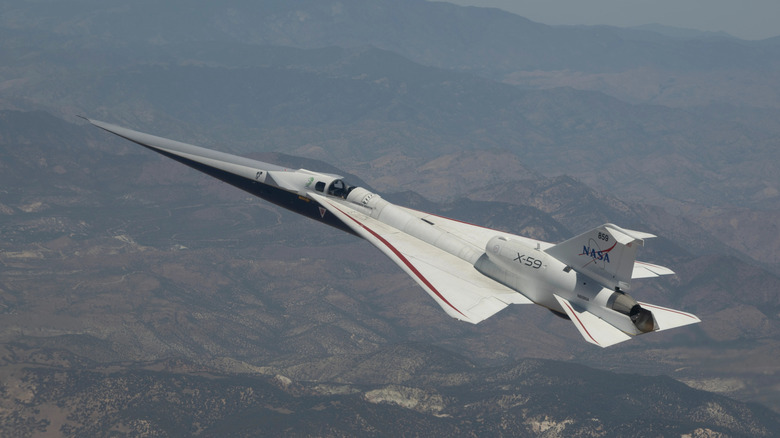
NASA has taken a step toward quiet supersonic flight. The X-59 experimental aircraft broke the sound barrier for the first time without producing the deafening sonic boom typically associated with supersonic aircraft. This confirmed that the concept works and that the mission is proceeding according to plan.
The NASA X-59 aircraft completed its first supersonic flight as part of the Quest mission. Credit: NASA / Lori Losey
How the test was conducted
Pilot Jim Less took off from Edwards Air Force Base in California and accelerated the X-59 to approximately 1,148 km/h, which is 1.1 Mach—ten percent faster than the speed of sound. The flight altitude was about 13,230 m. The test lasted 81 minutes, during which the team evaluated flight characteristics in subsonic and supersonic modes.
An F-15 fighter jet flew alongside for observation. Its loud sonic boom drowned out any sounds from the X-59, so it was not possible to assess the aircraft’s quietness during this flight.
NASA’s X-59 aircraft completed its first supersonic flight as part of the Quest mission.
Source: NASA Armstrong Flight Research Center
The next milestone
The next step will be a flight under mission conditions. The X-59 is scheduled to reach a speed of Mach 1.4, or approximately 1,489 km/h, and climb to an altitude of about 16,760 meters. These parameters form the basis for the final phase of testing.
Following this, the X-59 will conduct test flights over several communities in the United States. NASA will collect data on how people perceive the noise from the aircraft and will share it with U.S. and international regulators to help develop new noise standards.
Mission objective
The X-59 aircraft is central to the Quest mission, which aims to demonstrate that supersonic commercial flights over cities are possible without causing noise pollution for people on the ground.
As part of the program, NASA is developing methodologies and technologies for designing supersonic airliners. American manufacturers will be able to build new aircraft with the confidence that they will meet quiet flight requirements, and passengers on international routes will reach their destinations faster.
El Nino has arrived, and weather experts fear the global climate phenomenon may be primed to match a deadly event that led to the deaths of more than 50 million people.
The natural climate pattern occurs when warmer-than-usual waters in the Pacific change the weather around the world for a minimum of several months.
Ocean conditions have now warmed to the point where El Nino is active and will likely continue well into next year, officials declared on Thursday.
The declaration means the agency has found that sea surface temperatures are at least +0.9°F above average and are expected to stay that way for the foreseeable future.
Climate scientists fear this frequent weather event will become a 'Godzilla' or 'Super' El Nino by the end of the year, meaning sea surface temperatures rise to 3.6°F above normal or even higher - which NOAA classifies as 'strong.'
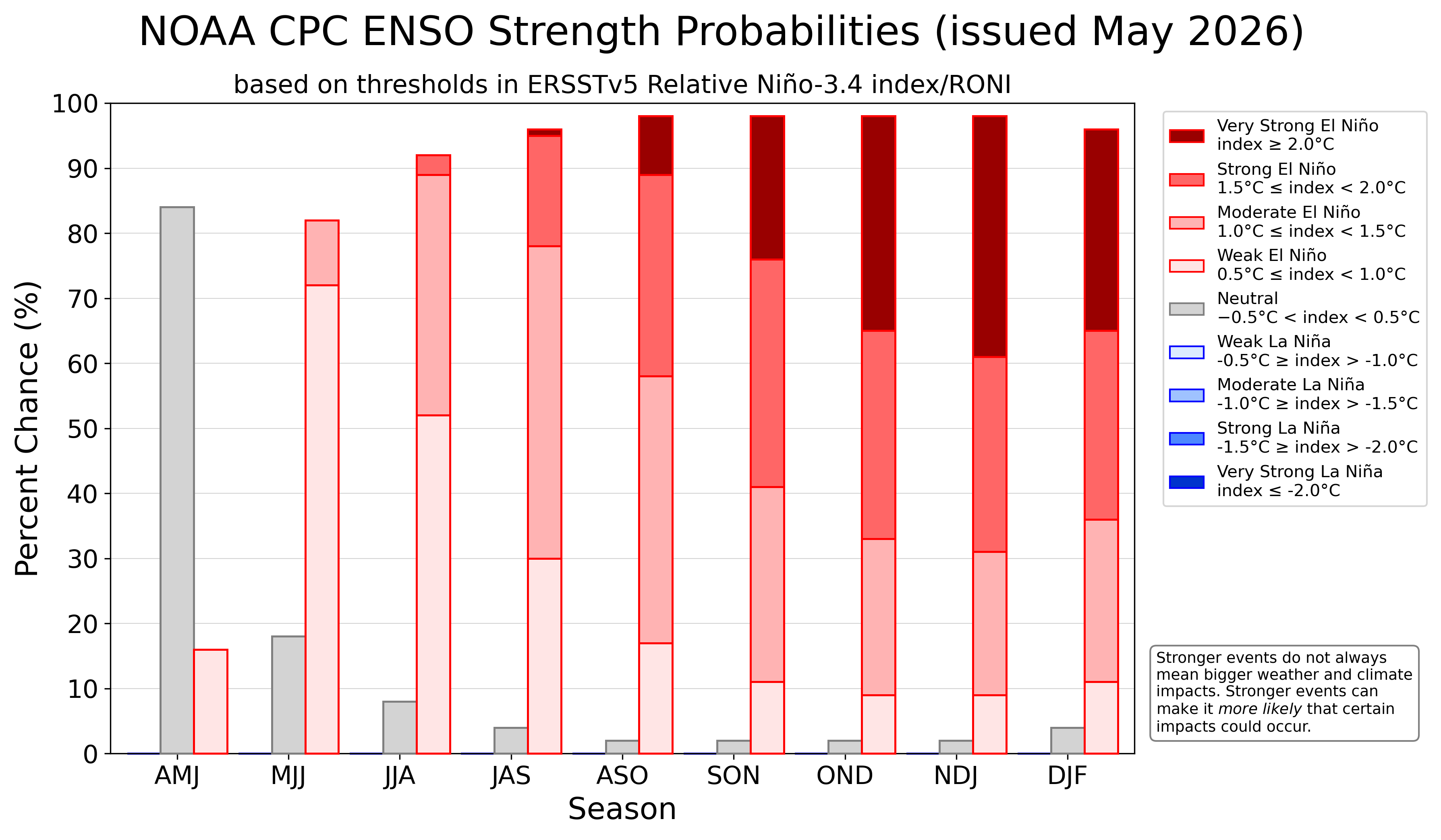
The agency confirmed those fears on Thursday, stating that there is a 63 percent chance of El Nino becoming 'very strong' between November 2026 and January 2027.
Climate officials added that this El Nino will likely be one of the strongest since 1950, and there is a fear it could match an event from 1877, which triggered severe droughts and crop failures around the world, contributing to more than 50 million deaths globally.
Scientists warn that a so–called 'super El Nino' could push global temperatures (above) to record–breaking highs
Many climate historians think the 1877 event reshaped world history, and some consider it one of the first 'truly global climate disasters.'
Just a 4.86°F increase in sea surface temperatures in the Pacific Ocean wreaked havoc across several continents.
Parts of Africa, Southeast Asia and Australia experienced severe drought and forest fires. India saw its normal monsoon rains disappear, while Northern China suffered devastating dry spells that led to harvest failures. In Brazil, rivers dried up and agriculture collapsed.
There were also outbreaks of malaria, plague, dysentery, smallpox and cholera across already weakened populations.
Researchers have estimated that the resulting scarcity of food and disease outbreaks killed up to 4 percent of the Earth's population at the time. That would be the equivalent of at least 250 million people dying if El Nino caused that to happen today.
While every El Nino is different, in the US, it typically brings warmer-than-normal temperatures across the northern half of the country and parts of Alaska. Cooler conditions are more common across the southern states, especially from Texas through the Southeast.
The climate pattern also tends to shift storm tracks, increasing the chances of wetter-than-average weather across California, the Southwest, the Gulf Coast and much of the Southeast.
Meanwhile, drier conditions are often seen in parts of the northern Rockies, the Ohio Valley, the Great Lakes and sections of the Mississippi Valley.
Drought-stressed wheat plants near parched ground in a field in Kansas last month. Scientists fear El Nino will lead to more droughts, especially in the northern US
Thursday's announcement revealed that the area of the central Pacific where scientists actively monitor sea surface temperatures for El Nino was 1.3°F above normal - breaking the El Nino threshold of 0.9°F.
However, NOAA also revealed that ocean waters in the eastern Pacific have already risen to 3.8°F above average. This pattern, where warmer water is detected in the east, is typical when a strong El Nino is developing.
AccuWeather senior meteorologist Chad Merrill said in a statement: 'Most El Ninos begin in the fall, so this is developing much earlier and faster than expected.'
El Nino often disrupts global rain patterns, making the climate wetter in the southern US and drier in the north
In the US, El Nino has a major impact on the natural jet stream, which flows from west to east over the middle of the country.
As El Nino heats the Pacific, this pushes the jet stream farther south, so it flows over the southern and Gulf states.
This brings wetter weather to the South, drier weather to the Midwest and warmer weather to the Pacific Northwest and Northern Plains.
'It will intensify drought in the Northwest and northern Rockies and lessen drought intensity and coverage in the Southwest,' Merrill added.
'It won’t do anything to eliminate the long-term drought in the Southeast and mid-Atlantic until we get to late fall and early winter.'
Deepti Singh, associate professor at Washington State University, told the Washington Post: 'Simultaneous multiyear droughts similar to those in the 1870s could happen again.'
'What is different now is that our atmosphere and oceans are substantially warmer than they were in the 1870s, which means the associated extremes could be more extreme.'
Climate forecasts show that 2026's temperatures in the Pacific Ocean are already well above average - triggering El Nino
While Super El Ninos have had a catastrophic impact on the globe in past years, meteorologists have noted that it may help the East Coast avoid a devastating Atlantic hurricane season.
Overall, AccuWeather is now predicting a below-average hurricane season, with fewer named storms and fewer tropical cyclones developing into major hurricanes.
However, AccuWeather's Lead Long Range Forecaster Paul Pastelok told the Daily Mail that this does not mean Americans should let down their guard in 2026, as a major hurricane can still reach land despite the presence of El Nino.
'It only takes one storm, and then boom! We're not saying that El Nino is going to weaken and dampen the Atlantic Basin season completely,' he said.
'There's still a lot of warm water, a lot of potential there. So, [I] just wanted to make sure [if] people were saying, "Oh, we don't have to worry about anything this year." That's not true. It only takes one storm.'
Pastelok noted that the devastating Hurricane Andrew, which made landfall in Southern Florida as a Category 5 storm in 1992 and killed 65 people globally, developed during an El Nino summer.
RELATED VIDEOS
Scientists Warn Massive Ocean Changes Could Reshape Global Weather | WION
Super El Niño Alert: World Braces For Major Climate Shift | WION World News
[VIDEO] “Leaked Over Area 51?” — Suspected Boeing F-47 NGAD Sixth-Generation Fighter Captured in Thermal Footage Near Groom Lake
Thermal footage filmed near Groom Lake and the Nevada Test and Training Range is fuelling speculation that the U.S. Air Force may already be flying a classified Boeing F-47 NGAD technology demonstrator years before operational deployment.
The sudden emergence of thermal footage allegedly showing a classified sixth-generation combat aircraft over Nevada’s heavily restricted Nevada Test and Training Range has injected unprecedented public visibility into the U.S. Air Force’s secretive Next Generation Air Dominance ecosystem at a moment of accelerating strategic competition with China.
Air Force
(DEFENCE SECURITY ASIA) — The sudden emergence of thermal footage allegedly showing a classified sixth-generation combat aircraft over Nevada’s heavily restricted Nevada Test and Training Range has injected unprecedented public visibility into the U.S. Air Force’s secretive Next Generation Air Dominance ecosystem at a moment of accelerating strategic competition with China.
The aircraft captured near Groom Lake appears to display an advanced tailless-canard blended-wing configuration consistent with speculative Boeing F-47 renderings, potentially marking the clearest publicly accessible imagery yet associated with America’s future air-superiority architecture.
If authentic, the footage suggests that risk-reduction demonstrators connected to the NGAD programme are already conducting operationally representative flight profiles years before the projected first flight window publicly associated with the production-standard Boeing F-47.
The implications extend far beyond aviation enthusiasts because any confirmation that a mature NGAD demonstrator is already flying would indicate the United States has progressed deeper into sixth-generation tactical aviation integration than previously understood by foreign intelligence services.
Movies
The video surfaced amid intensifying Pentagon emphasis on survivable long-range strike capabilities designed to penetrate increasingly dense anti-access and area-denial environments established by China’s People’s Liberation Army across the Indo-Pacific battlespace.
Unlike the F-22 Raptor generation, which emerged during an era of overwhelming U.S. post-Cold War aerospace superiority, the F-47 programme is being engineered specifically to survive highly networked kill chains integrating advanced radar systems, infrared search-and-track arrays, hypersonic weapons, and satellite-enabled targeting architectures.
The thermal capture was uploaded on June 5, 2026 by the YouTube channel PROJECT FEAR, whose operators conducted repeated observation trips overlooking the Nevada Test and Training Range from public terrain near Rachel, Nevada.
The footage reportedly involved collaboration with Anders Otteson of Uncanny Expeditions, whose earlier thermal observations of unidentified triangular aircraft in the same region had already intensified speculation surrounding classified aerospace activity over Area 51.
According to Otteson, the aircraft passed approximately 300 to 400 yards overhead, allowing its unusual aerodynamic planform and forward canards to resolve with greater clarity than previous civilian thermal captures associated with Groom Lake operations.
The aircraft’s apparent tailless configuration, cranked-kite wing geometry, and stealth-oriented edge alignment collectively mirror multiple publicly circulated conceptual depictions linked to Boeing’s NGAD design studies and historical tailless demonstrator programmes.
The timing of the footage is strategically significant because Boeing secured the Engineering and Manufacturing Development contract for the F-47 programme in March 2025 under a deal initially valued at approximately US$20 billion, equivalent to roughly RM76 billion.
That contract represented not merely a fighter procurement decision but a strategic industrial verdict on which aerospace architecture Washington believes can dominate contested airspace against peer competitors throughout the 2030s and potentially into the 2050s.
Has the F-47 Already Taken Flight? Groom Lake Footage Sparks Big Questions.
Area 51’s Strategic Role in America’s Black Aerospace Pipeline
Groom Lake has historically functioned as the operational bridge between classified aerospace experimentation and deployable combat capability, making any unusual aircraft activity there strategically consequential rather than merely speculative.
The same restricted complex hosted developmental testing associated with programmes such as the F-117 Nighthawk, early stealth demonstrators, and advanced reconnaissance platforms before their eventual public acknowledgment reshaped modern military aviation doctrine.
The Nevada Test and Training Range offers uniquely valuable operational conditions because its immense restricted airspace enables low-observable flight testing beyond the persistent surveillance envelope normally imposed by civilian radar and commercial aviation activity.
The suspected F-47-related aircraft reportedly conducted a relatively low-altitude and comparatively slow overhead pass, an unusual profile suggesting either deliberate observational exposure or operational testing emphasizing low-speed handling and sensor management characteristics.
Such low-profile flight behaviour diverges from traditional high-altitude classified test patterns and instead resembles historical “show-of-presence” flights sometimes associated with confidence validation or strategic signalling within black programme communities.
The platform’s blended-wing-body characteristics align with broader U.S. Air Force efforts to reduce radar cross-section while simultaneously increasing internal fuel volume necessary for Pacific-theatre combat operations exceeding 1,000 nautical miles in combat radius.
That range requirement reflects growing Pentagon concern that future wars against China would involve sustained long-distance air operations across the Western Pacific without reliable access to vulnerable forward operating bases.
A sixth-generation aircraft emphasizing range, thermal suppression, stealth shaping, and manned-unmanned teaming would fundamentally alter force-posture calculations surrounding Taiwan contingency planning and broader Indo-Pacific deterrence strategies.
The NTTR’s role in validating these technologies also suggests the aircraft may represent a technology demonstrator rather than a finalized operational platform, particularly given continuing uncertainty regarding NGAD’s ultimate procurement scale and cost structure.
The strategic importance of the programme intensified after earlier Pentagon concerns that projected NGAD fleet costs could exceed sustainable procurement thresholds, temporarily slowing programme momentum before Boeing’s selection revived development confidence.
The United States Air Force has dramatically accelerated development of the Boeing F-47 sixth-generation fighter by requesting US$5.03 billion (RM19.11 billion) for Fiscal Year 2027, signalling Washington’s intensifying concern over China’s rapidly advancing next-generation combat aviation programs.
Thermal Signature Anomalies and Next-Generation Stealth Engineering
One of the most analytically significant aspects of the footage involves the apparent absence of a conventional exhaust plume despite the aircraft reportedly generating substantial acoustic signatures during flight operations.
Conventional fighter aircraft typically produce highly visible infrared exhaust patterns detectable even by consumer-grade thermal optics, particularly during low-altitude nighttime operations involving significant engine thrust output.
The lack of a clearly identifiable exhaust bloom has therefore become central both to scepticism surrounding the footage and to arguments supporting the possibility of advanced thermal-management technologies integrated into sixth-generation propulsion systems.
Analysts have increasingly linked the anomaly to adaptive-cycle engine concepts associated with the Next Generation Adaptive Propulsion programme, particularly Pratt & Whitney’s XA-103 architecture emphasizing thermal suppression and fuel efficiency.
Adaptive-cycle propulsion enables dynamic airflow modulation between fuel-efficient cruise performance and high-thrust combat operations, potentially reducing infrared detectability while extending operational range across Indo-Pacific combat distances.
Infrared suppression has become strategically critical because modern air warfare increasingly relies on passive detection systems designed specifically to counter low-observable radar signatures through advanced heat-tracking methodologies.
China’s rapid deployment of infrared search-and-track capabilities aboard advanced platforms such as the J-20 has intensified U.S. emphasis on reducing not merely radar visibility but also thermal and electronic signatures across the electromagnetic spectrum.
The footage reportedly displayed a strong overall airframe thermal return without distinct engine plume definition, a phenomenon potentially consistent with distributed heat-management systems dispersing exhaust temperatures across broader structural surfaces.
Such engineering approaches would significantly complicate enemy missile lock-on processes during beyond-visual-range engagements, particularly against increasingly sophisticated dual-mode seekers combining radar and infrared guidance technologies.
Even if partially influenced by sensor-processing limitations inherent to consumer-grade thermal equipment, the footage nevertheless highlights how sixth-generation survivability may depend increasingly on multispectral stealth rather than radar reduction alone.
The Boeing F-47 NGAD America's Secret Weapon That Will Completely Dominate Every 6th Gen Fighter
Boeing F-47 and the Emerging Sixth-Generation Battlespace
The Boeing F-47 programme represents far more than a successor to the F-22 because it forms the central manned component within a broader distributed combat ecosystem integrating autonomous collaborative combat aircraft and AI-enabled battlespace management.
The United States Air Force has repeatedly emphasized that NGAD should be understood as a “family of systems” rather than a standalone fighter platform operating independently of networked unmanned assets.
Under this operational doctrine, the manned F-47 would likely function as an airborne command-and-control node directing loyal-wingman drones, electronic warfare systems, and distributed sensor networks deep inside contested airspace.
This architecture reflects lessons emerging from modern conflicts demonstrating that survivability increasingly depends upon distributed kill chains rather than concentration of capability within single exquisite platforms vulnerable to mass missile saturation.
The suspected aircraft’s tailless-canard geometry is strategically important because such designs prioritize aerodynamic efficiency and stealth edge alignment while potentially enabling high-energy maneuverability during long-range engagements.
Both proposed scenarios suggest that stealth aircraft development cycles are progressing at an accelerated pace. This acceleration could lead to more sightings of advanced aircraft before any official announcements are made.
Historically, canard configurations created radar-reflection penalties incompatible with earlier stealth requirements, yet sixth-generation computational design techniques may now permit canard integration without unacceptable low-observable compromises.
The aircraft’s apparent cranked-kite wing structure also aligns with aerodynamic concepts associated with sustained supersonic cruise efficiency and optimized lift distribution during long-duration penetration missions.
These characteristics are particularly relevant for Indo-Pacific operational scenarios where U.S. aircraft may need to transit enormous distances while retaining sufficient fuel and weapons capacity for high-intensity combat operations.
Boeing’s victory over rival industry competitors in securing the F-47 contract additionally carried enormous industrial consequences because the programme could determine American tactical aviation leadership for several decades.
The approximately US$20 billion initial EMD contract, equivalent to RM76 billion, therefore represents both a military investment and a strategic industrial commitment intended to preserve U.S. aerospace dominance amid rising Chinese aviation capability.
Thermal footage near Area 51 fuels F‑47 stealth jet speculation
Public Exposure, Strategic Signalling, and Intelligence Implications
The apparent visibility of the aircraft to civilian observers raises complex questions regarding whether the flight represented accidental exposure, operational complacency, or intentional strategic ambiguity directed toward foreign intelligence audiences.
Historically, selective visibility surrounding classified aerospace projects has occasionally functioned as a controlled signalling mechanism intended to shape adversary perceptions without revealing programme specifics or validated operational capabilities.
Allowing glimpses of advanced platforms can influence enemy procurement decisions, force-posture planning, and deterrence calculations by introducing uncertainty regarding the maturity of hidden technologies.
The timing of the footage coincides with growing global attention surrounding sixth-generation fighter competition involving the United States, China’s J-36 and J-50-related speculation, and multinational European GCAP and FCAS programmes.
Within this context, even ambiguous footage potentially contributes to psychological deterrence by reinforcing perceptions that Washington remains technologically ahead in stealth aviation and advanced propulsion integration.
The strategic signalling effect becomes particularly relevant as Beijing accelerates military modernization efforts emphasizing anti-access missile systems, advanced fighters, and long-range sensor networks across the Indo-Pacific region.
At the same time, intelligence analysts remain cautious because low-resolution thermal imagery inherently creates interpretive ambiguity capable of generating exaggerated conclusions unsupported by verifiable evidence.
The footage does not conclusively prove the operational existence of a production-standard F-47 platform, nor does it confirm the aircraft’s exact configuration, propulsion architecture, or programme affiliation.
Nevertheless, the consistency between the captured planform and previously circulated NGAD-related renderings significantly narrows the range of plausible alternative explanations compared with earlier unidentified aerospace sightings.
That convergence between speculative concept art and observable aerodynamic geometry explains why multiple aerospace analysts now regard the footage as potentially the most credible civilian glimpse yet into America’s next-generation air-dominance ecosystem.
Why the Alleged NGAD Sighting Matters for Future Air Warfare
If the aircraft genuinely represents an NGAD technology demonstrator, the footage indicates the United States may already be transitioning from conceptual sixth-generation research toward practical operational validation under realistic flight conditions.
Such progress would reshape assessments of future airpower balance because China and Russia have both invested heavily in counter-stealth technologies specifically intended to neutralize earlier-generation U.S. low-observable advantages.
A functioning sixth-generation demonstrator integrating multispectral stealth, adaptive propulsion, AI-enabled networking, and long-range persistence would therefore restore uncertainty into adversary strategic planning calculations.
The emphasis on tailless stealth shaping and thermal management additionally suggests future fighter survivability will increasingly depend on defeating integrated sensor fusion rather than relying exclusively upon radar invisibility.
This evolution reflects broader changes in military technology where passive infrared tracking, space-based surveillance, and distributed radar architectures collectively threaten traditional assumptions regarding stealth survivability.
Photo: Carsten Koall/dpa (Photo by Carsten Koall/picture alliance via Getty Images)
If confirmed authentic, the observed aircraft could serve as the manned platform within the U.S. Air Force's Next Generation Air Dominance (NGAD) 'family of systems.' This role would involve coordinating with autonomous drones and penetrating advanced air defense networks.
The aircraft’s reported low-speed overhead transit may also indicate testing related to sensor calibration, autonomous coordination, or variable-cycle propulsion management rather than pure high-speed performance evaluation.
Such operational experimentation would align with the Pentagon’s broader doctrinal shift toward adaptive combat ecosystems emphasizing persistence, survivability, and data integration over legacy dogfighting paradigms.
For Indo-Pacific military planners, confirmation that NGAD demonstrators are already flying would significantly influence calculations regarding force structure, aerial refueling requirements, forward basing vulnerability, and coalition interoperability strategies.
It would also intensify pressure on allied air forces participating in parallel sixth-generation efforts to accelerate timelines amid fears of widening capability divergence within Western aerospace ecosystems.
Although uncertainty remains unavoidable without official confirmation from the U.S. Air Force or Boeing, the Groom Lake thermal footage has nevertheless transformed NGAD from abstract procurement language into a visible symbol of the coming sixth-generation airpower era.
U.S Most Powerful and Deadliest F-47 Sixth-Gen Fighter Jet is Monstrous
Now, NASA says it is getting the plane ready to fly at faster speeds and higher altitudes, including its first test flight beyond the speed of sound.
With a new series of tests starting in early June, the space agency plans to fly X-59 at speeds of over 630 miles per hour (1,014 km/h) at an altitude of 43,000 feet.
This will be followed by a 'mission conditions flight', during which the jet will hit Mach 1.4, 925 miles per hour (1,490 km/h), at 50,000 feet.
Finally, test pilots will push the jet to its absolute limit, reaching a top speed of Mach 1.6 at 60,000 feet - around twice the height and speed of a commercial airline.
NASA's experimental supersonic jet, dubbed the 'Son of Concorde', will take to the skies in its first faster-than-sound flight in July
When a plane flies at sub-sonic speeds, it pushes the air out of the way like a boat moving through water, creating ripples in the form of sound waves.
But when something reaches the speed of sound, it starts to outrun these sound waves, and the ripples bunch up and merge together into a powerful shockwave.
This means that supersonic jets are constantly generating shockwaves, which people on the ground hear as a deafening boom as they sweep past.
Because these booms can be as loud as 110 decibels, similar to a loud rock concert, supersonic flights are generally banned over populated areas.
To solve this problem, NASA has been working to develop 'Quiet SuperSonic Technology (Quesst)' that would muffle the boom into a muted 'thump'.
The X-59 features a radically redesigned geometry in which every feature is designed to diffuse and muffle the sonic boom.
The X-59 jet has been designed to produce a much quieter sonic boom when flying at supersonic speeds, creating a 'thump' rather than a bang
Part of the reason that Concorde was eventually discontinued was that the sonic boom produced by breaking the sound barrier could be extremely loud for people on the ground
During the upcoming tests, the experimental aircraft will be chased by a standard supersonic jet equipped with a probe to record the shockwave
X-59: Key specs
* Manufacturer: Lockheed Martin
* Length: 99.7 feet (30 metres)
* Wingspan: 29.7 feet (9.0 metres)
* Max. airspeed: 1,218 mph
* Program cost: $247.5m (£187.5m)
* First flight: October 28, 2025
The most obvious difference from a normal jet is the thin, tapered nose, which accounts for almost a third of the plane's entire length and is shaped to break up the shockwave.
The downside of this novel design is that the cockpit is located around halfway down the length of the vehicle and doesn't have any forward-facing windows.
Instead, the single pilot uses a system of cameras and augmented reality displays, known as the eXternal Vision System, to see out the front.
Reaching these new speed and altitude records is a key milestone for Quesst, since they are NASA's targets for the X-59 to eventually fly over American communities.
Cathy Bahm, project manager for NASA's Low Boom Flight Demonstrator, says: 'Every step of envelope expansion brings us closer to demonstrating the quiet supersonic capability that is at the heart of the Quesst mission.
'Completing the first mission-conditions flight is especially meaningful - it's the moment where we begin validating the aircraft in the environment it was designed for.'
While the eventual goal is to produce quiet sonic booms, this upcoming batch of test flights will not be designed to assess the volume of the flight.
The X-59 will be accompanied by a standard supersonic chase plane, which would drown out any useful data with its own, much louder boom.
According to NASA, the sonic thump produced by X-59 passing overhead will be quieter than the sound of a car door shutting 20 feet away
The X-59's aerodynamic profile has been designed so that it breaks up the shockwave formed by passing the sound barrier and is much quieter in flight. Pictured: The sonic boom from a scale model of the aircraft during wind tunnel tests
Travelling at speeds up to Mach 1.6, or 1,218 miles per hour (1,960 km/h), the X-59 could cut the trip from London to New York to just four hours
The X-59's long nose accounts for a third of its total length, which means the cockpit doesn't have room for a forward-facing window. Test pilots instead use a system of cameras and augmented reality displays to see where they are going (pictured)
However, the chasing jet will be equipped with a specialised probe to take initial measurements of the X-59's shock waves.
Strain gages throughout the aircraft's body will also gather data on how it handles higher speeds and whether it is structurally safe to fly.
This data will pave the way for a new set of tests later this year, dubbed Quesst Phase 2, in which NASA will begin to check whether it is really producing a quiet supersonic thump as intended.
Ms Bahm says: 'As we look ahead to the upcoming flights, we're poised to open the envelope even further - moving boldly toward the mission test point this aircraft was built to achieve.'
The history of Concorde
Concorde was a turbojet-powered supersonic passenger jet that was operated from 1976 until 2003.
It had a maximum speed over twice the speed of sound at Mach 2.04 (1,354mph or 2,180k per hour at cruise altitude) and could seat 92 to 128 passengers.
It was first flown in 1969, but needed further tests to establish it as viable as a commercial aircraft. Concorde entered service in 1976.
It is one of only two supersonic transports to have been operated commercially. The other is the Soviet-built Tupolev Tu-144, which ran as a passenger aircraft only for a few years in the 1970s due to safety issues.
Concorde was the world's first supersonic airliner and operated for 27 years, but it was grounded in October 2003. Pictured is British Airways Concorde G-BOAB taking off with its landing gear still extended over the Cotswolds town of Fairford, Gloucestershire on July 20, 1996, during the annual RAF Fairford airshow
Concorde was jointly developed and manufactured by Aérospatiale and the British Aircraft Corporation (BAC) under an Anglo-French treaty. Concorde's name, meaning harmony or union, reflected the cooperation on the project between the UK and France.
Concorde was retired in 2003 due to a general downturn in the commercial aviation industry after its only crash in 2000, the September 11 attacks in 2001, and a decision by Airbus, the successor to Aérospatiale and BAC, to discontinue maintenance support.
It wasn't the first plane to break the sound barrier, however; that achievement was managed by the Bell X-1, piloted by Chuck Yeager, in October 1947.
The legendary rocket engine-powered aircraft, designed and built in 1945, achieved a speed of 700 miles (1,127 kilometers) per hour.
‘
Son of Concorde’ goes supersonic for first time paving way toward 3.5 hour London-NYC flights
NASA’s Supersonic Plane X-59 ‘Son of Concorde’ Completes Crucial Wheels-Up Test Flight
The ominous sign a SUPER El Niño is inching closer: Satellite image reveals how large areas of the Atlantic Ocean are 5°C hotter than usual – suggesting the unusual climate event could be imminent
Large areas of the Atlantic Ocean and Mediterranean Sea are currently 5°C (9°F) hotter than usual, amid warnings a Super El Niño is imminent.
Satellite images show an ongoing marine heatwave off the northern and western coasts of France, the southern coast ofSpainand in the sea off Monaco.
The waters off the coast of Dover, Eastbourne and Brighton are also significantly warmer than usual, with areas of dark red indicating soaring temperatures.
The image is based on recorded sea surface temperatures on 30 May, provided by the Copernicus Marine Service.
And it comes amid warnings that a 'Super El Niño' – marked by sustained warm temperatures across the Pacific Ocean – is inching closer.
Experts from the World Meteorological Organisation (WMO) recently predicted there is an 80 per cent likelihood of the weather phenomenon occurring during June–August 2026.
Current signs point to this year being one of the strongest El Niño patterns ever recorded.
While elevated temperatures in parts of the Atlantic and the Mediterranean are not used as part of an El Niño diagnosis, the weather phenomenon is expected to bring extreme heat 'nearly everywhere', with the potential for global average temperatures to rise by as much as 3°C (5.4°F) this summer.
Satellite images show an ongoing marine heatwave off the northern and western coasts of France, the southern coast of Spain and in the sea off Monaco. The waters off the coast of Dover, Eastbourne and Brighton are also significantly warmer than usual, with areas of dark red indicating soaring temperatures
El Niño years form part of a natural cycle known as the El Niño–Southern Oscillation and are marked by sustained warm temperatures across the Pacific Ocean.
Where this ocean surface warming exceeds 2°C (3.6°F), the event is often referred to as a 'super El Niño'.
While each El Niño varies, the event typically brings increased rainfall in parts of southern South America, the southern United States, parts of the Horn of Africa and central Asia.
In contrast, there will be drier conditions over Central America, northern South America, the Caribbean, Australia, Indonesia, and parts of southern Asia.
Meanwhile, scientists say there's a strong chance 2026 will be the hottest year ever recorded.
That could mean beating the record set in 2024, when global warming exceeded 1.5°C (2.7°F) above the pre–industrial average for the first time.
From late April to mid–May, the sea–surface temperature in the central–eastern Equatorial Pacific – the area used as a monitoring reference – was approaching El Niño thresholds, according to the WMO.
These increasing surface temperatures are being fed by unusually warm subsurface water in the tropical Pacific, where temperatures are a whopping 6°C (10.8°F) above average.
A Super El Niño is on its way, and is almost certain to arrive this summer. That's according to scientists from the World Meteorological Organisation (WMO), who warn there's now an 80 per cent likelihood of an El Niño event during June–August 2026, and a 90 per cent chance this will continue until at least November
The world is on track for 'extraordinary extreme weather' later this year, scientists have warned, as global ocean temperatures indicate a record–breaking heat is likely
The UK's top 5 warmest years
2025: 10.09°C
2022: 10.03°C
2023: 9.97°C
2014: 9.88°C
2024: 9.79°C
While its effects on the UK are yet to be determined, meteorologists say El Niño's intensity will likely be comparable to the 1997/98 event which saw global temperatures reach their highest on record.
During its development, the UK experienced an exceptionally hot, sunny and humid August characterised by heatwaves.
The average maximum temperature at Heathrow in August 1997 was 25.8°C (78.4°F), with a top temperature of 31.5°C (88.7°F) reached.
However, while the phenomenon typically brings warmer and drier conditions to the UK during summer months, it also increases the likelihood of colder winters.
WMO Secretary–General Celeste Saulo said: 'We need to prepare for a potentially strong El Niño event – which will exacerbate drought and heavy rainfall and increase the risk of heatwaves both on land and in the ocean.
'The most recent El Niño, in 2023–24, was one of the five strongest on record and it played a role in the record global temperatures we saw in 2024.
'The WMO community will be carefully monitoring conditions in the coming months to inform decision–making by governments, humanitarian agencies and climate–sensitive sectors.
'Advance seasonal forecasts and early warnings are vital to save lives and cushion the impact on our economies and our communities.'
Scientists say there is an extremely high, 86 per cent, chance that one year between now and 2030 will smash the temperature record last set in 2024
Yesterday, it emerged that the impending weather phenomenon could add hundreds to your grocery bill.
'We import two–fifths of our food from overseas,' Gareth Redmond–King, international lead at the Energy & Climate Intelligence Unit (ECIU), said.
'Extreme conditions that are driven by climate change, turbocharged by El Niño, are a threat to crops we can't grow here.
'Things like bananas, rice, tea, coffee and lots of fresh fruit.'
Food prices in the UK are already on track to be 50 per cent higher by November than they were five years ago, he added.
It comes as campaigners warned the weekly shop will keep getting more unpredictable – and more unaffordable – for millions of households.
Meanwhile, scientists have also raised concerns that an imminent Super El Niño could trigger global famine.
Benjamin Selwyn, Professor of International Relations and Development at the University of Sussex, said extreme heat and drought could damage harvests and worsen global food insecurity this summer.
El Niño alters rainfall, shifts jet streams and raises global temperatures,' he wrote on The Conversation.
'Human‑induced global heating intensifies these dangers.
'A study by the UN's Food and Agriculture Organization and the World Meteorological Organization shows that rising heat could make farm work unsafe for much of the year across South Asia, sub‑Saharan Africa and parts of the Americas.
'Crop yields have dropped sharply above 30°C, while heat stress reduces livestock productivity and survival.'
El Niño and La Niña are the warm and cool phases (respectively) of a recurring climate phenomenon across the tropical Pacific - the El Niño-Southern Oscillation, or 'ENSO' for short.
The pattern can shift back and forth irregularly every two to seven years, and each phase triggers predictable disruptions of temperature, winds and precipitation.
These changes disrupt air movement and affect global climate.
ENSO has three phases it can be:
*El Niño: A warming of the ocean surface, or above-average sea surface temperatures (SST), in the central and eastern tropical Pacific Ocean. Over Indonesia, rainfall becomes reduced while rainfall increases over the tropical Pacific Ocean. The low-level surface winds, which normally blow from east to west along the equator, instead weaken or, in some cases, start blowing the other direction from west to east.
* La Niña: A cooling of the ocean surface, or below-average sea surface temperatures (SST), in the central and eastern tropical Pacific Ocean. Over Indonesia, rainfall tends to increase while rainfall decreases over the central tropical Pacific Ocean. The normal easterly winds along the equator become even stronger.
* Neutral: Neither El Niño or La Niña. Often tropical Pacific SSTs are generally close to average.
NASA readies the X-59 for its first supersonic flight, SpaceX's Starship grounded and more science stories
by Cheyenne MacDonald
NASA/Jim Ross
This week, NASA shared more information about its planned moon base missions, Blue Origin's New Glenn rocket exploded on the launchpad and the James Webb Space Telescope spotted a supermassive black hole that researchers say "may have formed within the first second after the big bang." But first, we have updates on NASA's X-59 quiet supersonic research plane and SpaceX's Starship following last week's test flight. Catch up here on this week's science news.
Key test flights approach for NASA's quiet supersonic plane
Over the last decade, NASA has been developing an aircraft that could one day reach supersonic speeds — or travel faster than the speed of sound — without producing the thunderous sonic booms typically associated with this feat. The plane, called the X-59, took its first ever flight back in October and has conducted several more in the months since. Now, NASA says it's ready to go supersonic. The X-59 is scheduled to take its first supersonic flight, hitting over 630 mph at an altitude of about 43,000 feet, in early June, according to the space agency./
55,000 feet. After that, it'll go for its max speed: Mach 1.6, or 1,218 mph, at an altitude of 60,000 feet. NASA isn't ready to show off the X-59's quiet supersonic capabilities yet, though. For this phase of testing, NASA noted in a blog post, "The X-59 will be accompanied by a traditional supersonic chase plane, so any quiet thump it produces in the current phase of testing will be obscured by louder, traditional sonic booms from the chase."
NASA’s X-59 Prepares for Supersonic Flight
FAA grounds Starship after 'mishap'
SpaceX's Starship V3 launched for the first time last week in a test flight that achieved much of what the company set out to do. But, it wasn't entirely without hiccups, and the Federal Aviation Administration (FAA) has since ordered a pause on Starship flights while it investigates what went wrong and prevented the Super Heavy booster from making a soft splashdown as intended.
The issue arose after Starship separated from Super Heavy. "Following stage separation, the Super Heavy booster performed a directional flip maneuver and attempted its boostback burn," SpaceX explained in a blog post following the launch. "It was unable to light all planned engines and performed a partial boostback burn that ended early. Super Heavy attempted to reignite its engines for the landing burn before experiencing a hard splashdown in the Gulf of America." Starship went on to complete its journey and splashed down at the planned site in the Indian Ocean.
"After a thorough assessment of the operation, the FAA has determined the May 22 SpaceX Starship Flight 12 launch resulted in a mishap," the agency said in a statement released this week. "The mishap involved the Super Heavy booster as it flew back to the Gulf of America after stage separation. There are no reports of public injury or damage to public property." It added, "The FAA is requiring SpaceX to conduct a mishap investigation. The FAA will oversee the SpaceX-led investigation, be involved in every step of the process, and approve SpaceX's final report, including any corrective actions."
It's not an uncommon move on the FAA's part, and SpaceX has faced several such groundings over the years, many of which have been wrapped up fairly quickly. It likely won't be very long before we see Starship back in action. "A return to flight of the Starship-Super Heavy vehicle is based on the FAA determining that any system, process, or procedure related to the mishap does not affect public safety," the FAA noted in its statement.
The FAA grounded SpaceX competitor Blue Origin's New Glenn rocket last month following its third mission, and it was just cleared earlier this week to resume flights. But, during a hotfire test on Friday, New Glenn exploded on the launch pad at Cape Canaveral. You can read more about that below.
NASA's X-59 aims for quiet supersonic flight in 2026
Finally! America Introduces Its New Supersonic Jet!
Is it a bird? Is it a plane? No, it's a lenticular cloud formation.
Strange, saucer‑shaped clouds had plenty of people in the North East glancing at the sky over the Bank Holiday - and checking their photos twice for UFOs.
The unusual formations, spotted from Darlington to Sunderland, looked uncannily like flying saucers stacked on top of each other, hanging almost motionless.
What people were really seeing were lenticular clouds - rare, lens‑shaped clouds that often get mistaken for unidentified flying objects because of their smooth, sculpted edges and layered, 'spaceship‑like' appearance.
Lenticular clouds over Sunderland during the bank holiday weekend
(Image: Ian Maggiore/Northern Echo Camera Club)
They don’t behave like typical fluffy cumulus clouds; instead, they tend to sit in one place for a long time, forming and fading in the same spot, which only adds to the eerie, other‑worldly effect.
That stillness against a hazy blue backdrop is exactly what made them so eye‑catching during the Bank Holiday heatwave.
Lenticular clouds usually develop when stable, moist air is forced to flow over higher ground, such as the Pennines or the Cheviots, and begins to ripple in a series of invisible waves on the downwind side.
Lenticular clouds over Darlington during the bank holiday weekend
(Image: Claire Bott/Northern Echo Camera Club)
As the air rises at the crest of each wave it cools, the moisture condenses and a distinctive, lens‑shaped cloud forms; as it sinks again, the cloud evaporates, giving that sharply defined, “cut‑out” edge.
During the heatwave, strong temperature differences at different levels of the atmosphere and changes in wind speed with height made these waves more pronounced, increasing the chances of lenticular clouds forming.
With clear skies, warm evenings and half the region outside for the bank holiday, it was the perfect recipe for these mini UFO clouds and some spectacular photos to go with the science.
According to the experts, they form when air is stable and winds blow across hills and mountains from the same or similar direction at different heights.
Rising sea levels are already putting millions at risk of flooding – but a study now warns that land subsidence is making the danger even greater.
Earth's sinking cities are slipping towards sea level at an alarming rate, experts from the Technical University of Munich have warned.
A study showed that subsidence more than doubles the rate of sea level rise for some areas of the coastline.
To make matters worse, researchers say that this affects the largest and most densely populated cities more than anywhere else.
Between rising seas and sinking land, heavily urbanised areas of coast experience a relative sea level increase of about 6mm per year on average.
That is three times more than the global average for relative sea level rise, which stands at 2.1mm per year.
Likewise, land subsidence roughly doubles the absolute sea–level rise of 3.15mm per year, which measures the actual increase in volume and height of the ocean.
Lead researcher Dr Julius Oelsmann, of Technical University of Munich, says that this can 'significantly amplify the effects of climate–driven sea–level rise'.
Scientists have found that land subsidence is doubling the rate at which the water level rises in some of the world's biggest cities, putting millions at risk of flooding. Pictured: Rate of uplift (red) and subsidence (blue) in coastal areas
Jakarta is the world's fastest–sinking city, subsiding at a rate of 13.7mm per year. This puts the megacity's 42 million residents in extreme danger of flooding. Pictured: Flooding in Jakarta following heavy rain in 2024
As the climate gets hotter, melting glaciers and the expansion of warming water are gradually raising the level of the world's oceans.
'If we want to understand sea–level rise along coastlines and respond effectively, we must not only observe the ocean but also the land itself,' Dr Oelsmann says.
This is because a mixture of human activity and natural forces is combining to sink some of the world's biggest cities into the ocean.
The biggest factors driving this subsidence are excessive groundwater and oil extraction, which remove underground resources that previously stabilised the surface.
Dr Oelsmann points out that the 'sheer weight of cities' is also driving urban areas below sea level.
As cities grow larger and taller, heavier buildings are constructed, which compacts the ground beneath and slowly sinks the city relative to its surroundings.
Combined with climate–change–driven sea level increase, urban areas are seeing the waterline rise a lot faster than the rest of the world.
In the UK, the US, and Europe, areas of the coastline are sinking into the sea due to land subsidence. This is leading to a significantly faster rate of relative sea level increase
Earth's sinking cities
Prominent subsidence hot spots include:
Jakarta (–13.7 mm/year)
Tianjin (–13.5 mm/year)
Bangkok (–8.5 mm/year)
Lagos (–6.7 mm/year)
Alexandria (–4 mm/year)
Countries where relative sea levels are rising the fastest include Thailand, Bangladesh, Nigeria, Egypt, China, and Indonesia, where the ocean is getting seven to 10 millimetres higher each year.
The US, the Netherlands, and Italy also experience exceptionally rapid increases, with relative sea levels rising by around four to 5mm per year.
Due to the strong influence of city size, many countries also featured intense 'hot spots' of subsidence.
The 42 million residents of Jakarta, Indonesia, the world's most populous city, are in particular peril as the megacity slips towards the ocean at a rate of 13.7mm per year.
This is closely followed by Tianjin, China, home to 13.8 million people, which is seeing 13.5mm of subsidence per year.
Similarly, Bangkok, Lagos, and Alexandria are all experiencing well above average rates of subsidence with 8.5, 6.7, and 4mm per year, respectively.
Even within cities, the different rates of subsidence meant that one neighbourhood might be falling towards the ocean while others rise out of it.
In Jakarta, for example, some parts of the city are sinking at a staggering 42mm per year, while other regions actually see uplift.
Densely populated urban coastal regions are experiencing around 6mm of relative sea level increase per year (red regions)
This means that millions of people in some of the world's biggest cities are being put at risk of severe flooding.
Even if their homes don't fall completely below sea level, every millimetre of relative sea level increase creates a bigger risk that storms or extreme weather will lead to severe floods.
Studies estimate that nearly half of the city could be inundated and uninhabitable by 2050 if sea levels continue to rise at the current rate.
These dense, urban regions stand in stark contrast to Scandinavia, where natural geological processes are gradually lifting the land out of the sea.
During the last Ice Age, these northern latitudes were weighed down with vast ice sheets that pushed the land into the ocean, much like coast megacities do today.
As these ice sheets have retreated, that weight was removed, and the land masses are still 'rebounding' towards a stable position.
That means, even as absolute sea levels increase, the relative sea level in Finland and Sweden is actually getting lower each year.
Unfortunately for the rest of the world, there are no geological processes to pull cities back out of the water.
However, the researchers point out that proper city planning can dramatically slow the rate of subsidence.
Co–author Professor Florian Seitz, of the Technical University of Munich, says: 'In many large coastal cities, groundwater extraction is a major driver of land subsidence.
'This means that local political and water–management decisions can make a significant difference.'
In Tokyo, Japan, for example, subsidence rates once exceeded 10cm per year, reaching peaks of 24cm per year in the worst areas.
However, through government intervention and the introduction of new water sources, those rates were dramatically reduced.
'Improved groundwater management, stricter regulation of withdrawals, or targeted recharge of aquifers can at least slow subsidence rates and, in some cases, largely halt them,' says Professor Seitz.
Global sea levels could rise as much as 1.2 metres (4 feet) by 2300 even if we meet the 2015 Paris climate goals, scientists have warned.
The long-term change will be driven by a thaw of ice from Greenland to Antarctica that is set to re-draw global coastlines.
Sea level rise threatens cities from Shanghai to London, to low-lying swathes of Florida or Bangladesh, and to entire nations such as the Maldives.
It is vital that we curb emissions as soon as possible to avoid an even greater rise, a German-led team of researchers said in a new report.
By 2300, the report projected that sea levels would gain by 0.7-1.2 metres, even if almost 200 nations fully meet goals under the 2015 Paris Agreement.
Targets set by the accords include cutting greenhouse gas emissions to net zero in the second half of this century.
Ocean levels will rise inexorably because heat-trapping industrial gases already emitted will linger in the atmosphere, melting more ice, it said.
In addition, water naturally expands as it warms above four degrees Celsius (39.2°F).
Every five years of delay beyond 2020 in peaking global emissions would mean an extra 8 inches (20 centimetres) of sea level rise by 2300.
'Sea level is often communicated as a really slow process that you can't do much about ... but the next 30 years really matter,' said lead author Dr Matthias Mengel, of the Potsdam Institute for Climate Impact Research, in Potsdam, Germany.
None of the nearly 200 governments to sign the Paris Accords are on track to meet its pledges.
RELATED VIDEOS
These Cities Are One Disaster Away From Total Collapse
By 2100, These Cities Will Be Underwater - According to Science
Delhi, Mumbai, New York & Mexico City Are Sinking | Reports by NASA-ISRO | Vantage on Firstpost | 4K
'The biggest El Niño event since the 1870s': 'Super' El Niño is now the most likely scenario by the end of this year — and the humanitarian cost could be huge
A "very strong" El Niño is now the most probable scenario for the October-to-February period.
El Niño is the warmer phase of the natural El Niño-Southern Oscillation (ENSO) climate cycle, a periodic shift in the waters of the tropical Pacific Ocean that supercharges global temperatures, in turn impacting weather patterns and crops worldwide.
Now, in a new ENSO forecast published May 14, NOAA estimates that there's a 65% chance that the upcoming El Niño will be classified as strong or very strong starting in October, potentially placing it among the strongest in recorded history.
What exactly is a ‘super’ El Niño? And what does it mean for you?
A "very strong" El Niño — meaning a 3.6-degree-Fahrenheit (2 degrees Celsius) rise in sea surface temperatures, and unofficially called a "super" El Niño — is now the most probable scenario for the October-to-February period.
El Niño most likely to be "strong" or "very strong" from October to February.
(Image credit: NOAA Climate Prediction Center)
A "very strong" El Niño could wreak havoc
El Niño events occur every two to seven years, when shifts in wind and current patterns in the tropical Pacific Ocean cause sea surface temperatures to rise 0.9 F (0.5 C) above historical averages, resulting in profound knock-on effects on the global climate. The world is rapidly exiting the neutral phase.
The world's most recent El Niño spanned from May 2023 to March 2024 and was partially responsible for 2024 being the hottest year on record. If the upcoming El Niño is strong or very strong, 2027 could surpass the previous record, according to Climate Brief's State of the Climate assessment, published April 21.
In fact, the impending El Niño may itself break records. "Confidence is clearly shifting higher on potentially the biggest El Niño event since the 1870s," Paul Roundy, a professor of atmospheric and environmental sciences at the University at Albany, wrote on X on May 5.
Super El Niño 1877–78: The Deadliest Climate Disaster in Human History 🌊🔥#ElNino1877#ClimateDisaster
If a "super" El Niño does occur, it could rival the strongest on record: a catastrophic 1877 event that spurred the 1876-to-1878 global famine. The famine killed over 50 million people, or 3% of the world's population at the time.
Although the social, political and economic landscapes have changed since the 1877-to-1878 El Niño, the upcoming event could still seriously threaten food, water and economic security around the world, Deepti Singh, head of the Climate Extremes and Impacts Lab at Washington State University, told The Washington Post.
"What is different now is that our atmosphere and oceans are substantially warmer than they were in the 1870s, which means the associated extremes could be more extreme," Singh said.
More recent examples demonstrate the threat of strong and very strong El Niño phases. For example, an El Niño in 1997 to 1998 led to an estimated global economic loss of $32 billion to $96 billion.
NOAA ENSO forecaster Nathaniel Johnson recently told Live Science that a very strong El Niño would impact fisheries and crops, as well as heighten the risk of wildfires and hurricanes in parts of the world.
"You've got more people that are living in poverty already and if you get a reduction in crop yields because of drought or flooding [from El Niño] then that drives prices even higher," Liz Stephens, a professor of climate risk and resilience at the University of Reading in the U.K., told the BBC. "So we're looking at potentially quite huge humanitarian impacts this year, especially if the crisis in the Middle East continues."
The next NOAA ENSO forecast will arrive June 11.
RELATED VIDEOS
Record Strong Super El Niño Is Locking In — Major Worldwide Impacts Confirmed
SUPER El Niño is Coming to BURN You! (How Will You Survive?)
An innovative new Japanese combatdrone was recently unveiled by the country’s defense minister, who said the unmanned aerial systems are already being deployed in support of the country’s air defense capabilities.
The fixed-wing aircraft, developed by the Japanese defense company AirKamuy and appropriately named the AirKamuy 150, has been billed as a low-cost, environmentally friendly aerial system that can be produced quickly from readily available materials.
However, unlike most modern unmanned aerial systems developed for combat situations, the AirKamuy 150 is constructed almost entirely from something most wouldn’t expect: cardboard.
“Today, I had the opportunity to exchange opinions with everyone from Air Kamuy, which is renowned for its cardboard drones,” Japanese Defense Minister Shinjiro Koizumi said in a recent posting that appeared on his official X account.
“The Japan Maritime Self-Defense Force is already utilizing them as targets,” Koizumi said.
(Image Credit: AirKamuy)
Last month, it was announced that Japan would be moving to institutionalize its drone warfare capabilities, with the launch of a new initiative involving the country’s Ground Self-Defense Force (GSDF).
The move highlights a notable shift in Japan’s preparations for future combat, particularly amid heightened tensions in the Pacific region. Japanese officials have also cited a “shrinking workforce” as another primary factor behind the recent ramp-up in drone capabilities.
On April 13, an official ceremony was held in Tokyo to recognize the launch of a pair of new offices that will manage the country’s drone production: the “Unmanned Defense Capability Promotion Office” and the “Unmanned Systems Office,” both launched on April 8.
“Taking into account the geographical characteristics of our nation as a maritime nation, we must realize new ways of fighting at the earliest possible time,” Shinjiro said during the April ceremony.
Shinjiro also said he aspires to see Japan’s Self Defense Forces become “the organization that makes the greatest use of unmanned assets in the world.”
In a December 2022 document detailing Japan’s National Defense Strategy, defense officials noted specifically that in the event of an invasion, “Japan would need to ensure asymmetric advantage by leveraging, in addition to these capabilities, manned as well as unmanned assets and gain superiority across domains such as underwater, surface, and air.”
The document further outlined the country’s objectives to strengthen its unmanned defense capabilities, as well as “crossdomain operation capabilities” and “command and control/intelligence-related functions.”
“Unmanned assets are often relatively affordable compared to manned equipment and have the great advantage of being able to minimize human loss and operate continuously for a long period of time,” the strategic document stated, noting that combining such capabilities with emerging technologies that include artificial intelligence could be “a game-changer that fundamentally transform force structure and way of warfare, enabling Japan to gain asymmetrical advantages in the air, sea, and underwater domains.”
“For this reason, these unmanned assets will be effectively utilized not only for information gathering and surveillance, but also for a wide range of missions including combat support,” the document states.
Defense Minister Koizumi said in his recent posting on X that his meeting with AirKamuy representatives produced “an extremely in-depth discussion,” adding that he hopes the collaboration will help Japan reach its goals for transforming and optimizing its air defense capabilities in the months ahead.
“In aiming to become the Self-Defense Forces that makes the most extensive use of unmanned assets, including drones, in the world, strengthening collaboration with startups enthusiastic about the defense sector is indispensable,” Koizumi said.
Micah Hanks is the Editor-in-Chief and Co-Founder of The Debrief. A longtime reporter on science, defense, and technology with a focus on space and astronomy, he can be reached atmicah@thedebrief.org. Follow him on X@MicahHanks, and at micahhanks.com.
Japan's $2,000 Cardboard Drones: The Future of Swarm Warfare?
Why Japan Is Investing in Cardboard Drones | AirKamuy & SHIELD #CardboardDrone #AirKamuy #DroneSwarm
Meer van UFO'S of UAP'S, ASTRONOMIE, RUIMTEVAART, ARCHEOLOGIE, OUDHEIDKUNDE, SF-SNUFJES EN ANDERE ESOTERISCHE WETENSCHAPPEN - DE ALLERLAATSTE NIEUWTJES


 NASA aircraft quietly broke the sound barrier
 The NASA X-59 aircraft completed its first supersonic flight as part of the Quest mission.
Credit: NASA / Lori Losey