Giant Alien Disk Moving Across The Moons Surface On Nov 14, 2016, Video, UFO Sighting News.

Giant Alien Disk Moving Across The Moons Surface On Nov 14, 2016, Video, UFO Sighting News.
Bright Light Shoots Out Of Rock Along Extraterrestrial Highway, UFO Sighting News.
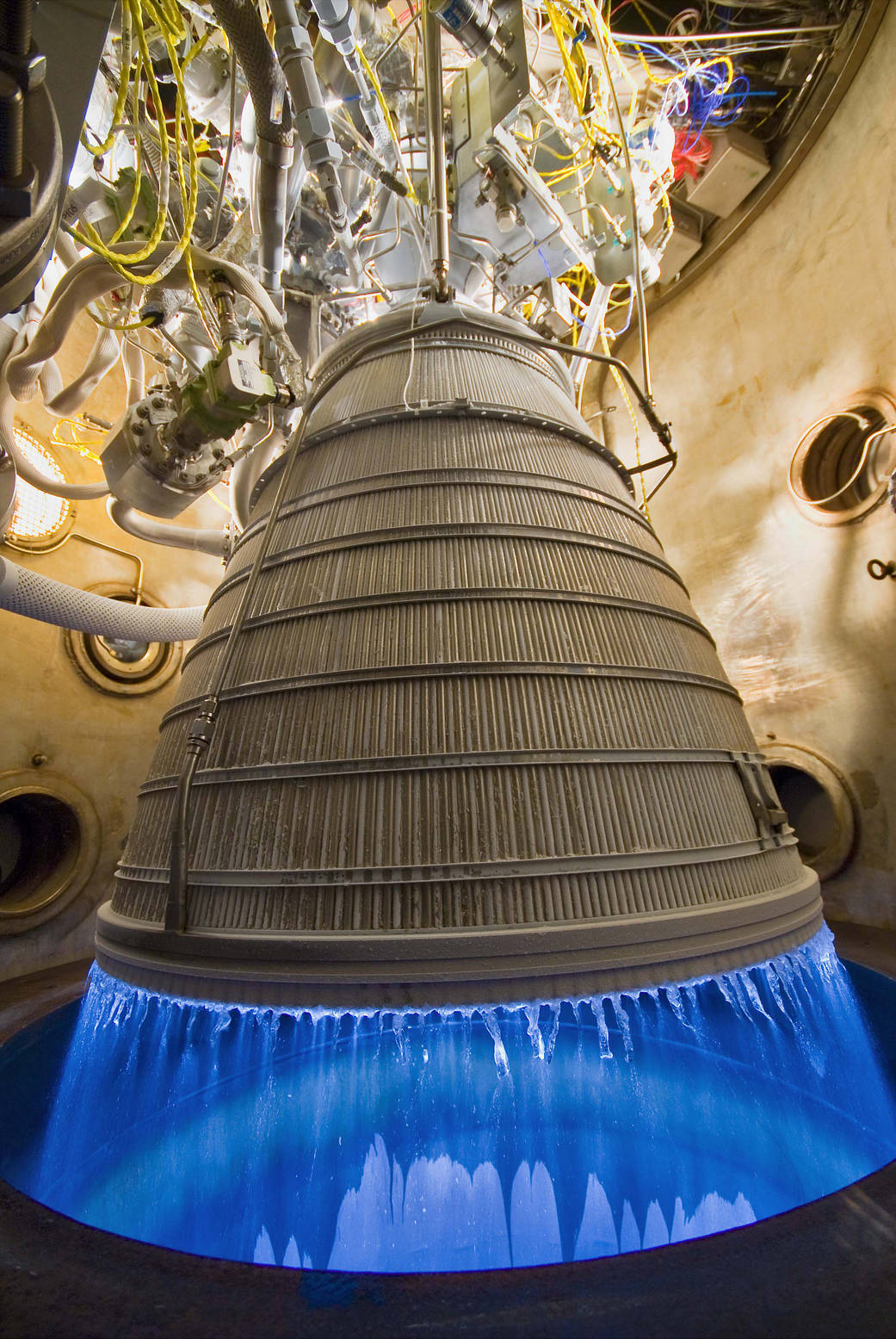
Awesome NASA Megarocket Engine Test Burns Blue (Photo)
What could be mistaken for a futuristic water cannon is actually a piece of technology developed more than 50 years ago that is destined to help launch NASA's next megarocket, the Space Launch System.
The RL10, a rocket engine developed in the 1950s by Pratt & Whitney, flew first in 1963. This engine has traveled to each planet in our solar system, powering spacecraft such as Voyager 1 — the first to reach interstellar space.
The RL10 rocket engine out-performs all other current engines and has over half a century of performance and documented reliability to its name. With more than 400 flights, over 15,000 hot fires on record and more than 2.3 million seconds of hot fire operation time with a greater than 0.999 demonstrated reliability during its use, the RL10 has earned its place in history. [The World's Tallest Rockets: How They Stack Up]
Because of its stellar record and its technically mature design, this rocket engine will make its way from the history books into the future of human spaceflight.
NASA's new Space Launch System, or SLS for short, will utilize this upper stage engine to launch an Orion spacecraft in the latter part of 2018 as well as eventually sending astronauts beyond the moon. Aerojet Rocketdyne of West Palm Beach, Florida will produce several RL10C-3 engines for NASA, powering its several planned deep space missions, with the ultimate goal being NASA's Journey to Mars.
According to James Burnum, NASA SLS Liquid Engines RL10 manager, "Engines are one of the most complex rocket elements … We need a reliable engine with a proven track record that has the performance to power humans to deep space."
Using the RL10 "leverages existing propulsion technology to provide SLS with a robust engine in a timely manner [avoiding] costs associated with a new engine development program," added Steve Wofford, SLS Liquid Engines manager at NASA's Marshall Space Flight Center in Huntsville, Alabama, where the SLS Program is managed.
The $174 million, 8-year contract leaves Aerojet Rocketdyne responsible for the management, testing (at NASA's West Palm Beach, Florida test facility), certification and delivery of the engines.
Follow us @Spacedotcom, Facebook and Google+. Original article on Space.com .
'Arrival' and the Raw Power of Smart Sci-Fi
The opening scenes of the new sci-fi film "Arrival" cover familiar territory, as we see enormous spacecraft hovering over cities on our troubled planet Earth.
But soon the film reveals that it's not going to be like other alien movies. The spaceships have no weapons. Our hero is a linguist. Cerebral narrative puzzles take shape. A procession of subtle and intriguing ideas ultimately blossom into a story of profound insight and hope.
"Arrival" is the best sci-fi movie of the year because it does what science fiction does best: It encourages thoughtful conjecture and lateral thinking. It asks us to project our hopes and anxieties out to some notional event horizon, then see what develops. In the choppy wake of this terrible and divisive election season, it's the one movie you should take the time to see, and process and talk about afterward.
Warning: There are some moderate spoilers ahead, but nothing much past what you can see in the trailers, and I'll stay far away from the film's central mystery.
Amy Adams plays Dr. Louise Banks, a linguist recruited by the U.S. government to communicate with the aliens. Twelve spaceships — ovoids that suggest seed pods, significantly — have descended over countries around the world. The aliens show no signs of aggression, but the world's nation-states respond with varying defensive postures, scrambling jets and aiming weapons at the ships.
Banks is partnered with mathematician Ian Donnelly (Jeremy Renner), who hopes that the language of numbers will help in establishing contact with the aliens. Each day, the ships' portals open briefly and Earth sends its various delegations aboard. Inside the ship, director Denis Villeneuve creates a minimalist marvel of art design, an extradimensional space with sideways gravity. It feels like a prehistoric cave, those sacred spaces where our species first experimented with language and art.
We see the aliens, eventually, but they're cleverly obscured and the visuals underline a storytelling strategy used throughout the film. "Arrival" isn't really interested in the aliens; it's interested in our reaction to the aliens. How will we reach out to this new entity, this ultimate Other? What will we choose to communicate, and how?
In the end, "Arrival" is all about communication. "The language we speak determines how we think," Louise says, referencing a fierce debate in the field of linguistics. Without spoiling too much, the aliens present us with a new kind of language, a new way to communicate. It's a language that imparts meaning directly, does not represent sound or speech, and is not bound by time.
RELATED: Sending Messages to Aliens: Could It Kill Us?
It's so nice to be treated as an adult by a science fiction movie. This is a film that asks us to think, and presents delicious mysteries concerning ideograms, palindromes, game theory and the significance of the number 0.083.
It's said that providence moves in mysterious ways, as does Hollywood, and the timing of "Arrival" is auspicious. The film addresses that nagging suspicion, perhaps you're familiar with it, that the promise of the Digital Age is fading fast. Our precious devices and networks aren't bringing us closer together. They're driving us apart. We sit in public spaces, staring into the tiny screens in our palms. We gather in online cliques and echo chambers with those who share our history and opinions.
Despite our space-age communication technology, we're not talking to each other — not really. We're projecting digital versions of ourselves. We aren't connecting in the important ways. We're fractured and divided, as evidenced by the world's escalating conflicts and even our own domestic elections and referendums.
Thoughtful science fiction like "Arrival" can help us approach this existential dilemma from a sideways vector. As a genre, as a mode, sci-fi provides us with the opportunity to think laterally about ideas and issues. Movies are one of the ways we process change, as a culture, on some unknowable level of collective consciousness that transcends rationality and intent. When a movie like "Arrival" comes along, we should pay attention. We're telling ourselves something.
Originally published on Seeker.
Video – Why Russia Did Not Put a Man on the Moon? The Secret Soviet Moon Rocket
It’s probably the most well known peacetime battle between the USA and the Soviet Union, in both technological and ideological terms of the 20th century.
Although the USA won the race to the moon, if you’d been a betting person from the mid 1950’s to 1960’s, the chances are that you would have thought the Soviet Union had a very good chance of getting there first.
So why didn’t Russia put a man on the moon?
At the time the soviets were leading the space race, they had already started with the launch of Sputnik, then launched several probes to the moon, including one in 1959 that orbited and taken photos of the far side and By 1961 they were the first to put a man in to space.
So when Kennedy made his now famous “We choose to go to the moon” speech in 1962 to rally public support, Khrushchev’s response was silence, neither confirming nor denying that they had a plan for a manned moon mission.
But at the time Khrushchev wasn’t really interested in competing with the US over the moon, he was more interested ICBM’s the Intercontinental Ballistic Missiles for the strategic rocket forces.
But there were others that had harboured plans for manned mission for a long time, these included the man whose name was a state secret and the most powerful man outside the Kremlin when it came to space.
He was Sergei Pavlovich Korolev, outside the inner circle of the top space scientists he was known only as the “Chief Designer” or by his first 2 initials SP, because the Soviet leadership feared that the western powers would send agents to assassinate him.
Korolev was the man who was behind many of the soviet space successes and the head of the OKB-1 design bureau, he over saw sputnik, and the manned missions including the first man in space Yuri Gagarin. His authority extended over almost everything to do with space, his design group worked on missions to mars and venus, communications, spy and weather satellites, ICBM’s and the soviet manned moon missions.
Korolev had a huge amount of control over the space program. In administrative power he was almost a one man version of NASA covering areas that in the US were done across multiple aerospace companies and flight centres.
But even a man with his power and connections didn’t get everything his own way. He had to continuously fight against rival designers and design groups. Although Korolev wanted the moon missions, in 1960 the job was given to his rival, Vladimir Chelomei because of his patronage by Khrushchev but his lack of experience meant that progress was slow.
The progress of Apollo on the other hand worried the chief designers and as a result of this and the in-fighting between the design bureau’s meant that there were multiple overlapping designs for the moon missions, at one point there were 30 different designs for launchers and spacecraft.
In 1964 and with the fall of Khrushchev, Korolev was given complete control over the moon missions and pushed through his designs ahead of Chelomei’s and the decision to finally compete for the moon was given, with the aim to land in 1967 the 50th anniversary of the October revolution and get there before the Americans.
This created a problem for Korolev, in order to lift the payload weight of 95 tons he needed a very large rocket. This new rocket would be called the N1, be as big as the American Saturn 5 and would require large powerful engines, similar to the F1 rockets in the Saturn.
Valentin Glushko was the leading Soviet rocket designer and head of the OKB 456 bureau, which had a near monopoly when its came rocket design & production. He specialised in making engines that used hypergolic propellants.
These consist of a fuel and an oxidizer, that when mixed together spontaneously ignite when they come into contact with each other. Korolev thought these were too dangerous for manned missions due to the highly toxic and corrosive nature of the chemicals that made up the fuel.
Glushko said that it was not possible to create a new large engine design that used cryogenic fuel of liquid oxygen and Kerosene and get it ready in time with limited resources and cash. He also sited that at the time the Americans had been working on cryogenic Saturn engines for 5 years and still hadn’t got them to work reliably…….

Aliens are ‘watching us and could arrive on Earth in the next 20 years’

Erich von Daniken, author of infamous book Chariots of the Gods, claims extraterrestrials will visit our planet in the coming decades Aliens are watching us and could arrive on Earth in the next 20 years, the author of ground-breaking book Chariots of the Gods has claimed.
Erich von Daniken, 82, sparked controversy when he published the work in 1968. Today, Erich – who has sold 75million books to date – insists there is even more evidence to support his theory than there was when he crafted it in the late 1960s.
And he believes that when they do make their appearance it could be on television, or in a football stadium.
Speaking from his home in Switzerland, Erich said: “I believe that at the moment we are under observation.
“This is based on conversations with very intelligent people, who have been told officially that UFOs are reality, and we are being watched. “I believe within the next 20 years some extra terrestrials will show up here – on television maybe or in football stadiums. “Crop circles show that somebody is already trying to contact us without shocking us. And we should start to think about these things. “I believe extraterrestrials will return to Earth and we should take this into consideration so we are not shocked. “Because it will be good for mankind. “We will learn to live in peace.”
He went on: “We humans, we have a psychological problem with extra terrestrials. We look at earthlings at the biggest thing in the universe.
“We don’t want extra terrestrials because they will crush our uniqueness. And therefore we try to deny they exist. “But this has changed. Extra terrestrials were here and they promised our ancestors they would return. “It would make more sense to look at this prospect in a speculative way, than to just throw it away. Don’t say it’s all rubbish. “We should think about it as we do science fiction movies. “Science fiction movies helps us to keep an open mind, and to ask questions about other life forms that might be out there.”
Chariots of the Gods – which inspired Hollywood film Prometheus – speculates if landmarks such as Stonehenge and the Pyramids could be signs left by aliens who visited thousands of years ago and promised to return..
And while it was welcomed by millions of readers, many scientists dismissed its claims as rubbish. But Erich – who accepts that criticism for his book at the time was “completely normal” – insists he has won over many experts with his views as knowledge of space has improved.
These advances have opened up a new world of possibilities for those wishing to explore the universe. Last month entrepreneur Elon Musk unveiled his vision to send people to Mars in just 10 years – with the aim of building a city on the red planet. But while Erich welcomes the prospect of interplanetary travel, he says people will have to wait a lot longer if they want to live on Mars.
He said: “I support the mission to Mars but I know we absolutely cannot survive there without taking our own environment.
“That environment would have to be there for at least two generations before we create an earthly atmosphere.
“A mission to Mars would be great, but that’s a story that goes on for the next 200 years.”
In celebration of the Chariots of the Gods ’s 50thanniversary, Erich von Däniken will deliver a keynote speech on Saturday October 15 at The Princess Anne Theatre, BAFTA, Piccadilly London, for The Erich Von Daniken Legacy Night.
This Martian Structure May House Key Ingredients for Life

One of the reasons we have been so intent on reaching Mars is so we can look for evidence of life that existed or still exists on the planet. Now, a new finding reveals Martian structures that may in fact house the ideal conditions for life.
This new study led by scientists at the University of Texas examined depressions in craters found within the Hellas Planitia and Galaxias Fossae regions of Mars. These depressions were first discovered in 2009 and were interesting to the researchers because they resembled each other as well as structures we have on Earth called ice cauldrons. Typically found in Iceland or Greenland, those depressions form when volcanic eruptions occur and melt ice sheets. This causes them to display concentric fractures, like bull-eyes.
Joseph Levy/NASA
However, it wasn’t just their similarity to ice cauldrons that made the researchers want to look further into these Martian structures. “We were drawn to this site because it looked like it could host some of the key ingredients for habitability — water, heat and nutrients,” said lead researcher Joseph Levy in a statement.
After the researchers analyzed the structures using new stereoscopic photographs that could take 2D images and extract 3D information, they concluded that the one in Galaxias Fossae was most likely cause by an asteroid impact, but the one in Hellas could have been caused by a volcanic eruption, similar to how our own ice cauldrons formed on Earth.
Oddur Sigurðsson/Icelandic Meteorological Office
If the researchers are right, their discovery would make the Hellas depression a good place to start in the hunt for Martian life when NASA sends a rover to the planet in 2020. The large amount of magma necessary to melt the ice to create the structure would have left behind liquid water while providing warmth and nutrients. “The possibility of liquid water formation during or subsequent to volcanism or an impact could generate locally enhanced habitable conditions, making these features tantalizing geological and astrobiological exploration targets,” the researchers conclude in the report.
This isn’t the first example of volcanic activity playing a role in the creation of life. In fact, a similar volcanic origin is one prominent theory for the start of life on Earth. According to some studies, volcanism may have played a huge part in the formation of peptides (long chains of amino acids that form the proteins at the core of living cells).
The identification of this place on Mars that may have liquid water and a volcano in close proximity to one another, all within a crater that might have been formed by an amino-acid bearing asteroid, significantly narrows down our search for life on the planet and is a promising step forward in the search for extraterrestrial life.
For the First Time in History, We Are Seeing Alien Worlds


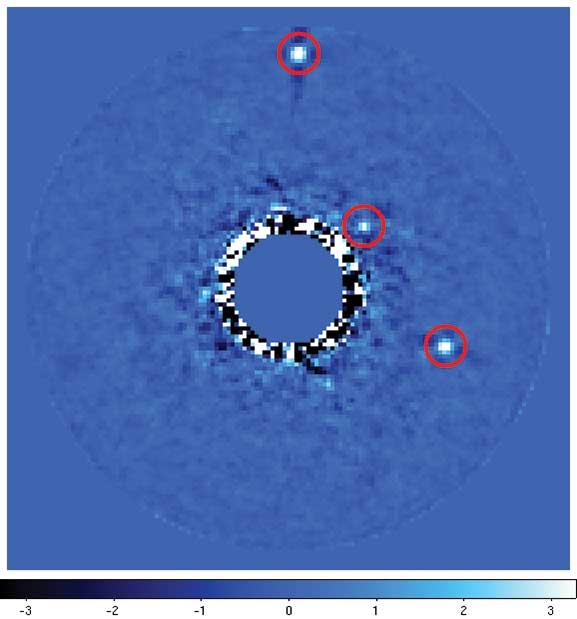
This image from the CHARIS instrument shows planets located around a star in the planetary system HR8799. Image: N. Jeremy Kasdin and team.
A team of scientists and engineers at Princeton University just gave exoplanet research a long-needed boost. Using a new Earth-bound instrument, the scientists were able to isolate light reflecting from far-out exoplanets.
This new instrument is known as CHARIS, an acronym for Coronagraphic High Angular Resolution Imaging Spectrograph. It was built by a team led by N. Jeremy Kasdin, professor of mechanical and aerospace engineering at Princeton. CHARIS features nine mirrors, five filters, two prism assemblies, and a microlens array. It weighs 226.8 kg (500 lbs), and is maintained at -223.15 C (50 Kelvin, -369 F).
Credits: N. Jeremy Kasdin, et al. / Princeton University
According to the team, CHARIS was able to isolate light reflecting from an exoplanet — a fairly difficult feat, given that these planets are dimmer than the stars they orbit.
“By analyzing the spectrum of a planet, we can really understand a lot about the planet. You can see specific features that can allow you to understand the mass, the temperature, the age of the planet,” researcher Tyler Groff explained.
The sun and our solar system in relation to the Milky Way galaxy. The white circle indicates the area where the majority of exoplanets have been found with current telescopes.
Credit: NASA/JPL-Caltech/T. Pyle
Exoplanets are planets found outside of the solar system, orbiting another star. We owe most of our success at finding exoplanets to the Kepler space telescope. But apart from where they are located, there really isn’t much we know about them.
CHARIS can help change that. It has been more than three decades since the first known exoplanets were discovered in the 1990s, and our fascination with them has only increased – especially since they could potentially support life (as a future home for us or a current one for extraterrestrial civilizations).
“With CHARIS spectra we can now do a lot more than simply detect planets: we can measure their temperatures and atmosphere compositions,” said Olivier Guyon, faculty member at the University of Arizona and head of the adaptive optics program at the Subaru Telescope in Hawaii, with which CHARIS works in conjunction.
51 Pegasi b, also called "Dimidium," was the first exoplanet discovered orbiting a star like our sun. This groundbreaking find in 1995 confirmed planets like Earth could exist elsewhere in the universe.
Exoplanet research is bound to get even better in the next couple of years, with the capabilities of CHARIS, together with the Subaru Telescope, and with the James Webb Space Telescope’s scheduled launch in 2018.
“There is a lot of excitement,” said Tyler Groff, a member of the Princeton research team currently working in NASA. “[CHARIS] is going to open for science in February to everyone.”
Erich Von Daniken concludes: Aliens will RETURN to Earth within 20 years
VIDEO: Mysterieuze aardbevingslichten gezien tijdens aardschok Nieuw-Zeeland

Tijdens de zware aardbeving in de buurt van de stad Christchurch, lichtte de hemel op mysterieuze wijze op. Het gaat om zogeheten aardbevingslichten.
Beelden van de ongewone lichten werden op YouTube geplaatst. In het filmpje zijn felle flitsen te zien tijdens de beving.
In een andere video, die op Instagram werd gezet, is te zien dat soortgelijke flitsen in de lucht zijn gezien in de stad Wellington.
Dergelijke lichten werden eerder ook al gezien tijdens aardbevingen, waaronder die in Christchurch in 2011, waarbij 185 mensen om het leven kwamen.
Sommigen suggereerden dat de lichten mogelijk waren veroorzaakt door elektriciteitskabels of transformators, maar ze werden ook gezien boven de oceaan.
Wetenschappers zijn het niet eens over de oorzaak, hoewel een studie uit 2014 concludeerde dat bepaald gesteente tijdens een aardbeving ‘aardbevingslichten’ kan voortbrengen.
De flitsen nemen verschillende vormen en kleuren aan. Tijdens de aardbeving in het Italiaanse L’Aquila in 2009 maakten getuigen ook melding van flikkerende lichten in lucht, meldde National Geographic.
Aardbevingslichten zijn bliksemlichten, flitslichten of een soort oplichtende halo’s die voor of tijdens aardschokken verschijnen.
Vroeger werden ze in verband gebracht met paranormale verschijnselen, maar tegenwoordig is de uitleg alledaagser: het zou simpelweg gaan om elektrische ladingen afkomstig van seismische scheuren, een beetje zoals het noorderlicht.
Toch kan de wetenschap dit verschijnsel nog steeds niet volledig verklaren.
[RT]
“Nostradamus voorspelde overwinning van Trump 400 jaar geleden al”

De bekende ziener Nostradamus zou 400 jaar geleden al voorspeld hebben dat Donald Trump de Amerikaanse presidentsverkiezingen zou gaan winnen.
De Fransman Michel de Nostredame leefde van 1503 tot 1566 en was apotheker, arts en astroloog. Hij werd vooral bekend door zijn profetieën.
Zijn aanhangers stellen dat hij de wereld onder meer heeft gewaarschuwd voor Napoleon, de twee wereldoorlogen, de aanslagen van 9/11 en het terrorisme.
Hij zou ook de overwinning van Trump hebben voorspeld: “De grote opzichtige, zonder schaamte, zal verkozen worden tot leider van het leger: de vrijmoedigheid van zijn beweringen, de brug gebroken, de stad zwijmelend van angst.”
En verder: “De valse boodschap over de oneerlijke verkiezing, die door de stad waart en een einde maakt aan het gebroken pact. Stemmen gekocht, de kapel bevlekt met bloed, de keizerrijken die samen worden gebonden.”
Dat zou dan weer te maken kunnen hebben met de relaties tussen de Verenigde Staten en Rusland.
Tot slot zei hij nog: “De mannelijke vrouw zal haar invloed uitbreiden naar het noorden. Ze zal bijna heel Europa en de rest van de wereld tegen zich in het harnas jagen. Twee nederlagen zullen haar uit haar evenwicht brengen zodat leven en dood Oost-Europa sterker zullen maken.”
Volgens volgelingen van Nostradamus is dit een verwijzing naar Hillary Clinton en haar nederlagen tegen Obama en tegen Trump. Met Oost-Europa zou hij verwijzen naar Rusland.
Omdat zijn voorspellingen vrij vaag waren en op meerdere manieren geïnterpreteerd konden worden, kreeg Nostradamus ook veel kritiek.
[HLN]
UFO IS REAL YOU WONT BELIEVE THIS UFO SEEN LANDING IN AREA 51 AND MORE 2016UFO IS REAL YOU WONT BELIEVE THIS UFO SEEN LANDING IN AREA 51 AND MORE 2016
Don't forget to subscribe and share . Also watch my other videos here
https://www.youtube.com/channel/UCyzM...
UFO IS REAL YOU WONT BELIEVE THIS UFO SEEN LANDING IN AREA 51 AND MORE 2016
music
name : Epic and Emotional Music - Last Dawn ( Copyright and Royalty Free )
link :https://www.youtube.com/watch?v=wWjgs...
UFO conspiracy theories argue that evidence of unidentified flying objects and extraterrestrial visitors is being suppressed by various governments, and politicians in every country, most notably the officials of Washington DC. Such conspiracy theories commonly argue that Earth governments, especially the Government of the United States, are in communication and/or cooperation with extraterrestrials despite public claims to the contrary, and further that some of these theories claim that the governments are explicitly allowing alien abduction.
Various UFO conspiracy ideas have flourished on the internet and were frequently featured on Art Bell's program, Coast to Coast AM. According to MUFON, the National Enquirer reported that a survey found 76% of participants felt the government was not revealing all it knew about UFOs, 54% thought UFOs definitely or probably existed, and 32% thought UFOs came from outer space.
Notable persons to have publicly stated that UFO evidence is being suppressed include Senator Barry Goldwater, Admiral Lord Hill-Norton (former NATO head and chief of the British Defence Staff), Brigadier General Arthur Exon (former commanding officer of Wright-Patterson AFB), Vice Admiral Roscoe H. Hillenkoetter (first CIA director), astronauts Gordon Cooper and Edgar Mitchell, and former Canadian Defence Minister Paul Hellyer. Beyond their testimonies and reports no substantiating evidence has been presented to support their statements and conclusions. According to the Committee for Skeptical Inquiry little or no evidence exists to support them despite significant research on the subject by non-governmental scientific agencies.
Space Laser to Help Robots 'Sniff Out' Alien Life

Back in the 2000s, when Branimir Blagojevic was developing a sensor for the military to detect airborne bio-hazards, he had no idea the technology could later be used in the search for extraterrestrial life.
His original work focused on the novel use of lidar — which stands for Light Detection and Ranging — and is based on similar principles as radar. Instead of using radio waves like radar, lidar uses laser light to detect objects and measure the distance to a target. This why lidar is often referred to as "light radar."
Blagojevic, now a NASA technologist at the Goddard Space Flight Center in Maryland, realized that the technology behind seeking out toxins and pathogens in the air might have an application beyond Earth and may even contribute to NASA's mission to work out whether Mars has (or had) life.
"If past life existed on Mars, it could be possible to detect with this kind of instrument," Blagojevic told Seeker.
RELATED: Mars Rover Curiosity Can Now Fire Laser
Currently, any mission sent to Mars is pretty limited in how it searches for evidence of biology, past or present. The Mars Science Laboratory rover Curiosity, for example, can scoop a sample of regolith (the dusty powdery "soil" that covers the Red Planet) in the hope that the tiny amount of pulverized rock contains biological chemistry. Making physical contact with any material intended for analysis is a concern; though any robot sent to Mars is sanitized, there's a risk of contaminating the "pristine" sample with contaminants from Earth, potentially skewing test results.
Also, the slow and laborious process a robot must go through to collect and analyze samples means very few samples can be taken from any given location. It could be that the sample analyzed by the Mars rover scoops a completely sterile sample, but unbeknownst to the robot or its controllers back on Earth, there could be Mars dirt crawling with organic chemistry only a couple of meters to the left. They would never know.
Blagojevic likens this maddening search as trying to find the proverbial "needle in a haystack." But it's worse than that — we don't yet know where the haystack is.
So how do you narrow the odds of finding biological material on Mars? One method could be to use Blagojevic's Bio-Indicator Lidar Instrument, or, simply "BILI."

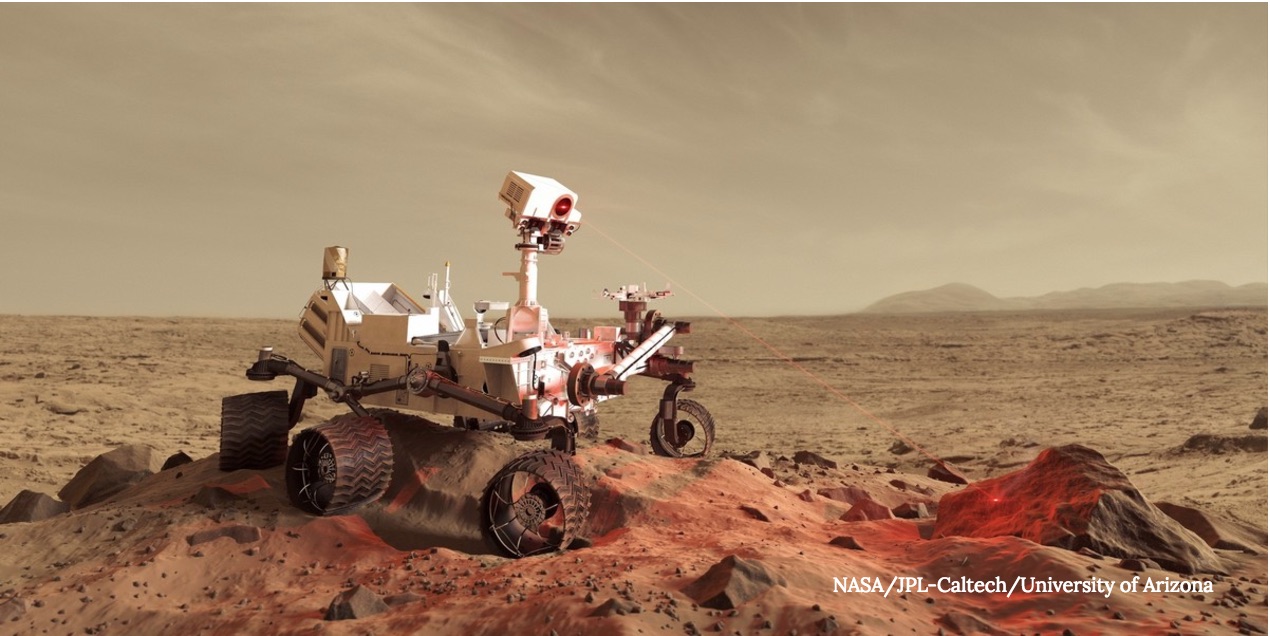
Mars is no stranger to lasers. Currently, Curiosity uses its ChemCam to laser-blast rocks so its sensors can study the vapor produced to decipher what chemicals it contains. Mars rocks will be safe from BILI, however.
Blagojevic, working with NASA planetary scientists Melissa Trainer, Alexander Pavlov and Melissa Floyd, hopes to mount this lidar system on a future Mars rover much in the same way ChemCam is used by Curiosity, but rather than aiming it at interesting geological features, this future rover would shoot its laser at particles in the Martian atmosphere. During its mission, the rover would scan its environment for dust plumes. Once it finds a wind-blown plume, likely above a hard-to-reach slope, it would fire its twin ultraviolet lasers into the dust.
As the laser light hits individual dust particles, energy from the laser will cause any particles in its path to produce light, a phenomenon known as florescence. The light from these fluorescing particles can then be measured, revealing what chemicals they are made of. If there's any organic matter in the dust (known as bio-indicators), BILI should be able to decipher its signal.
And the best thing is that this is all carried out remotely, possible hundreds of meters from the rover, meaning a huge area could be scanned for organic chemistry and contamination from the rover wouldn't factor into the measurements.
"This will basically increase the probability of finding life by roving the surface of Mars," said Blagojevic.
RELATED: Cassini Zeros in on Daring Dive into Enceladus' Plumes
The applications on Mars are obvious, and we could see future rovers using BILI to scan dusty red plumes, but could the technology be used to hunt for life elsewhere in the solar system?
"Beyond Mars, we did some calculations modeling whether this instrument could work on frozen worlds like the moon Enceladus and maybe Europa," Blagojevic said.
Enceladus is one of Saturn's enigmatic moons that possesses a thick icy shell surrounding a subsurface ocean. Through tidal interactions with Saturn, Enceladus produces heat in its core that keeps the subsurface water in a liquid state. Its ocean is of huge interest to astrobiologists because, on Earth, where there's liquid water there's life.
The internal heating and constant stresses on the icy shell causes some of the liquid water to erupt to the surface of the moon, like opening the cap of a soda bottle. Huge quantities of water vapor are lost to space, creating the moon's trademark plumes. If there's any extraterrestrial biology in that water, it's being vented to space also.

NASA's Cassini mission has used onboard sensors to "taste" these plumes as it flies past (pictured above), but detailed analysis is needed. Could BILI be mounted to a flyby mission to Saturn to possibly fire its UV lasers into the plumes to see if organic chemicals are present also?
"We found that it will be challenging because the water plumes on Enceladus have very low density" when compared with dust particles in Martian air, said Blagojevic. On average, Enceladus' plumes have an extremely low density, so to detect anything, a spacecraft would need to fly within 50 kilometers of the moon's surface and the laser would need to be in the 1 watt range to detect any florescence.
RELATED: Possible Europa Tectonics Could be Boon for Alien Life
"It's possible, but it requires a more powerful UV laser that may or may not be feasible for future flyby missions," he said.
As for Europa, lacking the obvious long-duration plumes that Enceladus has, whether this lidar system can be used to seek out biological chemistry would depend on if any aerosols exist close to its surface, cautions Blagojevic. The Jovian moon holds even more promise than Enceladus as a potentially habitable place for aquatic extraterrestrial life to thrive in its sub-surface ocean. Some optimistic hypotheses posit that multi-cellular life may even be possible.
As we know chemistry from inside the moon cycles to the surface — through apparently active icy tectonics — if there is biology in Europa's oceans, evidence of its presence may be found on the icy surface. And if there's some mechanism causing these organic chemicals to rise above the ice, perhaps a lander-mounted BILI could be used to reveal its secrets.
Originally published on Seeker.

NASA and FEMA Rehearse for the Unthinkable: An Asteroid Strike on Los Angeles (Video).jpg)
Imagine if scientists discovered that an asteroid was hurtling toward Los Angeles. The possibility has existed on the pages of Hollywood scripts. But in what may be a case of life imitating art, NASA, the Federal Emergency Management Agency and other government agencies engaged last month in a planetary protection exercise to consider the potentially devastating consequences of a 330-foot asteroid hitting the Earth.
The simulation projected a worst-case blast wave by an asteroid strike in 2020 that could level structures across 30 miles, require a mass evacuation of the Los Angeles area and cause tens of thousands of casualties. In 1998, the movie “Armageddon” dramatized an even greater fictional threat. In that blockbuster, a ragtag crew was sent on a mission to drill into an asteroid and set off a nuclear bomb to avert a global catastrophe.
As the character Harry Stamper, portrayed by Bruce Willis, summed up to his crewmates: “The United States government just asked us to save the world.”
The possibility has existed on the pages of Hollywood scripts. But in what may be a case of life imitating art, NASA, the Federal Emergency Management Agency and other government agencies engaged last month in a planetary protection exercise to consider the potentially devastating consequences of a 330-foot asteroid hitting the Earth.
The simulation projected a worst-case blast wave by an asteroid strike in 2020 that could level structures across 30 miles, require a mass evacuation of the Los Angeles area and cause tens of thousands of casualties.
That’s where the planetary protection exercise, conducted on Oct. 25 in El Segundo, Calif., comes in. The simulation that projected a strike in 2020 involved representatives from NASA’s Jet Propulsion Laboratory, the Department of Energy’s National Laboratories, the Air Force and the California Governor’s Office of Emergency Services.
While a warning of four years may seem like a lot of time, it would probably not be enough to deflect an asteroid of the size and orbit outlined in the simulation, Mr. Chodas said.
“Engineers think the simplest way to deflect an asteroid is to build a large spacecraft and simply ram it into the asteroid” years before it is predicted to hit Earth, he said.
It could take up to two years to build such a “kinetic impactor” spacecraft and another year or more to reach the asteroid, so in the case of this simulation, an evacuation, not a “deflection mission,” was necessary.
For the organizers of Asteroid Day, a global movement that seeks to protect the world from dangerous asteroids, such planning is not out of this world.
The group, which maintains that one million asteroids have the potential to strike Earth but that only 1 percent of them have been discovered, was set on Monday to release a letter signed by planetary scientists supporting missions to increase knowledge of asteroids. The group promotes the “100x Declaration,” which calls for increasing the rate of asteroid discoveries to 100,000 per year in the next 10 years.
“The more we learn about asteroid impacts, the clearer it became that the human race has been living on borrowed time,” Brian May, an astrophysicist and a founder and lead guitarist for the rock group Queen, said on the group’s website.
Asteroid Day is observed each year on June 30, the anniversary of what is believed to be the largest space-related explosion in human history: an asteroid strike in Tunguska, Siberia, in 1908.
An asteroid, believed to be less than 100 feet in diameter, exploded at the altitude of an airliner and flattened tens of millions of trees across 800 square miles. Researchers estimated the explosion was as powerful as a medium-size hydrogen bomb and several hundred times more powerful than the atomic bomb dropped on Hiroshima.
While there were no official reports of human casualties, hundreds of reindeer were reduced to charred carcasses in the explosion, the British Broadcasting Corporation reported. – New York Times
Thanks http://stateoftheworldreport.com
Source: NASA and FEMA Rehearse for the Unthinkable: An Asteroid Strike on Los Angeles – The New York Times
Check out more contributions by Jeffery Pritchett ranging from UFO to Bigfoot to Paranormal to Prophecy
Strange Blue Lights in the Sky During 7.8M Earthquake in New Zealand (Video)
Onlookers have captured video of bright flashes of light that lit up the sky over Wellington following a 7.8 magnitude earthquake that rocked New Zealand’s South Island.
Instagram user Syrian Kiwi posted video of the lights with the caption “Sky during earthquake in Wellington”.
The quake, located near Hanmer Springs in North Canterbury at a depth of 15km, struck just after midnight last night (10pm AEDT) and a swarm of powerful aftershocks have since rattled the country.
According to New Zealand news website Newshub reported that the video may have captured a phenomenon known as “earthquake lights”. where light is produced around continental rifts by electrical properties in certain rocks.
“When nature stresses certain rocks, electric charges are activated, as if you switched on a battery in the Earth’s crust,” senior researcher at NASA’s Ames Research Center, Friedemann Freund, told National Geographic in a 2014 article about the phenomenon.
Besides “earthquake lights”, Monday’s supermoon could have triggered the earthquakes according to seismologists.
Then, I just received an image taken by a resident in Perth, Australia, today (Monday November 14, 2016) which not only shows the supermoon but also a big blue/greenish UFO-like object.
Moreover, if you rotate the object 90 degrees a face of a human being appears in the middle of the object.
Although Friedeman suggests the mysterious blue lights in the sky are “earthquake lights”, I’m not convinced since “earthquake lights” look quite different (See image below) and normally they appear before or after an earthquake.
Maybe the seismologists have right about the supermoon, but then again, it does not explain the blue lights / flashes in the sky over New Zealand during the earthquakes and it certainly does not explain the strange blue / greenish object over Australia, captured many hours later.
Stephen Hawking: "We moeten een nieuwe planeet vinden om te overleven" - HLN.be

© afp.
Professor Stephen Hawking heeft gewaarschuwd dat het menselijke ras het geen 1.000 jaar meer overleeft als we geen nieuwe planeet vinden om naartoe te verhuizen. Dat zei hij tijdens een lezing voor de debatvereniging van de Oxford Union.
Lees ook
Hawking was er uitgenodigd om te spreken over het universum en het ontstaan van de mens. De 74-jarige astrofysicus noemde 2016, vanuit het standpunt als wetenschapper, een "glorieuze tijd om in te leven en onderzoek te doen naar theoretische fysica". "Ons beeld van het universum is de afgelopen vijftig jaar enorm veranderd en ik ben blij dat ik daar een kleine bijdrage aan heb kunnen leveren", zei Hawking. "Het feit dat wij als mensen, die zelf maar fundamentele partikels van de natuur zijn, zo dicht zijn gekomen bij het begrijpen van de wetten die ons leiden en van het universum, is zeker een triomf."
© afp.
Tegelijk schetste Hawking een erg somber beeld over de toekomst. Hij benadrukt dat er nog veel meer onderzoek nodig is naar het universum, niet alleen om het beter te begrijpen, maar ook om ons voortbestaan te verzekeren. "Ik denk niet dat we het nog 1.000 jaar zullen overleven zonder van onze fragiele planeet te ontsnappen", zei hij.
Eerder dit jaar had Hawking ook al gewaarschuwd voor nieuwe ontwikkelingen op vlak van wetenschap en technologie, omdat die kunnen leiden tot "nieuwe manieren die kunnen misgaan". En aangezien zelfvoorzienende kolonies op Mars er pas ten vroegste over 100 jaar zullen zijn, moet de mens in tussentijd "erg voorzichtig" zijn.
Hawking sloot af met goede raad voor studenten. "Denk eraan om naar de sterren te kijken, en niet naar je eigen voeten. Probeer te begrijpen wat je ziet, verwonder je over wat het universum doet bestaan. Wees nieuwsgierig. Hoe moeilijk het leven ook lijkt, er is altijd iets dat je kan doen en waarin je kan slagen. Het is belangrijk dat je het niet gewoon opgeeft."
De supermaan in beeld: magnifieke beelden van over heel de wereld op een rij - HLN.be
© EPA, AFP.
FOTO'S Een maandag is voor velen onder ons niet bepaald de favoriete dag van de week, maar noem deze maandag gerust met een licht gelukzalige glimlach terecht een 'Supermaandag'. Want vandaag doet een supermaan wereldwijd de monden openvallen. Een overzicht van prachtige foto's van dit wonderlijke zeldzame fenomeen.
Beeld van gisteren uit Madrid, Spanje. © afp.
Voor het eerst sinds 1948 staat de maan zo dicht bij de zon als vandaag. Ook wij zullen vanaf 17u21 (het allerbeste moment voor een reikhalzende blik naar boven, best richting het noordoosten, nvdr.) onze ogen richting de hemel werpen naar die prachtige grote bol die groter zal lijken dan normaal.
Helaas trekken wij Belgen aan het kortere eind in vergelijking met andere landen, want "de omstandigheden zijn zeer ongunstig voor de waarneming van de supermaan", zo waarschuwt het KMI. Het typisch Belgische herfstweertje met zijn storingen van mist, wolken en regen zal roet in het eten gooien. "Er is weinig kans dat dit fenomeen in ons land te bewonderen zal zijn", besluit het KMI.
Daar komt nog bij dat VRT-weerman Frank Deboosere de verwachtingen nog tempert door erop te wijzen dat het verschil tussen de grootste en de kleinst mogelijke maan amper 16% is en dat dit met het blote oog niet te zien is. "'Much ado about nothing', zou Shakespeare zeggen", besluit Deboosere.
Pech dus door wolken en mist voor ons land. Dikke pech zelfs, want het zal tot zo maar even 2034 duren voor het fenomeen nog eens voorvalt. Helaas lijken de eerste blikken naar boven écht niets op te leveren.
De #supermaan zal niet te zien zijn, zelfs niet vanop de VRT toren. Maar Brussel ziet er zo wel mooi uit.
Al maanden in m'n agenda... Waar is die #supermaan nu? #bewolkt6:16 PM - 14 Nov 2016
Als we toch onze nekspieren voor niets blijken te hebben opgewarmd en botsen op niets anders dan bewolking, zijn er nog altijd deze magnifieke beelden uit het buitenland die je kan bewonderen.
We voegen de hele avond foto's toe:
© epa.
© epa.
© ap.
© afp.
© ap.
© ap.
© afp.
© ap.
© ap.
© afp.
© reuters.
© ap.
© afp.
© epa.
© afp.
© ap.
© ap.
© ap.
© epa.
© epa.
© reuters.
© epa.
© epa.
© epa.
© reuters.
© afp.
© getty.
© epa.
© getty.
© reuters.
© reuters.
© afp.
© afp.
© afp.
© afp.
© afp.
© afp.
© ap.
© afp.
© reuters.
© afp.
© reuters.
© epa.
© epa.
© ap.
© ap.
© epa.
© epa.
© epa.
© afp.
© reuters.
© reuters.
© reuters.
© reuters.
© epa.
© ap.
© epa.
© epa.
© afp.
© afp.
© ap.
© ap.
© epa.
© epa.
© reuters.
© reuters.
© reuters.
© afp.
© reuters.
© ap.
© afp.
© epa.
© afp.
© afp.
© getty.
© afp.
© reuters.
UFO Fleet Takes Guy Buy Surprise Over Barcelona, Spain On Nov 2016, Video, UFO Sighting News.
Giant UFO Exits Ground Causing Earthquake In New Zealand, Nov 14, 2016, UFO Sighting News.