Ontdek de Fascinerende Wereld van UFO's en UAP's: Jouw Bron voor Onthullende Informatie!
Ben jij ook gefascineerd door het onbekende? Wil je meer weten over UFO's en UAP's, niet alleen in België, maar over de hele wereld? Dan ben je op de juiste plek!
België: Het Kloppend Hart van UFO-onderzoek
In België is BUFON (Belgisch UFO-Netwerk) dé autoriteit op het gebied van UFO-onderzoek. Voor betrouwbare en objectieve informatie over deze intrigerende fenomenen, bezoek je zeker onze Facebook-pagina en deze blog. Maar dat is nog niet alles! Ontdek ook het Belgisch UFO-meldpunt en Caelestia, twee organisaties die diepgaand onderzoek verrichten, al zijn ze soms kritisch of sceptisch.
Nederland: Een Schat aan Informatie
Voor onze Nederlandse buren is er de schitterende website www.ufowijzer.nl, beheerd door Paul Harmans. Deze site biedt een schat aan informatie en artikelen die je niet wilt missen!
Internationaal: MUFON - De Wereldwijde Autoriteit
Neem ook een kijkje bij MUFON (Mutual UFO Network Inc.), een gerenommeerde Amerikaanse UFO-vereniging met afdelingen in de VS en wereldwijd. MUFON is toegewijd aan de wetenschappelijke en analytische studie van het UFO-fenomeen, en hun maandelijkse tijdschrift, The MUFON UFO-Journal, is een must-read voor elke UFO-enthousiasteling. Bezoek hun website op www.mufon.com voor meer informatie.
Samenwerking en Toekomstvisie
Sinds 1 februari 2020 is Pieter niet alleen ex-president van BUFON, maar ook de voormalige nationale directeur van MUFON in Vlaanderen en Nederland. Dit creëert een sterke samenwerking met de Franse MUFON Reseau MUFON/EUROP, wat ons in staat stelt om nog meer waardevolle inzichten te delen.
Let op: Nepprofielen en Nieuwe Groeperingen
Pas op voor een nieuwe groepering die zich ook BUFON noemt, maar geen enkele connectie heeft met onze gevestigde organisatie. Hoewel zij de naam geregistreerd hebben, kunnen ze het rijke verleden en de expertise van onze groep niet evenaren. We wensen hen veel succes, maar we blijven de autoriteit in UFO-onderzoek!
Blijf Op De Hoogte!
Wil jij de laatste nieuwtjes over UFO's, ruimtevaart, archeologie, en meer? Volg ons dan en duik samen met ons in de fascinerende wereld van het onbekende! Sluit je aan bij de gemeenschap van nieuwsgierige geesten die net als jij verlangen naar antwoorden en avonturen in de sterren!
Heb je vragen of wil je meer weten? Aarzel dan niet om contact met ons op te nemen! Samen ontrafelen we het mysterie van de lucht en daarbuiten.
Vrijdag 6 januari 2017
Buitenaards bliepje blijkt afkomstig van extreem ver dwergstelsel - HLN.be
Buitenaards bliepje blijkt afkomstig van extreem ver dwergstelsel - HLN.be
Wetenschappers hebben na intensief onderzoek eindelijk de herkomst achterhaald van een mysterieus radiosignaal uit de ruimte dat tien jaar geleden voor de eerste keer werd opgevangen. Het buitenaardse bliepje blijkt, zo heeft een team internationale experts vastgesteld, afkomstig van een dwergsterrenstelsel dat 3 miljard lichtjaren van de aarde is verwijderd. Een ruimtesonde naar die locatie sturen is vooralsnog onmogelijk, omdat één lichtjaar al 9,5 biljoen kilometer (9.500.000.000.000) is.
Sterrenkundigen ging er in eerste instantie van uit dat het ultrakorte radiosignaaltje - het duurt maar drieduizendste van een seconde - uit de Melkweg afkomstig was waar ook de aarde deel van uitmaakt. En anders een sterrenstelsel vlak daarnaast. Wetenschappers die zijn verbonden aan de vooraanstaande Cornell-universiteit in Amerika hebben recent vastgesteld dat het bliepje met de werknaam FRB121102 het resultaat is van energie die moet zijn vrijgekomen in het dwergsterrenstelsel dat 99 procent kleiner is dan de Melkweg.
FRB121102 werd ontdekt in 2007 met een extreem geavanceerde radiotelescoop: een soort schotelantenne die zelfs de allerkleinste signalen uit het heelal kan opvangen. Momenteel zijn 18 van die FRB's die worden onderzocht, maar die zijn volgens de experts allemaal waargenomen met niet-officiële en vrij onnauwkeurige telescopen. "Radiosignaal FRB121102 kon echter wel worden herleid", aldus de wetenschappers die hun ontdekking hebben gepubliceerd in het vakblad Nature.
Volgens de astronomen was het niet eenvoudig om het petieterig bliepje te traceren. Het wordt namelijk maar sporadisch 'uitgezonden', waardoor ernaar zoeken zeer lastig is. "We wisten de globale plek en zijn daar vervolgens minstens 50 uur lang gaan peilen in de hoop dat we het weer zouden horen. Dat het lukte is puur geluk. Het was immers zoeken naar een de allerkleinste speld is de allergrootste hooiberg."
Chileense marine geeft opzienbarende beelden van UFO vrij
De Chileense marine heeft videobeelden vrijgegeven van een UFO die vreemde manoeuvres uithaalt.
Het voorval wordt al twee jaar bestudeerd door de Chileense autoriteiten, zo schrijft de Huffington Post.
Vele legerdeskundigen, technici en wetenschappers hebben zich al over het filmpje gebogen, maar geen van hen heeft een verklaring voor het vreemde vliegende object dat door twee officieren werd vastgelegd vanuit een helikopter.
Oceaan
“We weten niet wat het is, maar we weten wel wat het niet is,” zei generaal Ricardo Bermúdez, oud-hoofd van de CEFAA, het Chileense agentschap dat UFO’s onderzoekt.
Op 11 november 2014 vloog een helikopter van de Chileense marine ten westen van Santiago langs de kust toen de bemanning een vreemd object zag vliegen boven de oceaan.
Generaal Bermúdez (CEFAA)
Het object, dat zich op een afstand van zo’n 60 kilometer bevond, werd vastgelegd met infraroodapparatuur aan boord van de helikopter.
Communiceren
Er werd contact opgenomen met twee radarstations, maar die zagen het object niet op de radar verschijnen. Ook de radar aan boord van de helikopter pikte het object niet op.
Luchtverkeersleiders bevestigden dat er op dat moment verder geen vliegtuigen in het gebied vlogen. Er waren ook geen weerballonnen in de regio.
De piloot probeerde meerdere keren te communiceren met de UFO, maar kreeg geen antwoord.
Ovaalvormige structuur
“Dit object is waargenomen door getrainde professionals met vele jaren ervaring,” zei Bermúdez. “Ze konden niet verklaren wat ze hadden gezien.”
Het ging om een ‘witte, ovaalvormige structuur’ met twee schijnwerpers. Tot twee keer toe kwam er een soort gas of vloeistof uit het object.
“Dit is één van de belangrijkste cases geweest in mijn carrière als directeur van de CEFAA,” zei generaal Bermúdez, die in december met pensioen ging.
Bekijk hieronder de beelden van het vreemde object:
Internet in de ban van gevleugelde ‘demon’ in Arizona
Een foto van een ‘demonische’ verschijning is een regelrechte hit op internet.
Zondag plaatste Facebookgebruiker Richard Christianson een foto van iets wat lijkt op een duistere figuur met vleugels.
De foto, gemaakt in Arizona, toont een soort gevleugelde verschijning met op het hoofd hoorntjes, schrijft het AD. De verschijning zou net zo groot zijn als een huis.
Demon
“Wat zien jullie in deze foto? Iemand?” vroeg Christianson. Binnen de kortste keren werd de foto tienduizenden keren gedeeld.
Hoewel sommigen menen dat de maker een ‘demon’ heeft vastgelegd, denken anderen dat het beeld is gefotoshopt. Weer anderen geven de belichting de schuld.
Facebookgebruiker Danielle Holland zei dat de maker van de foto overdag nog eens dezelfde foto moet maken.
Palmboom
Iemand anders zei dat de vreemde figuur mogelijk een verwaaide palmboom is.
“Het is een palmboom,” schreef Gabriella Swedin. “Als je links kijkt kun je er nog één zien.”
Sommigen linken de verschijning aan de apocalyps. “Het bewijs dat het einde der tijden nadert,” schreef iemand.
Navy Releases Video Showing A UFO Spraying Chemicals Into Atmosphere
A Navy helicopter captured a video of a mysterious craft in 2014. The video was released by Comité de Estudios de Fenómenos Aéreos Anómalos (CEFAA), a government-based agency in Chile within the civil aeronautics directorate, DGAC – about the same to the U.S. Federal Aviation Administration.
The naval officers captured the strange craft through a helicopter-mounted Wescam infrared camera, usually used for covert, aerial surveillance. These types of cameras are taken into action in Predator drone footage. The Unexplained Aerial Phenomenon (UAP) or popularly known as UFO, was first noticed by the naked eye from around 35 to 40 miles. Taken west of Santiago at an altitude of about 4,500 feet – far lower than commercial airliners – the video probably caught the most baffling and the well-sourced video ever taken of a UFO.
The captain described the object in question as a flat, elongated structure with chemical plume discharges at around eight minutes into the video. Captured by the infrared lens, the darker color indicates high heat.
The pilot contacted two separate radar stations during the encounter. The radar stations, however, reportedly failed to track the object as their onboard radar was unable to pick up the unidentified flying object. They further confirmed that there was no other air traffic in the area where the UFO was observed.
The CEFAA shared the video to experts, including astrophysicist, nuclear chemist, and image and video experts. Video analysts of French UFO organization GEIPAN offered a possibility of a medium-haul craft dumping cabin wastewater before landing.
However, Chilean witnesses and researchers have not accepted this mundane explanation. They pointed out three reasons; first, the lack of radar corroboration, second, the unlikelihood of an experienced pilot to identify an airplane, and third, the absent of nearby flight path for a landing at the two nearby airports.
Bright UFO caught on tape over Kampinos Forest, Poland 1-Jan-2017
Check out this interesting footage of a huge unidentified flying object that was hovering in the sky above Kampinos Forest, Poland. This was filmed on 1st January 2017.
This interesting photo of a bright apparition in the sky above Brooklyn church in New York was filmed from a moving bus. This happened in early January 2017.
Al een decennium lang zijn astronomen in de ban van een raadselachtig fenomeen uit het heelal: korte radioflitsen aan de hemel. Wetenschappers hebben nu de herkomst ervan ontdekt. Het gaat om een klein sterrenstelsel op 3 miljard lichtjaren afstand, schrijven ze in het vakblad Nature. Maar wat er precies flitst, is nog niet duidelijk.
De zogenaamde 'fast radio bursts' (of snelle radioflitsen, FRB's) werden voor het eerst ontdekt in 2007. Sindsdien zijn er nog achttien waargenomen, maar slechts eentje - waargenomen in 2012 in het Arecibo Observatory in Puerto Rico - deed zich talloze keren voor.
De flitsen duren een duizendste van een seconde en kunnen in die tijd evenveel energie uitstoten als de zon in 10.000 jaar. De onderzoekers schatten dat er elke tien seconden een dergelijke uitbarsting plaatsvindt. Maar omdat je op het juiste moment met een radiotelescoop in de juiste richting moet kijken, zijn er nog maar heel weinig waargenomen.
"We weten nu dat deze uitbarsting afkomstig is van een klein, zwak sterrenstelsel op meer dan 3 miljard lichtjaren van de aarde", zeggen de onderzoekers. De ontdekking biedt geen antwoord op de vraag wat de flitsen juist veroorzaakt.
EEN LANGE STROOM VAN ONVERKLAARBARE OBJECTEN OP MARS ( VIDEO )
Hoelang zou NASA het nog vol kunnen houden door simpelweg nergens op te reageren en alle vreemde vondsten op Mars volkomen naast zich neer te leggen?
De eigen camera’s van de organisatie leggen de ene na de andere bizarre ontdekking vast op beeld en de wereld doet net alsof het niet bestaat.
Bij het Youtube kanaal Paranormal Crucible zijn ze nogal gespecialiseerd in het beter zichtbaar maken van foto’s die door de NASA karretjes op Mars zijn genomen.
Vaak krijg je dan met het aanbrengen van wat kleur en contrast opeens een veel duidelijker beeld van wat iets zou kunnen zijn.
Zoals het volgende object wat vreemd uitsteekt in het anders vlakke Mars-landschap. In alle gevallen geldt, wat het ook moge zijn, duidelijk is dat we hier te maken hebben met iets dat door intelligente wezens is gemaakt en niet iets dat spontaan is ontstaan in de natuur.
Door de jaren heen zijn er talloze voorbeelden gevonden van mogelijke restanten van dieren, zoals de volgende:
Niet alleen restanten van dieren, maar ook iets dat verdacht veel lijkt op een soort skelet van een mens-achtige:
Of iets dat lijkt op een soort buitenaardse schedel:
Wat te denken van het volgende object dat veel lijkt op een pistool zoals wij die op aarde hebben en op geen enkele manier doet denken aan iets dat natuurlijk is gevormd.
En nog steeds komt NASA ermee weg door simpelweg alles wat er op Mars wordt gevonden te negeren.
Paranormal Crucible heeft een overzicht gemaakt van de meest opmerkelijke vondsten van het afgelopen jaar. Daarnaast zijn er natuurlijk de jaren daarvoor nog talloze ontdekkingen gedaan.
USS Enterprise UFO Seen Near Earths Sun On NASA Images Jan 3, 2016, Video, UFO Sighting News.
Date of sighting: Jan 3, 2017 Location of sighting: Earths Sun This UFO was near the sun this week and something amazing about it is that not only is it huge, but it has a visible steam of energy leaving its bottom. The craft silhouette looks similar to the side view of the USS Enterprise. This ship is as big as Earths moon. Compare the size of it with the size of the radius of the sun...I'm being conservative here. The size indicates its several times bigger than Earth, but I believe that the distance is closer to the SOHO satellite and that his craft is being used to harvest a rare energy particle from our sun. Awesome catch byTheWatcher252 of Youtube. Scott C. Waring
This alien hand seems impossible, but X-rays confirm that real bones are below the skin. Humans have three bones in each finger area, yet this has 6 bones, so we know its not human. DNA results cannot tell us its an alien since we have no aliens to compare it too. Instead DNA results will only say the DNA doesn't match any known species. Sure there is a skull, but it looks to be the size of an infant if its the same species as the hand, however several different kinds of aliens may have been working together and died in the Cusco cave tunnel where it was found.
Scott C. Waring
News states:
Though easy, initially, to call fake, a Hollywood prop or whatever, the above artifact was seen by us in person recently in Cusco Peru. It was presented to us, along with a small mummified elongated humanoid skull and body by a local person.
Above is the skull; it was x-rayed and examined by physicians here in Cusco who stated that it clearly was not a human, but was a life form of some kind. The skull is composed of bone and skin of some sort. Plans are in the works for radiocarbon and DNA testing early in 2017 in the US.
X rays of the “hand” show that each of the 3 fingers has 6 bones, while a human hand has 3. Once again, as with the skull, physicians in Cusco determined that clearly this is not the hand of a human, but is made up of bone and skin. They were unable to determine what kind of life form it is, or was.
The detailed photo of one of the ends of the fingers, seen above, shows the skin as well as a fingernail which is surprisingly human looking. The keeper of this and other artifacts does not want to sell them, he simply wants to know what they are.
And again, another x-ray of the ends of the fingers shows that under the skin there are well defined bones, looking quite mammalian. The artifacts were found in a secret location, in a tunnel in the southern desert of Peru; more details and perhaps artifacts will be discussed when available.
This UFO is made of energy, and has been seen around the world, but most notedly over the mountains of Colorado and was once seen by tens of thousands of people over the holiest place on Earth...dome of rock. They can change shape, and in our ancient history, these UFOs have been called angels when they appeared before people, because they can take any form, but when they do, they usually have a glowing aura around them. The holy place of Dome of Rock...has a story about an angle that ascended into heaven at that very place...just like the glowing UFO in the video below from Argentina. Angel or alien...it can be both at the same time. Scott C. Waring.
News states:
A family camping at El Chocón on the evening of Saturday, December 31 (2016) claims having seen a UFO floating over the lake. The video they recorded shows a round light that moves and changes shape. Dario Carrizo, one of the people at the site, said that his wife and a friend recorded a light in the sky for 25 minutes. It moved quickly and changed sizes. They believe it was an unidentified flying object. "We spent the evening in a rough campground beyond the dam. That's where we saw the light, and it caught our attention, as it was very bright and moved all the time. It was quite striking," Carrizo explained. He further added that the cellphone shows a spinning object, but this detail cannon be made out clearly on YouTube. He ended by saying that it was a "lovely sight" for the adults, but no so much for the children, who "refused to go to sleep alone."
Experts baffled by 'crashed UFO' discovered at bottom of sea
A MYSTERIOUS object found beneath the waves has had experts speculating whether they have discovered a crashed UFO.
By Douglas Patientµ
The huge 200ft-wide Baltic Sea Anomaly appears to be formed of pieces of metal and cuts out electrical equipment when you get too close.
Sitting at the bottom of the ocean, a mind-boggling 300ft down, it has had experts scratching their heads since they found it back in 2012.
Now explorers are set to head back to the object to finally work out what it is.
Swedish explorer Peter Lindberg and his Ocean X team found the "crash site" while diving to explore a shipwreck.
YOUTUBE/OCEANX/MYSTERY HISTORY
INCREDIBLE: The explorers could not believe what they discovered on the ocean floor
“It could be something really awesome that we’ve found”
Denis Asberg
Denis Asberg, who was in the search team, told Swedish TV: “There is a mountain, It could be 20-25 metres tall with a canyon in the middle, and below it there is a lot of loose rocks.
“We were really surprised and puzzled. We were thinking what is it that we have found here.
“We contacted geologists, marine biologists and when they said they had never seen anything like this, of course more thoughts were triggered. It could be something really awesome that we’ve found.”
OCEANX
ALIEN: The structure appears to be a crashed UFO
There has been an explosion of theories as to what the object actually is.
Some say it is a WW2 device designed to disable submarines, a battleship gun turret or – of course – an alien spaceship.
And Daily Star Online revealed a handy guide of what to do if – or indeed when – aliens invade Earth.
Stefan Hogerborn, a professional diver with Ocean X, said: “Anything electric out there, and the satellite phone as well, stopped working when we were above the object, then when we got away about 200 metres, it turned on again.”
Geologist Steve Weiner believes the structure is not natural and is made of “metals which nature could not reproduce itself”.
It is nearly 300ft below the surface and measures 26ft tall.
YOUTUBE
MYSTERY: The formation is made of metal, scientists claim
Mr Lindberg said: “I have been the biggest sceptic, I was kind of prepared for finding just stone. For me it has been an amazing experience.
“I think it is very odd in its shape. It is tough to give an explanation as to what it might be exactly, since different scientists have many different theories.
“Whatever it is, it is something we do not usually find in nature sitting in the dark cold depths of the Baltic Sea.”
Ocean X is expected to return to the wreck to continue investigating the discovery.
The telescope Clyde Tombaugh used when he first saw Pluto.
Lowell Observatory
After January 12, anyone going through Lowell Observatory will not be able to see the telescope Clyde Tombaugh used to discover Pluto. The telescope is being removed temporarily for a year-long renovation project on the instrument.
The telescope may be a popular instrument to visit at the observatory, but it is in need of some major work to repair and restore it. The dome of the telescope is rotting, some parts have worn out, and several areas need to be cleaned, stripped, and repainted. Lowell’s technical staff will make sure all these issues are addressed and will also clean and repair the control mechanisms and photographic plate holders, among other accessories.
The renovation, which will cost $155,000, will both restore and preserve the 1920’s era telescope.
The Pluto Telescope is designed specifically for taking pictures of space objects and was used to study comets, asteroids, and stars with detectable proper motions, as well as the famous Pluto discovery in 1930 by Tombaugh.
“Like the Alvan Clark refractor across campus, the Pluto Discovery Telescope is a national treasure,” said Lowell Director Jeff Hall in a press release. “People come to Lowell from all over the world to see these historic telescopes, and I’m so pleased to see them restored and preserved for decades to come.”
The money for the renovation was raised through crowdsourcing, private donations, and a grant from Crystal Trust.
“We can’t undertake major projects like this without external support, and we’re grateful to everyone who has donated to make this happen,” Hall said.
Orionnevel geeft zijn geheimen prijs op nieuwe foto
Caroline Kraaijvanger
De foto onthult wat de nevel en zijn directe omgeving achter dikke wolken stof allemaal voor ons verborgen houden.
Je ziet de bekende Orionnevel helemaal links op de foto. De nevel maakt deel uit van de moleculaire wolk Orion A. Dit is een reusachtige moleculaire wolk die relatief dicht bij de aarde in de buurt staat: Orion A is zo’n 1350 lichtjaar van ons verwijderd. Orion A maakt op zijn beurt – samen met de moleculaire wolk Orion B – weer deel uit van het Orion Molecular Cloud Complex.
Hoge resolutie Op de nieuwe foto is de reusachtige moleculaire wolk in zijn geheel en in zeer hoge resolutie te zien. De foto is een montage van opnamen, gemaakt door de telescoop VISTA van de ESO-sterrenwacht in Chili. Deze infraroodtelescoop kijkt dwars door het stof van de moleculaire wolk heen en onthult wat er achter dat stof allemaal schuilgaat. We zien bijvoorbeeld tal van jonge sterren. Maar ook schijven van materie waaruit weer nieuwe sterren kunnen ontstaan en nevelflarden die in verband kunnen worden gebracht met pasgeboren sterren en kleine sterrenhopen.
Op deze foto zie je tal van jonge sterren en andere objecten die normaliter schuilgaan achter het stof.
Afbeelding: ESO / VISION survey.
Geboorte van een ster Door diep in het stof van deze moleculaire wolk te turen, hopen onderzoekers meer te weten te komen over hoe sterren in dergelijke moleculaire wolken tot stand komen. Ook hopen ze meer inzicht te krijgen in de ontwikkeling van sterren van verschillende massa’s.
Hier zie je de hoogtepunten van de nieuwe infraroodopname van Orion A. Als je op die infraroodopname inzoomt, zijn tal van merkwaardige structuren te zien, waaronder donkere stofwolken, kleine afbeeldingen van zeer verre sterrenstelsels en rode straalstromen van piepjonge sterren.
Afbeelding: ESO / VISIONsurvey.
Tijdens het bestuderen van de Orion-regio hebben astronomen verschillende bekende objecten in detail bekeken. Maar ze hebben ook nieuwe objecten ontdekt, waaronder vijf potentiële jonge stellaire objecten en tien mogelijke clusters van sterrenstelsels.
Astronomen weten mysterieuze snelle radioflitsen eindelijk thuis te brengen
Caroline Kraaijvanger
De flitsen vinden hun oorsprong in een sterrenstelsel hier heel, heel ver vandaan, zo blijkt uit nieuw onderzoek.
Zo’n tien jaar geleden spotten wetenschappers er voor het eerst eentje: een fast radio burst (FRB) oftewel een snelle radioflits. Wanneer zo’n snelle radioflits – die hooguit enkele milliseconden duurt – ontstaat, komt een enorme hoeveelheid energie vrij.
Herhaling Hoe een FRB precies ontstaat, is tot op de dag van vandaag onduidelijk. Sommige onderzoekers dachten dat zo’n snelle radioflits ontstond tijdens een botsing van neutronensterren. En daarmee namen deze onderzoekers automatisch aan dat zo’n radioflits een eenmalige gebeurtenis was. Die theorie kwam op losse schroeven te staan, toen astronomen op FRB 121102 stuitten. Deze radioflits gaf namelijk meerdere malen acte de présence. De radioflits ging de boeken in als de eerste zichzelf herhalende radioflits en heeft inmiddels al zo’n zeventien keer van zich laten horen. De theorie dat een radioflits ontstaat tijdens een eenmalige catastrofale gebeurtenis lijkt daarmee van tafel te zijn geveegd.
Dwergsterrenstelsel En nu krijgt het onderzoek naar FRB 121102 opnieuw een staartje: wetenschappers hebben de exacte locatie vastgesteld van de snelle radioflits. En wat blijkt? De radioflits vindt zijn oorsprong in een dwergsterrenstelsel op z’n drie miljard lichtjaar afstand. We kunnen nu dus met 100 procent zekerheid zeggen dat het een extragalactisch verschijnsel is. “We zijn de eersten die aantonen dat dit een kosmologisch fenomeen is,” vertelt onderzoeker Casey Law. “Het is dus niet iets in onze achtertuin. En we zijn de eersten die zien waar het ontstaat: in een klein sterrenstelsel. En dat is in mijn optiek heel verrassend.” Onderzoeker Shriharsh Tendulkar is het daar mee eens. “Men zou verwachten dat de meest snelle radioflitsen ontstaan in grote sterrenstelsels met het grootste aantal sterren en neutronensterren (resten van zware sterren).”
Hoe de radioflitsen precies ontstaan, blijft voor nu gissen. Wellicht zijn ze afkomstig van het ineengestorte overblijfsel van een zware ster. Een andere optie is dat ze gegenereerd worden in de nabijheid van een zwart gat dat gas uit zijn omgeving opslokt. Meer onderzoek zal uit moeten wijzen hoe de FRB’s precies ontstaan. Onderzoekers zullen daarvoor een beroep moeten doen op de beste radio-, optische, röntgen- en gammatelescopen die voorhanden zijn.
Tot wel 500 meter hoge penitenten ontdekt op Pluto
Caroline Kraaijvanger
Voor het eerst is er overtuigend bewijs dat deze ijzige pieken ook op andere hemellichamen dan de aarde voorkomen.
Penitenten zijn uit sneeuw of ijs opgebouwde pieken. Je vindt ze op grote hoogte, bijvoorbeeld in de Andes. De pieken – die allemaal in dezelfde richting wijzen – kunnen op aarde wel enkele meters hoog worden.
EUROPA
Onderzoekers vermoeden dat penitenten ook te vinden zijn op Jupiters maan Europa. Maar het bewijs daarvoor is lang niet zo overtuigend als het bewijs dat nu wordt aangevoerd voor het bestaan van penitenten op Pluto.
Pluto Nieuw onderzoek toont nu aan dat deze penitenten geen typisch aards verschijnsel zijn. We treffen ze namelijk ook aan op Pluto, zo is in het blad Nature te lezen. Het is voor het eerst dat er overtuigend bewijs is gevonden dat penitenten ook op plaatsen buiten de aarde voorkomen (zie kader).
Slangenhuid In september 2015 gaf NASA onderstaande foto vrij. We zien een heel bijzonder landschap op Pluto dat doet denken aan een slangenhuid: er zijn tal van ‘schubben’ zichtbaar die tot wel 500 meter hoog zijn en enkele kilometers uit elkaar liggen. Lang was onduidelijk hoe deze ‘slangenhuid’ was ontstaan. Maar onderzoekers stellen nu dat de ‘schubben’ penitenten zijn.
Je ziet hier Pluto’s ‘slangenhuid’, te vinden in een gebied dat informeel Tartarus Dorsa wordt genoemd.
Afbeelding: NASA / JHUAPL / SwRI.
Modellen en simulaties Ze trekken die conclusie onder meer op basis van modellen. Deze modellen tonen aan dat Pluto over alle ingrediënten en omstandigheden beschikt die nodig zijn om penitenten te laten ontstaan. Met behulp van computersimulaties gingen de onderzoekers bovendien na hoe penitenten op Pluto er dan uit zouden zien. En de gesimuleerde penitenten hebben exact dezelfde omvang als de ijzige ‘schubben’ die we op de foto’s van New Horizons zien. Ook de afstand tussen de gesimuleerde penitenten, hun oriëntatie en de leeftijd van de gesimuleerde penitenten komt keurig overeen met wat we op Pluto zien.
Zowel de aarde als Pluto beschikt dus hoogstwaarschijnlijk over penitenten. Best opmerkelijk als je bedenkt dat de verschillen tussen onze planeet en de dwergplaneet heel groot zijn. Zo is het op Pluto veel kouder, is de atmosfeer er dunner, het zonlicht minder sterk en bestaat sneeuw en ijs op het oppervlak van Pluto uit methaan en stikstof in plaats van water. En toch gelden hier dezelfde natuurwetten en kunnen dus ook hier penitenten ontstaan. En onderzoekers verwachten – op basis van dit onderzoek – dat penitenten op nog veel meer plekken in het zonnestelsel en zelfs buiten ons zonnestelsel te vinden zijn. “Zolang de omstandigheden maar goed zijn,” stelt onderzoeker John Moores. Zo wijst de ontdekking erop dat een atmosfeer nodig is om penitenten te laten ontstaan. “En dat kan verklaren waarom ze niet eerder zijn waargenomen op atmosfeerloze ijzige satellieten en dwergplaneten.”
We gaan voor het eerst een ijzeren planetoïde bezoeken!
Caroline Kraaijvanger
NASA heeft twee prachtige ruimtemissies aangekondigd: eentje naar een ijzeren planetoïde en eentje naar Jupiters Trojanen.
De missies – die de namen Lucy en Psyche dragen – moeten meer inzicht geven in hoe het er in de kinderjaren van ons zonnestelsel aan toeging. Lucy moet al in 2021 gelanceerd worden en voert naar de nog vrij mysterieuze Trojanen van Jupiter. “Terwijl Psyche een unieke ijzeren planetoïde zal bestuderen die nog nooit eerder bezocht is,” zo vertelt Thomas Zurbuchen namens NASA.
Psyche Zoals de naam al doet vermoeden, bezoekt Psyche de planetoïde 16 Psyche. Deze bijzonder grote planetoïde – met een diameter van zo’n 210 kilometer – bevindt zich in de planetoïdengordel tussen Mars en Jupiter en is zo’n drie keer verder van de zon verwijderd dan de aarde. In tegenstelling tot de meeste planetoïden is 16 Psyche niet opgebouwd uit steen of ijs. In plaats daarvan bestaat de planetoïde – net als de kern van de aarde – voornamelijk uit ijzer en nikkel. Astronomen sluiten dan ook niet uit dat 16 Psyche een restant is van een planeet die ongeveer net zo groot was als Mars, maar miljarden jaren geleden zijn rotsachtige buitenlaag tijdens gewelddadige botsingen met andere hemellichamen is kwijtgeraakt. “Dit biedt ons de kans om een nieuw type wereld te bestuderen – niet eentje van steen of ijs, maar van metaal,” stelt onderzoeker Lindy Elkins-Tanton. “Het is de enige manier waarop mensen ooit een kern kunnen bezoeken.” Psyche zou in oktober 2023 gelanceerd moeten worden en vervolgens in 2030 bij de planetoïde arriveren.
Een artistieke impressie van de twee ruimtemissies. Links zie je Lucy die zich ophoudt bij Euryabtes, één van de Trojanen van Jupiter. Rechts zie je Psyche en een stukje van 16 Psyche.
Afbeelding: SwRI & SSL / Peter Rubin.
Lucy Lucy kiest naar verwachting twee jaar eerder – in 2021 – het luchtruim. Tussen 2027 en 2033 zal Lucy zes Trojanen van Jupiter bestuderen. Dit zijn planetoïden die in dezelfde baan als Jupiter draaien. Ze bewegen op 60 graden boogafstand met de planeet mee en komen dus nooit met de gasreus in botsing. Aangenomen wordt dat de Trojanen resten zijn uit een veel vroeger stadium in de geschiedenis van het zonnestelsel. En wellicht zagen ze ver voorbij de huidige baan van Jupiter het levenslicht. “Dit is een unieke kans,” vindt onderzoeker Harold F. Levison. “Omdat de Trojanen restanten zijn van oermateriaal waaruit de buitenste planeten zijn opgebouwd, bevatten ze aanwijzingen die ons kunnen helpen om de geschiedenis van het zonnestelsel te ontrafelen
Uiteindelijk moeten Psyche en Lucy zo – in aanvulling op andere ruimtemissies – meer inzicht geven in hoe de zon en planeten ontstonden en door de tijd heen veranderden. En hoe de aarde uiteindelijk een plek werd waar leven kon ontstaan en zich kon ontwikkelen.
Ancient Alien Stargate or Gate Of The Gods Discovered In Peru?
There are many people around the world that believe that the Large Hadron Collider at CERN is being used as some kind of portal/stargate to travel to other dimensions – as far fetched as this may seem, there is now also talk of some kind of Ancient stargate discovered in Peru, which has also been described as some kind of ‘Gate of the Gods’
This bizarre looking monument gives you an idea at the achievements of the ancient people who once lived in this area. This HUGE stone gate has an incredible history as the ancient people had once described, that is along with a mystical design that gives more credibility to the local legends.
It was actually a local guide named Jose Luis Delgado Mamanu who discovered this bizarre great door-like structure in the Hayu Marca mountain region of Southern Peru, mostly by coincidence/accident! The Gate of the Gods, or also known as the ‘Puerta de Hayu Marca’ was carved in a huge natural rock, which measures precisely seven meters in height, as well as in width and it has a small compartment in the center at the base of the monument.
Please check out below the full picture of this incredible gate way – looking very much unlike anything else ever discovered before:
It is believed by many researchers that the smaller entrance was created for earthly beings, whilst the bigger symmetrical entrance was used by deities (god or goddess) when they visited our realm. It is also believed that the larger entrance was designed for beings to pass through from other dimensions/parallel worlds.
What is even more bizarre about this discovery is the fact that the local guide, Luis Delgado has said that he actually had dreams which the mysterious gate was leading him too, sending him creepy visions of people of old who opened the gate while invited him to pass through it – so even though many people consider his finding a pure coincidence, Luis believes that a strange force guided him to the gate, because of the many visions he received, almost like he had been chosen in some strange way for making such an incredible discovery. He said:
“When I saw the structure for the first time, I almost passed out. I have dreamed of such a construction repeatedly over the years, but in the dream, the path to the door was paved with pink marble statues that aligned on both sides of the path. In the dream, I also saw that the smaller door was open and there was a brilliant blue light coming from what looked like a shimmering tunnel.
I have commented to my family many times about these dreams and so when I finally gazed upon the doorway, it was like a revelation from God…How do you make order of such a strange occurrence?”
WHAT lies beyond?
Similar to the famous film stargate, there are many people around the world that believe that there are stargates dotted around the universe, possibly used by Alien beings to travel the vastness of the Universe. Perhaps these are how some of the supposed Ancient Aliens managed to travel to earth, hence there are so many markings on walls/monuments of ET interactions (please click HERE for more).
If it was some kind of God or perhaps some unearthly alien/interdimensional being who set this potential path for this man, we can only presume, but the local Indian population has named the place the “City of the Gods.” Although no city has ever been discovered in this region, strangely many of the rocks surrounding the area resemble buildings and artificial structures, which helped shape the idea of yet another unknown and possibly unearthly civilization who once had inhabited the area in the far distant past.
There is actually a different legend which tells of the Spanish Conquistadors who arrived in Peru and once robbed the Inca temples at that time which supposedly full of gold and precious stones. As a result of the alarming situation, a Inca priest of the Temple of the Seven Rays named Aramu Maru, fled the temple with a revered disk known as “the key of the gods of the seven rays” and hid in the mountains of Hayu Marca. When he finally arrived at the Gate of the Gods, which at that point in time was guarded by shaman-priests, he revealed the sacred key and in the moments that followed a great ritual began. The performance triggered the golden disk which opened a portal into the gate, and according to the legends, blue light did come out of it. Aramu Maru offered the golden disk to the priests and went through the portal, never to return again.
To make things even stranger and to add up to the mystery, some important archaeologists at the time found a small depression on the right side of the entrance way designed for humans, and confirmed that in this compartment, a small disk could be placed tight to the rock – Could it possibly be that this particular spot could very well be the place where the mechanism was once activated?
To help give an impression of the sheer size of the entrance!
It will only be when the worlds leading archaeologists discover this supposed saced golden disk, that we can only presume that ‘something’ may happen when placed in the slot in the wall. Interestingly many people have actually told how when they placed their hands on the small rocky door, they felt sudden significant ‘wave of energy’ flowing through their bodies – it has also been said that some of these individuals also had several experiences based, which appeared to be some kind of ‘cosmic visions’ which involved stars, columns of fire and the sound of some kind of unexplainable strange rhythmic music.
Another very strange coincidence is that Gate of the Gods strongly resembles the other fascinating “Gate of the Sun” near Lake Titicaca. Another bizarre coincidence is that if you link up the two sacred gates and five other mystical archaeological sites by grid lines, they actually intersect each other exactly where Lake Titicaca is located.
The Gate Of The Sun
The figures that decorate the stone on the Gate of the Sun are believed to have astronomical connotations and resemble human-like beings with wings and curled-up tails, and appear to be wearing rectangular ‘helmets’, although interpretations differ. The ‘ Sun-God’ is in the centre and is sculpted with rays omitting from his face in all directions. He also appears to be holding a staff in each hand. The ‘Sun-God’ figure is also called the ‘Weeping God’ because things similar to tears are carved on its face. Many have believed for a long time that the Gates of the sun may have been some kind of gateway to another worlds, a bit like the Gates of Gods in Peru.
Interestingly many UFO sightings have been witnessed in the skies above Peru and Lake Titicaca, which have often been described as looking like blue sphere’s or white luminous discs, which have been suggested as being connected somehow with these prominent ‘mysterious’ sites.
Please check out one of the many strange sightings of UFO’s being captured around Peru, notice how it is frozen in one place:
If Extra-terrestrials once visited this area, and this ‘doorway’ was of some prominence to other worldly beings, it seems more than likely that they may return someday. It has been mentioned in the legends that speak about the reopening of the Gate of the Gods, that this time it would be a far more significant entrance from these Beings/Gods, claiming that; “many times bigger than it actually is”, allowing the Gods to return in their “sun ships.”
This theory has been accompanied by the native Indian which legends say discovered, only after the area where the gate stands was surrounded by archaeologists. The stories depict a gateway leading to the land of the gods, used by ancient heroes in order to join their deities and have a glorious new life on the plain of immortality. The adventurers sometimes returned from the mystical plain accompanied by their gods who “inspected all the lands in the kingdom” before going back through the gate.
U.I.P SUMMARY
Could it be that this supposed Gate of the Gods has been sealed until the beings from other Dimensions one day return? This truly is such a fascinating story, just by looking at the incredible structure you can tell there is something very different/mysterious about this area of Peru!
Perhaps it is possible that these supposed ‘gods’ were potentially advanced Alien beings from a parallel universe or some other reality?
It is according to the local stories in the area, that these supposed gods had actually revealed themselves to the old indigenous people and occasionally offered great visions on the night sky – perhaps showing visions of other worlds/times that these Beings come from!?
Perhaps the Large Hadron Collider as CERN is being used as some kind of portal to other dimensions, like some kind of modern day stargate equivalent!? They have already admitted to discovering Parallel Universes and other dimensions.
Perhaps the majority of strange sightings being seen over the world are Beings crossing over from other dimensions. Lets not forget that the FBI and leading Scientists have already admitted to this theory.
The Nazi Antarctic fortress: Base 211 and Operation Highjump
Numerous ‘alleged’ covert operations took place during the Nazi era, and one of the most memorable one’s is that of Neuschwabenland and their enigmatic Base 211 located within Antarctica.
Neuschwabenland or New Swabia is located on the Antarctic continent between 20°E and 10°W in Queen Maud Land. This faraway land was explored in great detail by the German Antarctic expedition which even came across parts with warm fresh-water, ice-free areas and vegetation, in an area where according to science, everything is frozen. According to geologists who participated in the German expedition, the areas where vegetation was present were due to hot springs or other geothermal sources.
One of the most interesting quotes about Neuschwabenland and Antarctica comes from German Navy Grand Admiral Karl Dönitz who said that: “The German submarine fleet is proud of having built for the Führer in another part of the world a Shangri-La on land, an impregnable fortress.”
For half a century, rumors about secret Nazi expedition and a secret base called ‘Station 211’ has existed among writers and researchers. But were the Nazis equipped to carry out such fascinating missions? And is the above-mentioned quote from Grand Admiral Karl Dönitz true?
According to a number of rumors, ‘Station 211’ did exist, and if it did, then it must have been (maybe till is) located inside the ice-free mountain range in the Muhlig-Hofmann Mountains of Neuschwabenland, aka Queen Maud Land.
However, today many people rush and dismiss the existence of secret bases on Antarctica suggesting there is no evidence to support such claims.
As always, extraordinary claims require extraordinary evidence.
Facts are though to track down since there is a mind-boggling amount of stories and ‘alleged’ witnesses who state the Nazis had created a Shangri-La on land, an impregnable fortress at Neuschwabenland.
Many authors propose that in 1946-47 Admiral Byrd, one fo the most famous American polar explorers searched for secret Nazi bases. Many authors propose that the so-called Operation Highjump when Admiral Byrd had at his disposal the largest armada ever to be sent to Antarctica.
Operation Highjump included a staggering 13 ships, an aircraft carrier, a submarine, two destroyers and a total of 4,700 men with full battle gear in what was officially called an ordinary ‘training exercise.’
However, many people believe that Operation Highjump was anything but a training mission.
The flotilla included:
Aan escort aircraft carrier (the Philippines Sea)
two seaplane carriers (the Pine Island and Curritich)
two destroyers (the Brownsen and Henderson)
two escort ships (Yankee and Merrick)
two fueling ships (Canister and Capacan)
A submarine (the Sennet)
Operation Highjump was curiously terminated six months earlier than expected. An excerpt from February 19, 1947, describes Admiral Byrd’s arrival over the pole at 1000 hours:
We are crossing over the small mountain range and still proceeding northward as best as can be ascertained. Beyond the mountain range is what appears to be a valley with a small river or stream running through the center portion. There should be no green valley below! Something is definitely wrong and abnormal here! We should be over Ice and Snow! To the portside are great forests growing on the mountain slopes. Our navigation Instruments are still spinning; the gyroscope is oscillating back and forth!
Conspiracy theories surrounding Byrd, Station 211 and other mysterious discoveries made by Admiral Byrd –like the existence of blue-skinned people—are endless.
Interestingly, many people believe Admiral Byrd made a number of cryptic comments while he was interviewed by the International News Service correspondent Lee Van Atta aboard the USS Mount Olympus. The article appeared on the March 5th, 1947 edition of Chilean newspaper ‘El Mercurio’:
“Adm. Byrd declared today that it was imperative for the United States to initiate immediate defense measures against hostile regions. The admiral further stated that he didn’t want to frighten anyone unduly but that it was a bitter reality that in case of a new war the continental United States would be attacked by flying objects which could fly from pole to pole at incredible speeds. Admiral Byrd repeated the above points of view, resulting from his personal knowledge gathered both at the north and south poles, before a news conference held for International News Service.”
While ‘El Mercurio’ is in fact a real newspaper, many people remain skeptical about the article and Admiral Byrd’s comments. Is it possible that a real danger did exist in the southernmost parts of Antarctica after World War II? If so, what were these threats? Were the Nazis involved?
No one can say for sure whether or not Admiral Byrd searched for the secret Nazi base, or if he ver stumbled across it.
However, researchers did find the so-called ice-free mountains. Between 1956 and 1960, a Norwegian exploration team mapped extensive parts of Queen Maud Land where they stumbled across areas with vegetation and to the surprise of many, they also discovered the mountains matching the description of the rumors behind Station 211.
What are your thoughts? Do you believe that the Nazis had the ability and means to construct secret bases around the globe? Among them Base 211 on Antarctica? Or are these stories just elaborate myths without conclusive evidence?
Spacecraft 'Sees' the Mysteries Buried Under the Polar Ice Caps of Mars
By Ian O'Neill, Seeker
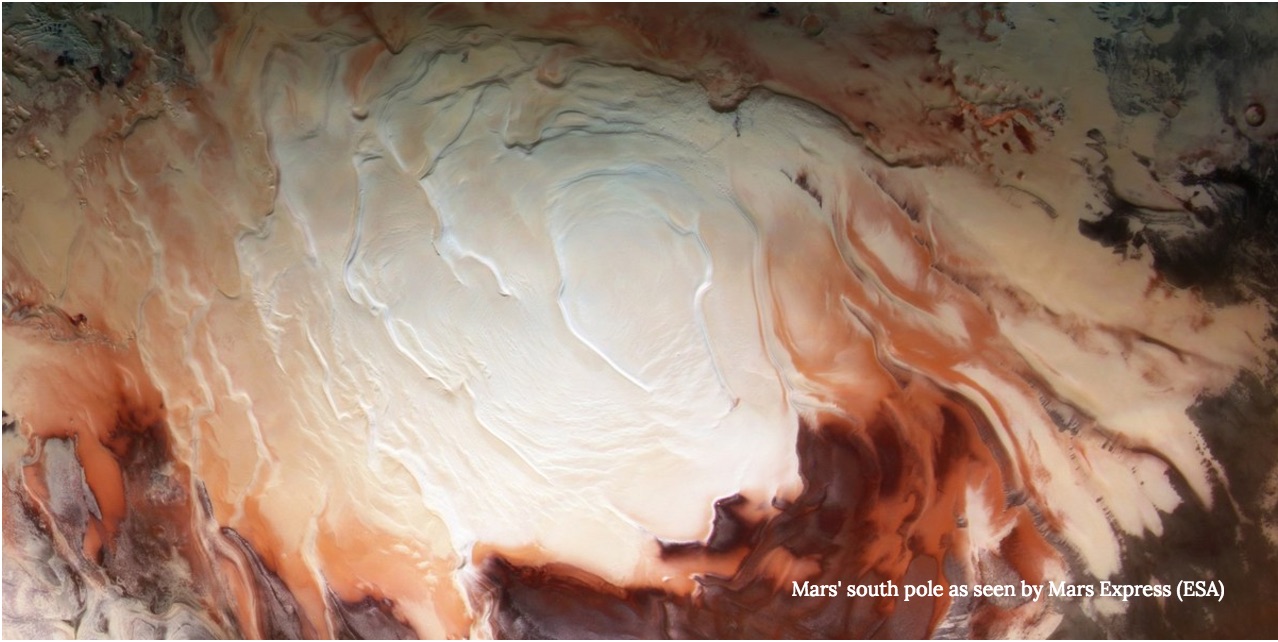
Mars' south pole as seen by Mars Express.
Credit: ESA
Like Earth, Mars possesses north and south polar ice caps. Unlike Earth, however, the Martian versions not only contain water ice, there's there's a thick layer of carbon dioxide ice acting as a blanket. Frozen CO2, also known as "dry ice", is known to wax and wane in thickness depending on the Martian season. Though we have a pretty good understanding of the ice caps' surface features and how they interact with Mars' predominately carbon dioxide atmosphere, what lies beneath the most ancient layers of ice has been a mystery.
That was, however, until NASA's Mars Reconnaissance Orbiter (MRO) arrived in orbit in 2006.
On board the veteran Mars satellite is an instrument called SHARAD — short for "Shallow Radar" — that has been bouncing radio waves off the planet's surface for over a decade. Individual observations by the instrument, for 2,000 orbits over the poles, have revealed some interesting icy findings over the years, but now, with a huge archive of data, planetary scientists have been able to build a 3-D view of the ice covering the north and south poles in the hope of better understanding the structures we cannot see inside the ice and how the ice changes over time. With this information they hope to build a picture of climatic changes over millions of years.
"We have applied industry-developed techniques in a very novel fashion to a Martian dataset, producing 3-D volumes that are each over 600 times larger than any terrestrial or planetary dataset of this kind," said senior scientist Nathaniel E. Putzig, of the Planetary Science Institute, in a statement.
A cutaway view of Planum Boreum at Mars' north polar cap. The blue and red areas show regions of high and low radar return power, respectively, which corresponds with ice thickness — white is the thickest.
Credit: NASA/ASI/JPL/FREAQS/PSI/SI/WUSTL
Hidden within these data are previously unknown features, including possible impact craters and vast layers of ice that likely highlight eras of climate changes as the Red Planet's tilt precessed. There also appears to be a larger than expected volume of frozen carbon dioxide locked in the south pole's cap.
"It is gratifying to see so plainly in the SHARAD volumes structures that took years of effort to characterize with the single-orbit profiles," Putzig added. "I'm excited about what we will learn from newly revealed features such as the probable impact craters."
"While 3-D seismic and ground penetrating radar have become routine tools in terrestrial geophysical exploration, our 3-D treatment of the SHARAD data is a first in planetary geophysical exploration," said Frederick J. Foss of Freestyle Analytical & Quantitative Services. "The 3-D imaged SHARAD volumes significantly enhance the detectability and interpretability of features within the Martian polar ice caps."
These 3-D maps of Martian ice cap interiors will no doubt aid future discoveries of what lies beneath, in turn developing our understanding of how Mars' atmosphere evolved from an apparently habitable state into the harsh, dry climate we find today.
Meer van UFO'S of UAP'S, ASTRONOMIE, RUIMTEVAART, ARCHEOLOGIE, OUDHEIDKUNDE, SF-SNUFJES EN ANDERE ESOTERISCHE WETENSCHAPPEN - DE ALLERLAATSTE NIEUWTJES


 Buitenaards bliepje blijkt afkomstig van extreem ver dwergstelsel - HLN.be