

Maandag 6 november 2017
 Astronomers Look For Life On 'Generic' Exoplanet

Astronomers Look For Life On 'Generic' Exoplanet
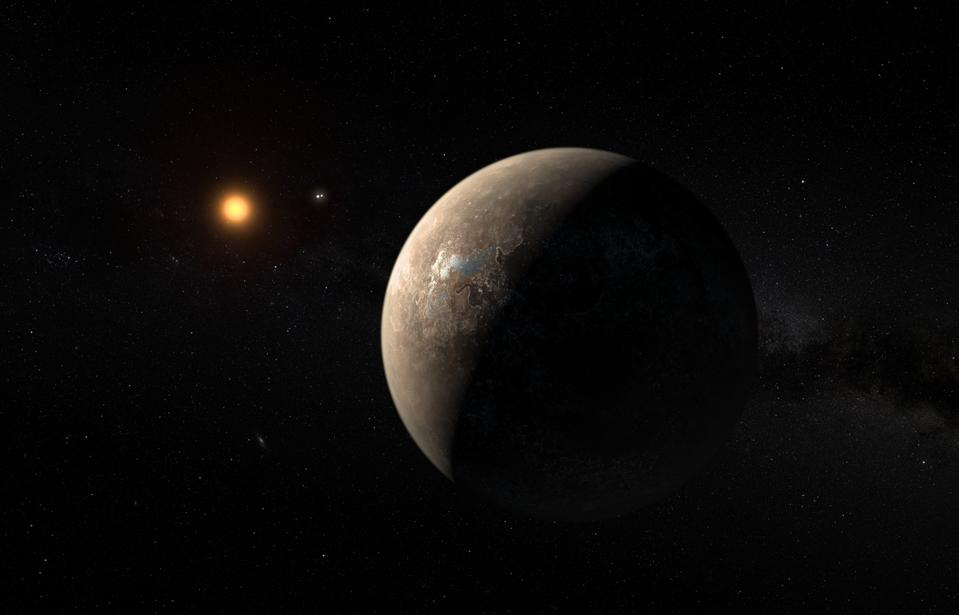
Artist's impression, exoplanet Proxima b.
(M. Kornmesser/AFP/Getty Images)
The alien world appears friendly at first, not forbidding.
Near the size of Earth, Proxima b is also nearby—twenty-five trillion miles away. In space, that’s practically spitting distance.
“The closest planet outside our solar system,” says Guillem Anglada-Escude, the lead scientist of the research team that discovered Proxima b in 2016. “And the first step beyond it.”
Proxima b’s proximity isn’t all that attracts the astronomers. Says Anglada-Escude: “Let’s not call it ‘Earth-like.’ But it does have Earth-like properties.”
Including the location of Proxima b’s orbit, inside the “habitable zone”—a sliver of sanctuary within solar systems, a place where a world could sustain liquid water.
Just as intriguing, Proxima b is probably rocky, like Earth, with enough surface area to serve as a launching pad for land-based life.
Even a mild climate might prevail on at least portions of the planet—although Proxima b is astonishingly close to its star, Proxima Centauri, just four-and-a-half million miles away. “That’s about five percent of the distance between the Earth and the Sun,” says Anglada-Escude.
Normally, that would suggest a scorched world, roasted by temperatures hundreds or perhaps thousands of degrees Fahrenheit. But Proxima Centauri, a cold star categorized as a “red dwarf,” is relatively faint and feeble, about one-tenth the size of the Sun and 500 times less bright.
Balance Proxima b’s closeness with Proxima Centauri’s coldness, and the result could be temperatures “in the same range as Earth,” says Anglada-Escude.
Proxima b, however, possesses a darker side—literally.
“It doesn’t have days and nights,” he says. Instead, the planet is, “almost for sure,” tidally-locked. Half of Proxima b forever faces its star; the other half remains in permanent darkness.
Somewhere in-between, a temperate space may endure—the so-called “terminator line,” blending both shadow and sunlight. Anglada-Escude speculates it covers roughly one-quarter of the surface. “My guess is, this is the place to find life, if there is any," he says.
Intrigued by the notion that alien life is there—microbes, vegetation, or something else—astronomers have published more than 100 studies of the planet over the past year.
Yet still, nearly nothing is certain about Proxima b. Some scientists say even the existence of an atmosphere is up in the air.
One study indicates Proxima Centauri’s ferocious stellar winds swept it away. “The force of that wind is thousands of times higher than the solar wind on Earth,” says Jeremy Drake of the Harvard-Smithsonian Center for Astrophysics. “Anywhere from one to twenty thousand times higher.”
Another study theorizes that extreme amounts of radiation emitting from a star so close “essentially blasts Proxima b’s atmosphere, scouring it off,” says Drake.
By themselves the winds and radiation are devastating enough. Combine them, and it’s a celestial double whammy.
Geschreven door peter om 14:49
Stuur door












 Did the Ancients Know the Secrets to Levitation?
 Is This The REAL Reason Why The Ancients Built THOUSANDS Of Pyramids?

 R
 Former Google Ethicist Warns Smartphones Are Weapons Of Mass


