
Interested in reading our new report, Exoplanet Science Strategy? Download the full report for free here:
http://ow.ly/dMoU30lGszs #ExoplanetScience


 Astronomer Have Spotted A Mysterious Object, Which Is 570 Billion Times Brighter than the Sun

Astronomer Have Spotted A Mysterious Object, Which Is 570 Billion Times Brighter than the Sun
So bright that it pushes the energy limit of physics. Billions of light years away, there is a giant ball of hot gas that is brighter than hundreds of billions of suns. It is hard to imagine something so bright. So what is it? Astronomers are not really sure, but they have a couple theories.
They think it may be a very rare type of supernova — called a magnetar — but one so powerful that it pushes the energy limits of physics, or in other words, the most powerful supernova ever seen as of today.

This object is so luminous that astronomers are having a really difficult time finding a way to describe it. “If it really is a magnetar, it's as if nature took everything we know about magnetars and turned it up to 11,” said Krzysztof Stanek, professor of astronomy at Ohio State University and the team's co-principal investigator, comedically implying it is off the charts on a scale of 1 to 10.
The object was first spotted by the All Sky Automated Survey of Supernovae (ASAS-SN or “assassin”), which is a small network of telescopes used to detect bright objects in the universe.
Although this object is ridiculously bright, it still can’t be seen by the naked eye because it is 3.8 billion light years away. ASAS-SN, since it began in 2014, has discovered nearly 250 supernovae, however this discovery, ASASSN-15lh, stands out because of its sheer magnitude. It is 200 times more powerful than the average supernova, 570 billion times brighter than the sun, and 20 times brighter than all the stars in the Milky Way Galaxy combined.

“We have to ask, how is that even possible?” said Stanek. “It takes a lot of energy to shine that bright, and that energy has to come from somewhere.”
Todd Thompson, professor of astronomy at Ohio State, has one possible explanation. The supernova could have generated an extremely rare type of star called a millisecond magnetar — a rapidly spinning and very dense star with a crazy strong magnetic field.
This is how crazy magnetars are: to shine as bright as it does, this magnetar would have to spin at least 1,000 times a second, and convert all of that rotational energy to light with pretty much 100 percent efficiency — making it the most extreme example of a magnetar that is physically possible.

“Given those constraints,” Thompson said, “will we ever see anything more luminous than this? If it truly is a magnetar, then the answer is basically no.”
Over the coming months, the Hubble Space Telescope will try to solve this mystery by giving astronomers time to see the host galaxy surrounding this object. The team may find that this bright object lies in the very center of a large galaxy — meaning the object is not a magnetar at all — and the gas around it is actually evidence of a supermassive black hole.

If that is the case, then the bright light could be explained by a new kind of event, said study co-author Christopher Kochanek, professor of astronomy at Ohio State. It would be something that has never, ever been seen before at the center of a galaxy.
Whether it is a magnetar, a supermassive black hole, or something else entirely, the results are probably going to lead to new thinking about how objects form in the universe.
Report calls for direct images of Earth-like exoplanets
A congressionally-mandated report recommends that NASA lead efforts to directly image possibly Earth-like exoplanets, using upcoming technologies. A major goal is finding habitable – maybe even inhabited – worlds.
The National Academies of Sciences, Engineering and Medicine (NASEM) in Washington, D.C., just released a new congressionally mandated report that aims to guide scientists’ study of exoplanets in the years to come. Among other things, the report urges NASA to lead a comprehensive direct imaging mission – using a new advanced space telescope – to study Earth-like exoplanets orbiting stars similar to our sun. The report is called Exoplanet Science Strategy.
The past several years have seen an explosion in the number of known exoplanets, or planets orbiting distant suns. At the moment, there are 3,779 confirmed planets, plus an additional 2,737 candidates awaiting verification. How many have been directly imaged? Fewer than two dozen, according to Wikipedia’s list of directly imaged exoplanets.
Many of the discovered exoplanets orbit close to their stars, and thus images are exceedingly difficult to image. Many are gas giants like Jupiter and Saturn, but others are smaller and rocky, like Earth. These rocky worlds would be the most difficult to image, but they’re of particular interest to astronomers and scientists, since at least some of them have the potential to be habitable and maybe even host life of some sort.
When scientists speak of Earth-like exoplanets, they’re basically referring to rocky planets of a similar size to Earth. With the limited information we currently have about these worlds, it’s still unknown how many of them have actual similarities to Earth, in terms of water, atmosphere, composition, habitability and so on. Obtaining that information is the next step in exoplanet research.
From the report:
The past decade has delivered remarkable discoveries in the study of exoplanets. Hand-in-hand with these advances, a theoretical understanding of the myriad of processes that dictate the formation and evolution of planets has matured, spurred on by the avalanche of unexpected discoveries. Appreciation of the factors that make a planet hospitable to life has grown in sophistication, as has understanding of the context for biosignatures, the remotely detectable aspects of a planet’s atmosphere or surface that reveal the presence of life.
The cover of the new report, Exoplanet Science Strategy 2018, by the National Academies of Sciences, Engineering and Medicine.
There are two main goals as outlined in the report:
To understand the formation and evolution of planetary systems as products of star formation and characterize the diversity of their architectures, composition, and environments.
To learn enough about exoplanets to identify potentially habitable environments and search for scientific evidence of life on worlds orbiting other stars.
The overall objective is to use both theory and observations to search for evidence of past and present life elsewhere in the universe. Rocky planets like Earth are the primary focus, given what we know about how life evolved here. A growing number of such worlds have been discovered by various missions and telescopes such as the Kepler Space Telescope, including ones in their stars’ habitable zones, although most are quite distant. The new TESS mission, which just launched a few months ago, is currently looking for similar planets closer to our own solar system.
A key aspect of that objective is to directly image these planets, which will require funding and long-term monitoring to see results. The report recommends using instruments that can directly image an exoplanet by blocking the light emitted by the parent stars – such as with a coronagraph or starshade.
Being able to determine what conditions are actually like on some of these rocky worlds – or even detect possible biosignatures – would open an exciting new chapter in exoplanet research. Other recent studies have shown that even planets covered completely in water – as some water worlds are thought to be – could potentially support life (both water and geologically active land masses are thought to have been necessary for life on Earth). Such discoveries increase the possibility of many worlds being able to support life, not just ones that are more “Earth-like.”

Artist’s concept of one of the Earth-sized exoplanets orbiting the star TRAPPIST-1. A growing number of such worlds are now being discovered. How many of them could support life?
Image via ESO/M. Kornmesser.
In addition to the new direct imaging capabilities, the report also notes that other ground-based observations will be essential. This would include the future Giant Magellan Telescope and the proposed Thirty Meter Telescope. These telescopes could not only provide advanced imaging and spectroscopic abilities of entire planetary systems, they could also detect molecular oxygen – a potential biomarker – in the atmospheres of rocky planets. The report further recommends that the National Science Foundation should invest in both telescopes to provide all-sky access.
The Kepler Space Telescope, now nearing its end of its mission, looked at stars relatively close by, while TESS will focus on stars even closer, in our sun’s immediate neighborhood. Another space telescope, however, the Wide Field Infrared Survey Telescope (WFIRST), would look at stars much further out, for which we still have little information as to planets, and enable a large direct imaging mission. WFIRST received the Academies’ highest priority in the 2010 Astronomy and Astrophysics Decadal Survey.
In addition, the report recommends that the James Webb Space Telescope should be used to systematically collect data on exoplanet atmospheres early in its mission.
The model of NASA’s interdisciplinary collaboration initiative – the Nexus for Exoplanet System Science – should also be expanded by supporting a cross-divisional research effort inviting proposals for interdisciplinary research. The report also calls on NASA to support a robust individual investigator program – including grants for theoretical, laboratory, and ground-based telescopic investigations to fully realize the scientific payoff of exoplanet missions.

The Planetary Habitability Laboratory currently lists 55 known exoplanets as potentially habitable, including these “top” ones.
Image via PHL @ UPR Arecibo (pal.upr.edu) July 2, 2018.
The report goes even further however, and is not limited to just scientific interest. It also acknowledges another very important issue – the discrimination and harassment that exist in the scientific workforce and how that can affect the exoplanet research community by posing barriers to the participation of people from certain demographic groups:
To maximize scientific potential and opportunities for excellence, institutions and organizations should take concrete steps to eliminate discrimination and harassment and to proactively recruit and retain scientists from underrepresented groups.
 National Academies ✔@theNASEM
Interested in reading our new report, Exoplanet Science Strategy? Download the full report for free here:
http://ow.ly/dMoU30lGszs #ExoplanetScience
Bottom line:
Source: Exoplanet Science Strategy 2018
Via The National Academies of Sciences, Engineering and Medicine
Released By The U.S. Air Force: Soldier Talks About Various E.T. Races
The United States Air Force has allowed the release of this video in 2012 showing a soldier discussing various ET races. In it, several fellow service members can be heard asking about Reptilian related ET's. He knows he is being filmed yet allows it to happen. Awareness Is Key. Analyze This. Look.
Video of UFO – Orb While Filming Moon With Nikon P900 – 18 Aug 2018
I was filming the moon on the early evening of August 18th2018 with a Nikon P900 and captured this object slowly flying to the right.
It's most easily seen on the left and then to the right of the moon several seconds later.
I didn't see the object while filming.
After discovering the capture I researched several "moon" videos to see if anything else seen something similar.
Some captured satellites.
This is not a satellite. Satellites fly by much faster...within a second of time. This object is on screen for around a minute and twenty seconds.
I also checked software like Stellarium, etc. to see if there were any moon transits by satellites or debris at the time. I found nothing in our databases so far.
Undeniably an object that is unidentified. If anyone can find a moon transit of debris or a faraway satellite in any of the databases, please post it. I found none.
Check out some of Crrow777 and Martin Stubbs YouTube captures...you'll see some that look very similar. Thanks to them both for providing the references.
And no...this is not fake or cgi. I have no idea how to produce images like this.
Are the aliens heading toward Earth? Strange glowing UFOs near the Sun sighted in San Bernardino, California
Alien Invasion? Strange Glowing UFOs sighted in San Bernardino, CA.
Are the aliens heading toward Earth? Strange glowing UFOs near the Sun sighted in San Bernardino, California
The director of the National Solar Observatory in New Mexico states that the closure is not about aliens
It has been a week since the National Solar Observatory in Sunspot, New Mexico, was shut down, evacuated, and visited by FBI agents— and the undisclosed “security issue” behind all this activity remains a mystery to the public.
Strange UFO In The Sky Over New Jersey Seen From Multiple Locations
These strange lights were filmed from 3 separate locations in New Jersey - Ocean city, Somers Point and Margate.
The witnesses claim the lights where part of one huge object.
Sondes de la NASA et de SpaceX : Une affirmation explosive suggère que les missions ont été “sabotées par des OVNI”
Les OVNI ont délibérément saboté trois grandes missions spatiales, selon des affirmations farfelues en ligne.
Des théoriciens du complot sont convaincus que les extra-terrestres ont piraté et détruit des sondes conçues pour explorer la galaxie en guise d’avertissement aux humains.
Ils ont mis en lumière des événements aussi bizarres que l’explosion d’un OVNI quelques secondes avant l’explosion de la fusée SpaceX en 2016 et avant la disparition de la sonde russe Phobos II en orbite autour de Mars.
Ces événements étranges, aussi farfelus qu’ils puissent paraître, ont déclenché des théories selon lesquelles des formes de vie intelligentes suivent de près nos missions galactiques.
La Fusée de SpaceX
Une fusée SpaceX Falcon-9 transportant un satellite Amos-6, qui devait étendre le haut débit de Facebook dans le monde entier, a explosé trois minutes avant un lancement d’essai programmé.
La compagnie d’Elon Musk a accusé une anomalie dans la quantité d’oxygène absorbée alors qu’elle chargeait le propergol dans la fusée.
Cependant, les théoriciens du complot aux yeux de faucon ont un point de vue différent.
Ils ont repéré un objet étrange – décrit comme un “globe gris” – qui apparaît une seconde avant que la fusée n’explose en une boule de feu.
Et ils sont convaincus que c’est un OVNI ou même un drone.
Certains ont prétendu que le Pentagone avait tiré quelque chose à côté de la fusée parce que SpaceX devient un sérieux concurrent pour le déploiement de satellites militaires.
Les sceptiques ont dit que l’OVNI était simplement un oiseau qui semblait beaucoup plus grand de loin.
Lorsque Musk a été interrogé sur la vie extra-terrestre, il a répondu sur Twitter : “On ne sait pas si nous sommes la seule civilisation actuellement vivante dans l’univers observable, mais il y a des chances que nous soyons est une impulsion supplémentaire pour étendre la vie au-delà de la Terre.”
Dans une autre réponse sur le média social, l’entrepreneur sud-africain a déclaré : “Il n’y a pas d’extraterrestres, du moins officiellement.”
La sonde Voyager 2 de la NASA
La sonde Voyager 2 de la NASA, lancée en août 1977 pour étudier les planètes les plus éloignées, est le seul vaisseau spatial à avoir visité les mastodontes de glace Uranus et Neptune.
C’est le troisième objet le plus éloigné de la Terre et il reste en contact avec le quartier général de l’agence spatiale.
En 2010, quelque chose de très étrange s’est produit.
Voyager 2 a commencé à transmettre des données illisibles pendant plusieurs semaines, ce qui a donné lieu à des suppositions selon lesquelles la sonde avait été piratée.
Un auteur pseudo-scientifique allemand, Hartwig Hausdorf, a laissé entendre que des extraterrestres avaient manipulé l’équipement dans l’espace lointain.
“On dirait presque que quelqu’un a reprogrammé ou détourné la sonde – nous ne connaissons donc peut-être pas encore toute la vérité”, a-t-il dit.
Cependant, la NASA a une explication plus simple, imputant le dysfonctionnement à la mémoire d’un ordinateur de bord qui, en quelques semaines, était à nouveau pleinement opérationnel.
Même si les données scientifiques étaient inintelligibles, ils ont insisté sur le fait que la sonde n’avait été ni piratée ni reprogrammée.
On pense qu’un vent cosmique d’une tempête solaire a pu frapper l’engin spatial.

La sonde russe Phobos II
La Russie a lancé les sondes Phobos 1 et 2 pour explorer la lune martienne du même nom en 1988.
L’un d’eux aurait été perdu à cause d’une erreur de commande radio.
Mais la deuxième sonde a atteint la lune martienne et a commencé à renvoyer des images de l’atmosphère de Mars et des environs.
L’image incroyable montre des objets très étranges, y compris ce qui semble être une forme d’éclipse très mince à la surface de la lune.
Peu de temps avant que la sonde ne disparaisse pour toujours, elle a renvoyé une photo montrant un énorme objet entre le vaisseau spatial et Mars.
Les conspirationnistes prétendent que l’OVNI était un vaisseau spatial cylindrique géant qui, selon eux, projetait l’ombre à la surface de Mars.
Ils croyaient qu’il s’agissait de la “première fuite d’un vaisseau mère extraterrestre dans le système solaire”.
New Mexico Solar Observatory Re-Opening Monday After Criminal Investigation Thawing arctic lakes are bubbling methane, amplifying global warming
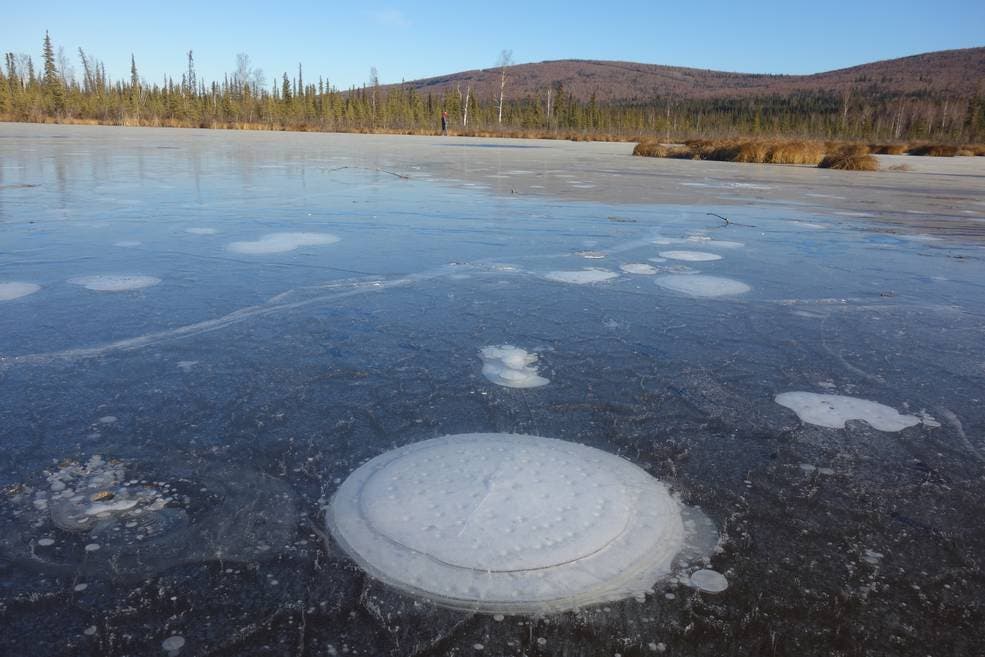
A NASA study of certain bubbling lakes in the Arctic suggests that methane deposits are being released due to an understudied phenomenon called ‘abrupt thawing’. Methane — which is 30 times more potent at trapping heat than carbon dioxide — has been frozen for potentially thousands of years and its sudden release could significantly impact the climate by the end of the century.
Methane bubbles up from the thawed permafrost at the bottom of the thermokarst lake through the ice at its surface.
Credits: Katey Walter Anthony/ University of Alaska Fairbanks.
Methane and carbon dioxide are both produced in thawing permafrost as animal and plant remains decompose. As long as this organic matter remains frozen, it will stay in the permafrost. However, if it thaws, it starts decaying, releasing carbon dioxide or methane into the atmosphere — which is why scientists are deeply concerned with the present development.
Right now, Earth’s atmosphere contains roughly 850 gigatons of carbon (a gigaton is about the weight of 100,000 school buses). Scientists estimate that there is about twice as much carbon frozen in permafrost than present in the atmosphere today.
That doesn’t mean that all of the carbon will end up in the atmosphere. The trick is to find out how much of the frozen carbon is going to decay, how fast, and where. The full picture seems to be even more complex than previously thought. In a new study, scientists have discovered a new source of methane that hasn’t been accounted for by climate models — methane emissions from ‘thermokarst‘ lakes.
Such lakes form when permafrost taws at a faster rate and deeper levels than usually happens. This sudden thawing creates a depression which fills up with rainwater, ice, and snow melt. The water’s presence then leads to even more thawing at the shores of the lake, speeding up the rate of methane release into the atmosphere.
“The mechanism of abrupt thaw and thermokarst lake formation matters a lot for the permafrost-carbon feedback this century,” said first author Katey Walter Anthony at the University of Alaska, Fairbanks. “We don’t have to wait 200 or 300 years to get these large releases of permafrost carbon. Within my lifetime, my children’s lifetime, it should be ramping up. It’s already happening but it’s not happening at a really fast rate right now, but within a few decades, it should peak.”
Walter Anthony and colleagues used a combination of computer models and field measurements to reach the conclusion that abrupt thawing more than doubles previous estimates of permafrost-derived greenhouse warming.
“Within decades you can get very deep thaw-holes, meters to tens of meters of vertical thaw,” Walter Anthony said. “So you’re flash thawing the permafrost under these lakes. And we have very easily measured ancient greenhouse gases coming out.”
Current models estimate carbon emission from thawing permafrost as a gradual process. These new results suggest that in reality, the Arctic’s thawing feedback loops are more complex than we suspected. It’s all especially concerning considering that the IPCC — the leading international body for the assessment of climate change — did not incorporate any permafrost carbon emissions and the resulting amplification of climate change in its most recent climate projections.
This means that it will be even more challenging to keep global temperatures below the 1.5- or 2- degrees Celsius target set by the international community under the Paris Agreement.
Even so, methane emissions from thawing permafrost pale in comparison to the amount of human fossil fuel emissions. According to the researchers, permafrost methane emissions account for only 1% of the global methane budget. So the best thing we can do is to transition as fast as possible to a carbon-neutral society.
“But by the middle to end of the century the permafrost-carbon feedback should be about equivalent to the second strongest anthropogenic source of greenhouse gases, which is land use change,” Walter Anthony said.
It Is Possible Jupiter Could Support Life, Scientists Say
BY
Jupiter and its shrunken Great Red Spot.
Credit: Wikimedia Commons.
A new factor has been added to the debate on whether or not living organisms could exist on Jupiter. You probably know Jupiter is a Jovian planet, a giant formed primarily out of gases. So how could alien life be able to exist in an environment where most of the phases of matter are absent? The answer is simply found in the element of water.
Within the rotating, turbulent Great Red Spot, perhaps Jupiter’s most distinguishable characteristic, are water clouds. Many of the other clouds in this enormous perpetual storm are comprised of ammonia and/or sulfur. Life theoretically cannot be sustained in water vapor alone; it thrives in liquid water. But according to some researchers, the fact alone that water exists in any form on the planet is a good first step.
The Great Red Spot is still a planetary feature which stumps much of the scientific community today. As it has been observed for the past century and a half, the Great Red Spot has been noticeably shrinking. The discovery of water clouds may lead to a deeper understanding of the planet’s past, including whether or not it might have sustained life, as well as weather-related information.
Some scientists have pondered the possibility that, due to the hydrogen and helium content in its atmosphere, Jupiter could be a diamond-producing“factory.” They have further speculated that these diamonds could enter into a liquid state and a rainfall of liquid diamonds would be in the Jovian’s weather forecast.
Likewise, the presence of water clouds means that water rain (a liquid) is not entirely impossible. Máté Ádámkovics, an astrophysicist at Clemson University in South Carolina, had this to say on the matter:
“…where there’s the potential for liquid water, the possibility of life cannot be completely ruled out. So, though it appears very unlikely, life on Jupiter is not beyond the range of our imaginations.”
Scientists are acting accordingly, researching the part which water plays in the atmosphere and other natural systems on Jupiter. They remain skeptical but eager to follow up on the new discovery. They shall also strive to find out just how much water the planet really holds.
Elon Musk Shares Powerful New Images of SpaceX BFR in Action
SpaceX’s BFR is taking on a new shape. Just days after sharing images of a new Tintin-inspired design for the Mars-bound rocket, CEO Elon Musk has posted more concept art alongside details of some additional features. The BFR, expected to complete test firing next year, could send the first humans to Mars as early as 2024.
It’s a big development for the company’s largest-ever rocket, unveiled 12 months ago at the International Astronautical Congress in Adelaide, Australia. The rocket eclipses even the Falcon Heavy, the world’s most powerful operational rocket that completed its first test launch in February. Where the Heavy has a liftoff thrust in the region of 2,500 tons, the BFR has a thrust of 5,400 tons. The new rocket uses 31 Raptor engines, powered by liquid oxygen and methane.
The altered design, depicted below, adds new fins to the rocket that Musk admits bear a resemblance to the ones found in the Tintin comics:

The redesigned nose plays a key role in operations:
 San@vicentes
What’s this thing near the nose ? Looks like some retractable thing ?
 Elon Musk ✔@elonmusk
Forward moving wing
However, the new renders also lack a key feature found on previous designs:
Elon Musk ✔@elonmuskGood catch. They are there in the flight design, but we forgot to put them in this render.
The rocket has been designed with reusability in mind, enabling humans to visit Mars and refuel by extracting resources from the area. The company will send two unmanned ships to Mars in 2022, followed by two more unmanned ships and two manned ships in 2024. Each ship will carry around 100 tons, meaning the six will send double the mass of the International Space Station to Mars. These will be used to set up refueling stations, laying the groundwork for self-sufficiency, and making the first step to a multi-city Martian colony.

The BFR is also expected to send the world’s first private passenger on a trip around the moon. SpaceX announced the development last week, declaring that “only 24 humans have been to the Moon in history” and “no one has visited since the last Apollo mission in 1972.” The company plans to announce further details about the identity of the passenger and their reasons at a livestreamed event on Monday at 6 p.m. Pacific time.
While it’s a serious moment for the company, Musk couldn’t help dropping a reference to comedy spy thriller Austin Powers in the replies:
 Conor McDonnell ✔@ConorMcDPhoto
Is it supposed to look like a shark? Because if that was planned thats pretty bad ass
Elon Musk ✔@elonmuskWith lasers
Doctor Evil’s dream of sharks with lasers is coming to life.
See also:
Photos via Elon Musk/Twitter
Solar Observatory Mysteriously Reopens After Investigation
They’re ba-ack!
The FBI and the Blackhawk helicopters are gone and the employees of the Sunspot Solar Observatory on Sacramento Peak in New Mexico are slowly coming back after the facility was mysteriously evacuated and closed on September 6thwithout explanation, causing rumors and conspiracy theories of all sizes and flavors to flourish. While the reason given for the closure seems to make sense in hindsight, the stress it caused local residents (some of whom were also evacuated) and law enforcement officials makes many wonder if it wasn’t overkill … or if there’s still some things they’re not being told.
“However, our desire to provide additional information had to be balanced against the risk that, if spread at the time, the news would alert the suspect and impede the law enforcement investigation. That was a risk we could not take.”

The Richard B. Dunn Solar Telescope
A spokesperson for AURA, the Association of Universities for Research in Astronomy which runs the 71-year-old solar observatory in Sunspot, New Mexico, finally revealed on September 16th that the investigation was criminal in nature, but gave no details on the crime itself.
“AURA has been cooperating with an ongoing law enforcement investigation of criminal activity that occurred at Sacramento Peak. During this time, we became concerned that a suspect in the investigation potentially posed a threat to the safety of local staff and residents. For this reason, AURA temporarily vacated the facility and ceased science activities at this location.”
Temporarily? Eleven days of evacuation plus a total news blackout at a facility whose main feature is a telescope makes one say more than “Hmm.” The observatory is near Holloman Air Force Base, the White Sands Missile Range and, of course, Roswell. The investigation was done by the FBI and the owners of the Blackhawk helicopters, not members of local law enforcement, who were asked to leave and kept in the dark.

As of this writing, there is no news of arrests being made or criminal charges being filed as a result of the alleged criminal investigation. The nine employees are back on the job and the facility is again open for tourists. How long will it take before they’re tired of being asked the same questions that have nothing to do with the Dunn Solar Telescope or the sun?
While the sun continues to shine everywhere else, Sunspot seems to be under a dome covered with an SPF 100 suncreen.
Fishermen saw ‘robot-like creatures with slit mouths and crab pincers in most bizarre alien abduction ever’, secret hypnosis files revealThe never-seen-before notes describe how the two men were fishing when a UFO hovered above them and three strange beings emerged
RUIMTESCHIP HANGT VIER MINUTEN BOVEN WEG...
RUIMTESCHIP HANGT VIER MINUTEN BOVEN WEG...
Het zal je gebeuren dat als je ’s avonds naar huis rijdt er opeens een enorm "iets" boven de weg hangt.
Dat is exact wat er enkele dagen geleden gebeurde toen een man samen met zijn vriendin naar huis reed en gelukkig kon hij een aantal foto’s maken.

De getuige is er absoluut van overtuigd dat het geen weerspiegeling of iets dergelijks is omdat nadat dit object een minuut of vier boven de weg had gehangen, dit opeens met grote snelheid wegvloog. Iets dat door hem en zijn vriendin beiden is gezien.
Ufoloog Scott Waring is heel benieuwd of er die avond ergens in de buurt mensen zijn vermist of tijdelijk zoek geweest zijn. Hij denkt namelijk dat wanneer een ruimteschip zo dichtbij de weg komt er een reden voor moet zijn. En die reden zou heel goed kunnen zijn dat ze van plan waren om één of meerdere mensen te ontvoeren.


Strange Series of Anomalies Stretching Across Pacific Ocean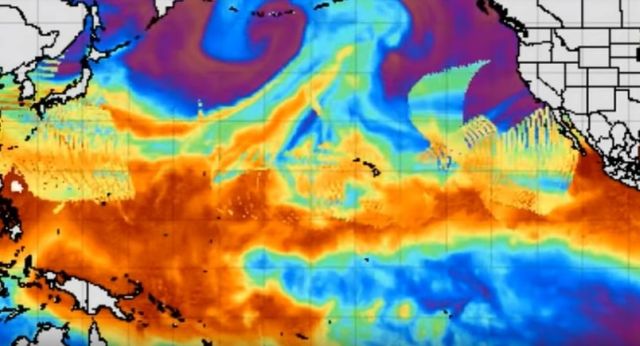

 Glowing Disk Hovers Over Road In Minnesota For Four Minutes Before Shooting Off, Sep 2018, Photos, UFO Sighting News.


 ‘UFO’ spotted onboard US Navy aircraft carrier, EXTRAORDINARY YouTube footage shows

One amazed YouTube user wrote: “TR-3B. It really exists!"
Another offered a detailed explanation, writing: “I think it's a TR-3B, the latest of the US's black projects vehicles.
“This is the next generation of secret technology developed by the skunk works and other secret development programs.
“It is in any case not alien. It might have been developed with the use of reverse-engineered alien technology. But built on this planet.”
Others were not so convinced, with user Jim Hatch penning: “Pretty sure they wouldn't leave it parked on the deck of an aircraft carrier, was it an alien spacecraft or some sort of secret technology?”


And others suggested the object was Photoshopped into the footage, joking about the triangle craft's “stealth shadow”.
One said: “Nice CGI.”
Another sceptic said: “So tell me why a craft which can defy gravity and travel faster than anything known by mankind, which doesn't use fossil fuel stands on the deck of an aircraft carrier?”
But there were some who were not sure what to think.
Matt Simon said: “The problem with today's CGI is that it's getting damn near impossible to know what is real and what is fake.


“Unless you're right there to actually witness it with your own eyes, when you see a compelling video and wonder if it's real or fake, sometimes all you can do is shake your head and shrug your shoulders.”
Eventually, ufoofinterest.org, which claims to “debunk hoaxes, conspiracies and misinformation”, rubbished the UFO claims.
The group tweeted a video which showed the original US Navy training footage with no UFO in sight, proving it had been doctored.
They said: “Triangle shaped UFO spotted on US Aircraft Carrier in the Mediterranean Sea?
“It's interesting to check out which sources the hoax promoter and CGI artist SECTION 51 used to fabricate his latest video.
“Here's a source without that fake UFO.”

Triangle shaped #UFO spotted on US Aircraft Carrier in Mediterranean Sea?
It's interesting to check out which sources the #hoax promoter and #CGI artist SECTION 51 used to fabricate his latest video.
Here's a source without that #fake UFO
https://youtu.be/Le_eYNdCrRQ?t=37s …
US observatory denies involvement of aliens in its ‘security’ closure
An American solar observatory has denied that aliens were involved in its security-related closure in a state known for secretive military testing and a suspected UFO crash.
The New Mexico solar observatory remains closed after being evacuated for unknown reasons last week.
“I can tell you it definitely wasn’t aliens,” a spokeswoman for the National Solar Observatory, part of the Sunspot Solar Observatory consortium, told The Washington Post.
Meanwhile, an investigation was underway by the Federal Bureau of Investigation (FBI).
“We don’t know anything. We’re just as curious as anyone else,” one guard said.
No local law enforcement was involved in the case as the FBI remained on the scene.
“They wouldn’t give us any details,” Otero County Sheriff Benny House said. “I’ve got ideas, but I don’t want to put them out there. That’s how bad press or rumors get started, and it’ll cause paranoia, or I might satisfy everybody’s mind and I might be totally off base.”
The observatory is also taking the chance to attract the people’s attention to its work.
“With the excitement this closure has generated, we hope you will come and visit us when we do reopen, and see for yourself the services we provide for science and public outreach in heliophysics,” it said.
Mars Explorers Could Live in 'Igloo' Near Red Planet's North Pole


"The crane vehicle could be reused several times and would be powered by fuel produced on Mars. It would reduce the payload that space shuttles would have to carry up to the research base," study co-author Claudio Leonardi, a scientist at EPFL, said in the same statement. "The vehicle's docking system would be similar to that used on the International Space Station: once a shuttle was docked, the vehicle would unload the cargo and crew and set them down on Mars."


