Ontdek de Fascinerende Wereld van UFO's en UAP's: Jouw Bron voor Onthullende Informatie!
Ben jij ook gefascineerd door het onbekende? Wil je meer weten over UFO's en UAP's, niet alleen in België, maar over de hele wereld? Dan ben je op de juiste plek!
België: Het Kloppend Hart van UFO-onderzoek
In België is BUFON (Belgisch UFO-Netwerk) dé autoriteit op het gebied van UFO-onderzoek. Voor betrouwbare en objectieve informatie over deze intrigerende fenomenen, bezoek je zeker onze Facebook-pagina en deze blog. Maar dat is nog niet alles! Ontdek ook het Belgisch UFO-meldpunt en Caelestia, twee organisaties die diepgaand onderzoek verrichten, al zijn ze soms kritisch of sceptisch.
Nederland: Een Schat aan Informatie
Voor onze Nederlandse buren is er de schitterende website www.ufowijzer.nl, beheerd door Paul Harmans. Deze site biedt een schat aan informatie en artikelen die je niet wilt missen!
Internationaal: MUFON - De Wereldwijde Autoriteit
Neem ook een kijkje bij MUFON (Mutual UFO Network Inc.), een gerenommeerde Amerikaanse UFO-vereniging met afdelingen in de VS en wereldwijd. MUFON is toegewijd aan de wetenschappelijke en analytische studie van het UFO-fenomeen, en hun maandelijkse tijdschrift, The MUFON UFO-Journal, is een must-read voor elke UFO-enthousiasteling. Bezoek hun website op www.mufon.com voor meer informatie.
Samenwerking en Toekomstvisie
Sinds 1 februari 2020 is Pieter niet alleen ex-president van BUFON, maar ook de voormalige nationale directeur van MUFON in Vlaanderen en Nederland. Dit creëert een sterke samenwerking met de Franse MUFON Reseau MUFON/EUROP, wat ons in staat stelt om nog meer waardevolle inzichten te delen.
Let op: Nepprofielen en Nieuwe Groeperingen
Pas op voor een nieuwe groepering die zich ook BUFON noemt, maar geen enkele connectie heeft met onze gevestigde organisatie. Hoewel zij de naam geregistreerd hebben, kunnen ze het rijke verleden en de expertise van onze groep niet evenaren. We wensen hen veel succes, maar we blijven de autoriteit in UFO-onderzoek!
Blijf Op De Hoogte!
Wil jij de laatste nieuwtjes over UFO's, ruimtevaart, archeologie, en meer? Volg ons dan en duik samen met ons in de fascinerende wereld van het onbekende! Sluit je aan bij de gemeenschap van nieuwsgierige geesten die net als jij verlangen naar antwoorden en avonturen in de sterren!
Heb je vragen of wil je meer weten? Aarzel dan niet om contact met ons op te nemen! Samen ontrafelen we het mysterie van de lucht en daarbuiten.
Woensdag 28 oktober 2020
Black Knight Satellite UFO Silently Moves Over Philippines, April 18, 2019, Video, UFO Sighting News.
Black Knight Satellite UFO Silently Moves Over Philippines, April 18, 2019, Video, UFO Sighting News.
Date of sighting: April 18, 2019, but reported this week
Location of sighting:Sta Rosa Laguna, Philippines
This object seems to be drafting through the sky, however when I make a close up of it...I find it baffling. The object has an opening on tis top. It has a brownish red tint and the open on its top has a few long spikes on it. The shape reminds me of one of the dark knight satellites I reported about 10 years ago from a NASA index. This is 100% alien, no doubt about it. I have heard of the UFOs over the Philippines, but this is the clearest video I have ever seen from there.
Scott C. Waring - Taiwan
Eyewitness states:
4/18/2019 - 6:25 PM Video taken by Galaxy S8 I have no idea what it is but it looks like a person floating through the sky wtf.
Creature With Tenticals Found On Mars, Oct 28, 2020, UFO Sighting News.
Screenshot below is a white fungus I found a few days ago...I think it feeds off this...its growing out like a plant.
Date of discovery: Oct 28, 2020 (Taiwan Time)
Location of discovery: Mars
Source: Gigapan (coming in a few days)
I found this strange creature with tentacles in a Mars photo today. The animal has an exoskeleton and looks like a cross between a scorpion and a tortoise. Also there is a lot of white fungus like growth in the area. I believe that this animal may live off the liquid inside these fungus tubes. 15 years ago I found a color photo of the Mars rover and its deep tracks behind it. Behind the rover in the tracks I saw a single white fungus plant, broken off at the point the rover cut through it. It had a straw like opening and a white liquid was driving down from it and streaming into the tracks 3 inches below. The tracks were deep in the dirt...about 3 inches...which is unusual and thats why I took a look at the tracks and found it. I did not record the photo URL so it is still lost...out there. I believe this animal is eating the white liquid inside those fungus plants.
Mysterious appearance seen in the sky over Boise, Idaho
Astrange anomaly which seems to change in shape and color hovered for prolonged period of time then moved erratically in the sky over Boise, Idaho on October 25, 2020.
It spent first 3 or so minutes hovering in place, then began moving in circular and diagonal paths around the sky, not overly quickly and not in a significant distance, but very clearly moving, hovering, and repeating, then it moved erratically in the sky.
The witness who watched the mysterious appearance for approximately 15 minutes said that it also was flashing in various colors before it disappeared. Mufon report here.
Specialists May Have Found A Link Between UFO Sightings And Nuclear Missile Sites
A team of specialists find in Bariloche, Argentina, a possible link between a massive amount of UFO sightings in the area and a secret nuclear project.
NASA FINDS BEST EVIDENCE YET THAT THERE IS WATER ICE ON THE MOON
This is groundbreaking for future plans to build a lunar base.
NASA HAS THE BEST EVIDENCE YET THAT THERE IS WATER ON THE MOON — and it appears far more abundant and more accessible than scientists first realized.
Trapped in ice, the evidence offers welcome justification for NASA’s ambitious program to not only return humans to the Moon by 2024, but to also establish a long-term, manned lunar base operating on a similar basis to the International Space Station.
As part of NASA's upcoming Artemis mission, the space agency wants to build a permanent lunar base on the Moon that will help astronauts reach further destinations like Mars. However, in order to do that, future astronauts would need to find resources on the Moon that can help accommodate their stay. Chief among them: water.
In a pair of studies published Monday in the journal Nature Astronomy, scientists report both the 'unambigious' detection of molecular water and small, icy water traps that are much more spread out across the lunar surface than previously believed.
In terms of the exact amount of water found, Casey Honniball, one of the scientists who took part in the research and a postdoctoral fellow at NASA, said: "The amount of water is roughly equivalent to a 12 ounce bottle of water within a cubic meter of lunar soil." However it is important to note that the water is seemingly distributed across the lunar surface, and there may be differences across regions, she added. Honniball made the comments during a press conference to announce the discovery Monday.
A WATERY WORLD
In 2018, scientists discovered evidence of water ice on the Moon's surface, mainly at lunar crater in the Moon's southern pole. Some of the water ice was also apparent at the northern pole, where temperatures never reach above -250 degrees Fahrenheit.
But the new discovery find ice water may be much more abundant across the lunar surface — occupying an area some 40,000 km squared, or about the same area as the country of Switzerland. Importantly, water also appears to exist in areas lit by sunlight — a key distinction from the implication of the 2018 results that water existed only in extremely cold, dark regions on the Moon.
Paul Hayne, a researcher at the Astrophysical & Planetary Sciences Department at the University of Colorado, and lead author of one of the new studies, noticed cold shadows in images of the Moon collected by NASA's Reconnaissance Orbiter and decided to investigate it further.
"If you could keep zooming in forever, at one point would you stop seeing those shadows," Hayne tells Inverse.
By further analyzing the image, the team behind the new study discovered that besides the large permanently shadowed craters on the Moon, there are tens of billions of other smaller cold traps that had not been mapped before across the lunar surface. Some of these are the size of a penny, the data suggest.
"What surprised us is just the sheer number," Hayne says. "Tens of billions of them and spread out throughout the poles."
The new discovery also showed that these shadowed areas can be found within a centimeter of sun-lit areas on the Moon, meaning that they are a lot more accessible than previously believed.Astronauts may not need to venture to the areas of the Moon where temperatures are freezing.
Instead, they could be standing in the relatively warm sunlit areas and still be able to have access to the frozen water.“It definitely expands the possibilities,” Hayne says. “What this discovery does is also expand the real estate on the lunar surface where a base could be viable.”
The studies also find clear evidence that the signs of water the scientists in 2018 found are indeed water, not of hydroxyls. Hydroxyls are used in household chemicals, like drain cleaner, according to Honniball.
HUMANS' FUTURE ON THE MOON
The scientists behind the two studies reinforced the idea that water is "extremely critical" to deep space exploration. It could be used for drinking water, and for other purposes they said. But water is heavy, Jacob Bleacher, a NASA researcher involved in the work, said during the same conference. That makes it hard to transport from Earth to the Moon, or further into space.
"Finding water that is easier to reach is really important to us," Bleacher said.
Knowing how much water is on the Moon, how it is stored, and whether it is replenished over time are important questions to answer for any future human exploration or stays on the Moon, Bleacher added. Ultimately, scientists hope to establish a lunar water resource map, he said.
SOFIA, NASA's Stratospheric Observatory for Infrared Astronomy, was critical to these new results. But SOFIA was not supposed to study the Moon. It was a shock when, during a test, the scientists operating the observatory found these clear signals of water across the Moon's surface, Naseem Rangwala, project scientist for the SOFIA mission, said during the conference.
An important implication of these results is that when planning a future lunar base, scientists may no longer be restricted to exploring the rims of lunar craters previously known to have ice water. Scientists also noted in the press conference that there is likely similar abundance on the far-side of the Moon as seen here on the near-side.
The discovery offers up new questions about how water can persist on the harsh conditions on the lunar surface, Paul Hertz, Astrophysics division director at NASA, added. The Moon has no atmosphere, and the surface is thought entirely inhospitable due to the harmful affects of solar radiation. But the new results suggest lunar water may withstand solar radiation because it is stored in the form of glass-like beads.
If water can persist — and replenish — across the Moon, then it is possible future lunar explorers could mine and use Moon water as we use water here on Earth, from growing crops to drinking cocktails.
Abstract 1:
Widespread hydration was detected on the lunar surface through observations of a characteristic absorption feature at 3 µm by three independent spacecraft1,2,3. Whether the hydration is molecular water (H2O) or other hydroxyl (OH) compounds is unknown and there are no established methods to distinguish the two using the 3 µm band4. However, a fundamental vibration of molecular water produces a spectral signature at 6 µm that is not shared by other hydroxyl compounds5. Here, we present observations of the Moon at 6 µm using the NASA/DLR Stratospheric Observatory for Infrared Astronomy (SOFIA). Observations reveal a 6 µm emission feature at high lunar latitudes due to the presence of molecular water on the lunar surface. On the basis of the strength of the 6 µm band, we estimate abundances of about 100 to 400 µg g−1 H2O. We find that the distribution of water over the small latitude range is a result of local geology and is probably not a global phenomenon. Lastly, we suggest that a majority of the water we detect must be stored within glasses or in voids between grains sheltered from the harsh lunar environment, allowing the water to remain on the lunar surface.
Abstract 2:
Water ice is thought to be trapped in large permanently shadowed regions in the Moon’s polar regions, due to their extremely low temperatures. Here, we show that many unmapped cold traps exist on small spatial scales, substantially augmenting the areas where ice may accumulate. Using theoretical models and data from the Lunar Reconnaissance Orbiter, we estimate the contribution of shadows on scales from 1 km to 1 cm, the smallest distance over which we find cold-trapping to be effective for water ice. Approximately 10–20% of the permanent cold-trap area for water is found to be contained in these micro cold traps, which are the most numerous cold traps on the Moon. Consideration of all spatial scales therefore substantially increases the number of cold traps over previous estimates, for a total area of ~40,000 km2, about 60% of which is in the south. A majority of cold traps for water ice is found at latitudes > 80° because permanent shadows equatorward of 80° are typically too warm to support ice accumulation. Our results suggest that water trapped at the lunar poles may be more widely distributed and accessible as a resource for future missions than previously thought.
We’ve suspected there was water on the moon for about a decade, but there was some room for interpretation. Well, not anymore.
“It’s actually 40,000 square kilometers,” Paul Hayne, one of the study authors, tells me, pointing out a typo in a press release. That’s 40,000 square kilometers that could host water on the moon.
The surface of the moon is pockmarked with water traps. Image credits: NASA.
The moon has a swarm of shadowy traps — traps where the sun never shines, cold enough that they could host water. It’s not the first time something like this has been speculated by researchers. In 2009, NASA scientists found water molecules in the polar regions of the moon.
But the 2009 study couldn’t really tell whether it was really (frozen) water or if there water is entrapped in lunar rocks. If this were the case, then the rock-embedded water (in a form called hydroxyl) wouldn’t really be of much use to potential moon missions. Now we know: it’s not.
As my colleague Rob points out, water has a distinct chemical signature that hydroxyl doesn’t, but it’s not always visible: you have to use the right instruments to see it. Casey Honniball and colleagues analyzed data from the Stratospheric Observatory for Infrared Astronomy (SOFIA) airborne telescope that observed the Moon at 6 micrometers (or microns) wavelengths. At this wavelength, the chemical signature of water becomes detectable, which confirmed that the 2009 study was on the money — it is indeed molecular water, not water that’s trapped in geological structures.
We’ve suspected there was water on the moon for about a decade, but there was some room for interpretation. Well, not anymore.
“It’s actually 40,000 square kilometers,” Paul Hayne, one of the study authors, tells me, pointing out a typo in a press release. That’s 40,000 square kilometers that could host water on the moon.
The surface of the moon is pockmarked with water traps. Image credits: NASA.
The moon has a swarm of shadowy traps — traps where the sun never shines, cold enough that they could host water. It’s not the first time something like this has been speculatedby researchers. In 2009, NASA scientists found water molecules in the polar regions of the moon.
But the 2009 study couldn’t really tell whether it was really (frozen) water or if there water is entrapped in lunar rocks. If this were the case, then the rock-embedded water (in a form called hydroxyl) wouldn’t really be of much use to potential moon missions. Now we know: it’s not.
As my colleague Rob points out, water has a distinct chemical signature that hydroxyl doesn’t, but it’s not always visible: you have to use the right instruments to see it. Casey Honniball and colleagues analyzed data from the Stratospheric Observatory for Infrared Astronomy (SOFIA) airborne telescope that observed the Moon at 6 micrometers (or microns) wavelengths. At this wavelength, the chemical signature of water becomes detectable, which confirmed that the 2009 study was on the money — it is indeed molecular water, not water that’s trapped in geological structures.
But this is just one of the puzzle pieces published today. In the other one, Paul Hayne and colleagues explored phenomena called “cold traps”.
Where the sun doesn’t shine
Imagine standing on the surface of the moon, near one of its poles, Hayne explains. You’d see a lot of shadows — shadows where the sun doesn’t shine, that are cold enough to preserve frozen water even without a lunar atmosphere.
“All of this area could harbor water ice, because these are regions where the temperature is so low (less than -163 °C) that ice is stable for billions of years.” There’s a lot of area that could hold water, but it’s not clear just how much there is. “However, we do not yet know how much is there.”
THe shadowed Shackleton Crater near the moon’s south pole is one location where scientists have found deposits of water ice. The ice can not only be used by lunar astronomers, but it has the potential to reveal insights about the moon’s history, (and the Earth’s) history.
Image credits: NASA/Goddard Space Flight Center/Leonard David’s Inside Outer Space.
Hayne and colleagues found that cold traps could vary drastically in size, down to just 1 centimetre in diameter. The smaller ones are much more common, Hayne notes, and all traps are more common in the polar areas. where light falls at more of an angle.
“Our findings suggest that water deposits in the micro cold traps are much more geographically widespread in the polar regions,” he explains.
What this all means
The immediate significance of this discovery is practical: if there’s a lot of water on the moon, then there’s a lot of water that could be used in lumar missions — and having access to water is an excellent starting point for a prospective lunar base, or even a research station.
“This discovery should make it easier to perform extraction and utilization for both science and exploration missions in the future,” Hayne also explains.
But the fact that the moon could host water is only a part of the story; where did that water come from in the first place?
Water may have been delivered to the Moon over geological timescales by an astronomical bombardment, Haynes says. Understanding where it came from could even reveal where the water on Earth is sourced. But if we really want to figure that out, remote observations just won’t do.
“The mostly likely sources based on current understanding are:
1) comets,
2) asteroids and interplanetary dust,
3) solar wind protons, and
4) volcanic outgassing from the Moon itself.
We will need to get down on the surface and analyze the ice deposits directly in order to understand which of these sources dominates. This also would shed light on the origins of Earth’s water.”
UFO sighting: Alien 'monolith' base found on Mars moon Phobos - claim
UFO watchers have been excitedly sharing a European Space Agency (ESA) image purportedly showing an alien moon base first posited by NASA astronaut Buzz Aldrin.
Legendary NASA astronaut Buzz Aldrin gave an interview on C-Span seven years ago. In this, the iconic Apollo 11 crew member stated: "Visit the moon on Mars.
"There is a monolith there. A very unusual structure on this little potato-shaped object that goes around Mars once every seven hours.
There is a monolith on Phobos
Buzz Aldrin
"When people find out about that, they are going to say 'who put that there?'
"'Who put that there?' Well, if you choose, the universe put it there."
This shock interview encouraged etdatabase.org conspiracy theorist Scott Waring and other UFO enthusiasts to search for alien life evidence around Mars.
Alien life hunters have been scouring for this monolith the decorated NASA astronaut spoke of ever since.
Now Waring believes he has found the legendary alien monolith on a verified European Space Agency (ESA) image of the Mars moon Phobos.
He wrote: "This ESA image was just put up for the public to see on December 6, 2016, so it's the newest out.
There was only 25 percent of the moon visible because there was a shadow over its other quarter."
The self-styled UFO expert used sophisticated photo software to lighten the high-definition image.
Waring said: "Low and behold, I made a huge discovery – the Buzz Aldrin alien monolith."
UFO sighting: Scott Waring and other UFO enthusiasts are searching for alien life around Mars
(Image: NASA)
He believes his dubious disco very is actually adding to evidence the ESA and US space agency NASA are involved in a conspiracy to suppress knowledge of intelligent alien civilisations in our solar system.
He said: "The monolith is far larger than any of us thought.
"We all assumed the alien base was this tall rectangular structure discovered five years ago, but it wasn't.
"That was nothing. This new structure is very big and must have been smudged-out using photoshop on most other Phobos photos in existence.
"ESA editors must have missed this one, because it is 100 percent evidence aliens constructed it and used the Mars moon as a space station.
"This means the Mars moon structure or ship is approximately 1.4 miles long (2.2km).
The bizarre and blurry Mars image triggered many comments on the etdatabase YouTube channel.
Javier Cabral appeared convinced by Waring's claims, commenting: "Thanks for showing what others hide from us."
However, MajMat remained a little more sceptical about the ESA photo's provenance, writing: "It looks very strange but it could be a natural formation, as there are lots of other straight lines on Phobos."
If there are in fact extraterrestrials in other parts of the universe, they may be able to spy on us depending on where they are living.
While this sounds like a creepy sci-fi movie, we’re actually doing the same thing by searching the universe for other intelligent life, so it’s very possible that other lifeforms may be doing the same. According to a new study, more than 1,000 nearby stars are in a great position to spy on our planet.
In a statement, Lisa Kaltenegger, who is an associate professor of astronomy at Cornell and director of the university’s Carl Sagan Institute as well as the lead author of the study, explained this further, “If observers were out there searching [from planets orbiting these stars], they would be able to see signs of a biosphere in the atmosphere of our Pale Blue Dot,” adding, “And we can even see some of the brightest of these stars in our night sky without binoculars or telescopes.”
Kaltenegger and Joshua Pepper, who is an associate professor of physics at Lehigh University and the co-author of the study, decided to think of Earth as a place for other intelligent life to study and they came up with some very interesting results.
By analyzing data gathered by TESS as well as Europe’s star-mapping Gaia spacecraft, they focused on stars that were located within a distance of approximately 300 light-years away from us and are positioned so that they can view Earth cross in front of our sun. They found 1,004 main-sequence stars (similar to our own sun) that may possibly have Earth-like planets orbiting them within the habitable zone. And 508 of those stars have a guaranteed “minimum 10-hour-long observation of Earth’s transit” when we pass in front of our sun.
Their study focused on just stars so the number of exoplanets that could be orbiting the more than a thousand suns with a decent view of Earth is yet to be determined. With the help from TESS and other technology, we’ll hopefully get an answer to that mystery in the near future. “If we’re looking for intelligent life in the universe that could find us and might want to get in touch, we’ve just created the star map of where we should look first,” Kaltenegger stated.
With 1,004 suns, there would most probably be at least a few planets orbiting some of them, so if there were aliens living on those planets, maybe they are spying on us. I wonder what they’re thinking…
Artist's impression of an exoplanet transiting a red dwarf star.
This illustration highlights the Moon’s Clavius Crater with an illustration depicting water trapped in the lunar soil there, along with an image of NASA’s Stratospheric Observatory for Infrared Astronomy
(SOFIA) that found sunlit lunar water.
Credit: NASA/Daniel Rutter
NASA’s Stratospheric Observatory for Infrared Astronomy (SOFIA) has confirmed, for the first time, water on the sunlit surface of the Moon. This discovery indicates that water may be distributed across the lunar surface, and not limited to cold, shadowed places.
SOFIA has detected water molecules (H2O) in Clavius Crater, one of the largest craters visible from Earth, located in the Moon’s southern hemisphere. Previous observations of the Moon’s surface detected some form of hydrogen, but were unable to distinguish between water and its close chemical relative, hydroxyl (OH). Data from this location reveal water in concentrations of 100 to 412 parts per million – roughly equivalent to a 12-ounce bottle of water – trapped in a cubic meter of soil spread across the lunar surface. The results are published in the latest issue of Nature Astronomy.
“We had indications that H2O – the familiar water we know – might be present on the sunlit side of the Moon,” said Paul Hertz, director of the Astrophysics Division in the Science Mission Directorate at NASA Headquarters in Washington. “Now we know it is there. This discovery challenges our understanding of the lunar surface and raises intriguing questions about resources relevant for deep space exploration.”
As a comparison, the Sahara desert has 100 times the amount of water than what SOFIA detected in the lunar soil. Despite the small amounts, the discovery raises new questions about how water is created and how it persists on the harsh, airless lunar surface.
Water is a precious resource in deep space and a key ingredient of life as we know it. Whether the water SOFIA found is easily accessible for use as a resource remains to be determined. Under NASA’s Artemis program, the agency is eager to learn all it can about the presence of water on the Moon in advance of sending the first woman and next man to the lunar surface in 2024 and establishing a sustainable human presence there by the end of the decade.
SOFIA’s results build on years of previous research examining the presence of water on the Moon. When the Apollo astronauts first returned from the Moon in 1969, it was thought to be completely dry. Orbital and impactor missions over the past 20 years, such as NASA’s Lunar Crater Observation and Sensing Satellite, confirmed ice in permanently shadowed craters around the Moon’s poles. Meanwhile, several spacecraft – including the Cassini mission and Deep Impact comet mission, as well as the Indian Space Research Organization’s Chandrayaan-1 mission – and NASA’s ground-based Infrared Telescope Facility, looked broadly across the lunar surface and found evidence of hydration in sunnier regions. Yet those missions were unable to definitively distinguish the form in which it was present – either H2O or OH.
“Prior to the SOFIA observations, we knew there was some kind of hydration,” said Casey Honniball, the lead author who published the results from her graduate thesis work at the University of Hawaii at Mānoa in Honolulu. “But we didn’t know how much, if any, was actually water molecules – like we drink every day – or something more like drain cleaner.”
Scientists using NASA’s telescope on an airplane, the Stratospheric Observatory for Infrared Astronomy, discovered water on a sunlit surface of the Moon for the first time. SOFIA is a modified Boeing 747SP aircraft that allows astronomers to study the solar system and beyond in ways that are not possible with ground-based telescopes. Molecular water, H2O, was found in Clavius Crater, one of the largest craters visible from Earth in the Moon’s southern hemisphere. This discovery indicates that water may be distributed across the lunar surface, and not limited to cold, shadowed places.
Credits: NASA/Ames Research Center
SOFIA offered a new means of looking at the Moon. Flying at altitudes of up to 45,000 feet, this modified Boeing 747SP jetliner with a 106-inch diameter telescope reaches above 99% of the water vapor in Earth’s atmosphere to get a clearer view of the infrared universe. Using its Faint Object infraRed CAmera for the SOFIA Telescope (FORCAST), SOFIA was able to pick up the specific wavelength unique to water molecules, at 6.1 microns, and discovered a relatively surprising concentration in sunny Clavius Crater.
“Without a thick atmosphere, water on the sunlit lunar surface should just be lost to space,” said Honniball, who is now a postdoctoral fellow at NASA’s Goddard Space Flight Center in Greenbelt, Maryland. “Yet somehow we’re seeing it. Something is generating the water, and something must be trapping it there.”
Several forces could be at play in the delivery or creation of this water. Micrometeorites raining down on the lunar surface, carrying small amounts of water, could deposit the water on the lunar surface upon impact. Another possibility is there could be a two-step process whereby the Sun’s solar wind delivers hydrogen to the lunar surface and causes a chemical reaction with oxygen-bearing minerals in the soil to create hydroxyl. Meanwhile, radiation from the bombardment of micrometeorites could be transforming that hydroxyl into water.
How the water then gets stored – making it possible to accumulate – also raises some intriguing questions. The water could be trapped into tiny beadlike structures in the soil that form out of the high heat created by micrometeorite impacts. Another possibility is that the water could be hidden between grains of lunar soil and sheltered from the sunlight – potentially making it a bit more accessible than water trapped in beadlike structures.
For a mission designed to look at distant, dim objects such as black holes, star clusters, and galaxies, SOFIA’s spotlight on Earth’s nearest and brightest neighbor was a departure from business as usual. The telescope operators typically use a guide camera to track stars, keeping the telescope locked steadily on its observing target. But the Moon is so close and bright that it fills the guide camera’s entire field of view. With no stars visible, it was unclear if the telescope could reliably track the Moon. To determine this, in August 2018, the operators decided to try a test observation.
“It was, in fact, the first time SOFIA has looked at the Moon, and we weren’t even completely sure if we would get reliable data, but questions about the Moon’s water compelled us to try,” said Naseem Rangwala, SOFIA’s project scientist at NASA’s Ames Research Center in California’s Silicon Valley. “It’s incredible that this discovery came out of what was essentially a test, and now that we know we can do this, we’re planning more flights to do more observations.”
SOFIA’s follow-up flights will look for water in additional sunlit locations and during different lunar phases to learn more about how the water is produced, stored, and moved across the Moon. The data will add to the work of future Moon missions, such as NASA’s Volatiles Investigating Polar Exploration Rover (VIPER), to create the first water resource maps of the Moon for future human space exploration.
In the same issue of Nature Astronomy, scientists have published a paper using theoretical models and NASA’s Lunar Reconnaissance Orbiter data, pointing out that water could be trapped in small shadows, where temperatures stay below freezing, across more of the Moon than currently expected. The results can be found here.
“Water is a valuable resource, for both scientific purposes and for use by our explorers,” said Jacob Bleacher, chief exploration scientist for NASA’s Human Exploration and Operations Mission Directorate. “If we can use the resources at the Moon, then we can carry less water and more equipment to help enable new scientific discoveries.”
SOFIA is a joint project of NASA and the German Aerospace Center. Ames manages the SOFIA program, science, and mission operations in cooperation with the Universities Space Research Association, headquartered in Columbia, Maryland, and the German SOFIA Institute at the University of Stuttgart. The aircraft is maintained and operated by NASA’s Armstrong Flight Research Center Building 703, in Palmdale, California.
Unknown Spacecraft Falls On Dominican Republic, Oct 9, 2020, Video, UFO Sighting News.
Date of crash: Oct 9, 2020
Location of crash:Dominican Republic
Wow, this thing is huge and still burning. Look at that fire in the opening as you watch the video. Its just amazing that this thing didn't kill someone hewn it fell. Notice the corned all around it had caught on fire and the people had put it out. Is this object a man made rocket part? There is a high probability of that, but if its man made, why didn't NASA or some other agency warn the public in that area of the world? Because there was no warning...I believe there is a big probability of this being alien technology.
If this was from one of the SpaceX rockets...Elon Musk would have warned people in that area of the world. Elon would not just ignore something that big and dangerous to harm someone. So it can't be SpaceX. So...is it a rocket part? If so...which country is responsible for it? If not...then its 100% alien technology.
Mysterious Humanoid In Sky Over Bronx, New York On Oct 22, 2020, UFO Sighting News.
Date of sighting: Oct 22, 2020 Location of sighting: Bronx, New York, USA
The eyewitness recorded a strange object over the Bronx this week. It was turning slowly and almost looks like a humanoid floating through the sky. If you notice the close ups above...there is one that looks like a persons figure in a running stance. UFOs over New York are not uncommon. As a matter of fact John Lennon stated many times in interviews that one came very close to his penthouse balcony. This strange object very well could be an actual alien entity that wants to mimic humans and maybe...later walk among us without anyone even noticing. Only in New York could that happen.
I like how brave Miley Cyrus is on coming out and telling the public about her sighting. There have been many UFO sightings over California and lots of celebrities who have seen them.
US President Ronald Reagan was governor of California at the time of his two sightings back in California. First he was driving with his wife to down the coast to get to a Hollywood party, but was late because they stopped to watch a UFO over the ocean. The second was in 1974, when he was in his plane over Bakersfield, CA and him and his pilot saw a glowing light. Reagan stated: “I was in a plane last week when I looked out the window and saw this white light. It was zigzagging around. I went up to the pilot and said, ‘Have you seen anything like that before?’ He was shocked and said, ‘Nope.” And I said to him, ‘Let’s follow it!’ We followed it for several minutes. It was a bright white light. We followed it to Bakersfield, and all of a sudden to our utter amazement, it went straight up into the heavens. When we got off the plane, I told Nancy all about it”
Even singer and song writer John Lennon saw a UFO in New York out their penthouse window. What I'm saying is that some UFOs have time travel...which means they travel at faster than light speed. They know the future and past, but will come back to the past to visit some people, but historic records mostly has information about famous people...they are recorded the best in history and most easily to find their locations. And of course...most interesting to see first hand in person. Miley Cyrus...she wasn't lying to get attention or drugged out of her mind. She saw an alien in a UFO, because the alien was interested in her. Often such a visit means something important is going to happen in that persons future...for Governor Reagon...he became US president. For John Lennon...he inspired the make love not war movement and was assassinated. It looks like Miley is going to do something historic in the future.
Scott C. Waring - Taiwan
News states:
Miley Cyrus stated, “I had an experience, actually. I was driving through San Bernardino with my friend, and I got chased down by some sort of UFO. “I’m pretty sure about what I saw, but I’d also bought weed wax from a guy in a van in front of a taco shop, so it could have been the weed wax. She adds that the UFO, which was ‘glowing yellow’ and looked like a flying snowplough, was also seen by other people in the same vicinity. Cyrus admitted she did feel disturbed by the encounter, but not threatened.“I didn’t feel threatened at all, actually, but I did see a being sitting in the front of the flying object. “It looked at me and we made eye contact, and I think that’s what really shook me, looking into the eyes of something that I couldn’t quite wrap my head around.”
Orange Orb Seen Over Burbank, California Baffles Eyewitnesses, Oct 24, 2020, UFO Sighting News.
Date of sighting: Oct 24, 2020 Location of sighting: Burbank, California, USA
I love the ladies comments during as they waited to see if it would fly away, but instead...as the lady said..."or it disappears!" Which it did and that was unexpected. Even I was expecting it to fly away. It is seen moving about in the sky a little bit, but also moves away from the eyewitnesses. Strange, I feel that the craft wanted to be seen, but soon got nervous that they would frighten the ladies and it cloaked. One of the ladies did express some worry, which could be sensed by telepathy which some alien species do have.
Scott C. Waring - Taiwan
Eyewitness states:
I was walking my dogs when I saw a light overhead, it looked like it was sort of like a kite on fire, or like a fireball, it was glowing, it was not a drone and not high enough to be a plane, it kept moving across the sky to the NE and then it just vanished. A neighbor came out and videod it. I have 2 still pics of it.
Science-Based Evidence May Indicate That UFO Landed In US Farm
In a farm in Delphos, Kansas, a man sees a strange object leaving a bright ring on his land. Tests lead by a team of scientists show that there’s something wrong with the soil.
Don’t forget to follow us on Twitter for the latest UFO videos & photos.
Famous American Singer-Songwriter Shares Her UFO and Alien Encounter
Source: Wikipedia
Miley Cyrus, an American singer-songwriter, claimed that she was chased down by an apparent UFO during a car ride with a friend in San Bernardino, California.
Miley said that she’s pretty sure about what she spotted but revealed she had also bought weed wax from a guy in a van in front of a taco shop, so she also thought it could have been the weed wax.
She described the UFO that escorted her as a flying, yellow-glowing snowplow. The singer said that her friend also noticed it, along with other people at the scene. Miley explained that there were multiple cars on the road that stopped to take a look, so she thought what she saw was real.
Don’t forget to follow us on Facebook for the latest UFO news, videos & photos.
The American pop singer said she was shaken for like five days following the incident. She also could not look at the sky the way she used to before because of fear of aliens who might make a comeback.
Miley explained that she didn’t feel threatened, but she noticed something sitting in the front of the UFO. She added that the mysterious being was looking at her, and they made eye contact. The eye contact with something that she couldn’t wrap her head around was what shook her.
It’s an “exciting new discovery” that NASA has been hyping up for since last week.
Water has been confirmed for the first time on the sunlit surface of the Moon — not just in the form of ice limited to the shadowed surfaces of larger craters as previously thought.
In other words, even when exposed by the warming radiation from the Sun, water is capable of surviving there. It’s a tantalizing result, and one that could have huge implications for human settlement of the natural satellite, but plenty of questions remain: we still don’t know if the water is accessible to use as a resource.
A pair of papers published by the journal Nature detail the discovery, which was made using NASA’s Stratospheric Observatory for Infrared Astronomy (SOFIA).
Using SOFIA, the team identified liquid water’s unique fingerprint near the southern pole of the Moon. It’s not there as “puddles of water,” as Casey Honniball, postdoctoral fellow at NASA’s Goddard Space Flight Center and lead author of one of the studies, described during a live stream, but spread out molecules of H2O.
It’s also not an awful lot of water: about 12 liquid ounces in a cubic meter of soil. It might also be quite tricky to extract as it’s completely mixed in with the soil.
The scientists suggest the water could have come through either the solar winds,or from impacting micrometeorites that may have contained water on their own.
The second paper found that the Moon is dotted with “billions” of tiny craters, creating shadowed regions all over its surface. The researchers concluded that these regions are technically cold enough to hold frozen ice.
These mini craters would also be far easier to access by astronauts. That means the discovery has major impacts on NASA’s plans to send astronauts to the surface of the Moon as soon as 2024 and establish a permanent human presence by the end of the decade.
“If we find that it’s abundant enough in certain locations, it would be easier to access versus going into these very cold, very dark places,” Honniball told The Verge.
In addition, water wouldn’t need to be brought there as payload on rockets, a highly expensive process.
SOFIA, a collaboration between NASA and the German Aerospace Center, is at its core a massive telescope mounted to the inside of a gutted 747 jumbo jet. A large door cut into the side of the body of the plane allows an 8.2 foot diameter telescope to make infrared observations at altitudes of over 40,000 feet — well above the atmosphere’s obscuring water vapor.
SOFIA hunts for a number of different celestial events, including the birth and death of stars, the formation of new solar systems, and the identification of complex molecules in space.
NASA had to ground SOFIA in mid-March due to the ongoing coronavirus pandemic, with flights resuming only in early June. The project even faced existential threats to its funding when no funding was allocated for SOFIA in NASA’s fiscal year 2021 budget proposal.
UFO Exposed On Google Earth Due To Melting Ice In Antarctica
ByDave Basner
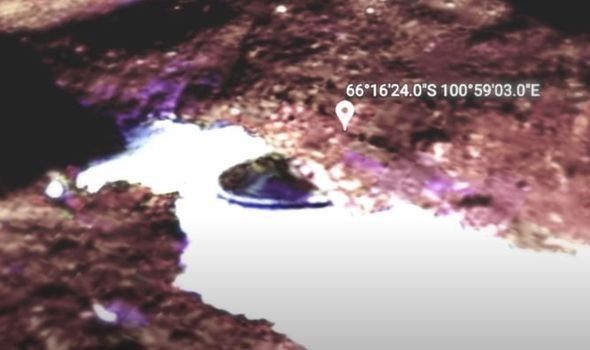
The melting polar ice caps are causing many problems, from rising sea levels to extreme weather events to the extinction of certain species and the loss of fresh water for the world. However, they also might have just uncovered proof of extraterrestrial life. That's according to one conspiracy theorist who claims the receding ice has revealed a flying saucer on Google Earth.
YouTuber MrMBB333 was sent the coordinates of the craft by a follower and created a video showing the strange, seemingly perfect circular shape, which is partially obscured by rocks. He states, "This appears to be a 60-foot-wide disc sticking out of the ground apparently being recently revealed by the melting snow and ice. There is the object, it looks like it was intelligently designed."
To support his theory, he alters the colors of the image and proposes that there is an "elevated circle" on the top of the structure.
Commenters are mostly in agreement, with one claiming, "It doesn't look stuck in the ground, it looks like it's hovering," while another added, "The black area under it looks like a shadow and if you look to your left, you will see a light source which looks like it's coming from inside the cave or tunnel."
Skeptics, though, think otherwise, with one stating, "It is just a small pool of water. If you look around at the other features locally you will notice that the other bodies of water also have a similar hue."
Russia's TASS Confirmed Voronezh UFO Incident On This Day In 1989; All You Need To Know
Russia confirmed the report of sightings of three aliens in the city of Voronezh arriving on the “banana-shaped” object (UFO) on October 9, 1989, 31 years ago.
On this day, October 9, 1989, 31 years ago Russia’s press agency TASS claimed that the extra-terrestrial contact on earth had already been made as it confirmed the report of sightings of three aliens in the city of Voronezh arriving on the “banana-shaped” object (UFO). “Scientists have confirmed the recent unidentified flying object recently landed in a park in the Russian city of Voronezh,” the release by TASS read. “They identified the landing site and found traces of aliens who made a short promenade about the park,” it added, claiming that two pieces of unidentified rocks were left behind which cannot be found on Earth.
According to a TIME report from the October 23, 1989 issue, a strange encounter between a milkmaid and a “cosmic creature” was reported to have happened in the Russian region of Perm, close to the Ural mountains. Soviet newspaper Komsomolskaya Pravda claimed that the Russian researchers registered the “influence of energies” after a geologist made claims of the discovery of the flying saucer in the region. When enquired, TASS and several other Soviet news outlets stood by the existence of aliens' claims in the Voronezh UFO incident of 1989.
Genrikh Silanov, head of the Voronezh Geophysical Laboratory, was reported by Tass as saying that Russians scientists found a 20-yard depression with four deep dents at the site, suspecting that it was intact a UFO, adding, two abnormal rocks sent scientists in a jiffy. “At first glance, they looked like sandstone of a deep-red color. However, mineralogical analysis has shown that the substance cannot be found on Earth,” AP cited Silanov’s statement in the TASS report. “However, additional tests are needed to reach a more definite conclusion,” he added.
UFO used ″biolocation″ tracker
Silanov said that the machine possibly a UFO used ″biolocation″ tracker. TASS report cited residents as eyewitnesses to the strange object that resembled a shining ball or disk 300 miles southeast of Moscow. Residents also reported sighting of small robot-like creatures similar to humans. “The aliens were three or even four meters (9 to 12 feet) tall, but with very small heads,″ TASS quoted witnesses as saying. ″They walked near the ball or disc and then disappeared inside.″ However, in a TIME report, writer Howard G. Chua-Eoan explained that the policy of glasnost — or ‘openness’ led the soviet media to be more expressive about events such as the Petrozavodsk phenomenon that involved 48 unidentified objects and the Voronezh UFO watch.
Meer van UFO'S of UAP'S, ASTRONOMIE, RUIMTEVAART, ARCHEOLOGIE, OUDHEIDKUNDE, SF-SNUFJES EN ANDERE ESOTERISCHE WETENSCHAPPEN - DE ALLERLAATSTE NIEUWTJES


 Black Knight Satellite UFO Silently Moves Over Philippines, April 18, 2019, Video, UFO Sighting News.