
Massive electrical sparks fly across power lines in Louisiana as dangerous weather batters the region.


 Massive electrical sparks fly across power lines in Louisiana
 Fast UFO making fast maneuvers over Huntington State Beach, California

This was filmed back in 2019 (11th March) but it was just posted on MUFON’s website today.
Witness report:
UFO flying next to plane in the sky above the beach goes Into a STAR WARS hyperdrive turn into space, then attempted coverup!!! 2 friends of mine along with one of their girlfriend’s and I were all together at the beach around 6 pm in Huntington Beach near a bathroom stall when suddenly we notice a vey mysterious giant fireball looking star, but obviously nothing like we seen before, moving steadily down the coast line. We could see a plane with its blinking lights flying in the opposite direction in the same line of direction of view which made it apparent that this was particularly not flying like a plane or jet. We watched for maybe a few or so minutes before I pulled out my iPhone and recorded the incident. I filmed for about 25 seconds and then turned off recording.
About a few minutes or less after I stopped recording, we all witnessed the UFO go from a steady tread to the left into an impossible abrupt turn towards west so fast that not the sky that the light faded away almost instantaneously like a stars wars hyperdrive intro space when the light stretches then fades away. The object shot towards the sky in front of us and faded away, then almost immediately after the incident, I personally witnessed the most aircraft at one time in the sky, which to me looked like a bunch of planes flying in every direction in the sky. There were also jets that came from the south that were suspicious because it was obvious why they were there and that was the only time I seen a team of jets fly in at night on top of the beach.
But the icing on the cake was when helicopters came and tried to cover up what we saw by trying to replicate the light by flying around where the UFO was flying and shining a search light around that looked kinda something similar to the UFO’s, but obviously was not perfect because it did not at all move like the UFO did and the light did not match the exact size or color and was also spinning in multiple directions. It baffled my friends and I and then a few months later in December.
NASA's Perseverance Mars rover is about to land in Jezero Crater. Here's what we know about the place.
Jezero Crater may be the proving ground in our search for Martian life.
If all goes to plan, NASA's Perseverance rover will alight at the location Thursday (Feb. 18) to start its multi-year quest to seek signs of habitability and cache particularly promising rocks for a future sample-return mission to bring to Earth's laboratories.
Picking the spot Percy will explore was an "exhaustive" process, NASA said in a statement, requiring five years of research examining 60 candidate locations. Mars sports abundant evidence of water and organic molecules, making it difficult to pick one single spot to answer the scientific questions driving the Mars 2020 mission.
Book of Mars: $22.99 at Magazines Direct
Within 148 pages, explore the mysteries of Mars. With the latest generation of rovers, landers and orbiters heading to the Red Planet, we're discovering even more of this world's secrets than ever before. Find out about its landscape and formation, discover the truth about water on Mars and the search for life, and explore the possibility that the fourth rock from the sun may one day be our next home.VIEW DEAL
But NASA determined Jezero was a good location to show how water periodically appeared and then disappeared on the Martian surface. Scientists believe Mars lost its water because the atmosphere grew too thin, but about 3.5 billion years ago, Jezero appears to have been a potentially habitable river valley.
"Scientists see evidence that water carried clay minerals from the surrounding area into the crater lake," NASA representatives wrote in a description of the site. "Conceivably, microbial life could have lived in Jezero … If so, signs of their remains might be found in lakebed or shoreline sediments. Scientists will study how the region formed and evolved, seek signs of past life, and collect samples of Mars rock and soil that might preserve these signs."
When NASA selected Jezero in 2018, scientists said a delta is typically an ideal spot to search for signs of ancient life, which would likely be microbial.
"A delta is extremely good at preserving biosignatures, [be they] evidence of life that might have existed in the lake water, or at the interface between the sediment and the lake water, or, possibly, things that lived in the headwaters region that were swept in by the river and deposited in the delta," Mars 2020 project scientist Ken Farley, of NASA's Jet Propulsion Laboratory in California, said during a s conference held that November.
Jezero Crater is about 18 degrees north of the Martian equator and shows extensive variety in geology, allowing scientists to look at diverse rocks that may represent the planet's evolution over the eras. The site's drawback, however, is that the complex terrain poses danger during landing with obstacles such as sand dunes. The scientists also wanted to avoid touching down on the delta itself.
This annotated map of Jezero Crater on Mars was created using data from the High Resolution Stereo Camera on ESA's Mars Express orbiter.
(Image credit: ESA/DLR/FU Berlin)
This map shows regions in and around Jezero Crater on Mars, the landing site of NASA's Perseverance rover. The green circle represents the rover's landing ellipse.
(Image credit: NASA/JPL-Caltech/USGS/University of Arizona)
This elevation map of Jezero Crater on Mars was created from ESA Mars Express data.
(Image credit: ESA/DLR/FU Berlin)
Long ago, Jezero contained a deep lake about the size of Lake Tahoe. The mission plan calls for Perseverance to land at the rim of the crater. The rover will wander over to the delta to examine the sediments, before examining the ancient shoreline and finally checking out some of the rocks at the rim of the crater.
"These rocks would have been hot shortly after the impact and may have hosted hot springs," scientist Ken Farley, of NASA's Jet Propulsion Laboratory, said in a December 2018 flyover video based on imagery collected by Mars orbiters. "Deposits from these springs would be another target in our search for possible ancient life on Mars."
They find track of Gigantic Vehicles “12 Million Years Old”
A famous geologist claims to have discovered intricate tracks that would have been made by vehicles, but several million years ago.
These peculiar marks on the ground are found in Turkey, specifically in the Phrygian Valley, according to the researcher, they were created by an ancient highly technological civilization and today unknown.
These ancient furrows discovered in Turkey’s Phrygian Valley have left Dr. Alexander Koltypin , a geologist at the National Science Scientific Research Center in Moscow, in complete awe.
The geologist believes that this construction could have been created by an intelligent race more than 12 million years ago.
The ruts in the Phrygian Valley have been closely examined, and one of the theories given is that they were made by off-road vehicles, much like those used today. But how could these clues, more than 12 million years ago, have been made from artifacts that to our knowledge had not yet been invented? Or better yet, an ancient and unknown civilization operated this type of vehicle?
Geologist Dr. Alexander Koltypin believes that these mysterious furrow-like marks in the Phrygian Valley in central Turkey were made by an intelligent race 12 and 14 million years ago.

“We can assume that older vehicles drove their heavy wheels on soft ground, perhaps a wet surface,” he said.
Inspections have found that the distance between the grooves is approximately the same as that left by current vehicles. However, there is one thing that does not match, these ruts seem to have been made by something much heavier than modern common transport.
These tracks are, for the most part, an impressive three feet deep.
In addition to the deep grooves, horizontal notches have been found in them along their interior walls. These notches on the inside of the grooves or tracks could well have been made by some kind of shaft, which adds more mystery to the matter.

Dr. Koltypin was aware that this finding would be too controversial and would cause quite a stir.
Koltypin stated the following:
I think we are seeing the signs of a civilization that existed before the classical creation of this world. Perhaps the creatures of that pre-civilization were not like modern human beings. These ancient clues can prove the existence of ancient civilizations, yet they are often ignored by scientists. ”

Although many detractors of Dr. Koltypin’s theories have emerged, in reality the Phrygian Valley of Turkey is not the only place where these ancient roads are found. Other areas, like the Maltese archipelago , have tracks that run along the cliffs and others that lead to the ocean.
These tracks in Malta have the same amount of controversial theories. More information on this can be found in the following video.
Although the audio for the following video is in English, you can enable Spanish subtitles. In case you don’t knowhow to do it, you can consult this GUIDE.
Despite the fact that conventional archeology pays no attention to these impressive discoveries, Koltypin continues to rely on his controversial theories.
It is possible that in the future, history will reveal many other findings that reveal once and for all that we are not the first to have advanced technology and that other sophisticated humanities existed before us.
William Cooper: How to Build A Flying Saucer! The Conspiracy Theorist Who Predicted His Own Death
William Cooper: The Conspiracy Theorist Who Predicted His Own Death | Tales From the Bottle
He made a lot of predictions, some came true, some yet to be seen, but one cost him everything. “Milton William “Bill” Cooper (May 6, 1943 – November 5, 2001) was an American conspiracy theorist, radio broadcaster, and author known for his 1991 book Behold a Pale Horse, in which he warned of multiple global conspiracies, some involving extraterrestrial life.
Cooper also described HIV/AIDS as a man-made disease used to target blacks, Hispanics, and homosexuals, and that a cure was made before it was implemented. He has been described as a “militia theoretician”.”
Hitler’s UFO Alien Connection During World War II - whatweknow
Hitler’s UFO-Alien Connection During World War II When Hitler first stepped onto the world stage with his contrived rhetoric, he was re-writing German mythology and history into a form of propaganda designed to increase German self-worth after Germany’s WWI defeat.
Most people thought he was insane and did not take him seriously at first. However Hitler announced that he was a member of a UFO cult and had an exclusive line of communication with a powerful extraterrestrial group. According to Hitler, these extraterrestrials were the source and power behind his new-found, born-again German ideology.
He explained that Nazi mysticism was the product of their devotion and worship of the Manipulative Extraterrestrials. Many high ranking Nazi members of Hitler’s inner circle declared that they also communicated with the extraterrestrial Nordic gods.
This is What Happens to Spacecraft When They Re-Enter the Earth’s AtmosphereWhen one of the Russian Progress resupply ships undocks from the International Space Station, timing is everything. The Progress needs to fire its engines at just the right time to instigate the deorbit burn in order for the ship to enter the atmosphere at just the right place, so that its destructive re-entry occurs over the Pacific Ocean. That way, any potential surviving bits and pieces that might reach Earth will hit far away from any land masses – which are home to people, buildings, and other things we don’t want to get bonked.
Last week, the timing for the Progress MS-15 cargo ship was just right so that the astronauts/cosmonauts on board the ISS could see the ship as it broke apart and burned up in Earth’s atmosphere. JAXA astronaut Soichi Noguchi shared the view on social media.
“Farewell, Progress 76P MS-15! #Russian cargo spacecraft undocked from #ISS, and successfully burned up,” Noguchi tweeted, sharing a photo of the Progress’ fiery demise.
Uncrewed Progress cargo ships have been flying since 1978, supporting previous Soviet-era space stations such as Salyut 6, Salyut 7 and Mir. They have been bringing supplies to the ISS since the very beginning of operations.
But now, there are several different robotic, automated resupply ships for the space station: the European Space Agency’s Automated Transfer Vehicle (ATV), JAXA’s (Japan Aerospace Exploration Agency) HTV resupply ship, Northrop Grumman’s (formerly Orbital ATK) Cygnus cargo ship, and SpaceX’s Cargo Dragon.

These ships bring supplies such as food, water, replacement/spare parts, and experiments to the crew, as well as propellants and oxygen. After everything is unloaded, the ships like Progress become a trash can – a place to stow garbage and other unneeded items. The ships stay docked to the ISS for about 6 months, and after being loaded with trash and waste, the hatch to the vehicle is closed and the Progress undocks from the station. Then the procedures for reentry begin.
Progress is designed to burn up in the atmosphere, but not everything is completely combustible. In a press release, Roscosmos said the non-combustible components of the craft land and sink into a “non-navigable region of the South Pacific. Non-combustible structure elements will drop in the calculated area of the non-navigable region of the Pacific Ocean. The estimated fragments drop area is approximately 1,680 km east of Wellington (New Zealand). Roscosmos has completed all the necessary procedures to flag this area as temporarily dangerous for sea navigation and aircraft flights.”

But besides the cargo ships returning from the ISS, other man-made objects regularly meet their demise by streaking through and burning up in Earth’s atmosphere. Things like old, inactive satellites, rocket stages and other discarded hardware, as well as smaller pieces of space debris — such as fragments of vehicles that exploded or collided, and even small pieces of paint that have come off of space vehicles.
All these items – both big and small – are tracked by radar by the Space Surveillance Network (SSN), which oversees radar and optical sensors at various sites around the world. There is the Joint Combined Space Operations Center (CSpOC) at Vandenberg Air Force Base, part of U.S. Strategic Command and ESA’s Space Debris team. They detect, track and identify all objects in Earth orbit, as well as monitoring the International Space Station (ISS) and other NASA satellites for collisions.

Interestingly, on average, about one satellite crashes back to Earth every week. Most are uncontrolled entries, and it’s kind of a crap shoot as to where any pieces surviving pieces might fall. But these fiery reentries are rarely seen, mostly because Earth is a big place, mainly covered by water, and much of what falls ends up in the oceans. Another thing is, most of us aren’t looking up into the night sky all that often.

But these reentries do sometimes get seen – sometimes by video surveillance cameras or dashcams. If the satellite or old rocket piece is big enough, pieces can be seen shedding as the reentering vehicle descends in a superheated shroud of incandescent plasma. The ablation process starts around a height of 100 km and is usually complete by the time the object has descended to about 20 km. (Here’s additional info on space debris).
Of course, “naturally occurring” objects fall through our atmosphere too, space rocks that range in size from dust grains to small asteroids. Many times, if you see something steak across the night sky, it is hard to tell the difference between a meteor and a piece of disintegrating space debris.
Have you seen something big break apart and fall through the sky? Our own David Dickinson often reports on reentering space objects and possible sightings on his Twitter account, as well as astronomer Jonathan McDowell, who tracks and reports on reentering objects on Twitter.
Of course, for the spacecraft we DON’T want to have break up in the atmosphere — such as crewed spacecraft — there are heat shields to protect them. But that’s another story for another day.
The post This is What Happens to Spacecraft When They Re-Enter the Earth’s Atmosphere appeared first on Universe Today.
Source:
How Reptilians Highjacked The Matrix - The Biggest Secret in Human History
How Reptilians Highjacked The Matrix – The Biggest Secret in Human History
Bringing you the highest quality, edited videos. All of my videos are created by me primarily using the editing programs Adobe premiere pro course Photoshop. change backgrounds, overlay images. And also im narrate to my videos my own voice. All of my videos are created with one purpose in mind. Aliens, spirituality.
Welcome the truth can change your life youtube channel Thanks for subscribe. Share Our Messages with Love and Gratitude
Bright Object With Nearby Orb, Coventry, England 2-1-2021, UFO Sighting News.
 Unidentified Lights In Over Tempe, Arizona Night Sky 2-12-21 UFO Sighting News.

 Object rotating silently over Aldie Airport, Virginia, USA 8-16-2020, UFO Sighting News.


 Secret underwater alien base found

Legends of lost and mysterious islands, advanced civilisations and Eden-like paradises have been told by sailors throughout human history. Is it possible these stories are more than just the myths of imaginative seafarers?
RELATED VIDEOS, selected and posted by peter2011
Lights Over Ocean Near Laguna Niguel, California 2-7-2021, UFO Sighting News.

 Why Do So Many People Still Think Aliens Built the Pyramids?

Conspiracy theories make the world go round (or flat). The greatest hits include the Illuminati, lizard people and Avril Lavigne being a clone, but none have endured quite like the theory that ancient aliens built the pyramids. The tin-foil belief has been kicking around since medieval times and now, thanks to TV series like Ancient Aliens – currently in its 16th season - it’s more popular than ever.
In July, 2020, tech edgelord Elon Musk tweeted “aliens built the pyramids, obv” and conspiracy theorist bed friend Joe Rogan has hosted a podcast with an autodidact who believes ancient civilisations ruled the earth. Believers aren’t just your classic conspiracy theorists, LSD heads or Louis Thereoux longform nut-jobs either. Mainstream international publications including the BBC and National Geographic have reported on the matter, and it’s also popped up on TikTok, which suggests people debate the theory across all walks of western (we’ll get to this later) life.
What they all believe, in one form or another, is that the pyramids in Ancient Egypt were built by outer-space terrestrials who likely use them as a way to monitor and observe planet Earth. But where, of every absurd belief in the world, did the idea that aliens built the pyramids come from?
The dinosaurs may have been wiped out by a comet fragment, not an asteroid
Around 66 million years ago, a giant asteroid struck our planet off the coast of Mexico. The devastating impact, whose force was equivalent to 10 billion Hiroshima A-bombs, unleashed huge tsunamis hundreds of feet tall, global wildfires, and sent molten rock hurtling all the way to the moon. About 75% of all life on Earth was killed almost instantly, including all non-avian dinosaurs. But according to a controversial Harvard astronomer, the culprit wasn’t an asteroid, but rather a comet fragment from the outer reaches of the solar system.
Since geophysicists first identified the huge impact crater in Chicxulub, Mexico, the site has been the subject of important research probing into the nature of the impactor in order to reconstruct the devastating timeline of the mass extinction that would follow.
We now know, for instance, that the impactor must have been very large, measuring between 10 and 80 kilometers in diameter, judging from the staggering 180-kilometer-wide crater, most of which is submerged in the Pacific Ocean. The impact then shrouded the planet into a decades-long winter, which decimated the suitable environments for dinosaurs.
This leading theory is that this impact arrived from the asteroid belt between Mars and Jupiter, but Harvard’s Professor Avi Loeb and astrophysics graduate student Amir Siraj have published a new study proposing an alternative source.
Loeb is no stranger to controversial theories. Previously, he claimed that the first-ever interstellar object Oumuamua may actually be an alien spaceship. He’s actually being a lot more conservative with his most recent paper published Monday in the journal Scientific Reports.
The pair of researchers performed the statistical analysis and gravitational simulations to essentially reverse-engineer the path the Chicxulub impactor took, showing that the impact actually originated from the Oort cloud — a shell of icy objects that exist in the outermost reaches of the solar system, more than a trillion miles away from Earth.
The Oort cloud is where most of the comets in the solar system are flung from. However, the Chicxulub impact wasn’t produced by a comet, but rather by comet fragments.
According to the researchers’ simulations, many Earth-crossing events were also directly preceded by very close encounters with the Sun. Astronomers call these comets “sun-grazers”.
Due to the gravitational interactions with the Jupiter-Sun system, large comets are torn apart into a large number of smaller fragments. Since the number of fragments large enough to account for the Chicxulub crater was about an order of magnitude greater than the background asteroid or comet population, the researchers simply conclude that it was far more likely that the crater was produced by a comet fragment.
“The solar system acts as a kind of pinball machine,” Siraj said. “Jupiter, the most massive planet, kicks incoming long-period comets into orbits that bring them very close to the sun.”
“And crucially, on the journey back to the Oort cloud, there’s an enhanced probability that one of these fragments hit the Earth,” the scientist added.
The comet fragment hypothesis may explain the unusual composition of the Chicxulub crater, which suggests the impactor was made of carbonaceous chondrite. These minerals are rare amongst main-belt asteroids, but rather widespread among long-period comets that make rounds between the sun and the Oort cloud.
A similar mineral composition was also encountered at the 2-billion-year-old Vredefort crater in South Africa, which is the largest confirmed crater in Earth’s geological history, as well as the Zhamanshin crater in Kazakhstan, which is the largest confirmed crater within the last million years. This is why the researchers plan to use the same approach on these craters as well.
These insights may be important in the future as the new Vera Rubin Observatory in Chile is scheduled to come online next year. The observatory can measure both the composition and tidal disruption of long-period comets, so it should be able to provide data that may confirm the researchers’ model.
“We should see smaller fragments coming to Earth more frequently from the Oort cloud,” Loeb says. “I hope that we can test the theory by having more data on long-period comets, get better statistics, and perhaps see evidence for some fragments.”
Ultimately, these investigations may be crucial in our efforts to mitigate catastrophic cosmic impacts and avoid the same fate as the dinosaurs.
“It must have been an amazing sight, but we don’t want to see that again,” Loeb said.
Chinese rover finds weird shard-shaped rock on the far side of the moon
China’s Yutu-2 rover just turned two years old and it received a fitting birthday gift. During one of its forays on the far side of the moon, the rover came across an elongated shard that has surprised scientists.
Yutu-2 is the first man-made craft that has explored the moon’s far side. On February 6, the rover resumed operations after Chinese mission control engineers forced it into hibernation in order to preserve energy during the cold lunar nights.
Thanks to Yutu-2, we now know what the moon looks like below the surface after the rover beamed back radar images it had collected. It also sent back very valuable photos and videos of the moon’s far side that will keep scientists busy for years.
Since it arrived at the moon’s far side, Yutu-2 has also come across a number of peculiar objects. In 2019, not long after touchdown, the rover found a “gel-like” substance that turned out to be breccia (broken fragments of minerals cemented together) formed by impact melts.

Now, Chinese scientists have reported what they describe as a ‘milestone’: an elongated shard sticking out of the lunar surface. The vast majority of lunar rocks are rounded, so the pointy rock immediately drew scientists’ attention.
'A fortunate accident': Scientists stumble across sea creatures living in -2°C water on the Southern Ocean seabed underneath Antarctica
Animals have been found living on the sea floor underneath Antarctica in what was previously thought to be an uninhabited wasteland.
Two types of filter-feeding sea sponges were spotted attached to a boulder at the bottom of the ocean by scientists from the British Antarctic Survey.
The explorers dropped a camera down a borehole which went through the 3,000ft (900m) of solid ice before plunging into the frigid Antarctic ocean underneath.
In the pitch black of the unexplored marine frontier the researchers found evidence of life in the -2.2°C water, the first stationary animals ever seen in this habitat.
These currently unidentified species are more than 200 miles from the nearest food source but appear to be thriving despite the arduous existence.
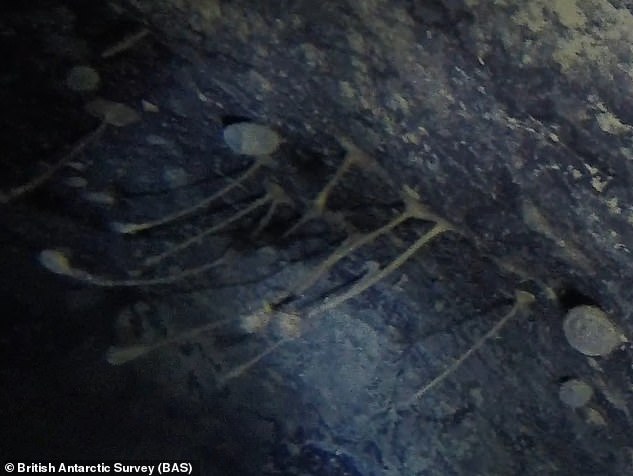
Animals have been found living on the sea floor underneath Antarctica in what was previously thought to be an uninhabited wasteland. Pictured, a boulder with the stationary life on
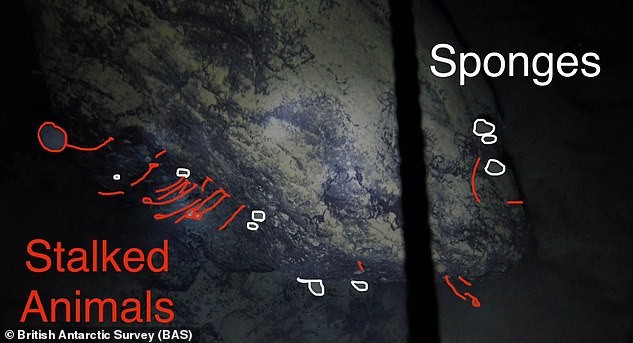
Sponges and unidentified stalked animals were spotted on a boulder at the bottom of the ocean by scientists from the British Antarctic Survey (pictured)
This part of the world is one of the last truly unexplored regions of the world as floating ice shelves have made it impossible to study the ocean beneath.
More than 1.5 million square km — an area bigger than the UK, Germany, Spain and Italy combined — is covered by this fortress of ice.
As a result only an area the size of a tennis court has been explored at all, thanks to eight boreholes drilled through the ice.
The exploration and study that has been done in this area has been primitive by modern standards as accessibility is so difficult due to the extreme weather.
'This discovery is one of those fortunate accidents that pushes ideas in a different direction and shows us that Antarctic marine life is incredibly special and amazingly adapted to a frozen world,' says biogeographer and lead author of the study Dr Huw Griffiths.
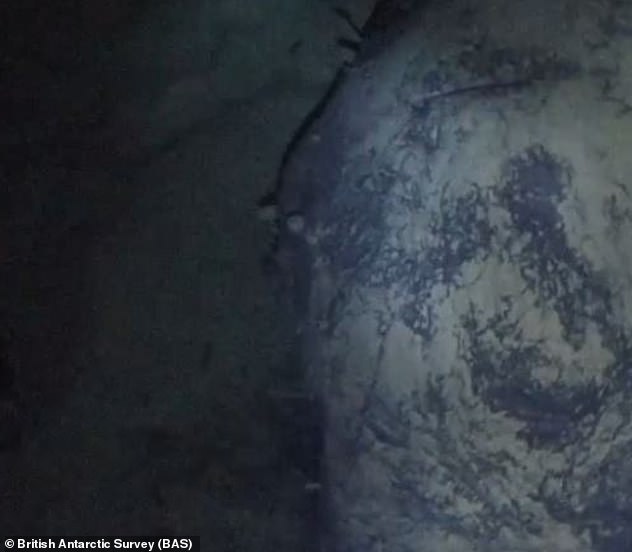
Researchers drilled the hole to take sediment samples from the sea floor when they ricocheted off the boulder (pictured), with the spinning camera capturing the lifeforms
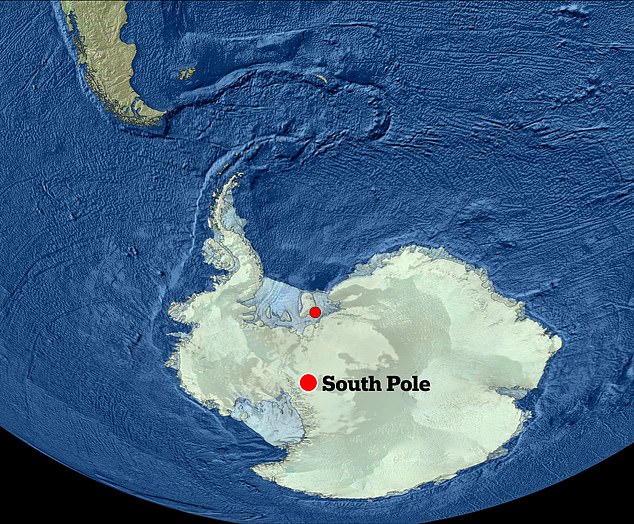
The borehole was drilled 160 miles (260km) from the open sea, further confounding researchers
The borehole was drilled 160 miles (260km) from the open sea, further confounding researchers.
Current theories clearly state that life becomes increasingly unlikely the further underwater and away from open water a location is.
Previous studies have found some mobile animals, such as fish and krill, in these areas but never before has an organism which stays still and filters the water around it for food ever been found.
Aptly, the study has been titled 'Breaking All the Rules' by its authors, and published today in the journal Frontiers in Marine Science.
Researchers drilled the hole to take sediment samples from the sea floor when they ricocheted off the boulder, with the spinning camera capturing the lifeforms.
'To answer our questions we will have to find a way of getting up close with these animals and their environment - and that's under 900 m (3,000 ft) of ice, 260 km (160 miles) away from the ships where our labs are,' adds Dr Griffiths.
'This means that as polar scientists we are going to have to find new and innovative ways to study them and answer all the new questions we have.
RELATED VIDEOS, selected and posted by peter2011
Mysterious Lifeforms Discovered Underneath Antarctica Ice
Mysterious lifeforms have been discovered in one of the most inhabitable places on our planet. Deep below the Antarctic ice shelf is very dark with subzero temperatures but some species are surprisingly thriving down there.
Located on a seafloor boulder were several species. In fact, this is the first time ever that stationary creatures attached to one specific location have been found underneath the ice of Antarctica.
Huw Griffiths, who is a biogeographer at the British Antarctic Survey and an author of the study, explained this further, “This discovery is one of those fortunate accidents that pushes ideas in a different direction and shows us that Antarctic marine life is incredibly special and amazingly adapted to a frozen world.”
Since it is so difficult to study what’s underneath Antarctica’s ice shelves, scientists are only able to make holes in the ice and lower equipment into the depths of the water. Based on evidence gathered from eight of their borehole surveys, they do know that there is some life beneath the ice, such as jellies, fish, crustaceans, and worms. But the fact that they found sponges was incredibly surprising.

Antarctica
They found the sponges underneath 890 meters of ice (2,920 feet) on the seafloor which was 1,233 meters down (4,045 feet). Located on the seafloor boulder was one sponge on a stalk while 15 others were without them. Furthermore, they discovered 22 organisms that have yet to be identified but could possibly be sponges, hydroids, ascidians, cnidaria, barnacles, or polychaetes. (Pictures can be seen here.)
Griffiths noted that there are still many unanswered questions like how they got there; how long have they been there; what do they eat; how many boulders have this type of life attached to them; are they new species and what would happen to them if the ice shelves ended up collapsing?
Since the majority of life on our planet needs sun to survive, it’s amazing to think that these creatures reside in complete darkness and are still able to live. Chemosynthesis is when organisms use the energy from reactions created by inorganic chemicals when there isn’t any sunlight around. Thermal vents found in the ocean release volcanic chemicals and heat, and bacteria uses chemosynthesis to make sugar for their food chain.

Antarctica
Organisms that live beneath glaciers chemosynthesise hydrogen and some chemosynthetic ecosystems depend on methane. Interestingly, a methane leak has been discovered in the waters of Antarctica.
With that being said, the living creatures underneath Antarctica’s ice shelves probably depend on a chemosynthetic food chain but much more research needs to be conducted in order to know for sure. Nevertheless, it’s incredibly interesting to know that several different species can survive beneath the freezing cold ice shelves of Antarctica.
Two jets chasing UFO over Panama City Beach, Florida
 Unknown lights filmed over Tempe, Arizona 12-Feb-2021

These UFOs were filmed over Tempe, Florida on 12th February 2021.
Witness report:
On the night of 2/12/2021. I happen to look out of my kitchen window while talking to my wife when I noticed a group of strange lights in the sky. I always look into the night sky and in the general direction of what I filmed. I’ve never seen anything like this especially in that part of the sky. This video is what I recorded. The objects traveled to a certain part of the sky and stayed there pulsated and then vanished into the clear night sky. I recorded is 2 separate clips. Because I thought the event ended but more returned. At one point an airplane traveling east went in the general direction of the objects. The objects seemed unaffected by this and more returned in the sky. They had a reddish orange color. The cell phone camera didn’t pick up these colors. Not sure what these were.
RELATED VIDEOS, selected and posted by peter2011

 Martian landslides may be caused by underground salts and...
 Is this the end of the A68a iceberg? Enormous block of...
 Earth lost a record 28 TRILLION tonnes of ice between 1994...
 How melting icebergs change ocean patterns: New study sheds...