Microfossils, tiny fossil fragments also known as palynomorphs that are only visible under a microscope, can be found almost anywhere on the Earth one chooses to look. Although these ubiquitous fossils play an essential role in telling the geological and organic story of Earth’s ancient past, studying them is no simple matter, mainly because there are billions of them.
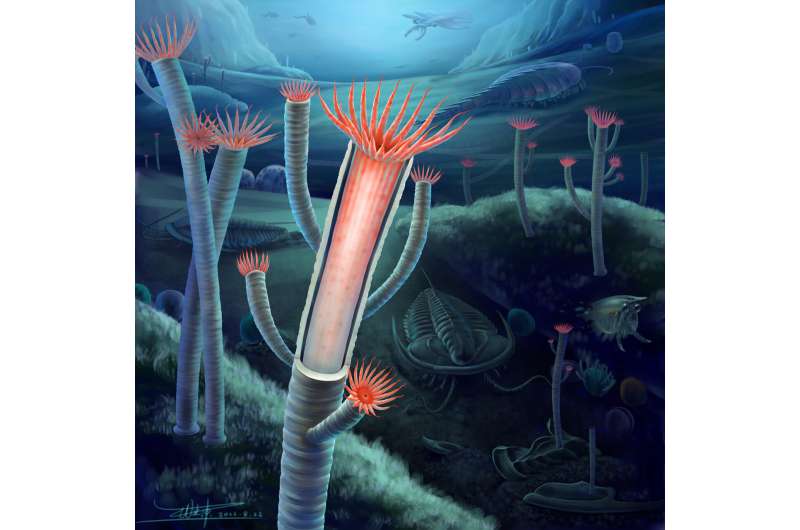
Artist's reconstruction of Gangtoucunia aspera as it would have appeared in life on the Cambrian seafloor, circa 514 million years ago. The individual in the foreground has part of the skeleton removed to show the soft polyp inside the skeleton. Reconstruction by Xiaodong Wang.
Credit: Reconstruction by Xiaodong Wang.
An exceptionally well-preserved collection of fossils discovered in eastern Yunnan Province, China, has enabled scientists to solve a centuries-old riddle in the evolution of life on earth, revealing what the first animals to make skeletons looked like. The results have been published today in Proceedings of the Royal Society B.
The first animals to build hard and robust skeletons appear suddenly in the fossil record in a geological blink of an eye around 550-520 million years ago during an event called the Cambrian Explosion. Many of these early fossils are simple hollow tubes ranging from a few millimeters to many centimeters in length. However, what sort of animals made these skeletons was almost completely unknown, because they lack preservation of the soft parts needed to identify them as belonging to major groups of animals that are still alive today.
The new collection of 514 million year old fossils includes four specimens of Gangtoucunia aspera with soft tissues still intact, including the gut and mouthparts. These reveal that this species had a mouth fringed with a ring of smooth, unbranched tentacles about 5 mm long. It's likely that these were used to sting and capture prey, such as small arthropods. The fossils also show that Gangtoucunia had a blind-ended gut (open only at one end), partitioned into internal cavities, that filled the length of the tube.
These are features found today only in modern jellyfish, anemones and their close relatives (known as cnidarians), organisms whose soft parts are extremely rare in the fossil record. The study shows that these simple animals was among the first to build the hard skeletons that make up much of the known fossil record.
Because of this, researchers are now turning to artificial intelligence for help in classifying these minuscule preserved remnants of Earth’s ancient past.
Typically ranging from 5 to 500 micrometers in size and anywhere from a couple of million years to over 500 million years old, these tiny fossils are found mostly in sedimentary rocks, making them invaluable both to geologists and paleontologists. They help determine the age of rock layers, reconstruct past environments, and understand the evolutionary history of life on Earth. For instance, the presence of certain microfossils can indicate whether a rock layer was formed in a marine or terrestrial environment, providing insights into past climate conditions and geological events. Simply put, they offer a glimpse into what a specific area was like all those years ago.
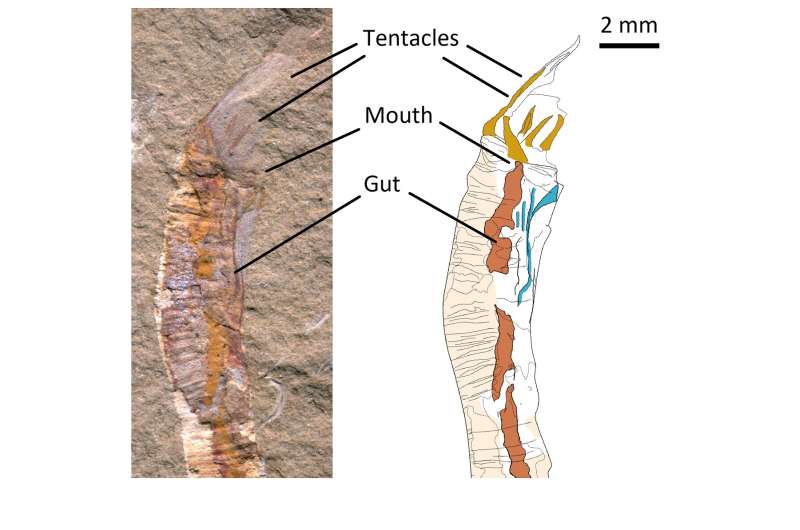
Fossil specimen (left) and diagram (right) of Gangtoucunia aspera preserving soft tissues, including the gut and tentacle. Image credit: Luke Parry and Guangxu Zhang.
Credit: Luke Parry and Guangxu Zhang.
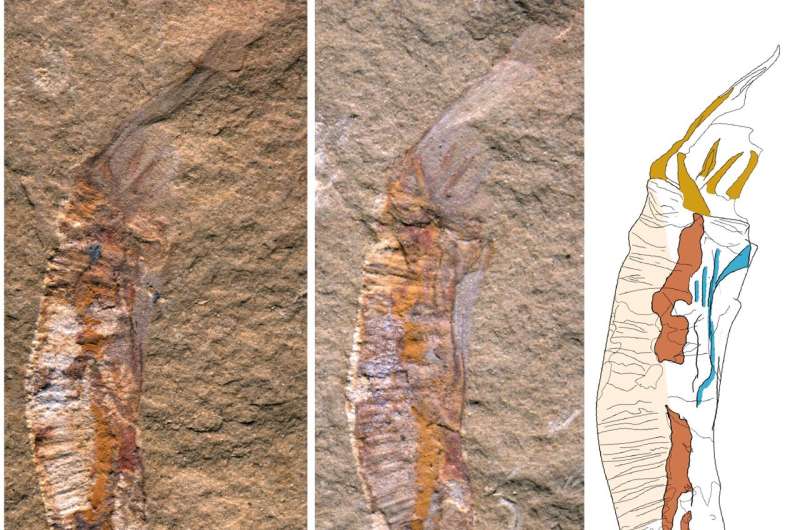
Fossil specimen of Gangtoucunia aspera preserving soft tissues, including the gut and tentacles (left and middle). The drawing at the right illustrates the visible anatomical features in the fossil specimens. Image credit: Luke Parry and Guangxu Zhang.
Credit: Luke Parry and Guangxu Zhang.
According to the researchers, Gangtoucunia would have looked similar to modern scyphozoan jellyfish polyps, with a hard tubular structure anchored to the underlying substrate. The tentacle mouth would have extended outside the tube, but could have been retracted inside the tube to avoid predators. Unlike living jellyfish polyps however, the tube of Gangtoucunia was made of calcium phosphate, a hard mineral that makes up our own teeth and bones. Use of this material to build skeletons has become more rare among animals over time.
Corresponding author Dr. Luke Parry, Department of Earth Sciences, University of Oxford, said, "This really is a one-in-million discovery. These mysterious tubes are often found in groups of hundreds of individuals, but until now they have been regarded as 'problematic' fossils, because we had no way of classifying them. Thanks to these extraordinary new specimens, a key piece of the evolutionary puzzle has been put firmly in place."
The new specimens clearly demonstrate that Gangtoucunia was not related to annelid worms (earthworms, polychaetes and their relatives) as had been previously suggested for similar fossils. It is now clear that Gangtoucunia's body had a smooth exterior and a gut partitioned longitudinally, whereas annelids have segmented bodies with transverse partitioning of the body.
The fossil was found at a site in the Gaoloufang section in Kunming, eastern Yunnan Province, China. Here, anaerobic (oxygen-poor) conditions limit the presence of bacteria that normally degrade soft tissues in fossils.
Ph.D. student Guangxu Zhang, who collected and discovered the specimens, said, "The first time I discovered the pink soft tissue on top of a Gangtoucunia tube, I was surprised and confused about what they were. In the following month, I found three more specimens with soft tissue preservation, which was very exciting and made me rethink the affinity of Gangtoucunia. The soft tissue of Gangtoucunia, particularly the tentacles, reveals that it is certainly not a priapulid-like worm as previous studies suggested, but more like a coral, and then I realized that it is a cnidarian."
Although the fossil clearly shows that Gangtoucunia was a primitive jellyfish, this doesn't rule out the possibility that other early tube-fossil species looked very different. From Cambrian rocks in Yunnan province, the research team have previously found well-preserved tube fossils that could be identified as priapulids (marine worms), lobopodians (worms with paired legs, closely related to arthropods today) and annelids.
Co-corresponding author Xiaoya Ma (Yunnan University and University of Exeter) said, "A tubicolous mode of life seems to have become increasingly common in the Cambrian, which might be an adaptive response to increasing predation pressure in the early Cambrian. This study demonstrates that exceptional soft-tissue preservation is crucial for us to understand these ancient animals."
The paper "Exceptional soft tissue preservation reveals a cnidarian affinity for a Cambrian phosphatic tubicolous enigma' will be published in Proceedings of the Royal Society B on Nov. 2.
Traditionally, the classification of microfossils has been a manual, time-consuming process requiring expert knowledge, with scientists staring into a microscope or at a computer screen for hours at a time. Given the sheer volume of data—potentially billions of microfossils from numerous slides—manual classification is tedious work, and attempting to classify all these microfossils is an insurmountable and impossible task. There are just too many of them, hence the advantage of letting AI assist in that process.
Spearheaded by a team from the University of Tromsø, The Arctic University of Norway, researchers have developed a novel method to automate the classification of microfossils.
The study introduces a two-stage AI-driven pipeline to automate the detection and classification of microfossils from microscope images.
The first stage involves using a pre-trained object detection model, YOLOv5, to identify and extract individual microfossils from high-resolution slide images. This model efficiently generates bounding boxes around each microfossil, a task that would be labor-intensive if done manually.
In the second stage, the researchers employ self-supervised learning (SSL) techniques to train models that can extract features from the detected microfossils. SSL is particularly advantageous in scenarios with limited labeled data, as it allows the model to learn useful representations from unlabeled data. The study compares two SSL frameworks, SimCLR and DINO, and finds that both significantly improve classification performance.
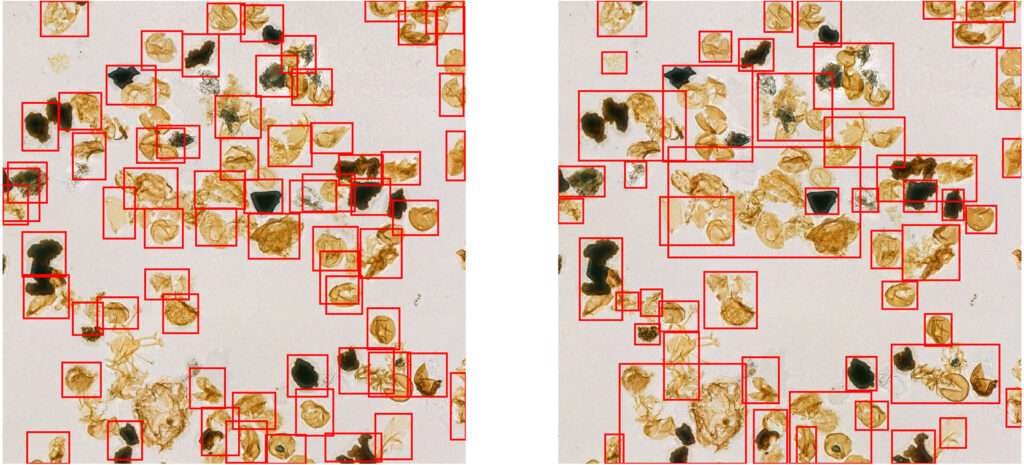
An image of the same slide of microfossils. On the left, the Machine learning approach. On the right, the pipeline of standard image processing methods. As the study notes, more fossils are separated with the machine learning approach as it is better able to differentiate the various fossil types.
(Image: Artificial Intelligence in Geosciences)
Basically, the AI is able to differentiate between different fossils and classify them. According to the study, this method is fast and computationally light, making it feasible to process and classify millions of microfossils efficiently. This scalability is crucial for handling the vast datasets typical in geological research. Moreover, as the AI classifies more fossils, it labels them and learns from its data, continuously adding to its own knowledge base.
“This work shows that there is great potential in utilizing AI in this field,” explained Iver Martinsen, one of the study’s authors, in a press statement. “By using AI to automatically detect and recognize fossils, geologists might have a tool that can help them better utilize the enormous amount of information that wellbore samples provide.”
The ability to automate microfossil classification has profound implications for earth sciences. It can accelerate research in subsurface exploration, aiding in oil and gas exploration and carbon capture and storage projects. Moreover, the insights gained from microfossil analysis can contribute to broader scientific inquiries, such as studying past climate changes and mass extinction events. Understanding these historical patterns is essential for predicting future environmental changes and developing strategies to mitigate their impacts.
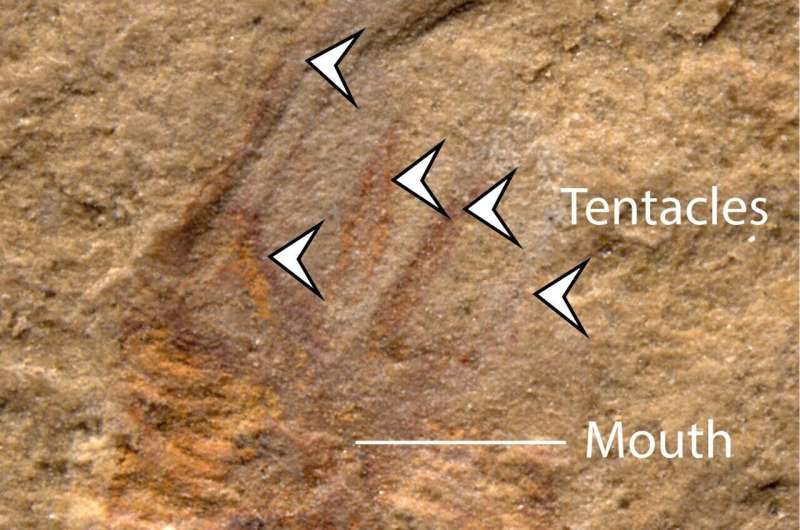
Close up photograph of the mouth region of Gangtoucunia aspera showing the tentacles that would have been used to capture prey. Image credit: Luke Parry and Guangxu Zhang.
Credit: Luke Parry and Guangxu Zhang.
“We are very happy with our results,” Martinsen concluded. “Our model exceeds previous benchmarks available out there. We hope that the present work will be beneficial for geologists both in industry and academia.”
- MJ Banias covers space, security, and technology with The Debrief. You can email him at mj@thedebrief.org or follow him on Twitter @mjbanias.
{ https://thedebrief.org/category/science/
https://phys.org/ }


 Are UFOs Real? What the Pentagon Has Learned