NASA prepares for next mission to the moon: Artemis III
NASA prepares for next mission to the moon: Artemis III
(NewsNation) — Following the success of the Artemis II lunar flyby, NASA isn’t wasting any time preparing for its next crewed mission to the moon.
Following the recent successful test flight of NASA’s Artemis II mission around the Moon, NASA rolled out the core stage, or the largest section, of the agency’s SLS (Space Launch System) rocket that will launch the crewed Artemis III mission in 2027. The stage departed from the agency’s Michoud Assembly Facility in New Orleans on Monday for shipment to NASA’s Kennedy Space Center in Florida, marking key progress on the path to the agency’s first crewed lunar landing mission to the Moon under the Artemis program in two years.
Using highly specialized transporters, engineers maneuvered the top four-fifths of the SLS core stage, the section containing the liquid hydrogen tank, liquid oxygen tank, intertank, and forward skirt, from inside NASA Michoud to the agency’s Pegasus barge for delivery to NASA Kennedy. After arrival, teams will complete the stage outfitting and vertical integration, and the agency’s Exploration Ground Systems Program will stack the rocket’s components in preparation for launch.
“Seeing this SLS rocket hardware roll out is a powerful reminder of our progress toward returning humans to the lunar surface,” said Lori Glaze, acting associate administrator, Exploration Systems Development Mission Directorate at NASA Headquarters in Washington. “This is the backbone of Artemis III. As it heads to Florida for final integration, we are one step closer to testing the critical capabilities needed to land Americans on the Moon, and ultimately, paving the way for our first crewed missions to Mars.”
At 212 feet tall, the completed core stage will consist of the top four fifths of the rocket combined with its engine section. The top four-fifths include the two propellant tanks that collectively hold more than 733,000 gallons of super-chilled liquid propellant to fuel four RS-25 engines. During launch and flight, the fully integrated stage will operate for more than eight minutes, producing more than 2 million pounds of thrust to propel astronauts inside NASA’s Orion spacecraft into orbit.
Building, assembling, and transporting the core stage is a collaborative process for two of NASA’s prime contractors, Boeing and L3Harris Technologies. Boeing is responsible for the overall design and assembly of the core stage, and L3Harris manufactures the rocket’s RS-25 engines. Recent announcements by NASA Administrator Jared Isaacman enabled the agency to standardize the SLS configuration, streamline operations, and optimize production to accelerate the Artemis program.
Next year’s Artemis III mission will launch astronauts to Earth’s orbit aboard the Orion spacecraft on top of SLS to test rendezvous and docking capabilities between Orion and commercial spacecraft needed to land Artemis IV astronauts on the Moon in 2028. NASA’s SLS is the only rocket capable of sending Orion, astronauts, and supplies to the Moon in a single launch.
As part of the Golden Age of innovation and exploration, NASA will send Artemis astronauts on increasingly difficult missions to explore more of the Moon for scientific discovery, economic benefits, establish an enduring human presence on the lunar surface, and to build on our foundation for the first crewed missions to Mars.
On Monday, NASA is rolling out the largest section of its Space Launch System rocket for Artemis III at its Michoud Assembly Facility in New Orleans, according to a release from the space agency.
While not as dramatic as an actual launch, the rollout signifies a major milestone in NASA’s next mission and lays the foundation for its eventual goal of sending the first astronauts to Mars.
What is NASA’s Artemis III?
With an expected mid-2027 launch, NASA’s Artemis III mission will test key docking and rendezvous operations required to transfer the crew aboard their Orion spacecraft to a commercial lunar lander, according to NASA. The mission is in preparation for Artemis IV, which aims to put astronauts on the moon in 2028.
“The SLS rocket is the only rocket capable of sending Orion, astronauts, and supplies to the Moon in a single launch,” NASA says.
The Artemis III mission will launch crew in the Orion spacecraft on top of the SLS (Space Launch System) rocket to test rendezvous and docking capabilities between Orion and commercial spacecraft needed to land astronauts on the Moon. NASA will announce specifics on the Artemis III mission design and crew closer to the 2027 launch.
Future NASA Artemis missions
Following the completion of Artemis III, NASA says it has two other crewed missions to the Moon planned.
Artemis IV is slated for an early 2028 launch, and, if all goes as planned, it’s when NASA will put humans back on the moon’s surface for the first time in more than 50 years.
Artemis V, the final mission, is scheduled for a late 2028 launch. It’s when NASA plans to land on the moon to begin building its Moon base as part of its goal of establishing a long-term presence on the moon.
All Hands for Artemis III
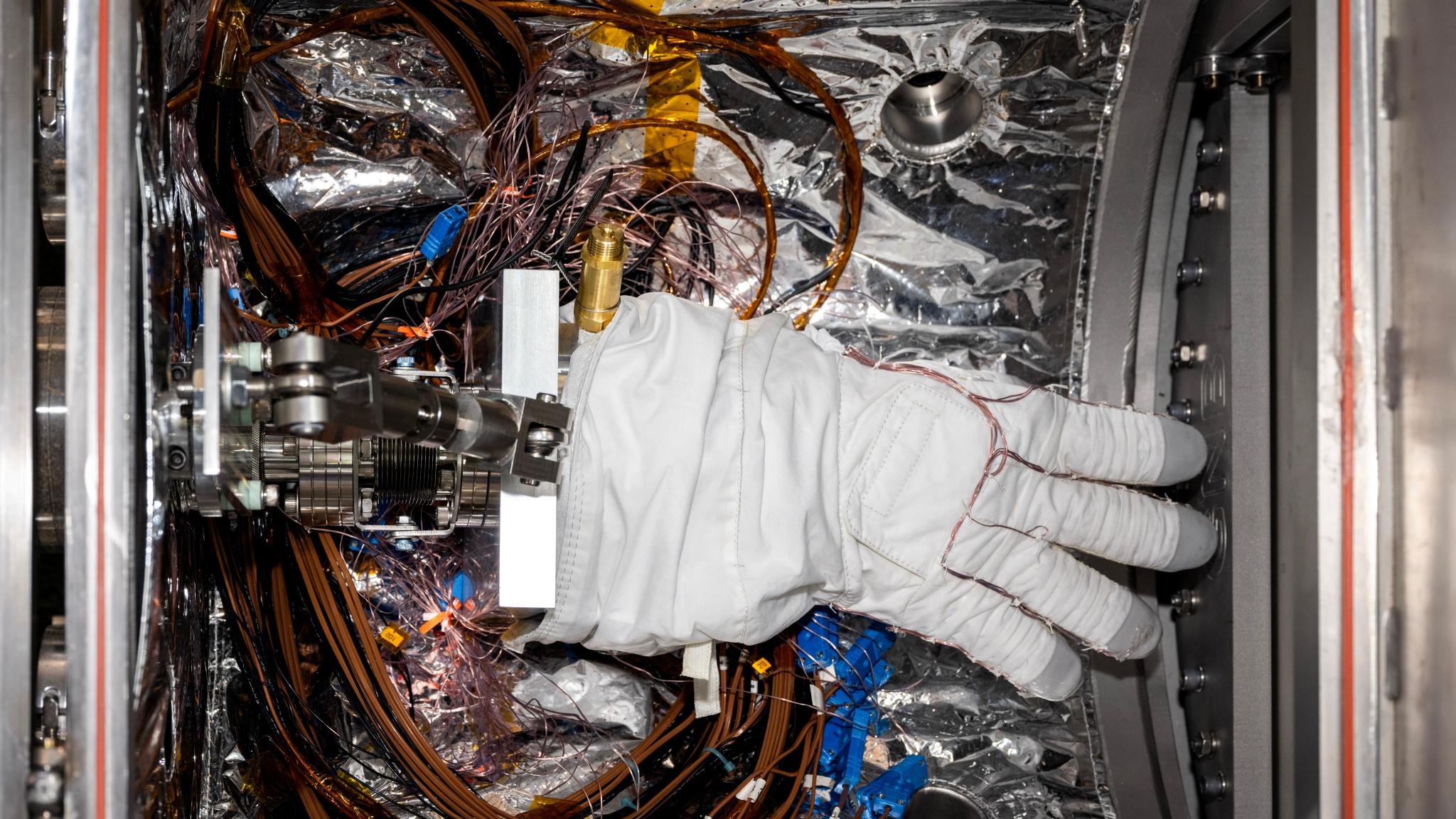
A NASA spacesuit glove designed for use during spacewalks on the International Space Station is prepared for thermal vacuum testing inside a one-of-a-kind chamber called CITADEL (Cryogenic Ice Testing, Acquisition Development, and Excavation Laboratory) at NASA’s Jet Propulsion Laboratory in Southern California on Nov. 1, 2023.
Part of a NASA spacesuit design called the Extravehicular Mobility Unit, the glove was tested at vacuum and minus 352 degrees Fahrenheit (minus 213 degrees Celsius) — temperatures as frigid as those Artemis III astronauts could experience on the Moon’s South Pole. A team from NASA JPL, NASA’s Johnson Space Center in Houston, and the NASA Engineering and Safety Center have collaborated on testing gloves and boots in CITADEL. Elbow joints are slated for testing next. In addition to spotting vulnerabilities with existing NASA suit designs, the experiments will help the agency prepare criteria for test methods for the next-generation lunar suit — being built by Axiom Space — which NASA astronauts will wear during the Artemis III mission.
How to Fly NASA’s Orion Spacecraft
On NASA’s Artemis II test flight, the first crewed mission under the agency’s Artemis campaign, astronauts will take the controls of the Orion spacecraft and periodically fly it manually during the flight around the Moon and back. The mission provides the first opportunity to ensure the spacecraft operates as designed with humans aboard, ahead of future Artemis missions to the Moon’s surface.
The first key piloting test, called the proximity operations demonstration, will take place after the four crew members — NASA’s Reid Wiseman, Victor Glover, and Christina Koch, and CSA (Canadian Space Agency) astronaut Jeremy Hansen — are safely in space, about three hours into the mission. To evaluate the spacecraft’s manual handling qualities, the crew will pilot Orion to approach and back away from the detached upper stage of the SLS (Space Launch System) rocket.
Crew members participating in the demonstration will use two different controllers, called rotational and translational hand controllers, to steer the spacecraft. Three display screens provide the astronauts with data, and another device, called the cursor control device, allows the crew to interact with the displays.

“On Artemis II, most of the time the spacecraft will fly autonomously, but having humans aboard is a chance to help with future mission success,” said Reid Wiseman. “If something goes wrong, a crewmember can jump on the controls and help fix the problem. One of our big goals is to check out this spacecraft and have it completely ready for our friends on Artemis III.”
The commander and pilot seats are each equipped with a rotational hand controller (RHC), gripped in the right hand, to rotate the spacecraft. It controls Orion’s attitude, or the direction the spacecraft is pointing. If the crew wants to point Orion’s nose left, the RHC is twisted left — for nose right, they will twist the RHC right. Similarly, the RHC can control the nose to pitch up or down or roll right or left.
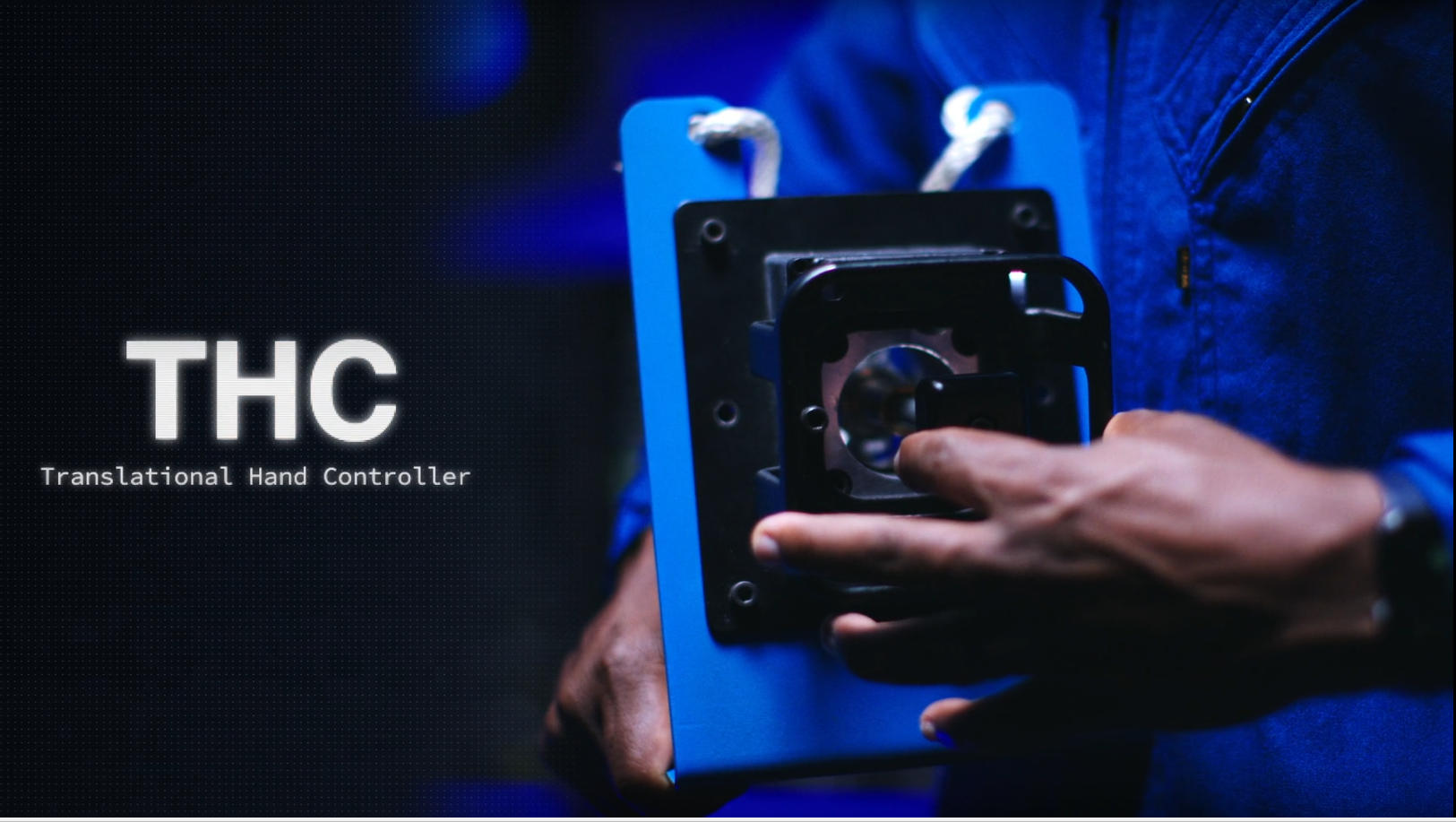
The translational hand controller (THC), located to the right or left of the display screens, will move Orion from one point to another. To move the spacecraft forward, the crew pushes the controller straight in — to back up, they will pull the controller out. And similarly, the controller can be pushed up or down and left or right to move in those directions.
When the crew uses one of the controllers, their command is detected by Orion’s flight software, run by the spacecraft’s guidance, navigation, and control system. The flight software was designed, developed, and tested by Orion’s main contractor, Lockheed Martin.
“We’re going to perform flight test objectives on Artemis II to get data on the handling qualities of the spacecraft and how well it maneuvers,” said Jeffrey Semrau, Lockheed Martin’s manual controls flight software lead for Artemis missions. “We’ll use that information to upgrade and improve our control systems and facilitate success for future missions.”
Depending on what maneuver the pilot has commanded, Orion’s software determines which of its 24 reaction control system thrusters to fire, and when. These thrusters are located on Orion’s European-built service module. They provide small amounts of thrust in any direction to steer the spacecraft and can provide torque to allow rotation control.
The cursor control device allows the crew to interact with the three display screens that show spacecraft data and information. This device allows the crew to interact with Orion even under the stresses of launch or entry when gravitational forces can prevent them from physically reaching the screens.

Next to Orion’s displays, the spacecraft also has a series of switches, toggles, and dials on the switch interface panel. Along with switches the crew will use during normal mission operations, there is also a backup set of switches they can use to fly Orion if a display or hand controller fails.
“This flight test will simulate the flying that we would do if we were docking to another spacecraft like our lander or to Gateway, our lunar space station,” said Victor Glover. “We’re going to make sure that the vehicle flies the way that our simulators approximate. And we’re going to make sure that it’s ready for the more complicated missions ahead.”
The approximately 10-day Artemis II flight will test NASA’s foundational human deep space exploration capabilities, the SLS rocket, Orion spacecraft, and supporting ground systems, for the first time with astronauts and will pave the way for lunar surface missions.
{ COMPOSED BY PETER2011, BASED ON INFORMATION OF NASA }