Ontdek de Fascinerende Wereld van UFO's en UAP's: Jouw Bron voor Onthullende Informatie!
Ben jij ook gefascineerd door het onbekende? Wil je meer weten over UFO's en UAP's, niet alleen in België, maar over de hele wereld? Dan ben je op de juiste plek!
België: Het Kloppend Hart van UFO-onderzoek
In België is BUFON (Belgisch UFO-Netwerk) dé autoriteit op het gebied van UFO-onderzoek. Voor betrouwbare en objectieve informatie over deze intrigerende fenomenen, bezoek je zeker onze Facebook-pagina en deze blog. Maar dat is nog niet alles! Ontdek ook het Belgisch UFO-meldpunt en Caelestia, twee organisaties die diepgaand onderzoek verrichten, al zijn ze soms kritisch of sceptisch.
Nederland: Een Schat aan Informatie
Voor onze Nederlandse buren is er de schitterende website www.ufowijzer.nl, beheerd door Paul Harmans. Deze site biedt een schat aan informatie en artikelen die je niet wilt missen!
Internationaal: MUFON - De Wereldwijde Autoriteit
Neem ook een kijkje bij MUFON (Mutual UFO Network Inc.), een gerenommeerde Amerikaanse UFO-vereniging met afdelingen in de VS en wereldwijd. MUFON is toegewijd aan de wetenschappelijke en analytische studie van het UFO-fenomeen, en hun maandelijkse tijdschrift, The MUFON UFO-Journal, is een must-read voor elke UFO-enthousiasteling. Bezoek hun website op www.mufon.com voor meer informatie.
Samenwerking en Toekomstvisie
Sinds 1 februari 2020 is Pieter niet alleen ex-president van BUFON, maar ook de voormalige nationale directeur van MUFON in Vlaanderen en Nederland. Dit creëert een sterke samenwerking met de Franse MUFON Reseau MUFON/EUROP, wat ons in staat stelt om nog meer waardevolle inzichten te delen.
Let op: Nepprofielen en Nieuwe Groeperingen
Pas op voor een nieuwe groepering die zich ook BUFON noemt, maar geen enkele connectie heeft met onze gevestigde organisatie. Hoewel zij de naam geregistreerd hebben, kunnen ze het rijke verleden en de expertise van onze groep niet evenaren. We wensen hen veel succes, maar we blijven de autoriteit in UFO-onderzoek!
Blijf Op De Hoogte!
Wil jij de laatste nieuwtjes over UFO's, ruimtevaart, archeologie, en meer? Volg ons dan en duik samen met ons in de fascinerende wereld van het onbekende! Sluit je aan bij de gemeenschap van nieuwsgierige geesten die net als jij verlangen naar antwoorden en avonturen in de sterren!
Heb je vragen of wil je meer weten? Aarzel dan niet om contact met ons op te nemen! Samen ontrafelen we het mysterie van de lucht en daarbuiten.
In recent years, the scientific community has closely followed the evolution of the Earth’s magnetic field, with some scientists finding clues of a sign of an incoming magnetic pole reversal (something which also spurred a hodgepodge of conspiracy theories). However, a new study reports that what we’re seeing now is probably not a precursor of a magnetic pole reversal.
The South Atlantic Anomaly.
Image credits: NASA.
The Earth’s magnetic field is crucial for life on the planet, serving as a shield against hazardous radiation from space, especially coming from the Sun. Since 1840, scientists have been consistently monitoring this magnetic field, and since then, the global strength of the magnetic field has decayed at a rate of about five percent per century. Following this continuous decrease, a significant anomaly has emerged, called the South Atlantic Anomaly.
This anomaly represents an area of an abnormally weak magnetic field — think of it as a dip in the Earth’s magnetic defenses. Here, protection from harmful radiation from space is reduced, which has several unfortunate consequences (for instance, satellites in the area are more likely to suffer from communication blackouts and passengers on flights around the area are subjected to more radiation).
Within the research community, some have interpreted this anomaly as a sign of an incoming pole reversal. If this were the case, it wouldn’t really be surprising — the Earth’s magnetic field is constantly changing, and the way which it changes also changes. As a result, in the Earth’s geological history, magnetic pole reversals have been quite common, and we know this by studying geological proxies — magnetic minerals in the rocks and sediments “record” the orientation and strength of the Earth’s magnetic field at the time of rock formation. By dating the rocks, we can know how the magnetic field evolved, and we have a pretty good idea on how this field evolved through the ages. However, we don’t really know when the next reversal will come.
Chrons
The Earth’s field has alternated between periods of normal polarity, in which the predominant direction of the field was the same as the present direction, and reverse polarity, in which it was the opposite. These periods are called chrons. The duration of chrons isn’t fixed, though the average time seems to be 450,000 years. The reversals themselves typically take between 1,000 and 10,000 years. However, the last one, which happened 780,000 years ago, happened very quickly — quite possibly in less than 100 years. It’s not really possible to predict these shifts.
Image via Wiki Commons.
Within their new study, scientists have reconstructed past changes in Earth’s magnetic field using paleomagnetic data from sediment cores and volcanic rocks from across the globe. They found a specifically good record for the time interval of 50,000 to 30,000 years before the present, including two magnetic dips that are similar to the South Atlantic Anomaly.
Neither of them led to a magnetic pole reversal, and as a result, the team concludes that the current anomaly is also unlikely to lead to a pole reversal. While this doesn’t rule out the possibility of a magnetic pole reversal at some point in the near future, it makes it much less likely. Monika Korte, co-author of the study, explained:
“Based on our observations of the past 50,000 years we conclude that the South Atlantic Anomaly cannot be interpreted as a sign for the beginning of a reversal of the poles. Times of the past that, unlike the beginning of the Laschamp excursion, showed patterns of the magnetic field like today were not followed by a pole reversal. After some time the anomalies disappeared.”
Richard Holme, Professor of Geomagnetism at the University of Liverpool and co-author, concludes:
“There has been speculation that we are about to experience a magnetic polar reversal or excursion. However, by studying the two most recent excursion events, we show that neither bear resemblance to current changes in the geomagnetic field and therefore it is probably unlikely that such an event is about to happen.
“Our research suggests instead that the current weakened field will recover without such an extreme event, and therefore is unlikely to reverse.”
The paper, `Earth’s magnetic field is probably not reversing’ has been published in Proceedings of the National Academy of Sciences (PNAS) doi:/10.1073/pnas.1722110115.
There are easily a dozen ways the age of humans could come to an end. At this point, an antibiotic-resistant plague, sea level rise, and global famine are all equally plausible ways for humans to get wiped off the face of the Earth. Fortunately, according to a new study in Proceedings of the National Academy of Sciences, we might be able to cross one possibility off the list: magnetic pole reversal.
In a paper published Monday, an international team of researchers provides evidence that the current disturbance in Earth’s magnetic field does not indicate that it’s about to reverse polarity, contrary to what some experts have recently suggested. Over the past few months, several scientists have expressed concernabout magnetic field weirdness happening in Earth’s magnetic field above the region between Chile and Zimbabwe — referred to as the South Atlantic Anomaly — speculating that it might lead Earth’s magnetic field to reverse entirely. But by examining past historical periods when magnetic conditions were similar to those today, the new study’s authors show the South Atlantic Anomaly most likely won’t result in an excursion — a partial pole change that’s usually accompanied by a reduction in field strength — or even a full reversal. Phew!
Researchers say magnetic field anomalies, like the one occurring over Africa right now, happened in the distant past but didn't turn into full reversals or excursions.
In these scenarios, over the past tens of thousands of years, they explain, anomalies like we’re seeing now usually resolved on their own, without major consequences. Sure, what’s happening now may seem unusual on the scale of centuries, but on the scale of millennia, they seem less strange. To reach this relieving conclusion, the authors examined other periods throughout Earth’s geological history in which similar weakening of the magnetic field showed up. In a couple notable instances, centered at 49 thousand years ago and 46 thousand years ago, anomalies appeared in Earth’s magnetic field, but they eventually resolved. The researchers say that our current conditions are close enough to these historical situations that we can safely say thiscurrent anomaly should resolve itself in a similar way.
“This suggests that the current weakened field will also recover without an extreme event such as an excursion or reversal,” write the study’s authors. Cue a wave of relief: If either of these events actually occurred, the consequences on Earth would be significant. While we don’t fully know what would happen, both events would likely affect satellite communications, animal migration, and our level of protection from solar winds. Most noticeably, our compass needles will point to Antarctica as “north.”
Of course, these events happen over thousands of years, so we can’t yet say for sure whether they’re right. But if geological history is any indication, we’re better off worrying about other more probable causes of our demise.
Nonetheless, the South Atlantic Anomaly has caused communication issues for satellites that pass through it, so even if a reversal or excursion probably won’t kill us, we’ll need to deal in some way with the strange reality of a changing magnetic field.
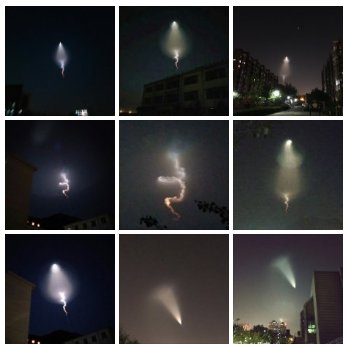
Mysterious light captured in China is not extraterrestrial spaceship
The mysterious light was spotted over several cities in China, cities, including Beijing, Taiyuan, Zhengzhou, and Qingdao. Baffled residents believed that the light could be UFO or extraterrestrial spaceship, but Chinese Academy of Science clarified saying it's neither of them.
A beam of mysterious light spotted over several parts in China baffled residents with some claiming that it could be a UFO or extraterrestrial spaceship. However, Chinese Academy of Science has clarified dismissed the claim that it is a UFO and said it is noctilucent contrail caused by an aircraft.
The mysterious light spotted Friday, April 27, created a buzz on Chinese social media platforms. Photos and videos of the light over Beijing went viral. Residents were confused and some even joked that it could be a massive torch.
"Bizarre scene appeared in the sky over Beijing. Have you seen it?," a post on Chinese social media Weibo read. The post, which was shared by the user the Beijing things Beijing people don't know, also had several photos of the mysterious light.
Another user, hang kong wu yu, took to Weibo to say that the light was observed in several cities, including Beijing, Taiyuan, Zhengzhou, and Qingdao.
Beijing Evening News had initially reported that the light could have been caused by the launch of a Beidou satellite. The launch happened Friday in Taiyuan city. And now People's Daily China has clarified that the UFO seen over the night sky in Beijing was nothing but a noctilucent contrail.
"The alleged "#UFO" seen in the sky above northern China on Friday evening was a noctilucent contrail, possibly caused by aircraft engine exhaust or air pressure changes, says the Chinese Academy of Science, warning the clouds as a sign of #globalwarming," the tweet reads.
Last December, a similar incident was recorded on camera in the US when SpaceX rocket was launched. Residents of Southern California and Arizona were baffled by the mysterious light over the sky. It was later revealed that the light was caused because of the launch of SpaceX rocket.
ET, is that you? A #mysterious light was seen Friday night by many residents in different northern Chinese cities, leading some to speculate about a possible extraterrestrial spaceship sighting, although the cause is still being investigated pic.twitter.com/FTPEEdn7hx
People's Daily,China✔@PDChina
The alleged "#UFO" seen in the sky above northern China on Friday evening was a noctilucent contrail, possibly caused by aircraft engine exhaust or air pressure changes, says the Chinese Academy of Science, warning the clouds as a sign of #globalwarmingpic.twitter.com/QJrgnuJRdO
Unlike in the USA where secret government cover-ups are responsible for creating hit TV shows, UFO conspiracies aren't popular in China. And yet, when UFOs do suddenly appear in the Celestial Kingdom as they did Friday night, a distinct lack of official information has made the unlikely existence of "little green men" to be the most comforting possibility to hope for.
The unidentified flying object appeared over Western Beijing and throughout parts of northeastern China Friday night and was witnessed by multiple residents.
Photos and videos (1, 2) of the UFO show a bright cone-shaped funnel leading a cork-screw "tail" behind it. The light was seen shining downward, then sharply altered course, and then finally disappeared.
Although it was widely seen, not much is actually known about it. With no official reports explaining the phenomenon, we're left with just a few facts that we can be sure of.
According to Yu Jun, editor-in-chief of the Guokr science website, we know the object was located high up in the atmosphere since it was seen across a wide area below. Because of its high altitude, the object was illuminated by sunlight that reached beyond the Earth's shadow.
And yet, further facts only serve to obfuscate the UFO's true nature.
With no launches made from the Taiyuan rocket center in Shanxi last night, it's not likely that the UFO was a satellite launch especially when considering its acute change in trajectory, said Yu. Additionally, online conjecture that this was a Beidou satellite can be ruled out since they are exclusively launched from the Xichang satellite launch center located in Western Sichuan province, reported the Beijing News.
With no official word from Chinese state media to explain last night's UFO, it wouldn't be right to make any baseless speculations. And yet, with China's airspace so highly restricted, it's not likely for this thing to be there unless it was authorized.
What does it all mean? We don't know, but if it turns out to be aliens who have come to Earth to perform their annual anal probe tests, then we can relax. After all, flying saucers are the least of Beijinger's worries when it comes to the city's list of airborne threats that include air pollution, sandstorms, flying catkins, and killer bees.
The Mutual UFO Network, or MUFON, is an all-volunteer organization dedicated to investigating unidentified flying objects (UFOs) in all 50 states and more than 40 countries through a decentralized network of state chapters and local field investigators. While the organization’s mission is promoting UFO research and discovering “the true nature of the phenomenon,” the most hoped for scenario is, of course, extraterrestrial first contact (unless government Disclosure comes first). Imagine an alien race finally comes to Earth and this is the man they meet.
The Facebook post by MUFON's former State Director for Pennsylvania that prompted outrage and resignations.
JOHN VENTRE / FACEBOOK
That’s John Ventre. He was, until recently, MUFON State Director for Pennsylvania and oversaw field investigations of the most compelling of the state’s approximately 600 annual UFO sightings. You may have seen him on History Channel's UFO Hunters or Anderson Live. Ventre wrote this on his personal Facebook page in response to a post from a popular alt-right account characterizing Netflix’s Dear White People as promoting “white genocide.” He railed against affirmative action and interracial couples.
“Everything this world is was created by Europeans and Americans,” Ventre said in the post. “F’ing blacks didn’t even have a calendar, a wheel or a numbering system until the Brits showed up.” He further alluded to pseudoscientific race science, which has found purchase in the mainstream right, spread by prominent conservative think tank figures like Charles Murray, who wields unjustified extrapolations from existing IQ data to argue against improving living standards for the poor.
Ventre’s comments have kicked off a wave of anger and resignations across MUFON, most recently UFO researcher Dr. Chris Cogswell.
Cogswell was named Director of Research for MUFON in January, but announced his resignation from the organization on Twitter in April. “When I first joined MUFON, taking on the Director of Research position, I believed this issue [with Ventre] had been dealt with,” Cogswell said. But on April 13, Cogswell learned of Ventre’s “continued role within MUFON as an active member” after Ventre emailed him about preparations for the 2018 MUFON Symposium in Cherry Hill, NJ. “Within six hours of finding out I had resigned. My internal conscience would not let me continue,” he said.
MUFON boasts nearly 4,000 members and 500 investigators across a coalition of just-the-facts data collectors, alien abductees, far-thinking engineers, conspiracy theorists, ancient alien pseudohistorians, religious visionaries and ufology enthusiasts of every possible stripe. If MUFON is successful, who would the first aliens actually meet? An organization representative of the full spectrum of human experience, or a club of aging white men?
It’s a question MUFON is currently struggling to answer, with Ventre’s post a crisis point in the organization’s ongoing evolution.
MUFON Executive Director Jan Harzan initially responded to Ventre’s post in a since-deleted message to the MUFON News page, disclaiming the organization’s responsibility for a Facebook comment “many found offensive.” Instead of condemning Ventre’s words, Harzan blamed the controversy on “the new social media world we now live in” and called for an open dialogue, writing, “There is no justice in hate, no matter what side of the fence you are on. On that we can all agree.”
MUFON Executive Director Jan Harzan's response to the Ventre post, since deleted.
MUFON
After a deluge of angry responses, punctuated with pushback from MUFON Director of Communications Roger Marsh—who, in between arguing in the comments “white supremacist” is a “pretty heavy label” for Ventre, instead pointed out Ventre’s “real” personality defects, including “serving cheap food at his mansion”—MUFON deleted the post and comment field. Harzan’s rhetorical question, “Who is worse, the persons posting, or the haters hating?” is still derisively cited by UFO bloggers.
Director of Communications Roger Marsh, making a rambling defense of Ventre in the comments beneath MUFON's first response.
MUFON
“It’s almost comical, in a field where there’s so much leeway given to extreme out-of-the-blue, wacky ideas, you would still think there would be kind of a baseline of, well, this is right or wrong,” Cogswell told Newsweek.
Another professed goal of MUFON is applying their UFO research toward “improving life on our planet.” According to Harzan, meaningful UFO discoveries and disclosures could mean we’re only “20-30 years from being out in space, like Star Trek.” But Star Trek is more than spaceships, it’s also an egalitarian ideal.
Scientific optimism has always been a key component of ufology and MUFON's mission.
"AMAZING STORIES" MAGAZINE, ZIFF-DAVIS PUBLISHING CO. / PUBLIC DOMAIN
“I felt justified because you’re talking about a hate crime of white genocide and I blasted black culture. I apologized the next day,” Ventre told Newsweek, alluding to a since-deleted apology also made to his Facebook page. Comparing the possibility of white genocide to The Purge, Ventre professed to be unaware of the term’s origins in neo-Nazism as reference to a demographic decline white supremacist groups use to portray prejudice as self-defense, guarding the white race against multiculturalism.
“I don’t hate anybody, I apologized for what I said. It was in a fit of anger, it was one time in my entire life,” Ventre said, mentioning his multiracial grandson and a black man from his gym for whom he arranged a job interview. “I’m feeling like because I’m a 60-year-old white man I’m getting totally unfairly attacked here.”
By the end of May 2017, Ventre was removed from his state directorship, but MUFON’s response didn’t stop a wave of researchers from distancing themselves. In July, board member and Washington State Director James Clarkson stepped down, citing both Ventre’s post and MUFON’s association with deep-pocketed donors like J.Z. Knight.
Knight preaches to tens of thousands of followers through her Lemurian warrior persona Ramtha, a 35,000-year-old spirit who leads “spiritual drinking games” while accusing Jewish people of paying their way out of the gas chambers and disparaging Mexicans, homosexuals and “organic farmers.” Like Knight, Ventre was also a high-tier “Inner Circle” donor to MUFON.
“Remaining in MUFON in any capacity is morally unacceptable,” former MUFON State Director James Clarkson.
Asked for comment after the Cogswell resignation, Clarkson told Newsweek, “There are many excellent state organizations, but money and power have corrupted the top. Same old story.”
Current and former MUFON members, including Cogswell, have described Ventre’s ongoing involvement in the Pennsylvania chapter. Despite the events of last year he continues to serve as a treasurer and conference coordinator, albeit without a title. Ventre denied having an official position, but clarified both his ongoing involvement in planning the Symposium and day-to-day operations. “People ask me questions, I help them. I’m helping Jan [Harzan, Executive Director] with the Symposium. I wanted him to know I am friends with all these people,” he said. “Nothing locally has changed for me.”
Harzan disputes that characterization. “He’s strictly a volunteer, he attends the local chapter meeting and he volunteers his time,” he said.
“It wasn’t a condemnation. It was a demotion,” UFO researcher and author of Somewhere in the Skies Ryan Sprague told Newsweek. “It’s clear that there’s a problem. And that problem stretches beyond one man’s racist rants.”
Even a cursory look around MUFON reveals views similar to Ventre’s. Steve Hudgeons Jr., MUFON’s Director of Investigations, has shared hundreds of far-right memes on his own Facebook page with anti-immigrant, anti-trans and anti-Muslim sentiments.
“I think some people in their minds have this view of old hippies with crystals," former MUFON Director of Research Dr. Chris Cogswell.
“Demographically, in my experience, MUFON is old; 55 and up for sure,” Cogswell said. "There is a pretty good percentage of ex-military, ex-law enforcement people who are very serious about this investigation stuff.” This can lead to radically different approaches for how UFO sightings are investigated or perceived. Where Ventre sees occult connections, citing alien abductions interrupted by the abductee calling upon Jesus, Cogswell might argue for a more data-driven approach. “Wouldn’t it be great if in five years Ancient Aliens was off TV and we had more serious investigations?” he asked.
The combination of demographicslikely to align with far-right viewpoints, and the overlap between UFO researchers and conspiracy theorists, produces an environment that Sprague and others argue can be toxic to minorities.
“MUFON is composed of civilian researchers and investigators from all around the country and in all walks of life,” Sprague says. “But when remarks such as Ventre’s become public, it is extremely disheartening to know someone like that is in a position to work directly with ethnically diverse and often vulnerable witnesses of UFO events.”
Racism isn’t the only outcome of MUFON’s disinterest in combating prejudice. Erica Lukes, former MUFON State Director for Utah, describes an organization unwilling to adequately address sexual harassment. (Harzan told Newsweek MUFON has a sexual harassment policy for the Symposium and other conferences, but it's not available online).
In 2016, Lukes appeared on California MUFON Radio, hosted by Lorien Fenton, to discuss both her particular experiences and the wider issue of sexism within ufology. “One of the things that I really feel there’s a big disconnect in MUFON and in ufology, totally together, is the fact that women out there can be very vulnerable at all these events,” Fenton said in discussion with Lukes. MUFON leadership quickly objected to how the organization was characterized.
When Lukes, who also has a radio show, shared her intention to have Fenton as a guest the backlash intensified. An investigator with MUFON’s rapid-response Star Team called her to unleash a barrage of abuse. “He proceeded to call me ‘a fucking whore,’” Lukes said.
Lukes reported the abuse to MUFON’s board, including Harzan and Marsh. “I was crying, this was very awkward for me, but they refused to take any action even though this was a person representing MUFON and I was a State Director.”
“It is a male-dominated field, but that doesn’t mean anybody should be subject to that kind of abuse and bullying, especially when an organization exists like MUFON to set the standard,” Lukes said. She ultimately left MUFON and founded her own organization called Unexplained Utah. “This situation is demeaning and demoralizing. We have to get more women involved and we have to see more women in the field.”
Members of MUFON and the wider ufology community are united by incidents both mysterious and beautiful, sometimes frightening. Almost everyone contacted for this article had stories of ineffable encounters that changed the course of their lives. In Utah, Erica Lukes saw orange orbs of light hovering along a ridgeline, breaking apart or melding like cells on a slide. UFO researcher and co-founder of KGRA Radio Lorin Cutts described to me a craft hovering above him on a railway station platform, causing dogs to bark and projecting a heat he could feel on his face.
A model of the UFO that crashed in Kecksburg, PA, created for an episode of "Unsolved Mysteries."
Many shared cases that stuck with them, using shorthand like Kecksburg, or even citing MUFON case numbers, like Case #74282, the Canadian Barbell UFOs. Harzan called it “one of the best cases I’ve personally seen in 30 years.” Lukes described her investigation of American Airlines Flight 434, pilots of which saw a mysterious object over Utah. But a shared sense of awe and curiosity only has so muchpower to unite. If MUFON hopes to be a unifying organization, one ready for whatever strange future comes our way, iit will have to first secure a baseline of dignity and safety for all its members.
Last year’s news that the Pentagon was running a secret $22 million-dollar UFO program took the UFO community by storm. It turns out that the New York Times article which broke the story, and Tom DeLonge’s To the Stars UFO project, seems to have gotten one key fact wrong; the name of the program itself.
The UFO research community has become quite excited and agitated in the last few days over a recent revelation made by UFO researcher Paul Dean.
According to Dean, he was contacted by an anonymous tipster in “a senior defence program leadership role” who aided him in discovering that the now infamous Advanced Aerospace Threat Identification Program (AATIP), the famous $22 million-dollar UFO hunting Pentagon program, is a loose in-house ad hoc term, and actually part of a larger military program aimed at the study of advanced weaponry. In other words, there is no formal AATIP.
Dean learned that the actual name of the program, of which AATIP was a part, is the Advanced Aerospace Weapons Systems Application Program (AAWSAP). Why does this matter? It turns out that after the original story broke, hundreds of Freedom of Information Act requests were made seeking information on AATIP. However, since there formally is no AATIP, those FOIA requests began to come back with letters stating that no information existed regarding the program. This all begs one question. How did the New York Times and DeLonge’s To the StarsAcademy (TTSA) get this wrong?
I asked Dean what he thought about such an error in reporting,
Whether the New York Times was told about the original name, being Advanced Aerospace Weapons Systems Application Program, but evidently chose not to publish it, is unknown to me.
Researcher Roger Glassel has attempted, on several occasions, to contact To the Stars and the writers of the New York Time’s article concerning their documentation for the UFO information and videos they’ve released so far. A critical concern his article raises is that neither To the Stars, nor the writers of the NYT article, seem interested in sharing the paperwork used to gain access to their information.
Furthermore, Glassel points out the obvious elephant (or UFO) in the room. If the Department of Defence did release these videos to DeLonge’s To the Stars Academy via FOIA requests, then has To the Stars been lying about the program’s name the entire time? Or, if To the Stars was truly looking under the AATIP rock, it would have found nothing, so where are these videos coming from?
Dean has similar concerns. When To the Stars released its three videos, the so-called “Tic-Tac” video, the “Gimbal” footage, and the “Go-Fast” video (above), it did not release how it managed to gain access to this information. Dean writes,
…the manner of how these audio-visual records were declassified, processed, released, whatever has been open to some debate.
However, according to Dean’s anonymous contact, the Department of Defense did release the footage, and that To the Stars’ employee and former intelligence man, Luis Elizondo, did use FOIA documents to gain access to the videos and be able to publicly release them. Strangely, the Department of Defense has been rather coy regarding the release of these videos and has denied releasing them. Dean’s contact stated that somehow “corners were cut” and the DoD’s Public Affairs people had their “noses put out of joint” because of it. Perhaps the individual or individuals within To the Stars who asked for this information were able to sidestep a few hurdles due to their connections?
…although it could be partially true, nothing is ‘official’ yet — and at the root — only muddies the water, it does not help to clean it up.
Dean himself has stated that he is reserving judgment for now and waiting for more information to arrive via his most recent batch of FOIA requests seeking information on AAWSAP. This has not stopped the Ufological speculation mill to already begin grinding out some wild rumours.
Some researchers are claiming that the program was not named purposefully due to some wild conspiracy, suggesting that the various high-level players in To the Stars are engaged in an active disinformation campaign, similar to the infamous MJ-12 documents or the counter-intelligence operation run by the Air Force and intelligence agent Richard Doty. Others are claiming that To the Stars wants to have a complete hold on the information and keeping the program’s name quiet would allow for them to ensure only they can access the data.
Regardless of where one stands, the only thing anyone can agree on is that the UFO community seems to thrive on the chaotic nature of the enigma. On forums and social media platforms, Ufological charges of conspiracy and hidden agendas are already being laid, and lines of allegiance seem to be forming. UFO “experts” and “gurus” are already posting their personal stance on the matter. Various UFO podcasts and radio shows are already covering the story, often spinning their speculative yarn without any real data or evidence. It just feels good to pick a side and yell. Conclusions are already being made and the evidence has yet to be totally presented. Indeed, Dean and Glassel have found a skeleton in a closet, but no one actually knows who owns the closet, nor the identity of the dead guy inside it. This will require some detective work and plenty of patience and diligence.
As for Paul Dean, he will let those overzealous UFO pundits duke it out while he patiently and diligently checks his mailbox on a daily basis. Only time will tell if his anonymous source is right, and if he is, you can guess how the UFO community will react.
At the end of the day, there is only one way to really establish the truth behind this confusing acronymic swap. When you make an FOIA request, make sure you ask for the #1 Ufologist recommended brand of exotic military grade weaponry research, the Advanced Aerospace Weapons Systems Application Program.
Over at his UFO Conjectures blog, Rich Reynolds has a new article titled “It’s time to eliminate the term ‘ufology.'” Rich says: “Like a lot of past ‘ologies’ – astrology, graphology, demonology, et al. – ufology has served its purpose, as the identifier of an interest, by dolts, in UFOs. It’s time to deep six the sobriquet.” Basically, Rich suggests that we should do away with the term “Ufology.” Well, he does admittedly have a point.
It’s doubtful that the term “Ufology” (and “UFO” too) will completely vanish from popular culture anytime soon. But, it wouldn’t be a bad thing to revamp things. After all, Ufology is, in essence, the study of unidentified flying objects. But, no-one can doubt that the subject encompasses much more than that. And, many of those “other things” have very little to do with what passes for mainstream Ufology. If (unlike me) you are an adherent of the theory (and a theory is all it is) that all we are dealing with is metal ships from another solar-system then, yes, Ufology is not a bad term to use. But, there is far more to Ufology than just an alien equivalent of NASA paying us occasional visits. I’ll explain what I mean.
Like it or like it not, Ufology encompasses a lot of things that the very old guard (in particular) squirm about when it comes to matters relative to UFOs. I often see such squirming when I’m lecturing on the Men in Black phenomenon. For example, there are cases of MIB turning up not when people have seen a UFO, but when they have been dabbling with Ouija-boards. There are cases where the MIB won’t enter a person’s home until they are invited in (shades of vampire legends). And witnesses report falling sick after being in close proximity to the MIB. Time and again I have had people tell me that the MIB are from “the government.” They’re not. But, for those who fly the flag of Ufology, the “secret agent” angle sits well in what passes for Ufology, and has done so for decades. But, I can say for sure, issues relative to vampire parallels and Ouija-boards don’t sit well with a lot of people who like the “U word.” Why? Such issues embarrass and annoy them. Too bad.
What about synchronicities? I get a lot of them, some very weird, and often in relation to the UFO phenomenon. How about those alien abductees who have apocalyptic dreams of the future? Again, I have seen well-known UFO researchers – usually those who got into the scene in the 1960s and 1970s- get embarrassed and defensive when it comes to issues that border on the supernatural. Why? Again, because it doesn’t go down well with what they want Ufology to be – and what it implies. And, also how it impacts on them as ufologists too.
Of course, there’s also the tiresome ego angle to deal with. I have seen more than a few saucer-seekers loudly and pompously state that they are Ufologists – solely because they like being in a scene which allows them to be part of an “ology” and to be an “ologist.” Just like an archaeologist or a biologist. Well, no actually, not at all. Being someone who investigates UFO cases (and that includes me) does not make a person an “ologist.” It makes us people who investigate weird shit.
It’s much the same with Cryptozoology. Yes, it may be exciting for some to scream “I’m a cryptozoologist!”(I’m sure I’ve done that a few times…) But, really, people like me are – in the eyes of many – monster-hunters, and I don’t have a problem with that term. As I know, though, there are some in the field of strange creatures who won’t touch the term, “monster hunter.” Nope. They need that “ology/ologist” fix, and particularly so when dealing with the media.
I don’t think it’s absolutely vital for the word “Ufology” to be replaced with another one. But, I do think something else might rid us of some of the pomposity in the field, which would not be a bad thing at all. And that something just might allow the scene to expand further into alternative realms of research and not be so tied to just the word “UFO.”
At 8:30 pm on January 23, 1974, a number of people living near the Berwyn mountains in the north of Wales reported seeing a UFO. A fireball streaked across the sky, appearing to crash into the mountains. This was immediately followed by a loud boom and shaking of the earth, leading witnesses to reasonably assume the sound had come from the fireball that, only seconds earlier, looked like it was about to cause a very loud noise in the Welsh countryside. An RAF team was dispatched to investigate and official reports indicate that they found no crash site of any sort—in stark contrast to the Gwynedd police department whose recorded logs mention “a large explosion in the area and a large fire in the mountainside.”
In 2010, official Ministry of Defense documents were released that many news outlets claimed disproved any claims of UFO sightings. The official explanation: a meteorite burning up in the atmosphere happening, coincidentally, at the exact same time as a probable earthquake or landslide. That’s a doozy of a coincidence. Also, the “large fire” was actually just the flashlights of poachers in the mountains.
Unsurprisingly, many were unconvinced of this official explanation, and a new piece of the mystery has reportedly just surfaced. UFO researcher Russ Kellet has just released a maphe says was given to him by five witnesses on which they recorded the flight path of the “flying saucer” and the subsequent flight path of RAF jets chasing after it.
Meteors are common. Meteors happening at the same time as unreported earthquakes are less common.
According to Russ Kellett, the five friends, four of whom served together in World War Two, jumped into a car and raced to the mountains after the UFO came down:
“The five saw a strange object and got out to have a look, but the military were there and told them to leave. They moved to a better position and started to take photos.”
It’s unclear if Kellett means that they photographed the “strange object” or if they were taking photographs to accurately mark the area on the map where the UFO came down. So far no photographs have been released alongside the flight path map.
Kellett says he was given the map after a talk he gave on the Berwyn mountain UFO incident “around the late 1990’s, or early 2000’s.” According to Kellet:
It was very strange and I was a little bit spooked. I’ve carried the map around for a long time as part of my research. ‘I’m getting older now and just wanted to put it out there to see what people make of it and if there was anybody else who could shed light on what happened.
The Berwyn mountain range where the alleged UFO crash took place.
The Berwyn mountain incident has not gotten less mysterious with age. The strange thing about the “Welsh Roswell” UFO sighting is the sheer number of inconsistencies between the official report and witness reports, including the official logs of the Gwynedd police. According to the Ministry of Defense, the RAF search and rescue team that was scrambled in response found no sign of wreckage and concluded that no impact ever occurred. Strange then, that multiple witnesses and a police log reported a fire on the mountainside at the exact time and location of the nonexistent impact. If Kellett is to be believed, too, the five responsible for the map witnessed a much more in depth investigation of the mountain, including seeing a “strange object.”
Also odd is the conclusion that, although none was recorded, the sound and shaking reported was definitely due to an earth tremor or landslide that happened at the exact same time as the UFO came down. Ministry of Defense investigations also report five other UFO sightings around 10pm that same night.
Without jumping to conclusions—if the MoD is, indeed, being shady about this, it could easily have been a crashed military plane and not necessarily an alien spacecraft—it seems safe to say, that despite the best efforts to curb public speculation, the Berwyn Mountains incident remains a mystery 45 years later.
I found an alien city (non reflective black material) inside a what looks like a crater, but is actually alien made to hide it. At the center of the city is a glowing orb. The city is made of massive black tunnels the move in every direction but they very in size from 2km wide to a few hundred meters wide. Below this mass of black structures is more of the city, which is sealed underground. Ever hear the story of Atlantis and how at the center of the city was a great diamond which was the power source for the entire culture? Perhaps Atlantis never sank, but instead flew to another planet, where we see it now. Scott C. Waring
Friday night on "Ancient Aliens," Podesta very seriously reflected on the Clinton campaign’s pro-alien declassification platform.(Andrew Harrer/Via Bloomberg)
Hillay Clinton’s campaign chairman was on cable television Friday night peddling conspiracy theories about extraterrestrial life forms, and nobody seems to have noticed.
In fairness, I didn’t really believe it until I saw it either. But there he was, John Podesta, speaking gravely over a foreboding soundtrack, lending his very earnest insights to “Ancient Aliens” on The History Channel. (Don’t tell Sen. Chuck Grassley, R-Iowa).
Podesta has long been in avid pursuitof the truth about UFOs, memorably reassuringthe public during Clinton’s 2016 campaign he’d “convinced her that we need an effort to kind of go look at that and declassify as much as we can, so that people have their legitimate questions answered.”
John Podesta✔@johnpodesta
Tune in to The History Channel tonight at 9pm ET for the season premiere of Ancient Aliens #TheTruthIsOutThere
And so it came to be, this former White House chief of staff and counselor to the president sat before “Ancient Aliens” cameras and unloaded enigmatic observations like, “The government seems to be completely unaccountable to the American public,” and “I've had a number of members of Congress, members of the U.S. Senate say to me, ‘Keep going at this. I'm really interested in it, but I can't say anything about it.’"
Behold this surreal exchange, wherein Podesta very seriously reflects on the Clinton campaign’s pro-alien declassification platform.
NARRATOR: Clinton's campaign chairman, John Podesta, is well-known for his interest in UFO and extraterrestrial encounters, and according to him, so is she.
PODESTA: Secretary Clinton, likewise, was also kind of interested in the topic, and during the course of the campaign said that, if elected, she would have ordered a more thorough declassification review …
NARRATOR: Many believe that had Clinton won, there would have been a seismic shift from the government's long-held policy of secrecy concerning UFO investigations to a new policy of full disclosure.
PODESTA: The system of regulation that creates our secrecy system — what's top secret, what's confidential, these lower levels of classification — that's regulated and has been since the Truman administration by executive order of the president. The president sets forward the general rules of classification, and some presidents have been more forthcoming, wanted less secrecy, some have tightened the reins and wanted more secrecy. It makes a difference.
That provided an opening for another of the episode’s commentators to claim, “The CIA and the Pentagon, they were worried about Hillary Clinton, Secretary Clinton, all the statements she was making, winning the presidency, and going to the Pentagon and basically saying, ‘You are going to give me the information I need to disclose the extraterrestrial presence or I’m gonna fire every single one of you.’”
Which, in turn, set up another expert nicely to insist with dramatic flair: “John Podesta was trying to get ready to open up that we're not alone in the universe. All of that crashed when a different person became president of the United States.”
“November 8, 2016: Donald Trump was elected as America's next president,” the History Channel’s narrator intones. “There would be no disclosure of the secret UFO files.”
So, was Trump’s election really secured by scheming puppetmasters in Russia? Or were those strings perhaps pulled from a little further out of this world by aliens hoping to shield their species from exposure to our planet at this strange moment in time?
"James Cameron's Story of Sci-Fi" launches tonight on AMC at 10 PM Eastern. The first episode of this six-part series focuses on aliens and how they've been portrayed in science fiction.
Here in the real world, scientists have spent more than a half-century actively listening to the sky and searching for E.T. This is their story.
“Are we alone in the universe?”
Humans have been pondering this question since medieval times, and probably long before. But for most of history, people had little more than low-tech telescopes and highly active imaginations with which to explore the idea that there’s life out there in the cosmos. Not anymore.
“After a millennia of asking the priests and philosophers what we should believe about life somewhere else, we suddenly have the tools,” Jill Tarter told Popular Mechanics. “We can explore instead of believe.”
As the former director of the Center for SETI Research at the SETI Institute, Tarter has led the painstaking search for life beyond Earth. Even though such a discovery would deeply transform society as we know it, SETI operates on a shoestring budget.
"It has had this... 'giggle factor,’” says Stephen Garber, a policy analyst in the NASA History Division and author of severalreports about NASA’s decades-long flirtation with SETI. “It [gained] this bad reputation...It was...an uphill battle for members of Congress to think it was a worthwhile science."
Of course, great scientists throughout history have been ignored, disregarded, and laughed at while trying to find answers to humanity's greatest questions. Will SETI scientists fine their vindication?
The Search Begins
Astronomer and SETI founder Frank Drake (middle) at the National Radio Observatory in Green Bank, West Virginia.
GETTY IMAGESMICHAEL ROUGIER/THE LIFE PICTURE COLLECTION
In 1960, 29-year-old radio astronomer Frank Drake at the National Radio Astronomy Observatory in Green Bank, West Virginia, lead humanity’s first organized search for interstellar radio transmissions. Fulfilling a dream he had since he was an eight-year-old living in Chicago, Drake pointed the observatory’s 85-foot radio telescope at two far-flung stars—Tau Ceti in the constellation Cetus and Epsilon Eridani in the constellation Eridanus. These stars are some 66 trillion miles away from Earth and about the same age as our sun. He called it Project Ozma, in honor of the fictional queen of Oz.
For six hours a day over the next two months, Drake and his team listened on a single frequency (1420 MHz) for signs of intelligent life. The hope was to hear a succession of uniform pulses or perhaps a numbering system, like a series of prime numbers. And, early on, they did.
FOR SIX HOURS A DAY AND OVER THE NEXT TWO MONTHS ON A SINGLE FREQUENCY, DRAKE AND HIS TEAM LISTENED FOR SIGNS OF INTELLIGENT LIFE.
The team stumbled across a strong, periodic, pulsating signal. Excited, they investigated further, but discovered that the signal was actually Earth-based, thought at an altitude thought impossible for modern aircraft to reach. Soon the rest of the world discovered what Drake and his team had heard—a U-2 spy plane had been shot down by the Soviet Union.
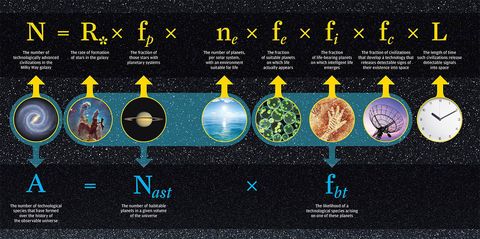
Undeterred, Drake still pondered the otherworldly. Using this first experiment and a few other calculations, Drake conjured a formula for figuring out the likelihood of intelligent extraterrestrial life contacting Earth. He called it the Drake Equation.
Drake's famous formula takes the number of stars born per year in the Milky Way that could conceivably host life-sustaining worlds, and multiples that by variety of factors including the fraction of stars that could have planets, the conditions for life, and the probability that the society is advanced enough to communicate beyond its own planet. Finally, that number is multiplied by a predicted average lifetime of advanced societies.
Drake’s equation.
UNIVESITY OF ROCHESTER
Drake admitted later that he was amazed that the equation became “one of the great icons of science because it didn’t take any deep intellectual effort or insight on my part.” His intention was simply to take a big idea and boil it down so that even beginners could understand what’s required to create advanced lifeforms.
Nonetheless, Drake concluded that more than 10,000 societies brimmed with intelligent life and were capable of reaching out to Earth. “[Drake’s estimate] of 10,000 galactic communicative societies is just as good today as it was in 1961,” says Seth Shostak, senior astronomer at the SETI Institute and author of the book Confessions of an Alien Hunter. “We still can’t make an [exact] calculation, [but it’s] an informed guess.”
NASA Joins the Hunt
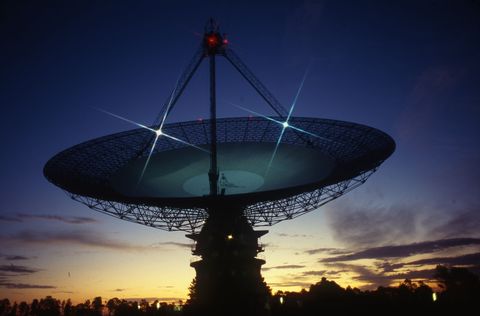
The Australian Parkes telescope, an instrumental telescope during the NASA Apollo 11 mission.
SETI INSTITUTE
Around the same time, Giuseppe Cocconi and Philip Morrison from Cornell University theorized that aliens would contact us via electromagnetic waves and over the frequency of 1420 MHz. The reason: That is the emission frequency of hydrogen, which, as any advanced species would know, is the most abundant element in the universe. The hydrogen hypothesis was just the beginning of a flood of ideas about how to find E.T.
In 1966, astrophysicist Carl Sagan speculated in his book Intelligent Life in the Universe that perhaps extraterrestrials had already come to Earth at some point in the planet’s history. Then five years later, during the apex of Apollo mania, NASA published the fateful Project Cyclops report.
Led by John Billingham and Bernard Oliver, the report laid out a bold and ambitious plan about how public funding could greatly enhance the search for intelligent life in the cosmos. One of the most prominent recommendations was doing away with big, self-contained radio telescopes and replacing with an array of radio telescopes in order to increase the total collecting area and thereby improve the sensitivity. A large number of small antennas not only cost less than one big one, but could be configured to look at many different spots in the sky simultaneously.
The report also offered that while 1420 MHz was perhaps the most likely frequency to meet our cosmic neighbors, it wasn’t the only place that a signal could be heard. It suggested stretching the search from 1000 MHz to 10,000 MHz with particular attention being paid to 1420 MHz to 1666 MHz, where the neutral form of hydroxyl radiates. This area on the dial that was coined the “water hole” due to the abundance of hydrogen and hydroxl—which together make water.
In the end, Project Cyclops never came to be. While the report did recommend starting with “minimum systems” and making additions until making contact or “until a new and superior technology was discovered,” the grand ambitions and the hefty price tag—with estimates reaching between $6 to $10 billion—were too much for Congress to approve.
“HERE WAS AN OLD QUESTION THAT HUMANITY HAD BEEN ASKING FOREVER AND I WAS IN THE RIGHT PLACE AND HAD THE RIGHT SKILLS.”
The report admits that there needed to be immense buy-in to make the project worthwhile, “to justify such an effort, which may require billions of dollars and decades of time, we must truly believe that other intelligent life exists and that contact with it would be enormously stimulating and beneficial to mankind.”
Regardless of its demise, Project Cyclops became a sacred text for those who truly believed in SETI. Tarter read the report while she was a graduate student at Berkeley. She was a computer programmer at the time and was the only one who knew how to program the PDP-8, the outdated computer that analyzed voltage signals from Berkeley's telescope at Hat Creek, a telescope in search for anything that’s particularly non-human.
Reading the report would change her life.
“Here was an old question that humanity had been asking forever and I was in the right place and had the right skills,” says Tarter, who also got her PhD in astrophysics, “this was a big question I could work on... and maybe help find an answer, too.”
SETI as Science
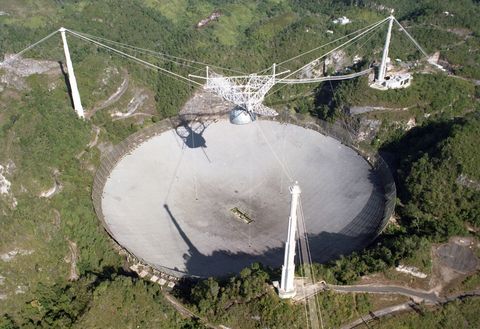
Arecibo observatory in Puerto Rico.
SETI INSTITUTE
While denied billions of dollars to extend humanity's search in the galaxy, Project Cyclops showed that there was an appetite for government-funded SETI research. By the late 1970s, NASA’s Ames Research Center and the Jet Propulsion Laboratory (JPL) in Pasadena both had established SETI programs. Tarter worked on these programs and but the Cold War UFO craze made things difficult.
“Our early years... were dedicated to distancing ourselves from that pseudoscience,” says Tarter, “and showing that this was a rigorous scientific exploration.” They did this by simply approaching it the way it would have for any other science: writing lots of papers, proposals, giving presentations, and lobbying to be in prestigious reports.
This included the 1977 “Search for Extraterrestrial Intelligence” report, written by many who were involved in Project Cyclops, in which it attempts to persuade the world that SETI was timely, feasible, prudent, and could be done at a lower cost (though it never proposes even an estimated dollar amount). The report even threw in some red terror by highlighting the advances the Soviets were making in the field, a powerful political motivator at the time.
Jill Tarter, project scientist at NASA’s Ames Research Center, stands on the Arecibo Complex in Puerto Rico, 1992.
GETTY IMAGESACEY HARPER
NASA reports also advocated for “the search for extraterrestrial intelligence [to] be supported and continued at a modest level as a long-term NASA research program.” While not government supported, much attention was paid to Sagan and Drake's 1974 collaborative effort to send out a binary message to our possible cosmic pals using the Arecibo Observatory telescope in Puerto Rico, at the time the world's largest single-aperture telescope.
Tarter says it took awhile, but due to these projects they eventually had enough support from outside of the government to establish the non-profit SETI Institute in late 1984 with Tarter was one of its founders.
“Suddenly, all of this money was freed up to actually do science, build instruments, and figure out how to observe,” says Tarter. At the same time, the Planetary Society, co-founded by Carl Sagan, also began listening to the sky, not to mention many other teams doing the same across the world.
In 1988, NASA headquarters formally endorsed SETI research and, with an increase in federal funding, started building out needed hardware and training. It culminated in the 1992 Columbus Day announcement of a ten-year, $100-million SETI program called “High-Resolution Microwave Survey," which would focus on targeted searching and all-sky surveying.
While this was certainly a win for scientists, Congress wasn’t so happy. During the 1991 budget debate, Congressmen Silvio Conte made the case for all of those who didn’t want to believe. “We cannot spend money on curiosity today when we have a deficit,” the Congressman said, saying one could spend “75 cents to buy a tabloid [with reports of aliens] at the local supermarket.”
“WE CANNOT SPEND MONEY ON CURIOSITY TODAY WHEN WE HAVE A DEFICIT.”
Two years later, Congress cut off federal funding of SETI. On September 22, 1993, Senator Richard Bryan proposed a last-minute amendment to kill the agreed-upon $100 million program, saying SETI had not yet found any evidence of extraterrestrial intelligence and there was no guarantee they ever would. The money, he believed, was being wasted, and the majority of the Senate agreed.
“We’ve been able to be more aggressive and bold than we might have been,” says Tarter, relating how the cuts affected SETI. “[But] if we have had level and sustained funding over that period, we would have been able to attract the best and brightest of the younger generation.
"We might have had some breakthroughs that we haven’t.”
Narrowing the Search
Seth Shostak, senior astronomer at SETI.
NASA/DAVID C. BOWMAN
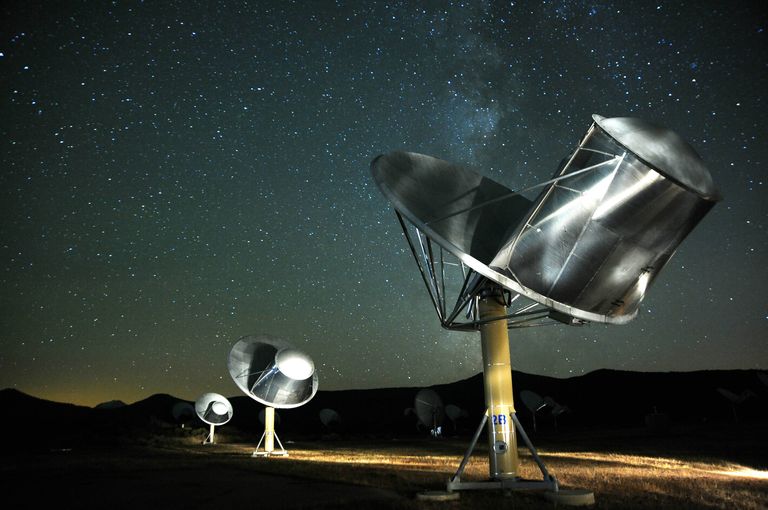
In the two plus decades since the split, privately-funded SETI programs have popped up across the country. While few in number, the SETI Institute, Harvard and Berkeley all have well-known programs. Microsoft co-founder Paul Allen funded the Allen Telescope Array at California's Hat Creek Radio Observatory, which went online in 2007, and internationally, China is also searching the skies.
“It’s actually a better way to do science so you all are not duplicating the same ideas others have,” says Shostak.
The biggest technological changes over the past few decades were faster equipment, more sensitive receivers, the increased importance of optical searching, and the ability to monitor millions of channels at once.
Shostak says SETI monitors about 70 million channels all at once, so if our extraterrestrial friends want to reach out, we have a better chance of hearing them.
"I BET EVERYBODY...THAT WE WOULD FIND INTELLIGENT LIFE WITHIN TWO DOZEN YEARS...NOT MICROBES. I’M TALKING ABOUT ALIENS."
It’s thanks to this improved tech as well as NASA’s help that we now know more about our potential cosmic neighbors. Although in an unofficial capacity, NASA has helped SETI discover more about our potential cosmic neighbors in the past 25 years. Although expected to run out of fuel in the next few months, the nine-year-old Kepler Mission successfully confirmed over 2,300 previously unknown planets in our galaxy. Thirty of those planets are potentially in the habitable zone, meaning they are similar size and in a temperature region where liquid water could pool on the surface.
In other words, those 30 planets could be candidates for intelligent life and are perfect targets for SETI’s radio telescopes. “These are all candidates,” says Shostak, “They are like lottery tickets. Most are bad, but maybe not all.” NASA’s newly launched TESS will continue where Kepler left off in an ongoing search for “Goldilocks” planets.
“I bet everybody...that we would find intelligent life within two dozen years," Shostak says. "Not microbes. I’m talking about aliens.”
But what exactly would first contact look like? Shostak says it would be nothing like what we see in the movies.
It would probably be in the form of a radio bleep or a narrow band signal coming from a star system. Anti-climatically, it would takes hours, if not days, for numerous tests to be run to confirm it was in fact legitimate. If the signal was determined to be extraterrestrial, we would probably immediately start looking for more.
The entire world would likely get involved, pooling equipment, expertise, and money to help with the search. NASA would get back into the SETI game overnight, and we would try to figure out if it was a message.
“It would be the biggest astronomical research project of all time,” he says.
For now, we appear to be alone in the universe, but the nature of scientific reason would suggest otherwise.
“If we are alone, then we are a miracle,” says Shostak. “That’s usually a assumption in science.”
AMC's Visionaries: James Cameron's Story of Science Fiction premieres Monday April 30 at 10/9c on AMC.
SACRIFICIAL STARE Discoveries at the site of the largest known mass sacrifice of children included this shroud-covered youngster lying next to a llama and a rope that was used to lead the llama. The Peruvian site dates to around 1450.
A hellishly unprecedented scene — what anthropologists suspect is the largest known child sacrifice — has been unearthed on a bluff overlooking Peru’s northern shoreline.
Around 550 years ago, members of the Chimú empire ritually killed and buried at least 140 children, ages 5 to 14, and 200 young llamas, says a team led by Gabriel Prieto of the National University of Trujillo in Peru and John Verano of Tulane University in New Orleans.
Except for a few incomplete skeletons, excavated children and llamas displayed cuts on their breast bones and dislocated ribs indicating that their chests had been sliced open. Three adults buried nearby on the bluff, including two women with violent head wounds, may have participated in the sacrifice.
Radiocarbon dating, mainly of ropes left around the llamas’ necks, puts the event at around 1450, shortly before the Inca conquered the Chimú in 1470.
A dried mud layer covering some of the sandy graves possibly resulted from flooding caused by massive rains. Agricultural crises triggered by repeated flooding might have led Chimú leaders to sacrifice children to their gods, Verano suggests.
KILLING PLEA Children’s bodies lay in sandy pits at a Peruvian site where researchers say 140 youngsters were ritually sacrificed around 550 years ago, possibly to appease gods thought to be responsible for devastating floods.
IN THE 1920s, during the early days of flight, Royal Air Force pilots crossing the Middle East noticed something bizarre across barren landscape of Syria, eastern Jordan and Saudi Arabia’s desert.
The giant structures, which covered the land in their thousands, looked like intricately carved stone wheels, only visible from the sky. Some are pendants. Rings. Others are known as “kites”.
Flt Lt Percy Maitland documented the mysterious structures in 1927 for the archaeological journal Antiquity, but they remained largely a secret until the 1970s when Dr David Kennedy, a retired archaeologist at the University of Western Australia, spotted some of them while surveying photographs from Jordan.
“They really dominate the landscape, suggesting a lot of effort was put into constructing these over a huge area,” Dr Kennedy said in 2011 of “The Works of the Old Men,” of which the structures are called.
A “gate” at Samhah, which are more than 1,200 feet long
Picture: David Kennedy - Source:Supplied
A bullseye.
Picture: David Kennedy - Source:Supplied
Dr Kennedy has been busily studying some of the sites, measuring 70 metres wide, in Jordan from above in planes or helicopters, but its neighbour, Saudi Arabia, has always just been out of his reach. The problem with fully unlocking these secrets for Dr Kennedy was gaining permission to visit the country.
Fast forward to 2017, and Dr Kennedy is using a far simpler method to discover the world’s hidden secrets; Google Earth.
In the past 10 years Google Earth has been particularly helpful for probing archaeologists keen to track every inch of the Earth, but notably in the Saudi region.
More than 400 previously undocumented structures — or “gates” as they are called — have been uncovered using the technology, and Dr Kennedy is particularly pleased.
“We tend to think of Saudi Arabia as desert, but in practice there’s a huge archaeological treasure trove out there and it needs to be identified and mapped,” he told the New York Times.
“You can’t see them very well from the ground level, but once you get up a few hundred feet, or with a satellite even higher, they stand out beautifully.”
As with other Gates, this aerial photo from Samhah reveals that the bars are not slender walls but a double line of stones with an infill of smaller stones.
Picture: David KennedySource:Supplied
In this low oblique view, a gate is clear and plainly overlain by a bullseye pendant surrounded by lava. The latter is still quite high and its wall is surprisingly thick.
Picture: David Kennedy - Source:Supplied
Last month, Dr Kennedy received an invite to investigate the structures from above. Two hundred sites in all across the Harrat Khaybar and Harrat Uwayrid regions. Gates. Kites. Triangles. Bull’s eyes. Keyholes. They were all there. And more vivid than Google Earth.
“From 500 feet, you can see the vital details of structures that are invisible in the fuzzy image on Google Earth,” he said.
“Once you get out in the desert areas, where you wouldn’t expect to find much at all, they are absolutely littered with archaeological sites.
“We’re now discovering now is exactly the same in Saudi Arabia.”
A group of pendants.
Picture: David Kennedy - Source:Supplied
But what does it all mean? Is there a connection between all these structures? According to Dr Kennedy, the structures are anything but random; in fact, they are quite deliberate.
“We could see immediately they were much more complicated than they appeared on Google Earth,” Dr. Kennedy told the New York Times.
“They are much more sophisticated than I was prepared for.”
To this day much of the conclusions are still speculation at best, but they are thought to date back as far as 9000 years ago and used by nomadic tribes as traps for hunting and farming.
Dr Kennedy thinks tribes would herb gazelle into the structures where hunters could trap and kill them.
“Essentially there was no escape,” said Dr. Kennedy.
The keyholes, on the other hand, could have been used as tombs or ritual buildings to bury the dead.
But the challenge for experts now, is to study them on the ground. And radio carbon testing to sure of time periods. It could be decades until we find the real answer — until then, the Arabian secrets remain buried in the sand.
Meer van UFO'S of UAP'S, ASTRONOMIE, RUIMTEVAART, ARCHEOLOGIE, OUDHEIDKUNDE, SF-SNUFJES EN ANDERE ESOTERISCHE WETENSCHAPPEN - DE ALLERLAATSTE NIEUWTJES



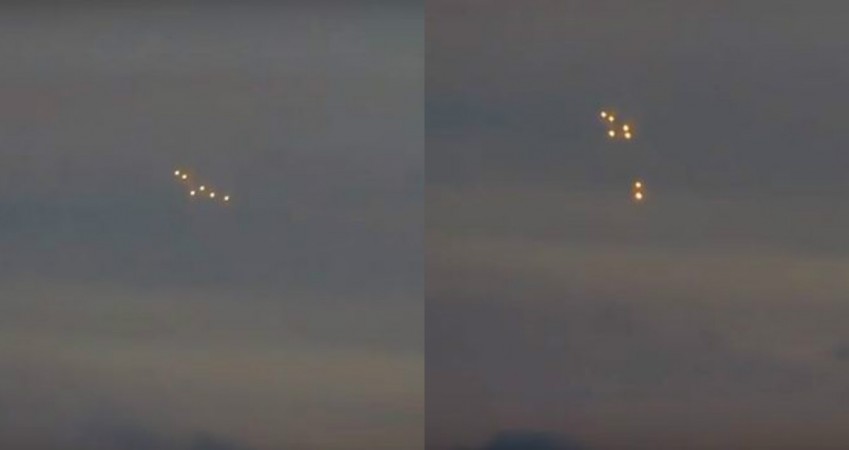

 , is that you? A #mysterious light was seen Friday night by many residents in different northern Chinese cities, leading some to speculate about a possible extraterrestrial spaceship sighting, although the cause is still being investigated pic.twitter.com/FTPEEdn7hx
 No evidence to say that Earth’s magnetic pole is reversing, new study concludes