Ontdek de Fascinerende Wereld van UFO's en UAP's: Jouw Bron voor Onthullende Informatie!
Ben jij ook gefascineerd door het onbekende? Wil je meer weten over UFO's en UAP's, niet alleen in België, maar over de hele wereld? Dan ben je op de juiste plek!
België: Het Kloppend Hart van UFO-onderzoek
In België is BUFON (Belgisch UFO-Netwerk) dé autoriteit op het gebied van UFO-onderzoek. Voor betrouwbare en objectieve informatie over deze intrigerende fenomenen, bezoek je zeker onze Facebook-pagina en deze blog. Maar dat is nog niet alles! Ontdek ook het Belgisch UFO-meldpunt en Caelestia, twee organisaties die diepgaand onderzoek verrichten, al zijn ze soms kritisch of sceptisch.
Nederland: Een Schat aan Informatie
Voor onze Nederlandse buren is er de schitterende website www.ufowijzer.nl, beheerd door Paul Harmans. Deze site biedt een schat aan informatie en artikelen die je niet wilt missen!
Internationaal: MUFON - De Wereldwijde Autoriteit
Neem ook een kijkje bij MUFON (Mutual UFO Network Inc.), een gerenommeerde Amerikaanse UFO-vereniging met afdelingen in de VS en wereldwijd. MUFON is toegewijd aan de wetenschappelijke en analytische studie van het UFO-fenomeen, en hun maandelijkse tijdschrift, The MUFON UFO-Journal, is een must-read voor elke UFO-enthousiasteling. Bezoek hun website op www.mufon.com voor meer informatie.
Samenwerking en Toekomstvisie
Sinds 1 februari 2020 is Pieter niet alleen ex-president van BUFON, maar ook de voormalige nationale directeur van MUFON in Vlaanderen en Nederland. Dit creëert een sterke samenwerking met de Franse MUFON Reseau MUFON/EUROP, wat ons in staat stelt om nog meer waardevolle inzichten te delen.
Let op: Nepprofielen en Nieuwe Groeperingen
Pas op voor een nieuwe groepering die zich ook BUFON noemt, maar geen enkele connectie heeft met onze gevestigde organisatie. Hoewel zij de naam geregistreerd hebben, kunnen ze het rijke verleden en de expertise van onze groep niet evenaren. We wensen hen veel succes, maar we blijven de autoriteit in UFO-onderzoek!
Blijf Op De Hoogte!
Wil jij de laatste nieuwtjes over UFO's, ruimtevaart, archeologie, en meer? Volg ons dan en duik samen met ons in de fascinerende wereld van het onbekende! Sluit je aan bij de gemeenschap van nieuwsgierige geesten die net als jij verlangen naar antwoorden en avonturen in de sterren!
Heb je vragen of wil je meer weten? Aarzel dan niet om contact met ons op te nemen! Samen ontrafelen we het mysterie van de lucht en daarbuiten.
Over the course of the last couple of weeks, I’ve posted a number of article here at Mysterious Universeon Area 51. Now, it’s time to wrap things up with what we know and what we might think we know about the tales of the base. It has, for sure, been a winding and twisting story. And a highly conspiratorial one, too. It’s also a story filled with facts that may well be fiction, and tales that sound like fiction, but which just might be filled with incredible truths. Add to all of that, cloak-and-dagger characters who prefer to stay in the shadows, but who claim to know a great deal and occasionally reveal it, disinformation experts, counterintelligence personnel, and a host of figures who suggest that there really might be an extraterrestrial presence at Area 51, and what we have is a story that truly boggles the mind. Perhaps those in charge of Area 51 want our minds boggled. After all, a state of confusion might be the perfect way to keep people away from the truth and have them focused on conspiracies that may not actually be real. Let’s take a look at what we know for sure.
It is a fact that the origins of what eventually became Area 51 date back to the early years of the Second World War. The Nevada Test and Training Range soon came to fruition and planted the seeds for what would come in the mid-1950s: Area 51. Highly advanced aircraft, such as the U-2, the SR-71 Blackbird, the Stealth Fighter and the Stealth Bomber were all secretly test-flown from Area 51. Probably the near-legendary Aurora, too. In that sense, many might say, there is no doubt that Area 51 has a valid reason for keeping just about everything under wraps. Indeed, considering the fact that those aforementioned aircraft were being built, tested, and flown when the Cold War was still in place and the Soviet Union had still yet to fall, one can easily see why measures would be taken to ensure that the U.S. Government’s most advanced aircraft would be subject to incredible secrecy. But, is there just too much secrecy for a squadron or several of radical, futuristic aircraft? That depends on who’s version of the “facts” believe.
Air Force U-2
As we have seen, there is one thing – more than any other – that sets Area 51 apart from just about every other military or government facility in the United States: it’s the sheer extent of the government’s determination to make sure that absolutely nothing gets out of Area 51 and no one gets in. Of course, and particularly so in today’s climate of uncertainty and threats of nuclear attacks, everyone needs to be vigilant. And that includes everyone who works at Area 51, too. They are, when all is said and done, just like us, regular people with lives and families. The big difference, though, is that they know the reasons for so much secrecy and we don’t.
It would be hard – in fact, impossible – to find a military installation in the United States that protects its secrets to a greater degree than Area 51. People have been forced to leave their homes and their land – solely due to U.S. Government concerns and worries that those same people just might see something they shouldn’t see. Those who stray too close to portions of the Nevada desert that the staff of Area 51 would prefer to keep under wraps risk large fines, imprisonment and even death, and all in the name of national security. Aircraft are banned from flying close to or over Area 51. They can even be shot down out of the sky, if circumstances dictate and warrant such drastic action. When, in 1974, NASA’s astronauts on-board Skylab took an aerial photo of the base, all hell broke loose in the defense- and intelligence-based communities of the United States. The CIA and the Department of Defense quickly got involved. Major concerns were expressed about how on Earth (or, in this case, off it) such a thing could have happened. Secret files were created, most of which have never publicly surfaced. Motion-detector equipment peppers the landscape. Cameras are everywhere. Guards patrol the local roads for any perceived suspicious characters. Night-vision technology ensures that no-one can penetrate the base in the early hours of the morning.
The government practically refuses to acknowledge not just the existence of Area 51, but even its name. That same government refused to offer help on the 1996 movie Independence Day, and all because a substantial portion of the movie revolved around Area 51 and the 1947 incident at Roswell, New Mexico. All of the above is astonishing. No facility in the United States comes even close to the level of secrecy and paranoia that surrounds Area 51. Which brings up an important question: is all of this overwhelming secrecy just in place to protect next-generation after next-generation of aircraft? Or, are the rumors and the whispers true? You know the ones, of course: the claims that deeply hidden at Area 51 are the remains of the Roswell wreckage, recovered flying saucers, and alien corpses. Maybe, even living aliens are at the base, too.
Regardless of where you, me and everyone else stands on the matter of what goes on at Area 51, there can be no doubt that it is the UFO-driven rumors and revelations which attract so much attention. Certainly, there’s no doubt that it was Bob Lazar who, in the late 1980s, set the wheels in motion for the controversy to begin and for the media and the public to sit up and take notice. And, as we have seen, accounts relative to aliens and UFOs – all in relation to area 51 – abound, and have done so for decades. The so-called “alien interview” footage led many to believe that living aliens are housed somewhere at Area 51. It is, however, garbage. Boyd Bushman told incredible stories of alien life and Area 51 connections. Likely it too was garbage – or disinformation. But, it was Bob Lazar – more than anyone else – who defined the beliefs and suspicions, and who still defines those beliefs and suspicions.
We should note, though, that there are certain threads running through the tales of UFOs at Area 51 that should make us cautious of what we are told. Let’s not forget that Lazar told of how his mind may have been messed with – possibly using updated MK-Ultra-type technologies. Certain portions of his memories were wiped clean. He felt that his very brief glimpse of a small creature at S-4 may have been a staged event; an event designed to make him think that live extraterrestrials were hidden at the base, when they may not have been.
There can be no doubt that the alien angle of the history of Area 51 excites many. Maybe that’s what the government is counting on. After all, not even the power of all the military-, defense-, and intelligence-based agencies in the United States can prevent a few leaks of classified information. So, perhaps to keep eager Ufologists away from stumbling on legitimate covert programs concerned with new aircraft designs, next-generation weapons-systems, mind-control techniques and more of a down to earth nature, they swamp those same Ufologists with enticing tales of extraterrestrial conspiracies and interviews with a sickly creature from another world (that never was).
The mysterious goat-sucker strikes again! As el chupacabracontinues its world tour, it’s clear that no livestock is safe. Around the globe, livestock and other farm animals are being savagely and mysteriously ripped apart, drained of their blood, or otherwise eviscerated. Over the last few years, stories reporting unexplained animal mutilationsappear to be on the rise.While the phenomenon is by no means new, the increasing frequency with which they’re being reported makes it seem like unknown, unseen predators are venturing into new territory in search of fresh meat. What’s behind these killings?
Hopefully this thing.
The latest case of a brutal and unexplained animal mutilation comes from the African nation of Namibia, where shepherds report that close to 30 goats have been found completely drained of their blood. Residents of the villages of Uukwanambwa and Amuteya say that for the past few weeks, some unknown predator has been stalking their goats in the night and somehow sucking all of their blood without spilling a drop.
According to news blog The Namibian, the creature has been seen by a few witnesses who say the animal resembles a large dog:
Two goats died and 10 have holes in the neck and they’re just salivating. We were told not to eat them and to kill the remaining four and burn them. The thing that killed the animals was apparently seen at the neighbour’s house fighting with a dog. Those who have seen them said they look like black dogs.
Local wildlife officials and veterinarians say the animals’ wounds are anomalous and that they’ve never seen anything like them before. Environment ministry deputy director for the north central regions Rehabeam Erckie told AllAfrica.com that “scientifically, these things attacking the goats in that manner are not part of the wildlife we know. We leave room for more investigations.”
Drained blood and missing reproductive organs are common features of these mysterious mutilations.
Are all of these cases of animal mutilations a further indication that things aren’t quite right in the natural world? As climate change, human development, and who knows what else continue to reshape the Earth and the ecosystems that depend on it, it’s natural we’ll start to see new patterns of animal behavior or even new animals emerge from the shadows. When will one of these creatures start preying on humans?
With the recentFOIA release of a list provided to Congresspertaining to the controversial Advanced Aerospace Threat Identification Program (AATIP), there has beena lot of resulting buzzabout wormholes, warp drives, and other futuristic concepts pertaining to advanced physics.
Steven Aftergood with the Federation of American Scientists was one of the recipients of the new disclosure, which he posted on the FAS website. In an interview with Motherboard, Aftergood expressed some surprise that the Defense Intelligence Agency would have provided so little financial backing for such disproportionately far-out projects.
“I think anyone who looks at these titles will scratch their heads and wonder what on earth the Defense Intelligence Agency was thinking,” he said. “These are the kinds of topics you pursue when you have more money than you know what to do with.”
Most news outlets that have commented on the release have, as expected, gravitated toward its more sensational aspects. While there is little in the way of direct mention of UFOs in the small batch of documents, a number of physics papers and research studies pertaining to propulsion, cloaking, and other technologies are listed. One might presume such technologies—if they existed in ways that could be practically and efficiently implemented—would be required to account for some of the more compelling UFO observations spanning the last 75 years.
However, what few are talking about in relation to the little breadcrumbs that are finally beginning to appear in relation to AATIP is what it tells us not only about the scope of the program but also the motivations behind it… wherein there are a number of similarities to previous government UFO studies.
One minor detail—but an important one—is the inclusion of the word “and” between “Threat” and “Identification.” In other words, the implication of the new title as referenced by the DIA in their letter to Aftergood (Nick Pope and others received essentially identical FOIA information around the same time) entails Advanced Aerospace Threat AND Identification Program: hence, the objective is not so much “threat identification” as it is an assessment of aerospace-related threats and the identification of advanced aerospace technologies. Yes, it’s a minor point, but one worth noting.
In terms of the financing side of the equation, as Aftergood noted, “These are the kinds of topics you pursue when you have more money than you know what to do with.” The paltry $22 million that was appropriated for the program hardly foots that kind of bill, although the reasons for its allocation are fairly evident. One aspect has to do with the fact that the Congressmen involved with the project—Harry Reid (D, Nevada), the late Ted Stevens (R, Alaska) and the late Daniel Inouye (D, Hawaii)—all had a history of allocating earmarks for their constituencies in their home states.
U.S. Senator Harry Reid.
The other has to do with what the latest FOIA releases show: that the clear areas of focus of the “contract” (as it is referred to in the documents) are in technological areas which, presumably, may have applications for weapons systems or other advancements well outside mere threat assessment and identification of different varieties of “advanced aerospace.”
I recently spoke with Alejandro Rojas, a writer for Open Mindsand arguably one of the more fact-oriented reporters on the UFO subject today, about the new releases. He shared my view that the practical side of government UFO studies—having to do with financial incentives and other advantages a government agency might hope to glean from such investigation—is something that is often under-emphasized, if not overlooked entirely in light of the more sensational implications of unidentified aircraft or other phenomena.
“First of all we live in a world where you’ve gotta make money,” Rojas says. “Any research or scientific research project out there has to have an end game that means profits. And it’s rare that you get research in areas that don’t have that.
“Sometimes government does need to step in for that reason: corporations don’t see that they can make a profit off of the medicine. We’ve seen this even in cancer research, where they think, ‘we’re not sure we can make money off of this medicine, even though it may help people.’ So the government has to step in to fund that sort of research because its gotta make money.”
“It’s got to have a purpose; it’s got to have a benefit. It can’t be science for science’s sake. Unfortunately, that’s frustrating for scientists… Then you have to play the politics game.”
Journalist Alejandro Rojas at Devils Tower, Wyoming
(photo by the author).
Rojas and I also spoke about past government studies in relation to this, most notably the U.S. Air Force’s Project Blue Book, and how it contrasts with the present AATIP program and its apparent areas of focus.
“In Project Blue Book they said they were researching potential threats caused by UFOs, essentially, and they determined there was no threat posed by the phenomenon,” Rojas said. “Which is interesting in itself because it does seem that that’s true. I mean, even with the Nimitz situation (see the U.S.S. Nimitz Incident, as recounted by pilot Dave Fravor) they’re chasing something around, but in none of the Blue Book cases does a threat seem to be posed.”
Rojas, who has spoken in the past with Luis Elizando, former head of the Pentagon study associated with AATIP, notes that Elizondo describes the ideology of the AATIP program slightly differently from its earlier government predecessors; specifically, the threat angle seems to come into play more prominently.
“However, what Elizondo has done is something different—and I don’t know if it’s him, or maybe Harry Reid and the group, you know, this was what they were doing—but Elizondo is very quick to point out… that anything unidentified constitutes a threat. Potentially, at least from their perspective, they have to consider every unknown a threat until we know otherwise. And I think that ideology is important because Blue Book closed when they determined this unidentified ‘whatever’ doesn’t seem to pose a threat. Elizondo is saying, ‘no, if you’re saying it’s unidentified, then by its nature it’s still a threat, from our perspective.”
“So it’s kind of justifying why we have to continue, even though Blue Book already happened. Blue Book determined arguably that there was unidentified craft… so what [Elizondo] is saying is that we can’t stop there–that if they’re unidentified, then we still need to consider them a threat, and that justifies us looking further into all of this.”
“There is a difference between the two programs in that manner,” Rojas concludes, underscoring the necessity for practical results from government UFO studies which seems to remain. “[AATIP] is more actively looking to produce some science or some potential other benefits in developing weapons from these identifications.”
Within this context, the AATIP program may be seen with at least some degree of greater clarity than before. It is a “contract”, as the recent DIA papers phrase it, which secured a limited amount of funding on behalf of Senators from three states based on a mutual interest they shared (and in the case of Harry Reid, which he shared with certain friends and constituents, namely Robert Bigelow). However, in order to obtain earmarks for such a program, its focus, as outlined in the recent DIA documents, clearly seems to have objectives which may have hope for producing scientific, strategic, or other incentives in the long term. The result appears to be a program that explores more practical areas of development and national security interest while facilitating some justification for the study of “unknowns” along the way, and on a budget that would have been considered pretty modest even decades ago.
None of this undermines the scope or objectives of the AATIP program, per se, although it is perhaps worthwhile to consider some of the details we have begun to glean about it that have less to do with its sensational elements and the mysterious phenomena associated with it.
Emiliano Sala Abducted By Mile Long UFO Over Channel Islands, Jan 23, 2019, Video, UFO Sighting News.
Date of abduction: Jan 21, 2019 Location of abduction: between Alderney and Guernsey island.
When a plane goes mission, I often look into it for related UFO sightings in that area. Emiliano Sala, the famous soccer player was on board a small single engine Piper Malibu, which seats about 6 people and it just happened to disappear in the exact location of the worlds largest UFO ever seen in history...being over a mile long and there were two of them seen by two different planes and pilots and many passages back in April 23, 2007. Well its happened again, but this time the small plane was so close to the mile long yellow and metallic UFO that it may have been deemed a threat and taken onboard the craft.
Thats right, Emiliano Sala may be alive and well on board a mile long UFO somewhere out in space or even on another planet by now. It is unlikely that the aliens would allow Emiliano to return to earth since he has walked among them and seen their technology...letting him go may cause a world wide panic. Also there is a huge area between France and Guernsey island that pilots are not allowed to fly over due to the area being military secret off limits location. This may be to help keep the aliens flying in and out of the ocean a secret.
Another thing is that back in 2007, the pilot of the craft that saw the mile long UFO wanted to go check it out...in his own words he states, ‘As I got closer to it, it became clear to me that it was tangible. I was in two minds about going towards it to have a closer look but decided against it because of the size of it. I had to think of the safety of the passengers first.’ So, if the pilot in 2007 wanted to go check out the UFOs and get closer...then maybe Emilianos' pilot also wanted to turn toward the UFOs and take a closer look and get video footage of the craft...but they got too close and were abducted. Even if the plane is found, no bodies will ever be found, but they probably took them...plane and all onboard the alien craft. Hey, you never know...he may teach aliens about soccer and create a universe cup competitions among worlds. Scott C. Waring For more info about the Guernsey UFO incident in 2007, copy paste this link.
Ancient nuclear weapons described in the Mahabharata – an ancient Hindu text that speaks of great destructive power 12,000 years ago. But does it hold up?
Where nuclear weapons detonated in India 12,000 years ago? According to ancient texts, the answer is a resounding ‘yes’. The descriptions of their effects uncannily remind us of modern nuclear weapons. Were ancient nuclear weapons unleashed on humanity 12,000 years ago?
The most famous text, the Sanskrit epic of Ancient India called the Mahabharata says:
A single projectile charged with all the power in the Universe… An incandescent column of smoke and flame as bright as 10,000 suns, rose in all its splendor… It was an unknown weapon, an iron thunderbolt, a gigantic messenger of death which reduced to ashes an entire race. The corpses were so burned as to be unrecognizable. Their hair and nails fell out, pottery broke without any apparent cause, and the birds turned white. After a few hours, all foodstuffs were infected. To escape from this fire, the soldiers threw themselves into the river.
It certainly seems like an ancient description of a nuclear explosion. One must understand, however, there is some question as to whether the text really translates to this (or that these portions are even part of it).
While the folks over at Skeptoid have actually done a pretty thorough job of researching this, we do know that you can find anything you want on the Internet. Is it possible that the translations of the ancient text have been embellished? Or is it likely that debunkers have cherry-picked the evidence to the contrary?
Conspiracy Perhaps?
There are organizations in this world who may actually be striving to cover up the existence of ancient nuclear weapons. The fact that it’s very unlikely humans would have had this technology millennia ago indicates that Ancient Aliens may have brought the technology – and there are plenty out there who want that idea squashed immediately.
So it’s not out of the realm of possibility that the entire thing is made up… but it’s also not out of the realm of possibility that there’s some amount of truth to these writings.
The Mahabharata isn’t the only ancient text that allegedly mentions weapons of incredible scale. In fact, there are some passages in the Bible which speak of weapons of mass destruction according to some.
The destructions of the cities of Sodom and Gomorrah are described in the Bible as having fire raining down on them. The cities were totally destroyed in a short time.
Some Ancient Alien theorists believe the Bible itself is evidence of ancient nuclear weapons, likely unleashed on humanity by aliens.
Mystery or Not?
While all of the different pieces of evidence for India’s ancient nuclear weapons may be weak individually, one cannot ignore their sum as a whole. Consequently, it’s difficult to rule this one as a fake totally.
That being said, however, it’s not possible to know for sure that the ancient texts are talking about ancient nuclear weapons either. This one might be a mystery forever.
What do you think? Did aliens provide nuclear weapons or use them against the human population in ancient times?
Back in the first moment of the universe, everything was hot and dense and in perfect balance. There weren't any particles as we'd understand them, much less any stars or even the vacuum that permeates space today. The whole of space was filled with homogeneous, formless, compressed stuff.
Then, something slipped. All that monotonous stability became unstable. Matter won out over its weird cousin, antimatter, and came to dominate the whole of space. Clouds of that matter formed and collapsed into stars, which became organized into galaxies. Everything that we know about started to exist.
Scientists still aren't sure. But researchers have figured out a new way to model in a lab the sort of defect that could have caused the great unbalancing of the early universe. In a new paper, published today (Jan. 16) in the journal Nature Communications, scientists showed that they can use supercooled helium to model those first moments of existence — specifically, to re-create one possible set of conditions that may have existed just after the Big Bang.
That matters because the universe is full of balancing acts that physicists call "symmetries."
Some major examples: Physics equations work the same way both forward and backward in time. There are just enough positively charged particles in the universe to cancel out all the negatively charged particles.
But sometimes, symmetries break. A perfect sphere balanced on the tip of a needle falls one way or the other. Two identical sides of a magnet separate into north and south poles. Matter wins out over antimatter in the early universe. Specific fundamental particles emerge from the formlessness of the early universe and interact with one another via discrete forces.
"If we take the existence of the Big Bang as given, the universe has undoubtedly undergone some symmetry-breaking transitions," Jere Mäkinen, the lead author of the study and a doctoral student at Aalto University in Finland, told Live Science. [Gallery: The World's Most Beautiful Equations]
Need proof? It's all around us. Every table and chair and galaxy and duck-billed platypus is evidence that something tipped the early universe out of its early, flat state and into its current complexity. We're here instead of being potentialities in a uniform void. So, something broke that symmetry.
Physicists call some of the random fluctuations that break symmetry "topological defects."
In essence, topological defects are spots where something goes wonky in an otherwise-uniform field. All at once a disruption emerges. This can happen due to outside interference, like in a lab experiment. Or it can happen randomly and mysteriously, like scientists suspect happened in the early universe. Once a topoligical defect forms, it can sit in the middle of a uniform field, like a boulder creating ripples in a smooth stream.
Some researchers believe that particular kinds of topological defects in the formless stuff of the early universe may have played a role in those first symmetry-breaking transitions. Those defects may have included structures called "half-quantum vortices" (patterns of energy and matter that look a bit like whirlpools) and "walls bounded by strings" (magnetic structures made of two-dimensional walls bounded on either side by two one-dimensional "strings"). Those spontaneously emerging structures affect the flow of matter in otherwise-symmetrical systems, and some researchers suspect that these structures played a role in clumping the universe together into the stars and galaxies we see today. [Album: Behind the Scenes at the Largest US Atom Smasher]
Researchers had previously created these sorts of defects in the magnetic fields of supercooled gases and superconductors in their labs. But the defects emerged individually. Most theories that use topological defects to explain the origin of the modern universe involve "composite" defects, Mäkinen said — more than one defect working in concert.
Mäkinen and his co-authors designed an experiment involving liquid helium cooled to fractions of a degree above absolute zero and squeezed into tiny chambers. In the darkness of those little boxes, half-quantum vortices emerged in the supercooled helium.
Then, the researchers changed the conditions of the helium, causing it to go through a series of phase transitions between two different kinds of superfluids, or fluids with no viscosity. These are phase transitions akin to water turning from a solid into a liquid or a gas, but under much more-extreme conditions. [Top 10 Ways to Destroy Earth]
Phase transitions cause symmetry to break. For example, liquid water is full of molecules that can orient in many different directions. But freeze that water, and the molecules get locked in place in particular positions. Similar breaks in symmetry happen with the superfluid phase transitions in the experiments.
Still, after the superfluid helium went through its phase transitions, the vortices remained — protected by walls bounded by strings. Together, the vortices and the walls formed composite topological defects and survived symmetry-breaking phase transitions. In that way, the researchers wrote in the paper, these objects mirrored defects that some theories suggest formed in the early universe.
Does this mean that Mäkinen and his co-authors have figured out how symmetry broke in the early universe? Absolutely not. Their model showed only that certain aspects of "grand unified theories" of how the early universe took its shape can be replicated in a lab — specifically, the parts of those theories that involve topological defects. None of those theories are widely accepted by physicists, and this could all be a big theoretical dead end.
But Mäkinen’s work does open the door to more experiments to investigate how these sorts of defects may have worked to shape the moments after the Big Bang. And these s}tudies definitely teach scientists something new about the quantum realm, he said. The open question remains: Will physicists ever conclusively link these details about the tiny quantum world with the behavior of the entire universe?
Alarming Increase In Volcanic Eruptions World Wide And Nobody Knows Why
Not many people know about it because no one is talking about it, probably because they have no idea why it's happening. The world’s volcanic activity has dramatically increased recently and they are erupting faster and more frequently than ever before. Furthermore, earthquakes are also on the rise.
What is happening?
While no one can say for sure what all this commotion is about, one thing is clear - the planet is becoming more and more unstable. There was a total of 3,542 volcanic eruptions during the 20th Century. Now, dividing that number by 100 gives an average of 35 eruptions per year, roughly. This means that the number of volcanic eruptions right now is far more than the 20th Century’s average for the entire year.
In addition to this, there are large numbers of earthquakes taking place too. If it seems like volcanic eruptions and earthquakes are taking place more frequently, it's probably because they are. The best theory that scientists can come up with as of yet is that the Earth is preparing its self for some sort of “world-changing mega tremor” with the power to split up continents and change the geography of the world as we know it today.
Where's the proof?
The proof is in the numbers. Raw data. The data shows that the number of global magnitude six (M6) or higher earthquakes from 1980 to 1989 increased to an average of 108.5 earthquakes per year, from 2000 to 2009 the planet averaged 160.9 earthquakes per year. This shows a 38.9% increase of M6+ earthquakes in these time frames.
Furthermore, there also appears to be growing unrest among the world’s supervolcanoes. Iceland is home to some of the most dangerous volcanoes on the planet and there is significant activity there. Also Santorini in Greece, Uturuncu in Bolivia, the Yellowstone and Long Valley calderas in the U.S, Laguna del Maule in Chile, Italy’s Campi Flegrei – almost all of the world’s active super-volcanic systems are starting to show some signs of inflation, which is an early indication that pressure is building in these volcanic systems and they are getting ready to explode.
More data can be found at this link; volcano.si.edu/.... This is just the month of December 2018. It is definitely a worrying prospect and everyone should be more cautious, especially when in the vicinity of volcanoes. Only time will tell how this will turn out and there isn't much we can do about it. All we can do now is wait…
New research suggests that the ancient people of Rapa Nui in eastern Polynesia – better known as Easter Island – built their famousahu(shrine) monuments near coastal freshwater sources.
The island of Rapa Nui is well-known for its elaborate ritual architecture, particularly its numerousmoai – monolithic human figures – and ahu, the monumental platforms that supported them. Researchers have long wondered why ancient people built these monuments in their respective locations around the island, considering how much time and energy was required to construct them.
Locations of ahu with statues on Rapa Nui.
Image via PLoS One.
For the new study, published January 10, 2019, in the peer-reviewed journal PLoS One, the researchers used spatial modeling to explore the potential relations between ahu construction locations and the islanders’ three most critical resources – rock mulch agricultural gardens, marine resources and freshwater sources. Their results suggest that ahu locations are explained by their proximity to the island’s limited freshwater sources.
University of Oregon anthropologist Robert DiNapoli is lead author of the study. He said in a statement:
Many researchers, ourselves included, have long speculated associations between ahu, moai and different kinds of resources – water, agricultural land, areas with good marine resources, etc. However, these associations had never been quantitatively tested or shown to be statistically significant. Our study presents quantitative spatial modeling clearly showing that ahu are associated with freshwater sources in a way that they aren’t associated with other resources.
Carl Lipo of Binghamton University in New York is a study co-author. He said:
The issue of water availability, or the lack of it, has often been mentioned by researchers who work on Rapa Nui. When we started to examine the details of the hydrology, we began to notice that freshwater access and statue location were tightly linked together.
It wasn’t obvious when walking around – with the water emerging at the coast during low tide, one doesn’t necessarily see obvious indications of water – but as we started to look at areas around ahu, we found that those locations were exactly tied to spots where the fresh groundwater emerges, largely as a diffuse layer that flows out at the water’s edge. The more we looked, the more consistently we saw this pattern. This paper reflects our work to demonstrate that this pattern is statistically sound and not just our perception.
The researchers currently only have comprehensive freshwater data for the western portion of the island and plan to do a complete survey of the island in order to continue to test their hypothesis of the relation between ahu and freshwater.
Bottom line: A new study suggests that the ancient people of Easter Island built their huge stone monuments near freshwater sources.
An artist's illustration of the star system HD 98800, which features a pair of stars orbited by a vertical planet-forming disk of material.
Credit: Mark Garlick/University of Warwick
Planet-forming disks of material typically orbit around the equators of stars, but now scientists have discovered such rings can go dramatically awry and encircle the poles of stars instead.
The new study suggests that worlds could exist with polar orbits around pairs of stars, potentially leading to seasons extraordinarily different than Earth's.
Stars are born within clouds of gas and dust. The gravitational pull of each star draws such material into spiraling orbits around it. Although clumps of this cloud start off moving in random directions at random speeds, as the cloud collapses, the clumps collide and merge. The result over time is a flattened disk called a protoplanetary disk that usually spins in the same direction as its star and surrounds the star's equator. The planets that emerge from such a disk also typically orbit around the star's equator, as is the case with the worlds of our solar system. [Secrets of Planet Birth Revealed in Amazing ALMA Radio Telescope Images]
Prior work found that nearly all young stars are initially surrounded by protoplanetary disks. In the case of protoplanetary disks around single stars, at least a third go on to form planets, said lead study author Grant Kennedy, an astronomer at the University of Warwick in England.
However, computer simulations have previously suggested that after protoplanetary disks have formed, any extra material they collect can knock them off-kilter. This could explain why astronomers have detected exoplanets with relatively crooked orbits around stars.
Kennedy and his colleagues focused on so-called circumbinary planets, which orbit around binary stars. Scientists had suspected that planets around binary stars could become misaligned — instead of orbiting the stars in the same plane in which the stars orbit one another, these worlds could orbit around their poles instead.
Now, Kennedy and his colleagues have detected the first example of a misaligned circumbinary protoplanetary disk. "It's one of those examples that nature manages to be more creative than we expect," Kennedy told Space.com.
The scientists focused on the quadruple-star system HD 98800, located about 146 light-years from Earth. "If planets were born here, there would be four suns in the sky," study co-author Daniel Price of Monash University in Australia said in a statement.
Using the Atacama Large Millimeter/submillimeter Array (ALMA), a huge radio observatory in Chile, the astronomers captured high-resolution images of the protoplanetary disk around two of the four stars. This ring is about the same diameter as the solar system's asteroid belt. (The other two stars lie outside the disk; the two pairs of stars orbit each other.)
Previous research confirmed the way in which these binary stars orbited one another. The new study revealed the protoplanetary disk around these stars essentially orbited around their poles, like a Ferris wheel with a carousel at its center.
"I wasn't actually expecting these data to reveal a polar configuration," Kennedy said. "Based on previous results, I had made all these predictions of complicated warped structures, but they turned out to be completely wrong. The end result is much simpler and more compelling."
A planet embedded in the protoplanetary disk of the star system HD 98800 would get this striking view of the disk and pair of stars.
Credit: Mark Garlick/University of Warwick
These new findings suggest that circumbinary planets in polar configurations may prove more common than often assumed, Kennedy said. "The disks exist, so why shouldn't the planets?" he said.
If a planet ever developed from the newfound protoplanetary disk, the scientists noted that from the surface of this world, the disk would resemble a thick band rising almost straight up from the horizon. The pair of stars the planet orbited would appear to move in and out of the plane of the disk, giving items on the world's surfaces two shadows at times. [The Most Fascinating Exoplanets Discovered in 2018]
Such a planet might also experience unusual seasons, Kennedy said. "For Earth, the seasons happen because of the tilt of the Earth's axis," he explained. This leads the amount of daylight each hemisphere gets each day to grow or shrink over the course of the year, and this influences how warm or cold they are, he said.
With any planet that might evolve in HD 98800, axial tilt is not the only potential factor underlying seasonal variations. "The stars will also change their height in the sky as they orbit each other," Kennedy said. Depending on the season, "sometimes there would be two suns during the day, sometimes one."
The scientists detailed their findings online today (Jan. 14) in the journal Nature Astronomy.
Attractive humanoid aliens will soon be embroiled in romance and adventure on The CW’s new seriesRoswell, New Mexico. In an early scene from the show’s new trailer, a Jeep drives under a sign in the desert that reads “Foster Ranch” just before an object from the air crashes into the ground causing a huge explosion. But what is the Foster Ranch, and how did Roswell get its alien reputation in the first place?
We're glad you asked! We're here to tell you all about the "real" alien history of Roswell, and there's two ways to do it. You can watch our mini-documentary for some quick facts, or keep scrolling and read the article for more in-depth knowledge.
Roswell, New Mexico is a desert town about 200 miles southeast of Albuquerque. It is the fifth largest town in New Mexico, but much more provincial than Santa Fe, another well-known New Mexico destination similar in size. While visitors from around the world flock to Santa Fe to experience Southwestern art and culture, tourists seek out Roswell for a different reason: aliens.
Although the alleged crash of an alien spacecraft outside of Roswell, New Mexico in 1947 is the most famous UFO or alien related incident, few knew about it before the first book on the topic, The Roswell Incident, was published in 1980. By July 1997, the 50th anniversary of the crash, the U.S. Air Force had released two separate reports on the Roswell incident (1995 report, 1997 report), and it was featured on the cover of Time magazine. The story of aliens at Roswell had reached the farthest corners of planet Earth.
The incident described by the Air Force began on the Foster ranch about 30 miles outside of Roswell. Ranch foreman Bill “Mack” Brazel claims to have come across odd-looking debris in the field some time in June or early July 1947. He and his son examined the debris but didn’t pay it much attention until Brazel heard stories of mysterious flying discs spotted in the skies elsewhere in the U.S. The most famous of these sightings took place on June 24, 1947, when businessman and amateur pilot Kenneth Arnold spotted several objects described by the press as “flying saucers” -- the first use of the term -- while flying near Mount Rainier, Washington. Arnold’s sighting made headlines and eventually prompted the United States military to begin official investigations into sightings of unidentified objects in the skies.
Brazel thought the debris he found might be one of these flying saucers and reported it to Chaves County Sheriff George Wilcox. Wilcox then reported Brazel’s discovery to the Roswell Army Airfield (RAAF), home of the 509th Bomb Group, at the time, the only team responsible for dropping the atom bomb.
The RAAF sent intelligence officer Major Jesse Marcel and counterintelligence corps officer Captain Sheridan Cavitt to meet with Brazel and drive out to the Foster ranch and take a look at the debris. The next day, July 8, the RAAF sent out a press release claiming, according to the Roswell Daily Record, that they had “come into possession of a flying saucer.” That day the Roswell Daily Record front page headline read: “RAAF Captures Flying Saucer On Ranch in Roswell Region.”
The next day, the Roswell Daily Record’s headline read: “Gen. Ramey Empties Roswell Saucer.” The subheadings read: “Ramey Says Excitement Is Not Justified,” and “General Ramey Says Disk Is Weather Balloon.” The same day, Ramey held a press conference at his office in Fort Worth, Texas with Marcel in which they posed with debris from a weather balloon. With that, as quickly as the story began, it went away.
The Arnold sighing in Washington had inspired the creation of U.S. Air Force Project Sign, the first official investigation into “flying saucers.” It was followed by Project Grudge, and then finally Project Blue Book. The U.S. Air Force investigated the UFO phenomenon from 1948 to 1969, but nowhere in their files will you find mention of the crash outside of Roswell. Nor will you see it in UFO books of the time. Soon after it occurred, the story was lost to obscurity.
Then, in the late 1970s, UFO researcher and nuclear physicist Stanton Friedman was given a tip. A retired Air Force intelligence officer said he had been part of the recovery of a flying saucer. That officer was Marcel. Friedman interviewed Marcel who confirmed that he had seen the debris recovered in Roswell and that it was no weather balloon. He claimed the material had properties beyond that which would have been possible to create at the time and also claimed the debris he showed Ramey had been replaced by weather balloon material for the press conference and photo shoot.
In a 1980 interview on the television series In Search Of…, Marcel said General Ramey told the press, “forget about it. It was nothing more than a weather observation balloon. Of course, which we both knew differently.”
“It was not anything from this Earth,” Marcel said. “I am quite sure of, because being in intelligence I was familiar with just about all materials used in aircraft and/or air travel. This was nothing like that.”
Marcel claimed he was told to go with the weather balloon cover story and he followed orders. However, decades later he was concerned the Air Force had not shared the truth with the public.
Over the next few years, Friedman, along with his research partner William Moore, interviewed many more witnesses. Some of them claimed they also believed the material could not have been from a weather balloon. In 1980, Moore wrote a book with author Charles Berlitz titled The Roswell Incidentsuggesting a major cover-up of a crashed extraterrestrial vehicle. The book was a hit, and along with Marcel’s appearance on In Search Of... the legend of the alien spaceship crash at Roswell grew.
Due to the popularity of the Roswell incident, the U.S. Air Force released an official report in 1995 on the event that backs up one of Marcell’s claims. It confirms the materials Marcel provided were not that of a standard weather balloon like those in the press photos. However, it claimed the debris Marcel examined was part of a secret program called Project Mogul. This project used atmospheric balloons to float listening devices into the atmosphere to monitor Russian nuclear tests.
The first witness account of alien bodies did not come until 1989. Roswell resident Glenn Dennis claimed that while working at a local funeral home at the time of the alleged crash, the RAAF had requested several child-sized caskets. He told his story for the first time to Friedman, but his account was first made public in the book UFO Crash at Roswell published in 1991.
He also claimed to have had a conversation with a nurse from RAAF who told him she had been present at the autopsies of extraterrestrial beings recovered from the crashed saucer. Dennis said he had promised never to share her name. He says the nurse disappeared soon after sharing the story with him.
The aliens she described were not attractive young adults, but they were, more or less, shaped like humans with spindly arms and legs and large heads.
“She drew me a diagram of the bodies,” Dennis claimed in a signed affidavit. “...including an arm with a hand that had only four fingers; the doctors noted that on the end of the fingers were little pads resembling suction cups. She said the head was disproportionately large for the body; the eyes were deeply set; the skulls were flexible; the nose was concave with only two orifices; the mouth was a fine slit, and the doctors said there was heavy cartilage instead of teeth. The ears were only small orifices with flaps. They had no hair, and the skin was black--perhaps due to exposure in the sun.”
Dennis’ story has been called into question after he gave the name of the alleged RAAF nurse to researchers and later admitted the name was made up. He claimed he gave a false name because of his promise not to share her real name. Another reason skeptics doubt Dennis’ claims that he did not come forward until decades after the fact, and years after the Roswell incident was popularized. According to researchers Thom Carey and Dom Schmitt, several of his friends have come forward to say Dennis did share his story about the child-sized caskets soon after the Roswell incident occurred, although some claimed they thought he was joking. Carey and Schmitt included their accounts in the 2009 book Witness to Roswell.
Since then others have claimed to have seen aliens at Roswell, and there was even a famous video of the alleged autopsy of the Roswell aliens. However, the video was debunked, and the creators have admitted to having been paid to create the fake autopsy.
The most credible witness to claim aliens had crashed at Roswell was retired Army Colonel Philip Corso. He was a decorated officer with a long list of achievements in World War II. In his book, The Day After Roswell, published soon before his death, Corso claimed that in 1961, while serving as chief of the foreign technology department he was tasked with handling materials retrieved from the Roswell crash.
“I came into possession of what I refer to as the ‘Roswell File,’” Corso said. “This file contained field reports, medical autopsy reports and technological debris from the crash of an extraterrestrial vehicle in Roswell, New Mexico in 1947.”
He says he farmed the material out to tech companies with U.S. Army contracts which went on to use the debris to develop technologies such as kevlar, night-vision, fiber optics, and computer chips, among others.
The companies Corso claims to have given the material to argue that the development of these technologies is well documented and do not include the use of extraterrestrial materials. Skeptics also point out that many of the witnesses to the alleged alien bodies only came forward after the Roswell incident was famous.
Whether or not aliens really crash landed in Roswell remains up for debate, but decades later the idea continues to inspire pop-culture and our ideas and dialogue regarding the potential for the existence of intelligent extraterrestrial civilizations. In a more cynical view, it can even be seen as enforcing trust issues between U.S. citizens and our government. It is a heavy burden for a small town in the middle of the New Mexico desert. Although, we shouldn’t feel too sorry for their unsought fame. If it wasn’t for the aliens, Roswell’s fame would be tied to being one of the first homes of the planes tasked with dropping the deadliest weapon known to humankind. Personally, I'd rather be known for aliens.
‘Project Blue Book’ Is Based on a True U.F.O. Story. Here It Is.
Aidan Gillen as the astronomer J. Allen Hynek in “Project Blue Book” on History. The series dramatizes, with some flagrant embellishment, an actual Air Force program designed to investigate and debunk U.F.O.s.CreditEduardo Araquel/History
Aidan Gillen as the astronomer J. Allen Hynek in “Project Blue Book” on History. The series dramatizes, with some flagrant embellishment, an actual Air Force program designed to investigate and debunk U.F.O.s.CreditCreditEduardo Araquel/History
Featuring a Russian spy murder, a self-immolation, gun-toting government thugs and other fanciful plot devices, “Project Blue Book,” History’spopular newserieson the Air Force’s program to investigate and debunk U.F.O.s, is not your historian’s Project Blue Book.
The History series predictably sensationalizes and overdramatizes case investigations and the historical figures involved, adding many story elements that simply never happened. It’s already hard enough for those trying to understand the truth about government involvement with U.F.O.s without mixing fact and fiction.
Nonetheless, melodrama aside, the real story is there:
Project Blue Book was the code name for an Air Force program set up in 1952, after numerous U.F.O. sightings during the Cold War era, to explain away or debunk as many reports as possible in order to mitigate possible panic and shield the public from a genuine national security problem: an apparently technological phenomenon that was beyond human control and was not Russian, yet represented an unfathomable potential threat.
Lights photographed in 1952 over a Coast Guard air station in Salem, Mass., part of the Blue Book archive.CreditShell R. Alpert/U.S. Coast Guard
Lights photographed in 1952 over a Coast Guard air station in Salem, Mass., part of the Blue Book archive.CreditShell R. Alpert/U.S. Coast Guard
The central character of the TV series, the prominent astronomer J. Allen Hynek, played by Aidan Gillen, was recruited as Blue Book’s scientific consultant and was indeed initially committed to explaining away flying saucers as natural phenomena or mistaken identifications. But he gradually realized that the bizarre objects were real and needed further scientific attention. (Though he never saw a supposed alien creature floating in a tank or crashed in a plane while recreating a reported U.F.O. dogfight, as depicted in the series.)
While Hynek was involved, Blue Book compiled reports of 12,618 sightings of unidentified flying objects, of which 701 remain unexplained to this day.
But what’s most important to study during that era is what occurred outside Project Blue Book, to the extent that it has been revealed. When we reported on the Pentagon’s Advanced Aerospace Threat Identification Program, which began in 2007, we offered a glimpse into a similar scenario today: military cases being investigated and filmed without the public knowing. This time, however, there was no public agency to accommodate reports of incidents, even when hundreds of witnesses were involved.
We learned through documents from the Pentagon program, and from interviews with participants, that the mystery of the elusive flying objects is still far from solved, and that not enough was being done to address that problem almost 50 years since the close of Blue Book.
The real Hynek, the Blue Book’s scientific consultant, at one of his observatories in the 1960s. Once a U.F.O. skeptic, he became a believer.
CreditNorthwestern University
Gillen as Hynek in “Project Blue Book,” which predictably sensationalizes the story.CreditEduardo Araquel/History
It all began in 1947. Lt. General Nathan Twining, the commander of Air Materiel Command, sent a secret memo on “Flying Discs” to the commanding general of the Army Air Forces at the Pentagon. Twining stated that “the phenomenon reported is something real and not visionary or fictitious.” The silent, disc-like objects demonstrated “extreme rates of climb, maneuverability (particularly in roll), and motion which must be considered evasive when sighted or contacted by friendly aircraft and radar.”
A new project, code-named “Sign,” based at Wright Field (now Wright-Patterson Air Force Base) outside Dayton, Ohio, was given the mandate to collect U.F.O. reports and assess whether the phenomenon was a threat to national security. With Russia ruled out as the source, the staff wrote a top secret “Estimate of the Situation,” concluding that, based on the evidence, U.F.O.s most likely had an interplanetary origin.
According to government officials at the time, the estimate was rejected by General Hoyt Vandenberg, the Air Force chief of staff. From then on, the proponents of the off-planet hypothesis lost ground, with Vandenberg and others insisting that conventional explanations be found.
Project Sign eventually evolved into Project Blue Book, with the aim of convincing the public that flying saucers could be explained.
Yet behind the scenes, authorities grappled with something sobering: well-documented U.F.O. encounters involved multiple trained observers, radar data, photographs, marks on the ground and physical effects on airplanes.
In 1952, the office of Maj. Gen. John Samford, the Air Force director of intelligence, briefed the F.B.I., saying it was “not entirely impossible that the objects sighted may possibly be ships from another planet such as Mars,” according to government documents. Air Intelligence had largely ruled out an earthly source, the F.B.I. memo reported.
National defense concerns were mounting as well. After Air Force planes scrambled to intercept brilliant objects seen and picked up on radar over Washington in 1952, Samford called a news conference to calm the country.
Maj. Gen. Samford's 1952 statement on "flying saucers."CreditCreditUS National Archives
He announced that between 1,000 and 2,000 reports had been analyzed and that most had been explained. “However,” he conceded, a certain percentage “have been made by credible observers of relatively incredible things. It is this group of observations that we now are attempting to resolve.”
He said no conclusions had been drawn, but played down any “conceivable threat” to the United States.
Later that year, however, H. Marshall Chadwell, the assistant director of scientific intelligence for the C.I.A., concluded in a memo to the C.I.A. director, Walter Bedell Smith, that “sightings of unexplained objects at great altitudes and traveling at high speeds in the vicinity of major U.S. defense installations are of such nature that they are not attributable to natural phenomena or known types of aerial vehicles.”
By 1953, authorities were concerned that communication channels were becoming dangerously clogged by hundreds of U.F.O. reports. Even false alarms could be perilous, defense agencies worried, since the Soviets might take advantage of the situation by simulating or staging a U.F.O. wave and then attack.
Documents show the C.I.A. then devised a plan for a “national policy,” as to “what should be told the public regarding the phenomenon, in order to minimize risk of panic.”
After a closed-door session with a scientific advisory panel chaired by H.P. Robertson from the California Institute of Technology, the C.I.A. issued a secret report recommending a broad educational program for all intelligence agencies, with the aim of “training and debunking.”
Training meant more public education on how to identify known objects in the sky. “The use of true cases showing first the ‘mystery’ and then the ‘explanation’ would be forceful,” the report said. Debunking “would be accomplished by mass media such as television, motion pictures, and popular articles.”
That plan involved using psychologists, advertising experts, amateur astronomers and even Disney cartoons to create propaganda to reduce public interest. And civilian U.F.O. groups should be “watched,” the report stated, because of their “great influence on mass thinking if widespread sightings should occur.”
The Robertson Panel Report was classified until 1975, five years after Blue Book was shut down. But its legacy endures in the aura of ridicule surrounding U.F.O. reports, inhibiting scientific progress.
“The implication in the Panel Report was that U.F.O.s were a nonsense (nonscience) matter, to be debunked at all costs,” Hynek wrote. “It made the subject of U.F.O.s scientifically unrespectable.”
One famous photo from the Blue Book files, taken by a farmer, was extensively analyzed but never explained.CreditBettmann/Getty Images
Hynek, the former U.F.O. skeptic, eventually concluded that they were a real phenomenon in dire need of scientific attention, with hundreds of cases in the Blue Book files still unexplained. Even many of the “closed” cases were resolved with ridiculous, often infuriating explanations, sometimes by Hynek himself.
“The entire Blue Book operation was a foul-up based on the categorical premise that the incredible things reported could not possibly have any basis in fact,” he wrote in the 1970s, when he was finally free to speak the truth.
When Blue Book closed in late 1969, the Air Force flatly lied to the American people, issuing a fact sheet claiming that no U.F.O. had ever been a threat to national security; that U.F.O.s did not represent “technological developments or principles beyond the range of present day scientific knowledge”; and that there was no evidence that they were “extraterrestrial vehicles.”
(Just a few years earlier, in 1967, a glowing red oval-shaped object hovered over Malmstrom Air Force Base in Montana, and all 10 of the facility’s underground nuclear missiles became disabled almost simultaneously while the U.F.O. was present, according to interviews with witnesses and official government reports. Technicians could find no conventional explanation.)
But whatever the Air Force told the public, it didn’t actually stop investigating U.F.O.s. A once-classified memo, issued secretly in October 1969, a few months before the termination of Blue Book, revealed that regulations were already in place to investigate U.F.O. reports that were “not part of the Blue Book system.” The memo, written by Carroll H. Bolender, an Air Force brigadier general, went on to say that “reports of U.F.O.s which could affect national security would continue to be handled through the standard Air Force procedures designed for this purpose.”
Clearly, government agencies continued to have some level of involvement in U.F.O. investigations in the decades following — and to the present. Despite government statements to the contrary, once-secret official documents include detailed reports of dramatic U.F.O. events abroad. Many cases at home were not investigated, including a 2006 event in which a disc-shaped object hovered over O’Hare Airport for more than five minutes and shot straight up through the clouds at an incredible speed.
Our reporting in 2017, which led to briefings for members of Congressional committees, showed that not much has changed since the close of Project Blue Book.
Scientists may know more about the behavior and characteristics of U.F.O.s and are closer to understanding the physics of how the technology operates, according to A.A.T.I.P. documents and interviews. But the government still makes every attempt to keep investigations and conclusions secret, while denying any involvement to American citizens.
A version of this article appears in print on Jan. 17, 2019, on Page C1 of the New York edition with the headline: This Is It. Order Reprints | Today’s Paper | Subscribe
This week’s Project Blue Book episode featured the Lubbock Lights UFO case. It was a case that left Project Blue Book Chief Edward Ruppelt baffled after his own investigation. Many of the case’s interesting nuances were featured in the show, however, the show did go down some conspiratorial routes that were not part of the real Project Blue Book investigation. The show is historical-fiction, and fortunately History posts articles on the real cases and they have a good one on theLubbock Lights.
If you want a thorough review including links to the Blue Book files, Ruppelt’s investigation, and photographs that were taken of the lights, see my review on Den of Geek here:Project Blue Book Episode 3 Review: The Lubbock Lights.
Project Blue Book gets one of its most puzzling cases while the show continues to slide into mythological UFO conspiracy.
This Project Blue Book review contains spoilers.
Project Blue Book Episode 3
The latest episode of Project Blue Bookcenters around the mysterious case of the Lubbock Lights. Hundreds of local witnesses in Texas spotted strange lights in the sky, including scientists. The show preserves many of the salient aspects of this real-life UFO event, but there was a hard turn into make-believe land that is continuing to propel the show into conspiracy and intrigue. The show is venturing pretty deep into La-La land, which is entertaining, but I hope the facts don’t get too lost in a sea of conspiracy. Then again, that is what I’m here for.
The episode begins with a young man in a control tower flirting with a girl over the phone when suddenly he captures something strange on the radar. Soon, he spots a V-shaped row of lights shooting by. I love the CG effects and dramatization of the sightings, it adds to the mystery and the idea that something is going on that is hard to explain.
The next scene is an interview with UFO author Donald Keyhoe. Keyhoe was a real-life UFO researcher, and this scene mimics a popular video that can be found online of Mike Wallace interviewing Keyhoe. On the show, the interviewer is not identified, but they discuss flying saucers and the Air Force coverup, including Roswell. After the filming, Keyhoe is approached by a man who wants to let him in on the phenomena witnessed in Lubbock, Texas, the town he is from. Keyhoe eventually gives him time and agrees to look into the sighting. As the two men talk, it is revealed they are being watched, and their stalker is taking pictures.
It turns out the photographer works for the Air Force guys who are pulling strings behind Project Blue Book, Captain Quinn’s superiors, General Hugh Valentine (Michael Harney) and General James Harding (Neal McDonough). They decide Keyhoe is a threat, so they have him brought in and have him roughed up a bit. Keyhoe tells them their intimidation will not work on him, so they shove a gun in his face. We do not see him again after that, but Valentine and Harding receive a visit from a plainclothes man who appears to be their superior.
Harding and Valentine have been warned that criminality is not acceptable, and if they continue breaking the law, the president will get informed of their secrets. But we are left wondering if the message was understood and if Harding will continue to go to extreme lengths to accomplish his goal. We did learn at the end of the second episode that Harding views himself as a protector of the people. His duties, managing the secret behind the flying saucers, justify his actions in his mind.
Back in Texas, Hynek and Quinn are dispatched to Lubbock to figure out what is going on. They visit a University to gather witnesses. Quinn gets sidetracked flirting with a college girl, and then they walk into a room to talk to witnesses. The place is full, and Quinn assumes these are mostly students trying to get out of class. He tells those people to scram, but no one leaves. Hynek takes over and asks everyone who has seen the lights to raise their hands. They all raise their hands.
Hynek has filled the chalkboard with notes on the sightings, and once everyone is gone, he explains how he has ruled out any conventional explanation for the lights he can think of. That is when a professor enters and tells them he needs the room for his class. Hynek and Quinn protest, but the professor claims to have solved their case anyway. He pulls out a picture of the lights that look just like what everyone has described. However, he tells them he has figured out they are birds called Plovers that have been illuminated by the recently installed streetlights in town.
Skeptical of the bird answer, Hynek talks Quinn into going to town and watching for UFOs. In town, the local townsfolk get in a tizzy over strangers looking around. Locals seem to get in a tizzy often in this show. The locals tell Hynek and Quinn they already had a visit from other men who were looking into the lights. After sharing a WTF glance at one another, Hynek and Quinn then seek a more secluded location to look for the UFOs.
Now in a field, the two chit chat and admire the stars sans UFOs. Hynek senses Quinn would like to find the girl he was flaring with earlier, so they decide to leave. Hynek chooses to take one last look while Quinn starts the car. Suddenly, the lights and the radio in the car start going in and out. Then Quinn appears to be captured by an electrical field. They had seen this happen to a witness to the lights in the hospital. Hynek runs to help Quinn, who mutters for Hynek not to touch the car. As Hynek tries to open the door, he receives an electrical shock that throws him to the ground. Hynek gets up again and then sees the V-shaped lights in the sky. He watches them, and as they get further away, the car returns to normal. Quinn gets out of the car in time to see the lights in the distance.
Quinn actually agrees with Hynek that this experience confirms there is something more to the Lubbock Lights than reflecting Plover bellies. They two then visit Harding and Valentine, but Harding explains that what everyone had been seeing was a Top Secret v-shaped aircraft. To keep the aircraft secret, they are ordered to tell the public the Lubbock Lights were birds. Hynek protests, but is essentially told to quit his bitchin’.
There is more intrigue with Mimi, who continues to spend time with Susie, the Russian spy. Another mystery man is also seen keeping an eye on Mimi for unknown reasons. Mimi also ends up buying an Atom Bomb shelter. The shelter serves not only as a device to give insight into the concerns people had in that era, but to also highlight that Mimi is feeling alone and a bit frightened being alone with Hynek gone so often. A feeling she expresses to him when he gets home.
The Project Blue Book Files
Now to the real-life case of the Lubbock Lights. The Lubbock Lights sightings took place mostly in August and September of 1951. The case was so baffling that Project Blue Book Chief Edward Ruppelt personally investigated them. Ruppelt also included an entire chapter to this investigation in his book The Report on Flying Saucers. It can be read in its entirety online.
Simply put, there were three major components: objects caught on radar, strange lights/objects observed by hundreds - often several times in one day, and one outlier report by a woman and her daughter who claim to have seen a pear-shaped metallic object flying around.
The radar report came from Larson Air Force Base on August 26th of an object observed on the radar for six minutes traveling at 900 miles per hour.
“Object was on a course of 340 deg with only slight deviations enroute (sic),” the Project Blue Book Report states. “[Altitude] 13,000 ft but accuracy of measurement questionable due to brief length time the object was detected. F-86 scrambled but radar contact with the object was lost before a/c were airborne (sic).”
Ruppelt says the submitter was curt and wanted him to know they absolutely ruled out weather interference. As Ruppelt covers in his book, Project Blue Book at this point was known for explaining away cases. Sure enough, the Advanced Technical Intelligence Center (ATIC) still claimed the readings were likely weather interference. Ugh.
However, Project Blue Book closed the report of the pear-shaped object by the two women as “unidentified.” This was the designation for cases in which they really had no explanation and generally indicates the Air Force found the witnesses credible. In this case, the two women say they were driving in Matador, Texas, about 80 miles northwest of Lubbock, when they spotted a pear-shaped metal object “drifting” about 150 feet off the ground. It was August 31, just before 1 pm. They estimated the object to be 40 feet long and 16 feet in diameter. They watched it for a short period. Then it accelerated up into the sky to the east. It was out of view in a few seconds.
The latter incident was much different than the bulk of the sightings. Most sightings were of groups of bright lights zipping through the night sky. They were not always in a v-formation, most often they were grouped randomly. On the evening of August 25th, a young Lubbock resident waiting up to see the lights everyone was talking about was kept an eye on the night sky. He saw the lights and rushed outside with his camera, but the lights were gone.Fortunately, they returned, and he snapped a couple of pictures. The objects then came back again, and he got a few more shots. The photos made it into the local newspaper, and it is one of these images, or a reproduction of it, that Historyused in the Lubbock Lights Project Blue Book episode. The lights in the show also looked just like the v-formation in the images.
There was one particular group of witnesses Ruppelt especially appreciated, a group of professors from Texas Technical College. One evening four professor of various disciplines were sitting around outside drinking tea when they saw the lights several times. Their sightings triggered an investigation by them and other colleagues who were interested in the mystery or were witnesses themselves.
They were able to discover the lights flew north to south, and they appeared at about 45 degrees off the northern horizon and disappeared at about 45 degrees off the southern horizon. This calculation could give them an estimate of the speed of the objects, but they could not determine how far the objects were or how large. The group never did figure out the secret of the mystery.
Another witness claimed to have more luck. He said he discovered they were Plovers. He said he saw the lights and admittedly got excited but then was able to determine they were indeed just Plovers reflecting light from the town. However, Ruppelt did not believe Plovers could explain the entire phenomenon. One reason being Plovers only fly in pairs or small groups, not large groups like in the photos or the large groups of lights witnesses reported. Another was that two of the Lubbock Lights encounters were during the day, and in both cases, the witnesses reported seeing a silent flying wing craft fly above them with rows of lights along the wings, which would appear as V-shaped lights viewed at night. Ruppelt’s investigation showed it was highly unlikely these were human-made craft.
In his book, Ruppelt said the case was baffling, and he could not come up with an answer. However, he says an anonymous scientist did. Ruppelt says he promised not to divulge the identity of this scientist, and in sharing how the scientist made the discovery and what the revelation was he would be exposing the scientist’s identity, so he can not say. Talk about a letdown.
Further, just like in the show, the Air Force decided to close the case with the Plover explanation. The real Lubbock Lights case did not include effects to vehicles, like in the program. However, UFO witnesses have reported this sort of thing before. One of the most baffling was a case in November 2009 in which a witness’ car stopped during a sighting of a cigar-shaped object above his head. After the encounter, investigators discovered the car was emitting an unusually strong magnetic field. They guy was so freaked out by it he sold the car.
Ruppelt’s book leaves one with the impression that the Air Force was as baffled by these cases as everyone else. In History’s Project Blue Book, as in UFO mythology, the Air Force knows much more than it is sharing. The later makes for a more exciting program, but alas, the prior seems more plausible. Unfortunately, we may never know what the Air Force really knows about UFOs, but in History’s Project Blue Book universe new revelations come weekly.
I look forward to new revelations on either front.
Open Minds UFO Radio: David is an Emmy award-winning filmmaker and producer. He has also had a lifelong interest in UFOs. Like many of us, David was excited about the news that the Pentagon had a secret UFO project. He was also excited about the extraordinary UFO encounter that was also featured in the New York Times article that broke the Pentagon UFO news. The encounter involved the USS Nimitz carrier strike group and occurred in November 2004 near San Diego. During training exercises a white object described as looking like a Tic Tac was spotted, jets went in to get a closer look, and then things got weird.
Some of the military personnel involved with the encounter have come forward since the NYT broke the story, including David Fravor, the lead pilot who got the closest look. As a filmmaker, David saw an opportunity to help tell the story by taking all of the details publicly available and recreating the encounter. In this episode, we talk to David about his inspiration to make the film, and the details and behind the scenes behind the film’s production.
UFO sightings in the USA MAPPED: Where are you most likely to see alien craft in the US?
UFO sightings across the US have become an almost daily occurrence since the 1940s, but certain states seem to be more welcoming to extraterrestrial visitors than others. Here is a map of the most likely place in the USA to see UFOs.
Researchers at Casino.org trawled back through decades worth of UFO sightings to narrow down the highest concentrations of alien encounters in the US.
The team behind the ambitious study have now shared their data with Express.co.uk alongside a map of the 50 US states.
Editor David Sheldon, exclusively told Express.co.uk the US is one of the world’s leading hotspots for UFO sightings.
He said: "While many of us are quick to dismiss UFOs as being the stuff of science fiction, there have actually been over 250,000 recorded sightings of UFOs in the USA alone.
“In addition, over 40,000 Americans are concerned enough about extra-terrestrial life forms to have taken out alien abduction insurance.
“And the US government takes them seriously enough to have set up The Advanced Aviation Threat Identification Program, elements of which are still classified.
“If you are concerned about lights in the sky, we strongly recommend you move to Florida which enjoys the lowest odds of UFOs streaking across the night sky.”
You can explore Casino's interactive UFO sighting map by clicking here.
GETTY•CASINO.ORG
UFO sightings: A map of 78 years worth of UFO claims was compiled together
CASINO.ORG
The data was collected since the UFO sighting craze erupted in the 1940s
Americans are concerned enough about extra-terrestrial life forms to have taken out alien abduction insurance
David Sheldon, Casino
According to Casino’s research, you are most likely to stumble upon extraterrestrial phenomena in the states of Wyoming and Vermont.
Over the past 78 years, more than 2,854 and 2,493 sightings were reported in the two states respectively, giving them both odds of 250/1.
Montana with its population of over one million people, came in close third with 4,179 sightings and population-based odds of 252/1.
The other states to fill out the top 10 list are North Dakota, Alaska, Hawaii, New Mexico, Rhode Island, New Hampshire and Maine.
In the state of Maine, which boasted a population of 1.3 million people in 2017, just over 3,600 sightings were reported since the last century.
In total, Americans have claimed 259,691 UFO sightings over the years.
According to Casino, the fear of alien invasion has prompted more than 40,000 Americans to take out life insurance against UFO abductions.
In Texas alone, the number of alien sightings is double the population of the island of St Helena - which is interesting because Texas features second on the list of top 10 least likely states to encounter a UFO.
CASINO.ORG
UFO sightings: The least likely state to have UFOs reported is Florida – the most likely is Wyoming
The top spot was taken by the 20.9 million-strong Florida, where only 6,020 people claimed to have seen ETs – giving odds of 3,485/1.
New York and Illinois came in close by with odds of 2,584/1 and 2,242/1 respectively.
The rest of the least likely states to see an alien are Pennsylvania, Tennessee, Arizona, New Jersey, Michigan and Maryland.
Alien ‘artefacts’ made by civilisations from Mars or Venus could be hidden on Earth, Nasa study suggests
Jasper Hamill
You might think that humanity’s best chance of finding alien life involves peering deep into space and analysing faraway galaxies.
But a Nasa study has suggested the truth about extraterrestrials could be lurking right under our noses.
Dozens of space scientists have teamed up to explore how our species could detect ‘technosignatures’, the name for pieces of evidence which give away the presence of advanced alien civilisations.
Some of these tell-tale signs are obvious. For instance, if loads of radio waves are detected coming from a distant star system, then it could be a clue which shows it’s inhabited by intelligent extraterrestrial organisms.
The truth might not be found out in space, but on our very own planet
(Picture: Getty)
We could also search for alien societies by looking for ‘megastructures’ called Dyson Spheres, which are theoretical power stations built surrounding a star to harvest its energy.
These would be easy to spot because they are likely to be gigantic and block out starlight whenever they pass in front of their sun.
Other technosignatures are harder to identify, such as evidence that a planet has been polluted by heavy industry.
In the new report, scientists also make the fascinating suggestion that our own planet may be hiding alien ‘artefacts’, some of which may even have been built by extinct civilisations which lived on Mars, Venus or even Earth.
‘Because the geological, paleontological, and archaeological records on Earth are so incomplete, it is even possible that the Earth itself hosts such artefacts, although, again, this idea is often conflated with unscientific popular imaginings and science fiction stories about alien visitation, and so must be approached carefully,’ researchers wrote.
‘If technosignatures were discovered in the solar system, it would be worth considering whether their origin might not be interstellar. Specifically, since the Earth is home to the only known species capable of interstellar communication and planetary travel (although both technologies remain in their early development), the Earth remains the only known planet fecund enough to promote technological life, and so it or an early, habitable Mars or Venus could even be the origin of such technology.’
So far, our species has only spotted one potential alien artefact, although most scientists believe its origins are natural rather than artificial.
An artist’s impression of ‘Oumuamua, which means ‘messenger’ in Hawaiian
This Nasa graphic shows the distinctive tumbling motion of ‘Oumuamua
It changed direction as it passed the sun, which may have been caused by a natural process called outgassing – although there is a very slight chance this could have been the result of it being steered somehow.
Some scientists suggested ‘Ouamuamua was an alien probe, whilst others went on to suggest our solar system could be full of similar extraterrestrial spacecraft.
Sadly, the consensus is that it was a comet ejected from a farway star system and sent on a long journey through the void.
In the latest study, scientists added: ‘Technosignatures in the solar system might come in the form of free-floating probes or structures—either passing through the solar system or in orbit around the Sun or other body—or in the form of structures or other signs of technologies on planetary surfaces.’
The research is collected in a paper called ‘Nasa and the search for technosignatures: A Report from the NASA Technosignatures Workshop’. It has just been published online and was produced after a conference in September 2018.
The Universe is out there, waiting for you to discover it.
A modified alien planet might exhibit unique electromagnetic signals, but that might not be the best
A little over 80 years ago, humanity first began broadcasting radio and television signals with enough power that they should leave Earth's atmosphere and progress deep into interstellar space. If someone living in a distant star system were keeping a vigilant eye out for these signals, they would not only be able to pick them up, but immediately identify them as created by an intelligent species. In 1960, Frank Drake first proposed searching for such signals from other star systems by using large radio dishes, giving rise to SETI: the Search for Extra-Terrestrial Intelligence. Yet over the past half-century, we've developed far more efficient ways to communicate across the globe than with broadcast radio and TV signals. Does searching for aliens in the electromagnetic spectrum even make sense anymore?
This question, of course, is extraordinarily speculative, but gives us a chance to look at our own technological progress, and to consider how that might play out elsewhere in the Universe. After all, if someone from a culture that was versed only in smoke signals and drum beats found themselves deep inside the heart of a forest, they might conclude that there was no intelligent life around. Yet if you gave them a cellphone, there's a good chance they could get reception from right where they stood! Our conclusions may be as biased as the methods we apply.
An artistic representation of Ben Franklin's electricity-harnessing experiments.
PUBLIC DOMAIN IMAGE
The mechanism of electricity only began to be understood in the late 18th century, with the work of Ben Franklin. The power of electricity only began to be harnessed to run electric circuits and other powered devices during the 19th century, and the phenomena associated with classical electromagnetism only became understood through the latter half of that century. The first transmissions of electromagnetic signals for communication didn’t take place until 1895, and the power of radio broadcasts to extend far out into interplanetary and interstellar space wasn’t achieved until the 1930s.
This image, current in 2011 (and now 7 years out of date), shows the reach of humanity's radio signals in space. A light year is a long distance, but the stars in our galaxy are tens of thousands of light years away, on average.
ABSTRUSE GOOSE
The speed of light is quite a limiting thing as well: if our radio signals have been traveling through interstellar space for 80 years, that means that only civilizations within 80 light years of us would have had an opportunity to receive those signals, and that only civilizations within 40 light years would have had the opportunity to receive those signals and send something back to us that we would’ve received by now. If the Fermi Paradox is the question of “where is everyone,” the answer is, “not within 40 light years of us,” which doesn’t tell us very much about intelligent life in the Universe at all.
While there might be hundreds of billions of stars within our galaxy alone, and around two trillion galaxies in the observable Universe, there are less than 1,000 stars within 40 light years of Earth.
There are a few dozen stars within 14 light years of Earth; that number rises up to only about 1000 after 40 light years, which is close to the maximum round-trip time of a light signal sent from Earth by humans capable of reaching out into the Universe.
INDUCTIVELOAD / WIKIMEDIA COMMONS
And to make matters worse, electromagnetic signals going out from Earth into interstellar space are decreasing, not increasing. Television and radio broadcasts are increasingly being run through cables or via satellite, not from transmission towers here on Earth. By time another century passes, it’s very likely that the signals we sent out (and hence, began looking for) during the 20th century will cease to be emitted from Earth altogether. Perhaps an alien civilization, making note of these observations when the signals do arrive, would draw the conclusion that this blue, watery planet orbiting our star in the great distance actually achieved intelligent, technologically advance life for a short while, and then wiped ourselves out as the signals gradually stopped.
Or, perhaps, drawing conclusions from what is or isn't present in any form of electromagnetic signal is altogether wrongheaded.
The Earth at night emits electromagnetic signals, but it would take a telescope of incredible resolution to create an image like this from light years away.
NASA'S EARTH OBSERVATORY/NOAA/DOD
If we were to look at Earth from a nearby distance in visible light, there would be no doubts about the fact of whether or not it’s inhabited: the great glow of cities at night is unmistakably a sign of our activity. Yet this light pollution is relatively new, and is something we’re finally learning how to manage and control if we put the effort (i.e., time, money, manpower and resources) into it. There’s no reason not to be optimistic that by the end of the 21st or 22nd centuries, the Earth at night will look no different than it did for billions of years: dark, except for the occasional aurora, lightning storm or erupting volcano.
The aurora borealis is one such transient feature that can be seen from space... or across the interstellar distances.
µUNITED STATES AIR FORCE PHOTO BY SENIOR AIRMAN JOSHUA STRANG
But if we weren’t looking for electromagnetic signals, what would we look at? Indeed, everything in the known Universe is limited by the speed of light, and any signal created on another world would necessitate that we be able to observe it. These signals — in terms of what could reach us — fall into four categories:
Electromagnetic signals, which include any form of light of any wavelength that would indicate the presence of intelligent life.
Gravitational wave signals, which, if there is one unique to intelligent life, would be detectable with sensitive enough equipment anywhere in the Universe.
Neutrino signals, which — although incredibly low in flux at great distances — would have an unmistakable signature dependent on the reaction that created them.
And finally, actual, macroscopic space probes, either robotic, computerized, free-floating or inhabited, which made its way towards Earth.
How remarkable that our science-fiction imaginations focus almost exclusively on the fourth possibility, which is by far the least likely!
A representation of an alien invasion. This is not an actual extraterrestrial.
FLICKR USER PLAITS
When you think about the vast distances between the stars, how many stars there are with potentially habitable planets (or potentially habitable moons), and how much it takes, in terms of resources, to physically send a space probe from one planet around one star to another planet around another star, it seems literally crazy to consider that method to be a good plan. Far more likely, you’d think, it would be smart to build the right type of detector, to survey all the various regions of the sky, and seek out the signals that could unambiguously show us the presence of intelligent life.
Long-term average precipitation by month (mm/day and in/day), based on 1961-1990 data, which affects the H2O concentration and therefore the emission spectrum of Earth.
PZMAPS / WIKIMEDIA COMMONS
In the electromagnetic spectrum, we know what our living world does in response to the seasons. With winters and summers, there are seasonal (and hence, orbital) changes in what electromagnetic signals our planet emits. As the seasons change, so do the colors on various parts of our planet. With a large enough telescope (or array of telescopes), perhaps the individual signs of our civilization could be seen: cities, satellites, airplanes and more. But perhaps the best thing we could look for is alterations of the natural environment, consistent with something that only an intelligent civilization would create.
An artist's impression of an ammonia world with an advanced stage of life on it. Yet we must be careful to rule out any natural signals that could mimic what we observe before we conclude in favor of aliens.
ITTIZ / WIKIMEDIA COMMONS
We haven’t yet done these things, but perhaps large-scale modifications of a planet would be the exact thing we should be looking for, and should be the large-scale projects we’d aspire towards. Remember, any civilization that we find is unlikely to be in their technological infancy like we are. If they survive it and thrive through it, we’ll likely encounter them in a state tens or hundreds of thousands of years more advanced than we are. (And if that doesn’t boggle your mind, consider how much more advanced we are than we were just a few hundred years ago!) But this brings up two other possibilities, too.
For the past 2+ years, gravitational waves have been detected on Earth, from merging neutron stars and merging black holes. By building a gravitational wave observatory in space, we may be able to reach the sensitivities necessary to detect a deliberate alien signal.
ESA / NASA AND THE LISA COLLABORATION
Perhaps — as our gravitational wave technology becomes set to detect the first signals from the Universe — we’ll discover that there are subtle effects that lend themselves to detection across the cosmos. Perhaps there’s something to be said for a world with tens of thousands of satellites orbiting it, something unique that a gravitational wave detector could spot? We haven’t worked it out in great detail because this field is in its infancy and not yet developed to the point where it could detect such a small signal. But these signals don’t degrade the way electromagnetic ones do, nor is there anything that shields them. Perhaps this new branch of astronomy will be the way to go, hundreds of years from now. But my money’s on the third options, if you want an out-of-the-box thought.
Reactor nuclear experimental RA-6 (Republica Argentina 6), en marcha, showing the characteristic Cherenkov radiation from the faster-than-light-in-water particles emitted. The reactions also produce copious amounts of antineutrinos.
CENTRO ATOMICO BARILOCHE, VIA PIECK DARÍO
What’s likely to be the power source for a sufficiently advanced civilization? Perhaps it’s nuclear power, most likely fusion power, and most likely a specific type of fusion that’s proven to be efficient, abundant, different from what occurs in the cores of stars, and that emits a very, very specific neutrino (or antineutrino) signature as a by-product. And those neutrinos should come with a very specific, explicit signature as far its energy spectrum goes: one that isn’t produced by any natural process.
There are many natural neutrino signatures produced by stars and other processes in the Universe. But note the unique and unambiguous signal that comes from reactor antineutrinos. The cutoff in energy is key to identifying this signal.
ICECUBE COLLABORATION / NSF / UNIVERSITY OF WISCONSIN
If we can predict what that signature is, understand it, build a detector for it and measure it, we can find a fusion-powered civilization anywhere, and not have to worry about whether they’re broadcasting or not. So long as they’re making power, we can find them. With SETI focusing solely on electromagnetic signatures, we may, at present, be looking for the cosmic equivalent of smoke signals in a cellphone-filled world. But this likely won’t be the case for long. As our technology continues to advance, our knowledge of what to look for will advance along with it. And perhaps someday — perhaps even someday soon — the Universe may have the most pleasant surprise of all in store for us: the news that we aren’t alone, after all.
Astrophysicist and author Ethan Siegel is the founder and primary writer of Starts With A Bang! His books, Treknology and Beyond The Galaxy, are available wherever books are sold.
I am a Ph.D. astrophysicist, author, and science communicator, who professes physics and astronomy at various colleges. I have won numerous awards for science writing since 2008 for my blog, Starts With A Bang, including the award for best science blog by the Institute of Physics.
Most scientists believe the moon and Earth have been bombarded by meteorites at a constant rate for the past few billion years. New research suggests that – in the past 300 million years – it’s been happening 2 to 3 times more frequently.
EarthSky community member Prabhakaran A captured this image in November 2018. It shows the large moon crater called Plato. The interior of the crater has been smoothed over from old lava flows.
Most scientists believe the rate at which the moon and Earth have been bombarded by meteorites has remained constant for the past two to three billion years. Understanding the age of craters on the moon can help us better understand the age of our own planet because the Earth would have received similar numbers of impacts.
It’s been assumed that the rarity of young craters on Earth (those created 300-600 million years ago) is attributed to preservation bias — craters have been erased over the years by erosion and the movement of the Earth’s plates. Since then however, using a new method to date craters on the moon, my colleagues and I have determined that the rarity of craters 300-600 million years [old] is due to a lower bombardment rate. In fact, the bombardment rate has increased by a factor of two to three in the past 300 million years.
To test this idea, we compared the Earth’s crater record to the moon’s in an article published in the journal Science. We suggest that the scarcity of terrestrial craters that are 300-650 million years old is simply due to a lower bombardment rate during that period — and not due to preservation bias.
Using rock abundance data from the Lunar Reconnaisance Orbiter to determine ages for lunar craters. Image via Rebecca Ghent, University of Toronto and Thomas Gernon, University of Southampton.
Dating craters
The moon’s surface serves as a time capsule, helping us to detangle Earth’s history. There are tens of thousands of craters on the moon and the only way to see if the bombardment rate has changed is to have an age for every single crater.
Traditionally, dating craters is done by recording the number and size of superimposed craters on the ejecta — the material displaced by impact — of each crater. However, these methods are extremely time-consuming and limited by image quality and availability.
In our work, we use a new method to determine the ages of lunar craters, employing temperature data from the Lunar Reconnaissance Orbiter’s Diviner instrument. This innovative method uses the rockiness of large craters’ ejecta as an alternative means for estimating the ages of Copernican craters (those younger than one billion years old).
This method works on the assumption that large lunar rocks have high thermal inertia and remain warm through the night, whereas the fine sand particles, called regolith, lose heat quickly.
A simple analogy for the concept of thermal inertia is rocks and sand at the beach. During the day both large rocks and the sand are warm. However, as soon as the sun sets, the sand gets cold. The large rocks which have a higher thermal inertia, however, stay warm for longer.
Stable terrain and crater erosion
Analysis shows young craters with numerous meter-sized fragments are easy to pick out from older craters with eroded fragments. As time goes by, these large rocks get broken down by future small impactors. Eventually, over the course of about a billion years, all of the rocks form into lunar regolith (a fine layer of dust covering the moon’s surface), providing an inverse relationship between rock abundance (the rockiness of a crater’s ejecta) and crater age. As craters get older, they become less rocky.
Using measured rock abundance values, we computed ages for 111 lunar rocky craters larger than six miles (10 km) in diameter that formed between 80° N and 80° S over the last billion years. Using the ages of these young craters, we determined that the production rate of large lunar craters – more than six miles (10 km) in diameter – increased by a factor of two to three in the past ~300 million years. Thus, the near-Earth objects population has increased over the last billion years.
The size and age distributions of lunar and terrestrial craters larger than 12 miles (20 km) over the last 650 million years have similar shapes. This implies that large crater erasure must be limited on stable terrestrial terrains. It also implies that the observed deficit of large terrestrial craters between 290-650 million years is not preservation bias, but a reflection of a distinctly lower impact rate. If we had observed more dominant erosion, the age distribution of terrestrial craters would be strongly skewed toward younger ages.
Using data from the recent study on Moon craters, SYSTEM Sounds created this video and accompanying soundtrack.
Support for limited erosion on cratered terrains also comes from records of kimberlite pipes on Earth. Kimberlite pipes are carrot-shaped pipes that extend a couple of kilometers below the surface and are often located on the same stable regions where we would find preserved impact craters. These underground pipes have been widely mined for diamonds, providing scientists with plentiful information about their location and erosion state.
Records show that kimberlite pipes have not experienced much erosion since forming around 650 million years ago. Therefore, the large young impact craters found on the same stable terrains must also be intact, providing us with a complete record.
Asteroid breakup?
The cause of this increase in the bombardment rate is still unknown. However, a hypothesis is that an asteroid family breakup caused a larger amount of debris to leave the asteroid belt and head towards our region of the solar system. The loss of most craters older than 650 million years could be due to erosion from Snowball Earth, when most of Earth’s surface was frozen around 650 million years ago.
We predict that the rare extinction-level event type craters like Chicxulub, which may have lead to the extinction of the dinosaurs, were a byproduct of the current high bombardment rate. These new findings could have implications for the evolution of phanerozoic life — our current geologic era — and the history of life including extinction events and evolution of new species.
Studying craters on the moon can shed light on the Earth’s history. Image via Parker/Southwest Research Institute.
Bottom line: A planetary scientist discusses what can be learned about Earth’s history by dating the moon’s impact craters.
Check it out. You can see the flash of a meteorite that struck the moon during Sunday night’s total eclipse. Photos and video here.
Astronomers are saying it might be the first known event of its kind, a flash of light seen during a total lunar eclipse. The eclipse took place during the night of January 20-21, 2019, and many caught it on film (see photos). But some sharp-eyed photographers and livestream viewers also noticed a flash on one edge of the moon, as a rock from space struck the surface of Earth’s companion world, just as the total eclipse was beginning.
A viewer on Reddit was apparently the first to notice the impact during the eclipse. National Geographic reported that he:
… reached out to the r/space community to see if others could weigh in. The news spread quickly on social media, as people from across the path of totality posted their images and video of this tiny flicker of light.
Here at EarthSky, we heard the news from one of our community members, Greg Hogan in Kathleen, Georgia. He wrote:
I reviewed my images from the other night, and I am showing in the news reports that the impact happened at 11:41 eastern time … I’m pretty excited!
You can see two of Greg’s photos below, with the meteorite flash marked by an arrow.
View larger at EarthSky Community Photos. | This flash on the red, eclipsed moon came from a meteorite strike! EarthSky friend Greg Hogan in Kathleen, Georgia was one of the first to notice he’d caught the flash on film. Thanks for the heads up, Greg!
View larger at EarthSky Community Photos. | Another shot from Greg Hogan of the meteorite flash on the moon, January 20, 2019, at 11:41 eastern (January 21 at 4:41 UTC).
Flashes on the moon have been reported before, but never on a moon in eclipse, to our knowledge. The flashes tend to be faint and short lived, and, when one occurs, astronomers want to check to be sure the flash isn’t from a camera, and not the moon itself. In this case, many images showed the same thing, a flash south of the crater Byrgiu – on the western part of the moon – at 4:41 UTC.
EarthSky community member Max Corneau, aka AstroDad, also caught the flash:
How often do meteorites strike the moon? More often than you might think. Astronomer and geologist Justin Cowart (@jccwrt on Twitter) at Stony Brook University in New York told National Geographic:
It’s a rare alignment of infrequent events. A [meteorite] about this size hits the moon about once a week or so.
Bottom line: Photos and video of the meteorite flash on the moon, caught during the January 20-21, 2019, total lunar eclipse.
When:January 2019 in Alabama and California, with 2016 similar sighting in Texas also being recently reported
Where:Lewisville (Dallas area in 2016), Alabama in 2019, and Los Angeles in 2019
What: Multiple bright white round objects appearing in sky and making strange formations
January 22nd, 2019 Update: A new MUFON report (case 97877) detailing similar UFOs over Los Angeles on January 19th, 2019 has been submitted. Check out this recent testimony and photo and compare to other reports below:
I had been out watching for the Delta Heavy launch because I wanted to take some photos. It was delayed by some minutes. When the launch began I started snapping photos. I couldn't see if the camera had captured anything. Finally, I saw the contrail of the missile in my viewer. So, I began snapping. I was hoping to photograph the separation of the tanks. No such luck. What surprised me is that the contrail went all the way across the sky.
When I came back to my apartment I connected the camera to my computer and began looking at the photos. The first few showed only sky. Then, I saw this one. My jaw dropped. The sun was behind the tree and the missile was off to the right.I missed photographing the missile but I got what appears to be a swarm of UFOs along the flight path of the Delta rocket. The dots did not appear in any of the other photos mainly because I was moving across the sky trying to continue to photograph the rocket.
Original story: A really intriguing UFO report from 2016 has just now been submitted to TexasUFOs. Although the witness did not get photo or video of the encounter, they found a video showing a similar event in Alabama from this year - this video shows multiple bright white circular objects swirling around the daytime sky. The UFOs on video were also caught on radar and so were not likely to be birds.Rick writes:
It was like the spiraling formation described in the video linked below, only it was smaller and more compact. It looked like a silver, double-helix shaped swarm of objects spiraling horizontally from east to west. We were in the Vista Ridge Mall parking lot (now known as Music City Mall). My daughter was with me when we saw it and other people getting out of their cars to walk into the mall stopped to look at it too. As far as I know, no one ever reported it to anyone.
Witness described UFOs as similar to the ones shown in video below
Witness also wrote that the objects looked like they were traveling in and out of formation, similar to double-helix:
Is this the same phenomenon that was witnessed in Texas? As always, you be the judge. Share your thoughts in the comments below, or on Facebook, Twitter, or Instagram.
Christian FröschlinHet kleine puntje links op de foto van amateurastronoom Christian Fröschlin is de meteoriet die maandagochtend insloeg op de maan.
WETENSCHAPBij de totale maansverduistering van maandagochtend heeft ook een primeur plaatsvonden. Er werd voor de eerste keer tijdens een verduistering, waardoor de maan toen bloedrood kleurde, een kleine lichtflits opgemerkt afkomstig van een meteorietinslag.
Misschien hebt u zoals miljoenen andere mensen maandagochtend genoten van het prachtige schouwspel aan de hemel. Blijkbaar hebben sommige gelukkigen - of diegenen die een sterke telescoop hebben - daarbij een kleine, onverwachte lichtflits opgemerkt. Op sociale media werd de waarneming meteen bediscussieerd terwijl filmpjes en foto’s lustig gedeeld werden. Enkele amateurastronomen vroegen ook raad aan wetenschappers. Die dachten eerst aan een afwijking van de camera’s. De flits zou namelijk kunnen verward worden met een slechte pixel.
Toch merkte men na verloop van tijd op dat verschillende foto’s dezelfde flits toonden. Om 4:41 uur, toen de verduistering nog maar net begonnen was, glinsterde telkens een klein stipje ten zuiden van de krater Byrgius, die zich op het westelijke deel van de maan situeert.
Jaren wachten
Ook astronoom Jose Maria Madiedo, codirecteur van MIDAS (Moon Impacts Detection and Analysis System) deed de waarneming en bevestigde dat het om een meteorieteninslag ging. Al jaren probeert hij met zijn collega’s een impact van zo’n inslag tijdens een maansverduistering vast te leggen. Maar Madiedo had de hoop nog niet opgegeven.
Zo’n inslag op de maan gebeurt bijna elke week, maar het is dus de eerste keer dat die tijdens een maansverduistering wordt waargenomen.
Grootte van voetbal
Madiedo schat dat de meteoriet niet groter was dan een voetbal. De krater als gevolg van de inslag zou wel ongeveer 10 kilometer breed zijn. Volgens wetenschappers moeten nu zoveel mogelijk waarnemingen verzameld worden om de primeur gedetailleerd te bestuderen en een beeld te krijgen van de nieuwe maankrater. “Deze gebeurtenis is een hele stap vooruit want zo kunnen we ook leren over een mogelijke impact van een meteoriet op de aarde”, aldus Madiedo nog.
UFO’s, wormgaten, extra dimensies en sterrenpoorten. Dit zijn de geheime onderzoeksprojecten van het Pentagon
Het Amerikaanse ministerie van Defensie stopt veel geld in onderzoek naar UFO’s, sterrenpoorten, het manipuleren van extra dimensies en warp drives, blijkt uit documentendie via Wob-verzoeken boven water zijn gehaald.
Directeur Steven Aftergood van het Project on Government Secrecy heeft de hand weten te leggen op de stukken, schrijft Motherboard.
Het ministerie investeerde in onderzoeksprojecten gericht op onzichtbaarheidsmantels, wormgaten in de ruimte en biomaterialen.
Donkere energie
Het is voor het eerst dat de onderzoeksprojecten rechtstreeks zijn gelinkt aan black operations die worden uitgevoerd door het Amerikaanse ministerie van Defensie.
In 2008 bleek al dat de NASA zich bezighoudt met het onderzoek naar warp drives. In 2013 leverde een project van het Jet Propulsion Laboratory van de NASA rond een warpveld ‘onduidelijke’ resultaten op.
Ook theoretisch astrofysicus en directeur van Icarus Interstellar Richard Obousy doet onderzoek naar interstellaire warp drives die worden aangedreven door donkere energie via andere universa, laten de stukken zien.
Geheim onderzoek
Hoewel we nog geen wormgaten hebben ontdekt, probeert EarthTech International er één te creëren waarmee we door de ruimte en tijd kunnen reizen, zo blijkt uit de vrijgegeven documenten.
In 2017 bleek al dat het Pentagon jaarlijks 22 miljoen dollar had geïnvesteerd in een geheim onderzoek naar UFO’s.
Dit programma zou in 2012 zijn stopgezet, maar is volgens ingewijden nooit beëindigd.
UFOs, warp drives, stargates: Freedom of Information query reveals secret list of Pentagon research projects
These bizarre experiments and programs are the stuff of conspiracy theory. But now it’s been revealed it was true the entire time.
Jamie Seidel
First ever UFO footage declassified
The United States Defence Intelligence Agency has one great fear: that someone, somewhere, has an unknown advantage … a secret weapon that could topple the world’s sole superpower from its perch. So when it hears talk of UFOs, stargates and warp drives — it takes it seriously.
Seriously enough to spend some serious money on.
Documents released under a freedom of information request confirm the DIA went full “X-Files” and established teams to examine almost every seemingly outlandish idea it encountered.
The declassified documents don’t reveal a whole lot more than the titles assigned to 38 secret research programs. But they do detail some of the speculative subjects that were being investigated.
Aftergood wasn’t impressed.
“I think anyone who looks at these titles will scratch their heads and wonder what on earth the Defence Intelligence Agency was thinking,” science and technology blog Motherboard reports Aftergood as saying. “These are the kinds of topics you pursue when you have more money than you know what to do with.”
BLACK PROJECTS
Nuclear-powered deep space propulsion. Invisibility cloaking. Wormholes through space. Biomaterials.
The existence of research projects involving the likes of NASA, DARPA and private firms probing these subjects are already widely known. But their potential ties to US Defence Department ‘black money’ was not.
From the outset it seemed a farfetched idea for NASA to be studying. But not so much if prodded — and funded — by the DIA.
And they have competition.
Icarus Interstellar director and theoretical astrophysicist Richard Obousy is also looking into the idea of interstellar warp drives powered by dark energy through alternate universes. But he’s also branching out into the slightly more practical idea of nuclear propulsion, among others.
Stargates leapt into the public conscious out of nowhere with the release of the 1994 movie Stargate, and the follow-up long-running TV series of the same name.
How advanced would aliens need to be to contact Earth?
We don’t even know if wormholes actually exist. But EarthTech International Inc hasn’t hidden the fact it’s been looking into the idea of creating one capable of traversing space and time. “Our research interests include theories of space-time, gravity and cosmology; studies of the quantum vacuum; modifications of standard theories of electrodynamics; interstellar flight science; and the Search for Extraterrestrial Intelligence, specifically as these topics may apply to developing innovative space propulsion and sources of energy,” its website boasts.
And a multitude of studies, from just as many sources, have been exploring ways of turning Harry Potter’s invisibility cloak into reality.
Pentagon Confirms Existence of $22m UFO Program, Releases Incident Videos. Credit - Department of Defense/To The Stars Academy of Arts and Science via Storyful
‘ANOMALOUS AEROSPACE THREATS’
“I loved science fiction when I was younger,” Aftergood told Motherboard. “Today I love good government. So I was not especially amused.”
US politics is a murky affair. Particularly when it comes to spending defence funs. For example, military bases aren’t necessarily placed where they’re needed. Instead, they often go into the electorates of the most powerful lobbyists.
And the DIA’s secret research funding appears no different.
Glowing Auras and ‘Black Money’: The Pentagon’s Mysterious U.F.O. Program
The shadowy program began in 2007 and was largely funded at the request of Harry Reid, the former Senate majority leader, who has had a longtime interest in space phenomena.
nytimes.com
Senator Harry Reid✔@SenatorReid
If anyone says they have the answers, they’re fooling themselves.
We don’t know the answers but we have plenty of evidence to support asking the questions. This is about science and national security. If America doesn’t take the lead in answering these questions, others will.
The Anomalous Aerospace Threats unit lasted just five years before it was shut down in 2012. And not all of its spend was classified ‘top secret’.
Turns out, much of the money was channelled through then Senate majority leader Democrat Harry Reid to his close friend, Robert Bigelow — an alien visitation conspiracy theorist also involved in developing space habitats for NASA.
2018 WAS HET HEFTIGSTE JAAR OOIT VOOR AARDVERANDERINGEN ( VIDEO )
De huidige situatie is in veel opzichten te vergelijken met de periode die men de eindtijd noemt. Het einde van de wereld zoals wij die kennen en een overgang naar een nieuwe.
Een tijd waarin de ene extreme aardverandering de andere overtreft en waar het jaar 2018 het meest heftige ooit was.
De mensen bakkeleien, vliegen elkaar in de haren, hebben korte lontjes, zijn onverdraagzaam en zeldzaam egoïstisch. Ook dit zijn allemaal kenmerken die je aantreft bij een bevolking die onrustig is en voelt dat er speciale dingen gaan gebeuren.
Niemand weet precies in welke vorm dat gaat komen, maar dat het gaat komen dat is iets wat men diep van binnen voelt. En dat alles zorgt nu niet bepaald voor echt ontspannen mensen.
Dat gevoel, maar ook een gevoel van haast, er is nog maar weinig tijd om alles te doen wat er nog moet gebeuren.
Een lezer schrijft daarover het volgende (dank!):
Zijn er meer mensen die ook last hebben van een gevoel haast te moeten maken, om datgene dat je denkt te moeten doen dan ook met enige spoed te doen?
Enkele jaren geleden werkte ik nog in een bedrijf waar ik mede door mijn leeftijd bedankt werd voor bewezen diensten en omdat ik daarvoor al was begonnen met een carrière schwitch, kreeg ik gaande de studies waar ik al aan was begonnen steeds meer het gevoel dat ik op moest schieten om datgene wat ik wil bereiken te halen voor het te laat is.
Omdat ik haast maakte ben ik nu na 3 jaar studie bijna aangekomen op het punt dat ik hiermee klaar ben, (de studie). Toch heb ik nog steeds een onbehaaglijk gevoel dat er iets heel groots staat te gebeuren en dat dit niet bepaald een prettig vooruitzicht is.
Een raar onderbuik gevoel dat steeds sterker wordt en dat mij niet angstig maakt maar wel waakzamer en als ik kijk naar wat er allemaal in de wereld en om ons heen gebeurd duidt op een zoals dat vaak genoemd wordt "eindtijd gevoel", Wat dat ook moge zijn.
Zijn er nogmaals meer mensen die hier last van hebben en hoe gaan jullie daar dan mee om?
Met de aarde is het net zoals met mensen gesteld. De aarde weet ook niet meer wat haar allemaal overkomt, maar weet wel dat het heftig is en dat er waarschijnlijk nog veel meer gaat komen.
Het jaar 2018 is inmiddels afgelopen en dit was voor wat betreft de aardveranderingen en weersextremen het ergste jaar ooit. Dat wil zeggen, het ergste jaar ooit voor zover ons bekend, want er zullen in een grijs en ver verleden vast nog wel jaren zijn geweest die nog heftiger waren.
Zo is het aantal waarnemingen van vuurbollen in de lucht de afgelopen jaren explosief gestegen en het is bovendien een stijging die nog steeds ieder jaar hoger wordt.
De aardbevingen zijn nu zo heftig en zo groot in aantal dat alle voorgaande records op dat gebied zijn gebroken en 2018 een jaar is geweest met een ongekend aantal aardbevingen.
Dat de Maya’s helemaal gelijk hadden met hun kalender en dat 21 december 2012 misschien niet het einde van de wereld was zoals velen dachten, maar het wel een enorm keerpunt was. Het was het punt waar vanaf dat moment het aantal aardbevingen explodeerde.
We zijn nu in het nieuwe jaar 2019 en er is geen reden om aan te nemen dat de aardveranderingen in zullen afnemen. Wat het ook is dat dit alles veroorzaakt, een cyclische gebeurtenis of een onbekende planeet, duidelijk is wel dat het niets te maken heeft met iets dat door de mens is veroorzaakt.
Hoe heftig de afgelopen maand december was, zie je in de volgende video.
Het is voor ons mensen bijna niet voor te stellen dat er op aarde een soort hybride ras rond loopt wat een (soort) kruising is tussen een buitenaards ras en het menselijk ras.
En toch is dit precies het geval en zijn veel van de koninklijke bloedlijnfamilies zowel het één als het ander.
De meest bekende koninklijke familie voor wat betreft “shape shifting” is wel de Britse, iets waar ooit prinses Diana een boekje over open deed aan een goede vriendin.
Dat de heersende klasse voor een groot deel bestaat uit Reptilians wordt eveneens duidelijk uit de Engelse koninklijke familie.
De door hen vermoorde prinses Diana wist precies met wie ze te maken had. Zo heeft ze veel verteld aan haar goede vriendin en vertrouwelinge Christine Fitzgerald. Zo had Diana een bijnaam voor de Engelse koninklijke familie, de Lizards of Reptillians. Ze wist ook zeker dat ze hier niet met gewone mensen te maken had.
Op de avond voor haar huwelijk met prins Charles werd ze geroepen voor een bespreking met de Windsor familie. Daar was toen ook aanwezig de toekomstige tweede vrouw van Charles, Camilla Parker Bowles.
Men had Diana die avond drugs toegediend en er werd haar verteld dat de enige reden voor haar verbintenis met Charles was, het voortbrengen van erfgenamen en dat Camilla zijn werkelijke vrouw was.
Om haar te laten zien wie ze werkelijk waren, veranderden prins Philips en de Queen Mother (moeder van huidige koningin Elizabeth) van vorm tot reptielen, het zogenaamd shape shifting. Er werd haar verteld dat als ze het ooit zou wagen om haar mond open te doen, ze zou worden gedood.
In de volgende korte video geeft David Icke wat meer informatie over dit fenomeen. Soms komen er dingen tevoorschijn, waarbij bovenstaande theorie duidelijk wordt. Zoals bij mensen waarbij ineens vreemde dingen in de ogen verschijnen en ze even van een menselijk oog veranderen naar dat van een reptiel.
Een Youtube kanaal dat wel vaker over dit fenomeen heeft gepubliceerd is van de man die bekend staat als The Hidden Underbelly.
Zo kwam hij begin december met de volgende video, waarin een presentatrice van een televisieprogramma opeens ogen krijgt zoals die van een reptiel.
Het gebeurde tijdens een interview op een Oekraïens internet televisiekanaal tijdens een discussie die ging over atheïsme en God. En ergens tijdens dat programma zegt de man: “De kinderen van God die later goden werden”. Exact op dat moment veranderen de ogen van de vrouw in een fractie van een seconde.
Echter, enige tijd na het publiceren van deze video verdwijnt The Hidden Underbelly voor meer dan een maand. Er komen geen berichten meer, er worden geen video’s gepubliceerd en dat terwijl de man eigenlijk wel dagelijks iets nieuws publiceerde.
In de video hieronder is te horen en zien wat de oorzaak is van dit alles. Direct nadat hij de bovenstaande video had gepubliceerd ontving hij een aantal dreigende e-mails en daarnaast een bericht dat eruit zag of het van de juridische afdeling van Youtube kwam.
Echter, toen hij deze mail opende werd zijn computer overgenomen door een virus die probeerde allerlei informatie over de man en zijn gezin te verzamelen. Zoals je hem kunt horen vertellen, was het allemaal erg heftig.
Nu, na ruim een maand en nadat zijn computer door een professioneel bedrijf volledig is geschoond, is hij weer in de lucht.
Net zoals we eerder deze week zagen bij Micha Kat, is het brengen van de waarheid iets dat je niet in dank wordt afgenomen en worden er smerige spelletjes gespeeld om de boodschapper onschadelijk te maken.
In geval van The Hidden Underbelly heeft het averechts gewerkt en is de man meer vastbesloten dan ooit om die dingen die in het duister worden gehouden in het licht te brengen.
Footage shows strange lights spinning in a large circle across the London night sky with a mysterious shining blue light from the middle. Many witnesses were quick to speculate a possible UFO sighting.
A still from Vishal Kugarjan's video
The video was apparently taken in Leyton, east London. It shows white dots of light spinning in a vast circle behind a cloud and moving across the night sky. A glowing blue light can be seen beaming through the cloud before the dispersal of the dots of light.
Many people speculated on Twitter over the strange lights. Some said that the video shows a UFO that was alien in origin. Others suggested that it could be a large projector of sorts in Tottenham. A few others claimed that they saw it too and they found out that it was from a laser light show in Walthamstow.
Linking a mysterious beam of light to the UFO phenomenon is not new. Just recently, a similar beam of light sent witnesses into a frenzy after it seemingly hovering across the Canadian sky, near the International Space Station.
Several viewers pointed out the similarity of the beam to the one spotted in Michigan in 2017, also close to the ISS. A large red beam of light can be seen in the live feed moving away from the atmosphere of the Earth.
peter2011:
It's a light show:
A strange pattern of lights was seen above Waltham Forest
In celebration of the start of the Borough of Culture, a 12-minute film called 'Into the Forest' was projected into the town hall accompanied by a cloud light show.
Nest by Marshmallow Laser Feast in collaboration with Erland Cooper in Lloyd Park, Walthamstow, for Waltham Forest’s Borough of Culture events.
Trying to access Area 51is dicey, dangerous, pointless and fruitless. Do not do it. Such is the extent of the surveillance of the landscape that surrounds the base (and all of the Nevada Test and Training Range, too), it’s all but impossible to successfully penetrate the secret base. Cameras, motion-detection devices, heat-seeking technology, night-vision, aerial drones, helicopters and much more collectively ensure that any attempt to stroll onto Area 51 – whether by day or night – will simply not work. That doesn’t prevent people from thinking they can do exactly that, though. A perfect exampleof this stupid futilityoccurred in the latter part of 2012. It was in October of that year when a team from the BBC tried to achieve what no-one else had done: find a way into Area 51. The two primary figures in the saga were Andre Maxwell and Darren Perks. The former is a well-known Irish comedian, while Perks is a conspiracy-theorist. And for good measure, they had a few UFO sleuths with them too, as they traveled around not just Nevada, but also Arizona and California. The plan was for the pair to get as close as they could to Area 51, and have the film-crew capture all of the excitement for posterity. It didn’t quite work out like that, though. They should have known that: there was not a chance.
The entire crew and cast was clearly not prepared for what was about to come down on them. They actually thought that trying to get into the base under cover of darkness would actually work. Of course, it didn’t. And it couldn’t! Their first stop was the town of Rachel – the home of the Little A’Le’Inn, which is the closest place of normality to Area 51. Not too far away is what is known as Area 51’s “Back Gate.”
According to Perks: “There was no one around, no guards, no vehicles – nothing. We filmed for approximately thirty minutes and tried to call the guards but there was no one there and no sign of them. So we all decided to walk past the barriers onto the restricted area past the security huts and basically onto Area 51. Nothing happened.” Going through the gates does not mean that you are immediately on Area 51. The base itself is still more than eight miles from the gates. In other words, despite what Perks claimed, they were most assuredly not on Area 51, at all. They were still miles away from it. And trying to get to the base from the gate is impossible without the required clearance – as the team quickly learned to their cost.
For a while the team managed to get some stock-footage of the area. It was, however, when they decided to knock on the door of one of the security huts at the gate that all hell broke loose. Armed security personnel descended upon them, ordering them to lie down on the ground, face-down. Or else. Not surprisingly, one and all did exactly what they were told to do. And quickly, too. All of the team was extensively searched. And, for a while, their iPhones, wallets and cameras were confiscated. For around three hours they were forced to lie flat on the desert floor. Background checks followed, as did a trip to the local sheriff’s office, where they were duly chewed out and fined in the region of $500.00 each. A lesson was learned the hard way: if you try and penetrate Area 51, you will not succeed. Instead, you’ll have a gun pointed at you and you’ll likely end up out of cash and a file will be opened on you. In other words, unless you have a warped reason to have your life turned over for the worse, then be content with Google images of the base.
What can artificial intelligence tell us about ourselves? Despite the growing urge to barricade myself in a log cabin on the side of a mountain, 300 miles away from the nearest circuit board, and answer “The day a robot tells me anything is the day I die,” it turns out A.I. can reveal a lot about the mysterious and murky history of human evolution. Although like all good mysteries, the more information we get, the murkier it becomes. According to anarticle publishedin Nature Communications, scientists from the Institute of Evolutionary Biology (IBE), the Centro Nacional de Análisis Genómico (CNAG-CRG) of the Centre for Genomic Regulation (CRG), and the University of Tartu have successfully used artificial intelligence deep-learning algorithms to identify the existence of a third, unknown, human species in the genome of Asian individuals.
We know that modern humans interbred with Neanderthals in Eurasia and Denisovens in Asia and Oceania, but scientists have theorized that there may have been a third species of hominid that made its way into the modern human genome. Now, thanks to these deep learning algorithms, that has been confirmed. The identity of third species is still a mystery, however, but scientists believe this species may have been a hybrid species of Neanderthal and Denisoven. This would bolster the argument that the remains of a Neanderthal-Denisovan hybrid found this past summer in a cave in Denisova was not an isolated incident, but evidence of an ongoing evolutionary progression. According to Mayukh Mondal, a researcher with the University of Tartu:
“Our theory coincides with the hybrid specimen discovered recently in Denisova, although as yet we cannot rule out other possibilities.”
The current model of human evolution holds that some 80,000 years ago, modern humans left the African Continent and began their migration throughout the rest of the globe. Up until 40,000 years ago modern humans co-existed with the other known species of hominids, Neanderthals and Denisovans. Recent studies have determined that these other species of hominids interbred with humans, giving us the weird hominid casserole that all of us beautiful people are today. While the recent findings don’t change that, it reminds us that the whole picture is quite a bit more complicated than we’ve previously been able to determine.
Basically, this picture is simplistic to the point of being nonsensical.
While the theory of a third hominid species has existed for a while, it was only through deep learning algorithms that scientists were able to prove it. According to Òscar Lao, principal investigator at the CNAG-CRG:
“[Deep learning] is an algorithm that imitates the way in which the nervous system of mammals works, with different artificial neurons that specialise and learn to detect, in data, patterns that are important for performing a given task. We have used this property to get the algorithm to learn to predict human demographics using genomes obtained through hundreds of thousands of simulations. Whenever we run a simulation we are travelling along a possible path in the history of humankind. Of all simulations, deep learning allows us to observe what makes the ancestral puzzle fit together.”
Deep learning algorithms attempt to model how the human brain learns.
This is the first time that deep learning has been able to explain part of human history, and researchers are excited for the implications this has in biology, genetics, and evolution.
I’ll bet good money that somewhere down the line this, A.I. stuff is going to start feeding us disinformation. Sooner or later there’s going to be a journal article titled “Deep Learning Algorithms Determine Humans Were Born to Serve the Great Machine,” and you’ll be wishing you had the foresight to build a sweet cabin.
Evidence was discovered at the beginning of this year for a mysterious 'Planet Nine' (artist's impression shown), and since then it has had scientists looking for signs that could confirm its existence. As evidence for a ninth planet in our solar system grows, a 30-year old theory about mass extinctions on Earth is resurfacing
Planet Nine Mystery Deepens with New ‘Eccentric Disc’ Theory
Something mysterious is lurking at the edge of our Solar System. So mysterious, in fact, that scientists can’t agree on what might or might not be out there. For years, scientists have debated the existence of an alleged “Planet Nine” beyond Neptune based on the gravitational effects something seems to have on surrounding objects. Astronomers haven’t found the alleged planet yet, but the search for it has instead turned up manystrange objects and unexpected discoveries. Will we ever find a hidden planet at the far edge of our cosmic neighborhood?
The Kuiper Belt
A new study published this week says probably not – although it does reveal its own new set of mysteries. Researchers at the University of Cambridge and the American University of Beirut have been studying the strange orbital anomalies found in some of the Kuiper Belt objects beyond Neptune and believe they can be explained not by a ninth planet but instead by what the astronomers are calling a “relatively massive and moderately eccentric disc of trans-Neptunian objects.”
Their hypothesis is that the same gravitational effects seen at the edge of the Solar System could be explained by the existence of a massive disc of small objects composed of rock, metals, and ices of methane, ammonia, and water. Some of these may be tiny dwarf planets, while many may be asteroids. The disc – if it exists at all – orbits the Sun at the far end of the Solar System past Neptune.
Antranik Sefilian, a Ph.D. student in Cambridge’s Department of Applied Mathematics and Theoretical Physics, says that while their theory is just that – a theory – it is in no way any more less plausible than the Planet Nine hypothesis:
While we don’t have direct observational evidence for the disc, neither do we have it for Planet Nine, which is why we’re investigating other possibilities. Nevertheless, it is interesting to note that observations of Kuiper belt analogues around other stars, as well as planet formation models, reveal massive remnant populations of debris.
Of course, the researchers note that without any evidence either way, there could be both a Planet 9 and a massive disc of small objects out there – the point is we don’t know. I’m left to wonder: what if it’s something else entirely, something truly unknown? What if some wildly exotic object is causing the gravitational effects beyond Neptune? We’ve only really been exploring space for a few decades, after all; who knows what we haven’t discovered yet?
Last week, Professor Mike Brown from Caltech tweeted a photo that shows the plot of a newly discovered eccentric Kuiper Belt Object (KBO). The giant hidden planet is thought to sit on the edge of our solar system and is 10 times more massive than the Earth, gaseous, and similar to Uranus or Neptune
Daniel Whitmire, a retired professor of astrophysics now working at the University of Arkansas Department of Mathematical Sciences, suggests that the planet, also referred to as 'Planet X', triggers comet showers linked to mass extinctions on Earth at intervals of approximately 27 million years
The dislodged comets not only smash into the Earth, they also disintegrate in the inner solar system as they get nearer to the sun, reducing the amount of sunlight that reaches the Earth. This could have led to a number of mass extinctions on Earth, including the one that is blamed for wiping out the dinosaurs (illustrated)
Astonishing visualization of the entire life cycle of a solar flare
We know that solar flares and eruptions can disrupt radio communications, global positioning systems and affect aviation and the safety of astronauts and our communications satellites.
A team of scientists has, for the first time, used a single, cohesive computer model to simulate the entire life cycle of a solar flare: from the buildup of energy thousands of kilometers below the solar surface, to the emergence of tangled magnetic field lines, to the explosive release of energy in a brilliant flash..
A dazzling visualization of the model shows tangled tendrils representing magnetic field lines around sunspots rising from the sun's surface and exploding in a brilliant, multicolored flash.
Two Flashing UFOs Buzz Around Space Station On Live Internet Cam, Jan 19, 2019, Video, UFO Sighting News.
Date of sighting: January 19, 2019
Location of sighting: Space Station
Two UFOs were recorded on live ISS internet cam buzzing around the station. The UFOs are flashing so yes, they want to be seen by the astronauts on board the space station. UFOs visiting the space station is actually a daily occurrence. If you watch the live Internet cam for a few hours...you will see things flying nearby that defy explanation. NASA always refuses to talk about these objects and instead take a stance to ignore any questions about them. The real question is...how many times have aliens landed ships at the space station and boarded it?
Easy Rider Secretly Sends Message About Aliens Agenda In Movie, July 14, 1969, Video, UFO Sighting News.
Date of movie: July 14, 1969 Title of movie: Easy Rider Writer of movie: Dennis Hopper, Peter Fonda, Terry Southern How do you pass on a message about aliens to millions all at the same time without having government men stop you? Movies right? Well, they did just that in the America classic movie Easy Rider. Apparently one of the writers got some inside information about aliens, because every freaking word that Jack Nicholson says is 100% on the mark. I could find no flaws in anything he said. I can find dozens of references of evidence to back up every accusation he has made. There were three writers of the script, Dennis Hopper, Peter Fonda and Terry Southern. One of these people had inside information about aliens and how they are influencing the world today. Unless Jack just came up with it himself during the scene...and slipped it in to enlighten the world. I knew about everything he said already, but even today, most people don't know even 5% of it. So, how did they know it then? Every word, every sentence was logically written to expose the alien influence over the last 70 years. In the scene, Jack Nicholson explains how aliens have influence humanity over the last 70 years and how humanity will grow because of it. When Jack finishes, they look down at his joint and are in awe, because...he hadn't been smoking it and it went out. This is a rare Easter egg hidden in one of the most legendary movie in American history.
To help cut down at the horrifically-long donor organ waitlist, some scientists are looking up to outer space.
Several doctors have tried to 3D print organs in the lab, with mixed results — organs with complex internal structures, like hearts and lungs, tend to collapse under their own weight.
Now, instead of supporting them with complex scaffolding systems, some scientists are wondering if it’d be better to send the 3D printer up to the zero-gravity environment of the International Space Station (ISS) in order to print hearts in space, according to BBC News — a convergence of space and medicine that could prove either be a grim folly or shape the future of surgery.
My Sides Are In Orbit
A number of scientists have already explored the idea of microgravity 3D printing. Next up will be a startup called Techshot, which has partnered with NASA to develop a biological 3D printer that it plans to send to the ISS this coming May.
First, the company plans to spend about a year on experiments that will determine how well the printer works in space. At that point, the company will largely focus on developing cardiac tissues, according to BBC News.
Open Source
“After our test protocols have been completed, we’ll open the program up to outside researchers who want to use our device,” Techshot VP Rich Boling told BBC News. After all those tests are done, Boling explained that the company will modify and optimize its printer before sending it back into space to fabricate even more complex tissues.
Once everything is up and running, Techshot hopes to manufacture hearts and other complex organs for people in need, Boling told BBC News. Not only could printed organs cut waitlist times, but Techshot also hopes that printing organs using the recipient’s stem cells will improve the odds of a person’s body accepting the new organ.
THE WONDERS OF DEEP SPACE: SCIENTISTS ARE ON THE HUNT FOR ALIEN MOLECULES
Astrochemists have discovered compounds in the cosmos that cannot exist on Earth. Here are a few of their findings
Something strange was hiding in the Horsehead. The nebula, named for its stallionlike silhouette, is a towering cloud of dust and gas 1,500 light-years from Earth where new stars are continually born. It is one of the most recognizable celestial objects, and scientists have studied it intensely. But in 2011 astronomers from the Institute of Millimeter Radioastronomy (IRAM) and elsewhere probed it again. With IRAM’s 30-meter telescope in the Spanish Sierra Nevada, they homed in on two portions of the horse’s mane in radio light. They weren’t interested in taking more pictures of the Horsehead; instead, they were after spectra—readings of the light broken down into their constituent wavelengths, which reveal the chemical makeup of the nebula. Displayed on screen, the data looked like blips on a heart monitor; each wiggle indicated that some molecule in the nebula had emitted light of a particular wavelength.
Every molecule in the universe makes its own characteristic wiggles based on the orientation of the protons, neutrons and electrons within it. Most of the wiggles in the Horsehead data were easily attributable to common chemicals such as carbon monoxide, formaldehyde and neutral carbon. But there was also a small, unidentified line at 89.957 gigahertz. This was a mystery—a molecule completely unknown to science.
Immediately after seeing the data Evelyne Roueff of Paris Observatory and other chemists on the team started theorizing about what kind of molecule might create the signal. They concluded that the unknown species had to be a linear molecule—a compound whose atoms are arrayed in a straight chain. Only a certain type of linear molecule would produce the spectral pattern the chemists were seeing. After working through lists of likely molecules, they hit on C3H+, propynylidynium. This molecular ion had never been seen before. In fact there was no proof it existed at all. If it could form, it would be highly unstable. On Earth it would almost immediately react with something else to transform into a more settled species. But in space, where the pressure is low and molecules rarely run into anything else to bond with, C3H+ might just be able to survive.
ASTRONOMERS OBSERVING THE HORSEHEAD NEBULA WITH A RADIO TELESCOPE IN SPAIN SAW THE CHEMICAL SIGNATURE OF A MYSTERY MOLECULE. THE TELESCOPE RETURNED SPECTROSCOPIC DATA—A LINE GRAPH REPRESENTING THE INTENSITY OF LIGHT COMING FROM THE NEBULA ACROSS A RANGE OF WAVELENGTHS. SHARP RISES IN THE LIGHT, SUCH AS THE FEATURE SHOWN HERE, INDICATE THE PRESENCE OF A SPECIFIC MOLECULE WHOSE CHEMICAL PROPERTIES ALLOW IT TO EMIT THAT PARTICULAR WAVELENGTH OF LIGHT. AFTER MUCH SLEUTHING RESEARCHERS WERE ABLE TO DETERMINE THAT THIS UNIDENTIFIED LINE FEATURE COMES FROM THE NEVER-BEFORE-SEEN COMPOUND C3H+, WHICH EXISTS ONLY IN SPACE.
Roueff and her colleagues studied whether the Horsehead Nebula contained the right ingredients and conditions to form the molecule. In 2012 they published a paper in Astronomy & Astrophysicsconcluding that the wiggle they saw likely belonged to C3H+. “I was relatively confident myself,” Roueff says. “But it required about two to three years to convince everyone that we had the right identification.”
At first, some skeptics contested the claim—if C3H+ had never been seen before, how could they be sure this was it? The clincher came last year, when researchers at the University of Cologne in Germany managed to create C3H+ very briefly in a laboratory. Not only did the feat prove that the molecule could exist, it also allowed scientists to measure the spectrum it produces when excited—the very same spectrum that showed up in the Horsehead. “It’s very rewarding to find a new molecule which we did not really think about before,” Roueff says. “When you are able to identify it through a chain of logic, it’s like being a detective.”
One alien molecule down, many, many more to go. The Horsehead Nebula is no aberration. Almost everywhere in the universe astronomers look—if they peer closely enough—they see unidentified spectral lines. The compounds we humans are familiar with, the species responsible for the huge diversity of materials on this planet, are just a fraction of those nature has created. And finally, after decades of work developing theoretical models and computer simulation techniques, along with laboratory experiments to reproduce new molecules, astrochemists are putting names to many of those unidentified lines.
Empty space
As recently as the 1960s most scientists doubted molecules could exist in interstellar space at all—the radiation there was thought to be too harsh for anything much beyond atoms and a few basic free radicals to survive. In 1968 physicist Charles Townes of the University of California, Berkeley, decided to look for molecules in space anyway. “I got the feeling that most of the Berkeley astronomers thought my idea was a little wild,” Townes, a Nobel laureate who died earlier this year, recalled in a 2006 account for the Astronomical Society of the Pacific. But Townes forged ahead and built a new amplifier for the six-meter antenna at Hat Creek Radio Observatory in California, which revealed the presence of ammonia in the Sagittarius B2 cloud. “How easy, and how exciting!” he wrote. “The news media as well as scientists began buzzing us.”
IN 1968 ASTRONOMERS DISCOVERED AMMONIA IN THE SAGITTARIUS B2 CLOUD. CREDIT: ESO
In the years since astronomers have found more than 200 types of molecules floating in space. Many are quite different from the species seen on the ground. “We usually do chemistry based on the conditions we have on Earth,” says Ryan Fortenberry, an astrochemist at Georgia Southern University. “When we get away from that paradigm, the chemicals that can be created are unbounded. If you can dream of a molecule, no matter how bizarre, there is a finite probability that over the eons of time and the immensity of space it has existed somewhere.”
Space is literally an alien environment. Temperatures can be much, much hotter than on Earth (such as in the atmosphere of a star) and much, much colder (in relatively empty interstellar space). Likewise, the pressures (extremely high or low) are far from terrestrial. Consequently molecules can form in space that would never emerge on our planet—and then they can stick around, even if they are highly reactive. “A molecule can go years and years before it bounces into another molecule in interstellar space,” says Timothy Lee, an astrophysicist at NASA Ames Research Center. “It might be in a region where there’s no radiation, so even if it’s not that stable, it can exist for a long time.”
These space molecules, once identified, could teach us a lot. Some of them might prove beneficial if scientists can create them in laboratories and learn to exploit their properties. Other molecules may help explain the origins of the organic compounds that gave rise to life on Earth. And all of them stand to expand the bounds of what is possible for chemistry in the universe.
Game-changing telescopes
In the past decade, as powerful new telescopes capable of observing faint spectral lines have come online, the search for alien molecules has accelerated. “It’s actually a heyday for astrochemistry right now,” says Susanna Widicus Weaver who leads an astrochemistry group at Emory University. The data available now, she says, are a huge improvement from just a decade ago when she completed her doctorate. NASA’s high-altitude Stratospheric Observatory for Infrared Astronomy (SOFIA), mounted on the side of a Boeing 747SP, began observing in infrared and microwave light in 2010 and the European Space Agency’s Herschel Space Observatory launched into orbit in 2009 to target the same wavelengths.
THE ATACAMA LARGE MILLIMETER/SUBMILLIMETER ARRAY (ALMA) IN CHILE. CREDIT: NRAO
The real game-changer, however, is the multinational Atacama Large Millimeter/submillimeter Array (ALMA), a constellation of 66 radio dishes inaugurated in 2013. At an altitude of about 5,200 meters on the Chajnantor Plateau, a Mars-like red expanse in Chile’s Atacama Desert, the driest place in the world, ALMA’s matching antennas swivel in unison as observers collect light from cosmic objects. Extremely dark and clear skies nearly devoid of image-blurring moisture give the telescope unprecedented sensitivity and precision in wavelengths from infrared to radio. ALMA creates both a visual picture and a spectrum for every pixel of its images, producing tens of thousands of spectral lines in every field of view it observes. “It’s amazing and it’s overwhelming at the same time,” Widicus Weaver says. “These data sets are so big that they often have to mail them to scientists on flash drives because they can’t download them.” The flood of data is providing a wealth of new spectral lines for astrochemists to mine. But like unidentified fingerprints at a crime scene, these lines are useless to scientists unless they can determine which molecules created them.
Instruments, including the ALMA telescopes, probing a young star and comet in our solar system have detected, for the first time, a chemical compound thought to be a marker of extraterrestrial life in interstellar space
Finding a link
To match molecules to these lines, scientists can go in a few directions. As in the case of C3H+, astrochemists might start with theory, using clues from the spectrum to guess what molecule might be behind it. A technique called ab initio quantum chemistry (ab initio is Latin for “from the beginning”) allows scientists to start from pure quantum mechanics—the theory that describes the behavior of subatomic particles—to calculate a molecule’s properties based on the motions of the protons, neutrons and electrons in the atoms that comprise it. On a supercomputer, scientists can run repeated simulations of a molecule, each time slightly adjusting its structure and the arrangement of its particles, and watch the results to find the optimal geometry of a compound. “With quantum chemistry we’re not limited by what we can synthesize,” Fortenberry says. “We’re limited by the size of the molecules. We need large amounts of computational power to do the calculations.”
Researchers can also look for hard evidence of new molecules by creating them in a laboratory and directly measuring their spectral features. A common technique is to start with a chamber of gas and run a current of electricity through it. An electron in the current might collide with a molecule of gas and break its chemical bond, giving rise to something new. Researchers keep the gas at very low pressure so that any chemicals that arise have a chance to hang out for a few moments before running into another molecule and reacting. Scientists will then shine various wavelengths of light through the chamber to measure the spectrum of whatever is inside. “You can get to the point where you’ve produced in the lab the same molecule that’s occurring in space but you don’t necessarily know what the molecule is,” says Michael McCarthy, a physicist at the Harvard–Smithsonian Center for Astrophysics. “So then you have to try to infer the elemental composition from a combination of different laboratory experiments with different samples.”
And in the 1980s scientists trying to make new chemicals produced the molecule argonium (36ArH+), a strange compound not normally found on Earth that combines hydrogen with the generally inert gas argon. In 2013 astronomers found argonium in space, first in the Crab Nebula and later in a distant galaxy via ALMA observations. Compounds based on noble gases form only under very specific circumstances; scientists think that in space, high-energy charged particles called cosmic rays slam into argon and knock electrons loose, enabling it to bond with hydrogen. For this reason, if scientists see argonium in a region of space, they can surmise that the place is flooded with cosmic rays. “It’s a very specific indictor of these circumstances which actually are very important in space,” says Holger Müller of the University of Cologne, leader of the team behind the ALMA discovery.
µ
Scientists discovered the compound Freon-40 using data from ALMA in Chile, and Rosina instrument on ESA’s Rosetta mission
A new world of molecules
Many of the molecules lurking in stars and nebulae are foreign in the extreme. To ask what they would look or feel like if you could hold them in your hand is nonsensical, because you could never hold them—they would react immediately. If you did manage to make contact with them, they would almost certainly prove toxic and carcinogenic. Oddly, however, scientists have a rough idea of what some alien molecules would smell like: Many detected so far belong to a class of compounds called aromatics, which are derived from benzene (C6H6) and were originally named for their strong odors.
Some new compounds reveal surprising atomic structures and share charge between atoms in unforeseen ways. Sometimes they challenge current theories of molecular bonding. A recent example is the molecule SiCSi, discovered in 2015 in a dying star, which is made of two silicon atoms and one carbon atom that are bonded in an unexpected way. The resulting molecule is somewhat floppy and produces a spectrum different from what simple theoretical models predict.
And space molecules may help answer one of the universe’s most fundamental questions: How did life get started? Scientists do not know if amino acids, the building blocks of life, first arose on Earth or in space (and were then delivered to our planet by comets and meteorites). “The big question is, do they form in molecular clouds as a star is forming,” asks Widicus Weaver, “or do they form once you have a planet or some other chunk of rock where chemistry can occur on the surface?” The answer will determine whether it is likely that amino acids are plentiful in the universe and available to possibly seed life on the myriad exoplanets out there or whether the chemistry that sparked us was isolated to our own planetary cradle. Astrochemists have already spotted signs of amino acids in space as well as sequences of molecules that might have given rise to them.
BUCKYBALLS, CONGLOMERATIONS OF 60 CARBON ATOMS, WERE FIRST CREATED IN LABS ON EARTH AND LATER DISCOVERED IN SPACE. CREDIT: NASA/JPL-CALTECH
Finally, perhaps some rare species could prove useful if they can be created in great enough quantity and kept under controlled conditions. “The great hope of astrochemistry is that we can find molecules that have completely new properties and we can apply those to problems here on Earth,” Fortenberry says. An example is the soccer ball–shaped molecules “buckyballs.” These large conglomerations of 60 carbon atoms first showed up in a laboratory in 1985 (and won their discoverers a Nobel Prize). Almost a decade later astronomers saw spectral features in interstellar gas that looked consistent with positively charged versions of buckyballs, and the connection was confirmed this July when researchers matched those features to the spectrum of buckyballs created under spacelike conditions in the lab. “This molecule is now all over the galaxy and all over the universe,” says buckyball co-discoverer Harold Kroto, now a chemistry professor at The Florida State University. Lately buckyballs have turned out to be not just a quirk found in space but a practical tool for nanotechnology, useful for strengthening materials, improving solar cells and even in pharmaceuticals.
At this point astrochemists are still testing the shallow waters in the great sea of molecules out there in space. The finds they have already turned up are a reminder that our own small corner of the cosmos is just that—an insignificant, and not necessarily representative, sample of what is possible. Perhaps the species we are familiar with on Earth are in fact the exotic ones, and the buckyballs, the Horsehead Nebula C3H+ and others still unknown are the ordinary stuff of the universe.
Zijn roterende zwarte gaten poorten naar de hyperruimte? Onderzoekers doen opmerkelijke ontdekking
Wat gebeurt er als je met je ruimteschip in een zwart gat vliegt? De meeste wetenschappers nemen aan dat je samengeperst en vermorzeld wordt.
Een team van de Universiteit van Massachusetts in Dartmouth heeft nu aangetoond dat niet alle zwarte gaten hetzelfde zijn.
Als een zwart gat zoals Sagittarius A*, dat zich in het centrum van ons sterrenstelsel bevindt, supermassief is en roteert, kun je er waarschijnlijk met je ruimteschip doorheen.
Zwak
Dat komt omdat de singulariteit in een roterend zwart gat ‘zwak’ is en objecten die ermee in aanraking komen niet beschadigt.
Vergelijk het met een vinger die je heel snel door een vlam beweegt zonder brandwonden op te lopen.
De vraag is alleen waar je dan precies uitkomt.
Hyperruimte
Het onderzoeksteam suggereert dat grote, roterende zwarte gaten kunnen worden gebruikt als poorten naar de hyperruimte.
Aangenomen wordt dat een singulariteit in een zwart gat ervoor zorgt dat een ruimteschip steeds verder wordt samengeperst en uit elkaar wordt getrokken.
Maar bij zwarte gaten zoals Gargantua is dit effect nauwelijks waarneembaar. De bemanning aan boord van een ruimteschip zou er niets van merken.
Geïsoleerd
De wetenschappers gaan er wel van uit dat zwarte gaten geïsoleerd zijn en niet worden beïnvloed door andere bronnen.
Dat terwijl de meeste zwarte gaten worden omringd door stof, gas en straling.
They’re small, with soft flabby bodies, over-sized heads and thin, weakly developed bones. Aliens? That’s one thought, but they’re more likely a group of freaky fish that have evolved to the point that they can live in the oxygen-depleted dead zones of the ocean. Are they the eventual survivors of whatever it is we eventually do to destroy the rest of life on Earth?
“I could hardly believe my eyes. We observed cusk eels, grenadiers, and lollipop sharks actively swimming around in areas where the oxygen concentration was less than one percent of typical surface oxygen concentrations. We were in a suboxic habitat, which should exclude fish, but instead there were hundreds of fish. I immediately knew this was something special that challenged our existing understanding of the limits of hypoxia [low-oxygen] tolerance.”
In a paper published in the journal Ecology, Natalya Gallo, graduate student at the Scripps Institution of Oceanography, described what she and a research team from the Monterey Bay Aquarium Research Institute (MBARI) found on a cruise and dive trip to some deep basins in the Gulf of California that are known to be suboxic – so-called dead zones where oxygen levels are so low that few if any animals or plants can live there. The remotely operated Doc Ricketts underwater robot(developed by MBARI) was sent to explore the Cerralvo Trough at depths between 600–900 meter (1,969–2,953 ft) and unexpectedly found the freaky-looking fish, not just surviving but thriving in schools numbering in the hundreds.
Cusk eel
“Many other types of fish are considered tolerant of low-oxygen conditions. But the fish in these parts of the Gulf are like the winners among a group of elite Olympic athletes.”
These Michael Phelps of the dead zone were predominantly cusk eels (Cherublemma emmelas) and lollipop cat sharks (Cephalurus cephalus). Both are bottom feeders with large heads and slender soft bodies (hence the name ‘lollipop’) which are good for living at great depths, and large gills which may help them take in enough of the suboxic water to get sufficient oxygen to live.
Obviously, these ‘Olympian’ fish don’t have Phelps-like Olympic bodies. It turns out they don’t have Phelpsian appetites either. What and how much these cull eels and cat sharks eat is still a mystery because they live in a dead zone which is, as its name suggests, dead. No fish, no plants, no worms, no Big Macs. It could be that their small, flabby, almost gelatinous bodies have low metabolisms but Gallo – whose Ph.D. thesis focuses on animals living in very low-oxygen environments – wants more data, which requires more dives into the Cerralvo Trough and the Gulf of California.
Lollipop cat shark
(Wikipedia)
This level of oxygen-deprived living is so unprecedented, the MBARI team believes these particular fish need a new name or classification. Their suggestion is ‘ligooxyphile’, which is Greek for ‘little oxygen lover’.
Little oxygen lovers. Is that the future of the rest of the creatures in our oceans … and possibly for us landlubber creatures as well? Team member and biological oceanographer Lisa Levin thinks it may be too late.
“Continued warming of the ocean may challenge even the most hypoxia-tolerant fishes. Elevated temperature will lower the solubility of oxygen in the water while increasing the amount of oxygen the fish need to survive.”
Do we all need to evolve into small, flabby, big-headed mouth-breathers? Or are we already?
Over the decades there have been a number of fictional tales of faked alien invasions. One of the more intriguing is Bernard Newman’s 1948 novel, The Flying Saucer. It tells of a secret group of scientists who fake three UFO crashes (one in New Mexico, no less – shades of the Roswell affair), as a means to convince the people of Earth that aliens are invading. In reality, it’s a big ruse. The reason: to try and unite the world and turn it into a (hopefully benevolent) New World Order-type future. H.G. Wells’ novel,The War of the Worlds, inadvertently provoked fears of an alien invasion when, in 1938, Orson Welles made a radio version of Wells’ classic 1898 book, which led some late listeners to theprogram to believethat a real extraterrestrialinvasion was beginning.
In the real world, Annie Jacobsen’s 2011 book – Area 51 –included a story given to her by an elderly man named Alfred O’Donnell. The story told to Jacobsen controversially suggested that a strange and sinister plot between Joseph Stalin and crazed, deranged nut, Joseph Mengele was initiated in the late-1940s. The idea was to try and convince the United States that aliens were invading. And, how were they set on achieving it? According to O’Donnell, Mengele physically altered a number of children (so they would look “alien”), and who were remotely flown in a futuristic-looking UFO-type aircraft, all the way to the U.S. The plan was that when the craft was – again remotely – landed and the terribly mutated children climbed out, the U.S. would be plunged into a state of hysteria. It’s not unlike the Wells-Welles situation in 1938. But, so the story went, the craft didn’t land. Rather, it allegedly crashed in the wilds of Lincoln County, New Mexico, and – as a result – the U.S. government chose to hide what O’Donnell claimed really happened. It should be noted that UFO researchers have suggested that O’Donnell himself had been fed disinformation (knowingly or not), as a means to further hide the truth of whatever happened at Roswell. All of which brings me to an early 1960s-era show that just might have been the ultimate “faked alien invasion” saga.
It all revolves around a 1963 episode of the cult-classic sci-fi show, The Outer Limits – which, along with The Twilight Zone, defined 1960s-era, on-screen science-fiction. The episode in question is titled “The Architects of Fear” and it was broadcast on the night of September 30, 1963. It starred Robert Culp, Leonard Stone and Geraldine Brooks. In the story, the world is a very dangerous place. That much is obvious from the opening words of the show: “Is this the day? Is this the beginning of the end? There is no time to wonder. No time to ask why is it happening, why is it finally happening? There is time only for fear, for the piercing pain of panic. Do we pray? Or do we merely run now and pray later? Will there be a later? Or is this the day?”
Not only is the world a dangerous place, but it appears that an all-out nuclear Armageddon is right on the horizon, and with no return from the brink of destruction. Or is there? Just maybe there is. Cue the plans of a group that undertakes classified work for a variety of government agencies. Its name: United Labs. The highest echelons of the company plan to save the people of the world – and the world itself – by creating a faked alien invasion. In other words, if the Human Race can be deceived into thinking that an alien attack is looming large on the horizon, it will provoke the United States, Europe, China and the then-Soviet Union to combine their efforts to defeat the alien foe. The result: a world as one, rather than as a planet filled with nations that seem almost desperate to destroy each other.
Unbeknownst to the rest of the world, the people at United Labs have found evidence of alien life on a faraway world they call Theta. The staff even have one of their Thetans, which is held secretly in the company’s facility. The United Labs people have no idea of the real agenda of the Thetans: are they friendly, hostile or somewhere in between? The questions are many. The answers are nowhere in sight. So, a decision is taken to turn the Thetans against us, the Human Race, in a very strange and alternative way. Such is the advanced nature of the technology at United Labs, they have the ability to surgically alter a human being and transform them into the identical form of a Thetan. The plan, then, is to have one of the employees surgically altered, to resemble a Thetan, and then reveal the Thetan to the world – and the plans that the aliens have for our world: destruction. Of course, no-one knows if the Thetans really are hostile, but making it look like that is the primary goal.
The secret, manipulative program begins when the highest echelons of United Labs get together to decide which one of them will be the man to undergo the radical surgery to turn him into something less than human – or maybe even more than human. Upon drawing lots, the man for whom life will never be as it was, is Dr. Allen Leighton (played by Culp). A great deal of planning goes into the project. Dr. Leighton – a physicist – is naturally crushed by the bleak fact that the time will come very soon when he will never see his wife, Yvonne (actress Geraldine Brooks), again. That much is very clear: the top secret project requires for Dr. Leighton to be killed in a plane crash. Of course, there is no plane crash. Rather, that is the cover story which is given to Yvonne and the press. Now, behind closed doors, the mutation of Dr. Leighton can begin without intrusion – or so it seems, at first.
Dr. Leighton is subjected to a series of bizarre medical procedures – some of which will physically alter his appearance to a significant degree. Other aspects of the plan to turn a man into an alien involve grafting alien tissue onto and into Dr. Leighton. There is, however, a terrible side-effect: Dr. Leighton’s mind begins to change, too. His normal, human thought processes – even his very character – start to fragment and he becomes far more like a real Thetan than he does a member of the Human Race. Add to that the fact that Yvonne astutely comes to realize that there is something profoundly suspicious about the nature of her husband’s death and we quickly get to see how things are in danger of unraveling. On top of that, Yvonne finds herself pregnant, something which Dr. Leighton – or what is left of him – quite understandably cannot forget. So, the plan has to go forward – and quickly so, if it is to work and prevent the destruction of the planet by the super-powers.
The United Labs staff create a high-tech vehicle which, they hope, will be assumed by the governments of our world to be an alien spacecraft. In reality, though, it’s one of ours. The plan is for the “alien spaceship” to land outside the United Nations headquarters in New York. Dr. Leighton – by then – will be completely alien in appearance and character. He will also be armed with a highly destructive weapon. The team hopes that when Leighton makes it clear to the elite of the U.N. that war with the Thetan race is all but inevitable, all of the powerful countries of our world will come together as one and fight the alien foe. It’s a brilliant idea – and a brilliant ruse, too. Unfortunately for United Labs, it doesn’t work as it should. In fact, it all ends in complete and utter disaster. The craft is not quite as reliable as the scientists assume. The result is that it crashes back to Earth and very near to the United Labs. And, nowhere near the United Nations. Dr. Leighton – in alien form – exits the crashed craft and stumbles through the surrounding woods, in which he is attacked and shot by a trio of terrified hunters. Severely injured, he makes his stumbling way towards the place where the whole, sinister plot began: United Labs. Yvonne, perhaps using a more than liberal degree of psychic power, still suspects that her husband did not die in a plane crash, makes her way to the labs, demanding to know the truth of what really happened to him.
As fate would have it, both Yvonne and what was once Dr. Allen Leighton arrive at the labs at pretty much the same time. As Allen Leighton dies in the lab, Yvonne realizes to her eternal horror that the alien monster before her is actually her beloved husband. One man is dead, a wife is in a state of turmoil, a secret project has quite literally come crashing down, and the threat of nuclear war is as likely as it was before the strange operation was initiated.
Artist's illustration of Planet Nine, a hypothetical world that some scientists think lurks undiscovered in the far outer solar system.
Credit: R. Hurt (IPAC)/Caltech
The weirdly clustered orbits of some far-flung bodies in our solar system can be explained without invoking a big, undiscovered "Planet Nine," a new study suggests.
The shepherding gravitational pull could come from many fellowtrans-Neptunian objects (TNOs) rather than a single massive world, according to the research.
"If you remove Planet Nine from the model, and instead allow for lots of small objects scattered across a wide area, collective attractions between those objects could just as easily account for the eccentric orbits we see in some TNOs," study lead author Antranik Sefilian, a doctoral student in the Department of Applied Mathematics and Theoretical Physics at Cambridge University in England, said in a statement. [The Evidence for 'Planet Nine' in Our Solar System (Gallery)]
The hunt for Planet Nine — or, as some prefer to call it, Planet X or Giant Planet Five — began in earnest in 2014. That year, astronomers Chad Trujillo and Scott Sheppard proposed the existence of a large, unseen "perturber" beyond Neptune, whose gravitational influence could explain oddities in the orbits of distant objects like the dwarf planets Sedna and 2012 VP113.
In January 2016, Konstantin Batygin and Mike Brown contributed more evidence, announcing that other TNOs also appeared to bear this gravitational imprint. Batygin and Brown estimated that the perturber is perhaps 10 times more massive than Earth and lies about 600 astronomical units (AU) from the sun on average. (One AU is the Earth-sun distance — about 93 million miles, or 150 million kilometers.)
The case has been building ever since, as astronomers have found more and more "clustered" TNOs; the tally is up to about 30 at the moment.
But Planet Nine's existence isn't a slam dunk: Some astronomers think the orbit-shaping tug is more likely coming from many small bodies. The new study, which Sefilian conducted with Jihad Touma of the American University of Beirut, explores this latter scenario.
The duo's modeling work suggests that the strength-in-numbers explanation does indeed work — if the mass of the Kuiper Belt, the ring of bodies beyond Neptune, is a few to 10 times that of Earth. This is a pretty big "if," given that most estimates peg the Kuiper Belt's mass at less than 10 percent that of Earth (and one recent study put the figure at 0.02 Earth masses).
But other solar systems are known to harbor massive disks of material in their outer reaches, Sefilian and Touma noted. And our failure to spot one around our own sun doesn't mean it doesn't exist, they stressed.
"The problem is, when you're observing the disk from inside the system, it's almost impossible to see the whole thing at once. While we don't have direct observational evidence for the disk, neither do we have it for Planet Nine, which is why we're investigating other possibilities," Sefilian said.
"It's also possible that both things could be true — there could be a massive disk and a ninth planet," he added. "With the discovery of each new TNO, we gather more evidence that might help explain their behavior."
The new study has been accepted for publication in the Astronomical Journal. You can read it for free at the online preprint site arXiv.org.
Mike Wall's book about the search for alien life, "Out There" (Grand Central Publishing, 2018; illustrated by Karl Tate) is out now.
Body of an Anunnaki King, 12,000 years old and ... Completely intact?(Video)
This discovery was made completely by chance in 2008, and if we know what happened is undoubtedly thanks to the Russian media, and the television press. It happened in Kurdistan, Iran, a country quite closed to the world, at least in the Western world, but with good relations with Russia.
Although hidden until today, we get to know what has been published by the Russian press. The discovery occurred in a work, when digging the ground to make the foundations of a house. Then a mausoleum containing three coffins appeared, and after making more concise excavations, in a layer of earth were found the remains of an ancient civilization and the ruins of a city.
By the stratum in which it was found, but also thanks to the artifacts found in the interior, archaeologists determined that the monument and the city were built between 10,000 and 12,000 years ago, a date that was quickly revised by the Islamic authorities after the publication of the find in the Russian press. The Iranian authorities publicly declared that the ruins were 850 years old, which obviously does not correspond to the facts and is, again, an official lie.
Of the three sarcophagi found in the mausoleum, we only have video evidence of the first two. We do not know anything about the third, or its content, or who was inside.
As you can see, it is very difficult from the video to determine the height of the individual, although they seem to be very high. Both seem to be in a state of suspended animation. One wears a crown, suggesting that he was the sovereign of the city, and was buried, as can be seen, with his sorcerer, which leads to the conclusion that in the third sarcophagus he must have contained his wife Queen. There are gold coins placed in the eyes of the king, which is a well-attested habit of antiquity. This is a first blow to the official lie that the ruins are from the 12th century. It can be seen that it has Caucasian features, but copper skin : the second individual sarcophagus shares these same characteristics.
It seems that they are adorned with gold and precious stones. These ornaments carry a cuneiform script that is not identifiable, but which has been translated, giving the name of the second man found in the second sarcophagus and thus how his magician by profession. The royal sarcophagus seems to be covered with gold or a metal that resembles it, and near the monarch you can see a golden chest embedded with strange gems, like those that are adorning the king, it is said strange because they seem luminescent.
Is this the first real evidence of the carriers of knowledge? Are these beings who were before the Flood and were linked to people and were directly related to the development of human civilization? Or is it just another fake that surfs the Internet? Leave us your comment!
The Earth’s magnetic field is steadily getting weaker, and scientists are warning that it could soon flip. If that happens, it will be a cataclysmic event beyond anything that we have ever experienced before. Of course most people never even give much thought to the giant magnetic field that surrounds our planet, but without it modern society would simply not be possible. The magnetic field provides protection for the electrical grid which powers our homes, our businesses, our hospitals, our stores, our banks, our computers and our televisions. It is essentially an enormous “force field” that protects our world from solar storms and cosmic radiation. Right now we take that protection for granted, but scientists tell us that Earth’s magnetic field has flipped before, and that it could soon happen again.
We’ve known for more than a century that our planet’s magnetic field has been weakening at a rate of about five per cent a century, prompting concerns that the Earth’s magnetic poles could soon flip — an event that could have potentially disastrous results for life on Earth.
Unfortunately, this sort of event could happen a whole lot sooner than many had anticipated. At this moment, there is a gigantic “anomaly” directly under the continent of Africa that has scientists extremely concerned…
The region that concerns scientists the most at the moment is called the South Atlantic Anomaly – a huge expanse of the field stretching from Chile to Zimbabwe. The field is so weak within the anomaly that it’s hazardous for Earth’s satellites to enter it, because the additional radiation it’s letting through could disrupt their electronics.
“We’ve known for quite some time that the magnetic field has been changing, but we didn’t really know if this was unusual for this region on a longer timescale, or whether it was normal,” physicist Vincent Hare from the University of Rochester in New York said in February this year.
I was amazed when I read that.
If the magnetic field is so weak in that region that it is dangerous for Earth’s satellites to fly over it, then what is all of that additional solar radiation doing to the people that actually live in all of those countries?
The current weakening in Earth’s magnetic field – which has been taking place for the last 160 years or so – is thought to be caused by a vast reservoir of dense rock called the African Large Low Shear Velocity Province, which sits about 2,900 kilometres (1,800 miles) below the African continent.
Or at least that is what they think, because the truth is that nobody has ever been 1,800 miles below the surface of the Earth to take a look.
In any event, everyone agrees that the Earth’s magnetic field continues to weaken, and that a flip is inevitable at some point.
If a rapid magnetic field flip were to happen in the near future, scientists tell us that electronic devices all over the globe would be fried and that “trillions of dollars in damage” would be caused…
According to a team of international scientists, including from the Australian National University (ANU), such an event in the future would increase our planet’s exposure to the Sun’s radiation, and could cause trillions of dollars in damage by decimating power and communications systems across the globe.
Already, we are seeing major Earth changes happen all over the globe, and this is a major theme in my work. Major storms are becoming larger and more intense, volcanic eruptions are happening more frequently, and big earthquakes are becoming increasingly common.
The truth is that the crust of our planet is cracked and we are just floating on the pieces. Our world is becoming increasingly unstable, and the worst is yet to come.
Mysterious chirps in deep space may be 'colliding black holes,' Hat Creek astronomer says
Jessica Skropanic Redding Record Searchlight
The fast radio bursts detected by a Canadian telescope may have been caused by colliding black holes, an astronomer at SETI Institute said.
The repeating pulses were discovered last summer by the Canadian Hydrogen Intensity Mapping Experiment (CHIME). Its findings, presented to the scientific community Jan. 9, have drawn widespread attention.
But black holes don't necessarily explain the series of bursts originating in a galaxy 1.5 billion light years away, said Seth Shostak, senior astronomer for the SETI Institute at Hat Creek Radio Observatory, about 70 miles east of Redding.
Fast radio bursts (FRBs) are pulses of radio waves a fraction of a second long.
“Some of these are only about a thousandth of a second," Shostak said.
The CHIME telescope at night in British Columbia. The telescope will help detect future fast radio bursts.
Andre Recnik
Radio telescopes record these signals, and computers alert astronomers when there’s an anomaly.
“We’re monitoring 70 million radio signals at once,” Shostak said. “It’s all done digitally.”
The longest of these recorded pulses is one-tenth of a second long, about equal to an eye blink, he said. "If you were listening to these things, what you’d hear is a very fast slide whistle. It's a radio burst. It’s a little bit of static that starts at the high end of the radio dial and comes down in frequency."
The first single burst was recorded in 2001, but it wasn’t recognized as such by astronomers until 2007. Since then more than 60 bursts were digitally recorded, Shostak said.
Astronomers don't yet know what causes the fast radio bursts, primarily because the frequency at which they show up makes research difficult.
"Almost all of these have only been measured once," Shostak said. "You see this happen — 'beep!' — and then you don't hear it again. You can sit there and look at it (recoded data) for weeks, and you never 'hear' it again. That makes it problematic because whenever in science you only measure something once, it's pretty hard to figure out what it is you're dealing with."
Hat Creek Radio Observatory in Shasta County
Courtesy of Seth Shostak, SETI
One possible, but highly improbable, explanation made public interest in fast radio bursts go sky-high: Intelligent life in another galaxy.
"Some people have suggested that you shouldn't rule out the possibility that this is some kind of alien signal, that maybe it's the Klingons trying to get in touch, or maybe it's a navigation beacon for them, or something like that," Shostak said. "You can cook up some scenarios in which it might be possible."
Klingons are the outer space villains in the television series "Star Trek."
But Shostak said that's unlikely because most individual fast radio bursts come from points billions of light years apart.
“You see a fast radio burst over there in the sky, and then you find another fast radio burst over here in the sky, and these places are billions of light years apart." If aliens are sending messages, "how is it they've all been organized to produce these fast radio bursts? It takes billions of years to send a message from one galaxy to another.”
Whatever makes fast radio bursts has to be incredibly powerful to create a signal an antenna on Earth can pick up, Shostak said. “It’s likely it’s a natural phenomenon. It could be colliding black holes."
Nonetheless, he said black holes colliding doesn't necessarily explain two series of repeating bursts recorded in 2012 and 2018.
In 2012, the Arecibo Observatory in Puerto Rico heard the first repeating bursts from what Shostak called a "rather nondescript galaxy" three billion light years away.
"The big discovery of last week was a second repeating one," Shostak said.
CHIME at Dominion Radio Astrophysical Observatory recorded the second series, 13 bursts in a three-week period in July and August, 2018.
“Once you have something that repeats, you can study it," Shostak said.
Allen Telescope Array operated by the SETI Institute at Hat Creek Radio Observatory in Shasta County.
Courtesy of Seth Shostak, SETI
Astronomers spoke of the discovery at the American Astronomical Society's annual meeting last week in Seattle. They're hopeful about modifying existing radio telescopes to listen for more bursts.
These include the Allen Telescope Array operated by the SETI Institute at Hat Creek Radio Observatory in the area of Lassen National Forest.
Shostak said he hopes the Allen Telescope Array will be capable of recording fast radio bursts by summer, but "it's always a money issue for our work because we're not funded by the government. It's all donations."
Depending in part on how soon SETI and other organizations can fund the adjustment of radio telescopes to detect them, Shostak said he thinks astronomers will know more about the cause of the bursts in the next two years. Whatever they are — alien messages, black-holes colliding or something else, he said it's sure to be big.
“Whatever is making this radio burst is an incredible event,” he said. “The amount of energy in that little chirp is 10 million times the energy the sun puts out in the same amount of time. It’s far away, it’s powerful and it’s mysterious."
Go to the SETI Institute for more information on the search for extraterrestrial life.
Why is that of the tens of thousands of reports of UFO’s since the iconic radio broadcast of Orson Welle’s “War of the World’s” terrified the nation in 1938, have none been reported by astronomers manning the observatories across our pale blue dot?
Is it because some leading astrophysicists such as Great Britain’s Martin Rees and Paul Davies at Arizona State University, who believe that advanced alien civilizations may be a billion or more years older than the human species have technology that would be unrecognizable by our primitive means.
Davies believes that advanced alien technology may exist that is “beyond matter.” That might have no fixed size or shape; have no well-defined boundaries. Is dynamical on all scales of space and time. Or, conversely, does not appear to do anything at all that we can discern. Does not consist of discrete, separate things; but rather it is a system, or a subtle higher-level correlation of things. Are matter and information, Davies asks, all there is? Five hundred years ago, Davies observes, “the very concept of a device manipulating information, or software, would have been incomprehensible. Might there be a still higher level, as yet outside all human experience, that organizes electrons?
If so, this “third level” would never be manifest through observations made at the informational level, still less at the matter level.
The “appearance of this Other” might be imminent, warns China’s preeminent science-fiction author of The Three-Body Problem, and that it might result in our extinction. “Perhaps in ten thousand years, the starry sky that humankind gazes upon will remain empty and silent,” he writes in the postscript to one of his books. “But perhaps … Continue readingFrom the X Files –“China’s Philosopher of Alien Civilizations Warns of First Contact”
Closer to the reality of 2019, astrophysicist Jason Wright at Penn State University has an solid, verifiable answer: astronomers haven’t observed any unidentified objects. It’s that simple he says. In a 2013 post, Astronomers and UFOs in his AstroWright blog, he wrote that “astronomers study big swaths of the sky all the time, and with much more sophisticated equipment than the cameras that have captured those iconic images of extraterrestrial UFOs. I tell them we don’t see any UFOs.”
Wright uses entry in the Astronomer’s Telegram as an example. The “Telegram” is a forum where astronomers can quickly disseminate information about new, interesting, or strange things they discover with their telescopes and cameras –so, yes, some astronomers do just “look through” telescopes all night trying to discovery new “stars,” Wright observes.
“I do not believe that most advanced alien civilizations will be biological,” says Susan Schneider of the University of Connectict and the Institute for Advanced Studies at Princeton .”The most sophisticated civilizations will be postbiological, forms of artificial intelligence or alien superintelligence.” Schneider is one of the few thinkers—outside the realm of science fiction— … Continue reading“Alien Artificial Intelligence is Out There” –And It’s Billions of Years Old (A 2018 Most Viewed)
In December of 2013, astronomers using RadioAstron, a 10 meter radio telescope in an elliptical orbit around the Earth, astronomers discovered a spacecraft orbiting the Earth that wasn’t in their database and quickly informed the world about their discovery. Just as quickly they determined that it was actually an object that just happened to have been overlooked by their database, and announced the resolution to the issue.
What did not happen, Wright says tongue in cheek, “is that NASA sent its goons to quiet the astronomers, or phone calls to the POTUS to send national security officers to red alert 5, or astronomers quickly opened up Photoshop to destroy the evidence.”
“Now, I don’t expect this example to convince hard-core UFOlogists who engage in highly developed conspiratorial thinking,” Wright concludes, “but I hope it sheds some light for others on the chasm between popular misconceptions of how extraterrestrial UFO’s might be real, and the reality of our understanding of all those lights in the sky.”
SCARRED SURFACE The moon held on to almost all the craters it’s ever acquired in 4.5 billion years of impacts. This lunar map is surrounded by images of 111 craters wider than 10 kilometers and younger than a billion years.
DR. A. PARKER/SWRI
A new look at the moon’s craters suggests the Earth and moon both suffered a sharp increase in impacts around 290 million years ago, and Earth has kept its biggest scars.
Geologists long assumed that erosion and tectonic activity had erased Earth’s craters so thoroughly that “you couldn’t say anything about the craters on Earth at all,” says planetary scientist Rebecca Ghent (SN: 12/22/18, p. 40). So to figure out how much Earth was pummeled in the past, Ghent and her colleagues turned to the moon.
“We can use our closest neighbor to learn a lot more about the Earth’s history,” says planetary scientist Sara Mazrouei, who worked on the study as a graduate student under Ghent at the University of Toronto.
With no atmosphere and no plate tectonics, the moon’s surface preserves a record of nearly all of its 4.5 billion years of craters. If the moon sat through a hailstorm of impacts, Earth should have experienced the same storm, and therefore the same rate of cratering, the researchers argue in the Jan. 18 Science. But without knowing how old most lunar craters are, it’s unclear if the Earth and the moon suffered impacts constantly or in short bursts.
Ghent realized in 2014 that the youngest craters on the moon were surrounded by large rocks, debris excavated by the impact that formed the crater (SN: 4/14/18, p. 32). Those large rocks absorb heat from the sun during the lunar day and radiate it back out at night in wavelengths of light visible to NASA’s Lunar Reconnaissance Orbiter.
“Right away you could see the young craters popping out,” Ghent says. Older craters, by contrast, were surrounded by rocks that had been beaten down to dust over time, so they didn’t glow as brightly at night.
INCOMING IMPACTS Planetary scientists figured out the ages of more than 100 craters on the moon, which revealed that there was a sharp uptick in impacts 290 million years ago. This movie illustrates craters forming over the past billion years of the moon’s history. Each impact is represented by a burst of light and a pitch, with higher tones representing smaller impacts and lower tones representing larger ones.
Ghent used nine craters whose ages were already known to figure out a mathematical relationship between a crater’s nighttime glow and its age. Then Mazrouei, working by hand, mapped all 111 lunar craters less than a billion years old and wider than 10 kilometers in diameter, and used that map to figure out the cratering rate.
Most lunar scientists assumed that, after an early turbulent period of extreme bombardment more than 3 billion years ago, the moon’s impact rate has been mostly constant. “But we saw an increase,” Mazrouei says — specifically, a jump in impacts by a factor of 2.6 around 290 million years ago.
The team then compared the lunar craters’ sizes and ages with 38 of the largest and most stable craters on the Earth. They lined up almost exactly in their timing and sizes.
To double check that such large craters on Earth weren’t often erased by erosion, the researchers looked at volcanic features called kimberlite pipes near the craters. These carrot-shaped lava tubes change starkly in appearance when eroded. The kimberlite pipes that appeared on the same terrain as the large craters confirmed that very little of either feature had been lost to erosion, Ghent says.
The jump in the impact rate could have been caused by a smash-up in the asteroid belt sending debris toward the inner solar system, says coauthor William Bottke, a planetary scientist at the Southwest Research Institute in Boulder, Colo. In 2007, Bottke linked one such asteroid break-up to the impact that killed the dinosaurs (SN: 9/8/07, p. 148).
Ghent cautions against drawing conclusions about an exact date for that spike in impacts, noting it could have happened tens of millions of years earlier or later than estimated, or in multiple spurts. “I don’t want people to say, ‘Hey, the Permian-Triassic extinction happened during that time. This might have caused it.’ We don’t know that,” she says.
The new finding offers an explanation for a gap in Earth’s craters between 300 million and 650 million years old, Bottke says. “We don’t see fewer craters because of erosion,” he says. “We see fewer craters because the impact flux was lower.”
But the craters’ longevity raised another question. While the moon’s craters date back billions of years, Earth has almost no preserved craters older than about 650 million years. That makes sense if craters are lost constantly to erosion. But if not, where did the older craters go?
Older craters could have been scraped away during a global glacial period called Snowball Earth, Bottke says. Other lines of geological evidence suggest Earth went through deep freezes, the last of which occurred about 650 million years ago.
Other planetary scientists not involved in the study expressed mixed reactions about its methodology and findings.
“That is a major step forward in our understanding of the impact flux in the inner solar system,” says planetary scientist Christian Koeberl of the University of Vienna. “Their method is interesting and new.”
Geologists Thomas Kenkmann and Stefan Hergarten of the University of Freiburg in Germany are more skeptical. In 2015, the duo showed that many of Earth’s craters could still be undiscovered (SN: 7/25/15, p. 5). They’re not convinced that the new study captured all craters, or that Earth’s crater count reflects an increase in impact rate 290 million years ago. It could just be that “younger craters are more likely to have survived,” Hergarten says. “The dataset is really small, so I would not trust in it too much.”
Kenkmann agrees. “Considering the low number of craters for the lunar calculation, and the vague interpretation of the terrestrial record, it appears that a house of cards is being built here.”
Here’s an alternative explanation to the Planet 9 hypothesis, the idea that a large undiscovered planet in the outer solar system is pulling on some small outer worlds, distorting their orbits.
Artist’s concept of distant trans-Neptunian objects, moving in far-flung orbits around our sun. Some of their orbits are strange, and that strangeness has caused astronomers to search for another undiscovered, large planet in our solar system.
In early 2016, astronomers at Caltechannounced evidencefor another large planet in the outer solar system. They – and most professional astronomers – call this distant, unknown world Planet 9 (although some call it Planet X, in deference to those still smarting over theIAU’s 2006 decisionto demote Pluto to dwarf planet status). The evidence for Planet 9 has always been indirect. It came from the strangely aligned orbits of small objects in the outer solar system. Since 2016, astronomers have searched for a Planet 9 (or Planet X) in the outer solar system, but, so far, they haven’t found one. Now another group of astronomers says the strange orbits of outer solar system bodies can be explained without a Planet 9.
In other words, maybe there’s no reason to suppose a Planet 9 exists.
What’s going on here? Nothing more than the process of science. Science is, after all, primarily a process and a search for truth.
Researchers at the University of Cambridge and the American University of Beirut have put forth the alternative explanation to the 2016 Planet 9 hypothesis. They agree with the observations showing some small outer bodies – called trans-Neptunian objects or TNOs, moving more than 30 times Earth’s distance from the sun – have strangely aligned orbits. But the new work suggests the combined gravitational force of many small, distant objects – not a large, single Planet 9 – could have created those weird orbits. According to their statement, the team:
… proposes a disk made up of small icy bodies with a combined mass as much as 10 times that of Earth. When combined with a simplified model of the solar system, the gravitational forces of the hypothesized disk can account for the unusual orbital architecture exhibited by some objects at the outer reaches of the solar system.
Illustration showing the hypothesized orbit of Planet 9 along with the known orbits of several trans-Neptunian objects (TNOs).
Image via R. Hurt/JPL-Caltech.
Generally speaking, the trans-Neptunian objects – or TNOs – circle the sun on nearly-circular paths oriented in all directions. However, said these astronomers:
Since 2003, around 30 TNOs on highly elliptical orbits have been spotted: they stand out from the rest of the TNOs by sharing, on average, the same spatial orientation …
The Planet 9 hypothesis suggests that to account for the unusual orbits of these TNOs, there would have to be another planet … ‘shepherding’ the TNOs in the same direction through the combined effect of its gravity and that of the rest of the solar system.
Antranik Sefilian of University of Cambridge explained how they came to an alternative viewpoint:
We wanted to see whether there could be another, less dramatic and perhaps more natural, cause for the unusual orbits we see in some TNOs. We thought, rather than allowing for a 9th planet, and then worry about its formation and unusual orbit, why not simply account for the gravity of small objects constituting a disk beyond the orbit of Neptune and see what it does for us?
Sefilian is a former student of Jihad Touma of the American University of Beirut. Together, they created a new computer model to explain the unusual orbits without a Planet 9. Sefilian said:
If you remove Planet 9 from the model and instead allow for lots of small objects scattered across a wide area, collective attractions between those objects could just as easily account for the eccentric orbits we see in some TNOs.
Earlier attempts to do this same work fell short, these astronomers said, because in earlier models the total mass of objects beyond Neptune have only added up to around one-tenth the mass of the Earth. That’s too small to account for the strange orbits of some TNOs. For the TNOs to have their observed orbits – without needing a Planet 9 – the model put forward by Sefilian and Touma required a combined mass of outer solar system bodies to be between a few to 10 times the mass of the Earth. Sefilian explained why he and Touma think it’s fair to explore the possibility that mass might be out there. He said:
When observing other [solar] systems, we often study the disk surrounding the host star to infer the properties of any planets in orbit around it. The problem is when you’re observing the disk from inside the system, it’s almost impossible to see the whole thing at once. While we don’t have direct observational evidence for the disk, neither do we have it for Planet 9, which is why we’re investigating other possibilities.
He added:
It’s also possible that both things could be true – there could be a massive disk and a 9th planet. With the discovery of each new TNO, we gather more evidence that might help explain their behavior.
Bottom line: New work suggests the combined gravitational force of many small, distant objects in the outer solar system – not a large, single Planet 9 – may have created the weird orbits of some outer solar system bodies. In other words, there may be no reason for a Planet 9 to exist.
In 2009, alien enthusiasts all around the world were pulled to a state of ecstasy when multiple UFO sightings were reported in Turkey. After the mass sighting, a team of experts at the Council for Scientific and Technological Research studied about the unidentified flying object sighting, and in 2017, they concluded that the clips were completely authentic, and were not subjected to any kind of editing.
Now, videos of similar UFOs have been released by popular conspiracy theoryYouTubechannel Mavi777. The conspiracy theory channel claims that the clips showing two UFOs were apparently shot from the skies of Michigan a few days back.
YouTube: Mavi777
Video 2009:
The UFO spotted in Michigan seems to be triangular in shape, and we can see glowing lights on their finely cut edges. Interestingly, at first glance, the UFO above Michigan skies seems very similar to the flying objects that were spotted in Turkey.
The video uploaded by Mavi777 soon went viral, and conspiracy theorists were quick to conclude that alien life is a reality. Many conspiracy theorists, after analyzing the video started arguing that aliens used to visit the earth on sophisticated flying vessels, and they even claim that governments all across the world are aware of their existence.
In the meantime, some viewers of Mavi777 put forward a very different theory. As per these people, the UFO spotted in the Michigan skies has nothing to do with aliens, but it is actually a secret military vehicle conducting a routine night check. Some of these people believe that triangular vessels like the alleged TR-3B are being used by the United States Air Force to spy on other countries.
The new UFO sighting was reported just a few days after another flying object was spotted coming out of a Mexican volcano. The video was initially uploaded to YouTube by a user named 'Kat Martin 2016', and it gained popularity after Scott C Waring, a popular UFO researcher shared the discovery on his website 'UFO Sightings Daily'.
Even though UFO sightings have been reported widely worldwide, experts reveal that most of these videos are fabricated for clickbait needs.
One eagle-eyed conspiracy theorist spotted a strange bright light hovering near the mouth of the 5,426 metre tall volcano, colloquially named El Popo. The sighting was made on webcams which constantly monitor the volcano. In the video of the sighting, a bright light can be seen darting around the source of the volcano, moving erratically in a circular motion.
YouTube user Kate Martin2016 quickly uploaded film to the video-sharing website, asking if what she saw was a genuine UFO or if there was a simpler explanation such as a bug.
She wrote alongside the video: “Could be anything from a UFO to a bug.
“Interesting how it is still, then zooms off in the same direction it came from though! I don't know, I have seen bugs look that way on film, but it seems pretty big.”
However, other conspiracy theorists are convinced it is a UFO and more so, is evidence that aliens are using the volcano as a base.
UFO seen at Popocatepetl volcano PROOF of alien base - shock claim
(Image: GETTY)
Prominent alien hunter Scott C Waring wrote on his blog, UFO Sightings Daily: “This particular volcano is famous for its UFO sightings over the last five years.
“I personally have recorded about ten videos of flying objects near the mouth of the volcano in the past.
“I believe the UFO is hovering over the left side of the volcano it pick up or drop off passengers or cargo for the alien base that sits 4-6km below the volcano.
The UFO was seen darting around the mouth of the volcano
(Image: YOUTUBE)
“Even the locals have reported seeing UFOs and even alien creatures on the volcano, so this video is not a surprise, but is excellent evidence that an alien base does exit there.”
Some people simply were not having it however, offering a more logical explanation.
YouTuber black hole commented: “Relax guys, it is just a flying lamp.”
Once is happenstance, twice is coincidence, three times is enemy action. Ian Fleming wrote that. While it hardly seems responsible to suggest that three sightings of the same “UFO” is equivalent to “enemy action” (don’t attack UFOs, literally nothing good could ever come from that), it’s a good quote and there’s a truth in there. Three separate sightings of the same weird thing in sky over the course of one week suggests that, despite the impossibility of identifying that weird thing, something’s puttering around up there. In early January, in the city of Hull, East Yorkshire, England, multiple witnesses reported seeing aglowing UFOon separate occasions and at different times of the day.
Artist’s rendition of orb UFOs
First, on January 6th, Hull Live reported that a woman and her aunt had seen a strange glowing red light hovering low in the sky while walking down the street at approximately 5:40 PM. The woman snapped a picture of the UFO and described the sighting:
“It didn’t seem to be moving and it just seemed really weird as it definitely wasn’t a laser, a helicopter or another light that was supposed to be there – it was just stationary in the sky and we thought it could have been a UFO.
As soon as we saw it, we took a picture of it on the phone, and when we were walking back from the shop, the red ball was still there – it was really freaky and shook us up a bit as it made us think that something else is out there.”
“Something else is out there” might be the most vague phrase ever used by anybody, but OK. The woman said that when she got home she showed the picture to her partner, who then went to the location of the sighting to try and get a video, but the UFO had disappeared.
On its own, that sighting would be pretty meaningless. It’s a red light in the sky in a populated area. There’s a thousand different explanations for that. Yet, on January 9th, Hull Livereported that another woman had come forward with a sighting. A 31-year-old woman says that at roughly 1:30 AM on New Years day, she was in bed and falling asleep when she heard a loud bang. She jumped up, thinking that it might be an intruder and looked outside. According to the woman:
“I thought it may have been someone booting in my gate to get my children’s bikes, so I peeked out through the blinds only to be met with a massive red orb in the sky opposite my street hovering above the local field.
My heart skipped a beat and I shut my blinds and dived back in bed because I was too nervous to look back out.”
On January 11, a third sighting was reported. This sighting occurred on Thursday, January 4th. A family was walking to a shopping center at approximately 4:45 PM when they saw a “scary, multicolored UFO” appear in the sky for a brief second. According to the unnamed witness, the object was circular and had lights of various colors and disappeared in the blink f an eye. However, 15 minutes later, the “UFO” showed up again, and the family was able to take a picture (you can see the picture here). According to the witness:
“We saw it again when we got to top of Midmere off Dorchester Road. It was flashing red, blue, green, yellow, all sorts of colours and when we blinked it disappeared into thin air.
It was circular in shape and we thought it was a plane at first but it was moving too quickly and it wasn’t shaped like one. It was flickering all different colours, normally a plane is one or two different colours when you see it. It was quite scary to see.”
This is actually pretty accurate.
So are these sightings related? The first two sightings aren’t reported as being anything other than a glowing red orb, while the third apparently upped its lighting budget. Of course, the third sighting also happened while it was still sort of light out. Do aliens use different headlights depending on the time of day? The picture of the third UFO definitely looks like it could be some sort of craft, but it could also be a drone. Drones are small and quick. Because of their size, they can present the illusion that they’re further away and faster than they actually are. At the same time, they make a pretty distinctive sound, and one that we’re all kind of used to at this point, so it’s hard to say.
It will be worth keeping an eye on Hull to see if any other UFOs show up, or if anyone crashes a drone.
Over the last few years, we’ve covered the development of the insane-soundingartificial meteor showersbeing developed by a Japanese start up. The company plans to launch tiny cube satellites into low orbit which can eject payloads of pellets designed to burn up in the Earth’s atmosphere. Those pellets are crafted with asecret chemical composition in order to create psychedelic technicolor meteor showers for everyone below. Say it with me now: what could go wrong?
“Whoops. You said the extra-extra-large pellets, right?”
You know, I don’t care what could go wrong. I’m going to get some hallucinogens, travel to wherever this is happening, listen to Vangelis, and have my mind freakin’ blown. The company behind this brain-bending technology is called Astro Live Experiences, or ALE, and promises “a whole new level of entertainment.” While ALE has been developing the “Sky Canvas” system for a while now, the company has just announced that its first prototype has been sent into spaceaboard an Epsilon rocket. Put in your magic mushroom orders now, because they’re sure to sell fast once these meteor showers start turning the night sky into a psychedelic light show.
Not everyone is happy about Sky Canvas, naturally. Hugh Lewis, a space debris and space junk expert at the University of Southampton, says the idea is irresponsible. “Given the fact that we’re trying to encourage good behaviour in the space environment and so on, just to throw things up there because they look pretty is a bit problematic,” Lewis told the BBC. Lewis believes there’s no way that ALE will be able to control the trajectory of the meteors like expected, meaning there could be potential unknown consequences like damage to other satellites or even interference with aircraft. In order to have their meteor showers happen where and when they want to, ALE will have to perfectly calculate the launch vectors of their pellets in order to have them visible at the desired time and place, which it plans to do at the 2020 Olympics in Tokyo. 頑張って!
I’m pretty sure this is a depiction of Sky Canvas, although it could be a panel from a manga about a horrible alien coming to destroy Earth.
ALE points out these unknowns right in their latest press release announcing the launch of their first satellite. “Because no one else has attempted this challenge before,” the company writes, “there have been no safety guidelines implemented for a mission of this type.” ALE says they held “multiple safety discussions and workshops” with the Japan Aerospace Exploration Agency to determine how best to not interfere with other satellites or create dangerous side-effects.
I don’t know why, but for some reason despite the potential dangers, Sky Canvas excites me – but the orbital billboardsbeing planned by a Russian startup horrify and disgust me. Sure, advertising can be called a form of art, but these meteor showers feel much more expressive, concerned solely with creating beauty and wonder than selling cheap crap to the masses. Will the skies become the next big medium for artists and advertisers? It’s likely inevitable. In some ways the skies already are a medium for advertisers through sky writing, those annoying banners pulled by planes, and blimps. Won’t giant luminous objects and spectacles be just a little more aesthetically pleasing? I, for one, welcome the glowing rainbow-colored skies of our cyberpunk future.
Meer van UFO'S of UAP'S, ASTRONOMIE, RUIMTEVAART, ARCHEOLOGIE, OUDHEIDKUNDE, SF-SNUFJES EN ANDERE ESOTERISCHE WETENSCHAPPEN - DE ALLERLAATSTE NIEUWTJES


 Area 51: Wrapping Things Up


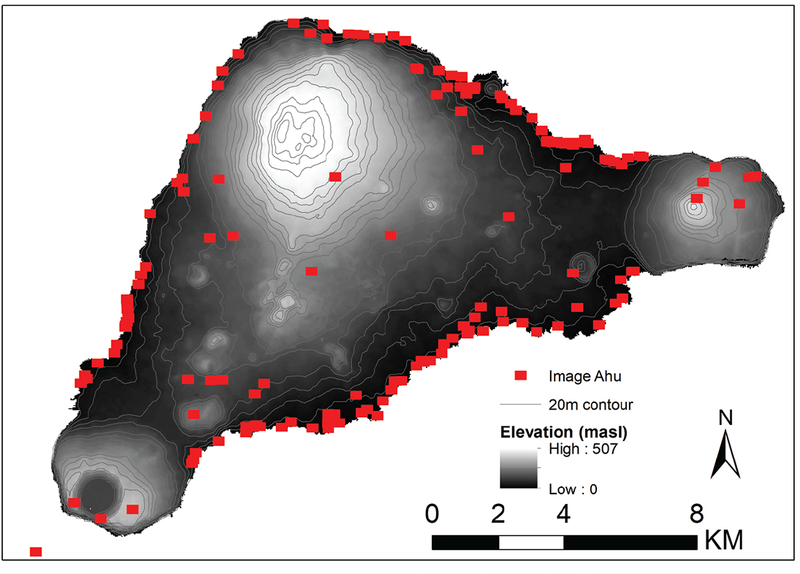



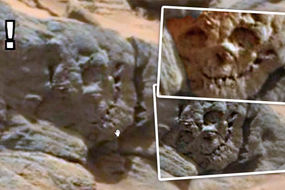


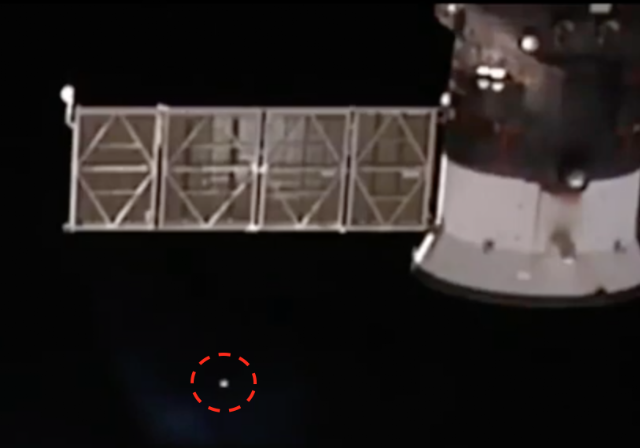


 µ






 The Daily Galaxy


