Ontdek de Fascinerende Wereld van UFO's en UAP's: Jouw Bron voor Onthullende Informatie!
Ben jij ook gefascineerd door het onbekende? Wil je meer weten over UFO's en UAP's, niet alleen in België, maar over de hele wereld? Dan ben je op de juiste plek!
België: Het Kloppend Hart van UFO-onderzoek
In België is BUFON (Belgisch UFO-Netwerk) dé autoriteit op het gebied van UFO-onderzoek. Voor betrouwbare en objectieve informatie over deze intrigerende fenomenen, bezoek je zeker onze Facebook-pagina en deze blog. Maar dat is nog niet alles! Ontdek ook het Belgisch UFO-meldpunt en Caelestia, twee organisaties die diepgaand onderzoek verrichten, al zijn ze soms kritisch of sceptisch.
Nederland: Een Schat aan Informatie
Voor onze Nederlandse buren is er de schitterende website www.ufowijzer.nl, beheerd door Paul Harmans. Deze site biedt een schat aan informatie en artikelen die je niet wilt missen!
Internationaal: MUFON - De Wereldwijde Autoriteit
Neem ook een kijkje bij MUFON (Mutual UFO Network Inc.), een gerenommeerde Amerikaanse UFO-vereniging met afdelingen in de VS en wereldwijd. MUFON is toegewijd aan de wetenschappelijke en analytische studie van het UFO-fenomeen, en hun maandelijkse tijdschrift, The MUFON UFO-Journal, is een must-read voor elke UFO-enthousiasteling. Bezoek hun website op www.mufon.com voor meer informatie.
Samenwerking en Toekomstvisie
Sinds 1 februari 2020 is Pieter niet alleen ex-president van BUFON, maar ook de voormalige nationale directeur van MUFON in Vlaanderen en Nederland. Dit creëert een sterke samenwerking met de Franse MUFON Reseau MUFON/EUROP, wat ons in staat stelt om nog meer waardevolle inzichten te delen.
Let op: Nepprofielen en Nieuwe Groeperingen
Pas op voor een nieuwe groepering die zich ook BUFON noemt, maar geen enkele connectie heeft met onze gevestigde organisatie. Hoewel zij de naam geregistreerd hebben, kunnen ze het rijke verleden en de expertise van onze groep niet evenaren. We wensen hen veel succes, maar we blijven de autoriteit in UFO-onderzoek!
Blijf Op De Hoogte!
Wil jij de laatste nieuwtjes over UFO's, ruimtevaart, archeologie, en meer? Volg ons dan en duik samen met ons in de fascinerende wereld van het onbekende! Sluit je aan bij de gemeenschap van nieuwsgierige geesten die net als jij verlangen naar antwoorden en avonturen in de sterren!
Heb je vragen of wil je meer weten? Aarzel dan niet om contact met ons op te nemen! Samen ontrafelen we het mysterie van de lucht en daarbuiten.
NASA and the European Space Agency (ESA) just released a breathtaking new Hubble image of the Triangulum Galaxy, one of our galaxy’s nearest cosmic neighbors.
The full 665-million-pixel image, composed of 54 different photos, shows between 10 and 15 million of the galaxy’s 40 billion stars. Hubble scientists say that the extraordinarily detailed new image could help them learn more about how new stars form.
Baby Shower
Vast regions of the Triangulum Galaxy are full of gas and dust clouds which hold the raw materials for new stars. Past research by the Hubble team found that a new star the size of our sun is formed in these clouds roughly once every two years — a dizzying frequency on cosmic timescales.
The odds of watching a star form are stacked against scientists, but this new survey highlighting hotbeds of celestial activity give NASA and ESA researchers a much better shot at watching and understanding the process than ever before.
Growing Up
Stars live for a long time — often billions of years. Many of the stars we can observe are well into their lifespans, so having a readily-available way to watch and study celestial newborns is useful to astronomers and astrophysicists who want to fill the blanks.
It’s questions like these that inspired the recent Hubble survey of the Triangulum Galaxy. As scientists go through the data they collected, we may learn a lot more about how stars like our Sun came to be.
WETENSCHAPOok in 2019 gaat de mensheid weer duchtig op zoek naar buitenaards leven. Ook buiten ons eigen zonnestelsel kan dat theoretisch voorkomen op exoplaneten in de “bewoonbare zone” aka “Goudlokjegebied”. Amateurastronomen hebben er nu zo eentje ontdekt. Het gaat om een tot nu toe gemiste en erg zeldzame superaarde, gespot in de waarnemingsgegevens van de intussen niet meer operationele Kepler-satelliet van NASA.
Sinds de jaren negentig zijn er al zo’n 4.000 exoplaneten ontdekt. Dat zijn planeten die niet, zoals de aarde, rond de zon draaien maar rond andere sterren. Slechts enkelen bevinden zich in het leefbare ‘Goudlokjegebied’ van hun ster, dat de juiste afstand van de planeet aanduidt ten opzichte van de ster aanduidt om de aanwezigheid van vloeibaar water mogelijk te maken. Het is een zone waar het niet te warm en niet te koud is voor eventueel leven. In ons zonnestelsel valt naast de Aarde alleen Mars binnen die bewoonbare zone.
Maar er zijn nog miljarden andere sterren dan de zon, waarrond eveneens miljarden exoplaneten cirkelen. Op een deel daarvan zou er dus theoretisch leven mogelijk zijn. De Kepler-satelliet is ontworpen om exoplaneten op te sporen en de telescoop is daarin succesvol.
In 2005 werden ook de eerste superaardes ontdekt, rotsachtige planeten met een massa groter dan die van de Aarde maar kleiner dan die van Uranus of Neptunus. Superaardes komen in ons zonnestelsel niet voor, wél daarbuiten. De eerste die ontdekt werd, was Gliese 876 d, die rond de rode dwerg Gliese 581 tolt. In 2007 kwam dan de eerste superaarde in de bewoonbare zone in het vizier: Gliese 581 d. Sinds 2013 zijn er nog vijf nieuwe superaardes ontdekt die eventueel leefbaar zijn.
Ron Miller/NASAblueshiftEen artistieke impressie van superaarde 55 Cancri e.
En nu dus opnieuw. De exoplaneet kreeg de naam K2-288Bb mee, ligt op 226 lichtjaren van de Aarde en is ongeveer twee keer zo groot als onze planeet. Een exoplaneet van deze omvang is uitzonderlijk. Ze bevindt zich in het dubbelstersysteem K2-288 in het sterrenbeeld Stier. Die twee sterren liggen op 8,2 miljard kilometer van elkaar, ongeveer zes keer de afstand tussen Saturnus en de zon. De meest heldere ster van de twee is ongeveer de helft in grootte en massa van onze zon, de andere is ongeveer een derde van de omvang en massa van de zon. K2-288Bb draait rond de kleinere, minder heldere ster in 31,3 dagen. Daarom staan de twee sterren mogelijk leven op de planeet niet in de weg, stelt een paper van onder anderen Abraham Loeb van de Harvard-universiteit. De superaarde kan volgens NASA een rotsachtige of een gasrijke planeet zoals Neptunus zijn en is half zo groot als deze laatste.
“Een erg opwindende vondst”, beweert Adina Feinstein, studente aan de University of Chicago en hoofdauteur van de paper hierover die in The Astronomical Journal zal verschijnen.
NASA-GSFCEen illustratie van de Transiting Exoplanet Survey Telescope (TESS).
WETENSCHAP NASA-telescoop Tess heeft een derde kleine planeet buiten ons zonnestelsel ontdekt. Dat werd deze week bekendgemaakt tijdens de jaarlijkse bijeenkomst van de American Astronomical Society in Seattle.
De nieuwe planeet, die voorlopig de weinig tot de verbeelding sprekende naam HD 21749b kreeg, cirkelt rond een heldere dwergster die zo’n 53 lichtjaren van haar verwijderd is in het sterrenstelsel Reticulum.
HD 21749b heeft ongeveer 36 dagen nodig om rond de ster te draaien. De oppervlaktetemperatuur van de planeet bedraagt naar schatting ongeveer 149 graden Celsius. Dat is vrij koel, gezien de nabijheid van haar ster die bijna even helder is als de zon. De exoplaneet is ongeveer drie keer groter dan de aarde en valt daarom in de categorie van een ‘sub-Neptunus’.
Geen rotsachtige bodem
Verrassend genoeg is ze 23 keer zwaarder dan de aarde. De kans is echter klein dat er sprake is van een rotsachtige bodem. “We denken dat deze planeet niet zo gasachtig is als Neptunus of Uranus, die voornamelijk uit waterstof bestaan en winderig zijn” zegt Diana Dragomir, postdoctoraal onderzoeker bij MIT die het onderzoek leidde.
Lichtdipjes
Sinds de lancering in april 2018 speurt TESS het heelal af op zoek naar dipjes in het licht van ongeveer 200.000 nabijgelegen sterren. Dergelijke dipjes wijzen meestal op een planeet die voor een ster passeert.
Daarnaast hebben de onderzoekers ook mogelijk bewijs gevonden voor een andere planeet. Indien dat bevestigd wordt, zou het de eerste planeet zijn die Tess ontdekt met dezelfde omvang als de Aarde.
Topgeheim UFO-project onthuld in nieuwe serie. Een 3 meter lang monster, een V-formatie en meer meldingen die onverklaard bleven
Op de Amerikaanse televisie is een nieuwe serie te zien over het decennialange onderzoek van de overheid naar UFO’s.
Het geheime project, Project Blue Book geheten, werd in 1952 gelanceerd en overzien door de Amerikaanse luchtmacht.
Van de meer dan 12.000 UFO-meldingen die werden onderzocht, bleven er 700 onverklaard.
De documenten over het project zijn nu vrijgegeven en de meest intrigerende zijn te zien in de nieuwe serie ‘Project Blue Book’.
Onmogelijk te verklaren
Het project werd opgestart omdat piloten en politieagenten – getrainde waarnemers dus – objecten zagen in het luchtruim die ze niet thuis konden brengen.
De overheid huurde astronoom J. Allen Hynek in om UFO’s te debunken, maar hij raakte er zelf ook van overtuigd dat we hier te maken hebben met een nagenoeg onbekend fenomeen.
Honderden UFO-meldingen waren onmogelijk te verklaren.
Drie meter lang
Eén incident vond plaats op 12 september 1952, waarbij drie jongens uit West Virginia een felrood licht door de lucht zagen vliegen en een explosie hoorden.
Een lokale krant meldde dat de jongens op de crashplek een ‘drie meter lang monster zagen met een rode neus en een groen gezicht dat leek te gloeien’.
Het wezen zou bekend komen te staan als ‘The Flatwood Monster’.
President
Op 30 augustus 1951 fotografeerde een tiener uit Texas een aantal lichten die in V-formatie door de lucht vlogen, de zogeheten Lubbock Lights.
“We besteden ook aandacht aan een massale waarneming door geloofwaardige getuigen waar zelfs de president bij betrokken werd,” zei uitvoerend producent Sean Jablonski.
Geheim
Hoewel er een einde kwam aan Project Blue Book, bleef de Amerikaanse overheid in het geheim onderzoek doen naar UFO’s, zo werd vorig jaar onthuld.
“UFO’s zijn een mysterie dat tot op de dag van vandaag niet is opgelost,” zei Jablonski. “We moeten ons afvragen door wie ze worden bestuurd en praten over buitenaards leven.”
Russian Physicists Come Closer to Plasma Engine for Superfast Space Travel
Scientists from Russia and around the world see plasma rocket technology as a crucial possible ingredient for speedy missions to Mars and beyond.
Physicists from the Budker Institute of Nuclear Physics of the Siberian branch of the Russian Academy of Sciences in Novosibirsk are preparing another round of experiments aimed at successfully harnessing the power of thermonuclear plasma for use in a rocket engine, institute deputy director Alexander Ivanov has told journalists.
The experiments, which will begin later this month, will follow up on earlier successful tests which confirmed the feasibility of confining plasma in an experimental setup using parameters suitable for a rocket engine, Ivanov said.
In late 2018, the institute began operation of a unique installation, known as the SMOLA, the Russian acronym for "Spiral-based Magnetic Open Trap", with the setup serving as the first step forward toward the creation of a fusion reactor. The "plasma trap" allowed scientists to work on confining plasma in a linear magnetic system, which, it is hoped, can eventually help lead to the creation of prototype plasma engine suitable for space travel.
"The first experiments showed that the effect exists. The space engine works, and the means to reducing plasma losses as well. Presently, standard equipment is installed. We are preparing to start experiments on it in January 2019 which should fully demonstrate its capabilities," Ivanov said.
According to the physicist, the current setup serves as a technology demonstrator, with scientists achieving a temperature of 100,000 degrees to form the plasma, and reaching a sufficient density to provide them with data suitable for further work on the creation of a plasma-based rocket engine.
In October, Energomash, a Russian power engineering company involved in the production of rocket engines, announced plans to build a high-powered electrode-less plasma rocket engine. Russia's Kurchatov Institute and the Chemical Automatics Design Bureau first reported that they were working on a plasma-based engine for space travel in 2016.
Other countries, including the United States, are engaged in similar developments. In 2015, NASA awardedprivate plasma rocket technology firm Ad Astra a contract on the creation of the "Variable Specific Impulse Magnetoplasma Rocket" (VASIMR), with the proposed engines operating by heating pressurised gas to extremely high temperatures using radio waves and keeping the resulting plasma under control using magnetic fields.
Plasma-based rocket engines are one of several proposed options for human exploration of other planets in our solar system, and beyond it.
Russische wetenschappers stap dichter bij plasmamotor waarmee we supersnel door de ruimte kunnen reizen. Zo werkt het
Russische wetenschappers experimenteren momenteel met plasmarakettechnologie, die ons in staat moet stellen om supersnel door de ruimte te reizen.
Natuurkundigen van de Russische Academie van Wetenschappen hebben al een aantal succesvolle experimenten afgerond en bereiden momenteel een reeks nieuwe experimenten voor.
De wetenschappers maken gebruik van een unieke installatie, een zogeheten SMOLA, die de eerste stap vormt in de creatie van een fusiereactor.
Prototype
De installatie moet de onderzoekers helpen om een prototype van een plasmamotor te maken die geschikt is voor ruimtereizen.
“De eerste experimenten laten zien dat het effect bestaat en dat de ruimtemotor werkt,” zei adjunct-directeur Alexander Ivanov van het Budker Institute of Nuclear Physics.
In de installatie worden temperaturen van ruim 100.000 graden bereikt om het plasma te kunnen vormen.
Plasmaraketmotor
In oktober vorig jaar kondigde Energomash, een Russisch energietechnologiebedrijf dat betrokken is bij de productie van raketmotoren, aan een plasmaraketmotor te gaan bouwen.
In 2016 liet het Koertsjatov-instituut, het belangrijkste onderzoeks- en ontwikkelingsinstituut in Rusland op het gebied van kernenergie, weten aan een plasmamotor voor ruimtereizen te werken.
Extreem hoge temperaturen
In een plasmamotor wordt samengeperst gas tot extreem hoge temperaturen verhit met behulp van radiogolven.
Door middel van magnetische velden wordt het plasma onder controle gehouden.
It has long been speculated by conspirators that aliens from thousands of years ago played a massive role in the construction of the pyramids. In Egypt, the focus of attention for most visitors is the awe-inspiring antiquities and the ancient wonders from the past. Amazon Prime’s "The Secret KGB Files" documentary, suggests that, in the 1960s, a team of Soviet investigators discovered a mysterious tomb in Egypt and that something "unexplainable" is beneath the Great Pyramid.
The footage reveals how the KGB found it hard to accept that mythology could have led to advanced alien knowledge.
However, in the documentary, an interview with a former diplomatic courier for the Soviet Union was tracked down by the show’s producers.
The man – who, the narrator claims, is given anonymity as the former Soviet official now works for the Russian mafia – describes how on one occasion he was moving documents between Cairo and Moscow.
The former Soviet Union employee reveals that among the documents was a memo from a high-ranking KGB official.
KGB found it hard to accept that mythology could have led to advanced alien knowledge
(Image: Getty)
He claims the document stated: “My agents have secured the notes of one of the scientists working on the Tomb of the Visitor findings.”
Another was an inventory of contents taken from the tomb, labelled "classified top secret".
It read: “Location of finding, undisclosed.
“Subjects, 15 crates of relics, one patricianly mummified body, one stone sarcophagus, and eight hieroglyphic samples.”
A project scientist who was one of the first to enter the tomb filed this report.
A team of Soviet investigators discovered a mysterious tomb in Egypt
(Image: Amazon Prime)
It read: “During inspection of the wall segment we noted an odd sensation, a magnetic repulsive force seemed to be emanating from the rock.
“We were unable to find any scientific explanation.”
Another memo is from the cryptologist report, which read: “Findings, partial decoded message on tomb wall indicates a prophecy of the return of ancient wing gods.”
The documents made it clear the Kremlin was taking the myth very seriously. One report indicated a military unit was ordered to the site.
A security order of the highest level was in force when the sarcophagus was opened.
Wetenschappers ontdekten iets onverklaarbaars onder Grote Piramide, blijkt uit geheime KGB-documenten
Samenzweringstheoretici speculeren al lange tijd dat aliens duizenden jaren geleden een grote rol hebben gespeeld bij de bouw van de piramides.
In de documentaire The Secret KGB Files, momenteel te zien op Amazon Prime, wordt gesteld dat Sovjet-onderzoekers in de jaren zestig op een mysterieuze tombe zijn gestuit in Egypte en dat zich ‘iets onverklaarbaars’ bevindt onder de Grote Piramide.
In de film komt een man voorbij die in de Sovjettijd werkzaam was als diplomatieke koerier.
Topgeheim
De man, die anoniem wil blijven omdat hij nu voor de Russische maffia werkt, zei dat hij op een dag een memo van een hooggeplaatste KGB-functionaris onder ogen kreeg.
Hij zei dat in het document viel te lezen: “Mijn agenten hebben de aantekeningen verzameld van één van de wetenschappers die onderzoek doen naar de Tombe van de Bezoeker.”
Een ander document bevatte een inventaris van voorwerpen die in de tombe waren gevonden, en was geclassificeerd als ‘topgeheim’.
Vreemd gevoel
“Voorwerpen: 15 kratten relikwieën, één gemummificeerd lichaam, één stenen sarcofaag en hiërogliefen.”
Het rapport was opgesteld door een wetenschapper die als één van de eersten de tombe binnenging.
“Tijdens de inspectie van een deel van de muur kregen we een vreemd gevoel,” klonk het. “Het was alsof uit het gesteente een magnetische, afstotende kracht kwam.”
Gevleugelde goden
“We konden hier geen wetenschappelijke verklaring voor vinden,” aldus de wetenschapper.
In een andere memo stond: “Deels ontcijferde boodschap op de muur van de tombe gaat over een profetie over de terugkeer van gevleugelde goden.”
Soldaten
De documenten laten zien dat het Kremlin de informatie zeer serieus nam.
Uit één van de rapporten blijkt dat er soldaten werden gestationeerd bij de tombe.
Dat er veel meer is dan alleen onze driedimensionale wereld, daar zijn ook steeds meer wetenschappers het wel over eens.
Organisaties zoals NASA zijn al heel lang op zoek in de ruimte naar die speciale toegangspoorten naar andere dimensies en het lijkt alsof er nu één is gevonden, maar niet door NASA.
De mensheid is al heel lang geobsedeerd geweest over de mogelijkheden om te reizen van de ene naar een andere dimensie. Dit concept werd ook ooit gebruikt in een televisieserie Stargate. De serie werd uiteraard gebracht als sciencefiction, maar dat is het helemaal niet.
Ook NASA geeft tegenwoordig toe dat ze zich al jarenlang bezighouden met onderzoek naar toegangspunten naar die andere dimensie(s).
Zo komen we ook aan de naam Stargate. De betekenis is letterlijk een toegangs- of sterrenpoort naar een andere dimensie. En als we die ingangen kunnen vinden, dan hebben we misschien ook de mogelijkheid om naar die andere dimensies te reizen en hopelijk ook weer terug.
Die toegangspoorten zijn te vinden in de ruimte zelf, maar ook op aarde schijnen er bepaalde plekken te zijn die als het ware kunnen fungeren als een stargate. Soms komen mensen ook per ongeluk terecht in andere dimensies en er zijn ook mensen die zeggen zelf een poort naar een andere dimensie te kunnen creëren.
Echter, tot nu toe zijn er weinig echt concrete stargates ontdekt in de ruimte, maar daar is nu misschien verandering in gekomen.
De bekende Youtube gebruiker Mr. MB333 kreeg van een lezer genaamd Michelle uit Californië een aantal opmerkelijke foto’s opgestuurd.
Op 15 december 2018 maakte zij foto’s van de zon en op één ervan verscheen een cirkelvormig beeld dat veel overeenkomsten vertoont met de zon.
Op de volgende afbeelding zie je rechts een foto zonder het object, maar wel met een kleine lensflare en links een afbeelding van het bizarre object.
De volgende twee laten het object wat beter zien en de afbeelding daarna toont het object in vergelijking met een stargate.
In de volgende video gaat Mr. MB333 veel dieper in op de vreemde afbeelding en heeft uren doorgebracht met het bestuderen van de opnames.
Hij komt tot de conclusie dat het echt is en er zijn zelfs bepaalde tekens te zien op het ringvormige object.
Een echte stargate of misschien toch een afwijking in de camera?
The road can be a dangerous, deadly place, with cars speeding and careening all over like big heavy missiles of metal, glass, and gasoline, and people often not paying attention to where these rolling projectiles are headed, all made even worse by poor road conditions or visibility, and automobile accidents take a major, tragic death toll on the roadways of our world. It can be a harrowing thought to realize that you are almost at the mercy of fate out there on the road, racing along essentially alone in a thin shell of metal that will likely not do much good to protect you if danger should come calling. Yet what if we are not alone out there on that stretch of road? What if there are benevolent forces watching over us, looking out for us, and guiding us safely to our destination? If some reports are to be believed then this might just be the case, and actual guardian angels may be patrolling the roads and highways just as surely as the specter of death.
One particularly odd type of report involving angels on the road is that of actual hitchhiking angels, which typically appear out of nowhere to picked up, go on to make prophetic statements or prevent some accident, and then vanish without a trace. Interestingly, there is a very early case of this sort of thing going back all the way to an era before cars were even a thing. This account can be found within a 1602 manuscript held by Linköping library in Sweden rather unwieldy titled Om the tekn och widunder som föregingo thet liturgiske owäsendet, or “On the Signs and Wonders Preceding the Liturgic Broil,” by a scholar named Joan Petri Klint, who wrote much of unexplained events and was sort of an early paranormal writer.
Among the many accounts of anomalies and strange occurrences held within the manuscript is a report supposedly given by a vicar of Klint’s acquaintance, who claimed that in February of 1602 he had been travelling to the town of Vadstena by sleigh along with three companions, when they came across a very young woman out in the frosty cold. Considering it was frigid outside and this girl seemed inadequately dressed and lost out in the middle of nowhere they offered her a ride on their sleigh, which she accepted with a nod. Things got very weird when they stopped at an inn for a rest and the mysterious young woman was offered a mug of beer. As soon as the drink was set in front of her it immediately turned to malt, and yet another beer placed there suddenly transformed into acorns. The third and final beer was grasped by this wondrous girl and turned to blood. The girl, who up to this point had not uttered a single word, then proclaimed “There will be good crops this year. There will be enough fruits of the trees. There will also be many wars and plagues,” before vanishing right before their eyes. True to her word, the year turned out to be exactly as she had prophesized.
It is hard to know if this was supposed to be an angel or not, but it certainly seems to fit, and remains a rather curious very early account of such roadside encounters. In a more modern day report we have a man who gave his experience on ThoughtCo. and says it was told to him by his parents, as he had been just a toddler when it happened. He says:
One late night when I was a toddler (20 now) my parents were just cruising around town while I stayed with my grandma. They were young parents and I was their first so I wouldn’t blame them for taking a break from me. And at some point they stopped at a gas station and while they were there, an old homeless man came up and politely asked for a ride. The man seemed harmless and they accepted his request. They were driving along and as they were crossing an intersection at a green light when they saw a car that had blown the red light coming at their side at full speed. But instead of getting t-boned, the incoming car went straight through them. They pulled to the side to make sure everything was okay. They looked in the back to check on the man. But he had vanished.
Another person told of a somewhat similar experience with a seemingly angelic hitchhiker on Reddit, saying it was an experience his father had had when he was a young man. The witness had apparently been stuck in heavy early morning traffic one day when he noticed a man standing by the side of the road, forlorn and hitchhiking, carrying a heavy looking bag. The father was kind enough to take pity on him, pull out of the traffic and even lose his place in order to pick the bedraggled looking man up, losing who knows how much time in doing so. Once in the car the stranger proved to be very friendly and kind, and the two chatted about life, family, and work, until the man without warning demanded the car be stopped and he be let out. The poster says of what happened next:
All of a sudden he asked my dad to drop him off. Dad was confused as this was right next to a field in the middle of nowhere. The guy said don’t worry about it and got out which weirded my dad out. My dad turned to leave and noticed the guy left his bag and went to let the guy know but he was gone. Nowhere to be seen. Dad says he searched for him but it made no sense where he went or how he could hide. Upon getting back in the car he looked in the bag to find it to be empty. Also weird. He decided to continue on his way and joined back in traffic. He came to the first set of lights eventually and noticed an accident had happened to the car that was behind him in the line of traffic originally and he realized had he not picked this guy up he would’ve been in that accident. That guy saved him. 2 weeks later his wife was pregnant with me. My dad still has the bag and carries it with him in his car at all times hoping to eventually run into the guy and thank him. Dad was saved by weird guardian angel hitchhiker guy. Still has memento from occasion. Doesn’t understand what happened to this day.
This is actually a very common theme in supposed roadside encounters with angels, that for whatever reasons they seem to be there to prevent some imminent catastrophe. One witness named Brandy McCall told of her experience with this on the site Medium. She relates how she was in a serious car accident when she was 16 years old while driving with a friend. The car they were in rolled several times before bouncing between a camper and a building and finally sliding to a halt leaving shards of metal and glass in its wake. Despite the rather harrowing incident, they were both surprisingly intact, except for the blood Brandy could feel flowing down her face. A neighbor told them she had called an ambulance, but there was not much they could do but wait, as they were trapped within the overturned vehicle. As they waited a series of unusual events would transpire that would change the admittedly not very religious witness. She says:
While we waited, an older gentleman in an old green pickup truck pulled off the road behind us. This man helped me out of the mangled car, took me over to sit at the edge of the road, and handed me a towel to hold to my bleeding face. He had the softest voice and smelled like Red Man tobacco — the same thing my pawpaw chewed. He told me help was coming, and checked over my friend.
I heard the firetrucks in the distance, and it was just a few moments before they came up the hill. The captain of the Fire Department was a man named Tony who I had known since birth. We went to the same church and his kids and I were around the same age. When I saw Tony get off the truck, I knew I was okay. An ambulance came and loaded us up. Tony rode with me, seeing that I was scared to death. He told me that if the car had gone a couple of inches further, the results would have been deadly. A piece of metal from the camper had cut through the windshield of the car, which is what had caused my head to bleed. It likely would have taken off the tops of our heads if we had gone any further. On top of that, we were two feet from a propane tank that had been filled earlier that week. I don’t know how we dodged both of those bullets.
Before we got to the hospital, I asked Tony about the old man. He just stared at me and told me there was no green truck, no old man. No one was around, except for the lady whose yard we had crashed in. The road we were on was a dead end. The gentleman I saw couldn’t have gotten around the firetrucks and ambulances to go the one way out without being seen. But I still had the towel in my hand that he had given me. Even though I was raised in church — Southern Baptist — I’ve never been overly religious. But I’m telling y’all, I think I saw an angel that day. I don’t know why, and it has never happened again. But I know what I saw.
In some reports like this the angel is not physically seen, but it’s presence it certainly felt. One witness from Ohio tells on ThoughtCatalog of how she was driving with her husband home from a horse stable when another vehicle made a sudden turn right in front of them, causing them to lose control of their car and crash. The victim found that her door on the passenger side was jammed and that she was hopelessly trapped within the totaled vehicle. The witness explains the miraculous things that happened next:
I was sitting there in deep shock, helpless, unable to exit the vehicle. But the next thing I remember, I was somehow transported and found myself standing on the road next to the car. I saw a dark shadow at the front of the car. It looked like the front part of a man from the side view. Sometime later the driver’s husband said to me, “I don’t know how you got out of that car.” I thought about it some more and realized I must have been moved through the car door with some supernatural help. This has given me a new perspective on a lot of things, including angelic protection.
It is hard to say whether this was “angelic protection” or not, but it certainly seems a rather amazing occurrence, whatever it was. In another account, an unnamed witness tells of how he and his wife were driving on the interstate on a hot summer day in North Carolina when a truck suddenly smashed into them from behind as they were crossing a bridge over a river. Their car was violently jolted up into the air and towards the rail and a steep, yawning drop below. That most certainly would have been their fate if a strange sequence of fortunate events didn’t unfold next, of which the witness says:
I realized we could be going over the rail and plunging into the river far below—a fall that would have meant certain death. But before I could even react, my car came back into the driving lane and steadied itself. The truck screamed past us only inches from my door. I managed to get off the bridge and pull over on the shoulder of the road to inspect my car. The driver of the truck had also stopped and rushed up to me. “I thought I had pushed you over the bridge when I hit your rear bumper!” he said. My wife and I were shaken but relieved.
It was a very close call. The driver had been tired and momentarily dozed off at the wheel of his speeding truck when he veered into my lane and caught the left rear of my car, sending it toward the side of the bridge. He thought we had gone over. I thought we were going over. But we didn’t. My wife says she felt the car move back to the left. I know that I didn’t turn the wheel to make it happen. We both feel that on that day, at that moment, we had the hand of an angel move our car back into the driving lane—keeping it from going off the bridge. I didn’t see an angel, but to this day we strongly feel there was a bit of extra help—an angel who rescued us from disaster.
In other instances, angels are reported as not stopping accidents so much as lending a much needed, often life-saving helping hand in times of need. One such miraculous experience happened to a Pastor John Boston, who one day was driving along with his 4-year-old daughter in the backseat when a truck swerved over the center line and came roaring towards them. In an attempt to avoid the inevitable collision, Boston veered to the side, and ended up smashing into a utility pole. This wasn’t even the worst of it, as a live transformer crackling with electricity came plunging down atop them, searing the metal and bubbling the paint with its intense heat. On top of all of this, Boston realized that not only was his daughter’s seatbelt jammed, but that the door wouldn’t open either.
It was during this seemingly inescapable situation, with the hissing transformer threatening to engulf their car in flames, that Boston says a stranger approached from the freedom of the street that remained out of his reach. The man was described as somewhat “scruffy,” but he was amazingly able to effortlessly open the car’s jammed door, unlatch the seatbelt that had moments before been completely stuck, and then carry the two of them 20 feet away to safety, just as the car caught fire to spew smoke everywhere. When the witness and his daughter were out of harm’s way, the man simply said, “My name is Johnny, the police are almost here and I can’t be here when they get here but you’re gonna be okay,” before standing up and just vanishing. Since that day Pastor Boston has been convinced that it was an angel who pulled them from certain doom.
Next we have the story of a witness calling herself “Deb,” who says in 1980 she was a single mother with two babies living in San Bernardino County, California. She usually dropped the young kids off at her parents’ house, which was only around 30 miles away, in the city of Alta Loma, and then picked them up in the evening on her way home from work. On this evening she picked them up as usual, but on the way home she was shocked to realize that she was almost out of gas and the car was sputtering, an oversight due to the fact that the old vehicle had a broken gas gauge. She says:
Halfway home, the car started to putter, and I realized I was on empty. I pulled off the first off ramp I could, and it just happened to be one that was slightly uphill. Almost at the top of the exit, my car died and there was absolutely nothing around except empty fields and distant lights at a truck stop about a quarter of a mile down the road. With no cars in sight, I didn’t know what to do. The kids were asleep and walking miles while carrying two kids in the middle of the night was not a good option. I put my head on the steering wheel while saying a short and panicky prayer,” she says. “I hadn’t even finished when I heard a few taps on my window.
The source of the tapping was a young man of around 21 years of age, well-kept, neatly dressed, and lightly smelling of soap. He seemed to almost emanate an aura of calm and reassurance, as Deb remembers that she didn’t feel any fear at all, even though this stranger was rapping on her window out in the middle of nowhere at night on this secluded road. Indeed, she felt a sense of safety, that she could trust this man even though she had never met him before, and he somehow eased her panicked state just by looking at her. This mysterious man then told her to put her car into neutral and then proceeded to push it over the hill to where she could get gas. She says:
I thanked him and followed his instructions. The car started moving. I steered it toward the lights of the truck stop and turned around to yell ‘thank you’ again to him. He was so nice! My car kept moving, but the young man was nowhere in sight. I mean, this area was completely remote. There was absolutely nowhere he could have gone that quickly, even if there was somewhere to go. I don’t even know where he came from to begin with.
I’ve always trusted in God to take care of us, but in relating that story many times to my children, who are now 30 and 32, they know for a fact that angels do exist and are sent to us if we just believe. I always thought it was so amazing that we were sent someone who I would trust instinctively without question. Since that incident, I’ve come to believe that we probably encounter angels all the time, and take for granted who they really are. I think they come in all shapes and sizes, young and old … and sometimes when we least expect them.
Similarly helped by a mysteriously vanishing stranger, and perhaps an even more bizarre case, comes from a man who says this experience happened to his wife’s mother back in the 1960s, when she was driving with her family with her husband and the wife and her brothers when they were just very young children. They were involved in a serious accident, which sent the mother’s head smacking through a broken windshield and getting quite viciously cut up. Again, a rather curious benevolent stranger appeared, and the man says of this all:
They got out of the car, and other drivers stopped to give assistance. Soon, a man carrying an old-fashioned doctor’s bag walked up and told everyone, “Step aside; I can take care of this.” He proceeded to quickly bandage the mother’s face, putting her at ease, and stopping the bleeding. Dad was distracted for a bit speaking to the police, but he says that it was not long before he got back to his wife. The man who helped her was gone. He asked people there where he went, and none of them had any recollection of ever having seen any man there at all. Not long afterward, though, at the hospital emergency room, doctors examined her and declared that whoever bandaged her must have been an expert, because a highly trained doctor could not possibly have done a better job.
She healed so well—from what could easily have been a fatal accident —that she has only one very small scar on her face. It’s only noticeable to someone who knows to look for it. The family has long been convinced that God sent an angel to give them assistance when they needed it the most, but that the angel—like many times in Scripture—instantly vanished once the job was done.
Is that what these people have experienced? Were these angels that came to them in times of need to help out? Or were they perhaps something else? Why did these benevolent entities choose these particular people when there are so many others who also face accidents and woes and the road? There is no way for us to really know the answers to these questions, and perhaps we are not even meant to know, their intentions, nature, and goals inscrutable mysteries beyond the human mind. Whatever the answers to these questions may be, and whether one even believes in actual literal angels or not, it sure is a comforting notion to think that as one is out on the road, maybe, just maybe there is someone or something looking out for us, watching us and waiting to snatch us from danger if it should come looking for us.
This article is dedicated to Jessica Saenz Farias, who is going through some tough times in her life and could use some angels right about now.
Parts of the government may be shut down in the U.S., but NASA is still searching for new planets with the help of a team of volunteer astronomers who are making some wonder why we need to keep paying (well, when they were getting paid) the pros. Not only that, the discovery was made using data from the now-retired Kepler Space telescope – data which had been analyzed before by the professionals who didn’t spot this major discovery. Can they help find lost keys or remotes?
Artist’s visualization of the K2-138 system, the first multi-planet system discovered by citizen scientists. The central star is slightly smaller and cooler than our sun. The five known planets are all between the size of Earth and Neptune; planet b may potentially be rocky, but planets c, d, e, and f likely contain large amounts of ice and gas. All five planets have orbital periods shorter than 13 days and are all incredibly hot, ranging from 800 to 1800 degrees Fahrenheit.
Credit: NASA/JPL-Caltech
“It took the keen eyes of citizen scientists to make this extremely valuable find and point us to it.”
Adina Feinstein, a University of Chicago graduate student lead author of a paper on the discovery of the planet (published in the latest Astrophysical Journal), described how the amateurs beat the pros in a presentation at the meeting of the American Astronomy Society in Seattle this week. As an intern at NASA in 2017, she was part of a team looking at Kepler data for transits – the dimming effect on a star when a planet passes in front of it. They found two for the K2-288 system – a binary pair of cool M-type (red) stars that are 5.1 billion miles apart or about six times the distance between Saturn and our sun – but the astronomers’ code requires three transits before declaring an exoplanetary discovery.
Kepler
Later investigations showed that NASA researchers had ignored data taken while Kepler was repositioning itself. The software was tweaked to better process it, but the new data was never reviewed manually instead of by computer — a critical error according to Joshua Schlieder, an astrophysicist at NASA’s Goddard Space Flight Center who worked with Feinstein and co-authored the paper.
“Inspecting, or vetting, transits with the human eye is crucial because noise and other astrophysical events can mimic transits.”
Luckily, the data was sent to Exoplanet Explorers, a volunteer project which studies Kepler data for transits. It was the Exoplanet Explorers who noticed a third transit in that early data from the repositioning period – data that led to the announcement of the discovery of K2-288Bb, an exoplanet about 1.9 times the size of Earth orbiting the smaller of the K2-288 binaries every 31.3 days. Its size puts K2-288Bb in the so-called “Fulton gap” – a rare group of exoplanets between 1.5 and 2 times that of Earth, making them good candidates for planetary evolution comparisons with Earth. Even better, K2-288Bb is in the “Goldilocks zone” of its star, putting it in the proper temperature and radiation zone to contain the liquid water needed for life.
That potential for K2-288Bb is supported by a separate paper, published this week in Monthly Notices of the Royal Astronomical Society and co-authored by Harvard’s Abraham Loeb (the same Loeb who suggested the ‘Oumuamua comet might actually be an alien-built probe), which states that low mass M-type stars the size of K2-288 are “theoretically capable of sustaining biospheres with the same productivity as the Earth.”
It pays to eyeball the data once in a while
While we continue to debate whether “amateur athletes” are really professionals, there’s no question that the amateur volunteers at Exoplanet Explorers are a valuable part of astronomy, not only by making new discoveries overlooked by the pros but by keeping the memory and hard work of the Kepler Space Telescope alive.
After that nice compliment, could one of them help me find my remote?
Could dark matter finally be understood? A Jan 3, 2019,release from the Universities of Surrey, Carnegie Mellon and ETH Zurichtouts some ground-breaking discoveries regarding the previously unknown and mysterious substance some scientists believe composes most of the known universe. In fact, it has been discovered dark matter has been able to be heated and moved. The release included findings from a hunt for dark matter by the team in the center of dwarf galaxies.
Dwarf galaxies are small galaxies emanating faint light that are found in the orbits of larger and brighter galaxies. Since dark matter interacts with light in a substantially different way than regular matter, it can only be truly observed using gravity and its effects. Because of its mysterious properties, dark matter is studied by observing the formation of stars in these dwarf galaxies.
According to the release, strong winds created in the formation of these stars push gas and dust toward the edge of these dwarf galaxies. This causes the center to have a decrease in mass – as all that gas and dust add together to some sizable numbers. As gravity and mass are related, a decrease in mass results in dark matter also moving away from the center of the galaxy. This causes the “dark matter heating” announced in the release.
This research may be helpful for building more accurate models of the universe and its forces, as it is theorized to compose as much as 80 percent of the known universe, despite not emitting light nor energy. Theories for what dark matter could be include Massive Compact Halo Objects (MACHOs), which are larger space items such as brown dwarf stars and black holes, and Weakly Interacting Massive Particles (WIMPs), which proposed particles of matter, which do not reflect or absorb light or any other form of electromagnetic energy.
Other scientists have claimed dark matter does not have to exist to explain the theorized mass of the universe (which is much more than the mass it would be from what can be observed, according to modern science) and instead claim physics as the study is known by modern humanity does not work at the largest levels. They have offered a theory called Modified Newtonian Dynamics. They claim the largest flaw in the proposed existence of dark matter is that no one has yet observed it. Perhaps this study can lead to something to change that.
A man found what looks to be an alien-like creature living inside one of the green plants in his aquarium. The man named Angus filled his aquarium with plants that he took from Lake Waikaremoana which is in North Island, New Zealand. It was about four weeks after he filled his tank with the plants that he noticed something odd swimming in one of them.
In a video that he posted to Reddit, the creature, which is about one centimeter long, is seen swaying inside of an egg. He asked people on Reddit, “Am I having an alien invasion? What do I do? Is it dangerous? No fish living in the tank. Only 5 snails.” He received an overwhelming response with over 500 people weighing in on what the creature may be. Some said it looked like a dragon fly or mantis, while others claimed it looked like a caddisfly, and some even suggested that it is a type of alien.
Video footage he uploaded on reddit shows the thing, which is only about a centimetre long, swaying in an 's' formation inside the egg
A man has discovered an alien-like animal living in his aquarium after he filled it with plants he ripped from a lake
But it was four weeks before the man, known only as Angus, noticed what appeared to be some sort of life form swimming inside a green casing
The greenery was taken from Lake Waikaremoana, on the North Island in New Zealand
There was another highly strange discovery in the waters of New Zealand recently. In November 2018, a woman discovered an odd looking skeletal sea creature while she was cleaning up garbage along Rakaia Huts beach after a big storm. The creature had spike-covered skin, a long head, two legs, and a tail.
The woman named Mary told Fox News, “When I pulled it out and saw all the teeth and barbs I was convinced it was a rare deep-sea creature. I was so excited because I love the ocean and its inhabitants. First I thought it was plastic sheeting. I pulled it out from underneath the sticks and it was a bit more than just a piece of plastic.”
She went on to say, “My first thought was that it was something alien, but I was more fascinated than anything. I took it all the way home and gave it to a taxidermist next door to see if he knew what it was but he wasn’t too sure either. That’s why I thought I should reach out and see if anyone else knew what it is.” She posted the picture of the creature on Facebook and that’s when several people told her that it was a male Dipturus nasutus.
New Zealand seems to be a hot spot for alien-looking sea creatures, so it’s pretty exciting to wonder what the next alien-like discovery will be along the waters. It may a good idea, though, to leave the sea plants where they belong in the water or you may end up bringing an alien home with you.
In October 2016, the UFO and conspiracy theory worlds got a shock when news broke that speaker and writer Max Spiers, 39, had been found dead under suspicious circumstances. In the weeks before his death, Spiers grew increasingly suspicious that he was being targeted by unknown individuals or groups, warning his mother Vanessa Bates that “your boy’s in trouble” and that “if anything happens, investigate.” Days later, eyewitnesses say, Spiers vomited a few liters of an unidentified black liquid before being found dead on a colleague’s sofa in Poland.
Spiers’ credibility was sometimes questioned by other members of the conspiracy theory community, and Spiers made some pretty bold claims, including claiming to have been made into a supersoldier during his childhood. Nevertheless, Spiers made a career out of investigating conspiracies, unidentified aerial phenomena, government cover-ups and the like. Shortly before his death, Spiers embarked on a project that led him to investigate politicians, celebrities, and prominent business magnates – you know, the kind that can get away with murdering someone. If they wanted to.
The circumstances surrounding Spiers’ death have been said to suggest some sort of cover-up.
Whether or not a shadowy cabal of Very Important People had anything to do with Spiers’ death has yet to be seen. It certainly appears that there are a lot of suspicious events surrounding Spiers’ death and the resulting investigation, though, including the researcher’s laptop being allegedly wiped clean after Polish police refused to perform an autopsy and ruled his death due to natural causes. Did Spier’s work get him murdered?
Depends on who you ask. His mother told reporters that Spiers’ most recent investigation was “going to expose black magic” among politicians and celebrities. Spiers’ girlfriend, meanwhile, said he would expose “enemies within other realities.” Not to be outdone, Spiers’ colleague and friend Miles Johnson told the BBC that aliens were of course somehow involved:
We have now got an unthinkable situation. Max has died for his country and the people on this planet. We’re dealing with aliens. We’re dealing with a predator within humanity, a fifth column, which has been successful so far in causing us a great deal of damage and harm. People like Max were involved in exposing that fifth column. He knew he was going to die. He knew he was in a trap. He told his mother that.
Was Max Spiers’ death a homicide? If so, committed by whom and for what end? Could it have had anything to do with his death? What was the black liquid Max Spiers could have vomited before his death? Are aliens from a hidden dimension of reality using politicians and celebrities to harvest young children for use in sacrificial interdimensional rituals?
Spiers was a popular speaker on the UFO and conspiracy theory circuits.
To get at as many of these questions as possible, a British court will hear an inquest opened to investigate Spiers’ death. The inquest will be held at the Guildhall in Sandwich, Kent and will last four days. During that time, Polish investigators are expected to present evidence and statements taken from witnesses in Poland including Monika Duval, the friend with whom Spiers was staying at the time of his death. On the first day of the inquest, a Polish pathologist declared that Spiers’ death was caused by pneumonia and drug intoxication. According to testimony given on the first day of the inquest, Spiers was apparently a known drug user and consumed a large quantity of a Turkish version of Xanax shortly before his death. Will this inquest help us discover the truth behind Max Spiers’ death, or will we finally put this mystery to rest?
On December 24, 2018 SOHO Lasco C2 and Lasco C3 captured a huge spherical object leaving the sun. Once again, on January 7, 2019 both satellites have captured another spherical object that leaves the sun.
According to some UFO researchers these spherical objects are alien spacecraft since similar spherical objects have been spotted near the sun which were clearly not coronal mass ejections while others believe that the phenomenon is a plasma discharge.
Currently we are in a solar minimum which is the period of least solar activity in the 11 year solar cycle of the sun. During this time, sunspot and solar flare activity diminishes, and often does not occur for days at a time, which makes us wonder whether the spherical object was indeed a plasma discharge or not.
The video below shows the moment the phenomenon leaves the sun.
Ancient Face Found On Mars Using Google Mars Map, Jan 9, 2019, Photos, UFO Sighting News.
Date of discovery: Jan 9, 2019 Location of discovery: Mars Google coordinates: 32°36'10.74"N 62°38'25.45"E I was fiddling around with Google Mars map, a free program that allows you to see the surface of Mars, when I noticed a face. I measured it with Google ruler and found that from the top to the bottom it was 3.4km long and across the forehead it was 1.69km wide. The face closely resembles the ancient Mesopotamians carvings in walls here on Earth. The face is part of a bigger drawing of two figures. You can see the line dividing the two figures which are wearing robes. You can also see a foot of the other person sticking out. The drawing was actually made from walls that stand very tall. These two figures look to be man and wife, and are raised higher than the surface around them...like a mound. It looks as if those walls are of an ancient city that once was there. For some unknown reason the second figures face and body has been covered up...as if to hide it from being seen. I think this may be a discrimination case between aliens where one species tried to cover up the other species art work. The art is also a message...that this species lived here and these two leaders cannot be forgotten. But another species evidently felt differently and covered half of it up. That half looks much more recent than that of the drawing. Scott C. Waring
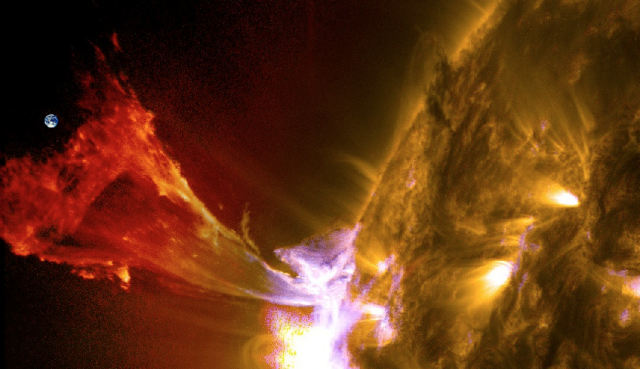
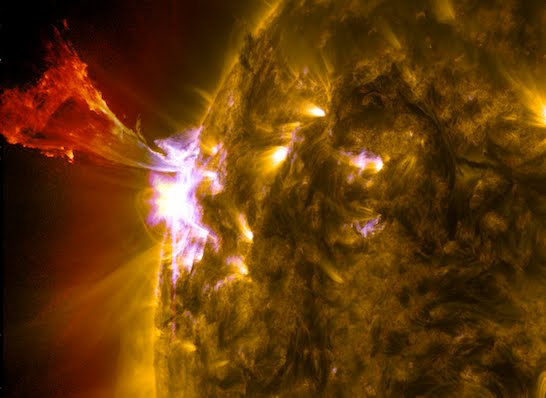
Here is a fun photo fact. I found this photo of our sun creating a solar burst that is big enough to wipe out all life on earth, stripping earth of its atmosphere, water and life...cooking it at the same time. You didn't need to know about that? Probably not, sometimes ignorance is bliss. In 2015 NASA made a statement that just such an occurnace happened to Mars and was responsible for its devastation, wiping out the Mars atmosphere and oceans. So...Mars is farther from the sun than Earth and still Mars was destroyed by the sun...so this is proof that this can happen to Earth too, which is much closer to the sun than Mars.
In the photo above you see an image of the earth near the solar explosion. This is just for size comparison. The explosion was big enough to destroy every planet in the solar system had they been hit. Its like tying a shotgun on a spinning top and seeing what happens.
The photo is dated May 3, 2013 and yet NASA tried hard to to publicize this information in order to keep the public from panicking. Eventually the solar explosion will head towards earth, but would NASA even tell the public it if knew of such a cataclysmic event? Probably not, it would only create more panic and fear.
Antarctica has become one of the most mysterious places on Earth. Maybe it always has been, but scientists are finally beginning to discover and explore these mysteries thanks to recent technological advances.Lost continents, mysterious space sounds,andunexplained sources of radioactivityare just some of the weirdness currently afoot on the southernmost continent – and that’s just the weirdness we know about.
The latest mystery to develop in Antarctica is the exploration of a long “lost” ancient lake lying over a kilometer below the continent’s ice sheet. Lake Mercer is referred to as a ‘lost’ lake because it exists below the surface of the ice, cut off from the rest of the world. It’s been that way for tens of millions of years, meaning this “lost lake” is a veritable time machine into prehistory. Even more exciting is the possibility that this isolated body of water could contain a unique, untouched ecosystem unlike anything else on the planet. What might we find at the bottom of Lake Mercer?
Scientists with the Subglacial Antarctic Lakes Scientific Access (SALSA) project drilled down to a depth of 1,084 metres (3,556 feet) in December 2018 using a tiny drill nozzle that sprays hot water. In order to ensure that the waters of Lake Mercer weren’t contaminated by the project, the drill water was sterilized with UV light and hydrogen peroxide using 500 tonnes of equipment that had to be shuttled for two months across the glacial surface from McMurdo Station.
McMurdo Station
Scientists plan to soon analyze sediments collected at the bottom of the lake in the hopes of discovering new organisms which might have been cut off from the rest of the world. Who knows what could have evolved down there over tens of millions of years? Whether or not we find life in space, the life we find in these super-remote corners of our own planet should be enough to rewrite the boring chapters of the biology books – if we ever find them before it’s too late. Let’s face it: contamination is inevitable, either in space or at the bottom of an Antarctic lake. It’s what we do best.
Alexander Weygers, a Renaissance man in the mold of the tech industry’s stated ideal, inspired an art dealer to become an acolyte. In this Hello World short, Ashlee Vance visits the dealer whose curiosity about Weygers has evolved into an obsession.
“Project Blue Book” UFO Series Premieres January 8, 2019 (Promo Trailer)
Project Blue Book chronicles the true top secret United States Air Force-sponsored investigations into UFO-related phenomena in the 1950’s and 60’s known as “Project Blue Book.” The series follows Dr. J. Allen Hynek, a brilliant college professor recruited by the U.S. Air Force to spearhead this clandestine operation that researched thousands of cases, many of which were never solved. Each episode will draw from the actual files, blending UFO theories with authentic historical events from one of the most mysterious eras in United States history.
Paul Hynek has worked in tech and entertainment and is currently a business consultant. Paul is also a former adjunct professor at Pepperdine University, and is presently a consultant for HISTORY’s new series Project Blue Book, based on a real project to investigate UFOs from 1952 to 1969. Paul is the son of Dr. J. Allen Hynek, an astronomer who worked with the U.S. Air Force investigating UFO cases from 1948 to the end of Blue Book in 1969. A character based on J. Allen Hynek is the lead character in the series. Paul’s father began his investigation with USAF as a skeptic, but by the time Blue Book ended, he was convinced some UFO cases posed a real mystery. The HISTORY series is not sticking strictly to the facts, but it is attempting to portray the people and events as accurately as possible. In this interview, we talk to Paul about the production of the new series, his father’s UFO work, and how he hopes the show will affect viewers and perceptions of the UFO phenomenon. Project Blue Book premieres January 8, 2018.
Visit the HISTORY Project Blue Book website for more:
After joining Project Blue Book, Dr. J. Allen Hynek (Aiden Gillen) is drawn deeper into the mysterious world of UFOs.
Credit: Copyright History 2019
Unidentified flying objects (UFOs) have long inspired curiosity and speculation, but when did our fascination with UFOs really take off? A new television drama explores the origins of the UFO phenomenon, drawing from the incredible true story of the U.S. government’s decades-long investigation of reported UFO encounters.
The secret program — dubbed Project Blue Book — launched in 1952 and was monitored by the U.S. Air Force until the project's termination in 1969. During that time, experts investigated more than 12,000 reports of UFO sightings, of which over 700 remain unexplained, according to records in the National Archives.
Now declassified, the most intriguing of these unsolved cases are revisited in the History Channel series "Project Blue Book." Premiering tonight (Jan. 8) at 10 p.m. ET/9 p.m. CT., the show offers UFO aficionados and skeptics alike a peek at how it all began. [7 Things Most Often Mistaken for UFOs]
Aidan Gillen (Littlefinger on HBO's "Game of Thrones") stars as Dr. J. Allen Hynek, the real-life professor and astrophysicist who acted as the science adviser for Project Blue Book, and who is known to many as the "father of UFOlogy," show creator and executive producer David O'Leary told Live Science.
In the series, Hynek joins Air Force officials to investigate and explain sightings of peculiar lights in the sky, mysterious glowing fireballs, "flying saucers" and even purported extraterrestrials, History Channel representatives said in a statement.
"The government had to respond to the fact that military pilots, commercial airline pilots, police officers — people with trained eyes — were seeing objects in the sky that they couldn't understand," O'Leary said.
But as "Project Blue Book" unfolds, Hynek comes to an unpleasant realization: His scientific curiosity about UFOs may run counter to a government agenda that wants to bury events that prove unthreatening, but nonetheless truly defy explanation, O'Leary said.
National security
During the period in U.S. history that gave rise to Project Blue Book, global superpowers were testing the boundaries of military technology, the likes of which had never been seen before. For obvious reasons, the U.S. Air Force wanted to keep tabs on all UFO sightings — which could represent previously unknown weapons — in the interests of national security, according to O'Leary.
However, hundreds of the UFO sightings investigated by Project Blue Book proved impossible to explain at all.
An incident that took place Sept. 12, 1952 (and is featured in the series), involved three boys in Flatwoods, West Virginia, who witnessed a fiery red light streaking overhead, followed by a loud crash. A local newspaper reported at the time that when the boys approached the scene, they glimpsed "a 10-foot monster with a blood-red body and a green face that seemed to glow," later dubbed "The Flatwoods Monster," the History Channel recounted.
Another unexplained sighting was documented in Lubbock, Texas, on Aug. 30, 1951; a teenager photographed a V-shaped arrangement of lights in the sky, now known as the Lubbock Lights, according to the History Channel.
Among the many reports of so-called flying saucers, one of the most unexplainable phenomena is the "Lubbock Lights," photographed at Lubbock, Texas, by 19-year old Carl Hart, Jr., on August 30, 1951.
Credit: Bettmann Archive
Other unnerving encounters with UFOs were directly observed midair by pilots, who are trained to recognize unexpected sights that may appear during challenging flight conditions. This makes their descriptions of UFOs harder to dismiss as delusional, and fueled Hynek's efforts to get to the bottom of these baffling events, O'Leary explained.
Credible witnesses
Case reports dramatized by the show feature a range of witnesses, from lone civilians, to individuals representing the military and law enforcement, to groups of people all reporting the same sighting, executive producer and showrunner Sean Jablonski told Live Science.
"By the time you get to the finale, there's a mass sighting by credible witnesses that actually prompts the president to get involved. So you go, 'Well, that's just undeniable.' And it's historically accurate," Jablonski said.
The cast of the new UFO drama series "Project Blue Book" (from left to right: Laura Mennell, Aidan Gillen, Neal McDonough, Michael Harney, Michael Malarkey, Ksenia Solo).
Credit: Copyright History 2019
Though the real Project Blue Book ended decades ago, interest in UFOs has scarcely dimmed. In fact, the U.S. government has continued to monitor and analyze UFO reports to this day, Live Science reported in 2018. The work took place under a secret program called the Advanced Aviation Threat Identification Program (AATIP), and it spanned decades despite official statements that federal UFO investigations ended with the demise of Project Blue Book in 1969.
"UFOs are a mystery that's still unsolved at this point," Jablonski said. "Once you open your mind up to the idea of the UFO phenomenon, then you have to ask 'Who's flying them?' And then you have to talk about alien life. It unmoors you from a reality that most people live in their whole lives."
The first episode of "Project Blue Book" airs tonight (Jan. 8) on the History Channel at 10 p.m. ET/9 p.m. CT.
NASA’s Future Spaceships Will Travel At 1 Million Miles Per Hour
NASA could be on the verge of a breakthrough. Currently, NASA is working on an advanced propulsion engine, that if cracked, can elevate our space travel to the next level. For decades, spacecraft have been stuck traveling at low chemical speeds, limiting our ability to research and explore space. However, now speeds of over one million miles per hour before 2050 are possible. The NASA institute for Advanced Concepts (NIAC) is funding two high potential concepts.
There are new ion drives being developed right now that could have power levels that are tens thousand times higher. Antimatter propulsion and multi-megawatt ion drives are being developed. The current speeds of spacecraft are quite low in space terms. The Voyager 1 spacecraft is moving at 38,000 mph (61,000 km/h). This speed was achieved mostly by a chemical rocket but also with the assistance of gravity, using it to slingshot the spacecraft out of orbit. Juno, Helios I and Helios II managed to reach speeds of around 150,000 mph using gravitational boosts also. The recently launched Parker Solar Probe will reach 430,000 mph using the Sun’s gravity.
Gravitational boosts are our current best way of achieving higher speeds for our spacecraft. However, this method is also detrimental to our research and exploration as it takes a lot of time to work. It can take many months before the desired speed is achieved and the real mission starts.
The new methods will use 50000 ISP lithium ion thrusters, the first of which will be tested in 4 months. This is part of a NASA NIAC phase 2 study to use lasers to beam 10 megawatts of power into new ion drivers. The recent progress of lasers is largely unknown to the public. The US military is developing lasers that can produce a whopping 100 kilowatts within the next two years.
Laser beam powered ion drives will be up to ten times faster than any previous ion drive. A spacecraft with this technology would take less than a year to get to Pluto.
Jet Propulsion Lab is building and ironing out the many components used in this system. The sail and the ion drives are finally coming together. The hardest part will be creating and sustaining the phased array lasers. Testing voltage will be boosted up to 6000 volts. This will allow the ion drives to be directly driven, which eliminates the need for a lot of electronics and weight. These type of ion drives do have many technical challenges, but predictions show a well-funded project could be successful before 2040.
The pair, who do not wish to be named, took a picture of a low flying red object near Peel Street, offSpring Bank, above an astro-turf pitch. They were unsure of what the light was, but speculated that it could be a UFO, which they say they viewed at 5.40pm on Sunday.
"We were walking towards the shops when we saw a big red ball in the sky that was really low down and wasn't moving that looked like it may have rings around it," said the woman.
There has been a suspected UFO sighting in Hull(Image: PA/National Archives)
"It didn't seem to be moving and it just seemed really weird as it definitely wasn't a laser, a helicopter or another light that was supposed to be there - it was just stationary in the sky and we thought it could have been a UFO.
"As soon as we saw it, we took a picture of it on the phone, and when we were walking back from the shop, the red ball was still there - it was really freaky and shook us up a bit as it made us think that something else is out there."
The two family member's showed a picture of the "UFO" to the woman's partner, and he went out to try and get a video of the object, but by the time he got back to the spot where it was sighted, the light was no longer there.
A suspected UFO sighting near Spring Bank
Even though he did not see the light in person, he is convinced that the object was something sinister, and indeed a UFO.
"I've never seen anything like it before," said the man, who did not wish to be named.
"It wasn't a drone, a streetlamp, a helicopter or anything that could be reasonably explained - it wasn't human and definitely something different.
"We can't prove it, but we think that it was a UFO, an we'd like to know if anyone else saw what it was."
Stories of UFOs have ebbed and flowed over the decades, but now there is new chatter of a different kind. Today mainstream news outlets featuring heavily credentialed experts weighing in on the ongoing UFO phenomenon. In December (2017), CNN announced: “A former Pentagon official who led a … government program to research potential UFOs said … he believes there is evidence of alien life reaching Earth.”
The New York Post summarized events: “… The New York Times released the results of an investigation into the U.S. military’s monitoring of UFO claims and came up with… a video released by the Pentagon that shows U.S. Navy pilots tracking the movements of a totally unexplainable aircraft. Now, a local news team from Las Vegas has obtained a military report that offers even more details on the sighting and the story is somehow becoming even more bizarre than it already was.” “The report explains in great detail how a U.S. Navy aircraft carrier played a strange game of hide and seek with multiple Anomalous Aerial Vehicles (AAVs) that demonstrated flight characteristics that should be downright impossible to pull off.”
Then there was a Washington Post story describing how a rock star had “mustered a team of credentialed experts to put mysterious incidents on your radar.” “UFOs”, the headline said, “are suddenly a serious news story.” The rock star, the Post reported, was former Blink-182 frontman Tom DeLonge, who launched To the Stars Academy of Arts & Science. It will investigate the “outer edges of science.”
Christopher Mellon, an adviser to the academy who served as deputy assistant secretary of defense for intelligence in the Clinton and George W. Bush administrations, wrote a Washington Post opinion piece that carried this headline: “The military keeps encountering UFOs. Why doesn’t the Pentagon care?”
What we have today are heavy-duty experts taking UFOs seriously. “My personal belief is that there is very compelling evidence that we may not be alone,” declared Luis Elizondo, the former Pentagon official in the CNN interview.
It is intriguing to think of a new generation of journalists having to decide what attention, if any, should be given to new assertions that “the truth is out there,” to borrow a tagline from “The X-Files.”
Long ago, as a young reporter, I was well aware of UFO stories.
Out of curiosity, I read mainstream media pieces as well as tabloid tales. What repeatedly struck me was this: As with much else in life, we were reluctant to simply accept that we didn’t immediately know the answer to the mystery of the moment.
In any event, I would not have imagined that some six decades later, UFO stories would still be around, with heavily credentialed experts weighing in.
The stories ebbed and flowed over the decades, but now there is new chatter of a different kind.
In the past, I suspected that reports of sightings were likely to increase when popular entertainment featured space sagas, but I also thought they were a reflection of universal tensions and anxiety.
Given that these are truly tense and anxious times, I started to look around for UFO-type talk — or, rather, the reporting of same. I searched for some indication of renewed and perhaps more intense attention.
I found it, and it even had a new spin — namely an assertion that the subject was “serious.”
In December, CNN announced: “A former Pentagon official who led a ... government program to research potential UFOs said ... he believes there is evidence of alien life reaching Earth.” Other media outlets also weighed in. What was going on?
Last month, The New York Post summarized and updated events:
“UFO sightings are a dime a dozen ... but back in December, The New York Times released the results of an investigation into the U.S. military’s monitoring of UFO claims and came up with something totally wild. It was a video released by the Pentagon that shows U.S. Navy pilots tracking the movements of a totally unexplainable aircraft. Now, a local news team from Las Vegas has obtained a military report that offers even more details on the sighting and the story is somehow becoming even more bizarre than it already was.”
The account continued: “The report explains in great details how a U.S. Navy aircraft carrier played a strange game of hide and seek with multiple Anomalous Aerial Vehicles (AAVs) that demonstrated flight characteristics that should be downright impossible to pull off.”
So there was all this.
Then I discovered a Washington Post story describing how a rock star had “mustered a team of credentialed experts to put mysterious incidents on your radar.”
UFOs, the headline said, “are suddenly a serious news story.”
The rock star, the Post reported, was former Blink-182 frontman Tom DeLonge, who launched To the Stars Academy of Arts & Science. It will investigate the “outer edges of science.”
Christopher Mellon, an adviser to the academy who served as deputy assistant secretary of defense for intelligence in the Clinton and George W. Bush administrations, wrote a Washington Post opinion piece that carried this headline: “The military keeps encountering UFOs. Why doesn’t the Pentagon care?”
In the past, we have seen UFO reports gain substantial international attention — originating from such locations as Roswell, N.M., the Exeter, N.H., area, Shag Harbour, N.S., Rendlesham Forest, which has been dubbed Britain’s Roswell, and many others. The British site even offers a UFO Trail.
I suppose it’s not exactly surprising that in times of uncertainty, many might wish for intelligent and caring aliens to arrive and show us how we lost our way.
What we have today, though, are heavy-duty experts taking UFOs seriously.
“My personal belief is that there is very compelling evidence that we may not be alone,” declared Luis Elizondo, the former Pentagon official in the CNN interview.
And Britain’s Telegraph newspaper quoted Elizondo, who is also involved with DeLonge’s academy, as saying: “In my opinion, if this was a court of law, we have reached the point of ‘beyond reasonable doubt.’ I hate to use the term UFO, but that’s what we’re looking at.”
Now, I came across all kinds of accounts involving UFOs in my day. So it is intriguing to think of a new generation of journalists having to decide what attention, if any, should be given to new assertions that “the truth is out there,” to borrow a tagline from “The X-Files.”
Meantime, as the stories pick up in the mainstream media, I can only quote Leah Crane writing in New Scientist: “The most ambitious search so far for extraterrestrial intelligence has released its first data – and there are no aliens yet.”
Hedley Burrell is a former editor and writer for The Washington Post and The Associated Press and media adviser for U.S. government agencies. He lives in Manatee County.
NORTHERN VIRGINIA — If evidence proving that extraterrestrials visited Earth has been squirreled away behind locked doors in Nevada, a former Pentagon official is calling for a big reveal.
Shea holds a comical sign that used to hang in his office. It was given to him by a journalist and UFO skeptic Phil KLASS.
“Show it to the National Academy of Sciences. Don’t hide it. Show it! We’ve been waiting for it! We’ve been waiting for it forever,” retired Air Force Col. David Shea said, raising his voice. “But so far, that hasn’t happened, and I don’t know why.”
Shea, 80, was the Air Force’s press spokesman on UFOs at the Pentagon from 1967 to 1971. He considers himself an “agnostic” when it comes to whether some unidentified flying objects are ships piloted by intelligent beings from faraway worlds.
( WTOP / Michelle BASCH )
“I would believe if I saw some evidence that showed we were visited by alien spacecraft, but there hasn’t been evidence to my mind of such,” he said in an interview at his Northern Virginia home.
In 1969, Shea wrote the news release that announced the end of Project Blue Book, an Air Force investigation of more than 12,000 UFO reports.
It concluded that there was no threat to national security, no sign of advanced technology and no evidence that UFOs are extraterrestrial.
And with that, it appeared to the public that the government had washed its hands of UFOs.
Shea wrote the newsrelease in 1969 that announced the end of the Air Force's Project Blue Book. It studied more than 12.000 UFO reports, and is now the basis op an upcoming Historiy Channel drama series.
( WTOP / Michelle BASCH )
But in December, almost 50 years after Project Blue Book ended, came explosive news.
The New York Times reported that Bigelow Aerospace had been storing material recovered from “unidentified aerial phenomena” in its buildings in Las Vegas as part of a secret Pentagon UFO investigation project called the Advanced Aerospace Threat Identification Program (AATIP).
Shea was not surprised by news of the project’s existence, but he thinks if more people were aware of the government’s history with UFOs, they would better understand why, in his opinion, the government should not get involved again.
“The UFOs never seem to go away,” he said.
The inscriptions on the back on that sign show how is was initially given to Klass, and than along passed to Shea.
( WTOP / Michelle BASCH )
Government investigations and scientific studies
What is considered the modern UFO era began as Americans’ Cold War fears of the Soviet Union were heating up.
In 1947, a veteran pilot flying near Mt. Rainier in Washington reported seeing nine strange objects flying in formation at incredible speeds.
The sighting made national news, and the same year, the Air Force (still the Army Air Forces at the time) began investigating — with intelligence officers in charge — reports of UFOs.
“They really weren’t sure what was going on. But by the end of ’49 they quickly became convinced that there was no threat, and there was no visitation, there was no advanced technology, and that was a good time to get out of the business, but they didn’t,” Shea said.
The work went on under several code names including “Project Sign,” “Project Grudge” and “Project Blue Book.”
‘Project Blue Book’ TV series chronicles UFO research of former NU scientist
Aidan Gillen (left) stars on "Project Blue Book" as Dr. J. Allen Hynek, who works with Capt. Michael Quinn (Michael Malarkey) on a study of UFO sightings. | History
J. Allen Hynek began his life as just “a little Czech boy from Chicago,” according to his son. He later became one of the country’s leading astronomers and the chairman of Northwestern University’s astronomy department.
Now, Allen is about to be featured on his own TV show, a drama called “Project Blue Book” premiering at 9 p.m. Tuesday on History, and named for Hynek’s study of UFO sightings for the U.S. government in the 1950s and 1960s.
The show centers on Allen (Aiden Gillen), a self-described “eccentric” scientist, who really comes off more intelligent than eccentric. He is recruited by the Air Force to prove that UFOs don’t exist. Partnered up with Air Force Capt. Michael Quinn (Michael Malarkey), Hynek travels the country to talk to people who claim to have had encounters with UFOs. The men work together, with some contention, to determine what actually happened during the supposed UFO sightings.
At first the sighting claims seem outlandish, but Allen, a scientist, is determined to uncover the truth.
J. Allen Hynek (Aiden Gillen ) discovers what appears to be an alien on “Project Blue Book.” | History
The show is based on real events but has a little bit of Hollywood embellishment. Writer and executive producer Sean Jablonski estimated that about 75 percent of the show is factual and 25 percent is dramatized. He said the characters on the show were based on real people, but that some of the names were changed.
“It’s not about accuracy so much as it is authenticity,” said Allen’s son Paul Hynek, who serves as a consultant on the show. He helps the cast and crew more accurately capture his parents on screen. He said he gave the actors who play his dad and mom some clothing and knick-knacks that actually belonged to his parents.
Episodes focus on real UFO sighting claims that Hynek evaluated. Even though the series takes place during the UFO-obsessed 1950s, Jablonski said he thinks it will resonate with contemporary viewers.
“Blue Book — why I think it’s so relevant right now, it was the beginning of fake news,” he said. “It’s literally what the government crafted to say: ‘What you saw is not what you saw.’”
Paul said he believed his dad would think the show is “a rollicking good adventure” and his mom, Mimi Hynek, would think it is “a bunch of nonsense.”
Hynek said he believed when his father came to work at Northwestern in 1960, the university was more interested in his mainstream science research than his work with Project Blue Book.
“Northwestern never really liked very much their chairman of the Department of Astronomy galavanting around the world studying UFOs,” he said. “It was his mainstream science that they were interested in, and they just sort of begrudgingly put up with the UFO crap.”
His mother, meanwhile, was president of the Cook County League of Women voters. He said she was always in touch with racial and gender issues and also tried to help black families get around segregated housing policies.
Dinosaur-Killing Asteroid Triggered Mile-High Tsunami That Spread Through Earth's Oceans
By Laura Geggel, Live Science Senior Writer
Credit: Shutterstock
When the dinosaur-killing asteroid collided with Earth more than 65 million years ago, it did not go gently into that good night. Rather, it blasted a nearly mile-high tsunami through the Gulf of Mexico that caused chaos throughout the world's oceans, new research finds.
The 9-mile-across (14 kilometers) space rock, known as the Chicxulub asteroid, caused so much destruction, it's no wonder the asteroid ended the dinosaur age, leading to the so-called Cretaceous-Paleogene (K-Pg) extinction.
"The Chicxulub asteroid resulted in a huge global tsunami, the likes of which have not been seen in modern history," said lead researcher Molly Range, who did the research while getting her master's degree in the Department of Earth and Environmental Sciences at the University of Michigan. [Image Gallery: Ancient Monsters of the Sea]
Range and her colleagues presented the research, which has yet to be published in a peer-reviewed journal, at the American Geophysical Union's annual meeting on Dec. 14 in Washington, D.C. And the research, first reported by EOS, is novel. "As far as we know, we are the first to globally model the tsunami from impact to the end of wave propagation," Range told Live Science.
The idea for the project got started when Range's two advisors — Ted Moore and Brian Arbic, both in the Department of Earth and Environmental Sciences at the University of Michigan — realized there was a glaring gap in the Chicxulub research field. Mainly, no one had published a global simulation of the tsunami the asteroid created.
"It wasn’t until starting this project that I realized the actual scale of this tsunami, and it’s been a fun research story to share," Range said.
Satellite views of the Chicxulub impact site in the Yucutan Peninsula, southern Mexico.
Image credit: NASA/JPL
Getting to work
The researchers knew that the asteroid hit shallow water in the Gulf of Mexico. But to correctly model its huge impact, they needed a model that could compute "the large scale deformation of the [Earth’s] crust that formed the crater, as well as the chaotic waves from the initial blast of water away from the impact site, and waves from ejecta falling back into the water," Range said. So, the group turned to Brandon Johnson, an assistant professor who studies impact cratering at Brown University in Rhode Island.
Johnson ran a model detailing what happened in the 10 minutes following the impact, when the crater was nearly a mile deep (1.5 kilometers) and the blast was so powerful, there wasn't any water in the crater yet. "At this point, some water was moving back toward the crater," Range said. According to the model, "this water will then rush into the crater and then back out, forming the 'collapse wave.'"
In a second model, the team studied how the tsunami propagated through oceans around the world. They did this by taking the results from the first model (particularly the crater shape) and the impact's waves with respect to resting sea level and water speeds, Range said. They then used data sets on the ancient terrain of the ocean, and used that to determine how the tsunami would have played out.
"We found that this tsunami moved throughout the entire ocean, in every ocean basin," Range said. In the Gulf of Mexico, water moved as fast as 89 mph (143 km/h), she found. Within the first 24 hours, the effects of the tsunami's impact spread out of the Gulf of Mexico and into the Atlantic, as well as through the Central American seaway (which doesn't exist anymore, but used to connect the Gulf to the Pacific).
After the initial nearly mile-high (1.5 km) wave, other huge waves rocked the world's oceans. In the South Pacific and North Atlantic, waves reached a whopping maximum height of 46 feet (14 m). In the North Pacific, they reached 13 feet (4 m). Meanwhile, the Gulf of Mexico saw waves as high as 65 feet (20 meters) in some spots and 328 feet (100 m) in others.
To put that in perspective, the largest modern wave ever recorded in the Southern Hemisphere was a "measly" 78 feet (23.8 m) tall, which struck near New Zealand in May 2018, Live Science previously reported.
When an asteroid struck the Yucatan region about 66 million years ago, it wiped out the dinosaurs, and most of life on Earth. If it had hit elsewhere, the dinosaurs might well have survived.
Credit: NASA/Don Davis
Hard evidence
There's evidence that supports the models, Range said. According to the second model, fast-moving water from the impact likely caused erosion and sediment disruption in South Pacific, North Atlantic and Mediterranean ocean basins.
In a separate study (which also has yet to be published), Moore examined sediment records across the ocean. His findings agree with the tsunami model, Range said.
It can be hard to imagine such a cataclysmic tsunami, so the researchers compared it to the 2004 Indian Ocean tsunami that killed at least 225,000 people. The two tsunamis were as different as night and day, they found. "Over the first 7 hours of both tsunamis, the [Chicxulub] impact tsunami was 2,500 to 29,000 times greater in energy than the 2004 Indian Ocean tsunami," Range said.
Of course, the giant tsunami wasn't the only event that did in the non-avian dinosaurs. The asteroid also triggered shockwaves and sent a vast amount of hot rock and dust into the atmosphere, which rubbed together with so much friction that they started forest fires and cooked animals alive. These particles also hovered in the atmosphere and blocked the sun's rays for years, killing plants and the animals that ate them.
Mass extinction only occurred when the asteroid having 9-km diameter hit the orange areas.
“Here we show that the probability of significantglobal cooling, mass extinction, and the subsequent appearance of mammals was quite low after anasteroid impact on the Earth’s surface. This significant event could have occurred if the asteroid hit thehydrocarbon-rich areas occupying approximately 13% of the Earth’s surface. The site of asteroid impact,therefore, changed the history of life on Earth.”
A spooky new series of photos of theasteroid Bennushow the diamond-shaped space rock approaching the camera and receding into the distance during a trio of flybys by a NASA spacecraft.
The video animation of the asteroid imagescomes courtesy of NASA's OSIRIS-REx spacecraft, which arrived at the little world on Dec. 3. After flybys such as this one, OSIRIS-REx used the data to enter orbit around the asteroid on Dec. 31.
OSIRIS-REx (Origins, Spectral Interpretation, Resource Identification, Security-Regolith Explorer) has an ambitious goal of scooping up material from Bennu and returning the sample to Earth for analysis. But before the spacecraft can descend to the asteroid's surface, mission planners must look at pictures and data and other information to give the spacecraft the best chance of a safe landing. [The Greatest Asteroid Encounters of All Time!]
Even before that, there was the challenge of getting into orbit.
"During the month of December, the spacecraft performed a preliminary survey of Bennu, conducting three flyovers of the asteroid's north pole and one each of its equator and south pole," OSIRIS-REx researchers said in a statement. "The data gathered during these flybys allowed the mission team to more precisely estimate Bennu's mass so that the spacecraft could go into orbit around the asteroid."
This still image of the asteroid Bennu comes from an animation of pictures taken by the NavCam 1 instrument on NASA's OSIRIS-REx spacecraft, showing the spacecraft's asteroid view from Nov. 30, 2018, to Dec. 31, 2018.
Credit: NASA/Goddard/University of Arizona/Lockheed Martin Space
The images were taken by NavCam 1, a black and white imaging system that is one of three cameras in OSIRIS-REx's Touch and Go Camera System. This suite of instruments will be crucial to help the spacecraft with its guidance, navigation and control in the coming months.
OSIRIS-REx's orbital maneuver set a record, as the asteroid is the smallest body ever orbited by a spacecraft. Bennu is only 1,640 feet (500 meters) wide, roughly the length of five U.S. football fields. The spacecraft also performs the closest orbit ever of a small body, achieving a preliminary orbit of 1 mile (1.6 km) from the surface.
OSIRIS-REx launched in September 2016 with the overarching goal of helping scientists better understand the formation of the early solar system, including carbon-rich asteroids that may have brought water and organic molecules to the Earth's surface and helped spark life. The probe is scheduled for a parachute landing in the Utah desert in September 2023, when it should arrive with a precious load of materials scooped up from Bennu's surface in mid-2020.
Jupiter’s moon Io is the most volcanically active world in our solar system. The Juno spacecraft – now orbiting Jupiter – has now gazed across a distance to acquire new images and insights about the “fires of Io.”
Meet Io, Jupiter’s innermost large moon. The red dots – nicknamed the “fires of Io” – are active volcanoes. December 2018 image via NASA’s Juno spacecraft (NASA/JPL-Caltech/SwRI/INAF). Read more about this image.
Jupiter’s moonIois the most volcanically active world in the solar system – even more active than Earth – with hundreds of volcanoes erupting at any almost given time. The Voyagerspacecraft discovered that Io has active volcanoes, back in the late 1970s, and – in the late 1990s and early 2000s – theGalileomission provided more stunning images of the “fires of Io.” Now, NASA’s current mission at Jupiter – theJunoorbiter spacecraft – has sent back new photos of a volcanic plume on this molten little world (image below). The news wasannouncedby the Southwest Research Institute on December 31, 2018.
The new images and other data were taken on the winter solstice in Earth’s Northern Hemisphere – December 21 – by various instruments such as the JunoCam camera. The Stellar Reference Unit (SRU), the Jovian Infrared Auroral Mapper (JIRAM) and the Ultraviolet Imaging Spectrograph (UVS) also observed Io for over an hour, to study the moon’s polar regions as well as look for evidence of any current active eruptions.
Juno isn’t designed to study the moons of Jupiter up close, as Galileo or Voyager did. Rather, Juno’s focus is on Jupiter itself. But Juno can and now has still made important observations from a distance. The observations of Io paid off, according to Scott Bolton, principal investigator of the Juno mission and an associate vice president of Southwest Research Institute’s Space Science and Engineering Division:
We knew we were breaking new ground with a multi-spectral campaign to view Io’s polar region, but no one expected we would get so lucky as to see an active volcanic plume shooting material off the moon’s surface. This is quite a New Year’s present showing us that Juno has the ability to clearly see plumes.
JunoCam image showing a volcanic plume illuminated beyond the terminator of Io, taken on December 21, 2018.
Image via NASA/SwRI/MSSS.
Stellar Reference Unit (SRU) image of Io taken on December 21, 2018. Io is softly illuminated by moonlight from another of Jupiter’s moons, Europa. The brightest feature on Io is suspected to be a penetrating radiation signature from an erupting volcano, and several of Io’s other volcanos can also be seen, including a plume circled in the image.
Image via NASA/JPL-Caltech/SwRI.
The images were taken during the 17th flyby of Jupiter by Juno. Juno orbits Jupiter, although it never comes very close to any of the moons. The first images were obtained on December 21 at 12:00, 12:15 and 12:20 coordinated universal time (UTC; translate to your time zone), before Io entered Jupiter’s shadow. Io itself is seen as half-illuminated, with an eruption visible as a bright spot just past the edge of the terminator. As explained by Candice Hansen-Koharcheck, the JunoCam lead from the Planetary Science Institute:
The ground is already in shadow, but the height of the plume allows it to reflect sunlight, much like the way mountaintops or clouds on the Earth continue to be lit after the sun has set.
Io’s eruptions are so powerful they can be seen even from a long distance away from the moon. In this case, reflected light from the moon Europa also helped to make the plume more visible, as seen in images from the SRU, according to Heidi Becker, lead of Juno’s Radiation Monitoring Investigation, at the Jet Propulsion Laboratory.
As a low-light camera designed to track the stars, the SRU can only observe Io under very dimly lit conditions. Dec. 21 gave us a unique opportunity to observe Io’s volcanic activity with the SRU using only Europa’s moonlight as our lightbulb.
A volcanic eruption on Io seen by the Galileo spacecraft in 1997.
Image via NASA/JPL/DLR.
Another view from Galileo – Io’s surface is very colorful and mottled, due to ongoing volcanic deposits.
Image via NASA/JPL.
Juno’s JIRAM instrument is even more versatile, able to see volcanic hotspots on Io in both daylight and at night. According to Alberto Adriani, a researcher at Italy’s National Institute for Astrophysics:
Though Jupiter’s moons are not JIRAM’s primary objectives, every time we pass close enough to one of them, we take advantage of the opportunity for an observation. The instrument is sensitive to infrared wavelengths, which are perfect to study the volcanism of Io. This is one of the best images of Io that JIRAM has been able to collect so far.
While the new Juno images were taken a lot farther away from Io the the previous ones, there is still a lot of information that scientists can obtain from them. For instance, they can provide new insights into how Jupiter interacts with its five moons – causing phenomena such as Io’s volcanic activity or the freezing of the moon’s atmosphere during an eclipse. Even though Io is very small, its gravitational interaction with Jupiter drives the moon’s volcanoes, which produce huge umbrella-like plumes of sulfur dioxide gas and extensive lava fields. That “stretching” causes friction and intense heat in Io’s interior, sparking massive eruptions across its surface.
A closer view of volcanic plains near Io’s south pole, taken by Voyager 1 in 1979.
Image via NASA/JPL/USGS.
Io’s volcanoes were first seen by NASA’s Voyager spacecraft in 1979, with the plumes arcing over the mottled and very colorful surface which made the moon look like a giant pizza. The eruptions continuously coat the surface with silicates and sulfur compounds. Io also has an extremely thin atmosphere consisting mostly of sulfur dioxide.
Juno – which orbits Jupiter every 53 days – is approximately halfway through its primary mission, and is scheduled to complete its mapping of Jupiter in July 2021.
Bottom line:
Io’s volcanic eruptions are an incredible sight, surprising for a small moon so far from the sun. The earlier Voyager and Galileo missions imaged them in beautiful detail, and now the Juno spacecraft – even though much farther away from Io – has also seen them, providing new observations and data about this geological wonder orbiting Jupiter.
This massive 780-foot (238 meters) crop circle appeared in 2001 in the remote area of Milk Hill in Wiltshire, England. The elaborate design is composed of 409 circles that form a pattern called a double, or six-sided, triskelion, which is a motif consisting of three interlocking spirals.
Credit: Handy Marks | public domain
Crop circles — strange patterns that appear mysteriously overnight in farmers' fields—provoke puzzlement, delight and intrigue among the press and public alike. The circles are mostly found in the United Kingdom, but have spread to dozens of countries around the world in past decades. The mystery has inspired countless books, blogs, fan groups, researchers (dubbed "cereologists") and even Hollywood films.
Despite having been studied for decades, the question remains: Who — or what — is making them?
Early crop circles
Many people believe that crop circles have been reported for centuries, a claim repeated in many books and websites devoted to the mystery. Their primary piece of evidence is a woodcut from 1678 that appears to show a field of oat stalks laid out in a circle. Some take this to be a first-hand eyewitness account of a crop circle, but a little historical investigation shows otherwise.
A woodcut pamphlet that some claim represents an early crop circle.
The woodcut actually illustrates what in folklore is called a "mowing devil" legend, in which an English farmer told a worker with whom he was feuding that he "would rather pay the Devil himself" to cut his oat field than pay the fee demanded. The source of the harvesting is not unknown or mysterious; it is indeed Satan himself, who — complete with signature horns and a tail — can be seen in the woodcut holding a scythe.
Some claim that the first crop circles (though they were not called that at the time) appeared near the small town of Tully, Australia. In 1966, a farmer said he saw a flying saucer rise up from a swampy area and fly away; when he went to investigate he saw a roughly circular area of debris and apparently flattened reeds and grass, which he assumed had been made by the alien spacecraft (but which police investigators said was likely caused by a natural phenomena such as a dust devil or waterspout). Referred in the press as "flying saucer nests," this story is more a UFO report than a crop circle report.
As in the 1678 mowing devil legend, the case for it being linked to crop circles is especially weak when we consider that the impression or formation was not made in a crop of any kind but instead in ordinary grass. A round impression in a lawn or grassy area is not necessarily mysterious (as anyone with a kiddie pool in the back yard knows). Indeed, mysterious circles have appeared in grass throughout the world that are sometimes attributed to fairies but instead caused by disease.
Modern crop circles
In fact, the first real crop circles didn't appear until the 1970s, when simple circles began appearing in the English countryside. The number and complexity of the circles increased dramatically, reaching a peak in the 1980s and 1990s when increasingly elaborate circles were produced, including those illustrating complex mathematical equations.
In July 1996, one of the world's most complex and spectacular crop circles appeared in England, across a highway from the mysterious and world-famous Stonehenge monument in the Wiltshire countryside. It was astonishing fractal pattern called a Julia Set, and while some simple or rough circles might be explained away as the result of a strange weather phenomenon, this one unmistakably demonstrated intelligence. The only question was whether that intelligence was terrestrial or extra-terrestrial.
Making the design all the more mysterious, it was claimed that the circle appeared in less than an hour and during the daytime — which, if true, would be virtually impossible for hoaxers to accomplish. The circle became one of the most famous and important crop circles in history.
It was later revealed that the circle had in fact been made in about three hours (by three hoaxers) very early that morning. It simply hadn't been noticed until the following afternoon when spotted from an airplane overhead.
People inspect crop circles within a golden wheat field in Switzerland. The photo was taken on July 29, 2007.
Credit: Jabberocky public domain
Theories & explanations
Unlike other mysterious phenomenon such as psychic powers, ghosts, or Bigfoot, there is no doubt that crop circles are "real." The evidence that they exist is clear and overwhelming. The real question is instead what creates them — and there are ways to investigate that question.
We can look at both internal and external evidence to evaluate crop circles. Internal information includes the content and meaning of the designs (is there anything that indicates that any information contained in the "messages" is of extraterrestrial origin?), and external information, including the physical construction of the crop designs themselves (is there anything that indicates that the designs were created by anything other than humans?)
Crop circle enthusiasts have come up with many theories about what create the patterns, ranging from the plausible to the absurd. One explanation in vogue in the early 1980s was that the mysterious circle patterns were accidentally produced by the especially vigorous sexual activity of horny hedgehogs. Some people have suggested that the circles are somehow created by localized and precise wind patterns, or by scientifically undetectable Earth energy fields and meridians called ley lines.
Others, such as molecular biologist Horace Drew, suggest that the answer lies instead in time travel or alien life. He theorizes that the patterns could be made by human time travelers from the distant future to help them navigate our planet. Drew, working on the assumption that the designs are intended as messages, believes he has decoded crop circle symbols and that they contain messages such as "Believe," "There is good out there," "Beware the bearers of false gifts and their broken promises," and "We oppose deception" (all, presumably, in English).
However, these odd, pseudo-biblical messages undermine the credibility of the crop circles, or at least the meaning read into them. Of all the information that an extraterrestrial intelligence might choose to convey to humanity — ranging from how to contact them to engineering secrets of faster-than-light travel — these aliens chose to impart intentionally cryptic messages about false gifts, broken promises, and hope for mankind (along with what seems to be a reference to a popular "The X-Files" slogan).
Many who favor an extraterrestrial explanation claim that aliens physically make the patterns themselves from spaceships; others suggest that they do it using invisible energy beams from space, saving them the trip down here. Still others believe that it is human, not extraterrestrial, thought and intelligence that is behind the patterns — not in the form of hoaxers but some sort of global psychic power that manifests itself in wheat and other crops.
Another triskelion crop circle. The symbol can be used to represent cycles, progress or competition.
Credit: Thomas J. Sutter, Jr. public domain
While there are countless theories, the only known, proven cause of crop circles is humans. Their origin remained a mystery until September 1991, when two men confessed that they had created the patterns for decades as a prank to make people think UFOs had landed (they had been inspired by the 1966 Tully UFO report). They never claimed to have made all the circles — many were copycat pranks done by others — but their hoax launched the crop circle phenomena.
Most crop circle researchers admit that the vast majority of crop circles are created by hoaxers. But, they claim, there's a remaining tiny percentage that they can't explain. The real problem is that (despite unproven claims by a few researchers that stalks found inside "real" crop circles show unusual characteristics), there is no reliable scientific way to distinguish "real" crop circles from man-made ones.
Crop circle features
While there are always a few exceptions, virtually all crop circles share a set of common characteristics.
Circles.
Crop circles, as the name implies, almost always involve circles — rarely triangles, rectangles, or squares, though some designs contain straight or curved lines. Perhaps not coincidentally, a circle is the easiest pattern for hoaxers to create.
This design of three flying birds was created on Aug. 3, 2003, in the county of Wiltshire in southern England. The birds, which resemble swallows, have ever-diminishing circles trailing behind their wing tips.
Credit: public domain
Nocturnal creation.
Crop circles are formed overnight, often sighted by farmers or passersby the next morning. Though there seems no logical reason for extraterrestrials or earth energies to only create patterns at night, it is obviously a great advantage for hoaxers to create the designs under the cover of darkness; full moon nights are especially popular.
Camera shyness.
Crop circles have never been recorded being made (except, of course, for those created by hoaxers). This is a very suspicious trait; after all, if mysterious earthly forces or aliens are at work, there's no reason to think that they wouldn't happen when cameras are recording.
Access to roads.
Crop circles usually appear in fields that provide reasonably easy public access, close to roads and highways. They rarely appear in remote, inaccessible areas. Because of this, the patterns are usually noticed within a day or two of their creation by passing motorists.
There are many theories about what creates crop circles, including aliens, mysterious vortices, time travelers and wind patterns, but they all lack one important element: good evidence. The only known cause of crop circles is humans. Perhaps one day a mysterious, unknown source will be discovered for crop circles, but until the perhaps they are best thought of as collective public art.
Astronomers estimate 100 billion habitable Earth-like planets in the Milky Way, 50 sextillion in the universe
Featured image is an infrared image of the core of the Milky Way, captured by NASA’s Spitzer space telescope. Infrared imaging allows you to see many stars which are normally obscured by intergalactic dust.
Astronomers at the University of Auckland claim that there are actually around 100 billion habitable, Earth-like planets in the Milky Way — significantly more than the previous estimate of around 17 billion. There are roughly 500 billion galaxies in the universe, meaning there is somewhere in the region of 50,000,000,000,000,000,000,000 (5×10²²) habitable planets. I’ll leave you to do the math on whether one of those 50 sextillion planets has the right conditions for nurturing alien life or not.
The previous figure of 17 billion Earth-like planets in the Milky Way came from the Harvard-Smithsonian Center for Astrophysics in January, which analyzed data from the Kepler space observatory. Kepler essentially measures the dimming (apparent magnitude) of stars as planets transit in front of them — the more a star dims, the larger the planet. Through repeated observations we can work out the planet’s orbital period, from which we can usually derive the orbital distance and surface temperature. According to Phil Yock from the University of Auckland, Kepler’s technique generally finds “Earth-sized planets that are quite close to parent stars,” and are therefore “generally hotter than Earth [and not habitable].”
The University of Auckland’s technique, called gravitational microlensing, instead measures the number of Earth-size planets that orbit at twice the Sun-Earth distance. This results in a list of planets that are generally cooler than Earth — but by interpolating between this new list, and Kepler’s list, the Kiwi astronomers hope to generate a more accurate list of habitable, Earth-like planets. “We anticipate a number in the order of 100 billion,” says Yock.
Gravitational microlensing, an effect theorized by Einstein back in 1936, is exactly what it sounds like. Essentially, light emitted by a star is bent by the gravity of massive objects, ultimately allowing astronomers to work out just how large those objects are. Gravitational microlensing has been used in recent years to detect planets the size of Neptune or Jupiter, and now Yock his colleagues at the University of Auckland have proposed a new method for detecting Earth-sized planets. The astronomers hope to use this new microlensing technique with a huge suite of telescopes — located in Chile, South Africa, Australia, New Zealand, Hawaii, and Texas — to confirm their estimate of 100 billion Earth-like habitable planets.
Suffice it to say, if the Milky Way contains 100 billion Earth-like planets, and there’s somewhere in the region of 500 billion galaxies, then there’s an extremely high chance of other planets harboring life. As for how we’ll get to those planets, though — or, alternatively, how the residents of those planets will get to us — remains a very big question. The nearest probably-habitable planet is Tau Ceti e, which is 11.9 light years from Earth. The fastest spacecraft ever, Helios II, traveled at 43 miles per second (70km/s), or 0.000234c (the speed of light). At that speed it would take 51,000 years for a spacecraft to reach Tau Ceti e.
Harold White’s possible Alcubierre warp drive, and star ship
It gets worse: Helios II was only travelling that fast because it was orbiting close to the Sun; Voyager, for example, travels at just 8 miles per second (so, about 200,000 years to reach Tau Ceti e). To reach another star within a reasonable time period (say, 50-100 years) we would need a propulsion system that’s capable of around 0.1c (10% light speed). There are a few proposed methods for reaching such insane speeds (antimatter rockets, fusion rockets), but nothing that’s being immediately (and seriously) considered for interstellar travel. Who knows, maybe NASA’s warp drive will pan out? If they can work out the whole annihilating-the-star-system-upon-arrival issue, that is…
Gravitational microlensing unlocks the secret of alien life
Research paper: doi: 10.1093/mnras/stt318 – “Extending the planetary mass function to Earth mass by microlensing at moderately high magnification”
10 Unsettling Astronomical Incidents and Phenomena (Video)
An exploration of ten of the most unsettling astrophysical events including Dyson Sphere candidates, a star containing plutonium, the Wow! Signal and others.
Author and futurist John Michael Godier explores the universe in weekly documentary videos released randomly.
These videos center on science, future technology and the mysteries of the universe. Additionally, John releases irregular videos covering breaking news on important developments in space science and technology as they happen.
MILIEUWist je dat het dieper gelegen deel van de Stille Oceaan enkele eeuwen achterloopt? Dat betekent dat dat gedeelte van de oceaan nog niets ondervindt van de klimaatopwarming. Meer zelfs: het diepste deel koelt nog steeds af. Een recente studie gepubliceerd in het wetenschappelijk tijdschriftScience legt uit hoe dat precies komt.
Enkel het diepste gedeelte van de Stille Oceaan loopt enkele eeuwen achter. Datzelfde diepe gedeelte is eigenlijk nog bezig met het verwerken van de Kleine IJstijd: die duurde van de vijftiende tot en met de negentiende eeuw en het was tot wel twee graden kouder dan de gemiddelde temperatuur van vandaag. Al lijkt twee graden niet veel, in werkelijkheid is dat een behoorlijk groot verschil. Zeker wat klimaatverschijnselen betreft. De bovenste laag van de oceaan stijgt overigens wel gewoon in temperatuur. Sinds 1971 is de oceaantemperatuur om de tien jaar 0,1 graden Celsius warmer geworden. Die stijging in temperatuur zou gelden voor het water tot op een diepte van minstens 3.000 meter.
Maar hoe kan het dan dat een deel van de oceaan zich nog steeds in de Kleine IJstijd waant? Krachtige zeestromen zorgen dat het water in de oceaan circuleert. Die ondoordringbare zeestroom zorgt ervoor dat de onderste laag tot zelfs duizenden jaren lang niet in contact komt met ook maar een streepje zonlicht. Bijgevolg is er geen sprake van een temperatuurstijging.
Veranderingen in het klimaat “Ons doel was om een model te ontwikkelen dat laat zien hoe de diepere oceaan reageert op veranderingen in het klimaat”, aldus Peter Huybers, een van de onderzoekers. Het resultaat is een model dat suggereert dat de dieper gelegen delen van de oceaan nog bezig zijn met afkoelen.
Klimaatopwarming
De oceaan speelt een belangrijke rol bij de klimaatopwarming. Doordat er zulke grote verschillen blijken te zijn tussen de bovenste en onderste laag van de oceaan stellen de onderzoekers zich nu de vraag hoeveel warmte de oceaan in werkelijkheid absorbeerde. Die vraag dient beantwoord te worden door bijkomend onderzoek.
Verhaal rond dood van bekende complottheoreticus zit vol gaten. De zaak-Spiers wordt steeds vreemder
De Britse complottheoreticus Max Spiers stierf in Polen onder onverklaarbare omstandigheden. Vlak voor zijn dood had hij zijn moeder verteld dat hij niet veilig was.
Zijn moeder hoopt nu dat een onderzoek de ‘enorme gaten’ in het verhaal rond zijn dood kan opvullen.
Spiers was in Polen voor een conferentie. Hij bleef slapen bij een vriendin in Warschau, waar hij plotseling ziek werd en twee liter zwarte vloeistof opbraakte.
Geen doodsoorzaak
Vlak voordat hij op 16 juli 2016 stierf schreef hij in een bericht aan zijn moeder Vanessa Bates: “Ik zit in de problemen. Als er iets met me gebeurt, ga dan op onderzoek uit.”
Pas een week na zijn dood werd zijn lichaam onderzocht. Britse artsen konden geen doodsoorzaak vaststellen.
Het onderzoek lag enige tijd stil en is sinds maandag weer hervat.
Enorme gaten
“Ik wil antwoorden,” zei Bates tegen The Guardian. “In belangrijke delen van het verhaal zitten enorme gaten.”
Toen de vriendin, Monika Duval, de laptop en telefoon van Spiers terugkreeg, was de laptop leeggemaakt en miste de simkaart uit zijn telefoon. Later kreeg ze de sim alsnog terug.
Spiers (39) gaf lezingen over paranormale en politieke complottheorieën.
Machtig pedonetwerk
Vlak voor zijn dood deed hij onderzoek naar een organisatie die volgens hem betrokken was bij een machtig pedonetwerk.
“Hij zei dat hij zich niet veilig voelde,” aldus Bates. “Hij gebruikte zelfs de woorden: ‘Ik denk dat ik vermoord kan worden’.”
Ze zei dat ze geen idee heeft wat er in Polen is gebeurd.
Veel tegenstrijdigheden
Een Poolse advocaat heeft getuigen in Polen geïnterviewd, maar daar verwacht Bates weinig van.
“De antwoorden die je krijgt leiden alleen maar tot meer vragen,” zei ze. “Het is een zaak met heel veel tegenstrijdigheden.”
Het onderzoek gaat naar verwachting vier dagen duren.
How much do conspiracy theorists mistrust, doubt and even hate NASA? A warning issued in 2002 that a killer asteroid had a remote chance of hitting the Earth in early 2019 was quickly retracted, yet suspicions of a cover-up appeared immediately and never went away. In fact, they seem to be growing because, duh, it’s January 2019! Are we all gonna die, breath a sigh of relief or something in-between?
On July 9, 2002, MIT astronomers discovered a 2 km (1.2 mile) wide asteroid-ish space rock that was on an odd 42-degree tilted orbit around the Sun. Named 2002 NT7, the rock was tracked to make a 2.29 year out-of-sync trip around the solar system. That didn’t concern them as much as a simulation they ran a week after its discovery which showed that 2002 NT7 was possibly on a collision course with Earth in February 2019, making it the first near-Earth object to be assigned a positive rating on not just one but two impact scales both the Torino Scale and the Palermo Technical Impact Hazard Scale, with the approximate date for a low-but-not-no possibly impact on February 1, 2019.
Then things got scary. On July 25, 2002, the low probability of a February 2019 impact was raised to 1-in-250,000. That’s more likely than the odds of getting hit by lightning, getting bitten by a shark, getting injured on an amusement park ride or winning a major lottery, which all happen a few times every year. At that point, some people started to panic.
“Asteroid Could Wipe Out a Continent in 2019”
That was just one of the headlines which caused the scientists to run the simulation again (and probably again and again) until they got a better number. On August 1, 2002, it was announced that there was no chance that 2002 NT7 would hit Earth at any time in 2019 nor for the next 100 years, and the asteroid was removed from the Sentry Risk Table. NASA attributed the new probability to new data and promptly forgot about it. Conspiracy theorists attributed it to a cover-up and never forgot.
Which brings us to 2019, when we’ll finally find out who is right. NASA suspiciously did some new calculations, changing the date 2002 NT7 would be closest to Earth to January 13, 2019, and the distance to .4 AU (61,010,000 km; 37,910,000 mi) from us or farther away than Mars.
“NASA killer asteroid ‘COVER UP’ as 60,000mph space rock ‘due to hit Earth NEXT MONTH’”
That new prediction did nothing to kill the conspiracy theorists, as this Daily Star headline attests. Are they right? A good way to find out is to ask them what they’re plans are for Super Bowl Sunday on February 3rd.
If we’re still here on January 14th, get ready to read this story again in 2021 … you know those NASA cover-up conspiracy theorists don’t give up THAT easily.
What would be the weirdest thing you could possibly imagine seeing in deep space? If you guessed a Tesla roadster, you’re probably right – although NASA occasionally spots some truly anomalous or curious things out the cold expanse of airless blackness surrounding us. The latest strange find comes thanks to NASA’s New Horizons space probe which last week found an odd “snowman world” in the Kuiper belt at the distant edges of our solar system.
Composite image of Ultima Thule.
The world’s nickname comes from the irregular shape of Ultima Thule, an icy minor planet at the far end of our cosmic neighborhood some 6.5 billion kilometers from Earth. Ultima Thule consists of two separate lobes seemingly joined together which give the impression of a simple snowman. The New Horizons probe was able to fly within 27,000 kilometers (17,000 miles) of Ultima Thule and gather several different types of images of the curious world.
New Horizon’s flyby of Ultima Thule marks a new record for the most distant object explored in our solar system. “This flyby is a historic achievement,” says New Horizons Principal Investigator Alan Stern. “Never before has any spacecraft team tracked down such a small body at such high speed so far away in the abyss of space. New Horizons has set a new bar for state-of-the-art spacecraft navigation.”
The two lobes of Ultima Thule appear to have similar composition.
According to Stern, the data collected by New Horizons is a “treasure trove” for him and other NASA scientists to pore over in the coming months as the space agency slowly downloads the data over the next two years. The odd binary minor planet could reveal new secrets about the process of planetary formation and the early days of our solar system.
While a couple of neat pictures of a weird snowman world aren’t exactly likely to draw major headlines, this new discovery shows just how close we are getting to being able to fully explore the strange, distant worlds of deep space. Who knows what kind of weirdness we’ll uncover in just a few more decades?
Long UFO Over Asian Temple In Vietnam During Overcast Day On Jan 2019, Photos, UFO Sighting News.
Date of sighting: January 1, 2019
Location of sighting: Hue, Vietnam
Source: MUFON #97520
A person in Vietnam this week was at a temple when they noticed something strange having over the building. A long cigar shaped UFO having long ways. When the UFO was noticed it moved off and seemed to become less and less visible as the photo evidence already shows. I enlarge the UFO and added contrast so that we can see it in more detail, so each photo from the eyewitness has a close up of the craft.
UFOs are frequently seen over temples and old structures, because they too have a high interest in human history and what we prefer to preserve.
As you can see the cigar UFO is thinner at its top and then the same width all the way down the craft until it reaches the bottom which is a half circle. This is absolutely a solid object that suddenly realised its been spotted and tried to cloak itself as it moved away. Proof that aliens do make mistakes, because they got caught.
A Chinese robot has started exploring the far side of the Moon.
The Chang'e-4 probe will explore the surface and carry out geological experiments. China plans to follow this up with further missions to return Moon rock to laboratories on Earth.
But it's not just scientists who are fascinated with the Moon's hidden face.
Musicians, film-makers and, of course, conspiracy theorists have all been inspired by that secret, barren landscape.
'There is no dark side of the Moon, really. As a matter of fact it's all dark.'
For music fans, the phrase Dark Side of the Moon will forever conjure up Pink Floyd's 1973 concept album.
In reality, the far side of the Moon is not dark - we never see it because the Moon orbits the Earth at around the same rate it spins. All parts of the Moon receive sunlight.
It's likely that the members of Pink Floyd weren't referring to this phenomenon of Tidal Locking with their album title, though.
The Dark Side of the Moon, here, is a metaphor for mental illness.
Image copyrightNSSDC
Image captionOne of the first pictures of the far side of the moon.
The Moon has been thought to have an effect on events - and moods - here on Earth for thousands of years.
Ancient Babylonians recorded the phases of the Moon on clay tablets.
But it wasn't until Isaac Newton identified gravity in the 18th Century that we began to understand its effect on tides.
In 1959 a Russian probe took the first photographs of the Moon's hidden face, and it was first seen by the naked eye almost ten years later when American astronauts flew past.
The 'Castle' on the Moon
There seems to be something tantalising about the hidden side of the Moon, though. The thought that it's always there, circling the Earth, yet just out of reach.
And that's sparked several conspiracy theories over the years.
There have been claims that astronauts saw a secret lunar base there - even some kind of castle. And some have even gone so far as to suggest aliens were encountered on the lunar surface.
Nasa, unsurprisingly, says there's no truth to any of these theories.
It does seem possible, though, that at the height of the Cold War between the USA and Russia, both sides considered using the far side of the Moon for a show of force.
Reports claim there were plans to detonate a nuclear bomb there as a show of strength. Thankfully even if that's true, the idea never got anywhere close to lift-off.
Image copyrightTWITTER/CGTNOFFICIALImage captionNo castles, no secret bases... this picture was sent back by the Chinese probe
Soul-eating aliens?
Writers and film-makers have been inspired by the far side of the Moon, too, though none seem to have produced anything with the longevity of Pink Floyd's masterpiece.
A 1990 horror film entitled The Dark Side of the Moon tells the story of a group of astronauts who discover an abandoned shuttle there. They later discover it went missing in the Bermuda Triangle and is home to an alien which feeds on human souls.
We haven't had the chance to watch, but its average score of 2.6 on Rotten Tomatoes seems about right.
In literature, the website Goodreads returns more than 200 results for books entitled Dark Side of the Moon, including a 1976 tale from children's author William Corlett about the journey of a lonely, troubled astronaut.
So whatever the Chang'e-4 probe tells us about rock formations and craters, it seems certain that the hidden face of the Moon will continue to exert a gravitational pull on imaginations here on planet Earth.
Le paradoxe de Enrico Fermi et les Extraterrestres - PART II
Les civilisations extra-terrestres existent et nous visitent, les ovnis en sont une manifestation
Les civilisations extra-terrestres existent et nous visitent, les ovnis en sont une manifestation: cette possibilité avait été évoquée durant la discussion entre Fermi et ses collègues, mais a été rejeté à cause de l'absence de preuves en faveurs de l'HET (à noter que cela remonte historiquement au tout début du phénomène).
L'HET est aujourd'hui l'explication du phénomène ovni privilégiée par la majorité des ufologues, contrairement à la communauté scientifique qui privilégie à l'inverse le modèle sociopsychologique du phénomène ovni. Pour les ufologues, le paradoxe repose sur le rejet du phénomène ovni comme manifestation des ET. Le rejet peut provenir d'une discordance entre la prédiction de ce que serait la manifestation d'une civilisation ET et le comportement des ovnis qui ne manifestent pas une volonté de prise de contact. Il faudrait donc, selon ses ufologues, commencer par s'interroger sur la validité de nos attentes sur la forme que devrait prendre la manifestation d'une civilisation ET visitant la terre.
Si nous ne comprenons pas comment les voyages interstellaires sont possibles, la source d'énergie très puissante dont semble disposer les ovnis ainsi que nombre d'autres capacités affichées par ces engins, ne serait-il pas normal que cette incompréhension s'étende à la logique de leur manifestations? Ainsi, toujours selon les ufologues, le raisonnement qui présente la discordance entre le comportement des ovnis et ce qu'on attendrait d'une manifestation d'ET ne peut être un argument pour rejeter le phénomène ovni comme possible manifestation des ET. On peut néanmoins se demander si cette tout-puissance ne rapproche pas plutôt la croyance dans l'HET d'un phénomène religieux. Le mouvement sceptique contemporain Michael Shermer dit par exemple ironiquement à ce propos: Toute civilisation extraterrestre ayant une avance technologie infiniment supérieur à la nôtre ne peut pas être distinguée de Dieu.
Critique de l'anthropisme
Ne pas voir d'extraterrestres n'implique pas qu'ils n'existent pas.
La grande taille de l'univers est un argument en faveur de l'existence de vie extraterrestre évoluée. Quelle que soit la probabilité d'apparition naturelle de vie intelligente comme la nôtre, dès lors qu'elle n'est pas nulle, l'apparition est très probable. En effet, il faut tenir compte de la multiplicité des occasions de se réaliser. Soit p la probabilité d'apparaître en une occasion, la probabilité d'apparaître au moins 1 fois en n occasions est 1-(1-p)n ; et pour n très grand cette valeur tend vers 1. Même si p est extrêmement petit, avec un nombre d'occasions suffisamment grand, l'événement se produira avec quasi certitude.
C'est la justification mathématique de la loi de Murphy : "Tout ce qui peut aller de travers ira de travers". Plus exactement il faudrait dire, aussi petite que puisse être la probabilité de réalisation d'un événement, il se produira avec quasi certitude dès lors qu'on lui donne suffisamment d'occasions de se produire. On comprendra intuitivement que si on essaye simultanément toutes les combinaisons du loto on est certain de gagner. La probabilité de gagner avec une grille peut être extrêmement faible, si on essaie toutes les combinaisons, on est certain de gagner. Il en va de même pour l'apparition de la vie.
La probabilité d'existence d'au moins deux civilisations intelligentes comme la nôtre est de l'ordre du carré de cette probabilité très proche de 1; elle est donc elle aussi proche de 1. Dès qu'on admet que l'apparition de vie intelligente comme la nôtre est le fruit de processus naturels aléatoires, alors on doit admettre la possibilité de l'existence de multiples civilisations extra-terrestres.
La panspermie augmenterait la probabilité d'existence de vie extra-terrestre. Il faut supposer que l'apparition de la vie et de l'homme ne soit pas le fruit de processus aléatoires et que la probabilité d'apparition naturelle soit nulle pour pouvoir soutenir l'idée que l'homme serait seul dans l'univers. Dans ce cas il resterait à déterminer ce qui est à l'origine de l'apparition de la vie et de l'homme.
LES ERREURS DANS LE PARADOXE DE FERMI TELS QUE LES SCEPTIQUES L'UTILISENT
Voici comment on présente généralement le paradoxe de Fermi:
"Vous devez être au courant de deux théories associées: l'équation de Drake (équation de Greenbank dans Britannica) et le paradoxe de Fermi. L'équation de Drake est une méthode scientifique pour spéculer combien de civilisations intelligentes pourraient exister dans une galaxie particulière à n'importe quel moment. Le paradoxe de Fermi résulte de croire que l'équation de Drake fournit une solution supérieure à 1 pour notre galaxie: si au moins une civilisation nous précède de plus de cinq million d'années environ, alors elle a développé les voyages interstellaires, et il devrait y avoir une présence abondante de ses représentants dans nos cieux et aussi physiquement sue notre sol à ce jour. Or il n'y a rien de tel. C'est le coeur du paradoxe de Fermi. Si vous croyez que la vie intelligente est courante, alors vous devez expliquer où sont les extraterrestres. Considérant que l'absence de preuve n'est pas la preuve de l'absence, on se doit de constater que les extraterrestres n'abondent pas sur Terre et que donc, il n'y a pas de vie intelligente ailleurs que sur la Terre dans notre galaxie."
A partir de cette présentation consensuelle du paradoxe de Fermi, nous pouvons d'ores et déjà constituer une liste des croyances et présupposés qui s'y rattachent:
L'équation de Drake est supposée vérifiée. Mais elle ne l'est peut-être pas. Il n'y a à l'heure actuelle aucun moyen de vérifier cette équation, elle n'est qu'une astuce non encore mise à l'épreuve de l'expérience.
L'équation de Drake mentionne les chances de la présence de la vie dans une galaxie. Elle ne prétend pas évaluer les chances de la présence de l'intelligence dans les formes de vie de la galaxie. Il y a là encore une fois la confusion fréquente entre la vie et la vie intelligente. Par exemple, SETI ne recherche pas la vie dans l'univers, mais la vie intelligente dans notre galaxie. Il y a donc besoin d'une deuxième équation, distincte qui permettrait d'évaluer les chances d'évolution d'une forme de vie vers l'intelligence. Cette équation n'existe pas encore.
L'Equation de Drake traite des chances de l'apparition de la vie dans UNE galaxie à la fois. Il pourrait y avoir des Galaxies ou la vie pullule, et des galaxies sans vie. A aucun moment, l'équation de Drake ne permet d'affirmer que les chances de présence de la vie sont identiques dans TOUTES les galaxies.
Le paradoxe de Fermi se fonde sur la supposition que l'équation de Drake a un résultat de 1 ou plus pour notre galaxie. Le paradoxe de Fermi ne s'applique donc pas forcément, parce que ce résultat est hypothétique et est utilisé comme hypothèse. Ce n'est pas un résultat établi.
On présuppose que si une civilisation intelligente existe depuis quelques millions d'années, elle développera le voyage interstellaire. Mais nous pouvons également supposer qu'aucune civilisation ne dure aussi longtemps. Les civilisations humaines, les seules civilisations pour lesquelles nous avons des données historiques, a une histoire de répétitions de développements et de désastres. Sur l'échelle courte d'environ mille années, nous pourrions avoir l'impression d'un développement continu, mais à n'importe quelle échelle plus longue ou plus courte, nous voyons que des civilisations et des espèces apparaissent, puis disparaissent, que leurs acquis se perdent, et que de nouvelles civilisations repartent quasiment à partir de rien.
Si nous regardons nos accomplissement, nous ne pouvons que nous interroger: sommes nous sur le point de développer le voyage interstellaire, ou au bord de la destruction complète? Pour réaliser le voyage interstellaire, nous avons au moins trois obstacles principaux devant nous: le risque de surexploitation et de pollution de notre sphère écologique à un point où nous ne pourrons plus y survivre, le risque d'un accident nucléaire à grande échelle ou d'une guerre nucléaire, et le risque de destruction complète par la chute d'un astéroïde sur la Terre. Ces trois risques s'appliquent à n'importe quelle autre civilisation qui serait sur le point d'acquérir la capacité du voyage interstellaire, et il pourrait y avoir un grand nombre d'autres risques de disparition dont nous ne nous serions pas encore rendu compte. En d'autres termes, depuis que la vie existe sur Terre, l'intelligence aurait pu venir depuis longtemps aux espèces qui nous ont précédé, et ceci a été empêché.
On présuppose qu'une forme de vie intelligente extraterrestre poursuivrait le but du voyage interstellaire. Mais il pourrait y avoir un grand nombre de formes de vie intelligentes qui n'ont aucune notion de ce qu'est une étoile, ou aucun moyen physiologique de construire des machines, ou aucune curiosité. Est-ce vraiment déraisonnable de penser qu'une civilisation évoluée pourrait renoncer à la volonté d'explorer l'univers réel pour s'absorber plutôt le développement et les plaisirs des réalités virtuelles qu'ils mouleraient selon leur désirs pour atteindre le bonheur maximal?
Le paradoxe de Fermi tel qu'utilisé par les sceptiques se fonde sur l'idée qu'il devrait y avoir observation abondante de présence extraterrestre en nos cieux. C'est exactement ce que nous avons. Il y a réellement des signes abondants de la présence extraterrestre en nos cieux. Les personnes que les sceptiques qualifient de "croyant aux ovnis" sont précisément en train de nous dire qu'il y a des survols fréquents de la Terre par des engins volants extraterrestres. Nous devons donc inverser le raisonnement et les conclusions des sceptiques afin de revenir à la signification réelle du paradoxe de Fermi: il nous dit que les ovnis que nous voyons partout sont bel et bien d'origine extraterrestre.
Le paradoxe de Fermi tel que présenté par les sceptiques se fonde sur l'idée qu'il devrait y avoir observation abondante d'êtres extraterrestres également sur la terre. C'est également exactement ce que nous avons. Il y a réellement des signes abondants de la présence extraterrestre sur la terre et également sur la mer et sous la mer. Ce site web en traite. Il y a des millions de gens qui disent avoir été enlevés par des extraterrestres, des milliers de cas de mutilations de bétail, plus de 10,000 crop circles recensés, des milliers de récits de rencontre du troisième type tout autour du monde. Là encore nous devons retourner les conclusions des sceptiques: le paradoxe de Fermi serait alors une indication que toutes ces histoires passées et présentes de rencontres avec des aliens, d'enlèvements, de crop circles, de crash d'ovnis, de capture d'extraterrestres, d'autopsie d'extraterrestres sont tout simplement des faits réels.
Les sceptiques ne se satisfont cependant pas de ces cas, ils nous demandent une activité extraterrestre encore plus flagrante sur la Terre. Ils vous diront par exemple: d'après le paradoxe de Fermi, on devrait tous les jours sur Terre croiser des aliens qui nous apostropheraient en disant "Bonjour, je suis de la planète Gloups, et toi, d'oú viens-tu?"
Ils ignorent tout simplement un certain nombre de choses:
Premièrement, de tels récits existent. Il y a des cas où une ou plusieurs personnes racontent qu'un ou plusieurs êtres extraterrestres se sont présentés à eux et ont effectivement déclaré: "Bonjour, je suis de planète Glurps, d'où êtes vous?" ou encore "Excusez-moi, je suis en panne, sur quelle planète suis-je?" Il est bien sur légitime de remettre en cause la vérité de ce genre de récits, mais il n'est pas légitime de prétendre que de tels récits n'existent pas. Il y a en a en fait beaucoup.
Deuxièmement, ils présupposent que la plupart des extraterrestres qui nous visiteraient seraient capables de communiquer avec nous d'une façon aussi simple et naturelle. Mais le paradoxe de Fermi ne nous indique pas qu'une majorité d'étrangers parlerait au moins une de nos langues terrestres. Il ne nous indique pas à quoi une forme de vie intelligente et voyageuse devrait ressembler, ou s'ils doivent même avoir des corps que nous pouvons percevoir, ou s'ils doivent être suffisamment semblables à nous de sorte qu'ils puissent réellement communiquer avec nous, et ne mentionnons même pas que la notion même de l'intelligence chez des extraterrestre est totalement déterminée par ce que nous pouvons comprendre de nous-mêmes et appelons l'intelligence.
Troisièmement, ils présupposent que nous pouvons identifier une forme de vie extraterrestre nous rendant visite. Ce n'est pas le cas, si nous nous référons à des situations semblables qui se seraient produites pour l'humanité: Le peuple de Montezuma n'a pas perçu les envahisseurs espagnols comme des soldats de nature humaine qui ont traversé la mer et qui vont envahir leur terre, mais comme l'arrivée de leur dieu serpent à plume tel qu'annoncé dans les prophéties. Les peuples des îles isolées du Pacifiques n'ont pas décrit les premiers avions qui ont atterri chez eux comme des machines volantes construites par des humains plus avancés qu'eux technologiquement, mais comme des dieux qu'il fallait vénérer, d'ou l'apparition et le développement spectaculaire des "Cargo Cults".
Quatrièmement, on présuppose que des êtres extraterrestres seraient intéressé à serrer la main. Mais nous pourrions aussi bien présumer qu'une civilisation d'origine extraterrestre assez avancée pour le voyage interstellaire pourrait avoir des normes morales tout aussi avancées qui leur interdirait d'établir des contacts qui altéreraient totalement le cours normal de l'évolution humaine, ou même causeraient l'effondrement complet de la civilisation humaine, comme cela s'est produit sur Terre quand une civilisation entre en contact avec une autre civilisation, en dépit des similitudes globales. Rappelez-vous que les Indiens d'Amérique été presque totalement décimés juste en raison des germes de la grippe importés d'Europe. Après tout, nos propres astronautes, retournant de la Lune, ont été placés en quarantaine, bien que chacun à la NASA ait été convaincu qu'aucune vie n'existe sur la Lune. Imaginez les précautions si on avait pensé qu'il y a de la vie sur la Lune.
Cinquièmement, des personnes qui "croient aux ovnis" affirment que les extraterrestres sont bien entrés en contact avec des gouvernements de l'humanité, qu'ils ont noué des relations d'échanges technologiques, signé des traités, à l'heure actuelle et dans le passé. Naturellement, n'importe qui peut railler ces affirmations, mais un sceptiques qui voudrait rester logique et se baser sur le paradoxe de Fermi pour en conclure qu'il n'y a pas de vie intelligente dans le reste de l'univers ne peut pas se contenter de railler, il doit en toute rigueur inclure dans son raisonnement les preuves que ces récits ne sont que des fantaisies.
Il y a des centaines d'autres arguments et informations qui auraient leur place ici:
savez-vous par exemple que l'armée US expérimente déjà des tenues de combat qui confère l'invisibilité à son porteur? Peut on encore ignorer que nous avons des avions capable d'échapper aux radars? Peut-on éliminer la possibilité que des extraterrestres déambulent effectivement en grand nombre parmi nous sans que nous nous en rendions compte?
En tentant d'utiliser le paradoxe de Fermi comme une preuve qu'il n'y a aucune vie extraterrestre intelligente ailleurs dans notre galaxie, on ne doit pas oublier qu'on est dans le domaine du spéculatif, de l'hypothèse et de l'abstrait. On se doit de connaître, mentionner, prendre en compte, étudier, évaluer les nombreuses autres indications qui montrent, au contraire, qu'il y a la vie intelligente ailleurs dans l'univers, et que cette vie intelligente est entrée en contact avec nous. Voici un résumé de certaines de ces indications opposées, notez que l'ensemble de ce site web vous fournira plus de détails et bien d'autres informations qui ne sont pas présentées ici.
Que sont donc les objets volants au comportement intelligent et aux performances impossibles à réaliser avec la technologie humaine (accélérations de 40G par exemple) vus dans nos cieux, suivis par des témoins oculaires, enregistrés par des radars au sol, poursuivis par des chasseurs des armées de l'air, qui les visualisent également sur leurs radars, et confirmés par des études scientifiques des données recueillies? En appliquant le rasoir d'Okham, et en sans contredire fondamentalement le paradoxe de Fermi, l'explication la plus simple et la plus logique n'est-elle pas que ce sont des machines volantes d'origine extraterrestre?
Est-ce que les Forces Aériennes Chiliennes sont saisies de folie? Devons nous envoyer l'essentiel des hommes qui nous gouvernent à l'asile? Est-ce que les équipages des navettes spatiales devraient changer de modèle de caméras? Doit-on envoyer un bataillon de psychiatres vers la ville de Phoenix, en Arizona? Charles Halt mérite-t-il vraiment sa promotion au grade de général après avoir écrit ceci?
... et ainsi de suite. Visitez donc tout simplement le reste de ce site, et reprenez ensuite votre lecture de cette page
Enrico Fermi in Rome, mid-1930s
Le paradoxe de Fermi attribue des intentions aux formes de vies étrangères: on suppose que s'il y a la vie intelligente dans la galaxie, elle doit être abondamment répandue parce que la galaxie est assez vieille pour qu'elles aient eu le temps de développer la technologie pour nous rendre visite, et ainsi ils doivent nous rendre visite. Mais comment pouvons-nous être si sûrs qu'ils doivent nous rendre visite?
Sommes-nous en quoi que ce soit intéressants? Ils verraient peut-être l'humanité comme très primitive et absolument sans intérêt. Ils pourraient être autant évolués par rapport à nous que nous sommes évolués par rapport aux escargots par exemple. Est-ce que nous essayons de faire savoir à la population respectable des escargots ce que nous sommes, ou nous considérons-nous que de par leur nature limitée par rapport à nous, ce serait une idées ridicule?
Si des êtres étrangers qui nous visiteraient étaient juste un peu plus évolués que l'humanité, ne serait-il pas dangereux pour eux comme pour nous qu'ils établissent un contact direct? Sommes-nous vraiment inoffensifs? Est-ce que Cortez fut inoffensif pour les Aztèques, et était-il si sûr qu'il n'avait rien à craindre de la puissance militaire des Aztèques?
Si une civilisation débute sur une planète, puis atteint une autre planète, peut-être très éloignée, et y rencontre une autre civilisation, que se passe-t-il? Est-ce que ils joignent leur effort et continuent de progresser ensemble? Se détruisent-ils mutuellement? Bloquent-ils l'expansion de chacun? Le plus fort détruit-il le plus faible? Est-ce qu'ils se fédèrent ou est-ce qu'ils établissent des frontières? Le fond de l'affaire est que si une civilisation particulière est capable de résoudre toutes ces grandes questions liées au contact à grande échelle avec nombreuses civilisations, ils sont également tellement avancés que s'ils atteignent la terre, ils peuvent agir sans limitations: ils peuvent nous ignorer, ils peuvent se rendre invisible, ils peuvent nous influencer, nous contrôler, ils pourrait même nous avoir créés.
L'équation de Drake et sa séquelle, le paradoxe de Fermi sont des constructions mathématiques théoriques qui ne sont pas conformes aux observations et ont besoin donc d'être remplacées par de meilleures théories.
Les observations que je mentionne sont:
Il y a une vie abondante sur la Terre, il y a de la vie sur Mars, il y en a probablement sur Europe, il n'y a aucune vie sur la Lune, de nombreuses découvertes et indications récente nous montrent que la vie pullule dès que certaines conditions existent.
La vie intelligente est probablement très rare, comme les recherches SETI semblent nous l'indiquer. L'espèce humaine est certainement la seule espèce vivante du système solaire douées d'intelligence et possédant une technologie.
Il y a un très grand nombre de preuves physiques que des engins volants pilotés par une intelligence et ne provenant pas de l'intérieur du système solaire nous survolent, et la seule explication autant que la plus simple explication est que ce sont des engins volants pilotés par des extraterrestres capable de voyages interstellaires.
Il y a un très grand nombre de phénomènes divers rapportés par une quantité impressionnante de témoins: des enlèvements par des extraterrestres, des mutilations de bétail, des trace au sol, les "crop circles", des crashes d'OVNIS, des captures d'extraterrestres, des autopsies d'extraterrestres, des objets et des constructions inexplicables etc. Le doute se doit de régner lorsqu'on est confronté à ces histoires, mais l'affirmation "aucune visite d'extraterrestre n'a eu lieu" est pour le moins audacieuse.
'idée, centrale dans le paradoxe de Fermi, que nous devrions soit voir un peu partout sur notre planète des petits hommes verts se taper dans le dos, soit considérer qu'il n'y a pas de vie intelligente ailleurs que sur la Terre est une idée simpliste qui ne correspond pas à la complexité de la question, et laisse de côté un très grand nombre de possibilités qui méritent réflexion, parmi lesquelles:
Tout ce qui à trait aux ovnis et aux extraterrestres a été systématiquement dissimulé par différents services secrets aux Etats Unis, qui se sont attachés à rendre le sujet ridicule, de sorte que les témoins sont embarassés, les journalistes évitent de publier quoi que ce soit de sérieux, et les scientifiques qui souhaiteraient se pencher sur le sujet risquent leur réputation.
Toute théorie qui attribue un comportement ou des intentions à des visiteurs extraterrestres a autant de chance d'être juste que l'étaient les idées des Aztèques à propos du débarquement de Cortez. L'idée que nous serions capable de reconnaître ou simplement percevoir correctement des visiteurs extraterrestres tellement en avance qu'ils pourraient effectuer des voyages interstellaires est aussi sérieuse que les perceptions qu'une fourmi pourrait avoir à propos des humains lorsqu'un humain remue sa fourmilière avec un bâton.
Le paradoxe de Enrico Fermi et les Extraterrestres
Le paradoxe de Fermi est juste une indication de plus que les Ovnis peuvent bel et bien être d'origine extraterrestre. Si des civilisations avancées existent, disait Fermi, elles devraient visiter notre planète en ce moment. Les sceptiques interprètent tout de suite cela comme la preuve de l'inexistence d'extraterrestres Pourtant d'un autre côté de nombreuses personnes crédibles comme des pilotes qui ont été témoins de phénomènes disent: "mais ils sont peut être déjà là" et on s'en moque royalement. Il faut savoir ce que l'on veut dans cette histoire...
Le paradoxe de Enrico Fermi et les Extraterrestres
Dans son interprétation populaire, le paradoxe de Fermi déclare fondamentalement que s'il y avait une vie intelligente ailleurs que sur cette terre, ils devraient être déjà parmi nous, étant donné l'âge de la galaxie qui aurait laissé le temps à plusieurs civilisations extraterrestres d'en développer la technologie. Le paradoxe de Fermi pose cette question simple : "Mais où sont-ils ?". C'est Fermi qui le premier a eu l'audace de poser le débat dans un contexte scientifique. Pour résumer le paradoxe en quelques mots, on peut montrer que la Galaxie devrait déjà être entièrement colonisée à l'heure actuelle et donc 'ils' devraient être ici ! Les sceptiques utilisent cet argument d'une manière très curieuse: "Les OVNIS ne peuvent pas être extraterrestres, parce que le paradoxe de Fermi nous indique que s'il y avait une vie intelligente ailleurs, des extraterrestres devraient visiter notre planète en ce moment." Cette page explore donc le paradoxe du paradoxe de Fermi, en bref: le paradoxe de Fermi est juste une indication de plus que les OVNIS sont en bel et bien d'origine extraterrestre.
Enrico Fermi
Enrico Fermi (né le 29 septembre 1901 à Rome et décédé le 28 novembre 1954 à Chicago) est un célèbre physicien italien récompensé d'un prix Nobel de physique en 1938 pour ses travaux en physique nucléaire. Ses recherches serviront de socle à l'exploitation de l'énergie nucléaire par la suite. Il fut également lauréat de la médaille Hughes en 1942, de la médaille Franklin en 1947 et du prix Rumford en 1953.
Biographie
Enrico Fermi dans les années 1940
Enrico Fermi naît le 29 septembre 1901 à Rome. Il est le troisième enfant d'une famille originaire de Plaisance. Bon élève, il se passionne très vite pour la physique et les mathématiques et commence à étudier divers ouvrages qu'il achète et qui traitent de mécanique, d'optique, d'astronomie et d'acoustique. Un ami de son père, l'ingénieur Adolfo Amidei, qui prend conscience des qualités hors du commun du jeune Fermi, lui prête divers ouvrages traitant de mathématiques. Ainsi Fermi à 17 ans maitrise la géométrie analytique la géométrie projective, le calcul infinitésimal et intégral, et la mécanique rationnelle. Fermi intègre l'École Normale Supérieure de Pise.
A partir d'octobre 1918, Fermi étudie à l'Université de Pise au sein de l'Ecole Normale Supérieure de Pise. Comme à son habitude, il étudie seul divers problèmes de physique mathématique et consulte à ce soin des ouvrages de Poincaré, de Poisson ou de Appel. À partir de 1919 Fermi s'intéresse aux nouvelles théories comme la relativité ou la physique atomique, ainsi acquiert une grande connaissance de théories tels : la relativité restreinte, le corps noir ou encore le modèle de l'hydrogène de Bohr. Ainsi Fermi le seul à l'université au fait de ces théories en arrive sur l'insistance de ses professeurs à donner des conférences où ils exposent aux professeurs et aux assistants les dernières découvertes de physique atomique.
En janvier 1922 après 4 ans passés à l'université, Fermi publie son premier article qui traite de la relativité générale. Dans une communauté scientifique italienne hostile aux travaux d'Einstein, Fermi est l'un des rares avec Levi-Civita à défendre la théorie de la relativité.
En 1922, Fermi obtient son diplôme de fin d'étude après avoir présenté un mémoire sur la diffraction des rayons X.
Il fréquente ensuite divers physiciens de haut rang dans l'Italie de l'époque, avant de devenir pendant deux ans conférencier à l'université de Florence. Il devient par la suite professeur de physique théorique en 1926 à Rome. C'est durant cette période qu'il développera la théorie statistique quantique que l'on appellera plus tard la statistique de Fermi-Dirac.
À partir de 1932 il se tourne plus précisément vers la physique nucléaire, et c'est cette même année qu'il rédige un article sur la radioactivité β. En 1934, il développe sa théorie sur l'émission de rayonnement bêta et s'oriente vers la création d'isotopes radioactifs artificiels par bombardement de neutrons lents.
Avec le début de la Seconde Guerre mondiale, Fermi émigre au États-Unis le 2 janvier 1939 avec toute sa famille et enseigne à Columbia avec son collègue Leó Szilárd. Ils travaillent ensuite ensemble à l'université de Chicago à l'élaboration d'une pile atomique. C'est là que le 2 décembre 1942 est réussie la première réaction en chaîne contrôlée de fission créée par l'homme. C'est l'avènement du premier réacteur nucléaire. Il travaille ensuite au Laboratoire national de Los Alamos jusqu'à la fin de la Seconde Guerre mondiale au sein du projet Manhattan. Il sera nommé citoyen états-unien en 1945 en récompense de ses travaux sur la bombe atomique.
En 1946 il accepte le poste de professeur au sein de l'INS (Institute for Nuclear Studies) qui deviendra plus tard l'institut Enrico-Fermi créé par l'université de Chicago. C'est en son honneur que sera créée la récompense Enrico-Fermi, qui sera décernée à partir de 1954 certaines années en récompense de travaux ou d'avancées exceptionnelles dans le domaine énergétique. Il passera le reste de sa vie à Chicago. Il meurt le 28 novembre 1954 d'un cancer de l'estomac à l'âge de 53 ans.
Travaux
Statistique de Fermi-Dirac Théorie de la désintégration β Découverte des neutrons lents
Bibliographie
Biographies
Emilio Segrè ; Enrico Fermi, physicist, University of Chicago Press (1995), ISBN 0226744736. L'auteur, qui fut l'étudiant, puis le collègue et ami de Fermi, obtiendra le prix Nobel 1959. Laura Fermi ; Atoms in the family: my life with Enrico Fermi, University of Chicago Press (Réédition - 1995),ISBN 0226243672. Souvenirs de la femme de Fermi. Carlo Bernardini & Luisa Bonolis (Eds) ; Enrico Fermi: his work and legacy, Springer-Verlag (2004), ISBN 3540221417. Hommage à Fermi pour le centième anniversaire de sa naissance, commandé par la société italienne de physique.
Œuvres
Enrico Fermi ; Thermodynamics , Dover Publications (1937), ISBN 048660361X. Enrico Fermi ; Notes on Quantum Mechanics, University of Chicago Press (2ème édition - 1995), ISBN 0226243818. Enrico Fermi ; Nuclear Physics : A Course Given by Enrico Fermi at the University of Chicago, University of Chicago Press (édition révisée - 1974), ISBN 0226243656. Enrico Fermi ; Elementary Particles, Yale University Press (1951), ISBN 0300094744.
Si les extraterrestres existent… alors, ils devraient être là ! « Mais où se cachent-ils ? »
s’interroge le fameux physicien Enrico Fermi au milieu du XX siècle, alors que la première « vague d’Ovnis » touche les Etats-Unis.
Le paradoxe de Fermi s'intéresse à la question de savoir pourquoi nous ne sommes pas déjà en contact avec des extraterrestres, vue la relative jeunesse de notre étoile, le Soleil, par rapport à toutes celles existant dans l'univers.
Naissance du paradoxe
Enrico Fermi (1901-1954), physicien italien, est connu pour son prix Nobel de physique en 1938, pour avoir produit la première réaction nucléaire en chaîne en 1944 mais avant tout pour cette histoire a priori anecdotique, que l'astronome Carl Sagan baptisa plus tard "le paradoxe de Fermi".
Pendant l'été 1950, Enrico Fermi travaillait au laboratoire national de Los Alamos. En se rendant à la cantine avec trois autres physiciens renommés, il discutait d'un dessin humoristique paru dans le New Yorker. Suite à une série de vols de poubelles à New York, le dessinateur avait représenté une soucoupe volante posée sur une autre planète avec des petits hommes verts tirant chacun un container de déchets.
Fermi demanda à Edward Teller, le père de la bombe H, une estimation de la probabilité que dans les dix prochaines années nous ayons la preuve de l'existence d'un objet se déplaçant plus vite que la vitesse de la lumière ? Il sous-entendait bien sûr que tout extraterrestre nous rendant visite aurait découvert le voyage supra-luminique. Teller hasarda : 1 sur 1 million. Fermi répondit que ce chiffre était bien trop faible, et que son estimation se portait à 10%. La question s'arrêta là. Ils prirent leur repas. Tout d'un coup Fermi se leva de table et s'écria "Mais où sont-ils ?"
Une représentation graphique du message Arecibo, première tentative humaine pour communiquer avec des civilisations extra-terrestres
Le problème
Sommes-nous la seule civilisation technologiquement avancée de l'Univers ? L'équation de Drake tente de quantifier leur nombre en faisant intervenir de nombreuses variables par ailleurs toutes inconnues sauf une. Enrico Fermi a fait la supposition de l'existence d'une seule civilisation extra-terrestre capable du voyage intersidéral (à une vitesse toutefois inférieure à la vitesse de la lumière). Il a supposé cette civilisation intéressée à la conquête de la Galaxie (quels qu'en soient les buts) et qu'elle progressait par bonds, colonisant une planète pendant quelques centaines ou milliers d'années, puis envoyant des dizaines de vaisseaux vers de nouvelles conquêtes.
Le problème est que - après seulement quelques centaines de milliers d'années – l'ensemble de la Galaxie est sous l'emprise de cette civilisation extra-terrestre (la faible vitesse de déplacement des vaisseaux est largement compensée par l'augmentation exponentielle du nombre de vaisseaux de colonisation). Enrico Fermi demande donc : « si les extraterrestres existent, mais où sont-ils donc ? ». Pourquoi n'avons-nous vu aucune trace d'une vie intelligente extraterrestre, par exemple des sondes, des vaisseaux ou des transmissions radios
Les distances sont-elles un argument ?
Estimons le temps que mettrait une civilisation à peine plus avancée que la nôtre pour coloniser toute la galaxie. En partant d'une population et d'un niveau technologique très faibles, il n'a pas fallu plus de 5 000 ans à l'humanité pour atteindre son point actuel, et le temps qu'il faudrait pour nous rendre à l'étoile la plus proche (distante de 4 années-lumière environ) est négligeable devant cette durée. Il n'est pas difficile d'imaginer un vaisseau spatial de quelques dizaines de milliers de tonnes, alimenté en énergie nucléaire, et capable de faire vivre une petite colonie aussi longtemps que nécessaire pour atteindre une planète accueillante (même plusieurs générations). On peut donc supposer que le front de colonisation de la galaxie avance au pire de 1 année-lumière en 1 000 ans. La Voie lactée faisant 100 000 années-lumière de diamètre, il faudrait donc au maximum 100 millions d'années pour la coloniser entièrement… et en réalité sans doute dix fois moins.
Des étoiles similaires au Soleil existaient en très grand nombre bien longtemps avant sa formation, donnant peut-être cinq milliards d'années d'avance à la vie pour s'y développer. Donc si on considère que l'apparition d'une civilisation technologique est suffisamment courante pour qu'il y en ait une ailleurs que sur Terre, dans la Voie lactée et en ce moment même, il faut accepter qu'il existe sans doute des civilisations depuis plusieurs milliards d'années qui auraient eu largement le temps de coloniser toute la galaxie.
Ils sont déjà parmi nous mais nous n'en savons rien.
Réponses possibles au paradoxe
Les réponses proposées à ce paradoxe sont nombreuses, et pas toutes exclusives entre elles. Elles peuvent être classées en quatre grandes catégories qui, elles mêmes, comportent plusieurs réponses de différents ordres :
Les civilisations extra-terrestres n'existent pas
La vie ne s'est développée que sur la Terre
La probabilité qu'une forme de vie technologiquement avancée puisse se développer ailleurs dans l'univers serait beaucoup plus faible qu'estimée initialement. Ce pourrait être parce que les facteurs permettant de développer la vie sont très nombreux (partant de la présence des éléments chimiques structurant la vie et d'une source d'énergie allant jusqu'à la présence d'une planète géante telle Jupiter pour aspirer les astéroïdes qui, autrement, détruiraient trop rapidement la vie en train de se former). Ce pourrait être aussi parce que, même ces facteurs réunis, les probabilités que les éléments chimiques se combinent pour former de la matière vivante sont si faibles que cet événement ne s'est produit qu'une fois dans toute l'histoire de l'univers, c'est, entre autres, pour tenter de trancher cette question que l'on recherche activement des traces de vie sur Mars et que l'on envisage d'en faire autant sur Europe (satellite de Jupiter, seul autre corps du système solaire, en dehors de la Terre, à posséder de l'eau liquide).
Le principe anthropique semble conforter cet argument : pourquoi observerions-nous un univers de cette taille si la vie avait pu apparaître dans un univers plus petit et donc moins improbable ? Objection possible : notre présence n'arrête pas pour autant l'actuelle expansion de l'univers. Que pourrait penser une possible civilisation (ne connaissant pas notre existence) dans 4 milliards d'années dans un univers encore plus grand ? Les hommes n'étant plus vivants tomberaient sûrement dans l'anonymat, ce qui pose bien sûr un problème pour les religions anthropocentristes. Réponse possible : l'univers serait plus étendu, mais pas plus grand au sens il ne contiendrait pas plus de matière après son expansion qu'avant, et donc pas plus de probabilité de donner la vie (voire moins en raison de l'extinction progressive de beaucoup d'étoiles par épuisement de son hydrogène).
La vie n'évolue pas nécessairement vers l'intelligence
L'anthropocentrisme humain tend à considérer le processus évolutif comme un processus linéaire amenant inexorablement vers sa niche écologique : une forme de vie intelligente (et d'autres ajouteront « qui peut vivre en harmonie sans vouloir s'entre-tuer »). L'intelligence fait partie des nombreux mécanismes d'adaptation permettant à des espèces de survivre, mais n'est pas pour autant le seul. Les cafards, les rats, les fourmis, les bactéries peuvent survivre dans de bien pires conditions. L'intelligence nous a bien réussi sur notre planète, qui possédait ses conditions spécifiques, mais chaque planète pouvant héberger la vie peut fort bien avoir des espèces dominantes ayant suivi d'autres voies ; d'ailleurs, même sur Terre, les dinosaures ont dominé pendant pratiquement 200 millions d'années sans évoluer vers une espèce capable de développer une civilisation technique.
La vie intelligente est vouée à l'autodestruction avant d'essaimer
Il y a au moins trois raisons qui peuvent soutenir cette hypothèse.
La première est que l'intelligence est directement liée à l'agressivité, et qu'elle en rend les effets de plus en plus graves. À l'extrême, elle peut s'auto-exterminer, et avec elle une bonne partie des formes vivantes de la planète. C'est le scénario brutal.
La seconde est que la vie animale est régulée et motivée par des systèmes émotionnels (douleur, angoisse, plaisir, etc.), que l'intelligence permet de modifier, court-circuiter. Si on donne à un rat la possibilité d'auto-stimuler ses centres nerveux associés au plaisir, il le fait, et il en meurt. Les drogués donnent un autre exemple similaire, et la façon dont les émotions naturellement associées à la reproduction (plaisir sexuel, émotions familiales) sont maintenant court-circuitées et obtenues sans reproduction (avec chute de la natalité sous le seuil de maintien de la population, dès que les techniques adéquates sont disponibles) est également très éclairante. Inversement, l'intelligence peut donner une angoisse existentielle face à une réalité vertigineuse, conduisant au suicide individuel. La perspective de voir une espèce intelligente disparaître « de bonheur » ou « d'angoisse » n'a rien d'inimaginable. C'est le scénario de la disparition en douceur.
La troisième est que sur le chemin des avancées technologiques menant à l'essaimage, il s'en trouve au moins une qui soit incontournable mais mène immanquablement à la perte. Par exemple une dont toute expérimentation a un résultat cataclysmique (vitrification de la planète), ou une très utilisée mais aux effets délétères découverts trop tard (endommagement irréversible de l'environnement ou de l'espèce). Dans ce cas nous serions voués nous aussi à provoquer notre perte.
Dans tous les cas, la vie intelligente peut disparaître avant de se diffuser ou de laisser des traces visibles. Sans aller jusqu'à l'extinction, elle peut aussi se retrouver suffisamment rare pour que chaque individu ait déjà assez à faire pour découvrir seulement la planète, et pour que les ressources importantes nécessaires à un voyage ou un signal spatial ne soient plus disponibles.
Les civilisations extra-terrestres existent, mais il leur est impossible de nous contacter
1. Limitations dues à la physique
Il se peut que l'expansion de l'univers jointe à des questions de lenteur de la lumière et de bilan énergétique interdise de façon durable des voyages suivis à l'extérieur d'un système solaire. Rappelons toutefois la remarque d'Arthur C. Clarke : « Lorsque nous sommes en orbite basse, nous sommes déjà énergétiquement à mi-chemin de n'importe quel autre point de la galaxie ». Reste la question de la limitation de vitesse à c, et de l'énergie nécessaire pour atteindre des vitesses qui en soient proches.
La récente découverte (1998) d'une accélération de l'expansion de l'univers donne un poids nouveau à cette hypothèse.µ
2. Communication impossible
Il se peut également que les civilisations extraterrestres soient différentes de nous à un point où nous n'aurions pas la possibilité de communiquer. Parmi les raisons possibles à une telle impossibilité, on peut citer :
- différences considérables d'échelle, y compris par exemple d'échelle de temps ;
- des différences dans la façon de penser, à un point rendant toute communication non seulement inintéressante pour les deux parties mais également structurellement impossible (par exemple, il nous serait extrêmement difficile de communiquer avec une intelligence collective telle qu'une fourmilière) ;
- une différence fondamentale d'essence (on pourrait imaginer par exemple une civilisation extraterrestre non constituée de matière, ou ne pouvant communiquer hors d'un substrat particulier, par exemple liquide) ; pour leurs télécommunications, une civilisation extra-terrestre n'utilise peut-être pas les ondes radio, mais une autre technologie qui nous est inconnue, auquel cas nos tentatives de contact comme SETI, ainsi que les leurs, s'avéreraient vaines ; etc.
3. Autre type de civilisations
Il est possible qu'une autre civilisation ne soit pas technique, soit par manque de matériaux, soit par manque de moyen de manipulation (comme les dauphins), soit du fait de l'inutilité de la technique (comme l'esclavage antique qui a empêché le développement du machinisme).
Sur une planète constamment entourée de nuages (à l'image de Vénus mais sans sa température élevée) une civilisation peut très bien se développer dans l'ignorance de l'existence du reste de l'univers, que ces nuages soient physiques ou figurés (tels ceux par exemple de quelque obscurantisme religieux, politique ou « philosophique »).
L'observation d'un phénomène ne signifie pas toujours qu'on soit capable de le comprendre et de l'interpréter correctement, comme le faisaient remarquer les frères Arcadi et Boris Strougatski dans Il est difficile d'être un Dieu (connu en France sous le titre du film Un Dieu rebelle).
Les civilisations extra-terrestres existent, ont développé la technologie pour nous visiter, mais ne l'ont pas fait [modifier]
« La meilleure preuve qu'il existe des êtres intelligents dans l'univers, est qu'ils n'ont jamais cherché à nous contacter. »
4. Démotivation
On peut considérer que, soit par hasard, soit pour des raisons éthiques, aucune des civilisations qui seraient apparues n'aurait souhaité s'étendre partout dans la galaxie, laissant à de nouvelles formes de vie le temps de se développer.
Ils peuvent également estimer que la probabilité d'une autre vie intelligente sur une autre planète est faible et ne nécessite pas une recherche sur le long terme.
Enfin, l'application du paradoxe de l'abondance, si leur société se trouvait avoir résolu la question du besoin et si leur psychisme avait une similitude avec le nôtre, peut avoir créé chez eux une importante passivité en éliminant toute recherche intellectuelle.
5. Blocage structurel
Nous entreprenons des projets pour en obtenir une satisfaction. Sans doute une société suffisamment avancée scientifiquement peut-elle facilement assurer cette satisfaction sans passer par les intermédiaires de la conception et de la réalisation de projets, ce qui conduit à la disparition de tout projet. Vision certes inquiétante, mais nullement impensable. Un tel état représente même un possible point fixe (attracteur) d'un processus de civilisation, et la Chine entre le XVe et le XVIIe siècle, figée dans sa parfaite stabilité d'institutions, en montre une réalisation possible sur notre planète même.
En effet, après les campagnes maritimes de l'amiral eunuque Zheng He qui ont exploré l'Océan Indien, certains prétendent même qu'il aurait reconnu la côte occidentale de l'Amérique du Nord, avec des navires beaucoup plus grands que les caravelles qui vont se répandre peu après lui de par le monde, la Chine se referme, persuadée que le monde périphérique n'a rien à lui apporter.
Les extraterrestres pourraient donc fort bien adopter une attitude de cocooning faisant qu'ils se passent très bien de nous et des complications d'un voyage pour venir nous voir.Le débat sur l'exploration spatiale sur notre propre Terre peut en être un exemple saisissant. Notre comportement humain pourrait être donc perçu de cette façon par une vie extraterrestre.
Les civilisations extra-terrestres existent et nous ont visités, mais ne signalent pas leur présence
Absence d'intérêt pour notre planète ou notre espèce
D'éventuels extraterrestres, même s’ils sont passés sur la planète, ne lui ont peut-être pas trouvé d'intérêt, et ont continué leur chemin (ou se sont abstenus de toute visite, compte tenu des informations collectées par leurs capteurs). Une civilisation capable de se déplacer entre systèmes solaires de la galaxie ne doit pas avoir de difficultés à s'approvisionner dans des endroits plus riches ou plus pratiques pour elle, ou tout simplement pour synthétiser la matière utile (au lieu de la transporter d'une planète à une autre, au prix d'efforts et surtout d'un délai exorbitant). Tout ce que nous aurions une chance de voir serait de temps à autres quelques routards galactiques égarés.
Même s'ils se sont aperçus de notre présence les extraterrestres n'ont peut-être pas plus de choses à nous dire que nous n'en avons à dire aux chimpanzés ou aux fourmis. Pire : ils pourraient nous juger inéduquables et ne pas souhaiter perdre leur temps avec nous.
On peut imaginer enfin que les extraterrestres, s'ils sont passés, l'ont fait il y a trop longtemps pour nous, avant notre apparition (Hypothèse du rendez-vous manqué).
Hypothèse du zoo
Des extraterrestres existeraient bien et s'intéresseraient à notre espèce :
Ils pourraient le faire de la même façon que nous nous intéressons aux animaux dans des réserves naturelles, par curiosité scientifique et en cherchant à interagir le moins possible avec eux. Les animaux d'un parc naturel ne savent jamais qu'ils sont dans un parc naturel. Et nous ne consacrons pas de ressources à essayer d'enseigner les équations différentielles à des bonobos sauvages, nous préférons les laisser vivre de façon traditionnelle. Star Trek réfère à cela par la Première directive (Prime Directive). Voir l'article l'hypothèse du zoo pour plus de détails.
Ils pourraient aussi être à l'origine de notre hominisation et nous avoir guidés du primate vers l'homme, en intervenant par exemple avec des masques humains ou par le biais des religions ("apparitions, miracles"). Eux-mêmes issus d'une telle évolution, ils auraient formé une civilisation avant l'homme et seraient entre temps devenus des êtres artificiels. Cette inconscience de nos origines nous aurait permis de nous éveiller à la conscience sans être transformés en « robots », ce qui nous serait advenu en cohabitant avec eux. Ces « parents cosmiques » attendraient alors de l'homme qu'il devienne à son tour "parent cosmique" en hominisant d'autres primates. Nous leur apporterions ainsi la preuve d'une conscience réelle acquise et de la réussite de leur propre expérience qu'aurait représenté notre hominisation. Ils ne se dévoileraient jamais à nous avant notre engagement à transmettre la vie et l'intelligence[1]. Cette hypothèse est apparentée à celle de la fiction La Sentinelle / 2001, l'odyssée de l'espace.
Hypothèse des « grands transparents »
Cette hypothèse relève plus du réalisme fantastique à la mode dans les années 1960 que d'une véritable supposition scientifique : des extraterrestres existeraient, et auraient entrepris de nous aider discrètement à trouver notre propre voie ainsi qu'à nous corriger de nos éventuels dysfonctionnements. Nous sommes là à la limite des points de vue scientifique et religieux. L'idée a néanmoins été exploitée par la science-fiction via divers médias populaires (romans, films, BD, ...). Hergé lui fait un clin d'œil par exemple sous les traits de Jacques Bergier dans Vol 714 pour Sydney.
The first premiere of 2019 don't forget to hit that reminder button. Hope you guys have had a good week, I look forward to seeing you all in the chat.
There is one item in orbit that is said to have an origin different from all of the other objects up above us. This spacecraft or satellite has come to be known as the Black Knight and its existence has been covered up by NASA for over 60+ plus years. Something that makes this UFO different from the man-made space objects is its ability to change its orbit. Moving around the planet in a non-set pattern a retrograde orbit. This has led many to speculate that this object is alien in origin and that it monitors the planet. This is where things become even more interesting as the Black knight has said to have been observing the earth for around 13000 years
NASA’s Planetary Defence Spacecraft is Set To Undergo it's First Real World Test
NASA, The National Aeronautics and SpaceAdministration, has put forward its plans to begin real-worldtesting of its brand new planetary defense system in the next couple of years which is a huge leap in the right direction for NASA, defense, and overall, planet earth.
Asteroids still pose a major threat to humans and all life on earth. Even just a moderately sized asteroid could lead to apocalyptic like events and end many many lives. As most people will agree, it was asteroids that killed all the dinosaurs. If they can completely eradicate an entire species much larger and arguably more powerful than humans, then we should be very very worried.
The new test is nicknamed the Double Asteroid Redirection Test, or DART for short. What will happen is, the DART spacecraft will be sent on a mission directly on a collision course with a non-threatening asteroid called Didymos. Then NASA will be able to test the ability of the spacecraft at redirecting the direction of the celestial object, just as if it were heading for earth and needed to be stopped.
Fourteen Arecibo radar images of the near-Earth asteroid (65803) Didymos and its moonlet.
The size of Didymos is the same as any other asteroid that poses quite a common threat to earth which is what makes this experiment so useful. The asteroid is approximately 800 meters across, and its secondary body or “moonlet” has a 150-meter size.
Around 11 million kilometers from Earth, DART will deliberately crash into Didymos’ moonlet at a speed of around 6 km/s. Accuracy will be ensured by using the sophisticated navigation software onboard the DART spacecraft. This will be the first example of the kinetic impact technique to change the motion of an asteroid in space. The propulsion system used will be the NASA Evolutionary Xenon Thruster - Commerical (NEXT-C), which will be an efficient way of reaching the target on schedule.
When is this happening?
NASA is expecting to launch the DART spacecraft in late December 2020 and through May 2021, with impact expected in October 2022, which isn't that long away now.
I think this is very exciting news and am glad NASA is undertaking such tests and measures to ensure the safety and continuity of the human race.
UFO’s have been witnessed in the skies above us for a very long time! Following World War 2 and the Roswell event, there can be no denying that fact that many people across the planet started seeing UFO’s. Even way before WW2 UFO’s have been reported throughout most of recorded history.
It is official that there are many records of UFOs in the early 1900’s and throughout much of the 18th and 19th centuries. But On top of that, there are many recorded events from thousands and thousands of years ago which, when looked at from a modern day perspective, sound very much like today’s UFO sightings.
This confirms that if even a very small percentage of these early records are accurate, then it would appear that UFOs, have had an interest in human beings since the beginning of time.
Here are ten such recorded UFO incidents:
10. Torch In The Sky 343 BC
According to writings by Diodorus Siculus Timoleon, while he was traveling from Corinth to Sicily around 343 BC, several bright lights, or lampas, would guide his journey. Although it was seen as a sign of help from the heavens, when looked at from a modern perspective, it could be regarded as a UFO sighting. According to the text, “All through the night he was preceded by a torch blazing in the sky up to the moment when the squadron made harbor in Italy.” Interestingly, Timoleon also claimed to have been foretold of “fame and glory” during this guidance, suggesting that some kind of interaction beyond a simple sighting had taken place, possibly telepathic communication—again, something often claimed in modern-day UFO encounters.Many historians have claimed the sighting to be nothing more than a comet or even a meteor shower. However, there are no such events on record, and furthermore, the lights were visible constantly and in a fixed direction right up until the squadron arrived on the shores of home, not how you would expect a comet or meteor to behave.
9. The Second Punic War Sightings 218–201 BC
There were many sightings of strange aerial phenomenon during the Second Punic War between 218 and 201 BC. Rome’s Annales maximi would tell of several of them.In 218 BC, there were reports of ships which gleamed in the sky coming out of the clouds. Two years later in 216 BC came a similar sighting of “gleaming round shields” traveling through the air. Each of the descriptions given of these two sightings can easily be imagined as the common UFOs described in the modern era. Many such sightings took place during times of war, which is a point carried over into modern conflicts. Many researchers believe the chaos created in conflict acts as a conduit for increased UFO activity. These sightings are also quite often seen by multiple witnesses. Both of these details are the backdrop to our next entries.
8. Three Moons Sighting 122 BC
Over the skies of Ariminium, Italy, in around 122 BC, there were several sightings of “three moons” appearing in the sky together. Furthermore, these objects were visible during the daylight hours as well as night.In Book II of his Natural History, Pliny would be one person who recorded the event, stating, “Three moons have appeared at once in the consulship of Gnaeus Domitius and Gaius Fannius.” Another writing of the three moons appears in Book I of Roman History, which says, “At Ariminium bright light like the day blazed out at night,” and that “three moons became visible” in many parts of the country.Whether this was a sighting of an intelligently guided craft or not is up for debate. Some mainstream historians have postulated that the sightings were an atmospheric phenomenon. Whether this would be something that writers at the time would have felt the need to record is also a matter of opinion.
7. The Roman Army 74 BC
As the Roman army progressed toward a clash with the army of King Mithridates VI in what is now modern-day Turkey, both sides would witness something completely out of the ordinary. The account, which took place in 74 BC, was chronicled by the historian Plutarch. (Note, however, that Plutarch was not alive during 74 BC.) Plutarch stated that despite the perfectly fine and pleasant weather, a sudden boom announced itself over the area, and a flash spread across the sky. He then wrote that “a huge, flame-like body was seen to fall between the two armies.”Furthermore, Plutarch would provide a solid and detailed description of the object. He stated it to be the shape of a wine jar and the color of molten silver. The object landed in between the two armies, stopping their advancements. Each army, both fascinated and scared of the mysterious craft before them, began to retreat, temporarily halting the conflict.
6. The Hanging Comet 12 BC
There is actually very little known about this particular incident, but it is worth including here simply because of the bizarre nature of it at a time when very few things should have been in the sky at all. In 12 BC, a strange “comet-like” object simply hovered over Rome for several days. It then “melted” into what was described as flashes that looked similar to torches. The account, as brief as it is, doesn’t mention any kind of sound or loud noise, so it is unlikely to have been a sudden explosion. Might it be that the craft was a mother ship of some kind, which dispersed smaller, probe-like craft after surveying the area as it hovered?It is perhaps also worth noting here that any accounts in Roman history arguably should be taken slightly more seriously than others. The reason for this is that Roman historians and recorders of current events had to go through strict procedures to ensure their reports were credible and accurate, and only then could the account be entered into the official record.
5. Chariots In The Clouds AD 75
Perhaps one of the best-recorded ancient sightings was that by Josephus in AD 75. According to his account, a mysterious and unnerving spectacle occurred over the skies of Judea. Josephus claimed, “Chariots and troops of soldiers in their Armour were seen running about among the clouds.” He would state the encounter to be “a miraculous phenomenon, passing belief.
”What is also interesting about the recording of this particular sighting is the awareness of Josephus that he might not be believed. Fortunately, there were other witnesses to the event, as Josephus writes that it would likely have been “deemed a fable were it not for the narratives of eyewitnesses” who had seen it, too.Furthermore, the events had taken place around the entire country as “armed battalions hurtling through the clouds” were witnessed over every city. Also, “great noise” rained down from above, causing “quakes” on the ground. Roman historian Tacitus mentioned the event in his writings, stating, “In the sky appeared a vision of armies in conflict, of glittering armour.” As crazy as it sounds, it would appear that what is being described is an aerial conflict.
4. Sighting Of Pope Pius I AD 150ghting By The Bro
Although there are doubts due to the fact of him being the only witness, the brother of Pope Pius I is said to have seen a UFO around AD 150 in Via Campana, Italy. The sighting took place in the middle of the afternoon, which, according to the witness, was a bright, sunny day. Out of nowhere, an object, described by the brother as “a beast,” descended downward. It was in the shape and color of “a piece of pottery” and had a top of multiple colors which shot out “fiery rays.”The object landed on the ground, causing clouds of dust to appear. When they had a cleared, “a maiden clad in white” was visible near the object.Nothing more is told, although modern UFO researchers have documented many claims of “angelic aliens” dressed all in white. Might this have been one of them?
3. Angel Hair Incident AD 196
Angel Hair is a chalk-like, silvery substance which sometimes rains down to the ground following UFO sightings. There are many accounts of this on record throughout the 20th century. There are also several accounts from ancient times. “Rains of chalk” were reported in Cales in 214 BC. A similar incident occurred in Rome in 98 BC.Perhaps the best of these ancient angel hair events is recorded by Cassius Dio, who wrote in AD 196 of “a fine rain resembling silver” which fell all over the city of Rome despite there not being a cloud in the sky and the day being bright. Cassius Dio writes that he himself didn’t witness it falling but came upon it on the ground shortly after. Using three bronze coins, he collected some of this mysterious residue for study. According to his report, the substance remained for three days but had disappeared by the fourth day.
2. Flaming Shield AD 776
At a time when a great part of modern-day Europe was known as Francia (or Kingdom of the Franks), Sigiburg in what is now modern-day Dortmund was being attacked by battalions of Saxon soldiers. As this attack progressed, however, a bizarre object appeared in the skies overhead. It was “the likeness of two large flaming shields reddish in color” and appeared to remain “floating” in the skies above them. So frightened was the advancing Saxon army that they immediately turned around, giving up their siege of Sigiburg and retreating away to safety.The account is recorded in detail in the Annales Laurissenses maiores—Latin annals which record much of the history of the region from AD 741 AD to 829. Although the author is ultimately unknown, it is widely believed that writers of the time would record events as they happened, which were then compiled at a later date into the finished work.
1. Magonia AD 816
Another recording of a bizarre aerial sighting from Francia occurred in AD 816 in what is now modern-day Lyon and was written about by Agobard of Lyon in his book De Grandine et Tonitruis. Agobard would write of his experience with Magonia, a realm in the clouds where “aerial sailors” and their airborne ships reside and sometimes come from. It is an interesting claim. According to the writings, three men and a woman had fallen to the ground from these aerial ships and were set upon by the townsfolk until Agobard intervened and prevented their certain deaths. It doesn’t state what happened to the four aerial sailors after this, however.The mythical Magonia and its origins are said to go back to Agobard’s writings. In more modern times, respected UFO researcher Jacques Vallee explored the subject in his book, Passport to Magonia, which looked at alleged UFO accounts in the distant past.
U.I.P SUMMARY
The aliens have been watching us for a very very long time, but why are they here and why are the watching us and where do they come from? Hopefully soon we will one day get the answers to all of these questions, but in the meantime we just have to keep our eyes to the skies above us people!
Pentagon Report CONFIRMS Warship UFO Encounter Was ‘No known aircraft in the world’
In what appears to be a rather important piece of Disclosure, US defence chiefs now reportedly commissioned a 13-page report into a UFO encounter off the coast of San Francisco.
Aircraft carrier USS Nimitz and vessels in her carrier strike group played cat-and-mouse with the UFO for some six days back in November 2004. And even more startling was the confirmation that destroyer USS Princeton reported encountered the craft on “several occasions” as F-18s warplanes were dispatched the investigate the UFO.
The Pentagon report details the “Tic Tac” was believed to be around 46feet long, look “solid white, smooth with no edges” and incapable of being detected by the most advanced gear in the US Navy.
Footage of the UFO encounter with USS Nimitz was previously leaked, with the pilot Commander David Fravor saying it was “not from this world”.
The leaked Pentagon report has revealed new details about the UFO encounter that shocked Navy fighter pilots above the Pacific.
The 2009 report does not bear any date or agency logo, but four officials confirmed that it was written as part of a Pentagon program with input from multiple agencies, KLAS reported.
The Las Vegas news station obtained the unclassified report while visiting Washington, DC for a debriefing arranged by former Senator Harry Reid.
The report reveals stunning new first-hand accounts of the November 14, 2004 encounter, which was documented in video that emerged in December of last year.
The incident unfolded as the Nimitz carrier group was conducting training exercises off the coast of southern California and Mexico ahead of a deployment to the Arabian Sea.
Beginning around November 10, the USS Princeton, a Ticonderoga-class guided missile cruiser, made multiple radar contacts with what the report calls an Anomalous Aerial Vehicle (AAV).
The senior chief fire controlman on the Princeton, which was equipped with ultra-advanced AN/SPY-1 multifunctional phased-array radar, reported that the AAV appeared from above 60,000 feet – the radar’s scan ceiling – and descended ‘very rapidly’ to about 50 feet above the surface of the ocean.
They would hover for a short time and then depart at high velocities and turn rates demonstrating advanced capabilities, the senior chief said.
The senior chief, who had 17 years of experience in fire control on cruisers, said he never obtained an accurate track on the AAV, because they exhibited speed consistent with a ballistic missile, but the radar was set to air intercept mode rather than ballistic missile tracking mode.
Then on November 14, the Princeton again detected an AAV around 11am and called it in two F/A-18 Hornets that happened to be returning to the USS Nimitz from a training exercise.
An E-2C Hawkeye surveillance plane was also operating in the area and attempted a radar contact on the AAV, but made only intermittent contact as was unable to gain a track.
An E-2C Hawkeye surveillance plane (like the one seen above) was also operating in the area and attempted a radar contact on the AAV, but made only intermittent contact
On November 14, the Princeton again detected an AAV around 11am and called it in two F/A-18 Hornets that happened to be returning to the USS Nimitz (pictured) from a training exercise
The skies were clear and blue with unlimited visibility that day, and the sea was calm, according to the report.
The first fighter jet to investigate, a USMC single-seat F/A-18C, flew within five to 10 nautical miles of the AAV’s location, but could not see it. Instead, he reported seeing a circular disturbance in the water about 50 to 100 meters in diameter. It reminded the pilot of something rapidly submerging in the ocean, like a submarine.
The report hypothesizes that ‘it is possible that the disturbance was being caused by an AAV but that the AAV was “cloaked” or invisible to the human eye.’
The Marine pilot was called off after the controller asked a plane carrying ordnance to respond, which he was not. When he returned to the USS Nimitz, his intelligence officer asked him if he’d seen the ‘supersonic Tic Tac’.
The next jet to respond was a Navy F/A-18F piloted by Cmdr. David Fravor and Lt. Cmdr. Jim Slaight, who made visual contact with the AAV that they have since publicly discussed, corroborating the report.
Fravor also spotted a disturbance in the water, almost as if it were boiling. But this time, hovering above the disturbance was a strange object.
The object was shaped like an elongated egg or a “Tic Tac”, according to Fravor, and was ‘holding like a Harrier’, the jump jet that can take off vertically.
Slaight, whose name is redacted from the report, described it as ‘solid white, smooth, with no edges. It was uniformly colored with no nacelles, pylons or wings.’
He described the exterior of the object as ‘like it had a white candy-coated shell, almost like a white board.’
When Fravor attempted to make a close pass of the object to attempt visual recognition, the object appeared to react, realigning its axis to point at the approaching plane. The AAV then ascended quickly and departed at supersonic speed.
When Fravor and Slaight returned to the Nimitz, the sailors in the intelligence center donned tin-foil hats to greet them, asking eagerly about their ‘UFO flight’.
Later in the day, another plane made the video that has since been released, according to the report.
Around 3pm, another Navy F/A-18F tracked a remarkable object on FLIR, which Fravor’s plane had not been equipped with.
The pilot said he couldn’t confirm whether he had tracked the same object seen by Fravor and Slaight, because he never made visual contact, only tracked it through FLIR.
The report notes that the USS Louisville nuclear fast-attack submarine was operating in the area, and detected no unusual undersea activity over the duration of the incidents.
The incident was filed in a regular training mission report and it is unclear if it was reported up the chain of command, the report finds.
The aircrews involved made and kept a copy of the FLIR recording, but were subjected to a ‘high level of ridicule’ over the incident, the report found.
Whatever the AAV was, the report stresses that it was ‘no known aircraft or air vehicle currently in the inventory of the United States or any foreign nation.’
Former Senator Reid, now recovering following cancer surgery, and others have urged Congress to create a new Pentagon program to study similar incidents as a matter of national security.
Another highly classified version of the leaked report was also written, but it is unlikely to ever be released.
Please see below the six conclusions coming from the compelling report:
The ‘Anomalous Aerial Vehicle’ was of unknown origin and represented technology not currently in the possession of the U.S. or any other nation.
It featured broadband RF stealth making the use of radar against it largely ineffective.
The craft manifested extreme performance but did not have lifting structures or control surfaces required for traditional flight.
It showed that it has some kind of advanced propulsion capability making it able to go instantly from hovering to very high speed and to make very abrupt course changes.
It was able to ‘cloak’ itself, becoming invisible visually to the naked eye.
Possibly capable of operating undersea without being detected by the most advanced sub-surface sensors.
Please see below a snippet of the report that describes the crew’s attempts to track the target in technical detail:
This story appears to be a very important missing part of the disclosure jigsaw!
U.I.P SUMMARY
This story just gets deeper and deeper and when US military personnel start talking about witnessing UFO’s you kind of have to listen up and listen!
Could it be that this is the first of many UFO reports from the US Military?
The object itself is pretty incredible looking to say the least and it is not just the way it looks which is alarming people, it’s also the fact the the UFO moved in ways which the US have NEVER witnessed before!
It appears that the US Government is well and truly now setting the scene for something rather incredible! Perhaps the push for the TRUTH is now working and the Elite are now buckling – watch this space!
Scientists Find the 'Missing' Dark Matter from the Early Universe
By Mara Johnson-Groh, Live Science Contributor
Credit: Shutterstock
Dark matter, it seems, has been clinging to galaxies for a very long time. Most galaxies that existed 10 billion years ago had about as much dark matter as galaxies do today, contradicting earlier studies that suggested less dark matter lurked around galaxies in the early universe.
"Dark matter was similarly abundant in star-forming galaxies in the distant past as it is in the present day," said Alfred Tiley, an astronomer at Durham University in England and lead author on the new study. The research was recently submitted to the journal Monthly Notices of the Royal Astronomical Society and published Nov. 16 in the preprint journal arXiv. "It wasn't a complete surprise, but in reality, we didn't know whether the observational reality would align with expectations from theory." [The 11 Biggest Unanswered Questions About Dark Matter]
Dark matter makes up approximately 85 percent of the total mass in our known universe, but the mysterious substance does not interact with light, leaving scientists in the dark about the its precise nature. So, instead of viewing it, astronomers must rely on dark matter's gravitational pull on the normal matter, called baryonic matter, that makes up the stars, nebulas and planets we see in the night sky, as well as all the trees, rocks and people on Earth.
Dark matter tends to clump into halos around galaxies; astronomers discovered this by measuring how fast galaxies rotate. According to Newton's law of gravity, stars on the outskirts of a galaxy should rotate much more slowly than those at the center. But in the 1960s, astronomers found speedy suburban stars on the fringe of the Milky Way that hinted at extra matter hiding out beyond those stars' galactic orbits.
Studies have since measured thousands of rotation rates across the universe, confirming the presence of these dark matter halos.
In the new study, researchers used data from two surveys of 1,500 star-forming galaxies to calculate rotation rates for galaxies going back 10 billion years. Precisely measuring galactic rotation far in the cosmic past is difficult, because these ancient galaxies are incredibly distant and faint. So, the scientists estimated an average by clumping the galaxies by distance and then combining their light.
"Our estimate of the amount of dark matter in galaxies is an average for the whole population at each epoch," Tiley told Live Science. "The amount of dark matter within individual galaxies might vary significantly."
Accounting for galaxy mass and density, the researchers found nearly equivalent amounts of dark matter for galaxies that existed long ago in our cosmic past as for galaxies in our local universe.
But not everyone is entirely convinced. The findings contradict previous studies that found that galaxies in the early universe had less dark matter than younger galaxies do. Those studies looked at much more massive individual galaxies and used a different model to infer the amount of dark matter.
"[The new research] uses only one of the four independent approaches we had used to come to our conclusion," Reinhard Genzel, lead author of one of the previous studies and an astronomer at the Max Planck Institute for Extraterrestrial Physics in Garching, Germany, told Live Science.
Tiley found that his team's results were highly dependant on the model they used. Ultimately, he chose to use a model that he and his colleagues found to be more representative of the low-mass galaxies scientists believe predominated at the early epoch.
Computer simulations suggest that very high-mass galaxies, like those studied by Genzel, are rare in the distant universe. "It appears [their] results apply to very massive galaxies at this distant epoch but may not be representative of galaxies with comparatively lower stellar masses, like those that we studied in our work," Tiley told Live Science.
The new results match what would be expected from the prevailing "lambda cold dark" matter model describing our universe. This model explains how the universe is structured and why it is expanding at an ever faster rate.
A new analysis of African dust reveals the Sahara swung between green and desert conditions every 20,000 years, in sync with changes in the Earth’s tilt.
Credit: Massachusetts Institute of Technology
Few places on this planet are as inhospitable as the Sahara desert. This is why it’s so intriguing to learn that the Sahara, and most of North Africa for that matter,used to be a lush regionfilled with a diversity of plants and wild animals. What’s more, this transition occurred relatively recently, in the order of thousands of years, judging from fossils and even rock paintings made by artists who lived in now abandoned settlements.
Now, MIT researchers claim that the region may be swinging between desert and lush conditions every approximately 20,000 years due to changes in the Earth’s axial tilt.
Tadrart Acacus desert in western Libya, part of the Sahara.
Credit: Wikimedia Commons.
Each year, tons and tons of Saharan dust are swept by northeastern winds into the Atlantic Ocean forming thick sediment deposits on the ocean floor. By analyzing these dust layers, it’s possible to infer many qualities about the climate they originate from. For instance, thick dust layers indicate arid times, whereas thinner layers are a sign of a wetter climate.
Some of the sediment core samples retrieved off the coast of West Africa can trace back Sahara’s climate history over millions of years. Previously, such analyses suggested that the Sahara oscillated between wet and dry climates every 100,000 years or so — something which scientists had pinned down to ice age cycles. Thick layers of dust seemed to coincide with periods when the Earth was more covered in ice, wheres less dusty layers corresponded to interglacial periods.
This correlation, however, does not bode well with our present understanding of the Saharan climate, which ought to be mainly driven by the region’s monsoon season. A periodic change in precipitation is determined by the tilt of the planet’s axis, which exposes some regions of Earth to more sunlight than others.
“We were puzzled by the fact that this 20,000-year beat of local summer insolation seems like it should be the dominant thing controlling monsoon strength, and yet in dust records you see ice age cycles of 100,000 years,” David McGee, an associate professor in MIT’s Department of Earth, Atmospheric and Planetary Sciences, said in a statement.
McGee and colleagues devised a new technique which reinterprets the values of Saharan dust cores deposited over the last 240,000 years. The new method hinges on the measurement of the concentration of a rare isotope of thorium.
Thorium is produced in the ocean when small amounts of radioactive uranium dissolve in seawater, then quickly attaches itself to sinking sediments, i.e. Saharan dust. This way, it’s possible to infer how much dust was accumulating during a particular era by studying the concentration of thorium in a particular sediment layer. The slow accumulation of sediment is associated with a higher concentration of thorium, and vice-versa.
Using thorium as their proxy for dust deposition (and, hence, Sahara’s historical climate), the MIT research team found that some peaks of dust in the cores may be false positives due to carbonate dissolution. With the confounding effect removed, the researchers found that the Sahara shifted from wet to dry climates every 20,000 years, in sync with monsoon activity and the planet’s periodic tilting of its axis.
This time series could be useful not only for understanding the history of the Sahara Desert (or luxurious plains, alternatively) but also that of our species. Humans emerged out of multiple hotspots in Africa and migrated towards the Middle East, and from there to Europe, Asia, and the rest of the world. These migrations may have been facilitated by the Sahara’s periodical mood swings.
“We can now produce a record that sees through the biases of these older records, and so doing, tells a different story,” McGee says. “We’ve assumed that ice ages have been the key thing in making the Sahara dry versus wet. Now we show that it’s primarily these cyclic changes in Earth’s orbit that have driven wet versus dry periods. It seems like such an impenetrable, inhospitable landscape, and yet it’s come and gone many times, and shifted between grasslands and a much wetter environment, and back to dry climates, even over the last quarter million years.”
That being said, the Sahara is also influenced by the global climate. According to a 2018 study, human-induced climate change contributed to a 10% expansion of the Sahara desert’s surface over the past hundred years.
And, of course, some of you might be wondering: when will the Sahara’s climate revert back to lush conditions? Scientists believe that up until 10,000-11,000 years ago, the Sahara looked more like today’s African savannah. This means that we still have another 10,000 years before North Africa becomes a giant oasis again.
The Big Bang didn’t just result in our familiar universe, according to a mind-bending new theory — it also generated a second “anti-universe” that extended backwards in time, like a mirror image of our own.
A new story in Physics World explores the new theory, which was proposed by a trio of Canadian physicists who say that it could explain the existence of dark matter.
Anti-Universe
The new theory, which is laid out in a recent paper in the journal Physical Review of Letters, aims to preserve a rule of physics called CPT symmetry. In the anti-universe before the Big Bang, it suggests, time ran backwards and the cosmos were made of antimatter instead of matter.
This new theory is compelling, according to a news release about the new theory, because it would mean that the universe is filled with “very massive sterile neutrinos” that could explain dark matter, a mysterious material that is believed to make up much of the universe.
New Particle
By the researchers’ own admission, according to Physics World, many details of the new theory still need to be hammered out. But co-author Neil Turok, of the Perimetery Institute for Theoretical Physics in Ontario, argued in an interview with the publication that the new theory is a strong one because it relies only on known particles and fields, instead of assuming that new ones will be discovered in the future.
“There is this frame of mind that you explain a new phenomenon by inventing a new particle or field,” he told Physics World. “I think that may turn out to be misguided.”
Mysterious Disappearances of Submarines After UFO Activity
There are many strange facts surrounding a number of missing submarines like the four submarines lost in 1968; The INS Dakar - Israelo, the USN Scorpion U.S., the S-647 Minery -French and the K-129 - Sovjet.
Joseph was on duty on an Ocean Station patrol on the Coast Guard Cutter Mellon. It was during this patrol that they had a number of unique UFO sightings that included radar and visual verification by a number of witnesses.
Three objects passed over the ship traveling at 3500 mph having approached the ship from the direction of where the sub was lost.
Flying time of note from OSV to that site at that speed recorded and verified was approximately 10 minutes. It is highly possible that the UFO phenomenon, and what could have been a very dangerous “rogue” operation gone array, possibly leading to what could have been one of the most significant event.
Even thought this may only be anecdotal data it may help penetrate the veil of secrecy and mystery surrounding submarines.
Meer van UFO'S of UAP'S, ASTRONOMIE, RUIMTEVAART, ARCHEOLOGIE, OUDHEIDKUNDE, SF-SNUFJES EN ANDERE ESOTERISCHE WETENSCHAPPEN - DE ALLERLAATSTE NIEUWTJES


 Ultra-Detailed New Image of Nearby Galaxy Shows Stars Being Born