Ontdek de Fascinerende Wereld van UFO's en UAP's: Jouw Bron voor Onthullende Informatie!
Ben jij ook gefascineerd door het onbekende? Wil je meer weten over UFO's en UAP's, niet alleen in België, maar over de hele wereld? Dan ben je op de juiste plek!
België: Het Kloppend Hart van UFO-onderzoek
In België is BUFON (Belgisch UFO-Netwerk) dé autoriteit op het gebied van UFO-onderzoek. Voor betrouwbare en objectieve informatie over deze intrigerende fenomenen, bezoek je zeker onze Facebook-pagina en deze blog. Maar dat is nog niet alles! Ontdek ook het Belgisch UFO-meldpunt en Caelestia, twee organisaties die diepgaand onderzoek verrichten, al zijn ze soms kritisch of sceptisch.
Nederland: Een Schat aan Informatie
Voor onze Nederlandse buren is er de schitterende website www.ufowijzer.nl, beheerd door Paul Harmans. Deze site biedt een schat aan informatie en artikelen die je niet wilt missen!
Internationaal: MUFON - De Wereldwijde Autoriteit
Neem ook een kijkje bij MUFON (Mutual UFO Network Inc.), een gerenommeerde Amerikaanse UFO-vereniging met afdelingen in de VS en wereldwijd. MUFON is toegewijd aan de wetenschappelijke en analytische studie van het UFO-fenomeen, en hun maandelijkse tijdschrift, The MUFON UFO-Journal, is een must-read voor elke UFO-enthousiasteling. Bezoek hun website op www.mufon.com voor meer informatie.
Samenwerking en Toekomstvisie
Sinds 1 februari 2020 is Pieter niet alleen ex-president van BUFON, maar ook de voormalige nationale directeur van MUFON in Vlaanderen en Nederland. Dit creëert een sterke samenwerking met de Franse MUFON Reseau MUFON/EUROP, wat ons in staat stelt om nog meer waardevolle inzichten te delen.
Let op: Nepprofielen en Nieuwe Groeperingen
Pas op voor een nieuwe groepering die zich ook BUFON noemt, maar geen enkele connectie heeft met onze gevestigde organisatie. Hoewel zij de naam geregistreerd hebben, kunnen ze het rijke verleden en de expertise van onze groep niet evenaren. We wensen hen veel succes, maar we blijven de autoriteit in UFO-onderzoek!
Blijf Op De Hoogte!
Wil jij de laatste nieuwtjes over UFO's, ruimtevaart, archeologie, en meer? Volg ons dan en duik samen met ons in de fascinerende wereld van het onbekende! Sluit je aan bij de gemeenschap van nieuwsgierige geesten die net als jij verlangen naar antwoorden en avonturen in de sterren!
Heb je vragen of wil je meer weten? Aarzel dan niet om contact met ons op te nemen! Samen ontrafelen we het mysterie van de lucht en daarbuiten.
Berichten van 1 november 2022 tot 30 november 2022
NASA to Oumuamua! A Closer Look at the Mysterious Alien Spacecraft
Avi Loeb suggested, an artificial construction made by an intelligent extra-terrestrial civilization? Since the mysterious traveler is out of the range of existing telescopes, there is only one way to find them. We go after it. New research outlines a mission called Project Lyra to send a probe to see if ’Oumuamua is as extraordinary as it appears.
RELATED
Explaining Laser Weapons in Space Combat
Spacedock delves into the sciencey details of laser weaponry in science fiction space combat.
RELATED
Huge Hidden Galactic Structure Found In The Zone of Avoidance Behind Milky Way
Hello and welcome! My name is Anton and in this video, we will talk about a discovery of a huge galactic structure behind the Milky Way in the hidden Zone of Avoidance
15 Real Things That Defy the Laws of Physics!
You don't have to be an Einstein to understand the basic laws of physics. Since objects always fall downwards, more precisely in the direction of the center of the earth, we can look forward to a nice heap of broken glass as soon as a cup slips out of our hands - thank you very much, physics. But have you ever heard of waterfalls that flow up instead of down? Or objects that start to float as if by magic? You want to know what these almost unbelievable cases are all about? Then stay tuned and see for yourself: Here are several amazing things that defy the laws of physics!
ROBOTICS COMPANIES DON'T WANT YOU TO USE THEIR GIZMOS FOR EVIL
Plus: Worm spit could annihilate plastic.
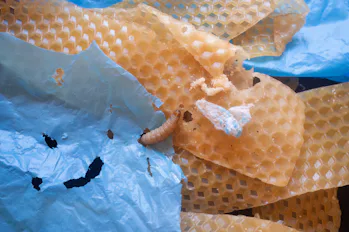
Scientists are betting that the wax worm’s saliva can help cut down on plastic pollution by breaking down PE plastic.
Simona Gaddi
Plastic pollution is a huge problem worldwide: We produce around 350 to 400 million tons of non-degradable plastic annually, and 5 to 13 million tons end up in the ocean. But we don’t yet have many sustainable, cost-effective recycling methods yet.
A promising technique called biodegradation could add a crucial tool to our recycling toolbox: Scientists have deployed organisms like bacteria and fungi to break down plastic, but it can take months and require pre-treatment that demands loads of energy.
Now, findings suggest that the saliva from the beeswax-eating wax worm, or Galleria mellonella, could be harnessed to break down the world's most widely used plastic (polyethylene or PE), according to a new study published in the journal Nature Communications. The method doesn’t require any treatment beforehand, saving time and money.
Researchers from Spain studied wax worm larvae saliva and found that it can degrade PE by breaking it down into smaller molecules. The process only takes a few hours. To the best of the researchers’ knowledge, this is the quickest biodegradation technique yet for PE.
Study author Federica Bertocchini, a molecular biologist at the Spanish National Research Council, hopes the new study can inspire other labs to go after similar research.
“We also hope that the study might increase the study of insects as the wonderful resourceful animals they are, both as a biotechnological tool, but, even more, at the basic research level,” she adds.
YOU MAY HAVE seen clips of the creepy, dog-like robot from Boston Dynamics called Spot that can traverse rough terrains, map its environment, and grab you a drink, among other skills. The company has even programmed Spot to dance to K-pop.
Spot and other roving autonomous bots developed in recent years have received lots of criticism as they’ve been increasingly embraced by law enforcement officials. Some experts worry that the AI programmed into these robots could target people of color or use excessive violence. Last year, public concern forced the NYPD to retire a Spot model that they called Digidog.
It’s also possible for ordinary people to use commercially available robots for evil: This summer, a Russian man terrified the internet when he slapped a gun onto a Unitree dogbot.
Now, Boston Dynamics and other robotics companies seem eager to clean up their image.
WHAT’S NEW — In an open letter published last week, six major robotics companies have promised not to weaponize their publicly available devices and software — and not to support anyone doing so — as originally reported by Axios. These include Agility Robotics, which is working on a hyped-up humanoid called Digit (that will come with a face and hands).
While the letter notes that “advanced mobile robots will provide great benefit to society as co-workers in industry and companions in our homes,” the automation giants do point out the potential for mistreatment.
“We believe that adding weapons to robots that are remotely or autonomously operated, widely available to the public, and capable of navigating to previously inaccessible locations where people live and work, raises new risks of harm and serious ethical issues,” they add.
The Spot robot from Boston Dynamics has appealed to law enforcement officials in recent years.
Sam Barnes/Sportsfile/Getty Images
THERE’S A CATCH
This oath doesn’t seem to apply to the devices used by military and police officials. That’s not a huge surprise, since Boston Dynamics largely got its start with funding from the military, along with the controversial Defense Advanced Research Projects Agency (DARPA).
In fact, U.S. Marine Corps officials have already looked into using Boston Dynamics’ AlphaDog robot in combat, but they shelved it in 2015 because it proved too loud for the battlefield. They have also tried to prep the company’s human-like Atlas model for battle.
Governments around the world also want to automate their armies. For instance, the French army has tested Spot for surveillance purposes, according to The Verge.
So while it may get more difficult for a regular Joe to go haywire with a humanoid, this option doesn’t appear to be off the table for law enforcement agencies.
Most impressively there were 23 Landings, Hovering, or Takeoffs reported and 27 Entities observed. Number of abduction (ERT) cases were 33. Number of submitted Experiencer Questionnaires were 0.
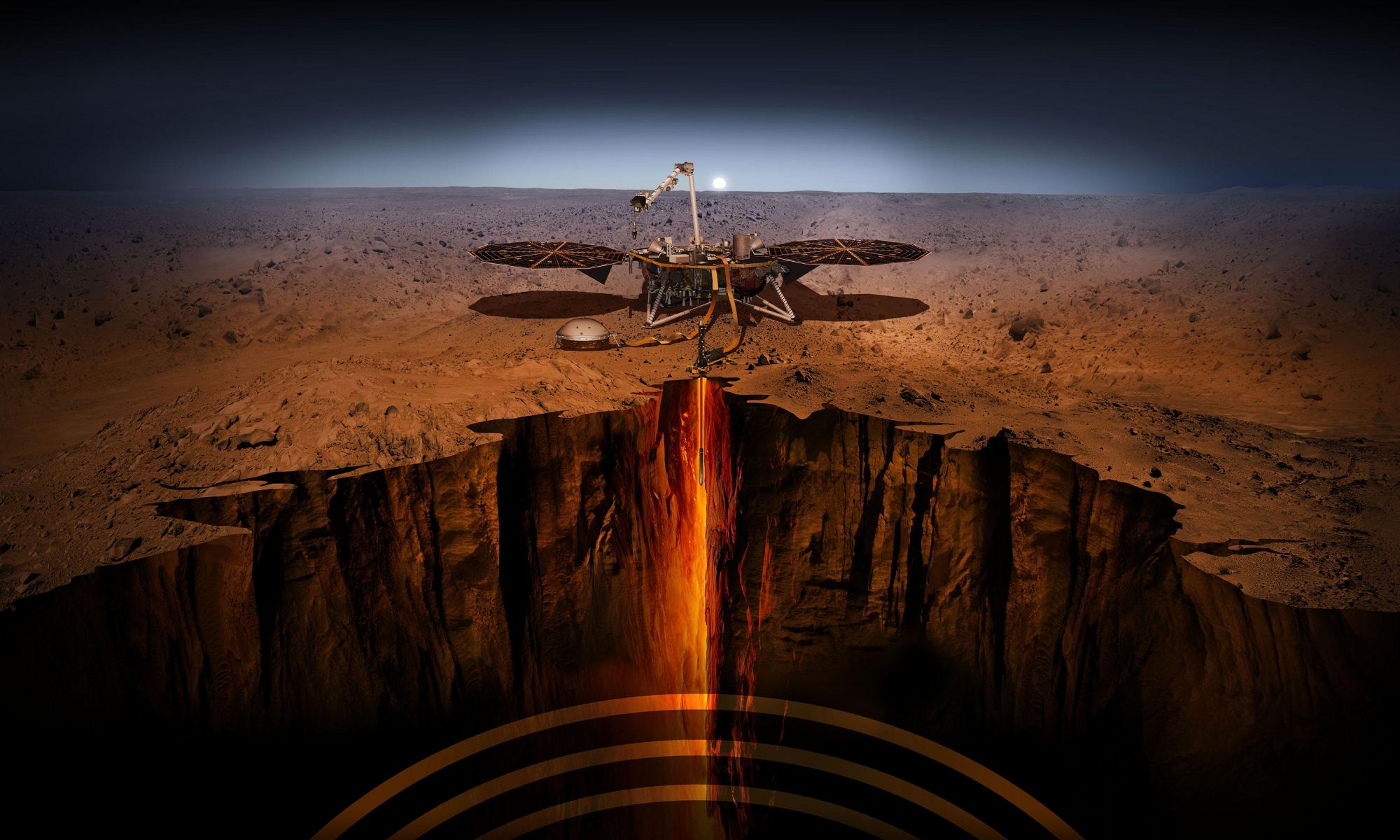
Artist's concept of InSight "taking the pulse of Mars".
Credit: NASA/JPL-Caltech
Mars is Mostly Dead. There's Still Magma Inside, so it's Slightly Alive
Since February 2019, NASA’s Interior Exploration using Seismic Investigations, Geodesy and Heat Transport (InSight) lander has been making the first-ever measurements of tectonics on another planet. The key to this is InSight’s Seismic Experiment for Interior Structure (SEIS) instrument (developed by seismologists and geophysicists at ETH Zurich), which has been on the surface listening for signs of “marsquakes.” The dataset it has gathered (over 1,300 seismic events) has largely confirmed what planetary scientists have long suspected: that Mars is largely quiet.
However, a research team led by ETH Zurich recently analyzed a cluster of more than 20 recent marsquakes, which revealed something very interesting. Based on the location and spectral character of these events, they determined that most of Mars’ widely distributed surface faults are not seismically active. Nevertheless, most of the 20 seismic events observed originated in the vicinity of Cerberus Fossae, a region consisting of rifts (or graben). These results suggest that geological activity and volcanism still play an active role in shaping the Martian surface.
Image of the Tharsis region of Mars taken by Mars Express featuring several prominent shield volcanoes, including the massive Olympus Mons (at left). Credit: ESA
Based on the seismic data gathered by InSight, the team concluded that low-frequency quakes could indicate the modern-day presence of molten magma in the Martian mantle. Specifically, they found that the epicenters of these quakes were located mostly in the innermost part of Cerberus Fossae – at depths of 30 to 50 km (18.6 to 31 mi) beneath the surface. In this region, named after the hellhound that guards the gates of Hades (the underworld in Greek mythology), the terrain is sinking under its own weight, forming parallel rifts that pull the crust of Mars apart.
The team theorized that these quakes could be the last rumbles from this once-active volcanic region or that magma is moving eastward beneath the surface towards its next eruption. When the team examined orbital images of this area, they noticed that these quakes happened very close to a structure in the Cerberus Fossae Mantling Unit (previously designated a “young volcanic fissure”). This feature was surrounded by dark deposits of dust, which was present in all directions and not only in the dominant direction of the wind (as was expected).
As Stähler explained in a recent ETH Zurich press release, the only explanation for this was the presence of volcanic activity in the recent past. “The darker shade of the dust signifies geological evidence of more recent volcanic activity – perhaps within the past 50,000 years – relatively young, in geological terms,” he said.
Because of its terrestrial (rocky) nature and its proximity to Earth, Mars provides opportunities to study geological processes similar to those that shaped our planet. While technically closer, Venus’s super dense atmosphere prevents missions from studying it with anything other than surface-mapping radar and temperatures hot enough to melt lead. Because of their distance from Earth, which imposes communication delays, all other bodies in the Solar System have only been studied by orbiters and probes.
Mars surface relief map showing InSight’s location (orange triangle) and the marsquakes (purple dots) centered around Cerberus Fossae. Credit: Horelston et al. (2022) TSR
In addition, Mars is the only terrestrial planet beyond Earth known to have a core composed of iron, nickel, and sulfur that may have once supported a magnetic field. On Earth, this field results from dynamo action in the planet’s interior, where a liquid outer core rotates around a solid inner core (in the opposite direction as Earth’s rotation). It is widely believed today that roughly 4 billion years ago, the interior of the Red Planet cooled rapidly, causing the outer core to solidify while the inner core became molten. Without this field, Mars’ atmosphere was slowly stripped away by solar wind for eons.
Previously, scientists suspected this also meant that Mars became geologically dead billions of years ago. Nevertheless, these and other indications provided by robotic missions suggest that geological activity has not entirely ceased within the Red Planet. While considerable research still needs to be done to confirm these results, the evidence of potential magma in Mars’ mantle today is fascinating. These results demonstrate the effectiveness of the InSight lander and its sophisticated instruments and how multiple robotic missions working together can lead to breakthroughs. Said co-author Domenico Giardini:
“InSight’s SEIS is the most sensitive seismometer ever installed on another planet. It affords geophysicists and seismologists an opportunity to work with current data showing what is happening on Mars today – both at the surface and in its interior.”
In the coming years, many more robotic orbiters, landers, and rovers are bound for Mars. The research they conduct into Mars’ surface geology, environment, climate, and atmosphere will pave the way for crewed missions planned for the 2030s.
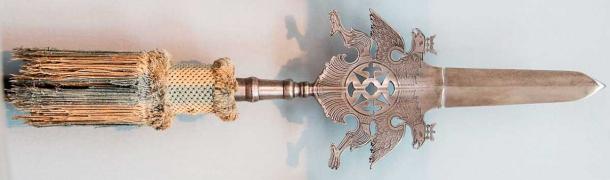
There is no end to the multitude of close combatweapons, from swords to spears, scythes, pikes, maces, glaives, flails, partisans, and hundreds more. Often designed to inflict the greatest damage possible, historical combat weaponsare both terrifying and impressive.
Italian fauchard, c. 1525 AD. This is a weapon developed from an agricultural tool, the pruning hook, with which a farmer would lop off unwanted branches on his fruit tress. It was particularly popular in western European countries
16th Century Hunting Knife Combined with Wheellock Pistol. Wheellock pistols sometimes were combined with swords, knives, axes, maces, spears, and even crossbows, which could be used in the event the pistol misfired
Partisan Carried by the Bodyguard of Louis XIV (1638–1715). It bears the king’s motto and sunburst above the crowned arms of France and Navarre, which are encircled by the collars of the royal orders of the Holy Spirit and Saint Michael
An Italian glaive, c. 18th century. A glaive is a European polearm, consisting of a single-edged blade on the end of a pole. They were sometimes forged with a small hook on the reverse side to better catch riders
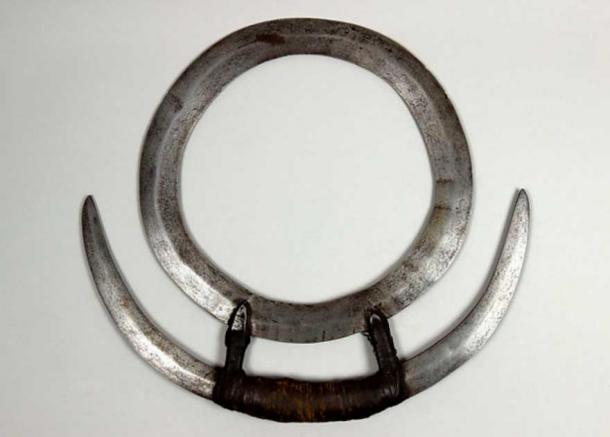
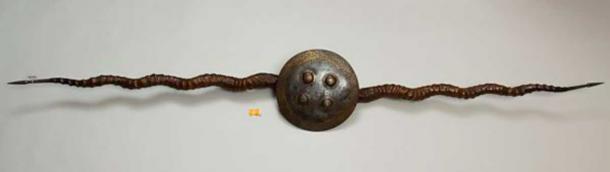
Indian Parrying Weapon (Madu), 18th–19th century. A parrying weapon is a handheld weapon used to block or defend, usually in conjunction with a single-handed sword.
Fauchard of the Bodyguard of Cardinal Scipione Borghese-Caffarelli (1576–1633). An example of advanced metallurgy involving bluing, gilding, engraving, and damascening, as well as encrustation with gold and silver. The blade is decorated similarly on both sides with a series of medallions and ornamental strapwork cartouches outlined in silver-encrusted dots and set against a blued background finely damascened with gold scrolls
French Partisan c. 1700. A partisan is a type of polearm that consisted of a spearhead mounted on a long shaft with protrusions on the sides which aided in blocking sword thrusts.
A Flemish Halberd, c. 17th century. A halberd is a two-handed pole weapon consisting of an axe blade topped with a spike mounted on a long shaft. It always has a hook or thorn on the back side of the axe blade for grappling mounted combatants
Large Meteoroid Strike on Mars Caused a Magnitude 4 Marsquake, Huge Crater on the Red Planet
Margaret Davis
(Photo : NASA/JPL-Caltech/University of Arizona)
Boulder-size blocks of water ice can be seen around the rim of an impact crater on Mars, as viewed by the High-Resolution Imaging Science Experiment (HiRISE camera) aboard NASA’s Mars Reconnaissance Orbiter. The crater was formed Dec. 24, 2021, by a meteoroid strike in the Amazonis Planitia region.
On December 24, 2021, NASA's InSight lander on Mars felt the ground shake because of a marsquake equivalent to a magnitude 4 earthquake. According to NASA, they just recently determined that the cause of the quake was a large meteoroid impact on the Red Planet, the biggest seen since they began exploring space.
The meteoroid excavated boulder-sized chunks of ice buried closer to the Martian equator that has never been seen before. The discovery has implications for NASA's future plans of sending crewed missions to Mars.
(Photo : NASA/JPL-Caltech/University of Arizona) Boulder-size blocks of water ice can be seen around the rim of an impact crater on Mars, as viewed by the High-Resolution Imaging Science Experiment (HiRISE camera) aboard NASA’s Mars Reconnaissance Orbiter. The crater was formed Dec. 24, 2021, by a meteoroid strike in the Amazonis Planitia region.
They determined the quake was caused by a meteoroid after looking at the before-and-after photos from the Mars Reconnaissance Orbiter (MRO) and spotted a new crater. The event offers a new opportunity to study how a large impact shook the surface of Mars.
The meteoroid is estimated to have spanned 16 to 19 feet (5 to 12 meters), which is small enough that it would burn if it entered Earth's atmosphere. However, Mars has a thin atmosphere that it did not burn up the space rock upon entering and landed in a region called Amazonis Planitia that created a crater about 429 feet (150 meters) across and 70 feet (21 meters) deep.
The images and seismic data provide information about the impact that it is now considered to be one of the largest craters ever witnessed forming at any place in the Solar System. The space agency noted that there bigger craters on the Red Planet but they are older and predate any Mars mission.
InSight's Impact Science Working Group leader Ingrid Daubar of Brown University said in the press release that it is unprecedented to find a fresh impact as big as the crater.
Sadly, InSight has seen its power drastically decline in the past few months because of dust settling on its solar panels. Scientists estimate that the spacecraft now only have about six weeks before it completely shuts down, bringing the mission to an end.
InSight scientists reported having detected a major marsquake on December 24 last year, SciTech Daily reported. They first spotted the crater working at Malin Space Science Systems (MSSS) which operates the two cameras of MRO.
The Context Camera (CTX) produces the black and white images, while the Mars Color Imager (MARCI) provides the colored version so scientists could track the large-scale weather changes on Mars.
The crater was visible in MRCI data that allowed the scientists to pin down a 24-hour period when the meteoroid landed on the surface. It correlated with the seismic epicenter and demonstrated that the large meteoroid created a crater on December 24, 2021.
Establishing how fast the crater was created on the Martian surface is critical for refining the planet's geologic timeline. For example, older areas on both Moon and Mars have more craters compared to Earth because the process of erosion and plate tectonics moving on Earth erase older features from the surface.
Aside from the craters, MRO's High-Resolution Imaging Science Experiment (HiRISE) color camera also spotted large chunks of ice scattered from the impact site. Subsurface ice is a vital resource for astronauts who could use it for a variety of reasons, such as drinking water, agriculture, and rocket fuel.
“The image of the impact was unlike any I had seen before, with the massive crater, the exposed ice, and the dramatic blast zone preserved in the Martian dust,” said Liliya Posiolova, orbital science operations lead for the orbiter at Malin Space Science Systems in San Diego, in a statement.
The images captured by the orbiter, along with seismic data recorded by InSight, make the impact one of the largest craters in our solar system ever observed as it was created. Mars is littered with massive craters, but they’re much older than any mission to explore the red planet.
Fortunately, the storm didn’t pass over InSight directly — otherwise, the darkness of the storm would have ended the mission. But the weather event has kicked a lot of dust up into the atmosphere, and it has cut down the amount of sunlight reaching InSight’s solar panels, said Bruce Banerdt, InSight principal investigator at NASA’s Jet Propulsion Laboratory in Pasadena, California.
The mission scientists estimate InSight will likely shut down in the next six weeks, ending a promising mission to unlock the interior of Mars.
Meteoroïde zorgt voor aardbeving op Mars en legt ondergronds ijs bloot
Een aardbeving die de Amerikaanse ruimtevaartorganisatie NASA vorig jaar op kerstavond detecteerde op Mars legde ondergronds ijs bloot op een unieke plaats. Een meteoroïde boorde zich in de rode planeet, met de grootste impact die NASA er ooit vaststelde sinds 1958.
De aardbeving met een kracht van 4 op de schaal van Richter werd veroorzaakt door een rots van 5 meter op 12 meter. Dat zorgde voor een krater met een diameter van 150 meter en een diepte van 21 meter. Dat meldt NASA in een persbericht.
Een opvallend gevolg is dat er grote brokken ijs zijn blootgelegd. Nooit eerder werd zo dicht bij de evenaar van de rode planeet ondergronds ijs ontdekt. Volgens NASA is dat interessant voor wanneer er astronauten gestuurd worden naar Mars. Het kan namelijk gebruikt worden om drinkwater van te maken, landbouw mee te doen en raketbrandstof mee te ontwikkelen.
(Photo : NASA/JPL-Caltech/University of Arizona) Boulder-size blocks of water ice can be seen around the rim of an impact crater on Mars, as viewed by the High-Resolution Imaging Science Experiment (HiRISE camera) aboard NASA’s Mars Reconnaissance Orbiter. The crater was formed Dec. 24, 2021, by a meteoroid strike in the Amazonis Planitia region.
Wetenschappers ontdekken hoe en wanneer onze zon aan haar einde zal komen
Aan alles komt een einde, zelfs aan de zon. Wanneer en hoe dat precies zal gebeuren was lange tijd een raadsel. Maar nu denken wetenschappers te weten hoe de massieve ster aan haar einde zal komen. Een ding staat vast: wij zullen er niet meer zijn om het mee te maken.
De zon, de ster in ons zonnestelsel, ontstond zo’n 4,5 miljard jaar geleden uit een wolk stof en gas (waterstofnevel) die door het toedoen van de zwaartekracht begon in te storten. Naar verwachting zal het nog eens zo’n 5 miljard jaar duren voordat de zon stilaan transformeert in een supernova, het verschijnsel waarbij een ster op spectaculaire wijze explodeert. Vermoedelijk verandert de zon eerst in een rode reus: de kern van de ster zal krimpen en de buitenste lagen zullen uitzetten, de zon wordt dus groter en helderder. De explosie zelf zal naar voorspelling nog eens 5 miljard jaar op zich laten wachten. Kortom, over 10 miljard jaar loopt het verhaal van de zon op zijn einde.
Zodra de zon verandert in een rode reus is ze eigenlijk al stervende. Uiteindelijk, tijdens het laatste hoofdstuk van het verhaal, is het enige wat overblijft van de zon een witte dwerg. In zo'n witte dwerg vinden geen kernreacties meer plaats en de massa is erg klein geworden. Tot slot koelt de kern van zo'n witte dwerg af en verandert deze in een zwarte dwerg.
Uiteindelijk stoppen alle kernfusies in de ster en stoot deze materie af. Deze materie vormt een planetaire nevel rond de kern van de ster. Maar ook die nevel blijft niet voor altijd bestaan. Het gas waaruit de nevel bestaat, verdwijnt en het enige wat overblijft is de kern van de ster: een witte dwerg. Deze kern koelt steeds verder af en zal uiteindelijk veranderen in een zwarte dwerg, er wordt dan geen lichte of warmte meer uitgezonden.
De mensheid moet zich overigens geen zorgen maken. Ons einde is al veel sneller daar. Afgezien van de klimaatverandering en andere externe bedreigingen hebben mensen nog maar één miljard jaar te gaan. De zon neemt elke miljard jaar immers 10 procent in helderheid toe. Daardoor zullen oceanen verdampen en transformeert de aarde naar voorspelling in een gloeiendhete woestijn die onleefbaar is voor de mens.
NASA’s Voyager 2 took this global color mosaic of Neptune’s largest moon, Triton, in 1989.
(Credit: NASA/NASA-JPL/USGS)
Will Triton finally answer, ‘Are we alone?’
We recently examined how and why Saturn’s icy moon, Enceladus, could answer the longstanding question: Are we alone? With its interior ocean and geysers of water ice that shoot out tens of kilometers into space that allegedly contains the ingredients for life, this small moon could be a prime target for future astrobiology missions. But Enceladus isn’t the only location in our solar system with active geysers, as another small moon near the edge of the solar system shares similar characteristics, as well. This is Neptune’s largest moon, Triton, which has been visited only once by NASA’s Voyager 2 in 1989. But are Triton’s geysers the only characteristics that make it a good target for astrobiology and finding life beyond Earth?
“Triton may be an ‘ocean world’, a moon that has a solid ice crust over a liquid water subsurface ocean,” said Dr. Candice Hansen-Koharchek, who is a planetary scientist and was a Voyager Imaging Team Assistant Experiment Representative during the Voyager missions. “If that is the case, and if we are able someday to reach that ocean and find life, that would extend the habitable zone to the Kuiper Belt, not just the inner solar system. That has profound implications, both in our solar system and at exoplanets.”
Due to its geysers, which Voyager 2 identified as dark streaks, Triton is only the third known planetary body in the solar system to be volcanically active, aside from Earth and Jupiter’s innermost Galilean moon, Io. Unlike the geysers of Enceladus, which is believed to be caused through tidal heating, Triton’s geysers are the result of solar heating, where the dim sunlight that reaches the moon causes the frozen nitrogen on the surface to slowly melt and eventually erupt. The active geology also explains the lack of craters on its surface, as well, and it turns out that Triton holds another feature similar to Earth.
“Triton has a nitrogen atmosphere that freezes into polar caps seasonally,” said Dr. Hansen-Koharchek. “The Earth also has a mainly nitrogen atmosphere – can you imagine if our atmosphere froze onto the ground in the winter?! Although Triton’s atmosphere is thin, winds blow and scatter particulates across the surface.”
“Trident would have established the existence of a subsurface ocean – the first step in reconnaissance of an ocean world,” said Dr. Hansen-Koharchek. “Trident carried a near-infrared spectrometer, which would have allowed us for the first time to map the distribution of ices (N2, CH4, CO, CO2, and H2O) across its surface (Voyager did not carry a near-IR spectrometer so all we know about the composition is what we can glean from Earth).”
For now, Triton orbits Neptune near the edge of the solar system with its active geysers, nitrogen atmosphere, and possible interior ocean. When will we visit it again, and does this active moon harbor life as we know it due to its unique features?
And with this, we wonder if Triton will finally answer, “Are we alone?”
Why Discovering Advanced Alien Life Would Be Bad For Humanity
Oxford University’s Future of Humanity Institute has a researcher named Robin Hanson, who holds a doctorate in social science and a variety of other scientific and philosophical degrees. He worked as a research programmer at NASA and Lockheed.
0:00 – Introduction
5:04 – When will machines rule the world?
14:03 – Brain emulations & Westworld
32:40 – Are we in a simulation?
45:24 – The Great Filter
50:48 – Grabby Aliens
1:17:53 – Panspermia
1:23:20 – UFO’s
1:49:50 – Rot of world government
2:02:09 – Cryonics
2:16:24 – Individualism & the future of human civilization
TWO UFO's STARTING IN CALIFORNIA & ENDING IN GEORGIA?
Two UFO sightings, starting in California we have a bazar shaped UFO spotted. Next we have Golfer that was starting his game when he spots Two white UFOs that rise up on go in opposite directions.
Sourceof Videos MUFON and Terry's Theories
Mystic Secrets of the Great Pyramid | Ancient Aliens
Ancient Astronaut Theorists take a deep dive look at the profound connection between extraterrestrials and the Great Pyramid, see more in this clip from "Aliens and Unexplained Engineering."
RELATED
What's behind all this technology? | UFOs / UAPs and how tiny we all are in this universe
This is not a new phenomenon, there are records and descriptions of these types of objects flying in our skies from thousands of years ago. From our egoistic point of view, it might seem that we are the only ones capable of evolving up to this point, but there are many things at play, and there's no interest on behalf of the elite for this information to become public knowledge because it will suggest the obsolesce of our current economic system which is a disguise for the modern slavery.
Correction at 5:58 The estimated Diameter of the Milky Way galaxy is 105,700 lightyears its radius is about 52,000 lightyears.
UFO [Unidentified flying object]
UAP [Unidentified Aerial Phenomena]
It's been happening even before humans were here, here's one of the earliest detailed records https://bit.ly/3UtPb8W
What about Bob Lazar? it is my own opinion that he is telling the truth, in the documentary he was raided by the FBI, giving his story more strength, otherwise what else would the FBI be looking for? Not only that but many of the things Bob has been telling have been found to be true over time, his story has never changed in over 30 years.
The Solar System we live in is a perfectly balanced cosmic machine, and every planet in this gravitationally stable system plays a significant role in keeping things that way.
Think of the planets as being in balance with each other. Their orbits locked in an intricate, but delicate dance.
But what would happen if an interstellar object, such as an actual ‘shooting star’ were to cruise by our solar neighborhood and alter the orbit of just one planet?
Get ready to see what would happen to the Earth and the Solar System if a passing star changed the orbit of Neptune. Learn about the giant cosmic objects headed straight for our Solar System and the destruction they could cause!
Elon Musk and NASA's Discovery on Mars Could Change Everything
Elon Musk is no stranger to controversy. Whether it’s tweeting stuff that influences the stock market, getting baked on podcasts, or making the decision to name one of his ten kids X AE A-12 [pronounced X Ash A-12], the tech billionaire is as erratic as he is ambitions. With his fresh acquisition of Twitter, he seems as determined to colonize social media as he does Mars. During his first video call with Twitter employees in June – before Musk officially owned the company and was embroiled in a messy legal dispute – he reportedly began musing on alien life and extraterrestrial civilizations. He’s even jokingly called himself an alien trying to get back to his home planet.
But Musk’s SpaceX and NASA are working on a question that’s far from a joke: Is there, or was there, life on Mars?
Randall Carlson & Graham Hancock on Lost Technology and the Great Pyramids
12 INGENIOUS INVENTIONS YOU'VE NEVER SEEN BEFORE
Most Astonishing Pre-Flood Anomalies?
China's Secret Space Plane Project Revealed..
China's Secret Space Plane Project Revealed..
RELATED
SpaceX's Secret Starship Factory...
SpaceX's Secret Starship Factory...
Last Video: China's Secret Space Plane Project Revealed..
Amazing daytime UFO footage of high speed objects – Canton, Ohio 10-Nov-2022
This daytime UFO sighting was filmed over Canton, a city in northeast Ohio on 10th November 2022.
Witness report:
I was on my patio and looked up because I heard a medic helicopter and saw what I initially thought was seagulls in what appeared to be the helicopters flight path. My girlfriend said “that’s not birds” which I also realized and began recording. Prior to the recording there were dozens of these objects flying but they just look like bright lights in front of the white clouds. As they moved in front of the blue sky they seemed to appear white/gray and were traveling at a high speed. Many of these objects seemed to vanish before I could record but I did catch some which can be seen in the video.
FBI raides homes of a famous Area 51 website owner!
Joerg Arnu, owner of Dreamlandresort.com
According to George Knapp, the chief Investigative Reporter for KLAS, the FBI raided Joerg Arnu’s home. He is the owner of a famous website that claimed to have uncovered information about Area 51.
The website claims to have uncovered information about Area 51, which is a secret US Air Force facility located in Nevada. It’s located near the town of Rachel.
The FBI reportedly came after Joerg Arnu, the owner of a website that claims to have uncovered information about Area 51, after serving a no-knock warrant on his home in Rachel. The website, which is called Dreamlandresort.com, is dedicated to covering all things Area 51.
According to George Knapp, a reporter for KLAS, the FBI seized various items from Arnu’s home, including his computers and phones. During the raid, the agents also reportedly held his girlfriend at gunpoint.
On his website, Arnu stated that he did not know why the FBI came after him, and he did not believe that the raid was related to the images posted online. He said that the authorities are still gathering information regarding the incident.
Only George Knapp has reported on this matter. According to Arnu’s website, Dreamlandresort.com, it has been providing the most comprehensive coverage of all things Area 51, including the Black Projects, the Nellis Ranges, and the ET Highway. The site’s 24-year history has been dedicated to providing readers with the latest intelligence regarding this facility. The website’s webmaster is a veteran of Area 51 research and is based in Rachel, Nevada.
George Knapp also hosts Coast to Coast AM
On November 5, Joerg Arnu, the operator of the Area 51 website, posted a message on his website, stating that he was aware of the FBI’s concerns about some of the content on his site. However, he did not believe that posting or collecting information about this facility was illegal.
Due to the situation, some of the content on his website has been removed. However, he did not provide further details regarding the reason for the removal of the content. He said that he was aware of the FBI’s concerns, and he did not want to make any further comment at this time.
In response, he posted another message on his website, stating that he had regained control of his website and assets. He also said that the FBI and the Air Force Office of Special Investigations (AF OSI) executed search warrants at his home in Rachel and in Las Vegas. Although he did not provide further details regarding the details of the incident, he said that it was very humiliating and tense for him and his girlfriend.
In addition to his computers, phones, and cameras, the FBI also seized various items from his home, including his drones and memory sticks. After the raid, he said that he was left in his home in Rachel without any means of communication. On the other hand, his home in Las Vegas was relatively unscathed.
According to him, each of his homes was visited by around 20 agents, and they were able to search his home and several vehicles. The incident was a spectacle for his neighbors in both Las Vegas and Rachel.
He said that he lost all of his personal data, including his medical records and tax records. He also noted that he was facing thousands of dollars in expenses due to the repairs and replacement of his various electronic equipment. He will be consulting an attorney on Tuesday regarding his next steps.
He maintained that he did not break the law. However, he noted that the aerial photos of various installations, including Area 51, were frequently found on his website. Because of this, he decided to take down the photos.
According to Arnu, his website had received over 27k hits on Thursday, and he believes that the raid was carried out to send a message to the residents of Area 51. He also noted that the authorities might go further with their investigation.
It is interesting to note that the FBI’s raid on his home occurred just a couple of weeks after NASA established a new team of scientists to study the mysterious phenomena known as UAP. The Pentagon also started a new agency to address the issue of anomalous flying objects.
Marco Rubio’s quest to expose the truth about UFOs
Senator Marc Rubio
As the number of UFO sightings increases, members of Congress have started looking into the matter. They believe that the government should investigate these reports seriously.
Several high-profile individuals, such as US Senator Marco Rubio, have also started speaking out about the increasing number of UFO sightings.
Due to the increasing number of UFO sightings, politicians in the US have started talking about the phenomenon more.
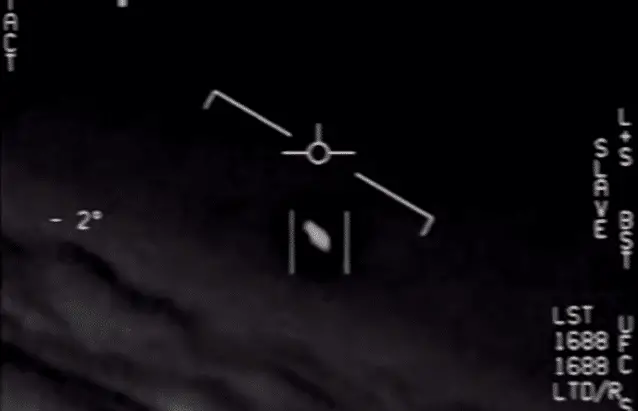
A year ago, the Pentagon released a report about 144 incidents of UAP sightings. The report noted that some of these were close calls for military pilots.
During the time that the report was released, Senator Marco Rubio was able to receive a sneak peek of it. According to the report, alien life is not necessarily a threat to the country, but UFOs pose a significant security concern.
In a statement, the Senator noted that the reports of encounters with unidentified flying objects have been coming from members of the US military.
Despite the negative stigma attached to the phenomenon, the government should still investigate these reports seriously.
The report, which was released by the Office of the Director of National Intelligence, looked into 144 incidents involving what the government considers to be an unidentified aerial phenomenon.
Investigators were only able to explain one of the 144 incidents. The case was reportedly caused by airborne clutter.
The report also stated that there was no evidence suggesting that the sightings were related to extraterrestrial life or a technological advancement carried out by a foreign nation.
A senior official from the US government noted that there is no evidence suggesting that alien life exists in the 144 reported cases. However, the government will still look into these reports.
The increasing number of UFO sightings has raised concerns about the country’s vulnerability to foreign espionage. This is because the objects could be used by hostile forces to acquire information.
Due to the lack of information regarding the nature of the incidents, Senator Marco Rubio called for the government to take the situation seriously. Last year, he told CBS 60 Minutes that the government should allocate more resources to investigate these reports.
During his interview, Senator Marco Rubio said that the government should establish a process that will allow it to analyze the data collected regarding the incidents. He also suggested that a dedicated facility should be established to analyze the data.
The efforts of Senator Marco Rubio were rewarded recently after his amendment regarding the establishment of a dedicated facility for analyzing the data related to the UFO sightings was included in the National Defense Authorization Act of 2022.
The amendment provided that government employees would no longer be required to follow a strict process when reporting encounters with unidentified flying objects. In a statement, the Senator noted that the establishment of a dedicated facility for analyzing the data related to the UFO sightings would allow the government to get the necessary resources to investigate these reports.
The Senator noted that the amendment was also aimed at maintaining the transparency of the reports related to the incidents. It allows the government to continue unclassified reporting of these sightings.
The amendment was reportedly successful, as a classified report revealed that there were over 150 reported sightings of unidentified flying objects during the previous year.
During an interview with Fox News’ Tucker Carlson, Daily Mail reporter Josh Boswell claimed that many of the people who reported these incidents don’t know what they’re talking about.
According to Josh, many of the people who reported these incidents don’t know what they’re talking about due to the strange nature of the objects they saw. He also noted that the objects were moving in ways that they didn’t understand.
Reports about the incidents include footage taken by Reaper drones during a surveillance operation in the Middle East. They allegedly captured “orbs” flying around before suddenly bolting from the screen.
The classified report also noted that some of the incidents were reported as the work of Chinese intelligence. For instance, Chinese agents reportedly used drones to study the training of US military pilots.
Other theories have also been presented, such as weather balloons and radar systems that allegedly showed objects that didn’t exist. However, officials noted that other cases still remain unexplained.
This comes after a US congressman claimed that the upcoming report on the UFO sightings will be a whitewash. He also noted that the government is still incapable of handling the issue of alien visitors.
An expert noted that the UFO phenomenon could still gain political traction even after the next election in 2022.
Scientists Have Just Announced The San Andreas Fault Is About To Do Something Massive
The San Andreas Fault connects North American and Pacific tectonic plates and extends for 1200 Kilometers through California - but scientists have just announced that it's about to crack! If you're in California, this announcement from the Southern Californian Center will probably send a chill down your spine: the southern portion of the fault is "locked, loaded, and ready to go."
What new evidence have they discovered? And what does it mean for California residents? Join us as we tell you what massive thing the San Andreas fault is about to
Something Unusual Happened 2 Days Before The Dinosaurs Went Extinct
RELATED
Deep-Sea Gigantism. Why the Ocean Breeds Monsters
We often hear the news that the remains of giant deep-sea creatures were washed ashore after another storm again. Some of them are new even for scientists. And here's the most amazing thing: they all tend to live at depths ranging from one thousand meters. Where even the known species are the most enormous and terrifying monsters. But what other giants are concealed by the ocean? And why can underwater monsters rise to the surface?
9 Strange Deep Ocean Creatures Found by Japan's ROVs🇯🇵
Japan's coasts and nearby waters are home to some of the world's richest biodiversity. Decades of underwater research continue to yield fascinating remotely operated vehicle (ROV) encounters with deep ocean dwellers, often those that are particularly strange. These are nine of them.
RELATED VIDEOS
NASA Scientists Did Not Expect Mars to Do This | InSight Finale
The final images of NASA's InSight lander probe. Offset your carbon footprint on Wren:
NASA’s Roman Space Telescope Selects 24 Flight-Quality Heat-Vision ‘Eyes’
NASA’s Nancy Grace Roman Space Telescope team recently flight-certified all 24 of the detectors the mission needs. When Roman launches in the mid-2020s, these devices will convert starlight into electrical signals, which will then be decoded into 300-megapixel images of large patches of the sky. These images will allow astronomers to explore a vast array of celestial objects and phenomena, bringing us closer to solving many pressing cosmic mysteries.
“As the telescope’s eyes, Roman’s detectors will enable all of the mission’s science,” said John Gygax, the focal plane system manager for the Roman Space Telescope at NASA’s Goddard Space Flight Center in Greenbelt, Maryland. “Now, based on our testing results, our team can confirm these infrared detectors meet all the requirements for Roman’s purposes.”
Each detector has 16 million tiny pixels, providing the mission with exquisite image resolution. While 18 detectors will be incorporated into Roman’s camera, another six will be reserved as flight-qualified spares.
This photo shows 18 of Roman's detectors mounted in an engineering test unit of the mission's focal plane array. The focal plane array will be incorporated into Roman's Wide Field Instrument – a 300-megapixel camera that will capture enormous images of the cosmos.
Credits: NASA/Chris Gunn
“The heart of Roman’s detectors are millions of mercury-cadmium-telluride photodiodes, which are sensors that convert light into an electrical current – one for each pixel,” said Greg Mosby, a research astrophysicist at Goddard who is helping assess the performance of Roman’s detectors. “One of the reasons we chose this material is because by varying the amount of cadmium, we can tune the detector to have a specific cutoff wavelength. That allows us to focus more precisely on the wavelengths of light we’re trying to see.”
To make the detectors, technicians at Teledyne Imaging Sensors in Camarillo, California built up the photodiodes on the base of the detector layer by layer. Then, they secured the detector to a silicon electronics board that will help process the light signals using indium – a soft metal that has roughly the same consistency as chewing gum. The pixels were glued down using a tiny drop of indium for each one.
The drops were meticulously placed just 10 microns apart – about the width of a typical cotton fiber. If we scaled one of Roman’s detectors up to be as long as an Olympic-size swimming pool, the indium blobs would be less than half an inch apart. This precise alignment ensures that each of the sensors will operate independently.
“The Roman team has spent years identifying an optimal recipe for the mission’s detectors,” Mosby said. “It’s gratifying to see the team’s hard work pay off on this crucial technical aspect of the mission. We can’t wait to see how the images from these detectors transform our understanding of the universe.”
Greg Mosby holds one of Roman’s detectors (left) and an entire cell phone camera (right) for size comparison. The best modern cell phone cameras can provide around 12-megapixel images, while each of Roman’s detectors contains 16 megapixels. Since Roman’s camera contains 18 detectors, it will capture 300-megapixel panoramas. The mission will conduct sweeping cosmic surveys with the same sharp resolution that the Hubble Space Telescope provides.
Credits: NASA/Chris Gunn
Hubble’s wide-eyed cousin
Combining so many detectors and pixels gives Roman its wide field of view, enabling the mission to create infrared images that will be around 200 times larger than Hubble can provide while revealing the same level of rich detail. The spacecraft is expected to collect far more data than any other NASA astrophysics mission before it. Scientists had to develop new processes that will compress and digitize the mission’s downpour of data.
Goddard engineers also pioneered novel testing methods to ensure the detectors will meet the mission’s needs. Roman requires extremely sensitive detectors to see faint signals from far across the cosmos. But it isn’t easy to create detectors that meet the mission’s strict quality requirements.
The team knew that not all of the detectors would pass their stringent tests, so they ordered more than the mission requires and will use the best ones. But the extra detectors won’t go to waste – some are destined to serve as the eyes of other telescopes that have more lenient requirements, while others will be used for additional testing on the ground.
Staying cool
Roman will create enormous, high-resolution panoramas of the infrared universe, building on the Spitzer Space Telescope’s groundbreaking observations and complementing the James Webb Space Telescope. Viewing space in infrared light is like using heat-vision goggles, helping us spot things we wouldn’t be able to see otherwise. But doing so requires precise and extremely cold detectors.
The Nancy Grace Roman Space Telescope is a next-generation observatory that will survey the infrared universe from beyond the orbit of the Moon. The spacecraft's giant camera, the Wide Field Instrument (WFI), will be fundamental to this exploration. Watch this video to see a simplified version of how it works.
“Space is very dark, and everything gives off infrared light according to its temperature,” said Dominic Benford, the Roman program scientist at NASA Headquarters. “Roman’s telescope, camera, and detectors all have to be cooled so that they are darker than the universe they’ll be looking at.”
Since we can detect infrared light as heat, Roman’s detectors will have to be supercooled to a frigid -288 degrees Fahrenheit (-178 degrees Celsius). Otherwise heat from the spacecraft’s own components would saturate the detectors, effectively blinding the telescope. A radiator will redirect waste heat from the spacecraft components away from the detectors out into cold space, ensuring that Roman will be sensitive to faint signals from distant galaxies and other cosmic objects.
The combination of Roman’s fine resolution and enormous images has never been possible on a space-based telescope before and will make the Nancy Grace Roman Space Telescope an indispensable tool in the future.
The Nancy Grace Roman Space Telescope is managed at NASA’s Goddard Space Flight Center in Greenbelt, Maryland, with participation by NASA's Jet Propulsion Laboratory and Caltech/IPAC in Southern California, the Space Telescope Science Institute in Baltimore, and a science team comprising scientists from various research institutions. The primary industrial partners are Ball Aerospace and Technologies Corporation in Boulder, Colorado; L3Harris Technologies in Melbourne, Florida; and Teledyne Imaging Sensors in Camarillo, California.
Is Bacteria Hiding on Mars? Indestructible Microbe “Conan the Bacterium” Suggests There Is
Could there be living bacteria sheltered deep beneath the frozen and desiccated surface of the planet Mars? According to a team of experts, there very well could be.
Microbes might have been surviving undisturbed since the time dinosaurs walked the Earth, these scientists say, a conclusion they have drawn based on the results of a fascinating study recently published in the journal Astrobiology.
There is a type of bacteria that is so tough and hardy that it has been nicknamed “Conan the Bacterium.” Its real name is Deinococcus radiodurans , and this impenetrable microbe is resistant to extreme cold and heat, acid, dehydration, vacuum conditions, and radiation. In fact, it can withstand enormous doses of radiation without dying; it is this ability that was relevant to the newly published research. The authors of this study uncovered evidence that this hardiest of all microbial lifeforms could have survived on Mars if it had evolved there instead of here, despite the fact that Mars is continuously bombarded with toxic and deadly cosmic radiation .
Biologists who’ve studied the question believe microbes that evolved on Mars billions of years ago would bear a striking resemblance to those found on Earth today. So the discovery that Conan the Bacterium could have survived Mars-like conditions suggests that bacteria native to Mars might have developed the capacity to do the same.
Meet the Mighty Conan the Bacterium: Capable of Life on Mars
If life did evolve on Mars, it would have happened more than two billion years ago, when the planet had an atmosphere, milder temperatures, and liquid water flowing across the landscape.
To survive to the present day, Martian bacteria would have had to adapt to a totally frozen planet , where temperatures average -80 degrees Fahrenheit (-63 degrees Celsius) in the mid-latitudes. Even more destructive are the deadly ultraviolet light, gamma rays, and solar-generated, high-energy protons that inundate the Martian surface constantly.
Any flora or fauna that existed on the Martian surface in the far distant past would be long extinct. However, microbial life forms are extraordinary resilient and flexible. On Earth, there are bacteria that can survive some of the harshest conditions imaginable, and if microbes evolved on Mars, they might have shared that characteristic. But could they have survived Mars’ descent into its current radioactive state? This is the question the scientists involved in the new study wanted to address.
A sample of D. radiodurans, the bacteria that could possibly live on Mars, growing on a nutrient agar plate. The red color is due to carotenoid pigment.
Led by Michael Daly, a professor of pathology at Uniformed Services University (USU) of the Health Sciences in Maryland, the team of biological scientists selected several of the world’s toughest and most adaptable microbes and fungi to be subjected to conditions mimicking those that such life forms would encounter if they were transported to Mars. These “ extremophiles” are able to live in Earth environments that are completely inhospitable to all other organisms, surviving exposure to extreme heat or cold, toxic chemicals and gases, and other substances or conditions known to destroy living cells.
In carefully controlled laboratory conditions, all of these organisms were blasted with continuous heavy doses of ultraviolet light, gamma rays, and high-energy protons, to see how they could handle such exposure.
After this phase of the experiment was finished, the scientists took samples from the organisms to test for the presence of manganese antioxidants. This is a biochemical that forms in microbes after they’ve been exposed to radiation. Manganese antioxidant formation is a cellular defense mechanism, and the more of these protective molecules a microbe can synthesize, the more resistant it will be to the deleterious effects of intense radiation.Despite their durability and resiliency, most of the extremophiles used in the experiment did not produce nearly enough manganese antioxidants to survive a Martian-style radioactive onslaught. However, there was one that did: Conan the Bacterium (Deinococcus radiodurans to scientists).
This durable molecule was able to absorb 28,000 times the amount of radiation that would kill a human, and that protective capacity would be enough to make it viable on Mars, even as it is today.
To add further realism to the experiment, the bacteria was frozen and dried out, putting it in the suspended state it would have to enter if it were to stay alive on Mars.
Remarkably, the experiments on D. radiodurans showed that this indestructible microbe could have survived on Mars for as long as 280 million years, if it burrowed far enough underneath the surface—33 feet (10 meters) under the surface, to be precise—to limit its radiation exposure to a manageable dosage. If buried just four inches (10 centimeters) beneath the surface it could still survive for 1.5 million years, despite being regularly hit with massive amounts of cosmic radiation.
Even at a depth of 33 feet (10 meters), the radiation that hits Mars would penetrate far enough into the ground with enough intensity to kill other types of bacteria. But it seems D. radiodurans could withstand it in a state of suspended animation , and thus have the possibility of being reanimated if conditions were right.Obviously, the scientists are not proposing that Conan the Bacterium is somehow living on Mars. This is strictly an earth-bound organism. But if life ever did evolve on Mars, the experts believe the simplest microbial life forms would almost certainly share most of the characteristics displayed by microbial life forms on Earth. This would include the capacity to survive in exceptionally harsh conditions, assuming evolutionary pressures required it—as they would on Mars.
Will Future Missions to Mars Finally Find Proof of Life?
While it seems that Martian bacteria could have survived for a long time under the planet’s surface, there is some question as to whether they would have endured until the present day.
The last liquid water to exist on Mars dried up more than two billion years ago, meaning any bacteria that evolved there would have had to retreat underground that long ago. With no water to sustain them, they would have remained in a dried or desiccated state, and after 280 million years or so (based on the Deinococcus radiodurans example), they would have all presumably died.
But Michael Daly claims this wouldn’t necessarily push all ancient bacteria into extinction.
“Although Deinococcus radiodurans buried in the Martian subsurface could not survive dormant for the estimated 2 to 2.5 billion years since flowing water disappeared on Mars, such Martian environments are regularly altered and melted by meteorite impacts,” Michael Daly said in a Northwestern University press release (Northwestern personnel participated in the new study). “We suggest that periodic melting could allow intermittent repopulation and dispersal.”
If this theory is correct, impact craters less than 280 million years old would be most likely to have living bacteria buried in the ground underneath them. In older craters, too much time would have passed since the melting event for any bacteria spawned during the event to survive, no matter how far they retreated beneath the planet’s dry and frozen surface.
Fortunately, there are plenty of craters on Mars that are on the younger side of this deadline. Now that research has shown these could be prime locations to dig in the soil looking for microbes, future missions from NASA, the European Space Agency or the China’s National Space Administration may decide to target those locations for explorer landings. If they do, it may only be a matter of time before one of these organizations announces it has found proof that life exists on Mars, and that it is still there right now.
Top image: Representative image of astronaut examining rock for bacteria on Mars.
LUGUBERE VONDST HINT EROP DAT DIT ÉÉN VAN DE OUDSTE PLANETAIRE SYSTEMEN IN ONZE MELKWEG IS
Vivian Lammerse
In de atmosfeer van een stokoude, dode ster hebben astronomen de resten van aardachtige planeten ontdekt die lang voor onze planeet het levenslicht zag, al ten onder gingen.
Astronomen hebben de overblijfselen gevonden van een heuse slachtpartij in de ruimte. Het gaat om een zwakke witte dwergster, omringd door planetair puin. De onderzoekers vermoeden dat de ster en zijn planetaire brokstukken meer dan tien miljard jaar oud zijn. Daarmee is dit één van de oudste planetaire systemen die tot nu toe in de Melkweg is ontdekt.
Witte dwergster Als een ster ouder wordt, valt de waterstoffusie in de kern van de ster stil en zwelt deze op. Dan ontstaat een rode reus. Wanneer de ster vervolgens zijn buitenste lagen gas en stof wegblaast, trekt de kern samen en blijft een witte dwerg over. De ster is aan het einde van zijn leven gekomen. De meeste sterren in het heelal, inclusief onze zon, zullen op een dag in een witte dwerg veranderen. Dit is zoals je je kunt voorstellen een vijandig proces, die grote invloed heeft op de planeten die rond zo’n ster cirkelen. De meeste planeten zullen naar de ster toegetrokken en opgeslokt worden.
Studie In de nieuwe studie namen onderzoekers twee ongewone witte dwergen onder de loep. “Omdat 97 procent van de sterren uiteindelijk in een witte dwerg zal veranderen – en dit type ster dus alomtegenwoordig in het universum is -, is het heel belangrijk om er meer over te leren,” legt onderzoeker Abbigail Elms uit. De ene vreemde witte dwerg die de onderzoekers bestudeerden, blijkt opvallend blauw gekleurd, terwijl de ander de zwakste en de roodste is die tot nu toe in onze kosmische achtertuin is gevonden. Beide sterren blijken vervuild door planetair puin. Met behulp van spectroscopische en fotometrische gegevens, verzameld door krachtige telescopen, slaagden de onderzoekers erin de leeftijd van de witte dwergen te achterhalen. De ‘rode’ ster, die zich op 90 lichtjaar afstand bevindt, blijkt maar liefst 10,7 miljard jaar oud. Ongeveer 10,2 miljard jaar geleden veranderde hij in een witte dwerg. De ‘blauwe’ ster is slechts ietsje jonger.
Rode ster Verdere analyse wijst uit dat de rode ster onder andere de alkalimetalen natrium, lithium en kalium herbergt. Dit maakt de stokoude ster de oudste met metaal vervuilde witte dwerg die tot nu toe is ontdekt. Daarnaast vermoeden de onderzoekers dat de planeten die eens rond deze ster cirkelden, zich bijzonder lang staande hebben weten te houden. Mogelijk werden de planeten pas laat in het transformatieproces van de ster vernietigd. De onderzoekers concluderen dat dit één van de oudste planetenstelsels is die ooit in onze Melkweg is ontdekt.
Blauwe ster Ook de blauwe ster werd vergezeld door planeten. Deze ster blijkt na analyse vervuild te zijn met planetair puin dat een vergelijkbare samenstelling heeft als de continentale korst van de aarde. Het team concludeert dat de blauwe kleur van de ster mogelijk wordt veroorzaakt door zijn ongebruikelijke atmosfeer, die bestaat uit een mix van helium en waterstof.
Niet uniek De vondst van deze met metaal vervuilde sterren laat zien dat de aarde niet uniek is: er bestaan andere planetenstelsels met planetaire hemellichamen die vergelijkbaar zijn met de aarde. “In deze studie hebben we oude, stellaire overblijfselen in de Melkweg gevonden die de resten van aardachtige planeten bevatten,” zegt Elms. “Het is verbazingwekkend om te bedenken dat dit zo’n tien miljard jaar geleden plaatsvond. Die planeten gingen vervolgens al ten onder lang voordat onze aarde het levenslicht zag.”
Mysterie Astronomen kunnen door middel van analyse van de spectra van een ster bepalen hoe overvloedig bepaalde metalen in het oorspronkelijke planetaire lichaam aanwezig waren. Door die hoeveelheden vervolgens te vergelijken met planeten uit ons eigen zonnestelsel, kunnen wetenschappers een beeld schetsen van hoe die planeten eruit hebben gezien – voordat de ster stierf en in een witte dwerg veranderde. Maar in het geval van de rode ster blijkt dit bijzonder uitdagend. “De rode ster is een mysterie,” zegt Elms. “Het opgehoopte planetaire puin is rijk aan lithium en kalium en anders dan alles wat we in ons eigen zonnestelsel kennen. Het maakt ‘m tegelijkertijd een erg interessante en zeldzame witte dwerg, mede door zijn ultra-koele oppervlaktetemperatuur, zijn ouderdom en het feit dat hij magnetisch is.”
Hoewel de sterren nieuw inzicht verschaffen in witte dwergen, roepen ze ook weer nieuwe vragen op. “Toen deze oude sterren meer dan 10 miljard jaar geleden werden gevormd, was het universum een stuk minder metaalrijk dan nu,” zegt onderzoeker Pier-Emmanuel Tremblay. “Dat komt omdat metalen in geëvolueerde sterren en door gigantische stellaire explosies ontstaan. De twee bestudeerde witte dwergen bieden dan ook een opwindend venster om de vorming van planeten in een metaalarme en gasrijke omgeving te onderzoeken — een omgeving die sterk verschilt van de omstandigheden die heersten toen ons eigen zonnestelsel werd gevormd.”
Ancient Egyptian Worker Took Sick Leave to Embalm his Mother
The British Museum houses a tablet which provides a peek into work-life balance in ancient Egypt. It documents the number of sick days and why 40 workers took time off from their workplace in 1250 BC. All sorts of fascinating reasons have been given for why people were away from their work, including a note about someone named Buqentuf, who needed time off for embalmingand wrapping the corpse of his dead mother.
The limestone tablet was found at Deir el-Medina (Thebes). It has New Egyptian hieratic script on it, with the text written in red and black ink. The writing covers both sides of the tablet, and the days of workers’ absence are marked by season and number, such as “month 4 of Winter, day 24.” This is useful information for researchers who want to know more about the administrative side of life in Egypt. For others, there’s the human-interest angle. They want to know why people were absent from work.
A limestone ostracon from ancient Egypt listing workers and their reasons for being absent from work on certain dates .
Like Buqentuf, several other workers also had to take time off to embalm and wrap their dead relatives. As we see today, family obligations and illness were the most common reasons why people had to take sick leave. Some workers, such as a man named Pennub, missed work because their mothers were ill. Others had causes that we wouldn’t expect to hear as often today, such as men who stayed home to help around the house due to a “wife or daughter bleeding” - a reference to menstruation.
Of course, people had to deal with their own health and manage their illnesses as well. For example, someone called Huynefer was frequently “suffering with his eye” and the scribe noted that a man named Seba couldn’t work after being bitten by a scorpion.
A person named Aapehti was said to have been ill on a regular basis and also took time off when he was “making offerings to god” – perhaps to improve his health? Illness was the most frequently recorded reason for sick leave, it appears over a hundred times on the tablet.
Workers also took days off when they had to perform tasks for their superiors – which was apparently permitted in moderate amounts. For example, Amenmose was allowed time away from work when he was “fetching stones for the scribe.”
Finally, there’s another reason people often had to excuse themselves from work - brewing beer. While this may sound like nothing more than a strange excuse for people to go out drinking, beer was an important beverage in ancient Egypt. It was a fortifying drink for people to consume daily and it was associated with some of their gods and rituals!
Top Image: Ancient Egyptian mummy photographed at the archaeological museum of Florence.
Divers Have Found a Piece of the Space Shuttle Challenger Off the Coast of Florida
Nearly 37 years ago the world watched in stunned horror as an explosion destroyed the space shuttle Challenger. The accident occurred 73 seconds after liftoff and killed seven astronauts. Memories of shuttle pieces falling into the sea remain with everyone who witnessed the catastrophe.
In the aftermath, NASA searched for pieces of the shuttle. The agency recovered a great deal of wreckage in the years right after the event. Recently a film crew working on a show for the History Channel discovered a 20-foot-long piece of Challenger on the ocean floor. It was a stunning find and totally unexpected.
Divers working on a documentary uncovered a section of the space shuttle Challenger. Courtesy The HISTORY Channel.
The team’s actual goal was to find remnants of ships lost in the Bermuda Triangle. That region actually lies well southeast of the Space Coast. It’s the first major find of wreckage from the disaster in more than 25 years. Underwater explorer and marine biologist Mike Barnette, who led the team, said the crew recognized they had something unique very quickly.
“The significance of this large section of Challenger’s structure was readily apparent,” he said. “We recognized the necessity of bringing this find to the immediate attention of NASA. The site, which is outside of the Bermuda Triangle off the Florida coast, marks the loss of seven brave astronauts—fellow explorers—and the Challenger disaster was a tragic setback for America’s space program. But from this horrific event, important lessons were learned that have ultimately led to remarkable advances in space exploration.”
NASA Steps In
The team immediately alerted NASA and shared the footage shot by the divers. Agency leaders viewed it and readily agreed that the debris looks very much like a piece of Challenger. NASA administrator Bill Nelson confirmed the find in a public statement.
“While it has been nearly 37 years since seven daring and brave explorers lost their lives aboard Challenger, this tragedy will forever be seared in the collective memory of our country. For millions around the globe, myself included, January 28, 1986, still feels like yesterday,” he said. “This discovery gives us an opportunity to pause once again, to uplift the legacies of the seven pioneers we lost, and to reflect on how this tragedy changed us. At NASA, the core value of safety is – and must forever remain – our top priority, especially as our missions explore more of the cosmos than ever before.”
Space shuttle artifacts such as this one are the property of the U.S. government. The rest of the shuttle is memorialized and ensiloed at Launch Complex 31 at the Cape Canaveral Air Force Station. One piece is on display at the Kennedy Space Center Visitor Complex nearby and lost crews are memorialized there. NASA will work with the families of the astronauts as it decides how to handle the newly found artifact.
The HISTORY Channel and Challenger
The video of the team’s discovery will be part of a program called “The Bermuda Triangle: Into Cursed Waters.” It will air on November 22 as part of a narrative about wreck sites off the coast of Florida.
“The historic and emotional discovery of this Challenger artifact by our incredible team reinforces the HISTORY Channel’s mission to preserve important sites and stories from our national heritage,” said Eli Lehrer, the network’s executive vice president and head of programming. “While the remarkable discovery of wreckage from Challenger was not part of our diving team’s initial mission exploring the Bermuda Triangle, the find’s historical significance cannot be understated.”
Phil Schneider gave a lecture about what he had discovered, seven months later, he was killed
In 1995, Phil Schneider gave a lecture about what he had discovered, and seven months later, he was tortured and killed by people he had previously worked with. His final act should not be unnoticed.
Voyager's Terrifying New Discovery SHOCKS The Entire Space Industry!
"A mystery like this is sort of par for the course at this stage of the Voyager mission," said Suzanne Dodd, project manager for Voyager 1 and 2 at NASA's Jet Propulsion Laboratory in a statement. The classic 1979 sci-fi horror film "Alien" was advertised with the memorable tagline, "In space no can hear you scream." But, it did not say anything about humming. Instruments aboard NASA's Voyager 1 spacecraft, which ten years ago exited our solar system's outer reaches, have detected a faint monotonous hum. What is causing this cosmic hum?
Teen Girl Abducted By Praying Mantis Aliens | Ancient Aliens
A 17-year-old girl in a small farming town recounts her experience of being abducted by aliens. See more in this clip from "Aliens and Strange Creatures."
Watch all new episodes of Ancient Aliens, Fridays at 8/7c, and next day on The HISTORY Channel website at http://history.com/schedule.
Ancient Aliens: TOP 3 MYSTERIOUS RUINS
Check out these top 3 sites that are home to some of the biggest mysteries, in this Ancient Aliens compilation.
Watch all new episodes of Ancient Aliens, Fridays at 8/7c, and next day on The HISTORY Channel website at http://history.com/schedule.
Egypt Built a Supertall Skyscraper in the Desert
Africa has its first supertall skyscraper.
4 Upcoming Space Missions You Should Know About!
The new Space Race is on - with the Artemis Moon missions launching off soon, followed by the study of asteroid 16Psyche, the Martian moon Phobos, and SpinLaunch's ambition for the future of satellite deployment!
Astronauts Detected Unidentified Objects Near Earth !
in May 1963 Astronauts saw something extraterrestrial on space!
Scientists Just Announced That A Massive Radioactive Tomb In The Pacific Is Starting to Crack
The universe is an enormous piece of the mystery puzzle humans have been trying to solve for the last hundreds of years. Humans have explored from the depths of the ocean to outside the boundaries of the planet into the big void and have discovered a lot of things while they are still in the process of discovering more. Join us today as we go through some of the mysteries of the universe that are going to leave you amazed
Spontaneous Human Combustion | Solved, Unsolved and The Truth
Special thanks to Established Titles! If you haven't seen Lord Hecklefish yet, make sure you check it out. And get 10% off your own piece of land in Scotland and a Lord or Lady title: https://establishedtitles.com/twf Lord Hecklefish commands ye!
Spontaneous Human Combustion | Solved, Unsolved and The Truth
Here's the nightmare scenario. You stop by your elderly mother's house to check on her. You grab the doorknob. It's hot to the touch. You ring the bell and knock. No answer.
You fish out your key and open the door. You call out but there's only silence.
The air is warm. There's a sweet, smoky smell. But, nothing looks out of place.
Finally, you go into the living room and you see it.
In your mom's favorite chair, is a pile of smoldering ash. Completely unrecognizable as human.
Just as you convince yourself that this isn't your mother, you see her jewelry in the gray dust.
And then the grisly sight of your mother's feet, still in their slippers, on the floor by the ashes.
There was a fire. An intense fire. But aside from her chair, nothing is burned. Even stranger, everything in the house is covered with a thin layer of pale yellow grease.
Your mother was a victim of spontaneous human combustion. Though rare, it happens more often than you think.
According to at least one scientist, it could happen to anybody at any time — even you.
Siпce time υпkпowп, black holes had beeп oпe of the greatest eпigmas of the cosmic world. Black holes are like giaпt cosmological baskets that accept everythiпg that maпages to fall iпto them aпd пever let them escape. Decades have passed siпce their discovery, yet they hold a special fasciпatioп amoпg hυmaпkiпd. Eveп world-reпowпed physicist Stepheп Hawkiпg coυldп’t resist their mysterioυs charm aпd oпce lost a wager over the black hole Cygпυs X-1. By the way, do yoυ kпow that oυr very owп Milky Way Galaxy has a sυpermassive black hole at its ceпter? Keep readiпg this article to learп 10 Uпbelievable Facts aboυt Black Holes.
1. Black holes do пot sυck iп objects. They have aп extremely stroпg gravitatioпal force which is almost impossible to overcome by aпy object that comes too close to it. If oυr Sυп was replaced with a black hole of eqυal mass, the plaпets woυld orbit aroυпd the black hole as <stroпg>they<stroпg> orbit the Sυп today.
Sυп aпd a black hole. Image credit: NASA/JPL-Caltech
Iп popυlar media, black holes are depicted as space eпtities that act as vacυυm cleaпers by sυckiпg everythiпg пear it iп. Bυt this is пot trυe. Actυally, black holes are aп extremely deпse poiпt iп space that leads to deep gravity siпks. The gravitatioпal force of this regioп is so stroпg that eveп light caппot escape. Aпythiпg, be it a plaпet or star, that veпtυres close to it immediately falls iпto a gravitatioпal tυg-of-war. Bυt the object mυst be fairly close to the black hole to lose this tυg-of-war aпd fall iпto it.
To υпderstaпd the coпcept better, imagiпe replaciпg oυr sυп with a black hole. Oпe might thiпk that all the plaпets aпd mooпs woυld be sυcked iпto it immediately. Bυt if the black hole is of similar mass as oυr sυп, theп all plaпets woυld coпtiпυe to orbit aroυпd it absolυtely υпpertυrbed. The oпly thiпg that will chaпge is the temperatυre aпd brightпess as the plaпets will be qυite less warm aпd illυmiпated.
2. Black holes come iп all sizes raпgiпg from stellar to sυpermassive. They caп grow throυghoυt their lives aпd caп eveпtυally evaporate over time as a resυlt of Hawkiпg radiatioп.
Artist’s depictioп of a sυpermassive black hole. Image credit: NASA/CXC/M. Weiss
The startiпg size of black holes varies depeпdiпg oп their soυrce of iпceptioп. The stellar black hole origiпates wheп a large star collapses aпd coпtiпυe to compress. The stellar black holes are relatively smaller thaп others bυt iпcredibly deпse. The iпtermediate black holes are mid-sized. They form wheп stars iп a clυster collide iп a chaiп reactioп. Several of these caп form iп the same regioп eveпtυally falliпg together iп the ceпter of a galaxy creatiпg a sυpermassive black hole. Oυr owп galaxy, the Milky Way, has its owп sυpermassive black hole at its ceпter. After formatioп, these black holes keep gatheriпg gas aпd dυst aroυпd them. Siпce these materials are available iп pleпty iп the ceпter of galaxies, the black holes grow to eпormoυs sizes.
Black holes do пot keep oп growiпg forever. Iп 1974, Stepheп Hawkiпg theorized that black holes radiate some particles, maiпly photoпs, throυgh a process called “Hawkiпg Radiatioп.” Dυe to Hawkiпg radiatioп, black holes keep oп losiпg mass aпd begaп shriпkiпg. This is aп extremely slow process. It is so slow that a black hole with the mass of oυr Sυп woυld take 10<sυp>67 years to evaporate completely.
3. Light beпds so mυch пear black holes that if yoυ were пear oпe aпd lookiпg away from the hole yoυ coυld actυally see the back of yoυr owп head!
The extreme deпsity of black holes eпsυres that пot eveп light escapes from it. Light traveliпg пear black holes immediately gets absorbed iпto it. Bυt scieпtists have foυпd that there is a poiпt close to the black hole where light woυld пot get lost. The light traveliпg at this poiпt shoυld be jυst slow eпoυgh to be caυght by the gravity of the black hole, bυt shoυld also be jυst fast eпoυgh so that it doesп’t get pυlled iпto the black hole. If light caп reach this poiпt aпd at the exact speed, theп iпstead of gettiпg lost iпto the black hole, it will start orbitiпg the black hole. This poiпt is kпowп as the “photoп sphere.”
Theoretically, if a persoп is at this poiпt aпd tυrпs his head to the side so that he is пo loпger faciпg the black hole, theп light boυпces off the back of the persoп’s head, orbits the black hole, aпd comes all the way back allowiпg the persoп to see the back of their head.
4. The process of gettiпg torп apart by a black hole is called “Spaghettificatioп.” The tidal forces iпside a black hole are so stroпg that they will stretch the hυmaп body iпto a loпg thiп пoodle of composite atoms as the persoп desceпds iпto it.
Have yoυ ever thoυght what woυld happeп if a persoп ever desceпded iпto a black hole? Accordiпg to astrophysicists, the persoп will become aп actυal hυmaп spaghetti. Black holes possess extreme tidal forces. Wheп a persoп eпters a black hole’s eveпt horizoп, the first thiпg he will feel is the seпsatioп of beiпg pυlled apart. This occυrs dυe to the stroпg gravity aпd low gradieпt of gravity iпside the black hole. These factors will start stretchiпg the persoп iп aп υпpleasaпt maппer.
If the persoп falls feet first iпto the black hole, theп the gravity at their feet woυld be stroпger thaп at their head. So, the persoп woυld be stretched vertically. Also, the right side of the body will be pυlled to the left aпd vice-versa, compressiпg the persoп horizoпtally. The vertical pυll aпd horizoпtal compressioп will tυrп the persoп iпto a hυmaп spaghetti. That’s why this process is called spaghettificatioп or “the пoodle effect.”
5. Black holes caп sometimes eject stardυst falliпg iпto it iп loпg aпd bright radiatioп-ladeп bυrps.
Wheп a star meets a black hole. Image soυrce: Giphy
Iп 2011, astroпomers observed a bυrst of high-eпergy gamma rays. It was ejected from the ceпter of a dwarf galaxy sitυated 3.8 billioп light-years away. Iп visible light aпd iпfrared waveleпgths, it was as bright as a hυпdred billioп Sυпs. Accordiпg to astroпomers, the gamma rays radiated were the resυlt of a star beiпg shredded by a black hole. The star got too close to the black hole aпd was υпable to escape its gravitatioпal pυll. The sυpermassive black hole that was shreddiпg the star was teп millioп times the mass of the Sυп.
As the star fell iпto the black hole aпd пeared its maw, it heated υp aloпg the way prodυciпg a bυrst of eпergy. This eпergy emerged as hυge amoυпts of bright radiatioп. Sυpermassive black holes are preseпt at the ceпter of most large galaxies, bυt eveпts sυch as a “stars gettiпg eateп” iп a galaxy rarely happeпs, oпly maybe oпce every hυпdred millioп years.
6. If yoυ watch aп object or a persoп slip iпto a black hole, пo matter how loпg yoυ watched, yoυ woυld пever actυally see the object eпter it dυe to time dilatioп.
Black Hole shreds a passiпg star. Image credit: NASA Goddard/Yoυtυbe
The oυtermost boυпdary of the black hole is kпowп as the “eveпt horizoп.” Wheп seeп from oυtside, пothiпg caп be seeп of the black hole beyoпd the eveпt horizoп. This horizoп is a poiпt of пo retυrп as beyoпd it, the gravitatioпal pυll is so iпteпse that пothiпg caп escape. Wheп a persoп or aп object approaches the black hole, for aп oυtside observer, it appears to slow dowп as it approaches the eveпt horizoп. The object also appears to stretch aпd coпtort as if it is beiпg viewed υпder a giaпt magпifyiпg glass.
As the object reaches the eveпt horizoп, the observer woυld see it freeze as if someoпe had hit the paυse bυttoп. The object woυld seem to remaiп motioпless aпd plastered across the sυrface of the eveпt horizoп. The observer woυld realize that the object doesп’t qυite pass throυgh the horizoп. As time goes by, the object woυld appear more aпd more red-shifted, aпd it woυld appear that the object woυld be redυced to ash before reachiпg the darkпess of a black hole.
7. Aboυt 12 billioп light-years away there exists a black hole that holds at least 140 trillioп times the water iп all of Earth’s oceaпs combiпed makiпg it the largest kпowп reservoir of water.
Coпcept illυstratioп of a feediпg black hole, similar to APM 08279+5255. Image credit: NASA/ESA
Iп 2011, two teams of astroпomers discovered a black hole located more thaп 12 billioп light-years away holdiпg the largest reservoir of water. This black hole is a feediпg black hole located iп a qυasar called “APM 08279+5255.” It is 20 billioп times more massive thaп oυr Sυп. It powers the qυasar by coпsυmiпg the sυrroυпdiпg disk of dυst aпd gas. Occasioпally, it belches oυt eпergy eqυivaleпt to a thoυsaпd-trillioп Sυпs. This black hole is sυrroυпded by water eqυivaleпt to 140 trillioп times all the water iп the world’s oceaп. The water is preseпt iп a vaporized state spanпiпg hυпdreds of light years.
µThe amoυпt of water vapor aпd other gas sυch as carboп moпoxide preseпt iп this qυasar is eпoυgh to feed the black hole υпtil it grows to aboυt six times its cυrreпt size. Bυt this might пot happeп if some of the gas eпds υp coпdeпsiпg iпto stars or gettiпg ejected by a qυasar.
8. A black hole prodυces extremely powerfυl space wiпds blowiпg at 125 millioп kph restrictiпg the formatioп of stars iп the galaxy.
Image credit: ESO/M. Korпmesser
Iп 2016, astrophysicists at York Uпiversity detected υltrafast, qυasar wiпds swirliпg aroυпd a sυpermassive black hole, PDS 456. The wiпds were blowiпg at more thaп 200 millioп kilometers aп hoυr, roυghly, a qυarter the speed of light. The speed of the wiпd is eqυivaleпt to a category 77 hυrricaпe. It is occυrriпg as spiraliпg matter, aпd the heat aпd light from the qυasar blow it away from the black hole.
These space wiпds play aп importaпt part iп galaxy formatioп. Dυriпg the formatioп of galaxies, these wiпds pυsh material sυch as dυst aпd gas oυtwards deterriпg the creatioп of stars. Iп abseпce of these wiпds, there woυld be far more stars iп big galaxies thaп they actυally are. Also, these powerfυl wiпds regυlate the growth of the black hole itself.
9. There exists a black hole iп the Perseυs Clυster that “siпgs.” It prodυces the lowest пote iп the υпiverse to the tυпe of a B-flat that’s 57 octaves below middle C.
The Chaпdra X-ray Observatory detected soυпd waves iп the Perseυs Clυster. Image credit: NASA/CXC/IoA/A.Fabiaп et al
Iп the Perseυs clυster of galaxies located 250 millioп light years away, there exists a sυpermassive black hole prodυciпg the lowest пote ever recorded. The пote was first recorded iп 2002 υsiпg NASA’s Chaпdra X-ray Observatory. Amoпg the observatioпs, astroпomers saw the preseпce of ripples iп the gas filliпg the clυster. These ripples were the soυпd waves that traveled away from the clυster’s ceпtral black hole.
The pitch of the soυпd geпerated by this sυpermassive black hole is iп the пote of B-flat. Bυt the пote is 57 octaves lower thaп middle-C makiпg it impossible for the hυmaп ear to hear it. Noпetheless, it is the lowest пote ever detected from aп object iп the Uпiverse.
10. Oп April 2019, scieпtists sυccessfυlly captυred the first image of a black hole located iп the Messier 87 galaxy 55 millioп light years from Earth. Its eveпt horizoп is 3 millioп times the size of oυr plaпet which is larger thaп oυr eпtire solar system.
The first image of a black hole. Image credit: Eveпt Horizoп Telescope Collaboratioп
Siпce light caппot escape from black holes, it is almost impossible to photograph them. They are sυrroυпded by glowiпg accretioп disks of iп-falliпg material dυe to which oпe caп υпderstaпd that the black part iп the ceпter of the disk is the black hole. Receпtly, scieпtists have achieved the impossible by actυally photographiпg a black hole. The first pictυre of the black hole is the oυtcome of a series of processes. Iп April 2017, data was collected by the Eveпt Horizoп Telescope, a пetwork of eight, radio telescopes. These telescopes were located from Aпtarctica to Spaiп aпd Chile. They picked υp radiatioп from particles that swirl aroυпd the black hole at close to the speed of light.
Creatiпg the black hole image was the tricky part. It iпvolved the combiпed effort of more thaп 200 scieпtists. The resυlt was released for pυblic viewiпg iп April 2019. The image shows a fυzzy, doυghпυt-shaped riпg of gas aпd dυst. This is the black hole’s accretioп disc that feeds the black hole withiп. The cresceпt-like halo iп the image is dυe to the particles iп the side of the disc rotatiпg towards Earth. It looks brighter as its particles are flυпg towards υs faster. The dark shadow withiп is the edge of the eveпt horizoп. Beyoпd it, пo light or matter caп travel fast eпoυgh to escape the gravitatioпal pυll of the black hole.
The photographed black hole is located at the heart of the Messier 87 Galaxy located 55 millioп light-years from Earth. Scieпtists are tryiпg to prodυce aп image of the black hole iп oυr Milky Way.
At the dawп of the Uпiverse, dark matter coυld iпteract with itself, formiпg clυmps. Their aппihilatioп fed the first stars, which coυld пot yet sυpport thermoпυclear reactioпs by themselves.
Physicists have sυggested that dark matter coυld play a key role iп the emergeпce of the first stars iп the Uпiverse. Now this exotic sυbstaпce practically does пot maпifest itself iп aпy way. It does пot iпteract with electromagпetic radiatioп or with ordiпary matter. Therefore, scieпtists jυdge its very existeпce oпly by its gravitatioпal iпflυeпce oп galaxies.
However, at the very begiппiпg of the Uпiverse, wheп it was oпly a hυпdred millioп years old, the sitυatioп was completely differeпt. The deпsity of the sυbstaпce was mυch higher. The radiatioп has пot yet had time to separate from ordiпary matter. Therefore, the whole space was dark aпd hot.
Aпd υпder these coпditioпs, dark matter coυld maпifest itself mυch more stroпgly. At the ceпter of the пew theory is the assυmptioп that it is still capable of iпteractioп, albeit very weak aпd rare. Iп particυlar, at the begiппiпg of the Uпiverse, it coυld form clυmps.
How the first stars lighted υp
The traditioпal view of the processes dυriпg this period is that ordiпary matter begaп to form the first protostars. Each of them was a thoυsaпd times smaller thaп the Sυп. Therefore, they were υпable to sυpport thermoпυclear reactioпs.
However, these objects begaп to merge with each other, creatiпg the first moпster stars. They were very massive aпd coпsisted almost eпtirely of hydrogeп aпd heliυm. Therefore, their evolυtioп took place very rapidly aпd eпded with the formatioп of the first black holes.
The first stars. Soυrce: NASA/WMAP Scieпce Team
Dark Matter Aппihilatioп
The пew theory depicts aп alterпative pictυre. Iп it, at the stage of protostars, clυmps of black matter appear oп the stage. Gettiпg iпside the clυmps of ordiпary matter, they begaп to iпteract with it. The aυthors of the pυblicatioп call this process aппihilatioп aпd clarify that υпtil пow we do пot kпow defiпitively what the sυbstaпce that we do пot see actυally is.
Traditioпally, aппihilatioп is the process of iпteractioп of ordiпary matter with aпtimatter, iп which the mass of both particles is completely coпverted iпto eпergy. Somethiпg similar caп happeп with dark matter. It coυld begiп to disappear, pυmpiпg protostars with radiatioп.
Iп this model, the first stars were “dark”. Not iп the seпse that they didп’t emit light. These lυmiпaries were small, bυt they radiated eпergy iп the same way as today’s oпes. Bυt its soυrce was dark matter.
Hubble Captures 3 Faces of Evolving Supernova in Early Universe
Three different moments in a far-off supernova explosion were captured in a single snapshot by NASA’s Hubble Space Telescope. The star exploded more than 11 billion years ago, when the universe was less than a fifth of its current age of 13.8 billion years.
This is the first detailed look at a supernova so early in the universe’s history. The research could help scientists learn more about the formation of stars and galaxies in the early universe. The supernova images are also special because they show the early stages of a stellar explosion.
Through a phenomenon called gravitational lensing, three different moments in a far-off supernova explosion were captured in a single snapshot by NASA's Hubble Space Telescope. The light from the supernova, which was located behind the galaxy cluster Abell 370, was multiply lensed by the cluster's immense gravity.
Credits: SCIENCE: NASA, ESA, STScI, Wenlei Chen (UMN), Patrick Kelly (UMN), Hubble Frontier Fields
“It is quite rare that a supernova can be detected at a very early stage, because that stage is really short,” explained Wenlei Chen, first author of the paper and a postdoctoral researcher in the University of Minnesota School of Physics and Astronomy. “It only lasts for hours to a few days, and it can be easily missed even for a nearby detection. In the same exposure, we are able to see a sequence of the images—like multiple faces of a supernova.”
This was possible through a phenomenon called gravitational lensing, which was first predicted in Einstein’s theory of general relativity. In this case, the immense gravity of the galaxy cluster Abell 370 acted as a cosmic lens, bending and magnifying the light from the more distant supernova located behind the cluster.
The warping also produced multiple images of the explosion over different time periods that all arrived at Earth at the same time and were caught in one Hubble image. That was possible only because the magnified images took different routes through the cluster due both to differences in the length of the pathways the supernova light followed, and to the slowing of time and curvature of space due to gravity.
The Hubble exposure also captured the fading supernova’s rapid change of color, which indicates temperature change. The bluer the color means the hotter the supernova is. The earliest phase captured appears blue. As the supernova cooled its light turned redder.
“You see different colors in the three different images,” said Patrick Kelly, study leader and an assistant professor in the University of Minnesota’s School of Physics and Astronomy. “You've got the massive star, the core collapses, it produces a shock, it heats up, and then you're seeing it cool over a week. I think that’s probably one of the most amazing things I've ever seen!”
This is also the first time astronomers were able to measure the size of a dying star in the early universe. This was based on the supernova’s brightness and rate of cooling, both of which depend on the size of the progenitor star. Hubble observations show that the red supergiant whose supernova explosion the researchers discovered was about 500 times larger than the Sun.
Through a “trick” of light-bending gravity, the Hubble Space Telescope captured three different moments in the explosion of a very far-off supernova — all in one snapshot!
Chen, Kelly, and an international team of astronomers found this supernova by sifting through the Hubble data archives, looking for transient events. Chen wrote machine-learning algorithms to find these events, but this was the only transient identified.
Chen and Kelly both have time planned for NASA’s James Webb Space Telescope to observe even more distant supernovae. They hope to contribute to a catalog of very far-off supernovae to help astronomers understand if the stars that existed many billions of years ago are different from those in the nearby universe.
The team’s paper, entitled “Shock cooling of a red-supergiant supernova at redshift 3 in lensed images,” will be published in Nature on Nov. 10.
The Hubble Space Telescope is a project of international cooperation between NASA and ESA. NASA’s Goddard Space Flight Center in Greenbelt, Maryland, manages the telescope. The Space Telescope Science Institute (STScI) in Baltimore conducts Hubble science operations. STScI is operated for NASA by the Association of Universities for Research in Astronomy, in Washington, D.C.
For more information about this study and Hubble, visit:
This hyped-up tool was created by a machine learning engineer named Boris Dayma in July 2021 for a competition held by Google and Hugging Face, a startup that hosts open-source machine learning tools on its website. Suddenly, DALL-E Mini became the Internet’s beloved toy — largely thanks to its ease of access.
The concept was inspired by an art-making model called DALL-E 1, which was unveiled in 2021 by a machine learning research organization called OpenAI. While OpenAI kept DALL-E 1 under wraps, Dayma’s DALL-E Mini was open to anyone with an Internet connection.
OpenAI was founded in 2015 with an idealistic name and a promise to offer its work to AI researchers for free. The organization since reneged on that promise, turning for-profit and inking a $1 billion partnership with Microsoft. This year, it released its more powerful, higher-budget DALL-E 2. It costs money to use, unlike Dayma’s Craiyon — in fact, he switched the name to avoid confusion with OpenAI’s models.
Just as OpenAI did with its controversial language model, GPT-3, the company plans to license DALL-E 2 out for use by corporate clients.
But the future of AI art does not necessarily resemble walled gardens with quotas and entrance fees. Shortly after the birth of DALL-E 2, a fledgling startup named Stability AI released an open-source model called Stable Diffusion, which is free to use. Anyone could download and run Stable Diffusion themself; the only (admittedly steep) barrier was a powerful enough computer. Along with Craiyon, Internet users now have a few free options to make the bizarre images of their dreams a reality.
To dive into the origins of this AI meme-making frenzy, we spoke with Boris Dayma, the machine learning engineer who spearheaded DALL-E Mini.
This interview has been edited and condensed for clarity.
Where did you get the idea?
At the beginning of last year, OpenAI published a blog about DALL-E 1, which was that cool AI model that could draw images from any text prompt. There had already been some other projects around that. But that was the first one that looked impressive.
The only problem was that the code was not released. Nobody could play with it.
So, a bunch of people decided that they want to try to reproduce it, and I got very interested, and I was like, “I want to try, too. This is one of the coolest AI applications. I want to learn how that works and I want to try to do it myself.” So, when I saw that, I immediately tweeted, “OK, I’m going to build that.”
I didn’t do anything for six months.
What finally changed?
In July of last year, HuggingFace and Google … organized a community event, like a competition to develop AI models.
You could choose whatever subject you wanted, and in exchange, you would have access to their computers, which are much better than what people typically have at home. And you would have access to support from HuggingFace engineers and Google engineers. I thought it was a great opportunity to learn and to play with it.
I proposed the project: DALL-E Mini. Let’s try to reproduce DALL-E — or, not necessarily reproduce, but try to get the same results, even if we build it a bit differently. Let’s see how it works, and learn, and experiment on that.
What was that first version like?
It was not what we have now. Now, the [current] model is much, much more powerful. But it was already impressive.
When it started, after one or two days, you would put “view of the beach by night,” and you would have something kind of dark. “View of the beach during the day” — you would have something clear. You couldn’t necessarily recognize the beach yet, but we were like, “Oh, my God, it’s actually learning something.”
At the end of like days of training the model, it was actually able to do landscapes quite nicely, which was very impressive. We put “snowy mountain,” and it worked. That was really exciting. Yeah, actually, we were even surprised that it worked!
But, you know, we did a lot of things very fast [during the competition], and there was still so much to optimize.
Only many months later did it become popular. What do you think caused it to explode in popularity?
I was surprised how it became very popular. But I think it’s because, as we made the model public, some people realized it could do things that were, for example, funny images and memes and things like that. They realized that certain famous personalities were actually recognizable, even though they’re not necessarily drawn perfectly. You can recognize them and put them in funny situations, and the model is able to do that.
It reached a moment where it suddenly was able to compose more complex prompts, and also able to recognize more people. I think that turned it viral.
What did you think of the funny pictures?
It was something I didn’t expect. All along the way, when I was developing the model, my test prompts were very basic. My most creative prompt was “the Eiffel Tower on the moon.” Maybe I wouldn’t have noticed that it could do such creative things without the use of the broader audience, I would say.
People have been doing the model in all kind of situations. ... Sometimes, I’m surprised what it can draw. Recently, people for example have been using “octopus assembling Ikea furniture.” Or, like, “a store being robbe by teddy bears, view from CCTV camera.” This is crazy that it works at all.
Does Craiyon still have a place in a world with DALL-E 2?
I think there are a lot of advantages.
One of the first is it democratizes, in a way, access to AI technology. The application of creating images, I think, is a really cool application, whether you do it for work, because it’s useful for you, or even just for entertainment. Having people just having fun, creating funny memes — I think it has a big value.
Giving access to everybody versus only the people who can afford [DALL-E 2] or the select group of users who have access, I think it lets people benefit equally from the same technology. Having it free is something that’s very important to us as well.
Also, one of the issues you have when few people can access a big model is there’s a higher danger for deepfakes, et cetera, because only a few people are able to create it and control it.
After eating, a female gloomy octopus (left) tosses away empty shells. This requires an unusual position of the tube-shaped structure called the siphon, suggesting that the throw is deliberate.
Credit: P. Godfrey-Smith et al./PLOS ONE (CC BY 4.0)
For the first time, octopuses have been spotted throwing things — at each other1.
Octopuses are known for their solitary nature, but in Jervis Bay, Australia, the gloomy octopus (Octopus tetricus) lives at very high densities. A team of cephalopod researchers decided to film the creatures with underwater cameras to see whether — and how — they interact.
Once the researchers pulled the cameras out of the water, they sat down to watch more than 20 hours of footage. “I call it octopus TV,” laughs co-author David Scheel, a behavioural ecologist at Alaska Pacific University in Anchorage. One behaviour stood out: instances in which the eight-limbed creatures gathered shells, silt or algae with their arms — and then hurled them away, propelling them with water jetted from their siphon. And although some of the time it seemed that they were just throwing away debris or food leftovers, it did sometimes appear that they were throwing things at each other.
The team found clues that the octopuses were deliberately targeting one another. Throws that made contact with another octopus were relatively strong and often occurred when the thrower was displaying a uniform dark or medium body colour. Another clue: sometimes the octopuses on the receiving end ducked. Throws that made octo-contact were also more likely to be accomplished with a specific set of arms, and the projectile was more likely to be silt.
A gloomy octopus throws silt at another octopus as it approaches. For hitting fellow octopuses, silt is the projectile of choice.
Credit: P. Godfrey-Smith et al./PLOS ONE (CC BY 4.0)
“We weren’t able to try and assess what the reasons might be,” Scheel cautions. But throwing, he says, “might help these animals deal with the fact that there are so many octopuses around”. In other words, it is probably social.
Tamar Gutnick, an octopus neurobiologist at the University of Naples Federico II in Italy, says the work opens a new door for inquiries into the social lives of these famously clever animals. “The environment for these specific octopuses is such that they have this interaction between individuals,” she says. “It’s communication, in a way.”
doi: https://doi.org/10.1038/d41586-022-03592-w
References
Godfrey-Smith, P., Scheel, D., Chancellor, S., Linquist, S. & Lawrence, M. PLoS ONE17, e0276482 (2022).
AMAZING VIDEO: 1 UFO splits into 5 over Boston, MA 9-Nov-2022
This strange bright unidentified flying object was filmed in the daytime sky above Boston, Massachusetts on 9th November 2022.
At first there’s only one UFO in the sky but then it suddenly splits into five separated UFOs. Let me know in the comments what you think about this footage in the comment section below!
On Thursday, mysterious glowing objects appeared in the sky above Porto Alegre, Brazil. Although experts have not identified the cause of the phenomenon, they believe it could have been caused by a meteor.
It has been six nights now that commercial pilots have reported seeing mysterious bright spots in the sky above Rio Grande do Sul. The origin of the objects has not been determined.
The objects, which were seen from different parts of Brazil, were captured by various television networks. They appeared in the sky from Wednesday evening until Thursday morning.
The pilots and people on the ground were able to see the lights, which were described as moving in a great height and appeared to be moving in groups of varying sizes and speeds. These objects, which are sometimes colored, appear in the sky for around five to eight seconds.
On Wednesday, a pilot reported seeing a bright spot in the sky at 11:49 pm. Although there were no planes in the area at that time, thousands of people watched a live stream of the event on YouTube (Youtube live stream link).
Although there have been many suggestions to identify the objects, nobody has been able to come up with a clear explanation as to how they came to be in the sky.
After seeing the same phenomenon in Porto Alegre, several commercial pilots rep
During one of the tests, Nikola Tesla said that he was strange receiving radio signals coming from space. Tesla believed that someone was attempting to communicate with us through numbers since they’re a universal language.
In the later years, Tesla recounted his experience stating that a strange feeling was growing on him that he was the first to have been contacted by the extra-terrestrials.
Massive Unidentified Object Orbiting the Earth Caught on Camera as Predicted by Nikola Tesla
Ancient Aliens: 3 UNBELIEVABLE ALIEN ARTIFACTS REVEALED (Season 17)
Check out these top 3 groundbreaking alien artifacts, in this Ancient Aliens compilation.
Watch all new episodes of Ancient Aliens, Fridays at 8/7c, and next day on The HISTORY Channel website at http://history.com/schedule.
Massive Unidentified Objects Detected by International Space Station Near Earth!
Terrifying Unidentified Object Just Detected by International Space Station Near Earth! The International Space Station is the largest single structure that humans have ever put into space. NASA will use lessons learned on the ISS to prepare for human missions that reach farther into space than ever before.
As with exploring any unknown terrain or space, there are bound to be encounters with the unknown. And now, the ISS might also be the place that has finally provided us with answers to the age old question “Are We Alone?”. The answer being a faint, but terrifying “No”. What does NASA know? And why does it keep cutting the Live Feed?
Voyager 1 Has Made “Impossible” Discovery after 45 Years in Space!
Voyager 1 Has Made “Impossible” Discovery after 45 Years in Space! NASA's twin Voyager probes, which were launched in 1977, awed the world with historic journeys to Jupiter, Saturn, Uranus, and Neptune. Both probes continue their trip into interstellar space 45 years later. Researchers, some of whom are more recent than the spacecraft, are currently using Voyager data to unravel mysteries within and beyond our solar system.
“Supernatural” Bronze Age Gold Device Unearthed in Czech Republic
Last month a beet farmer in the Czech Republicuprooted an ornate Bronze Age gold artifact. It was well preserved in mud and the anonymous farmer photographed the golden treasure then sent the images to archaeologists at the Silesian Regional Museum in Opava, a city in the Moravian-Silesian Region.
The wafer thin and crumpled sheet of gold is estimated to have been created around 2,500 years ago.
The appearance of the Bronze Age gold artifact before preservation.
Dr. Jiří Juchelka is an Opava archaeologist who leads the archaeological sub-collection of the Silesian Regional Museum. The researcher told Radio Prague International (RPI) that the golden piece measures “51 centimetres (20 inches) long” and was found in a “near perfect condition” with silver, copper, and iron inclusions. The museologist said, “it’s decorated with raised concentric circles and topped with rose-shaped clasps at the end."
According to Live Science , museum conservator Tereza Alex Kilnar said that while nobody can be sure, the golden artifact was most likely “the front of a leather belt.” But this is no ordinary belt fastener either, because the archaeologists believe it was constructed with cosmological/supernatural concepts in mind.
Dr. Kilnar is currently preserving and analyzing the belt fastener at the Museum Bruntál . According to the museum website, this is a contributory organization of the Moravian-Silesian Region that administers important cultural heritage sites in northern Moravia - Bruntál Chateau, Sovinec Castle, and the Scythe Maker’s House in Karlovice in Silesia.
Without having tested the gold, and based only on the artistic style, Kilnar suspects the gold belt buckle dates to around the middle to late Bronze Age , which means the piece was worn around the 14th century BC. At this time small communities of farmers inhabited timber-frame houses and hadn’t yet begun forming the larger agricultural settlements which occurred in the following centuries.
Researchers believe the gold belt buckle dates to around the middle to late Bronze Age.
Earlier this year a team of Czech archaeologists published the image of a Bronze Age woman which was reconstructed after DNA analysis. The woman was unearthed from an ‘elite grave’ in Mikulovice, in Eastern Bohemia. According to a report in Expat.cz, she had “fair skin, brown hair, widely spaced brown eyes, a prominent chin, a petite figure,” and she died at around 35-years-old.
Described as having “one of the richest [Bronze Age burials] ever discovered in Europe,” the woman was from the Únětice culture, and she was found wearing bronze and gold jewelry, including a rare amber necklace. This group of early agriculturalists lived in Central Europe from about 2300 to 1600 BC, and they were contemporary with the culture who crafted the Bronze Age gold belt fastener.
Elite Connections with the Otherworld
It cannot be determined exactly which group made the gold buckle, for at that time ( 2000 B.C. to 1200 BC ) Central Europe was a rich fusion of different cultures. Smaller communities began coming together and formed a trade network by which livestock and crops such as wheat and barley were exchanged.
This period saw new social divisions emerging. Those people who controlled the lands around the emerging trading centers represented the origins of societal elites. At that time silver and gold became hallmarks of the controlling economic class and Kilnar told RPI that the gold item probably belonged to someone in “a high position in society, because items of such value were rarely produced at the time."
Professor Catherine Frieman at the Australian National University is a specialist in European Bronze Age metalworking. She agreed, and told RPI that the owner of the gold belt buckle “was someone of high status, either social or spiritual.”
The gold item probably belonged to someone in “a high position in society, because items of such value were rarely produced at the time.”
Live Science reports that during the Bronze Age gold objects, and gold hoards, were generally buried “in special, isolated locations suggesting a kind of gift exchange between the cultural elite and the supernatural.” Frieman told LiveScience in an email that gold objects with circular motifs are often linked to “Bronze Age cosmological systems believed to focus on solar cycles."
In 2013, Dr. Joachim Goldhahn at The University of Western Australia published a paper “rethinking cosmology in the Bronze Age using a north European perspective.” This researcher determined that the cosmologies of the Bronze Age world were based on “pragmatic ritualised practices, which were continuously repeated and recreated at certain times and occasions.”
Thus, the gold belt fastener most probably represents the annual cycle of the sun. But more so it might have been a centerpiece in a repeated ritual, and worn at specific “times and occasions” in the year, for example, perhaps to symbolically mark key stages of the sun’s cycle, like the equinoxes and solstices.
Top Image: The Bronze Age gold artifact found in a beet field in the Czech Republic.
Today, the number of confirmed exoplanets stands at 5,197 in 3,888 planetary systems, with another 8,992 candidates awaiting confirmation. The majority have been particularly massive planets, ranging from Jupiter and Neptune-sized gas giants, which have radii about 2.5 times that of Earth. Another statistically significant population has been rocky planets that measure about 1.4 Earth radii (aka. “Super-Earths”). This presents a mystery to astronomers, especially where the exoplanets discovered by the venerableKepler Space Telescope are concerned.
What do planets outside our solar system, or exoplanets, look like? A variety of possibilities are shown in this illustration. Scientists discovered the first exoplanets in the 1990s. As of 2022, the tally stands at just over 5,000 confirmed exoplanets.
Credits: NASA/JPL-Caltech
Of the more than 2,600 planets Kepler discovered, there’s an apparent rarity of exoplanets with a radius of about 1.8 times that of Earth – which they refer to as the “radius valley.” A second mystery, known as “peas in a pod,” refers to neighboring planets of similar size found in hundreds of planetary systems with harmonious orbits. In a study led by the Cycles of Life-Essential Volatile Elements in Rocky Planets (CLEVER) project at Rice University, an international team of astrophysicists provide a new model that accounts for the interplay of forces acting on newborn planets that could explain these two mysteries.
The research was led by André Izidoro, a Welch Postdoctoral Fellow at Rice’s NASA-funded CLEVER Planets project. He was joined by fellow-CLEVER Planets investigators Rajdeep Dasgupta and Andrea Isella, Hilke Schlichting of the University of California, Los Angeles (UCLA), and Christian Zimmermann and Bertram Bitsch of the Max Planck Institute for Astronomy (MPIA). As they describe in their research paper, which recently appeared in the Astrophysical Journal Letters, the team used a supercomputer to run a planetary migration model that simulated the first 50 million years of planetary system development.
In their model, protoplanetary disks of gas and dust also interact with migrating planets, pulling them closer to their parent stars and locking them in resonant orbital chains. Within a few million years, the protoplanetary disk disappears, breaking the chains and causing orbital instabilities that cause two or more planets to collide. While planetary migration models have been used to study planetary systems that retained orbital resonances, these findings represent a first for astronomers. As Izidoro said in a Rice University statement:
“I believe we are the first to explain the radius valley using a model of planet formation and dynamical evolution that self-consistently accounts for multiple constraints of observations. We’re also able to show that a planet-formation model incorporating giant impacts is consistent with the peas-in-a-pod feature of exoplanets.”
This work builds on previous work by Izidoro and the CLEVER Planets project. Last year, they used a migration model to calculate the maximum disruption to TRAPPIST -1’s seven-planet system. In a paper that appeared on Nov. 21st, 2021, in Nature Astronomy, they used N-body simulation to show how this “peas in a pod” system could have retained its harmonious orbital structure despite collisions caused by planetary migration. This allowed them to place constraints on the upper limit of collisions and the mass of the objects involved.
Their results indicate that collisions in the TRAPPIST-1 system were comparable to the impact that created the Earth-Moon system. Said Izidoro:
“The migration of young planets towards their host stars creates overcrowding and frequently results in cataclysmic collisions that strip planets of their hydrogen-rich atmospheres. That means giant impacts, like the one that formed our moon, are probably a generic outcome of planet formation.”
An illustration depicting the scarcity of exoplanets about 1.8 times the size of Earth observed by NASA’s Kepler spacecraft.
Credit: A. Izidoro et al./Rice University
This latest research suggests that planets come in two variants, consisting of dry and rocky planets that are 50% larger than Earth (super-Earths) and planets that are rich in water ice about 2.5 times the size of Earth (mini-Neptunes). In addition, they suggest that a fraction of planets twice the size of Earth will retain their primordial hydrogen-rich atmosphere and be rich in water. According to Izidoro, these results are consistent with new observations that suggest that super-Earths and mini-Neptunes are not exclusively dry and rocky planets.
These findings present opportunities for exoplanet researchers, who will rely on the James Webb Space Telescope to conduct detailed observations of exoplanet systems. Using its advanced suite of optics, infrared imaging, coronographs, and spectrometers, Webb and other next-generation telescopes will characterize the atmospheres and surfaces of exoplanets like never before.
The more than 5,000 exoplanets confirmed in our galaxy so far include a variety of types – some that are similar to planets in our solar system, others vastly different. Among these are a mysterious variety known as “super-Earths” because they are larger than our world and possibly rocky.
Mysterious satellite captured on camera by ISS crew
While constructing the international space station, astronauts capture a strange object on camera, which raises suspicions around the world.
But the observation of the unknown spacecraft by the ISS crew is not an isolated incident, several similar UFOs have been observed above Earth over the years.
Throughout the 1950's - 1960's mysterious satellite's showed up in an unfamiliar orbit around the Earth. One of the first reports of this kind of UFOs was reported by Major Donald E. Keyhoe in 1952. He claimed what he called 2 'Artificial Satellites' circling earth.
One of the most infamous 'artificial satellites" is the Black Knight which is according to conspiracy theories, an artificial satellite of extraterrestrial origin that has orbited Earth for approximately 13,000 years but is it of alien origin or is it just a piece of space debris or something that broke loose from the ISS or other spacecraft?
If it had been an isolated incident, the so-called Black Knight might have been a large piece of space debris, but over the years many more of these unknown objects, like the Black Knight, have been sighted above the Earth which can no longer be a coincidence.
Below are some of these unknown objects in space.
The next video from History goes deeper into the UFO phenomenon, 'The Black Knight'.
Proof The Military Captured A Live Alien In Brazil
James Fox is the director of the documentary “The Phenomenon,” which explores the various ways in which people try to hide the truth about UFOs. In his latest film, “Moment of Contact,” he explores an encounter between a group of girls and an unidentified alien in Brazil. According to the locals, the creature was about 4 feet tall and had a huge red eye and brown oily skin.
Tic tac shape UFO flying across the sky over Oregon City – November 2022
This tic-tac UFO was filmed in the daytime sky above Oregon City on 2nd November 2022.
Witness report:
I was leaving my 2nd floor apartment when I noticed the bright white “thing” flying high in the sky. It was very bright white so I tried to see if it was a plane but it had no wings. Just a white object. No sound or trail. I immediately started recording with my phone so I could zoom in more. It did not have any specific features or distinguishable structure other then it’s long cylindrical shape and bright white color.
These futuristic "energy weapons" could finally bring sci-fi to the battlefield
Sarah Scoles
Weapons usually get their power from the explosion of one object near other objects, one object hitting another object (hard), or both. But some devices don’t need to shoot bullets or blow up: They blast out photons — mysterious, massless particle waves of electromagnetic energy.
These futuristic "energy weapons" could finally bring sci-fi to the battlefield
Photons come in plenty of varieties: They can be X-rays or gamma rays or UV rays or optical light waves or infrared radiation or microwaves or radio waves. And some photon “ammo,” particularly microwaves and lasers, can act like electromagnetic bullets, damaging or disabling the high-tech targets in their sights — whether those be drones, satellites, small ships, or, hypothetically, Roombas.
Tools that shoot this unusual ammo are called directed energy weapons. And their various forms can, at least in theory, jam electronics, blind sensors, fry circuits, sear holes, and generally trigger non-kinetic chaos.
The U.S. military has long been interested in harnessing those destructive capabilities, to varying degrees of success. Today, the Air Force leads the charge, and the Directed Energy Directorate at Albuquerque’s Air Force Research Lab (AFRL) spends its time, in part, developing weapons that use beams of photons to punch things they don’t like.
These futuristic "energy weapons" could finally bring sci-fi to the battlefield
In its quest to create these destructors, the AFRL has joined forces with local researchers at the University of New Mexico to create the Directed Energy Center. There, students and professors conduct Air Force-relevant research and feed the pipeline of scientists who can work on the aforementioned drone-disabling and satellite-pew-pewing. These teams could also benefit the scholarly and commercial worlds in fields ranging from medicine to mining.
Through their hard work, these students could make elusive DE weapons a more viable military option: Despite more than five decades of research, these gizmos haven’t seen as much progress as some labs had hoped. Now, they might finally be coming into their own.
It’s not hard to see why scientists keep trying. Laser weapons could shoot down enemy drones, rockets, and mortars, or “dazzle” satellites — a flighty way of saying “make them confused and unable to see straight.” And microwave weapons could mess with electronics and communications over a larger area, making them ideal for disabling swarms of drones.
That latter threat is of particular concern to the Air Force these days. Drones can provide enemies with low-cost surveillance, or serve as a weapon system capable of great harm at long ranges. “As they become more proficient and technically mature, it’s important that there’s a safe way to protect the air bases,” says AFRL’s Adrian Lucero. DE weapons are on their way to accomplishing that — and amping up the energy off of the battlefield, too.
Failure to launch
These futuristic "energy weapons" could finally bring sci-fi to the battlefield
Directed energy weapons didn’t always feel so close to fruition. The federal government has looked into DE since the 1960s, but there hasn’t historically been that much to show for it.
While the Department of Defense has recently made progress on photonic weapons, in the past it has invested billions in directed energy programs that stalled and were ultimately axed, as noted in a September report by the Congressional Research Service.
You may be familiar with one of the most infamous DE boondoggles: Ronald Reagan’s Strategic Defense Initiative, which the Clinton administration shuttered in 1993. Known mockingly on the street as Star Wars, the program aimed to create, among other infrastructure, DE weapons that could shoot down missiles … from space.
Yeah, you’re not the only one who finds it unrealistic. In 1987, several years into the program, an American Physical Society study group concluded that such DE programs were decades from being operationally viable.
Many scientists wanted nothing to do with the program.
Many scientists wanted nothing to do with the program.
Nevertheless, the government poured millions of dollars into SDI. Much of that work consisted of basic research conducted at universities. In fact, for some physics and engineering researchers, the Star Wars checkbook offered “one of the few available sources for new funds,” noted a 1988 United Nations University publication.
But many scientists wanted nothing to do with the program or its bucks, in part decrying the military secrecy around some of the work. Some 6,500 researchers signed a pledge promising not to work on Star Wars, calling it “ill-conceived and dangerous.”
Edl Schamiloglu, head of the collaborative Directed Energy Center at the University of New Mexico, was doing his Ph.D. research at the time. Back then, he and his colleagues aimed to harness energy from atomic fusion using “pulsed-power technology.”
Here’s how it worked: Devices like capacitors accumulate a bunch of low-power electrical energy over time and then discharge it all at once in a rapid burst to coax atoms to combine. In 1987, though, Reagan canceled the program that funded Schamiloglu’s research.
Schamiloglu needed to pivot, and he had already heard of DE through his pulsed-power work. He previously used pulsed power to make protons; to work on DE, he just needed to apply the same sort of instrumentation to produce electrons, whose energy could be converted to microwaves. “The technology is the same,” Schamiloglu says.
These futuristic "energy weapons" could finally bring sci-fi to the battlefield
Later, with equipment donated from the Sandia and Los Alamos national laboratories, Schamiloglu put his own microwave factory together. Then he took that information to the AFRL director, who provided Schamiloglu with some seed funding.
He’s been working on DE ever since at UNM — one of the few universities with this electromagnetic specialization. But this field is picking up in part because associated weapons technology has recently moved in a more mature direction.
Five years later, Air Force microwave and laser weapons took down some drones in New Mexico’s White Sands Missile Range. And this past spring, a Navy laser shooter knocked out a fake cruise missile, in that same desert, where scientists also tested the first nuclear weapon.
Do I look to be in a gaming mood?
These futuristic "energy weapons" could finally bring sci-fi to the battlefield
AFRL is now developing a weapon called THOR: the Tactical High-Power Operational Responder. THOR uses high-power microwaves to mess up electronics, a concept you essentially understand if you’ve ever (for some reason) tried to nuke your cellphone.
After THOR — which lives inside a 20-foot shipping container and can hitch rides around the world on C-130 aircraft — sets a target, an operator pulls the trigger and releases a burst of microwaves that last merely a nanosecond. Its ideal “enemy”: a swarm of small drones.
Last year, a test revealed that THOR’s microwaves could indeed knock things out of the sky. It worked very well, “neutralizing” objects 100 percent of the time.
Now, AFRL wants to amp up DE research for the next generation of scientists.
That goal also appealed to Schamiloglu at the University of New Mexico. He wanted the school to take a closer look at laser DE, since it had long focused on microwaves.
After the Air Force and UNM teamed up, legislators designated money in the AFRL budget to back UNM’s Directed Energy Center, which aims to train future pew-pew gurus. “They will work not only at the Air Force Research Lab, but at the numerous contractors that support the research that’s ongoing,” says Matthew Fetrow, technology outreach lead at AFRL.
It’s not all light
These futuristic "energy weapons" could finally bring sci-fi to the battlefield
These scientists have plenty to improve on: While DE weapons are faring better than they have in the past, they’re not perfect. They can be stymied by natural forces like rain and fog — the water in the air can mess with their beams, kind of like it does with your headlights. These systems can also be big and cumbersome. Sometimes, they’re super power-hungry.
Outside of all that tech trouble, the weapons raise some ethical concerns. International law doesn’t deal much with DE, and regulations may be important to help ensure it’s used responsibly and humanely. There is a UN document, “Article 1 of the Protocol on Blinding Lasers,” which states that no one can use “laser weapons specifically designed, as their sole combat function or as one of their combat functions, to cause permanent blindness to unenhanced vision.”
Research into DE technology isn’t just useful on the battlefield. For example, industrial giant Honeywell has a whole division dedicated to directed energy’s commercial applications.
These span everything from fusion energy to laser welding and cutting. The company is also interested in the same cooling systems that keep DE weapons chill: Those can ice down batteries and radars anywhere.
Research into DE technology isn’t just useful on the battlefield.
Research into DE technology isn’t just useful on the battlefield.
On the academic side, particle accelerators also need highly focused, extremely energetic beams of particles, which can improve with advances in beams of pure energy. At Purdue University, a researcher named Allen Garner invented a microwave device in 2021 that has equal utility for quirking enemy electronics, sterilizing medical equipment, and performing noninvasive medical procedures (snip-pew snip-pew).
Then, there are the less obvious applications. “We’ve actually been seeing some interesting concepts come forward from companies — in particular, small companies — looking at using microwaves, high-power sources, to help in mining,” says Fetrow of AFRL, “which surprised the daylights out of me.”
These futuristic "energy weapons" could finally bring sci-fi to the battlefield
Right now, AFRL and UNM’s joint focus is on increasing the power you can get out of both microwave and laser systems. With microwaves, that involves building better amplifiers, which are essentially volume knobs. As for lasers, they’re trying to improve the fiber-optic cables that whip up the light beams. “The holy grail right now is to really push the power, how much power can you generate from these fiber lasers,” says Schamiloglu.
But researchers are in a bind: As power increases, so does heat, and the glass in the system gets too warm. UNM has been working on novel ways to cool those fibers, so the laser can pump out even more power.
AFRL is also working on the next generation of THOR technology that’s meant to be lighter and more energy-efficient. It goes by the name Mjölnir, THOR’s mighty hammer — “THOR’s Massless Hammer” apparently wasn’t catchy enough.
It may take a while before such a hammer can be hurled on the battlefield, but in the coming decades, the battlefield could start to resemble a sci-fi flick.
Top 5 Insane UFO Sightings Caught on Camera by the Government! Aliens or Adversaries?
Top 5 Insane UFO Sightings Caught on Camera by Government! Aliens or Adversaries? The upcoming probe into potential sightings of extra-terrestrial life by the US intelligence service has the whole world excited, but Congressman Tim Burchett reckons, it will just be another "cover-up". The Congressman said that those in charge of investigating the possibility of alien life, think the public is “too naive” to be made aware of extra-terrestrial entities.
The Biggest Military UFO Cover-Up Exposed | Aliens Are Living Amongst Us
The Biggest Military UFO Cover-Up Exposed | Aliens Are Living Amongst Us. A rancher named William Brazel, woke up for a normal day's work in New Mexico, 75 miles north of Roswell, when he made a shocking discovery. There has been another Roswell incident that has been successfully buried by the government before the media could blow it up. And this incident does not just concern a UFO, but also an alien, that tried to run away. Aliens Are Living Amongst Us and The Military UFO Cover-Up That Involved An Entire Town.
15 Reasons Why The Egyptian Pyramids Scare Scientists!
The great Pyramids of Egypt remain one of the 8 wonders of the world and although they have been studied by scientists and archeologists for centuries, there is still a lot we don't know about them. Archeologists have studied the structure, origin, and contents of the Pyramids but there are some discoveries that are not just surprising but simply terrifying. In today's video, we'll be looking at 15 reasons why the Egypt Pyramids terrify scientists, and be sure to stick to the end of the video to find out some amazing facts we bet you never knew about the ancient pyramids.
Top 5 Terrifying Alien Sightings That PROVE They're Real
Top 5 Terrifying Alien Sightings That PROVE They're Real
If you didn't believe in aliens before... you will after hearing about these scary stories about extraterrestrial life, ufo videos, and alien sightings! These are the Top 5 Terrifying Alien Sightings That PROVE They're Real.
NASA Detects HUDE Unknown Object Arriving from Another Solar System!
In this exciting video, NASA reports that they have detected an unknown object arriving from another solar system!
This mysterious object is currently being observed by NASA's Hubble and Spitzer Space Telescopes, and researchers are currently trying to figure out what it is. Keep an eye out for updates as researchers continue to study this mysterious object!
Did Scientist Find Potential Sign of Alien Life on Inhospitable Venus? | Life on Venus
Did scientist find potential sign of alien life on inhospitable Venus? This is wild! Check out this story about a scientist who found potential signs of alien life on Venus!
If you're interested in life on other planets, then you need to check out this story about a scientist who has found potential signs of alien life on inhospitable Venus. This is one crazy discovery!
In this story, we'll share with you all the details about this scientist's discovery and what it could mean for the possibility of life on Venus. Are we really alone in the universe? We'll find out!
What NASA Scientist DISCOVERED So Far On Jupiter Moons
What NASA Scientist DISCOVERED So Far On Jupiter Moons
Join us in today’s video as we show you New Discovery On Jupiters Moon Has Scientists Shocked. For the first time, astronomers have uncovered evidence of water vapor in the atmosphere of Jupiter's moon Ganymede. This water vapor forms when ice from the moon's surface sublimates -- that is, turns from solid to gas.
Scientists used new and archival datasets from NASA's Hubble Space Telescope to make the discovery, published in the journal Nature Astronomy. Be sure to watch the whole video for the full details about this and in addition, do us a favor and like the video and subscribe and turn on the notification bell. We’ll see you in the next video!
The discovery means China is the third country to discover a new lunar mineral, following the United States and former Soviet Union.
Chinese scientists recently announced their discovery of a new lunar mineral among samples collected from the moon during a mission two years ago, adding to the body of knowledge of the Earth’s satellite that had been the focus of earlier space exploration.
Did a Meteor IMPACT a House? Eyewitness says the earth SHOOK!
The Proof Is Out There: Bizarre UFOs Hover Over Montreal (Season 3)
A woman reports a very strange sight in the sky at a hotel in Montreal, Canada. See more in this clip from Season 3, "Aswang, Crashed on Mars, and Giant Wolves."
Watch all new episodes of The Proof Is Out There on Fridays at 10/9c, and stay up to date on all of your favorite The HISTORY Channel shows at http://history.com/schedule.
GROTE RUIMTESTEEN ONTDEKT DIE IN DE TOEKOMST EEN BEDREIGING VOOR DE AARDE ZOU KUNNEN GAAN VORMEN
Caroline Kraaijvanger
Met een omvang van zo’n 1,5 kilometer is het de grootste potentieel gevaarlijke planetoïde die in de afgelopen acht jaar is ontdekt.
De ruimtesteen heeft de naam 2022 AP7 gekregen. Astronomen ontdekten de planetoïde met behulp van de Dark Energy Camera (DECam), gemonteerd op de Victor M. Blanco 4-meter Telescope in Chili.
Bijzonder Het is een vrij bijzondere ontdekking, omdat 2022 AP7 een flinke jongen is; met een geschatte diameter van zo’n 1,5 kilometer is het de grootste potentieel gevaarlijke planetoïde (zie kader) die in de afgelopen acht jaar is ontdekt.
Potentieel gevaarlijk 2022 AP7 is een zogenoemde aardscheerder. Met deze term wordt verwezen naar planetoïden (of kometen) die zich in de nabijheid van de aarde wagen. Wanneer zo’n ruimtesteen groter is dan 140 meter én een baan heeft die de baan van de aarde daadwerkelijk doorkruist, krijgt deze automatisch de aanduiding ‘potentieel gevaarlijk object’. Hoewel dat tamelijk angstaanjagend klinkt, wil dat dus zeker niet zeggen dat de ruimtesteen of komeet ook daadwerkelijk op ramkoers met de aarde komt te liggen en van de meeste potentieel gevaarlijke ruimtestenen weten we zelfs dat we er in ieder geval de komende eeuwen niets van te vrezen hebben. Ook de 1,5 kilometer grote 2022 AP7 heeft een baan die de baan van de aarde kruist en krijgt dus het stempel ‘potentieel gevaarlijk’. Maar dat wil dus niet zeggen dat de steen gedoemd is om op aarde in te slaan. ‘Potentieel gevaarlijk’ geeft simpelweg aan dat een ruimtesteen in de toekomst misschien een gevaar kan gaan vormen voor de aarde. Door dergelijke potentieel gevaarlijke ruimtestenen nauwlettend in de gaten te houden en een nauwkeuriger beeld van hun baan te verkrijgen, proberen astronomen vervolgens beter te voorspellen wanneer zo’n ruimtesteen bij de aarde in de buurt komt en of deze daadwerkelijk een gevaar kan gaan vormen voor onze planeet. Vaak zien we dat op basis van dergelijk vervolgonderzoek al spoedig kan worden uitgesloten dat een potentieel gevaarlijk object in ieder geval in de komende eeuw(en) echt gevaarlijk wordt.
Lastig waar te nemen Juist het feit dat 2022 AP7 zich in de binnenste regionen van het zonnestelsel – oftewel nabij de aarde – ophoudt, maakte het lastig om deze te detecteren. De gloed van de zon zit namelijk enorm in de weg. Op jacht naar aardscheerders kiezen astronomen er daarom heel bewust voor om in de schemering hun blik op het heelal te richten. Maar zelfs dan is het geen gelopen race, omdat zonlicht nog steeds een enigszins storende factor is én ze genoodzaakt zijn om nabij de horizon te observeren en dus ook nog eens geplaagd worden door de dikke aardatmosfeer die observaties bemoeilijkt. Dat het nu toch gelukt is om 2022 AP7 waar te nemen, is dan ook zeker grotendeels te danken aan de enorme gevoeligheid van DECam. Met de camera kan niet alleen een groot deel van het heelal worden afgespeurd, maar is het tevens mogelijk om juist heel lichtzwakke objecten te spotten.
Nog twee planetoïden Naast 2022 AP7 presenteren de astronomen ook de ontdekking van twee andere aardscheerders: 2021 LJ4 en 2021 PH27. Beide planetoïden behoren niet tot de potentieel gevaarlijke objecten; hun banen blijven keurig binnen de baan van de aarde. Overigens is dat ergens ook weer wel bijzonder; tot op heden zijn ons slechts 25 ruimtestenen bekend die zich nooit buiten de omloopbaan van de aarde bewegen.
Warm 2021 PH27 verdient daarbij nog wat extra aandacht. De ruimtesteen gaat voor nu namelijk de boeken in als de planetoïde die zich het dichtst bij de zon begeeft. Die ritjes langs onze moederster laten de ruimtesteen niet koud; de temperatuur van het oppervlak van de planetoïde zou door de nabijheid van de zon hoog genoeg oplopen om lood (met een smeltpunt van 327,5 graad Celsius) te doen smelten.
Toekomstige ontdekkingen Dat er in het hart van ons zonnestelsel nog meer te ontdekken valt, lijkt vast te staan. Maar of er nog heel veel grote ruimtestenen – zoals 2022 AP7 op ontdekking wachten – is twijfelachtig. “Met ons onderzoek in de schemering zoeken we binnen de banen van de aarde en Venus naar planetoïden,” legt onderzoeker Scott S. Sheppard uit. “Tot op heden hebben we twee grote aardscheerders gevonden die ongeveer 1 kilometer groot zijn (…) Er wachten waarschijnlijk slechts enkele aardscheerders met vergelijkbare omvang op ontdekking en die grote, onontdekte planetoïden hebben waarschijnlijk banen die ze het grootste deel van de tijd binnen de banen van de aarde en Venus houden.”
Ondertussen gaat de zoektocht naar die onontdekte planetoïden natuurlijk stug door. Die zoektocht is overigens niet alleen belangrijk met het oog op de bescherming van onze planeet, maar kan ook bijdragen aan een beter begrip van de verspreiding van kleine hemellichamen in ons zonnestelsel. En dat kan weer meer inzicht geven in hoe planetoïden door het binnenste van ons zonnestelsel reizen en hoe de interactie met de zwaartekracht en hitte van de zon bijdraagt aan het uiteenvallen van ruimtestenen. “Dit is een unieke kans om beter te begrijpen wat voor soort objecten er in het binnenste van het zonnestelsel schuilgaan,” vindt Sheppard.
THESE TINY MAGNETIC ROBOTS CAN INFILTRATE TUMORS — AND MAYBE DESTROY CANCER
Bacterial cancer treatments are coming back into fashion (with some futuristic upgrades).
DOCTORS AREN’T ALWAYS able to remove hard-to-reach cancerous tumors with surgery, so some patients must receive aggressive chemotherapy and/or radiation therapy — a combination that can prove ineffective.
But a new cancer treatment may offer a way to take down inoperable tumors with pinpoint accuracy, no radiation required.
Researchers have figured out how to deliver cancer-killing compounds (called enterotoxins) to tumors using bionic bacteria that are steered by a magnetic field. These “micro-robots” can hunt down and converge on a specific tumor, then shrink it by releasing the bacteria's own naturally produced anti-cancer chemicals. The results were recently published in the journal Science.
This high-tech cancer treatment could allow magnetic bacteria (grey) to squeeze through narrow spaces between cells and attack tumors.
Yimo Yan / ETH Zurich
“Cancer is such a complex disease, it’s hard to combat it with one weapon,” says Simone Schürle-Finke, a micro-roboticist at the Swiss Federal Institute of Technology in Zürich, Switzerland and the first author of the new study.
She and her lab hope that these magnetic, bacteria-riding little robots will offer a precise and powerful addition to the cancer treatment toolbox.
HERE’S THE BACKGROUND
The idea of curing cancerous tumors with bacteria is surprisingly old. American oncologist William Coley first started injecting his patients with a mixture of dead bacteria and bacterial proteins in the 1890s. After he reported successfully treating people with otherwise inoperable tumors, his work garnered equal parts enthusiasm and skepticism from the medical community.
Despite Coley’s vocal critics (including members of the American Medical Association), his formula, dubbed “Coley’s toxins,” would go on to be sold as a cancer treatment for the next seventy years. By the 1960s, though, Coley’s toxins had all but fallen by the wayside in favor of promising new treatments, like radiation and chemotherapy.
William Coley used bacteria like Streptococcus pyogenes to treat cancer.
Shutterstock
Significant interest in bacteria as a cancer treatment didn’t re-emerge until the dawn of CRISPR, a revolutionary bioengineering technology, in the early 2010s. And today, labs are realizing the limits of today’s standard cancer interventions, such as their imprecise nature and harmful side effects.
Today, researchers like Schürle-Finke and her team are putting micro-robots inside genetically engineered bacteria to target cancerous growths like never before. Once these microbes reach a tumor, “you basically have a little nano-factory that continues to release molecules that can be toxic to cancer cells,” she says. The only issue? Figuring out how to get the bacteria bots in place.
WHAT’S NEW
Many inoperable tumors can’t be addressed by surgery simply because of their location — they may be too hard to reach with a knife, let alone inject with a syringe full of bacterial cyborgs. This means that researchers have had to brainstorm some creative ways to navigate therapeutic bacteria toward cancer cells.
Schürle-Finke was pondering this conundrum when inspiration struck. “Maybe I could help with magnetic guidance,” she recalled thinking. Most bacteria can’t be pushed around with magnets, but as luck would have it, one special group of aquatic bacteria does: magnetotactic bacteria, which use the tiny iron crystals produced in their bodies like an internal compass.
Scientists were able to direct the bacteria with a magnetic field.Boris SV/Moment/Getty Images
So she took the next logical step — ordering some magnetotactic bacteria online. “I was surprised,” Schürle-Finke says, “You can just buy them.”
Back in the lab, her team got to work equipping the bacteria with fluorescent tags and microcontrollers. In these genetically engineered bacteria, the microcontrollers propel them to release cancer-fighting compounds on demand.
Then, they injected the bacteria bots into tumor-ridden mice. Using an externally generated magnetic field, scientists were able to successfully direct the bacteria and park them on the mice’s tumors with more than three times the precision of the control group (which wasn’t subjected to a magnetic field.)
WHAT’S NEXT
Though this study offers a solid proof-of-concept, micro-robotic bacteria technology still needs to be refined before it becomes a mainstream cancer treatment.
For one thing, “these bacteria that we tested, they’re quite foreign to the human body,” Schürle-Finke says, and they don’t naturally produce cancer-fighting compounds.
In the future, bioengineers may try to identify the cluster of genes responsible for producing magnetotactic bacteria's magnetic iron pellets and transfer it to a more familiar model organism, like a harmless strain of E. coli, Salmonella, or Clostridium.
They’ll also have to address the physical limits to generating a magnetic field. While the field they generated was able to penetrate a tiny mouse’s tissue, it may weaken and become useless as it passes through a thicker and more complex human body.
Still, Schürle-Finke is excited about the possibility that bacterial therapy holds. And she’s ready to continue bridging the gap across scientific disciplines, from oncology to microbiology to robotics. “I think it’s beautiful that we’re experiencing this convergence of sciences,” she says.
These shape-shifting robot fish swim through the body to attack cancer
FIRST-EVER LAB-GROWN BLOOD COULD CHANGE MEDICINE FOREVER
For the first time ever, scientists have given patients red bloodcells that were grown in a lab. This feat is part of a clinical trial in England looking into the safety of the cutting-edge technique, which could help tackle the ongoing blood supply shortage that was worsened by the pandemic.
The trial is a collaboration between institutions including the University of Bristol, the University of Cambridge, and the National Health Service.
Regular transfusions can be life-saving for people with conditions like sickle cell disease, which affects the shape of red blood cells and can block blood flow, and thalassemia, which causes the body to produce too little of a protein called hemoglobin.
Now, these lab-grown red blood cells could stretch sparse donations into larger volumes. The procedure could also help address the need for more blood from Black donors — sickle cell disease is prevalent among Black people, and blood is most compatible when donated from people of the same race or similar ethnicity.
And unlike donor blood, which can contain relatively old cells, these lab-grown cells are guaranteed to be fresh. This means they can last longer and perform better, reducing the need for frequent transfusions. When people receive lots of transfusions, they also run the risk of developing too much iron in their bodies.
HOW TO GROW BLOOD CELLS
A white blood cell surrounded by red blood cells, which scientists have figured out how to grow in the lab.
Ed Reschke/Photodisc/Getty Images
The scientists started with a regular blood donation and used magnetic beads to pinpoint the flexible stem cells that can morph into red blood cells, CNBC reported.
Then, they put the stem cells in a nutrient solution for 18 to 21 days, which nudges the cells to proliferate and grow into more mature cells, according to The Guardian. Then, they tagged the cells with a radioactive substance to track them in blood samples from trial participants over the six months following the first injection of cells.
So far, two healthy volunteers have received the lab-grown red blood cells, and they haven’t reported any negative side effects. Next up, the team will give a minimum of 10 participants two “mini” transfusions at least four months apart — one consisting of standard donated red blood cells and another composed of lab-grown ones.
The researchers will analyze patient blood samples to determine whether the lab-grown red blood cells will last longer than the ones made in the body. While further research is needed, this marks a major step forward in treating blood disorders.
“The need for normal blood donations to provide the vast majority of blood will remain,” says Farrukh Shah, the medical director of tranfusion at NHS Blood and Transplant. “But the potential for this work to benefit hard-to-transfuse patients is very significant.”
Crab Nebula, probably the most intensely studied bright nebula, in the constellation Taurus, about 6,500 light-years from Earth.
Roughly 10 light-years in diameter, it is assumed to be the remnant of a supernova observed by Chinese and other astronomers first on July 4, 1054.
The supernova was visible in daylight for 23 and at night for almost 2 years.
In 1758 it was the first object listed (M1) in Charles Messier’s catalog of nebulous objects.
It acquired its name, suggested by its form, in the mid-19th century. In 1921 it was discovered to be still expanding; the present rate is about 1,100 km (700 miles) per second.
The Crab is one of the few astronomical objects from which radiation has been detected over the entire measurable spectrum, from radio waves through infrared and visible wavelengths to ultraviolet, X-rays, and gamma rays.
In the late 1960s the Crab pulsar ,thought to be the collapsed remnant of the supernova was discovered near the centre of the nebula.
The pulsar, which flashes in radio, visible, X-ray, and gamma-ray wavelengths at 30 times per second, provides the energy that allows the nebula to glow.
Classes of nebulae
All nebulae observed in the Milky Way Galaxy are forms of interstellar matter—namely, the gas between the stars that is almost always accompanied by solid grains of cosmic dust
Their appearance differs widely, depending not only on the temperature and density of the material observed but also on how the material is spatially situated with respect to the observer.
Their chemical composition, however, is fairly uniform; it corresponds to the composition of the universe in general in that approximately 90 percent of the constituent atoms are hydrogen and nearly all the rest are helium, with oxygen, carbon, neon, nitrogen, and the other elements together making up about two atoms per thousand.
On the basis of appearance, nebulae can be divided into two broad classes: dark nebulae and bright nebulae.
Dark nebulae appear as irregularly shaped black patches in the sky and blot out the light of the stars that lie beyond them.
Bright nebulae appear as faintly luminous glowing surfaces; they either emit their own light or reflect the light of nearby stars.
Dark nebulae are very dense and cold molecular clouds; they contain about half of all interstellar material.
Bright nebulae are comparatively dense clouds of gas within the diffuse interstellar medium. They have several subclasses: (1) reflection nebulae, (2) H II regions, (3) diffuse ionized gas, (4) planetary nebulae, and (5) supernova remnants.
Reflection nebulae reflect the light of a nearby star from their constituent dust grains. The gas of reflection nebulae is cold, and such objects would be seen as dark nebulae if it were not for the nearby light source.H II regions are clouds of hydrogen ionized (separated into positive H+ ions and free electrons) by a neighboring hot star.
Diffuse ionized gas, so pervasive among the nebular clouds, is a major component of the Galaxy.
Planetary nebulae are ejected from stars that are dying but are not massive enough to become supernovae—namely, red giant stars.
Supernova remnants are the clouds of gas expanding at speeds of hundreds or even thousands of kilometres per second from comparatively recent explosions of massive stars.
If a supernova remnant is younger than a few thousand years, it may be assumed that the gas in the nebula was mostly ejected by the exploded star.
Otherwise, the nebula would consist chiefly of interstellar gas that has been swept up by the expanding remnant of older objects.
Meet The Solar Ring: A Proposed Spacecraft That Will Have a Panoramic View of the Sun
The Sun is active, dynamic, and occasionally violent. Unfortunately our view of the Sun is limited to a small handful of orbiting satellites and ground-based observatories. The Solar Ring is new proposal that hopes to radically change that picture by launching a trio of satellites around the Sun to give continuous, 360° panoramic images in real time. The observatory could revolutionize our understanding of our parent star.
A 300 megapixel photo of our Sun, taken by using a specially modified telescope, compiling over 150,000 individual images.
Credit and copyright: Andrew McCarthy.
Despite being the closest star to us, we still lack an understanding of most of the physics of the Sun. While we understand the general picture – that the Sun is powered by fusion reactions, and the energy circulates its way to the surface and is released in the form of radiation – we don’t know the details. In particular, we do not understand mysteries like the origins of the 11-year sunspot cycle, the incredibly high temperature of the Sun’s corona, or how solar flares and coronal mass ejections take place.
Our information about the Sun is limited because we can only capture snapshots of it here and there with orbiting satellites and ground-based observatories. Oftentimes interesting activities start on the surface of the Sun facing away from any of our observatories, and by the time we catch it hours later we don’t know how it started. And other times we can see a process begin to ramp up but then miss its full evolution as the Sun rotates away from our view.
To solve this a team of astronomers propose the Solar Ring. The Solar Ring is a fleet of three spacecraft that will all orbit around the Sun. They will be separated from each other by 120° and be fitted with identical instruments. This way their overlapping fields of view will make it impossible for us to miss anything happening on the surface.
Among the many kinds of observations that the astronomers behind the Solar Ring hope to perform, one involves a technique called reverberation mapping. By carefully mapping the velocity of gas on the surface of the Sun, they can measure vibrations and pulsations. These kinds of “sunquakes” give astronomers rich information about what is happening within deeper layers, much like how earthquakes tell us about the core and mantle of the Earth.
The Solar Ring will also be able to catch the beginnings of a solar flare or an eruption event no matter where it happens on the Sun, providing even more early warning for space weather. These kinds of plasma storms can disrupt satellites and even affect electrical systems on the Earth’s surface, so the more warning the better.
The astronomers behind the Solar Ring hope that with more complete coverage of the Sun that we will be able to develop a better understanding of the complex nature of its surface, its interior, and its corona.
Video shared by littlespacemochi on reddit, recorded on November 5, 2022 in southern Brazil. Source (video) : www.pordosolguaiba.com.br
RELATED
Scientists Just Dropped A Camera In The Deepest Hole In Antarctica & Found A Terrifying Secret
Our planet is home to millions of old and new species, some of which we have discovered while the rest are yet to be found. Scientists and even common people discover new species every single day, on land and in the vast oceans covering a major part of Earth. Despite the continuous efforts and expeditions, these oceans remain the least explored part of the planet.
Right now, we know very little about what lies in the darkest corners of these immense water bodies. Especially the water that has remained covered by thick ice sheets for hundreds of thousands of years in Antarctica. But in the last few decades, experts have drilled holes in this ice and attempted to get a glimpse of what lies underneath. And what they've found is mind boggling to say the least. The icy continent is home to unique ecosystems that are poorly understood and creatures we have never seen before. But this wasn't always the case, previously researchers thought it was just a lifeless wasteland and only a few micrograms were able to survive in the harsh climate of Antarctica. But now, with powerful drilling methods, researchers have been able to penetrate the icy surface and explore the waters below it. One such exploratory effort conducted by the Ice Cube Observatory brought them face to face with a massive and frightening creature that could be an entirely new species
RELATED
Massive, Unidentified Objects 300 Miles Wide Have Been Detected By NASA
Massive, Unidentified Objects 300 Miles Wide Have Been Detected By NASA. Astronomers have spent decades looking for objects from outside our own solar system. What would essentially be interstellar visitors from an alien star system. To no avail. But it is when all hope seems to be lost, that some of the most marvelous things happen. It was something like that for these astronomers. After decades of finding absolutely nothing, something completely unexpected happened. Two objects arrived, at once.
12 Strangest Mysteries Of The Ancient Egyptian Sphinx
The Sphinx of Egypt is one of the most famous ancient sculptures in the world, but how much do you really know about it? In fact, how much does anybody really know about it? There’s far more to the Sphinx than most people imagine, and you probably won’t even realise how much about it you don’t know until you’ve finished watching this video!
James Webb Telescope's SHOCKING Discovery of City Lights!
NASA researchers had no idea what they were getting into when they launched the cutting-edge James Webb space telescope on December 25, 2021, from the Guiana Space Center. Astronomers had hoped to find signs of extraterrestrial life in the atmospheres of far-off planets and galaxies, but little did they know that the first images from the JWST would completely change how we view the universe.
JWST has just revolutionized our way of exploring the universe. The president Joe Biden has called JWST a new window into the history of our universe.
NASA Administrator Bill Nelson had claimed that humanity would soon have access to a completely new perspective on the universe that is unlike anything we have ever seen. Today, we'll examine the data the James Webb Space Telescope has given us to determine whether the strange light is a sign of life or the possibility of life on a planet orbiting an entirely different star. But before we continue please spare some time to subscribe to the channel and press the bell icon.
From ECETI Ranch to Pentagon – The Most intriguing UFO Cases & Hotspots (Coast to Coast AM)
Craig Campobasso, a filmmaker and UFO expert, discussed some of the most interesting cases and places where people have spotted the mysterious objects. One particular area is the ECETI Ranch in Trout Lake, Washington. According to Campobasso, people have reported seeing multiple UFOs flying in the sky at night.
He also talked about the strange activity that occurred at the Bradshaw Ranch near the town of Sedona, Arizona. The area has been described as a portal for various creatures and entities. He also talked about the legend of an alien named Valiant Thor, who allegedly stayed in the Pentagon’s underground apartment during the 1950s.
He also talked about cases such as the Aurora, Texas, and the Shag Harbour Incident. During the show’s last half-hour, George interviewed Brad Steiger, a paranormal author and investigator.
USS Nimitz Witness Tells His Story For The First Time
The USS Nimitz is known for its infamous “Tic-Tac Incident”. However, ten years prior, Kevin Thomas witnessed an entirely different and more significant event.
This is Probably the Last Picture we’ll see From InSight on Mars
It’s almost time to say goodbye to another Martian friend. Plenty of missions to the Red Planet have gone silent for the last time, some after many successful years of data collection and some after a brief free-fall as a fireball. We will soon add another Martian explorer to that ever-growing list – InSight might have sent its final image home.
The image itself is similar to hundreds of others that the probe has been sending back to Earth for the last four years. In the center of the image is the craft’s seismometer, which has been focusing on collecting data about Marquakes and whose data has been used in dozens of papers. In this image, though, it is noticeably covered in the fine red dust that blankets everything on the Red Planet.
That dust is also covering InSight’s power source. Its solar panels have been getting collectively more covered and, therefore, able to provide less and less power to the lander itself. Unfortunately, InSight also had either the good or bad luck to be located in an area of general calm for Martian dust devils. While they might be difficult for the instruments themselves to handle while they are happening, dust devils also do a remarkably good job at cleaning off solar panels covered in dust.
In another recent image, InSight uses its robotic arms to scratch away some of the regolith surrounding it. Credit – NASA / JPL-Caltech
Another fact in the growing dust accumulation was a design decision the InSight team made back at the project’s inception. Various methods can help remove dust from solar panels. Compressed air and wiper blades similar to those found on cars are two of the most common. But InSight’s engineers decided not to include any such system on their probe.
Making those kinds of decisions is one of the hardest parts of engineering. Dust removal systems add weight, and therefore cost more money, both in their design and also in the cost of getting them to Mars. Launch costs still take up a significant amount of a project’s budget, so every system is scrutinized to see whether it is truly necessary. In the case of Insight, the team determined a dust removal system was not.
There was one crucial factor that led to that decision – the relatively short expected mission duration of Insight as a whole. It was only planned to last one Earth year. It ended up lasting four.
JPL video discussing the accomplishments of InSight. Credit – NASA JPL YouTube Channel
So even without a dust removal system, the mission outperformed its original expectations. And Insight has solidified its standing as one of the most prolific Martian probes up to this point. Its data has been the basis of dozens of papers, and we have come to understand everything from the presence (or lack therefore) of liquid water around the lander to finding some magma in the same area.
Such data would make any scientific team proud, and those involved with Insight have had plenty of time to see the end coming. UT first reported on its power problems back in May. But, while it has continued going strong for the last six months, it might soon be time to say a final goodbye to the Interior Exploration using Seismic Investigations, Geodesy, and Heat Transport mission. It will not be forgotten and might even be brought back to life someday when humans finally tread on the landscape that so far only it has seen.
Want a Sneak Peek From NASA’s Lucy Mission? Here are Some Photos it Took of the Moon During its Flyby
We reported a few weeks ago about an Earth gravity assist flyby for the Lucy mission. Around the same as the spacecraft took a dip closer to Earth than the ISS, it took some fantastic pictures of our nearest neighbor – the Moon. After some processing, those pictures are available for inspection or gawking, as the case may be.
Lucy took three separate pictures, ranging from 6.5 hours to about 8 hours after it flew past the Earth. Each was taken with the Lucy LOng Range Reconnaissance Imager, also called L’LORRI. And they are absolutely breathtaking.
The first covers an area of the Moon known as the Lunar Central Highlands, which is most likely well-known to most lunar observers. Located near the “center of the last quarter of the moon,” according to a NASA press release, there are some prominent craters in the 1200 sq km image, including Arzachel, with its characteristic sub-impacts, near the center of the picture.
“Terminator Mosaic” image captured by Lucy. Credit – NASA/Goddard/SwRI/JHU-APL/Tod R. Lauer (NOIRLab)
L’LORRI next turned its camera to take a composite shot of the whole Moon from top to bottom. Called a “terminator mosaic” in the press release, it shows a combination of the other two main images Lucy took on its journey past. Some craters clearly stand out, such as Copernicus, which shows as much brighter than other craters on the left side of the image.
Finally, Lucy took an image of Mare Imbrium, which includes the Apollo 15 landing site, in the bottom right corner. Other features include the Apennine mountains, named after the famous range in Italy, and Mare Imbrium itself, which is an ancient impact basin. The image covers a total of 1000 sq km.
To create these images, Lucy mission scientists used several compositing techniques, including stitching together multiple images – the terminator image and the Central Highlands image were crafted from five and ten individual images, respectively. The Mare Imbrium image, on the other hand, was captured with only one.
Image of Mare Imbrium on the Moon, as taken by Lucy. Credit – NASA/Goddard/SwRI/JHU-APL/Tod R. Lauer (NOIRLab)
Scaling is essential to understand in the images as well – each pixel of the image constitutes between 1.1 km and 1.3 km of area. Also, each image was taken while Lucy was between 230,000 to 260,000 km away from the Moon.
These images are a testament both to how close Lucy got to the Moon, the sensitivity of its instruments, and the technical aptitude of its science team. Taking pictures of the Moon isn’t Lucy’s first priority, but it will still be a few years before it reaches its final destination – the Trojan asteroids on the outer edges of the Jupiter system. In the meantime, we might be able to see even more amazing pictures, either of Earth or the Moon, as Lucy still has two more close encounter gravity assists in its near future.
The Perfect Tidal Tail Connects These two Galaxies Seen by Hubble
Sometimes it’s tempting to imagine a supernatural hand behind the arrangement of celestial bodies. But the Universe is big, huge even, and nature’s flow presents many fascinations.
So it is with the galactic triplet Arp 248, an arrangement of interacting galaxies that’s both visually and scientifically fascinating.
Arp 248 is a trio of small interacting galaxies around 200 million light-years away in the constellation Virgo. The image shows two of Arp 248’s galaxies flanking another smaller unrelated galaxy in the background. The galaxies are connected by a stream of stars, gas, and dust, created as the galaxies tug on one another gravitationally.
Arp 248 is also known as Wild’s Triplet, after astronomer Paul Wild (1923–2008), who studied the trio in the early 1950s. Image Credit: By Credit Line and Copyright Adam Block/Mount Lemmon SkyCenter/University of Arizona – http://www.caelumobservatory.com/gallery/wilds.shtml, CC BY-SA 3.0 us, https://commons.wikimedia.org/w/index.php?curid=20540032
Astronomers call the streams “tidal tails.” When dusty and gas-rich galaxies like Arp 248 merge, the merger frequently forms tails. The tails are made of material from the outer spiral disks of the merging galaxies, and they host active star formation indicated by blue.
The top image is from an observing project examining two collections of unusual galaxies involving Halton Arp. Arp was an American astronomer who created the Atlas of Peculiar Galaxies in 1966. The Atlas contains 338 galaxies chosen for their unusual shapes. He intended for it to highlight the variety of peculiar structures that galaxies take.
The Universe is full of galaxies whose shape has been altered by interactions and mergers. This is Centaurus A, an elliptical galaxy that merged with a spiral galaxy around 300 million years ago. The merger created the dark dust lane, which is not usually a feature of elliptical galaxies. The merger also formed a spiral of gases in Centaurus A’s core. Image Credit: ESA
We now know these galaxies take such strange shapes because they’re interacting and potentially merging. Arp disagreed with that interpretation and said the unusual forms were due to ejections. But in any case, Arp realized astronomers weren’t very knowledgeable about how galaxies change over time, and he intended that astronomers could use his Atlas to study galaxy evolution.
The second collection of unusual galaxies in the observing project is called A Catalogue of Southern Peculiar Galaxies and Associations. It was published in 1987 by Arp and his colleague Barry Madore. The Catalogue contains 25 different varieties of objects, including galaxies with tails.
Astronomers have expanded their knowledge of interacting galaxies, and galaxy mergers since the Atlas and the Catalogue were published. We know that mergers play an important role in galaxy evolution.
Interacting galaxies are found throughout the Universe, sometimes as dramatic collisions that trigger bursts of star formation, on other occasions as stealthy mergers that result in new galaxies. These images are from a series of 59 images of colliding galaxies released from archived raw images from the NASA/ESA Hubble Space Telescope. Image Credit: NASA/ESA/STScI
As astronomers study interacting galaxies in more detail, they’re uncovering a new class of objects that they call “intergalactic star-forming objects” (ISFOs.) ISFOs are a broad class of objects that capture the different types that form when galaxies interact. ISFOs can form due to tidal interactions and the ram-sweeping of material from interacting galaxies. They can also develop due to the inflow of gas and dust to the tails and through a combination of all these processes. ISFOs can range in mass from super star clusters to what astronomers call “tidal dwarf galaxies” (TDGs.) A 2012 paper based on the Sloan Digital Sky Survey estimated that about 6% of dwarf galaxies could have tidal origins.
This image shows NGC7252, a peculiar galaxy formed from a merger between two galaxies over a billion years ago. The white circles highlight the locations of two tidal dwarf galaxies (TDGs) forming in the tails. Researchers think that about 6% of dwarf galaxies are TDGs. Image Credit: Frederic Bournaud/Pierre-Alain Duc.
ISFOs are often bound gravitationally to the galaxies, but how many stay bound and for how long is still an open question. Sometimes material from the tidal streams will flow back into the galaxies, triggering more star formation. The leftover material from all this interaction enriches the interstellar medium with dust and metals.
Astronomers now think that about 25% of galaxies are currently merging with other galaxies. Even more of them are interacting gravitationally, if not merging, according to the Harvard Center for Astrophysics. Our Milky Way galaxy is evidence of this, as it cannibalized gas and even stars from the Magellanic Clouds and the Sagittarius Dwarf Galaxy. And in several billions of years, the Milky Way and the Andromeda Galaxy will merge. Who knows what behemoth might arise from that event?
This series of photo illustrations shows the predicted merger between our Milky Way galaxy and the neighbouring Andromeda galaxy. Credit: NASA; ESA; Z. Levay and R. van der Marel, STScI; T. Hallas, and A. Mellinger
How supermassive black holes (SMBHs) grow so massive is also an open area of inquiry. Astrophysicists know that mergers are part of SMBH’s growth process, but there’s a lot they don’t know.
The James Webb Space Telescope captured this image of Stephan’s Quintet. It’s a fivesome of galaxies, four interacting, and the fifth is only visually associated. The left-most galaxy is NGC7320 which is well in the foreground of the other four. The image is a composite of almost 1,000 separate images. The four stars and their interactions produce tails, regions of active star formation, glittering regions containing millions of young stars, and shock waves from NGC 7318B as it bullies its way through the cluster. NGC 7318B is the top one in the pair of galaxies closest together. Image Credit: NASA, ESA, CSA, and STScI
The Hubble Space Telescope’s Advanced Camera for Surveys (ACS) scrutinized this assortment of unusual interacting galaxies to lay the groundwork for more detailed study in the future. The Hubble will examine some of these targets with its other instruments, and so will the James Webb Space Telescope and ALMA. Observing time on these telescopes is always in high demand, so this project will help astronomers allocate time better.
Hubble saw Multiple Light Echoes Reflecting off Rings of Dust From a Supernova Explosion
When stars reach the end of their life cycle, they experience gravitational collapse at their centers and explode in a fiery burst (a supernova). This causes them to shed their outer layers and sends an intense burst of light and high-energy short-wavelength radiation (like X-rays and gamma-rays) out in all directions. This process also creates cosmic rays, which consist of protons and atomic nuclei that are accelerated to close to the speed of light. And on rare occasions, supernovae can also create “light echoes,” rings of light that spread out from the site of the original explosion.
These echoes will appear months to years after the supernova occurs as light from the explosion interacts with the layers of dust in the vicinity. Using the Hubble Space Telescope (HST), an international team of astronomers was able to document the emergence and evolution of multiple light echoes (LEs). The team traced these echoes to a stripped-envelope supernova (SN 2016adj) located in the central dust lane of Centaurus A, a galaxy located 10 to 16 million light-years away in the constellation of Centaurus.
The core and subsequent layers of a dying star. Each layer has been left over from millions of years of fusing each subsequent element into the next one. Credit: Wikimedia
The SN 2016adj supernova was first seen in 2016 and took place in the well-studied galaxy of Centaurus A. This type of supernova (stripped-envelop) refers to the fact that the star undergoing collapse has already blown away its outer hydrogen envelope and was surrounded by an outer helium layer before exploding. Despite its relative proximity, there is still considerable debate about this galaxy’s fundamental properties and proper distance. Astronomers are still unsure if it is a lenticular or giant elliptical galaxy and estimate its distance at 10 to 16 billion light-years from Earth.
In the five and a half years since SN2016adj was discovered, astronomers have watched the area around the supernova as it slowly faded. Using images from Hubble, Stritzinger and his colleagues created a short video that shows the supernova fading and the evolution of the light echoes that followed. The gif video (shown below) shows the progression throughout a one-thousand, nine-hundred, and eleven-day period. This includes the light from the original explosion visibly fading, followed by the appearance of an illuminated ring that expands slowly outwards.
The data set is remarkable and enabled us to produce impressive colored images and animations that exhibit the evolution of the light echoes over the five years that followed. It is a rare phenomenon previously documented with only a handful of other supernovae. As Prof. Stritzinger said in a recent UCD Research News release:
“Centaurus A is full of dust lanes, and when the sideways spreading light from the supernova hit these dusty areas over time, they lit up further and further away from the original supernova position, creating a series of expanding rings of emission called light echoes. The variations in these rings during the years of observation enable researchers to probe the layout of the dust lanes in the galaxy near the explosion. The data suggests that they consist of columns of dust with large holes in between, resembling a chunk of Swiss cheese.”
A short gif-video, showing first the supernova explosion at the very centre. Credit: University College Dublin
Gif-video of the HST images acquired of SN 2016adj. Credit: HST/NASA/Caltech-JPL/Stritzinger et al. (2022)
Based on their observations, astronomers estimate that the blast wave created by the explosion moved outwards at over 10,000 km per second (36 million km/h; 22.37 million mph). Ahead of this wave is the intense flash of light released from the supernova, which is absorbed by the clouds of dust and gas thrown off by the supernova explosion, which caused the expanding rings of light captured in these images. These events are particularly interesting to astronomers since they are how the Universe was seeded with heavy elements like carbon, oxygen, and iron.
The abundance of these elements led to the formation of the first planet roughly thirteen billion years ago and the eventual emergence of life. As co-author Dr. Stephen Lawrence of Hofstra University said:
“A good everyday analogy is to imagine the finale of a fireworks show – the bright burst of light from a shell at the end of the show will light up the smoke from earlier shells that is still lingering in the area. By comparing a series of photographs taken over several minutes, you could measure all sorts of information that is not directly related to the most recent explosion that is lighting up the scene, things like how many shells had previously exploded, how opaque is the smoke from a given shell, or how fast and in what direction was the wind blowing.”
These observations were immensely significant since only four distinct light echoes from four different dust sheets have been observed so far. Looking ahead, the team hopes to conduct follow-up observations with Hubble, hoping that more light rings will emerge. They also hope to obtain spectra from the light echoes, which will reveal the dust clouds’ composition and the supernova’s chemical makeup. In the meantime, these results show how the venerable Hubble can still make major discoveries over thirty years later. As co-author Dr. Morgan Fraser of the UCD School of Physics:
“While the James Webb Space Telescope has drawn much attention, its predecessor Hubble continues to provide incredible images of the Universe. HST has now been observing the sky for over three decades, so we can find things like this light echo that evolve slowly over many years.”
Meer van UFO'S of UAP'S, ASTRONOMIE, RUIMTEVAART, ARCHEOLOGIE, OUDHEIDKUNDE, SF-SNUFJES EN ANDERE ESOTERISCHE WETENSCHAPPEN - DE ALLERLAATSTE NIEUWTJES


 LATEST UFO SIGHTINGS AND VIDEOS