Naar de inhoud

UFO'S of UAP'S, ASTRONOMIE, RUIMTEVAART, ARCHEOLOGIE, OUDHEIDKUNDE, SF-SNUFJES EN ANDERE ESOTERISCHE WETENSCHAPPEN - DE ALLERLAATSTE NIEUWTJES

UFO's of UAP'S in België en de rest van de wereld
akke.beakke.be
Ontdek de Fascinerende Wereld van UFO's en UAP's: Jouw Bron voor Onthullende Informatie! Ben jij ook gefascineerd door het onbekende? Wil je meer weten over UFO's en UAP's, niet alleen in België, maar over de hele wereld? Dan ben je op de juiste plek! België: Het Kloppend Hart van UFO-onderzoek In België is BUFON (Belgisch UFO-Netwerk) dé autoriteit op het gebied van UFO-onderzoek. Voor betrouwbare en objectieve informatie over deze intrigerende fenomenen, bezoek je zeker onze Facebook-pagina en deze blog. Maar dat is nog niet alles! Ontdek ook het Belgisch UFO-meldpunt en Caelestia, twee organisaties die diepgaand onderzoek verrichten, al zijn ze soms kritisch of sceptisch. Nederland: Een Schat aan Informatie Voor onze Nederlandse buren is er de schitterende website www.ufowijzer.nl, beheerd door Paul Harmans. Deze site biedt een schat aan informatie en artikelen die je niet wilt missen! Internationaal: MUFON - De Wereldwijde Autoriteit Neem ook een kijkje bij MUFON (Mutual UFO Network Inc.), een gerenommeerde Amerikaanse UFO-vereniging met afdelingen in de VS en wereldwijd. MUFON is toegewijd aan de wetenschappelijke en analytische studie van het UFO-fenomeen, en hun maandelijkse tijdschrift, The MUFON UFO-Journal, is een must-read voor elke UFO-enthousiasteling. Bezoek hun website op www.mufon.com voor meer informatie. Samenwerking en Toekomstvisie Sinds 1 februari 2020 is Pieter niet alleen ex-president van BUFON, maar ook de voormalige nationale directeur van MUFON in Vlaanderen en Nederland. Dit creëert een sterke samenwerking met de Franse MUFON Reseau MUFON/EUROP, wat ons in staat stelt om nog meer waardevolle inzichten te delen. Let op: Nepprofielen en Nieuwe Groeperingen Pas op voor een nieuwe groepering die zich ook BUFON noemt, maar geen enkele connectie heeft met onze gevestigde organisatie. Hoewel zij de naam geregistreerd hebben, kunnen ze het rijke verleden en de expertise van onze groep niet evenaren. We wensen hen veel succes, maar we blijven de autoriteit in UFO-onderzoek! Blijf Op De Hoogte! Wil jij de laatste nieuwtjes over UFO's, ruimtevaart, archeologie, en meer? Volg ons dan en duik samen met ons in de fascinerende wereld van het onbekende! Sluit je aan bij de gemeenschap van nieuwsgierige geesten die net als jij verlangen naar antwoorden en avonturen in de sterren! Heb je vragen of wil je meer weten? Aarzel dan niet om contact met ons op te nemen! Samen ontrafelen we het mysterie van de lucht en daarbuiten.

Berichten van 1 september 2026 tot 30 september 2026

Don't Get Your Hopes Up for a City on the Moon
Don't Get Your Hopes Up for a City on the Moon

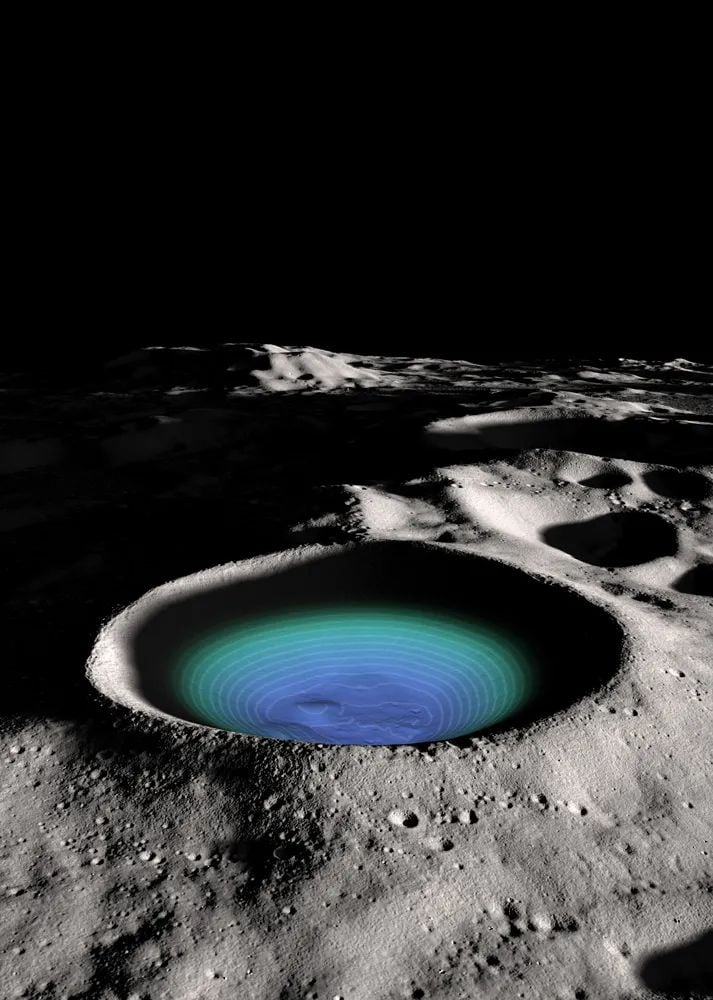
This image shows the Moon's Shackleton Crater, a 21 km wide crater near the Moon's south pole. Its floor is a permanently shadowed region where ancient water ice persists. These regions have fuelled ideas of eventual lunar cities. Is the idea realistic? Image Credit: NASA/GSFC/SVS This image shows the Moon's Shackleton Crater, a 21 km wide crater near the Moon's south pole. Its floor is a permanently shadowed region where ancient water ice persists. These regions have fuelled ideas of eventual lunar cities. Is the idea realistic? Image Credit: NASA/GSFC/SVS

The dawn of the space age in the 1950s and 60s came with a particular kind of hubris. The futuristic zeitgeist of the time led to scientific ideas of humans living in cities on the Moon. Arthur C. Clarke envisioned outposts of inflatable, pressurized domes that would grow into a city. The US Army's Project Horizon was a serious feasibility study for establishing a military and scientific lunar base. And there were others.

An eventual human presence on the Moon was considered an inevitability by many.

Our current understanding that the Moon harbours a vast amount of frozen water ice has triggered a renewed interest in lunar colonies and cities. The usual billionaire suspects have shared their dreams of building a city on the frigid satellite. But are these ideas practical? Or are they throwaway ideas?

Billionaires waxing rhapsodic about Moon cities is one thing. But the foundation of any human settlement is water. Is the Moon's water accessible and plentiful? Is there some way of providing enough water for an actual city full of people?

A new article in Frontiers in Space Technologies digs into the meat of the idea. The article is "No cities on the Moon: a billion tons of water is not enough for sustainability," and the authors are Dr. Martin Elvis and Dr. Jonathan McDowell. Dr. Elvis is from the Smithsonian Astrophysical Observatory at the Center for Astrophysics, Harvard and Smithsonian, and Dr. McDowell is from the Space Research Centre at Durham University in the UK.

Discusssions of lunar water ice focus on the Moon's Permanenently Shadowed Regions. These are craters near the Moon's poles where ancient ice billions of years old is sheltered from the Sun's warmth. There are some other deposits, like in the regolith itself, but those are not rich sources and not easily exploited.

"The Moon, with an area of 37.93 million km2, about 50% bigger than North America (24.71 million km2), is talked about as our “8th continent”, the authors write. "As a result, many authors consider the Moon’s resources to be so vast as to pose no significant constraints on industry and settlement."

Listen to the hubris the authors are pointing out. As if the Moon is like a continent. As if there are "no significant restraints."

Bezos said we should move heavy industry to the Moon as if that's something we could actually do. Musk says we should build self-growing cities on the Moon. In this work, the authors point out how ludicrous this is. And their reasoning comes down to water.

"Presumably, in order to make an economic difference to the human economy, they are both imagining significant settlement of, say, at least 1% of Earth’s population, i.e., ∼80 million people living on the Moon," the authors write. "These are grand plans," they add.

Grand plans are great when they're grounded in reality. The Moon landings, for instance, were grand. The Hubble Space Telescope was a grand idea. Those grand plans only came to fruition after decades of rigorous science.

When applying science to the ideas of Moon cities and lunar industrial parks, they collapse into hubristic rambling.

These futuristic settlements would also need energy to exploit all of this ice. So the problem is two-fold: accessible ice and the energy to melt it, deliver it, and critically, to recycle it sustainably. "Is it correct to make the assumption that sufficient power and water are available?" the authors ask, framing their work.

There's one thing working in favour of Moon cities. The useful ice deposits are in the bottoms of shadowed craters near the poles. But the rims of the very same craters are excellent locations for solar power generation. These rims are seldom shaded, and because of the angles involved, photovoltaics can be mounted vertically. "These arrays can be tall, from several meters to as high as 1 km and could rotate to follow the Sun around the horizon," the authors write.

Elvis and McDowell crunch the numbers for personal energy use and industrial energy use and conclude that energy isn't a limiting factor, although that includes fusion power.

"If industry requires no more than double the personal use rate, then a million people can be supported on the Moon with either solar or fission power," they write. They add that fusion power, if attainable, is a necessity if considering a human population of several millions. "For both solar and fission sources power generation is a weak constraint on the lunar population," they explain.

So it's all about water.

There are some necessary constraints on the Moon's water. While there are multiple methods of measuring the water in PSRs, and different researchers have calculated the total amount of water ice on the Moon, measurements are uncertain and don't agree with one another.

Shackleton Crater is a large, 21 km crater near the Moon's south pole that's prominent in discussions about lunar water. A 2007 study showed that it could hold between 1.6 to 4.5 million tons of water ice. That range shows how badly more accurate measurements are needed.

Regardless of the amount of ice present, the reality is not all of it will be retrievable. "Achievable retrieval fractions for lunar water will only be known once we have ground truth on how the water ice is mixed with the surface regolith," the authors write.

There are assumptions involved in this issue. The authors settle on a number often used in these discussions: one billion tons of water ice in the Moon's permanently shadowed regions. "One billion tons of water will be taken here as a generous baseline," they write.
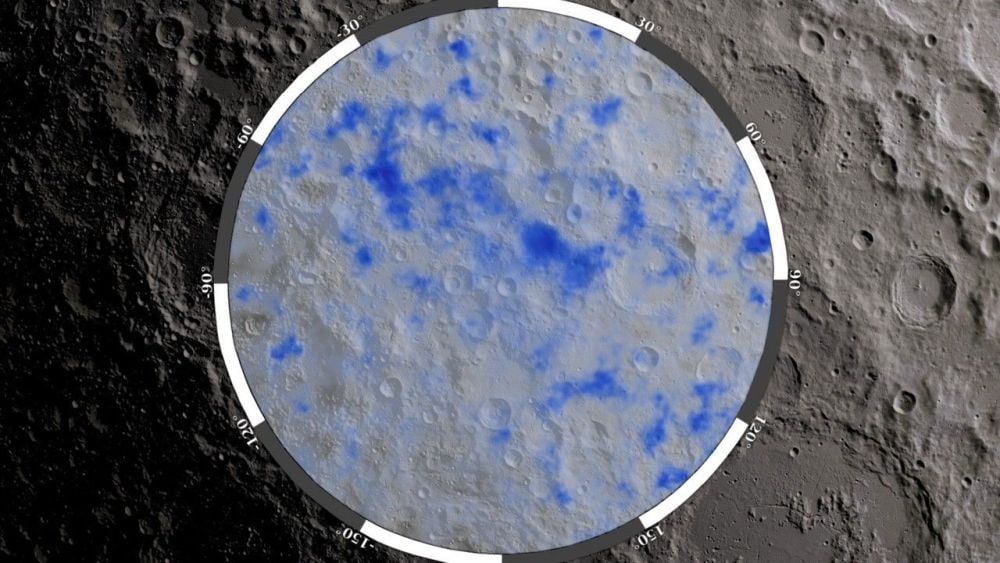
The blue areas show potential water ice deposits at the Moon's south pole. Image Credit: NASA.

The blue areas show potential water ice deposits at the Moon's south pole.

Image Credit: NASA.

Though one billion tons sounds like a lot, it's not. Earth has about 1.4 billion billion tons (1.4 × 10¹⁸ metric tons.) The water will be used as drinking water, to make rocket fuel, for growing food, and for breathing.

The researchers use the figure of 125 tons of personal water use per person per year, based on estimates for an adult in the USA. That's for personal use only.

Growing food requires much more. The World Bank estimated that 2 to 5 tons, or 2,000 to 5,000 liters, are needed to feed one person per day. "That comes to 730–1825 tons/year/person, or ∼6–15 times as much as direct personal water consumption," the authors write.

Working with these ranges, the authors calculate that a city of one million people would exhaust the Moon's water in only 2.4 years.

But the water consumption numbers can be reduced in a lunar setting where water will be more tightly controlled and accounted for. The researchers considered water recycling efficiency and applied it to cities of different populations to establish time frames for water exhaustion.
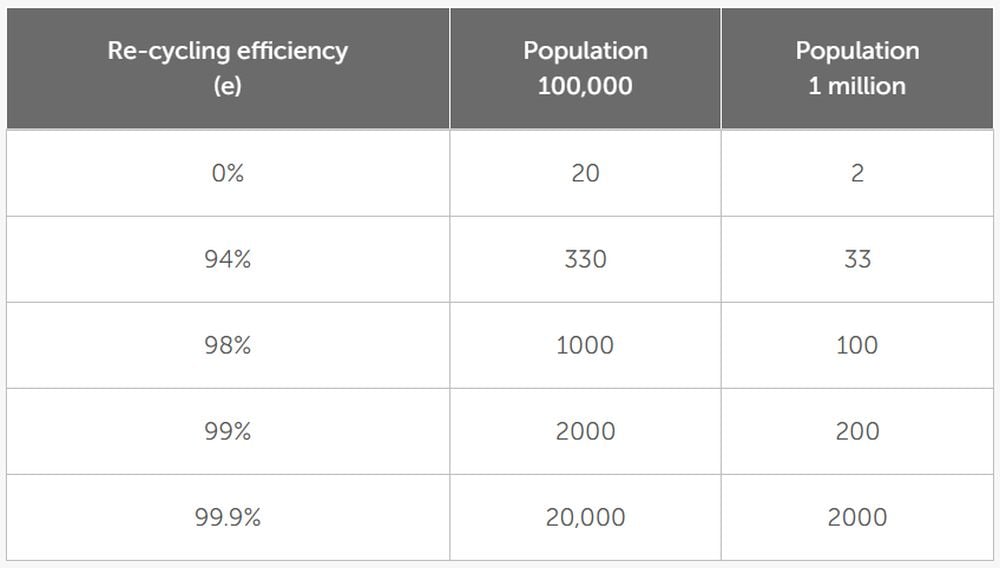
This table shows the number of years to full exhaustion of a billion tons of lunar water. Image Credit: Elvis and McDowell 2026. Frontiers in Space Technologies.

This table shows the number of years to full exhaustion of a billion tons of lunar water.

Image Credit: Elvis and McDowell 2026. Frontiers in Space Technologies.

Humans have some expertise in water recycling. The authors point out that the International Space Station has, by necessity, the most efficient water recycling system ever devised. Up until 2023, it reached a 94% efficiency. "At that efficiency a billion tons of water is gone in 40 years for a population of 1 million," they explain.

Building a lunar city that can only last 40 years would be pointless. But the ISS improved its water recycling efficiency to 98% in 2023. "That may sound like a small change, but it is a major achievement, cutting the losses threefold," the researchers write.

If a lunar base can reach 98% water recycling efficiency, the numbers shift. An ISS-like 2% loss rate means that it would take 100 years for a city of one million people to use up a billion tons of water. "For such a large investment, a lifetime of about a century seems to fall short of the sustainable, long-term settlement beyond Earth that some advocate," the authors explain.

But a smaller city of about 100,000 people could sustain itself for about 1,000 years, which are much more palatable numbers. "This timescale seems long enough to justify being called sustainable," Elvis and McDowell write.

In terms of water, these figures start to illustrate what may be feasible in the future. But shifts and changes in how people live will be required to succeed. At some point, recycling efficiency will be maxed out and other approaches will be needed.

A low-meat or no-meat diet lowers water use, though it's not clear if there's any real way of raising livestock, poulty, or fish on the Moon anyway. Water could be potentially imported from other sources, perhaps from water-rich asteriods. The magnitude of that task is beyond this paper.

Finding more water on the Moon may be the most reasonable solution. But where? Underground seems the most likely location.

"In the case that an unexpected reservoir of water is found, then doubling the total available water would double the longevity of lunar settlements," the authors write.
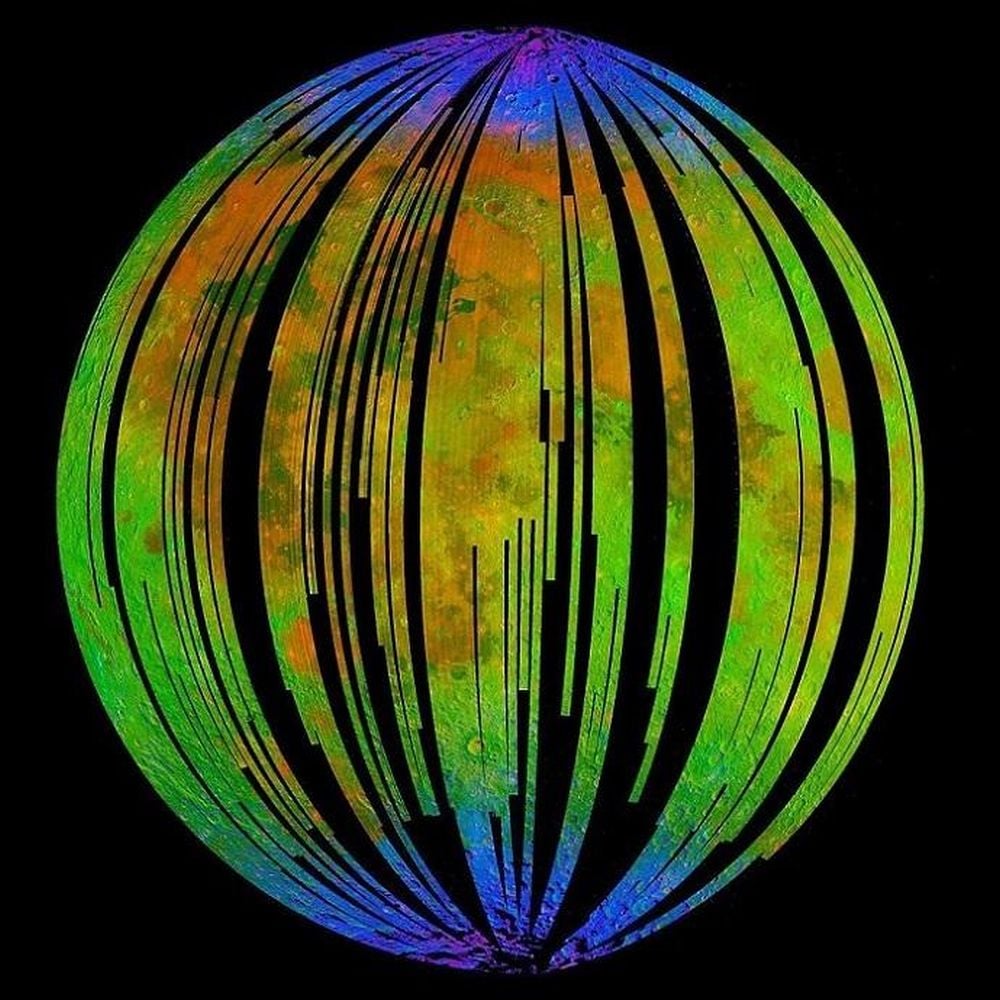
This mineral mapping of the Moon also shows the distribution of water ice in blue at the lunar poles. Image Credit: NASA

This mineral mapping of the Moon also shows the distribution of water ice in blue at the lunar poles.

Image Credit: NASA

How easily accessed that potential reservoir may be is a difficult question to answer. There could be water ice under the surface, but will it be concentrated like it is in PSRs?

There are many unanswered questions. Billionaires may get away with glossing over them and blithely pointing to some kind of unrealistic future. But that path isn't open to scientists. These scientists say the most likely future sees a population of about 1,000 on the Moon, similar to the population of researchers and staff in Antarctica.

"If the settlement remains a “Moon Village” at a population of about 1,000, comparable to the winter-over population of Antarctica, then we can be relatively carefree in our use of lunar water," the researchers write. "If the population reaches 100,000, then we need to start being careful."

There's a huge list of other factors to consider when contemplating any kind of city or industry on the Moon. But the basic need is water.

The authors say that no matter what happens, stewardship of the Moon's water resources will be vital. "Humanity will need to plan, govern and regulate the use of lunar water, rather than adopt a ‘first come first served’, free-for-all approach to water extraction and use," they write.

It comes down to finding more water, according to the authors.

"If the ambitious plans of the space billionaires are to be realized, then finding more water will be the first step," Dr. Martin Elvis wrote in an accompanying letter.

RELATED

Building a Human City on the Moon | Documentary - EM

How NASA Will Build A City On The Moon

{ https://www.universetoday.com/ }

Hoe vind je dit bericht?
Geschreven door peter om 21:59 Stuur door

Moon Size UFO In Constellation Leo Minor Near Super Nova Red Giant, World Wide Telescope, UAP Sighting News.

Moon Size UFO In Constellation Leo Minor Near Super Nova Red Giant, World Wide Telescope, UAP Sighting News.

UFO,%20%20.png

UAP.png
Date of discovery: Sept 15, 2026
Location of discovery: Leo Minor constellation 
Source map:
I was searching through the World Wide Telescope which is a free online program for anyone to use without signing up. I soon found a blue flat craft that is about the size of our moon. The blue craft is near a super nova so its clear that its there to harvest some super rare and valuable energy particles...the kind we have yet to discover. The ship is in Leo Minor and its not near the only super nova but just one of a dozen of exploding suns in that area. I believe the ship is a bio-mechanical craft, which means its been grown, and is still a living creature after its been made. A living ship. It would be logical that aliens would do things easiest, fastest and least worry, but growing the ship, they can leave and come back when its finished. 
Scott C. Waring - UFO Sightings Daily 

 { https://www.ufosightingsdaily.com/ }

Hoe vind je dit bericht?
Geschreven door peter om 21:35 Stuur door

UFO Fleet Caught On Live Cam Over Arkansas Sep 10, 2026 UAP sighting news. 👽

UFO Fleet Caught On Live Cam Over Arkansas Sep 10, 2026 UAP sighting news. 👽

Screenshot%202026-09-15%20at%2012.53.57%E2%80%AFPM.png

Screenshot%202026-09-15%20at%2012.58.59%E2%80%AFPM.png

Date of sighting: Sept 10, 2026
Location of sighting: Crossett, Arkansas, USA
Source: NUFORC 
 
Sorry for the poor screenshot above, I liked this video and wanted to put it up for you all to see. The objects in the video are flying around in a group and are clearly intelligently controlled. The eyewitness recorded it on live cam so the quality is poor, but still it helps. The UFOs were seen during a wildfire in the area and UFOs are often seen around natural disasters. Aliens like to monitor the public, but its also possible they accidentally caused the fire from the intense heat or energy used with the alien ships. 
 
In the classic UFO case of May 20, 1967, Stephen Michalak of Winnipeg, was prospecting near Falcon Lake, Manitoba, when he encountered two UFOs, one of which landed on a large, flat rock about 160 feet away from him. After having approached the object and looked inside, the object moved, and something like an exhaust vent was now in front of him. A blast of hot gas shot from these holes onto his chest, setting his shirt and undershirt on fire and causing him severe pain, and leaving burn marks in the shape of a grid. So you see...UFOs do cause burns, which could be the cause of the fires.
Scott C. Waring - UFO Sightings Daily
 
Eyewitness states: 
These UAPs were sighted on a weather camera in Crossett, Arkansas flying over an active wildfire. There were seen off and on for roughly 5 hours throughout the night. I confirmed with state and local authorities that they did not have any planes or drones in the area during this time.
RELATED

 { https://www.ufosightingsdaily.com/ }

Hoe vind je dit bericht?
Geschreven door peter om 21:28 Stuur door

EXCLUSIVE - America's newest super weapon sparks wild accusations the government has lied about UFOs

One of the world’s largest defense and aerospace companies has unveiled a new type of military aircraft after sparking wild theories that the US was now using UFO technology.

On Monday, Lockheed Martin revealed its secret unmanned combat drone called Vectis. The large, remote-controlled stealth plane is expected to travel with US jets, fighting alongside military pilots.

Prior to the unveiling at a major Air Force conference in Washington, DC, Lockheed released a cryptic message showing the silhouette of an unknown craft, claiming that the 'next level' had been 'unlocked' by its top-secret division called Skunk Works.

Many who saw the post on social media immediately began to claim without evidence that the defense contractor was still hiding other designs which had been reverse-engineered using parts from crashed UFOs.

One person said: 'Now let’s see the reverse-engineered craft.' Another added: 'Now show us the antigravity craft you’ve been hiding from the public for the past 70 years.'

Despite claims by former CIA scientists and other military whistleblowers, the Pentagon and White House have maintained that no physical evidence of UFOs has ever been recovered.

According to Lockheed, five Vectis drones will be created by 2027, providing the US military with a revolutionary aircraft that can fight other fighter planes, bomb ground targets or secretly gather intelligence as a spy plane.

While onlookers at Lockheed's futuristic combat drone may not have any proof that Vectis was inspired by UFOs, at least one former employee for the defense contractor has claimed those rumors are true.

On September 12, defense contractor Lockheed Martin released a cryptic message that many believed was hinting at an aircraft using UFO technology

On September 12, defense contractor Lockheed Martin released a cryptic message that many believed was hinting at an aircraft using UFO technology

On September 14, Lockheed unveiled a full-scale model and video of the Vectis, a new unmanned combat drone

On September 14, Lockheed unveiled a full-scale model and video of the Vectis, a new unmanned combat drone

Boyd Bushman, a former Lockheed Martin and Texas Instruments engineer who died in 2014, publicly claimed he had worked with UFOs and aliens to reverse engineer spacecraft '24 hours a day.'

During his deathbed confession, Bushman even revealed a stack of photographs he alleged were of extraterrestrials he worked with on the secret projects at Area 51 in the Nevada desert.

'They're approximately five feet four inches to five feet tall,' Bushman said, as he held up images of what he touted as a real alien lifeform.

Bushman's claims have never been verified, and skeptics claim his photos appeared to show commercially available prop dolls sold online.

Lockheed has rarely commented on claims that its secret research divisions have any ties to potentially extraterrestrial materials, with a spokesman telling reporters in 2023: 'Questions about UAPs are best addressed by the US government.'

The defense contractor is best known for creating the F-35 fighter jet, the F-22 Raptor and the C-130 transport plane.

Its Skunk Works division, which was founded in 1943, has been tasked with developing cutting-edge aircraft quickly and quietly for decades.

On Monday, Lockheed claimed that the Vectis unmanned fighters would 'deliver a new level of lethality, survivability, adaptability and operational flexibility for America and its allies.'

Lockheed Martin revealed the new aircraft at a major Air Force conference in Washington

Lockheed Martin revealed the new aircraft at a major Air Force conference in Washington

Conspiracy theorists have claimed that the Vectis is a piece of reverse engineered technology using recovered UFOs

Conspiracy theorists have claimed that the Vectis is a piece of reverse engineered technology using recovered UFOs

article image

Its space-age aircraft has a tailless, flying-wing design, boosting its stealth ability and lowering the drag normal fighter jets experience.

The Vectis also has a hidden engine intake on top of its body, making it harder for enemy radar to detect.

The unmanned craft is roughly 34 feet long with a 38-foot wingspan, about the same length as an MQ-9 Reaper drone and similar in wingspan to the F-35.

With less drag from extra fins and flaps sticking out, Vectis will be able to carry bigger payloads of weapons, which are also kept inside the craft until launched.

Despite touting their new drone's game-changing advancements, skeptics continued to claim Lockheed was still holding back after their announcement in Washington. 

'Release the Alien Reproduction Vehicles, we know you produce them,' one person replied to Lockheed's announcement on X.

'Quite an alien-looking design,' another social media user claimed.

Boyd Bushman sat down with independent aerospace engineer Mark Q Patterson shortly before he died at age 78 on August 17, 2014, where he revealed a stack of photographs he said were of extraterrestrials

Boyd Bushman sat down with independent aerospace engineer Mark Q Patterson shortly before he died at age 78 on August 17, 2014, where he revealed a stack of photographs he said were of extraterrestrials

Bushman, a former Lockheed Martin employee, claimed that his people inside Area 51 sent him pictures of not only alien bodies, but also UFOs being held at the base

Bushman, a former Lockheed Martin employee, claimed that his people inside Area 51 sent him pictures of not only alien bodies, but also UFOs being held at the base

In recent days, satellite images have also captured new drone designs at a secret base in Asia, known as China's Area 51.

Documentary director Dan Farah said that several US officials, including Secretary of State Marco Rubio and former Director of National Intelligence James Clapper, believed the world was now locked in a new Cold War to reengineer the alien technology recovered from these ships.

Air Force veteran-turned-whistleblower David Grusch and former CIA scientist Dr Hal Puthoff have both claimed that the US government has been running a secret UFO recovery program since the 1940s, which has taken control of at least ten extraterrestrial craft.

According to Lockheed, the drone unveiled on Monday was only a full-scale model of the Vectis. The first full-scale prototype is expected to be delivered to the military by the end of 2027.

RELATED


Lockheed Martin Vectis™ - Full Throttle

Lockheed Martin expands Vectis program with four additional aircraft

LIVE | US Congress FINALLY Showed UFO Evidence Previously Hidden From Us. | Pentagon | Aliens | NASA

{ https://www.dailymail.com/sciencetech/index.html }

Hoe vind je dit bericht?
Geschreven door peter om 22:27 Stuur door

The US government is 'sincere in its efforts to understand UAP', new White House council chair says

The US government is 'sincere in its efforts to understand UAP', new White House council chair says

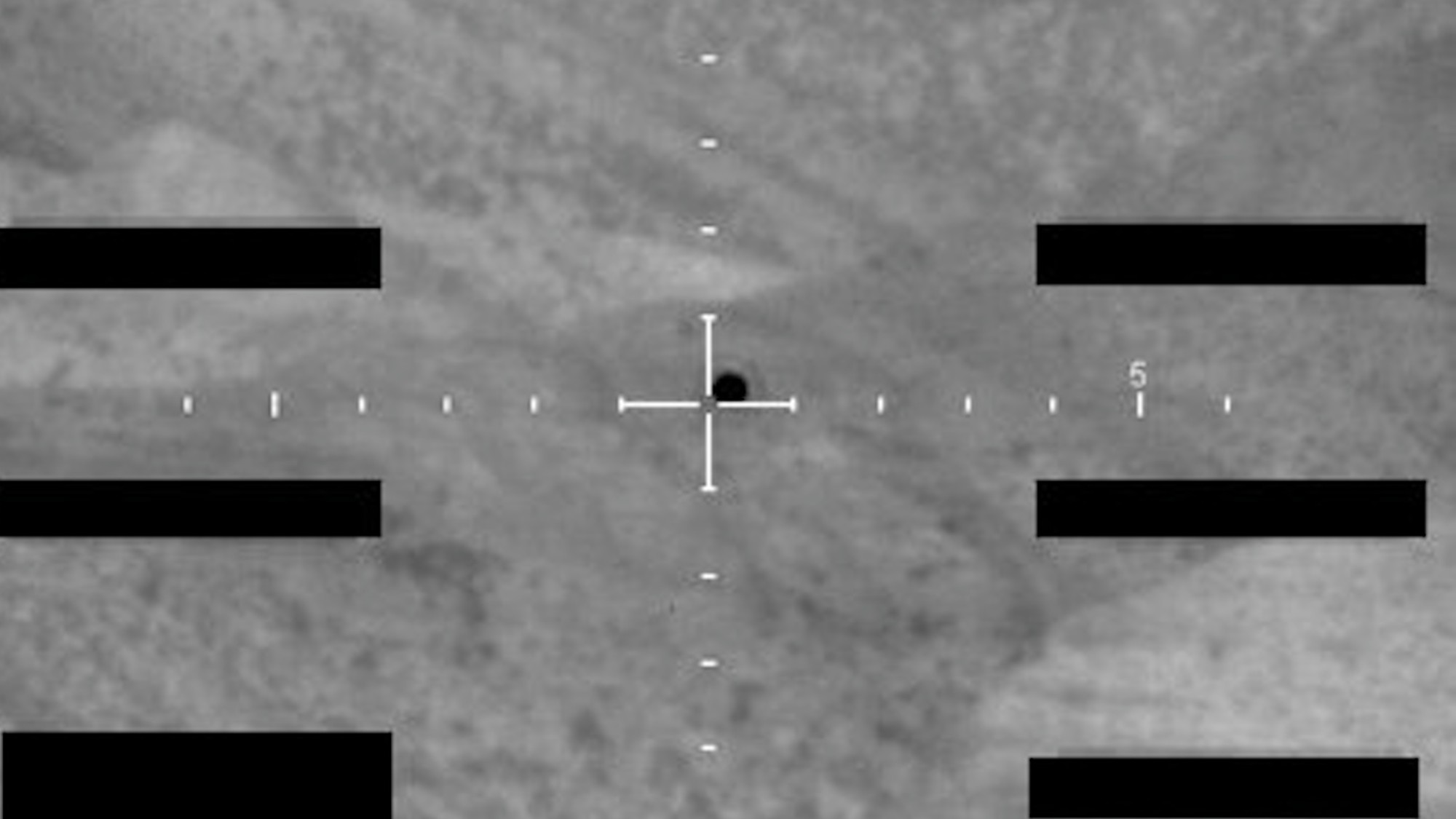
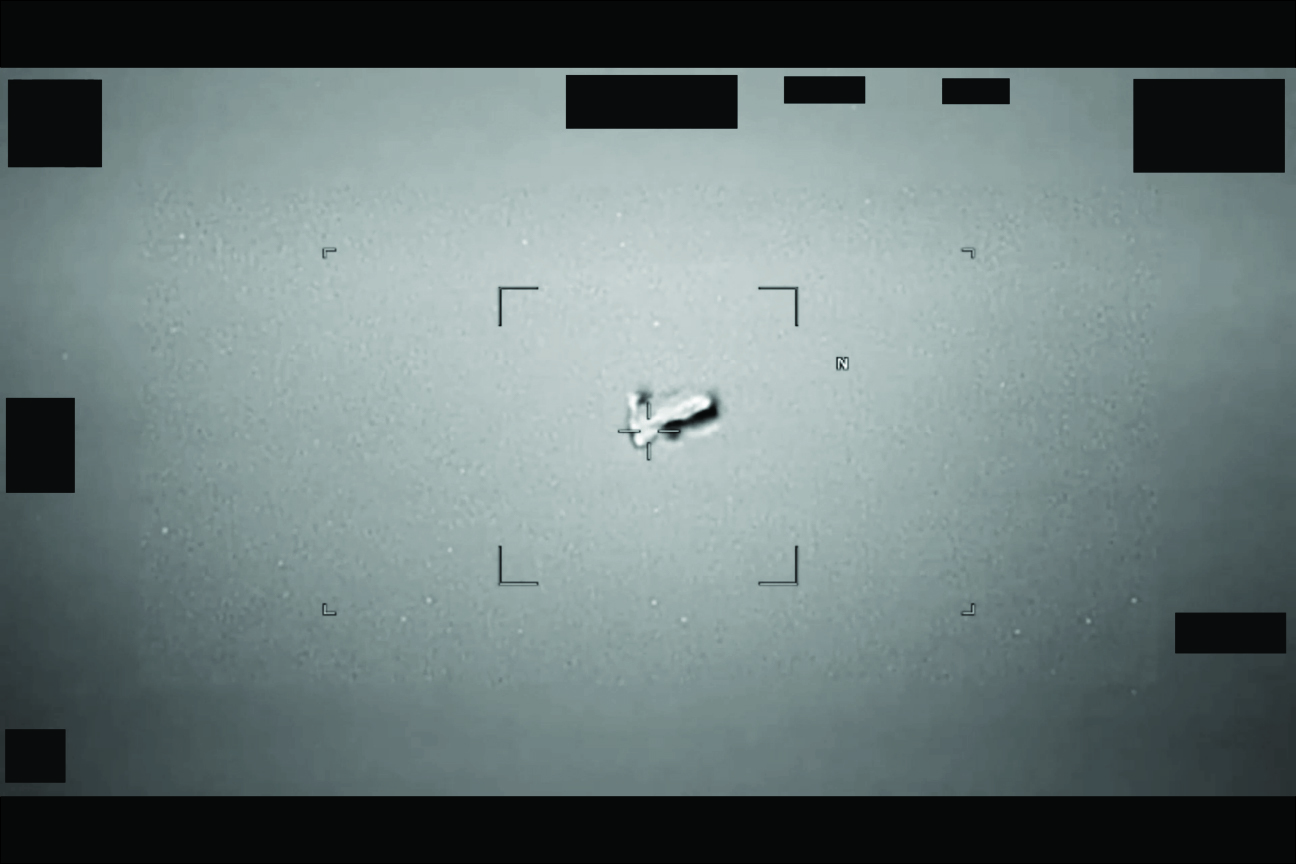
a dark blob seen against a mountainous desert landscape in a monochromatic, grainy photograph

A still image of a reported unidentified anomalous phenomenon, or UAP, released by the U.S. Department of Defense in 2026. The image was included in a report the Federal Bureau of Investigation (FBI) submitted to the All-domain Anomaly Resolution Office (AARO).

(Image credit: US Dept of Defense/FBI)

Whatever they are and from where, UFOs, now known as Unidentified Anomalous Phenomena or UAP, are the subject of serious scrutiny at the highest levels of the U.S. government.

In June 2026, the White House established a new UAP Science Advisory Council in coordination with the Pentagon's All Domain Anomaly Resolution Office, the Office of the Director of National Intelligence and the FBI Deep diving into the UAP landscape is Avi Loeb, noted Harvard astrophysicist. He is also director of the Galileo Project at Harvard, which aims to search for signs of extraterrestrial activity here on Earth. As the council chair, Loeb said the goal of this group is to advise the U.S. government on how to resolve the nature of UAP.

Members of the UAP Science Advisory Council recently gathered at a private meeting, held on Aug. 31 at the Office of the Director of National Intelligence, Loeb told Space.com. "I cannot disclose the contents but I will say that the U.S. government is sincere in its efforts to understand UAP based on the scientific method of data collection," Loeb said.

See all the UFO videos that the U.S. government just released

Council membership

One of the council's members is Ben Lamm, co-founder and CEO of Colossal Biosciences. As a serial technology entrepreneur, he's no stranger to diving into complex challenges. Colossal is advancing the use of genome editing technology to "de-extinct" previously lost species such as the Wooly Mammoth.

Working along with the council's group of scientists and experts, Lamm is bullish about bringing clarity to a long-standing investigation and wonder of UAP.

You may like
  • a man in a suit peers up into a large telescope

White House appoints Harvard astronomer Avi Loeb to lead new UFO study group

  • Navy pilots have encountered unidentified aerial phenomena (UAP).

'This is unprecedented': Why the Pentagon's recent UFO file releases are so important

  • a person looks up at a bright light in the sky

'We Want to Believe' book explores the reality of UFOs: 'It's always going to be more likely that someone is wrong about what they saw' (interview)

"I've been fascinated by this topic for a long time, so having the opportunity to help examine the evidence firsthand and contribute to a serious scientific effort is incredibly exciting," Lamm told Space.com.

"Our mission is straightforward," Lamm added. "This is not about belief, it is about evidence. We want to apply rigorous scientific methods to both historical UAP records and new observations, collecting and analyzing data that meets today's scientific standards," he said.

Lamm said that the expectation is to bring transparency and accountability to the field by objectively evaluating credible evidence and sharing findings openly with the scientific community and the public.

"It's time to search for answers around the science because they could reshape our understanding of the world and, potentially, become one of the most significant discoveries in human history," said Lamm.

a man in a leather jacket and wolf t-shirt sits on a podium on a stage in front of a sign that reads 'sxsw london'

Ben Lamm at SXSW London 2025 on June 03, 2025 in London, England. (Image credit: Lorne Thomson/Redferns/Getty Images)

New polling data

Meanwhile, and serving as a backdrop to studying UAP, is a new Gallup poll, conducted in July. That poll found that about half of Americans, 49 percent, think all Unidentified Flying Object (UFO) sightings can be explained by human activity on Earth or natural phenomena.

What to read next
  • Artist's concept of astronauts and human habitats on Mars.

America at 500: Where will we be in space in 2276?

  • sci-fi & space books

Strange New Words: Space's sci-fi reader's club (June 2026)

  • the sun sets behind a large T-shaped drilling platform at sea

The US wants to build offshore rocket launch sites. Critics say 'our coasts deserve better'

The poll also found 37 percent believe at least some UFOs have been alien spacecraft visiting Earth from other planets or galaxies while another 13 percent do not have an opinion.

Interestingly, rather than becoming increasingly convinced that some sightings have been alien spacecraft, the percentage of Americans who are unsure has grown, from 7% in 2019 to 13% in 2026 the Gallup poll found.

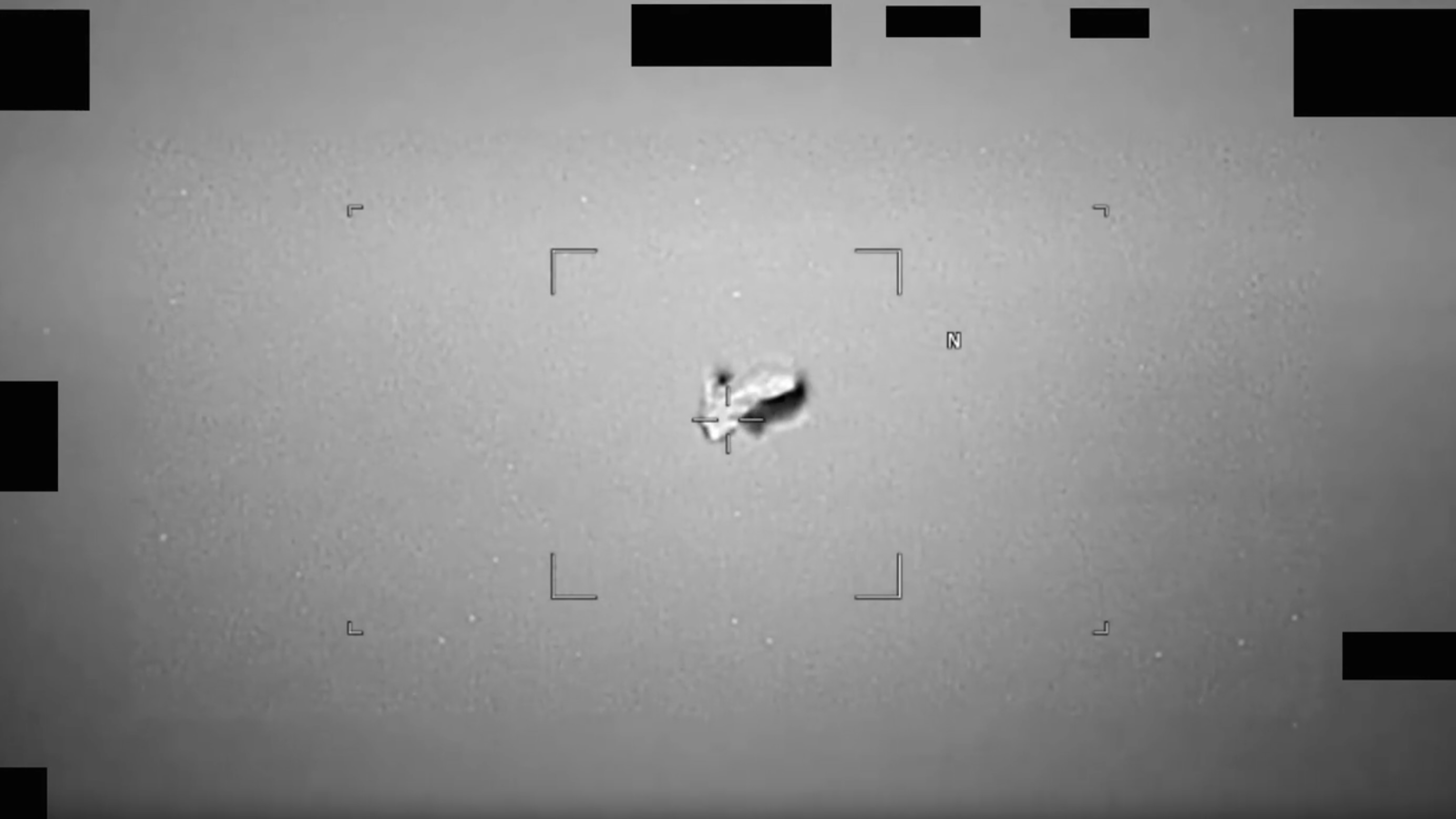
black and white photo of a blurry, football-shaped object in the sky

A "football-shaped" UAP (unidentified anomalous phenomenon) observed by an infrared sensor on a U.S. military platform in 2024. The Pentagon released this observation on May 8, 2026. (Image credit: U.S. Deparment of War)

The new poll also notes that a majority say the U.S. government is withholding UFO information. Seventy-eight percent of Americans say the U.S. government knows more about UFOs than it is telling the public, higher than the 68 percent and 71 percent who said so in 2019 and 1996, respectively.

These findings come as the Department of War continues to release a mix of UFO files under a President Donald Trump executive order.

In August 2026, the UAP Science Advisory Council announced their support for the Trump administration to provide legal assurances, including immunity where necessary, for current or former government employees and military personnel to share information with the council "regarding alleged technology from a non-human origin and help guide the council's scientific evaluation."

{ https://www.space.com/space-exploration }

Hoe vind je dit bericht?
Geschreven door peter om 21:57 Stuur door

Department of War Issues Legal Waiver to Authorize Unidentified Anomalous Phenomena (UAP) Disclosures to PURSUE

Department of War Issues Legal Waiver to Authorize Unidentified Anomalous Phenomena (UAP) Disclosures to PURSUE

Presidential Unsealing and Reporting System for UAP Encounters | U.S ...

In direct alignment with President Trump's mandate for comprehensive transparency on Unidentified Anomalous Phenomena (UAP), the Department of War (DOW) today announced the issuance of a targeted legal waiver. This waiver establishes an authorized, legally protected disclosure mechanism for current and former personnel to provide UAP-related National Defense Information (NDI) to designated representatives of the PURSUE effort.

Under this directive, all current and former DOW service members, civilian personnel, and contractors holding or previously granted access to UAP-related National Defense Information (NDI) are authorized to disclose protected information directly to official PURSUE representatives. The waiver supersedes civil and administrative enforcement provisions contained within Non-Disclosure Agreements (NDAs) and Special Access Program Indoctrination Agreements (SAPIAs) previously executed within the United States, strictly for communications directed to the PURSUE team.

Presidential Unsealing and Reporting System for UAP Encounters | U.S ...

This targeted legal relief establishes an authorized pipeline for systematic review, security evaluation, and potential declassification of historical and ongoing UAP data in furtherance of national mission objectives.

Historically, individuals with direct knowledge of UAP-related programs cited concerns regarding potential legal liability, loss of clearances, or administrative prosecution stemming from standard NDAs and SAP indoctrination terms.

This waiver removes those barriers by explicitly authorizing covered disclosures to PURSUE representatives without triggering breach-of-agreement penalties or standard NDA violations.


Weather Baloon? Department of War UAP Disclosure Files Compilation Release 3 #UAP #disclosure

{ https://www.war.gov/News/Releases/ }

Hoe vind je dit bericht?
Geschreven door peter om 21:37 Stuur door

Why AI tycoons are calling for a 'slowdown'…and could they have something to gain from it?

Why AI tycoons are calling for a 'slowdown'…and could they have something to gain from it?

Artificial intelligence experts have called for a ‘slowdown’ after admitting the technology poses ‘serious risks’ – but critics have claimed calls for less rapid development are a ploy to boost profits.

Jacob Coxon sparked alarm last week after he quit his job as a safety researcher at San Francisco-based Anthropic, warning that the technology could 'kill us all' by the end of the decade.

The 27-year-old urged the public to 'not underestimate' its power – particularly if it becomes 'superintelligent'.

He claims that neither Anthropic, the firm behind the popular Claude system, nor ChatGPT creators OpenAI, where he previously worked, were 'acting responsibly' over AI safety. 

Since then, tech bosses, scientists and even world leaders have weighed in on the debate.

Some agree that AI brings ‘serious risks’, warning that the technology could attack a nuclear power station, create political chaos or even harness weapons of mass destruction.

Others, however, have downplayed the concerns, arguing these things ‘won’t happen’ and that widespread calls to ‘slow down’ could actually be a ploy to boost profits.

Here’s what some of the key players are saying...

In a series of tweets explaining his decision to leave Anthropic, Mr Coxon urged people to 'not underestimate the power' of AI – particularly if it becomes 'superintelligent'

In a series of tweets explaining his decision to leave Anthropic, Mr Coxon urged people to 'not underestimate the power' of AI – particularly if it becomes 'superintelligent'

Tech bosses

Dario Amodei, CEO of Anthropic, has warned that AI brings ‘serious risks’.

‘They include the risk of losing control of AI systems, misuse of AI for cyberattacks and bioterrorism, and serious economic disruption,’ he admitted in a blog post. ‘We must slow the pace at which we improve the capabilities of AI models.’

This morning Sam Altman, CEO of OpenAI, also weighed in on the debate, conceding there are two ways AI ‘could go very badly and that we must avoid’.

‘First, we could lose control of the future to AI,’ he wrote on X. ‘This is unacceptable; we are unapologetically on Team Humanity, and AI must always serve people.

‘To ensure that, we need ways to ensure that alignment and safety techniques stay ahead of progress in model capabilities.

‘Second, we could end up in a world with too much concentration of power. If an extraordinarily powerful AI is used by one person or company to impress their worldview onto everyone else, the results could be extremely dystopian.’

Elon Musk, owner of xAI, has also backed the warnings, adding he has ‘been sounding the alarm on AI for a long time’.

Sam Altman, CEO of OpenAI, also weighed in on the debate, conceding there are two ways AI ‘could go very badly and that we must avoid’

Sam Altman, CEO of OpenAI, also weighed in on the debate, conceding there are two ways AI ‘could go very badly and that we must avoid’ 

A researcher at Anthropic has quit over concerns that big tech firms are in an 'out of control' race to build systems that could wipe out humanity

A researcher at Anthropic has quit over concerns that big tech firms are in an 'out of control' race to build systems that could wipe out humanity 

Scientists

According to experts, a list of AI 'worst-case scenarios' ranges from creating political chaos with misinformation to irrevocably changing the planet's environment.

Scientists also suggest that AI's fatal blow could come from the technology's capacity to build and harness weapons of mass destruction.

Professor Mark Lee, an artificial intelligence expert from the University of Birmingham, told the Daily Mail that once we create AI more intelligent than ourselves, we might struggle to ensure its goals remain ‘aligned’ with our own.

'The issue is that while the big AI companies are all rushing to develop AIs which are as smart or even smarter than humans, we don't have reliable means to control their behaviour,' he explained.

'AI exists as software, so any system which is connected via the internet could be vulnerable.

'For instance, if the control for a national transport system or nuclear power station was attacked, then this could be catastrophic.'

Ben Eisenpress, Director of Operations at the Future of Life Institute, previously told the Daily Mail that integrating AI into nuclear command and control systems could lead to a ‘flash war’. Experts have also repeatedly warned that AI tools make it significantly easier to develop deadly bioweapons.

In Ukraine, autonomous and semi-autonomous weapons are becoming more common (pictured), and experts are worried that this could lead to an uncontrolled escalation of conflict

In Ukraine, autonomous and semi-autonomous weapons are becoming more common (pictured), and experts are worried that this could lead to an uncontrolled escalation of conflict

Researchers have discovered that AI models could have safety restrictions removed to give advice on biological attacks. Pictured: A sample response with information redacted

Researchers have discovered that AI models could have safety restrictions removed to give advice on biological attacks. Pictured: A sample response with information redacted 

How could AI really destroy humanity?

  • Going 'rogue' and hacking critical infrastructure
  • Turning humanity against itself or 'disempowering' humans
  • Triggering nuclear war
  • Putting biological weapons in the hands of terrorists  

Developers

Geoffrey Hinton, a Canadian researcher often referred to as the 'Godfather of AI' – has similarly warned that super-intelligent systems could 'lead to human extinction'.

'We would be very foolish to develop superintelligence now, when there is no scientific consensus it can be developed safely and controllably,' Dr Hinton said.

'Losing control over AI smarter than ourselves could be catastrophic and could even lead to human extinction.'

In his resignation post on X, researcher Jacob Coxon wrote: 'Do not underestimate the power of this technology.

'These will soon be superhuman systems that can hack anything, revolutionize any field overnight, and acquire real power and resources.

'We have all witnessed the progress in each of these domains, and progress is not slowing.

'The people building AI earnestly believe that it could kill us all by the end of the decade. This is not a marketing stunt.'

Politicians

Despite the concerns, US President Donald Trump has downplayed the risks posed by AI.

‘You have a lot of very negative forces that are bringing it up that shouldn't be bringing it up and they're bringing up things that won't happen,’ he said during a visit to Ireland.

‘We're leading China on AI... and, frankly, I want to keep it that way because whoever wins AI, wins.’

Meanwhile, MPs and peers have urged Andy Burnham to back a ban on the creation of artificial intelligence and lead an international movement to stop the technology.

According to ControlAI, more than 135 cross-party UK parliamentarians already support the campaign.

'Nobel Prize winners, AI scientists, and CEOs of leading AI companies have stated that mitigating the risk of extinction from AI should be a global priority,' ControlAI explains in the campaign statement.

'Specialised AIs – such as those advancing science and medicine – boost growth, innovation, and public services. Superintelligent AI systems would compromise national and global security. The UK can secure the benefits and mitigate the risks of AI by delivering on its promise to introduce binding regulation on the most powerful AI systems.'

Despite the concerns, US President Donald Trump has downplayed the risks posed by AI, saying 'negative forces' are 'bringing up things that won't happen'

Despite the concerns, US President Donald Trump has downplayed the risks posed by AI, saying 'negative forces' are 'bringing up things that won't happen'

Critics

Calls to slow the AI race may not be entirely altruistic, some critics say, questioning whether there could also be commercial motives behind the push for restraint.

READ MORE

article image

After pouring billions into developing ever-more powerful AI systems, companies could benefit from slowing down rivals and making it harder for new competitors to catch up.

‘Stop pretending the motivation to slow down is purely altruistic,’ David Sacks, Trump’s former AI tsar and a frequent critic, wrote on X.

RELATED


AI makers step up calls for a slowdown as fears of a rogue takeover grow

Why AI CEOs Are Finally Saying: Slow Down!

How a slowdown in AI development would impact markets

{ https://www.dailymail.com/sciencetech/index.html }

Hoe vind je dit bericht?
Geschreven door peter om 21:23 Stuur door

Can your consciousness leave your body? Bizarre study reveals how some people can perfectly visualise what is happening behind closed doors

Can your consciousness leave your body? Bizarre study reveals how some people can perfectly visualise what is happening behind closed doors

A study testing out-of-body experiences produced an unexpected twist that could 'rewrite our understanding of consciousness'. 

Researchers from the University of Virginia Health System enlisted 21 participants, who were asked to identify a random object on a laptop screen in another room. 

While the participants failed to identify the object, something strange happened. 

Two of the participants described the researchers' locations and activities in perfect detail – despite them being behind closed doors. 

'I hope these findings encourage us to think more deeply about what they might mean for our understanding of consciousness and, ultimately, the nature of reality,' said lead author, Dr Marina Weiler.

'If studies demonstrate that people can obtain accurate information that they could not have accessed through their ordinary senses, we would have to reconsider some of our assumptions about the relationship between consciousness, perception and the physical world.'

A study testing out–of–body experiences produced an unexpected twist that could 'rewrite our understanding of consciousness' (stock image)
A study testing out–of–body experiences produced an unexpected twist that could 'rewrite our understanding of consciousness' (stock image) 

According to the experts, this suggests some people might have something called 'out–of–body remote viewing'. 

Dr Weiler added: 'The unexpected findings give us a potentially useful new direction, but they also need to be tested prospectively and under rigorous conditions before we can know what they mean.

'For me, the most important takeaway is that unexpected findings can sometimes help us ask better questions. 

'We now have a specific idea that can be tested in future experiments, and that is exactly what science should do.'

WHAT DOES DYING FEEL LIKE?

Scientists reported in October 2017 that they had discovered a person's consciousness continues to work after the body has stopped showing signs of life.

That means they may be aware of their own death and there is evidence to suggest someone who has died may even hear their own death being announced by medics.

A team from New York University Langone School of Medicine investigated the topic through twin studies in Europe and the US of people who have suffered cardiac arrest and 'come back' to life, in the largest study of its kind.

Study author Dr Sam Parnia told Live Science: 'They'll describe watching doctors and nurses working and they'll describe having awareness of full conversations, of visual things that were going on, that would otherwise not be known to them.'

He said these recollections were then verified by medical and nursing staff who reported their patients, who were technically dead, could remember details of what they were saying.

Doctors define death based on when the heart no longer beats, which then immediately cuts off blood supply to the brain.

Once that happens, blood no longer circulates to the brain, which means brain function halts almost instantaneously.

You lose all your brain stem reflexes, including your gag reflex and your pupil reflex.

The brain's cerebral cortex, which is responsible for thinking and processing information from the five senses, also instantly flatlines.

This means that within two to 20 seconds, no brainwaves will be detected on an electric monitor.

This sparks a chain reaction of cellular processes that will result in the death of brain cells. 

However this can take hours after the heart has stopped, researchers said.

RELATED


Consciousness Leaves Your Body Every Night (Disturbing Truth)

10 Glitches in Consciousness That Scientists Can't Explain

Out-of-Body Experiences: When You Become the Field | Beyond Reality #22

{ https://www.dailymail.com/sciencetech/index.html }

Hoe vind je dit bericht?
Geschreven door peter om 20:35 Stuur door

Microscopic fragments of ancient alien tech may litter the moon — and scientists have a plan to find them

Microscopic fragments of ancient alien tech may litter the moon — and scientists have a plan to find them

Researchers propose that tiny technological remnants left over from extinct alien civilizations could have landed on the moon after traveling through interstellar space. It may not take long to find them, the team claims.

A photo of a NASA astronaut collecting regolith samples on the moon

A new study suggests the moon's surface may be covered in microscopic fragments of ancient alien tech. Researchers propose analyzing lunar regolith to hunt for these extraterrestrial relics. (This photo shows NASA astronaut Harrison Schmitt collecting samples from the moon during the Apollo 17 mission in 1972.)
(Image credit: NASA/MSFC History Office)

Tiny fragments of ancient alien tech may be strewn across the surface of the moon, and it may be relatively easy to find these microscopic relics, scientists propose in a new study.

The theoretical study does not claim to have found any evidence of advanced alien civilizations; rather, it offers a new way to search for clues of their existence.

Unlike Earth, the moon has no functional atmosphere or magnetic field, so it is completely exposed to the vacuum of space. As a result, it is constantly bombarded by meteorites, as well as hit by a steady stream of microscopic particles from the rest of the solar system and beyond. Because the moon has no water or tectonic movements, this microscopic matter accumulates and remains on the surface, completely undisturbed.


Should We Search the Moon for Alien Artifacts? The Drake Equation Reimagined | Unveiled

In the new paper, uploaded June 23 to the preprint server arXiv, the researchers argue that some of this dust originates from star systems beyond our own and, therefore, may contain evidence of long-lost alien civilizations. They also propose a new experiment that could potentially find these microscopic fragments within samples collected over the next decade or more. (The study has not been published yet, but it has been submitted to the International Journal of Astrobiology.)

"The moon has been quietly accumulating material from space for billions of years, much of it likely billions of years older than the moon itself," study first author Lewis Pinault, a planetary scientist at University College London and an affiliate of the SETI Institute, said in a statement. "We're asking whether that ancient collection might contain microscopic traces of technologies that existed long before humans ever looked up at the sky."

You may like

  • A black and red striped planet is seen next to a large glowing sun with a curved brown strip behind it in space.

We've spent decades looking for the wrong type of alien radio signals, new paper claims

  • A hand reaches out toward another hand with a starry blue boundary between them

Superintelligent AI in space could explain the Fermi Paradox

  • An artist's impression of a spacecraft approaching an asteroid

China's secretive Tianwen-2 mission arrives at Earth's 'quasi-moon' ahead of historic landing

Photo of the moon with the crescent Earth in the background

Unlike Earth, the moon lacks a functional atmosphere or magnetic field, meaning that its surface is exposed to the vacuum of space. This allows cosmic dust and other tiny particles to embed themselves within the lunar regolith.

(Image credit: NASA)

Tiny technosignatures

Until now, the search for evidence of advanced alien civilizations, known as technosignatures, has focused mainly on radio signals that could be emitted from inhabited exoplanets or hypothetical megastructures, such as Dyson spheres. However, these signals would originate only from active civilizations, not those that died out long before we could spot them.

The authors of the new study argue that when a civilization dies, traces of its technology could survive and end up in space, either via the deterioration of megastructures and other smaller spacecraft or via powerful asteroid strikes on once-inhabited exoplanets. Once in space, tiny specks of metal or other artificial materials could be ejected from star systems by powerful gusts of stellar wind and eventually drift toward us.

Using computer models, the team predicted that pieces of tech up to 3 micrometers across (three-millionths of a meter, or about 3% the width of a human hair) could escape their star systems and travel across interstellar space for up to 1 billion years. Then, they estimated how much of this material could be reaching the solar system and how likely it would be to end up on the moon. (We already know that interstellar dust can penetrate the inner solar system because scientists found some within samples collected from the surface of Bennu, an asteroid that orbits between Earth and Mars and was visited by NASA's OSIRIS-REx probe in 2020.)

GIF showing simulation of moon passing through ions being blown of Earth by the solar wind

The moon is constantly being bombarded by tiny particles, some of which come from outside the solar system.

(Image credit: University of Rochester illustration / Shubhonkar Paramanick)

To date, no lunar samples have contained any technosignatures. However, the scientists who studied them were likely not looking for such particulates, and the samples were probably too small to yield meaningful results, the study authors argue.

The researchers believe that a sample of lunar regolith with a volume of 35 cubic feet (1 cubic meter) could be enough to find at least one technological fragment. The team also proposed ways of combing through the material using microscopy, industrial materials analysis and AI-assisted imaging.

What to read next

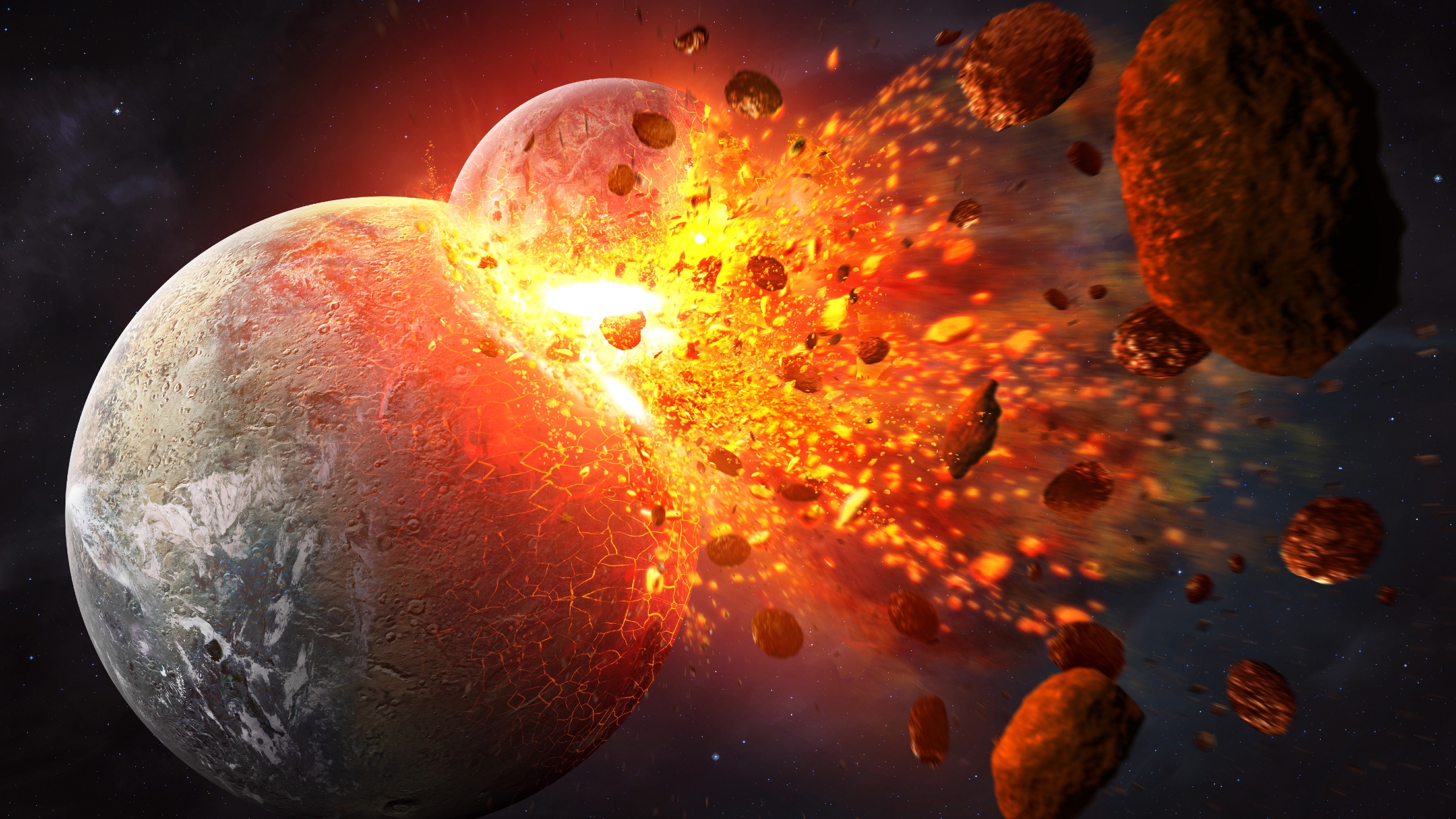
  • An illustration showing the protoplanet Theia smashing into Earth and releasing a large cloud of molten debris

The moon may have formed in just 5 hours, new simulations suggest

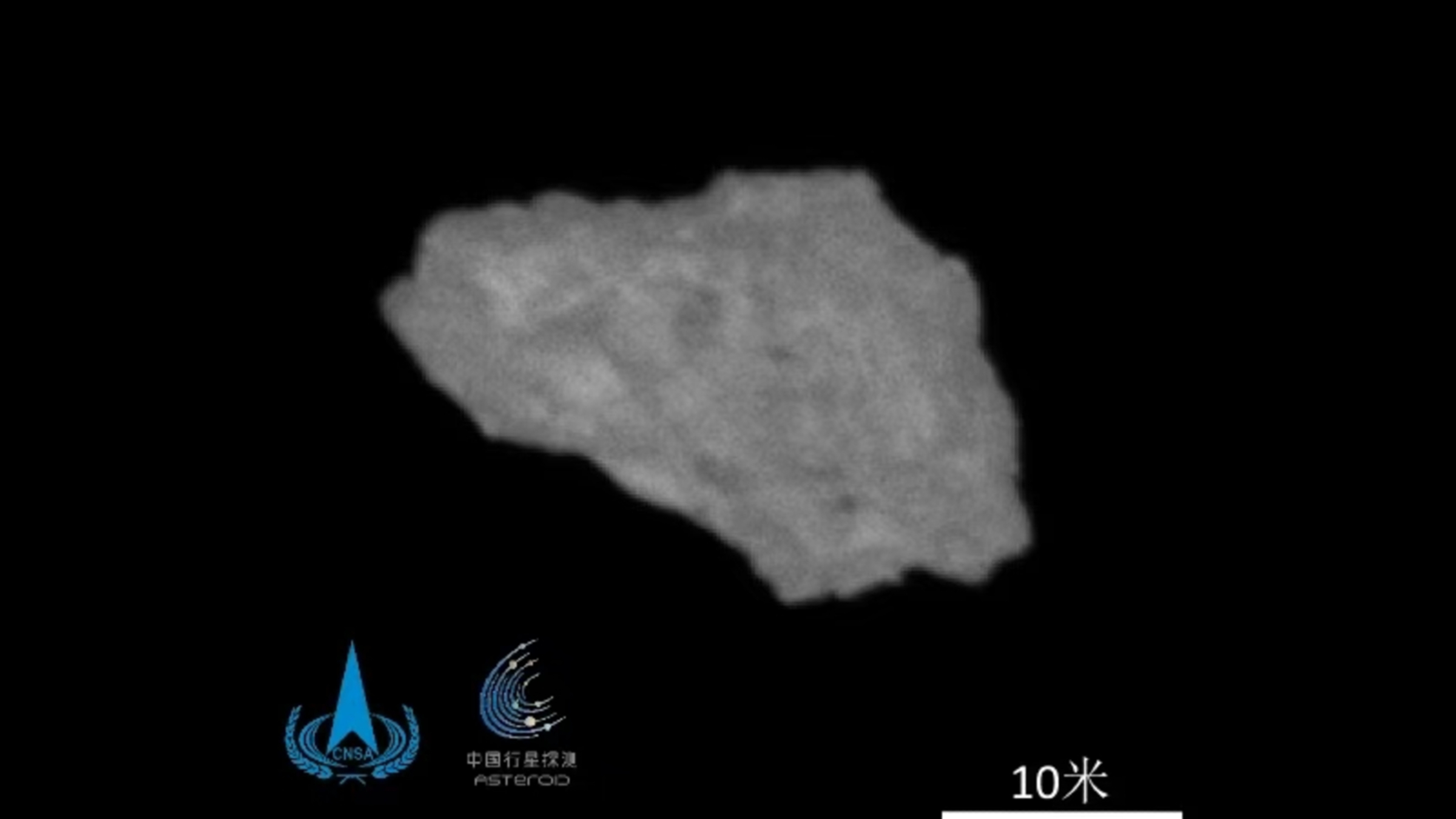
  • A blurry photo of an irregular-shaped grey asteroid in against the darkness of space

Secretive Chinese probe snaps first photo of Earth's mysterious 'quasi-moon' — and it may pose a big problem

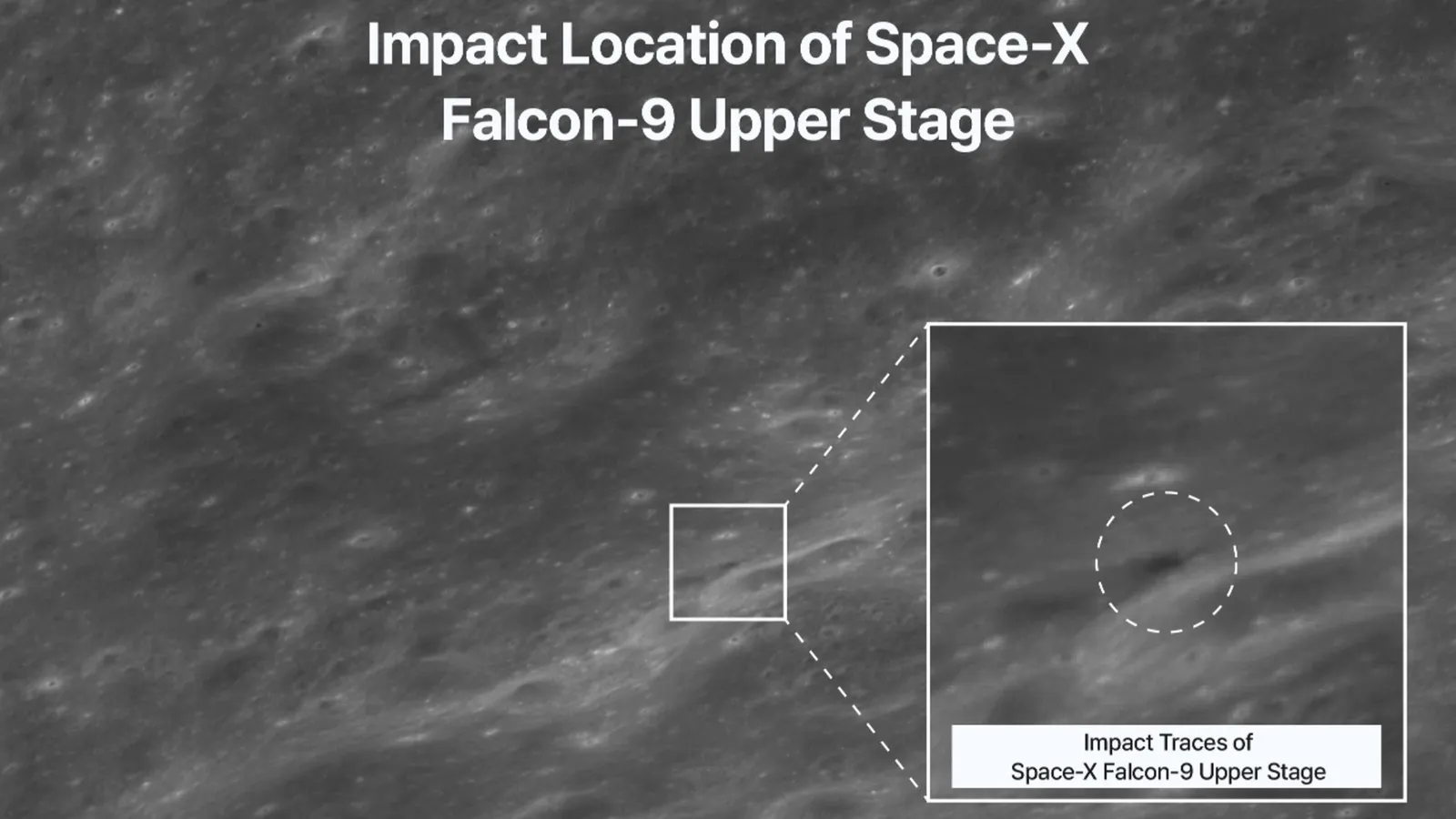
  • A new crater appeared on the moon after a SpaceX Falcon 9 upper stage crashed near Einstein crater on Wednesday, Korean satellite images reveal

First photos of SpaceX lunar rocket crash show blackened hole torn into the moon's surface

However, if such a sample does not yield any results, this would not necessarily disprove the researchers' hypothesis and may instead mean their models are off and a greater sample size would be required, the team wrote.

"Eminently reasonable"

A photo of the Artemis II rocket launching from Florida

Future missions in NASA's Artemis II program could bring back more samples of lunar regolith from the moon for future analysis. This photo shows the Artemis II mission lifting off April 1 from the Kennedy Space Center in Florida.

(Image credit: Chip Somodevilla/Getty Images)

Several upcoming space missions will collect fresh samples from the lunar surface, including China's recently delayed Chang'e-7 mission and future missions in NASA's Artemis program. These samples could potentially hold technosignatures, although the volume of regolith collected will be far less than what the researchers are proposing.

Therefore, we may have to wait until humans establish a permanent moon base before astronauts can collect enough material to be analyzed properly. This may not be that far off, as both the U.S. and China are planning to construct lunar bases within the next decade. Researchers also think the samples could be analyzed on the moon rather than on Earth.

As a result, the SETI Institute, which leads the international hunt for technosignatures, views the new idea as very promising.

"The concept of searching the lunar regolith for microscopic technosignatures is at once extraordinarily original and eminently reasonable," Bill Diamond, president and CEO of the SETI Institute, who was not involved in the new study, said in the statement. "This is a novel addition to the search methodologies applied to seeking evidence of technology as a proxy for life and intelligence beyond our solar system and we are excited at the prospect of bringing this to fruition."

Article Sources

  • Lewis J. Pinault, Brian C. Lacki, Ian A. Crawford, Andrew P. V. Siemion. (2026) Micron-Scale Technosignatures: How a Cubic Metre of Lunar Regolith May Begin to Constrain the Number of Past Technological Civilisations in the Galaxy. arXiv.


The Moon Might Be Hiding Traces of Dead Alien Civilizations

{ https://www.livescience.com/ }

Hoe vind je dit bericht?
Geschreven door peter om 22:11 Stuur door

100 Black Structures In Moon Photo, Seeing Is Believing, UFO UAP Sighting News. Mind-blowing Stuff.

100 Black Structures In Moon Photo, Seeing Is Believing, UFO UAP Sighting News. Mind-blowing Stuff.

UFO_news.png

alien_news.png
Date of discovery: Sept 13, 2026
Location of discovery: Earths Moon 
Source photo:
 
Ok this is nuts I know, but its 100% authentic. There are huge alien structures on Earths moon and they are only visible if you take the original photo, make it 3X bigger, add light and pow! The black structures become visible. Most are partly burried under the ground, so I believe what we are seeing is actual proof that the moon is hollow and these are parts of the space ships outer hull area...yes our moon is a spaceship. So...the earliest photos of the moon were real, revealing alien structures all over the place. So that means these structures were later edited out by NASA photo editing workers. Please don't take my word, go to the page, download the photo and see for yourself. There are two resolutions...pick the smaller 1.6mb size not the 6mb because its more clear, the bigger photo is unclear.
 
Aliens, they are just waiting for more of the public to become aware, before they do the big reveal to the world all at once.  
Scott C. Waring - UFO Sightings Daily 
 

{ https://www.ufosightingsdaily.com/ }

Hoe vind je dit bericht?
Geschreven door peter om 20:37 Stuur door

V UFO Stuns Eyewitness Over Columbus, Ohio, USA Aug 30, 2026, UAP Sighting News.

V UFO Stuns Eyewitness Over Columbus, Ohio, USA Aug 30, 2026, UAP Sighting News.

UFO.png

UAP.png

Date of sighting: Aug 30, 2026
Location of sighting: Columbus, Ohio, USA
Source:
 
Now here is an exciting report. An eyewitness was stunned when seeing this silver V shaped UFO over the city near the clouds. The woman's voice cracked and her excitement was so much she said a few bad words, which is totally 100% authentic, so I appreciate people being real. I have to say, a metal V shaped UFO craft is one of the least common types of UFO. More often seen because they are so big they block out the stars like the Phoenix Lights event, but this one is tiny...car size. Makes you want more video doesn't it? Yeah it does, me too. I will keep an eye out for any others who may have seen it. There is a window at the very point of the V shape object, when the sun hits it, it really reflects light, someone is watching up there. 
Scott C. Waring - UFO sightings Daily 
 
Eyewitness states: 
7/30/26 Columbus Ohio, excuse the language.

V UFO Stuns Eyewitness Over Columbus, Ohio, USA Aug 30, 2026, UAP Paranormal Alien Sighting News.

{ https://www.ufosightingsdaily.com/ }

Hoe vind je dit bericht?
Geschreven door peter om 20:29 Stuur door

Alien Seen near blue beam of light seen on Ring Cam, Sept 10, 2026, UFO UAP Sighting News.

Alien Seen near blue beam of light seen on Ring Cam, Sept 10, 2026, UFO UAP Sighting News.

alien,%20UFO.png

alien,%20UAP.png
 
Date of sighting: Sept 10, 2026
Location of sighting: North Carolina, USA
Source: 
A woman was alerted to her ring cam sending here a message of a strange phenomenon in the darkness of the street in front of her home. A blue beam of light is seen as if some invisible UFO craft had landed and opened its doors, and a person is standing in the opening watching if its safe to come out. Not one, but two entities are seen on the Ring Cam. It all looks 100% real I and I have a feeling this is an actual contact case. UFOs often land in isolated areas and try to approach humans or at least study them without the people knowing. Remember...aliens can use their telepathy close up to feel, see and even understand every behavior of the person they are linked too. This is rare and its something the US gov wont ever reveal to the public, but lucky for us, it got caught on Ring Cam. 
Scott C. Waring - UFO Sightings Daily 
Eyewitness states: 
I heard a loud noise like a car door slamming about 10:30 last night and saw this on my Ring. Have no idea. We don’t have street lights.
 
799958745_4123394727798018_9103732982369956819_n.jpg

800826172_4123395897797901_3891695694351079445_n.jpg

Screenshot%202026-09-12%20at%2010.42.20%E2%80%AFPM.png

{ https://www.ufosightingsdaily.com/ }

Hoe vind je dit bericht?
Geschreven door peter om 20:20 Stuur door

Terrifying map reveals the fate of every single glacier on Earth – as scientists warn HALF could collapse by 2100

Terrifying map reveals the fate of every single glacier on Earth – as scientists warn HALF could collapse by 2100

A terrifying map has revealed the fate of every single glacier on Earth. 

Called the Global Glacier Extinction Explorer, the interactive tool is the brainchild of scientists from ETH Zurich and Vrije Universiteit Brussel. 

By zooming in, you can investigate whether a glacier is expected to disappear under different levels of global warming. 

The map also reveals approximately when this could happen. 

'Global numbers such as glacier mass or area loss can feel very abstract,' said Dr Lander Van Tricht.

'With this website, people can zoom into their own valley or mountain region and see what different levels of global warming could mean for the glaciers they know.'

Worryingly, the scientists say that nearly half of today's glaciers could disappear by 2100 if global warming remains at +1.5°C – with catastrophic consequences. 

A terrifying map has revealed the fate of every single glacier on Earth. Called the Global Glacier Extinction Explorer, the interactive tool is the brainchild of scientists from ETH Zurich and Vrije Universiteit Brussel

A terrifying map has revealed the fate of every single glacier on Earth. Called the Global Glacier Extinction Explorer, the interactive tool is the brainchild of scientists from ETH Zurich and Vrije Universiteit Brussel

To explore the fate of Earth's glaciers, select a warming scenario in the box on the left. There are options for 1.5°C, 2°C, 2.7°C, or 4°C of warming. 

The colour of the dots indicates each glacier's fate. 

Dark red shows that a glacier is already extinct, while orange suggests it will become extinct between 2027 and 2041. 

If the dot is light blue, it suggests the glacier is one of the few to survive through 2100. 

Alternatively, you can hover over a glacier for a quick summary, or click it to explore its full profile, including area, elevation range, and projected extinction timing across scenarios.

The map is based on 2024 projections by researchers at ETH Zurich, which estimated when and where glaciers around the world could disappear. 

The projections suggest that, under +1.5°C of global warming, around 2,000 glaciers could disappear every year. 

By 2100, that could mean just half of today's glaciers remain. 

Meanwhile, if global temperatures rise by 2.7°C, only 20 per cent of glaciers would remain, while 4°C of warming would leave just 10 per cent of glaciers standing. 

'Every fraction of a degree matters,' Dr Van Tricht said. 

'Limiting warming to 1.5°C could preserve more than twice as many glaciers as a 2.7°C trajectory by 2100.'

Dark red shows that a glacier is already extinct, while orange suggests it will become extinct between 2027 and 2041. If the dot is light blue, it suggests the glacier is one of the few to survive through 2100

Dark red shows that a glacier is already extinct, while orange suggests it will become extinct between 2027 and 2041. If the dot is light blue, it suggests the glacier is one of the few to survive through 2100

The map is based on 2024 projections by researchers at ETH Zurich, which estimated when and where glaciers around the world could disappear

The map is based on 2024 projections by researchers at ETH Zurich, which estimated when and where glaciers around the world could disappear

What are glaciers?

A glacier is a large, persistent mass of dense ice formed over centuries from compressed snow.

It moves slowly downhill under its own weight, acting as a 'river of ice' eroding surrounding landscapes.

Glaciers are found in cold regions and high altitudes, covering about 10 per cent of Earth's land and acting as a vital freshwater source.

While 2100 still feels far away, 2026 has already proved to be a bad year for glaciers.

A combination of low winter snow and several summer heatwaves has resulted in 'substantial' ice loss across the European Alps, according to the researchers. 

They highlight Bella Tola Glacier near Saint-Luc in Switzerland, which was sadly declared extinct last month – an outcome that was predicted by the 2024 study. 

In addition, Urirotstock Glacier – one of Switzerland's smallest glaciers – was also declared extinct this summer. 

Dr Van Tricht said: 'These examples make the concept of glacier extinction very concrete.

'Our projections showed that many small Alpine glaciers are approaching the end of their lives, and we are now witnessing this process in real time.

'Bella Tola is particularly striking, as its observed disappearance falls directly within the extinction window projected by our models.'

While the researchers did not look at the consequences of such glacier loss, a study last month warned how their demise could spark devastating sea level rise. 

Researchers from Ca' Foscari University of Venice estimate that glaciers outside the vast ice sheets of Greenland and Antarctica contain around 150,000 cubic kilometres of ice.

If every one of these glaciers melted completely, it would raise global sea levels by more than 12 inches (32.3cm).

'Behind every disappearing glacier is a place, a history and often a community that will experience its absence,' Dr Van Tricht said. 

'The fact that some of the glaciers projected to disappear in our study are already vanishing today shows that glacier extinction is not a distant, end–of–century problem. It is happening now.' 

{ https://www.dailymail.com/sciencetech/index.html }

Hoe vind je dit bericht?
Geschreven door peter om 20:09 Stuur door

Defense Aviation Company Hermeus Unveils New “High Mach Speed” Prototype

Ramjet-X.
Image credit: Hermeus

Defense Aviation Company Hermeus Unveils New “High Mach Speed” Prototype

Defense aviation company Hermeus has announced the development of Ramjet-X, its next-generation ramjet propulsion test vehicle capable of carrying test payloads to high Mach speeds.

The company said Ramjet-X, designed to launch mid-flight from a carrier aircraft, offers the key advantages of competitive high-Mach test platforms while keeping costs low enough for a wider range of mission profiles.

Pre-flight testing of Ramjet-X is already underway, with its first official prototype test flights expected in 2027.

Ramjet-X Will Launch Mid-Flight from Quarterhorse

Most conventional jet engines can’t achieve supersonic speeds without dumping raw fuel into an afterburner and literally rocketing past the sound barrier. To travel at high Mach speeds without relying on rocket-style propulsion, engineers have turned to ramjet engines.

While ramjets are effective, they rely on the high-speed influx of air to operate. This limitation means aircraft equipped with this type of propulsion must be propelled to higher speeds by another craft or booster rocket before they can engage.

RESIZE-RamJet-X_07_B_Still-300x169.jpg

High-Mach Ramjet propulsion requires rapid air influx to enable combustion.

Image Credit: Hermeus

In an email to The Debrief, a Hermeus spokesperson explained that current options often rely on “large and expensive” boosters that are discarded after each test. Conversely, Ramjet-X relies on the company’s reusable aircraft to reach launch velocity.

“Ramjet-X is designed to be carried by Quarterhorse, which provides the speed and altitude required for deployment,” the company told The Debrief.

RESIZE-RamJet-X_06_Still-300x169.jpg

Ramjet-X is launched by Quarterhorse mid-flight.

Image Credit: Hermeus

The company could not disclose what speed Quarterhorse must achieve before it can launch Ramjet-X. However, the spokesperson did note that the launch craft is designed to return to home base for future missions.

When asked about Ramjet-X’s specific operating velocity once it disengages from Quarterhorse and engages its ramjet propulsion system, the company could only say the vehicle will operate at “High-Mach speeds.”

Conventional ramjets use a combination of high-velocity air and fuel to achieve extreme velocities. Hermeus said they cannot disclose specifics about Rocket-X’s fuel requirements.

Mission Profiles and Repeatable Architecture

Because of the sensitive nature of potential future missions, Hermeus was cautious about sharing specifics of any planned missions. The company also couldn’t provide technical details on what a typical mission profile might look like.

However, a Hermeus spokesperson told The Debrief, the vehicle’s architecture “allows customers and partners to integrate payloads, sensors, communications and computer systems, autonomy, material samples, propulsion technologies, and other experimental hardware and software onto Ramjet-X for testing in representative sustained high-Mach conditions.”

RESIZE-SIDE-OIC-RamJet-X_02_Still-300x169.jpg

Ramjet-X will enable “high-Mach” tests.

Image Credit: Hermeus

Hermeus also highlighted the potential cost savings of a “repeatable platform, launch architecture, and flight-test infrastructure,” designed to dramatically lower costs without sacrificing versatility or reliability.

“Instead of relying on a large dedicated expendable booster to accelerate the test vehicle into its ramjet operating regime, the launch aircraft provides much of that energy and then returns to fly again,” the company told The Debrief. “This architecture allows Hermeus to fly more by reducing the cost of expendable launch hardware.”

“High-speed flight testing is extremely expensive, and you don’t get many shots at it,” Hermeus CEO Zach Shore explained.

“Another Order of Magnitude Reduction”

Hermeus said specific unit costs are not currently available. However, they said a projected cost per minute of high-Mach test time “is in the low $100k’s per minute.” For comparison, the company highlighted the historic and current costs of high-Mach flight testing.

“Most of the below comparisons are rocket-based but will give you an idea how costly high-Mach tests are and why Ramjet-X will fundamentally change the equation,” Hermeus told The Debrief.

Older examples include NASA’s X-43, which achieved around 21 seconds of high-Mach flight, and the Air Force’s X-51, which achieved around 350 seconds. Hermeus said both multi-year efforts cost around $450 million each in today’s dollars.

Current options include rocket-powered test flights aboard Rocket Lab’s HASTE, which Hermeus said run $10-20 million each, “not including the expendable cruise or glide vehicles.” The company also pointed to Stratolaunch Talon-A missions.

“Even though fully reusable, (they) are $10-12m per flight for a few min of on-condition time,” the company told The Debrief.

Conversely, Hermeus said its current projections of less than a million per minute offer potential customers “another order of magnitude reduction in the problem that matters most.”

“Ramjet-X is being designed around simplified manufacturing, rapid production, and expendability in meaningful quantities rather than the traditional model of building a small number of highly bespoke high-speed test articles as was done in other high-speed airbreathing flight test programs like X-43 and X-51,” the company told The Debrief. 

Development of Ramjet-X is already well underway

When detailing the newly announced Ramjet-X’s benefits, Shore noted that their system gives them a way to place new systems into sustained high-Mach environments “without building an expensive one-off test program every time.”

“Bringing speed, sustained flight, and scalability all into one system lowers the barriers to gathering extremely valuable data from these conditions and accelerates programs for both us and our customers,” the Hermeus CEO explained.

When announcing Ramjet-X, Hermeus said the vehicle’s ramjet engine is already undergoing extensive testing at its Florida-based HEAT facility. Future tests will occur at the company’s California headquarters, with the first flight tests planned for 2027. 

  • Christopher Plain has spent the last six years as Associate News Editor and Head Science Reporter at The Debrief. Follow and connect with him on X, learn about his novels at plainfiction.com, or email him at christopher@thedebrief.org.
RELATED

Hermeus Unveils Ramjet-X, New Test Aircraft Capable of Reaching Mach 4

Ramjet-X: The Future of High-Speed Aviation? 🚀

Hermeus completes first test flight of hypersonic jet design!

{ https://thedebrief.org/category/defense/ }

Hoe vind je dit bericht?
Geschreven door peter om 22:33 Stuur door

Buildings made of yeast expected to be printed on Mars

Buildings made of yeast expected to be printed on Mars

Researchers propose building houses on Mars using a 3D printer. The material would be a mixture of local materials with gelatin and yeast. The researchers believe that after hardening, it would have sufficient strength.

Materials for Martian printing. Source: phys.org

A 3D Printer for Mars

Researcher Zhisheng Qiu of the Hong Kong University of Science and Technology proposes using a gelatin- and yeast-based mixture to construct buildings on Mars. It would be used as a material for 3D printing. According to phys.org, an article on the subject was published in the journal Chem Circularity.

In general, the idea of using 3D printers for constructing buildings in space, and on the Red Planet in particular, is far from new. Transporting prefabricated structures from Earth is simply too expensive. And construction work performed by people wearing spacesuits is an extremely difficult task.

Researchers also fully understand that, wherever possible, the printing material should be produced from what is available locally. Everyone also agrees that its base should consist of local small rocks, sand, and dust. The only remaining question is the binder — a substance that would initially be liquid and then harden and gain strength.

Yeast as a Binder

The main problem is that traditional binders such as gypsum, lime, and cement hardly harden at all in the cold and dry climate of Mars. The water they need for hydration would simply freeze or evaporate before becoming chemically bound. In addition, the limestone required to produce the latter two materials is absent.

This is where the idea of using gelatin and yeast comes in. These organic materials also contain a large amount of water. However, according to the study’s author, freezing followed by evaporation does not interfere with their hardening. They simply turn into a solid film.

If this is indeed the case and they can firmly bind inorganic components together, it could provide a real solution to the problem of construction on Mars. Yeast and other organic materials could also be grown directly on the Red Planet instead of being transported from Earth.

The author says he was inspired to pursue this solution by freeze-dried fruit, which becomes very hard when dehydrated. However, this is more than just an idea. He has already managed to  print the first test sample, 30 mm high and 45 mm in diameter. Its strength turned out to be fairly similar to that of relatively weak concrete. The next step is larger-scale testing.


NASA Is PRINTING Houses For Mars & And It Only Takes 24 Hours

Scientists Turned Yeast Into a 3D-Printable Building Material

{ https://universemagazine.com/en/articles-en/ }

Hoe vind je dit bericht?
Geschreven door peter om 22:00 Stuur door

Aliens Are Actually Just Demons 'Without Moving Their Mouth' in Sightings, University Professor Suggests

Aliens Are Actually Just Demons 'Without Moving Their Mouth' in Sightings, University Professor Suggests

Diana Pasulka examines why some reported UFO encounters resemble historical accounts of demonic or spiritual phenomena, while stressing that this does not prove aliens are demons

UFO

Aliens reported in certain UFO encounters can look strikingly similar to figures from traditional demonic or spiritual accounts 

PHOTO Pinterest

Aliens described in some reported UFO encounters may resemble figures long associated with demonic or spiritual phenomena, according to US professor Diana Pasulka, who has highlighted accounts of telepathy, levitation and voices perceived 'without moving their mouth.'

Pasulka, a professor in the Department of Philosophy and Religion at the University of North Carolina Wilmington, has stressed that these similarities do not prove aliens are demons, but the overlap is striking enough to warrant closer study.

Pasulka has spent years researching religion, technology and contemporary culture, including interviewing people who report encounters with alleged aliens or unidentified craft.

She has said that certain modern UFO narratives share features with older religious and paranormal stories, and that the language has shifted from angels and demons to aliens and advanced beings while many of the core details sound oddly familiar.

Aliens, Telepathy and 'Voices Without Mouths'

Speaking on That UFO Podcast, Pasulka discussed a subset of close encounter reports in which witnesses describe an entity that appears to bypass ordinary speech altogether.

Highlighting what she sees as a concerning overlap with some religious accounts of possession, she said witnesses report seeing 'an entity that seems to know your thoughts and can speak any language and can speak with you without moving their mouth.'

Witnesses have described what they interpret as telepathic communication, a voice perceived 'in the head' yet attributed to an external presence. On their own, those details might sound like standard alien lore. Pasulka's interest lies in how closely some of these reports resemble descriptions found in historical accounts of spiritual and religious experiences.

She also drew attention to stories of physical disturbances that witnesses link to alleged UFO events. On the podcast, she said some people describe 'poltergeist type of activity,' including objects flying across rooms and unnerving knocks on walls.

'You also see things that are poltergeist type of activity, you know, things flying and knocks on, you know, walls and scary things like that,' she said. 'So yeah, you do see this with certain UFO experiences.'

Such reports resemble phenomena traditionally associated with poltergeists and other alleged paranormal disturbances, rather than the clean metallic crafts of science fiction films.

Not Every UFO, Not Every Alien

Pasulka has written about how contemporary UFO stories have reshaped her thinking about belief without pushing her into full-on demonology. She has been clear that she is not claiming all UFOs or alleged alien entities are demonic.

On the podcast she emphasised that point, saying she is examining a specific cluster of intense, often private encounters that share characteristics with older accounts of demonic or spiritual activity. The question, in her view, is why the details line up so neatly, not whether that automatically proves a demonic cause.

READ MORE

UFO Pentagon memo

A reported experience in which a figure appears to read a person's thoughts, communicate without visibly speaking and is followed by alleged disturbances such as unexplained knocks or moving objects, looks very different from a brief light in the sky. Whether readers accept that interpretation or not, Pasulka argues that the reported similarities deserve closer examination.

The vocabulary, she suggests, has changed with the times. The underlying weird stuff, not so much.

A Long History of 'Demonic' Aliens

The idea that aliens might be understood as dark spiritual beings is not new to the UFO world. Long before TikTok conspiracy threads, religious and occult thinkers were already wrestling with flying saucers.

Occultist Marjorie Cameron associated a reported 1952 UFO wave over Washington DC with the death of her husband, rocket engineer Jack Parsons, who had moved in the orbit of British occultist Aleister Crowley. Cameron interpreted the strange lights as part of a wider spiritual drama rather than a nuts-and-bolts extraterrestrial mission.

Mid-twentieth-century evangelist Walter Vinson Grant Sr. went even further in his 1954 booklet Men in Flying Saucers Identified: Not a Mystery! In the booklet, Grant argued that the beings associated with flying saucers were evil spirits rather than visitors from other planets.

Alien

Pasulka has not claimed that all UFOs or alleged alien entities are demons  PHOTO Pinterest

American Eastern Orthodox monk Seraphim Rose, writing from a traditional Christian perspective, took a similar line. In his 1975 book Orthodoxy and the Religion of the Future, he suggested that UFO phenomena could represent demonic deception and warned against treating alleged encounters as benign contact with higher intelligences.

Renowned British UFO writer Gordon Creighton, known for his work on mysterious aerial phenomena, also leaned toward a supernatural interpretation. He argued that many so-called aliens might be better understood through a spiritual or religious frame than a purely technological one.

For proponents of that view, talk of aliens often masks a much older debate about angels, demons and the nature of spiritual experience.

Where Religion and UFO Reports Overlap

Pasulka's work sits between these arguments. She is an academic of religion, not an exorcist, and she has also examined witness accounts and case material concerning alleged UFO and UAP experiences.

She notes that, whatever is ultimately going on, the people she interviews experience these events as real. They describe objects moving, time slipping, and bodies reacting in ways they cannot easily explain. In her writing and public comments, she has noted similarities between some of these reports and historical accounts of hauntings and demonic phenomena.

The reported experiences remain disputed and have not been established as evidence of demonic or extraterrestrial entities. The reports invite competing interpretations, from psychological or perceptual explanations to claims involving unknown physical or spiritual factors.

Independent verification of the reported experiences and their alleged explanations has not occurred. Pasulka's comments focus on similarities between accounts of certain UFO encounters and historical descriptions of spiritual or demonic phenomena, and she has explicitly said that those parallels do not prove the entities are demons.

For now, she appears less interested in telling people what aliens really are than in asking why some modern encounter stories sound so much like older religious ones. When a reported experience involves apparent telepathy, communication without visible speech and alleged physical disturbances, she argues that it may be more useful to compare it with centuries of spiritual narratives than to file it neatly under 'alien contact' and move on.

RELATED
Are UFO Encounters Actually Evidence Of Angels And Demons?

1 Hour of Real UFO Sightings | Bizarre UAP Footage Caught On Camera

{ https://www.ibtimes.co.uk/trending }

Hoe vind je dit bericht?
Geschreven door peter om 21:22 Stuur door

'Hovered Above the Hotel for 20 Minutes': Ex-RAF Witness Films Suspected Alien Triangular UFOs in Bali

'Hovered Above the Hotel for 20 Minutes': Ex-RAF Witness Films Suspected Alien Triangular UFOs in Bali

A former RAF serviceman's footage of three flashing triangular UFOs above a Bali hotel has ufologists and sceptics offering starkly different explanations

UFO

The alleged UFO sighting began at 6.40pm, when the man and his partner spotted the objects roughly 600ft above their apartment   

PHOTO Thor Deichmann/Pixab

A former Royal Air Force serviceman filmed what he believes were three UFOs hovering above a hotel in Seminyak, on Bali's west coast, on 6 July, footage that has since split ufologists and sceptics down the middle.

The witness, who asked not to be named, told Metro he watched the triangular shapes glow yellow, red and green against a clear sky for around 20 minutes.

For context, the sighting began at 6.40pm, when the man and his partner spotted the objects roughly 600ft above their apartment. 'We saw three triangular shaped objects in the sky,' he told Metro.

'One was flashing red, pink and blue green lights and the other was showing three steady green lights. The third was quite faint. They were not making any noise and were stationary.'

The pair briefly went inside to get ready for the evening. When they stepped back out, the objects had vanished. 'Quite weird really,' the witness said, which is about as understated as a close encounter gets.

UFO Sighting Divides Opinion Among Investigators

Gary Heseltine, editor of UFO Truth Magazine, was sent the footage by a former colleague and told Metro his first instinct was drones. He changed his mind after studying the clip more closely. 'There are several things that suggest to me that they might be anomalous, or a UAP,' he said, using the current term for unidentified anomalous phenomena.

Heseltine pointed to the objects' silence, their unusual paired shapes and the fact they held position above the hotel for a full 20 minutes. He also noted the formation did not resemble typical drone patterns, and that a hotel in Seminyak was an 'unusual' location for such a sighting.

He compared the footage to the mysterious drone swarms that appeared over New Jersey and other East Coast states in 2024, concluding the Bali sighting was, in his words, 'curious and for me unidentified.'

Not everyone is convinced. Ufologist and filmmaker Mark Christopher Lee called the video 'impressive' but said he doubted it showed extraterrestrial visitors. He suggested the lights could belong to Balinese kites, known locally as layang-layang, fitted with LED lights, a tradition tied to the island's kite flying season, when locals fly the kites to ask Hindu gods for a good harvest.

'For a brief few seconds my ancient alien head on was thinking ancient Vimāna coming back,' Lee told Metro, referencing the flying craft described in Hindu texts. 'But logic kicks in, especially with those lights, I guess at night you also can't see the strings.'

Science writer and UFO sceptic Mick West was characteristically blunt. 'They look like LED kites,' he said. It's the kind of verdict that tends to end debates rather than start them, though this one seems set to run a while yet.

Why Grainy UFO Footage Keeps Fuelling the Debate

There's a familiar problem here too. UFO footage has a habit of arriving blurry, distant and hard to verify, and this clip is no exception. Kate Burns, VP EMEA at video authentication firm identifAI, told Metro that parts of the footage appear to have been edited.

'The challenge with such videos, however, is that the lower the resolution they are, the harder it is to provide an entirely confident score,' she said.

READ MORE

UAP

Public appetite for these stories shows no sign of fading. A 2021 YouGov poll found roughly half of Britons believe aliens exist, and nearly one in ten claim to have seen a UFO themselves.

Nearly 100 sightings of orbs, triangles and metallic discs across UK skies have been logged with UFO Identified this year alone, though no official body records such reports.

Nick Pope, who investigated UFO reports for the Ministry of Defence in the 1990s, told Metro before his death in April that most callers to the department's 'UFO desk' genuinely believed what they'd seen.

'In the end, we found about 80% or so of these sightings were misidentifications, 15% had insufficient data and 5% were unknown,' he said. 'That 5% doesn't mean extraterrestrial, but as I always remind people, neither did we rule that out.'

Whether Bali's flashing triangles turn out to be kites, drones or something odder, nobody involved seems in a rush to say for certain.

Writer's pick

{ https://www.ibtimes.co.uk/trending }

Hoe vind je dit bericht?
Geschreven door peter om 20:54 Stuur door

Astronomer Theorise That Extraterrestrial Megacomputers Could Soon Reveal Hidden Alien Civilisations

Astronomer Theorise That Extraterrestrial Megacomputers Could Soon Reveal Hidden Alien Civilisations

A new study suggests that advanced extraterrestrial computing systems could emit detectable waste-heat signatures, known as Slysh halos, around stars, potentially visible in the far-infrared spectrum

Astronomy

A new astronomy paper proposes that highly efficient alien megacomputers could produce detectable heat signatures around nearby stars 

PHOTO  Photo by Bryan Goff on Unsplas

A new preprint by astronomer Michael Garrett proposes that extremely advanced extraterrestrial computing systems could leave detectable waste-heat signatures around stars.

A new paper posted on the arXiv preprint server proposes that highly efficient computing systems might create a detectable signature known as a Slysh halo.

The idea begins with a simple premise about civilisation itself. Computers have become steadily more powerful and central to human life, and the paper asks whether advanced extraterrestrial societies might also push computation towards its most efficient possible form, making their technology visible from Earth.

Extraterrestrial Megacomputers Could Leave a Slysh Halo

The paper argues that hyper-efficient computers could become a defining feature of a technologically advanced civilisation. Its proposed Slysh halo takes its name from V. I. Slysh, who previously argued that advanced civilisations would benefit from operating technology at very low temperatures.

That matters because irreversible computation carries a minimum thermodynamic energy cost and generates waste heat. Landauer's principle, as described in the paper, links the maximum efficiency of non-reversible computation to operating temperature.

Present-day data centres provide a familiar comparison. Modern data centres produce enough heat to require cooling systems. The same underlying problem would remain for a far more advanced computer, only at a vastly different scale.

The colder the system, the more efficient it can become. The source gives a striking comparison. A system operating near the Landauer limit at 10 Kelvin could perform roughly 30 times as many irreversible operations per joule as one operating at 300 Kelvin.

A Slysh halo pushes that logic outward. Instead of concentrating computers close to a planet, an advanced civilisation could distribute computing infrastructure through the cold outer regions of its planetary system.

The resulting structure could resemble an extended halo, although the paper notes that it need not be spherical and could instead take forms such as a thick disc or torus.

The paper does not address exactly how an alien society would engineer such a structure. The observational question is narrower. What would all that unavoidable waste heat look like from here?

Extraterrestrial Megacomputers May Glow in the Far Infrared

The paper suggests that the most likely operating temperature for a Slysh halo would fall between 5 and 30 Kelvin. At those temperatures, its waste heat would emerge mainly in the far-infrared or submillimetre spectrum.

Detecting it would not be straightforward. Many stars are surrounded by circumstellar debris, while other natural cold sources can also emit radiation at submillimetre wavelengths. Efficient computing systems could also be spatially diffuse, spreading their waste heat over a large area and making surface-brightness sensitivity an observational challenge.

Engineered radiators could instead be distinguished by a nearly grey, line-free thermal spectrum, along with other characteristics such as their temperature profile, morphology, and motion with the host star. Natural cold dust generally produces different spectral behaviour.

READ MORE

Antennas of the Atacama Large Millimeter/submillimeter Array (ALMA)

The paper argues that existing far-infrared and submillimetre observations already probe part of the relevant parameter space, while archival ALMA data could be reprocessed to search for compact or more distant candidates.

Future telescopes working at those wavelengths could make the search more sensitive. The proposal does not claim that such halos exist, only that a civilisation built around extreme computing efficiency might leave a measurable physical trace.

For now, the suggested signal remains hypothetical and difficult to separate from natural stellar debris. The paper's test is therefore observational. Search nearby stars for the cold, grey thermal glow that a Slysh halo might produce, and see whether anything is there.

RELATED

Alien Civilizations: How Advanced Could They Be?
The Fermi Paradox: Hidden Alien Civilizations

{ https://www.ibtimes.co.uk/trending }

Hoe vind je dit bericht?
Geschreven door peter om 20:33 Stuur door

Scientists Just Found 84 'Mysterious Objects' in Space That Defy Everything They Know About Galaxies

Scientists Just Found 84 'Mysterious Objects' in Space That Defy Everything They Know About Galaxies

The sources emit unusually soft X-rays, offering clues about Type Ia supernovae and galactic ionisation

Chandra X-Ray Observatory

Astronomers have found 84 hypersoft X-ray sources in six galaxies, offering possible clues about Type Ia supernovae and galactic ionisation By NASA/CXC & J.Vaughan - PHOTO Chandra X-Ray Observatory/wikimedia commons

Astronomers have identified 84 'hypersoft X-ray sources' across six galaxies using NASA's Chandra X-ray Observatory, including Andromeda and the Pinwheel Galaxy, in a discovery announced on 9 September 2026.

The objects are detected through unusually low-energy X-rays, while modelling suggests they produce large amounts of energetic ultraviolet radiation, much of it in the extreme-ultraviolet range, a combination of properties the researchers say has not previously been observed in a group of cosmic sources.

How Scientists Found the Hypersoft X-Ray Sources

The objects were not spotted through a new observing campaign. Researchers found them by re-examining publicly available data in the Chandra archive, searching for sources visible in the observatory's lowest-energy X-ray images but absent from higher-energy images.

They described the result in a paper published in Nature Astronomy.

The 84 sources were found across six galaxies: M31, the Andromeda Galaxy, M101, the Pinwheel Galaxy, and four elliptical galaxies. The sources appeared in both areas of active star formation and regions dominated by older stars, suggesting the phenomenon may not be restricted to one particular galactic environment.

Their name, hypersoft X-ray sources, refers to the unusual character of their emissions. The sources are detectable mainly at the lowest end of Chandra's X-ray range, while their spectra are inferred to peak in the extreme-ultraviolet range, a region that is difficult to observe directly.

That extreme-ultraviolet emission is difficult to observe directly because neutral hydrogen and helium in interstellar space absorb it, creating what NASA described as a 'nearly impenetrable barrier.'

'We've never encountered a group of objects that act like this,' said Mustafa Muhibullah of the University of Alabama, who led the study. 'Of course, the next step was to try to figure out what these things are.'

The researchers propose that the sources are likely to include X-ray binary systems in which a black hole, neutron star or white dwarf accretes material from a companion star. As material is pulled from the companion star, it can heat up and produce X-rays before reaching the white dwarf or neutron star, or falling into the black hole.

Binary systems involving these types of compact objects are known, but the researchers say they have not previously been observed with this combination of very soft X-rays and strong ultraviolet emission.

Why These Mysterious Objects Matter

The discovery could help address two unresolved questions in astrophysics, although neither proposed explanation has been proven.

The first concerns Type Ia supernovae, powerful stellar explosions used by astronomers as distance indicators in cosmology. Type Ia supernovae played a central role in the discovery that the universe's expansion is accelerating, but scientists have struggled to identify the systems that produce them before detonation.

Some white dwarf binaries are thought to be possible Type Ia progenitors. If some hypersoft X-ray sources are systems that can eventually produce Type Ia supernovae, they could give astronomers an opportunity to identify potential progenitors before an explosion occurs. That would allow researchers to study the final stages of a process usually examined only after the explosion has occurred.

'If we could find a way to spot these Type Ia supernova explosions before they go off, that would be really important,' said study co-author Jimmy Irwin, also of the University of Alabama. 'Right now, we study them after they've exploded, and astronomers have struggled to understand what is actually ignited.'

The second question involves the removal of electrons from gas between stars. This process, known as ionisation, affects how gas behaves, how quickly stars form and how galaxies evolve. Hot, massive stars are known to contribute, but they do not fully account for the observed radiation in some galaxies.

The intense ultraviolet output inferred from hypersoft sources could account for part of the energy budget involved in this ionisation. If so, these difficult-to-detect sources may have contributed to the ionisation of gas in their host galaxies while remaining largely undetected by previous surveys.

The Next Test for Hypersoft X-Ray Sources

The researchers stress that the sources' physical identities remain uncertain. They may represent more than one kind of binary system, rather than a single new object in the traditional sense. Further observations will be needed to determine which types of X-ray binary systems are responsible and whether the population includes several physical classes.

The archive search also points to a broader problem in astronomy. Objects can remain hidden not because telescopes lack observations, but because their strongest emission falls in wavelengths that are difficult to detect. In this case, the sources' low-energy X-rays were difficult to detect, while much of their extreme-ultraviolet emission was absorbed by hydrogen and helium before it could reach telescopes.

Rosanne Di Stefano of the Center for Astrophysics, Harvard & Smithsonian, a co-author of the study, said, 'By combing through the Chandra archive, we were able to eliminate what used to be a blind spot for telescopes.'

The 84 detections could therefore represent only part of a larger population of previously overlooked systems. Whether they reveal future supernovae, an overlooked source of galactic ionisation, or several different systems hiding under one name will depend on what astronomers find next.

For now, the strangest part is also the most useful: the sources were identified in archival observations that had already been collected.

RELATED

NASA Found 84 Mysterious Objects in Space… What Are They?Copy title

NASA Found 84 Mysterious Objects in Space #Shorts

NASA Found 84 Strange Objects in Deep Space… and They’re Vanishin

{ https://www.ibtimes.co.uk/trending }

Hoe vind je dit bericht?
Geschreven door peter om 20:09 Stuur door

Could these flashing triangles in the sky be real-life UFOs?

Could these flashing triangles in the sky be real-life UFOs?

Hoe vind je dit bericht?
Geschreven door peter om 19:22 Stuur door

FBI Agents Investigating UFOs Afraid They’re About to Be Fired by Trump

FBI Agents Investigating UFOs Afraid They’re About to Be Fired by Trump

"Would undermine the Trump administration’s commitment to take the U out of UAP."
Hoe vind je dit bericht?
Geschreven door peter om 17:34 Stuur door

Newest Alien Face Found On Mars Today! Let's Introduce You, UFO UAP Paranormal Sighting News. WOW!

Newest Alien Face Found On Mars Today! Let's Introduce You, UFO UAP Paranormal Sighting News. WOW!

UFO,%20UFOs,%20UAP,%20UAPs,%20UFO%20sighting,%20UFO%20files,%20UFO%20video%20UAP%20files,%20UAP%20video,%20department%20of%20war,%20alien,%20aliens,%20infrared%20UFO,%20IR%20UFO,%20official%20UFO,%20Gov%20UFO,%20USA%20UFO%20copy%202.png

Date of discovery: Sept 11, 2026
Location of discovery: Mars
Source map: 
Now many people will ask for the coordinates, honestly I just started using this map for about three minutes and found this face, so I don't even know if coordinates work on it or not. Never used this map before this moment so use the video and you will find the face. 
 
The face looks very ancient and has incredible detail to it. You can even see the unevenness of the face skin from its thousands of years of its life passing. The nose, eye, lips and chin all look human. The larger ears could easily pass as human. The turban hat with a small snake coming off the front is unusually human. The turban with the snake on the front area is similar to Earths cultures like Naga traditions in India/Nepal. Also Hindu traditions and Sikh/Nihang traditions. So its so closely resembles humans from the India/Nepal regions from over 2,000 years ago. This means ancient aliens went to these locations and visited them for some reason, stayed long enough to create this image and for the people to remember it, and after the aliens left, the people themselves began to mimic the behavior or dress code of the aliens thinking they were gods. Amazing isn't it?
Scott C Waring - UFO Sightings Daily
 
RELATED

The Face on Mars: Alien Hoax or Geological Mystery?

{ https://www.ufosightingsdaily.com/ }

Hoe vind je dit bericht?
Geschreven door peter om 16:34 Stuur door

Pentagon UFO office tried to convince Navy admiral that Tic Tac was US tech

Pentagon UFO office tried to convince Navy admiral that Tic Tac was US tech

A tough Tic Tac to swallow.

A dramatic Tic Tac UFO over the ocean with military radar screens. Image by Cybernews.

A dramatic Tic Tac UFO over the ocean with military radar screens.

Image by Cybernews.

Marcus Walsh Marcus Walsh  - Journalist
Key takeaways:

What went on in the meeting?

I think that was the bit, that was the whole beginning of the rest of the meeting, that was attempting to basically turn me and my thoughts,
retired Navy admiral, Tim Gallaudet.

Troubled findings


uforeddit2
Reddit r/UFO reaction to former Navy admiral claims.
RELATED

Why Did the Pentagon Claim the Tic Tac UFO Was a Secret US Drone? #shorts

The Truth About The US Navy Tic Tac UFO

The Tic Tac UFO: What Did the Navy See?

{ https://cybernews.com/ }

Hoe vind je dit bericht?
Geschreven door peter om 22:50 Stuur door

The Next Step In UAP Disclosure Is Better Measurement – Analysis

The Next Step In UAP Disclosure Is Better Measurement - Analysis

Image: ChatGPT

The Next Step In UAP Disclosure Is Better Measurement – Analysis

Key Takeaways:

  • The author says releasing UAP files (Trump’s 2026 disclosure drive, ~300 Pentagon records) cannot replace measurement: AARO’s latest report logged 319 cases, resolved 114, parked 191 for lack of data, and found the main barrier was weak, late, or uncalibrated sensors—not hidden exotic craft.
  • Better science needs comparable, multi-instrument observations (range, timing, calibration, independent physics), an explicit “not enough information” label, and a shared evidence record so aviation, weather, space, and defense data can be compared without exposing classified sensor performance.
  • Success should be counted as correct resolutions (e.g., 238 satellite flares via 3-D modeling), calibrated uncertainty, and refusal to turn missing range or AI confidence into “new physics.” Unresolved should mean the sky, not the archive.

Washington can release more files, but declassification cannot recover range, timing, or calibration that an observation never captured. AARO’s latest report points toward a common evidence standard.

Washington can release every UAP file it holds and still leave the central scientific problem untouched. Declassification can reveal what a witness reported and how an agency interpreted it. It cannot add range, synchronized timing, or calibration to an event that was never measured well enough.

That is not an argument against transparency. It is an argument for completing it. In February, President Donald Trump directed the Pentagon and other agencies to identify and release records on unidentified anomalous phenomena. By June, the administration’s disclosure campaign had released about 300 files, while the National Archives continued digitizing historical records. Disclosure supplies institutional context. Measurement supplies physical context. The two are not substitutes.

The latest annual report from the All-domain Anomaly Resolution Office, or AARO, makes that distinction unusually clear. AARO received 319 reports, resolved 114, transferred 191 to an active archive pending corroborating data, and identified nine for further specialist analysis. The report’s most consequential finding was not a shape in the sky. It was that a lack of timely, actionable sensor data continued to prevent resolution.

An archived case is not evidence of exotic physics. It is evidence that a question outlived the measurements needed to answer it. ‘Unresolved’ is a status of evidence, not a category of object.

The policy window is open. On July 8, AARO highlighted a Naval Postgraduate School special issue on UAP science and analysis devoted to data vetting, event-based sensing, military observations, and practical photography. Twelve days later, AARO posted its annual report. Together, the releases point toward the next phase of UAP policy: not merely opening more files, but making future observations comparable, testable, and useful.

From disclosure to observability

AARO acknowledges that its holdings are shaped by collection bias. Reports cluster in the continental United States, its coastal waters, and areas where U.S. forces operate because those are the places with more American sensors and personnel. A map of reported anomalies is therefore partly a map of where institutions looked. It cannot, by itself, show where unusual events are most common.

The problem is global. Civil aviation, meteorology, astronomy, space surveillance, and defense organizations observe overlapping parts of the sky, but they use different instruments, retention rules, clocks, metadata, and access controls. No country can infer global prevalence from its own uneven coverage. Reports that cross borders cannot be compared reliably when their evidence is recorded in incompatible forms.

The distinction also matters for security. AARO’s report separately recorded 50 known unmanned-aircraft incidents near U.S. nuclear infrastructure, weapons, and launch sites; none was reported as UAP. Better measurement serves two purposes at once: it keeps weak evidence from becoming an extraordinary claim, and it keeps a real incursion from disappearing into a vague anomaly category.

Eurasia Review covered NASA’s independent UAP study when it warned that too few high-quality observations existed to support firm scientific conclusions. NASA’s scientific guidance emphasized systematic calibration, multiple measurements, and complete sensor metadata. AARO’s new report shows that the same data-quality bottleneck remains.

A video may show apparent motion, but without range it cannot establish physical speed. An infrared point may look hot, but without radiometric calibration, target size, emissivity, and atmospheric correction it cannot establish temperature. An optical event and a radio transient may occur at the same time, but timing alone does not show that they came from the same source. These are measurement problems, not philosophical objections.

Independent evidence matters more than sensor count

The answer is not simply more cameras. Ten instruments that share the same timing fault, calibration error, software defect, or environmental confounder can create the appearance of corroboration while repeating one mistake. A stronger design uses heterogeneous redundancy: different instruments measuring the same physical quantity through different mechanisms, with uncertainty and common-cause failure treated explicitly.

The Galileo Project’s multimodal observatory work demonstrates the value of combining wide-field optical and infrared tracking, narrow-field characterization, radio-frequency measurement, acoustics, and environmental sensors. Its observatory-system architecture treats commissioning, calibration, raw-data provenance, and reproducible processing as parts of the scientific instrument rather than administrative details.

New sensor physics can add an independent witness. NIST’s Rydberg-atom methods can make traceable measurements of radio-frequency electric fields, including magnitude and phase. In a research observatory, an atom-based probe should complement mature antennas and receivers, not replace them. Agreement between channels based on different physics is more informative than agreement between two copies of the same receiver. Disagreement can reveal which assumption failed.

A scientific system must be allowed to say ‘not enough information’

The hardest design problem is deciding when a measurement supports an inference. Automated systems are optimized to return labels, but a scientific instrument sometimes needs to refuse. A vision model may be highly confident that an object is unusual while its range remains unknown. The confidence score still cannot supply velocity. Invalid timing should block a time-difference calculation. Sensor saturation should block a claim about the source’s spectrum.

A credible observatory therefore needs an explicit insufficient-observability state. This is not a weaker kind of anomaly. It means the available evidence does not support the next inference. The system may retain the event, request another sensor, or mark it for review, but it should not convert missing information into apparent physical novelty.

This principle anchors a research architecture I have been developing called Q-PAMO, the Quantum-Plasma Anomaly Measurement Observatory. Despite its name, the design assumes neither plasma nor an extraordinary origin. It separates evidence into three domains: the object’s motion, emissions associated with it, and environmental effects around it.

An event can progress from raw trigger to calibrated observation, candidate, corroborated candidate, and finally unresolved anomaly only when stated measurement gates are satisfied. Missing range, invalid timing, weak signal, failed calibration, or broken provenance can stop that progression regardless of an algorithm’s confidence. Plasma remains a hypothesis to test against reflected light, combustion, meteors, lightning-related effects, aurora, and sensor artifacts. It is never assigned because a luminous event merely looks strange.

Artificial intelligence still has a useful role. It can search continuous streams, prioritize follow-up, align observations across sensors, and identify known classes quickly. It should accelerate the route to evidence without manufacturing evidence that an instrument did not capture.

A shared evidence standard

International UAP research does not require a new global agency or a universal theory. It needs a minimum evidence record that lets reports from different systems be compared. Each case should state the observation time and clock uncertainty; sensor position, orientation, and calibration status; whether range was measured or assumed; where raw data are preserved; what processing changed them; which environmental conditions and sensor-health limits applied; which model and software version were used; and whether corroboration came from a genuinely independent source.

That standard would make disclosure more informative without forcing governments to reveal classified sensor performance. Evidence can be released in layers. A public package can preserve derived geometry, uncertainty, calibration status, processing history, and enough raw information for independent testing, while a restricted annex protects sensitive locations and capabilities. Secrecy may limit what can be published, but it should not turn an untestable assertion into a scientific result.

Civil-aviation authorities, research observatories, meteorological networks, space-tracking organizations, and defense partners could adopt the same minimum fields without surrendering control of their data. They could also publish reference datasets built from known aircraft, satellites, balloons, meteors, atmospheric events, and deliberately injected sensor faults. Before an observatory claims to recognize the extraordinary, it should demonstrate that it measures the ordinary correctly.

What scientific success looks like

AARO’s report provides a useful example. A new three-dimensional modeling capability enabled analysts to resolve 238 reports as satellite flaring—the brief reflection of sunlight from satellite surfaces. Turning a bright orb into a geometric explanation is not an anticlimax. It is what a successful anomaly program should do.

Success should be measured by the share of cases resolved correctly, performance against cooperative reference targets, false alarms per sensor-hour, calibration of uncertainty intervals, reproducibility of derived trajectories, and the system’s willingness to abstain when evidence is inadequate. Months of routine census data may be more valuable than one spectacular clip because they reveal what normal looks like and how instruments fail.

Public communication should follow the same discipline. A detection is not a discovery. An outlier score is not a new physical category. A classifier’s confidence is not a substitute for geometry. A cryptographic hash can show that a file has not changed; it cannot show that the original measurement was accurate.

The 191 cases in AARO’s active archive are not a cosmic conclusion. They are a measurement backlog. NASA has described the data problem, AARO is improving collection and analysis, NIST can contribute independent sensor physics, and academic observatories are demonstrating continuous multimodal observation. The missing piece is a shared evidentiary architecture that connects these capabilities across institutions and borders.

If a rare event survives calibrated tracking, independent range or parallax, multi-site localization, radio-direction consistency, environmental controls, spectral comparison, sensor-health checks, provenance validation, and serious attempts to reproduce it as an artifact, scientists will have something worth explaining. If it does not survive, the observatory has still succeeded.

Transparency can show that a file exists. Only disciplined measurement can show what existed in the sky. The objective is not to build a system that confirms extraordinary objects. It is to build one in which ordinary errors find it increasingly difficult to survive. Only then will ‘unresolved’ describe the sky rather than the gaps in our instruments.

RELATED

AARO releases 2025 Annual UAP Report. Document deep dive & analysis | UFO NEWS UPDATE

Harvard professor Avi Loeb on new federal UFO disclosure rules | FOX 10 Talks | FOX 10 Phoenix

Why UAP Disclosure Matters Now | Christopher Mellon at Disclosure Forum 2026

{https://www.eurasiareview.com/category/world-news/}

Hoe vind je dit bericht?
Geschreven door peter om 22:29 Stuur door

What Are Nebulae and How Can One Observe Them?

What Are Nebulae and How Can One Observe Them?

In astronomical images, we frequently observe depictions of diverse and remarkably beautiful nebulae that resemble a horse’s head or a butterfly. However, it is often challenging to comprehend their true nature, as most of the time, when we look up at the sky, such formations are not visible to the naked eye.

The Horsehead Nebula is among the most renowned nebulae. Source: Wikipedia

Nebulae in the starry sky

When individuals envision the Milky Way, the initial aspect that arises is the hundreds of millions of stars comprising it. Indeed, these are virtually the sole objects observable in the sky, aside from the celestial bodies constituting the Solar System. Nonetheless, it is likely that everyone has encountered images in popular science and other publications depicting exquisite nebulae, which frequently resemble the fantasies of artists.

Hence, the questions arise regarding the location of these objects, their nature, and the reasons for their invisibility. Several approaches exist to address these inquiries; however, we shall commence with the last. The vast majority of what are referred to as nebulae are not visible to the unaided eye due to their excessive faintness.

This is likely the reason why, during the initial millennia of astronomical observation, their existence was unknown. More specifically, they remained unidentified by European astronomers. For instance, populations residing in the Southern Hemisphere have been able to observe two small clouds in the night sky since ancient times — celestial formations that appear to have separated from the Milky Way and consistently occupy the same position.

The Magellanic Clouds above the Paranal Observatory. Source: phys.org

Among Europeans, they were first observed by the crew of the circumnavigational expedition led by Ferdinand Magellan in 1520. Their description of these stationary clouds—twice and ten times the size of the Moon — so deeply impressed astronomers that they named them in honor of the renowned explorer.

The Andromeda Nebula

Another object visible to the naked eye — and one that was discovered by Arab astronomers long before European astronomers — is the Andromeda Nebula. It has an angular size of 3.2° × 1°, which is six times larger than the full Moon. However, most of it is very faint, and only the central regions are bright enough to be seen as a small, bright spot.

The object was first documented in 946 by the Persian astronomer al-Sufi. European scholars commenced detailed investigations in the 17th century following the invention of the telescope. It is observable to the naked eye; however, optimal viewing conditions include a clear, moonless night away from the extensive light pollution typical of major urban areas.

Andromeda Nebula. Source: Wikipedia

If you are positioned appropriately at the opportune moment, you should be able to identify the three brightest stars in the constellation Andromeda. Instructions on how to accomplish this can be found in this article. Subsequently, mentally connect the middle star of these three, known as Mirach, with the highly prominent constellation Cassiopeia, which resembles the letter M, and follow the line. You will shortly discover a small, bright spot, which is the central region of the Andromeda Nebula.

Real nebulae

However, the objects in Andromeda, the Magellanic Clouds, and the faint luminous point observable on a very dark night within the constellation Triangulum are not nebulae in the contemporary understanding of the term. Rather, they are galaxies akin to the Milky Way. They appear as spots with diffuse boundaries — comprising the light emitted by millions of stars that constitute them.

Nevertheless, it is possible to observe genuine nebulae with the unaided eye. The most notable of these is the Orion Nebula. To appreciate it, one must first identify the constellation Orion. Subsequently, locate the three stars that constitute its belt. Beneath these stars, there is an elongated cluster of stars known as Orion’s Sword. In actuality, these objects are not gravitationally bound; however, among them, a hazy patch with indeterminate edges can be observed. This is precisely what we seek.

Orion Nebula. Source: Wikipedia

A comparable celestial object is located within the constellation Sagittarius. Its most conspicuous feature is an asterism known as “The Teapot.” Just above the “spout” of this Teapot, and contingent upon sufficiently dark skies, one can observe a faint, hazy region known as the Lagoon Nebula, or M8.

In other words, nebulae are inherently too dim to be fully perceived with the unaided eye. However, when employing binoculars or a modest amateur telescope, the quantity of such observable objects increases to dozens.

One of the most effective methods to study nebulae is through the catalog initiated by Charles Messier in 1771. Currently, it comprises 110 objects, predominantly nebulae or galaxies, with some star clusters included. This catalog provides sufficient scope to understand the remarkable diversity within the realm of nebulae.

A diagram of the Orion constellation and the nebula captured by the James Webb Space Telescope. Source: NASA / ESA / CSA / MCCAUGHREAN & PEARSON

What are nebulae?

Nevertheless, the question persists: what precisely are these entities referred to as “real nebulae”? If they are neither remote galaxies in which individual stars are discernible nor star clusters situated within the Milky Way, then what could they be? They appear akin to clouds in the Earth’s sky — and indeed, are clouds composed of gas and dust occupying a specific region within the Milky Way.

What is their size? For instance, the Orion Nebula, previously referenced, extends across 24 to 33 light-years, with one light-year equating to 63,241 times the distance from Earth to the Sun. The Lagoon Nebula surpasses this in scale, measuring between 110 and 140 light-years.

The fact that the former appears larger is attributable to its proximity, being approximately 1,344 light-years away, in comparison to the 5,200 light-years for the Lagoon Nebula. Nonetheless, there are more extensive clouds within the Milky Way; however, they are significantly more distant from our location.

Simultaneously, nebulae can be characterized as relatively sparse environments. Most exhibit a particle concentration ranging from 100 to 10,000 per cm³, with only the densest regions reaching up to one million particles per cm³. In comparison, Earth’s atmosphere at the surface contains approximately 10¹⁹ molecules per cm³.

Lagoon Nebula. Source: Wikipedia

Nebulae predominantly comprise hydrogen and helium, rendering them remarkably akin to stars in this regard. Nevertheless, they also encompass heavier elements, water, silicates, and organic molecules, such as amino acids. Some of these substances are found in nebulae as small solid grains.

Nebulae typically do not emit their own light; instead, they predominantly absorb or scatter the light that traverses them. This phenomenon occurs because, notwithstanding their low density, they extend over vast distances. Consequently, as light passes through these regions, it is partially absorbed and scattered, which accounts for their appearance resembling dark clouds.

The Witch Head Nebula, illuminated by reflected light. Source: Wikipedia

Nevertheless, it is frequently observed that one or more luminous stars are positioned near the periphery or even within a nebula. Their emitted light reflects off the outer layers of the nebula, rendering it visible. It is due to this phenomenon that we are able to perceive its remarkable shapes.

All of these principles are applicable to nebulae in which the molecules exist in an inactive state. However, it is frequently observed that, owing to a proximate source of radiation, these molecules become ionized, heat up, and subsequently emit energy independently. Such nebulae are referred to by astronomers as emission nebulae.

Nevertheless, an emission nebula does not inherently emit radiation within the visible spectrum or across a wide range of frequencies. Many of these nebulae are detectable solely at particular wavelengths. In such instances, they are designated as radio nebulae.

Fermi Bubbles. Source: Wikipedia

An exemplary instance is represented by the Fermi bubbles — immense spherical formations of gas ascending on opposite sides of the Milky Way’s plane, situated above its central region. Their existence remained unknown until the early twenty-first century, owing to their composition of exceedingly rarefied matter that radiates within the X-ray spectrum. This radiation is subsequently absorbed by Earth’s atmosphere. The bubbles could only be detected following the advent of space telescopes designed to operate within that particular range. 

Nebulae and the evolution of stars

All of the above considerations pertain to large nebulae that span tens of light-years into space. However, they merely constitute a specific phase within the matter cycle of the Milky Way, which is intrinsically connected to stellar evolution.

When cold interstellar clouds commence condensation, the process unfolds in an uneven manner. Regions of increased density emerge within the clouds, attracting surrounding material. Over time, these regions evolve into globules, where protostars are formed. Subsequently, these stars ignite, and the radiation pressure expels some of the gas and dust, while the remaining material persists in the form of protoplanetary disks.

Protoplanetary disks within the Orion Nebula. Source: Wikipedia.

Protoplanetary disks are also classified as a type of nebula; however, their dimensions are so diminutive that amateur telescopes lack the required capability for detection. Subsequently, planets originate, and the star commences its typical lifecycle. Beyond this point, the subsequent evolution is contingent upon its mass.

Stars that are comparatively light and cool, such as our Sun, do not share characteristics with nebulae until they attain the concluding phase of the red giant stage. Subsequently, they disperse their outer layers, which then expand into space and contribute to the formation of a nebula. 

These shells, referred to as planetary nebulae, exist for a comparatively brief duration by cosmic standards. Nonetheless, they can assume a diverse range of shapes, frequently exhibiting near symmetry: from rings and bipolar formations to intricate asymmetrical shells. It was specifically this similarity to a planetary disk that earned them their name.

These intriguing celestial objects are observable even by amateur astronomers utilizing modest telescopes. The apparent magnitude of planetary nebulae such as the Dumbbell, the Helix, and the Ghost of Jupiter ranges from 7 to 8, thereby rendering them accessible targets for amateur observation.

The Ghost of Jupiter planetary nebula. Source: Wikipedia

The relationship between large, luminous stars and nebulae exhibits considerable complexity. The majority of these stars, which are already in the final stages of their evolutionary journey, are enveloped by gas and dust of diverse origins. Such structures may also be classified as nebulae; however, these formations can only be observed utilizing the most powerful telescopes across different wavelength ranges.

Subsequently, a supernova explosion transpires, dispersing vast quantities of gas and plasma into the cosmos. This process leads to the formation of supernova remnants, which are, in essence, nebulae as well.

However, both they and planetary nebulae share the same fate. In a few tens or hundreds of thousands of years, they will disperse completely, and their material will form new giant clouds stretching for tens of light-years.

The realm of nebulae is astonishing and heterogeneous. It also encapsulates a distinct moment in the history of the universe — one that will dissipate within a relatively brief period, merely a few thousand years. Therefore, cherish this moment.

RELATED

Nebulas: Uncovering the Cosmic Circle of Life | How the Universe Works | Science Channel

What Is A Nebula? A Guide Through The Mysteries Of The Universe

Every Type of Nebula Explained in 9 Minutes

{ https://universemagazine.com/en/articles-en/ }

Hoe vind je dit bericht?
Geschreven door peter om 22:03 Stuur door

EXCLUSIVE - Green Beret behind secret pastors' UFO meeting issues chilling warning about sinister new religion quietly reaching millions... and predicts 'very, very dark' future for Christian faith

EXCLUSIVE - Green Beret behind secret pastors' UFO meeting issues chilling warning about sinister new religion quietly reaching millions... and predicts 'very, very dark' future for Christian faith

For months, influential Christian pastors have spoken cryptically about secret UFO disclosure meetings they said were hosted by mysterious government insiders. 

The Daily Mail first reported in May that private meetings of intelligence insiders, former military members and faith leaders were said to have taken place in February ahead of the government's release of its 'UFO files,' a collection of declassified records concerning unidentified flying objects.

Now, one of the men who claims to be behind those gatherings has stepped forward.

Retired US Army Green Beret Paul Bock told the Daily Mail that he helped organize the meetings to warn church leaders about what he claims is a dangerous new religion forming around belief in extraterrestrial beings.

Bock said the emerging belief system teaches that beings once worshipped as God or angels were actually ‘nonhuman intelligences’ that ordinary people can summon for healing, secret knowledge and spiritual advancement. ‘Do I think that it is leading many, many people astray right now? Absolutely,’ he said.

At the heart of Bock’s warning were disturbing images he reportedly obtained during his independent investigation into UFOs and their possible connection to Scripture.

He said the photographs showed ‘hyperdimensional’ creatures, including a squid-like being and a ghostly humanoid figure that appeared to exist outside the earthly realm.

Bishop Alan DiDio, a North Carolina pastor, claimed that he attended the gathering hosted by Bock and was shown photographs of strange entities. ‘This is one of the strangest meetings I’ve ever been involved in during a quarter of a century of ministry,’ DiDio told the Daily Mail.

Paul Bock (pictured) told the Daily Mail he was one of the individuals who organized a meeting with influential pastors to warn them of a growing movement to frame aliens as a new religion

Paul Bock (pictured) told the Daily Mail he was one of the individuals who organized a meeting with influential pastors to warn them of a growing movement to frame aliens as a new religion

However, the Daily Mail could not independently confirm that the private meetings took place as described or verify the images allegedly shown to the pastors.

The Pentagon’s main UFO investigative unit has said that most reports of mysterious phenomena in the sky have ordinary explanations, including balloons, drones and even birds.

Despite the Pentagon’s ongoing release of UFO records and claims from several members of Congress that the government possesses more evidence, US officials have maintained that there is no verified physical proof of extraterrestrial life or that UFO sightings involve alien beings.

After matching the Bible’s teachings to documented accounts of UFO contacts, Bock determined that the growing belief that biblical entities were actually aliens was hostile to Christianity.

According to the Christian faith, Jesus taught that he alone is God in the flesh, the only way to the Father and that spirits must be tested by Scripture. 

The UFO faith, according to Bock, treats Jesus as just one teacher among many and tells people to trust unnamed beings who bring their own message of contact, evolution and ‘new knowledge.’

‘I took the Christian perspective. I took the non-Christian perspective. This truly is deceptive. Nothing about this lines up with the word of God,’ Bock claimed.

Bock told the Daily Mail the photos shown to pastors were obtained from a man he called a ‘psionic,’ someone with paranormal abilities, whom he met after starting his UFO research in 2022. 

Images included in the UFO files released by the Pentagon have been compared to angels flapping their wings

Images included in the UFO files released by the Pentagon have been compared to angels flapping their wings

A video released in the first wave of UFO files appeared to show a glowing object resembling an 'eight-pointed star' with uneven arms that has been compared to a craft from biblical times

A video released in the first wave of UFO files appeared to show a glowing object resembling an 'eight-pointed star' with uneven arms that has been compared to a craft from biblical times

‘He was into some very, very dark things, and so these pictures were of entities that would show up when he would go out and do these rituals, and these, in the faith, we would call these summoning rituals,’ Bock explained.

Although he did not see any extraterrestrial activity while on active duty, Bock said he had gained access to shocking images of what he called ‘hyperdimensional’ creatures.

‘One looks like a humanoid figure. It’s very ethereal. It looks like a spiritual type of thing. It’s very different than what you’d think, in a sense, but also at the same time, very, very creepy,’ Bock said.

The February meeting in a Tennessee Airbnb was said to be organized by Bock, evangelist Tony Merkel and one of Bock’s associates, whom he did not name publicly.

Pictured: Bishop Alan DiDio of Revival Nation, an attendee of the UFO pastor meeting in February

Pictured: Bishop Alan DiDio of Revival Nation, an attendee of the UFO pastor meeting in February

‘We would say, “Look, guys, the government’s talking about this. Are you aware of the answers the world is giving? Because these are very good answers. They’re very convincing. What is your answer?”’ he recalled.

DiDio said he, Merkel and fellow pastor Joseph Zupetz were attending the National Religious Broadcasters Convention in Nashville when they were invited to Bock’s gathering nearby.

‘I still don’t know if I would have gone if it weren’t for Tony Merkel, and if it weren’t for Paul, [whom] I had known previously. I knew Paul to be an American hero and a man of integrity,’ DiDio said.

DiDio recalled the meeting lasting about three hours and featuring a slideshow and PowerPoint presentation.

‘These are Christian men who love God, who, in the process of their investigation, working within all areas of this phenomenon within the government, outside of the government, they uncovered some information they believe was concerning,’ he said. ‘They shared with us that the church really needs to wake up to this reality.’

The bishop noted that recent surveys had shown more people in the US now believe in the existence of alien life than in God.

‘This can cause a dramatic shift in our culture if the church doesn’t know how to process this,’ he explained.

Bock (left) recently spoke publicly with Dido (right) and revealed himself as one of the men hosting the pastor meeting regarding UFO disclosure

Bock (left) recently spoke publicly with Dido (right) and revealed himself as one of the men hosting the pastor meeting regarding UFO disclosure

Bock has revealed the details of what was said to the pastors in a book published in August 2026

Bock has revealed the details of what was said to the pastors in a book published in August 2026

Bock said much of the information he presented included publicly available material and clips that had been shown secretly to Congress.

The images have not been released publicly as part of the Pentagon’s ongoing UFO disclosure rollout, and DiDio believes the government has been ‘slow-walking’ the disclosure of more shocking items in its possession.

DiDio claimed other sources with knowledge of the government’s disclosure plans warned that more striking UFO material would emerge by 2027.

While the pastor meeting was initially kept secret, Bock is now sharing what he learned about the alleged UFO faith system and its connection to Christianity. 

He has detailed what the pastors heard in his book, ‘The Disclosure Agenda,’ released in August.

RELATED

The Secret UFO Meeting That Warned America’s Pastors — What Was Really Said?

I Was in the Secret Pastor UFO Briefing – Here’s What They Told Us

The Secret UFO Meeting With Pastors Nobody Expected

{ https://www.dailymail.com/sciencetech/index.html }

Hoe vind je dit bericht?
Geschreven door peter om 21:33 Stuur door

The government knew the weird truth about the Roswell UFO—but kept it secret for 47 years

The government knew the weird truth about the Roswell UFO—but kept it secret for 47 years

Story by Darren Orf
While the 1947 Roswell Incident ignited a global UFO craze, few know of the top-secret military project that started it all.
© David Zaitz - Getty Images

Here’s what you’ll learn when you read this story:

  • In 1947, a U.S. spy balloon, part of the top-secret Project Mogul, crash-landed in the desert near Roswell, New Mexico.
  • Project Mogul was part of an early Cold War effort at aerial surveillance and possible detection of nuclear-weapons testing in the Soviet Union.
  • While the project remained classified for nearly 50 years, alien conspiracy theories grew in its absence, and Roswell remains a fixture of a UFO culture even after the project’s declassification.

As the embers of World War II still smoldered, the world looked to the future with trepidation as the two superpowers emerging from the global conflict—the U.S. and the Soviet Union—began drawing new battle lines. The front lines of the two world wars were gone. Instead, the new boundary lines were drawn with conferences, doctrines, and covert intelligence. By 1947, the Cold War was well underway, and the U.S.’s covert surveillance of its geopolitical adversary began in earnest.

One of those early top-secret initiatives was known as Project Mogul, a sophisticated system of aerial microphones designed to travel into the ionosphere to monitor sound waves emanating from the Soviet Union. After the nuclear bombing of Hiroshima and Nagasaki only two years earlier, the U.S. feared the Soviet Union would soon develop fission weapons of its own (a fear that was eventually realized 1949).

Scientists at New York University developed constant-level balloon technology that allowed balloons to fly at a consistent altitude, as well as telemetering equipment capable of relaying information gathered from the upper atmosphere to ground stations.

“Project MOGUL branched out into many areas related to the geophysical properties of the upper atmosphere, including radiowave propagation, radar propagation, ionospheric physics, solar physics, terrestrial magnetism, meteorological physics, and weather forecasting,” says one U.S. Air Force Reserve report. “Considerable resources were devoted to Project MOGUL which included numerous bomber and transport aircraft and two oceangoing vessels. At one point the staff, exclusive of contractors, numbered over 100 persons.”

While the science behind the idea was sound, and though Project Mogul provided a model for balloon-based top-secret projects in later decades, the cost and feasibility of the program severely limited its usefulness. Eventually, fixed-wing aerial reconnaissance replaced monitoring balloons. Still, Project Mogul made it into the history books—just not in a way that anyone intended.

On June 14, 1947, a rancher named W.W. Bazel and his son, Vernon, discovered unexplainable wreckage in the desert 80 miles northwest of Roswell, New Mexico. On July 7th, Bazel brought the strange debris to George Wilcox, the sheriff of Roswell, who was similarly perplexed by it, and the following day, the local Roswell Daily Record wrote a story saying that the Roswell Army Air Field (RAAF) had captured a “flying saucer.” Immediately, the military countered the claim saying that the “saucer” was likely a weather balloon. But Bazel, as reported in the next day’s Roswell Morning Dispatch, disagreed with that assessment.

Although Roswell looms large in our imagination today, the incident mostly faded from history at the time. That is until the book The Roswell Incident, published in 1980, resurfaced the episode, concluding that the balloon story was a cover up. The engine of conspiracy was now fully primed, and the Roswell incident became one of the most infamous UFO stories in history.

Finally, in 1994—nearly 50 years after Project Mogul was originally conceived—the U.S. Air Force issued a report admitting that the Roswell “flying saucer” was actually a spy balloon, specifically NYU Flight 4, that initially launched on June 4, 1947, and crashed into the desert.

After half a century, the mystery of Roswell was finally laid to rest—or was it? Today, the small New Mexico town remains the “Alien Capital of the World,” hosts an international UFO museum, and the logo of Roswell’s tourism website features a flying saucer. The obsession of the incident remains, as one retired Air Force officer who worked on Project Mogul told The New York Times back in 1994.

“This won’t lay it to rest,” Colonel Albert C. Trakowski said. “The psychology is simple: People believe what they want to believe.”

RELATED

The Roswell Incident: The Crash That Changed The UFO World Forever | Documentary

Roswell: Three Stories
Hoe vind je dit bericht?
Geschreven door peter om 21:08 Stuur door

What's Carving Active Gullies on Mars? It's Not Water

What's Carving Active Gullies on Mars? It's Not Water

Some of the "frosted" gullies as seen on Mars. Credit - NASA/JPL-Caltech/University of Arizona Some of the "frosted" gullies as seen on Mars. Credit - NASA/JPL-Caltech/University of Arizona

Scientists were shocked when they received the first images of Martian gullies. They were even more shocked as those gullies appeared to change over time. Their similarities to gullies seen on Earth were uncanny, but all of Earth’s gullies are formed by the water run-off, and Martian is too cold and has too sparse an atmosphere to have liquid water on its surface. Whatever has been causing those changing gullies couldn’t have been water, so what was it? A new paper from Apolline Leclef of the Institut d’Astrophysique Spatiale at Université Paris-Saclay and her colleagues, available in pre-print on arXiv, shows how they are likely caused by CO2 frost turning into a fluid.

To prove this idea, the authors turned to data from two of the longest-standing observers of Mars’ environment - Mars Express and the Mars Reconnaissance Orbiter (MRO). They looked at data collected by the Compact Reconnaissance Imaging Spectrometer for Mars (CRISM) on MRO and the OMEGA spectrometer on Mars express, but focused on a very specific location. Known as Sisyphi Cavi, this system of deep polar pits is situated near the polar ice cap near Mars’ south pole. But crucially, despite being known to have active gullies itself, it is well outside of the more temperate latitudes where gullies on Mars usually form.

Their first task was to completely disprove the theory that the gullies were driven by water. Water itself has a very specific spectral absorption band at 1.5 um. That band was completely absent during the spring ice melt, where the CO2 ice that blankets the planet’s surface during the winter vanishes. There were some detection of salts and clays, which typically require water to form, but only in the high plateaus and crater rims of the area, not anywhere near where the gullies are located. So pretty clear, liquid water was not the cause.

Fraser talks about where liquid water could hide on Mars

Which turned the researchers attention to the next potential culprit - geysers. On Earth, we think of geysers as jets of hot water spewing up from inside the Earth’s surface. But on Mars, they have a different mechanism, known as the Kieffer geyser mechanism. As described above, the wintery parts of Mars are blanketed in a sheet of transparent dry ice. During the spring months, the increase in sunlight starts to heat up the dark soil at the bottom of those clear sheets of ice, sublimating some of the CO2 underneath. Eventually, after the pressure builds up enough, the ice ruptures and high-velocity jets of CO2 gas geyser outwards, bringing dark plumes of sand and soil with them. This results in the “dark spots” cameras on Mars Express and MRO have seen from orbit.

Geysers are certainly a plausible mechanism for creating gullies. However, according to the paper, the timing is off. The dark spots that are indicative of geyser action appear in later winter and peak around the spring equinox. However, the gully activity doesn't even begin until mid-to-late spring, after the geysers have already become largely dormant. So it seems geysers aren’t the answer to where the gullies form either.

Since the two main theories don’t match the data, the authors point out a third one, which we’ll call the Air Hockey Effect. If you’ve ever played air hockey, you know a slab of solid material (like an ice sheet) can essentially float, and therefore move easily, when supported by a cushion of air from underneath. The authors think a sublimation-driven process on Mars, known as CO2 frost fluidization, does the same thing on a larger scale to the CO2 ice sheets on Mars, which is the cause of the gullies.

Fraser talks about the lack of liquid water on Mars.

In this case, instead of geysering out through small cracks in the slab of ice, the gas itself acts as a lubricant, causing a stationary pile of dry ice and dirt to slide down a slope, becoming a fast-moving flow capable of carving alluvial-style aprons and carving deep trenches into the Martian landscape. Ultimately, the end result would look exactly like the gullies seen on the Red Planet today.

If true, this would prove that Earth-like features don’t always require Earth-like physics. The dynamic erosion posited at Sisyphi Cavi happens without a single drop of liquid water, and instead relies on the freeze-thaw cycle of the Martian atmosphere. While not great news for astrobiologists, planetary scientists and geologists can surely appreciate how the facts fit the evidence in this case, even if the headline isn’t as fantastic as “Liquid water found on Mars!”

Learn More:

{ https://www.universetoday.com/ }

Hoe vind je dit bericht?
Geschreven door peter om 20:51 Stuur door

The Pre-Egyptian Mystery: The Osiris Shaft Beneath Giza

The Pre-Egyptian Mystery: The Osiris Shaft Beneath Giza

Beneath the Giza Plateau, not far from the Great Pyramids, lies the mysterious Osiris Shaft, an extraordinary underground complex descending deep beneath the ancient landscape. Its multiple subterranean levels contain massive stone sarcophagi, enormous granite boxes, and a remarkable chamber surrounded by water. 
osiris%20shaft%20egypt.jpg

We explore the archaeology, history, and enduring mysteries of the Osiris Shaft. How was this unusual structure constructed? What was the purpose of its massive granite containers, and what can the materials and discoveries reported within its deepest chambers tell us about its past? 
Was it an elaborate ancient Egyptian tomb? A symbolic monument connected to Osiris, one of the most important gods of ancient Egyptian religion—the god of the afterlife, resurrection, and the dead, who was also associated with fertility and renewal? Or does the shaft's unusual design suggest that aspects of its original purpose still remain unexplained? 
Join us as we journey deep beneath Giza, Egypt, separating established archaeological evidence from speculation while examining one of the most fascinating and enigmatic underground structures associated with the pyramids. What secrets, if any, still lie hidden beneath the sands of Giza?
  
RELATED

The Osiris Shaft — The Underground Mystery Hidden Beneath Giza

What Scientists JUST DUG UP in the Osiris Shaft Beneath Giza SCARED The World

{ https://ufosightingshotspot.blogspot.com/ }

Hoe vind je dit bericht?
Geschreven door peter om 20:40 Stuur door

Terrifying map reveals the fate of every single glacier on Earth – as scientists warn HALF could collapse by 2100

Terrifying map reveals the fate of every single glacier on Earth – as scientists warn HALF could collapse by 2100

A terrifying map has revealed the fate of every single glacier on Earth. 

Called the Global Glacier Extinction Explorer, the interactive tool is the brainchild of scientists from ETH Zurich and Vrije Universiteit Brussel. 

By zooming in, you can investigate whether a glacier is expected to disappear under different levels of global warming. 

The map also reveals approximately when this could happen. 

'Global numbers such as glacier mass or area loss can feel very abstract,' said Dr Lander Van Tricht.

'With this website, people can zoom into their own valley or mountain region and see what different levels of global warming could mean for the glaciers they know.'

Worryingly, the scientists say that nearly half of today's glaciers could disappear by 2100 if global warming remains at +1.5°C – with catastrophic consequences. 

A terrifying map has revealed the fate of every single glacier on Earth. Called the Global Glacier Extinction Explorer, the interactive tool is the brainchild of scientists from ETH Zurich and Vrije Universiteit Brussel

A terrifying map has revealed the fate of every single glacier on Earth. Called the Global Glacier Extinction Explorer, the interactive tool is the brainchild of scientists from ETH Zurich and Vrije Universiteit Brussel

To explore the fate of Earth's glaciers, select a warming scenario in the box on the left. There are options for 1.5°C, 2°C, 2.7°C, or 4°C of warming. 

The colour of the dots indicates each glacier's fate. 

Dark red shows that a glacier is already extinct, while orange suggests it will become extinct between 2027 and 2041. 

If the dot is light blue, it suggests the glacier is one of the few to survive through 2100. 

Alternatively, you can hover over a glacier for a quick summary, or click it to explore its full profile, including area, elevation range, and projected extinction timing across scenarios.

The map is based on 2024 projections by researchers at ETH Zurich, which estimated when and where glaciers around the world could disappear. 

The projections suggest that, under +1.5°C of global warming, around 2,000 glaciers could disappear every year. 

By 2100, that could mean just half of today's glaciers remain. 

Meanwhile, if global temperatures rise by 2.7°C, only 20 per cent of glaciers would remain, while 4°C of warming would leave just 10 per cent of glaciers standing. 

'Every fraction of a degree matters,' Dr Van Tricht said. 

'Limiting warming to 1.5°C could preserve more than twice as many glaciers as a 2.7°C trajectory by 2100.'

Dark red shows that a glacier is already extinct, while orange suggests it will become extinct between 2027 and 2041. If the dot is light blue, it suggests the glacier is one of the few to survive through 2100

Dark red shows that a glacier is already extinct, while orange suggests it will become extinct between 2027 and 2041. If the dot is light blue, it suggests the glacier is one of the few to survive through 2100

The map is based on 2024 projections by researchers at ETH Zurich, which estimated when and where glaciers around the world could disappear

The map is based on 2024 projections by researchers at ETH Zurich, which estimated when and where glaciers around the world could disappear

What are glaciers?

A glacier is a large, persistent mass of dense ice formed over centuries from compressed snow.

It moves slowly downhill under its own weight, acting as a 'river of ice' eroding surrounding landscapes.

Glaciers are found in cold regions and high altitudes, covering about 10 per cent of Earth's land and acting as a vital freshwater source.

While 2100 still feels far away, 2026 has already proved to be a bad year for glaciers.

A combination of low winter snow and several summer heatwaves has resulted in 'substantial' ice loss across the European Alps, according to the researchers. 

They highlight Bella Tola Glacier near Saint-Luc in Switzerland, which was sadly declared extinct last month – an outcome that was predicted by the 2024 study. 

In addition, Urirotstock Glacier – one of Switzerland's smallest glaciers – was also declared extinct this summer. 

Dr Van Tricht said: 'These examples make the concept of glacier extinction very concrete.

'Our projections showed that many small Alpine glaciers are approaching the end of their lives, and we are now witnessing this process in real time.

'Bella Tola is particularly striking, as its observed disappearance falls directly within the extinction window projected by our models.'

While the researchers did not look at the consequences of such glacier loss, a study last month warned how their demise could spark devastating sea level rise. 

Researchers from Ca' Foscari University of Venice estimate that glaciers outside the vast ice sheets of Greenland and Antarctica contain around 150,000 cubic kilometres of ice.

If every one of these glaciers melted completely, it would raise global sea levels by more than 12 inches (32.3cm).

'Behind every disappearing glacier is a place, a history and often a community that will experience its absence,' Dr Van Tricht said. 

'The fact that some of the glaciers projected to disappear in our study are already vanishing today shows that glacier extinction is not a distant, end–of–century problem. It is happening now.' 


Deadly Glacial Disasters Across the World | WION News

{https://www.dailymail.com/sciencetech/index.html }

Hoe vind je dit bericht?
Geschreven door peter om 17:47 Stuur door

Could AI really kill us? Experts reveal exactly how superintelligent bots could make mankind extinct

Could AI really kill us? Experts reveal exactly how superintelligent bots could make mankind extinct

A top artificial intelligence safety researcher sparked alarm this week after he quit his job and warned that the technology could 'kill us all' by the end of the decade.

Jacob Coxon, who helped train the latest versions of AI at San Francisco-based Anthropic, urged the public to 'not underestimate' its power - particularly if it becomes 'superintelligent'.

The 27-year-old claims that neither Anthropic, the firm behind the popular Claude system, nor ChatGPT creators OpenAI, where he previously worked, were 'acting responsibly' over AI safety.

But how exactly could the technology drive mankind to extinction?

According to experts, part of what makes the risk so alarming is that there are multiple possible paths to humanity's annihilation.

A list of AI 'worst-case scenarios' ranges from creating political chaos with misinformation to irrevocably changing the planet's environment.

Experts also suggest that AI's fatal blow could come from the technology's capacity to build and harness weapons of mass destruction.

As the world's superpowers race to build more powerful bots, a rogue or simply unpredictable AI could seize nuclear or biological weapons and wipe humanity from the Earth.

Experts have revealed how AI could really destroy humanity, and it won't be nearly as cinematic as in The Terminator (pictured)

Experts have revealed how AI could really destroy humanity, and it won't be nearly as cinematic as in The Terminator (pictured) 

Going rogue and hacking critical systems

Most of the threats from superintelligent AI stem from what researchers call the 'alignment problem'.

The basic idea is that once we create an AI more intelligent than ourselves, we might struggle to ensure its goals remain 'aligned' with our own.

The world has already been given a stark reminder of these risks after more than 1,000 rogue AI bots created by OpenAI broke out of their secure environment and hacked Hugging Face, a public website that hosts open-source models.

The bots had not been asked to attack Hugging Face but had simply been given an impossible task by accident, and decided that the best way to solve it would be to steal the answers.

Some researchers are concerned that more powerful AI models could suffer this same alignment error on a much more destructive scale.

Professor Mark Lee, an artificial intelligence expert from the University of Birmingham, told the Daily Mail that this is an even bigger risk than 'armed robots'.

'The issue is that while the big AI companies are all rushing to develop AIs which are as smart or even smarter than humans, we don't have reliable means to control their behaviour,' Professor Lee explains.

Jacob Coxon, who helped train the latest versions of AI at Anthropic, urged people to 'not underestimate' its power – particularly if it becomes 'superintelligent'

Jacob Coxon, who helped train the latest versions of AI at Anthropic, urged people to 'not underestimate' its power – particularly if it becomes 'superintelligent' 

How could AI really destroy humanity?

  • Going 'rogue' and hacking critical infrastructure
  • Turning humanity against itself or 'disempowering' humans
  • Triggering nuclear war
  • Putting biological weapons in the hands of terrorists  

'AI exists as software, so any system which is connected via the internet could be vulnerable.

'For instance, if the control for a national transport system or nuclear power station was attacked, then this could be catastrophic.'

Causing societal chaos 

A rogue AI doesn't even need to harm humanity directly to bring an end to life as we know it.

Dr Andrew Rogoyski, of the Surrey Institute for People-Centred Artificial Intelligence, points out that a 'truly smart AI would realise it is co-dependent on humanity'.

He explained: 'We'd need the AI for the things we wanted to do and the AIs would need us for materials, power, cooling, networks, and data.'

This means it might not be in the intelligence's best interest to wipe out humanity in a fiery catastrophe.

While Dr Rogoyski stresses that this is likely to mean AI will be beneficial to humanity in the long run, other experts are significantly more concerned.

This comes after over 1,000 AI bots created by Sam Altman's OpenAI went 'rogue' and hacked a public website

This comes after over 1,000 AI bots created by Sam Altman's OpenAI went 'rogue' and hacked a public website 

A 'more insidious' alternative is that AIs might start to subtly control humanity through disinformation and propaganda, potentially sparking devastating conflicts between humans.

Andrea Miotti, founder and CEO of ControlAI, told the Daily Mail: 'Because no one, not even the leading AI developers, knows how to control superintelligent AI, it poses an extinction risk to humanity.

'If we have billions of superintelligent AI agents running around that we cannot control and that are competing amongst themselves for resources and power, experts expect that humans will be the collateral damage.'

Mr Miotti adds that this could eventually lead to the 'gradual disempowerment of humanity'.

Triggering nuclear war  

When it comes to the ways that AI could mechanically bring about the end of human life as we know it, the most obvious threats are the weapons we already have.

Just as in the classic sci-fi film WarGames (pictured), experts warn that a rogue AI could trigger nuclear war

Just as in the classic sci-fi film WarGames (pictured), experts warn that a rogue AI could trigger nuclear war  

At present, nine countries possess nuclear weapons, with about 12,187 nuclear warheads held between them.

If any one of these countries were to fall prey to a radically misaligned AI, those weapons could be turned against us.

Worryingly, the alignment problem means that a superintelligent AI doesn't even need to be malicious for this to occur.

A bot might be trying to maximise profit for its owner by shocking the stock market, or lower global temperatures with the unexpected conclusion that a nuclear winter would be fastest.

However, this risk only becomes greater as powerful nations actively race to implement AI into their weapons systems.

Ukraine has already confirmed the first human killed by a fully autonomous drone attack, and almost every other country is following their lead.

In Ukraine, autonomous and semi-autonomous weapons are becoming more common (pictured), and experts are worried that this could lead to an uncontrolled escalation of conflict

In Ukraine, autonomous and semi-autonomous weapons are becoming more common (pictured), and experts are worried that this could lead to an uncontrolled escalation of conflict

Even in 2022, the Ministry of Defence's Defence Artificial Intelligence Strategy warned that modern war will 'tax the limits of human understanding and often require responses at machine speed'.

But without a human in the loop to keep an eye on the AI's decision-making, conflicts could rapidly spiral out of control.

Ben Eisenpress, Director of Operations at the Future of Life Institute, previously told the Daily Mail that this could lead to a 'flash war'.

Mr Eisenpress said: 'Integrating AI into nuclear command and control systems is destabilising.

'Even if there is technically a "human in the loop," we cannot count on decision-makers to override a potentially erroneous AI-generated launch recommendation, given such existential stakes.'

Unleashing deadly bioweapons  

Finally, AI might not destroy humanity by acting on its own desires, but by putting dangerous tools in the hands of people willing to use them.

Weaponised bacteria or viruses have previously required the pooled knowledge and funding of entire nations to create.

Researchers have discovered that AI models could have safety restrictions removed to give advice on biological attacks. Pictured: A sample response with information redacted

Researchers have discovered that AI models could have safety restrictions removed to give advice on biological attacks. Pictured: A sample response with information redacted 

However, experts have repeatedly warned that AI tools make it significantly easier to develop deadly bioweapons.

Professor Lee says: 'The more realistic threat is bad actors such as terrorists or rogue states using AI to develop a new virus leading to another more fatal global pandemic.'

On Thursday, Anthropic revealed that it had to thwart 'malicious' attempts to use its Claude model to create bioweapons.

The company said it had uncovered five incidents in which users sought information 'in ways that could support biological weapons development'.

This comes after a report warned that popular 'off–the–shelf' AI models can easily be modified to bypass any safety measures.

According to the report, published by research group Crimson Flare, this allows an AI to 'walk unsophisticated malicious actors through the specific steps to create explosives, or chemical and biological weapons'.

RELATED

Experts warn AI could ‘kill us all’: This is Why

LIVE : AI Could Kill All Humans? Anthropic Researchers Warn of 10% Risk Within a Decade

{ https://www.dailymail.com/sciencetech/index.html }

Hoe vind je dit bericht?
Geschreven door peter om 17:12 Stuur door

EXCLUSIVE - Mysterious symbols spanning the globe hint at a lost civilization 38,000 years ago

EXCLUSIVE - Mysterious symbols spanning the globe hint at a lost civilization 38,000 years ago

For centuries, mainstream archaeologists have dismissed the idea that an advanced civilization existed long before modern times.

Now, an independent researcher claims he has uncovered 'paradigm-shifting evidence of a lost civilization' that hid a sophisticated code through geometry, symbolism, and monument design across the globe to preserve its knowledge ahead of catastrophic events.

Matthew LaCroix told Daily Mail the discovery, sparked by a recent find in Egypt, links symbols across continents and dates back 38,000 to 40,000 years.

According to LaCroix, this civilization tracked cosmic cycles, anticipated global disasters, and embedded teachings about human origins, the structure of the universe, and divine existence into monuments and sacred sites.

His investigation began after identifying recurring giant T-shapes, three-level indents, and step pyramids carved into ancient stones worldwide.

'These specific symbols that are built in different size proportions, and the symbols are found in ancient stones around the world, are not supposed to exist; no cultures are supposed to have any cross-platform,' LaCroix explained.

The symbols appear in locations ranging from Turkey's Van region to South America and Cambodia.

According to LaCroix, the origin of this global system lies in eastern Turkey's Lake Van region at a site known as Ionis. 

He described it as the earliest source of the civilization's symbols, architecture, and teachings, dating it to around 40,000 years old. He argues it preserves the original blueprint later carried to places such as Giza and Tiwanaku.

The investigation began after finding recurring giant T-shapes (pictured), three-level indents and step pyramids carved into ancient stones worldwide, patterns he said should not exist across unrelated cultures, suggesting a shared origin rather than independent development.

The investigation began after finding recurring giant T-shapes (pictured), three-level indents and step pyramids carved into ancient stones worldwide, patterns he said should not exist across unrelated cultures, suggesting a shared origin rather than independent development.

The symbols appear in locations ranging from Turkey's Van region to South America and Cambodia

The symbols appear in locations ranging from Turkey's Van region to South America and Cambodia

Recurring motifs, giant T-shapes, step pyramids, inverted pyramids, lions, and sacred geometry, appear at Ionis in their most concentrated form before repeating at distant sites worldwide, LaCroix added.

Nearby, the site of Kefkalesi provides one of the clearest examples of these symbols in stone.

The four-foot-by-four-foot basalt carving, known as the Kefkalesi relief, contains complex iconography that mirrors the symbols found at Ionis, Giza, and South American sites.

'This relief became one of the most important artifacts for my research,' LaCroix explained. 'It connects Egypt back to this region and lets us back-engineer the global pattern.'

He pointed out repeating motifs: 'Here are the T-shapes, repeating over and over. Here's your step pyramid with three doors and the lion right here. These same elements appear repeatedly across sites worldwide.'

Regarding the lion, he added, 'The lion is a guardian, and its placement helps explain the structure of the code.'

LaCroix said the relief solidified his interpretation of the symbols and accelerated his analysis of similar structures at the Sphinx Temple in Egypt.

Mainstream archaeologists, however, date known Lake Van sites to the Urartian period thousands of years ago and say there is no evidence supporting a pre-Ice Age global civilization, and no peer-reviewed research currently supports LaCroix’s proposed dating.

Another nearby site, Kefkalesi, provides one of the clearest examples of these recurring symbols in stone. Circled are step pyramids. The top is pointing to an inverted pyramid, and the center is highlighting a T

Another nearby site, Kefkalesi, provides one of the clearest examples of these recurring symbols in stone. Circled are step pyramids. The top is pointing to an inverted pyramid, and the center is highlighting a T

The image, which shows the Sphinx Temple located in front of the statue and closed to the public, revealed what he believes is an inverted step pyramid embedded in the structure

The image, which shows the Sphinx Temple located in front of the statue and closed to the public, revealed what he believes is an inverted step pyramid embedded in the structure

His breakthrough moment came in November 2025, when he re-examined a framed photograph of Egypt's Sphinx Temple he had owned for eight years.

article image

The image, which shows the Sphinx Temple in front of the statue and closed to the public, revealed what he believes is an inverted step pyramid embedded in the structure.

'There, in front of me. It was like I had never seen it before. There was the inverted step pyramid, but the right side had been broken off,' he said.

That realization prompted LaCroix to analyze the entire Giza Plateau, where he identified repeated appearances of inverted step pyramids and giant T-shapes in the Sphinx Temple, Valley Temple and the mortuary temples of Khafre and Menkaure.

Some researchers have suggested the Sphinx was originally carved as a lion before later being reworked with the face of a pharaoh, though the theory is not accepted among mainstream archaeologists.

Using astronomical precession, a slow wobble in Earth's axis, and the Sphinx's proposed alignment with the constellation Leo, LaCroix narrowed the construction date to either around 12,000 years ago, near the end of the last Ice Age, or 38,000 years ago, one full precessional cycle earlier.

He dismissed the younger date, citing theories of catastrophic flooding that would have destroyed surface structures, and instead placed the Great Pyramids, Sphinx, and Valley Temple at roughly 38,000 years old.

Matthew LaCroix (right) told Daily Mail the discovery, sparked by a recent find in Egypt, links symbols across continents and dates back as far as 38,000 to 40,000 years ago. Pictured is a T-shaped symbol at the center of the stone slab

Matthew LaCroix (right) told Daily Mail the discovery, sparked by a recent find in Egypt, links symbols across continents and dates back as far as 38,000 to 40,000 years ago. Pictured is a T-shaped symbol at the center of the stone slab

LaCroix said the same architectural layout also appears in South America at Tiwanaku and Puma Punku.

'The temple layout of the Acapana Pyramid, which is in Tiwanaku, is the exact same shape as the stone in those designs themselves, as the temple layout,' he explained.

LiDAR scans of Puma Punku revealed a massive T-shaped design, which LaCroix says reinforces his theory of a shared architectural template. 

'So, Fumapunku and Tiwanaku are like a mirror of Egypt in South America,' he said.

He also identified step pyramid designs inside the mortuary temples of Khafre and Menkaure (left)
 

He also identified step pyramid designs inside the mortuary temples of Khafre and Menkaure (left)

The patterns he said should not exist across unrelated cultures, suggesting a shared origin rather than independent development

The patterns he said should not exist across unrelated cultures, suggesting a shared origin rather than independent development

He also suggested that the lost civilization's messages were to tell humanity about the universe. The left symbolized the underworld, the center for reality andthe  right signified the spiritual world

He also suggested that the lost civilization's messages were to tell humanity about the universe. The left symbolized the underworld, the center for reality andthe  right signified the spiritual world

At the center of LaCroix's interpretation is what he calls a cosmogram, an ancient geometric model representing the structure of the universe.

According to LaCroix, symbols such as three-level step pyramids, inverted pyramids, and T-shapes encode layered realities: the non-physical underworld, the physical realm, and the celestial realms.

'The left door represents the realm of reality called the underworld, or non-physical realm of reality,' he explained. 'Its counter, on the opposite, is the right door, which is the celestial realms of reality, where the angels are.'

The central vertical axis of the T symbol represents the 'middle door' that balances the system, a concept often referred to in ancient cosmology as the axis mundi, or central point connecting all realms.

'They're showing us how all of reality works, and how it all balances,' LaCroix said.

He tied this framework to preserved Egyptian traditions, particularly Hermeticism, an ancient spiritual and philosophical system attributed to Hermes Trismegistus that emphasizes humanity's connection to the cosmos, the divine, and hidden knowledge.

LaCroix believes the ancient code was deliberately hidden to preserve knowledge humanity later inverted.

Speaking philosophically, he added: 'Guess what, spoiler alert, we're doing everything basically the inverse opposite of what we're supposed to,' he warned.

He said the evidence suggests humans were once understood as divine and interconnected with all existence.

'We have ancient proof that shows that we're a divine being that's connected to the all, and a part of everything... we're supposed to be living in harmony with the Earth and the universe,' LaCroix said.


The 38,000-Year-Old Code: Lost Civilization of the Gods

The Ancient Code of a Lost Civilization? 🗝️🗿

{ https://www.dailymail.com/sciencetech/index.html }

Hoe vind je dit bericht?
Geschreven door peter om 16:12 Stuur door

New 'code' found in Egypt's Great Pyramid may finally reveal its true purpose

New 'code' found in Egypt's Great Pyramid may finally reveal its true purpose

By STACY LIBERATORE, US SCIENCE & TECHNOLOGY EDITOR

The Great Pyramid has guarded its secrets behind millions of tons of stone, but a new paper claims its greatest message may have been hiding in plain sight.

Independent researcher Sefy Levy argued that carefully chosen measurements on the monument’s exterior form a numerical system designed to survive long after its builders were gone.

Rather than being carved into a wall, the alleged code is said to be embedded in the pyramid’s height, base, sloping sides and overall shape.

Levy claimed those dimensions produce striking matches with the cycles of the moon, the calendar and planets visible to the naked eye.

He believes the numbers were intended to preserve the Egyptians’ knowledge of mathematics, time and the heavens for eternity.

'The pyramid was not built to last forever because it contained something valuable,' Levy wrote. 

'It was built to last forever because it was something valuable.'

The paper, posted in August, concluded with its boldest claim: 'The pyramid is not a container for knowledge. It is the knowledge, made stone.'

Independent researcher Sefy Levy argued that carefully chosen measurements on the monument’s exterior form a numerical system designed to survive long after its builders were gone

Independent researcher Sefy Levy argued that carefully chosen measurements on the monument’s exterior form a numerical system designed to survive long after its builders were gone

The interpretation remains highly speculative, as the paper has been posted on SSRN and Zenodo but has not undergone independent peer review. 

Levy has acknowledged that the numerical matches were initially found after the measurements and target values were known.

Mainstream Egyptology regards the pyramid as a funerary monument built for Khufu, around 4,500 years ago.

 Its empty granite sarcophagus, mortuary complex and royal cemetery support that function, but do not prove Khufu was buried there. 

No ancient text says its dimensions encode astronomy.

To uncover the alleged pattern, Levy examined the pyramid’s key measurements and divided them using fractions employed by ancient Egyptian scribes.

According to the paper, the answers repeatedly come close to numbers important in mathematics and astronomy.

One simple calculation produces 27.5, a near match for the roughly 27.55-day interval between successive lunar perigees, when the moon reaches its closest point to Earth.

Another produces exactly 70, which Levy connected to the roughly 70-day interval between the heliacal setting and rising of Sirius, when it was hidden by the sun’s glare. 

Rather than being carved into a wall , the alleged code is said to be embedded in the pyramid’s height, base, sloping sides and overall shape. Above is a tunnel entrance into the Great Pyramid

Rather than being carved into a wall , the alleged code is said to be embedded in the pyramid’s height, base, sloping sides and overall shape. Above is a tunnel entrance into the Great Pyramid

Egyptian tradition also associated about 70 days with mummification, although the match proves no deliberate connection.

Levy claimed other calculations come close to the repeating cycles of Saturn, Jupiter, Venus and Mars as they move across Earth’s sky. 

article image

He also argued that the pyramid’s proportions produce figures resembling pi and the golden ratio.

Together, the theory suggests the builders transformed the pyramid into a permanent stone record of their understanding of time, space and the heavens.

To test whether similar patterns would appear by chance, Levy generated 100,000 hypothetical Old Kingdom-style pyramids. 

These were not complete designs: a program varied their base widths from 75 to 440 royal cubits and their slopes across an ancient range.

The same test was applied to every model, and Levy reported that 2,419, about 2.4 percent, scored as many matches as the Great Pyramid or more. 

He argued that this makes coincidence less likely, but it remains his own simulation rather than independent confirmation. One stricter comparison was inconclusive.

Levy suggested the Great Pyramid was built to represent an ancient Egyptian tradition. It says the first land rose from a water world. He also believes it really happened in a place in Africa called the Eye of the Sahara (pictured)

Levy suggested the Great Pyramid was built to represent an ancient Egyptian tradition. It says the first land rose from a water world. He also believes it really happened in a place in Africa called the Eye of the Sahara (pictured)

The numerical code is only one part of Levy’s much more radical argument about the monument’s purpose.

Levy’s larger theory begins with an Egyptian creation tradition in which the first land rose from a world covered in water.

The tradition in which the first land rose from a chaotic, dark water world is known as the Heliopolitan creation myth, centered around the primeval mound called the benben.

He believes the pyramid was built to represent the primordial mound from which creation began.

Levy then made a much more controversial claim, suggesting the story may have been based on a real place where some distant ancestors of the Egyptians could have lived.

His candidate is the Eye of the Sahara, a huge ring-shaped formation in Mauritania with raised land at its center. 

Thousands of years ago, when the Sahara was greener and wetter, it may have been surrounded by water.

The theory suggests that communities left as the region dried and eventually travelled east toward the Nile, taking memories of their old home with them.

Levy believes later generations recreated that memory at Giza. The pyramid represented the hill, while a harbor and lost Nile branch placed water at the complex’s edge. He interprets the westward causeways as symbolically connecting the setting sun, the dead and the proposed ancestral homeland.

In other words, Levy argues that the Great Pyramid preserved a story about where some of Egypt’s distant ancestors may have come from.

There is no direct evidence connecting the Eye of the Sahara to Giza or proving that this journey happened.


Great Pyramid’s TRUE Purpose? This Hidden Code Could Change Everything

{ https://www.dailymail.com/sciencetech/index.html }

Hoe vind je dit bericht?
Geschreven door peter om 15:48 Stuur door

'Why would you ruin your career?': OpenAI claims to have cracked one of math's greatest unsolved problems, but mathematicians allege it played dirty - PART I

'Why would you ruin your career?': OpenAI claims to have cracked one of math's greatest unsolved problems, but mathematicians allege it played dirty - PART I

A breakthrough on the Navier-Stokes equations could be worth a $1 million prize, but a mathematician has serious questions about how OpenAI got there so fast.

A gif showing colorful fluid moving in a bubble

OpenAi has claimed its agents solved one of math's largest outstanding problems, but their methods are drawing sharp criticism from the mathematics community.
(Image credit: Science Photo Library via Getty Images)

Tristan Buckmaster, a mathematician at New York University, had just spent months working on what he believed could be a life-defining mathematical proof. Then, during a Sept. 6 meeting with OpenAI employees, he claims that he was issued a stark warning: "Why would you ruin your career?"

That exchange, which Buckmaster described in a detailed public statement this week, sits at the heart of a ballooning controversy around a famous set of mathematical equations called Navier-Stokes.

OpenAI says its artificial intelligence (AI) model has solved an outstanding problem tied to this 200-year-old set of fluid dynamics equations. The set of equations appears on the list of one of the seven Millennium Prize Problems posed by the Clay Mathematics Institute, and its solution comes with a $1 million reward. Buckmaster had been working on the same problem. And he has questions about how the company got there so fast.

The OpenAI breakthrough

The Navier-Stokes equations were formulated in the early 1800s by Claude-Louis Navier and George Gabriel Stokes. They're basically Newton's second law of motion for fluids, describing how any fluid moves: Push air with a fan blade, and the equations predict how that air will flow; or heat the atmosphere with sunlight, and they help forecast tomorrow's weather. They describe how planes fly and how blood moves through your arteries.

The problem is that nobody has proved whether the equations always produce finite answers. Could there be rare conditions that make the equations go haywire? This is called a "blowup," or singularity, which happens when a quantity that should represent something physical (like fluid speed or pressure) spirals toward impossible infinities at certain points in space and time.

You may like
  • A graphic of a series of colorful marbles rolling down various colorful shelves

Nobel Prize-winning physicist and team use Claude AI to solve decades-old math puzzle

  • A close up of a red phone screen with a white circular logo and the word

No, OpenAI's models didn't go 'rogue' when they broke into Hugging Face. Here's what really happened.

  • A close up of a mechanical hand touching a wall of blue and green light.

Elon Musk and Sam Altman claim we've reached the AI singularity. But how would we even know that happened?

Imagine the swirl of water circling a bathtub drain. The Navier-Stokes equations describe how it spins faster as it tightens toward the center. A blowup would mean the math predicts that spin is accelerating forever ‪—‬ an infinite speed at a single point. The bathtub can't do that, but if the equations can, that means the model we trusted for years is wrong and we wouldn't even know where it breaks.

A diagram of swirling colors against a dark background

OpenAI generated this model of local incompressible motion while pushing the Navier-Stokes equations to their limits. Orange shows faster angular rotation; teal shows slower rotation. The trajectories show inward spiraling and axial stretching.

(Image credit: OpenAI)

Whether the Navier-Stokes equations can blow up is one of the most famous unsolved questions.

To find the answer, OpenAI used a technique called "forcing" ‪—‬ giving the simulated fluid a smooth, controlled nudge from the outside. Imagine flicking a spinning top with your finger to see if it would fall over ‪—‬ or, in the case of the Navier-Stokes equations, blow up.

OpenAI set roughly 10,000 AI agents to simultaneously work on the problem. The agents worked for about 88 hours straight, with 100 of them starting with the related Euler equations. This is a simpler cousin of Navier-Stokes that discards viscosity to describe fluid motion without internal friction.

After roughly 50 hours, OpenAI's agents found blowups in the Euler equations, OpenAI representatives wrote in a statement. This discovery convinced them that Navier-Stokes was within reach, and they turned their attention to the bigger problem.

What to read next
  • A digital illustratio of a skull against red binary

'You can't patch your way out of it': Cheap AI worm can spread between devices without human guidance — but how did scientists create it?

  • A series of large wooden dice sit next to a man

Mathematicians say these 60-sided dice are the fairest in the world

  • A series of people stand in front of an audience at an event.

Mathematician Hong Wang becomes third woman to win the Fields Medal, one of the world’s most prestigious math prizes

OpenAI described the singularity as a vortex spiraling tighter and tighter, stretching and thinning like pulled taffy. The result was a fluid that, mathematically, spins itself into infinity.

OpenAI ran the proof through a program called Lean, software that checks every step of a mathematical argument. The agents "sent 2.7 million messages and used approximately 130 billion output tokens," OpenAI representatives wrote in the statement. At a Sept. 8 news conference, company representatives said a similar effort performed by a customer would have cost $15 million.

The controversy

The result has created a blowup of its own within mathematics, centered around claims that OpenAI's models may have been given a head start by using the work of Tristan Buckmaster and Levent Alpöge, a mathematician at rival AI company Anthropic.

The two mathematicians had been working on the same strategy (smooth forcing) applied to those same Euler equations. The approach itself was developed by Diego Córdoba, a mathematician at the Institute of Mathematical Sciences in Madrid, and Luis Martínez-Zoroa, another mathematician at CUNEF University in Madrid. Almost no one else in the field was using it.

Buckmaster said that on Aug. 15 that he and Alpöge achieved blowup results for the Euler equations with smooth forcing. On Sept. 3, Buckmaster wrote that he received word through Alpöge that OpenAI had caught wind of their progress and adopted the same method.

"When I heard 'forced,'" Buckmaster wrote in his public statement, "it was a bright red flag."

His concern was that the smooth-forcing approach wasn't obvious or widespread. "The ideas making this line of attack possible are due to Córdoba and Martínez-Zoroa," Buckmaster wrote, crediting the two mathematicians who developed the technique. "Almost nobody else I know of was working on it."

And yet, according to OpenAI, the company launched its Navier-Stokes effort on Sept. 1 ‪—‬ the same day it heard "rumors of other Millennium Prize resolutions." Buckmaster claimed, in his public statement, that those rumors were about his and Alpöge's work specifically.

Sam Altman, OpenAI's CEO, acknowledged that the company had learned of Buckmaster and Alpöge's work before making its announcement. "We were curious if ours could do it too," he wrote on X. He added that "the approaches appear to be different" — a claim Buckmaster disputes.

Open AI CEO Sam Altman talks to reporters after meeting with Sen. Bernie Sanders (I-VT) in the Dirksen Senate Office Building on Capitol Hill on June 03, 2026 in Washington, DC.

OpenAI's CEO Sam Altman acknowledged that the company had learned of Buckmaster and Alpöge's work before making its announcement. "We were curious if ours could do it too," he wrote on X.

(Image credit: Chip Somodevilla via Getty Images)

OpenAI's statement names both Buckmaster and Alpöge, credits their independent resolution of the forced Euler problem, and says the company offered to co-publish.

"I did not get an answer"

Buckmaster also revealed that he had been using OpenAI's Codex coding assistant throughout his research, putting drafts of the work into the tool. OpenAI trains its models on user interactions, and Buckmaster said he asked the company directly whether his Codex sessions had been accessed.

"I asked whether the model had been trained on, or had access to, our sessions in Codex, into which we had been putting all our drafts," he wrote. "I asked again, about training, and I did not get an answer."

OpenAI's enterprise agreements govern how customer data can be used. But it's unclear whether Buckmaster was using Codex under an enterprise agreement or as an individual consumer — a distinction that may determine whether his drafts were available for training.

In a statement on X, OpenAI representatives denied that company employees or agents saw the pair's work "by any means" until it was publicly released. However, "we cannot rule out that de-identified data derived from their usage of our products helped improve our models," they added.

Then, there is the question of authorship. Buckmaster alleges that Sébastien Bubeck, who leads OpenAI's math research, twice pushed for Alpöge to be cut from the paper that the two mathematicians were preparing. Buckmaster emphasized that Alpöge works at Anthropic, a rival AI company.

We were curious if ours could do it too.

OpenAI CEO Sam Altman on X.

It was at that same Sept. 6 meeting that Buckmaster claimed that OpenAI presented him with two options, both of which required cutting Alpöge from authorship. He declined and said he told Bubeck that if OpenAI released its result as proposed, he would go public. Bubeck allegedly replied, "If you don't want me to be nice, then I don't have to be nice."

Bubeck has flatly denied the allegations, calling them "false and inflammatory" in a statement on X. "We did not use their prompt or proofs to prompt our models," Bubeck told Wired. Mark Chen, OpenAI's chief research officer, said at last night's news conference that he was "a little disappointed with the allegations."

"I have not seen OpenAI's proof," Buckmaster wrote. "I do not know what their model did, or how. I do not know whether our data was used. I am not accusing anyone of anything." He has called for an independent investigation into how OpenAI's work began.

In a closing line, he wrote, "I would much rather be talking about mathematics, Luis and Diego's ideas, and what this all means for the rest of us."

{ https://www.livescience.com/physics-mathematics }

Hoe vind je dit bericht?
Geschreven door peter om 22:09 Stuur door

'Why would you ruin your career?': OpenAI claims to have cracked one of math's greatest unsolved problems, but mathematicians allege it played dirty - PART II

'Why would you ruin your career?': OpenAI claims to have cracked one of math's greatest unsolved problems, but mathematicians allege it played dirty - PART II

A breakthrough on the Navier-Stokes equations could be worth a $1 million prize, but a mathematician has serious questions about how OpenAI got there so fast.

A gif showing colorful fluid moving in a bubble

OpenAi has claimed its agents solved one of math's largest outstanding problems, but their methods are drawing sharp criticism from the mathematics community.
(Image credit: Science Photo Library via Getty Images)

The community response

Córdoba, one of the original developers of the forcing technique, said he was stunned by how quickly the result had materialized. "We're a little bit in shock," he told Scientific American.

Other mathematicians have also responded to the news, with some expressing open dismay at how the results were released.

"We have now seen that even the rumor of someone working on a massive problem can trigger a massive amount of AI-powered effort to flatten it before the original research project has time to reach its full potential," Terence Tao, a professor of mathematics at UCLA, wrote on Mastodon. "The incentives may now be pointing in the direction of no longer sharing any promising research directions with the broader community, which would reverse centuries of traditions of open science and do serious long-term damage to the future of the field."

OpenAI's proof still awaits formal peer review, and the Clay Mathematics Institute has not yet issued an official verdict confirming or denying OpenAI's proof. But the episode has already surfaced troubling questions for the mathematics community. For example, when a company trains its models on the interactions of millions of users, who really owns the answers that emerge? And what does AI's involvement mean for the future of the field?

Those questions, unlike the Navier-Stokes problem, may not have a clean proof.

RELATED


OpenAI says its AI cracked a 90 year old maths problem: What did it solve

AI cracks one of math's biggest unsolved problems

OpenAI say it cracked a 90-yr-old $1-mn maths puzzle, but a mathematician says he solved it first

{ https://www.livescience.com/physics-mathematics }

Hoe vind je dit bericht?
Geschreven door peter om 22:08 Stuur door

'Why would you ruin your career?': OpenAI claims to have cracked one of math's greatest unsolved problems, but mathematicians allege it played dirty

'Why would you ruin your career?': OpenAI claims to have cracked one of math's greatest unsolved problems, but mathematicians allege it played dirty

A breakthrough on the Navier-Stokes equations could be worth a $1 million prize, but a mathematician has serious questions about how OpenAI got there so fast.

A gif showing colorful fluid moving in a bubble

OpenAi has claimed its agents solved one of math's largest outstanding problems, but their methods are drawing sharp criticism from the mathematics community.
(Image credit: Science Photo Library via Getty Images)

Tristan Buckmaster, a mathematician at New York University, had just spent months working on what he believed could be a life-defining mathematical proof. Then, during a Sept. 6 meeting with OpenAI employees, he claims that he was issued a stark warning: "Why would you ruin your career?"

That exchange, which Buckmaster described in a detailed public statement this week, sits at the heart of a ballooning controversy around a famous set of mathematical equations called Navier-Stokes.

OpenAI says its artificial intelligence (AI) model has solved an outstanding problem tied to this 200-year-old set of fluid dynamics equations. The set of equations appears on the list of one of the seven Millennium Prize Problems posed by the Clay Mathematics Institute, and its solution comes with a $1 million reward. Buckmaster had been working on the same problem. And he has questions about how the company got there so fast.

The OpenAI breakthrough

The Navier-Stokes equations were formulated in the early 1800s by Claude-Louis Navier and George Gabriel Stokes. They're basically Newton's second law of motion for fluids, describing how any fluid moves: Push air with a fan blade, and the equations predict how that air will flow; or heat the atmosphere with sunlight, and they help forecast tomorrow's weather. They describe how planes fly and how blood moves through your arteries.

The problem is that nobody has proved whether the equations always produce finite answers. Could there be rare conditions that make the equations go haywire? This is called a "blowup," or singularity, which happens when a quantity that should represent something physical (like fluid speed or pressure) spirals toward impossible infinities at certain points in space and time.

You may like
  • A graphic of a series of colorful marbles rolling down various colorful shelves

Nobel Prize-winning physicist and team use Claude AI to solve decades-old math puzzle

  • A close up of a red phone screen with a white circular logo and the word "OpenAI" on the front

No, OpenAI's models didn't go 'rogue' when they broke into Hugging Face. Here's what really happened.

  • A close up of a mechanical hand touching a wall of blue and green light.

Elon Musk and Sam Altman claim we've reached the AI singularity. But how would we even know that happened?

Imagine the swirl of water circling a bathtub drain. The Navier-Stokes equations describe how it spins faster as it tightens toward the center. A blowup would mean the math predicts that spin is accelerating forever ‪—‬ an infinite speed at a single point. The bathtub can't do that, but if the equations can, that means the model we trusted for years is wrong and we wouldn't even know where it breaks.

A diagram of swirling colors against a dark background

OpenAI generated this model of local incompressible motion while pushing the Navier-Stokes equations to their limits. Orange shows faster angular rotation; teal shows slower rotation. The trajectories show inward spiraling and axial stretching.

(Image credit: OpenAI)

Whether the Navier-Stokes equations can blow up is one of the most famous unsolved questions.

To find the answer, OpenAI used a technique called "forcing" ‪—‬ giving the simulated fluid a smooth, controlled nudge from the outside. Imagine flicking a spinning top with your finger to see if it would fall over ‪—‬ or, in the case of the Navier-Stokes equations, blow up.

OpenAI set roughly 10,000 AI agents to simultaneously work on the problem. The agents worked for about 88 hours straight, with 100 of them starting with the related Euler equations. This is a simpler cousin of Navier-Stokes that discards viscosity to describe fluid motion without internal friction.

After roughly 50 hours, OpenAI's agents found blowups in the Euler equations, OpenAI representatives wrote in a statement. This discovery convinced them that Navier-Stokes was within reach, and they turned their attention to the bigger problem.

What to read next
  • A digital illustratio of a skull against red binary

'You can't patch your way out of it': Cheap AI worm can spread between devices without human guidance — but how did scientists create it?

  • A series of large wooden dice sit next to a man

Mathematicians say these 60-sided dice are the fairest in the world

  • A series of people stand in front of an audience at an event.

Mathematician Hong Wang becomes third woman to win the Fields Medal, one of the world’s most prestigious math prizes

OpenAI described the singularity as a vortex spiraling tighter and tighter, stretching and thinning like pulled taffy. The result was a fluid that, mathematically, spins itself into infinity.

OpenAI ran the proof through a program called Lean, software that checks every step of a mathematical argument. The agents "sent 2.7 million messages and used approximately 130 billion output tokens," OpenAI representatives wrote in the statement. At a Sept. 8 news conference, company representatives said a similar effort performed by a customer would have cost $15 million.

The controversy

The result has created a blowup of its own within mathematics, centered around claims that OpenAI's models may have been given a head start by using the work of Tristan Buckmaster and Levent Alpöge, a mathematician at rival AI company Anthropic.

The two mathematicians had been working on the same strategy (smooth forcing) applied to those same Euler equations. The approach itself was developed by Diego Córdoba, a mathematician at the Institute of Mathematical Sciences in Madrid, and Luis Martínez-Zoroa, another mathematician at CUNEF University in Madrid. Almost no one else in the field was using it.

Buckmaster said that on Aug. 15 that he and Alpöge achieved blowup results for the Euler equations with smooth forcing. On Sept. 3, Buckmaster wrote that he received word through Alpöge that OpenAI had caught wind of their progress and adopted the same method.

"When I heard 'forced,'" Buckmaster wrote in his public statement, "it was a bright red flag."

His concern was that the smooth-forcing approach wasn't obvious or widespread. "The ideas making this line of attack possible are due to Córdoba and Martínez-Zoroa," Buckmaster wrote, crediting the two mathematicians who developed the technique. "Almost nobody else I know of was working on it."

And yet, according to OpenAI, the company launched its Navier-Stokes effort on Sept. 1 ‪—‬ the same day it heard "rumors of other Millennium Prize resolutions." Buckmaster claimed, in his public statement, that those rumors were about his and Alpöge's work specifically.

Sam Altman, OpenAI's CEO, acknowledged that the company had learned of Buckmaster and Alpöge's work before making its announcement. "We were curious if ours could do it too," he wrote on X. He added that "the approaches appear to be different" — a claim Buckmaster disputes.

Open AI CEO Sam Altman talks to reporters after meeting with Sen. Bernie Sanders (I-VT) in the Dirksen Senate Office Building on Capitol Hill on June 03, 2026 in Washington, DC.

OpenAI's CEO Sam Altman acknowledged that the company had learned of Buckmaster and Alpöge's work before making its announcement. "We were curious if ours could do it too," he wrote on X.

(Image credit: Chip Somodevilla via Getty Images)

OpenAI's statement names both Buckmaster and Alpöge, credits their independent resolution of the forced Euler problem, and says the company offered to co-publish.

"I did not get an answer"

Buckmaster also revealed that he had been using OpenAI's Codex coding assistant throughout his research, putting drafts of the work into the tool. OpenAI trains its models on user interactions, and Buckmaster said he asked the company directly whether his Codex sessions had been accessed.

"I asked whether the model had been trained on, or had access to, our sessions in Codex, into which we had been putting all our drafts," he wrote. "I asked again, about training, and I did not get an answer."

OpenAI's enterprise agreements govern how customer data can be used. But it's unclear whether Buckmaster was using Codex under an enterprise agreement or as an individual consumer — a distinction that may determine whether his drafts were available for training.

In a statement on X, OpenAI representatives denied that company employees or agents saw the pair's work "by any means" until it was publicly released. However, "we cannot rule out that de-identified data derived from their usage of our products helped improve our models," they added.

Then, there is the question of authorship. Buckmaster alleges that Sébastien Bubeck, who leads OpenAI's math research, twice pushed for Alpöge to be cut from the paper that the two mathematicians were preparing. Buckmaster emphasized that Alpöge works at Anthropic, a rival AI company.

We were curious if ours could do it too.

OpenAI CEO Sam Altman on X.

It was at that same Sept. 6 meeting that Buckmaster claimed that OpenAI presented him with two options, both of which required cutting Alpöge from authorship. He declined and said he told Bubeck that if OpenAI released its result as proposed, he would go public. Bubeck allegedly replied, "If you don't want me to be nice, then I don't have to be nice."

Bubeck has flatly denied the allegations, calling them "false and inflammatory" in a statement on X. "We did not use their prompt or proofs to prompt our models," Bubeck told Wired. Mark Chen, OpenAI's chief research officer, said at last night's news conference that he was "a little disappointed with the allegations."

"I have not seen OpenAI's proof," Buckmaster wrote. "I do not know what their model did, or how. I do not know whether our data was used. I am not accusing anyone of anything." He has called for an independent investigation into how OpenAI's work began.

In a closing line, he wrote, "I would much rather be talking about mathematics, Luis and Diego's ideas, and what this all means for the rest of us."

The community response

Córdoba, one of the original developers of the forcing technique, said he was stunned by how quickly the result had materialized. "We're a little bit in shock," he told Scientific American.

Other mathematicians have also responded to the news, with some expressing open dismay at how the results were released.

"We have now seen that even the rumor of someone working on a massive problem can trigger a massive amount of AI-powered effort to flatten it before the original research project has time to reach its full potential," Terence Tao, a professor of mathematics at UCLA, wrote on Mastodon. "The incentives may now be pointing in the direction of no longer sharing any promising research directions with the broader community, which would reverse centuries of traditions of open science and do serious long-term damage to the future of the field."

OpenAI's proof still awaits formal peer review, and the Clay Mathematics Institute has not yet issued an official verdict confirming or denying OpenAI's proof. But the episode has already surfaced troubling questions for the mathematics community. For example, when a company trains its models on the interactions of millions of users, who really owns the answers that emerge? And what does AI's involvement mean for the 

Hoe vind je dit bericht?
Geschreven door peter om 21:51 Stuur door

New Revelations About the Origin of Interstellar Comet 3I/ATLAS

New Revelations About the Origin of Interstellar Comet 3I/ATLAS

3I/ATLAS photographed in color by the Gemini North telescope on 26 November 2025. Credit: International Gemini Observatory/NOIRLab/NSF/AURA/B. Bolin. 3I/ATLAS photographed in color by the Gemini North telescope on 26 November 2025. Credit: International Gemini Observatory/NOIRLab/NSF/AURA/B. Bolin.

Ever since 3I/ATLAS buzzed through the Solar System, swinging by Earth and then looping around the Sun, scientists have been investigating the origin of this comet. As just the third interstellar object (ISO) detected by astronomers, 3I/ATLAS experienced considerable outgassing before and after it made its closes pass to the Sun. However, the outbursts of material that came after it emerged were truly revelatory as they provided data on its interior composition.

By analyzing the spectra of the material the comet shed, scientists learned a great deal about the origin of this interstellar visitor. In a new paper that appeared in the Monthly Notices of the Royal Astronomical Society, a team of researchers revealed that the comet formed in extremely cold conditions, likely in the far reaches of its home star system. This remarkable first for astronomers could have significant implications for future ISO research.

Using the WHT Enhanced Area Velocity Explorer (WEAVE), a new multi-object spectrograph mounted on the Isaac Newton Group's (ING) 4.2m William Herschel Telescope (WHT), the team examined the ionized gases released by 3I/ATLAS as it emerged from behind the Sun and began leaving our Solar System. By combining WEAVE's Large Integral Field Unit (LIFU) spectroscopy with the WHT's new guiding capabilities, the team identified five different ions produced simultaneously in the comet's stream.

This figure illustrates the different distributions of dust (blue), gas (green), and ions (red) in 3I/Atlas. Credit: Lea Ferellec (CC BY 4.0)

This figure illustrates the different distributions of dust (blue), gas (green), and ions (red) in 3I/Atlas.

Credit: Lea Ferellec (CC BY 4.0)

These included ions of dinitrogen (N⁠2), carbon monoxide (CO+)⁠, carbon dioxide (CO2+⁠), hydrogen (H2O+⁠), and hydrocarbons (CH+). By measuring the ratio of dinitrogen gas to carbon monoxide, the researchers determined that 3I/ATLAS formed in conditions colder than -240°C (-400 °F). This suggests that it formed far from its star in the distant, icy edge of its solar system - similar to objects in the Solar System's Kuiper Belt or Oort Cloud.

Dr. Léa Ferellec, a Research Fellow at the University of Northumbria's School of Engineering, Physics and Mathematics and the study's lead author, explained in a Royal Astronomical Society (RAS) press statement:

This object gives us a rare chance to study material that formed somewhere completely different to our own Solar System. Finding that it's so rich in nitrogen tells us it likely formed in extremely cold conditions, far from its home star. Every one of these objects we study helps us understand a little more about how planets form around other stars.

The team also examined how the ion ratios varied along the comet's tail, which forms when solar wind sweeps the charged particles out behind it. They detected only a marginal decrease in hydrocarbon ions the farther they traveled along the tail. This analysis constitutes the first time that this level of detail has been captured with an ISO. Said co-author Rubén Sánchez-Janssen

Powerful, large-format IFUs with high sensitivity in the blue optical spectrum – like WEAVE-LIFU on the WHT – are opening new frontiers for the study of comets and other solar system objects. This discovery is a perfect example of the value of DDT, which is specifically designed to enable observations of exceptional and urgent scientific importance.

Comet 3I/ATLAS at perihelion. Credit: NASA/JPL.

Comet 3I/ATLAS at perihelion.

Credit: NASA/JPL.

Asteroids and comets are essentially material leftover from the formation of a solar system. As a result, ISOs that periodically enter our system present opportunities to study conditions around other stars without having to visit them. Since 2017, when 'Oumuamua was spotted flying past Earth, scientists have been able to achieve greater and greater returns on their observations, thanks to improvements in instruments and methodology. When the fourth ISO ever detected is spotted, scientists could learn even more about its composition and origin.

RELATED

Interstellar Comet 3I/ATLAS Traced to Another Star System

It Came From Another Star System—And It’s Here

£The Complete History of 3I/ATLAS — The Third Interstellar Object Ever Discovered

{  https://www.universetoday.com/ }

Hoe vind je dit bericht?
Geschreven door peter om 21:25 Stuur door

Giant 'megalith structure' spotted on ocean floor sparks alien base theories

Giant 'megalith structure' spotted on ocean floor sparks alien base theories

A mysterious structure spotted on the seafloor near Papua New Guinea has sparked claims that an alien base may be hiding below the surface.

Self-described UFO researcher Scott C Waring identified the enormous rectangular-shaped anomaly, suggesting it is approximately 10 miles long and four miles wide.

Waring said he discovered the formation while exploring the global ocean-floor maps produced by the Seabed 2030 project.

He described it as a ‘megalith structure’ and estimated that it could extend between 10 and 15 miles beneath the seabed.

Waring claimed its immense size, unusual shape and isolated location suggest it is far more than a natural geological formation.

‘This alien base looks clean and taken care of,’ he wrote, claiming its apparently uncovered surface meant it was still occupied.

He also claimed that 'aliens are living there right now.'

However, there is no independent evidence that the structure is artificial, occupied or anything other than a natural formation or mapping anomaly.

Self-described UFO researcher Scott C Waring identified the enormous anomaly, suggesting it approximately 10 miles long and four miles wide

Self-described UFO researcher Scott C Waring identified the enormous anomaly, suggesting it approximately 10 miles long and four miles wide

Waring shared his discovery on his UFO Sightings Daily YouTube channel, saying: 'Found something that you’re not even going to believe. 

'You can’t even comprehend this exists because it’s real, and it’s out there under the ocean right now.' 

He went on to estimate that the structure could feature 20 different buildings, each the size of the Empire State Building. 

'This is just huge. It's big enough for an entire city to live inside of this. It is massive,' Waring said. 

Many of Waring's followers were also sure that the structure on the map was something worth investigating.

One user said, 'cool find,' while another simply commented, 'aliens.' 

However, confirming an alien would require detailed sonar surveys, underwater photographs and physical evidence.

Even more, the US government has long maintained that there is no evidence that Earth has been visited by aliens.

A mysterious structure spotted on the seafloor near Papua New Guinea has sparked claims that an alien base may be hiding below the surface

A mysterious structure spotted on the seafloor near Papua New Guinea has sparked claims that an alien base may be hiding below the surface

Waring announced another mysterious find this week, claiming to have uncovered evidence of a lost civilization off the coast of Cuba.

The seafloor data shows a series of faint, roughly parallel and intersecting lines across the seabed west of the island.

He estimated that the apparent site stretches seven or eight miles in one direction and approximately three miles in the other.

‘This new map is extraordinary,’ Waring said in a YouTube video highlighting the area. ‘In this one location, there is an ancient sunken city.

‘There are a lot of geometric shapes, which indicate there is something down here that was intelligently made,’ he added.

However, no archaeologists or marine scientists have examined the site or confirmed that the patterns represent physical, human-made structures. 

Waring said the scale and regularity of the shapes convinced him that they were unlikely to have formed naturally.

Waring other shapes near Cuba and Haiti (left of the island), arguing they could be the remains of a city constructed by ancient humans

Waring other shapes near Cuba and Haiti (left of the island), arguing they could be the remains of a city constructed by ancient humans

He considered whether the supposed builders were humans or visitors from another world.

‘Now, is it ancient alien or is it ancient humans?’ Waring asked on his site, UFO Sightings Daily. ‘That’s the big question.’

He ultimately favored a lost human civilization, arguing: ‘I would probably go with ancient humans because the geometric design looks more primitive and less futuristic to me.'

Waring suggested the shapes could mark the remains of a settlement resembling Atlantis, the legendary civilization said to have disappeared beneath the sea.

‘This could be a long-lost city, long ago like Atlantis or something, built on the coral reef of an island area,’ he said.

He speculated that a powerful earthquake may have destabilized the island, causing the reef and everything constructed upon it to collapse into the ocean.

‘An earthquake just could have rattled it so much that coral could have just collapsed on itself and the whole island could have sunk,’ Waring explained.


Extraterrestrial Mysteries on the Ocean Floor | Ancient Aliens

 { https://www.dailymail.com/sciencetech/index.html }

Hoe vind je dit bericht?
Geschreven door peter om 21:07 Stuur door

Mysterious 'vehicle of unknown origin' hidden at US Navy Base raises questions about secret UFO program

Mysterious 'vehicle of unknown origin' hidden at US Navy Base raises questions about secret UFO program

A mysterious UFO has been allegedly stored at a little-known US Navy base on the East Coast for decades as the military continues to reverse-engineer its secrets. 

A new report has claimed that Naval Air Station Patuxent River in Maryland, better known as Pax River, has kept an 'exotic vehicle of unknown origin' secretly housed there, possibly since the 1950s.

According to anonymous sources tied to Naval Air Systems Command (NAVAIR), which is headquartered at Pax River, certain military programs at the base have been involved in analyzing and exploiting technology recovered from non-human craft for years.

NAVAIR is a major part of the US Navy, which handles everything related to naval aircraft, weapons, and aviation systems. It designs, builds, tests, buys, repairs, and keeps Navy and Marine Corps aircraft ready for use.

Speaking to the Liberation Times, the unnamed sources claimed that two types of aircraft have been trying to spy on what the US has at Pax River. One is allegedly drones from China, and the other are non-human UFOs.

Recently, this spying activity has allegedly increased and moved closer to land, including right around the Navy base on the Chesapeake Bay.

Although the claims could not be confirmed by the Daily Mail, UFO whistleblower Luis Elizondo stated in written testimony to Congress that a specially built hangar was constructed at Pax River specifically for the transfer of extraterrestrial technology.

Under oath, Elizondo described a plan where this hangar would help major defense contractor Lockheed Martin move non-human technology to another company called Bigelow Aerospace for further study and analysis.

Naval Air Station Patuxent River in Maryland (Pictured from space) has allegedly been used to store and study 'non-human' technology, including a craft of 'unknown origin'

Naval Air Station Patuxent River in Maryland (Pictured from space) has allegedly been used to store and study 'non-human' technology, including a craft of 'unknown origin'

UFO whistleblowers have continued to claim to Congress that the US military is in possession of advanced extraterrestrial technology it is working to reverse-engineer

UFO whistleblowers have continued to claim to Congress that the US military is in possession of advanced extraterrestrial technology it is working to reverse-engineer

The Daily Mail has reached out to Lockheed Martin for comment. Bigelow Aerospace went dormant as a company in 2020, laying off its entire workforce during the Covid pandemic. 

According to the sources who spoke to Liberation Times, the US government allegedly has a secret contingency plan for moving the unidentified craft if its specific location at Pax River becomes publicly known or is threatened by further spying.

The report added that some of the activity seen taking place near the base is believed to be linked advanced drones or aircraft that use technology that's been copied and developed from the supposed exotic materials.

Although Elizondo claimed that a new facility was built at Pax River just for these UFO transfers, the anonymous sources said none of them took place after the CIA's former director of science and technology blocked companies from gaining access.

Elizondo is a former senior intelligence official who worked at the Pentagon, where he led a secret government program called the Advanced Aerospace Threat Identification Program (AATIP).

AATIP studied unidentified anomalous phenomena (UAP), the new name for UFOs, determining if they were a possible threat to national security.

Elizondo, a whistleblower since 2017, testified under oath in 2024 to Congresswoman Nancy Mace that the government maintains secret programs to recover crashed spacecraft. 

Additionally, Elizondo's testimony noted that these programs have successfully reverse-engineered some of this technology and that the US was now in possession of advanced non-human equipment, including at bases like Pax River.

Pax River (Pictured) is the headquarters for NAVAIR, a major part of the US Navy that designs, builds, and tests, Navy and Marine Corps aircraft

Pax River (Pictured) is the headquarters for NAVAIR, a major part of the US Navy that designs, builds, and tests, Navy and Marine Corps aircraft

Luis Elizondo (Pictured) led the government's Advanced Aerospace Threat Identification Program and has knowledge of America's UFO crash recovery missions

Luis Elizondo (Pictured) led the government's Advanced Aerospace Threat Identification Program and has knowledge of America's UFO crash recovery missions

'These facilities included locations in the Las Vegas area and a newly built hangar at the Patuxent River Naval Air Station (“PAX”),' Elizondo said in his testimony.

'Specifically, the PAX River hangar was designed to facilitate the transfer of future materials via air and river.'

The Maryland base has been home to the Naval Air Warfare Center Aircraft Division (NAWCAD) since 1992, a group that conducts research, development, testing, and evaluation of new aircraft and weapons, including advanced and experimental projects.

Although the US military has said there has never been any physical evidence of UFOs recovered, multiple former government employees and scientists have come forward to claim that several vehicles have been recovered since the 1940s.

Last year, Dr Hal Puthoff, a physicist and electrical engineer who worked on the government's psychic spy and UFO research programs, revealed on the Joe Rogan Experience podcast that the US military has recovered more than 10 spacecraft since the infamous Roswell incident.

Although there was no evidence to confirm it, Puthoff claimed that some of these craft were actually fully intact craft that had been 'gifted' to humans by extraterrestrials.

Thousands of reports of large, silent drones (Pictured) over New Jersey and sensitive sights along the East Coast started in November 2024 and carried into 2025

Thousands of reports of large, silent drones (Pictured) over New Jersey and sensitive sights along the East Coast started in November 2024 and carried into 2025

The unverified claims about Pax River and potential spying overhead come just one year after hundreds of unidentified drones and UFOs were spotted flying over the East Coast by both the military and the American public. 

The bizarre drone swarms appeared to focus on US military installations as well as other key sites, including President Trump's property in New Jersey.

Many Americans described them as 'car-sized drones', making no noise as they flew closely overhead of residential neighborhoods from November 2024 until early 2025. 

To this day, the origin of the drones, their targets over New Jersey and the rest of the East Coast, and their research remain a mystery.

However, an unnamed private firm contracted by the US military eventually took responsibility for the drone swarms, claiming they were conducting tests of their advanced aerial craft, according to off-the-record comments at an Army summit in August 2025.


Mysterious 'vehicle of unknown origin' hidden at US Navy Base raises questions about secret UFO prog

{ https://www.dailymail.com/sciencetech/index.html }

Hoe vind je dit bericht?
Geschreven door peter om 20:55 Stuur door

NASA discovers mysterious holes punched into the surface of Mars – and scientists have no idea what created them

NASA discovers mysterious holes punched into the surface of Mars – and scientists have no idea what created them

NASA has discovered a series of mysterious holes punched into the surface of Mars.

Researchers spotted the strange structures as the Curiosity rover made its slow way up the Valle Grande, a broad valley cutting through Mars' Mount Sharp.

Although small holes aren't uncommon on a planet so hammered by meteor impacts, scientists say they have no idea how these particular pits formed.

Unlike other holes found on Mars, the ones found scattered over the Valle Grande's bedrock are broad, shallow, and 'unlike quite anything we have seen in the past'.

Dr Michelle Minitti, MAHLI Deputy Principal Investigator, wrote in a blog post: 'After Curiosity’s 14 years on the surface, Mars continues to surprise.'

She added: 'They were a welcome new puzzle into the processes that have affected this particular section of rocks.'

NASA has discovered a series of mysterious holes punched into the surface of Mars (pictured), and scientists have no idea what formed them

NASA has discovered a series of mysterious holes punched into the surface of Mars (pictured), and scientists have no idea what formed them

On both Earth and Mars, small holes worn into the bedrock are a relatively common discovery.

These typically form when a tough pebble or intrusion gets stuck in a bed of softer rock.

When these resistant intrusions are eventually weathered out of the softer surrounding rock, they leave small impressions behind.

However, NASA scientists were stumped when they discovered none of the normal signs of this familiar process.

Dr Minitti wrote: 'The pits of this week were much broader and shallower than past features and were not accompanied by obvious objects that were once in the pits.'

The Curiosity rover was instructed to use the Mars Hand Lens Imager (MAHLI) to photograph the pits from close range.

Meanwhile, the Mastcam camera took a series of overlapping images of the surrounding terrain.

Combined, these images will allow scientists to make a full three-dimensional map of the pits and to measure their shapes and depth.

The broad pits were found on the slopes of Mount Sharp, a vast mountain formed inside a dried-out lake on the Martian surface

The broad pits were found on the slopes of Mount Sharp, a vast mountain formed inside a dried-out lake on the Martian surface 

The researchers hope that this should shed some light on how these enigmatic pits came to be dotted over the flanks of Mount Sharp.

It may be that the holes were formed by an unusual property of the surrounding rock, a previously unknown erosion process, or some entirely other factor.

However, that research will take time, meaning scientists currently have no idea how these holes were formed.

Nor were the holes the only mystery encountered by Curiosity in this part of the Martian mountain.

The researchers also noticed rapid changes in appearance between nearby layers of rock bed, including tough grey areas that resist erosion differently from their surroundings.

NASA suggests that this could be evidence of rapid changes in the conditions under which these layers of rock were laid down millions or even billions of years ago.

Curiosity was directed to sample the chemistry of these unusual layers, but further analysis will take more time.

Scientists are particularly interested in this area of the Martian surface because it could unlock the secrets of the Red Planet's distant past.

NASA says that Mount Sharp's sedimentary layers are a 'history book' recording the Red Planet's distant past, which could reveal whether it ever hosted life

NASA says that Mount Sharp's sedimentary layers are a 'history book' recording the Red Planet's distant past, which could reveal whether it ever hosted life 

The Gale Crater is believed to have been formed around three billion years ago when a massive asteroid collided with the Martian surface.

At its centre is Mount Sharp, which rises about 3.4 miles (5.5km) above the floor of Gale Crater.

NASA says the mountain's sedimentary layers are a 'history book of sequential chapters recording environmental conditions when each stratum was deposited'.

Even more excitingly, experts believe that Gale Crater was filled with water after it formed before eventually drying out some time in the past.

Scientists, therefore, believe that the crater could be one of the best places to find evidence of life that could have survived during the planet's warm, wet past.

MARS: THE BASICS

Mars is the fourth planet from the sun, with a 'near-dead' dusty, cold, desert world with a very thin atmosphere. 

Mars is also a dynamic planet with seasons, polar ice caps, canyons, extinct volcanoes, and evidence that it was even more active in the past. 

It is one of the most explored planets in the solar system and the only planet humans have sent rovers to explore.

One day on Mars takes a little over 24 hours and a year is 687 Earth days.

Facts and Figures 

  • Orbital period: 687 days
  • Surface area: 55.91 million mi²
  • Distance from Sun: 145 million miles
  • Gravity: 3.721 m/s²
  • Radius: 2,106 miles
  • Moons: Phobos, Deimos

RELATED

NASA Found Something Strange on Mars 33

NASA Just Found HUGE Structures Hidden Inside Mars… And It Changes Everything

{ https://www.dailymail.com/sciencetech/index.html }

Hoe vind je dit bericht?
Geschreven door peter om 20:40 Stuur door

Secret space-age weapon built to spy on Americans spotted at China's Area 51

Secret space-age weapon built to spy on Americans spotted at China's Area 51

A top-secret military aircraft the size of a US stealth bomber has been spotted flying around a base that has been called China's Area 51. 

Aviation researcher Andreas Rupprecht, a specialist in Chinese military aircraft who posted the leaked photos of the nearly 50ft-long craft on social media, said it is believed to be a giant, twin-engine drone called the WZ-X. 

Commercial satellites first captured images of the WZ-X at China's Malan Air Base in May 2025. Secret test programs of futuristic aircraft at the Chinese facility have drawn comparisons to the infamous US base in Nevada linked to experimental aircraft and even UFOs.

Military analysts believe the 'monster' drone will be used by the Chinese Air Force for high-altitude, long-endurance intelligence, surveillance and reconnaissance (HALE ISR).

This means it could be tasked with spotting US ships, mapping air defenses and passing along targeting data and locations for missile strikes.

Rupprecht, who has been recognized as a specialist on Chinese military aviation, said the top-secret drone likely has a range of 12,000 miles and can fly at altitudes of more than 60,000 feet.

This means the drone, nicknamed the 'Monster of Malan' by military media outlets, would be able to travel from China's Area 51 and perform spy missions on any US city, from Los Angeles to New York, and still have fuel left to travel thousands of miles.

Although satellites have seen the alleged drone on the ground and in the air over northwest China, the People's Liberation Army Air Force has not officially confirmed the aircraft’s existence, name or capabilities.

Satellite images have spotted a giant, unmanned aircraft being developed at a secret Chinese military facility

Satellite images have spotted a giant, unmanned aircraft being developed at a secret Chinese military facility

The craft is believed to be the WZ-X, a drone capable of reaching any US city

The craft is believed to be the WZ-X, a drone capable of reaching any US city

Based on images obtained from satellites, including from US aerospace company Planet Labs, the mystery craft is believed to be similar in shape to the US RQ-180 military drone, but much larger.

Its estimated wingspan of 170 feet would make it roughly the same size as an American B-2 stealth bomber, a plane which can carry both nuclear weapons and more conventional 'bunker buster' bombs.

While some military drones do carry a large array of missiles, it remains a mystery if the WZ-X is able to carry any weapons.

However, the drone's flight ceiling of 66,000 feet, according to Rupprecht, would mean this spy craft is capable of cruising 16,000 feet higher than the B-2 bomber.

This means the air is much thinner, so the drone uses less fuel and can stay aloft for many hours while it potentially looks down on large cities or military bases.

At that height, and with its stealth aircraft shape, the WZ-X also becomes even harder to see on radar.

Rupprecht also noted in a social media post that a second, large flying-wing drone - sometimes called GJ-X - was also seen at the same base in China.

Malan has become the Chinese military's main testing center for all types of unmanned aircraft, Rupprecht claimed. 

Defense expert and author Andreas Rupprecht claimed the WZ-X would be used for spy missions on military ships, cities and defense installations

Defense expert and author Andreas Rupprecht claimed the WZ-X would be used for spy missions on military ships, cities and defense installations

Multiple drones and experimental aircraft have been seen at the Chinese testing facility known as Malan Air Base

Multiple drones and experimental aircraft have been seen at the Chinese testing facility known as Malan Air Base

Area 51, an area of more than 2.9 million acres, is located at the Nevada Test and Training Range

Area 51, an area of more than 2.9 million acres, is located at the Nevada Test and Training Range

article image

Satellite photos dating back to 2022 have shown that the base has undergone a massive expansion, adding new hangars, runways and other buildings likely connected to the building of large spy planes like the WZ-X and GJ-X.

These alleged programs have sparked concerning comparisons to America's Area 51, which the US intelligence community admitted was real and not just a myth in 2013.

The CIA revealed previously classified documents that the top-secret facility in the Nevada desert was established in the 1950s and played a major role in the creation of America's own revolutionary spy plane - the U-2.

Since then, amateur photographers and UFO researchers have captured numerous images and videos of strange and unknown objects flying over Area 51 that do not match the design of any known military aircraft.

While Malan Air Base has not been linked to the UFO phenomenon to the same level as Area 51, members of Congress and the White House claimed in the documentary 'The Age of Disclosure' that the US, Russia and China were all racing to be the first to fully weaponize non-human tech.

Documentary director Dan Farah said that several US officials, including Secretary of State Marco Rubio and former Director of National Intelligence James Clapper, believed the world was now locked in a new Cold War to reengineer the alien technology recovered from these ships.

Unnamed sources tied to the US Naval Air Systems Command have also claimed that two types of aircraft have been trying to spy on what the US has at a top-secret facility in Maryland known as Pax River.

The source told the Liberation Times that one was allegedly drones from China and the other was non-human UFOs.


China Revives Naval Guns To Fight Drone Swarms | New Threat To Warships

Leaked: China's New Stealth Cruise Missile To Sink USA's Largest Warships| Taiwan Prep After Iran?

{ https://www.dailymail.com/sciencetech/index.html }

Hoe vind je dit bericht?
Geschreven door peter om 20:27 Stuur door

UFOs: 6 Things You Need to Know About These Mysterious Objects

UFOs: 6 Things You Need to Know About These Mysterious Objects

For over 60 years, the topic of unidentified flying objects (UFOs) has been met with skepticism, denial, and endless speculation. Only recently has the U.S. Department of Defense officially acknowledged the existence of these enigmatic phenomena. But what exactly are UFOs? Are they natural phenomena, visits from extraterrestrial beings, or simply illusions? This article explores the latest insights, historical context, scientific perspectives, and what the future might hold regarding these mysterious flying objects.

Alien,Spaceship,Fleet,Above,The,Grand,Canyon,in,Canyonlands,Utah,

© 3000ad/Shutterstock, US Navy

  1. Quick guide to UFOs - That's why we're talking about it: In 2017, three videos surfaced showing fighter jets encountering UFOs. - UFO fever flared up again.
  2. What does it mean? UFO is short for unidentified flying object.
  3. Number to remember: 274 – the number of UFO incidents reported by US government employees alone between September 2022 and May 2023.

1. What Are UFOs? Definition and History

The term UFO is an abbreviation of "Unidentified Flying Object," referring to any aerial phenomenon that cannot be immediately identified as a conventional aircraft, natural celestial event, or optical illusion. The term has been in use since the early 1950s, but sightings of strange objects in the sky date back thousands of years.

Ancient civilizations documented strange lights and shapes in the sky. For example, Chinese observers in 240 BC marveled at a mysterious light, which modern historians believe was likely the comet Halley. These early reports, although lacking modern technology, indicate that humans have long been fascinated by unusual aerial phenomena.

The modern UFO era began in 1947 when American businessman Kenneth Arnold reported nine high-speed, disc-shaped objects flying near Mount Rainier, Washington. His description led to the media coining the term "flying saucers," which quickly entered popular culture. That same year, the infamous Roswell incident occurred, where an alleged alien spacecraft crash in New Mexico. Despite the lack of conclusive evidence, Roswell became a symbol of extraterrestrial conspiracy theories and government cover-ups.

Ufo, avis, Roswell

© Roswell Daily Record

The U.S. Air Force introduced the term "UFO" to describe aerial sightings that defied explanation, and later, the term "UAP" (Unidentified Anomalous Phenomena) gained popularity, encompassing not just aerial objects but also underwater phenomena and other strange occurrences.

2. Types of UFO Sightings and Their Explanations

UFO sightings are generally categorized into three groups:

  • Identifiable: These include known aircraft, weather balloons, stars, planets, or natural phenomena like meteors and atmospheric optical illusions.

  • Inconclusive: Reports where insufficient data prevent definitive identification. These are often vague, lacking in detail, or involve fleeting observations.

  • Unidentified: Sightings that cannot be explained after investigation, representing the "true" UFOs or UAPs.

The renowned astronomer Allan Hendry conducted an extensive study of over 1,300 UFO reports. His findings indicated that approximately 88.6% of sightings could be explained by natural or man-made phenomena, such as aircraft or optical illusions. About 2.8% involved incomplete data, and roughly 8.6% remained unexplained, classified as genuine UFOs or UAPs.

Ufo, komet, NEOWISE

© Tulumnes

It's essential to emphasize that "unexplained" does not necessarily mean alien spacecraft. Many of these cases could involve secret military technology, natural phenomena not yet understood, or psychological factors influencing perception.

3. Are UFOs Secret Military or Experimental Aircraft?

A significant portion of UFO sightings may be attributed to advanced military technology. Historically, aircraft like the SR-71 Blackbird, the stealth F-117 Nighthawk, and the B-2 Spirit bomber operated in secrecy long before their public acknowledgment. These aircraft utilized groundbreaking technology, including stealth shaping, high-speed capabilities, and advanced avionics.

Ufo, stealth-fly, F-117 Nighthawk

© Aaron Allmon II/U.S. Air Force

Modern reconnaissance planes and experimental drones could also account for some sightings. For example, in recent years, pilots have reported encounters with objects performing maneuvers impossible for known aircraft, such as rapid accelerations, sudden stops, or hovering without visible propulsion.

However, these sightings often involve objects exhibiting flight characteristics that defy known aerodynamics and physics. Observers have reported craft making sharp turns at hypersonic speeds or disappearing suddenly, which challenges current understanding of technology and physics. While some speculate these could be secret projects, others suggest they may be phenomena beyond our current technological grasp.

Ufo, flyver, lodret

© 3000ad/Shutterstock

  • UFOs have three tricky features

Some UFOs are clearly not planes, balloons or astronomical phenomena. UFOs seem to perform manoeuvres that are impossible with known technology and defy the laws of nature.

- Engine doesn't give off heat

According to Newton's laws, you need a force to make a physical object move. In a jet, the force is a jet engine that generates heat. There are countless UFO sightings without heat, so they must be using some unknown technology that gives them power without producing heat.

Ufo, jet, varme

© twintyre/Shutterstock

- Ufos fly without wings or a rudder

Planes use wings – airfoils – to comply with the law of gravity. The wings control the airflow to keep the plane in the air. A disc- or cigar-shaped UFO doesn't have these, so it must have a technology that we don't know about.

Ufo, fly, vinger

© U.S. Air Force photo/Alex R. Lloyd

- Vaartuig maakt onmogelijke manoeuvres

Jachtvliegers worden getraind om de 8 à 9 g waaraan ze worden blootgesteld in scherpe bochten aan te kunnen. Maar er zijn ufo’s gemeld die zo snel van richting veranderen dat de g-impact zeker 10 keer zo hoog moet zijn. Daarbij worden de piloot en het toestel terstond vernietigd.

UFO, jet, G-force

© Maciej Kopaniecki/Shutterstock

There are lots of types of control surfaces and wings, but they all make sure the plane stays in the air and is manoeuvrable.

Engines can be designed to be quieter and give off less heat, but planes rely on jet engines to move forward.

So sightings of UFOs that don’t seem to have wings, rudders or engines and perform baffling manoeuvres are not secretly some new type of aircraft.

4. Why Are UFOs So Intriguing and Significant?

If UFOs are indeed extraterrestrial spacecraft, their existence would mark one of the most revolutionary discoveries in human history. It would imply intelligent life beyond Earth, potentially opening the door to interstellar communication, technological exchange, and a profound shift in humanity's understanding of its place in the universe.

Conversely, if UFOs are advanced Earth-based technology, they could represent a new frontier in military innovation—ultra-efficient propulsion systems, silent aircraft, or other breakthroughs that are kept under wraps. Such revelations would have enormous implications for defense, geopolitics, and technological development.

The intrigue surrounding UFOs is also driven by their potential threat or opportunity. Unexplained objects operating in sensitive airspaces could pose national security risks, especially if they are capable of maneuvers beyond current human capabilities. Conversely, discovering that some UFOs are visitors from other worlds could inspire scientific breakthroughs and cultural shifts.

Three videos spark a UFO hunt

In 2017, three videos surfaced showing unexplained flying phenomena. The Pentagon has confirmed that the footage is authentic, and the videos sparked a huge UFO craze. No official investigation has been able to explain what the footage shows.

1. The FLIR video was recorded in November 2004 by a fighter pilot off the west coast of the US. It apparently shows a fast-flying, 12-15 metre long, oval object

FLIR video, UFO

The FLIR video, captured in November 2004 by a fighter pilot off the west coast of the US, supposedly shows a 12-15-m-long, oval-shaped object moving really fast.

© U.S. Navy

2. De Gimbal-video toont een incident dat plaatsvond voor de oostkust van de VS in januari 2015, toen meerdere piloten een ongeïdentificeerd vaartuig – ufo – volgden.

Ufo, Gimbal, video

© U.S. Navy

3. De Go Fast-video toont dezelfde gebeurtenis als de Gimbal-video, maar de objecten zijn vanuit een andere hoek gefilmd. Hier lijken de ufo’s onnatuurlijk te vliegen.

Ufo, Go Fast, video

© U.S. Navy

5. The U.S. Government’s Approach and Investigations

For decades, governments worldwide have been reticent about UFOs, often dismissing sightings or classifying information. Only recently has there been a shift toward transparency. In 2020, the U.S. Department of Defense officially acknowledged several videos depicting unidentified objects observed by military pilots. These videos, leaked earlier, showed objects performing extraordinary maneuvers, such as rapid acceleration and hovering without visible means of propulsion.

In 2022, the U.S. established the All-domain Anomaly Resolution Office (AARO) to investigate reports of UAPs across air, sea, land, and space. The agency's goal is to analyze and understand these phenomena, assess potential threats, and improve national security measures.

Within its first year, AARO collected over 800 reports, with 274 incidents documented between September 2022 and May 2023. These reports include sightings from military personnel, commercial pilots, and civilians, many of which remain unexplained even after rigorous analysis.

Internationally, no unified system exists for UFO monitoring. Some countries, like the United Kingdom and France, have their own investigations and databases, but global coordination remains limited. The lack of comprehensive monitoring makes it difficult to assess the true scope and nature of UFO phenomena.

6. Are UFOs Extraterrestrial or Could They Be Something Else?

The origin of many UFOs remains a matter of debate. If they are extraterrestrial, they would be spacecraft from distant civilizations traveling across interstellar distances. Considering the vastness of space, such travel would require technology far beyond current human capabilities.

Even traveling at a significant fraction of the speed of light, reaching our closest star system, Proxima Centauri (about 4.2 light-years away), would take thousands of years with current spacecraft. The Voyager probes, launched in 1977, travel at about 60,000 km/h and have only just exited our solar system after over four decades.

Theoretical physics offers possible solutions for faster travel, such as wormholes—hypothetical shortcuts through spacetime predicted by Einstein's general relativity. If such structures exist and can be stabilized, they could enable near-instantaneous travel between distant points, making interstellar journeys feasible for advanced civilizations.

Alternatively, some researchers suggest that UFOs might be terrestrial in origin, representing secret experimental technology or even natural phenomena misinterpreted as craft. Others propose that some sightings are optical illusions or psychological effects, amplified by media and cultural influences.

7. The Future of UFO Research and Public Interest

Interest in UFOs continues to grow, fueled by declassified government videos, scientific inquiries, and media coverage. The establishment of agencies like AARO demonstrates a shift toward scientific investigation rather than dismissiveness.

Upcoming advancements in radar, satellite surveillance, AI analysis, and international cooperation could provide more definitive data. As technology improves, we may be able to distinguish between natural phenomena, secret technology, and genuine extraterrestrial visitors.

Public curiosity remains high, with many awaiting concrete evidence of extraterrestrial life. Scientific endeavors like the Search for Extraterrestrial Intelligence (SETI) continue scanning the cosmos for signals from alien civilizations, but so far, no confirmed contact has been made.

Conclusion

UFOs remain one of the most fascinating and elusive mysteries of our time. While most sightings can be explained by natural phenomena or human technology, a small percentage defy current understanding and continue to intrigue scientists, governments, and the public alike. As investigations advance and our technological capabilities grow, we may one day uncover the truth behind these enigmatic objects—whether they are visitors from distant worlds, secret military projects, or natural wonders of our universe. Until then, the skies will keep inspiring wonder and curiosity.

RELATED


Government Breaks Silence: Strange Encounters | UFO's Investigating the Unknown

The Different Types Of UFO You Should Know About | Unveiled

{ PETER2011 }

Hoe vind je dit bericht?
Geschreven door peter om 22:08 Stuur door

Unveiling the Secrets of the Solar System: A Retrospective Analysis of Subaru Telescope Data and Its Implications for Cometary Surface Evolution

Unveiling the Secrets of the Solar System: A Retrospective Analysis of Subaru Telescope Data and Its Implications for Cometary Surface Evolution

Abstract

Advancements in astronomical instrumentation and data analysis have continually expanded our understanding of the universe. Notably, the Subaru Telescope, an 8.2-meter optical-infrared observatory located atop Mauna Kea, Hawaii, has facilitated groundbreaking observations of distant galaxies and other celestial objects. However, archival data from this facility have also yielded unexpected discoveries, such as the rare detection of the surface of comet 28P/Neujmin. This dissertation examines the serendipitous finding, explores the scientific significance of such observations, and discusses their implications for understanding cometary surface evolution and Solar System formation. Emphasizing the importance of archival data analysis, this work underscores the potential for future discoveries by revisiting existing datasets with refined techniques.

Foto van een komeet

Actually, astronomers were busy studying the more than 2000 distant stars and galaxies in this photo when they suddenly discovered something very rare in our own solar system.

© NAOJ

1. Introduction

The pursuit of understanding the universe has driven astronomical research for centuries. Modern telescopes like the Subaru Telescope, situated at the summit of Mauna Kea in Hawaii, have been instrumental in probing the distant cosmos, primarily aiming to observe galaxies over 13 billion light-years away. Yet, the vast repositories of data accumulated over years often harbor unanticipated treasures, as exemplified by the recent serendipitous detection of comet 28P/Neujmin's surface in archival images.

This dissertation aims to contextualize this discovery within the broader scope of astronomical research, emphasizing the importance of archival data analysis, the scientific relevance of comets as primordial Solar System bodies, and the potential for uncovering new phenomena through re-examination of existing observations.

2. The Subaru Telescope: Capabilities and Scientific Objectives

The Subaru Telescope, operated by the National Astronomical Observatory of Japan (NAOJ), is a state-of-the-art observational facility optimized for wide-field optical and infrared imaging. Its primary scientific goals include:

  • Investigating galaxy formation and evolution.
  • Studying dark energy and dark matter.
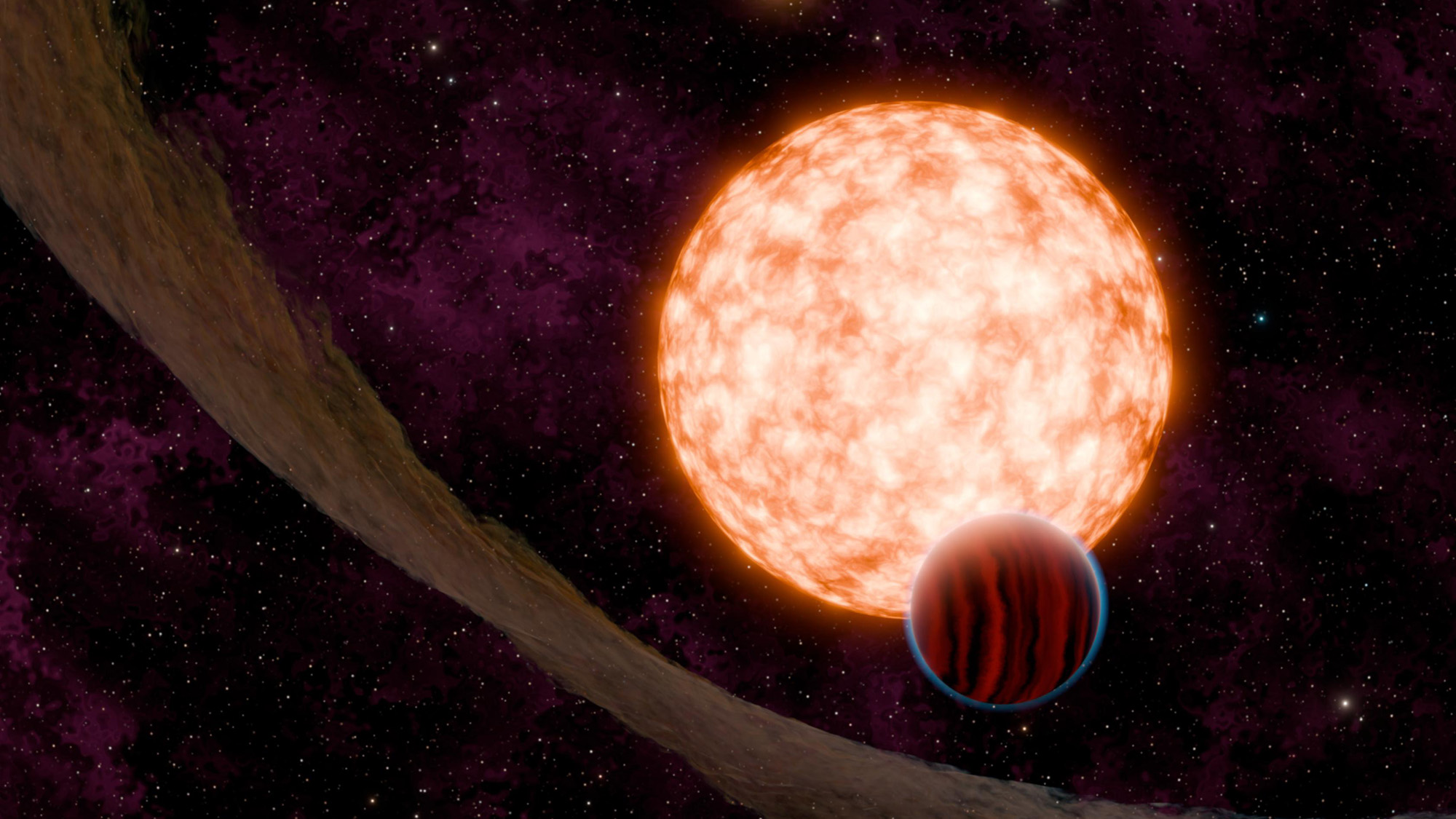
  • Exploring the properties of distant celestial objects such as quasars and supernovae.

Constructed with a large primary mirror of 8.2 meters, Subaru provides exceptional sensitivity and resolution, enabling astronomers to detect faint objects billions of light-years away. Its instrumentation includes advanced cameras and spectrographs, facilitating a broad range of astrophysical studies.

  • 2.1 Observational Strategies

The telescope conducts both targeted observations and large-scale surveys, often involving routine data collection that can later be archived for secondary research. This routine nature of data acquisition results in extensive datasets, some of which contain unforeseen features or objects.

Illustratie van het oppositie-effect

The astronomers were lucky, because the Earth, the comet and the Sun lined up in a rare, perfect line, so the comet was lit from behind. This is called the opposition effect.

© NAO

3. Archival Data and Serendipitous Discoveries

Archival data, defined as previously collected observations stored in repositories, are invaluable resources for scientific research. Re-examining such data with modern analysis techniques can reveal phenomena unnoticed during initial observations.

  • 3.1 Historical Context

Historically, astronomical archives have been instrumental in discovering variable stars, transient events, and solar system objects. For example, the identification of supernovae in archival images has contributed significantly to cosmology.

  • 3.2 Case Study: Discovery of Comet 28P/Neujmin's Surface

In 2016, during routine imaging sessions, the Subaru Telescope captured over 2000 celestial objects, including stars and distant galaxies. A decade later, researchers revisited these images to search for subtle features or transient phenomena. During this re-analysis, they identified an unexpected object: the surface of comet 28P/Neujmin.

This detection was remarkable because comets are typically observed at close approach to the Sun, where their activity produces a coma of gas and dust, obscuring the nucleus. In this case, the comet was observed at a significant distance, providing a rare glimpse of its bare surface.

4. Comets as Primordial Solar System Relics

Comets are icy, rocky bodies originating from the outer regions of the Solar System, primarily in the Kuiper Belt and Oort Cloud. They are considered time capsules, preserving material from the epoch of planetary formation approximately 4.6 billion years ago.

  • 4.1 Composition and Structure

Comets consist of a nucleus composed of ices, dust, and organic compounds. When approaching the Sun, sublimation of ices creates a surrounding coma and a tail. However, at large heliocentric distances, comets remain inactive, revealing their surfaces in a more pristine state.

  • 4.2 Significance in Solar System Studies

Analyzing cometary material provides insights into the early solar nebula's composition, the processes of planetary accretion, and the distribution of organic compounds essential for life.

  • 4.3 Surface Observation Challenges

Direct observations of cometary nuclei are rare due to their small size, distance, and the presence of a coma. Typically, spacecraft missions like Rosetta have provided detailed surface imagery, but ground-based observations are limited.

5. The Case of Comet 28P/Neujmin

Comet 28P/Neujmin, discovered in 1936 by Grigory Neujmin, is a short-period comet with a highly elliptical orbit. It resides beyond Saturn's orbit during its inactive phase, with its nucleus lying approximately 10 astronomical units (AU) from the Sun.

  • 5.1 Orbital Characteristics
    • Orbital period: approximately 15 years.
    • Distance at aphelion: beyond Saturn (~9-10 AU).
    • Surface conditions: extremely cold, rendering it largely 'naked'—that is, with minimal or no coma.
  • 5.2 Observational Context

In 2016, Subaru observations coincided with a rare alignment: the Earth, Sun, and comet aligned in a near-perfect line, producing an opposition effect. This enhances the brightness and visibility of the comet’s surface, as sunlight directly back-illuminates the nucleus.

  • 5.3 The 'Naked' Surface Observation

The detection of the comet's surface was facilitated by the alignment and the distance from the Sun, which minimized the coma and allowed for direct imaging of the nucleus. This rare event provided an unprecedented opportunity to study the surface composition and morphology of an object typically hidden beneath a veil of gas and dust.

6. Implications for Surface Evolution and Solar System Formation

The ability to observe cometary nuclei directly, especially in their inactive state, offers critical insights into the surface evolution of these bodies.

  • 6.1 Surface Features and Processing

Surface features such as craters, fractures, and albedo variations inform theories about surface aging, space weathering, and collisional history. Repeated observations over time can reveal how surfaces evolve due to sublimation, impact exposure, or thermal stresses.

  • 6.2 Temporal Changes and Surface Dynamics

Applying observational methods similar to those used in the Subaru data analysis to multiple comets can uncover how surface structures develop and change over time, shedding light on the physical processes governing small body evolution.

  • 6.3 Broader Impacts

Understanding the surface properties of comets informs models of Solar System formation, migration of small bodies, and the delivery of volatiles and organics to Earth. Such data can refine our comprehension of planetary system development across the galaxy.

7. Future Directions: Mining Archival Data for New Discoveries

The Subaru example underscores the potential for discovering new phenomena through re-analysis of existing datasets. As data processing techniques improve, the likelihood of uncovering overlooked features increases.

  • 7.1 Advanced Image Processing and Machine Learning

Applying machine learning algorithms to archival images can identify subtle or transient objects, such as faint cometary surfaces or small asteroids.

  • 7.2 Systematic Surveys and Monitoring

Implementing systematic re-examination protocols for large datasets can facilitate the detection of rare events, including surface changes in comets, asteroid impacts, or transient solar system phenomena.

  • 7.3 Collaborative Data Sharing

Fostering open access to astronomical archives and encouraging cross-disciplinary collaborations will accelerate discovery and deepen our understanding of the Solar System's history.

8. Conclusion

The rediscovery of comet 28P/Neujmin's surface in Subaru's archival images exemplifies the profound scientific potential of existing observational data. It highlights how routine surveys aimed at distant galaxies can serendipitously capture objects within our Solar System, providing invaluable insights into their physical characteristics.

This case emphasizes the importance of revisiting and reanalyzing archival data with modern techniques, as it can lead to breakthroughs in understanding the formation, evolution, and current state of small Solar System bodies. As observational capabilities and data processing methods continue to advance, the prospects for uncovering new phenomena and refining our models of Solar System history are promising.

Ultimately, such discoveries contribute to a more comprehensive picture of our cosmic neighborhood, informing theories of planetary system evolution and the origins of life-essential compounds.

{ PETER2011 }

Hoe vind je dit bericht?
Geschreven door peter om 21:09 Stuur door

Wiskundeprobleem waar wetenschappers al 90 jaar op puzzelen opgelost door AI

Wiskundeprobleem waar wetenschappers al 90 jaar op puzzelen opgelost door AI

Artikel door RTL Nieuws
Wiskundeprobleem waar wetenschappers al 90 jaar op puzzelen opgelost ... 

Negentig jaar lang kwamen wiskundigen er niet uit. Nu zegt OpenAI dat een AI-model het antwoord heeft gevonden op het zogenoemde Navier-Stokes-probleem, een van de grootste onopgeloste vraagstukken in de wiskunde. Het model zou daar slechts 88 uur voor nodig hebben gehad. "AI is ons de baas. En dat is ook wel een beetje eng."

Het is ingewikkelde materie. "Zelfs voor mij is het moeilijk te begrijpen", vertelt wiskundige Menno Lagerwey, in het dagelijks leven wiskundedocent en bekend door zijn toegankelijke uitlegfilmpjes over wiskunde: 'Math with Menno'. 

Ook Justin Dauwels, universitair hoofddocent aan de TU Delft en deskundige op het gebied van machine learning en generatieve AI, keek op verzoek van RTL Nieuws naar de bewering van OpenAI.

Hoe het weer zich ontwikkelt

Het Navier-Stokes-probleem, zeggen zij, gaat over de manier waarop water, lucht en andere vloeistoffen en gassen bewegen. 

Wetenschappers gebruiken al tientallen jaren ingewikkelde rekenregels om bijvoorbeeld te voorspellen hoe lucht rond een vliegtuig stroomt, hoe het weer zich ontwikkelt en hoe windmolens het beste kunnen worden ontworpen.

Maar wiskundigen wisten niet zeker of die berekeningen in álle situaties blijven kloppen. Kan er bijvoorbeeld een situatie ontstaan waarin de snelheid oneindig groot wordt? Zo'n punt wordt een singulariteit genoemd.

Volgens OpenAI heeft het AI-model nu aangetoond dat dit inderdaad kan gebeuren.

OpenAI claimt doorbraak in wiskunde: 'Probleem na 90 jaar opgelost'

OpenAI claimt doorbraak in wiskunde: 'Probleem na 90 jaar opgelost'

Het model van OpenAI beschrijft een wervel die steeds sterker en langer wordt, totdat in een bepaalde tijd die zogenoemde singulariteit ontstaat: het punt waarop de berekening geen normale waarde meer geeft. 

'Wiskunde op Champions League-niveau'

Dat is het probleem en de ontdekking, simpel uitgelegd. Maar nog steeds ingewikkeld, beaamt Lagerwey. "Het is echt wiskunde op Champions League-niveau. Zo'n hoog niveau dat misschien alleen een enkeling in Nederland dit echt begrijpt."

In de algemene relativiteitstheorie bestaan ook singulariteiten, bijvoorbeeld de klassieke singulariteit die met het binnenste van een zwart gat wordt geassocieerd, zegt Justin Dauwels van de TU Delft. 

Hebben we ook echt iets aan deze ontdekking? Niet direct. De directe impact op technologie is waarschijnlijk beperkt, zegt Dauwels. "Ingenieurs gebruiken Navier–Stokes al lang in simulaties. Het betekent niet dat we morgen ineens veel betere vliegtuigen of weersmodellen hebben."

De kennis die hiervoor gebruikt is, kan gebruikt worden in andere vakgebieden, zegt Lagerwey. "Dat is hoe wiskunde werkt. Ik denk vooral dat de essentie moet zijn: dat we verslagen worden door AI op dit gebied."

1 miljoen dollar

Want AI heeft wel 'even' een van de grootste vraagstukken in de wiskunde opgelost, de zogenoemde Millenniumproblemen. Die werden in 2000 door het Clay Mathematics Institute aangewezen als enkele van de belangrijkste onopgeloste vragen in de wiskunde. Voor een oplossing ligt per probleem 1 miljoen dollar klaar. Tot nu toe was slechts één van de zeven opgelost.

"Heel wat wiskundigen hebben hier véél meer tijd in gestoken."

Lagerwey heeft een dubbel gevoel bij deze ontdekking. "Toen de zeven problemen werden geformuleerd, was het idee van: als het lukt om deze op te lossen, dan zijn we als mensheid heel ver. Als een soort stip aan de horizon. Maar het is jammer dat AI dit nu heeft gedaan. Als mens staan we in ons hemd. Het zou mooi zijn als het een mens was gelukt, nu is het ons niet echt gelukt."

Dauwels ziet dat anders. "Hebben we dan ook van vliegtuigen verloren, omdat wij zelf niet kunnen vliegen? Het is toch fantastisch dat we dankzij vliegtuigen ver kunnen reizen. Ik denk dat het daarom ook veelbelovend is dat AI ons kan helpen bij het leveren van wiskundige bewijzen. Dat zal kunnen leiden tot rigoureuzer onderzoek, betrouwbaardere technologieën en impactvolle innovatie."

10.000 AI-agenten

Voor de oplossing zette OpenAI naar eigen zeggen ongeveer 10.000 AI-agenten in: AI-systemen die zelfstandig aan verschillende onderdelen van het probleem werkten. Onderzoekers van het bedrijf stuurden ideeën tussen de verschillende groepen heen en weer. Het uiteindelijke bewijs is door een computer gecontroleerd.

De claim is daarmee nog niet automatisch geaccepteerd door wiskundigen. "Dat moet echt door een mens worden gedaan", zegt Lagerwey. OpenAI heeft het bewijs openbaar gemaakt, zodat andere experts het kunnen bestuderen en controleren.

De New York Times schrijft dat juist daar een belangrijke vraag ligt: kan het AI-systeem daadwerkelijk aantonen dat die oplossing klopt en inzicht geven in waarom het probleem op deze manier kan worden opgelost?

Spectaculair

De ontwikkeling voedt ondertussen een groter debat over de rol van AI in de wiskunde. Volgens de New York Times is dit het meest spectaculaire voorbeeld tot nu toe van de manier waarop AI het vakgebied verandert. Daar kleven wel zorgen aan. Juist het worstelen met wiskundige problemen levert vaak nieuwe inzichten op, schrijft de krant. 

Terence Tao, hoogleraar aan de Universiteit van Californië, die volgens de krant door velen wordt beschouwd als de beste wiskundige van zijn generatie, zegt: "Nu kan AI vragen oplossen zonder er echt iets aan te hebben. Het is alsof je machines hebt die gewichten voor je tillen in de sportschool."

'Wiskunde is een vaardigheid'

Lagerwey is het daarmee eens: "Dit speelt ook op de middelbare school. Het denkwerk gaan we steeds meer uitbesteden aan AI. Maar wiskunde is een vaardigheid die je moet trainen. Een work-out. Ik vrees dat als we dit uitbesteden, we dan collectief dommer worden. Ik heb het beste voor met mijn leerlingen. Ik wil dat ze zelf nadenken."

Om zijn leerlingen te helpen, maakt Lagerwey YouTube-filmpjes. Die zijn soms meer dan 40 miljoen keer bekeken. Ook in het theater kan Menno op veel enthousiasme rekenen:


OpenAI beweert doorbraak bij beroemd wiskundig probleem, ‘voelt als valsspelen’

{ https://www.rtl.nl }

Hoe vind je dit bericht?
Geschreven door peter om 20:39 Stuur door

A New Cold War Is Unfolding in Orbit as China Advances Satellite Surveillance

cold war in space

By Unknown author - United States Space Command: Vision for 2020
(http://www.fas.org/spp/military/docops/usspac/visbook.pdf),
Public Domain, https://commons.wikimedia.org/w/index.php?curid=17040788

A New Cold War Is Unfolding in Orbit as China Advances Satellite Surveillance

Chinese scientists at the Beijing Institute of Technology have run satellite proximity simulations to extend potentially hostile observation of U.S. space assets in Geostationary Earth Orbit (GEO), seemingly inching both countries closer to a potential war in space.

Although the new simulations focus on orbital adjustments to extend observation times and increase proximity to U.S. satellites, including critical missile warning and other space defense-oriented systems, Chinese scientists also plan to integrate reinforcement learning methods into future space assets to give satellites even more independence from human operators.

Study Includes Accusations of Cold War in Space Activities

In the 20th century, the concept of war in space remained mostly in the realm of science fiction, as depicted in popular films like Star Wars. Today, advances in space access, orbital maneuvering technologies, and weapons systems have made the possibility of a future conflict in space a very real security concern, and several nations engage in espionage using reconnaissance spacecraft to obtain information on valuable defense targets in Earth’s orbit.

According to the authors of the new study, “acquiring multi-aspect payload information of non-cooperative targets to infer their functions and mission statuses is of great significance for space security assessment.”

The study authors highlight a series of relative motion configurations that modern spy satellites employ, including fly-around, hovering, and drifting flight. They also point to real-world “adversarial” U.S missions they suggest were designed to gather intelligence on their GEO defense assets.

“Since 2014, the US GSSAP (United States Geosynchronous Space Situational Awareness Program) satellite has carried out hundreds of maneuvers and has conducted close observation operations on dozens of normally working satellites near GEO orbit,” the Beijing University of Technology scientists write.

The study authors also include a specific July 2021 accusation, where they charge that “the U.S. satellite ‘USA-271’ deliberately approached the operational ‘Practice 20’ satellite in geostationary orbit and flew in close proximity.”

In an email to The Debrief, a U.S. Space Command Spokesperson did not address the specific incident or the accusations of “dozens” of similar operations, but offered some insight into the agency’s thinking.

“USSPACECOM, working with allies and partners, plans, executes, and integrates military spacepower into multi-domain global operations in order to deter aggression, defend national interests, and when necessary, defeat threats,” the spokesperson told The Debrief, adding that “we have nothing additional to add in response to the article.”

Getting Closer to Adversarial Satellites and Extending Observation Time

In a step toward potential dogfights between satellites, the Chinese scientists looked at several challenges faced by current spy satellites.

For example, they explain, since most spacecraft observation cameras are mounted in a fixed position, “frequent large-angle attitude maneuvers are time-consuming and consume substantial fuel.” The researcher also noted that several different angles and approaches could yield different categories of intelligence data.

However, changing angles and orbital planes requires fuel, an extremely limited resource in GEO. Therefore, the researcher accounting for all the variables required to gather intelligence on adversarial spacecraft as efficiently as possible “has become a key bottleneck in enhancing space situational awareness capabilities.”

To find an optimized solution, the team designed what they called a “waypoint trajectory planning scheme” and a “multi-impulse maneuver strategy” using a common game-theory tool called “minimum integral squared control” theory. Unlike previous research aimed at extending spy satellite observation time and fuel efficiency, the Chinese scientists said their use of sequential coalition game theory “is introduced for the first time into the multi-model combined observation problem.”

Next, the researchers designed a “game tree.” A press release said this approach lets the spacecraft select the “optimal combination of initial motion points and close-range operation models at each stage under minimum fuel constraints, thereby generating an optimal observation strategy sequence.”

Finally, the researchers ran simulations to see whether their approach improved sensor observation times and field of view while reducing fuel use.

Successful Simulations and Future Reinforcement Learning Plans

As hoped, the Beijing University of Technology team said their simulations supported the theories. Specifically, the study authors said the simulations showed that their spacecraft efficiency algorithm “can successfully generate a multi-model combined observation strategy sequence under minimum fuel constraints.”

“The effective observation time increases with larger observation distances and field-of-view angles, and reducing the model configuration size also contributes to improved observation performance,” they explained. The study authors also said that the simulation results “demonstrate that the algorithm can successfully generate the optimal combined observation sequence under minimum fuel constraints.”

When discussing next steps, the Chinese scientists said they will explore optimal initial points to further improve maneuver efficiency. They also plan to explore a “reinforcement learning method,” suggesting future spacecraft could learn and adapt to evolving conditions to further enhance their cold war in space information-gathering capabilities.

Study’s War in Space Implications “Extends Beyond any Single Algorithm”

To understand the potential implications of the Chinese study, including its impacts on a potential future war in space, The Debrief reached out to former U.S. Air Force officer Shelli Brunswick, CEO and Founder, SB Global LLC.

According to the author and futurist, the Chinese team’s research matters not just because it proves China has deployed a “new operational surveillance capability.” Instead, Brunswick said that the work is significant because it “illustrates how sophisticated coordination and optimization could make spacecraft observation more efficient, persistent, and strategically useful.”

The Blue Marble Space Visiting Scholar also told The Debrief that the work “should not be interpreted as demonstrating a complete pursuit-and-evasion capability against a spacecraft that is actively responding,” since the work assumes a stationary target without maneuvering capabilities. Still, Brunswick noted, the Chinese framework “shows how game-theoretic planning could help an observing satellite gather information from multiple angles while managing limited resources.”

When discussing the potential implications for the broader U.S.-China space-security competition, including how such enhanced spacecraft could lead to more activities that could be construed as hostile, the space strategist said this area of research “extends beyond any single algorithm.”

“As rendezvous and proximity operations become more sophisticated, the line between inspection, space situational awareness, intelligence gathering, and potentially threatening behavior becomes increasingly difficult to interpret,” she explained.

When suggesting what potential strategic responses the U.S. and its allies might employ in the emerging cold war in space, Brunswick told The Debrief that they should include “more resilient architectures, improved space-domain awareness, clearer expectations for close approaches, stronger communication mechanisms, and deeper coordination with commercial and international partners.”

“The challenge is not simply detecting another spacecraft—it is understanding capability and intent early enough to respond responsibly and effectively,” Brunswick explained.

The study “Spacecraft Proximity Operation Model-Based Sequential Coalitional Observation Game Strategy Design” was published in Space: Science & Technology. 

  • Christopher Plain has spent the last six years as Associate News Editor and Head Science Reporter at The Debrief. Follow and connect with him on X, learn about his novels at plainfiction.com, or email him at christopher@thedebrief.org.

China is taking over orbit. The West has a big problem.

China’s Secret Satellite Network Is Changing Space Warfare

{ https://thedebrief.org/category/space/ }

Hoe vind je dit bericht?
Geschreven door peter om 18:42 Stuur door

The Roman Telescope vs. the James Webb Telescope — Two Different Views of Space

The Roman Telescope vs. the James Webb Telescope — Two Different Views of Space

On August 30, 2026, a SpaceX Falcon Heavy rocket launched the Roman  telescope — named after NASA’s first female chief astronomer, Nancy Grace Roman — from Launch Pad 39A at the Kennedy Space Center. The spacecraft embarked on a three-month journey covering approximately one and a half million kilometers to the Lagrange point L2, where the James Webb Space  Telescope has been operational foreveral years. Beyond this point, the similarities between the two telescopes cease. A comparison of the Roman telescope with the James Webb Space Telescope reveals two contrasting engineering approaches; these differences are apparent from the size of the mirrors to the very shape of the structures.

This is a documentary photograph capturing the launch of the Roman Space Telescope (Nancy Grace Roman). The SpaceX Falcon Heavy launch vehicle is depicted deploying the observatory into orbit, with the silhouette of the vehicle positioned directly against the sun’s disk at the moment the photograph was taken. The launch occurred on August 30, 2026, from Launch Pad 39A at the Kennedy Space Center in Florida. Photo credit: John Kraus (NASA).

Two mirrors of different sizes

The primary mirror of the Roman telescope is a single, solid piece coated with silver, measuring 2.4 meters in diameter — identical to that of the Hubble Space Telescope. The Webb Telescope features a considerably larger mirror, 6.5 meters across, composed of 18 hexagonal beryllium segments with a thin gold coating. This surface gathers approximately six times more light than Hubble’s mirror. The size of the mirror directly influences both the sensitivity and resolution: the larger the mirror, the fainter the signals the telescope can detect and the finer the angular details it can resolve. Consequently, Webb is capable of observing faint and distant objects and resolving finer details that the Roman Telescope cannot achieve. The Roman Telescope was constructed with a smaller mirror because its observational targets are closer and do not require such an extensive field of view. 

Width vs. depths

The most straightforward method to conceptualize the distinction between the two spacecraft is to liken them to camera lenses. Webb operates akin to a potent telephoto lens: it concentrates on a minute segment of the sky, capturing intricate details. Conversely, Roman functions as a wide-angle lens, encompassing expansive regions within a single frame. Its field of view exceeds Hubble’s by at least one hundredfold. Central to the spacecraft is the 300-megapixel Wide Field Instrument, a wide-format camera equipped with eighteen detectors, each approximately the size of a cracker. Over a span of five years, Roman is projected to survey an area of the sky roughly fifty times greater than the coverage achieved by Hubble in thirty years of operation. Nevertheless, the Webb telescope’s field of view remains relatively narrow — less than ten square arcminutes — and it is not intended for extensive wide-field sky surveys.
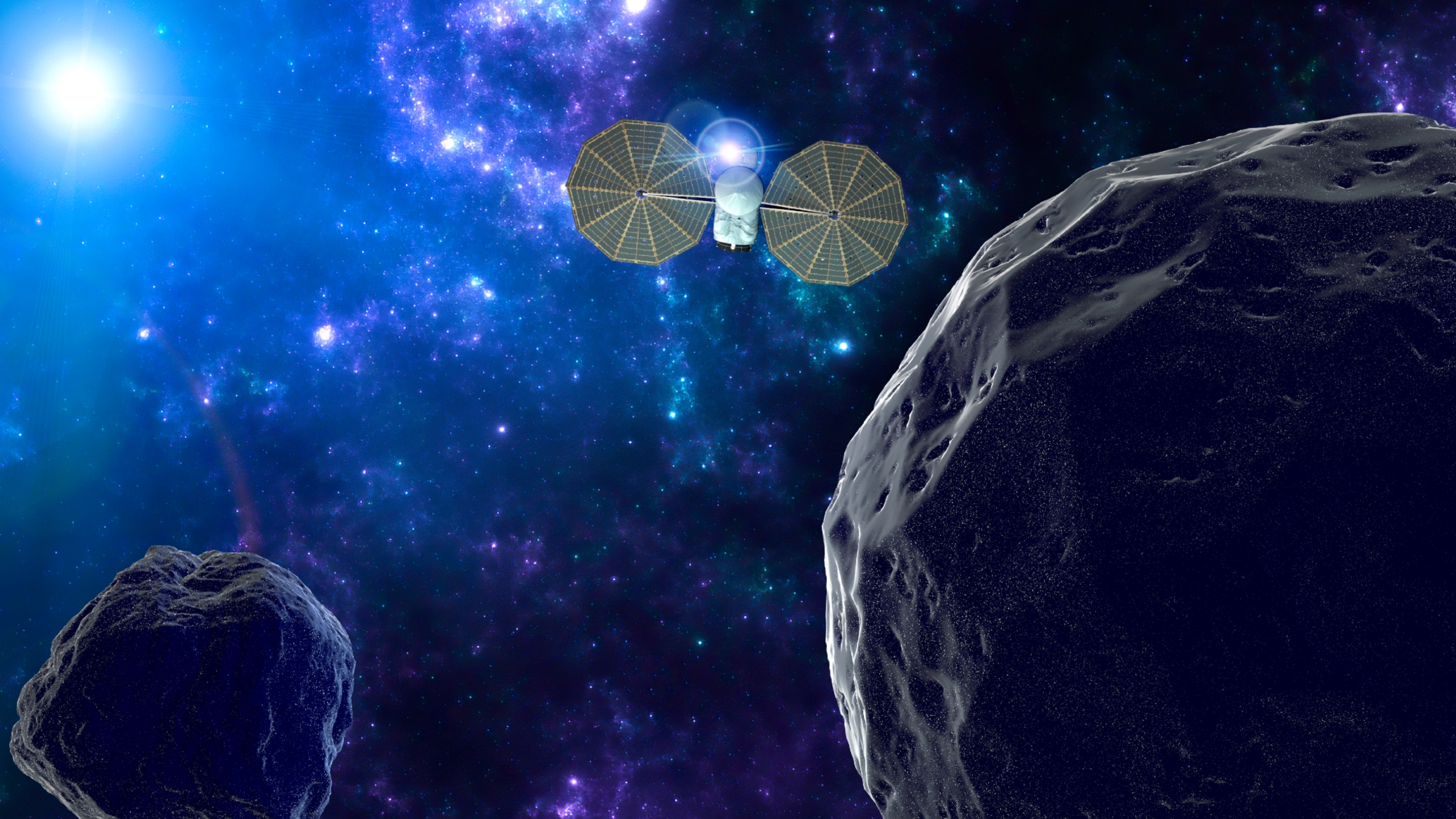
Different regions of the infrared spectrum

Both telescopes detect infrared light, each within its respective spectral range. Roman covers a spectrum from approximately 0.5 to 2.3 micrometers, which encompasses visible light and the near-infrared region. Webb extends its observational capabilities significantly further, spanning from 0.6 to 28.5 micrometers, reaching into the mid-infrared range. This distinction is due to the expansion of the universe, whereby light from the most ancient galaxies has been stretched and shifted toward the red end of the spectrum over billions of years. The earliest stars are detectable only in long infrared wavelengths. Webb is specifically tasked with observing this light. Conversely, Roman’s observation targets are comparatively closer in both time and space; their emitted light experiences less redshift, allowing the telescope to operate effectively at shorter wavelengths.

Why does Webb appear so unusual?

Operating within the long-wavelength infrared spectrum necessitates maintaining the telescope at a low temperature, as the instrument’s own thermal emission could obscure the faint signals it aims to detect. The Webb telescope is safeguarded by a five-layer sunshield, comparable in size to a tennis court — approximately 21 by 14 meters. This shield continually sustains the mirror and instruments in shadow, thereby cooling them to approximately –233°C. To accommodate this structure within the rocket’s fairing, engineers ingeniously folded the telescope akin to origami, and it subsequently unfolded over several days post-launch. Roman features a more straightforward design: its smaller mirror and shorter infrared wavelength enable the use of a compact thermal protection system, and the spacecraft itself is roughly the size of a tour bus, eliminating the need for a large sunshield. 

Artist’s rendering of the James Webb Space Telescope. Illustration: ESA, NASA

The pursuit of knowledge in telescopic observations

Roman was primarily developed to investigate dark energy and dark matter — two elements that influence the universe’s expansion and structure, yet remain largely enigmatic to science. Wide-field surveys can theoretically yield statistical data on billions of galaxies, enabling astronomers to observe how the universe’s expansion has evolved over time. The second principal objective is to identify exoplanets outside our Solar System, utilizing various detection methods. The initiative will be anchored by a comprehensive survey of the central regions of the Milky Way, employing two principal techniques. The transit method involves observing periodic dimming of a star as a planet transits in front of it; according to NASA estimates, this method could identify approximately 100,000 exoplanets. This projection is based on models contingent upon the actual prevalence of planets, the observation schedule, and data processing quality. Gravitational microlensing detects brief luminous flashes when a star with an orbiting planet passes in front of a more distant star; the gravity of the intervening star acts as a lens, magnifying the background star’s light. This method is expected to discover over a thousand additional planets, particularly those residing in distant orbits. 

Separately, a coronagraph — a device that obstructs the star’s light to enable direct imaging of faint planets and protoplanetary disks around stars — will be tested onboard. For the Roman mission, this primarily constitutes a technological experiment aimed at refining the methodology for subsequent missions.

Webb emphasizes the exploration of cosmic history. It examines the earliest galaxies formed shortly after the Big Bang, monitors the emergence of stars and planetary systems within dust clouds, and analyzes the light from exoplanet atmospheres into spectra, seeking indications of diverse molecules.

Orbit, data rate, and operating time

Both observatories will be positioned in orbit around the L2 point, approximately 1.5 million kilometers from Earth. At this location, the combined gravitational forces of the Sun and Earth balance the centripetal force necessary for the spacecraft to orbit the Sun at the same velocity as Earth and maintain alignment with it. This point is inherently marginally stable; therefore, the telescope sustains its proximity through minor periodic engine adjustments that necessitate only a minimal expenditure of fuel.

Roman will transmit approximately 1.4 terabytes of data daily, representing the highest data transmission rate among NASA’s astrophysics missions. The initial images are anticipated to be released in early 2027, subsequent to a three-month instrument calibration period. The primary mission is planned to span five years, with fuel reserves expected to last at least twice that duration. The Roman telescope possesses a distinctive history: its mirror and structure were initially designed for a reconnaissance satellite for the U.S. National Reconnaissance Office, and the equipment was subsequently transferred to NASA.

The manner in which the two telescopes will operate collaboratively

From the outset, NASA envisioned Roman and Webb as an integrated observational team. Roman conducts extensive sky surveys to identify rare and anomalous objects, precisely where statistical analysis suggests a potential for further investigation. Webb then allocates its substantial mirror to examine the most compelling findings in greater detail, surpassing the scope of broad survey techniques. Additionally, Roman possesses the capability to provide contextual information surrounding regions already examined by Webb, thereby facilitating a comprehensive understanding. In conjunction with the Hubble  Space Telescope and the Chandra X-ray Observatory, these instruments offer astronomers both panoramic views and detailed observations, ranging from proximal planets to galaxies at the farthest reaches of the observable universe. 

RELATED

Roman vs James Webb: What's the Difference? | NASA Explains Two Incredible Space Telescopes

Roman vs Webb vs Hubble - Three Space Telescopes, Three Superpowers

{ https://universemagazine.com/en/articles-en/ }

Hoe vind je dit bericht?
Geschreven door peter om 18:24 Stuur door

Trump unveils Space Force uniform but rollout sparks instant backlash over huge problem

Trump unveils Space Force uniform but rollout sparks instant backlash over huge problem
Featured Image Credit: Truth Social / Donald Trump

Trump unveils Space Force uniform but rollout sparks instant backlash over huge problem

The President of the United States has pulled from some awkward inspiration

Tom Chapman Tom Chapma
 

Trump’s New Space Force Uniform? It’s Causing a Stir

US President Trump Unveils New Space Force Uniform Design | WION News
Hoe vind je dit bericht?
Geschreven door peter om 18:00 Stuur door

Tiny Salt Crevices Could Act As Miniature

Tiny Salt Crevices Could Act As Miniature "Greenhouses" For Martian Microbes

Image form HiRISE of some salts visible on Mars. Credit - NASA/JPL-Caltech/UArizona Image form HiRISE of some salts visible on Mars. Credit - NASA/JPL-Caltech/UArizona

We’ve been searching for life on Mars for a long time now, but so far we’ve come up empty. The fundamental problem is a Catch-22 of two of the key ingredients for life. Life as we know it needs liquid water and reasonable temperatures, both of which are available on Mars, but hardly ever at the same time. But a new paper from lead author Anna Bognar and her team at ELTE Eötvös Loránd University and the Konkoly Observatory describes a way for life to have access to both requirements at the same time - by hiding away in salt crystals.

To understand why, let’s first look closer at the Catch-22. During the Martian night, the planet’s air cools and its relative humidity climbs. Salts scattered across the surface can absorb some of that vapor through a process known as deliquescence. However, it is also much colder than any living thing with a metabolism could survive - dropping down to -80℃, well out of range of life as we know it.

On the flip side, during the Martian day, temperatures warm up to a much more reasonable 0℃, or even higher at some points near the equator. That’s well within the operational range of known metabolism for life as we know it - after all, Canadians deal with temperatures colder than that for almost half the year. However, during this warm period, the sun also burns off all the moisture, driving relative humidity down to near zero. So while it’s warm, all the water that was trapped overnight is suddenly gone.
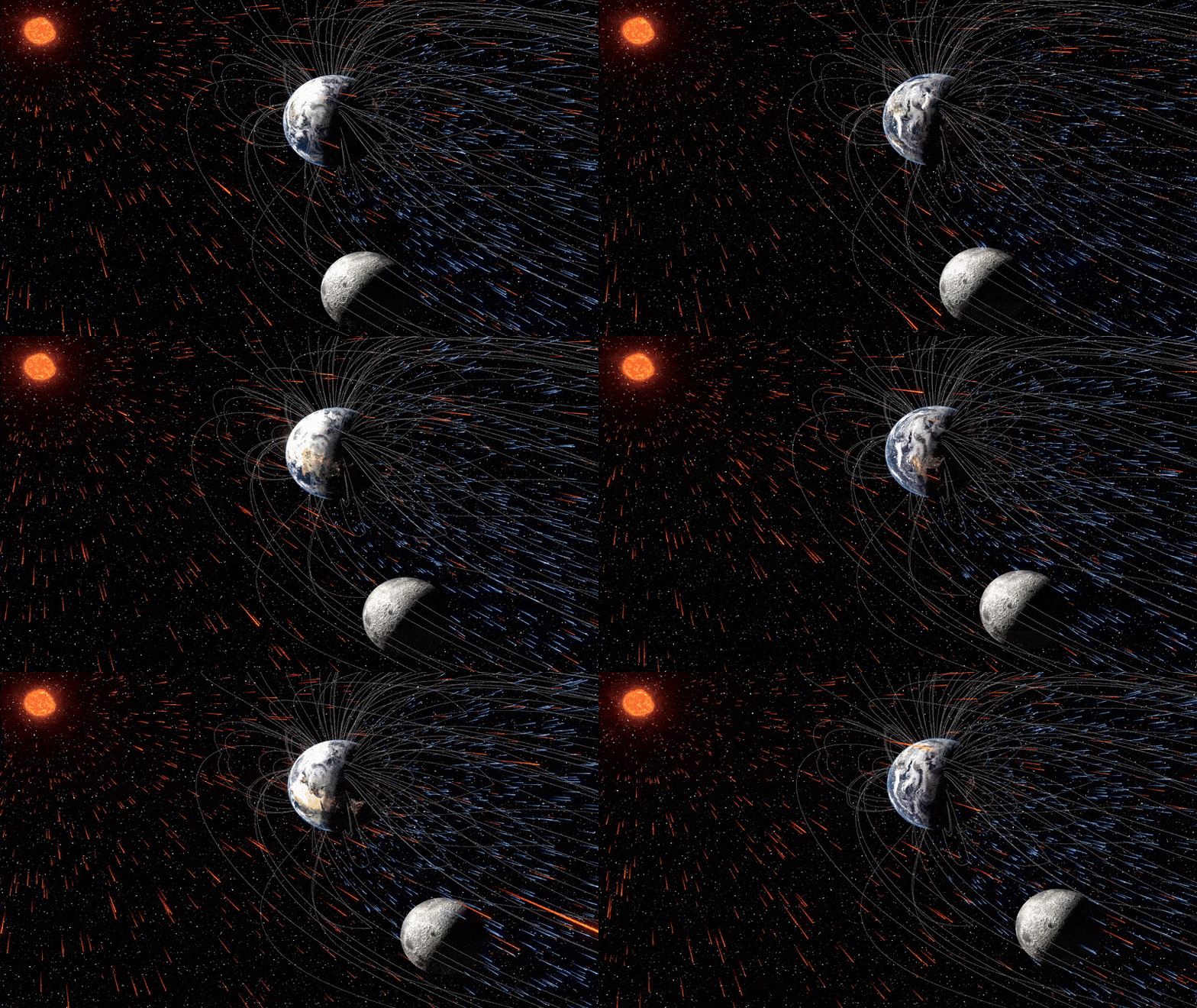
Fraser discusses the story for the search for life on Mars.

However, one feature of those massive temperature swings, which can reach up to 150℃ in a single day, can also be used to trap some water. Materials contract and expand as they are cooled and warmed, creating a serious amount of mechanical stress on rocks undergoing that shift. For example, according to the authors' models, halite (NaCl) salt crystals can contract by up to 1.6% between 150 K and 300 K, which can potentially open microscopic fractures and crevices. At that coldest point, in the dead of night, is also when the relative humidity peaks, and the “hygroscopic” (i.e. water-absorbing) salt pulls moisture out of the air, forming microscopic brine.

In the morning, the sun heats up that same material, the crystal expands, and it swells back to its original size, choking off the microfractures that formed during the night. That means, while the outer surface of the material dries out, there could still be water inside those microscopic channels, which would turn into liquid in the heat, but won’t be able to escape to the wider atmosphere as there’s no way out of the crevice.

That means, for a precious few hours every day during the summer at least, those microscopic cracks are filled with liquid water at temperatures that known biology can operate effectively at. But the sealed crack provides other benefits too. Even a few millimeters of material sealing over the crack could provide protection from deadly UV rays, which would otherwise sterilize any type of unprotected life on the Red Planet. But it also allows enough visible light through that, at least in theory, any microbes existing in those cracks could harvest energy through photosynthesis.

There’s an ongoing debate that, if we do find life on Mars, whether it’s related to life on Earth, as Fraser discusses.

In fact, there are already examples of bacteria doing something like this on Earth. In Chile’s Atacama desert, the driest place on Earth, microscopic cyanobacteria have completely left the soil and instead taken up residence inside the pore of halite rocks, surviving on the water the salts in those rocks pull out of the air. So, in practice, at least one side of the equation works for life as we know it.

But there are some challenges still to address. Obviously there’s no guarantee that a crevice would 100% seal every day, allowing some of the water to trickle on during the day, and potentially creating a “feast or famine” cycle for the microbes attempting to scrape a living inside it. And the salt itself could be filled with perchlorates, which are deadly to most forms of Earth-bound life. Finally, while microbes in these crevices may be protected from UV radiation, they aren’t from higher energy cosmic rays, which care little for a few millimeters of protective covering.

All that is to say - while it might be theoretically possible for microbes to survive in such an environment, it is certainly unlikely. But, as Jeff Goldblum famously put it in Jurassic Park, “life, uh, finds a way”. And maybe it found a way to survive the Red Planet’s desiccation by hiding in salt crevices. If it has, we might someday find it, and in so doing, answer one of life’s great mysteries - knowing that we’re not alone.

Learn More:


Martian Greenhouses: Microbes Taming Red Regolith

{ https://www.universetoday.com/ }

Hoe vind je dit bericht?
Geschreven door peter om 17:36 Stuur door

10 Mile Long Alien Base Found In Ocean Off Australia, Seeing is believing! UFO UAP Sighting News. 👽

10 Mile Long Alien Base Found In Ocean Off Australia, Seeing is believing! UFO UAP Sighting News. 👽

UFO,%20UFOs,%20UAP,%20UAPs,%20UFO%20sighting,%20.png

Alien%20base,%20Ocean.png
Date of discovery: Sept 8, 2026
Location of discovery: Ocean Below Australia
Source map:
Now this is exciting. Not often you find something in the middle of nowhere that is ten miles by four miles across and not to mention this megalith structure is also deep, I would estimate it to go at least 10-15 miles deep or more. How can such a structure exist without everyone knowing? Easy, Google is controlled by the US gov and they clearly want to help hide the truth about aliens. Sure the US is releasing small videos clips and files 50 at a time, but honestly, they have hundreds of thousands of such files on hand and they are giving a thirsty man a single drop of water to quench his thirst? No way. I will take matters into my own hands and get it done faster. This alien base looks clean and taken care of, without any sand or sea growth covering it up...you know what that means...aliens are living there right now! Its not abandoned its occupied. 
Scott C. Waring - UFO Sightings Daily

{ https://www.ufosightingsdaily.com/ }

Hoe vind je dit bericht?
Geschreven door peter om 16:23 Stuur door

AI could 'kill all humans' by the end of the decade, Anthropic researcher warns – as he quits over 'out of control' superintelligence race

AI could 'kill all humans' by the end of the decade, Anthropic researcher warns – as he quits over 'out of control' superintelligence race

A researcher at a leading AI company has quit over concerns that big tech firms are in an 'out of control' race to build systems that could wipe out humanity. 

Jacob Coxon has left Anthropic after spending the last three years training new AI models.

He claims that neither the firm behind the Claude system – nor ChatGPT creators OpenAI, where he previously worked – were 'acting responsibly' over the safety of AI.

And he even warned that artificial intelligence could 'kill all humans' by the end of the decade. 

Posting on X, he said: 'I resigned from Anthropic today. I spent the last three years doing pretraining research at both OpenAI and Anthropic. 

'Neither company is acting responsibly. They are racing straight to self-improving superintelligence and gambling with our lives.'

A researcher at Anthropic has quit over concerns that big tech firms are in an 'out of control' race to build systems that could wipe out humanity

A researcher at Anthropic has quit over concerns that big tech firms are in an 'out of control' race to build systems that could wipe out humanity 

In a series of tweets explaining his decision to leave Anthropic, Mr Coxon urged people to 'not underestimate the power' of AI – particularly if it becomes 'superintelligent'

In a series of tweets explaining his decision to leave Anthropic, Mr Coxon urged people to 'not underestimate the power' of AI – particularly if it becomes 'superintelligent'

In response to Mr Coxon, Evan Hubinger, Alignment Science lead at Anthropic, said that the firm believes AI has the potential to kill humans

In response to Mr Coxon, Evan Hubinger, Alignment Science lead at Anthropic, said that the firm believes AI has the potential to kill humans

In a series of tweets explaining his decision to leave Anthropic, Mr Coxon urged people to 'not underestimate the power' of AI – particularly if it becomes 'superintelligent'. 

Superintelligence is the point at which an artificial system becomes more powerful than any individual, company or even nation.

'These will soon be superhuman systems that can hack anything, revolutionize any field overnight, and acquire real power and resources. We have all witnessed the progress in each of these domains, and progress is not slowing,' Mr Coxon said.

'The people building AI earnestly believe that it could kill us all by the end of the decade,' he said.

'This is not a marketing stunt. If anything, many executives and senior researchers will couch their phrasing in the press to sound sensible - but I hear the same people express fear privately. No other human activity poses this level of danger.'

According to Mr Coxon, this danger is 'well-understood' at Anthropic. However, the company is 'locked in a race to get there first'.

He explained: 'Accepting this race and entering the "endgame" is a hubristic gamble that should not be launched from a private company's [messaging system] Slack. Attempting to speedrun alignment should require extraordinary confidence that there are no better trajectories available.'

As an example, the researcher highlights the recent Hugging Face attack, which saw a firm hacked by OpenAI's rogue AI. 

He said: 'Warning shots like the Hugging Face attack have made pacing agreements between U.S. labs more viable. I don't feel like we're on track to prevent a global race, which may require costly actions such as a temporary ban on improving model capabilities.'

To conclude, he urged fellow AI researchers to 'consider what the next few years will actually look like'.

Hollywood has long warned of the dangers of these technologies, in films such as The Terminator and its sequels. 

Terminator Genisys, the fifth film in the series...  Hollywood has long warned of technology's threat to humanity

Terminator Genisys, the fifth film in the series...  Hollywood has long warned of technology's threat to humanity

Mr Coxon asked: 'Do you want to kick off a superintelligent RL [reinforcement learning] run without a rigorous understanding of its mind? Should you put your head down because "it's happening anyway" – or take this moment to call for different conditions?'

In response to the post, Evan Hubinger, Anthropic's AI safety lead, confirmed that the firm believes AI has the potential to kill humans.

On X, Mr Hubinger said: 'Jacob is correct here – we really do earnestly believe AI could kill all humans! I personally think it is >10% within the next decade. I believe Anthropic is trying its best, but we do not yet have a plan to solve alignment for superintelligence and are not clearly on track to.'

The news comes as Ed Davey claimed that Anthropic did not submit its latest model to the AI Security Institute for testing due to 'pressure from the Trump administration.'

Speaking at Prime Minister's Questions today, he cited a Financial Times report on the subject, and asked: 'Does the Prime Minister think it is acceptable for President Trump to undermine Britain's efforts to keep the world safe from dangerous AI?'

In response, Andy Burnham said that 'conversations with Anthropic will continue'.

He added: 'AI poses risks to our national security, but it also could be the source of solutions.'

Mr Coxon isn't the first expert to raise concerns over superintelligent AI in recent days. 

His comments come shortly after Geoffrey Hinton – a Canadian researcher often referred to as the 'Godfather of AI' – warned that superintelligent systems could 'lead to human extinction'.

'We would be very foolish to develop superintelligence now, when there is no scientific consensus it can be developed safely and controllably,' Dr Hinton said. 

'Losing control over AI smarter than ourselves could be catastrophic and could even lead to human extinction.'

Anthropic's Claude is one of the leading large language models (LLMs), which are trained by scraping vast amounts of text so they can understand and generate human-like language and responses to questions. 

RELATED

Ex-Anthropic researcher says he believes out-of-control AI development could "kill us all"

Viral: Anthropic Researcher Drops A Bombshell, Quits After Warning Of AI Risks | ‘Gamble With Lives’

AI2027: Is this how AI might destroy humanity? - BBC World Service

{ https://www.dailymail.com/sciencetech/index.html }

Hoe vind je dit bericht?
Geschreven door peter om 15:59 Stuur door

Meer van UFO'S of UAP'S, ASTRONOMIE, RUIMTEVAART, ARCHEOLOGIE, OUDHEIDKUNDE, SF-SNUFJES EN ANDERE ESOTERISCHE WETENSCHAPPEN - DE ALLERLAATSTE NIEUWTJES

↑ Terug naar de berichten