Ontdek de Fascinerende Wereld van UFO's en UAP's: Jouw Bron voor Onthullende Informatie!
Ben jij ook gefascineerd door het onbekende? Wil je meer weten over UFO's en UAP's, niet alleen in België, maar over de hele wereld? Dan ben je op de juiste plek!
België: Het Kloppend Hart van UFO-onderzoek
In België is BUFON (Belgisch UFO-Netwerk) dé autoriteit op het gebied van UFO-onderzoek. Voor betrouwbare en objectieve informatie over deze intrigerende fenomenen, bezoek je zeker onze Facebook-pagina en deze blog. Maar dat is nog niet alles! Ontdek ook het Belgisch UFO-meldpunt en Caelestia, twee organisaties die diepgaand onderzoek verrichten, al zijn ze soms kritisch of sceptisch.
Nederland: Een Schat aan Informatie
Voor onze Nederlandse buren is er de schitterende website www.ufowijzer.nl, beheerd door Paul Harmans. Deze site biedt een schat aan informatie en artikelen die je niet wilt missen!
Internationaal: MUFON - De Wereldwijde Autoriteit
Neem ook een kijkje bij MUFON (Mutual UFO Network Inc.), een gerenommeerde Amerikaanse UFO-vereniging met afdelingen in de VS en wereldwijd. MUFON is toegewijd aan de wetenschappelijke en analytische studie van het UFO-fenomeen, en hun maandelijkse tijdschrift, The MUFON UFO-Journal, is een must-read voor elke UFO-enthousiasteling. Bezoek hun website op www.mufon.com voor meer informatie.
Samenwerking en Toekomstvisie
Sinds 1 februari 2020 is Pieter niet alleen ex-president van BUFON, maar ook de voormalige nationale directeur van MUFON in Vlaanderen en Nederland. Dit creëert een sterke samenwerking met de Franse MUFON Reseau MUFON/EUROP, wat ons in staat stelt om nog meer waardevolle inzichten te delen.
Let op: Nepprofielen en Nieuwe Groeperingen
Pas op voor een nieuwe groepering die zich ook BUFON noemt, maar geen enkele connectie heeft met onze gevestigde organisatie. Hoewel zij de naam geregistreerd hebben, kunnen ze het rijke verleden en de expertise van onze groep niet evenaren. We wensen hen veel succes, maar we blijven de autoriteit in UFO-onderzoek!
Blijf Op De Hoogte!
Wil jij de laatste nieuwtjes over UFO's, ruimtevaart, archeologie, en meer? Volg ons dan en duik samen met ons in de fascinerende wereld van het onbekende! Sluit je aan bij de gemeenschap van nieuwsgierige geesten die net als jij verlangen naar antwoorden en avonturen in de sterren!
Heb je vragen of wil je meer weten? Aarzel dan niet om contact met ons op te nemen! Samen ontrafelen we het mysterie van de lucht en daarbuiten.
As of this writing, almost 5300 exoplanets spanning approximately 4000 planetary systems have been confirmed to exist in our universe. With each new exoplanet discovery, scientists continue to learn more about planetary formation and evolution that has already shaken our understanding of this process down to its very core. One such example is “Hot Jupiters”, which are Jupiter-sized exoplanets, or larger, that orbit closer to their parents stars than Mercury does to our own. This is in stark contrast to our own Solar System, which has rocky planets closer towards our Sun and the gas giant planets much farther out.
Therefore, it is only right that a recent discovery published in The Astrophysical Journal continues to push our understanding of the cosmos. In this study, an international team of researchers led by the Carnegie Institution for Science confirm the existence of a new Jupiter-sized exoplanet, TOI-5205b, orbiting a young, low-mass, main-sequence red dwarf (M dwarf) star, TOI-5205, located approximately 87 parsecs (284 light-years) from Earth.
What makes this discovery unique is the mass of TOI-5205b is rather large for orbiting such a young and small red dwarf star, thus challenging previous understandings of planetary formation and evolution. This is because gas giant exoplanets have traditionally been observed orbiting older and larger M dwarf stars.
“The host star, TOI-5205, is just about four times the size of Jupiter, yet it has somehow managed to form a Jupiter-sized planet, which is quite surprising!” exclaimed Dr. Shubham Kanodia, who is a postdoctoral fellow in the Carnegie Earth & Planets Lab and an expert in red dwarf stars, and lead author of the study. Dr. Shubham recently discussed the discovery in an in-depth blog post, as well. Using food as an analogy, Jupiter orbiting our Sun is equivalent to a pea orbiting a grapefruit, whereas TOI-5205b orbiting its parent star would be equivalent to a pea orbiting a lemon.
Artist illustration demonstrating size comparisons of TOI-5205b orbiting its parent star (left) compared to Jupiter orbiting our Sun (right). (Artwork Credit: Katherine Cain/Carnegie Institution for Science)
The general theory of planetary formation begins with a massive, rotating disk of gas and dust encircling young stars, with gas planets initially being formed from rocky material comprising approximately 10 Earth masses. Over time, this material forms the core of the giant planet which then accumulates large amounts of gas from the disk to produce the massive gas giants we observe today. As it turns out, the confirmation of TOI-5205b could throw this theory into disarray.
Artist illustration of TOI-5205b orbiting its parent star. (Artwork Credit: Katherine Cain/Carnegie Institution for Science)
“TOI-5205b’s existence stretches what we know about the disks in which these planets are born,” explained Dr. Kanodia. “In the beginning, if there isn’t enough rocky material in the disk to form the initial core, then one cannot form a gas giant planet. And at the end, if the disk evaporates away before the massive core is formed, then one cannot form a gas giant planet. And yet TOI-5205b formed despite these guardrails. Based on our nominal current understanding of planet formation, TOI-5205b should not exist; it is a ‘forbidden’ planet.”
The discovery was initially made using data from NASA’s Transiting Exoplanet Survey Satellite (TESS), which uses the transit detection method for locating exoplanets, and the data indicated that TOI-5205b blocks approximately 7% of its parent star’s light, making TOI-5205b one of the largest transits ever recorded for a confirmed exoplanet in orbit around a main-sequence star.
Given the very large transit that TOI-5205b produced, the researchers demonstrated that this could make this exoplanet an ideal candidate for future atmospheric observations using NASA’s James Webb Space Telescope (JWST), which could help scientists better understand the secrets behind its formation and evolution, as well. This is because JWST has already been successful in observing exoplanet atmospheres in incredible detail, as it recently demonstrated with exoplanet, WASP-39b.
Learn about the recent JWST atmospheric observation of WASP-39b, and a similar study could also be conducted on TOI-5205b!
What fascinating new discoveries will scientists make about exoplanets in the coming years and decades, and how much will these discoveries continue to push our knowledge of planetary formation and evolution? Only time will tell, and this is why we science!
Pulsating Orb Over El Paso, Texas Feb 25, 2023, UFO Sighting News. Video.
Date of sighting: Feb 25, 2023
Location of sighting: El Paso, Texas, USA
Wow, this one was recorded over Texas a few days ago. The eyewitness saw it coming from over the mountains and then all about for 15+ minutes. From the colors, I would say this one has a real friendly and happy glow about it. The orb knew it was being watched and didn't want to cause any fear. Oh, and yes, orbs can change colors, saw a softball size UFO up close 2 meters from me here in Taiwan and it was like cloudy liquid silver, colors moving slowly within it, but 50 meters away it was white as a star. Orbs change colors at will, they can also read your mind, your thoughts and if you call them to you with a kind and open heart, I promise, you will see one. But they are sneaky, the one I saw so close, it came behind my camera. As I said, it could read my thoughts and knew where to come safely.
Scott C. Waring - Taiwan
Eyewitness states:
Orb with pulsating lights. Saw object come over mountain range. Stayed in area 15 minutes.
Ancient Aliens: Great Flood DESTROYS Lost Iraqi Civilization (Season 19)
Did civilization exist 12,000 years ago? See more in this scene from Season 19, Episode 3, "Mystery of the Lost Civilization."
RELATED VIDEOS
A 10 Million Year Old Find Rewrite Human History!
I often talk about the fact that archeological finds can rewrite our history, and this time the find was not long in coming. In Germany, archaeologists discovered a unique object that was checked in a variety of ways in order to 100% clarify its age. And they were amazed that it was about 10 million years old! It has the power to completely rewrite our history! I will talk about this find and others in this video.
14:24 ► Ancient tombs and sarcophagus found under Notre Dame
A unique find of archaeologists that amazed the whole world. It has the power to rewrite the history of mankind. To learn more about it and see the most ancient buildings of the United Arab Emirates, the oldest Buddhist temple, the Peruvian "sea monster" and the world's oldest family tree, then you should watch this video to the end! Hi Friend. You are on the KirTop channel.
The UnXplained: "Unearthly Image" Hidden in Utah Desert (Season 4)
Over 200 monoliths have mysteriously appeared around the world. See more in this scene from Season 4, Episode 22, "Mysterious Monoliths."
Have Aliens Found Us? More Oumuamua Like Technology Interstellar Spacecrafts Now in Our Solar System
Have Aliens Found Us? More Oumuamua Like Technology Interstellar Spacecrafts Now in Our Solar System. A strange Cosmic object was flying past our planet and no one had the slightest clue 5 days later the interstellar object was on its way out of the solar system when Robert Warwick an astronomer at the University of Hawaii at Manoa spotted it. It was from the moment of its discovery a weird object, weird orbit, weird speed, and weird properties, the strange object was called Oumuamua, the first known Interstellar object to visit the solar system but here is the thing astronomers had only 11 days to observe the odd visitor.
China’s New H-20 Stealth Bomber is Worse Than You Think
This new aircraft could change the balance of power in the world. Currently the United States is the only nation to operate a strategic stealth bomber fleet like the B-2. This new Chinese stealth bomber is the type of aircraft that is sent to destroy an entire enemy airfield or soften up defenses for an invasion. The H-20 would have major ramifications for a possible invasion of Taiwan if it is able to evade their air defense systems.
19 Events That Will Happen Before 2050 Compilation
19) Colonization of Mars No, we’re not talking about an upcoming sci-fi blockbuster – the colonization of Mars is a real possibility in the foreseeable future.
18) Technological singularity The technological singularity is the hypothesis that the invention of artificial super-intelligence will trigger rampant technological growth, resulting in unimaginable changes to human civilization.
17) Nuclear fusion In nuclear physics, nuclear fusion is a reaction in which two or more atomic nuclei are combined to form one or more different atomic nuclei and subatomic particles - neutrons or protons. Fusion was accomplished in 1951 with the Greenhouse Item nuclear test, while nuclear fusion on a large scale in an explosion was first carried out on November 1, 1952, in the Ivy Mike hydrogen bomb test.
16) Interstellar exploration Until recently, interstellar travel was nothing more than a theoretical possibility. However, the exploration of other star systems may become reality sooner than you think
15) Ice-free Arctic The loss of Arctic sea ice is one of the clearest signs of human-caused climate change and so far the Arctic Ocean has melted to its lowest extent ever recorded since satellites began measuring it in 1979
14) 99942 Apophis asteroid threat Before global warming brings humanity on the verge of extinction, a giant rock from outer space might wipe us all out
13) Chocolate extinction Bad news for all of you chocolate lovers out there: your favorite food may actually become extinct in a few decades
12) Antibiotics stop working According to a major 2016 UK study, urgent action is needed to control the use of antibiotics before they stop working and leave a number of major conditions untreatable
11) Technological singularity The technological singularity is the hypothesis that the invention of artificial super-intelligence will trigger rampant technological growth, resulting in unimaginable changes to human civilization
10) New countries Situations and circumstances keep changing, but conflicts rarely end. Unfortunately, in most cases, it is war that ultimately leads to the division of borders and fights for independence have been ongoing for a long time in many parts of the world. Countries and Land Masses At first, this one may sound a bit...abstract. After all, don't we already have a LOT of countries on this Earth of ours?
9) A New Pandemic? We're sure that this one terrifies you to a certain level, but if 2020 proved anything to us, it's that you don't know what to expect until it happens
8) Brand New Medicines If you were to look at medicine as it was in the 1920s and see where they are in the year 2020, you'll see such a rapid scale improvement it would see ludicrous that people survived during the times without this medicine.
7) Sci-Fi Tech Don't go overboard on this one, we're not saying that hovercars and jetpacks are going to be commonplace in our world in the year 2050, however, certain pieces of sci-fi tech are likely to come around by 2050.
6) Green Planet? This one is honestly a bit more wishful thinking than anything else but it could happen should the right forces come into play.
5) Y2K Part 2? If you recall the year 1999, you might remember a gigantic fear that was going on called the Y2K Bug.
4) True Virtual Reality Heading back to sci-fi tech, let's single out another desired object that might just happen by 2050: true virtual reality.
3) A.I. Everywhere Judgment Day is inevitable, and yes, we're quoting Terminator.
2) Super-Automation Here's a darker element of growing technology that we're already facing right now. The more that technology grows, the more that humans can be replaced by automated machines.
1) The Unthinkable When it comes to predicting the future...there's always a risk. Because in truth, you have NO idea what's going to happen in the next however many days or months or years or decades
The hidden agenda: Metallic UFO and its companion spotted over the Arizona desert
On January 24, 2023 what seems to be a metallic UFO has been spotted while hovering above the Arizona desert. the UFO is accompanied by another object visible in the distance.
Isn't it strange that these kinds of unknown objects can fly through US airspace at low altitudes seemingly undisturbed and are not intercepted and brought down like the Chinese hot air balloon and the other three unknown objects?
Wouldn't it make sense that these types of objects would also be intercepted and shot down by the US Airforce as happened with the Chinese balloon and the other three unknown objects?
Since the many UFOs and UAPs are left alone, not only does it say a lot about the knowledge the Pentagon and the US government have about these UFOs and UAPs to make the decision not to shoot down these objects, but it also says a lot about the shooting down of the other objects, likely indicating that these actions were carried out as part of a secret agenda behind the scenes, that may not be known to the US government, to archive a particular target in the near future.
Where Are The Aliens? The Search For Extraterrestrial Life
For more than four decades, scientists have been on a mission to find techno-signatures – signals coming from distant alien civilizations. Despite the search, no convincing evidence has been found for biology beyond Earth. But, considering the vastness of the universe, it is estimated that our galaxy, the Milky Way, which contains about 400 billion stars, is likely to have life beyond our planet.
The Fermi paradox remains unresolved, which states that if intelligent extraterrestrial life exists, then why haven’t we seen any evidence of it? Some scientists have attempted to estimate the number of technologically advanced species in the universe through the Drake Equation, which has seven terms that need to be answered to get an estimate. While this equation has been useful, a slightly different approach has been suggested by Adam Frank from the University of Rochester. Rather than estimating how many civilizations are out there to communicate with today, they estimate how many civilizations have been out there since the beginning of the universe.
The first term of the Drake Equation is the rate of star formation, which we now know is about one star forming per year. The next two terms we’ve recently nailed down are the fraction of stars that have planets and the number of habitable zone planets – planets in the right place for life to form. For every five stars, one of them has a planet in the right place for life to form.
While we have made a lot of progress in the last 20 years, the question remains, where are the aliens? The answer to this question could lie in the search for technological signatures of other civilizations. Several international scientific projects are devoted to searching for evidence of life beyond Earth, from biomolecular detection to exoplanet atmospheres and biomarker detection.
In 2017, an object hurtled through the solar system. Although most astronomers believe it was a natural phenomenon, some believe it was the result of advanced technology developed by an alien civilization. NASA has funded a mission concept known as the Extrasolar object Interceptor.
The search for alien life has progressed a long way. According to a study published in the planetary science journal Planetary Science Journal earlier this month, NASA’s James Webb telescope can detect consistent passive technosigns. One of the most common characteristics of industry on Earth is atmospheric pollution. If this type of pollution is found in an exoplanet’s atmosphere, it could provide evidence of alien technology.
Watch
Where Are The Aliens? The Search For Extraterrestrial Life from Science Time
Civilizations need only be older than ours to have technology that we are incapable of understanding. If we were to meet life from a planet that had no contact with Earth, it would likely be shocking to us. Other planets have different histories of cooking their soup of chemicals and making life out of it. Most stars are different than the sun, which may explain why interstellar tourist agencies never advertise Earth as a desired tourist destination, as all we can offer them is green grass vacation sites illuminated by visible light.
In conclusion, the search for aliens has been ongoing for several decades, and we have made significant progress in our understanding of the universe. The quest to find intelligent extraterrestrial life may still be ongoing, but we continue to make discoveries that bring us closer to the answer.
Over the past couple of years, the number of reports of extraterrestrial beings being spotted in different parts of the world has increased. These sightings put a question mark over the possibility of alien life. While some believe that the notion of alien life is just science fiction, other believers think that there’s more to it.
One of the most interesting aspects about the UFO phenomenon is the idea that extraterrestrial beings may have been visiting Earth for thousands of years. In ancient cultures, there have been numerous stories about encounters with beings in the sky. These stories provide a glimpse into the beliefs of our ancestors.
In ancient Egyptian literature, the gods were referred to as individuals who came from the sky and taught people how to build structures such as pyramids. In the Bible, there are also references to extraterrestrial beings and chariots of fire. The Mahabharata, which is a part of the Hindu epicurean literature, talks about the gods’ use of flying machines known as “Vimas,” which were capable of moving across different dimensions.
The increasing number of reports about extraterrestrial beings has raised various questions about the nature of our existence. Some believe that these beings could have helped us develop our ancestors by providing us with the necessary tools and knowledge to build advanced civilizations. Others think that they might have left us with advanced technology that governments around the world have been keeping secret.
Although the idea of ancient aliens has been around for a long time, the mainstream scientific community has started to take it seriously in the last couple of years. In 2017, the U.S. Defense Department released footage of an alleged alien encounter, which caught the public’s attention.
Despite the lack of evidence supporting the existence of alien life, the discovery of new planets outside our solar system has raised the possibility that other civilizations could also exist. Some believe that the conditions in the universe are so similar that intelligent life could easily evolve.
Despite the various cover-ups and mysterious nature of alien life, the evidence supporting the notion of alien existence continues to grow. As we continue to search for new planets outside of Earth, it’s possible that we will find more proof of alien life. However, it’s not yet clear if we will ever encounter these beings.
Although it may seem extraterrestrial life is already a distant idea for some people, the evidence suggests there could be more to it than we currently know. We must not lose sight of the fact that these beings have been a part of our culture and history. As the universe continues to expand, we can only look for answers to the many alien-related questions.
Watch FULL documentary movie about Origins of Humanity
Maak kennis met TOI-5205b, een planeet die volgens alles wat wij over de vorming van planeten weten, eigenlijk niet zou mogen bestaan.
Onderzoekers hebben een vrij ongewoon planetair systeem ontdekt. Het gaat om een grote gasreus die rond een kleine rode dwergster cirkelt. De bevindingen dagen lang gekoesterde ideeën over planeetvorming uit.
Rode dwergsterren Rode dwergsterren (M-sterren) zijn de meest voorkomende en langstlevende sterren in het heelal. Ze zijn een stukje kleiner en koeler dan onze eigen zon. Hoewel rode dwergsterren over het algemeen meer planeten herbergen dan andere type sterren, is het vrij onwaarschijnlijk dat ze gasreuzen huisvesten. Dat heeft er onder andere mee te maken dat rode dwergen extreem actief zijn en op krachtige wijze uitbarsten, waardoor een mogelijk rondom cirkelende planeet van zijn atmosfeer wordt ontdaan. Het betekent dat dergelijke zonnestelsels onherbergzame plekken lijken voor de vorming van gasachtige planeten.
Ontdekking Toch is dat precies wat astronomen nu hebben ontdekt. De nieuwe planeet, die de naam TOI-5205b heeft gekregen, kwam als eerste in het vizier van planetenjager TESS. Na verdere analyse bevestigden onderzoekers dat het hier inderdaad om een planeet ging en wisten ‘m met behulp van verschillende instrumenten verder te karakteriseren.
Gasreus Toen uit vervolgmetingen bleek dat onderzoekers hier ook nog eens op een – in verhouding – grote gasreus waren gestuit, stonden ze versteld. “De moederster, TOI-5205, is ongeveer vier keer zo groot als Jupiter, maar toch is het op de één of andere manier gelukt om een planeet ter grootte van Jupiter voort te brengen,” zegt onderzoeker Shubham Kanodia. “Dit is heel verrassend.”
Erwt en citroen Om dit wat beter te begrijpen; onderzoekers hebben vaker Jupiter-achtige planeten rond een zon-achtige ster gevonden, wat je qua grootte kunt vergelijken met een erwt die rond een grapefruit draait. Maar de rode dwergster TOI-5205 is veel kleiner. In dit geval lijkt het meer op een erwt die rond een citroen draait. Wanneer TOI 5205b voor zijn moederster langs beweegt, blokkeert ie zelfs ongeveer zeven procent van haar uitgestraalde licht – een van de grootste bekende planeetovergangen.
De grootte van de gasreus vergeleken met die van zijn moederster. Afbeelding: Katherine Cain is courtesy of the Carnegie Institution for Science
Overigens is het niet voor het eerst dat onderzoekers een gasreus rond een rode dwerg aantreffen. Er is namelijk een klein aantal gasreuzen ontdekt in een baan rond oudere rode dwergsterren. Maar tot nu toe is er nog nooit een gasreus gevonden in een planetair systeem rond een lichte M-ster, zoals TOI-5205.
Verboden planeet Dat de gasreus dus toch het levenslicht rond TOI-5205 heeft gezien, is merkwaardig. Onderzoekers begrijpen er dan ook niet veel van. Sterker nog, ze noemen de gasreus een ‘verboden’ planeet: Op basis van ons huidige begrip van planeetvorming zou TOI-5205b helemaal niet moeten bestaan. De ontdekking daagt dan ook de theorieën over de vorming van gasreuzen uit.
Geboorte van een gasreus Planeten worden geboren in een roterende schijf van gas en stof die jonge sterren omringt. Om een gasreus te vormen, moet ongeveer 10 aardmassa’s van dit rotsachtige materiaal zich ophopen, waardoor een massieve, rotsachtige kern ontstaat. Daarna zal het grote hoeveelheden gas uit naburige gebieden naar zich toetrekken. En zo ontstaat een gigantische gasreus. Het tijdsbestek waarin dit allemaal gebeurt is cruciaal. “Het bestaan van TOI-5205b staat op gespannen voet met wat we weten over de schijven waarin dergelijke planeten geboren worden,” legt Kanodia uit. “Wanneer zo’n schijf net is ontstaan, zit er namelijk nog niet genoeg rotsachtig materiaal in om een kern te vormen. En dus kan er ook geen gasreus geboren worden. Ook aan het einde van de rit, als de schijf verdampt voordat de massieve kern is gevormd, kan er geen gasreus meer gevormd worden. En toch zag TOI-5205b het levenslicht.”
Het bestaan van TOI-5205b roept dus nog veel vragen op. Want hoe kan zo’n lichte ster zo’n grote gasreus hebben voortgebracht? Onderzoekers hopen de bizarre planeet dan ook met toekomstige waarnemingen verder te doorgronden. Het liefst zouden ze de krachtige James Webb-telescoop op de gasreus richten. Zo denken ze dat deze ruimtetelescoop de enige is die licht zou kunnen werpen op de atmosfeer en enkele aanvullende aanwijzingen zou kunnen geven over hoe deze vreemde planeet het levenslicht zag.
In a first, planetary geologists describe an active mantle plume on the surface of Mars.
An illustration of Olympus Mons, the largest known volcano in the solar system. Mars may have a mantle plume that's fueling its earthquakes and recent volcanism.
(Image credit: SEBASTIAN KAULITZKI/SCIENCE PHOTO LIBRARY via Getty Images)
For decades, astronomers assumed that Mars was geodynamically dead — a planet without rumbling earthquakes and erupting volcanoes. Though remnants of towering volcanoes exist on the surface of the Red Planet today, these colossal structures have been dormant for millions of years. With little to no heat firing the planet's engine, scientists reasoned, Mars became dormant long ago.
However, over the last five years, this assumption has been proven wrong. NASA's InSight mission has detected quakes and even evidence of recent volcanism around one Martian region, known as Elysium Planitia. And now, they think they know why this activity is occuring.
In a paper published in the journal Nature Astronomy(opens in new tab) Dec. 5, scientists describe what appears to be the first active mantle plume discovered on the Martian surface. Study co-author Jeff Andrews-Hanna(opens in new tab), a planetary geologist at the University of Arizona, called the finding a "very big surprise."
The finding suggests that Mars may be cooling significantly more slowly than scientists had anticipated. If this is the case, it could have profound implications not just for the planet's geology but also in the search for water — or perhaps even alien life.
In terms of geology, Mars and Earth have several key differences. Our planet's crust is divided into many tectonic plates, which move around and bump into one another, driving geological activity. "On Earth, most volcanism takes place around the boundaries of these plates," Paul Byrne(opens in new tab), a planetary geologist at Washington University in St. Louis who was not involved in the new research, told Live Science in an email.
Here we see a false color image of Elysium Planitia on Mars. The linear depressions on the left are created by tectonic faults. (Image credit: NASA/JPL-Caltech/ASU)
But Mars lacks separate tectonic plates; instead, its crust is a single continuous sheet sitting atop the mantle. For this reason, scientists think volcanic activity on Mars, both ancient and more recent (geologically speaking), must be the result of mantle plumes.
A mantle plume is an upwelling of hot, rocky material from a planet's mantle, the layer that sits just beneath the crust like the white of an egg under a shell. Unlike an egg white, however, the mantle isn't liquid. "All that material is actually solid," Andrews-Hanna told Live Science, but "over geologic time scales, it's able to flow." This gradual mantle movement allows plumes to bubble to the surface like wax in a lava lamp. Plume activity is generally believed to drive terrestrial volcanoes in places such as Hawaii and Iceland.
Researchers have known for some time that volcanoes used to exist on Mars; the largest known volcano in the solar system, Olympus Mons, was discovered on the Martian surface in 1971. Olympus Mons has been inactive for around 25 million years. Based on what we know of Martian geology, it makes sense for the enormous volcano to be quiet.
Smaller celestial bodies tend to cool faster than their larger counterparts. Planets with a thinner mantle — the geological layer that drives most volcanic activity — also cool off at an even quicker rate. "So, at least in this case, size matters," Byrne said. Mars is about 53% the size of our planet, and its mantle is only 15% as thick. Because of this, scientists have long speculated that Mars should be relatively dead from a volcanic and geological perspective.
This assumption has been challenged in recent years by NASA's InSight mission, which landed a seismometer on Mars in 2018. Since landing in the Elysium Planitia region, Mars' second-largest volcanic region, this device has detected a wellspring of seismic activity. "Maybe 90% of the Marsquakes that we recorded and analyzed come from this one region," study first author Adrien Broquet(opens in new tab), a planetary geophysicist at the University of Arizona, told Live Science.
In 2020, scientists also described fissures in the area that may have been volcanically active as recently as 50,000 years ago. And this hot spot just so happens to be the same place where Broquet and Andrews-Hanna posit that the mantle plume is slowly bubbling up.
They suspect that a mantle plume could explain this unexpected seismic and volcanic activity. "What this is telling us is that Mars' interior is not behaving," Andrews-Hanna said.
However, one mantle plume and several hundred Marsquakes do not mean that Mars is gearing up for a massive eruption anytime soon. Assuming the site is indeed volcanically active, Byrne said, "the amount of energy there is still a tiny amount of what the planet once had." In other words, Mars is still cooling, just more gradually than scientists had assumed.
But there is one other exciting implication of discovering an active mantle plume on Mars. "The heat coming from the plume could allow for water," by melting the ice that exists under the planet's surface and creating aquifers, Broquet said. If this is the case, Elysium Planitia could be the best location on Mars to search for evidence of past or present life.
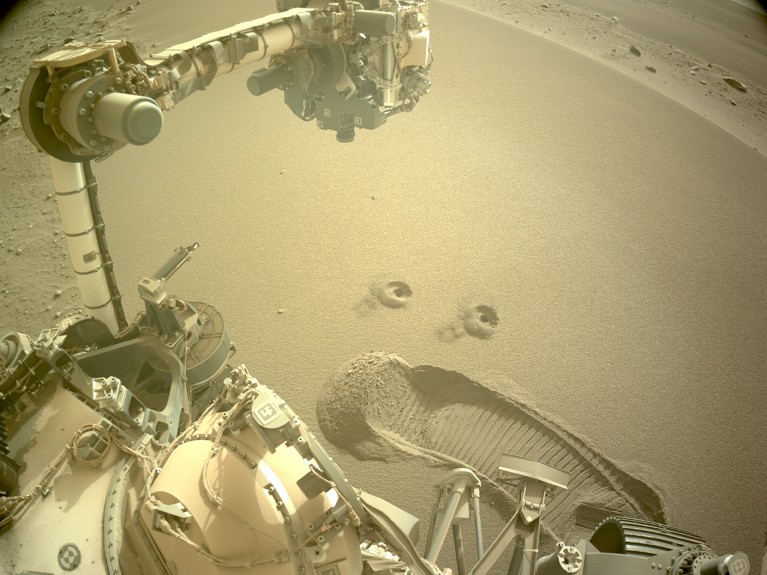
Depositing the cores is an early step toward the first-ever Mars sample return. “We’re coming up on this really big and exciting milestone,” says Meenakshi Wadhwa, a planetary scientist at Arizona State University in Tempe and NASA’s principal scientist for the Mars sample return.
Perseverance drills and stores rock samples in its belly as it rolls around on Mars; by depositing some of them in what NASA calls a sample depot, it will create a cache of back-up samples that will be safe if something goes catastrophically wrong as the rover continues to explore Jezero. “It guarantees that a scientifically high-value sample collection will be available for Earth return,” Wadhwa said on 16 December, at a press briefing at a meeting of the American Geophysical Union.
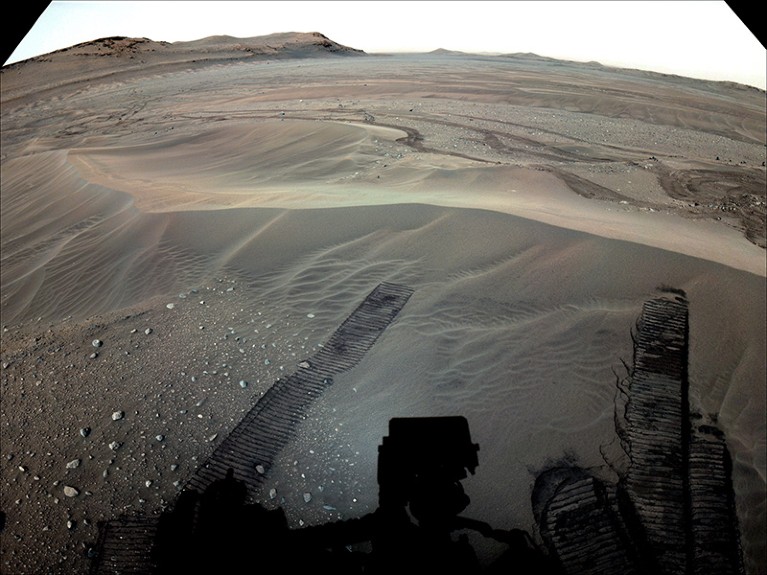
The Martian site nicknamed Three Forks, where the Perseverance rover will soon deposit a cache of samples.
Credit: NASA/JPL-Caltech/ASU/MSSS
Perseverance will deposit the tubes at the base of an ancient river delta in Jezero, in a flat area called Three Forks, where it should be easy for future spacecraft to land. The contents of the ten tubes include three samples of sedimentary rock from the delta, which scientists think will offer the best chance of finding evidence of past life on Mars. The sediments probably settled out at the bottom of slow-flowing water in the delta; on Earth, such sediments often preserve signs of microbial life.
The depot will also include four crater-floor samples of igneous rocks, which are volcanically derived rocks that will allow researchers back on Earth to determine, for the first time, the absolute age of rocks from a particular place on Mars. Rounding out the collection will be one sample of Martian dirt, one of the Martian atmosphere and one ‘witness tube’ that will show whether Earth contaminants were present during sample collection.
Ticket to ride
Perseverance has near-duplicates of most of the samples it will cache, and will keep those duplicates on board. After it drops off the ten cores, it will continue exploring Jezero, adding cores from each of the interesting rocks it encounters. The goal is that the rover will ultimately hold the near-duplicates of the cores that it put down at Three Forks, plus more cores that represent an even wider range of geological diversity. If everything goes well, a future spacecraft will fly to wherever Perseverance ends up and will retrieve the samples directly from the rover.
At Three Forks, Perseverance will put the 10 tubes between 6 and 15 metres apart on the surface, says Katie Stack Morgan, the rover’s deputy project scientist at the Jet Propulsion Laboratory in Pasadena, California. That’s to make sure there is enough room for tiny wheeled helicopters to roll up next to them, pick them up and fly them over to the future fetch lander. The collection will then blast off the surface — in the first-ever rocket launch from another planet — and into Mars orbit, and will eventually return to Earth no earlier than 2033.
After the rover lays down the 10 tubes, it will still have 25 empty tubes on board for whatever it might encounter in the years to come.
Meer van UFO'S of UAP'S, ASTRONOMIE, RUIMTEVAART, ARCHEOLOGIE, OUDHEIDKUNDE, SF-SNUFJES EN ANDERE ESOTERISCHE WETENSCHAPPEN - DE ALLERLAATSTE NIEUWTJES


 The Planet That Shouldn’t Exist