Ontdek de Fascinerende Wereld van UFO's en UAP's: Jouw Bron voor Onthullende Informatie!
Ben jij ook gefascineerd door het onbekende? Wil je meer weten over UFO's en UAP's, niet alleen in België, maar over de hele wereld? Dan ben je op de juiste plek!
België: Het Kloppend Hart van UFO-onderzoek
In België is BUFON (Belgisch UFO-Netwerk) dé autoriteit op het gebied van UFO-onderzoek. Voor betrouwbare en objectieve informatie over deze intrigerende fenomenen, bezoek je zeker onze Facebook-pagina en deze blog. Maar dat is nog niet alles! Ontdek ook het Belgisch UFO-meldpunt en Caelestia, twee organisaties die diepgaand onderzoek verrichten, al zijn ze soms kritisch of sceptisch.
Nederland: Een Schat aan Informatie
Voor onze Nederlandse buren is er de schitterende website www.ufowijzer.nl, beheerd door Paul Harmans. Deze site biedt een schat aan informatie en artikelen die je niet wilt missen!
Internationaal: MUFON - De Wereldwijde Autoriteit
Neem ook een kijkje bij MUFON (Mutual UFO Network Inc.), een gerenommeerde Amerikaanse UFO-vereniging met afdelingen in de VS en wereldwijd. MUFON is toegewijd aan de wetenschappelijke en analytische studie van het UFO-fenomeen, en hun maandelijkse tijdschrift, The MUFON UFO-Journal, is een must-read voor elke UFO-enthousiasteling. Bezoek hun website op www.mufon.com voor meer informatie.
Samenwerking en Toekomstvisie
Sinds 1 februari 2020 is Pieter niet alleen ex-president van BUFON, maar ook de voormalige nationale directeur van MUFON in Vlaanderen en Nederland. Dit creëert een sterke samenwerking met de Franse MUFON Reseau MUFON/EUROP, wat ons in staat stelt om nog meer waardevolle inzichten te delen.
Let op: Nepprofielen en Nieuwe Groeperingen
Pas op voor een nieuwe groepering die zich ook BUFON noemt, maar geen enkele connectie heeft met onze gevestigde organisatie. Hoewel zij de naam geregistreerd hebben, kunnen ze het rijke verleden en de expertise van onze groep niet evenaren. We wensen hen veel succes, maar we blijven de autoriteit in UFO-onderzoek!
Blijf Op De Hoogte!
Wil jij de laatste nieuwtjes over UFO's, ruimtevaart, archeologie, en meer? Volg ons dan en duik samen met ons in de fascinerende wereld van het onbekende! Sluit je aan bij de gemeenschap van nieuwsgierige geesten die net als jij verlangen naar antwoorden en avonturen in de sterren!
Heb je vragen of wil je meer weten? Aarzel dan niet om contact met ons op te nemen! Samen ontrafelen we het mysterie van de lucht en daarbuiten.
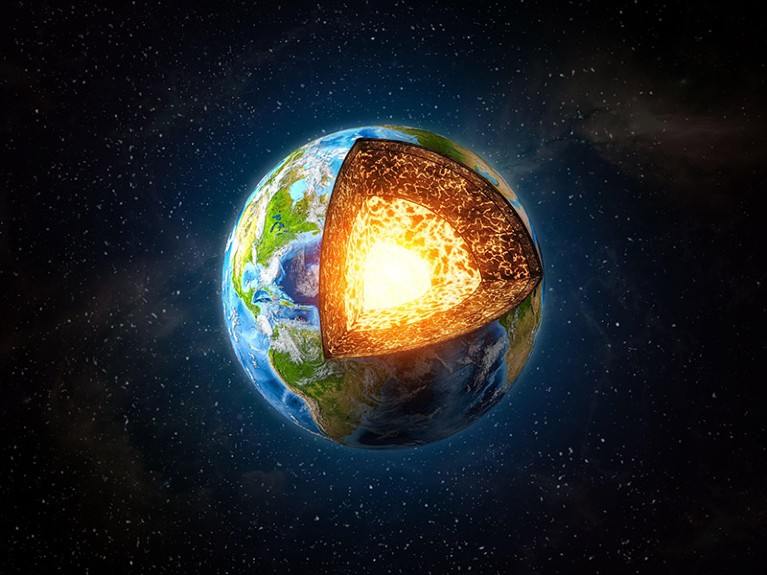
Seismic waves have helped researchers to learn about the layers that comprise Earth’s solid centre.
Credit: Maksym Yemelyanov/Alamy
The reverberations from earthquakes as they bounce back and forth through the centre of Earth have revealed new details about the structure of the planet’s inner core, according to a study published in Nature Communications this week1.
For several decades, evidence has been mounting to suggest that the planet’s solid inner core is made up of distinct layers2,3 but their properties have remained mysterious.
To better understand the inner core’s structure, researchers used multiple seismometers to examine how seismic waves are distorted as they pass through the solid ball of iron nickel at Earth’s heart. “Earth oscillates like a bell after a large earthquake, and not just for hours, but days,” says co-author Hrvoje Tkalčić, a geophysicist at the Australian National University in Canberra, Australia.
To detect these oscillations, researchers recorded the waveforms at close to the original site of the earthquake and at the antipode —the direct opposite position on the surface of Earth. This enabled them to look at the multiple journeys through Earth’s centre. “It’s like a ping-pong ball that’s bouncing back and forth,” says co-author Thanh-Son Pham, a postdoctoral fellow at the Australian National University. Each reverberation takes around twenty minutes to cross from one side of the planet to the other, and the seismometers recorded up to five bounces from a single event.
Stacked measurements
The original earthquakes each reached a magnitude of greater than six, but the waves got progressively weaker as they passed through Earth’s core. The researchers used a technique called ‘stacking’, in which they combined the waveforms from a single event to build a more detailed picture of the distortion from the innermost core.
They found that the waves travelled differently through the innermost inner core — which they estimate to be around 650 kilometres thick — than through the outer part. Waves passing through the innermost part of the core slowed down in one direction, whereas waves passing through the outer layer slowed down in another direction. “It simply means that the iron crystals — iron, which is dominant in the inner core — is probably organized in a different way than in the outer shell of the inner core,” Tkalčić says.
Geophysicist Vernon Cormier at the University of Connecticut in Storrs says that the study is important because it offers a measurement of Earth’s innermost section that was very difficult to achieve. “It requires finding seismic waves recorded at very long distance and that are fairly weak in amplitude, and then enhancing the amplitude so that you could measure the wave speed in the very deep interior of the Earth,” says Cormier.
Although the technique is routinely used for minerals exploration, it is not commonly used in geophysics.
The latest finding will help in understanding how Earth’s solid inner core formed — a process that is thought to have started somewhere between 600 million and 1.5 billion years ago — and what role that might have had in shaping the magnetic field.
doi: https://doi.org/10.1038/d41586-023-00496-1
References
Pham, T.-S. & Tkalčić, H. Nature Commun.14, 754 (2023).
Before the experts decided on the ultimate design for planes, a ton of bizarre flying contraptions were proposed, but just because we now have designs that function doesn't stop individuals from imagining new methods to explore the sky.
Carl Sagan Explains The Cosmos Using Drake Equation, To Find How Many Intelligent Civilizations In Our Galaxy. UFO Sighting News.
The Drake Equation is a formula that attempts to estimate the number of intelligent civilizations in the Milky Way galaxy with whom communication might be possible. The equation takes into account a number of factors, including the rate of star formation, the fraction of stars with planets, and the number of planets that could support life.
The Drake Equation is often used as a starting point for discussions about the possibility of extraterrestrial life, but it is important to note that the values used for each parameter are highly uncertain and could vary widely depending on a number of factors. Using the Drake Equation to estimate the number of intelligent alien species in the universe is difficult, as it requires making assumptions about a number of unknown factors.
However, some estimates suggest that there could be as many as 10 billion intelligent civilizations in the Milky Way galaxy alone. It is important to note, however, that these estimates are highly speculative and subject to significant uncertainty. As we continue to explore the universe and gather more data about the conditions necessary for life, our estimates of the number of intelligent alien species in the universe may change.
John Lennon describes seeing a UFO over New York, 1974 UFO Sighting News.
-
Date of sighting: 1974
Location of sighting: New York City, New York, USA
John Lennon, one of the founding members of the Beatles, was known for his creative talents, activism, and controversial views on various topics. In 1974, Lennon reportedly had a UFO encounter that left a lasting impression on him. According to reports, Lennon and his girlfriend, May Pang, were living in an apartment in New York City when they observed a bright, circular object hovering in the sky outside their window. Lennon described the object as being "a very vivid, white light" that he initially thought was a helicopter. However, when the object began to move erratically and change colors, Lennon realized it was not a conventional aircraft. Lennon later recounted the experience in interviews and even mentioned it in some of his songs. He described feeling a sense of awe and wonder at the sighting and suggested that it had a profound impact on his worldview.
White UFO Over Kellog, Iowa May 28, 2022, UFO Sighting News. Video
Date of sighting: May 28, 2022
Location of sighting: Kellog, Iowa, USA Source: MUFON
I made a close up of 6 seconds and slowed it down 2X to make it a total of 12 seconds and put it at the start of the video. That way everyone could see this objects shape, but its odd, its rectangle then oval then round, so its shape seems to change. This to me indicates its a true alien craft, because there are no aircraft or rockets capable of changing shape. 100% alien tech.
Scott C. Waring - Taiwan
Report just in Today. Eyewitness states:
On May 28, 2022, my neighbors contacted me about a bright object in the sky at 7:50 PM and sent a picture. I was unable to see it from my location, so I walked down the street with my wife and our 11 year old son to their location. I took a number of pictures from that location and then we all walked about 3/4 of a mile further to a more open area near the lake so we could get a better view. I contacted to two other neighbors to join us with a telescope or binoculars if they had one. He only had a digital camera, and by the time he got set up the object appear to dim. One neighbor asked if it seemed to be fading, my wife watched it blank out 2 to 3 times and then disappear about 9:25 pm.
I posted about it on a local drone Facebook page. Someone replied that there was a weather balloon in the area, and I dismissed it as a possible weather balloon. After the recent sightings across the United States of odd shaped objects, I looked at the pictures again. One in particular stood out to me, as when I change the contrast from the original blurry photo of a zoom in on the object using my phone editing feature, a strange shape or structure emerges from within the disc. The object did not appear to be reflecting light but had its own light source which sometimes looked like balls of light around it. These pictures were all taken from my iPhone 13 Pro. Included is the compass direction of the location and the known balloon location approximate the time of the event. I originally dismissed this as a possible weather balloon, but after the recent sightings decided to take another look at the pictures.
The sightings The Belgian UFO wave began in November 1989. Reports were filed, most many weeks after the events. Many of the reports related a large object flying at low altitude. Some reports also stated that the craft was of a flat, triangular shape, with lights underneath. The Belgian UFO wave peaked with the events of the night of 30–31 March 1990. On that night, one unknown object was tracked on radar, and two Belgian Air Force F-16s were sent to investigate, with neither pilot reporting seeing the object. No reports were received from the public on the date. But over the next 2 weeks reports from 143 people who claimed to have witnessed the object were received, all of them after the event. Over the ensuing months, many others claimed to have witnessed these events as well. Following the incident, the Belgian Air Force released a report detailing the events of that night At around 23:00 on 30 March, the supervisor for the Control Reporting Center (CRC) at Glons received reports that three unusual lights were seen moving towards Thorembais-Gembloux, which lies to the southeast of Brussels. Glons CRC requested the Wavre gendarmerie send a patrol to confirm the sighting. Approximately 10 minutes later, some later reports stated that a second set of lights were seen, moving towards the first triangle. Traffic Center Control at Semmerzake tracked one object only on its radar, and an order to scramble two F-16 fighters from Beauvechain Air Base was given. Throughout this time, in reports after the event, some people claim that the phenomenon was visible from the ground, describing the whole formation as maintaining their relative positions while moving slowly across the sky.
Belgian UFO wave,sightings of triangular UFOs in Belgium lasted from 29 November 1989 to April 1990
The Belgian UFO wave began in November 1989. Reports were filed, most many weeks after the events. Many of the reports related a large object flying at low altitude. Some reports also stated that the craft was of a flat, triangular shape, with lights underneath.
The Belgian UFO wave peaked with the events of the night of 30–31 March 1990. On that night, one unknown object was tracked on radar, and two Belgian Air Force F-16s were sent to investigate, with neither pilot reporting seeing the object. No reports were received from the public on the date. But over the next 2 weeks reports from 143 people who claimed to have witnessed the object were received, all of them after the event. Over the ensuing months, many others claimed to have witnessed these events as well. Following the incident, the Belgian Air Force released a report detailing the events of that night.
Belgian UFO Wave - Reportage Belgische Ufologen (1995)
Interview met Belgische Ufologen Mark Broux, Wim Van Utrecht en Prof. Vermeessen. Fragment VTM Reportage (1995)
Belgian UFO videos 2022
Videocompilatie van de UFO-beelden die in 2022 bij het Belgisch UFO-meldpunt (www.ufomeldpunt.be) binnenkwamen.
Belgian UFO videos 2021
Videocompilatie van de UFO-beelden die in 2021 bij het Belgisch UFO-meldpunt (www.ufomeldpunt.be) binnenkwamen.
UFO boven België
Op 23 juni 2020, om 22:02 uur zagen Jasmina Van Wrydeve en haar moeder Manuela Dello een UFO in Zeebrugge (België) vanuit hun appartement vlakbij de zee. Ze slaagden erin het evenement vast te leggen en vertelden ons dat dit geen geïsoleerd evenement was. Volgens hen is er tegenwoordig veel UFO-activiteit op de Noordzee.
Original F-16 radar lock-on footage of a UFO & interview with Belgian Air Force Maj. Gen. De Brouwer
Belgian UFO wave, 1989 - 1990.
"The events of November 29 would be documented by no less than thirty different groups of witnesses, and three separate groups of police officers. All of the reports described a large object flying at low altitude. The craft was of a flat, triangular shape, with lights underneath.
This giant craft made not a sound as it slowly and fearlessly moved across the landscape of Belgium. There was free sharing of information as the Belgian populace tracked this craft as it moved from the town of Liege to the border of the Netherlands and Germany.
This first startling sighting would evolve into a wave over the next several months. On two occasions, a pair of F-16 fighters chased the mysterious object, but to no avail.
On March 30, 1990, a frantic call to military headquarters came from a Belgian national police Captain.
He marveled at a giant triangle passing over and simultaneously two ground radar stations were reporting an object of unknown origin on their screens.
One of these bases was NATO controlled near the city of Glons, southeast of Brussels.
After contacting other radar facilities, they learned that at least four other stations were also reporting the object on their screens. The object was moving across their screens slowly, and failed to send a transponder signal to identify itself.
Two F-16s were ordered to intercept and identify this phenomenon, and one of the jet's radars locked the object in. It appeared as a small diamond on the pilot's screen.
The pilot reported that only a few seconds after locking on the target, the object began to pick up speed, quickly moving out of radar range.
An hour long chase ensued, during which time the F-16s picked up the strange craft's signal two additional times, only to see it fade from view.
The triangular craft seemed to be playing a cat and mouse game, and finally was lost in the night lights of Brussels.
The pilots of the fighters reported that the UFO had made maneuvers at speeds beyond the capability of their technology, and once the radar showed the craft drop from 10,000 to 500 feet in 5 seconds!"
-Belgium General says incredible UFO case is a mystery - Exclusive
In this video, retired Belgian Air Force General Wilfried De Brouwer discusses a wave of triangular UFOs he investigated in 1989 and 1990. He was in charge of the Belgian Air Force's official investigation. They never came to a definite conclusion as to where the mysterious triangles came from. De Brouwer also discusses the controversial photograph that was allegedly taken in Petit-Rechain.
TRIANGULAR UFOs - Mysteries with a History
Driehoekige UFO's als onderwerp is opnieuw in het nieuws gekomen met een nieuwe waarneming boven de Las Vegas-strip tijdens Kerstmis, met video's die op verschillende sociale media zijn geplaatst. Terwijl lokale tv-zenders en nieuwsuitzendingen zich haastten om het te ontkrachten als een zeldzaam weerfenomeen, hebben veel getuigen en anderen gezegd dat dit niet lijkt op iets dat te wijten is aan het weer. Driehoekige UFO-waarnemingen komen vaak voor en hebben een lange geschiedenis. Sommigen zeggen dat het geheime militaire vliegtuigtechnologie is, terwijl anderen zeggen dat het nagemaakte buitenaardse vaartuigen zijn. In deze aflevering zullen Cristina Gomez en Jimmy Church gevallen en theorieën onderzoeken met betrekking tot dit fascinerende aspect van het UFO-mysterie.
ONDERWERPEN DIE IN ELKE AFLEVERING BEHANDELD WORDEN - Mysteries met een geschiedenis is een wekelijkse show die kijkt naar specifieke plaatsen, gebeurtenissen en onderwerpen met een belangrijke geschiedenis en die ons begrip op de proef stellen. Van UFO-waarnemingen tot UFO-hotspots, het paranormale, inclusief plaatsen van geesten, bizarre bovennatuurlijke activiteit, stedelijke legendes, overleveringen, mythen en nog veel meer.
Cristina Gomez stelt vragen, zoekt naar antwoorden en kijkt in de marge van de menselijke ervaring om aanwijzingen te vinden over enkele van de meest vreemde mysteries die de mensheid in verwarring brengen. Ze onderschrijft geen bepaalde overtuigingen en haar meningen zijn gewoon speculatief.
The Day UFOs Stopped Play: Recalling the Fascinating Sighting at Stadio Artemi Franchi, Florence, Italy, with a Sketch of the Event by Silvio Neri
UFOs have been a subject of fascination and intrigue for decades. The idea that we may not be alone in the universe has captivated our imaginations for years, and while there are still many questions unanswered, sightings of UFOs continue to occur all over the world. One such sighting occurred in 1954 at a football stadium in Florence, Italy. The event became known as the day UFOs stopped play, and it has since become one of the most well-known sightings of its kind.
On October 27, 1954, the Fiorentina football club was playing against its local rival Pistoiese at the Stadio Artemi Franchi in Florence. The match was well underway, with 10,000 fans watching in the concrete bowl of the stadium. However, just after half-time, the game was interrupted when spectators spotted something strange in the sky. According to the referee’s match report, play was suspended because spectators saw something in the sky. The players stopped playing, and the ball rolled to a standstill.
Stadio Artemi Franchi
One of the footballers on the pitch at the time was Ardico Magnini, a legend at the club who had played for Italy at the 1954 World Cup. He later recalled the events of that day, saying, “I remember everything from A to Z. It was something that looked like an egg that was moving slowly, slowly, slowly. Everyone was looking up, and there was also some glitter coming down from the sky, silver glitter. We were astonished we had never seen anything like it before. We were absolutely shocked.”
Another player, Romolo Tuci, also vividly remembers the event. “In those years everybody was talking about aliens, everybody was talking about UFOs, and we had the experience, we saw them, we saw them directly, for real,” he said.
Among the crowd was Gigi Boni, a lifelong Fiorentina fan. “I remember clearly seeing this incredible sight,” he said. His description of multiple objects differs slightly from Magnini’s. “They were moving very fast, and then they just stopped. It all lasted a couple of minutes. I would like to describe them as being like Cuban cigars. They just reminded me of Cuban cigars, in the way they looked.”
The incident at the stadium cannot simply be interpreted as mass hysteria. There were numerous UFO sightings in many towns across Tuscany that day and over the days that followed. According to some eyewitness accounts, a ray of white light was seen in the sky coming from Prato, north of Florence.
60 Years On: Recalling La Nazione's Reporting of the Unforgettable UFO Sighting over Florence, Italy, and the Mysterious Glass Fibres That Followed
Another man who relishes the chance to speak about that day is Roberto Pinotti, the president of Italy’s National UFO Centre. He has written many books about UFOs (you can find them on Amazon), and his home in the center of Florence is stuffed full of alien memorabilia, posters of old Italian B-movies, framed newspaper articles, and black-and-white photographs of blurry flying saucers. “The players and the public were stunned seeing these objects above the stadium,” Pinotti says. “At the time the newspapers spoke of aliens from Mars. Of course, now we know that is not so – but we may conclude that it was an intelligent phenomenon, a technological phenomenon, and a phenomenon that cannot be linked with anything we know on Earth.”
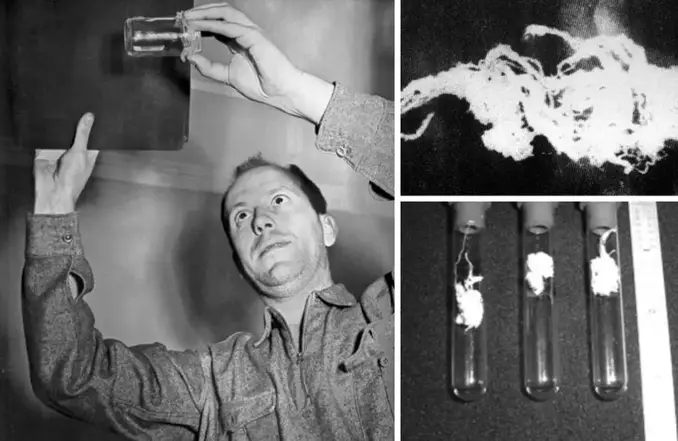
Pinotti is also intrigued by the material that fell from the sky – what Magnini describes as silver glitter. “A wave of flying saucers over Italy,” reported the Domenica del Corriere three years later. “It is a fact that at the same time the UFOs were seen over Florence, there was a strange, sticky substance falling from above. In English, we call this ‘angel hair,'” says Pinotti.
Unraveling the Enigma of Angel Hair: A Closer Look at the Mysterious Substance Connected to UFO Sighting
Variously described by witnesses as similar to cobwebs, cotton wool, or even marshmallows, angel hair is a strange substance that has been reported in connection with UFO sightings around the world. According to Pinotti, the substance is a type of organic material that has not yet been identified. He believes that it is created by the propulsion systems of UFOs and is left behind as they move through the atmosphere.
UFOs Over Italy: Unveiling the Fascinating Coverage of the Domenica del Corriere on the Wave of Flying Saucers That Took the Nation by Storm
The incident at the Stadio Artemi Franchi was not the first time that UFOs had been reported in Italy. In fact, the country has a long history of UFO sightings, with many of them occurring during the 1950s and 60s. Some of the most well-known sightings include the so-called “Sanremo incident” in 1954, in which two Italian air force planes chased a UFO over the Ligurian Sea, and the “Carmine UFO” sighting of 1965, in which a group of schoolchildren in the town of Carmine witnessed a large, cigar-shaped object hovering over their schoolyard.
Football Legends and Fans Gather: Ardico Magnini, Ronaldo Lomi, Romolo Tuci, and Gigi Boni Remember the Day UFOs Stopped Play at Stadio Artemi Franchi
Despite the wealth of sightings and evidence, the scientific community remains divided on the topic of UFOs. While some researchers argue that there is a great deal of evidence to support the existence of extraterrestrial life and that UFO sightings are proof of this, others are more skeptical. They argue that many UFO sightings can be explained by natural phenomena or are the result of misidentification or hoaxes.
Fifa (Federation Internationale de Football Association) also posted a documentary on their website about the UFO sightings at football matches. You can watch full documentary at this link or in just a part about the Day UFOs Stopped Play in the video bellow!
Regardless of which side of the debate you fall on, there is no denying that the incident at the Stadio Artemi Franchi was a truly remarkable event. It captured the imagination of people all over the world and remains one of the most fascinating UFO sightings on record. Today, over 65 years later, it still inspires wonder and intrigue and reminds us that there is much we still don’t know about the universe and our place in it.
Ancient Environmental DNA Reveals Thriving 2-Million-Year-Old Life on Greenland
A “breakthrough” has been made in understanding the history of our planet. Studying ancient environmental DNA a team of researchers has now tracked and mapped the evolution of biological communities that existed some two million-years-ago (Mya).
Until now, the scientific understanding of Earth’s ancient biological lifeforms was greatly built on the oldest environmental DNA available, which was taken from a woolly mammoth that roamed in the Siberian tundra around 1 Mya. But a team of researchers has now sampled and interpreted DNA from sedimentary clay and quartz deposits taken from the permafrost of Greenland that dates back to around 2 million Mya.
Based on this new study of ancient environmental DNA, the team of researchers has presented a detailed picture of life in a 2-million-year-old (Myo) environment, describing it as “far removed from the icy shores of the Arctic Circle.” But more importantly, they think their new techniques and methodology might soon shine light on the ancient origins of humans .
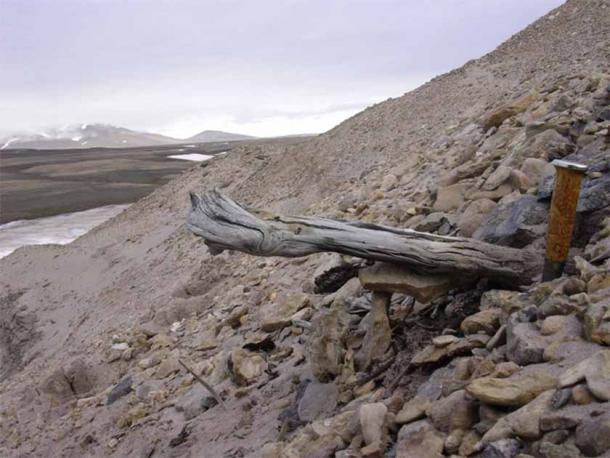
A two-million- year-old trunk from a larch tree still stuck in the permafrost within the coastal deposits. The tree was carried to the sea by the rivers that eroded the former forested landscape.
A new paper published in the journal Nature explores an ancient ecosystem through the results of an analysis of “the oldest ancient environmental DNA recovered to date,” anywhere. The samples were all taken in the north of Greenland, and the study reveals the animal and plant species that roamed these northern territories approximately two Mya.
Author of the new paper, Geneticist Eske Willerslev of the University of Cambridge in the UK and the University of Copenhagen in Denmark, says the new research opens “a new chapter spanning 1 million extra years of history.” And as a result of this new study scientists can now “look directly at the DNA of a past ecosystem that far back in time" added Eske.
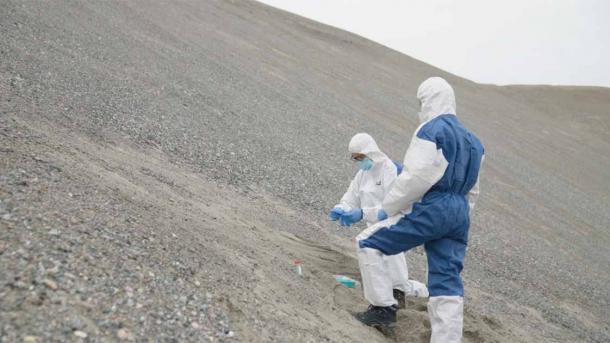
Prof. Eske Willerslev and a colleague sample sediments for environmental DNA in Greenland.
(Courtesy of NOVA, HHMI Tangled Bank Studios & Handful of Films/ Nature)
Revolutionary Steps in Environmental DNA Analysis
The ancient environmental DNA was identified in samples taken at the Kap København Formation, located in Peary Land, North Greenland. Often described as a ‘polar desert’ this region is renowned for its rare fossils dating back to the Neogene period beginning 23.03 million years ago (Mya) to the beginning of the present Quaternary Period 2.58 Mya.
Notwithstanding, because ‘vertebrate’ fossils are rare in the Arctic researchers have always struggled to obtain samples that reveal new data about ancient biological communities. Eske explains that all previous research suggested that around 2–3 Mya the Kap København Formation region had experienced a much warmer climate with “temperatures 11–19 °C warmer than today.” But the new research was constructed around extracted and sequenced DNA “from 41 organic-rich sediment samples taken from 5 different sites within the Kap København Formation.”
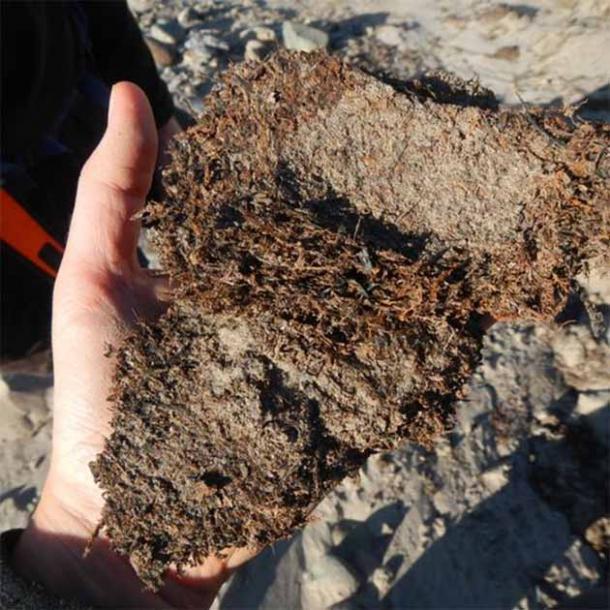
Newly thawed moss from the permafrost coastal deposits. The moss originates from erosion of the river that cut through the landscape at Kap København some two million years ago.
Geologist Kurt Kjær of the University of Copenhagen explains that most of the samples were taken many years ago during other research projects. It wasn't until “a new generation of DNA extraction and sequencing equipment was developed” that extremely small and damaged fragments of DNA in the sediment samples could be analysed enabling the new “map a 2-million-year-old ecosystem."
The new model of the Greenland polar region some 2 Mya shows an ancient ecosystem thriving with fern and fauna. An open boreal forest was filled with “a mixed vegetation of poplar, birch and thuja trees, as well as a variety of Arctic and boreal shrubs and herbs.” Furthermore, mitochondrial DNA allowed the researchers to build a picture of the wildlife from the ground up.
On a microscopic scale, DNA was identified from microorganisms and fungi and the ancient world was populated by ants and fleas. On the other end of the spectrum giant mastodons roamed among reindeer, rodents and geese, and until this study it was thought that mastodons did not range as far north as Greenland. Then, in areas that were once ancient seas, the scientists recovered DNA from the Atlantic horseshoe crab (Limulus polyphemus).
Questing Ancient Origins
In conclusion, the authors suggest their data points towards “Earth's future in the face of a changing climate.” What they mean here is that they now have insights into the ability of different species to adapt to the changing environments resulting from temperature increases. Geogeneticist Mikkel Pederson of the University of Copenhagen said the new found information suggests that given time, “more species can evolve and adapt to wildly varying temperatures than previously thought.”
In the opening sentence this new research was described as a “breakthrough.” Why so? Now that ancient environmental DNA has been extracted from clay and quartz samples, and successfully analysed, the new technique might now be turned towards deposits from other locations around the world. Willerslev said “the possibilities are endless" and that if the new method was applied in Africa scientists might soon be gathering “ground-breaking information about the origin of the first humans and their ancestors."
Top image: Reconstruction of Kap København formation two-million years ago in a time where the temperature was significantly warmer than northernmost Greenland today.
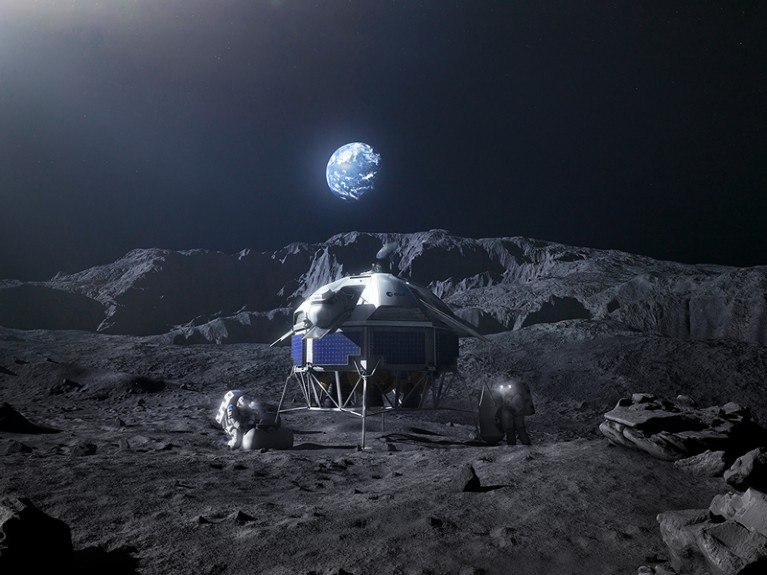
The European Space Agency hopes that its Argonaut Moon missions (artist’s impression) will be powered by batteries that use the radioactive element americium.
Credit: ESA
European scientists are developing a breed of battery for space missions that is powered by nuclear waste. The European Space Agency (ESA) hopes that the technology will, by the end of the decade, allow it to operate spacecraft that don’t rely on solar panels and can explore the Moon and far-off reaches of the Solar System without relying on equipment from international partners.
Ministers at ESA’s ministerial council meeting in Paris on 22 and 23 November agreed to fund a €29-million (US$30-million) programme called European Devices Using Radioisotope Energy (ENDURE). This aims to develop long-lasting heat and electricity units powered by the radioactive element americium-241, in time for a series of ESA Moon missions in the early 2030s.
“If we want to have autonomy in exploration, we need these capabilities,” says Jason Hatton, a co-leader of ENDURE, based at the European Space Research and Technology Center (ESTEC) in Noordwijk, the Netherlands. ESA’s growing space ambitions mean it needs its own source of long-lasting power, says Hatton.
Element 241
Americium, a by-product of plutonium decay, has never been used as a fuel. For missions in which solar power would not suffice — either because of shade or because of distance from the Sun — ESA has relied on US or Russian partners, which have used plutonium-238 batteries to power missions since the space race. NASA built plutonium batteries, for example, that warmed the Huygens probe during its descent to Saturn’s moon Titan in 2005. But plutonium-238 has been in short supply over the past decade and is expensive to produce.
And ESA severed ties with Russia after the country invaded Ukraine. “The current political situation demonstrates that you cannot always rely on partners”, says Athena Coustenis, an astrophysicist at the Paris Observatory in Meudon, France, who chairs an ESA advisory committee that backed the new programme.
The lack of a power source has long restricted the solo missions that European scientists propose, and limited others. The agency felt its lack of radioisotope power keenly in 2014, when its comet-landing Philae probe was operational for less than three days because it ended up in a shaded spot where its solar panels were useless. “For years, European scientists have been saying that if you want to go far, or to dark and cold places, there is no other way,” says Coustenis.
Better than plutonium?
Americium’s big advantage over plutonium is that it is cheaper and more abundant, repurposing waste that would otherwise be useless, says Véronique Ferlet-Cavrois, who co-leads the ENDURE initiative at ESTEC.
Plutonium-238 is made in a two-stage process that involves irradiating a neptunium target with neutrons. Researchers at the UK government’s National Nuclear Laboratory (NNL) in Sellafield have shown that americium can be extracted from reprocessed nuclear fuel used in civil power plants and made into fuel pellets, which form the core of the batteries. Part of the ENDURE programme will include raising americium production capacity to what is needed for batteries, says Hatton.
Americium has a longer half-life than plutonium-238, which means it lasts longer but packs less power per gram. But because americium is more readily available, producing one watt of power costs about one-fifth as much as it does using plutonium, says Markus Landgraf, who coordinates work on future lunar missions at ESTEC.
Over the next three years, the ENDURE team will develop prototypes into models that can be tested in mission-like conditions, as precursors to usable devices. In a collaboration with NNL, a team at the University of Leicester, UK, has developed two types of device: a radioisotope heating unit, which warms instruments with heat produced in the decaying americium, and radioisotope thermoelectric generators (RTGs), which use the heat to produce electricity by creating a temperature difference across metal plates.
The researchers designed both types of device to account for americium’s higher volume for a given power output, and cooler temperatures, compared with plutonium, says Richard Ambrosi, a physicist and specialist in space power systems, who leads the team at the University of Leicester.
Safety is also crucial, because of the use of radioactive materials. The units are encapsulated in layers including a platinum alloy, which seal in the americium while allowing heat to escape, he says. The programme’s next phase will focus on safety testing, so that the americium units can be certified for launch. Tests will include monitoring the behaviour of components at high temperatures and under impact — for example, during an explosion on the launch pad — to ensure that radioactive material would not leak. “We have to be able to survive a significant set of very extreme scenarios,” says Ambrosi.
Once developed, the same basic power system could be reused on any missions for which solar energy is unavailable, says Ferlet-Cavrois. This is the case during nights on the Moon, which last 14 Earth days, and on expeditions to the Solar System beyond Jupiter. To survive the harsh lunar night, China’s active Moon rover, Chang’e-4, uses plutonium heating units built in collaboration with Russia.
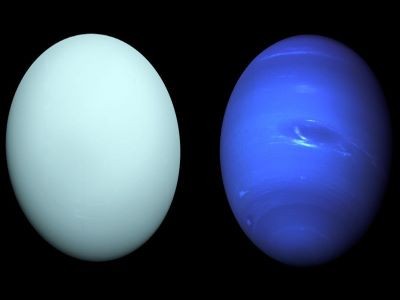
ESA’s first target for launching americium power sources is its Argonaut Moon lander, scheduled to launch in the early 2030s. The Argonaut missions would conduct long studies on the lunar surface and support astronauts working there, says Landgraf. And in the 2040s, ESA hopes to power a mission to the ice giants Uranus and Neptune, says Ferlet-Cavrois. These planets have been studied only during fly-bys by NASA’s Voyager 2 probe in the 1980s.
Americium’s availability, and the challenges of producing plutonium-238, mean that NASA might want to use it too, says Landgraf. The agency is assessing its ability to produce enough RTGs for its coming missions. For its Artemis programme, which aims to establish a long-term presence on the Moon, “they consider our americium very interesting”, he says.
It has taken more than a decade of research to get the americium technology to the stage at which it can be developed for real missions, says Ambrosi. “The excitement is actually quite palpable at the moment. We’ve been working on this for a long time,” he says.
Voor zover we weten komen de mineralen hier op aarde van nature niet voor.
Canadese wetenschappers ontdekten de twee mineralen toen ze zich bogen over een stukje van een 15 ton zware meteoriet die in Somalië is teruggevonden. Het gaat om de op acht na zwaarste meteoriet die ooit op aarde is ontdekt. Maar nieuw onderzoek wijst nu dus uit dat het gewicht en de omvang niet het enige is wat deze meteoriet zo speciaal maakt. De buitenaardse steen blijkt namelijk ook twee mineralen te herbergen die hier op aarde van nature niet voorkomen.
Elaliite en elkinstantonite De wetenschappers hebben de twee mineralen de namen elaliite en elkinstantonite gegeven. De mineralen zijn aangetroffen in een 70 gram wegend plakje van de meteoriet dat aan de wetenschap ter beschikking is gesteld. En mogelijk herbergt dit plakje nóg een mineraal dat hier op aarde van nature niet voorkomt, maar dat wordt momenteel nog nader onderzocht.
Soepeltjes De ontdekking van de eerste twee ‘nieuwe’ mineralen ging overigens verrassend soepeltjes. Het was in eerste instantie wetenschapper Chris Herd die in het stukje meteoriet iets geks aantrof. Hij schakelde vervolgens collega Andrew Locock in, die eerder al nieuwe mineralen beschreef. “En de eerste dag dat hij (Locock, red.) enkele analyses uitvoerde, zei hij al: ‘Je hebt hier minimaal twee nieuwe mineralen in zitten’,” vertelt Herd. “Dat was fenomenaal. Meestal is het namelijk heel veel werk om te kunnen concluderen dat er een nieuw mineraal in zit.”
Dat het dit keer zo gemakkelijk ging, is goed te verklaren. Want hoewel beide mineralen van nature niet op aarde voorkomen, hebben wetenschappers ze eerder wel in het laboratorium weten te creëren. En een vergelijking van de nieuwe, op natuurlijke wijze in deze meteoriet tot stand gekomen mineralen met synthetische mineralen leidde Locock tot de spoedige conclusie dat we hier te maken hebben met mineralen die – voor zover we weten – van nature niet op aarde voorkomen.
Andere chemie En dat is een opwindende ontdekking, vindt Herd. “Wanneer je een nieuw mineraal vindt, betekent het dat de geologische omstandigheden (waaronder de steen gevormd is, red.), de chemie van de steen anders is dan alles wat we hiervoor gezien hebben. En dat maakt dit zo opwindend. Want in dit geval hebben we zelfs twee mineralen die nieuw zijn voor de wetenschap.”
Nader onderzoek De mineralen worden nu nog nader onderzocht. Herd en collega’s hopen zo te achterhalen wat ze ons kunnen vertellen over de omstandigheden waaronder de meteoriet tot stand is gekomen. “Dat is mijn vakgebied,” aldus Herd. “De geologische processen en de geologische geschiedenis van de planetoïde waar deze steen ooit deel van uitmaakte, achterhalen.”
Zoals gezegd wordt vermoed dat het dunne plakje van de meteoriet dat Herd en collega’s bestudeerd hebben nog een derde mineraal herbergt dat we hier op aarde niet kennen. En wanneer wetenschappers de beschikking zouden krijgen over aanvullende stukjes van de meteoriet is het niet ondenkbaar dat daarin nog meer nieuwe mineralen worden aangetroffen. Of het zover gaat komen, is helaas zeer twijfelachtig; volgens de laatste berichten is de meteoriet naar China overgebracht, met als doel deze daar te verkopen. Of wetenschappers in de toekomst nog stukjes van de meteoriet tot hun beschikking krijgen, is dan ook onzeker.
Meer van UFO'S of UAP'S, ASTRONOMIE, RUIMTEVAART, ARCHEOLOGIE, OUDHEIDKUNDE, SF-SNUFJES EN ANDERE ESOTERISCHE WETENSCHAPPEN - DE ALLERLAATSTE NIEUWTJES


 Secrets of Earth’s inner core revealed by large quakes