Ontdek de Fascinerende Wereld van UFO's en UAP's: Jouw Bron voor Onthullende Informatie!
Ben jij ook gefascineerd door het onbekende? Wil je meer weten over UFO's en UAP's, niet alleen in België, maar over de hele wereld? Dan ben je op de juiste plek!
België: Het Kloppend Hart van UFO-onderzoek
In België is BUFON (Belgisch UFO-Netwerk) dé autoriteit op het gebied van UFO-onderzoek. Voor betrouwbare en objectieve informatie over deze intrigerende fenomenen, bezoek je zeker onze Facebook-pagina en deze blog. Maar dat is nog niet alles! Ontdek ook het Belgisch UFO-meldpunt en Caelestia, twee organisaties die diepgaand onderzoek verrichten, al zijn ze soms kritisch of sceptisch.
Nederland: Een Schat aan Informatie
Voor onze Nederlandse buren is er de schitterende website www.ufowijzer.nl, beheerd door Paul Harmans. Deze site biedt een schat aan informatie en artikelen die je niet wilt missen!
Internationaal: MUFON - De Wereldwijde Autoriteit
Neem ook een kijkje bij MUFON (Mutual UFO Network Inc.), een gerenommeerde Amerikaanse UFO-vereniging met afdelingen in de VS en wereldwijd. MUFON is toegewijd aan de wetenschappelijke en analytische studie van het UFO-fenomeen, en hun maandelijkse tijdschrift, The MUFON UFO-Journal, is een must-read voor elke UFO-enthousiasteling. Bezoek hun website op www.mufon.com voor meer informatie.
Samenwerking en Toekomstvisie
Sinds 1 februari 2020 is Pieter niet alleen ex-president van BUFON, maar ook de voormalige nationale directeur van MUFON in Vlaanderen en Nederland. Dit creëert een sterke samenwerking met de Franse MUFON Reseau MUFON/EUROP, wat ons in staat stelt om nog meer waardevolle inzichten te delen.
Let op: Nepprofielen en Nieuwe Groeperingen
Pas op voor een nieuwe groepering die zich ook BUFON noemt, maar geen enkele connectie heeft met onze gevestigde organisatie. Hoewel zij de naam geregistreerd hebben, kunnen ze het rijke verleden en de expertise van onze groep niet evenaren. We wensen hen veel succes, maar we blijven de autoriteit in UFO-onderzoek!
Blijf Op De Hoogte!
Wil jij de laatste nieuwtjes over UFO's, ruimtevaart, archeologie, en meer? Volg ons dan en duik samen met ons in de fascinerende wereld van het onbekende! Sluit je aan bij de gemeenschap van nieuwsgierige geesten die net als jij verlangen naar antwoorden en avonturen in de sterren!
Heb je vragen of wil je meer weten? Aarzel dan niet om contact met ons op te nemen! Samen ontrafelen we het mysterie van de lucht en daarbuiten.
Unknown space object (meteorite?) plunges into the sea near the Canary Islands
Translation from report diariodeavisos.elespanol.com: A possible meteorite has triggered the alarms in Gran Canaria on the afternoon of this Wednesday. According to official sources, it crossed La Palma, El Hierro, La Gomera, the south of Tenerife and passed through Gran Canaria, to end up plunging into the sea, on the north coast, between the municipalities of Arucas and Guía.
The loud noise generated by the trajectory of the meteorite triggered alarm among the population in different parts of the island, with special emphasis on the Santa Brígida area, where it was even thought of a landslide. The subsequent fire in an area of the municipality suggested that it was due to the impact of the meteorite, something that was later ruled out.
When it entered the Canarian sky, a luminous object of an intense red color was seen and then a trail of smoke. He crossed the western islands in the direction of Gran Canaria.
The alert began at 3:39 p.m. this Wednesday, at which time dozens of people have called 112 reporting "tremors" of origin yet to be identified. According to the sources of the emergency service, they have not had to intervene for the moment and are collecting information about the incident.
"I do not know the origin, but the tremor was quite important. Not only windows, the floor and walls trembled and in the background a sound like a distant explosion," said Twitter user @meteograncanaria.com
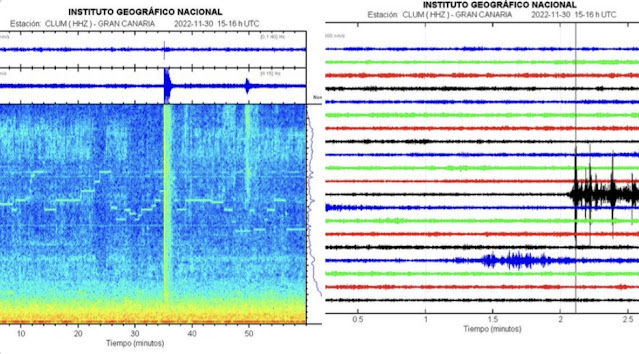
The National Geographic Institute has registered the shock, but still does not specify the origin. The authorities are trying to find out the cause of the great noise that this Wednesday keeps Gran Canaria in suspense .
Although it is believed to have been a meteorite, this has not yet been proven. It is said to have been a 3-foot-long object that would weigh many tons. Such an object would cause a huge tidal wave when it crashes into the sea and that does not seem to be the case here. So, was it a meteorite or could it have been something else that crashed into the sea?
Twitter page below: The great roar this afternoon in Gran Canaria was not produced by any earthquake. At our seismic stations we see the noise of some kind of unknown explosion. What we see is sound. Therefore, this is outside of our competences
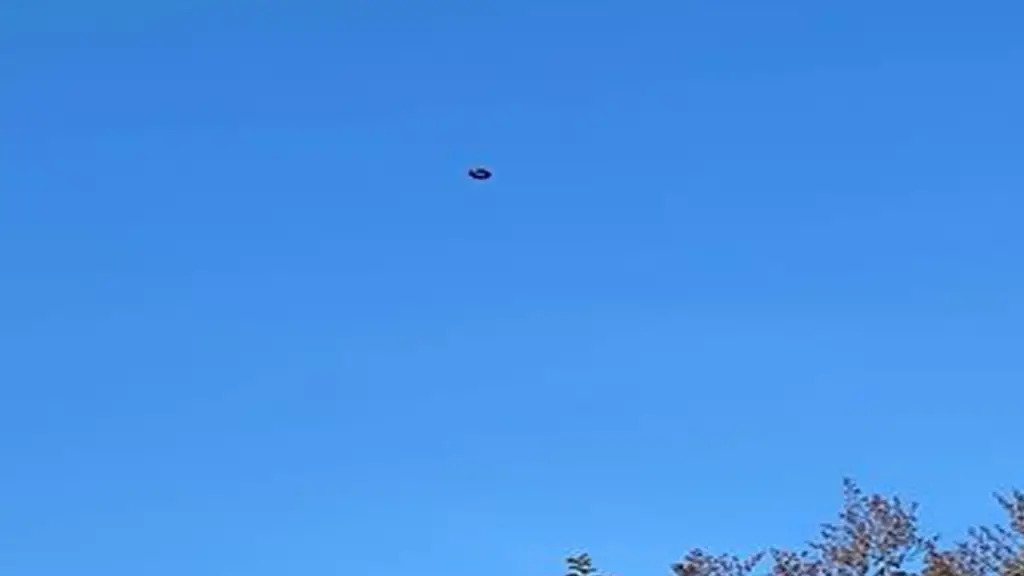
Donut-shaped UFO over Southern California on 27-Nov-2022
This donut-shaped UFO sighting was filmed over Southern California and it was submitted to our website through our Facebook page. It was filmed on 27th November 2022.
What do you think it is? Real deal or maybe a balloon?
Synthetic Greys: Artificially Programmed Probes with One Aim in Mind – Gather Information & Survive
According to author and philosopher, Nigel Kerner, we are entering a critical phase in our evolution as a species due to the increasing number of artificial constructs being introduced to us.
Richard S. Syrett, the guest host, joined the team of Kerner and Silverman to discuss the author’s ideas about an advanced race that has developed AI probes known as Greys.
Are Aliens Already on Earth? A Mysterious Interstellar Object Crashed in Our Ocean
Are Aliens Already on Earth? A Mysterious Interstellar Object Crashed in Our Ocean! A guest from beyond our solar-system is earth-bound, and we have absolutely no idea. The object wasn’t all that big, just a meter or so across, but its significance is massive. What is amazing here, is that the information about the asteroid was not immediately made public by the Government. It took two men Avi Loeb and Amir Siraj three years to have the government accept the origin of the interstellar object and make it public. Let's check out what it could really be?
THE ALIEN ABDUCTION OF THE CENTURY : LINDA NAPOLITANO STORY - ORIGINAL V MOVIES SCI-FI DOCUMENTARY
THE ALIEN ABDUCTION OF THE CENTURY : LINDA NAPOLITANO STORY - ORIGINAL V MOVIES SCI-FI DOCUMENTARY
Linda Napolitano was a simple New York housewife, at least until November 30, 1989, when in the middle of the night she was abducted by aliens and made to float above the Manhattan sky until she entered a UFO where she was subjected to mysterious experiments. Hypnosis, aliens, man in black and important political figures, these are the pieces that characterize the alien abduction of Linda Napolitano, what over time was defined by experts as "the alien abduction case of the century".
Welcome to V Movies. The fastest growing YouTube Channel for full length movies! We post every day new and exciting movies! Action, Thrillers, Horror, Sci-Fi! And so much more! Just click SUBSCRIBE and hit the Bell Button! We post EVERY DAY!
All movies on our channel have been legally licensed to V Movies from distributors, filmmaker and content owners. If you have any copyright concerns please write us at info@vchannelsmedia.com !
V Movies is Part of the V Channels Media Group!
Are you a filmmaker and want your movie to be featured on V Movies and earn movie too? Drop us an email distribution@vchannelsmedia.com today!
Do Habitable Planets Exist Other Than Our Earth? | Exoplanets: Thousands Of New Worlds | Spark
Are we alone in the universe? This question has been one of the greatest mysteries of all time. 20 years ago, individual scientists began to challenge traditional planetary science as they set off to seek, observe and reveal the existence of unknown worlds: EXOPLANETS. The film recounts the epic journey of these astrophysicists, who turned our knowledge of the universe upside down, in their quest for extraterrestrial life.
Massive, Unidentified Object 75 Miles Wide Detected By Scientists At NASA
Massive, Unidentified Object 75 Miles Wide Just Detected By Scientists At NASA. Recently, astronomers spotted a massive, 75 miles wide strange object approaching the outer regions of our solar system. The discovery soon caused ripples of excitement and curiosity within the planetary science community because the object is of an unusually large size and of an abnormal origin. The object is approaching our Solar System from the Oort Cloud, a huge region surrounding the Sun that starts far, far beyond the orbit of Neptune, where no manmade object has been able to get at properly, yet. Studying the mysterious object could change everything for astronomers and astronomy, to say the very least. This is the shocking discovery that was made by NASA of an unidentified object entering our solar system.
NASA Finds An Object That’s Eating Galaxies
There's something huge and massive out there deep in the universe, some unknown force that is pulling on everything, and accelerating all galaxies towards the unknown, including our own Milky Way.
But that's not all, astronomers may have just found something even bigger and more mysterious! What is this unknown force, and will it destroy everything in the universe?
RELATED
James Webb Telescope Discovers New Exoplanet Near Earth Where Humans Came From?
The James Webb Space Telescope demonstrated its ability to transform exoplanet research by capturing the first direct image of a planet orbiting a faraway star. Only approximately two dozen exoplanets have been directly imaged; the vast majority have only been detected by the transient dimming of the stars they orbit. However, that might soon alter. A planet outside of our solar system has been directly photographed for the first time by the James Webb Space Telescope less than two months after it began its science operations. Watch on as we walk you through how important this breakthrough is for the discovery of a new habitable planet!
Webb Discoved Artifical Light On Proxima B & What This Could Mean!
Webb Discoved Artifical Light On Proxima B & What This Could Mean!
Did the James Webb Space Telescope detect artificial lights on Proxima B, an exoplanet in our neighboring galaxy? If so, this could be evidence of intelligent life on the planet. The lights were seen by the most powerful telescope in existence and are suggestive of a civilization using powerful artificial lights. So what's the reality behind this strange phenomenon? Stay tuned as we explore this possibility in more detail.
In today's video we look at Webb Discoved Artifical Light On Proxima B & What This Could Mean!...Keep watching to see What possibilties lay ahead for detection of alien life
Subscribe for space news & discoveries, James Webb Space Telescope, Hubble, SpaceX, and NASA news. As well as updates on the Moon and Mars missions. Inspired by Space Awesome, Space Rumor, Future Space, Exoplanet, Space News Unfold, Insane Curiosity, Future Unity, The Space Wind, History of the Universe, Lift-Off, Space Insider, Atomix, Tech Space, thebhp, TheSimplySpace, The Secrets of The Universe and Space Hub.
RELATED
Finally! NASA Announces What's Inside a Black Hole and It's Horrifying
Finally! NASA has announced what's inside a Black Hole! And man...it's *spooky*! Watch the video to find out more, and be sure to share with your friends so they can watch too!
Watch this video to find out what's inside a Black Hole, and be sure to share it with your friends to teach them about the universe! Black holes are some of the most mysterious things in the universe, and this video will shed light on what's inside them.
8 Mind Blowing Facts About Space You Did Not Know About!
Hey there fact finders! Knowledge is power!
Space is full of mysteries! The more we learn about how the universe functions, the more we realize how little we still know. All we do is wonder about what’s out there and what’s happening there. The fact is that we all know that it’s magnificent and big, but we don't know how big or how beautiful our space is. And if you are also curious about the space go ahead and watch this video.
14 Hollywood Myths About Space
You grow up seeing the bright yellow sun in the sky. You hear about the dark side of the Moon, and watch epic space battles in your favorite sci-fi movies. Then one day you find out none of it is true at all! Today's that day, Bright Sider. The sun isn't yellow, there is no dark side of the moon, and explosions can't really happen in the vacuum of space. That and more truths about common myths most people have no idea about but it's time to finally debunk them! ? Animation is created by Bright Side.
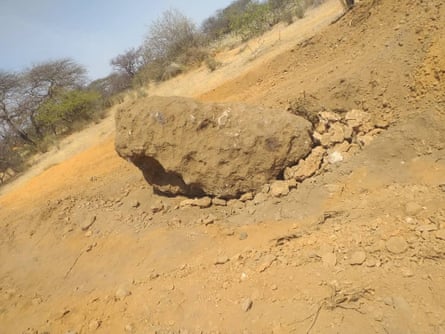
A slice of the El Ali meteorite contains two minerals never seen before in a natural state on Earth.Photograph: Supplied
A team of researchers in Canada say they have discovered two new minerals – and potentially a third – after analysing a slice of a 15-tonne meteorite that landed in east Africa.
The meteorite, the ninth largest recorded at over 2 metres wide, was unearthed in Somalia in 2020, although local camel herders say it was well known to them for generations and named Nightfall in their songs and poems.
Western scientists, however, dubbed the extraterrestrial rock El Ali because it was found near the town of El Ali, in the Hiiraan region. A 70-gram slice of the iron-based meteorite was sent to the University of Alberta’s meteorite collection for classification.
The meteorite was found near the town of El Ali in Somalia.Photograph: Courtesy of Global Resources
Dr Chris Herd, a professor in the department of earth and atmospheric sciences and the curator of the collection, said that while he was classifying the rock he noticed “unusual” minerals. Herd asked Andrew Locock, the head of the university’s electron microprobe laboratory, to investigate.
“The very first day he did some analyses, he said, ‘You’ve got at least two new minerals in there’,” said Herd. “That was phenomenal. Most of the time it takes a lot more work than that to say there’s a new mineral.”
Similar minerals had been synthetically created in a lab in the 1980s but never recorded as appearing in nature, Herd said, adding that these new minerals could help understand how “nature’s laboratory” works and may have as yet unknown real-world uses. A third potentially new mineral is being analysed.
A sample of the meteorite.
Photograph: Courtesy of University of Alberta Meteorite Collection
“I never thought I’d be involved in describing brand new minerals just by virtue of working on a meteorite,” said Herd. “That’s what makes this exciting: in this particular meteorite you have two officially described minerals that are new to science.” They have been named elaliite, after the location of the meteorite, and elkinstantonite, after Lindy Elkins-Tanton, principal investigator of Nasa’s upcoming Psyche mission that aims to send a spacecraft to a metal-rich asteroid.
“Lindy has done a lot of work on how the cores of planets form, how these iron nickel cores form, and the closest analogue we have are iron meteorites. So it made sense to name a mineral after her and recognise her contributions to science,” Herd said.
University of Alberta scientists would like to examine other samples from the same meteorite but Herd said there were reports that it had been removed to China. Meteorites are often bought and sold on international markets.
A third ancient human skull has been uncovered at a site in China. A 3D reconstruction of the second skull, discovered three decades ago and called Yunxian 2, is pictured.
Credit: Pascal Goetgheluck/SPL
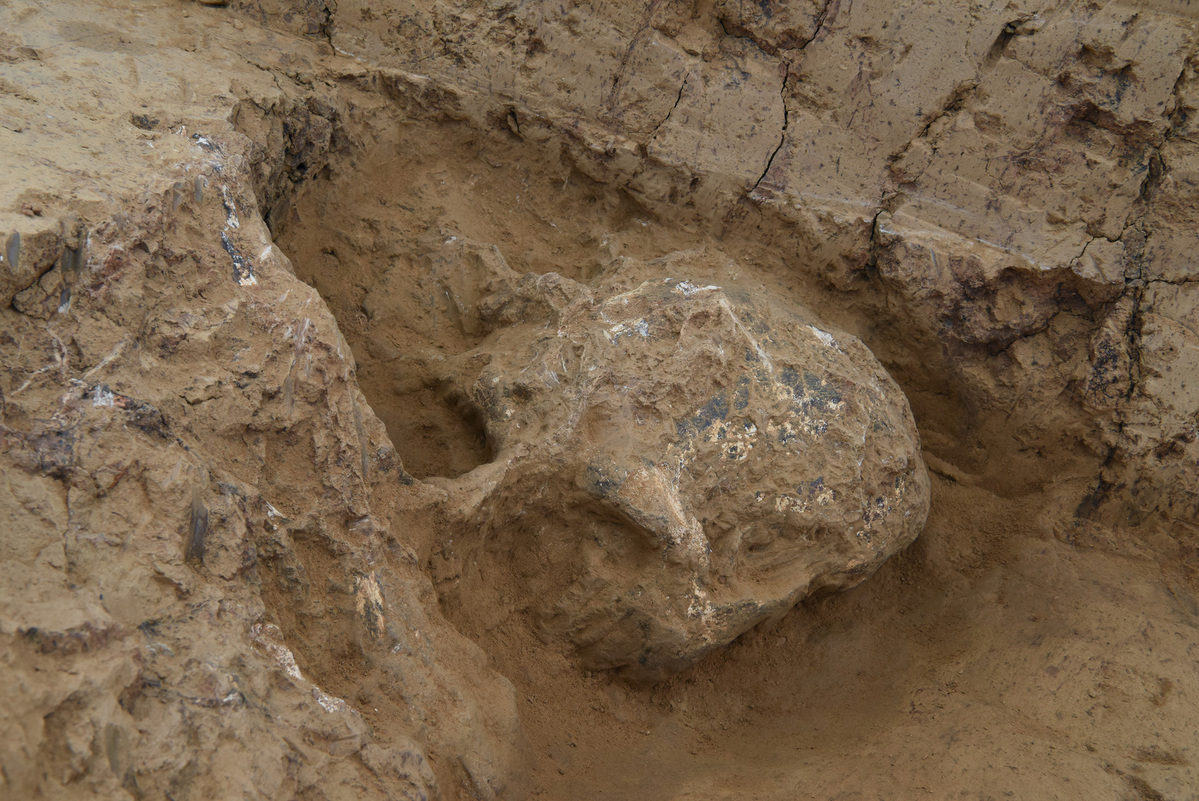
Researchers are heralding the discovery of an ancient human skull in central China as an important find. As excavation of the remarkably intact fossil continues, archaeologists and palaeoanthropologists anticipate that the skull could give a fuller picture of the diverse family tree of archaic humans living throughout Eurasia in prehistoric times.
Archaeologists expect to finish excavating the ancient human skull in November, at the same site in Yun county, Hubei province in central China where the remains of two other million-year-old humans were found decades ago.
Photo: CCTV
No 3 skull of Yunxian Man is found in an excavation site known as Xuetangliangzi in Yunyang district, Shiyan city, Central China's Hubei province.
[Photo/Xinhua]
The skull was discovered on 18 May at an excavation site 20 kilometres west of Yunyang — formerly known as Yunxian — in central China’s Hubei province. It lies 35 metres from where two skulls — dubbed the Yunxian Man skulls — were unearthed in 1989 and 19901, and probably belongs to the same species of ancient people, say researchers.
“It’s a wonderful discovery,” says palaeoanthropologist Amélie Vialet at the National Museum of Natural History in Paris, who has worked on the first two skulls, commonly referred to as Yunxian 1 and 2. Unlike those earlier discoveries, which were crushed and distorted after millennia underground, the third skull, Yunxian 3, seems to be in good condition.
In 2010, Vialet and her colleagues created digital reconstructions of the Yunxian 2 skull, and confirmed that it was probably a member of the archaic human species Homo erectus2. Dating of sediment and animal fossils from the site suggest that the Yunxian humans lived between 1.1 million and 800,000 years ago.
Is Yunxian Man Homo erectus?
Homo erectus was first described from fossils found on the Indonesian island of Java in the late nineteenth century. Javanese fossils dating to 1.5 million years ago suggest that members of the species might have been the first early humans to have ventured out of Africa.
Homo erectus was both widespread and long-lived. Remains have been found in eastern Africa, eastern Asia and possibly Europe, and they span a period from 1.9 million to 250,000 years ago. Because of this, there is a great deal of variability in the species’ fossil record, and the precise relationships between different populations are a matter of debate
The skulls of Yunxian 1 and 2 were distorted after millennia underground.
Credit: Alamy
The Yunxian 3 skull is half-buried in an upright position. Researchers have uncovered the forehead, including the brow ridge and eye sockets, as well as the top, back and left cheekbone of the skull. It is not yet known whether teeth or a lower jawbone are attached to the skull, says Gao Xing at the Institute of Vertebrate Paleontology and Paleoanthropology in Beijing, who is leading the excavation.
Vialet says that the Yunxian 1 and 2 skulls share some features with older Javanese fossils, and others with younger Homo erectus fossils from mainland Asia. Like the Javanese fossils, they are large, big-brained skulls. But she says that they are less heavily built, a characteristic that usually indicates a more modern individual.
Researchers have found Homo erectus remains at more than a dozen sites across China. Vialet says that the ancient humans at Yunxian could be the ancestors of some of these populations, but their skulls bear distinct features that set them apart.
For example, fossils from around 700,000 years ago that were discovered in the Zhoukoudian cave system in suburban Beijing — known as the Peking Man Site — have a prominent sagittal keel, a crest that runs along the midline of the skull for the attachment of strong jaw muscles. The Yunxian skulls all seem to lack this feature, says Vialet.
Variable fossils
Yameng Zhang, a palaeoanthropologist at Shandong University, says that the Homo erectus fossils found in China are highly variable and researchers don’t know why. It could be that each population evolved independently in Asia. Or they could have been the result of multiple waves of expansion out of Africa, he says. “More complete Chinese H. erectus like Yunxian 3 are crucial to answer this question.”
Vialet says that the Yunxian 3 skull should be compared with Chinese as well as European hominin fossils, such as the 1.4-million-year-old face from the Sima del Elefante cave in Atapuerca, Spain, discovered in July. She is currently comparing Yunxian 2 with European hominin fossils, and says that the Yunxian people could be more similar to European populations from the middle Pleistocene epoch than they are to later specimens from China.
If the Yunxian 3 skull has teeth, especially molars, they could be useful for discerning evolutionary relationships with other early humans, says Clément Zanolli at the University of Bordeaux, France.
Archaeologists work to uncover the secrets of ancient humans at the site in Yun county, in the central Chinese province of Hubei.
Photo: Weibo
An age-old question
Once the Yunxian 3 skull is excavated, probably within the next few months, dating it will be an important task. Several techniques have been used to estimate the age of Yunxian 1 and Yunxian 2 at between 800,000 and 1.1 million years.
Wei Wang, a geochronologist at Shandong University, says that hominin fossils in China are often more difficult to date than fossils in Africa, because China lacks volcanic sediments that can be reliably dated by measuring the amounts of radioactive isotopes in the rock.
Jean-Jacques Bahain at the National Museum of Natural History in Paris dated sediments collected from the Yunxian site using electron spin resonance and uranium series dating3. This requires a close comparison between values taken from the fossil and the quartz in the sediment. But he says that the samples he measured weren’t collected at the same time and location as the Yunxian 1 and 2 skulls.
The discovery of Yunxian 3 therefore represents a unique opportunity to collect sediment samples from the ground that the skull sits in, he says.
Small animal fossils surrounding the Yunxian 3 skull are slowing the extraction process, according to Gao. Bahain says that such specimens could help to pinpoint the age of the Yunxian 3 skull, and also connect it to early human remains elsewhere in China that have been found with prehistoric fauna.
doi: https://doi.org/10.1038/d41586-022-04142-0
References
Tianyuan, L. & Etler, D. Nature357, 404–407 (1992).
Waanzinnige ontdekking in de diepte: is dit het langste dier ter wereld?
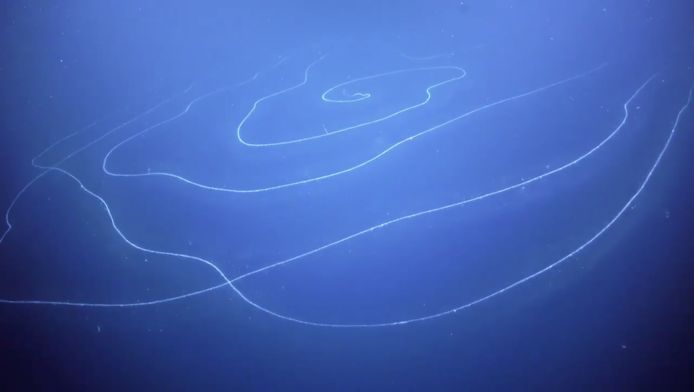
In een onderwaterkloof voor de kust van Australië vond een waanzinnige ontdekking plaats op ongeveer 600 meter diepte. Het gaat om een lang gelatineachtig wezen dat in een reusachtige spiraal hangt. “Het was als een touw aan de horizon. Je kon het niet missen”, zegt Nerida Wilson van het West-Australisch Museum aan de Britse krant 'The Guardian’.
De lengte van het dier bedraagt maar liefst 45 meter. Dat is dubbel zo lang als een blauwe vinvis. Het gaat hier om een buiskwal, waarschijnlijk een nieuwe soort uit het geslacht Apolemia, een groep die er meestal uitziet als een in de knoop geraakte sjaal. De spiraalvorm zorgt ervoor dat ze veel eten binnen krijgen. Talrijke stekende tentakels creëren een muur des doods in het water, waarin kleine prooien, waaronder schaaldieren en vissen, gevangen zitten.
Duikboot
Het dier werd toevallig ontdekt, dat gebeurt wel vaker bij diepzee-onderzoek. De wetenschappers wilden het leven op de zeebodem bestuderen, en kwamen deze drijvende kwal toevallig tegen toen hun onderzeeër onderweg was terug naar het schip.
Het schip, Falkor, zond live beelden uit van de duikboot. Wilson beschrijft hoe iedereen aan boord gefascineerd en verbaasd was toen de enorme spiraal in beeld kwam. Iedereen zwermde naar de controlekamer om het beter te kunnen zien. “Het was zo’n prachtige energie”, zegt Wilson. “Iedereen had zoiets van: ‘Wat is dit?’”
KIJK.
Het gaat om een lang gelatineachtig wezen dat in een reusachtige spiraal hangt
Buiskwallen behoren tot dezelfde groep als gewone kwallen, maar ze bouwen hun lichaam op een unieke manier op. Het zijn eigenlijk honderden aan elkaar geplakte kleine kwallen. Toch is een buiskwal één organisme. “Het had twee ouders”, zegt Wilson aan ‘The Guardian’. In plaats van te groeien tot een lichaam met organen die verschillende functies vervullen, bestaan buiskwallen uit afzonderlijke delen. Sommige delen zijn verantwoordelijk voor de voeding, andere voor de voortplanting, en weer andere bewegen en sturen het dier door het water.
Nog geen wereldrecord opgeëist
Gebaseerd op een ruwe berekening van het spoor van de duikboot is de spiraalvormige buiskwal een kandidaat voor het langste exemplaar dat ooit is aangetroffen. Met ongeveer 45 meter zou het zelfs het langste dier kunnen zijn dat ooit is gemeten.
De piloot van de duikboot die hem vanaf de oppervlakte bestuurde kon maar heel even het dier in beeld brengen omdat de batterij van de duikboot bijna leeg was. “We cirkelden rond, namen wat beelden en een klein weefselmonster”, zegt Wilson. “Daarna moesten we gewoon verder gaan.” Wilson wil nog geen wereldrecords opeisen en werkt samen met een specialist in fotogrammetrie om een nauwkeuriger schatting van de grootte van de buiskwal te krijgen.
When these worms begin consuming everything in their path, gigantic piers, ships, and fairy bridges are all endangered. And if this worm is starving and there is only a tiny snail around, all that will be left of it will be the shell. Why are grotesque beings so vital to our world? Where did the iron snail originate? Why did Darwin chop up worms? How did snails acquire long-range weaponry like harpoons? Let’s find out.
At least once, you’ve looked up at the night sky and asked the same longstanding question we’ve all asked at least once, “Are we alone?” With all those points of light out there, we can’t be the only intelligent beings in the universe, right? There must be at least one technological civilization aside from us in the great vastness that we call the cosmos.
The astronomer Carl Sagan was famous for his quote in his book and film, Contact, “The universe is a pretty big place. If it’s just us, seems like an awful waste of space.” Yet, for some of us, it’s incredibly hard to fathom that it’s just us in the vast unknown full of so many stars and a growing list of exoplanets being discovered on a near daily basis. However, despite all our endless searching, we’ve so far found no one.
So, what if you found out one day that it is just us? What if in the great cosmos, out of all the planets, stars, and galaxies, we are truly alone? How would you look at the universe? At humanity? At yourself? Would you believe it? Would you stop looking up at the stars entirely? Would you feel disappointed that we’re alone, that we’re truly it, or would you feel a sense of optimism knowing that the longstanding question has finally been answered once and for all?
The film, Ad Astra, showed Roy McBride played by Brad Pitt searching for his father, H. Clifford McBride, played by Tommy Lee Jones, the latter of whom was on a mission at Neptune searching for intelligent life outside of the solar system and in the rest of the universe. In the end, Brad finds his dad alone on the space station orbiting Neptune, only to discover that his father didn’t find anything. No intelligent life anywhere in the universe. He discovered that we’re it.
Throughout the film, Roy was struggling to reconnect with his father and his father was struggling to connect with the universe, and this only serves as an appropriate analogy for our own pursuit of answering the longstanding question. At one point when he’s on Mars, Roy asks himself regarding his father, “I don’t know if I hope to find him or be free of him.” In our own pursuit of trying to answer the longstanding question, what if it’s not that we’re hoping to find intelligent life, but that we’re trying to be free of knowing if there’s intelligent life?
In the end, when Clifford disappointingly tells his son that there’s no one else in the universe and that he’s failed in his mission, Roy doesn’t respond with anger or disappointment, but with optimism, telling his estranged father with a smile, “Dad, you haven’t. Now we know. We’re all we’ve got.” In that moment, it was as if the literal weight of the universe was lifted from Roy’s shoulders knowing that we’re it. After Roy unfortunately leaves his father to die in the void, Roy notes that he can’t wait for the day that his solitude ends, and the film ends with him reconnecting with his wife.
While Roy felt almost relieved to finally know the answer to the longstanding question, it’s important to ask if you’d feel the same way? Because, despite all the hopes of us finding intelligent life elsewhere in the universe, we must face the real possibility that we’re it. That’s it just us, and where do we go from here?
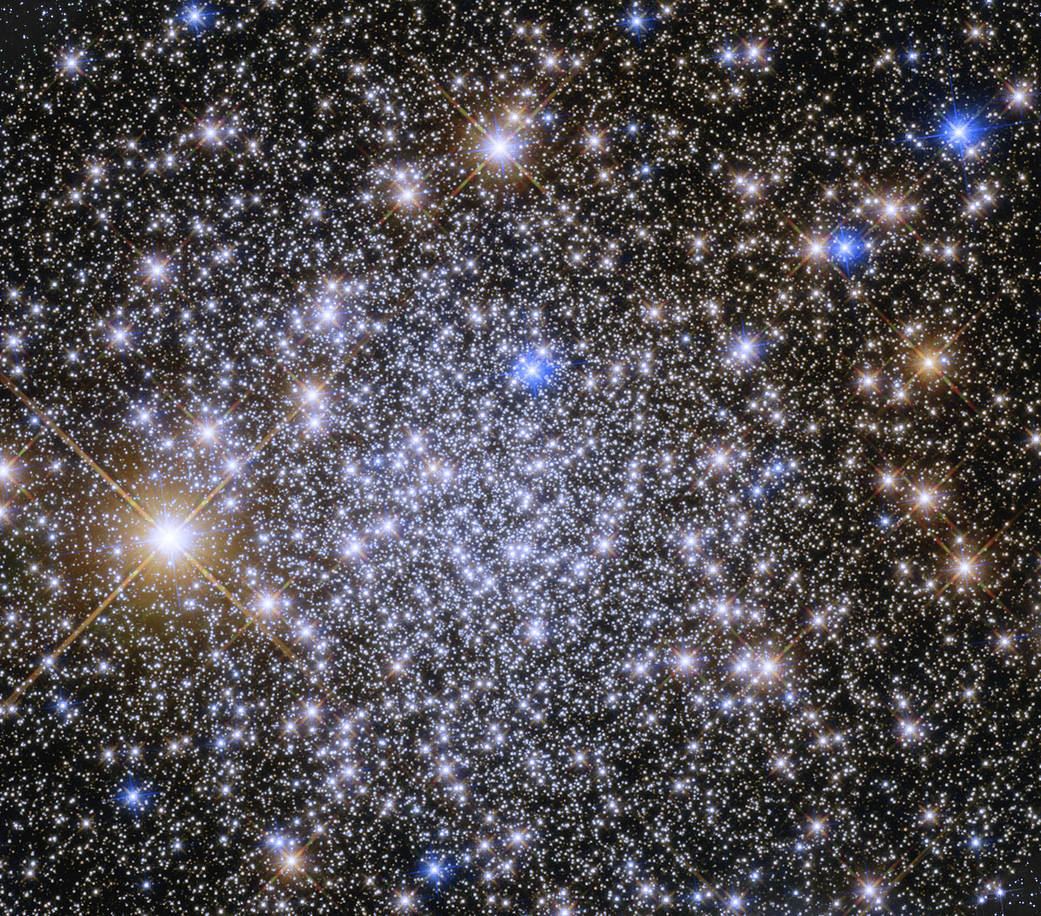
Pismis 26, a globular star cluster located about 23,000 light-years away, as seen by the Hubble Space Telescope.
Credit: NASA, ESA and R. Cohen (Rutgers the State University of New Jersey); Processing: Gladys Kober (NASA/Catholic University of America).
Two Great Globular Clusters Seen by Hubble: Pismis 26 and Ruprecht 106
If you like shiny things, some of the most gorgeous objects in space are globular clusters, with their bright, densely packed collections of gleaming stars. And if you like globular clusters, you’re in luck: two different Hubble images of globular clusters were featured this week by NASA and ESA.
The Hubble telescope basically revolutionized the study of globular clusters, as with ground-based telescopes, it is almost impossible to distinguish the individual stars in globular clusters because they are so densely packed. Hubble been used to study what kind of stars globular clusters are made up of, how they evolve and the role of gravity in these dense systems.
The first image from Hubble, featured by NASA, is this beautiful glittering gathering of stars (above) called Pismis 26, a globular star cluster located about 23,000 light-years away. The cluster is named for Armenian astronomer Paris Pismis who first discovered the cluster in 1959 at the Tonantzintla Observatory in Mexico; and this cluster has the dual name Tonantzintla 2.
Usually, globular clusters consist of stars that are quite old (red and dead), with some of the oldest stars in the Universe. In fact, our resident astrophysicist, Paul Sutter has called globular clusters the “retirement homes for the galaxy.”
Astronomers estimate the age of this particular cluster to be 12 billion years old.
The stars in globular clusters are held together by mutual gravitational attraction. Globular clusters cover a relatively small region in space, with most no more than a couple dozen parsecs across. But each one contains hundreds of thousands, and sometimes millions, of stars. Sutter says that puts the average distance between stars at about 1 light-year, but in their cores the stars pack together over a thousand times more tightly than in our own neighborhood.
Hubble captured this star-studded image of Ruprecht 106.
Credit: ESA/Hubble & NASA, A. Dotter
The second globular cluster image, this one featured by ESA, shows Ruprecht 106. Hubble captured this star-studded image with the Advanced Camera for Surveys (ACS), which was installed on the space telescope by astronauts during a servicing mission in 2002.
Ruprecht 106 contains a bit of a mystery. Even though most of the constituent stars in globular clusters stars likely formed at approximately the same time and location, research with Hubble has shown that is not always true. It turns out that almost all globular clusters contain groups of stars with distinct chemical compositions, which means those groups of stars within the clusters have very slightly different ages or compositions from the rest of the cluster.
However, a handful of globular clusters do not possess these multiple populations of stars, and Ruprecht 106 is a member of that group. Astronomers will likely use the James Webb Space Telescope to study enigmatic clusters like Ruprecht 106 to learn more about the stars and their life cycles.
Meer van UFO'S of UAP'S, ASTRONOMIE, RUIMTEVAART, ARCHEOLOGIE, OUDHEIDKUNDE, SF-SNUFJES EN ANDERE ESOTERISCHE WETENSCHAPPEN - DE ALLERLAATSTE NIEUWTJES


 Unknown space object (meteorite?) plunges into the sea near the Canary Islands