Ontdek de Fascinerende Wereld van UFO's en UAP's: Jouw Bron voor Onthullende Informatie!
Ben jij ook gefascineerd door het onbekende? Wil je meer weten over UFO's en UAP's, niet alleen in België, maar over de hele wereld? Dan ben je op de juiste plek!
België: Het Kloppend Hart van UFO-onderzoek
In België is BUFON (Belgisch UFO-Netwerk) dé autoriteit op het gebied van UFO-onderzoek. Voor betrouwbare en objectieve informatie over deze intrigerende fenomenen, bezoek je zeker onze Facebook-pagina en deze blog. Maar dat is nog niet alles! Ontdek ook het Belgisch UFO-meldpunt en Caelestia, twee organisaties die diepgaand onderzoek verrichten, al zijn ze soms kritisch of sceptisch.
Nederland: Een Schat aan Informatie
Voor onze Nederlandse buren is er de schitterende website www.ufowijzer.nl, beheerd door Paul Harmans. Deze site biedt een schat aan informatie en artikelen die je niet wilt missen!
Internationaal: MUFON - De Wereldwijde Autoriteit
Neem ook een kijkje bij MUFON (Mutual UFO Network Inc.), een gerenommeerde Amerikaanse UFO-vereniging met afdelingen in de VS en wereldwijd. MUFON is toegewijd aan de wetenschappelijke en analytische studie van het UFO-fenomeen, en hun maandelijkse tijdschrift, The MUFON UFO-Journal, is een must-read voor elke UFO-enthousiasteling. Bezoek hun website op www.mufon.com voor meer informatie.
Samenwerking en Toekomstvisie
Sinds 1 februari 2020 is Pieter niet alleen ex-president van BUFON, maar ook de voormalige nationale directeur van MUFON in Vlaanderen en Nederland. Dit creëert een sterke samenwerking met de Franse MUFON Reseau MUFON/EUROP, wat ons in staat stelt om nog meer waardevolle inzichten te delen.
Let op: Nepprofielen en Nieuwe Groeperingen
Pas op voor een nieuwe groepering die zich ook BUFON noemt, maar geen enkele connectie heeft met onze gevestigde organisatie. Hoewel zij de naam geregistreerd hebben, kunnen ze het rijke verleden en de expertise van onze groep niet evenaren. We wensen hen veel succes, maar we blijven de autoriteit in UFO-onderzoek!
Blijf Op De Hoogte!
Wil jij de laatste nieuwtjes over UFO's, ruimtevaart, archeologie, en meer? Volg ons dan en duik samen met ons in de fascinerende wereld van het onbekende! Sluit je aan bij de gemeenschap van nieuwsgierige geesten die net als jij verlangen naar antwoorden en avonturen in de sterren!
Heb je vragen of wil je meer weten? Aarzel dan niet om contact met ons op te nemen! Samen ontrafelen we het mysterie van de lucht en daarbuiten.
The Bermuda Triangle: Into Cursed Waters: CHALLENGER SPACECRAFT UNCOVERED ON OCEAN FLOOR (Season 1)
Mike and his dive team search for clues regarding a }case of 27 missing people but come across something bigger. See more in this clip from Season 1, "A Big Find."
Watch new episodes of The Bermuda Triangle: Into Cursed Waters, Tuesdays at 10/9c, and stay up to date on all of your favorite The HISTORY Channel shows at history.com/schedule.
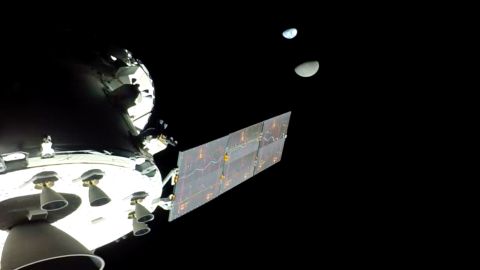
NASA's Artemis 1 spacecraft "strange" moon images taken less than 4,500 miles away
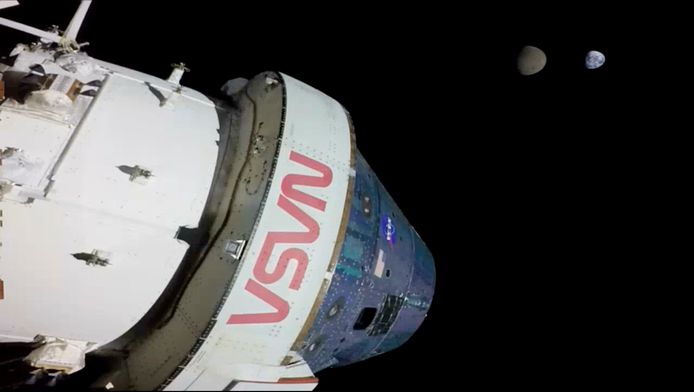
See footage below of the Orion spacecraft a little over an hour before its "outbound powered flyby burn" on Nov. 21, 2022. The spacecraft was less than 4,500 miles away (~7,242 km) and was traveling at 757 miles per hour (1218 kph). NASA's Artemis 1 Orion spacecraft aces close moon flyby in crucial engine burn.
During Orion's moon flyby it shows an oval shaped/egg shaped moon rather then the round-shaped moon as we know which is very strange, isn't it?
If you compare an image of the moon, photographed in 2010 from Madison, Alabama, USA, photographed with a Celestron 9.25 Schmidt-Cassegrain telescope. Acquired with a Canon EOS Rebel T1i (EOS 500D), with the moon image, taken less than 4,500 miles away from the moon, with the cameras on board of the Artemis 1 spacercaft then you come to the conclusion that these images are overexposed on purpose.
With overexposed moon images and an unusual oval-shaped/egg-shaped moon, we may wonder what they like to keep hidden from the public.
Alien Invasion: Is The Government Secretly Fighting Dangerous ETs?
In this video, entitled “The Fight Against Alien,” the creators of Unveiled discuss the possibility that Earth is fighting a secret battle against extraterrestrials. There are various reasons why this might be true, but do we really need to start looking for the bunkers yet?
Linda Moulton Howe: An Interview with an Annunaki Hybrid
Marina, a Starseed human hybrid, talks about her experiences with extraterrestrial creatures, including beings that she encountered when she was six years old. In this interview, Linda Howe asks a lot of important questions about the presence of hybrid humans on Earth.
Shenzhou 15 crew enters Chinese space station after docking
Shenzhou 15 astronauts Fei Junlong (commander), Deng Qingming and Zhang Lu completed ingress into the Tiangong space station on Nov. 29, 2022 (Nov. 30 - Beijing time) shortly after docking.
NASA Artemis 1 mission update - Breaking spaceflight records and upcoming events
Orion has now flown "farther than any spacecraft built to fly Human, more than 268,000 miles," according to NASA. Learn about the Artemis 1 record-breaking feat and more in this mission update.
Credit: NASA
An Interstellar Visitor is Lying Dormant in the Depths of the Pacific Ocean
A guest from beyond our solar-system is earth-bound, and we have absolutely no idea. The object wasn’t all that big, just a meter or so across, but its significance is massive. What is amazing here, is that the information about the asteroid was not immediately made public by the Government. It took two men Avi Loeb and Amir Siraj three years to have the government accept the origin of the interstellar object and make it public. Let's check out what it could really be?
ASTONISHING UFO SIGHTING IN TEXAS | The Proof is Out There (Season 3)
A mysterious UFO sighting in Texas shocks the whole community. See more in this clip from Season 3, "Bigfoot Photobombs Eagle's Nest, Mexican Blackbirds Dive To Their Death, and Human Faced Fish."
Do Habitable Planets Exist Other Than Our Earth? | Exoplanets: Thousands Of New Worlds | Spark
Are we alone in the universe? This question has been one of the greatest mysteries of all time. 20 years ago, individual scientists began to challenge traditional planetary science as they set off to seek, observe and reveal the existence of unknown worlds: EXOPLANETS. The film recounts the epic journey of these astrophysicists, who turned our knowledge of the universe upside down, in their quest for extraterrestrial life.
An ancient virus that has lain frozen in the Siberian permafrost for 48,500 years has become the oldest ever revived so far, scientists say.
It is among seven types of viruses in the permafrost that have been resuscitated after thousands of years.
The youngest had been frozen for 27,000 years and the oldest, called Pandoravirus yedoma, has been frozen for 48,500 years.
Although the viruses are not considered a risk to humans, scientists warn that other viruses exposed by melted ice could be 'disastrous' and lead to new pandemics.
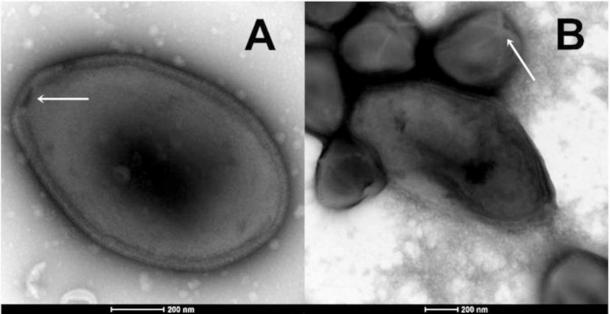
The 48,500-year-old virus is a pandoravirus, which infects single-cell organisms known as amoebas. Image A shows the isolated egg-shaped particle of pandoraviruses with a small hole or opening called an ostiole (white arrowhead). B shows a mixture of pandoravirus particles and 'megavirus' particles with a 'stargate' - a white starfish-like structure (white arrowhead)
Pandoravirus yedoma was found in permafrost 52ft (16m) below the bottom of a lake in Yukechi Alas in Yakutia, Russia
REVIVED VIRUS TYPES
- Pandoravirus
- Cedratvirus
- Megavirus
- Pacmanvirus
- Pithovirus
'48,500 years is a world record,' Jean-Michel Claverie, a virologist at Aix-Marseille University in France, told the New Scientist.
Named after pandora's box, pandoravirus is a genus of giant virus first discovered in 2013, and the second largest in physical size of any known viral genus after pithovirus.
Pandoravirus is one micrometre long and 0.5 of a micrometre wide, meaning that it is visible with a light microscope.
This particular 48,500 year-old specimen was found in permafrost 52ft (16m) below the bottom of a lake in Yukechi Alas in Yakutia, Russia.
Professor Claverie and his colleagues previously revived two 30,000-year-old viruses from permafrost, the first of which was announced in 2014.
All nine viruses are capable of infecting single-cell organisms known as amoebas — but not plants or animals. However, other frozen viruses could be very dangerous to plant and animal life, including humans.
Some 65 per cent of Russian territory is classed as permafrost — ground that remains permanently frozen even during summer months.
But, as temperatures rise due to global warming, the ground is now starting to thaw out, coughing up animals and objects that have been frozen for thousands of years.
It has even spawned an industry reliant on the wooly mammoth — which went extinct some 10,000 years ago — as hunters go in search of unearthed skeletons so they can extract their tusks and sell them to ivory dealers.
But the discovery of such well-preserved specimens has also given rise to the fear that diseases which the animals may have carried could be unfrozen with them, and, unlike their hosts, may survive being thawed out.
Professor Claverie warned last year of 'extremely good' evidence that 'you can revive bacteria from deep permafrost'.
He even discovered one such virus himself — pithovirus — which, when defrosted from permafrost began attacking and killing amoebas.
While the pithovirus, which had been frozen for some 30,000 years before the experiment, is harmless to humans, Professor Claverie said it demonstrates that long-frozen viruses can 'wake up' and begin re-infecting hosts.
Scientists disagree about the exact age of the Arctic ice cap, the permafrost which surrounds it, and therefore the age of the objects it contains.
Pictured, elongated particle of a pithovirus (1.9 micrometres in length) exhibits a single apex cork-like structure (white arrowhead)
But most defrosted discoveries that have been uncovered so far date from the last ice age, around 115,000 to 11,700 years ago.
In their research paper, Professor Claverie and colleagues say the release of live bacteria or archaea that have remained in cryptobiosis in permafrost for millions of years a potential 'public health concern'.
'The situation would be much more disastrous in the case of plant, animal, or human diseases caused by the revival of an ancient unknown virus,' they say.
'As unfortunately well documented by recent (and ongoing) pandemics, each new virus, even related to known families, almost always requires the development of highly specific medical responses, such as new antivirals or vaccines.'
The Arctic is of course more sparely populated than other parts of the world, but Professor Claverie said more people are now going there to mine resources such as gold and diamonds.
Unfortunately, the first step in mining these resources is to strip away the upper layers of permafrost, thus exposing people to viruses.
'How long these viruses could remain infectious once exposed to outdoor conditions (UV light, oxygen, heat), and how likely they will be to encounter and infect a suitable host in the interval, is yet impossible to estimate,' the team say.
'But the risk is bound to increase in the context of global warming when permafrost thawing will keep accelerating, and more people will be populating the Arctic in the wake of industrial ventures.'
This nine viruses are detailed further in the new preprint paper, yet to be peer-reviewed, on the bioRxiv server.
Last month, scientists warned that the chance of a virus 'spilling over' to another species increases with the melting of glaciers — slowly moving rivers of ice.
Meltwater from the glaciers can transport pathogens to new hosts, making parts of the Arctic potential 'fertile ground for emerging pandemics'.
KILLER VIRUSES COULD BE RELEASED FROM MELTING ICE IN THE ARCTIC, STUDY WARNS
Glaciers that are melting amid rising global temperatures could be the cause of the next deathly pandemic, a study said.
Scientists investigated how climate change may affect the risk of 'spillover' – a virus jumping to another species – by examining samples from Lake Hazen in the Arctic.
Lake Hazen, seen from above in this NASA image, is the largest High Arctic freshwater lake in the world
They found that the chance of a spillover event increases with the melting of glaciers, as the meltwater can transport pathogens to new hosts.
A warming climate could bring viruses in the Arctic into contact with new environments and hosts, increasing the risk of this 'viral spillover', the experts warn.
'Spillover risk increases with runoff from glacier melt, a proxy for climate change,' say the researchers in their paper, published in Proceedings of the Royal Society B.
'Should climate change also shift species range of potential viral vectors and reservoirs northwards, the High Arctic could become fertile ground for emerging pandemics.'
What Could Go Wrong?! 48,500-Year-Old Siberian Virus is Revived
The world’s oldest known frozen and dormant virus has been revived in a French laboratory leading many to express concerns about the dangers of bringing to life ancient microbes. The virus was removed from the Siberian permafrost in Russia’s far east and is 48,500 years old, offering proof that viruses are incredibly hardy and capable of surviving indefinitely when they’re preserved in a frozen state.
Melting Siberian Permafrost in a Virus-Filled Pandora’s Box
This particular virus is actually one of nine different types of viruses that have been resuscitated from Siberian permafrost samples in recent years. That includes seven viruses resuscitated for this new study, and two other approximately 30,000-year-old viruses brought back to life by the same team of researchers from other samples taken in 2013. The youngest of these viruses was frozen 27,000 years ago.
As reported in the non-peer-reviewed journal bioRxiv, the 48,500-year-old virus has been named Pandoravirus yedoma , in reference to Pandora’s box. The virus was found in a sample of permafrost taken from 52 feet (16 m) below the bottom of a lake in Yukechi Alas in the Russian Republic of Yakutia.
The first-ever pandoravirus was one of the two viruses found in 2013, although that one was of a different type altogether. “48,500 years is a world record,” Jean-Michel Claverie, a virologist at Aix-Marseille University in France and the lead author of the permafrost viral study, told the New Scientist .
In addition to its age, the other remarkable feature of this pandoravirus is its size. Classified as a type of giant virus, Pandoravirus yedoma is approximately one micrometer long and .5 micrometers wide. This means they can be examined directly under a microscope. It contains approximately 2,500 genes, in contrast to the miniscule modern viruses that infect humans that possess no more than 10 to 20 genes.
Climate change and the resulting thawing of the permafrost could release a mass of new Siberian viruses into the atmosphere.
Climate Change and the Threat of Permafrost Viral Release
Given the disturbing coronavirus pandemic the world has just experienced, it might seem alarming that these scientists are intentionally reviving long-lost viruses previously hidden in the frozen wastelands of Siberia. But they say this research is necessary to evaluate the dangers associated with climate change.
One quarter of the Northern Hemisphere is underlain by permanently frozen ground, referred to as permafrost,” they wrote in their newly published paper. With the thawing of the permafrost, organic matter which has been frozen for as many as a million years is thawing out. One of the effects of this is the release of carbon dioxide and methane into the atmosphere, amplifying the greenhouse effect.
"The other is that “part of this organic matter also consists of revived cellular microbes (prokaryotes, unicellular eukaryotes) as well as viruses that remained dormant since prehistorical times,” explained the authors in bioRxiv. Only by extracting viruses from permafrost samples and reviving them in controlled conditions, the scientists claim, will it be possible to evaluate the nature of the threat they might pose to human health and safety in a warmer, permafrost-free future.
Since permafrost covers more one-fourth of all land territory in the Northern Hemisphere, this is not an idle concern. The viral load currently locked up in permanently frozen ground is undoubtedly massive, and if it were all released over the course of a couple of decades it could conceivably set off an avalanche of new viral infections in a variety of host species.
None of these victims would be immune to the impact of viral agents that had been out of circulation for tens of thousands of years. Immune systems would eventually adjust, but that might happen too late to prevent a catastrophic loss of life that cuts across the microbial-, plant- and animal-life spectrums.
The 48,500-year-old Siberian virus is a pandoravirus, which infects single-cell organisms known as amoebas.
Immortal Viruses May Be Returning Soon, in Quantities too Astounding to Imagine
Concerns about permafrost melting are not only theoretical. The once-frozen ground has already started to thaw in some areas, and that has allowed scientists to recover frozen and well-preserved specimens of animals that lived during the Paleolithic period.
In recent years the remains of wooly rhinos that went extinct 14,000 years ago have been found, and in one instance scientists recovered a 40,000-year-old wolf’s head that was in almost pristine condition. Wooly mammoth remains have proven especially easy to find in the freshly-thawed soil, so much so that a black-market industry has arisen in which mammoth tusks removed from illicitly unearthed mammoth skeletons are being sold to ivory traders.
What concerns scientists about this development is that potent infectious agents may be hiding dormant inside these well-preserved ancient animal remains. It is notable that the 27,000-year-old virus found in this new study was not removed from the lake bottom sample, but was instead extracted from frozen mammoth excrement taken from a different permafrost core.
Needless to say, ancient viruses released from thawed animal hosts would be more likely to evolve into something threatening to humans than a virus that specifically attacks microbes like amoeba.
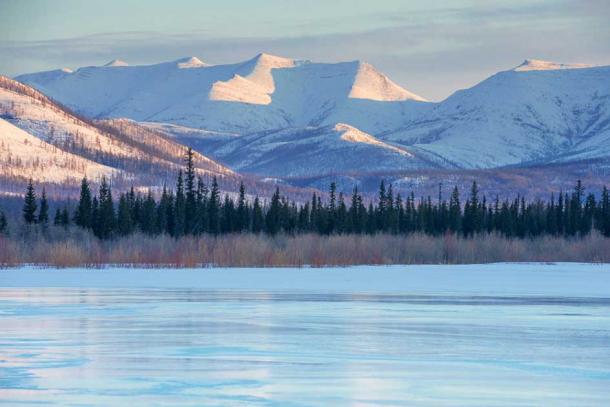
Winter landscape and frozen lake in Yakutia, Siberia.
The Hidden Danger of Ancient Bacteria and Viruses in the Thawing Permafrost
In their research paper, Professor Claverie and his colleagues emphasized how dangerous ancient bacteria and viruses could be to present-day life forms of all types. Even if frozen in deeper levels of permafrost for millions of years, they could become active again should the permafrost disappear.
In comparison to outbreaks from modern viruses, “the situation would be much more disastrous in the case of plant, animal, or human diseases caused by the revival of an ancient unknown virus,” the French scientists wrote. “As unfortunately well documented by recent (and ongoing) pandemics, each new virus, even related to known families, almost always requires the development of highly specific medical responses, such as new antivirals or vaccines.”
The Arctic regions of the planet are largely free of permanent human settlers. But the researchers point out that more people are visiting the planet’s coldest regions than ever before, mainly to harvest valuable resources like oil, gold and diamonds that are present in abundance in these previously under-explored areas. In strip-mining operations the upper layers of the permafrost are actually torn out intentionally, meaning that viral exposures during such operations may be unavoidable.
“How long these viruses could remain infectious once exposed to outdoor conditions (UV light, oxygen, heat), and how likely they will be to encounter and infect a suitable host in the interval, is yet impossible to estimate,” the scientists concluded. “But the risk is bound to increase in the context of global warming when permafrost thawing will keep accelerating, and more people will be populating the Arctic in the wake of industrial ventures.”
Other scientists have warned of the dangers of viruses being released in the Arctic through the melting of glaciers, which is yet another possible side effect of global warming. This could expose animals and humans to flowing rivers of glacial meltwater that could carry pathogens to new areas further south.
Whether any of these worst-case scenarios come to fruition remains to be seen. But even a small amount of melting, regardless of the cause, could be enough to release some potentially hazardous viral agents into the global environment, where billions of vulnerable people live.
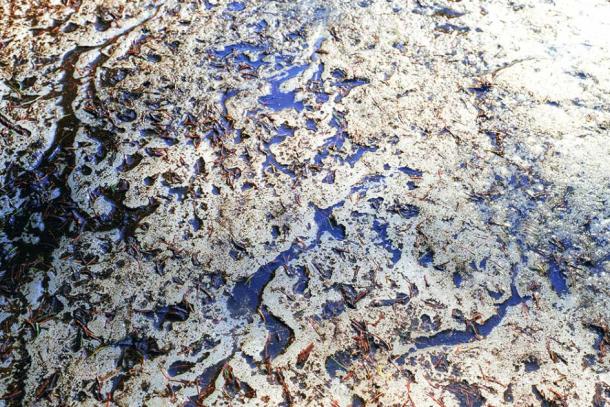
Top image: Colony of microbes, representational image.
Record voor Orion: nooit eerder was ruimteschip voor mensen zo ver van de aarde
De nieuwe Amerikaanse raket Orion heeft sinds de lancering de verste afstand bereikt die ooit is afgelegd door een ruimtevaartuig dat is bedoeld voor het vervoeren van mensen. Dat meldde de Amerikaanse ruimtevaartorganisatie NASA maandagavond laat. Het ruimtevaartuig was maandag 432.000 kilometer van de aarde verwijderd
In this image provided by NASA, the Earth and its moon are seen from NASA's Orion spacecraft on Monday.
NASA
KIJK.:
“We hebben de maximale afstand tot de aarde gehaald!”, zei de ruimtevaartorganisatie op Twitter. Het oude record werd in 1970 gevestigd met de ruimtemissie Apollo 13. De bemanningsleden vlogen toen op 401.056 kilometer afstand van de aarde.
Orion begon op 16 november aan zijn eerste vlucht naar de maan en terug. Het vaartuig bereikte zaterdag de baan om de maan. Begin december moet het vaartuig de maan verlaten en beginnen aan de terugvlucht naar de aarde. Die eindigt, als alles goed gaat, op 11 december.
Over een paar jaar willen de Verenigde Staten weer mensen op de maan laten rondlopen, voor het eerst sinds 1972. De onbemande missie Artemis I is een generale repetitie om de veiligheid van de Orion te toetsen. De volgende Artemis-vlucht staat gepland voor 2024. Dan moet het ruimteschip met vier mensen aan boord rond de maan vliegen. Rond 2025 moeten mensen weer voet op de maan zetten.
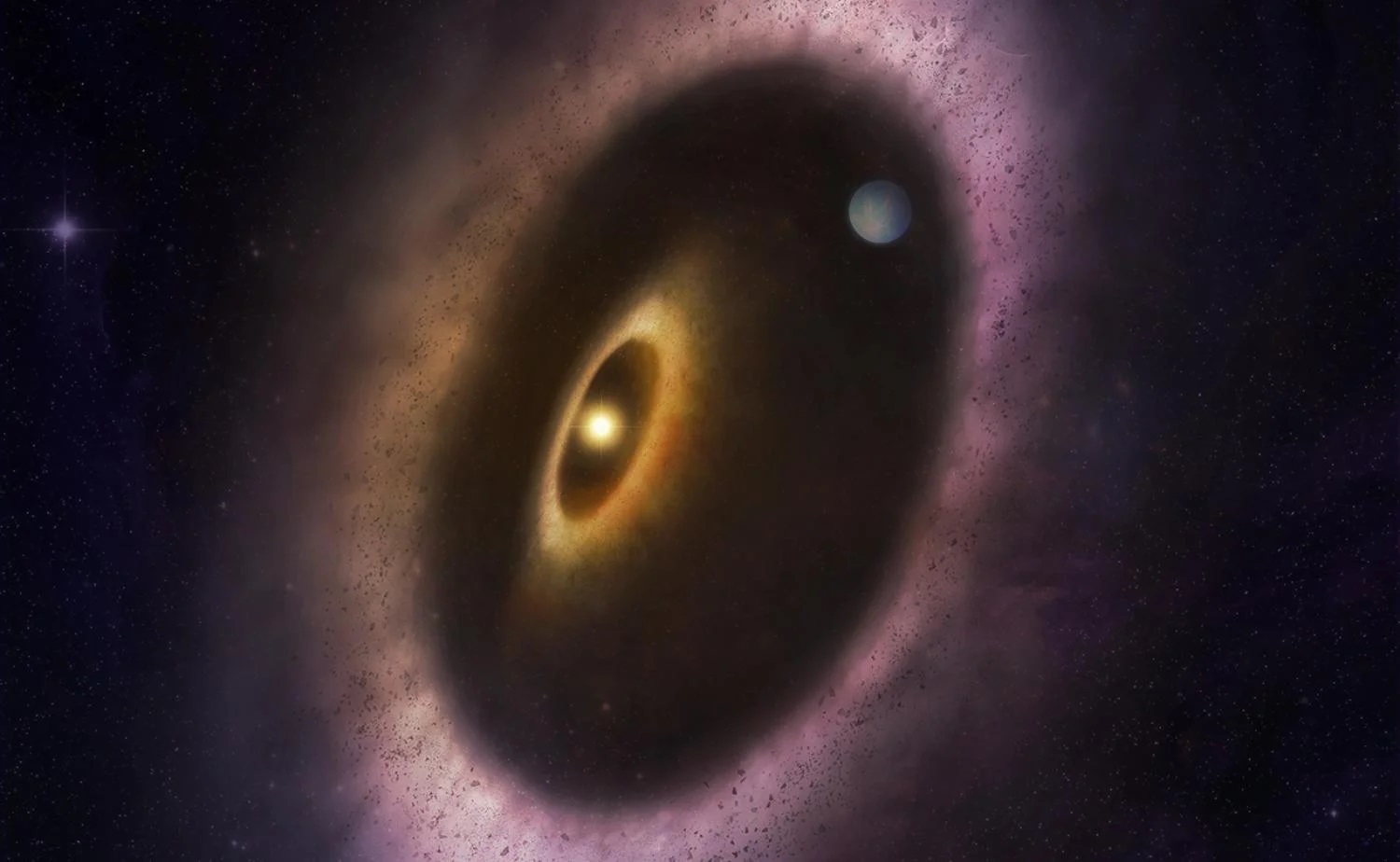
Astronomers with the SHINE collabortion observed a debris disk containing a Super-Jupiter around a young star.
Credit: ALMA (ESO/NAOJ/NRAO); M. Weiss (NRAO/AUI/NSF)
Astronomers Directly Image a Jupiter-Sized Planet Orbiting a Sunlike Star
According to the most widely-accepted theory, planetary systems form from large clouds of dust and gas that form disks around young stars. Over time, these disks accrete to create planets of varying size, composition, and distance from their parent star. In the past few decades, observations in the mid- and far-infrared wavelengths have led to the discovery of debris disks around young stars (less than 100 million years old). This has allowed astronomers to study planetary systems in their early history, providing new insight into how systems form and evolve.
This includes the SpHere INfrared survey for Exoplanets (SHINE) consortium, an international team of astronomers dedicated to studying star systems in formation. Using the ESO’s Very Large Telescope (VLT), the SHINE collaboration recently observed and characterized the debris disk of a nearby star (HD 114082) in visible and infrared wavelengths. Combined with data from NASA’s Transiting Exoplanet Space Satellite (TESS), they were able to directly image a gas giant many times the size of Jupiter (a “Super-Jupiter”) embedded within the disk.
The SPHERE instrument shortly after it was installed on ESO’s VLT Unit Telescope 3. Credit: ESO/J. Girard
As they state in their paper, the team relied on the Spectro-Polarimetric High-contrast Exoplanet REsearch (SPHERE) instrument on the VLT to take optical and near-IR images of HD 114082, an F-type star (a yellow-white dwarf) located in the Scorpius–Centaurus association – a stellar cluster located about 310 light-years from Earth. Like the 500 stars surveyed by the SHINE team, HD 114082 is a young star surrounded by a protoplanetary debris disk (from which planets form). Observations of these disks in recent decades have shown that they are an integral part of planetary systems:
As Dr. Engler told Universe Today via email, these surveys date back to 1983 and the discovery of the first disk around Vega. Since then, dozens of surveys have been performed in infrared wavelengths and scattered light using space-based telescopes like the Herschel Space Observatory and the venerable Hubble and ground-based telescopes like the Atacama Large Millimeter-submillimeter Array (ALMA), the Gemini Planet Imager (GMI), and SPHERE/VLT. As she explained:
“These studies provided valuable information about the formation and evolution of planetary systems since planets are formed from, reside in, and interact with the dust material. Young debris disks (in the first hundred million years) trace the processes of terrestrial planet formation, and thus studying them helps us to understand the dynamical interaction and evolution of terrestrial planets, in particular the Earth, in the young Solar system.”
Using Sphere, Engler and her team observed HD 114082 in the optical and near-infrared using the angular differential imaging (ADI) and polarimetric differential imaging (PDI) techniques. The former consists of acquiring high-contrast images from an altitude-azimuth telescope while the instrument rotator is off, allowing the instrument and telescope optics to remain aligned and the field of view to rotate relative to the instrument. The latter involves combining different incident polarizations of light and measuring the specific polarization components transmitted or scattered by the object.
Artist’s impression of circumstellar disk of debris around a distant star. Credit: NASA/JPL
Both techniques have been used extensively in the study of circumstellar debris disks and (according to Engler) revealed some interesting things about HD 114082:
“Our images revealed a bright planetesimal belt at a distance of 35 AU from the host star, very similar to the Kuiper belt in the Solar system. The debris belt is inclined at 83° and has a wide inner cavity. The dust particles, which we trace in this observation, have sizes around 5 microns and a relatively high scattering albedo of 0.65; this means they scatter nearly two-thirds of incoming stellar radiation and absorb only one third of it. The scattered light has a relatively low degree of linear polarization with a maximum of 17% which, however, is comparable with the polarization values for cometary dust in the Solar system.”
The team also consulted data from TESS to confirm the presence of a super-Jupiter companion, which was first detected by the observatory in 2021 using transit photometry (aka. the Transit Method). Consistent with this data, Engler and her colleagues confirmed that the planet orbits its parent star at approximately 0.7 AU – about the same distance between Venus and the Sun. Recent observations based on radial velocity measurements confirmed this planet and produced mass estimates about eight times that of Jupiter.
“HD 114082 provides an example for young planetary systems, where the presence of planetary companions to the host star has been inferred from the discovery of a debris disk,” Engler added. “This confirms the theoretical considerations of debris systems as signposts for young planets. Studying this and other similar planetary systems will allow [astronomers] to establish a link between the properties of extrasolar Kuiper belts and planets residing within them.”
Artist’s impression of the super-hot Super-Jupiter WASP-79b located 780 light-years away in the constellation Eridanus. Credit: NASA
The implications of this study go beyond the study of young stars and planetary systems that are still in formation. They are also significant for studying our Solar System, which has some interesting parallels to these protoplanetary environments. Said Engler:
“The direct imaging studies of the last decade show that the circumstellar material in many debris disks is confined to ring-like structures, similar to two debris belts in the Solar system: the Edgeworth-Kuiper belt and the main asteroid belt. The cavities inside the extrasolar Kuiper belts are curved by unseen planets, which leave their imprints in the debris dust distribution, such as warps, clumps and belt eccentricities.”
Lastly, this study demonstrates the growing use and effectiveness of direct imaging studies, which are possible thanks to improved instruments, imaging capability, and data-sharing methods. In the near future, next-generation instruments will allow for even more accurate and detailed direct imagining studies. These include space-based observatories like the JWST and the Nancy Grace Roman Space Telescope and ground-based telescopes like the Extremely Large Telescope (ELT), the Giant Magellan Telescope, and the Thirty Meter Telescope (TMT).
By studying the geometry and asymmetric features in debris disks, astronomers can predict the location and masses of planets that are not yet detectable with current instruments. “Direct imaging makes it possible to study the scattering properties of dust particles around distant stars,” Engler added. “These properties contain information about particle composition, shape, and size, and thus we can gain insights into the composition of the building blocks of exoplanets.”
The Second-Closest Supermassive Black Hole Might be in a Nearby Dwarf Galaxy
There’s a little galaxy in the Milky Way’s cosmic neighborhood called Leo 1. It’s a dwarf spheroidal that lies less than a million light-years away from us. Surprisingly, it has a supermassive black hole about the same mass as Sagittarius A* in our galaxy. That’s unusual in several ways, and astronomers want to know more about it.
The name of the central supermassive black hole is Leo 1*. The galaxy itself is hard to observe, due to its proximity to the bright star Regulus. Leo 1* is challenging to spot, too. It’s just not bright, even though it is gobbling up material to stay alive. So, astronomers at the Center for Astrophysics | Harvard & Smithsonian, are developing a method to study it and figure out how this monster supermassive black hole could exist in such a small galaxy.
“Black holes are very elusive objects, and sometimes they enjoy playing hide-and-seek with us,” said Fabio Pacucci, lead author of a study published this week. “Rays of light cannot escape their event horizons, but the environment around them can be extremely bright — if enough material falls into their gravitational well. But if a black hole is not accreting mass, instead, it emits no light and becomes impossible to find with our telescopes.”
Leo 1 and its Black Hole
This galaxy’s supermassive black hole’s existence was suggested in 2021 by astronomers who noticed that stars at the heart of Leo 1 were speeding up as they approached. That’s pretty good evidence for a black hole. However, imaging the emissions from any material spiraling into the black hole was impossible. And thus, Leo 1’s black hole remained tantalizingly out of reach.
What makes this supermassive black hole in a dwarf spheroidal such a challenge to understand? Let’s look at its home. Leo 1 is a very “low metal” galaxy, like many other dwarf spheroidals. It has stars, to be sure, but not a lot of gas. Until recently astronomers didn’t think these types of galaxies had central supermassive black holes. That’s because these monsters accrete and grow by feeding on gas and other material that wanders too close. A metal-poor, gas-poor galaxy just doesn’t seem like the right environment for a behemoth like Leo 1 seems to have.
Leo 1 is also a fairly young galaxy. It last went through a star-forming epoch that began some 6 billion years ago and ended about a billion years ago. Star formation gobbles up a lot of gas. In addition, since this galaxy orbits the Milky Way, a close passage may have stripped more gas away. That would have also slowed the star formation rate and robbed the black hole of the fuel it needs. So, that leaves a lot of questions, first among them, if there is a 3-million-solar-mass black hole in Leo 1, how did it get so big? Clearly, it grew from something, and it’s still growing, albeit slowly. Also, since it’s not hugely bright with emissions, how can it be observed?
Observing the Leo 1* Supermassive Black Hole
Pacucci and his research partner, Avi Loeb, suggest using red giant stars as tracers to track the supermassive black hole’s activity. “In our study, we suggested that a small amount of mass lost from stars wandering around the black hole could provide the accretion rate needed to observe it,” Pacucci explained. “Old stars become very big and red — we call them red giant stars. Red giants typically have strong winds that carry a fraction of their mass to the environment. The space around Leo I* seems to contain enough of these ancient stars to make it observable.”
U Camelopardalis, or U Cam for short, is a red giant star nearing the end of its life. It’s losing mass as it dies, and that material is ejected into space. Red giant stars similar to this one, but in Leo 1 are losing mass, too. If they wander too close to Leo 1*, that mass gets caught up in the gravitational pull of the Leo 1* black hole. Emissions from that gas as it gets superheated can be traced, and used to help understand more about this black hole. Credit: ESA/Hubble, NASA and H. Olofsson (Onsala Space Observatory).
It’s an interesting methodology that should allow them to gain more information about the black hole and its environment. It also raises more questions about this supermassive black hole’s very existence. “Observing Leo I* could be groundbreaking,” said Loeb, the co-author of the study. “It would be the second-closest supermassive black hole after the one at the center of our galaxy, with a very similar mass but hosted by a galaxy that is a thousand times less massive than the Milky Way. This fact challenges everything we know about how galaxies and their central supermassive black holes co-evolve. How did such an oversized baby end up being born from a slim parent?”
Most galaxies host central supermassive black holes that are a small percent of their total mass. That’s true of the Milky Way. But, Leo 1* breaks the mold. “In the case of Leo I,” Loeb said, “we would expect a much smaller black hole. Instead, Leo I appears to contain a black hole a few million times the mass of the Sun, similar to that hosted by the Milky Way. This is exciting because science usually advances the most when the unexpected happens.”
Using Radio Telescopes to Probe Leo 1*
While there’s no way to image Leo 1* in visible light, it turns out radio observatories can focus on it. The team has already observed it using the Chandra X-ray Observatory, the Karl Jansky Very Large Array, and the Atacama Large Millimeter Array. Those observations should confirm the existence of the black hole and give some idea of its accretion rate.
Meer van UFO'S of UAP'S, ASTRONOMIE, RUIMTEVAART, ARCHEOLOGIE, OUDHEIDKUNDE, SF-SNUFJES EN ANDERE ESOTERISCHE WETENSCHAPPEN - DE ALLERLAATSTE NIEUWTJES


 The Bermuda Triangle: Into Cursed Waters: CHALLENGER SPACECRAFT UNCOVERED ON OCEAN FLOOR (Season 1)





 Climate change could drive the emergence of the next...
 Will the next pandemic come from a GLACIER? Killer viruses...
 Melting ice in the Arctic could unleash 100,000 TONNES of...
 Northeast Greenland ice sheet is melting so rapidly it could...