Ontdek de Fascinerende Wereld van UFO's en UAP's: Jouw Bron voor Onthullende Informatie!
Ben jij ook gefascineerd door het onbekende? Wil je meer weten over UFO's en UAP's, niet alleen in België, maar over de hele wereld? Dan ben je op de juiste plek!
België: Het Kloppend Hart van UFO-onderzoek
In België is BUFON (Belgisch UFO-Netwerk) dé autoriteit op het gebied van UFO-onderzoek. Voor betrouwbare en objectieve informatie over deze intrigerende fenomenen, bezoek je zeker onze Facebook-pagina en deze blog. Maar dat is nog niet alles! Ontdek ook het Belgisch UFO-meldpunt en Caelestia, twee organisaties die diepgaand onderzoek verrichten, al zijn ze soms kritisch of sceptisch.
Nederland: Een Schat aan Informatie
Voor onze Nederlandse buren is er de schitterende website www.ufowijzer.nl, beheerd door Paul Harmans. Deze site biedt een schat aan informatie en artikelen die je niet wilt missen!
Internationaal: MUFON - De Wereldwijde Autoriteit
Neem ook een kijkje bij MUFON (Mutual UFO Network Inc.), een gerenommeerde Amerikaanse UFO-vereniging met afdelingen in de VS en wereldwijd. MUFON is toegewijd aan de wetenschappelijke en analytische studie van het UFO-fenomeen, en hun maandelijkse tijdschrift, The MUFON UFO-Journal, is een must-read voor elke UFO-enthousiasteling. Bezoek hun website op www.mufon.com voor meer informatie.
Samenwerking en Toekomstvisie
Sinds 1 februari 2020 is Pieter niet alleen ex-president van BUFON, maar ook de voormalige nationale directeur van MUFON in Vlaanderen en Nederland. Dit creëert een sterke samenwerking met de Franse MUFON Reseau MUFON/EUROP, wat ons in staat stelt om nog meer waardevolle inzichten te delen.
Let op: Nepprofielen en Nieuwe Groeperingen
Pas op voor een nieuwe groepering die zich ook BUFON noemt, maar geen enkele connectie heeft met onze gevestigde organisatie. Hoewel zij de naam geregistreerd hebben, kunnen ze het rijke verleden en de expertise van onze groep niet evenaren. We wensen hen veel succes, maar we blijven de autoriteit in UFO-onderzoek!
Blijf Op De Hoogte!
Wil jij de laatste nieuwtjes over UFO's, ruimtevaart, archeologie, en meer? Volg ons dan en duik samen met ons in de fascinerende wereld van het onbekende! Sluit je aan bij de gemeenschap van nieuwsgierige geesten die net als jij verlangen naar antwoorden en avonturen in de sterren!
Heb je vragen of wil je meer weten? Aarzel dan niet om contact met ons op te nemen! Samen ontrafelen we het mysterie van de lucht en daarbuiten.
NASA to Oumuamua! A Closer Look at the Mysterious Alien Spacecraft
Avi Loeb suggested, an artificial construction made by an intelligent extra-terrestrial civilization? Since the mysterious traveler is out of the range of existing telescopes, there is only one way to find them. We go after it. New research outlines a mission called Project Lyra to send a probe to see if ’Oumuamua is as extraordinary as it appears.
RELATED
Explaining Laser Weapons in Space Combat
Spacedock delves into the sciencey details of laser weaponry in science fiction space combat.
RELATED
Huge Hidden Galactic Structure Found In The Zone of Avoidance Behind Milky Way
Hello and welcome! My name is Anton and in this video, we will talk about a discovery of a huge galactic structure behind the Milky Way in the hidden Zone of Avoidance
15 Real Things That Defy the Laws of Physics!
You don't have to be an Einstein to understand the basic laws of physics. Since objects always fall downwards, more precisely in the direction of the center of the earth, we can look forward to a nice heap of broken glass as soon as a cup slips out of our hands - thank you very much, physics. But have you ever heard of waterfalls that flow up instead of down? Or objects that start to float as if by magic? You want to know what these almost unbelievable cases are all about? Then stay tuned and see for yourself: Here are several amazing things that defy the laws of physics!
ROBOTICS COMPANIES DON'T WANT YOU TO USE THEIR GIZMOS FOR EVIL
Plus: Worm spit could annihilate plastic.
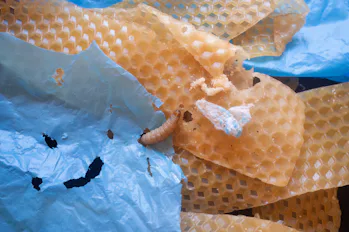
Scientists are betting that the wax worm’s saliva can help cut down on plastic pollution by breaking down PE plastic.
Simona Gaddi
Plastic pollution is a huge problem worldwide: We produce around 350 to 400 million tons of non-degradable plastic annually, and 5 to 13 million tons end up in the ocean. But we don’t yet have many sustainable, cost-effective recycling methods yet.
A promising technique called biodegradation could add a crucial tool to our recycling toolbox: Scientists have deployed organisms like bacteria and fungi to break down plastic, but it can take months and require pre-treatment that demands loads of energy.
Now, findings suggest that the saliva from the beeswax-eating wax worm, or Galleria mellonella, could be harnessed to break down the world's most widely used plastic (polyethylene or PE), according to a new study published in the journal Nature Communications. The method doesn’t require any treatment beforehand, saving time and money.
Researchers from Spain studied wax worm larvae saliva and found that it can degrade PE by breaking it down into smaller molecules. The process only takes a few hours. To the best of the researchers’ knowledge, this is the quickest biodegradation technique yet for PE.
Study author Federica Bertocchini, a molecular biologist at the Spanish National Research Council, hopes the new study can inspire other labs to go after similar research.
“We also hope that the study might increase the study of insects as the wonderful resourceful animals they are, both as a biotechnological tool, but, even more, at the basic research level,” she adds.
YOU MAY HAVE seen clips of the creepy, dog-like robot from Boston Dynamics called Spot that can traverse rough terrains, map its environment, and grab you a drink, among other skills. The company has even programmed Spot to dance to K-pop.
Spot and other roving autonomous bots developed in recent years have received lots of criticism as they’ve been increasingly embraced by law enforcement officials. Some experts worry that the AI programmed into these robots could target people of color or use excessive violence. Last year, public concern forced the NYPD to retire a Spot model that they called Digidog.
It’s also possible for ordinary people to use commercially available robots for evil: This summer, a Russian man terrified the internet when he slapped a gun onto a Unitree dogbot.
Now, Boston Dynamics and other robotics companies seem eager to clean up their image.
WHAT’S NEW — In an open letter published last week, six major robotics companies have promised not to weaponize their publicly available devices and software — and not to support anyone doing so — as originally reported by Axios. These include Agility Robotics, which is working on a hyped-up humanoid called Digit (that will come with a face and hands).
While the letter notes that “advanced mobile robots will provide great benefit to society as co-workers in industry and companions in our homes,” the automation giants do point out the potential for mistreatment.
“We believe that adding weapons to robots that are remotely or autonomously operated, widely available to the public, and capable of navigating to previously inaccessible locations where people live and work, raises new risks of harm and serious ethical issues,” they add.
The Spot robot from Boston Dynamics has appealed to law enforcement officials in recent years.
Sam Barnes/Sportsfile/Getty Images
THERE’S A CATCH
This oath doesn’t seem to apply to the devices used by military and police officials. That’s not a huge surprise, since Boston Dynamics largely got its start with funding from the military, along with the controversial Defense Advanced Research Projects Agency (DARPA).
In fact, U.S. Marine Corps officials have already looked into using Boston Dynamics’ AlphaDog robot in combat, but they shelved it in 2015 because it proved too loud for the battlefield. They have also tried to prep the company’s human-like Atlas model for battle.
Governments around the world also want to automate their armies. For instance, the French army has tested Spot for surveillance purposes, according to The Verge.
So while it may get more difficult for a regular Joe to go haywire with a humanoid, this option doesn’t appear to be off the table for law enforcement agencies.
Most impressively there were 23 Landings, Hovering, or Takeoffs reported and 27 Entities observed. Number of abduction (ERT) cases were 33. Number of submitted Experiencer Questionnaires were 0.
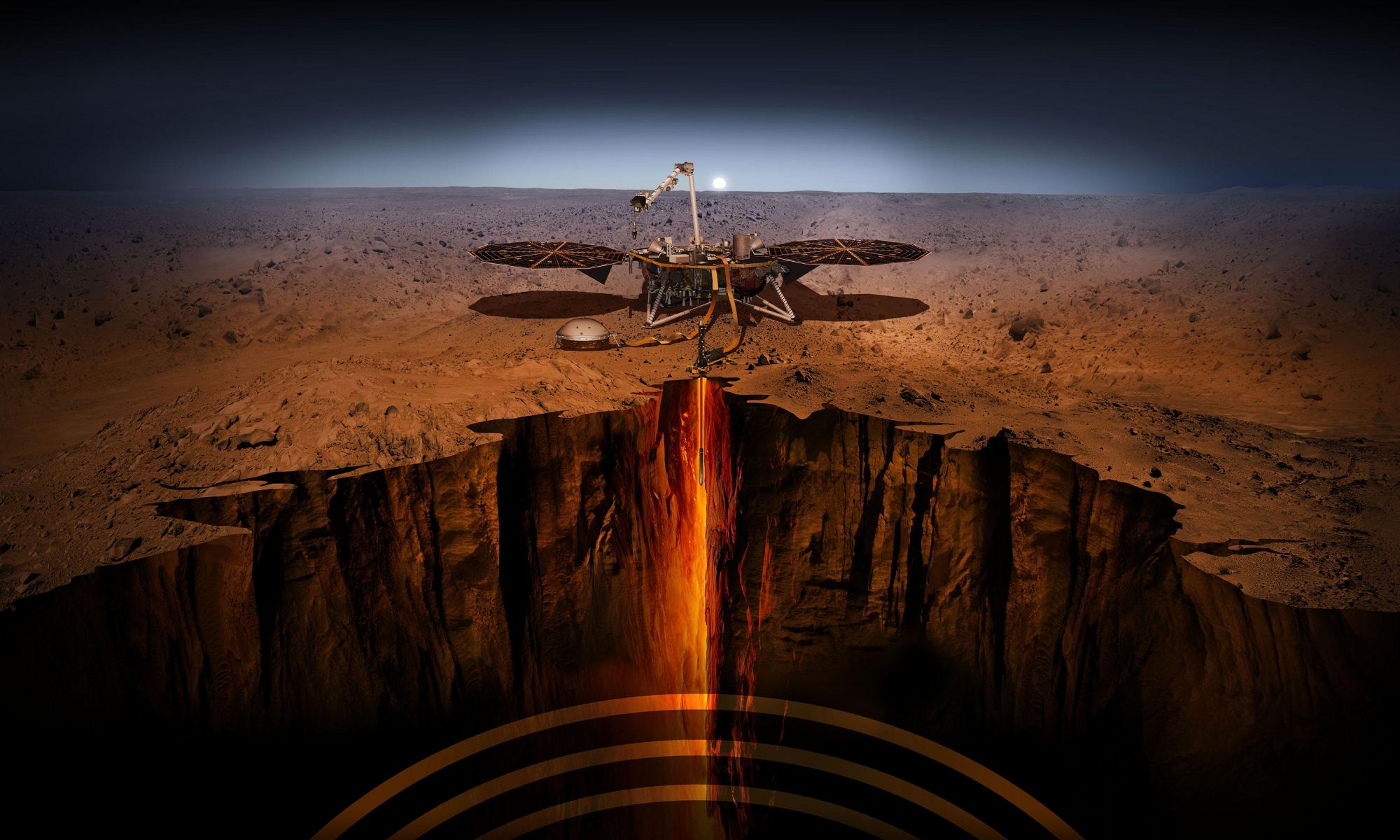
Artist's concept of InSight "taking the pulse of Mars".
Credit: NASA/JPL-Caltech
Mars is Mostly Dead. There's Still Magma Inside, so it's Slightly Alive
Since February 2019, NASA’s Interior Exploration using Seismic Investigations, Geodesy and Heat Transport (InSight) lander has been making the first-ever measurements of tectonics on another planet. The key to this is InSight’s Seismic Experiment for Interior Structure (SEIS) instrument (developed by seismologists and geophysicists at ETH Zurich), which has been on the surface listening for signs of “marsquakes.” The dataset it has gathered (over 1,300 seismic events) has largely confirmed what planetary scientists have long suspected: that Mars is largely quiet.
However, a research team led by ETH Zurich recently analyzed a cluster of more than 20 recent marsquakes, which revealed something very interesting. Based on the location and spectral character of these events, they determined that most of Mars’ widely distributed surface faults are not seismically active. Nevertheless, most of the 20 seismic events observed originated in the vicinity of Cerberus Fossae, a region consisting of rifts (or graben). These results suggest that geological activity and volcanism still play an active role in shaping the Martian surface.
Image of the Tharsis region of Mars taken by Mars Express featuring several prominent shield volcanoes, including the massive Olympus Mons (at left). Credit: ESA
Based on the seismic data gathered by InSight, the team concluded that low-frequency quakes could indicate the modern-day presence of molten magma in the Martian mantle. Specifically, they found that the epicenters of these quakes were located mostly in the innermost part of Cerberus Fossae – at depths of 30 to 50 km (18.6 to 31 mi) beneath the surface. In this region, named after the hellhound that guards the gates of Hades (the underworld in Greek mythology), the terrain is sinking under its own weight, forming parallel rifts that pull the crust of Mars apart.
The team theorized that these quakes could be the last rumbles from this once-active volcanic region or that magma is moving eastward beneath the surface towards its next eruption. When the team examined orbital images of this area, they noticed that these quakes happened very close to a structure in the Cerberus Fossae Mantling Unit (previously designated a “young volcanic fissure”). This feature was surrounded by dark deposits of dust, which was present in all directions and not only in the dominant direction of the wind (as was expected).
As Stähler explained in a recent ETH Zurich press release, the only explanation for this was the presence of volcanic activity in the recent past. “The darker shade of the dust signifies geological evidence of more recent volcanic activity – perhaps within the past 50,000 years – relatively young, in geological terms,” he said.
Because of its terrestrial (rocky) nature and its proximity to Earth, Mars provides opportunities to study geological processes similar to those that shaped our planet. While technically closer, Venus’s super dense atmosphere prevents missions from studying it with anything other than surface-mapping radar and temperatures hot enough to melt lead. Because of their distance from Earth, which imposes communication delays, all other bodies in the Solar System have only been studied by orbiters and probes.
Mars surface relief map showing InSight’s location (orange triangle) and the marsquakes (purple dots) centered around Cerberus Fossae. Credit: Horelston et al. (2022) TSR
In addition, Mars is the only terrestrial planet beyond Earth known to have a core composed of iron, nickel, and sulfur that may have once supported a magnetic field. On Earth, this field results from dynamo action in the planet’s interior, where a liquid outer core rotates around a solid inner core (in the opposite direction as Earth’s rotation). It is widely believed today that roughly 4 billion years ago, the interior of the Red Planet cooled rapidly, causing the outer core to solidify while the inner core became molten. Without this field, Mars’ atmosphere was slowly stripped away by solar wind for eons.
Previously, scientists suspected this also meant that Mars became geologically dead billions of years ago. Nevertheless, these and other indications provided by robotic missions suggest that geological activity has not entirely ceased within the Red Planet. While considerable research still needs to be done to confirm these results, the evidence of potential magma in Mars’ mantle today is fascinating. These results demonstrate the effectiveness of the InSight lander and its sophisticated instruments and how multiple robotic missions working together can lead to breakthroughs. Said co-author Domenico Giardini:
“InSight’s SEIS is the most sensitive seismometer ever installed on another planet. It affords geophysicists and seismologists an opportunity to work with current data showing what is happening on Mars today – both at the surface and in its interior.”
In the coming years, many more robotic orbiters, landers, and rovers are bound for Mars. The research they conduct into Mars’ surface geology, environment, climate, and atmosphere will pave the way for crewed missions planned for the 2030s.
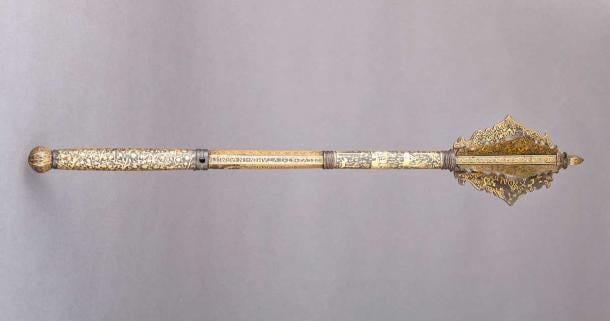
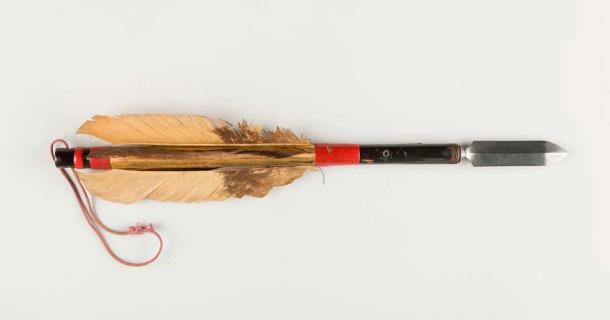
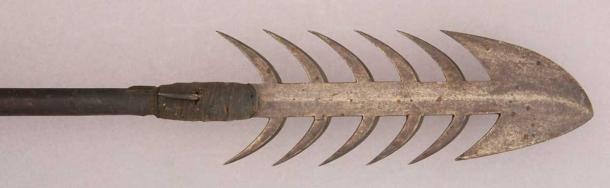
There is no end to the multitude of close combatweapons, from swords to spears, scythes, pikes, maces, glaives, flails, partisans, and hundreds more. Often designed to inflict the greatest damage possible, historical combat weaponsare both terrifying and impressive.
Italian fauchard, c. 1525 AD. This is a weapon developed from an agricultural tool, the pruning hook, with which a farmer would lop off unwanted branches on his fruit tress. It was particularly popular in western European countries
16th Century Hunting Knife Combined with Wheellock Pistol. Wheellock pistols sometimes were combined with swords, knives, axes, maces, spears, and even crossbows, which could be used in the event the pistol misfired
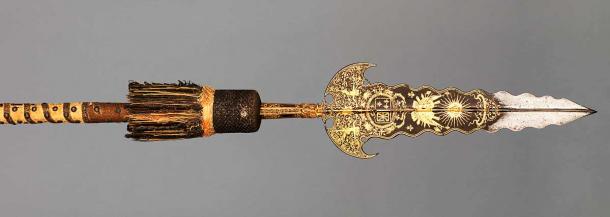
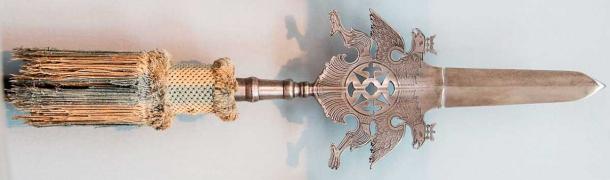
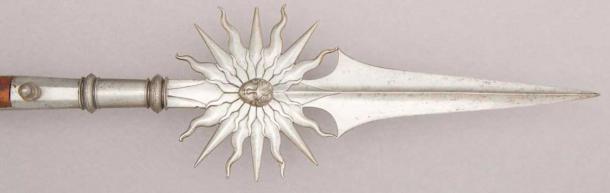
Partisan Carried by the Bodyguard of Louis XIV (1638–1715). It bears the king’s motto and sunburst above the crowned arms of France and Navarre, which are encircled by the collars of the royal orders of the Holy Spirit and Saint Michael
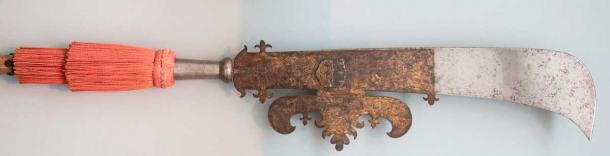
An Italian glaive, c. 18th century. A glaive is a European polearm, consisting of a single-edged blade on the end of a pole. They were sometimes forged with a small hook on the reverse side to better catch riders
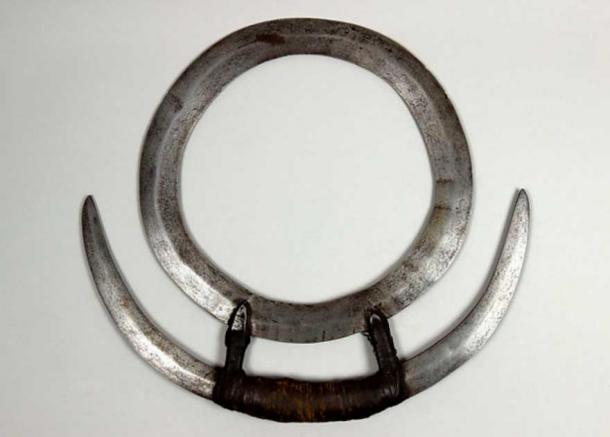
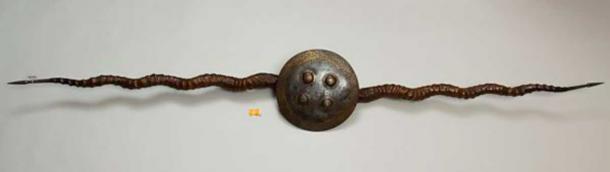
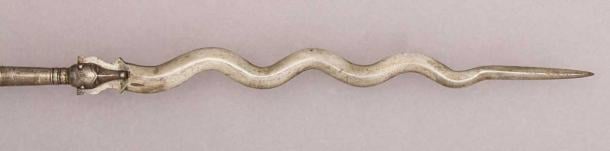
Indian Parrying Weapon (Madu), 18th–19th century. A parrying weapon is a handheld weapon used to block or defend, usually in conjunction with a single-handed sword.
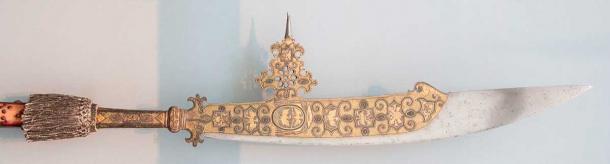
Fauchard of the Bodyguard of Cardinal Scipione Borghese-Caffarelli (1576–1633). An example of advanced metallurgy involving bluing, gilding, engraving, and damascening, as well as encrustation with gold and silver. The blade is decorated similarly on both sides with a series of medallions and ornamental strapwork cartouches outlined in silver-encrusted dots and set against a blued background finely damascened with gold scrolls
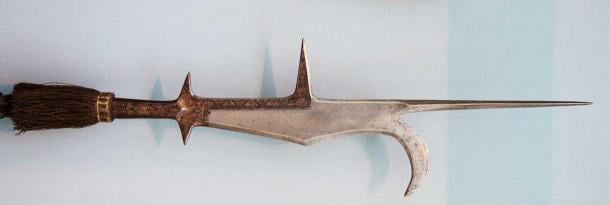
French Partisan c. 1700. A partisan is a type of polearm that consisted of a spearhead mounted on a long shaft with protrusions on the sides which aided in blocking sword thrusts.
A Flemish Halberd, c. 17th century. A halberd is a two-handed pole weapon consisting of an axe blade topped with a spike mounted on a long shaft. It always has a hook or thorn on the back side of the axe blade for grappling mounted combatants
Large Meteoroid Strike on Mars Caused a Magnitude 4 Marsquake, Huge Crater on the Red Planet
Margaret Davis
(Photo : NASA/JPL-Caltech/University of Arizona)
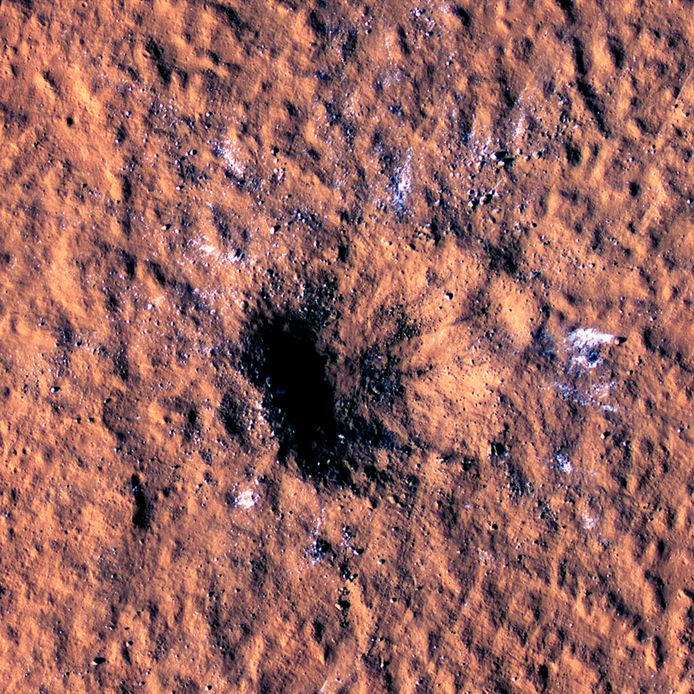
Boulder-size blocks of water ice can be seen around the rim of an impact crater on Mars, as viewed by the High-Resolution Imaging Science Experiment (HiRISE camera) aboard NASA’s Mars Reconnaissance Orbiter. The crater was formed Dec. 24, 2021, by a meteoroid strike in the Amazonis Planitia region.
On December 24, 2021, NASA's InSight lander on Mars felt the ground shake because of a marsquake equivalent to a magnitude 4 earthquake. According to NASA, they just recently determined that the cause of the quake was a large meteoroid impact on the Red Planet, the biggest seen since they began exploring space.
The meteoroid excavated boulder-sized chunks of ice buried closer to the Martian equator that has never been seen before. The discovery has implications for NASA's future plans of sending crewed missions to Mars.
(Photo : NASA/JPL-Caltech/University of Arizona) Boulder-size blocks of water ice can be seen around the rim of an impact crater on Mars, as viewed by the High-Resolution Imaging Science Experiment (HiRISE camera) aboard NASA’s Mars Reconnaissance Orbiter. The crater was formed Dec. 24, 2021, by a meteoroid strike in the Amazonis Planitia region.
They determined the quake was caused by a meteoroid after looking at the before-and-after photos from the Mars Reconnaissance Orbiter (MRO) and spotted a new crater. The event offers a new opportunity to study how a large impact shook the surface of Mars.
The meteoroid is estimated to have spanned 16 to 19 feet (5 to 12 meters), which is small enough that it would burn if it entered Earth's atmosphere. However, Mars has a thin atmosphere that it did not burn up the space rock upon entering and landed in a region called Amazonis Planitia that created a crater about 429 feet (150 meters) across and 70 feet (21 meters) deep.
The images and seismic data provide information about the impact that it is now considered to be one of the largest craters ever witnessed forming at any place in the Solar System. The space agency noted that there bigger craters on the Red Planet but they are older and predate any Mars mission.
InSight's Impact Science Working Group leader Ingrid Daubar of Brown University said in the press release that it is unprecedented to find a fresh impact as big as the crater.
Sadly, InSight has seen its power drastically decline in the past few months because of dust settling on its solar panels. Scientists estimate that the spacecraft now only have about six weeks before it completely shuts down, bringing the mission to an end.
InSight scientists reported having detected a major marsquake on December 24 last year, SciTech Daily reported. They first spotted the crater working at Malin Space Science Systems (MSSS) which operates the two cameras of MRO.
The Context Camera (CTX) produces the black and white images, while the Mars Color Imager (MARCI) provides the colored version so scientists could track the large-scale weather changes on Mars.
The crater was visible in MRCI data that allowed the scientists to pin down a 24-hour period when the meteoroid landed on the surface. It correlated with the seismic epicenter and demonstrated that the large meteoroid created a crater on December 24, 2021.
Establishing how fast the crater was created on the Martian surface is critical for refining the planet's geologic timeline. For example, older areas on both Moon and Mars have more craters compared to Earth because the process of erosion and plate tectonics moving on Earth erase older features from the surface.
Aside from the craters, MRO's High-Resolution Imaging Science Experiment (HiRISE) color camera also spotted large chunks of ice scattered from the impact site. Subsurface ice is a vital resource for astronauts who could use it for a variety of reasons, such as drinking water, agriculture, and rocket fuel.
“The image of the impact was unlike any I had seen before, with the massive crater, the exposed ice, and the dramatic blast zone preserved in the Martian dust,” said Liliya Posiolova, orbital science operations lead for the orbiter at Malin Space Science Systems in San Diego, in a statement.
The images captured by the orbiter, along with seismic data recorded by InSight, make the impact one of the largest craters in our solar system ever observed as it was created. Mars is littered with massive craters, but they’re much older than any mission to explore the red planet.
Fortunately, the storm didn’t pass over InSight directly — otherwise, the darkness of the storm would have ended the mission. But the weather event has kicked a lot of dust up into the atmosphere, and it has cut down the amount of sunlight reaching InSight’s solar panels, said Bruce Banerdt, InSight principal investigator at NASA’s Jet Propulsion Laboratory in Pasadena, California.
The mission scientists estimate InSight will likely shut down in the next six weeks, ending a promising mission to unlock the interior of Mars.
Meteoroïde zorgt voor aardbeving op Mars en legt ondergronds ijs bloot
Een aardbeving die de Amerikaanse ruimtevaartorganisatie NASA vorig jaar op kerstavond detecteerde op Mars legde ondergronds ijs bloot op een unieke plaats. Een meteoroïde boorde zich in de rode planeet, met de grootste impact die NASA er ooit vaststelde sinds 1958.
De aardbeving met een kracht van 4 op de schaal van Richter werd veroorzaakt door een rots van 5 meter op 12 meter. Dat zorgde voor een krater met een diameter van 150 meter en een diepte van 21 meter. Dat meldt NASA in een persbericht.
Een opvallend gevolg is dat er grote brokken ijs zijn blootgelegd. Nooit eerder werd zo dicht bij de evenaar van de rode planeet ondergronds ijs ontdekt. Volgens NASA is dat interessant voor wanneer er astronauten gestuurd worden naar Mars. Het kan namelijk gebruikt worden om drinkwater van te maken, landbouw mee te doen en raketbrandstof mee te ontwikkelen.
(Photo : NASA/JPL-Caltech/University of Arizona) Boulder-size blocks of water ice can be seen around the rim of an impact crater on Mars, as viewed by the High-Resolution Imaging Science Experiment (HiRISE camera) aboard NASA’s Mars Reconnaissance Orbiter. The crater was formed Dec. 24, 2021, by a meteoroid strike in the Amazonis Planitia region.
Wetenschappers ontdekken hoe en wanneer onze zon aan haar einde zal komen
Aan alles komt een einde, zelfs aan de zon. Wanneer en hoe dat precies zal gebeuren was lange tijd een raadsel. Maar nu denken wetenschappers te weten hoe de massieve ster aan haar einde zal komen. Een ding staat vast: wij zullen er niet meer zijn om het mee te maken.
De zon, de ster in ons zonnestelsel, ontstond zo’n 4,5 miljard jaar geleden uit een wolk stof en gas (waterstofnevel) die door het toedoen van de zwaartekracht begon in te storten. Naar verwachting zal het nog eens zo’n 5 miljard jaar duren voordat de zon stilaan transformeert in een supernova, het verschijnsel waarbij een ster op spectaculaire wijze explodeert. Vermoedelijk verandert de zon eerst in een rode reus: de kern van de ster zal krimpen en de buitenste lagen zullen uitzetten, de zon wordt dus groter en helderder. De explosie zelf zal naar voorspelling nog eens 5 miljard jaar op zich laten wachten. Kortom, over 10 miljard jaar loopt het verhaal van de zon op zijn einde.
Zodra de zon verandert in een rode reus is ze eigenlijk al stervende. Uiteindelijk, tijdens het laatste hoofdstuk van het verhaal, is het enige wat overblijft van de zon een witte dwerg. In zo'n witte dwerg vinden geen kernreacties meer plaats en de massa is erg klein geworden. Tot slot koelt de kern van zo'n witte dwerg af en verandert deze in een zwarte dwerg.
Uiteindelijk stoppen alle kernfusies in de ster en stoot deze materie af. Deze materie vormt een planetaire nevel rond de kern van de ster. Maar ook die nevel blijft niet voor altijd bestaan. Het gas waaruit de nevel bestaat, verdwijnt en het enige wat overblijft is de kern van de ster: een witte dwerg. Deze kern koelt steeds verder af en zal uiteindelijk veranderen in een zwarte dwerg, er wordt dan geen lichte of warmte meer uitgezonden.
De mensheid moet zich overigens geen zorgen maken. Ons einde is al veel sneller daar. Afgezien van de klimaatverandering en andere externe bedreigingen hebben mensen nog maar één miljard jaar te gaan. De zon neemt elke miljard jaar immers 10 procent in helderheid toe. Daardoor zullen oceanen verdampen en transformeert de aarde naar voorspelling in een gloeiendhete woestijn die onleefbaar is voor de mens.
NASA’s Voyager 2 took this global color mosaic of Neptune’s largest moon, Triton, in 1989.
(Credit: NASA/NASA-JPL/USGS)
Will Triton finally answer, ‘Are we alone?’
We recently examined how and why Saturn’s icy moon, Enceladus, could answer the longstanding question: Are we alone? With its interior ocean and geysers of water ice that shoot out tens of kilometers into space that allegedly contains the ingredients for life, this small moon could be a prime target for future astrobiology missions. But Enceladus isn’t the only location in our solar system with active geysers, as another small moon near the edge of the solar system shares similar characteristics, as well. This is Neptune’s largest moon, Triton, which has been visited only once by NASA’s Voyager 2 in 1989. But are Triton’s geysers the only characteristics that make it a good target for astrobiology and finding life beyond Earth?
“Triton may be an ‘ocean world’, a moon that has a solid ice crust over a liquid water subsurface ocean,” said Dr. Candice Hansen-Koharchek, who is a planetary scientist and was a Voyager Imaging Team Assistant Experiment Representative during the Voyager missions. “If that is the case, and if we are able someday to reach that ocean and find life, that would extend the habitable zone to the Kuiper Belt, not just the inner solar system. That has profound implications, both in our solar system and at exoplanets.”
Due to its geysers, which Voyager 2 identified as dark streaks, Triton is only the third known planetary body in the solar system to be volcanically active, aside from Earth and Jupiter’s innermost Galilean moon, Io. Unlike the geysers of Enceladus, which is believed to be caused through tidal heating, Triton’s geysers are the result of solar heating, where the dim sunlight that reaches the moon causes the frozen nitrogen on the surface to slowly melt and eventually erupt. The active geology also explains the lack of craters on its surface, as well, and it turns out that Triton holds another feature similar to Earth.
“Triton has a nitrogen atmosphere that freezes into polar caps seasonally,” said Dr. Hansen-Koharchek. “The Earth also has a mainly nitrogen atmosphere – can you imagine if our atmosphere froze onto the ground in the winter?! Although Triton’s atmosphere is thin, winds blow and scatter particulates across the surface.”
“Trident would have established the existence of a subsurface ocean – the first step in reconnaissance of an ocean world,” said Dr. Hansen-Koharchek. “Trident carried a near-infrared spectrometer, which would have allowed us for the first time to map the distribution of ices (N2, CH4, CO, CO2, and H2O) across its surface (Voyager did not carry a near-IR spectrometer so all we know about the composition is what we can glean from Earth).”
For now, Triton orbits Neptune near the edge of the solar system with its active geysers, nitrogen atmosphere, and possible interior ocean. When will we visit it again, and does this active moon harbor life as we know it due to its unique features?
And with this, we wonder if Triton will finally answer, “Are we alone?”
Why Discovering Advanced Alien Life Would Be Bad For Humanity
Oxford University’s Future of Humanity Institute has a researcher named Robin Hanson, who holds a doctorate in social science and a variety of other scientific and philosophical degrees. He worked as a research programmer at NASA and Lockheed.
0:00 – Introduction
5:04 – When will machines rule the world?
14:03 – Brain emulations & Westworld
32:40 – Are we in a simulation?
45:24 – The Great Filter
50:48 – Grabby Aliens
1:17:53 – Panspermia
1:23:20 – UFO’s
1:49:50 – Rot of world government
2:02:09 – Cryonics
2:16:24 – Individualism & the future of human civilization
Meer van UFO'S of UAP'S, ASTRONOMIE, RUIMTEVAART, ARCHEOLOGIE, OUDHEIDKUNDE, SF-SNUFJES EN ANDERE ESOTERISCHE WETENSCHAPPEN - DE ALLERLAATSTE NIEUWTJES


 LATEST UFO SIGHTINGS AND VIDEOS