Ontdek de Fascinerende Wereld van UFO's en UAP's: Jouw Bron voor Onthullende Informatie!
Ben jij ook gefascineerd door het onbekende? Wil je meer weten over UFO's en UAP's, niet alleen in België, maar over de hele wereld? Dan ben je op de juiste plek!
België: Het Kloppend Hart van UFO-onderzoek
In België is BUFON (Belgisch UFO-Netwerk) dé autoriteit op het gebied van UFO-onderzoek. Voor betrouwbare en objectieve informatie over deze intrigerende fenomenen, bezoek je zeker onze Facebook-pagina en deze blog. Maar dat is nog niet alles! Ontdek ook het Belgisch UFO-meldpunt en Caelestia, twee organisaties die diepgaand onderzoek verrichten, al zijn ze soms kritisch of sceptisch.
Nederland: Een Schat aan Informatie
Voor onze Nederlandse buren is er de schitterende website www.ufowijzer.nl, beheerd door Paul Harmans. Deze site biedt een schat aan informatie en artikelen die je niet wilt missen!
Internationaal: MUFON - De Wereldwijde Autoriteit
Neem ook een kijkje bij MUFON (Mutual UFO Network Inc.), een gerenommeerde Amerikaanse UFO-vereniging met afdelingen in de VS en wereldwijd. MUFON is toegewijd aan de wetenschappelijke en analytische studie van het UFO-fenomeen, en hun maandelijkse tijdschrift, The MUFON UFO-Journal, is een must-read voor elke UFO-enthousiasteling. Bezoek hun website op www.mufon.com voor meer informatie.
Samenwerking en Toekomstvisie
Sinds 1 februari 2020 is Pieter niet alleen ex-president van BUFON, maar ook de voormalige nationale directeur van MUFON in Vlaanderen en Nederland. Dit creëert een sterke samenwerking met de Franse MUFON Reseau MUFON/EUROP, wat ons in staat stelt om nog meer waardevolle inzichten te delen.
Let op: Nepprofielen en Nieuwe Groeperingen
Pas op voor een nieuwe groepering die zich ook BUFON noemt, maar geen enkele connectie heeft met onze gevestigde organisatie. Hoewel zij de naam geregistreerd hebben, kunnen ze het rijke verleden en de expertise van onze groep niet evenaren. We wensen hen veel succes, maar we blijven de autoriteit in UFO-onderzoek!
Blijf Op De Hoogte!
Wil jij de laatste nieuwtjes over UFO's, ruimtevaart, archeologie, en meer? Volg ons dan en duik samen met ons in de fascinerende wereld van het onbekende! Sluit je aan bij de gemeenschap van nieuwsgierige geesten die net als jij verlangen naar antwoorden en avonturen in de sterren!
Heb je vragen of wil je meer weten? Aarzel dan niet om contact met ons op te nemen! Samen ontrafelen we het mysterie van de lucht en daarbuiten.
NASA’s Revolutionary LISTER Mission Could Unlock the Moon’s Secrets
LISTER aims to change that. By measuring the Moon’s internal heat flow, scientists can reconstruct its thermal history—shedding light on how the celestial body evolved over billions of years.
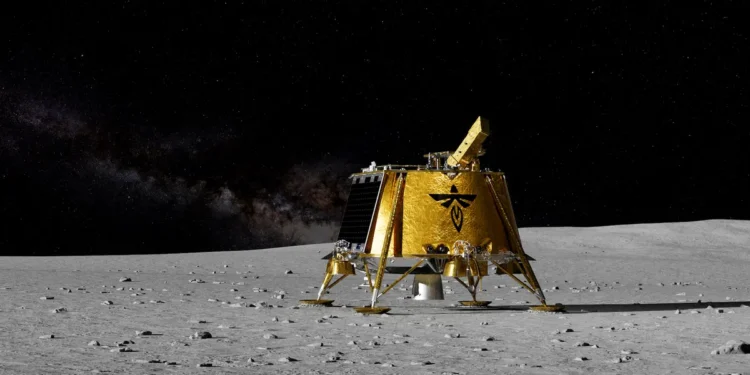
An illustration of the Blue Ghost Lander on the surface of the Moon.
Credit: Firefly Aerospace.
The race to explore the Moon has intensified, with multiple missions pushing the boundaries of human knowledge. Among these is NASA’s groundbreaking LISTER (Lunar Instrumentation for Subsurface Thermal Exploration with Rapidity), which could provide critical insights into the Moon’s origins and pave the way for sustainable lunar habitats.
Carried aboard Firefly Aerospace’s Blue Ghost lunar lander, LISTER launched aboard a SpaceX Falcon 9 rocket on January 15. As Blue Ghost journeys toward the Moon, scientists eagerly anticipate the instrument’s role in unraveling mysteries beneath the lunar surface.
Why LISTER Matters: The Hunt for the Moon’s True Origins
Despite decades of research, the Moon’s formation remains a puzzle. A leading theory suggests that billions of years ago, a Mars-sized object called Theia collided with Earth, ejecting debris that coalesced into the Moon. However, no single hypothesis fully explains the lunar body’s composition and characteristics.
LISTER aims to change that. By measuring the Moon’s internal heat flow, scientists can reconstruct its thermal history—shedding light on how the celestial body evolved over billions of years. Understanding these processes is crucial not only for planetary science but also for future space exploration.
Unlike previous instruments, LISTER features an advanced pneumatic drill designed to reach depths of three meters with minimal energy consumption. As it burrows into the Moon’s regolith, the instrument will take precise measurements of:
Thermal gradient: How temperature changes with depth
Thermal conductivity: How efficiently heat moves through lunar soil
These findings will help determine the Moon’s geological stability—a key factor in planning long-term lunar settlements.
The Lunar South Pole: The Next Frontier for Human Spaceflight
LISTER’s insights could play a vital role in NASA’s Artemis program, which aims to establish a sustained human presence on the Moon. The Artemis III mission will land astronauts at the lunar south pole, a region believed to contain vast ice reserves. This frozen water could serve as a critical resource for future explorers, enabling everything from drinking water to rocket fuel production.
However, recent studies suggest that the lunar surface is not as stable as once believed. Gradual contraction of the Moon is causing surface warping, making some regions prone to landslides. By analyzing subsurface heat flow, LISTER may help identify safer landing sites and inform the construction of future lunar bases.
LISTER’s Impact on Solar System Exploration
But experts explain that LISTER is more than just a lunar tool. Lister is a technological leap for planetary exploration. If successful, its pneumatic drilling system could be deployed on missions to Mars and beyond, helping scientists investigate subsurface conditions on other celestial bodies.
With its advanced instrumentation and potential to reshape our understanding of the Moon, LISTER could become one of the most influential lunar experiments of the decade.
Lunar Trailblazer: The Pioneering Small Satellite to Investigate Water on the Moon - Bethany Ehlmann
The Moon's Secrets: Unveiling Its Strange Interior
Artistic rendering of astronauts standing on the edge of the Vallis Schrödinger canyon. It extends out from the Schrödinger impact basin. Credit: Lunar and Planetary Institute/Michael Carroll.
The Moon has Two Grand Canyons, Carved in Minutes by an Asteroid Impact
Our Moon continues to surprise us with amazing features. Scientists recently shared new information about two canyons that branch out from a major lunar impact. The site is the Schrödinger basin near the Moon’s South Pole. It formed when an asteroid or possibly even a leftover planetesimal slammed into the surface. It took only minutes to dig out that huge crater and split the landscape to make two huge rifts that extend from the site.
According to David Kring of the Lunar and Planetary Institute in Houston, TX, the impact is of very ancient origin. “Nearly four billion years ago,” he said, “an asteroid or comet flew over the lunar south pole, brushed by the mountain summits of Malapert and Mouton, and hit the lunar surface. The impact ejected high-energy streams of rock that carved two canyons that rival the size of Earth’s Grand Canyon. While the Grand Canyon took millions of years to form, the two grand canyons on the Moon were carved in less than 10 minutes.”
Those two canyons—named Vallis Schrödinger and Vallis Planck—are significant clues to that turbulent time in the Moon’s past. And, they’re impressive. Vallis Schrödinger is just under 300 kilometers long, 20 km wide, and 2.7 kilometers deep. Vallis Planck has two units. One is a deep canyon within the ejecta blanket of debris thrown out by the impact. The rest comprises a row of craters made as falling rocks were thrown out from the impact. They fell back to the Moon to create so-called “secondary craters.” The canyon part is about 280 kilometers deep, 27 km wide, and 3.5 km deep. The depth of both of these canyons surpasses the deep gorges of Earth’s Grand Canyon in Arizona.
Anatomy of an Impact and its Aftermath
The impactor probably slammed into the surface at nearly 55,000 kilometers per hour. The crash is what produced the enormous 320-kilometer-diameter Schrödinger impact basin. In the aftermath, the rocky debris scoured the deep canyons.
Schrödinger formed in the outer margin of the South Pole-Aitken (SPA) basin. At a diameter of about 2,400 km, it’s the largest and oldest impact basin on the Moon. The basin’s rim is about 300 km from the South Pole and within 125 km of the proposed exploration site for the Artemis mission.
The Schrödinger crater has a ~150-km diameter peak ring and the whole area is surrounded by a blanket of impact ejecta that splashed out in an irregular pattern up to 500 km away. The outermost crater ring resembles a circular mountain range and rises 1 to 2.5 km above the basin floor. It was produced by the collapse of a central uplift after the impact. After the impact, basaltic lava flows flooded the area. A large pyroclastic vent erupted more material onto the basin floor. That volcanic activity ended around 3.7 billion years ago.
Impact Anomalies
A careful analysis of the impact basin the canyons, and the ejecta surrounding the site by Kring and a team of scientists at the Lunar Planetary Laboratory, gives an idea of impact details. In a paper released about the site, the scientists discuss its features, plus some unusual finds. For example, the canyon rays don’t converge at the basin’s center as you might expect from typical impacts. They seem to come together in a different spot. That implies a point explosion impact.
Schrödinger peak-ring impact basin and two radiating canyons carved by impact ejecta. NASA\SVS\Ernest T. Wright. b Azimuthal Equidistant Projection of the Moon LRO LROC WAC Global Morphology Mosaic 100 centered on the Schrödinger basin, with the continuous ejecta blanket outlined and radial secondary crater rays (red). Vallis Schrödinger and Vallis Planck intersect near the southern rim of the basin (white point). The size of the point indicates the uncertainty. The projected bearing of the primary impactor (yellow) runs through the point of intersection and the basin center. A third unnamed feature extends in an uprange direction.
The location of the converging rays suggests that the incoming asteroid’s trajectory was about 33.5 west of north. The evidence also points to a distributed impact. That could mean the impactor came in at a low angle. Or, it’s also possible that secondary ejecta from the impact also came in at low angles. There are many secondary craters in the area which help explain the possibilities. Continued analysis will help explain the huge amounts of energy released in the event. Gareth Collins, one of Kring’s team members, said, “The Schrödinger crater is similar in many regards to the dino-killing Chicxulub crater on Earth. By showing how Schrödinger’s km-deep canyons formed, this work has helped to illuminate how energetic the ejecta from these impacts can be.”
Future Exploration
Of course, these rays and the impact basin will end up as great exploration points for NASA’s upcoming Artemis missions. Right now, the evidence from the ejecta blanket points to the fact that there’s an uneven distribution, particularly in the area where the first missions are planned. That will allow astronauts and robotic probes to reach underlying samples of the Moon’s primordial crust without having to dig through rocks of a younger age.
Since the basin is the second-youngest basin on the Moon, the impact melted rocks will be a great way to test the actual age of the impact. The general understanding is that some 3.8 billion years ago, the Moon (and Earth) experienced a great many of these collisions. This epoch was the Late Heavy Bombardment, thought to have lasted up to 200 million years. The continual impacts during this time scarred the surfaces of the rocky planets and the Moon, as well as asteroids. Lunar rocks created as a result of lava flows at that time will open a window into their ages and mineralogy, especially compared to other, older rock formations. They should also improve our understanding of that period of solar system history. In particular, it can help scientists characterize the impacts on Earth that affected not just the surface, but its life forms.
Space Junk Could Re-Enter the Atmosphere in Busy Flight Areas
In the more than 60 years since the Space Age began, humans have sent more than 6,740 rockets to space. According to the ESA’s Space Debris Office, this has resulted in 56,450 objects in orbit; about 36,860 of these objects are regularly tracked and maintained in a catalog, while 10,200 are still functioning. The rest is a combination of spent rocket stages, defunct satellites, and pieces of debris caused by unused propellant exploding and orbital collisions. This is leading to a cascade effect known as Kessler Syndrome, where the amount of debris in orbit will lead to more collisions and more debris.
What’s worse, the situation is only projected to get worse since more launches are expected with every passing year. Last year, space agencies and commercial space companies conducted a record-breaking 263 launches, with the U.S. (158) and China (68) leading the way. And with future break-ups occurring at historic rates of 10 to 11 per year, the number of debris objects in orbit will continue to increase. According to a new study by a team from the University of British Columbia (UBC), this also means that debris falling to Earth will have a 1 in 4 chance per year of entering busy airspace.
Artist’s impression of the orbital debris problem. Credit: UC3M
Traditionally, the discussion of space junk and the Kessler Syndrome has focused on how debris in orbit will pose a hazard for future satellites, payloads, and current and future space stations. In 2030, NASA and its many partnered space agencies plan to decommission the International Space Station (ISS) after thirty years of continuous service. However, this situation will also mean that more debris will be deorbiting regularly, not all of which will completely burn up in Earth’s atmosphere.
An illustration of a field of orbital debris, or space junk, circling Earth.
While the chance of debris hitting an aircraft is very low (one in 430,000, according to their paper), the UBC team’s research highlights the potential for disruption to commercial air flights and the additional costs it will lead to. The situation of more launches and more hazards is illustrated perfectly by the “rapid unscheduled disassembly” (RUD) of the Starship on January 16th, during its seventh orbital flight test. The explosion, which happened shortly after the prototype reentered Earth’s atmosphere, caused debris to rain down on the residents of the Turks and Caicos. Said Wright in a UBC News release:
“The recent explosion of a SpaceX Starship shortly after launch demonstrated the challenges of having to suddenly close airspace. The authorities set up a ‘keep out’ zone for aircraft, many of which had to turn around or divert their flight path. And this was a situation where we had good information about where the rocket debris was likely to come down, which is not the case for uncontrolled debris re-entering the atmosphere from orbit.”
A similar situation happened in 2022 when the spent stages of a Chinese Long March 5B (CZ-5B) weighing about 20 metric tons (22 U.S. tons) prompted Spanish and French aviation authorities to close parts of their airspace. If spent stages and other payloads have a low enough orbit, they can reenter Earth’s orbit uncontrolled, and large portions may make it to the ground. In addition to the record number of launches last year, there were also 120 uncontrolled rocket debris re-entries while more than 2,300 spent rocket stages are still in orbit.
Debris from the SpaceX Starship launched on January 16th, spotted over the Turks and Caicos Islands. Credit: Marcus Haworth/Reuters
According to the International Air Transport Association, passenger numbers are expected to increase by almost 7% this year. With rocket launches and commercial flights increasing at their current rate, Wright and his colleagues say that action must be taken to mitigate the potential risks. As part of their study, the team selected the busiest day and location for air traffic in 2023, which was in the skies above Denver, Colorado – with one aircraft for every 18 square km (~7 mi2). They then paired this to the probability of spent rock stages reentering Earth’s atmosphere (based on a decade of data) above the flights.
With this as their peak, they calculated the probability of rocket debris reentering the atmosphere over different air traffic density thresholds. Their results showed that for regions experiencing 10% peak air traffic density or higher, there was a 26% chance of deorbited rocket debris entering that airspace. “Notably, the airspace over southern Europe that was closed in 2022 is only five percent of the peak,” said Wright. “Around the world, there is a 75-per-cent chance of a re-entry in such regions each year.”
At present, whenever orbital debris reenters the atmosphere around busy airspace, aviation authorities will respond by diverting flight paths, closing airspace, or taking the risk of allowing flights to continue. “But why should authorities have to make these decisions in the first place? Uncontrolled rocket body re-entries are a design choice, not a necessity,” said Dr. Boley. “The space industry is effectively exporting its risk to airlines and passengers.”
One possibility is to design rocket stages to reenter the atmosphere in a controlled way so they can crash into the ocean far away from busy air traffic lanes. However, this solution requires collective international action. “Countries and companies that launch satellites won’t spend the money to improve their rocket designs unless all of them are required to do so,” said Dr. Byers. “So, we need governments to come together and adopt some new standards here.”
A series of articles based on evidence of Reincarnation and Life after Death
1. The Afterlife Investigations 2. Is there Life before Life? 3. Reincarnation: The Boy Who Lived Before.. 4. The Afterlife: 'Quantum theory of soul's existence' 5. Proof of Heaven 6. UFO expert describes Grey ETs and how the soul enters the body
1. The Afterlife Investigation
Breakthrough scientific evidence for the afterlife. The Scole Experiments. For five years a group of mediums and scientists witnessed more phenomena than in any other experiment in the history of the paranormal, including recorded conversations with the dead, written messages on sealed film, video of spirit faces and even spirit forms materializing.
These experiments may finally convince you there is life after death. The scientific team in change of overseeing these experiments include world renowned Cambridge Scientist - Dr. Rupert Sheldrake, Dr. David Fontana and Researcher Montague Keen who died during the filming of the documentary
2. Is there Life before Life?
Evidence that we have lived before
1. People who claim to have lived prior lives have always seemed fake to me. Too often they claim to have been someone famous, like an Egyptian Pharaoh, Napoleon or Joan of Ark. Certainly, if reincarnation is real, it is not limited to the rich and famous...Article: Scientific Proof of Reincarnation
2. James Leininger was not yet 2 years old when he began to have terrible nightmares. His parents knew he would outgrow them, but his screams frightened them. When they would come to his bedside, they often found him on his back, kicking his legs in the air and thrashing his arms -- as if he were trying to escape from an imaginary box. He would also yell some garbled words that his parents could not understand...Article: Convincing Cases of Past Lives
3. Rabbi Yonassan Gershom is a Hasidic Jew and author of Beyond the Ashes -- Cases of Reincarnation from the Holocaust. Hasitism is a branch of Orthodox Judaism that promotes spirituality and joy through Jewish mysticism. This very ancient mystic tradition is based on the Talmud and the teachings of the more recent Kabbala...Article: What Did Jesus Say?
4. While most people think of reincarnation as a dogma of religion or an interesting philosophy, the Buddhist monks in Tibet have developed it into a science.
This ancient and isolated Himalayan community has a tradition of contemplating and recording the aspects of human consciousness. Buddha, himself, began these thought experiments as a means of understanding human suffering. He discovered that our misery comes from our reluctance to accept change and our emotional attachment to both situations and material objects. Buddha understood that change is an inevitable process with time and he devised a method for detaching oneself, mentally and emotionally, from transient phenomenon...Article: Tibetan Buddhism: Rebirth v Reincarnation
5. Hinduism is the oldest and most intellectual religion in human history. Great minds contemplated ideas about God, the soul and human existence long before there was a written language to record such things. As such, the religion was mainly an oral tradition. There is no known founder. Yet the ideas about reincarnation, the laws of karma and the abstract nature of the Creator remain the ultimate revelation and source of almost all other faiths. We explore Hinduism, the Bhagavad-gita and Krishna Consciousness in this summary...Article: Hinduism: The Source of Knowledge
6. "Seeing the light" refers to the personal experience that is reported when one remembers their true identity as something "other than this body." There are many methods that have been used to achieve this goal. Meditation and good living are important but some ancient cults also used a technique that involved fire or reflected light. The method, called "phosphenes" is explored and a possible explanation of how it works is given for consideration. We start this journey in Greece, about 3600 years ago, during the Bronze Age. Our focus is part of a secret cult called the Eleusinian Mysteries...Article: Seeing the Light
7. This is a "true" story of a hypnosis session where an obese patient was receiving therapy for overeating. The hypnotist attempted to suggest that the patient remember how it felt to be thin and began a typical regression procedure. Not being careful on the selection of words, the therapist regressed the patient back to a time "when you were light". This reference to light apparently brought the patient back to a time between incarnations -- only the subsequent life that was recalled was not in the past... This amazing transcript is reproduced, word for word, and describes a life in the future. What do humans look like? How do we live? What mysteries have we solved? Although we cannot vouch for its authenticity, it is certainly a thought provoking and interesting read...Article: Can We Recall FUTURE Lives?
3. Refreshing take on Reincarnation: The Boy Who Lived Before..
Documentaries all too often come with attitude. Last week, when Dominion Post film critic Graeme Tuckett said that one of the strengths of the film festival's My Kid Could Paint That was that it made you have to make up your own mind, I agreed with him.
It was refreshing to see a documentary actually doing what documentaries by definition are supposed to do.
The Boy Who Lived Before starred Cameron, who was only two when he started talking in detail about another place and another family that he had previously belonged to.
If last night's documentary on Prime, The Boy Who Lived Before, had an attitude, it was one of respect. Its subject matter – reincarnation, in this case a small child who had memories of a previous life and of a place which he had never visited – was one guaranteed to get a cynic sneering. But all this documentary set out to do was to allow the audience to observe Cameron's story being checked out. It made for riveting – and touching – viewing.
Cameron was only two when he started talking in detail about another place and another family that he had previously belonged to. That other place was the island of Barra, off the west coast of Scotland, a place neither he nor his family had ever visited. He also spoke of a white house on the sand, watching planes land on the beach, a black and white dog, siblings, a mother who'd had her long hair cut short, and a father who had died because he didn't look both ways. Most two-year-olds don't suffer from nostalgia, but Cameron missed his "other mother" so much that sometimes he cried when his real mother picked him up from kindergarten. His memories, which he continued to have till he was five, when we met him, were completely consistent. He even knew his "other" father's name – Shane Robertson. He was a happy and loving little boy, but he yearned for his other life.
Cameron was fortunate to have a marvellously understanding and compassionate mother. She did that very difficult thing – she kept an open mind. She also managed another even more difficult thing – she at least appeared unthreatened by his longing for his other family. She took a risk when she allowed a camera crew to accompany her on the search for Cameron's other family, but it was one that paid off.
Even the people Cameron's mother approached in her attempt to make sense out of the rationally impossible allowed her her dignity.
The first person she spoke to (on camera, anyway) was potentially the hardest – psychologist Chris French, also the editor of The Skeptic Magazine. Though he was careful not to mock, in lots of ways he stated the bleeding obvious: somehow – through TV perhaps? or a family friend? – Cameron had learnt about Barra and invented a world that he had inhabited.
At this point in our house we became a little restless and uneasy, recalling how our daughter, when aged two, had had the habit of waking three or so hours after having been put to bed. At playcentre one day this guileless toddler had displayed such a parentally-humiliating knowledge of the Ewing family and Southfork that I kick myself now for not having known about children who'd lived another life – I could have just explained away her knowledge by telling everyone that Sue- Ellen was her other mother.
Norma, however, could not think of an opportunity Cameron might have had to pick up such detailed information. Also it would have been easy enough to check whether any TV drama or documentary had been made which contained the details which were so entrenched in this small child's imagination.X So she took Cameron to see a child psychologist who confirmed that, like many children, Cameron had an imaginary world. There were significant differences though – most children who create a friend or a world know that it's their own creation. Cameron insisted his existed.
The third expert that Norma consulted was Dr Jim Tucker, an academic from the University of Virginia who – in a this could only happen in America sort of way – headed a department dedicated to scientifically investigating paranormal phenomena such as near-death experiences, ghosts and reincarnation. Tucker accompanied Norma and her two little boys to Barra.
If this had been fiction (a very similar idea was dealt with a couple of years back in Sea of Souls) it would have had to have had a resolution, and this documentary offered no amazing ending. What it did show – in an impressively unspooky sort of way – was that much of what Cameron remembered did exist. After a false start – there were very few people called Robertson on Barra – we were taken with Cameron to see the house he remembered, where several decades ago a family called Robertson had spent a couple of summers. Then we were taken to meet a woman who was a member of the family. She looked kindly, yet nervously, at Cameron. There'd been no Shane Robertson. There had, though, been several Jameses. There'd been a black and white dog. There'd been a big black car.
And there they left us. Like all other children who have had this experience – and there are thousands documented – as Cameron grew older the memories faded. Having seen the house that he had so vividly described, he became a happier, more settled child. It was terrifically interesting, and I anticipate many happy hours a-Googling. It was evidence of what a really good documentary should do – not tell you how to think, but encourage you to get your own brain ticking over.
Even though it goes against all my naturally pragmatic instincts, on the issue of reincarnation this documentary leaves my mind refreshingly open.
4. The Afterlife: 'Quantum theory of soul's existence'
A pair of world-renowned quantum scientists say they can prove the existence of the soul.
A near-death experience happens when quantum substances which form the soul leave the nervous system and enter the universe at large, according to a remarkable theory proposed by two eminent scientists.
Their idea stems from the notion of the brain as a biological computer, "with 100 billion neurons and their axonal firings and synaptic connections acting as information networks" which can persist in the universe even after death, explaining the perceptions of those who have near-death experiences.
American Dr Stuart Hameroff and British physicist Sir Roger Penrose developed a quantum theory of consciousness asserting that our souls are contained inside structures called microtubules which live within our brain cells.
In a near-death experience the microtubules lose their quantum state, but the information within them is not destroyed. Or in layman's terms, the soul does not die but returns to the universe. Thus it is held that our souls are more than the interaction of neurons in the brain. They are in fact constructed from the very fabric of the universe - and may have existed since the beginning of time.
Let's say the heart stops beating, the blood stops flowing, the microtubules lose their quantum state.
"The quantum information within the microtubules is not destroyed, it can't be destroyed, it just distributes and dissipates to the universe at large.
'If the patient is resuscitated, revived, this quantum information can go back into the microtubules and the patient says "I had a near death experience".'
In the event of the patient's death, it was "possible that this quantum information can exist outside the body indefinitely - as a soul. Read more here and here
5. Proof of Heaven
Top neurosurgeon 'spent six days in heaven' during a coma.
A top neurosurgeon claims to have ‘Proof of heaven’ after making a full recovery from a seven day coma that saw his neocortex inactivated.
Dr Eben Alexander, who teaches neuroscience at Harvard University among others, fell seriously ill after contracting a rare form of bacterial meningitis in 2008.
Within hours of developing a severe headache, Dr Alexander’s entire cortex—the section of the brain that controls thought and emotion —had shut down.
Though his chances of survival were low, he awoke from the coma seven days later and began describing an ‘other worldly experience’. Read full article here
Dr. Evan Alexander tells us about his experience in the afterlife and concludes that consciousness survives physical death.
6. UFO expert describes Grey ETs and how the soul enters the body
In an exclusive Suzanne Hansen, Founding Director of UFOCUS NZ Research Network (New Zealand) publicly reveals the unique and compelling history of how she first met the soul of her son aboard a Grey ET spacecraft when she was only 8 years old and her son appeared as a “Ball of Light.”
Ms. Hansen reveals that later in her life, after she was married and pregnant with her son, she was taken aboard a Grey ET spacecraft, where she met her son’s soul once more as “a Ball of Light.” On this occasion, her son’s Soul was inserted into her womb and her son’s body in a procedure by the Grey ETs, who also gave her deep information about the future positive social role her son would play on Earth. Throughout her life, Ms. Hansen states, her experiences with the Grey ETs were “transformational, purposeful, and positive.”
Excerpt from Suzanne Hansen's interview:
Suzanne Hansen’s account is corroborated by Mary Rodwell, RN, who led Ms. Hansen through hypnotic regression sessions designed to help her recover her memories of her life-long experiences around her son’s Soul aboard Grey ET spacecraft.X Ms. Rodwell is “a world leader in alien abduction counseling. Mary Rodwell was featured in an SBS documentary alongside her son – a self-confessed UFO skeptic. Mary, a former nurse and midwife and clinical hypnotherapist founded ACERN in 1997 and has since investigated over 1600 cases of ET encounters worldwide
Suzanne Hansen’s statement:
1. During this experience at age eight, I was initially taken to a large room in which I 'played' with children of mixed species, using mind games to facilitate telepathic communications between us. The interesting thing is that I could 'see' the objects being produced by our minds, with both my mind (thoughts) and my eyes. You will notice a strange small bed in this drawing with a baby on it and a Grey beside it. In another regression session, Mary Rodwell regressed me to when I was 6 months old, where I could see myself lying on this small bed. I have nick-named it the 'lullaby bed' and a description of how and why this bed is used with human babies, and the technology involved, features in another chapter of my book.
2. I was invited to accompany a Grey to a room where I was to meet another 'child'. Here I am as an eight-year-old girl, during my first 'official' meeting with the ball of blue light, learning to relate to the soul of my future son through play. The Greys 'observed' from another area of the craft to see if we would be suited.
3. At age 28, I was taken onboard craft for a 'merging' procedure, where the soul of my future son would enter my body, and that of my unborn child, for the first time. Two Grey-mixed-species entities comforted me, while a Grey began a procedure to lower my metabolism prior to the soul entering my body.
Her experiences with the specific species of Grey ETs she encountered are purposeful and transformational, although she has had to work through a period of personal fear about the experiences.X Ms. Hansen says that her understanding is that souls are universal, and can chose to incarnate into a variety of species on different planets.
She says that a soul is a spiritual entity, and all of its incarnations appear designed to learn moral or evolutionary lessons.
The Grey ETs’ job
Ms. Rodwell concludes by saying that her abduction research has led her to conclude that a specific species of Grey ETs job includes:
1. Gathering genetic information and materials on humans 2. Healing procedures on humans; 3. Cooperation between interdimensional intelligences, as evidenced by the cooperation between human souls and Grey ETs; 4. Deepening of compassion and love, healing ability, and telepathic transfer of information by humans.
The medical and health inspections of humans by the Grey ETs appear to be for levels of pollution, toxins, and other harmful materials that relates to the planet’s problems.
The typology of intelligent civilizations
The dimensional ecology hypothesis of the multi-verse includes a new typology of extraterrestrial civilizations, based on empirical evidence confirming the existence of the following typologies of extraterrestrial civilizations and extraterrestrial governance bodies:
A. Solar system civilizations: Planetary civilizations in our own solar system, such as the intelligent human civilization living under the surface of Mars that reportedly enjoys a strategic relationship with the United States government.
B. Deep space civilizations: Intelligent extraterrestrial civilizations that are based on a planet, solar system, or space station in our galaxy or in some other location in this known physical universe. An example includes the 10 – 100 intelligent extraterrestrial civilizations that, according to a NATO report, have been visiting Earth for many centuries.
C. Hyper-dimensional civilizations: Intelligent civilizations that are based in dimensions or universes parallel to our own and that may use technologically advanced physical form and/or transport when entering our known universe.
D. Extraterrestrial governance authorities: Legally constituted extraterrestrial governance authorities with jurisdiction over a defined territory, such as the Milky Way Galactic Federation, which has been empirically located in replicable research. Read full article
Our review of the impact of the dimensional hypothesis shows that humanity is being misinformed about the reality of its soul, of life after death, and the mechanisms of reincarnation.
Video: Interview with Ms. Hansen: RELATED VIDEOS
The Surprising Evidence for Reincarnation and the Afterlife
How Does Reincarnation and the Afterlife Really Work?
How Reincarnation Really Works, What You Need To Know!
1. ZEROIDS Living beings which inhabit the cosmic void.
Bioforms which may populate the recesses of free space.
This domain is characterized by virtually zero temperature and zero atmospheric pressure.
Russian astrophysicist Dr. V.l. Goldanskii argued that appreciable quantities of prebiotic material should be able to accumulate in the regions surrounding nebulae, or titanic gas clouds.
2. ARCHONS
‘Interdimensional entities’ the negative controllers of humankind
Archons are "are hidden negative controllers of humankind, inorganic interdimensional entities that must now be exposed and exorcised from the individual human mind, from our human species, and from the planet as a whole as part of our collective evolution to a new state of consciousness and being."
Allegedly, EBANI's are organic beings because they are moving in an intelligent way.
4. Flying and Underwater Humanoids
One of the most curious types of sightings - and quite rare - are those of human-like beings that fly. "Human-like" because in most respects they look like us, except that they have wings. In most cases, these odd creatures are not assumed to be either angels or devils (as traditional depictions have them as human-like beings with wings), but as something else. Something quite unusual.
5. Mysterious Flying Orbs and Spheres Since World War 2, strange Flying Spheres have been reported and filmed making impossible maneuvers compared to terrestrial aircraft.
They can avoid radar and even disable tracking and flight instrumentation. They have been seen by military pilots, airline pilots, NASA space shuttle pilots, and even International Space Station personnel. Is their origin extraterrestrial?
Despite all efforts, Flying Spheres still remain a mystery to UFO researchers.
See evidence of a newly discovered and previously unknown life form that currently exists on this planet. In this program is stunning high quality video of "Rods" in flight taken by a production company working for the Discovery Channel while taping cliff jumpers in South America. New methods are presented using the sun which illuminates the phenomenon, providing incredible detail for analyzing the anatomy of this life form. Included in this program are comments by renowned scientists as part of the process of authentication. Discover new sky fishing methods for capturing this entity on film that you can use with your own camera.
'Non-human biologics' recovered by US government, says UFO whistleblower David Grusch
🔍 FBI’s Secret UAP Task Force: Investigating UFOs Since 2020!
A Secret FBI Task Force Investigating UAPs
Recent revelations have brought to light a secret FBI working group dedicated to investigating Unidentified Aerial Phenomena (UAPs), commonly referred to as UFOs. According to Politico, this is the first time that the existence of such a unit has been publicly disclosed. Ryan Graves, a former U.S. Navy pilot and a well-known whistleblower in the UAP community, has shed new details on the group’s operations.
Graves, who previously testified before Congress about repeated encounters with unexplained aerial objects, claims that the FBI unit consists of over a dozen staff members who spend significant time tracking down and analyzing UAP reports. This working group, which began its operations around 2020, aims to address potential security concerns linked to unidentified objects operating within U.S. airspace.
The Role of the FBI in UAP Investigations
The FBI, primarily known for law enforcement and counterintelligence, has been tasked with examining these mysterious aerial phenomena due to their potential national security implications. The group’s primary focus is to investigate whether UAPs present a threat, violate U.S. airspace regulations, or involve any foreign or unauthorized technology.
Graves, who is also the co-founder of Americans for Safe Aerospace, an organization advocating for increased UAP awareness, stated that the FBI team is working closely with pilots and witnesses to gather credible reports. He emphasized that his organization has helped facilitate interviews between witnesses and the FBI agents, ensuring that crucial information reaches the right authorities for further investigation.
Findings and National Security Concerns
Although Graves did not disclose specific details about the group’s findings, he mentioned that their investigations have been “fruitful” and have significantly advanced UAP research both in classified and unclassified settings. This aligns with the broader effort by U.S. intelligence agencies and Congress to understand and address UAP sightings, especially after multiple reports from military personnel describing unknown aerial objects that demonstrate advanced capabilities beyond current technology.
However, Graves also highlighted concerns regarding the future of this FBI group. According to him, some agents involved in the UAP investigations fear losing their jobs due to possible administrative changes, particularly if a political shake-up leads to mass removals within the FBI. He warned that a potential purge of agents could disrupt the ongoing efforts to analyze and mitigate risks associated with unidentified aerial objects.
Whistleblower Protection and the Future of UAP Investigations
Graves has consistently advocated for stronger protections for whistleblowers and witnesses coming forward with UAP-related information. Many individuals hesitate to report sightings due to concerns about professional repercussions or government secrecy. By working with federal agencies like the FBI, Graves and other advocates hope to create a more open and systematic approach to handling UAP cases.
The former Navy pilot urged the government to acknowledge the vital work being done by the FBI’s UAP investigative team and provide them with the necessary resources to continue their efforts. He also called for increased transparency, encouraging the White House and FBI leadership to formalize the group’s status and expand its mission.
VIDEO:
FBI group is investigating UFOs: Former Navy pilot | Morning in America
The existence of an FBI group dedicated to investigating UAPs adds another layer to the ongoing debate surrounding UFOs and national security. With increasing attention from Congress, military personnel, and intelligence agencies, the push for greater understanding and transparency continues to gain momentum. Whether this FBI task force will be able to continue its work without political interference remains to be seen, but its role in gathering and analyzing UAP reports is undeniably critical.
As more details emerge, the public will be watching closely to see whether these investigations lead to significant breakthroughs or remain shrouded in secrecy.
RELATED VIDEOS
How the UAP Task Force evaluated UFO cases
Secret Pentagon Program (Full Episode) | UFOs: Investigating the Unknown
Government Breaks Silence: Strange Encounters | UFO's Investigating the Unknown
During their stints on the International Space Station (ISS) - lasting for months at a time - astronauts spend their spare time doing many of the same things people do on Earth.
This raises the question: do astronauts masturbate or have sex in zero-gravity?
NASA has not issued any strict guidelines around 'alone time', although commanders have stated that they do not allow sexual intercourse on the ISS.
Now, two scientists have revealed what would happen if an astronaut ejaculated in space.
Sex historian, Dr Esme Louise James, and AI expert, Dr Matt Agnew, turned to the concept of conservation of momentum to understand what would happen if a 'man's rocket blasted off in space'.
According to the pair's calculations, ejaculation would propel the astronaut backwards at a speed of around two metres/hour.
This could throw a spanner in the works for astronauts hoping to get frisky on future missions to Mars.
Dr Adam Watkins, Associate Professor in reproductive and developmental physiology, at the University of Nottingham previously told MailOnline: 'Sex in space is physically possible, but would not be as easy as it is here on Earth.'
Sex historian, Dr Esme Louise James, and AI expert, Dr Matt Agnew , turned to the concept of conservation of momentum to understand what would happen if a 'man's rocket blasted off in space'
Dr James and Dr Agnew posted a video on TikTok, exploring what would happen if a male astronaut ejaculated in space.
'I'm here with Matt Agnew to finally answer the question we're sure has also plagued your mind for many years,' Dr James wrote in the video's caption.
To work it out, the pair used a fundamental concept of physics known as the 'conservation of momentum'.
Dr Agnew explained: 'The conservation of momentum says that the total momentum of two or more bodies in a system will remain the same.
'This means that the mass multiplied by the velocity of the ejaculate will equal the mass multiplied by the velocity of the man.'
The pair estimate that the average volume of ejaculate would be around one teaspoon, while its density would be around one gram per millilitre.
Meanwhile, the average speed of ejaculation is an impressive 45km/hr (27mph), according to the scientists.
'We multiply the mass by velocity, and that gives us the momentum of the ejaculate,' Dr Agnew said.
No human has ever officially had sex in space (that they've admitted to...), and the lack of gravity could make it difficult
Could you have sex in space?
Sex in space is physically possible but not recommended.
There is nothing stopping astronauts from overcoming the challenges of having sex in microgravity.
However, low libido and erectile dysfunction may make things difficult.
The biggest risks are associated with pregnancy. Experts are not sure whether microgravity and radiation will damage a developing foetus.
Studies have suggested that developing in space could lead to birth defects in kids.
To conserve momentum and obey the fundamental laws of physics, the man's velocity multiplied by his mass must also equal this number.
'Let's say the average man weighs 70 kilos. This means the velocity must equal 0.000562 metres/second,' Dr Agnew explained.
In simple terms, this means the ejaculation would cause the astronaut to travel backwards at a speed of about two metres per hour.
'How fast is that? About the speed of an average garden snail,' Dr Agnew joked.
'So, if you ever find yourself in the vacuum of space, and you want to use ejaculate as propellant, you're not gonna be moving very quickly.'
The video has delighted many users, who flocked to the comments over on TikTok.
'These school math problems are getting insane,' one user joked.
Another added: 'Physics has never been put to better use than this,' while one joked: 'Why aren't they teaching this in school?'
No human has ever officially had sex in space (that they've admitted to...), and the lack of gravity could make it difficult.
German astronaut Ulrich Walter once suggested in an interview that humans could look to the animal kingdom for inspiration.
Dolphins will sometimes enlist the help of a third to push the couple together and prevent them from drifting apart while mating.
Mr Walter suggested that open-minded astronauts might also enlist the help of a willing friend to push them together.
Alternatively, Paul Root Wolpe, a former NASA Bioethicist, has described how the humble Velcro strap could be the answer.
Mr Wolpe told DW: 'Everything on the walls of the space station is covered in Velcro, so you could take advantage of that by velcroing one partner to the wall.
'You have to get creative in this space.'
RELATED VIDEOS
Sex in Space - Fan Questions | StarTalk
You Need To Know How Astronauts Poop In Space
Life, Love And Sex In Space | SPACETIME - SCIENCE SHOW
Experts blame climate change for the unusually-hot start to 2025 globally, despite an emerging La Niña weather phenomenon.
La Niña – the large-scale cooling of the ocean surface temperatures in the central and eastern equatorial Pacific Ocean – leads to variations in global weather.
'January 2025 is another surprising month, continuing the record temperatures observed throughout the last two years,' said Samantha Burgess, deputy director of C3S.
'Copernicus will continue to closely monitor ocean temperatures and their influence on our evolving climate throughout 2025.'
January 2025 was the warmest January on record globally, with an average surface air temperature of 55.81°F (13.23°C). This map shows where Earth suffered extremes in terms of heat last month, compared to the 1991-2020 reference period
Looking forward, 2025 could set a record for the hottest months the world has ever seen, similar to the run of records set in 2024.
Last December, November, October and September were all the second-hottest for that respective month, according to CS3, while August 2024 was the joint-warmest August globally, tied with August 2023.
C3S looks at temperature readings from a variety of instruments, such as weather stations, balloons and satellites.
The department's readings refer to the average air temperature for the whole planet over the whole month – so lower than a single typically 'hot' temperature reading.
According to CS3, which is based in Bonn in Germany, last month was 3.15°F (1.75°C) above the January average for 1850-1900.
This is the designated 'pre-industrial' reference period to which modern temperatures are compared, prior to widespread industrialization when humans started significantly impacting the atmosphere by burning fossil fuels.
It was also the 18th month in the last nineteen months for which the global-average surface air temperature was more than 2.7°F (1.5°C) above the pre-industrial level.
January 2025 beats both the previous two Januarys in terms of global average air temperature - not to mention all Januarys on record
Looking forward, 2025 could set a record for the hottest months the world has ever seen. Pictured, Sao Paulo, Brazil, January 26, 2025
Experts blame climate change for an unusually-hot start to the year, despite an emerging La Niña weather pattern. Pictured, La Jolla Shores beach, San Diego, California, January 10, 2025
The hottest Januarys on record
January 2025 - 55.81°F (13.23°C)
January 2024 - 55.65°F (13.14°C)
January 2020 - 55.43°F (13.02°C)
January 2016 - 55.38°F (12.99°C)
January 2017- 55.13°F (12.85°C)
Note: Figures listed are global average air temperature for the month
Looking at Europe specifically, the average temperature over European land for January 2025 was 35.24°F (1.8°C), according to CS3.
This makes last month the second warmest January in Europe only after January 2020, which was 4.75°F (2.64°C) above average.
Europe last month was also 4.51°F (2.51°C) above the 1991-2020 average for January.
European temperatures were notably above average over southern and eastern Europe, including western Russia, but were below average over Iceland, the UK and Ireland, northern France, and northern Scandinavia.
The Met Office has already said that the UK’s January average mean temperature was 3°C, which is 0.9°C lower than the current long-term average.
Meanwhile, conditions were wetter than average across regions of western Europe, as well as parts of Italy, Scandinavia and the Baltic countries, leading to flooding in some regions, reveals CS3.
Conversely, drier than average conditions were recorded in northern UK and Ireland, eastern Spain, and north of the Black Sea.
Outside Europe, temperatures were notably above average over northeast and northwest Canada, Alaska, Siberia southern South America, Africa and much of Australia and Antarctica.
In January 2025, it was wetter than average in Pictured, Guaratiba beach amid a heat wave in Rio de Janeiro, Brazil, on January 19, 2025
Meanwhile, temperatures were below average in the US, the easternmost regions of Russia, the Arabian Peninsula and mainland Southeast Asia.
It was wetter than average in Alaska, Canada, central and eastern Russia, eastern Australia, south-eastern Africa, southern Brazil, with regions experiencing floods and associated damage.
Drier than average conditions established in southwestern US and northern Mexico, northern Africa, the Middle East, across Central Asia and in eastern China as well as in much of southern Africa, southern South America and Australia.
C3S also revealed that the the global average sea surface temperature (SST) was 69.4°F (20.78°C) last month.
This marks the second-highest SST value on record for January, 0.34°F (0.19°C) below the January 2024 record.
CS3 also warns that January 2025 saw Arctic sea ice reaching its lowest monthly extent for January – at six per cent below average – due to warmer temperatures.
Carbon emissions and the greenhouse effect: A primer
The greenhouse effect is the reason our planet is getting too hot to live on.
CO2 released by human activity is accumulating as an 'insulating blanket' around the Earth, trapping more of the sun's heat in our atmosphere.
Without the natural greenhouse effect, heat would pass outwards from the Earth¿s surface into space - making it too cold to live. But emissions of gases such as CO2 and methane push the greenhouse effect too far - acting as a blanket that traps heat
CO2 - and other greenhouse gases - are emitted by actions such as burning fossil fuels like coal for energy, burning forests to make way for livestock and
Fertilisers containing nitrogen produce nitrous oxide emissions - another greenhouse gas.
Meanwhile, fluorinated gases are emitted from equipment and products that use these gases.
Such emissions have a very strong warming effect, up to 23,000 times greater than CO2.
Sources: European Commission/BGS/NASA
The January data was “surprising” even to climate change experts at Copernicus, the European climate change service, which noted that it was the 18th month in the last 19 where the global-average surface air temperature was more than 1.5°C above the pre-industrial level.
“January 2025 is another surprising month, continuing the record temperatures observed throughout the last two years, despite the development of La Niña conditions in the tropical Pacific and their temporary cooling effect on global temperatures,” said Samantha Burgess, Copernicus Strategic Lead for Climate.
For many in the northern hemisphere January 2025 will be remembered by “wetter-than-average conditions” over western Europe, as well as parts of Italy, Scandinavia and the Baltic countries, Copernicus said, highlighting “heavy precipitation” and flooding in some regions.
Regional variations
On the other hand, drier than average conditions were recorded in the northern UK and Ireland, eastern Spain and north of the Black Sea.
Beyond Europe, it was wetter than average in Alaska, Canada, central and eastern Russia, eastern Australia, southeastern Africa, and southern Brazil, with regions experiencing floods and associated damage.
But drier-than-average conditions took hold in southwestern United States and northern Mexico, northern Africa, the Middle East, across Central Asia and in eastern China as well as in much of southern Africa, southern South America and Australia.
Global temperature rise is primarily attributed to humans burning fossil fuels which have led to record concentrations of greenhouse gases in the atmosphere. Other factors are also key, including deforestation.
World's Hottest Year Is 2024? | World News | Latest English News | World News
Among several recent findings, the rover has found rocks made of pure sulfur — a first on the Red Planet.
Scientists were stunned on May 30 when a rock that NASA’s Curiosity Mars rover drove over cracked open to reveal something never seen before on the Red Planet: yellow sulfur crystals.
Since October 2023, the rover has been exploring a region of Mars rich with sulfates, a kind of salt that contains sulfur and forms as water evaporates. But where past detections have been of sulfur-based minerals — in other words, a mix of sulfur and other materials — the rock Curiosity recently cracked open is made of elemental, or pure, sulfur. It isn’t clear what relationship, if any, the elemental sulfur has to other sulfur-based minerals in the area.
While people associate sulfur with the odor from rotten eggs (the result of hydrogen sulfide gas), elemental sulfur is odorless. It forms in only a narrow range of conditions that scientists haven’t associated with the history of this location. And Curiosity found a lot of it — an entire field of bright rocks that look similar to the one the rover crushed.
Pan around this 360-degree video to explore Gediz Vallis channel, the location where NASA’s Curiosity Mars rover discovered sulfur crystals and drilled its 41st rock sample. The images that make up this mosaic were captured by the rover’s MastCam in June. Credit: NASA/JPL-Caltech/MSSS
“Finding a field of stones made of pure sulfur is like finding an oasis in the desert,” said Curiosity’s project scientist, Ashwin Vasavada of NASA’s Jet Propulsion Laboratory in Southern California. “It shouldn’t be there, so now we have to explain it. Discovering strange and unexpected things is what makes planetary exploration so exciting.”
It’s one of several discoveries Curiosity has made while off-roading within Gediz Vallis channel, a groove that winds down part of the 3-mile-tall (5-kilometer-tall) Mount Sharp, the base of which the rover has been ascending since 2014. Each layer of the mountain represents a different period of Martian history. Curiosity’s mission is to study where and when the planet’s ancient terrain could have provided the nutrients needed for microbial life, if any ever formed on Mars.
NASA’s Curiosity Mars rover captured this view of Gediz Vallis channel on March 31. This area was likely formed by large floods of water and debris that piled jumbles of rocks into mounds within the channel.
NASA/JPL-Caltech/MSSS
Floods and Avalanches
Spotted from space years before Curiosity’s launch, Gediz Vallis channel is one of the primary reasons the science team wanted to visit this part of Mars. Scientists think that the channel was carved by flows of liquid water and debris that left a ridge of boulders and sediment extending 2 miles down the mountainside below the channel. The goal has been to develop a better understanding of how this landscape changed billions of years ago, and while recent clues have helped, there’s still much to learn from the dramatic landscape.
Since Curiosity’s arrival at the channel earlier this year, scientists have studied whether ancient floodwaters or landslides built up the large mounds of debris that rise up from the channel’s floor here. The latest clues from Curiosity suggest both played a role: some piles were likely left by violent flows of water and debris, while others appear to be the result of more local landslides.
While exploring Gediz Vallis channel in May, NASA’s Curiosity captured this image of rocks that show a pale color near their edges. These rings, also called halos, resemble markings seen on Earth when groundwater leaks into rocks along fractures, causing chemical reactions that change the color.
NASA/JPL-Caltech/MSSS
Those conclusions are based on rocks found in the debris mounds: Whereas stones carried by water flows become rounded like river rocks, some of the debris mounds are riddled with more angular rocks that may have been deposited by dry avalanches.
Finally, water soaked into all the material that settled here. Chemical reactions caused by the water bleached white “halo” shapes into some of the rocks. Erosion from wind and sand has revealed these halo shapes over time.
“This was not a quiet period on Mars,” said Becky Williams, a scientist with the Planetary Science Institute in Tucson, Arizona, and the deputy principal investigator of Curiosity’s Mast Camera, or Mastcam. “There was an exciting amount of activity here. We’re looking at multiple flows down the channel, including energetic floods and boulder-rich flows.”
A Hole in 41
All this evidence of water continues to tell a more complex story than the team’s early expectations, and they’ve been eager to take a rock sample from the channel in order to learn more. On June 18, they got their chance.
While the sulfur rocks were too small and brittle to be sampled with the drill, a large rock nicknamed “Mammoth Lakes” was spotted nearby. Rover engineers had to search for a part of the rock that would allow safe drilling and find a parking spot on the loose, sloping surface.
After Curiosity bored its 41st hole using the powerful drill at the end of the rover’s 7-foot (2-meter) robotic arm, the six-wheeled scientist trickled the powderized rock into instruments inside its belly for further analysis so that scientists can determine what materials the rock is made of.
Curiosity has since driven away from Mammoth Lakes and is now off to see what other surprises are waiting to be discovered within the channel.
More About the Mission
Curiosity was built by NASA’s Jet Propulsion Laboratory, which is managed by Caltech in Pasadena, California. JPL leads the mission on behalf of NASA’s Science Mission Directorate in Washington.
Meer van UFO'S of UAP'S, ASTRONOMIE, RUIMTEVAART, ARCHEOLOGIE, OUDHEIDKUNDE, SF-SNUFJES EN ANDERE ESOTERISCHE WETENSCHAPPEN - DE ALLERLAATSTE NIEUWTJES


 NASA’s Revolutionary LISTER Mission Could Unlock the Moon’s Secrets