Naar de inhoud

UFO'S of UAP'S, ASTRONOMIE, RUIMTEVAART, ARCHEOLOGIE, OUDHEIDKUNDE, SF-SNUFJES EN ANDERE ESOTERISCHE WETENSCHAPPEN - DE ALLERLAATSTE NIEUWTJES

UFO's of UAP'S in België en de rest van de wereld
akke.beakke.be
Ontdek de Fascinerende Wereld van UFO's en UAP's: Jouw Bron voor Onthullende Informatie! Ben jij ook gefascineerd door het onbekende? Wil je meer weten over UFO's en UAP's, niet alleen in België, maar over de hele wereld? Dan ben je op de juiste plek! België: Het Kloppend Hart van UFO-onderzoek In België is BUFON (Belgisch UFO-Netwerk) dé autoriteit op het gebied van UFO-onderzoek. Voor betrouwbare en objectieve informatie over deze intrigerende fenomenen, bezoek je zeker onze Facebook-pagina en deze blog. Maar dat is nog niet alles! Ontdek ook het Belgisch UFO-meldpunt en Caelestia, twee organisaties die diepgaand onderzoek verrichten, al zijn ze soms kritisch of sceptisch. Nederland: Een Schat aan Informatie Voor onze Nederlandse buren is er de schitterende website www.ufowijzer.nl, beheerd door Paul Harmans. Deze site biedt een schat aan informatie en artikelen die je niet wilt missen! Internationaal: MUFON - De Wereldwijde Autoriteit Neem ook een kijkje bij MUFON (Mutual UFO Network Inc.), een gerenommeerde Amerikaanse UFO-vereniging met afdelingen in de VS en wereldwijd. MUFON is toegewijd aan de wetenschappelijke en analytische studie van het UFO-fenomeen, en hun maandelijkse tijdschrift, The MUFON UFO-Journal, is een must-read voor elke UFO-enthousiasteling. Bezoek hun website op www.mufon.com voor meer informatie. Samenwerking en Toekomstvisie Sinds 1 februari 2020 is Pieter niet alleen ex-president van BUFON, maar ook de voormalige nationale directeur van MUFON in Vlaanderen en Nederland. Dit creëert een sterke samenwerking met de Franse MUFON Reseau MUFON/EUROP, wat ons in staat stelt om nog meer waardevolle inzichten te delen. Let op: Nepprofielen en Nieuwe Groeperingen Pas op voor een nieuwe groepering die zich ook BUFON noemt, maar geen enkele connectie heeft met onze gevestigde organisatie. Hoewel zij de naam geregistreerd hebben, kunnen ze het rijke verleden en de expertise van onze groep niet evenaren. We wensen hen veel succes, maar we blijven de autoriteit in UFO-onderzoek! Blijf Op De Hoogte! Wil jij de laatste nieuwtjes over UFO's, ruimtevaart, archeologie, en meer? Volg ons dan en duik samen met ons in de fascinerende wereld van het onbekende! Sluit je aan bij de gemeenschap van nieuwsgierige geesten die net als jij verlangen naar antwoorden en avonturen in de sterren! Heb je vragen of wil je meer weten? Aarzel dan niet om contact met ons op te nemen! Samen ontrafelen we het mysterie van de lucht en daarbuiten.

Archief

NASA Just Discovered the Oldest Martian Rock With a Texture Unlike Anything Ever Seen

NASA Just Discovered the Oldest Martian Rock With a Texture Unlike Anything Ever Seen

Adding to the excitement, Perseverance also detected serpentine minerals—a group of greenish rocks that likely formed when molten magma encountered water.

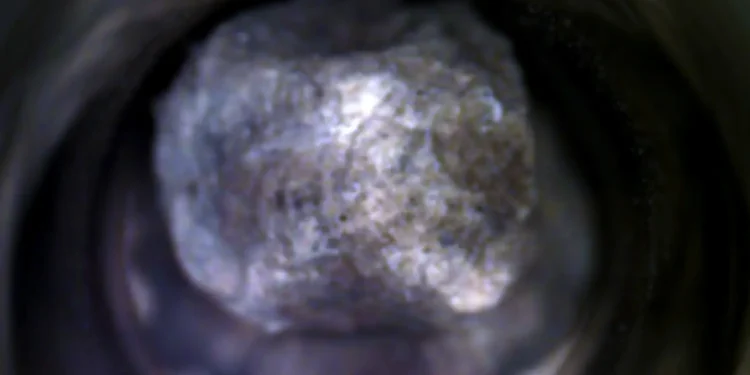
NASA’s Perseverance rover has just made an exciting breakthrough in its search for clues about Mars’ geological past, collecting a sample that scientists describe as “unlike anything we’ve seen before.” Named “Silver Mountain,” this newly acquired rock is the oldest sample ever collected on the Red Planet, dating back to the Noachian epoch—a period between 3.7 to 4.1 billion years ago when Mars was likely warmer and had liquid water.

A Mysterious Rock Unlike Any Other

The discovery was made in a scientifically intriguing region called Blue Hill, located within the larger Shallow Bay area of Jezero Crater. The site contains a unique variety of low-calcium pyroxene, a mineral found in many igneous rocks on Earth, particularly in the planet’s upper mantle. Scientists believe this mineral could provide new insights into Mars’ volcanic history and past water interactions.

Adding to the excitement, Perseverance also detected serpentine minerals—a group of greenish rocks that likely formed when molten magma encountered water. The presence of serpentine could hint at a history of hydrothermal activity, which is significant because such environments on Earth are known to support microbial life.

A Critical Find on a Limited Path

What makes this discovery even more significant is that Blue Hill is the only known outcrop of its kind along Perseverance’s current route. This means the opportunity to study its composition is limited. Recognizing its scientific value, mission controllers directed the rover to extract a 2.9-centimeter (1.1-inch) core sample, ensuring that a piece of this ancient Martian history would be preserved for further study.

“My 26th sample, known as ‘Silver Mountain,’ has textures unlike anything we’ve seen before,” the official Perseverance account shared in a post on X.

The Mars Sample Return (MSR) mission aims to bring Perseverance’s collected samples back to Earth for detailed laboratory analysis. However, the mission has faced significant delays due to funding challenges and shifting priorities at NASA. With a new presidential administration on the horizon, the future of MSR is uncertain, raising concerns among planetary scientists eager to examine these invaluable specimens.

Despite these setbacks, Perseverance’s ongoing discoveries continue to deepen our understanding of Mars’ complex history.

RELATED VIDEO

Perseverance Rover Spots an Unusual Rock in Ancient River Channel (Mars Report)

{ https://curiosmos.com/ }

Hoe vind je dit bericht?
Geschreven door peter om 18:41 Stuur door

This British Scientist Proposes Controversial Theory: We May Be Living 52 Million Lives in a Simulation

Dr. Melvin Vopson simulation

This British Scientist Proposes Controversial Theory: We May Be Living 52 Million Lives in a Simulation

Dr. Melvin Vopson suggests a controversial theory that we may be living 52 million lives in a simulation, as one real-world lifetime could feel like 4.2 billion years in simulated time.

Dr. Vopson, an associate professor in physics at the University of Portsmouth, suggests that we might be living in a computer simulation, much like in The Matrix. He believes that certain signs in our daily lives hint that reality might not be what it seems. He explores the question: if we are in a simulated world, what is its purpose?

Dr Vopson makes scientific observations and measurements to support his theory. His theory is considered controversial which suggests that time can slow down in a simulation. Just like dreams feel long but last only a short time in real life, a whole lifetime in a simulated world could happen in just one real-world minute. This means a person could live many lifetimes by repeating these short simulations, potentially experiencing 52 million lifetimes in one human lifespan.

Dr. Melvin Vopson has previously published research suggesting that information has mass and that all elementary particles – the smallest known building blocks of the universe – store information about themselves, similar to the way humans have DNA.

In 2022, he discovered a new law of physics that could predict genetic mutations in organisms, including viruses, and help judge their potential consequences. It is based on the second law of thermodynamics, which establishes that entropy – a measure of disorder in an isolated system – can only increase or stay the same.

Dr. Melvin Vopson Dr. Melvin Vopson

Dr. Vopson had expected that the entropy in information systems would also increase over time, but on examining the evolution of these systems he realized it remains constant or decreases. That’s when he established the second law of information dynamics, or infodynamics, which could significantly impact genetics research and evolution theory.

Dr. Vopson presents three possible explanations. One idea is that we willingly entered this simulation before birth, choosing to live in an exciting, artificial world rather than a dull real one. In this view, life is like a highly advanced virtual reality game meant for entertainment.

Another possibility is that we are part of an experiment designed to solve real-world problems. This theory suggests that humans in the future create simulations like ours to test solutions for global crises such as climate change or war. If one of these simulations finds a solution, it could be applied in the real world.

The third idea is that time in the simulation moves much slower than in reality. A few minutes in the real world could last for centuries here, allowing us to live multiple lifetimes. Thus, by choosing to exist in the simulation, we might experience a form of immortality.

According to this idea, in the same way, that our dreams can feel days long but last only minutes in real life, an entire lifetime in a simulated universe could take just one minute in the real world. That means a person could become virtually immortal by stacking up these one-minute simulated lives across their entire human lifetime, leaving 52 million chained lifetimes behind. (Source)

Although Dr. Vopson admits these are just theories and not proven by science, some of his research suggests that the universe could be a giant computer. He is not alone in this belief—figures like Elon Musk have also speculated that reality might be a simulation.

In 2022, Dr. Vopson discovered a new law of physics that could predict genetic mutations in organisms, including viruses, and help judge their potential consequences.

It is based on the second law of thermodynamics, which establishes that entropy – a measure of disorder in an isolated system – can only increase or stay the same.

Dr. Vopson had expected that the entropy in information systems would also increase over time, but on examining the evolution of these systems he realized it remains constant or decreases. That’s when he established the second law of information dynamics, or infodynamics, which could significantly impact genetics research and evolution theory.

Dr Vopson said: “I knew then that this revelation had far-reaching implications across various scientific disciplines.

“What I wanted to do next is put the law to the test and see if it could further support the simulation hypothesis by moving it on from the philosophical realm to mainstream science.”

Information theory is the study of how information is measured, stored, and shared. It was first developed by a mathematician named Claude Shannon and is now used in many areas of science, including physics.

In 2022, Dr. Vopson and another physicist, Serban Lepadatu, introduced a new idea called the “second law of infodynamics.”

This idea is similar to a well-known rule in physics called the “second law of thermodynamics,” which says that disorder (called entropy) in the universe always increases or stays the same over time. In simple terms, things naturally become more chaotic.

However, Dr. Vopson found that in information systems—such as digital data or genetic code—the opposite happens. Instead of becoming more disordered, these systems become more organized over time.

He tested this idea on different systems and found that it supports the theory that our universe might be a simulation. This is because, unlike in nature where things become more chaotic, information systems tend to become more efficient and structured. The patterns we see in nature might be a way of organizing information, which fits with the idea of a simulated world.

Key findings include:

  • Biological Systems: The second law of infodynamics challenges the conventional understanding of genetic mutations, suggesting that they follow a pattern governed by information entropy. This discovery has profound implications for fields such as genetic research, evolutionary biology, genetic therapies, pharmacology, virology, and pandemic monitoring.
  • Atomic Physics: The paper explains the behavior of electrons in multi-electron atoms, providing insights into phenomena like Hund’s rule; which states that the term with maximum multiplicity lies lowest in energy. Electrons arrange themselves in a way that minimizes their information entropy, shedding light on atomic physics and the stability of chemicals.
  • Cosmology: The second law of infodynamics is shown to be a cosmological necessity, with thermodynamic considerations applied to an adiabatically expanding universe supporting its validity.

“The paper also provides an explanation for the prevalence of symmetry in the universe”, explained Dr. Vopson.

Dr. Vopson argues that this law plays a role in atomic physics (electron arrangement), cosmology, and biological systems. This last one is where Dr. Vopson makes a big claim: contrary to Charles Darwin’s idea that mutations occur randomly, mutations actually occur so that information entropy is minimized.

He analyzed the constantly mutating SARS-CoV-2 (a.k.a. COVID-19) virus, and his paper on that investigation—shows a “unique correlation between the information and the dynamics of the genetic mutations.”

“A super complex universe like ours, if it were a simulation, would require a built-in data optimization and compression in order to reduce the computational power and the data storage requirements to run the simulation,” Dr. Vopson wrote. (Source)

Dr. Vopson tested his new idea, called the “second law of infodynamics,” by studying digital information.

He wrote the word “INFORMATION” in binary (a computer code using 1s and 0s) onto a tiny magnetic surface. Over time, as the system went through many cycles at room temperature, the information started to fade. After 1,990 cycles, it disappeared completely. This matched his theory, which says that information naturally gets lost over time, becoming simpler.

Read also:

Dr. Vopson was surprised and excited that his idea applied to many different systems. He believes the law could be universal. However, he made it clear that, while his study supports the idea that the universe might be a simulation, it doesn’t prove it for sure. He hopes his work will encourage more research and that other scientists will find new ways to test this idea.

He also suggested another experiment to check his theory. If scientists smash matter and antimatter (opposites of each other) together, they might see low-energy light particles appear. This would show that information is being erased, proving his law of infodynamics in action.

Information physics suggests that everything we see as physical might actually be made of bits of information.

This means our universe could be a simulation. The idea isn’t new—John Archibald Wheeler suggested in 1989 that the universe might emerge from information.

In 2003, philosopher Nick Bostrom argued that it’s likely we are living in such a simulation, as advanced civilizations might create simulations that are impossible to tell apart from reality.

Physicist Seth Lloyd from the Massachusetts Institute of Technology in the US took the simulation hypothesis to the next level by suggesting that the entire universe could be a giant quantum computer. (Source)

Dr. Vopson noted that the simulation hypothesis has attracted the interest of many public figures, such as Elon Musk and Neil deGrasse Tyson, along with other people from all walks of life, showing that it has a broad appeal.

RELATED VIDEOS


The Simulation Theory

Neil deGrasse Tyson Explains the Simulation Hypothesis

Are We Living in A Simulation - Simulation Theory Explained- Are We Real - Is this World an illusion

{ https://howandwhys.com/ } 

Hoe vind je dit bericht?
Geschreven door peter om 18:25 Stuur door

Ex-Defence Minister: E.T.s From Andromeda & Saturn’s Moon Visiting Earth For Thousands Of Years

Ex-Defence Minister: E.T.s From Andromeda & Saturn's Moon Visiting ...

Ex-Defence Minister: E.T.s From Andromeda & Saturn’s Moon Visiting Earth For Thousands Of Years

There are already dozens of claims in favor of extraterrestrial visitation. Today, numerous astronauts and government officials support the UAP phenomena, and some are highly positive that they could have an alien origin. The Honorable Paul Hellyer (1923-2021), former Canadian Minister of Defense said extraterrestrials have been visiting our planet for thousands of years and it is likely that at least two of them are working with the U.S. government and sharing their highly-advanced technologies with humans.

In the 1960s, Paul Hellyer, a high-ranking official during the Cold War, asserted that he had discovered with certainty about the existence of aliens while serving in the military. He said that people from other worlds had been coming to Earth for a very long time. He insisted that a lot of the stuff that makes up our high-tech gadgetry had been gifted to us by overly-advanced ETs.

Hellyer had long expressed his views on extraterrestrials in public. He testified at the Citizen Hearing on Disclosure in May 2013 in Washington, DC. Five former members of U.S. Congress and one former U.S. senator listened to more than thirty hours of testimony from government officials, military personnel, researchers, and witnesses.

Huffington Post Canada described that, as part of his testimony, Hellyer stated that “aliens are living among us and that it is likely at least two of them are working with the U.S. government.” More specifically, Hellyer announced that at least four species of extraterrestrials had been visiting Earth for thousands of years. According to Huffington Post Canada, he also stated that some extraterrestrials originate from the “Zeta Reticuli, the Pleiades, Orion, Andromeda, and Altair star systems” and “may have different agendas.”

He first spoke openly about his belief governments are covering up an alien presence back in 2005, saying UFOs are as plentiful in our sky as airplanes. “Much of the media won’t touch it, so you just have to keep working away at it and we will get a critical mass and one day they will say Mr. President or Mr. Prime Minister, we want the truth and we want it now because it affects our lives.”

In 2013, Hellyer appeared on the RT interview show SophieCo with Sophie Shevardnadze to discuss extraterrestrials and UFOs. Shevardnadze asked Hellyer, “Why do you say that UFOs are as real as airplanes flying over our heads?” Hellyer replied, “Because I know that they are. As a matter of fact, they’ve been visiting our planet for thousands of years.” He further stated military action had brought down UFOs, and humans had adapted alien technology for use on Earth. (Source)

Read also:

He said: “As far as technology is concerned, they are light years ahead of us, and we have learned a lot of things from them. A lot of the things we use today we got from them, you know – led lights and microchips and Kevlar vests and all sorts things that we got from their technology and we could get a lot more too, especially in the fields of medicine and agriculture if we would go about it peacefully. But, I think, maybe some of our people are more interested in getting the military technology, and I think that’s wrong-headed, and that’s one of the things that we are going to have to change, because we’re going to have to work together, all of us, everywhere on the planet.”

Paul Hellyer alien

Hellyer takes us to where he saw his first UFO, and points. Credit: Motherboard

Shevardnadze asked: “Have you ever had your own encounter with aliens?” Hellyer replied: “Not encounter with aliens, no. I’ve seen a UFO, about 120 miles north of Toronto, over Lake Muskoka, where I have a cottage. Two years ago, at Thanksgiving, which is October, [my wife?] said that she wanted to go out and look at the stars, so… I’m not much of a night man… but I put on my cap and went out with her and she looked into the eastern sky and said, ‘There’s a star,’ and I turned the other way and said, ‘Oh, there’s a much brighter one over here,’ and she looked there and we watched it until our necks almost broke for about 20 minutes, and it was definitely a UFO because it could change position in the sky by three or four degrees in three or four seconds.”

Shevardnadze further asked Hellyer if shooting down those UFOs was risking an interstellar war, and, if so, “should we be creating a Star Wars force to defend ourselves from possible invasion or something like that?”

Hellyer said: “I think it’s a possibility, but it’s a possibility especially if we shoot down every UFO that comes into our airspace without asking who they are and what they want. Right from the beginning, we started scrambling planes, trying to shoot them down, but their technology was superior enough that we weren’t able to get away with it, certainly not for a long while.”

He continued: “During that period of time they could have taken us over without any trouble if they wanted to, so I think, rather than developing our own Star Wars to protect ourselves against them, we should work with the benign species that are of a vast majority and work together, and rely largely on them, of course, and cooperate, so that we would be contributing something at the same time; I don’t think there’s any point in us developing a galactic force that would tempt us to ride on our own and get into mischief, which is one of the things that some of them are concerned about.”

On countering physicist Stephen Hawking’s assertion that any alien visitors to Earth would likely be malevolent, Hellyer argued that not only have aliens already visited Earth but that they have helped contribute to humanity’s technological progress. He said earthlings owe a lot to their alien friends. “Even that computer screen on your desk,” he said, “can trace its origins to spaceships. Microchips, for example, fiber-optics, they are just two of the many things that allegedly — and probably for real — came from crashed vehicles,” Hellyer added. (Source)

Hellyer was not the only one speaking of a partnership between humans and extraterrestrial intelligence. The former head of the Israeli space security program and retired general Haim Eshed also claimed that a sort of agreement had been made between aliens and the US government to keep silent on their experiments on Earth and secret bases on Mars.

Mr. Eshed said that aliens and “Galactic federation” do exist and have been working with the US and the Israel government for years, but they keep it a secret to avoid mass hysteria. According to him, President Trump was aware of it and has already been in contact with space aliens. He further said that the aliens have been waiting for humans to evolve and reach a certain stage to actually understand space and spaceships. Besides, they signed a contract with humans to do experiments on Earth and also research with them to learn the fabric of the universe.

RELATED VIDEOS


Remembering Paul Hellyer: Raw Footage from Last Interview

IN FULL: Canadian defence minister gives briefing after US shoots UFO down | ABC News

Aliens Among Us: Canadian Defense Minister Speaks Out

{ https://howandwhys.com/ }

Hoe vind je dit bericht?
Geschreven door peter om 00:00 Stuur door

Monsterlijke radiojet in het piepjonge heelal ontdekt die alle records verbreekt

Monsterlijke radiojet in het piepjonge heelal ontdekt die alle records verbreekt

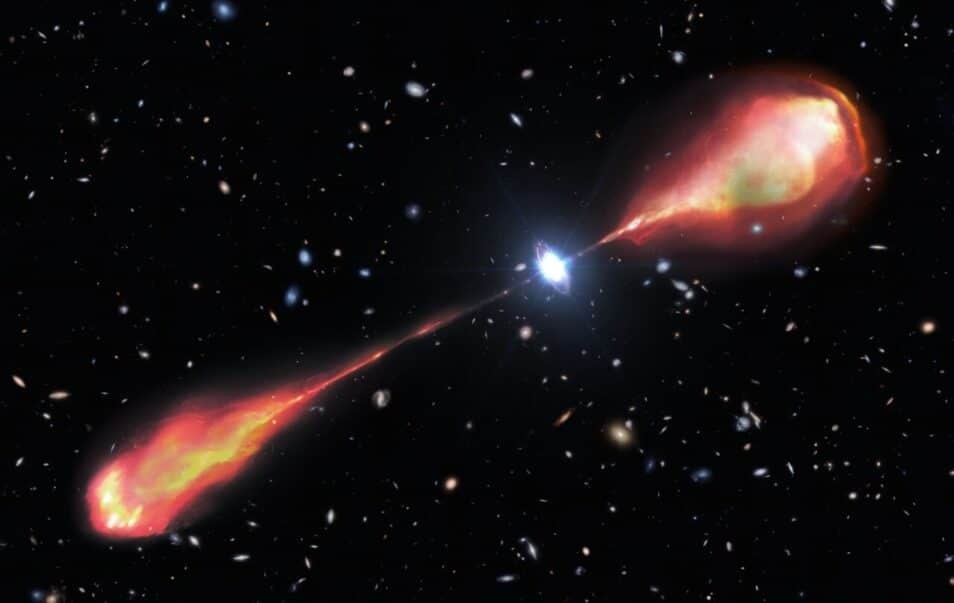
Deze gigantische jet, die zich over minstens 200.000 lichtjaar uitstrekt, ontstond toen het heelal nog geen 10 procent van zijn huidige leeftijd had.

Astronomen hebben met behulp van de Gemini North-telescoop – een van de twee telescopen van het International Gemini Observatory – de grootste radiojet ooit in het vroege heelal opgespoord. Tot nu toe bleven zulke grote radiojets grotendeels onzichtbaar in het verre heelal. Dankzij deze waarnemingen krijgen astronomen waardevolle nieuwe inzichten in wanneer de eerste jets ontstonden en hoe ze de evolutie van sterrenstelsels beïnvloedden.

Radiojets
Uit decennia aan astronomische waarnemingen weten wetenschappers dat de meeste sterrenstelsels een superzwaar zwart gat in hun hart hebben. Wanneer gas en stof erin vallen, komt er door de wrijving enorm veel energie vrij, wat resulteert in heldere galactische kernen – quasars – die krachtige jets van energierijke materie de ruimte in schieten. Deze jets zijn met radiotelescopen over enorme afstanden te detecteren. In ons lokale heelal zijn zulke radiojets niet zeldzaam en worden ze in een handvol nabije sterrenstelsels gevonden. Maar in het verre, vroege heelal waren ze tot nu toe wel een zeldzaamheid.

Jacht
Onderzoekers besloten echter de uitdaging aan te gaan en de jacht te openen op vroege radiojets. “We zochten naar quasars met krachtige radiojets in het vroege heelal, omdat dit ons inzicht geeft in hoe en wanneer de eerste jets werden gevormd en op welke manier ze de evolutie van sterrenstelsels hebben beïnvloed”, verklaart Anniek Gloudemans, postdoctoraal onderzoeker bij NOIRLab en hoofdauteur van de nieuwe studie.

Grootste ooit
En nu komen ze met groot nieuws. In de nieuwe studie, gepubliceerd in The Astrophysical Journal Letters, onthullen ze namelijk de ontdekking van een verre radiojet met twee ‘lobben’, die zich uitstrekt over maar liefst 200.000 lichtjaar – twee keer zo breed als de Melkweg. Dit is de grootste radiojet die ooit zo vroeg in de geschiedenis van het heelal is gevonden.

De grootste radiojet ooit ontdekt in het vroege heelal, vastgelegd met behulp van verschillende telescopen, waaronder de LOFAR-telescoop, de Gemini North-telescoop en de Hobby Eberly Telescope. Dit beeld werd verder aangevuld met optische gegevens van de DECam Legacy Survey. Afbeelding: LOFAR/DECaLS/DESI Legacy Imaging Surveys/LBNL/DOE/CTIO/NOIRLab/NSF/AURA/F. Sweijen (Durham University)
De jet werd voor het eerst opgespoord met de internationale Low Frequency Array (LOFAR), een indrukwekkend netwerk van radiotelescopen verspreid over heel Europa. Vervolgwaarnemingen in het nabij-infrarood met de Gemini Near-Infrared Spectrograph (GNIRS) en in het optische bereik met de Hobby Eberly Telescope gaven een compleet beeld van de radiojet en de quasar die hem aandrijft. Deze ontdekkingen zijn essentieel voor een dieper begrip van het ontstaan en de processen achter de eerste grootschalige jets in ons heelal.

Om de eigenschappen van de quasar – zoals zijn massa en de snelheid waarmee hij materie opslokt – te achterhalen, onderzocht het team een specifieke lichtgolflengte die door quasars wordt uitgezonden: de MgII (magnesium) brede emissielijn. Dit signaal komt normaal gesproken in het ultraviolet voor, maar door de uitdijing van het heelal wordt het licht van de quasar ‘uitgerekt’ naar langere golflengten. Hierdoor bereikt het magnesiumsignaal de aarde in het nabij-infrarood, waar het met GNIRS kan worden gedetecteerd.

J1601+3102
De quasar, die de naam J1601+3102 heeft gekregen, ontstond toen het heelal nog geen 1,2 miljard jaar oud was – slechts 9 procent van zijn huidige leeftijd. Hoewel quasars soms massa’s hebben die miljarden keren groter zijn dan die van onze zon, is deze relatief klein en weegt hij ‘slechts’ 450 miljoen keer de massa van de zon. De dubbelzijdige jets vertonen een asymmetrie in zowel helderheid als lengte, wat suggereert dat een extreem omgevingseffect hen beïnvloedt.

Zwart gat
De resultaten verschaffen interessante nieuwe inzichten in de vorming van krachtige radiostraling in het vroege heelal. “Opmerkelijk genoeg heeft de quasar die deze gigantische radiojet aandrijft geen extreem zwaar zwart gat, in vergelijking met andere quasars”, vertelt Gloudemans. “Dit suggereert dat een superzwaar zwart gat of een uitzonderlijk hoge accretiesnelheid niet per se 

Ruis
De eerdere schaarste aan grote radiojets in het vroege heelal werd vaak verklaard door de ruis van de kosmische microgolfachtergrond – de straling die is overgebleven van de oerknal. Deze achtergrondstraling dempt doorgaans het radiolicht van zulke verre objecten. “Maar omdat dit object zo extreem is, kunnen we het vanaf de aarde waarnemen, ondanks de enorme afstand”, legt Gloudemans uit. “Dit object toont aan wat we kunnen ontdekken door de krachten van verschillende telescopen, die op uiteenlopende golflengten werken, te bundelen.”

Wetenschappers hebben nog talloze vragen over hoe radiogheldere quasars zoals J1601+3102 zich onderscheiden van andere quasars. Het is bijvoorbeeld nog onduidelijk welke omstandigheden nodig zijn om zulke krachtige radiojets te creëren en wanneer de eerste radiojets in het heelal precies zijn ontstaan. Maar dankzij de combinatie van verschillende telescopen zijn astronomen nu in elk geval wel weer een stap dichter bij het begrijpen van deze mysterieuze kosmische fenomenen.

Bronmateriaal

GERELATEERDE VIDEO'S

Largest Black Hole Jet in the Universe Discovered | Mind-Blowing Cosmic Phenomenon!

Largest black hole jet discovered stretches 23 million light years

{ https://scientias.nl/nieuws/astronomie-ruimtevaart/ }

Hoe vind je dit bericht?
Geschreven door peter om 22:31 Stuur door

Avalanches, Icy Explosions, and Dunes: NASA Is Tracking New Year on Mars

Avalanches, Icy Explosions, and Dunes: NASA Is Tracking New Year on Mars

Instead of a winter wonderland, the Red Planet’s northern hemisphere goes through an active — even explosive — spring thaw.

It’s a new year on Mars, and while New Year’s means winter in Earth’s northern hemisphere, it’s the start of spring in the same region of the Red Planet. And that means ice is thawing, leading to all sorts of interesting things. JPL research scientist Serina Diniega explains.

Credit: NASA/JPL-Caltech

While New Year’s Eve is around the corner here on Earth, Mars scientists are ahead of the game: The Red Planet completed a trip around the Sun on Nov. 12, 2024, prompting a few researchers to raise a toast.

But the Martian year, which is 687 Earth days, ends in a very different way in the planet’s northern hemisphere than it does in Earth’s northern hemisphere: While winter’s kicking in here, spring is starting there. That means temperatures are rising and ice is thinning, leading to frost avalanches crashing down cliffsides, carbon dioxide gas exploding from the ground, and powerful winds helping reshape the north pole.

“Springtime on Earth has lots of trickling as water ice gradually melts. But on Mars, everything happens with a bang,” said Serina Diniega, who studies planetary surfaces at NASA’s Jet Propulsion Laboratory in Southern California.

Mars’ wispy atmosphere doesn’t allow liquids to pool on the surface, like on Earth. Instead of melting, ice sublimates, turning directly into a gas. The sudden transition in spring means a lot of violent changes as both water ice and carbon dioxide ice — dry ice, which is much more plentiful on Mars than frozen water — weaken and break.

“You get lots of cracks and explosions instead of melting,” Diniega said. “I imagine it gets really noisy.”

Using the cameras and other sensors aboard NASA’s Mars Reconnaissance Orbiter (MRO), which launched in 2005, scientists study all this activity to improve their understanding of the forces shaping the dynamic Martian surface. Here’s some of what they track.

Frost Avalanches

In 2015, MRO’s High-Resolution Imaging Science Experiment (HiRISE) camera captured a 66-foot-wide (20-meter-wide) chunk of carbon dioxide frost in freefall. Chance observations like this are reminders of just how different Mars is from Earth, Diniega said, especially in springtime, when these surface changes are most noticeable.

“We’re lucky we’ve had a spacecraft like MRO observing Mars for as long as it has,” Diniega said. “Watching for almost 20 years has let us catch dramatic moments like these avalanches.”

This image from NASA's Mars Reconnaissance Orbiter spacecraft shows a channel system flowing to the southwest toward the huge Hellas impact basin.

Martian spring involves lots of cracking ice, which led to this 66-foot-wide (20-meter-wide) chunk of carbon dioxide frost captured in freefall by the HiRISE camera aboard NASA’s Mars Reconnaissance Orbiter in 2015.

Credit: NASA/JPL-Caltech/Univ. of Arizona

Gas Geysers

Diniega has relied on HiRISE to study another quirk of Martian springtime: gas geysers that blast out of the surface, throwing out dark fans of sand and dust. These explosive jets form due to energetic sublimation of carbon dioxide ice. As sunlight shines through the ice, its bottom layers turn to gas, building pressure until it bursts into the air, creating those dark fans of material.

But to see the best examples of the newest fans, researchers will have to wait until December 2025, when spring starts in the southern hemisphere. There, the fans are bigger and more clearly defined.

As light shines through carbon dioxide ice on Mars, it heats up its bottom layers, which, rather than melting into a liquid, turn into gas. The buildup gas eventually results in explosive geysers that toss dark fans of debris on to the surface.

As light shines through carbon dioxide ice on Mars, it heats up its bottom layers, which, rather than melting into a liquid, turn into gas. The buildup gas eventually results in explosive geysers that toss dark fans of debris on to the surface.

Credit: NASA/JPL-Caltech/University of Arizona

Spiders

Another difference between ice-related action in the two hemispheres: Once all the ice around some northern geysers has sublimated in summer, what’s left behind in the dirt are scour marks that, from space, look like giant spider legs. Researchers recently re-created this process in a JPL lab.

Sometimes, after carbon dioxide geysers have erupted from ice-covered areas on Mars, they leave scour marks on the surface. When the ice is all gone by summer, these long scour marks look like the legs of giant spiders.

Credit: NASA/JPL-Caltech/University of Arizona

Powerful Winds

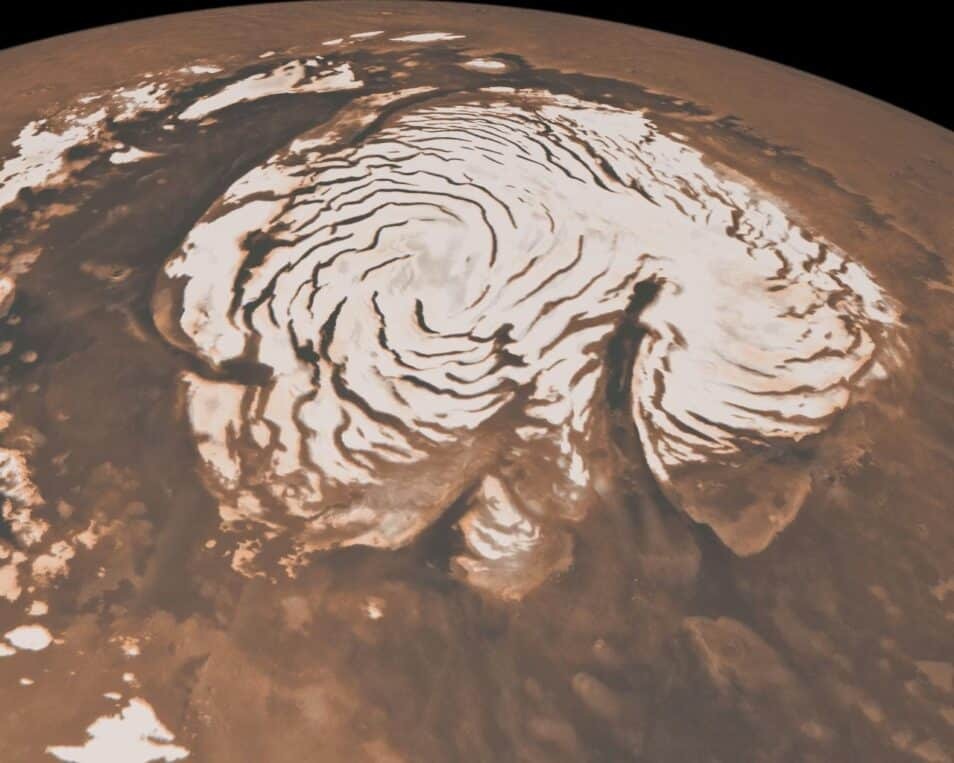
For Isaac Smith of Toronto’s York University, one of the most fascinating subjects in springtime is the Texas-size ice cap at Mars’ north pole. Etched into the icy dome are swirling troughs, revealing traces of the red surface below. The effect is like a swirl of milk in a café latte.

“These things are enormous,” Smith said, noting that some are a long as California. “You can find similar troughs in Antarctica but nothing at this scale.”

Fast, warm wind has carved the spiral shapes over eons, and the troughs act as channels for springtime wind gusts that become more powerful as ice at the north pole starts to thaw. Just like the Santa Ana winds in Southern California or the Chinook winds in the Rocky Mountains, these gusts pick up speed and temperature as they ride down the troughs — what’s called an adiabatic process.

This image, combining data from two instruments aboard NASA's Mars Global Surveyor, depicts an orbital view of the north polar region of Mars. To the right of center, a large canyon, Chasma Boreale, almost bisects the white ice cap.

As temperatures rise, powerful winds kick up that carve deep troughs into the ice cap of Mars’ north pole. Some of these troughs are as long as California, and give the Martian north pole its trademark swirls. This image was captured by NASA’s now-inactive Mars Global Surveyor.

Credit: NASA/JPL-Caltech/MSSS

Wandering Dunes

The winds that carve the north pole’s troughs also reshape Mars’ sand dunes, causing sand to pile up on one side while removing sand from the other side. Over time, the process causes dunes to migrate, just as it does with dunes on Earth.

This past September, Smith coauthored a paper detailing how carbon dioxide frost settles on top of polar sand dunes during winter, freezing them in place. When the frost all thaws away in the spring, the dunes begin migrating again.

Each northern spring is a little different, with variations leading to ice sublimating faster or slower, controlling the pace of all these phenomena on the surface. And these strange phenomena are just part of the seasonal changes on Mars: the southern hemisphere has its own unique activity.

Surrounded by frost, these Martian dunes in Mars northern hemisphere were captured from above by NASAs Mars Reconnaissance Orbiter using its HiRISE camera on Sept. 8, 2022.
Credit: NASA/JPL-Caltech/University of Arizona

More About MRO

The University of Arizona, in Tucson, operates HiRISE, which was built by Ball Aerospace & Technologies Corp., in Boulder, Colorado. NASA's Jet Propulsion Laboratory, a division of Caltech in Pasadena, California, manages the Mars Reconnaissance Orbiter Project for NASA’s Science Mission Directorate, Washington.

For more information, visit:

News Media Contact

  • Andrew Good

Jet Propulsion Laboratory, Pasadena, Calif.

818-393-2433

andrew.c.good@jpl.nasa.gov

  • Karen Fox / Molly Wasser

NASA Headquarters, Washington

202-358-1600

karen.c.fox@nasa.gov / molly.l.wasser@nasa.gov

{ https://www.jpl.nasa.gov/ }

Hoe vind je dit bericht?
Geschreven door peter om 22:12 Stuur door

Mars in lentelicht: spectaculaire veranderingen op de rode planeet

Mars in lentelicht: spectaculaire veranderingen op de rode planeet

Recente beelden tonen dramatische veranderingen op Mars tijdens de overgang naar lente, met lawines, gasgeisers en ‘Mars-spinnen’ aan het noordelijke oppervlak.

In dit artikel belichten we aan de hand van enkele recente foto’s van Mars’ oppervlak de zich nu voltrekkende overgang naar lente op Mars’ noordelijke halfrond. Dankzij de langdurige observaties van de Mars Reconnaissance Orbiter (MRO) komen dramatische veranderingen in het landschap aan het licht. We bekijken verschillende fenomenen, waaronder afbrokkelende stukken droogijs, explosieve gasgeisers en de vorming van spin-achtige structuren aan het oppervlak, die samen een dynamisch beeld geven van de Marslente.

Martiaanse duinen. Deze hoge resolutie opname toont migrerende duinen in de noordelijke hemisfeer van Mars, omgeven door vorst (rijp van droogijs). Deze afbeelding is gemaakt met HiRISE aan boord van MRO en benadrukt de dynamiek achter duinvorming onder invloed van lokale, seizoensgebonden windsystemen.  Foto: NASA/JPL-Caltech/University of Arizona

Lawines in Mars’ lente
De overgang naar lente op Mars brengt aanzienlijke structurele veranderingen met zich mee. In 2015 legde de HiRISE-camera een 20-meter groot brok droogijs in vrije val vast. Deze afbrokkelende ijsmassa’s illustreren hoe door invloed van toenemende temperaturen abrupte gevolgen zoals we die ook kennen op aarde, heftige gevolgen teweegbrengen. JPL-onderzoeker Serina Diniega merkt op: “we zijn blij dat we bijna 20 jaar lang een waarnemingsplatform als MRO hebben, waarmee we deze dramatische gebeurtenissen kunnen zien voltrekken, in plaats van alleen de gevolgen van smelt.”

Droogijs-lawines. De vrije val een 20-meter groot brok bevroren koolstofdioxide, vastgelegd door HiRISE (Mars Reconaissance Orbiter) in 2015, illustreert de explosieve aard van Mars’ lentetransitie. Foto: NASA/JPL-Caltech/Univ. of Arizona

Gasgeisers, explosieve uitbarstingen en ‘Mars-spinnen’
Opwarming van de grond door toedoen van de groter wordende zonnekracht op het noorden zorgt ervoor dat onder het oppervlak gelegen reservoirs van droogijs sublimeren naar gasvormig koolstofdioxide, waardoor er actief spuwende geisers ontstaan. MRO heeft dit bijzondere proces weten vast te leggen:

Gasgeisers. Dit beeld toont gasgeisers die, als gevolg van sublimatie van ondergronds gelegen kooldioxide-ijs, donkere fonteinen van materiaal de atmosfeer in blazen en over het Martiaanse oppervlak verspreiden. Foto: NASA/JPL-Caltech/University of Arizona

Afhankelijk van de kenmerken van de grond kan er veel druk opbouwen voordat de geiser losbarst en explosief wordt. Het verschijnsel van actieve geisers en explosies van onder het oppervlak komt elk Martiaans jaar weer ten einde in de zomer en laat dan donkere spin-achtige afzettingen van zand en stof, verspreid over het oppervlak, achter; ‘Mars-spinnen’:

Mars-spinnen. Na uitrazen van de gasgeisers ontstaan lange, spinachtige deposities op het oppervlak van Mars, een kenmerkend effect van droogijs sublimatie van onder het oppervlak. Foto: NASA/JPL-Caltech/University of Arizona Close-up van Mars-spinnen. Deze close-up toont de gedetailleerde structuur van Mars-spinnen, gevormd door langdurige sublimatie van kooldioxideijs. Foto: NASA/JPL-Caltech/Univ. of Arizona

Winderige troggen bij de noordpool
De opwarming van Mars’ noordpool leidt tot lokaal krachtige winden die diepe troggen klieft in de ijsbedekking van Mars’ noordpool. Deze troggen kunnen een lengte bereiken die vergelijkbaar is met de doorsnede van pool zelf; zo’n 1.000 km.

Winderige troggen. Krachtige windstromen snijden diepe troggen in de ijsbedekking van Mars’ noordpool, welke een totale afmeting heeft van ongeveer 1.000 km. doorsnede telt in de Martiaanse winter. Rechtsonderin de getoonde ijsmassa doorklieft de Chasma Boreale canyon. Deze heeft een lengte van ongeveer 450 km. en is zo’n 2 kilometer diep. Foto: NASA/JPL-Caltech/MSSS

De beelden van Mars’ oppervlak onthullen de dynamische processen die optreden tijdens de overgang naar lente. IJslawines, explosieve gasgeisers en de ontwikkeling van Mars-spinnen tonen hoe de rode planeet onder invloed van veranderende temperaturen en sublimatie in een korte tijd drastisch verandert. Deze observaties, ondersteund door bijna 20 jaar aan hoge resolutie opnamen, bieden een unieke kans voor wetenschappers om de evoluerende krachten op Mars te bestuderen.


New Year, New Mars: Red Planet Gets Active as Spring Begins
(Mars Report)
  • De afgelopen decennia zijn er prachtige foto’s gemaakt van interstellaire nevels, sterrenstelsels, planeten, andere hemellichamen en in de ruimtevaart. Ieder weekend halen we een indrukwekkende ruimtefoto uit het archief. Genieten van alle foto’s? Bekijk ze op deze pagina. Heb je zelf bijzondere (astro)foto’s die je wil delen met ons? Stuur ze in via ons mailadres o.v.v. ‘Ruimtefoto’!

Bronmateriaal

{ https://scientias.nl/nieuws/astronomie-ruimtevaart/ }

Hoe vind je dit bericht?
Geschreven door peter om 22:00 Stuur door

Terrifying robot dog can walk, climb, and even backflip on almost any terrain - but concerned viewers predict it will be 'hunting down every last human before long'

The idea of a robotic dog that can move on almost any terrain might sound like something from the latest episode of Black Mirror. 

But as this terrifying footage shows, it has now become a reality. 

The state-of-the-art robot dog is called Lynx, and is the brainchild of Chinese company, Deep Robotics. 

Equipped with four wheels instead of paws, the bot can walk, climb, and even backflip on everything from rocks to snow. 

Deep Robtics hopes that it could be used in search and rescue operations. 

However, some sceptics have already raised concerns about the four-legged robot. 

'I know these are gonna be hunting down every last human before long,' one user commented on the video. 

However, they reluctantly added: 'But this is also just legitimately cool as hell.'

The state-of-the-art robot dog is called Lynx, and is the brainchild of Chinese company, Deep Robotics

The state-of-the-art robot dog is called Lynx, and is the brainchild of Chinese company, Deep Robotics

Equipped with four wheels instead of paws, the bot can walk, climb, and even backflip on everything from rocks to snow

Equipped with four wheels instead of paws, the bot can walk, climb, and even backflip on everything from rocks to snow

Lynx stands at just under one metre tall, and weighs 30kg - around the same size as a Labrador Retriever. 

'DEEPRoboticsLynx all-terrain robot boasts a compact and agile design with exceptional adaptability to diverse terrains,' Deep Robotics explains on its website. 

'By leveraging its distinctive wheel-leg motion, DEEPRoboticsLynx strikes an optimal balance between speed and agility, carrying forward DEEP Robotics' deep expertise in embodied intelligence and industry applications.'

According to the firm, the robot is able to climb platforms up to 80cm tall and navigate continuous steps reaching up to 22cm tall. 

Meanwhile, when it's on the move, the bot can reach top speeds of five metres/second (11mph). 

It also comes with an IP54 protection rating, meaning it is suitable for use in all weather conditions. 

Equipped with a wide-angle camera, the bot could be used to access hard-to-reach areas during search and rescue missions. 

Unsurprisingly, it comes with a fairly hefty price-tag. 

According to the firm, the robot is able to climb platforms up to 80cm tall and navigate continuous steps reaching up to 22cm tall

According to the firm, the robot is able to climb platforms up to 80cm tall and navigate continuous steps reaching up to 22cm tall

Unsurprisingly, it comes with a fairly hefty price-tag. Lynx will set buyers back by $17,999 (£14,520.65)

Unsurprisingly, it comes with a fairly hefty price-tag. Lynx will set buyers back by $17,999 (£14,520.65)

Lynx will set buyers back by $17,999 (£14,520.65)!

The response to the bot has been overwhelmingly positive on social media. 

article image

Commenting on Deep Robotics' video showcasing the robot, one user wrote: 'That's crazy. This kind of robots with such agility were still a science fiction several years ago.'

Another added: 'this is the most hardcore flex I've ever seen in the history of robotics.'

And one joked: 'the first couple of jump clips had me wondering if those were real or cgi because of how well the lynx did it!'

However, others were slightly more sceptical of the robot. 

'Cant wait for this thing to chase me down in the future,' one user wrote, while another said: 'This 100% was a black mirror episode.'

WHAT IS BOSTON DYNAMICS' SPOT MINI ROBO-DOG?

Boston Dynamics first showed off Spot, the most advanced robot dog ever created, in a video posted in November 2017.

The firm, best known for Atlas, its 5 foot 9 (1.7 metre) humanoid robot, has revealed a new 'lightweight' version of its robot Spot.

The robotic canine was shown trotting around a yard, with the promise that more information from the notoriously secretive firm is 'coming soon'.

Boston Dynamics tease upcoming video of new robot - Spot

'Spot is a small four-legged robot that comfortably fits in an office or home' the firm says on its website.

It weighs 25 kg (55 lb), or 30 kg (66 lb) when you include the robotic arm.

Spot is all-electric and can go for about 90 minutes on a charge, depending on what it is doing, the firm says, boasting 'Spot is the quietest robot we have built.' 

Spot was first unveiled in 2016, and a previous version of the mini version of spot with a strange extendable neck has been shown off helping around the house. 

In the firm's previous video, the robot is shown walking out of the firm's HQ and into what appears to be a home.

There, it helps load a dishwasher and carries a can to the trash.

It also at one point encounters a dropped banana skin and falls dramatically - but uses its extendable neck to push itself back up. 

'Spot is one of the quietest robots we have ever built, the firm says, due to its electric motors.

'It has a variety of sensors, including depth cameras, a solid state gyro (IMU) and proprioception sensors in the limbs. 

'These sensors help with navigation and mobile manipulation. 

'Spot performs some tasks autonomously, but often uses a human for high-level guidance.' 

RELATED VIDEOS


China reveals unstoppable all-terrain robo-dog on wheels

5 Best Robot Dogs You Can Buy In 2025

Amazing Robotic Dog tricks

Robot dog with gun brings Black Mirror into terrifying reality

{ https://www.dailymail.co.uk/ }

Hoe vind je dit bericht?
Geschreven door peter om 21:31 Stuur door

Scientists discover microplastics in Antarctica's most remote regions - as they warn 'nowhere on Earth is truly untouched'

Scientists discover microplastics in Antarctica's most remote regions - as they warn 'nowhere on Earth is truly untouched'

The sheer scale of Earth's plastic problem has been laid bare in a new study. 

Researchers from the British Antarctic Survey (BAS) have discovered microplastics in the snow near some of Antarctica's deep field camps. 

This is the first time these tiny pieces of plastic - some as small as a red blood cell - have been found in such remote locations. 

An initial analysis suggests that the microplastics have come from local sources. 

'This could come from outdoor clothing, or the ropes and flags that are used to mark safe routes in and around the camp,' said Dr Clara Manno, an ocean ecologist at BAS. 

Worryingly, the implications of microplastics in this frozen wilderness remain unclear. 

'Despite stringent regulations on materials entering Antarctica, our findings reveal microplastic contamination even in remote and highly controlled areas,' said Dr Kirstie Jones-Williams, co-author of the study. 

'This underscores the pervasive nature of plastic pollution—demonstrating that nowhere on Earth is truly untouched.'

Researchers from the British Antarctic Survey (BAS) have discovered microplastics in the snow near some of Antarctica's deep field camps

Researchers from the British Antarctic Survey (BAS) have discovered microplastics in the snow near some of Antarctica's deep field camps

This is the first time these tiny pieces of plastic - some as small as a red blood cell - have been found in such remote locations (stock image)

This is the first time these tiny pieces of plastic - some as small as a red blood cell - have been found in such remote locations

(stock image)

For the study, the researchers analysed samples collected from three field camps at the Union Glacier and the Schanz Glacier - two remote areas at the South Pole.

Previous studies have relied on scientists hand-picking particles and fibres out of samples for analysis. 

Instead, the BAS team used a newer technique that involves melting snow through filter paper and scanning it at a higher resolution.  

Their analysis revealed microplastics at concentrations ranging from 73 to 3,099 particles per liter of snow. 

The vast majority (95 per cent) of the particles were smaller than 50 micrometres - the size of most human cells. 

According to the researchers, this suggests previous studies may have underestimated the true extent of microplastic pollution in Antarctica, due to the less sensitive detection methods. 

'With these developing techniques, we're now able to analyse microplastics of a much smaller size than before,' said Dr Emily Rowlands, co-author of the study. 

'In fact, we found microplastic abundance in these snow samples to be 100 times higher than in previous studies of Antarctic snow samples.'

For the study, the researchers analysed samples collected from three field camps at the Union Glacier and the Schanz Glacier - two remote areas at the South Pole

For the study, the researchers analysed samples collected from three field camps at the Union Glacier and the Schanz Glacier - two remote areas at the South Pole

An initial analysis suggests that the microplastics have come from local sources. Pictured: An example of an Antarctic field camp

An initial analysis suggests that the microplastics have come from local sources. Pictured: An example of an Antarctic field camp

Across all three sites, the researchers identified several common plastic types, including polyamide (used in textiles), polyethylene terephythalate (found in bottles and packaging), polyethylene, and synthetic rubber.

While the researchers believe the microplastics come from local sources, they admit that further research is needed to confirm this. 

'We need to do more research to fully understand the sources of microplastic pollution in Antarctica – how much of it is local, and how much is transported over long distances so we can explore how best to reduce this plastic pollution in one of the most pristine places on Earth,' Dr Manno said. 

Concerningly, the true implications of the microplastics are not yet fully understood. 

article image

Some previous studies have suggested that microplastics could cause snow to melt more quickly, while another revealed that the particles could be reducing the amount of carbon transported to the seafloor by krill. 

Antarctica is also home to a range of animals including penguins, seals, and fish - many of which have already been found to contain microplastics. 

The researchers hope the findings will help to shed light on the urgent need to slow the spread of plastic pollution worldwide.  

'Our research highlights the need to leverage existing Antarctic presence for sustained monitoring,' Dr Jones-Williams added. 

'As the world seeks accountability through the United Nations Environment Assembly Global Plastics Treaty, regular assessments in such pristine environments could provide critical evidence for policy and action.' 

WHAT CAN MICROPLASTICS DO TO THE HUMAN BODY IF THEY END UP IN OUR FOOD SUPPLY?

According to an article published in the International Journal of Environmental Research and Public Health, our understanding of the potential human health effects from exposure to microplastics 'constitutes major knowledge gaps.' 

Humans can be exposed to plastic particles via consumption of seafood and terrestrial food products, drinking water and via the air. 

However, the level of human exposure, chronic toxic effect concentrations and underlying mechanisms by which microplastics elicit effects are still not well understood enough in order to make a full assessment of the risks to humans.

According to Rachel Adams, a senior lecturer in Biomedical Science at Cardiff Metropolitan University, ingesting microplastics could cause a number of potentially harmful effects, such as: 

  • Inflammation: when inflammation occurs, the body's white blood cells and the substances they produce protect us from infection. This normally protective immune system can cause damage to tissues. 
  • An immune response to anything recognised as 'foreign' to the body: immune responses such as these can cause damage to the body. 
  • Becoming carriers for other toxins that enter the body: microplastics generally repel water and will bind to toxins that don't dissolve, so microplastics can bind to compounds containing toxic metals such as mercury, and organic pollutants such as some pesticides and chemicals called dioxins, which are known to causes cancer, as well as reproductive and developmental problems. If these microplastics enter the body, toxins can accumulate in fatty tissues. 

Scientists from the University of Michigan have developed a new way to find sources of ocean microplastics and track their movements using NASA satellite data.
Credits: University of Michigan

{ https://www.dailymail.co.uk/ }

Hoe vind je dit bericht?
Geschreven door peter om 21:00 Stuur door

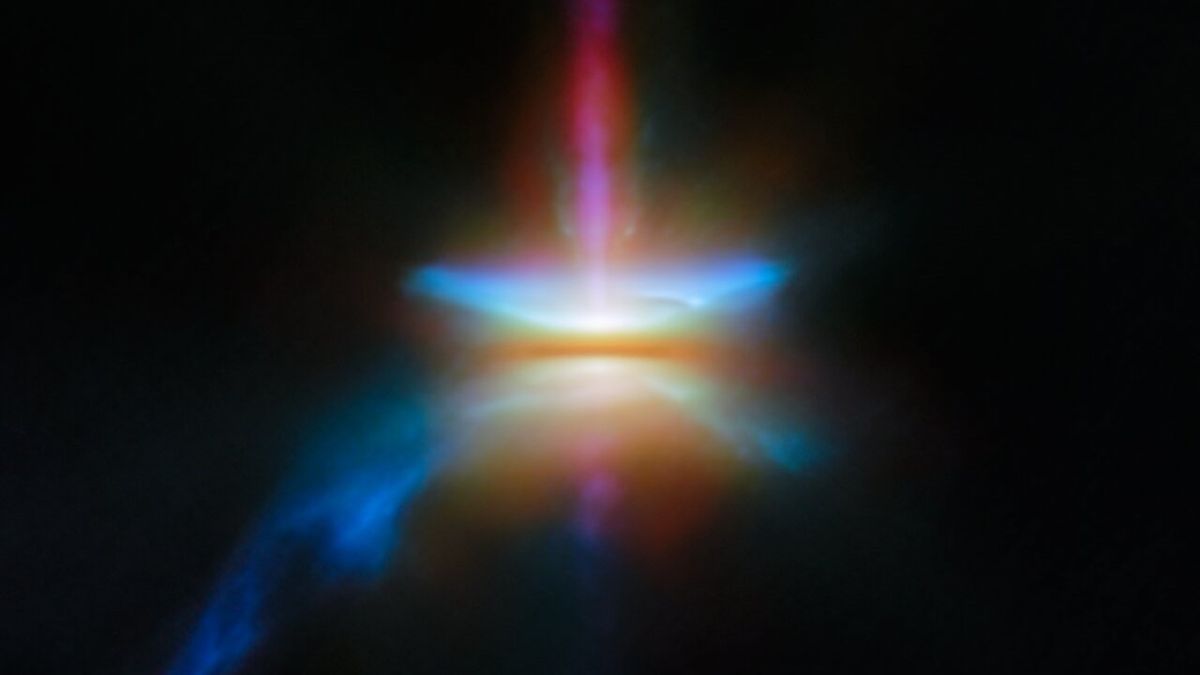
Stunning, rainbow-colored object spotted by James Webb telescope could be an alien solar system in the making

Stunning, rainbow-colored object spotted by James Webb telescope could be an alien solar system in the making

HH 30 as imaged by the James Webb Space Telescope.

(Image credit: ESA/Webb, NASA & CSA, Tazaki et al.)

The James Webb Space Telescope (JWST) has captured a stunning image of a young star firing energy into space, illuminating a protoplanetary disk from which a new solar system may form.

The young star, called HH 30, is a Herbig-Haro object — a bright knot of gas formed when the gas streaming from young protostars collides with nearby matter, producing shockwaves.

HH 30 is located 450 light-years away in the dark cloud LDN 1551 in the Taurus Molecular Cloud. Astronomers are studying the gassy knot to learn more about how dust grains combine with massive jets to form planets. The researchers published their findings Feb. 3 in The Astrophysical Journal.

"These grains are only one millionth of a metre across — about the size of a single bacterium," the researchers wrote in a blog post accompanying the image. "While the large dust grains are concentrated in the densest parts of the disc, the small grains are much more widespread."

Where star systems are born

Stars take tens of millions of years to form, growing from dense, billowing clouds of turbulent dust and gas to gently glowing protostars, before materializing into gigantic orbs of fusion-powered plasma like our sun.

Related: 

Scientists think that planets form around young stars when dust and gas particles collide and stick together, snowballing over millions of years until they reach their final forms.

To study HH 30's edge-on disk (meaning JWST sees only the disk’s side from its vantage point near Earth), the researchers combined infrared data captured by JWST with longer-wavelength observations made by the Atacama Large Millimeter/submillimeter Array (ALMA) telescope and the Hubble Space Telescope. These data enabled the researchers to capture dust particles from millimeter down to micrometer scales.

RELATED STORIES

The result is a breathtakingly detailed view of the dust's movement across the disk, showing it migrating within the disk and settling in a dense layer, where it is clumping to form the beginnings of planets. Nested alongside this are several layers of gas. One of these layers originates from the jet spat out by the star, while others are from a broader cone-shaped outflow enveloped by a nebula reflecting the star's light.

"Together, these data reveal HH 30 to be a dynamic place, where tiny dust grains and massive jets alike play a role in the formation of new planets," the researchers wrote.

{ https://www.livescience.com/space }

Hoe vind je dit bericht?
Geschreven door peter om 20:42 Stuur door

Uranus’ Moon Ariel has Deep Gashes, Could Reveal its Interior

Voyager 2 captured this image of Uranus' moon Ariel in 1986 from 130,000 km away. New research based largely on this image hints at the nature of the moon's interior. Image Credit: By NASA/JPL - https://www.jpl.nasa.gov/images/pia00037-ariel-at-voyager-closest-approach, Public Domain, https://commons.wikimedia.org/w/index.php?curid=1110562

Uranus’ Moon Ariel has Deep Gashes, Could Reveal its Interior

We’ve only gotten one close-up view of Uranus and its moons, and it happened decades ago. In 1986, Voyager 2 performed a flyby of Uranus from about 81,500 km (50,600 mi) of the planet’s cloud tops. It was 130,000 km (80,000 mi) away from Uranus’ moon, Ariel, when it captured the leading image. It showed some unusual features that scientists are still puzzling over.

What do they reveal about the moon’s interior?

Ariel has the usual crater-pitted surface that most Solar System objects display. But its surface also has complex features like ridges, canyons, and steep banks and slopes called scarps. Research published last year suggested that these surface features and chemical deposits are caused by chemical processes inside the moon. Ariel could even have an internal ocean, according to the research.

New research published in The Planetary Science Journal digs deeper into the issue to try and understand what processes could create Ariel’s surface features. Its title is “Ariel’s Medial Grooves: Spreading Centers on a Candidate Ocean World.” The lead author is Chloe Beddingfield from Johns Hopkins University Applied Physics Laboratory (JHUAPL).

“Ariel is a candidate ocean world, and recent observations from the James Webb Space Telescope (JWST) confirmed that its surface is mantled by a large amount of CO2 ice mixed with lower amounts of CO ice,” Beddingfield and her co-researchers write in their paper. These materials should be unstable on Ariel, though, and should sublimate away into space. “Consequently, the observed constituents on Ariel are likely replenished, possibly from endogenic sources,” the authors write.

The research is centred on Ariel’s chasma-medial groove systems and how they formed. These are trenches that cut straight through the moon’s huge canyons. While previous research has suggested that the trenches are tectonic fractures, this research arrives at a different hypothesis. “We present evidence that Ariel’s massive chasma-medial groove systems formed via spreading, where internally sourced material ascended and formed new crust,” the paper states.

This Voyager 2 image of Ariel shows the names of some of the moon's surface features. Image Credit: By Ariel_(moon).jpg: NASA/Jet Propulsion Labderivative work: Ruslik (talk) - Ariel_(moon).jpg, Public Domain, https://commons.wikimedia.org/w/index.php?curid=12867133

This Voyager 2 image of Ariel shows the names of some of the moon’s surface features. Image Credit: By Ariel_(moon).jpg: NASA/Jet Propulsion Labderivative work: Ruslik (talk) – Ariel_(moon).jpg, Public Domain, https://commons.wikimedia.org/w/index.php?curid=12867133

This is similar to ocean-floor spreading on Earth, which is where new crust forms. If true, it can account for Ariel’s surface deposits of carbon dioxide ice and other carbon-bearing molecules.

“If we’re right, these medial grooves are probably the best candidates for sourcing those carbon oxide deposits and uncovering more details about the moon’s interior,” Beddingfield said in a press release. “No other surface features show evidence of facilitating the movement of materials from inside Ariel, making this finding particularly exciting.”

Ariel’s surface is dominated by three main terrain types: plains, ridged terrain, and cratered terrain. The cratered terrain is the oldest and most extensive type of terrain. The ridged terrain is the second main terrain type and is made of bands of ridges and troughs that can extend for hundreds of kilometres. The plains are the third type and are the youngest of the terrains. They’re on canyon floors and in depressions in the middle of the cratered terrain.

As far as scientists can tell, the grooves that intersect the canyons are the youngest surface features on Ariel. Previous research suggested that they result from the interplay between volcanic and tectonic processes. However, this research says otherwise: spreading could be responsible.

This image from the research puts Ariel's complex surface on full display. The locations of the three known medial grooves are shown in red. Image Credit: Beddingfield et al. 2025. This image (Figure 1) from the research puts Ariel’s complex surface on full display. The locations of the three known medial grooves are shown in red. Image Credit: Beddingfield et al. 2025.

In the 1960s, scientists validated the idea of seafloor spreading on Earth, which led to the acceptance of plate tectonics. One of the main pieces of evidence for plate tectonics is the way the edges of continents like Africa and South America fit together if you “remove” the Atlantic Ocean and the intervening seafloor.

The same thing happened when Beddingfield and her colleagues “removed” the chasm floors on Ariel.

The researchers showed that when they removed the floors of the chasms, the margins lined up. This is strong evidence of spreading. “The margins of Brownie, Kewpie, Korrigan, Pixie, and Sylph Chasmata closely align when the Intermediate Age Smooth Materials (orange unit in Figure 1), which make up the chasma floors, are removed and the Cratered Plains (green unit in Figure 1) are reconstructed,” they write.

This figure from the study shows possible configurations of Ariel's Cratered Plains before (left) and after (right) spreading occurred. Note how neatly the chasma walls line up. "Our reconstruction focuses on removing the young chasma floors, examining the offset of the Kra Chasma segments, and aligning the similarly shaped chasma walls," the authors write. Image Credit: Beddingfield et al. 2025. This figure from the study shows possible configurations of Ariel’s Cratered Plains before (left) and after (right) spreading occurred. Note how neatly the chasma walls line up. “Our reconstruction focuses on removing the young chasma floors, examining the offset of the Kra Chasma segments, and aligning the similarly shaped chasma walls,” the authors write. Image Credit: Beddingfield et al. 2025.

According to the research, spreading centers develop above convention cells underneath Ariel’s crust, and heat forces material upward to the crust. The material cools at the surface, forming new crust. The entire process is driven by tidal forces as Ariel orbits the much larger Uranus. This heats the moon’s interior, creating the convection. Some of the moon’s interior cycles between heating as the moon follows its orbit. It’s possible that internal material continuously melts and then refreezes.

“It’s a fascinating situation — how this cycle affects these moons, their evolution and their characteristics,” Beddingfield said.

Like other Solar System moons that experience tidal heating, Ariel may have an ocean under its surface. In a 2024 study, researchers proposed that another of Uranus’ moons, Miranda, could have a subsurface ocean maintained by tidal heating.

However, Beddingfield is skeptical about drawing a connection between Ariel’s grooves and a potential ocean.

“The size of Ariel’s possible ocean and its depth beneath the surface can only be estimated, but it may be too isolated to interact with spreading centers,” she said. “There’s just a lot we don’t know. And while carbon oxide ices are present on Ariel’s surface, it’s still unclear whether they’re associated with the grooves because Voyager 2 didn’t have instruments that could map the distribution of ices.”

The connection between the grooves and the materials deposited on Ariel’s surface is stronger though. “These new results suggest a possible mechanism for emplacing fresh material and short-lived compounds, including carbon monoxide and perhaps ammonia-bearing species on the surface,” said Tom Nordheim, a co-author of this research and the 2024 paper.

“Our results indicate that medial grooves in large chasmata on Ariel are spreading centers, resulting from the exposure of subsurface material, creating new crust,” the authors summarize in their conclusion. “Thus, these features are likely geologic conduits to Ariel’s interior and could be the primary source of CO2, CO, and other volatiles detected on its surface.”

Richard Cartwright from the Johns Hopkins Applied Physics Laboratory led the 2024 study that used the JWST to identify CO ice and CO2 deposits on Ariel. To find more answers about this intriguing moon, Cartwright says we need a dedicated mission to Uranus and its moons. “We need an orbiter that can make close passes of Ariel, map its medial grooves in detail, and analyze their spectral signatures for components like carbon dioxide and carbon monoxide,” he said. “If carbon-bearing molecules are concentrated along these grooves, then it would strongly support the idea that they’re windows into Ariel’s interior.”

The authors agree that only a dedicated mission can provide answers. “The medial grooves are some of the youngest geologic features observed on Ariel, and close flybys of these features by a future Uranus orbiter are imperative to gain insight into recent geologic events and the geologic and geochemical properties of this candidate ocean world,” they write.

There’ve been many proposed missions to Uranus. NASA, the ESA, JAXA, and the CNSA (China National Space Administration) have all had proposals. NASA’s Uranus Orbiter and Probe mission would study Uranus and its moons from orbit by conducting multiple flybys of each major moon. The probe would enter Uranus’ atmosphere. However, even if selected, a plutonium shortage means the mission wouldn’t launch until the mid or late 2030s.

A graphic explaining some of the features of NASA's proposed Uranus Orbiter and Probe mission. Image Credit: NASA. A graphic explaining some of the features of NASA’s proposed Uranus Orbiter and Probe mission. Image Credit: NASA.

So far, only China has firm plans to send a spacecraft to the ice giant. It will be part of their Tianwen-4 mission to Jupiter and would perform a single flyby of Uranus. The next launch windows for a mission to Uranus are between 2030 and 2034, but China’s mission isn’t scheduled until 2045.

Press Release: 

Research: 

RELATED VIDEOS

Ariel, the shiny moon of Uranus

Ariel: Uranus Brightest Moon

{ https://www.universetoday.com/ }

Hoe vind je dit bericht?
Geschreven door peter om 18:38 Stuur door

Meer van UFO'S of UAP'S, ASTRONOMIE, RUIMTEVAART, ARCHEOLOGIE, OUDHEIDKUNDE, SF-SNUFJES EN ANDERE ESOTERISCHE WETENSCHAPPEN - DE ALLERLAATSTE NIEUWTJES

↑ Terug naar de berichten