Ontdek de Fascinerende Wereld van UFO's en UAP's: Jouw Bron voor Onthullende Informatie!
Ben jij ook gefascineerd door het onbekende? Wil je meer weten over UFO's en UAP's, niet alleen in België, maar over de hele wereld? Dan ben je op de juiste plek!
België: Het Kloppend Hart van UFO-onderzoek
In België is BUFON (Belgisch UFO-Netwerk) dé autoriteit op het gebied van UFO-onderzoek. Voor betrouwbare en objectieve informatie over deze intrigerende fenomenen, bezoek je zeker onze Facebook-pagina en deze blog. Maar dat is nog niet alles! Ontdek ook het Belgisch UFO-meldpunt en Caelestia, twee organisaties die diepgaand onderzoek verrichten, al zijn ze soms kritisch of sceptisch.
Nederland: Een Schat aan Informatie
Voor onze Nederlandse buren is er de schitterende website www.ufowijzer.nl, beheerd door Paul Harmans. Deze site biedt een schat aan informatie en artikelen die je niet wilt missen!
Internationaal: MUFON - De Wereldwijde Autoriteit
Neem ook een kijkje bij MUFON (Mutual UFO Network Inc.), een gerenommeerde Amerikaanse UFO-vereniging met afdelingen in de VS en wereldwijd. MUFON is toegewijd aan de wetenschappelijke en analytische studie van het UFO-fenomeen, en hun maandelijkse tijdschrift, The MUFON UFO-Journal, is een must-read voor elke UFO-enthousiasteling. Bezoek hun website op www.mufon.com voor meer informatie.
Samenwerking en Toekomstvisie
Sinds 1 februari 2020 is Pieter niet alleen ex-president van BUFON, maar ook de voormalige nationale directeur van MUFON in Vlaanderen en Nederland. Dit creëert een sterke samenwerking met de Franse MUFON Reseau MUFON/EUROP, wat ons in staat stelt om nog meer waardevolle inzichten te delen.
Let op: Nepprofielen en Nieuwe Groeperingen
Pas op voor een nieuwe groepering die zich ook BUFON noemt, maar geen enkele connectie heeft met onze gevestigde organisatie. Hoewel zij de naam geregistreerd hebben, kunnen ze het rijke verleden en de expertise van onze groep niet evenaren. We wensen hen veel succes, maar we blijven de autoriteit in UFO-onderzoek!
Blijf Op De Hoogte!
Wil jij de laatste nieuwtjes over UFO's, ruimtevaart, archeologie, en meer? Volg ons dan en duik samen met ons in de fascinerende wereld van het onbekende! Sluit je aan bij de gemeenschap van nieuwsgierige geesten die net als jij verlangen naar antwoorden en avonturen in de sterren!
Heb je vragen of wil je meer weten? Aarzel dan niet om contact met ons op te nemen! Samen ontrafelen we het mysterie van de lucht en daarbuiten.
De meest indrukwekkende dingen ooit gemaakt met een 3D-printer Iedereen en hun buurman weten dat de wereld met elke nieuwe dag exponentieel sneller verandert. Maar een van de meest fascinerende revoluties die plaatsvinden in laboratoria over de hele wereld is de opkomst van 3D-printen. Van dingen die je kunt eten tot vervangingen voor voeten en alles daartussenin.
LEES VERDER om enkele van de meest indrukwekkende dingen te zien die 3D-printers ooit hebben gemaakt.
Een hart Israëlische wetenschappers van de Universiteit van Tel Aviv hebben naar verluidt 's werelds eerste 3D-geprinte, gevasculariseerde technische hart gecreëerd.
Ongeboren baby Een Ests 3D-technologiebedrijf besloot het ultieme zwangerschapssouvenir te maken, waardoor ouders de kans krijgen hun baby aan te raken voordat deze zelfs maar geboren is.
Ongeboren baby Nadat ze zorgvuldige foto's hebben gemaakt, printen ze 3D-foetusmodellen zo gedetailleerd dat je al hun vingers kunt tellen en kunt zien wiens neus de baby heeft!
Jezelf Je maakt eerst een fotografische scan van 360 graden van een persoon en geeft deze vervolgens weer in een digitaal 3D-model (en retoucheert het model zodat het voldoet aan de vereisten voor afdrukken). De drukmachine gebruikt dit digitale model vervolgens om een solide figuur met hoge resolutie te produceren.
Een wervelkolom-as Een kunstmatige 3D-geprinte as, de eerste die ooit met succes in de wervelkolom van een botkankerpatiënt is geïmplanteerd, wordt geïmplanteerd in een model in het Peking University Third Hospital in Beijing.
Prothetische onderarm De Taiwanese ingenieur Chang Hsien-Liang verloor zijn onderarm bij een ongeval en was zeer ontevreden over zijn prothetische opties. Daarom ontwierp en bouwde hij zijn eigen prothetische onderarm met behulp van 3D-printtechnologie!
Een toekansnavel Grecia de toekan verloor het grootste deel van zijn bovensnavel bij een aanval, maar hij kan nu eten met zijn 3D-geprinte snavel in het dierenasiel Zoo Ave in Alajuela, Costa Rica.
Ijsje Bedrukte lekkernijen die je kunt eten! In de Iceason-winkel in Shanghai worden deze kleine karakters gemaakt van ijs met aardbeienmelksmaak en vervaardigd door een 3D-printer.
Een chocoladebierflesje Gaetan Richard, oprichter van het 3D-printchocoladebedrijf Miam Factory, maakt iets waarvan je niet wist dat je het nodig had: een chocoladebierflesje.
Een motor Ontwerper Marco Mattia Cristofori, van de Duitse 3D-printerfabrikant BigRep, creëerde een bijna volledig 3D-geprinte e-motorfiets, genaamd "NERA".
Een auto Tijdens een rondleiding door Techmer PM, een kunststofproductiebedrijf in Tennessee, wierp Barack Obama een blik op een 3D-geprinte Shelby Cobra.
Vliegtuigstoelen Airgo's 3D-geprinte prototype van hun Orion-vliegtuigstoelen voor lange afstanden ziet er zeker uit als een upgrade van een touringcar.
Viool Hier poseert de Franse ingenieur en professionele violist Laurent Bernadac met een 3D-geprinte viool gemaakt van transparante hars, de "3Dvarius" genoemd.
Kunststof werkende pistolen In 2014 werd Yoshimoto Imura de eerste man die in Japan werd gearresteerd wegens illegaal bezit van twee plastic pistolen die hij zelf had gemaakt met behulp van 3D-printtechnologie.
Huisvesting Onderzoekers van de Universiteit van Nantes in Frankrijk hebben het startschot gegeven voor een 3D-geprint sociaal woningbouwgebouw genaamd 'Yhnova'
Geavanceerde geometrische structuren De M1 3D-printer bij Carbon in Redwood City, Californië concurreert met de ingewikkelde creaties van de natuur zelf.
In 1988, Miriam Delicado had a contact experience with Tall Blonde extraterrestrials who told her they were involved in the creation of humanity and rescuing large numbers of humans at the end of different historical ages. She described the ends of the First, Second and Third Worlds where human civilizations were wiped out by cataclysms due to the dangers they posed to the planet in developing advanced technologies without the right ethical understanding. Delicado said the Tall Blondes intervened in huge spacecraft (aka space arks), to take large numbers of humans off the surface to the safety of outer space, the bottom of oceans, or Inner Earth, to wait out the cataclysmic surface events. The Tall Blondes, she pointed out, are very different to the “Tall Whites” encountered by Charles Hall at Nellis Air Force Base in the 1960s.
After her profound contact experience, Delicado was approached by Men in Black and other organizations who wanted to recruit her to different official government programs so they could better understand alien technologies. She said that the contact enhanced her psychic abilities, and she was invited by a secret Russian organization to join a psychic community, where she would be trained and be among “her kind”.
In her first Exopolitics Today interview, Miriam Delicado discusses her incredible contact experiences, the life-changing events that happened afterward. She also discusses the dangers that lie ahead as humanity enters the End Times where confusion and corruption abound, and critical thinking is compromised in ways that are very similar to the end of Atlantis.
Nuclear powerplant becomes UFO hotspot with '10 sightings in a single month'
The Kudankulam Nuclear Plant in the town of Tirunelveli in India has seemingly become a UFO /UAP hotspot - with as many as ten sightings in a single month.
Kudankulam (or Koodankulam) Nuclear Plant appears to be a UFO hotspot.
(Image: Wikipedia/submitted)
Multiple sightings of Unidentified Flying Objects (UFOs) have been reported at a troubled nuclear power plant being built by Vladimir Putin's Russia in India.
UFOs or Unidentified Anomalous Phenomena (UAP) have been spotted around Kudankulam Nuclear Plant, in the town of Tirunelveli, India, as many as 10 times within a single month.
Sabir Hussain, a UFO researcher affiliated with the Indian Society for Extraterrestrial Studies, said the UFOs have been observed by a local official.
He said: "Syed, an engineering graduate (now a sub-inspector), has seen UFOs more than 10 times in the Koodankulam area in August 2023."
The initial sighting reportedly occurred just 10 days after another individual reported witnessing a UFO in a nearby village along the coastline of Chennai.
Claiming that UFOs were spotted in the sky covering Koodankulam in Tirunelveli district last year, UFO tracker Sabir Hussain here said these unidentifhttps://www.dtnext.in/news/tamilnadu/ufo-visits-near-key-nuclear-installations-baffle-experts-776265
(Image: Supplied)
The mysterious object was described to have been flying in a peculiar "zigzag" pattern while emitting an intensely bright light across the night sky.
Syed told news outlet DT Next: "After meeting UFO tracker Sabir and discussing with him, I am more than 100 percent sure what I saw were UFOs. The way it stood still, the way it made zigzag movements and the speed in which it disappeared all were different."
A picture snapped by Syden reveals a bright white light in the night sky, forming a circle but no clear details can be seen from the image he shared. The first part of the nuclear plant in question was launched in 2013, with additional units becoming operational over the next decade.
Syed who claims he saw UFOs 'zig zagging' around the plant.
A new study by researchers from Brown University and the SETI Institute of an object nicknamed “Space Snowman” is reportedly “shaking up” what scientists thought they knew about distant objects in the far reaches of the solar system.
Officially named Kuiper Belt Object 486958 Arrokoth, the researchers say the double-lobed object at the edge of our solar system may contain stores of ice deep within its interior from over 4.6 billion years ago when the solar system formed. Perhaps even more surprising, the researchers believe other Kuiper Belt objects (KBOs) may also contain these ancient ices from the dawn of the solar system.
The study’s results, published in the journal Icarus, are expected to inform future missions, including a sample return mission designed to help unlock the secrets of life on Earth.
SPACE SNOWMAN MAY NOT BE THE ONLY KBO CONTAINING ANCIENT ICE
“We’ve shown here in our work, with a rather simple mathematical model, that you can keep these primitive ices locked deep within the interiors of these objects for really long times,” said Sam Birch, a planetary scientist at Brown and one of the paper’s co-authors. “Most of our community had thought that these ices should be long lost, but we think now that may not be the case.”
If true, these ancient ice stores hidden within Space Snowman and other KBOs could offer critical information to scientists studying the formation of our planets and moons, as well as the dawn of Earth life itself.
Much of the previous skepticism came from the wide use of thermal evolutionary models applied to the solar system’s creation that, the researchers say, “failed to account for the longevity of ices that are as temperature sensitive as carbon monoxide.” This led Birch and his co-author Orkan Umurhan, a senior research scientist at the SETI Institute, to design and create their own model, which revealed that it is more likely that these highly volatile ancient ices “stick around” much longer than previously thought.
“We are basically saying that Arrokoth is so super cold that for more ice to sublimate — or go directly from solid to a gas, skipping the liquid phase within it — that the gas it sublimates into first has to have travel outwards through its porous, sponge-like interior,” Birch said.
Unfortunately, Birch explained, if you want to move the gas, you also have to sublimate the ice surrounding it. His models show that for many KBOs, including Space Snowman, there isn’t enough solar energy to accomplish this.
“So what you get is a domino effect: it gets colder within Arrokoth, less ice sublimates, less gas moves, it gets even colder, and so on,” Birch explained. Eventually, everything just effectively shuts off, and you’re left with an object full of gas that is slowly trickling out.”
If their models are correct, the researchers say a large number of KBOs besides Space Snowman could contain ancient ices, which remain effectively dormant within the object’s interior unless they experience an orbital shift that moves them closer to the sun. In fact, the researchers suspect that this is why KBOs that do experience an orbital shift that brings them closer to the sun explode so violently. The ancient ices inside these objects suddenly sublimate to gas and expand, essentially turning them into comets.
“The key thing is that we corrected a deep error in the physical model people had been assuming for decades for these very cold and old objects,” said Umurhan. “This study could be the initial mover for reevaluating the comet interior evolution and activity theory.”
RESEARCH WILL INFORM UPCOMING MISSIONS TO RETRIEVE SAMPLES FROM COMETS
Although the study is based on theoretical models, the researchers get the opportunity to apply their expertise in the near future. That’s because both Birch and Umurhan are listed as co-investigators for NASA’s upcoming Comet Astrobiology Exploration Sample Return (CAESAR) mission, which could launch as soon as August of this year.
According to NASA, “The Comet Astrobiology Exploration Sample Return (CAESAR) mission will acquire and return to Earth for laboratory analysis a minimum of 80 grams of surface material from the nucleus of comet 67P/Chur-yumov-Gerasimenko (67P). CAESAR will characterize the surface region sampled, preserve the collected sample in a pristine state, and return evolved volatiles by capturing them in a separate gas reservoir.”
As the name’s inclusion of “astrobiology” implies, one of the goals of CAESAR is to look for gins of life or its building blocks at the dawn of the solar system’s creation. Although the mission isn’t expected to actually land on a comet until 2038, the researchers say their new study shows that sample return missions like CAESAR may contain a wide range of tantalizing clues that are just waiting to be unlocked.
“There may well be massive reservoirs of these primitive materials locked away in small bodies all across the outer solar system — materials that are just waiting to erupt for us to observe them or sit in deep freeze until we can retrieve them and bring them home to Earth,” Birch said.
Christopher Plain is a Science Fiction and Fantasy novelist and Head Science Writer at The Debrief. Follow and connect with him on X, learn about his books at plainfiction.com, or email him directly at christopher@thedebrief.org.
De Mars Express-sonde arriveerde eind 2003 bij Mars en cirkelt alweer dus alweer bijna 21 jaar om de rode planeet heen. En in die tijd heeft hij 25.000 baantjes om Mars getrokken. Een enorme mijlpaal die de sonde viert door een geweldige foto van Mars af te leveren.
Op de foto schittert een flink stuk van het Marsoppervlak, met daarop enkele van de beroemdste vulkanen die de rode planeet rijk is. Zo zien we Olympus Mons; niet alleen de grootste vulkaan van Mars, maar ook de grootste van ons zonnestelsel! De vulkaan is bijna 22 kilometer hoog en is met een oppervlakte van 300.000 vierkante kilometer zeven keer omvangrijker dan ons eigen Nederland.
Grote vulkanen Naast Olympus Mons zijn op de foto echter nog meer vulkanen te zien. Ascraeus Mons, bijvoorbeeld. Met een hoogte van 18 kilometer kan deze ook tot de grotere vulkanen van Mars worden gerekend. Ook zijn op de foto de vulkanen Arsia Mons – net iets hoger dan onze Mount Everest – en Pavonis Mons – ongeveer 14 kilometer hoog – te zien.
Klovensysteem Onder dit drietal van vulkanen vinden we Noctis Labyrinthus; een klovensysteem, met valleien die tot wel 30 kilometer breed en tot wel 6 kilometer diep zijn. Het klovensysteem is ongeveer 1190 kilometer lang; vergelijkbaar met 3,5 keer de afstand tussen Groningen en Maastricht.
Wolken Wat daaronder opvalt, zijn de blauwe tinten op een verder zandkleurig plaatje. Ze worden veroorzaakt door wolken. Helemaal onderaan zijn golfstijgwinden (Lee wave clouds) te zien. Ze ontstaan doordat lucht over een obstakel – bijvoorbeeld een berg – wordt gedwongen.
Afbeelding: ESA / DLR / FU Berlin.
Phobos Wie goed kijkt, ziet dat niet alleen Mars door Mars Express is vereeuwigd; ook maan Phobos is op de foto te zien. En wel schuin onder Arsia Mons. Phobos bevindt zich vrij dicht bij Mars in de buurt; de afstand tussen beide hemellichamen bedraagt slechts 6000 kilometer. Ter vergelijking: onze maan draait op zo’n 385.000 kilometer afstand om de aarde heen.
Veel werk verzet Met de geweldige foto viert ESA dus het 25.000e rondje van Mars Express rond Mars. Dat 25.000 rondje voltooide de ruimtesonde overigens al in oktober 2023. Maar nu pas staat de Europese ruimtevaartorganisatie daar uitgebreid bij stil. Niet alleen met deze foto, maar ook door terug te blikken op wat Mars Express ons – cirkelend rond Mars – allemaal over de rode planeet heeft geleerd. Zo bracht de sonde de atmosfeer van Mars in kaart en gaf deze meer inzicht in hoe het water op de rode planeet door de tijd heen verging. Ook bestudeerde de sonde de twee manen van Mars – Phobos en Deimos – in ongeëvenaard detail en maakte deze geweldige foto’s van Mars.
En als het aan ESA ligt, gaat de oude orbiter daar ook nog wel even mee door. In 2023 werd de missie van Mars Express – voor de zoveelste keer – verlengd. Afgesproken werd toen om Mars Express zeker tot 2026 rond Mars te laten cirkelen. De informatie die de ruimtesonde nog altijd verzamelt, wordt namelijk als zeer waardevol beschouwd. Niet alleen omdat we zo nóg meer over Mars te weten komen. Maar ook omdat de informatie van belang kan zijn voor aankomende Marsmissies. Zo hoopt de Europese ruimtevaartorganisatie ergens in de komende jaren een rover naar Mars te sturen die op zoek moet gaan naar sporen van (vergaan) Martiaans leven. En NASA wil door Marsrover Perseverance op Mars verzameld materiaal op gaan pikken en naar de aarde brengen. En hoe meer we – bijvoorbeeld via Marsorbiters, zoals Mars Express – over de rode planeet te weten komen, hoe groter de slagingskans van dergelijke ambitieuze missies.
Whoopi Goldberg — The View moderator, intergalactic Star Trek queen, and anti-cactus warrior — has done what the United States government has never dared in its nearly 250 years of existence: confirm that extraterrestrial life has made contact with humanity.
The Oscar-winning actress and apparent interstellar explorer told her cohosts Wednesday that she is fully aware that aliens are among us on earth, after View guest and Ghostbusters franchise star Kumail Nanjiani said he believes in space-dwelling beings.
"I think they're waiting for us to clean up a little bit so that they can come here and tell us we're really messing things up," Nanjiani joked, before Goldberg spoke of her findings.
"They're already here," she said, calmly. "They're already ... They've been here for quite some time."
A stunned Nanjiani turned to Goldberg for further information, as she did not elaborate on how — or why — she knows such information. "And what are they doing?" he asked, to which she responded: "They're watching us."
Whoopi Goldberg confirms aliens exist on 'The View'.
ABC; GETTY
"They're watching us?" Nanjiani asked, before Sara Haines attempted to soften the impact of Goldberg's stunning revelation with some levity. "She talks to ghosts, not aliens. Duh," Haines said, referencing Goldberg's role in the classic movie Ghost. "I got you, girl."
Entertainment Weekly has reached out to a representative for The View for more information on how Goldberg knows aliens exist.
This isn't the first time Goldberg has discussed aliens on The View. The subject came up multiple times in 2023, with the actress reacting to a congressional hearing on UFOs that yielded claims that the government possessed "non-human" body parts by telling her cohosts she already "knew" that information.
Later in September, she got up from her seat at the Hot Topics table to analyze a large photo of a reported alien body, indicating to the panelists that her findings, in the moment, concluded that "it's definitely dead."
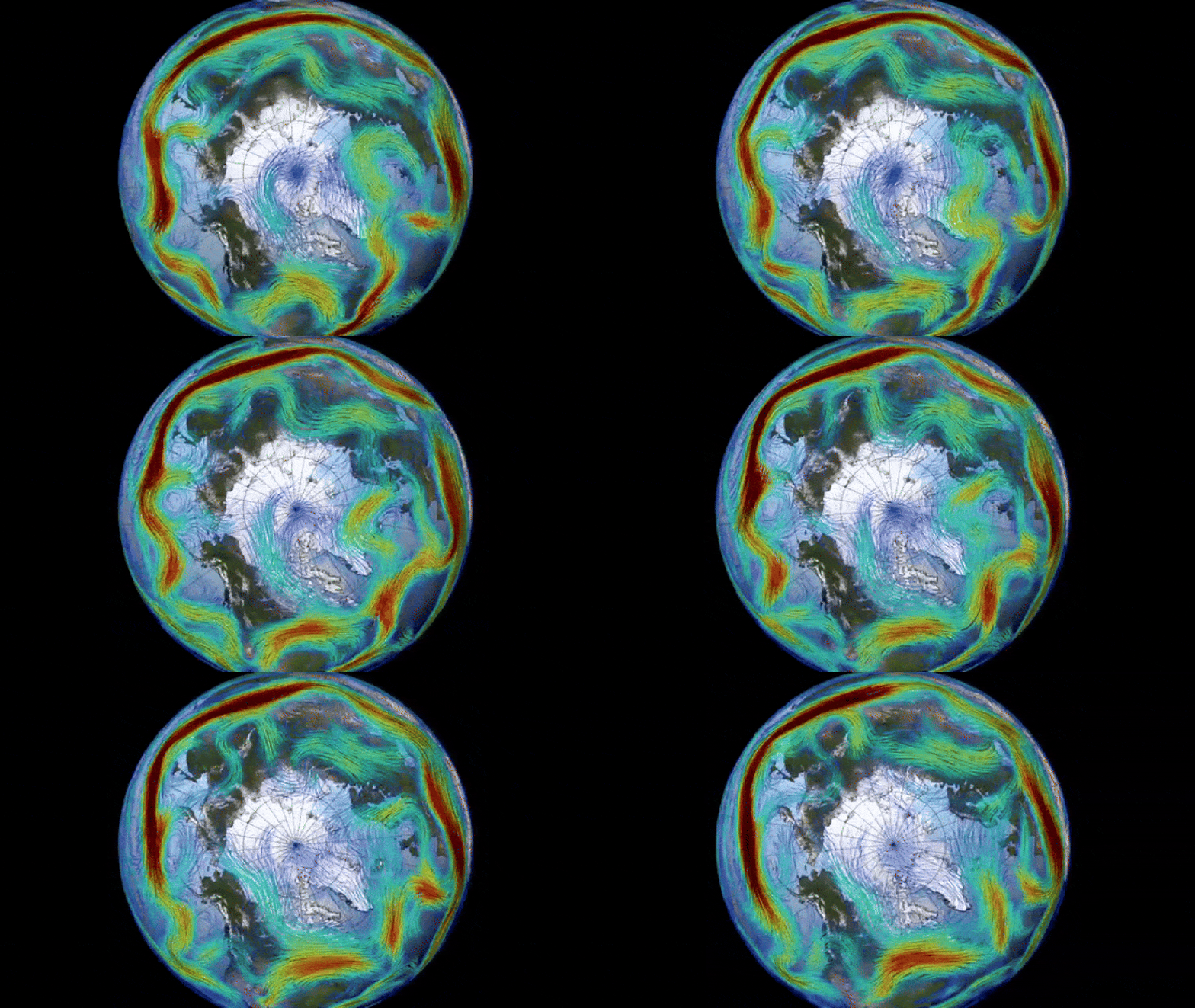
Earlier this month, a sudden atmospheric warming event caused the Arctic's polar vortex to reverse its trajectory. The swirling ring of cold air is now spinning in the wrong direction, which has triggered a record-breaking "ozone spike" and could impact global weather patterns.
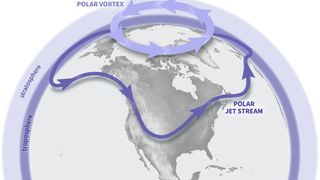
The polar vortex is a key driver of the polar jet stream (seen here).
(Image credit: NASA/Goddard Space Flight Center)
The polar vortex circling the Arctic is swirling in the wrong direction after surprise warming in Earth's atmosphere triggered a major reversal event earlier this month. It is one of the most extreme atmospheric U-turns seen in recent memory.
In the past, disruptions to the polar vortex — a rotating mass of cold air that circles the Arctic — have triggered extremely cold weather and storms across large parts of the U.S..
The current change in the vortex's direction probably won't lead to a similar "big freeze." But the sudden switch-up has caused a record-breaking "ozone spike" above the North Pole.
Polar vortices occasionally reverse temporarily. These events can last for days, weeks or months and are caused by sudden stratospheric warming (SSW), when the temperatures in the stratosphere climb by as much as 90 degrees Fahrenheit (50 degrees Celsius) in the space of a couple of days, according to the Met Office.
The sudden warming is caused by "planetary waves" in the atmosphere — compression waves formed when air rises into a region of different density and is pushed back downward by the force of Earth's spin. This process disrupts or reverses the vortex flow. (Image credit: NOAA Climate.gov)
The current reversal event in the Arctic began on March 4. However, the winds are starting to slow down, hinting that the vortex will return to its normal trajectory soon, Spaceweather.com reported.
"It was a substantial reversal," Amy Butler, a climate scientist at the National Oceanic and Atmospheric Administration (NOAA) and author of NOAA's new polar vortex blog, told Spaceweather.com. The speed of the reversed winds puts the event in the top six on record, she added.
Disruptions to the polar vortex can impact weather in the U.S., such as in 2019 when a massive cold front descended across the Midwest. These extreme weather events occur when the polar vortex deforms the jet stream — an air current that surrounds the polar vortex — exposing lower latitudes to large blobs of icy Arctic air.
This month's disruption did not change the shape of the jet stream, so weather patterns are expected to remain largely unaffected, according to Spaceweather.com.
However, the change in air temperature around the Arctic has sucked up large amounts of ozone from lower latitudes, creating a temporary ozone spike — the opposite of an ozone hole. Currently, there is more ozone surrounding the Arctic than at this time during any other year on record, according to Spaceweather.com. However, this ozone spike will disappear after the polar vortex returns to normal.
The current reversal is the second of its kind this year, following a smaller event in January that did cause a brief cold snap in some states, Butler wrote in NOAA's polar vortex blog.
Historical records show that SSW events are more likely to occur during El Niño or La Niña, the two contrasting phases of a natural cycle of planet-wide warming and cooling. During these phases, global weather systems become more unstable, which sets the stage for more frequent reversal events, Butler wrote in the NOAA blog.
We are currently in the midst of a major El Niño, which could make further reversals or disruptions more likely over the next year or so.
In today’s episode: We talk to Brett Tingley, Managing Editor at Space.com who has covered UAP as a journalist on other outlets such as Scientific American, The War Zone, Popular Science, the History Channel, Science Discovery, and The Debrief. We also cover the latest UFO/UAP News and look at a couple weird videos from the Enigma app.
Thermal Modeling of a Pulsed Plasma Rocket Shows It Should Be Possible To Create One
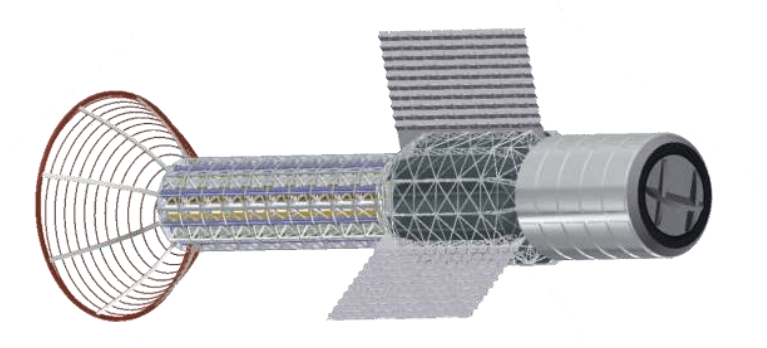
We’ve reported on a technology called pulsed plasma rockets (PPRs) here at UT a few times. Several research groups have worked on variations of them. They are so popular partly because of their extremely high specific impulse and thrust levels, and they seemingly solve the trade-off between those two all-important variables in space exploration propulsion systems. Essentially, they are an extremely efficient propulsion methodology that, if scaled up, would allow payloads to reach other planets in weeks rather than months or years. However, some inherent dangers still need to be worked out, and overcoming some of those dangers was the purpose of a NASA Institute for Advanced Concepts (NIAC) project back in 2020.
Originally granted to Howe Industries, a design shop that has received several NIAC grants (including two in 2020 itself), the purpose of this project was to model the design of a fully functional PPR in modeling software to see if the necessary materials and power systems are available for a rocket that can provide 100 kN of thrust and over 5,000 seconds of specific impulse.
In essence, a PPR takes a fuel pellet made out of some form of fissionable material (in this case, uranium), and zaps it into a plasma, then emits the plasma out the back for a forceful thrust. Rockets with this design can carry much less fuel than standard chemical rockets, but their design must be significantly larger due to the heating constraints put on the system by creating the plasma in the first place.
SciShow discusses a scaled down version of the PPR proposed in the paper. Credit – SciShow Space
Those heating constraints were one of the Phase I NIAC study’s main focal points in 2020. In particular, this study focused on analyzing the barrel the fuel pellet is released into to see if it could withstand the extreme temperatures created by handling a plasmatized uranium pellet.
To do this modeling, the team at Howe Industries used a modeling software called MCNP6 to check where particles went in the system and thereby calculate how much heat would be collected on other parts of the system where it wasn’t desired. MCNP6 uses a Monte Carlo simulation methodology, which calculates where neutrons will be created from the fission reaction that makes the plasma and where those neutrons will impact the rest of the spacecraft.
Those plasmas would have to be created about once every second, according to the calculations done by Howe Industries, and each pulse must reach an energy level of around 1 keV – much smaller than industrial-level nuclear fission reactors but a relatively high number for a spacecraft propulsion system. That energy is turned into heat, and while some of the heat is effectively used to eject the plasmatized uranium out as a thrust propellant, the rest is absorbed by other parts of the system.
Troy Howe, one of the paper’s authors, discusses his research into the PPR. Credit – Interstellar Research Group YouTube Channel
The barrel was a part of that system that is particularly important in these thermal calculations. The modeled barrel was made out of low-enriched uranium but of a different type than the projectile, allowing the energy to heat the projectile and not the barrel itself. However, a small part of the barrel would be made of highly enriched uranium, allowing for rapid plasma propagation in an otherwise relatively stable system.
That’s not to say that none of the heat generated by the fission reaction would end up in the barrel. Still, by the author’s calculations as part of their final report, an active cooling system should be enough to lower the temperature to a point where at least the barrel itself wouldn’t melt. Other parts of the system, such as the nozzle and a rotating drum that helps handle the fuel pellet, will be modeled in future work.
Additional future work would include building benchtop prototypes of these systems to test them out, though the prospect of working with highly enriched uranium as part of this process seems daunting. However, NIAC hasn’t yet funded a Phase II study of the PPR system, so for now, it is resigned to a nicely modeled project and another step forward in an idea that has plenty of history. Maybe someday, it will find its time to shine.
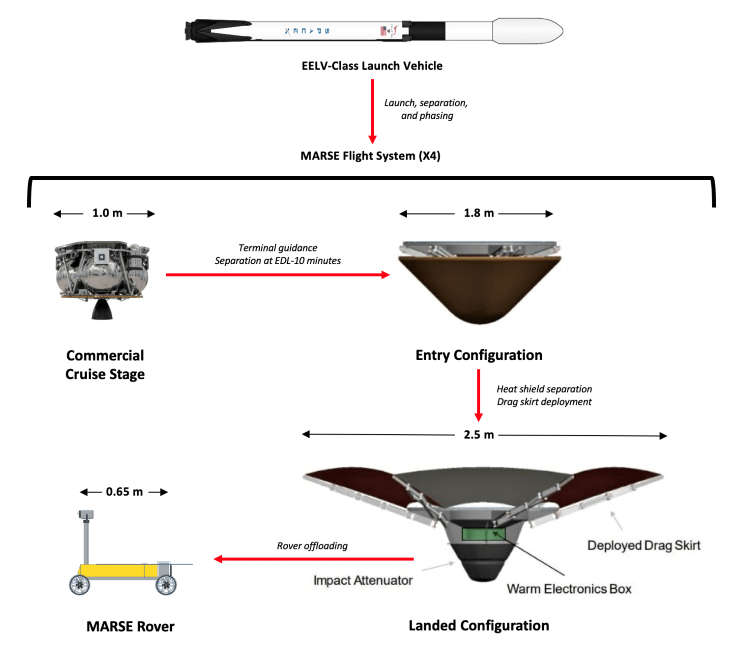
A breakdown of the Mars Astrobiology, Resource, and Science Explorers (MARSE) mission profile and its Simplified High Impact Energy Landing Device (SHIELD) system, which could revolutionize how we search for life on Mars by using four rovers at four different landing sites. (Credit: Longo (2024))
Search for Life on Mars Could Level-Up with MARSE Mission Concept
A recent study presented at the 55th Lunar and Planetary Science Conference (LPSC) discusses the Mars Astrobiology, Resource, and Science Explorers (MARSE) mission concept and its Simplified High Impact Energy Landing Device (SHIELD), which offers a broader and cheaper method regarding the search for—past or present—life on the Red Planet, specifically by using four rovers at four different landing sites across Mars’ surface instead of just one-for-one. This concept comes as NASA’s Curiosity and Perseverance rovers continue to tirelessly explore the surface of Mars at Gale Crater and Jezero Crater, respectively.
Here, Universe Today discusses the MARSE mission concept with the study’s sole author, Alex Longo, who is a MS student in the Department of Earth, Marine and Environmental Sciences at the University of North Carolina at Chapel Hill, regarding the motivation behind MARSE, how the landing sites were chosen, significant implications, current work being conducted, and next steps for MARSE becoming an actual mission. Longo draws on his ten-plus years of experience finding landing sites on Mars, along with having several publications under his belt, including an assortment of scientific abstracts, papers, and a Kindle book. So, what was the motivation behind the MARSE mission concept?
“The overarching goal of the MARSE concept study was to reduce the cost of access to the surface of Mars,” Longo tells Universe Today. “Flagship-class rovers, such as Curiosity and Perseverance, are extremely capable vehicles. The caveat is that, since they cost over a billion dollars apiece, we can only visit one or two sites on Mars every decade. Like Earth, Mars is an astoundingly diverse planet. Using satellites in orbit, we have mapped a variety of ancient environments which may have been habitable in the distant past. However, the resolution of orbital imagery and spectra are limited, and they sometimes fail to predict what a field geologist (or, in the case of Mars, a rover controlled by geologists) will discover on the ground. Even on Earth, finding early biosignatures is difficult, and even with comparatively little weathering and erosion, I would not be surprised if the same is true on Mars. MARSE was intended to present one possible solution which would allow planetary scientists to explore more sites on Mars within a realistic budget.”
The car-sized Curiosity rover landed in Gale Crater on August 6, 2012, with its mission website displaying that Curiosity has traveled a total of 31.27 kilometers (19.43 miles) as of January 27, 2024, having far surpassed its primary mission timeline of one Martian year, or 687 Earth days. Gale Crater was chosen as the landing site due to a multitude of evidence that it once held liquid water at some point in Mars’ ancient past, as scientists estimate that Gale Crater was formed from an impact between approximately 3.5 to 3.8 billion years ago. During its time in Gale Crater, Curiosity has used its suite of scientific instruments to identify evidence of past liquid water within Gale Crater and evidence that Mars once contained the building blocks for life, including carbon, oxygen, nitrogen, phosphorus, and sulfur.
A selfie of NASA’s Curiosity rover taken on Oct. 11, 2019, or the 2,553rd Martian day, or sol, of its long and successful mission. (Credit: NASA/JPL-Caltech/Malin Space Science Systems)
The car-sized Perseverance rover landed in Jezero Crater on February 18, 2021, with its mission website displaying that Perseverance has traveled a total of 25.113 kilometers (15.604 miles) as of March 28, 2024. While Perseverance and Curiosity have similar designs, the main upgrade has been the delivery of the Ingenuity helicopter to Mars, which became the first robotic explorer to achieve a powered flight on another world and accomplished dozens of flights before being permanently grounded after damaging one of its rotor blades on what would be its final landing in January 2024. Like Gale Crater for Curiosity, Jezero Crater was chosen as the landing site for Perseverance due to strong evidence that it once held a massive body of liquid water, which is made evident from the enormous fan-delta deposit that was the likely entry point for the liquid water billions of years ago. During its time in Jezero Crater, Perseverance has used its suite of scientific instruments to identify ancient volcanic rocks, sediments from an ancient lakebed, converted carbon dioxide (the primary atmospheric constituent of Mars) to oxygen, and even used its powerful microphones to record the sounds of Mars. Given the incredible science conducted by Curiosity and Perseverance, what are the most significant implications for the MARSE mission?
A selfie of NASA’s Perseverance rover taken in January 2023 displaying the rover with several sample tubes it has collected and dropped on the Martian surface to be picked up and returned to Earth by the Mars Sample Return mission, scheduled for the 2030s. (Credit: NASA/JPL-Caltech/Malin Space Science Systems)
“The most significant ramification of this trade study is that it should be possible to build a small rover capable of characterizing an unexplored site on Mars,” Longo tells Universe Today. “There have been several proposals for cheap Mars landers, such as SHIELD. MARSE demonstrates that it may be possible to deliver useful scientific payloads with these landers. Each MARSE rover weighs just 15 kilograms and is about the size of a microwave oven. If we can determine how to land similar rovers on Mars, that would help proliferate and democratize Mars exploration. We are already seeing a similar paradigm shift in lunar exploration thanks to the Commercial Lunar Payload Services (CLPS) program.”
Artist rendition of one of the four MARSE mission rovers that will each be deployed to explore separate landing sites on Mars. (Credit: Longo (2024))
While Curiosity and Perseverance have successfully explored their respective landing sites in great detail, the cost of each mission was in the billions of dollars (Curiosity: ~$2.5 billion, Perseverance: ~$2.7 billion). Therefore, the cost alone only allows for one rover per mission, and their landings occurred almost seven years apart. As noted, one of the objectives of the MARSE mission concept is to land four rovers at four separate landing sites, which are Columbia Hills, Milankovi? Crater, Mawrth Vallis, and Terra Sirenium, with Coumbia Hills being the landing site for the Spirit rover during its mission from 2004 to 2010, and the others having never been explored by landers or rovers. But how were the landing sites chosen and are other landing sites being considered?
Longo tells Universe Today, “The four landing sites are not an exclusive list. We just wanted to illustrate the range of investigations which can be conducted with this approach. All four of the listed sites have been highlighted in peer-reviewed papers and prior landing site studies, so we know that they have high scientific potential.”
Image of Columbia Hills on Mars, which is one of the potential landing sites for a MARSE rover. The white circle denotes the approximate 80-kilometer (50-mile) landing ellipse that SHIELD will use to land. (Credit: Longo (2024))
Longo continues by telling Universe Today that SHIELD will be designed to “land at any flat site on Mars below the datum (0 km of elevation on Mars; the equivalent of sea level on Earth), so you could readily swap one or more of them out for locations of your choice”, with Longo noting that one of his personal favorite landing sites would be inside Valles Marineris, which is the largest and deepest canyon in the solar system. Longo discusses the years-long research by Dr. Steven Ruff at Arizona State University, who conducted analog studies comparing hot spring deposits at Columbia Hills on Mars to similar features at the El Tatio hot spring in Chile, concluding that microbial communities could thrive at these locations.
A breakdown of the Mars Astrobiology, Resource, and Science Explorers (MARSE) mission profile and its Simplified High Impact Energy Landing Device (SHIELD) system, which could revolutionize how we search for life on Mars by using four rovers at four different landing sites. (Credit: Longo (2024))
As noted, Curiosity and Perseverance landed on Mars almost nine years apart, 2012 and 2021, respectively, but their respective missions had been in the works almost an entire decade earlier. Both rovers are part of NASA’s Mars Exploration Program, with the Curiosity rover mission having been approved in 2003 and the Perseverance rover mission having been announced in 2012. Once approved, it takes NASA years to design and build each rover, ensuring every aspect of their systems is functioning at their fullest potential before being delivered and loaded onto the launch vehicle. This includes tests designed to analyze the rovers’ endurance, exposure to harsh environments, and longevity, and many others. Therefore, if a MARSE mission were to get the green light, it could still be almost a decade of designs, builds, and tests before their microwave-sized rovers touch the surface of Mars. So, what are the next steps in terms of MARSE being approved for an actual mission?
“Regrettably, the future of MARSE and SHIELD is uncertain,” Longo tells Universe Today. “This concept was developed with the support of the SHIELD team at JPL, led by Lou Giersch and Nathan Barba. They were doing phenomenal, cutting-edge work, and I was grateful for the opportunity to work with them. Unfortunately, JPL was forced to implement massive budget cuts and layoffs last month due to uncertainty over the future of the Mars Sample Return mission, which accounts for the majority of the center’s budget. Because JPL’s future priorities are in flux, we have placed the development of the MARSE concept on hold.”
While uncertainty looms for the MARSE mission, it’s important to note that space exploration missions often take decades to go from a simple concept to real hardware, and then several more years until it’s launched. This is noted by the Curiosity and Perseverance rover missions, as it took almost a decade from the time each was approved until they landed on Mars. Moreover, it is not uncommon for mission proposals to take several attempts before they’re approved, as NASA has very stringent criteria for approving missions, including cost, timelines, science objectives, and long-term implications for science. Despite the outlook, this has not deterred Longo from continuing his work for the MARSE mission concept.
“Developing a mission concept is a rewarding experience, and it was a privilege to work on this concept with the SHIELD team,” Longo tells Universe Today. “Even if it happens a decade from now, I hope that someone will eventually implement a low-cost, multi-rover Mars geology and astrobiology mission. Following the completion of Mars Sample Return, the next logical steps in Mars exploration are to explore more of the planet, to develop a better understanding of its history, and to learn what Mars can teach us about our own planet’s past. If we want to have a thriving space program, we need to be creative and embrace bold ideas, and I love working with the scientists and engineers who are doing just that.”
Will the MARSE mission get to explore the Red Planet in the coming years and decades? Only time will tell, and this is why we science!
Meer van UFO'S of UAP'S, ASTRONOMIE, RUIMTEVAART, ARCHEOLOGIE, OUDHEIDKUNDE, SF-SNUFJES EN ANDERE ESOTERISCHE WETENSCHAPPEN - DE ALLERLAATSTE NIEUWTJES


 De meest indrukwekkende dingen ooit gemaakt met een 3D-printer