Ontdek de Fascinerende Wereld van UFO's en UAP's: Jouw Bron voor Onthullende Informatie!
Ben jij ook gefascineerd door het onbekende? Wil je meer weten over UFO's en UAP's, niet alleen in België, maar over de hele wereld? Dan ben je op de juiste plek!
België: Het Kloppend Hart van UFO-onderzoek
In België is BUFON (Belgisch UFO-Netwerk) dé autoriteit op het gebied van UFO-onderzoek. Voor betrouwbare en objectieve informatie over deze intrigerende fenomenen, bezoek je zeker onze Facebook-pagina en deze blog. Maar dat is nog niet alles! Ontdek ook het Belgisch UFO-meldpunt en Caelestia, twee organisaties die diepgaand onderzoek verrichten, al zijn ze soms kritisch of sceptisch.
Nederland: Een Schat aan Informatie
Voor onze Nederlandse buren is er de schitterende website www.ufowijzer.nl, beheerd door Paul Harmans. Deze site biedt een schat aan informatie en artikelen die je niet wilt missen!
Internationaal: MUFON - De Wereldwijde Autoriteit
Neem ook een kijkje bij MUFON (Mutual UFO Network Inc.), een gerenommeerde Amerikaanse UFO-vereniging met afdelingen in de VS en wereldwijd. MUFON is toegewijd aan de wetenschappelijke en analytische studie van het UFO-fenomeen, en hun maandelijkse tijdschrift, The MUFON UFO-Journal, is een must-read voor elke UFO-enthousiasteling. Bezoek hun website op www.mufon.com voor meer informatie.
Samenwerking en Toekomstvisie
Sinds 1 februari 2020 is Pieter niet alleen ex-president van BUFON, maar ook de voormalige nationale directeur van MUFON in Vlaanderen en Nederland. Dit creëert een sterke samenwerking met de Franse MUFON Reseau MUFON/EUROP, wat ons in staat stelt om nog meer waardevolle inzichten te delen.
Let op: Nepprofielen en Nieuwe Groeperingen
Pas op voor een nieuwe groepering die zich ook BUFON noemt, maar geen enkele connectie heeft met onze gevestigde organisatie. Hoewel zij de naam geregistreerd hebben, kunnen ze het rijke verleden en de expertise van onze groep niet evenaren. We wensen hen veel succes, maar we blijven de autoriteit in UFO-onderzoek!
Blijf Op De Hoogte!
Wil jij de laatste nieuwtjes over UFO's, ruimtevaart, archeologie, en meer? Volg ons dan en duik samen met ons in de fascinerende wereld van het onbekende! Sluit je aan bij de gemeenschap van nieuwsgierige geesten die net als jij verlangen naar antwoorden en avonturen in de sterren!
Heb je vragen of wil je meer weten? Aarzel dan niet om contact met ons op te nemen! Samen ontrafelen we het mysterie van de lucht en daarbuiten.
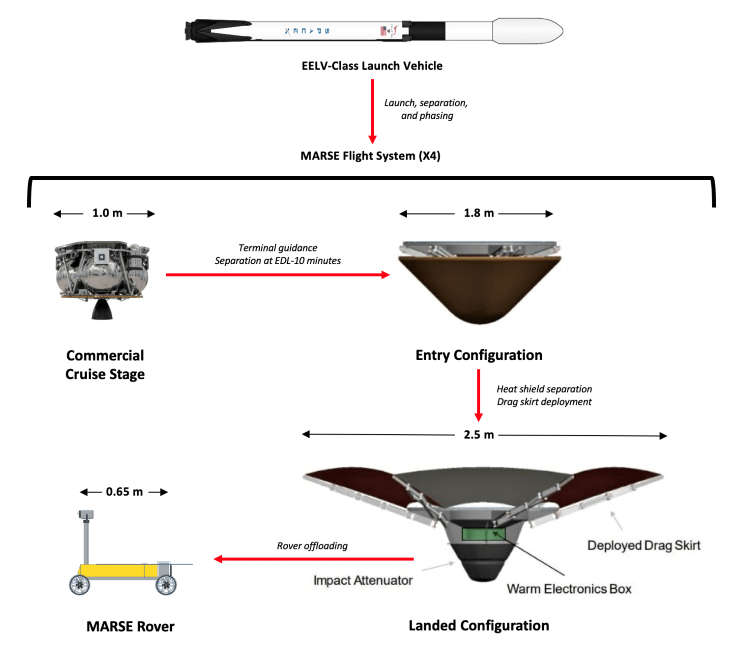
A breakdown of the Mars Astrobiology, Resource, and Science Explorers (MARSE) mission profile and its Simplified High Impact Energy Landing Device (SHIELD) system, which could revolutionize how we search for life on Mars by using four rovers at four different landing sites. (Credit: Longo (2024))
Search for Life on Mars Could Level-Up with MARSE Mission Concept
A recent study presented at the 55th Lunar and Planetary Science Conference (LPSC) discusses the Mars Astrobiology, Resource, and Science Explorers (MARSE) mission concept and its Simplified High Impact Energy Landing Device (SHIELD), which offers a broader and cheaper method regarding the search for—past or present—life on the Red Planet, specifically by using four rovers at four different landing sites across Mars’ surface instead of just one-for-one. This concept comes as NASA’s Curiosity and Perseverance rovers continue to tirelessly explore the surface of Mars at Gale Crater and Jezero Crater, respectively.
Here, Universe Today discusses the MARSE mission concept with the study’s sole author, Alex Longo, who is a MS student in the Department of Earth, Marine and Environmental Sciences at the University of North Carolina at Chapel Hill, regarding the motivation behind MARSE, how the landing sites were chosen, significant implications, current work being conducted, and next steps for MARSE becoming an actual mission. Longo draws on his ten-plus years of experience finding landing sites on Mars, along with having several publications under his belt, including an assortment of scientific abstracts, papers, and a Kindle book. So, what was the motivation behind the MARSE mission concept?
“The overarching goal of the MARSE concept study was to reduce the cost of access to the surface of Mars,” Longo tells Universe Today. “Flagship-class rovers, such as Curiosity and Perseverance, are extremely capable vehicles. The caveat is that, since they cost over a billion dollars apiece, we can only visit one or two sites on Mars every decade. Like Earth, Mars is an astoundingly diverse planet. Using satellites in orbit, we have mapped a variety of ancient environments which may have been habitable in the distant past. However, the resolution of orbital imagery and spectra are limited, and they sometimes fail to predict what a field geologist (or, in the case of Mars, a rover controlled by geologists) will discover on the ground. Even on Earth, finding early biosignatures is difficult, and even with comparatively little weathering and erosion, I would not be surprised if the same is true on Mars. MARSE was intended to present one possible solution which would allow planetary scientists to explore more sites on Mars within a realistic budget.”
The car-sized Curiosity rover landed in Gale Crater on August 6, 2012, with its mission website displaying that Curiosity has traveled a total of 31.27 kilometers (19.43 miles) as of January 27, 2024, having far surpassed its primary mission timeline of one Martian year, or 687 Earth days. Gale Crater was chosen as the landing site due to a multitude of evidence that it once held liquid water at some point in Mars’ ancient past, as scientists estimate that Gale Crater was formed from an impact between approximately 3.5 to 3.8 billion years ago. During its time in Gale Crater, Curiosity has used its suite of scientific instruments to identify evidence of past liquid water within Gale Crater and evidence that Mars once contained the building blocks for life, including carbon, oxygen, nitrogen, phosphorus, and sulfur.
A selfie of NASA’s Curiosity rover taken on Oct. 11, 2019, or the 2,553rd Martian day, or sol, of its long and successful mission. (Credit: NASA/JPL-Caltech/Malin Space Science Systems)
The car-sized Perseverance rover landed in Jezero Crater on February 18, 2021, with its mission website displaying that Perseverance has traveled a total of 25.113 kilometers (15.604 miles) as of March 28, 2024. While Perseverance and Curiosity have similar designs, the main upgrade has been the delivery of the Ingenuity helicopter to Mars, which became the first robotic explorer to achieve a powered flight on another world and accomplished dozens of flights before being permanently grounded after damaging one of its rotor blades on what would be its final landing in January 2024. Like Gale Crater for Curiosity, Jezero Crater was chosen as the landing site for Perseverance due to strong evidence that it once held a massive body of liquid water, which is made evident from the enormous fan-delta deposit that was the likely entry point for the liquid water billions of years ago. During its time in Jezero Crater, Perseverance has used its suite of scientific instruments to identify ancient volcanic rocks, sediments from an ancient lakebed, converted carbon dioxide (the primary atmospheric constituent of Mars) to oxygen, and even used its powerful microphones to record the sounds of Mars. Given the incredible science conducted by Curiosity and Perseverance, what are the most significant implications for the MARSE mission?
A selfie of NASA’s Perseverance rover taken in January 2023 displaying the rover with several sample tubes it has collected and dropped on the Martian surface to be picked up and returned to Earth by the Mars Sample Return mission, scheduled for the 2030s. (Credit: NASA/JPL-Caltech/Malin Space Science Systems)
“The most significant ramification of this trade study is that it should be possible to build a small rover capable of characterizing an unexplored site on Mars,” Longo tells Universe Today. “There have been several proposals for cheap Mars landers, such as SHIELD. MARSE demonstrates that it may be possible to deliver useful scientific payloads with these landers. Each MARSE rover weighs just 15 kilograms and is about the size of a microwave oven. If we can determine how to land similar rovers on Mars, that would help proliferate and democratize Mars exploration. We are already seeing a similar paradigm shift in lunar exploration thanks to the Commercial Lunar Payload Services (CLPS) program.”
Artist rendition of one of the four MARSE mission rovers that will each be deployed to explore separate landing sites on Mars. (Credit: Longo (2024))
While Curiosity and Perseverance have successfully explored their respective landing sites in great detail, the cost of each mission was in the billions of dollars (Curiosity: ~$2.5 billion, Perseverance: ~$2.7 billion). Therefore, the cost alone only allows for one rover per mission, and their landings occurred almost seven years apart. As noted, one of the objectives of the MARSE mission concept is to land four rovers at four separate landing sites, which are Columbia Hills, Milankovi? Crater, Mawrth Vallis, and Terra Sirenium, with Coumbia Hills being the landing site for the Spirit rover during its mission from 2004 to 2010, and the others having never been explored by landers or rovers. But how were the landing sites chosen and are other landing sites being considered?
Longo tells Universe Today, “The four landing sites are not an exclusive list. We just wanted to illustrate the range of investigations which can be conducted with this approach. All four of the listed sites have been highlighted in peer-reviewed papers and prior landing site studies, so we know that they have high scientific potential.”
Image of Columbia Hills on Mars, which is one of the potential landing sites for a MARSE rover. The white circle denotes the approximate 80-kilometer (50-mile) landing ellipse that SHIELD will use to land. (Credit: Longo (2024))
Longo continues by telling Universe Today that SHIELD will be designed to “land at any flat site on Mars below the datum (0 km of elevation on Mars; the equivalent of sea level on Earth), so you could readily swap one or more of them out for locations of your choice”, with Longo noting that one of his personal favorite landing sites would be inside Valles Marineris, which is the largest and deepest canyon in the solar system. Longo discusses the years-long research by Dr. Steven Ruff at Arizona State University, who conducted analog studies comparing hot spring deposits at Columbia Hills on Mars to similar features at the El Tatio hot spring in Chile, concluding that microbial communities could thrive at these locations.
A breakdown of the Mars Astrobiology, Resource, and Science Explorers (MARSE) mission profile and its Simplified High Impact Energy Landing Device (SHIELD) system, which could revolutionize how we search for life on Mars by using four rovers at four different landing sites. (Credit: Longo (2024))
As noted, Curiosity and Perseverance landed on Mars almost nine years apart, 2012 and 2021, respectively, but their respective missions had been in the works almost an entire decade earlier. Both rovers are part of NASA’s Mars Exploration Program, with the Curiosity rover mission having been approved in 2003 and the Perseverance rover mission having been announced in 2012. Once approved, it takes NASA years to design and build each rover, ensuring every aspect of their systems is functioning at their fullest potential before being delivered and loaded onto the launch vehicle. This includes tests designed to analyze the rovers’ endurance, exposure to harsh environments, and longevity, and many others. Therefore, if a MARSE mission were to get the green light, it could still be almost a decade of designs, builds, and tests before their microwave-sized rovers touch the surface of Mars. So, what are the next steps in terms of MARSE being approved for an actual mission?
“Regrettably, the future of MARSE and SHIELD is uncertain,” Longo tells Universe Today. “This concept was developed with the support of the SHIELD team at JPL, led by Lou Giersch and Nathan Barba. They were doing phenomenal, cutting-edge work, and I was grateful for the opportunity to work with them. Unfortunately, JPL was forced to implement massive budget cuts and layoffs last month due to uncertainty over the future of the Mars Sample Return mission, which accounts for the majority of the center’s budget. Because JPL’s future priorities are in flux, we have placed the development of the MARSE concept on hold.”
While uncertainty looms for the MARSE mission, it’s important to note that space exploration missions often take decades to go from a simple concept to real hardware, and then several more years until it’s launched. This is noted by the Curiosity and Perseverance rover missions, as it took almost a decade from the time each was approved until they landed on Mars. Moreover, it is not uncommon for mission proposals to take several attempts before they’re approved, as NASA has very stringent criteria for approving missions, including cost, timelines, science objectives, and long-term implications for science. Despite the outlook, this has not deterred Longo from continuing his work for the MARSE mission concept.
“Developing a mission concept is a rewarding experience, and it was a privilege to work on this concept with the SHIELD team,” Longo tells Universe Today. “Even if it happens a decade from now, I hope that someone will eventually implement a low-cost, multi-rover Mars geology and astrobiology mission. Following the completion of Mars Sample Return, the next logical steps in Mars exploration are to explore more of the planet, to develop a better understanding of its history, and to learn what Mars can teach us about our own planet’s past. If we want to have a thriving space program, we need to be creative and embrace bold ideas, and I love working with the scientists and engineers who are doing just that.”
Will the MARSE mission get to explore the Red Planet in the coming years and decades? Only time will tell, and this is why we science!
Mysterious Cattle Mutilations: Extraterrestrial Intrigue or Covert Government Acts?
In the vast stretches of rural America, a perplexing phenomenon has been occurring for decades, leaving farmers, investigators, and the public alike baffled and concerned. Cattle mutilations, characterized by precise and inexplicable surgical-like incisions, removal of organs without any traces of blood, and absence of predator signs, have been reported across various states and even globally. This phenomenon has sparked a flurry of theories attempting to explain the culprits behind these bizarre occurrences, with two primary hypotheses emerging: extraterrestrial involvement and clandestine government operations.
A significant portion of the speculation surrounding cattle mutilations points towards the involvement of extraterrestrial beings. This theory is bolstered by numerous eyewitness accounts of unidentified flying objects (UFOs) and unexplained lights seen in the vicinity of mutilation sites. Investigators like Chuck Zukowski have dedicated years to mapping these incidents against UFO sightings, discovering intriguing patterns that suggest a correlation. For instance, many of these events align along the 37-degree latitude, hinting at a potential “paranormal freeway” that intersects with areas reporting the highest UFO activities. This alignment has led some to theorize about the motivations behind these extraterrestrial visits, suggesting that the precise nature of the mutilations indicates a scientific purpose, possibly related to genetic research or the study of terrestrial life forms.
The Government Operation Hypothesis
On the other side of the debate are those who believe that these mutilations are the result of secret government or military experiments. Witnesses have reported seeing unmarked, military-style helicopters in areas where mutilations occurred, raising suspicions about a government-led program. This theory suggests that the government might be conducting covert operations to monitor the health of the livestock population, possibly in response to concerns about diseases such as mad cow disease. The secrecy surrounding these operations could be attributed to the potential panic and societal ramifications that could arise from the public’s awareness of threats within the food chain.
Seeking the Truth Amid Mystery
Despite the multitude of theories, concrete evidence pointing definitively to either extraterrestrial or government activities remains elusive. This lack of clarity only adds to the mystery and fuels further speculation. What is clear, however, is the impact of these incidents on the affected communities. For the farmers who have suffered losses, the phenomenon is not just a subject of curiosity but a direct threat to their livelihoods and well-being.
VIDEO:
Cattle Mutilations: Aliens or Secret Government Operation? | The Unexplained Files
The quest for answers continues as both independent researchers and possibly undisclosed entities delve deeper into this enigma. The implications of discovering the truth behind cattle mutilations are profound, potentially revealing new dimensions of our reality, whether they are rooted in our own world or stem from the far reaches of the cosmos.
As the investigation into this perplexing phenomenon advances, one thing remains certain: the resolution of the cattle mutilation mystery could unravel secrets that challenge our understanding of both the natural and the supernatural, urging us to reconsider what we know about the universe and our place within it.
Wat je moet doen wanneer je een alien ziet De Amerikaanse overheid ontvangt maandelijks tientallen meldingen van UFO's. Hoewel de meesten vals alarm blijken te zijn (van drones tot zwervend afval), kan ongeveer 2-4% van die meldingen niet worden verklaard. Gezien de grootte van ons zonnestelsel is het niet ondenkbaar dat er leven is buiten onze planeet dat nog niet is ontdekt. Voordat we ingaan op de meldingen van mensen die beweren te zijn ontvoerd door buitenaardse wezens, kun je je afvragen: wat moet ik doen als er een buitenaards wezen tevoorschijn komt?
UFO's In 2023 hebben buitenaardse wezens in sommige landen tot discussie geleid. Een klokkenluider van de Amerikaanse luchtmacht getuigde over UFO's tijdens een hoorzitting in het Huis van Afgevaardigden.
Een geheim van de Amerikaanse overheid? De Amerikaan David Grusch beweerde dat er een geheim programma wordt uitgevoerd door de Amerikaanse federale overheid, die 'niet-menselijke' ruimtevaartuigen en hun 'dode piloten' zou bergen.
Buitenaardse lijken In Mexico werden twee gemummificeerde lijken, waarvan werd beweerd dat ze buitenaards waren, door UFO-fanaat Jaime Maussan tentoongesteld in het Mexicaanse Congres. Critici deden ze echter af als 'nep'.
Radiogolven Als er buitenaardse wezens bestaan, zouden ze de aarde makkelijk kunnen vinden. We sturen namelijk al meer dan 100 jaar radiogolven de ruimte in.
Kosmische buren? Als we daadwerkelijk het heelal delen met aliens, zouden ze deze golven waarschijnlijk kunnen oppikken. Dit hangt echter af van de technische ontwikkelingen die ze hebben doorgemaakt en of ze middelen hebben die vergelijkbaar zijn met die van ons, zoals telescopen.
Aankomst Als er een buitenaards wezen bij jou voor de deur stond, hoe zou je dan reageren? Op dit moment bestaan er geen afspraken over wat je moet doen wanneer je een alien tegenkomt.
Aankomst Zonder internationaal protocol dat we dienen te volgen wordt het misschien tijd dat we nadenken over hoe we zouden moeten reageren als er een buitenaards wezen opduikt – voor het geval dat!
Een aangekondigde waarschuwing? Als er aliens zouden arriveren in een enorm luchtschip of UFO, zou dit waarschijnlijk opvallen. Zelfs zonder kunstlicht zou een buitenaards voertuig zonlicht reflecteren.
Oumuamua In oktober 2017 namen twee Pan-STARRS-telescopen op Hawaï de reflectie van een object waar dat Oumuamua werd genoemd, wat in het Hawaïaans 'verkenner' betekent .
Oumuamua De eigenschappen van Oumuamua zijn anders dan andere natuurlijke kometen of asteroïden in ons zonnestelsel, waardoor het mogelijk een resultaat is van buitenaardse technologie.
Een lange reis Het zou Oumuamua 10.000 jaar hebben gekost om ons zonnestelsel te doorkruisen. Als het een middel was geweest die zou zijn gestuurd om ons te bespioneren, dan zou deze te oud geweest zijn en hoogstwaarschijnlijk niet meer functioneren.
De slimste jongetjes het heelal? We kunnen niet weten of we de beste technologie van het heelal tot onze beschikking hebben of dat het dusdanig onontwikkeld is dat onze telescopen kleine, snel bewegende objecten in ons zonnestelsel niet kunnen waarnemen.
Communicatie Stel dat er op een dag aliens op aarde terechtkomen of dat we bewijs vinden van buitenaards leven: hoe zouden we dan taal of andere middelen gebruiken om met elkaar communiceren?
Communicatie Er zijn veel manieren waarop mensen met elkaar communiceren wanneer dat d.m.v. gesproken taal niet mogelijk is. Lichaamstaal zou waarschijnlijk een belangrijk middel zijn, zoals het dat in het verleden ook vaak geweest is.
Lichaamstaal Het gebruik van (hand)gebaren zou een van de manieren kunnen zijn om een gesprek te voeren. Er worden ongeveer 7.100 talen gesproken op aarde, wat zeer verwarrend kan zijn voor buitenaardse wezens!
Communicatie met dieren Die talen worden echter alleen door mensen gesproken. Misschien kan de manier waarop dieren communiceren aantonen hoe buitenaardse wezens dat zouden kunnen doen.
Evolutie Wetenschappers geloven dat de wetten van evolutie universeel zijn en dat de ontwikkeling die het leven op aarde heeft doorgemaakt ook van toepassing zou kunnen zijn op buitenaardse wezens.
Evolutie Als deze theorie klopt, zou dit kunnen betekenen dat alle wezens die in het universum leven en de talen die zij spreken gemeenschappelijke kenmerken hebben.
Wetten van de natuurkunde Communicatie is in het hele universum, voor zover wij weten, onderworpen aan de wetten van de natuurkunde. Dit betekent dat alles, van gebaren tot geluiden, de basis kan vormen een buitenaardse taal.
Taalkunde Sommige taalkundigen hebben gespeculeerd over hoe een niet-menselijke taal zou kunnen klinken. Ze zijn het erover eens dat als er wezens bestaan die goed technisch onderlegd zijn, communicatie tussen hen van groot belang zou zijn.
Taalkunde Hoewel de aard van de menselijke taal kan lijken op welke buitenaardse taal dan ook, betekent dit niet dat er op dezelfde manier gesproken zou worden.
Buitenaardse taal Mensen spreken, schrijven, maken gebaren, trommelen en fluiten om te communiceren. Het is mogelijk dat intelligente aliens communiceren op een manier waarop wij dat niet doen, bijvoorbeeld door gebruik te maken van magnetische velden of feromonen.
Vergelijkbare kennis Je kunt je wel voorstellen dat buitenaardse wezens van een aantal dingen dezelfde kennis zouden hebben als mensen, zoals de chemische bouwstenen van het heelal.
Vergelijkbare kennis Je zou dus misschien een gesprek kunnen voeren over de spiralen die je in de natuur tegenkomt, de waarde van Pi, of de chemische formule voor water als je een manier zou vinden om te kunnen communiceren met buitenaardse wezens.
Contact We kunnen echter niet weten of we een buitenaardse taal zouden kunnen ontcijferen of een gesprek met aliens zouden kunnen voeren zonder in contact te komen met zulke wezens.
Speculaties Tot die tijd kunnen we over de aard van buitenaardse wezens, hun technische ontwikkeling en de mogelijkheid om met mensen te communiceren alleen maar speculeren.
MUFON Het Mutual UFO Network (MUFON) is een Amerikaanse organisatie die onderzoek doet naar UFO's. Dit een voorbeeld van een aanspreekpunt voor mensen die denken dat ze er een hebben gezien.
Amerikaanse ministerie van Defensie Op zijn beurt heeft NASA gezegd dat het de ontvangen meldingen van UFO's naar het Amerikaanse ministerie van Defensie stuurt. Hun onderzoek moet uitwijzen of er ook leven buiten onze planeet is.
Verwerpingen Meldingen van UFO's worden doorgaans verworpen, omdat er in het verleden nooit overtuigend bewijs is geweest dat tekenen van buitenaards leven aantoonde. Er zijn geen duidelijke richtlijnen over wat je moet doen als je een alien tegenkomt; je kunt maar beter hopen dat het een goedaardig wezen is!
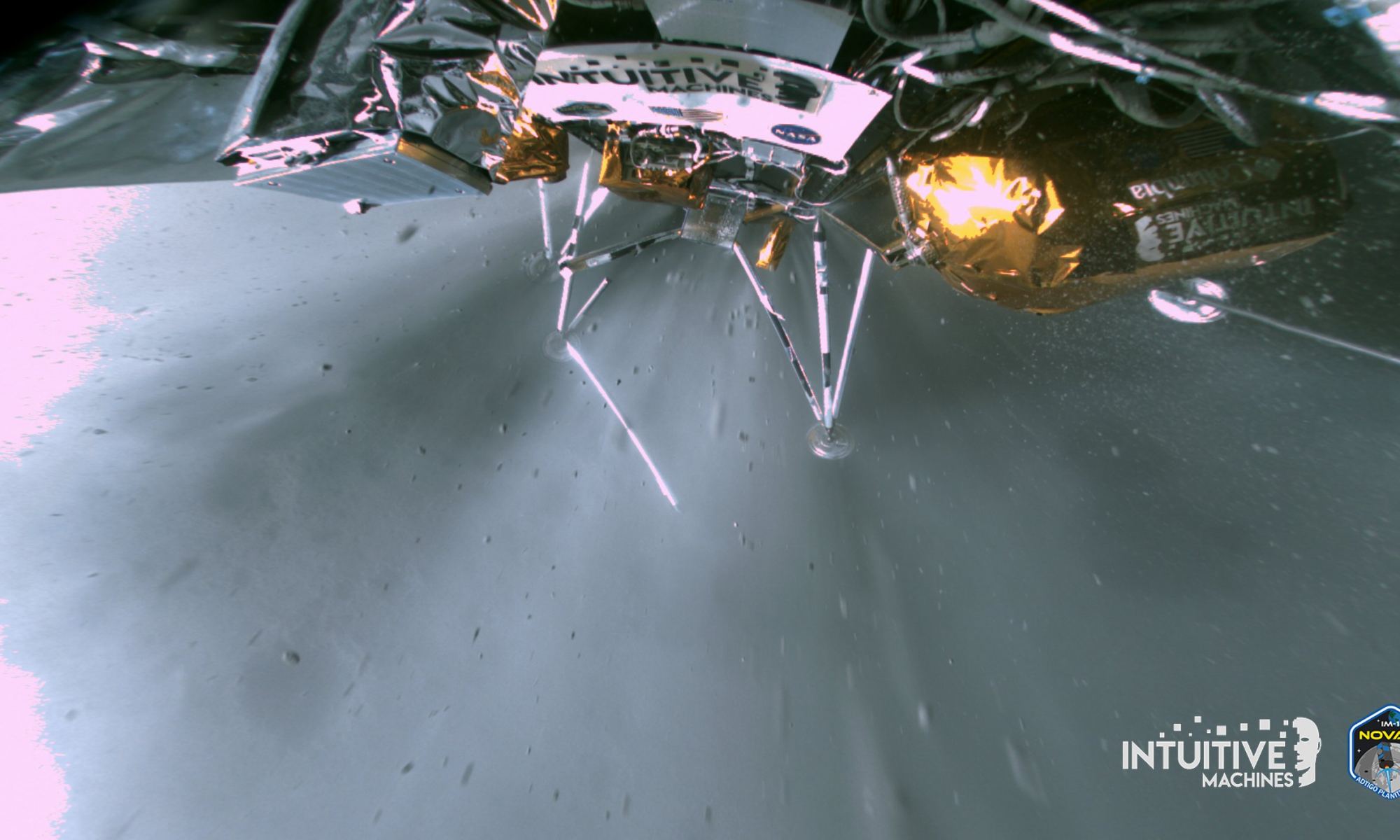
On February 15th, Intuitive Machines (IM) launched its first Nova-C class spacecraft from Kennedy Space Center in Florida atop a SpaceX Falcon 9 rocket. On February 22nd, the spacecraft – codenamed Odysseus (or “Odie”) – became the first American-built vehicle to soft-land on the lunar surface since the Apollo 17 mission in 1972. While the landing was a bit bumpy (Odysseus fell on its side), the IM-1 mission successfully demonstrated technologies and systems that will assist NASA in establishing a “sustained program of lunar exploration and development.”
After seven days of operation on the lunar surface, Intuitive Machines announced on February 29th that the mission had ended with the onset of lunar night. While the lander was not intended to remain operational during the lunar night, flight controllers at Houston set Odysseus into a configuration that would “call home” if it made it through the two weeks of darkness. As of March 23rd, the company announced that their flight controllers’ predictions were correct and that Odie would not be making any more calls home.
The company started listening for a wake-up signal from Odysseus on March 20th, when they projected that there was enough sunlight in the lander’s vicinity. At the time, it was thought that this could potentially charge Odysseus‘ power system, allowing it to activate its radio and reestablish contact with Houston. However, three days later, at 10:30 AM Central Standard Time (08:30 AM PST; 11:30 AM EST), flight controllers determined that the lander was not charging up after it completed its mission.
Image from the IM-1 Odysseus lander after it soft landed on the lunar surface. Credit: Intuitive Machines
This consisted of the Nova-C spacecraft making its inaugural soft landing on the Moon, the first time an American spacecraft has done so in over 50 years. The IM-1 mission was also the first time a spacecraft used methalox – the combination of liquid methane and liquid oxygen (LOX) – to navigate between the Earth and the Moon. While the IM-1 was not expected (or intended) to survive the lunar night, the data acquired by this mission could prove useful as the company continues to improve the lunar landing systems to deliver payloads to the Moon.
One of the company’s main objectives is to develop heat and power sources that can “keep systems from freezing during the lunar night.” This technology will greatly extend the life of lunar surface missions and facilitate the buildup of infrastructure on the Moon’s surface. A second Nova-C lander with the IM-2 mission will launch aboard a Falcon 9 no earlier than December 2024. This mission will land a drill and the Polar Resources Ice Mining Experiment-1 (PRIME-1) mass spectrometer near the south pole of the Moon.
This NASA payload will demonstrate the feasibility of In-Situ Resource Utilization (ISRU) and measure the volatile content of subsurface samples. ISRU and the presence of water are vital to the creation of a lunar base and the ability to send crews to the lunar surface well into the foreseeable future. A third mission (IM-3) is scheduled for early 2025, which will carry four NASA payloads to the Reiner Gamma region of the Moon, a rover, a data relay satellite, and secondary payloads to be determined. All three launches were contracted as part of NASA’s Commercial Lunar Payload Services (CLPS) program.
In addition, the IM-1 mission controllers and company managed to have a final farewell with the Odysseus mission before nightfall and the depletion of its battery power. On February 22nd, the lander transmitted a final image (shown below), which mission controllers in Houston received by February 29th. The image, Intuitive Machines said in a statement, “showcases the lunar vista with the crescent Earth in the backdrop, a subtle reminder of humanity’s presence in the universe. Goodnight, Odie. We hope to hear from you again.”
The last image sent by the IM-1 Odysseus mission on Feb. 22nd, 2024. Credit: Intuitive Machines
European scientists have created an extremely detailed geological map of Oxia Planum, the landing site for the ESA's Rosalind Franklin rover. Not only will it help guide the rover's driving, it will help the rover sample the most promising sites. Image Credit: Fawdon et al. 2024.
Rosalind Franklin, the ESA’s Mars rover, is scheduled to launch no sooner than 2028. Its destination is Oxia Planum, a wide clay-bearing plain to the east of Chryse Planitia. Oxia Planum contains terrains that date back to Mars’ Noachian Period, when there may have been abundant surface water, a key factor in the rover’s mission.
Rosalind Franklin’s primary mission mirrors that of NASA’s Perseverance rover: to search for fossil evidence of life. To do that, both rovers are equipped with a suite of powerful instruments. They both have sampling drills, but Franklin’s drill wins the tale of the tape. It can penetrate to a depth of two meters, compared to Perseverance’s which can only drill a few inches deep.
In order for the Franklin to be successful, it needs to land in a place where its drilling capability can be put to good use. That’s why the ESA chose Oxia Planum. Not only is it flat, which makes for a safer landing, but it contains hydrated minerals. In fact, it’s one of the largest exposed sections of clay-bearing minerals on Mars, and that’s where the fossilized evidence of life it seeks may be found.
A team of European scientists has created the most detailed geological map of Oxia Planum ever. It took four years to complete and leans heavily on data from orbiters. The detailed map shows 15 units with characteristic geological features that can help decide how the rover explores the area. The map will also help the rover interpret its surroundings and collect evidence of primitive life.
“This map is exciting because it is a guide that shows us where to find the answers.”
Peter Fawdon, co-lead author, Open University
Oxia Planum preserves a record of the forces that shaped the region and that shaped Mars. It’s a transitional region between Chryse Planitia, which contains lower elevation plains from the Amazonian/Hesperian, and Arabia Terra, the heavily cratered Noachian-aged region.
The sediments at Oxia Planum are nearly four billion years old. This will be the oldest site ever visited by a rover.
The new map has its roots in the COVID lockdowns. During that time, the Rosalind Franklin science team trained 80 volunteers to help them map Oxia Planum. The ExoMars Trace Gas Orbiter and NASA’s Mars Reconnaissance Orbiter supplied the data.
The result is a map that shows Oxia Planum’s geology in high detail. It shows types of bedrock and features like ridges and craters. It also shows crater ejecta and windborne dust. The map will not only help the rover navigate through difficult terrain; it’ll inform the choices of where to drill for samples.
This isn’t the first geological map of the Martian surface. But as this comparison shows, the new map (left) is much more detailed than previous ones (right.) The map on the right is a global geological map that labels the entire landing region as lNh, or late Noachian highlands. Image Credit: L: Fawdon et al. 2024. R: Tanaka et al. 2014.
“The map represents our current understanding of bedrock units and their relationships prior to Rosalind Franklin’s exploration of this location,” the map creators write in the paper presenting the map.
“The objectives of this map are (i) to identify where the most astrobiologically relevant rocks are likely to be found, (ii) to show where hypotheses about their geological context (within Oxia Planum and in the wider geological history of Mars) can be tested, (iii) to inform both the long-term (hundreds of metres to ~1 km) and the short-term (tens of metres) activity planning for rover exploration, and (iv) to allow the samples analyzed by the rover to be interpreted within their regional geological context,” the authors explain.
This is the new geological map of Oxia Planum, along with explanatory text. Image Credit: Fawdon et al. 2024.
“The wider region was extensively modified during the late Noachian and Hesperian periods, as shown by evidence of fluvial and paleo-lake activity, possible shoreline formation, volcanism, and aqueous alteration,” the authors write. The Hesperian is when Mars lost its water and transitioned from a warm, wet environment to a dry, cold environment. Understanding how that happened is a primary goal in Mars science.
The map contains a location and context section that orients viewers. The image on the left shows Rosalind Franklin’s landing site, and the image on the right shows the geological context. Image Credit: Fawdon et al. 2024.
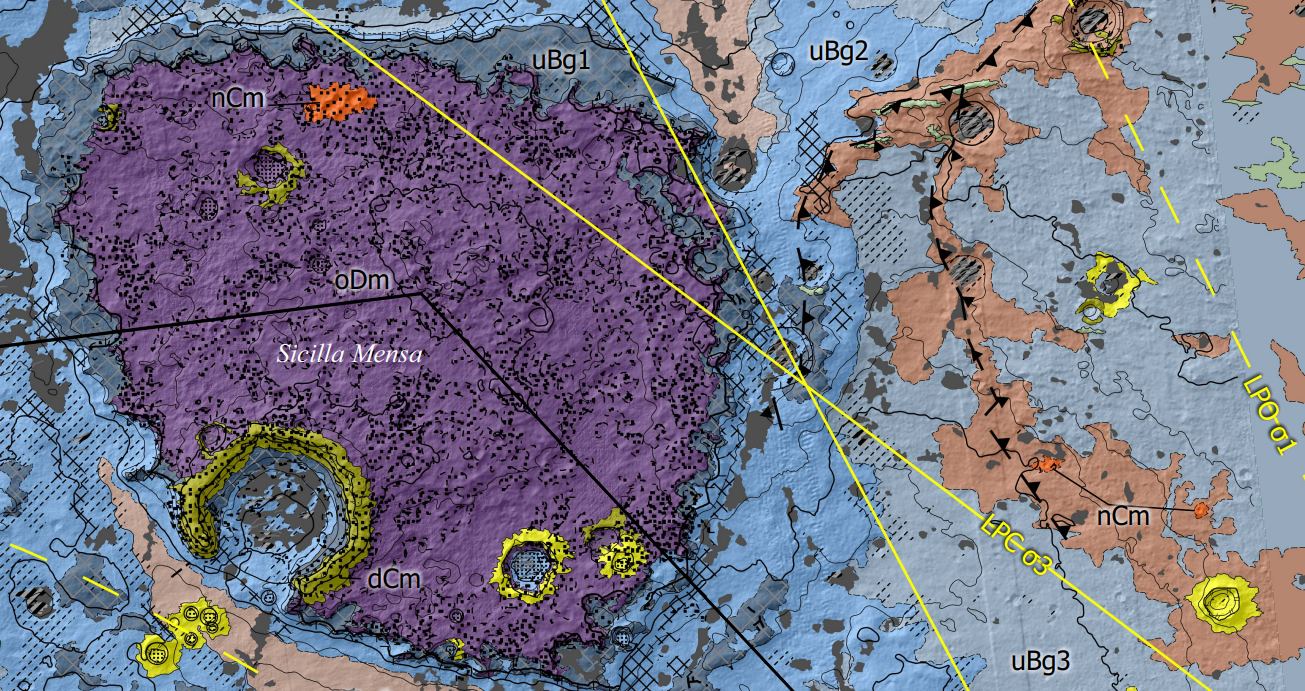
The map shows mound materials, different types of bedrock, features like Mensas and crater materials of different ages.
This zoom-in of the map shows Sicilla Mensa, a flat-topped feature with cliff-like edges. oDm stands for overlying dark material. The image also shows craters and the extent of their ejecta, shown in yellow. It’s labelled rCm for recent crater material. Image Credit: Fawdon et al. 2024.
This is the highest-resolution map of the region ever made. With a scale of 1:25,000, each centimetre on the map equals 250 meters on Mars. Since Rosalind Franklin will travel an average of 25 to 50 meters each day, a day’s journey is one or two millimetres on the map.
The making of the map has already provided some benefits to the Rosalind Franklin mission. “The mapping exercise has provided the wider <ExoMars> rover team with a sound knowledge of the landing site and has also helped us to develop new geological hypotheses for the region,” the authors write.
Oxia planum is rich in clays, also called hydrated minerals. Because clays are formed in water-rich environments, it makes these sites excellent locations to study for clues as to whether life once began on Mars. Image Credit: ESA/Mars Express (OMEGA and HRSC) and NASA/Mars Reconnaissance Orbiter (CRISM). LICENCE: ESA Standard Licence
The map is more than just a driving guide. It’s essentially a summary of our hypotheses about Mars. When the rover begins its mission, its initial exploration and drilling will test some of these existing hypotheses for Martian geology and history. Those results will inform the rover team, leading to better decisions about where to drill and explore. That will “… improve the chances of the mission meeting its search for life goals,” the authors explain.
“This map is exciting because it is a guide that shows us where to find the answers. It serves as a visual hypothesis of what we currently know about the different rocks in the landing site. The instruments on Rosalind Franklin will allow us to test our knowledge on the spot when the time comes,” explained Peter Fawdon, one of the lead authors from the Open University.
Blue Cigar-Shaped UFO Captured Over Scottsdale, AZ: A Night to Remember
In the serene night sky of Scottsdale, Arizona, a remarkable event unfolded on March 28, 2024, that has since sparked the curiosity and excitement of UFO enthusiasts and skeptics alike. Amidst the familiar paths of airplanes from the nearby airport, a mysterious blue, cigar-shaped object made an appearance, distinguishing itself with its peculiar movements and sustained presence. This extraordinary sighting, captured on an iPhone 13 Pro, has become the latest sensation in the realm of UFO sightings, adding to the growing archive of unexplained aerial phenomena.
A Witness’s Account: A String in the Sky
The sighting was reported by a local resident of Scottsdale who was out for a routine evening walk with their dog. What was expected to be a typical stroll turned into a captivating encounter with the unknown. The witness described seeing “a strange blue light that looked like a string hanging in the sky.” This luminous entity was observed to move in a manner unlike any aircraft commonly seen in the area—ascending and descending gracefully, yet with an intent that defied simple explanation. For over 30 minutes, this blue, cigar-shaped UFO hovered in the night sky, performing a mesmerizing dance that was both enigmatic and awe-inspiring.
Despite the proximity to an airport, where the sight of planes is an everyday occurrence, the behavior and appearance of this object were distinctly out of the ordinary. It maneuvered at altitudes higher than those of passing aircraft, capturing the witness’s full attention until it eventually descended and vanished from sight.
The Implications of the Sighting
This incident in Scottsdale is not an isolated event but rather a part of a larger pattern of UFO sightings that continue to intrigue and puzzle observers around the world. Each account, including this latest one from Arizona, adds valuable data to the ongoing investigation into UFO phenomena. With every report, the call for a deeper understanding and more thorough exploration of these sightings grows louder, urging both scientific and public communities to ponder the possibilities that lie beyond our current comprehension.
Join the Quest for Answers
For those fascinated by the unknown, this sighting serves as an invitation to join the quest for answers. It encourages us to look up at the sky with curiosity and wonder, to question the nature of the unexplained, and to engage in the broader conversation about what lies beyond the visible spectrum of our everyday lives.
As the search for understanding continues, the importance of documenting and sharing observations becomes ever more evident. Whether you’re a seasoned UFO researcher or simply someone who marvels at the mysteries of the universe, your perspective is valuable. The Scottsdale sighting reminds us all of the infinite wonders that await discovery, urging us to keep our minds open and our eyes skyward.
India's Kudankulam Nuclear Power Plant has become a UFOhotspot after a police officer reported seeing odd aerial lights above it more than 10 times last summer.
Indian Police Service investigator Syed Abdul Kader shared two videos exclusively with DailyMail.com, which track the bright lights making 'zigzags' above the facility.
Fearing the craft was not manmade, Kader turned to his nation's leading UFO expert, who in 2019 filed a petition to the Supreme Court of India with the backing of former Pentagon officials and US Air Force vets — urging the south Asian nation to take all the unexplained sightings near its nuclear facilities more seriously.
While the shape, size and speed of Kader's mystery objects are difficult to discern, his footage shows them making unusual movements at the altitude of an airplane.
'It's shaking when it's moving! It's going up and down,' the confused cop narrates in one video, watching the UFO's bizarre and apparently non-aerodynamic maneuvers.
'The way it's moving,' he opines in the video, 'this could never be an airplane.'
India's Kudankulam Nuclear Power Plant has become a UFO hotspot after a police officer reported seeing odd aerial lights above it more than 10 times last summer
Roughly a dozen or so incidents last summer all involved apparent airborne craft loitering near the Kudankulam Nuclear Power Plant (pictured above) at the southern tip of the subcontinent - as well as the Madras Atomic Power Station near Kalpakkam, along the country's east coast
'It's in a southern direction,' Kader told his wife during the August 8th sighting.
'It's standing [or hovering] in the direction of the Koodankulam Nuclear Power Plant.'
'It is always coming in at this time, when it is not too dark, nor too bright,' Kader's wife can be heard saying. 'I've seen this many times.'
While it is difficult for an outside observer to discern if the UFO is moving, or if Kader's camera is unsteady, DailyMail.com can report that some common prosaic explanations can likely be ruled out.
Such sightings have turned out to be distant planets, like Venus that is the third brightest object in the sky, after the sun and moon.
And the bright 'dog star,' Sirius, as well as the planets Jupiter and Mercury have also been occasionally misreported as UFOs.
However, in Kader's August 8 video, filmed at dusk (7:30PM local time), the eastern direction of the UFO at sunset refutes the notion that a common bright planet or star could explain the mystery's eerie aerial glow.
While the shape, size and speed of Kader's mystery objects are difficult to discern, his footage shows them making unusual movements at the altitude of an airplane
Syed Abdul Kader shared two of the videos exclusively with DailyMail.com, which show bright lights whizzing up and down above the facility
Police sub-inspector Syed Abdul Kader (right), assigned to the technical wing of the Tirunelveli office - one hour's drive north of the Kudankulam nuclear plant - told UFO expert Sabir Hussain (left) that he filmed two videos of these unusual aerial phenomena or UAP
A sky map for that night and time, geolocated to the Kaders' hometown of Tirunelveli via TheSkyLive.com shows that Venus was completely obscured, below the western horizon and below the sunset.
Most other bright stars and planets were also not in the eastern sky at that moment.
At another point in the video, Kader's wife exclaims, 'It's so close. How come no one else is seeing this?'
To which Kader replies, 'No, that's why the DGP [Director General of Police] he, himself, has seen it [the UFOs]. And that's why everybody's talking about this.'
India made history by becoming the first nation to land a spacecraft on the moon's south pole August 23, 2023
Kader's mysterious UFO videos were first secured by one of India's foremost UFO investigators, Sabir Hussain, director of the Indian Society for UFO Studies (INSUFOS) based in Chennai.
It was Hussain who petitioned the Supreme Court of India in 2019 warning that casually dismissing reports of UFO activity near the nation's sensitive atomic power sites could risks an unintentional nuclear war between India and its uneasy neighbor Pakistan.
His efforts came with letters endorsing his petition, by former US counterintelligence official and Pentagon UFO investigator Lue Elizondo, US Air Force veteran Robert Salas, and other UFO experts from America and Europe.
'Syed came to my house,' Hussain told DailyMail.com. 'I debriefed him.'
'He told me that most of the time, [the UFO] was either coming from the direction of Kudankulam Nuclear Power Plant, going towards it, or stationary in that direction.'
Officer Kader, Hussain told DailyMail.com, also stated that the UFOs were sometimes spotted hovering above the nearby Indian Space Research Organization's (ISRO) Propulsion Complex.
Nestled alongside the mountainous Mahendragiri hill in the state of Tamil Nadu, the ISRO Propulsion Complex tests cryogenically stored rocket fuel among its other space program duties.
The ISRO facility is also approximately one hour's drive south of the Kaders' home, which is in the city of Tirunelveli in Tamil Nadu.
A vocal advocate on the UFO issue, Hussain once voiced his suspicion that alleged alien occupants of such craft cut communications between ISRO and its Chandrayaan-2's Vikram lander in 2019 — for the south Asian nation's own good.
'The extra-terrestrials have sent a message to the Indian government to get rid of your nukes before you explore other worlds,' Hussain told the Deccan Chronicle.
'You will not be allowed to land on the moon unless "they" decide to allow you.'
The fate of ISRO's Vikram lander aside, Hussain's new UFO witnesses, sub-inspector Kader and his wife, can at least be heard in their videos discussing the mysterious aerial phenomena's consistent apparent interest in the Kudankulam nuclear plant.
Kader's video-taped sightings, as Hussain told DT Next, 'happened just 10 days after former DGP [Director General of Police] Prateep V. Philip took pictures of a UFO on [the] Muttukadu sea shore near Chennai.'
Philip's rank of DGP is the highest position attainable in the Indian Police Service.
A sky map for that night and time (above), geolocated to the Kaders' hometown of Tirunelveli via TheSkyLive.com, shows Venus was completely obscured, below the western horizon and sunset. Most other bright stars and planets were also not in the eastern sky at that moment
The Kaders' sightings to the south overlapped with weeks of sightings in July and August up the eastern coast, along the Neelankarai-Mahabalipuram shoreline. That region, near the city of Chennai, is home to the Madras Atomic Power Station (MAPS) in Kalpakkam (above)
Hypothetical extraterrestrial interest in the Kudankulam nuclear plant, if correct, would join decades of active protests against the plant by concerned local civilians.
Thousands of local residents faced teargas shelling, imprisonment and prosecution under both terrorism and sedition charges by local police for speaking out against the nuclear energy plant. Even children with the protestors faced sedition charges.
In September of 2019 the Kudankulam nuclear plant was discovered to be infected with malware, which one cyber security analyst with CSO attributed to 'a false flag operation using stolen North Korean code to muddle attribution.'
Hussain told DailyMail.com that the plant has faced corruption charges and safety concerns since before it first became operational a decade ago.
'Kudankulam, which is a focus of our attention,' Hussain said, 'came online only in 2013 after Fukushima disaster happened.'
'Ever since it came online, it has been shutting down once every two months,' he added. 'They are working only to 30 percent of their capacity. So you do the math.'
DailyMail.com has reached out to the Indian government's Nuclear Power Corporation of India, Ltd., which runs the plant, for comment.
US Air Force ICBM launch officer Robert Salas (pictured left, and as a young man, right) told of his encounter with an orange flying disc that turned off 10 warheads at Malmstrom Air Force Base, Montana in 1967
An email shows AARO staff contacted former US Air Force ICBM launch officer Robert Salas to gather information about his encounter. He tweeted his thank you email from AARO
This time last year, two Air Force veterans revealed to DailyMail.com's Josh Boswell that they had just testified to the Pentagon's UFO-hunting All-domain Anomaly Resolution Office (AARO) about their experiences witnessing UFOs interfere with US nuclear missiles.
One email showed AARO staff contacting former US Air Force ICBM launch officer Robert Salas to gather information about his chilling encounter with an orange flying disc that inexplicably turned off 10 warheads at Malmstrom Air Force Base, Montana in 1967.
Another former officer, Dr. Robert Jacobs, also briefed AARO, testifying to a 35mm film he shot for the Air Force in 1964, which allegedly caught a flying saucer shooting a test missile out of the sky.
Although Salas described those early interactions with AARO officials as 'very magnanimous,' this month the disappointed Air Force veteran described the Pentagon office's most recent UFO report as 'a 'Steaming pile of ...'
'I gave AARO a two hour PowerPoint presentation on the Malmstrom AFB incidents where twenty ICBMs were disabled during UFO encounters,' Salas said on the social media site X, speaking to incidents at the base beyond 1967.
'The USGOV owes us, the informed public, much more respect on this subject,' he concluded, 'than offered by AARO's steaming pile of insults.'
Astronauts Have Surprising Ability to Orient Themselves and Gauge Distance Traveled in Space: Study
New research has implications for crew safety in space and could potentially give clues to how aging affects people’s balance systems here on Earth.
Jörges et al. tackled the question of whether body posture influences human perception of self-motion and distance; they found some evidence that the same amount of optic flow can elicit the sensation of having traveled further when supine versus when sitting upright, that is, optic flow is more effective at eliciting a sense of self-motion when supine; this constitutes evidence that visual and non-visual cues are at least partially integrated even when self-motion is presented only visually; however, they did not find any significant differences between performance on Earth and in the microgravity of the ISS, suggesting that vestibular cues play a minor role, if any, in the estimation of visually presented self-motion.
“It has been repeatedly shown that the perception of gravity influences perceptual skill,” said York University’s Professor Laurence Harris, senior author of the study.
“The most profound way of looking at the influence of gravity is to take it away, which is why we took our research into space.”
“We’ve had a steady presence for close to a quarter century in space and with space efforts only increasing as we plan to go back to the moon and beyond, answering health-and-safety questions only becomes more important.”
“Based on our findings it seems as though humans are surprisingly able to compensate adequately for the lack of an Earth-normal environment using vision.
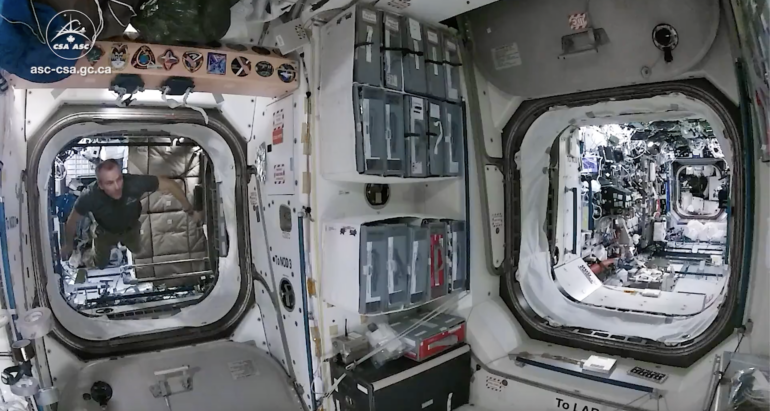
In the research, Professor Harris and colleagues studied a dozen astronauts aboard the International Space Station (ISS), which orbits about 400 km from the Earth’s surface.
“Here, Earth’s gravity is approximately cancelled out by centrifugal force generated by the orbiting of the station. In the resulting microgravity, the way people move is more like flying,” Professor Harris said.
“People have previously anecdotally reported that they felt they were moving faster or further than they really were in space, so this provided some motivation to actually record this.”
The authors compared the performance of a dozen astronauts — six men and six women — before, during, and after their year-long missions to the space station and found that their sense of how far they traveled remained largely intact.
Space missions are busy endeavors and it took the researchers several days to connect with the astronauts once they arrived at the space station.
“It’s possible our research was unable to capture early adaptation that may have occurred in those first few days. It’s still a good news message because it says that whatever adaptation happens, happens very quickly,” Professor Harris said.
Space missions are not without risk. As the ISS orbits the Earth it is sometimes hit with small objects that could penetrate the vessel requiring astronauts to move to safety.
“On a number of occasions during our experiment, the ISS had to perform evasive maneuvers,” Professor Harris said.
“Astronauts need to be able to go to safe places or escape hatches on the ISS quickly and efficiently in an emergency. So, it was very reassuring to find that they were actually able to do this quite precisely.”
“Our research shows exposure to microgravity mimics the aging process on a largely physiological level — wasting of bones and muscles, changes in hormonal functioning and increased susceptibility to infection — but this paper finds that self-motion is largely unaffected, suggesting the balance issues that frequently come from old age may not be related to the vestibular system.”
“It suggests that the mechanism for the perception of movement in older people should be relatively unaffected, and that the issues involved in falling may not be so much in terms of the perception of how far they’ve moved, but perhaps more to do with how they’re able to convert that into a balance reflex.”
The study was published in the journal npj Microgravity.
B. Jörges et al. 2024. The effects of long-term exposure to microgravity and body orientation relative to gravity on perceived traveled distance. npj Microgravity 10, 28; doi: 10.1038/s41526-024-00376-6
Study: Introduced Tardigrade Proteins Slow Metabolism in Human Cells
New research led by the the University of Wyoming, Laramie, provides additional evidence that tardigrade proteins eventually could be used to make life-saving treatments available to people where refrigeration is not possible and enhance storage of cell-based therapies.
Sanchez-Martinez et al. provide insights into how tardigrades induce reversible biostasis through the self-assembly of labile CAHS gels.
First discovered in 1773, tardigrades are a diverse group of microscopic invertebrates that are best known for their ability to survive extreme conditions.
Also known as water bears or moss piglets, these creatures can live for up to 60 years, and grow to a maximum size of 0.5 mm, best seen under a microscope.
They are able to survive for up to 30 years without food or water, for a few minutes at temperatures as low as minus 272 degrees Celsius (minus 457 degrees Fahrenheit) or as high as 150 degrees Celsius (302 degrees Fahrenheit), and minus 20 degrees Celsius (minus 4 degrees Fahrenheit) for decades.
Tardigrades withstand pressures from virtually 0 atm in space up to 1,200 atm at the bottom of the Marianas Trench, and are also resistant to radiation levels up to 5,000-6,200 Gy.
They survive by entering a state of suspended animation called biostasis, using proteins that form gels inside of cells and slow down life processes.
“Amazingly, when we introduce these proteins into cells, they gel and slow down metabolism, just like in tardigrades,” said Dr. Silvia Sanchez-Martinez, a researcher at the University of Wyoming, Laramie.
“Furthermore, just like tardigrades, when you put human cells that have these proteins into biostasis, they become more resistant to stresses, conferring some of the tardigrades’ abilities to the human cells.”
“Importantly, our research shows that the whole process is reversible,” said Dr. Thomas Boothby, a researcher at the University of Wyoming, Laramie.
“When the stress is relieved, the tardigrade gels dissolve, and the human cells return to their normal metabolism.”
“Our findings provide an avenue for pursuing technologies centered on the induction of biostasis in cells and even whole organisms to slow aging and enhance storage and stability.”
S. Sanchez-Martinezet al. 2024. Labile assembly of a tardigrade protein induces biostasis.Protein Science33 (4): e4941; doi: 10.1002/pro.4941
UAP Up Close Shoots Past Passenger Jet Windows! March 2024, UFO Sighting News Video.
Date of sighting: March 2024 Location of sighting: New York, New York, USA
Watch as a UFO shoots past a passenger jet over New York and gets caught on video. The object is long, dark and has a bright white window area which is the alien pilots cockpit location. It's obvious this UAP shoot past to scan the technology of the plane as well as record the thoughts of its passengers. This is 100% proof that UFOs frequent heavily populated areas.
Meer van UFO'S of UAP'S, ASTRONOMIE, RUIMTEVAART, ARCHEOLOGIE, OUDHEIDKUNDE, SF-SNUFJES EN ANDERE ESOTERISCHE WETENSCHAPPEN - DE ALLERLAATSTE NIEUWTJES


 Search for Life on Mars Could Level-Up with MARSE Mission Concept