Naar de inhoud

UFO'S of UAP'S, ASTRONOMIE, RUIMTEVAART, ARCHEOLOGIE, OUDHEIDKUNDE, SF-SNUFJES EN ANDERE ESOTERISCHE WETENSCHAPPEN - DE ALLERLAATSTE NIEUWTJES

UFO's of UAP'S in België en de rest van de wereld
akke.beakke.be
Ontdek de Fascinerende Wereld van UFO's en UAP's: Jouw Bron voor Onthullende Informatie! Ben jij ook gefascineerd door het onbekende? Wil je meer weten over UFO's en UAP's, niet alleen in België, maar over de hele wereld? Dan ben je op de juiste plek! België: Het Kloppend Hart van UFO-onderzoek In België is BUFON (Belgisch UFO-Netwerk) dé autoriteit op het gebied van UFO-onderzoek. Voor betrouwbare en objectieve informatie over deze intrigerende fenomenen, bezoek je zeker onze Facebook-pagina en deze blog. Maar dat is nog niet alles! Ontdek ook het Belgisch UFO-meldpunt en Caelestia, twee organisaties die diepgaand onderzoek verrichten, al zijn ze soms kritisch of sceptisch. Nederland: Een Schat aan Informatie Voor onze Nederlandse buren is er de schitterende website www.ufowijzer.nl, beheerd door Paul Harmans. Deze site biedt een schat aan informatie en artikelen die je niet wilt missen! Internationaal: MUFON - De Wereldwijde Autoriteit Neem ook een kijkje bij MUFON (Mutual UFO Network Inc.), een gerenommeerde Amerikaanse UFO-vereniging met afdelingen in de VS en wereldwijd. MUFON is toegewijd aan de wetenschappelijke en analytische studie van het UFO-fenomeen, en hun maandelijkse tijdschrift, The MUFON UFO-Journal, is een must-read voor elke UFO-enthousiasteling. Bezoek hun website op www.mufon.com voor meer informatie. Samenwerking en Toekomstvisie Sinds 1 februari 2020 is Pieter niet alleen ex-president van BUFON, maar ook de voormalige nationale directeur van MUFON in Vlaanderen en Nederland. Dit creëert een sterke samenwerking met de Franse MUFON Reseau MUFON/EUROP, wat ons in staat stelt om nog meer waardevolle inzichten te delen. Let op: Nepprofielen en Nieuwe Groeperingen Pas op voor een nieuwe groepering die zich ook BUFON noemt, maar geen enkele connectie heeft met onze gevestigde organisatie. Hoewel zij de naam geregistreerd hebben, kunnen ze het rijke verleden en de expertise van onze groep niet evenaren. We wensen hen veel succes, maar we blijven de autoriteit in UFO-onderzoek! Blijf Op De Hoogte! Wil jij de laatste nieuwtjes over UFO's, ruimtevaart, archeologie, en meer? Volg ons dan en duik samen met ons in de fascinerende wereld van het onbekende! Sluit je aan bij de gemeenschap van nieuwsgierige geesten die net als jij verlangen naar antwoorden en avonturen in de sterren! Heb je vragen of wil je meer weten? Aarzel dan niet om contact met ons op te nemen! Samen ontrafelen we het mysterie van de lucht en daarbuiten.

Archief

Venus Isn't Dead After All
Venus Isn't Dead After All

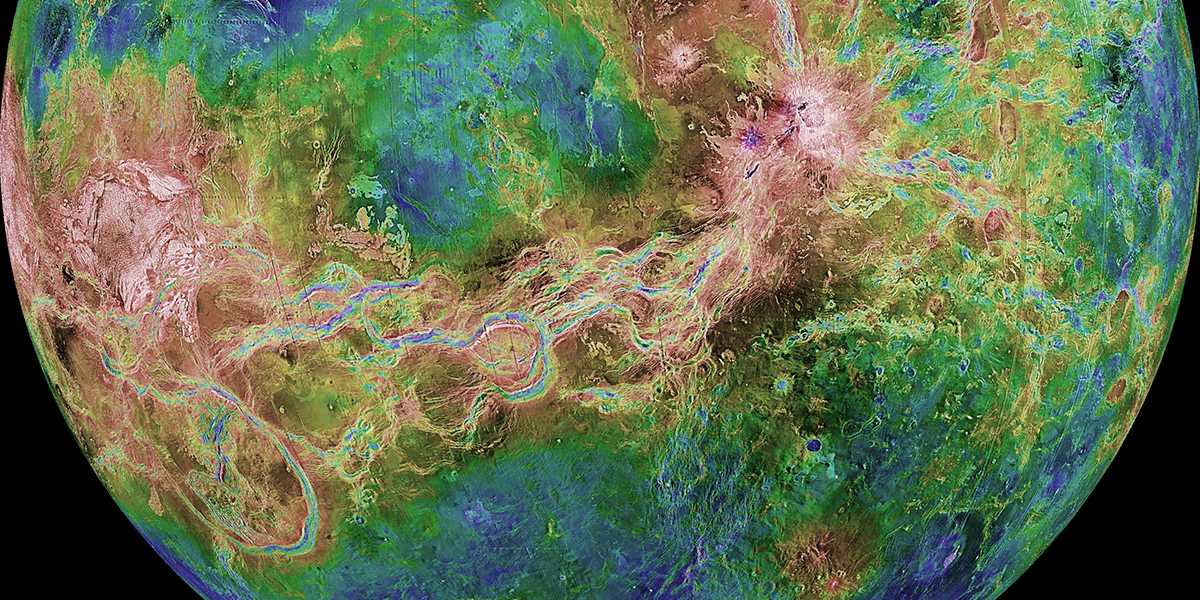
There are huge rift valleys on Venus. They suggest that the planet is still geologically active. Credit: NASA/JPL/USGS There are huge rift valleys on Venus. They suggest that the planet is still geologically active. Credit: NASA/JPL/USGS

When it comes to literary allegories, Venus is about as close to Dante's description of hell as one can get! Its atmosphere is 93 times as dense as Earth's, which is equal to the pressure found 900 m (3,000 ft) underwater, enough to crush the human body. It's also the hottest planet in the Solar System, with temperatures reaching 467 °C (872 °F), which is hot enough to melt lead. Unlike Earth, its surface is not composed of tectonic plates that are constantly shuffling around, but a single-piece crust.

Until recently, scientists believed that this meant Venus was geologically inactive, though recent findings have challenged this. According to a new study by ETH researchers, Venus is not only geologically "alive" but hosts many active volcanoes. This is evident from Venus' rift valleys (aka chasmata), lowland features similar to those on Earth that form when tectonic plates move apart. These features show that Venus also experiences tectonic activity, creating rifts that can measure up to 10,000 km (~6,200 mi) in diameter.

The research was led by Xi Yang, a graduate student from the Department of Earth and Planetary Sciences (DEPS) at ETH Zürich as part of his Master's studies. He was joined by Taras V. Gerya, a Professor of Geodynamics in the DEPS (and Yang's supervisor), and Dr. Anna J. P. Gülcher, a Geosciences researcher from the University of Freidburg and the Center for Space and Habitability at the University of Bern. Their results are published in a paper that appeared in Nature Geosciences.
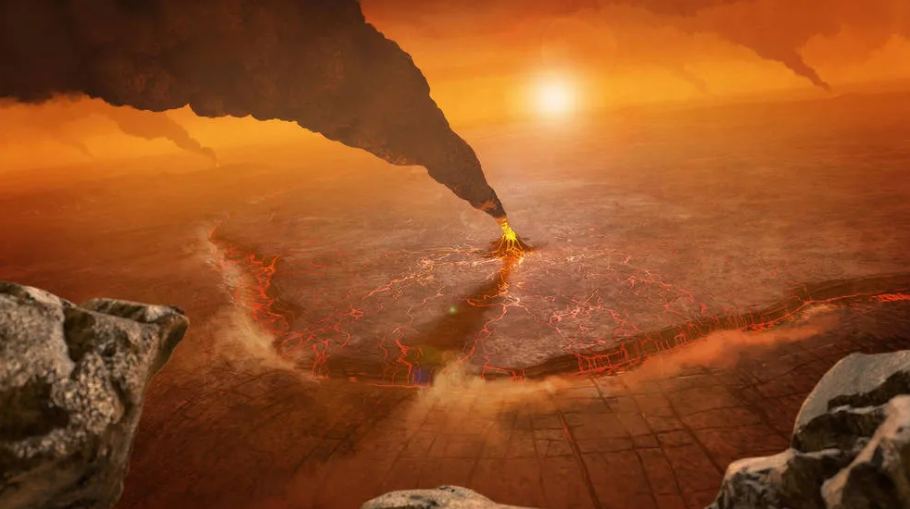
Current research reveals that Venus is not only geologically active, but has active volcanoes on its surface. Credit: NASA/JPL-Caltech/Peter Rubin

Current research reveals that Venus is not only geologically active, but has active volcanoes on its surface.

Credit: NASA/JPL-Caltech/Peter Rubin

Previous models of Venus' geological evolution, along with data provided by NASA's Magellan probe (which observed Venus between 1990 and 1994), have confirmed that large rift valleys exist on Venus. Previous models indicated that broad ridges (rift flanks) form along the edges of rift valleys when they are geologically young and are either still moving or have only recently ceased.

Until now, geoscientists believed that they formed more than 100 million years ago, but this has remained unconfirmed. What's more, earlier models had relied on simplified material assumptions and been mostly two-dimensional. As a result, the question of whether Venus is still geologically active or not has remained unresolved. To address this, Yang and his team employed a new computer model to create the first high-resolution 3D models of Venus' surface, focusing on the Ganis, Dali, and Devana Chasmata.

This allowed them to accurately replicate these rift structures and provide better explanations of their formation. Their model shows that rift flanks on Venus tend to flatten rapidly after movement ceases, meaning that systems become less steep and narrow their flanks with age. Unlike Earth, where erosion gradually wears down features, Venus’s flanks subside due to crustal relaxation. Their simulations also suggest that these rifts widen at a rate of 3 to 10 cm (~1.2 to 4 inches) a year, which is faster than previous models suggested.

Based on their modeling and observational data from Magellan and other missions, the researchers conclude that Venus remains geologically active and has a more dynamic interior than previously thought. “The results help us to better assess the tectonic activity on Venus,” says Gerya. This is particularly important considering that NASA and the ESA are preparing multiple missions to explore Venus' atmosphere, surface, and interior structure in the near future.
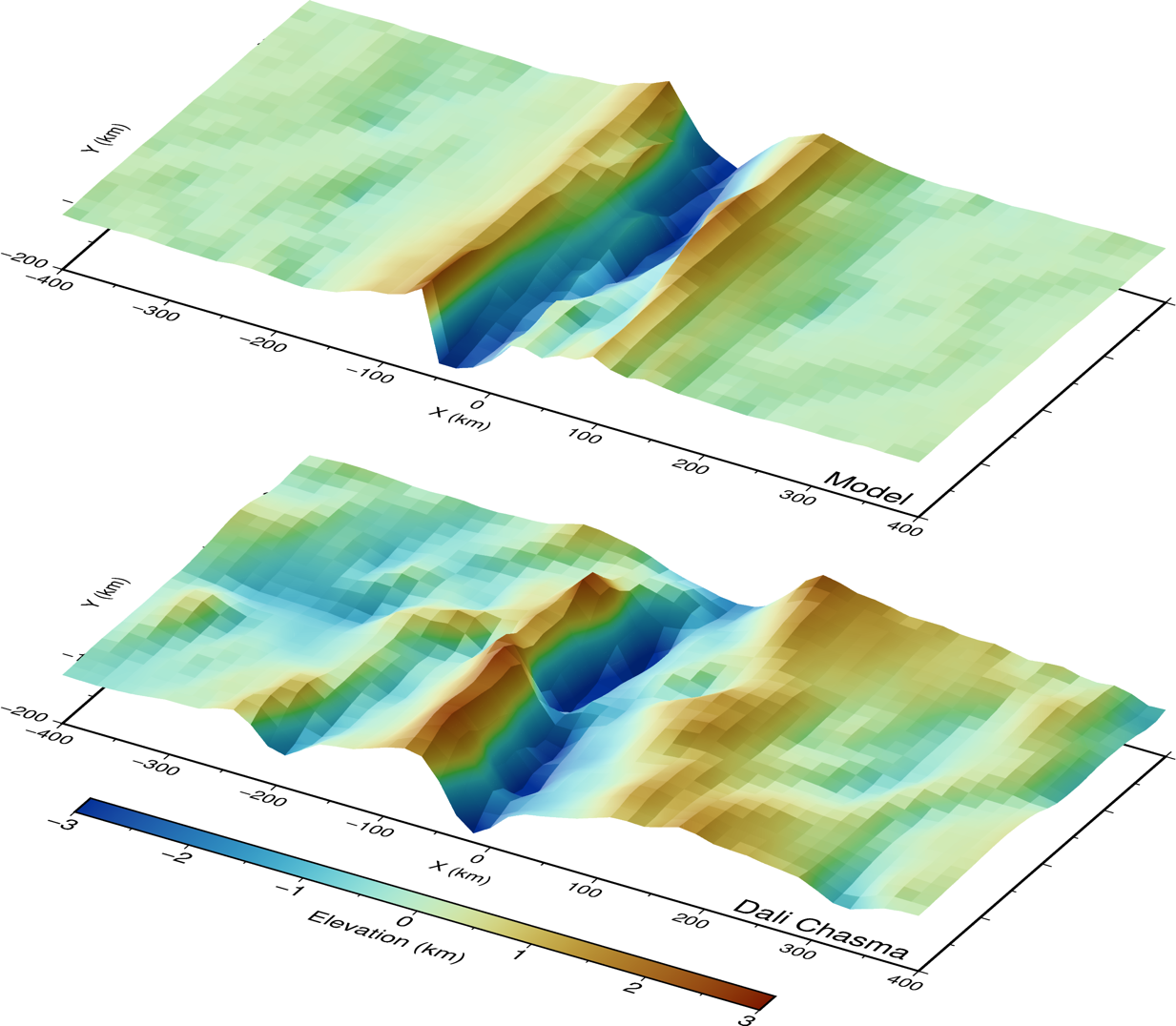
Comparison between the crustal model at 700,000 years (top figure) and the actual Dali Chasma rift system (bottom). Credit: Xi Yang/ETH Zürich

Comparison between the crustal model at 700,000 years (top figure) and the actual Dali Chasma rift system (bottom).

Credit: Xi Yang/ETH Zürich

The results of their model could help mission planners pinpoint geologically active regions for these missions to study. Interestingly, Taras Gerya and fellow ETH geophysics professor Paul Tackley (and their colleagues) are participating in mission planning for ESA's EnVision mission, a probe that is scheduled to launch in the 2030s to study Venus' atmosphere, surface and interior, and how they interact with each other.

Similarly, the team's findings are shaking up what scientists know about how rocky planets in our Solar System formed, and could have applications in the search for habitable exoplanets.

Further Reading: 

Venus Isn't Dead After All

Falcon 9 Slams Into The Moon // Liquid on Pluto // Venus Isn’t Dead

{ https://www.universetoday.com/ }

Hoe vind je dit bericht?
Geschreven door peter om 17:13 Stuur door

Scientist Constructs "Big Picture" of Mars Water from Rover Data

Scientist Constructs "Big Picture" of Mars Water from Rover Data

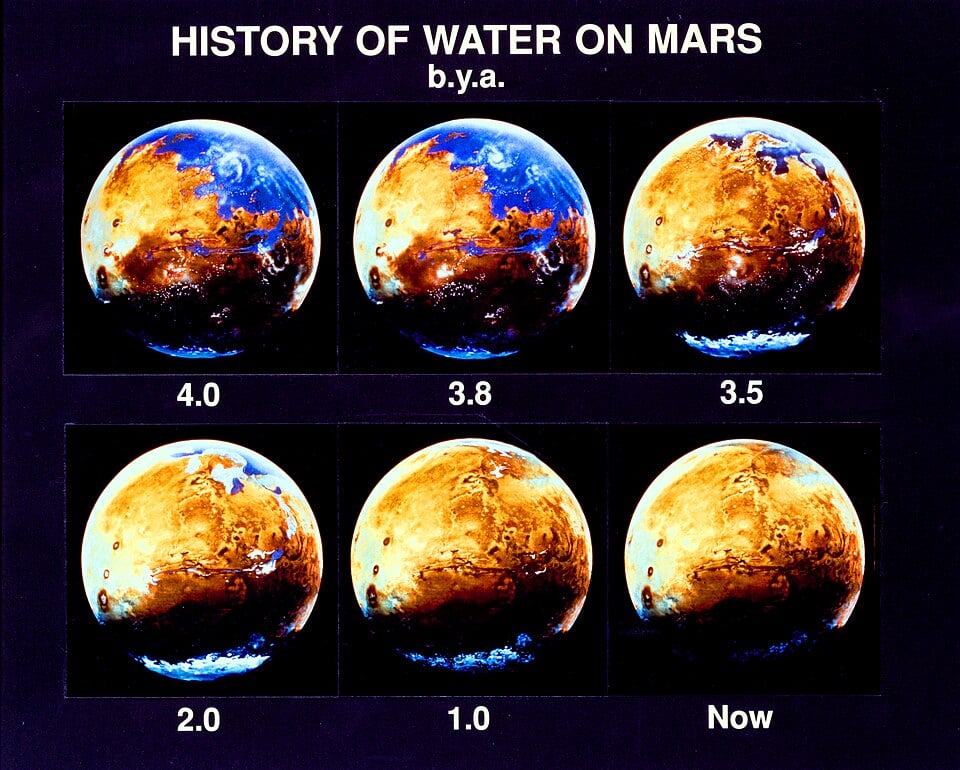
A pictorial history of water on Mars by space artist Michael Carroll. This is based on Viking data and work done at NASA Ames. A study of rover measurements of water-related minerals on the Red Planet shows that water may well have been more widespread than previously thought. Courtesy Michael Carroll, public domain. A pictorial history of water on Mars by space artist Michael Carroll. This is based on Viking data and work done at NASA Ames. A study of rover measurements of water-related minerals on the Red Planet shows that water may well have been more widespread than previously thought. Courtesy Michael Carroll, public domain.

Rover data from more than 20 years ago has revealed clues to the existence of liquid water on ancient Mars. The NASA Spirit Rover carried a specialized instrument called a Mössbauer Spectrometer that performed mineralogical analyses of soil, rock, and dust on the surface of the Red Planet at Gusev Crater. Individual measurements didn't always indicate definitive proof of water, but when scientist Paolo de Souza of Edith Cowan University in Australia examined years' worth of measurements together, a definite pattern began to show up in the existence of minerals that could only exist in the presence of water. His analysis shows that Mars used to sport a lot more water than scientists expected and that the data showing its existence was in the data all along.

A panorama of the region where the Spirit rover landed inside Mars's Gusev Crater. Dust and soil at the site show traces of water-related minerals altered magnetite and hematite. Credit: NASA/JPL-Caltech/Cornell

A panorama of the region where the Spirit rover landed inside Mars's Gusev Crater. Dust and soil at the site show traces of water-related minerals, including altered magnetite and hematite.

Credit: NASA/JPL-Caltech/Cornell

De Souza was particularly interested in the existence of hematite and altered magnetite measured in the Martian soil. These two minerals often form when rocks interact with water. Hematite, in particular, is at the heart of the amazing "blueberries" found on Mars at Meridiani Planum by the Opportunity rover. The traces of hematite in de Souza's study were excavated from 32 Gusev soil sites that were undisturbed. The result of de Souza's work is the most detailed iron-mineral profile of Martian soil done to date. Scientists didn't expect to find hematite in the soils at the site, so the finding was a surprise. It turns out it was there all along, just in amounts too small in each rover sample measurement.

"One of the most important discoveries was finding crystalline hematite in ordinary Martian soil," Professor de Souza said. "This mineral's widespread presence suggests not only that water was present, but that significant areas of Mars may have once been covered by water."

Hematite, Magnetite and Water on Mars

Hematite is what's called an "iron oxide". It forms in the presence in liquid water, as well as in volcanic regions. On Mars, both types of environments exist, but the regions where the hematite is found appear to be largely shaped by past contact with water. That's why de Souza and others suspect that these areas of Mars were once inundated with water.

Magnetite occurs in both igneous (volcanic) rocks as well as in sedimentary rocks here on Earth. It's also an iron-bearing mineral, and on Mars, its presence indicates that water and rocks interacted. The fact that it's also found in widespread areas indicates a warmer, wetter past on Mars.

Martian "blueberries" as seen by the Opportunity Rover at Meridiani Planum during its exploration. These hematite orbs likely formed in contact with water. Credit: NASA/JPL Public Domain.

Martian "blueberries" as seen by the Opportunity Rover at Meridiani Planum during its exploration. These hematite orbs likely formed in contact with water.

Credit: NASA/JPL Public Domain.

The layers of dust that the rover studied in Gusev Crater that contain traces of the water-related minerals are found across the planet. De Souza's findings suggest that the layer of dust extends across huge areas of Mars. It likely formed over millions of years thanks to constant wind erosion, temperature changes, and storms that moved huge quantities of dust across the Martian surface.

Revisiting Past Data

According to de Souza, each rover measurement wasn't enough to come to a definitive conclusion about water on Mars. But, taken together, they paint a striking picture of Mars's past. "Many measurements were not detailed enough on their own to identify minerals present in very small quantities," he said. "By bringing the data together and analysing it in a new way, we were able to reveal information that had been hidden for years."

It took de Souza several years of painstaking work, sifting through all the measurements, to construct the picture of water on Mars, particularly at Gusev Crater. He had to take into account a number of factors at play during the measurements, including temperature conditions, samples from different soil regions, physical and chemical weathering of the surface materials, and the effects of millions of years of global dust storms. He described the details in a paper submitted to Springer Nature (cited below).

In the future, de Souza will do a similar analysis of data from soils studied by the Opportunity rover at Meridiani Planum. If it works out as expected, hundreds of measurements will be analyzed and combined to form a "big picture" assessment of water on Mars in that region, as well. The work on the Gusev Crater and Meridiani Planum soils also points out the need for future missions to the Red Planet to carry spectrometers to do longer-term studies of the soil than the Opportunity and Spirit instruments were able to do.

For More Information


NASA’s Curiosity Rover Explores Ancient Martian Water Body | WION Podcast

{ https://www.universetoday.com/ }

Hoe vind je dit bericht?
Geschreven door peter om 16:51 Stuur door

20 mile UFOs on Moon by Ukraine Scientists Confirmed by Apollo 17 photos and Italian 2007 UFO video!

20 mile UFOs on Moon by Ukraine Scientists Confirmed by Apollo 17 photos and Italian 2007 UFO video!

UFO,%20UFOs,%20UAP,%20UAPs,%20UFO%20sighting,%20UFO%20files,%20UFO%20video%20UAP%20files,%20UAP%20video,%20department%20of%20war,%20alien,%20aliens,%20infrared%20UFO,%20IR%20UFO,%20official%20UFO,%20Gov%20UFO,%20USA%20UFO%20copy.png

Screenshot%202026-08-09%20at%2012.49.33%E2%80%AFPM.png

Date of discovery: 2025 by Ukraine astronomers
Location of sighting: Earths moon
2007 UFO: 
2011 UFO: 
 
Yes Ukraine astronomers made some awesome recordings of video, yes actual video (not released yet) of round donut UFOs moving to and from the moon some of them reaching tens of miles across. The astronomers say this is proof that there is a base on the moon, however there is not 'a' base on the moon...the whole moon is a base...meaning a space station covered in lunar material to give it camouflage. 
 
Also back in 2011 I discovered three photos. These photos reveal a UFO about 15 miles across in HD detail! The UFO is a black circle, which actually absorbs the light so much that its has zero reflection. Thats pure alien tech there. In two photos its gone, in one photo it's there. Yeah...NASA missed it but I found it. 
 
Then...an amateur astronomer in Italy in 2007 was recording the moon by accident he said when he was cleaning his telescope and caught this object moving over the moons surface for 2 minutes! The round object actually made a 45 degree turn...which is 100% proof it's intelligently controlled since nothing in nature out there is capable of such maneuvers. This video is exactly the same object as that caught on video by Ukraine scientists...but unreleased as of today. The astronomer said it was 5.6 miles wide or 4.8 arc seconds.
 
So...yeah...20 mile UFOs exist. Why are they there? Because the moon is a giant space station. No little bases, it's all one giant base. We had the evidence for a long time, but lately, the public is paying more attention to it because of the Trump UFO file drops. 
Scott C. Waring - UFO Sightings Daily 
 

{ https://www.ufosightingsdaily.com/ }

Hoe vind je dit bericht?
Geschreven door peter om 16:37 Stuur door

UFOs and Defense: French Military Elite Concluded Extraterrestrial Hypothesis Is “By Far the Best” Explanation — Then Urged Paris to Break the Silence

UFOs and Defense: French Military Elite Concluded Extraterrestrial Hypothesis Is “By Far the Best” Explanation — Then Urged Paris to Break the Silence

America ı By Samuel Lopez

Night scene with a glowing circular UFO hovering above a dark landscape, a jet flying nearby and distant mountains at the horizon.

Inside This Report

  • A panel of retired French generals, scientists, and intelligence officials spent three years analyzing hundreds of documented UFO cases before reaching a startling conclusion in 1999
  • The COMETA report — compiled with cooperation from France's gendarmerie, air force, and space agency CNES — found the extraterrestrial hypothesis "the best scientific hypothesis" for a small percentage of unexplained sightings
  • The authors warned that continued government secrecy, particularly in the United States, carries real political, religious, and defense consequences — and recommended France build permanent structures to study the phenomenon

By Samuel López | USA Herald

For more than seventy years, the words "unidentified flying object" have summoned images of tabloid headlines and blurry photographs. But in July 1999, a document surfaced in France that forced even skeptics to sit up straight. It wasn't produced by a fringe research group or a self-styled contactee. It came from COMETA — a committee of retired French Air Force generals, a former head of the national space agency CNES, engineers, admirals, and a national police chief — operating under the umbrella of the Institut des Hautes Etudes de Défense Nationale, France's institute for advanced national defense studies.

Their report, "UFOs and Defense: What Should We Prepare For?" ran nearly ninety pages and was built on three years of methodical work: interviews with fighter pilots, cross-referenced radar data, gendarmerie case files stretching back decades, and cooperation from GEPAN/SEPRA, the CNES division tasked since 1977 with formally investigating unexplained aerospace phenomena in French airspace.

What the committee found wasn't sensationalism. It was restraint — and that restraint is precisely what made the conclusions land so hard.

The Cases That Wouldn't Go Away

The report walks through a series of episodes that French investigators say defy conventional explanation. In 1977, Mirage IV pilot Hervé Giraud and his navigator tracked a luminous object that outmaneuvered their aircraft near Luxeuil, with no corresponding radar contact from ground control — despite the object's evident speed and proximity. In January 1994, Air France Flight AF 3532's captain, copilot, and chief steward all watched an object shift shape from a "brown bell" into a lens before vanishing — a sighting independently corroborated by a fifty-second radar track recorded at the Cinq-Mars-la-Pile control center, ruling out a weather balloon.

Then there's Trans-en-Provence, a 1981 case investigators returned to twice. A witness watched a silent, ovoid object land in his garden, then depart at high speed. Soil and plant samples analyzed by INRA's ecology laboratory reportedly showed altered chlorophyll concentrations and biochemical stress consistent with exposure to an intense electromagnetic field — effects that persisted in the vegetation for years afterward.

Internationally, the report cites the 1976 Tehran incident, in which Iranian F-4 fighter jets scrambled to intercept an object that reportedly disabled their instrumentation and weapons systems on approach, and the 1957 RB-47 case over the American South, where a U.S. Air Force bomber crew tracked an object visually, on radar, and via onboard microwave-emission detectors simultaneously

French military report said extraterrestrial hypothesis best explains some UAP cases

Why the Extraterrestrial Hypothesis Made the Cut

COMETA's authors didn't arrive at their conclusion casually. The report methodically works through alternative explanations — secret  military technology, disinformation campaigns, holographic projections, unknown natural phenomena — and finds each insufficient to account for the small subset of cases the French call "UAP D": incidents that resist explanation even after exhaustive investigation.

The committee estimated that roughly 5 percent of the aeronautical sightings they reviewed fell into this unexplained category — a small fraction, but one drawn from a pool of nearly 500 well-documented international cases. That, they argued, was enough to warrant taking the extraterrestrial hypothesis seriously as a working theory grounded in known physics, including magnetohydrodynamic propulsion concepts already under study in the U.S. and Britain.

A Pointed Message for Washington

Perhaps the most striking section of the report isn't about the phenomena themselves — it's about American secrecy. The committee directly criticized U.S. policy, citing regulations like JANAP 146 and Air Force Regulation 200-2, which historically criminalized unauthorized disclosure of UFO sightings by military and commercial pilots alike. The authors argued this "impressive repressive arsenal" had persisted since the 1950s and warned that ongoing opacity — particularly following the 1947 Roswell incident — undermines trust between allied nations and complicates any coordinated response to a phenomenon that, by the report's own admission, does not respect national borders.

The recommendations were concrete: expand SEPRA's staffing and budget, formalize sighting-reporting protocols for pilots and air traffic controllers, integrate UFO detection into civilian and military space surveillance systems, and open diplomatic channels — including through the European Union — to press the United States for greater transparency. 

More than two decades later, the COMETA report remains one of the most detailed government-adjacent examinations of the UFO question ever published by a major Western nation — a reminder that the loudest calls for disclosure haven't always come from conspiracy theorists, but sometimes from the generals themselves.

About the Author

Samuel López is a Senior Legal Analyst, investigative journalist, and legal researcher with more than two decades of experience analyzing litigation, government disclosure practices, and complex regulatory controversies. His work draws on years spent parsing declassified records, agency reporting requirements, and cross-border policy disputes — the same investigative rigor he brings to unraveling documents like the COMETA report, where separating verified fact from speculation requires both legal precision and a reporter's skepticism.

{ https://usaherald.com/ }

Hoe vind je dit bericht?
Geschreven door peter om 00:13 Stuur door

What the Witnesses Saw—and What the Evidence Can Prove

What the Witnesses Saw—and What the Evidence Can Prove

From an unresolved report involving approximately 100 objects off Virginia to the testimony of Navy aviators David Fravor and Ryan Graves, this week’s briefing examines the widening gap between credible observation and publicly available proof.

By The UFO Times Editorial Desk

U.S. Navy vessels operating in the Atlantic Ocean — regional context for the AARO Virginia UAP report

U.S. Navy vessels operating in the Atlantic Ocean. This image provides regional context only. It does not depict the vessels, personnel or events described in AARO’s FY 2025 annual report, and should not be interpreted as visual evidence of the reported incident.  Image: U.S. Navy / Public Domain.

The most important word in the study of unidentified anomalous phenomena is not extraordinary.

It is unidentified.

That word does not confirm extraterrestrial technology. It does not establish that every reported object possesses unusual capabilities. It tells us that, with the information available, investigators have not determined what was observed.

That uncertainty can be uncomfortable. It is also where responsible investigation must begin.

This week, The UFO Times examines four stories that approach the unknown from different directions: an official report containing remarkably little public detail, two Navy aviators whose accounts helped transform the modern UAP debate, and the filmmaker who shaped how millions imagine the moment of disclosure.

Together, they raise one central question: How should we evaluate extraordinary reports when the witnesses may be credible, but the complete evidence remains outside public view?

News Analysis — Feature StoryThe dominant story this week

The Virginia Report: An Extraordinary Number, an Incomplete Record

The most arresting passage in AARO’s latest annual report describes an incident off the coast of Virginia.

According to the official document, U.S. Navy assets reported approximately 100 airborne UAP and two likely uncrewed surface systems. AARO says it is investigating the event in coordination with the reporting unit.

The number immediately attracts attention.

The lack of accompanying information should attract just as much.

The public report does not provide the date, precise location, duration, altitude, speed or appearance of the objects. It does not explain whether the count was simultaneous or accumulated over time. It does not reveal which sensors detected them or whether the airborne and surface systems appeared to operate together.

No public radar data, infrared imagery or video accompanies the account.

That leaves us with an official report of a potentially important event—but without enough information to determine whether it involved foreign surveillance systems, military drones, sensor interpretation problems, multiple unrelated objects or something genuinely anomalous.

■ Our conclusion

The number is extraordinary. The publicly available evidence is not. An unresolved military report deserves investigation. It does not, by itself, establish an extraordinary origin.

Military Witness
USS Nimitz aircraft carrier — the vessel from which Commander David Fravor launched on November 14, 2004

USS Nimitz. In November 2004, Commander Fravor launched from this vessel and encountered an object that could not be identified. Department of Defense footage associated with the incident has since been officially authenticated. This image is contextual and does not depict the encounter.

David Fravor: When Testimony Becomes Difficult to Dismiss

Commander David Fravor’s November 2004 encounter with the object now known as the Tic-Tac remains one of the most consequential military UAP cases of the modern era.

Fravor was not alone. Other members of his flight were present, and radar operators aboard the USS Princeton had reportedly been monitoring unusual contacts before his aircraft was redirected to investigate.

Fravor described a smooth, white, wingless object maneuvering above disturbed water. When he descended to examine it, the object appeared to react to his presence before accelerating away. Approximately five minutes of observation became the foundation of an account that Fravor has repeated with striking consistency for more than two decades.

His professional qualifications are verifiable. His account is corroborated in important respects by other personnel. Infrared footage associated with the broader incident was recorded during a later flight and eventually authenticated and released by the Department of Defense.

Those facts make Fravor an exceptionally significant witness.

They still do not identify the object.

Credible testimony can establish that an unusual observation occurred. It cannot always establish what caused it. Fravor’s importance lies partly in his refusal to pretend otherwise.

Military Witness
Ryan Graves — former U.S. Navy F/A-18 pilot and UAP aviation-safety advocate

Ryan Graves, former U.S. Navy F/A-18 pilot. He has testified publicly about recurring unidentified contacts in military training airspace and founded Americans for Safe Aerospace to improve UAP reporting standards.

Ryan Graves: From UFO Mystery to Aviation Safety

Ryan Graves helped change the public UAP discussion by asking a practical question: What happens when unidentified objects repeatedly enter military training airspace?

Beginning around 2014, Graves and other Navy aviators operating off the eastern United States reported unusual radar contacts and, in some cases, visual observations. The reports became especially significant after upgraded radar systems began detecting objects that older systems had not shown.


Navy Fighter Pilot: The Truth About UFOs. "I've Seen Them With My Own Eyes" | Ryan Graves

Some pilots initially suspected equipment problems. The issue became more difficult to dismiss when radar contacts reportedly corresponded with infrared or visual observations.

Graves has consistently avoided presenting these encounters as proof of extraterrestrial visitation. He frames them as an aviation-safety, national-security and scientific problem. That distinction matters. If the objects were foreign surveillance systems, they represented a security concern. If they were domestic systems operating without adequate coordination, they represented a safety concern. If some demonstrated capabilities that conventional explanations could not account for, the scientific implications would be substantial.

Graves does not ask pilots to decide what they saw. He asks that they be able to report it accurately and without professional stigma. That may ultimately prove more valuable than any dramatic declaration.

Analysis
Steven Spielberg — filmmaker whose work shaped public understanding of UFO disclosure over five decades

Steven Spielberg. His films drew partly from documented UFO history, including consultation with astronomer J. Allen Hynek, who worked with the U.S. Air Force’s Project Blue Book programme.

Contextual portrait.

Spielberg: The Story We Carry Into Every Investigation

Long before congressional hearings and official UAP offices entered public discussion, Steven Spielberg helped define how millions imagined contact with an unknown intelligence.

Close Encounters of the Third Kind did not emerge entirely from fantasy. Spielberg consulted J. Allen Hynek, the astronomer who had worked with the U.S. Air Force’s Project Blue Book. The film drew from documented UFO history, contemporary reports and the institutional tensions surrounding official investigations.

But cinema does something that evidence cannot: it completes the story. It gives unexplained lights an origin. It gives secrecy a purpose. It gives humanity an encounter, an answer and, eventually, a resolution. Real investigations rarely provide that satisfaction.

The Virginia report contains no revealed visitors and no final explanation. Fravor’s testimony ends with an object departing at extraordinary speed. Graves’s reporting leaves us with recurring airspace encounters whose causes remain uncertain.

Spielberg helps us imagine disclosure. Journalism must determine whether disclosure has actually occurred.

Popular culture can inspire curiosity. It cannot substitute for proof.

■ What Connects These Stories?

The Virginia report, Fravor’s encounter, Graves’s advocacy and Spielberg’s films occupy different evidentiary categories. They should not be treated as though they prove the same thing.

  • The Virginia incident is an official unresolved report with insufficient public detail.
  • Fravor offers credible, corroborated military testimony associated with authenticated government footage—but the object’s origin remains unidentified.
  • Graves documents a broader reporting and flight-safety problem involving multiple pilots, sensors and recurring encounters.
  • Spielberg represents the cultural framework through which much of the public interprets all three.

Taken together, these stories do not prove extraterrestrial visitation. They establish something more limited, but still important: trained military personnel have reported unidentified objects in operational airspace; the government has investigated such incidents; some cases remain unresolved; and the public still lacks sufficient data to determine what occurred in many of the most consequential reports.

That is not a final answer. It is a legitimate investigative problem.

The Evidence Ledger

What the available record confirms — and where the public record falls short.

SubjectWhat is establishedWhat remains unresolved
Virginia
Incident
A U.S. Navy unit reported approximately 100 airborne objects and two likely uncrewed surface systems; AARO says the case remains under investigation. Date, sensor data, object behavior, proximity, coordination and origin.
David
Fravor
A qualified Navy aviator reported a close encounter; other personnel provided supporting testimony; related footage was authenticated by the Department of Defense. The identity, origin and precise capabilities of the observed object.
Ryan
Graves
Navy aviators reported recurring unidentified objects in training airspace; Graves has testified publicly and advocated improved reporting standards. The nature and origin of the objects and how many reports share a common cause.
Spielberg’s
Influence
His films drew partly from real UFO history and consultation with J. Allen Hynek. Whether any cinematic disclosure scenario resembles events occurring outside fiction.

The Standard That Must Hold

The UAP subject presents two equal and opposite risks.

The first is reflexive dismissal: assuming that every witness is mistaken and every unresolved report must have an ordinary explanation before the evidence has been examined.

The second is premature certainty: treating every unexplained observation as confirmation of extraterrestrial technology.

Neither approach is investigative.

Credible witnesses deserve to be heard. Official reports deserve scrutiny. Government agencies should release enough information for meaningful public and scientific evaluation. Conventional explanations should be tested rather than assumed—and extraordinary conclusions should require evidence strong enough to support them.

The unknown should neither be ridiculed nor romanticized.

It should be investigated.

Facts First. Mystery Second. Speculation Last.

— The UFO Times Editorial Desk

■ Continue Your Investigation

Explore our ongoing coverage of the stories that connect this briefing:

The search for truth continues. Follow the investigation with The UFO Times.

{ https://theufotimes.com/ }

Hoe vind je dit bericht?
Geschreven door peter om 23:49 Stuur door

The Declassified DOW-UAP-PR043 in the PURSUE Disclosure is Likely a Missile

The Declassified DOW-UAP-PR043 in the PURSUE Disclosure is Likely a Missile

1*sbNfrf4HosDRZasr6nTV1g.png
View of DOW-UAP-PR043 (left) side-to-side with the matched Google Earth terrain (right). The labelled points were used as candidate terrain controls rather than as target positions. (Image credit: Nandal & Loeb 2026)

The UAP Science Advisory Council (https://uapsac.com/) is currently reviewing declassified, publicly available data, that was released so far on the Presidential Unsealing and Reporting System for Unidentified Anomalous Phenomena (PURSUE) website (https://www.war.gov/ufo/).

DOW-UAP-PR43: Africa, 2025 | The UFO Files

The main challenge in determining the velocity and size of UAP objects involve uncertainties about their distance and direction of motion. Without radar data or triangulation from cameras at different locations, as attempted in the Galileo Project Observatories (https://galileo.hsites.harvard.edu/) under my leadership, the actual speed and size of the objects remain unknown.

Together with my brilliant postdoc and council member, Dr. Devesh Nandal, we realized that unknown UAP parameters can be tightly constrained through a known background terrain, which can be used as a coordinate system to infer the motions of the target object as well as the camera, as functions of time.

To demonstrate the remarkable power of this method, we studied the declassified case DOW-UAP-PR043, involving an unresolved UAP report from Africa in 2025, released by the All-Domain Anomaly Resolution Office (AARO) in the Pentagon here. Amazingly, we were able to do better than AARO and resolve this case as a likely fast missile. Our full analysis report is available here. Below are some details of the related scientific analysis.

We started with the publicly released infrared video with a resolution of 1920 × 1080 pixels and a frame rate of about 29.97 frames per second. The video file is 11.75 seconds long.

To evaluate the velocity of the small feature that crosses the image, we first located the terrain. The above image shows the video view (left) side-to-side with the matched Google Earth terrain (right). The best match for the location was near 11.388655◦ N, 43.139259◦ E, near Goubetto in southern Djibouti. The nearby channel belongs to the Damerjog drainage system. It resembles a river in the infrared image, but it is more likely a dry wadi.

We produced tilted Google Earth views and placed candidate ground-control points on clear channel bends and compound features. The location match was strong because the same ordered sequence of bends and tributaries appeared in both the video and the map.

We next stabilized the terrain and searched for features that moved relative to the ground.

1*M70_PGUAo0sX_0VEbIjZCw.png
Terrain-stabilized target track. The red circles mark the 13 measured target centroids from frame 61 to frame 73, and the yellow line shows the fitted direction of motion. The target moves toward the lower right. The small frame-to-frame departures from the line are minor compared with the total track length and are consistent with centroid and image-processing uncertainty. (Image credit: Nandal & Loeb 2026)

The map coordinates allowed us to ask: What speed would be inferred if the changing line of sight intersected the local ground plane? The answer is: 3.33 kilometers per second. We then attempted to infer the motion of the camera based on the largest local terrain correction. Our camera model implied that the camera altitude was 2.26 kilometers above the local ground plane and the camera’s platform speed was about 77.7 meters per second. We then tested for differential parallax. A stationary object at low altitude produced only a small fraction of the observed motion. The parallax contribution increased rapidly only when the assumed target altitude approached the conditional sensor altitude.

1*_rNccx8lyzGr3-K8ZnuYfA.png
UAP velocity and viewing geometry as a function the UAP altitude above the ground plane. In the upper panel, the solid blue curve is the best conditional speed solution. The lower panel shows the corresponding mean slant range and its range along the measured track. The same angular motion maps to a shorter physical path as the assumed UAP altitude rises, so both inferred speed and slant range decrease. (Image credit: Nandal & Loeb 2026)

We intersected each target viewing ray with a horizontal surface at a chosen altitude. This generated a family of possible physical speeds rather than one unique value. The upper panel of the above figure shows the inferred UAP speed as a function of altitude.

1*xkjeaF089UGCXGOPXrcK-A.png

Apparent-size of the UAP (in meters) as functions of altitude. The horizontal dashed line marks the published diameter of the missile AGM-88 body used only as an illustrative scale, while the pale horizontal band shows a broader missile-diameter comparison range. The vertical dotted line marks the inferred camera’s altitude. None of these lines measures the target length: a long missile viewed nearly nose-on could present a cross-track dimension closer to its diameter than to its full length, and the unresolved image may be broadened by the sensor response. (Image credit: Nandal & Loeb 2026)

The apparent target width was about 3.8 full-resolution pixels. We consider the resulting physical sizes as upper limits because the measured width includes the sensor point-spread function, compression, motion blur, registration uncertainty, and possible thermal blooming. The above figure shows the inferred UAP size in meters as a function of altitude. The inferred width of about 4 meters at an altitude of 1.5 kilometers cannot be compared directly with the published length of a missile. It is a blurred cross-track upper limit. Depending on viewing orientation, the more relevant comparison may be body diameter rather than body length.

1*o0N5pT2Quiw5BDdZTjPSpw.jpeg

Aerodynamic drag and heating for the missile hypothesis. Panel (a) shows the UAP speed-altitude curve, the Mach 1, Mach 3, and Mach 5 levels (horizontal lines), and the camera’s altitude (vertical dashed blue line on the right side). The curve is above Mach 5 under an altitude of 1.17 km. Panel (b) shows dynamic pressure and the relative heating proxy on logarithmic axes; both rise steeply toward low altitudes, which is why sustained low-altitude hypersonic flight is difficult. Panel © shows the predicted speed loss without propulsion during the observed 0.4004 s interval for several ballistic coefficients. The shaded strip marks the illustrative missile HARM-like ballistic-coefficient range. Panel (d) compares the fitted along-track acceleration with the 95% constant-velocity bootstrap band and with representative initial drag decelerations.

Next, we evaluated the drag and heating associated with friction on air, which increases significantly with decreasing altitude. Our results are summarized in the above figure. The required propulsion thrust rises with dynamic pressure at low altitudes.

A fast tactical missile is physically compatible with the data. The low-altitude hypersonic branch is strongly penalized by dynamic pressure, drag, and heating, which makes sustained cruise in that regime difficult. The short track does not show statistically significant acceleration or deceleration, so it cannot distinguish a propelled missile from a sufficiently high ballistic-coefficient object that is coasting. The apparent-size estimate also does not identify a missile class. The video provides no clear plume, launch context, impact, or independent target range.

1*Lzkr77gp89mM_vACsr5yNw.png

An example of a low-altitude missile is the AGM-88 HARM (High-speed Anti-Radiation Missile) — U.S. air-launched anti-radar missile (as discussed here):

  • Length: 4.2 m
  • Speed: ~1 km/s
  • Altitude profile: Highly variable, since it’s launched from aircraft at whatever altitude the strike platform is operating at and dives on the radar emitter.

Fighter jets can fire the AGM-88 HARM across a wide flight envelope, including low-altitude deck operations around 1.5 km. At 1.5 km, the dense air increases aerodynamic drag. Recent developments in hypersonic missiles are discussed here and here.

The UAP is unlikely to be a bird because the low speeds of birds (limited by about 24 meters per second) would require a distance from the camera of tens of meters, from where it would be possible to notice the wings of a bird based on infrared data from the Galileo Project Observatories. The lack of wings also eliminates the interpretation of an airplane. A close-by passage would also lead to angular acceleration or deceleration which are not detected.

Our scientific analysis shows that the declassified DOW-UAP-PR043 in the PURSUE disclosure is most likely a fast tactical missile.

UAP are a mixed bag, with many being human-made objects with insufficient data to identify their specific parameters. But the fundamental question remains: Is there any UAP which indicates alien technology?

All members of the UAP Science Advisory Council are open-minded to the possibility that such objects exist. This mindset was echoed in today’s cover story of TIME magazine here, titled “America is Finally Taking Extraterrestrials Seriously”. Also today, Popular Mechanics released here a podcast discussion by Andrew Daniels, Shawn Gorman and John Gilpatrick, on the question: “Does Avi Loeb Know Something the Rest of Us Don’t?”

For the record, my answer to this question is: No.

1*SGDJAUxOuVehCZx110SOOw.jpeg

Cover story of TIME magazine on August 6, 2026. (Image credit: TIME)
Hoe vind je dit bericht?
Geschreven door peter om 17:08 Stuur door

Mysterious orb seen racing over residential area in new UFO files

Mysterious orb seen racing over residential area in new UFO files

BY Rebecka Pieder


Watch: 'They saw GREEN ORBS!’: New UFO files released by War Dept spark massive ALIEN BUZZ

The Pentagon has released a fresh batch of declassified UFO files, with never-before-seen footage, renderings, and documents chronicling the mysterious objects.

Videos show a mysterious orb whizzing over a residential area in the Middle East, and footage of a black sphere hovering over the Pacific Ocean, seemingly vanishing for a moment before resurfacing.

This latest release contains 41 files in total: over a dozen videos, three images, and a score of PDF documents. The oldest document is from 1953, and the most recent one is from this year.

The US defence department uploaded the first tranche of 161 files to their website on 8 May, with promises of more to come.

After President Trump called for the documents to be released in an executive order earlier this year, the Pentagon has declassified hundreds of files in a series of five drops.

Here's what's included in this latest tranche:

Video footage captured over the Gulf of Oman in 2021 appears to show a dark "cold orb" moving in irregular patterns. What at first glance resembles a housefly darting across the frame, is reportedly an Unidentified Anomalous Phenomena (UAP) measuring around 4 feet (1.2 metres) in diameter.

Unidentified Anomalous Phenomena is the official term used by the US government and scientists to describe objects such as these. Distinct from Unidentified Flying Objects, UAP's can be found on land and underwater, as well as soaring in the air.

Another video, captured by a US military sensor camera at an undisclosed location in the Middle East in 2025, shows a round sphere travelling in a straight line over what looks like an urban residential area.

In one declassified FBI document, a former military pilot describes seeing lights in the sky in October 2023 on a flight between Boston and Dublin. He claimed that many other pilots have witnessed similar events between midnight and 3am.

The white lights would start out dim, getting progressively brighter before fizzling out. Some of the lights remained still, while others moved in straight lines, sometimes changing directions, the pilot said. He has seen variations of these lights at least ten times since spotting the lights for the first time in 2023.

In footage captured over the Pacific Ocean in 2019, a black sphere appears and then disappears from view. When it reappears, visibly quivering, it slowly drifts from left to right.

The video's description noted that although the imagery was captured by a sensor, the display itself was recorded using a handheld device, which may account for some of the flickering visible in the footage.

In a 1953 PDF document, the US Naval Photographic Interpretation Center outlines its conclusions about two videos captured in the western United States, in Montana and Utah in 1950 and 1952, respectively. In the memo, the centre describes objects that appear to increase in size as their "luminosity" increases. It concludes that the videos depict objects whose characteristics are "inconsistent with those of natural phenomena".

All of the images in this latest release are renderings, meaning they are artistic interpretations of first-hand descriptions of extra-terrestrial encounters.

One rendering portrays a vast dark triangle in the sky, with round lights marking each corner. This image is based on a first-hand encounter by two former US military service members from the summer of 2011, the description said.

Public interest in extraterrestrial life has resurged in the United States in recent years. In 2022, Congress held its first UFO hearings in five decades, while the military pledged to increase transparency surrounding the issue.

Announcing this fifth drop of files, Pentagon spokesperson Sean Parnell said the department will release additional documents on a "rolling basis".

READ MORE

RELATED VIDEOS

Pentagon Drops 41 New UFO Files: Shocking UAP Videos, Mysterious Orbs & 70 Years Of Hidden Secrets

Astrophysicist Avi Loeb breaks down Pentagon's 5th batch of UFO files

ALIENS IN MIDEAST SKIES? Pentagon Drops Never-Before-Seen UFO Footage Captured By U.S. Military

{ https://www.bbc.com/news }

Hoe vind je dit bericht?
Geschreven door peter om 16:25 Stuur door

Declassified UFO files reveal US probe into 1963 Brazil ‘dead spaceman’ crash claim that quickly fell apart

Declassified UFO files reveal US probe into 1963 Brazil ‘dead spaceman’ crash claim that quickly fell apart

US declassified records detail a 1963 probe into a claimed sphere crash in Brazil.

By 
Representational image of a UFO investigation following a mysterious 1963 incident in Brazil. (Unsplash)
Representational image of a UFO investigation following a mysterious 1963 incident in Brazil.
(Unsplash)
Declassified US government records have revealed that American officials investigated a bizarre 1963 report claiming a metal sphere had crashed in a Brazilian town with a dead, unidentified occupant inside.

The alleged incident took place in Conde, a municipality in Brazil’s Bahia state, on November 8, 1963. A Portuguese-language broadcast by Rio de Janeiro’s Radio Tupi reported that a large metal sphere had fallen in the middle of the town, leaving a deep hole.

According to a US government transcript of the broadcast, the object allegedly contained a human body wearing heavy clothing marked with inscriptions that could not be deciphered.

The extraordinary report quickly drew the attention of US officials. American diplomats in Brazil sought information about the incident, while the details were circulated among the State Department, the Defense Department and NASA.

Also read:

But the investigation soon produced a far less mysterious explanation, and ultimately found no evidence that the reported crash had occurred.

US diplomats investigate mysterious sphere

On November 14, 1963, six days after the original radio report, the US Embassy in Rio de Janeiro sent a telegram to the State Department and the American Consulate in Salvador seeking clarification.

The embassy described the reported object as a “large metal manned balloon” and the alleged occupant as a “dead crewman” wearing what was described as a uniform or spacesuit with strange markings.

Officials had also heard reports that an object had been seen flying over the area around the same time and had tentatively been identified as a weather balloon, according to the Daily Mail report.

However, the embassy stated that no such craft had been recovered from the ground.

The inquiry was subsequently passed to the Defense Department and NASA. American officials were seeking to establish whether local authorities had actually confirmed the incident or whether reports circulating in Brazilian newspapers were unfounded.

Investigation finds no witnesses or wreckage

A final diplomatic cable dated November 20 provided a starkly different picture.

Harold Midkiff, the American consul in Salvador, reported that the story had apparently been fabricated in Rio de Janeiro. According to the cable, as cited by Daily Mail, newspaper reporters and other investigators had travelled to Conde but could not find anyone who had witnessed an unusual object falling from the sky.

Also read:

The local secretary of public security had suggested that the object might have been a weather balloon, but that possibility could not be independently verified either.

Midkiff also forwarded two newspaper reports from Bahia supporting the conclusion that there had been no confirmed crash.

One report said Brazil’s Ministry of Aeronautics had categorically denied that a strange object had appeared in Conde. Another carried the dismissive headline, “The Airship that wasn’t there.”

The diplomatic record said the only unusual development that could be confirmed was that a reporter had managed to send a dispatch from Conde using an old Morse code machine at a federal telegraph office.

What the newly released UFO files actually show

The records are part of a new tranche of declassified UFO material released by the US government. Their inclusion in the archive provides a glimpse into how American officials handled extraordinary reports during the Cold War.

But the documents do not establish that a spacecraft crashed in Brazil, nor do they confirm that a non-human or unidentified crew member was recovered.

Instead, they show that US officials took the report seriously enough to seek verification through diplomatic channels. Their investigation ultimately found no witnesses, wreckage or other physical evidence supporting the sensational account.

The files also leave unanswered a basic question: who originally created the story and how it reached Radio Tupi remains unclear.

According to the Daily Mail report, an apparent date error in one of the records lists the incident as occurring in November 1964, although the surrounding documents and the diplomatic correspondence place the reported event in November 1963.

RELATED


Brazil UFO crash claims & new UFO files released | Backscroll

Pentagon UFO Files: 5 Shocking Revelations From Latest Document Dump| 41 Files, Including Videos Out

Hoe vind je dit bericht?
Geschreven door peter om 16:03 Stuur door

Pentagon releases fifth batch of UFO Files, comprised of 41 records

Pentagon releases fifth batch of UFO Files, comprised of 41 records

The latest records come from a mix of the Pentagon, FBI, CIA, State Department and Executive Office of the President.

 By Misty Severi

Pentagon UFO Files: 5 Shocking Revelations From Latest Document Dump| 41 Files, Including Videos Out

The Pentagon released its fifth batch of UFO Files on Friday that consists of a mix of documents, images and videos that date back as far as 1950 and as recent as 2026.

The release comes after President Donald Trump first teased declassifying the files on UFOs in February and ordered War Secretary Pete Hegseth to declassify them in April. The first batch was released in May.

The latest records come from a mix of the Pentagon, FBI, CIA, State Department and Executive Office of the President.

"Today, the Department of War is publishing the fifth release of declassified and historical Unidentified Anomalous Phenomena files as part of the Presidential Unsealing and Reporting System for UAP Encounters," Pentagon spokesman Sean Parnell said in a statement. "The Department will release additional files on a rolling basis."

The records were primarily grainy videos of flying objects captured by military sensors and cameras. Six of the videos were from a 2021 incident over the Gulf of Oman that was documented by Special Operation Forces, according to CBS News.

An accompanying report noted that service members on board a gunship spotted "approximately 25 instances of UAPs while conducting a live fire exercise in the Gulf of Oman." 

"The UAPs were observed as cold orbs flying at lower altitudes between 250 to 1300 MPH in different formations as well as maneuvering aggressively," the report reads. "UAPs also appeared to react to the aircraft firing its main cannon."

A former military pilot also told the Pentagon in 2024 about an incident he witnessed in Afghanistan in 2002 that featured a large strange triangle that appeared to block out the stars. 

"At approximately 4:30 AM local time, [redacted] noticed that the stars were getting blacked out over Bagram," the agent wrote in a report. "It appeared as if something huge went overhead, from west to east, and was an equilateral triangle shape. The object was moving silently, at a consistent speed and altitude, possibly 150 knots, with no lights visible." 

The full archive of UFO files is now available on WAR.GOV/UFO.

  • Misty Severi is a news reporter for Just The News. You can follow her on X for more coverage. 
RELATED 

Fifth batch of Pentagon UFO files released: See all 16 videos

{ https://justthenews.com/ }

Hoe vind je dit bericht?
Geschreven door peter om 15:42 Stuur door

Alien body fossilized on side of crater on Mars, NASA photo, UFO UAP Sighting News.

Alien body fossilized on side of crater on Mars, NASA photo, UFO UAP Sighting News.

Mars_alien.png

Date of discovery: Aug 7, 2026
Location of discovery: Mars
NASA photo: 
Photo data: MER Opportunity rover, Sol 121
 
While searching through rover photos on Mars I came across something that really...was unexpected, even by me. I found a figure of a bipedal species that was clearly fossilized and fallen into a crater. I believe it might have been standing up at the craters edge but over time and Mars storms...slid down the hill. Its head falling off and rolling a few meters below it. The body is a little over 3 meters tall minus with the head. Its long arm and shoulder very visible and being held to its side along its hips, its chest huge indicating its a very muscular species, its two legs visible which tells us it a bipedal species. 
 
I did say fossilized...because if this species were to live on Mars...it would have to be silica base not carbon based like humans. Which means it could withstand the heat of Mars, lack of water and its body would not be soft flesh and bones, but instead a silica mesh within its body and possibly an exoskeleton too...which all mean it could not only live on Mars...but also thrive on Mars, and when it dies, it would not break down so easily like a human body would. 
 
Scientists have debated other possible intelligent life forms existing as non carbon based for decades, but I believe...the evidence for them existing is right here in this NASA rover photo. 
Scott C. Waring - UFO Sightings Daily 
Mars_life.jpg
Mars_fossil.png

face_mars.png

{ https://www.ufosightingsdaily.com/ }

Hoe vind je dit bericht?
Geschreven door peter om 15:30 Stuur door

Meer van UFO'S of UAP'S, ASTRONOMIE, RUIMTEVAART, ARCHEOLOGIE, OUDHEIDKUNDE, SF-SNUFJES EN ANDERE ESOTERISCHE WETENSCHAPPEN - DE ALLERLAATSTE NIEUWTJES

↑ Terug naar de berichten