


RELATED
Zondag 9 augustus 2026
 UFOs and Defense: French Military Elite Concluded Extraterrestrial Hypothesis Is “By Far the Best” Explanation — Then Urged Paris to Break the Silence
UFOs and Defense: French Military Elite Concluded Extraterrestrial Hypothesis Is “By Far the Best” Explanation — Then Urged Paris to Break the Silence
America ı By Samuel Lopez
Inside This Report
- A panel of retired French generals, scientists, and intelligence officials spent three years analyzing hundreds of documented UFO cases before reaching a startling conclusion in 1999
- The COMETA report — compiled with cooperation from France's gendarmerie, air force, and space agency CNES — found the extraterrestrial hypothesis "the best scientific hypothesis" for a small percentage of unexplained sightings
- The authors warned that continued government secrecy, particularly in the United States, carries real political, religious, and defense consequences — and recommended France build permanent structures to study the phenomenon
By Samuel López | USA Herald
For more than seventy years, the words "unidentified flying object" have summoned images of tabloid headlines and blurry photographs. But in July 1999, a document surfaced in France that forced even skeptics to sit up straight. It wasn't produced by a fringe research group or a self-styled contactee. It came from COMETA — a committee of retired French Air Force generals, a former head of the national space agency CNES, engineers, admirals, and a national police chief — operating under the umbrella of the Institut des Hautes Etudes de Défense Nationale, France's institute for advanced national defense studies.
Their report, "UFOs and Defense: What Should We Prepare For?" ran nearly ninety pages and was built on three years of methodical work: interviews with fighter pilots, cross-referenced radar data, gendarmerie case files stretching back decades, and cooperation from GEPAN/SEPRA, the CNES division tasked since 1977 with formally investigating unexplained aerospace phenomena in French airspace.
What the committee found wasn't sensationalism. It was restraint — and that restraint is precisely what made the conclusions land so hard.
The Cases That Wouldn't Go Away
The report walks through a series of episodes that French investigators say defy conventional explanation. In 1977, Mirage IV pilot Hervé Giraud and his navigator tracked a luminous object that outmaneuvered their aircraft near Luxeuil, with no corresponding radar contact from ground control — despite the object's evident speed and proximity. In January 1994, Air France Flight AF 3532's captain, copilot, and chief steward all watched an object shift shape from a "brown bell" into a lens before vanishing — a sighting independently corroborated by a fifty-second radar track recorded at the Cinq-Mars-la-Pile control center, ruling out a weather balloon.
Then there's Trans-en-Provence, a 1981 case investigators returned to twice. A witness watched a silent, ovoid object land in his garden, then depart at high speed. Soil and plant samples analyzed by INRA's ecology laboratory reportedly showed altered chlorophyll concentrations and biochemical stress consistent with exposure to an intense electromagnetic field — effects that persisted in the vegetation for years afterward.
Internationally, the report cites the 1976 Tehran incident, in which Iranian F-4 fighter jets scrambled to intercept an object that reportedly disabled their instrumentation and weapons systems on approach, and the 1957 RB-47 case over the American South, where a U.S. Air Force bomber crew tracked an object visually, on radar, and via onboard microwave-emission detectors simultaneously
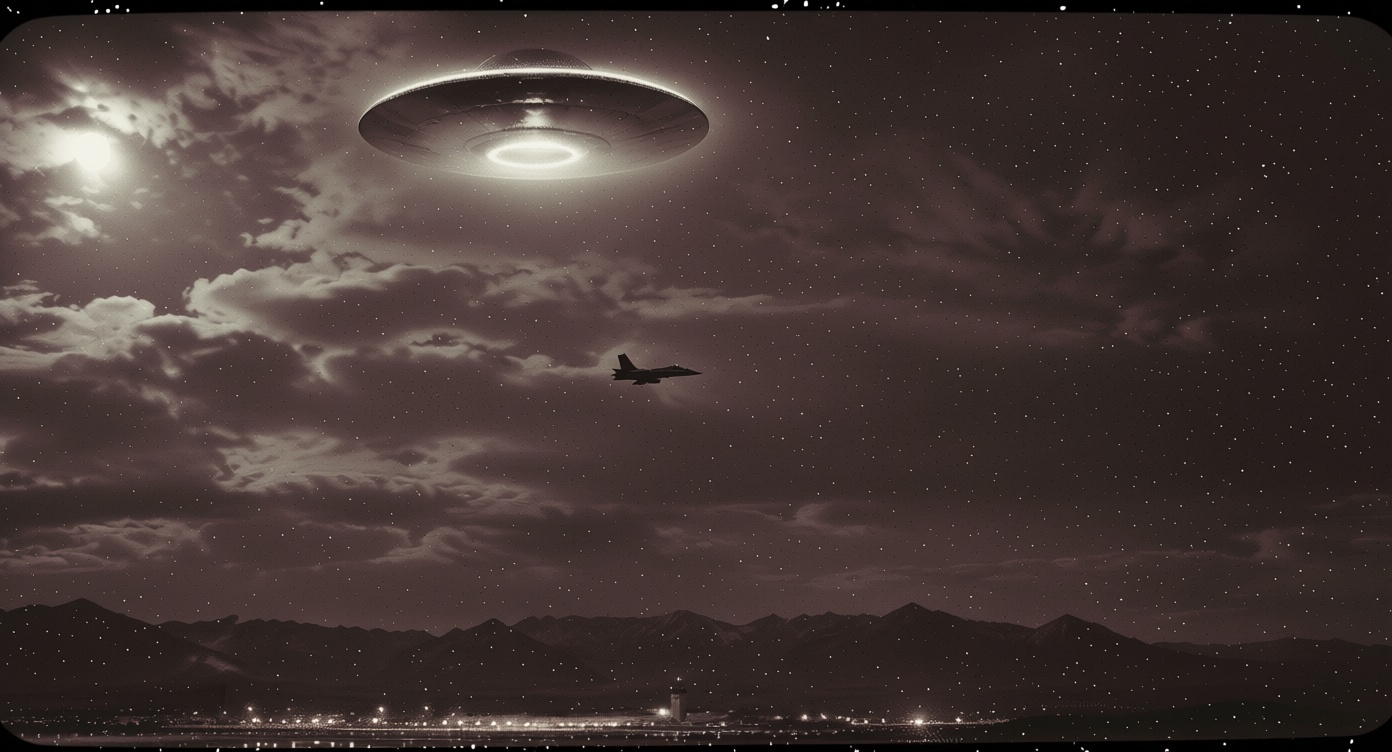
Why the Extraterrestrial Hypothesis Made the Cut
COMETA's authors didn't arrive at their conclusion casually. The report methodically works through alternative explanations — secret military technology, disinformation campaigns, holographic projections, unknown natural phenomena — and finds each insufficient to account for the small subset of cases the French call "UAP D": incidents that resist explanation even after exhaustive investigation.
The committee estimated that roughly 5 percent of the aeronautical sightings they reviewed fell into this unexplained category — a small fraction, but one drawn from a pool of nearly 500 well-documented international cases. That, they argued, was enough to warrant taking the extraterrestrial hypothesis seriously as a working theory grounded in known physics, including magnetohydrodynamic propulsion concepts already under study in the U.S. and Britain.
A Pointed Message for Washington
Perhaps the most striking section of the report isn't about the phenomena themselves — it's about American secrecy. The committee directly criticized U.S. policy, citing regulations like JANAP 146 and Air Force Regulation 200-2, which historically criminalized unauthorized disclosure of UFO sightings by military and commercial pilots alike. The authors argued this "impressive repressive arsenal" had persisted since the 1950s and warned that ongoing opacity — particularly following the 1947 Roswell incident — undermines trust between allied nations and complicates any coordinated response to a phenomenon that, by the report's own admission, does not respect national borders.
The recommendations were concrete: expand SEPRA's staffing and budget, formalize sighting-reporting protocols for pilots and air traffic controllers, integrate UFO detection into civilian and military space surveillance systems, and open diplomatic channels — including through the European Union — to press the United States for greater transparency.
More than two decades later, the COMETA report remains one of the most detailed government-adjacent examinations of the UFO question ever published by a major Western nation — a reminder that the loudest calls for disclosure haven't always come from conspiracy theorists, but sometimes from the generals themselves.
About the Author
Samuel López is a Senior Legal Analyst, investigative journalist, and legal researcher with more than two decades of experience analyzing litigation, government disclosure practices, and complex regulatory controversies. His work draws on years spent parsing declassified records, agency reporting requirements, and cross-border policy disputes — the same investigative rigor he brings to unraveling documents like the COMETA report, where separating verified fact from speculation requires both legal precision and a reporter's skepticism.
Geschreven door peter om 00:13
Stuur door