Naar de inhoud

UFO'S of UAP'S, ASTRONOMIE, RUIMTEVAART, ARCHEOLOGIE, OUDHEIDKUNDE, SF-SNUFJES EN ANDERE ESOTERISCHE WETENSCHAPPEN - DE ALLERLAATSTE NIEUWTJES

UFO's of UAP'S in België en de rest van de wereld
akke.beakke.be
Ontdek de Fascinerende Wereld van UFO's en UAP's: Jouw Bron voor Onthullende Informatie! Ben jij ook gefascineerd door het onbekende? Wil je meer weten over UFO's en UAP's, niet alleen in België, maar over de hele wereld? Dan ben je op de juiste plek! België: Het Kloppend Hart van UFO-onderzoek In België is BUFON (Belgisch UFO-Netwerk) dé autoriteit op het gebied van UFO-onderzoek. Voor betrouwbare en objectieve informatie over deze intrigerende fenomenen, bezoek je zeker onze Facebook-pagina en deze blog. Maar dat is nog niet alles! Ontdek ook het Belgisch UFO-meldpunt en Caelestia, twee organisaties die diepgaand onderzoek verrichten, al zijn ze soms kritisch of sceptisch. Nederland: Een Schat aan Informatie Voor onze Nederlandse buren is er de schitterende website www.ufowijzer.nl, beheerd door Paul Harmans. Deze site biedt een schat aan informatie en artikelen die je niet wilt missen! Internationaal: MUFON - De Wereldwijde Autoriteit Neem ook een kijkje bij MUFON (Mutual UFO Network Inc.), een gerenommeerde Amerikaanse UFO-vereniging met afdelingen in de VS en wereldwijd. MUFON is toegewijd aan de wetenschappelijke en analytische studie van het UFO-fenomeen, en hun maandelijkse tijdschrift, The MUFON UFO-Journal, is een must-read voor elke UFO-enthousiasteling. Bezoek hun website op www.mufon.com voor meer informatie. Samenwerking en Toekomstvisie Sinds 1 februari 2020 is Pieter niet alleen ex-president van BUFON, maar ook de voormalige nationale directeur van MUFON in Vlaanderen en Nederland. Dit creëert een sterke samenwerking met de Franse MUFON Reseau MUFON/EUROP, wat ons in staat stelt om nog meer waardevolle inzichten te delen. Let op: Nepprofielen en Nieuwe Groeperingen Pas op voor een nieuwe groepering die zich ook BUFON noemt, maar geen enkele connectie heeft met onze gevestigde organisatie. Hoewel zij de naam geregistreerd hebben, kunnen ze het rijke verleden en de expertise van onze groep niet evenaren. We wensen hen veel succes, maar we blijven de autoriteit in UFO-onderzoek! Blijf Op De Hoogte! Wil jij de laatste nieuwtjes over UFO's, ruimtevaart, archeologie, en meer? Volg ons dan en duik samen met ons in de fascinerende wereld van het onbekende! Sluit je aan bij de gemeenschap van nieuwsgierige geesten die net als jij verlangen naar antwoorden en avonturen in de sterren! Heb je vragen of wil je meer weten? Aarzel dan niet om contact met ons op te nemen! Samen ontrafelen we het mysterie van de lucht en daarbuiten.

Categorie: ARCHEOLOGIE ( E, Nl, Fr )

The Great Pyramid Has Endured for Millennia—Scientists Have Finally Decoded the Ancient Engineering Technology That Made It Possible

The Great Pyramid of Giza
(Image Credit: J. Bishop/Unsplash)

The Great Pyramid Has Endured for Millennia—Scientists Have Finally Decoded the Ancient Engineering Technology That Made It Possible

The Great Pyramid of Khufu, the largest and most impressive surviving monument from the ancient world, has long remained an enigma to scholars. One reason is its remarkable resistance to damage from events such as earthquakes, which has helped it endure for thousands of years without significant structural issues.

Now, researchers say they finally understand the ancient technological factors behind the pyramid’s resilience throughout time.

According to new research, the unique frequency at which the pyramid vibrates during earthquakes contrasts significantly with the sands of the Giza plateau on which it rests. This, a new study in Scientific Reports argues, along with the massive structure’s shape and internal design, has all played a part in helping ensure its longevity.

A Marvel of the Ancient World

Khufu’s Pyramid, often simply called the Great Pyramid, is the oldest of the Seven Wonders of the Ancient World and the sole surviving example. Scholars have maintained a fascination with Giza’s monumental megastructures since antiquity, and debate over the mystery of its construction continues into the present day.

Completed during Egypt’s Old Kingdom (2600–2450 BCE), the Great Pyramid raises a significant question about the structural qualities that have contributed to its longevity. Addressing this aspect of one of the greatest engineering feats of the ancient world, researchers Mohamed ELGabry and colleagues Ayman Hamed, Sakuji Yoshimura, Hesham M. Hussein, Mohamed Maklad, and Asem Salama now say a combination of factors, which include the internal features within the pyramid, all contribute to its success at surviving events that have damaged smaller, more structurally sophisticated monuments in Egypt.

Using Sound to Solve an Ancient Mystery

To help them determine the factors that contribute the most significantly to the longevity of Khufu’s Pyramid, the research team began with an ambient noise survey, which involved horizontal-to-vertical spectral ratio analysis at more than three dozen locations throughout the ancient structure, which included chambers within the pyramid, construction blocks, and adjacent soil.

Their approach was not only successful but also revealed surprising insights into the pyramid’s construction, the team says.

Among the most significant discoveries, the team says they found that the pyramid “exhibits uniform fundamental frequencies (2.0–2.6 Hz) with an average of ~ 2.3 Hz across all structural elements,” revealing an extraordinary consistency in terms of the structure’s dynamic characteristics.

Also important, they say, is that the frequency band the pyramid’s structural components exhibit contrasts sharply with the surrounding soil. This is important because it limits the amplification of resonance through interactions between the stone assembly of the structure and its surrounding soil, which the team identifies as “a key mechanism protecting the monument during seismic activity.

Finally, although the team identifies an increase in seismic amplification with respect to the structure’s height, they also found that it “diminishes substantially within the pressure-relieving chambers,” which they interpret as an indication of “how their geometry actively reduces seismic response.”

Ancient Earthquake Impact Reduction

As a final consideration, the team also examined the pyramid’s subsurface foundation, where they calculated the structure’s vulnerability to seismic events.

After determining a very low value, the team concludes that the pyramid’s foundation has an “excellent bearing capacity and minimal earthquake-induced risk,” noting that, in addition to the monument’s resilience over time, its unique structural properties will likely protect it from future damage.

“The low seismic vulnerability index estimated for the foundation soils suggests that any future earthquakes are likely to produce only limited damage to the main pyramid body,” the team reports in their study.

Arguably, the team’s most significant finding is that the pyramid’s ancient builders possessed an exceptionally advanced understanding of the engineering properties behind the stone used in its construction.

“These findings present compelling quantitative evidence that ancient Egyptian architects possessed profound geotechnical understanding, optimizing structure design and site characterization to assure millennial-scale stability against seismic hazards,” the team reports.

The recent study, “Architectural and geotechnical aspects affecting earthquake resilience for the antique Egyptian Khufu pyramid,” appeared in Scientific Reports on May 21, 2026.

  • Micah Hanks is the Editor-in-Chief and Co-Founder of The Debrief. A longtime reporter on science, defense, and technology with a focus on space and astronomy, he can be reached at micah@thedebrief.org. Follow him on X @MicahHanks, and at micahhanks.com.

Why the Great Pyramid Still Confuses Scientists 🏺 | Egypt’s Unsolved Mystery!

Even Modern Engineers Can't Explain This... (The Great Pyramid Mystery)

{ https://thedebrief.org/category/science/ }

Hoe vind je dit bericht?
Geschreven door peter om 22:44 Stuur door

How a 4,000-year-old city defied history's 'rules' by becoming more equal as it became more successful


The Secret of Mohenjo-Daro: Technology Too Advanced for the Ancient World

{ https://phys.org/earth-news/ }

Hoe vind je dit bericht?
Geschreven door peter om 20:10 Stuur door

Mount Roraima: Evidence of Ancient Cutting Technology?

Mount Roraima: Evidence of Ancient Cutting Technology?

A beautiful, wide-angle shot of the neighboring Kukenan tepui at sunset, showing the massive, seemingly

mariusalbertsen

Rising abruptly from the lush, untamed jungles of southeastern Venezuela, Mount Roraima is a geological behemoth that defies logic. With its perfectly flat plateau and sheer, vertical cliffs plunging thousands of feet into the mists below, it looks less like a natural mountain and more like a colossal, ancient fortress. For decades, alternative researchers and mystery enthusiasts have looked at these impossibly straight geological lines and asked a controversial question: could Mount Roraima be the result of artificial cuts? This massive tepui, surrounded by a harsh and isolated landscape, continues to capture the imagination of explorers and scientists alike.

The sheer scale of Mount Roraima is breathtaking, with its summit covering roughly 31 square kilometers (12 square miles) and its highest point reaching 2,810 meters (9,219 ft). The walls of the tepui are so remarkably vertical and smooth that they appear to have been sheared off by advanced machinery. This visual anomaly has fueled endless speculation about ancient, highly advanced civilizations or even extraterrestrial architects who may have terraformed the region in the distant past. However, distinguishing between the myths of ancient builders and the harsh realities of geological time requires a deeper look into both the stone and the people who live in its shadow.

A traveler sitting on the rocky, alien terrain of Mount Roraima's plateau

A traveler sitting on the rocky, alien terrain of Mount Roraima's plateau, looking out over the clouds and sheer cliffs. 

Pixabay Free/Emilio17

The Monolithic Mystery of the Tepuis

To understand the intense speculation surrounding Mount Roraima, one must first look at its baffling geography. The mountain is part of the Pacaraima chain, a series of tepuis, table-top mountains that dominate the Gran Sabana region. When clouds roll in, obscuring the base of the mountain, Mount Roraima appears to float in the sky like a solid island of rock. It is this otherworldly appearance that inspired Sir Arthur Conan Doyle's famous 1912 novel, "The Lost World." The stark 90-degree angles of the cliff faces look distinctly non-natural, leading many to draw comparisons to ancient megalithic structures like Stonehenge or the perfectly cut stones of Puma Punku.

A dramatic view of a tepui's vertical stone walls rising out of the mist

A dramatic view of a tepui's vertical stone walls rising out of the mist. Visually represents the "artificial cuts" debate.

 Pixabay Free/JohannaWallace

Proponents of the artificial cuts theory point to the immense, block-like formations that litter the plateau and the base of the cliffs. Some of these gigantic stone blocks appear uniformly rectangular, resembling quarried masonry on a scale far beyond human capability. Could a lost civilization have used advanced technology to mine this mountain for precious minerals? While this theory is incredibly compelling and makes for fantastic lore, modern science offers a different, yet equally fascinating, explanation for these supposedly artificial features.

Geological studies have consistently shown that the secret to Mount Roraima lies in the immense power of deep time. According to a comprehensive 2019 study by Sauro et al., the tepuis are composed of ancient Precambrian quartz arenite sandstones. Over millions of years, a unique weathering process known as "arenization" slowly dissolved the quartz. This relentless chemical and physical weathering, combined with massive structural collapses, naturally creates the sheer vertical walls and the giant, block-like sinkholes that mimic artificial cuts. Nature, given enough time, is the ultimate master mason.

Myth of the Tree of Life

While modern science attributes the shape of Mount Roraima to the slow dissolution of quartz sandstone, the indigenous peoples of the region have their own profound explanations. For the Pemon and Kapon tribes, who have inhabited the Circum-Mount Roraima landscape for centuries, the tepui is deeply woven into their cultural DNA. They do not see the mountain as an artificially cut quarry, but rather as the sacred remnants of a cosmic event. Anthropological research, including recent ethnographies by Riris et al. (2025), details the rich oral traditions that view Mount Roraima as the stump of the mighty "Tree of Life."

Blue-tinted ancient rock art showing human and animal figures.

Blue-tinted ancient rock art showing human and animal figures. Represents the region's indigenous presence and ancient myths. 

Pixabay Free/MikeGoad

According to local folklore, this colossal tree once bore all the fruits and vegetables of the world, providing endless sustenance for humanity. However, a legendary trickster figure named Makunaima chopped down the tree in a moment of greed or folly. The massive trunk crashed to the earth, unleashing a terrible flood, and the sheer, flat-topped stump that remained became Mount Roraima. This powerful myth beautifully explains the "cut" appearance of the tepui without the need for alien lasers or lost technological empires. It highlights a profound spiritual connection to the geological landscape.

The folklore surrounding Mount Roraima is not merely a collection of ancient bedtime stories; it is a vital part of indigenous identity. The mountain is considered sacred ground, heavily protected by spirits, and historically, scaling its walls was strictly forbidden. The mists that perpetually shroud the summit are said to be the smoke from the fires of the spirits. This deep-rooted reverence demonstrates how ancient humans naturally created complex, mythical frameworks to make sense of the awe-inspiring and intimidating geological anomalies of their environment.

A lush, dense tropical waterfall in the Venezuelan jungle

A lush, dense tropical waterfall in the Venezuelan jungle, representing the impenetrable Gran Sabana surrounding the tepuis.

Pixabay Free/Atlantios

Prehistoric Footprints in the Gran Sabana

While the theory of artificial cuts remains firmly in the realm of alternative history, there is undeniable evidence of ancient human presence in the shadow of Mount Roraima. Recent archaeological expeditions have begun to reveal that the seemingly impenetrable Canaima National Park complex was not entirely devoid of early human activity. Although the brutal environment makes the preservation of organic material difficult, researchers have found enduring marks left in stone. A 2026 study by García et al. documented the exciting discovery of new rock art sites and lithic tools in the region.

A wide landscape shot showing the massive scale of the tepui plateau rising above the savanna

A wide landscape shot showing the massive scale of the tepui plateau rising above the savanna.

(Pixabay Free/jplenio)

These recent findings provide a tangible link between the modern indigenous populations and their prehistoric ancestors. The newly discovered petroglyphs feature intricate geometric patterns, human figures, and representations of the diverse local fauna. The presence of these ancient artists suggests that the area around Mount Roraima has been a site of cultural significance for thousands of years. The lithic tools found nearby indicate that these ancient people were not just passing through, but were actively hunting, gathering, and surviving in this challenging environment.

A moody, dramatic shot of ancient stone monoliths under a stormy sky (Stonehenge style).

A moody, dramatic shot of ancient stone monoliths under a stormy sky (Stonehenge style). A thematic image to accompany the "ancient builders" or megalithic theories. 

Pixabay Free/ELG21

The discovery of prehistoric rock art adds a crucial layer of authenticity to the region's historical narrative. It shifts the focus from unsubstantiated claims of advanced ancient engineering to the very real, hard-fought survival of indigenous groups in South America. These ancient people did not need advanced machinery to leave their mark on the world. Their legacy is etched into the stone faces of the Gran Sabana, proving that the true magic of Mount Roraima lies not in hypothetical artificial cuts, but in the enduring relationship between the mountain and the humans who have revered it since antiquity.

Ultimately, Mount Roraima stands as a testament to the staggering power of geological forces and the boundless capacity of human imagination. Whether viewed as the petrified stump of the Tree of Life, a naturally sculpted masterpiece of quartz sandstone, or a canvas for prehistoric artists, it remains one of the Earth's most mesmerizing mysteries. While the vertical cliffs were carved by water and time rather than ancient saws, the true wonder of Mount Roraima is that it continues to inspire a profound sense of awe in everyone who gazes upon its towering walls.

  • Top Image: A beautiful, wide-angle shot of the neighboring Kukenan tepui at sunset, showing the massive, seemingly "cut" flat top and vertical walls glowing in golden light. Excellent representation of the tepui structure.
  • Source: Paolo Costa Baldi/CC BY-SA 3.0

By Marius Albertsen

FAQs

  • Is Mount Roraima artificially cut? No, the sheer vertical cliffs and flat top of Mount Roraima are the result of a natural geological process called arenization. Over millions of years, chemical and physical weathering dissolved the ancient quartz sandstone, causing massive structural collapses that created straight lines resembling artificial cuts.
  • What is the indigenous myth of Mount Roraima? The local Pemon and Kapon indigenous peoples believe Mount Roraima is the petrified stump of the legendary "Tree of Life." According to folklore, this massive tree once held all the fruits of the world before it was chopped down by a trickster spirit, leaving behind the flat-topped mountain.
  • Are there ancient archaeological sites near Mount Roraima? Yes, recent archaeological studies have uncovered prehistoric rock art, petroglyphs, and lithic (stone) tools in the Canaima National Park region surrounding the tepuis. These discoveries confirm that ancient humans lived and hunted in the shadow of Mount Roraima thousands of years ago.

References

RELATED VIDEOS

Mount Roraima – The Lost World Above the Clouds | Full 4K Cinematic Documentary | Sleep Story

Mount Roraima | The Real Lost World | Full Documentary | Exploring Venezuela


The Mountain That Looks Sliced in Half: Mount Roraima's Mysteries...

{ https://www.ancient-origins.net/news-history-archaeology }

Hoe vind je dit bericht?
Geschreven door peter om 23:07 Stuur door

260 Giant Monuments Found In Sahara Desert, Where A Dangerous New Gold Rush Is Heating Up

260 Giant Monuments Found In Sahara Desert, Where A Dangerous New Gold Rush Is Heating Up

By Tom Hale

260 giant monuments found in Sahara Desert, where a dangerous new gold ...

Satellite images of some Atbai Enclosure Burials, some of which have been recently vandalized. Image credit: Google Earth

While the Egyptian pharaohs were raising their pyramids above the sands of Giza, another culture was quietly burying its dead in grand monuments just across the desert. For thousands of years, these landmarks have lain in obscurity in one of the most punishing landscapes on Earth, but new research is finally bringing them to light.

An international team of archaeologists has uncovered 260 previously undocumented structures deep in the Eastern Desert, the corridor of the Sahara wedged between the Nile River and the Red Sea in eastern Sudan. They found them not by trekking through the brutal terrain of endless dunes, but by searching through vast troves of satellite imagery.

The structures consist of circular mass graves, some up to 80 meters (262 feet) in diameter, filled with the skeletal remains of people and animals, such as cattle, sheep, and goats. Many are ringed by a low outer wall, with a single individual laid to rest at the very center of the ring.

Since the structures haven’t yet been closely investigated by archaeologists with boots on the ground, precise details, like when they were built, are not immediately obvious. However, thanks to strikingly similar structures excavated over the past century, known as Atbai Enclosure Burials, the researchers believe they were constructed around 4,500 to 6,500 years ago.

Just like the other Atbai Enclosure Burials, the people buried here were likely nomadic pastoralists who herded livestock across the region. It's no coincidence, then, that most of the monuments are located close to ancient watering holes, dried-up riverbeds, and oases.

They were made at a time when the Sahara was undergoing a dramatic shake-up. The Sahara is locked in a cyclic rhythm, swinging between arid desert and lush savanna roughly every 21,000 years. The last of these "Green Sahara" periods was between roughly 15,000 and 5,000 years ago, precisely the era when these monument-builders thrived.

As the green pastures receded and the sands advanced, this culture appears to have vanished. And it wouldn't be the last time this happened. In the Ténéré Desert, another remote corner of the Sahara, another troop of archaeologists have uncovered a deeply mysterious site known as Gobero, consisting of 200 human skeletons, as well as thousands of artifacts. Once again, this site appears to have been abandoned when aridification swept through the Sahara around 5,000 years ago.

The Sahara may look lifeless today, but these sites are proof that it was once a thriving stage for countless human cultures whose stories we are only beginning to recover.

Which is exactly why the researchers are sounding the alarm. The Eastern Desert is currently in the grip of a new gold rush, drawing people, money, and guns deep into the once-empty region. The study found that at least 12 of the ancient structures had already been damaged by mining activity and vandalism. As the lust for gold heats up, the destruction is only set to worsen.

RELATED VIDEOS
6000 Year Old City Found Buried in Sahara Desert | Lost Civilization | Mystery World News #shorts

Lost Sahara City Found The Ancient Warning Nobody

Sahara Sand Mystery — The Buried Civilization Beneath The Desert | Buried Secrets

{ https://www.newsbreak.com/ }

Hoe vind je dit bericht?
Geschreven door peter om 21:44 Stuur door

Hall of Records theories explode as CIA doc mentioning 'temple under Sphinx' found

Hall of Records theories explode as CIA doc mentioning 'temple under Sphinx' found

The location of an ancient library believed to lie beneath Egypt's Great Sphinx has long been one of archaeology's greatest mysteries.

Now, a resurfaced CIA document from 1952 is reigniting speculation surrounding the legendary Hall of Records after a cryptic reference to a 'temple under Sphinx' was found inside a Cold War-era photographic inventory.

The Hall of Records legend has fascinated the public for nearly a century, with some claiming the mythical archive contains ancient texts, maps and evidence of a lost civilization that predated recorded history. 

The 10-page CIA file, dated November 20, 1952, is titled 'Presentation Form for Graphic Material' and appears to catalog 11 rolls of black-and-white photographic negatives taken between July and December 1950.

Rather than an intelligence briefing, the document appears to be a simple archival inventory. 

But believers say the phrase 'Temple under Sphinx' stands out because it is not a standard archaeological description commonly used today.

One X user posted: 'So the CIA knows about the temple UNDER THE SPHINX. Still want to call BS on the Hall of Records?'

While no hidden temple has ever been confirmed beneath the Great Sphinx, archaeologists have long known about the ancient Sphinx Temple, a structure located directly in front of the monument on the Giza Plateau. 

A resurfaced CIA document from 1952 is reigniting speculation surrounding the legendary Hall of Records after a cryptic reference to a 'temple under Sphinx' was found inside a Cold War-era photographic inventory

A resurfaced CIA document from 1952 is reigniting speculation surrounding the legendary Hall of Records after a cryptic reference to a 'temple under Sphinx' was found inside a Cold War-era photographic inventory

Much of the modern myth traces back to American clairvoyant Edgar Cayce, who predicted in the 1930s that a hidden chamber containing records from Atlantis would one day be discovered beneath the Sphinx's paw. 

According to Cayce, the hidden archive supposedly contained texts detailing humanity's forgotten history, advanced science and catastrophic events that destroyed earlier civilizations. He predicted the chamber would one day be discovered, fueling decades of speculation and expeditions around the monument.

Interest intensified in the 1990s after seismic studies and ground-penetrating radar detected underground cavities and anomalies near the Sphinx. 

Japanese researchers from Waseda University and later American teams identified unusual voids beneath the Giza Plateau, though mainstream archaeologists disputed claims that they were artificial chambers. 

Famed Egyptologist Zahi Hawass has consistently denied the existence of a Hall of Records, saying: 'The Sphinx has been thoroughly excavated. My friend and colleague, Mark Lehner, and I investigated it ourselves in 1979. Nothing like a Hall of Records has been found in or near the Sphinx.'

He also admitted that researchers have asked him for permission to excavate under the Sphinx, to which he refused, saying, 'it did not make sense,' adding that he found evidence that underneath the left paw is nothing but solid rock.

However, the circulating CIA reference has sent conspiracy forums and ancient history communities into overdrive, with many asking the same question: Did the agency stumble across something beneath the Sphinx more than 70 years ago?

'Of course, there's more to those sights than they let on. The Book of Thoth is rumored to be underneath the Sphinx,' another person shared on Reddit. 

The the hidden archive, speculated to be hidden below the Great Sphinx, supposedly contained texts detailing humanity's forgotten history, advanced science and catastrophic events that destroyed earlier civilizations.

The the hidden archive, speculated to be hidden below the Great Sphinx, supposedly contained texts detailing humanity's forgotten history, advanced science and catastrophic events that destroyed earlier civilizations.

The Book of Thoth is a significant element of Egyptian mythology, centering around the quest of Nefer-ka-ptah, a prince of Egypt, who seeks a sacred text attributed to Thoth, the god of wisdom. 

Legend has it that the Book of Thoth is supposedly hidden inside the legendary Hall of Records beneath the Great Sphinx of Giza. 

The material in the document was being forwarded to CIA headquarters for archival purposes, with the first page warning that the nitrate film was explosive and required special handling during shipment.

The document largely focuses on Afghanistan, cataloging hundreds of images tied to archaeological digs, cave excavations, local villages, bazaars, infrastructure projects and geological surveys. 

But buried among ordinary entries such as 'Tourist at Pyramids,' 'Sphinx' and 'Ruins near Sphinx' is the phrase that has now captured the internet's imagination: 'Temple under Sphinx; July '50.' 

However, one brief line buried within the file has captured the imagination of conspiracy theorists online.


Ancient City Discovered Beneath the Sphinx: Shocking New Findings | WION Podcast

{ https://www.dailymail.com/sciencetech/index.html }

Hoe vind je dit bericht?
Geschreven door peter om 01:06 Stuur door

Study Argues Dante's Inferno Mapped a Planetary Impact 500 Years Before Science

Study Argues Dante's Inferno Mapped a Planetary Impact 500 Years Before Science

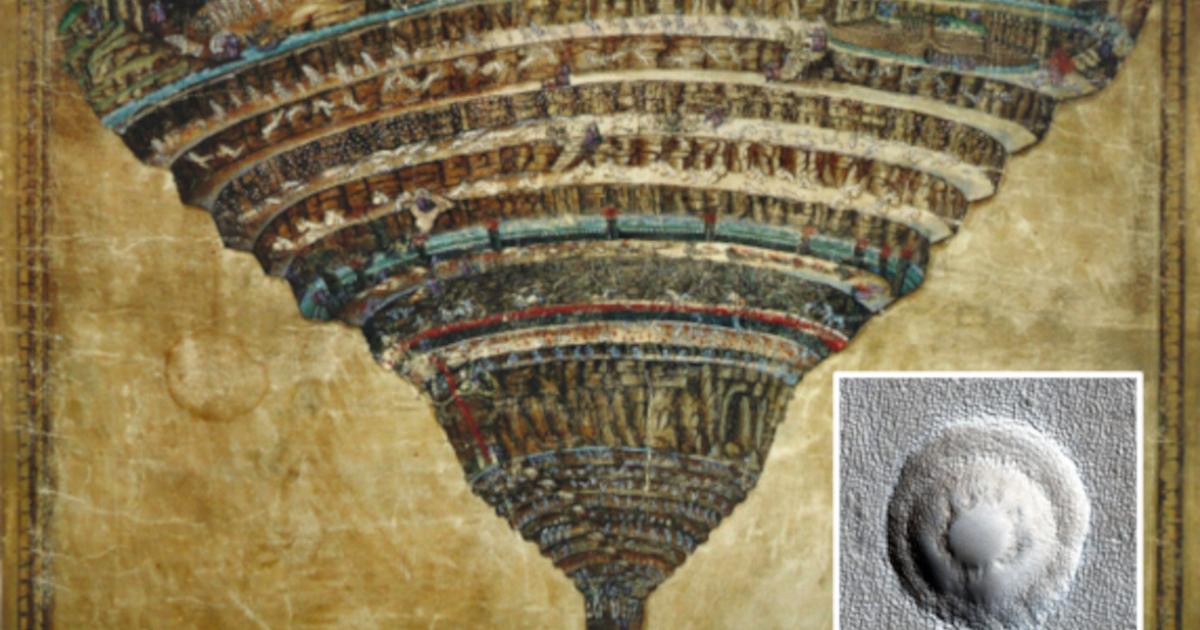
Botticelli's Map of Hell (c. 1480–1495), a detailed diagram of Dante's Inferno showing the funnel-shaped pit of Hell

Dante's Inferno Mapped a Planetary Impact 500 Years Before Science

A new study presented at the European Geosciences Union (EGU) General Assembly in Vienna in April 2026 has put forward a striking argument: that the geometry of Hell as described in Dante Alighieri's Inferno closely mirrors the physical structure produced by a large planetary impact event. The research, led by Dr. Iain Stewart of the University of Plymouth, suggests that the medieval poet may have encoded real geophysical knowledge into his 14th-century masterwork, some five centuries before modern science had the tools to describe such phenomena.

Hell's Geometry and the Science of Craters

Dante's Inferno describes Hell as a vast, inverted conical pit beneath the Earth's surface, narrowing downward through nine concentric circles toward a frozen core. According to the study, this geometry matches what planetary scientists now call a "complex impact crater", the type formed when a massive asteroid strikes with enough force to cause rock to behave like a fluid. Such craters are characterized by terraced inner walls, a central uplift, and a broad, relatively flat floor, features that map with surprising fidelity onto Dante's layered underworld.

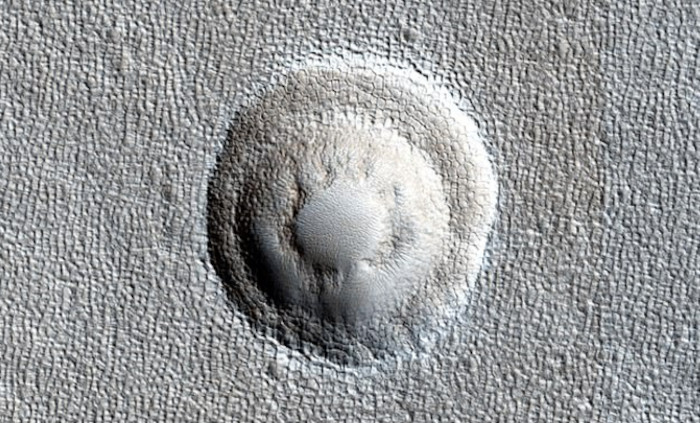
terraced ridges of large meteor strikes seen on Mars, such as this impact crater on the Arcadia Planitia.

According to the study, the nine circles of hell are remarkably similar to the terraced ridges of large meteor strikes seen on Mars, such as this impact crater on the Arcadia Planitia.

(NASA/JPL-Caltech/Univ of Arizona)

The researchers note that Dante was deeply engaged with the natural philosophy of his day, drawing on Aristotle and the Arabic scholars who transmitted classical learning to medieval Europe. What the new research proposes is that this model, consciously or not, captured the essential morphology of a large impact structure, a description that would not be formally articulated by geologists for another five hundred years.

Artist's impression of the Chicxulub impact event

Artist's impression of the Chicxulub impact event, which produced a complex crater whose structure parallels Dante's description of Hell. (Donald E. Davis / NASA / Public Domain)

The Chicxulub Connection

The researchers draw particular attention to the Chicxulub impact crater, the 66-million-year-old scar left beneath the Gulf of Mexico by the asteroid that ended the age of the dinosaurs. Chicxulub is one of the best-studied complex impact craters on Earth, and its internal structure — with its peak ring, terraced walls, and central basin — provides a real-world analogue for the geometry Dante described. The study does not claim Dante had direct knowledge of Chicxulub, but argues that the physical intuitions embedded in classical natural philosophy led him to a geometrically accurate model of what a large impact structure looks like.

The scale of Dante's Hell (roughly the size of the Mediterranean basin) is consistent with the scale of a very large terrestrial impact structure, though the authors acknowledge this may be coincidence rather than evidence of direct knowledge. As Heritage Daily noted in its coverage, the study "raises the intriguing possibility that Dante's vision of Hell was not purely theological but also reflected an intuitive grasp of planetary physics."

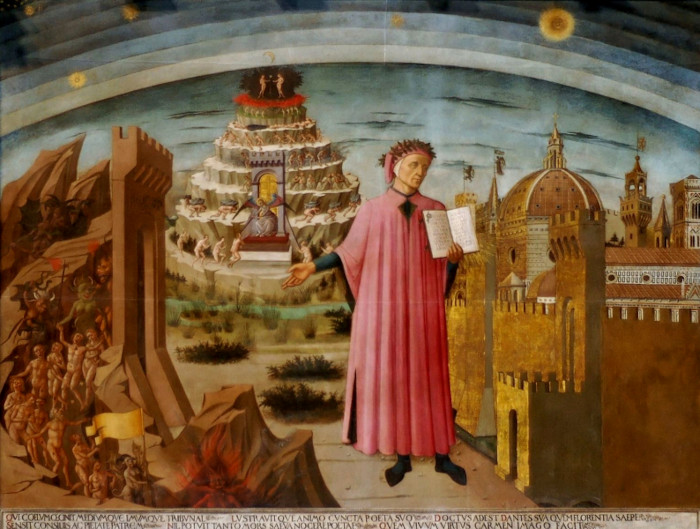
Domenico di Michelino's 1465 painting of Dante Alighieri holding the Divine Comedy, with the mountain of Purgatory and the city of Florence behind him.

Domenico di Michelino's 1465 painting of Dante Alighieri holding the Divine Comedy, with the mountain of Purgatory and the city of Florence behind him. (Public Domain)

A Poet Ahead of His Time?

This is not the first time scholars have looked to ancient and medieval texts for evidence of sophisticated natural knowledge. Researchers have previously argued that ancient peoples at sites such as Göbekli Tepe were tracking cometary activity, and that myths from many cultures preserve memories of catastrophic impact events. The new Dante study fits into this broader tradition of "archaeo-geophysics" — the search for scientific knowledge embedded in pre-modern cultural artefacts.

Dr. Stewart presented the findings at the EGU General Assembly, one of the world's largest gatherings of earth and planetary scientists. The work has not yet been published in a peer-reviewed journal, and the authors acknowledge that their hypothesis remains speculative. What they do argue is that Dante's extraordinary spatial imagination, combined with the physical intuitions of classical philosophy, produced a description of Hell that corresponds closely to the structure of a large impact crater - making the Divine Comedy a work that may be as remarkable for its science as for its poetry.

  • Top image: Botticelli's Map of Hell (c. 1480–1495), a detailed diagram of Dante's Inferno showing the funnel-shaped pit of Hell.
  • Source: Public Domain

By Gary Manners

References

{ https://www.ancient-origins.net/news-history-archaeology }

Hoe vind je dit bericht?
Geschreven door peter om 23:37 Stuur door

Archaeologists reveal wooden secret beneath ancient stone island

Archaeologists reveal wooden secret beneath ancient stone island

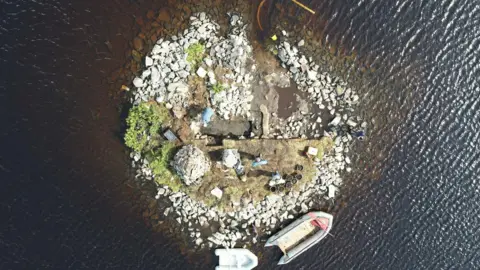
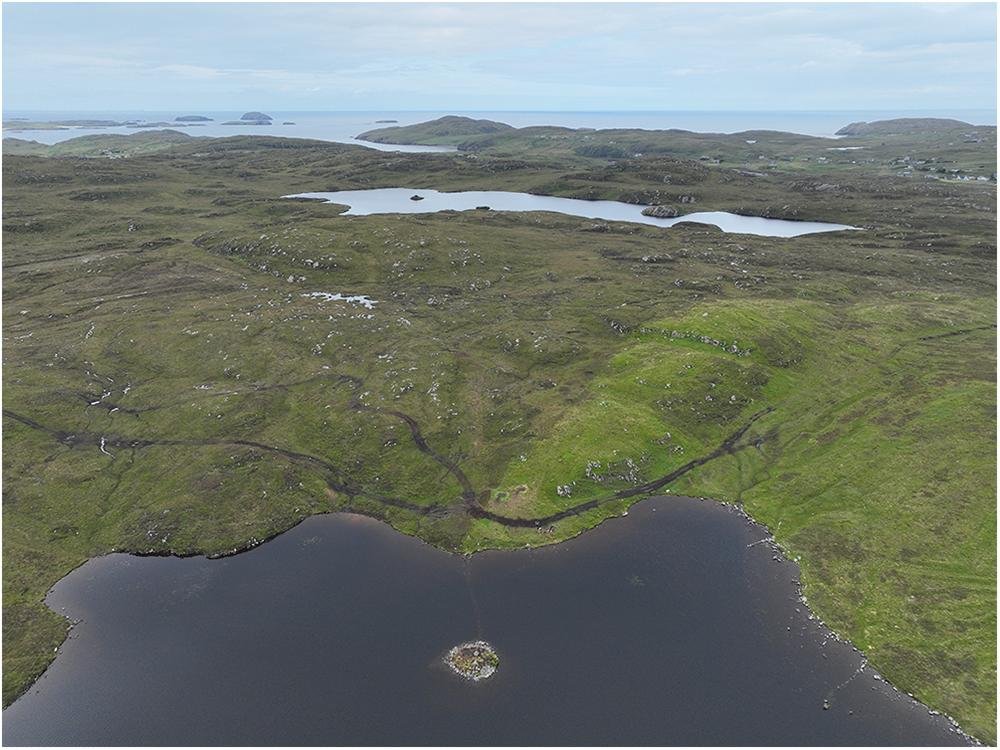
PA Media An artificial island built from large white stones in a Scottish loch - captured from above

PA Media
From above, the island - or crannog - looks like it is made from stone

An ancient artificial island in a loch on the Isle of Lewis was built entirely on a wooden platform, archaeologists have discovered.

From above, the Neolithic island - or crannog - in Loch Bhorgastail appears to be made of stone, though it was known that there was some timber underneath it.

5,000-year-old artificial island hidden in Scottish loch predates Stonehenge

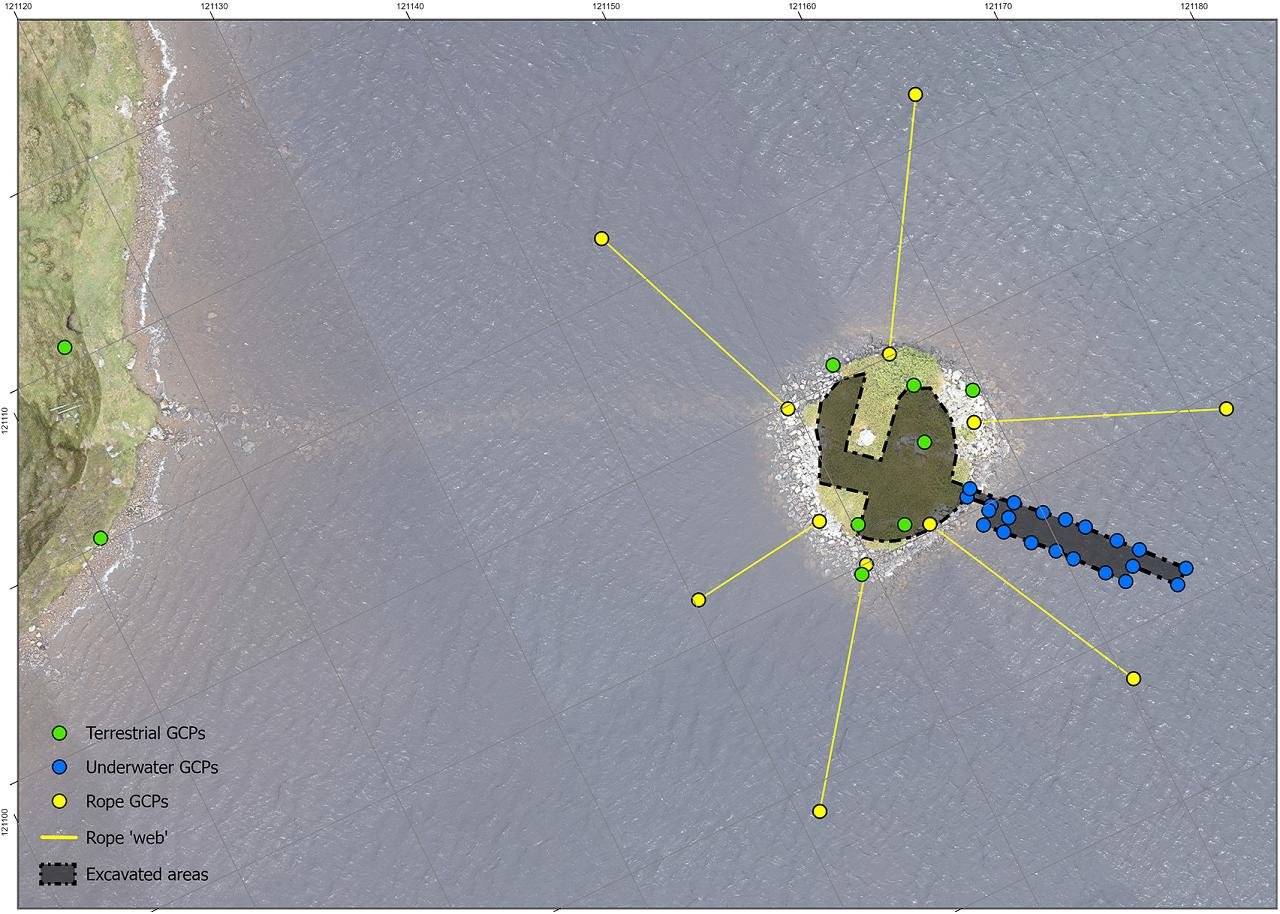
Ground control points used for UAS and underwater surveys at Loch Bhorgastail, showing the distribution of terrestrial, underwater, and rope-mounted control points across the land–water interface.

Credit: Blankshein et al., Advances in Archaeological Practice (2026)

Archaeologists reveal secrets of prehistoric human-made island

The crannog at Loch Bhorgastail.

Credit: University of Southampton

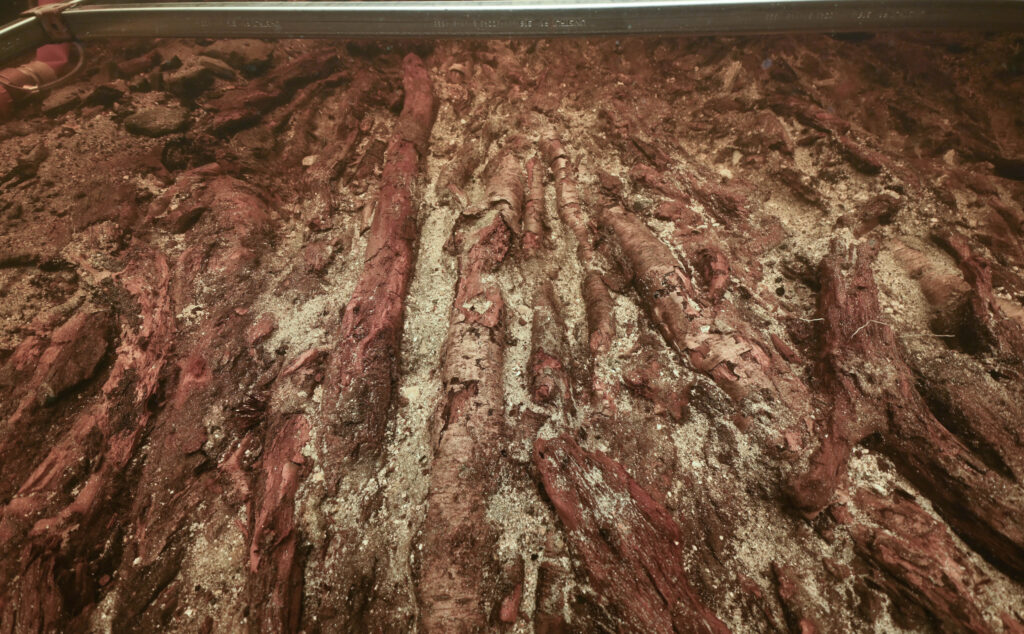
However, researchers from the University of Southampton carried out an excavation and have revealed that wood was used to support the whole structure.

The group dated their findings between 3500 and 3300 BC - around the early Bronze Age - and said the technique would have been used at other nearby sites throughout the Outer Hebrides.

5,000-year-old artificial island hidden in Scottish loch predates Stonehenge

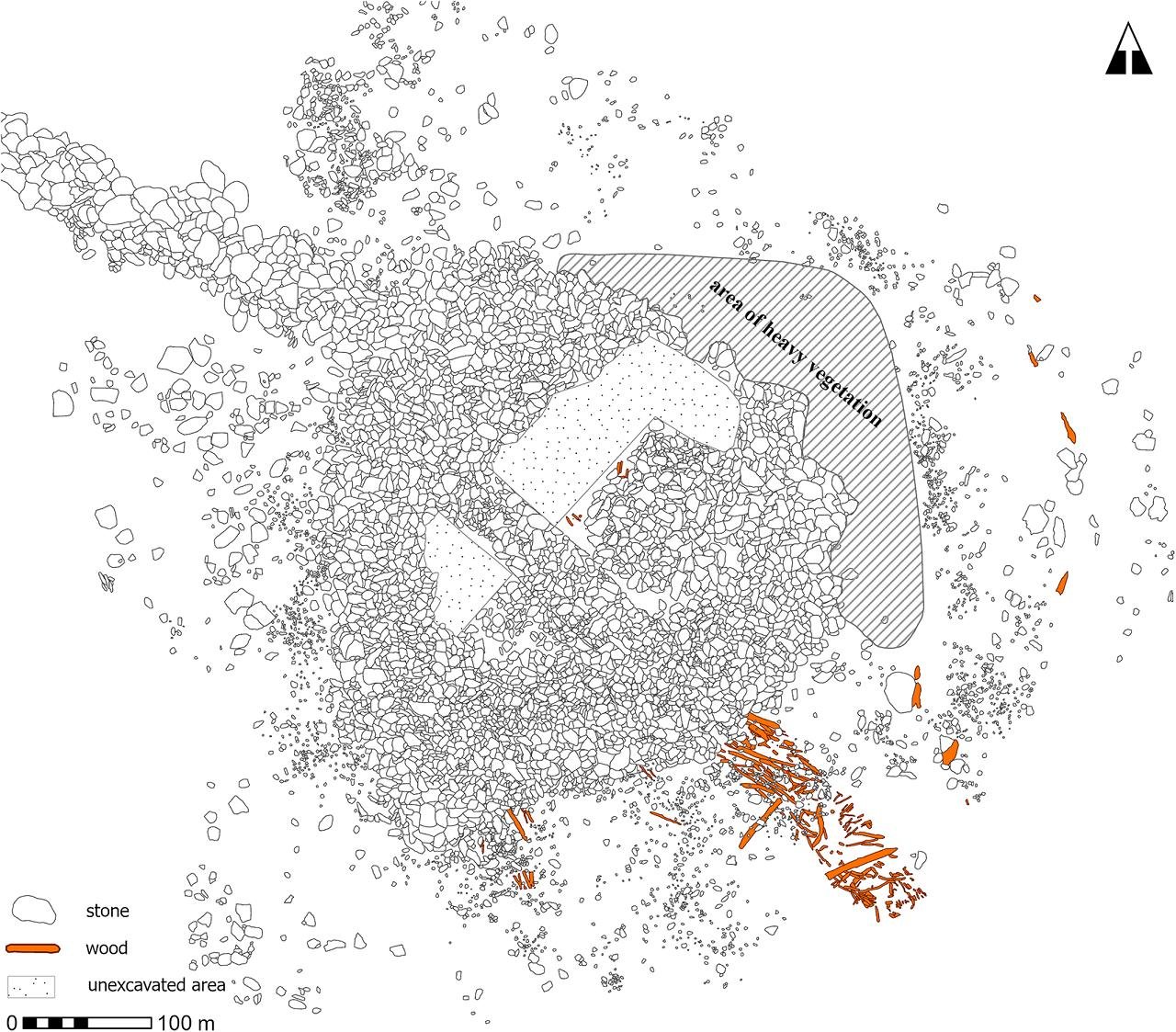
Plan view of stone and timber elements above and below the waterline, digitized from multiple integrated photogrammetry survey datasets.

Credit: Blankshein et al., Advances in Archaeological Practice (2026)

University of Southampton archaeologist, Dr Stephanie Blankshein, said: "When we actually started excavating is when we realised that it was actually this coherent, quite large timber structure that was under what you would see as the stone island today.

"While we still don't know exactly why these islands were built, the resources and labour required to construct them suggests not only complex communities capable of such feats, but also the great significance of these sites."

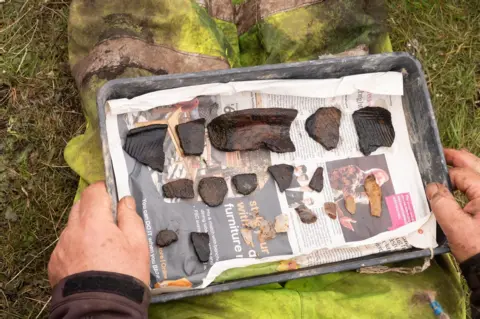
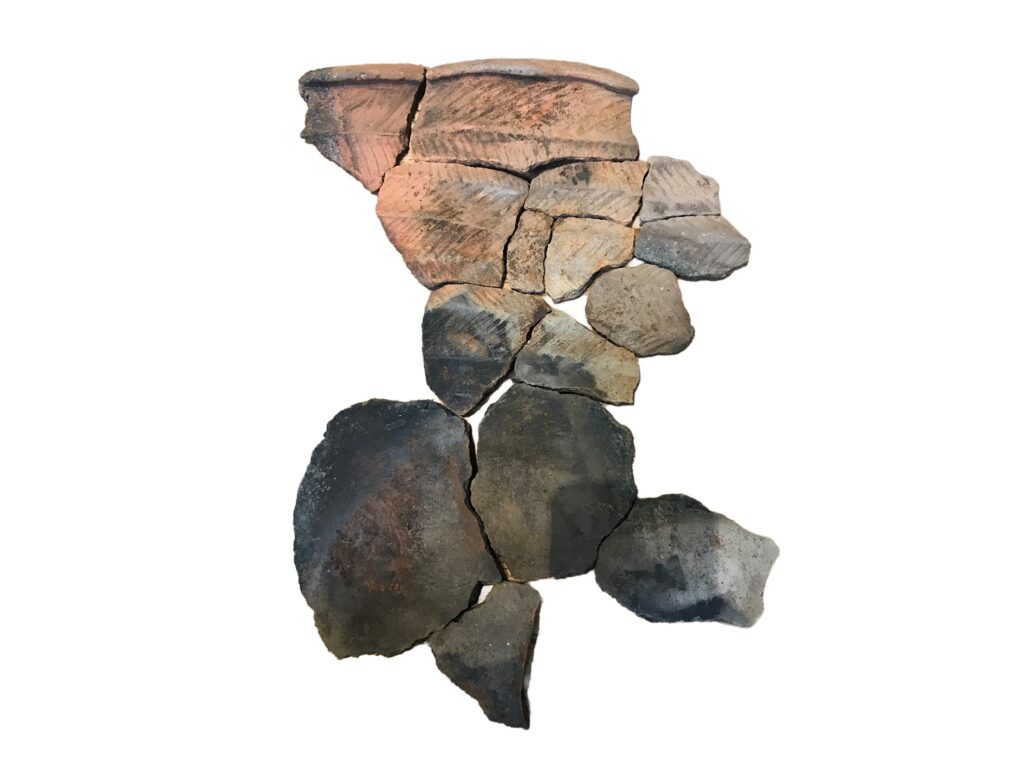
As well as the layered wood and brushwood construction under the stone, archaeologists found hundreds of pieces of Neolithic pottery in the surrounding water.

PA Media A pair of hands holds a tray containing broken pieces of ancient pottery

Crannogs are small artificial islands that are typically thousands of years old, and hundreds of them exist in Scotland's lochs.

The site in Loch Bhorgastail was first discovered in 2009.

Through fieldwork carried out since 2021, the archaeologists have revealed the different stages of development of the crannog.

They discovered that it was first established more than 5,000 years ago and started out as a circular wooden platform, around 23m (75ft) across, topped with brushwood.

Around 2,000 years later in the Middle Bronze Age, another layer of brushwood and stone were added, with more activity around 1,000 years after that during the Iron Age.

A stone causeway, now underwater, leads from the loch shore to the island.

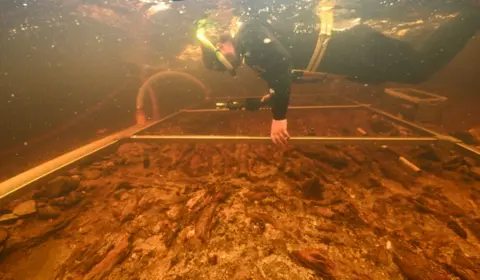
PA Media A diver floating in shallow water, holding what appears to be a metal frame just over the water bed. The diver appears to be examining a wooden platform nestled in the rocky, sandy bed.
PA Media
Archaeologists found that the whole island was built on a wooden platform

As part of the fieldwork, the researchers created images of how the island looks above and below the water line using the science of photogrammetry.

This is when photographs of the subject are taken from multiple different angles and then "stitched" together by specialist software to create a high resolution digital model.

5,000-year-old artificial island hidden in Scottish loch predates Stonehenge

Aerial view of the Loch Bhorgastail crannog, illustrating the site context and land–water interface in which integrated terrestrial and underwater survey methods are applied.

Credit: Blankshein et al., Advances in Archaeological Practice (2026)

Carrying out photogrammetry in shallow water, such as that around the crannog, poses difficulties so the archaeologists created a new technique for doing so during their fieldwork.

They used two small waterproof cameras – with low-light performance and a wide-field of view.

These were locked at a set distance apart on a frame, providing precise overlapping of imagery, to help compensate for any missing or disrupted data.

The cameras were manoeuvred through the water by a diver with positioning controlled to centimetre accuracy, which is said to match that achieved by an aerial drone.

The-crannogs-timber-platform-below-the-waterline-1024x634.jpg

The crannog’s timber platform below the waterline.

Credit: University of Southampton

Fragments of a Neolithic pot found near the crannog. Credit: University of Southampton

Fragments of a Neolithic pot found near the crannog.

Credit: University of Southampton

Their technique is described in a newly published article in the journal Advances in Archaeological Practice.

The images were created alongside experts from the University of Reading.

RELATED 

Drone Footage of Wales | Craig Goch Dam & Snowdonia Landscapes | Cinematic 4K

{ https://www.bbc.com/news }

Hoe vind je dit bericht?
Geschreven door peter om 20:50 Stuur door

Great Pyramid Construction Theory Reveals New Link to Mysterious “Void” Within Egypt’s Largest Ancient Megastructure

The Great Pyramid of Giza

Great Pyramid Construction Theory Reveals New Link to Mysterious “Void” Within Egypt’s Largest Ancient Megastructure

Recent research into how the Great Pyramid of Giza was built may offer new clues about a mysterious void discovered within Egypt’s largest monument.

Also known as Khufu’s Pyramid, the structure is both the oldest of the Seven Wonders of the Ancient World and the only one to have remained standing for thousands of years. Equally intriguing is the mystery of its construction, which has also remained a matter of debate for millennia, making it one of archaeology’s longest-running controversies.

However, a new study published in npj Heritage Science argues that the famous ancient megastructure may have been built using a special ramp employing a helical path, which would have been constructed into the face of the pyramid itself.

The new theory was developed by independent Spanish researcher Vicente Luis Rosell Roig, based on computational models that employed mathematical simulation. The resulting theory, which Roig characterizes as the Integrated Edge-Ramp (IER) model, considers factors such as the weight of individual limestone blocks used in the Great Pyramid’s construction and limitations imposed by the structural systems that could have facilitated their placement.

Great Pyramid Egypt’s Great Pyramid of Giza (Image Credit: Dieter Van Hammée/Unsplash)

In addition to offering mathematical support for a working ramp system that feasibly could have been used for the construction of the Great Pyramid, Roig says his findings appear to align with past detections of a large cavity and other anomalies within the structure, suggesting the existence of this “void” may be related to the monument’s structural stages.

A Novel Theory of Pyramid Construction

One of the fundamental problems Roig identified with past theories involving a singular ramp for the Great Pyramid’s construction was the large amount of material that would have been left behind, for which there is virtually no archaeological evidence.

To account for the absence of evidence for an external ramp, Roig considered the possibility that a ramp had been built into the structure itself and later filled in as the monument neared completion.

Based on the period spanning Khufu’s 27-year reign, Roig also calculated that a monument assembled from an estimated 2.3 million limestone and granite blocks would have required an average of one block being placed roughly every one to three minutes—a daunting task, even by today’s engineering standards.

According to Roig, using a single ramp to construct the Great Pyramid would have taken at least half a century. By comparison, an Integrated Edge-Ramp model of construction could have incorporated multiple ramps—perhaps as many as sixteen—which could have facilitated primary construction of the Great Pyramid in under 14 years.

However, quarrying the stone, transporting it, and accounting for seasonal periods of inactivity would extend that to 20-27 years, which Roig still found to be a good match for the historical information available on the construction of Khufu’s pyramid.

A Two-Way Ramp System

Based on Roig’s Integrated Edge-Ramp model, a ramp slightly narrower than four meters would have allowed for two-way movement along the face of the structure, including sleds, which the pyramid’s builders would have relied on to help move the massive blocks toward their destination, as well as empty sleds being returned for the next load.

Great Pyramid

A computer rendering showing possible implementation of a helical ramp system for pyramid construction (Image Credit: Rosell Roig, V. L. (2026). A computational framework for evaluating an edge-integrated, multi-ramp construction model of the Great Pyramid of Giza. Npj Heritage Science, 14(1), 142. https://doi.org/10.1038/s40494-026-02405-x).

However, Roig notes that 90° turns, which would have been required at locations where the ramp rounded corners on the structure, would present “operational bottlenecks.” To overcome this, he suggests that platforms would have been required in these locations “as operational buffers where teams can pass and execute pivots safely, with minimal impact on the construction sequence,” and that these could be removed, like the ramp itself, as construction progressed.

Overall, Roig found that this method of construction would meet structural engineering standards for stress distribution and that it would not have resulted in dangerous stress levels in any part of the monument during the building phase.

New Support for the Great Pyramid “Void”?

Intriguingly, Roig’s study also revealed a surprise: the IER model he proposes may support past muon tomography studies conducted by the ScanPyramids mission, which found apparent structural spaces within the pyramid.

Between 2016 and 2017, the research, led by Cairo University in collaboration with the French Heritage Innovation Preservation Institute, identified a large “void” within the Great Pyramid, along with several other smaller internal features.

Roig says that, based on the IER model’s predicted path, the ancient helical ramp he suggests the Great Pyramid’s builders used aligns well with the locations of the cavities ScanPyramids identified.

ScanPyramids Cross-sectional rendering of the Great Pyramid showing the location of the “void” area identified by ScanPyramids in 2017 (Image Credit: S. Procureur, et al/https://www.nature.com/articles/s41467-023-36351-0/CC 4.0)

“The alignment is compatible with density anomalies from backfilled construction infrastructure,” Roig writes, though noting that “alternative explanations remain viable at present resolution.”

“Non-detection of internal spirals or specific helical voids must be interpreted within method sensitivity and coverage limits,” he adds, emphasizing that “current data neither confirm nor exclude edge-integrated backfill.”

Fundamentally, Roig concludes that while other possible construction methods cannot yet be ruled out, the helical approach he examined would have offered several benefits.

“While a single ramp shows baseline feasibility, meeting Khufu’s reign requires parallelizing a multi-ramp system,” Roig writes, adding that “The multi-ramp system offers qualitative advantages within Old Kingdom constraints.”

Roig’s recent study, “A computational framework for evaluating an edge-integrated, multi-ramp construction model of the Great Pyramid of Giza,” appeared in npj Heritage Science.

  • Micah Hanks is the Editor-in-Chief and Co-Founder of The Debrief. A longtime reporter on science, defense, and technology with a focus on space and astronomy, he can be reached at micah@thedebrief.org. Follow him on X @MicahHanks, and at micahhanks.com.

{ https://thedebrief.org/category/science/ }

Hoe vind je dit bericht?
Geschreven door peter om 22:48 Stuur door

Mysterious Egyptian Tablet: Terrestrial or Extraterrestrial?

Mysterious Egyptian Tablet: Terrestrial or Extraterrestrial?

Enhanced image of the stone tablet designated as the offering table of Defdji.

By mainstream archaeologists’ assessment, this intricately carved slab of stone is designated the ‘offering table for Defdji’ and is simply a rather elaborate offering table. However, to others it bears an uncanny resemblance to an aircraft control panel, complete with what appear to be buttons, dials, and gauges.

This striking similarity has propelled the carved stone into the center of the "forbidden archaeology" movement. Enthusiasts of ancient astronaut theories argue that this incredible object is evidence of advanced, forgotten technologies or extraterrestrial contact in the distant past. However, mainstream archaeologists offer a vastly different, yet equally fascinating, explanation rooted in the complex spiritual beliefs of the Old Kingdom. As we dive into the origins and purpose of this peculiar stone board, we must navigate the line between modern imagination and historical reality. What exactly is this artifact, and why does it look like it belongs in the cockpit of a modern jet?

A clear unenhanced photo of the stone tablet designated as the offering table of Defdji,

A clear unenhanced photo of the stone tablet designated as the offering table of Defdji, held at Rijksmuseum Van Oudhaden, Leiden, Netherlands.

(National Museum of Antiquities, Leiden/CC0)

Discovery of the Mysterious Egyptian Tablet

The objects origin is listed as Egypt, with the precise origin ‘Unknown’. When examining the mysterious Egyptian tablet, the immediate visual impact is undeniable and completely mesmerizing. Carved from a solid, flawless block of high-quality alabaster, the artifact measures approximately 0.5 meters (1.6 ft) in length and 0.3 meters (1.0 ft) in width. Unlike the typical flat offering tables found in many ancient tombs, this stone features a highly complex, three-dimensional surface. It is covered in a series of perfectly smooth circular depressions, raised nodes, and grooved channels that intersect at precise geometric angles.

Unlike the majority of ancient Egyptian offering tables, which are typically rectangular, the table of Defdji is notable for its rare circular shape. It is carved from a single, thick block of white alabaster (calcite), a material highly prized in ancient Egypt for its luminous quality and association with purity. The artifact measures 49 centimeters (19.3 inches) in diameter and is exceptionally thick at 13 centimeters (5.1 inches)

The layout of the carvings is what fuels the endless speculation about their true nature and origin. The overall design gives an impression of the dials and gauges found on an aviator's dashboard or a modern machine interface. Below these "dials" are raised rectangular shapes that look exactly like physical switches or levers waiting to be toggled by a human hand. The precision of the stonemasonry is so exact that it seems almost machine-made, an incredibly impressive feat for artisans working around 2400 BC.

For decades, photographs of the artifact have circulated widely in fringe science and alternative history communities, often stripped of their vital archaeological context. Without its historical background, the stone easily transforms into a piece of ancient high-tech machinery in the minds of modern viewers. Observers frequently note that the ergonomic spacing of the "buttons" would perfectly fit a human hand, further fueling the idea that this was a highly functional console. It is this tantalizing blend of geometric precision and seemingly inexplicable design that keeps the mystery of the tablet alive today.

A rectanglualr offering table, with 4 basins for liquids, and a hetep and hieroglyphs.

Most offerings tables are rectangular like this one, which has 4 bowls for oils and the shape of the hetep carved (also held at Rijksmuseum Van Oudhaden, Leiden, Netherlands).

(National Museum of Antiquities, Leiden/CC0)

Ancient Astronauts and the Aircraft Control Panel Theory

The mysterious Egyptian tablet has undeniably become a highlight of forbidden archaeology, a controversial field that investigates out-of-place artifacts (OOPArts). Proponents of this theory firmly believe that mainstream science deliberately suppresses or ignores evidence of highly advanced prehistoric civilizations. When confronted with the tablet, these alternative researchers ask a very compelling question. How could a society armed only with soft copper chisels and primitive stone hammers conceive of and execute such a futuristic design?

According to ancient astronaut theorists, the artifact is either a petrified remnant of a genuine control panel or a fascinating "cargo cult" replica. The cargo cult theory suggests that ancient Egyptians witnessed advanced beings, perhaps extraterrestrials or survivors of a lost technological civilization, operating actual flying machines. Attempting to honor or replicate the immense power of these "gods," the local artisans painstakingly carved a mock-up of the machinery out of sacred stone. In this specific scenario, the mysterious Egyptian tablet serves as an ancient homage to a technology they witnessed but did not fully understand.

Supporters of this alternative view often point to other unusual Egyptian artifacts to heavily bolster their controversial claims. They frequently reference the famous "helicopter hieroglyphs" found in the Temple of Seti I at Abydos as corroborating evidence of ancient flight. They also point to the aerodynamic wooden Saqqara Bird, arguing that these items prove the ancients understood complex aerodynamics. When viewed through this specific lens, the alabaster control panel is not an isolated anomaly, but can be presented as part of a much broader pattern of forgotten ancient technology.

While highly speculative and largely rejected by academia, this narrative taps into a deep, universal human desire to uncover hidden truths about our origins. The idea that humanity's past is far more technologically complex than the history books claim is an incredibly seductive concept. It transforms silent stones into loud testaments of a forgotten golden age where humans and advanced beings may have interacted.

A flat offering table covered with hieroglyphs

An offering table found from the Saqqara tomb of king Qa'a, the last ruler of the First Dynasty of Egypt. It is inscribed with hieroglyphs, like the example being discussed.

(Jon Bodsworth/CC0)

The Real Purpose Behind the Intricate Carvings

Despite the captivating allure of ancient flying machines, mainstream archaeologists offer a deeply profound, though decidedly less extraterrestrial, explanation. The mysterious Egyptian tablet is universally recognized by professional Egyptologists as an elaborate "Seven Sacred Oils" offering board. These specialized artifacts were essential, highly sacred components of elite burial rituals during the Old Kingdom, roughly between 2686 BC and 2181 BC. Rather than operating an aircraft, this beautiful artifact was designed to ensure the safe and successful passage of the deceased into the perilous afterlife.

The perfectly round, circular depressions that look so much like modern dials were actually small reservoirs meant to hold specific ceremonial liquids. These oils, which included exotic substances like festival perfume, cedar oil, and Libyan unguent, were highly prized and extremely expensive in antiquity. During the complex and vital "Opening of the Mouth" ceremony, priests would use these oils to ritualistically anoint the statues or mummies of the dead. This powerful ritual was believed to magically restore the earthly senses of the deceased, allowing them to see, hear, breathe, and eat in the underworld.

Offering table of Defdji.

Offering table of Defdji. This round offering table is a rarity, the majority of offering tables being rectangular. Sometimes the table comes in the shape of the hieroglyph for ‘offering’ - ‘hetep’ in Egyptian – a reed mat with a loaf of bread on it. Here, this shape is included in the carving on the surface.

(Rijksmuseum van Oudheden, Leiden, Netherlands/CC0)

The raised "buttons" and intersecting grooves were not mechanical switches, but rather a sophisticated, practical system to catch spills and separate different sacred liquids. The names of the specific oils were very often inscribed in delicate hieroglyphs directly above or beside their corresponding reservoirs on similar tablets.

Surface Layout and Reliefs

The entire upper surface of the table is heavily ornamented with precise, raised relief carvings and finely incised hieroglyphs. The layout is highly structured and serves a specific ritual function rather than a mechanical one.

The central feature of the table is the hetep sign, which is placed horizontally across the middle in raised relief. The hetep hieroglyph, which translates to "offering" or "to be satisfied/at peace," traditionally depicts a reed mat with a stylized loaf of bread resting upon it. This central motif visually anchors the table and explicitly defines its purpose as a conduit for sustenance in the afterlife.

The surface surrounding the hetep sign is meticulously divided into a grid of small rectangular compartments. Each of these compartments contains hieroglyphic text specifying the name of a particular dish, drink, or purifying agent intended for the deceased. In total, the table catalogs over ninety distinct products, creating an exhaustive eternal menu. To ensure the offerings reached their intended recipient, the phrase "for Defdji" is clearly inscribed beside each designated item.

The Seven Sacred Oils

One of the most distinctive features of the Defdji table, and the element that most frequently draws modern misinterpretation, is the arrangement of shallow, circular cavities designed to hold liquids.

In the top panel of the table, arranged in a straight horizontal line, are seven distinct, shallow depressions. These cavities were specifically carved to hold the "Seven Sacred Oils," which were essential components of elite burial practices and the "Opening of the Mouth" ceremony. During this ritual, priests would use these consecrated oils to anoint the cult statue or mummy of the deceased, a process believed to magically restore their earthly senses in the afterlife.

The hieroglyphs corresponding to these seven cavities explicitly name the oils from right to left:

1.setji-beb (festive ointment)

2.hekenu (laudation oil)

3.seftji (balm)

4.nekhenem oil

5.twat (tua) oil

6.hatet-ash (top quality pine/cedar oil)

7.hatet-tjehenu (top quality Libyan oil) .

Below the central hetep sign, the table features additional circular depressions: two larger, distinct dishes carved in deep relief, and further below them, representations of two small vases and a jug resting within a bowl. These lower depressions and raised vessels were likely used for liquid libations, such as water, wine, or beer, which would be poured over the table during funerary rites.

The incredible precision of the carvings on this specific artifact was a pure testament to the immense wealth and social status of the tomb owner. Only the highest-ranking nobles could afford to commission the absolute finest stonemasons in the land to craft such a flawless ritual object.

Therefore, the tablet is a masterpiece of ritualistic art, embodying the profound spiritual technology of ancient Egypt rather than mechanical or aeronautical engineering. The ancient Egyptians did not need airplanes to travel; they built these intricate metaphysical machines to transport their souls across eternity.

Ultimately, artifacts like this force us to appreciate that while the ancient Egyptians were not flying jet planes, they possessed an extraordinary mastery of their environment. Their true "advanced technology" was their unparalleled stonemasonry and their incredibly complex understanding of life, death, and eternity. The sands of Egypt may have yielded this secret, but the artifact ensures that the conversation about humanity's ancient capabilities is just beginning.

  • Top Image: Enhanced image of the stone tablet designated as the offering table of Defdji that has been circulated on the internet.     
  • Source: National Museum of Antiquities, Leiden/CC0

By Marius Albertsen 

FAQs

  • What is the mysterious Egyptian tablet that looks like an aircraft control panel? It is an intricately carved alabaster stone artifact featuring circular depressions and raised nodes that strongly resemble a modern machine interface or dashboard. While alternative historians claim it is evidence of ancient advanced technology, archaeologists identify it as a ritualistic object from the Old Kingdom.
  • What was the true purpose of the tablet in ancient Egypt? Mainstream Egyptologists agree that the artifact is a "Seven Sacred Oils" offering board. The circular depressions were used as reservoirs to hold precious ceremonial oils during elite burial rituals, specifically for the "Opening of the Mouth" ceremony to awaken the senses of the dead.
  • Why do people think ancient Egyptians had advanced technology? The belief stems from "forbidden archaeology" and the ancient astronaut theory, fueled by artifacts (OOPArts) that seem too complex for their time. Psychological phenomena like pareidolia also play a role, as modern humans tend to project familiar technological shapes, like dashboards or helicopters, onto ancient, unrelated designs.

References


{ https://www.ancient-origins.net/news-history-archaeology }

Hoe vind je dit bericht?
Geschreven door peter om 16:45 Stuur door

Archaeologists discover a perfectly circular ancient Egyptian temple that may have been used for sacred water rituals 2,200 years ago

Archaeologists discover a perfectly circular ancient Egyptian temple that may have been used for sacred water rituals 2,200 years ago

Archaeologists have uncovered a strange, perfectly circular ancient Egyptian temple, that might have been used for sacred water rituals 2,200 years ago.

Located in the ancient port city of Pelusium, southeast of modern-day Port Said, the round temple centres on a huge water basin about 35 metres (115 ft) across.

Researchers discovered that this structure is actually connected to the Nile by a system of water channels and reservoirs.

This suggests the temple may have been used to worship the Egyptian river deity Pelusius in elaborate ceremonies.

At the centre of the temple's water basin is a large, square pedestal, which experts believe once held a statue of the god.

Pelusius is described as a 'shadowy figure' in ancient mythology, who emerges out of the mingling of Egyptian, Greek, and Roman beliefs.

His name comes from the Greek word 'pelos', which translates to 'mud' or 'silt', but almost no evidence about the deity has survived.

Egyptologist Dr Steve Harvey, of the Archaeological Institute of America, told The Art Newspaper: 'If this Roman-era cult structure can be confirmed to be dedicated to the city god Pelusius, it would be a stunning example of the presence of a temple for a deity previously attested only in Classical sources.'

Archaeologists have uncovered a strange, perfectly circular ancient Egyptian temple, that might have been used for sacred water rituals 2,200 years ago

Archaeologists have uncovered a strange, perfectly circular ancient Egyptian temple, that might have been used for sacred water rituals 2,200 years ago

Archaeologists first uncovered the round temple structure in 2019, according to the Egyptian Ministry of Tourism and Antiquities.

When around a quarter of the structure had been revealed, the researchers thought they had found the city's sennett house - the centre of political organisation.

However, as more of the round building emerged from the earth, this interpretation began to change.

Soon, archaeologists uncovered the network of waterways that connected the sanctuary with a tributary of the Nile.

Hisham Hussein, the head of Egypt’s Central Department for Maritime Antiquities and Sinai, who supervised the excavation, said in a statement: 'Ongoing excavation and comparative studies have completely changed our understanding [of the site].

'We now know this was a sacred water installation used in religious rituals, not a political structure.'

The Nile and its yearly pattern of floods would have had immense religious and practical importance for the people of this region.

Every year, the river burst its banks, submerging vast areas with silty water that retreated to leave behind rich, fertile sediment - perfect for growing crops.

The structure is located in the ancient port city of Pelusium, southeast of modern day Port-Said. It contains a huge water basin about 35 metres (115 ft) across

The structure is located in the ancient port city of Pelusium, southeast of modern day Port-Said. It contains a huge water basin about 35 metres (115 ft) across

When archaeologists first uncovered the thick brick walls, they thought it was the city's sennett house - the hub of political activity for the region
When archaeologists first uncovered the thick brick walls, they thought it was the city's sennett house - the hub of political activity for the region 

The Nile was so important that the Egyptian people even assigned the river its own god: Hapi.

Inside the temple, researchers found evidence of Nile silt and areas to collect water, confirming its symbolic connection with the river.

The temple's unique construction also reveals the complex history of conquest and colonisation between the Egyptian, Greek, and Roman civilisations.

The bustling city of Pelusium was founded sometime around 800 BC on previously submerged land on the Eastern edge of the Nile Delta.

Located just before the river branches into tributaries that wind down to the Mediterranean Sea, the city occupied a critical strategic position that was ideal for trade.

The Egyptian Pharaohs built it up to be a fortress city, the Greeks and Persian empires attempted to capture it, and the Ptolemaic rulers used it as a customs station to connect their empire with the wider world.

Eventually, the city was absorbed by the sprawl of the Roman Empire and converted into a provincial capital.

The city's unique architecture and mish-mash of styles bear the distinctive marks of each generation of influence.

Researchers found a system of water channels and reservoirs that connect the structure to the Nile, suggesting it was used in water-based worship

Researchers found a system of water channels and reservoirs that connect the structure to the Nile, suggesting it was used in water-based worship 

The temple may have been used to worship the Egyptian river deity Pelusius, whose name comes from the Greek word 'pelos', which translates to 'mud' or 'silt'

The temple may have been used to worship the Egyptian river deity Pelusius, whose name comes from the Greek word 'pelos', which translates to 'mud' or 'silt'

Archaeologists say the city contains a mixture of influences from Egyptian, Greek, and Roman sources, which combine to create a unique style of architecture

Archaeologists say the city contains a mixture of influences from Egyptian, Greek, and Roman sources, which combine to create a unique style of architecture

Based on its thick, red brick walls, archaeologists believe that the temple was built during the Roman period.

article image

However, the god Pelusius is an ancient Egyptian deity most often associated with the myth of the gods Isis and Osiris.

Likewise, in 2022, researchers found a temple dedicated to the Greek god Zeus, which was renovated under the rule of Roman Emperor Hadrian in the second century AD.

Hisham Lithi, the secretary general of Egypt’s Supreme Council of Antiquities, pointed out the sites 'unique architectural design combining ancient Egyptian traditions and the Hellenic and Roman styles'.

Mr Lithi described the city as 'an exceptional embodiment of the civilised interaction between Egypt and the ancient world'.

RELATED VIDEOS

Major Discovery in Egypt: HUGE Round Temple Rewrites History!

Archaeologists Uncover a Massive Circular Temple in Egypt

{ https://www.dailymail.com/sciencetech/index.html }

Hoe vind je dit bericht?
Geschreven door peter om 20:57 Stuur door

Meer van UFO'S of UAP'S, ASTRONOMIE, RUIMTEVAART, ARCHEOLOGIE, OUDHEIDKUNDE, SF-SNUFJES EN ANDERE ESOTERISCHE WETENSCHAPPEN - DE ALLERLAATSTE NIEUWTJES

↑ Terug naar de berichten