The M-Files: UFOs in Manitoba
The annual Canadian UFO Survey, prepared by Winnipeg-based Ufology Research, has been collecting data on reports of unidentified flying objects since the late 1980s. Its 25-year analysis of Canadian UFO cases looked at about 15,000 reports from coast to coast, with an average of several hundred per year. Last year, Ufology Research’s 2014 Canadian Survey studied more than 1,000 UFO cases reported in Canada, or almost three cases each day.
But what about Manitoba, by itself?
Last year, in 2014, there were 44 UFO sightings reported in Manitoba. The number per year has varied from as low as only six in 1999 to as many as 124 in 2012. During the 25-year Ufology Research study, covering 1989-2013, there were 1,075 UFO reports from Manitoba.
However, Ufology Research originally had been the local provincial group Ufology Research of Manitoba (UFOROM), created in 1976 through the encouragement of the US-based UFO organization, the Center for UFO Studies (CUFOS). Ufology Research thus also had access to the UFOROM cases for analyses.
Although unusual objects in the sky have been seen and reported throughout history, the “modern” UFO era began in 1947 when pilot Kenneth Arnold reported seeing several metallic objects flying over Mount Rainer in Washington. In subsequent years, the then-called “flying saucers” were reported around the globe. Not surprisingly, many sightings were reported in Canada, and many were by observers in Manitoba. The infamous Project Blue Book and related earlier official studies by the US Air Force included many Manitoba reports. Blue Book files have been released to researchers and the Manitoba cases have been extractedIn addition, historical records from newspaper archives, journals and personal diaries have been scoured for reports of unusual aerial objects. These and all other sources were used to add Manitoba reports into a master database for studying what Manitobans have been seeing in the province’s skies.
The oldest account of an odd object over Manitoba took place in the fall of 1792. Explorers David Thompson and Andrew Davy were camped on the shore of Landing Lake, near what is now Thicket Portage. In Thompson’s diary, he recorded that one night he and his companion were surprised by the appearance of a brilliant “meteor of globular form... larger than the Moon.” This object seemed to move directly towards them, descending slightly, and “when within three hundred yards of us, it struck the River ice with a sound like a mass of jelly, was dashed in innumerable luminous pieces and instantly expired.” Thompson noted that the next morning, when they went to see the hole it should have made in the ice, they could not find any sign of the object’s apparent impact on the Earth.
Between then and now, Ufology Research has collected more than 2,000 reports of unidentified flying objects over Manitoba. These reports include observations by people from all walks of life―from farmers, pilots, campers and police. There are reports noted in newspapers, mailed to civilian investigators and posted to Facebook groups. Cases have been obtained from private files, RCMP files, Canadian Forces documents and the National Archives in Ottawa.
It should be emphasized that UFOs classified as Unknown or Unexplained do not imply alien visitation. Each case might have an explanation following further investigation. And of those that remain unexplained, they may remain unexplained, but still are not incontrovertible proof of extraterrestrial intervention or some mysterious natural phenomenon.
The Results
A total of 2,023 Manitoba reports were found in historical records, existing files and modern databases. Of these, most were clustered during the years 1952, 1967, 1975, 1992, 2004 and 2012. Some of these years correspond with UFO report trends elsewhere in the world, although there are some differences.


Breaking down the cases by month, UFO reports peak in Manitoba in July and August, which is what we would expect for a province that has harsh winters. Most sightings occur when the weather is warm and more witnesses are outside, at cottages, campgrounds or when evening sky observing is comfortable.

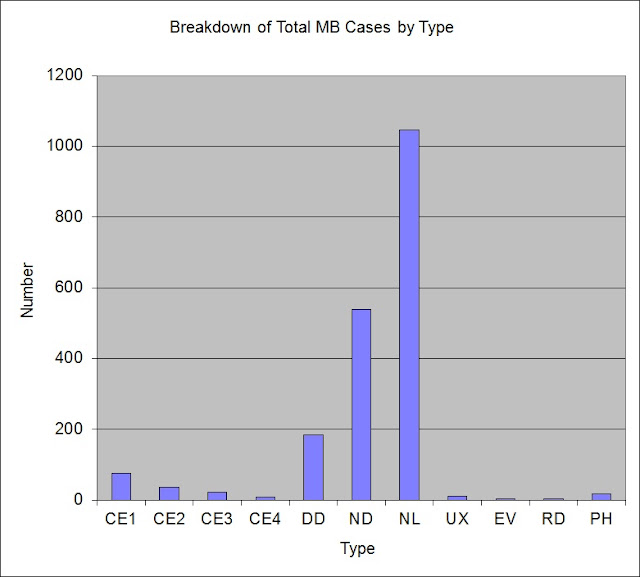
For the type of UFO reported, the most common was a simple Nocturnal Light (NL) at 54% of the total. This was followed closely by Nocturnal Disc (ND), at 28%. What this means is that at least 82% of all sightings occur at night and that most are simply lights in the night sky. Less than 10% of all cases are Daylight Discs (DD), and are objects reported during the day. Less than 7% of all cases were Close Encounters, where witnesses were within 100 metres of an unusual object
Since previous studies have shown that the density of UFO reports is related to population, it should not be surprising that the largest proportion of Manitoba UFO reports occurred in Winnipeg (38%). However, towns with small populations such as Carman and Sperling made the top five list of UFO “hotspots” in the province, obviously due to the major UFO flap in the Carman area in the 1970s.
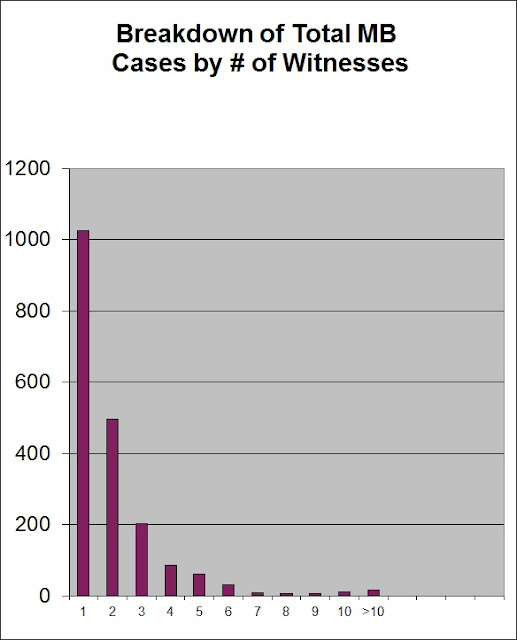
The prime time for seeing UFOs in Manitoba was between 10:00 pm and midnight. The average duration of a UFO sighting was about 20 minutes, suggesting that a witness had plenty of time to observe and try and explain the object being observed. Curiously, in cases where the UFO was Unexplained, the average duration of observation is lower, at only about 17 minutes. The average number of witnesses per sighting is 2.08, meaning that the typical case involved two people observing a UFO together


The predominant colour of reported UFOs was white, followed by red, orange and “multicoloured.” The predominant shape reported was “point source” (i.e. a distant light), followed by fireball, sphere and then “irregular.”


For Source of reports, about 37% were reported directly to Ufology Research. National Defence had 8% of the cases, with smaller fractions coming from RCMP, Transport Canada and the National Research Centre in Ottawa. US-based UFO organizations such as MUFON, APRO and NUFORC provided about 25% of the data.
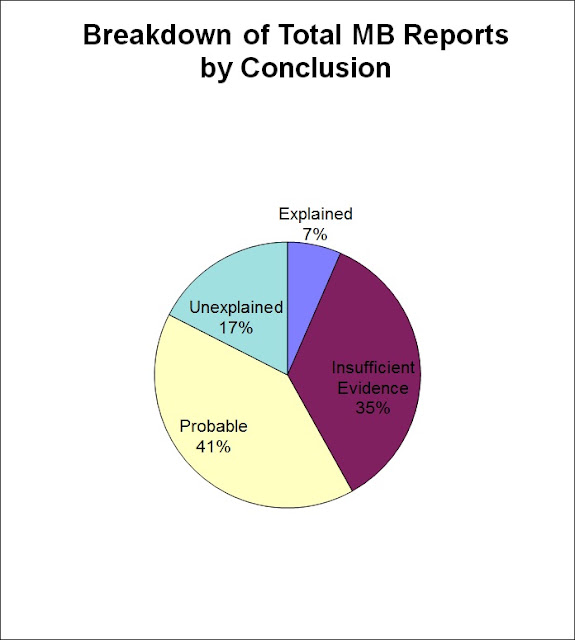
The breakdown of all Manitoba UFO reports by Conclusion is as follows:
Explained 6.5%
Insufficient Evidence 35.4%
µProbable Explanation 40.5%µ
Unexplained 17.5%
{ http://uforum.blogspot.ca/ }


 The M-Files: UFOs in Manitoba