 Meta AI Can Now Read Your Mind: A Deep Dive into Brain-to-Text Technology
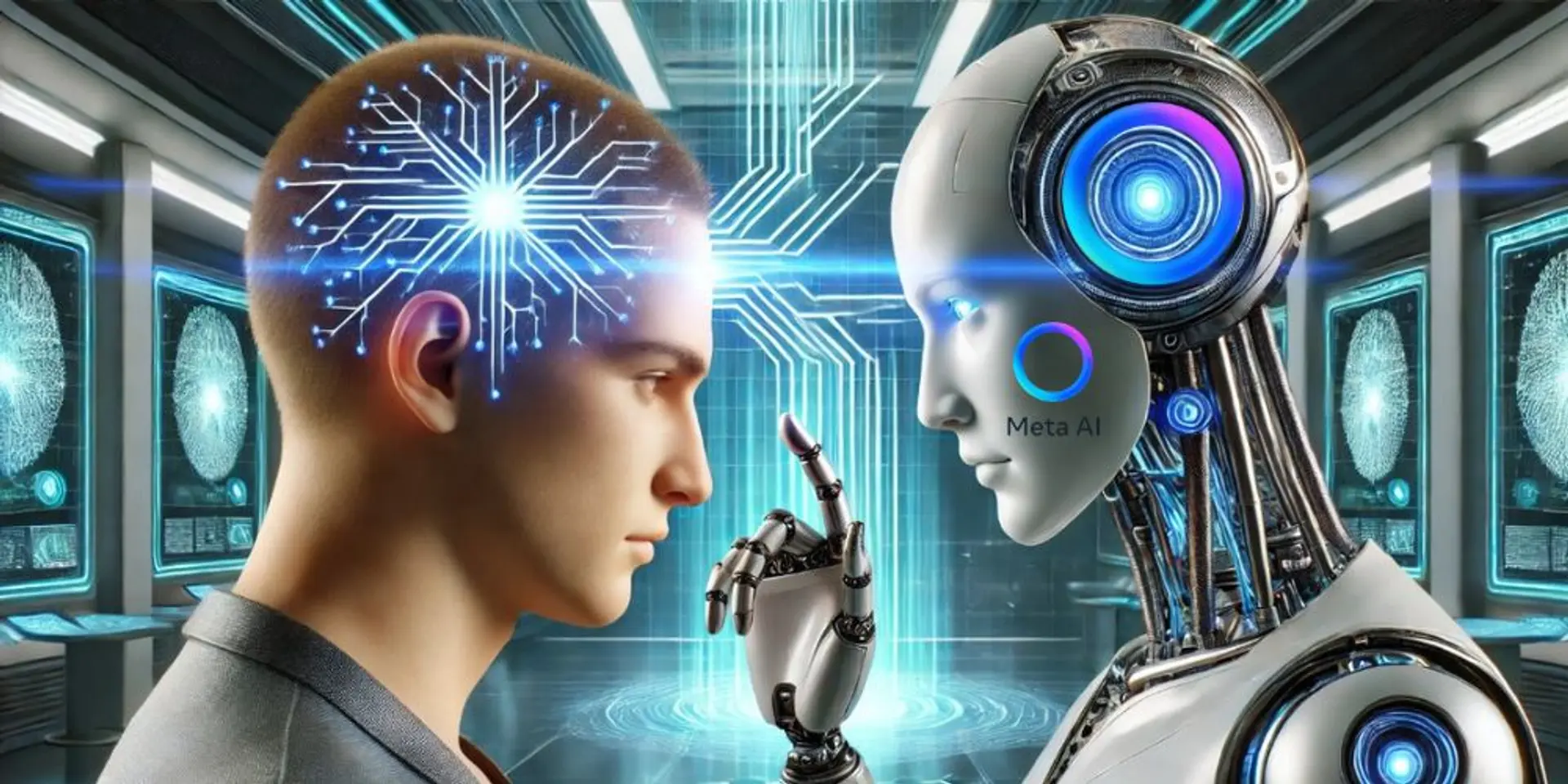
Meta AI Can Now Read Your Mind: A Deep Dive into Brain-to-Text Technology
Meta's AI can now decode brain activity into text with 80% accuracy, bringing us closer to mind-powered communication. Dive into the future of brain-computer interfaces—read the full story now!
Imagine a world where your thoughts can be transcribed into text without lifting a finger. Meta is turning this futuristic vision into reality. In collaboration with the Basque Center on Cognition, Brain, and Language, Meta's AI research team has developed a groundbreaking system capable of decoding brain activity into text with remarkable accuracy.
The Science Behind the Magic
This innovative approach utilises non-invasive techniques, specifically magnetoencephalography (MEG) and electroencephalography (EEG), to measure the brain's magnetic and electrical activity. In a study involving 35 participants, researchers recorded brain signals as individuals typed sentences. These recordings trained an AI model to predict text based solely on brain activity. The results were astounding: the system achieved up to 80% accuracy in decoding characters from MEG data, significantly outperforming previous EEG-based methods.
A Leap Forward in Non-Invasive Brain-Computer Interfaces
Traditional brain-computer interfaces often require surgical implants, posing risks and limiting accessibility. Meta's approach, however, is entirely non-invasive. By employing MEG and EEG, the system captures brain activity without the need for implants, making the technology safer and more accessible. This advancement holds promise for individuals with speech impairments or paralysis, offering a potential pathway to regain communication abilities.
Challenges on the Horizon
While the progress is impressive, several hurdles remain:
- Equipment Limitations: MEG technology requires large, expensive machinery—approximately $2 million per device—and necessitates a magnetically shielded room. This setup is currently impractical for everyday use.
- Sensitivity to Movement: Participants must remain still during MEG recordings, as even slight movements can disrupt signal accuracy. This constraint poses challenges for real-world applications.
- Individual Variability: The AI model requires personalised training, as brain activity patterns differ among individuals. Developing a universal model applicable to everyone remains a complex task.
The Road Ahead: From Lab to Life
Transitioning this technology from the laboratory to everyday life involves addressing these challenges. Researchers are exploring ways to miniaturise MEG equipment and enhance its portability. Advancements in AI could lead to models that generalise across users, reducing the need for individualised training. Moreover, ethical considerations, particularly concerning mental privacy and data security, must be prioritised as the technology progresses.
A Glimpse into the Future
Meta's brain-to-text system represents a significant stride in human-computer interaction. Envision a future where composing messages or controlling devices is as effortless as thinking. While practical implementation may still be years away, the foundation laid by this research brings us closer to a world where our minds can seamlessly interface with technology.
In the words of Meta's AI research team, "Our efforts are not towards products but towards understanding the computational principles that allow the brain to acquire language."
As we continue to unravel the mysteries of the mind, the possibilities for innovation are boundless.
Introduction: Pre-Crime and Mind Reading Technology
- References 2002 movie "Minority Report" (2054 setting) - pre-crime police units arresting future criminals
- Breakthrough: AI translating brain scans into text at tissue level
- May 2023: University of Texas Austin creates "semantic decoder" converting brain activity to text
- Meta develops similar technology plus real-time visual brain wave analysis
- Potential applications: helping speech-impaired individuals vs privacy concerns
UT Austin Semantic Decoder Research
- Lead researchers: Jerry Tang (doctoral student computer science), Alexander Huth (assistant professor neuroscience/computer science)
- Publication: Journal of Nature Neuroscience
- Device name: Non-invasive language decoder
- Capabilities: Reconstruct continuous language from perceived speech, imagined speech, silent videos
- Advantage over invasive methods: Lower risk than Neuralink-type implants but less clear data
Technical Implementation
- Method: Functional magnetic resonance imaging (fMRI) - non-invasive brain recordings
- Spatial specificity: Excellent - pinpoints neuroactivity with great accuracy
- Temporal limitation: Blood oxygen level dependent (BOLD) signal slow - 10 seconds rise/fall
- Challenge: Natural speech rate 1-2 words per second vs 10-second fMRI response time
Training Process
- Training data: 16 hours of spoken narrative stories per subject
- Model type: Encoding model predicting brain responses to natural language
- Method: Linear regression extracting semantic features
- Individual training: 15+ hours of data per person in MRI scanner
AI Integration
- Generative AI: GPT-1 (earlier ChatGPT version) for proper English grammar/structure
- Algorithm: Beam search for efficient word sequence generation
- Process: Analyzes brain activity → generates word sequences one at a time → keeps most probable sentences → refines predictions continuously
- Example: "I ate an apple" → decoder generates "I consumed a fruit" or "an apple was in my mouth"
Research Results and Testing
Performance Evaluation
- Test subjects: 3 individuals with trained decoders
- Method: Brain responses to new stories analyzed
- Results: Decoded sequences captured meaning, often replicated exact words/phrases
- Significance: Semantic information extractable from fMRI brain signals
Brain Region Analysis
- Discovery: Diverse brain regions redundantly encode word-level language representations
- Implication: Backup systems for language understanding - if one region damaged, others process same information
- Analogy: Multiple copies of same book for redundancy
Extended Capabilities
- Imagined speech: Successfully decoded content/meaning during fMRI scans
- Cross-modal decoding: Worked when participants viewing movies (not hearing spoken language)
- Visual processing: Model predicted word descriptions of what participants seeing
Meta's Advanced Brain Reading System
Technical Specifications
- Launch date: October 18, 2023
- Technology: MEG (magnetoencephalography) - non-invasive neuroimaging
- Resolution: Thousands of brain activity measurements per second (vs fMRI's few seconds)
- Capability: Real-time visual representation decoding from brain activity
System Architecture
- Three components: Image encoder, brain encoder, image decoder
- Training data: Public MEG recordings from healthy volunteers
- AI alignment: Brain signals align with Dino V2 computer vision AI
- Learning method: Self-supervised learning (no human labels)
Performance Results
- Capability: Reconstruct images from brain activity in real-time
- Accuracy: Correctly identified broad object categories
- Limitations: Unstable in finer details
- Process: Left side shows original image, right side shows AI interpretation from brain waves only
Future Applications and Implications
Positive Applications
- Medical: Help mentally conscious but unable to speak/communicate individuals
- Consumer technology: Smartphone volume/notifications/music adapt to mood/brain activity
- Interface: Device commands via thoughts (like Google Assistant but with brain)
Next Sense Earbuds Development
- Company: Originated from Google's Alphabet X division
- Timeline: Working since 2020
- Capabilities: Capture human brain signals via earbuds
- Medical applications: Monitor/diagnose epilepsy, depression, sleep disorders
- Functions: Detect seizures, assess medication effectiveness, improve deep sleep
Privacy and Ethical Concerns
- Privacy catastrophe: Meta/Google knowing thoughts/visual focus for advertising
- Public opinion manipulation: Potential to sway opinions
- Meta's track record: Poor history with user privacy and consent
- Wearable integration: Concerns about Meta VR headsets, camera glasses
Technical Limitations for True Telepathy
- Accuracy/resolution: Must increase significantly
- Contextual understanding: Need tone, emotion, contextual nuances
- Bidirectional communication: Send and receive thoughts between people
- Current status: True telepathy remains fiction
Scientific Reception and Media Coverage
Researcher Reactions
- Dr. Alexander Huth quote: "We were kind of shocked that it works as well as it does. I've been working on this for 15 years"
- Professor Tim Beren (Oxford): Praised technical progress, potential to decipher thoughts/dreams/subconscious ideas
- Quote: "These generative models are letting you see what's in the brain at a new level"
Current Limitations
- Equipment: Scanners bulky and expensive
- Training: Long and tiresome process
- Environment: Controlled laboratory settings only
- Future outlook: Technology will improve like all tech