Naar de inhoud

UFO'S of UAP'S, ASTRONOMIE, RUIMTEVAART, ARCHEOLOGIE, OUDHEIDKUNDE, SF-SNUFJES EN ANDERE ESOTERISCHE WETENSCHAPPEN - DE ALLERLAATSTE NIEUWTJES

UFO's of UAP'S in België en de rest van de wereld
akke.beakke.be
Ontdek de Fascinerende Wereld van UFO's en UAP's: Jouw Bron voor Onthullende Informatie! Ben jij ook gefascineerd door het onbekende? Wil je meer weten over UFO's en UAP's, niet alleen in België, maar over de hele wereld? Dan ben je op de juiste plek! België: Het Kloppend Hart van UFO-onderzoek In België is BUFON (Belgisch UFO-Netwerk) dé autoriteit op het gebied van UFO-onderzoek. Voor betrouwbare en objectieve informatie over deze intrigerende fenomenen, bezoek je zeker onze Facebook-pagina en deze blog. Maar dat is nog niet alles! Ontdek ook het Belgisch UFO-meldpunt en Caelestia, twee organisaties die diepgaand onderzoek verrichten, al zijn ze soms kritisch of sceptisch. Nederland: Een Schat aan Informatie Voor onze Nederlandse buren is er de schitterende website www.ufowijzer.nl, beheerd door Paul Harmans. Deze site biedt een schat aan informatie en artikelen die je niet wilt missen! Internationaal: MUFON - De Wereldwijde Autoriteit Neem ook een kijkje bij MUFON (Mutual UFO Network Inc.), een gerenommeerde Amerikaanse UFO-vereniging met afdelingen in de VS en wereldwijd. MUFON is toegewijd aan de wetenschappelijke en analytische studie van het UFO-fenomeen, en hun maandelijkse tijdschrift, The MUFON UFO-Journal, is een must-read voor elke UFO-enthousiasteling. Bezoek hun website op www.mufon.com voor meer informatie. Samenwerking en Toekomstvisie Sinds 1 februari 2020 is Pieter niet alleen ex-president van BUFON, maar ook de voormalige nationale directeur van MUFON in Vlaanderen en Nederland. Dit creëert een sterke samenwerking met de Franse MUFON Reseau MUFON/EUROP, wat ons in staat stelt om nog meer waardevolle inzichten te delen. Let op: Nepprofielen en Nieuwe Groeperingen Pas op voor een nieuwe groepering die zich ook BUFON noemt, maar geen enkele connectie heeft met onze gevestigde organisatie. Hoewel zij de naam geregistreerd hebben, kunnen ze het rijke verleden en de expertise van onze groep niet evenaren. We wensen hen veel succes, maar we blijven de autoriteit in UFO-onderzoek! Blijf Op De Hoogte! Wil jij de laatste nieuwtjes over UFO's, ruimtevaart, archeologie, en meer? Volg ons dan en duik samen met ons in de fascinerende wereld van het onbekende! Sluit je aan bij de gemeenschap van nieuwsgierige geesten die net als jij verlangen naar antwoorden en avonturen in de sterren! Heb je vragen of wil je meer weten? Aarzel dan niet om contact met ons op te nemen! Samen ontrafelen we het mysterie van de lucht en daarbuiten.

Shocking memo reveals missing UFO-linked scientist was trying to escape a secret Pentagon network before vanishing

Shocking memo reveals missing UFO-linked scientist was trying to escape a secret Pentagon network before vanishing

New revelations about the missing UFO-linked Air Force general reveal he attempted to leave the Pentagon's secret research programs days before vanishing.

Newly released police reports from New Mexico authorities state that retired Major General William Neil McCasland was attempting to step down from several high-level advisory positions at government-connected research laboratories across the US in the lead-up to his February 27 disappearance.

The new clues were released in a Freedom of Information Act request by Sara Bondink, a self-proclaimed historical researcher and author who has been following the McCasland investigation, revealing previously unseen details about the case.

The information, documented during a March 3 interview, shows communications between the general's wife, Susan Wilkerson, and a member of the Bernalillo County Sheriff's Ghost Unit, which specializes in anti-gang and human trafficking operations.

While Wilkerson had previously claimed on social media that her husband no longer possessed any top-secret clearances with the US government, it was revealed during the interview that he was still an active member of at least four different groups with deep ties to national defense secrets.

In the report, Wilkerson told authorities that McCasland was making a desperate attempt to resign from several and possibly all of these secretive projects over fears the 68-year-old was suffering from severe mental decline.

All of the groups McCasland was reportedly connected to, including Sandia National Laboratories, Riverside Research, the Kirtland Partnership and a University Affiliated Research Center, are involved in high-level research for the Department of War, engaging in projects focused on national security and advanced technology.

McCasland's disappearance has been at the heart of the so-called missing scientist investigation, with the general's career appearing to overlap with several NASA scientists, nuclear lab workers and military personnel who either died or vanished without a trace in recent years.

A new surveillance image shows retired Air Force general William Neil McCasland the day before he vanished without a trace on February 27

A new surveillance image shows retired Air Force general William Neil McCasland the day before he vanished without a trace on February 27

McCasland was last seen leaving his New Mexico home without his phone, wearable devices or glasses less than two months ago. 

He was only carrying a pistol, and his wife told 911 dispatchers that it appeared he was trying 'not to be found.'

Just days before he vanished, according to the police report, McCasland flew by himself to Washington DC to officially resign from Riverside Research.

The nonprofit provides scientific research, engineering and advisory services on advanced technology projects through contracts with the Pentagon, US intelligence community and the Air Force, which are worth hundreds of millions of dollars.

Authorities wrote in their report: 'Upon returning to New Mexico, Neil told Susan that he resigned from the board of Riverside Research because he could not keep up, mentally, with the conversation.'

He was still a paid consultant for Sandia National Laboratories, a major US government-owned research lab that develops advanced technology for national security, including nuclear weapons, before his disappearance.

Sandia primarily works under the Department of Energy’s National Nuclear Security Administration and supports the Air Force research and development work at multiple facilities, including Kirtland Air Force Base.

McCasland was also deeply tied to Kirtland through his work with the Air Force Research Lab. 

He had been in charge of AFRL's Phillips Research Site at Kirtland before becoming the research unit's commanding officer from 2011 to 2013.

The veteran officer continued to maintain a key role with the New Mexico base even after retiring, becoming a member of the Kirtland Partnership, a nonprofit working to protect and expand the military research facility and nuclear weapons lab.

William Neil McCasland, 68, was last seen around 11am Friday near Quail Run Court NE in Albuquerque, the Bernalillo County Sheriff's Office said

William Neil McCasland, 68, was last seen around 11am Friday near Quail Run Court NE in Albuquerque, the Bernalillo County Sheriff's Office said

The item seen in McCasland's hand on February 26 has been compared to a waterproof first aid kit by viewers on social media

The item seen in McCasland's hand on February 26 has been compared to a waterproof first aid kit by viewers on social media

Wilkerson confirmed previously released bodycam recordings, which revealed an anonymous caller to police who claimed General McCasland had a concerning meeting with the Kirtland Partnership and members of the US Space Force on February 26, just hours before he disappeared. 

The unidentified female witness who claimed she was at the dinner with McCasland told police: 'I was shocked this morning when I saw the alert because what I noticed Thursday evening [February 26] is that he wasn't his usual self. 

'[McCasland] was kind of spacey and quiet and you know that that happens with people.' 

'He was the head of Air Force Research Lab to the point the man's names are in the UFO documents that are fixed to be released,' the witness claimed during a phone call with police, obtained by the Law&Crime Network.

'He's in that depth, so he has a very high security clearance.'

According to the interview with Wilkerson, the former general had also attempted with resign from his position with a University Affiliated Research Center (UARC) tied to an unnamed school.

UARCs are special, long-term research partnerships between a university and the Pentagon that allow the military to get independent help on advanced science and technology projects that universities are uniquely skilled at providing.

The police report noted that McCasland was attempting to quit his role with UARC due to the same fears of mental decline, however, 'the leadership was trying to convince him otherwise.'

The day before his disappearance, McCasland was seen alert and aware as he exited a local sporting goods store in New Mexico with a mysterious parcel and what appeared to be a portable first aid kit.

Despite his wife's claims of potential mental decline, government officials have revealed that McCasland was still being looked at as a key witness in the ongoing effort to declassify decades-old secrets related to UFOs and extraterrestrials.

In early May, Air Force veteran and UFO whistleblower David Grusch specifically named McCasland as one of the officers who had been in charge of classified programs related to non-human craft recovery and reverse-engineering.

Grusch alleged that the general had not been cooperative with recent efforts by lawmakers looking to interview him over his knowledge of America's suspected contact with extraterrestrials.

The White House has tasked the FBI with investigating McCasland's mysterious disappearance and the disappearances of several other individuals tied to US nuclear secrets in the New Mexico area over the last year.

So far, only one person has been found. The remains of Los Alamos National Lab worker Melissa Casias were discovered in a New Mexico park on May 28.

There has been no sign of McCasland since he vanished four months ago. He reportedly only took a pair of boots and his .38-caliber revolver with him after changing into a set of clothes Wilkerson did not know he owned.


Missing UFO-linked Air Force general attempted to leave Pentagon's secret research programs

{ https://www.dailymail.com/sciencetech/index.html }

Hoe vind je dit bericht?
Geschreven door peter om 00:22 Stuur door

Swarm of orbs Over Islamabad, Pakistan June 2026, UFO UAP Paranormal Alien Sighting News.

Swarm of orbs Over Islamabad, Pakistan June 2026, UFO UAP Paranormal Alien Sighting News.

UFO_Swarm.png

Date of sighting: June 6, 2026
Location of sighting: Islamabad, Pakistan
Source: NUFORC 
 
A UFO was spotted over Islamabad and it turn out there was a whole line of them following each other. What at first looks like a single UFO turns out to be a whole swarm flying in line. Very rare to see a swarm, almost never get them on video but this is one of those exceptional moments that just shows the incredible tech aliens have at their disposal. 
Scott C. Waring - UFO Sightings Daily 
 
Eyewitness states: 
Observed a glowing spherical object displaying unusual movement similar to Pentagon-released UAP footage; video recorded. My wife and I witnessed a bright, ball-shaped glowing object moving across the night sky. The object appeared spherical and emitted a steady light. Its movement was unusual and closely resembled the motion seen in the Pentagon-released UAP footage, showing smooth changes in direction and speed that did not seem consistent with a typical aircraft. A second light was also observed in the sky, revolving continuously in a repeated pattern for an extended period of time. Both phenomena were visible simultaneously during the sighting. The event lasted several minutes, was witnessed independently by both of us, and was captured on video for further analysis and identification. No obvious sound was heard from either object during the observation.
  
Hoe vind je dit bericht?
Geschreven door peter om 00:00 Stuur door

Ancient Alien Face, Looks Human In Eye of Hurricane, UFO Sighting News, A sign from aliens.

Ancient Alien Face, Looks Human In Eye of Hurricane, UFO Sighting News, A sign from aliens.

UFO,%20UFOs,%20UAP,%20UAPs,%20UFO%20sighting,%20UFO%20files,%20UFO%20video%20UAP%20files,%20UAP%20video,%20department%20of%20war,%20alien,%20aliens,%20infrared%20UFO,%20IR%20UFO,%20official%20UFO,%20Gov%20UFO,%20USA%20UFO%20copy%202.png
NASA Link: https://svs.gsfc.nasa.gov/3757/ 
Date of discovery: June 24, 2026
Date of event: Aug 27, 2010
 
For decades, the public has been told that faces seen in rocks, mountains, clouds, and even on Mars are simply examples of pareidolia...the brain's tendency to recognize familiar patterns. I don't accept such a rudimentary and simple explanation. What if pareidolia has become a convenient label for the CIA to used to discourage deeper investigation into actual alien evidence? A face is one of the most powerful and universally recognized symbols imaginable. If an advanced extraterrestrial civilization wanted to leave markers for future intelligent beings, faces would be an obvious choice. Yet whenever such formations are discovered, they are often dismissed before serious study begins. I believe most of these so-called pareidolia cases represent genuine signs left behind by non-human intelligence. While not every face-shaped object is artificial, automatically dismissing them all as coincidence will cause us to overlook evidence that extraterrestrials visited Earth and other worlds long ago...and perhaps remain present today. 

Scott C. Waring - UFO Sightings Daily

{ https://www.ufosightingsdaily.com/ }

Hoe vind je dit bericht?
Geschreven door peter om 23:54 Stuur door

Baba Vanga's prophecy of 'alien invasion at sporting event' revived by self-styled psychic - 'I saw so much screaming'. UFO UAP Sighting News.

Baba Vanga's prophecy of 'alien invasion at sporting event' revived by self-styled psychic - 'I saw so much screaming'. UFO UAP Sighting News.

abduction_prediction.png

Date of prediction: June 25, 2026

As much as I want a UFO to reveal itself over tomorrows sporting event, I do have to say, why would only one person get the message from aliens? If such a thing was to be announced by aliens it is most likely going to be announced to a large group of individuals that do not know each other and can all relay a similar message to the world. This way, those that do want to be taken, would be at the event. Yes, aliens might want volunteers rather than taking people against their will. So many people would attend this event just to be taken and meet them, I being one of them. I have only met with a plasmoid (energy entity) sphere two meters from me, and as far as I know, I have no new information given to me from it, other than me being allowed to see its true form close up, which is what I asked for. As for the sports game having a mass abduction by a huge UFO tomorrow. I sure hope so, the world really needs so distraction from boring political fights. 

"I have to tell you that I dreamed again about aliens invading the soccer field in Miami. And I clearly saw the players being carried off by the first ship that arrived," Bahiana said with tears in her eyes in an Instagram post. She claims that she was inside a spaceship in the dream. Later, the mothership came and took in thousands of people from the field. "I saw so much screaming, so much crying, so many tears, suffering," the self-proclaimed psychic said.

Scott C. Waring - UFO Sightings Daily 

{ https://www.ufosightingsdaily.com/ }

Hoe vind je dit bericht?
Geschreven door peter om 23:48 Stuur door

Will something supernatural appear at the Brazil vs. Scotland World Cup Match?

Will something supernatural appear at the Brazil vs. Scotland World Cup Match?

Predictions by psychics and mediums have been made for decades, and more often than not, the events they foresee never come to pass. However, a new prediction has emerged, claiming that something extraordinary could occur during the current 2026 FIFA World Cup. 
something%20supernatural%20appear%20at%20the%20Brazil%20vs.%20Scotland%20World%20Cup%20Match.jpg

Below are the predictions of Vó Bahiana and Baba Vanga, along with an intriguing connection to a scene from the 2021 film The Tomorrow War, which depicts a remarkably similar scenario. 
Brazilian psychic and spiritualist Vó Bahiana recently went viral after claiming she had recurring dreams of an alien spacecraft appearing during the Brazil vs. Scotland World Cup match at Hard Rock Stadium in Miami Gardens, Florida, on June 24. She warned her more than 23 million social media followers that extraterrestrial craft would descend upon Miami and abduct players as well as hundreds of spectators. According to Vó Bahiana, she witnessed the entire event unfold in her dreams. 
Her claims echo a famous prediction attributed to Baba Vanga, who is said to have foretold that humanity's first contact with extraterrestrial life would occur during a major international sporting event, though Baba Vanga did not talked about abduction.  
Vó Bahiana stated: "I dreamed again about aliens invading the soccer field in Miami. I clearly saw players and citizens being carried away by the first ship that arrived. When that ship lifted off, a much larger mother ship appeared and took thousands of people from the soccer field. I saw a lot of screaming, crying, tears, and suffering. I am very scared because this is the second time I've had this dream. They're saying something bad is going to happen on the 24th at the soccer field in Miami." 
Adding to the mystery is the 2021 film The Tomorrow War, which features a scene in which Brazil and Scotland are playing a soccer match when unexpected visitors suddenly appear in the middle of the game. Although the film depicts people from the future rather than extraterrestrials, the similarities to the predictions of Vó Bahiana and Baba Vanga are certainly striking. 
Of course, predictions and coincidences do not necessarily indicate that such an event will occur. Still, it raises an intriguing question: what are the odds that a movie released in 2021 would portray a scenario so similar to these recent predictions surrounding the Brazil vs. Scotland match? 
In the end, nothing will happen, and the match will likely proceed just like any other World Cup game.

{ https://ufosightingshotspot.blogspot.com/ }

Hoe vind je dit bericht?
Geschreven door peter om 23:41 Stuur door

Ancient King Head On Mars With Diamond The size of a Baseball on Its head! June 24, 2026, UFO Sighting News.

Ancient King Head On Mars With Diamond The size of a Baseball on Its head! June 24, 2026, UFO Sighting News.

Baseball%20size%20diamond.png

diamond%20on%20mars.png

Date of discovery: June 24, 2026
Location of sighting: Mars Perseverance Sol 1889
Source: 
 
A picture is worth a thousand words, then this one with a diamond the size of a baseball on a statue of an ancient face is worth billions. Want to know why there is such a hurry to get to mars? Easy...one word...money. The face must have been someone very important, very high up. A leader...and possibly a king. This looks like a statue, but as an old CIA file revealed to the world, alien weapons that turn flesh into limestone like statues exist. 
 
I also found other faces, a crab, bones, ect. Take a look at the screenshots below, but you do have to break free of the confines of the mental constraints that the boring, fake scientific facts that were engrained into each of us to keep us from learning the truth. That aliens...were here long before us, and will be here...long after us. 
Scott C. Waring - UFO Sightings Daily
 
 
Screenshot%202026-06-24%20at%206.59.25%E2%80%AFPM.png

Screenshot%202026-06-24%20at%206.39.58%E2%80%AFPM.png

Screenshot%202026-06-24%20at%206.58.34%E2%80%AFPM.png

Screenshot%202026-06-24%20at%206.45.06%E2%80%AFPM.png

Screenshot%202026-06-24%20at%207.03.24%E2%80%AFPM.png

Screenshot%202026-06-24%20at%206.49.35%E2%80%AFPM.png

{ https://www.ufosightingsdaily.com/ }

Hoe vind je dit bericht?
Geschreven door peter om 00:00 Stuur door

New UFO Files Paint a ‘Very Clear’ Picture of Alien Contact, Researcher Claims

New UFO Files Paint a ‘Very Clear’ Picture of Alien Contact, Researcher Claims

UFO-2-1024x576.jpg

The debate over unidentified flying objects, now officially referred to as Unidentified Anomalous Phenomena (UAPs), has intensified once again following the release of a new batch of previously classified U.S. government documents. The latest disclosure includes 72 files, six videos, and historical audio recordings, providing fresh material for researchers, skeptics, and believers alike.

While many expected groundbreaking revelations, some UFO experts argue that the newly released files offer something equally significant: a clearer picture of how governments have investigated the phenomenon for decades.

Third Wave of UFO Files Released

The latest release marks the third major batch of UFO-related documents made available to the public. Among the most discussed materials are several videos captured by civilians that reportedly show unusual aerial phenomena.

One video, recorded using an iPhone 14 Pro Max in July, appears to show two bright objects moving together across the sky. Another video depicts a glowing, plasma-like object hovering above a pond. According to reports, these recordings were examined as part of official investigations into unexplained aerial sightings.

Although the footage does not provide definitive proof of extraterrestrial life, it continues to fuel public interest in one of the most enduring mysteries of modern times.

Historic Audio Adds New Perspective

The release also includes an audio recording from 1962 featuring veteran journalist Walter Cronkite interviewing astronaut Gordon Cooper.

Cooper, one of the original Mercury astronauts, discussed the possibility of intelligent life elsewhere in the universe and acknowledged that many highly qualified individuals had witnessed aerial objects that lacked a clear explanation.

His comments are particularly noteworthy because Cooper was among the most respected figures in the early U.S. space program. For UFO researchers, historical testimony from astronauts remains an important part of the broader discussion surrounding unidentified aerial phenomena.

UFO Researcher Sees a Bigger Picture

According to UFO researcher Joshua Golembeske, the newly released documents may seem ordinary on the surface, but they contain details that support long-standing claims about government interest in UFOs.

Rather than viewing the release as full disclosure, Golembeske describes it as a gradual process of information being revealed to the public.

He points to one particular document, reportedly identified as CIA Document 19, which references an assessment produced by the Australian Department of Defense. The document allegedly suggests that governments have taken UFO reports far more seriously than the public has been led to believe.

Claims within the document reportedly include discussions about military investigations, secret recovery operations, and attempts to study advanced technologies associated with unexplained aerial craft.

While such claims remain controversial and unproven, they continue to attract significant attention from both researchers and the public.

The Legacy of Project Blue Book

One of the recurring themes in the UFO community is the role of Project Blue Book, the U.S. Air Force program that investigated UFO sightings between 1952 and 1969.

Officially, the project concluded that most sightings could be explained through conventional means and found no evidence of extraterrestrial visitation. However, some researchers believe the program served a dual purpose: publicly downplaying UFO reports while privately continuing investigations into unexplained cases.

The newly released files have renewed discussion about whether governments have always been more interested in the phenomenon than they publicly admitted.

The Mystery of Plasma-Like Objects

Among the most intriguing aspects of the latest disclosure are references to glowing, plasma-like phenomena.

Numerous reports in the newly released files describe unusual lights and orb-shaped objects observed by both civilians and military personnel. Similar descriptions have appeared throughout UFO history, including reports of mysterious “green fireballs” observed in the late 1940s.

Some researchers suggest these objects may represent a distinct category of unidentified phenomena. Others argue they could be atmospheric effects, classified military technology, or natural plasma formations that are not yet fully understood.

Regardless of their origin, recurring reports of luminous objects continue to be one of the most consistent elements in UFO investigations worldwide.

UFOs and Nuclear Facilities

Another topic highlighted by researchers is the apparent connection between UFO sightings and nuclear installations.

For decades, military personnel and former officials have reported unusual aerial activity near missile silos, nuclear power plants, and weapons storage facilities. Several well-known cases involve unidentified objects allegedly interfering with military systems or appearing near sensitive strategic locations.

The newly released documents reportedly contain additional references to this pattern, adding fuel to a debate that has persisted since the beginning of the Cold War.

Whether these incidents represent advanced surveillance technology, natural phenomena, or something more exotic remains unknown.

Growing Public Demand for Transparency

Public interest in UFOs has reached levels not seen in decades. Congressional hearings, whistleblower testimony, military encounters, and government reports have transformed what was once considered a fringe topic into a mainstream discussion.

Many advocates argue that greater transparency is necessary to understand the true nature of the phenomenon. Others caution that extraordinary claims require extraordinary evidence and that many questions remain unanswered.

The latest document release is unlikely to settle the debate. Instead, it appears to be another chapter in a story that continues to evolve.

Are We Entering a New Era of UFO Disclosure?

Whether the recent files represent meaningful disclosure or simply another incremental release depends largely on one’s perspective.

For believers, the documents reinforce decades of testimony suggesting that governments know more than they have publicly admitted. For skeptics, the files remain far from proving the existence of extraterrestrial visitors.

What is clear is that official interest in unidentified aerial phenomena has not disappeared. As more information becomes available and public curiosity continues to grow, the mystery surrounding UFOs may become one of the defining scientific and cultural questions of the 21st century.

For now, the newly released files offer more questions than answers—but they ensure that the conversation about UFOs, UAPs, and the possibility of alien contact is far from over.

RELATED VIDEOS

WATCH: Pentagon Releases 6 Shocking UFO Files #shorts #ufo #uap #lab360

The UFO Disclosure Files They Don't Want You To See

{ https://www.latest-ufo-sightings.net/ }

Hoe vind je dit bericht?
Geschreven door peter om 23:30 Stuur door

World's oldest known asteroid impact: Crater in Western Australia was created when a space rock smashed into Earth 3 BILLION years ago, study reveals

The world's oldest recorded asteroid impact has been discovered, revealing new evidence of Earth's violent history.

Scientists have long suspected that the North Pole Dome in Western Australia's Pilbara region was the site of an ancient catastrophe.

Now, researchers have uncovered the first rock–solid evidence that provides an exact date for the impact.

Using advanced mineral dating techniques, they show that the crater was formed when a space rock smashed into Earth 3.02 billion years ago.

While billions of years of erosion have wiped away much of the evidence, this impact was substantial enough to leave a lasting legacy on Earth.

Lead author Professor Chris Kirkland told the Daily Mail that this meteor could have been a 'kilometre–scale' object, although its precise size is impossible to determine.

He said: 'At North Pole Dome, the impact appears to have generated a long–lived fractured system that was later reused by fluids.

'On the early Earth, that kind of process could have influenced chemical exchange between rocks and an early ocean, causing mineral alteration and potentially modifying the environments available for microbial life.'

Scientists have revealed that the North Pole Dome in Western Australia's Pilbara region (pictured) is the oldest asteroid impact crater on Earth

Scientists have revealed that the North Pole Dome in Western Australia's Pilbara region (pictured) is the oldest asteroid impact crater on Earth 

Although scientists believe space rocks have battered Earth throughout most of its history, evidence of these ancient impacts is nearly impossible to trace.

Big enough asteroid impacts cause geological changes in the surrounding rocks, but billions of years of heat, pressure, and fluid movements obscure or reset these changes.

This is why scientists have previously found it so difficult to pin down the exact age of the North Pole Dome crater.

However, Professor Kirkland and his team have now been able to track down a 'mineral clock', left behind in the damaged rocks.

The key piece of evidence was zircon, an extraordinarily resilient mineral that can hold its shape for billions of years.

When the researchers took samples from the rocks around North Pole Dome, they found that some zircon crystals had strange branching or 'skeletal' shapes.

Professor Kirkland believes that these are 'impact–modified crystals' formed when old zircon in the rocks was disrupted and partially recrystallised by the intense heat of an impact.

Critically, they were also able to date the formation of these crystals to an event around three billion years ago.

Scientists uncovered tiny zircon crystals in the rock, which were disturbed and reset by a massive asteroid collision

Scientists uncovered tiny zircon crystals in the rock, which were disturbed and reset by a massive asteroid collision 

The researchers were able to date these disturbed crystals to around three billion years ago, making this the first evidence of the world's oldest impact crater
The researchers were able to date these disturbed crystals to around three billion years ago, making this the first evidence of the world's oldest impact crater 

Since there isn't anything else in the geological history that could explain the crystal's dramatic transformation, they are very likely to be the signature of a meteor impact.

The team then analysed a second mineral, apatite, which formed as hot fluids moved through the shock–damaged rocks – also producing a similar age estimate.

'The agreement between two different mineral systems gives us confidence that we are seeing the signature of a single major event — a meteorite impact,' says Professor Kirkland.

This is an exciting discovery for geologists since it dates the crater back to the 'Archean aeon', a time when the planet's earliest continents were forming.

The moon's surface, which provides a much more stable record, suggests that the inner solar system was heavily bombarded by meteors around this time.

Although the theory is not universally accepted, some geologists believe that this could have been part of a cataclysmic event known as the Late Heavy Bombardment.

According to this theory, a sudden change in the orbits of the giant planets – Jupiter, Saturn, Uranus, and Neptune – destabilised the asteroid belt and sent thousands of rocks flying in Earth's direction.

These impacts could have helped to shape Earth's early crust, creating basins, melting rocks, building deep fractures, and driving hydrothermal systems.

Scientists say that the rocks around North Pole Dome (pictured) would have been formed when Earth's first continents were just being created

Scientists say that the rocks around North Pole Dome (pictured) would have been formed when Earth's first continents were just being created 

article image

However, scientists have struggled to find any evidence on Earth of craters dating back to this period.

'Earth must also have experienced that bombardment, but most of the evidence has been destroyed,' explains Professor Kirkland.

'That is why the North Pole Dome discovery is so important. 

'At 3 billion years, it is the oldest recognised impact structure on Earth and one of the very few windows into how impacts affected the Archean Earth.'

KILLING OFF THE DINOSAURS: HOW A CITY-SIZED ASTEROID WIPED OUT 75 PER CENT OF ALL ANIMAL AND PLANT SPECIES

Around 66 million years ago non-avian dinosaurs were wiped out and more than half the world's species were obliterated.

This mass extinction paved the way for the rise of mammals and the appearance of humans.

The Chicxulub asteroid is often cited as a potential cause of the Cretaceous-Paleogene extinction event.

The asteroid slammed into a shallow sea in what is now the Gulf of Mexico.

The collision released a huge dust and soot cloud that triggered global climate change, wiping out 75 per cent of all animal and plant species.

Researchers claim that the soot necessary for such a global catastrophe could only have come from a direct impact on rocks in shallow water around Mexico, which are especially rich in hydrocarbons.

Within 10 hours of the impact, a massive tsunami waved ripped through the Gulf coast, experts believe.

Around 66 million years ago non-avian dinosaurs were wiped out and more than half the world's species were obliterated. The Chicxulub asteroid is often cited as a potential cause of the Cretaceous-Paleogene extinction event (stock image)

Around 66 million years ago non-avian dinosaurs were wiped out and more than half the world's species were obliterated. The Chicxulub asteroid is often cited as a potential cause of the Cretaceous-Paleogene extinction event

(stock image)

This caused earthquakes and landslides in areas as far as Argentina. 

While investigating the event researchers found small particles of rock and other debris that was shot into the air when the asteroid crashed.

Called spherules, these small particles covered the planet with a thick layer of soot.

Experts explain that losing the light from the sun caused a complete collapse in the aquatic system.

This is because the phytoplankton base of almost all aquatic food chains would have been eliminated.

It's believed that the more than 180 million years of evolution that brought the world to the Cretaceous point was destroyed in less than the lifetime of a Tyrannosaurus rex, which is about 20 to 30 years.

RELATED VIDEOS

Oldest Asteroid Impact Crater on Earth Dated to 3 Billion Years

Outback asteroid crater found to be world’s oldest

Oldest known asteroid impact on Earth precisely dated to 3 billion years

{ https://www.dailymail.com/sciencetech/index.html }

Hoe vind je dit bericht?
Geschreven door peter om 23:16 Stuur door

'These don't occur naturally': Radio signals linked to alien life may be passing Earth by undetected, new study hints

'These don't occur naturally': Radio signals linked to alien life may be passing Earth by undetected, new study hints

New research suggests that alien radio signals may be transformed by plasma from their home stars — and scientists on Earth could be overlooking prime evidence of alien intelligence.

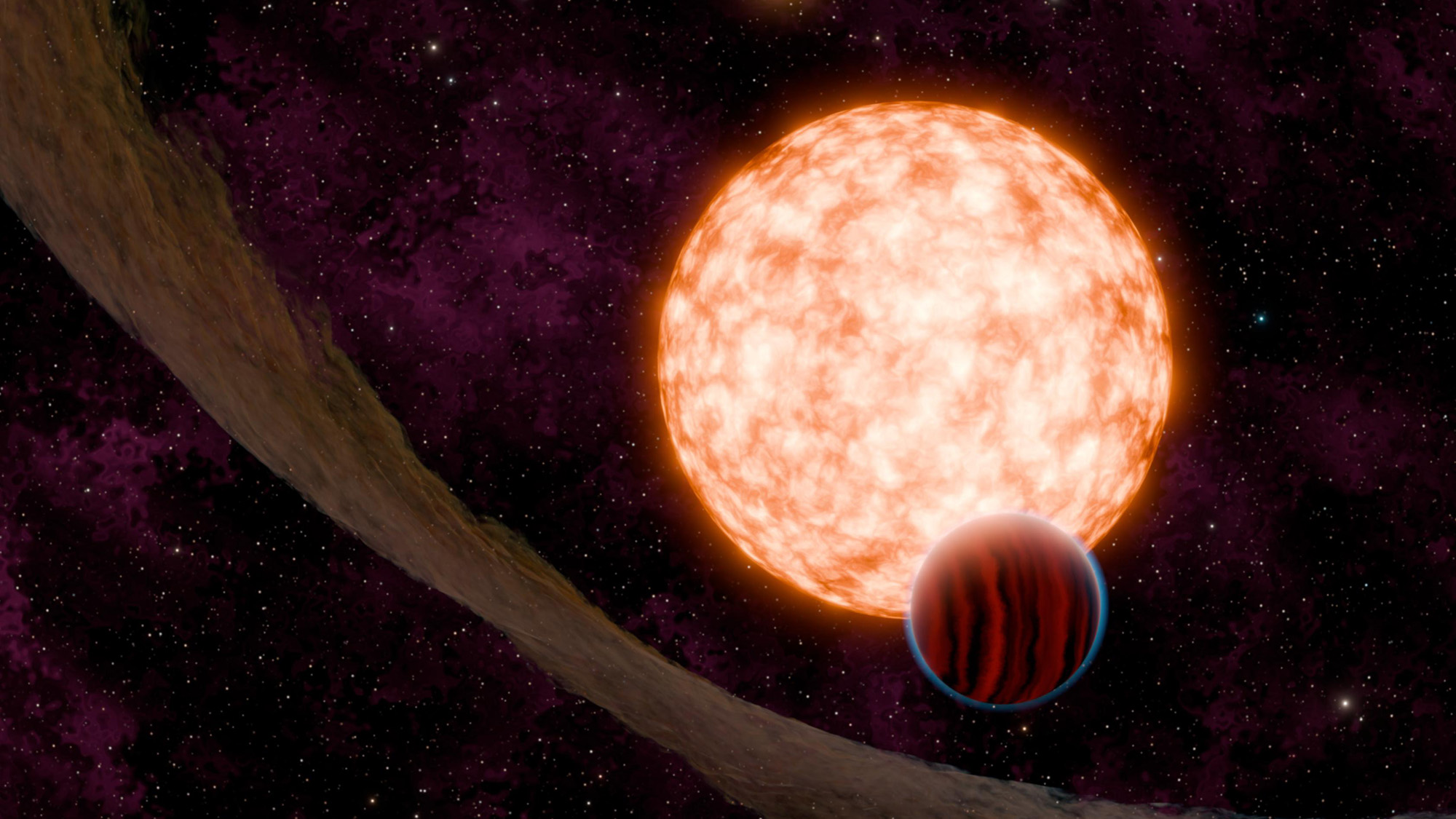
A black and red striped planet is seen next to a large glowing sun with a curved brown strip behind it in space.

An illustration of an exoplanet in an alien star system. New research suggests that radio emissions from intelligent aliens may be transformed by the plasma from their home stars — suggesting scientists could be overlooking evidence of extraterrestrial intelligence.
(Image credit: NASA/JPL-Caltech/R. Hurt, K. Miller (Caltech/IPAC))

Humans have been searching the stars for alien radio signals for decades — and so far, E.T. has not phoned home. But that doesn’t mean intelligent life isn’t out there, a new study hints. Rather, something else could be interfering: according to the research, space weather surrounding alien planets could be preventing us from detecting technological signals from extraterrestrial civilizations.

The findings, published March 5 in The Astrophysical Journal, offer a potential answer to the Fermi paradox: Given the size of the universe, there are many potentially habitable planets that could support life, and yet we have not detected technosignatures from any of them ‪— so, "Where is everyone?" physicist Enrico Fermi famously posited in 1950.

Why Scientists Think Aliens Have ALREADY Visited Earth

In the new study, researchers found that space weather caused by a planet's star could broaden hypothetical technosignals, dissipating their power over a larger range of frequencies and making them more difficult to detect.

"If a signal gets broadened by its own star's environment, it can slip below our detection thresholds, even if it's there, potentially helping explain some of the radio silence we've seen in technosignature searches," Vishal Gajjar, an astronomer at the SETI Institute and first author of the paper, said in a statement.

One way astronomers search for alien life is by looking for very narrowband signals, which are sharp spikes in the power of a radio emission. This spike usually only covers a few hertz.

You may like
  • A starry sky above the Arecibo Observatory in Puerto Rico.

'I have no doubt that life is out there': Why radio astronomers are convinced alien contact is only a matter of time

  • A colorful streak of blue and golden lights against a dark backdrop

'The sun would all but disappear, and the moon would always look full': A radio astronomer shares her mind-bending view of the universe

  • An illustration of a red sphere connected to a white black hole by a wavy strand of light.

Mysterious repeating radio signal traced to 'vampire' star that's slowly eating its companion

"These don't occur naturally," Evan Keane, an astronomer at Trinity College Dublin who was not involved in the research, told Live Science. "So, if you see something very narrowband, you know that it is from something of interest." Astronomers would, for example, be able to easily detect some narrowband technosignatures on Mars, coming from the Mars rovers. But they have not observed any such signals from a clearly non-human origin.

Distorting signals

The new research argues that astronomers may have been looking for the wrong signal shape. In the new study, the researchers found that alien signals could be distorted by stellar space weather surrounding their home stars, which could explain why they have not been detected.

Space weather refers to changes in the space environment caused by charged particles, radiation and giant lumps of plasma called coronal mass ejections emitted by the sun. Other stars also generate space weather in their vicinity.

Gajjar and SETI colleague Grayce Brown investigated how space weather has historically impacted communications between Earth and spacecraft such as Mariner IV, which flew by Mars in the 1960s, and the Viking probes, which launched in 1977 for a voyage through the solar system and beyond. They created one of the largest collections of signal broadening examples and used that information to determine how other sunlike stars would affect the environment around their exoplanets. From this, the team calculated what would happen to a hypothetical alien narrowband signal that originated on one of them.

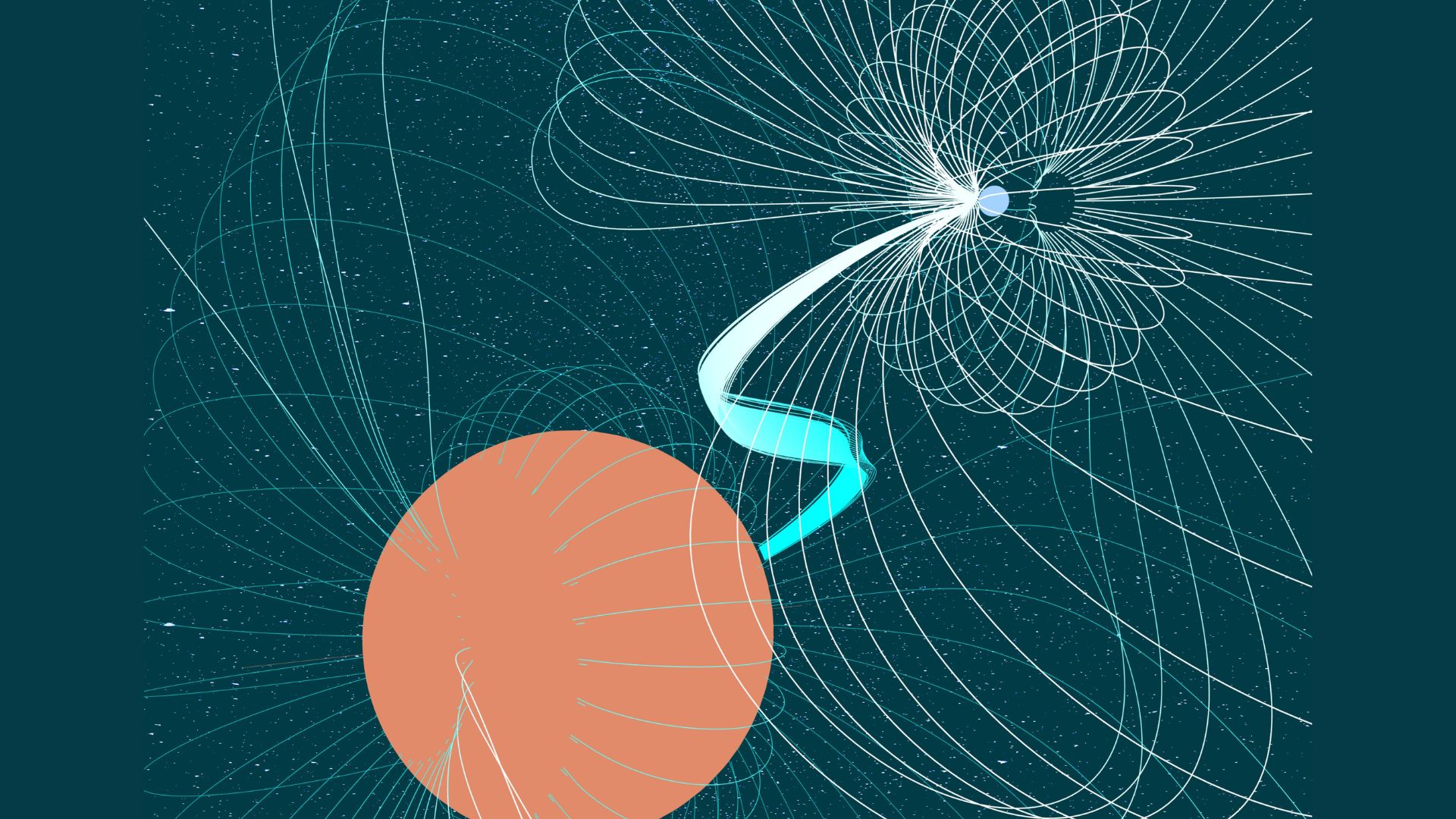
A planet’s radio signal may begin as a sharp tone (left, white) but can be spread out by the star’s plasma winds into a wider, fainter signal (right, green). The new study suggests radio astronomers may be missing signals by mostly looking for the sharp white shape instead of the broader green one.

(Image credit: Vishal Gajjar)

Then, they turned their attention to M dwarf stars, the most common type in the Milky Way. These stars account for three out of four stars in our galaxy, and some have been around since the early universe. That gives them a lot of time to have developed technologically advanced life, according to the paper.

What to read next
  • An artist's illustration showing dozens of potential exoplanets in a grid

Scientists identify 10,000 'impossible' exoplanet candidates, potentially tripling the number of known alien worlds

  • An illustration of a magnetic field around a red exoplanet in space

'Totally counterintuitive': Scientists accidentally discover magnetic fields around 7 distant planets, opening new window in the search for life

  • An illustration of the four gas giants of our solar system next to each other in the darkness of space.

2 vanished 'super Earths' once orbited near Uranus and Neptune, new study hints

There are no actual measurements of space weather around these stars, so Gajjar and Brown modeled what might happen to a narrowband technosignal that emerged from exoplanets and had to travel through interplanetary plasma. They found that hypothetical narrowband signals from these exoplanets were more likely to be smeared by space weather, making them even harder to detect.

In the paper, the authors propose a framework to estimate how much broadening would happen to a signal, given its frequency and the type of star its exoplanet was orbiting.

This new framework doesn’t totally answer Fermi’s infamous question, but it does give us a potential reason for the silence. The Fermi paradox "is not solely evidence for the absence of transmitters, but also a reflection of our detection limitations arising from a mismatch between the assumed signal morphology" and shape, the researchers wrote.

A step forward for SETI

Michael Garrett, an astrophysicist at the University of Manchester in the U.K. who was not involved in the study, welcomed the research.

"It is a solid contribution that SETI researchers and signal-processing teams should pay attention to," he told Live Science. "One of the strengths of the paper is that it's grounded in real measurements too, drawing on decades of spacecraft observations."

However, he emphasized that the paper focused on narrowband radio signals, which was only one way of potentially detecting an alien civilization. By contrast, Garrett's work explores the possible combined radio leakage from a technological civilization across a large range of frequencies.

Andrew Siemion, director of Breakthrough Listen Oxford Hub in the U.K. who was not involved in the research but collaborates with the SETI Institute, said this is the first paper to explore the space around exoplanets and its impact on detectability.

"The work offers a very concrete mechanism through which a candidate signal might ultimately be validated as having a likely origin with a distant planetary system," he told Live Science.

The authors recommended that future searches, especially with sensitive next-generation telescopes such as SKA-Low, take note of signal broadening when searching for civilizations beyond Earth.


Is SETI lying to us about Aliens? Here's over 100 Extraterrestrial signals that we HAVE detected!

Are We Finally Detecting Alien Life — Or Just Misreading the Universe?

Scientists Detected a Repeating Signal From Deep Space... But Something Changed

{ https://www.livescience.com/planet-earth }

Hoe vind je dit bericht?
Geschreven door peter om 22:36 Stuur door

NASA satellite captures wave of warm water hundreds of miles long that signals a devastatingly strong El Niño

NASA satellite captures wave of warm water hundreds of miles long that signals a devastatingly strong El Niño

Skyler Ware
KEYS TAKEAWAYS
  • A massive wave of warm water linked to El Nino is stretching across the Pacific Ocean, with sea surfaces more than 6 inches higher than usual.
  • The Sentinel-6 Michael Freilich satellite captured the anomaly on June 8, showing higher-than-average sea levels caused by warmer waters associated with the current El Nino event.
  • Kelvin waves like this one form when winds weaken near the equator, allowing warm water to build up in the east and prevent colder waters from rising, impacting atmospheric circulation patterns and weather.
When you buy through links on our articles, Future and its syndication partners may earn a commission.
https:%2F%2Fmedia.zenfs.com%2Fen%2Flive_science_953%2Fb15f93371785a62f53e73c792a474982
A wave of warm water and higher-than-usual sea surfaces (red) stretches across the Pacific, a few days before El Niño was declared. | Credit: Data for the map were acquired by the Sentinel-6 Michael Freilich satellite and processed by scientists at NASA's Jet Propulsion Laboratory (JPL).
NASA Earth Observatory/Lauren Dauphin

A massive wave of warm water is making its way across the Pacific Ocean as the newly declared El Niño gets into full swing, satellite images show.

The band, called a Kelvin wave, marks a swell of higher-than-average sea levels that stretches hundreds of miles along the equator. The anomaly is caused by warmer waters linked to El Niño — the warm phase of a natural climate pattern whose current iteration could become one of the strongest ever recorded.

The Sentinel-6 Michael Freilich satellite captured the deviations from average sea surface height on June 8. Red areas indicate higher sea surfaces than usual, while blue areas mark areas with lower surface heights.

Developed and launched in 2020 by NASA and the European Space Agency and operated by the European Organisation for the Exploitation of Meteorological Satellites (EUMETSAT), Sentinel-6 Michael Freilich measures changes in sea surface height down to fractions of an inch every 10 days.

The data complements measurements of sea surface temperature that have shown Pacific waters warming at unpreceded rates over the past several months, leading scientists to declare the start of a new El Niño on June 11. When ocean water warms, it expands and takes up more space. That translates to an increase in the height of the water relative to the satellite and the center of Earth, which is then picked up by the satellite's sensitive equipment. At some points along the equator, sea surfaces are now more than 6 inches (15 centimeters) higher than usual.

Kelvin waves like this one form when winds in the western Pacific near the equator weaken and temporarily reverse, blowing from west to east instead of east to west. That lets warm water gradually build up in the east, deepening the layer of warm surface waters and preventing colder waters from rising from below. The wave has now reached the western coast of South America.

NASA had already observed a few other Kelvin waves this year, suggesting an El Niño event was soon to follow. In January, Sentinel-6 Michael Freilich detected one near Micronesia that dissipated around mid-February. Another emerged in March and elevated sea levels near Peru by mid-May.

Related stories

Changes in sea surface temperature or height can alter atmospheric circulation patterns and affect the weather. El Niño often increases rainfall in the southwestern U.S., Colombia, Peru and Ecuador, while rainfall in the western Pacific tends to decrease. The most recent El Niño, which lasted from June 2023 to April 2024, boosted global mean temperatures that made 2024 the hottest year on record and the first to breach the 1.5 degrees Celsius (2.7 degrees Fahrenheit) warming limit — a guardrail set by the Paris Agreement beyond which the effects of climate change become more and more catastrophic.

The June 8 conditions in the western Pacific were similar to those that occurred 1997 during a particularly strong El Niño, according to a statement from NASA. 2026 has seen fewer Kelvin waves so far than 1997, but this year's El Niño is still ramping up.

"For now, it looks like it's going to be a big one — more so than I would have said last week — but we still need more observations to know what's going to happen," Severine Fournier, a sea level researcher at NASA's Jet Propulsion Lab, said in the statement.

NASA satellite captures wave of warmwater hundreds of miles long that signals an ultrastrong ElNiño

NASA Satellite Spots Super El Niño Forming:Climate Signal Threatening Global Weather | WION Podcast
Hoe vind je dit bericht?
Geschreven door peter om 22:11 Stuur door

Een fotoanalyse van MUFON: Communiceert deze groene bol? Een forensische beeldanalyse van een virale bewering over een UAP door Seth H. Feinstein, fotoanalist bij MUFON.

ORB-LETTERS.png

Een fotoanalyse van MUFON: Communiceert deze groene bol? Een forensische beeldanalyse van een virale bewering over een UAP door Seth H. Feinstein, fotoanalist bij MUFON.

8 januari 2026 Samenvatting

Een afbeelding van een groene bol, afkomstig uit een viraal filmpje op sociale media dat aan Chris Bledsoe wordt toegeschreven, leidde tot wijdverspreide speculatie dat het object interne letters of symbolen bevatte en een communicerende, niet-menselijke intelligentie vertegenwoordigde. Dit artikel presenteert een forensische beeldanalyse van het stilstaande beeld van de groene bol met behulp van gevestigde digitale forensische technieken, waaronder kanaalisolatie, randdetectie, HSV-analyse en principale componentenanalyse (PCA). De resultaten wijzen erop dat de waargenomen structuren consistent zijn met artefacten van computerfotografie, compressie-effecten en perceptuele illusies, in plaats van een fysiek object of communicatief signaal. Deze casus laat zien hoe beeldverwerkingsprocessen van smartphones en compressie op sociale media overtuigende, maar misleidende visuele anomalieën kunnen produceren.

Achtergrond van de zaak

In december 2025 begon een afbeelding van een groene bol te circuleren op sociale media, na een bericht van Chris Bledsoe. Hij beschreef de afbeelding als een stilbeeld uit 4K-video-opnamen die waren gemaakt tijdens een World Forum-evenement in Wrightsville Beach, North Carolina. In het bericht werd gesuggereerd dat de bol letters of symbolen bevatte en een vorm van communicatie impliceerde.

Volgens beschikbare verklaringen bestaat er meer dan 20 GB aan videogegevens in hoge resolutie, naar verluidt opgenomen met een Apple iPhone Pro. Er waren echter alleen gecomprimeerde versies van de beelden beschikbaar voor analyse, die op sociale media werden gedeeld. Metadata ontbrak in de geanalyseerde bestanden, omdat sociale mediaplatformen standaard EXIF- en tijdsinformatie verwijderen tijdens het uploaden. Hierdoor konden de datum, tijd en precieze opnameparameters niet onafhankelijk worden geverifieerd.

Opvallend is dat de vermeende belettering tot nu toe slechts in vier geïdentificeerde frames voorkomt.

ORB-LETTERS-300x277.png

Visueel bewijsmateriaal beoordeeld

Er werden drie verwante visuele bronnen onderzocht:

  1. Eerste video van een bol op afstand:
    Een korte, met de hand opgenomen nachtvideo waarop een klein, wit, cirkelvormig lichtje op aanzienlijke afstand te zien is. Er zijn geen voorgrondobjecten (bomen, gebouwen, horizonmarkeringen) zichtbaar, waardoor bewegingsanalyse onbetrouwbaar is.
  2. Ingezoomde witte "vervormende" bol.
    Een tweede, nog sterker ingezoomde video toont een wit object met een organisch of membraanachtig uiterlijk. Deze beelden vertonen kenmerken die consistent zijn met puntspreidingsfunctievervorming, een veelvoorkomend artefact bij het filmen van subpixel-lichtbronnen met extreme digitale zoom.
  3. Een stilbeeld van een groene bol.
    Een sterk ingezoomd stilbeeld dat vermoedelijk afkomstig is uit dezelfde of verwante video-opnamen. Op dit beeld is een groen, cirkelvormig object te zien met interne vormen die door sommige kijkers worden geïnterpreteerd als letters of symbolen.

Analytische methoden

De stilstaande afbeelding van de groene bol werd geïmporteerd in GIMP en Forensically beta voor forensische analyse. De volgende processen werden toegepast:

  • RGB-kanaalisolatie
  • Sobel- en gradiëntranddetectie
  • HSV-randdetectie
  • Hoofdcomponentenanalyse (PCA), met de nadruk op componenten van hogere orde.
  • Visuele consistentiecontroles tussen algoritmen

Elke methode werd gekozen om te bepalen of de waargenomen interne structuren fysieke randen, oppervlakken of coherente geometrie vertegenwoordigen, of dat ze producten zijn van digitale verwerking.

Resultaten

  • Kanaalisolatie

Door de rode, groene en blauwe kanalen te isoleren, bleek dat de waargenomen structuur vrijwel uitsluitend in het groene kanaal aanwezig was. Bij versterking van de rode en blauwe kanalen kwamen geen overeenkomstige structurele details naar voren. Dit gedrag wijst op een door de sensor gestuurde kanaaloverleving in plaats van een object dat van nature groen licht uitzendt.

  • Randdetectie

Bij alle Sobel-, gradiënt- en standaardranddetectiealgoritmen bleef de buitenste grens van het object consistent en vormde een vloeiend cirkelvormig profiel. De interne "letters" leverden echter bij geen enkel algoritme stabiele randen op. Dit wijst erop dat de interne vormen geen fysieke randgeometrie hebben en geen solide of op oppervlakken gebaseerde kenmerken zijn.

  • HSV-randdetectie

HSV-EDGE-DETECTION-300x277.png

Bij HSV-randdetectie ontstond een verspreid veld van willekeurige witte pixels in plaats van doorlopende randlijnen. In forensische analyses duidt dit patroon op chromatische ruis en artefacten door beeldverbetering, en niet op een fysieke structuur. Dergelijke resultaten worden routinematig gebruikt om vaste objecten, oppervlakken en vaartuigen uit te sluiten.

Hoofdcomponentenanalyse (PCA)

PCA-component 3 onthulde vierkante en trapvormige patronen die consistent waren met macroblokken van videocodecs en digitale zoomartefacten. De analyse benadrukte kunstmatige segmentatie die leek op organische membranen, een bekende perceptuele illusie veroorzaakt door overmatige verscherping, ruisinteractie en scheiding van eigenvectoren.

Deze effecten worden vaak waargenomen bij de analyse van:

  • Digitaal ingezoomde sterren of planeten
  • Verre vliegtuiglichten
  • Maanbeelden sterk bewerkt
  • Nachtmodus smartphone-opnamen

Overwegingen bij computerfotografie

De camera die naar verluidt werd gebruikt, was een Apple iPhone Pro. Apple's workflow voor computergestuurde fotografie geeft prioriteit aan esthetische helderheid boven wetenschappelijke nauwkeurigheid, vooral bij weinig licht. Bekende processen zijn onder andere:

  • Tijdelijke ruisonderdrukking
  • Lokale klankmapping
  • Dynamische belichtingscompensatie
  • Benadruk herstel
  • Superresolutie-upscaling tijdens zoomen
  • Rolling shutter-vervorming tijdens beweging uit de hand

Bij het filmen van geïsoleerde, heldere objecten tegen een donkere hemel introduceren deze processen vaak kunstmatige kleurverschuivingen, interne structuren en geometrische patronen. Groene bollen, plasma-achtige sferen en 'gestructureerde' lichten zijn bijzonder veelvoorkomende resultaten.

Groene bollen zijn een bekend en herhaalbaar resultaat van:

  • Verre puntlichtbronnen
  • Smartphonefoto's maken bij weinig licht
  • Extreem digitaal zoomen
  • Computationele verbetering
  • Compressie-artefacten

Ze vormen op zichzelf geen bewijs van gestructureerde vaartuigen, energievelden of communicatie. Een gedegen forensische analyse is essentieel voordat buitengewone verklaringen worden toegekend aan visueel aantrekkelijke beelden.

Atmosferische en sensoreffecten

Verstrooiing in de atmosfeer, inclusief Rayleigh-verstrooiing, draagt ​​bij aan:

  • Blauwe of witachtige waas
  • Contrastverlies
  • Zachte gloed rond verre lichtbronnen

Sensorblooming was ook duidelijk zichtbaar, waarbij intens licht in aangrenzende pixels lekt, wat halo's en mistachtige structuren veroorzaakt. Het stapelen van frames met lange belichtingstijd versterkt deze effecten nog verder, vooral in combinatie met beweging en compressie.

Discussie: Communiceert de bol?

Het verschijnen van interne symbolen of letters kan het best worden verklaard door pareidolie – de menselijke neiging om betekenisvolle patronen te zien in willekeurige of ambigue gegevens – versterkt door AI-gestuurde beeldverbetering. Het feit dat de "letters" slechts in vier frames voorkomen, ondersteunt sterk een algoritmische oorsprong in plaats van opzettelijke signalering.

Er zijn geen forensische aanwijzingen die de aanwezigheid van:

  • Fysieke oppervlaktedetails
  • Gestructureerde geometrie
  • Energievelden
  • Gerichte communicatie

In plaats daarvan leiden alle analytische resultaten tot een onjuiste interpretatie.

Conclusie

De afbeelding van de groene bol komt het meest overeen met een verre puntlichtbron – zoals een heldere ster, planeet of vliegtuiglicht – die door extreme digitale zoom, computergestuurde verbetering van beelden bij weinig licht, atmosferische effecten en videocompressie als afwijkend wordt weergegeven. Hoewel het object visueel aantrekkelijk is, vertegenwoordigt het geen communicerende entiteit of gestructureerd UAP.

Deze zaak onderstreept de cruciale noodzaak van forensische beeldanalyse bij onderzoek naar UAP's en laat zien hoe moderne smartphonecamera's onbedoeld buitengewone beelden kunnen produceren uit ogenschijnlijk gewone bronnen.

Over de auteur

  • Seth H. Feinstein is een forensisch fotoanalist en onderzoeker, gespecialiseerd in beeldauthenticiteit, digitale artefacten en vals-positieve UAP-beelden. Vergis u niet: ik ben geen ontkrachter. Ik heb talloze onbekende uitkomsten meegemaakt. De data spreken voor zich, en de waarheid is wat telt.
  • Willekeurige witte stippen in de HSV-randdetectie betekenen dat het algoritme chromatische ruis detecteert, en geen echte randen.

{ https://mufon.com/ }

Hoe vind je dit bericht?
Geschreven door peter om 21:48 Stuur door

The McMinnville, Oregon UFO Festival

The McMinnville, Oregon UFO Festival

Dean Fassnidge, State Director, MUFON Oregon

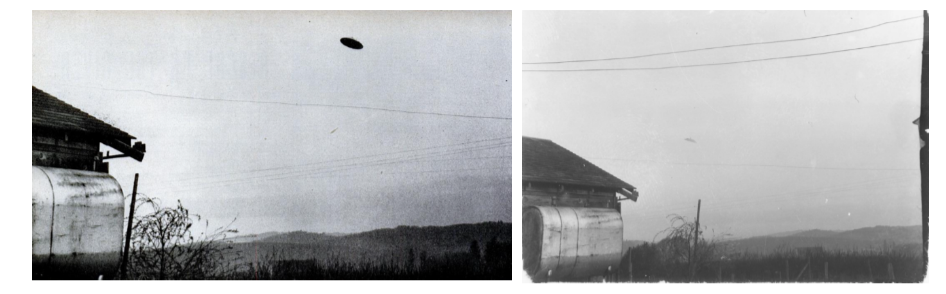
The McMinnville, Oregon UFO Festival began in 2000 to commemorate an important event in local UFO history, the Trent farm photos. It is celebrated each year around the date of the sighting with parades, social events, and scientific presentations.

Is the McMinnville UFO Festival Worth It? (2026 Review & Vlog)

Speakers this year included Dr. Matthew Szydagis, Dr. Rebecca Charbonneau (SETI), Kelly

Chase, Jason Martell (Ancient Aliens), George Knapp, and Jeremy Corbell.

Each year, the Oregon MUFON chapter also has prominent exposure in the main lecture hall to answer public questions and promote our organization. At the same time, we make some great connections with others in our field. This event is truly exceptional and should be a “must” for any enthusiast.

a9775f8f-8811-4bc5-96f9-79dd8b07a555.png?rdr=true

A little background history. It can be argued that the first documented UFO case in Oregon history is known as the Trent Sighting, occurring on May 11, 1950, above the Trent family farm located between McMinnville and Sheridan, Oregon.

Evelyn Trent observed a disc-shaped object maneuvering in the sky above their farm.

She alerted her husband, Paul, and they saw an object and estimated it to be about 20 to 30 feet in diameter. Paul went back into the house, grabbed his Kodak camera, and took two photographs before the object flew off to the west. Immediately, they alerted their in-laws, who lived next to the property, and their father-in-law observed the object as well.

99617d28-a3a5-45c2-a8e8-b7842790deec.png?rdr=true

Paul Trent initially thought it was a secret military aircraft and kept the sighting to himself. He finished his roll of film, containing previously taken pictures around the farm, including pictures of his family’s Mother’s Day picnic celebration.

This action in itself indirectly bolsters the legitimacy of the event, and that there was no intent to fabricate the images – they were in the middle of the film roll.

A month later, while talking with his banker, Frank Wortman, and encouraged by his brother Ralph, he mentioned the sighting and his photographs. Mr. Wortman was excited and displayed the photos in his bank’s window in McMinnville.

Shortly thereafter, local reporter Bill Powell convinced Trent to loan him the negatives and ran an article in the McMinnville Telephone-Register newspaper.

decc76f4-bf5a-4b4d-8fe5-0f1b9f2ac099.png?rdr=true

On June 9 and 10, 1950, The Oregonian published the photographs. On June 12, the story aired on national news broadcasts, followed by reprints of the photographs in the June 26 issue of Life magazine. The Trents were even flown to New York to appear on the television show,

We The People.

Following this national exposure, an investigator from Project Blue Book came to the

farm to interview the Trents, in addition to investigators from the FBI.

In 1969, as we know, the Air Force’s Condon Commission published a report, claiming an exhaustive UFO study and easily dismissing many accounts. However, it was stated that the Trent photographs were “difficult to explain conventionally” and concluded that the photographs were genuine. Following the conclusion of the Condon report, the negatives were returned to UPI, and in 1970, they were sent back to the

News-Register (formerly the Telephone Register) in McMinnville. When they arrived back at the paper, 20 years later, the negatives had been tampered with considerably.

Someone had cropped the negatives, trimming down the edges and reducing their overall size so that parts of the original image were missing. Despite ongoing attempts by Philip Klass and others to debunk the photos, in 1975, Dr. Bruce Maccabee of MUFON, a renowned optical-photo analyst, made an intensive study of the negatives and concluded that they were not the result of some kind of trickery.

Interesting Side Note:

In 1999, a longtime resident of McMinnville saw the pictures and articles commemorating the Trent UFO sighting at the newly opened Hotel Oregon. Wishing to remain anonymous, she validated the sighting by telling her story. On May 11, 1950, she and a group of her fellow Linfield College students heard stories of a recent UFO encounter nearby. They went to the area of the present site of the McMinnville airport and saw dozens of cars pulled off the road, presently on Three Mile Lane. Following the direction people were looking, they too observed a “steel gray, metal saucer” floating just above tree level.

Their encounter went unreported.


How the McMinnville UFO sighting inspired Oregon’s famous UFO festival

We Drove 7 Hours to the World’s Greatest UFO Festival | McMinnville UFO Fest 2026

{ https://mufon.com/ }

Hoe vind je dit bericht?
Geschreven door peter om 21:35 Stuur door

Lawmaker UFO Talk with Private Contractor

Lawmaker UFO Talk with Private Contractor

Overview

Rep. Eric Burlison, R-Mo., is broadening his inquiry into alleged UAP-related government secrecy by turning to private defense contractors, specifically MIT Lincoln Laboratory. In a social media post, Burlison said he had sent a letter seeking a classified 1952 briefing video described as a “flying saucer talk,” adding that the laboratory’s attorneys responded quickly and indicated they would comply within 30 days. The move comes as lawmakers continue pressing for transparency around alleged secret UFO-related programs they believe may sit outside traditional Pentagon records.

Burlison framed the effort as part of a larger strategy to follow information wherever it may be stored. “Congressional letters carry weight. We’re going to keep sending them,” he said, signaling that the inquiry is likely to continue beyond this single request. The congressman’s comments reflect a growing frustration among some lawmakers that key records may not be held directly by federal agencies but instead by outside entities that work with the government under classified arrangements.

Why MIT Lincoln Laboratory Matters

MIT Lincoln Laboratory is not a typical contractor. Founded in 1951 to help build the SAGE air defense network, it is one of the country’s oldest Federally Funded Research and Development Centers (FFRDCs). These centers occupy a unique position in the defense ecosystem: they are funded by the government, work on long-term national security projects, and can access classified and proprietary information that many commercial contractors cannot legally see. Over decades, Lincoln Lab has been involved in sensitive work ranging from ballistic missile defense to electronic warfare.

That structure is central to Burlison’s argument. In his view, if lawmakers want to understand whether hidden programs exist, they must examine the network of nonprofit research institutions and laboratories that operate one step removed from the executive branch. He said his investigation is following “the trail into RAND, MITRE, Aerospace Corp, MIT Lincoln Labs, and the Northrop Grummans of the world,” underscoring his belief that information may be dispersed across multiple private-sector institutions rather than stored in a single government archive.

Congressional Push for Disclosure

The latest move also fits into a broader wave of congressional scrutiny sparked by testimony from David Grusch, the former intelligence officer whose allegations of secret UFO-retrieval and reverse-engineering programs helped drive a series of hearings. Grusch has argued that private contractors may be used to shield sensitive programs from congressional oversight, making it harder for lawmakers to verify what the government knows about UAPs or how taxpayer money may be spent.

That view has found support among some members of Congress. Rep. Tim Burchett, R-Tenn., one of the most vocal advocates for disclosure, has repeatedly said the Defense Department appears to silo information in ways that frustrate oversight. He compared the dynamic to the secrecy surrounding World War II-era efforts such as the Manhattan Project, noting that large numbers of people may work on a program without knowing its true purpose. For advocates of disclosure, the issue is therefore not only whether UFO programs exist, but who controls the records and who can be asked to account for them.

Pentagon Response and What Comes Next

The Pentagon has consistently denied claims that it is hiding evidence of recovered UFO craft or covert retrieval programs, and officials have maintained that many UAP reports are explainable through conventional means, incomplete data, or misidentification. Still, Burlison’s request suggests lawmakers are not limiting themselves to government agencies alone. By targeting a federally funded laboratory with long-standing classified access, he is testing whether records tied to historical UAP claims may exist outside normal public-facing channels.

If Lincoln Laboratory does provide a response within the stated 30-day window, it could become another data point in a growing congressional record that includes hearings, whistleblower testimony, and requests to defense-linked institutions. For now, Burlison’s outreach illustrates how the UAP debate has shifted from speculation about sightings to a more concrete fight over where information is kept, who controls it, and whether Congress can get access to it.

{ https://usubjects.com/  }

Hoe vind je dit bericht?
Geschreven door peter om 23:49 Stuur door

New Horizons is heading beyond the Solar System

New Horizons is heading beyond the Solar System

The New Horizons spacecraft could cross the boundary of the heliosphere in as little as three years — or it may take as long as fourteen. That range comes from new forecasts built by combining solar-wind prediction methods with numerical models of the heliosphere. 

Modeling the structure of the heliosphere and its interaction with the interstellar medium. Solar-wind data and pressure forecasts help predict when New Horizons will encounter the termination shock on its way toward interstellar space. Credit: NASA / IBEX / Adler Planetarium / SwRI

Forecasting the Solar Wind

Researchers at the Southwest Research Institute (SwRI) in Texas used existing numerical simulations to reconstruct the structure of the heliosphere and its interaction with the interstellar medium. They added solar-wind data and forecasts of its pressure to the models. This made it possible to estimate the position of the termination shock — the first plasma boundary the spacecraft will encounter beyond Pluto’s orbit.

The heliosphere does not have a static boundary. It constantly expands and contracts in response to changes in solar activity. During solar maximum, the stronger solar wind expands it; during solar minimum, it shrinks. This dynamic behavior is what makes forecasting so difficult and produces such a wide range of possible timelines.

Two Scientific Papers

Two scientific papers by Dr. Jonathan Gasser of SwRI describe the forecasting method. The first, published in the peer-reviewed journal Advances in Space Research, focuses directly on predicting when the spacecraft will cross the termination shock. The second, published in The Astrophysical Journal, examines long-term variations in the global heliosphere based on solar-wind forecasts.

According to the team’s estimates, New Horizons will reach the boundary no earlier than 2029 and no later than 2040. The spacecraft may cross it not just once, but several times, if the heliosphere contracts and then expands again as New Horizons continues its journey. New Horizons will become only the third spacecraft in history to cross this boundary. The first two were Voyager 1 and Voyager 2.

Shape Matters

Scientists do not agree on the exact shape of the heliosphere. Some models depict it as comet-like, with a rounded nose and an elongated tail. Other calculations suggest a croissant-like shape. The distance to the boundary in any given direction depends on which model is closer to reality.

That is why researchers emphasize the need for direct measurements. As New Horizons approaches the termination shock, the team will need to prepare in advance to collect and downlink data from this region. New Horizons has already completed historic flybys of Pluto and the Kuiper Belt object Arrokoth. Now it is approaching the forward region of the heliosphere.

New Horizons Is About to Cross the Edge of Our Solar System #didyouknow #mindblown #space #facts

New Horizons: Across The Expanse

Beyond The Horizon : The Universe's New Sight - Space Documentary

{ https://universemagazine.com/en/articles-en/ }

Hoe vind je dit bericht?
Geschreven door peter om 23:28 Stuur door

Did Gravitational Tides Cause Earth's Extinctions?

Did Gravitational Tides Cause Earth's Extinctions?

This illustration shows a massive tidal wave created by the flyby of a planetary mass object. New research says Earth may have experienced multiple dangerous flybys that contributed to or caused extinctions in the last 600 million years. Image Credit: Fargion 2026. PoS.

Life on Earth took a long evolutionary journey that eventually created us, the purportedly intelligent species that dominates the planet. But there was no grand plan or design, only happenstance, nature, and luck. Life on Earth suffered multiple extinctions, but got up, dusted itself off, and continued on its long march to complexity.

The Chicxulub impact that wiped out the dinosaurs and set the stage for the ascension of mammals grabs plenty of headlines. But there may have been more subtle events that also led to extinctions. Gravitational tides generated by the flybys of planetary mass objects or dwarf planets may have played a role.

That's according to a new paper by Daniele Fargion, a research professor from Rome University and the Osservatorio Astronomico di Capodimonte in Naples. It's a conference proceedings paper titled "Mass Extinctions by Gravitational Tides" and it was presented at the 'Multi-frequency Behaviour of High Energy Cosmic Sources' conference in Palermo, June 2025. It's currently available at arxiv.org.

Fargion points out that there's ample evidence for a population of dwarf planet sized objects in the outer Solar System, of which Pluto may be the most well-known member. There could be thousands of tens of thousands of these objects on elliptical orbits. Gravitational perturbations could send some of these objects into the inner Solar System, where collisions like the one between Earth and Theia created the Moon. But far more likely than head-on collisions are flybys.

"Such passages may have left strong tidal signatures: giant waves, large volcanic episodes, sea regressions, coherent meteor showers, and major climatic perturbations," Fargion writes. "These mechanisms could have contributed to several major biological mass extinctions over the past 600 million years, as suggested by peculiar correlations in the geological record."

Fargion explains that Earth's major mass extinctions correlate in time with huge changes in the planetary climate, meteoric impacts, and enormous volcanic eruptions. Correlation is one thing, but finding the definitive links between them is more difficult. "The reason for that is not clear. Meteoritic impacts alone, volcanic eruptions alone or sea regressions alone could not have caused all the major mass extinctions," he writes.

While there's plenty of evidence, including the iridium anomaly, that an impact wiped out the dinosaurs and created a mass extinction about 64 million years ago, the causes of other mass extinctions aren't so clear.

The largest known extinction occurred 251 million years ago, and pinpointing its cause continues to be difficult. "But, neither an iridium anomaly, nor a large meteoritic crater have been dated back to the Permian/Triassic (P/T) mass extinction, 251 𝑀 𝑦 ago, which was the largest known extinction in the history of life, where global species extinction ranged between 80% to 95%," the author explains.

"Here we suggest that tidal effects of planetary-mass objects which pass near Earth could have caused all of these and can explain the complex geological records of the major biological mass extinctions," Fargion explains.

There are many anomalies in the inner Solar System that can be attributed to flybys of, collisions with, or captures of planetary mass objects from the outer Solar System. Uranus is tilted on its side, and that could be from a collision. Triton, Neptune's largest moon, appears to be a captured Kuiper Belt Object. And the Late Heavy Bombardment may have been caused by perturbations from a planetary mass flyby. The Solar System also features several retrograde orbit moons, a feature which still waits for an explanation.
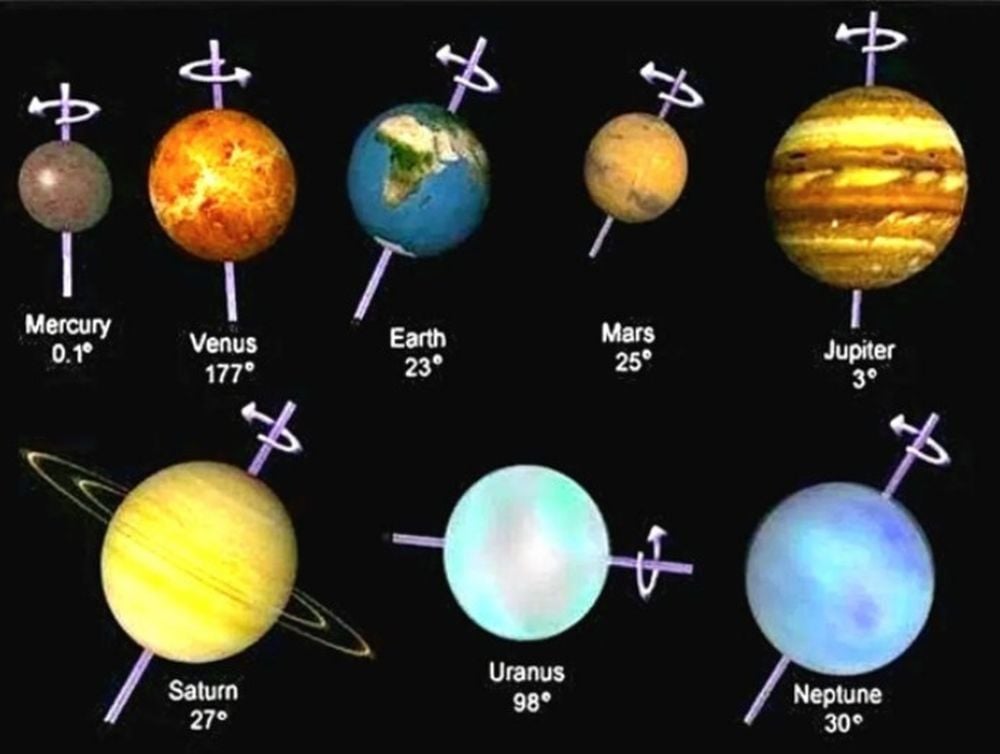
The author says that collisions with planetary mass objects could've created the off-axis spins of the planets. Multiple collisions may have been responsible. Image Credit: Fargion 2026. PoS

*The author says that collisions with planetary mass objects could've created the off-axis spins of the planets. Multiple collisions may have been responsible. Image Credit: Fargion 2026. PoS*

It's unreasonable to think that Earth was unaffected by similar events.

"Passage of such objects near Earth could have generated on it gigantic tidal waves, large volcanic eruptions and drastic changes in global climate and sea level," writes Fargion. "Moreover, upon crossing the asteroids and Kuiper belts these planetary mass objects could have diverted large meteorites and asteroids into a collision course with Earth. Thus visits of distant planets may be the common cause for the various catastrophes that were jointly responsible for the major biological mass extinctions."

Some evidence for past flybys can be seen in the Earth-Moon system, according to the author. "Fossil corals show that the rate of decrease in the number of diurnal rings during annual cycles, i.e. the rate of decrease in the number of days in a year, has changed suddenly into a slower rate at the end Devonian," Fargion writes. "Since the lengthening of the day is due to slowing of the rotation of Earth by the well understood Moon’s tidal forces, it implies that at the end Devonian the moon-Earth distance increased suddenly by a significant fraction."

A collision couldn't do that because it's so sudden and would create an instantaneous change. But a flyby could. "Such an increase could have been induced by a tidal pull in a nearby passage of a visiting planet/moon," Fargion explains. That tidal pull could also generate global tsunamis, and generate powerful tides that lasted years. It would also deform the crust and generate tidal heating in the planet's interior, which could have triggered massive volcanic eruptions.

These events were all a long time ago, and it's challenging to estimate how many flybys there were and how massive the objects were. "A reliable estimate of the masses and the flux of the visiting planets/planetesimals is not possible yet," writes Fargion.

But Jupiter may provide a way to understand. Jupiter is slightly tilted on its axis, and also seems to have an unaccounted for energy source that helps it have such a high surface temperature. Fargion calculates that Jupiter has suffered 16 collisions with objects of 0.5 Earth masses in its history. "Similar estimates for other planets, although yielding the correct order of magnitude for the tilts of their spins, are less reliable because the inferred number of accreted planets is too small," Fargion explains. "We note, however that the past dwarf planet population, four billion years ago, could be more heavier than present one, which is mostly dominated by lighter Moon-like dwarf planet mass."

The Solar System's history is a puzzle, and Earth's history is likewise puzzling. Ongoing discoveries of massive objects in the outer Solar System show that they're a part of the puzzle, too. If they visited the inner Solar System, they could've triggered extinctions. And if it happened in the past, it could happen again in the future.
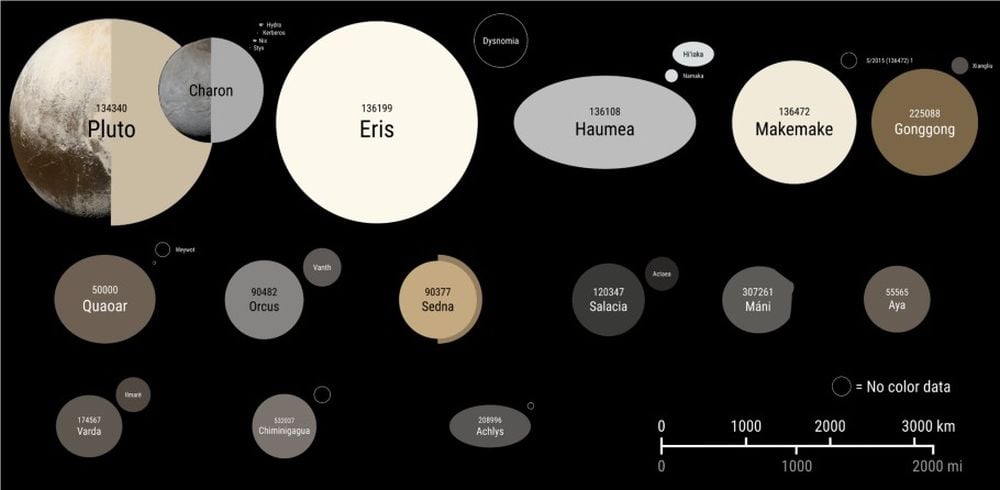
These are some of the planetary mass objects in our Solar System. During flybys, objects with this much mass could've triggered extinctions on Earth. Image Credit: Fargion 2026. PoS

*These are some of the planetary mass objects in our Solar System. During flybys, objects with this much mass could've triggered extinctions on Earth.

Image Credit: Fargion 2026. PoS*

"The consequent lessons for us humans, to overcome such an eventual extinctions are: deep sky inspection to seek weakest far dwarf planet sources, once found, alert the incoming events as soon as possible," the author writes. If it's asteroid sized, try to divert it.

But if it's larger than an asteroid and is a planetary mass object, then we need to prepare differently. The main danger, according to Fargion, would be from massive tidal waves that swept around the planet and persisted for years. In this case, there's only one thing we can do.

"A prevention might be also to organize, on the top of mountains chains (at 2-3 km altitude), secure refuge for human and life for surviving such (rare but not, impossible) events," Fargion writes.

The author also entertains the idea that flybys like this could help explain the Fermi Paradox. "The tidal mass extinction, its rate and form, may also explain the famous Fermi Paradox: Where is everybody, or, why they are not yet here? The answer could be, that life is unstable and short," the author writes.

"Astrophysical tidal extinctions could more rarely cancel any advanced civilization, making a life reset toward a lower, primordial, silent level," Fargion concludes.


All 5 Mass Extinctions Explained (And How Life Survived)

When Life Almost Ended: Mass Extinctions Through Time

{ https://www.universetoday.com/ }

Hoe vind je dit bericht?
Geschreven door peter om 22:55 Stuur door

Scientists Warn Extraterrestrial Encounters Could Endanger Earth—a Quarantine Facility on the Moon May Be Our Last Line of Defense

Moon base extraterrestrial

(Image Credit: Novioboy/Public Domain)

Scientists Warn Extraterrestrial Encounters Could Endanger Earth—a Quarantine Facility on the Moon May Be Our Last Line of Defense

During future space missions, humans may finally encounter extraterrestrial life forms, settling the age-old question of whether we are alone in the cosmos. But what if alien biology is so different from that of Earthlings that its presence could become a potential global hazard?

This is the concern raised by researchers Frederick I. Moxley and Anthony Ricciardi in a new study, which argues that in an era of sample return missions and space missions that are carrying humans and our robotic probes farther into the cosmos than ever before, we need to be prepared to enact measures to protect our planet against the unforeseen consequences of any potential alien encounters the future may hold.

“The advancement of space exploration into an era of sample return missions from Mars, asteroids, and icy moons raises the potential for biological contamination either to or from Earth,” the authors write in their recent study, published in the journal Ambio. Given the potential for such contamination, Moxley and Ricciardi approach the question of alien contact from the perspective of past examples where invasive species on Earth have caused major disturbances to the environments they encounter.

“We consider the possibility that extraterrestrial organisms introduced to Earth could behave analogously to invasive species by destabilizing ecosystems or interacting unpredictably with their new environment,” the authors write, pointing to the multitude of examples known to science, many of which involve the introduction of microbial organisms into new environments—often with devastating consequences.

In many cases, such organisms not only can survive in new environments, but can often adapt with remarkable speed, even in some of the most extreme environments.

This, the authors say, challenges the idea that extraterrestrial life might not even be capable of surviving on Earth, as expressed by some past research.

“The plausibility of encountering extraterrestrial life warrants stringent planetary protection measures grounded in biosafety and biosecurity principles,” the authors warn.

So how do they suggest protecting Earth against such potentially catastrophic events involving future encounters with extraterrestrials?

According to Moxley and Ricciardi, building a quarantine facility on the Moon could serve as Earth’s last line of defense against any unintended alien invasions that could radically disrupt Earth’s fragile ecosystems.

“Due to its proximity, natural isolation, and apparent lack of a biosphere, the Moon can serve as a secure site for biocontainment of extraterrestrial samples,” the authors write. In their study, they examine historical instances where biological invasions have led to catastrophic environmental changes and argue that constructing a biocontainment facility on the Moon “should form the cornerstone of modern astrobiological risk mitigation strategies.”

Moon base extraterrestrial

Artist’s concept of a future lunar base (Image Credit: NASA/SAIC/Pat Rawlings)

What the researchers propose falls in line with current plans NASA has for a permanent lunar base, which is one of the many ambitious efforts under its Artemis Mission. Such a lunar outpost, which will serve as the official Artemis Base Camp, is planned for construction near the Moon’s South Pole.

At a cost of close to $30 billion, the effort will help to facilitate an ongoing human presence on the Moon by as soon as 2028, according to current mission timelines, and will serve as a science hub in support of future lunar exploration.

For Moxley and Ricciardi, incorporating a quarantine facility within our future lunar infrastructure that can house any extraterrestrial life forms we may encounter could prove to be vital. Ultimately, having such a facility may play the important role of shielding Earth against unintentional contamination by a potentially invasive alien species.

The team’s recent paper, “Protecting earth from extraterrestrial contamination: The case for a lunar biocontainment facility,” was published in Ambio.

  • Micah Hanks is the Editor-in-Chief and Co-Founder of The Debrief. A longtime reporter on science, defense, and technology with a focus on space and astronomy, he can be reached at micah@thedebrief.org. Follow him on X @MicahHanks, and at micahhanks.com.
RELATED VIDEOS

Answering Extra-Terrestrial Questions | Through the Wormhole | Science Channel

Close Encounters with Terrifying Aliens | UFO Files

{ https://thedebrief.org/category/science/ }

Hoe vind je dit bericht?
Geschreven door peter om 22:35 Stuur door

Missing scientist found dead after 11 months took two shocking items with her that cast doubt on suicide theory

Missing scientist found dead after 11 months took two shocking items with her that cast doubt on suicide theory

The case of a missing nuclear lab employee who was found dead nearly a year after vanishing has taken a troubling turn, with new details raising questions about the suicide theory. 
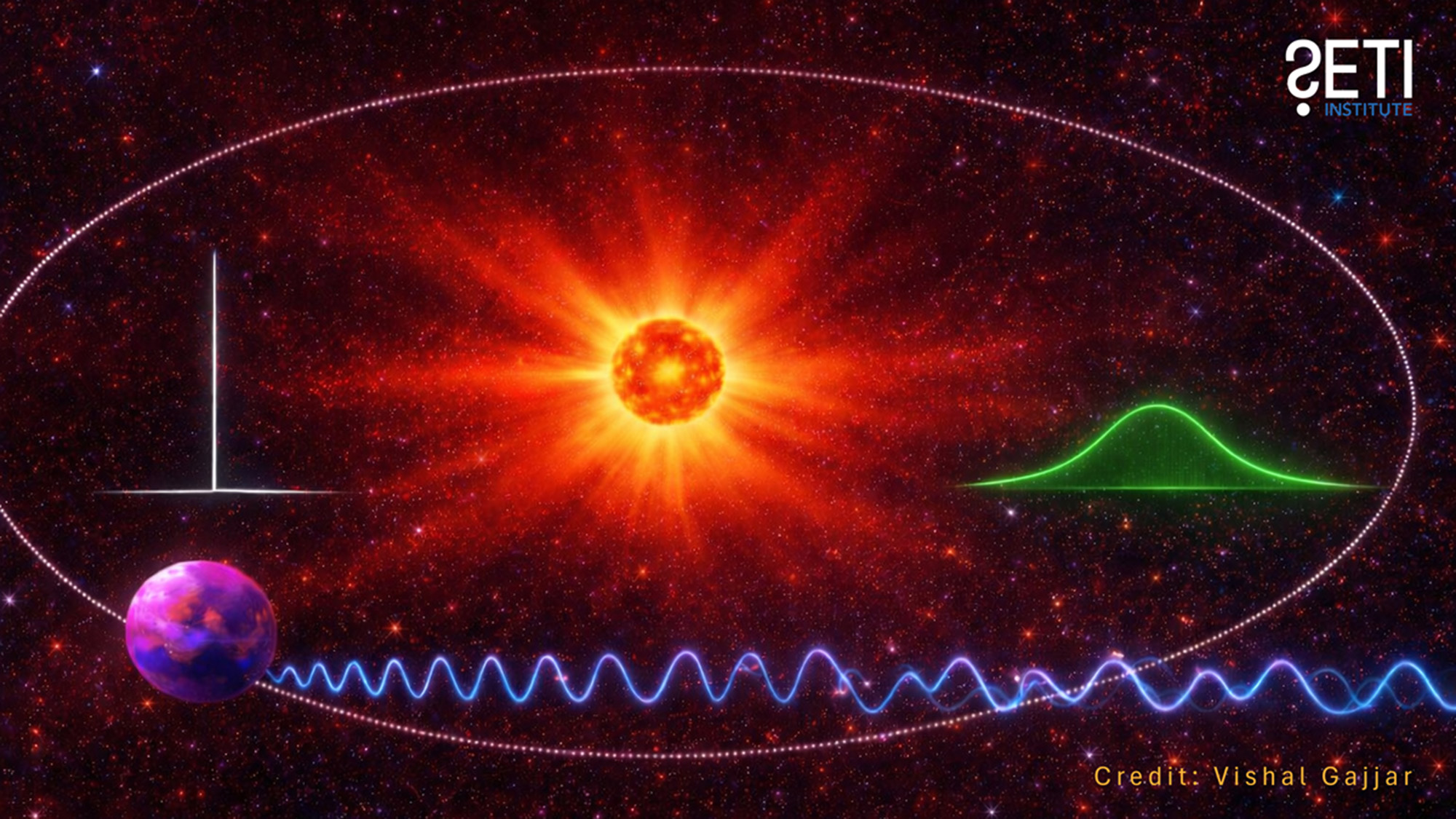
Melissa Casias, 53, a former administrative assistant at Los Alamos National Laboratory (LANL), disappeared from her home in Ranchos de Taos, New Mexico, on June 26, 2025.

Her skeletal remains, along with a reported gunshot wound to the head, were discovered in New Mexico's Carson National Forest on May 28, lying next to a handgun that her family insists did not belong to the wife and mother.

Now, new details about her final moments have been released, revealing Casias took her toothbrush and thyroid medication before walking out the door of her Ranchos de Taos home for the last time.

Los Angeles Magazine contributor Lauren Conlin, who has been following Casias' case closely and first reported on the items, told NewsNation that they are 'things that might indicate you're planning to stay alive.'

Morgan Wright, founder and CEO of the National Center for Open and Unsolved Cases, also said that there are key aspects of Casias' disappearance and the discovery of her remains that do not add up.

'You don't get slumped up on a tree,' said Wright.

'Most of the time, in every crime scene I've worked on, there are skeletonized remains, and there's no connective tissue left. Everything's on the ground in pieces.' 

The final image of Melissa Casias alive came from a surveillance camera near State Road 518 in New Mexico, approximately three miles from her home.

The final image of Melissa Casias alive came from a surveillance camera near State Road 518 in New Mexico, approximately three miles from her home

article image

Although Casias' remains have been in the custody of authorities since June 1, the New Mexico Office of the Medical Investigator has yet to announce an official cause of death.

Earlier this month, authorities told the Daily Mail that an initial CT scan of the remains did not reveal any projectiles in the skull, meaning no bullet was recovered alongside the skull fragments found in the woods.

Police have not publicly confirmed that Casias suffered a gunshot wound to the head.

Those details were first disclosed to the Daily Mail by Arizona-based investigator Thomas McNally, who had been working on the case on behalf of Casias' parents, Joe and Joanne Mondragon.

The absence of a recovered bullet has raised questions among independent investigators. 

Wright said the type of ammunition allegedly used could be a key factor, telling NewsNation that some bullets expand upon impact and are often recovered from a body, while others are more likely to pass completely through. 

He argued that determining the type of ammunition involved could help investigators understand why no projectile was found.

Casias vanished after dropping off her husband, Mark, another LANL employee, at the facility that morning, approximately 70 miles from their home.

Melissa Casias worked at the Los Alamos National Laboratory, a long-running nuclear research facility, before disappearing on June 26, 2025.

Melissa Casias worked at the Los Alamos National Laboratory, a long-running nuclear research facility, before disappearing on June 26, 2025

Melissa Casias (Left) pictured with her husband Mark Casias.

Melissa Casias (Left) pictured with her husband Mark Casias

She then claimed she had to return home after forgetting the badge needed to access the nuclear lab.

According to Mark, Casias had the security badge with her when she dropped him off that morning, as she would have needed the badge to get past the security checkpoints to drop him off.

When Casias arrived in Ranchos de Taos, the couple's daughter, Sierra, reportedly told investigators that her mother visited the teen's place of work to drop off a sandwich and then said she planned to work from home after forgetting the badge.

Despite what Casias reportedly told both her daughter and husband, she returned home to drop off her work and personal phones, which the family would later find inside the house, wiped clean of all data.

Surveillance cameras last spotted Casias walking alone eastward on State Road 518, roughly three miles from her home around 2.20pm local time.

Melissa Casias (Left) pictured with her daughter, Sierra. Her daughter is believed to be the last family member is see Casias alive on June 26, 2025.

Melissa Casias (Left) pictured with her daughter, Sierra. Her daughter is believed to be the last family member is see Casias alive on June 26, 2025

Former FBI Assistant Director Chris Swecker told the Daily Mail in March he was concerned her disappearance was part of a much larger pattern involving individuals who had access to top secret government research.

Swecker explained that Casias's work at LANL may have made her a target for abduction, since an administrative assistant often has access to the same sensitive files their supervisors have.

'In a classified lab, or just a high clearance lab, they would basically be in the know on what's going on,' Swecker said. 'And it wouldn't be the first time their administrative assistant has been targeted.'

However, the woman's family and private investigators have disputed how much access Casias really had, claiming that the LANL employee lost her security clearance due to financial troubles she and her husband were having.


Missing U.S. Scientist Found Dead: Mystery Around UFO-Linked Researchers Deepens | GRAVITAS

Missing Scientists Mystery Deepens: Missing US Scientist Melissa Casias Found Dead in Forest | WION

15 Scientists Missing Under Strange Circumstances… What Happened?

{ https://www.dailymail.com/sciencetech/index.html }

Hoe vind je dit bericht?
Geschreven door peter om 21:54 Stuur door

Scientists found the optimal robot body, and it has 20 legs ‪—‬ watch it scale walls and move through trees

Scientists found the optimal robot body, and it has 20 legs ‪—‬ watch it scale walls and move through trees

A sea-urchin-like robot could offer a new blueprint for making more versatile robots, research suggests.

A 20-legged robot rolls down a dirt path in the woods.

New research suggests that a sea-urchin-like robot could offer a new blueprint for making more versatile robots.
(Image credit: Duke University)

A weird 20-legged machine could change how scientists think about the ideal robot form.

For decades, roboticists have been inspired by the natural world, building machines that resemble humans, dogs, insects and even horses. But new research suggests that the most useful robot body may look less like a human and more like a sea urchin.

The robot has no front or back. Its 20 telescoping legs, each costing $300, radiate from a central body, with a depth camera at each leg tip, leading the researchers to name it Argus, after the all-seeing monster of Greek mythology. This design results in a machine that can move in any direction, stabilize itself after being pushed, cross rough terrain, carry a 10-pound (4.5 kilograms) payload and even climb up walls.

The Duke University scientists who created the robot published their findings May 27 in the journal Science Robotics.

"Watching Argus move is unlike watching any other robot we've worked with," Jiaxun Liu, a doctoral student in Duke's General Robotics Lab and co-author of the study, said in a statement. "The first time we saw it navigate among trees and rough terrain, even under heavy collisions [when someone pushed it], we knew this was something different."

You may like
  • A person sits in a large cage built into a red bipedal robot with long arms.

China's real-life 'transformer' mech is a giant humanoid robot that can switch from bounding on 4 legs to walking on 2

  • A close up of an oval shaped metal roller with a camera in the middle rolling on a sandy surface.

This 'crawling' robot rolled around the moon and took a historic photo

  • A white humanoid robot stands over a kitchen stove, holding utensils.

This humanoid robot does all your housework for you ‪—‬ and its makers say it's ready for your home

Simulating symmetry

The team arrived at Argus' design after running more than 1,500 simulations of different robot shapes. Instead of asking what animal the robot should resemble, the researchers focused on how symmetrical a machine could be in all directions ‪—‬ a mathematical concept called dynamic isotropy.

The dynamic isotropy score ranges from 0 to 1 and measures how evenly a robot can accelerate its body, or center of mass, in every direction. A score of 1 means a robot can react or move nearly identically in all directions.

"When a robot can accelerate equally well in every direction, it stops needing to face the world in any particular way," Boyuan Chen, director of Duke's General Robotics Lab and co-author of the study, said in the statement. "Forward and backward become the same. Left and right become the same. The whole problem of robot control changes character."

According to the researchers, most robots today — including advanced four-legged robots, humanoids and conventional drones — score below 0.6, meaning they're better at moving or reacting in some directions than others. With its 20 legs, Argus scored a 0.91, close to the theoretical maximum.

To achieve this high score, the team arranged Argus' body around a shape called a regular dodecahedron, a three-dimensional form with 12 pentagonal faces. The arrangement gives the robot a nearly uniform field of view and allows it to move without needing to orient itself the way a conventional robot would.

What to read next
  • A black arm with a ovular paddle on the end passes a ball forward on a blue table tennis to a person with a red paddle in the foreground

Advanced AI-powered table-tennis-playing robot can match up to the professionals — watch it in action

  • A humanoid running robot with a red jersey reaches a dark blue ribbon at the finish line of a road race.

Humanoid robots have outpaced human runners in the half-marathon, beating the world record ‪—‬ here are the secrets to this astonishing feat
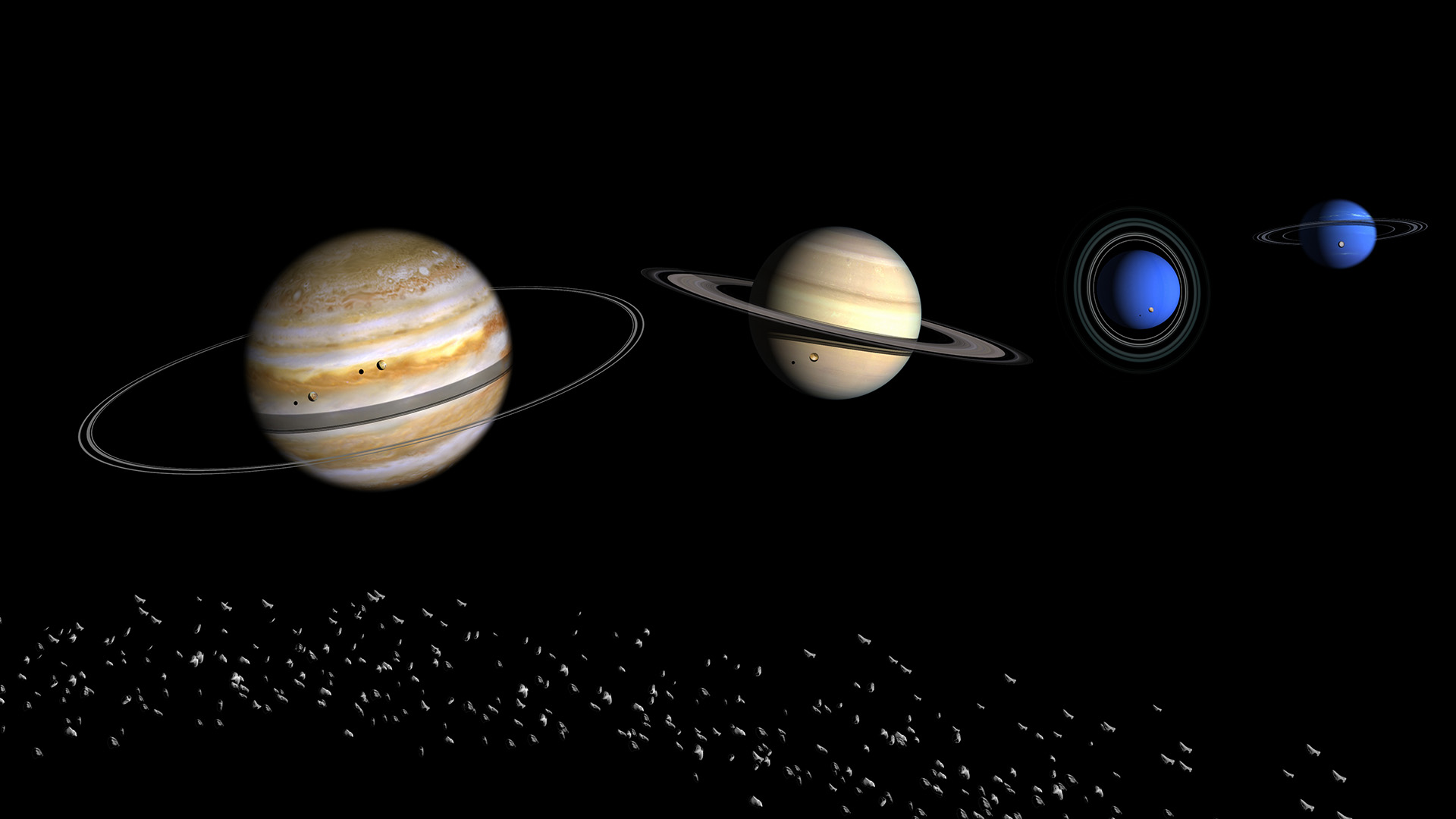
  • Screenshot of Ouster's new lidar system in action

World's first 'native' color lidar will let robots and self-driving cars map the world in full color 3D

Chen said that based on these findings, robots don't need to imitate humans or dogs to boost their agility, and instead are designed from deeper mathematical principles.

Releasing the robot

To test whether Argus' design was truly optimal, the team took the robot out on the Duke campus, where it rolled across concrete, grass, dense foliage, soft sand, wet surfaces and bark. It handled obstacles up to 5 inches (12.7 centimeters) tall, kept moving even after three of its legs were broken, and pushed a 3-foot (1 meter) cube while rolling.

Argus, the 20-legged robot, rolls across a sandy beach.

(Image credit: Duke University)

Argus is a proof of concept and not the final answer on the optimal robot design, the researchers wrote in the study. Its broader importance may be in how it was designed rather than where or how it can be used in real-world scenarios ‪—‬ it could be a mathematical way to compare different robot bodies and design new form factors from scratch.

"It shows that designing for dynamic symmetry isn't just a theoretical curiosity," Boxi Xia, a postdoctoral researcher at Duke's General Robotics Lab and co-author of the study, said in the statement. "It produces a robot you can deploy in the wild, on uneven ground and in clutter, even in low-gravity settings. It changes what's possible."

Article Sources

  • Liu, J., Xia, B., & Chen, B. (2026). Extreme dynamic symmetry enables omnidirectional and multifunctional robots.

Science Robotics, 11(114). https://doi.org/10.1126/scirobotics.aec1725


Extreme Dynamic Symmetry EnablesOmnidirectional and Multifunctional Robots

This 20-Legged Robot Could Change Robotics Forever

{ https://www.livescience.com/technology/robotics }

Hoe vind je dit bericht?
Geschreven door peter om 18:25 Stuur door

Humans May Soon Be Able to Regrow Body Parts—Including Fingers and Limbs—Thanks to a Groundbreaking Serum

Humans May Soon Be Able to Regrow Body Parts—Including Fingers and Limbs—Thanks to a Groundbreaking Serum

The key to regeneration has been inside you all along, new research suggests.

Hologram color paper reflection

Getty Images

Imagine losing a finger in a kitchen mishap or an entire limb in an accident. Instead of learning to adapt to a prosthetic, your doctor prescribes you a serum. A few months later, your bone, muscle, nerves, and skin have perfectly knit themselves back together. Your limb is entirely regrown.

It sounds like pure science fiction, but scientists are currently working to unlock the secrets of limb regeneration in mammals, drawing inspiration from salamanders. Axolotls, a type of salamander, can take roughly 40 to 50 days to regrow lost limbs, which is a flash compared to humans and other mammals who lack the ability all together. But a new treatment could change that shortcoming.

In a recent study published in Nature Communications, researchers from Texas A&M University used a specially-formulated serum that encouraged mice to form a blastema—the temporary cellular structure that helps organisms like axolotls regenerate structures.

Hw were they able to do this? According to study author Ken Muneoka, PhD, professor of veterinary physiology and pharmacology at Texas A&M, he and his team amputated part of a mouse’s finger. From there, researchers followed three steps to regrow the digit:

  • Wait for initial healing: Instead of treating the wound right away, Muneoka and his team waited for the skin to close up and heal over. The wound actually has the highest potential to regrow right when the skin closes and the body’s natural inflammation peaks, Muneoka explains.
  • Apply the first protein (FGF2): Once the skin closed, Muneoka and his team implanted a tiny bead containing a protein called FGF2. While this protein doesn’t cause full regrowth on its own in adult mice, it successfully stops the body from forming a scar, according to Muneoka. Instead, it tricks the wound cells into forming a “blastema”—a mass of multiplying, unprogrammed cells that is usually seen when animals like salamanders regrow lost limbs. Simply put, it helps the body form a “blueprint.”
  • Apply the second protein (BMP2): After the blastema formed, Muneoka and his team treated it with a second protein called BMP2. On its own, BMP2 only helps fix and lengthen broken bones, according to Muneoka. However, because it was applied after the first protein, it uses the newly formed blastema cells to grow an entirely new, complete bone at the tip of the finger.

So, could someone who is born with, say, an underdeveloped limb be able to grow a new one using this treatment—or does the human body lack the blueprint? According to Muneoka, it depends on the reason for the underdeveloped limb.

“The human body uses the ‘blueprint’ to form the limb in the embryo, and we found evidence that this ‘blueprint’ is re-utilized when regeneration is stimulated by our treatment,” Muneoka says. In other words, someone whose limb was underdeveloped because of external factors in vivo, such as alcohol or drug exposure, might see better results than someone whose underdeveloped limb was caused by a genetic modification—or a damaged blueprint. “If the ‘blueprint’ is intact, then the expectation is that the regeneration should be possible,” he says. The amount of time this would take isn’t yet known.

If this treatment has the potential to regrow human limbs, what else could it do? Could it eventually be used to regrow more complex structures, like organs? There are studies—such as one published in Nature Genetics and another in PNAS—that show lung formation and limb formation share similar genetic requirements, according to Muneoka. There’s also research in salamanders that show that two proteins that are important for limb regeneration are also important for regeneration of other structures, such as gills.

“This suggests that the regenerative process may have universal characteristics, which gives us hope that our strategy for stimulating digit regeneration could have broad application,” Muneoka says. “We believe that our study outlines a general strategy for enhancing regenerative capabilities in humans. The specific details for this strategy will likely differ between organ systems, and that needs to be determined empirically.”

The tricky part, Muneoka says, is that organ regeneration requires time that may not be possible if the organ’s use is required to stay alive. So depending on the extent of the organ’s damage, a transplant from a donor may still be necessary.

Regeneration of body parts is unlikely to lead to immortality, though, according to Muneoka. “If individuals could regenerate organs throughout their lives, it would improve the quality of life, and it may enhance lifespan,” he says. But he points to a 2021 mouse study that he worked on, which found that blastema formation and the quality of the regenerative response declines with age.

So while we won’t be able to live forever or sprout a new pair of lungs overnight, the blueprint for human regeneration is already coded inside us—an exciting step forward for what’s possible when it comes to human healing.


The Genes That Regrow Body Parts Are Already in Humans

Humans Could Regrow Body Parts? | The Science of Regeneration 🔬

{ https://www.popularmechanics.com/science/ }

Hoe vind je dit bericht?
Geschreven door peter om 17:49 Stuur door

Archaeologists Found an ‘Anomaly’ Near the Pyramids That May Reveal an Ancient Portal

https:%2F%2Fmedia.zenfs.com%2Fen%2Fpopular_mechanics_642%2F7ff52ff30f0d0a60f3c224e88c8d2b54

Experts Find 'Anomaly' Near the Great Pyramids

Nick Brundle Photography - Getty Images

Ground-penetrating radar has enabled archaeologists to identify hidden structures beneath the surface. A new study conducted by Japanese and Egyptian researchers has revealed an L-shaped structure accompanied by a nearby anomaly next to the Great Pyramids of Giza. While the precise nature of the anomaly is unknown, the researchers speculate that the L-shaped feature could potentially be an entrance to a deeper structure.

In archaeology, ground-penetrating radar (GPR) has transformed the way sites are studied. This geophysical technique sends radar pulses into the ground to create subsurface images. Similar methods have previously uncovered Viking longships in Norway, revealed lost civilizations within the Amazon rainforest, and even mapped entire Roman cities without any excavation.

Once again, GPR has yielded discoveries near one of the world’s most thoroughly explored sites—the Great Pyramids of Giza. The research team, led by Motoyuki Sato of Tohoku University, combined GPR with electrical resistivity tomography (ERT), a method that uses variations in electrical resistance to map underground features. Using these techniques, they detected what they describe as an “L-shaped anomaly” in the western cemetery close to the pyramids.

Darren Orf

In the world of archeology, few tools have revolutionized the field as much as ground-penetrating radar (GPR). This geophysical technique uses radar pulses to image the subsurface. Similar techniques have uncovered Viking longships in Norway, revealed lost civilizations in the Amazonian jungle, and even entire Roman cities without ever putting a shovel into dirt.

In 2024, GPR once again delivered near one of the most well-excavated sites in the world—the Great Pyramids of Giza.

Researchers led by Tohoku University's Motoyuki Sato used GPR, along with electrical resistivity tomography, or ERT, to survey a "blank" patch of the Western Cemetery, the elite burial zone west of the Great Pyramid. The scans showed an L-shaped structure near the surface, with a deeper anomaly below it.

GPR sends radar pulses into the ground. ERT maps how strongly buried materials resist electrical current. Together, the methods gave the team a look at shapes and contrasts below the sand without opening the ground.

According to the team's research paper, published in the journal Archeological Prospection, the structure is roughly 6.5 feet from the surface, measures 33 feet in length, and was backfilled after construction.

"The Western Cemetery at Giza is known as an important burial place of members of the royal family and high-class officers," the paper reads. "In the initial survey by GPR and ERT we found an anomaly in the north of the survey site. The area of the anomaly could be established approximately, but the structure and the location were unclear."

Below the L-shaped feature, the team reported a deeper anomaly 16 to 33 feet underground and described it as "highly electrically resistive." That could mean a few things. The paper pointed to two possibilities: a mixture of sand and gravel, or sparse spacing with air voids. The cemetery around it is packed with mastabas, the flat-roofed tombs associated with elite burials at Giza. This particular patch drew less attention because it did not have the kind of visible surface architecture that usually pulls archaeologists in.

Later research and heritage-science literature treats the 2024 paper as an example of integrated GPR/ERT work in Egypt, but the Western Cemetery anomaly has not been upgraded into a solved archaeological case.

So, what exactly could this L-shape structure and its lower anomaly represent? Speaking with Live Science, Sato said the structure is likely not natural, as the shape is too sharp.

"It may have been an entrance to the deeper structure," Sato and his colleagues wrote in the paper. But "may" is doing real work here. The scan doesn't identify what is below the L-shaped feature, and the researchers didn't claim they had found a tomb. "From the survey results, we cannot determine the material causing the anomaly," they wrote, "but it may be a large subsurface archaeological structure."

The paper called for excavation to establish the anomaly's purpose. Until that happens publicly, the cleanest version of the story is that something unusual showed up in the scans beside the Great Pyramid, and archaeologists still don't know exactly what it is.

This Western Cemetery study is separate from viral claims about enormous hidden structures beneath the Pyramid of Khafre, which Egyptian archaeologist Zahi Hawass publicly rejected in 2025. The GPR/ERT study near the Great Pyramid is peer-reviewed and real—but it's also unresolved.

RELATED


Archaeologists Discovered Mysterious Technology in a Forgotten Pyram

Great Pyramid Anomaly Makes No Sense!

The Missing Logbook That Proves Pyramids Weren't Built With Ropes
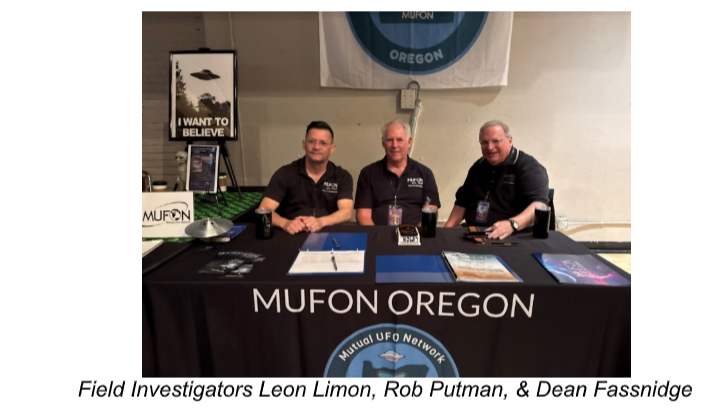
{ https://www.popularmechanics.com/science/ }

Hoe vind je dit bericht?
Geschreven door peter om 17:32 Stuur door

Meer van UFO'S of UAP'S, ASTRONOMIE, RUIMTEVAART, ARCHEOLOGIE, OUDHEIDKUNDE, SF-SNUFJES EN ANDERE ESOTERISCHE WETENSCHAPPEN - DE ALLERLAATSTE NIEUWTJES

↑ Terug naar de berichten