Naar de inhoud

UFO'S of UAP'S, ASTRONOMIE, RUIMTEVAART, ARCHEOLOGIE, OUDHEIDKUNDE, SF-SNUFJES EN ANDERE ESOTERISCHE WETENSCHAPPEN - DE ALLERLAATSTE NIEUWTJES

UFO's of UAP'S in België en de rest van de wereld
akke.beakke.be
Ontdek de Fascinerende Wereld van UFO's en UAP's: Jouw Bron voor Onthullende Informatie! Ben jij ook gefascineerd door het onbekende? Wil je meer weten over UFO's en UAP's, niet alleen in België, maar over de hele wereld? Dan ben je op de juiste plek! België: Het Kloppend Hart van UFO-onderzoek In België is BUFON (Belgisch UFO-Netwerk) dé autoriteit op het gebied van UFO-onderzoek. Voor betrouwbare en objectieve informatie over deze intrigerende fenomenen, bezoek je zeker onze Facebook-pagina en deze blog. Maar dat is nog niet alles! Ontdek ook het Belgisch UFO-meldpunt en Caelestia, twee organisaties die diepgaand onderzoek verrichten, al zijn ze soms kritisch of sceptisch. Nederland: Een Schat aan Informatie Voor onze Nederlandse buren is er de schitterende website www.ufowijzer.nl, beheerd door Paul Harmans. Deze site biedt een schat aan informatie en artikelen die je niet wilt missen! Internationaal: MUFON - De Wereldwijde Autoriteit Neem ook een kijkje bij MUFON (Mutual UFO Network Inc.), een gerenommeerde Amerikaanse UFO-vereniging met afdelingen in de VS en wereldwijd. MUFON is toegewijd aan de wetenschappelijke en analytische studie van het UFO-fenomeen, en hun maandelijkse tijdschrift, The MUFON UFO-Journal, is een must-read voor elke UFO-enthousiasteling. Bezoek hun website op www.mufon.com voor meer informatie. Samenwerking en Toekomstvisie Sinds 1 februari 2020 is Pieter niet alleen ex-president van BUFON, maar ook de voormalige nationale directeur van MUFON in Vlaanderen en Nederland. Dit creëert een sterke samenwerking met de Franse MUFON Reseau MUFON/EUROP, wat ons in staat stelt om nog meer waardevolle inzichten te delen. Let op: Nepprofielen en Nieuwe Groeperingen Pas op voor een nieuwe groepering die zich ook BUFON noemt, maar geen enkele connectie heeft met onze gevestigde organisatie. Hoewel zij de naam geregistreerd hebben, kunnen ze het rijke verleden en de expertise van onze groep niet evenaren. We wensen hen veel succes, maar we blijven de autoriteit in UFO-onderzoek! Blijf Op De Hoogte! Wil jij de laatste nieuwtjes over UFO's, ruimtevaart, archeologie, en meer? Volg ons dan en duik samen met ons in de fascinerende wereld van het onbekende! Sluit je aan bij de gemeenschap van nieuwsgierige geesten die net als jij verlangen naar antwoorden en avonturen in de sterren! Heb je vragen of wil je meer weten? Aarzel dan niet om contact met ons op te nemen! Samen ontrafelen we het mysterie van de lucht en daarbuiten.

EXCLUSIVE - Vatican may know scripture describes alien beings... and Bible expert reveals the hidden clues

EXCLUSIVE - Vatican may know scripture describes alien beings... and Bible expert reveals the hidden clues

A former Bible translator says his research suggests the original Hebrew Bible texts refer to groups of alien beings, not one God, and that the Vatican is closely monitoring of his ideas.

Mauro Biglino, an Italian scholar who translated biblical texts for Edizioni San Paolo, a major Catholic publishing house linked to the Vatican, has focused his research on Hebrew words he believes describe multiple supernatural beings and even spacecraft in biblical times.

Biglino told the Daily Mail that sources he considers reliable claimed figures within the Vatican have been following his work and discussing its implications in certain theological circles.

However, he provided no evidence that the Vatican is monitoring him or considering taking action against his work. ‘Given the reach of my publications... I believe it is highly probable that, sooner or later, [the Vatican] will intervene in some way,’ he claimed.

Biglino is a proponent of the ‘ancient alien’ theory, which suggests technologically advanced beings visited Earth in the distant past and were mistaken for gods, angels or demons by ancient cultures.

In particular, he argues that the Hebrew word ‘Elohim’ refers to multiple beings rather than one God and that passages in Ezekiel describe advanced technology, including flying vehicles.

Biglino further alleged that factions within the Vatican, including historians, archaeologists and scientists, are ‘fully aware’ that the Bible may contain a radically different story from the one taught by religious leaders.

‘Many of them are fully aware that the Hebrew Bible presents a much more complex picture than the simplified version generally offered in religious teaching,’ he said.

Pictured: One of the most complete Hebrew Bibles still in existence, seen in New York in 2023

Pictured: One of the most complete Hebrew Bibles still in existence, seen in New York in 2023

Pictured: Mauro Biglino (Left) discusses his ideas about the real meaning of the Hebrew Bible

Pictured: Mauro Biglino (Left) discusses his ideas about the real meaning of the Hebrew Bible

However, Biglino’s interpretation is rejected by mainstream biblical scholars, who explain that Elohim can be grammatically plural while referring to the singular God of Israel, depending on the surrounding language.

Scholars also generally interpret Ezekiel’s extraordinary vision as symbolic religious imagery - not a literal description of spacecraft or extraterrestrial visitors.

Biglino’s argument begins with the Hebrew word Elohim, which is plural in form, and biblical passages that describe ‘assemblies’ or ‘councils’ of divine beings.

He also pointed to figures including Yahweh, Elyon and Shaddai, names or titles traditionally understood as referring to the same God, as possible evidence of multiple powerful beings.

Biglino told the Daily Mail that mainstream theology tends to interpret such figures as ‘spiritual beings, angels, symbolic expressions or manifestations of the one transcendent God.’

‘My approach is different because I begin with the Hebrew words, their grammar and the concrete actions attributed to the biblical protagonists,’ he explained.

Biglino argued that the Elohim behave more like physical rulers than an all-knowing, eternal God, traveling between locations, holding councils, dividing territory, forging alliances, fighting wars and governing different populations. 

‘They eat, drink, rest and experience emotions such as anger, jealousy and fear. Above all, they are not described as immortal,' he continued.

Biglino believes that the word 'Elohim' in the Bible refers to multiple beings - not one God - and that passages in Ezekiel seem to refer to advanced technology including flying vehicles

Biglino believes that the word 'Elohim' in the Bible refers to multiple beings - not one God - and that passages in Ezekiel seem to refer to advanced technology including flying vehicles

Biglino highlighted Psalm 82, which describes God presiding over an assembly of divine beings and warning that they will ‘die like mortals.’

He also cited Deuteronomy 32, which describes nations being divided among higher powers, as evidence of multiple powerful beings rather than one immortal God.

However, neither passage mentions aliens or extraterrestrial technology. Scholars generally interpret the other figures as spiritual beings subordinate to the God of Israel.

Although Elohim is plural in form, it is frequently paired with singular verbs when referring to Israel’s God, a grammatical detail supporting a singular meaning in those passages.

Nevertheless, Biglino argued that Vatican specialists must have considered whether the texts preserve accounts of contact with nonhuman intelligences.

He believes his theory poses a far greater challenge to Catholic teaching than the possibility that life exists elsewhere in the universe.

The Vatican Observatory has publicly discussed extraterrestrial life, but Biglino predicted that the Church would regard any aliens as creations of the same universal God.

Biglino (Left) claimed that the Vatican has been monitoring his work, which challenges the Catholic Church's interpretation of the Bible

Biglino (Left) claimed that the Vatican has been monitoring his work, which challenges the Catholic Church's interpretation of the Bible

‘Asking whether microbial or intelligent life may exist on another planet is relatively unproblematic for theology. 

'Asking whether non-human beings came to Earth in the past, interacted with our ancestors and were subsequently identified as “gods” is far more challenging,’ he said.

Biglino said his interpretation emerged while translating 17 books of the Old Testament for a Catholic publisher.

He pointed to the Hebrew word kavod, traditionally translated as the ‘glory’ of God, which he said is also associated with weight, heaviness and physical substance.

In Exodus and Ezekiel, Biglino claimed, the kavod arrives, departs, moves through space and produces noise, fire and light. It can also be dangerous to people nearby.

‘In these contexts, it behaves like something physically present,’ he said.

‘It appeared to contain the memories of different peoples who had relationships with powerful beings possessing superior knowledge, longer lifespans and technologies that the ancient writers could describe only through the vocabulary available to them.’

Biglino predicted that the Church would gradually adapt its teachings if governments eventually confirmed the existence of technologically advanced nonhuman beings.

‘It could simply say that these beings, like humanity, are creatures of the one universal God,’ he said.

However, while scholars acknowledge that ancient Hebrew words can carry several meanings, linguistic ambiguity alone does not establish that the Bible describes aliens or advanced machinery.

RELATED VIDEOS

The Weirdest Conspiracy Theories About The Bible

Bible Conspiracies: The Deception of Mankind

{ https://www.dailymail.com/sciencetech/index.html }

Hoe vind je dit bericht?
Geschreven door peter om 20:24 Stuur door

Mysterious ‘cloaked UFO’ spotted hiding inside cloud over North America

Mysterious ‘cloaked UFO’ spotted hiding inside cloud over North America

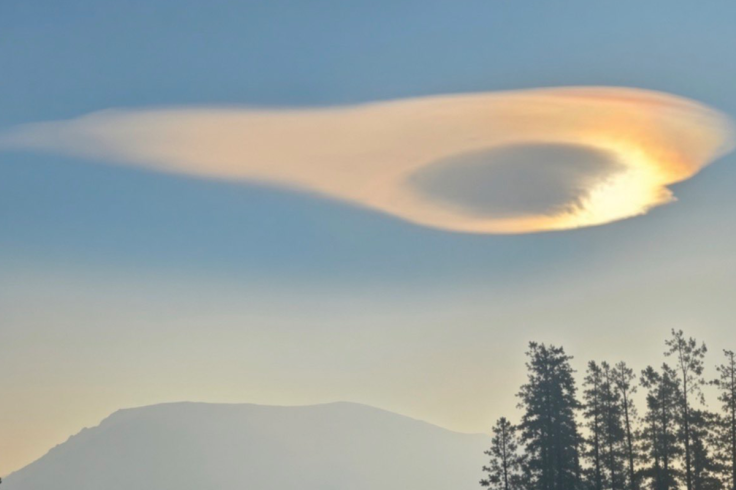
A mysterious photograph appears to show a ‘cloaked UFO’ hiding inside a cloud above a Canadian mountain town.

The image was reportedly captured over Canmore, Alberta on August 2 and shows a glowing, saucer-shaped formation suspended above the landscape.

It was shared on Facebook by Chary Woods, who posted the photo in a group dedicated to clouds.

Many people in the comments were quick to congratulate Woods on capturing an epic cloud hanging in the sky, but some noted that it looked more like a UFO.

At its center is a dark oval that UFO researcher Scott C Waring claims is a classic disk-shaped alien craft concealed within the cloud.

Waring said he increased the contrast on the photograph, allegedly making the object at the center of the formation easier to see. 

He claimed the UFO had deliberately created the cloud to hide itself while flying closer to the ground.

The researcher further alleged that alien craft use clouds as cover while secretly scanning the thoughts of people below.

The image was reportedly captured over Canmore, Alberta on August 2 and shows a glowing, saucer-shaped formation suspended above the landscape

The image was reportedly captured over Canmore, Alberta on August 2 and shows a glowing, saucer-shaped formation suspended above the landscape

Mysterious 'Cloaked UFO'

A spectacular photograph of a saucer-shaped cloud over Canmore, Alberta, has sparked a wild online debate, with one researcher claiming it hides a cloaked UFO deployed to scan human thoughts @overclassifiedx / X

The extraordinary image has divided viewers online, with some declaring it evidence of extraterrestrial visitors while others questioned whether it was created using artificial intelligence.

However, no evidence has emerged proving that the shape is a physical craft or that aliens were involved.

‘This is a UFO cloaked within a cloud that it created,’ Waring wrote on his UFO Sightings Daily website.

‘When you add contrast to the photo, the alien classic disk craft becomes visible at its center.’

Waring claimed extraterrestrials had successfully used the supposed camouflage technique for millions of years.

‘UFOs use clouds to fly closer to the ground in order to scan the thoughts of humans below,’ he added.

‘I think UFO researchers worldwide will agree with me on this.’

The photograph shows a glowing formation stretching horizontally across the sky above mountains, trees, homes and a road.

At its center is a dark o val that UFO researcher Scott C Waring claims is a classic disk-shaped alien craft concealed within the cloud

At its center is a dark o val that UFO researcher Scott C Waring claims is a classic disk-shaped alien craft concealed within the cloud

A bright point of light, appearing to be the sun, can be seen shining through the thinner cloud near the dark central area.

The cloud’s smooth edges and oval shape give it the appearance of a traditional flying saucer, while its illuminated rim makes the formation stand out against the blue-gray sky.

The striking scene immediately prompted wildly different interpretations from social media users.

‘Sauron?’ one person asked, apparently comparing the glowing formation to the all-seeing Eye of Sauron from The Lord of the Rings.

Another viewer offered a more otherworldly explanation, writing: ‘The picture looks real by the contrast of the gate in the foreground. The star family is returning home again from the stars.’

A third declared: ‘Yes, I do believe in UFOs!!!’

Others were less convinced that the photograph could be trusted in an era of increasingly sophisticated image-generation technology.

‘With AI tricks we now are stuck wondering if this beauty is real. It’s fascinating!’ one commenter wrote.

Several viewers saw nothing sinister in the formation and instead praised it as a remarkable cloud.

‘Amazing photo! Thanks for sharing,’ one person said, while another called it a ‘fabulous capture.’

article image

One viewer compared the formation to a heart seen from the side, while another believed it resembled a halo.

The image file does not contain original camera metadata that could confirm when, where or with what device it was captured.

A visual examination did not reveal obvious hallmarks commonly associated with AI-generated pictures, such as malformed vehicles, duplicated trees or warped buildings.

The lighting, shadows, haze and surrounding landscape also appear internally consistent.

However, the PNG file appears to have been exported or processed, meaning its authenticity cannot be conclusively established from the available copy.

The shape resembles a naturally occurring lenticular cloud, which can form smooth, lens-like structures over mountainous areas and is frequently mistaken for a flying saucer.

The dark ‘disk’ could therefore be another layer of cloud, a shadow or an opening emphasized by the sunlight behind it.

Increasing the contrast would make differences between the light and dark areas more visible, but would not prove that a solid object was concealed inside.

For now, the apparent UFO remains an unexplained shape within a spectacular cloud rather than confirmed evidence of an alien spacecraft.

Some viewers leaned into fantasy, with one person jokingly asking whether the glowing formation was the all-seeing Eye of Sauron from The Lord of the Rings. Another commenter claimed that humanity's 'star family' was finally 'returning home again from the stars.'

{ https://www.dailymail.com/sciencetech/index.html }

Hoe vind je dit bericht?
Geschreven door peter om 18:48 Stuur door

What UFOs and religion have in common

What UFOs and religion have in common

Catholic religious studies professor Diana Pasulka is reframing the public conversation on how we see UFOs

VSRXCORERHNWFEJ63SUFBHAC5I.jpg?auth=0312dc42e41b4b9544439acbf5ba62550552a6337a60c538e291d4550830bc33&focal=0%2C0&width=800&height=544

  • This article was first published in the State of Faith newsletter. Sign up to receive the newsletter in your inbox each Monday night.

The connection between UFOs and religion may not seem obvious, but Diana Walsh Pasulka, a Catholic religious studies scholar, has come to see the two as intertwined.

Both wrestle with the mysteries that lie beyond ordinary human experience and require language, community and a personal witness to make sense of it. And in both cases, the two have the power to transform the way that reality is perceived.

Pasulka, who is a professor of religious studies at the University of North Carolina Wilmington, used to dismiss the whole UFO conversation.

But as she was studying the archives of the Catholic saints like Teresa of Ávila and St. Francis of Assisi, she noticed parallels between their mystical experiences and modern-day alleged UFO accounts.

She tracked Catholic accounts from the 13th and 14th centuries that referred to visions of “flying houses,” “balls of light” and “little people.” Centuries later, she argues, people reporting UFO sightings — like the wave of reports in 1947 — have similarly relied on religious language to make sense of extraordinary experiences.

Related

These findings didn’t undermine Pasulka’s religious belief. In fact, studying the UFO reports and interviewing people with alleged encounters reinforced her Catholic faith, she recently told Joe Rogan on his podcast. “It supercharged my Christianity,” she said.

Pasulka is one of the leading voices in the current UFO conversation. She brings a fresh lens to a subject that’s long been relegated to the fringes of cultural debate.

The recent file release on Unidentified Anomalous Phenomena by the U.S. government  did not prove the existence of extraterrestrial beings. But it did unsettle the purely materialist understanding of the world and reopened questions about the limits of human knowledge and science.

Pasulka has written a lot about UFOs, including in her recent book, “The Others: UFOs, AI, and the Secret Forces Guiding Human Destiny.” She groups UFOs along with other extraordinary phenomena, including angels, demons and AI, under the umbrella of “nonhuman intelligence.”

I’m making my way through the book, and I’m finding it fascinating. I was struck by the connection Pasulka makes between UFOs and religion and the way that the former opens up the possibility for belief in the supernatural and the enchanted.

“The truth is that the possibility that UFOs are real has been the best thing for religion and religious practitioners for at least 200 years,” Pasulka writes, “and certainly within the period since 1917, when sociologist Max Weber confidently asserted that the modern world was disenchanted because rationalism and science replaced religion as dominant explanatory frameworks.”

One of religion’s functions, according to Pasulka, is “to help people assess nonordinary events and phenomena. It provides ritual, language and community to metabolize encounters that would otherwise overwhelm the individual.”

She goes on:

“Throughout history, we have reports of forms of intelligence associated with religious events, and from the 20th century onward, UFO encounters that appear to exceed our capacity to comprehend them. … The UFO, oddly enough, has re-enchanted the modern world; it has re-legitimized transcendence for secular subjects. Originally, religion remains the most adaptive framework we possess for understanding and responding to potential nonhuman intelligence, from AI to alleged UFOs.”

Related

Pasulka was raised by secular parents — although her father came from a Catholic background and her mother was Jewish — and had little exposure to faith until age 11. While watching Franco Zeffirelli’s “Jesus of Nazareth” on TV, she was captivated by a scene in which Jesus saves the woman accused of adultery by inviting those “without sin” to throw a stone at her. She immediately asked her mother to buy her a Bible and became determined to understand Jesus’ teachings.

Pasulka converted to Catholicism, but she remained more “secular” in her disposition, she shared on the Rogan podcast. Studying people’s experiences with UFOs made her more open to extraordinary manifestations of her own faith — she wanted to be a “believing believer.”

Pasulka has acknowledged in interviews that she has no secret knowledge or evidence about UFOs.

Her point is that the phenomenon should not be dismissed as either science fiction or a fringe belief but instead that UFO claims deserve attention as a significant cultural and even religious phenomenon. And as a form of modern religion, belief in the UFO can be studied as such, through scholarly methods.

As a culture steeped in materialism and hyper-rationalism begins to hunger again for mystery and transcendence, belief in UFOs may offer a new outlet for religious imagination.

Fresh off the press

The beloved and influential Latter-day Saint poet Carol Lynn Pearson passed away this week. I talked to a few people about her legacy of compassion and inclusion. And don’t miss Carol Lynn’s final poem.

A German scholar at the University of Würzburg made an unexpected discovery while studying a 12th-century manuscript containing the sermons by St. Augustine.

Did you know that almost every day for over a century, someone has played a recital at the Salt Lake Tabernacle organ? Inside one of the longest-standing traditions at Temple Square.

What I’m reading

“Literally,” “actually” and extra exclamation points. The way we speak has become more extravagant. — The New York Times

Antisemitic graffiti appeared on a California synagogue after the house of worship suffered in the LA wildfires. — Forward

One charismatic Christian couple in Maryville, Tennessee, believed that their local bookstore became “the central hub for demonic activity” and was targeted for “spiritual warfare.” — The Atlantic

In addition to Pasulka’s book, I’m in the middle of “London Falling: A Mysterious Death in a Gilded City and a Family’s Search for Truth” by Patrick Radden Keefe. It’s a gripping narrative about identity and parental grief and the city’s culture of wealth.

End notes

One evangelist influencer decided to use her Alaska Airlines flight delay to preach to her fellow airplane passengers. “God’s timing is perfect,” she announced to the cabin while filming herself. Maybe God was sparing them from danger, she said. She proceeded to preach about resurrection and salvation.

The preaching session didn’t go well for her, and she was asked to disembark the plane. In a video that went viral on social media, the flight attendant appears to be saying that the crew didn’t feel safe during the incident.

“I didn’t know that the message of Jesus Christ was unsafe,” the influencer said as she was filming herself and getting off the flight. She invoked freedom of speech and described the attack as “spiritual warfare.” She recorded a seven-part video of the saga on Instagram, with one video getting nearly 3 million views.

RELATED


UFOs in Religion: Hidden Link Between Ancient “Miracles” and Modern Aliens | Dr. Diana Walsh Pasulka

What rising curiosity about UFOs and aliens could mean for religion

What the Vatican Really Thinks About UFOs!

{ https://www.deseret.com/faith/ }

Hoe vind je dit bericht?
Geschreven door peter om 22:51 Stuur door

The Cape Girardeau, Missouri UFO Crash & Dead Aliens Legend of 1941

The Cape Girardeau, Missouri UFO Crash & Dead Aliens Legend of 1941

by Steve Paslow

UFO-use.jpg

Cape Girardeau is a principal city in Cape Girardeau County and Scott County in the USA state of Missouri. The city is the economic center of southeastern Missouri, and the home of Southeast Missouri University. The alleged Cape Girardeau UFO crash of 1941 is one of the oldest and most controversial stories in American UFO lore. If the event actually occurred as described, it would have taken place six years before the famous June 4th  to July 10th 1947 Roswell, New Mexico UFO crash incident, making it one of the earliest claimed UFO crash-retrieval cases in the United States. However, there is no physical evidence or contemporary documentation confirming the event, and historians generally regard it as an unverified legend.

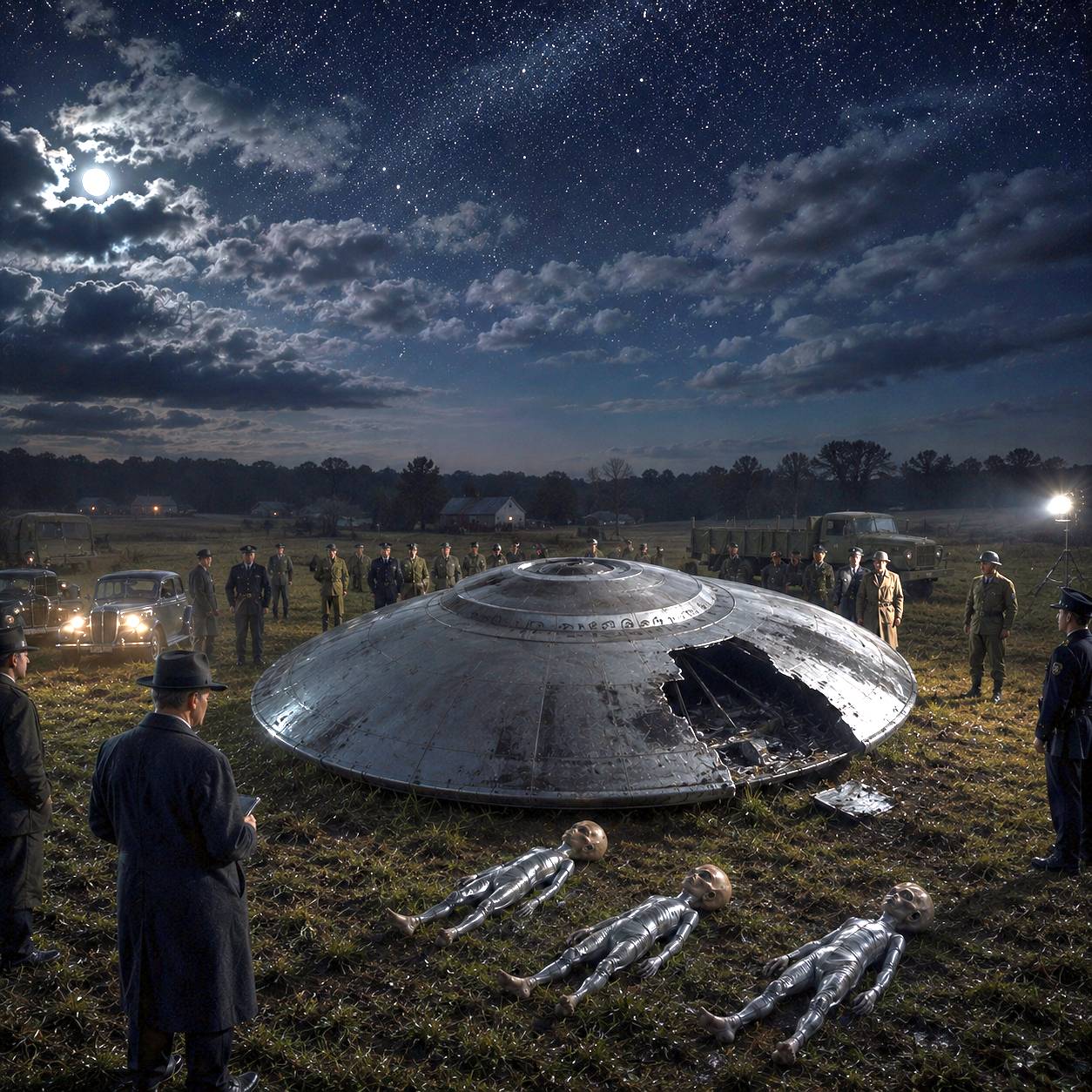
According to the legend, the incident occurred in April or June 1941 in a rural area outside Cape Girardeau, Missouri. The central figure is Reverend William G. Huffman, a Baptist minister of The Red Star Baptist Church. According to accounts that surfaced decades later, Huffman received a late-night request from local authorities to travel to what he believed was an airplane crash so he could pray over; administer last rites to the victims.  When he arrived, police officers, military personnel, and plainclothes officials were already present.

The story says he found something entirely unexpected. Instead of a conventional aircraft, witnesses later claimed there was a disc-shaped metallic craft lying on the ground. Which years later would be called a “flying saucer”.  Nearby the wrecked craft were three small humanoid dead bodies. According to later re-tellings, the corpses were said to be: About 4 feet (1.2 meters) tall. Hairless. Possessing unusually large heads. Having large eyes. Small mouths. Thin arms and legs. Wearing what appeared to be a seamless  and tight metallic suit. Some versions claim strange; unrecognizable  hieroglyphic-like symbols or writings were visible inside or on parts of the craft.

The Military Arrives

According to the legend, military personnel soon arrived and secured the crash site. Witnesses were allegedly instructed never to discuss what they had seen. One frequently repeated part of the story claims a military photographer secretly gave Reverend Huffman a photograph showing him standing beside one of the bodies. The photograph has never been produced publicly.

https://images.openai.com/static-rsc-4/o3RbmeUKURB8a_a141JrISO_zDq6AWSZvNEUqd1nu_atTvsDVs5dRBtKkvM8TJiP-FL45Z75FY5ZxxK4d3lrg9EPHJjMJAA6S2kS5eXFQhX-PgT1Z3zqlylybn0YWo5-yt9bMTE1kvICUIDn421Q1xAtqbjS02nRKmOQbGUzBxQHROc9xblvW4chK6i1goHH?purpose=fullsize

How the Story Became Public

One reason the case remains controversial is that no reports from 1941 describing the event have been found. Instead, the story first entered UFO literature decades later. In the early 1990s, UFO researcher Leonard Stringfield published an account after receiving information from Charlette Mann, Reverend Huffman’s granddaughter. She said her grandfather privately told the family about the extraordinary incident shortly before his death and had remained silent for many years because of alleged government pressure.

Leonard H. Stringfield is one of the best-known figures in UFO research, particularly for his investigations into alleged UFO crash-retrieval cases. Although he did not claim to have personally witnessed the alleged 1941 Cape Girardeau incident, he was the first researcher to publish it in detail, bringing the story to the attention of the UFO community. Stringfield (1920–1994) served in the U.S. Army Air Forces during World War II and became interested in flying saucers shortly after the war. During the 1950s he was associated with the civilian UFO research organization CRIFO (Civilian Research, Interplanetary Flying Objects). Later, he became famous for a long series of reports investigating claims that the U.S. military had recovered crashed UFOs and non-human bodies. Rather than insisting every story was true, he generally presented witness testimony and discussed its strengths and weaknesses.

According to Stringfield, the story reached him through another respected UFO researcher, Raymond E. Fowler. In the late 1980s or about 1990, Fowler received a letter from Charlette (or Charlotte) Mann, a woman whose grandfather had allegedly witnessed an extraordinary event in 1941. Fowler believed Stringfield would be especially interested because he was collecting reports of crashed UFOs, so he forwarded the letter to him. Stringfield then contacted Mann directly. He interviewed her by telephone and asked her to prepare a more detailed written account of what her grandfather had told the family over the years.

When Stringfield published the case

Stringfield first published the Cape Girardeau story in July 1991. It appeared in Status Report VII: UFO Crash/Retrievals – The Inner Sanctum, one installment of his well-known UFO Crash/Retrievals report series. This was not a mass-market magazine article but a special research publication distributed primarily among UFO investigators and interested readers. The publication included: Charlette Mann’s letter. Stringfield’s personal comments including that Mann’s story could be true, even though there was no real proof.  His assessment is that the report deserved preservation because it fit the pattern of other alleged crash-retrieval accounts he had collected.

https://images.openai.com/static-rsc-4/z7JsyksZXIyNgs2pRgiclcQ4m1M3botj1YSjI5zfCzU3OE2R0FG8Pjh9IPeYi2WMfsaOZ0MTs7k8oYTsmgixOWR3Jf29cVRRT5X_gtvhfh0td1iHNQTcXBmBT02gW1pcDfa48rdTY3E8FqYxExBqctpPU73tfU44iUznqQLSJx0pI37s4g8H9MSqjxSn15vi?purpose=fullsize

Why Some People Believe It

Supporters point to several factors: The account predates the Roswell incident by six years. Reverend Huffman was reportedly considered an honest and respected minister. The family’s version of the story remained fairly consistent over time. Later researchers attempted to identify possible officials and locations that might match the narrative. No evidence about a fraud or a hoax regarding the story ever surfaced to the public, even after eighty five years, 2026, the year of this online article.

Reasons for Skepticism

Most historians and many UFO researchers remain unconvinced because: There are no official police, military, or newspaper reports from 1941 describing such a crash. No wreckage or artifacts have ever been recovered. The famous alleged photograph has never surfaced. The principal account is secondhand, based on what Reverend Huffman’s granddaughter said he privately told family members years later. The story only became widely known roughly fifty years after the alleged event.

Countering The Skeptics

The important thing to remember is that the federal government, at least, wanted the whole incident to be keep secret and ordered a big “hush up”. There would also be severe penalties for anyone who would speak about the matter which can include instant arrest and jailing. In some cases, UFO talkers, allegedly claimed, without any proof, many, many years later, to have been threatened with “disappearing and would never by found” by military authorities as punishment for not remaining silent. So naturally there is going to be no government reports publicly known about the UFO crash with dead aliens, nor wreckage or artifacts publicly recovered, no UFO photograph; no extraterrestrials photograph publicly surfacing, and a private family member story about a crashed flying disk and dead aliens taking about fifty years to be mentioned publicly when there finally seemed to be a safe time to do so.

Legacy

Despite the lack of conclusive evidence, the Cape Girardeau case has become one of the most discussed alleged UFO crash stories before Roswell. It has inspired books, documentaries, podcasts, and continuing debate within the UFO community. Some researchers refer to it as the “First Roswell,” while skeptics view it as a compelling local legend that cannot be verified. Whether the event represents a genuine, hidden historical incident or a story that grew over time remains unresolved. At present, there is no verified evidence that extraterrestrial beings or a crashed spacecraft were recovered near Cape Girardeau in 1941. But, there might be an official government file in highly protected storage on the strange occurrence that is highly classified and marked as “top secret”.

RELATED


Before & After - The 1941 UFO Crash in Cape Girardeau 4K

Cape Girardeau UFO Crash of 1941

Cape Girardeau Missouri UFO crash 1941

{ https://mysticsciences.com/ }

Hoe vind je dit bericht?
Geschreven door peter om 22:17 Stuur door

UFOs and Defense: French Military Elite Concluded Extraterrestrial Hypothesis Is “By Far the Best” Explanation — Then Urged Paris to Break the Silence

America ı By Samuel Lopez

Night scene with a glowing circular UFO hovering above a dark landscape, a jet flying nearby and distant mountains at the horizon.

Inside This Report

  • A panel of retired French generals, scientists, and intelligence officials spent three years analyzing hundreds of documented UFO cases before reaching a startling conclusion in 1999
  • The COMETA report — compiled with cooperation from France's gendarmerie, air force, and space agency CNES — found the extraterrestrial hypothesis "the best scientific hypothesis" for a small percentage of unexplained sightings
  • The authors warned that continued government secrecy, particularly in the United States, carries real political, religious, and defense consequences — and recommended France build permanent structures to study the phenomenon

By Samuel López | USA Herald

For more than seventy years, the words "unidentified flying object" have summoned images of tabloid headlines and blurry photographs. But in July 1999, a document surfaced in France that forced even skeptics to sit up straight. It wasn't produced by a fringe research group or a self-styled contactee. It came from COMETA — a committee of retired French Air Force generals, a former head of the national space agency CNES, engineers, admirals, and a national police chief — operating under the umbrella of the Institut des Hautes Etudes de Défense Nationale, France's institute for advanced national defense studies.

Their report, "UFOs and Defense: What Should We Prepare For?" ran nearly ninety pages and was built on three years of methodical work: interviews with fighter pilots, cross-referenced radar data, gendarmerie case files stretching back decades, and cooperation from GEPAN/SEPRA, the CNES division tasked since 1977 with formally investigating unexplained aerospace phenomena in French airspace.

What the committee found wasn't sensationalism. It was restraint — and that restraint is precisely what made the conclusions land so hard.

The Cases That Wouldn't Go Away

The report walks through a series of episodes that French investigators say defy conventional explanation. In 1977, Mirage IV pilot Hervé Giraud and his navigator tracked a luminous object that outmaneuvered their aircraft near Luxeuil, with no corresponding radar contact from ground control — despite the object's evident speed and proximity. In January 1994, Air France Flight AF 3532's captain, copilot, and chief steward all watched an object shift shape from a "brown bell" into a lens before vanishing — a sighting independently corroborated by a fifty-second radar track recorded at the Cinq-Mars-la-Pile control center, ruling out a weather balloon.

Then there's Trans-en-Provence, a 1981 case investigators returned to twice. A witness watched a silent, ovoid object land in his garden, then depart at high speed. Soil and plant samples analyzed by INRA's ecology laboratory reportedly showed altered chlorophyll concentrations and biochemical stress consistent with exposure to an intense electromagnetic field — effects that persisted in the vegetation for years afterward.

Internationally, the report cites the 1976 Tehran incident, in which Iranian F-4 fighter jets scrambled to intercept an object that reportedly disabled their instrumentation and weapons systems on approach, and the 1957 RB-47 case over the American South, where a U.S. Air Force bomber crew tracked an object visually, on radar, and via onboard microwave-emission detectors simultaneously.

Why the Extraterrestrial Hypothesis Made the Cut

COMETA's authors didn't arrive at their conclusion casually. The report methodically works through alternative explanations — secret military technology, disinformation campaigns, holographic projections, unknown natural phenomena — and finds each insufficient to account for the small subset of cases the French call "UAP D": incidents that resist explanation even after exhaustive investigation.

The committee estimated that roughly 5 percent of the aeronautical sightings they reviewed fell into this unexplained category — a small fraction, but one drawn from a pool of nearly 500 well-documented international cases. That, they argued, was enough to warrant taking the extraterrestrial hypothesis seriously as a working theory grounded in known physics, including magnetohydrodynamic propulsion concepts already under study in the U.S. and Britain.

A Pointed Message for Washington

Perhaps the most striking section of the report isn't about the phenomena themselves — it's about American secrecy. The committee directly criticized U.S. policy, citing regulations like JANAP 146 and Air Force Regulation 200-2, which historically criminalized unauthorized disclosure of UFO sightings by military and commercial pilots alike. The authors argued this "impressive repressive arsenal" had persisted since the 1950s and warned that ongoing opacity — particularly following the 1947 Roswell incident — undermines trust between allied nations and complicates any coordinated response to a phenomenon that, by the report's own admission, does not respect national borders.

The recommendations were concrete: expand SEPRA's staffing and budget, formalize sighting-reporting protocols for pilots and air traffic controllers, integrate UFO detection into civilian and military space surveillance systems, and open diplomatic channels — including through the European Union — to press the United States for greater transparency.

More than two decades later, the COMETA report remains one of the most detailed government-adjacent examinations of the UFO question ever published by a major Western nation — a reminder that the loudest calls for disclosure haven't always come from conspiracy theorists, but sometimes from the generals themselves.

About the Author

Samuel López is a Senior Legal Analyst, investigative journalist, and legal researcher with more than two decades of experience analyzing litigation, government disclosure practices, and complex regulatory controversies. His work draws on years spent parsing declassified records, agency reporting requirements, and cross-border policy disputes — the same investigative rigor he brings to unraveling documents like the COMETA report, where separating verified fact from speculation requires both legal precision and a reporter's skepticism.

RELATED


UFOs and Defense: What Should We Prepare For? Wiki Brigades' Analysis of the Comet Report

The “Cometa” Report | “The ET hypothesis is the most valid and logical for UFOs” | Credit: @ natgeo | Secret Pentagon Program I UFOs: Investigating the Unknown | H/T UFOBloke (X) #lesliekean #cometa #cometareport #et #extraterrestrial #ufo #uap

Proof or Goof?: The UFO Files - 006 The COMETA Report

{ https://usaherald.com/category/america/ }

Hoe vind je dit bericht?
Geschreven door peter om 21:59 Stuur door

12 Bible mysteries that scholars still debate today

12 Bible mysteries that scholars still debate today

Hoe vind je dit bericht?
Geschreven door peter om 21:43 Stuur door

14,000 UFO sightings in Germany: Reporting centre in Hesse investigates

14,000 UFO sightings in Germany: Reporting centre in Hesse investigates

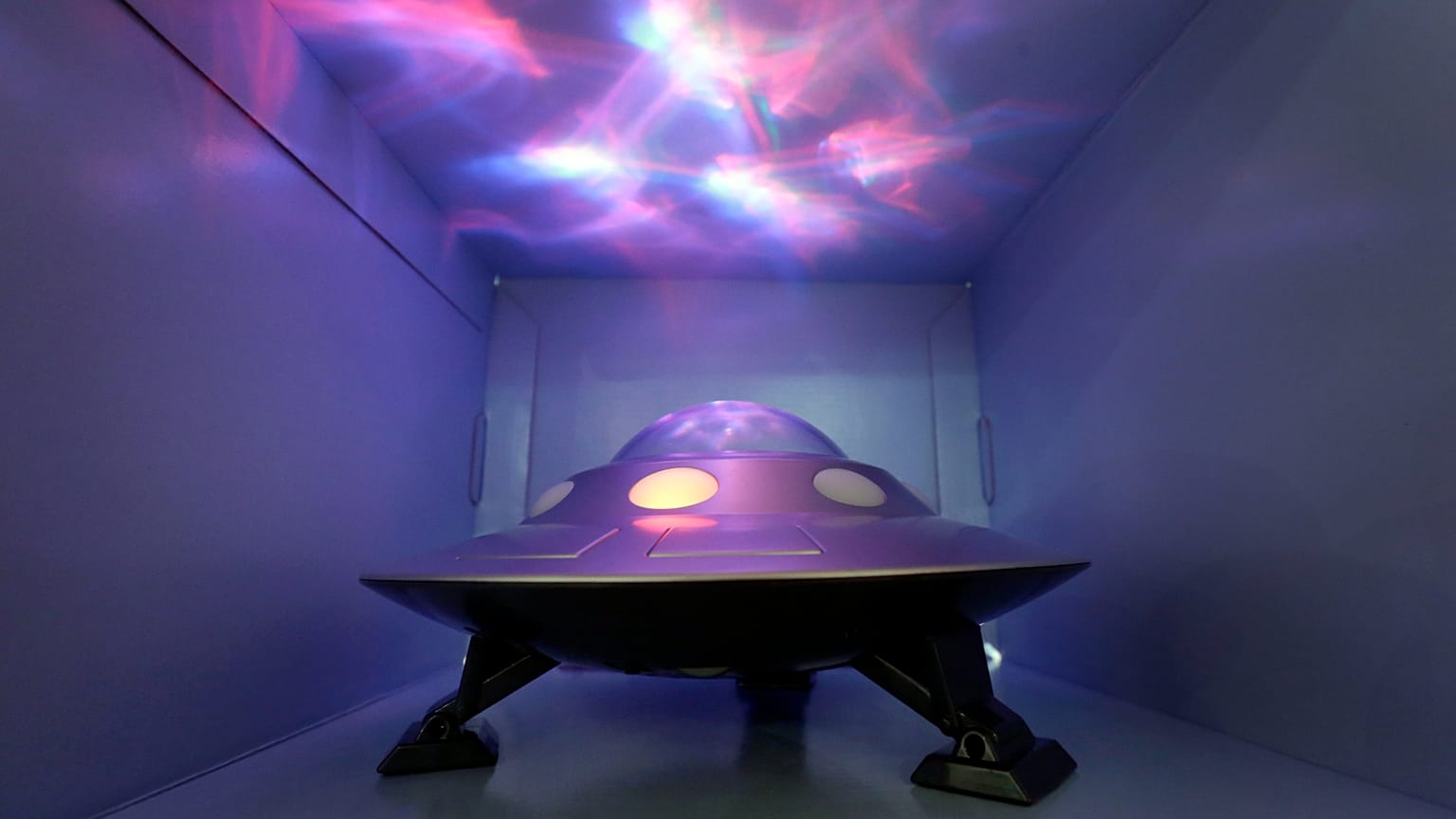
The "Cosmic UFO" projector from Cloud b will be unveiled at the TTPM Holiday Showcase in New York on 1 October 2014.

Copyright AP Photo

By Nela Heidner

Glowing spheres and mysterious lights are generating a wave of reports in Germany. As Pentagon files reignite debate, CENAP in Lützelbach has long sought to explain the sightings.

The Central Research Network for Extraordinary Celestial Phenomena (CENAP) is a point of contact for people in Germany who are looking for a scientific explanation for what they observe in the sky.

CENAP director Hansjürgen Köhler says they have never received as many reports as they do at the moment: "We receive between three and six report's a day. Without question, we're the busiest reporting centre in the German-speaking world." By August 2026 he and his team had cleared up some 14,000 cases.

Köhler is an amateur astronomer; it all started "with youthful recklessness."

"We were working at the observatory and expanding our knowledge there. Back then, lots of calls were coming in and the observatory was getting fed up with it. That prompted us to take a closer look at the whole UFO subject."

As an 11-year-old he watched the moon landing on television. It left a deep impression on him and laid the foundations for his interest. "If I'd known back then what was coming, I wouldn't have done it; there really were a few annoying years, but these days I enjoy it because we can give people a sensible explanation."

"In 1973, at the beginning, when we were young men starting to grapple with this subject, we obtained microfilms from the USA from the Second World War era showing flying objects that were considered inexplicable phenomena."

"We realised that even back then, during the war, there were repeated natural phenomena," says Köhler. "Some of the images were quite striking – not least because of the pilots' reactions, as they asked themselves in astonishment what might just have flown past them."

Pentagon files put UFOs back in the spotlight

Today, with the Pentagon in Washington having released the so-called UFO files, the topic is gaining momentum again.

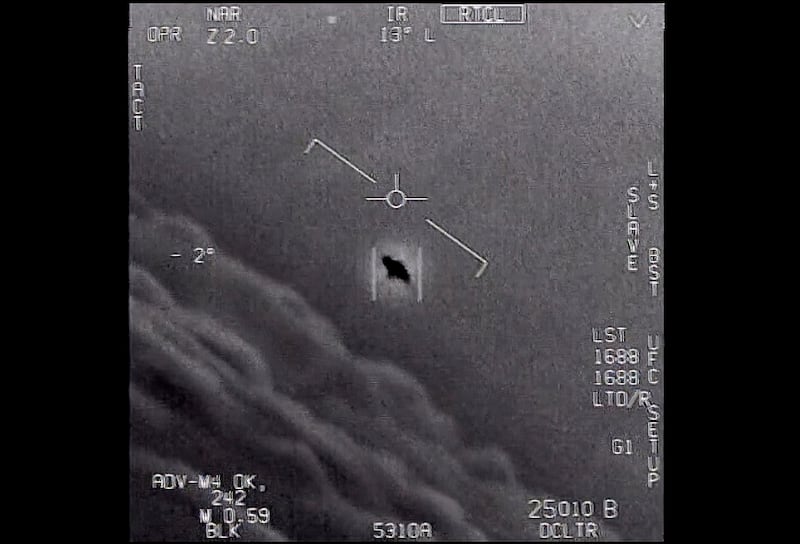
After the US Navy had already released videos showing unidentified flying objects – now officially mostly referred to as "Unidentified Anomalous Phenomena" (UAP) – the Pentagon in April 2020 for the first time formally confirmed the authenticity of three recordings from 2004 and 2015. The videos show encounters between US military pilots and flying objects whose origin could not initially be clearly determined.

In December 2022 the "All-domain Anomaly Resolution Office" (AARO) was even set up within the US Department of Defense. The office is tasked with systematically investigating UAP reports, assessing any potential threats to national security and reviewing past cases.

For Köhler, that's old hat: "We already know the archives anyway; there was nothing in them that was new to me. For the younger generation, though, it is something new. We can only yawn when we see the old footage."

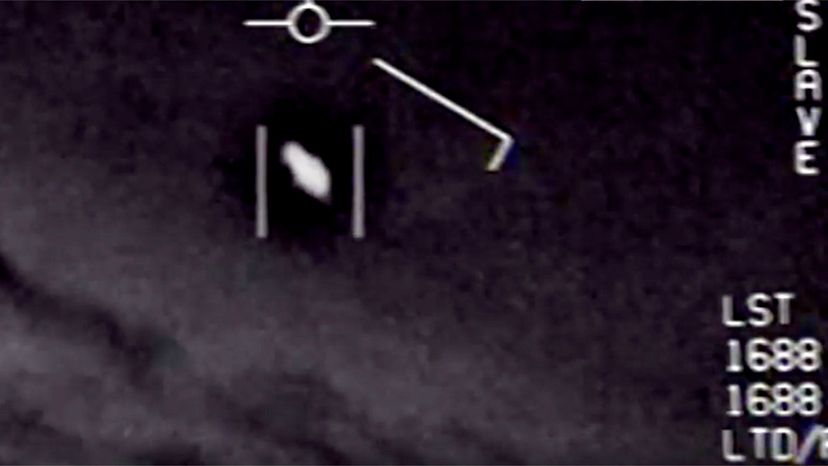
One of the recordings, the so-called "Gimbal" video, was made in January 2015 during a training flight by a US Navy F/A-18 off the coast of California. The infrared footage shows an unidentified object that appears to rotate on its own axis and is commented on in astonishment by the pilots. The Pentagon itself has confirmed the authenticity of the recording but, by its own account, has so far been unable to clearly establish the object's exact identity.

Köhler is convinced that the video shows nothing more than a balloon. He explains its apparently rapid movement as a relative motion between the aircraft and the balloon: because of the jet's high speed, it creates the impression that the object is racing past at enormous pace.

He also has something to add on the F/A-18 itself: "Ever since it was introduced by the US Navy it has had issues with its electronic tracking systems. It has received nine updates to get that under control, and there are still misreadings, including in the speed indications."

But, as Köhler says with some frustration, "all of that simply gets lost. The film is shown again and again, and the debunking is like a drop in the ocean, it too just disappears. Above all on social media and on X, the kind of tall tales that are told there are so absurd. I don't even watch it any more because it annoys me; it runs counter to my work."

I do not deny that there is life out there.
 Hansjürgen Köhler 
Founder of Germany's only UFO reporting centre CENAP

Köhler boils down the reports that reach him to one core idea: "Supposedly, visitors from far out there drop by every day to see what we're up to here. I do not deny that there is life out there. But are we really to believe that they travel across galaxies with highly advanced technology to our blue planet and then crash of all places here above the desert?"

Critics of CENAP occasionally complain that the organisation assesses many UFO sightings very sceptically and places a strong emphasis on conventional explanations. Supporters see that as precisely the organisation's strength: CENAP seeks to classify observations in scientific terms and distinguish between genuinely unexplained phenomena and misinterpretations.

The differing assessments mainly stem from the question of how open one should remain to explanations that are still unknown.

"I understand that people start puzzling over it; I can end up in that situation too," says expert Köhler. "Some people call the police at 2:00 in the morning and say they can see something flashing in the sky. Then the officers call us because the people insist so strongly that there is something there. So you have two police officers standing there, looking up at the sky together with the caller, unable to explain it either and phoning us."

Köhler has a recommendation for such cases: "Members of the public can find out what they are observing – there are free astronomy apps. You can point your phone at the sky and the name of the celestial body then appears."

What has he been able to identify so far?

Aircraft, helicopters, rocket stages, satellites, astronomical causes such as meteors, bright fireballs (daytime meteors), planets, bright stars, balloons of all kinds (weather, atmospheric, hot-air) and decorative foil balloons in XXL format from children's birthday parties and weddings, as well as lasers used by event organisers that sometimes shine over distances of several kilometres.

There are, however, also cases that Köhler has not been able to resolve. Anyone hoping to see them as proof of extraterrestrial visitors will be disappointed: "These were not alien visits. The cases have simply remained unexplained because we lack key information. For a serious investigation we need the date, time, place, direction in the sky and, if possible, visual material. Only then can we start our research."

RELATED

14,000 UFO sightings in Germany: reporting centre in Hesse investigates #Shorts

🛸 14,000 UFO SIGHTINGS IN GERMANY!

{ https://www.euronews.com/ }

Hoe vind je dit bericht?
Geschreven door peter om 21:05 Stuur door

Are Pentagon-confirmed UFOs a National Security Threat?

Are Pentagon-confirmed UFOs a National Security Threat?

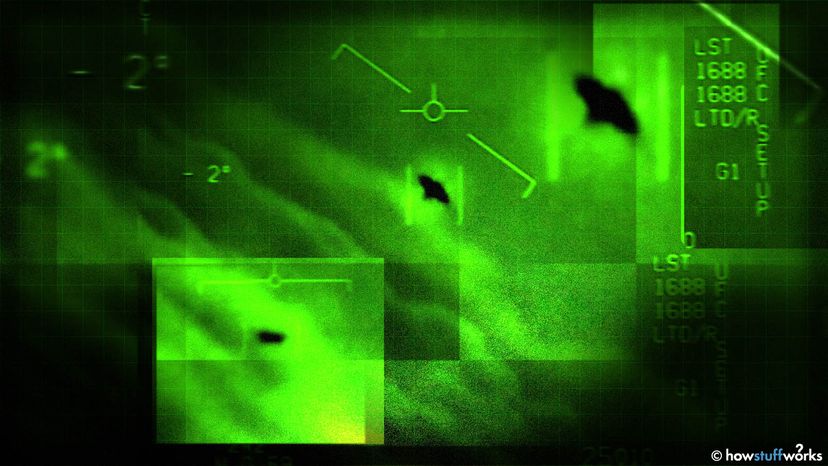
ufo On Aug. 4, 2020, the U.S. Department of Defense approved the establishment of an Unidentified Aerial Phenomenon Task Force (UAPTF). "The mission of the task force is to detect, analyze and catalog UAPs that could potentially pose a threat to U.S. national security," according to the DoD website.  HowStuffWorks

There's a reason why you may be hearing a lot about UFOs lately. In June, the Pentagon and the Director of National Intelligence will present to Congress an unclassified report about unusual sightings by U.S. service members of UFOs — unidentified flying objects. National security folks, however, refer to them as unidentified aerial phenomena, or UAPs.

Apparently, there have been a lot of reports of UAPs in recent years. We — the general public — just haven't heard much about them. Any rumblings of flying saucers buzzing in our atmosphere have been vehemently denied by the government for decades. That is, until recently. So, what changed?

1. The U.S. Government Is Investigating Strange Sightings

In 2007, the U.S. government created the Aerospace Threat Identification Program, or AATIP, a hush-hush organization hidden away in the Pentagon. The program was charged with collecting and analyzing information regarding strange aerial objects that had been reported to the Department of Defense (DoD) by service members through the years.

In 2008, Luis Elizondo joined the effort with 20 years' experience running military operations under his belt. In 2010, he was tapped to lead the program and sharpened its focus on national security. He fielded reports of UAP sightings, doing due diligence to vet them.

One tucked-away report that caught his eye was that of a strange Tic-Tac-shaped object over the Pacific Ocean reported in November 2004 by two former U.S. Navy pilots. Commander David Fravor and Lt. Commander Alex Dietrich, were training with the Nimitz Carrier Strike Group. Radar from a ship that was part of the training group had detected "multiple anomalous aerial vehicles" in the horizon descending 80,000 feet (24,380 meters) in less than a second, according to a "60 Minutes" report earlier this month. Fravor and Dietrich were sent out in separate aircraft to investigate, each with a weapons system officer in their back seat.

As they approached, they saw an area of roiling water about the size of a 737 airplane. Hovering above it was the Tic-Tac-shaped object making "no predictable movement, no predictable trajectory," Dietrich said. The object had no markings, no wings, and no exhaust plumes. When Fravor flew in for a closer look, the object flew off so fast it seemed to disappear. It was spotted seconds later on radar approximately 60 miles (96 kilometers) away.

That was just the tip of the iceberg. There were many more reports by naval aviators who witnessed strange cubes or triangles doing things that no known aircraft were capable of doing — stopping rapidly, turning instantly, and accelerating immediately to speeds of 11,000 mph (17,700 kph) or more. And they were doing these things in restricted airspace, often in airspace designated for fighter-jet training, such as off the coast of San Diego, or off the coasts of Virginia and Jacksonville, Florida.

2. What Are UAPs Capable Of?

We talked to Elizondo in an email interview and, according to him, the UAP that have been tracked and monitored for decades exhibit what have become referred to as "The Five Observables." These are:

  1. antigravity lift
  2. sudden and instantaneous acceleration
  3. hypersonic velocities without any visible signatures, sonic booms or observable means of propulsion
  4. low observability or cloaking
  5. trans-medium travel — the ability to operate in extraordinary ways from the vacuum of space to the depts of the oceans without impedance or aerodynamic limitations

It's these characteristics that baffle national security experts the most. "We do not have anything in our arsenal that can perform in these ways and we have a high degree of confidence that no known terrestrial ally or adversary possesses this technology either," Elizondo says.

3. What Could They Be?

Pilots have speculated that the objects were either secret U.S. technology or adversary spy crafts, according to Elizondo on "60 Minutes."

"Remember, we've been observing these performance characteristics for many decades," Elizondo assures. "If a foreign adversary had developed these technologies 75 years ago, and we were still unaware they possessed it, it would be the most extraordinary intelligence failure in United States history."

Then does that mean they're from outer space? Rather than jumping to conclusions, Elizondo suggests we open our minds to the possibilities.

"These vehicles may originate from outer space, inner space, or even the space in between," he says. "We could be dealing with an advanced, self-replicating AI which communicates with itself instantaneously across vast distances using a quantum internet. Perhaps an advanced underwater civilization is native to our planet, and we're now advanced enough to be observing them moving through our oceans, airspace and upper atmosphere."

4. Do UAPs Pose a Threat to National Security?

There's been no active hostility or aggressive action taken by these objects, though "they're clearly powerful enough to do harm if that were their intention," Elizondo says. Any time an advanced vehicle is operating in restricted airspace with impunity, you have to consider the possibility that they could be a threat if they wanted to be, he says.

"If we want to fully understand what we're observing, and to communicate those findings to the public, we need a whole-of-government approach that is collaborative and transparent," Elizondo says.

5. Is the U.S. Government Still Tracking UAPs?

Funding for AATIP ran out in 2012, but Elizondo continued to investigate UAP sightings until 2017, when he got fed up with the Pentagon's skepticism, and quit. Before he left, however, he declassified three Navy videos of UAPs. And then he started to spread the word.

Meanwhile, Christopher Mellon, former deputy assistant secretary of defense for intelligence for presidents Bill Clinton and George W. Bush, acting as a civilian, shared those declassified videos with The New York Times. He had to do did it, he told "60 Minutes," to get the Defense Department to take this "national security issue" seriously.

Raising public awareness prompted Congress to take notice, and the Pentagon to admit the existence of AATIP. Last August, the Pentagon reenacted the program, changing the name to the UAP Task Force. Service members were finally given the green light to share reports of UAP sightings.

When then-intelligence committee chairman Sen. Marco Rubio of Florida was briefed on UAPs, he called on the Pentagon and the Director of National Intelligence to present Congress with an unclassified report of the sightings by June 2021.

"Fortunately, both Congress and the DoD are prepared to take this subject seriously, and the remaining pushback against transparency is confined to a very small cadre of individuals whose grasp over the secrecy is quickly weakening," Elizondo says. "We're hearing enough of an outcry from our men and women in uniform, and from the American people, and we have to take that seriously. ... It's become a liability for the Pentagon to exacerbate a coverup of these facts."

6. What Will the Report Say?

There's tons of data, videos, photos, telemetry, signatures collected and full electromagnetic spectrum analysis that will need to be sifted through in order to provide a complete report — "far too much to be properly collated within the 180-day Congressional mandate," Elizondo says. He expects the report to be just a teaser, with much more details in the months that follow.

"I expect that this initial report 

will draw attention to the reality of UAP, the potential scientific and technological value that exists in better understanding how they operate, and the need for a permanent office in the U.S. Government to examine the data we collect in order to present it to Congress and the American people."

RELATED 

‘THESE THINGS ARE REAL’: UAP whistleblower on Pentagon UFO files

LIVE | Mystery Objects Tracked By US Military Revealed In New Pentagon Files, Are They UFOs?

{ https://www.howstuffworks.com/ }

Hoe vind je dit bericht?
Geschreven door peter om 20:46 Stuur door

UAP Meaning: Understanding Unidentified Aerial Phenomena

UAP Meaning: Understanding Unidentified Aerial Phenomena

U.S. Navy pilots tracked and photographed what appeared to be a fast-moving object off the Florida coast in 2015.  Department of Defense

As you gaze up at the vast night sky, spotting flying objects and flashing lights, you might wonder if you're witnessing evidence of extraterrestrial visitors or simply natural phenomena. Historically, most people would label these mysterious objects as UFOs or Unidentified Flying Objects.

But did you know that there's a more modern terminology now in play? Enter "UAP" or Unidentified Aerial Phenomena. So, what exactly is the UAP meaning?

1. The Evolution from UFO to UAP

Throughout history, from ancient Greece to present times, people have reported sightings of unidentified objects in the sky. These events, often linked with extraterrestrial origin, have been the focus of many enthusiasts and government agencies alike.

But the term UFO isn't without its issues.

When we hear "UFO", our minds often jump straight to alien spacecraft. Blame it on pop culture or the association the term has built over the years.

  • A Brief History of UFOs

The term "UFO" came into our lexicon after a significant event on June 24, 1947. Pilot Kenneth Arnold reported nine bright, flying discs moving at high speeds near Mount Rainer.

This report birthed the terms "flying saucer" and "flying disc," laying the groundwork for what we commonly refer to as UFOs. Following Arnold's report, government officials and military units started establishing UFO investigation task forces.

Over the past decades, UFO sightings became synonymous with aliens. Reports from pilots, military personnel, and civilians alike about flying saucers, hovering lights and objects moving at high speeds always seemed to suggest visitors from outer space.

2. The UAP Era Begins

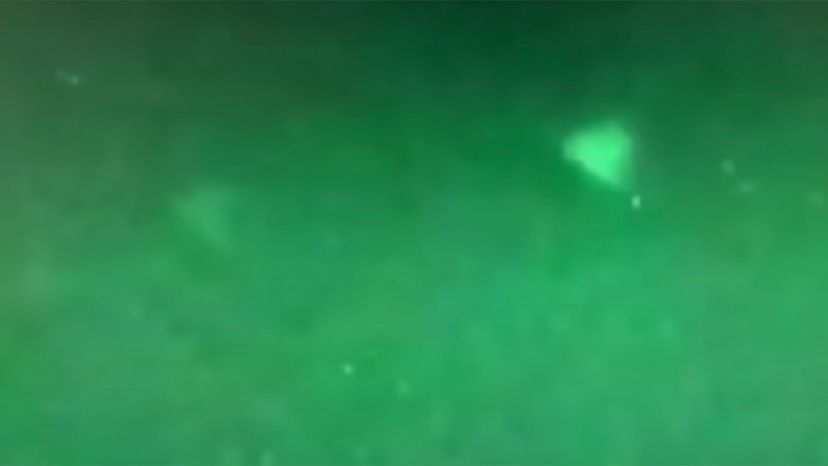
UAP This screenshot of a leaked video of a flashing, triangle-shaped object that flew over a U.S. warship was confirmed by the Pentagon as real, though it declined to label it a UAP. SETI

The shift from "UFO" to "UAP" was subtle but significant. UAPs encompass a broader definition, including any unidentified anomalous phenomena in the sky. This change in terminology was partly due to recent years of data collected by national security departments and civilian star gazers.

In 2021, the Office of the Director of National Intelligence (ODNI) released a comprehensive report on Unidentified Aerial Phenomena called Preliminary Assessment: Unidentified Aerial Phenomena.

This report mentioned the rigorous scientific methods applied to UAP research, using advanced technologies like radar. It was no longer just about eyewitness accounts. The focus had shifted to hard evidence and understanding the nature of these events.

In a leap towards understanding these phenomena better, NASA has now commissioned an independent team of 16 scientists and astrophysicists. They aim to analyze unclassified UAP data and work towards ensuring aircraft safety.

3. UFOs, UAPs and the Quest for Answers

Whether it's UFOs or UAPs, the essence remains the same: unidentified flying objects in the sky. Both terms, while carrying different connotations, point towards humanity's eternal exploration and desire to understand the unknown.

While UAPs might be the preferred term in government circles, it doesn't exclude the possibility of extraterrestrial origins. The UAP terminology might just be the scientific community's way of embracing these unidentified objects without fear of, well, sounding a bit out of this world.

The change in terminology represents a more data-driven, scientific approach to understanding mysterious flying objects in our sky. As the stars twinkle and mysterious objects continue to whizz by, our search for answers continues, regardless of what we call them.

This article was updated in conjunction with AI technology, then fact-checked and edited by a HowStuffWorks editor.

Hoe vind je dit bericht?
Geschreven door peter om 20:27 Stuur door

What Materials Are Suitable for Constructing Cities on the Moon and Mars?

What Materials Are Suitable for Constructing Cities on the Moon and Mars?

In the future, humanity will reside on other planets within the Solar System — primarily on the Moon and Mars. To achieve this, it will be necessary to undertake construction activities utilizing local resources. However, what materials are actually accessible there that could be employed in the construction of habitats?

City on Mars. Source: innspace.pl

Cities on Mars

 Science fiction frequently depicts a future wherein humanity has established colonies across the Solar System and has even reached planets orbiting other stars. Additionally, to facilitate these possibilities, a substantial number of habitats have been constructed within these fictional worlds, allowing humans to endure in conditions that are often highly inhospitable. 

Science

In reality, however, we remain considerably distant from establishing cities on the Moon and Mars, let alone on the moons of Jupiter. After nearly seventy years of  space exploration, the most significant achievement of humanity thus far is the construction of a few space stations, each approximately the size of a modest residence, usually accommodating no more than six individuals at any given time. Furthermore, occupancy durations typically do not exceed one year.

This is precisely the reason why many individuals question the feasibility of humans living in space on a permanent basis. Establishing permanent habitation for hundreds or thousands of people appears impractical at present.

Modern space stations

This is indeed the case when considering spacecraft that have already been launched into space. Typically, they are composed of metals and specialized synthetic materials developed on  Earth, subsequently launched into orbit. These spacecraft generally feature relatively weak engines but possess substantial internal volumes. Scaling such designs to significantly larger sizes presents considerable technical and financial challenges. 

The longstanding plans to transport modules constructed on Earth to the Moon and Mars — where they can be assembled into settlements — have persisted for many years. However, in practice, even in proposals for future orbital stations, there is an increasing tendency to move away from the principle of launching modules in their operational form.

Ideally, it is essential to develop the capability to construct on other planets utilizing the same methodologies applied on Earth: employing small units or segments of material, and integrating manual craftsmanship with machinery directly at the deployment site.
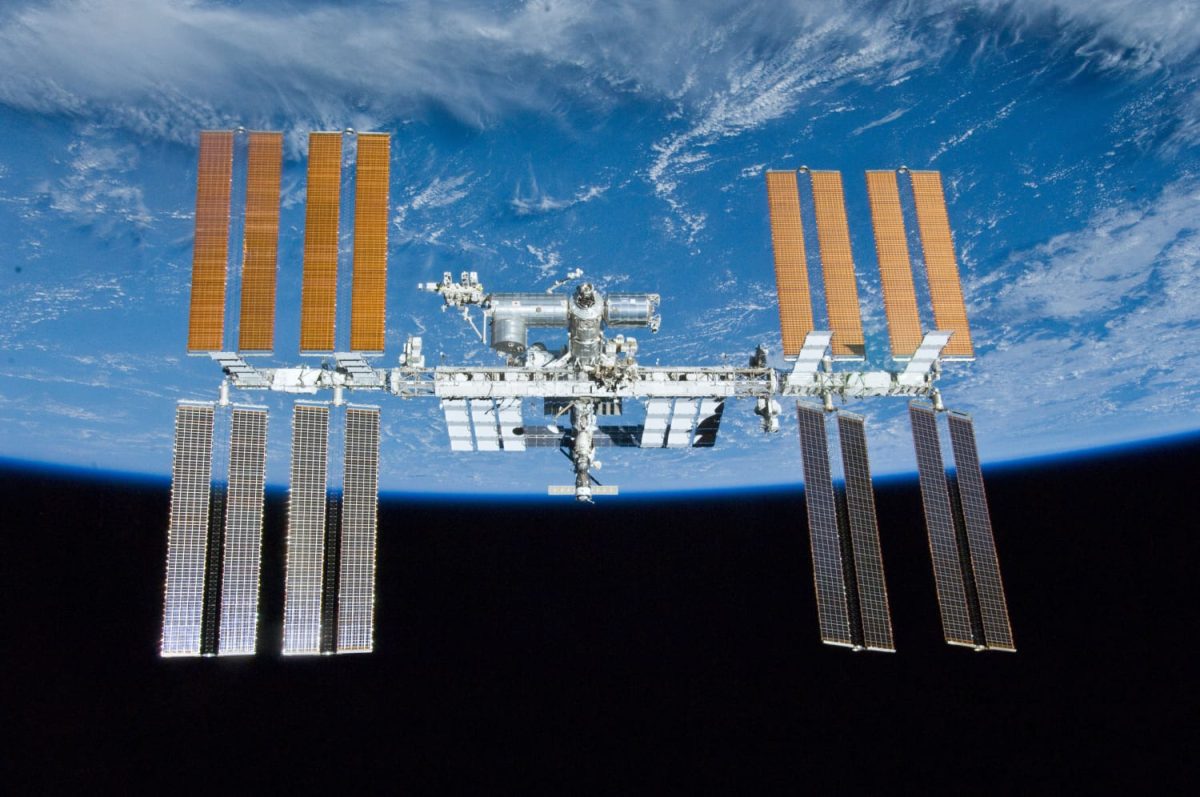
International Space Station. Source: phys.org

However, in the context of space stations, manual labor performed by astronauts remains exceedingly costly. Consequently, inflatable and collapsible structures are presently under consideration as a compromise between terrestrial and extraterrestrial construction methodologies. This approach enables the deployment of comparatively small objects into space, which can subsequently be expanded in orbit to create substantially larger enclosed areas with a normal atmosphere, suitable for a diverse range of applications.

Most likely, they will attempt similar endeavors on the Moon and Mars once their exploration initiatives become more earnest. To some extent, this approach may prove beneficial. However, subsequently, they will need to adopt a different strategy that considers the unique characteristics of these celestial bodies.

Construction on the Moon

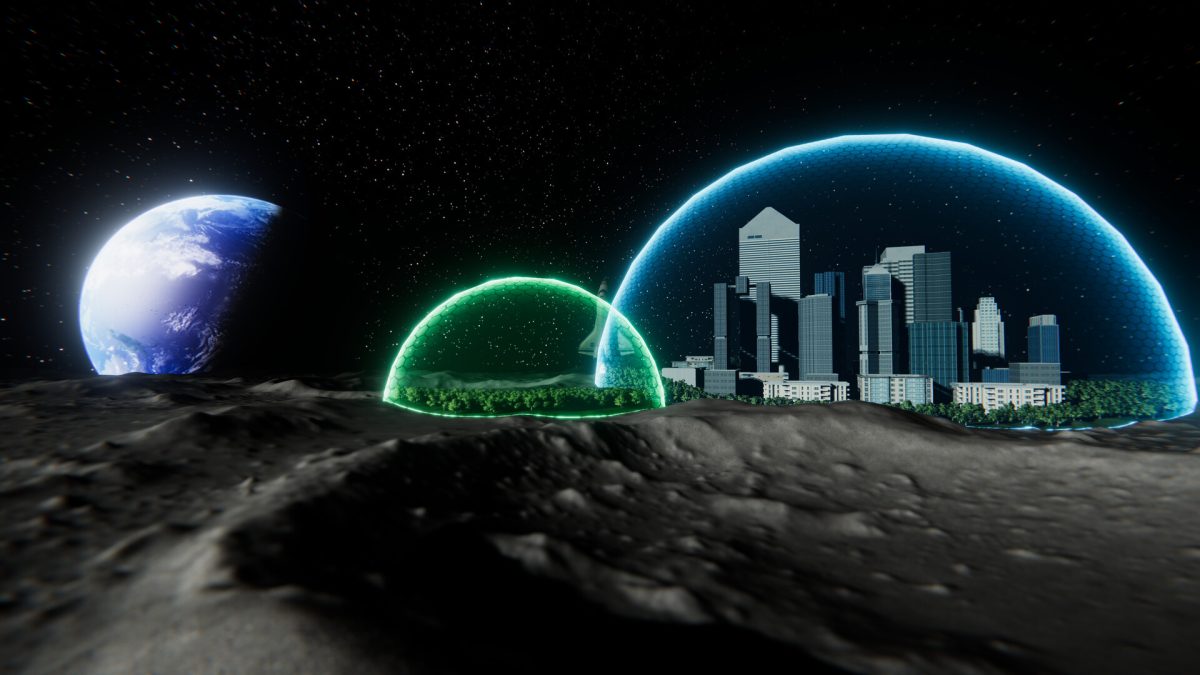
Future urban settlements on the Moon were historically envisioned as conventional Earth-like communities, enclosed beneath transparent domes. A dome is an architectural construct that effectively disperses substantial loads, thereby enabling the development of expansive interior spaces. It is noteworthy that this structural form has been employed for many centuries in religious edifices accommodating large congregations.

And overall, the idea sounds promising, given that the Moon has no atmosphere and its gravity is one-sixth that of Earth’s. It would seem like the perfect solution: build giant, thin-walled domes and live under them.

Future space stations are anticipated to be constructed utilizing inflatable modules. Source: www.space.com

However, in reality, the absence of an atmosphere presents a singular consequence that fundamentally undermines this entire concept. Without a gaseous envelope, there is no mechanism to compel meteors approaching our moon to decelerate and combust, as occurs on Earth. Consequently, they impact its surface at full velocity, a phenomenon that can be observed plainly from Earth without the aid of a telescope. Construction activities on the Moon entail establishing structures within an environment subjected to relentless meteorite impacts. No inflatable or prefabricated structure transported from Earth could withstand such conditions. Moreover, increasing the thickness of these structures is not a viable solution, as, even on our planet, metallic frameworks are primarily used as structural supports; otherwise, the economic viability of construction would be compromised. On the Moon, however, each kilogram of metal is as valuable as gold, owing to the exorbitant costs associated with delivery from Earth. 

Interestingly, scientists are already aware of the necessary actions — covering the dome with lunar regolith, potentially bonded with an adhesive substance. This will solidify and fuse the particles into a cohesive structure. Nonetheless, this prompts an inherent inquiry among researchers: Is it possible for this identical material to be employed in the construction of the primary structures as well?

This is an exceptionally intriguing question, considering that the Moon — lacking not only an  atmosphere but also water capable of supporting life — completely lacks the materials that, due to their widespread availability on Earth, facilitated construction with relative ease thousands of years ago: namely, wood, grass, and sedimentary rocks such as clay, gypsum, and limestone.

Constructing virtually any structure — ranging from a basic dugout composed of  earth and timber to a skyscraper reinforced with concrete — appears infeasible on the Moon. However, this notion persists only until one considers the foundational level of straightforward chemical compounds.
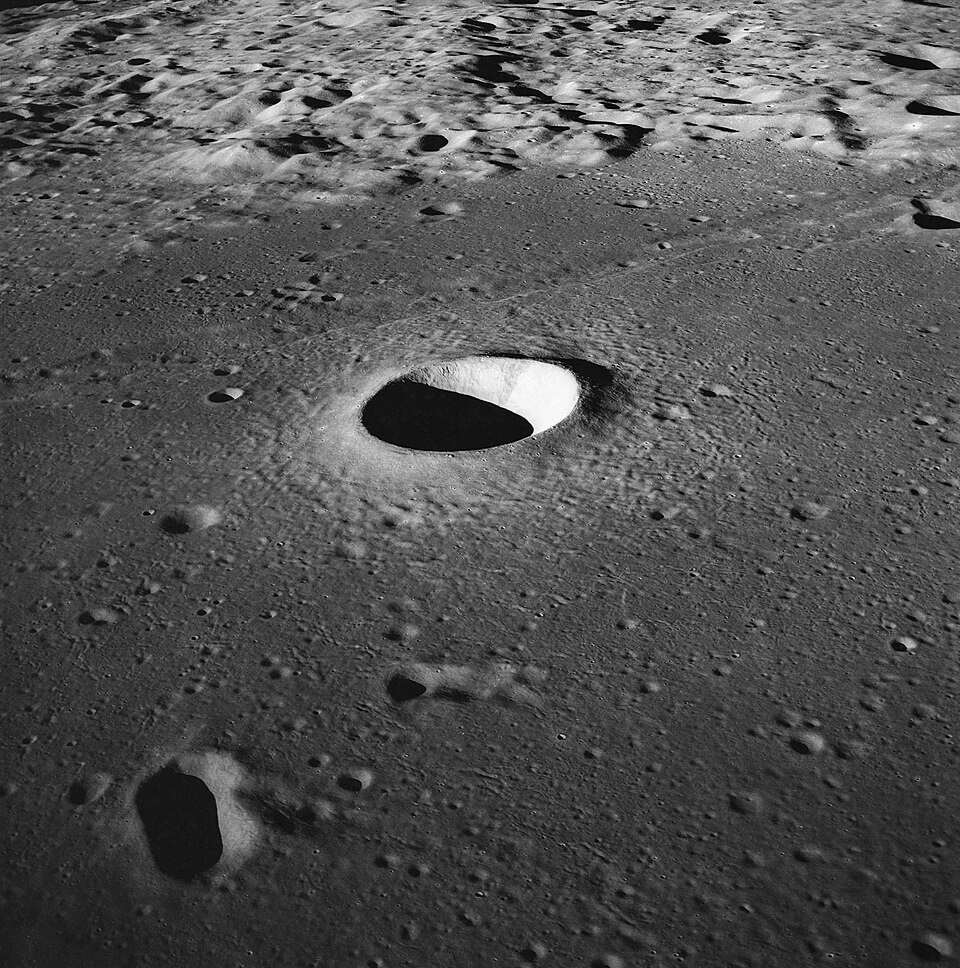
The craters on the Moon illustrate the advantages of constructing cities underground in that locale. Source: phys.org

Concrete or not concrete?

Ceramic bricks and tiles, silicate blocks, sand, and cement — as well as their derivatives, concrete and mortar—are all predominantly composed of oxides of four main elements: silicon, aluminum, calcium, and iron. In the geological formations that constitute the Moon — namely the basalts of the lunar maria, the ANT rocks of the “continents,” ilmenite, and even the rare KREEP rocks — these four elements, in addition to oxygen, are uniformly present. 

The issue resides in the fact that these minerals are entirely distinct from those typically mined on  Earth. In fact, the primary challenge is to acquire the oxide mixtures with which we are acquainted in a form from which substances can be effectively extracted.

In principle, at a certain stage, it becomes unnecessary to rely on additional methods to attain a construction technique superior to all existing modules and inflatable dwellings. The development of a synthetic binder that remains liquid for several hours upon mixing with local rubble, subsequently hardening into a robust monolith without requiring any substances not available on the Moon, enables the production of a material classified as concrete. When combined with metal reinforcement, concrete allows modern engineers to construct virtually any structure.
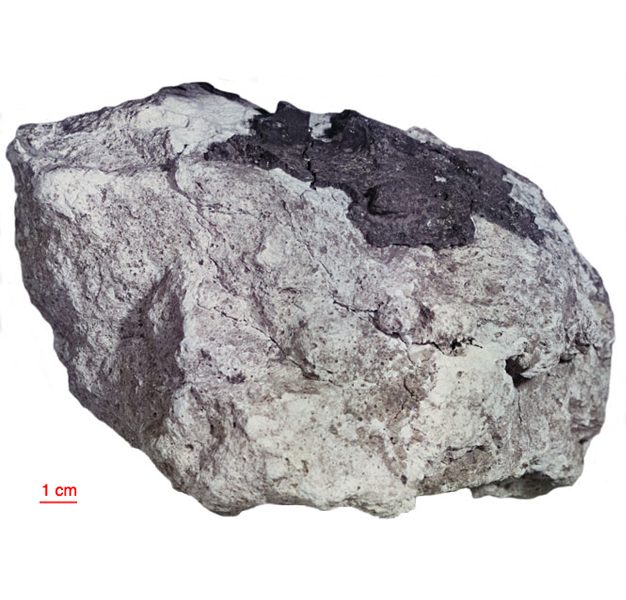
A specimen of lunar anorthosite. Source: phys.org

The advantages of concrete reside in its capability to adapt to virtually any mold and, when integrated with metal, to constitute a complex, multi-layered composite. The most exemplary instances of this composite approach attain the strength of aluminum, while being significantly more cost-effective.

The subsequent step involves establishing the production of this substance from lunar rocks; in other words, it fundamentally relies on the expertise of chemists.

Indeed, it is well-established that Portland cement, which unequivocally transforms into a monolith following the mixing process — and is known to be producible from a combination of oxides through the addition of lunar rocks — remains an essential material.

The primary issue with it is that, in order to transform it into concrete, it also necessitates water, which must remain in a warm or hot liquid state for all the hours and days until the concrete solidifies. However, on the Moon’s atmosphere-less surface, this water will evaporate very rapidly. Consequently, to construct anything using this concrete, it is necessary to first establish conditions similar to those on Earth at the construction site. In the case of a structure measuring hundreds of meters, this entails creating a temporary, airtight enclosure that would need to be even larger. 

Portland cement. Source: www.researchgate.net

The most remarkable aspect of this situation is that it may ultimately prove to be the optimal scenario, given that it is uncertain whether we will ever encounter something akin to Portland cement — yet capable of being subjected to controlled hardening in a vacuum.

Nevertheless, an additional alternative exists — directly melting rock to create walls and other structures from molten stone. As it solidifies, it is capable of assuming any shape. The benefit of this technology is that walls can be constructed in a vacuum using this method. However, the drawback is that this process demands substantially greater energy compared to the construction of walls from concrete.

Nevertheless, it is essential to acknowledge that under lunar conditions, any solid monolithic shell constitutes only a portion of the enclosure structure, which must be capable of withstanding such conditions. Internally, it must also incorporate a layer of airtight material that prevents the passage of gases. Externally, even a reinforced concrete dome should be coated with regolith, which will at least partially absorb the impact of micrometeorites.

And that brings us to the following suggestion: why not submerge the lunar city, at least partially, beneath the surface? For example, a dome could be built over one of the craters. This would create a sufficiently large interior space while requiring significantly less work. 
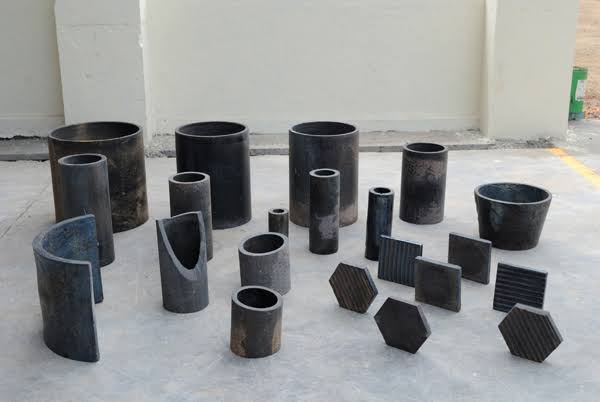
Products cast from molten stone. Source: wearresistantsolutions. com.au

Cities on Mars

All statements regarding the Moon are equally applicable to Mars, and in fact, even more so, given that transporting cargo to Mars presents significantly greater challenges than to our Moon. Moreover, certain distinctive attributes of Mars render construction activities therein more complex than on the Moon. 

This assertion is exemplified by the fact that Mars is located at a greater distance from the Sun, necessitating enhanced thermal insulation for structures. Furthermore, from a geological perspective, Mars is not entirely a lifeless planet, and its gravitational force is considerably higher. Consequently, any constructions undertaken there must be substantially more resilient, particularly in terms of foundational stability, compared to those on our Moon.

Conversely, the circumstances concerning construction materials on Mars are significantly more favorable than those on the Moon. Primarily, although liquid water cannot exist on the surface owing to the exceptionally low atmospheric pressure, the total reserves of water in the form of ice at the polar regions and beneath the surface are substantial. This implies that utilizing traditional binding agents on Mars is considerably more feasible.
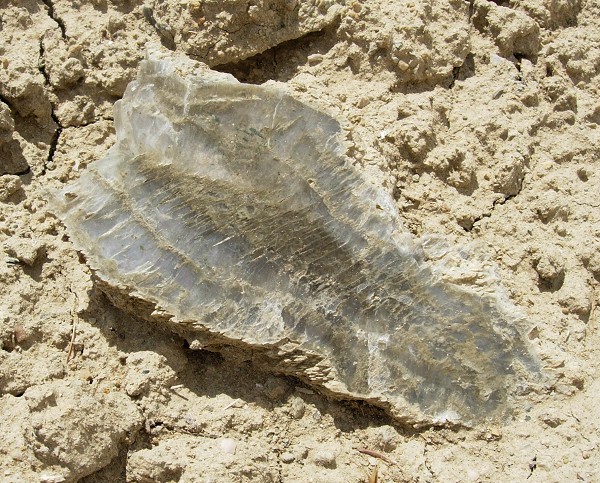
Gypsum on Mars. Source: phys.org

Secondly, Mars comprises sedimentary rocks that are well-known to us, particularly clays. The presence of these materials enables the fabrication of extremely robust and durable construction materials. Although the notion of humans or robots laying bricks on Mars may appear impractical to some, it could, in fact, prove more cost-effective than transporting building structures from Earth. 

Another significant category of rocks identified on Mars comprises sulfate-bearing rocks, specifically gypsum. Considering the minimal presence of water vapor in the Martian  atmosphere and the fact that liquid water — an essential element for life — has not traversed the surface for hundreds of millions of years, some of these rocks may inherently function as a natural binding agent, requiring only pulverization. Furthermore, even if their binding properties are not inherent, the gypsum binder familiar to us can be obtained directly from these rocks, and its formulation has been well known for thousands of years.

Gypsum is regarded as an inferior binder compared to Portland cement, as it offers lesser strength and is not water-resistant. However, when employed as mortar for brickwork — particularly when reinforced with metal rods — it may be adequate for constructing a 5- to 6-story building. Considering that these structures will inevitably be erected within large temporary domes, pursuing greater height might be unnecessary. The primary consideration is to design sufficiently spacious interiors to promote psychological comfort.
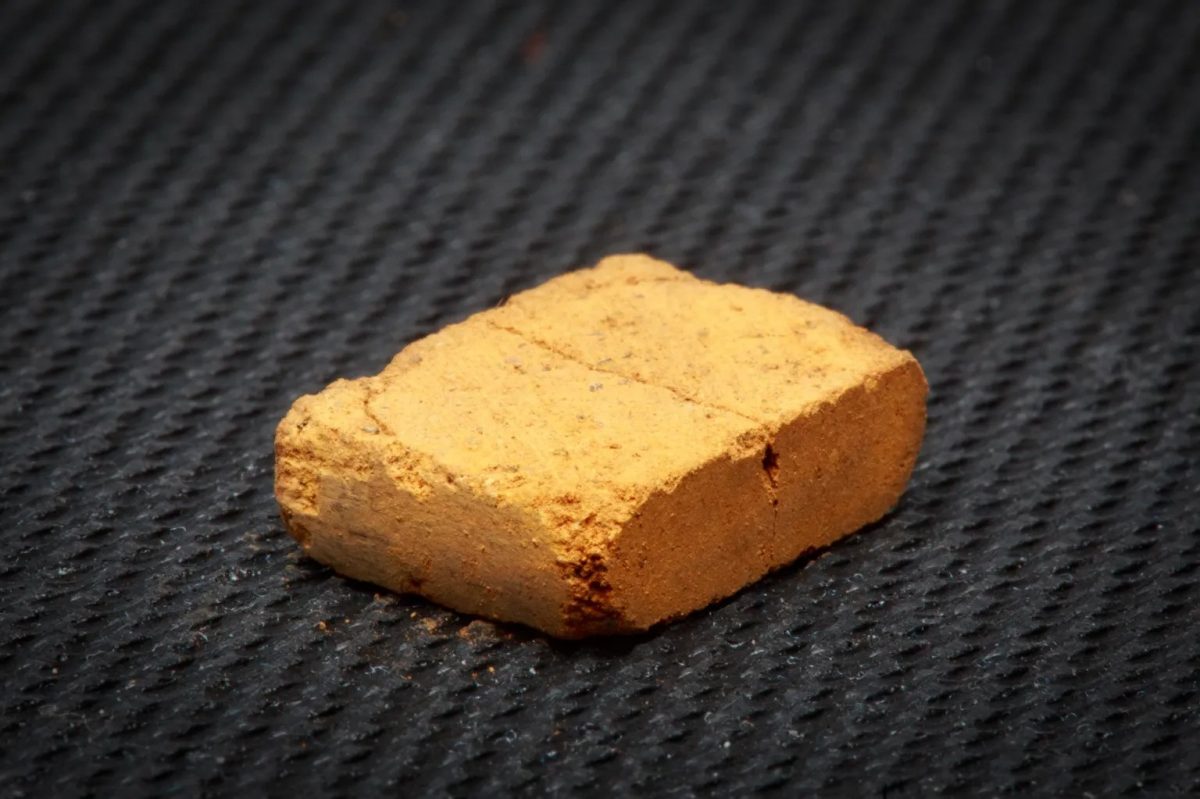
The brick is molded to resemble lunar soil. Source: www.popsci.com

Given that Mars possesses at least a minimal atmosphere, micrometeorites do not present a significant threat to local structures. Consequently, it is unnecessary to encase them with an external shell, and they may feature significantly larger windows than those on the Moon. Nevertheless, the concept of partially burying the buildings and the passageways connecting them beneath the surface remains a commendable idea. 

Once more, all of this presumes that the walls solely furnish structural stability, whereas the internal layers are tasked with preserving internal pressure and temperature. Under these circumstances, this residence shall remain habitable for numerous decades.

Overall, the construction endeavors on the Moon and Mars do not appear to be an unattainable concept. Nevertheless, they necessitate dependence on indigenous resources rather than materials transported from Earth. This reliance considerably influences the architectural design and appearance of the structures.

Most contemporary projects depict structures composed of metal, glass, or plastic. Nevertheless, the extraction and processing of metal remain necessary. The same requirement applies to glass, and bio-based plastics would need to be imported from Earth entirely.

Simultaneously, the silicate, sulfate, carbonate, and, to a certain extent, aluminate components of rocks, which are presently considered waste, are in fact the most prevalent raw materials used in the manufacturing of construction materials on Earth. Their utilization could potentially reduce the cost of construction, even in  space.

If our genuine aspiration is to establish sustained habitation within space — beyond merely undertaking expeditions — we must acquire the capacity to utilize all resources accessible in that environment. Subsequently, we will discover that the Moon and Mars are not as desolate and unwelcoming as they may appear.


RELATED


How SpaceX Will Build a City on The Moon

Building a Human City on the Moon | Documentary - EM

How NASA Will Build A City On The Moon

{ https://universemagazine.com/en/articles-en/ }

Hoe vind je dit bericht?
Geschreven door peter om 18:30 Stuur door

These Curious Ancient Greek Artifacts Have Extraterrestrial Origins—Why They Vanished 3000 Years Ago Remains a Mystery

meteoritic iron

(Image Credit: M. Gounelle, E. Mantzourani/Journal of Archaeological Science/https://doi.org/10.1016/j.jas.2026.106622)

These Curious Ancient Greek Artifacts Have Extraterrestrial Origins—Why They Vanished 3000 Years Ago Remains a Mystery

Deep within ancient chamber tombs where elite members of society in ancient Greece and Crete were once laid to rest, new evidence has emerged that these high-status individuals wore some out-of-this-world iron jewelry.

Among the most coveted jewelry worn in the Bronze Age Mediterranean world were rings that were likely made from extraterrestrial iron, according to a new study published in the Journal of Archaeological Science.

Researchers Matthieu Gounelle and Eleni Mantzourani used chemical analysis to examine more than 90 iron objects from the Bronze Age and Early Iron Age, uncovered from 33 archaeological sites, revealing that about one-third of the artifacts were likely crafted using iron that fell from space.

Although iron harvested from ancient meteorites accounted for at least 10 of the rings the researchers examined, another three “might deserve further examination,” the study’s authors say, in new observations that indicate these ancient extraterrestrial adornments “may have been popular power symbols among prominent individuals” that included the Mycenaean and Minoan palatial elite.

Yet despite their apparent significance, the otherworldly fashion trend involving these otherworldly rings seems to have mysteriously vanished by the 12th century BCE, for reasons that remain unclear to researchers.

Meteoritic Iron as a Status Symbol

Using portable X-ray fluorescence, or XRF, to assess these rare artifacts in various museums where they are kept, most of the objects were found to contain very little nickel, if any at all. This is consistent with iron produced using smelting processes from the periods in question, which relied on terrestrial ores.

However, 13 of the objects possessed elevated levels of nickel, which hinted at the likelihood that some of these ancient rings had been crafted with metal originating in meteorites, which contain far more nickel than smelted varieties of iron do.

Another intriguing discovery the researchers made was that each artifact suspected of being made from meteoritic iron was either a whole or fragmentary signet or bezel ring, combining the suspected meteoritic iron with gold, silver, or bronze. Most were also found in various chamber tombs alongside other luxury goods, adding to the likelihood that these unique artifacts may have been considered symbols of status or authority.

Where Did Ancient Greeks Obtain Extraterrestrial Iron?

However, another mystery involves the source of the meteoritic material, which remains uncertain since extraterrestrial iron was uncommon in ancient Greece. Because of this, the team suspects that one reason for this material’s role as a status symbol may have been not just its otherworldly nature, but also the fact that it was likely imported.

“Given the rarity of meteorites in Greece and the established trade networks during the Bronze Age, we propose that the source of the raw meteoritic material was Egypt,” the team writes, “where meteorites are numerous due to the abundance of deserts.”

Several famous examples of meteoritic iron have been recovered from Egypt, which include a dagger found among the items entombed with the Pharaoh Tutankhamun.

The abundance of rings made from this extraterrestrial metal contrasts with the more common iron objects that appear to have been made from smelted material. This suggests that ancient metalworkers recognized the distinction between the materials, and ascribed higher value to the far rarer meteoritic forms of iron.

An Otherworldly Fashion Trend Goes Missing

Curiously, the researchers also found that by around the 12th century BCE, this otherworldly fashion trend appears to have almost completely vanished, and for reasons that remain unclear.

Possible reasons for this may include interruptions to trade networks, political upheaval, or simply changes in trends from the period. However, one potential clue is that the ancient Greeks’ production of meteoritic iron rings seems to have ended coinciding with the collapse of the Mycenaean palace system.

“Such a development could be related to economic, social or political changes,” the team speculates, although they also acknowledge more mundane possibilities.

“It is also possible that the meteoritic finger ring fashion, almost exclusive to Minoan and Mycenaean Late Bronze Age, has ‘naturally’ faded away as does any fashion,” the researchers write.

The recent study, “Iron in Greece in the second millennium B.C.E.,” appeared in the Journal of Archaeological Science. 

  • Micah Hanks is the Editor-in-Chief and Co-Founder of The Debrief. A longtime reporter on science, defense, and technology with a focus on space and astronomy, he can be reached at micah@thedebrief.org. Follow him on X @MicahHanks, and at micahhanks.com.

RELATED

These Ancient Artifacts Were NOT Human-Made — And Experts Have No Answer

The Alien Origins of Human Civilization | Ancient Aliens

They Were Here: The Lost Alien Artifacts That Rewrite Human History

{ https://thedebrief.org/category/science/ }

Hoe vind je dit bericht?
Geschreven door peter om 18:04 Stuur door

Tom Slemen's Haunted Wirral: Mystery of the 'Tic Tac' UFOs

Tom Slemen's Haunted Wirral: Mystery of the 'Tic Tac' UFOs

Haunted Wirral – Mystery of the Chinese Spacemen
By Tom Slemen

ON the Sunday morning of June 24, 2018, at around 6am, a 45-year-old man named Rod was driving along Barnston Lane in Moreton.

UFOs and the paranormal were the furthest things from his mind on that sunny morning.

The reason I will not give his full name is that Rod was driving home to his wife after spending the night with a woman he had met at work. He felt terrible about his duplicity, but could not stay away from the "other woman"; he was beguiled by her and could not bring himself to end the affair.

As Rod neared the Farmer's Arms pub, something in the sky caught his eye and he slowed down. Travelling towards him across the blue sky, at an altitude of around 300 feet, was a strange white object that looked like an enormous Tic Tac sweet, or perhaps a giant propane tank.

Rod estimated that the object was about 50 to 60 feet long, and it passed overhead in complete silence. He could see no wings, markings or other features on the hull of the mysterious craft, nor could he discern what means of propulsion it was using. There were no visible propellers or jet engines.

Rod soon lost sight of the UFO, but there were other reports of the craft being seen over Litherland Avenue in Moreton, as well as Upton Road and Grampian Way. Several motorists travelling along the M53 also reported seeing the UFO pass overhead, heading in the direction of Noctorum.

Many years before, in 2005, I had been on BBC Radio Merseyside talking about UFOs when a retired schoolteacher in her sixties, whom I shall call Margaret, telephoned the programme. She said that she and her sister Grace had seen a huge white UFO which she described as an oblong capsule with rounded ends.

The craft had allegedly landed on Bidston Hill at around five o’clock on the morning of June 22, 2004. Margaret said that two men wearing white spacesuits were standing beside the object, which appeared to be hovering a few feet above the ground.

Grace heard the men speaking to one another in Chinese, a language with which she had some familiarity because she had attended university with a Chinese friend many years earlier and had picked up a little of it. She recalled hearing one of the men say something sounding like “jìngdiàn de”, which she understood to mean “electrostatic”.

Margaret did not see the men’s faces, but Grace did. She said that, behind their visors, they appeared to be two East Asian men. Both looked towards Grace and Margaret but seemed completely unfazed by the women’s presence.

They later walked behind the craft, and shortly afterwards it took off silently at considerable speed, heading east in the direction of Flaybrick Cemetery.

Later that day, the women encountered two police officers and told them what they had witnessed. The officers said they had been in the vicinity of Bidston Hill at around the same time that morning but had seen nothing unusual. Margaret gained the impression that the policemen were particularly bemused by Grace’s description of the “spacemen” as Chinese.

The women’s account was not taken seriously by a few self-appointed ufologists. Yet since Tic Tac-shaped UFOs became internationally famous, there has been speculation that such objects might not be extra-terrestrial at all, but highly advanced experimental aircraft employing some unknown form of propulsion.

One of the most famous modern encounters involving a Tic Tac UFO occurred on November 14, 2004, when US Navy fighter pilots were sent to investigate mysterious objects detected by radar off the coast of Southern California.

Commander David Fravor, flying an F/A-18 Super Hornet from the USS Nimitz Carrier Strike Group, encountered a smooth, white, oval object roughly 40 feet long, hovering above a disturbance in the ocean. The strange craft had no visible wings, rotors or obvious means of propulsion and became known as the “Tic Tac” because of its distinctive shape.

Fravor said that when he descended towards it, the object appeared to react to his movements before suddenly accelerating away and disappearing. The USS Princeton had reportedly been detecting unusual objects for about two weeks, sometimes appearing at around 80,000 feet before rapidly descending towards the sea. A later flight equipped with sophisticated infrared equipment recorded an unidentified object, resulting in the now-famous footage subsequently released by the US Department of Defense.

Long before the celebrated 2004 encounter, however, remarkably similar objects had allegedly been seen over Wirral.

On the morning of July 10, 1979, 58-year-old William York was at his flat at The Channel on Harrison Drive, Wallasey, suffering severe pain from a slipped disc, when something unusual outside his bedroom window caught his attention.

He initially noticed a mysterious light moving across the sky, but then four brilliant lights appeared, seemingly arranged around a horizontal object. According to York, the lights eventually became enveloped in what looked like a red cloud before vanishing.

A milkman working his early-morning round also reported seeing the objects and apparently had a clearer view. He described cylindrical craft with rounded ends — remarkably reminiscent of what would decades later become known as Tic Tacs. He watched them travel towards New Brighton before they disappeared near the lighthouse.

That particular area has featured in many UFO reports over the years, leading some ufologists to speculate that an unidentified aerial “portal” exists somewhere near Perch Rock.

Whether such a thing could exist is another matter entirely, although theoretical physics does entertain the concept of wormholes: hypothetical shortcuts through space-time which, in principle, might connect enormously distant regions of the universe.

Then, in 2001, I received an intriguing telephone call while appearing on Billy Butler’s programme on BBC Radio Merseyside. A man from Bebington told me that he and his wife had watched an intensely bright white object pass beneath the Runcorn Bridge before travelling towards Wirral.

He compared its peculiar shape to a Tic Tac. The description raised a few laughs in the studio at the time, but it was surprisingly apt. The object reportedly followed the eastern side of the Wirral peninsula before disappearing after passing New Brighton Lighthouse.

Perhaps the most dramatic local account, however, occurred during the Great Storm of October 1987.

As hurricane-force winds battered the country, a woman in her sixties whom I shall call Elaine found herself caught in terrifying conditions at New Brighton. Her car had been blown off the road and struck a bollard, and when she climbed out to inspect the damage, her poodle escaped from the vehicle and apparently disappeared.

Fearing that her dog had been swept away, Elaine struggled against winds so ferocious that she had to lean into them simply to remain upright. It was then that she noticed an extraordinary sight beyond New Brighton Lighthouse.

Suspended behind it was an enormous white object which Elaine compared to a gigantic pill.

Despite the tremendous waves and winds exceeding 100 mph, the strange craft appeared completely motionless. Elaine watched it for perhaps twenty seconds before, without warning, it shot away. Within moments, it had dwindled to little more than a point of light racing northwards across Liverpool Bay.

Elaine eventually fought her way back to her damaged car, where she discovered her missing poodle curled up safely on the passenger seat, terrified by the screaming wind. Her panic turned to relieved laughter.

The following day, however, Elaine heard a report that a pill-shaped UFO had supposedly been observed travelling northwards, apparently towards or beyond the Isle of Man. The description immediately reminded her of the enormous object she had witnessed during the storm.

And sightings around New Brighton have continued.

One warm, calm night in August 2022, a couple standing on King’s Parade noticed what appeared to be an oval patch of absolute darkness hanging approximately sixty feet above the sea. As they watched, six glowing red spheres emerged from the strange aperture in single file. The objects travelled silently inland, passing alarmingly close to blocks of flats near Wellington Road.

When the witnesses looked back towards the mysterious black oval, it appeared to be contracting. Within about a minute, it had completely disappeared.

In March 2023, a woman jogging along King’s Parade reported something remarkably similar. Approximately 600 yards offshore, she noticed what looked like a dark opening suspended above the water. At first, she assumed that her eyes were deceiving her, until two glowing red objects emerged from it.

The black aperture then seemed to close, while the two lights travelled eastwards and gradually faded from view.

If the mysterious “hole” off New Brighton ever appears again, perhaps someone with a drone could fly a video camera through it. I would certainly like to know what is on the other side.

* All of Tom Slemen’s books and audiobooks are available from Amazon.

RELATED

The Tic Tac UFO: The Navy Footage That Shocked Pilots

Pentagon UFO Emails LEAKED: The Truth About the Tic Tac Incident

{ https://www.wirralglobe.co.uk/news/ }

Hoe vind je dit bericht?
Geschreven door peter om 17:30 Stuur door

Venus Isn't Dead After All

Venus Isn't Dead After All

There are huge rift valleys on Venus. They suggest that the planet is still geologically active. Credit: NASA/JPL/USGS There are huge rift valleys on Venus. They suggest that the planet is still geologically active. Credit: NASA/JPL/USGS

When it comes to literary allegories, Venus is about as close to Dante's description of hell as one can get! Its atmosphere is 93 times as dense as Earth's, which is equal to the pressure found 900 m (3,000 ft) underwater, enough to crush the human body. It's also the hottest planet in the Solar System, with temperatures reaching 467 °C (872 °F), which is hot enough to melt lead. Unlike Earth, its surface is not composed of tectonic plates that are constantly shuffling around, but a single-piece crust.

Until recently, scientists believed that this meant Venus was geologically inactive, though recent findings have challenged this. According to a new study by ETH researchers, Venus is not only geologically "alive" but hosts many active volcanoes. This is evident from Venus' rift valleys (aka chasmata), lowland features similar to those on Earth that form when tectonic plates move apart. These features show that Venus also experiences tectonic activity, creating rifts that can measure up to 10,000 km (~6,200 mi) in diameter.

The research was led by Xi Yang, a graduate student from the Department of Earth and Planetary Sciences (DEPS) at ETH Zürich as part of his Master's studies. He was joined by Taras V. Gerya, a Professor of Geodynamics in the DEPS (and Yang's supervisor), and Dr. Anna J. P. Gülcher, a Geosciences researcher from the University of Freidburg and the Center for Space and Habitability at the University of Bern. Their results are published in a paper that appeared in Nature Geosciences.

Current research reveals that Venus is not only geologically active, but has active volcanoes on its surface. Credit: NASA/JPL-Caltech/Peter Rubin

Current research reveals that Venus is not only geologically active, but has active volcanoes on its surface.

Credit: NASA/JPL-Caltech/Peter Rubin

Previous models of Venus' geological evolution, along with data provided by NASA's Magellan probe (which observed Venus between 1990 and 1994), have confirmed that large rift valleys exist on Venus. Previous models indicated that broad ridges (rift flanks) form along the edges of rift valleys when they are geologically young and are either still moving or have only recently ceased.

Until now, geoscientists believed that they formed more than 100 million years ago, but this has remained unconfirmed. What's more, earlier models had relied on simplified material assumptions and been mostly two-dimensional. As a result, the question of whether Venus is still geologically active or not has remained unresolved. To address this, Yang and his team employed a new computer model to create the first high-resolution 3D models of Venus' surface, focusing on the Ganis, Dali, and Devana Chasmata.

This allowed them to accurately replicate these rift structures and provide better explanations of their formation. Their model shows that rift flanks on Venus tend to flatten rapidly after movement ceases, meaning that systems become less steep and narrow their flanks with age. Unlike Earth, where erosion gradually wears down features, Venus’s flanks subside due to crustal relaxation. Their simulations also suggest that these rifts widen at a rate of 3 to 10 cm (~1.2 to 4 inches) a year, which is faster than previous models suggested.

Based on their modeling and observational data from Magellan and other missions, the researchers conclude that Venus remains geologically active and has a more dynamic interior than previously thought. “The results help us to better assess the tectonic activity on Venus,” says Gerya. This is particularly important considering that NASA and the ESA are preparing multiple missions to explore Venus' atmosphere, surface, and interior structure in the near future.

Comparison between the crustal model at 700,000 years (top figure) and the actual Dali Chasma rift system (bottom). Credit: Xi Yang/ETH Zürich

Comparison between the crustal model at 700,000 years (top figure) and the actual Dali Chasma rift system (bottom).

Credit: Xi Yang/ETH Zürich

The results of their model could help mission planners pinpoint geologically active regions for these missions to study. Interestingly, Taras Gerya and fellow ETH geophysics professor Paul Tackley (and their colleagues) are participating in mission planning for ESA's EnVision mission, a probe that is scheduled to launch in the 2030s to study Venus' atmosphere, surface and interior, and how they interact with each other.

Similarly, the team's findings are shaking up what scientists know about how rocky planets in our Solar System formed, and could have applications in the search for habitable exoplanets.

Further Reading: 


Venus Isn't Dead After All

Falcon 9 Slams Into The Moon // Liquid on Pluto // Venus Isn’t Dead

{ https://www.universetoday.com/ }

Hoe vind je dit bericht?
Geschreven door peter om 17:13 Stuur door

Scientist Constructs "Big Picture" of Mars Water from Rover Data

Scientist Constructs "Big Picture" of Mars Water from Rover Data

A pictorial history of water on Mars by space artist Michael Carroll. This is based on Viking data and work done at NASA Ames. A study of rover measurements of water-related minerals on the Red Planet shows that water may well have been more widespread than previously thought. Courtesy Michael Carroll, public domain. A pictorial history of water on Mars by space artist Michael Carroll. This is based on Viking data and work done at NASA Ames. A study of rover measurements of water-related minerals on the Red Planet shows that water may well have been more widespread than previously thought. Courtesy Michael Carroll, public domain.

Rover data from more than 20 years ago has revealed clues to the existence of liquid water on ancient Mars. The NASA Spirit Rover carried a specialized instrument called a Mössbauer Spectrometer that performed mineralogical analyses of soil, rock, and dust on the surface of the Red Planet at Gusev Crater. Individual measurements didn't always indicate definitive proof of water, but when scientist Paolo de Souza of Edith Cowan University in Australia examined years' worth of measurements together, a definite pattern began to show up in the existence of minerals that could only exist in the presence of water. His analysis shows that Mars used to sport a lot more water than scientists expected and that the data showing its existence was in the data all along.
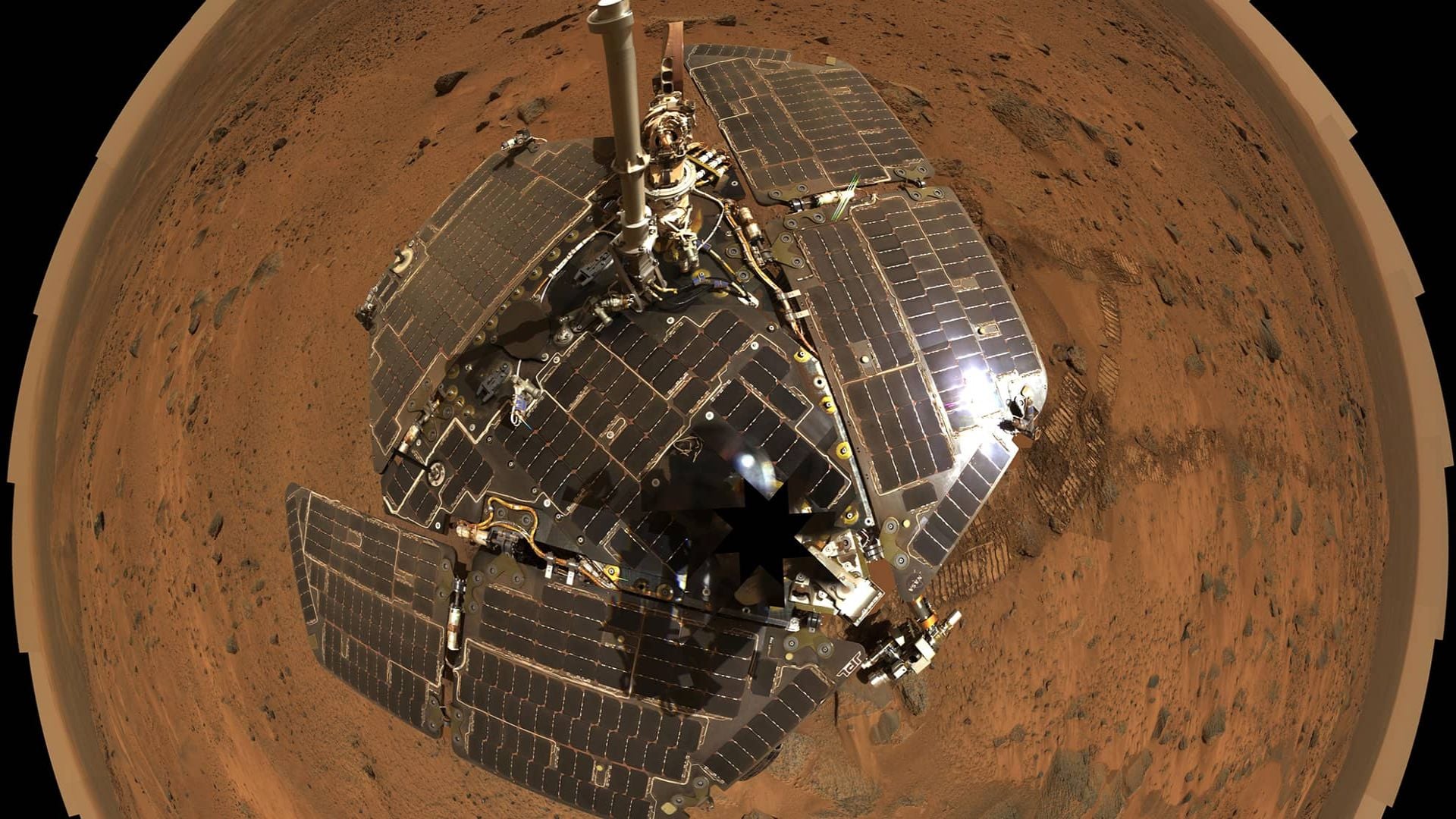

A panorama of the region where the Spirit rover landed inside Mars's Gusev Crater. Dust and soil at the site show traces of water-related minerals altered magnetite and hematite. Credit: NASA/JPL-Caltech/Cornell

A panorama of the region where the Spirit rover landed inside Mars's Gusev Crater. Dust and soil at the site show traces of water-related minerals, including altered magnetite and hematite.

Credit: NASA/JPL-Caltech/Cornell

De Souza was particularly interested in the existence of hematite and altered magnetite measured in the Martian soil. These two minerals often form when rocks interact with water. Hematite, in particular, is at the heart of the amazing "blueberries" found on Mars at Meridiani Planum by the Opportunity rover. The traces of hematite in de Souza's study were excavated from 32 Gusev soil sites that were undisturbed. The result of de Souza's work is the most detailed iron-mineral profile of Martian soil done to date. Scientists didn't expect to find hematite in the soils at the site, so the finding was a surprise. It turns out it was there all along, just in amounts too small in each rover sample measurement.

"One of the most important discoveries was finding crystalline hematite in ordinary Martian soil," Professor de Souza said. "This mineral's widespread presence suggests not only that water was present, but that significant areas of Mars may have once been covered by water."

Hematite, Magnetite and Water on Mars

Hematite is what's called an "iron oxide". It forms in the presence in liquid water, as well as in volcanic regions. On Mars, both types of environments exist, but the regions where the hematite is found appear to be largely shaped by past contact with water. That's why de Souza and others suspect that these areas of Mars were once inundated with water.

Magnetite occurs in both igneous (volcanic) rocks as well as in sedimentary rocks here on Earth. It's also an iron-bearing mineral, and on Mars, its presence indicates that water and rocks interacted. The fact that it's also found in widespread areas indicates a warmer, wetter past on Mars.

Martian "blueberries" as seen by the Opportunity Rover at Meridiani Planum during its exploration. These hematite orbs likely formed in contact with water. Credit: NASA/JPL Public Domain.

Martian "blueberries" as seen by the Opportunity Rover at Meridiani Planum during its exploration. These hematite orbs likely formed in contact with water.

Credit: NASA/JPL Public Domain.

The layers of dust that the rover studied in Gusev Crater that contain traces of the water-related minerals are found across the planet. De Souza's findings suggest that the layer of dust extends across huge areas of Mars. It likely formed over millions of years thanks to constant wind erosion, temperature changes, and storms that moved huge quantities of dust across the Martian surface.

Revisiting Past Data

According to de Souza, each rover measurement wasn't enough to come to a definitive conclusion about water on Mars. But, taken together, they paint a striking picture of Mars's past. "Many measurements were not detailed enough on their own to identify minerals present in very small quantities," he said. "By bringing the data together and analysing it in a new way, we were able to reveal information that had been hidden for years."

It took de Souza several years of painstaking work, sifting through all the measurements, to construct the picture of water on Mars, particularly at Gusev Crater. He had to take into account a number of factors at play during the measurements, including temperature conditions, samples from different soil regions, physical and chemical weathering of the surface materials, and the effects of millions of years of global dust storms. He described the details in a paper submitted to Springer Nature (cited below).

In the future, de Souza will do a similar analysis of data from soils studied by the Opportunity rover at Meridiani Planum. If it works out as expected, hundreds of measurements will be analyzed and combined to form a "big picture" assessment of water on Mars in that region, as well. The work on the Gusev Crater and Meridiani Planum soils also points out the need for future missions to the Red Planet to carry spectrometers to do longer-term studies of the soil than the Opportunity and Spirit instruments were able to do.

For More Information


NASA’s Curiosity Rover Explores Ancient Martian Water Body | WION Podcast

{ https://www.universetoday.com/ }

Hoe vind je dit bericht?
Geschreven door peter om 16:51 Stuur door

20 mile UFOs on Moon by Ukraine Scientists Confirmed by Apollo 17 photos and Italian 2007 UFO video!

20 mile UFOs on Moon by Ukraine Scientists Confirmed by Apollo 17 photos and Italian 2007 UFO video!

UFO,%20UFOs,%20UAP,%20UAPs,%20UFO%20sighting,%20UFO%20files,%20UFO%20video%20UAP%20files,%20UAP%20video,%20department%20of%20war,%20alien,%20aliens,%20infrared%20UFO,%20IR%20UFO,%20official%20UFO,%20Gov%20UFO,%20USA%20UFO%20copy.png

Screenshot%202026-08-09%20at%2012.49.33%E2%80%AFPM.png

Date of discovery: 2025 by Ukraine astronomers
Location of sighting: Earths moon
2007 UFO: 
2011 UFO: 
 
Yes Ukraine astronomers made some awesome recordings of video, yes actual video (not released yet) of round donut UFOs moving to and from the moon some of them reaching tens of miles across. The astronomers say this is proof that there is a base on the moon, however there is not 'a' base on the moon...the whole moon is a base...meaning a space station covered in lunar material to give it camouflage. 
 
Also back in 2011 I discovered three photos. These photos reveal a UFO about 15 miles across in HD detail! The UFO is a black circle, which actually absorbs the light so much that its has zero reflection. Thats pure alien tech there. In two photos its gone, in one photo it's there. Yeah...NASA missed it but I found it. 
 
Then...an amateur astronomer in Italy in 2007 was recording the moon by accident he said when he was cleaning his telescope and caught this object moving over the moons surface for 2 minutes! The round object actually made a 45 degree turn...which is 100% proof it's intelligently controlled since nothing in nature out there is capable of such maneuvers. This video is exactly the same object as that caught on video by Ukraine scientists...but unreleased as of today. The astronomer said it was 5.6 miles wide or 4.8 arc seconds.
 
So...yeah...20 mile UFOs exist. Why are they there? Because the moon is a giant space station. No little bases, it's all one giant base. We had the evidence for a long time, but lately, the public is paying more attention to it because of the Trump UFO file drops. 
Scott C. Waring - UFO Sightings Daily 
 

{ https://www.ufosightingsdaily.com/ }

Hoe vind je dit bericht?
Geschreven door peter om 16:37 Stuur door

UFOs and Defense: French Military Elite Concluded Extraterrestrial Hypothesis Is “By Far the Best” Explanation — Then Urged Paris to Break the Silence

UFOs and Defense: French Military Elite Concluded Extraterrestrial Hypothesis Is “By Far the Best” Explanation — Then Urged Paris to Break the Silence

America ı By Samuel Lopez

Night scene with a glowing circular UFO hovering above a dark landscape, a jet flying nearby and distant mountains at the horizon.

Inside This Report

  • A panel of retired French generals, scientists, and intelligence officials spent three years analyzing hundreds of documented UFO cases before reaching a startling conclusion in 1999
  • The COMETA report — compiled with cooperation from France's gendarmerie, air force, and space agency CNES — found the extraterrestrial hypothesis "the best scientific hypothesis" for a small percentage of unexplained sightings
  • The authors warned that continued government secrecy, particularly in the United States, carries real political, religious, and defense consequences — and recommended France build permanent structures to study the phenomenon

By Samuel López | USA Herald

For more than seventy years, the words "unidentified flying object" have summoned images of tabloid headlines and blurry photographs. But in July 1999, a document surfaced in France that forced even skeptics to sit up straight. It wasn't produced by a fringe research group or a self-styled contactee. It came from COMETA — a committee of retired French Air Force generals, a former head of the national space agency CNES, engineers, admirals, and a national police chief — operating under the umbrella of the Institut des Hautes Etudes de Défense Nationale, France's institute for advanced national defense studies.

Their report, "UFOs and Defense: What Should We Prepare For?" ran nearly ninety pages and was built on three years of methodical work: interviews with fighter pilots, cross-referenced radar data, gendarmerie case files stretching back decades, and cooperation from GEPAN/SEPRA, the CNES division tasked since 1977 with formally investigating unexplained aerospace phenomena in French airspace.

What the committee found wasn't sensationalism. It was restraint — and that restraint is precisely what made the conclusions land so hard.

The Cases That Wouldn't Go Away

The report walks through a series of episodes that French investigators say defy conventional explanation. In 1977, Mirage IV pilot Hervé Giraud and his navigator tracked a luminous object that outmaneuvered their aircraft near Luxeuil, with no corresponding radar contact from ground control — despite the object's evident speed and proximity. In January 1994, Air France Flight AF 3532's captain, copilot, and chief steward all watched an object shift shape from a "brown bell" into a lens before vanishing — a sighting independently corroborated by a fifty-second radar track recorded at the Cinq-Mars-la-Pile control center, ruling out a weather balloon.

Then there's Trans-en-Provence, a 1981 case investigators returned to twice. A witness watched a silent, ovoid object land in his garden, then depart at high speed. Soil and plant samples analyzed by INRA's ecology laboratory reportedly showed altered chlorophyll concentrations and biochemical stress consistent with exposure to an intense electromagnetic field — effects that persisted in the vegetation for years afterward.

Internationally, the report cites the 1976 Tehran incident, in which Iranian F-4 fighter jets scrambled to intercept an object that reportedly disabled their instrumentation and weapons systems on approach, and the 1957 RB-47 case over the American South, where a U.S. Air Force bomber crew tracked an object visually, on radar, and via onboard microwave-emission detectors simultaneously

French military report said extraterrestrial hypothesis best explains some UAP cases

Why the Extraterrestrial Hypothesis Made the Cut

COMETA's authors didn't arrive at their conclusion casually. The report methodically works through alternative explanations — secret  military technology, disinformation campaigns, holographic projections, unknown natural phenomena — and finds each insufficient to account for the small subset of cases the French call "UAP D": incidents that resist explanation even after exhaustive investigation.

The committee estimated that roughly 5 percent of the aeronautical sightings they reviewed fell into this unexplained category — a small fraction, but one drawn from a pool of nearly 500 well-documented international cases. That, they argued, was enough to warrant taking the extraterrestrial hypothesis seriously as a working theory grounded in known physics, including magnetohydrodynamic propulsion concepts already under study in the U.S. and Britain.

A Pointed Message for Washington

Perhaps the most striking section of the report isn't about the phenomena themselves — it's about American secrecy. The committee directly criticized U.S. policy, citing regulations like JANAP 146 and Air Force Regulation 200-2, which historically criminalized unauthorized disclosure of UFO sightings by military and commercial pilots alike. The authors argued this "impressive repressive arsenal" had persisted since the 1950s and warned that ongoing opacity — particularly following the 1947 Roswell incident — undermines trust between allied nations and complicates any coordinated response to a phenomenon that, by the report's own admission, does not respect national borders.

The recommendations were concrete: expand SEPRA's staffing and budget, formalize sighting-reporting protocols for pilots and air traffic controllers, integrate UFO detection into civilian and military space surveillance systems, and open diplomatic channels — including through the European Union — to press the United States for greater transparency. 

More than two decades later, the COMETA report remains one of the most detailed government-adjacent examinations of the UFO question ever published by a major Western nation — a reminder that the loudest calls for disclosure haven't always come from conspiracy theorists, but sometimes from the generals themselves.

About the Author

Samuel López is a Senior Legal Analyst, investigative journalist, and legal researcher with more than two decades of experience analyzing litigation, government disclosure practices, and complex regulatory controversies. His work draws on years spent parsing declassified records, agency reporting requirements, and cross-border policy disputes — the same investigative rigor he brings to unraveling documents like the COMETA report, where separating verified fact from speculation requires both legal precision and a reporter's skepticism.

{ https://usaherald.com/ }

Hoe vind je dit bericht?
Geschreven door peter om 00:13 Stuur door

What the Witnesses Saw—and What the Evidence Can Prove

What the Witnesses Saw—and What the Evidence Can Prove

From an unresolved report involving approximately 100 objects off Virginia to the testimony of Navy aviators David Fravor and Ryan Graves, this week’s briefing examines the widening gap between credible observation and publicly available proof.

By The UFO Times Editorial Desk

U.S. Navy vessels operating in the Atlantic Ocean — regional context for the AARO Virginia UAP report

U.S. Navy vessels operating in the Atlantic Ocean. This image provides regional context only. It does not depict the vessels, personnel or events described in AARO’s FY 2025 annual report, and should not be interpreted as visual evidence of the reported incident.  Image: U.S. Navy / Public Domain.

The most important word in the study of unidentified anomalous phenomena is not extraordinary.

It is unidentified.

That word does not confirm extraterrestrial technology. It does not establish that every reported object possesses unusual capabilities. It tells us that, with the information available, investigators have not determined what was observed.

That uncertainty can be uncomfortable. It is also where responsible investigation must begin.

This week, The UFO Times examines four stories that approach the unknown from different directions: an official report containing remarkably little public detail, two Navy aviators whose accounts helped transform the modern UAP debate, and the filmmaker who shaped how millions imagine the moment of disclosure.

Together, they raise one central question: How should we evaluate extraordinary reports when the witnesses may be credible, but the complete evidence remains outside public view?

News Analysis — Feature StoryThe dominant story this week

The Virginia Report: An Extraordinary Number, an Incomplete Record

The most arresting passage in AARO’s latest annual report describes an incident off the coast of Virginia.

According to the official document, U.S. Navy assets reported approximately 100 airborne UAP and two likely uncrewed surface systems. AARO says it is investigating the event in coordination with the reporting unit.

The number immediately attracts attention.

The lack of accompanying information should attract just as much.

The public report does not provide the date, precise location, duration, altitude, speed or appearance of the objects. It does not explain whether the count was simultaneous or accumulated over time. It does not reveal which sensors detected them or whether the airborne and surface systems appeared to operate together.

No public radar data, infrared imagery or video accompanies the account.

That leaves us with an official report of a potentially important event—but without enough information to determine whether it involved foreign surveillance systems, military drones, sensor interpretation problems, multiple unrelated objects or something genuinely anomalous.

■ Our conclusion

The number is extraordinary. The publicly available evidence is not. An unresolved military report deserves investigation. It does not, by itself, establish an extraordinary origin.

Military Witness
USS Nimitz aircraft carrier — the vessel from which Commander David Fravor launched on November 14, 2004

USS Nimitz. In November 2004, Commander Fravor launched from this vessel and encountered an object that could not be identified. Department of Defense footage associated with the incident has since been officially authenticated. This image is contextual and does not depict the encounter.

David Fravor: When Testimony Becomes Difficult to Dismiss

Commander David Fravor’s November 2004 encounter with the object now known as the Tic-Tac remains one of the most consequential military UAP cases of the modern era.

Fravor was not alone. Other members of his flight were present, and radar operators aboard the USS Princeton had reportedly been monitoring unusual contacts before his aircraft was redirected to investigate.

Fravor described a smooth, white, wingless object maneuvering above disturbed water. When he descended to examine it, the object appeared to react to his presence before accelerating away. Approximately five minutes of observation became the foundation of an account that Fravor has repeated with striking consistency for more than two decades.

His professional qualifications are verifiable. His account is corroborated in important respects by other personnel. Infrared footage associated with the broader incident was recorded during a later flight and eventually authenticated and released by the Department of Defense.

Those facts make Fravor an exceptionally significant witness.

They still do not identify the object.

Credible testimony can establish that an unusual observation occurred. It cannot always establish what caused it. Fravor’s importance lies partly in his refusal to pretend otherwise.

Military Witness
Ryan Graves — former U.S. Navy F/A-18 pilot and UAP aviation-safety advocate

Ryan Graves, former U.S. Navy F/A-18 pilot. He has testified publicly about recurring unidentified contacts in military training airspace and founded Americans for Safe Aerospace to improve UAP reporting standards.

Ryan Graves: From UFO Mystery to Aviation Safety

Ryan Graves helped change the public UAP discussion by asking a practical question: What happens when unidentified objects repeatedly enter military training airspace?

Beginning around 2014, Graves and other Navy aviators operating off the eastern United States reported unusual radar contacts and, in some cases, visual observations. The reports became especially significant after upgraded radar systems began detecting objects that older systems had not shown.


Navy Fighter Pilot: The Truth About UFOs. "I've Seen Them With My Own Eyes" | Ryan Graves

Some pilots initially suspected equipment problems. The issue became more difficult to dismiss when radar contacts reportedly corresponded with infrared or visual observations.

Graves has consistently avoided presenting these encounters as proof of extraterrestrial visitation. He frames them as an aviation-safety, national-security and scientific problem. That distinction matters. If the objects were foreign surveillance systems, they represented a security concern. If they were domestic systems operating without adequate coordination, they represented a safety concern. If some demonstrated capabilities that conventional explanations could not account for, the scientific implications would be substantial.

Graves does not ask pilots to decide what they saw. He asks that they be able to report it accurately and without professional stigma. That may ultimately prove more valuable than any dramatic declaration.

Analysis
Steven Spielberg — filmmaker whose work shaped public understanding of UFO disclosure over five decades

Steven Spielberg. His films drew partly from documented UFO history, including consultation with astronomer J. Allen Hynek, who worked with the U.S. Air Force’s Project Blue Book programme.

Contextual portrait.

Spielberg: The Story We Carry Into Every Investigation

Long before congressional hearings and official UAP offices entered public discussion, Steven Spielberg helped define how millions imagined contact with an unknown intelligence.

Close Encounters of the Third Kind did not emerge entirely from fantasy. Spielberg consulted J. Allen Hynek, the astronomer who had worked with the U.S. Air Force’s Project Blue Book. The film drew from documented UFO history, contemporary reports and the institutional tensions surrounding official investigations.

But cinema does something that evidence cannot: it completes the story. It gives unexplained lights an origin. It gives secrecy a purpose. It gives humanity an encounter, an answer and, eventually, a resolution. Real investigations rarely provide that satisfaction.

The Virginia report contains no revealed visitors and no final explanation. Fravor’s testimony ends with an object departing at extraordinary speed. Graves’s reporting leaves us with recurring airspace encounters whose causes remain uncertain.

Spielberg helps us imagine disclosure. Journalism must determine whether disclosure has actually occurred.

Popular culture can inspire curiosity. It cannot substitute for proof.

■ What Connects These Stories?

The Virginia report, Fravor’s encounter, Graves’s advocacy and Spielberg’s films occupy different evidentiary categories. They should not be treated as though they prove the same thing.

  • The Virginia incident is an official unresolved report with insufficient public detail.
  • Fravor offers credible, corroborated military testimony associated with authenticated government footage—but the object’s origin remains unidentified.
  • Graves documents a broader reporting and flight-safety problem involving multiple pilots, sensors and recurring encounters.
  • Spielberg represents the cultural framework through which much of the public interprets all three.

Taken together, these stories do not prove extraterrestrial visitation. They establish something more limited, but still important: trained military personnel have reported unidentified objects in operational airspace; the government has investigated such incidents; some cases remain unresolved; and the public still lacks sufficient data to determine what occurred in many of the most consequential reports.

That is not a final answer. It is a legitimate investigative problem.

The Evidence Ledger

What the available record confirms — and where the public record falls short.

SubjectWhat is establishedWhat remains unresolved
Virginia
Incident
A U.S. Navy unit reported approximately 100 airborne objects and two likely uncrewed surface systems; AARO says the case remains under investigation. Date, sensor data, object behavior, proximity, coordination and origin.
David
Fravor
A qualified Navy aviator reported a close encounter; other personnel provided supporting testimony; related footage was authenticated by the Department of Defense. The identity, origin and precise capabilities of the observed object.
Ryan
Graves
Navy aviators reported recurring unidentified objects in training airspace; Graves has testified publicly and advocated improved reporting standards. The nature and origin of the objects and how many reports share a common cause.
Spielberg’s
Influence
His films drew partly from real UFO history and consultation with J. Allen Hynek. Whether any cinematic disclosure scenario resembles events occurring outside fiction.

The Standard That Must Hold

The UAP subject presents two equal and opposite risks.

The first is reflexive dismissal: assuming that every witness is mistaken and every unresolved report must have an ordinary explanation before the evidence has been examined.

The second is premature certainty: treating every unexplained observation as confirmation of extraterrestrial technology.

Neither approach is investigative.

Credible witnesses deserve to be heard. Official reports deserve scrutiny. Government agencies should release enough information for meaningful public and scientific evaluation. Conventional explanations should be tested rather than assumed—and extraordinary conclusions should require evidence strong enough to support them.

The unknown should neither be ridiculed nor romanticized.

It should be investigated.

Facts First. Mystery Second. Speculation Last.

— The UFO Times Editorial Desk

■ Continue Your Investigation

Explore our ongoing coverage of the stories that connect this briefing:

The search for truth continues. Follow the investigation with The UFO Times.

{ https://theufotimes.com/ }

Hoe vind je dit bericht?
Geschreven door peter om 23:49 Stuur door

The Declassified DOW-UAP-PR043 in the PURSUE Disclosure is Likely a Missile

The Declassified DOW-UAP-PR043 in the PURSUE Disclosure is Likely a Missile

1*sbNfrf4HosDRZasr6nTV1g.png
View of DOW-UAP-PR043 (left) side-to-side with the matched Google Earth terrain (right). The labelled points were used as candidate terrain controls rather than as target positions. (Image credit: Nandal & Loeb 2026)

The UAP Science Advisory Council (https://uapsac.com/) is currently reviewing declassified, publicly available data, that was released so far on the Presidential Unsealing and Reporting System for Unidentified Anomalous Phenomena (PURSUE) website (https://www.war.gov/ufo/).

DOW-UAP-PR43: Africa, 2025 | The UFO Files

The main challenge in determining the velocity and size of UAP objects involve uncertainties about their distance and direction of motion. Without radar data or triangulation from cameras at different locations, as attempted in the Galileo Project Observatories (https://galileo.hsites.harvard.edu/) under my leadership, the actual speed and size of the objects remain unknown.

Together with my brilliant postdoc and council member, Dr. Devesh Nandal, we realized that unknown UAP parameters can be tightly constrained through a known background terrain, which can be used as a coordinate system to infer the motions of the target object as well as the camera, as functions of time.

To demonstrate the remarkable power of this method, we studied the declassified case DOW-UAP-PR043, involving an unresolved UAP report from Africa in 2025, released by the All-Domain Anomaly Resolution Office (AARO) in the Pentagon here. Amazingly, we were able to do better than AARO and resolve this case as a likely fast missile. Our full analysis report is available here. Below are some details of the related scientific analysis.

We started with the publicly released infrared video with a resolution of 1920 × 1080 pixels and a frame rate of about 29.97 frames per second. The video file is 11.75 seconds long.

To evaluate the velocity of the small feature that crosses the image, we first located the terrain. The above image shows the video view (left) side-to-side with the matched Google Earth terrain (right). The best match for the location was near 11.388655◦ N, 43.139259◦ E, near Goubetto in southern Djibouti. The nearby channel belongs to the Damerjog drainage system. It resembles a river in the infrared image, but it is more likely a dry wadi.

We produced tilted Google Earth views and placed candidate ground-control points on clear channel bends and compound features. The location match was strong because the same ordered sequence of bends and tributaries appeared in both the video and the map.

We next stabilized the terrain and searched for features that moved relative to the ground.

1*M70_PGUAo0sX_0VEbIjZCw.png
Terrain-stabilized target track. The red circles mark the 13 measured target centroids from frame 61 to frame 73, and the yellow line shows the fitted direction of motion. The target moves toward the lower right. The small frame-to-frame departures from the line are minor compared with the total track length and are consistent with centroid and image-processing uncertainty. (Image credit: Nandal & Loeb 2026)

The map coordinates allowed us to ask: What speed would be inferred if the changing line of sight intersected the local ground plane? The answer is: 3.33 kilometers per second. We then attempted to infer the motion of the camera based on the largest local terrain correction. Our camera model implied that the camera altitude was 2.26 kilometers above the local ground plane and the camera’s platform speed was about 77.7 meters per second. We then tested for differential parallax. A stationary object at low altitude produced only a small fraction of the observed motion. The parallax contribution increased rapidly only when the assumed target altitude approached the conditional sensor altitude.

1*_rNccx8lyzGr3-K8ZnuYfA.png
UAP velocity and viewing geometry as a function the UAP altitude above the ground plane. In the upper panel, the solid blue curve is the best conditional speed solution. The lower panel shows the corresponding mean slant range and its range along the measured track. The same angular motion maps to a shorter physical path as the assumed UAP altitude rises, so both inferred speed and slant range decrease. (Image credit: Nandal & Loeb 2026)

We intersected each target viewing ray with a horizontal surface at a chosen altitude. This generated a family of possible physical speeds rather than one unique value. The upper panel of the above figure shows the inferred UAP speed as a function of altitude.

1*xkjeaF089UGCXGOPXrcK-A.png

Apparent-size of the UAP (in meters) as functions of altitude. The horizontal dashed line marks the published diameter of the missile AGM-88 body used only as an illustrative scale, while the pale horizontal band shows a broader missile-diameter comparison range. The vertical dotted line marks the inferred camera’s altitude. None of these lines measures the target length: a long missile viewed nearly nose-on could present a cross-track dimension closer to its diameter than to its full length, and the unresolved image may be broadened by the sensor response. (Image credit: Nandal & Loeb 2026)

The apparent target width was about 3.8 full-resolution pixels. We consider the resulting physical sizes as upper limits because the measured width includes the sensor point-spread function, compression, motion blur, registration uncertainty, and possible thermal blooming. The above figure shows the inferred UAP size in meters as a function of altitude. The inferred width of about 4 meters at an altitude of 1.5 kilometers cannot be compared directly with the published length of a missile. It is a blurred cross-track upper limit. Depending on viewing orientation, the more relevant comparison may be body diameter rather than body length.

1*o0N5pT2Quiw5BDdZTjPSpw.jpeg

Aerodynamic drag and heating for the missile hypothesis. Panel (a) shows the UAP speed-altitude curve, the Mach 1, Mach 3, and Mach 5 levels (horizontal lines), and the camera’s altitude (vertical dashed blue line on the right side). The curve is above Mach 5 under an altitude of 1.17 km. Panel (b) shows dynamic pressure and the relative heating proxy on logarithmic axes; both rise steeply toward low altitudes, which is why sustained low-altitude hypersonic flight is difficult. Panel © shows the predicted speed loss without propulsion during the observed 0.4004 s interval for several ballistic coefficients. The shaded strip marks the illustrative missile HARM-like ballistic-coefficient range. Panel (d) compares the fitted along-track acceleration with the 95% constant-velocity bootstrap band and with representative initial drag decelerations.

Next, we evaluated the drag and heating associated with friction on air, which increases significantly with decreasing altitude. Our results are summarized in the above figure. The required propulsion thrust rises with dynamic pressure at low altitudes.

A fast tactical missile is physically compatible with the data. The low-altitude hypersonic branch is strongly penalized by dynamic pressure, drag, and heating, which makes sustained cruise in that regime difficult. The short track does not show statistically significant acceleration or deceleration, so it cannot distinguish a propelled missile from a sufficiently high ballistic-coefficient object that is coasting. The apparent-size estimate also does not identify a missile class. The video provides no clear plume, launch context, impact, or independent target range.

1*Lzkr77gp89mM_vACsr5yNw.png

An example of a low-altitude missile is the AGM-88 HARM (High-speed Anti-Radiation Missile) — U.S. air-launched anti-radar missile (as discussed here):

  • Length: 4.2 m
  • Speed: ~1 km/s
  • Altitude profile: Highly variable, since it’s launched from aircraft at whatever altitude the strike platform is operating at and dives on the radar emitter.

Fighter jets can fire the AGM-88 HARM across a wide flight envelope, including low-altitude deck operations around 1.5 km. At 1.5 km, the dense air increases aerodynamic drag. Recent developments in hypersonic missiles are discussed here and here.

The UAP is unlikely to be a bird because the low speeds of birds (limited by about 24 meters per second) would require a distance from the camera of tens of meters, from where it would be possible to notice the wings of a bird based on infrared data from the Galileo Project Observatories. The lack of wings also eliminates the interpretation of an airplane. A close-by passage would also lead to angular acceleration or deceleration which are not detected.

Our scientific analysis shows that the declassified DOW-UAP-PR043 in the PURSUE disclosure is most likely a fast tactical missile.

UAP are a mixed bag, with many being human-made objects with insufficient data to identify their specific parameters. But the fundamental question remains: Is there any UAP which indicates alien technology?

All members of the UAP Science Advisory Council are open-minded to the possibility that such objects exist. This mindset was echoed in today’s cover story of TIME magazine here, titled “America is Finally Taking Extraterrestrials Seriously”. Also today, Popular Mechanics released here a podcast discussion by Andrew Daniels, Shawn Gorman and John Gilpatrick, on the question: “Does Avi Loeb Know Something the Rest of Us Don’t?”

For the record, my answer to this question is: No.

1*SGDJAUxOuVehCZx110SOOw.jpeg

Cover story of TIME magazine on August 6, 2026. (Image credit: TIME)
Hoe vind je dit bericht?
Geschreven door peter om 17:08 Stuur door

Mysterious orb seen racing over residential area in new UFO files

Mysterious orb seen racing over residential area in new UFO files

BY Rebecka Pieder


Watch: 'They saw GREEN ORBS!’: New UFO files released by War Dept spark massive ALIEN BUZZ

The Pentagon has released a fresh batch of declassified UFO files, with never-before-seen footage, renderings, and documents chronicling the mysterious objects.

Videos show a mysterious orb whizzing over a residential area in the Middle East, and footage of a black sphere hovering over the Pacific Ocean, seemingly vanishing for a moment before resurfacing.

This latest release contains 41 files in total: over a dozen videos, three images, and a score of PDF documents. The oldest document is from 1953, and the most recent one is from this year.

The US defence department uploaded the first tranche of 161 files to their website on 8 May, with promises of more to come.

After President Trump called for the documents to be released in an executive order earlier this year, the Pentagon has declassified hundreds of files in a series of five drops.

Here's what's included in this latest tranche:

Video footage captured over the Gulf of Oman in 2021 appears to show a dark "cold orb" moving in irregular patterns. What at first glance resembles a housefly darting across the frame, is reportedly an Unidentified Anomalous Phenomena (UAP) measuring around 4 feet (1.2 metres) in diameter.

Unidentified Anomalous Phenomena is the official term used by the US government and scientists to describe objects such as these. Distinct from Unidentified Flying Objects, UAP's can be found on land and underwater, as well as soaring in the air.

Another video, captured by a US military sensor camera at an undisclosed location in the Middle East in 2025, shows a round sphere travelling in a straight line over what looks like an urban residential area.

In one declassified FBI document, a former military pilot describes seeing lights in the sky in October 2023 on a flight between Boston and Dublin. He claimed that many other pilots have witnessed similar events between midnight and 3am.

The white lights would start out dim, getting progressively brighter before fizzling out. Some of the lights remained still, while others moved in straight lines, sometimes changing directions, the pilot said. He has seen variations of these lights at least ten times since spotting the lights for the first time in 2023.

In footage captured over the Pacific Ocean in 2019, a black sphere appears and then disappears from view. When it reappears, visibly quivering, it slowly drifts from left to right.

The video's description noted that although the imagery was captured by a sensor, the display itself was recorded using a handheld device, which may account for some of the flickering visible in the footage.

In a 1953 PDF document, the US Naval Photographic Interpretation Center outlines its conclusions about two videos captured in the western United States, in Montana and Utah in 1950 and 1952, respectively. In the memo, the centre describes objects that appear to increase in size as their "luminosity" increases. It concludes that the videos depict objects whose characteristics are "inconsistent with those of natural phenomena".

All of the images in this latest release are renderings, meaning they are artistic interpretations of first-hand descriptions of extra-terrestrial encounters.

One rendering portrays a vast dark triangle in the sky, with round lights marking each corner. This image is based on a first-hand encounter by two former US military service members from the summer of 2011, the description said.

Public interest in extraterrestrial life has resurged in the United States in recent years. In 2022, Congress held its first UFO hearings in five decades, while the military pledged to increase transparency surrounding the issue.

Announcing this fifth drop of files, Pentagon spokesperson Sean Parnell said the department will release additional documents on a "rolling basis".

READ MORE

RELATED VIDEOS

Pentagon Drops 41 New UFO Files: Shocking UAP Videos, Mysterious Orbs & 70 Years Of Hidden Secrets

Astrophysicist Avi Loeb breaks down Pentagon's 5th batch of UFO files

ALIENS IN MIDEAST SKIES? Pentagon Drops Never-Before-Seen UFO Footage Captured By U.S. Military

{ https://www.bbc.com/news }

Hoe vind je dit bericht?
Geschreven door peter om 16:25 Stuur door

Declassified UFO files reveal US probe into 1963 Brazil ‘dead spaceman’ crash claim that quickly fell apart

Declassified UFO files reveal US probe into 1963 Brazil ‘dead spaceman’ crash claim that quickly fell apart

US declassified records detail a 1963 probe into a claimed sphere crash in Brazil.

By 
Representational image of a UFO investigation following a mysterious 1963 incident in Brazil. (Unsplash)
Representational image of a UFO investigation following a mysterious 1963 incident in Brazil.
(Unsplash)
Declassified US government records have revealed that American officials investigated a bizarre 1963 report claiming a metal sphere had crashed in a Brazilian town with a dead, unidentified occupant inside.

The alleged incident took place in Conde, a municipality in Brazil’s Bahia state, on November 8, 1963. A Portuguese-language broadcast by Rio de Janeiro’s Radio Tupi reported that a large metal sphere had fallen in the middle of the town, leaving a deep hole.

According to a US government transcript of the broadcast, the object allegedly contained a human body wearing heavy clothing marked with inscriptions that could not be deciphered.

The extraordinary report quickly drew the attention of US officials. American diplomats in Brazil sought information about the incident, while the details were circulated among the State Department, the Defense Department and NASA.

Also read:

But the investigation soon produced a far less mysterious explanation, and ultimately found no evidence that the reported crash had occurred.

US diplomats investigate mysterious sphere

On November 14, 1963, six days after the original radio report, the US Embassy in Rio de Janeiro sent a telegram to the State Department and the American Consulate in Salvador seeking clarification.

The embassy described the reported object as a “large metal manned balloon” and the alleged occupant as a “dead crewman” wearing what was described as a uniform or spacesuit with strange markings.

Officials had also heard reports that an object had been seen flying over the area around the same time and had tentatively been identified as a weather balloon, according to the Daily Mail report.

However, the embassy stated that no such craft had been recovered from the ground.

The inquiry was subsequently passed to the Defense Department and NASA. American officials were seeking to establish whether local authorities had actually confirmed the incident or whether reports circulating in Brazilian newspapers were unfounded.

Investigation finds no witnesses or wreckage

A final diplomatic cable dated November 20 provided a starkly different picture.

Harold Midkiff, the American consul in Salvador, reported that the story had apparently been fabricated in Rio de Janeiro. According to the cable, as cited by Daily Mail, newspaper reporters and other investigators had travelled to Conde but could not find anyone who had witnessed an unusual object falling from the sky.

Also read:

The local secretary of public security had suggested that the object might have been a weather balloon, but that possibility could not be independently verified either.

Midkiff also forwarded two newspaper reports from Bahia supporting the conclusion that there had been no confirmed crash.

One report said Brazil’s Ministry of Aeronautics had categorically denied that a strange object had appeared in Conde. Another carried the dismissive headline, “The Airship that wasn’t there.”

The diplomatic record said the only unusual development that could be confirmed was that a reporter had managed to send a dispatch from Conde using an old Morse code machine at a federal telegraph office.

What the newly released UFO files actually show

The records are part of a new tranche of declassified UFO material released by the US government. Their inclusion in the archive provides a glimpse into how American officials handled extraordinary reports during the Cold War.

But the documents do not establish that a spacecraft crashed in Brazil, nor do they confirm that a non-human or unidentified crew member was recovered.

Instead, they show that US officials took the report seriously enough to seek verification through diplomatic channels. Their investigation ultimately found no witnesses, wreckage or other physical evidence supporting the sensational account.

The files also leave unanswered a basic question: who originally created the story and how it reached Radio Tupi remains unclear.

According to the Daily Mail report, an apparent date error in one of the records lists the incident as occurring in November 1964, although the surrounding documents and the diplomatic correspondence place the reported event in November 1963.

RELATED


Brazil UFO crash claims & new UFO files released | Backscroll

Pentagon UFO Files: 5 Shocking Revelations From Latest Document Dump| 41 Files, Including Videos Out

Hoe vind je dit bericht?
Geschreven door peter om 16:03 Stuur door

Meer van UFO'S of UAP'S, ASTRONOMIE, RUIMTEVAART, ARCHEOLOGIE, OUDHEIDKUNDE, SF-SNUFJES EN ANDERE ESOTERISCHE WETENSCHAPPEN - DE ALLERLAATSTE NIEUWTJES

↑ Terug naar de berichten