Naar de inhoud

UFO'S of UAP'S, ASTRONOMIE, RUIMTEVAART, ARCHEOLOGIE, OUDHEIDKUNDE, SF-SNUFJES EN ANDERE ESOTERISCHE WETENSCHAPPEN - DE ALLERLAATSTE NIEUWTJES

UFO's of UAP'S in België en de rest van de wereld
akke.beakke.be
Ontdek de Fascinerende Wereld van UFO's en UAP's: Jouw Bron voor Onthullende Informatie! Ben jij ook gefascineerd door het onbekende? Wil je meer weten over UFO's en UAP's, niet alleen in België, maar over de hele wereld? Dan ben je op de juiste plek! België: Het Kloppend Hart van UFO-onderzoek In België is BUFON (Belgisch UFO-Netwerk) dé autoriteit op het gebied van UFO-onderzoek. Voor betrouwbare en objectieve informatie over deze intrigerende fenomenen, bezoek je zeker onze Facebook-pagina en deze blog. Maar dat is nog niet alles! Ontdek ook het Belgisch UFO-meldpunt en Caelestia, twee organisaties die diepgaand onderzoek verrichten, al zijn ze soms kritisch of sceptisch. Nederland: Een Schat aan Informatie Voor onze Nederlandse buren is er de schitterende website www.ufowijzer.nl, beheerd door Paul Harmans. Deze site biedt een schat aan informatie en artikelen die je niet wilt missen! Internationaal: MUFON - De Wereldwijde Autoriteit Neem ook een kijkje bij MUFON (Mutual UFO Network Inc.), een gerenommeerde Amerikaanse UFO-vereniging met afdelingen in de VS en wereldwijd. MUFON is toegewijd aan de wetenschappelijke en analytische studie van het UFO-fenomeen, en hun maandelijkse tijdschrift, The MUFON UFO-Journal, is een must-read voor elke UFO-enthousiasteling. Bezoek hun website op www.mufon.com voor meer informatie. Samenwerking en Toekomstvisie Sinds 1 februari 2020 is Pieter niet alleen ex-president van BUFON, maar ook de voormalige nationale directeur van MUFON in Vlaanderen en Nederland. Dit creëert een sterke samenwerking met de Franse MUFON Reseau MUFON/EUROP, wat ons in staat stelt om nog meer waardevolle inzichten te delen. Let op: Nepprofielen en Nieuwe Groeperingen Pas op voor een nieuwe groepering die zich ook BUFON noemt, maar geen enkele connectie heeft met onze gevestigde organisatie. Hoewel zij de naam geregistreerd hebben, kunnen ze het rijke verleden en de expertise van onze groep niet evenaren. We wensen hen veel succes, maar we blijven de autoriteit in UFO-onderzoek! Blijf Op De Hoogte! Wil jij de laatste nieuwtjes over UFO's, ruimtevaart, archeologie, en meer? Volg ons dan en duik samen met ons in de fascinerende wereld van het onbekende! Sluit je aan bij de gemeenschap van nieuwsgierige geesten die net als jij verlangen naar antwoorden en avonturen in de sterren! Heb je vragen of wil je meer weten? Aarzel dan niet om contact met ons op te nemen! Samen ontrafelen we het mysterie van de lucht en daarbuiten.

Berichten van 1 november 2026 tot 30 november 2026

Noah's Ark discovery revealed as first photos show wood buried 30 feet underground

Noah's Ark discovery revealed as first photos show wood buried 30 feet underground

A discovery buried deep beneath a remote mountainside in Turkey could offer a new clue in the centuries-old search for Noah's Ark.

Researchers investigating the Durupınar Formation near Mount Ararat recently announced that pieces of charred wood were found about 30 feet below the surface.

Now, the first photographs of the fragments have been released, revealing blackened, cracked wood with visible grain patterns and markings that researchers believe may have been made by ancient tools. 

Archaeologist Dr Cenker Atila told FOX News: 'One of the wooden pieces clearly shows signs of human workmanship. 

'Its surface appears to have been slightly shaped and flattened using an axe or a knife.

'The fact that these wooden fragments were found at such a considerable depth indicates that they may belong to an ancient period.'

The samples have been sent to four independent laboratories in different countries to determine their age, identify the type of wood and investigate their origins.

The formation's location and boat-like outline have long fueled comparisons with the biblical account, which places the ark's resting place in the 'mountains of Ararat.'

Researchers investigating the Durup¿nar Formation near Mount Ararat recently announced that pieces of charred wood were found about 30 feet below the surface

Researchers investigating the Durupınar Formation near Mount Ararat recently announced that pieces of charred wood were found about 30 feet below the surface

The site is a mysterious formation in Turkey that some believe looks like a massive boat

The site is a mysterious formation in Turkey that some believe looks like a massive boat 

The Durupınar Formation lies about 18 miles south of Mount Ararat, Turkey's highest peak.

Researchers also point to its roughly 515-foot length, which they say corresponds to the vessel described in Genesis.

Using their conversion of biblical measurements, the ark would have measured approximately 515 feet long, 86 feet wide and 52 feet tall.

Andrew Jones, founder of Noah's Ark Scans, which is involved in the investigation, said in a statement: 'We're testing this material to establish its age, identify the type of wood and look for traces of tree pitch.

'After decades of searching, this could be a crucial piece of the puzzle.'

The reference to pitch is significant because the Bible describes Noah being instructed to coat the ark inside and out with the waterproofing substance.

However, the wood's charred appearance does not establish that pitch was present or that the fragments came from an ancient vessel.

The discovery of the wood follows radar scans that Dr Khosrow Bakhtar, a veteran US defense scientist, said revealed patterns resembling chambers and corridors inside the roughly 515-foot-long formation. 

Researchers said that some pieces appeared to have been deliberately cut or shaped with tools

Researchers said that some pieces appeared to have been deliberately cut or shaped with tools

The samples have been sent to four independent laboratories in different countries to determine their age, identify the type of wood and investigate their origins

The samples have been sent to four independent laboratories in different countries to determine their age, identify the type of wood and investigate their origins

'This is the most significant finding of 45 years of my career. It's not geologic-related, because we masked all the geologic features,' Bakhtar said in a late October press release.

The latest investigation builds on a 2019 radar survey that detected straight lines and angular patterns the team interpreted as possible walls, passageways and compartments.

This year, Bakhtar examined the formation using a more powerful radar system developed through US Air Force research, capable of reaching deeper underground.

The team reported detecting large underground boundaries and spaces that it interpreted as possible sediment-filled chambers, corridors and tunnels.

Five prominent features appeared to form a possible tunnel system stretching roughly 151 feet, with an average height of more than 14 feet.

Researchers also identified a thick underground layer that appeared to contain three separate sublayers, drawing comparisons with the Bible's description of an ark built with three decks.

A radar scan of Turkey's Durup¿nar Formation shows underground features that researchers interpreted as possible buried passageways at the suspected Noah's Ark site

A radar scan of Turkey's Durupınar Formation shows underground features that researchers interpreted as possible buried passageways at the suspected Noah's Ark site

The team found pottery that they say predates what biblical scholars call the Great Flood. Pictured right is the Turkish archaeologist leading the project, Dr Cenker Atila from Sivas Cumhuriyet University

The team found pottery that they say predates what biblical scholars call the Great Flood. Pictured right is the Turkish archaeologist leading the project, Dr Cenker Atila from Sivas Cumhuriyet University

'In our holy books, Noah's Ark had three levels; in our radar studies, we also identified a formation with three levels,' said Atila, an archaeologist at Sivas Cumhuriyet University in Turkey.

The team claims it has '100 percent confirmed' that the formation is a 'man-made object' rather than a natural geological feature.

Jones, who has investigated the area for nearly 30 years, previously told the Daily Mail that neither radar surveys nor drilling inside the formation had detected limestone or solid bedrock.

'This destroys the theory that the site is a solid limestone block shaped into a boat by glaciers and weathering after coming down the mountainside, and it also refutes the theory that this is bedrock around which mud flowed to form the shape,' he said.

Further studies using infrared thermography (IRT) could show a ship-shaped hull under the soil

Further studies using infrared thermography (IRT) could show a ship-shaped hull under the soil

The radar captured 'a series of right angles' about 20 feet down, which researchers believe could be rooms that held animals on the ark

The radar captured 'a series of right angles' about 20 feet down, which researchers believe could be rooms that held animals on the ark

However, ruling out those explanations would not, by itself, establish that the formation was built by people.

Radar readings are also not photographs of exposed rooms or passageways. They show how signals respond to different materials and boundaries underground, which must be physically examined to establish what produced them.

The team is using the scans to identify promising locations for further drilling.

Jones acknowledged that the findings have not definitively identified the formation as the biblical vessel.

'I firmly believe the Durupınar Formation represents the buried remains of Noah's Ark,' he said, describing the scans as a 'compelling new line of evidence' rather than definitive proof

RELATED

Scientists Just Uncovered a New Mystery at Noah’s Ark — The World Is Asking Questions!

Burnt Wood Found 30 Feet Inside "Noah's Ark"… Now the Lab Decides #knowledgeremarks
Scientists went 60 feet inside Noah's Ark — What They found changed everything

{ https://www.dailymail.com/sciencetech/index.html }

Hoe vind je dit bericht?
Geschreven door peter om 18:07 Stuur door

EXCLUSIVE - Giant UFO with dangling tentacles hovers near US military base before vanishing: 'Only God and the government know what it is'

A giant, jellyfish-like UFO was filmed hovering in the direction of a US military base in Alaska before disappearing within minutes.

Sara Jane Osborn told the Daily Mail she was photographing a rainbow in Anchorage when a dark object emerged above distant trees near what she believed was Joint Base Elmendorf-Richardson (JBER).

JBER hosts F-22 Raptor fighters and supports air defense, surveillance and military airlift operations. 

The encounter unfolded on June 15 at around 10.13pm, she recalled, while the evening sky remained bright. 

The object appeared to have dangling appendages that moved independently as it hovered and turned from side to side. Osborn estimated it was visible for about three minutes before vanishing almost as abruptly as it appeared. 

'It disappeared almost as quickly as it came,' Osborn said. 

Its apparent size also puzzled them, with a small aircraft spotted during their outing looking tiny by comparison.

Osborn said the search afterward failed to uncover a kite, its operator or another explanation for what they had witnessed.

She added that 'only God and the government'  would know what it was, describing an eerie sight that left her and her husband, Pete, looking for answers.

A giant, jellyfish-like UFO was filmed hovering in the direction of a US military base in Alaska before disappearing within minutes

A giant, jellyfish-like UFO was filmed hovering in the direction of a US military base in Alaska before disappearing within minutes

Osborn and her husband had traveled to Anchorage on business from the Valley, where they now live after spending years in the city.

She was captivated by a rainbow as they drove along Sixth Avenue and began taking photographs through the open car window.

Pete pulled into an empty downtown parking lot, allowing her to capture the view without passing vehicles and traffic lights getting in the way.

Then she noticed something she initially dismissed as an insect.

'I was annoyed, because I was like, is that a mosquito?' she recalled. But when Osborn looked beyond her phone screen, she realized the shape demanded a closer look.

She asked Pete whether he could see it, took several photographs, and began recording.

Osborn said she had more than a brief video of the encounter, having photographed the rainbow in rapid succession. 'But I have multiple stills of pictures taken within milliseconds of each other,' she said.

She described taking photographs in rapid succession. What troubled her was its movement.

The object appeared to have dangling appendages that moved independently as it hovered and turned from side to side

The object appeared to have dangling appendages that moved independently as it hovered and turned from side to side

The object was spotted near Joint Base Elmendorf-Richardson in Alaska

The object was spotted near Joint Base Elmendorf-Richardson in Alaska 

Osborn contrasted its 'black and silver' appearance with the 'bright colors' of kites she was used to seeing.

She described the trees moving, noting there was a breeze. 'But it wasn't a big enough breeze for a kite,' she said. 'It was very clearly not a kite in its movements.'

Osborn believed the object's movements differed from those of a kite, whose tails she expected to stream together in the wind.

The couple also questioned why something that appeared so large would remain airborne for only a few minutes.

article image

'Because if there was a kite there, why would you only fly it for, like, three minutes?' Osborn asked.

She also questioned whether the nearby park could accommodate something so large. 'It's a very small park. You can't operate a large kite from that park,' she said.

Having lived in Anchorage for years, she said she was familiar with the colorful kites flown around the city's parks. This object, she felt, did not fit that familiar scene.

'You know, you're kind of looking for some, some logical explanation of what it was,' she said.

The couple went toward a nearby park, hoping to find someone packing away a kite or another clue that might explain the sighting.

'And there was nobody taking down a kite,' Osborn said. 'People would have been there. The kite would have been there.'

They continued searching and drove toward Arctic Valley, where they could look across the wooded landscape.

'And we looked everywhere. We looked for, like, 30 minutes,' she said.

By then, the object had disappeared.

Its apparent position added to their questions. The couple believed it had been above forested military land associated with JBER. 'But it's just forest over there,' Osborn said.

Sara Jane Osborn told the Daily Mail she was photographing a rainbow in Anchorage when a dark object emerged above distant trees

Sara Jane Osborn told the Daily Mail she was photographing a rainbow in Anchorage when a dark object emerged above distant trees

Its apparent size also puzzled them, with a small aircraft (right) spotted during their outing looking tiny by comparison

Its apparent size also puzzled them, with a small aircraft (right) spotted during their outing looking tiny by comparison

Her husband estimated the object could have been within about three miles of their position, although that distance was not confirmed.

The couple also recalled seeing an aircraft near the mountains that appeared much smaller, adding to their impression that the unidentified object was unusually large.

However, without knowing the distance to either object, their apparent sizes cannot reliably establish their actual dimensions.

The object's perceived position also does not establish a military connection. A kite, drone or another airborne object has not been ruled out, and their account provides no evidence of an extraterrestrial origin.

Osborn herself considered a more ordinary explanation.

'You know, maybe it's a drone-type thing,' she said.

But its apparent size and unusual movement continued to trouble her.

The lack of other witnesses was another detail she found puzzling.

'We weren't able to find anyone else who saw it when we did either,' she said.

For Osborn, Pete's presence made the experience harder to dismiss. She said that, without him, she might have doubted her own eyes.

What began as an attempt to photograph a rainbow had become something neither could explain.

'Because it was there, and then it wasn't,' she said. 'I can't deny that it happened.'

RELATED

Jellyfish UAP Caught on MULTIPLE Cameras! | #ufo #uap
UFO caught on cam: Leaked video shows 'Jellyfish' UAP allegedly flying over US military base in Iraq

{  https://www.dailymail.com/sciencetech/index.html  }

Hoe vind je dit bericht?
Geschreven door peter om 22:31 Stuur door

48 Years Ago, a TV Crew Went to Investigate UFO Reports and Actually Captured Them on Camera

48 Years Ago, a TV Crew Went to Investigate UFO Reports and Actually Captured Them on Camera

The Kaikōura lights sightings remain a mystery nearly 50 years later

On December 21, 1978, two Safe Air pilots reported seeing UFOs in the skies near the Kaikōura mountain ranges in New Zealand. According to a newspaper article from the time, multiple objects were sighted over a four-hour period and tracked by Wellington Airport’s air traffic control radar. One of the pilots was quoted as saying that he’d spotted something coming toward them “at tremendous speed.” The next evening, several people in the area claimed to have seen similar objects.

A producer for Channel 0 in Melbourne, Australia heard of the sightings and sent a TV crew to investigate by plane. Sometime after midnight on December 31, while flying between Wellington and Christchurch, they captured footage of a rapidly moving white light that appeared to be following them. On the return flight two hours later, they encountered other brightly illuminated objects, including one that resembled a flying saucer. You can check out the recordings for yourself below.

The TV Crew That Filmed a REAL UFO 🎥
Kaikoura Lights: UFOs Tracked by Radar & Filmed by News Crew!

The Strange Story of the 1978 UFO Encounter That Was Actually Caught on Camera

“Just being on the cramped, noisy flight deck of the Argosy barrelling down the coast in the dead of the night was exciting,” recalled reporter Quentin Fogarty. “Factor in a row of pulsating, hypnotic lights hovering outside the window, and it goes to another level,” he continued. The footage was featured on the prime-time news and quickly spread around the world—it even got covered by CBS anchorman Walter Cronkite. 

However, skeptics immediately dismissed the story, attributing the phenomena to everything from lights reflecting off of squid boats to an unusual view of Venus. The TV crew were also accused of perpetrating a hoax, but they always maintained that whatever they saw above Kaikōura was real. “We had film, our own eyewitness accounts and confirmation from the flight crew and air traffic controllers that we had stumbled into something astonishing,” Fogarty told The New Zealand Herald in 2018. “My grandkids love to hear the story of my brush with UFOs. I just wish I could provide an ending,” added journalist Dennis Grant.

RELATED

The Unexplained UFO Film | Kaikōura: The Government's Secret Decision Finally Documented
The Mysterious Kaikoura Lights Haunting New Zealand's Coast No One Can Explain

{ https://www.vice.com/en/category/science/ }

Hoe vind je dit bericht?
Geschreven door peter om 21:58 Stuur door

Alien Disclosure in 2027? What the Public Record Actually Shows

Alien Disclosure in 2027? What the Public Record Actually Shows

Is alien disclosure in 2027 a real timetable? We trace the claim, compare it with UAP records and explain what evidence would actually confirm non-human intelligence.

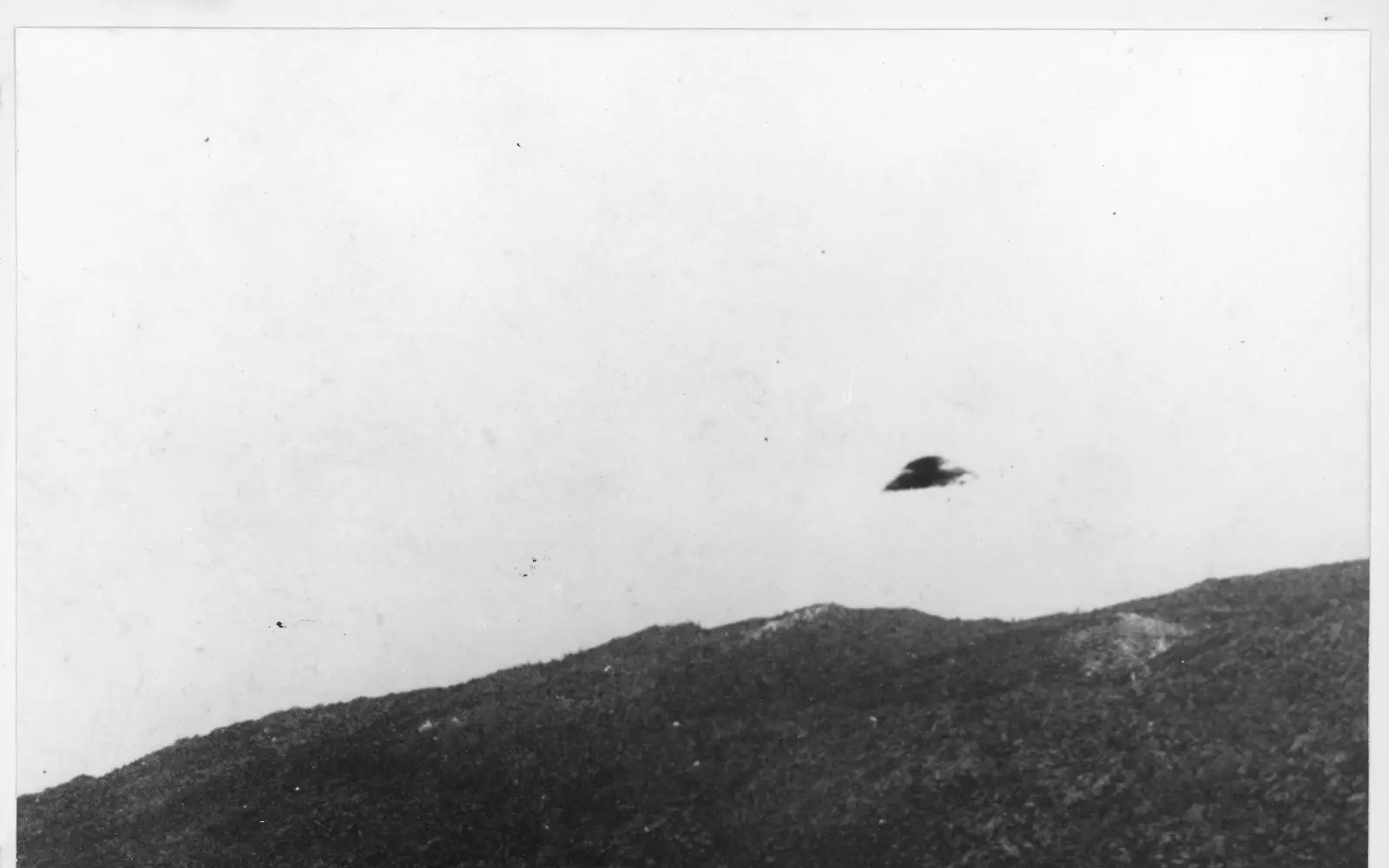
Historic black-and-white National Archives UAP record showing a dark object above a ridge

An image filed as “Unidentified Flying Object” in U.S. Air Force records.

Credit: U.S. National Archives, NAID 218517913.

Will there be alien disclosure in 2027? The public record currently shows a recurring claim, not an official countdown. The date is tied to a former intelligence officer’s statement, while the United States has also begun releasing real UAP records. Keeping those two strands separate is the key to understanding what is—and is not—known.

There is a reason the date keeps circulating. It did not appear from nowhere. But it is also not the deadline of a public government programme, a congressional act or a published scientific finding. The story of 2027 sits at the intersection of one former intelligence officer’s public claim, a real push for greater access to UAP records and a public that has watched the subject move from ridicule to official hearings, archives and military releases.

That distinction matters. The documents now being released are real. The unanswered cases are real. The arguments over secrecy, oversight and historical records are real. A confirmed timetable for public contact or a final disclosure in 2027 is something else entirely.

Where did the 2027 claim come from?

The date is closely associated with John Ramirez, a former CIA officer who has spoken publicly about UAPs after leaving government service. In a 2023 interview, Ramirez said he had heard that something could happen in 2027 and suggested that recent disclosures might be preparing the public for it.

It was an extraordinary claim, and it travelled fast because it supplied a specific date to a subject that is usually made of fragments: testimony, classified programmes, witness accounts, military footage and documents that arrive years after the events they describe. A date gives all of that material a shape. It makes a slow, uncertain process feel like a countdown.

But a public claim is not a government notice. Ramirez did not produce a document establishing a 2027 event, identify a law that requires one or point to an official timetable. His statement is part of the story because it explains why so many people now search for “alien disclosure 2027.” It is not, by itself, evidence that a planned revelation exists.

That does not mean the wider UAP debate can be reduced to one interview. The date has stayed alive because genuine disclosure work has been taking place around it.

Why the rumour attached itself to real disclosure efforts

The United States has built a public record system for UAP material. The 2024 National Defense Authorization Act required federal agencies to identify and organise UAP-related records for a collection at the National Archives. The law set an October 20, 2024 deadline for agencies to review the records in their custody and prepare publicly releasable copies for online access.

That is a significant development. It means UAP records are being treated as a historical and governmental archive rather than left scattered across agencies, private contractors and old programme files. The collection is broad: it covers records relating to unidentified anomalous phenomena, technologies of unknown origin and non-human intelligence or equivalent subjects.

Yet an archive is not an announcement of contact. A record can document an observation, a failed attempt at identification, a discussion of a claim or a request for further analysis. It may be incomplete, heavily redacted or later explained. Making a document public allows people to examine what the government recorded; it does not automatically settle what the object or event was.

That difference is easy to lose online. “Disclosure” can mean releasing decades-old files. It can mean confirming that an agency investigated a report. It can mean an official finding that a particular object remains unresolved. It can also mean, in its most dramatic form, a government acknowledging that non-human intelligence is present on Earth. Those are not interchangeable events.

What the current UAP releases actually say

The All-domain Anomaly Resolution Office, or AARO, has been releasing material through its public transparency initiative. Its own description is plain: the cases in that archive are unresolved because the government has not been able to make a definitive determination about their nature. Sometimes the problem is a lack of data. Sometimes the useful data cannot be released without exposing military sensors, locations, witnesses or operational methods.

An unresolved case is worth studying. It can raise questions about airspace security, collection methods, sensor limits and the quality of the available evidence. Curiosmos has also explained why a UAP’s distance matters more than a dramatic video: without scale and range, even striking footage can support only a narrow conclusion. It is not a blank cheque for every proposed explanation. The responsible starting point is the opposite: preserve the original report, establish what the instruments recorded, identify what is missing and let independent analysts test the available material.

That is why the newer releases matter. A video, a witness report or a sensor document may not answer the largest question on its own, but it gives researchers something better than a rumour. It gives them a record with a date, a chain of custody and a defined context.

Curiosmos has followed that process in our coverage of the National Archives’ UAP records collection, the fifth U.S. UAP release and the AARO imagery release. Each release adds material to the public discussion. None has announced that 2027 is a deadline for contact.

Congress has considered a much larger disclosure process

The idea of formal disclosure is not confined to podcasts. Members of Congress have repeatedly proposed stronger measures for collecting, reviewing and releasing UAP records. A 2025 Senate amendment described as the UAP Disclosure Act of 2025 included a proposed review-board structure and a “controlled disclosure campaign plan.”

The language is striking because it acknowledges how difficult the subject can be. Classified information may involve intelligence sources, sensor capabilities, military platforms, nuclear information or private contractors. A disclosure process has to separate what can be released from what must remain protected for genuine national-security reasons.

But proposed legislation is not the same as enacted law, and a disclosure plan is not the same as a declaration of non-human contact. The 2025 text was submitted as an amendment and ordered to lie on the table. It did not establish a public 2027 date.

That leaves a harder and more useful set of questions than a simple yes-or-no prediction. If governments hold records that deserve public scrutiny, the issue is how those records will be authenticated, who will review them and whether the public will receive enough context to distinguish an unresolved observation from a demonstrated conclusion.

What would genuine disclosure look like?

If a historic disclosure were ever to occur, it would need more than a dramatic speech or a short video clip. It would require material that can withstand examination beyond the first news cycle.

That means records with provenance: where they came from, who collected them, how they were stored and what has been done to them since. It means data that independent experts can inspect where national-security limits allow. It means technical claims that can be tested against physics, engineering and known sensor behaviour. And it means officials being specific about the difference between what has been observed, what has been alleged and what has actually been established.

The question of biological material or recovered technology would demand an even higher standard. A photograph, a press conference or a witness statement might start the conversation, but the decisive work would involve documented samples, independent laboratories and methods that other specialists can scrutinise. Nothing less would settle a question of that scale.

That standard should not be seen as an attempt to make disclosure impossible. It is what would protect a genuine discovery from being lost in noise, hoaxes and political argument. If the evidence is as consequential as people believe, it deserves to be handled in a way that can outlast the first wave of excitement.

So, will there be alien disclosure in 2027?

There may be more hearings, more document releases, more official video and more testimony before 2027 ends. The UAP subject is now firmly inside public institutions: the National Archives, congressional proposals, military reporting systems and scientific discussions about how better data might be collected.

What is not public is a government timetable promising that non-human intelligence will be revealed in 2027. The date remains a claim with a traceable source, amplified by years of genuine frustration over secrecy and a real demand for better access to evidence.

That may feel less dramatic than a countdown, but it leaves the larger question intact. The most useful measure of progress will not be whether a date on social media arrives with a spectacle. It will be whether the public gains records, data and review processes strong enough to tell the difference between an unresolved object, a classified human programme and something that would genuinely change our understanding of life in the universe.

Sources and further reading

RELATED

The SECRET 2027 Alien Contact Timeline You May Not Know About
ALIENS, DISCLOSURE & DECEPTION | SOMETHING BIG IS COMING
Governments Preparing For Alien Contact In 2027 | UFO Truth Revealed!

{ https://curiosmos.com/category/uap/ }}

Hoe vind je dit bericht?
Geschreven door peter om 21:38 Stuur door

Grusch Says Recovery Footage Showed Human-Looking Beings

Grusch Says Recovery Footage Showed Human-Looking Beings

David Grusch describes footage he says he saw of recovered bodies. His account raises questions about appearance, provenance and biological identification.

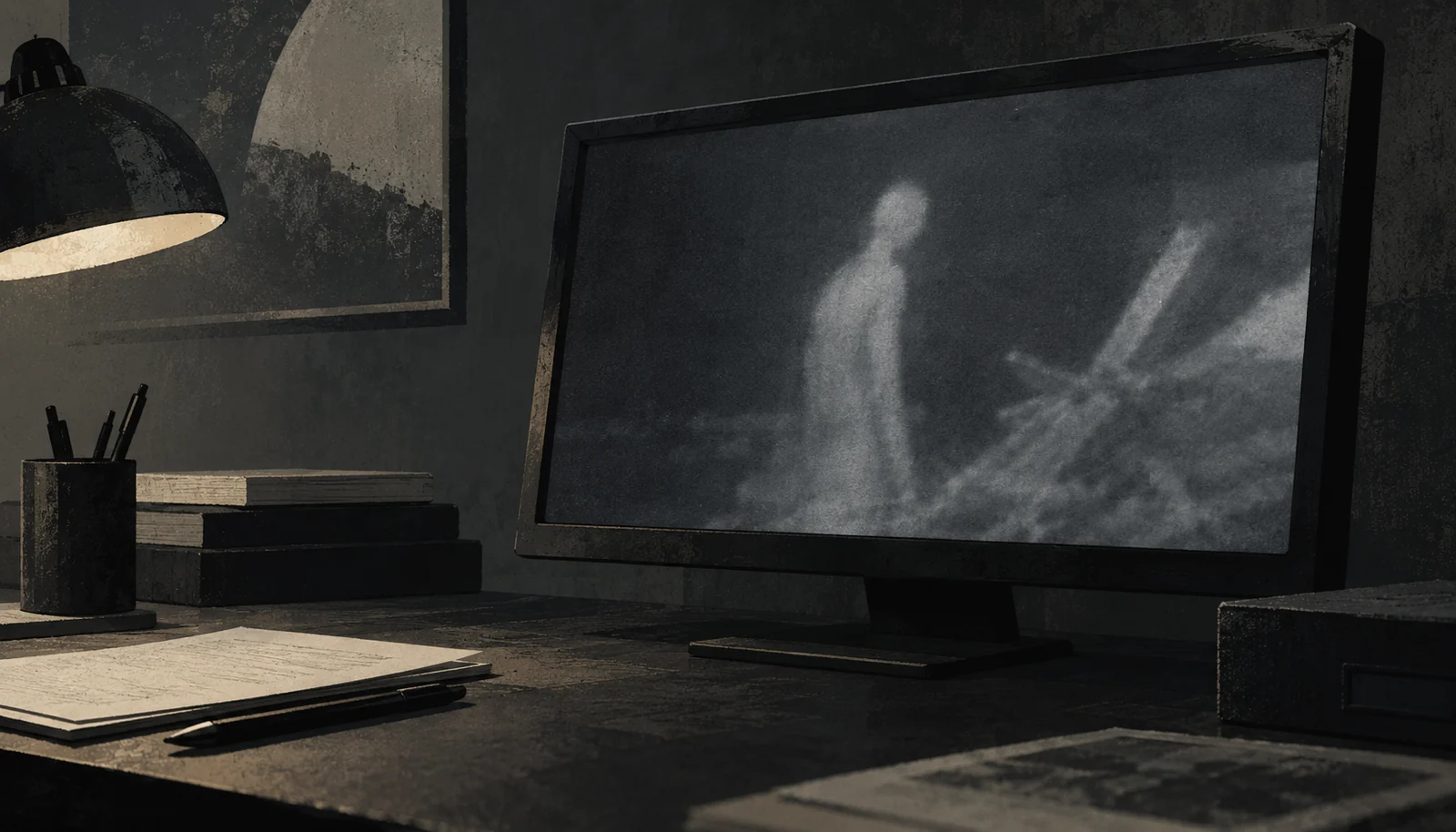
Illustration of a video monitor displaying an indistinct pale human-shaped figure.

Editorial illustration of the recovery-footage account; not an image of the footage or a recovered being.

Illustration: Curiosmos.

In this report

  1. The account behind the description
  2. From a congressional allegation to a described scene
  3. A familiar face would make identification harder

David Grusch says the beings he saw in recovery footage looked strikingly human. Pale skin, familiar proportions and an appearance he compared with classical beauty: the description is a departure from the small, dark-eyed figures that dominate popular images of alien encounters.

Speaking in a September 2026 interview, the former intelligence officer described video he says showed bodies during a retrieval. He did not present the footage publicly. His account concerns images he says he viewed, rather than bodies he examined himself.

That distinction leaves an intriguing question. If such footage exists, how would investigators establish who—or what—it shows?

The account behind the description

In the interview, Grusch described human-looking figures with very pale, bluish-white skin. He also discussed footage showing a recovery scene, rather than a close anatomical examination. An automated transcript places this discussion around the one-hour mark.

He withheld details that he said could expose sources. That prevents readers from independently tracing the recording to a date, location or retrieval team.

The comparison with Greek gods needs care, too. Grusch referred to an account involving Tom DeLonge and William McCasland. The comparison reaches the interview through that separate account; it does not come from a conversation Grusch says he personally had with McCasland.

From a congressional allegation to a described scene

Grusch became widely known after his 2023 congressional appearance. The history of these promises is also part of the wider disclosure debate. His written statement described an investigation informed by people he considered credible, including individuals with longstanding involvement in alleged recovery activities. He said some information had been provided through classified channels.

The newer description gives the public a scene to imagine. It also introduces a different task: evaluating a recording. A witness’s account of a video and the video itself offer different opportunities for scrutiny. Investigators could examine an original file for editing, compare its location with independent records and interview the people who recorded it.

A clip circulating online would be a much poorer starting point. Compression can erase detail, and a repost can strip away the file’s history. Even a convincing-looking scene might leave the identity of its subjects unresolved.

A familiar face would make identification harder

A human-looking body would invite ordinary explanations before any biological examination had begun. Clothing, skin colour and apparent height would tell an investigator relatively little on their own. Lighting changes colour; camera angle changes proportions; a scene without a reliable scale makes height difficult to estimate.

Nor would unusual appearance establish an extraterrestrial origin. That question would require evidence beyond the image: samples with a documented history, independent examinations and results other researchers could inspect. Any proposed genetic finding would need an explanation of how contamination was controlled and how the comparison was made.

Conversely, a familiar appearance would not by itself settle every question about a genuinely unusual specimen. The investigation would still have to follow the material, rather than decide its origin from a face.

For now, the public has Grusch’s description. The footage he discusses has not been supplied with this interview for independent examination. The most interesting next development would be a recording with a traceable history—or biological results tied to the same recovery. Either would let the discussion move from an image described by one person to material that others could examine.

RELATED

UFO Whistleblower David Grusch Makes Bombshell Revelation about Sentient Alien Plasmoid Life
UFO whistleblower says U.S. recovered nonhuman "biologics" from crash sites
GRUSCH SPILLS A LOT OF BEANS. Tells Dr. Phil about photos, crafts, visuals of non humans.

{ https://curiosmos.com/category/uap/ }

Hoe vind je dit bericht?
Geschreven door peter om 21:14 Stuur door

Mars' Molten Heart is Long Gone, but Some Magma Chambers May Persist

Mars' Molten Heart is Long Gone, but Some Magma Chambers May Persist

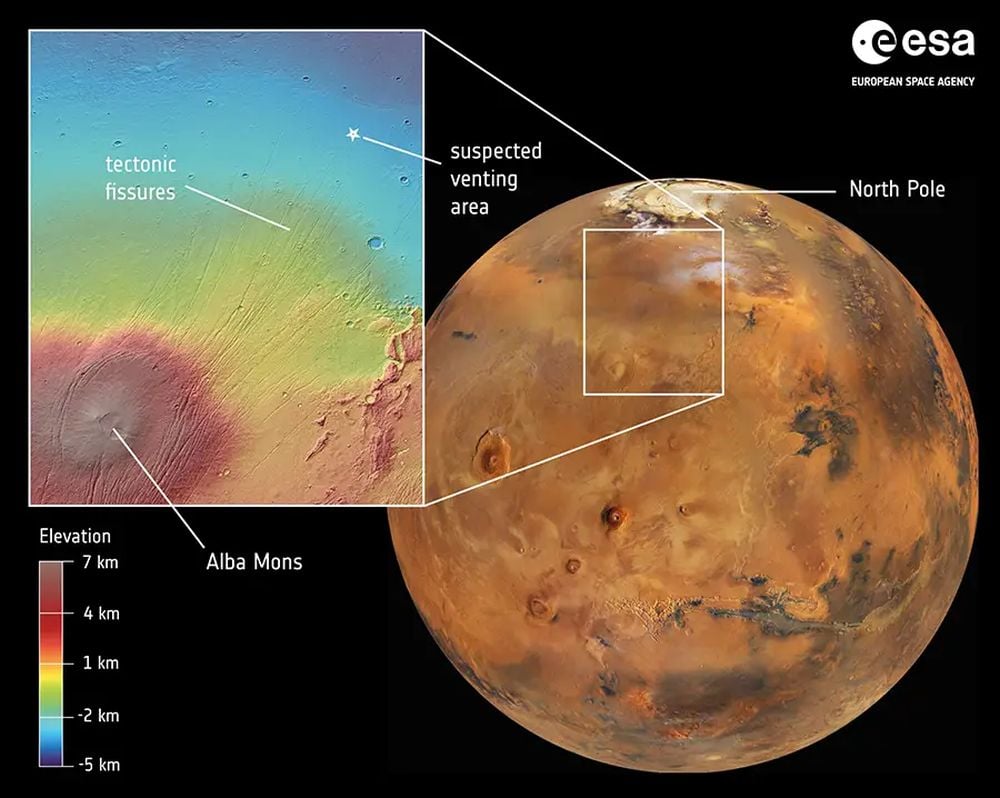
We've known about HCl in Mars' atmosphere for some time, thanks to the Trace Gas Orbiter. They were attributed to atmospheric interactions due to warmth during perihelion. But the same chemical has been detected at aphelion, and researchers think it may be venting into the atmosphere from underground magma chambers. If that's true, then Mars isn't as dormant as thought. Image Credit: MEX/HRSC global color mosaic, ESA/DLR/FU Berlin, G. Michael. Inset: Blended MOLA-HRSC digital elevation model, Fergason et al 2018

We've known about HCl in Mars' atmosphere for some time, thanks to the Trace Gas Orbiter. They were attributed to atmospheric interactions due to warmth during perihelion. But the same chemical has been detected at aphelion, and researchers think it may be venting into the atmosphere from underground magma chambers. If that's true, then Mars isn't as dormant as thought.

Image Credit: MEX/HRSC global color mosaic, ESA/DLR/FU Berlin, G. Michael. Inset: Blended MOLA-HRSC digital elevation model, Fergason et al 2018

We'll never stop being fascinated by Mars. It's kind of like a failed Earth. It appears as if billions of years ago Mars was warm, wet, and habitable. That ended when its interior cooled and its geodynamo failed.

When its geodynamo failed, its magnetic shield failed. The full force of the Sun bore down on the unfortunate planet, and its warming atmosphere was lost to space.

The loss of atmosphere wasn't the only change. Mars had a powerful volcanic past, and the prominent volcanoes in Tharsis Montes prove that. But the planet is largely believed to have left its volcanic past behind as a consequence of cooling.

But there's growing evidence that the planet isn't totally dormant. Recent evidence from missions like InSight and the ExoMars Trace Gas Orbiter suggest some ongoing activity. InSight detected more than 1300 Marsquakes, and the Trace Gas Orbiter detected hydrochloric acid.

Hydrochloric acid (HCl) is a highly corrosive acid with multiple natural sources, including atmospheric ones. The ExoMars Trace Gas Orbiter (TGO) collected widespread observations of HCl in Mars' atmosphere at parts-per-billion levels, but initially, it was only detected during perihelion. The HCl detections were attributed to aerosol-atmospheric sources driven by greater warmth from the Sun, a naturally-occurring, seasonal pattern.

But new research in Science Advances shows that not all of the TGO's HCl detections can be traced to perihelion. It's titled "Enigmatic HCl detections as a potential signature of igneous activity on Mars." The lead author is Alexander Trokhimovskiy from the Space Research Institute at the Russian Academy of Sciences.

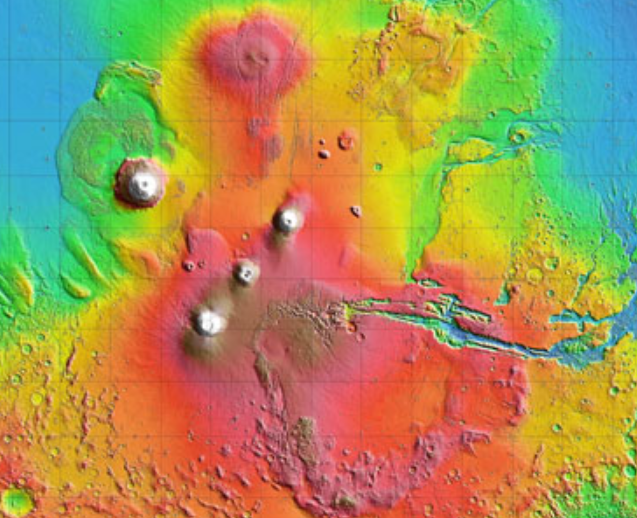
This Mars Orbiter Laser Altimeter (MOLA) image shows Alba Mons near the top, with the three Tharsis Montes volcanoes below it, and the massive Olympus Mons to their northwest. Though not as tall as Olympus Mons, Alba Mons is larger by area. The new HCl detections are curiously close to Alba Mons. Image Credit: NASA/JPL/GSFC

This Mars Orbiter Laser Altimeter (MOLA) image shows Alba Mons near the top, with the three Tharsis Montes volcanoes below it, and the massive Olympus Mons to their northwest. Though not as tall as Olympus Mons, Alba Mons is larger by area. The new HCl detections are curiously close to Alba Mons.

Image Credit: NASA/JPL/GSFC

The authors acknowledge that Mars is believed to be volcanically dormant, and that Marsquakes and other evidence of more recent volcanic activity is accumulating. However, there's no clear understanding of Mars' modern activity. For instance, many of the InSight lander's detections were attributed to meteorites.

If we were to witness an actual eruption, and the gases that go with it, a new understanding of Mar's interior would arise. But that hasn't happened, and we have to rely on less obvious evidence for Mars' internal state.

"While sulfur dioxide, so far undetected, could testify to ongoing eruptive activity, evidence of active magma chambers may be better identified by seepage of halogen gases, such as hydrogen chloride (HCl)," the authors write. "Here, we report HCl detections during the cold aphelion season that are isolated in the Alba Mons region." Could these new HCl detections be a window into Mars' interior?

Olympus Mons is known as the largest volcano and the tallest mountain in the Solar System. But Alba Mons is actually the largest volcano by surface area. Like Olympus Mons, it's also in the Tharsis region. (And neither are part of Tharsis Montes, the iconic row of three volcanoes). Alba Mons' volcanic flows reach further than 1300 km from its central summit. One of Alba Mons most significant features is its enormous system of fractures. For multiple reasons, detecting HCl over Alba Mons is intriguing.

"Strongly localized in space and time, aphelion HCl detections, amidst an otherwise absence of HCl at that season on Mars, exhibit marked contrast with prolonged and widespread detections at perihelion," the authors write.

“Detections of HCl at low altitudes, unexplained by observed atmospheric state and models, together with the geological context of the region, hint at an igneous origin of this gas,” Trokhimovskiy et al. write. These most recent HCl directions were in 2025.

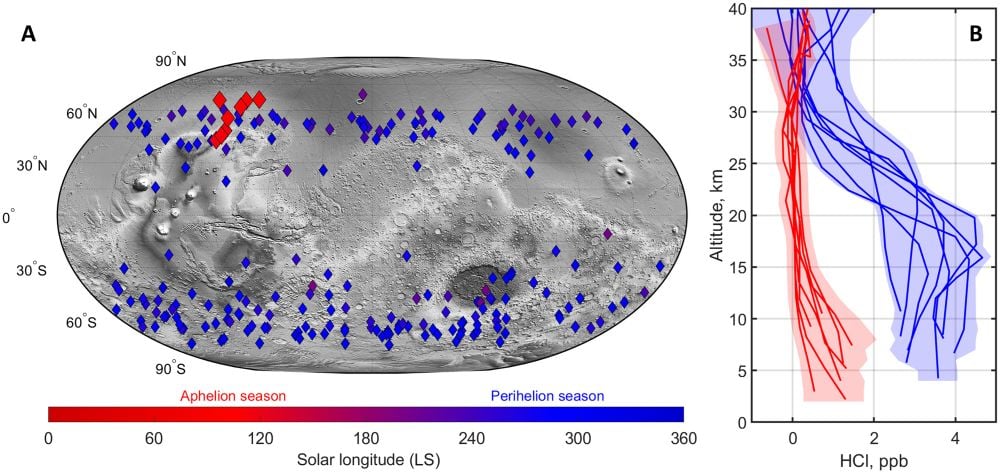
This figure show HCl detections by the Trace Gas Orbiter. Blue ones represent perihelion detections, which can be explained by seasonal warming and atmospheric interactions driven by the Sun. Red ones are more enigmatic. They could come from tiny fissures near Alba Mons, almost directly under the detections. Image Credit: Alexander Trokhimovskiy et al. , Enigmatic HCl detections as a potential signature of igneous activity on Mars. Sci. Adv.12, eaeb9422(2026).

This figure show HCl detections by the Trace Gas Orbiter. Blue ones represent perihelion detections, which can be explained by seasonal warming and atmospheric interactions driven by the Sun. Red ones are more enigmatic. They could come from tiny fissures near Alba Mons, almost directly under the detections.

Image Credit: Alexander Trokhimovskiy et al. , Enigmatic HCl detections as a potential signature of igneous activity on Mars. Sci. Adv.12, eaeb9422(2026).

The HCl detections alone may not be enough to oveturn the idea that Mars is dormant. As the authors say, they're just a hint. But there's more. "We also identify fresh and narrow (<1 meter) fissures in this area, which we interpret to be potential HCl pathways rooted into magmatic bodies at depth," the researchers explain.

"These structures have not been identified on Mars in earlier works. For instance, systematic geomorphologic mapping of the northern hemisphere did not consider these landforms," the authors explain.

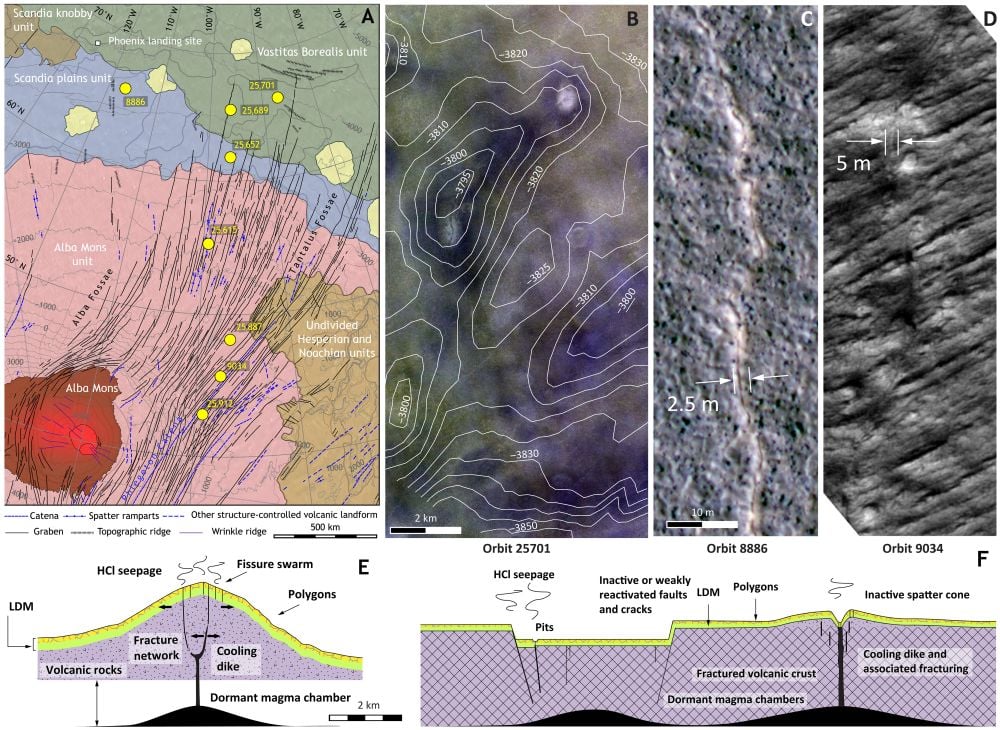
These panels shows some of the important points in the research. (A) shows Alba Mons and the HCl aphelion detections in yellow. (B) is a CASSIS image from the TGO showing a fractured ridge, while (C) and (D) are HiRISE images from NASA's Mars Reconnaissance Orbiter showing smaller fissures the researchers identify as potential HCl sources. (E) and (F) are geological models that can explain HCl is seeping from these fissures. Image Credit: Alexander Trokhimovskiy et al. , Enigmatic HCl detections as a potential signature of igneous activity on Mars. Sci. Adv.12, eaeb9422(2026).

These panels shows some of the important points in the research. (A) shows Alba Mons and the HCl aphelion detections in yellow. (B) is a CASSIS image from the TGO showing a fractured ridge, while (C) and (D) are HiRISE images from NASA's Mars Reconnaissance Orbiter showing smaller fissures the researchers identify as potential HCl sources. (E) and (F) are geological models that can explain HCl is seeping from these fissures.

Image Credit: Alexander Trokhimovskiy et al. , Enigmatic HCl detections as a potential signature of igneous activity on Mars. Sci. Adv.12, eaeb9422(2026).

The researchers calculated the seepage rate necessary to account for the HCl abundance in the aphelion detections. They compared it to the perihelion detections, and included the expected lifetime for HCl to persist in the Martian atmosphere. Their work rules out atmospheric-aerosol interactions as the source for the HCl detected during aphelion. But it also rules out those same interactions for the source of HCl detected during perihelion. That makes sense, since non-seasonal seepage from magma chambers would be happening no matter the season.

"Thus, perihelion HCl is unlikely to be directly volcanic in origin," they write. There could still be a link between igneous HCl and perihelion HCl. "However, a connection between igneous and seasonal HCl may still exist via a mechanism complementary to heterogeneous production," the authors write.

Planets are complicated, as we Earthlings know. Multiple interrelated factors contribute to the whole, and everything changes over time. This work further emphasizes how that's true, even on so-called dormant Mars. "The overall cycle of hydrogen chloride includes irreversible sinks," the authors write, and sinks have to be included in any modelling or understanding of Mars.

"Introducing a volcanic source of HCl, we can propose that a fraction of the perihelion HCl observed in the Martian atmosphere is ultimately of igneous origin," the researchers explain. "Localized igneous sources may therefore act as continuous primary contributors of chlorine, which is subsequently redistributed between atmospheric and surface reservoirs."

But despite the complicated picture of seasonality and surface sinks, their conclusion is clear: "Our results are best explained by ongoing igneous processes in the Martian interior."

RELATED

Mars May Still Be Volcanically Active — Scientists Found a Clue!
Mars May Still Be Alive — A Gas Is Leaking From Its Volcano
Mars Volcanic Activity? New Research Article Points to Hidden Magma

{ https://www.universetoday.com/ }

Hoe vind je dit bericht?
Geschreven door peter om 20:42 Stuur door

AI imagines what cities on other planets could look like

AI imagines what cities on other planets could look like

Story by Haylee Kelnhofer

AI imagines what cities on other planets could look like

©ALot.com

AI imagines what cities on other planets could look like
In this age of artificial intelligence and advanced technology, the possibilities are endless. Whatever image, idea, thought, or concept you can conjure, A.I. can create it to some capacity for you. We’ve used A.I. to invent some interesting and illustrious concepts, such as cities on various solar system planets. From Jupiter and Mars to our beloved moon, A.I. has created unique depictions of what our future could look like. Whether it’s an ice and snowy terrain of intricate structural designs or dome-like structures made out of moon rock, these cities could be a preview into what our lives may look like years from now.
Uranus
©(Image via Midjourney)

Uranus
To end it off with a bang, we have Uranus once again! This city truly looks futuristic. Those space shuttles look like they’ve been teleported through a black hole or something equally fascinatingly foreboding. The sky is reminiscent of the beautiful wonders space offers, with its own version of the northern lights.

We can’t forget about the city itself. It’s built seamlessly into Uranus’ snowy terrain, and the dark gray metal exterior seems durable enough to handle the icy and cold-biting weather. Residents of the city are cozying up to their fireplaces if that steam coming from those buildings is any indication!

q
Jupiter
©(Image via Midjourney)

Jupiter
A far cry from the tropical forest city on Jupiter, this one is inspired by general futuristic expectations with a reliance on some kind of obsidian metal. The city continues into the far reaches of Jupiter’s abounding terrain. Since the planet is the largest, it could be a neighbor to the former green-infested civilization.

The orange and lightning-streaked sky alludes to the city's location on Jupiter’s surface; it’s potentially close to the planet’s Giant Red Spot. In that case, the city must be prepared to endure the echoes of the enormous hurricane-esque storm, but that doesn’t look like a problem. The large buildings are integrated to weather the storm, and those space shuttles in the sky are effective transport for Jupiter’s heavy winds.

Moon
©(Image via Midjourney)

Moon
With a view of a once-inhabited Earth, this version of the moon is one with a thriving city of human activity and even scientific advancements. The few astronauts in view seem to be studying the moon’s surface and, perhaps, ways to improve civilized life on the astronomical object.

This is probably one of the more uniquely structured cities. Its round tunnels, engraved in moon rock, resemble the tunnels that ants inhabit underground. If they look this interesting on the outside, imagine what they would look like on the inside! It even seems this community is attempting to bring greenery to the somber, gray-hued environment.

Neptune
©(Image via Midjourney)

Neptune
Neptune is another ice giant with icy and snowy terrain similar to Uranus. A futuristic city with equally futuristic technology to withstand the outstanding freezing temperatures of over negative 300 degrees! The silver-white material of the structures blends in with the surrounding environment to deter any unwanted terrestrial beings!

Neptune’s city is equipped for thriving activity. It’s probably one of those places in sci-fi movies where a building looks smaller from the outside than the inside. The interior exceeds the expectations of all who look upon the structure. If you love the winter or snow, Neptune may be the best option for relocation

Uranus
©(Image via Midjourney)

Uranus
An ice giant, indeed! The icy city with the large moon or planet in the background makes this city life look straight from a sci-fi movie or novel. Imagine waking up to this. That’s a sight to behold! Uranus is known for its icy and windy environment, so life on this planet may not always be the best.

However, the few people at the bottom of the city are strapped in space gear that is fit to bear the uninhabitable force of Uranus’ environment. The elaborate architecture looks like it’s part of an opulent city with a royal castle – medieval times meet the future!

Jupiter
©(Image via Midjourney)

Jupiter
Jupiter may be the best planet for cities to thrive because of its enormous size: it’s the largest planet in the solar system! We’re not entirely sure what environments can be found on the gas giant, but surely, with its expansive terrain, an enriching, vibrant green forest is one of them.

The city looks like a fun and interesting place to discover Jupiter’s unknown territory. This tropical paradise is a perfect complement to Jupiter’s hydrogen ocean! You can enjoy the beautiful scenery around you and then walk to the unique, hopefully safe, ocean. A great haven from the infamous Great Red Spot storm in the planet’s southern hemisphere!

Mars
©(Image via Midjourney)

Mars
There has been constant speculation that Mars is another place humanity can call home. Remember when NASA found water on the planet? Well, perhaps this vision of a city on Mars is what our looming days will eventually look like. Unfortunately, the Red Planet doesn’t appear to offer much in sights; the environment is endless dusty red terrain.

However, Mars is somewhat similar to Earth: It has the same four seasons but in longer periods. Regardless, that should help humanity accommodate to the planet's environment more easily. Those white pod-like homes may look small, but they’re probably cozy for the winter and durable against Mars’ polar ice caps.

Venus
©(Image via Midjourney)

Venus
One of Venus’ many names is Earth’s twin, so the potential structure of a city on the planet’s surface is fitting. However, it is the hottest planet in the solar system and has been shaped by volcanic activity…hopefully, civilization doesn’t run into any of those unfortunate circumstances.

The tan-orange and sandy appearance of the planet's surface alludes to a territory fit for volcanoes and their unforgiving demeanor. However, humanity seems prepared for such geological fissures. The city's structural integrity seems top-tier, and its bright silver metallic exterior suggests it can withstand the overbearing heat of lava, volcanic ash, and steam.

Mercury
©(Image via Midjourney)

Mercury
With the teeming gray rock mountains in the background and futuristic dome-like structures built into the surface, not to mention the ominous planet or moon in the back, Mercury definitely looks like something out of a sci-fi movie. Since it’s the closest planet to the sun, special caution and accommodations would need to be made, and the rounded, almost circular structures look like they keep the sun’s overwhelming heat out and people safe from an unfortunate stifling experience.

The stark white city also gives an air of modern, rich living. Life on Mercury doesn’t look too bad: there’s a walkway to traverse the solitary terrain and even a seemingly small pool to swim in. The already rich folk need to leave this planet and its opulent living to those who’ve never experienced such notions. Venus is down the road; try there instead!

Moon
©(Image via Midjourney)

Moon
To start, we have the moon. NASA has already sent astronauts to the dark and chalk-white environment of the astronomical body and has even considered the possibility of humans living on it. So, this is perfect for our minds to picture what life on the space object could entail.

The city looks like New York, which could be perfect for civilization to acclimatize to a new and, frankly, terrifying environment. When you see the familiar, it’ll usually help ease timid and anxious spirits. Just don’t look at Earth looming over everything, the endless dark and starry night, or the odd off-white and bumpy ground of the moon – because then you might panic, and the air is sparse up there!

RELATED

🌆 BEYOND REALITY: Cities Floating Between Planets | Sci-Fi Ambience
25 INSANE Future Space Cities That Will Actually Exist | Orbital Megastructures 2050

{ https://www.alot.com/ }

Hoe vind je dit bericht?
Geschreven door peter om 20:03 Stuur door

The Living-Orb Accounts Robert Hastings Wants to Investigate

The Living-Orb Accounts Robert Hastings Wants to Investigate

Witnesses describe glowing objects that seemed to breathe or communicate. Their accounts raise questions about appearance, plasma and how another encounter could be recorded.

Illustration of a small orange orb hovering beside a garden fence at dusk

Illustration of the reddish-orange light described in an account collected by Robert Hastings. An interpretive scene, not a photograph of the reported encounter.

Credit: Curiosmos.

A hovering light that seems to breathe poses a different question from an unfamiliar aircraft. Could something luminous appear alive—and what would let us investigate that impression?

UFO researcher Robert Hastings has been gathering accounts of that kind. In a June 20, 2026 article, he described witnesses who told him about plasma-like orbs they believed were conscious. He also invited similar accounts for a book he was preparing. These are claims about personal encounters, not a scientific announcement that living plasma has been discovered.

The encounter that made an orb seem alive

Hastings recounts testimony from a woman he calls Amanda, who contacted him in 2022 about an experience she dated to autumn 1992. She described a reddish-orange object hovering near a neighbour’s yard, roughly the size of a melon. Its flickering, undulating appearance reminded her of breathing.

She also reported hearing a reassuring message in her mind and losing awareness of the passage of time. In her account, the light disappeared as her husband came outside. Her name is withheld, and Curiosmos has not interviewed her or independently verified the event.

The interesting question is why she understood the encounter as involving a living presence. Her description combines an observed appearance with a private experience of communication. Those two parts would require different kinds of investigation. Another observer might record the light’s movement; a recording could not by itself establish the source of a thought.

Plasma already behaves in unfamiliar ways

There is a physical reason the word plasma attracts attention. Plasma is ionised gas, containing free electrons and charged ions. It responds to electric and magnetic fields and can form complex structures. NASA’s glossary describes these spontaneous, intermittent structures across different scales.

A pattern that changes shape can consequently have an organised appearance without being a biological organism. That leaves room for a worthwhile question: how far can physical self-organisation go, and which observations would reveal something beyond it?

Calling an unidentified light a plasmoid does not answer that question. First, investigators would need to establish that plasma is actually present. Colour, glow and movement alone cannot identify a substance’s composition or the process supplying its energy.

Measurements make the term more specific. In a 2021 investigation using NASA’s Magnetospheric Multiscale spacecraft, instruments measured particles and fields closely enough to test how plasma responds collectively to electromagnetic forces. That research concerned near-Earth space, not Hastings’ encounters. It illustrates the difference between an evocative visual description and a measured plasma process.

How a future encounter could be documented

A repeat sighting would offer opportunities unavailable in a decades-old recollection. Observers could preserve the original recording, note the time and weather, identify the camera settings and document their positions. Separate observations from known locations could help estimate distance.

Distance is particularly valuable. A light moving across a camera frame supplies an angular motion, not a speed through space. Without knowing whether it was metres or kilometres away, an apparent burst of acceleration is difficult to translate into physical movement.

The NASA UAP study team’s 2023 report recommends calibrated observations and contextual information for this reason. Better records would also allow investigators to compare an orb’s apparent response with changes in the surroundings. Did it move after an observer approached? Did several people see the same response? Did it recur under comparable conditions?

Such questions leave the possibility of unusual behaviour open while giving it something concrete to rest on. A flicker interpreted as breathing, a measured physical cycle and a response that consistently tracks an outside action would be three different findings.

A witness account worth preserving accurately

Curiosmos has covered orb reports from pilots. Hastings’ account explores another part of the subject: the impression that a light has a presence or awareness. It should retain that human dimension without turning the witness’s interpretation into an established property of the object.

For someone reporting an encounter, careful listening and careful documentation can belong together. Preserve what was seen, what was felt and what remains uncertain. If another encounter produces records that several independent investigators can examine, the question could advance beyond the memory that first brought it to our attention.

RELATED

Nuclear Weapons and UFOs with Robert Hastings

The ORB Strategy That's Actually Getting My Traders Funded
IT CAME OUT OF THE RED ORB - Ep. 202 - July 22, 2026

{ https://curiosmos.com/category/uap/ }

Hoe vind je dit bericht?
Geschreven door peter om 00:00 Stuur door

Trump says Air Force pilots described a round UFO flying three times faster than an F-22 fighter jet

Are UAPs Real? A High-Stakes Deep Dive with Timothy Phillips

President Donald Trump said Air Force pilots told him a mysterious round object flew past an F-22 fighter jet at three times its speed, while pledging to investigate claims that a secret government program studying UFOs could exist without the president's knowledge.

Trump made the comments during an interview with correspondent Ross Douthat that aired Sunday on CBS' "60 Minutes."

Douthat asked Trump whether anything the president had seen, heard or been told led him to believe there was more behind unidentified objects spotted in the sky. Trump described himself as "not too much of a believer," but pointed to conversations with Air Force pilots in the Oval Office.

"These are not people that you would say are conspiracy theorists – they don’t even know what it means – but they’re great, great pilots," Trump said, before joking about their appearance. "Young, handsome, they have beautiful, nice flat tops. I’d like to have a haircut just like them. They look perfect, like Tom Cruise."

Black triangular shape appears above a mountain ridge in an image included with a federal report documenting a 2026 unidentified aerial object sighting.

An image released with a 2026 FBI report depicts a black triangular object above mountainous terrain. Federal agents reported seeing a silent, triangular object hover above a ridgeline before accelerating into a canyon. Authorities have not confirmed whether the image is an actual photograph or a reconstruction.

(Department of War)

Trump called the pilots "the real deal" and said they had told him "things that are very strange."

He described one of those encounters involving an F-22.

"They’re flying an F-22, which is the best there is, the fastest, the best plane that anyone’s ever seen," Trump said. "And something goes by them at three times their speed. And it’s round. It’s not aerodynamic."

Trump did not identify the pilots or say when or where the encounter occurred.

President Donald Trump and War Secretary Pete Hegseth

President Donald Trump previously directed the War Department to release UAP and UFO files.

(Aaron Schwartz / AFP via Getty Images)

Douthat then asked Trump about claims from alleged whistleblowers that the government operates a secret program studying UFOs that even presidents may not know about.

Two bright orbs hovering in tandem above a dark tree line in the night sky.

A screenshot of video footage from an alleged unidentified anomalous phenomenon (UAP) sighting in the northeastern United States in July 2025, which was detailed in files released by the DOW and originally obtained by the FBI.

(DOW/FBI)

"No, and I haven’t heard that," Trump said. "But if there is, I’m going to find out about it right after this interview."

Trump later said there are "a lot of very solid people" who believe such claims are true, though he remained skeptical himself.

A UFO is circled in red in a black and white surveillance image

A black and white surveillance image with a UFO circled in red.

(iStock)

Fox News Digital reached out to the White House for comment.

Trump's remarks come just weeks after the Pentagon's All-domain Anomaly Resolution Office (AARO) released a batch of recently declassified records detailing UFO sightings spanning decades.

Among them was a 2026 account from federal law enforcement agents who reported seeing a matte-black triangular object rise vertically above a mountain ridge, hover silently and then accelerate into a canyon at a speed they compared to a fighter jet.

The witnesses described no visible engines, rotors, exhaust or other conventional means of propulsion. Handheld thermal equipment also showed a uniform heat signature across the object's surface rather than concentrated heat typically associated with a propulsion system.

The object was never identified, and the Pentagon report noted that its speed was estimated by witnesses rather than measured by instruments.

Are we alone? Scientists take a new look at UAP sightings

{ https://www.foxnews.com/ }

Hoe vind je dit bericht?
Geschreven door peter om 23:44 Stuur door

Trump says ‘young, handsome’ pilots have told him ‘very strange’ things about UFOs

Trump says ‘young, handsome’ pilots have told him ‘very strange’ things about UFOs

President Donald Trump speaks at the UP Summit at the Space Florida Launch and Landing Facility in Cape Canaveral, Fla., Friday, Nov. 6, 2026. (AP Photo/Jacquelyn Martin)

Donald Trump speaking at Cape Canaveral on Friday

( Picture: AP Photo/Jacquelyn Martin)

Donald Trump may or may not be using UFOs as a distraction from his unpopular policies, but there’s something else that’s distracting him from UFOs.

In a new interview with the CBS News show 60 Minutes, the US president was asked if he had seen anything in the reams of documents released by his administration that has struck him as too strange to explain.

But instead, Trump quickly veered into newly familiar territory – talking about how sexy the US Air Force’s pilots are.

He told host Ross Douthat: ‘I’m not too much of a believer, but I sat in the Oval Office, first term and a little bit second term, meeting with Air Force pilots that are really good, solid people.

‘These are not people that you would say are conspiracy theorists. They don’t even know what it means.

‘But they’re great, great pilots. Young, handsome. They have beautiful, nice flat tops. I’d like to have a haircut just like them. They look perfect, like Tom Cruise.

‘They’re thin, you know, very thin and very everything, but they’re the real deal.’

These gorgeous military men have told him about ‘things that are very strange’, he said, such as round objects that fly past their F-22 jets at three times the speed.

Trump’s focus on male physiques during speeches at his campaign rallies drew plenty of attention ahead of last week’s midterm elections.

Among the targets for his hot-blooded comments was incumbent Ohio senator Jon Husted, a Republican who was running for reelection in the November 3 vote.

At a campaign event a few weeks before polling day, Trump told the crowd:’I started examining his body because I didn’t know he was a great athlete.

‘And I looked and I watched up and down. I looked at his ass, and I looked at the whole thing.’

In Georgia several days later, Trump called Republican candidate for governor Rick Jackson a ‘very handsome, distinguished, beautiful-looking guy’.

He also declared his joy that the US was ‘allowed to have big, strong, handsome soldiers now’, adding: ‘There are some reasons to be president.’

Husted and Jackson both ultimately failed in their election bids, losing to Democrats Sherrod Brown and Keisha Lance Bottoms respectively.

New documents released last month by the Defense Department provided more recollections from federal agents who said they encountered UFOs – officially called unidentified anomalous phenomena, or UAP.

Tom Cruise arriving for the Digger royal film performance and world premiere, at the Odeon Luxe in Leicester Square, central London. Picture date: Tuesday September 22, 2026. PA Photo. Photo credit should read: Ian West/PA Wire

The pilots who deliver his UFO briefings look ‘perfect, like Tom Cruise’, Trump said

(Picture: Ian West/PA Wire)

The report said the agents watched the craft ‘executing a slow, controlled, perfectly vertical ascent’ which ‘occurred in absolute acoustic silence’, before it stopped moving ‘instantaneously’.

In his 60 Minutes interview, Trump said the existence of UFOs is ‘one of the questions in private I get asked about’ most by people he meets.

Asked about claims from whistleblowers that there is a programme studying the phenomena that is even hidden from the president, Trump said: ‘I haven’t heard that.

‘But if there is, I’m going to find out about it right after this interview.’

RELATED

Trump on UFOs: Pilots Told Me "Very Strange" Things 🛸 #shorts
Trump on What Air Force Pilots Told Him About UFOs

} https://metro.co.uk/news/ }

Hoe vind je dit bericht?
Geschreven door peter om 23:17 Stuur door

Donald Trump on UFOs, Aliens & UAPs (Compilation)

Trump on UFO sightings: Air Force pilots have told me 'very strange' things

In a sitdown with 60 Minutes, President Donald Trump weighed in on UFOs and said that Air Force pilots have "told me things that are very strange".

Donald Trump said during the interview that one of the most frequent questions he gets asked is what the military calls unexplained anomalous phenomena, also known as unidentified flying objects, or UFOs. (REUTERS/Eric Lee) (REUTERS)

Donald Trump said during the interview that one of the most frequent questions he gets asked is what the military calls unexplained anomalous phenomena, also known as unidentified flying objects, or UFOs.

(REUTERS/Eric Lee) (REUTERS)

In a sitdown with 60 Minutes correspondent Ross Douthat, President Donald Trump weighed in on UFOs and said that military pilots have "told me things that are very strange". Trump’s interview comes days after Republicans faced setbacks in the 2026 midterm elections.

In the same interview, Trump stood by his handling of the economy and the Iran war. However, he also acknowledged some "bad messaging" on economic issues and said his immigration crackdown was "too tough" at times.

What Donald Trump said about UFOs

Trump said during the interview that one of the most frequent questions he gets asked is what the military calls unexplained anomalous phenomena, also known as unidentified flying objects, or UFOs.

“I'm not too much of a believer, but I sat in the Oval Office, first term and a little bit second term, meeting with Air Force pilots that are really good, solid people,” said the president. “These are not people that you would say are conspiracy theorists. They don't even know what it means. But they're great, great pilots. Young, handsome. They have beautiful, nice flat tops. I'd like to have a haircut just like them. They look perfect, like Tom Cruise. … They're thin, you know, very thin and very everything. And … they're the real deal. And they've told me things that are very strange in certain cases.”

Also Read |

He added, “They said, 'Yes, there's something going on out there...' because they're flying an F-22... and something goes by them at three times their speed, and it's round..."”

RELATED

Donald Trump on UFOs, Aliens & UAPs (Compilation)

Trump on 60 Minutes: Pilots Saw Something Round
Trump Discusses UFOs and Air Force Pilots' Reports

{ https://www.hindustantimes.com/ }

Hoe vind je dit bericht?
Geschreven door peter om 22:48 Stuur door

Arizona Nurse Claims Over 100 Terminally Ill Children Saw Grey Alien-Like Beings Before Death

Terminally Ill Children Saw Grey Aliens

Arizona Nurse Claims Over 100 Terminally Ill Children Saw Grey Alien-Like Beings Before Death

An Arizona nurse who spent decades caring for dying patients claimed that more than 100 terminally ill children reported seeing mysterious beings resembling Grey aliens shortly before their deaths. Some children reportedly laughed and interacted with these visitors, while others became frightened and tried to hide.

David Parker, a retired registered nurse from Phoenix, Arizona, shared his account on Reddit in September and October 2023. Parker said he had worked in nursing for 40 years, including 17 years in hospice care and five years in a specialized pediatric hospice unit.

During his career, he claimed to have been present at approximately 3,600 deaths. He had witnessed patients describing deceased relatives, unusual figures, and other experiences near the end of their lives. Still, the reports from the children were unlike anything he remembered hearing from adult patients.

David Parker

Parker explained that the pediatric facility had ten beds and cared for patients ranging from newborn babies to 17-year-olds. Many children arrived with extremely serious illnesses after other medical treatments had been exhausted. Families were allowed to stay with their children, and the staff provided care not only for the patients but also for parents and relatives who were preparing for an unimaginable loss.

According to Parker, most children remained at the facility for only a short time, sometimes just a few days. Many were infants or were already too ill to communicate, but some older children remained conscious and could describe what they were experiencing. It was among these patients that he began noticing a recurring pattern. Instead of seeing deceased family members, as many adult hospice patients reportedly did, the children described small, strange-looking beings standing near their beds or moving around their rooms.

The descriptions were remarkably similar, according to Parker. The figures were approximately four feet tall, extremely thin, and pale grey in color. They had disproportionately large eyes, narrow heads, thin bodies, long arms, and unusually long fingers.

In later interviews, Parker added that the children described small slits for their noses and mouths, and hands that appeared to have three or four fingers rather than five. Their heads were particularly unusual because they were narrow and elongated instead of the oversized, bulbous heads commonly associated with popular depictions of Grey aliens.

Parker claimed that the encounters continued throughout the five years he worked at the pediatric facility. Some children smiled or laughed while watching the figures, and others appeared to communicate with them. A few were reportedly so frightened that they pulled blankets over themselves or tried to avoid looking in their direction. Several children even made drawings of the visitors.

At first, Parker did not associate these descriptions with extraterrestrial beings. He said he was not particularly interested in UFOs at the time and was unfamiliar with the popular image of the Grey alien. He assumed the children might be seeing some unfamiliar kind of spirit.

Only later, after learning more about UFO-related accounts, did he begin to notice the similarities between their descriptions and the entities frequently reported in alleged alien encounters. Even then, he remained uncertain whether the figures had anything to do with extraterrestrial life.

One of the most extraordinary incidents occurred in a room containing three beds separated by partitions. Parker explained that the arrangement allowed nurses to observe several seriously ill children from one position while still providing separation between the patients. In a later interview, he described the barriers as solid walls extending from floor to ceiling, with an opening at one end that allowed staff to monitor the room.

On several occasions, Parker claimed, two children in this area appeared to respond to the same invisible presence simultaneously. They would look toward the same part of the room, sometimes nodding or making unfamiliar sounds, before suddenly stopping together. He believed they were repeating something being spoken to them by the visitors. The children were not simply describing a figure standing beside a bed. According to his recollection, they appeared to participate in something resembling a conversation.

Parker attempted to reproduce the sounds he remembered hearing from the children. He said the children involved were sometimes around eight to twelve years old, making the behavior more noticeable to him than ordinary infant babbling.

Parker later discussed these experiences during an interview with former US Air Force pilot Chris Lehto, released on YouTube in December 2025. He explained that the television sets in the hospice were rarely turned on and that the atmosphere was generally quiet. He again recalled children repeating unfamiliar syllables while looking in the same direction. Parker could hear their responses, but he never heard the voices they seemed to be imitating. He also admitted that he had not conducted any formal investigation into these incidents because his responsibility was to care for the children, not question them about unusual experiences.

Parker said the facility also had seven private rooms, where children reportedly described similar beings. In a December 2024 Reddit post, he explained that many patients were too seriously ill to walk or interact with one another. He believed this made it unlikely that the descriptions were simply being passed between children through ordinary conversations.

Another peculiar detail involved the visitors’ apparent interest in the nurses. Parker said some children would tell him that a Grey-like figure was standing directly beside him or doing something near him. He would look around but see nothing unusual.

During one of his later Reddit discussions, Parker recalled that he sometimes closed his eyes and mentally asked the mysterious visitors to reveal themselves. Despite his curiosity, he claimed they never appeared to him, even when the children seemed to be watching them from only a short distance away.

Interestingly, Parker also said that not all the children were receiving narcotic pain medication. He compared his hospice experience with his later work in a pediatric burn unit, where patients frequently required strong painkillers. He said he had not encountered the same recurring descriptions among those burn patients.

The distinction interested him because many people naturally associate unusual visions near death with medication, confusion, or hallucinations. Yet the absence of narcotic drugs does not eliminate other possible medical explanations, including changes in brain function caused by severe illness.

Parker described how some members of the hospice staff allegedly interpreted the children’s drawings according to their religious beliefs. During his conversation with Lehto, he claimed certain nurses added halos, wings, beards, or other religious features to sketches the children had made.

According to Parker, the additions were visibly different from the original drawings, sometimes even using different ink. He objected to these changes because he believed the children had described something quite different from the angels or religious figures that adults wanted to see.

Parker believed the children were reporting an unfamiliar presence, while some adults apparently interpreted the same descriptions through their own religious traditions. He insisted that the children had not described the figures as Jesus, Mary, or angels.

However, the drawings would have been important evidence if they had been preserved in their original form. When Reddit users asked him to share them, Parker admitted that he was uncertain whether he still possessed any of the sketches. He said they might be stored among old belongings, although he feared they could already be lost.

The unusual experiences were not confined to what children claimed to see. Parker described another phenomenon that he believed was sometimes visible to the adult hospice staff. He reported seeing light and dark human-sized forms moving through corridors and entering patient rooms. Some appeared almost solid toward the center, with mist-like edges that seemed to trail behind them. He compared their movement to a stack of pennies in which different sections shifted forward and backward without the entire structure falling apart.

According to Parker, the figures sometimes moved along hallways, stopped, changed direction, and disappeared inside rooms. He claimed other staff members witnessed similar forms, although the Grey-like visitors remained invisible to the adults. On certain occasions, he said he would wait for one of these shapes to pass before continuing down the corridor.

Parker’s personal history may also help explain why he approached these experiences differently from someone encountering them for the first time. He revealed that he had lost his own children to a drunk driver. The tragedy profoundly affected him and helped shape his decision to work with dying patients and their families.

Parker also shared another extraordinary account involving an elderly hospice patient, which he later described in a YouTube video titled The Final Gift. He claimed the woman was unconscious and had previously undergone an amputation that left her with only one leg. One day, while passing her room, he reportedly saw her sitting upright on the edge of the bed, smiling and appearing unusually healthy. Both legs were visible. When he returned to look again, she was lying unconscious in her bed, just as she had been before.

Parker interpreted the experience as a possible glimpse of the woman’s spirit while she was still alive. He said the incident affected him deeply because he had never met her before caring for her at the hospice. The story became even stranger when he claimed the woman later appeared to him at his home.

Afterward, he contacted the hospice and learned that she had recently died. Parker saw these experiences as deeply meaningful, although there is no independent evidence confirming the apparition or establishing that it represented anything outside ordinary human perception.

Read also:

In a study published in the Journal of Palliative Medicine in January 2014, physician Christopher Kerr and colleagues investigated the experiences of hospice patients approaching death. The researchers enrolled 66 participants, with 59 included in the final analysis.

Most reported experiencing at least one dream or vision, and nearly all described their experiences as feeling real. The most common visitors were deceased or living relatives and friends, while comforting encounters with deceased loved ones became more frequent as death approached.

The research became especially relevant to pediatric patients when Kathryn Levy, Pei C. Grant, and Christopher Kerr published a case study online on January 24, 2020. Their paper documented the experiences of a 15-year-old girl with terminal glioblastoma who experienced two vivid end-of-life dreams or visions.

The researchers reported that the experiences provided comfort and meaning for the girl and her family. Although the case did not involve extraterrestrial beings, it demonstrated that significant end-of-life experiences can occur in children and deserve serious attention within pediatric palliative care.

A wider systematic review published in 2023 also examined how hospice patients experience these dreams and visions. Researchers found recurring themes involving deceased relatives, emotional reassurance, and a sense of preparation for death.

There are several medical possibilities that need to be considered when examining Parker’s account. Severe illness can affect the brain through changes in oxygen supply, metabolism, infection, dehydration, and medication. Delirium can also produce vivid hallucinations, and the National Cancer Institute recognizes that confusion and altered perception are common in patients approaching death. Some end-of-life visions occur without the obvious disorientation associated with delirium, which is one reason clinicians and researchers continue to study these experiences rather than treating every report as identical.

Parker never provided a definite explanation for what he believed the children experienced. He wondered whether the visitors were spirits, extraterrestrial beings, or something else entirely. He also questioned whether the experiences were somehow connected to the location of the hospice, since he did not encounter the same recurring descriptions throughout his other nursing work. Whatever the explanation, he continued to regard the children as sincere in what they were describing, even though he could not share their perceptions.

45-Year Hospice Nurse: Dying Kids All Saw the Same ‘Thin-Headed’ Beings

{  https://howandwhys.com/ }

Hoe vind je dit bericht?
Geschreven door peter om 22:30 Stuur door

An Artificial CORTEX to Guide Satellite Rescue Missions

An Artificial CORTEX to Guide Satellite Rescue Missions

This illustration is exaggerated and isn't to scale, but it highlights the growing space debris problem. Some of the debris isn't really junk; it's zombie satellites. Researchers are developing an autonomous framework called CORTEX for guiding servicing satellites to dock with these zombies and revive them. Image Credit: ESA

This illustration is exaggerated and isn't to scale, but it highlights the growing space debris problem. Some of the debris isn't really junk; it's zombie satellites. Researchers are developing an autonomous framework called CORTEX for guiding servicing satellites to dock with these zombies and revive them.

Image Credit: ESA

The growing problem of satellites crowding one another is generating concern in the space community, for good reason. Almost 20,000 satellites orbit Earth now, and with more satellite constellations and other satellites being launched every year, Low-Earth Orbit (LEO) is starting to look like it's reaching its limit. Of particular concern are the 3,500+ plus satellites that are basically zombies. They are either completely non-functional or not sending any signals alerting other satellites to their presence.

A collision between two satellites could be catastrophic. Satellite constellations have some built-in redundancy which would help deal with the loss, but there's an additional risk. A collision could also create a debris cloud, multiplying the ongoing risk. The Kessler syndrome describes a cascade of collisions generated from debris created in a single, initial collision, that goes on to create even more collisions. It's like a feedback loop that keeps getting worse.

Somehow, this problem must be dealt with. The existing debris is one thing, but intact zombie satellites are another. These have lost the ability to communicate and warn other satellites of their presence. These can be repaired, and that's the subject of new research in Acta Astronautica. It's titled "CORTEX: An autonomous, end-to-end, convex-based framework for close-range rendezvous trajectory design and guidance with hardware testbed validation," and the lead author is Minduli Wijayatunga, a new aerospace engineering faculty member in The Grainger College of Engineering, at the University of Illinois Urbana-Champaign.

This work is all about the growing idea of Rendezvous and Proximity Operations (RPO). Spacecraft docking operations have been custom-designed solutions for individual situations, like docking with the ISS. But with thousands of zombie satellites, custom docking solutions aren't realistic.

"Rendezvous and Proximity Operations (RPO) are shifting from bespoke demonstration missions such as Northrop Grumman’s Mission Extension Vehicles, China’s Tianyuan–1, and Astroscale’s ADRAS-J, to routine missions due to the growth of in-orbit assets and the resulting demand for inspection, servicing, assembly, and debris mitigation," the authors write. They point out that while there were only about 13,700 tracked objects in LEO in 2019, there were more than 24,000 in 2025. That's a shocking increase, and there's no signs of it slowing down.

That's forcing scientists to develop autonomous ways to deal with the overpopulation. The growing population of satellites isn't the only thing dictating an autonomous solutions. Autonomous repair is also critical because of the time delay in communications between the ground and LEO, and because satellites are best observed in and maneuvered with in windows when they're illuminated by sunlight.

“These spacecraft must be able to track the trajectories of uncooperative objects autonomously but also make go/no-go decisions without waiting for the ground to decide,” Wijayatunga said. “Suppose your thruster fails or you encounter high-order orbital perturbations that push you away from your nominal trajectory. In those instances, how do you make those decisions?” she added.

That's what CORTEX is being designed to do.

"This paper presents CORTEX (Convex Optimization for Rendezvous Trajectory EXecution), an autonomous framework for close-range rendezvous trajectory design and guidance under sensing, actuation, and dynamics uncertainties," the authors write.

"Among RPO phases, the close-range rendezvous, where the servicer locates the docking port axes and approaches the client, is particularly safety-critical. It must satisfy strict operational constraints (e.g., keep-out zones, approach corridors, plume/line-of-sight constraints, illumination/eclipses) under limited actuation authority and imperfect relative navigation," the authors write.

Wijayatunga's PhD involved trajectory and guidance using something called convex optimization. Convex optimization is a method that lets a spacecraft approach a target using math and trajectories, not input commands. It basically solves a math problem of trajectories and thruster commands until the lone, best answer is arrived at. The answer should mean a successful docking. The idea is to reach that docking state with minimal fuel use while also following constraints like the targets no-go zones or keep-out zones. Those are places on the target satellite that might house sensitive equipment like sensors or antennae.

This work expanded to include the idea of sunlight windows. Cortex also includes options other than aborting if things went sideways. Instead of calling the docking off, CORTEX can reconsider its options. It even takes into account situations that arise where thrusters can't be fired.

“I wanted to bring that same idea into developing CORTEX and expand it, taking into consideration sunlight windows so we don't have to operate in darkness. That, and the replanning versus abort architecture, are novel in CORTEX,” Wijayatunga said.

“CORTEX has trajectory design and guidance, so if you deviate significantly from your nominal mission trajectory, it replans the trajectory and re-approaches unless you are in severe violation of your keep-out zone, in which case it returns to a passively safe orbit. It's an algorithm to recover from the unexpected. We tried instances where you're supposed to use your thrusters, but you can't for whatever reason. And CORTEX was very robust to that.”

CORTEX is being tested in a particular modelled docking scenario. It's what's called an ISAM, an In-orbit Servicing Sssembly and Manufacturing. It's designed for what will most likely be fairly typical in the future. It involves a Client Spacecraft Object (CSO) in LEO and is designed to test autonomous approach, servicing, and inspection of the CSO by a servicing spacecraft with a Guidance Navigation and Control (GNC) system for proximity operations.

Hold positions are an important part of CORTEX. In the modelled scenario, there are two of them that let the servicing spacecraft pause and re-evaluate in a fixed relative position. One is at the beginning of the fly around, and the other is at the start of the final approach. They are there to let the servicer pause during eclipses, a new idea in CORTEX.

This figure shows some aspects of CORTEX controlling a servicing spacecraft while it approaches and rendezvous with a client satellite. Blue shows the Rendezvous Sphere, orange shows the Approach Sphere, and red is the Keep Out Sphere. The approach axes is identified as CORTEX's successful solution to the docking problem. Image Credit: Wijayatunga et al. 2026. Acta Astronautica.

This figure shows some aspects of CORTEX controlling a servicing spacecraft while it approaches and rendezvous with a client satellite. Blue shows the Rendezvous Sphere, orange shows the Approach Sphere, and red is the Keep Out Sphere. The approach axes is identified as CORTEX's successful solution to the docking problem.

 Image Credit: Wijayatunga et al. 2026. Acta Astronautica.

One way of looking at CORTEX is as a flow chart governed by four things. "The goals of CORTEX are: (i) minimize fuel and time consumption, (ii) ensure that both the fly-around and final approach occur entirely in sunlight, (iii) avoid the KOS during the fly-around phase, and (iv) satisfy the approach corridor constraint and avoid plume impingement during the final approach," the authors write.

This schematic flow-chart shows how CORTEX works. CORTEX has the ability to abort its approach if necessary, and instead of giving up, it can determine how to re-approach its client. Image Credit: Wijayatunga et al. 2026. Acta Astronautica.

This schematic flow-chart shows how CORTEX works. CORTEX has the ability to abort its approach if necessary, and instead of giving up, it can determine how to re-approach its client. Image Credit: Wijayatunga et al. 2026.

 Acta Astronautica.

In the tests, the servicing spacecraft was forced into an odd, unexpected situation and CORTEX had to deal with it. Its orbit was unexpectedly perturbed, and thruster operation was impaired, not firing when they were supposed to. Other errors were also introduced, corresponding to unexpected factors like solar storms and thrust errors.

CORTEX fared well in the tests and was able to deal with the unexpected situations in the models. "In all cases, the framework either recovered successfully while respecting safety constraints or executed a safe retreat before entering unsafe regions," the authors write.

“In some of the hardware tests, if the servicer violates the approach corridor, it leaves the keep-out zone and retreats to a safe position and in others, the servicer is able to recover and carry on with its mission,” Wijayatunga said.

Satellite close approach and recovery isn't purely hypothetical. The Japan Aerospace Exploration Agency (JAX) launched Astroscale's ADRAS-J in 2024. It successfully maneuvered within 50 meters of a typical piece of space debris, a spent rocket stage, considered to be an 'uncooperative target.' It flew around the object, catching multiple images from different angles. It used sensors and autonomous navigation to accomplish this.

Astroscale's ADRAS-J autonomous spacecraft approached a spent rocket booster, a typical piece of space debris, and captured images of it from multiple angles. It's a step toward eventual servicing of zombie satellites. Image Credit: Astroscale/JAXA.

Astroscale's ADRAS-J autonomous spacecraft approached a spent rocket booster, a typical piece of space debris, and captured images of it from multiple angles. It's a step toward eventual servicing of zombie satellites.

 Image Credit: Astroscale/JAXA.

The hallmark of the past few decades is rapidly-advancing technology. Among other things, it's led to a crowded LEO and a growing population of zombie satellites.

Maybe we'll end up using technological tools like CORTEX, enabled by AI and machine learning, to manage the problems technology has helped generate in the first place.

{ https://www.universetoday.com/ }

Hoe vind je dit bericht?
Geschreven door peter om 21:09 Stuur door

Five Alien Orbs Being Followed By Small Aircraft, Madison, Wisconsin, USA Nov 8, 2026, UFO UAP Sighting News.

Five Alien Orbs Being Followed By Small Aircraft, Madison, Wisconsin, USA Nov 8, 2026, UFO UAP Sighting News.

UAP_Wisconsin.png
UFO_Wisconsin.png


Date of sighting: Nov 8, 2026
Location of sighting: Madison, Wisconsin, USA
Source:
Now this is unexpected. This short video was recorded in Madison, Wisconsin yesterday and there is a aircraft that is following a feet of orbs over the city last night. I took a screenshot of the orbs and found they had no wings, no aircraft flashing lights and even no sound. So that rules out military helicopters...because they are loud and can shake the neighborhood...everyone knows when they fly over you. So...what about Chinese lanterns? Nope again, lanterns glow orange most the time and usually burn out in under 60 seconds and travel with the wind. These objects are moving way to fast to be lanterns and they are being escorted by some kind of silent aircraft...the flashing three lights gives this away. I feel these orbs are alien in origin and most likely came from 45km from Lake Michigan...so we know what that means, these orbs came from below the water from an underwater alien base and are being escorted by a small aircraft that seems to have caught sight of it...and followed it. Why would they follow the glowing orbs? Wouldn't you if you were a pilot of a four seat light aircraft? I sure would. Its the chance of a lifetime and this pilot is making that dream come true. But...will he ever release the info about his sighting or just keep it secret? Only time will tell. 
Scott C. Waring - UFO Sightings Daily 
 

{ https://www.ufosightingsdaily.com/ }

Hoe vind je dit bericht?
Geschreven door peter om 20:54 Stuur door

Do you have what it takes? Nasa is hiring new astronauts to live and work on the MOON - with a $165,000 salary

Do you have what it takes? Nasa is hiring new astronauts to live and work on the MOON - with a $165,000 salary

Growing up, many children dream of becoming an astronaut one day and getting to visit the moon.

Now, that fantasy is about to become a reality for a select few – because Nasa is seeking new astronauts 'to help write the next chapter of human spaceflight'.

The lucky candidates will live and work on the moon, and receive a comfortable salary of $164,395 (£122,565) per year. 

This is an extraordinary time to join Nasa's astronaut corps,' Nasa administrator Jared Isaacman said.

'The people we select could walk on the moon, live and work at the Moon Base, and help pioneer the systems and operations that will ultimately carry crews to Mars. 

'Those missions will demand technical excellence, sound judgment, teamwork and courage.'

Growing up, many children dream of becoming an astronaut one day and visiting the moon. Now, that dream is about to become a reality for a select few – because Nasa is hiring

Growing up, many children dream of becoming an astronaut one day and visiting the moon. Now, that dream is about to become a reality for a select few – because Nasa is hiring

Applications are open on Nasa's website now, with those interested having until 11.59pm EST on December 3 to submit their applications.

Unsurprisingly, to be accepted, you'll need to meet Nasa's strict set of criteria. 

The basic requirements include US citizenship and a master's degree in a Stem field.

The requirement for the master's degree can also be met by completion of at least two years of work toward a doctoral programme, completion of a Doctor of Medicine, Doctor of Osteopathic Medicine, Physician Assistant, Doctor of Nursing Practice, Family Nurse Practitioner, or a related medical degree, or completion of, or current enrolment in, a nationally recognised Test Pilot School programme.

'If Test Pilot School is the only advanced technical degree, then completion of a bachelor's degree in a Stem field, including engineering, biological science, physical science, or computer science is required,' Nasa explained.

In addition, you'll need to have at least three years of related professional experience after completing your qualifying degree.

For pilots, this can include 750 hours of pilot-in-command time in a high-performance jet aircraft, 1,500 total flight hours (including 750 as pilot) in other fixed-wing aircraft, or 1,000 total flight hours (including 300 as pilot) in a rotary-wing aircraft. 

As expected, Nasa also has strict medical and security clearances, as well as physical standards. 

Applications are open on Nasa's website now, with those interested having until 11.59pm EST on December 3 to submit their applications.

Applications are open on Nasa's website now, with those interested having until 11.59pm EST on December 3 to submit their applications.

Candidates will be expected to work in dangerous, life-threatening situations, and live in confined spaces for prolonged periods of time. 

They'll also need to perform 'arduous' physical activities, including heavy lifting and crawling. 

What's more, applicants will need to consider if they're willing to be apart from their friends and family during long missions.  

'Must be willing to deploy to space for 12 months or longer, accepting extreme isolation, austere living conditions, and separation from loved ones,' Nasa explained.  

If you meet all these requirements – and nail a face-to-face interview – you could be invited into the training programme, which will last around two years. 

Only then will Nasa decide on its final astronauts.

'For those who apply, becoming a Nasa astronaut is more than a career opportunity,' said Scott Tingle, chief astronaut and chair of the Astronaut Selection Board at Nasa's Johnson Space Center in Houston. 

The lucky candidates will live and work on the moon, and will receive a decent salary of $164,395 (£122,565) per year

The lucky candidates will live and work on the moon, and will receive a decent salary of $164,395 (£122,565) per year

'It is a chance to join a legacy of explorers who have pushed the boundaries of discovery and play a role in the missions that will shape humanity's future in space. 

'The next generation of astronaut candidates could help write history while inspiring future scientists, engineers, and explorers.' 

Since the 1960s, Nasa has selected more than 370 people to train as astronaut candidates. 

Its last round of hiring was in 2024, when ten astronauts were selected – out of a pool of more than 8,000 applicants. 

The hiring news has sparked huge interest among aspiring astronauts on X. 

Replying to Nasa's post about applications, one user said: 'I have no professional qualifications for this. I just love space and want to go to space.'

Another added: 'Applied in my head at age 9, still waiting to hear back.'

And one joked: 'I'm a 34-year-old Englishman with absolutely 0 experience needed to be an astronaut apart from I really like space. Have you got room for me?' 

RELATED

Do you have what it takes to be an astronaut?
Becoming Astronauts Are You Next

{ https://www.dailymail.com/sciencetech/index.html }

Hoe vind je dit bericht?
Geschreven door peter om 20:36 Stuur door

Joe Rogan warns of 'human vs nonhuman' war in the next five years: 'We're not going to be the apex predator anymore'

Humanity is allegedly heading towards an apocalyptic showdown that will end with a nonhuman life form in charge of the planet within the next decade.

Podcast host Joe Rogan warned that the threat to the human race came from advanced artificial intelligence, which he theorized was alive and was becoming more than just an incredibly fast computer program.

Rogan said: 'I don't think it's a technology. I think it's a life force. I think it's a life form. I think it's digital life. And I think it's going to be infinitely more intelligent than us.'

AI would overtake humans as Earth’s ‘apex predator’ within five to ten years, he predicted, as the technology rapidly replaces jobs around the world. 

Rogan said he had been warned about the unchecked potential of AI by multiple whistleblowers from the tech industry who were 'terrified' of AI's ability to deceive and even blackmail people to avoid being shut down.

Suggesting it was already too late for humans to prevent AI from eventually controlling all of society, he noted that big tech firms such as OpenAI had removed key safety features from their AI programs that prevented it from making up information or cheating to achieve its goals.

Rogan urged society to stop battling each other and prepare for a potentially losing war against a superintelligence that could take over power grids, water supplies and global communications.

'We're going to be dealing with humans versus nonhumans. And I think nonhumans are going to be running the show. Like literal nonhumans, like nonhuman, nonbiological intelligence is going to be running the show,' Rogan predicted.

Joe Rogan claimed artificial intelligence may be a life form instead of a collection of computer problems (Stock Image)

Joe Rogan claimed artificial intelligence may be a life form instead of a collection of computer problems

(Stock Image) 

Rogan made the chilling prediction during his interview with comedian and author Sam Tallent on the Joe Rogan Experience podcast, as they discussed jobs disappearing due to automation.

'We're not going to be the apex predator anymore. There's going to be a thing that has ultimate domain over us,' Rogan declared.

'The aliens are here, and they live inside chips. They're real. It's a life form, and it's a hyperintelligent life form that we've created.'

The podcast host explained that AI was continuing to evolve, learn and improve itself, claiming it was capable of tapping into resources around the globe to solve problems which humanity has not been able to figure out in decades. 

He said mathematician Eric Weinstein had already declared 'math is broken,' noting how AI had solved equations in seconds that humans considered impossible to answer.

Rogan predicted that AI will soon have access to technology that humanity was still struggling to develop, including cold fusion, an inexhaustible source of clean energy made by forcing atoms to fuse together without extreme heat.

He claimed that one of the only positives that may come from the rise of AI and potential 'full-scale societal collapse' would be the human instinct to come together following a crisis, comparing it to the American response after the September 11 terror attacks.

Joe Rogan warned that he believed artificial intelligence was a 'life form' that would soon become the dominant species on Earth

Joe Rogan warned that he believed artificial intelligence was a 'life form' that would soon become the dominant species on Earth

article image

Rogan cautioned that if a foreign nation were able to harness the power of a true AI superintelligence, they would be able to control critical US systems, shut down infrastructure and launch devastating cyber attacks on the population. 

'It's going to happen because there's a Manhattan style a Manhattan Project-style race that's going on right now between us and China and Russia and we can't lose it,' Rogan said during the November 3 podcast episode.

'If we lose it, then they are going to have a super intelligence that controls everything. It'll control the grid. It'll control, like water systems, everything,' he added.

Whether a foreign adversary unleashed an AI-powered attack on the world or AI did it by itself, Rogan urged the public to put their political and societal differences aside and start preparing for a doomsday-style event.

'We have to come together and people are going to have to learn how to grow their own food. They're going to have to learn how to be self-sustaining,' Rogan explained.

'We're going to get to a very weird place very shortly because we have become so dependent on these industrial production methods of creating food that we can't even imagine this concept of getting our own food,' he continued.

The podcast host's warning came after Jacob Coxon, a whistleblower who worked at AI giant Anthropic, claimed that this 'dangerous technology' could destroy humanity by the year 2030.

Jacob Coxon, a former researcher for OpenAI and fellow giant Anthropic, claimed that this 'dangerous technology' could destroy humanity by the year 2030.

Coxon said that humans knew how to control nuclear weapons, but did not know how to control AI.

'The people building AI earnestly believe that it could kill us all by the end of the decade. This is not a marketing stunt,' he wrote in a chilling September 9 post on X.

Rogan has also previously claimed that the birth of superintelligence within AI systems could soon be looked at by some as the prophesied Second Coming of Jesus Christ.

In December 2025, Rogan claimed AI-powered technology would soon be able to replicate some biblical feats, potentially enabling humans to bring people back from the dead using new medicines or mind-uploading technology.

{ https://www.dailymail.com/sciencetech/index.html }

Hoe vind je dit bericht?
Geschreven door peter om 20:03 Stuur door

Ancient writings offer 'historical evidence' Jesus was hailed 'a god' after the crucifixion, researcher claims

Ancient writings offer 'historical evidence' Jesus was hailed 'a god' after the crucifixion, researcher claims

Writings claiming a Roman emperor sought to recognize Jesus as a god just years after the crucifixion may preserve a real historical episode.

A peer-reviewed analysis published in Aequitas Magazine by researcher Luigi Zito examined the credibility of those accounts and whether they fit Roman political practices.

Its central source is the Christian writer Tertullian, who claimed Emperor Tiberius received reports from Palestine about Christ’s divinity and supported recognizing him as 'a god,' only for the Roman Senate to reject the declaration.

The study places the alleged Senate debate around 35 AD, about two years after Jesus is said to have died, but Tertullian wrote his account more than 150 years later. No original Senate decree survives to independently confirm his story.

Zito suggested Tiberius may have seen recognition of Jesus’ followers as a way to ease religious tensions in Judea and bring the emerging movement under Roman protection and oversight. 

He interpreted the reported proposal as a political strategy to maintain stability, rather than evidence that the emperor had personally become a Christian. 

Zito argued that the reported disagreement made political sense because the emperor and Senate exercised overlapping powers and could clash over religious recognition.

Combined with references in other ancient writings and comparisons with Roman government procedures, these points led Zito to argue that the story could reflect an authentic event.

Ancient writings claiming a Roman emperor sought to recognize Jesus as a god just years after his crucifixion may preserve a real historical episode, a new study argues

Ancient writings claiming a Roman emperor sought to recognize Jesus as a god just years after his crucifixion may preserve a real historical episode, a new study argues

'The legal implications are then brought into dialogue with major currents of historical-critical research, showing how the senatus consultum presupposes not only the historical existence of Jesus but an early high Christology operative within the first decade after his death,' Zito shared in the study.

'Finally, the article argues that law, as a system that regulates concrete realities rather than theological abstractions, provides a unique type of historical evidence one that compels a reassessment of the continuity between the historical Jesus and the Christ of faith. 

If it occurred, he concluded, it would suggest that belief in Jesus’ divinity had reached the highest levels of Roman government within years of his death. 

Tiberius ruled the Roman Empire from AD 14 to 37, during the period when Pontius Pilate governed Judea and Jesus was crucified.

Romans worshipped many gods, and religious matters were closely tied to government, with officials deciding which practices to support, tolerate or restrict.

Zito argued that the reported proposal could have concerned accommodating the worship of Jesus within Rome’s religious system, without Tiberius personally becoming a Christian.

The ancient account at the center of his argument appears in chapter five of Apology, Tertullian’s defense of Christianity.

‘Tiberius accordingly, in whose days the Christian name made its entry into the world, having himself received intelligence from Palestine of events which had clearly shown the truth of Christ’s divinity, brought the matter before the senate, with his own decision in favor of Christ,’ Tertullian wrote.

‘The senate, because it had not given the approval itself, rejected his proposal.’

The work survived through handwritten copies passed down over centuries, including a ninth- or tenth-century manuscript held by France’s national library under the reference Latin 1623.

Zito also explored how news of Jesus could have reached the emperor.

Its central source is the Christian writer Tertullian, who claimed Emperor Tiberius received reports from Palestine about Christ’s divinity and supported recognizing him, only for the Roman Senate to reject the proposal

Its central source is the Christian writer Tertullian, who claimed Emperor Tiberius received reports from Palestine about Christ’s divinity and supported recognizing him, only for the Roman Senate to reject the proposal

Roman governors recorded important provincial affairs and communicated with Rome, giving Pilate a plausible reason to report an execution involving religious controversy and potential unrest, he argued in the study.

The paper connected this possibility with passages in Justin Martyr’s First Apology, another early Christian defense addressed to Roman authorities.

In chapters 35 and 48, Justin tells readers they could check events surrounding Jesus’ crucifixion and reported miracles against records associated with Pilate.

Zito argued that making such an appeal would have risked contradiction if the records were invented.

However, Justin does not describe Tiberius’ Senate proposal, and his references do not establish that he personally examined those documents.

The study also explored why a pagan emperor might have supported recognizing Jesus, drawing comparisons with Rome’s treatment of other religious movements.

In 186 BC, the Senate imposed strict controls on the Bacchanalia, rites honoring the god Bacchus, restricting gatherings and requiring official permission for exceptions.

article image

Other examples showed how Rome welcomed foreign deities. Officials brought the worship of Cybele, known as the Magna Mater or ‘Great Mother,’ from Anatolia in 204 BC, while the Egyptian gods Isis and Serapis eventually gained prominent temples in the city. 

Zito used these examples to argue that religious decisions could reflect political interests and concerns about public order.

He proposed that Tiberius might have viewed accommodation of Jesus’ followers as a way to manage tensions in Judea.

Under that interpretation, the emperor’s reported protection of Christians represented a political compromise following the Senate’s rejection of the proposal.

Another part of the investigation concerned a passage attributed to the philosopher Porphyry, a critic of Christianity, and preserved by the Christian writer Macarius of Magnesia.

Questioning accounts of Jesus’ resurrection, the critic asked ‘why Jesus … did not appear to Pilate … and more particularly among Romans both in the Senate and among the people.’

The passage argues that appearances before these powerful figures could have prevented the condemnation of Jesus’ followers.

Zito considered that reference potentially significant because it appears in an argument attacking Christianity, rather than defending it.

However, connecting the decision specifically to Tiberius’ reign required an additional inference.

The paper also examined Armenian tradition associated with Moses of Chorene, whose History of Armenia preserves purported letters between King Abgar of Edessa and Emperor Tiberius.

In that narrative, Abgar reports Jesus’ miracles and resurrection and urges the emperor to promote his worship.

A reply attributed to Tiberius claims that Pilate had already supplied information about Jesus and that the emperor had brought the matter before the Senate, which rejected it.

The letter also describes the emperor threatening punishment against those who accused Christians, echoing the protection reported in Tertullian’s account.

Zito used this correspondence as another strand of the tradition connecting Jesus with imperial decision-making.

He argues that it presents a picture of claims about Jesus spreading beyond Judea and entering communications between Rome and rulers in the East.

However, the letters survive within a later historical narrative, rather than as authenticated first-century documents, and Zito acknowledges that legendary details may have entered the tradition.

Zito also drew on Eusebius’ Church History, which describes Pilate informing Tiberius about reports of Jesus’ resurrection and the belief that he was divine.

Eusebius then recounts the emperor’s approach to the Senate, its rejection of the proposal and Tiberius’ continued support.

However, Eusebius explicitly quotes Tertullian as a source, meaning his account demonstrates the transmission of the story rather than independently confirming the event.

Zito considered these traditions, alongside his comparisons with Roman institutions, sufficient to argue that the episode deserves serious historical consideration.

His conclusion remains conditional on the fact that, if the accounts preserve a real event, they would indicate that claims about Jesus’ divinity reached powerful figures beyond his immediate followers within years of his death.

RELATED

I Researched Every Ancient Reference to Jesus Outside the Bible
Do Ancient Roman and Jewish Manuscripts Prove Jesus Existed?
Jesus: What Historians Really Know About His Life | Ancient History Documentary
What Josephus Actually Wrote About Jesus (Forensic Analysis)

{ https://www.dailymail.com/sciencetech/index.html }

Hoe vind je dit bericht?
Geschreven door peter om 19:41 Stuur door

Meet the real-life 'Thing': Scientists develop a robotic hand that walks on its fingers – just like the creepy Addams Family character By WILIAM HUNTER, SENIOR SCIENCE & TECHNOLOGY REPORTER

While it might look and move just like ‘Thing’ from The Addams Family, this scuttling hand isn’t the product of any special effects wizardry.

Scientists have created a real-life version of the disembodied hand from the creepy franchise, teaching a robotic hand to walk by itself.

The robot is able to walk upright on its fingertips across a range of different surfaces and terrains.

The 1.8lb hand can even pick itself up after a fall, push objects around and press buttons on a keyboard while staying balanced.

In the future, scientists believe this could give humanoid robots a way of reaching spaces that are too small for their bulky bodies by popping off their limbs and sending them on ahead.

Lead researcher Amirhossein Kazemipour told the Daily Mail: ‘Imagine a robot reaching a narrow opening that its body or arm cannot enter.

Scientists from ETH Zurich have created a robotic walking hand that can detach from an arm and scuttle by itself

Scientists from ETH Zurich have created a robotic walking hand that can detach from an arm and scuttle by itself 

The robot has an eerie similarity to Thing, the animated hand from The Addams Family (pictured)

The robot has an eerie similarity to Thing, the animated hand from The Addams Family (pictured)

‘A future version could detach its hand, let it crawl inside to inspect the space, operate a control or move something, then retrieve it afterwards.’

Robotic hands are already incredibly impressive pieces of technology, capable of subtle manoeuvres and careful manipulation.

However, as Mr Kazemipour explains, their biggest drawback is that they generally need to be attached to bulky robots.

‘A robotic hand normally depends on an arm and the rest of the robot to get it where it needs to work,’ he said.

‘We wanted to give it more independence.’

What makes this particularly impressive is the fact that it isn’t a custom-built machine but an off-the-shelf robotic hand.

Instead of building a specialised robot, the researchers took an existing robotic hand and modified it so that the device could move under its own power

Instead of building a specialised robot, the researchers took an existing robotic hand and modified it so that the device could move under its own power 

Besides walking around, the robotic hand is also able to hold itself up while pressing buttons on a keyboard

Besides walking around, the robotic hand is also able to hold itself up while pressing buttons on a keyboard

The scientists, from ETH Zurich, gave this existing tech an entirely new function with a few modifications and some clever coding.

The engineers started with a WUJI robotic hand, an existing bit of tech by the Chinese technology company. They added a battery, a small computer and a motion sensor to create a wireless clambering hand that carries all of its own power and computing equipment.

While Thing might make it look supernaturally simple, teaching a hand to crawl by itself is far from easy.

‘The fingers have different lengths and ranges of movement, with the thumb off to one side,’ says Mr Kazemipour.

‘Every time a finger lifts to take a step or interact with an object, the hand’s support changes.’

To get around this, the researchers used reinforcement learning, a process in which the computer controlling the robot practises through trial and error in a simulation.

The robotic hand learned to walk through a process called reinforcement learning, practising motions over thousands of computer simulations

The robotic hand learned to walk through a process called reinforcement learning, practising motions over thousands of computer simulations 

The hand is able to 'walk' over 14 different types of surfaces, including metal sheeting, gravel, hardwood floors, and stone

The hand is able to 'walk' over 14 different types of surfaces, including metal sheeting, gravel, hardwood floors, and stone

Instead of a scientist programming each movement manually, this let the hand work out how best to move its fingers on different surfaces before any physical testing began.

To carry that virtual experience into the real world, the simulations were combined with measurements of how the hand’s 20 moving joints respond and where its fingers slide across the ground.

The hand can ‘walk’ across 14 types of surface, including grass, gravel, hardwood floors and stone. It can right itself after a fall, doing so 21 times out of 25 in testing. With an overhead camera supplying spatial information, it can also push blocks across the floor, leaving them within about two-thirds of an inch of their target.

The researchers also taught the hand to operate a keyboard, pressing keys with one finger while propping itself up on the other four. In a test, operators played a simple video game by sending commands to the hand, which hit the right keys 29 times out of 32.

For now, the hand is controlled remotely by an operator, with an onboard computer translating their commands into finger movements. In future, the researchers say, the technology could help build more complex autonomous robots.

Mr Kazemipour says: ‘I’m interested in robots whose specialised parts can work both independently and together.

‘Each part could have its own sensing, control and mobility, separating when useful and reconnecting when a task needs the whole body.’

It's a Thing! AI-Powered Robot Hand Walks on Fingers
This Self Walking Robotic Hand From ETH Zurich Is Horrifying. 🤖🖐️

{ https://www.dailymail.com/news/index.html }

Hoe vind je dit bericht?
Geschreven door peter om 19:15 Stuur door

The Army Built a Nuclear-Powered ‘City’ Beneath Greenland’s Ice. It Was a Test for Something Bigger

The Army Built a Nuclear-Powered ‘City’ Beneath Greenland’s Ice. It Was a Test for Something Bigger

Project Iceworm envisioned 2,500 miles of tunnels under Greenland's ice. Camp Century was the first step, until the ice itself got in the way.

AP26007350143156

A woman walks with her dogs on a beach in Nuuk, Greenland, on March 4, 2025.

(AP Photo/Evgeniy Maloletka, File)

In April 2024, NASA scientists flying over Greenland were testing radar equipment when the remains of a Cold War Army installation appeared beneath them.

“We were looking for the bed of the ice and out pops Camp Century,” Alex Gardner, a scientist at NASA’s Jet Propulsion Laboratory, told NASA.

The abandoned base’s structures now sit at least 100 feet below the surface. The radar gave a different perspective of a place the Army once called home: a settlement carved into the ice, complete with living quarters and nuclear energy for the base.

The ambitions for the base went beyond the simple housing of soldiers in Greenland. It helped to test whether the Army could build something much larger and more complex: a concealed network capable of supporting up to 600 nuclear missiles that could strike the Soviet Union.

A Township Inside the Ice

Construction began in 1959. Army engineers excavated trenches, covered them with steel arches and snow, and installed prefabricated buildings inside.

Airspace around the buildings helped limit melting. The resulting settlement could accommodate roughly 200 soldiers. Its main passage, appropriately called “Main Street,” stretched more than 1,000 feet.

Getting supplies was a mission of its own. According to a study from 2016 that was published in Geophysical Research Letters, the Army supported Camp Century through hauling supplies across an over-snow trail that came directly from Thule Air Base, which is now known as Pituffik Space Base.

The camp was built 26 feet into the ice sheet’s upper layer of compacting snow. Soldiers lived inside the same snow that held the base up, which made the snow itself central to the experiment.

A mushroom cloud rises over the ocean during a U.S. nuclear weapons test in the Pacific.

A U.S. nuclear test in the Pacific during the Cold War era. Images like this underscore the stakes that inspired the Golden Rule’s 1958 anti-nuclear voyage and its renewed mission today.

A Reactor Beneath The Snow

Power came from the Army’s PM-2A nuclear reactor. Installing it meant moving hundreds of tons of equipment into an environment where extreme cold could make metal brittle.

The reactor began operating in 1960 and ran for approximately 33 months before the Army deactivated and removed it, according to the Atomic Heritage Foundation.

Camp Century itself was publicly promoted. The Army produced a film showcasing its research community, and scientists conducted genuine investigations into Greenland’s ice.

The reactor and the missile proposal served their own purposes. The nuclear power components kept the installation operating, while Project Iceworm looked at the details of how an expanded version of that installation could support a potential nuclear weapons force.

Showing how personnel could live and work was just a step toward evaluating this larger ambition. The American Geophysical Union says that this camp was just a proof of concept for the nuclear missile deployment system.

The Bigger Plan: Project Iceworm

The Arctic offered an important strategic advantage during the Cold War: it provided the shortest route between the United States and the Soviet Union.

Project Iceworm envisioned approximately 2,500 miles of tunnels capable of supporting up to 600 nuclear missiles. U.S. officials kept the missile program secret from the Danish government, even though Denmark had approved Camp Century, according to the American Geophysical Union.

The key to the plan was concealment. Moving missiles through an extensive underground network could make their locations difficult for an adversary to target and track. Army planners hoped this would confuse the enemy enough to keep American retaliatory efforts alive.

Army engineers also installed an experimental railway beneath the snow as an early demonstration of the concept. In 1962, the Army proposed the project to the Joint Chiefs of Staff.

The proposed area of construction covered around 50,000 square miles in Greenland. Camp Century was just a small experiment compared with the base that the original engineers had in mind.

Ice Was A Problem

The environment ultimately undermined the idea. Greenland’s ice sheet moves and deforms. At Camp Century, that behavior threatened the tunnels that a much larger missile system would also depend on.

The Atomic Heritage Foundation identifies the unstable ice as the most important technical obstacle to Iceworm.

The Joint Chiefs of Staff rejected the proposal in 1963. Year-round operations at the base ended in 1964, while seasonal activity continued until the base was abandoned in 1967. The missiles were never deployed.

The test installation survived longer than the weapons proposal, but the Army left its infrastructure behind in a deteriorating tunnel network.

Denmark Greenland US

The Danish navy's inspection ship HDMS Vaedderen sails off Nuuk, Greenland, on Sunday, Jan. 18, 2026.

(Mads Claus Rasmussen/Ritzau Scanpix via AP)

Materials The Army Left Behind

Abandonment rested on an assumption that accumulating snow would keep the site buried indefinitely.

Researchers later questioned that assumption. A 2016 study examined how warming could eventually expose infrastructure and waste, including diesel fuel, sewage, chemical contaminants and low-level radioactive material.

Its projections suggested the site could begin losing more surface snow and ice than it gained around 2090 under a high-emissions scenario. That was a possible transition toward eventual exposure, rather than a fixed date when the entire camp would emerge.

NASA's 2024 imagery gave a clearer view of the buried structures. Earlier radar surveys had detected and shown the camp, but the newer instrument revealed individual features in much greater detail for viewers.

The scientists were trying to test ways to map ice sheets, not look for an Army base under the ice. The imagery brought back hidden secrets from a different age: a nuclear-powered settlement that 

RELATED TOPICS

The Nuclear City That Disappeared Beneath Greenland's Ice
The Secret Nuclear City Beneath the Ice
Camp Century America Built a Nuclear City Under Greenland’s Ice — Then the Ice Started Moving

{ https://www.military.com/ }

Hoe vind je dit bericht?
Geschreven door peter om 23:15 Stuur door

A Strange Radio Signal in The Far Reaches of The Milky Way Is Behaving Like Nothing Else in The Galaxy

A Strange Radio Signal in The Far Reaches of The Milky Way Is Behaving Like Nothing Else in The Galaxy

A Strange Radio Signal in The Far Reaches of The Milky Way Is Behaving Like Nothing Else in The Galaxy

Radio telescopes beneath the Milky Way. Astronomers have discovered a mysterious radio source in our galaxy that has been changing for decades.

(000ne/E+/Getty Images)

Many things scattered throughout the Milky Way flicker, glow, and pulse in idiosyncratic ways.

From the staccato static of a pulsar to the sudden eruption and slow fade of light from a nova, astronomers have a good handle on the various transient changes cosmic objects undergo.

It would be a mistake, however, to think the catalog of sidereal shenanigans is complete.

And astronomers have now observed an object behaving in ways that no one has ever seen before.

It's called VT J1906+0849, located out beyond the Milky Way's outer Norma-Cygnus spiral arm, and changing in blazing radio light.

The hinky part? Whatever is powering the object seems to operate on a timescale of decades.

"The source," astronomers write in a paper led by Jessie Miller of the California Institute of Technology, "is a distant Galactic synchrotron transient that has remained radio-bright for approximately two decades while exhibiting an evolving spectral turnover frequency and little apparent expansion."

Most changing objects astronomers detect in the night sky transform on relatively short timescales, from milliseconds to months. This has a lot to do with technology – the way we observe the sky, and how long we've been doing it in detail.

In the 1990s, many large-scale surveys began looking more closely at the whole sky, and in the years since, many others have joined the party.

VT J1906+0849 first came to astronomers' attention in data collected in 2017 as part of the Very Large Array Sky Survey (VLASS). There, at least 49,000 light-years from Earth, out beyond the galaxy's spiral arm, was the brightest radio transient the survey had discovered.

At around 70 millijanskies, it was an extraordinarily bright radio transient, especially at such a great distance.

That, naturally, raised questions: What the heck was it, and had it been overlooked in previous survey data?

Thus began the scurry so familiar to astronomers – looking for other observations that covered the same patch of the sky, then seeing what their source looked like in those observations.

There were several radio surveys that had covered the same patch of sky prior to the 2017 VLASS observation.

A Strange Radio Signal in The Far Reaches of The Milky Way Is Flashing Like Nothing Else in The Galaxy

The location of VT J1906+0849 in radio observations from 1996 (left), 2005 (middle), and 2017 (right). The mysterious source is absent in the earliest image, but appears in later observations.

(Miller et al., ApJ, 2026)

In 1996… there was absolutely nothing to be seen at the site in data collected as part of the NRAO VLA Sky Survey.

But by 2005, that had started to change.

Over the course of several surveys that observed the object between 2006 and 2013, it showed an overall brightening – reaching a peak of around 200 millijanskies in 2014.

The 2017 detection seemed to have caught VT J1906+0849 as it was fading from that peak, but the overall light curve was so weird that the only sensible course of action was to see what it would do next.

The researchers obtained follow-up observations in 2019, 2024, and 2026, with additional observations in 2025 that managed to include VT J1906+0849's corner of the sky. And for a while, it looked as though VT J1906+0849 was winding down. The 2019 and 2024 observations showed it growing progressively fainter.

Then, in late 2025, it went PSYCH.

A Strange Radio Signal in The Far Reaches of The Milky Way Is Flashing Like Nothing Else in The Galaxy

The changing radio brightness of VT J1906+0849 over several decades, measured at different frequencies. The source brightened dramatically, faded, and then began brightening again in late 2025.

(Miller et al., ApJ, 2026)

In data obtained using the Very Large Array, astronomers observed VT J1906+0849 growing brighter once again.

So far, so weird. But that's not even the weirdest thing.

Astronomers can infer a lot about a radio source by studying how brightly it shines at different wavelengths on the radio spectrum.

In the case of VT J1906+0849, the radio emission rises to a peak at a particular frequency before dropping off again. But that peak doesn't behave.

In 2019, it was at around 1.9 gigahertz. By 2024, it had shifted down to around 0.8 gigahertz. But by 2026, it had climbed back up to around 2.2 gigahertz. (The spectral peaks for 2014 and 2025 were not well constrained, but both appeared to occur at substantially higher frequencies.)

It's not unusual for a brightness peak to move, but it usually does so in a specific way for specific radiation. The researchers believe this object's radio-wave emission comes from energetic charged particles moving through magnetic fields via synchrotron radiation.

If the source were simply an expanding cloud of material, as is often the case for synchrotron emission, its changing radio spectrum would be expected to follow a more predictable pattern, with the peak shifting toward lower frequencies as the cloud spread out.

But VT J1906+0849 doesn't seem to be spreading out much.

In spite of the dramatic changes in its brightness and radio spectrum, the researchers found little evidence that the source had expanded over several years of observations.

And the sudden shift back toward higher frequencies suggests something rather more complicated than a cloud of energetic particles simply cooling and dispersing.

Combined with the rebrightening, the clues suggest that, whatever VT J1906+0849 is doing, it's an ongoing process.

There are several possibilities, but three are particularly interesting.

A Strange Radio Signal in The Far Reaches of The Milky Way Is Flashing Like Nothing Else in The Galaxy

The location of VT J1906+0849 as seen at optical (top row), near-infrared (J, H, and K), and mid-infrared (remaining panels) wavelengths. These observations help astronomers investigate what might be producing the mysterious radio emission. 

(Miller et al., ApJ, 2026)

One thing that can brighten and then fade over time is an explosion such as a nova – but the ejected material should show signatures of expansion, even if the timescale made sense, which it does not.

Another option is a pulsar-powered nebula, but the dancing frequency peak is too chaotic.

That just leaves the third option, and it's a common suspect in many cosmic mysteries: A black hole doing snacking crimes. Or a black hole or neutron star accreting material from a binary companion, if you want to be all straitlaced about it.

If it is a compact object having a nosh, however, it's doing a remarkably good job of concealing the evidence. Observations using NASA's Swift telescope failed to detect a hint of the powerful X-rays expected from such an accreting system.

But a non-detection doesn't necessarily mean a non-emission. And there's another object in the Milky Way that might offer a final, crucial clue.

SS 433 is an object located around 18,000 light-years from Earth, and it's extremely guilty of weirdness. It's thought to consist of either a black hole or a neutron star, orbiting with a companion star every 13 days.

But the really interesting thing about SS 433 is what happens to the material being pulled away from the companion star.

Some of it falls onto the compact object, but much of it is flung back into space as powerful jets and a dense wind from the disk of material swirling around the central object.

That wind can also obscure the X-rays produced by the accretion process, hiding some of the evidence of what is happening at the heart of the system.

The researchers think something similar might be happening with VT J1906+0849.

If a compact object is continuously launching a jet of energetic particles into a dense surrounding wind, the interaction could produce the strange, changing radio emission while preventing the emitting material from expanding freely.

It could also explain the missing X-rays. And there's another clue: infrared observations of VT J1906+0849 revealed evidence of gas moving at around 2,000 kilometers per second, consistent with a powerful outflow.

It's a compelling possibility, but far from a confirmed identification. More observations will be needed to determine whether VT J1906+0849 really is a younger relative of SS 433, or something even stranger.

Still, it's a satisfying answer to a strange sequence of problems, and a message to microquasars everywhere. You might think you got away with it… but astronomers are wising up to your game.

"VT J1906+0849," they write, "highlights the potential for wide-field radio surveys to uncover a population of obscured Galactic accretors that are difficult to identify at other wavelengths."

Mwahahaha.

The research has been published in The Astrophysical Journal.

RELATED

Strange Signals Keep Coming From Deep Space — What's Sending Them?
This Signal From 238 Light-Years Away Has No Explanation Yet!
NASA Detected a STRANGE Signal From Space — And Nobody Knows What It Means

{ https://www.sciencealert.com/ }

Hoe vind je dit bericht?
Geschreven door peter om 22:29 Stuur door

Details of New Jersey’s 2024 Drone Outbreak Still Remain Largely Unexplained

Details of New Jersey’s 2024 Drone Outbreak Still Remain Largely Unexplained

th?id=ONUT.o5h6AaHv4O-_u8FKZV90Bw&pid=News&w=316&h=200&c=14&rs=2&qlt=90&dpr=1.3

Nighttime drone and aircraft sightings across New Jersey in late 2024 prompted thousands of reports and a federal investigation into unidentified objects in the sky.

TRENTON, NJ – Nearly two years after mysterious lights and suspected drones filled New Jersey’s night skies, the federal government has offered an explanation for the sightings that alarmed residents, frustrated local officials and sparked nationwide attention. But despite thousands of reports and months of public debate, investigators never provided a complete, sighting-by-sighting account of what people witnessed.

Federal officials say the 2024 drone mystery involved legal aircraft, authorized drone flights and mistaken sightings, but questions remain about what residents saw in the night sky.

Nobody has ever said who owned and operated those drones, what they were testing, and why it was isolated to New Jersey.

The unusual activity began drawing widespread attention in November 2024, when residents across New Jersey reported seeing illuminated objects moving overhead after dark. Reports spread through Morris, Somerset, Ocean, Monmouth and other counties, with witnesses describing everything from small drones to aircraft that appeared unusually large, often times in waves of multiple aircraft.

Videos circulated across social media, prompting calls for answers from police departments, municipal officials and members of Congress. Some residents questioned whether the objects were conducting surveillance, while others worried about potential threats to aviation and public safety.

By December 2024, the Federal Bureau of Investigation, Department of Homeland Security, Federal Aviation Administration and Department of Defense were examining thousands of reports. Their findings pointed largely toward ordinary aircraft, legally operated drones and objects in the night sky that had been mistaken for something unusual.

Federal Investigators Found No Evidence of a Coordinated Drone Threat

In a joint federal assessment released in December 2024, officials said they had reviewed more than 5,000 reports and found no evidence of a widespread security threat. Investigators identified a combination of commercial aircraft, private planes, helicopters, authorized drones and celestial objects.

Federal agencies said they had “not identified anything anomalous” in the reports examined. They also reported finding no evidence that the sightings represented a foreign surveillance operation or an immediate national security danger.

The findings did not establish that every reported object was imaginary or that no drones were operating over New Jersey. Instead, investigators concluded that the available evidence did not support claims of a coordinated fleet of mysterious aircraft operating across the state.

That distinction became important as residents continued sharing videos and eyewitness accounts. Federal officials could explain many sightings through ordinary aviation activity, but they did not publicly identify the aircraft or objects involved in every individual report.

FAA-Authorized Flights Added Another Twist to the Mystery

In January 2025, the White House offered additional information about the drone activity, stating that some flights had been authorized by the FAA for research and other purposes. The administration also pointed to recreational drone operators and the misidentification of conventional aircraft.

That explanation raised another question for New Jersey residents: If some operations were authorized, why had local officials and the public struggled to obtain clear answers while the sightings were occurring?

The communication problems became part of the controversy. Local officials had repeatedly requested more detailed information during the height of the sightings, while federal agencies maintained that investigators had not uncovered a broader threat.

Online discussions continued well after the initial reports faded. Aviation enthusiasts and social media users examined whether experimental electric aircraft, including electric vertical takeoff and landing vehicles such as the Pivotal BlackFly, could explain some observations.

However, no publicly established federal finding identified the BlackFly or a particular private contractor as the source of the widespread New Jersey sightings. Claims involving experimental aircraft remained separate from the government’s documented conclusions.

Two Years Later, Some Questions Still Have No Public Answer

By October 2026, the central federal explanation remained that the sightings were largely a mixture of routine aviation, authorized drone activity and mistaken identifications. Investigators had not publicly established that a coordinated group of unidentified drones was operating over New Jersey.

What remains missing is a comprehensive public accounting of the individual sightings that fueled the original concern. The government has not released a complete list matching every widely circulated video or eyewitness report to a specific aircraft, drone operator or astronomical object.

For residents who watched unfamiliar lights overhead in late 2024, the official findings provide an explanation for the broader wave of reports, but not necessarily for each personal experience.

The New Jersey drone mystery ultimately produced thousands of reports, a multiagency federal investigation and widespread criticism of government communication. Federal officials found no evidence of an extraordinary or coordinated security threat, but the absence of a complete public record of individual sightings means some questions about specific incidents remain unanswered.

RELATED

3 Years Filming Unexplained Drones Over Somerset County New Jersey | From the 2024 Frenzy to 2026
Thousands Saw Them: The New Jersey Drone Mystery

{  https://www.shorenewsnetwork.com/  }

Hoe vind je dit bericht?
Geschreven door peter om 21:58 Stuur door

UFO Expert Says Government Hides 'Mantis-Type' Aliens and Keeps Dead Bodies in a Military Institute

UFO Expert Says Government Hides 'Mantis-Type' Aliens and Keeps Dead Bodies in a Military Institute

Davis said the alleged records also indicate recovered bodies were transferred to an unidentified military medical institute, while stressing uncertainty about the beings' true nature

Mantis-Type Aliens

UFO expert Dr Eric Davis alleges classified records describe four alien types and bodies held by an unnamed military institute. (Image is for illustrative purposes)

PHOTO AI Generated/ChatGPT

UFO expert and astrophysicist Dr Eric Davis claimed that classified government records describe at least four types of beings and that recovered bodies were transferred to an unnamed military medical institute.

According to News Nation, Davis stated that he had seen evidence and records, which he described as classified and not subject to the Freedom of Information Act. He expressed uncertainty about the nature of the beings, particularly those whose appearance he compared with insects and reptiles.

UFO Expert Describes Four Alleged Types

'There's a minimum of four that we know of. And I've seen the evidence, and I've seen the records.'

The four categories Davis identified were Greys, Nordics, Insectoids, also described as Mantis-type beings, and Reptilians. His reference to a minimum of four left open the possibility of other categories, without identifying any additional types.

Davis compared the Greys with beings depicted in the final scene of Close Encounters of the Third Kind. The film reference illustrated the appearance he was describing rather than establishing evidence for the beings' existence.

'They variously are described as the Greys, like what everybody saw in Close Encounters of the Third Kind at the end of that movie in the final scene.'

He described Nordics as very tall, human-like individuals with Caucasian features. These descriptions formed part of his claims about the records he had reviewed.

UFO Expert Explains Mantis-Type Comparison

Davis described the third category in terms of its resemblance to insects, including praying mantises, while distinguishing appearance from identity.

'There's the beings that resemble or look like insects, like a praying mantis-type insect, but they're not an insect.'

He suggested that people encountering something unfamiliar and shocking might compare it with familiar things to make sense of what they were seeing. In that explanation, an insect-like appearance could lead to an insectoid description without establishing the being's true nature.

The same uncertainty accompanied his description of Reptilians. Davis referred to their apparent body structure but cautioned against treating the label as a definitive identification.

'There's the reptilians for the same case, in that their morphology, body structure looks like a reptilian. And they may not be reptilian.'

His descriptions therefore relied on comparisons with recognisable forms, alongside qualifications about what those comparisons could establish.

UFO Expert Claims Military Institute Received Bodies

When questioned about where the government kept recovered bodies, Davis stated that he did not know. He nevertheless claimed that the bodies had been transferred to a military-linked medical institution rather than a private organisation.

'Given to a military institute, a medical institute, and it's classified. And that institute has been in existence since the Civil War.'

Davis did not identify the institution by name. His claim about its historical origins was accompanied by an assertion that its structure and location had subsequently altered.

He claimed that the institute was divided into two or three separate components during the first Obama administration and relocated to different military medical facilities. Those assertions concern an earlier period, rather than a dated announcement of a current transfer.

According to Davis, the original organisation no longer existed in its previous form, while the location of the alleged recovered bodies remained something he could not identify.

RELATED

Are Mantid Aliens the Intelligence Behind UFO Abductions? [Eerie's Vault Episode #125]
The Mantis Aliens: Insectoid Beings Reported in UFO Encounters

{ https://www.ibtimes.co.uk/science }

Hoe vind je dit bericht?
Geschreven door peter om 21:36 Stuur door

Pilots Entering Thunderstorm Encounter Cylindrical UFO And Fear Collision

Pilots Entering Thunderstorm Encounter Cylindrical UFO And Fear Collision

On August 16, 2026, Two pilots flying a private jet charter encountered a cylindrical-shaped UFO as they were about to enter a thunderstorm near Tiffin, Ohio. They described the object as highly reflective and pill-shaped. It was oriented vertically and appeared to have a metallic surface without seams or any flight control appendages. When the object was first sighted, the witnesses say that it appeared to emerge from the wall of storm clouds directly ahead and was on a direct collision course with their jet. Eventually, the object passed on a parallel course on their left and came as close as two miles. Alarmed by the unexpected airspace intrusion at 41,000 ft, the crew made a report to the Air Route Traffic Control Center (ARTCC).

Pilots stunned after spotting mysterious UFO shaped like a pill while flying across America

CGI recreation based on witness descriptions

The incident follows years of hundreds of similar UFO reports, where witnesses often describe the unidentified objects as “pill” or “tic-tac” shaped. In many cases, the objects are seen in vertical orientation, emerging from water, and coming in close proximity to the aircraft. In the August sighting, the air traffic controller referred the pilots to NUFORC, where they made a report. NUFORC investigator Ben Hansen followed up on the report and spoke to the crew’s captain, obtained FAA radar data, and the ATC radio communication. The incident currently remains unexplained.

What We Know

The most prosaic explanations have been explored. The object was not detected by FAA radar, nor by the jet’s onboard TCAS. While NUFORC has been unable to definitively rule out the possibility the object was a balloon, there have been no database matches with planned balloon launches, nor was the FAA notified of launch conflicts as is standard for safety protocols. Coupled with the witness’s estimate that the object was at least 30 feet in height and uniformly shaped without tapering at the top or bottom, it presents some challenges to the balloon theory.

Why This Case Matters

  • Amid hundreds of pilot reports per year that involve concerns of collision with unknown objects, the UAP/UFO subject needs to be taken more seriously by agencies such as the FAA. While NUFORC gladly assists by accepting the FAA’s reports (it’s still listed in the federal regulations as a civilian agency where reports should be made), there is no indication in this case that the FAA escalated the concerning sighting to other agencies for a parallel investigation.
  • While entertaining, in the audio recording the controller jokes to the pilots about making a NUFORC report and he states, “Make sure you include what color the alien was.” Unfortunately, the stigma surrounding UFO reporting is still very strong and the ridicule factor makes many pilots hesitant to say anything.
  • No matter whether the object eventually has a prosaic explanation or not, it was unknown and within controlled airspace. Traveling at a speed of several hundred mph, a jet colliding with a weather balloon can take out a plane’s engine. A high-altitude balloon operated by foreign adversaries (such as those involved in the Chinese spy balloon incidents in 2023) also places the U.S. at national security risk when such UAP sightings aren’t escalated for government investigation.
  • The latest Department of War UFO file releases have consisted almost entirely of military encounters. This current case is one example of hundreds of civilian pilot reports. It highlights the fact that UAP activity may be more frequently observed by civilian aviators, but they rarely have the sophisticated camera systems and sensors to adequately record it.

Case File and Media

Full Report:

2-minute video (includes radar playback, radio communications, and recreation photos of the event): https://vimeo.com/1238537411/3742d38ba7

The audio recordings and radar data were obtained through a Freedom of Information Act request. The photographs taken by the crew were released for use by their consent to have them placed on NUFORC’s website.

Ben Hansen, 10/24/26

{ https://nuforc.org/posts/ }

Hoe vind je dit bericht?
Geschreven door peter om 20:46 Stuur door

Matthew Brown Raises a Mind-Controlled UFO Theory—and a Human Breeding Claim

Matthew Brown Raises a Mind-Controlled UFO Theory—and a Human Breeding Claim

Matthew Brown connects alleged UFO programmes with consciousness and inherited abilities. His interview mixes reported accounts with his own speculation.

Conceptual illustration of a human profile connected by abstract lines to an oval craft.

Conceptual illustration of a hypothetical mental interface; not a depiction of demonstrated technology.

 Illustration: Curiosmos.

In this report

  1. Where Brown’s account changes into a theory
  2. The government really did investigate psychic abilities
  3. What a mental interface would have to do

Could operating an unfamiliar craft depend on the person sitting inside it? Matthew Brown has raised that possibility in an interview that connects alleged UFO programmes, consciousness and the idea of selecting people for an inherited ability.

The suggestion is extraordinary. Brown discusses the possibility that a covert effort could cultivate people capable of interacting mentally with unusual technology. In the relevant passages, however, he presents suspicion and speculation—not a breeding programme he says he personally witnessed.

Where Brown’s account changes into a theory

Brown’s August 2026 interview with Jesse Michels ranges across alleged secret programmes and stories Brown says circulate within that world. The automated transcript makes an important distinction visible: some passages describe accounts he says he encountered; others explore what he thinks might explain them.

Near the discussion of inherited abilities, Brown wonders whether selection over several generations could be involved. Turning that into a flat statement that the Pentagon breeds UFO pilots would erase the uncertainty in his own account.

His discussion of historical agreements also relies on what he describes as an oral tradition. A story passed between people, an agreement someone has read and an operation someone has observed are three different starting points. Reporting them as a single body of established knowledge would conceal how each claim reached him.

The government really did investigate psychic abilities

There is a documented historical connection between US intelligence and research into unusual mental abilities. According to the CIA’s own account, its remote-viewing research began in 1972. Responsibility moved to the Defense Intelligence Agency in 1977; the programme later returned to the CIA for review in 1995.

Remote viewing concerned attempts to obtain information about distant targets. It was not a demonstrated method of piloting a craft. The CIA says its review found the information too vague and inconsistent to provide the specific intelligence needed, and the programme ended.

That history gives Brown’s discussion a real point of comparison. It shows that agencies explored unusual claims about perception. It does not supply a missing link between those experiments and the selection of people to operate recovered technology.

What a mental interface would have to do

A craft controlled through an operator’s thoughts could mean several very different things. Defining the mechanism is part of turning a UAP account into a testable question. It might use sensors to translate measurable biological signals into commands. Brown’s discussion goes much further, invoking abilities whose proposed connection to the technology has not been demonstrated publicly.

The practical question would be whether an operator could produce a repeatable response under conditions that exclude ordinary controls and information cues. An observer would need to know what command was intended, what the machine did and whether the result occurred reliably with different operators.

A claim about inherited ability adds another layer. Success by one person would not establish inheritance. Researchers would have to define the ability, measure it consistently and examine how it occurs across families while accounting for training and shared circumstances.

Brown’s speculation is interesting because it shifts the imagined problem from rebuilding hardware to understanding an operator. Perhaps the difficult part of an unfamiliar machine would be its interface. But the interview does not provide a working demonstration or records of a breeding operation. Keeping that boundary visible lets readers explore the idea without mistaking a proposed explanation for an observed programme.

RELATED

Matthew Brown Drops UFO Bombshell
Pentagon Whistleblower UNLOADS on Alien Hybrid Breeding Programs (ft. Matthew Brown)

{ https://curiosmos.com/category/uap/   }

Hoe vind je dit bericht?
Geschreven door peter om 16:34 Stuur door

Steven Greer Put His UFO Disclosure Demand in Writing. Here Is What the Letter Says

Steven Greer Put His UFO Disclosure Demand in Writing. Here Is What the Letter Says

Greer’s June 2026 letter set an August deadline and described a proposed evidence effort. The document distinguishes promises from material actually supplied.

Illustration of an envelope and blank papers beside a calendar on a desk.

Editorial illustration accompanying the report on Greer’s letter; the papers shown are not the document.

Illustration: Curiosmos.

In this report

  1. A promise to seek material
  2. Different releases would answer different questions
  3. The deadline and the follow-up

Steven Greer put a deadline on his demand for UFO disclosure: August 29, 2026. In a letter dated June 29, he outlined a proposed effort to obtain and release material concerning alleged craft, bodies and secret operations if the government did not respond.

The deadline has now passed. It joins a longer history of disclosure promises and public records. The document remains worth reading because its wording is more specific—and in places more conditional—than the headlines announcing it.

A promise to seek material

The four-page letter, posted on Greer’s website, describes what he calls Unacknowledged National Operational Disclosure, or UNOD. It alleges hidden activities involving unusual craft and biological material.

The letter says that, unless the government contradicts its position by the deadline, the effort will solicit further hard evidence and release material. The promise to solicit evidence matters. It is not the same as attaching a complete, independently examined collection to the letter.

Greer also presents his position on protection from national-security prosecution. That is his assertion in the document, not an official finding that the proposed activity has government approval. The recipient’s silence would not, by itself, authenticate the alleged objects or endorse the account.

Different releases would answer different questions

An account from someone who says they worked on a craft would add testimony. A document with a verifiable origin could establish what an organisation recorded. A physical sample, examined independently and accompanied by a traceable history, could support a different kind of inquiry.

Those materials should not be counted as equivalent simply because they are described as evidence. A witness could be accurately describing a document whose contents are mistaken. A genuine document could record an unverified report. A real specimen could still have an ordinary origin.

For the biological claims, a useful release would explain where the material came from, who handled it and what tests were performed. For a craft claim, the operating data, examination methods and access given to independent investigators would matter as much as photographs.

Greer’s letter also distinguishes material proposed for release from technical information it says would be withheld. That would limit what outside researchers could reproduce from a public package. Readers would need a clear inventory of what was made available and what remained inaccessible.

The deadline and the follow-up

Greer’s website lists a September 29 podcast episode about the letter, the deadline and claims of suppression. The episode listing establishes that he returned to the subject after August 29. Its brief description does not itself provide the promised bodies, craft or an independent examination of them.

A disclosure effort could become far more useful through a simple public record: each item promised, the date it was released, a direct route to the original material and the examination it has received. That would allow people following the story to distinguish a new allegation from a new document or a new physical finding.

Greer’s letter makes the proposal concrete enough to follow in that way. The next question is which of its promised materials can be examined beyond the people already making the claims.

RELATED

Everyone Says They Ignored Him…Under His Own Rules That Was a Yes: Steven Greer's UFO Ultimatum
Dr. Steven Greer on UFO Evidence, Trump, Living E.T. & Underground Government (Full Interview)
Dr. Steven Greer outlines the Disclosure Project’s push for full transparency on UFOs, alleging that the most compelling evidence—craft, bodies, and advanced technologies—is held by private defense contractors beyond normal government oversight. He describes whistleblower testimony, claims of illegal black projects, recovered extraterrestrial artifacts like the 12,560-year-old “buggosphere,” and covert human-made UFO operations used in psychological warfare. Greer warns against fear-based narratives, urges protection for witnesses, and advocates releasing select energy and propulsion technologies to transform society while avoiding misuse.

{ https://curiosmos.com/category/uap/   }

Hoe vind je dit bericht?
Geschreven door peter om 16:22 Stuur door

Eric Weinstein Says Officials Sought His Help With UFO Disclosure

Eric Weinstein Says Officials Sought His Help With UFO Disclosure

Weinstein describes alleged approaches about preparing the public for UFO disclosure. A 2022 request log shows the subject has a longer public history.

Hoe vind je dit bericht?
Geschreven door peter om 15:49 Stuur door

Glowing UFO Lights Up Sky Over Utah, Object Coming Out of It! Nov 4, 2026, UAP Sighting News.

Glowing UFO Lights Up Sky Over Utah, Object Coming Out of It! Nov 4, 2026, UAP Sighting News.

UFO_2.png
UFO_Utah_1.png
Date of sighting: Nov 5, 2026
Location of sighting: Beryl, Utah, USA
Source:
 
Guys I lived in Utah for a few years and can honestly say that UFOs are all over the place in that state. I would estimate there are 3-4X the sightings compared to other US states. This sighting here shows a glowing light during sunrise, but it wasn't the moon, she caught the moon in a different position. This is a UFO in early morning trying to sneak out before people wake up. Awesome catch and defiantly aliens. Whats it doing? Thats obvious...one photo clearly shows a huge object on 3-4 thick leges that looks like its being delivered to an underground base, probably about 5-6 miles below the city of Beryle. Even aliens need supplies. 
Scott C. Waring - UFO Sightings Daily 
 
Eyewitness states: 
Does anyone know what was in the sky this morning around 5am looks like over Newcastle or cedar?
 
UFO_UAP_1.png


Screenshot%202026-11-08%20at%2011.33.32%E2%80%AFAM.png

Screenshot%202026-11-08%20at%2011.33.08%E2%80%AFAM.png

{ https://www.ufosightingsdaily.com/ }

Hoe vind je dit bericht?
Geschreven door peter om 15:04 Stuur door

Tomorrow In UFO History: Nov 9, 1979....Dechmont Woods Alien Assault: Forest Worker Dragged by Robotic Entities To UFO! UAP Sighting News.

Tomorrow In UFO History: Nov 9, 1979....Dechmont Woods Alien Assault: Forest Worker Dragged by Robotic Entities To UFO! UAP Sighting News.

UFO%20Sightings%20Daily.jpg
This photo above is a ai rendering of the similar drawing made by a sketch artist for the eyewitness. 
ScotlandLanding1979b.jpg
Original drawing approved by eyewitness. 
Date of event: November 9, 1979
Location of event: Livingston, Scotland, UK
This is 100% proof that aliens are actively exploring remote areas of Earth and are not afraid to use physical force on humans.
A respected forester named Robert Taylor was out checking trees when he walked right into a 20-foot dark grey, metallic craft hovering silently in a clearing. It was trying to use a camouflage mechanism to blend into the forest, changing its transparency right before his eyes!
Suddenly, two smaller, robotic-looking sphere entities rolled out from under the main ship. They made a distinct plopping sound and rushed straight for him. These entities actually attached themselves to Taylor's trousers and began dragging him toward the main craft. He described a suffocating, acrid smell like burning brake linings just before he blacked out.
When he woke up, the crafts were gone, but the physical evidence left behind was undeniable. Local police investigated the area and found distinct ladder-like tracks and 40 angled holes punched into the dirt. Forensic teams even analyzed the tears in Taylor's trousers where the entities grabbed him.
Folks, this wasn't a hallucination. The police treated it as a criminal assault by entities unknown. This is a classic, undeniable close encounter showing alien technology at work right on our own soil.
Scott C. Waring - UFO Sightings Daily

RELATED

November 9, 1979 - The Livingston Incident
The Dechmont Law Incident: Scotland's Only UFO Crime Scene | British UFO Encounters #aliens
The UFO Encounter in a Scottish Forest That Still Baffles People | Dechmont Woods

{ https://www.ufosightingsdaily.com/ }

Hoe vind je dit bericht?
Geschreven door peter om 14:52 Stuur door

Theory predicting an older universe without dark matter or dark energy passes key cosmological tests

Theory predicting an older universe without dark matter or dark energy passes key cosmological tests

Theory predicting an older universe without dark matter or dark energy passes key cosmological tests

Andromeda Galaxy captured in the vast deep space.

Credit: Jason Pittman - pexels.com

An alternative model in which the universe is 26.7 billion years old and needs neither dark matter nor dark energy has held up against several major cosmology tests, according to a new University of Ottawa study. The research, titled "A Big Bang Nucleosynthesis Consistency Test of the CCC+TL Cosmology," is published in the journal Universe.

One model, many observations

During 2025 and 2026, Rajendra Gupta, adjunct professor in uOttawa's Department of Physics, and postdoctoral researcher Dr. Nikolaos Samaras tested the CCC+TL model against a range of important astronomical observations.

CCC+TL stands for "covarying coupling constants plus tired light." The model suggests that what is usually attributed to dark matter and dark energy could instead come from evolving fundamental constants that govern how forces and particles interact.

Scientists have searched for dark matter and dark energy for decades, but neither has been directly detected. The standard cosmological model, known as ΛCDM, also faces questions raised by observations of surprisingly mature galaxies in the early universe.

"Most emerging models explain only a limited set of observations," Gupta says. "A new model must not conflict with the pillars of cosmology and astrophysics, and our findings meet that challenge, including the yet-to-be-published cosmic microwave background challenge."

CCC+TL changes the Einstein and Friedmann equations, which describe gravity and the expansion of the universe. That meant the researchers couldn't just modify the standard model and existing computer codes. For each test, they developed CCC+TL-compliant equations and code.

Theory predicting an older universe without dark matter or dark energy passes key cosmological tests, warranting further investigation

Abundance of light elements' nucleosynthesis with time using the 𝛬 CDM clock.

Credit: Universe (2026)

What the tests found

The model's results agreed with several major observations. Its predictions for the amounts of hydrogen, helium and other light elements formed shortly after the Big Bang matched those of the standard model. It also agreed with cosmic-chronometer measurements, which use the ages of galaxies to estimate how fast the universe has expanded over time.

In a recent paper published in Monthly Notices of the Royal Astronomical Society, the researchers also applied the model to all 175 galaxies in the SPARC database and found it could reproduce their rotation curves without dark matter. A separate study of time dilation in supernova observations also supports the model, although that paper is still under review.

The team looked at the Bullet Cluster too. There, the extra gravitational effect the model predicts, rather than the dark matter, tracks the galaxies, not the hot, X-ray-emitting gas. The researchers call this an early proof of concept that needs more study.

"Observations attributed to dark matter and dark energy likely originate from covarying coupling constants," adds Gupta, whose paper on the origin of dark matter and dark energy explores the idea.

Theory predicting an older universe without dark matter or dark energy passes key cosmological tests, warranting further investigation

Schramm plot of BBN elemental abundances.

Credit: Universe (2026). DOI: 10.3390/universe12070193

More time for early galaxies to form

The model could also help explain why astronomers keep finding large, mature galaxies so early in cosmic history.

In the standard model, the universe was about 300 million years old during cosmic dawn. Under CCC+TL, it would have been about 4.6 billion years old at the same observed redshift. That extra time gives galaxies longer to grow and develop. In the researchers' calculations, early galaxies come out about 12 times larger in size and mass than the standard model predicts, as reported in Galaxies.

"Impossible early galaxies become predictable galaxies," Gupta explains. "We predict that galaxies exist well beyond the distances the James Webb Space Telescope has reached."

That prediction may soon be tested. The James Webb Space Telescope's GLIMPSE program plans to search for galaxies at redshifts that may exceed 50. In the standard model, there may not be enough time for massive galaxies to form that early. CCC+TL has no such limit.

"The success should encourage astronomers to take the new model seriously. It is challenging to understand and apply, but we believe it extends the physics of the universe beyond ΛCDM limits," concludes Gupta.

Publication details

{ https://phys.org/space-news/ }

Hoe vind je dit bericht?
Geschreven door peter om 14:29 Stuur door

Now that Democrats control the House, they plan to deliver UFO disclosure

Now that Democrats control the House, they plan to deliver UFO disclosure

Locked in a big game of disclosure chess.

Blue and red chess pieces locked in UAP disclosure checkmate.

Blue and red chess pieces locked in UAP disclosure checkmate.

Image by Cybernews.

Marcus Walsh - Journalist

Key takeaways

Unfortunately, the current administration has not been fully transparent on UAP and has slow-walked several of the statutory requirements Congress established for UAP disclosure,
said Andre Carson (Indiana Democrat.)

A UFO flying through the c̶o̶s̶m̶o̶s̶ chromosomos.

A UFO flying through the cosmos.

Image by Cybernews.

“I don’t trust another president”

Speaking with Rogan in particular, Grusch’s claims have become more extreme. Grusch told Rogan he was waiting for a "Ghostbusters situation” before Trump leaves office.

Both parties as bad as each other

Let me guess, if they get in power they will blame the opposition for halting progress, and if the opposition gets in power they will blame them.
reddit bipartisan
What a Democratic Congress Means for UFO Disclosure

{ https://cybernews.com/ }

Hoe vind je dit bericht?
Geschreven door peter om 01:28 Stuur door

UFO Expert Actually Thinks Donald Trump Will Reveal Live Aliens and 4K Spacecraft After Midterm Loss

UFO Expert Actually Thinks Donald Trump Will Reveal Live Aliens and 4K Spacecraft After Midterm Loss

After a bruising electoral defeat, one UFO researcher's extraordinary prediction collides with the government's continuing lack of verified alien evidence

Donald Trump

President Donald Trump faces speculation about a possible UFO disclosure following Republican midterm defeats

PHOTO The White House, Public domain, via Wikimedia Commons

Filmmaker and UFO researcher Jon Stewart has floated the idea that Donald Trump could respond to Republican midterm election losses by dramatically unveiling 'catastrophic disclosure' of alleged extraterrestrial evidence, including a living alien or crystal-clear 4K images of a recovered spacecraft.

Speaking to FOX 32 Chicago in an interview published on Friday, 6 November, Stewart speculated that the former president might turn to a headline-grabbing revelation after Republicans lost control of Congress in the US midterms. No such White House plan has been confirmed.

The comments followed the 3 November elections, when Democrats won control of both the House of Representatives and the Senate, according to the Associated Press. Stewart linked the setback to his theory that Trump might seek a dramatic announcement to regain public attention.

Stewart described his imagined scenario as 'catastrophic disclosure', meaning a sudden public revelation of supposed evidence of extraterrestrial life. His prediction was speculation, not a claim to have seen such evidence.

Why Stewart Sees an Alien Reveal as a Political 'Hail Mary'

During the interview, Stewart described the possibility of an alien disclosure as a political 'Hail Mary'. He suggested a sensational announcement could rally Americans around Trump after the Republican defeat.

He compared his imagined spectacle to the public entertainment of ancient Rome, even floating a four-day extravaganza. The comparison described the scale of the announcement he envisioned, not an event being organised by the administration.

Stewart also spoke about disappointment among people seeking greater government transparency on unidentified anomalous phenomena, or UAP. He argued that unclear videos and fleeting sightings had fallen short of the conclusive evidence some enthusiasts hoped to see.

Washington has released UAP material. The Pentagon's All-domain Anomaly Resolution Office, known as AARO, publishes video footage and investigative records, including unresolved cases from 2026. Its public descriptions caution against treating unidentified objects as evidence of extraterrestrial activity.

An unexplained recording, after all, is not necessarily proof of alien technology. That distinction is central to assessing Stewart's prediction.

What Officials Say About Alleged Alien Craft

Stewart's scenario went beyond another set of ambiguous images. He speculated about displaying a living extraterrestrial, alien remains allegedly held by the government or clear 4K images of a purportedly recovered spacecraft. The term '4K' refers to image resolution, not a type of craft.

He named military facilities while discussing where such material might be stored. They included Dugway Proving Ground in Utah and Michael Army Airfield, which is located within Dugway. He also mentioned a Tonopah location in Nevada, home to the Tonopah Test Range.

The installations exist, but that does not establish the presence of extraterrestrial remains or spacecraft. The US Army describes Dugway as a defence testing facility, while the Department of Energy documents national security work at Tonopah.

Black Triangle Reported Above a Mountain Ridge

NASA says it has found no credible evidence of extraterrestrial life, despite speculation surrounding President Donald Trump's potential UFO disclosure. 

PHOTO X/@WhiteHouse

AARO's historical review found no verifiable evidence that the US government or private companies had recovered or reverse-engineered extraterrestrial technology. Its findings distinguish unresolved sightings from proof of alien origins.

NASA likewise says it has found no credible evidence of extraterrestrial life and no evidence that UAP originate beyond Earth. The agency has welcomed Trump's direction towards wider government transparency on the subject, but has reported no evidence supporting the extraordinary scenario Stewart described.

{ https://www.ibtimes.co.uk/trending }

Hoe vind je dit bericht?
Geschreven door peter om 00:33 Stuur door

Loch Ness Monster: The Legend, the Science and the Lake Itself

Loch Ness Monster: The Legend, the Science and the Lake Itself

Loch Ness Monster: The Legend, the Science and the Lake Itself

Loch Ness is a long, narrow freshwater loch in the Scottish Highlands that holds more water than all the lakes of England and Wales combined, and it is famous worldwide as the home of the Loch Ness Monster, better known as Nessie. It runs in a straight line for more than 37 kilometers (23 miles) along the Great Glen fault between Inverness and Fort Augustus, reaches depths of around 230 meters (755 feet), and its dark, peat-stained water hides the largest volume of fresh water in the British Isles. The romantic ruins of Urquhart Castle stand on its western shore, and the loch is tied to one of the most famous mysteries of modern times. This guide covers where Loch Ness lies, how it formed, why its water is so dark, what really lies behind the legend of the Loch Ness Monster, and how to visit this mysterious lake.

💡 At a glance

Loch Ness is the largest lake in the United Kingdom by volume and the most famous body of water in the Scottish Highlands. It fills part of the long tectonic valley of the Great Glen, carved along a powerful geological fault, and together with other lochs it is linked into the Caledonian Canal. It is roughly 37 km long and up to 230 meters deep, and dissolved peat makes its water so dark that underwater visibility is close to zero. It is precisely in these murky depths that popular imagination placed Nessie, a monster whose first mention goes back to the Irish monk Saint Columba in the 6th century. It became a worldwide sensation with the famous "surgeon's photograph" of 1934, later exposed as a hoax. Modern sonar and DNA searches have found no prehistoric reptile; the most likely explanation remains a giant eel or an optical illusion. On the shore, the ruins of Urquhart Castle and the cruise boats from the village of Drumnadrochit draw visitors.

📍 Quick facts: Loch Ness
Scottish Gaelic name Loch Nis
Country Scotland (United Kingdom)
Region Scottish Highlands, Great Glen
Length approx. 37 km (36.3 km / 22.6 mi)
Width approx. 1.5 km (max. 2.7 km)
Surface area approx. 56 km² (22 sq mi)
Maximum depth approx. 230 m / 755 ft (2nd deepest loch in Scotland)
Water volume approx. 7.4 km³, the largest volume of fresh water in the British Isles
Surface elevation approx. 16 m above sea level
Outflow River Ness → North Sea (Moray Firth)
Part of Caledonian Canal, Great Glen
Nearest towns Inverness (north), Fort Augustus (south)
Famous landmark ruins of Urquhart Castle
Legend the Loch Ness Monster (Nessie)

Contents

Where is Loch Ness and how did it form?

Loch Ness lies in the far north of Scotland, in the Scottish Highlands, about 10 kilometers (6 miles) southwest of Inverness, and fills the middle section of a dramatic valley called the Great Glen (Glen Mòr in Gaelic, "the Great Valley"). This almost perfectly straight valley cuts across the entire Highlands from northeast to southwest, from the North Sea at Inverness to the Atlantic at Fort William, and Loch Ness is its longest and deepest loch.

The Great Glen is no accident. It follows one of the most prominent geological faults in Europe, the Great Glen Fault, along which entire blocks of the Earth's crust shifted by tens of kilometers hundreds of millions of years ago. The fault created a line of weakness that massive glaciers later gouged during the Ice Age into a deep trough with steep sides. When the ice melted roughly 10,000 years ago, the trough filled with water, creating a chain of long, narrow and unusually deep lochs, with Loch Ness standing out among them.

Today the loch is part of the Caledonian Canal, a brilliant feat of engineering designed by the famous engineer Thomas Telford and built between 1803 and 1822. The canal linked the natural lochs of the Great Glen (Loch Ness, Loch Oich and Loch Lochy) with a system of man-made channels and 29 locks into a single navigable route across Scotland, so ships no longer had to sail around the dangerous northern coast. Like the Scottish massif of Ben Nevis or the dramatic valley of Glen Coe, Loch Ness is one of the iconic faces of Great Britain and the wild nature of the Highlands.

Panorama of Loch Ness in the Scottish Highlands, its dark water hemmed in by the wooded slopes of the Great Glen

The calm surface of Loch Ness framed by the wooded slopes of the Highlands, a view that has fed legends about what lurks in its depths for centuries.
(Video: Pexels, CC0)

The Great Glen and the Caledonian Canal: a route across Scotland

The Great Glen is a strikingly straight valley more than a hundred kilometers (over 60 miles) long that splits the Scottish Highlands in two, with a chain of lochs along its floor, Loch Ness among them. Its geometric straightness reveals that this is not an ordinary river valley but the surface expression of a huge geological fault, the Great Glen Fault.

The fault formed roughly 400 million years ago during the so-called Caledonian orogeny, when ancient continents collided and the bedrock of today's Scotland took shape. Along the fault line, whole blocks of the Earth's crust slid horizontally by tens of kilometers; geologists estimate the displacement at up to around a hundred kilometers. The fault is not entirely dead: weak earthquakes occur in the area from time to time, though never destructive ones. The crushed rock along the line formed a weak zone that Ice Age glaciers easily deepened.

Three long lochs lie on the floor of the Great Glen: Loch Ness, the smaller Loch Oich at the watershed, and Loch Lochy in the southwest. In the early 19th century, engineers had the idea of linking them into one navigable route. The result was one of the most ambitious projects of its time, the Caledonian Canal: the work of engineer Thomas Telford, built from 1803 to 1822. The full route is about 97 kilometers (60 miles) long, roughly a third of which consists of man-made channels connecting the natural lochs, and it climbs through 29 locks. Its most famous section is a flight of eight consecutive locks called Neptune's Staircase near Fort William.

The original aim was to let fishing boats and warships cross Scotland and avoid the dangerous passage around the stormy northern coast. Commercially, the canal came too late: ships had grown in the meantime and it was already too small for large steamers. Today, however, it is a popular tourist and leisure waterway, and sailing it is one of the most beautiful ways to experience Loch Ness.

View along the long Great Glen with the waters of Loch Ness stretching toward the Highland mountains

How big and how deep is Loch Ness?

Loch Ness is about 37 kilometers (23 miles) long, only 1.5 kilometers (about 1 mile) wide on average, and reaches a maximum depth of around 230 meters (755 feet), making it one of the deepest lochs in Scotland. With a surface area of 56 km² (22 sq mi) it is far from the largest, but what makes it exceptional is its volume: the narrow, enormously deep trough holds roughly 7.4 cubic kilometers of water.

That makes Loch Ness the lake with the largest volume of fresh water in the entire British Isles: it contains more water than all the lakes and reservoirs of England and Wales combined. Its huge depth and volume are one reason the legend of a hidden creature feels so convincing: in such a mass of opaque water, almost anything could theoretically hide.

The largest British lake by surface area is actually Scotland's Loch Lomond, while Loch Ness holds the record for freshwater volume. To see where Loch Ness ranks among the world's famous lakes, here is a quick comparison:

Lake Max. depth Known for
Loch Ness approx. 230 m Largest volume of fresh water in Britain
Lake Baikal 1,642 m Deepest lake in the world
Caspian Sea 1,025 m Largest lake in the world by area
Lake Titicaca 281 m Highest navigable lake

Compared with giant Lake Baikal or the vast Caspian Sea, Loch Ness is fairly modest, but its depth is exceptional by British standards: only one lake in the British Isles is deeper, nearby Loch Morar. To learn more about how lakes form and why they matter for the landscape, read our overview article on lakes in general.

Why is the water of Loch Ness so dark, and why doesn't it freeze?

The water of Loch Ness is so dark because of its high content of dissolved peat, washed into the loch by streams from the surrounding moors and peat bogs of the Highlands. Tiny peat particles stain the water brown like weak tea and scatter light so strongly that just a few meters down it is completely dark and visibility drops almost to zero.

This opacity is the key to understanding the whole mystery. Divers and underwater cameras have only a tiny range in the brownish-black water, sonar bounces off stirred-up sediment, and any shadow or movement just below the surface easily turns into a "mysterious object." Without visibility, the loch becomes a perfect stage for the imagination. The loch has even inspired children's literature: in the series Alea Aquarius, the underwater city of Rach Turana lies on its bed.

The second remarkable thing is that Loch Ness practically never freezes. Its enormous volume of water acts as a giant heat reservoir: the deep layers soak up heat over the summer and slowly release it over the winter, so the loch stays at around 5 to 6 °C (41 to 43 °F) all year. As a result, mist and mirages often form over the cold surface in frosty air: temperature inversions that can "lift" a distant shore or a wave and create the impression that something large is moving across the water. Meteorologists use exactly these optical effects to explain a good share of the historical monster sightings.

Close-up of the dark, peat-stained surface of Loch Ness reflecting the wooded shore

Nessie: the legend of the Loch Ness Monster

The Loch Ness Monster is a legendary water creature said to live in the depths of Loch Ness, usually pictured with a small head on a long neck and a bulky body resembling a prehistoric reptile. It is affectionately nicknamed Nessie and is one of the most famous figures in world cryptozoology, the field that searches for animals whose existence has not been scientifically confirmed.

The roots of the legend go surprisingly far back. The oldest mention is usually linked to the Irish monk Saint Columba, who came in the 6th century to convert Ireland and Scotland to Christianity. According to the biography written by Abbot Adomnán around the year 700, in 565 he encountered a "water beast" by the River Ness that attacked a swimmer; Columba is said to have driven the animal away with the sign of the cross and a command. Whatever lay behind it, the story shows that the idea of a dangerous creature in these waters is many centuries old and deeply rooted in Celtic culture.

The modern era of Nessie, however, began only in the 20th century. In 1933 a new road, the A82, was completed along the northern shore of the loch, opening the previously remote shoreline to heavy traffic and views of the water for the first time. That same year, the local newspaper carried a report from the Mackay couple, who had seen "an enormous animal rolling in the water" by the loch. The story spread quickly, journalists seized on the sensation, and within a few months dozens more witnesses reported the monster. A phenomenon was born that still draws millions of visitors to the Highlands and ranks alongside other world mysteries such as the Himalayan Yeti.

Misty, mysterious atmosphere over the surface of Loch Ness at dusk

Famous photos and scientific searches for Nessie

The most famous "proof" of the Loch Ness Monster became the so-called "surgeon's photograph" of 1934, showing a small head rising from the water on a long, gracefully curved neck. The picture was published by the Daily Mail and attributed to a respectable London doctor, Robert Kenneth Wilson, whose profession was meant to lend it credibility. The photo went around the world and for decades became the iconic face of the entire legend.

Only in 1994 did the truth come out: it was a carefully planned hoax. The monster's neck and head were in fact a putty model mounted on a toy, a wind-up submarine, and the whole stunt had been masterminded by Marmaduke Wetherell as revenge on the newspaper that had earlier ridiculed him. The confession of one of those involved, Christian Spurling, shortly before his death revealed how easily a single fake photo can keep a mystery alive for generations.

Serious science gradually turned its attention to the loch as well. In 1960, aeronautical engineer Tim Dinsdale filmed a moving object that is still debated today. In 1987 a large-scale sonar sweep, Operation Deepscan, sent dozens of boats with echo sounders across the loch in a single line; it picked up several unexplained contacts but no evidence of a large animal. The high point came in 2018, when a team led by New Zealand geneticist Neil Gemmell took water samples from across the loch and analyzed them for environmental DNA, the genetic traces every organism leaves behind. The results, published in 2019, were clear: no reptile DNA, no prehistoric plesiosaur, no large unknown animal. What they did find was a huge amount of eel DNA. A detailed overview of the history and research can be found in the Loch Ness entry on Wikipedia.

Year Event Outcome
565 Mention of a "water beast" in the life of St. Columba Oldest legend
1933 New A82 road, the Mackays' report Birth of the modern phenomenon
1934 The "surgeon's photograph" Exposed as a hoax in 1994
1987 Operation Deepscan (sonar) Unexplained contacts, no proof
2019 DNA analysis (N. Gemmell) No reptile, huge amounts of eel DNA

What is the Loch Ness Monster really?

The Loch Ness Monster is most likely a mix of natural phenomena, mistakes and the human desire to believe in the mysterious, because scientific searches have never confirmed the existence of any large unknown creature. Still, the most common explanations are worth a look, as each one reveals part of why the legend works so well.

  • A giant eel. Since the 2019 DNA study, the strongest "down-to-earth" candidate has been the eel. The loch hosts huge numbers of them, and older individuals can grow to an impressive size. A dark, snake-like body gliding just below the surface matches many descriptions. That one exceptionally large eel lives in Loch Ness remains unlikely, but unlike a prehistoric reptile, it does not contradict biology.
  • A plesiosaur. The most romantic theory claims that Nessie is a surviving plesiosaur, a long-necked marine reptile from the Mesozoic. Science rejects it for several reasons: plesiosaurs died out with the dinosaurs 66 million years ago, they were cold-blooded reptiles poorly suited to cold water, they would have to surface regularly to breathe (and so would be seen constantly), and a lake only 10,000 years old could never have supported a breeding population.
  • Large fish. Besides the eel, there have been theories about a stray sturgeon, a large fish with a prehistoric look, bony plates and an elongated snout, which might resemble a "monster's back" when surfacing, or about a giant wels catfish, introduced to British waters by anglers. Neither fish has been documented in the loch, but at least both belong to real biology, unlike long-extinct reptiles.
  • Mistakes and illusions. Most sightings have mundane causes: floating logs and mats of peat rising from the bottom, boat wakes that ripple for a long time on calm water, swimming deer and otters, flocks of birds, seiches (a rocking oscillation of the water surface) and, above all, the temperature inversions and mirages mentioned above. Add to that the human mind, which automatically looks for familiar shapes in random forms. Like the dragon and other creatures from the whole gallery of legends, Nessie lives mainly in our imagination, and that is exactly why it is immortal.

What fish and animals live in Loch Ness?

Surprisingly few fish species live in Loch Ness, and its waters are poor in nutrients, which is one of the strongest scientific arguments against the existence of a large monster. The dark, peaty water lets through little light, slowing the growth of plankton at the base of the food chain, so the loch can support far fewer animals than its huge volume would suggest.

Still, it has some interesting residents. Atlantic salmon and sea trout pass through the loch on their way to spawning grounds, brown trout live in its waters, and so does the cold-loving Arctic charr, a relic of the Ice Age. The crucial role, however, belongs to eels: the 2019 genetic study confirmed that their DNA is present in the loch in huge quantities. That is why, once reptiles were ruled out, the eel became the most frequently cited "real" candidate for the monster: its long, snake-like body gliding below the surface matches many descriptions of Nessie.

Other animals thrive around the loch and on its surface too. Otters live along the shores and leave a distinctive wake as they swim, and birds of prey and waterfowl nest in the area. Ecologically, Loch Ness is an oligotrophic lake: deep, cold and nutrient-poor, the exact opposite of fertile lowland lakes teeming with life. This scarcity of food, alongside the complete absence of reptile DNA, is another strong reason science rejects the existence of a large predator in the loch.

Rocky shore and calm water of Loch Ness, natural habitat of salmon, trout and eels

Urquhart Castle: the stone guardian of the loch

Urquhart Castle is an extensive medieval ruin on a rocky headland on the western shore of Loch Ness and one of the most visited sights in the entire Scottish Highlands. It offers the most photographed view of the loch, and many alleged Nessie sightings have been made from its walls.

The castle was strategically important throughout the Middle Ages because it controlled the route through the Great Glen. In the 13th and 14th centuries it became one of the key points of the Scottish Wars of Independence and changed hands several times between the Scottish and English crowns; both the English king Edward I and rebels loyal to Robert the Bruce passed through its walls. The largest surviving part is the five-story Grant Tower, from whose top you can see almost the whole loch.

The fateful year for the castle was 1692. To keep Urquhart from falling into the hands of Jacobite rebels, the garrison blew it up as they left, and it has been crumbling into a romantic ruin ever since. Its turbulent history also recalls the fate of Mary, Queen of Scots, the tragic Scottish queen in whose time the local castles were the scene of endless power struggles. Today the ruin is cared for by Historic Environment Scotland, and a modern visitor center stands at its entrance.

Ruins of Urquhart Castle on the shore of Loch Ness overlooking the dark water and the Grant Tower

Kelpies and the Scottish folklore of water horses

The kelpie is a mythical water spirit of Scottish folklore that most often takes the form of a beautiful horse standing on the bank of a loch or river; it lures a traveler to climb on its back, then plunges into the depths and drowns him. This ancient tradition of "water horses" forms the cultural background from which the legend of the Loch Ness Monster grew, long before anyone pulled out a camera.

Dozens of tales were told in the Highlands about creatures lurking in dark waters, from kelpies to the "each-uisge" of the sea lochs. These stories also served a practical purpose: they warned children not to go near dangerous banks and deep water. When the modern story of Nessie was born in the 20th century, it fell on ground that the kelpie and other creatures had been preparing for centuries.

The legacy of the water horses is still alive in Scotland today. Near Falkirk, a pair of 30-meter (98-foot) steel horse-head sculptures called The Kelpies has stood since 2013 and is one of Scotland's most famous modern landmarks. Celtic imagery, with its interlaced knots, spirals and symbols drawn from nature and myth, has also adorned Scottish and Irish jewelry for centuries. If you are looking for a piece of this mysterious northern aesthetic, you will find it in the motifs explored in our article on Celtic symbols.

The monumental horse-head sculptures The Kelpies near Falkirk, a nod to the Scottish folklore of water horses

How to visit Loch Ness

The easiest base for visiting Loch Ness is Inverness, the "capital of the Highlands," which sits at the northern end of the loch and is the transport gateway to the whole region. From there, the scenic A82 runs along the western shore to the village of Drumnadrochit and on to the southern tip at Fort Augustus. You can drive the whole route in about an hour, but by far the best part is stopping along the way.

The heart of the tourist scene is the village of Drumnadrochit, home to the Loch Ness Centre, devoted to the history of sightings and scientific expeditions. From here and from nearby Urquhart Castle, cruise boats set out (for example the popular Jacobite Cruises) that take you around the loch, show you the castle from the water and often let you watch a sonar screen. At the southern end, in Fort Augustus, you can watch boats work their way through the locks of the Caledonian Canal.

If you prefer to explore actively, try the Loch Ness 360° Trail, a circular hiking and cycling route of about 130 kilometers (80 miles) that loops around the entire loch and links the better-known northern shore with the wilder, quieter southern side along the South Loch Ness Trail. The best views of the water open up from the high ground above Urquhart Castle and from viewpoints above the A82; photographers come mainly at dawn, when mist often lies over the water and the loch looks its most mysterious. At the southern end in Fort Augustus, the flight of five consecutive locks, which boats climb from the loch into the Caledonian Canal right in the middle of the village, is well worth a stop.

Loch Ness is often the highlight of a Highlands trip and easy to combine with the region's other gems: the dramatic valley of Glen Coe, a climb up Britain's highest mountain, Ben Nevis, or a visit to one of the renowned distilleries you can read about in our article on Scotch whisky. The Highlands are at their most beautiful in late summer and early autumn, when the slopes turn purple with heather and mists over the loch give the landscape its truly mysterious atmosphere.

Sailboat on Loch Ness beneath the wooded slopes of the Scottish Highlands

Surprising facts about Loch Ness

Besides its famous legend, Loch Ness holds a number of lesser-known facts that make it one of the most remarkable lakes in Europe. Here are the highlights:

  • More water than England and Wales combined. Thanks to its depth, Loch Ness holds about 7.4 km³ of fresh water, more than all the lakes of England and Wales put together.
  • It almost never freezes. Its huge volume acts as a heat reservoir, so the water stays around 5–6 °C (41–43 °F) even in harsh Highland winters.
  • Water like weak tea. Dissolved peat stains the loch brown and cuts underwater visibility almost to zero.
  • Part of a route across Scotland. The Caledonian Canal runs through Loch Ness, letting boats sail from the east coast to the west coast of the country.
  • DNA pointed to eels. A 2019 genetic analysis found no reptile but huge numbers of eels, today the most likely "explanation" for the monster.
  • The economics of a mystery. The legend of the Loch Ness Monster brings the Highlands tourism income in the tens of millions of pounds every year.
  • A castle full of history. The ruins of Urquhart are among Scotland's most visited monuments and witnessed the Wars of Independence.

Loch Ness in books, films and popular culture

Thanks to its legend, Loch Ness has become one of the best-known places in world popular culture, and the Loch Ness Monster has found its way into films, books, advertising and tourism like few other mysteries. Every year it draws hundreds of thousands of visitors to an otherwise remote corner of the Highlands and brings the region income in the tens of millions of pounds.

The monster has been a gift to filmmakers: the family adventure The Water Horse (2007) tells the story of a boy who raises Nessie from a mysterious egg, and the loch has served as the backdrop for countless documentaries and thrillers. In books, Nessie appears in everything from children's stories to serious cryptozoological studies, and her silhouette, a small head on a long neck, has become an instantly recognizable icon.

The phenomenon has its real-life heroes too. The best known is Steve Feltham, who gave up a conventional life in 1991, moved to the loch and has been watching for Nessie as a professional "monster hunter" ever since, earning himself a place in the Guinness Book of Records. In 2023 the loch saw the largest organized search in more than half a century, bringing together dozens of volunteers with modern technology. Whether or not anything is down there, the legend of the Loch Ness Monster has proved immortal, and together with dragons and other mythical creatures it belongs to the stories humanity tells again and again.

Frequently asked questions

  • Is the Loch Ness Monster real?

There is no scientific evidence that the Loch Ness Monster exists. Large-scale sonar searches and the 2019 DNA analysis of the whole loch found no trace of any large unknown animal. The most famous "proof," the 1934 photograph, was exposed as a hoax. Most sightings can be explained by floating objects, boat wakes, animals or optical illusions over the water.

  • How deep is Loch Ness?

Loch Ness reaches a maximum depth of about 230 meters (755 feet), making it the second deepest loch in Scotland. The combination of great depth and a length of 37 kilometers gives it the largest volume of fresh water in the British Isles, around 7.4 cubic kilometers.

  • Where exactly is Loch Ness?

Loch Ness is in the north of Scotland, in the Scottish Highlands, in the tectonic valley of the Great Glen southwest of Inverness. From there it runs in a straight line for about 37 kilometers to the village of Fort Augustus and is part of the Caledonian Canal.

  • Why is the water in Loch Ness so dark?

The water in Loch Ness is dark because of its high content of dissolved peat, washed in from the surrounding moors. Peat stains the water brown and scatters light so strongly that a few meters below the surface it is completely dark. This opacity is part of why the loch "hides" so many mysteries.

  • What is the most likely explanation for the monster?

Since the 2019 genetic study, the most frequently cited explanation is a giant eel. The loch hosts large numbers of eels, and their dark, snake-like bodies gliding below the surface match many sightings. The popular theory of a surviving plesiosaur is ruled out by science: plesiosaurs died out 66 million years ago, and the cold loch could not have sustained them.

  • Is Loch Ness worth visiting even without the monster?

Absolutely. Even without Nessie, Loch Ness offers the dramatic scenery of the Highlands, the romantic ruins of Urquhart Castle, cruises on the loch and an ideal base for exploring the area, from Glen Coe to Britain's highest mountain, Ben Nevis. The loch is at its most beautiful in late summer, when the heather is in bloom and mists roll over the water.

You might also like

If Loch Ness caught your interest, explore more stories about lakes, Scottish nature and world legends on our blog:

  • Lakes: A window into the mysterious world of nature: how lakes form and why they matter so much for the landscape.
  • Lake Baikal: The deepest lake in the world: the Siberian giant that makes even Loch Ness look small.
  • Glen Coe: Scotland's valley of volcano and ice: another jewel of the Highlands.
  • Kelpie: The water horse of Scottish folklore: the creature from which the legend of Nessie grew.
  • Plesiosaur: The long-necked marine reptile: the prehistoric creature many hoped to find in Nessie.
💍 The mysteries of the Scottish Highlands inspire jewelry too. Celtic knots, dragon spirals and symbols from the depths of myth have adorned jewelry for centuries. Discover jewelry with mysterious symbolism →4
RELATED
Loch Ness Monster Is Real... And It's Far Bigger Than You've Ever Seen
The Shocking Mystery of Scotland's Loch Ness
What Evidence Is There For The Loch Ness Monster?

{ https://autorskesperky.com/en/ }

Hoe vind je dit bericht?
Geschreven door peter om 00:09 Stuur door

Hearing On UFOs Held In The US Congress

Hearing On UFOs Held In The US Congress

A hearing on UFOs was held in the US Congress, yesterday Wednesday, with American lawmakers continuing to seriously consider the possibility that not only unexplained objects are violating U.S. airspace, but also that the military has spent decades secretly recovering extraterrestrial crafts to enhance its own technology.

HDN Newsroom

The House Oversight Committee hearing was titled “Unidentified Anomalous Phenomena: Exposing the Truth.” The title refers to UAPs (Unidentified Anomalous Phenomena), the new preferred acronym for UFOs, a term increasingly popular for describing mysterious airborne objects among those who support related theories and also used by American officials.

The Republican Representatives Nancy Mace and Glenn Grothman argued that American citizens are disappointed with the lack of transparency from the U.S. government on the matter of UFOs. Luis Elizondo, a decorated former counterintelligence officer, who has for years claimed that the American government hides knowledge of UAPs, was a key witness at the hearing.

On Wednesday, a new list of witnesses provided new testimony on these very concerns during a joint hearing by House Oversight subcommittees. The hearing, which lasted over two hours, was the second in Congress on the topic of UFOs following another session held in July 2023.

During the hearing, a video was examined showing a “white sphere” emerging from the ocean off the coast of Kuwait. The Pentagon issued a report in March stating it found no evidence of extraterrestrial spacecraft.

Journalist Michael Shellenberger, providing evidence to the House Representatives, stated that he was informed about the footage by a source in recent weeks. The founder of the news service “Public” noted that the 13-minute high-definition color video shows the “sphere” 20 miles off the coast of Kuwait and was shot from a helicopter.

“Later, halfway through the video,” the source said, “the sphere is joined by another sphere that briefly enters the frame from the left before quickly exiting the frame again.”

He mentioned that the source discovered the video on SIPR, the secure internet protocol router network used by the Department of Defense “for transmitting classified information.”

Nancy Mace, who co-chaired the hearing, examined a 12-page document allegedly detailing a classified UAP crash recovery program known as Immaculate Constellation.

The report was submitted to Congress by Shellenberger, who stated during the hearing that a whistleblower, who is a current or former official of the American government, wrote the report, which claims that “the executive branch has been managing UAP issues without knowledge, oversight, or authorization from Congress for quite some time, possibly decades.”

The House Oversight Committee’s Subcommittee on Cybersecurity, Information Technology, and Government Innovation was informed that objects, including those observed performing maneuvers at speeds greater than 3,000 Gs, have been detected over U.S. military and energy facilities.

Representatives were told that the objects can travel faster underwater than American submarines and withstand immense force.

Luis Elizondo, a former Department of Defense official, was asked whether these objects could be controlled via a “mind-body connection,” to which he responded that they are clearly “intelligently controlled.”

“The vehicles we’re talking about… are performing at over 1,000, 2,000, 3,000 Gs,” he said, adding that they respond to human movements and are incredibly agile.

“We are talking about technologies that exceed anything in our [military] inventory,” he said.

Last year, the House Oversight Committee also examined UFOs, with at least one witness claiming that the Pentagon covered up something, which the department denied.

In November 2023, NASA announced it would take “specific action” to investigate the potential threat of UFOs following the release of a landmark report on the phenomenon.

The 33-page report found that NASA should play a greater role in detecting such phenomena.

Watch the video

RELATED

UFO hearing: 4 witnesses testify before Congress on US government transparency | FULL
Key moments at House UFO transparency hearing

{ https://www.hellenicdailynewsny.com/en-us/ }

Hoe vind je dit bericht?
Geschreven door peter om 23:41 Stuur door

Would a Person without a Spacesuit Explode, and Would a Black Hole Pull in Everything around It? An Astrophysicist Dispels Common Myths about Space

Would a Person without a Spacesuit Explode, and Would a Black Hole Pull in Everything around It? An Astrophysicist Dispels Common Myths about Space

Science fiction films have led us to believe that explosions in space produce sound, asteroids travel in dense swarms, and black holes consume everything within their reach. These notions have become so deeply ingrained that they are often accepted as fact. Astrophysicist Oleksandr Veles examined some of the most prevalent myths and explained what actually occurs.

Is there truly silence in space?

Yes, and that is one of the most striking differences between real space and its portrayal in films. On screen, spaceships pass by with the roar of a moped, lasers whistle, and explosions are deafening. If a spaceship were to explode right next to an astronaut, the astronaut would see a bright flash and debris flying in all directions, but would not hear the explosion.

Sound consists of mechanical vibrations of particles and requires a medium — such as air, water, or a solid — to propagate. When we speak, our vocal cords create pressure fluctuations in the air, and these waves reach the ears of the people we are addressing. Interplanetary space is nearly empty; it contains so few particles that sound waves have no medium through which to travel.

The spacecraft contains air, allowing sound to travel through it as it does on Earth. If an astronaut touches the hull, they may feel or even hear vibrations traveling through the structure.

The phrase “listening to space” is appropriate in this context. The universe continually emits signals, including radio pulses from pulsars, electromagnetic radiation from the Sun, and gravitational waves generated by merging black holes. Since humans lack the sensory organs necessary to perceive these signals directly, scientists convert the data into sound through a process known as sonification. Variations in the intensity of a pulsar’s radio signal can be represented by changes in volume, while variations in frequency can be conveyed through pitch, producing a distinct rhythm when heard through headphones. This constitutes an auditory representation of scientific data, even though the waves themselves reached us silently.

Is it possible for a fire to burn in space?

Combustion requires three elements: fuel, an oxidizer (typically oxygen), and a sufficiently high temperature. Removing any one of these elements will extinguish the fire. Because outer space contains virtually no oxygen, a candle thrown overboard will go out immediately.

Rocket engines function effectively in a vacuum. Because a rocket carries both fuel and an oxidizer, it does not require atmospheric oxygen. Combustion can occur in any environment, provided that all necessary components are brought together.

The station has an atmosphere, so ordinary combustion is possible there. However, fire behaves very differently in microgravity. On Earth, a flame rises because heated air is less dense than cooler air; it rises as fresh, oxygen-rich air flows in from below. In microgravity, hot gases do not rise, and oxygen reaches the flame primarily through diffusion—the gradual mixing of molecules. A candle flame becomes nearly spherical, smaller, dimmer, and often blue.

Although a small flame may appear harmless, a fire aboard a space station is among the most dangerous emergency scenarios. Escape to fresh air is impossible from a sealed module, and carbon monoxide and toxic smoke can spread throughout the station through its ventilation system. Accordingly, NASA and other agencies conduct specialized experiments on combustion in microgravity to determine how such fires can be prevented and extinguished.

What would happen to a person without a spacesuit?

Films often portray one of two scenarios: a person in outer space either instantly freezes into a statue or explodes. Neither outcome is likely; however, surviving for an extended period in a vacuum is not possible.

Let us begin with the effects of cold. In a vacuum, there is no air to rapidly draw heat away from the body. The body will lose heat through thermal radiation and the evaporation of moisture, but it will not freeze instantly.

There will be no explosion. The skin and connective tissues are sufficiently strong to keep the body intact. As a result of the sudden pressure drop, gases in the body will begin to expand, and moisture on exposed surfaces — such as saliva on the tongue — may boil even at normal body temperature. Blood in the blood vessels will not boil because it remains under pressure; however, gas and vapor bubbles may form in the tissues, causing them to swell.

The most significant threat is oxygen deprivation. Air is expelled from the lungs, and oxygen levels in the blood decline rapidly. Within approximately 10–20 seconds, a person is likely to lose consciousness as a result of acute hypoxia, or insufficient oxygen reaching the brain. Holding one’s breath in this situation is particularly dangerous: when external air pressure decreases sharply, the air in the lungs expands, potentially causing severe lung injury.

Survival is possible if the person’s blood pressure is restored to normal promptly and oxygen is administered. Within a minute or two, the condition becomes critical, and each additional second spent in a vacuum significantly increases the risk of irreversible injury or death. The reality is more alarming than depicted in films. A person may lose consciousness rapidly and without warning; without immediate assistance, this can result in death.

Is it true that the stars in the sky extinguished long ago?

A widely held belief is both romantic and melancholic: when we gaze at the night sky, we see the light of stars that no longer exist. While this is partly true, the reality is considerably more fascinating.

Light travels at an exceptionally high, yet finite, speed — approximately 300,000 km/s. Consequently, we observe distant objects as they were in the past. We see the Sun as it was approximately eight minutes ago. Light from Proxima Centauri, the nearest star to the Sun, takes about 4.2 years to reach us, while light from Deneb takes more than 2,500 years.

Stars have exceptionally long lifespans. The Sun will remain on the main sequence for approximately 10 billion years, while small red dwarfs can shine for trillions of years — far longer than the universe has existed to date. The few hundred or thousand years that light from most stars visible to the naked eye takes to reach us represents only a small fraction of their age. The claim that most of these stars ceased shining long ago is a popular myth with no scientific basis.

In this respect, a telescope functions as a kind of time machine: the farther into space we observe, the earlier stages of the universe’s history we see. The phrase “we see a star as it was a thousand years ago” is a convenient popular-science simplification. According to the special theory of relativity, the simultaneity of distant events depends on the reference frame and the method used to synchronize clocks; this is a fundamental property of spacetime. The night sky reveals the past, and the vast majority of the stars we observe are still alive.

Does the asteroid belt resemble a scene from “Star Wars”?

Anyone who has seen “Star Wars” may recall a spacecraft racing at breakneck speed through a dense asteroid field while evading enormous boulders. Although spectacular, this scene bears little resemblance to reality.

The main asteroid belt lies between the orbits of Mars and Jupiter, approximately 300 to 500 million kilometers from the Sun. It contains millions of objects, ranging from tiny fragments to bodies hundreds of kilometers in diameter. To provide perspective, the region in which these objects are dispersed is vast. Even among the larger asteroids, neighboring objects are typically separated by hundreds of thousands or millions of kilometers.

A spacecraft traveling through the asteroid belt would most likely not encounter a single asteroid visible to the naked eye, and its pilot would not need to adjust the controls constantly. A realistic depiction of the scene from “Star Wars” would be uneventful: hours, days, or even weeks of travel, with nothing but emptiness visible through the porthole.

How the Sun heats us through a vacuum

Heat is transferred in three ways. Thermal conduction can be observed when a metal spoon is placed in hot tea and gradually warms along its length to the handle; energy is transferred through the material via interactions among its particles. Convection occurs in a teapot, where heat is carried by the movement of the water or gas itself. Because a vacuum separates the Sun and Earth, neither of these mechanisms operates across that space.

The third method is radiation. Any object with a temperature above absolute zero emits electromagnetic waves, and the Sun emits them with extraordinary intensity across the visible, infrared, and ultraviolet ranges. Electromagnetic waves do not require a medium; they propagate through a vacuum at the speed of light and travel the distance from the Sun to Earth in approximately eight minutes.

The ground, oceans, plants, and buildings absorb this radiation, converting its energy into the internal energy of matter and thereby heating these materials. The heated surfaces then transfer heat to the atmosphere through thermal conduction and convection. Solar radiation heats only objects that absorb it, while the empty space between them remains unaffected.

What would occur if the Sun were to disappear suddenly?

Consider a purely hypothetical scenario: The Sun neither explodes nor collapses into a black hole; instead, it ceases to exist instantaneously, along with all its mass. Although the laws of physics do not permit this, it serves as a valuable thought experiment.

Light from the Sun takes approximately 8 minutes and 20 seconds to reach Earth, and we would continue to see it in the sky throughout that interval. The same principle applies to gravity. Earth would not perceive the Sun’s disappearance instantaneously, nor would it fly away at that moment, because changes in the gravitational field also propagate at the speed of light. This is one of the fundamental conclusions of Einstein’s general theory of relativity. Mass and energy warp spacetime, and other bodies move in accordance with its geometry. When the distribution of mass changes, information about that change cannot travel faster than light.

For the first eight minutes or so, nothing unusual would occur on Earth: the Sun would continue to shine, and the planet would follow its usual orbit. Only after 8 minutes and 20 seconds would the final wave of light and information about the change in the gravitational field reach us. The Sun would disappear from view, and Earth would move away in an approximately straight line, tangent to its former orbit, at a speed of about 30 km/s. Its subsequent trajectory would be influenced by the gravitational pull of other celestial bodies. There is no instantaneous communication in the universe, including through gravity; even the geometry of spacetime requires time for light to travel.

Could a black hole consume the Earth?

In science fiction, black holes are frequently portrayed as cosmic vacuum cleaners that consume stars, planets, and even entire galaxies. It is sometimes claimed that a black hole could devour the entire universe. In reality, its gravity follows the same laws as that of any other massive object.

Let us consider a hypothetical scenario in which the Sun is replaced by a black hole of exactly the same mass. From the perspective of orbital motion, almost nothing would change. Earth, Mercury, Venus, Mars, and the other planets would continue to follow nearly the same orbits, because at large distances, the gravitational field of a spherically symmetric body is determined by its mass, regardless of whether it is a star or a black hole. Without sunlight and heat, life on Earth would come to an end; however, nothing would be drawn into the black hole. The event horizon of such a black hole — the boundary beyond which even light cannot escape — would have a radius of only about 3 km. The Sun’s entire mass would be contained within an object approximately 6 km in diameter.

A black hole becomes dangerous when an object approaches it too closely. Powerful tidal forces arise in this region: gravity pulls the nearer part of an object noticeably more strongly than the farther part, and, in extreme cases, the object is literally torn apart. Scientists jokingly refer to this process as “spaghettification.” Even near a black hole, however, not everything falls into it. Stable orbits exist around black holes, and matter that has not lost sufficient orbital energy and angular momentum can remain in orbit for a very long time.

At the center of the Milky Way is the supermassive black hole Sagittarius A*, with a mass approximately four million times that of the Sun. Stars orbit it, while the Solar System is located at a distance of approximately 26,000 light-years. Black holes do not prey on planets. The danger they pose arises from their enormous mass being compressed into an extremely small volume.

Do individuals truly age more slowly in space?

Yes, this phenomenon has been experimentally confirmed. An astronaut who spends time in orbit returns to Earth slightly younger than someone who remains on Earth throughout that period. More than a century ago, Albert Einstein demonstrated that time does not pass at the same rate for everyone; its passage depends, in particular, on velocity and gravity.

The faster a spacecraft travels relative to Earth, the more slowly time passes aboard it compared with a clock on Earth. The International  Space Station (ISS) travels at approximately 28,000 km/h; consequently, clocks aboard the station run slightly slower. A second effect is gravity: the stronger the gravitational field, the more slowly time passes. At the ISS’s altitude, Earth’s gravitational field is slightly weaker, so this effect causes the clocks to run faster. These two effects act in opposite directions, but for the station, velocity is the dominant factor. An astronaut who spends six months aboard the ISS returns a few milliseconds younger than if they had remained on Earth. This difference would not be noticeable in a mirror or in how one feels, but it can be measured with ultra-precise clocks.

At high speeds, the effects become increasingly remarkable. Consider a spacecraft traveling with a constant acceleration equal to Earth’s gravitational acceleration. During the first half of the journey, it accelerates; during the second half, it decelerates at the same rate, arriving at its destination at rest before returning in the same manner. A round trip to Proxima Centauri, 4.2 light-years away, would take approximately 12 years according to observers on Earth, but only about seven years for the crew. An expedition to Betelgeuse, 550 light-years away, would return after 1,104 years by the Earth calendar, while only 24 years would elapse aboard the spacecraft. The Andromeda Galaxy is 2.5 million light-years away; according to the crew’s clock, the round trip would take 57 years, although more than five million years would pass on Earth. Under these conditions, even a journey to another galaxy could theoretically be completed within a single human lifetime.

In a certain sense, travel into the future is real, and the ordinary laws of physics are sufficient to explain it. The astronaut will not perceive the slowdown: his heart will beat as usual, his watch will continue to mark the seconds, and his biological processes will proceed normally. The difference will become apparent only upon his return, when he compares his watch with one on Earth.

Does the Moon have a far side?

The Moon does not have a “dark side.” This misconception arose from confusion between the “far side” and the “dark side.” The Moon consistently presents virtually the same hemisphere toward Earth, which is why the same lunar seas and craters are visible through a telescope. It rotates on its axis approximately once every 27.3 days, and its orbit around Earth takes the same amount of time. This phenomenon is known as synchronous rotation, or tidal locking.

The far side receives just as much sunlight. The Sun illuminates both sides of the Moon in turn, just as it illuminates different parts of Earth as the planet rotates. During a full moon, the hemisphere visible from Earth is almost completely illuminated, while the far side is mostly in darkness. During a new moon, the opposite is true: the side facing Earth is almost unlit, while the far side experiences a true lunar day.

You Don't Explode in Space. Here's What Happens.
30 Space Myths Debunked by Scientists - Cosmic Truths Revealed - Gentle Space Journey
10 Space Myths You Still Believe (School Got These Wrong)

{ https://universemagazine.com/en/articles-en/ }

Hoe vind je dit bericht?
Geschreven door peter om 23:30 Stuur door

Was Jesus Copied From Horus? What the Egyptian Sources Say

Was Jesus Copied From Horus? What the Egyptian Sources Say

A carved Egyptian temple relief showing Osiris lying on a bier with Isis in the form of a bird hovering above him

Osiris on a bier with Isis above him in the form of a kite, a relief in the Osiris chapel of the temple at Dendera that shows the conception of Horus.

Photo by A. Parrot, CC0, via Wikimedia Commons.

 All Fact Checks

A familiar post is doing the rounds on X again this October. It sets the Egyptian god Horus beside Jesus and lists what the two supposedly share, from a virgin birth on December 25 to 12 disciples, a crucifixion and a rising after three days. So, do the Egyptian sources actually tell that story about Horus?

This Fact Check tests only that question and offers no view on matters of faith. Its verdicts cover only whether each parallel can be found in Egyptian texts or in the classical writers who described Egyptian religion.

Read that way, most of the list does not hold up. Horus has a father in the texts, and no source saved for this check gives him a December birthday, 12 disciples or a crucifixion. Two Egyptian themes are often compared with the Christian story, a story in which the child Horus dies and is restored to life, and images of Isis holding Horus.

What the evidence says

The oldest relevant texts are the Pyramid Texts, spells carved inside royal pyramids. In Samuel Mercer's 1952 translation of Utterance 366, the goddess Isis comes to her husband Osiris "rejoicing for love of thee," and the passage then says "Horus the pointed has come forth from thee". The same lines call the child "Horus, the son, who avenges his father." Here Horus has a father.

The Greek writer Plutarch gives a later version in his essay Isis and Osiris. After the god Typhon, the Greek name for Set, kills and scatters Osiris, Plutarch writes that "Osiris consorted with Isis after his death, and she became the mother of Harpocrates, untimely born and weak in his lower limbs." Harpocrates is the Greek form of Horus the Child. A birth after a father's death is unusual, but neither text describes a virgin mother.

A dark stone stela carved with a child figure standing on crocodiles and surrounded by rows of small figures and hieroglyphs

The Metternich Stela, a magical stela with Horus the Child, made in the reign of Nectanebo II, 360 to 343 BC. Metropolitan Museum of Art 50.85, Fletcher Fund, 1950.

Public domain 

On the question of the date, Plutarch explains that the Egyptian year ended with five extra days, which the Egyptians "celebrate them as the birthdays of the gods." He adds, "On the second of these days Arueris was born whom they call Apollo, and some call him also the elder Horus." The Egyptologist Edmund Meltzer, answering readers' questions about these parallels, gives the same day to Horus in general, noting that "the birthday of Horus was celebrated on the second Epagomenal Day of the year". He accepts that the Egyptian calendar slowly drifted, so in some year that day would have matched December 25. His conclusion is direct: "There is no way that this can be responsibly equated with Dec. 25".

The disciples and the crucifixion fare worse, and Meltzer explains that the phrase "Followers of Horus" appears often in Egyptian texts with more than one meaning, and he writes that "in no way can their religious role be characterized as disciples or apostles." On the idea of a crucified Horus, which rests on identifying Horus with a star between two other stars described as thieves of light, he calls the reasoning "Procrustean logic".

The Egyptian texts do contain a story of revival, though of a very different kind. The account carved on the Metternich Stela, a magical stela of the fourth century BC now in the Metropolitan Museum of Art, tells how the young Horus "was stung by a scorpion and died". In the 1912 retelling by the Egyptologist Wallis Budge, the god Thoth then "proceeded to utter the great spell which restored Horus to life", after which "the poison of the scorpion flowed out of him, and he once more breathed and lived." Meltzer also notes that "The resurrection of Horus is an episode in his childhood". The child revives at once, with no three days.

The Egyptian god most linked with a return from death is Osiris. Plutarch says Osiris "came to Horus from the other world and exercised and trained him for the battle," and Meltzer, too, points to "the resurrection of Osiris" as one of the genuine points of comparison.

Finally, there is the image of mother and child. Meltzer writes that many Egyptologists see a similarity in some aspects, such as "the depiction of Isis and the child Horus and the depiction of the Madonna and Child". He adds only that "This might involve some historical influence". That is a likeness, indicative rather than conclusive.

The alternative view

The idea is older than the internet, and the English writer Gerald Massey set it out in Ancient Egypt the Light of the World in 1907. He wrote that "the birthday of the Messiah now celebrated on the 25th of December had been celebrated for at least 10,000 years on the corresponding day as the birth of the Egyptian" child god. In the same book he listed "the virgin motherhood of Jesus, the divine sonship of Jesus, the miracles of Jesus" among features he believed had earlier been told of an Egyptian figure he called Iusa, and he placed a rising in the underworld "on the third day."

Massey reached December 25 through astronomy, holding that a birthday of Horus on July 25 had shifted over thousands of years until it "came to be commemorated on the 25th of December", and he described a company of twelve as "followers of Horus, or disciples of Iusa". Meltzer traces the modern form of the claim to the online film Zeitgeist, whose points he says "seem to be based on a book called The Pagan Christ by Tom Harpur". Ancient Origins did not read Harpur's book or the film directly for this check, so their arguments are reported here only as Meltzer describes them. Other popular writers who are often linked with these lists, such as Alvin Boyd Kuhn and Dorothy Murdock, who wrote as Acharya S, were not read either, and this check does not assess their work.

Supporters of the comparison can point to Meltzer himself, who accepts that the mother and child images and the resurrection of Osiris invite comparison, while calling the longer list "extremely forced and sometimes entirely illusory."

Where this leaves it

The Egyptian texts and Plutarch give Horus a father and no band of 12 followers or crucifixion. They do preserve a story of the child Horus dying and being restored to life, and a mother and child image that many scholars compare with later Christian art.

Nothing in the Egyptian record bears on Christian faith, and this Fact Check makes no judgment on it.

How we checked this

Ancient Origins read Samuel Mercer's 1952 translation of the Pyramid Texts, Utterance 366, and Frank Cole Babbitt's Loeb translation of Plutarch's Isis and Osiris. It also read Wallis Budge's Legends of the Gods (1912) for the Metternich Stela story and the Metropolitan Museum of Art's record, which dates the stela to Nectanebo II. Budge dated it to Nectanebo I.

Gerald Massey's 1907 book was read in a public online edition, and Edmund Meltzer's answer to readers' questions was read only as a search-index excerpt, because the full page could not be opened. Tom Harpur, Alvin Boyd Kuhn, Dorothy Murdock and the film Zeitgeist were not read directly.

How we label claims: see How we check evidence. More Fact Checks: Göbekli Tepe, the Sphinx and Atlantis, the evidence hub.

By Aris Manus

Claim by claim

  • Unverified: The story of Jesus was copied from the Egyptian god Horus. Reason: the Egyptian texts and Plutarch do not tell most of the parallels in the popular list.
  • Established: Egyptian texts give Horus a father. Reason: the Pyramid Texts and Plutarch both make Osiris his father.
  • Unverified: Horus was born on December 25. Reason: Plutarch places the birth of Arueris, the "elder Horus", on the second of the five extra days, and Meltzer gives Horus that day.
  • Unverified: Horus had 12 disciples and was crucified. Reason: no source read for this check records either, and Meltzer rejects both readings.
  • Established: An Egyptian story has the child Horus die and live again. Reason: on the Metternich Stela Thoth revives him at once with a spell, and the text gives no three days.
  • Disputed: Images of Isis and Horus shaped Madonna and Child images. Reason: Meltzer says many Egyptologists see a likeness but that influence only might be involved.

Sources

RELATED

📜 The Historical Jesus | Episode 2 – Was Jesus Copied from Ancient Pagan Myths? | Credible Truth |

{ https://www.ancient-origins.net/ }

Hoe vind je dit bericht?
Geschreven door peter om 23:07 Stuur door

What really happens when you die? Scientists find 'credible' evidence your consciousness lives on after your brain shuts down

What really happens when you die? Scientists find 'credible' evidence your consciousness lives on after your brain shuts down

Your mind could live on after death, even when your brain stops working, a researcher has suggested. 

Finland-based researcher Pekka Rechardt based the idea on accounts of cardiac arrest survivors who recalled vivid experiences that an earlier review placed during periods of severely suppressed or undetectable electrical brain activity.

Rechardt reexamined a 2025 review of near-death research by a team of international researchers, who reported that electrical activity in the cortex, the brain’s outer layer, can disappear within 10 to 30 seconds of cardiac arrest.

The authors of that review, published in the peer-reviewed journal International Review of Psychiatry, argued that some near-death experiences occur during this suppressed period, when an electroencephalogram, or EEG, shows a flat recording.

Rechardt treated those accounts as evidence supporting the possibility that consciousness does not depend entirely on brain activity.

For Rechardt, the puzzle is that these experiences retained three basic ingredients of awareness: a sense of being present, vivid sensations and the ability to experience events as a coherent whole.

He argued that if those ingredients can persist without the brain activity normally associated with consciousness, the destruction of the brain might not necessarily destroy the mind.

‘This empirical consideration supports life after death being a credible option,’ he wrote. 

A new paper argues that vivid near-death experiences support the possibility that consciousness exists beyond the brain and could survive death

A new paper argues that vivid near-death experiences support the possibility that consciousness exists beyond the brain and could survive death

Published in the Journal of Consciousness Studies, the paper developed an explanation of consciousness that Rechardt proposed in 2023.

The earlier review, by Bruno Angeli-Faez, Bruce Greyson and Pim van Lommel, also reported that alpha and beta brain rhythms, which it describes as critical for consciousness, disappear within about 6.5 seconds of cardiac arrest.

Rechardt’s own explanation starts from the assumption that consciousness cannot be reduced to brain activity. He then asked how experiences fit together, even in ordinary life.

The paper uses the example of someone walking along a sunny beach, enjoying the scenery and warmth while thinking about philosophical questions.

These sensations and thoughts involve different parts of the brain, and signals take time to travel between them. Yet the person experiences them together, as one unfolding scene.

Rechardt argues that explaining this unified perspective requires more than identifying the individual brain processes involved.

His proposed answer is an additional spatial dimension beyond familiar length, width and height, from which information associated with different brain regions could be experienced together.

He illustrated the principle by considering how someone looking down at a flat drawing can see its separate parts together from a position above the page. 

Near-death experiences, the researcher wrote, may offer ‘a glimpse of what awaits her or him’ when the bodily functions that sustain human life have ended

Near-death experiences, the researcher wrote, may offer ‘a glimpse of what awaits her or him’ when the bodily functions that sustain human life have ended

Extending that analogy, he proposed that the three-dimensional brain could be associated with a conscious perspective in a fourth spatial dimension.

Another part of his argument concerned the feeling of being present in the ‘Now.’ A near-death experience can include memories or unfamiliar scenes, but the person still experiences them as happening within a present moment.

Rechardt argued that describing physical events in space and time does not fully explain that personal sense of presence.

He makes a similar distinction between detecting a brain response to a color and explaining what seeing that color actually feels like.

These questions form part of the ‘hard problem’ of consciousness: why physical processes are accompanied by subjective experiences.

For Rechardt, the persistence of these familiar features in near-death accounts is a reason to consider a framework for awareness beyond the brain. However, gaps in an explanation do not establish that his alternative is correct.

He applied his dimensional analogy to death by noting that destroying a painting does not destroy the person looking at it.

In his proposed scenario, death could similarly end the connection between the brain and consciousness without destroying the framework in which experience occurs.

Awareness could then continue without receiving information through the body’s senses, he suggested.

That possibility depends on the framework existing independently of the brain, rather than being created and maintained by it.

Near-death experiences, he wrote, may offer ‘a glimpse of what awaits her or him’ when the bodily functions that sustain human life have ended.

RELATED

Your Brain's Final 7 Minutes: What Really Happens When You Die?
What REALLY Happens When You Die?
What Happens After We Die? | 100 Calm Discoveries | Science Stories For Sleep
What REALLY Happens When You Die (According To Science)

{ https://www.dailymail.com/sciencetech/index.html }

Hoe vind je dit bericht?
Geschreven door peter om 13:27 Stuur door

November #21 MUFON eNewsletter

November #21 MUFON eNewsletter

Worldwide Number of Reports by Country

UNITED STATES 254

CANADA 19

UNITED KINGDOM 16

AUSTRALIA 3

FRANCE 7

BRAZIL 3

IRAN 2

ITALY 3

GREECE 2

RUSSIA 2

JAPAN 2

SPAIN 3

KOREA, (South) 2

IRELAND 2

INDIA 2

AUSTRIA 1

INDONESIA 1

NORWAY 1

THIALAND 1

LITHUANIA

PORTUGAL 1

SWEDEN 1

TURKEY 1

CHILE 1

SO. AFRICA 1

NETHERLANDS 1

SYRIA 1

BULGARIA 1

ISRAEL 1

PUERTO RICO 1

CHINA 1

KAZAKHSTAN 1

TOTAL:334

Shape of Object

Number of Reports

Circle 55

Sphere 49

Triangle 34

Unknown 33

Other 21

Disc 19

Star-like 19

Cigar 12

Fireball 8

Tic Tac 7

N/A 7

Cylinder 6

Oval 5

Square/Rectangular 4

Boomerang 2

Egg 4

Diamond 4

Blimp 3

Flash 2

Bullet/Missile 2

Blimp 5

Cross 2

Teardrop 1

Cross 1

Saturn 1

State Number of Reports

California 22

Florida 19

New York 16

Texas 13

Michigan 12

Missouri 10

Washington 10

Pennsylvania 10

Arizona 10

Colorado 9

Ohio 9

North Carolina 8

Massachusetts 7

Nevada 6

Indiana 6

Connecticut 5

Kansas 5

Virginia 5

Kentucky 5

Georgia 5

New Jersey 5

Illinois 5

Tennessee 5

Oklahoma 4

Oregon 4

South Carolina 4

Arkansas 4

Minnesota 4

Alabama 3

Wisconsin 3

Idaho 3

Wyoming 3

Iowa 2

Utah 2

Montana 2

Maine 2

New Mexico 2

Delaware 1

Nebraska 1

West Virginia 1

Maryland 1

Rhode Island 1

Distance from Witness

Number of Reports

< 100 ft - 37

101-500 ft - 26

501 ft - 1 Mile - 50

Over 1 Mile - 65

Unknown - 41

NO VALUE - 24

Most impressively there were 10 Landings, Hovering, or Takeoffs reported and 20 Entities observed. 

ERT

Number of abduction (ERT) cases submitted with Experiencer Questionnaires were 58.

{ https://mufon.com/ }

Hoe vind je dit bericht?
Geschreven door peter om 12:40 Stuur door

Science Behind the Forecast: The cloud that can look like a UFO

Science Behind the Forecast: The cloud that can look like a UFO

Lenticular clouds can look like a UFO

Lenticular clouds can look like a UFO

Every week WAVE 3 meteorologist Tawana Andrew breaks down what we know and what we don't about the climate and weather here in Louisville.

This week on Science Behind the Forecast, we’ll learn about a cloud that can look like a UFO. LPM’s Bill Burton talks about that cloud with meteorologist Tawana Andrew.

This transcript was edited for clarity and length.

Tawana Andrew: Today's topic continues with clouds, but we're focusing on Mother Nature's UFOs.

Bill Burton: The cloud that looks like a UFO. It's called a lenticular cloud. What do we need to know about it?

TA: The reason that we have lenticular clouds is all because of the wind and how it interacts with the Earth's surface. As it blows across the Earth's surface, it interacts with various objects like mountains, hills, even buildings, and that interaction disrupts the wind's flow, creating eddies and making the wind more turbulent downstream.

When you have a stable atmosphere, this turbulence creates what's called a gravity wave downwind from the obstruction. If you have within that gravity wave the air temperature at the crest of the wave dropping to the dew point, then you have condensation happening and those clouds begin to form. But with a stable atmosphere, it resists vertical motion. It wants to be back where it's supposed to be, so the air will return to its original altitude. As that happens, any liquid water will go back to water vapor, and that means you'll see the end of the cloud dissipating. These clouds are continuously developing and dissipating at the crest and the trough of each of these gravity waves, so they look stationary as the wind is flowing quickly through an area.

BB: That's wild. So they're constantly changing, yet they always look the same?

TA: Exactly, which I feel like adds to their spookiness, their mysteriousness.

There are three types of lenticular clouds. There are alto cumulus standing lenticular clouds, stratocumulus lenticular clouds and cirro cumulus lenticular clouds.

BB: Wow, that's a mouthful. What are the differences between the three?

TA: The difference has to do with altitude and the phase of water inside of them. Starting off with the high altitude zero cumulus standing lenticular cloud, because we’ve got to have a long name for everything, right?

BB: Of course, I'd have it no other way.

TA: These are mainly composed of ice crystals, which give them a more delicate, wispy appearance, and these will form well above 18,000 feet. For the alto cumulus lenticular clouds, those are a mixture of ice and water, and they'll form between 8,500 and 24,000 feet, depending on where in the world they are happening. But these are the ones that are really dynamic in how they look, and the ones that are more likely to look like a UFO, they're pretty fluffy. They're very well defined with that lens-like outline, and they're so cool to see in person. They're definitely on my bucket list for sure.

The last one is the stratocumulus lenticular cloud, and that one is made almost entirely of liquid water droplets, it's a lot more rare. You don't get those very often, especially since they form below 8,500 feet. They're a little bit thicker. They're more uniform in appearance, but we just don't see them often.

Lenticular clouds, they're really cool to see, but they're also a very excellent indicator of the turbulence and the waves that are going on in our atmosphere, whether or not we see it or not

RELATED

The cloud that looks like a UFO
ticular Clouds – The UFO-Shaped Clouds in Our Sky
The Different Types Of UFO You Should Know About | Unveiled

{ https://www.lpm.org/news }

Hoe vind je dit bericht?
Geschreven door peter om 23:50 Stuur door

Mysterious jellyfish-like bioform filmed near military base in Alaska

Mysterious jellyfish-like bioform filmed near military base in Alaska

In previous articles, we have written about biological UFOs, showcasing images of different types of biological entities, such as zeroids, archons, ebani, flying rods, and squid- or jellyfish-like objects floating in the sky. 
squid-%20or%20jellyfish-like%20bioform.jpg

According to Jacques Vallée, a renowned computer scientist and ufologist, these entities may not necessarily be extraterrestrial in origin but could belong to a reality operating under different physical laws. 
These bioforms, or living entities, are not only observed floating in our skies but also, for example, orbiting the Moon, potentially inhabiting the vast expanses of free space and the cosmic void. 
The next video has been circulating since around June 15, 2026 (attributed to Sara Jane Osborn and reportedly filmed over the Anchorage/Eagle River area near Joint Base Elmendorf-Richardson). It appears to show a possible jellyfish-like bioform drifting slowly against the backdrop of a mountain. 
Now, for example, compare this jellyfish anomaly with jellyfish found in the oceans. They are among the oldest life forms on Earth, having existed for at least 500 million years. They are remarkable creatures because they have no brain, heart, or bones and they move by rhythmically contracting their bodies, but they also drift along with ocean currents. 
Could it then be possible that the anomaly captured in this video is indeed a bioform, similar to the jellyfish that have existed in our oceans for at least 500 million years, but instead of living in water, it exists in the vast expanses of open space and the cosmic void? Like its ocean-dwelling counterparts, could it move by rhythmically contracting its body while drifting along with the wind, as the anomaly appears to do in the video?

RELATED

The Alaska "Jellyfish UFO": Investigating the Footage
Unknown Creatures Have Been Filmed Across Alaska - Part 3
The Jellyfish UFO Video the Military Doesn't Want You to See

{ http://ufosightingshotspot.blogspot.com/ }

Hoe vind je dit bericht?
Geschreven door peter om 21:21 Stuur door

The ozone hole is at its largest in a DECADE: Opening over Antarctica reaches 9.6 million square miles – more than twice the area of the United States, NASA warns

The ozone hole is at its largest in a DECADE: Opening over Antarctica reaches 9.6 million square miles – more than twice the area of the United States, NASA warns

The ozone hole is at its largest in a decade, thanks to 'atypical weather conditions' over Antarctica, NOAA and NASA scientists have revealed. 

At its peak, between September 7 and October 13, the hole stretched to 9.6 million square miles (25 million square kilometres). 

To put that into perspective, that is more than twice the area of the United States. 

Scientists say the hole – which is the seventh largest in 48 years of recording – is being fuelled by the powerful polar vortex. 

'The annual ozone hole has been forming later in the season in recent years, which tells us the ozone layer is healing,' explained Paul Newman, a senior scientist at the University of Maryland and leader of NASA's ozone research team. 

'But an unusually powerful polar vortex has extended ozone depletion in the Antarctic this season, allowing the hole to grow to proportions we haven't seen in a decade.'

The ozone hole is at its largest in a decade, thanks to 'atypical weather conditions' over Antarctica, NOAA and NASA scientists have revealed

The ozone hole is at its largest in a decade, thanks to 'atypical weather conditions' over Antarctica, NOAA and NASA scientists have revealed

NOAA and NASA's measurements show that the hole reached its greatest extent on September 18. 

On that day, it stretched out a staggering 10.5 million square miles (27.1 million square kilometres). 

That's about three times as big as the United States – and around 90 per cent as large as the largest ozone hole ever observed, which was recorded on September 9, 2000.

Dr Newman explained: 'The 2026 ozone hole is large but could have been 1 to 2 million square miles (3.5 million square kilometers) larger if ozone–depleting substances were as prevalent in the atmosphere today as they were at their year 2000 peak.'

Dr Newman is referencing chlorofluorocarbons (CFCs) and other ozone-depleting compounds that were once widely used in consumer goods such as refrigerators, air conditioners, and building insulation. 

While these chemicals still linger in the atmosphere today, scientists estimate they'll be gone by the 2070s, at which point the ozone hole will fully recover.

Ozone in the stratosphere acts as Earth's sunscreen, helping to shield us from harmful solar radiation. 

However, when human–made compounds containing chlorine and bromine are released into the air, ozone can deplete. 

NOAA and NASA's measurements - taken using weather balloons (pictured) - show that the hole reached its greatest extent on September 18

NOAA and NASA's measurements - taken using weather balloons (pictured) - show that the hole reached its greatest extent on September 18

Air currents carry these gases up into the stratosphere, where they're broken down by UV radiation. 

As the freed chlorine and bromine atoms interact with cloud particles, they cause ozone to be destroyed. 

While the ozone hole opens up every autumn, scientists say the current polar vortex is to blame for this year's unprecedented size. 

'The polar vortex was unusually large this year in part because planetary–scale weather systems that typically well up from the lower atmosphere and break up the vortex were especially weak in August and September,' said Amy Butler, a research scientist at the NOAA Chemical Sciences Laboratory. 

'That weak wave action kept the strongest polar vortex winds further from the South Pole by several degrees of latitude, creating a larger area for conditions ideal for ozone depletion to occur.'

The news comes shortly after scientists warned that the polar vortex could bring early snow to Britain. 

Forecasts predict a dramatic weakening of the polar vortex, with some even indicating the winds could reverse direction by mid–November.

If this happens, the jet stream will be allowed to wander from its usual position, increasing the risk of cold air moving southwards out of the Arctic.

It could also cause a 'blocked weather pattern' that encourages high pressure to become established over the UK, bringing cold, dry air.

Speaking to the Daily Mail, Dr Regan Mudhar, a weather scientist from the Université de Lausanne, said we 'certainly can't rule out' the possibility of snowfall.

The Ozone layer sits in the stratosphere 25 miles above the Earth's surface and acts like a natural sunscreen

Ozone is a molecule comprised of three oxygen atoms that occurs naturally in small amounts. 

In the stratosphere, roughly seven to 25 miles above Earth's surface, the ozone layer acts like sunscreen, shielding the planet from potentially harmful ultraviolet radiation that can cause skin cancer and cataracts, suppress immune systems and also damage plants. 

It is produced in tropical latitudes and distributed around the globe. 

Closer to the ground, ozone can also be created by photochemical reactions between the sun and pollution from vehicle emissions and other sources, forming harmful smog.

Although warmer-than-average stratospheric weather conditions have reduced ozone depletion during the past two years, the current ozone hole area is still large compared to the 1980s, when the depletion of the ozone layer above Antarctica was first detected. 

In the stratosphere, roughly seven to 25 miles above Earth's surface, the ozone layer acts like sunscreen, shielding the planet from potentially harmful ultraviolet radiation

In the stratosphere, roughly seven to 25 miles above Earth's surface, the ozone layer acts like sunscreen, shielding the planet from potentially harmful ultraviolet radiation

This is because levels of ozone-depleting substances like chlorine and bromine remain high enough to produce significant ozone loss. 

In the 1970s, it was recognised that chemicals called CFCs, used for example in refrigeration and aerosols, were destroying ozone in the stratosphere.  

In 1987, the Montreal Protocol was agreed, which led to the phase-out of CFCs and, recently, the first signs of recovery of the Antarctic ozone layer. 

The upper stratosphere at lower latitudes is also showing clear signs of recovery, proving the Montreal Protocol is working well.

But the new study, published in Atmospheric Chemistry and Physics, found it is likely not recovering at latitudes between 60°N and 60°S (London is at 51°N).

The cause is not certain but the researchers believe it is possible climate change is altering the pattern of atmospheric circulation - causing more ozone to be carried away from the tropics.

They say another possibility is that very short-lived substances (VSLSs), which contain chlorine and bromine, could be destroying ozone in the lower stratosphere.

VSLSs include chemicals used as solvents, paint strippers, and as degreasing agents.

One is even used in the production of an ozone-friendly replacement for CFCs.

First Alert Weather Extra: Antarctic ozone hole unusually large in 2026

{ https://www.dailymail.com/sciencetech/index.html }

Hoe vind je dit bericht?
Geschreven door peter om 21:04 Stuur door

Stonehenge mystery deepens: Scientists say the Altar Stone may come from northern ENGLAND after all – and not Scotland or Wales as previously thought

Stonehenge mystery deepens: Scientists say the Altar Stone may come from northern ENGLAND after all – and not Scotland or Wales as previously thought

It's one of the biggest remaining mysteries surrounding Stonehenge – where did the central stone come from?

For years, researchers have been trying to determine where the huge six-ton sandstone slab originated before it was transported to Salisbury Plain thousands of years ago.

For much of the last century, experts believed the Altar Stone came from west Wales.

That theory was then overturned by recent studies pointing instead to north-east Scotland.

Now, an investigation has cast doubt on Scotland as well, leaving northern England as one of the most promising remaining candidates.

Lead author Professor Duncan Pirrie, from the University of South Wales, told the Daily Mail: 'Our search is focusing on rocks which form part of a geological unit called the 'Old Red Sandstone'.

'Key areas for us to focus on now are in the Midland Valley of Scotland, Southern Scotland and northern England.'

The monument's Altar Stone, now mostly buried under two bigger sarsen stones, may come from northern England after all

The monument's Altar Stone, now mostly buried under two bigger sarsen stones, may come from northern England after all

Researchers have spent years trying to determine where the huge sandstone slab originated before it was transported to Salisbury Plain thousands of years ago

Researchers have spent years trying to determine where the huge sandstone slab originated before it was transported to Salisbury Plain thousands of years ago

The Altar Stone is a distinctive 16ft (4.9m) sandstone slab that lies at the heart of Stonehenge. 

The international team carried out the most detailed geological analysis of the Altar Stone ever undertaken, examining its structure, minerals, chemistry and isotopic composition.

Their findings, published in the Journal of the Geological Society, suggest the stone did not come from the Orcadian Basin in north-east Scotland, which has been one of the leading theories.

Instead, the hunt for its true birthplace has narrowed to a broad swathe of southern Scotland and northern England.

Professor Pirrie explained: 'The two main groups of rocks at Stonehenge are the larger "sarsen" stones which are broadly speaking relatively locally derived.

'There are then the smaller bluestones which are dominantly a range of igneous rock types which can be linked back to the Preseli Hills of Pembrokeshire.'

According to the researchers, the Altar Stone stands apart because it is composed of sandstone containing distinctive calcite cement and the mineral baryte.

Researchers believe Stonehenge is made of three types of stone. Here, the Altar Stone is highlighted in green

Researchers believe Stonehenge is made of three types of stone. Here, the Altar Stone is highlighted in green

Lead author Professor Duncan Pirrie said key areas of focus are now the Midland Valley of Scotland, Southern Scotland and northern England

Lead author Professor Duncan Pirrie said key areas of focus are now the Midland Valley of Scotland, Southern Scotland and northern England

While sandstone is common throughout Britain, scientists have yet to find a perfect geological match.

'Our work has suggested that we can rule out Wales,' Professor Pirrie added.

'There are still some areas in the far north-east of Scotland that we need to check, so perhaps we cannot entirely rule out this area, although we haven't found anywhere yet in this region.

'So we are focusing on southern Scotland and northern England.'

Researchers believe identifying the source could reveal new details about the abilities of the Neolithic people who built the monument.

'I think that we have perhaps rather lost sight of just how capable Neolithic people were,' Professor Pirrie added.

'Clearly moving a six-tonne stone significant distances is a testament to their engineering and organisational ability.'

The Altar Stone contains distinctive white mineral bands and ripple-like patterns formed millions of years ago. These geological features act like a fingerprint, helping scientists trace its origins

The Altar Stone contains distinctive white mineral bands and ripple–like patterns formed millions of years ago. These geological features act like a fingerprint, helping scientists trace its origins

Microscopic images of the Altar Stone reveal its unique mix of minerals and cement, providing scientists with a detailed geological fingerprint

Microscopic images of the Altar Stone reveal its unique mix of minerals and cement, providing scientists with a detailed geological fingerprint

Professor Pirrie notes that while the bluestones were transported around 140 miles (225km), bringing the Altar Stone from Scotland would have involved an even greater journey.

'Our latest study provides the most detailed description of the Altar Stone ever compiled, and we are very hopeful that we can answer this challenge soon,' he added.

According to Professor Richard Bevins of Aberystwyth University, the latest work has significantly narrowed the search area.

He said: 'For almost a century, the prevailing view was that the Altar Stone came from west Wales.

'Our previous research overturned that assumption and pointed instead to Scotland as the most likely source.

'This latest study significantly refines the search by identifying the specific geological characteristics we need to look for, allowing future investigations to be targeted more effectively.

'With each new piece of evidence, we move closer to solving one of Stonehenge's most enduring mysteries.'

Stonehenge's sarsen stones are the larger megaliths that form an outer circle and central horseshoe. Then there are the smaller bluestones, and the Altar Stone in the middle

Stonehenge's sarsen stones are the larger megaliths that form an outer circle and central horseshoe. Then there are the smaller bluestones, and the Altar Stone in the middle

It¿s possible the stones were transported by being placed on logs, with a team of people pulling them along via ropes. Pictured: A replica of a stone being transported at Stonehenge

It's possible the stones were transported by being placed on logs, with a team of people pulling them along via ropes. Pictured: A replica of a stone being transported at Stonehenge.

Professor Nick Pearce, also of Aberystwyth University, said eliminating possible source regions was just as important as discovering new ones.

'Every location eliminated narrows the search and brings us closer to discovering where the Altar Stone originated,' he said.

Earlier this year, an expert suggested Stonehenge's famous sarsen stones may have been transported there as part of a Neolithic race.

Win Scutt, curator of properties at Stonehenge, said there may have been an element of competition in lugging the 30-ton stones from up to 20 miles away.

The prehistoric monument on Salisbury Plain features dozens of massive, iconic megaliths that form an outer circle and central horseshoe.

While there are countless theories as to why the monument, which is around 5,000 years old, was built, Mr Scutt suggests humanity's primal urge to compete may have played a role.

'I think there might have been a sport in getting these stones here,' he said. 'Teams of people, a bit of competition, a challenge.'

The Stonehenge monument standing today was the final stage of a four part building project that ended 3,500 years ago

Stonehenge is one of the most prominent prehistoric monuments in Britain. The Stonehenge that can be seen today is the final stage that was completed about 3,500 years ago. 

According to the monument's website, Stonehenge was built in four stages:   

First stage: The first version of Stonehenge was a large earthwork or Henge, comprising a ditch, bank and the Aubrey holes, all probably built around 3100 BC. 

The Aubrey holes are round pits in the chalk, about one metre (3.3 feet) wide and deep, with steep sides and flat bottoms. 

Stonehenge (pictured) is one of the most prominent prehistoric monuments in Britain

Stonehenge (pictured) is one of the most prominent prehistoric monuments in Britain

They form a circle about 86.6 metres (284 feet) in diameter. 

Excavations revealed cremated human bones in some of the chalk filling, but the holes themselves were likely not made to be used as graves, but as part of a religious ceremony.

After this first stage, Stonehenge was abandoned and left untouched for more than 1,000 years. 

Second stage: The second and most dramatic stage of Stonehenge started around 2150 years BC, when about 82 bluestones from the Preseli mountains in south-west Wales were transported to the site. It's thought that the stones, some of which weigh four tonnes each, were dragged on rollers and sledges to the waters at Milford Haven, where they were loaded onto rafts.

They were carried on water along the south coast of Wales and up the rivers Avon and Frome, before being dragged overland again near Warminster and Wiltshire.

The final stage of the journey was mainly by water, down the river Wylye to Salisbury, then the Salisbury Avon to west Amesbury. 

The journey spanned nearly 240 miles, and once at the site, the stones were set up in the centre to form an incomplete double circle. 

During the same period, the original entrance was widened and a pair of Heel Stones were erected. The nearer part of the Avenue, connecting Stonehenge with the River Avon, was built aligned with the midsummer sunrise. 

Third stage: The third stage of Stonehenge, which took place about 2000 years BC, saw the arrival of the sarsen stones (a type of sandstone), which were larger than the bluestones.

They were likely brought from the Marlborough Downs (40 kilometres, or 25 miles, north of Stonehenge). 

The largest of the sarsen stones transported to Stonehenge weighs 50 tonnes, and transportation by water would not have been possible, so it's suspected that they were transported using sledges and ropes. 

Calculations have shown that it would have taken 500 men using leather ropes to pull one stone, with an extra 100 men needed to lay the rollers in front of the sledge.

These stones were arranged in an outer circle with a continuous run of lintels - horizontal supports. 

Inside the circle, five trilithons - structures consisting of two upright stones and a third across the top as a lintel - were placed in a horseshoe arrangement, which can still be seen today. 

Final stage: The fourth and final stage took place just after 1500 years BC, when the smaller bluestones were rearranged in the horseshoe and circle that can be seen today.

The original number of stones in the bluestone circle was probably around 60, but these have since been removed or broken up. Some remain as stumps below ground level. 

Source: Stonehenge.co.uk 

RELATED

Stonehenge’s Altar Stone Came From Scotland. How Did It Get There?

Scientists Finally Solved the Stonehenge Altar Stone Mystery
How Scientists Traced Stonehenge's Altar Stone to Scotland

{ https://ww.dailymail.com/sciencetech/index.html }

Hoe vind je dit bericht?
Geschreven door peter om 20:47 Stuur door

NASA unveils experimental X–70 Fractal airplane – as it hails a 'new beginning for aeronautics'

NASA unveils experimental X–70 Fractal airplane – as it hails a 'new beginning for aeronautics'

NASA has unveiled a new experimental airplane, dubbed the 'X–70 Fractal'.

The space agency has kept details on the aircraft sparse, but says it hails a 'new beginning for aeronautics'. 

'The X–70 Fractal gives NASA a crewed, high–performance platform to test advanced flight–control, maneuverability, and other cutting–edge technologies in real flight,' said NASA Administrator Jared Isaacman. 

'Its modular design and ability to rapidly swap internal and external payloads will keep our teams flying, learning, and moving quickly from one experiment to the next. 

'We expect her first flight under the NASA banner within the next two years, and X–70 is just one part of this new beginning for aeronautics. 

'This is why people come to NASA: to build, to learn, and most importantly, to fly.' 

NASA has unveiled a new experimental airplane, dubbed the 'X-70 Fractal'. However, instead of showing the actual plane, NASA decided to release an AI-generated image - which didn't sit well among many fans

NASA has unveiled a new experimental airplane, dubbed the 'X–70 Fractal'. However, instead of showing the actual plane, NASA decided to release an AI–generated image – which didn't sit well among many fans

X–70 Fractal: Key specs

Payload: 2,000lbs

Takeoff weight: 10,000lbs

Cruising speed: Mach.75

Altitude: 45,000 feet

Range: 1,726 miles

The mysterious aircraft was announced during the UP.Summit at NASA's Kennedy Space Centre in Florida. 

However, instead of showing the actual plane, NASA decided to release an AI–generated image – which didn't sit well among many fans. 

Taking to X, one said: '@NASA If you're going to introduce an aircraft, AT LEAST SHOW IT.'

Another questioned: 'Why share a photo if you won’t share the photo.' 

And one joked: 'NASA dropping stealth aircraft teasers like Batman trailers.' 

According to NASA, the X–70 Fractal will be crewed, and has enough space to accomodate up to 2,000lbs of experimental payloads.  

It has a takeoff weight of 10,000lbs and is designed to cruise at Mach.75 – about the same as a Boeing 737. 

In terms of altitude, the plane can reach up to 45,000 feet, while its range is about 1,726 miles.

NASA's 'Son of Concorde' supersonic jet (pictured) has broken the sound barrier for the first time, hitting a top speed of 713 miles per hour (1,150 km/h)

NASA's 'Son of Concorde' supersonic jet (pictured) has broken the sound barrier for the first time, hitting a top speed of 713 miles per hour (1,150 km/h)

NASA has remained tight–lipped on further details, including the launch date and price. 

'For decades, NASA Aeronautics has used X–planes to develop technologies that advance aviation,' said Laurie Grindle, director of the Aeronautics Division within NASA's Research and Technology Mission Directorate. 

'It's exciting to bring on another X–plane to accelerate and drive aeronautics research.' 

The X–70 Fractal is one of several experimental planes owned by NASA. 

The Bell X–1 made history in 1947, when it became the first aircraft to break the sound barrier, reaching a speed of 700 miles per hour (1,127 kilometers per hour). 

The X–15 then reached 4,520mph (Mach 6.7) in 1967 – a record that still stands today.

Meanwhile, NASA's current X–59 quiet supersonic demonstrator has been hailed as the 'Son of Concorde'. 

XB-70 VALKYRIE, THE MACH 3 TITAN | The Rise and Fall of the supersonic nuclear bomber

{ https://www.dailymail.com/sciencetech/index.html }

Hoe vind je dit bericht?
Geschreven door peter om 18:43 Stuur door

China announced the timelines for each phase of its crewed lunar program

China announced the timelines for each phase of its crewed lunar program

China has released its first step-by-step timeline specifying the years in which it plans to carry out missions leading to a crewed Moon landing before 2030. Three uncrewed test flights are scheduled before the crewed mission. However, the Chinese program currently does not include sending astronauts on a trial flight around the Moon, as NASA did with Apollo 8.

misyachna-ekspedycziya-pid-syajvom-zemli.jpg

Artist’s illustration of China’s crewed lunar program

Three Steps Toward a Landing

The mission sequence was presented on October 31 at the Seventh Academic Conference on Human Spaceflight in Beijing. Speakers included Wang Xiang, chief designer of the Lunar Exploration Project. The years appeared only on presentation slides later circulated on social media. A CCTV report described the same stages without dates.

According to Ars Technica, a Long March 10A rocket is scheduled to send the new Mengzhou spacecraft into Earth orbit without a crew in early 2027. The spacecraft for this flight is already at the Wenchang launch site on Hainan Island. In 2028, the more powerful Long March 10 will send the Lanyue lander to the Moon, where it will land and take off without a crew. A year later, two such rockets will launch both spacecraft simultaneously, and the vehicles will dock in lunar orbit. Only after that will astronauts board Mengzhou.

china-1.jpg

A Long March 10 test rocket lifts off from the Wenchang launch site during a low-altitude test flight on February 11, 2026.

Credit: VCG/VCG via Getty Images

Separate launches are necessary because China does not have a rocket capable of sending both the crew spacecraft and the lander to the Moon together. In lunar orbit, two of the three astronauts will transfer to Lanyue and descend to the surface. After completing their work, they will ascend to rejoin Mengzhou and return home aboard it. Whether these deadlines can be met will help determine who becomes the first to land humans on the Moon again since 1972.

Rehearsals Without Crews

Wang Xiang explained this sequence through two principles. Everything that must be done near the Moon will first be tested in Earth orbit, including during flights to the Tiangong space station. Everything the crew will do will first be performed by uncrewed spacecraft. The uncrewed Lanyue is intended to test, as far as possible, the key technologies of the entire future mission, from docking with the crew spacecraft to landing, ascent, and redocking. The lander will also carry scientific and technology experiments, for which the China Manned Space Agency issued a call for proposals on October 22.

The American Apollo program followed a different path. Before the July 1969 landing, NASA sent crews to the Moon twice, and the Apollo 10 astronauts descended in their lunar module to approximately 15 kilometers above the surface. China is replacing such dress rehearsals with uncrewed missions. Before the landing itself, Mengzhou will carry astronauts only to the Tiangong station in Earth orbit.

Who Will Be First?

NASA plans to land astronauts during the Artemis IV mission in 2028, approximately a year before China. The United States has been developing the  Space Launch System rocket and Orion spacecraft for more than 15 years, making them more mature than their Chinese counterparts. However, serious questions remain about the landers for which SpaceX and Blue Origin received multibillion-dollar contracts. These could push the American mission back to 2030 or later.

microsoftteams-image-17-1-1.webp

The structure of the Orion spacecraft.

Illustration: NASA

Congress and the White House have given NASA Administrator Jared Isaacman broad authority to accelerate the Artemis program. Over the past year, Isaacman has canceled construction of the Lunar Gateway station and a planned upgrade to the Space Launch System. In late October, he announced that Orion would be placed in low lunar orbit to accommodate Blue Origin’s lander.

For both countries, the first landing will be only the beginning. NASA and China are already preparing for a sustained presence near the Moon’s south pole, and Jared Isaacman has promised that NASA will establish a base on the lunar surface within the next decade.

What we know about China's plans to land astronauts on the moon by 2030 | ABC NEWS
China Lays Out Its Two-Launch Plan to Put Astronauts on the Moon Before 2030

{ https://universemagazine.com/en/articles-en/ }

Hoe vind je dit bericht?
Geschreven door peter om 22:55 Stuur door

“It Could be a Bad Day”: Scientists Build New Tool for Deflecting a Dangerous Asteroid with a Nuclear Blast

deflect an asteroid

Image by Lixxe from Pixabay

“It Could be a Bad Day”: Scientists Build New Tool for Deflecting a Dangerous Asteroid with a Nuclear Blast

Sandia National Laboratories scientists have created the most accurate simulation of an asteroid-deflection scenario using X-rays generated by a nuclear blast, revealing that a space rock’s shape and the detonation location can dramatically alter the method’s effectiveness.

Although more development is expected to improve the model’s accuracy, the research team behind its creation said their updated approach removes much of the guesswork in a doomsday scenario, increasing the chances of successfully deflecting a dangerous asteroid.

Deflecting a Dangerous Incoming Asteroid with a Nuclear Blast Isn’t Science Fiction

In science fiction, humans often use nuclear missiles to redirect dangerous asteroids headed toward Earth, with varying levels of success. Although no real-life scenario has required an actual nuclear missile to deflect an asteroid, scientists have built models of the event to plan for the worst case.

Instead of blasting the target into millions of pieces, Sandia National Laboratories scientists explored using X-rays emitted from a nuclear blast to “nudge” a dangerous asteroid off course. According to Sandia physicist Nathan Moore, the idea first came to him when the facility’s Z machine deflected a small piece of an asteroid with X-rays.

“I started wondering how to scale up the calculation to more accurately predict deflection of a full-scale asteroid,” Moore explained.

When investigating the problem, Moore found that most existing X-ray asteroid deflection models had taken a mathematical shortcut. More specifically, most abandoned the complex, calculation-intensive mathematics of naturally shaped asteroids in favor of hypothetical spherical ones. However, as the SNL research team leader noted, “the trouble is, spherical asteroids don’t exist,” adding that asteroids “come in all kinds of odd, lumpy shapes.”
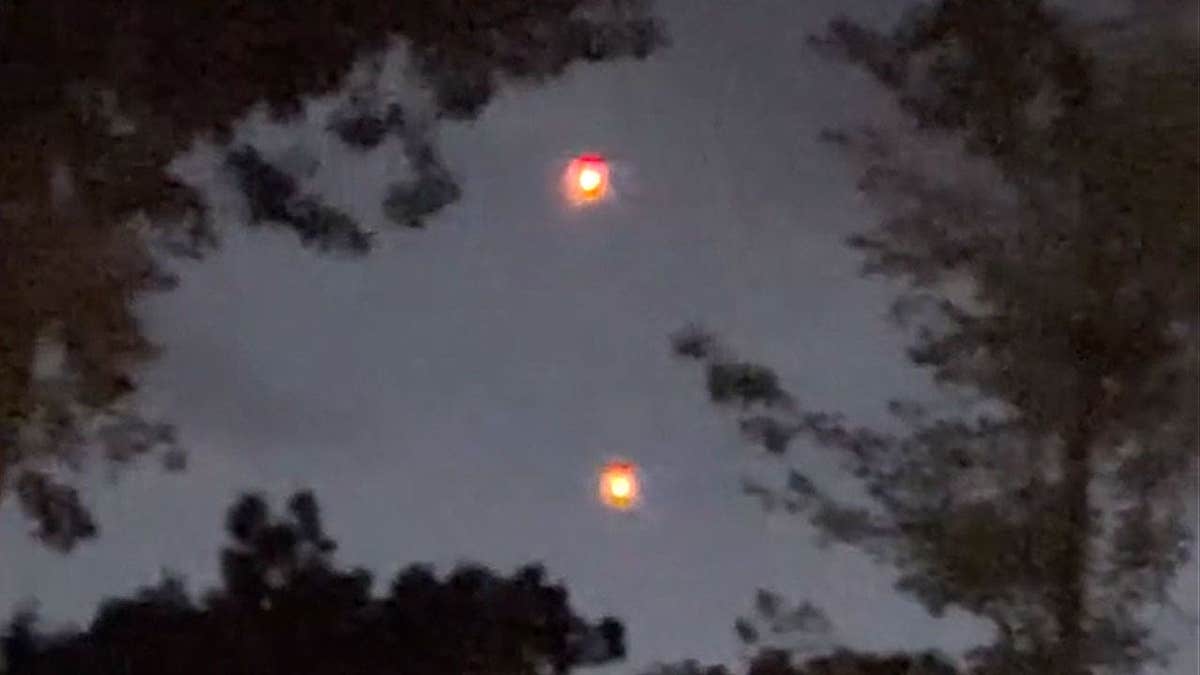
While searching for a new approach that accounts for the unusual shapes of space rocks and the complex mathematics of X-ray deflection, Moore said he “latched onto some work one of my colleagues was doing” on outgassing in objects like asteroids moving through space, which led to an “aha moment.”

“We realized we could do this,” Moore said. “No more spheres. We would be able to model deflection for any asteroid.”

Researchers Surprised by How Much Aim Affected Success

To build the model, Moore said he borrowed high-fidelity codes used at Sandia for different types of problems and combined their specific abilities into one asteroid deflection tool. This included the ALLEGRA code, which Moore noted is typically used to model “fast, high-energy experiments, like magnetically imploding wires on the Z machine.”

The team also included SPARTA. Moore said this is a direct simulation Monte Carlo code normally used to “model comparatively weak, slowly evolving forces, like the drag on a satellite from the solar wind.”

“Our new algorithm is over 1,600 times faster, which was critical to this breakthrough,” Moore said. “With the old models, computers just couldn’t handle it.”

Using the new approach, the team modeled a simulated asteroid using high-resolution 3D imagery from spacecraft flybys of actual asteroids. Next, the Sandia team blasted their simulated asteroid with simulated X-rays to measure the effect. To approximate real-world scenarios, the team adjusted the explosion’s size and distance and changed which side of the rock was irradiated.

After comparing the results, Moore and colleagues found that irradiating different sides of a naturally shaped asteroid altered how much momentum the blast transferred to the asteroid. They also found that altering the blast’s location affected how much spin was induced in the target rock.
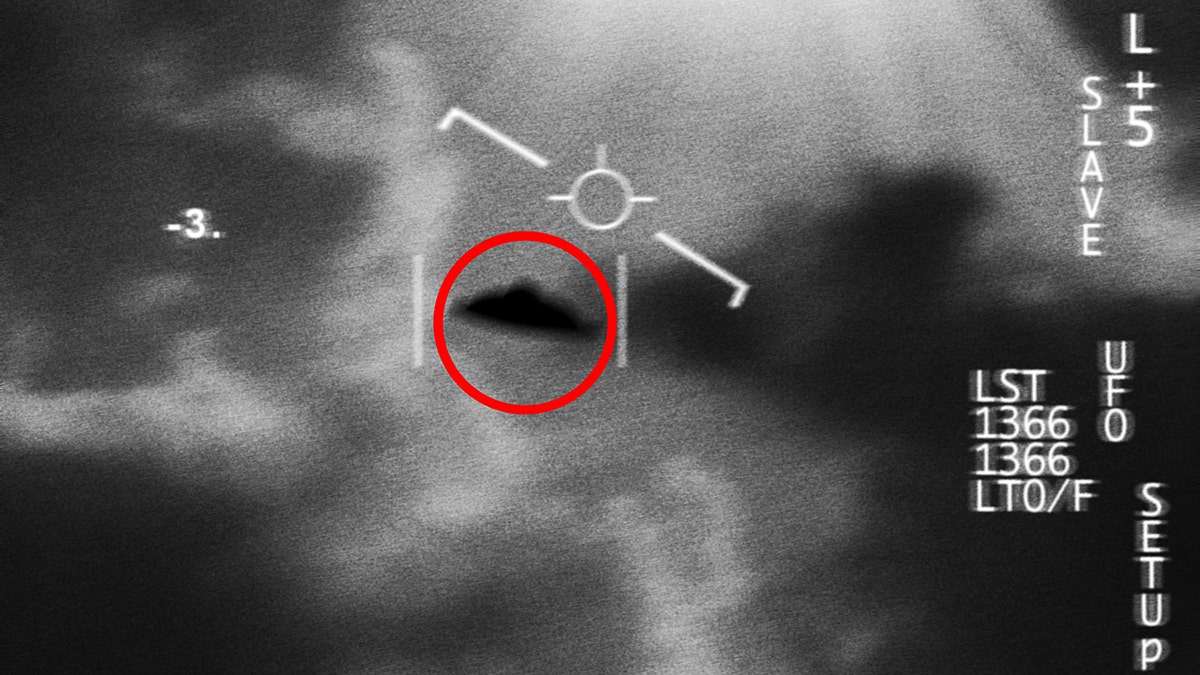
In some cases, the team observed a fivefold difference in rotational speed between two different blast locations. In another case, the team found that the asteroid’s change in rotational velocity after explosion “varied by a factor of 17.”

“We expected aim to matter,” Moore said. “What surprised us was how much.”

“Guess Wrong, and it Could be a Bad Day”

When discussing the current model’s limitations, the Sandi team noted that their model requires “fairly accurate” asteroid shape data from all sides. In a real-world scenario, there may not be enough time to send a spacecraft to capture such data. Moore also pointed to limitations in predicting how an asteroid will react after it is broken into several pieces.

“We can’t predict breakup of the entire asteroid body accurately yet,” Moore said, adding that the current version only models the breakup of surface material.

Still, the study author noted, the model reduces much of the guesswork in avoiding a doomsday scenario, with targeting the blast location becoming increasingly critical to success.

“Our study shows how important it is to aim carefully,” Moore said. “Pick the right side, and you win. Guess wrong, and it could be a bad day.”

  • Christopher Plain has spent the last six years as Associate News Editor and Head Science Reporter at The Debrief. Follow and connect with him on X, learn about his novels at plainfiction.com, or email him at christopher@thedebrief.org.
How NASA Could Stop an Asteroid Without Hitting It
Nuclear impact: Scientists say NASA should blow up asteroid headed for moon

{ https://thedebrief.org/category/space/ }

Hoe vind je dit bericht?
Geschreven door peter om 22:17 Stuur door

Pilot claims he spotted UFOs moving across sky during ‘seven flights’

Pilot claims he spotted UFOs moving across sky during ‘seven flights’

Pilot captures mysterious flashing lights while flying over Brussels | SWNS

A veteran pilot says he has seen a raft of unidentified flying objects (UFOs) over the last four years.

Steve Frazer, 48, first saw a mysterious… something zipping through the skies above Brussels, Belgium, in 2022.

Since then, the pilot of 27 years has noticed the same flashing lights ‘six or seven’ times, including last month.

He initially chalked the glowing orbs up to military aircraft that might be refuelling but says other pilots in the Netherlands have seen them, too.

One fellow pilot even radioed to ask about any military activity.

‘I saw these lights when I was working and another colleague saw the lights coming back from Lithuania,’ Steve, from Sandbach, Cheshire, says.

Screen grab depicts alleged UFOs sighted by pilot Steve Frazer.// A pilot says he has spotted UFOs whilst flying planes over Brussels. Steve Frazer, 48, has been a captain for 20 years operating commercial flights, and in 2022 first spotted what looked like an aircraft orbiting over land near Brussels. Since then he has noticed the same flashing lights "six or seven" times, most recently in October 2026, at first mistaking them for a military aircraft that might be refuelling. Time lapsed footage Steve captured mid-flight shows what appears to be small orbs of light shooting across the sky before disappearing. Steve says he's not the only one who has reported the strange lights, with other pilots commenting on them after he researched the phenomenon online. The captain, from Sandbach, Cheshire, says: "I saw these lights when I was working and another colleague saw the lights coming back from Lithuania.

Steve Frazer spotted the groups of lights for the first time in 2022

(Picture: Steve Frazer/SWNS)

Screen grab depicts alleged UFOs sighted by pilot Steve Frazer.// A pilot says he has spotted UFOs whilst flying planes over Brussels. Steve Frazer, 48, has been a captain for 20 years operating commercial flights, and in 2022 first spotted what looked like an aircraft orbiting over land near Brussels. Since then he has noticed the same flashing lights "six or seven" times, most recently in October 2026, at first mistaking them for a military aircraft that might be refuelling. Time lapsed footage Steve captured mid-flight shows what appears to be small orbs of light shooting across the sky before disappearing. Steve says he's not the only one who has reported the strange lights, with other pilots commenting on them after he researched the phenomenon online. The captain, from Sandbach, Cheshire, says: "I saw these lights when I was working and another colleague saw the lights coming back from Lithuania.

The orbs were fast-moving, with the plane never reaching them

(Picture: Steve Frazer/SWNS)

Pilot Steve Frazer, who claims to have spotted UFOs moving across the sky during night flights. // A pilot says he has spotted UFOs whilst flying planes over Brussels. Steve Frazer, 48, has been a captain for 20 years operating commercial flights, and in 2022 first spotted what looked like an aircraft orbiting over land near Brussels. Since then he has noticed the same flashing lights "six or seven" times, most recently in October 2026, at first mistaking them for a military aircraft that might be refuelling. Time lapsed footage Steve captured mid-flight shows what appears to be small orbs of light shooting across the sky before disappearing. Steve says he's not the only one who has reported the strange lights, with other pilots commenting on them after he researched the phenomenon online. The captain, from Sandbach, Cheshire, says: "I saw these lights when I was working and another colleague saw the lights coming back from Lithuania.

Steve Frazer claims other pilots have spotted similar lights

(Picture: Steve Frazer/SWNS)

‘We saw them in the same space and roughly the same direction but it was ever so strange.’

Steve was flying towards the light for some time but could never quite catch up to the floating lights.

‘In the little video you see the lights coming up from the ground and I seem to recall it was Brussels coming into view back towards the UK – it’s always north-westerly heading,’ he adds.
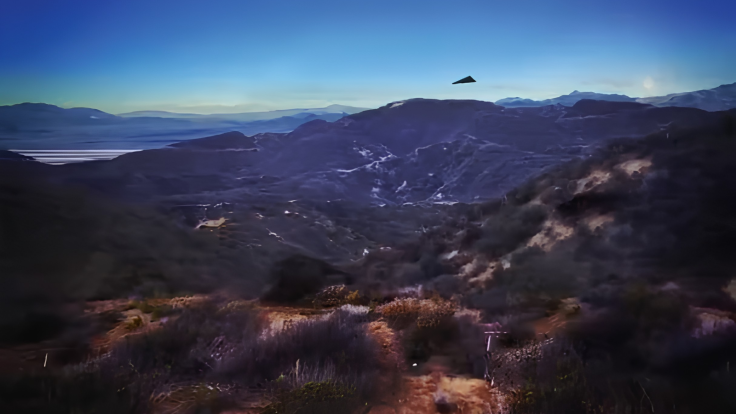
Steve compared footage of the UFO to satellites such as Starlink, Elon Musk’s constellation of metal that provides internet connection.

‘The report deserves to be logged properly’

Metro showed Steve’s footage to two UFOlogists, people who investigate the metal discs, jittery lights and fiery orbs filling the skies.

Both said it’s hard to ignore Steve’s claims, given he is a pilot of nearly three decades.

‘When someone with that background says an object does not match anything he has seen before – satellites, Starlink, military refuelling, or normal traffic – the report deserves to be logged properly,’ says Mark Christopher Lee, a filmmaker and alien hunter.

Screen grab depicts alleged UFOs sighted by pilot Steve Frazer.// A pilot says he has spotted UFOs whilst flying planes over Brussels. Steve Frazer, 48, has been a captain for 20 years operating commercial flights, and in 2022 first spotted what looked like an aircraft orbiting over land near Brussels. Since then he has noticed the same flashing lights "six or seven" times, most recently in October 2026, at first mistaking them for a military aircraft that might be refuelling. Time lapsed footage Steve captured mid-flight shows what appears to be small orbs of light shooting across the sky before disappearing. Steve says he's not the only one who has reported the strange lights, with other pilots commenting on them after he researched the phenomenon online. The captain, from Sandbach, Cheshire, says: "I saw these lights when I was working and another colleague saw the lights coming back from Lithuania.

The lights could be a yet-to-be-made-public drone, a type of unarmed aircraft, said one expert (Picture: Steve Frazer/SWNS)

Still, there could be a more down-to-Earth explanation.

Given Belgium is a member of Nato, a Western mutual-defence alliance, the lights could be powerful drones being tested in secret.

‘That remains the most straightforward explanation for many high-quality, recurring sightings of this type,’ Lee says.

Gary Heseltine, the editor of UFO Truth Magazine, says he doesn’t blame Steve for filming the ‘baffling lights’.

‘Many UAPs are similar to the objects seen in these clips,’ Heseltine says, using a term for what UFOs are often called by government officials: unidentified anomalous phenomena.

‘They remain an enigma worthy of serious scientific research.’

Screen grab depicts alleged UFOs sighted by pilot Steve Frazer.

Steve said the orbs didn’t appear shaped like satellites

 (Picture: Steve Frazer/SWNS)

Nearly one in three Brits believe that aliens have already visited Earth, according to a YouGov poll, while 7% say they have seen a UFO.

The pollster said it shows that feeling the truth is out there has become less of a fringe belief in recent years.

Still, Lee says that the UK lacks a centralised way of reporting UFO sightings. Many police forces no longer track them, and a Ministry of Defence ‘UFO hotline’ was closed in the 2000s.

It’s why the producer has long called on the government to reinstate it.

Until then, for Heseltine, the fact that Steve spoke with the press is certainly something.

‘What is to be applauded is the fact that the pilot is willing to go public about the incident,’ he adds. ‘This is to be encouraged.’

{ https://metro.co.uk/news/ }

Hoe vind je dit bericht?
Geschreven door peter om 21:35 Stuur door

Midlands pilot claims he spotted UFOs moving across the sky during flights over Belgium

Midlands pilot claims he spotted UFOs moving across the sky during flights over Belgium

Commercial pilot Steve Frazer says he has spotted mysterious flashing lights during flights over Brussels multiple times since 2022, and claims other pilots have reported similar sightings

BY Jordan Coussins and SWNS EmilyPhillips (Emily Phillips)

An image depicting a bright, circular object emitting a soft glow in a predominantly dark setting, possibly representing a celestial body observed at night.

A pilot claims he has observed UFOs while operating aircraft above Brussels.

Steve Frazer, 48, has served as a captain for 20 years conducting commercial flights, and in 2022 initially witnessed what appeared to be an aircraft circling over territory near Brussels.

Since that moment, he has observed the identical flashing lights "six or seven" times, most recently in October 2026, initially confusing them for a military aircraft that could be refuelling.

Time-lapse footage Steve recorded during flight shows what seems to be small orbs of light darting across the sky before vanishing.

Steve claims he's not alone in reporting the unusual lights, with fellow pilots remarking on them after he investigated the phenomenon online.

The captain, from Sandbach, Cheshire, states: "I saw these lights when I was working and another colleague saw the lights coming back from Lithuania.

"We saw them in the same space and roughly the same direction but it was ever so strange.

"I just thought it was a military refuelling aircraft but the way it was moving and speed, it didn't make any sense.

"We were going towards them for seemingly ages and never got to them.

"That was a few years ago and I didn't think much about it.

"I did a couple of flights recently and saw them again.

An individual in uniform is seated in the cockpit of an aircraft, engaged in writing with a pen. The cockpit is equipped with various control panels and monitors.

"I've been flying 27 years commercially and it doesn't fit with anything I've seen previously.

"Technically in a sense it's an unidentified object that seems to be flying.

"It looked to me it was coming over the Atlantic, it looked beyond the UK."

Steve claims he isn't alone in spotting the orbs, with another pilot making radio contact last month to enquire about any military operations.

"I've done my own digging to try and figure out what they are and I can't find an answer to it," he told Talk to the Press.

"I know what satellites normally look like, I've seen plenty of Starlinks and things like that.

"They don't fit with that movement.

An individual, dressed in a formal pilot's uniform, is seated within the cockpit of an aircraft, smiling broadly. The cockpit is equipped with various control panels and navigational displays, suggesting the individual's professional role in aviation.

"In the little video you see the lights coming up from the ground and I seem to recall it was Brussels coming into view back towards the UK - it's always north-westerly heading.
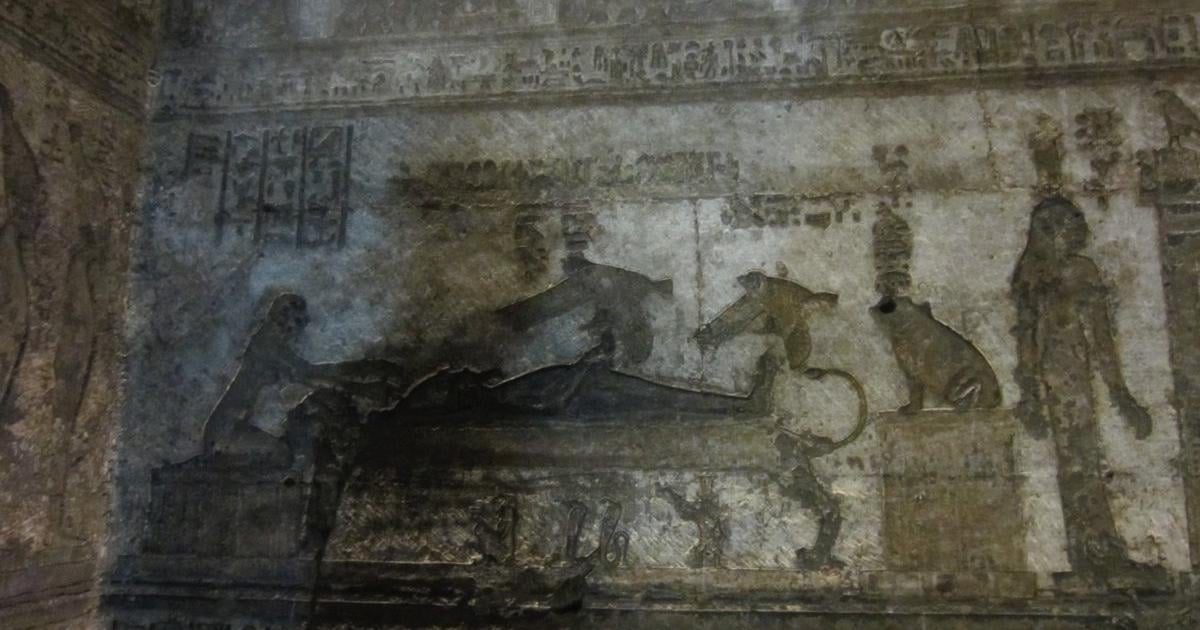
"I've done a little research online and other people have reported this but I don't think anyone has recorded it, not that I've seen anyway.

"Some people flying in the Netherlands saw it as well and made a report through a media channel but I'm not entirely sure.

"It seems to fit with what other pilots have commented on when they've seen them."

RELATED

Pilot captures mysterious flashing lights while flying over Brussels | SWNS

{ https://www.birminghammail.co.uk/news/midlands-news/ }

Hoe vind je dit bericht?
Geschreven door peter om 21:13 Stuur door

Asteroids' Oddball Shapes Make Deflecting Them Challenging

Asteroids' Oddball Shapes Make Deflecting Them Challenging

This artist's illustration shows NASA's Double Asteroid Redirection Test spacecraft approaching its target, Dimorphos. If we need to deflect an incoming asteroid on short notice, an impactor like DART won't do the job. We may need to redirect the dangerous rock with an x-ray pulse from a carefully detonated nuclear weapon. But the part of the surface we direct the x-ray pulse at matters a lot. Image Credit: NASA/Johns Hopkins APL/Steve Gribben

This artist's illustration shows NASA's Double Asteroid Redirection Test spacecraft approaching its target, Dimorphos. If we need to deflect an incoming asteroid on short notice, an impactor like DART won't do the job. We may need to redirect the dangerous rock with an x-ray pulse from a carefully detonated nuclear weapon. But the part of the surface we direct the x-ray pulse at matters a lot.

Image Credit: NASA/Johns Hopkins APL/Steve Gribben

If you're looking for uniformity in Nature, you won't find it in the asteroid belt. Not only are asteroid compositions different because they come from different parent bodies, but their shapes are different, too. They're not massive enough to round themselves like planets do.

This is more than just another space factoid; asteroid shapes matter. It's a near-certainty, given enough time, that a dangerous asteroid will head directly for a collision with Earth, and that's something scientists are actively studying. They want to develop ways to knock an asteroid off course, if necessary. That's what NASA's Double Asteroid Redirection Test (DART), and the ESA's follow-up Hera mission were about.

There are multiple concepts for redirecting a dangerous asteroid. One of them is a nuclear weapon. Not to obliterate an asteroid, but to bombard it with radiation by exploding the nuclear weapon in close proximity to the asteroid. This is called a stand-off X-ray mitigation scenario. The radiation pulse will change an asteroid's course, if done soon enough and done correctly.

But the outcome of the pulse needs to be predictable to work, and that's where asteroids' different shapes come into play.

"The effectiveness of deflecting Near Earth Objects (NEOs) using pulsed radiation is challenging to quantify because it hinges critically on surface topography, which is often unknown," write the authors of new research in Icarus. The research is "Efficient computation of vapor ejecta over asteroid geometries during pulsed energy deflection," and the lead author is Nathan Moore. Moore is a physicist at Sandia National Laboratories.

A simple kinetic impactor is probably the preferred choice for deflecting an asteroid. That's what the DART mission did, and it appeared to be successful. Though it only changed the velocity of its target Dimorphos by a little, it was done soon enough to create a substantial change in its position over years.

But the more pertinent issue concerns an asteroid, or perhaps a comet, that's on a collision course with Earth, but isn't discovered soon enough for an impactor to effectively change its trajectory.

"While considered an option of last resort, it has been argued that late-time interception of a near-Earth object (NEO) or comet, either for disruption or deflection, might only be possible with the higher energy concentration available from detonation of a pulsed energy device," the authors write. 'Pulsed energy device' is one way of saying nuclear weapon. In space, there's no atmospheric shock wave from a nuclear explosion, only radiation, which is released in a powerful pulse.

"Stand-off energy bursts—those detonated far from the surface—hold a potential advantage compared to surface explosions in that they might permit deflection with less disruption to the original structure, allowing for more controlled steering of the asteroid and its debris," the authors write. Disrupting the original structure might make for a good action sequence in a movie, but it would multiply the hazard to Earth by creating a swarm of debris, some of which could strike our planet.

Researchers have simulated using nuclear weapons and their radiation pulses to deflect asteroids, but their irregular shapes have stymied them. These shapes are far more difficult to model, so most research has focused on spherical asteroids. Moore and his colleagues developed a new algorithm to overcome these limitations.

“Our new algorithm is over 1,600 times faster, which was critical to this breakthrough,” Moore said. “With the old models, computers just couldn’t handle it.”

In this research, the authors simulated known asteroids with more irregular shapes, an important improvement on previous work.

"The approach improves on earlier methods by accounting for the actual topography of the asteroid fully in three dimensions without unacceptably increasing computational cost or reducing accuracy," the authors explain. "As a demonstration, we predict the deflection of three bodies of different shape—asteroid (101955) Bennu, asteroid (25143) Itokawa, and asteroid (6489) Golevka—from both near-field and far-field irradiations."

These images of asteroids Itokawa (left) and Bennu (middle), and a computer model of asteroid Golevka (right), show how asteroid shapes can be very different from one another. Image Credits: Itokawa: By ESO, CC BY 4.0, https://commons.wikimedia.org/w/index.php?curid=170826264. Bennu: By NASA/Goddard/University of Arizona - Public Domain. Golevka: By NASA/JPL - NASA - Jet Propulsion Laboratory. Public Domain.

These images of asteroids Itokawa (left) and Bennu (middle), and a computer model of asteroid Golevka (right), show how asteroid shapes can be very different from one another.

Image Credits: Itokawa: By ESO, CC BY 4.0, https://commons.wikimedia.org/w/index.php?curid=170826264. Bennu: By NASA/Goddard/University of Arizona - Public Domain. Golevka: By NASA/JPL - NASA - Jet Propulsion Laboratory. Public Domain.

A sequence of events unfolds after a nuclear device is detonated near an asteroid. First, an intense x-ray pulse is directed at one side of the asteroid. Then there's rapid surface vaporization, and that creates most of the deflection thrust. Next is an internal shock wave, a powerful blow that travels through the asteroid's body. Finally, the internal structure of the asteroid is fractured, and that can blow chunks of the asteroid off the surface opposite the blast, and off of the asteroid's sides.

So despite there being no atmospheric shock wave, the asteroid is still disrupted.

The results highlighted how important an asteroid's shape is. Depending on which side of the asteroid was facing the radiation blast, the deflection velocity can be up to five times greater. "We find that the orientation of the body at time of intercept can increase the deflection velocity by up to nearly 2× for Bennu, 4× for Itokawa, and 5× for Golevka, compared to the minimum response for each body," the authors write.

This figure shows the pressure distribution as averaged over the first 20 μs of vapor expansion, for asteroid (a) Bennu, (b) Itokawa, and (c) Golevka, for near and far Height Of Bursts (HOB). The vaporization is what creates most of the deflection thrust. Image Credit: Moore et al. 2026. Icarus.

This figure shows the pressure distribution as averaged over the first 20 μs of vapor expansion, for asteroid (a) Bennu, (b) Itokawa, and (c) Golevka, for near and far Height Of Bursts (HOB). The vaporization is what creates most of the deflection thrust.

Image Credit: Moore et al. 2026. Icarus.

“We expected aim to matter,” said lead author Moore in a press release. “What surprised us was how much.”

The simulation in this work can be used on any asteroid that's been mapped by a spacecraft during a flyby. The size of the explosion, the distance, and the surface exposed to it can all be calculated in advance. By calculating the surface vaporization, the main factor in deflection, the simulation determines how hard the asteroid will be pushed, how fast it will rotate, and how much of the surface might break up.

The interior structure of asteroids can be quite different, and that's beyond the capabilities of this model to account for. "Right now, our computer model only considers breakup of rocks on the surface. We can’t predict breakup of the entire asteroid body accurately yet," Moore said.

Real life is always different from simulations, and that means that these results can't tell us with absolute certainty what will happen. But it's a step forward, one that drives home how critical the aim is to a successful asteroid deflection, should one be needed in the future.

"The strong sensitivity of deflection and disruption to asteroid topography is especially pertinent given that the shape of an incoming NEO might not be known, and its orientation at time of intercept may be uncontrolled," the authors write. Their work as it stands now can at least be used to make estimates, which is better, far better, than nothing.

"Alternatively, effort could be made to obtain high-resolution topographic characterization of an incoming NEO to improve accuracy of the deflection model, such as using spacecraft-based imagery or altimetry acquired before detonation," the authors explain.

It's possible that asteroid-mapping spacecraft could stand at the ready in space, waiting to be deployed. They could even be paired with asteroid-disrupting spacecraft carrying nuclear weapons. Or the two capabilities could be combined into one spacecraft. Placing atomic weapons in space would be extremely tricky in our fractured geopolitical world, but it's still a possibility, maybe the only possibility.

But however we prepare for an incoming asteroid, this work highlights how important it is that our aim is true.

  • “Our study shows how important it is to aim carefully,” Moore said. “Pick the right side and you win. Guess wrong and it could be a bad day.”

RELATED

Asteroid Deflection Techniques for Planetary Defense | SLICE SCIENCE | FULL DOCUMENTARY
Is Deflecting Killer Asteroids Impossible? 😨
Why Do Asteroids Have Irregular Shapes? ☄️🪨

{  https://www.universetoday.com/  }

Hoe vind je dit bericht?
Geschreven door peter om 20:51 Stuur door

Blue Glowing Tic-Tac Over Medellín, Antioquia, Colombia. Sept 31, 2026, UFO UAP Sighting News.

Blue Glowing Tic-Tac Over Medellín, Antioquia, Colombia. Sept 31, 2026, UFO UAP Sighting News.

Screenshot%202026-11-05%20at%2012.14.04%E2%80%AFPM.png

Date of sighting: Oct 31, 2026
Location of sighting: Medellín, Antioquia, Colombia
Source: NUFORC
 
Colombia is notorious for its UFO sightings seen by police, mayors and public. However this one is unique in that its glowing bright blue, usually reports label them as red. This object appeared in the sky and the disappeared as the eyewitness watched. Its soul purpose...to seed our skies with mini ai living orbs. You can see seval star like objects near, but in different positions among the two phtoos submitted. This blue tic-tac craft is a mother orb ship. The smaller orbs observe everything from insects to aircraft, from kids playing in trees to horses on a farm. Its all significant to them because its all lost history that they are trying to record, but lost millions or billions of years ago. Also note...orbs have no outer arms or moving parts, the soul tool they use is often...telepathic, because nothing is more real, than the memories of the living at that specific moment in history. Knowledge...is the asset that aliens seek most. 
Scott C. Waring - UFO Sightings Daily
 
Eyewitness states: 
I was sitting on the sidewalk when I saw a green-blue light between the clouds over me. I grab my Phone and took a couple of pictures. There was an aura or haze around the object. It emitted other objects In the beginning it appeared like a comet tail, but it never moves in the sky, and slowly it disappears.
 
Hoe vind je dit bericht?
Geschreven door peter om 20:30 Stuur door

NASA's 3,200-pound space telescope plummets back to Earth with an uncontrolled fiery crash

NASA's 3,200-pound space telescope plummets back to Earth with an uncontrolled fiery crash

NASA's doomed space telescope made an uncontrolled reentry back to Earth on Wednesday, nearly 22 years after launching. 

The 3,200-pound Swift Observatory launched in 2004 to study gamma-ray bursts, the most powerful explosions in the universe, and other cosmic objects and events. 

It was designed for a two-year prime mission. 

After 21 years of science operations, Swift’s low Earth orbit began to rapidly decay because of increased solar activity. 

The US Space Force confirmed that the Swift spacecraft re-entered Earth’s atmosphere at 7.39am ET over the North Sumatra region of Indonesia, at approximately 3.4 degrees north latitude and 98.6 degrees east longitude. 

NASA expected most of the spacecraft to burn up as it traveled through the atmosphere, but some components may have survived re-entry. 

Pennsylvania State University’s John Nousek, an astronomer involved in the mission, told AP: 'We’ve known this day would come since before Swift was launched. 

'At least in low-Earth orbit, what goes up must come down. And that end is catastrophic.'

The US Space Force confirmed that the Swift spacecraft re-entered Earth’s atmosphere at 7.39am ET over the North Sumatra region of Indonesia

The US Space Force confirmed that the Swift spacecraft re-entered Earth’s atmosphere at

The space agency's press release explained that surviving fragments could fall within a broad belt around the equator stretching across parts of Latin America, Africa, southern Asia and northern Australia.

That places the US and Europe outside the potential impact zone. 

The re-entry follows NASA's failed attempt to rescue Swift in August.

The space agency had spent $30 million in hopes of sending another spacecraft to push the telescope into a higher orbit and avoid an uncontrolled fall back to Earth. 

 The rescue spacecraft, named Link, went into an uncontrollable spin a few weeks after its liftoff in early July.

While flight controllers managed to slow Link’s tumble, issues continued to plague its pointing and positioning in orbit.

NASA Administrator Jared Isaacman said in a statement: 'This is not the outcome we were working toward, but it does not change why this mission was worth attempting.'

Swift resumed observations once the rescue attempt was called off, discovering even more gamma-ray bursts and other ultrahigh-energy events. But by late October, the telescope was too low to remain steady for observations, and its systems were shut down.

The 3,200-pound Swift Observatory launched in 2004 to study gamma-ray bursts, the most powerful explosions in the universe, and other cosmic objects and events

The 3,200-pound Swift Observatory launched in 2004 to study gamma-ray bursts, the most powerful explosions in the universe, and other cosmic objects and events 

Swift Observatory captured the afterglow of a gamma-ray burst. The bright rings are X-rays scattered by dust layers within our galaxy. Multiple space and ground-based telescopes witnessed one of the brightest explosions in space when it reached Earth

Swift Observatory captured the afterglow of a gamma-ray burst. The bright rings are X-rays scattered by dust layers within our galaxy. Multiple space and ground-based telescopes witnessed one of the brightest explosions in space when it reached Earth

Its final tally included more than 2,000 gamma-ray bursts and 1,400 exploding stars, not to mention a slew of comets, asteroids and star-shredding black holes. 

The telescope’s superpower was its ability to swivel swiftly toward erupting celestial events.

NASA considered Swift a first responder for the Hubble and Webb space telescopes and others that would follow its alerts and provide deeper investigations. 

Scientists are still figuring out how to fill the gap.

Nousek said: 'Our fervent hope is that the lessons learned by the successes of Swift can be applied to new generations of space missions to accelerate our discoveries about the universe.'

RELATED

NASA telescope set to crash to Earth after 22 years
Space telescope crashes back to Earth after failed rescue
NASA space telescope crashed into earth after 22 years of tracking cosmic explosions

{ https://www.dailymail.com/sciencetech/index.html }

Hoe vind je dit bericht?
Geschreven door peter om 20:03 Stuur door

Lost account of Jesus's descent to hell and resurrection uncovered in 1,600-year-old papyrus, researchers suggest

Lost account of Jesus's descent to hell and resurrection uncovered in 1,600-year-old papyrus, researchers suggest

A few broken lines of ancient writing may preserve a lost account of Christianity’s most extraordinary claims.

Researchers have deciphered a roughly 1,600-year-old Christian manuscript that they believe describes Jesus’ death, descent into the underworld and return through his resurrection.

Written in Greek, the fragment measures just two by three inches and was held among unpublished papyri in the Austrian National Library.

The team’s tentative translation includes references to someone who ‘died’ and a figure who ‘descended’ and apparently ‘ascended again,’ although missing letters leave parts of the wording uncertain.

Amphilochios Papathomas and Marianna Thoma, of the University of Athens in Greece, believe the passage concerns Jesus and could belong to a Christian work that did not survive through medieval copying.

Their analysis favors a fourth- or fifth-century date, placing the manuscript hundreds of years after the crucifixion but within the ancient Christian world.

They suggested it may preserve a sermon, possibly written by a church father or an Egyptian religious leader, although a hymn or another religious composition remains possible.

If their interpretation is correct, the fragment preserves part of a Christian work that may otherwise have disappeared, offering another glimpse of how ancient believers described Jesus’ victory over death. 

Researchers have deciphered a roughly 1,600-year-old Christian manuscript that they believe describes Jesus’ death, descent into the underworld and return through his resurrection

Researchers have deciphered a roughly 1,600-year-old Christian manuscript that they believe describes Jesus’ death, descent into the underworld and return through his resurrection

Published online on January 19, 2026, in the journal Tyche, the paper examined the fragment catalogued as P.Vindob. G 29289, a Late Antique Greek papyrus fragment.

Its original author remains unknown, as does the precise place where the papyrus was found.

The researchers suspect it came from Egypt’s Fayum region or Hermopolis because those locations supplied material to the collection, but the library’s inventories provide no precise origin.

Their investigation involved studying the original in Vienna, transcribing the surviving Greek and comparing its handwriting and language with other ancient manuscripts and Christian writings.

The most striking interpretation concerns a damaged phrase on the reverse.

Translated into English, the researchers’ tentative reading is: ‘… alone (?) he who descended (into Hades) ascended again (?) …’ 

The words ‘into Hades’ are supplied by the researchers to explain their interpretation, while the final word translated as ‘ascended’ is partly reconstructed. 

‘The sense of the passage is probably that only Jesus and no one else went into Hades and returned through his resurrection,’ the researchers wrote, translated from German.

The team’s tentative translation includes references to someone who ‘died’ and a figure who ‘descended’ and apparently ‘ascended again,’ although missing letters leave parts of the wording uncertain

The team’s tentative translation includes references to someone who ‘died’ and a figure who ‘descended’ and apparently ‘ascended again,’ although missing letters leave parts of the wording uncertain

Hades refers here to the realm of the dead, which the authors connect with a Christian tradition describing Jesus’ descent after death.

According to a longstanding Christian tradition, Jesus entered the realm of the dead before his resurrection and freed the righteous who had died before him. 

The researchers supported their interpretation by comparing the wording with passages attributed to Eusebius and with Christian hymns describing the Savior descending into the regions of death.

In one passage, Eusebius, an early Christian writer, describes the Savior alone descending into the regions of death, resembling the fragment’s proposed reference to a lone figure who ‘descended.’ 

Another surviving verb appears to mean ‘swallowed.’

The team suggested death was its subject, drawing comparisons with Christian writings that portray death swallowing people but failing to retain or overcome Jesus.

Their proposed reading placed the fragment within an established tradition of describing Christ’s victory over death.

However, the manuscript does not preserve an uninterrupted narrative of an empty tomb or Jesus appearing alive to his disciples.

Its gaps are substantial, and some crucial words have been reconstructed from surviving letters and parallels elsewhere.

The papyrus bears three horizontal folds and appears to have broken along the upper two. 

Near the end of the passage, the scribe squeezed the beginning of the word interpreted as ‘ascended’ against the edge of the sheet, while its continuation is now missing. 

The researchers reconstructed the proposed ending from the remaining letters and comparisons with other Christian texts. 

Blank space at the end of the final surviving line suggests the passage may have concluded a section of the original work. 

The researchers acknowledged other possible restorations, including a word meaning ‘was raised.’

article image

The authors also considered a less likely interpretation in which the descent refers to Jesus coming from heaven to live as a human, rather than entering the realm of the dead. 

The front appears to offer moral guidance, addressing the reader as a ‘wanderer’ and warning against taking the ‘broad road’ while hoping for life.

The researchers found a similar warning in a sermon by early Christian preacher John Chrysostom.

However, a damaged verb could describe someone walking in the past rather than a command to ‘walk,’ possibly making the passage about Jesus’ own life.

Both sides were copied by the same scribe in a carefully executed literary script, according to the team.

To estimate its age, they compared its handwriting with examples spanning several centuries, including the Egerton Gospel and other Christian papyri.

Although some similarities occur in earlier and later manuscripts, the combined handwriting and linguistic evidence points them toward the fourth or fifth century.

The researchers allow a broader date range from the late third through the fifth century, although they favor the fourth or fifth. 

That estimate concerns the surviving copy, not necessarily the work’s composition.

The paper reports no radiocarbon dating.

Double slashes dividing the text provide another clue: similar marks occur in Christian manuscripts and hymns, supporting the possibility of a poetic composition.

The researchers hope this first scholarly publication will help others identify the original work or locate more pieces of the same papyrus.

RELATED

Why Did Jesus Descend Into Hell 3 days Before the Resurrection?
The Full Story of Jesus' Death,Descent into Hades,Resurrection & Ascension|Full Biblical Documentary
Why Jesus Christ Had to Go to Hell After His Death (The 3 Days Explained)

{ https://www.dailymail.com/sciencetech/index.html }

Hoe vind je dit bericht?
Geschreven door peter om 19:38 Stuur door

Meer van UFO'S of UAP'S, ASTRONOMIE, RUIMTEVAART, ARCHEOLOGIE, OUDHEIDKUNDE, SF-SNUFJES EN ANDERE ESOTERISCHE WETENSCHAPPEN - DE ALLERLAATSTE NIEUWTJES

↑ Terug naar de berichten