Naar de inhoud

UFO'S of UAP'S, ASTRONOMIE, RUIMTEVAART, ARCHEOLOGIE, OUDHEIDKUNDE, SF-SNUFJES EN ANDERE ESOTERISCHE WETENSCHAPPEN - DE ALLERLAATSTE NIEUWTJES

UFO's of UAP'S in België en de rest van de wereld
akke.beakke.be
Ontdek de Fascinerende Wereld van UFO's en UAP's: Jouw Bron voor Onthullende Informatie! Ben jij ook gefascineerd door het onbekende? Wil je meer weten over UFO's en UAP's, niet alleen in België, maar over de hele wereld? Dan ben je op de juiste plek! België: Het Kloppend Hart van UFO-onderzoek In België is BUFON (Belgisch UFO-Netwerk) dé autoriteit op het gebied van UFO-onderzoek. Voor betrouwbare en objectieve informatie over deze intrigerende fenomenen, bezoek je zeker onze Facebook-pagina en deze blog. Maar dat is nog niet alles! Ontdek ook het Belgisch UFO-meldpunt en Caelestia, twee organisaties die diepgaand onderzoek verrichten, al zijn ze soms kritisch of sceptisch. Nederland: Een Schat aan Informatie Voor onze Nederlandse buren is er de schitterende website www.ufowijzer.nl, beheerd door Paul Harmans. Deze site biedt een schat aan informatie en artikelen die je niet wilt missen! Internationaal: MUFON - De Wereldwijde Autoriteit Neem ook een kijkje bij MUFON (Mutual UFO Network Inc.), een gerenommeerde Amerikaanse UFO-vereniging met afdelingen in de VS en wereldwijd. MUFON is toegewijd aan de wetenschappelijke en analytische studie van het UFO-fenomeen, en hun maandelijkse tijdschrift, The MUFON UFO-Journal, is een must-read voor elke UFO-enthousiasteling. Bezoek hun website op www.mufon.com voor meer informatie. Samenwerking en Toekomstvisie Sinds 1 februari 2020 is Pieter niet alleen ex-president van BUFON, maar ook de voormalige nationale directeur van MUFON in Vlaanderen en Nederland. Dit creëert een sterke samenwerking met de Franse MUFON Reseau MUFON/EUROP, wat ons in staat stelt om nog meer waardevolle inzichten te delen. Let op: Nepprofielen en Nieuwe Groeperingen Pas op voor een nieuwe groepering die zich ook BUFON noemt, maar geen enkele connectie heeft met onze gevestigde organisatie. Hoewel zij de naam geregistreerd hebben, kunnen ze het rijke verleden en de expertise van onze groep niet evenaren. We wensen hen veel succes, maar we blijven de autoriteit in UFO-onderzoek! Blijf Op De Hoogte! Wil jij de laatste nieuwtjes over UFO's, ruimtevaart, archeologie, en meer? Volg ons dan en duik samen met ons in de fascinerende wereld van het onbekende! Sluit je aan bij de gemeenschap van nieuwsgierige geesten die net als jij verlangen naar antwoorden en avonturen in de sterren! Heb je vragen of wil je meer weten? Aarzel dan niet om contact met ons op te nemen! Samen ontrafelen we het mysterie van de lucht en daarbuiten.

Categorie: ARTICLES of MUFON ( ENG)

Belgium’s Flying Triangle Wave

1-Belgian-triangles-ftr.jpg

Belgium’s Flying Triangle Wave

Thirty years ago, thousands of Belgian citizens reported mysterious platforms flying silently over rooftops. The Royal Belgian Air Force got involved and cooperated fully with civilian investigators. To this day, however, the origins of these craft remain unknown.

It’s hard to convey the excitement caused by the Belgian UFO wave if you were not following UFO news back in 1989 and the early 1990s. There was no shortage of UFO reports back then, and interest in the phenomenon was at a high. The sightings and photos from Gulf Breeze, Florida, dominated the American scene, wild UFO reports and stories coming out of the old Soviet Union received huge international media attention, and the Mexican video wave took off in 1991. Yet the Belgian wave seemed to top all of these stories for awhile. The reports out of this small country, headquarters of both the European Commission and NATO, received unprecedented coverage, making even the front page of the Wall Street Journal on October 10, 1990, with a story entitled, “Belgium Scientists Seriously Pursue A Triangular UFO.”

1b-Belgian-triangles.jpg

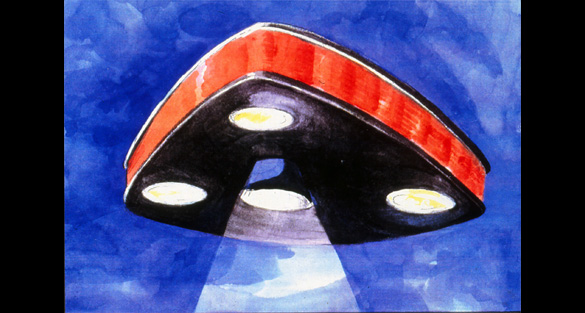
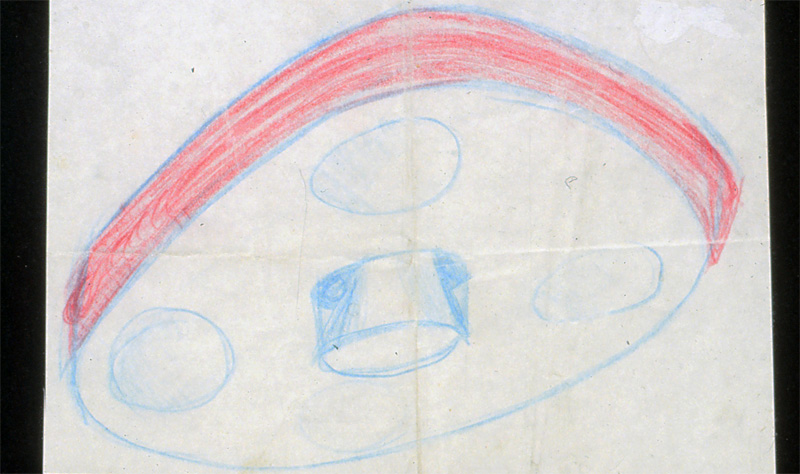
The classic triangular-shaped UFO described by hundreds of eyewitnesses during the Belgium wave: sketch by witness used to create reconstruction of the object seen at the top of story. 

Credit: SOBEPS

There were many reasons for the interest generated by the Belgian wave. One was the quality of the reports themselves, the bulk of which were registered in the French-speaking region of Wallonia. There were no landings or humanoid sightings but lots of detailed multiple-witness sightings of flying platforms moving slowly and silently above rooftops. Shapes varied, but the predominant form was triangular or delta-shaped crafts. Some of the descriptions were so precise that traditional explanations of misidentified natural phenomena or conventional aircraft were ruled out. Instead, stealth fighters and other U.S. secret military aircraft became the favorite explanations suggested by skeptics, but these were quickly ruled out by the Royal Belgian Air Force (RBAF). Another reason for the wave’s importance was that it was carefully investigated and documented by a local UFO organization called SOBEPS (Belgian society for the study of space phenomena).

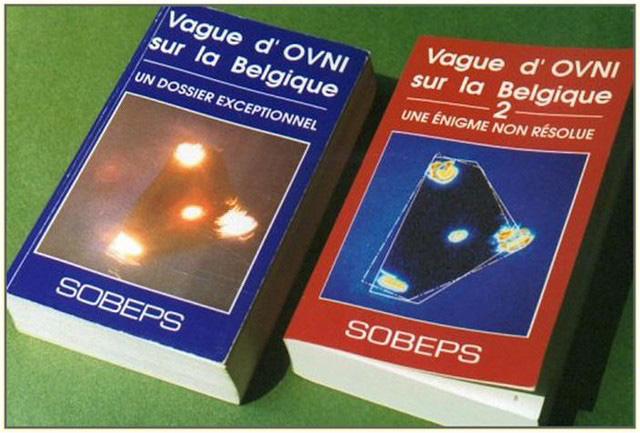
SOBEPS was formed in 1971 by Lucien Clerebaut, Michel Bougard, and others, and built a small but highly dedicated cadre of field investigators. By the end of the wave in 1993, SOBEPS had collected over two thousand eyewitness reports comprising twenty thousand pages, four hundred hours of audio tapes, and six hundred full inquiries. Five hundred and forty cases remained unexplained. SOBEPS also had the assistance of top-notch scientists, including Léon Brenig, a nonlinear dynamics theorist at the Free University in Brussels, and Professor Auguste Meessen, a physicist from Catholic University at Louvain. Regarding his work with SOBEPS, Dr. Brenig has said, “here is an opportunity where we can apply the scientific method.” Brenig himself became a witness of the so-called Belgian triangle while driving in the Ardennes on March 18, 1990. The whole dossier was eventually published by SOPEPS in two massive volumes, five hundred pages each, entitled Vague d’OVNI sur la Belgique (UFO Wave ver Belgium), published in 1991 and 1994 respectively. Due to financial difficulties, SOBEPS dissolved on December 31, 2007, but some of its members formed a new, smaller organization called COBEPS (Belgian committee for the study of space phenomena) to preserve the archives and work done for thirty-six years.

10-The-two-SOBEPS-volumes.jpg

The two volumes published by SOBEPS entitled, “UFO Wave Over Belgium.” Credit: SOBEPS

A final and key element in the credibility of the Belgian UFO wave was the participation and validation by the RBAF, which showed an unusual degree of openness. As the Belgian wave gained steam, the Belgian Ministry of Defence was deluged with queries from the public and the media. The task fell upon the chief of operations of the air force, Col. Wilfried De Brouwer, who was later promoted to major general and deputy chief of the RBAF. Now retired from the service, Gen. De Brouwer has continued to speak about the wave. He was one of the many international officials who spoke at the famous event at the National Press Club (NPC) in Washington, DC, in November 2007, organized by filmmaker James Fox and journalist Leslie Kean. “The Belgian UFO wave was exceptional and the air force could not identify the nature, origin and intentions of the reported phenomena,” said De Brouwer at the NPC. He also gave a detailed presentation on the wave at the MUFON International UFO Symposium in San Jose, California, in July 2008, and was one of five generals to write an essay in Leslie Kean’s new book, UFOs: Generals, Pilots, and Government Officials Go On the Record.

Although the RBAF scrambled jets on three occasions during the wave, Gen. De Brouwer has explained on various occasions that they didn’t have the manpower or resources to mount a full-fledged investigation of their own, so instead they took the unusual route of cooperating fully with SOBEPS. The radar data was turned to Prof. Meessen for analysis, and Gen. De Brouwer agreed to write the postface for SOBEPS’s first volume when he was still in the service. “I must acknowledge that I somewhat hesitated when SOBEPS asked me to contribute my share to this book,” he wrote. “Indeed, I am not a UFO specialist and, moreover, it is quite delicate for somebody who occupies an official function to put on paper his personal ideas on such a disputed issue. However, I estimate that I would not have been honest towards the SOBEPS if I had refused. The air force always played a fair game on this subject and I regard this postface as a complementary element to the exceptional file written by the people of SOBEPS.”

THE EUPEN INCIDENT

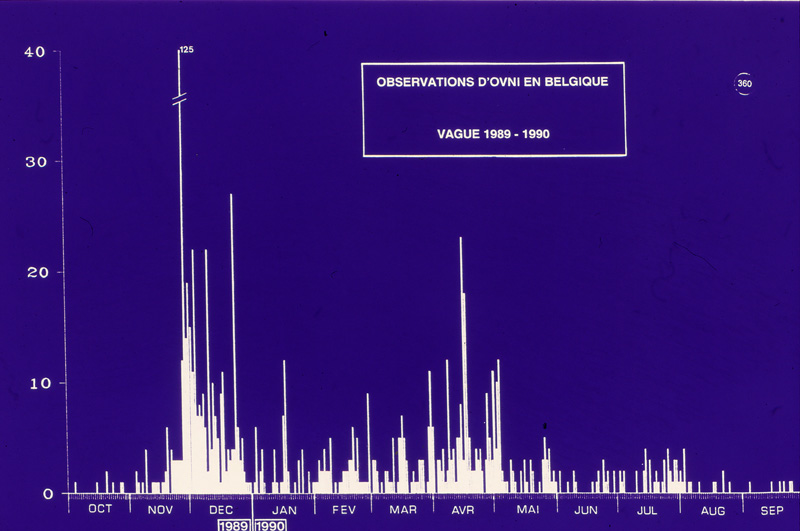
Although some sightings were reported in October 1989, the first important incident of the Belgian wave took place a month later on November 29 around the small town of Eupen, which is in a region of Belgium near the German border. This initial case put the so-called “Belgian triangle” on the map and led to the start of the RBAF’s involvement. There were both daytime and nighttime sightings, although the latter were lengthier and more detailed. Gen. De Brouwer explained in his essay for Leslie Kean’s book, “a total of seventy reported sightings made on November 29 were fully investigated and none of these sightings could be explained by conventional technology. The team of investigators and I estimate that approximately fifteen hundred people must have seen the phenomenon at more than seventy different locations from different angles during this afternoon and evening.” There were a total of thirteen gendarmes (policemen) who saw the UFO from eight different locations around Eupen. Prof. Meessen summarized the case in SOBEPS’s book:

On November 29, 1989, a large craft with triangular shape flew over the town of Eupen. The gendarmes von Montigny and Nicol found it near the road linking Aix-la-Chapelle and Eupen. It was stationary in the air, above a field which it illuminated with three powerful beams. The beams emanated from large circular surfaces near the triangle’s corners. In the center of the dark and flat understructure there was some kind of “red gyrating beacon.” The object did not make any noise. When it began to move, the gendarmes headed towards a small road in the area over which they expected the object to fly. Instead, it made a half-turn and continued slowly in the direction of Eupen, following the road at low altitude. It was seen by different witnesses as it flew above houses and near City Hall.

In his 2008 MUFON lecture, Gen. De Brouwer provided additional details on this sighting: “The UAP [Unidentified Aerial Phenomenon] emitted repeatedly and simultaneously two red light beams with a red light ball at the spearhead of the beam. Subsequently, the red balls returned to the craft.” There was also apparently a second triangular craft, which made “a forward tilting maneuver, exposing the upper side of the fuselage,” continued De Brouwer. “They [gendarmes] saw a dome with rectangular windows, lighted up at the inside. It then disappeared to the North.” Two more gendarmes saw one of the craft from a monastery nearby; “one is currently the head of the police in that area, he was scared like hell,” added De Brouwer.

3-Belgian-wave-chart.jpg

Statistical chart of Belgian sightings between October 1989 and September 1990, showing peaks in the November-December period and a second one in April.

Credit: SOBEPS

The Eupen incident was followed by many other UFO sightings, including several reported on December 11, 1989. One of the witnesses that evening was a personal acquaintance of Gen. De Brouwer, Col. André Amond, a civil engineer in the Belgian Army. Col. Armond worked next door to Gen. De Brouwer and wrote a detailed report for the Ministry of Defence. Col. Armond was driving with his wife around 6:45 p.m., when they noticed a strange object with flashing red lights. They stopped the car and got out to see it better. “Suddenly, they saw a giant spotlight, about twice the size of the full moon, which approached them to an estimated distance of 100 meters,” wrote De Brouwer, adding that “the colonel’s wife was frightened and asked to leave.” In his report to the Ministry, Armond “ascertained that this craft was not a hologram, helicopter, military aircraft, balloon, motorized Ultra Light, or any other known aerial vehicle.”

Various shapes were reported throughout the wave, including round, rectangular, and cigar-shaped, but the majority were triangular objects. Gen. De Brouwer notes that the differences may also be due to the eyewitnesses’ viewing angles. Researcher Marc Valckenaers listed some of the characteristics of the UFOs in SOBEPS’s second volume about the wave, including: irregular displacement (zig-zag, instantaneous change of trajectory, etc.), displacement following the contours of the terrain; varying speeds of displacement (including very slow motion), stationary flight (hovering), overflight of urban and industrial centers, and sound effects (faint humming to total silence).

4-Belgian-platform.jpg

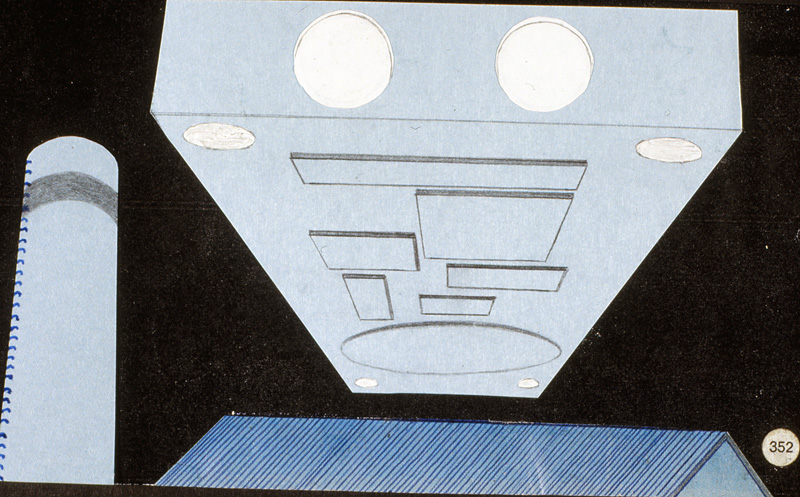
Reconstruction of the incredible rectangular flying platform seen by two factory workers on April 22, 1990, described as “an aircraft carrier turned upside down.”

Credit: SOBEPS

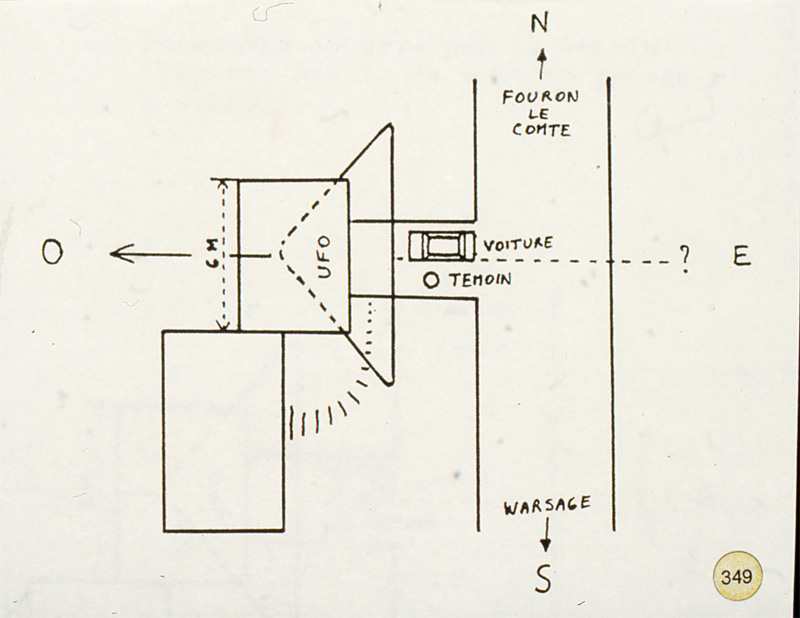
One of the strangest reports came from two factory workers from the town of Basècles, southwest of Brussels, who saw a huge trapezoid flying platform (330 x 200 feet) just before midnight on April 22, 1990. The object moved slowly and silently, covering the entire factory courtyard. In the SOBEPS report, the factory workers described the UFO as “an aircraft carrier turned upside down.” Despite the science-fiction quality of this sighting, an almost identical report was filed nearly a year later, on March 15, 1991, by an electronic engineer in Auderghem, near Brussels, who woke up in the middle of the night when he “heard a barely audible, high-frequency whistling tone. He looked out the window and saw a large rectangular craft at very low altitude with irregular structures on the bottom,” wrote Gen. De Brouwer.

5-Belgian-platform.jpg

One characteristic of the Belgian wave was how close the objects were flying above the rooftops, as shown with this flying rectangular platform.

Credit: SOBEPS

6-Belgian-platform-map.jpg

Another view of the rectangular flying platform above the rooftop and sketch showing where the witness saw it.

Credit: SOBEPS

THE F-16 SCRAMBLE EPISODE

If the Eupen multiple-witness sightings of November 1989 triggered the Belgian wave, the jet fighter scramble incident during the night of March 30, 1990 marked the peak of public interest and global media coverage. The Belgian Air Force had scrambled jets on two prior occasions without positive results. The December 5, 1989 scramble was unsuccessful; when the jet reached the sky, the UFO was gone. Additionally, the December 16, 1989 case turned out to be a false alarm; the authorities quickly determined that it was a laser projection reflected by a cloud layer. Following these two fiascos, the RBAF implemented a new policy that jets would be scrambled only when a sighting was detected on radar and was visually confirmed on the ground by the police.

7-SOBEPS-team-at-radar-base.jpg

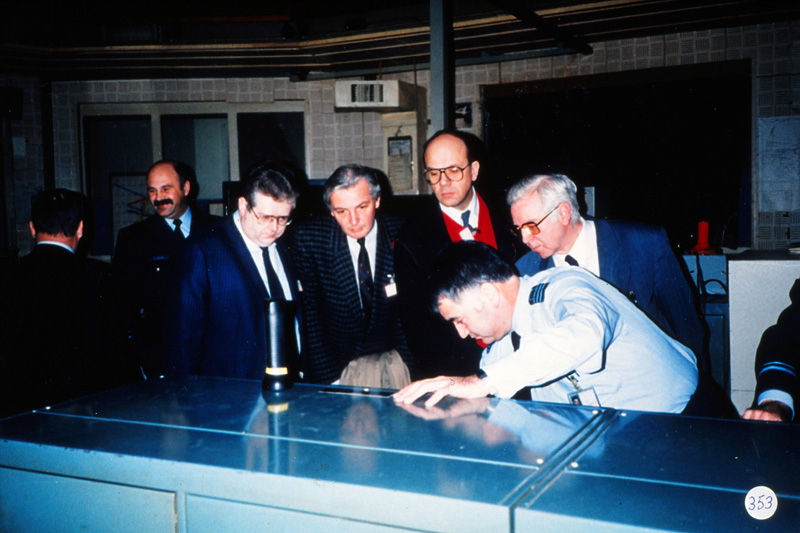
The SOBEPS team visiting the Royal Belgian Air Force radar facility at Glons: in the center group, left, the Society’s chairman Lucien Clerebaut and right, physicist Prof. Auguste Meessen, next to military officer.

Credit: SOBEPS

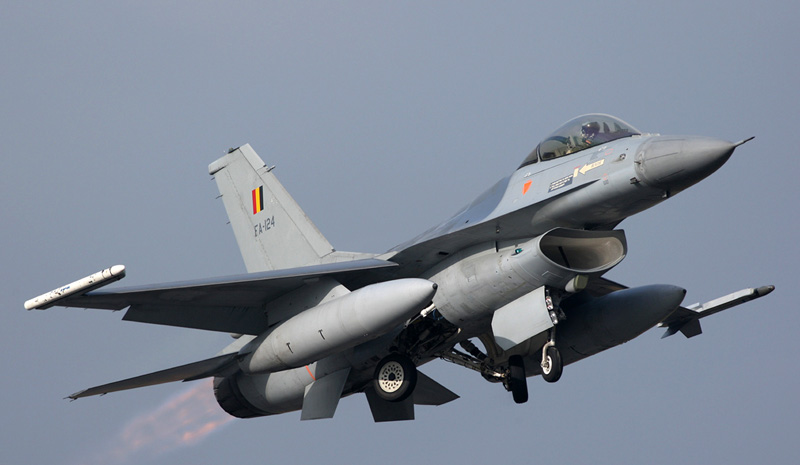
As put in a preliminary report prepared by Major P. Lambrechts of the RBAF, entitled “Report Concerning the Observation of UFOs During the Night of March 30 to 31, 1990,” the incident began at 10:50 p.m. on March 30 when the gendarmerie telephoned the radar “master controller at Glons” to report “three unusual lights forming an equilateral triangle.” More gendarmes confirmed the lights. When the NATO facility at Semmerzake detected an unknown target at 11:49 p.m., a decision to scramble two F-16 fighters was made. The jets took off at 12:05 a.m. from Beauvechain, the nearest air base, and flew for just over an hour. According to Major Lambrechts’s report:

The aircraft had brief radar contacts on several occasions, [but the pilots]…at no time established visual contact with the UFOs…each time the pilots were able to secure a lock on one of the targets for a few seconds, there resulted a drastic change in the behavior of the detected targets…[During the first lock-on at 12:13 a.m.] their speed changed in a minimum of time from 150 to 970 knots [170 to 1,100 mph] and from 9,000 to 5,000 feet, returning then to 11,000 feet in order to change again to close to ground level.

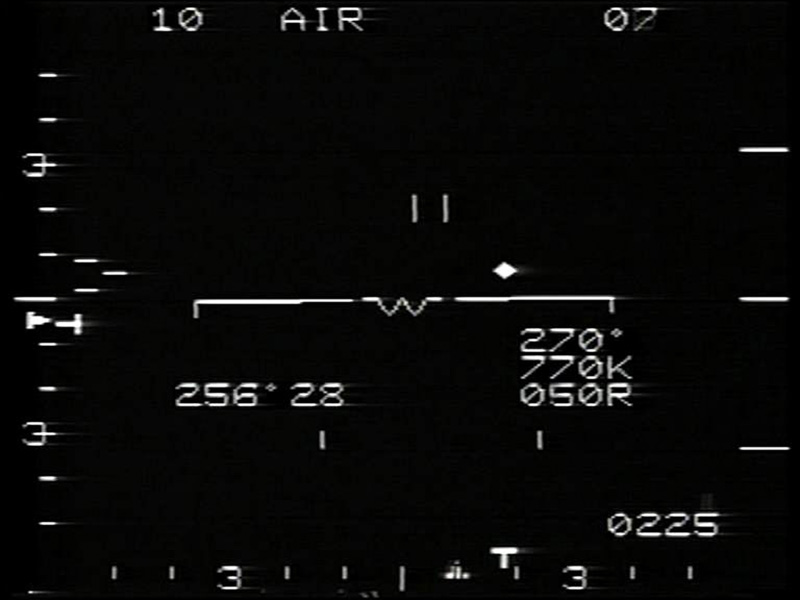
When Col. De Brouwer showed the computerized radar images of the UFO tracked by the F-16 onboard radar system in a heavily attended press conference at the Ministry of Defence on July 11, 1990, the international media went into a frenzy. Transcripts of the radio communications between ace fighter pilots, Capt. Yves Meelbergs, Lt. Rudy Verrijt, and the Glons Control Reporting Center near Liege, were also released and provide some dramatic moments. The transcripts paint a picture of the jets chasing ghost radar echoes that appear and disappear and then reappear again, but at no time are the pilots able to establish visual contact with the supposed objects. Belgium’s Electronic War Center (EWC) eventually undertook a detailed technical analysis of the F-16 computerized radar tapes, completed by Col. Salmon and physicist M. Gilmard in 1992, and later reviewed by Prof. Meessen.

15-F-16.jpg

An F-16 jet fighter of the Royal Belgian Air Force like the ones scrambled on the night of March 30-31, 1990.

Credit: Bernard Thouanel

Although some aspects of this case still remain unexplained, Meessen and SOBEPS accepted the Gilmard-Salmon hypothesis that most of the radar contacts were really echoes caused by a rare meteorological phenomenon. This became evident in four lock-ons, explained Meessen, “where the object descended to the ground with calculations showing negative altitude…. It was evidently impossible that an object could penetrate the ground, but it was possible that the ground could act as a mirror.” Meessen explained how the high velocities measured by the Doppler radar of the F-16 fighters might result from interference effects. He pointed out, however, that there was another radar trace for which there is no explanation to date. As for the visual sightings of this event by the gendarmes and others, Meessen suggested that they could possibly have been caused by stars seen under conditions of “exceptional atmospheric refraction.”

16-UFO-radar-image-1.jpg

One frame from the F-16 onboard radar system showing the UFO lock-on during the March 1990 scramble episode, shown by the RBAF at a famous press conference in July 1990.

Credit: RBAF/ Bernard Thouanel

In a 1995 telephone interview, Gen. De Brouwer summarized his reflections on this complex case: “We always look for possibilities which can cause errors in the radar systems. We can not exclude that there was electromagnetic interference, but of course we can not exclude the possibility that there were objects in the air. On at least one occasion there was a correlation between the radar contacts of one ground radar and one F-16 fighter. This weakens the theory that all radar contacts were caused by electromagnetic interference. If we add all the possibilities, the question is still open, so there is no final answer.” De Brouwer took a more detached view of the F-16 scramble episode, however, in his 2008 MUFON lecture and his 2010 essay included in Kean’s book: “The conclusion of the Air Force, therefore, was that the evidence was insufficient to prove that there were real crafts in the air on that occasion.”

THE PETIT-RECHAIN PHOTO

12-Petit-Rechain-photo-1.jpg

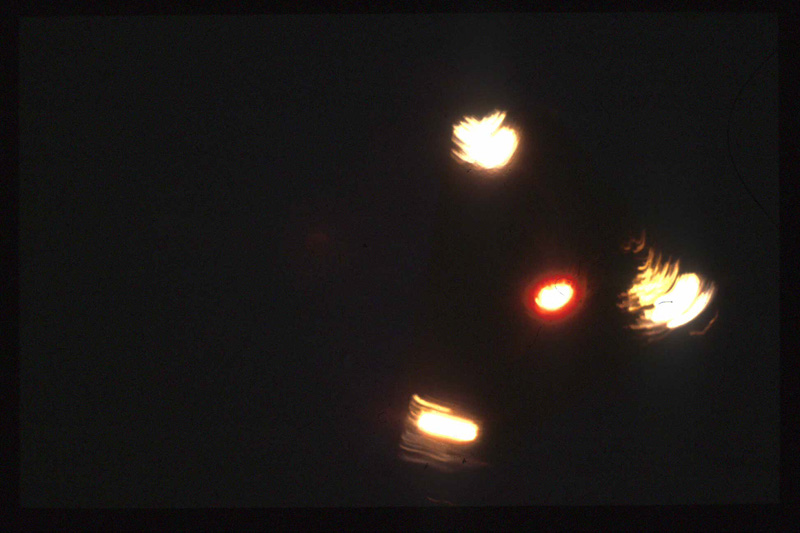
The famous color slide of the Belgian triangle photographed in Petit-Rechain in early April 1990.

Credit: © Guy Mossay/SOFAM

Seldom has the old saying that a picture is worth a thousand words become more true than in the case of the extraordinary photograph of a flying triangle taken in the small town of Petit-Rechain in April 1990. This color slide became the emblematic symbol of the Belgian UFO wave. It has been published and broadcast in television programs all over the world, and it appears on the cover of the two SOBEPS volumes on the Belgian wave. It’s also one of the most analyzed UFO photos in the history of ufology. During my trip to Brussels in 1995, I had the opportunity to talk at length with Patrick Ferryn, the investigator who researched the case initially and wrote the chapter about it in the SOBEPS book. Ferryn gave me copies of the photo and samples of computer enhancements made by Marc Acheroy, professor of electricity at the Royal Military School, where the image was analyzed by the Signal Treatment Center. The details of how the photo was taken are fairly simple and straightforward.

The photographer, P.M. (who wants privacy, but has fully cooperated with SOBEPS), was a twenty-year-old factory worker, who lived in the small community of Petit-Rechain, near Verviers. He was at home with his girlfriend on the night of either April 4 or 7, 1990 (he can’t pin down the exact date), when his girlfriend first noticed the object between 11:00 and 11:30 p.m. as she took the dog to the courtyard. According to P.M.’s statement to Ferryn, he was alerted by his girlfriend, went outside, and “saw the object practically stationary towards the southwest, at about a forty-five-degree elevation. It consisted of three white round lights on a barely perceptible triangular surface. In the center there was a blinking spot of the same color, or maybe a bit more reddish than the other lights.” P.M. grabbed his camera, a Praktica model BX20 with a 55-200 mm zoom and a “Cokin” 1A 52 mm skylight filter. He shot the last two frames of a roll of 36-200 ASA Kodak color slide film. The UFO then moved slowly towards Petit-Rechain, until it was hidden by the roofs in the village. The entire episode took about five minutes.

The roll of film was sent by mail to a development house offering a special discount, and when P.M. received the slides, he noticed only frame #35 had captured the UFO; frame #36 was entirely black. Ferryn estimated that “the photo was probably taken with a focal distance between 55 and 200 mm, and with exposition time ranging from 1 to 2 seconds.” P.M. showed the photo to his factory coworkers (all of whom were later interviewed by Ferryn), but otherwise didn’t do anything to analyze or commercialize the picture. One of his coworkers knew a local photo-journalist from Verviers, Guy Mossay, who immediately saw the image’s potential value. P.M. sold the photo rights to Mossay for a small fee. Mossay then proceeded to copyright it with SOFAM (Belgium’s multimedia society for visual arts authors).

Skeptics have naturally pointed to the possibility of a hoax with profit motive. However, if that is the case, why did P.M. sell the rights to Mossay for a minor fee? Moreover, hoaxers never supply original slides or negatives for scientific analysis, as was done by P.M. Having checked his background, interviewed acquaintances, and so on, Ferryn noted that “the account of the main witnesses was coherent.” Gen. De Brouwer spent quite a bit of time explaining the details of this case during his MUFON lecture, saying of the witness that, “this guy is genuine, he is a guy who would not fake at all, I can assure you of that.” More importantly, the Petit-Rechain photo has been subjected to more scientific analysis than practically any other UFO photo in history.

13-Petit-Rechain-photo-2.jpg

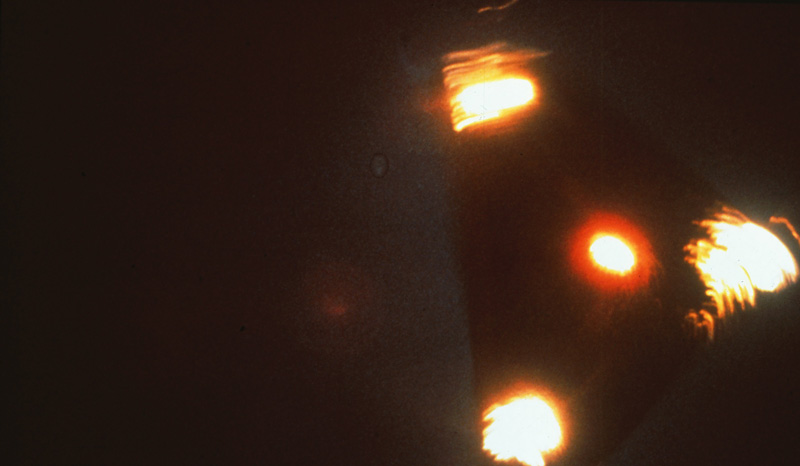
When the Petit-Rechain photo is overexposed, the triangular outline of the object appears clearly.

Credit: © Guy Mossay/SOFAM

The list of experts and institutions that have analyzed this photo include Prof. Acheroy of Belgium’s Royal Military Academy; Prof. François Louange, an expert in photo interpretation of satellite images for the French space agency, CNES; Dr. Richard Haines, a retired senior NASA scientist and respected UFO researcher; Belgium’s Royal Institute of Artistic Patrimony; and André Marion, a nuclear physicist with France’s National Center for Scientific Research (CNRS), who conducted an analysis in 2002 with improved technology. The technical details of these analyses are too numerous for this article, but suffice it to say that evidence of photographic trickery has never been found. Furthermore, of several efforts to duplicate the photo using a dark cardboard triangular model with holes and light bulbs, only one made by members of the Astrophysics Institute at Liege University somewhat resembled the Petit-Rechain photo. But the luminosity of the spots in the replica was uniform, while those in the original exhibited different shapes and spectral effects. The most recent CNRS study by Dr. Marion confirmed the previous analysis and found, as put by Gen. De Brouwer, a “halo around the craft with patterned structure,” which could have been caused by the object’s “propulsion system” of “magnetoplasma dynamic.” Marion also stated that “it would be extremely difficult to fake such a photograph.”

In the end, it’s almost impossible to guarantee the authenticity of a UFO image. There will always be a difference of opinions, but the verdict in the Petit-Rechain case appears highly favorable. Triangular UFOs were seen throughout Belgium during the early 1990s. Dozens of fuzzy videos and grainy photos were taken, but they were generally not impressive. Petit-Rechain was the great exception.

  • Note: Since the writing of this article, the photo turned out to be an admitted hoax.

NO EVIDENCE OF SECRET AIRCRAFT

Due to the high credibility of most witnesses in the Belgian wave and their descriptions of a silent, triangular craft being so precise, trying to explain the wave in terms of hoaxes, misidentified natural phenomena, or conventional aircraft seemed fruitless. Therefore, a number of skeptics and aviation journalists focused on trying to prove the hypothesis of secret U.S. aircraft flying over Belgium. A series of candidates were proposed, from the Airborne Warning and Control System (AWACS) to secret airships, from the F-117A stealth fighter to some other revolutionary U.S. secret military aircraft such as the alleged TR-3A Black Manta. First, you have to ponder why the U.S. would conduct tests of their most-secret aircraft in such a highly populated area like Wallonia, which is not only a U.S. ally, but also headquarters of the NATO alliance. Gen. De Brouwer put it bluntly in a 1991 interview with the French magazine, OVNI Présence: “Why would the Americans conduct tests here in Europe, without permission and with the risk of having an accident that could create a diplomatic incident on a global scale? This doesn’t involve only Belgium, but NATO, where its concept itself could be put in question. I don’t believe that the Americans could take such a risk, it’s evident.”

9-Gen-De-Brouwer-in-Washington.jpg

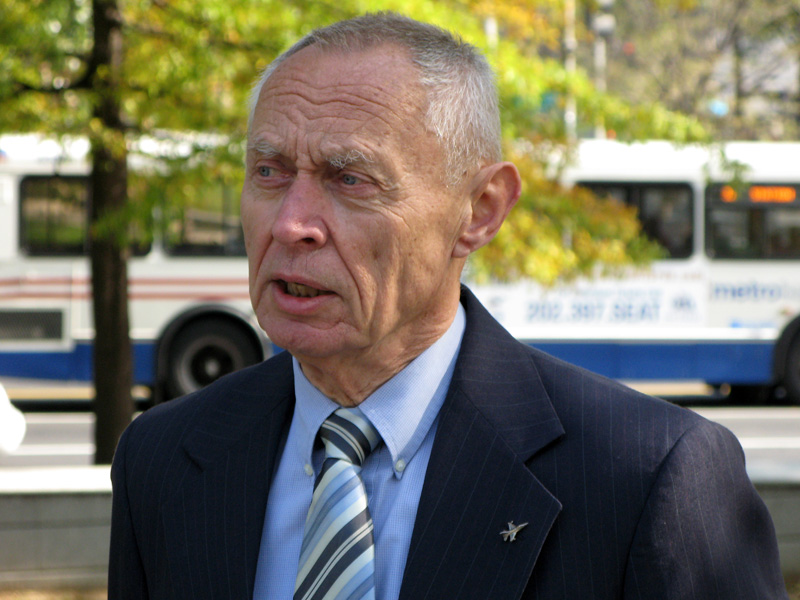
Major General (Ret.) Wilfried De Brouwer, who was the Royal Belgian Air Force point man for the UFO wave, during his trip to Washington, DC to participate at the National Press Club event in 2007.

Credit: Bernard Thouanel

Guy Coeme and Leo Delcroix, the two Belgian Ministers of Defence during the wave, denied emphatically the theory that the UFOs were actually U.S. aircraft and based their denial on official inquiries with the U.S. Embassy in Brussels. In a 1993 letter to French researcher Renaud Marhic, Minister Delcroix wrote: “Unfortunately, no explanation has been found to date. The nature and origin of the phenomenon remain unknown. One theory can, however, be definitely dismissed since the Belgian Armed Forces have been positively assured by American authorities that there has never been any sort of American aerial test flight.” A declassified 1990 document from the U.S. Defense Intelligence Agency (DIA) entitled, “Belgium and the UFO Issue,” supports Delcroix’s position. After describing the basic events of the wave that had transpired up to that point, the unnamed U.S. official wrote at the very end of this memo: “The [U.S. Air Force (USAF)] did confirm to the [Belgian Air Force] and Belgian [Ministry of Defence] that no USAF stealth aircraft were operating in the Ardennes area during the periods in question. This was released to the Belgian press and received wide dissemination.”

Thirty years have now passed since the Belgian UFO wave, and no new significant evidence has been produced to prove that the sightings were caused by secret military aircraft. The reported cases remain unexplained. It seems certain that something massive and technologically advanced flew over Belgian territory during the 1989-93 period. Why and who was behind it are questions that remain to be answered. A suitable conclusion, for now, is to repeat what Gen. De Brouwer wrote at the end of his famous postface to the SOBEPS’s first volume: “The day will come undoubtedly when the phenomenon will be observed with technological means of detection and collection that won’t leave a single doubt about its origin. This should lift a part of the veil that has covered the mystery for a long time. A mystery that continues thus present. But it exists, it is real, and that in itself is an important conclusion.”

11-AH-Clerebaut-at-SOBEPS.jpg

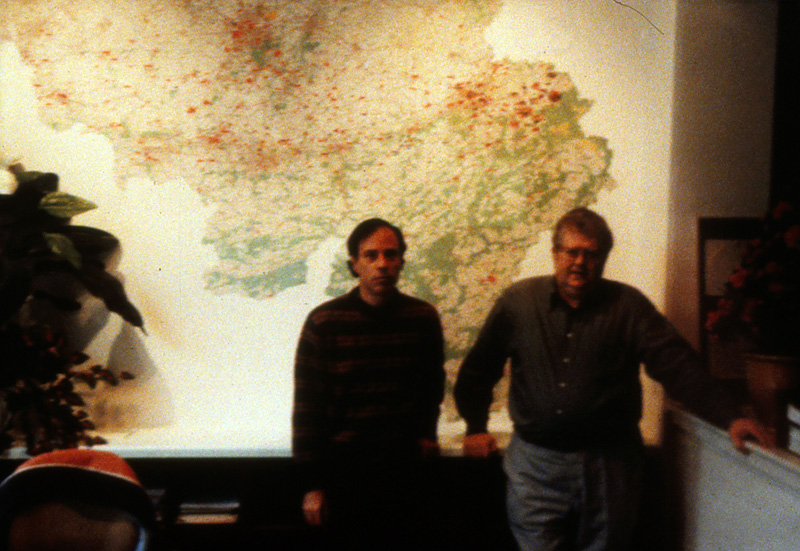
The author (left) with SOBEPS’ chairman Lucien Clerebaut at the Society’s headquarters in Brussels in 1995. The map in the background shows the locations of sightings in Belgium.

Credit: Antonio Huneeus

  • A version of this article originally appeared in Issue #5 (December/January 2011) of Open Minds UFO Magazine. Back issues can be found here.

Popular Posts:

{ http://www.openminds.tv/ }

Hoe vind je dit bericht?
Geschreven door peter om 01:54 Stuur door

Rojas Report: Luis Elizondo on DoD, the UAP Task Force and more

Rojas Report: Luis Elizondo on DoD, the UAP Task Force and more

Luis Elizondo, former head head of the Advanced Aerospace Threat Identification Program (AATIP), will join us to talk about recent developments. We’ll discuss the Department Of Defense’s announcement of the creation of a UAP Task Force, his History channel show Unidentified, the history of inaccurate statements made about him by the DoD and more.

For more information about TTSA visit: ToTheStarsAcademy.com

{ http://www.openminds.tv/ }

Hoe vind je dit bericht?
Geschreven door peter om 00:21 Stuur door

A Survivor at Roswell: The Truth About the One that Walked Away

9-ROSWELL-BURNED-CORPSE-2_FTR.jpg

A Survivor at Roswell: The Truth About the One that Walked Away

  • Don Schmitt has been one of the primary investigators of the alleged crash of a UFO in Roswell, New Mexico in 1947. He and his colleagues have tracked down hundreds of witnesses who claim to have information about what happened. When putting together the Roswell UFO crash issue of Open Minds Magazine in 2011, we asked Don to write us an article on the best evidence that an actual pilot of the alleged spacecraft survived. The following is the article he provided us for the magazine.

Ever since the Roswell crash of a flying saucer with “little men” inside, one specific rumor has persisted: that one of those “little men” actually managed to survive the ordeal. For most of the years since the 1947 Roswell crash and the subsequent weather balloon explanation, stories about mysterious bodies associated with the crash remained, but the very notion that Earth was indeed the host to a living extraterrestrial visitor was beyond the pale of belief. But, the question remained: Did an extraterrestrial survive that ill-fated night?

Eye-Witnesses’ Accounts of the Surviving Alien

Dan Dwyer

In 1947, Frankie Dwyer Rowe, a twelve-year-old girl, witnessed her father being threatened and warned by the military authorities for what he saw at the Roswell crash site. Her father, now deceased, was a crew chief for the Roswell Fire Department at the time of the incident. When the call came into the fire station that there had been an airship crash north of town, Dan Dwyer and Lee Reeves were dispatched with the station’s “tanker” (a pickup truck with a large cylindrical water tank in the back) to the crash site. The Chavez County sheriff and a couple of his deputies were also following up the rear in fast pursuit. Arriving just before the military would secure the scene, Dwyer and Reeves witnessed something totally unexpected. It wasn’t an airplane at all, but an egg-shaped vessel of some sort that they did not recognize.

And the bodies! Dwyer could see three diminutive humanoid beings lying in the lee of the craft. With his focus riveted on the craft and the bodies on the ground, Dwyer noticed a movement out of the corner of his eye. There, walking in front of him, seemingly from out of nowhere, was something right out of a science fiction novel. According to the fireman, it was about the size of a ten-year-old child, with grayish skin, no hair, and a large head and eyes. Within moments the roar of approaching vehicles could be heard as the military finally took charge of the entire affair. The two firemen were escorted away from the immediate area and warned of the consequences if they should ever speak of the incident. To further demonstrate the seriousness of what was witnessed, Dwyer and his family were paid a visit by military police that very evening at their home. Dwyer and his wife were physically threatened and were told that authorities would kill their children should they utter a word about what was witnessed earlier that day.

5-Dan-Dwyer-L-Roswell-Fire-Deparment-1950s.jpg

Roswell fireman Dan Dwyer (left) and his crew in the mid-1950s.

Credit: Don Schmitt

George Wilcox

The Roswell incident left an impact on all those involved, especially then-Roswell sheriff, George Wilcox. Just before Wilcox’s widow Inez passed away, she related a story to her granddaughter Barbara, who since passed on the story: “The event shocked [George]. He never wanted to be sheriff again after that. My grandmother said, ‘Don’t tell anybody. When the incident happened, the military police came to the jailhouse and told George and I that if we ever told anything about the incident, not only would we be killed, but our entire family would be killed!”’ Barbara adds, “They called my grandfather, and someone came and told him about the crash. He went out there to the site; there was a big burned area, and he saw debris. There were four space beings. Their heads were large. They wore suits like silk. One of the ‘little men’ was alive.” Inez Wilcox reiterated to Barbara that her and George took the threats very seriously and kept the information from the family.

Sergeant Homer G. Rowlette

2-Sgt.-Homer-Rowlette-1947-228x300.jpg

Sergeant Homer Rowlette in 1947. Gave a death bed confession of being part of the clean-up crew.

Credit: U.S. Army/Don Schmitt

Sergeant Homer G. Rowlette, Jr., was a member of the 603rd Air Engineering Squadron at the RAAF in 1947. He was a career military man and retired as an NCO after twenty-six years of dedicated service to his country. Before passing away in March 1988, he finally conveyed to his son, Larry the following startling information about his involvement with the “crash of the flying saucer.” Rowlette was part of a cleanup detail sent to the crash site north of Roswell. Larry was told that his father had seen everything. He handled the “memory material,” which according to Homer, was “thin foil that kept its shape.” If that wasn’t enough, he described the actual ship, which was “somewhat circular.” He also caught his son completely by surprise when he announced, “I saw three little people. They had large heads and at least one was alive!”

Master Sergeant Harry Telesco

Corroboration of Rowlette’s story has come from another member of the same squadron also stationed at Roswell at that time. Master Sergeant Harry Telesco had already passed away, when I located and contacted his family in 2007. According to his daughter, her late father had spoken many years ago of being at the crash site north of town and seeing the strange wreckage and little bodies there. He also testified that he had seen one that was still alive.

Richard Loveridge

In 1947, Richard Loveridge worked as a mechanical engineer for the Boeing Aircraft Company and was part of their crash-investigation team. When information came in about the crash of an aircraft outside of Roswell, Loveridge drove to the area believing it was one of their planes. It would not be until the last year of his life in 1993 that he would finally confess to his family about the true nature of the alleged “plane” crash. The Boeing crash investigator admitted that he “saw everything.” He saw the wreckage, which was not from a conventional aircraft, as well as three small, deceased “entities” and one that was still alive. Loveridge described them as “child-size” and “grayish” in color. He refused to elaborate any further to his family: “Don’t ask me any more about this. They can hurt you.”

Ervin Boyd

Ervin Boyd worked as a B-29 mechanic at the Roswell Army Airfield (RAAF) in 1947; he worked specifically in Hangar P3, which would later be known as Building 84. On the particular day in question, Boyd was taking a cigarette break on what he called a “hot summer day,” and the doors of the hangar were open on both ends of the building. As soon as he stepped outside the hangar doors, he observed a number of men and vehicles swarming towards the building. Startled by the situation, he quickly noticed that some of the men were carrying what he first thought was the body of a child. “Why didn’t they take it to the hospital?” he asked himself. As they passed by him, he was shocked to see that it was something else.

“It was child-size, four feet, maybe a little more, and a head that was larger than one on a normal body. The eyes were walnut-shaped and also larger than normal. From my angle, it didn’t look like it had much of a nose. The arms were a bit longer too, and the skin was ashy, gray and kind of scaly. I believe it was still alive.”

Suddenly, a number of officers grabbed Boyd and rushed him away from the area and started to get physically rough with him. One of them sternly stated, “Mr. Boyd, you didn’t see anything.” But, the civilian persisted. Finally, he was warned that if he ever said one more word, not only would he lose his job, but the lives of his wife and children would be at stake. It would not be until he suffered a stroke twenty-four years later that he would finally break his silence with his family.

8-ROSWELL-DEBRIS-FIELD-A.jpg

Army Roswell clean up crews from the Roswell movie.

Credit: Paul Davies

Joseph Montoya

That same afternoon, Monday, July 7, 1947, New Mexico’s newly elected thirty-two-year-old lieutenant governor, Joseph Montoya, was in Roswell. It is not entirely clear how the politician came to be on the base at the RAAF on the exact day as some of the bodies, including the possible survivor from the crash. One possible scenario is that he was there on Independence Day weekend for the dedication of a new plane, and after the ceremony he was escorted over to the B-29 hangar just as the first military vehicles were bearing down with their “out-of-this-world” cargo.

Montoya would confide to close associates that he had seen “four little men.” He described how small they were, along with the stunning fact that “one was alive!” Montoya painted the beings as, “short, only coming up to my chest. [They were] skinny with big eyes shaped like tear-drops. [The] mouth was real small, like a knife-cut across a piece of wood, and they had large heads.”

Next, he described the scene inside the hangar. Each of the little men, including the one that was alive, was stretched out on a table brought over from the mess hall and set up for that purpose. “I knew that one was alive because I could hear it moaning.” Montoya said that it was moving, with its knee bent and rocking back and forth

After a frantic exit from the hangar, Montoya was picked up and driven from the base by associates. Montoya would always warn that “It’s too dangerous to talk about.” Even years later, he would continue to caution that “the government will get you.”     

“Eli” Benjamin   

Another man who himself admits to having seen bodies was Elias “Eli” Benjamin (a pseudonym).  His wife told me much about the incident, but it would be several years before Eli would tell me himself. As a retired career U.S. Air Force man, Benjamin feared for his pension—and still does—if he ever talked about Roswell. Benjamin and his wife had come to the International UFO Museum and Research Center in Roswell in 2002 to see the exhibits. Against her husband’s wishes, Mrs. Benjamin stopped into the museum director’s office to tell someone about her husband. After hearing Mrs. Benjamin’s story, especially the part about bodies and the hospital, Julie Shuster, the museum director, felt that a private interview with Mr. Benjamin was warranted. It was soon apparent, however, that there was a major problem: Mr. Benjamin was nowhere to be found. He had left the building, when he observed his wife and the director looking around for him—he was a reluctant witness, to put it mildly.

1-Pfc-Eli-Benjamin-1947-205x300.jpg

Private first class Eli Benjamin in 1947. He escorted the bodies from hanger P-3 to the RAAF base hospital.

Credit: U.S. Army/Don Schmitt

Since that day, I have managed to track down the former member of the 390th Air Service Squadron and meet with him half a dozen times to try to gain his confidence. In the process, I learned that Benjamin’s main fear, similar to so many others who were and are reluctant Roswell witnesses, was his belief that he, as a retired air force veteran, might lose his pension if he said anything about those long-ago events. I assured Benjamin that I knew of no instances whatsoever of someone losing his pension for talking about Roswell. Besides, the secretary of the air force issued a proclamation in 1994 that absolved anyone with knowledge about the Roswell incident who believed that they were still subject to security or secrecy oaths regarding the matter. The other thing I noticed was that Benjamin was still deeply moved, if not troubled, by what he witnessed back in 1947, and he broke down in tears on several occasions when talking to me about it. His wife also revealed that her husband still has trouble sleeping comfortably and continued to wake up suddenly in the middle of the night, shaking. In 2005, the eighty-year-old Eli Benjamin agreed to tell his story.

In July 1947, Eli Benjamin was a private first class with the 390th Air Service Squadron at the Roswell Army Air Field. Possessing a top secret clearance, Private First Class Benjamin was authorized to provide security support for the most highly classified operations of the 509th Bomb Group—the first atomic-bomb wing in the world. In addition to his primary job of guarding the B-29 Bombers, one of his secondary duties was that of a recovery specialist, which involved the grim activities associated with the aftermath of plane crashes.

On the morning of Monday, July 7, 1947, Benjamin walked back to his barracks after a night of guard duty on the flight line followed by breakfast at mess hall.   “Something’s going on” he thought to himself, as he stood at attention and saluted the playing of the national anthem and morning flag-raising ritual at the base headquarters on the south end of the esplanade. He knew that the base commander, Colonel William Blanchard, normally held his weekly staff meetings on Tuesday mornings, but on this day, Benjamin thought there were too many staff cars and other vehicles parked in the headquarters parking lot for a regular staff meeting. When Benjamin finally arrived back at his barracks, “Word was given to my squadron to be on the alert for special duty,” he said. Such was life in the 509th and the Strategic Air Command and sleep after his long shift would have to remain a secondary consideration. The word finally found Benjamin: “Benjamin! Get your gun and report to hangar P-3 for guard duty.”

Upon arriving at the B-29 hangar to report to the officer in charge, Benjamin walked into a commotion at the main entrance of the building. A number of military police were trying to restrain the very officer from whom Benjamin was supposed to get his duty instructions. The lieutenant colonel was clearly experiencing an emotional reaction to the situation at hand, which seemed to be the transfer of a number of gurneys over to the base hospital. Another officer quickly pointed to Benjamin and ordered him to complete the assignment.

While in the process, something under one of the sheets covering each litter appeared to be moving. Then, as each of the stretchers was loaded into the back of a waiting ambulance truck, a sheet fell away revealing the grayish face and swollen, hairless head that clearly was not human.

9-ROSWELL-BURNED-CORPSE-2.jpg

Surviving Roswell alien from the Roswell movie.

Credit: Paul Davies

The military police orders were to deliver the cargo to the base hospital emergency room (Building 317) and remain there until relieved. Once at the medical facility, a half-dozen hospital personnel and men in suits took control of one specific gurney. All eyes were on the covered arrival as they removed the sheet from a being with an over-sized head, which had large, slanted eyes, two holes in place of a nose, and a slit for a mouth. For a number of moments all surrounding the patient just stood staring with mouths agape. It was alive. As the last of the gurneys was wheeled in, Benjamin and the other military police were immediately dismissed, sent back to their squadrons, and sworn to secrecy. They were told the incident never happened.

Sixty-three years after the event, the fog of time prevents Eli Benjamin from recalling the names or faces of the other men assigned to “escort duty” that day. They may well have been from other squadrons on the base or even from other bases brought in from outside (known as augmentation troops) to prevent the comparing of notes later on.

For her part, Mrs. Benjamin confirms her husband’s account of his involvement in the Roswell events of July 1947. She further states that he confided the story to her with the promise that she would never tell anyone else. Eli’s memories of that night—seeing the swollen face and slanted eyes of the “species”—remain with, and haunt, him to this day.

Roy Musser

Roy Musser happened to be at the base that afternoon. He was a civilian contractor painting part of the hospital. Working in the rear, where the loading dock area was located, he claimed to have seen the arrival of the small bodies and the “creature.” Apparently uninjured, he observed it walking and said it looked like a “very slender child.”

The military warned Musser that he was never to mention what he had seen to anyone or he and his family would be in jeopardy. Musser kept quiet for a number of years before relating the experience to fireman Dan Dwyer.

Miriam “Andrea” Bush

All military hospital administrators had their own secretary. In the case of Lieutenant Colonel Harold M. Warne, his was a twenty-seven-year-old civilian woman named Miriam “Andrea” Bush. Miriam was a graduate of New Mexico State College at Las Cruces, where she had majored in business administration. She also had a top security job at the base hospital. But none of her prior experiences prepared her for what she was about to see.

As she was performing routine duties at the hospital, Dr. Warne took her by the arm and quietly mentioned that she should accompany him to the examination room. Upon entering, she was immediately surprised to observe a number of bodies on gurneys in the middle of the room. At first she thought they were children based on their size. Their skin was grayish to brown in tone, and white linens covered most of each body. But the heads were too large to be children and had large staring eyes. All at once, one of them moved. Miriam would never forget what she had seen that day in Roswell.

4-Miriam-Pat-Bush-1980s.jpg

Miriam Bush and her sister-in-law Pat Bush in the 1980s. Miriam claims to have seen the alien bodies at the RAAF base hospital.

Credit: Don Schmitt

What Became of the Surviving Alien?

To date there remains no eyewitness testimony as to what ultimately became of the survivor and how it was transported from Roswell. There is reliable information, however, that the being did spend some time at Wright Patterson Air Force Base and was still there up to nine months later in 1948.

6-Wright-Field-1947.jpg

Wright Field, 1947, where the survivor from Roswell was reportedly taken for study.

Credit: U.S. Army/Don Schmitt

While on his deathbed in 1997, Lieutenant Colonel Marion Magruder, a highly decorated World War II flying ace, swore to his five sons that, while with the War College, he was assigned to Wright Patterson Air Force Base in April 1948 and allowed to briefly see the “live alien” at that time. He and the others in his company were instructed that the being was recovered from the crash in Roswell just the year before. His description was similar to all the other eye-witnesses. He emphasized that there was no question that it “came from another planet.”

As one of the personnel at the RAAF once remarked, “They sure weren’t from Texas.” And in the same vein, they weren’t from Japan, Germany, or anywhere else on Earth. That is one issue all of the witnesses remain unanimous on.

Popular Posts:

{ http://www.openminds.tv/ }

Hoe vind je dit bericht?
Geschreven door peter om 23:58 Stuur door

Alleged UFO Crashes in the U.S. other than Roswell: Aurora, Aztec, d Kecksburg

x-files-ufo-crash.jpg

 Alleged UFO Crashes in the U.S. other than Roswell: Aurora, Aztec, d Kecksburg

Aurora, Texas, 1897

4-Steve-Schowiak-A-windmill-on-an-abandoned-ranch-in-Central-Texas-198x300.jpg

An abandoned windmill in Texas, similar to the one described n the UFO crash.

Credit: Steve Schowiak

In 1896 and 1897, news of mysterious airship sightings was sweeping the nation. Many of these reports were similar to modern UFO sightings and consisted of strange lights darting around the sky. Other stories, however, referred to giant dirigibles (lighter-than-air aircraft). Even though there were a few inventors building dirigibles at the time throughout the world, for the most part, this explanation has been dismissed. There were no known successfully built dirigibles in the United States. The descriptions were also often much larger and flew much faster than the experimental blimps of this era.

Some witnesses reported seeing human-looking occupants in the airships. A few newspapers, including The Washington Times, went so far as to speculate that these were visitors from Mars. One of the last reports of mysterious airships was the curious report of S.E. Haydon in the Dallas Morning News on April 17, 1897. In his article, Haydon claimed that witnesses spotted an airship at 6 a.m. in the town of Aurora, Texas, on April 16. It flew low to the ground, descending until it finally collided with a windmill on the property of Judge J.S. Proctor. The collision resulted in a massive explosion, “scattering debris over several acres of the ground, wrecking the windmill and water tank and destroying the judge’s flower garden.”

According to the article, the townspeople were surprised to find the pilot’s body among the debris. It appeared to “not [be] an inhabitant of this world.” The local signal service officer speculated that he was from Mars. They also allegedly found papers containing strange hieroglyphics, which they assumed comprised a journal of the pilot’s travels. They were unable to determine the craft’s method of propulsion, but they did recover metals that appeared to be a mixture of aluminum and silver.

Haydon_article_Aurora_Texas_UFO_incident_1897.jpg

Original newspaper article describing the incident, by S. E. Haydon, “A Windmill Demolishes It,” The Dallas Morning News, April 19, 1897, p. 5.

Nearly seventy-six years later, the Mutual UFO Network (MUFON), decided to take a closer look at this UFO legend. By then, rumors had circulated that Haydon had fabricated the entire story. When Haydon wrote the story, the town of Aurora was reeling from a string of bad luck. Several residents had died from typhoid that winter, cotton crops had failed, and a railroad planned for the city had gone broke. It was believed that Haydon, a local cotton buyer, created the story to try and breathe some new life into the town. MUFON investigators found surprising evidence; however, that supported the idea that something extraordinary may have taken place.

According to MUFON’s report, Texas state director, Bill Case, found two individuals who testified that their parents had witnessed the events described by Haydon in his article. The first was Mrs. Mary Evans, who says that she was fifteen-years-old when her parents went to the crash site and when they returned home, described to Mary the explosion and the small man who was killed in the crash. She recalled they had informed her the townsfolk buried what was left of the pilot in the local cemetery. The other witness was Charlie Stephens, whose father said he had seen the crash, which caused a massive fire that could be seen for three miles.

Using the witness testimony, MUFON investigators found what they believed to be the site of the crash. Radiation levels were checked and were typical for the area. The investigators found metal fragments with metal detectors that indicated something had crashed and spread debris over a two-or-three-acre area east of where the windmill was located. One-piece, in particular, caught their attention.

The mysterious piece of metal was found beneath four inches of soil and appeared to have been in a molten state when it penetrated the Earth and smashed against a limestone rock where it was found. Under analysis, the metal was determined to be a very pure form of aluminum alloy, oddly devoid of traces of copper, which is typically seen with this sort of manufactured aluminum. It had also gone through a heating-and-cooling stage consistent with that of an explosion.

The next part of MUFON’s investigation was to find the remains of the UFO pilot. They located a headstone with a triangle and some circles carved into it, possibly an etching of the craft. The metal detectors also alerted to metal below the surface at this location. Paperwork was submitted to exhume the body, but townsfolk vehemently denied the request and asked that researchers not enter the cemetery. Soon after MUFON’s investigation, the headstone disappeared altogether, leaving the location of the grave unknown.

In an article published in the Houston Chronicle in 2007, Aurora business owner Karen Tedrow said she understood the townspeople’s reluctance: “My parents are buried there, and I don’t want them digging around. Earthly body or not, they ought to let it rest in peace.”

In the end, MUFON investigators determined that there was more to the story than previously believed and that they had found “sufficient evidence to cast reasonable doubt on the hoax theory.”

Aztec, New Mexico, 1948

Another famous alleged UFO crash case occurred in March 1948 in the remote town of Aztec, New Mexico, in the northwest corner of the state. This story began with the publishing one of the first UFO books, Behind the Flying Saucers, written by Frank Scully in 1950.

Scully was a writer for the entertainment magazine Variety. He says some of his Hollywood friends recommended that he get in touch with Silas Newton, a successful oilman, who had some interesting UFO crash stories. Newton shared his stories with Scully and explained the electromagnetic nature of the propulsion of crashed UFOs. Newton, along with an anonymous scientist referred to as Dr. Gee, became the primary source for Scully’s book.

behind-the-flying-saucers-book-cover.jpg

According to Newton and Dr. Gee, advanced radar stations in New Mexico caused the crash of a disc-shaped UFO near Aztec. The craft was mostly intact with just a puncture near one of the windows. Scientists, including Dr. Gee, who were first to arrive on the scene, saw bodies inside the craft. Without visible doors on the object, the scientists were eventually able to get into the craft by sticking a pole inside and pressing a button on a wall that opened a hidden door.

Inside, the scientists found sixteen charred bodies of beings that were humanoid in form but only three-to-four-feet tall. They appeared to have been killed by a fire inside the craft. The craft was made of a solid material that looked similar to aluminum and was very lightweight. Eventually, the aircraft was disassembled and taken to Wright Patterson Air Force Base in Dayton, Ohio, which is often rumored to be the home base for recovered extraterrestrial objects.

Once Scully’s book was published, it quickly became a bestseller. However, doubts about the credibility of the main witnesses began to surface. J.P. Cahn, a freelance reporter, wrote an investigative piece for True magazine, claiming that the whole book was based on lies. Cahn claimed that he could prove that the metals Newton was purporting to be from an alien spacecraft were just a standard grade of aluminum used in pots and pans. He also said that he discovered the true identity of Dr. Gee.

According to Scully, Dr. Gee was a very accomplished scientist, with “more degrees than a thermometer.” However, Cahn discovered that Dr. Gee was a business associate of Newton’s by the name of Leo GeBauer. GeBauer owned a radio-and-television-parts company in Phoenix, Arizona. Although technologically inclined, GeBauer did not have the myriad of degrees claimed in Scully’s book. Scully’s response to this accusation was that GeBrauer was only one of many scientists represented by Dr. Gee in the book.

Cahn also uncovered that, although never formally charged, Newton had been accused of making false claims regarding stocks and oil prospects. Cahn believed that Newton and GeBrauer conned Scully into accepting their story to convince investors that they had access to secret alien technology capable of finding oil fields.

All of this has tarnished Scully’s book; however, there are UFO investigators who believe they have found evidence that supports the Aztec crash happened, including FBI documents. One such report can be found in Timothy Good’s book, Above Top Secret. In the book’s appendix, there is an FBI document from March 1950 that includes the report of an air force investigator on rumors of a crashed “flying saucer” discovered in New Mexico with three small bodies inside. It says the crash was the result of nearby “very high-powered radar.” Skeptics believe that Newton and GeBrauer had been peddling this story everywhere, and it eventually got back to the air force and the FBI.

Researchers Nick Redfern and Scott Ramsey obtained additional FBI documents regarding the Aztec crash. Ramsey says that these documents describe Newton as a very successful businessman and philanthropist. Although Newton told some tall tales to his investors, Ramsey says the investors seemed to be mostly happy with Newton’s results.

Ramsey has also been able to unearth alleged witnesses to the actual crash. Ken Farley claims he was driving from Durango, Colorado, to San Diego, California, on March 25, 1948, when he stopped outside Aztec to visit a friend. Having heard recent talk of emergency vehicles headed into the desert, Farley and his friend decided to check out what was going on. They arrived at a mesa with a large disc sitting next to it. There were several oilfield workers and a couple of police officers at the scene. They described an object much like the one Scully had written about, which appeared to be undamaged. Police eventually asked them to leave.

Another witness was nineteen-year-old Doug Noland, a gas company employee. He says that on that day, he had picked up his boss, Bill Ferguson, and drove to the desert to put out a brush fire. When Noland and Ferguson arrived at the scene, oilfield workers that were already on the scene told them that the fire was under control and showed them a mysterious large disc-shaped object.

Ramsey says he started as a skeptic, but twenty years later is still finding evidence that convinces him there may be something more to the crash at Aztec, New Mexico.

Kecksburg, Pennsylvania, 1965

On December 10, 1965, newspapers across the country reported events that took place the prior evening. Witnesses from Pennsylvania to Illinois, and even as far north as Canada, reported seeing a fireball race across the sky. In Pennsylvania, Ohio, and Michigan, debris was reported falling from the fiery object. Outside of Kecksburg, Pennsylvania, witnesses reported a flash of light and a fire in the nearby woods.

On the evening of December 9, Robert Gatty, writer for the Tribune-Review out of Greensburg, Pennsylvania, was asked to report on an alleged UFO crash site in a forest outside Kecksburg. When he arrived, Gatty found the area was roped off by police expecting the arrival of “Army engineers and, possibly, civilian scientists.” Gatty claims that police threatened to arrest him if he proceeded into the forest. He reported that the roads were jammed with curious spectators and news reporters.

One of the other newsmen on location was John Murphy, the news director for one of the local radio stations, WHJB. According to his wife, Murphy arrived before the authorities, took pictures, and recorded some witnesses’ audio interviews. He would later put this all together in a radio documentary called Object in the Woods. Murphy later told listeners that he left out some conversations because the witnesses feared reprisal by the police or the army. Murphy’s wife and a coworker both have since said Murphy was visited by men claiming to be with the government. They confiscated some of his recordings and photographs.

To this day, the military maintains that it did not find anything in the forest that night. Nonetheless, Stan Gordon, a local UFO researcher, has gathered several witnesses who attest to the event and the object. Witnesses at the scene reported seeing an acorn-shaped object in the forest that was the size of a “Volkswagen.” Some witnesses later reported seeing the army hauling the tarp-covered object away, revealing only the lower lip of the object. Others reported a band of strange hieroglyphs around the base of the object.

7-im001895.jpg

This acorn shaped UFO was created as a prop for a TV show and is now on display in Kecksburg.

Credit: Kecksburg Volunteer Fire Department

Some scientists have speculated that the object was just a meteorite seen in Lake Erie’s vicinity that night. Russia’s Cosmos 96 space probe re-entered the atmosphere over Canada that day, and some have speculated that this is what landed in the woods. Witnesses claimed that the object changed direction several times before slowly falling in a downward trajectory towards the forest. Neither a Russian space probe nor a meteorite would change directions.

In 2002, inspired by Gordon’s work, the Syfy channel decided to investigate the Kecksburg case and, to do so, enlisted the help of journalist Leslie Kean. Together, they formed the Coalition for Freedom of Information (CFI). According to Kean’s report on the CFI website, the team set out to obtain official documents from NASA using the procedures allowed under the Freedom of Information Act (FOIA). In doing so, the CFI team was determined to “not accept the usual ‘no records’ responses” that are usually given for such requests.

Their initiative caught the attention and support of President Bill Clinton’s then Chief of Staff, John Podesta. He joined a press conference held by the Syfy channel on October 22, 2002, in which the CFI announced the efforts to obtain NASA files on the Kecksburg incident. Podesta stated before the press,

I think it’s time to open the books on questions that have remained in the dark on the question of government investigations of UFOs… It’s time to find out what the truth really is that’s out there. We ought to do it because it’s right; we ought to do it because the American people quite frankly can handle the truth; and we ought to do it because it’s the law.

John-Podesta-Center-for-American-Progress.jpg

John Podesta

Credit: Center for American Progress

The CFI focused on obtaining records from NASA instead of the air force or army because Gordon had previously received files from NASA, indicating that there were more files yet to be uncovered. In particular, CFI pursued the “Fragology Files,” which were described as “reports of space objects’ recovery, [and] analysis of fragments to determine national ownership and vehicle origin.” NASA responded that the files were destroyed, and, in a separate letter, NASA claimed that the records had been missing since 1987.

NASA continued to stall and claim that it had no relevant files, even files that had already been retrieved by Gordon. The CFI appealed the NASA responses and won, but NASA continued to stall. The CFI was then forced to sue and announced its intentions at a press conference on October 21, 2003. NASA finally agreed to send specific files, but only sent unhelpful pieces of information. CFI continued to pursue the lawsuit.

During this time, the chief scientist for orbital debris at NASA’s Johnson Space Center, Nicholas Johnson, reviewed whether the Kecksburg incident could have been a human-made object that simply re-entered the Earth’s atmosphere. In an interview on October 10, 2003, he told Kean, “I can tell you categorically, that there is no way that any debris from Cosmos 96 could have landed in Pennsylvania anywhere around 4:45 p.m.” Kean’s report demonstrates that “Johnson’s data shows that no man-made object from any country entered our atmosphere and landed in Pennsylvania on the afternoon of December 9.”

Although Johnson made strong statements to the contrary, in 2005, NASA spokesman David Steitz told the Associated Press that “the ‘UFO’ [Kecksburg object] was a Russian satellite, but government records documenting it have been lost.” This response was particularly strange in part because NASA had said that it did not even investigate the Kecksburg case. So, where did Steitz get this information? Kean tried to follow up with Steitz to clear up these discrepancies but could not obtain any particularly useful explanation.

8-kecksburg-1.jpg

Illustration of the UFO described by witnesses. Credit: Michael Schratt

Finally, after being tied up in court for two years, the final hearing on the CFI’s case against NASA occurred on March 20, 2007. U.S. District Court Judge Emmet Sullivan, clearly dissatisfied with NASA’s conduct in the case, reprimanded NASA’s attorney and, at one point, stated, “heads should roll” at NASA, and “I can sense the plaintiff’s frustration because I’m frustrated. It’s totally frustrating.” Judge Sullivan ruled in favor of the CFI and required NASA to pay for all legal fees for the case, to reexamine the files, and declassify relevant documents if necessary, explaining any redactions.

NASA sent more files to Kean, but none of them pertained to the Kecksburg incident. NASA searched hundreds of boxes. Kean feels that NASA made a genuine effort in the end, but that the filing systems were so weak that it was difficult to find anything. She concluded, “In summary, we’ll never know whether any documents in the missing or destroyed boxes might have shed light on the Kecksburg incident, even if only by providing a small lead that could open doors for researchers. It only takes one page to change everything.”

  • A version of this article originally appeared in Issue #8 (June/July 2011) of Open Minds UFO Magazine. Back issues can be found here.


Popular Posts:

Related videos, selected and posted by peter2011

{ http://www.openminds.tv/ }

Hoe vind je dit bericht?
Geschreven door peter om 01:14 Stuur door

Presentation: Steven Spielberg, Ufologist

Presentation: Steven Spielberg, Ufologist

Phoenix MUFON Online Speaker Series Steven Spielberg: Ufologist – Livestream presentation by Alejandro Rojas

Close Encounters of the Third Kind was one of Spielberg’s first hit movies. What you may not know is that Spielberg based the film on real UFO research conducted by the government and its famous astronomer consultant, Dr. J. Allen Hynek. Close Encounters is also not the only movie of Spielberg’s inspired by real alleged UFO and alien encounters. In this lecture, I cover the incredible cases that influenced many of Spielberg’s films, the rumor he was given a unique insight into UFOs by President Ronald Reagan, and his connection to a UFO presentation at the United Nations and the recent revelation that the Pentagon has a secret UFO investigation project. Spielberg, the self-proclaimed Ufologist, knows much more about UFOs and aliens than he lets the public to know.

For more information about Phoenix MUFON visit: http://www.phoenixmufon.com/

Popular Posts:

{ http://www.openminds.tv/ }

Hoe vind je dit bericht?
Geschreven door peter om 01:29 Stuur door

Interview with Col. Aerial Sánchez of the Uruguayan Air Force UFO Commission CRIDOVNI

1b-Col-Sanchez-2-ftr.jpg
Interview with Col. Aerial Sánchez of the Uruguayan Air Force UFO Commission CRIDOVNI

Integrating the Latin American Official Commissions

An Exclusive Interview with Colonel (Ret.) Ariel Sánchez, a veteran of the Uruguayan Air Force’s UFO Commission CRIDOVNI

By J. Antonio Huneeus & Yohanan Díaz Vargas

The Uruguayan Air Force Colonel (Ret.) Ariel Sánchez is one of the most experienced official UFO investigators in the world. He joined the Uruguayan Air Force’s CRIDOVNI (Spanish acronym for Commission for the Reception and Investigation of Reports of Unidentified Flying Objects) in 1989 when he was a captain. Since then he served the Commission in multiple ways as investigator, secretary, president, and now technical director, a position he has held since retiring from active duty in the air force in 2012.

Colonel Sánchez has also been CRIDOVNI’s international face and has appeared many times at national and regional conferences, both officially in uniform and as a private citizen and investigator. We caught up with Colonel Sánchez recently at the IV Global UFO Forum and UFO Summit of the Americas held in Foz de Iguaçu, Brazil, in December 2012.

In 1979, Uruguay was the first South American country to establish an official UFO agency. Other countries in the region eventually followed the Uruguayan model, and various agencies or departments were started in Chile, Peru, Ecuador, and Argentina. Colonel Sánchez addressed the issue of cooperation among these agencies, as well as CRIDOVNI’s integration of civilian investigators into an official commission, a model that was recently followed in Argentina.

4-Col-Sanchez-with-OM-mag.jpg

Colonel Sánchez with a copy of Open Minds magazine.

Image credit: J. Antonio Huneeus

J. Antonio Huneeus (AH): Colonel Sánchez, can you please tell us a little bit about your military background and how you became involved with CRIDOVNI?

Ariel Sánchez (AS): Well, I entered the air force in 1976, and in 1986, I graduated as a second lieutenant of the Uruguayan Air Force. Later, I became specialized in air traffic control with radar and in aviation security. Around 1989, I was asked to join the Commission for the Reception and Investigation of Reports of Unidentified Flying Objects (CRIDOVNI) of the Uruguayan Air Force, as secretary of the Commission and as an investigator. So, beginning in 1989, I joined the Commission to which I still belong. I was the president, and currently am the technical director.

AH: Why don’t you explain a bit about how and why the Commission was created?

AS: During the 1960s and 1970s there were many reports of UFOs in the skies of South America. Uruguay was not isolated from this, and the air force began to learn about the reports. Then, in 1979, the Uruguayan Air Force took charge of the investigation of UFO reports made in Uruguayan territory. In the 1960s and 1970s, many sightings of these objects had occurred, and people were becoming nervous about strange things in the sky with no idea as to what they might be. Since the Uruguayan Air Force is charged by law for the control and oversight of its airspace, it decided to form a group, a Commission, to receive and investigate these reports. The Commission has existed for thirty-three years.  During this time, it has experienced uninterrupted work, taking and investigating [UFO] reports with the support of the civilian personnel integrated to this Commission, and with the backing of state institutions like universities, technological labs, faculties, municipal planetariums, and so on—a variety of state agencies supporting the work of the air force and the civilian personnel linked to it.

AH: What is involved in an investigation?

AS: Well, usually what happens is that when something strange is seen in the skies, people go to the media or to the police to report what they saw. The air force is notified about it and makes contact with the press or the police in order to obtain more data, and then begins the tasks of investigating, going to the site, interviewing the witness, and taking soil samples if necessary, like in cases in which the ground was affected. A general survey of the area is made in order to discard terrestrial explanations such as aircraft traffic, astronomical phenomena, satellites, fallen space junk, military maneuvers, or exercises in which flares are used.

After the initial survey, the investigator is usually left with five questions he must pose to himself: What is the possibility of fraud by the witness?  What is the possibility of fraud by a third person not linked to the witness?  What is the possibility of a psychological phenomenon by the witness?  What is the possibility of a conventional phenomenon which was not identified by the witness, for example, an aircraft passing by? And, finally, what is the possibility of an unconventional phenomenon?  This last question is the most interesting because when one is left with the unconventional answer, then one must start working specifically with the data collected, and see if there is additional evidence that the witnesses can supply like photos or videos that can back the testimony.

Yohanan Díaz Vargas (YD): What is the most interesting case investigated by the Commission?

AS: The CRIDOVNI data bank has approximately twelve hundred cases that were investigated.  That doesn’t mean there weren’t more cases, but sometimes the reports received are so vague that they don’t deserve a full investigation. Anyway, within those cases we have three percent that have not been solved—these are the cases we refer to as unconventional or simply, UFOs.

Among these, I can tell you about military pilot cases in which UFOs were chased in flight attempting, albeit unsuccessfully, to get close to the objects in order to identify them. There are also cases in which the aircraft was affected, i.e. cases in which the control panel of a military transport plane carrying passengers had a burnt smell from unexplained overheated. We also have cases of civil aircraft which were followed by nocturnal lights that couldn’t be identified. These are some of the more weighty cases that we have . . . These cases have an eighty percent probability of an unconventional phenomenon, which is very high.

YD: On CRIDOVNI’s website, there is an old photograph of a football (soccer) stadium in which there is a strange object. Can you tell us the details?

6a-foto-estadio-Centenario.jpg

The famous photo taken during a match of the First World Cup at the Centenario Stadium in Montevideo in 1930, showing a possible UFO right on the photo’s left border.

Image credit: CRIDOVNI

AS: That photo was taken in 1930 when Uruguay was playing a game during the first World Cup in Montevideo, in the Centenario Stadium. It wasn’t until 1985, when someone doing research on the history of Uruguayan soccer found the plate (back then glass plates were used for photo negatives), and when he examined the plate, he saw a small object shaped like a flying saucer in a corner of Centenario Stadium. So, this fellow went to one of the biggest newspapers in Uruguay and told them the story. The newspaper published it in 1985 with the headline, “A UFO in the Centenario Stadium in 1930.” Apprised of the fact, the Commission went to work, and we located a relative of the original photographer, who explained that in reality it was an auto-inflated cover with a balloon attached by a cord to one of the tribunes, which belonged to a well known company from that time that publicized sales of car covers in that way. And sure enough, when one enlarges the glass plate, you can even see the name of the company that made this type of publicity—thus this case was resolved as something conventional fifty-five years later.

6b-foto-estadio-Centenario-det.jpg

Enlargement of the object made from the original photographic glass plate.

Image credit: CRIDOVNI

UFO Ground Traces in Durazno Department

AH: The other case that I am interested in is a landing incident in a place called Durazno, which is somewhat similar to the famous 1981 UFO landing case in Trans-en-Provence, which was documented by the French government.

AS: As matter of fact, I was the investigator on this case. At the time, I was an air force captain, and we learned about the case in the department of Durazno, in a place called Saint George. I won’t give the precise name of the farm, but the year was 1993. The farm owners were a married couple who lived with their son.  They were about to start dinner one night when they observed through the window some spheres over the field in front of their property. At a distance of about 500 or 600 meters, they saw lights that they first thought were otter hunters pointing at various places with flashlights. As the lights persisted, they went outside and observed orange spheres hovering at low altitude over the neighbor’s field. Still attributing the lights to poachers or hunters, they finished dinner and went to sleep.

The next day, they found the neighbor and told him, “Last night we saw that you let some hunters into your field.” “No, no,” the neighbor responded, “I didn’t let anybody in, come see what I found.” They all then went to the field where the lights had been seen, and they found eight holes displayed in symmetrical order like a rhombus, with an approximate depth of 30 cm and 22 cm in diameter. These holes were apparently made by the orange spheres that were seen interacting over that terrain.

When CRIDOVNI visited the site, we found that the holes were really shaped like a rhombus. But what was weird was that the soil taken from the holes was spread out giving the impression that the soil was not extracted but just dug and left around the hole. We questioned all the witnesses and took ground samples from the both the center and the border of the hole, and also took background control samples from the terrain. These samples showed a decrease of the soil’s chemical composition, which was manganese, zinc, and phosphorous. All this made us speculate that perhaps the reason the spheres were glowing orange was due to their interaction with the terrain, extracting some type of chemical compounds which produced the lights seen by the witnesses.

We also interviewed other witnesses from a nearby farm who were herding animals at that time, and they too confirmed seeing two spheres coming from the area where the event took place. They described these spheres as flying at low altitude, passing over their heads, and ascending until they disappeared from view. So, we have some six witnesses who observed the behavior displayed by these luminous objects—I am not sure whether to call them objects or lights since we don’t know what they were, but the weird thing is not just the interaction with the terrain observed, but the decrease of the chemical compounds in the soil samples we collected.

10-ufo-hole-Durazno-farm.jpg

One of the eight holes made by a UFO at the San Jorge farm in Durazno, Uruguay, in 1993.

Image credit: CRIDOVNI/El País

AH: Tell me more about the holes.

AS: The holes had a diameter of approximately 20 to 22 cm and 30 cm deep. There were eight holes, all equal, and the soil taken from each hole was spread around each one. This gave the investigator the impression that the spheres entered the ground rotating over the terrain, and as they rotated they started to throw the soil around.  That was the sensation we got when we saw all the soil spread around the holes.

CRIDOVNI’s Procedures and Documents

YD: When CRIDOVNI receives a report, what is the procedure? Does the witness have to fill a questionnaire? What is the method you follow?

AS: Well, when we receive a report, we go to the place and interview the witness, collect all the basic data, and provide the witness with a questionnaire. If the case deserves it, we do a full field investigation as in the case I just discussed. We try to find out a little bit about the witness, his cultural and educational levels, his reputation in the area in which he lives.  In other words, we try to get a witness profile, and then we look at the level of strangeness of the event itself. We use for that an evaluation manual based on percentages, which tells us if an event is more or less conventional when compared to what we know today about aerospace developments and such.

YD: How long does it take to investigate a report?

AS: That depends on the event. For example, we can resolve a case in two or three days if you don’t have to wait for the analysis of samples or animals (i.e., cattle mutiliations). But, in a simple case it usually takes two to three days if the case falls into the conventional category. Now, if it’s unconventional, then the case remains open waiting for new data. We have open files for many years.

AH: Are the documents generated by the Commission in the last thirty years available to the public? Can they be viewed?

AS: We always give the information and the results of all our investigations to the public. The files are confidential for the reason that they provide the identity and the address of the places where the events took place, and there is a law in our country that protects privacy, so we are not allowed to release the files themselves. But, what we do instead is provide answers to specific questions. For instance, in 1986, there was a report of airplanes chasing a UFO, and people wanted to know what happened with that case. So we give them that information. We have no problem in providing the final report, but what we cannot give to the public are the folders in our archives because, as I said, they contain confidential information, and sometimes people don’t understand that the witnesses doesn’t want to be bothered.

AH: Other countries censor or redact the name or address of the person, but the rest of the document is released, such as the United States with the Freedom of Information Act.

AS: Yes, I know that.  I’ve seen what is done in the United States, but in Uruguay the privacy law is such that you cannot provide information that can lead to finding a particular person in his home or any place where he can be bothered by the press. But, otherwise, we have no problem in sharing the data. In fact, one of our presidents published a book in Uruguay in which he discussed twenty of the most interesting cases from our files. The book was published ten years ago and is entitled, Uruguay’s Official Open Archives.  That is one example of the openness our Commission always strived to provide.

Air Force Fighters Chase UFO in 1986

AH: Can you please describe in more detail the case of the 1986 airplane UFO chase?

AS: Yes, the case of the Pucará air force fighters in 1986. While flying during training maneuvers near a hydroelectric dam, the pilots observed a luminous round object hovering right on top of the dam, which is in a restricted flight zone. Well, that caught the pilots’ attention, who asked the control tower if they had any report of a lost aircraft or any type of civil airplane conducting an authorized night survey flight in that area. There was nothing in that zone, and so they requested permission to approach the object in order to identify it.

7-Pucara-fighter.jpg

An Uruguayan Air Force Pucará fighter training aircraft like the ones engaged in the famous UFO chase in 1986 over the Palmar dam. 

Image credit: Wikimedia Commons

When the pilots started the approach maneuver, the object made an evasive turn and escaped at amazing speed. The fighters were unable to match the object’s speed, so they went back to the training zone, but a few minutes later they realized he object was flying again over the hydroelectric dam. So, they tried to approach the object again, but this time at higher speed. The object then made a final evasive maneuver and headed west, changing rapidly from a yellowish-white color to a reddish-orange, disappearing from view at an incredibly fast speed.

The pilots were totally baffled by this event and decided to return to the base.  When they landed, they were told that a large power blackout had occurred in Montevideo, caused by overheating of one of the lines from the dam which powered Montevideo, actually overheating of a transformer. The investigators and the pilots determined that the blackout could have been caused by the object’s action over the dam, which overheated the line.

9-Represa-Palmar.jpg

The hydroelectric dam of Palmar over which a UFO hovered in 1986, triggering perhaps a power blackout.

Image credit: TuPatrocinio.com

YD: But they were not linked?

AS: We were never able to know if the [blackout] was or was not caused by the actions of an unidentified flying object over the dam; but, the overheating occurred and the transformer failed at that time the object was flying just above. Now, we are not able to prove that the object actually affected the transformer, but the timing did coincide. Still, the most impressive part is the testimony of the pilots trying to intercept this object.

Conclusions and a Call to Integrate Other South American Agencies

AH: Can you give us your conclusions about the mysterious part of this phenomenon, not those cases that were explained by conventional objects or phenomena?

AS: Sure, I can give you my personal thoughts. I can’t speak officially for the Commission because one of the key tenets of our Commission is that each member has his own personal opinion about the subject, particularly for those who have worked there a number of years. The UFO phenomenon is recognized by the Uruguayan Air Force as a real phenomenon.  Its point of origin is unknown, and we don’t know if it’s a lower atmosphere phenomenon that we haven’t catalogued yet, a physical phenomenon, or if there is a possibility of someone sending a probe to our system, to our planet, just as we are sending probes to Mars and other parts of our planetary system.

Now, as far as my own tentative personal conclusion, I do believe there could be superior beings to us, and I am not sure if they are living here on Earth or are coming from somewhere else. What is clear is that these objects seen in the skies are not new, they were seen in Uruguay fifty years ago, but the technology (reported in the sightings) didn’t exist fifty years ago—today some of this technology does exist, so who had this technology fifty years ago?

My own hypothesis, after so many years of investigation, is that there is a superior intelligence to ours behind this phenomenon, perhaps an undiscovered race—I don’t know if it’s human—which is hidden somewhere, in the oceans or mountains or jungles, I don’t know, which perhaps suffered a catastrophe five hundred thousand years ago and is in orbit somewhere with the remains of their civilization. This is what I can deduce because I haven’t had the good fortune of having a UFO on the table for analysis, which is what we all want. The air force doesn’t rule out the extraterrestrial hypothesis, but personally I am inclined to believe in a closer hypothesis, that of a superior intelligence interacting with us in these unidentified flying objects. From where they come or how they get here, I don’t know.  But we are seeing them, we are photographing them, we have chased and tried to grab them in order to identify them, but without success.

YD: Recently, CRIDOVNI signed an agreement with the CEFAA in Chile?

AS: Yes, in April 2012, we signed an agreement with the Chilean Air Force to share information and data about sightings reported in both countries. Chile has a very large number of sightings; Uruguay a little less.  We are investigating about thirty to forty cases per year, but we signed an agreement to share data and even to conduct joint projects, as we did already once on a case at Easter Island. The idea is to get the different Latin American air forces with official commissions—Peru, Ecuador, and Argentina—to integrate with the agreement that we signed with the Chileans.

11-Gen-Bermudez-Col-Sanchez-sign.jpg

General Ricardo Bermúdez (left) and Colonel Ariel Sánchez signing in Santiago the official agreement between Chile’s CEFAA and Uruguay’s CRIDOVNI.

Image credit: CEFAA

YD: So, the first country was Chile?

AS: Chile and Uruguay were the first countries to reach this agreement, but the idea, our goal, is to invite the other countries to come here because our air force is celebrating its first centenary in 2013. I have already made a proposal to our commander-in-chief to invite other air forces with official investigations to join this agreement and meet in Montevideo in 2013 to sign—so that we can obtain and share a bigger official data bank.

YD: And, with this association of official groups, what would be the role of the civilian investigators and groups?

AS: At least, in Uruguay, the [civil] investigators are already integrated into our Commission since the inception of CRIDOVNI when they were invited to participate.  Many of them are already fully integrated to our group, which is both a military and civil commission. I am not sure about the level of integration with civil investigators in the other countries, but most of them followed the Uruguayan model.

5-Col-Sanchez-group.jpg

A group of speakers at Brazil’s World UFO Forum in December 2012. (Right to left) Colonel Ariel Sánchez, coauthor Yohanan Díaz from Mexico, Rodrigo Fuenzalida from Chile, J. Antonio Huneeus, and Roberto Pinotti from Italy.

Image credit: J. Antonio Huneeus

YD: When you speak at conferences, do you represent the institution officially or semi-officially?

AS: I have done it both ways. I retired from the air force five months ago, but I continue my work in the Commission as its technical director. When I go abroad, I can do it either officially or privately.  It just depends on the type of invitation.

  • This article originally appeared in Issue #19 (April/May 2013) of Open Minds Magazine. Back issues can be found here.


Popular Posts:

{ http://www.openminds.tv/ }

Hoe vind je dit bericht?
Geschreven door peter om 01:04 Stuur door

Documentary on alien implants convinces filmmaker topic not so crazy

Patient-Seventeen.jpg

Documentary on alien implants convinces filmmaker topic not so crazy

A paranormal documentary filmmaker who explores people’s extraordinary beliefs, has tackled the often ridiculed topic of alien abduction, and the related phenomenon of alien implants. However, this documentary features an actual doctor, a credible alleged abductee and some science. All of which has convinced filmmaker Jeremy Corbell that alien implants deserve a serious examination.

Jeremy.jpg

Jeremy Corbell investigating the alien implant case in a scene in Patient Seventeen.

(Credit: Jeremy Corbell/ExtraordinaryBeleifs.com)

Of all of the fringe ideas in the UFO field, the idea that people are being snatched up by aliens and then returned without their knowledge is pretty hard for many to swallow. Added on top of that the claims some of these people have had implants placed inside of them by the aliens, well, for many, that is bat-poop crazy.

When first asked to document a surgery to remove an alleged alien implant, Cobell responded it was “way outside of my scope of knowledge or interest.”

“It seemed too wild for me to put my mind around,” explained Corbell.

However, since he was asked by friends, and has an interest in extraordinary beliefs, Corbell decided to do it. His experience ultimately resulted in his newly released documentary, Patient Seventeen.

One of the main characters, who Corbell grew very fond of, is a podiatrist and alien implant specialist, Dr. Roger Leir.

Roger-Leir.jpg

Dr. Roger Leir post-surgery.

(Credit: Jeremy Corbell/ExtraordinaryBeleifs.com)

Incidentally, Leir was also skeptical when he was approached years ago with the request to remove a suspected alien implant. He thought it was ridiculous. But when he removed the object, begrudgingly, he said it was unlike anything he had seen before, and became very interested in the topic. He then removed, or aided in the removal, of dozens of the objects before passing away in 2014.

Corbell says Leir passed away while he was putting his documentary together, but it was not so much Leir that convinced him the alien abduction and implant phenomenon may be real.

Alien-implans.jpg

The suspected alien implant removed from patient 17. µ

(Credit: Jeremy Corbell/ExtraordinaryBeleifs.com)

“It was the patient that transformed my opinion,” says Corbell.

Corbell describes the man he refers to as patient 17, the namesake for his film, as an “average guy of above average height.”

He is six foot nine.

He is referred to as patient 17 because he wishes to remain anonymous, and because he was Leir’s 17th patient to undergo an “alien implant” removal. Corbell says patient 17 is a very down to earth person.

In fact, Corbell says, “He was, and remains, the biggest skeptic that this object removed from his leg — that is hands down extraordinary — has anything to do with his abduction experiences.”

patient-17.jpg

The man known as patient 17.

(Credit: Jeremy Corbell/ExtraordinaryBeleifs.com)

So what is so extraordinary about the object? Well, for the full story you will have to watch the film, but, according to Corbell, some experts have interpreted the data from test results conducted thus far as being made off-world.

Corbell admits more testing has to be done, but he is convinced this thing is really weird.

Alien-Implant-Microscope.jpg

The object removed from patient 17 under a microscope.

(Credit: Jeremy Corbell/ExtraordinaryBeleifs.com)

A short version of Patient Seventeen was entered into the EBE Film Festival at the International UFO Congress several years ago. Although I knew Leir personally, the film exposed me to aspects of his life I was not familiar with, such as a beautiful scene of Leir playing a gigantic organ. The scene was very intimate and moving.

As for patient 17, the man. He did come across as credible, and certainly does not fit the mold of what many think of as an “alien abductee.” He came across as an independent professional who did not seem interested in seeking attention.


I admit, alien abduction is a weird topic that can be uncomfortable. The awkwardness of the phenomenon is portrayed well in the comedy television show People of Earth on TBS. However, if there was ever a documentary that would convince those interested in hard evidence, this may be the one. Not only that, I have to admit, I am partial to Corbell’s shooting style, which is intimate, beautiful and up close and personal.

As of today, Patient Seventeen is available on iTunes, and will be available on other streaming outlets soon.

Related  videos, selected and posted by peter2011


Popular Posts:

{ http://www.openminds.tv/ }

Hoe vind je dit bericht?
Geschreven door peter om 23:23 Stuur door

Mutual UFO Network Director Arrested for Solicitation of Minor

12916247_1133193850058512_1774730555333336252_o-620x330.jpg

Mutual UFO Network Director Arrested for Solicitation of Minor

According to the Huntington Beach Police Department, Jan Harzan, who has served as the International Director of the Mutual UFO Network (MUFON) since 2013, was arrested on July 3 for solicitation of a minor. This news came to light on July 14 when the Huntington Beach Police Department posted the following notice on their Facebook page:

“On July 3, detectives contacted a male by the name of Jan Harzan after Harzan solicited sexual activity from a detective he believed was a 13 year old girl. The suspect solicited the minor to meet for the purpose of engaging in sexual activity, and when the suspect agreed to meet the supposed minor, detectives were there to take him into custody.”

Screen-Shot-2020-07-16-at-4.08.46-PM-785x1024.png

The Huntington Beach Police Department Adult Arrest Log also notes the arrest.

According to freelance journalist Tim McMillan, the Huntington Beach Police Department also sent out a press release. A journalist whom McMillan has worked with in the past, MJ Banias and Vice senior staff writer Anna Merlin were the first to publish a mainstream article on Harzan’s arrest.

Yesterday, July 15, the MUFON Board of Directors responded with a short statement:

Screen-Shot-2020-07-16-at-4.02.38-PM-1024x519.png

“In light of recent events, Jan Harzan has been permanently removed as the Executive Director of the Mutual UFO Network (MUFON). Effective immediately, he will no longer serve any role in the organization.

David MacDonald, Executive Director Emeritus and a member of the MUFON Board of Directors, will now assume the duties of Executive Director. MUFON remains committed to its core mission: the study of UFOs for the benefit of humanity. This mission is greater than any one person or member of MUFON and supersedes all other considerations. We will continue to move forward and focus on our mission statement.”

As the statement notes, MacDonald has previously served as MUFON’s Executive Director. MacDonald has a colorful past. Vice covered his previous work in a 2015 article titled Raunchy Tales from the Pilot of a Mile-High Club Plane. The subtitled reads: “Pilot David MacDonald makes a living flying folks around—while they get it on in the back of his plane.”

When asked if MacDonald would get requests beyond just taking couples up to have sex, he responded:

“Yes, I have. We had somebody bring their dog. We’ve had requests for threesomes. We actually had a request from some people in Iceland. Now, these folks have too much time on their hands in Iceland and they wanted to know if we had an airplane which would accommodate ten couples and are there any restrictions, save damage to the airplane or injury to the pilot.”

In the article, he also said that clients had asked him to join them, but he always refuses.

In 2012, blogger Billy Cox wrote an article on MacDonald taking over the lead position at MUFON. Cox also covered MacDonald’s interesting mile-high club business. Cox also asked MacDonald about MUFON’s controversial new practice of performing a background check on their certified UFO field investigators. MUFON often dispatches Field investigators to speak with witnesses.

“We weeded out a number of criminals and scam artists and at least one pedophile.” MacDonald explained. “Can you imagine sending a thief or a pedophile into someone’s house? I don’t even want to think about those liability issues.”

In the spirit of full disclosure, I was a MUFON field investigator for a few years in the early 2000s. I also handled MUFON public relations and served as their official spokesperson in the late 2000s. I do not bring up MacDonald’s past to equate his legitimate business with the alleged heinous crime committed by Harzan. However, MUFON leadership has always been predominately old, white, and male. Harzan’s alleged offense and the mile-high airline have in common that they both can be considered “creepy” or “pervy.”

Putting a PR hat on, it is horrible to replace an old, white alleged pedophile with an old, white guy who ran a pervy airline, especially if you want to avoid this sort of media attention. What message is being sent to the public?

I am not the one who feels this way. In the Vice article regarding Harzan, the authors point out a couple of MUFON scandals involving racist comments from leaders within the MUFON organization.

The first scandal was also covered in an article by Newsweek. John Ventre was the state director for Pennsylvania when he went on a tirade on Facebook about a Netflix show he accused of promoting “white genocide.”

“Everything this world is was created by Europeans and Americans,” Ventre fumed. “F’ing blacks didn’t even have a calendar, a wheel or a numbering system until the Brits showed up.”

Screen-Shot-2020-07-16-at-4.10.06-PM-1024x422.png

Harzan responded that MUFON had nothing to do with an individual’s social media. However, the backlash grew, and after several prominent members threatened to quit, Ventre was finally relieved of his state director position. Many were told he was kicked out of MUFON altogether, but that was not the case.

In January of 2018, scientist Chris Cogswell took the position of MUFON’s Director of Research. He quit in April once he found out that Ventre was still working for MUFON.

“When I first joined MUFON, taking on the Director of Research position, I believed this issue [with Ventre] had been dealt with,” Cogswell told Newsweek.

Cogswell says in April he received an email from Ventre regarding the annual MUFON symposium. Ventre was organizing it. Within hours of receiving the email, Cogswell resigned.

More recently, another MUFON state director, Ken Pfeifer, posted racist comments on his Facebook as well. Regarding Black Lives Matter, he wrote: HOLY SHIT….I WOULD OF PICKED THEIR COTTON FOR THEM….IF I THOUGHT IT WOULD END THIS BLM RACIST MADNESS.”

Despite calls for concern, Harzan said he did not see any racist messages on Pfeifer’s Facebook. Pfeifer kept that post up until recently. He still has a meme posted that reads: “Tear gas isn’t working. Lob job applications at them and see how fast they run.”

How is this all connected? MUFON leadership has always wondered why they can’t get more young people, more diversity, and more women involved. Meanwhile, the latest director has been arrested for being an alleged pedophile, the previous/new director ran a pervy airline, and racist comments by MUFON leaders are not only tolerated but allowed to continue without consequence.

Imagine being a young woman interested in this topic or a person of color. Would you feel comfortable going to a MUFON meeting at this point? As a parent, would you want your child involved with such an organization? MUFON’s problems need a much stronger response than only letting Harzan go.

Despite appearances, MUFON is full of great people interested in a similar topic, UFOs. Having recently lived in Arizona, I am great friends with the people who run that chapter. In fact, they are some of my closest friends. I have been a MUFON supporter for many years. I do not feel these controversies represent the organization as a whole, but the rot from within won’t go away by ignoring it exists.

  • NOTE: During all of these controversies, as a previous spokesperson for the organization, I have sent MUFON board members and directors emails regarding my suggestions on how to deal with these issues. Although we have worked together on other matters, my suggestions on these matters have not been acknowledged.

Popular Posts:

{ http://www.openminds.tv/ }

Hoe vind je dit bericht?
Geschreven door peter om 23:01 Stuur door

Decades of Government UFO Gaslighting Exposed

USAF_UFO_FACT_ftr.jpg

Decades of Government UFO Gaslighting Exposed

Posted by: Alejandro Rojas

The United States Air Force claims it stopped investigating UFOs in 1969. It is a point they love to repeat when inquiries have been made for the last few decades, even when researchers present government documents to demonstrate otherwise. Often in the past couple of decades, instead of answering my inquiries about UFO documents, I am sent the USAF UFO Fact sheet. However, given recent revelations, the USAF fact sheet was wrong, and, as many have demonstrated, the government has been taking UFOs seriously for a very long time.

According to the USAF UFO Fact Sheet, the USAF program to investigate UFOs, Project Blue Book, was closed because “No UFO reported, investigated and evaluated by the Air Force was ever an indication of threat to our national security.”

In a memo dated October 20, 1969, by Brigadier General Carroll H. Bolender, the reasons for closing Project Blue Book were outlined. In the memo, Bolender noted that “reports of unidentified flying objects which could affect national security are made in accordance with JANAP 146 or Air Force Manual 55-11, and are not part of the Blue Book system.”

His note indicates that the most critical cases were not going to Project Blue Book, which begs the question, “what good is it to investigate UFOs without the best cases?” It also implies there were cases, “which could affect national security.”

JANAP 146 detailed “Communication Instructions for Reporting Vital Intelligence Sightings [aka CIRVIS].” “Unidentified flying objects” were one of the items listed as something to report.

CIRVIS reporting poster from 1950s

Eventually, the military replaced CIRVIS with Operational Reporting (OPREP). A document distributed by the chairman of the Joint Chiefs of Staff in 1993 says, “OPREP–3 reports containing information relating to unknown objects near U.S. military installations are considered extremely sensitive, and thus not releasable.”

Sure enough, UFO researchers have found several of these documents. They typically address UFOs incursions over weapons storage areas, including those that house nuclear weapons.

OPREPLoring.jpg

Despite having receipts, UFO researchers are often grouped in with the tin-foil hat crowd. Nick Pope ran the Ministry of Defense (MoD) “UFO desk.” He dealt with these issues from the government side. Pope told the Huffington Post, “We were telling the public we’re not interested, this is all nonsense, but in reality, we were desperately chasing our tails and following this up in great detail."

“To really achieve our policy of downplaying the UFO phenomenon, we would use a combination of ‘spin and dirty tricks,'” claims Pope. “We used terms like UFO buffs and UFO spotters — terms that mean these people are nut jobs. In other words, we were implying that this is just a very somewhat quaint hobby that people have as opposed to a serious research interest.”

As in many things, it seems the U.S. and U.K. had UFO public relations strategy in common.

I remember the first time I got a good case. It was a security officer who had recently returned from the war in Iraq. He was hypersensitive to his environment and spotted an odd object hovering over a mountain near commercial airliners’ path. He says he tried calling the local airport and the police. No one cared. He finally found the number to a local group collecting UFO reports and got to me. When I called the airport and hounded the FAA on the matter, they didn’t care. They referred me to civilian UFO groups, like the one of which I was a part.

I was shocked and very concerned. It appeared the UFO taboo was causing government agencies to lend a blind-eye to potentially dangerous situations that put the public in harm’s way. What my witness reported may have been someone flying a remote-controlled aircraft near commercial airliners. But the FAA could not be bothered once the word “UFO” was invoked.

It was refreshing to hear Senator Marco Rubio recently express a similar concern.

“The bottom line is if there are things flying over your military bases and you don’t know what they are because they are not yours, and they exhibit, potentially, technologies that you don’t have at your own disposal, that to me is a national security risk and one that we should be looking into,” Rubio told CBS Miami.

Rubio is the chairman of the Senate Select Committee on Intelligence (SSCI). In the proposed Intelligence Authorization Act for 2021 (see verbiage below from exploratory committee report: pages 11 and 12), the SSCI is asking that the Director of National Intelligence “in conjunction” with the Secretary of Defense put together a report on “unidentified aerial phenomenon [UAP].” The report is to include information from the “Unidentified Aerial Phenomena Task Force.”

Screen-Shot-2020-07-20-at-8.12.46-PM-1024x401.png

Screen-Shot-2020-07-20-at-8.13.14-PM-1024x629.png

Why would he assume they have this sort of information? Well, the reasons made public stem from the revelations of Luis Elizondo, a former intelligence officer who claims to have headed up a project at the Pentagon investigating UAP. His involvement in the program was featured in an article in The New York Times in late 2017. Elizondo claimed that the program continued even after he had left a few months before the article was published.

Although the Department of Defense (DoD) balked at the claims at first, they have admitted that the program existed and still exists. A DoD spokesperson recently told Swedish UFO researcher Roger Glassel it is an “interagency team.”

One agency included in the SSICI UAP report request is the FBI.

Further, just last night, Elizondo told investigative journalist George Knapp on Coast to Coast AM that he recently discovered an earlier program similar to his. A transcript of the conversation can be read on SilvaRecord.com. Elizondo says that he was recently at a meeting having a classified discussion when one of the men present told him he had done Elizondo’s UAP job in the 80s.

“I wasn’t there to ask him questions,” says Elizondo. “I was there for them to ask me questions, but it was very clear to me that AATIP was not the first of its kind ever. There was an organized effort back in the ’80s to do exactly this as well.”

The question is, how will the various agencies the SSCI is asking to provide information respond? Will they gaslight the SSCI, like they have done with the public at large since 1969?

Chris Mellon, former U.S. Deputy Assistant Secretary of Defense for Intelligence and former Staff Director of the SSCI worked with Elizondo to get credible information regarding Elizondo’s UAP research out to the public. U.S. Navy cases, along with firsthand witnesses, led to the Navy admitting they took UAPs seriously and investigated UAP incidents.

Elizondo and Mellon are co-leads in the History Channel series Unidentified. In the first season of the show, we saw the two take some of the Navy witnesses to Washington D.C. to brief lawmakers. Politico covered some of these briefings. All of this lead to the SSCI UAP report requests.

In a recent interview shared on the Rojas Report, Mellon says they have several never before seen military cases that should help frame the forthcoming reports.

“I think they’re going to add to the impetus and the need for Congress to be asking questions,” says Mellon. “And also begin to underscore the kinds of things or provide more reason to believe that a report of that nature should be able to produce some very interesting findings.”

One such case is from NORAD, says Mellon.

“For example, in season two, we have a NORAD watch officer who tells a story of an event he participated in firsthand, in which NORAD was trying to intercept a UFO,” says Mellon. “This [went] all the way up to the four-star level, and they were scrambling every jet they could get in the air.”

This one should make it into the reports. Although in the OPREP article I referenced above, researcher John Greenewald says NORAD had told him “in the spirit of the FOIA, they looked for UFO information but found no records.”

Now the public knows the trials and tribulations of legitimate UFO researchers. There is a lot of wild speculation on the internet regarding UFOs, including thousands claiming to already be in contact with aliens. Hopefully, mainstream science, media, and academia are beginning to realize some of those concerned that the government has been lying to us about what it knows about UFOs have the receipts to prove it.

Popular Posts:

{ http://www.openminds.tv/ }

Hoe vind je dit bericht?
Geschreven door peter om 21:55 Stuur door

Meer van UFO'S of UAP'S, ASTRONOMIE, RUIMTEVAART, ARCHEOLOGIE, OUDHEIDKUNDE, SF-SNUFJES EN ANDERE ESOTERISCHE WETENSCHAPPEN - DE ALLERLAATSTE NIEUWTJES

↑ Terug naar de berichten