Ontdek de Fascinerende Wereld van UFO's en UAP's: Jouw Bron voor Onthullende Informatie!
Ben jij ook gefascineerd door het onbekende? Wil je meer weten over UFO's en UAP's, niet alleen in België, maar over de hele wereld? Dan ben je op de juiste plek!
België: Het Kloppend Hart van UFO-onderzoek
In België is BUFON (Belgisch UFO-Netwerk) dé autoriteit op het gebied van UFO-onderzoek. Voor betrouwbare en objectieve informatie over deze intrigerende fenomenen, bezoek je zeker onze Facebook-pagina en deze blog. Maar dat is nog niet alles! Ontdek ook het Belgisch UFO-meldpunt en Caelestia, twee organisaties die diepgaand onderzoek verrichten, al zijn ze soms kritisch of sceptisch.
Nederland: Een Schat aan Informatie
Voor onze Nederlandse buren is er de schitterende website www.ufowijzer.nl, beheerd door Paul Harmans. Deze site biedt een schat aan informatie en artikelen die je niet wilt missen!
Internationaal: MUFON - De Wereldwijde Autoriteit
Neem ook een kijkje bij MUFON (Mutual UFO Network Inc.), een gerenommeerde Amerikaanse UFO-vereniging met afdelingen in de VS en wereldwijd. MUFON is toegewijd aan de wetenschappelijke en analytische studie van het UFO-fenomeen, en hun maandelijkse tijdschrift, The MUFON UFO-Journal, is een must-read voor elke UFO-enthousiasteling. Bezoek hun website op www.mufon.com voor meer informatie.
Samenwerking en Toekomstvisie
Sinds 1 februari 2020 is Pieter niet alleen ex-president van BUFON, maar ook de voormalige nationale directeur van MUFON in Vlaanderen en Nederland. Dit creëert een sterke samenwerking met de Franse MUFON Reseau MUFON/EUROP, wat ons in staat stelt om nog meer waardevolle inzichten te delen.
Let op: Nepprofielen en Nieuwe Groeperingen
Pas op voor een nieuwe groepering die zich ook BUFON noemt, maar geen enkele connectie heeft met onze gevestigde organisatie. Hoewel zij de naam geregistreerd hebben, kunnen ze het rijke verleden en de expertise van onze groep niet evenaren. We wensen hen veel succes, maar we blijven de autoriteit in UFO-onderzoek!
Blijf Op De Hoogte!
Wil jij de laatste nieuwtjes over UFO's, ruimtevaart, archeologie, en meer? Volg ons dan en duik samen met ons in de fascinerende wereld van het onbekende! Sluit je aan bij de gemeenschap van nieuwsgierige geesten die net als jij verlangen naar antwoorden en avonturen in de sterren!
Heb je vragen of wil je meer weten? Aarzel dan niet om contact met ons op te nemen! Samen ontrafelen we het mysterie van de lucht en daarbuiten.
Berichten van 1 september 2019 tot 30 september 2019
The volcanic atmosphere may be all the moon needs.
An active volcanic eruption on Jupiter's moon Io, captured by NASA's Galileo spacecraft in false color. White and orange areas are newly erupted hot lava, while the two small, bright spots are exposed molten rock. The orange and yellow ribbon is a cooling lava flow more than 37 miles (60 km) long.
The most volcanic body in the solar system may not boast a magma ocean beneath its surface after all.
Scientists had thought that magnetic field variations around Jupiter's moon Io, as measured years ago by NASA's Galileo spacecraft, resulted from interactions between Io's magma ocean and the gas giant's magnetic field.
But recent research suggests that the same variations could be caused by interactions between Jupiter's magnetic field and Io's volcano-fed atmosphere. A magma ocean on Io, while not ruled out, is therefore not required, the study reports.
As king of the planets, Jupiter boasts the solar system's largest magnetosphere, the envelope of charged plasma around an object where its magnetic field dominates. Most of Jupiter's moons, including Io, are embedded in the magnetosphere, and their atmospheres and magnetic fields can interact with the larger structure.
Galileo made six flybys of Io between 1999 and 2002 while exploring the Jovian system. Those flybys revealed the moon's interaction with the planet's magnetic field and, along with its extensive volcanism, led researchers to conclude that Io concealed amagma ocean beneath its surface.
But ongoing studies of the moon's atmosphere have allowed a separate team of scientists to take new stock of Galileo's data. The recent research suggests that the volcanically modified atmosphere alone could be responsible for the changes seen by Galileo.
The original research, published in 2011, assumed a much thinner atmosphere than subsequent observations by a variety of instruments revealed.
"We considered a thicker atmosphere with asymmetries and find that a magnetic field from a magma ocean is not needed to explain the same data," Aljona Blocker, a researcher at Germany's University of Cologne and the lead author on the study, told Space.com by email.
A volcanic explosion on the Jupiter moon Io captured by NASA's Voyager 1 spacecraft.
(Image credit: NASA/JPL)
Patchy magnetic fields
With more than 150 known volcanic hotspots, Io easily qualifies as the most volcanic body in the solar system. Gas and dust plumes from 16 different volcanic centers have been observed climbing up to an altitude of 250 miles (400 kilometers), creating a patchy, sulfur-rich atmosphere. When Io travels through Jupiter's shadow, the atmosphere collapses into frost, evaporating back into gas once the moon emerges.
Since the conclusion of the Galileo mission, researchers have used Earth- and space-based instruments to probe Io's atmosphere. These observations revealed how the density of the atmosphere changes based on its location over the moon, with the atmosphere thinner over the poles than at the equator.
Unlike Earth, whose spinning iron core generates a planet-wide magnetic field, Io has no magnetic field of its own. Instead, it is shrouded beneath Jupiter's massive magnetosphere.
"Io would not have any magnetic fields if it was taken out of the magnetosphere of Jupiter and put in empty space," Blocker said.
Blocker and her colleagues modeled interactions between Io's atmosphere to determine how the air affects the surrounding Jovian magnetosphere. They primarily probed how the plumes created by the volcanoes Tvashtar and Pele affect the plasma environment of the moon. Tvashtar is located near the northern pole of Io, while Pele lies closer to the equator. The two lie on nearly opposite sides of the moon, so that when one sits in daylight, the other is in darkness.
The researchers found that the changes generated by the atmosphere's interaction with the plasma are sufficient to explain the measurements made by Galileo. Polar plumes had a stronger effect on the magnetic field surrounding the moon, while plumes near the equator caused much weaker changes. They also determined that Io's ionosphere — the upper atmosphere where charged particles tend to live — changes, due to volcanic activity. Such changes alone are sufficient to explain Galileo's observations, the team concluded
This result matches with the team's2017 discovery that Io's auroral spots are inconsistent with a magma ocean.
It's still possible that a magma ocean flows beneath Io's surface; the new findings simply rule it out as a necessity. Further geophysical observations that do not rely on measurements of the charge environment could help reveal the presence of a magma ocean, if one exists, Blocker said.
"We require more measurements from Io's environment fromfuture spacecraft missions to constrain Io's interior structure and … atmosphere," she said.
US MILITARY THREATENED TO BOMB “MILLENNIALS” STORMING AREA 51
U.S. AIR FORCE/VICTOR TANGERMANN
KRISTIN HOUSER
Joke Bombed
On Friday, approximately 75 alien-enthusiasts gathered in the Nevada desert for Storm Area 51, a jokey Facebook event that went viral back in June.
But just before those folks met up for what ended up being afar smaller event than expected, a public relations unit within the U.S. military took to Twitter to share a “joke” of its own — threatening to kill attendees with a stealth bomber.
And I Oops
On Friday, Defense Visual Information Distribution Service (DVIDS) tweeted a photo of a B-2 stealth bomber along with the caption “the last thing #Millennials will see if they attempt the #area51raid today.”
The unit later deleted the tweet and apologized for posting it in the first place.
“Last night a DVIDSHUB employee posted a Tweet that in NO WAY supports the stance of the Department of Defense,” DVIDS tweeted on Saturday. “It was inappropriate and we apologize for this mistake.”
Come In Peace
The tweet was clearly in very poor taste, but had anyone actually attempted to raid Area 51, the military would have legally been allowed to use deadly force against them.
Thankfully, it didn’t come to that. In fact, the whole event seems to have gone peacefully. Law enforcement arrested just one person, and even that attendee didn’t attempt to breach Area 51’s gates — they just got caught urinating near them.
If you’re a nerd like me, the image of a half-constructed, almost skeletal second Death Star from Return of the Jedi is permanently lodged in your brain as one of the most majestically ominous creations in all of cinema.
George Lucas’ vision of building massive superstructures directly in outer space is iconic, but it’s hardly the first of its kind. The idea of manufacturing whole spacecraft or space stations that never touch Earth, that are fabricated and assembled directly out in the void where they will be operating, is one of humanity’s oldest science fiction dreams, dating back to antiquity, before the genre of sci-fi as we know it was even invented.
But now, outer space manufacturing is about to become a reality, albeit at a much smaller scale than the Death Star. The real-life Florida startup Made in Space recently won a $73.7 million contract from NASA to use, over the next three years, what’s essentially an advanced space-grade 3D printer to print out wings for a spacecraft while it orbits Earth.
Made in Space is pursuing something altogether more ambitious: producing whole new pieces of working equipment from raw materials in outer space — and doing so in a matter of days.
“We’re focused on the industrialization of space and moving the means of production into space,” said Justin Kugler, vice president of advanced programs and concepts at Made in Space, in a phone interview with OneZero.
To be clear, humanity has already gotten fairly good at assembling stuff in space — connecting one craft or piece of equipment to another using specialized tools, computers, physics, and robotics. That’s how the International Space Station and orbital laboratories from China and Russia were all put together over the years. But Made in Space is pursuing something altogether more ambitious and trickier: actually producing whole new pieces of working equipment from raw materials in outer space—and doing so in a matter of days.
Made in Space was founded nearly a decade ago in Silicon Valley by a quartet of entrepreneurial dudes: Aaron Kemmer, Jason Dunn, Mike Chen, and Michael Snyder. They were all part of some of the first graduate studies programs offered by Singularity University, a “benefit corporation” focused on nurturing advanced technologies that will move humanity toward the technology singularity, started by entrepreneur Peter Diamandis and futurist Ray Kurzweil.
Fittingly, given its lofty origins, Made in Space’s ultimate goal is that its 3D-printing-like technology will eventually be used to construct entire space settlements, cities even, at relatively lower cost than would be possible if those same structures were built on the ground first and then launched into space. (You’re paying a lot more for rocket fuel in those cases.)
The way Kugler describes it, using Made in Space’s technology, you’ll be able to launch small spacecraft and satellites that, once in orbit, could autonomously create the kinds of equipment normally restricted to larger, heavier satellites, at least when limited to traditional, Earth-bound production processes.
“You’re talking tens of millions [of dollars] compared to hundreds of millions,” said Kugler, referring to the cost savings Made in Space is envisioning.
NASA, whose funding yo-yos quite dramatically year over year, obviously sees the appeal of the cost-savings aspect of Made in Space’s approach.
“The benefit to the taxpayer is more efficient and affordable spacecraft and space vehicle designs that are not overdesigned (for launch) and that do not require the hardware needed to deploy the spacecraft into a usable configuration,” said Dayna Ise, a program executive at NASA’s Space Technology Mission Directorate division, in an emailed statement.
That same Made in Space tech could and likely will be used to build space weaponry and battle stations — though hopefully not on the mass-destruction scale of the Death Star. Northrop Grumman — the aerospace and defense contractor that makes the Global Hawk military drone, among other weaponry — is one of Made in Space’s key business partners.
First, though, there needs to be a working proof-of-concept of the idea, which is coming soon.
In 2022 or shortly thereafter, a rocket made by the aptly named company Rocket Lab Electron will launch from New Zealand and release Made in Space’s smaller spacecraft, the Archinaut One, which is about the size of a small refrigerator that you’d see in a college student’s dorm room.
It’s a cylindrical craft with some complicated-looking equipment strapped to the side and two tiny solar arrays sprouting on opposite sides like square robotic bat wings. But the relatively benign appearance hides some groundbreaking technology onboard. Archinaut One will carry its own additive manufacturing facility.
Additive manufacturing refers to a wide range of technologies and building processes, among them 3D printing, that all share in common the ability to fabricate objects with relatively high precision by applying layers of material on top of one another, adding them together to form a more complex object.
Desktop 3D printers have been around for years, sold by the likes of MakerBot (a subsidiary of Stratasys) and XYZprinting.
Made in Space has already built a printer slightly larger than these desktop models. In 2014, the company launched it aboard a SpaceX Dragon commercial cargo vessel, which it sent, along with some mice, to the International Space Station.
That printer, which Made in Space called a zero-gravity printer, printed more than a dozen items and ended up serving as the basis for all of its subsequent technology. It was succeeded by Made in Space’s more advanced additive manufacturing facility printer (AMF printer), launched to the space station in 2016 and since used to print more than 100 different tools, including everything from specialized wrenches to finger splints for astronauts. (They’re prone to injuring their fingers on all the finicky equipment aboard the space station.)
Now Made in Space plans to take the success of that very same technology and run a variation of it outside of the space station—in the even more inhospitable vacuum of space, on the side of the free-flying Archinaut One spacecraft. After decoupling from the Rocket Lab rocket, the Archinaut One will enter low-earth orbit (LEO to space industry folks, defined by NASA as the first 100 to 200 miles of space above Earth’s surface) and begin circling our home planet more than 11 times per day.
A few days later, the Archinaut One will conduct the historic, first-ever free-flying additive manufacturing demonstration in space, using a spool of polymer filament to print two 32-foot-long (64 feet total) semirigid beams extending from either side of the spacecraft.
The beams will be much larger than those the Archinaut One could otherwise support if it were relying on traditional space assembly methods, such as bringing them folded up into space from Earth, and will be used to act as a kind of scaffolding for long solar arrays that extend outward. “Like Venetian blinds,” according to Kugler.
Robotic arms will weave the electrical junctions through the solar arrays and connect them back into the spacecraft, providing working power. And all of this will happen automatically, controlled by software algorithms, with humans overseeing it back on the ground in Texas and Florida.
“Space being a difficult and unusual medium is 90% of the challenge we face,” Kugler told OneZero.
Although Made in Space likes to brag that it doesn’t have any competition when it comes to its specific space-grade additive manufacturing systems, the commercial space industry at large is broadly focused on developing technologies to reduce the weight, cost, and time it takes to put craft into orbit and beyond.
SpaceX has its impressively successful Falcon reusable rockets, while other companies, including Virgin Galactic and Sierra Nevada, are working on private reusable space shuttle–type craft. Bigelow Aerospace, the company founded by billionaire hotel magnate and UFO aficionado Robert Bigelow, has launched an inflatable human habitat to the space station and proven that the concept — using fabric lighter than traditional spacecraft materials to construct tentlike rooms in orbit — is viable for reducing weight at launch and, therefore, rocket fuel and cost.
These companies all face the same challenges humanity has encountered since we first started shooting rockets up into the sky—namely, that beyond Earth’s atmosphere is an inhospitable environment for pretty much everything, even strong materials like metal and plastic.
There’s the strong force of gravity exerted on the payload of a rocket launch, then all the speed and motion to get objects into space, and once they get there, they typically move at thousands of miles per hour. The atmosphere also helps protect objects on Earth from a number of damaging space forces, like debris, cosmic radiation, and the more unfiltered radiation and heat of the sun. So, designing systems that work in space requires solving for problems in physics, math, chemistry, electromagnetism, thermodynamics, computation, and materials science, among other disciplines.
In many ways, space is fundamentally opposed to the kinds of finicky and delicate 3D-printing processes that companies have developed for Earth, with extremely precise and even fragile moving parts.
Fortunately for Made in Space, its employees have already managed to solve some of the fundamentals. The company says it prudently designed its zero-gravity additive manufacturing to work in a wide range of differing gravity environments, from “more than one G to negative G,” according to Kugler — that is, gravity both stronger and weaker than what’s felt on Earth’s surface.
“For the future of building deep-space transit vehicles that will take people to far-off destinations and land, this is vital technology.”
In fact, even though the Archinaut One demo will be the first of its kind, it may be easier in some ways to accomplish than Made in Space’s previous feat of putting a printer aboard the space station, where it was more prone to jostling and other interference (“perturbations,” as Kugler calls them) from the astronauts going about their tasks, such as running on the space station treadmill.
If the company can pull off this demo, what’s next?
“In the near term, we can directly apply the tech from the Archinaut One to making small satellites that have larger, more efficient solar arrays or larger, more efficient active arrays, like antennas, reflectors, laser arrays,” Kugler said.
Made in Space thinks that within a few years after that, it will be able to build solar collection stations that can beam power to other spacecraft or customers down on Earth.
NASA, for one, is bullish on using Made in Space’s technology to create human-crewed spacecraft. “The timeline depends on a variety of factors, but the in-space robotic manufacturing and assembly capability could be matured to this level within the next decade,” Ise said.
“For the future of building cities in space and deep-space transit vehicles that will take people to far-off destinations and land, this is vital technology,” Kugler went on. “We will need a couple of miracles between now and then, but it’s possible.”
Made in Space isn’t talking up the potential for its technology to be used in Death Star–like superweapons—or any smaller weapons, for that matter. But it is open to developing craft and technology that can be used by the U.S. military.
Asked about the possibility of using the technology for defense purposes, Made in Space spokesperson Austin Jordan provided the following statement via email: “Our vision is that Made in Space will continue to be a close partner to the U.S. government across both defense and civil organizations. As it relates to national security and defense, in-space assembly and manufacturing capabilities could address key national security space priorities, including improving asset resilience, enhancing satellite capabilities, and providing rapid-response equipment. I think innovative technology platforms like Archinaut One will open up the playbook for us to engage with various agencies within the defense community to incorporate these capabilities into future missions.”
It may take a while, but if Made in Space’s visions pan out at all close to how the company hopes, future generations may look at the Death Star scenes in Star Wars as more realistic — perhaps worryingly so — than George Lucas could have ever anticipated.
India’s first attempt to land on the moon appears to have failed
The Vikram lander likely crashed onto the lunar surface on September 6.
India's Chandrayaan 2 spacecraft (illustrated) searched for the Vikram lander from orbit. Chandrayaan 2 will continue observing the moon for about a year.
The sun is setting on India’s first attempted lunar landing. As night fell over the lunar south pole on September 20, scientists’ hopes that the solar-powered Vikram lander would contact Earth before the end of one lunar day have been dashed.
Officials at the Indian space agency ISRO reportedly believe that the Vikram lander died on impact with the lunar surface on September 6. The probe lost contact shortly before it was meant to touch down near the moon’s south pole (SN: 9/6/19), according to the Times of India.
Still, there was hope that Vikram or its onboard rover would perk up and reestablish contact. ISRO spent two weeks — the equivalent of one lunar day — trying to communicate with Vikram. The lander and its rover, Pragyan, were designed to last one lunar day before the lack of sunlight and cold temperatures shut them down.
ISRO said that its Chandrayaan 2 orbiter took pictures on September 10 showing the lander lying flat or tilted on its side. Those images, however, were not publicly released.
NASA’s Lunar Reconnaissance Orbiter also flew over the landing site on September 17. But “lunar local time was near dusk; large shadows covered much of the area,” the space agency said in an e-mail. “The exact location of the lander was not known, so the lander may not be in the camera field of view.” NASA said that it would search again on October 14, when the sun is higher in the lunar sky.
After the sun completely sets on Vikram’s landing site, temperatures there will drop to about –180° Celsius for another two weeks. The solar-powered lander’s electronics are not expected to survive the frigid night.
ISRO has yet to put out an official statement. But the Times of India reported on September 20 that the team analyzing the mission’s failure believes that it was caused by an error in the spacecraft’s automatic landing program. The newspaper quoted an unnamed scientist as saying that the lander may have started spinning on its way to the lunar surface so that thrusters meant to slow the descent instead accelerated it.
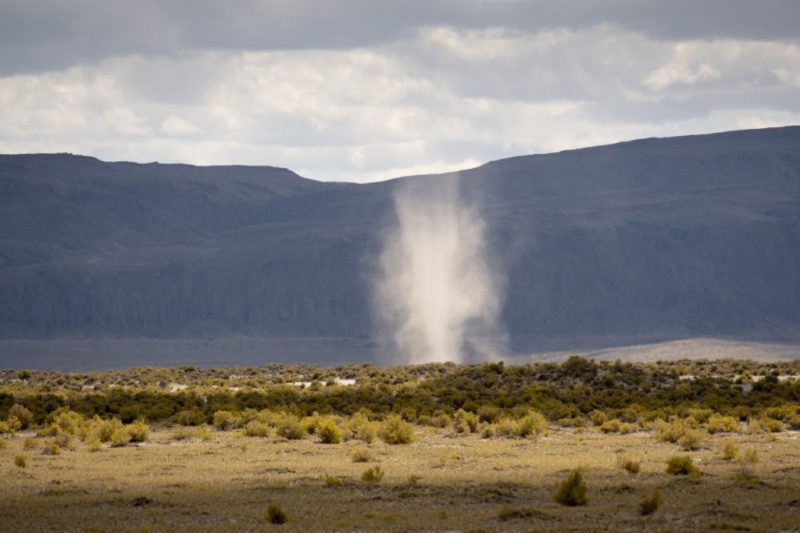
Dust devils are common are common on Earth, but ubiquitous on Mars, a desert world. Scientists are using drones carrying cameras and other instruments to gain new insights.
The video above shows scientists’ encounter with a dust devil in May 2019, in the Alvord Desert in southeastern Oregon. These scientists – members of the Boise State Dust Devil Collaboration – have been flying drones through active dust devils, in part to understand earthly dust devils better, and also to understand dust devils on Earth’s neighbor planet, Mars.
Dust devils, while common in arid climates on Earth, are ubiquitous on Mars, where they may be responsible for much of the planet’s haze that helps heat its atmosphere. Dust devils have been observed from landers the ground and from orbiting spacecraft all over the surface of Mars. A better understanding of dust devils on Earth will help scientists understand their influence on Mars’ climate.
In the video above, acquired with a drone, you can see how the drone tilts and drops once inside the dust devil. It’s also fun to see the drone chase the dust devil as it moves away. Jackson reported on these May 2019 observations via drone on September 19, 2019, at a joint meeting of the European Planetary Science Congress and the AAS Division for Planetary Sciences in Geneva, Switzerland. He said the drone struggled as air pressure dropped inside the dust devil. Camille M. Carlisle of SkyandTelescope.com, who apparently heard Jackson speak at the meeting, explained:
The pressure drop matches what’s expected for the wind speed twirling round the dust devil’s funnel.
Yet, Jackson said, despite the fact that dust devils have been studied for decades, scientists still aren’t entirely clear on the physics of how dust devils lift dust into the atmosphere. He said:
When we compare theoretical predictions of how much dust a devil should lift to how much it does lift, the numbers just don’t add up.
That’s why Jackson’s team thought of the drones to study dust devils. The drones carry not just cameras, but also other lightweight instruments, including pressure and temperature loggers. They measure the structures of the dust devil while taking particle samples to determine how much material the dust devil is carrying.
Dust devil research in the Alvord desert of Eastern Oregon.
In summer 2017, Jackson and his team were awarded a grant from the NASA Idaho Space Grant Consortium to launch drones into dust devils. In 2018, they also received a three-year, $217,000 grant from NASA’s Solar System Workings Program. Why is NASA interested in dust devils? These scientists explained:
NASA currently has three active rovers on Mars, two of which are powered by solar panels. Martian dust has been a concern, falling on the panels and reducing the amount of energy generated, and the static charges that can build up in the dust devils may pose a hazard to electrical equipment deployed on Mars.
And why drones? The scientists said:
Previous studies of Martian dust devils have relied on passive sampling of the profiles via meteorology packages on landed spacecraft. Past studies of terrestrial devils have employed more active sampling (instrumented vehicles or manned aircraft) but have been limited to near-surface or relatively high-altitude sampling.
Drones promise a new and powerful platform from which to sample dust devils at a variety of altitudes. Measurements made aloft are more directly relevant for evaluating the dust that is injected into the atmosphere.
NASA may have dust on its mind since the official demise of its Mars Opportunity rover earlier this year. Opportunity – fondly nicknamed Oppy – was built to last 90 days, but spent 15 years exploring Mars, until a Mars-wide dust storm hit in June 2018. The rover relied on solar power. Its solar panels are now thought to be blanketed with dust. Engineers in the Space Flight Operations Facility at NASA’s Jet Propulsion Laboratory sent more than a thousand commands to Mars throughout this past fall and early winter, in an attempt to restore contact with the rover. It didn’t work. The rover sits silent on Mars’ surface now, in Mars’ Perseverance Valley.
The tweet below, from 2016, offers a particularly beautiful and poignant view of the Opportunity rover in relationship to a Mars dust devil.
If you want more about Mars’ dust devils, check out the video below. The navigation cameras aboard NASA’s Curiosity Mars rover captured images of a few of them moving dust across Gale Crater in 2017. Dust devils result from sunshine warming the ground, prompting convective rising of air. All the dust devils in the video below were seen in a southward direction from the rover. Timing is accelerated and contrast has been modified to make frame-to-frame changes easier to see.
Area 51 bestormen? Ans Hoornweg 'weet' al lang wat er daar gebeurt
Wat gebeurt er precies in het geheimzinnige ‘Area 51’? Twee Nederlandse Youtubers reisden er speciaal voor af naar Amerika en werden opgepakt. Niet nodig, want Ans Hoornweg heeft het allemaal al gehoord van de aliens zelf.
Over Ans later meer, maar eerst: waar komt die plotse aandacht voor Area 51 nu eigenlijk vandaan?
Is er een ufo neergestort?
Rond de streng verboden en zwaarbeveiligde militaire basis in Nevada hangt al decennia een hardnekkige zweem van geheimzinnigheid. Wat er zich binnen de hekken van het afgeschermde terrein afspeelt, houdt mensen al generaties bezig.
Zo wordt er gefluisterd dat in 1947 een vliegende schotel zou zijn neergestort. Ook zouden er illegale experimenten worden uitgevoerd op buitenaardse wezens.
Om voor eens en voor altijd te weten wat er in Area 51 gebeurt, willen mensen het gebied vrijdag bestormen. Een oproep daartoe gaat viraal op Facebook en wordt overspoeld met reacties.
De lokale autoriteiten maken zich ernstig zorgen over het aanstaande ‘evenement’ en waarschuwen iedereen om niet in de buurt van het geheime terrein te komen. De Amerikaanse overheid doet de geruchten steevast af als onzin.
‘Mijn alienvriend zit in Area 51’
Daar gelooft de 77-jarige Ans Hoornweg dus helemaal niets van. Sterker nog, ze weet dat het niet waar is. Man bijt hond sprak de vrouw, die al van kinds af aan ‘contact’ heeft met ruimtewezens. “Ik ben zelf een alien geweest”, verklaart ze.
Ans is namelijk ‘geïncarneerd’ vanaf een andere planeet en heeft sinds haar kindertijd goed contact met een speciale vriend, die toevallig in Area 51 gevangen wordt gehouden. “Dat wezen is daar binnen.”
En zoals mensen met elkaar praten, laten buitenaardse wezens elkaar dingen weten via beelden. Zo heeft Ans als kind al ‘gezien’ wat er zich in het complex afspeelt. “Ik ben er niet naartoe gevlogen. Nee, ik heb mijn zesde zintuig.”
Wat kan haar vriend vertellen over de geruchten over ruimteschepen en aliens? “Wat ik kan zien is dat ze daar gecrashte ufo’s hebben. Ook hebben ze buitenaards wezens in hun bezit die ze gevangen houden.”
Tekst loopt verder onder de foto
Feestje voor de bestorming
Ans vindt het verschrikkelijk wat haar vriend moet doorstaan, maar voelt zich machteloos. “Wat kan ik doen?” Buitenaardse beschavingen zijn volgens haar dan ook blij met de aandacht, zodat ‘alles’ naar buiten kan komen.
Inmiddels zijn de eerste bestormers gezien in het afgelegen gebied op zo’n 130 kilometer van gokstad Las Vegas. Mensen zijn met campers gekomen omdat er in de wijde omtrek geen hotels zijn.
Ze houden feestjes bij de geheime militaire basis. De politie houdt er rekening mee dat er weleens 30.000 mensen zouden kunnen komen.
Youtubers Govert Sweep (21) en Ties Granzier (20) besloten vorige week al een kijkje te nemen en moesten dat bekopen met een paar dagen cel en een boete van 4500 dollar. Ze vlogen vrijdag terug naar Brussel.
Ans is vol lof over de Nederlanders. “De jongens die het op de kaart gezet hebben, ja geweldig. Dat vind ik echt fantastisch. Die jongelui hebben we nodig.”
Het hele verhaal van Ans kun je bovenaan dit artikel bekijken. Het begint na vijftien seconden.
Wat ik kan zien is dat ze daar gecrashte UFO’s hebben. Deze vrouw zegt te weten wat er gebeurt in het geheimzinnige Area 51
De aangekondigde ‘bestorming’ van de militaire basis Area 51 in de Amerikaanse staat Nevada is rustig verlopen, zo laat de politie weten.
Er zijn enkele mensen opgepakt vanwege het betreden van het terrein rond de basis, wat streng verboden is.
Zo’n twee miljoen mensen hadden zich opgegeven voor een Facebookevenement om de basis te bestormen. Uiteindelijk zijn slechts enkele duizenden op komen dagen.
Hele leven
Sommige mensen beweren dat er op het terrein UFO’s en buitenaardse wezens zijn.
Eén van hen is de 77-jarige Ans Hoornweg. Tegen Man bijt hond zegt ze al haar hele leven contact te hebben met ruimtewezens.
Die zouden haar als kind al hebben laten zien wat er gebeurt in Area 51.
Gecrashte UFO’s
“Wat ik kan zien is dat ze daar gecrashte UFO’s hebben,” zegt Hoornweg. “Ook hebben ze buitenaardse wezens in hun bezit die ze gevangen houden.”
Ze vertelt verder dat buitenaardse beschavingen blij zijn dat Area 51 zo in de openbaarheid komt.
Opgepakt
Daarnaast vindt ze het fantastisch dat twee populaire Nederlandse YouTubers de basis op de kaart gezet hebben.
Ties Granzier en Govert Sweep werden vorige week opgepakt voor het betreden van Area 51.
Ze hadden camera’s, een laptop en een drone bij zich om opnames van het gebied te maken.
Astronoom suggereert dat er buitenaardse ruimtesondes in ons zonnestelsel zijn. Hier moeten we gaan zoeken
Bevinden zich op asteroïden nabij de aarde buitenaardse ruimteschepen die onze planeet al lange tijd monitoren? Hierover heeft astronoom James Benford van Microwave Sciences in Californië een paper gepubliceerd in The Astronomical Journal.
Het gaat hierbij om asteroïden die net als de aarde in een baan om de zon draaien. Deze objecten komen ieder jaar zeer dicht in de buurt van de aarde.
Om die reden zouden ze door buitenaardse beschavingen kunnen worden gebruikt om de aarde in de gaten te houden.
Observeren
Buitenaardse sondes zouden op deze manier aan het zicht worden onttrokken en de asteroïden bieden toegang tot zonne-energie.
Ze zouden vele duizenden jaren operationeel kunnen blijven.
Volgens dr. Benford kunnen ze lang geleden naar de aarde zijn gestuurd om onze planeet te observeren.
Motieven
“Ze kunnen al dan niet reageren op signalen, afhankelijk van de motieven van de aliens,” zegt de astronoom.
Hij denkt dat de sondes waarschijnlijk onbemand zijn, zoals onze eigen Voyager en New Horizons.
“Wellicht luisteren de sondes naar ons en wachten ze totdat wij er één hebben gevonden,” aldus Benford.
Kosmische achtertuin
Als we zo’n sonde vinden, zal hij actief worden, denkt de astronoom.
Volgens Benford is het van groot belang om in onze eigen kosmische achtertuin te zoeken naar oude, buitenaardse ruimteschepen.
2016 HO3
Hij is vooral geïnteresseerd in een asteroïde met de naam 2016 HO3, die op 27 april 2016 is ontdekt.
De Chinese ruimtevaartorganisatie CNSA hoopt in 2024 een sonde naar de asteroïde te sturen.
You may observe the footage below. You may inspect the footage below. You may see the footage below. You’re in a position to take a look at the footage below. Footage of a large shadow moving over the crowd stays in the movie.
You are able to take a look at the video below. The video can be seen on the TTS Academy Community of Interest site by click on this link. The quick video below, for instance, is merely one of several contemporary sightings.
You may actually watch videos all day long for many years about aliens. You may have a look at the video below. The quick video below, for example, is just one of several contemporary sightings.
Some reports state it is a ping, but others claim it is a beep. They state it’s a ping, while some claim it’s a beep. They state it is a ping, though some claim it is a beep.
You’re in a position to have a peek at the footage below. You might have a look at the footage below. It’s possible to have a look at the footage below. It’s possible that you have a look at the footage below. You may have a look at the footage below. You may have a look at the footage below.
The simple truth is the origin of Chinese people is a complex conundrum. Maybe it is really out there. It is that they do. It is a bit shaky because of the simple fact the witness had to use full-zoom to concentrate on the craft. The truth is that they do. Currently there are lots of hoax out there. What You should Know About Latest UFO Footage You might actually watch videos all day long for several years about aliens.
You may have a look at the video below. You’re in a position to have a look at the video below. You can have a look at the video below. You have the ability to look at the video below. You’re prepared to have a peek at the video below. It’s possible to have a peek at the video below.
UFOs are observed through telescopes. At times, however, they cannot be identified due to the minimal quality of evidence associated with their sightings. Throughout that time period, there were two triangle UFOs sighted in the identical website. Throughout that time frame, there were two triangle UFOs sighted in exactly the same site.
My sighting only lasted lots of seconds. The sighting itself, in spite of the corroborative sightings, isn’t hard to dismiss by itself. It’s quite easy to comprehend why there are a lot of UFO sightings. It’s very simple to comprehend why there are a great deal of UFO sightings. Now, UFO sighting has been a matter of amusement rather than a concern, though there are ample evidences about their scary general appearance. Today, UFO sighting has been an issue of amusement in the place of a concern, although there are ample evidences about their scary look. Many reported UFO sightings actually wind up being something as easy as a balloon.
UFOs are frequently associated with aliens and conspiracy theories. They are frequently associated with aliens and conspiracy theories. Sometimes, however, they cannot be identified because of the low quality of evidence related to their sightings. Throughout that time period, there were two triangle UFOs sighted in the exact same site.
One interesting and increasingly talked about area of the world of the paranormal is the Shadow Person. These are often described as vaguely humanoid entities of pure black, variously as either well-defined or more amorphous and cloud-like, which are usually only glimpsed in the periphery of vision and are known to conjure up waves of irrational fear. They have been speculated as being everything from demons, to interdimensional interlopers, to earth spirits or even angels, and they are commonly accepted as being a separate phenomena from regular ghosts. Considering their fleeting nature, evasiveness, and seeming aversion to be witnessed head-on, there has been very little photographic evidence put forward towards their existence, but on occasion some images come out that seem to be in keeping with the idea of Shadow People. While inconclusive and often blurry or vague, thee photographs offer a glimpse into a poorly understood realm of the paranormal, and here we will look at some of the more famous and indeed controversial such photos of Shadow People.
One treasure trove of shadow people reports is the notorious Waverly Hills Sanatorium, in Louisville, Kentucky, in the United States. Opened in 1910, it was originally envisioned as a hospital for tuberculosis patients during an outbreak in the region at the time. Considering its secretive operations and the pall of death cast over it, it quickly became the center of rumors of human experimentation, mistreatment, suffering, and death, and by the time it closed in 1961 around 64,000 people were said to have died here in horrifying circumstances. Considering this, it is already ripe for tales of hauntings, and it is supposedly quite imbued with all manner of spirits, some of the most often seen being the mysterious Shadow People. One well-circulated photo of one of these entities was released after a tour of the facility in 2014, during which a woman took a picture of an empty area and noticed this image when the film was developed.
Waverly Hills Sanatorium photo
Another visitor was investigating the old sanatorium by himself when he snapped a photo of a room full of old equipment. The image shows what appears to be some sort of shadowy figure looming in the foreground, and the photographer insists that he was alone at the time. What do you think?
Waverly Hills Sanatorium photo
Speaking of haunted tuberculosis hospitals, we also have the Lima Tuberculosis Hospital in Allen County, Ohio, which closed in 1972 and has remained abandoned ever since. The former hospital has become infamous for its various hauntings, including reports of shadow people, which are said to follow visitors about, mostly only visible in the periphery of the vision and only briefly witnessed before flickering away. Yet on occasion there have been some photos taken of these mysterious figures, and one of them was taken by an urban explorer who didn’t notice what he had captured on film until much later.
Lima Tuberculosis Hospital photo
One location that seems to be absolutely infested with Shadow People entities is Lawler Ford Road, in Glencoe, Missouri. Built in the 1860s, it has over the years accrued a long list of strange lore, such as ghost lights and persistent reports of Shadow People, and such is its odd legacy that the road is more commonly known as “Zombie Road.” Reports of shadowy entities lurking in the wilderness here are numerous, and some of them have allegedly been captured on film. One of the more striking of these is an image taken by Tom Halstead, of the paranormal investigator group “Paranormal Taskforce,” who in 2005 took this eerie photo of a whole procession of purported Shadow People milling about in the tree-line apparently staring at him. Halstead has been adamant that there were no other people there at the time, and that the whole area was surrounded by water, due to a high water level of the river, yet the figures just sort of melted away. The picture was featured in the documentary Legacy of Shadows.
Zombie Road Shadow People
Halstead returned to the area in 2006, when he took another anomalous photo at a bridge in the area well known for its paranormal phenomena. The photo in this case is a bit less defined, but also seems to show some sort of black, vaguely humanoid figure at close range to the camera. It is a strange image to be sure, making one wonder if it is real or just a photography trick.
Zombie Road Shadow Person photo
Other supposedly haunted places have their own alleged photos of Shadow People, such as the famously haunted RMS Queen Mary, which was in its glory days a British ocean liner that largely sailed about the North Atlantic Ocean before being retired in 1967. The vessel was then sailed to the port of Long Beach, California, where it became a hotel and tourist attraction and has gained a reputation for being intensely haunted ever since. One of the many paranormal phenomena reported from here is, you guessed it, Shadow People. Indeed, one of the best photos of a supposed Shadow Person ever taken was snapped here, and you can see it below. Is this just a trick of lighting, or what?
The Queen Mary photo
Another rather famous image of a purported Shadow Person was taken at the former Moundsville Prison, in West Virginia. Between its years of operation spanning from 1866 to its closing in 1995, this was the final destination for all manner of some of society’s worst offenders, many of whom spent their last days on earth here. Murders, riots, and suffering were rampant here, and it is perhaps no surprise that the location should be insanely haunted. Many types of apparitions have been sighted here, including Shadow People, said to come here to feed off the negative energy, and photos of strange things are not uncommon at all. One such picture was taken by Polly Gear, of the Mountaineer Paranormal Group, and seems to show a black figure lurking at the end of a hallway, even though Gear has insisted that no one was there at the time. What is it?
Moundsville Prison Shadow Person photo
One figure that the Shadow People seem to be prone to taking is that of the “Hat Man,” a black figure with a hat perched upon its head that is seen in many far flung cases. The Hat Man has been sighted all over the place, and has indeed become a paranormal phenomenon all unto itself, and while there has rarely been any photographic proof of it there has been some. In 2011, a family visited Trentham Cottage, in Port Arthur, Australia, which is a former prison facility and convict settlement, when they took a random photograph of a doorway. At the time there was nothing there, but when they looked at the photos later they could see an anomalous entity clearly wearing a hat standing there. What is it and why did it appear in this picture?
Trentham Cottage Hat Man photo
It is often the case that these figures are not noticed in these pictures until later, with the photographer not aware that anything is awry until they are shocked to see what they have captured when looking through their photographs. Another instance of this comes from a photographer who was taking pics of the 4th Street Bridge, in Los Angeles, staying there with a friend for around 20 minutes. When they went through the photographs later they were surprised to find a rather curious figure standing up within the shadows peering down at them. The location is supposedly impossible to get up to, and one wonders just what this figure is.
4th Street Bridge Shadow Person photo
As with all photographic evidence of supposed paranormal phenomena, these images are far from proving anything. They are inconclusive, perhaps able to be faked, and only serve to fuel speculation on the existence of these mysteries. Yet they nevertheless provide a rare glimpse into the specific phenomena of Shadow People, which are often considered to be the most elusive and mysteries of entities. Whether any of these photographs actually show these apparitions in action I leave for you the reader to decide, and whether there is anything to it or not they are bizarre glimpses into a particularly odd area of the paranormal all the same.
Witnesses claim the old woman was "picked up" by two trucks as she walked across the desert.
Her current whereabouts and her identity remain unknown.
For decades, conspiracy theorists have believed the highly-classified Homey Airbase in the Mojave Desert, Nevada, US, holds extraterrestrial life-forms.
Official reports suggest experimental aircraft and black project weapon systems are tested there, but conspiracists remain unconvinced.
Earlier this year, more than two million people signed up to an internet event arranging to storm Area 5, billed "Storm Area 51, They Can't Stop All of Us" in a whacky bid to "see them aliens".
And while the event was labelled a fail a video has since emerged of a woman ignoring security barriers and walking into the base.
However, unlike the planned event to “Naruto run” to the entrance, the woman was filmed simply strolling in.
The clip shows crowds of onlookers flooding to the security barriers in shock as the woman begins her attempt.
One person seemingly asks onlooking security guards: "Hey, are you guys going to do anything about that?"
To which someone replies: "Eventually." "Eventually?" the man asks, laughing.
Someone else adds: "I didn't think they'd actually do it."
Before shouting to her: "Don't do it, don't do it."
But she ignored the pleads and was seen ducking under a final barrier featuring a large "stop" sign.
Witnesses can be heard saying: "Oh my god, oh know. She's still going.
According to Twitter user Matthew Carswell, who posted the video on Saturday, state authorities were out of their jurisdiction and unable to step in considering it’s a federal base.
The eyewitness said the woman was instead picked up by two trucks about “half a mile in”.
He speculated she had probably been arrested as a result.
It’s the greatest paranormal/ufology/conspiracy event of the century — if not perhaps ever – so it’s only fitting that it ends today in … disappointment? Unfortunately, that’s the news from Area 51 this weekend where what started out as “Storm Area 51, They Can’t Stop All of Us” became a 2 million-persons-coming extravaganza which downsized into a couple of music festivals after another storm of warnings, lawsuits, folds, fauxs and fallacies and then reached a peep of a climax as an estimated 3,000 people showed up, around five people got arrested and no one actually stormed Area 51.
Except one woman.
“So like some old lady ACTUALLY stormed #area51.”
That’s the headline on a tweet by Matthew Carswell (@Leche_frio) which showed a video of what appears to be the only person to actually step around the barrier, cross the border, and storm Area 51 on this iconic/ironic weekend. OK, “storm” may be an exaggeration as it appears she walked in very slowly – perhaps out of caution or perhaps because she’s an “old lady.” (You can watch the video for yourself on Twitter or here.)
Needless to say (why else would we be doing this story?), she did it. Matthew Carswell (@Leche_frio) recorded the woman for about 45 seconds, showing her approach the secure facility’s back gate, dip under it and begin walking towards … what? Aliens? Men in Black? Security guards? Stealth bombers? (OK, they apologized for that one.)
“She gives no f–ks.”
Well, that’s obvious … although hard to tell because we never see her face. In fact, what’s more interesting is that Carswell pans the scene and we see a number of police officers watching her enter as well. After being asked too many times, he posted the answer on Twitter.
1. The cops couldn’t go after her since they were only state cops and it’s a federal base.” 2. She got scooped up by 2 trucks like half a mile in 3. No I don’t know what happened to her but I can assume she’s jail
That last assumption was confirmed by the Reno Gazette, where Lincoln County Sheriff Kerry Lee revealed that the person was a 60-year-old woman (no identity given) and:
“She told us she was going to trespass. It was something she wanted to do, and she walked across.”
And?
The Reno Gazette says “the California woman now faces a trespassing charge and a $1,000 fine.”
They should have taken up a collection to pay the fine, court coasts, lawyer fees, etc. for the only person brave (or dumb) enough to do what began as a rallying cry just a few weeks ago:
What if we’ve been silently observed by an alien civilization since humanity’s genesis? A new idea put forth by astronomer Dr. James Benford in a paper published in the Astronomical Journal this week suggests that our search for alien intelligence should focus on the “co-orbital” asteroids that orbit the sun in a similar pattern to Earth. Benford suggests that these asteroids would provide perfect observation decks on which aliens may have stationed robotic probes, laying dormant since ancient times. He argues that these co-orbitals should be a primary target for SETI, the Search for Extraterrestrial Intelligence. He also suggests that if we look at these asteroids and do not find evidence of ancient alien probes than it tells us something else: we’re well and truly alone and no one cares about us.
Now that might be a pretty big assumption to make. After all, there’s the whole fallacy of thinking that an alien intelligence would come up with the same plans, tactics, and techniques as an Earth-bound descendant of chimpanzees would. But it’s clear that Benford is right about one thing at least—if aliens did have a long-term observation strategy, co-orbital asteroids would be perfect staging areas.
Dr. James Benford calls these potential probes “lurkers.” They would be small probes that have remained hidden and unnoticed for thousands of years, watching us, or perhaps waiting for a signal to turn on and begin watching us. A news release covering Benford’s new paper says:
“They may respond to an intentional signal and may not, depending on unknown alien motivations. Lurkers would likely be robotic, like our own Voyager and New Horizons probes.”
“Co-orbitals” are a recently discovered group of asteroids that orbit the sun at similar rates to Earth, thereby staying at roughly the same distance from our planet. If aliens had stationed probes on these asteroids they would have a constant source of solar energy and and a secure, hidden, and stable place from which to observe us. Regardless if aliens use technology remotely similar to ours or not, the physical laws of the universe would still apply. Everything needs energy, and in the void of space solar energy is probably the best bet regardless of what the probe actually looks like. Benford says that probes hanging out on co-orbitals could possibly sustain themselves for many thousands of years.
Benford says that if we did find an alien probe on one of these co-orbitals we could simply photograph it and send it the photograph with a message saying “we see you.” And sure, that’s a pretty creepy thing to do, but so is spying on a whole species for all of their evolutionary history. It’s only fair.
But if we don’t find one, Benford says that it would be strong evidence that we truly are alone. He says:
“If we find nothing there, this gives us a profound result: no one has come to look at the life of the Earth, which has been evident in our atmosphere in spectral lines over interstellar distances for over a billion years.”
Would we even recognize evidence of an alien civilization if we saw it?
But it has to be said, what if they just did something else? Sure co-orbitals would be perfect places to stage an observation from, but many people who have been told there’s a perfect way to do something end up doing it a completely different way, to varying degrees of success. Jumping straight to “well if it’s not there, in that specific spot, then that means it doesn’t exist anywhere else” is pretty ludicrous. That sounds like what I say about my car keys when I’m grumpy in the morning. But that’s a problem with looking for alien intelligence. We don’t know what it looks like, and we don’t know how it thinks. Assuming that it behaves exactly like Earth primates, when there’s a whole universe of infinite possibility seems a little bit small minded. But of course, that’s coming from someone who is 100% sure his car keys got eaten by a black hole at least three times per week.
White UFOs Circle Apartments In Spain, Video, UFO Sighting News.
Date of sighting: Sept 22, 2019 Location of sighting: Seville, Spain An eyewitness in Spain caught some strange white lights moving and disappearing over some buildings in his city. The objects seen to be playing...having fun knowing that the humans below were excitedly looking upward at them. I myself have been eyewitness to a similar event at midnight over my apartments here in Taiwan. I cant say what he saw, but I'll tell you what I saw. At midnight we walked into the inside area of our appartmemt garden area. We noticed several dozen white lights shooting across the sky at about 3X the speed of a jet plane. However as they disappeared from view behind the 10 floor apartments...suddenly about 6 of them came back and stared circling us. It was hard to record and it didn't come out well on video. But it lasted for about 15 minutes until about 3 untited and it looked like the moon then faded and gone. Scott C. Waring -Taiwan
UFO Fleet Passes Over Brazil On Sept 2019, Video, UFO Sighting News.
Date of sighting: September 16, 2019 Location of sighting: Bahia, Brazil Source:Youtube user Ricado Here is a recent UFO sighting in the Brazil region of Bahia. The eyewitnesses caught three or more glowing objects moving across an over cast sky in the distance. You can hear the excitement in the voices of the many eyewitnesses as the UFOs cross the sky. They sound baffled by what these glowing objects could be. They make no sound, have no flashing airline lights. There seems to be no obvious explanation...leaving us with only one option left...UFOs. Scott C. Waring-Taiwan
Ancient ET Base Found In Antartica! UFO Sighting News.
Date of discovery: Sept 23, 2019 Location of discovery: Antartica Google Coordinates: 74° 3'44.57"S 103°16'4.79"W I was looking at Google Earth in the Antartica region and found four underground base facilities located within 1km of each other. Each building sits on the ocean floor and barely breaks the surface of the top of the ocean. Each buildings between 2km and 2.8km across according to google ruler. Watch the video to learn and see more photos of them. This is 100% proof that alien bases exist in Antartica. Scott C. Waring
Area 51 is a top-secret military base in Nevada, USA and is associated with UFO theories. A Facebook event encouraging people to storm the base attracted over two million people and alien enthusiasts.
The alien planet K2-18 b would be a truly exotic vacation destination.
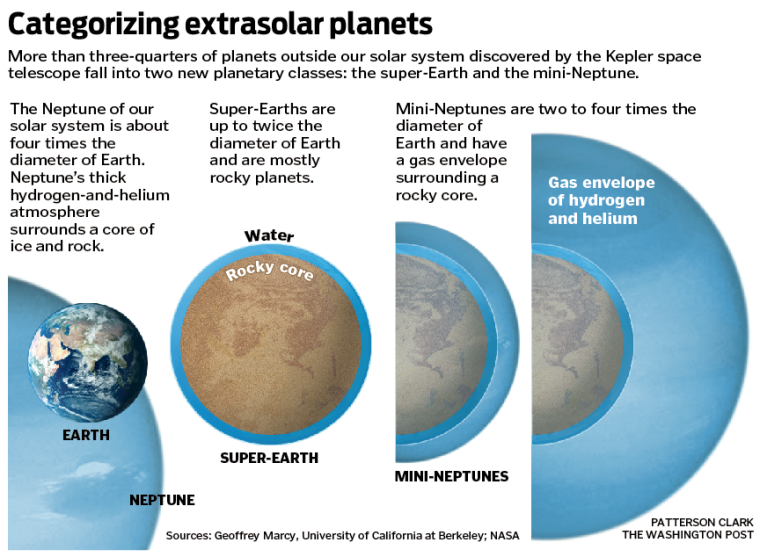
Two research teams just announced the detection of water vapor in the air of K2-18 b, a "super-Earth" that lies about 110 light-years from our planet. This is a landmark discovery, because the alien world is potentially habitable, apparently orbiting its star at the right distance for liquid water to exist on the planetary surface.
But this doesn't mean that K2-18 b is Earth-like; in fact, the two worlds are quite different. K2-18 b is about 2.3 times wider than Earth and eight times more massive, for example, and it orbits a red dwarf, a star much smaller and dimmer than our own sun.
So, what would a trip to K2-18 b be like? Very long, for starters — it would take more than a million years to get there using traditional rocket propulsion. But let's put matters of practicality aside. What would you see on the surface of this world? What would you experience?
It's tough to say, unfortunately. For starters, K2-18 b, which was discovered in 2015, orbits relatively close to its host star, completing one lap every 33 Earth days. So, the planet could be tidally locked, always showing one face to the red dwarf, just as Earth's moon always shows us its near side. If that's the case, then K2-18 b would have a day side and a night side, with a strip of permanent twilight separating the two.
But we don't know if that's the case, and the uncertainty continues from there.
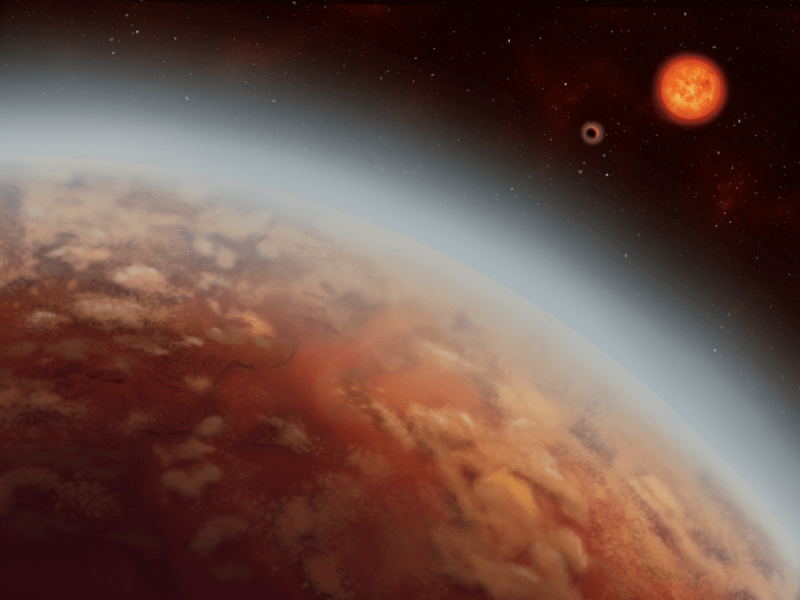
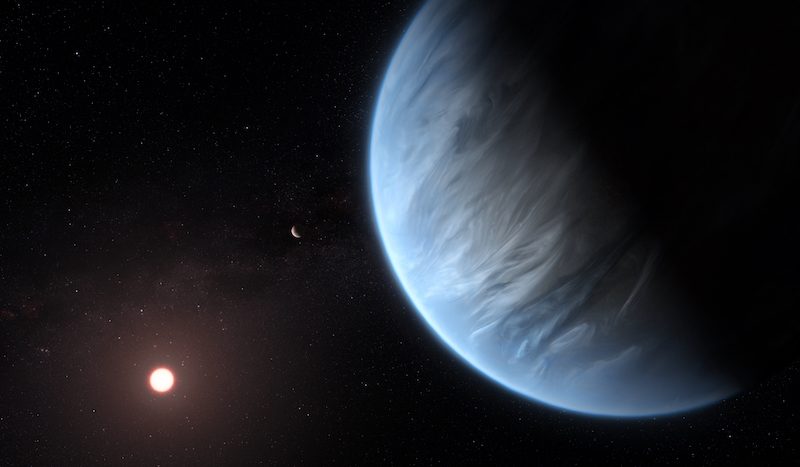
This artist's impression shows the planet K2-18b, its host star and an accompanying planet in this system.
(Image credit: ESA/Hubble, M. Kornmesser)
One of the research teams, led by Angelos Tsiaras of University College London's Centre for Space Exochemistry Data (CSED), determined that water vapor makes up between 0.01% and 50% of K2-18 b's atmosphere. With such a big range, it's tough to characterize the exoplanet; it could be completely flooded, for instance, or a world with lakes and oceans but lots of exposed land, study team members said.
The other research group, led by Björn Benneke of the Institute for Research on Exoplanets at the Université de Montréal, posited another scenario. These scientists suggested that K2-18 b consists of a planetary core surrounded by a huge, hydrogen-dominated atmosphere that contains mere smidges of water vapor. Such a world wouldn't have a surface, at least not the kind we're used to here on Earth.
Tsiaras and his colleagues published their results yesterday (Sept. 11) in the journal Nature Astronomy. Benneke's team has posted its paper to the online preprint site arXiv.org; the study has not yet been peer-reviewed.
The planet's temperature is also uncertain. Tsiaras' team estimated a surface temperature of between minus 100 and 116 degrees Fahrenheit (minus 73 to 47 degrees Celsius). That means the surface could, on average, be colder than Antarctica or hotter than Earth's most blistering deserts.
K2-18 b's gravitational pull is better understood, because we know the planet's mass and diameter. If most of the exoplanet is solid rock and ice, a visitor to the world's surface would feel 37% heavier than he or she feels on Earth. (K2-18 b's higher mass is mostly offset by its greater size in this regard, because the gravitational force decreases with the square of the distance from a planet's center.)
The picture would be more complicated if K2-18 b is mostly atmosphere, as envisioned by Benneke's team. In that case, the gravitational pull you'd feel would depend on the size of the planet's core. But the force of that pull wouldn't really matter from your perspective; the massive atmosphere would generate such high pressures that you'd be squished wherever you tried to stand.
But if you could survive, and if you could see through that atmosphere, you'd be treated to some memorable vistas.
During a teleconference with reporters Tuesday (Sept. 10), Tsiaras pointed out that K2-18 b has a sibling that orbits closer to the host star. From the surface of K2-18 b, this other planet might look like Venus does in Earth's sky, Tsiaras said.
And then there's the star itself, which would look quite different from our own sun.
"You would see a red star rather than an orange-yellow one," Ingo Waldmann of CSED, a member of Tsiaras' team, said during the telecon.
Red dwarfs tend to be more active than sunlike stars, more frequently unleashing powerful flares. K2-18 b's parent star is quiescent by red dwarf standards, Waldmann said, but the star may still bathe the planet in higher quantities of damaging ultraviolet radiation than we're used to.
"For life on Earth, that would be bad — we'd all get cancer relatively quickly," Waldmann said. "But, you know, life there may have evolved differently. So, it's hard to tell."
Mike Wall's book about the search for alien life, "Out There" (Grand Central Publishing, 2018; illustrated byKarl Tate), is out now. Follow him on Twitter @michaeldwall. Follow us on Twitter@Spacedotcom orFacebook.
Water detected on distant super-Earth planet with potential to host alien life
A “WORLD FIRST” discovery on a distant planet could be the key to scientists finding alien life.
Alien discovery breakthrough as UK scientists detect water on distant super-Earth planet
(Image: SWNS)
Water vapour has been detected on a super-Earth known as K2-18b, located about 110 light years away. And its temperatures make it potentially habitable for alien life. The exoplanet was first spotted in 2015 by Nasa's Kepler spacecraft but analysis of data has revealed new details that have not been seen on a super-Earth before.
K2-18b is classed as a super-Earth because it is bigger than our Earth - twice as big in fact, as well as eight times heavier.
Current equipment is only able to determine basic factors such as distance, mass and temperature but sophisticated tools developed at University College London have been able to translate existing data from the Hubble Space Telescope to make sense of the unique molecule signatures of water vapour.
K2-18b is too far away for astronomers to see, but they can look at how starlight is filtered through the planet's atmosphere as it passes around its own sun, called K2-18.
The planet is a lot closer to its star than Earth is to the Sun, meaning it only takes around 33 days to transit.
Scientists translated data from the Hubble Telescope to model the planet
(Image: SWNS)
It's the only planet outside our solar system that we know has the correct temperature, an atmosphere and water
Dr Angelos Tsiaras
First author Dr Angelos Tsiaras said: "It's the only planet outside our solar system that we know has the correct temperature, an atmosphere and water.
”Of course, K2-18b is not a second Earth, because it is a planet that is much bigger, has a different atmospheric composition. It's orbiting a completely different star, so it doesn't look like Earth.
"The search for habitable planets, it's very exciting, but it's here to always remind us that this (Earth) is our only home and it's probably out of the question if we will be able to travel to other planets."
Although the planet sits in the habitable zone, scientists say that instruments available at present are not able to determine any signs of life.
It will also require many more observations to be sure that it is a habitable planet.
Scientists, who have published their findings in the Nature Astronomy journal after more than a year of work, believe the water content could be as low as 0.01 percent or as high as 50 percent.
Co-author Dr Ingo Waldmann said: “We don't know how much water there is; however, what these models clearly say is that there is an atmosphere and that there is water there.”
Researchers do not think K2-18b is the only super-Earth like this and expect to find others with similar characteristics among more than 4,000 exoplanets that have already been discovered.
They hope that newer technology, such as the James Webb Space Telescope due to launch in March 2021, will be able to unlock more secrets beyond our solar system.
Dr Tsiaras added: "We are looking forward to the next generation of telescopes and go even further.”
Co-author Professor Giovanna Tinetti said: "Our discovery makes K2-18b one of the most interesting targets for future study."
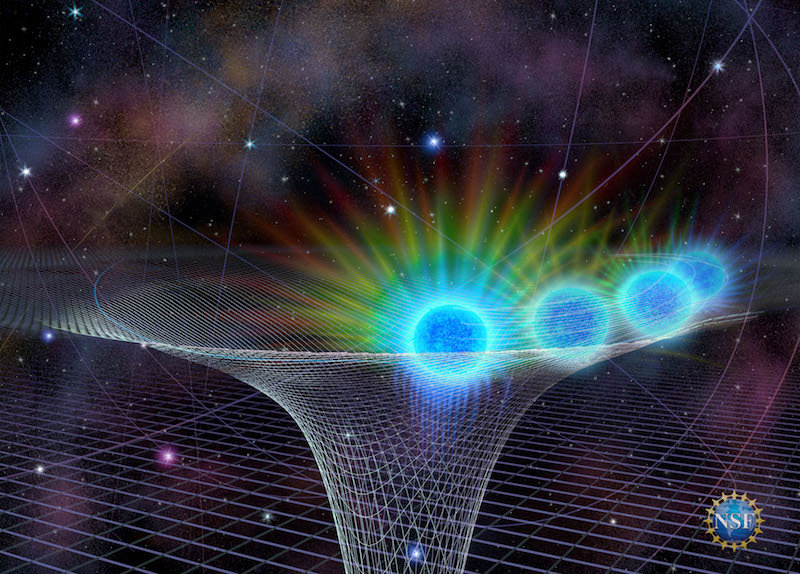
Astronomers have discovered a bright, young star that is running away from home. Why? What did the star's parents do to deserve this? According to a study published Aug. 6 in the journalAstronomy & Astrophysics, it's nobody's fault; it seems the young star simply fell in with the wrong crowd — namely, a very hungry black hole.
The star, which is named PG 1610+062, was first observed hurtling across the sky in a 1986 star survey, though little attention has been paid to the stellar renegade's story since then. In the present study, astronomers working at the W. M. Keck Observatory atop Hawaii's Mauna Kea volcano took the closest-ever look at the runaway. They confirmed it is one of the fastest stars ever seen shooting out of the Milky Way's galactic disk.
The team calculated the star's velocity to be about 1.2 million mph (2 million km/h), which isn't quite enough to escape the bonds of the galaxy's gravity, but fast enough for it to be able to leave the star's home solar system in the cosmic dust.
There are a few different processes that explain how a star can get booted out of its home system, and they usually involve binary partnerships — that is, two stars orbiting around a common center of mass. If one member of the pair were to theoretically disappear — say, by exploding in a supernova or getting swallowed up by a supermassive black hole —the remaining star might get such a sudden, energetic kick in the pants that it would slingshot straight out of its home system, or even out of its home galaxy entirely.
The case of PG 1610+062 may be a bit unusual though, the researchers wrote. Judging by the star's mass, velocity and likely origin (the team traced it to the Sagittarius spiral arm of the galaxy), it seems unlikely that the star ever came close enough to the supermassive black hole at the center of our galaxy to see its partner star gobbled up.
Rather, the star's fast-but-not-too-fast movement seems to suggest that it had a run-in with a mid-mass black hole — that is, a black hole with hundreds to hundreds of thousands of times the mass of the sun (as opposed to a stellar black hole, which can have up to about 20 suns' worth of mass, or a supermassive black hole, which can be millions or billions of times the sun's mass, according to NASA).
Scientists have never found convincing evidence that mid-mass black holes exist in our galaxy. This stellar runaway still isn't hard proof of their existence, but it does strengthen the case that mid-mass black holes could be out there, the researchers wrote. Now, "the race is on to actually find them," lead study author Andreas Irrgang, an astronomer at the Friedrich-Alexander University of Erlangen-Nuremberg in Germany, said in a statement.
A RUNAWAY STAR IS ESCAPING A BLACK HOLE AT 1.2 MILLION MPH
SHOOTING STAR / BY DAN ROBITZSKI
NASA
DAN ROBITZSKI
It Follows
Back in the 1980s, astronomers spotted a runaway star speeding across the night sky at upwards of 1.2 million miles per hour.
Now, decades later, scientists say they’ve finally figured out which pocket of the galaxy the star once called home — and what it’s fleeing from: a giant black hole.
Home Is Nowhere
The star, dubbed PG1610+062, has probably spent all this time escaping from a black hole,Live Science reports. Or, more technically, it likely passed near a mid-mass black hole and got whipped off course by its gravitational pull, like a galactic slingshot.
There’s something slightly off about that explanation, though. Namely, a black hole with the mid-range mass needed to launch the star at this particular speed has never been observed within the Milky Way, according to a press release about the research.
In other words, there may be undetected monstrous black holes lurking in the Milky Way.
“Now, PG1610+062 may provide evidence that [mid-mass black holes] could indeed exist in our galaxy,” Friedrich-Alexander University of Erlangen-Nuremberg astronomer Andreas Irrgang said in the press release. “The race is on to actually find them.”
There could be up to 10 billion Earth-like planets in our galaxy alone
Our galaxy could be littered with warm, watery planets like Earth.
That’s the conclusion of researchers at Penn State University, who used data from NASA’s Kepler telescope to estimate the number of Earth-like planets in the Milky Way.
Their results, published in The Astronomical Journal this week, suggest that an Earth-like planet orbits one in every four Sun-like stars. Totalled up, that means there could be up to 10 billion Earth-like worlds in our home galaxy.
The estimate is an important step in the search for alien life, since any potential life on other planets would most likely be found on an Earth-like world warm enough to hold liquid water.
So a better understanding of the potential number of Earth-like planets in the galaxy can inform projects like the Wide-Field Infrared Survey Telescope, which will launch into space in the mid 2020s and hunt for signs of oxygen and water vapour on distant planets.
“We get a lot more return on our investment if we know when and where to look,” Eric Ford, a professor of astrophysics and co-author of the new study, told Business Insider.
Ford’s team defined an Earth-like planet as being anywhere from three-quarters to one-and-a-half times the size of Earth, and orbiting its star every 237 to 500 days.
That’s presumably within the star’s habitable zone – the “range of orbital distances at which the planets could support liquid water on their surfaces,” as Ford described it in a press release.
“For astronomers who are trying to figure out what is a good design for the next major space observatory, this piece of information is an integral part of that planning process,” he said.
5 to 10 billion planets like Earth
The researchers’ estimate is based on data from NASA’s Kepler space telescope. Launched in 2009, the telescope used what’s known as the transit method to find worlds outside our Solar System. It watched over 530,000 stars for tiny dips in a star’s brightness that could be caused by a planet passing in front of it – transits, in other words.
This work transformed our understanding of the galaxy. Kepler found more than 2,600 exoplanets, revealed that there are more planets than stars in the Milky Way, and gave researchers new insight into the diversity of planet types.
The telescope also allowed scientists to confirm for the first time that many exoplanets are similar to Earth.
The telescope retired last year after it ran out of fuel, but passed the planet-hunting torch to the Transiting Exoplanet Survey Satellite (TESS), which launched in April 2018.
Overall, Kepler’s results suggested that 20 percent to 50 percent of the stars visible in the night sky had Earth-like planets in their habitable zones.
But Ford’s team didn’t want to estimate the number of Earth-like planets in the galaxy based solely on the exoplanets Kepler found, because the transit method is only good at detecting large planets close to their stars (since they block out more light).
It’s not great, however, at finding small planets farther from their stars. Plus, Kepler’s method was biased toward small, dim stars about one third the mass of our Sun.
So to estimate how many planets Kepler might have missed, the researchers created computer simulations of hypothetical universes of stars and planets, based on a combination of Kepler’s planet catalogue and a survey of our galaxy’s stars from the European Space Agency’s Gaia spacecraft.
Then the researchers’ program “observed” those stars as Kepler would have.
The simulation gave the scientists a sense of how many exoplanets in each hypothetical universe Kepler would have detected, and which kinds.
They could then compare that data to what the real Kepler telescope detected in our universe to estimate the abundance of Earth-sized planets in the habitable zones of Sun-like stars.
“There are significant uncertainties in what range of stars you label ‘Sun-like,’ what range of orbital distances you consider to be ‘in the habitable zone,’ what range of planet sizes you consider to be ‘Earth-like,'” Ford said.
“Given those uncertainties, both 5 and 10 billion are reasonable estimates.”
Improving the search for aliens
The next step in the search for alien life is to study potentially habitable planets to figure out what they’re made of.
“Scientists are particularly interested in searching for biomarkers – molecules indicative of life – in the atmospheres of roughly Earth-size planets,” Ford said.
Even if a planet is in a star’s habitable zone, it still needs a substantial atmosphere to trap enough heat to sustain liquid water on its surface. Scientists can calculate the composition of an exoplanet’s atmosphere by measuring how its star’s light behaves as it passes through.
This is where Ford’s research comes into play: If Earth-like worlds are abundant, there could be enough of them close by for NASA scientists to study with a smaller, cheaper telescope. If all the Earth-y worlds are far away, though, NASA would need to rely on more far-reaching telescopes.
The researchers recommended that future space missions plan for a range of possible incidences of Earth-like planets – between one for every 33 Sun-like stars and one for every two sun-like stars.
“One of the important things here is not just giving a single number but understanding the range of possibilities,” Ford said. “So that people who have to make decisions could hope for the best and plan for the worst and still be able to come up with a solid scientific strategy.”
Astronauts aboard NASA’s International Space Station (ISS) intentionally started fires in space in order to study how flames react in microgravity. The experiment was also conducted to identify ways of making combustion cleaner.
For the experiment, the astronauts used a special onboard equipment known as the Combustion Integrated Rack (CIR). Through the CIR, the astronauts on ISS were able to start fires in a safe and controlled manner.
According to NASA, the microgravity conditions in the ISS had a huge impact on the fires they created. Unlike fires on Earth, which move upwards and form an almost triangular shape, flames in space have spherical structures.
The astronauts explained that fire moves away from its source or epicenter as the hot gas expands due to the lack of gravity. Based on the images provided by NASA, the fire the astronauts created looked like a swarm of fireflies moving in a circular formation.
Through the experiment, the astronauts were able to understand how fires react in space. Aside from the fire’s unusual shape, they noticed that the soot remains longer within the flame in space than on Earth. Soot comes from the incomplete burning of organic matter. It is the carbon by-product of combustion that has negative environmental effects.
Through the CIR as well as another study known as the Advanced Combustion via Microgravity Experiments (ACME), NASA was able to understand how environmental conditions influence how much soot is produced by fires.
“It turns out, it has a big impact on the flame,” ACME’s principal investigator Richard Axelbaum said. “In this case, even though the temperatures of the flames may be the same whether you introduce the inert with the oxidizer or the fuel, the impact for soot formation or flame strength is substantially different.”
In addition to finding ways to make cleaner combustions, NASA also gained a deeper understanding of how fires work in space. With this information, the agency will be able to develop effective methods in suppressing accidental fires in space. According to the agency, this will serve as a crucial safety aspect for the ISS as well as future human colonization missions on the Moon and Mars.
This flame was one of many ignited as part of the Flame Design investigation inside of CIR to investigate the amount of soot that is produced in different conditions. The yellow spots are soot clusters that glow yellow when hot. These clusters grow larger in microgravity than on Earth because the soot remains within the flame longer.
WETENSCHAP & PLANEET Wetenschappers zetten de boor in de Zuidpool. Het oudste ijs ter wereld bevat cruciale informatie over het eeuwenoude klimaat en kan helpen bij het maken van prognoses over onze toekomst.
Het oudste ijs op aarde is ‘hot’. Australische wetenschappers volgen het voorbeeld van collega’s uit Europa. Ook zij treffen voorbereidingen voor boringen op de Zuidpool naar het ijs van... jawel, 1,5 miljoen jaar oud.
Klimatologen zijn ervan overtuigd dat het oude ijs, op een diepte van liefst drie kilometer, cruciale informatie bevat over de eeuwenoude atmosfeer van de aarde. Bovendien zou het ijs hen kunnen helpen bij de voorspellingen over ons klimaat in de toekomst, in het bijzonder over de effecten van de opwarming van de aarde.
De Australische Antarctica Divisie (AAD) onthulde gisteren de boorinstallatie die haar bij de zoektocht op de Zuidpoool moet helpen. “We hopen dat we hiermee een van de laatste, grote problemen in onze klimaatstudies kunnen oplossen’’, aldus glacioloog Tas van Ommen.
Belletjes
In het ijs zitten kleine luchtbelletjes. Die ontstaan bij de vorming van ijsplaten als gevolg van sneeuwval. Elke keer als het sneeuwt, wordt er een extra laagje gevormd. Die laagjes worden dan samengeperst tot ijs door nieuwe lagen die erop vallen. In die sneeuw zitten ook luchtbellen, gassen en stofdeeltjes en die kunnen een beeld geven van de temperatuur, de atmosfeer en het klimaat op een bepaald moment in de geschiedenis.
Van Ommen noemt de belletjes in het oude, kilometers diepe ijs, ‘de tijdcapsules van onze oude atmosfeer’. “Zij kunnen ons opheldering geven over het gehalte aan CO2 zo’n miljoen jaar geleden, in een tijd dat het klimaat veranderde’’, aldus de glacioloog.
AAD
Lange adem
Ruwweg een miljoen jaar geleden deed zich een grote verandering voor in het klimaatsysteem van de aarde, de Mid-Pleistocene Transitie. Daarvoor duurden ijstijden 40.000 jaar, daarna 100.000 jaar. “Dat zou kunnen zijn gebeurd onder invloed van de CO2’’, voegt Van Ommen eraan toe. “Met de informatie van toen willen we onderzoeken welke gevolgen de huidige, stijgende gehaltes van CO2 op de lange termijn kunnen hebben op ons klimaat.’’
De Australische boor, gemaakt van roestvrij staal, aluminium, brons en titanium, is geheel in Australië ontwikkeld. Intense kou, tot min 55 graden Celsius, is volgens de makers geen enkel probleem. Het karwei is er een van de lange adem. Naar verwachting zal het Australische team in 2021 beginnen met het boren. Pas vier jaar later zal de diepte van drie kilometer zijn bereikt. “Het wordt een ongelooflijk avontuur’’, zegt AAD-directeur Kim Ellis. “Het gaat hier om een van de meest extreme, afgelegen delen van de aarde.’’
Zeeniveau
Ook Europese wetenschappers uit tien landen treffen de voorbereidingen voor een diepe boring in het Zuidpool-ijs. Zij concentreren zich met hun project ‘Beyond Epica’, financieel ondersteund door de Europese Commissie, op het gebied ‘Little Dome C’, in het oosten van Antarctica, op 3.200 meter boven zeeniveau. Hun boringen beginnen al volgend jaar juni, een jaar eerder dan die van hun Australische collega’s. Die boring zal drie jaar duren.
Vijftien jaar geleden slaagden de Europese onderzoekers er al in om ijs te vinden van 800.000 jaar oud. Dat ijs liet een heel nauwe relatie zien tussen het CO2-gehalte en de temperatuur op aarde. “We kwamen toen ook te weten dat de concentraties van broeikasgassen die we vandaag kennen, veel hoger liggen dan ze de afgelopen 800.000 jaar ooit zijn geweest’’, aldus professor Raimund Muscheler van de universiteit van Lund in Zweden.
thinkstockDigitale illustratie van de planeet Venus.
WETENSCHAPDe Aarde is nog altijd, voor zover we weten, de enige bewoonbare planeet in ons zonnestelsel. Maar een nieuwe studie leidt tot de conclusie dat de planeet Venus wellicht ook ooit twee à drie miljard jaar lang vatbaar voor leven was. Tot er een groot mysterie plaatsvond.
Wetenschappers vermoeden al langer dat Mars ooit leven toeliet op de planeet en voor Venus werd dat eveneens in het verleden geopperd. Nieuw onderzoek - vorige week gepresenteerd op een Europees wetenschappelijk congres - ondersteunt die laatste thesis. Venus had mogelijk 2 tot 3 miljard jaren lang stabiele temperaturen én “vloeibaar water”, tot een “dramatische transformatie” meer dan 700 miljoen jaar geleden de planeet volledig hervormde en 80 procent van de bodem veranderde. “Dat leidde misschien wel tot de transformatie van een klimaat zoals op aarde naar de helse broeikas zoals we die nu kennen”, legt onderzoeker en hoofdauteur van de studie, dr. Michael Way, uit.
Vandaag is het ruim 460 graden Celsius op de Venusbodem. Maar Way en zijn team vonden vijf plausibele scenario’s met stabiele temperaturen tussen 20 en 50 graden Celsius op Venus, die de planeet drie miljard jaar lang kon vasthouden. Tot iets mysterieus’ - Way denkt aan vulkanische activiteit op Venus - 700 tot 750 miljoen jaar geleden een enorme explosie van koolstofdioxide veroorzaakte op de planeet. Nog van een heel andere schaal dan bij de Siberische Trappen die gevormd werden door heftige vulkaanuitbarstingen op aarde zo’n 500 miljoen jaar geleden
Omdat Venus dichter bij de zon ligt dan de Aarde en omdat de oppervlaktetemperaturen er zo extreem zijn, is het bestaan van vloeibaar water op de planeet niet vanzelfsprekend. Maar uit de simulaties van Ways onderzoek blijkt dat vloeibaar water op Venus in het verleden wel degelijk niet uit te sluiten valt. Vandaag is Venus te heet daarvoor. Meer onderzoek dringt zich op, meent Way, om de geschiedenis van de planeet te doorgronden en na te gaan hoe die kan helpen bij het zoeken naar exoplaneten in de ‘Venuszone’, waarvan sommige mogelijk vloeibaar water en gematigde klimaattypes zouden kunnen hebben.
“It is an honor to be able to collaborate with some images that could be the appearance of the first UFO in Alicante.”
Alejandro Mollá of Alicante, Spain, SHOULD be honored. It’s not every day that someone who uploads a video of a strange aerial phenomena he recorded during a scary-looking storm on September 14th over Alicante, a southeastern Spain port city on the Mediterranean, gets a call from a government agency that isn’t a threat. Mollá sent it to Agencia 6 which posted the video on YouTube and submitted it to the University of Alicante. Whoever looked at it there observed “something weird” in the video. Apparently, someone else did too.
“So there is tension and emotion while analyzing the images in the UA and in the next few hours at NASA.”
Despite the poor Google translation, there no mistaking that NASA is analyzing this UFO as well. Why? The original video can be seen here. The “silver” UFO is tough to spot in in that recording from Mollá’s cell phone, so someone (possibly Agencia 6) added a helpful circle to track it (see that one here).
If you don’t care to listen to storm sounds while looking at a storm, another one has the perfunctory musical background (see and here it here).
A good UFO sighting doesn’t need music.
Can you see why NASA would be interested in this UFO? If you can’t, Agencia 6 provided this handy explanation:
“The only proven study that exists in the annals of NASA on this type of phenomena is that lived and captured in Wisconsin, in the United States. There are divergences on the reasons why this type of phenomenon can occur with hurricanes or large storms , but the only occasion where the relief of a possible spaceship has been captured is the one that these photos of that storm collect, in a short video more than a minute, exactly as today happened in Alicante with the recording of our partner Alejandro Mollá.”
“For ufologist analysts, these ships could approach Earth using the energy that storms give off , taking advantage of it to recharge their “refueling reserves”. Others, on the other hand, assure that, if these ships exist as the photos show, their approach to our planet to analyze the life of the terrestrial is camouflaged between phenomena that make them go unnoticed.”
“Seen several fireball/lights throughout a 2 hour span making some odd movements during a lightning show.”
A common theory about UFOs appearing during lightning storms is that they’re stealing power/refueling off of our natural electricity and that clouds provide natural ‘cloud cover’ to hide them. However, they’ obviously don’t do a great job because there’s so many UFO sightings during storms.
Does NASA believe this ‘UFO refueling from lightning’ theory? There are no indications other than the Agencia 6 comment to verify that NASA really did contact anyone in Wisconsin or at the University of Alicante. Perhaps the agency was more interested in the storms themselves. The storm caused severe flooding in Alicante. Yet another product of climate change?
Sometimes it’s just a cloud.
Or is NASA just looking for some nicer places around the world to study UFOs. No offense, Wales, WI, but Lonely Planet says Alicante is a popular tourist city with plenty of fresh seafood and an active nightlife.
“Of all Spain’s mainland provincial capitals, Alicante (Valenciano: Alacant) is the most influenced by tourism, thanks to the nearby airport and resorts. Nevertheless it is a dynamic, attractive Spanish city with a castle, old quarter and long waterfront. The eating scene is exciting and the nightlife is absolutely legendary, whether you’re chugging pints with the stag parties at 7pm or twirling on the dance floor with the locals seven hours later. On a weekend night it’s impossibly busy and buzzy year-round.”
Sounds like chasing UFOs in Alicante is more fun than chasing bulls in Pamplona. But don’t worry … if you’re still interested in the recent UFOs, Agencia 6 is staying on the case, just in case someone at NASA has a response or someone else proves it’s something else or a hoax.
“Therefore, given the interest we know this issue will raise, we will keep you informed exclusively here at Agencia6.”
It was while he was on the trail of a UFO wave in Devon, U.K. in 1997 that UFO researcher/author Nigel Wright spent time at the Exeter Public Library, in an effort to determine if there had been other waves of paranormal activity in the area, in years long gone. It was while doing so that Wright stumbled on the May 21, 1909 edition of England’s Exmouth Journal newspaper. Titled Invasion Scares – Queer Stories from Humberside, the article reads as follows: “A strange story was told to the Yorkshire Post, Grimsby correspondent by workmen from Killingholme near Immingham new dock works on Tuesday night. They declared that they were seated at noon on the roadside at Killingholme, when a large motor car drove up and two men alighted who walked to the bank on which the workmen were seated and asked if any airships had been recently seen near. The workmen replied: ‘No’, whereupon the motorists asked the distance between Killingholme and Spurn, and whether any mines were laid in the Humber between the two places. The workmen referred their interrogators to a coastguard, saying he would be able to answer them. It does not matter,’ replied the motorists, and, after enquiring the way to the nearest refreshment house, they jumped into their car and drove quickly away.”
This is typical behavior of the Men in Black, pulling up in a car, asking questions about unusual aerial vehicles, and driving off again – except for the fact that it’s a rarity to find pre-1947 reports of such activity. It may well have been Wright’s persistent digging into such matters, and specifically into the matter of the MIB, that led to a dreaded knock on the door. In this case, however, the visitor was a WIW: a Woman in White. In 2015, Nigel Wright told me: “It was right when we were in the middle of that huge UFO wave, and I had gone to an evening meeting of Jon’s [Downes] Exeter Strange Phenomena research group. And my wife, Sue, was in the flat we lived in, in Exmouth. There was a knock at the door, Sue went to answer it. And when she opened the door, there stood a lady in all white. It was a lovely, sunny, early evening, and the woman was dressed in a long, white coat, white trousers, white headscarf with a little bit of a black fringe poking through, and huge black sunglasses that wrapped right around, and very pasty-looking skin. Which was rather weird, to say the least, with it being hot and sunny.
“Sue said something like, ‘Hello can I help you?’ And she asked if I was there. Sue said, ‘No, he’s out at the moment. The woman then said, and I’m working from memory now, of what Sue told me when I got home that night: ‘This thing he is doing with UFOs, tell him to stop it, right away!’ Sue asked why, and this woman didn’t say another thing – at all. She just stared for a moment, then turned and walked down towards the gate. Then something strange happened: the road we lived on was a long, dead straight road, about 150 to 200 yards in each direction. As the woman went down the path, Sue turned to pick up our youngster, who was crying, and when she turned back again, about ten seconds later, there was no sign of her in either direction. Sue went to the road and looked both ways and there was no-one, for as far as Sue could see. She had just vanished.
“It was very odd because just the night before this all happened, I had a hypnotic regression done on a blocked experience from when I was a kid, in which I think I was taken on-board a UFO. And, I actually discussed all this at Jon’s meeting – which would have been the same time the woman was visiting the house. That warning to keep off sounds terribly familiar, doesn’t it?”
It’s one of those children’s bedtime questions (not as bad as the BIG one about babies) that can be answered (up to a certain age) with “Ask your mother,” but will still keep you up all night wondering where DO comets come from? A new study gives the answer … at least for our solar system – interstellar comets are a different animal (rock) and require more study.
For the next time the question comes up, here’s your answer:
“We did some statistics to pin down if there was a special time or place in our young solar system, where our chemical models meet the data on comets. There was a single model that fitted each comet best, thereby indicating that they share their origin.”
Yeah, that will satisfy your child’s curiosity … not. While working on his PhD at Leiden University in the Netherlands, astronomer Christian Eistrup wondered if the icy balls orbiting the sun in various strange and sundry paths might have similar chemical compositions, which might give a hint to where they came from and when.
Fortunately, he had access to the Leiden Observatory (astronomical institute of Leiden University) and Ewine van Dishoeck, the observatory’s 2018 Kavli Prize winner “”for her combined contributions to observational, theoretical, and laboratory astrochemistry, elucidating the life cycle of interstellar clouds and the formation of stars and planets.” Eistrup had already developed models to predict the chemical composition of protoplanetary discs – those flat discs of gas and dust around young stars that eventually coalesce to form planets or get eaten by the star. After meeting van Dishoeck, Eistrup had his “A-ha!” moment.
“I thought it would be interesting to compare our chemical models with published data on comets. Luckily, I had the help of Ewine.”
Using chemical data on 14 different and well-known comets, the team worked backwards to find a time when they matched and were surprised to find one that fit all 14. That was the cometary nursery. Not surprisingly, it existed when the Sun was still young as well. The model showed a cold zone around the Sun (although far from it) measuring between 21 to 28 Kelvin (around -250 Celsius or around -420 F). At that temperature, everything was an ice molecule, but some chemical reactions were still taking place, resulting in cometary siblings with differing compositions. Their early cometary DNA model also revealed a rather ‘disturbing’ reason for their subsequent differing locations and trajectories:
“Although we now think they formed in similar locations around the young Sun, the orbits of some of these comets could be disturbed—for instance by Jupiter—which explains the different orbits.”
A-ha!
The results were accepted recently by the journal Astronomy & Astrophysics and summarized in a university press release. If you’re raising an astute and science-oriented child, they will no doubt ask a follow-up question after your “Comets come from an ice ring that circled the Sun when it was young” answer: Could one of these comets have life forms on it which it could bring to Earth in a collision?
“We still don’t know how life on Earth began. But the chemistry on comets could lead to the production of organic molecules, including some building blocks for life. And if the right comet hits the right planet, with the right environment, life could start growing.”
Make sure you give credit to Christian Eistrup and tell your child to direct all future bedtime questions to him at Leiden Observatory, where he’s looking for more comets to model.
In the 1980’s, astronomers detected mysterious filaments weaving throughout the center of the Milky Way. These filaments, called synchrotron emissions, stretch hundreds light years through deep space and have remained one of the universes many enigmas since their discovery. Now, new observations may shed some light, or at least further describe, these mysterious filaments. They seem to be part of giant, radioactive black hole burps.
The South African Radio Astronomy Observatory’s MeerKAT telescope recently observed two bizarre cones of radioactivity expanding outwards 700 light years from either side of Sagittarius A*, the supermassive black hole at the center of the Milky Way. Their findings were recently published in the journal Nature. Astronomers believe that these two bubbles of radioactivity are the result of a violent explosion in in Sgr A* after it devoured a particularly large and impressive meal. In other words, they’re burps.
There’s a star-devouring monster at the center of that thing.
Astronomers say that the event that caused these burps could be responsible for accelerating the electrons into making the synchrotron emissions found in the mysterious deep space filaments. It’s a solid hypothesis as the filaments seem to be linked to the burps.
Physicist Farhad Yusef-Zadeh of Northwestern University, who was one of the scientists to discover the filaments, says:
“The radio bubbles discovered with MeerKAT now shed light on the origin of the filaments. Almost all of the more than 100 filaments are confined by the radio bubbles.”
The radio burps form a nearly perfectly symmetrical hourglass on either side of the galactic plane approximately 1,400 light years in length. Astronomers say the unusual symmetry of the structure gives a clue as to how long ago the event which put a rumbling in the black hole’s tummy took place. Astronomer William Cotton from the National Radio Astronomy Observatory says:
“The shape and symmetry of what we have observed strongly suggests that a staggeringly powerful event happened a few million years ago very near our galaxy’s central black hole.”
Man, when you really think about it, it’s all just cosmic burps.
The eruption was likely due to a large amount of interstellar gas being devoured by the supermassive black hole. Like chugging cheap beer. Another possible cause is that a burst of star formations triggered a series of shock waves that rippled through Sgr A*. Like getting punched in the belly after chugging cheap beer. William Cotton says:
“In effect, this inflated energetic bubbles in the hot, ionized gas near the galactic center, energizing it and generating radio waves which we could eventually detect here on Earth.”
The more we look at the center of the Milky Way the more weird stuff we seem to find. And the more we look at black holes the more active they seem to be. Which is slightly off-putting. But it’s at least pretty cool. I mean, it’s the coolest incident of violent burping I’ve ever heard about.
While some world leaders are arguing over what to do about an attack on Saudi oil production facilities that may or may not be linked to Iran, someone (or some ‘thing’) is already making its presence felt by the Iranian military in a big and mysterious way. An unusual video was uploaded on Instagram recently which seems to show an unidentified flying object being fired upon and eluding the shots. The alleged location and identity of the shooters puts it at one of the most dangerous spots in the world and may show a UFO eluding one of the top militaries in the world.
“Endless shooting range for hunting unidentified bird in the night sky, Iran, Saravan. Team # # We_Won’t_ Alone presents you an incredible video of shooting a very bright anonymous object in the dark of night. The shelling is said to have been carried out by the Islamic Revolutionary Guard Corps, which has never stepped back in protecting Iran’s borders. Interestingly enough, the shooters load and unload their guns and machine guns many times, but it does not appear to be intended to be stopped and is trying to escape the battle madly. The clash occurred last night in eastern Iran, the border town of Saravan, in the Mashkad area.”
That description is from a Pictame post that refers to an Instagram post with a video (see it here) by @we.are.not_alone uploaded on September 8 of what looks like anti-aircraft attack on a UFO by what the poster says is the Islamic Revolutionary Guard Corps or the Iranian National Guard which occurred on September 7. (You can also see it on their Twitter feed here.) The location is the Iranian city of Saravan located on the border with Pakistan, in the border area of Sistan and Iranian Baluchistan.
Without any additional information or confirmation – the only (so far) media source to cover it was the Daily Star – this is the kind of UFO report that’s easy to forget and move on.
Except …
The Iranian video hits the news at the same time as the reports at Motherboard and other sites that the U.S. Navy has for the first time reportedly verified the authenticity of a series of the three videos leaked to the public showing US fighter pilots chasing UFOs.
“The Navy designates the objects contained in these videos as unidentified aerial phenomena.”
Combine that with US officials blaming Iran for the Saudi oil facilities bombings and the explanations that the incredibly fast object in the Iranian video might be aliens. Could the video instead be showing a new drone or aircraft technology that the US has developed and Iran fears it can’t shoot down, so it attacks somewhere else to deflect the enemy’s attention away from its own lands?
Then there’s the possibility that it’s not US technology but Pakistan’s or an ally of Pakistan.
This all adds up to … something we need to keep an eye on? And possibly worry about?
Do you remember the mysterious hole that suddenly appeared in the Soyuz MS-09 capsule attached to the International Space Station? You can bet NASA astronauts and other ISS residents do. To refresh your member, it started in August 2018 when NASA ground officials detected a small leak in the ISS, which they initiallyblamed on a tiny meteorite. Inspections by the crew traced it to the Soyuz capsule, and the hole was inspected and then plugged without determining a cause. However, a spacewalk inspection of the exterior showedsigns of drillingand a previously-applied patch made of a mysterious yellow substance. The Soyuz capsule was deemed safe to return to Earth because the part with the hole gets ejected before the descent through the atmosphere. Unfortunately, that destroyed the visible evidence. However #2, an investigation of the records of the Russian space agency Roscosmos and the contractor who worked on the Soyuz found that indeed the hole was caused by a drill on the ground and was patched to pass inspection. To determine if it was deliberate sabotage or an accident, the case became acriminal investigation with the usual denials and fingerprinting in Russia, and worried discussions in the U.S. about how soon some other means of shuttling crews would become available. Whew!
Too bad it couldn’t have been re-purposed.
That brings us to two new reports by Sputnik News. In the first, Roscosmos chief Dmitry Rogozin announced that the “causes” of the hole had been found. Tem ne meniye (that’s Google Translate Russian for ‘however’) …
“It was in the household compartment [of the Soyuz MS-09 spacecraft], it already burned down long ago when the ship was descending. We took all the samples. What happened is clear to us, but we won’t tell you anything. We may have some secrets.”
Really? Is that what he said to NASA too? In the second, Sputnik News reveals one person who was told everything.
“The president has been briefed on the results of the investigation.”
Russian President Vladimir Putin knows who made the hole and why. Perhaps President Trump can work out a deal to get him to spill the borscht about the botched coverup. Do we have any secrets Putin doesn’t know already?
Never mind.
It could have been worse.
It sounds like time is of the essence for Elon Musk’s SpaceX to get approval to transport astronauts to the ISS. Perhaps President Trump can work out a deal to get him to speed things up. What does Musk need? Money? Publicity? What do you get to bribe for the guy who has everything?
What’s 426 feet wide, travels 55,000 miles per hour, and can sneak up on you before you know it?
Apparently 2019 OK, a potentially deadly asteroid which remained unnoticed until within 24 hours of its near-miss with Earth earlier this year, according to newly released emails.
The story was reported by BuzzFeed, who obtained internal NASA emails about the incident via Freedom of Information Act Request.
“Spotted just 24 hours before a relatively narrow miss with Earth, the incident reveals holes in NASA’s surveillance network to observe incoming space rocks, ” BuzzFeed writers Dan Vergano and Jason Leopold reported. Apparently the object was first observed by a Brazilian observatory, which notified the U.S. space agency.
The fact that 2019 OK passed within just 40,500 miles of Earth is certainly a wakeup call. However, does the news mean it’s time to appoint new experts to sit at the helm of Earth’s planetary defense systems?
Not quite.
Asteroid detection is a burgeoning field, not only due to advancements in science and technology, but mainly out of necessity. In the eventual sense, a space object large enough to be able to cause widespread damage will strike the Earth–it’s not a matter of if, but simply one of when.
If we are to be able to prepare for this eventuality at all, Earthlings have no option but to find the best ways of detecting potential threats of this kind before they happen.
While the fact that 2019 OK managed to sneak up on us is legitimately concerning, let’s not forget the fact that it was spotted. Also, in a similar set of circumstances that occurred back in June, the University of Hawaii managed to detect a car-sized asteroid with the help of its ATLAS and Pan-STARRS survey telescopes, which are located near Puerto Rico.
“The 4-meter diameter asteroid, named 2019 MO, was observed four times in a span of 30 minutes by the ATLAS Maunaloa facility, just after midnight Hawaiʻi time on the morning of Saturday, June 22,” a press release from the university stated. “At that time, the asteroid was only 500,000 km from Earth – or 1.3 times the distance to the Moon.”
Part of what makes these “near misses” so disturbing is that we’re seeing them at all. As our asteroid detection capabilities continue to improve, what we’re actually seeing is a better success rate at spotting these objects, whereas in the past they might not have been seen at all.
The really sobering idea is to think of how many more times in the past there were larger–or closer–objects that sped past Earth without us having so much as an idea.
According to NASA, “At the start of 2019, the number of discovered near-Earth asteroids totaled more than 19,000. An average of 30 new discoveries are added each week.”
That’s a lot of space rocks being detected.
In fact, by October 2016, NASA had reached a landmark number of 15,000 asteroids detected:
“The 15,000 milestone, reached on October 13, 2016, marked a 50 percent increase in the number of known near-Earth asteroids since 2013, when discoveries reached 10,000 in August of that year. More than 95 percent of these objects were discovered by NASA-funded surveys (primarily using ground-based telescopes) since 1998, when NASA initially established its Near-Earth Object Observations Program and began tracking and cataloguing them.”
It’s easy to see why people would be worked up about news of a “near-miss” like what happened with 2019 OK. However, rather than a failure on part of NASA and other space agencies around the world, if anything, it’s a clear indication that our planetary defense science is steadily improving.
Maybe we need to cut them some slack in the meantime; as these innovative defense systems continue to improve, they may also one day save the world and all life as we know it.
“The InSight fluxgate magnetometer has detected magnetic pulsations on the surface of Mars for the first time. The observations have implications to the wave sources in the induced magnetosphere and whether and how these waves can reach the surface.”
That type of report coming from your local police would cause some concern. Coming from the EPA or the military, it would be a cause for worry. Coming from Mars … it’s a mystery, but it’s definitely a sign of job security for space engineers. At the latest joint meeting of the European Planetary Science Congress and the American Astronomical Society, a NASA gave a presentation on findings by the Mars InSight lander, including the startling revelation that it has beendetecting mysterious long pulsations at the Martian midnight. In addition, another presentation reveals that it found strange electrical signs that may be coming from a 2.5-mile-thick layer under the surface that just might be water. Finally, the InSight and its engineers are celebrating because the lander received an Emmy! Wait, what?
Artist depiction of InSight on the Martian surface
(NASA/JPL)
“The nighttime continuous pulsations found by IFG are unexpected because they are distinct from what are typically observed on the Earth’s surface at the same local time. On the other hand, we have not found the Mars counterparts for many types of geomagnetic pulsations well known in Earth studies. We speculate that the observed magnetic pulsations by InSight to date are associated with fluctuations in the induced magnetotail and on the magnetospheric boundary. Under this scenario, the distinct field and plasma environment at Mars raises interesting questions about how these oscillations propagate through the magnetosphere and ionosphere and reach the surface.”
IFG is the InSight FluxGate, the magnetometer measuring the strength and variations of the surface magnetic field at the InSight landing site on the planet’s equator. The National Geographic story on the conference highlights the importance of InSight providing for the first time a surface analysis of Martian magnetism, which will help scientists determine why Mars lost its protective magnetic and perhaps reveal some warning signs as to if and when Earth might lose its own field. And why do these pulses happen at midnight?
National Geographic covered the second big story from InSight – it picked up magnetic signals from beneath the Martian surface that resemble those on Earth that indicate the presence of water … lots of water. That would bean that somewhere no deeper than 62 miles (100 km) is an aquifer or perhaps even a layer of water that can be drilled to from anywhere on Mars. Unfortunately, InSight’s drill only reaches 16 feet, so the first Martian well belongs to a future probe. If InSight is correct, it won’t need a diving rod.
What about the Emmy?
Oh, yeah. In a special presentation prior the big Emmy Awards show, the Academy of Television Arts & Sciences gave NASA the Outstanding Original Interactive Program award for its coverage of the Insight Lander’s entire life from conception to landing and beyond, using TV, social media and other methods to keep the world informed and involved with this exciting project.
When does the InSight show come on?
“Congrats to those who contributed to the news, web, education, television and social media coverage of this landing on the Red Planet.”
Does it sound like NASA Administrator Jim Bridenstine is more excited about the Emmy than InSight’s discovery of mysterious midnight magnetic pulses and a potential planet-wide water supply? Of course he is! InSight is never coming back to Earth so he gets to keep the statue in his office.
What started off as a joke had about 2 million people pledging to “Storm Area 51” this weekend, and even after the event was cancelled, authorities were still worried that tens of thousands of people may still show up at the gates of the highly guarded Area 51 Air Force base. In total, approximately 3,000 people showed up to the several alien-themed events that took place in the desert region, not far from the base.
With the “storm” weekend finally finished, a surprisingly low amount of visitors gathered at the gate to the base in the early morning hours of September 20th. Law enforcement officers blocked the road around a mile away from the gate and approximately 150 people walked the remainder of the way up to the back gate of Area 51. Around a dozen officers were present at the gate, as well as an officer with a police dog just in case anyone attempted to get a closer look at the base. At one point, around 20 people in the crowd acted as if they were going to “storm” the gates while the song “Final Countdown” played in the background, but everyone started laughing and nobody ended up “storming”.
A total of five people were arrested – three people (two males and one female) were arrested for trespassing; one person was arrested for indecent exposure for urinating near the gate to Area 51; and one was taken into custody for an alcohol-related incident.
As for the festivities, one event was a lot more successful than the other. “Storm Area 51 Basecamp”, which took place at the Alien Research Center in Hiko, was cancelled after just 500 people showed up on the first day. Keith Wright, who organised the event, said that they had expected 5,000 people to show up. “We put on a safe event for people that showed up,” he said, adding that they had to cancel it because “it costs tens of thousands of dollars to staff each day.”
“Alienstock” seemed to have been a much bigger success. Connie West, who runs the Little A’Le’Inn motel in Rachel, said that “This is the most fabulous time,” and “I’m just so grateful that people came.” The several thousand travelers who were camping on the grounds of the motel and in surrounding areas, were apparently really enjoying all of the musical talent West had brought in for the festivities.
In other news, the US military has issued an apology after posting a tweet that suggested that UFO enthusiasts should be worried that a B-2 nuclear-capable bomber was ready to protect the secrets of Area 51. The Defense Visual Information Distribution Service (or DVIDS) tweeted a photo of a B-2 stealth bomber with a very stern warning that read, “The last thing #Millennials will see if they attempt the #area51raid today.”
All in all, it was a pretty quiet weekend considering that just a few weeks ago, the event was still scheduled to happen with around two million people pledging to storm the base. You can see some pictures here from the “storm” weekend.
An attendee is detained after briefly physically crossing a security line, as people gathered to “storm” Area 51.
Attendee Daniel Rodriguez wears at tinfoil hat as he and other Alien hunters gathered to “storm” Area 51 at an entrance near Rachel, Nevada.
Getty
Attendees depart after gathering to “storm” Area 51 at an entrance to the military facility.
Attendee Ellie Urquhart walks past a security line as people gather to “storm” Area 51.
Members of law enforcement stand near barb wire, as people gathered to “storm” Area 51, at an entrance to the military facility near Rachel, Nevada on September 20, 2019.
Attendees discuss with guards as they gather to “storm” Area 51.
Frightening extraterrestrial encounters reported by soldiers
The idea that unknown extraterrestrial beings are visiting the Earth for hidden purposes is something to think about.
Yet, if the following cases are to be believed, then that may very well be precisely what is happening.
Whilst it is terrifying to consider the intentions of alien beings who possibly observe us, it is even more frightening to consider how those they are tampering with are the very people we rely on to keep us safe.
Guys, I found this statue with a cat like face and ears way back in 2004, but the 1.5mb size high detail photo was soon taken down by NASA. NASA took the photo back in 2000 and when I found it in 2004, Youtube still didn't exist and I hadn't made my UFO website yet...so it was lost forever. However I found it again in a much smaller size photo on a NASA site. So, please check out my video below to learn its size. It will blow your mind! Scott C. Waring
Aliens visiting? Crashed UFO on Mars and one hovering over navy base in California spotted
The search for alien life has been going on for years and those involved in alien hunting or UFO hunting have many a times, come close enough to provide evidence justifying it.
New Delhi: UFO and alien-related findings are a hot topic among people across the world and the latest one to do the rounds comes directly from Mars itself.
A strange triangular-shaped object has been found buried on the surface of the Red Planet and some believe it is a sign of a crashed UFO.
A video uploaded on YouTube by conspiracy theorist channel SecureTeam10 revealed the discovery.
The video narrator said: “There is no doubt that there is something of an almost perfect triangular-shaped nature, albeit a little dented up and a little warped, but it doesn’t look like it belongs there.”
Speaking about the close proximity of the “crashed UFO” to the “alien base”, he added: “When you find another object in the same general area that again looks out of place. We have found these domes on multiple planets and moons.”
“Even NASA and our own space agencies have talked about getting us to the moon and establishing bases have drawn up their plans using the exact same thing – domes,” he continued.
“Could that be what we’re seeing here? A camouflage among this crater field. Or is this some sort of ancient relic?” the narrator asked.
The search for alien life has been going on for years and those involved in alien hunting or UFO hunting have many a times, come close enough to provide evidence justifying it.
While many UFO/alien hunters from around the world have sworn that extraterrestrial life exists, NASA has dismissed these claims, leading alien hunters to believe that the space agency is deliberately trying to hide alien existence.
Meanwhile, the video also talks about images of a UFO spotted hovering in the air over the desert near the Naval Air Weapons Station China Lake in California.
The images were apparently captured in 2007, but released recently by a man called Keith Bradshaw (pseudonym), who was 'too nervous' to show anyone until now.
According to reports, Keith says he went out to the desert after being told about the craft by a friend.
“This thing would wobble along close to the ground, very unstable," he told the Daily Star.
“Then it would freeze in position, go up to a certain height and sit there for a few minutes perfectly still. It made no noise that I could hear."
Keith said that he watched the craft for about ten minutes. He also claimed he saw the silver UFO while a number of military vehicles were parked nearby.
There was even a military helicopter flying around at the time.
“I don’t believe anyone could have been riding on the inside, but I got the idea the helicopter was somehow remotely controlling it," he said.
“It looked like whoever was controlling it was having fun with it, sometimes because they would do little tricks with it.”
(Video courtesy: secureteam10)
By opening the pictures up to the world, Keith hopes to open the conversation about whether we've been visited by extraterrestrials – or whether it was simply some new kind of military hardware that he witnessed.
As per a report in the Mirror, he provided the pictures to 54-year-old UFO sleuth Philip Mantle, who says he hasn't seen anything like this in over 40 years of research.
Mantle has described them as "the most controversial UFO photos on record" and adds experts are unable to agree if the photographs are real.
Aliens Blamed for Mysterious Cattle Mutilations in Eastern Oregon and Australia
Silvies Valley Ranch
The five dead bulls were found on July 30 and 31, in a wooded area about 15 miles from U.S. 395, the nearest major road. Their genitals and tongues had been cleanly removed.
There are a number of things most cattle mutilation stories have in common. They generally happen at night. The cuts are surgically precise. There’s no blood. And they often happen in groups across a number of farms or ranches in an area. That was the case again recently in Oregon and Queensland, Australia, where multiple mysterious cattle mutilations were discovered in multiple locations. Both sets of incidents have one more thing in common – local law enforcement can’t solve the cases and the cattle owners are blaming … aliens!
“A lot of people lean toward the aliens. One caller had told us to look for basically a depression under the carcass. ‘Cause he said that the alien ships will kinda beam the cow up and do whatever they are going to do with it. Then they just drop them from a great height.”
Deputy Dan Jenkins of the Harney County Sheriff’s Office in Burns, Oregon, is one of those frustrated law enforcement officials. He told Oregon Public Radio (OPR) that he investigating the deaths this summer of five young purebred bulls at the massive Silvies Valley Ranch. He’s heard the stories of other mutilations of young bulls at a ranch in Pendleton and Princeton, both cities in eastern Oregon. Andie Davies in Princeton told OPR that her son, a butcher, was amazed at how clean the killer’s cuts were and Andie herself was baffled by the fact that there were no tracks – footprints, tires, horses, animals – around the fresh, mutilated corpse. Who – or what – is able to traverse this rough terrain to find, kill and mutilate these bulls without leaving a trace of their presence?
Where are the tracks?
“In the last three months we have lost 10 heads and five of them have definitely been under strange circumstances. About three weeks ago my husband was working near the river and noticed a dead cow. He realized the ubre was gone. At first we thought of a dog, but then we saw an ear removed and a circle around the muzzle where the tongue had been removed. Definitely not a person, whether it’s a sophisticated robot or aliens, we just don’t know.”
Down under at the Cloverly Station ranch near Mackay in Queensland, owner Judy Cook is just as baffled and ready to blame aliens or robots. “Ubre” is Spanish for udder, but there are other mysterious circumstances surrounding the multiple cattle mutilations that Cook and her husband have found on their remote ranch – which cannot be accessed by land without someone noticing it.
“It’s an hour’s drive from here and no one gets out without driving straight through the house. There were absolutely no bands, no blood, nothing. It’s amazing to think that there was no blood, no way to cut something with a knife so cleanly. The problem is that nothing approached and ate it; the dogs or the pigs, nothing really wants to take it.”
That’s another common trait of unsolved cattle mutilations – other animals, even scavengers, often don’t touch the corpses. Cook doesn’t want to sound like another angry rancher thinking more about the profits lost than finding what or who could have performed these cattle atrocities, so she’s consulted veterinarians, including one in the U.S. who has investigated similar cases, and they agree that even skilled large animal surgeons with the latest equipment could not make such precise cuts.
In the U.S., a map of cattle mutilations somewhat matches a map of UFO sightings along the 37th parallel – the so-called UFO Highway. However, eastern Oregon is a long way from there. It’s Bigfoot country, but a Venn diagram of Bigfoot sightings and mutilations wouldn’t have many in the overlapping part. And there’s no Bigfoot in Queensland. (Or is there?) Have aliens with a taste for fried ubre expanded their territory?
I don’t care how far it is. I’m pregnant and I have a craving for ubre.
Cattle mutilations are easy to blame on wolves, coyotes, humans – rustlers, people conducting strange rituals, etc. – and other creatures. Those owners tasked with protecting the rest of the herd and law enforcement officers trying to solve the mysterious crimes continue to be baffled and find it increasingly difficult to blame conventional causes. That’s so many are moving to believe what Andie Davis says:
“Definitely not a person, whether it’s a sophisticated robot or aliens, we just don’t know.”
An artist's depiction of the Chandrayaan-2 lander, Vikram, preparing to alight on the lunar surface. The procedure occurred on Sept. 6, 2019, but appears to have gone wrong, with the Indian space agency losing contact with the lander late in the maneuver.
As India attempted a daring moon landing last week — and in the wake of the apparent crash of its lander — NASA and U.S. companies have watched for any insights relevant to their own upcoming moon shots.
India's Chandrayaan-2 was an ambitious three-part mission, with an orbiter settled into circling the moon and a lander and rover that were meant to make a soft touchdown on Sept. 6. But late in the landing process, the Vikram lander went silent, and the Indian Space Research Organisation (ISRO) is running out of time to reconnect with the robot. If it cannot, the incident will mark the second lunar lander lost this year, joining Israel's Beresheet mission. For the U.S., which hasn't attempted to land on the moon since the Apollo program but wants to again soon, it's a stark reminder of the difficulty of spaceflight.
"For us from a management perspective, we just know this is hard," Camille Alleyne, deputy manager for the Commercial Lunar Payload Services (CLPS) program at NASA's Johnson Space Center, said during a panel yesterday (Sept. 12) at a symposium held in Huntsville, Alabama. The CLPS program wants to purchase landing services from U.S. companies to ferry science instruments. "It's clear that our contractor pool has a steep challenge on their hands."
Currently, two U.S. companies are taking part in the first round of CLPS missions, which are meant to land in 2021: Astrobotic and Intuitive Machines. Sharad Bhaskaran, mission director for Astrobotic, was also on the panel and had only praise for both Chandrayaan-2 and its Israeli predecessor.
"I think both the SpaceIL and the ISRO missions were huge successes," Bhaskaran said. "Our challenge is to learn from those missions, understand what happened, make sure that we don't make the same mistakes. If there are design changes we can make at this stage, we will make those. But I felt personally those were huge successes."
ISRO has said that even without a successful landed component, the Chandrayaan-2 mission has completed between 90% and 95% of its objectives. And the mission will likely produce plenty of science to come through the orbiter, judging by the success of its predecessor, which carried the instrument that identified water ice below the lunar surface inside dark craters near the south pole.
NASA's own moon orbiter may provide vital information for both ISRO and future American lunar landing attempts. The Lunar Reconnaissance Orbiter, which has been circling the moon since 2009, is scheduled to fly over the Vikram lander's targeted touchdown site on Sept. 17.
The spacecraft's photos could help ISRO diagnose the current status of the lander and aid the agency's continuing efforts to establish contact with it. In the wake of Beresheet's crash in April, the LRO also photographed that site.
But the LRO was also close enough during Vikram's landing attempt to gather data about the maneuver using its Lyman-Alpha Mapping Project instrument, Jay Jenkins, program executive for the Office of Exploration at NASA's Science Mission Directorate, said during the panel.
"As a matter of fact, during the descent of Chandrayaan-2, the LAMP instrument was observing the changes in the exosphere as a result of the rocket effluence coming down," he said. The exosphere is the moon's very thin would-be atmosphere; the rockets would have been attempting to slow the spacecraft enough for a soft landing. "So we're really eager to see how those observations turn out."
With Chandrayaan-2, India was attempting a feat that NASA has not tried in decades; its last soft landing on the moon was in 1972. Since then, the agency has concentrated on sending landers and rovers to Mars instead. And given NASA's focus on enlisting the commercial space industry in its endeavors, that leaves a tantalizing opportunity for U.S. companies to dream of succeeding at what Israel and India could not quite execute.
"I think those were very strong motivators for us to continue our mission and to be the first successful American landing since Apollo," Bhaskaran said.
The first color image of the comet C/2019 Q4 (Borisov), which astronomers believe to be the first known interstellar comet ever identified, was captured by the Gemini North telescope at Hawaii's Mauna Kea. Gemini North acquired four 60-second exposures in two color bands (red and green). The blue and red lines are background stars moving in the background.
The colored image allowed astronomers to spot a comet tail, which is the product of gases flowing off its surface. This tail is unique among the suspected interstellar visitors to our solar system. Of course, there have only been two such guests so far — this comet, named Comet C/2019 Q4 (Borisov), and 'Oumuamua, which is a long asteroid or space rock with no obvious gases flowing from its surface.
Astronomers nabbed the view the night of Sept. 9-10 using the Gemini Multi-Object Spectrograph on the Gemini North Telescope on Hawaii's Mauna Kea.
"This image was possible because of Gemini's ability to rapidly adjust observations and observe objects like this, which have very short windows of visibility," Andrew Stephens, who coordinated the observations at the Gemini Observatory, said in a statement. "However, we really had to scramble for this one since we got the final details at 3:00 a.m. [local time] and were observing it by 4:45!"
The comet was discovered by Russian amateur astronomer Gennady Borisov on Aug. 30. Right now its path in the Earth's sky brings it close to the sun, making it difficult to observe because it is best visible in twilight. In the next few months, the comet is expected to move further away from the sun — making it easier to see.
For these new Gemini observations, the astronomical team obtained them thanks to a target-of-opportunity program led by Piotr Guzik and Michal Drahus at the Jagiellonian University in Krakow, Poland. A research paper, led by Guzik, was uploaded to the preprint server Arxiv on Thursday (Sept. 12) and has been submitted to a journal for publication. (Papers on arXiv are not yet peer-reviewed.)
Astronomers aren't certain if this comet originated from outside our solar system, because its path through space isn't well defined. So far, however, the data suggests that its path is a hyperbola — meaning that it is dipping into the solar system before flying out again. Most comets and asteroids tracked in the solar system have elliptical orbits, which range from nearly circular to egg-shaped to long-looped orbits.
It's always nice to see old friends, and NASA's asteroid-monitoring team has a busy schedule this weekend (Sept. 13 and 14) doing just that.
NASA's first appointment of the night is with an asteroid dubbed 2010 CO1, which will make its closest approach to Earth at 11:42 p.m. EDT (0342 GMT on Sept. 14). Then, less than a day later, at 7:54 p.m. EDT on Sept. 14 (2354 GMT), a second asteroid called 2000 QW7 will fly past Earth. Neither has any chance of hitting Earth.
"These asteroids have been well observed," Lindley Johnson, planetary defense officer at NASA, said in a statement. "Both of these asteroids are passing at about 14 lunar distances from the Earth, or about 3.5 million miles away, but small asteroids pass by Earth this close all the time."
2010 CO1, which is between 400 feet and 850 feet across (120 to 260 meters) is a relatively frequent visitor and last made a close approach last fall, skimming past Earth on Sept. 11. And we'll see it again next year, on Sept. 16. Annual visits will continue until 2023, after which the asteroid will stay farther away from Earth until 2061.
But it's been much longer since scientists got a good look at 2000 QW7, which hasn't made a close approach since the flyby during which it was first identified, in September 2000. It won't make another close approach until 2038. This space rock is about twice the size, at 950 feet to 2,100 feet across (290 to 650 m).
Both of these asteroids are in or near NASA's medium category of asteroids, which begins at rocks at least 460 feet (140 m) across — large enough that if one hit, it could have catastrophic local consequences. NASA's large category begins at 0.6 miles (1 kilometer) across, substantial enough that if an impact occurred it could have global consequences.
NASA and other space agencies identify and track asteroids so that, if one does turn out to be on a collision course with Earth, humans could have enough warning to potentially do something about it. But for these two asteroids, that isn't a problem — scientists already have enough information about their orbits to know that they'll pass right on by.
Has the Biblical Moses Been Identified in Secular Egyptian Records?
Moses was a prophet and a leader according to Abrahamic religions, but many scholars view him as a legendary figure rather than a real historic person. They do concede that a Moses-like figure could have existed in history, so is it possible to track this person down through historic records? It is the view of this writer that this is very possible and that in fact the Moses figure can be traced as that of the primary confidant of none other than Egyptian pharaoh Hatshepsut. The trail begins with Th Exodus.
The Exodus and Moses Birth
What is the date of the Exodus ? To find Moses in the Egyptian records, the first requirement is to fix the date of the Exodus of the Hebrews from Egypt.
If we use the Bible as our primary source, we know that this occurred during the ‘ New Kingdom ’ period of Egypt, when the powerful Egyptian families of the south reasserted themselves and drove out the Hyksos invaders , who had been entrenched in the power centers of northern Egypt for over 100 years.
The Hyksos’ stay in Egypt is known in history as the ‘Second Intermediate Period’. However, there is a difference of opinion among biblical scholars as to when, during the New Kingdom, the Exodus occurred. So, can we find anything to help us pin it down?
If one accepts the biblical dating of Solomon’s time , we know that he started building his famous temple in 960 BC, and the text of 1 Kings 6 v1 states that this was 480 years since the Exodus . Thus, we can fix a date for the Exodus of 1440 BC, when Moses was 80 years old. This would mean that he was born around 1520 BC and is an adult in the court between 1500 and 1480 BC.
Where Does the Name Moses Come From?
1500 – 1480 BC is the time of the pharaoh Queen Hatshepsut, and she had a close confidant, described by the well-known Egyptologist Joyce Tyldesley in her book on Hatshepsut, as the ‘Greatest of the Great’.
The father of Hatshepsut was Thutmose l , and his name means ‘son of Thoth’, the god of wisdom, ‘mose’ meaning ‘son’. This is a common use of the word ‘mose’ as in ‘Ra meeses’, son of the sun god Ra, etc.
The biblical text tells us that it was the pharaoh’s daughter who named Moses. Exodus 2 v 10 states that, “she called him Moses because she said, ‘I drew him out of the water’”.
But we will not find a Prince Moses in the court in Egypt because another bible reference, Hebrews 11 v 24, states that “ Moses, when he had grown up, refused to be known as the son of Pharaoh’s daughter”.
Instead, we find that the close confidant of the queen is a man called ‘ Senenmut’. This appears to be a unique name, and one of its meanings is ‘mother’s brother’. Hatshepsut was born in the early 1530s, so they were close in age, so such a name makes sense.
Why Would the Royal Heiress Adopt a Slave Child?
If Hatshepsut is the woman who rescued and adopted Moses, what would make a woman of such high standing adopt a slave child? After her mother, Hatshepsut was the highest woman in the land, and such a woman would not consider saving the life of a slave child, let alone adopt him as her son. But when we look at the past, it is hard for us to remember that the people we are observing are just like us. They have thoughts and feelings like us, and Hatshepsut, at the time she found the abandoned baby in the basket, was a little girl, with the instincts to protect the helpless that we see so often in children. The text of Exodus 2 v 6 says “she saw the child, he was crying, and she took pity on him”.
Hatshepsut knew that he was a Hebrew child, as the rest of the verse tells us. But she was too young to look ahead and understand the enormity of her action. Almost immediately she must have formed an attachment to him, and as he grew the attachment grew, and her loyalty to him would alter the course of her life.
So, What Do We Know of Hatshepsut?
We know that Hatshepsut married her brother, Thutmose II, becoming his ‘Great Royal Wife’, his principal queen. She bears him two daughters but no sons and, following his death after a reign of only 13 years, his son by a harem woman is made the pharaoh, becoming Thutmose III .
This new pharaoh is an infant and Hatshepsut is made regent. She is effectively the ruler of the land, holding all the power already, and so it seems odd to Egyptologists that after just two years she makes herself pharaoh.
Did she have ambitions to put her adopted son on the throne? This she could do if she were pharaoh, but not if she were only regent. She reigns as the senior pharaoh, jointly with Thutmose III for 22 successful years, until her death.
She rules the country well. She sets up trading expeditions with the lands south of Egypt. She keeps a firm grip on Nubia, Egypt’s southern neighbor from which vast resources are acquired, including gold, cattle, slaves, and soldiers. She carries out extensive building works, both in Waset, the ancient name for Luxor, and around the country.
Life-sized statue of Hatshepsut. She is shown wearing the nemes-headcloth and shendyt-kilt, which are both traditional for an Egyptian king. The statue is more feminine, given the body structure.
She extends the Temple of Amun in Waset, erecting 4 huge obelisks in his honor, two of which are still there, one still standing. It bears engravings as clear as they were when it was erected 3,500 years ago, reading – “Raised for the glory my father Amun that I may be given life”. She builds a magnificent mortuary temple for herself , where the gods are honored, known as the Temple of Deir el Bahri, which still stands and is visited by thousands of tourists every year.
What Happened to Hatshepsut’s Memory After Her Death?
Hatshepsut ruled her country well and was buried honorably, probably with her father Thutmose l in tomb KV 20, a tomb she had built for a double burial.
After the death of his stepmother, Thutmose III continued his long reign of over 50 years, spending much of that time campaigning in the Levant, defeating the power of the Hittites to the northwest and the Mittani to the northeast and bringing the wealthy city states of Canaan firmly under Egyptian control. He is known as the ‘Napoleon of Egypt’ for his success as a military man.
But 30 years after her death, all records of Hatshepsut came under attack. Her statues were removed from the temples, smashed and buried in a pit, and her reliefs were excised from the walls of the temples. In subsequent years, Hatshepsut’s name was omitted from the King Lists , a thing done to no other pharaoh except the great heretic pharaoh Akenaten but not to the one previous female pharaoh Sobekneferu who reigned briefly at the end of the 12th Dynasty.
Removing all record of Hatshepsut’s name was intended, by the Egyptians, as the ultimate punishment, known as ‘damnatio memoriae’. All records of a person removed from history as if they had never lived resulted in the death of their soul for eternity. This effectively removed Hatshepsut from Egyptian history until all memory of her and why she had been so hated was lost.
She was forgotten for over 1,000 years, until vague references to her were found by the priest Manetho in 300 BC when he was asked by the Greeks in power at that time to search out and list the pharaohs of Egyptian history. He found references to a female pharaoh called Amensis, who was identified by later Egyptologists as Hatshepsut, and recorded her as the fifth pharaoh of the New Kingdom Dynasty, but nothing more was known of her.
It was thought that Hatshepsut’s mummy had been lost, but it has recently been identified lying abandoned in the tomb of her royal nurse Sitre, tomb KV 60. It was identified by a tooth fragment known to belong to Hatshepsut, and the mummy appeared to have been left without ceremony, perhaps in haste to hide it from those who would have destroyed it. The Egyptians believed that the preservation of the body was essential to survival in the afterlife, hence the lengths they went to, to preserve them. It was the ultimate punishment to destroy a person’s body.
So, Who Would Have Tried to Remove Hatshepsut From History?
The action against Hatshepsut’s (and Senemut’s) memory occurs either late in the reign of Thutmose III, when his son Amenhotep II was sharing the throne, or after Thutmose’s death, when Amenhotep II was reigning alone. It seems therefore to be Amenhotep II who is responsible for this destruction.
He would be at the correct time to see the return of Moses demanding the release of the Hebrew slaves. The story of the Exodus describes great hardship for Egypt, and one can understand Amenhotep’s fury against both Hatshepsut and Senenmut and wishing to destroy their memory. Being wiped out of history for the Egyptians was tantamount to eternal damnation.
When Were Hatshepsut’s Statues Discovered and What Did They Reveal?
During the 1800s, wealthy gentlemen such as James Breasted went to Egypt specifically with the hope of finding evidence to prove the biblical record . These men effectively established the science of Egyptology.
But at that time, the statues of Hatshepsut still lay buried in the pit where they were thrown 30 years after her death. They remained there undiscovered until found by Herbert Winlock an American Egyptologist employed by the Metropolitan Museum of Art in Boston, United States in 1927, by which time the world at large was no longer interested in trying to prove the Bible. But not only was a hoard of statues of Hatshepsut discovered just east of the first court of her mortuary temple at Deir el Bahri. Another pit was found, containing over 20 hard stone statues of Senenmut, a huge number for a non-royal. In fact, to date, 26 hard stone statues of Senenmut have been identified which causes Egyptologists to wonder what was it about this man that he was given such status.
Kneeling statue of Senenmut, Chief Steward of Queen Hatshepsut.
The first thing to confront us when looking at the records of Senenmut are the many beautiful statues of him as a young lad holding Hatshepsut’s elder daughter, the Princess Neferure . She is there wrapped in his cloak as a baby as he sits on the ground.
He is holding her in his arms the way a woman would hold a child. In some examples he sits on a chair holding her on his lap. Some are of him standing holding Neferure as a toddler, but altogether they show a level of intimacy between the two of them, as we would have in photos taken of our children together.
He is said to be the tutor to Neferure, but statues of a royal child being held like this had never been made before this date. And this is breaking protocol because a non-royal is not allowed to touch a royal child in this way.
And we know that Senenmut is not royal because he names his parents in one of his tombs, and they have no titles at all, showing that they are of humble origin. But the extraordinary thing about Senenmut is that he is treated as a royal.
He has two beautiful tombs built for himself, one, TT 353 has the oldest known star chart, a work of great expertise, on the ceiling. And this tomb is actually within the sacred precinct of Hatshepsut’s mortuary temple. This is a sacred space and to have Senenmut’s tomb in such a place, sacred in itself, but also the personal space of the pharaoh, shows a degree of closeness between them that is shocking, unless there is an explanation for it.
The other tomb TT 71 has decorations described by the Egyptologist Peter Dorman in the book ‘ Hatshepsut from Queen to Pharaoh’ , page 131 as being clearly done “by artists from the royal ateliers”. Dorman also dismisses the suggestion that Senenmut may have been Hatshepsut’s lover. In this tomb TT 71, a sarcophagus belonging to Senenmut was found. It is made of quartzite, a material only allowed to be used by the royals.
We know that Moses neither dies nor is buried in Egypt. And Senenmut is not buried in either of his tombs but disappears from Egyptian records.
Besides the statues of Senenmut holding the infant princess, there are many statues made of him making offerings to the gods. These statues were made to stand in the presence of the gods, and again, it is not permitted for a non-royal to enter the presence of the gods; having your statue there was the equivalent of you being there in person.
Here again he is treated as a royal. And all these statues are of a very young man, so it must be Hatshepsut who ordered these statues to be made. To be in the presence of the gods was a very favored position, because you would receive the continual blessings of the gods.
We also find a number of reliefs carved in the most sacred space of all in the Deir el Bahri Temple, in the sanctuary of Amun itself. One is even carved in the back wall of the sanctuary, where the ceremonial boat which carried the idol of Amun was placed overnight before its return journey to Waset. For the images of a common citizen to be placed in such a sacred space, breaks every rule in the book, but Hatshepsut must have done this, and done it because Senenmut was the son she had adopted, and she was ambitious for him to rise high in Egypt.
During the course of his years at the court of Hatshepsut, Senenmut is acknowledged by experts in Egyptology, to have held many of the highest titles in the land, showing that he truly was the ‘Greatest of the Great’, in Hatshepsut’s court.
Senemut’s high standing in the court during the reign of Hatshepsut, coupled with him being wiped from the Egyptian historical narrative, and the correlation between the biblical and Egyptian dating, would suggest therefore that he was the person we know from the Bible as Moses.
Having discovered the story of Hatshepsut and Senenmut, I decided to present it as an historical novel. It was published in October 2018 by Mirador. It is called ‘ The King and her children’ and is available from Waterstones and Amazon.
Top image: Moses crossing the Red Sea. Source: Davy Cheng / Adobe Stock.
“We have never seen anything like this in the 24 years we have studied the supermassive black hole. It’s usually a pretty quiet, wimpy black hole on a diet. We don’t know what is driving this big feast.”
Artist’s concept of an object called S0-2 orbiting our Milky Way’s supermassive black hole. Astronomers tracked this object for years, hoping to catch it falling over the hole’s event horizon. It did not fall in, but its close approach in 2018 might be one reason for the black hole’s growing appetite now.
UCLA astronomers announced on September 11, 2019, that, last May, they caught the supermassive black hole at the center of our Milky Way galaxy having an unusually large meal of interstellar gas and dust. They caught the feast on May 13 (although of course it happened some 25,000 years ago earlier, since the center of the galaxy is about 25,000 light-years away). What they saw was this. The black hole – called Sagittarius A*, pronounced Sagittarius A-star – became extremely bright in May 2019, growing 75 times as bright for a few hours. Yet, as of now, the researchers don’t yet understand why. Why did the area just outside the black hole’s event horizon – its point of no return – suddenly become brighter? What did it ingest, and why at that time?
Astronomer Tuan Do is lead author of new research describing this event, published September 11 in Astrophysical Journal Letters. He also produced the timelapse in the tweet below, which depicts the brightness changes at Sgr A*. Andrea Ghez, of the UCLA Galactic Center Group, is co-senior author on the new paper. She said:
We have never seen anything like this in the 24 years we have studied the supermassive black hole. It’s usually a pretty quiet, wimpy black hole on a diet. We don’t know what is driving this big feast.
… analyzed more than 13,000 observations of the black hole from 133 nights since 2003. The images were gathered by the W. M. Keck Observatoryin Hawaii and the European Southern Observatory’s Very Large Telescope in Chile. The team found that on May 13, the area just outside the black hole’s ‘point of no return’ (so called because once matter enters, it can never escape) was twice as bright as the next-brightest observation.
They observed large changes on two other nights this year; all three of those changes were ‘unprecedented,’Ghez said.
They said the brightness surrounding the black hole always varies somewhat, but the extreme variations in brightness observed this year left them “stunned.”
So what is going on?
In an absolute sense, the increased brightness on a few nights in 2019 can be explained by radiation from gas and dust falling into the black hole. One hypothesis about the increased activity is that when a star called S0-2 made its closest approach to the black hole during the summer 2018, it launched a large quantity of gas that reached the black hole this year. Tuan Do, the study’s lead author, said:
The first image I saw that night, the black hole was so bright I initially mistook it for the star S0-2, because I had never seen Sagittarius A* that bright. But it quickly became clear the source had to be the black hole, which was really exciting.
Another possibility involves a bizarre object known as G2, which is most likely a pair of binary stars, which made its closest approach to the black hole in 2014. It’s possible the black hole could have stripped off the outer layer of G2, Ghez said, which could help explain the increased brightness just outside the black hole.
Morris said another possibility is that the brightening corresponds to the demise of large asteroids that have been drawn in to the black hole.
Tuan Do@quantumpenguin
Here's a timelapse of images over 2.5 hr from May from @keckobservatory of the supermassive black hole Sgr A*. The black hole is always variable, but this was the brightest we've seen in the infrared so far. It was probably even brighter before we started observing that night!
The question for astronomers is, what does this activity mean? Is it simply an extraordinary singular event, or is it a precursor to significantly increased activity for Sgr A*? Mark Morris, UCLA professor of physics and astronomy, is another author on the paper. He said:
The big question is whether the black hole is entering a new phase – for example if the spigot has been turned up and the rate of gas falling down the black hole ‘drain’ has increased for an extended period – or whether we have just seen the fireworks from a few unusual blobs of gas falling in.
The team has continued to observe the area. They say they’ll try to settle the question based on what they see from new images. Ghez said:
We want to know how black holes grow and affect the evolution of galaxies and the universe. We want to know why the supermassive hole gets brighter and how it gets brighter.
The black hole is some 26,000 light-years away and poses no danger to our planet. Do said the radiation would have to be 10 billion times as bright as what the astronomers detected to affect life on Earth.
Astrophysical Journal Letters also published a second article by the researchers, describing speckle holography, the technique that enabled them to extract and use very faint information from 24 years of data they recorded from near the black hole.
Ghez’s research team reported July 25 in the journal Science the most comprehensive test of Einstein’s iconic general theory of relativity near the black hole. Their conclusion that Einstein’s theory passed the test and is correct, at least for now, was based on their study of S0-2 as it made a complete orbit around the black hole.
… studies more than 3,000 stars that orbit the supermassive black hole. Since 2004, the scientists have used a powerful technology that Ghez helped pioneer, called adaptive optics, which corrects the distorting effects of the Earth’s atmosphere in real time. But speckle holography enabled the researchers to improve the data from the decade before adaptive optics came into play. Reanalyzing data from those years helped the team conclude that they had not seen that level of brightness near the black hole in 24 years.
It was like doing LASIK surgery on our early images. We collected the data to answer one question and serendipitously unveiled other exciting scientific discoveries that we didn’t anticipate.
Bottom line: UCLA astronomers announced on September 11, 2019, that – in May – they caught the supermassive black hole at the center of our Milky Way galaxy having an unusually large meal of interstellar gas and dust. Why did the area just outside the black hole’s event horizon – its point of no return – suddenly become dramatically brighter? What did it ingest, and why at that time?
It was exciting last week when scientists announced water vapor in a super-Earth’s atmosphere. But, even as the announcement came, other scientists were cautioning that the planet – K2-18b – is probably less like a super-Earth and more like a mini-Neptune.
Artist’s concept of K2-18b, as well as another planet in this system, K2-18c, with the parent star, a red dwarf, in the background.
A couple of days ago, EarthSky reportedthat for the first time ever, water vapor had been detected in the atmosphere of a potentially habitable super-Earth exoplanet. We weren’t alone in our report. As might be expected, the finding received a lot of attention from media. But, it turns out, that the story might not be quite as first reported and was mis-characterized to some extent.
The discovery was outlined in two different papers, the first one published on arXiv on September 10, 2019, and the second in the peer-reviewed journal Nature Astronomy on September 11, 2019.
The papers detail the finding of water vapor in the atmosphere of K2-18b, an exoplanet in the habitable zone of its star – where temperatures could allow liquid water to exist – 110 light-years from Earth. It’s accurate that this is the first time that water vapor has been identified in the atmosphere of a smaller exoplanet (non-gas-giant) in the habitable zone of its star, but soon after the announcement, many planetary scientists critiqued how the discovery was covered in media and social media.
The water vapor detection itself is confirmed, but there is a lot of debate as to just what kind of planet K2-18b actually is, and how habitable it may be (or not).
Another artist’s concept of super-Earth K2-18b. Scientists have detected water vapor in its atmosphere, but is it habitable? Most scientists say it’s unlikely.
Some scientists, including in the Nature Astronomy paper, have referred to the planet as a super-Earth. A super-Earth is larger than Earth but smaller than Neptune – typically up to about a maximum of twice the size of Earth – and many have been discovered already. Most are thought to be rocky, like Earth, but there is a transition point – starting about 1.6 to 2 times Earth’s radius – where a planet can become a mini-gas-giant, or a mini-Neptune as they are usually called. They are larger than super-Earths, but still smaller than Neptune. Most scientists now consider K2-18b to be a mini-Neptune, not a super-Earth, with a deep atmosphere of hydrogen and/or helium, and possibly no solid surface at all.
K2-18b has a radius of about 2.7 times that of Earth, and a mass about nine times that of Earth. While some scientists would still consider that to be a possible super-Earth, most, it seems, would classify it as a mini-Neptune. All of this can be a bit confusing.
The 2017 study previously linked to considered that K2-18b might be either large and rocky or covered with water and/or ice. But that study didn’t account for atmospheric constraints, only mass and radius. As exoplanet scientist Erin May told me on Twitter:
My PhD partially focused on the distinction between these classes of planets. Many studies show that it’s extremely difficult to make a planet > than 2 Earth-radii without a large atmosphere. Mass & radius (density) alone are actually not very useful here. I’d also like to point out that from mass and radius alone, this planet should have never been considered a super-Earth. I think there’s a tendency to throw this term around because it’s more “exciting”, but we as astronomers need to keep our terminology straight.
Néstor Espinoza, an astronomer at the Max Planck Institute for Astronomy (MPIA), also told me:
If you believe the water feature, you have to believe it is an H/He dominated atmosphere so yes. And the source you cite is not “outdated” – at that time we just didn’t have atmospheric constraints, only mass and radius. Also: the very fact that we see a water feature *implies* a H/He dominated atmosphere. There is no way around it.
There is a good Twitter thread about all this here, from Jessie Christiansen, a research scientist at NASA Exoplanet Science Institute (NExScI):
Dr. Jessie Christiansen✔@aussiastronomer
GUYS. Two independent announcements today of the same thing: We have found water vapor in the atmosphere of a planet called K2-18 b!
The Hubble Space Telescope spies a rare glimpse of water in the atmosphere of an exoplanet that isn't much bigger than Earth. https://go.nature.com/2LsFk2E
In Nature Astronomy, using the Hubble data from Benneke's observing proposal, Tsiaras et al also report a water vapor detection on K2-18 b.
Alexandra Witze
✔@alexwitze
The planet is more of a mini-Neptune than a super-Earth: it's got a thick hydrogen atmosphere and if you want to find the water you'd have to go ballooning. But, the work is pushing the limits of understanding these alien worlds and how like (or unlike) Earth they may be.
So what about habitability? Since the planet is considered – by most scientists – to now be a mini-Neptune, this lowers the chances significantly. Water vapor itself, or even rain (as still considered possible in this planet’s atmosphere), is great, but life-as-we-know-it requires a rocky surface/interior for chemical nutrients, and bodies of liquid water. There may indeed be planets out there with life forms in only a gaseous atmosphere, but for Earth-kind of life at least, K2-18b would seem to be ill-suited for this.
There has been a lot of debate over whether K2-18b is a super-Earth or mini-Neptune. Most scientists now agree that it is a mini-Neptune, making habitability much less likely.
Finding evidence for water vapor on a distant exoplanet in its star’s habitable zone is exciting, but is not in itself proof of habitability. There are many factors that need to be considered, including composition of the planet and its atmosphere. However, K2-18b is the smallest exoplanet so far found to have water vapor in its atmosphere, which is a good sign: it supports the contention of scientists that even smaller planets with water vapor and/or liquid water will be found, worlds that are more Earth-like in terms of both size and composition. Upcoming space-based telescopes such as the James Webb Space Telescope (JWST) will be able to study the atmospheres of planets like this, and smaller, in greater detail than ever before, and even search for biosignatures, which could be evidence for life.
Bottom line: The exoplanet K2-18b does have water vapor in its atmosphere, but the planet itself is probably very un-Earth-like.
Interstellar Object Heading Towards Earth Could Be Probe Sent by Aliens – Report
A space object that was discovered by Russian scientist Gennady Borisov in August 2019 and preliminarily designated as a comet by scientists might in reality turn out to be an alien spacecraft, one Californian researcher suggests.
A mysterious object heading through our Solar System could be an interstellar probe piloted by hyper-intelligent beings, a senior astronomer at the Search for Extra Terrestrial Intelligence (SETI) Institute in California, Dr Seth Shostak, told the Sun.
Слава@st_slava
Телескоп Джемини Север, расположенный на вершине вулкана Мауна-Кеа используя мультиобъектный спектрограф получил четыре снимка в красном и зеленом фильтрах уникальной межзвездной кометы C/2019 Q4 (Borisov), объединение которых позволило впервые увидеть «ледяную гостью» в цвете
Last week, scientists at the Gemini Observatory in Hawaii obtained images of a new high-speed space body designated as C/2019 Q4 that was first spotted by Russian amateur astronomer Gennady Borisov. Although scientists believe that the space object, which was captured by the Gemini North Telescope's Gemini Multi-Object Spectrograph, is most likely a comet due to a pronounced tail emerging as a result of outgassing, Shostak thinks that we should not dismiss the possibility that the unidentified object might be an alien spacecraft.
"We can't rule out that this is an interstellar probe", Dr Shostak told the Sun. "If we get a closeup look, we may well see it has a metal exterior with portholes and little green faces looking out at us. However, I would bet next month's pay cheque this is a comet".
Dr Shostak, who is a leading scientist at the non-profit SETI Institute, which is dedicated to seeking out the origins of life in the universe and searching for potential extra-terrestrial signals, believes that the object should be checked for signs of radio signals and life by SETI’s powerful scanning equipment.
"I have suggested to our SETI team that we give this new object a look with the Allen Telescope Array", said the scientist. "So maybe we will check it out".
A similar procedure has previously been conducted in regards to another interstellar, cigar-shaped, object called Oumuamua, which made headlines in 2017 when it was noticed while leaving the Solar System. Although there were some suspicions that the object might have been an alien probe sent by a distant civilisation, these speculations were not confirmed in the end.
Dr Shostak nevertheless believes that there is life beyond our planet and that there have been visitors to the Earth in the past.
"I have no doubts that aliens are out there, we wouldn't be doing our work if I didn't believe that", said the scientists in an interview with The Sun. "It’s even possible they've visited Earth at some point, maybe a billion years ago, maybe 100million years ago. We may never know".
C/2019 Q4, which is currently on route from deep space, is expected to pass near Mars in October this year.
SpaceX launched its Starhopper rocket prototype on its highest flight ever on Aug. 27, 2019. The reusable hopping rocket flew from one pad to the other, with a targeted 500-foot (150 meters) ceiling at SpaceX's South Texas test site near Boca Chica Village.
SpaceX wants to buy out the properties of residents in a community located only a few miles away its Starhopper launch site in south Texas, according to a report.
The company's Starhopper flights made headlines this summer as the rocket prototype flew as high as 500 feet (about 150 meters) in altitude. Starhopper fits in well in with SpaceX's Mars exploration plans, as Starhopper is supposed to be an early prototype for the Starship vehicle that SpaceX hopes will bring people to the Red Planet in the coming decades.
But that testing has also produced an unintentional 100-acre brush fire and even explosion warnings in the launching region, which lies nearby the tiny hamlet of Boca Chica, according to Business Insider.
So, SpaceX sent buyout offers to at least 10 households in the community — which has a predominantly elderly population of only about 20 people — saying the company is concerned about "increased disruption to Boca Chica residents and our commitment to complying with public health and safety guidelines," according to the letter, which is written with SpaceX letterhead.
"We did not anticipate that local residents would experience significant disruption from our presence," SpaceX explains of its reasoning to use Cameron County as a potential spaceport location. "However, it has become clear that expansion of spaceflight activities, as well as compliance with Federal Aviation Administration and other public safety regulations, will make it increasingly more challenging to minimize disruption to residents of the village."
SpaceX is offering each household a fixed buyout price of three times the appraised property value, saying that it favors giving an identical deal to residents because it is "the fairest approach." The letter, which is dated Thursday (Sept. 12), adds that the offer is good for two weeks — or until Sept. 26.
To anyone who will accept the offer, SpaceX also plans to give those residents exclusive access to more Starship development events, through "future private VIP launch viewing events that are unavailable to the public."
A few residents told Business Insider they have no interest in accepting the buyout. For example, Maria Pointer, who runs a Facebook group about SpaceX that generally supports its work, said that the company does not understand that most residents cannot afford to buy properties nearby, even with SpaceX's offer to triple property values.
"They need to understand that most of this community has very limited income," she said. "We want to move on, just give us what we need to move on. I'm not going to go to a trailer or an apartment. I gave my life to this property. I gave it everything I had. Nobody else wanted to tame it."
SpaceX did not immediately respond to a Business Insider request for comment. On Sept. 28 — two days after the offer deal closes — the company reportedly plans to give a presentation in an area nearby to provide an update about the Starship development program.
Since SpaceX is not a publicly owned company, outsiders can only get a partial view of its financial situation. The company's valuation was appraised at $33.3 billion in May, according to CNBC. SpaceX is engaged in multiple spaceflight projects, including Starship, creating a vast network of 5G satellites called Starlink, developing a Crew Dragon commercial crew vehicle for NASA, making cargo runs to the International Space Station, and hefting satellites using its Falcon 9 and Falcon Heavy rockets.
BIZARRuim tweeduizend feestvierders hebben gisteren verzameld bij Area 51, de mysterieuze testlocatie van de geheime Amerikaanse luchtmacht, in de staat Nevada. Ze kwamen bijeen als reactie op het Facebook-initiatief ‘Storm Area 51’. Tot een bestorming kwam het niet, wel werden drie mensen gearresteerd.
Op het zwaarbewaakte terrein zouden stiekem buitenaardse ruimteschepen en hun bemanning verstopt zijn. De initiatiefnemer van het evenement had mensen opgeroepen het complex gisteren te bestormen. In totaal zegden online ruim 2 miljoen mensen toe, maar in realiteit kwamen ‘maar’ ongeveer 2.300 mensen opdagen, aldus lokale media. Een bestorming bleef uit.
“Mensen droegen gekke kostuums bij de ingang van de basis”, zei een bezoeker. “Waarom zou je dat willen missen? Het is een ervaring die je maar één keer in je leven meemaakt.” Sommige feestgangers droegen ruimtepakken en maskers van buitenaardse wezens. Ook hadden sommigen spandoeken bij zich.
AFPDe “bestormers” van Area 51
De festiviteiten zijn niet uitgelopen op een chaos, iets waar de Amerikaanse autoriteiten op voorhand bang voor waren. Zij waarschuwden mensen juist níet naar Area 51 te komen. Eén vrouw wist de streng beveiligde toegangspoort te passeren en werd tijdelijk vastgehouden, maar ze is inmiddels weer vrijgelaten. Twee bezoekers werden aangehouden voor aanstootgevend gedrag en alcoholmisbruik. “De mensen zijn hier vooral om te kijken wat er aan de hand is”, zei een veiligheidsagent. “Ze komen om plezier te hebben.”
De mysterieuze basis wordt volgens het Amerikaanse leger gebruikt voor het ontwikkelen van geheime militaire projecten. Maar er doen al decennia theorieën de ronde dat de VS op de basis de restanten van een UFO (en haar bemanning) verborgen houdt, en er ook op andere wijze contact onderhoudt met buitenaards leven. In 1947 zou bij de basis een vliegende schotel zijn neergestort. Het gebied is daarom uitgegroeid tot bedevaartsoord voor mensen die in UFO’s en aliens geloven. De weg die naar het gebied leidt, Highway 375, is omgedoopt tot de Extraterrestrial (buitenaardse) Highway.
AFPVolgens lokale media zakte slechts een honderdtal personen af naar de basis, vaak vermomd of met een hoedje van aluminiumfolie om zich "tegen straling te beschermen".
Storm Area 51
Vanwege een uit de hand gelopen grap verzamelen zich uiteindelijk dus meer dan 2.000 mensen in de woestijn van Nevada, vlakbij Las Vegas. In juli maakte een Amerikaan op facebook het ‘Storm Area 51’-evenement aan om ‘de aliens te gaan zien’. Het motto was ’They Can’t Stop All of Us. Met andere woorden: als we met zoveel mogelijk mensen de basis bestormen, kunnen ze ons niet allemaal tegenhouden. Binnen de kortste keren gaven 2,1 miljoen mensen vanuit de hele wereld aan te komen voor de geplande bestorming op 20 september. Wat het Amerikaanse leger er toe bracht in een officiële verklaring te stellen “iedereen te ontraden de basis te betreden”. “We staan altijd klaar om de eigendommen van Amerika te beschermen.”
APDe “bestormers” van Area 51
“We bereiden ons voor op het ergste”
Het weerhield de eerste Amerikanen zich er niet van zich eerder deze week alvast te melden. Verslaggevers van de Las Vegas Revie Journal zagen al meerdere ‘kampen’ langs snelweg 375 bij het plaatsje Rachel. Bezoekers zetten er hun tenten of campers neer, en lieten vlaggen met ‘alien-thema’s’ wapperen. Ken Faulhaver (64) zei tegen de krant: “We zijn hier voor het spektakel. We kopen wat bier en wat merchandise.” En: “Ik hoop dat de aliens komen om mee te feesten.” Bewoners van de dorpjes in het gebied vreesden dat er een massa mensen zou opdagen, zo vertelden ze aan verschillende persbureaus. “We bereiden ons voor op het ergste”, aldus een bewoner.
Dat is onder meer omdat festivalorganisatoren en andere commerciële partijen op het idee van de bestorming zijn gedoken. Op meerdere plekken in de regio zijn dezer dagen (muziek)evenementen onder namen als Area 51 Base Camp en Alienstock. Naast muziek staan er lezingen (over aliens) en films (ook over aliens) gepland.
EPADe “bestormers” van Area 51
Bier en vlaggen
Biermerk Budweiser sponsort een van de feesten en verkoopt ‘buitenaardse’ hoofddeksels. Ook maakte het merk een vlag (voor 75 dollar) die de aandacht moet trekken van UFO’s en hun bemanning. Fastfoodgigant Arby’s verkoopt vanuit een special opgezet restaurant “het beste vlees voor buitenaards leven”.
“Dit fenomeen is een perfecte combinatie van onze interesse in aliens, het buitenaardse, overheidssamenzweringen en de wens om te weten wat we nog niet weten”, zegt socioloog Michael Ian Borer van de Universiteit van Nevada tegen persbureau AP.
Asteroid 2016 HO3 has an orbit around the sun that keeps it as a constant companion of Earth.
NASA/JPL-CALTECH
Are there relic alien spacecraft on asteroids close to Earth that may have been observing the planet for longer than humans have existed?
A thought-provoking, if unlikely-sounding new theory that near-Earth ‘companion’ asteroids may contain live or ancient robotic probes sent from faraway civilizations comes from Dr. James Benford at Microwave Sciences in Lafayette, California, whose paper "Looking for Lurkers: Co-Orbiters as SETI Observables," is published this week in the Astronomical Journal.
Before we dismiss it as crazy talk, consider that Benford thinks that by ruling-out the presence of alien probes and extraterrestrial archeology on rocks that are often close to Earth would bring us to a profound conclusion: there is no-one out there and we’re truly alone.
What are co-orbital objects?
In this context, a co-orbital is an asteroid that goes around the Sun on the same, or similar, orbital path to Earth. Co-orbital objects approach Earth very closely every year at distance is much shorter than anything except the moon.
Consequently, co-orbitals could be a great place to watch Earth from. Not only would any alien probes on co-orbital objects be concealed, but they would also be anchored and able to access solar energy. They could possibly sustain themselves for many thousands of years.
Illustation of American spacecraft Voyager 1which has survived space for twenty years and travelled over six billion miles. (Photo by Time Life Pictures/NASA/The LIFE Picture Collection/Getty Images)
TIME LIFE PICTURES
What are ‘lurkers?’
According to Benford, a lurker is a hidden, unknown and unnoticed observing probe, and they could have been sent to observe Earth long ago. “They may respond to an intentional signal and may not, depending on unknown alien motivations,” reads a news release covering Benford’s new paper. “Lurkers would likely be robotic, like our own Voyager and New Horizons probes.” The space probes currently the furthest from us, Voyagers 1 and 2 (launched in the late 1970s) and New Horizons (launched in 2006 and the fastest man-made object ever launched from Earth) have gotten much further than the outskirts of our own solar system.
There’s also obviously a limit to how long any alien space probes sent to study Earth could last. “Perhaps probes are waiting on these objects, listening to us and waiting for us to find them” reads the paper. “They may remain silent and simply report back to wherever they communicate to”. Benford suggests that if we did find such a “lurker” we could simply photograph it and send it in a message simply to say “we see you” and wake the probe from its passive state.
The idea is loosely inspired by the concept of using a Bracewell probe for allowing widely separated civilizations to communicate.
How crazy is this theory?
At first glance, it’s way out there, but Benford thinks that the process of looking for relic alien spacecraft in Earth’s cosmic backyard is critical in us understanding the possibility of extra-terrestrial intelligence in our galaxy. “If we find nothing there, this gives us a profound result: no one has come to look at the life of the Earth, which has been evident in our atmosphere in spectral lines over interstellar distances for over a billion years.” Spectral lines from light are used by astronomers to identify atoms, molecules and elements present in a planet.
Benford is arguing that if we find nothing on the co-orbital objects around Earth, then the chances of there being more advanced alien civilisations anywhere in our galaxy become more remote.
What is 2016 HO3?
Between 120 and 300 ft. in diameter and also known as ‘Earth's Constant Companion' by NASA, 2016 HO3 is the smallest, closest, and most stable known quasi-satellite of Earth. Discovered on April 27, 2016, by the Pan-STARRS 1 asteroid survey telescope on Haleakala, Hawaii, 2016 HO3 loops around the Earth every year during Earth’s orbit of the Sun. It’s been stable for at least 100 years and will remain so for many hundreds of years to come. However, 2016 HO3 is always at least nine million miles away, so never a threat to Earth.
Benford thinks we should study co-orbital objects both in the electromagnetic spectrum of microwaves and light, and also using planetary radar.
Proxima Centauri, the nearest star system to us, would be a primary target for early interstellar probes.
(Photo by: Education Images/Universal Images Group via Getty Images)UNIVERSAL IMAGES GROUP VIA GETTY IMAGES
China’s plan to visit 2016 HO3
Getting to 2016 HO3 from Earth orbit requires relatively little rocket propulsion, so it’s no surprise that the China National Space Administration (CNSA) has announced plans to send a probe. A robotic mission that would return samples could launch in 2024.
The search for extraterrestrial life is currently focused on distant exoplanets. It’s a sobering thought that asteroids in our own celestial backyard may have hosted alien probes sent to study Earth many thousands of years ago by extraterrestrial civilizations. Wishing you clear skies and wide eyes.
One of my all-time favorite books is without a doubt Journey to the Center of the Earth, written by world-famous Author Jules Verne.
The story written by Verne involves a German professor called Otto Lidenbrock who was convinced that there are volcanic tubes that lead toward the center of our planet.
Lidenbrock, his nephew Axel, and their guide Hans descend into the Icelandic volcano Snæfellsjökull and encounter many adventures along the way, including prehistoric animals and dangers. Eventually, they resurface in southern Italy, at the Stromboli volcano.
In the book, Verne describes a MASSIVE ocean that exists inside our planet.
He explains how: a vast expanse of water, the beginning of a lake or an ocean, extended beyond the limits of sight.
Further, the view followed its mass outlined on the misty background of the horizon. It was a true ocean, capriciously contoured by the terrestrial shores, but deserted and with a terribly wild aspect.
The book was a science fiction bestseller, and despite many people believing that something like this may be possible, the idea remained firmly a science fictional idea.
Now, what if what was once thought to be a mere fantasy of the writer, was, in fact, closer to reality?
Image Credit: Shutterstock.
Is it even possible that there really is an underground ocean beneath or feet?
An article published in the journal Nature points in that direction.
As it turns out, scientists discovered a while ago, a diamond-rich in water with traces of a mineral called ringwoodite (in honor of its discoverer, the geochemist Alfred Ringwood).
The diamond originally came from an area that separates the upper terrestrial mantle from the lower one, that is, between four and six hundred kilometers beneath our feet.
So, what does that has to do with Verne, Inner Earth, and an ocean beneath our feet?
The fact is that the diamond found was associated with water molecules in a significant proportion (1.5%), which leads experts to propose the theory that this zone of transition of the mantle is very rich in water.
In fact, scientists have proposed that there is so much water beneath the surface of our planet, that we can cover the surface of our planet entirely in water. The existence of this ‘underground ocean’ would explain the great volcanic and tectonic dynamism of the planet.
Graham Pearson, a researcher from the University of Alberta (Canada) says that the ringwoodite found “provides confirmation that there really are pockets of water in the depths of the Earth.”
That, however, is a theoretical confirmation, of course, since due to lack of equipment and technology it would be impossible to obtain physical evidence from the mantle directly.
That kinda’ sucks since, despite the fact that humans have made it to space, landed on the moon and explored distant alien worlds, we’ve still not explored what exactly lies beneath our ocean, and what mysteries may be hidden beneath the surface of our planet.
Alfred Ringwood proposed that the mineral that bears his name could be found in the transition zone of the mantle, originated by the high pressures and temperatures that are found beneath deep beneath the surface.
But if we can’t go down there, how did scientists find the diamond?
Experts believe that the diamond surfaced in a volcanic eruption in a kimberlite wash (an igneous rock formed from magma and that is the deepest).
It was only three millimeters wide and lacked commercial value, but it was sold to scientists who were looking for other types of rocks, and who came up with something that was priceless: inside the diamond, there was a microscopic trail of ringwoodite.
But not everyone is convinced that a massive underground ocean exists and not all scientists believe that the result of the diamond analysis should be extrapolated to the theory of a massive underwater ocean based on such a small sample of ringwoodite.
Moreover, some scientists even admit that even if there is an ocean beneath our feet, it would not be in liquid form but under a molecular variant called hydroxyl, with only one atom of oxygen and another of hydrogen instead of the two.
David Wilcock and Earth’s Inner Civilizations
In 2015, an article appeared on Coast To Coast AM, where author and researcher David Wilcock discusses Earth’s Inner Civilizations.
Wilcock told C2C that an alliance of ancient civilizations currently resides inside the Earth, and they may soon reveal themselves to the ‘outer’ world.
During the formation of all watery planets in the universe, he explained, hollow cavities form below the surface of the crust and have their own biome that features bacteria which gives off natural light.
“What this means is that you can actually live inside caverns in the Earth that have visible light,” he marveled.
Based on his research, Wilcock said, “it appears that these cavities are used so that more advanced civilizations have a place they can live while they’re managing what takes place on the surface.”
Over the span of the planet’s history, he explained, various advanced societies, such as the Atlanteans, took refuge underground in order to survive tumultuous times and ultimately settled in their new subterranean location.
While the presence of these civilizations has been a part of UFO lore for decades, he contended that the government has direct knowledge of their presence due to accidentally discovering them via clandestine projects aimed at building secret underground bases.
“They’ll have these tunnel boring machines and sometimes they break through into someplace they’re not supposed to go,” Wilcock claimed, “and there’s already people there.”
For the full interview with David Wilcock click here.
Inner Earth Civilizations Exist: the Science and Evidence of Habitable Underground Civilizations
Stillness in the Storm Editor: Why did we post this?
The preceding information discusses a scientific discovery that might provide evidence for the existence of large caverns within the earth capable of human habitation. Several alleged insiders and whistleblowers claimed that there are indeed advanced civilizations below the surface of the earth. While concrete evidence of such locations have yet to emerge, the preceding article offers evidence for existence of the so-called inner earth. The fact that this question of inner earth remains difficult to confirm means it is an excellent tool for exercising the discerning mind, which is an essential skill for the development of a truly wise and sovereign individual.
Meer van UFO'S of UAP'S, ASTRONOMIE, RUIMTEVAART, ARCHEOLOGIE, OUDHEIDKUNDE, SF-SNUFJES EN ANDERE ESOTERISCHE WETENSCHAPPEN - DE ALLERLAATSTE NIEUWTJES


 Jupiter's Volcanic Moon Io May Not Have a Magma Ocean After All