The purpose of this blog is the creation of an open, international, independent and free forum, where every UFO-researcher can publish the results of his/her research. The languagues, used for this blog, are Dutch, English and French.You can find the articles of a collegue by selecting his category. Each author stays resposable for the continue of his articles. As blogmaster I have the right to refuse an addition or an article, when it attacks other collegues or UFO-groupes.
Druk op onderstaande knop om te reageren in mijn forum
Zoeken in blog
Deze blog is opgedragen aan mijn overleden echtgenote Lucienne.
In 2012 verloor ze haar moedige strijd tegen kanker!
In 2011 startte ik deze blog, omdat ik niet mocht stoppen met mijn UFO-onderzoek.
BEDANKT!!!
Een interessant adres?
UFO'S of UAP'S, ASTRONOMIE, RUIMTEVAART, ARCHEOLOGIE, OUDHEIDKUNDE, SF-SNUFJES EN ANDERE ESOTERISCHE WETENSCHAPPEN - DE ALLERLAATSTE NIEUWTJES
UFO's of UAP'S in België en de rest van de wereld Ontdek de Fascinerende Wereld van UFO's en UAP's: Jouw Bron voor Onthullende Informatie!
Ben jij ook gefascineerd door het onbekende? Wil je meer weten over UFO's en UAP's, niet alleen in België, maar over de hele wereld? Dan ben je op de juiste plek!
België: Het Kloppend Hart van UFO-onderzoek
In België is BUFON (Belgisch UFO-Netwerk) dé autoriteit op het gebied van UFO-onderzoek. Voor betrouwbare en objectieve informatie over deze intrigerende fenomenen, bezoek je zeker onze Facebook-pagina en deze blog. Maar dat is nog niet alles! Ontdek ook het Belgisch UFO-meldpunt en Caelestia, twee organisaties die diepgaand onderzoek verrichten, al zijn ze soms kritisch of sceptisch.
Nederland: Een Schat aan Informatie
Voor onze Nederlandse buren is er de schitterende website www.ufowijzer.nl, beheerd door Paul Harmans. Deze site biedt een schat aan informatie en artikelen die je niet wilt missen!
Internationaal: MUFON - De Wereldwijde Autoriteit
Neem ook een kijkje bij MUFON (Mutual UFO Network Inc.), een gerenommeerde Amerikaanse UFO-vereniging met afdelingen in de VS en wereldwijd. MUFON is toegewijd aan de wetenschappelijke en analytische studie van het UFO-fenomeen, en hun maandelijkse tijdschrift, The MUFON UFO-Journal, is een must-read voor elke UFO-enthousiasteling. Bezoek hun website op www.mufon.com voor meer informatie.
Samenwerking en Toekomstvisie
Sinds 1 februari 2020 is Pieter niet alleen ex-president van BUFON, maar ook de voormalige nationale directeur van MUFON in Vlaanderen en Nederland. Dit creëert een sterke samenwerking met de Franse MUFON Reseau MUFON/EUROP, wat ons in staat stelt om nog meer waardevolle inzichten te delen.
Let op: Nepprofielen en Nieuwe Groeperingen
Pas op voor een nieuwe groepering die zich ook BUFON noemt, maar geen enkele connectie heeft met onze gevestigde organisatie. Hoewel zij de naam geregistreerd hebben, kunnen ze het rijke verleden en de expertise van onze groep niet evenaren. We wensen hen veel succes, maar we blijven de autoriteit in UFO-onderzoek!
Blijf Op De Hoogte!
Wil jij de laatste nieuwtjes over UFO's, ruimtevaart, archeologie, en meer? Volg ons dan en duik samen met ons in de fascinerende wereld van het onbekende! Sluit je aan bij de gemeenschap van nieuwsgierige geesten die net als jij verlangen naar antwoorden en avonturen in de sterren!
Heb je vragen of wil je meer weten? Aarzel dan niet om contact met ons op te nemen! Samen ontrafelen we het mysterie van de lucht en daarbuiten.
30-11-2024
The Universe’s Largest Water Reservoir: 140 Trillion Times Earth’s Water in
The Universe’s Largest Water Reservoir: 140 Trillion Times Earth’s Water in
In a groundbreaking discovery, astronomers have unveiled an immense cosmic water reservoir that dwarfs Earth’s water content by an astonishing 140 trillion times. This colossal aqueous expanse, located over 12 billion light-years away, surrounds a distant quasar and challenges our understanding of water’s prevalence in the early universe.
The identification of this massive water reservoir marks a significant milestone in our exploration of the cosmos. Matt Bradford, a scientist at NASA’s Jet Propulsion Laboratory, emphasizes the uniqueness of this discovery, stating, “The environment around this quasar is producing an unprecedented mass of water.” This finding not only showcases water’s pervasiveness throughout the universe but also provides insights into its presence during the universe’s infancy.
The quasar in question, designated APM 08279+5255, is a cosmic powerhouse driven by an enormous black hole. This celestial behemoth, with a mass 20 billion times that of our sun, generates energy equivalent to a thousand trillion suns. The sheer scale of this cosmic engine creates conditions conducive to the formation and maintenance of vast quantities of water vapor.
While water vapor is not uncommon in our own Milky Way galaxy, the amount detected in this distant quasar is staggering. It surpasses our galaxy’s water vapor content by a factor of 4,000, as most of the Milky Way’s water exists in frozen form. This disparity highlights the exceptional nature of the quasar’s environment and its potential implications for our understanding of cosmic evolution.
The role of water in cosmic environments
Water vapor serves as a crucial trace gas, offering valuable insights into the properties of celestial objects. In the case of APM 08279+5255, the water vapor extends across a gaseous region spanning hundreds of light-years. This expansive distribution indicates that the quasar bathes the surrounding gas in X-rays and infrared radiation, creating unusually warm and dense conditions by astronomical standards.
Despite the vast quantities of water vapor present, the environment remains incredibly cold by terrestrial standards. The gas temperature hovers around a frigid -63 degrees Fahrenheit. However, this is still five times hotter and 10 to 100 times denser than typical galactic environments, showcasing the extreme nature of quasar-influenced regions.
The abundance of water vapor and other molecules, such as carbon monoxide, suggests that there is sufficient gas to fuel the black hole’s growth for an extended period. However, the ultimate fate of this gas remains uncertain. It could potentially condense to form new stars or be expelled from the quasar’s vicinity due to the intense radiation and gravitational forces at play.
Technological marvels behind the discovery
The detection of this massive water reservoir was made possible by cutting-edge observational techniques and instruments. Two teams of scientists, led by Matt Bradford and Dariusz Lis respectively, utilized different observatories to confirm and analyze the water vapor’s presence :
Z-Spec at the California Institute of Technology’s Submillimeter Observatory
Combined Array for Research in Millimeter-Wave Astronomy (CARMA)
Plateau de Bure Interferometer in the French Alps
These advanced instruments allowed the teams to detect multiple spectral signatures of water, providing detailed information about its quantity and distribution. The accidental discovery by Lis’s group in 2010 was further corroborated and expanded upon by Bradford’s team, highlighting the collaborative nature of astronomical research.
The use of these specialized observatories demonstrates the technological prowess required to probe the distant universe and uncover its secrets. As our observational capabilities continue to advance, we may uncover even more surprising findings about the cosmos and its composition.
Implications for our understanding of the universe
The discovery of this massive water reservoir has far-reaching implications for our understanding of the universe and its evolution. It challenges previous assumptions about the distribution of water in the early cosmos and raises intriguing questions about the role of water in the formation and development of celestial structures.
This finding also highlights the potential for new cosmological models that challenge traditional theories about the universe’s origins and evolution. The presence of such vast quantities of water in the early universe may require a reevaluation of our current models of cosmic chemistry and the processes that led to the formation of complex molecules in space.
Furthermore, this discovery underscores the importance of continued exploration and observation of distant cosmic objects. As we peer deeper into space and further back in time, we gain invaluable insights into the conditions that prevailed in the early universe and the processes that shaped the cosmos we observe today.
Comparison
Earth
Quasar APM 08279+5255
Water Content
1x
140 trillion x
Distance from Earth
0 light-years
Over 12 billion light-years
Temperature
Variable
-63°F (average)
As we continue to unravel the mysteries of the cosmos, discoveries like this massive water reservoir serve as reminders of the vast and wondrous nature of our universe. They inspire us to push the boundaries of our knowledge and technology, driving us to explore ever further into the cosmic depths in search of answers to our most fundamental questions about existence itself.
VIDEOS
Gigantic Floating Cosmic Ocean Found In Space?140 Trillion Times Larger Than Earth@TheCosmosNews
Largest Reservoir of Water in Space Holds 140 Trillion Times More Water Than Earth's Oceans
In a remarkable turn of events, NASA’s Voyager 1 spacecraft, which has been silently traveling through space for nearly 50 years, has once again proven its resilience. After a critical communication failure in October 2023, the aging probe has successfully resumed transmitting valuable data back to Earth. The spacecraft, currently more than 24.9 billion kilometers (15.4 billion miles) away, is now working with minimal power to provide groundbreaking insights into the furthest reaches of our solar system. This unexpected recovery is a testament to the extraordinary engineering that keeps Voyager 1 alive and functioning, despite its age and distance.
A Communication Glitch and a Brilliant Recovery
On October 19, 2023,Voyager 1 experienced an unexpected malfunction when its primary communication system failed. The spacecraft’s X-band transmitter, which it uses to send data to Earth, stopped working. This sudden issue left engineers scrambling to restore contact with the spacecraft, which had been operating on limited power for years. The team suspected that the spacecraft’s fault protection system had been triggered, and as NASA’s Tony Greicius explained in the Voyager Blog, “The flight team suspected that Voyager 1’s fault protection system was triggered twice more and that it turned off the X-band transmitter and switched to a second radio transmitter called the S-band.”
While Voyager 1‘s main communication channel was down, the S-band backup system allowed engineers to continue tracking the spacecraft’s position. However, the challenge of detecting this signal at such a vast distance was far from simple. Tony Greicius clarified that “While the S-band uses less power, Voyager 1 had not used it to communicate with Earth since 1981. It uses a different frequency than the X-band transmitters’ signal, which is significantly fainter.” The weak signal from the S-band was a significant challenge for the engineers, who were unsure if it could even be detected from Earth due to the immense distance the spacecraft had traveled. Despite these doubts, the Deep Space Network engineers were able to successfully pick up the faint signal. “The flight team was not certain the S-band could be detected at Earth due to the spacecraft’s distance, but engineers with the Deep Space Network were able to find it,” Greicius noted.
How Do We Communicate with Faraway Spacecraft?
The fact that engineers could detect the S-band signal from Voyager 1—which is currently in interstellar space—is a testament to the advanced capabilities of NASA’s Deep Space Network. After confirming that the faint signal was valid, the team was able to switch back to the X-band transmitter by mid-November, resuming normal operations and allowing Voyager 1 to continue sending back invaluable scientific data from the outer reaches of our solar system.
Power Challenges and the Long Road Ahead
Although Voyager 1‘s communication systems have been successfully restored, the spacecraft’s power supply remains a major concern. After almost 50 years of operation, well beyond its original mission timeline, the spacecraft’s power resources are in steady decline. The radioactive thermoelectric generators (RTGs), which provide power by converting the decay of plutonium into electricity, are gradually losing efficiency. NASA engineers have been carefully monitoring and adjusting Voyager 1’s power usage, making critical decisions to ensure the spacecraft can continue transmitting data. Non-essential systems have been turned off, and the team is managing the spacecraft’s remaining power reserves with precision. However, as the output of the RTGs continues to decrease, Voyager 1 faces the inevitable challenge of running out of power, leaving engineers to work tirelessly to extend its operational life as long as possible.
The spacecraft’s dwindling power is particularly concerning as it means certain instruments and systems can no longer operate. The mission team is constantly faced with the challenge of prioritizing which systems remain active, all while ensuring that Voyager 1 continues to send valuable scientific data back to Earth. As the spacecraft drifts farther from the Sun, its solar power generation capabilities have long since become negligible, making the RTGs the only source of energy. Nonetheless, Voyager 1 has managed to achieve far more than anyone expected, operating for decades beyond its anticipated lifespan.
Voyager 1’s Enduring Legacy
As Voyager 1 continues its journey into the vast unknown of interstellar space, its legacy becomes even more significant. Originally launched in 1977 to explore the outer planets, the spacecraft’s primary mission was completed long ago, but its extended mission continues to provide invaluable insights into deep space. Data from Voyager 1 has helped scientists study the interstellar medium, cosmic radiation, and magnetic fields—subjects that were once beyond the reach of human knowledge. These findings have expanded our understanding of the vast, uncharted territory beyond the influence of our solar system, offering a glimpse into the nature of the cosmos itself.
Even as Voyager 1 nears its 50th anniversary, it remains a symbol of humanity’s drive for exploration. Despite the spacecraft’s aging systems and the enormous distance between it and Earth, every new communication breakthrough represents a triumph of ingenuity and perseverance. NASA’s engineers continue to keep Voyager 1 operational, pushing the limits of space exploration with each passing year. As Voyager 1 sends back data from the farthest reaches of the solar system and beyond, it serves as humanity’s most distant ambassador, continuing to deliver knowledge from the frontiers of space. This extraordinary mission will leave a legacy of scientific discoveries and technological achievements for generations to come, helping future explorers better understand the universe.
Communicating With Deep Space - How It Works | Video
Recent Study Suggests That The Surface Of Mars May Be Saturated With Carbon Dioxide That Could Be Converted Into Rocket Fuel
Recent Study Suggests That The Surface Of Mars May Be Saturated With Carbon Dioxide That Could Be Converted Into Rocket Fuel
by Michael Levanduski
Source: Shutterstock
Planning missions to Mars is very difficult.
Even just getting a rover or other equipment to the red planet has endless challenges, but at least that has been successfully accomplished many times.
As we move closer to the possibility of manned missions to Mars, new hurdles need to be overcome.
One of the biggest ones is how to get people back to Earth. It takes a huge amount of fuel to send a spacecraft to Mars and land on the surface. Having to bring enough to power a trip back as well will be not just hard, but also very inefficient.
Fortunately, it might not be necessary.
According to a new paper that was recently published in the journal Science Advances, there may everything needed to make rocket fuel right there on Mars.
They estimate that about 80% of the carbon dioxide that was formerly in the Martian atmosphere is now trapped in carbon-based organic compounds right near the surface. This carbon could be extracted and converted into rocket fuel.
This is a process that has already been done many times here on Earth, so it is well understood.
In a statement, MIT geology professor Oliver Jagoutz said:
“Based on our findings on Earth, we show that similar processes likely operated on Mars, and that copious amounts of atmospheric CO2 could have transformed to methane and been sequestered in clays. This methane could still be present and maybe even used as an energy source on Mars in the future.”
The material that they believe holds all this CO2 is called smectite clay, which also exists on Earth. Scientists believe that 3.5 billion years ago, Mars had large amounts of surface water.
The coauthor of the study, Joshua Murray, who is an MIT planetary sciences PhD, explains:
“At this time in Mars’ history, we think CO2 is everywhere, in every nook and cranny, and water percolating through the rocks is full of CO2 too. These smectite clays have so much capacity to store carbon. So then we used existing knowledge of how these minerals are stored in clays on Earth, and extrapolate to say, if the Martian surface has this much clay in it, how much methane can you store in those clays?”
The answer, it seems, is a lot. While it is unlikely that the first people to travel to Mars will want to fully rely on this as a source of fuel for their return trip, it is certainly a promising option for the future of space travel to and from Mars.
Mars could serve as a ‘gas station’ for travel throughout our solar system.
NASA astronauts stranded on the International Space Station (ISS) have been pictured with theirThanksgiving Day meals - amid growing concerns about their health.
Sunita Williams, 59, and Butch Wilmore, 61, who have been stuck in space for 175 days, revealed they will be feasting on brussels sprouts, butternut squash and smoked turkey that was dehydrated before heading to the ISS.
'Our crew up here just wanted to say Happy Thanksgiving to all our friends and family who are down on Earth and everyone who is supporting us,' Williams said in a video.
Williams and Wilmore were joined by astronauts Nick Hague and Don Pettit in the video to share their holiday menu with friends and family back home.
'Our meal may look a little bit different,' Hague admitted as roughly half a dozen, sealed white packages floated upward into microgravity, containing 'all the things that we're going to enjoy on Thanksgiving.'
'Brussels sprouts, butternut squash, apples and spice, and smoked turkey,' NASA astronaut Nick Hague (bottom left), now on his third tour aboard the ISS, explained as he let the sealed white packages of the space crew's orbital feast float into microgravity. 'It's going to be delicious'
Smiling behind Hague (bottom left) in the space station's holiday transmission were the two NASA astronauts (top row) who have been stuck on the ISS since June - after the inaugural crewed flight of Boeing's Starliner spacecraft faced malfunctions and gas leaks
ISS astronauts subsist mainly on dehydrated foods in vacuum-packed pouches that need to be rehydrated – and if needed to be warmed – in an plane-style machine before consumption.
As a byproduct of the orbiting laboratory's fuel cells, water is a plentiful source, but dehydrated food also helps reduce weight on the space station, NASA has said.
Williams offered more details on the crew's orbital Thanksgiving menu Wednesday, including green beans, mushrooms, mashed potatoes and a dessert of apple cobbler.
'Our flight control teams gave us tomorrow off, so our plans are, as usual, get up and workout, do the Turkey trot, watch a little Macy's [Thanksgiving] Day Parade,' she told NBC News.
Williams, however, emphasized that she does not consider herself 'stranded' in space, adding that NASA has a plan in place in the event that she or any other astronaut aboard the ISS needs to get back to Earth.
'Our mission control team and our management has always had an option for us to come home,' she said. 'So yeah, we came up here on Starliner.
Above the stranded NASA astronauts during a September 24, 2024 pizza meal. One doctor at the time raised concerns about Sunita's health, claiming this image showed her looking 'gaunt.' Williams claims she has actually gained muscle on board the ISS, blaming the look on 'fluid shift'
'We're coming back on a Dragon, but there’s always been a plan of how we would get home.'
During long-term ISS missions, crews can typically lose about five percent of their original body mass, due primarily to muscle and bone density loss that occurs naturally due to microgravity.
Wilmore, according to one NASA official who declined to be named, 'had a lot more mass at the start,' coming in at six feet tall and over 210 pounds.
'So, it's not as big of a deal,' this employee told the New York Post.
Despite what seemed apparent to observers watching NASA's video feeds, Williams came forward earlier this month to deny 'rumors' that she had lost weight while on her unexpectedly long stay in on the ISS.
Williams claimed that she has actually gained muscle on board the ISS, and pointed to 'fluid shift' to explain her appearance in the concerning photos.
Magnetic Tornado is Stirring up the Haze at Jupiter’s Poles
An artificially colored view of Jupiter as seen in ultraviolet light. In addition to the Great Red Spot, which appears blue, another oval feature can be seen in the brown haze at Jupiter's south pole. The oval, an area of concentrated haze, is possibly the result of mixing generated by a vortex higher up in the planet's ionosphere. These dark UV ovals also appear periodically at the north pole, though less often. Credit Troy Tsubota and Michael Wong, UC Berkeley
Magnetic Tornado is Stirring up the Haze at Jupiter’s Poles
Jupiter is a stunning planet to observe. Whether it be visible light or any other wavelength. In a stunning new image released by the University of California -Berkley, Jupiter is seen in ultraviolet light. The familiar Great Red Spot appears as a blue oval as do many of the familiar belt features. Around the polar regions are revealed a brown haze which is thought to be caused by a high altitude vortex mixing up the atmosphere. The jury is still out on the mechanism behind this though but it may be an interaction between Jupiter’s strong magnetic field which pierces the atmosphere near the poles.
Jupiter is the largest planet in the Solar System, a gas giant with powerful storms. With a diameter of 143,000 km, Jupiter is 11 times wider than Earth and capable of swallowing all of the other planets in the Solar System and still have room to spare. It is composed or hydrogen and helium and lacks a solid surface. It’s atmosphere has bands of alternating colour with strong winds, hurricanes and lightning storms. The Great Red Spot is one of its most well known features, a hurricane system three times the size of Earth. It’s also home to a family of satellites including the four well known Galilean moons Io, Europa, Ganymede and Callisto.
Side-by-side images show the opposite faces of Jupiter. The largest storm, the Great Red Spot, is the most prominent feature in the left bottom third of this view. Credit: NASA, ESA, Amy Simon (NASA-GSFC).
The atmosphere of Jupiter is a complex system of thick clouds, storms and high winds. The hydrogen makes up about 90% of the atmosphere with helium the bulk of the remainder plus trace amounts of methane, water vapour and other compounds. The belts in the atmosphere appear to alternate between lighter and darker colours driven by different temperatures, chemical compositions and wind speeds that reach up to 640 km/hr. Lower down, beneath the visible layer, the atmosphere becomes denser, hotter and eventually becomes fluid. Other phenomenon have been observed from lightning storms, aurora and ice crystal clouds.
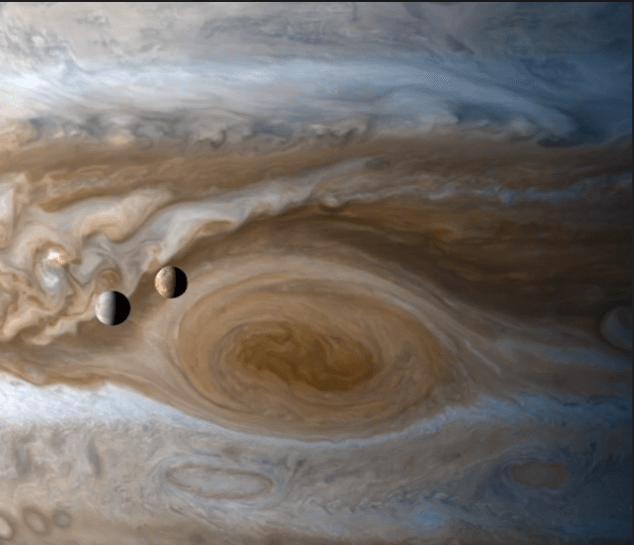
Europa and Io move across the face of Jupiter, with the Great Red Spot behind them. Image: NASA/JPL/Cassini, Kevin M. Gill
The newly released ultraviolet image reveals strange features around the polar regions. The oval shaped features are Earth-sized and only visible in the ultraviolet wavelengths. The ovals seems to consistently appear at a slightly lower latitude than the auroral zones around the poles. In the image, the ovals seem dark in colour due to absorption of ultraviolet radiation, more so than the brighter surrounding regions.
The Hubble Space Telescope orbits Earth at an altitude of 540 km and takes yearly images of Jupiter and the other planets. Hubble was the first telescope to capture the so called UV ovals and they have since been detected by the Cassini spacecraft. The team at UC Berkeley discovered that the ovals were more common around the south pole (appearing in 75% of images around south pole and only 12% around north pole.)
This image of NASA’s Hubble Space Telescope was taken on May 19, 2009 after deployment during Servicing Mission 4. NASA
The team spoke with planetary atmospherics experts Tom Stallard (Northumbria University in UK) and Xi Zhang (from UC Santa Cruz) to try and understand the mechanism. They theorise that Jupiter’s strong magnetic field lines experience friction in the ionosphere leading to the establishment of a vortex (a rotating, spinning flow of fluid or air.) It is the vortex that drives the dark ovals.
Stem Cells Grown in Space Could Revolutionize Medicine Here on Earth
Extended periods spent in microgravity can take a serious toll on the human body, leading to muscular atrophy, bone density loss, vision problems, and changes to the cardiovascular, endocrine, and nervous systems. At the same time, however, scientists have found that microgravity may play a key role in the future of medicine. This includes bioprinting in space, where cultured cells are printed out to form organic tissues and organs without the need for grafts. Printing in microgravity also ensures that fragile cell structures do not collapse due to pressures caused by Earth’s gravity.
However, space medicine may also have applications for stem cell research, which also benefit from a microgravity environment. Stem cells have countless applications in medicine because of their ability to quickly replicate and differentiate into many different types of cells. Based on experiments carried out aboard the International Space Station (ISS), researchers from the Mayo Clinic in Florida determined that these abilities are enhanced when grown in space. These findings could have significant benefits in the study of disease prevention and treatment on Earth, as well as medical treatments delivered in space.
The research was conducted by Fay Ghani and Abba C. Zubair, two pathologists with the Mayo Clinic’s Center for Regenerative Biotherapeutics and the Department of Laboratory Medicine and Pathology. The paper detailing their experiment and findings was recently published in NPJ Microgravity. For their experiment, the team specifically examined the behavior of several types of adult stem cells, which manage normal wear and tear on the body. These cells are often grown by scientists for the sake of disease research and developing new therapies.
Several experiments have been run on the ISS. Credit: Ghani & Zubair, NPJ Microgravity (2024)
The process is challenging, expensive, and takes a long time. But as Zubair said in a recent interview with ScienceAlert!, the process could be simplified by growing them in space-based labs:
“Studying stem cells in space has uncovered cell mechanisms that would otherwise be undetected or unknown within the presence of normal gravity. That discovery indicates a broader scientific value to this research, including potential clinical applications. The space environment offers an advantage to the growth of stem cells by providing a more natural three-dimensional state for their expansion, which closely resembles growth of cells in the human body.
Ghani and Zubair experimented with many types of adult stem cells and obtained positive results for them all. This included general improvements in cell expansion and stability of replication, which continued after the cell cultures were returned to Earth. In particular, they noted improvements with mesenchymal stem cells (MSCs), a class of multipotent stromal cells that can differentiate into bone, cartilage, muscle, and fat cells – which gives rise to marrow adipose tissue, thus increasing bone density.
When grown in microgravity, these cells were shown to be better at managing immune system responses and reducing inflammation. “That’s in comparison to the two-dimensional culture environment available on Earth that is less likely to imitate human tissue,” said Zubair. “The space research conducted so far is just a starting point. A broader perspective about stem cell applications is possible as research continues to explore the use of space to advance regenerative medicine.”
One of the experiments conducted aboard the ISS. Credit: Mayo Clinic
While there is still a significant amount of research and testing to be done, these results are very promising and indicate that stem cells can be grown faster and in greater numbers in microgravity. Ghani and Zubair are confident that space-grown stem cells will help treat the most common causes of mortality here on Earth, including heart disease, stroke, cancer, and neurodegenerative diseases like dementia, Parkinson’s disease, Multiple Sclerosis (MS), and Amyotrophic Lateral Sclerosis(ALS).
Superfast Supercomputer Creates the Biggest Simulation of the Universe Yet
These images are a small sample from the Frontier supercomputer simulations. They reveal the evolution of the expanding universe in a region containing a massive cluster of galaxies from billions of years ago to present day (left). Red areas show hotter gasses, where temperatures reach 100 million Kelvin or more. The panel on the right is a zoom-in, where star tracer particles track the formation of galaxies and their movement over time. Credit: Argonne National Laboratory, U.S Dept of Energy
Superfast Supercomputer Creates the Biggest Simulation of the Universe Yet
Scientists at the Department of Energy’s Argonne National Laboratory have created the largest astrophysical simulation of the Universe ever. They used what was until recently the world’s most powerful supercomputer to simulate the Universe at an unprecedented scale. The simulation’s size corresponds to the largest surveys conducted by powerful telescopes and observatories.
The Frontier Supercomputer is located at the Oak Ridge National Laboratory in Tennessee. It’s the second-fasted supercomputer in the world, behind only El Capitan, which pulled ahead in November, 2024. Frontier is the world’s first exascale supercomputer, though El Capitan has joined the ranks of exascale supercomputing.
The new Frontier simulation is record-breaking and is now the largest simulation of the Universe ever conducted. Its exascale computing allows it to simulate a level of detail that was unreachable prior to its implementation. Exascale is so advanced that it’s difficult to fully exploit its capabilities without new programming paradigms.
Frontier is a significant leap in astrophysical simulations. It covers a volume of the Universe that’s 10 billion light years across. It incorporates detailed physics models for dark matter, dark energy, gas dynamics, star formation, and black hole growth. It should provide new insights into some of the fundamental processes in the Universe, such as how galaxies form and how the large-scale structure of the Universe evolves.
“There are two components in the universe: dark matter—which as far as we know, only interacts gravitationally—and conventional matter, or atomic matter.” said project lead Salman Habib, division director for Computational Sciences at Argonne.
“So, if we want to know what the universe is up to, we need to simulate both of these things: gravity as well as all the other physics including hot gas, and the formation of stars, black holes and galaxies,” he said. “The astrophysical ‘kitchen sink’ so to speak. These simulations are what we call cosmological hydrodynamics simulations.”
Cosmological hydrodynamics simulations combine cosmology with hydrodynamics and allow astronomers to examine the complex interrelationships between gravity and things like gas dynamics and stellar processes that have shaped and continue to shape our Universe. They can only be conducted with supercomputers because of the level of complexity and the vast number of numerical equations and calculations involved.
The sheer amount of energy needed for Frontier to perform these simulations is staggering. It consumes about 21 MW of electricity, enough to power about 15,000 single-family homes in the US. But the payoff is equally as impressive.
“For example, if we were to simulate a large chunk of the universe surveyed by one of the big telescopes such as the Rubin Observatory in Chile, you’re talking about looking at huge chunks of time — billions of years of expansion,” Habib said. “Until recently, we couldn’t even imagine doing such a large simulation like that except in the gravity-only approximation.”
“It’s not only the sheer size of the physical domain, which is necessary to make direct comparison to modern survey observations enabled by exascale computing,” said Bronson Messer, Oak Ridge Leadership Computing Facility director of science. “It’s also the added physical realism of including the baryons and all the other dynamic physics that makes this simulation a true tour de force for Frontier.”
The Exascale-class HPE Cray EX Supercomputer (Frontier) at Oak Ridge National Laboratory. Image Credit: By OLCF at ORNL – https://www.flickr.com/photos/olcf/52117623843/, CC BY 2.0, https://commons.wikimedia.org/w/index.php?curid=119231238
Frontier simulates more than just the Universe. In June, researchers working with it achieved another milestone. They simulated a system of 466 billion atoms in a simulation of water. That was the largest system ever modeled and more than 400 times larger than its closest competition. Since water is a primary component of cells, Frontier is paving the way for an eventual simulation of a living cell.
Frontier promises to make advancements in multiple other areas as well, including nuclear fission and fusion and large-scale energy transmission systems. It’s also been used to generate a quantum molecular dynamics simulation that’s 1,000 times greater in size and speed than any of its predecessors. It also has applications in modelling diseases, developing new drugs, better batteries, better materials including concrete, and predicting and mitigating climate change.
Astrophysical/cosmological simulations like Frontier’s are powerful when they’re combined with observations. Scientists can use simulations to test theoretical models compared to observational data. Changing initial conditions and parameters in the simulations lets researchers see how different factors shape outcomes. It’s an iterative process that allows scientists to update their models by identifying discrepancies between observations and simulations.
Frontier’s huge simulation is just one example of how supercomputers and AI are taking on a larger role in astronomy and astrophysics. Modern astronomy generates massive amounts of data, and requires powerful tools to manage. Our theories of cosmology are based on larger and larger datasets that require massive computing power to simulate.
Frontier has already been superseded by El Capitan, another exascale supercomputer at the Lawrence Livermore National Laboratory (LLNL). However, El Capitan is focused on managing the nation’s nuclear stockpile according to the LLNL.
Simulating The Universe with Supercomputers
Simulating the Universe on a Supercomputer - Discover Our Universe
Popular media love talking about asteroid mining using big numbers. Many articles talk about a mission to Psyche, the largest metallic asteroid in the asteroid belt, as visiting a body worth $10000000000000000000, assumedly because their authors like hitting the “0” key on their keyboards a lot. But how realistic is that valuation? And what does it actually mean? A paper funded by Astroforge, an asteroid mining start-up based in Huntington Beach, and written by a professor at the Colorado School of Mine’s Space Resources Program takes a good hard look at what metals are available on asteroids and whether they’d genuinely be worth as much as the simple calculations say that would be.
The paper divides metals on asteroids into two distinct types—those that would be worth returning to Earth and those that wouldn’t. Really, the only metals judged to be worthy of returning to Earth are the platinum-group metals (PGMs), which are known for their extraordinarily high cost, relatively low supply, and high usefulness in a variety of modern-day technology. That includes catalytic converters, which is why they are commonly the target of thieves.
The other category would be metals used for in-space construction, such as iron, aluminum, and magnesium. While these might not be economically viable to send back to Earth because of their relatively low prices on our home planet, they are useful up in space for constructing large structures, such as space stations or solar power arrays. However, given the chicken-and-egg problem of not having any demand for these space-sourced metals because they are so expensive, it is hard to quantify how much they are worth. Its competition (i.e. launching the material from Earth), is priceable though, and at $10,000 / kg, plus $100 / kg for a common material such as iron.
Fraser talks about whether we would mine asteroids.
Those prices aren’t anywhere near the $500,000 / kg that a PGM such as Rhodium has ever back on Earth, but it could still make mining asteroids for iron economically viable if the material is used in space. So what do all those calculations mean for the actual value of the asteroids that we might mine?
First and most importantly, recent research suggests that asteroids made out of “pure metal,” such as Psyche is assumed to be, are likely pure fiction. While that might not be great news for any single benign asteroid worth a lot, the other part of that research is that even asteroids that were originally thought to be relatively low in metal content actually have reasonable quantities that could be economically extracted.
To prove the point, the paper looked in detail at a series of meteorite studies, which are the equivalent of left-over asteroids, and compared the “grades” of 83 different elements with ores found on or near the Earth’s surface. Since remote sensing has difficulty distinguishing between some of those elements, meteorite samples that can be subjected to advanced analysis techniques are our best bet at accurately calculating the chemical composition of asteroids, other than the few samples of in-tact asteroids that have been returned so far.
Isaac Arthur also discusses the prospects of asteroid mining. Credit – Isaac Arthur YouTube Channel
That data showed that PGMs, while lower in concentration than considered initially (because of an assumption in a foundational paper on the composition of asteroids), are still in much higher concentrations than the equivalent terrestrial ores. In particular, a material known as a refractory metal nugget (RMN) could have concentrations of PGMs orders of magnitude higher than anything found on Earth or other types of asteroidal material.
RMNs are primarily found in a calcium aluminum inclusion (CAI) structure, mainly on L-type asteroids. L-types are relatively uncommon asteroids with a reddish tint, but we haven’t yet visited them. They might be made up of more than 30% CAIs, though, in which case, they could contain a significant amount of extractable PGMs without additional processing.
However, RMNs themselves are very small, at the micron to sub-micron range, making them extremely hard to process in the first place. So, bulk extraction from asteroidal regolith could range up to hundreds of ppm, which is already a few orders of magnitude greater than their concentration in Earth’s regolith.
Fraser talks about mining Psyche, the largest “metallic asteroid” in the asteroid belt.
When looking at the metals for use in space, they are about as abundant as initially predicted, but they face challenges in processing them out of their oxidized states. Typically, this requires some high-energy procedure, such as molten regolith electrolysis, to break off the elemental metal, which is needed for further processing. Again, there’s the chicken and egg problem of having a power source that is large enough to perform these processes, but building it would require the material that would require the power source.
Eventually, that problem will disappear if companies like AstroForge have their way. Remember that the company funded this study, and its two co-founders and Kevin Cannon, the professor at CSM, were co-authors. The company plans to launch its next mission, a rendezvous with near-Earth asteroids, to try to tell if they’re “metallic” in January. Perhaps that mission will help contribute to our growing understanding of the composition and value of the asteroids surrounding us.
Scientists have used the world's fastest supercomputer to show the universe as it has never been seen before.
In this incredible video, scientists from the Department of Energy’s Argonne National Laboratory reveal the largest computer simulation of the universe ever created.
The simulated area contains a staggering 311,296 cubic megaparsecs of space.
Through it, you can watch as vast clusters of galaxies come together over billions of years.
However, this staggeringly massive vista is just 0.001 per cent of the entire simulation.
The results of that enormous computation will enable scientists to investigate the evolution of the universe and the role played by mysterious dark matter.
Project leader Dr Salman Habib says: 'There are two components in the universe: dark matter — which as far as we know, only interacts gravitationally — and conventional matter, or atomic matter.
'So, if we want to know what the universe is up to, we need to simulate both of these things.'
Scientists have revealed the largest simulation of the universe ever created, simulating an area of 31 billion cubic megaparsecs
When astronomers look at distant galaxies through a powerful telescope like the James Webb Space Telescope they are able to look back in time to the early days of the cosmos.
However, those images only give us snapshots of how the universe once looked.
To get a true god's-eye view of creation, astronomers need to create what is called a 'hydrodynamic simulation'.
Rather than just simulating the pull of gravity between different chunks of matter, hydrodynamic simulations get as close as possible to forces which shape cosmic evolution.
Dr Habib says that this requires scientists to simulate 'gravity as well as all the other physics including hot gas, and the formation of stars, black holes and galaxies. The astrophysical "kitchen sink" so to speak.'
The problem is that these kinds of simulations need vast amounts of computational power to create.
In order to run simulations at all, astronomers have typically left out all the other forces and factors which make hydrodynamic simulations so useful.
Dr Habib says: 'For example, if we were to simulate a large chunk of the universe surveyed by one of the big telescopes such as the Rubin Observatory in Chile, you’re talking about looking at huge chunks of time — billions of years of expansion.
In this incredible video, you can see as a vast cluster of galaxies condense in the expanding universe. This mindboggling clip (pictured) only shows 0.001 per cent of the whole simulation
This new simulation is on a scale with the largest maps of the cosmos ever created such as the ESA's Euclid cosmic atlas (pictured)
The simulation captures the formation of galactic filaments such as the Laniakea filament (illustrated) which contains hundreds of thousands of galaxies including the Milky Way
How many stars are in the universe?
Our Solar System revolves around one star, the Sun.
But, the Sun is only one of between 100 and 400 billion stars in the Milky Way.
This is only one of more than 100 galaxies in the Virgo Supercluster which, itself only one part of even larger structures.
It is estimated that there could be between 100-200 billion and two trillion galaxies in the Universe.
Overall, scientists estimate that there could be around 70 septilion stars in the Universe.
That's 70 followed by 23 zeros.
'Until recently, we couldn’t even imagine doing such a large simulation like that except in the gravity-only approximation.'
To overcome these problems, the researchers used the Frontier supercomputer at Oak Ridge National Laboratory.
Even with a computer that fast, emulating the universe isn't simple and it's taken more than a decade for scientists to refine and upgrade the code in order to run a hydrodynamic simulation on this scale.
However, earlier this month, researchers were able to use 9,000 of Frontier's computing nodes to simulate a volume of the expanding universe measuring more than 31 billion cubic megaparsecs.
Critically, this simulation also includes the effects of the mysterious substance known as dark matter.
Dark matter is a theoretical type of particle which doesn't interact with the atoms and subatomic particles which make up the rest of the universe.
Critically, this simulation also includes the effects of dark matter. This theoretical substance could create vast, unobservable structures between galaxies which have given the universe the extra mass it needs to evolve into the form we observe today. Pictured: a NASA simulation of the formation of dark matter structures in the early universe
The only way that dark matter supposedly affects the universe around it is by exerting a gravitational pull.
Scientists first proposed that this strange substance might exist to explain why the gravitational forces in the universe seem to be stronger than the mass of all the galaxies should produce.
However, since we cannot observe dark matter in any way simulations like this are key to understanding how it might have influenced the evolution of the cosmos.
The team are yet to release any analysis based on the simulation but we should expect some exciting revelations to come.
Dark matter is a hypothetical substance said to make up roughly 85 per cent of the universe.
The enigmatic material is invisible because it does not reflect light, and has never been directly observed by scientists.
Astronomers know it to be out there because of its gravitational effects on known matter.
The European Space Agency says: 'Shine a torch in a completely dark room, and you will see only what the torch illuminates.
Dark matter is a hypothetical substance said to make up roughly 27 per cent of the universe. It is thought to be the gravitational 'glue' that holds the galaxies together (artist's impression)
'That does not mean that the room around you does not exist.
'Similarly we know dark matter exists but have never observed it directly.'
The material is thought to be the gravitational 'glue' that holds the galaxies together.
Calculations show that many galaxies would be torn apart instead of rotating if they weren't held together by a large amount of dark matter.
Just five per cent the observable universe consists of known matter such as atoms and subatomic particles.
Exploring our Mind-Blowing Universe | BBC Earth Science
The Mind-Blowing Mysteries of the Universe | Space Documentary 2024
An AI Chemist Made A Catalyst to Make Oxygen On Mars Using Local Materials
Breaking oxygen out of a water molecule is a relatively simple process, at least chemically. Even so, it does require components, one of the most important of which is a catalyst. Catalysts enable reactions and are linearly scalable, so if you want more reactions quickly, you need a bigger catalyst. In space exploration, bigger means heavier, which translates into more expensive. So, when humanity is looking for a catalyst to split water into oxygen and hydrogen on Mars, creating one from local Martian materials would be worthwhile. That is precisely what a team from Hefei, China, did by using what they called an “AI Chemist.”
Unfortunately, the name “AIChemist” didn’t stick, though that joke might vary depending on the font you read it in. Whatever its name, the team’s work was some serious science. It specifically applied machine learning algorithms that have become all the rage lately to selecting an effective catalyst for an “oxygen evolution reaction” by utilizing materials native to Mars.
To say it only chose the catalyst isn’t giving the system the full credit it’s due, though. It accomplished a series of steps, including developing a catalyst formula, pretreating the ore to create the catalyst, synthesizing it, and testing it once it was complete. The authors estimate that the automated process saved over 2,000 years of human labor by completing all of these tasks and point to the exceptional results of the testing to prove it.
Depiction of the process the AI Chemist went through to create the test catalyst.Credit – Zhu et al.
Before we get to that, though, let’s start with the “initial conditions.” The team developed an “all-in-one” robotic AI chemist capable of performing all these tasks. It was initially based on work done by more limited AI chemists who could read synthetic chemistry literature and estimate the efficacy of different chemical compounds for different tasks. After they built the model, they needed to feed it with some data.
For that data, they selected five different common rocks from the surface of Mars. They estimated that there would be 3,764,376 possible combinations to come out of the elements present in those rocks, depending on how the combinations were manufactured. So, the first task of the AI Chemist was to select one that could act as a catalyst for splitting off oxygen. Part of that dataset was built with 30,000 other theoretical datasets and the results of 243 experiments. The result is a “polymetallic” material composed of manganese, iron, nickel, magnesium, aluminum, and calcium.
Next, a sample of the catalyst would be manufactured for testing. The AI is equipped with a robot arm that took physical samples of meteorites that had been dissolved in hydrochloric acid and attempted to synthesize the suggested catalyst out of those materials. This process involved pretty extreme processes like centrifuging the samples at 7,500g for 5 minutes to separate out the necessary materials and drying out the resultant material. Impressively, all of this was seemingly done without human intervention.
Fraser goes into detail about how a potential mission to Mars will happen in the near future – including creating oxygen using catalysts.
After some of the material had been synthesized, the research team tested it by actually performing the reduction process it was designed to do. More importantly, they did so under Martian ambient conditions. The material performed admirably, similar to existing catalysts already used.
So, effectively, an AI just developed and tested a catalyst for use on Mars using local materials. And potentially saved over 2,000 years of intensive human labor in doing so. That is a testament to how effective AI is at finding patterns in existing data and extrapolating them using new data. It remains to be seen, though, if this catalyst will ever see the light of day on Mars, as the catalyst itself must be integrated with the rest of the system to perform the reduction reaction to split oxygen from water effectively. Given the complexity of the process used to create that catalyst, it might be easier for us to ship one directly from Earth, even if it doesn’t use Martian materials.
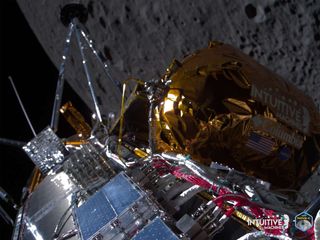
Odysseus continues its voyage to the lunar surface.
Odysseus landing on the Moon
Odysseus lunar lander’s first images of the Moon
Update for 7 pm ET: Touchdown! Intuitive Machines reports that its IM-1 lander Odysseus has landed on the moon and is transmitting a faint, but definite, signal. "Houston, Odysseus has found his new home," mission director Tim Crain said. See our full landing story, video and photos.
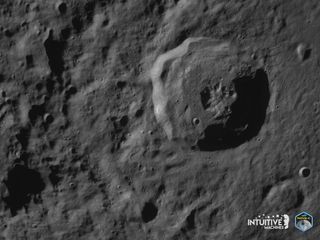
The Odysseus lander from Intuitive Machines obtained this picture of the Bel’kovich K crater on Feb. 21, 2024. (Image credit: Intuitive Machines/X)
Hours ahead of its moon landing, Odysseus snapped a picture of a lunar crater.
The Intuitive Machines lander beamed home an image of the Bel’kovich K crater, a roughly 31-mile (50-kilometer) divot in the moon's northern equatorial highlands. Mountains in the center were "made when the crater was formed," officials wrote Wednesday (Feb. 21) on X, formerly Twitter.
Odysseus successfully entered lunar orbit on Wednesday following a crucial engine burn, and is slated to touch down near the moon's south pole on Thursday afternoon (Feb. 22) no earlier than 6:24 p.m. EST (2324 GMT). You can tune in to the landing live here at Space.com, courtesy of NASA, or directly via the space agency. Coverage will begin at 5:00 p.m. EST (2300 GMT).
1st image of Odysseus on the moon released after historic landing
If Odysseus makes it, the lander will be the first private machine to successfully soft land on the moon and the first American vehicle overall to do so since the crewed Apollo 17 mission achieved the feat in 1972. You can watch the attempt here at Space.com.
Intuitive Machines' Odysseus lander beams home a selfie in lunar orbit on Feb. 21, 2024. (Image credit: Intuitive Machines)
The mission launched on Feb. 15 on a SpaceX Falcon 9 rocket, bringing along 12 payloads for lunar investigations. Six of those experiments are from NASA and associated with the agency's Commercial Lunar Payload Services program, or CLPS.
NASA aims to use CLPS missions for science investigations ahead of the agency's Artemis program, which itself plans to put astronauts back on the moon in the 2020s and eventually establish a permanent base at the lunar south pole. The region is rich in water ice, which is useful for fueling and machinery.
One CLPS mission has already tried to reach the moon, but it didn't make it. Astrobotic's Peregrine lunar lander launched in January atop the first United Launch Alliance's Vulcan Centaur rocket. Peregrine, however, developed a fuel leak and instead was steered into Earth's atmosphere on Jan. 18.
Other private missions before Odysseus' IM-1 endeavor did indeed achieve lunar orbit before. Examples include Israel's Beresheet and Tokyo's Hakuto-R landers. Both missions, however, saw their spacecraft crash: Beresheet in April 2019 and Hakuto-R in April 2023.
This story was updated at 2:34 p.m. Feb. 22 with the updated landing time.
New Images of Odysseus On The Moon Have Been Released!
SpaceX deploys Intuitive Machines lunar lander in amazing view from space
Wetenschappers hebben ontdekt dat de Kuipergordel mogelijk bijna twee keer zo groot is als eerder werd gedacht. Niet alleen dat: het zou zelfs zo kunnen zijn dat er sprake is van een tweede gordel.
De ruimtesonde New Horizons heeft weer een nieuwe ontdekking gedaan: het zou zomaar kunnen zijn dat de Kuipergordel miljarden kilometers verder reikt dan de huidige modellen voorspellen. De ruimtesonde is inmiddels aangekomen op een afstand van 60 AU, wat betekent dat deze zestig keer verder verwijderd is van de zon dan onze eigen planeet: AU staat voor Astronomical Unit en is gelijk aan de afstand tussen de zon en de aarde, wat ongeveer 150 miljoen kilometer is. Op de huidige afstand van 9 miljard kilometer vanaf de zon vangt New Horizons een hoop meer stof is dan de bedoeling is, wat mogelijk betekent dat de Kuipergordel een stuk verder reikt dan eerder werd gedacht. Wetenschapper Alex Doner heeft meegewerkt aan het onderzoek. Hij laat weten: “New Horizons is momenteel bezig met de eerste directe metingen van interplanetair stof – ver voorbij Neptunus en Pluto. Op deze afstand kan elke kleine observatie leiden tot een grote ontdekking. Het idee dat we wellicht een verlenging hebben ontdekt van de Kuipergordel is een stap vooruit in het ontrafelen van de mysteries van het zonnestelsel.” Het onderzoek is gepubliceerd in het blad Astrophysical Journal Letters.
De Kuipergordel Als je vanaf de zon door ons zonnestelsel reist, kom je eerst de planeet Mercurius tegen. Vervolgens Venus, de aarde, Mars, Jupiter, Saturnus, Uranus en Neptunus. Tussen Mars en Jupiter bevindt zich dan ook nog de planetoïdengordel: een gebied met een grote hoeveelheid planetoïden. En voorbij Neptunus bevindt zich dan de Kuipergordel, bestaande uit miljarden komeetachtige – uit steen en ijs bestaande – objecten. Sommige van die objecten zijn groot – zoals Eris en Pluto – andere zijn juist aanzienlijk kleiner.
Ruimtestof De wetenschappers hebben de ontdekking kunnen doen omdat New Horizons zich momenteel dus door de Kuipergordel beweegt en hierbij stof tegenkomt. Dit stof wordt vervolgens gedetecteerd, waardoor er uiteindelijk een dichtheid bepaald kan worden. Die dichtheid is momenteel een stuk hoger dan deze zou moeten zijn. De verwachting is namelijk dat de buitenste ring van de Kuipergordel een lagere stofdichtheid heeft dan de regionen binnenin. Aangezien New Horizons vooralsnog geen lagere dichtheden heeft gemeten is het dan ook waarschijnlijk dat deze de buitenkant van de Kuipergordel nog niet heeft bereikt. Mede-wetenschapper Alan Stern licht toe: “Deze nieuwe bevindingen betekenen dat New Horizons waarschijnlijk het eerste ruimtevaartuig is dat een nieuwe verzameling hemellichamen heeft ontdekt. Ik ben dan ook erg nieuwsgierig om te zien tot hoever de hoge stofdichtheid zal reiken.”
IJsdeeltjes De metingen van New Horizons komen op het perfecte moment. Zo hebben wetenschappers van het New Horizons-team met behulp van observatoria zoals de Subaru Telescope in Hawaii eerder een aantal objecten gevonden die ver buiten het gebied liggen dat traditioneel gezien als de Kuipergordel wordt aangemerkt. En New Horizons lijkt nu dus ook ter plekke te bevestigen dat de buitengrens van de Kuipergordel op grotere afstand ligt dan gedacht. Zo werd eerst gedacht dat deze grens zich rond een afstand van 50 AU bevond, terwijl nu wordt gedacht aan een afstand van 80 AU. Concreet betekent dit een verlenging van 4,5 miljard kilometer. Het team van Doner is naarstig op zoek naar een mogelijke verklaring. Zo stelt Doner: “Het zou goed kunnen zijn dat New Horizons nu kleine ijsdeeltjes detecteert die niet dichter bij de zon kunnen komen. Een ander verklaring zou kunnen zijn dat kleine stofdeeltjes van de Kuipergordel door stralingsdruk een stuk verder worden geduwd dan voorheen werd gedacht. Dit laatste idee is niet heel waarschijnlijk, maar het zou kunnen.”
Het is ongetwijfeld niet de laatste keer dat New Horizons vanuit de buitenste regionen van ons zonnestelsel van zich laat horen; vooralsnog heeft de ruimtesonde nog meer dan genoeg brandstof. De verwachting is namelijk dat de ruimtesonde tot aan 2050 kan blijven werken, waarbij deze een afstand zal overbruggen van meer dan 100 AU. Het is trouwens ook niet de eerste keer dat New Horizons een opzienbarende ontdekking doet. Zo heeft de ruimtesonde in het verleden foto’s gemaakt van Pluto en is deze zeer dicht in de buurt gekomen van Arrakoth. Wil je meer weten over New Horizons? Kijk dan eens hier.
Recently-Discovered Active Asteroid is in Fact Main-Belt Comet, Astronomers Say
Recently-Discovered Active Asteroid is in Fact Main-Belt Comet, Astronomers Say
456P/PANSTARRS, an active, main-belt asteroid first spotted in 2021, is recurrently active, and activity is likely driven by the sublimation of volatile ice, according to new observations from the Magellan-Baade telescope and the Lowell Discovery Telescope.
Images of 456P/PANSTARRS taken with the Magellan-Baade telescope in Chile on October 3, 2024, and the Lowell Discovery Telescope in Arizona on October 26, 2024, where the head, or nucleus, of the comet is at the center of each image, and the tail extends to the right.
Image credit: Scott S. Sheppard / Carnegie Institution for Science / Audrey Thirouin, Lowell Observatory / Henry H. Hsieh, Planetary Science Institute.
“Main-belt comets are icy objects found in the asteroid belt between Mars and Jupiter — rather than the cold outer Solar System where icy bodies are typically expected,” said Planetary Science Institute senior scientist Henry Hsieh and colleagues.
“They sport comet-like features, like tails extending away from the Sun or fuzzy clouds as the Sun’s heat vaporizes their ice.”
These objects were first discovered in 2006 at the University of Hawaii by Dr. Hsieh and his then-doctoral advisor, Professor David Jewitt.
“Main-belt comets belong to a larger group of solar system objects known as active asteroids, which look like comets, but have asteroid-like orbits in the warm inner Solar System,” the astronomers said.
“This larger group includes objects whose clouds and tails are made of ejected dust produced after an impact or as they quickly rotate, rather than just those that eject dust due to vaporized ice.”
“Both main-belt comets and active asteroids in general are still relatively rare, but scientists are discovering them at a growing clip.”
456P/PANSTARRS was discovered as P/2021 L4 (PANSTARRS) from observations on June 9 and 14, 2021, by Pan-STARRS1, and Canada-France-Hawaii Telescope observations on June 14, 2021.
Dr. Hsieh and co-authors observed the object twice using the Magellan Baade Telescope and Lowell Discovery Telescope in October 2024 to establish its status as a main-belt comet.
“This object is not just an asteroid that experienced a one-off event that caused it to show activity one time, but is an inherently active, icy body similar to other comets from the outer Solar System,” Dr. Hsieh said.
If 456P/PANSTARRS’s activity were due to something other than ice vaporization, then its tail would be expected to appear only once randomly, and not repeatedly appear when it was close to the Sun.
An icy object, on the other hand, heats up every time it approaches the Sun, and the vaporized ice drags dust out along with it.
When the object moves farther from the Sun and cools, the activity stops.
Observations of repeated dust ejection activity during close approaches to the Sun are currently considered the best and most reliable way to identify main-belt comets.
“There are still very few confirmed main-belt comets known,” Dr. Hsieh said.
“We want to build up the population so we can get a clearer idea of what their broader properties are — such as their sizes, activity duration and distribution within the asteroid belt, for example — so that they can be better used to trace ice in the Solar System in general.”
The findings were published in the Research Notes of the American Astronomical Society.
Henry H. Hsieh et al. 2024. Confirmation of Recurrent Activity of Main-Belt Comet 456P/PANSTARRS (P/2021 L4). Res. Notes AAS 8, 283; doi: 10.3847/2515-5172/ad90a6
This article is a version of a press-release provided by the Planetary Science Institute.
Asteroid Samples Returned to Earth Were Immediately Colonized by Bacteria
We’ve known for a while that complex chemistry occurs in space. Organic molecules have been detected in cold molecular clouds, and we have even found sugars and amino acids, the so-called “building blocks of life,” within several asteroids. The raw ingredients of terrestrial life are common in the Universe, and meteorites and comets may have even seeded Earth with those ingredients. This idea isn’t controversial. But there is a more radical idea that Earth was seeded not just with the building blocks of life but life itself. It’s known as panspermia, and a recent study has brought the idea back to popular science headlines. But the study is more subtle and interesting than some headlines suggest.
Panspermia became popular in the 1800s and 1900s when it became clear that life arose surprisingly early on Earth. On a geologic scale, cellular life appears almost as soon as Earth cooled enough to support it. Given the complexity of DNA and living cells, how could such a thing have evolved so quickly? In the panspermia model, life evolved either in space or on some distant world, and was carried to Earth within asteroids or comets. We know that some living things can survive the harsh vacuum of space, so perhaps we have some alien, extraterrestrial origin.
But there are reasons to be skeptical. For one, the transition from organic to biological chemistry may be remarkably adaptive. While life appears to have appeared suddenly on Earth, that may be precisely what you’d expect. Without an example of extraterrestrial life, we simply don’t know. And while life can survive in space for a limited time, it’s not likely to survive for the millions of years it would take for an asteroid to traverse the solar system, much less the billions of years it would take to travel between star systems. Still, one step toward proving panspermia would be to gather material from an asteroid and find out it has life, and that’s exactly what this latest study found.
The Hayabusa2 mission, launched in 2014, landed on a small asteroid named Ryugu in 2018 and returned a sample of material to Earth in 2020. The sample was kept sterile the whole time, hermetically sealed for the journey back, and only opened in a pure nitrogen clean room using sterilized equipment. The sample was as clean and uncontaminated as we could get. When the team prepared a sample and looked at it under an electron microscope, they found rods and filaments of organic matter consistent with microbial life. In other words, the team found life on an asteroid.
Except they likely didn’t.
The size distribution is consistent with terrestrial life. Credit: Genge, et al
One thing to keep in mind is that microbial life is incredibly robust. It exists everywhere and spreads rapidly. You can find the stuff in the cores of nuclear power plants, in hot thermal vents, and in the cleanest clean room. And even if you sterilize something, microbial life will find a way. When the team found life on their sample, the first thing they did was to look for evidence of contamination, and there was plenty of evidence to be found. To begin with, the size distribution of the organic rods and filaments found in the sample is consistent with those commonly deposited by terrestrial life. Their data also found evidence of a growth and decline period of about five days, which is also consistent with Earth life. If the Ryugu samples had truly evolved beyond Earth, they would be genetically separated from us by millions or billions of years. Their size and growth rate wouldn’t match those of our common microbes. So the best explanation is that the sample became contaminated despite our best efforts.
While the study doesn’t support the panspermia model, it does tell us two important things. The first is that our sterilization procedures are likely inadequate. We may have already spread life to the Moon and Mars inadvertently. The second is that asteroids have organic materials that could sustain terrestrial life. That’s good news if we want to establish ourselves elsewhere in the solar system. Earth life may not have begun in space, but it could very well end up there.
Water and Carbon Revealed in NASA's Ancient Asteroid Samples
OKEANOS – A Mission That Would Have Retrurned Samples From the Trojan Asteroids
Getting a mission to the point of officially being accepted for launch is an ordeal. However, even when they aren’t selected for implementation, their ideas, and in some cases, their technologies, can live on in other missions. That was the case for the Oversize Kite-craft for Exploration and AstroNautics in the Outer Solar system (OKEANOS) project, originally planned as a Japanese Aerospace Exploration Agency (JAXA) mission. Despite not receiving funding to complete its entire mission, the project team released a paper that details the original plan for the mission, and some of those plans were incorporated into other missions that are still under development.
OKEANOS sought to build on JAXA’s success in returning samples from asteroids to Earth. Its most well-known mission in that regard was Hayabusa-2, which returned samples from the asteroid Ryugu in 2020 and has been the subject of dozens of scientific papers since. Ryugu is a near-earth asteroid, which means its origins in the solar system are dramatically different from those of other asteroids farther out from the Sun, which is where OKEANOS came in.
The original plan for OKEANOS was to launch a sample return mission to one of the Jupiter Trojan asteroids that sit in the Lagrange points in front of and behind Juptier and its orbital path. Scientists believe these asteroids originated outside of Neptune’s orbit in the Kuiper belt but were brought closer to the Sun due to gravitational fluctuations caused by the migration of the gas giant planets. Since they would hold clues to the early solar system, astronomers are interested in their composition, and some space exploration enthusiasts are interested in the materials they hold for in-situ resource utilization purposes. But so far, no missions have visited them yet.
A solar panel, like the one shown in the video, would have been a key component of the OKEANOS missions. Credit – The Japan Times YouTube Channel
That is about to change, though, with Lucy, a NASA mission that launched in 2021 to visit them. However, Lucy will simply do remote observations and lacks the equipment to sample them directly, let alone return a sample back to Earth. The project team had hoped OKEANOS would do just that.
Several novel technologies would be used to enable OKEANOS’ scientific objectives. One of the most interesting was a combination solar sail and ion drive known as a solar power sail. A solar power sail combines the solar pushing power of a solar sail with flexible photovoltaic solar collectors that can collect a significant amount of energy while deployed in a sail-like configuration. JAXA has also successfully tested a similar system with its IKAROS mission, demonstrating the technology in 2010.
Since solar sails have tiny thrust out near Jupiter, OKEANOS relies entirely on an ion engine and simply deploys its “sails” to deploy the solar panels that collect energy to power the ion drive. But once it reached its destination, it would utilize its second interesting technology—a lander.
Fraser talks about Lucy, the first mission to explore the Trojan asteroids.
The two main asteroid sample return missions – OSIRIS-REx and Hayabusa-2 – directly touched down on the surface of their respective asteroids. However, there have been deployed landers that have at least attempted to land on an asteroid before – Philae, the lander that accompanied ESA’s Rosetta mission, is probably the most famous. But never before has a mission attempted to land a lander, collect a sample, and return it to a “mothership” that would then transport that sample back to Earth. Doing so out at the Trojan asteroids would add a new difficulty level of having significant communications lag time, making it difficult to troubleshoot any problems with the mission.
Given JAXA’s track record, it seemed likely that they could pull off that technical challenge. However, the mission was never fully funded due to a “cost issue,” according to the paper. JAXA selected a project known as LiteBIRD to study the cosmic microwave background as its large-class mission for this decade instead. Despite that, the technical details of some of the instrumentation have been described in other papers, and the project team feels confident that future asteroid sample return missions will adopt at least some of them. We’ll be sure to see more of those in the future as interest grows in understanding the roots of our solar system and how we might utilize the readily available resources on asteroids.
A prototype of a robot designed to explore subsurface oceans of icy moons is reflected in the water’s surface during a pool test at Caltech in September. Conducted by NASA’s Jet Propulsion Laboratory, the testing showed the feasibility of a mission concept for a swarm of mini swimming robots. Credit: NASA/JPL-Caltech
Europa, one of the four Galilean satellites of Jupiter is one of the most intriguing locations in the Solar System to search for life. However, its subsurface oceans are buried beneath thick layers of ice making exploration difficult. To explore its oceans, scientists have suggested using small swimming robots capable of penetrating the icy shell. Recently, NASA engineers tested prototypes designed to operate as a swarm, enabling them to explore the mysterious sub-ice oceans on Europa and other icy worlds in the Solar System.
Along with the other three Galilean satellites orbing Jupiter, Europa was discovered just over 400 years ago by Galileo. It is the smallest of the four measuring just 3,120 km across. It orbits Jupiter at a distance of 671,000 km in an almost circular orbit. In comparison to our own Moon, Europa is a little smaller but that is where the similarities end. Europa is made of a silicate rock and has a thick water ice crust below which is thought to be a liquid water ocean and it is this which has captured the interest of scientists.
The Galilean moons of Jupiter: Io, Europa, Ganymede, and Callisto. (Credit: NASA/JPL-Caltech)
The deep oceans of Europa may well harbour forms of aquatic life. Consider the deepest parts of the oceans of Earth where whole eco-systems thrive off thermal vents. At these depths, no light from the Sun penetrates so the organisms and creatures living at these depths take all their energy from the heat escaping from inside the planet. It is this which tantalisingly suggests that maybe such life could have evolved in the oceans of Europa too.
A black smoker hydrothermal vent discovered in the Atlantic Ocean in 1979. It’s fueled from deep beneath the surface by magma that superheats the water. The plume carries minerals and other materials out to the sea. Courtesy USGS.
The exploration of Europa is already underway with NASA’s Europa Clipper expected to arrive in 2030. It will explore Europa with a powerful set of scientific instruments over a total of 49 flybys. Each pass will see the instruments search for signs that the ocean under the thick icy crust could sustain life. This will just be a flyby mission with Europa being probed from high above its surface. NASA are already shaping up their next mission to include even more complex robots that could survey the depths of the sub-surface oceans of Europa.
Artist’s concept of a Europa Clipper mission. Credit: NASA/JPL
This is where NASA’s new mission called SWIM ‘Sensing With Independent Micro-swimmers’ comes in. The concept at least, is simple…a swarm of self-propelled robots that can swim around in the underground oceans having been deployed by the ice piercing cryobot. Once underway, the swimming robots, which are about the size of a mobile phone, would hunt for chemical and temperature signals that might indicate life.
The swimming robots are not just on the drawing board. Engineers have already used 3D printers to create prototypes that have already been tested in a 23 metre pool. The devices which are propelled along by two propellers, with flaps for steering were able to stay on course. These prototypes however were a little larger than those destined to make it into space measuring about three times larger.
The results of the test were very promising but much more work is needed before they are ready for launch. Meanwhile the robots are likely to be trialled here on Earth to support oceanographic research before being sent on their way to Europa.
Astronauts aboard the International Space Station(ISS) were sent into a panic after a cargo ship arrived with a 'toxic smell' and 'possible contamination hazard in the form of droplets.'
The Progress 90 docked with the Russian Poisk module at 9:31am ET on Saturday and Roscosmos cosmonauts identified a smell immediately after opening the hatch.
The Russian crew quickly strapped into protective equipment and activated an extra air-scrubbing system aboard their segment of the ISS for about 30 minutes.
NASA astronaut Don Pettit also reported some 'spray paint-like' smell in the Node 3 module of the US Segment, but it was not immediately clear if it had originated from Progress.
'Space station air scrubbers and contaminant sensors monitored the station's atmosphere following the observation, and on Sunday, flight controllers determined air quality inside the space station was at normal levels,' NASA shared in a statement.
The agency continued to explain that there are no concerns for the crew as of Sunday afternoon, but the hatch between the Russian modular and cargo craft is still closed.
The Progress 90 arrived at the Russian Poisk module at 9:31am, delivering three tons of food, fuel and supplies for members of the Expedition 72 crew on board the ISS.
The Progress 90 docked with the Russian Poisk module at 9:31am ET and Roscosmos cosmonauts identified a smell immediately after opening the hatch. NASA said the crew has yet to reopen the hatch
NASA reported that the US side of the orbiting laboratory also activated its own air-scrubbing system, while the hatch to Russia’s Poisk module remained closed.
While Russian outlets reported a toxic smell, NASA told a different story.
'After opening the Progress spacecraft’s hatch, the Roscosmos cosmonauts noticed an unexpected odor and observed small droplets, prompting the crew to close the Poisk hatch to the rest of the Russian segment,' the agency shared on X.
Progress 90 is scheduled to stay docked for about six months before returning to Earth.
The 'toxic smell' comes just months after a report revealed space agency and its Russian counterpart, Roscomos, are tracking 50 'areas of concern' related to a growing leak aboard the station.
Although officials have been aware of the issue since 2019, the exact source of the leak is still unknown.
All potential cracks have been covered with 'a combination of sealant and patches' but NASA warned that the leak reached its fastest rate yet in April this year.
Both the US and Russian side of the ISS activated its air-scrubbing systems after the toxic smell was identified
Concerns over the station's safety are now so high that NASA has negotiated with Roscomos to only open the hatch when necessary and to keep it sealed in the evenings.
And that's not the only cause for concern, as the space agency has warned that the ISS is at risk of being pelted with micro-meteors and space debris.
In 2019, it was noted that the module had begun to leak a small amount of air through an unidentified crack.
However, despite efforts to seal the module, the amount of air escaping the station has only increased over the last five years.
In February this year, NASA was forced to hold a press conference on the issue as the amount of air escaping temporarily increased from 0.2 lbs per day (0.09 kg) to 2.4 lbs (1.08 kg) per day.
A report published in September by NASA's Office of the Inspector General (OIG) confirmed that the leak hit record rates in April - losing 3.7 lbs (1.68 kg) of air every day.
This has prompted the space agency to escalate the threat rating to the highest level and consider evacuation plans.
In May and June, NASA officials traveled to Russia to discuss 'heightened concerns' over the seemingly growing leak.
Speaking to the Washington Post, NASA associate administrator Jim Free says: 'We have conveyed the seriousness of the leaks multiple times, including when I was in Russia earlier this year.
'We've come to a compromise that they close it in the evening.'
The OIG report states: 'The Service Module Transfer Tunnel leak is not an immediate risk to the structural integrity of the Station, and there are no current concerns of long-term impacts to the overall structure.'
Likewise, ISS program manager Joel Montalbano told a press conference in February that the leak was 'not an impact right now on the crew safety or vehicle operations, but something for everybody to be aware of.'
Astronaut Chris Hadfield Debunks Space Myths | WIRED
NASA has spotted mysterious 'spiderwebs' on a never-before-explored region near the equator of Mars.
The agency's Curiosity rover has been dispatched to probe these bizarre structures — which cover a six to 12 mile stretch of Martian desert — as the machine searches for signs that this long desolate world once supported alien life.
Geologists suspect that the spiderwebs are a gigantic version of a type of crystalized minerals, known as a 'boxwork,' which appear inside some caves on Earth.
They can be found on the ceiling of Wind Cave in South Dakota, which were created by calcium carbonate mineral water seeping into cracks between softer rocks that hardened into crystals.
But the sprawling, over 3,800-acre-wide boxwork on Mars differs in that it was likely formed by Martian seawater and may have trapped fossils of ancient life in its web.
'These ridges will include minerals that crystallized underground, where it would have been warmer,' according to Rice University geologist Dr Kirsten Siebach.
'Early Earth microbes could have survived in a similar environment,' Dr Siebach explained, nothing that the 'salty liquid water' that created these Martian webs an ideal location to find lingering fossil evidence of ancient alien microbes.
The discovery comes as Australian researchers have found that a Martian meteorite, which crashed into Northwest Africa, provides more evidence of hot water on Mars.
A chemical analysis of that meteorite suggests conditions were ripe for aquatic life to develop on Earth's nearest neighbor over four billion years ago.
According to satellite mapping work by 'Martian geologist' Dr Kirsten Siebach, at least 113.6 billion gallons of salty, warm mineral-laden water would have been required to create the vast field of crystal webbing (above), which is about as big or bigger than Los Angles Airport (LAX)
NASA's planetary geologists suspect the webs are a gigantic version of a type of crystalized minerals, known as a 'boxwork,' that appear inside caves on Earth. Above, Wind Cave National Park in South Dakota has some of America's most spiderweb-like 'boxwork' on its ceiling
Ever since it first parachuted down to the Martian surface on August 6, 2012, Curiosity has been exploring the Red Planet for signs of life — as well as hunting for clues about Mars' climate, geology and where all its ancient water went.
But NASA researchers have been intrigued by the massive geological spiderweb for even longer, ever since their Mars Reconnaissance Orbiter satellite first captured aerial images of this haunting landscape back on December 10, 2006.
The likelihood that evidence of aquatic microbial life of Mars might be caught in this giant web as fossils 'makes this an exciting place to explore,' Dr Siebach noted.
This web of potential dead alien microbes and bugs rests in the shadow of a three-mile tall mountain, officially known as 'Aeolis Mon,' but nicknamed 'Mount Sharp.'
Past explorations by the Curiosity rover have revealed many sedimentary layers along the cliff faces of Mount Sharp, suggesting in rich detail that it had been formed by water erosion via ancient lake deposits.
NASA scientists suspect that this erosion helped form the giant crystal spiderweb, as mineral-rich pulses of water seeped and cascaded down Mount Sharp into fractures in the surface rock and then crystallized.
According to satellite mapping work that Dr Siebach published in 2014, at least 113.6 billion gallons of salty, warm mineral-laden water would have been required to create the vast field of crystal webbing, which is bigger than Los Angles Airport (LAX).
Above, NASA's Curiosity rover takes a 'robotic selfie' on the Red Planet via its arm-mounted Mars Hand Lens Imager (MAHLI). Each of the rover's selfies is really a composite image created from dozens of high-resolution photos taken at various angles by the MAHLI camera
Above, another view of the 'boxwork' webs on the ceiling of Wind River cave in South Dakota
'Mineralization,' the kind of crystal formation that likely occurred here, 'is known on Earth to help facilitate preservation of once-habitable environments,' they noted.
And in Australia this month, scientists working with Martian meteor NWA 7034, discovered after it crashed into Northwest Africa, have found still further evidence that ancient warm oceans on Mars could have easily supported alien life.
'We used nano-scale geochemistry to detect elemental evidence of hot water on Mars 4.45 billion years ago,' planetary scientist Dr Aaron Cavosie said in a statement.
'Geochemical markers of water' were discovered on meteor NWA 7034, Dr Cavosie explained, based both on the shape of its rocky grain patterns and its chemical composition: 'tell-tale signs of water-rich fluids from when the grain formed.'
It's believed that NWA 7034 was ejected from an asteroid impact on Mars that created a crater in the northeast of the 'Terra Cimmeria-Sirenum' province in the southern hemisphere of Mars.
Curiosity rover captured this panorama on November 2, 2024 as it was leaving Mars' so-called 'Gediz Vallis' channel on its way toward the mysterious gigantic spiderweb formation
Above, another panorama made by NASA's Curiosity Mars rover before it left Gediz Vallis
A special technique used to date the age of incredibly old zircon minerals via trace amounts of radioactive material, called 'Uranium–lead dating,' found that this meteor was made up of some of the oldest Martian volcanic rock ever obtained.
'The team identified element patterns in this unique zircon, including iron, aluminum, yttrium and sodium,' Dr Cavosie said, 'Through nano-scale imaging and spectroscopy.'
'These elements were added as the zircon formed 4.45 billion years ago,' he continued, 'suggesting water was present during early Martian magmatic activity.'
This mixture of hot and mineral-rich water, not unlike the hydrothermal vents that support life deep in Earth's oceans, point towards the possibility that life was developing on Mars billions of years ago, amid all this volcanic activity.
'Hydrothermal systems were essential for the development of life on Earth,' Dr Cavosie explained, 'and our findings suggest Mars also had water, a key ingredient for habitable environments, during the earliest history of crust formation.'
The Australian planetary scientist and his team at Curtin University in Australia published their results in the journal Science Advances this past Friday.
In its decade-plus on the Red Planet, NASA's Curiosity rover has trekked roughly 20 miles of the Martian surface for clues about the life that may have once thrived there.
Curiosity will begin studying the spiderweb ridges up close in 2025, according to NASA administrator Bill Nelson, where it will stay for a 'monthlong journey through Mars' boxwork.'
The Mars Reconnaissance Orbiter (MRO) searches for evidence that water persisted on the surface of Mars for a long period of time.
It was launched August 12, 2005, and achieved an initial orbit around the red planet on March 10, 2006.
In November 2006, after five months of, it entered its final science orbit and began its primary science phase.
Since its arrival, MRO and its High Resolution Imaging Science Experiment (HiRISE) telescope have been mapping the martian surface, which has been taking shape for more than three billion years.
MRO’s instruments analyse minerals, look for subsurface water, trace how dust and water are distributed in the atmosphere, and monitor daily weather in support of its science objectives.
MRO's missions have shown that water flowed across the Martian surface, but it is still unknown whether water persisted long enough to provide a habitat for life.
VIDEOS
The Most Breathtaking Photos of Mars Ever Captured – A Tribute to Space Photography
Mysterious Green Spot Discovered on Mars | WION Podcast
See Mars Like Never Before! NASA's Perseverance Rover Sends New Video and Images of the Red Planet
The idea of a killer asteroid smashing into Earth might sound like the plot of the latest science fiction blockbuster.
But it could become a reality, according to NASA, which puts the chance of a deadly asteroid striking Earth in any given year at roughly one in 300,000.
Before you panic about our impending doom, there's good news.
A scientist from the University of Murcia has come up with an equation to spot killer asteroids heading for our planet.
Professor Oscar del Barco Novillo's equation is based on the gravitational bending of light, and will allow scientists to pinpoint the precise positions of minor objects in the solar system.
This includes objects in the Kuiper Belt – a region of icy objects including Pluto and other dwarf planets beyond the orbit of Neptune – and a vast, frozen, spherical shell called the Oort Cloud, which is the most distant region in our solar system.
In turn, that could allow planetary defence networks to spot and prepare for any asteroids which could collide with Earth.
This advanced warning could be the difference between having time to deflect the asteroid onto a safe path and a cataclysmic impact.
The idea of a killer asteroid smashing into Earth might sound like the plot of the latest science fiction blockbuster. But it could become a reality, according to NASA, which puts the chance of a deadly asteroid striking Earth in any given year at roughly one in 300,000 (stock image)
Before you anic about our impending doom, there's good news. A scientist from the University of Murcia has come up with an equation to spot killer asteroids heading for our planet
Normally, light takes a straight path from an object to our eyes, meaning where we see the image is where the object really is.
However, this isn't the case for distant objects like asteroids because of a phenomenon called 'gravitational deflection'.
When a beam of light passes through a strong gravitational field like the one around our sun it leaves its straight path and follows a curved trajectory.
You can think of this like a ball following a curving path as it rolls over some uneven ground.
The idea that gravity might bend passing beams of light was first proposed by Sir Isaac Newton in 1730.
The issue for astronomers is that gravitational deflection means that the image we see of a distant object doesn't line up with where the object really is.
Professor Novillo told MailOnline: 'When the sunlight is reflected on the minor objects in the solar system, such as asteroids, the light beams we receive on Earth are deflected due to the Sun and major planets such as Jupiter.
Normally, light takes a straight path from an object to our eyes, meaning where we see the image is where the object really is. However, this isn't the case for distant objects like asteroids because of a phenomenon called 'gravitational deflection'
The 6 asteroids that could hit Earth
1. Bennu
Diameter: 1,574 ft
Odds of collision: 1/2,700 on September 24, 2182
2. 1950 DA
Diameter: 6,561 ft
Odds of collison: 1/34,500 on March 16, 2880
3. 2023 TL4
Diameter: 1,083 ft
Odds of collision: 1/181,000 on October 10, 2119
4. 2007 FT3
Diameter: 2,165 ft
Odds of collision: 1/11.5 million on October 5, 2024
5. 2023 DW
Diameter: 166 ft
Odds of collision: 1/1,584 on February 14, 2046
6. 1979 XB
Diameter: 2,165 ft
Odds of collision: 1/1.8 million on December 14, 2113
'In this sense, the actual positions of these minor bodies are shifted, so this effect should be taken into account in the equations of motion of these minor bodies.'
For most applications that might not be an issue, but when it comes to calculating the orbit of a potentially hazardous asteroid even a small miscalculation could be fatal.
Professor Novillo's solution, published in Monthly Notices of the Royal Astronomical Society, is to treat gravity as if it were a physical medium like water to work out how much light bends as it passes through.
Using this formula, Professor Novillo calculated the angle of deflection for light beams coming from Mercury at different points in its orbit.
Comparing the results to those based on Newtonian and Einsteinian equations, he found there was up to a 15.8 per cent difference when Mercury was at its greatest distance from the Sun.
Professor Novillo says that the most important consequence of this discovery is to enable 'a better calculation of the orbits of minor objects in the solar system, which could be potentially hazardous to the Earth.'
While it won't help detect asteroids in the first place, it will help determine a more precise location for these objects and, consequently, a better estimation of their orbits.
Just like in the movie Armageddon (pictured), humanity may be able to deflect an incoming asteroid so long as there is time to organise a response
For example, the ESA's DART mission used a fridge-sized satellite to slam into the space rock Dimorphos to see if an asteroid could be knocked from its path.
While the results are due to be confirmed by the Hera mission late next year, early observations show that the impact did deflect Dimorphos' orbit.
In theory, humanity could use a similar kamikaze satellite to deflect the orbit of a hazardous asteroid on its way to Earth.
However, doing this would require years of prior warning to give space agencies time to plan the mission and for the asteroid to drift out of Earth's path.
That is why it is so critical for space agencies to have an accurate way of assessing the locations and orbits of asteroids drifting through the solar system.
Beyond planetary defence, this equation could also be used to deepen our understanding of the universe.
The hope is that scientists will now be able to calculate the exact location of the nearest star to Earth, Proxima Centauri.
Proxima Centauri is 4.25 light-years away and is thought to have three exoplanets orbiting around it.
This discovery could also be used to determine the exact location of Proxima Centauri B (artist's impression). If this exoplanet is in its star's habitable zone, it could be the closest Earth-like planet to our sun
If its location could be precisely determined, that would also help scientists accurately study the orbits of its planets to learn whether they do indeed sit within their star's habitable zone.
Additionally, Professor Novillo's discovery could even help scientists map the most distant reaches of space.
Professor Novillo says: 'Distant galaxies, which are distorted and magnified by large amounts of intervening mass, such as galaxy clusters, might be precisely located with this new exact equation.'
Armed with this equation, scientists could produce even more accurate maps which might help understand how dark matter and dark energy have shaped the Universe into what we see today.
Currently, NASA would not be able to deflect an asteroid if it were heading for Earth but it could mitigate the impact and take measures that would protect lives and property.
This would include evacuating the impact area and moving key infrastructure.
Finding out about the orbit trajectory, size, shape, mass, composition and rotational dynamics would help experts determine the severity of a potential impact.
However, the key to mitigating damage is to find any potential threat as early as possible.
NASA and the European Space Agency completed a test which slammed a refrigerator-sized spacecraft into the asteroid Dimorphos.
The test is to see whether small satellites are capable of preventing asteroids from colliding with Earth.
The Double Asteroid Redirection Test (DART) used what is known as a kinetic impactor technique—striking the asteroid to shift its orbit.
The impact could change the speed of a threatening asteroid by a small fraction of its total velocity, but by doing so well before the predicted impact, this small nudge will add up over time to a big shift of the asteroid's path away from Earth.
This was the first-ever mission to demonstrate an asteroid deflection technique for planetary defence.
The results of the trial are expected to be confirmed by the Hera mission in December 2026.
There was Hot Water on Mars 4.45 Billion Years Ago
This artist’s impression shows how Mars may have looked about four billion years ago. The young planet Mars would have had enough water to cover its entire surface in a liquid layer about 140 metres deep, but it is more likely that the liquid would have pooled to form an ocean occupying almost half of Mars’s northern hemisphere, and in some regions reaching depths greater than 1.6 kilometres. Credit: ESO/M. Kornmesser
There was Hot Water on Mars 4.45 Billion Years Ago
Earth and Mars were very similar in their youth. Four billion years ago, both planets had vast, warm seas. But while Earth retained its oceans, the waters of Mars evaporated away or froze beneath its dusty surface. Exactly why these two worlds took such divergent paths is unclear, though it may lie in the origins of their water.
Based on geological studies, we know that Earth’s water cycle seemed to have stabilized early. From about 4.5 billion years ago to today, water has had a stable presence on Earth. For Mars, things are less clear. Clay minerals cover about 45% of the Martian surface and date to what is known as the Noachian period, which ranges from 4.1 to 3.7 billion years ago. We also see evidence of water flows from 3.7 to 3.0 billion years ago, in what’s known as the Hesperian period. During the Amazonian period, which dates from 3 billion years ago to today, Mars seems to have been mostly dry. We have little evidence of the earliest period of Mars, known as the pre-Noachian. But a new study peels back the Martian ages to give us a glimpse of the first epoch of Mars, and it comes from a Martian meteorite known as Black Beauty.
Black Beauty, or NWA 7034, is a Martian meteorite thought to have formed at a time when the Red Planet harbored a magnetic field. Credit: C Agee, Institute of Meteoritics, UNM; NASA
There are about 200 meteorites known to have come from Mars, and they are currently the only physical samples of Mars we have on Earth. One of the larger meteorites, Northwest Africa 7034, was discovered in Western Sahara in 2011 and is nicknamed “Black Beauty” because of its rich black coloring. It’s made of material that’s about 4.4 billion years old and contains more water than any other Martian meteorite. But since it was only ejected from Mars 1.5 billion years ago, it is difficult to determine whether Black Beauty formed in a wet environment or if it gained water during the Noachian or Hesperian period.
This new study doesn’t focus on Black Beauty as a whole, but rather on small crystals of zircon embedded within it. These crystals can be dated to 4.48–4.43 billion years, meaning they formed in the Pre-Noachian period. What’s interesting is that the crystals have layers of iron, aluminum, and sodium in a pattern known as oscillatory zoning. Since zircon is igneous in origin, this kind of banding is almost unheard of in zircon crystals. On Earth, there is only one place where such a pattern occurs, which is in hydrothermal geysers such as those found in Yellowstone National Park.
The presence of these crystals in Black Beauty proves not only that Mars was wet during the Pre-Noachian period, but that it was geologically active with warm thermal vents. Similar vents on Earth may have triggered the formation of life on our world. Whether life ever existed on Mars is still an unanswered question, but it is clear that the conditions for life on Mars did exist in its earliest history.
Beste bezoeker, Heb je zelf al ooit een vreemde waarneming gedaan, laat dit dan even weten via email aan Frederick Delaere opwww.ufomeldpunt.be. Deze onderzoekers behandelen jouw melding in volledige anonimiteit en met alle respect voor jouw privacy. Ze zijn kritisch, objectief maar open minded aangelegd en zullen jou steeds een verklaring geven voor jouw waarneming! DUS AARZEL NIET, ALS JE EEN ANTWOORD OP JOUW VRAGEN WENST, CONTACTEER FREDERICK. BIJ VOORBAAT DANK...
Druk op onderstaande knop om je bestand , jouw artikel naar mij te verzenden. INDIEN HET DE MOEITE WAARD IS, PLAATS IK HET OP DE BLOG ONDER DIVERSEN MET JOUW NAAM...
Druk op onderstaande knop om een berichtje achter te laten in mijn gastenboek
Alvast bedankt voor al jouw bezoekjes en jouw reacties. Nog een prettige dag verder!!!
Over mijzelf
Ik ben Pieter, en gebruik soms ook wel de schuilnaam Peter2011.
Ik ben een man en woon in Linter (België) en mijn beroep is Ik ben op rust..
Ik ben geboren op 18/10/1950 en ben nu dus 75 jaar jong.
Mijn hobby's zijn: Ufologie en andere esoterische onderwerpen.
Op deze blog vind je onder artikels, werk van mezelf. Mijn dank gaat ook naar André, Ingrid, Oliver, Paul, Vincent, Georges Filer en MUFON voor de bijdragen voor de verschillende categorieën...
Veel leesplezier en geef je mening over deze blog.