The purpose of this blog is the creation of an open, international, independent and free forum, where every UFO-researcher can publish the results of his/her research. The languagues, used for this blog, are Dutch, English and French.You can find the articles of a collegue by selecting his category. Each author stays resposable for the continue of his articles. As blogmaster I have the right to refuse an addition or an article, when it attacks other collegues or UFO-groupes.
Druk op onderstaande knop om te reageren in mijn forum
Zoeken in blog
Deze blog is opgedragen aan mijn overleden echtgenote Lucienne.
In 2012 verloor ze haar moedige strijd tegen kanker!
In 2011 startte ik deze blog, omdat ik niet mocht stoppen met mijn UFO-onderzoek.
BEDANKT!!!
Een interessant adres?
UFO'S of UAP'S, ASTRONOMIE, RUIMTEVAART, ARCHEOLOGIE, OUDHEIDKUNDE, SF-SNUFJES EN ANDERE ESOTERISCHE WETENSCHAPPEN - DE ALLERLAATSTE NIEUWTJES
UFO's of UAP'S in België en de rest van de wereld Ontdek de Fascinerende Wereld van UFO's en UAP's: Jouw Bron voor Onthullende Informatie!
Ben jij ook gefascineerd door het onbekende? Wil je meer weten over UFO's en UAP's, niet alleen in België, maar over de hele wereld? Dan ben je op de juiste plek!
België: Het Kloppend Hart van UFO-onderzoek
In België is BUFON (Belgisch UFO-Netwerk) dé autoriteit op het gebied van UFO-onderzoek. Voor betrouwbare en objectieve informatie over deze intrigerende fenomenen, bezoek je zeker onze Facebook-pagina en deze blog. Maar dat is nog niet alles! Ontdek ook het Belgisch UFO-meldpunt en Caelestia, twee organisaties die diepgaand onderzoek verrichten, al zijn ze soms kritisch of sceptisch.
Nederland: Een Schat aan Informatie
Voor onze Nederlandse buren is er de schitterende website www.ufowijzer.nl, beheerd door Paul Harmans. Deze site biedt een schat aan informatie en artikelen die je niet wilt missen!
Internationaal: MUFON - De Wereldwijde Autoriteit
Neem ook een kijkje bij MUFON (Mutual UFO Network Inc.), een gerenommeerde Amerikaanse UFO-vereniging met afdelingen in de VS en wereldwijd. MUFON is toegewijd aan de wetenschappelijke en analytische studie van het UFO-fenomeen, en hun maandelijkse tijdschrift, The MUFON UFO-Journal, is een must-read voor elke UFO-enthousiasteling. Bezoek hun website op www.mufon.com voor meer informatie.
Samenwerking en Toekomstvisie
Sinds 1 februari 2020 is Pieter niet alleen ex-president van BUFON, maar ook de voormalige nationale directeur van MUFON in Vlaanderen en Nederland. Dit creëert een sterke samenwerking met de Franse MUFON Reseau MUFON/EUROP, wat ons in staat stelt om nog meer waardevolle inzichten te delen.
Let op: Nepprofielen en Nieuwe Groeperingen
Pas op voor een nieuwe groepering die zich ook BUFON noemt, maar geen enkele connectie heeft met onze gevestigde organisatie. Hoewel zij de naam geregistreerd hebben, kunnen ze het rijke verleden en de expertise van onze groep niet evenaren. We wensen hen veel succes, maar we blijven de autoriteit in UFO-onderzoek!
Blijf Op De Hoogte!
Wil jij de laatste nieuwtjes over UFO's, ruimtevaart, archeologie, en meer? Volg ons dan en duik samen met ons in de fascinerende wereld van het onbekende! Sluit je aan bij de gemeenschap van nieuwsgierige geesten die net als jij verlangen naar antwoorden en avonturen in de sterren!
Heb je vragen of wil je meer weten? Aarzel dan niet om contact met ons op te nemen! Samen ontrafelen we het mysterie van de lucht en daarbuiten.
15-08-2024
See the Northern Lights from SPACE: NASA astronaut on board the ISS films a stunning video of the astronomical light display
See the Northern Lights from SPACE: NASA astronaut on board the ISS films a stunning video of the astronomical light display
Mr Dominick has been on board the ISS since March 3, 2024
He has tweeted a stunning bird's-eye-view of the Northern Lights
Witnessing the Northern Lights is something that features on many people's bucket-lists.
Now, one lucky astronaut has trumped seeing them from Earth, and instead has posted an incredible video of the aurora from space.
Matthew Dominick, a NASA astronaut currently on board the International Space Station (ISS), tweeted his bird's-eye view of the Northern Lights.
The stunning footage has garnered huge attention, with fans dazzled by the unique view of the aurora.
Even NASA itself was impressed, with the NASA Earth X account replying: 'These videos never get old.'
Witnessing the Northern Lights is something that features on many people's bucket-lists. Now, one lucky astronaut has trumped seeing them from Earth, and instead has posted an incredible video of the aurora from space
Mr Dominick launched to the ISS on March 3, 2024 as commander of NASA’s SpaceX Crew-8 mission.
He’s serving as a flight engineer aboard the orbiting laboratory and was expected to spend around six months on the ISS, although his return to Earth could be pushed back amid the issues with the Boeing Starliner.
While he spends most of his time on the ISS conducting scientific experiments, Mr Dominick also regularly snaps photos and films footage from his unique vantage point.
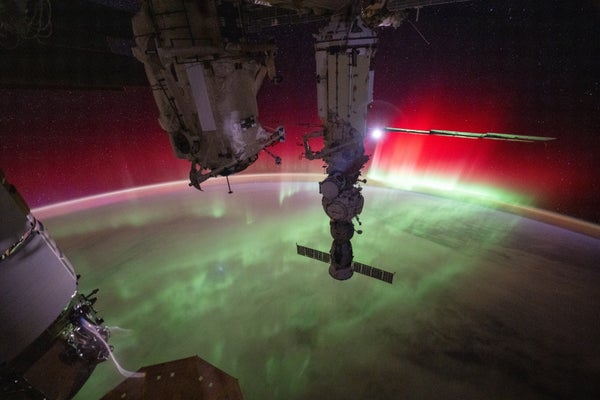
'Timelapse of the moon setting into streams of red and green aurora followed by a sunrise lighting up Soyuz with a light blue,' he wrote in the caption with his latest video.
'The aurora have been amazing the past few days.'
His video has already been viewed almost 800,000 times, and several fans have replied, expressing their amazement.
'Man that is just amazing... what a sight,' one user wrote.
Another added: 'you are becoming the ultimate space photographer, great work again!'
While he spends most of his time on the ISS conducting scientific experiments, Mr Dominick also regularly snaps photos and films footage from his unique vantage point
His video has already been viewed almost 800,000 times, and several fans have replied, expressing their amazement
And one joked: 'What a strange world. Fun to visit, I'm sure.'
Auroras are caused by disturbances in Earth's 'magnetosphere' (its system of magnetic fields) due to powerful activity on the sun.
High-energy particles travel from the sun towards us at hundreds of miles per second before bombarding our magnetosphere.
At this point, some of the energy and small particles can travel down the magnetic field lines at the north and south poles into our planet's atmosphere.
There, the particles interact with gases in our atmosphere, resulting in beautiful displays of light in the sky, known as auroras.
Oxygen gives off green and red light, while nitrogen glows blue and purple.
The Northern and Southern Lights are natural light spectacles triggered in our atmosphere that are also known as the 'Auroras'.
There are two types of Aurora - Aurora Borealis, which means 'dawn of the north', and Aurora Australis, 'dawn of the south.'
The displays light up when electrically charged particles from the sun enter the Earth’s atmosphere.
There are two types of Aurora - Aurora Borealis (file photo), which means 'dawn of the north', and Aurora Australis, 'dawn of the south.' The displays light up when electrically charged particles from the sun enter the Earth’s atmosphere
Usually the particles, sometimes referred to as a solar storm, are deflected by Earth’s magnetic field.
But during stronger storms they enter the atmosphere and collide with gas particles, including hydrogen and helium.
These collisions emit light. Auroral displays appear in many colours although pale green and pink are common.
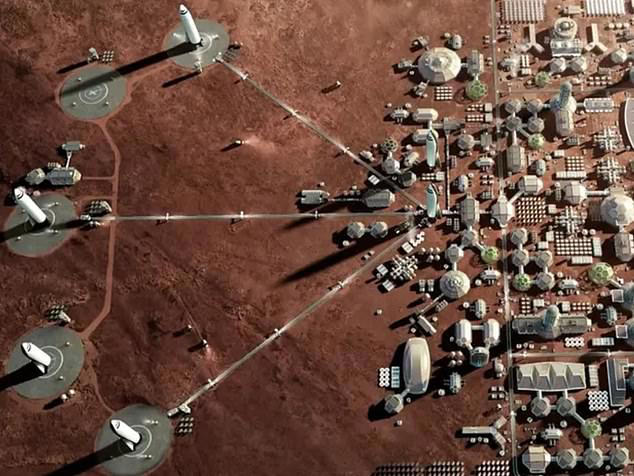
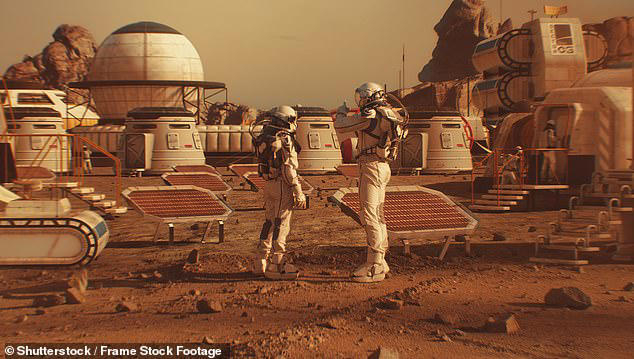
Elon Muskhas big ambitions to colonize Mars by 2050, and a new scientific discovery could make those dreams a reality.
A team of scientists have proposedan 'innovative' way to warm the Red Planet by more than 18 degrees Fahrenheit in just a matter of months, which they believe would be enough to sustain human life.
They proposed injecting large quantities of Martian dust into the atmosphere to improve its ability to trap heat, just like water vapor and carbon dioxide do on Earth.
Shooting about 10 liters of dust, consisting of iron and aluminum, per second for at least a decade could warm the planet from -85F to 86F.
A groundbreaking new discovery suggests that Elon Musk's dream of terraforming Mars might not be as far-fetched as people think.
Elon Musk dreams of building a Martian city that could sustain a million people by 2050.
Musk himself has said that he plans to use the natural resources on Mars to 'terraform' its existing atmosphere and make the planet warmer, wetter and overall more like Earth.
The idea of being stuck in space might sound like the plot of the latest science fiction blockbuster. But it has become a reality for Suni Williams and Butch Wilmore - two unlucky astronauts who are potentially stuck on the International Space Station (ISS) until 2025, despite only expecting to be there for eight days. Although the views might be out of this world, the ISS is far from the ideal destination for an impromptu eight-month trip. With little spare room and zero gravity, even simple tasks like eating or going to the toilet can be extremely difficult. And whether it's in their phone box-sized bedrooms or on the vacuum-powered toilet, the astronauts aboard the orbiting station can often be cramped, smelly, and uncomfortable.
Going to bed on Earth might be one of the simplest things imaginable. But without the assistance of gravity, lying down or even resting your head on a pillow essentially becomes impossible. Aboard the ISS, the astronauts' main sleeping quarters are located in the Harmony Module near one end of the space station. In each of the four walls, there are four 'sleep stations', each about the same size as a phone booth. Rather than trying to lie on a mattress, the astronauts cocoon themselves in sleeping bags tethered to the inside of the station. Although the sleep stations do close to give the astronauts some privacy and darkness, drifting off can be quite tricky.
The ISS can be quite loud as the station's life support systems whirr through the night and the station is regularly bathed in the intense light from the sun as it orbits. For this reason, eye masks and earplugs are standard issue for astronauts looking to get some much-needed rest. One of the biggest risks of sleeping in space is not a bad night's rest but the build-up of CO2. Without gravity, CO2 from the astronaut's breath can form a 'bubble' around their head, potentially suffocating them in their sleep. Thankfully, the NASA sleeping pods are well-ventilated so that the astronauts can breathe fresh air all night. NASA assigns its astronauts eight hours of sleep time after a 16-hour working day, but most astronauts generally get about six hours of shut-eye after spending some of their time resting and relaxing.
Astronauts on the ISS start their day by brushing their teeth and having a wash. But as with everything in space, this is far more complicated than it would be on Earth. Without gravity, water's surface tension causes it to act like a sticky mass, forming large floating orbs that attach themselves to nearby surfaces. This rules out the possibility of having a shower, so astronauts bathe twice a day using washcloths, with one used for washing and the other for rinsing. Hair is kept clean using rinseless shampoo and astronauts even give each other haircuts by using a vacuum to suck away the freshly cut hair. When it comes to brushing your teeth, this is actually quite easy since water sticks to the toothbrush in microgravity. Since floating wastewater would be a danger to the electronics, astronauts either spit their toothpaste into a piece of paper or just swallow it.
Perhaps the biggest question on everyone's mind is how astronauts are able to go to the toilet while in space. The toilet on the ISS, or 'orbital outhouse' as it is jokingly called by astronauts, is located in the Tranquility module. Unlike a terrestrial toilet, the ISS toilet has two separate receptacles for solid and liquid waste. For urine, the astronauts use a hose with a funnel on the front to catch the liquid before it escapes into the rest of the station. And for solid waste, there is a small hole with a lid which uses fan-powered suction to help everything end up where it needs to go. However, astronauts have reported that this set-up takes some practice to use and the process can reportedly become somewhat messy.
In an earlier tour of the ISS, Suni Williams pointed out the various gloves, wet wipes, and disinfectant supplies kept in the toilet to make sure everything remains hygienic. Once the astronauts have done their business, faeces is sucked into rubbish bags where it is dehydrated and compressed. These bags are sometimes returned to Earth for study but are usually burned up in the atmosphere. Urine, meanwhile, is sent through the station's Water Recovery System and transformed back into usable water.
Most of an astronaut's day aboard the ISS is spent working, and shifts usually last 16 hours with a few breaks for meals. Work may involve carrying out routine maintenance of the space station and making repairs to the various systems. In some cases, that could involve 'extra-vehicular activity', otherwise known as spacewalks, in which the astronauts step outside the station. A large part of their work is scientific, with astronauts carrying out various experiments to learn more about the effects of space radiation and microgravity.
In the highly demanding environment of space, astronauts need to eat a lot of nutritious food to stay healthy. That means getting three square meals a day plus snacks to make up a diet of at least 2,500 calories. Since resupplies are infrequent and fresh produce is heavier to transport, the majority of astronauts' food is dehydrated for long-term storage. Astronauts use a water gun to rehydrate the packaged food, before heating it in a microwave. Astronauts are also provided with powdered drinks that can be rehydrated and drunk through a straw. However, between 2015 and 2017 astronauts also had access to the ISSpresso which was the first ever espresso coffee machine designed for space.
Astronauts eat their meals in the Unity module which is fitted with all the necessary food preparation equipment as well as antibacterial materials on the walls. Due to their busy schedules, the crew won't often eat together during the week with the exception of Sunday when the team will come together for a group meal. To maintain some sense of normalcy, the astronauts eat at a table, strapping their legs to chairs and using magnetic trays to hold their food in place. The biggest difference in an astronaut's diet is that booze is absolutely off the cards. NASA has forbidden drinking alcohol on any mission on the grounds that astronauts need to be alert and healthy at all times. To this day, Buzz Aldrin remains the only person to have consumed alcohol in space after he drank a small amount of wine during a secret communion service in the moon lander.
In addition to eating well, astronauts need a lot of exercise to remain fit and healthy. NASA astronauts are required to do two hours of exercise every day while on the ISS and are carefully monitored for fitness and health. Without the need to fight against gravity, astronauts' muscles can quickly shrink, leading to potential health complications. This is part of the reason that many astronauts are unable to walk for a time after re-entering Earth's gravity. The ISS has three main pieces of exercise equipment for the astronauts to use which are located in the Tranquility module.
Astronauts can either choose to use an exercise bike called CEVIS, a treadmill called T2, or a weight-lifting system called ARED. In the absence of gravity, the machines use a combination of pistons, flywheels, and elastic bands to simulate the force of an astronaut's weight. During their time on the ISS, Williams and Wilmore, have even been taking part in weightless Olympics-inspired workouts in order to stay occupied and stay positive amid uncertainty.
This study suggests he may be onto something.
'It’s not that often you get some really quite new, innovative idea for terraforming,' Colin McInnes, a space engineer at the University of Glasgow not involved with the work, told Science Magazine.
'The gap between where Mars is and where Mars could be for habitability is narrower than we might think,' he added.
Related video:
What Has Curiosity Learned About Mars In 10 Years Since Landing? (Dailymotion)
The researchers' approach is actually based on the same atmospheric mechanism that's driving climate change here on Earth: the greenhouse effect.
Currently, Mars' atmosphere is so thin that heat from the sun easily escapes the planet's surface.
The microscopic size and spherical shape of Martian dust mean that it isn't great at absorbing radiation or reflecting heat back down to the surface.
But the research team believes they could use the iron and aluminum in the dust to engineer nine-micrometer-long rods.
That's roughly twice the size of a Martian dust particle, but smaller than a speck of glitter.
Currently, the surface of Mars is a freezing, barren desert. But scientists have come up with a simple way to warm up the Red Planet.
Terraforming Mars' atmosphere would bring us one step closer to establishing a human colony on the red planet.
When the researchers tested how their particles would absorb heat radiation and reflect it down to the planet's surface, they found 'unexpectedly huge effects,' Samaneh Ansari, a Ph.D. student at Northwestern University and the study's lead author, told Science Magazine.
This approach would require about two million tons of particles per year, but manufacturing them would be relatively easy because the ingredients are right there on Mars.
That sets this new approach apart from previous schemes to globally warm the Red Planet.
By comparison, this method would be roughly 5,000 times more efficient, the researchers claimed.
This strategy would still take decades, but it seems logistically easier than any other ideas proposed so far.
Warming up Mars would be a critical first step towards making this planet a suitable home for humans, or any other life form for that matter.
It would free up the little water that's frozen in polar ice caps beneath the planet's surface, and make Mars a more suitable place for agriculture and out own bodies.
Mars' atmosphere is too thin to trap heat at the surface. Scientists want to inject it with engineered dust to make it more insulating.
This is all great news for Musk. But warming up Mars is just one step down a long road he'll need to travel before he can colonize the Red Planet.
Even with this new atmosphere, humans still wouldn't be able to breathe the air on Mars because it doesn't contain enough oxygen.
Plus, the air pressure on Mars is 150 times lover than on Earth, which would cause human blood to boil.
Musk will have to solve these problems and more before he builds a bustling Martian metropolis. But this new research brings him a little bit closer to realizing his dream.
Astronaut Matthew Dominick captured this time-lapse imagery of an aurora dancing through the skies over Earth's polar latitudes in streams of flickering red and green light.
A recent uptick in solar activity has lit up the polar skies with auroras: streams of red or green light that happen when charged particles from the Sun race along the lines of Earth’s magnetic field to collide with the upper atmosphere. This usually happens close to the North and South Poles, but auroras have been visible at lower latitudes several times in recent months. Astronauts aboard the ISS arguably have the best view of all, and Matthew Dominick just proved it.
One of thousands of images Dominick captured with his new lenses over the weekend.
Matthew Dominick, NASA
Lights, Camera, Space Station
NASA astronaut Matthew Dominick took thousands of photos of the spectacular auroras over the weekend and put them together in this short time-lapse video.
"We received a cargo shipment this week with lots of cool stuff, to include some new camera lenses," wrote Dominick on Sunday. "Spent a good part of the weekend with a 15mm, T1.8 lens. Made a whole bunch of timelapses."
In another post, Dominick added, "The aurora have been amazing the past few days"
Part of the station (and a docked Soyuz crew capsule) hovers in the foreground, the glittering stars of deep space in the distance, and the green and red lights of the auroras dance across Earth's upper atmosphere. At about the 45-second mark, the light of sunrise (which happens about every 90 minutes as the ISS zips around the planet) bathe the docked Soyuz capsule in a pale blue glow.
This video was pieced together from individual time-lapse images.
Another image, not part of the short video, shows part of the ISS in the foreground, with the aurora glowing in Earth's atmosphere — and beyond that, the dense swath of stars that make up the Milky Way's disk.
"Still looking though 1000s of frames, lots of which have aurora, but the Milky Way in this one stood out," wrote Dominick.
Dominick captured the aurora and the Milky Way, and some city lights down on Earth, in this single image.
Matthew Dominick, Nasa
The new lenses were part of a supply shipment loaded aboard a Cygnus cargo vessel, which docked at the ISS last Tuesday. Cygnus also brought fresh fruit and vegetables, a new supply of coffee, nearly 2,800 pounds of research equipment, more than 3,500 pounds of new hardware for the station, and more than 2 tons of other supplies for the crew.
Those supplies included some clothes and personal food items for stranded Starliner crew members Butch Wilmore and Suni Williams, who are now scheduled to return home on a SpaceX Crew Dragon spacecraft sometime in early 2025.
NASA astronaut Matthew Dominick took this photo of the aurora display caused by a coronal mass ejection from the International Space Station. “Felt so lucky to grab this shot,” he wrote on X, formerly Twitter.
Matthew Dominick/NASA
Astronaut Matthew Dominick captured this stunning time-lapse of the Northern Lights from the International Space Station.
A new James Webb Space Telescope analysis of the giant, metal-rich asteroid Psyche reveals signs of hydration in the form of rust. This could help pin down the mysterious rock's origins.
An illustration of the metal-rich asteroid Psyche. James Webb Space Telescope data suggests the hydroxyl groups on Psyche are probably bound to metal on the asteroid's surface, forming rust.
(Image credit: NASA/JPL-Caltech/ASU)
Scientists using the James Webb Space Telescope (JWST) have identified a component of water on the mysterious metal-rich asteroid Psyche. The findings suggest the hydration exists as rust and may shed light on how this enigmatic object formed.
The asteroid 16 Psyche is pretty unusual for the main asteroid belt between Mars and Jupiter. Measuring an enormous 173 miles (280 kilometers) at its widest, the potato-shaped object was once thought to be wholly metallic. Psyche's supershiny surface had led researchers to suggest the asteroid was possibly the iron-rich heart of a planetesimal (a planetary building block) and could unravel how Earth and the other terrestrial planets formed. Some have valued the asteroid’s rare metal components at $100,000 quadrillion — a literal goldmine in space.
But all that glitters isn't gold — or even metal. Over the past decade, new data about Psyche's density and reflectance spectra — the intensity of different wavelengths of sunlight reflected off the asteroid's surface ― suggest it is most likely a mixed silicate and metal world.
In 2017, researchers discovered tantalizing traces of another component: water. Spectra from the infrared region, at long wavelengths that we perceive as heat but can't see, showed the signature of hydroxyl units — the OH molecule, which forms part of water.
These results suggested Psyche's surface may contain small amounts of water, as either ice or hydrated minerals. But the results were inconclusive, since the spectrum, collected using NASA's ground-based Infrared Telescope Facility in Hawaii, may have been corrupted by water in Earth's atmosphere. Besides, the researchers hadn't found a more definitive signature of water from a slightly higher infrared wavelength. That signature has helped other astronomers "detect widespread molecular water on the Moon but had not yet been used for asteroids," study author Stephanie Jarmak, a planetary scientist at the Harvard and Smithsonian Center for Astrophysics, told Live Science in an email.
An artist's illustration of the James Webb Space Telescope. (Image credit: Alamy)
To determine if Psyche really has water, Jarmak and scientists from several U.S. and German institutes turned to two of JWST's infrared-sensing instruments: the Near Infrared Spectrograph (NIRSpec) and the Mid-Infrared Instrument (MIRI), which can detect shorter and longer infrared wavelengths, respectively. By directing these instruments toward the asteroid in March 2023, the scientists collected snapshots of the spectrum reflected by Psyche's north pole, which was then facing the telescope. Their results have been accepted by the Planetary Science Journal and are available as a preprint via arXiv.
The NIRSpec data showed the hydroxyl signature, confirming its presence on the asteroid. What's more, Jarmack noted, the high-quality data allowed comparisons with hydroxyl signatures from other meteorites, revealing that Psyche's hydroxyl signature resembled that from certain rust-bearing, carbon-rich meteorites. This finding led the researchers to conclude that hydroxyls are bonded to metals on Psyche, forming rust.
But the MIRI data lacked the conclusive signature of water. Still, the researchers can't rule out the presence of water, as it could be present on other parts of Psyche that JWST couldn't see. It's also possible that water is present but at concentrations below MIRI's detection limit, making it less than half the concentration of water on the moon, which is itself only a raindrop's equivalent in 2.25 pounds (1 kg) of soil.
Apart from forming rust, Psyche's hydroxyl groups provide hints about how the asteroid formed. If the hydroxyl formed within the asteroid, this could indicate Psyche was born in the cold, outer bounds of the solar system and tottered inward over millions of years. However, the existing evidence suggests water-bearing asteroid impactors that slammed into Psyche and shaped it also brought the hydroxyl.
Future plans include studying exactly where the hydrated metals are found on Psyche's surface, Jarmak said, adding that these include "observations of Psyche's south pole that contains a large crater that may have resulted from an encounter with a hydrated impactor."
Metal-rich asteroids are lucrative sources of rare minerals and the subject of future space mining ventures. However, despite its estimated value, Psyche isn't among them — at three times Earth's distance from the sun, it's too far for extraction efforts to be cost-effective.
Scientists hoping to find proof of life on mars have found evidence of a reservoir of water that could at one point have sustained life.
The body of water resides deep under the surface of Mars within fractured igneous rocks, holding enough to fill an ocean that would cover the entire surface of Earth's planetary neighbour.
The discovery follows seismic data obtained by NASA's robotic InSight lander during a mission that helped decipher the interior of Mars.
The water, located about 7.2 to 12.4 miles (11.5 to 20 km) below the Martian surface, potentially offers conditions favourable to sustain microbial life, either in the past or now, the researchers said.
University of California planetary scientist and co-author of the study Vashan Wright said: "At these depths, the crust is warm enough for water to exist as a liquid. At more shallow depths, the water would be frozen as ice."
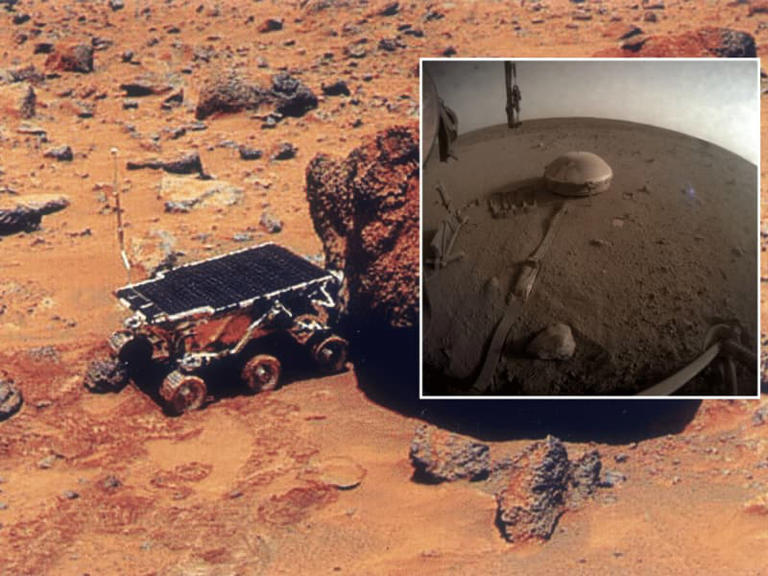
The InSight lander touched down in 2018 to study the deep interior of Mars, gathering data on the planet's various layers, from its liquid metal core to its mantle and its crust. The InSight mission ended in 2022.
Fellow co-author Michael Manga said: "On Earth, we find microbial life deep underground where rocks are saturated with water and there is an energy source. InSight was able to measure the speed of seismic waves and how they change with depth.
"The speed of seismic waves depends on what the rock is made of, where it has cracks and what fills the cracks. We combined the measured seismic wave speed, gravity measurements and rock physics models. The rock physics models are the same as the ones we use to measure properties of aquifers on Earth or map oil and gas resources underground."
The data indicated the presence of this reservoir of liquid water within fractured igneous rocks - formed in the cooling and solidification of magma or lava - in the Martian crust, the planet's outermost layer.
Wright said: "Mid-crust whose rocks are cracked and filled with liquid water best explains both seismic and gravity data
"The water exists within fractures. If the InSight location is representative and you extract all the water from the fractures in the mid-crust, we estimate that the water would fill a 1-2 km deep (0.6-1.2 miles) ocean on Mars globally."
The Martian surface is cold and desolate today but once was warm and wet. That changed more than 3 billion years ago. The study suggests that much of the water that had been on the Martian surface did not escape into space, but rather filtered down into the crust.
Manga added: "Early Mars had liquid water on its surface in rivers, lakes and possibly oceans. The crust on Mars could also have been full of water from very early in its history, too,
"On Earth, groundwater underground infiltrated from the surface, and we expect this to be similar to the history of water on Mars. This must have occurred during a time when the upper crust was warmer than it is today."
Water would be a vital resource if humankind ever is to place astronauts on the Martian surface or establish some sort of long-term settlement.
Mars harbours water in the form of ice at its polar regions and in its subsurface. But the depth of the apparent underground liquid water would make it difficult to access.
Volgens een onderzoek is het leven op onze planeet mogelijk ontstaan door een precies atmosferisch fenomeen: bliksem. Dit is hoe.
Oorsprong van het leven op aarde, het grootste mysterie voor de wetenschap
Hoe is het leven op aarde ontstaan en wat heeft het veroorzaakt? Het is een van de grootste vragen van de wetenschap, maar een nieuwe studie heeft misschien het antwoord gevonden. Volgens wetenschappers van Harvard heeft de bliksem die onze oerplaneet tussen de wolken trof mogelijk de elementen gegenereerd die noodzakelijk zijn voor het leven.
De wetenschap heeft zich altijd afgevraagd wat de oorsprong van het leven op aarde is en dit nieuwe onderzoek lijkt steeds dichter bij het antwoord te komen. Een eeuwenoude bliksemschicht kan de oorzaak zijn geweest, waaruit ieder levend wezen is ontstaan. Om het mysterie op te lossen, moeten we beginnen bij de basis: hoe zijn stikstof en koolstof ontstaan en wanneer verschenen ze in onze wereld? Er zijn in dit opzicht drie mogelijke hypothesen: ze werden getransporteerd door kometen en hemellichamen die op de aarde vielen, door onderwaterbronnen of door de bliksem die ons oppervlak trof.
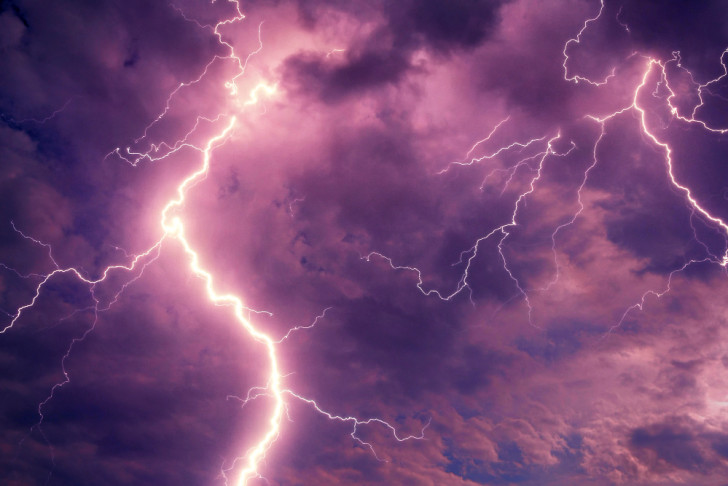
Miller-Urey-experiment over de oorsprong van leven veroorzaakt door bliksem over de oorsprong van bliksem leven
Freepik
Volgens het team van deskundige scheikundigen van de universiteit van Harvard ligt het antwoord precies in de bliksem: nadat ze de wolken en de aarde hadden geraakt, hebben ze mogelijk “hoge concentraties reactieve moleculen op lokaal niveau geproduceerd, waardoor er verschillende grondstoffen zijn ontstaan voor de opkomst en overleving van primitief leven wereldwijd.”
Dit is niet de eerste studie die deze theorie probeert aan te tonen: zelfs Harold Urey, de Amerikaanse Nobelprijswinnaar voor de scheikunde, volgde samen met zijn student Stanley Miller in 1953 hetzelfde experimentele pad. Destijds creëerden ze een elektrische boog om deze theorie na te bootsen. de bliksem, waarbij gebruik wordt gemaakt van een combinatie van ammoniak, methaan, waterstof en water, elementen waarvan men denkt dat ze de atmosfeer van onze jonge planeet vormen. Het resultaat was de productie van aminozuren, essentieel voor het voortbrengen van leven. Tegenwoordig geloven wetenschappers dat de oorspronkelijke atmosfeer uit stikstof en kooldioxide zou kunnen bestaan: op basis hiervan voerde het team van Harvard een nieuw experiment uit, waarbij dat van Urey en Miller werd bijgewerkt.
Heeft de bliksem leven teweeggebracht? Het nieuwe experiment
Door in het laboratorium een simulatie van blikseminslagen tussen de wolken en de aarde na te bootsen, binnenin een primordiale biosfeer, observeerden de wetenschappers de chemische reacties van deze atmosferische gebeurtenissen: het resultaat toonde een significante reductie van kooldioxide tot koolmonoxide en mierenzuur, terwijl stikstof werd omgezet in ammonium, nitriet en nitraat.
Uiteindelijk lijkt de bliksem de belangrijkste elementen voor de vorming van leven te hebben geproduceerd. Hoewel ze het leven niet direct creëerden, kunnen ze wel de voorwaarden hebben gecreëerd voor de ontwikkeling ervan. Als de atmosfeer van de jonge aarde inderdaad bestond uit niet-reactieve stikstofmoleculen, dan was de bliksem datgene wat ontbrak om de aanzet te geven tot de vorming van zaken die essentieel zijn voor het leven, zoals eiwitten en DNA. De zekerheid over wat er miljarden jaren geleden gebeurde, zal er echter misschien nooit komen.
Astronauten gestrand in de ruimte: hoe zullen ze overleven?
Astronauten gestrand in de ruimte: hoe zullen ze overleven?
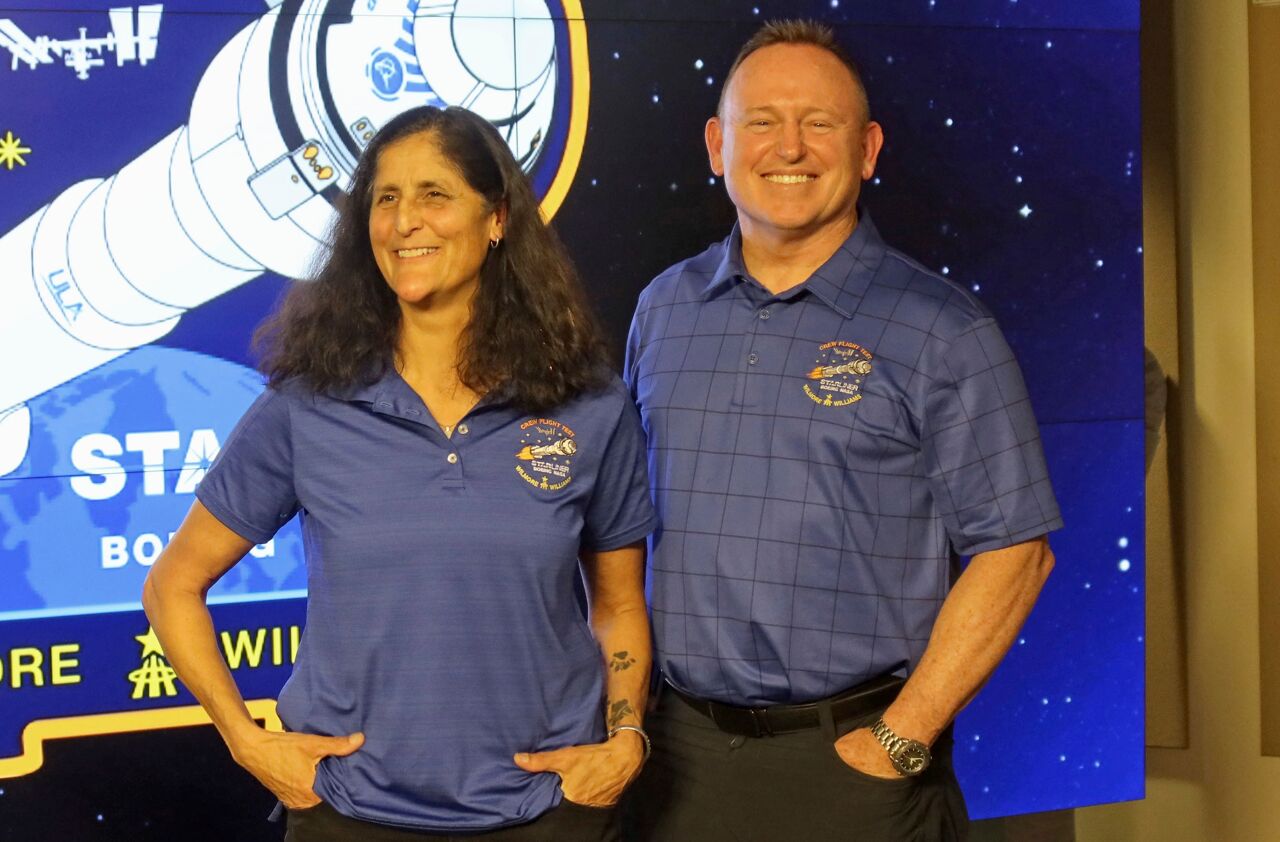
Twee NASA-astronauten, Sunita “Suni” Williams en Commandant Barry “Butch” Wilmore, zijn onverwacht gestrand in de ruimte na een mislukte testvlucht van het Boeing Starliner ruimtevaartuig. In plaats van hun geplande terugkeer naar de aarde na acht dagen, worden ze geconfronteerd met een onzekere toekomst aan boord van het internationale ruimtestation (ISS).
NASA via Getty Images
De twee astronauten, beiden gepensioneerde marinekapiteins en ervaren ruimtevaarders, bevinden zich in een uitdagende situatie. Terwijl ingenieurs op aarde koortsachtig werken om de oorzaak van het probleem met het voortstuwingssysteem van het Starliner-ruimtevaartuig te achterhalen, blijven Williams en Wilmore optimistisch. Tijdens een persconferentie vanuit de ruimte in juli uitte Williams haar vertrouwen in de technische teams: “Ik heb een heel goed gevoel in mijn hart dat het ruimtevaartuig ons zonder problemen thuis zal brengen.”
Desondanks is het onzeker hoe lang het duo nog in de ruimte zal moeten blijven. Commandant Wilmore benadrukte het belang van de tests die nu worden uitgevoerd: “We vertrouwen erop dat de testen die we doen de testen zijn die we moeten doen om de juiste antwoorden te krijgen en om ons de gegevens te geven die we nodig hebben om terug te keren.”
Williams en Wilmore kwamen aan op 6 juni.
Foto: NASA
Leven zonder zwaartekracht
Voor Williams en Wilmore is het leven in de ruimte ondertussen een bijzondere ervaring. In het ISS, waar zwaartekracht geen rol speelt, ervaren ze geen verschil tussen liggen, staan of zelfs ondersteboven zijn. Slapen kan overal in het ruimtestation, of het nu op de vloer, muur of plafond is, omdat er geen gevoel van richting is. Het ISS biedt slaapstations ter grootte van telefooncellen, waar de bemanning in een slaapzak kan rusten.
Naast hun dagelijkse werkzaamheden aan reparaties en experimenten, zoeken de astronauten ook naar manieren om hun tijd in de ruimte nuttig te besteden. Zo genieten ze van het adembenemende uitzicht op de aarde vanuit het observatoriumdek van het station. Daarnaast kunnen ze gebruik maken van de fitnessapparatuur aan boord, zoals het Advanced Resistive Exercise Device (ARED), dat hen in staat stelt traditionele oefeningen uit te voeren, zoals squats en bankdrukken, door gebruik te maken van vacuümtechnologie.
De Starliner kampt al even met technische mankementen. De capsule van Boeing had jaren geleden al op punt moeten staan.
Foto: Getty
De realiteit dringt door
Ondanks deze afleidingen blijft de harde realiteit van hun situatie aanwezig. “Die mantra die je hebt gehoord, ‘Falen is geen optie’, dat is waarom we hier nu blijven,” zei Wilmore eerder. De komende dagen zullen cruciaal zijn om te bepalen of Williams en Wilmore veilig naar de aarde kunnen terugkeren, of dat hun verblijf in de ruimte nog aanzienlijk langer zal duren.
Williams is een gewezen helikopterpiloot en Wilmore een gevechtspiloot.
Foto: Kyodo News
Recordbrekend verblijf?
Mocht het verblijf van Williams en Wilmore in de ruimte langer duren, dan zullen ze echter geen records breken. Het record voor de langste afzonderlijke ruimtevlucht staat op naam van de Russische kosmonaut Valeri Polyakov, die in 1995 maar liefst 437 dagen in de ruimte verbleef. Recente records zijn echter ook indrukwekkend: NASA-astronaut Frank Rubio keerde vorig jaar terug na een verblijf van 371 dagen in de ruimte.
With an eerie "The Twilight Zone" vibe and surreal cosmic elements, Stage 2 Studios and Serenity Forge's sci-fi video game called "Lifeless Moon" has arrived and we've got the odd launch trailer to share that highlights its immersive old-school storyline.
It's appears to be a trippy 3D action adventure release designed with platform stages that combine logic and puzzle-solving skills, where a pair of Apollo-era astronauts encounter a strangely familiar desert town during a dream-like expedition to the Moon.
"Lifeless Moon" and its blurred realities was just launched July 9, 2024 for Xbox One/X/S, PlayStation 4 and 5, Epic Games Store, and Steam.
A scene from Serenity Forge's "Lifeless Moon." (Image credit: Serenity Forge)
Here's the official synopsis:
"What secrets will be unearthed on the moon?
"You cannot fathom what will come next in 'Lifeless Moon'. Reality itself unravels as the mysteries unfold, adding chaos to an already monumental mission. After stumbling upon a town on the moon that is eerily similar to one back on Earth, you are thrown into the middle of a much larger conspiracy. Venture through strange environments as you collect clues and decipher puzzles. The town is only the beginning of an unforgettable adventure across time and space.
"A sandy boardwalk, a cabin in the woods, and an ominous floating city in the sky are just a few of the peculiar stops along the way. Your surroundings may appear familiar, but nothing is as it seems. Reveal the truth behind these unique locations through environmental puzzle-solving and platforming. Gather documents and information in your journal during your lunar travels and piece together the origin of the many strange phenomena you encounter.
"You've uncovered a cryptic mystery on the moon. Confront a strange phenomenon, tap into its extraordinary powers, and overcome psychological challenges to reveal the truth."
A scene from Serenity Forge's "Lifeless Moon." (Image credit: Serenity Forge)
"Lifeless Moon" acts as sort of a spiritual successor to Serenity Forge's "Lifeless Planet" from 2014, and its "Lost"-style narrative design was influenced by classic science fiction literature and films where lunar explorers face inexplicable anomalies in time and space. It's also a throwback to TV series like "The Outer Limits," which often depicted astronauts or test pilots facing disorienting situations, psychological experiments, and dangerous discoveries while on routine missions.
Serenity Forge's "Lifeless Moon" is available now on your favorite gaming platform.
Mars was once wet, but now its surface is desiccated. Its meagre atmosphere contains only a tiny trace amount of water vapour. But new research says the planet contains ample liquid water. Unfortunately, it’s kilometres under the surface, well out o
A cutout of the Martian interior beneath NASA's Insight lander. The top 5 kilometers of the crust appear to be dry, but a new study provides evidence for a zone of fractured rock 11.5-20 km below the surface that is full of liquid water—more than the volume proposed to have filled hypothesized ancient Martian oceans. Credit: James Tuttle Keane and Aaron Rodriquez, courtesy of Scripps Institute of Oceanography
Mars was once wet, but now its surface is desiccated. Its meagre atmosphere contains only a tiny trace amount of water vapour. But new research says the planet contains ample liquid water. Unfortunately, it’s kilometres under the surface, well out of reach.
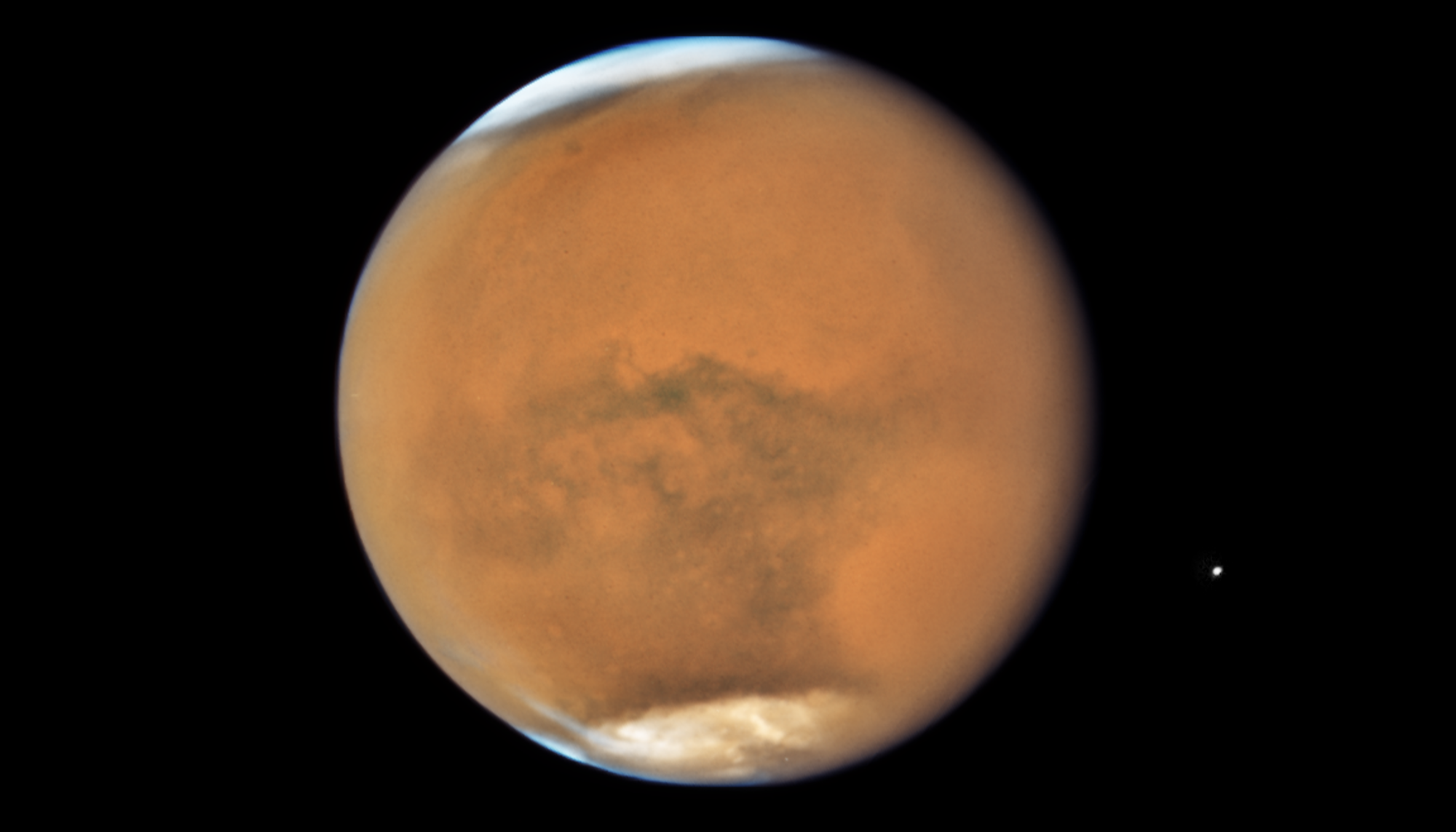
A 2018 photo of Mars during a dust storm, snapped by the Hubble Space Telescope. More than 3 billion years ago, the dusty red planet had oceans and rivers. That water disappeared, leaving only ice on the surface, most of it in the polar caps. A new analysis of Mars' interior suggests that much of the liquid water still exists in the pores of rocks 10-20 kilometers below the surface.
NASA, ESA, STScI
The question of what happened to Mars’ water is an enduring one. There’s ample evidence showing that water flowed across the planet’s surface, carving out river channels, creating sediment deltas, and filling lakes. It may even have had ocenas. The planet was likely warm and wet until around 3.8 billion years ago, during the transition from the Noachian Period to the Hesperian Period. Over time it lost both its thick atmosphere and its water.
The most widely accepted explanation for the water’s disappearance is that the planet’s magnetic shield weakened and that the solar wind blew most of the water away into space.
New research published in the Proceedings of the National Academy of Sciences (PNAS) presents a new wrinkle in the Mars water mystery. Its title is “Liquid water in the Martian mid-crust,” and the first author is Vashan Wright, an assistant professor at UC San Diego’s Scripps Institution of Oceanography.
“Understanding the Martian water cycle is critical for understanding the evolution of the climate, surface and interior,” Wright said in a press release. “A useful starting point is to identify where water is and how much is there.”
Wright and his colleagues worked with data from NASA’s InSight lander, which was sent to Mars to study the planet’s deep interior. InSight aimed to understand not only Mars but also the processes that shape all rocky planets. The mission ended in December 2022 when the lander became unresponsive, but scientists are still working with its data.
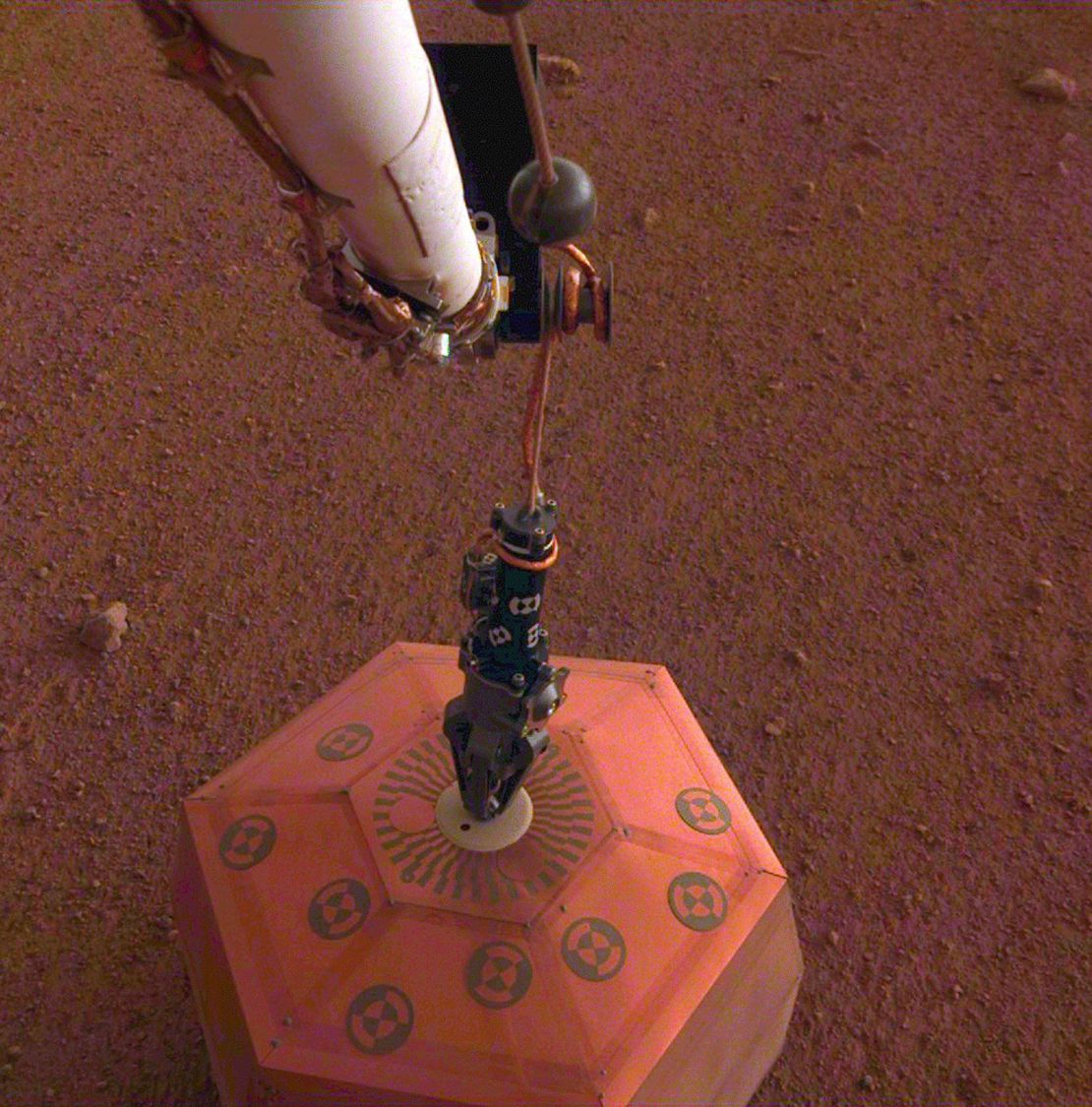
During its mission, InSight gathered seismic data with SEIS, the Seismic Experiment for Interior Structure. SEIS was sensitive to Marsquakes and meteorite impacts, and the seismic data is helping scientists understand Mars’ interior, including its core, mantle, and crust.
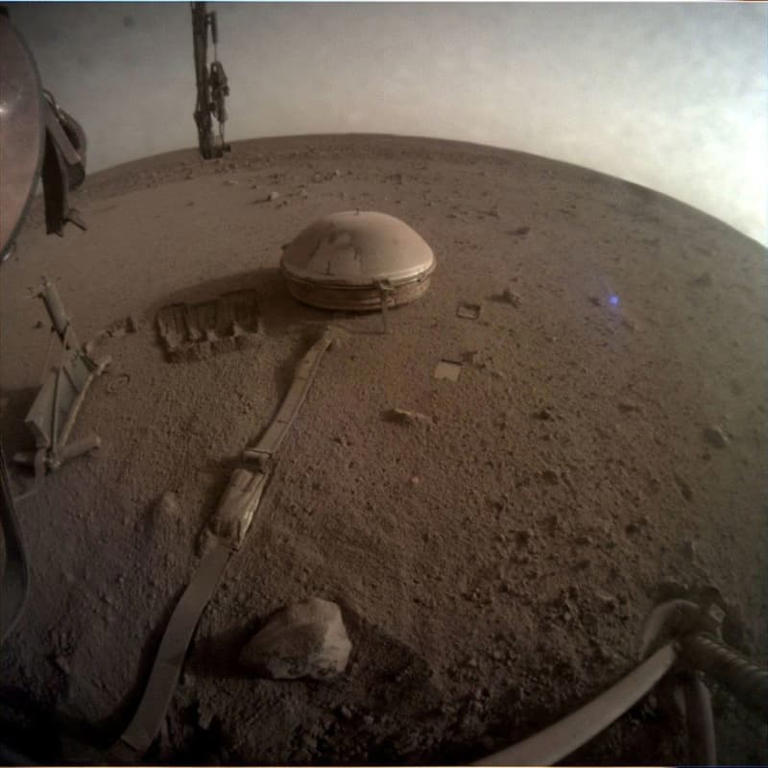
This image shows InSight’s SEIS, the Seismic Experiment for Interior Structure. It’s housed under a protective dome that shields it from wind and dust. Credit: NASA/JPL
“Large volumes of liquid water transiently existed on the surface of Mars more than 3 billion years ago,” the authors write in their published research. “Much of this water is hypothesized to have been sequestered in the subsurface or lost to space.”
Seismic waves sensed by SEIS can help determine if some of Mars’ water is in the planet’s subsurface. When seismic waves travel through a planet, they reveal information about the inner structure and composition. There are different types of waves, and some can’t travel through liquids. That’s how scientists learned that Earth has a liquid core.
Wave velocities and directions also reveal a lot. Velocity and direction change when the waves reach boundaries like the one between a planet’s crust and its mantle. Waves also provide information about the density and elasticity of materials they pass through. Changes in wave speed also reveal information about temperature differences.
But conclusions don’t jump out of data and announce themselves. Researchers have to work their way through the data and try to interpret it. The Mars science community is doing just that, and this research is the latest part of the effort.
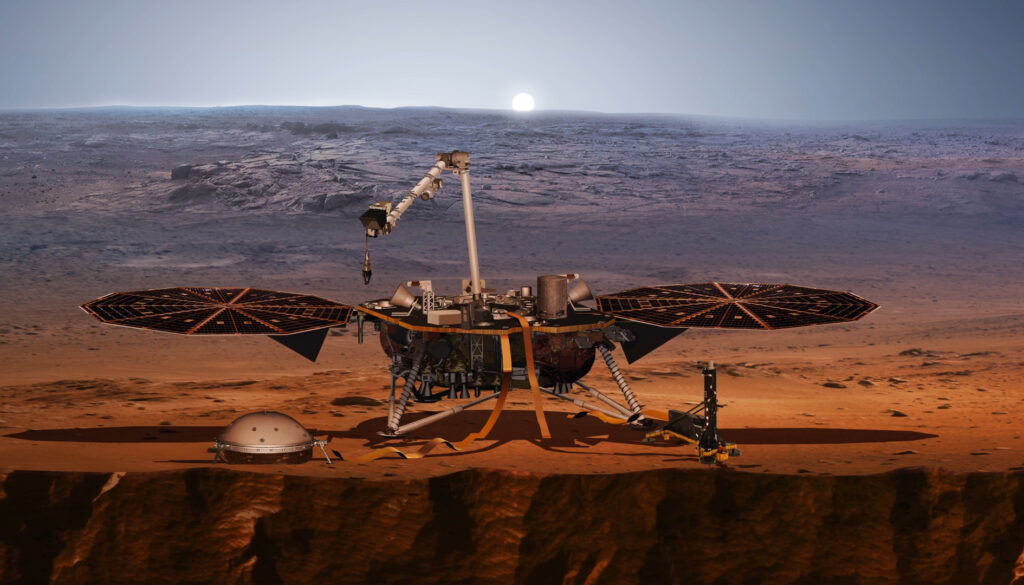
An artist’s concept of the InSight lander on Mars after the lander’s robotic arm deployed a seismometer (domed object to the left of the lander) and a heat probe directly onto the ground. The lander stopped recording data in 2022, but scientists are still mining the data for information about Mars’ interior.
NASA/JPL-Caltech
Previous researchers have tried to constrain the conditions under the InSight Lander in Elysium Planitia. Scientists use the term upper crust to describe the depth down to about 8km and the term lower crust to describe the depth between 8 km and about 20 km. Some research from orbiters showed that the upper crust is like a cryosphere that contains abundant frozen water. Orbital images of recent meteorite impacts appear to show exposed ice.
But this new research goes against that. The authors write that seismic waves “in the upper 8 km beneath InSight is lower than expected for an ice-saturated cryosphere.”
Previous research also showed that the lower crust contains either highly porous mafic rock or less porous felsic rock. However, it was difficult to determine how much water was contained in the pores.
That’s where this research comes in.
“We assess whether Vs, Vp, and bulk density ?b data are consistent with liquid water-saturated pores in the mid-crust (11.5 ± 3.1 to 20 ± 5km) within 50 km of the InSight lander,” the authors write. Vs means the velocity of secondary seismic waves, Vp means the velocity of primary seismic waves, and pb means bulk density. The bulk density means the mass of a volume unit of rock including any liquid trapped in its pores.
According to the authors, the mid-crust is one of our identifiable layers under the InSight lander. It may even be global, but there is not enough data to conclude that yet.
However, the researchers did reach another conclusion: “A mid-crust composed of igneous rock with thin fractures filled with liquid water can best explain the geophysical data.”
If the InSight Lander location is representative of the rest of Mars, the approximately 11.5 km to 20 km deep mid-crust could hold an enormous amount of water. There could be enough to cover the entire planet in a layer of water 1 to 2 km deep. Of course, this is just a thought exercise since Mars’ wouldn’t be able to hold onto the surface water.
If the planet does hold such a vast amount of water, it won’t be of much use to human visitors trying to establish a presence there. Even on Earth, drilling only 1 km into the surface is difficult. It’s challenging to conceive of a way to drill 11 km deep on Mars.
But where there’s water, there could be life.
“Establishing that there is a big reservoir of liquid water provides some window into what the climate was like or could be like,” said co-author Michael Manga, a UC Berkeley professor of earth and planetary science. “And water is necessary for life as we know it. I don’t see why [the underground reservoir] is not a habitable environment.”
It may very well be habitable, but that doesn’t mean it’s inhabited. It is at least a possibility, though.
We’ve found life at a depth of 5 km within Earth’s crust. Could the same thing be possible on Mars?
Just like the water, an answer to that question is well out of reach. For now.
A now-viral video shared by a Boeing 747 pilot flying from Saudi Arabia to Nigeria in early August allegedly showed three strange lights near the aircraft.
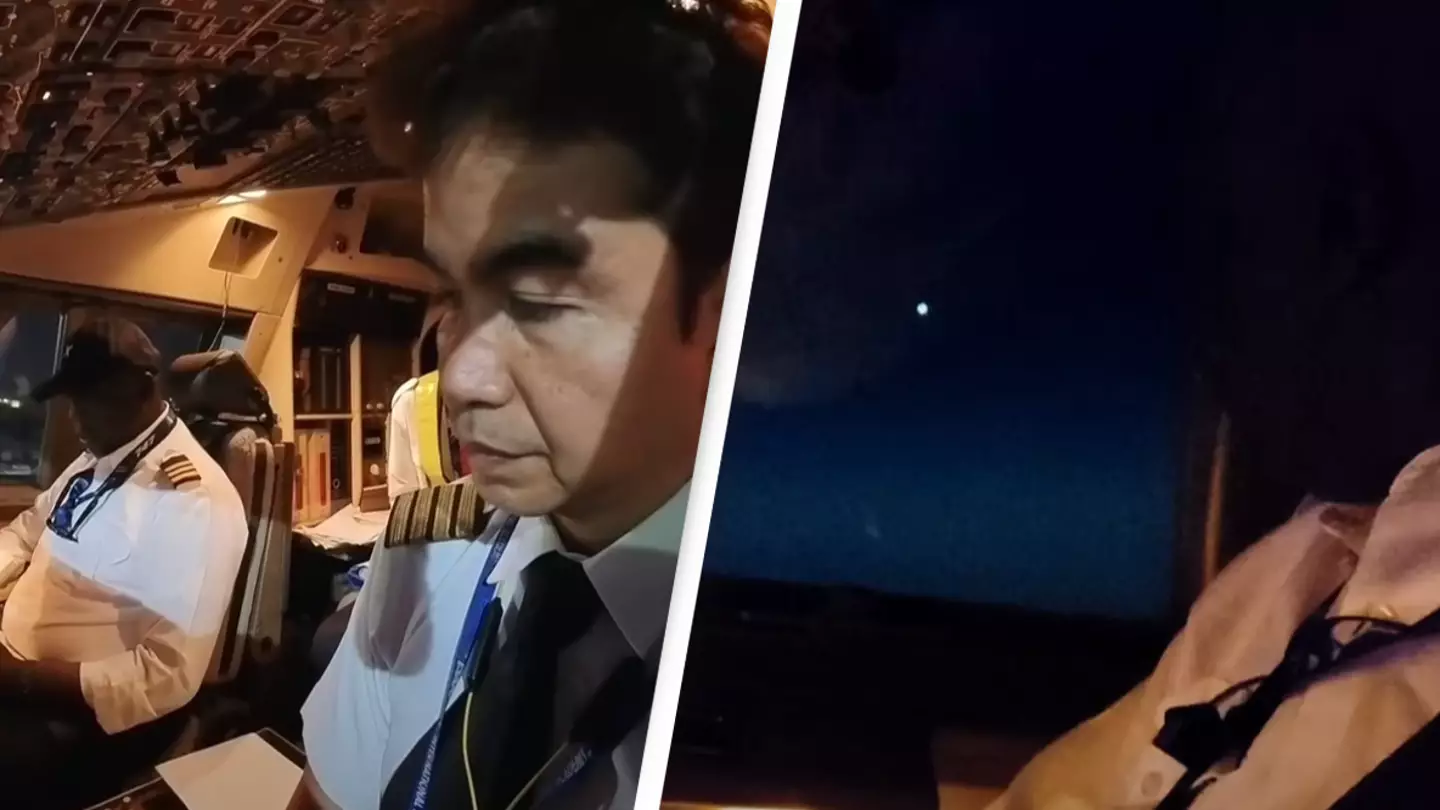
The footage was shared by Captain Ruud Van Pangemanan, who said the glowing orbs showed up around 30 minutes into his flight (the 20-minute mark in the video posted to YouTube). You can clearly see Pangemanan’s co-pilot, and he is transfixed on the aerial phenomenon, which looks sort of like a lighthouse beacon in the sky as it flashes in and out in the sky.
Whatever the objects are, Pangemanan said they didn’t show up on radar. Similarly, his team thought the lights might be drones, though these would also presumably show up on radar.
Pangemanan dismissed the idea that the lights were satellites or stars. But I feel like the latter may be close to the truth, as this is more like a spook light than a straight UFO. Unlike UFOs, spook lights are just giant balls of light that are said to hover off the ground. Science explains them as “ball lightning.” Do I think Pangemanan videoed ball lightning in the atmosphere? No. But I’m not sure he’s captured a UFO either.
My gut feeling, unlike more recent UFO sightings, is that this particular video is probably of something related to the recent meteor showers. Yes, these lights are a bit weird in the way they behave. But they just look like large fragments of exploding rock in our atmosphere.
I may be wrong; perhaps this is some type of military aircraft or possibly some type of cosmic event. But I feel like this is probably not legitimate. At least, I hope it isn’t.
If we want to go full tin-foil-hat and believe these are UFOs following Pangemanan fly to Nigeria then their behavior is somewhat disconcerting. Unlike most UFOs, which whiz through the skies in all sorts of directions, these ones seemed to hover, moving gradually. Almost like they’re watching.
And I really don’t like the idea of an interplanetary alien species taking the time to watch us humans as we go about our normal lives.
Pilots intercepted by mystery ‘UFOs’ that went under the radar during flight
Pilots intercepted by mystery ‘UFOs’ that went under the radar during flight
The pilots were flying from Saudi Arabia to Nigeria when they uncovered the 'UFOs'
Callum Jones
The remarkable moment a pair of pilots were intercepted by mystery 'UFOs' has been shown online, with many convinced they now believe as a result of the staggering footage.
Discussion surrounding UFOs has been going on for decades, and it's one that doesn't seem to be ending anytime soon.
While some stories are more plausible than others, it's harder to argue with video footage.
Captain Ruud Van Pangemanan recently posted a video to YouTube of two pilots flying a Boeing 747 from Saudi Arabia to Nigeria.
However, this flight was far from ordinary as the two pilots spotted objects that were described as being 'extremely bright' and 'moving freely' in the night sky.
Captain Ruud explains in the video titled 'UFO Intercept Captain Ruud Flight with Boeing 747' that the supposed 'UFO orbs' appeared around 30 minutes into the flight.
The pilots could not believe their eyes.
(YouTube/Captain Ruud Van Pangemanan)
There was nothing out of the ordinary going on before then, with Captain Rudd stating a 'normal take off and cruising' took place prior to the alleged sighting.
The video concludes with the pilot convinced he had seen a UFO.
"This is my experience of seeing something strange or UFO," he explained in the video.
The pilot continued: "What we see is still a mystery. Before that, we thought it was a light plane but it wasn't on our radar.
"We thought maybe it was a star but the stars didn't move. The UFO light shone for a long time and moved."
The initial assumption here is it's just another aircraft, though this would show up on the pilots' radar.
On this occasion, they say nothing was to be seen.
Drones was another idea floated by those in the aircraft, but this would show up on the radar as well.
The pilots were intercepted by mystery 'UFOS'.
(YouTube/Captain Ruud Van Pangemanan)
While we may not know for sure what the flashing lights were, a Pentagon chief did admit last year UFOs have been spotted 'all over the world'.
Physicist Dr Sean Kirkpatrick, director of the Pentagon's All-domain Anomaly Resolution Office, said: "We see these ['metallic orbs'] all over the world, and we see these making very interesting apparent manoeuvres."
The video has been viewed more than 100,000 times on YouTube, with many now believing in UFOs.
"My wife and I sit in our garden here in the uk. Every single night, if we have a clear sky, you will see lights travel across the sky that will suddenly grow bright, exactly what you see in this video. I am actually so happy that a pilot has confirmed what we see," one person commented.
While a second added: " These things are real, and reporting them may help to at least plot where they are most prevalent. This in turn alerts others to be cautious."
Featured Image Credit: YouTube/Captain Ruud Van Pangemanan
Chloride deposits are markers for early Mars’ aqueous past, with important implications for the understanding of the Martian climate and habitability. Using high-resolution color-infrared images captured by the Colour and Stereo Surface Imaging System (CaSSIS) onboard ESA’s Trace Gas Orbiter (TGO), planetary researchers have performed a planet-wide search for chloride-bearing deposits in Terra Sirenum and other regions of Mars.
This CaSSIS/TGO image shows chloride-bearing deposits (purplish, scaley wave) in Terra Sirenum, Mars.
Image credit: ESA / TGO / CaSSIS.
“Mars is currently a desert world that used to be covered by rivers, lakes, and possibly oceans some 3.5 billion years ago,” said University of Bern researcher Valentin Bickel and his colleagues.
“A cold era began when Mars lost its magnetic field and could no longer hold its own atmosphere, leading to water evaporating, freezing, or becoming trapped within the surface.”
“As the water disappeared over time, it left mineral fingerprints on the surface.”
In the study, the researchers used a neural network to map potentially chloride-bearing deposits in CaSSIS images over a significant fraction of Mars.
They identified a total of 965 chloride deposit candidates with diameters ranging from 300 to 3,000 m.
“Most likely, those salt deposits formed from shallow ponds of water or brine that evaporated in the Sun,” the scientists said.
“People use a similar method to produce salt for human consumption in saltwater pools on Earth.”
“Very salty waters could have become a haven for life, a beacon for habitable places on Mars,” they added.
“High concentrations of salt allow water to remain liquid at temperatures as low as minus 40 degrees Celsius.”
“The chloride deposits in the picture above and its direct relation to liquid water make areas such as Terra Sirenum good targets for future robotic missions searching for signs of life.”
“Chloride-bearing terrain does not stand out in regular black-and-white images but shows up as a distinct purple hue in color-infrared images, making CaSSIS a unique tool to study the distribution of salts across Mars.”
“Our paper includes never-seen-before data that helps us better understand the distribution of water in Mars’ distant past,” they said.
“TGO continues to image Mars from orbit to understand its ancient past and potential habitability.”
“The spacecraft is not only returning spectacular images, but also providing the best inventory of atmospheric gases and mapping the planet’s surface for water-rich locations.”
“Understanding the history of water on Mars and whether it once allowed life to flourish is at the heart of ESA’s ExoMars missions.”
The team’s paper was published this month in the journal Scientific Data.
V.T. Bickel et al. 2024. A Global Dataset of Potential Chloride Deposits on Mars as Identified by TGO CaSSIS. Sci Data 11, 845; doi: 10.1038/s41597-024-03685-3
Mid-Crust of Mars May Contain ‘Oceans of Liquid Water’
An artist’s concept of the InSight lander on Mars after the lander’s robotic arm deployed a seismometer (domed object to the left of the lander) and a heat probe directly onto the ground. The lander stopped recording data in 2022, but scientists are still mining the data for information about Mars’ interior.
Credit: NASA / JPL-Caltech
Mid-Crust of Mars May Contain ‘Oceans of Liquid Water’
New data about the Martian crust gathered by NASA’s InSight lander allowed geophysicists at the University of California San Diego and the University of California Berkeley to estimate that the amount of groundwater could cover the entire planet to a depth of between 1 and 2 km. It’s located in tiny cracks and pores in rock in the planet’s mid-crust, between 11.5 and 20 km below the surface.
A cutout of the Martian interior beneath NASA’s Insight lander. The top 5 kilometers of the crust appear to be dry, but a new study provides evidence for a zone of fractured rock 11.5-20 km below the surface that is full of liquid water — more than the volume proposed to have filled hypothesized ancient Martian oceans.
Credit: James Tuttle Keane and Aaron Rodriquez / Scripps Institution of Oceanography
“Liquid water existed at least episodically on Mars in rivers, lakes, oceans, and aquifers during the Noachian and Hesperian, more than 3 billion years ago,” said Dr. Vashan Wright from the Scripps Institution of Oceanography at the University of California San Diego and colleagues.
“Mars lost its ability to host persistent bodies of liquid water on its surface after the planet lost most of its atmosphere during this time period.”
“The ancient surface water may have been incorporated in minerals, buried as ice, sequestered as liquid in deep aquifers, or lost to space.”
For the study, Dr. Wright and his colleagues used data that InSight collected during a four-year mission ending in 2022.
The lander collected information from the ground directly beneath it on variables such as the speed of marsquake waves from which scientists can infer what substances reside beneath the surface.
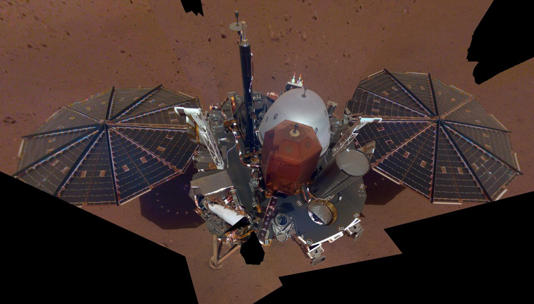
NASA InSight's first full selfie on Mars. It displays the lander's solar panels and deck. On top of the deck are its science instruments, weather sensor booms and UHF antenna. The selfie was taken on Dec. 6, 2018 (sol 10). The selfie is made up of 11 images which were taken by its Instrument Deployment Camera, located on the elbow of its robotic arm. Those images are then stitched together into a mosaic.
Credit: NASA/JPL-Caltech
InSight's white robotic arm and black handlike grapple deployed the first seismometer on another planet on December 19, 2018.
NASA/JPL-Caltech
The data were fed into a model informed by a mathematical theory of rock physics.
From it, the researchers determined that the presence of liquid water in the crust most plausibly explained the data.
“Establishing that there is a big reservoir of liquid water provides some window into what the climate was like or could be like,” said University of California Berkeley’s Professor Michael Manga.
“And water is necessary for life as we know it. I don’t see why the underground reservoir is not a habitable environment. It’s certainly true on Earth — deep, deep mines host life, the bottom of the ocean hosts life.”
“We haven’t found any evidence for life on Mars, but at least we have identified a place that should, in principle, be able to sustain life.”
“Lots of evidence — river channels, deltas and lake deposits, as well as water-altered rock – support the hypothesis that water once flowed on the planet’s surface.”
A 2018 photo of Mars during a dust storm, snapped by the Hubble Space Telescope. More than 3 billion years ago, the dusty red planet had oceans and rivers. That water disappeared, leaving only ice on the surface, most of it in the polar caps. A new analysis of Mars’ interior suggests that much of the liquid water still exists in the pores of rocks 10-20 kilometers below the surface.
Credit: NASA / ESA / STScI
“But that wet period ended more than 3 billion years ago, after Mars lost its atmosphere.”
“Planetary scientists on Earth have sent many probes and landers to the planet to find out what happened to that water — the water frozen in Mars’ polar ice caps can’t account for it all — as well as when it happened, and whether life exists or used to exist on the planet,” the authors said.
“The new findings are an indication that much of the water did not escape into space but filtered down into the crust.”
“The new paper analyzed the deeper crust and concluded that the available data are best explained by a water-saturated mid-crust below Insight’s location.”
“Assuming the crust is similar throughout the planet, there should be more water in this mid-crust zone than the volumes proposed to have filled hypothesized ancient Martian oceans.”
Large Reservoir of Liquid Water Found Deep Below the Surface of Mars
The findings appear in the Proceedings of the National Academy of Sciences.
Vashan Wrightet al. 2024. Liquid water in the Martian mid-crust. PNAS 121 (35): e2409983121; doi: 10.1073/pnas.2409983121
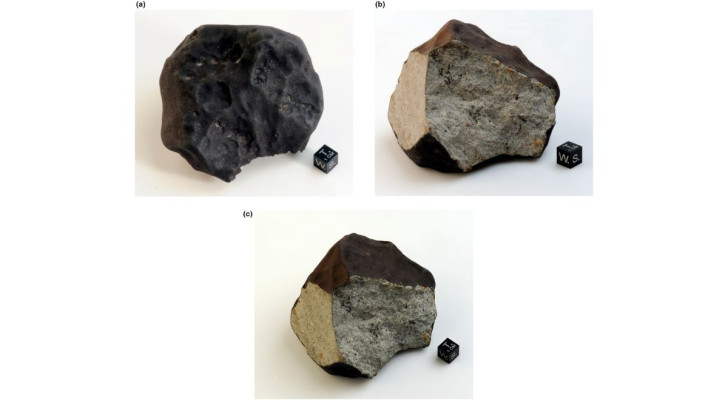
Van de meteorieten die de aarde sinds haar ontstaan hebben getroffen, slaagt een klein percentage erin het oppervlak van de planeet te bereiken, en wordt misschien zelfs door mensen gevonden. In de meeste gevallen beperkt het onderzoek zich echter tot de analyse van de compositie, en weinig anders. Het ontdekken van de exacte oorsprong van een meteoriet is niet eenvoudig, en daarom heeft een recent onderzoek liefhebbers en professionals verbaasd. Onderzoekers zijn erin geslaagd om een meteoriet te linken aan een gloed die zich voordeed in de atmosfeer... bijna 50 jaar geleden.
De vondst van de meteoriet… bijna 50 jaar geleden
Het is 1976 en Josef Pfefferle is een boswachter die de overblijfselen van een lawine bij het dorp Ischgl in Oostenrijk opruimt. Op een gegeven moment ziet hij echter een steen die heel anders is dan de andere die hij verwijdert: het is een zwarte steen ter grootte van een vuist en lijkt geen aardse oorsprong te hebben. Pfefferle besluit dit vreemde souvenir van zijn werk mee naar huis te nemen en bergt de steen 32 jaar lang op in een doos.
Het is nu 2008 en eindelijk, na het horen van het nieuws over een meteorietvondst, herinnert de bejaarde boswachter zich de vreemde steen die hij mee naar huis nam. Hij besluit de experts van de universiteit te raadplegen en die vinden de vondst inderdaad buitengewoon. Het is een meteoriet die, te oordelen naar de staat waarin hij bewaard is gebleven, niet in de oudheid op aarde moet zijn gevallen. Maar hoe begrijp je zoiets?
Op zoek naar de ruimtelijke oorsprong van de meteoriet
Gritsevich et al./Meteoritics & Planetary Science - 2024
Het onderzoek naar de meteoriet wordt uitgevoerd door een team van wetenschappers onder leiding van Maria Gritsevich van de Universiteit van Helsinki, die de resultaten publiceerde in het tijdschrift Meteoritics & Planetary Science. Gritsevich en haar collega's veronderstellen dat de meteoriet onlangs op aarde is gevallen, en dat er daarom ook videobewijs van de gebeurtenis zou kunnen zijn.
Om deze reden beginnen onderzoekers beelden te analyseren van 25 hemelobservatiecamera's in Zuid-Duitsland. Het lijkt een eenvoudige zoektocht, maar dat is slechts tot op zekere hoogte zo: in de afgelopen 50 jaar zijn er meer dan 2000 "vuurballen" waargenomen die meteorieten zouden kunnen zijn, maar welke trof Ischgl vóór 1976? Maria Gritsevich en haar team vinden bewijs van de inslag: een enorme flits die, laag aan de horizon, bij zonsopgang op 24 november 1970 de Oostenrijkse hemel verlicht. De meteoriet die Pfefferle vond is meer dan 50 jaar oud en heeft het grootste deel van zijn leven in een doos opgesloten gezeten.
De impact van de ontdekking op de studie van meteorieten
Als je het verhaal van de meteoriet van Ischgl leest, is het normaal om je af te vragen welk doel het dient om zijn ontdekking in verband te brengen met zijn oorsprong. Hoewel complex, is dit zeer belangrijk onderzoek, dat kan helpen cruciale informatie te begrijpen, zoals het gebied van het zonnestelsel waar het vandaan komt, zijn baan, zijn “verwantschap” met andere hemellichamen, enzovoort.
Toch is niet iedereen het erover eens dat de ontdekking van de meteoriet te wijten is aan de crash van 1970. Volgens andere wetenschappers had de door Pfefferle gevonden steen eeuwenlang op aarde kunnen wachten, goed beschermd door de gunstige omstandigheden in de Oostenrijkse Alpen. Wat de waarheid ook is, het is verbazingwekkend hoe je oude gegevens kunt raadplegen om antwoorden te vinden over gebeurtenissen die beginnen in het zonnestelsel en eindigen in een Oostenrijks bos, wachtend om gevonden te worden.
A Hopper Could Explore Over 150km of Triton’s Surface In Two Years
Neptune’s largest moon, Triton, is one of the most biologically interesting places in the solar system. Despite being hard to reach, it appears to have active volcanoes, a thin atmosphere, and even some organic molecules called tholins on its surface. However, Voyager only visited it once, in passing, 35 years ago. Technology has advanced a lot in the intervening decades, and a new push for a lander on Triton specifically has been garnering attention. One such mission was described by Steve Oleson and Geoffrey Landis of NASA’s Glenn Research Center. Their concept mission, known as Triton Hopper, was funded by NASA’s Institute for Advanced Concepts (NIAC) back in 2018 and utilized a cryogenic pump to extract propellant from Triton’s surface to power a “hopper” that could travel up to 5 km a month, and do some fascinating science along the way.
The first challenge to any mission on Triton is getting there. As part of the NIAC final report for the Triton Hopper, the authors performed a preliminary study examining different propulsion methods. Solar electric propulsion and aerobraking in Neptune’s larger atmosphere came out on top. The Hopper would have to hitch a ride with a larger orbital spacecraft responsible for trajectory planning of the “hops” and communicating with Earth.
Once safely deposited on Triton’s surface, a hopper could do lots of exciting science. The instrument payload described in the mission brief included ground-penetrating radar, spectroscopy equipment, a microscope, and even a seismometer. In total, the whole system weighed just under 300 kg—relatively light for an interplanetary mission.
Video describing the Triton Hopper mission in detail. Credit – Dreksler Astral YouTube Channel
But most of that weight wouldn’t be in the instrumentation—it would be in the Hopper’s unique propulsion system. The concept behind the propulsion system is simple enough: Get some propellant material into the spacecraft, then heat that material to a point where it is pressurized. Once enough pressure is built up, release it as a jet stream that would allow the 300 kg spacecraft to overcome the relatively weak gravity of Titan, which is only ½ the gravity of our own Moon.
The study focused on two main ways to get material into the Hopper – a shovel and a cryogenic pump. Each has its advantages, though the pump was more effective, at least in the theoretical simulations run as part of the Phase I project. The shovel suffered from potential contamination by other material being loaded into the propellant collection hopper and either blocking the nitrogen-rich ice and snow from entering it or itself being absorbed into the thermal chamber and sucking up some of the heat intended to melt the propellant.
On the other hand, a cryopump could use waste heat from the rover’s normal power-generating operations to directly melt the ice and snow the Hopper landed on and absorb that into a heating chamber, where it would be further heated before being used as a propellant. This methodology can be effective at gathering the best propellant options and providing an outlet for the lander’s waste heat that doesn’t just radiate into Triton’s thin atmosphere.
Fraser discusses why Triton is so interesting with Dr. Jason Hofgartner
Once enough pressure is built up by heating the propellant, the Hopper can take off from the moon’s surface and “hop” a short distance using its six power and four steering thrusters. The authors estimate about 50 seconds of specific impulse once a month. While that might not seem like a lot, it would allow the Hopper to cover about 150 kilometers over the course of a two-year mission.
It could find plenty of interesting scientific spots in those two years. However, the mission, which is also competing for resources with plenty of other mission concepts for Triton landers, appears to be on hold. It hasn’t received a Phase II, and there haven’t been any development updates in the last few years. But given the general popularity of the hopper concept even on other worlds in our solar system and the desirability of Triton as an exploration destination, it seems likely that someday some form of this mission will soar above the ice surface of Neptune’s biggest moon. It might just be a while before it does.
An Ancient Martian Lake Was Larger Than Any Lake on Earth
In January 2024, DLR's HRSC on board ESA's Mars Express spacecraft captured the Caralis Chaos region, which has several interesting and sometimes puzzling landscape features – such as a field of small, light-coloured hills to the northeast (bottom-right of the image). The mounds are located in the remains of a depression that was once filled by a lake.Image Credit: ESA/DLR/FU Berlin (CC BY-SA 3.0 IGO)
An Ancient Martian Lake Was Larger Than Any Lake on Earth
The ESA’s Mars Express orbiter captured an image of the remains of a vast ancient lake on Mars. The remnant lake bed has been weathered and altered by the passing of billions of years. In the planet’s distant past, scientists say, it held enough water to fill Earth’s Caspian Sea almost three times over.
The leading image shows a region on Mars called Caralis Chaos.
At first glance, it just looks like a vague outline of a depression scrambled and scarred by time, with Mars’ ubiquitous impact craters sprinkled throughout the image. But for scientists who study planetary surface features, the image is rife with clues—clues that connect it to Mars’ warm and watery ancient past and to the ensuing episodes of change the planet underwent.
The following topographical map brings clarity.
Red is high elevation, and blue is low elevation. The lakebed boundaries curve up and away from the bottom centre of the frame towards the top right, skirting around the large central crater. This is one of several lakebeds in the region that were once joined into one vast lake named Lake Eridania. Image Credit: ESA/DLR/FU Berlin. Licence: CC BY-SA 3.0 IGO or ESA Standard Licence
The ancient lakebed consists of several basins surrounding and including the Caralis Chaos region. In the distant past, they were all joined into one big lake named Lake Eridania. It had a surface area of about 1.1 million square km. The largest non-ocean body of water on Earth is the Caspian Sea, with a surface area of 389,000 km.
This image puts the Caralis Chaos region into context. It’s from a 2015 paper that focused on two parts of the Eridania Lake system: Atlantis Chaos and Simois Colles. Image Credit: Adeli et al. 2015.
Liquid water was likely abundant on early Mars between about 4.1 and 3 billion years ago during the Noachian and Hesperian Periods. Mars may have even hosted a massive ocean that covered about one-third of its surface. Eridania Lake was likely a single lake until the late Noachian when Mars gradually lost its water. During that period, the lake was fragmented into multiple smaller lakes.
The ancient lakebed is now punctuated with mounds. Scientists think Mars’ dusty winds initially formed the mounds. Later, they were covered by water, then the water disappeared, and they were exposed to the wind again.
This perspective view shows the mounds on the floor of ancient Lake Eridani. Image Credit: ESA/DLR/FU CC BY-SA 3.0 IGO
The floors of all of the basins that comprised Eridania Lake are covered by light-toned materials containing Fe/Mg-phyllosilicates. The region also has chloride, indicating that a playa region once existed here as the water receded. Some of the geological evidence in the region suggests that some surface water may have survived until long after the Noachian.
This diagram shows how volcanic activity may have caused the deposition of minerals on the floor of Lake Eridania. Chlorides were deposited along the shoreline by evaporation. Image Credit: By Jim Secosky chose this image NASA – https://www.jpl.nasa.gov/spaceimages/details.php?id=PIA22060, Public Domain, https://commons.wikimedia.org/w/index.php?curid=63303061
There’s also evidence of volcanic activity. Two large faults called fossae run through the region. Collectively, they’re known as Sirenum Fossae.
This image shows the extent and depth of ancient Lake Eridania. It also shows Sirenum Fossae, two large faults in the Martian surface. Image Credit: By Jim Secosky modified NASA image – https://photojournal.jpl.nasa.gov/figures/PIA22059_fig1.jpg, Public Domain, https://commons.wikimedia.org/w/index.php?curid=63330708
The region between the two faults is called a graben, a depressed portion of the crust. Sirenum Fossae was formed as Mars’ Tharsis region, a vast volcanic plateau that’s home to Olympus Mons and Tharsis Montes, rose up and put enormous pressure on the crust.
This is a perspective view of one of the Sirenum Fossae fault lines. Image Credit: ESA/DLR/FU CC BY-SA 3.0 IGO
These images all come from the ESA’s Mars Express Orbiter. It has been orbiting Mars since 2004, mapping its surface and minerals and studying the planet’s interior, subsurface, and atmosphere. It has been in orbit for more than 20 years. The ESA has extended its mission until at least the end of 2026 and has given it a provisional extension until 2028.
Are Andromeda and the Milky Way Doomed to Collide? Maybe Not
Scientists discovered the Andromeda galaxy, known as M31, hundreds of years ago, and around a century ago, we realized that it had negative radial velocity toward the Milky Way. In other words, eventually, the two galaxies would merge spectacularly. That has been common knowledge for astronomers since then, but is it really true? A new paper from researchers at the University of Helsinki looks at several confounding factors, including the gravitational influence of other galaxies in our local group, and finds only a 50% chance that the Milky Way will merge with the Andromeda galaxy in the next 10 billion years.
That seems like a pretty big thing to get the physics wrong on. So, how did the authors come to that conclusion? They accounted for a problem that has been popularized in media as of late – the three-body – or in this case, four-body – problem. And with that problem comes a lot of uncertainty, which is why there’s still a 50% chance that this huge event might still happen.
Thinking of Andromeda and the Milky Way in isolation doesn’t account for the other galaxies in what we know as the “Local Group.” This comprises approximately 100 smaller galaxies at various orientations, distances, and speeds. The largest of the remaining galaxies is the Triangulum galaxy, M33, which is about 2.7 million light-years away and consists of upwards of a mere 40 billion stars. That’s about 40% of the approximately 100 billion stars in the Milky Way but a mere 4% of the nearly 1 trillion stars estimated to exist in Andromeda. Still, they would have their own gravitational pull, contorting the simplistic dynamic between Andromeda and the Milky Way.
Fraser explains some of the orbital mechanics around Andromeda’s motion.
Further confounding that dynamic is the Large Magellanic Cloud, which is either the second or third closest galaxy to our own at a distance of only 163,000 light years. This is slightly larger than the Milky Way’s diameter, at 105,700. It also houses around 20 billion stars, so while it’s even less massive than M33, it still exerts a hefty gravitational pull.
The authors accounted for the gravitational pull of both of those other galaxies in their calculations of the paths of the Milky Way and Andromeda over the next few billion years. They found that the complicated dance of astronomical giants could potentially result in a scenario where the two galaxies don’t merge. However, there was another significant factor in their calculations: uncertainty.
Scientists never like uncertainty. In fact, much of their research tries to place bounds on certain parameters, like the rotational speed of galaxies or the distances between them. Unfortunately, despite their proximity, there are many uncertainties surrounding the four galaxies used in the study, and those uncertainties make precise calculations of the effects of their gravitational and rotational pull difficult.
Fraser discusses what stars, if any, we can see in Andromeda.
Developing estimates rather than concrete numbers is one-way scientists often deal with uncertainty, and in this case, that estimate fell right at the 50% mark in terms of whether or not the wo galaxies would collide. However, there is still a lot of uncertainty in that estimate, and plenty more confounding factors, including the other galaxies in the local group, will influence the final outcome. Ultimately, time will help solve the mystery, but that is a very long time on the scale of galaxy mergers. If it happens at all, a merger between the Milky Way and Andromeda will happen long after our own Sun has burnt out, and humans will either die out with it or find a way to expand to new stars. And if, at that point, we get easy access to an additional galaxy’s worth of resources, it would be all the better for us.
This illustration shows a stage in the predicted merger between our Milky Way galaxy and the neighboring Andromeda galaxy, as it will unfold over the next several billion years. In this image, representing Earth’s night sky in 3.75 billion years, Andromeda (left) fills the field of view and begins to distort the Milky Way with tidal pull. Credit: NASA; ESA; Z. Levay and R. van der Marel, STScI; T. Hallas; and A. Mellinger
The Next Solar Cycle Has Started… But the Current One Hasn’t Finished Yet
We may be already seeing the makings of next solar cycle, peeking out through the current one.
It’s been a wild ride. Thus far, Solar Cycle Number 25 has been one of the strongest cycles in recent memory, producing several massive sunspot groups. The current large region turned Earthward (Active Region 3780) is now easily visible with eclipse glasses… no magnification needed. Cycle 25 started back in 2019.
Massive sunspot rotates into view. Credit: NASA/SDO
A Stormy Year
To be sure, the latest solar cycle will be one for the history books, as it heads towards an active maximum in 2025. But even though Cycle 25 will run out through the remainder of the current decade, there are already signs that Cycle 26 could be beginning, just under the roiling solar surface. A study out of the University of Birmingham recently presented at the Royal Astronomical Society’s National Astronomical Meeting in Hull (United Kingdom) shows that key indicators for the start of the next cycle may already be in place.
Numbering the solar cycle under current the convention goes all the way back to the start of Cycle 1 in 1755. The pattern for numbering cycles was started in 1852 by astronomer Rudolf Wolf.
We know that a new solar cycle has formally started when sunspots appear at higher solar latitudes. These also typically have a reversed polarity, versus the previous cycle. These then push down near the solar equator as the cycle progresses. Spot from two cycles can also mix as the transition gets underway.
A large sunspot group from May 2024. Credit: NASA/SDO
Laying out spots from successive cycles versus latitude creates a butterfly diagram that demonstrates this effect, in what’s known as Spörer’s Law.
A butterfly graph (top) showing sunspots versus latitude over time. Credit: NASA/MSFC
Peering Inside the Sun
But there’s more to the Sun than meets the eye. As a large ball of hydrogen and helium gas, the Sun does not rotate as a single solid mass. Instead, it rotates faster at the equator (25 days) versus near the poles (34 days). Scientists can probe the solar interior via a method known as solarhelioseismology, which looks at waves crossing the solar photosphere in an effort to model the interior.
These internal sound waves form bands in a phenomenon known as solar torsional oscillation. Faster-rotation belts appear as a harbinger of the next cycle. These move along with visible sunspots towards the solar equator as the cycle progresses.
“The indication of Cycle 26 that we see is that the solar rotation has been speeding up at around 50 degrees latitude and now appears to be leveling off,” Rachel Howe (University of Birmingham) told Universe Today. “This forms part of a pattern called the torsional oscillation, where bands of slightly faster and slower rotation emerge at mid-latitudes before the cycle officially starts and move down to lower latitudes, alongside the sunspot activity, as the cycle develops. In earlier cycles we have seen that the faster-rotating band associated with the cycle can be traced back to around the maximum of the previous cycle, and we think we’re seeing the beginning of the pattern again. It will still be several years before we can expect to see sunspots belonging to the new cycle, though!”
A solar cycle map, showing speed and torsional oscillations over time versus latitude for the last three solar cycles… and the start of Solar Cycle 26 (upper right). Credit: Rachel Howe.
Monitoring the Sun Around the Clock
The Global Oscillation Network Group (GONG) makes the science of helioseismology possible. This is a worldwide network that monitors the Sun continuously. In space, the Helioseismic Magnetic Imager aboard the joint ESA/NASA Solar and Heliospheric Observatory (SOHO) compliments this effort. The Michelson Doppler Imager (MDI) on NASA’s Solar Dynamics Observatory (SDO) also plays a key role in this campaign. This effort goes back to 1995, spanning the last three solar cycles.
Big Bear Lake and Solar Observatory, part of the GONG network monitoring the Sun.
This gives researchers a look at the start of the last two solar cycles. It also hints at what might be in store for the start of Solar Cycle 26. “If we can understand how this flow pattern relates to the sunspot cycle, we may be able to do better at predicting how strong the next solar maximum will be and when it will occur,” says Howe.
Sunspots from July 31st, 2024. Credit: Eliot Herman.
Solar Cycle 25 has thus far been extremely active, far beyond expectations. This follows the historic lull that preceded it between Cycles 24 and 25. Observers saw few sunspots during this profound minimum. Still, this fell in line with many predictions made by astronomers who study the Sun, suggesting a stronger than usual cycle on rebound.
Looking Ahead to Cycle 26
“The Sun is always surprising,” says Howe. “Some of the most exciting discoveries recently have come from the spacecraft—Solar Orbiter and Parker Solar Probe—that are flying closer to the Sun than ever before, helping scientists to unravel the connections between what we see on the Sun’s surface and the ‘space weather’ events that affect us on Earth. We’re looking at the surface of the Sun in more detail than ever before, but there’s also a place for long-term studies (which this work is a part of) that follow the large-scale patterns inside the Sun over decades.”
A magnetic view of the Sun, courtesy of SDO. Credit: NASA/SDO
The May 10th solar storm was thus far the most impressive one of the cycle. This storm sent aurora to latitudes far south as Spain and Mexico, areas where aurorae are rarely seen. We were treated to a persistent red glow watching from central Germany, an unforgettable sight.
Solar Cycles and More
Historically, the Wolf Sunspot Number defines the level of solar activity. Astronomers refer to this as the Relative or Zürich Sunspot Number. One 2013 study suggested that the orientation and strength of the heliospheric current sheet is a better indicator of the health of the current solar cycle, rather than the sunspot number.
We usually say it’s an 11-year solar cycle from one minima/maxima to the next… but it’s actually double that length. The Sun’s magnetic field flips every 11-years, returning to the same relative orientation every 22 years.
We see ‘starspot cycles’ on other suns as well. It is also unclear why an 11-year cycle is ‘baked in’ to our Sun. We’re also unsure if this has always been the case throughout its 4.6-billion year life span.
This research provides a great model to test the next solar cycle, as we struggle to understand and live with our tempestuous star.
De nachtelijke hemel lijkt onbeweeglijk en onveranderlijk, de sterrenbeelden lijken vast en zonder bijzondere veranderingen. Toch zal de hemel binnenkort een gebeurtenis bevatten waar astronomen al jaren op wachten: een enorme explosie op duizenden lichtjaren van de aarde vandaan. En ja, die zal met het blote oog te zien zijn.
Een nova-explosie die binnenkort met het blote oog te zien is
T Coronae Borealis is een binair systeem dat zich op ongeveer 3000 lichtjaar van de aarde bevindt en bestaat uit een witte dwerg en een rode reus. Velen zijn bekend met de term “rode reus”, dat wil zeggen een ster van een bepaalde grootte in de laatste fase van zijn leven: de zon zal over vijf miljard jaar ook een rode reus worden. Het geval van witte dwergen is anders, niet meer bestaande sterren die een massa hebben die vergelijkbaar is met die van de zon, maar gecomprimeerd tot de grootte van de aarde, of zelfs kleiner.
Kortom, het is een zeer dichte ster met een bijzonder sterke zwaartekracht. Precies om deze reden trekt de witte dwerg die aanwezig is in het T Coronae Borealis-systeem waterstof aan van de rode reus en hoopt dit op aan zijn oppervlak. Op een gegeven moment zullen de gasdruk en de hitte een kritiek niveau bereiken, met verwoestende gevolgen: er ontstaat een thermonucleaire explosie die het opgehoopte materiaal de ruimte in werpt. Het proces herhaalt zich gemiddeld elke 80 jaar, en zal binnenkort opnieuw plaatsvinden.
A red giant star and white dwarf orbit each other in this animation of a nova similar to T Coronae Borealis. The red giant is a large sphere in shades of red, orange, and white, with the side facing the white dwarf the lightest shades. The white dwarf is hidden in a bright glow of white and yellows, which represent an accretion disk around the star. A stream of material, shown as a diffuse cloud of red, flows from the red giant to the white dwarf. When the red giant moves behind the white dwarf, a nova explosion on the white dwarf ignites, creating a ball of ejected nova material shown in pale orange. After the fog of material clears, a small white spot remains, indicating that the white dwarf has survived the explosion.
NASA/Goddard Space Flight Center
Hoe de explosie van T Coronae Borealis te herkennen
Het cyclische karakter van de T Coronae Borealis nova is op zijn eigen manier al enige tijd bekend: de eerste geregistreerde waarneming dateert uit de herfst van 1217, toen de explosie werd opgemerkt door een abt in Duitsland. Volgens NASA zal de explosie met het blote oog zichtbaar zijn en niet zo moeilijk te herkennen: trek gewoon een rechte lijn tussen Arcturus en Vega, twee van de helderste sterren op het noordelijk halfrond. Het sterrenbeeld Corona Borealis, waar T Coronae Borealis deel van uitmaakt, heeft de vorm van een hoefijzer en bevindt zich ten westen van het sterrenbeeld Hercules. Dit zijn de woorden van Rebekah Hounsell van NASA's Goddard Space Flight Center:
Dit evenement wordt een unieke ervaring die een nieuwe generatie astronomen kan inspireren. Het zal jongeren in staat stellen een kosmische gebeurtenis te observeren, vragen te stellen en gegevens te verzamelen.
En in feite zullen we, vergeleken met de vorige nova in 1946, een verzameling instrumenten hebben die toen gewoon ondenkbaar was. De Fermi Gamma-ray ruimtetelescoop, de James Webb ruimtetelescoop en NuSTAR en natuurlijk miljarden mensen zullen de gebeurtenis observeren.
Een buitengewone kans voor de astronomie
We weten natuurlijk dat de verwachte explosie al zo'n 3000 jaar geleden plaatsvond, en dat het licht ervan richting de aarde reist. De gebeurtenis zal echter van relatief korte duur zijn en de nova zal minder dan een week zichtbaar blijven aan de nachtelijke hemel. Dit is een buitengewone kans om de structuur en dynamiek van terugkerende stellaire explosies te bestuderen.
Maar is het zeker dat de dreigende explosie zal plaatsvinden? Ja en nee. Zoals we al zeiden, komen novae van T Coronae Borealis gemiddeld elke 80 jaar voor, en het is redelijk om aan te nemen dat de nieuwe explosie op komst is. Toch blijven deze hemelse verschijnselen zeer onstabiel en onvoorspelbaar. Er zullen ongetwijfeld veel ogen naar de hemel gericht zijn, op zoek naar een gloed in een nachtelijke hemel die vaak te stil en onveranderlijk is.
A conceptual image of how to find Hercules and the “Northern Crown” in the night sky, created using planetarium software. Look up after sunset during summer months to find Hercules, then scan between Vega and Arcturus, where the distinct pattern of Corona Borealis may be identified.
NASA
A coordinated scientific approach
Watch V407 Cyg go nova! In this animation, gamma rays (magenta) arise when accelerated particles in the explosion's shock wave crash into the red giant's stellar wind.
NASA/Conceptual Image Lab/Goddard Space Flight Center
Het bewijst dat het door NASA geramde maantje Dimorphos zeker niet de enige is die rond een ruimtesteen cirkelt.
We weten dat planeten manen kunnen herbergen. Onze aarde heeft er bijvoorbeeld één, terwijl Saturnus met 146 erkende manen de grootste verzameling in ons zonnestelsel heeft. Maar ook ruimtestenen kunnen maantjes hebben. Denk maar aan het maantje Dimorphos, dat de plantoïde Didymos omcirkelt en door NASA’s Dart-missie van koers werd veranderd. Maar hoe uniek is het eigenlijk dat ruimtestenen maantjes hebben?
Binaire planetoïden Het is mogelijk een stuk minder bijzonder dan we dachten. Ruimtetelescoop Gaia heeft namelijk mogelijke maantjes ontdekt rond meer dan 350 planetoïden waarvan niet eerder bekend was dat ze een metgezel hadden. Als deze ontdekking wordt bevestigd, komen er 352 nieuwe binaire planetoïden bij, wat het aantal bekende ruimtestenen met manen bijna verdubbelt.
Moeilijk te vinden Dat er tot nu toe nog niet veel maantjes rond ruimtestenen zijn gevonden, is niet zo verwonderlijk. “Binaire planetoïden zijn lastig te vinden omdat ze vaak klein en ver weg zijn,” legt onderzoeksleider van de nieuwe studie Luana Liberato uit. “We verwachten dat iets minder dan een zesde van de planetoïden een metgezel heeft. Tot nu toe hebben we slechts 500 van de naar schatting één miljard planetoïden in binaire systemen ontdekt. Onze studie suggereert dat er nog veel manen zijn die op ontdekking wachten.”
Gaia Door zijn speciale vermogen om de hele hemel in de gaten te houden, heeft Gaia sinds de lancering in 2013 al verschillende belangrijke ontdekkingen op het gebied van planetoïden op zijn naam staan. In de derde gegevensrelease heeft Gaia de posities en bewegingen van meer dan 150.000 planetoïden met grote precisie bepaald (zie ook de afbeelding hieronder).
Gaia heeft meer dan 150.000 banen van planetoïden in kaart gebracht. Op deze afbeelding zie je verschillende kleurrijke banen die rond de zon cirkelen, waarbij elke kleur een andere planetoïde vertegenwoordigt. In het midden van de afbeelding, waar een gebied binnen de baan van Jupiter wordt afgebeeld, zijn de banen van de planetoïden bijzonder dicht op elkaar gepakt. Afbeelding: ESA/Gaia/DPAC
Deze precisie maakte het mogelijk voor wetenschappers om verder te zoeken naar planetoïden die het typische ‘wiebelen’ vertonen, veroorzaakt door de aantrekkingskracht van een omcirkelende maan (zoals bij een binaire ster). En op deze manier kwamen onderzoekers dus honderden planetoïden met een natuurlijke satelliet op het spoor.
Meer over Gaia ESA’s Gaia-satelliet (afkorting van Global Astrometric Interferometer for Astrophysics) werd eind 2013 gelanceerd en had een duidelijk doel voor ogen: de positie, afstand en bewegingen van miljarden sterren vastleggen, met een betere nauwkeurigheid dan ooit tevoren. De ruimtetelescoop opereert in een baan om het zogenoemde tweede Lagrangepunt, op een slordige 1,5 miljoen kilometer van de aarde. Op dit tweede Lagrangepunt zijn de zwaartekrachten tussen de aarde en de zon in evenwicht, waardoor de telescoop in een stabiele positie blijft en op lange termijn vrijwel onbelemmerd zicht heeft op de nachtelijke hemel. En de metingen zijn heel nauwkeurig; Gaia is zo gevoelig dat de telescoop zelfs de groei van een mensenhaar op de maan zou kunnen meten!
Waarom astronomen zo geïnteresseerd zijn in (de maantjes van) planetoïden? Dat komt omdat deze ruimtestenen waardevolle inzichten verschaffen in de vorming en evolutie van ons zonnestelsel. Binaire systemen zijn nog interessanter omdat ze ons de kans bieden te onderzoeken hoe verschillende hemellichamen ontstaan, botsen en met elkaar interageren in de ruimte.
Nieuwe gegegevengrelease Ondertussen heeft Gaia al meerdere datasets vrijgegeven. In 2016 kwamen onderzoekers met de eerste dataset op de proppen. Deze bevatte de afstanden en bewegingen van twee miljoen sterren. In 2018 volgde de tweede dataset, waarin de 3D-posities, 2D-bewegingen, de helderheid en kleur van meer dan 1,3 miljard sterren werd onthuld. In 2020 volgde de derde gegevensrelease. De meer dan 150.000 ontdekte planetoïde banen werden vervolgens verfijnd als onderdeel van de Focused Product Release van dat jaar. En hier blijft het niet bij. We kunnen namelijk nóg meer planetoïde banen verwachten in de volgende gegevensrelease 4 van Gaia, die voor midden 2026 wordt verwacht.
Geheimen Dankzij de ruimtetelescoop vergroten we dus steeds meer onze kennis over ons zonnestelsel. “Gaia heeft bewezen een geweldige ontdekkingsreiziger van planetoïden te zijn,” zegt Timo Prusti van ESA. “De telescoop werkt hard om de geheimen van het universum, zowel binnen als buiten ons zonnestelsel, te onthullen. Deze nieuwste ontdekking benadrukt hoe elke gegevensrelease van Gaia een grote verbetering in datakwaliteit betekent en laat zien welke opwindende nieuwe wetenschappelijke inzichten door de missie mogelijk worden gemaakt.”
Dat ESA zich blijft richten op het bestuderen van planetoïden blijkt ook wel uit de aanstaande lancering van de Hera-missie, later dit jaar. Hera bouwt voort op NASA’s DART-missie, die in 2022 Dimorphos ramde, om te testen of we planetoïden kunnen afbuigen. Hera zal Dimorphos na de impact onderzoeken. Het is bovendien de eerste missie die een binaire planetoïde op een bezoekje trakteert. En met aankomende missies zoals Hera in het vooruitzicht, kunnen we verwachten dat we nog veel meer zullen leren over planetoïden en hun manen, wat ons begrip van de kosmos verder zal uitbreiden.
Beste bezoeker, Heb je zelf al ooit een vreemde waarneming gedaan, laat dit dan even weten via email aan Frederick Delaere opwww.ufomeldpunt.be. Deze onderzoekers behandelen jouw melding in volledige anonimiteit en met alle respect voor jouw privacy. Ze zijn kritisch, objectief maar open minded aangelegd en zullen jou steeds een verklaring geven voor jouw waarneming! DUS AARZEL NIET, ALS JE EEN ANTWOORD OP JOUW VRAGEN WENST, CONTACTEER FREDERICK. BIJ VOORBAAT DANK...
Druk op onderstaande knop om je bestand , jouw artikel naar mij te verzenden. INDIEN HET DE MOEITE WAARD IS, PLAATS IK HET OP DE BLOG ONDER DIVERSEN MET JOUW NAAM...
Druk op onderstaande knop om een berichtje achter te laten in mijn gastenboek
Alvast bedankt voor al jouw bezoekjes en jouw reacties. Nog een prettige dag verder!!!
Over mijzelf
Ik ben Pieter, en gebruik soms ook wel de schuilnaam Peter2011.
Ik ben een man en woon in Linter (België) en mijn beroep is Ik ben op rust..
Ik ben geboren op 18/10/1950 en ben nu dus 75 jaar jong.
Mijn hobby's zijn: Ufologie en andere esoterische onderwerpen.
Op deze blog vind je onder artikels, werk van mezelf. Mijn dank gaat ook naar André, Ingrid, Oliver, Paul, Vincent, Georges Filer en MUFON voor de bijdragen voor de verschillende categorieën...
Veel leesplezier en geef je mening over deze blog.