The purpose of this blog is the creation of an open, international, independent and free forum, where every UFO-researcher can publish the results of his/her research. The languagues, used for this blog, are Dutch, English and French.You can find the articles of a collegue by selecting his category. Each author stays resposable for the continue of his articles. As blogmaster I have the right to refuse an addition or an article, when it attacks other collegues or UFO-groupes.
Druk op onderstaande knop om te reageren in mijn forum
Zoeken in blog
Deze blog is opgedragen aan mijn overleden echtgenote Lucienne.
In 2012 verloor ze haar moedige strijd tegen kanker!
In 2011 startte ik deze blog, omdat ik niet mocht stoppen met mijn UFO-onderzoek.
BEDANKT!!!
Een interessant adres?
UFO'S of UAP'S, ASTRONOMIE, RUIMTEVAART, ARCHEOLOGIE, OUDHEIDKUNDE, SF-SNUFJES EN ANDERE ESOTERISCHE WETENSCHAPPEN - DE ALLERLAATSTE NIEUWTJES
UFO's of UAP'S in België en de rest van de wereld Ontdek de Fascinerende Wereld van UFO's en UAP's: Jouw Bron voor Onthullende Informatie!
Ben jij ook gefascineerd door het onbekende? Wil je meer weten over UFO's en UAP's, niet alleen in België, maar over de hele wereld? Dan ben je op de juiste plek!
België: Het Kloppend Hart van UFO-onderzoek
In België is BUFON (Belgisch UFO-Netwerk) dé autoriteit op het gebied van UFO-onderzoek. Voor betrouwbare en objectieve informatie over deze intrigerende fenomenen, bezoek je zeker onze Facebook-pagina en deze blog. Maar dat is nog niet alles! Ontdek ook het Belgisch UFO-meldpunt en Caelestia, twee organisaties die diepgaand onderzoek verrichten, al zijn ze soms kritisch of sceptisch.
Nederland: Een Schat aan Informatie
Voor onze Nederlandse buren is er de schitterende website www.ufowijzer.nl, beheerd door Paul Harmans. Deze site biedt een schat aan informatie en artikelen die je niet wilt missen!
Internationaal: MUFON - De Wereldwijde Autoriteit
Neem ook een kijkje bij MUFON (Mutual UFO Network Inc.), een gerenommeerde Amerikaanse UFO-vereniging met afdelingen in de VS en wereldwijd. MUFON is toegewijd aan de wetenschappelijke en analytische studie van het UFO-fenomeen, en hun maandelijkse tijdschrift, The MUFON UFO-Journal, is een must-read voor elke UFO-enthousiasteling. Bezoek hun website op www.mufon.com voor meer informatie.
Samenwerking en Toekomstvisie
Sinds 1 februari 2020 is Pieter niet alleen ex-president van BUFON, maar ook de voormalige nationale directeur van MUFON in Vlaanderen en Nederland. Dit creëert een sterke samenwerking met de Franse MUFON Reseau MUFON/EUROP, wat ons in staat stelt om nog meer waardevolle inzichten te delen.
Let op: Nepprofielen en Nieuwe Groeperingen
Pas op voor een nieuwe groepering die zich ook BUFON noemt, maar geen enkele connectie heeft met onze gevestigde organisatie. Hoewel zij de naam geregistreerd hebben, kunnen ze het rijke verleden en de expertise van onze groep niet evenaren. We wensen hen veel succes, maar we blijven de autoriteit in UFO-onderzoek!
Blijf Op De Hoogte!
Wil jij de laatste nieuwtjes over UFO's, ruimtevaart, archeologie, en meer? Volg ons dan en duik samen met ons in de fascinerende wereld van het onbekende! Sluit je aan bij de gemeenschap van nieuwsgierige geesten die net als jij verlangen naar antwoorden en avonturen in de sterren!
Heb je vragen of wil je meer weten? Aarzel dan niet om contact met ons op te nemen! Samen ontrafelen we het mysterie van de lucht en daarbuiten.
12-08-2024
An Ancient Martian Lake Was Larger Than Any Lake on Earth
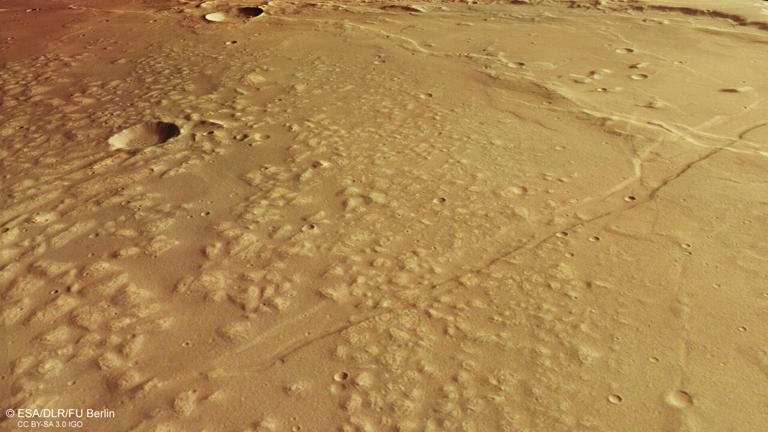
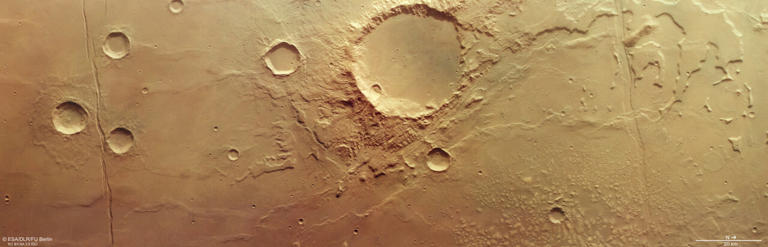
In January 2024, DLR's HRSC on board ESA's Mars Express spacecraft captured the Caralis Chaos region, which has several interesting and sometimes puzzling landscape features – such as a field of small, light-coloured hills to the northeast (bottom-right of the image). The mounds are located in the remains of a depression that was once filled by a lake.Image Credit: ESA/DLR/FU Berlin (CC BY-SA 3.0 IGO)
An Ancient Martian Lake Was Larger Than Any Lake on Earth
The ESA’s Mars Express orbiter captured an image of the remains of a vast ancient lake on Mars. The remnant lake bed has been weathered and altered by the passing of billions of years. In the planet’s distant past, scientists say, it held enough water to fill Earth’s Caspian Sea almost three times over.
The leading image shows a region on Mars called Caralis Chaos.
At first glance, it just looks like a vague outline of a depression scrambled and scarred by time, with Mars’ ubiquitous impact craters sprinkled throughout the image. But for scientists who study planetary surface features, the image is rife with clues—clues that connect it to Mars’ warm and watery ancient past and to the ensuing episodes of change the planet underwent.
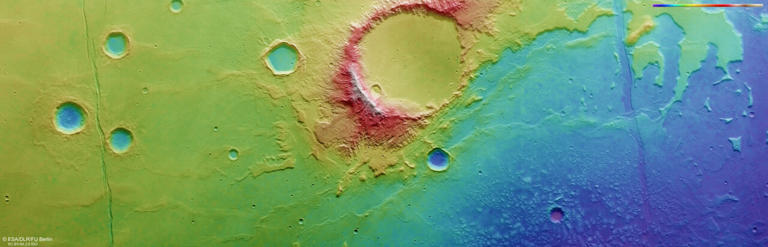
The following topographical map brings clarity.
Red is high elevation, and blue is low elevation. The lakebed boundaries curve up and away from the bottom centre of the frame towards the top right, skirting around the large central crater. This is one of several lakebeds in the region that were once joined into one vast lake named Lake Eridania. Image Credit: ESA/DLR/FU Berlin. Licence: CC BY-SA 3.0 IGO or ESA Standard Licence
The ancient lakebed consists of several basins surrounding and including the Caralis Chaos region. In the distant past, they were all joined into one big lake named Lake Eridania. It had a surface area of about 1.1 million square km. The largest non-ocean body of water on Earth is the Caspian Sea, with a surface area of 389,000 km.
This image puts the Caralis Chaos region into context. It’s from a 2015 paper that focused on two parts of the Eridania Lake system: Atlantis Chaos and Simois Colles. Image Credit: Adeli et al. 2015.
Liquid water was likely abundant on early Mars between about 4.1 and 3 billion years ago during the Noachian and Hesperian Periods. Mars may have even hosted a massive ocean that covered about one-third of its surface. Eridania Lake was likely a single lake until the late Noachian when Mars gradually lost its water. During that period, the lake was fragmented into multiple smaller lakes.
The ancient lakebed is now punctuated with mounds. Scientists think Mars’ dusty winds initially formed the mounds. Later, they were covered by water, then the water disappeared, and they were exposed to the wind again.
This perspective view shows the mounds on the floor of ancient Lake Eridani. Image Credit: ESA/DLR/FU CC BY-SA 3.0 IGO
The floors of all of the basins that comprised Eridania Lake are covered by light-toned materials containing Fe/Mg-phyllosilicates. The region also has chloride, indicating that a playa region once existed here as the water receded. Some of the geological evidence in the region suggests that some surface water may have survived until long after the Noachian.
This diagram shows how volcanic activity may have caused the deposition of minerals on the floor of Lake Eridania. Chlorides were deposited along the shoreline by evaporation. Image Credit: By Jim Secosky chose this image NASA – https://www.jpl.nasa.gov/spaceimages/details.php?id=PIA22060, Public Domain, https://commons.wikimedia.org/w/index.php?curid=63303061
There’s also evidence of volcanic activity. Two large faults called fossae run through the region. Collectively, they’re known as Sirenum Fossae.
This image shows the extent and depth of ancient Lake Eridania. It also shows Sirenum Fossae, two large faults in the Martian surface. Image Credit: By Jim Secosky modified NASA image – https://photojournal.jpl.nasa.gov/figures/PIA22059_fig1.jpg, Public Domain, https://commons.wikimedia.org/w/index.php?curid=63330708
The region between the two faults is called a graben, a depressed portion of the crust. Sirenum Fossae was formed as Mars’ Tharsis region, a vast volcanic plateau that’s home to Olympus Mons and Tharsis Montes, rose up and put enormous pressure on the crust.
This is a perspective view of one of the Sirenum Fossae fault lines. Image Credit: ESA/DLR/FU CC BY-SA 3.0 IGO
These images all come from the ESA’s Mars Express Orbiter. It has been orbiting Mars since 2004, mapping its surface and minerals and studying the planet’s interior, subsurface, and atmosphere. It has been in orbit for more than 20 years. The ESA has extended its mission until at least the end of 2026 and has given it a provisional extension until 2028.
Are Andromeda and the Milky Way Doomed to Collide? Maybe Not
Scientists discovered the Andromeda galaxy, known as M31, hundreds of years ago, and around a century ago, we realized that it had negative radial velocity toward the Milky Way. In other words, eventually, the two galaxies would merge spectacularly. That has been common knowledge for astronomers since then, but is it really true? A new paper from researchers at the University of Helsinki looks at several confounding factors, including the gravitational influence of other galaxies in our local group, and finds only a 50% chance that the Milky Way will merge with the Andromeda galaxy in the next 10 billion years.
That seems like a pretty big thing to get the physics wrong on. So, how did the authors come to that conclusion? They accounted for a problem that has been popularized in media as of late – the three-body – or in this case, four-body – problem. And with that problem comes a lot of uncertainty, which is why there’s still a 50% chance that this huge event might still happen.
Thinking of Andromeda and the Milky Way in isolation doesn’t account for the other galaxies in what we know as the “Local Group.” This comprises approximately 100 smaller galaxies at various orientations, distances, and speeds. The largest of the remaining galaxies is the Triangulum galaxy, M33, which is about 2.7 million light-years away and consists of upwards of a mere 40 billion stars. That’s about 40% of the approximately 100 billion stars in the Milky Way but a mere 4% of the nearly 1 trillion stars estimated to exist in Andromeda. Still, they would have their own gravitational pull, contorting the simplistic dynamic between Andromeda and the Milky Way.
Fraser explains some of the orbital mechanics around Andromeda’s motion.
Further confounding that dynamic is the Large Magellanic Cloud, which is either the second or third closest galaxy to our own at a distance of only 163,000 light years. This is slightly larger than the Milky Way’s diameter, at 105,700. It also houses around 20 billion stars, so while it’s even less massive than M33, it still exerts a hefty gravitational pull.
The authors accounted for the gravitational pull of both of those other galaxies in their calculations of the paths of the Milky Way and Andromeda over the next few billion years. They found that the complicated dance of astronomical giants could potentially result in a scenario where the two galaxies don’t merge. However, there was another significant factor in their calculations: uncertainty.
Scientists never like uncertainty. In fact, much of their research tries to place bounds on certain parameters, like the rotational speed of galaxies or the distances between them. Unfortunately, despite their proximity, there are many uncertainties surrounding the four galaxies used in the study, and those uncertainties make precise calculations of the effects of their gravitational and rotational pull difficult.
Fraser discusses what stars, if any, we can see in Andromeda.
Developing estimates rather than concrete numbers is one-way scientists often deal with uncertainty, and in this case, that estimate fell right at the 50% mark in terms of whether or not the wo galaxies would collide. However, there is still a lot of uncertainty in that estimate, and plenty more confounding factors, including the other galaxies in the local group, will influence the final outcome. Ultimately, time will help solve the mystery, but that is a very long time on the scale of galaxy mergers. If it happens at all, a merger between the Milky Way and Andromeda will happen long after our own Sun has burnt out, and humans will either die out with it or find a way to expand to new stars. And if, at that point, we get easy access to an additional galaxy’s worth of resources, it would be all the better for us.
This illustration shows a stage in the predicted merger between our Milky Way galaxy and the neighboring Andromeda galaxy, as it will unfold over the next several billion years. In this image, representing Earth’s night sky in 3.75 billion years, Andromeda (left) fills the field of view and begins to distort the Milky Way with tidal pull. Credit: NASA; ESA; Z. Levay and R. van der Marel, STScI; T. Hallas; and A. Mellinger
The Next Solar Cycle Has Started… But the Current One Hasn’t Finished Yet
We may be already seeing the makings of next solar cycle, peeking out through the current one.
It’s been a wild ride. Thus far, Solar Cycle Number 25 has been one of the strongest cycles in recent memory, producing several massive sunspot groups. The current large region turned Earthward (Active Region 3780) is now easily visible with eclipse glasses… no magnification needed. Cycle 25 started back in 2019.
Massive sunspot rotates into view. Credit: NASA/SDO
A Stormy Year
To be sure, the latest solar cycle will be one for the history books, as it heads towards an active maximum in 2025. But even though Cycle 25 will run out through the remainder of the current decade, there are already signs that Cycle 26 could be beginning, just under the roiling solar surface. A study out of the University of Birmingham recently presented at the Royal Astronomical Society’s National Astronomical Meeting in Hull (United Kingdom) shows that key indicators for the start of the next cycle may already be in place.
Numbering the solar cycle under current the convention goes all the way back to the start of Cycle 1 in 1755. The pattern for numbering cycles was started in 1852 by astronomer Rudolf Wolf.
We know that a new solar cycle has formally started when sunspots appear at higher solar latitudes. These also typically have a reversed polarity, versus the previous cycle. These then push down near the solar equator as the cycle progresses. Spot from two cycles can also mix as the transition gets underway.
A large sunspot group from May 2024. Credit: NASA/SDO
Laying out spots from successive cycles versus latitude creates a butterfly diagram that demonstrates this effect, in what’s known as Spörer’s Law.
A butterfly graph (top) showing sunspots versus latitude over time. Credit: NASA/MSFC
Peering Inside the Sun
But there’s more to the Sun than meets the eye. As a large ball of hydrogen and helium gas, the Sun does not rotate as a single solid mass. Instead, it rotates faster at the equator (25 days) versus near the poles (34 days). Scientists can probe the solar interior via a method known as solarhelioseismology, which looks at waves crossing the solar photosphere in an effort to model the interior.
These internal sound waves form bands in a phenomenon known as solar torsional oscillation. Faster-rotation belts appear as a harbinger of the next cycle. These move along with visible sunspots towards the solar equator as the cycle progresses.
“The indication of Cycle 26 that we see is that the solar rotation has been speeding up at around 50 degrees latitude and now appears to be leveling off,” Rachel Howe (University of Birmingham) told Universe Today. “This forms part of a pattern called the torsional oscillation, where bands of slightly faster and slower rotation emerge at mid-latitudes before the cycle officially starts and move down to lower latitudes, alongside the sunspot activity, as the cycle develops. In earlier cycles we have seen that the faster-rotating band associated with the cycle can be traced back to around the maximum of the previous cycle, and we think we’re seeing the beginning of the pattern again. It will still be several years before we can expect to see sunspots belonging to the new cycle, though!”
A solar cycle map, showing speed and torsional oscillations over time versus latitude for the last three solar cycles… and the start of Solar Cycle 26 (upper right). Credit: Rachel Howe.
Monitoring the Sun Around the Clock
The Global Oscillation Network Group (GONG) makes the science of helioseismology possible. This is a worldwide network that monitors the Sun continuously. In space, the Helioseismic Magnetic Imager aboard the joint ESA/NASA Solar and Heliospheric Observatory (SOHO) compliments this effort. The Michelson Doppler Imager (MDI) on NASA’s Solar Dynamics Observatory (SDO) also plays a key role in this campaign. This effort goes back to 1995, spanning the last three solar cycles.
Big Bear Lake and Solar Observatory, part of the GONG network monitoring the Sun.
This gives researchers a look at the start of the last two solar cycles. It also hints at what might be in store for the start of Solar Cycle 26. “If we can understand how this flow pattern relates to the sunspot cycle, we may be able to do better at predicting how strong the next solar maximum will be and when it will occur,” says Howe.
Sunspots from July 31st, 2024. Credit: Eliot Herman.
Solar Cycle 25 has thus far been extremely active, far beyond expectations. This follows the historic lull that preceded it between Cycles 24 and 25. Observers saw few sunspots during this profound minimum. Still, this fell in line with many predictions made by astronomers who study the Sun, suggesting a stronger than usual cycle on rebound.
Looking Ahead to Cycle 26
“The Sun is always surprising,” says Howe. “Some of the most exciting discoveries recently have come from the spacecraft—Solar Orbiter and Parker Solar Probe—that are flying closer to the Sun than ever before, helping scientists to unravel the connections between what we see on the Sun’s surface and the ‘space weather’ events that affect us on Earth. We’re looking at the surface of the Sun in more detail than ever before, but there’s also a place for long-term studies (which this work is a part of) that follow the large-scale patterns inside the Sun over decades.”
A magnetic view of the Sun, courtesy of SDO. Credit: NASA/SDO
The May 10th solar storm was thus far the most impressive one of the cycle. This storm sent aurora to latitudes far south as Spain and Mexico, areas where aurorae are rarely seen. We were treated to a persistent red glow watching from central Germany, an unforgettable sight.
Solar Cycles and More
Historically, the Wolf Sunspot Number defines the level of solar activity. Astronomers refer to this as the Relative or Zürich Sunspot Number. One 2013 study suggested that the orientation and strength of the heliospheric current sheet is a better indicator of the health of the current solar cycle, rather than the sunspot number.
We usually say it’s an 11-year solar cycle from one minima/maxima to the next… but it’s actually double that length. The Sun’s magnetic field flips every 11-years, returning to the same relative orientation every 22 years.
We see ‘starspot cycles’ on other suns as well. It is also unclear why an 11-year cycle is ‘baked in’ to our Sun. We’re also unsure if this has always been the case throughout its 4.6-billion year life span.
This research provides a great model to test the next solar cycle, as we struggle to understand and live with our tempestuous star.
De nachtelijke hemel lijkt onbeweeglijk en onveranderlijk, de sterrenbeelden lijken vast en zonder bijzondere veranderingen. Toch zal de hemel binnenkort een gebeurtenis bevatten waar astronomen al jaren op wachten: een enorme explosie op duizenden lichtjaren van de aarde vandaan. En ja, die zal met het blote oog te zien zijn.
Een nova-explosie die binnenkort met het blote oog te zien is
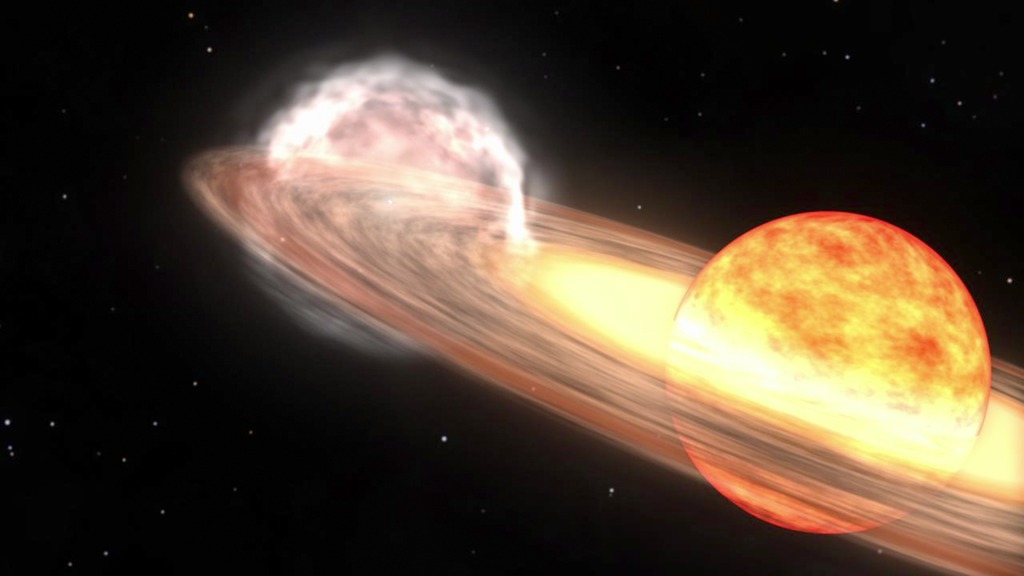
T Coronae Borealis is een binair systeem dat zich op ongeveer 3000 lichtjaar van de aarde bevindt en bestaat uit een witte dwerg en een rode reus. Velen zijn bekend met de term “rode reus”, dat wil zeggen een ster van een bepaalde grootte in de laatste fase van zijn leven: de zon zal over vijf miljard jaar ook een rode reus worden. Het geval van witte dwergen is anders, niet meer bestaande sterren die een massa hebben die vergelijkbaar is met die van de zon, maar gecomprimeerd tot de grootte van de aarde, of zelfs kleiner.
Kortom, het is een zeer dichte ster met een bijzonder sterke zwaartekracht. Precies om deze reden trekt de witte dwerg die aanwezig is in het T Coronae Borealis-systeem waterstof aan van de rode reus en hoopt dit op aan zijn oppervlak. Op een gegeven moment zullen de gasdruk en de hitte een kritiek niveau bereiken, met verwoestende gevolgen: er ontstaat een thermonucleaire explosie die het opgehoopte materiaal de ruimte in werpt. Het proces herhaalt zich gemiddeld elke 80 jaar, en zal binnenkort opnieuw plaatsvinden.
A red giant star and white dwarf orbit each other in this animation of a nova similar to T Coronae Borealis. The red giant is a large sphere in shades of red, orange, and white, with the side facing the white dwarf the lightest shades. The white dwarf is hidden in a bright glow of white and yellows, which represent an accretion disk around the star. A stream of material, shown as a diffuse cloud of red, flows from the red giant to the white dwarf. When the red giant moves behind the white dwarf, a nova explosion on the white dwarf ignites, creating a ball of ejected nova material shown in pale orange. After the fog of material clears, a small white spot remains, indicating that the white dwarf has survived the explosion.
NASA/Goddard Space Flight Center
Hoe de explosie van T Coronae Borealis te herkennen
Het cyclische karakter van de T Coronae Borealis nova is op zijn eigen manier al enige tijd bekend: de eerste geregistreerde waarneming dateert uit de herfst van 1217, toen de explosie werd opgemerkt door een abt in Duitsland. Volgens NASA zal de explosie met het blote oog zichtbaar zijn en niet zo moeilijk te herkennen: trek gewoon een rechte lijn tussen Arcturus en Vega, twee van de helderste sterren op het noordelijk halfrond. Het sterrenbeeld Corona Borealis, waar T Coronae Borealis deel van uitmaakt, heeft de vorm van een hoefijzer en bevindt zich ten westen van het sterrenbeeld Hercules. Dit zijn de woorden van Rebekah Hounsell van NASA's Goddard Space Flight Center:
Dit evenement wordt een unieke ervaring die een nieuwe generatie astronomen kan inspireren. Het zal jongeren in staat stellen een kosmische gebeurtenis te observeren, vragen te stellen en gegevens te verzamelen.
En in feite zullen we, vergeleken met de vorige nova in 1946, een verzameling instrumenten hebben die toen gewoon ondenkbaar was. De Fermi Gamma-ray ruimtetelescoop, de James Webb ruimtetelescoop en NuSTAR en natuurlijk miljarden mensen zullen de gebeurtenis observeren.
Een buitengewone kans voor de astronomie
We weten natuurlijk dat de verwachte explosie al zo'n 3000 jaar geleden plaatsvond, en dat het licht ervan richting de aarde reist. De gebeurtenis zal echter van relatief korte duur zijn en de nova zal minder dan een week zichtbaar blijven aan de nachtelijke hemel. Dit is een buitengewone kans om de structuur en dynamiek van terugkerende stellaire explosies te bestuderen.
Maar is het zeker dat de dreigende explosie zal plaatsvinden? Ja en nee. Zoals we al zeiden, komen novae van T Coronae Borealis gemiddeld elke 80 jaar voor, en het is redelijk om aan te nemen dat de nieuwe explosie op komst is. Toch blijven deze hemelse verschijnselen zeer onstabiel en onvoorspelbaar. Er zullen ongetwijfeld veel ogen naar de hemel gericht zijn, op zoek naar een gloed in een nachtelijke hemel die vaak te stil en onveranderlijk is.
A conceptual image of how to find Hercules and the “Northern Crown” in the night sky, created using planetarium software. Look up after sunset during summer months to find Hercules, then scan between Vega and Arcturus, where the distinct pattern of Corona Borealis may be identified.
NASA
A coordinated scientific approach
Watch V407 Cyg go nova! In this animation, gamma rays (magenta) arise when accelerated particles in the explosion's shock wave crash into the red giant's stellar wind.
NASA/Conceptual Image Lab/Goddard Space Flight Center
Het bewijst dat het door NASA geramde maantje Dimorphos zeker niet de enige is die rond een ruimtesteen cirkelt.
We weten dat planeten manen kunnen herbergen. Onze aarde heeft er bijvoorbeeld één, terwijl Saturnus met 146 erkende manen de grootste verzameling in ons zonnestelsel heeft. Maar ook ruimtestenen kunnen maantjes hebben. Denk maar aan het maantje Dimorphos, dat de plantoïde Didymos omcirkelt en door NASA’s Dart-missie van koers werd veranderd. Maar hoe uniek is het eigenlijk dat ruimtestenen maantjes hebben?
Binaire planetoïden Het is mogelijk een stuk minder bijzonder dan we dachten. Ruimtetelescoop Gaia heeft namelijk mogelijke maantjes ontdekt rond meer dan 350 planetoïden waarvan niet eerder bekend was dat ze een metgezel hadden. Als deze ontdekking wordt bevestigd, komen er 352 nieuwe binaire planetoïden bij, wat het aantal bekende ruimtestenen met manen bijna verdubbelt.
Moeilijk te vinden Dat er tot nu toe nog niet veel maantjes rond ruimtestenen zijn gevonden, is niet zo verwonderlijk. “Binaire planetoïden zijn lastig te vinden omdat ze vaak klein en ver weg zijn,” legt onderzoeksleider van de nieuwe studie Luana Liberato uit. “We verwachten dat iets minder dan een zesde van de planetoïden een metgezel heeft. Tot nu toe hebben we slechts 500 van de naar schatting één miljard planetoïden in binaire systemen ontdekt. Onze studie suggereert dat er nog veel manen zijn die op ontdekking wachten.”
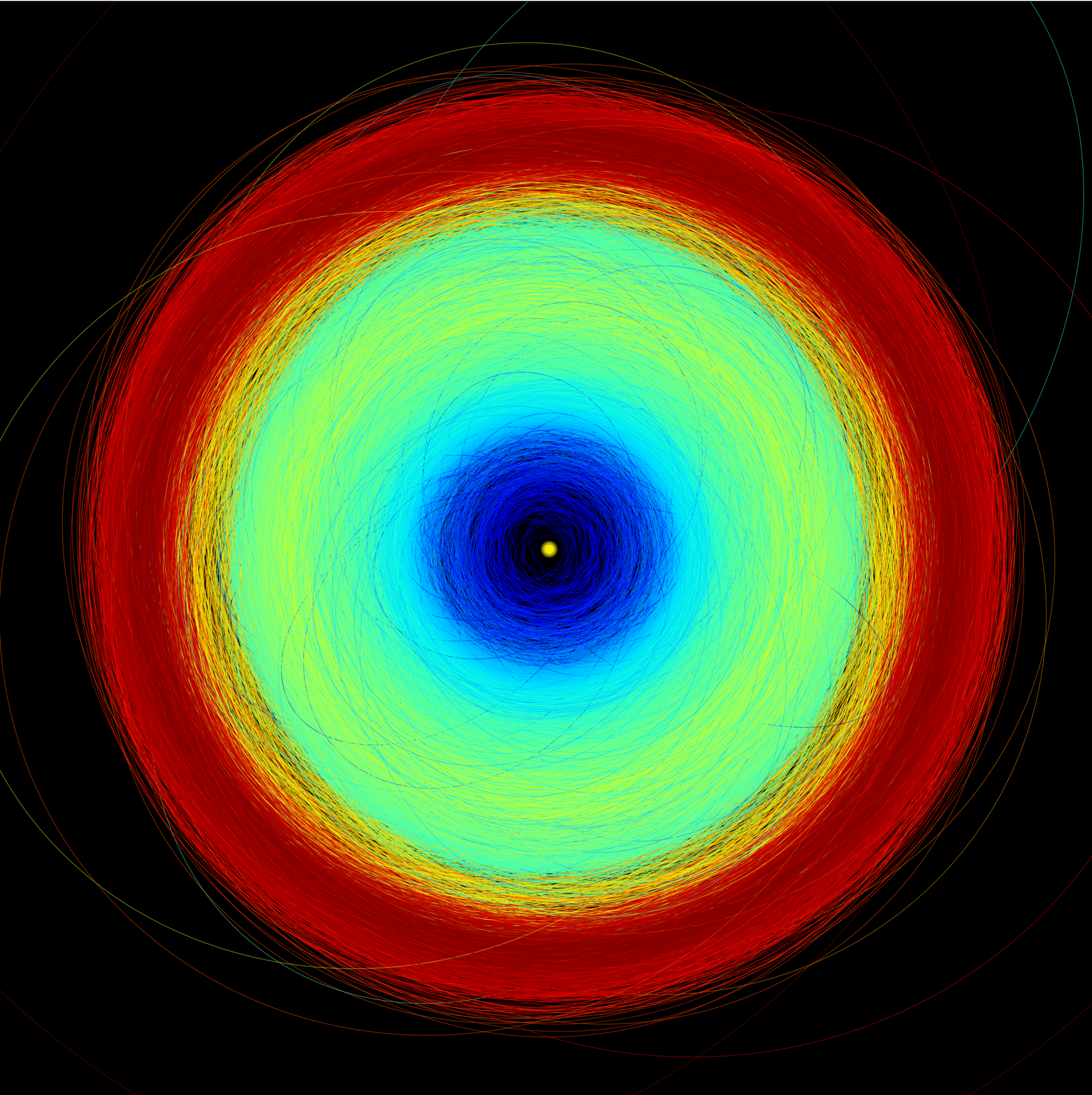
Gaia Door zijn speciale vermogen om de hele hemel in de gaten te houden, heeft Gaia sinds de lancering in 2013 al verschillende belangrijke ontdekkingen op het gebied van planetoïden op zijn naam staan. In de derde gegevensrelease heeft Gaia de posities en bewegingen van meer dan 150.000 planetoïden met grote precisie bepaald (zie ook de afbeelding hieronder).
Gaia heeft meer dan 150.000 banen van planetoïden in kaart gebracht. Op deze afbeelding zie je verschillende kleurrijke banen die rond de zon cirkelen, waarbij elke kleur een andere planetoïde vertegenwoordigt. In het midden van de afbeelding, waar een gebied binnen de baan van Jupiter wordt afgebeeld, zijn de banen van de planetoïden bijzonder dicht op elkaar gepakt. Afbeelding: ESA/Gaia/DPAC
Deze precisie maakte het mogelijk voor wetenschappers om verder te zoeken naar planetoïden die het typische ‘wiebelen’ vertonen, veroorzaakt door de aantrekkingskracht van een omcirkelende maan (zoals bij een binaire ster). En op deze manier kwamen onderzoekers dus honderden planetoïden met een natuurlijke satelliet op het spoor.
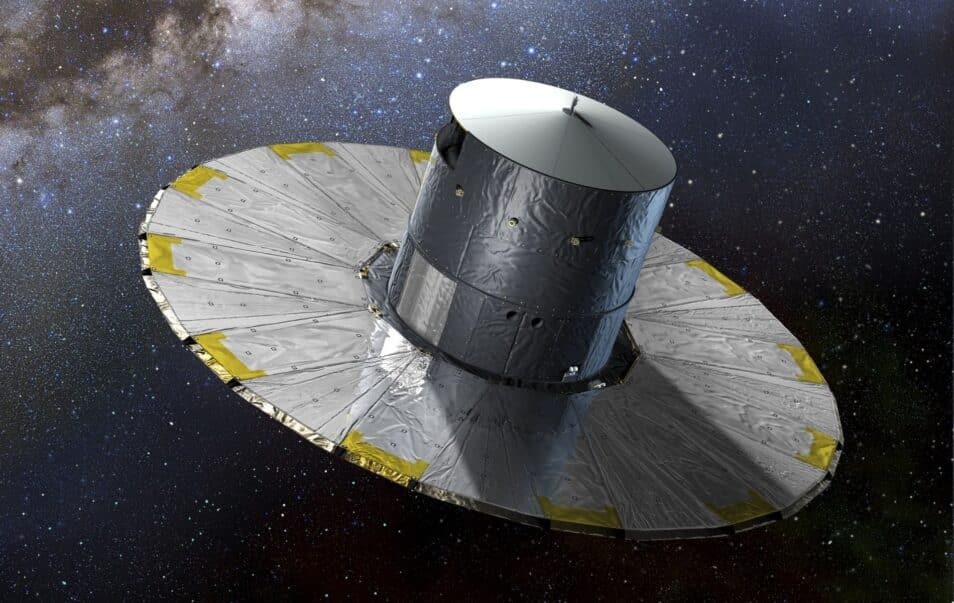
Meer over Gaia ESA’s Gaia-satelliet (afkorting van Global Astrometric Interferometer for Astrophysics) werd eind 2013 gelanceerd en had een duidelijk doel voor ogen: de positie, afstand en bewegingen van miljarden sterren vastleggen, met een betere nauwkeurigheid dan ooit tevoren. De ruimtetelescoop opereert in een baan om het zogenoemde tweede Lagrangepunt, op een slordige 1,5 miljoen kilometer van de aarde. Op dit tweede Lagrangepunt zijn de zwaartekrachten tussen de aarde en de zon in evenwicht, waardoor de telescoop in een stabiele positie blijft en op lange termijn vrijwel onbelemmerd zicht heeft op de nachtelijke hemel. En de metingen zijn heel nauwkeurig; Gaia is zo gevoelig dat de telescoop zelfs de groei van een mensenhaar op de maan zou kunnen meten!
Waarom astronomen zo geïnteresseerd zijn in (de maantjes van) planetoïden? Dat komt omdat deze ruimtestenen waardevolle inzichten verschaffen in de vorming en evolutie van ons zonnestelsel. Binaire systemen zijn nog interessanter omdat ze ons de kans bieden te onderzoeken hoe verschillende hemellichamen ontstaan, botsen en met elkaar interageren in de ruimte.
Nieuwe gegegevengrelease Ondertussen heeft Gaia al meerdere datasets vrijgegeven. In 2016 kwamen onderzoekers met de eerste dataset op de proppen. Deze bevatte de afstanden en bewegingen van twee miljoen sterren. In 2018 volgde de tweede dataset, waarin de 3D-posities, 2D-bewegingen, de helderheid en kleur van meer dan 1,3 miljard sterren werd onthuld. In 2020 volgde de derde gegevensrelease. De meer dan 150.000 ontdekte planetoïde banen werden vervolgens verfijnd als onderdeel van de Focused Product Release van dat jaar. En hier blijft het niet bij. We kunnen namelijk nóg meer planetoïde banen verwachten in de volgende gegevensrelease 4 van Gaia, die voor midden 2026 wordt verwacht.
Geheimen Dankzij de ruimtetelescoop vergroten we dus steeds meer onze kennis over ons zonnestelsel. “Gaia heeft bewezen een geweldige ontdekkingsreiziger van planetoïden te zijn,” zegt Timo Prusti van ESA. “De telescoop werkt hard om de geheimen van het universum, zowel binnen als buiten ons zonnestelsel, te onthullen. Deze nieuwste ontdekking benadrukt hoe elke gegevensrelease van Gaia een grote verbetering in datakwaliteit betekent en laat zien welke opwindende nieuwe wetenschappelijke inzichten door de missie mogelijk worden gemaakt.”
Dat ESA zich blijft richten op het bestuderen van planetoïden blijkt ook wel uit de aanstaande lancering van de Hera-missie, later dit jaar. Hera bouwt voort op NASA’s DART-missie, die in 2022 Dimorphos ramde, om te testen of we planetoïden kunnen afbuigen. Hera zal Dimorphos na de impact onderzoeken. Het is bovendien de eerste missie die een binaire planetoïde op een bezoekje trakteert. En met aankomende missies zoals Hera in het vooruitzicht, kunnen we verwachten dat we nog veel meer zullen leren over planetoïden en hun manen, wat ons begrip van de kosmos verder zal uitbreiden.
Microscopic wormholesmay be driving the accelerated expansion of the universe, scientists say. These tiny wormholes are constantly being born from the vacuum of space due to subtle quantum effects.
If confirmed through experiments and observations, the wormholes could become a valuable source of information on quantum gravity — a theoretical unification of the fundamental forces of the universe, often considered to be the Holy Grail of theoretical physics.
To reconcile the observations of universe expansion with this theory, scientists have proposed that space is filled with an enigmatic entity that can't be detected in ground or space-based experiments.
This mysterious substance, called dark energy, interacts very weakly with other types of matter and fields, so, there is currently no reliable information about its structure or origin.
In a recent study published April 5 in the journal Physical Review D, researchers proposed a bold new candidate for dark energy: subatomic-size wormholes — or tiny tunnels connecting disparate points in space.
According to the authors, these wormholes are constantly being born and destroyed in the vacuum of space due to quantum effects. This is similar to how particles are produced near the event horizons of black holes, leading to Hawking radiation; or how electron-positron pairs are generated by a strong electric field — a phenomenon known as the Schwinger effect.
However, the creation of these wormholes is somewhat different from those other phenomena because their mathematical description requires quantum effects in gravity to be accounted for — a task that's much more complicated and poorly understood.
These difficulties in calculating quantum gravitational phenomena prevented the authors from accurately deriving the wormhole birth rate. However, using an approach known as Euclidean quantum gravity, they showed that if about 10 billion wormholes are spontaneously created per cubic centimeter per second, the energy they generate would be sufficient to explain the currently observed rate of the universe's expansion.
"Although our result was derived on the grounds of Euclidean quantum gravity… it is likely that our modification may hold for other quantum gravity theories as well," study co-author Stylianos Tsilioukas, a doctoral student at the University of Thessaly and National Observatory of Athens, told Live Science via email.
Moreover, the team's analysis showed that their model of dark energy is even better observationally than the most widely accepted theory, known as the Standard Cosmological Model, which posits that dark energy has a time-independent energy density.
"According to our proposal dark energy can change as time flows," Tsilioukas said. "This is a major advantage because recent observations suggest that the rate of expansion of the universe is different in recent times than it was in the early universe."
However, no matter how successful the researchers' model is at explaining the general properties of dark energy, the validity of any physical theory must be tested with experimental data. And for now, the theory remains untestable.
In the future, the ever-increasing accuracy of space experiments and observations should enable astronomers to deduce the universe expansion rate in more detail, as well as to measure other observable manifestations of dark energy. This could enable researchers to test whether this newly proposed model of dark energy is correct.
In the meantime, the authors plan to further improve their theoretical analysis. "We are working right now on a model which calculates the rate of wormhole formation. " Tsilioukas said. "The research seems promising and we hope to publish the results very soon."
Scientists Discover New Geological Link Between Earth and Venus
Ishtar Terra is a complex geological region on Venus. New research shows it may have formed through processes similar to Earth's. Image Credit: NASA/JPL/USGS – http://photojournal.jpl.nasa.gov/catalog/PIA00007, Public Domain, https://commons.wikimedia.org/w/index.php?curid=18235544
Scientists Discover New Geological Link Between Earth and Venus
Venus is sometimes called Earth’s sister planet because of their shared physical, geological, and atmospheric features. Scientists have discovered something new about Venus’ geology that’s reminding us of the similarities between the two planets. We have to look deep inside both planets to see what the researchers found.
There are a few reasons why the pair of planets are sometimes called twins. They have several characteristics in common:
They’re inner Solar System neighbours.
They’re both rocky.
They’re roughly the same size and mass.
They both have few craters, implying young surfaces.
They both have atmospheres and dense clouds.
They both have geological similarities and surface features like volcanoes, mountains, plateaus, and plains.
New research published in Nature Geoscience focuses on the last item in that list. Its title is “Ishtar Terra highlands on Venus raised by craton-like formation mechanisms.” The lead author is Fabio Capitanio, an Associate Professor from the Monash University School of Earth, Atmosphere and Environment.
Ishtar Terra is one of three large highland regions on Venus. Its topography includes mountains, plains, and plateaus. The Maxwell Montes mountain chain is in Ishtar Terra, and it’s about 11 km (6.8 mi) high, compared to Mt. Everest, which is 8.8 kilometres (5.5 mi).
Ishtar Terra has highly complex terrain and appears to be heavily deformed. These are indications that Venus underwent powerful geological activity in its past.
This view of Venus is centred on its north pole. Ishtar Terra is the red region just below the image’s centre. The white region is Maxwell Montes, and the left-most red lobe is Lakshmi Planum. Image Credit: NASA/JPL/USGS – http://photojournal.jpl.nasa.gov/catalog/PIA00007,Public Domain, https://commons.wikimedia.org/w/index.php?curid=18235544
Ishtar Terra also contains Lakshmi Planum, a two million square kilometre plateau about four km high and surrounded by extremely deformed terrain. It’s made of smooth lava flows and features two large shield volcanoes. Colette Patera is about 130 km in diameter, and Sacajawea Patera is about 200 km across and 1-2 km deep. Though Venus is tectonically inactive now, scientists think that ancient tectonic activity is responsible for the region’s wild topography.
Click on the image to explore an interactive 3D map of Ishtar Terra at Sketchfab by user v7x. Image Credit: Sketchfab/v7x
The new research in Nature Geoscience zeroes in on a specific part of geology called cratons. Cratons are the ancient geological cores of Earth’s continents. They’re stable parts of Earth’s lithosphere that are usually found in the center of the planet’s continental plates. Cratons have survived Earth’s extensive history of continental rifting and merging. They’re typically composed of extremely durable basement rock and have deep roots that can extend several hundred kilometres into the planet’s mantle.
Some cratons date from the Precambrian era, more than 2.5 billion years ago. Others may be even older and could date back to the Earth’s early days during the Hadean and Archaean Eons.
In this new work, Capitanio and his co-researchers used data from NASA’s Magellan spacecraft and high-performance computer simulations to investigate the formation of Ishtar Terra more deeply. They found that Ishtar Terra may have formed the same way that Earth’s cratons may have formed.
“The structures emerging in this model provide topography, gravity and crustal thicknesses remarkably comparable to the plateaus of Venus.”
From “Ishtar Terra highlands on Venus raised by craton-like formation mechanisms.”
On Earth, plateaus and belts of mountains like Ishtar Terra would clearly result from colliding continental plates. Ishtar Terra is similar to the Tibetan Plateau, and continental collision is the primary driver behind its formation. Something else must be behind Ishtar Terra and Venus’s other terrae because the planet lacks plate tectonics. But Ishtar Terra shares something particular with Earth. It has a thick crustal floor similar to Earth’s cratons.
This suggests that the planets have or had processes in common. Ishtar Terra and Venus’ other terrae may have risen from the planet’s hot interior. While there are several competing explanations for the formation of Earth’s cratons, one is the molten plume model. It states that rising plumes of molten rock came from deep within Earth’s mantle and built up thick layers with the cratons on top.
“The study challenges our understanding of how planets evolve,” lead author Capitanio said. “We did not expect Venus, with its scorching 460°C surface temperature and lack of plate tectonics, to possess such complex geological features.”
While Venus doesn’t have plate tectonics, it does have a hot lithosphere. The planet’s surface temperature is about 460°C (860°F). The heat extends into the lithosphere, which is hotter than Earth’s due to Venus’s runaway greenhouse effect. The surface simply can’t shed heat the way Earth does. The high heat means that Venus’s lithosphere is probably thinner than Earth’s. While Earth’s lithosphere can be as thick as 200 km, maybe even thicker, Venus’s is only about 50-100 km thick. Since it’s so much thinner, it’s also weaker.
“Venus’s hot lithosphere might make it a good analogue of early Earth and might enable the same types of continent-forming processes that occurred on Earth,” the researchers write in a briefing from Nature. “Our focus was on Ishtar Terra, the broadest of the plateaus, for which we found that the topography, crustal thicknesses and gravity signals are consistent with our simulations when the modelled lithosphere is about 10–50 times weaker than Earth’s.”
This figure from the research compares observations (a, c, e) with modelled results (b, d, f). The columns are topography, crust thickness, and gravity anomaly at 194 million years. “The structures emerging in this model provide topography, gravity and crustal thicknesses remarkably comparable to the plateaus ofVenus,” the researchers explain. Image Credit: Capitiano et al. 2024.
The thin lithosphere favours “the emplacement of a thick magmatic crust on top of a deep residual depleted mantle,” the authors write in their research.
“This finding provides a fascinating new perspective on Venus and its potential links to early Earth,” Capitanio said. “The features we found on Venus are strikingly similar to Earth’s early continents, suggesting that the dynamics of Venus’ past may have been more similar to Earth’s than previously thought.”
The research shows that despite their differences, divergent rocky planets can share underlying mechanisms. Spotting these cratons or craton-associated mechanisms on another planet can help scientists understand Earth. “By studying similar features on Venus, we hope to unlock the secrets of Earth’s early history,” Associate Professor Capitanio said.
Venus is like the Solar System’s plan B. If life couldn’t make it work on Earth, maybe it could’ve worked on Venus. There’s evidence that Venus may have once had liquid water and used to be in the habitable zone, though that’s not certain. In any case, while Earth is resplendent with life, Venus is far too hot.
Earth’s ancient cratons are a part of Earth’s story. On our planet, geology, life, and the planet’s atmosphere are all intricately connected. By recognizing what Earth and Venus have in common and how they are also so different, researchers can learn more about Earth’s trajectory toward a living planet.
Future missions to Venus are in the works, and they should provide even more explanations for the sister planets’ divergent outcomes.
“Our research has paved the way for future missions to Venus, such as DAVINCI, VERITAS, and EnVision,” Capitanio said. “These missions will provide further insights into Venus’ geological history and its connection to Earth.”
The Moon’s Atmosphere Comes from Space Weathering How do you get an atmosphere at a world that doesn’t have one and can’t keep one? If it’s the Moon, you simply bombard it for millions of years with tiny meteorites. Also, let it si
A future astronaut studies the lunar surface to understand space weathering of the Moon. Courtesy NASA.
How do you get an atmosphere at a world that doesn’t have one and can’t keep one? If it’s the Moon, you simply bombard it for millions of years with tiny meteorites. Also, let it sit in the solar wind and see what happens. Both space-weathering processes create a thin “exosphere” just above the lunar surface.
Scientists call the first process “impact vaporization” and now suspect that it’s a major reason the lunar atmosphere exists. It also helps explain how atmospheric atoms escape from the Moon to space.
A team of scientists at MIT and the University of Chicago recently published a paper describing their research into the space weathering causes of the lunar exosphere. It pinpoints the process of impact vaporization as a major player. “We give a definitive answer that meteorite impact vaporization is the dominant process that creates the lunar atmosphere,” says the study’s lead author, Nicole Nie, an assistant professor in MIT’s Department of Earth, Atmospheric and Planetary Sciences. “The Moon is close to 4.5 billion years old, and through that time the surface has been continuously bombarded by meteorites. We show that eventually, a thin atmosphere reaches a steady state because it’s being continuously replenished by small impacts all over the Moon.”
Tracking the Space Weathering Influence on the Moon’s Atmosphere
Researchers have known about the lunar atmosphere for decades. It was first observed in the 1980s as a layer of atoms hugging close to the surface. The LADEE mission specifically studied that exosphere. The atoms don’t just lie there, however. They bounce around, largely stirred up by constant impacts of tiny objects called micrometeoroids. Those dust-sized particles—along with larger objects smacking into the surface—kick up the lunar soil. That vaporizes some of the atoms of material—including potassium and rubidium. Those atoms are suspended in the thin exosphere. Or, if they get enough velocity in the weak lunar gravity, they escape to space.
The different ways that space weathering can affect the lunar surface. Cartoon by IntrplnetSarah, Creative Commons Attribution-ShareAlike 3.0
The MIT/Chicago team members wanted to prove the exosphere is produced by this impact vaporization component of space weathering. So, they analyzed samples of lunar soil collected during the Apollo missions. They zeroed in on the potassium and rubidium content. That’s because those elements vaporize easily. If the Moon’s atmosphere is atoms suspended above the surface, lighter isotopes of those atoms should be more easily lofted. The heavier isotopes are more likely to settle back in the soil. Furthermore, scientists predict that impact vaporization, and ion sputtering, should result in very different isotopic proportions in the soil. The specific ratio of light to heavy isotopes that remain in the soil, for both elements they tested, eventually proved that impact-related vaporization is an important part of exosphere creation.
The Solar Wind’s Effect on the Moon
The solar wind also plays a role in creating the Moon’s exosphere. That occurs as the ionized particles in the solar wind ions interact with the surface and “sputter off” neutral atoms. Not only does this process contribute to the creation of an exosphere, but it also affects the erosion of materials on the Moon. The current MIT/Chicago study, however, pinpoints the constant rain of impacts as a significant contributor and the two processes work together to create the lunar exosphere
“With impact vaporization, most of the atoms would stay in the lunar atmosphere, whereas with ion sputtering, a lot of atoms would be ejected into space,” Nie said. “From our study, we now can quantify the role of both processes, to say that the relative contribution of impact vaporization versus ion sputtering is about 70:30 or larger.”
Space Weathering and Future Missions
So, about 70 percent or more of the lunar exosphere is a product of meteorite impacts. The rest occurs thanks to the incessant influence of the solar wind. While this space weathering activity doesn’t produce anything like a breathable atmosphere that future lunar explorers could breathe, it does give insight into the processes that affect the Moon.
Both meteoritic bombardments and solar wind activity pose continuing risks to lunar visitors and their infrastructure. In addition to simply understanding the evolution of the lunar surface and atmosphere, such studies will be useful to anyone who seeks to build—and live—on the Moon in the future.
New Study Suggests that Our Galaxy is Crowded or Empty. Both are Equally Terrifying!
Gaia's all-sky view of our Milky Way Galaxy and neighbouring galaxies, based on measurements of nearly 1.7 billion stars. The map shows the total brightness and colour of stars observed by the ESA satellite in each portion of the sky between July 2014 and May 2016. Brighter regions indicate denser concentrations of especially bright stars, while darker regions correspond to patches of the sky where fewer bright stars are observed. The colour representation is obtained by combining the total amount of light with the amount of blue and red light recorded by Gaia in each patch of the sky. The bright horizontal structure that dominates the image is the Galactic plane, the flattened disc that hosts most of the stars in our home Galaxy. In the middle of the image, the Galactic centre appears vivid and teeming with stars. More information on: http://sci.esa.int/gaia/60169-gaia-s-sky-in-colour/
New Study Suggests that Our Galaxy is Crowded or Empty. Both are Equally Terrifying!
Is there intelligent life in the Universe? And if so, just how common is it? Or perhaps the question should be, what are the odds that those engaged in the Search for Extraterrestrial Intelligence (SETI) will encounter it someday? For decades, scientists have hotly debated this topic, and no shortage of ink has been spilled on the subject. From the many papers and studies that have been written on the subject, two main camps have emerged: those who believe life is common in our galaxy (aka. SETI Optimists) and those who maintain that extraterrestrial intelligence is either rare or non-existent (SETI Pessimists).
In a recent paper, David Kipping (Prof. “Cool Worlds” himself) and Geraint Lewis examined this debate more closely and offered a fresh take based on a form of probability analysis known as Jayne’s Experiment. By applying this method to astrobiology and the Drake Equation, they concluded that the existence of intelligent life in our galaxy may be an “all or nothing” proposition. To quote the late and great scientist and science fiction author Arthur C. Clarke: “Two possibilities exist: either we are alone in the Universe, or we are not. Both are equally terrifying.”
In 1961, famed astronomer Frank Drake hosted the first SETI meeting ever at the Greenbank Observatory in West Virginia. In preparation for the event, he created an equation summarizing the challenges SETI researchers faced. This came to be known as the Drake Equation and is expressed mathematically as:
N = R* × fp × ne × fl × fi × fc × L
Where:
N is the number of currently active, communicative civilizations in our galaxy.
R* is the rate at which stars form in our galaxy.
fp is the fraction of stars with planets.
ne is the number of planets that can potentially host life, per star that has planets.
fl is the fraction of the above that actually do develop life of any kind.
fi is the fraction of the above that develop intelligent life.
fc is the fraction of the above that develop the capacity for interstellar communication.
L is the length of time that such communicative civilizations are active.
The Drake Equation was not intended to estimate the number of extraterrestrial civilizations (ETCs) in our galaxy but to stimulate dialogue about SETI. Since Drake first formulated it, the equation has been subject to criticism, additions, and revisions and has often been misrepresented in the process. As Prof. Kipping explained to Universe Today via email, part of the problem is how values are often arbitrarily applied to the parameters:
“Since we don’t know most of the parameters, this is just pure speculation, and it should be labeled as such. Another point often missed is that it represents the mean number of civilizations and, thus, an expectation value of some underlying distribution. These days, it’s become a bit of a sport to critique the Drake equation. Certainly, anyone using it as a calculator should be fairly criticized, but the basic idea is not wrong. There must be some number of civilizations out there, and we could, in principle, collect relevant parameters to calculate it. The issues arise in the exact formulation, which parameters to include, what they really mean, and how to deal with nuances like time variability.”
Jaynes’ Experiment
Edwin Jaynes (1922-1998) was the Wayman Crow Distinguished Professor of Physics at Washington University in St. Louis. In 1968, he imagined an experiment where a person in a lab is presented with a jar containing an unknown and unlabelled compound (chemical X). Along a laboratory bench, there are a large number of beakers filled with water, and the experiment is to test how often chemical X will dissolve within them. Jaynes argued that one should expect the compound to either dissolve in nearly every instance or almost never.
The function of the Haldane prior (F –1(1 – F ) –1) that captures this behavior. Credit: D. Kipping & G. Lewis (2024).
When plotted on a graph, the probability distribution would be bowl-shaped, with values peeking at 0 and 1. As Kipping explained in more detail:
“Jaynes imagined a series of what we call Bernoulli experiments – that is, experiments that return yes/no answers. These could be anything really, but as an example, he imagined dissolving an unknown chemical into a series of beakers containing water and then asking – what fraction of them will dissolve? Another scientist, the legendary John Haldane, had already suggested that an answer of ~50% was unlikely a-priori. One should expect that either nearly all of them will dissolve or hardly any.
“Jaynes rigorously proved that and pioneered many of the tools of objective Bayesian inference. We can equally replace the Bernoulli experiment under consideration to other questions, like what fraction of stars will become a black hole? Before obtaining any observations, an answer of ~50% would be surprising, implying that the distribution of stellar masses is finely balanced such that half are above the critical mass threshold and half below. In reality the answer is one-in-a-thousand, which falls in line with Jayne’s position.”
Because of his immense contributions to the field of statistics, Jaynes is credited with being one of the founders of “Objective Bayesianism.” While his experiment was not intended as such, Kipping and Lewis saw its potential application in astrobiology.
All or Nothing?
In his seminal 1983 paper, “The Great Silence – the Controversy Concerning Extraterrestrial Intelligent Life,” David Brin addressed the ongoing debate regarding the existence of extraterrestrial life. From this, he discerned the presence of two camps when it came to the debate: “Contact Optimists” and “Contact Pessimists” – or as Kipping and Lewis refer to them in their paper, “SETI Optimists” and “SETI Pessimists” – those who believe that there are civilizations in our galaxy humanity can make contact with and those who believe it is fruitless since humanity is alone in the Universe.
When Jaynes’ Experiment is applied to the question of intelligent life in our galaxy, we should expect that it would either be very common or very rare. In the middle, where the probability distribution is weakest (i.e., extraterrestrial life is semi-common), is where the “fine-tuning problem” emerges. In the context of cosmology and astrobiology, fine-tuning refers to the proposition that the conditions for life can occur only when certain universal constants lie within a very narrow range of values.
If any of these fundamental constants were slightly different, the Universe would not be conducive to the development of matter, large-scale structures, or life as we know it. As Kipping explained, this presents a problem for SETI Optimists:
“Unlike the black hole example I gave you earlier, there’s no lower bounds on this problem. With black holes, we know the smallest and biggest allowed star mass from astrophysics and it’s only a few orders of magnitude. The black hole threshold must be in that fairly narrow range somewhere. When it comes to aliens, the probability of intelligence could be 1% or 0.000….00001% (add as many zero’s as you like).
“With a such a vast range of possibilities, SETI optimists have to believe the rather contrived view that the % value is not so high that we wouldn’t see anyone yet, but certainly far higher than the deep abyss of low probabilities that are plausible. Thus they have a fine-tuning problem essentially, needing the percentage to live in a fairly narrow corridor.”
If our galaxy were filled with extraterrestrial civilizations, surely there would be undeniable signs that we would have noticed—i.e., radio signals, megastructures, Clarke Bands, and other “technosignatures.” If this is starting to sound familiar, it’s because this argument is the very core of the Fermi Paradox (which we have written an entire series about!) As such, one could construe Kipping and Lewis’ argument as an example of SETI Pessimism. Luckily, the story does not end there.
Kipping and Lewis’s revised formalism for the Drake Equation, based on the theoretical birth and death rates of civilizations. Credit: Kipping, D. & Lewis, G. (2024)
A New Formalism
Faced with this result, Kipping and Lewis attempted to devise a new formalism for the Drake Equation that considers just two processes: the birth rate and the death rate of civilizations. When this is done, all of the parameters in the equation (except for L, the lifespan of civilizations) collapse into a single parameter: the birth and death rate of civilizations (rc). Or as it would appear mathematically: NC = rc x LC. Said Kipping:
“In the standard Drake equation, we often get caught up arguing about which parameters to include (should there be a fraction for the probability of life developing into multicellular life, for example). But it’s completely undeniable that every civilisations must have a beginning and an end, in fact we can even set the death rate to zero which corresponds to infinite lifetimes if we so desire in this framework. In an ecological system, like a petri dish, for example, there is a well-defined maximum possible population that we call the carrying capacity. So, we updated the birth-death version of the Drake equation to account for this nuance.”
In this case, the distribution of probabilities became S-shaped (see image above), but the end result was still the same: either the galaxy is crowded or empty. One way around this is the idea that humanity could be alive during a period in which ETCs have emerged and are beginning to expand throughout the galaxy and thus have not been noticed by our instruments yet. However, as Kipping and Lewis showed, this also suffers from the fine-tuning problem, as biology indicates that population growth is an accelerating phenomenon.
“You see, galactic expansion phases should be relatively quick on a cosmic timescale; in fact, really like the blink of an eye,” said Kipping. “So it’s unlikely you’d live during such a phase; you’re more likely to live when the galaxy is essentially empty before this happens or after it’s happened (which, in fact, is arguably impossible since your planet is colonized). Once again, Fermi’s Paradox rears its head, where the strongest likelihood is that humanity is either alone, early to the party, or one of a few civilizations currently existing in the Milky Way.
Hope for SETI?
But before you go thinking it’s all bad news, Kipping and Lewis emphasize that SETI is an important and vital experiment that deserves dedicated resources. “While the odds of success appear small, such a success would arguably represent the most impactful scientific discovery in human history,” they conclude. They also suggest several reasons to remain hopeful, which include Hanson’s “Grabby Aliens” hypothesis, which states that humanity is at the midpoint in the S-shaped curve and that we will encounter an ETI in a few hundred million years.
In the meantime, Kipping also suggests that SETI could benefit from casting a wider net. If, as their study suggests, advanced civilizations are very rare (or non-existent) in our galaxy, then we should look to extra-galactic sources. “I think my favorite way out is that our galaxy is just unusually quiet, most are busy and filled, but we are the first in the Milky Way,” he added. “This seems improbable, but perhaps being born in a busy galaxy is impossible since the habitable real estate has already been gobbled up. This suggests we should put more emphasis on extra-galactic SETI as our best shot.”
If Advanced Civilizations Using Quantum Communications, Is That Why We’ve Never Seen Them?
Establishing communication with an alien intelligence is one of the news items I, and I’m sure many others, long to see. Since we have started the search for advanced civilisations we have tried numerous ways to detect their transmissions but to date, unsuccessfully. A new paper suggests quantum communication may be the ideal method for interstellar communication. It has many benefits but the challenge is that it would require a receiver over 100km across to pick up a signal. Alas they know we don’t have that tech yet!
The search for alien signals has been undertaken under the banner of the search for extraterrestrial intelligence or SETI for short. It began in 1960 when Frank Drake commenced the first search. It was of course not fruitful but since then, large radio telescopes have been used to undertake searches. There have been many projects but of particular interest has been Project Breakthrough. It has used advanced technology and international collaborations but still there has been no success.
Frank Drake writing his famous equation on a white board. Credit: SETI.org
To be able to effectively search for alien signals its imperative to fully understand the nature of communication. A quest that started back in 1948 with the development of the modern theory of classical communication. In 1959 it was proposed that human technology was available to send or receive interstellar classical communication which simply requires a message, someone to send it and someone to receive it.
Over the years that followed communication theories developed and quantum information theory emerged. It explores how quantum mechanics has an affect on the storage of and transmission of information. At the centre of the theory is the quantum bit or qubit which can exist in a number of states all at once due to the phenomenon of superposition. In classical information theory, bits of information are either 0 or 1 but in quantum theory they can be any infinite number of combinations with certain probabilities until measured. At that point, the wave function collapses to one of the definite states.
Another key element of quantum theory is entanglement where two or more particles are interconnected so that the state of one is related to the state of the other no matter how far apart they are. With qubits linked in this way data processing can be far faster than in classical model and more secure too. The paper authored by Latham Boyle from the University of Edinburgh suggests that it may be possible to send or receive information between the stars using quantum communications. A previous study by Arjun Berera proposed photon qubits could be used to transmit information over interstellar and even possibly intergalactic distances without loss of coherence.
The concept of quantum coherence describes the ability to maintain the specific quantum state but this alone is not enough for communication. The communication channel must also have sufficient capacity. In addition, specific wavelengths must be used (or avoided for example wavelengths less than 26.5 cm to avoid issues with the cosmic microwave background.) To facilitate this, radio telescopes with a diameter of 100 km must be used. Currently we don’t have the capability to build such instruments and this may explain why, in such a large and old universe, we still haven’t detected any aliens yet! We may simply have to wait until we can build such instruments before aliens can communicate with us.
Twee Amerikaanse astronauten die begin juni naar het internationale ruimtestation ISS gingen voor een missie van zo'n 8 dagen, moeten mogelijk tot februari 2025 in de ruimte blijven.
De twee Amerikaanse astronauten, Sunita Williams en Barry Wilmore, gingen begin juni met Starliner, de nieuwe ruimtecapsule van Boeing, naar het ISS. Zij zien hun verblijf verlengd door technische problemen met de Starliner.
Tijdens de koppeling op 6 juni werkten enkele stuurraketten niet en lekte helium, waardoor NASA nu overweegt hen met een ander schip terug te brengen.
De Crew Dragon van SpaceX is een mogelijk alternatief. Als deze optie wordt gekozen, zouden de astronauten wel pas in februari 2025 met twee collega's kunnen terugkeren. Een beslissing hierover wordt binnenkort verwacht.
(Fausto by Tagtik/Source: NOS, VRT/Illustration picture: Unsplash)
This weekend is the perfect time to catch the year’s most spectacular — and easiest to watch — meteor shower, the Perseids.
The annual Perseid meteor shower will peak late on Sunday night and into the early predawn hours of Monday morning, but the Perseids should put on a spectacular late-night show from now through the middle of next week. Here’s everything you need to know, from how to watch the Perseids to the science behind the light show.
The Perseids are known for long, bright streaks of light.
VCG/Visual China Group/Getty Images
When Is the Perseid Meteor Shower?
Short answer: Right now! The Perseid meteor shower happens around this time every year, from mid-July to early September, with a dramatic peak around August 12.
Meteor showers like the Perseids are a vivid reminder that we’re passengers on a ball of rock moving through space at more than 67,000 miles per hour — and right now, we’re flying through a stream of dusty debris left in the wake of a comet. Comet 109P/Swift-Tuttle makes a long loop around the Sun every 133 years, and it leaves a trail of dust, ice, and pebbles in its wake. Every year, at about the same point in Earth’s 365-day lap around the Sun, our planet crosses Swift-Tuttle’s debris trail. As that debris patters against Earth’s upper atmosphere, like bugs hitting the windshield of a passing car, it creates bright streaks of light in the sky.
What to Expect from the Perseid Meteors
At the peak of the Perseid meteor shower, between 50 and 100 meteors an hour will streak across the night sky. That’s a meteor or more every minute, so your chances of seeing several meteors are very good.
The Perseids are known for leaving bright, colorful streaks of light that can linger in the sky for several seconds; the longest, brightest streaks come from meteors that just skim the top of our atmosphere, instead of plunging straight in. Most of the streaks of light you’ll see during the Perseids are objects about the size of sand grains, disintegrating 50 miles above you at temperatures hotter than 3,000 degrees Fahrenheit. Larger grains, usually about an inch across, can burst apart in bright fireballs; if you’re lucky, you may spot a few of those an hour.
How to See the Perseid Meteors
The Perseids are one of the easiest meteor showers to watch, mostly because it offers so many meteors streaking across the sky, but also because Swift-Tuttle’s debris trail is so wide that we get several days of good viewing, unlike other meteor showers that may offer only a few hours of real meteor-watching. If the weather or your personal schedule don’t cooperate on the night of August 11, you can still see a fantastic show a few days before or after the shower’s peak.
As with any stargazing, darkness is key. You’ll want to get as far away from city lights as possible. The ideal meteor-watching spot is dark, with a wide-open view of as much of the sky as possible, but especially the north. Bring a lawn chair or blanket, and settle in. Turn off your headlights, flashlights, and cell phone, and give your eyes about 30 minutes to adjust to the darkness.
For casual viewers, meteors should be visible anytime after around 10pm local time, but the best views will be after midnight, when the bright half-Moon sets and leaves a dark sky for meteors to shine against. And the dark pre-dawn hours of Monday morning will offer the most and brightest meteors.
If going outside isn’t your thing, you can catch the Virtual Telescope Project’s livestream, starting at 9pm Eastern Time on August 11 and August 12.
This time-lapse photo shows the Perseids seeming to radiate from a point in the northern sky.
CFOTO/Future Publishing/Getty Images
Do the Perseid Meteors Come from Perseus?
Short answer: no.
If you stare up at the night sky for long enough, you may notice that the Perseid meteors seem to radiate from a point somewhere in the constellation Perseus. It may look a little like the classic Windows 95 Starfield screensaver (for the history buffs out there who remember screensavers). That’s an optical illusion; as Earth flies through the cloud of dust and debris, the direction in which we’re moving will look like the center, from which all the meteors seem to radiate out and past us. In the case of the Perseids, that point is somewhere in the constellation Perseus, in the northern sky.
But the Perseid meteors are actually just bits of dust and tiny pebbles that, at this moment, are in a cloud all around us.
Is Comet Swift-Tuttle Going to Crash Into Earth Someday?
Short answer: maybe, but not anytime soon.
Comet 109P/Swift-Tuttle is the largest object that regularly crosses Earth’s orbit and passes close to our planet, so astronomers have kept a close eye on it. They’ve calculated its orbit, and ours, for about the next 2,000 years, and Swift-Tuttle is in no danger of hitting Earth until sometime after the year 4400 (and even then, the chances aren’t huge). So you can relax and enjoy the show.
If Swift-Tuttle eventually does hit Earth, it’s going to wreck everything. The nucleus — the actual ball of ice and dust that forms the main body of a comet — of Swift-Tuttle is about 16 miles wide, which makes it twice the size of the object that smashed into the Yucatan Peninsula 65 million years ago and ended the dinosaurs’ world. Because of how much faster Swift-Tuttle moves in relation to Earth, though, it would hit with about 27 times as much force as the Chicxulub object.
The two Boeing Starliner astronauts may remain onboard humanity’s farthest outpost for half a year more. Not everyone at NASA thinks the spacecraft has been proven safe enough to bring them back from Earth orbit.
When NASA’s associate administrator of space operations Ken Bowersox addressed reporters on Wednesday, internal debates within the space agency surfaced. The concerns were regarding the safety of Starliner’s two astronauts, Suni Williams and Butch Wilmore, who’ve already been living in space two months longer than planned.
They flew into space on June 5 for what was, at the time, set as an eight-day mission. The mission was called Crew Flight Test and was meant to be a certification of Starliner’s abilities to become a commercial crew program spacecraft — second to the now tried-and-tested SpaceX Crew Dragon — that could bring spacefarers to the International Space Station (ISS) and back safely at a low cost to NASA.
With Starliner, NASA seeks comfort. If something goes wrong in space or with SpaceX’s launchers, astronauts can rely on Starliner to make it to space without interruption in the timelines.
Things went awry soon into the mission. Thruster and helium leak anomalies didn’t stop Starliner and its crew from successfully docking to the ISS, but raised serious concerns about how they would return home.
Problems arise on test flights, and that’s what the evaluative nature of these flights are for: to catch blindspots and remedy. But days, weeks and, now, months have passed.
To figure a way forward, NASA and Boeing have run hot fire tests of Starliner in space. And on Earth, engineers have put spare thrusters through the gamut at NASA’s White Sands Testing Facility in New Mexico to replicate the conditions that the hardware in space has gone through. They believe the thruster issue is due to overheating, plus swelling of a teflon seal that blocks the flow of fuel into the thruster’s combustion chamber. “What we're trying to do now is sort of understand what all that data means to us from the White Sands testing, and then what it means to the thrusters on orbit,” NASA Commercial Crew Program manager Steve Stich said Wednesday.
As teams figure out the ramifications of the worst case scenario for thruster overheating, as well as of the helium leaks experienced during Starliner’s journey to the ISS,the test crew remains in space. Their return date continued to be pushed into the future. Their arrival home could now be as late as next year.
Don’t overstay your time in space
Tensions clashed last month, when Boeing Commercial Crew Program manager Mark Nappi scolded reporters during a press briefing for using language that called the astronauts “stranded” or “stuck” in space. Reporters pushed back asking for clearer responses from NASA and Boeing leadership as to when they’d come home, and more frequent updates on the Starliner troubleshooting. Then during a follow-up media conference, Nappi and Stich expressed regret that they had outlined the mission as an eight-day event, to avoid scrutiny.
Test flight or not, missions must adhere to schedule windows. The ISS is an aging spacecraft. To maintain its functions, astronauts are swapped in and out on assignments. Having two extra astronauts aboard the station strains the resources, occupancy, and schedules of the other space crews. That’s not even taking into account the private, personal tolls that the extended missions may have on the crew. Or, the physical changes they’ll experience as a result of longer periods in microgravity.
As a consequence of the idle Starliner, the SpaceX Dragon Crew-9 mission will no longer launch in mid-August with its crew of four. Its launch date has been pushed to September 24. Its crew may also be halved to open up two free seats for Wilmore and Williams to return home as a backup plan. But Crew-9 wraps up its six-month mission in February 2025, meaning the Starliner crew would come home eight months past schedule.
Not everyone at NASA agrees on Starliner’s safety
The same day that Bowersox and his colleagues announced the new Crew-9 launch date, he opened up about the internal discussions that have kept the Starliner crew from returning home.
“It's been really great to watch our team working, our Boeing team, our NASA team, the way people are speaking up. The way we're hearing different voices, different thoughts on how critical different factors are in the decision,” Bowersox said Wednesday.
“I think it's been very healthy. I have to admit that sometimes when we get disagreement, it's not fun. It can be painful having those discussions. But it's what makes us a good organization. And it's what will get us to a good decision as we approach that point here in the future. And I don't think we're too far away from making that call,” he added.
Starliner may still yet return with its crew. Data from recent tests and new evaluations might finally bring the team to a consensus for how — and when — to finally bring Williams and Wilmore home.
NASA Discovers Galaxies Older Than the Universe Astronomers were left stunned after NASA’s powerful James Webb Telescope captured several galaxies deep in the cosmos that appear to be older than the universe itself.
This sparked significant and engaging debate among astronomers about how such a thing is possible. Here's what the experts have to say about the strange phenomena.
The Beginning of the Universe Astrophysicists believe the universe was formed at least 13.8 billion years ago following a significant event commonly referred to as the Big Bang.
Prior to this, the entirety of the universe’s energy is theorized to have been concentrated in a singularity, defined as a point of infinite temperature and density. As this singularity began to expand, it resulted in an explosion dubbed the Big Bang.
The Fundamental Forces of Nature Appear After the violent explosion that gave birth to the universe as we know it occurred, the fundamental forces of nature, including electromagnetism and gravity, alongside the strong and weak forces, evolved in stages.
These led to the eventual formation of galaxies. However, observations carried out using the state-of-the-art James Webb Telescope have noticed that certain earlier galaxies appear to have skipped the gradual process of evolution, giving the impression that they are older than the universe itself.
The Webb Telescope Observes Early Galaxies The powerful Webb telescope can essentially peer back in time and observe galaxies when the universe was a mere 500 million years old, or 3% of its current age.
As the cosmos was still considered in its infancy at this period, researchers predicted small galaxies scattered throughout the universe. However, the JWST has observed galaxies that were far larger than previously anticipated.
Webb Telescope Makes Fascinating Discovery The galaxies spotted by the JWST contain a mass of stars that could be as much as 100 billion times the mass of the Sun.
To better understand this enormous cluster of stars in the early galaxies, we can compare it to our own galaxy, the Milky Way, which only contains a mass of stars equal to approximately 60 billion suns.
How is This Possible? The question that continues to perplex astronomers is how such an extensive number of celestial bodies and extensive galaxies existed at such an early period of the universe.
To better understand this, we must explore "redshifting." According to the European Space Agency (ESA), “Redshift is a key concept for astronomers. The term can be understood literally—the wavelength of the light is stretched, so the light is seen as 'shifted' towards the red part of the spectrum.”
The Visible Light Spectrum In simple terms, redshift refers to a particular section of the visible light spectrum.
The shortest wavelength of light is violet, at around 380 nanometers. The longest is red, at around 700 nanometers. Astronomers use the latter to gather valuable data on the age of galaxies.
ESA Defines Redshift According to the ESA, redshift is used to measure how far a celestial object like a galaxy has moved away from us.
“When an object (e.g. a galaxy) moves away from us, it is 'red-shifted' as the wavelength of light is 'stretched' so the light is seen as 'shifted' towards to red end of the spectrum,” according to the ESA.
Redshift and Dating Galaxies Astronomers can use this redshift to predict the age of galaxies found throughout the universe, as all celestial bodies and objects emit a frequency or hue of color that telescopes can pick up. This red color will differ depending on how young or old the galaxy is, allowing researchers to effectively discern how old galaxies are in the depths of the cosmos.
Redshifting can also be used to instruct researchers on the extreme age of galaxies in the cosmos, as well as to analyze several other factors, including their size. Astronomers can also use redshift to scour the galaxy for massive stars and to give researchers an indication of how far a celestial body is from our own planet.
Galaxies During the Infancy of the Universe Continues to Perplex Astronomers As galaxies in the cosmos age, they produce more suns, which is generally expected. However, the galaxy spotted by the JWST during the universe's infancy has a mass significantly larger than that of the present-day Milky Way.
Despite their attempts to explain this unusual phenomenon, astronomers and researchers have come up empty-handed, and there is no accepted explanation just yet.
The Universe is 26.7 Billion Years Old, Says Researcher Physicist Rajendra Gupta from the University of Ottawa in Canada is one researcher who believes he has an answer to the question, suggesting “redshift could be a hybrid phenomenon, rather than purely due to the universe’s expansion.”
He added, “Our newly-devised model stretches the galaxy formation time by several billion years, making the universe 26.7 billion years old, and not 13.7 as previously estimated,” Dr Gupta said.
Why Early Galaxies Appear to Have Larger Masses The suggestion that the universe is twice as old as originally thought has stirred up considerable controversy in the scientific community.
Such a revelation could undoubtedly explain why early galaxies, which emerged 500 million years after the beginning of the universe, appear with a mass generally associated with billions of years of evolution.
Starliner-astronauten keren mogelijk pas in 2025 terug naar aarde
Starliner-astronauten keren mogelijk pas in 2025 terug naar aarde
Starliner-astronauten keren mogelijk pas in 2025 terug naar aarde
De twee astronauten die begin juni met de Boeing-ruimtecapsule Starliner zijn aangekomen in het internationale ruimtestation ISS, moeten daar mogelijk nog tot 2025 blijven. Dat heeft het Amerikaanse ruimtevaartagentschap NASA gemeld.
Sunita Williams en Butch Wilmore zijn sinds 6 juni aan boord van het internationale ruimtestation (ISS). Hun testmissie zou ongeveer een week duren, maar door problemen met de Starliner kunnen ze voorlopig niet terugkeren.
NASA bestudeert nu twee mogelijkheden om hen terug naar de aarde te brengen. Een eerste optie is om hen toch met de Starliner te laten terugkeren, maar daarvoor moeten er wel nog werken aan dat ruimtetoestel worden uitgevoerd.
De tweede optie is om de Crew 9-missie van SpaceX in september met slechts twee van de vier voorziene astronauten te laten vertrekken. Wilmore en Williams zouden dan met hen kunnen terugkeren. Dat betekent dan wel dat ze tot februari volgend jaar vastzitten in het ISS.
About 80 percent of Greenland is armored in a continuous sheet of ice, three times the area of Texas. But it hasn’t always been that way. At various points in Earth’s past, much of the island was, in fact, actually green — covered in soil and vegetation. The last period of thaw may have been more recent than previously thought, according to new research. The new data comes with worrying implications for present-day climate change and sea level rise.
Tiny organic fossils found deep under the ice in central Greenland show that the middle of the landmass was ice free, serving as habitat for growing plants and insects within the last 1 to 2 million years, per a study published August 5 in the journal Proceedings of the National Academy of Sciences. The exact age of Greenland’s ice sheet remains unresolved, but the ballpark suggested by the new findings bolster the formerly controversial “fragile Greenland” hypothesis, which suggested that the island’s ice sheet has melted at least once since it first formed. And if it thawed entirely before, then it could easily do so again under human-caused global warming, spurring even more dramatic sea level rise than current climate models indicate.
The Pleistocene era lasted from about 2.6 million years ago to the start of the Holocene, 11,700 years ago. During this period, our planet went through several freeze and thaw cycles where glaciers expanded during ice ages and contracted during interglacials. Previously, glaciologists and the research record have disagreed about what was happening on Greenland, during this epoch. For example, one 2016 study of mineral deposits in ocean sediments indicated that the ice sheet has persisted for 7.5 million years. In contrast, another study published that same year assessing isotopes in ice cores suggested that the ice sheet is just 1.1 million years old, with more than 280,000 years of ice-free conditions leading up to its last freeze.
The new research supports that latter finding. The study scientists re-evaluated sediments collected in a two-mile-deep ice core more than 30 years ago from Summit Camp, Greenland, a research station positioned near the very center of the ice sheet. Isotope analysis of quartz extracted from the sand at the bottom of the core suggests that it was buried under ice no more than 2 million years ago.
Isotope analysis of quartz extracted from the sand at the bottom of the core suggests that it was buried under ice no more than 2 million years ago.
Inside the previously frozen sediment, the researchers also identified miniature fossils of a bygone ecological age. Among other bits of remarkably well-preserved biological matter, the scientists found a poppy seed, moss remnants, insect parts, willow wood, and fungi — hallmarks of a tundra landscape. These fossil finds suggest that not only was the center of Greenland ice-free within the past 2 million years, but that it was also unfrozen long enough for soil and a complex ecosystem to form — likely for thousands and thousands of years. “Poppies don’t grow on top of miles of ice,” said Hailey Mastro, co-lead study author and a master’s student researching paleoclimatology at the University of Vermont, in the news statement.
The assemblage of organisms suggests Greenland’s climate was not much warmer than today’s at the time of this last melt, with summer temperatures between 1 and 10 degrees Celsius. Though an ice-free Greenland might be good news for cold-adapted flowers, it’s not good news for us. “This new study confirms and extends that a lot of sea-level rise occurred at a time when causes of warming were not especially extreme,” said Richard Alley, a geoscientist at Penn State who reviewed the research, in a press release. It’s “a warning of what damages we might cause if we continue to warm the climate,” he added. Past assessment of the same 1993 ice core determined that, if the center of Greenland was melted, then 90 percent of the island would also be ice-free.
Already, the Greenland ice sheet is the largest single contributor to ongoing sea level rise, and that melt is accelerating. If the landmass were to lose all of its ice, it would raise global sea level by an alarming 24 feet. Even with current warming, that’s not set to happen right away. Likely it would take hundreds to thousands of years for the island to lose all of its ice mass. But still, less ice on Greenland means much, much less land above water elsewhere.
China’s super-secret space plane spotted above Europe
China’s super-secret space plane spotted above Europe
Story by Andrew Paul
So little is known about Shenlong, China’s ultra-secret, reusable space plane that there aren’t even publicly verifiable photos of the experimental aircraft. But that doesn’t mean knowledgeable astronomy enthusiasts can’t catch glimpses of the vehicle as it orbits Earth, as was recently the case for Felix Schöfbänker in Upper Austria. Based on his July 30 images first highlighted by Space.com, Schöfbänker theorizes he possibly identified a pair of previously unknown features on Shenlong’s underside—potentially a pair of solar panels that help power the craft.
China’s Shenlong space plane captured in orbit on July 30, 2024.
Credit: Felix Schöfbänker
Space planes like Shenlong are designed for multi-year, uncrewed orbital missions after hitching a ride aboard a rocket. Upon mission completion, however, the vehicles are capable of returning to Earth and landing on runways similar to conventional aircraft. China’s mysterious robotic vehicle has completed at least two confirmed missions since 2020, the second of which lasted 276 consecutive days in orbit above Earth. During that excursion, Shenlong deployed at least one free-flying object that experts believe may have been either a small satellite or external craft designed to monitor the plane itself. Its current mission began after launching from a Chinese space agency facility in the Gobi Desert on December 14, 2023. Since then it has released at least seven confirmed objects of unknown purpose into orbit. Thanks to the new images, it seems that it might receive at least some of its power sources through solar panel arrays.
“I am not really sure if they are solar panels or some other features like an antenna or something of that nature,” he added on Monday.
Altitude, time, and angle details during Shenlong’s sighting on July 30, 2024.
Additional information inferred from the data includes apparent confirmation that the space plane recently lowered its orbit down to about 217 miles above Earth, and that it does appear to measure somewhere within its previously estimated 30-foot length. Although its wings are not visible in the grainy imagery, it is still believed that Shenlong’s wingspan is at least wide enough to necessitate small cutouts in China’s Long March 2F rocket used to deliver it into orbit.
Shenlong isn’t the only experimental space plane currently conducting secretive missions above Earth. The US Space Force’s X-37B, built by Boeing and slightly smaller China’s aircraft, has been working on its own endeavors since its latest launch aboard a SpaceX Falcon Heavy rocket on December 28, 2023. Two Boeing X-37 variants are believed to exist, and have completed six previous missions so far—its last excursion lasting a total of 909 days in orbit.
Related video:
Shenzhou 15 Crew Launches To China's Tiangong Space Station (Space.com)
Mars Once Hosted Lake Larger than Any on Earth: Lake Eridania
Mars Once Hosted Lake Larger than Any on Earth: Lake Eridania
This new image from the High Resolution Stereo Camera (HRSC) onboard ESA’s Mars Express spacecraft shows Caralis Chaos, broken-down and dried-up remnants of a vast ancient Martian lake named Lake Eridania.
This image from ESA’s Mars Express shows Caralis Chaos, a Martian region where copious water is thought to have once existed in the form of an ancient lake known as Lake Eridania.
Image credit: ESA / DLR / FU Berlin.
Lake Eridania once held more water than all other Martian lakes combined and covered an area of over a million km2.
The lake was larger than any known lake on Earth, containing enough water to fill the Caspian Sea nearly three times over.
It likely existed around 3.7 billion years ago, first as one large body of water and later as a series of smaller isolated lakes as it began to dry out.
Eventually Lake Eridania disappeared completely, along with the rest of the water on the Red Planet.
“The lower-left part of the frame features the remains of an old lakebed,” the Mars Express researchers said.
This oblique perspective view was generated from the digital terrain model and the nadir and colour channels of the High Resolution Stereo Camera on ESA’s Mars Express. It shows a region of Mars known as Caralis Chaos, where copious water is thought to have once existed in the form of an ancient lake.
Credit: ESA/DLR/FU Berlin
This colour-coded topographic image shows a region of Mars known as Caralis Chaos, where copious water is thought to have once existed in the form of an ancient lake. It was created from data collected by ESA’s Mars Express on 1 January 2024 (orbit 25235) and is based on a digital terrain model of the region, from which the topography of the landscape can be derived. Lower parts of the surface are shown in blues and purples, while higher altitude regions show up in whites and reds, as indicated on the scale to the top right. North is to the right. The ground resolution is approximately 15 m/pixel and the image is centred at about 38°S/177°E.
Credit: ESA/DLR/FU Berlin
This tan-colored slice of ground is smoother to the left and becomes covered in small hills and mounds to the right. Wriggly, uneven ridges cut horizontally across the frame, while two prominent fault lines cut down vertically on the left and right. Large and small craters are peppered across the terrain. The worn-away boundaries of a once-colossal lakebed can be seen curving up and away from the bottom-center to the top right; this skirts around the largest crater seen here, which sits in the middle of the picture encircled by rough, irregular valleys and channels.
Credit: ESA/DLR/FU Berlin
“The boundaries of this bed can be seen curving up and away from the center of the frame, skirting around the large central crater.”
“The old lakebed is now filled with lots of raised mounds, thought to have formed as ancient Martian winds swept dust across the planet.”
“This dust was later covered and altered by water, before drying out again and breaking apart.”
Alongside water, there are clear signs of volcanism at play in and around this region, known as Caralis Chaos.
“Two long cracks run horizontally through this image, cross-cutting both the aforementioned lakebed and the smoother ground to the top,” the scientists said.
“These are known as the Sirenum Fossae faults, and formed as Mars’ Tharsis region — home to the largest volcanoes in the Solar System — rose up and put immense stress on the Martian crust.”
“Volcanic stress is also to blame for the many wrinkle ridges found here.”
“These appear as wriggly lines weaving across the frame vertically.”
“Wrinkle ridges are common on volcanic plains, forming as new lava sheets are compressed while still soft and elastic, causing them to buckle and deform.”
“The impact craters here, created as space rocks collided with Mars, are also fascinating.”
For decades, a massive anomaly sprawling across 1.2 million square miles on the Indian Ocean floor has baffled scientists. This phenomenon, known as the “gravity hole,” has sparked endless debate and curiosity. Read on as we uncover this mystery, officially named the Indian Ocean Geoid Low.
The Indian Ocean’s Gravity Anomaly So, what’s the deal with this vast region of the Indian Ocean that sits up to 106 meters below the global average sea level? It turns out there’s a significant dip in Earth’s gravity here. This gravitational anomaly has puzzled scientists for years, but recent studies are shedding light on its origins and linking it to deep geological processes.
Understanding the Geoid Low Geologists have a term for this “hole”—a geoid low, where Earth’s gravity is weaker than average. It might sound alarming, but it’s just a natural part of our planet’s gravitational landscape. Recent research suggests that molten rock plumes rising from deep beneath Africa are responsible for this phenomenon; these plumes are at the edge of an ancient sea bed.
Earth’s Shape and Gravitational Variation Ideally, Earth would have uniform gravity, but it’s not a perfect sphere. It’s flatter at the poles and bulges at the equator, causing variations in gravity. Different regions exert varying gravitational pulls based on the crust, mantle, and core mass distribution. Such complexity contributes to gravitational anomalies like the low geoid of the Indian Ocean.
The Potsdam Gravity Potato To visualize these gravitational tugs, scientists use gravity measurements from sensors and satellites to create models like the “Potsdam gravity potato.” The model highlights Earth’s gravitational highs and lows, helping scientists understand the mass distribution beneath the surface. It’s like taking off each layer of an onion, discovering more with every peel.
Discovery and Confirmation of the IOGL The Indian Ocean Geoid Low (IOGL) was discovered by Dutch geophysicist Felix Andries Vening Meinesz in 1948 during a ship-based gravity survey. Since then, subsequent shipboard expeditions and satellite measurements have confirmed its presence. This IOGL is the planet’s most prominent gravitational anomaly, covering over three million square kilometers.
Investigating the Origins Researchers Attreyee Ghosh and Debanjan Pal compared various computer models of the region’s formation over the past 140 million years. Each model used different variables for the convection of molten material within the mantle. Their goal? To pinpoint the cause of the IOGL. Their findings point to a distinctive mantle structure influenced by ancient geological events.
The Role of the Mantle and the African Blob The study suggests that the IOGL is due to a unique mantle structure combined with an adjacent disturbance under Africa known as the “African blob.” This large low-shear velocity province (LLSVP) consists of hot, low-density material, thought to be remnants from ancient seafloor slabs, which influence the region’s gravitational characteristics.
Connection to the Tethys Ocean Geologists believe Tethyan slabs, remnants of an ancient seafloor from the Tethys Ocean, form the African blob. Over 200 million years ago, the Tethys Ocean existed between the supercontinents Laurasia and Gondwana. As India moved northward, it created the Indian Ocean and left behind these geological traces.
Evolution and Persistence of the IOGL Around 20 million years ago, the geoid low probably formed its current shape as plumes began spreading through the upper mantle. The mantle material flow from the African blob sustains this anomaly. As long as these flows continue, the geoid low will persist.
Future Implications The IOGL will eventually dissipate when temperature anomalies cause it to move, which could take many millions of years. Studying this geoid low provides valuable insights into Earth’s internal processes and the dynamic nature of its mantle.
Beste bezoeker, Heb je zelf al ooit een vreemde waarneming gedaan, laat dit dan even weten via email aan Frederick Delaere opwww.ufomeldpunt.be. Deze onderzoekers behandelen jouw melding in volledige anonimiteit en met alle respect voor jouw privacy. Ze zijn kritisch, objectief maar open minded aangelegd en zullen jou steeds een verklaring geven voor jouw waarneming! DUS AARZEL NIET, ALS JE EEN ANTWOORD OP JOUW VRAGEN WENST, CONTACTEER FREDERICK. BIJ VOORBAAT DANK...
Druk op onderstaande knop om je bestand , jouw artikel naar mij te verzenden. INDIEN HET DE MOEITE WAARD IS, PLAATS IK HET OP DE BLOG ONDER DIVERSEN MET JOUW NAAM...
Druk op onderstaande knop om een berichtje achter te laten in mijn gastenboek
Alvast bedankt voor al jouw bezoekjes en jouw reacties. Nog een prettige dag verder!!!
Over mijzelf
Ik ben Pieter, en gebruik soms ook wel de schuilnaam Peter2011.
Ik ben een man en woon in Linter (België) en mijn beroep is Ik ben op rust..
Ik ben geboren op 18/10/1950 en ben nu dus 75 jaar jong.
Mijn hobby's zijn: Ufologie en andere esoterische onderwerpen.
Op deze blog vind je onder artikels, werk van mezelf. Mijn dank gaat ook naar André, Ingrid, Oliver, Paul, Vincent, Georges Filer en MUFON voor de bijdragen voor de verschillende categorieën...
Veel leesplezier en geef je mening over deze blog.