The purpose of this blog is the creation of an open, international, independent and free forum, where every UFO-researcher can publish the results of his/her research. The languagues, used for this blog, are Dutch, English and French.You can find the articles of a collegue by selecting his category. Each author stays resposable for the continue of his articles. As blogmaster I have the right to refuse an addition or an article, when it attacks other collegues or UFO-groupes.
Druk op onderstaande knop om te reageren in mijn forum
Zoeken in blog
Deze blog is opgedragen aan mijn overleden echtgenote Lucienne.
In 2012 verloor ze haar moedige strijd tegen kanker!
In 2011 startte ik deze blog, omdat ik niet mocht stoppen met mijn UFO-onderzoek.
BEDANKT!!!
Een interessant adres?
UFO'S of UAP'S, ASTRONOMIE, RUIMTEVAART, ARCHEOLOGIE, OUDHEIDKUNDE, SF-SNUFJES EN ANDERE ESOTERISCHE WETENSCHAPPEN - DE ALLERLAATSTE NIEUWTJES
UFO's of UAP'S in België en de rest van de wereld Ontdek de Fascinerende Wereld van UFO's en UAP's: Jouw Bron voor Onthullende Informatie!
Ben jij ook gefascineerd door het onbekende? Wil je meer weten over UFO's en UAP's, niet alleen in België, maar over de hele wereld? Dan ben je op de juiste plek!
België: Het Kloppend Hart van UFO-onderzoek
In België is BUFON (Belgisch UFO-Netwerk) dé autoriteit op het gebied van UFO-onderzoek. Voor betrouwbare en objectieve informatie over deze intrigerende fenomenen, bezoek je zeker onze Facebook-pagina en deze blog. Maar dat is nog niet alles! Ontdek ook het Belgisch UFO-meldpunt en Caelestia, twee organisaties die diepgaand onderzoek verrichten, al zijn ze soms kritisch of sceptisch.
Nederland: Een Schat aan Informatie
Voor onze Nederlandse buren is er de schitterende website www.ufowijzer.nl, beheerd door Paul Harmans. Deze site biedt een schat aan informatie en artikelen die je niet wilt missen!
Internationaal: MUFON - De Wereldwijde Autoriteit
Neem ook een kijkje bij MUFON (Mutual UFO Network Inc.), een gerenommeerde Amerikaanse UFO-vereniging met afdelingen in de VS en wereldwijd. MUFON is toegewijd aan de wetenschappelijke en analytische studie van het UFO-fenomeen, en hun maandelijkse tijdschrift, The MUFON UFO-Journal, is een must-read voor elke UFO-enthousiasteling. Bezoek hun website op www.mufon.com voor meer informatie.
Samenwerking en Toekomstvisie
Sinds 1 februari 2020 is Pieter niet alleen ex-president van BUFON, maar ook de voormalige nationale directeur van MUFON in Vlaanderen en Nederland. Dit creëert een sterke samenwerking met de Franse MUFON Reseau MUFON/EUROP, wat ons in staat stelt om nog meer waardevolle inzichten te delen.
Let op: Nepprofielen en Nieuwe Groeperingen
Pas op voor een nieuwe groepering die zich ook BUFON noemt, maar geen enkele connectie heeft met onze gevestigde organisatie. Hoewel zij de naam geregistreerd hebben, kunnen ze het rijke verleden en de expertise van onze groep niet evenaren. We wensen hen veel succes, maar we blijven de autoriteit in UFO-onderzoek!
Blijf Op De Hoogte!
Wil jij de laatste nieuwtjes over UFO's, ruimtevaart, archeologie, en meer? Volg ons dan en duik samen met ons in de fascinerende wereld van het onbekende! Sluit je aan bij de gemeenschap van nieuwsgierige geesten die net als jij verlangen naar antwoorden en avonturen in de sterren!
Heb je vragen of wil je meer weten? Aarzel dan niet om contact met ons op te nemen! Samen ontrafelen we het mysterie van de lucht en daarbuiten.
02-08-2024
Oorlog in de ruimte: VS voelen hete adem van Rusland en China
Oorlog in de ruimte: VS voelen hete adem van Rusland en China
Oorlog in de ruimte: VS voelen hete adem van Rusland en China
Volgens de New York Times zet het Pentagon spoed achter de voorbereidingen om oorlog in de ruimte te kunnen voeren.
Washington is ervan overtuigd dat de snelle vooruitgang van China en Rusland op het gebied van ruimteoperaties een groeiende bedreiging vormt voor de Amerikaanse troepen en andere militaire middelen op de grond en satellieten in een baan om de aarde.
De details van de inspanningen van het Pentagon blijven zeer vertrouwelijk. Bepaalde documenten zijn echter onlangs vrijgegeven en gepubliceerd door de New York Times.
Daarin erkennen functionarissen van het Ministerie van Defensie in toenemende mate dat het initiatief een grote verschuiving in militaire operaties weerspiegelt, waarbij de ruimte een echt slagveld zal worden.
De VS zal niet langer alleen vertrouwen op militaire satellieten om te communiceren, navigeren, traceren en te richten op terrestrische bedreigingen, instrumenten die het Pentagon decennialang een aanzienlijk voordeel hebben gegeven in conflicten.
Het ministerie van Defensie wil een nieuwe generatie instrumenten op de grond en in de ruimte verwerven waarmee het zijn satellietnetwerk kan verdedigen tegen aanvallen en, indien nodig, vijandelijke ruimtevaartuigen in een baan om de aarde kan verstoren of uitschakelen, aldus functionarissen van het Pentagon in een reeks interviews, toespraken en verklaringen
De strategie verschilt fundamenteel van eerdere militaire ruimteprogramma's door de uitbreiding van het scala aan offensieve capaciteiten, wat heel anders is dan het voorstel voor het Strategisch Defensie-initiatief uit de jaren tachtig, dat nooit het daglicht zag en dat tot doel had satellieten te gebruiken om de Verenigde Staten te beschermen tegen aanvallen met nucleaire raketten.
(SR and MaSi for Tagtik/Source: New York Times/Photo: Pixabay)
How Oumuamua Changes Our Perspective on Galactic Panspermia
Artist’s impression of the first interstellar asteroid/comet, "Oumuamua". This unique object was discovered on 19 October 2017 by the Pan-STARRS 1 telescope in Hawaii. Credit: ESO/M. Kornmesser
How Oumuamua Changes Our Perspective on Galactic Panspermia
Panspermia is an innately attractive idea that’s gained prominence in recent decades. Yet, among working scientists, it gets little attention. There are good reasons for their relative indifference, but certain events spark renewed interest in panspermia, even among scientists.
The appearance of Oumuamua in our Solar System in 2017 was one of them.
Panspermia is the hypothesis that life can travel throughout the Universe by hitching an unintended ride with space dust, meteoroids, asteroids, comets, and even rogue planets.
It’s an ancient idea, which only increases its resonance for some. The Greek philosopher Anaxagoras was the first to propose it. He coined the term ‘panspermia’ and said that the Universe was full of life and that some of it fell to Earth. It remains on the fringe of science because it can’t explain how life started, and it’s not testable. But it is enduring.
Oumuamua’s appearance sparked renewed interest in Panspermia. After the object came and went rapidly in 2017, scientists attempted to determine what it actually was. Maybe it was a comet, maybe it was an asteroid, maybe it was a chunk of frozen hydrogen. Many hypotheses were presented. Now, we simply call it an interstellar object, or ISO.
From the perspective of panspermia, Oumuamua’s classification isn’t the most pressing concern. It was a visitor to our Solar System from elsewhere, and that’s the most salient point.
In a new paper, a trio of researchers examine how many of these types of objects might exist and what properties they’d need to protect and transport life throughout the galaxy. The paper is titled “The Implications of ‘Oumuamua on Panspermia.” The lead author is David Cao, a high school student who also served as an intern at the Johns Hopkins University Applied Physics Laboratory.
“Panspermia is the hypothesis that life originated on Earth from the bombardment of foreign interstellar ejecta harbouring polyextremophile microorganisms,” the authors write. “By utilizing ‘Oumuamua’s properties as an anchor, we estimate the mass and number density of ejecta in the ISM.”
Throughout their work, they acknowledge that “panspermia is an extraordinarily difficult theory to quantitatively model and assess.” But it’s still worth an attempt because of Oumuamua. “The recently discovered ‘Oumuamua merits a reexamination for the possibility of panspermia, the hypothesis that life seeded on Earth from the bombardment of life-bearing interstellar ejecta and that life can be transferred from one celestial body to another.”
Panspermia is the idea that life is spread throughout the galaxy, or even the Universe, by asteroids, comets, and even minor planets. Credit: NASA/Jenny Mottor
The trio determined the minimum size of ejecta needed to protect extremophiles from radiation, especially from supernovae. Intense gamma rays can sterilize ejecta if they’re not large enough for extremophiles to survive in their interiors, shielded by rock or water ice. Ejecta also needs to be large enough to protect any lifeforms from impact with another body. But the size depends on the nature of the ejecta.
“We consider the four most common elemental compositions of asteroids (chondritic, stony and metallic) and comets (water-ice) in our own Solar System: silicate, nickel, iron, and water-ice,” they write. Nickel has the highest attenuation and the smallest minimum size needed to shelter life. Water-ice requires the maximum size.
The authors explain, “We make an assumption that the number density abundances and varying compositions of interstellar ejecta mirror the content of minor bodies in our own Solar System.” Based on that, they settled on a minimum size of 6.6 meters.
They also tried to determine the likelihood that extremophiles could have seeded Earth, though they acknowledge that many of the factors involved are poorly understood and poorly constrained. In order to seed life, an ejecta carrying extremophiles had to have arrived at Earth early, before the earliest evidence of fossilized life. “Second, we estimate the total number of impact events on Earth after its formation and prior to the emergence of life (? 0.8 Gyr).”
They calculate impact rates for objects of different sizes. For objects at least 10 meters in diameter, they calculate that about 40,000 of them could’ve impacted Earth in its first 800,000 years.
This figure from the study shows the total number of collisions by minimum shielding depth for Earth’s first 800,000 years. The different dotted, dashed, and solid lines represent distribution slopes. Image Credit: Cao et al. 2024
Existing estimates of the number of Earth-like planets in the Milky Way are available. Based on those, here’s what it all adds up to, keeping in mind all of the poorly constrained factors involved. “However, we find that panspermia is a plausible potential life-seeding mechanism for (optimistically) potentially up to ~ 105 (100,000) of the ~ 109 (one billion) Earth-sized habitable zone worlds in our Galaxy,” the authors write.
But the prospects that Earth itself was seeded by panspermia are very weak. “For the Earth in particular, we conclude that, independent of other hypotheses for the origins of life on Earth, panspermia remains improbable (< 0.001%).” In a way, it’s more of a thought experiment. The authors say that “the true relative probability for panspermia remains unknown.”
The panspermia idea will not disappear. It’s simply too compelling to discard, even though it cannot be tested.
Another way of looking at it is that Earth could be a source of panspermia rather than a receiver.
“The fraction of these rocky planets that possess magnetic fields, atmospheres, and liquid surface water capable of supporting life is currently unconstrained and unknown, but our work implies as many as 104 of these worlds in our Galaxy could be populated with life today via panspermia under the most optimistic assumptions that all of these worlds are capable of supporting ejecta-transported life, with Earth as one of the potential source planets.” The number could rise to 104 under the most optimistic conditions.
There are other factors to consider. We’re only beginning to determine the number of rogue planets or free-floating planets (FFPs). As we learn more about them and their abundance, the panspermia hypothesis will change. “The discovery of rogue-free floating planets (FFPs) suggests a significantly higher ISM ejecta number density than expected for large objects,” the authors explain.
This illustration shows a rogue planet travelling through space. Credit: NASA/JPL-Caltech/R. Hurt (Caltech-IPAC)
Also, the number of ejecta and their mass haven’t been constant. For example, during the hypothesized Late Heavy Bombardment, a much larger number of objects were crashing into the Earth and the other Solar System bodies. How would that have affected panspermia?
“~4 Gyr ago, the Earth is thought to have experienced an unprecedented number of impact events that consequently ejected matter into the ISM, the era of Late Heavy Bombardment,” the authors write. The rate of bombardment was between 100 to 500 times greater than the present rate. If other solar systems experienced similar events, there would be substantially more potential for panspermia.
Artist concept of Earth during the Late Heavy Bombardment period. Credit: NASA’s Goddard Space Flight Center Conceptual Image Lab.
The star formation rate also plays a role. “As more stars are formed, more mass will be ejected into the ISM in star formation regions, increasing the production of ISM ejecta number density,” the authors explain.
There are so many unknowns and so much conjecture that many scientists avoid the panspermia theory completely. But more and more data will keep coming our way, and as it does, the idea will be revised and reconsidered.
The Rubin Observatory Large Synoptic Survey Telescope will hopefully see its long-anticipated first light in early 2025. That telescope will undoubtedly detect many more ISOs and FFPs, filling in important gaps in our knowledge.
As that data comes in, expect more attention to be focused on the panspermia theory
Starliner Successfully Fires its Thrusters, Preparing to Return to Earth
Being trapped in space sounds like the stuff of nightmares. Astronauts on board the International Space Station have on occasion, had their return delayed by weather or equipment malfunction. We find ourselves again, watching and waiting as two astronauts; Juni Williams and Butch Wilmore have been stuck for months instead of their week long mission. The delays came as the Starliner system required fixes to be implemented. NASA successfully fired up 27 of its 28 thrusters in a hot-firing test and now, ground teams are preparing finally, to bring them home.
The Boeing Starliner spacecraft is officially known as the CST-100 Starliner. It was developed by Boeing as part of NASA’s Commercial Crew Program. Its purpose is to transport astronauts to the International Space Station and other low orbit craft. Starliner hit the headlines with its reusable design aimed at reducing costs and increasing launch frequency. It was first launched on 20 December 2019 as an uncrewed test flight to demonstrate docking capability with ISS.
Boeing’s CTS-100 Starliner taking off from Cape Canaveral, Florida, on June 5th, 2024. Credit: NASA
Since 2019 Starliner has had issues along the way but has largely seen a successful progression to becoming a key part of NASA’s launch capability. Just recently however there have been issues with the manoeuvring jets used to adjust the attitude. Engineering teams at NASA and Boeing have been working on and running tests with Mexico a new configuration. Part of the thruster system controls the flow of helium, these are the helium manifolds and they were opened to allow engineers to monitor any helium supply issues and leaks.
The team ran a hot fire test of the reaction control system jets on 27 July to see if there were any problems with the propulsion system. They test fired 27 out of 28 jets while astronauts Wilmore and Williams sat inside the docked Starliner. The tests involved firing the jets for short bursts, one at a time. They revealed that all thrusters were back to performing well and the helium manifolds were within operational margins that were needed for a return trip from ISS. The engineering teams closed the manifolds ahead of undocking and returning the astronauts home.
The work is not over for the engineering teams however as they are now reviewing data from the tests and from ground based testing at the White Sands Test Facility in New Mexico. Once the review of data is complete, NASA and Boeing will identify a date to return the astronauts.
Meanwhile back on board the ISS Wilmore and Williams wait. They have been checking other Starliner systems in preparation for return, working with other Boeing teams to prepare and have been undertaking pressure tests of their space suits. They have been working alongside Expedition 71 members and have recently helped setup the BioServe centrifuge in the Harmony Module. The centrifuge supports a wide range of biological, physical and materials science projects. Facilitating the separation of substances with different densities it can work with cell cultures, DNA, protein, blood and sedimentary samples.
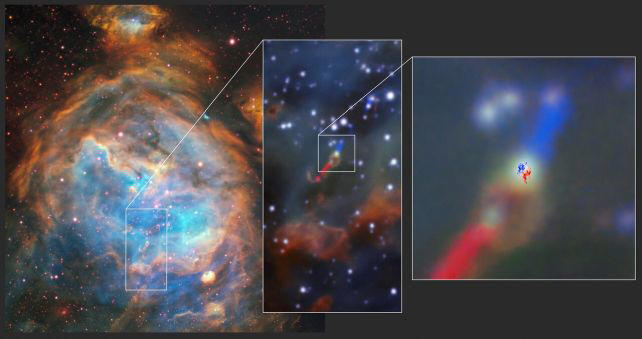
Astronomers have recently spotted signs of an extended disk of dust and gas, whirling in orbit around a distant star.
While this phenomenon is a normal stage in the development of a star and its planetary system, what makes this find so spectacular is that it's the first one we've seen around a star in a whole other galaxy, outside of our own.
The feature was spotted in the Large Magellanic Cloud, a dwarf galaxy some 179,000 light-years away from the Milky Way. And, although it might seem like common sense to suppose that star formation processes are universal, we've not been able to observe their vagaries outside of our home galaxy before.
"When I first saw evidence for a rotating structure in the ALMA data I could not believe that we had detected the first extragalactic accretion disc, it was a special moment," said astronomer Anna McLeod of Durham University in the UK, when the findings were published in November.
"We know discs are vital to forming stars and planets in our galaxy, and here, for the first time, we're seeing direct evidence for this in another galaxy."
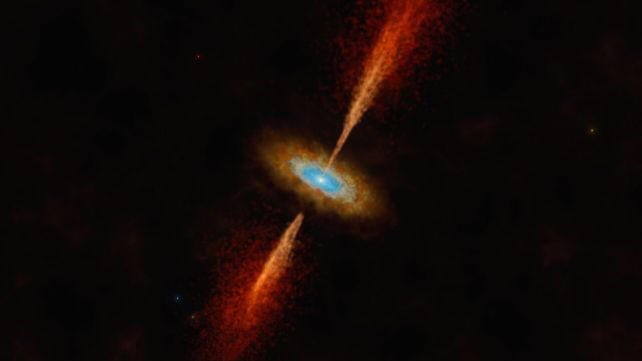
An artist's impression of the recently discovered disk.
Stars are born from dense clumps in clouds of molecular gas and dust that hang out in interstellar space. When a clump grows dense enough, it collapses under gravity; spinning, it starts to draw in more material from the cloud around it. This material doesn't just fall onto the protostar any old how, though; it arranges into a disk around the star's equator, and falls down onto it in a more controlled, steady stream, like water down a drain.
Once the star is done forming, what remains of the disk stays there, clumping together to form all the other elements of a planetary system: the planets, the asteroids and meteors, the comets, the dust. That's why the Solar System's planets are more or less orbiting the Sun in a flat plane. We ourselves are like the sentient mold that grew on the leftovers of the Sun's breakfast.
The Atacama Large Millimeter/submillimeter Array (ALMA), a powerful radio telescope, has imaged quite a few such disks throughout the Milky Way, in various stages of development; some have clear gaps that are thought to be cleared by planets clumping together as they orbit. But the farther away something is, the harder it is to resolve, even with a powerful telescope.
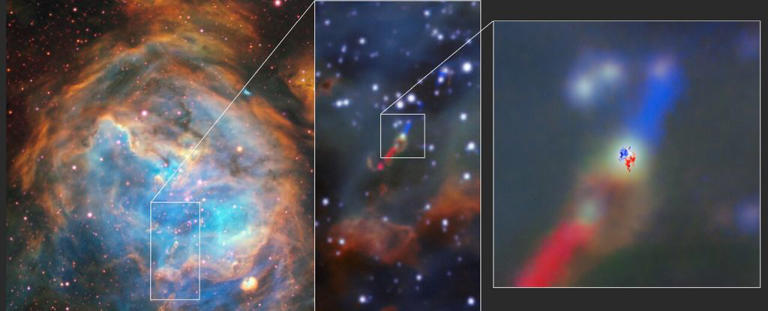
The location and orientation of the jets and disk identified in HH 1177.
McLeod and her colleagues embarked on their campaign to find an extragalactic stellar disk when data obtained by the Multi Unit Spectroscopic Explorer (MUSE) instrument on the Very Large Telescope revealed signs of a jet, in a system named HH 1177.
These, too, are a signature of star formation: some of the material swirling around the forming star gets whisked away along its magnetic field lines to the poles, where it is launched into space in the form of a powerful jet.
The researchers wanted to see if they could spot the disk in the dusty heart of star formation, so they used ALMA to look for signs of rotation. This can be seen in the way wavelengths of light are shortened as the source is pushed towards us, and lengthened as they are pulled away.
"The frequency of light changes depending on how fast the gas emitting the light is moving towards or away from us," explained astronomer Jonathan Henshaw of Liverpool John Moores University in the UK. "This is precisely the same phenomenon that occurs when the pitch of an ambulance siren changes as it passes you and the frequency of the sound goes from higher to lower."
Interestingly, the ALMA data showed clear signs of this rotation. The star, the team's analysis revealed, is very young and massive, still feeding from the disk around it. This is pretty normal. But there was a difference between it and the protostellar disks found in the Milky Way: the HH 1177 disk can be seen in optical wavelengths.
This, the researchers explain, has to do with the interstellar environment in the Large Magellanic Cloud. There is much less dust there; so the HH 1177 star is not as shrouded in a curtain of material as young, massive Milky Way stars usually are.
This makes the discovery an important one for studying, not just how stars form in different environments, but the limits those environments can place on star formation in general.
"We are in an era of rapid technological advancement when it comes to astronomical facilities," McLeod said. "Being able to study how stars form at such incredible distances and in a different galaxy is very exciting."
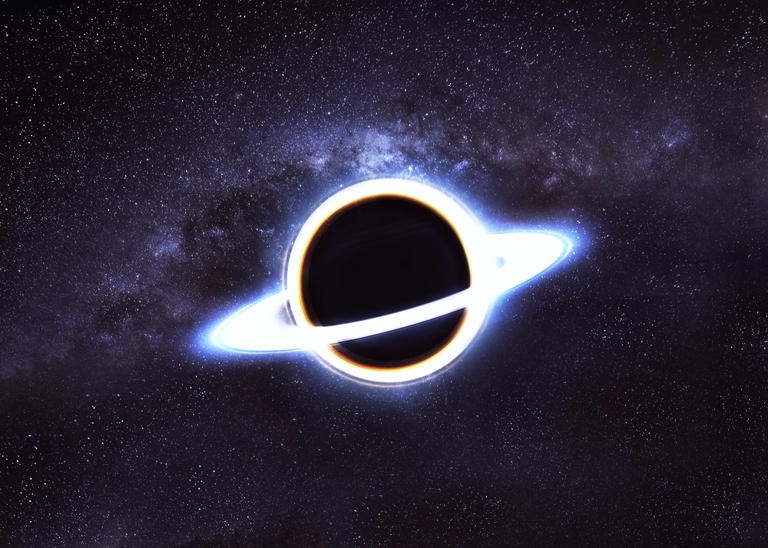
When Black Holes Die, They Are Reborn As White Holes
When Black Holes Die, They Are Reborn As White Holes
Story by The Physics arXiv Blog
When Black Holes Die, They Are Reborn As White Holes
In recent years, black holes have morphed from highly theoretical exotic possibilities to well-observed astrophysical objects. The observational evidence has come from sources such as the first observation of ripples in spacetime caused by black hole collisions and the first image of a black hole published in 2019.
Black holes are predicted by Einstein's theory of general relativity, which describes the universe on the largest scale. But these objects must also distort spacetime on the tiniest scale, meaning that black holes must also have interesting quantum properties. The challenge for theorists is to find ways to unite the disparate theories of relativity and quantum mechanics in a theory of ‘loop' quantum gravity that correctly predicts observations.
And these theorists have been busy. Over the last decade, they have developed an increasingly sophisticated theoretical understanding of black holes that could explain some of the biggest mysteries of cosmology.
Now the physicist and popular science writer Carlo Rovelli with Francesca Vidotto, both at Western University in Canada, review this progress and highlight some of its jaw-dropping conclusions. The new work suggests that when black holes die, they turn into white holes. That myriads of tiny white holes could be passing through the Earth at any time. And that these objects are an ideal candidate for the dark matter that cosmologists believe fills the universe but have never directly observed.
Related video:
What If Earth Fell Into a Black Hole? (Dailymotion)
Astrophysicists have long believed that black holes cannot be large static objects that remain unchanged over the lifetime of the universe. Instead, their work suggests that black holes evolve. Now theoreticians' work with loop quantum gravity has thrown the details of this evolution into stark relief.
For a start, black holes gradually evaporate by emitting Hawking radiation. This causes the black hole horizon to shrink, while the volume of the interior does not. "This implies that an old evaporated black hole has a small horizon but a huge internal volume," say Rovelli and Vidotto.
This shrinking continues until the hole reaches the tiniest possible size at the Planck Scale. At this point, the quantum energy density becomes great enough to resist further shrinkage. The hole rebounds and undergoes a strange quantum personality change. "At the end of the evaporation, a black hole undergoes a quantum transition to a white hole with a Planckian-size horizon and a vast interior," say the researchers.
This is what cosmologists call a "remnant" of a black hole and understanding the properties of these remnants has been an important part of their work.
White holes have been studied for some time. Like black holes, they are legitimate solutions to Einstein's field equations. "A white hole spacetime is simply the time reversal of a black hole spacetime," say Rovelli and Vidotto.
And like black holes, white holes were not thought likely to play a major role in the universe. This view now needs to change, say Rovelli and Vidotto, just as it has for black hole because the two are intrinsically linked.
One potential stumbling block has always been that the solutions giving rise to white holes are unstable. But Rovelli and Vidotto point out that any instability should lead to the formation of a superposition of both black and white holes that is stable.
The difference is largely academic anyway. To a casual observer, a white hole is indistinguishable from a black hole. It is only their past and future that differ, albeit in a way that is inaccessible to most observers.
An important question is how long remnants last. Rovelli and Vidotto point out that for the remnant itself, the process of full dissipation must happen very quickly. But time dilation means that for a distant observer, it could take the lifetime of the universe.
"Time slows down near high density mass," say the researchers. "An observer (capable of resisting the tidal forces) landing on a Planck matter distribution will find herself nearly immediately in the distant future, at the time where the black hole ends its evaporation." In other words: "A black hole is a shortcut to the distant future," they say.
If all this is accurate, the universe should be full of black hole remnants (or white holes). And their mass should have a gravitational effect on all the visible matter in the universe. That's why remnants are good candidates for dark matter.
"Remnants are a dark matter candidate that does not require exotic assumptions of new forces, or particles or corrections to the Einstein equations, or physics beyond the standard model," say Rovelli and Vidotto. "It only requires general relativity and quantum theory to hold together."
Quantum Detector
But these particles will be very hard to detect because gravity is such a meagre force on this tiny scale. Yet Rovelli and Vidotto say there may be a way.
The idea is to create a mass that exists in two different locations at the same time in a quantum superposition of both states. Then, as a remnant flies past, it will interact via gravity more strongly with the nearer mass, causing the superposition to change in character. Detecting this change would be a sign that a dark matter particle has passed by.
Whether this would uniquely indicate the presence of a black hole remnant is another question yet to be decided. But the important point is that this kind of experiment is close to being possible today.
All that makes this an exciting area of physics to be in. And one that is likely to change as physicists gather more detailed observations of black hole collisions and other quantum gravity phenomenon. So watch this space - black holes, white holes and Planck stars are set to become the coolest things in astrophysics (as if they were ever anything else)!
Milky Way’s Thin Disk Formed Less Than One Billion Years from Big Bang, New Study Suggests
Milky Way’s Thin Disk Formed Less Than One Billion Years from Big Bang, New Study Suggests
Using data fromESA’s Gaia mission, astronomers have found a large number of metal-poor stars older than 13 billion years on orbits similar to that of our Sun.
Rotational motion of young (blue) and old (red) stars similar to the Sun (orange).
Image credit: NASA / JPL-Caltech / R. Hurt / SSC / Caltech.
“The Milky Way Galaxy has a large halo, a central bulge and bar, a thick disk and a thin disk,” said Dr. Samir Nepal from the Leibniz Institute for Astrophysics Potsdam and colleagues.
“Most stars are located in the so-called thin disk of our Milky Way and follow an organised rotation around the Galactic center.”
“Middle-aged stars such as our 4.6-billion-year-old Sun belong to the thin disk, which was generally thought to have started forming around 8 to 10 billion years ago.”
Using the new Gaia dataset, the astronomers studied stars within around 3,200 light-years from the Sun.
They discovered a surprising number of very old stars in thin disk orbits; the majority of these are older than 10 billion years, some of them even older than 13 billion years.
These ancient stars show a wide range of metal compositions: some are very metal-poor (as expected), while others have twice the metal content of our much younger Sun, indicating that a rapid metal enrichment took place in the early phase of the Milky Way’s evolution.
“These ancient stars in the disk suggest that the formation of the Milky Way’s thin disk began much earlier than previously believed, by about 4-5 billion years,” Dr. Nepal said.
“This study also highlights that our Galaxy had an intense star formation at early epochs leading to very fast metal enrichment in the inner regions and the formation of the disk.”
“This discovery aligns the Milky Way’s disk formation timeline with those of high-redshift galaxies observed by the NASA/ESA/CSA James Webb Space Telescope and the Atacama Large Millimeter Array (ALMA).”
“It indicates that cold disks can form and stabilize very early in the Universe’s history, providing new insights into the evolution of galaxies.”
“Our study suggests that the thin disk of the Milky Way may have formed much earlier than we had thought, and that its formation is strongly related to the early chemical enrichment of the innermost regions of our Galaxy,” said Dr. Cristina Chiappini, an astronomer at the Leibniz Institute for Astrophysics Potsdam.
“The combination of data from different sources and the application of advanced machine learning techniques have enabled us to increase the number of stars with high quality stellar parameters, a key step to lead our team to these new insights.”
Samir Nepal et al. 2024. Discovery of the local counterpart of disc galaxies at z > 4: The oldest thin disc of the Milky Way using Gaia-RVS. A&A, in press; arXiv: 2402.00561
Warp Drive Collapse Should Generate Gravitational Waves, Theoretical Astrophysicists Claim
Warp Drive Collapse Should Generate Gravitational Waves, Theoretical Astrophysicists Claim
The principle idea behind a warp drive is that instead of exceeding the speed of light directly in a local reference frame, a ‘warp bubble’ could traverse distances faster than the speed of light — as measured by some distant observer — by contracting spacetime in front of it and expanding spacetime behind it.
Clough et al. proposed a formalism for studying warp drive spacetimes dynamically and produced the first fully consistent numerical-relativity waveforms for the collapse of a warp drive bubble.
Despite originating in science fiction, warp drives have a concrete description in general relativity, with University of Wales astrophysicist Miguel Alcubierre first proposing a spacetime metric that supported faster-than-light travel.
Whilst there are numerous practical barriers to their implementation in real life, such as the requirement for an exotic type of matter with negative energy, computationally, one can simulate their evolution in time given an equation of state describing the matter.
In a new work, theoretical astrophysicists studied the signatures arising from a warp drive ‘containment failure.’
“Even though warp drives are purely theoretical, they have a well-defined description in Einstein’s theory of general relativity, and so numerical simulations allow us to explore the impact they might have on spacetime in the form of gravitational waves,” said Dr. Katy Clough, a researcher at Queen Mary University of London.
“The results are fascinating. The collapsing warp drive generates a distinct burst of gravitational waves, a ripple in spacetime that could be detectable by gravitational wave detectors that normally target black hole and neutron star mergers.”
“Unlike the chirps from merging astrophysical objects, this signal would be a short, high-frequency burst, and so current detectors wouldn’t pick it up.”
“However, future higher-frequency instruments might, and although no such instruments have yet been funded, the technology to build them exists.”
“This raises the possibility of using these signals to search for evidence of warp drive technology, even if we can’t build one ourselves.”
“In our study, the initial shape of the spacetime is the warp bubble described by Alcubierre,” said Dr. Sebastian Khan, a researcher at Cardiff University.
“While we were able to demonstrate that an observable signal could in principle be found by future detectors, given the speculative nature of the work this isn’t sufficient to drive instrument development.”
The authors also delve into the energy dynamics of the collapsing warp drive.
The process emits a wave of negative energy matter, followed by alternating positive and negative waves.
This complex dance results in a net increase in the overall energy of the system, and in principle could provide another signature of the collapse if the outgoing waves interacted with normal matter.
“It’s a reminder that theoretical ideas can push us to explore the Universe in new ways,” Dr. Clough said.
“Even though we are sceptical about the likelihood of seeing anything, I do think it is sufficiently interesting to be worth looking.”
“For me, the most important aspect of the study is the novelty of accurately modeling the dynamics of negative energy spacetimes, and the possibility of extending the techniques to physical situations that can help us better understand the evolution and origin of our Universe, or the processes at the centre of black holes,” said University of Potsdam’s Professor Tim Dietrich.
“Warp speed may be a long way off, but this research already pushes the boundaries of our understanding of exotic spacetimes and gravitational waves.”
“We plan to investigate how the signal changes with different warp drive models.”
Katy Clough et al. 2024. What no one has seen before: gravitational waveforms from warp drive collapse. Open Journal of Astrophysics 7; doi: 10.33232/001c.121868
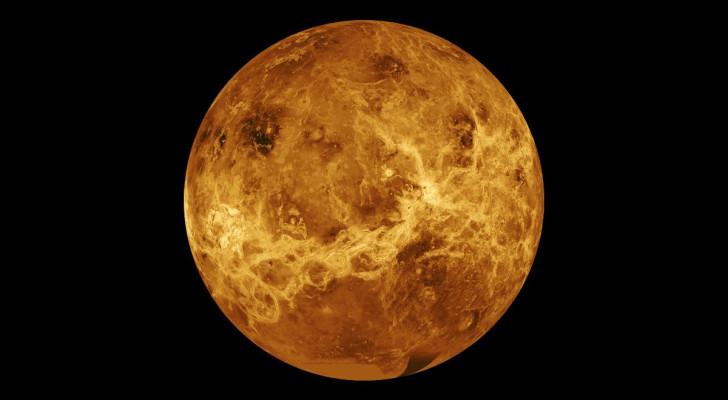
Venus, de tweede planeet van het zonnestelsel, lijkt qua omvang en massa sterk op de aarde, maar verder is het een van de meest onherbergzame plaatsen die we tot nu toe kennen. De atmosfeer, die bestaat uit gassen die giftig voor ons zijn, is het onderwerp geweest van recente ontdekkingen die de aanwezigheid lijken te suggereren van twee gassen die door levende organismen worden geproduceerd. Kunnen we daarom spreken van sporen van leven op Venus? Laten we het samen ontdekken!
Zoeken naar leven op andere planeten: het belang van biomarkers
Zoals we in de inleiding zeiden, is Venus een plek die net zo fascinerend is om te bestuderen als onherbergzaam, voor welke vorm van leven dan ook die ons bekend is. Het oppervlak bereikt temperaturen van 450°C, terwijl de atmosfeer ongeveer 90 keer dichter is dan die van de aarde. Een onherbergzame plek, waar echter leven zou kunnen voorkomen op hoogten van minstens 50 kilometer boven het oppervlak, waar de omstandigheden minder extreem zijn. Maar hoe kom je erachter of er organismen op Venus leven?
Een van de methoden die wetenschappers gebruiken, bestaat uit het analyseren van de chemische samenstelling van de planeten. Meestal is het inderdaad mogelijk om verbindingen te identificeren die geen verband houden met het leven, maar soms is het mogelijk om zogenaamde biomarkers te vinden, dat wil zeggen chemische verbindingen die op aarde door bepaalde organismen worden geproduceerd. En die zouden kunnen duiden op een soortgelijk proces op andere planeten of andere hemellichamen. Op Venus beweren sommige wetenschappers bijvoorbeeld sporen van fosfine en ammoniak te hebben gevonden. Maar wat betekent dat?
Fosfine en ammoniak in de atmosfeer van Venus: wat betekent het?
Unsplash - Not the actual photo
Er zijn twee specifieke biomarkers gedetecteerd in de atmosfeer van Venus, tijdens observaties die al een paar jaar duren en die, zo lijkt het, zijn bevestigd. De eerste biomarker is fosfine, een verbinding die op aarde door sommige microben wordt geproduceerd in zuurstofvrije omgevingen en in kleine hoeveelheden door vulkanen. Sommige wetenschappers beweren al jaren dat fosfine een teken van buitenaards leven op Venus zou kunnen vertegenwoordigen. In het bijzonder vestigde Dave Clements van Imperial College London in een onderzoek uit 2023 opnieuw de aandacht op de kwestie en ontdekte dat fosfine wordt vernietigd door de werking van de zon. Maar over zijn vorming is nog niets bekend: zou het leven kunnen zijn?
De tweede biomarker is ammoniak, onlangs geïdentificeerd door Jane Greaves van Cardiff University, die samen met Dave Clements een conferentie gaf op de National Astronomy Meeting 2024. Beiden betogen hoe de aanwezigheid van fosfine en ammoniak ons kan helpen de atmosfeer van Venus beter te begrijpen en, waarom niet, ook de mogelijke aanwezigheid van leven.
Sporen van leven op Venus?
Veel geleerden zijn het erover eens dat Venus in het verleden mogelijk omstandigheden heeft gehad die meer leken op die op aarde, inclusief de mogelijkheid om leven te huisvesten. Het is echter moeilijker om de aanwezigheid van fosfine en ammoniak in de atmosfeer van de planeet te verklaren met bekende chemische processen. Hier op aarde worden de twee stoffen geproduceerd door biologische of hoogstens industriële processen, maar op Venus?
Het is duidelijk dat het te vroeg is om conclusies te trekken, maar het onderzoek van Clements en Greaves heeft tenminste de verdienste dat het met de vinger in de juiste richting wijst. Er zullen veel preciezere detecties nodig zijn door de James Clerk Maxwell-telescoop, gericht op Venus, en veel meer tijd. Tegelijkertijd is het normaal om verbaasd te zijn over de mogelijkheid om iets te ontdekken dat nog nooit eerder is gezien, ook al is het een klein organisme dat op 50 kilometer hoogte zweeft, op een verder onherbergzame planeet.
Runaway Star Might Explain Mysterious Black Hole Disappearing Act
Runaway Star Might Explain Mysterious Black Hole Disappearing Act
ByJET PROPULSION LABORATORY
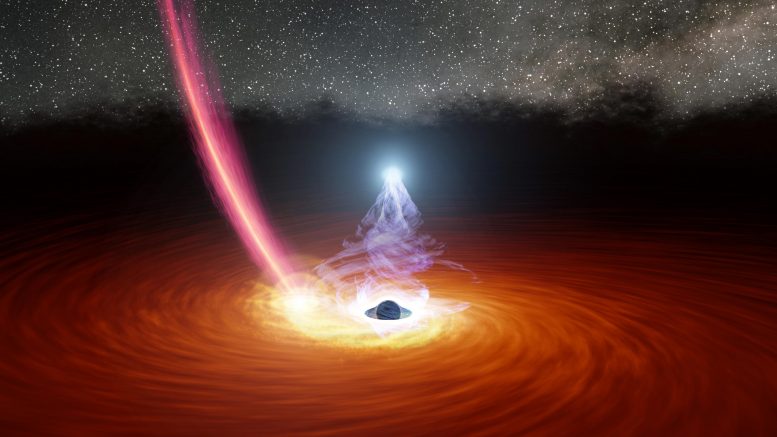
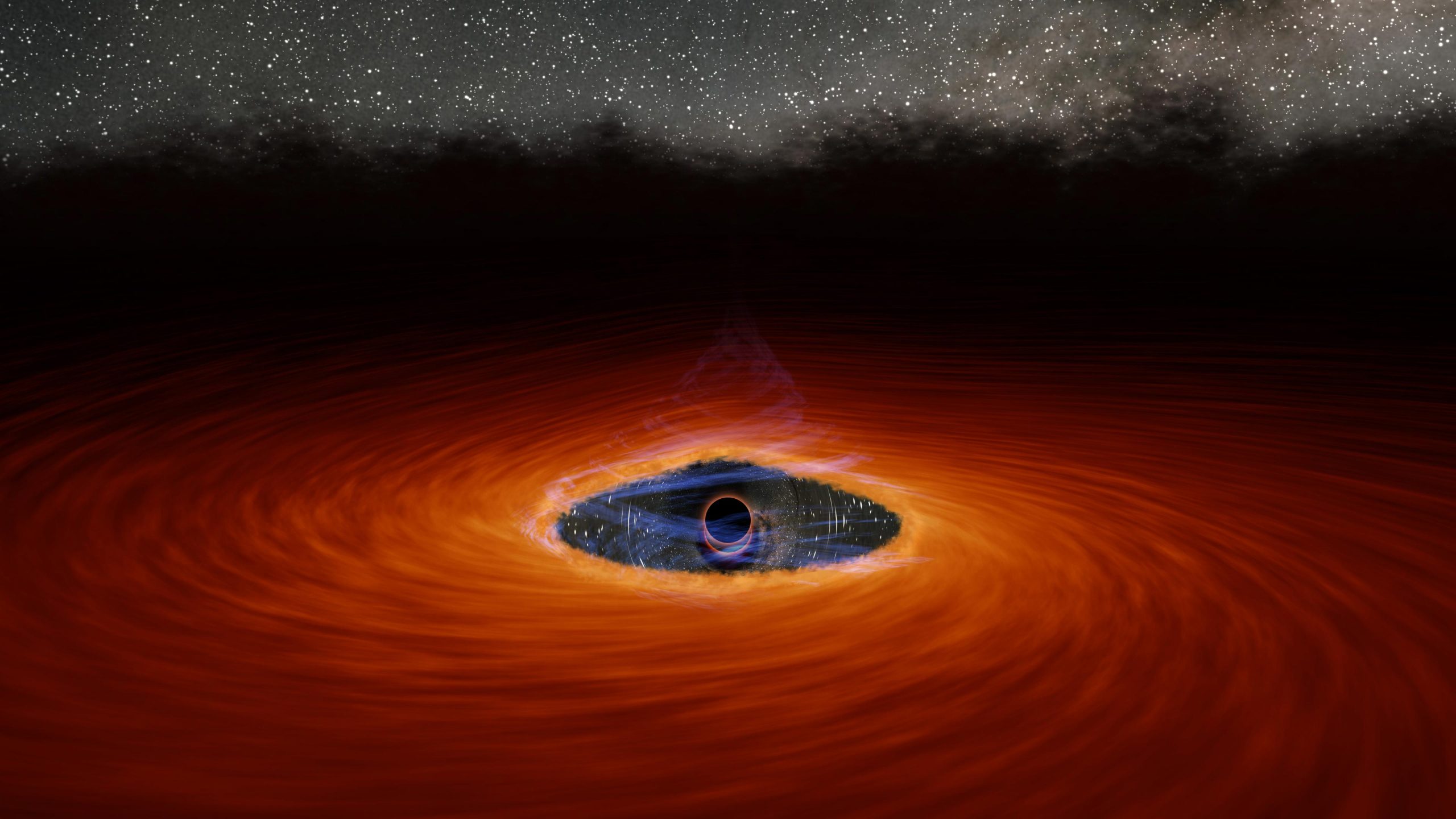
The two illustrations on this page show a black hole surrounded by a disk of gas, before (above) and after (below) the disk is partially dispersed. In this top image, the ball of white light above the black hole is the black hole corona, a collection of ultra-hot gas particles that forms as gas from the disk falls into the black hole. The streak of debris falling toward the disk is what remains of a star that was torn apart by the black hole’s gravity.
Credit: NASA/JPL Caltech
The telltale sign that the black hole was feeding vanished, perhaps when a star interrupted the feast. The event could lend new insight into these mysterious objects.
At the center of a far-off galaxy, a black hole is slowly consuming a disk of gas that swirls around it like water circling a drain. As a steady trickle of gas is pulled into the gaping maw, ultrahot particles gather close to the black hole, above and below the disk, generating a brilliant X-ray glow that can be seen 300 million light-years away on Earth. These collections of ultrahot gas, called black hole coronas, have been known to exhibit noticeable changes in their luminosity, brightening or dimming by up to 100 times as a black hole feeds.
But two years ago, astronomers watched in awe as X-rays from the black hole corona in a galaxy known as 1ES 1927+654 disappeared completely, fading by a factor of 10,000 in about 40 days. Almost immediately it began to rebound, and about 100 days later had become almost 20 times brighter than before the event.
The X-ray light from a black hole corona is a direct byproduct of the black hole’s feeding, so the disappearance of that light from 1ES 1927+654 likely means that its food supply had been cut off. In a new study in the Astrophysical Journal Letters, scientists hypothesize that a runaway star might have come too close to the black hole and been torn apart. If this was the case, fast-moving debris from the star could have crashed through part of the disk, briefly dispersing the gas.
This illustration shows the black hole after the debris from the star has dispersed some of the gas in the disk, causing the corona to disappear.
Credit: NASA/JPL Caltech
“We just don’t normally see variations like this in accreting black holes,” said Claudio Ricci, an assistant professor at Diego Portales University in Santiago, Chile, and lead author of the study. “It was so strange that at first we thought maybe there was something wrong with the data. When we saw it was real, it was very exciting. But we also had no idea what we were dealing with; no one we talked to had seen anything like this.”
Nearly every galaxy in the universe may host a supermassive black hole at its center, like the one in 1ES 1927+654, with masses millions or billions of times greater than our Sun. They grow by consuming the gas encircling them, otherwise known as an accretion disk. Because black holes don’t emit or reflect light, they can’t be seen directly, but the light from their coronas and accretion disks offers a way to learn about these dark objects.
The authors’ star hypothesis is also supported by the fact that a few months before the X-ray signal disappeared, observatories on Earth saw the disk brighten considerably in visible-light wavelengths (those that can be seen by the human eye). This might have resulted from the initial collision of the stellar debris with the disk.
Digging Deeper
The disappearing event in 1ES 1927+654 is unique not only because of the dramatic change in brightness, but also because of how thoroughly astronomers were able to study it. The visible-light flare prompted Ricci and his colleagues to request follow-up monitoring of the black hole using NASA’s Neutron star Interior Composition Explorer (NICER), an X-ray telescope aboard the International Space Station. In total, NICER observed the system 265 times over 15 months. Additional X-ray monitoring was obtained with NASA’s Neil Gehrels Swift Observatory — which also observed the system in ultraviolet light — as well as NASA’s Nuclear Spectroscopic Telescope Array (NuSTAR) and the ESA (the European Space Agency) XMM-Newton observatory (which has NASA involvement).
When the X-ray light from the corona disappeared, NICER and Swift observed lower-energy X-rays from the system so that, collectively, these observatories provided a continuous stream of information throughout the event.
Although a wayward star seems the most likely culprit, the authors note that there could be other explanations for the unprecedented event. One remarkable feature of the observations is that the overall drop in brightness wasn’t a smooth transition: Day to day, the low-energy X-rays NICER detected showed dramatic variation, sometimes changing in brightness by a factor of 100 in as little as eight hours. In extreme cases, black hole coronas have been known to become 100 times brighter or dimmer, but on much longer timescales. Such rapid changes occurring continuously for months was extraordinary.
“This dataset has a lot of puzzles in it,” said Erin Kara, an assistant professor of physics at the Massachusetts Institute of Technology and a co-author of the new study. “But that’s exciting because it means we’re learning something new about the universe. We think the star hypothesis is a good one, but I also think we’re going to be analyzing this event for a long time.”
It’s possible that this kind of extreme variability is more common in black hole accretion disks than astronomers realized. Many operating and upcoming observatories are designed to search for short-term changes in cosmic phenomena, a practice known as “time domain astronomy,” which could reveal more events like this one.
“This new study is a great example of how flexibility in observation scheduling allows NASA and ESA missions to study objects that evolve relatively quickly and look for longer-term changes in their average behavior,” said Michael Loewenstein, a coauthor of the study and an astrophysicist for the NICER mission at the University of Maryland College Park and NASA’s Goddard Space Flight Center (GSFC) in Greenbelt, Maryland. “Will this feeding black hole return to the state it was in before the disruption event? Or has the system been fundamentally changed? We’re continuing our observations to find out.”
More About the Missions
NICER is an Astrophysics Mission of Opportunity within NASA’s Explorer program, which provides frequent flight opportunities for world-class scientific investigations from space utilizing innovative, streamlined, and efficient management approaches within the heliophysics and astrophysics science areas.
NuSTAR recently celebrated eight years in space, having launched on June 13, 2012. A Small Explorer mission led by Caltech and managed by NASA’s Jet Propulsion Laboratory in Southern California for the agency’s Science Mission Directorate in Washington, NuSTAR was developed in partnership with the Danish Technical University and the Italian Space Agency (ASI). The spacecraft was built by Orbital Sciences Corp. in Dulles, Virginia. NuSTAR’s mission operations center is at the University of California, Berkeley, and the official data archive is at NASA’s High Energy Astrophysics Science Archive Research Center at GSFC. ASI provides the mission’s ground station and a mirror data archive. Caltech manages JPL for NASA.
ESA’s XMM-Newton observatory was launched in December 1999 from Kourou, French Guiana. NASA funded elements of the XMM-Newton instrument package and provides the NASA Guest Observer Facility at GSFC, which supports the use of the observatory by U.S. astronomers.
GSFC manages the Swift mission in collaboration with Penn State in University Park, Pennsylvania, the Los Alamos National Laboratory in New Mexico, and Northrop Grumman Innovation Systems in Dulles, Virginia. Other partners include the University of Leicester and Mullard Space Science Laboratory of the University College London in the United Kingdom, Brera Observatory in Italy, and the Italian Space Agency.
Reference:“The Destruction and Recreation of the X-Ray Corona in a Changing-look Active Galactic Nucleus” by C. Ricci, E. Kara, M. Loewenstein, B. Trakhtenbrot, I. Arcavi, R. Remillard, A. C. Fabian, K. C. Gendreau, Z. Arzoumanian, R. Li, L. C. Ho, C. L. MacLeod, E. Cackett, D. Altamirano, P. Gandhi, P. Kosec, D. Pasham, J. Steiner and C.-H. Chan, 16 July 2020, Astrophysical Journal Letters. DOI: 10.3847/2041-8213/ab91a1
"This discovery mainly opens up a new pathway to studying brown dwarfs that are in remote regions of the Milky Way. If they get thrown at us, it's much easier!""
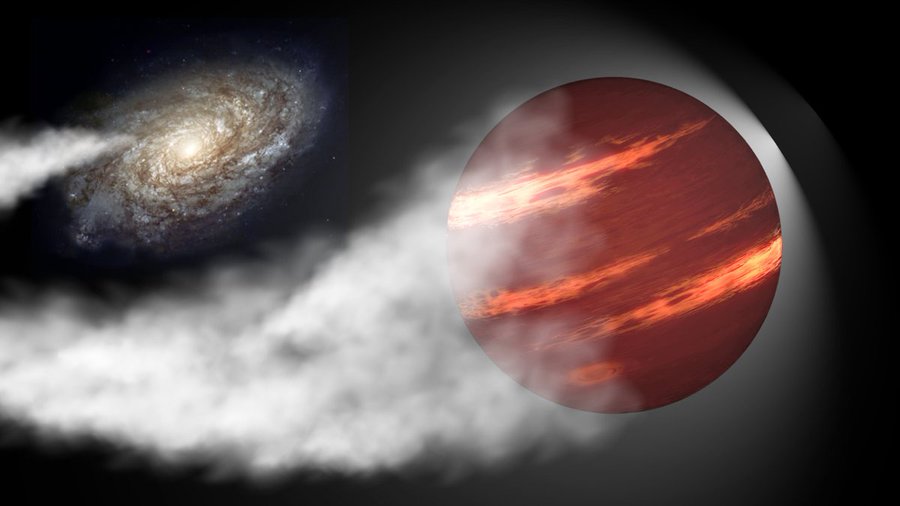
An illustration shows a runaway brown dwarf escaping a spiral galaxy.
(Image credit: Robert Lea (created with Canva)/NASA)
A newly discovered rogue stellar body may well be a "failed star," but it certainly isn't a failure when it comes to velocity!
The potential brown dwarf is racing through our Milky Way galaxy at 1.2 million mph (1.9 million kph). That's about 1,500 times faster than the speed of sound! Thankfully, this cosmic runaway is heading toward the center of the Milky Way and not toward us. However, the object is traveling so fast that it could eventually escape our galaxy entirely.
The incredible speed of this newly uncovered stellar body, designated CWISE J1249+3621, isn't the only fascinating thing about the object, which is currently around 400 light-years from Earth.
The stellar body has a mass that is just around 8% that ofthe sun, or 80 times the mass ofJupiter, which puts it right on the dividing line between a star and a fascinating group of objects called "brown dwarfs," often (somewhat unfairly) labeled "failed stars."
After several citizen scientists flagged the object, a team of astronomers followed up using the Keck I Telescope, one of two 10-meter twin telescopes located on the dormant volcano Maunakea, in Hawai'i.
"We discovered a very low-mass object, right on the star/brown dwarf mass boundary, that has an extreme velocity, moving fast enough that it may actually be unbound to the Milky Way galaxy," study team leader Adam Burgasser, of the University of California San Diego, told Space.com. "It joins a collection of 'hypervelocity' stars that have been found over the past few decades, most of which are thousands of light-years from the sun, whereas this source is a 'mere' 400 light-years away."
Burgasser added that the team's observations included an analysis of CWISE J1249+3621's atmosphere. This indicated that the potential brown dwarf also has an unusual chemical composition. The team aimed to use the information they gathered about the motion and composition of CWISE J1249+3621 to speculate on its possible origins.
"This discovery mainly opens up a new pathway to studying brown dwarfs that are in remote regions of the Milky Way, including its center, its halo and its various globular clusters and satellites," Burgasser said. "All of these systems are too far away to study brown dwarfs in detail directly, but if they get thrown at us, it's much easier!"
A young star, similar to the renegade star PG 1610+062, gets ejected from the Milky Way by a hungry black hole. So long!
(Image credit: A. IRRGANG, FAU)
What is this rogue star running from?
Brown dwarfs form just like stars do — from giant clouds of gas and dust, called molecular clouds, that develop overly dense patches that collapse under the influence of their own gravity. However, unlike a regular star such as the sun, brown dwarfs fail to gather enough material from the remains of the cloud that birthed them to reach the mass needed to generate the pressures and temperatures in their cores that kickstart the fusion of hydrogen to helium. This is the process that defines a "main sequence" star. Hence, the "failed star" moniker foisted on brown dwarfs.
Brown dwarfs have masses ranging from around four times that of Jupiter to around 80 times that of the gas giant. (For comparison, the sun is 1,000 times more massive than Jupiter.) The mass of CWISE J1249+3621 is exciting because it puts it right at the hypothetical boundary between a star and a brown dwarf.
"The low mass is significant because it's by far the lowest-mass, high-velocity 'star' found to date. The original hypervelocity stars found about 20 years ago were massive O stars [around 50 times as massive as the sun] and B stars [up to 16 times as massive as the sun], a likely selection bias because these stars are rare and would need to be found at large distances," Burgasser said. "Our discovery indicates that whatever process (or processes) causes these stars to run away must operate at both high and low masses."
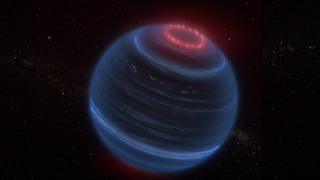
An illustration of a brown dwarf with an aurora, compared to the sizes of some other space objects. (Image credit: NASA/CC)
The UC San Diego researcher explained that the team is really excited to try to answer what sent this stellar body careening through the Milky Way.
"The star could have been kicked out of the center of Milky Way by our supermassive black hole, Sagittarius A*, a process commonly used to explain the origins of other hypervelocity stars," Burgasser said. "Notably, our star is moving into the center, not away, but it might be on a return trip after being ejected previously."
He added that it is also possible that the brown dwarf is on the run from a "cosmic vampire." The rogue stellar body may have been part of a binary system with a white dwarf stellar corpse that was ripping material away from it. This gruesome feeding eventually causes the white dwarf to erupt in a cosmic explosion called a Type Ia supernova. This would destroy the white dwarf and provide the "kick" that sent this runaway racing through the Milky Way at incredible speeds.
"Another possibility is that the star was launched out of a globular cluster through dynamical interactions with black holes in the center of the cluster; recent simulations show that this should happen several times over the age of the Milky Way," Burgasser said. "Any of these processes above, given a fast enough kick, could have launched it out, or in the case of an 'extragalactic' star, it just happens to be passing through."
He added that, currently, the team can't rule out the possibility that this potential brown dwarf is an intruder in our galaxy that came from outside the Milky Way. But the fact that it's passing through the plane of our Milky Way makes that a less likely case.
"The orbit is certainly the most surprising aspect of this object; it is moving radially in and out of the center of the Milky Way and almost perfectly in the plane," Burgasser said. "Most of the high-velocity stars we see are on much more chaotic or inclined orbits. I think this is a real clue to its real origin."
An illustration of a faint brown dwarf and its infrared emissions . (Image credit: NASA, ESA, CSA, LEAH HUSTAK (SPACE TELESCOPE SCIENCE INSTITUTE))
Runaway brown dwarfs, if that is indeed what CWISE J1249+3621 is, appear to be rare, but this could be because of their cool and faint nature, which makes them difficult to detect. This means that the population of rogue brown dwarfs could be much larger than current detection rates indicate.
"These types of stars are exceedingly rare; only a few dozen have been found out of billions of stars examined, and, as noted, this is the first low-mass one. And this object in particular is difficult to see because it's a very cool and dim star, nearly 10,000 times fainter than the sun and emitting most of its light at infrared wavelengths," Burgasser said. "It's hard to say how common these bodies are, with only one found so far, but since this is so close, we speculate that there may be many more.
"That speculation is informed partly by the fact that the majority of stars in the Milky Way are low mass, and about one in five are brown dwarfs, and that these objects are the easiest to 'throw around' since they are so low mass."
The team now intends to follow up on the investigation of CWISE J1249+3621's atmosphere in greater detail to see if its chemical abundances reveal something about its origin. They will also attempt to discover more of these low-mass stellar runaways, a hunt in which citizen scientists will play an integral role.
"We definitely want to find more of these objects, and our citizen scientists have identified several more high-velocity candidates to follow up," Burgasser concluded. "Citizen scientists were absolutely essential to this study! They were the ones who identified this source as an interesting target worth investigating. Without them, we'd still have hundreds of thousands of faint little dots to sort through."
The team's research is discussed in a pre-peer-reviewed paper featured on the repository site arXiv.
"Notice the cranes and vehicles at the bottom, which show off just how enormous the ELT is!"
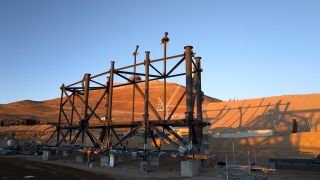
Protective cladding being installed on the sides of the Extremely Large Telescope (ELT) dome.
(Image credit: ESO)
The dome enclosing the world's largest telescope is taking shape, with the installation of protective siding and supports for the primary mirror.
The European Southern Observatory's (ESO) Extremely Large Telescope (ELT) is currently under construction on the Cerro Armazones mountain in Chile's Atacama Desert and is expected to see its first light by 2028.
Recent progress photos from the construction site taken in June 2024 show cladding being installed on the outside of the ELT dome. This layer of material serves as a thermal insulation barrier and provides weather resistance to help protect the telescope from the extreme environment of the Chilean deser
Part of the dome will have large sliding doors, which will remain closed during the day and open at night, allowing the telescope to survey the sky. Once complete, the telescope will hunt for Earth-like exoplanets in search of signs of life outside of our own solar system and probe the early universe to study the first galaxies that formed after the Big Bang, among other tasks.
Assembly has begun on the beam structure for the sliding doors, which will help protect the telescope from the high daytime temperatures and dusty desert environment.
The frame of the dome’s sliding doors that will protect the Extremely Large Telescope (ELT) during the day and open at night for observations. (Image credit: ESO)
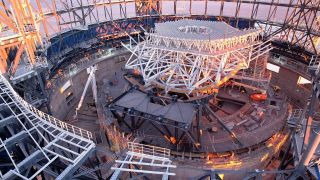
Construction photos from June also show progress on the support structure in the center of the dome that will eventually hold the ELT's 128-foot-wide (39 meters) primary mirror (M1), which weighs a whopping 200 tons. The mirror will rest on the white lattice structure, which will allow M1 to move smoothly during observations and compensate for varying gravity loads, wind conditions, vibrations or changes in temperature.
"Notice the cranes and vehicles at the bottom, which show off just how enormous the ELT is!" ESO officials said in a statement releasing the updated images.
The support structure is assembled in the center of the dome, which will eventually hold the Extremely Large Telescope’s (ELT) 200-ton primary mirror. (Image credit: ESO)
The primary mirror will be made up of 798 individual hexagonal segments, making it the largest segmented mirror ever built for a telescope. The ELT will have a total of five mirrors, all of which have different shapes, sizes and roles but will work together to observe the cosmos.
The secondary mirror, M2, will hang above M1, reflecting the light collected by it to the tertiary mirror, M3. The hole in the middle of the white lattice structure will house the central tower, which will hold the M3, M4 and M5 mirrors.
It seems that acclaimed actor Laurence Fishburne ("The Matrix") has some uncanny attraction to sci-fi projects centered around doomed spaceships, having co-starred in 2016's "Passengers" and the 1997 cult classic, "Event Horizon."
Now he's sharing the screen with the Academy Award-winning Casey Affleck ("Manchester By the Sea") and Tomer Capone ("The Boys") in Bleecker Street's upcoming outer space thriller, "Slingshot," and we've got the first full trailer to share to prove our point.
The basic plot revolves around a harrowing 1.5-billion-mile trek to Saturn's moon Titan and one astronaut's inability to distinguish nightmares from real-life due to the side effects of a drug meant to induce hibernation sleep for the long haul.
"Slingshot" arrives in theaters on Aug. 30, 2024 as perhaps a bit of a sleeper hit in the late summer box office bonanza, and with Håfström at the helm this has all the makings of a future sci-fi classic.
The official poster for Bleecker Street's "Slingshot." (Image credit: Bleecker Street)
Directed by Mikael Håfström ("1408") from a screenplay by R. Scott Adams ("Donner Pass") and Nathan Parker ("Moon"), this riveting production also stars Emily Beecham ("Cruella") and David Morrissey ("The Colour Room," "The Walking Dead").
Check out the official synopsis:
"A psychological thriller starring Casey Affleck and Laurence Fishburne, 'Slingshot' follows an elite trio of astronauts aboard a years-long, possibly compromised mission to Saturn's moon Titan. As the team gears up for a highly dangerous slingshot maneuver that will either catapult them to Titan or into deep space, it becomes increasingly difficult for one astronaut to maintain his grip on reality."
As seen in this trippy trailer, Affleck's unhinged character is not dealing with the extreme mental rigors of the mission very well and is hallucinating heavily as the Odyssey 1 spacecraft prepares to whip around Jupiter to provide the craft with a super speed boost necessary to properly reach the moon of Titan.
Laurence Fishburne, Casey Affleck, and Tomer Capone star in "Slingshot." (Image credit: Bleecker Street)
Casey Affleck and Laurence Fishburne in 'Slingshot'
"Slingshot" was mostly filmed at Korda Studios in Budapest, Hungary and was produced by Richard Saperstein, Istvan Major, and Beau Turpin. Ivett Havasi, Shara Kay, Michael Hollingsworth, Tom Nohstadt, Ron Cundy, Nikolett Barabás, Jonathan Krauss, Brooklyn Weaver and Joanna Plafsky serve as the film's executive producers.
Bleecker Street's "Slingshot" streaks into theaters on Aug. 30, 2024.
Images from the "Fly-around Observation" on July 15 conducted by Astroscale's ADRAS-J demonstration satellite. The idea was to image this space debris. Courtesy Astroscale/JAXA.
Near-Earth space is an orbiting junkyard of space debris. Everything from old rocket parts and pieces of dead satellites to cameras and tools floats in orbit. None of it serves a useful function any longer, but it does threaten other spacecraft. In fact, some missions have been damaged by this orbital debris and the problem will get worse as we launch more missions to space.
So, it makes sense to remove the existing space junk, but how to do that? A company in Japan called Astroscale is working with the Japan Aerospace Agency (JAXA) to figure that out.
On July 15 and 16th, Astroscale maneuvered a demonstration satellite called ADRAS-J into place around its target. Its goal was to do a “Fly-around observation” of a rocket upper stage that launched the Greenhouse Gases Observing Satellite (GOSAT) in 2009. ADRAS-J was launched earlier this year on a trajectory to chase down space debris. The early July portion of the mission saw ADRAS-J fly around the object and get high-quality images of the object. In addition, it took data about the rocket motor’s motion in space (including its orbital parameters) and assessed its condition. The effort was successful and the teams captured great images of the motor from every angle.
More images of the target object of space debris from ADRAS-J on July 16th. Courtesy Astroscale/JAXA.
The maneuvers ADRAS-J made are technically challenging, requiring fine guidance control of the ADRAS-J module. Luckily, the target object was fairly easy to approach and move around. In on-orbit maneuvers like this one, it’s important to control the relative position and attitude of the servicer unit (ADRAS-J). Such control allows it to move around the object and zero in on specific parts for further work. The rocket motor was fairly stable. However, not all bits of space junk are as stable as the rocket motor targeted for this experiment.
Challenges to Working with Space Debris
Given the huge collection of space junk out there, not everything is going to be easy to capture. Future “clean-up efforts” could involve so-called “non-cooperative targets” whose motions are more chaotic, or are dangerous to approach. Those could be very challenging. So, it’s important to have the detailed shape and surface reflectance of the real target object. For most pieces of space junk that information isn’t readily available.
For example, it’s also useful to know the changing visibility of the target object, and the influence of earth-reflected light, which disturbs the navigation sensor (the so-called Earth background problem in non-cooperative relative navigation). These add to the complexity of the mission. That’s because the servicer spacecraft must overcome those challenges for relative navigation while achieving highly accurate relative six-degree-of-freedom control around the target.
The ADRAS-J mission is part of the “Commercial Remove of Debris Demonstration” initiative from JAXA to acquire and test debris removal in space. If it’s successful, that should help clear up space for future missions leaving Earth. Astroscale Japan, Inc. will continue to operate ADRAS-J and will carry out “Astroscale missions” to further test the hardware and maneuvering capabilities.
The next step will be to perform a “Mission termination service”. That involves the transfer of a target piece of space junk to a safe orbit. This will be done in cooperation with JAXA, which has already provided extensive technical advice, testing facilities, and other activities supporting ADRAS-J’s development and operation.
Fly-around images in sequence. Courtesy Astroscale/JAXA.
Why Clean Up Space Junk?
Tens of thousands of artificial objects orbit above Earth. That includes more than 5,000 operating satellites, plus space stations, and Starlinks, and other stuff shot into orbit since the late 1950s. Eventually, as the old adage says, “what goes up must come down.” In fact, some of it does come back to Earth, which also poses a safety issue.
In the case of dead rocket motors and other nonworking pieces of space junk, not only will they come down to Earth, but they get in the way of spacecraft launches. That includes crewed launches carrying astronauts to the space stations, the Moon, and beyond.
The danger isn’t just that a collision will hurt somebody in space or on the ground. Tiny pieces of space junk can knock holes in solar panels and instruments. Bits of dust and paint flecks and other materials literally “sandblast” spacecraft on the way up. Space shuttles showed a lot of this damage. All this space debris began littering our spaceways starting with the first launches in the late 1950s. The materials are tracked by the North American Aerospace Defense Command (NORAD), and their catalogs include details of all the objects including satellites, weapons, fairings, upper stages, cameras, tools, and other pieces of debris from satellites destroyed by collisions and other actions.
It makes sense to clean up the junk that doesn’t fall back to Earth (and hopefully burn up in the atmosphere). That’s why JAXA and other agencies are looking at proactive ways to approach, apprehend, and safely store the debris (or deorbit it to vaporize, if possible). The first steps with ADRAS-J are proofs of concept that should lead to a larger clean-up job and a safer near-Earth environment for future missions.
No Merger Needed: A Rotating Ring of Gas Creates A Hyperluminous Galaxy
This is a distant Hyper Luminous Infrared Galaxy named PJ0116-24. These galaxies experience rapid star formation that astronomers think is triggered by mergers. But this one suggests otherwise. Warm gas is shown in red and cold gas is shown in blue. Image Credit: PJ0116-24
No Merger Needed: A Rotating Ring of Gas Creates A Hyperluminous Galaxy
Some galaxies experience rapid star formation hundreds or even thousands of times greater than the Milky Way. Astronomers think that mergers are behind these special galaxies, which were more abundant in the earlier Universe. But new results suggest no mergers are needed.
These galaxies are called Hyper Luminous Infrared Galaxies (HyLIRGs), and they emit most of their energy in the infrared. New research examined a HyLIRG that’s 10,000 times brighter than the Milky Way in infrared. Instead of a chaotic merger, they found an organized rotating ring of gas that they say is responsible for the galaxy’s abundant star formation.
HyLIRGs are the rarest type of starburst galaxy, and they’re the most extreme type. They’re found only in the distant, ancient Universe. The galaxy is named PJ0116-24 and has a redshift of z=2.125. That redshift value means the light we’re seeing was emitted about 10.5 billion years ago, and the distant galaxy is now about 16 billion light-years away. At that distance, astronomers had to use gravitational lensing to look at the galaxy. That not only magnified the galaxy, it created an Einstein Ring.
This image is a VLT MUSE image of PJ0116-24 distorted into an Einstein Ring by a gravitational lens. The foreground lens is not removed in this image. Image Credit: Liu et al. 2024.
The researchers used a pair of telescopes to observe the galaxy. The Very Large Telescope traced the warm gas with its Enhanced Resolution Imager and Spectrograph (ERIS) instrument, and the Atacama Large Millimetre/submillimetre Array traced the cold gas. By combining the observations from both, the astronomers found an organized ring of rotating gas. If a merger had occurred and triggered the galaxy’s abundant star formation, an organized structure like this wouldn’t have been present. Instead, the galaxy’s morphology would be much more chaotic.
The authors write, “A widely accepted scenario is that HyLIRGs are the distant higher-luminosity tail of the local ultra-luminous IR galaxies with extreme starburst activities triggered by major mergers.” Another possibility is that these galaxies are very young and are experiencing their maximum star formation rates associated with youth. The problem is that astronomers haven’t observed enough of them to be certain exactly what’s going on.
This galaxy was identified by the Planck All-Sky Survey to Analyze Gravitationally-lensed Extreme Starbursts project (PASSAGES), which found about 20 HyLIRGs. PJ0116-24 is the brightest one found in the southern sky.
This image from the research shows how the gravitational lensing created an Einstein Ring. It’s a distorted but still scientifically revealing image of the distant HyLIRG PJ0116-24. The gravitational lensing creates two images of the galaxy, with two AGN, labelled A1 and A2. The foreground lens has been removed from the image. Blue to green colours show stars, and red shows the cold gas out of which more stars form. (Note that the Einstein Ring is an artifact of gravitational lensing and is not the gaseous ring that the researchers found. That ring is revealed in velocity maps.) Image Credit: Liu et al. 2024.
The authors write, “We found PJ0116-24 to be highly rotationally supported with a richer gaseous substructure than other known HyLIRGs. Our results imply that PJ0116-24 is an intrinsically massive and rare starburst disk probably undergoing secular evolution.” Its star formation rate (SFR) is 1,490 solar masses yr-1.
Simulations predict that the maximum SFR is greater than or equal to 1,000?solar masses yr-1. If these observations are correct, then they show that a galaxy can reach its maximum SFR even if it is alone and hasn’t been involved in a merger.
“Unlike almost all other extreme HyLIRGs, which are major mergers, PJ0116-24 does not obviously have massive companions or disturbed kinematics as evidence for major mergers,” the authors explain in their paper.
These velocity maps clearly show a coherent rotating gaseous ring structure in PJ0116-24. If the galaxy’s rapid SFR were because of a merger, no such orderly structure would be present. Image Credit: Liu et al. 2024.
The galaxy also shows much higher metallicity than others in the early Universe. “These diagnostics indicate solar to supersolar metallicity,” the authors write. “This is much higher than in non-starburst galaxies at the same redshifts.”
Amit Vishwas is a postdoc at the Cornell Center for Astrophysics and Planetary Sciences. He’s a co-author of this paper and a previous paper in 2023 that used the JWST to observe another galaxy at an earlier epoch with similar gas conditions and metallicity. PJ0116-24 is about five times more massive and luminous than that one. Vishwas says both of these galaxies are helping astronomers build a better picture of how galaxies evolve.
“In both cases, gravitational lensing helped us zoom in to study the details of the interstellar medium of these galaxies,” Vishwas said in a press release. “I believe these new observations are helping us build an argument for the way galaxies evolve and build up – efficiently converting gas to stars in rapid growth spurts separated by long periods of relative calm.”
“The robust confirmation of PJ0116-24 as the most rotationally supported HyLIRG from this work is key evidence suggesting that secular evolution, that is, without recent major mergers, can be responsible for maximal star formation in the Universe,” the authors conclude in their work.
The origins of the Moon have been the cause of many a scientific debate over the years but more recently we seem to have settled on a consensus. That a Mars-sized object crashed into Earth billions of years ago, with the debris coalescing into the Moon. The newly formed Moon drifted slowly away from Earth over the following eons but a new study suggests some surprising nuances to the accepted model.
According to current theory, the Moon formed around 4.5 billion years ago, shortly after the Solar System’s birth. It began with a massive collision between the early Earth and a Mars-sized protoplanet called Theia. The impact sent debris into orbit around the Earth which eventually coalesced to create the Moon. There is plenty of evidence to support this theory chiefly the composition of Earth’s mantle and lunar rocks.
Artist’s impression of the early Solar System, where collision between particles in an accretion disc led to the formation of planetesimals and eventually planets. Those early particles brought primitive minerals to each world. Credit: NASA/JPL-Caltech
The majority of the debris cloud settled back down on the Earth, a large proportion formed the Moon but some of it was ejected from the Earth-Moon system. In the paper recently authored by Stephen Lepp and his team from the University of Nevada they explored the dynamics of the material ejected from the impact.
Shortly after the Moon formed it was orbiting Earth at a distance about 5% of its current value (average distance – 384,400km) but slowly, due to tidal effects between Earth and Moon it drifted away to its current altitude. Its surface was largely molten magma which gradually cooled and solidified forming the familiar crust, mantle and core that we see today. Heavy bombardment scarred the lunar surface with impact basins and craters and volcanic activity led to the slow formation of the lunar maria.
The orbit of the Moon around the Earth has settled into a slightly elliptical one with an eccentricity of 0.0549. It is not a perfect circle and moves from 364,397km to 406,731km from Earth. The system wasn’t so stable in the early days of the Earth-Moon system and the particles in the accreting Moon had more erratic journeys.
The Moon on August 24, 2023, with the eQuinox 2 telescope by Unistellar. Credit: Nancy Atkinson.
One of the terms that describes evolving orbits is nodal precession (where the orbital intersections slowly move around the orbit). There are two types and the first relates to where particles in an orbit slowly precess about the angular momentum vector of the Earth-Moon system. The other occurs around highly eccentric binary systems when the inclination of the orbiting object is large. The particle precesses about the binary eccentricity vector. Taking into account the Earth and orbits of particles in the debris cloud as the Moon started to form, such orbits described would be unstable.
The team showed that of all the possible orbits of particles, those in polar orbits were the most stable. They went further and showed that they existed around the Earth-Moon binary system after the Moon formed. As the separation of the Earth and Moon slowly increased through tidal interactions the region of space where polar orbits could exist decreased. Today, with the Moon at its current distance from Earth, there are no stable polar orbits since the nodal precession driven by the Sun is dominant
The team conclude that the presence of polar orbiting material can drive eccentricity growth of a binary system like the Earth and Moon. If a significant amount of material found its way into a polar orbit then the eccentricity of the Earth-Moon system would have increased.
I have always found Mariana’s Trench fascinating, it’s like an alien world right on our doorstep. Any visitor to the oceans or seas of our planet will hopefully get to see fish flitting around and whilst they can survive in this alien underwater world they still need oxygen to survive. Breathing in oxygen is a familiar experience to us, we inflate our lungs and suck air into them to keep us topped up with life giving oxygen. Fish are different, they get their oxygen as water flows over their gills. Water is full of oxygen which at the surface comes from the atmosphere or plants. But deep down, thousands of meters beneath the surface, it is not so easy. Now a team of scientists think that potato-sized chunks of metal called nodules act like natural batteries, interacting with the water and putting oxygen into the deep water of the ocean.
Thanks to robotic underwater explorers the sight of life teeming around thermal vents on the bottom of the deep ocean is not unusual. At those depths, no sunlight can penetrate to facilitate photosynthesis in plants. Somehow though, oxygen is present in the dark, deep regions of the ocean and its the rocks that a team of scientists led by Andrew Sweetman have been exploring.
A Three-dimensional cross-section of the hydrothermal system in the Chicxulub impact crater and its seafloor vents. The system has the potential for harboring microbial life. Illustration by Victor O. Leshyk for the Lunar and Planetary Institute.
The production of oxygen by plants is well understood. Light is captured by a pigment known as chlorophyll where it is then converted into chemical energy and stored in the glucose. During photosynthesis, carbon dioxide from air and water from soil are combined in a series of chemical reactions to produce glucose and oxygen that we use to breathe. This oxygen from the plants plays a role in maintaining levels in the atmosphere and the oceans and seas. The study challenges this somewhat simplified explanation.
The team focussed on measuring how much oxygen was being consumed by organisms in the depths of the ocean. Water sampled from the deep showed a surprising rise in oxygen levels instead of an anticipated decline. The study was repeated a few years later from the same location in a study commissioned by a mining company. Again they saw a rise in oxygen levels. Clearly something in the deep ocean was creating oxygen, but what?
Lab tests ruled out the possibility of microbes but the region being studied was peppered with lumps of rock known as polymetallic nodules. The nodules are known to form when manganese and cobalt precipitate out of water and form around shells. The nodules where theorised to be the source of the oxygen but the mechanism was not understood.
The answer came when Sweetman heard a reporter calling the nodules ‘a battery in a rock’. Putting batteries in saltwater results in bubbles of hydrogen and oxygen which is the result of a process known as electrolysis. The team measured the voltage on the nodules and found just one of them to be 0.95 volts – a little lower than the required 1.5 volts for saltwater driven electrolysis but the team were onto something, suspecting multiple rocks could cluster together to increase voltage.
The discovery of rocks on the bottom of the ocean generating oxygen is fascinating on its own but it has profound impacts on the search for life elsewhere in the universe. We have already discovered ice covered water worlds among the moons around some of the outer planets. It’s likely there will be others in planetary systems around other stars. If these worlds are common then it is quite likely that oxygen is being released through electrolysis from similar metallic nodules and perhaps, supporting entire ecosystems.
NASA Made a World-Shaking Discovery: Compelling Evidence of Past Life on Mars
NASA Made a World-Shaking Discovery: Compelling Evidence of Past Life on Mars
Story by Darren Orf
In its ancient past, Mars likely contained many of the necessarily ingredients for microbial life to flourish on its surface.
Now, a new discovery by NASA’s Perseverance rover shows a trifecta of compelling evidence—including the presence of water, organic compounds, and a chemical energy source—all on one rock located in the Jezero Crater.
Although this is the best clue yet that microbial life existed on Mars, there are still other explanations that could explain this geologic display without the existence of microbes.
“Is there life on Mars” is a question that has vexed astrobiologists and David Bowie alike. While the latter imagined some macabre collection of arachnids on the Red Planet, NASA scientists are fixated on finding evidence that microbial life once flourished on the fourth rock from the Sun. So fixated, in fact, that the space agency has spent more than $5 billion getting two immensely complicated robotic rovers—Curiosity and Perseverance—onto the Martian surface with this specific microbial mission in mind.
Now, one of those rovers might’ve discovered one of the most compelling pieces of evidence for Martian microbial life. Located on an arrowhead-shaped, three-foot-long rock nicknamed “Cheyava Falls” in the Jezero Crater (the 28-mile-wide crater that Perseverance has called home for the past three years), this “piece of evidence” is actually a trifecta of data points that suggest the presence of past microbial life. The rock in question features two vertical veins of calcium sulfate that likely formed from past water, and these stripes both flank a red band of rock filled with “leopard spots.”
NASA has discovered evidence of past water on Mars before, but it’s this narrow band of rock that brings new meaning to this discovery. Using its SHERLOC (Scanning Habitable Environments with Raman & Luminescence for Organics & Chemicals) and PIXL (Planetary Instrument for X-Ray Lithochemistry) instruments, Perseverance determined the existence of organic compounds within the rock. Oh, and those “leopard spots?” Those likely indicate chemical reactions that could’ve supplied energy to ancient microbial Martians.
While each of these discoveries—the presence of water, organic compounds, and chemical reactions—would be notable even if discovered separately, NASA has never seen all three in one location, meaning the geological chemistry of Cheyava Falls is possibly our best clue yet that Mars once hosted life.
“Cheyava Falls is the most puzzling, complex, and potentially important rock yet investigated by Perseverance,” Caltech’s Ken Farley, Perseverance project scientist, said in a NASA press statement. “We have our first compelling detection of organic material, distinctive colorful spots indicative of chemical reactions that microbial life could use as an energy source, and clear evidence that water—necessary for life—once passed through the rock.”
While this site is particularly exciting, it’s far from the first Martian discovery to cause considerable microbial hype. Just earlier this year, scientists studying a 2017 soil analysis from Curiosity’s ongoing mission in Gale Crater discovered an abundance of manganese in the soil—something that usually requires the presence of oxygen and (you guessed it) microbes.
An annotated image of the Cheyava Falls rock, the two vertical veins of calcium sulfate can be seen on the left and right of the image.
But all of these discoveries come with more than a few caveats. In Curiosity’s case, too little is known about the Mars’ oxidation process to be certain that microbes existed in Gale Crater, and this new discovery also isn’t immune from scientific scrutiny. One big head scratcher is the presence of millimeter-sized olivine crystals—a mineral that forms from magma. This may possibility explain how past volcanic activity could produce this geologic phenomena without relying on the presence of microbes at all.
“We have zapped that rock with lasers and X-rays and imaged it literally day and night from just about every angle imaginable,” Farley said in the press statement. “Scientifically, Perseverance has nothing more to give. To fully understand what really happened in that Martian river valley at Jezero Crater billions of years ago, we’d want to bring the Cheyava Falls sample back to Earth, so it can be studied with the powerful instruments available in laboratories.”
The “six-wheeled geologist” (as NASA calls it) doesn’t contain an onboard lab like its sister rover, Curiosity. But that’s actually a feature—not a flaw. NASA originally designed Perseverance to also be a sample retrieval mission, meaning that the space agency would send an additional spacecraft to retrieve samples from Perseverance and bring them back to Earth for further study.
However, with the costs of such a mission edging into the $11 billion range, bringing back samples of this Martian geologic wonder is in now question—as is the possibility of definitively understanding if there was once microbial life on Mars.
NASA’s Double Asteroid Redirection Test (DART) made history almost two years ago. This was the first time humanity attempted to intentionally alter the motion of a space rock. They succeeded.
A spacecraftslammed into the tiny moon of an asteroid, all while its onboard camera and an Italian robotic onlooker called LICIACube snapped photos.
The footage is a treasure trove. On Tuesday, teams published five scientific papers in the journal Nature Communications. Each contains new insights into what these rocks are like, and how tricky it may be for future planetary defense missions to strike another asteroid to avoid an impact’s calamity on Earth.
Behold the final five-and-a-half minutes before DART intentionally collided into asteroid Dimorphos.
Here are five discoveries about this binary asteroid system so briefly encountered on September 26, 2022.
1. THE LARGER ASTEROID HAS AN OLDER SURFACE THAN THE LITTLE MOON.
Didymos and its moonlet Dimorphos are related to one another. But scientists still don’t know exactly how. One investigation looked at 16 craters on the larger asteroid, Didymos.
DRACO, the Didymos Reconnaissance and Asteroid Camera for OpNav scientific camera, was one image source. It took many photos of Didymos and smaller Dimorphos before impacting the latter’s surface.
The craters suggest that the Didymos surface is about 12.5 million years old. But the Dimorphos surface is a fraction of that, only about 90,000 years to 300,000 years old.
2. DIDYMOS IS A PILE OF RUBBLE.
Observations confirmed theoretical expectations: It’s essentially a clump of leftovers from a catastrophic event in the ancient past.
Scientists noticed Didymos boulders appear too large to have been excavated by whatever made the craters. Something grander was responsible, and its mess, rounded up through gravitational attraction, is now Didymos. The large boulders are heirlooms passed down from an ancient parent rock.
This image from Italy’s LICIACube show the plumes of ejecta streaming from the Dimorphos asteroid after NASA’s DART made impact. Each rectangle creates a different level of contrast. This helps viewers to better see the plume’s fine structure.
3. WE NEED TO KNOW MUCH MORE ABOUT FRACTURES ON DIMORPHOS’ BOULDERS.
Asteroid boulders live in an airless environment. But, they can be altered through thermal fatigue. As the Sun shines on them, cracks form.
The Dimorphos fractures were identified with the help of independent contributors who located them across boulders of different sizes. This work adds to what’s already been gleaned about the Near-Earth asteroid population from previous NASA, Japanese, and European missions.
The picture emerging from the data is that, should a kinetic impactor like DART slam into another space rock, the thermal cracks “may contribute to an enhancement in the ejected mass,” one study says.
4.ECLIPSES MAY BE ONGOING.
On the flip side, eclipses could be having an opposite effect: cooling rocks down.
This animation shows how Dimorphos’ orbit around Didymos was seen from Earth about one week after the DART impact.
Based on limited data about how Dimorphos now spins after DART struck it, scientists think the moonlet remains tidally-locked to Didymos. This means Dimorphos shows the same face to Didymos, like the Moon does with Earth. If this relationship is fostering eclipses, a periodic drop in temperature could be happening on the asteroids.
Like thermal fatigue from solar radiation, the cooling effect of eclipses must also be factored into deflection techniques. This asteroid duo provides a unique chance to investigate this. Other closely-studied asteroids and comets have no companion to block out light.
5. THE DIDYMOS SURFACE IS WEAKER THAN DRY SAND ON EARTH.
One major thing researchers want to know before visiting any celestial object is how much weight you can put on it. This is called bearing capacity. It reveals a lot about the formation history of the Solar System. And in the case of planetary defense, bearing capacity also informs how to build something that can effectively knock a space rock off a collision course with Earth.
“The low surface strength of Dimorphos likely contributed to DART’s significant impact on its orbit,” NASA officials wrote in an announcement published Tuesday. This also seems to be a trait of the larger asteroid, Didymos.
Researchers looked at DRACO’s final full image of Didymos before it slammed into the moonlet Dimorphos. DART didn’t touch Didymos. But boulders on its surface left tracks. Scientists studied nine of these paths. They determined that the bearing capacity of Didymos is “at least 3 orders of magnitude less than the bearing capacity of dry sand on Earth, or lunar regolith [dirt].”
Researchers have already learned so much about Near-Earth asteroids from the DART mission. Thanks to the European Space Agency’s upcoming Hera mission to survey the duo in October 2026, even more discoveries could emerge.
What could a future sovereign Mars economy look like?
What would the economy of a future Mars society look like, and how could it be self-sustaining while being completely sovereign from Earth and its own economy? This is what a recent study submitted to Space Policy hopes to address as a sole researcher discusses a model that could be used for establishing economic freedom on Mars, enabling both monetary and political stability across all Red Planets settlements. This study holds the potential to help scientists, economists, and world leaders better understand plausible governmental systems used by human settlers on other worlds while maintaining sovereignty from Earth and its own governmental law and order.
Here, Universe Today discusses this incredible study with Dr. Jacob Haqq-Misra, who is the Director and a Senior Research Investigator of Blue Marble Space Institute of Science (BMSIS) and sole author of the study, regarding the motivation behind the study, significant ideas presented in the study, the importance of establishing a sovereign economic system on Mars, eliminating capital exchange between Mars and Earth, how Mars can become a sovereign entity from Earth after humans settle there, and how an economic system can be established on a sovereign Mars. Therefore, what was the motivation behind the study?
“My motivation was to build on the idealistic framework for an independent Mars that I developed in my book Sovereign Mars,” Dr. Haqq-Misra tells Universe Today. “In my book, I describe five conditions for enabling Mars to be an independent planetary state, a juridical peer to Earth. In this new study, I develop a possible economic model that would be consistent with these five conditions.”
These five conditions outlined in Sovereign Mars include all permanent settlers on Mars completely acquiescing Earth citizenship and interests; Earthlings being unable to interfere with the Mars affairs, including financial, political, and social aspects; Earthlings requiring permission from Mars to conduct scientific investigations on the Red Planet; only Mars citizens can own land; and all resources brought from Earth, including technological or other items, will remain on Mars permanently.
For the study, Dr. Haqq-Misra dives deeper into the economic facets of a future sovereign Mars government while embodying these five conditions, specifically focusing on the financial aspects of such an economic system, including banking, currencies, capital ownership, and Earthling tourism. He emphasizes how such a system builds off the mistakes from Earth’s present-day economic systems that could potentially lead to both financial and political stability on Mars. He notes this is an “idealistic but feasible model” with the goal of establishing full economic freedom for future Mars citizens from Earth. So, what were the most significant ideas presented in this study?
“The first idea is ‘full reserve banking’,” Dr. Haqq-Misra tells Universe Today. “Our banking system today allows banks to loan out more money than they hold as cash in reserves, which is known as a ‘fractional reserve’ system. This can lead to problems such as a ‘run on the bank,” where too many people try to take out their deposits all at once, only to find that the bank does not have their money.”
Dr. Haqq-Misra continues, “The second idea is the diffusion of capital ownership. Many visions of space settlement imagine something like a world space agency or other centralized authority that could ensure justice and perhaps even serve as a way to redistribute wealth. But the centralization of sovereign power also carries significant risks for the abuse of such power. Some arguments even suggest a somewhat Marxists approach toward the centralized or government ownership of wealth-producing capital, which is then redistributed equitably, but this again carries significant risk of abuse and corruption. An alternative idea is to widely diffuse the ownership of capital, instead of wealth. This means that ownership of companies, equipment, and anything else that can generate wealth would be held in a wider range of hands than today—ideally, by everyone.”
Along with the five conditions of a sovereign Mars noted above, requirements will also be established by the full reserve banking system on Mars, including all transactions staying on Mars, no currency exchange with Earth, and currency issuance will be based on changes in population. All tourism on Mars will follow three conditions that coincide with the conditions of both a sovereign Mars and the Mars full reserve banking system, including tourists being unable to own capital on Mars, the prohibition of Mars currency from being returned to Earth, and no currency transactions from tourists while services would only be provided from the exchange of goods.
On present-day Earth, currency exchange is the primary method for purchasing goods and services, with a total of 180 currencies being recognized across 195 countries around the world. While the value of each currency across the globe varies daily, this system allows individuals from separate countries to own capital in other countries with minimal government interference. But what is the importance behind the complete lack of capital exchange between Earth and Mars?
“This is part of the idealistic framework in Sovereign Mars,” Dr. Haqq-Misra tells Universe Today. “Preventing exchange between the two planets would enable Mars to retain its maximum potential to develop new ideas in civilization, such as this economic model. In practice, these ideas could still be attempted on Mars even if there is some exchange between the two planets, although this may lead to different results.”
The prospect of sending humans to Mars has been the purview of science fiction and countless scientific discussions for over 100 years. this began with the Danish silent film A Trip to Mars and other films continuing throughout the 20th century while incorporating current Mars inhabitants or remnants of past Mars civilizations. While films of the last few decades of the 20th century and into the 21st century conveyed the first human trips to Mars, most recently with the film The Martian, little has been discussed regarding permanent human settlements on the Red Planet.
The closest this notion came was in the television series The Expanse, which depicted the Martian Congressional Republic on Mars being a sovereign entity from Earth, complete with its own military and political hierarchy. However, the economic system within this government wasn’t discussed in detail. But what steps need to be taken for Mars to become a sovereign entity after humans settle there?
“The biggest challenge is having sufficient infrastructure and resources to become self-sustaining on Mars,” Dr. Haqq-Misra tells Universe Today. “Some resources could be used on Mars, but not right away, and actually enabling an independent Mars may require benefactors with long-term visions for humanity or even Earth, without the need for an immediate or near-future financial return. I call this ‘deep altruism’ in Sovereign Mars.”
Additionally, regarding the importance of establishing a sovereign economic system on Mars and the steps required for this economic system to take hold, Dr. Haqq-Misra tells Universe Today, “We have many examples even in recent history of economic recessions and collapses. If space settlement is really to be a long-duration venture, then we need economic ideas that can remain sustainable over long timescales.”
Dr. Haqq-Misra continues, “The best way to establish this economic system would be for any initial settlers to agree on a method for implementing such a system prior to actually arriving on Mars. Part of the value in thinking about martian governance today is to anticipate such possibilities prior to the actual landing of humans on Mars. And thinking about governance on Mars can also help us gain better insight into our governance and economic systems on Earth.”
Sending humans to Mars could happen within the next decade, but sending humans to live there could be decades away, and establishing a sovereign Mars could be at least 100 years away, along with establishing and maintaining a sustainable economy separate from Earth. However, establishing protocols well in advance could lead to a smooth transition into an economic system on a sovereign Mars that is completely separate and free from the Earth’s systems.
Dr. Haqq-Misra concludes by telling Universe Today, “I am working with a talented group of students this summer through the BMSIS Young Scientist Program to examine historical analogues for sovereignty on Mars. We hope to have some new studies finished in the coming year.”
Will a future sovereign Mars successfully establish an economic system that is separate from Earth some time in the distant future? Only time will tell, and this is why we science!
Having Trouble Traversing the Sands of Mars? A Lizard Robot Might Help
Mars exploration vehicles typically have wheels, allowing them to traverse some challenging terrain on the Red Planet. However, eventually, their systems start to wear down, and one of their wheels gets stuck. The “Free Spirit” campaign in 2009 was the most widely known case. Unfortunately, that campaign wasn’t successful, and now, 15 years later, Spirit remains stuck in its final resting place. Things might have been different if NASA had adopted a new robot paradigm developed by Guangming Chen and his colleagues at the Nanjing University of Aeronautics & Astronautics Lab of Locomotion Bioinspiration and Intelligent Robots. They devised a robot based on a desert lizard, with adaptable feet and a flexible “spine” that, according to their calculations, would be well suited to traversing over Martian regolith.
Planning for traversing tough terrain isn’t limited to rovers that are stuck. Curiosity and Perseverance, perhaps the two best-known operating rovers on Mars, currently spend a lot of their time trying to avoid areas where they might become entangled. This limits their ability to capture any data from those areas, potentially missing out on some cool rocks, like the pure sulfur that Curiosity recently found for the first time on Mars.
A lizard-inspired robot, on the other hand, would have no trouble traversing such terrain. It also has some advantages over traversing different types of terrain, such as rocks. Most rovers don’t have enough leg lift to get over medium-sized rocks, whereas a legged robot would, especially one with adjustable “toes” that would allow it to grip a rock tighter than would otherwise be possible with typical legged robots.
Lizard-inspired robots aren’t only useful for walking – they can also jump like their biological cousins, as demonstrated in this video from UC Berkeley’s robotics lab. Credit – UC Berkeley YouTube Channel
The design for the robot itself is relatively simple – it has four “feet” that are offset from each other by a chassis that essentially looks like a desert lizard. It even has a tail for counterbalancing. Each foot has a series of three “toes” powered by springs. They also have a servo for ankle articulation and a bearing for rotational control. This combination allows the lizard robot to walk on all fours effectively and adjust each leg to best adapt to the surface it is “walking” over.
The authors performed a series of kinematic calculations for different types of terrain to help understand how the robot would interact with each of those surfaces. Kinematic calculations are typically used in robotics when designers attempt to find the best way to move a specific robot part. The calculations are relatively detailed in this case, given the number of variable parts. However, a control algorithm is possible using just on-board computation, allowing for some basic autonomous terrain navigation if architecture is ever adopted for use in space.
Building an actual prototype would be a great way to work on that navigation algorithm, and that’s precisely what the researchers did. They 3D printed many of the parts for the chassis and foot, embedded some batteries and controllers in the head and tail sections, and started testing the prototype on simulated Martian test terrain.
Mars isn’t the only place that could benefit from legged robots – they could work on the Moon as well, as Fraser discusses.
They tested everything from grasping loose regolith to climbing over small rocks, and their algorithm seemed to work effectively for handling the relatively simple terrain in the test bed. However, the robot’s actual speed of movement was slower than originally simulated, mainly due to technical difficulties in balancing the motions of the springs and the spine.
Despite any problems that arose during physical testing, this new robot iteration is a step in the right direction, as this lab has been designing similar systems for years. They also plan to continue to another version, including mounting a continuous power supply and fully implementing an autonomous navigation algorithm. Their research is funded by both Jiangsu Province and the Chinese Ministry of Science and Technology, so it seems it will continue to gain support, at least for the foreseeable future.
Beste bezoeker, Heb je zelf al ooit een vreemde waarneming gedaan, laat dit dan even weten via email aan Frederick Delaere opwww.ufomeldpunt.be. Deze onderzoekers behandelen jouw melding in volledige anonimiteit en met alle respect voor jouw privacy. Ze zijn kritisch, objectief maar open minded aangelegd en zullen jou steeds een verklaring geven voor jouw waarneming! DUS AARZEL NIET, ALS JE EEN ANTWOORD OP JOUW VRAGEN WENST, CONTACTEER FREDERICK. BIJ VOORBAAT DANK...
Druk op onderstaande knop om je bestand , jouw artikel naar mij te verzenden. INDIEN HET DE MOEITE WAARD IS, PLAATS IK HET OP DE BLOG ONDER DIVERSEN MET JOUW NAAM...
Druk op onderstaande knop om een berichtje achter te laten in mijn gastenboek
Alvast bedankt voor al jouw bezoekjes en jouw reacties. Nog een prettige dag verder!!!
Over mijzelf
Ik ben Pieter, en gebruik soms ook wel de schuilnaam Peter2011.
Ik ben een man en woon in Linter (België) en mijn beroep is Ik ben op rust..
Ik ben geboren op 18/10/1950 en ben nu dus 75 jaar jong.
Mijn hobby's zijn: Ufologie en andere esoterische onderwerpen.
Op deze blog vind je onder artikels, werk van mezelf. Mijn dank gaat ook naar André, Ingrid, Oliver, Paul, Vincent, Georges Filer en MUFON voor de bijdragen voor de verschillende categorieën...
Veel leesplezier en geef je mening over deze blog.