The purpose of this blog is the creation of an open, international, independent and free forum, where every UFO-researcher can publish the results of his/her research. The languagues, used for this blog, are Dutch, English and French.You can find the articles of a collegue by selecting his category. Each author stays resposable for the continue of his articles. As blogmaster I have the right to refuse an addition or an article, when it attacks other collegues or UFO-groupes.
Druk op onderstaande knop om te reageren in mijn forum
Zoeken in blog
Deze blog is opgedragen aan mijn overleden echtgenote Lucienne.
In 2012 verloor ze haar moedige strijd tegen kanker!
In 2011 startte ik deze blog, omdat ik niet mocht stoppen met mijn UFO-onderzoek.
BEDANKT!!!
Een interessant adres?
UFO'S of UAP'S, ASTRONOMIE, RUIMTEVAART, ARCHEOLOGIE, OUDHEIDKUNDE, SF-SNUFJES EN ANDERE ESOTERISCHE WETENSCHAPPEN - DE ALLERLAATSTE NIEUWTJES
UFO's of UAP'S in België en de rest van de wereld Ontdek de Fascinerende Wereld van UFO's en UAP's: Jouw Bron voor Onthullende Informatie!
Ben jij ook gefascineerd door het onbekende? Wil je meer weten over UFO's en UAP's, niet alleen in België, maar over de hele wereld? Dan ben je op de juiste plek!
België: Het Kloppend Hart van UFO-onderzoek
In België is BUFON (Belgisch UFO-Netwerk) dé autoriteit op het gebied van UFO-onderzoek. Voor betrouwbare en objectieve informatie over deze intrigerende fenomenen, bezoek je zeker onze Facebook-pagina en deze blog. Maar dat is nog niet alles! Ontdek ook het Belgisch UFO-meldpunt en Caelestia, twee organisaties die diepgaand onderzoek verrichten, al zijn ze soms kritisch of sceptisch.
Nederland: Een Schat aan Informatie
Voor onze Nederlandse buren is er de schitterende website www.ufowijzer.nl, beheerd door Paul Harmans. Deze site biedt een schat aan informatie en artikelen die je niet wilt missen!
Internationaal: MUFON - De Wereldwijde Autoriteit
Neem ook een kijkje bij MUFON (Mutual UFO Network Inc.), een gerenommeerde Amerikaanse UFO-vereniging met afdelingen in de VS en wereldwijd. MUFON is toegewijd aan de wetenschappelijke en analytische studie van het UFO-fenomeen, en hun maandelijkse tijdschrift, The MUFON UFO-Journal, is een must-read voor elke UFO-enthousiasteling. Bezoek hun website op www.mufon.com voor meer informatie.
Samenwerking en Toekomstvisie
Sinds 1 februari 2020 is Pieter niet alleen ex-president van BUFON, maar ook de voormalige nationale directeur van MUFON in Vlaanderen en Nederland. Dit creëert een sterke samenwerking met de Franse MUFON Reseau MUFON/EUROP, wat ons in staat stelt om nog meer waardevolle inzichten te delen.
Let op: Nepprofielen en Nieuwe Groeperingen
Pas op voor een nieuwe groepering die zich ook BUFON noemt, maar geen enkele connectie heeft met onze gevestigde organisatie. Hoewel zij de naam geregistreerd hebben, kunnen ze het rijke verleden en de expertise van onze groep niet evenaren. We wensen hen veel succes, maar we blijven de autoriteit in UFO-onderzoek!
Blijf Op De Hoogte!
Wil jij de laatste nieuwtjes over UFO's, ruimtevaart, archeologie, en meer? Volg ons dan en duik samen met ons in de fascinerende wereld van het onbekende! Sluit je aan bij de gemeenschap van nieuwsgierige geesten die net als jij verlangen naar antwoorden en avonturen in de sterren!
Heb je vragen of wil je meer weten? Aarzel dan niet om contact met ons op te nemen! Samen ontrafelen we het mysterie van de lucht en daarbuiten.
30-07-2024
Watch an Inflatable Habitat Burst in Super Slo-Mo
Image of Sierra Space's full-scale Large Integrated Flexible Environment (LIFE®) on the test stand at NASA Marshall Space Flight Center. (Credit: Sierra Space)
Ae inflatable habitats the future of human space exploration? This is what the space-tech company, Sierra Space, hopes to achieve as theyrecently conducted a successful Ultimate Burst Pressure test on June 18 with its Large Integrated Flexible Environment (LIFE®) technology at NASA’s Marshall Space Flight Center. The goal of these tests is to inflate the test article until it explodes while ascertaining if the maximum pressure falls within NASA’s strict safety guidelines regarding a recommended operating pressure of 60.8 psi (maximum operating pressure of 15.2 psi times four as a safety factor). Upon explosion, Sierra Space engineers immediately found the recent test achieved 74 psi, thus exceeding NASA’s safety standards by 22 percent.
“We are 100 percent committed to maintaining U.S. leadership in Low Earth Orbit. Sierra Space is leading the way with the first commercial space station to replace the International Space Station when it is decommissioned and ensure there is no gap in LEO,” said Sierra Space CEO Tom Vice. “Our revolutionary, expandable space station technology reinvents the space station. Our technology, for the first time, will enable the right unit economics that will usher in the full commercialization of space. Our biotech and industrial partners will utilize our factories of the future to innovate new products that will massively disrupt terrestrial markets and benefit life on Earth.”
This recent test marks the technology’s second full-scale structural test and seventh key validation test, which comes after Sierra Space successfully conducted its first full-scale burst test in December 2023, achieving 77 psi and exceeding NASA’s safety standards by 27 percent. Both test units stood at more than 6 meters (20 feet) in height and had volumes of 300 m3 (10,594 ft3), or approximately 1/3rd of the pressurized volume of the International Space Station (ISS). Sierra Space is now planning for the first test of its 500 m3 (17,657 ft3) space station technology in 2025, which will be 55 percent of the pressurized volume of the ISS.
December 2023 burst test of the Large Integrated Flexible Environment (LIFE®)
“No other company is moving at the speed of Sierra Space to develop actual hardware, stress-tested at full scale, and demonstrate repeatability. We’ve taken a softgoods system that very few companies around the world have been able to design, and now we have consistent, back-to-back results,” said Shawn Buckley, VP of Earthspace™ Systems, Space Stations, at Sierra Space. “A second successful full-scale test is an absolute game changer. We now know it’s possible to equal or surpass the total habitable volume of the entire International Space Station, in a single launch.”
While these two recent tests were conducted at full-scale, Sierra Space conducted two sub-scale burst tests in July 2022 and November 2022, achieving maximum pressures of 192 and 204 psi, respectively, with NASA’s safety standards being 182.4 psi given the sub-scale sizes, thus both tests successfully exceeding these safety standards.
July 2022 sub-scale burst test
November 2022 sub-scale burst test
Sierra Space stated in June 2023 that they hope to launch a “pathfinder” version of the LIFE® habitat in 2026 with the goal of the technology being an essential piece to the Orbital Reef commercial space station, with the latter scheduled to be operational in 2027. Given its size, Sierra Space estimates the LIFE® habitat can comfortably accommodate four astronauts with the remaining volume being used for science experiments, exercise equipment, small medical facilities, and the Astro Garden® system, which can potentially grow food in space and has previously undergone testing at the Sierra Space Madison WI facility.
This comes as numerous commercial space companies are attempting to launch their own space stations, including the Axiom Station, Starlab Space Station, Haven-1, and the aforementioned Orbital Reef space station. Additionally, this also comes as NASA announced their plans to “retire” the ISS in 2030, although the agency announced in a July 2024 white paper that they will evaluate the possibility of extending the lifetime of the ISS if no commercial space stations are able to accommodate space-based research at that time.
How will Sierra Space’s Large Integrated Flexible Environment (LIFE®) technology help advance human space exploration in the coming years and decades? Only time will tell, and this is why we science!
Not many aircraft in military aviation history have been shrouded in mystery and conjured as much speculation as the SR-91 Aurora. First appearing in the 1980s, “Aurora” was listed in a black program spy plane request, and ever since, this mysterious airframe has remained cloaked in secrecy. It was an attempt by military engineers to come up with a hypersonic plane design that would clock over Mach 5.0; no other aircraft has been reported to do so.
The SR-91 Aurora entered public awareness through the Los Angeles Times and Aviation Week & Space Technology reports in the mid-1980s. All the reports made the point that “Aurora” had been included inadvertently in the budget for 1995, which the U.S. government had submitted for “black aircraft production,” insinuating a clandestine project with funding greater than nearly $1 billion for the B-2 Spirit. By 1986, funding for the black project had swelled to about $2.7 billion, according to a procurement document obtained by Aviation Week.
In the 1980s, with the world’s fastest plane, the SR-71 Blackbird, reaching the end of its service life, a replacement had to be taken into consideration. That very impressive flying machine was powered by Pratt & Whitney J58 engines and represented an early effort at stealth design that could break Mach 3.2. According to analysts, the U.S. was capable of fielding a Mach 5.0 airframe and probably did so with the SR-91 Aurora.
Over the years, several reports and sightings have been viewed as a confirmation of the existence of the Aurora. One such sighting was reported by an engineer in 1989 over the North Sea, which claimed that the Aurora was a triangular-shaped aircraft. However, considering the speed at which the aircraft is supposed to fly, such sightings do not seem very credible. When the Aurora was supposedly flying, the Air Force’s B-2 bomber and F-117 Nighthawk were operational and would have accounted for the sightings.
In 2000, Nic Outterside of the Aberdeen Press and Journal cited anonymous sources that RAF/USAF Machrihanish in Kintyre, Argyll, served as a base for Aurora airframes. The long runways would be suitable for high-altitude experimental aircraft. More evidence appeared in the form of an answer to a parliamentary question in 2006 which stated that the British Ministry of Defense had been told by the United States that the U.S. Air Force had plans to produce a Mach 4.0-6.0 supersonic airframe, though no evidence conclusively proved that such a project existed.
So-called “sky quakes” over Los Angeles, first observed in the early 1990s, have also been attributed to the Aurora. In 1993, Bill Sweetman of Jane’s Defense Weekly reported that U.S. Geological Survey seismologists had recorded tremors consistent with a sonic boom from a high-altitude supersonic aircraft. These tremors were not in line with any known aircraft, suggesting something faster and more advanced.
Though countless claims and sightings have been made, the SR-91 Aurora has not been confirmed by U.S. officials. If it does exist, it would shatter the Blackbird’s speed record into minute pieces, truly heralding a new era in hypersonic flight.
The SR-91 Aurora has seldom failed to impress the imagination of aircraft enthusiasts and military analysts. From fact to fiction, and through internet myth, Aurora is what aerospace ambition and the mysterious represent.
Warp drives, hypothetical propulsion systems that move spacecraft by compressing or “warping” spacetime around them rather than producing thrust like conventional engines, have long been the subject of ongoing research in physics. Although the concept has its roots in science fiction, many researchers over the last several decades have contributed to a growing realization that such technologies could actually work, at least in theory.
Now, a new study takes a novel approach to the conceptual study of warp drives: what might happen if such a futuristic propulsion system broke down? More specifically, the team involved with the study aimed to simulate key signatures—gravitational waves in this case—that would result from what they call warp drive “containment failure.”
WARP DRIVES IN SCIENCE FICTION
Although the warp drive concept was arguably made famous by its appearances in Star Trek, the idea has its origins much earlier. One of the earliest known fiction works to feature warp drive propulsion was a 1931 novel by John W. Campbell, Islands in Space. However, the term “space-warp drive” would not appear until almost two decades later in Fredrick Brown’s 1949 story “Gateway to Darkness.” Decades after that, the idea would also become a mainstay of interstellar transportation in the fictional universes of Star Trek,Star Wars, and other science fiction franchises.
Hypothetically, warp drive propulsion could actually exist, although bringing the technology to fruition would first require overcoming hurdles that include finding exotic sources of energy to power it, as well as relativistic issues that arise from implementing travel under such conditions.
According to Dr. Katy Clough of Queen Mary University of London, the lead author of the recent study, warp drives still look good on paper despite such problems.
“Even though warp drives are purely theoretical, they have a well-defined description in Einstein’s theory of General Relativity,” Clough said in a recent statement, “and so numerical simulations allow us to explore the impact they might have on spacetime in the form of gravitational waves.”
Through collaboration with gravitational physicists at Queen Mary University of London, the University of Potsdam, the Max Planck Institute (MPI) for Gravitational Physics in Potsdam, and Cardiff University, the international team used numerical simulations to examine the consequences of a warp drive breakdown.
Specifically, the team sought to explore the generation of gravitational waves such a “containment failure” would produce and whether signatures from such an event might be registered by Earth-based gravitational wave detectors.
Dr. Sebastian Khan of Cardiff University’s School of Physics and Astronomy and one of the paper’s co-authors, said it was “only natural that we carry on the tradition of warp drive research in the era of gravitational wave astronomy,” noting the early work in 1994 by Miguel Alcubierre, who is credited with constructing the first mathematical solution for warp drive physics while working on his Ph.D. at Cardiff University, after which he also worked at the MPI in Potsdam.
WARP DRIVE COLLAPSE
According to the team, when a warp drive collapses, it should produce gravitational waves, a form of energy-carrying wave generated under conditions where large amounts of mass are accelerated or disturbed, normally associated with celestial events.
On Earth, physicists have been studying gravitational waves since the first one was officially detected in 2015. Current research generally focuses on targets that include mergers between neutron stars, supermassive black holes, and other cosmic phenomena. According to the research team in their new paper, the breakdown of a warp drive would produce a noticeably different signature from these celestial sources of gravitational waves, resulting in a high-frequency burst.
Unfortunately, this quick gravitational burst would not register on detectors currently in use. However, this raises the intriguing question of whether warp drive transportation might produce perturbations in spacetime that might generate detectable signatures fairly often, at least if it were already in use by any spacefaring civilizations traversing the cosmos.
While no detectors capable of spotting these specific signatures presently exist, the technology required to build them does. This means that scientists might potentially be able to detect warp drives in use by alien civilizations, even if we are still a long way from harnessing the technology ourselves.
Dr. Khan notes that while the team’s study paves the way toward the detection of such hypothetical signals, it does not offer guidance on how prospective warp drive detectors might be built.
The researchers also explored the energetic aspects of hypothetical warp drive failure, revealing that a wave of negative energy matter would be released, after which alternating positive and negative waves would follow. The resulting net energy increase, the team says, might also produce a detectable signature.
“For me, the most important aspect of the study is the novelty of accurately modeling the dynamics of negative energy spacetimes,” Dietrich said, adding that the prospect of detecting signatures such technologies would produce might have other real-world applications.
Apart from the detection of advanced alien propulsion systems, Dietrich says the team’s findings could at least “help us better understand the evolution and origin of our universe, or the avoidance of singularities at the center of black holes.”
However, the team admits that detecting gravitational wave signatures from alien warp drives, while a far-fetched possibility, is nonetheless worth investigating.
“Even though we are skeptical about the likelihood of seeing anything, I do think it is sufficiently interesting to be worth looking at,” Dr. Clough said in a statement.
The team’s new paper, “What no one has seen before: gravitational waveforms from warp drive collapse,” appeared in The Open Journal of Astrophysics on July 25, 2024, and can be read in its entirety at the arxiv.org website.
NASA's Perseverance rover has discovered a rock on Mars that contains what scientists believe may be signs of ancient life.
The rock, dubbed "Cheyava Falls" by the rover's science team, exhibits intriguing characteristics that suggest it may have hosted life billions of years ago.
Analysis conducted by Perseverance's onboard instruments indicates that a core sample contains chemical signatures and structures potentially formed by life when the area was rich with flowing water.
While these features could indicate ancient microbial life, alternative explanations are still being considered, and further research is essential to confirm this hypothesis.
Nicola Fox, associate administrator of the Science Mission Directorate at NASA Headquarters, remarked on the significance of the find, "This trip through the Neretva Vallis riverbed paid off as we found something we've never seen before, which will give our scientists so much to study."
Ken Farley, Perseverance project scientist at Caltech, highlighted the rock's potential importance: "Cheyava Falls is the most puzzling, complex, and potentially important rock yet investigated by Perseverance. We have our first compelling detection of organic material and evidence that water once passed through the rock. However, we still need to determine exactly how the rock formed."
Related video:
Mars Rock May Hold Ancient Alien Life Trace Says NASA After 'Big Surprise' (Newsweek)
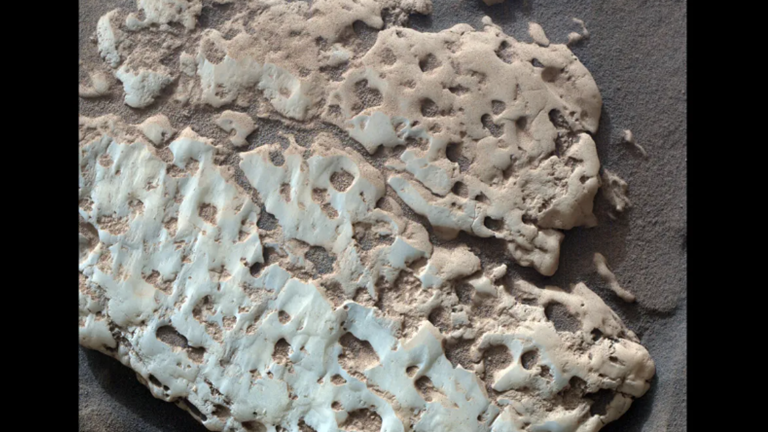
Named after a Grand Canyon waterfall, Cheyava Falls measures 3.2 feet by 2 feet. The rock's white calcium sulfate veins and reddish bands suggest the presence of hematite, a mineral that contributes to Mars's distinctive rusty hue. Closer inspection revealed millimetre-sized off-white splotches surrounded by black material, akin to leopard spots. These black halos contain both iron and phosphate, as determined by the rover's PIXL (Planetary Instrument for X-ray Lithochemistry) instrument.
David Flannery, an astrobiologist from Queensland University of Technology and a member of the Perseverance science team, explained, "On Earth, these types of features in rocks are often associated with the fossilized record of microbes living in the subsurface."
Copyright 2024 Cover Media. Distributed by Tribune Content Agency, LLC.
Signs of Ancient Life on Mars? Here’s What We See in This Intriguing Rock #Shorts
NASA’s Perseverance rover has made very compelling observations in a Martian rock that, with further study, could prove that life was present on Mars in the distant past – but how can we determine that from a rock, and what do we need to do to confirm it?
Morgan Cable, a scientist on the Perseverance team, takes a closer look.
Recent observations of Venus have yielded new evidence of a compound in its atmosphere that could indicate the presence of life, according to findings that potentially lend weight to controversial past discoveries.
Phosphine, a toxic gas that astrobiologists have proposed could be associated with the presence of life on rocky planets, was initially detected in Venus’s atmosphere in a surprise discovery four years ago. Now, new observations potentially strengthen those past findings, hinting at the presence of biosignatures that, if confirmed, could mean life forms are able to thrive in the planet’s harsh environment.
A CONTROVERSIAL DISCOVERY ON VENUS
The initial detection of phosphine in Venus’s oxidized atmosphere was reported in September 2020, when a team of scientists led by Jane Greaves of Cardiff University said they had found evidence of the toxic molecule. The discovery initially led to debate over the possibility that life could exist on Venus, since phosphine is normally associated with organisms that thrive in low-oxygen environments.
The team’s announcement received considerable media attention, and also led to controversy that culminated in rebukes from some in the scientific community. Arguably, the sharpest criticism was leveled by the organizing committee of the International Astronomical Union (IAU) Commission F3 on Astrobiology, who even questioned the ethics of Greaves and her team over the manner in which the discovery was revealed.
“It is an ethical duty for any scientist to communicate with the media and the public with great scientific rigour and to be careful not to overstate any interpretation which will be irretrievably picked up by the press,” the commission wrote in an official statement released at the time.
The commission added it “would like to remind the relevant researchers that we need to understand how the press and the media behave before communicating with them.”
Initial follow-up attempts to detect the compound again were unsuccessful. However, last year, Greaves and her team succeeded in detecting phosphine in deeper portions of the planet’s atmosphere during observations made with the James Clark Maxwell Telescope (JCMT) at Mauna Kea Observatory, Hawaii. Additional detections with NASA’s Stratospheric Observatory for Infrared Astronomy (SOFIA) also suggested the presence of phosphine, which may originate either within or from below the clouds on Venus.
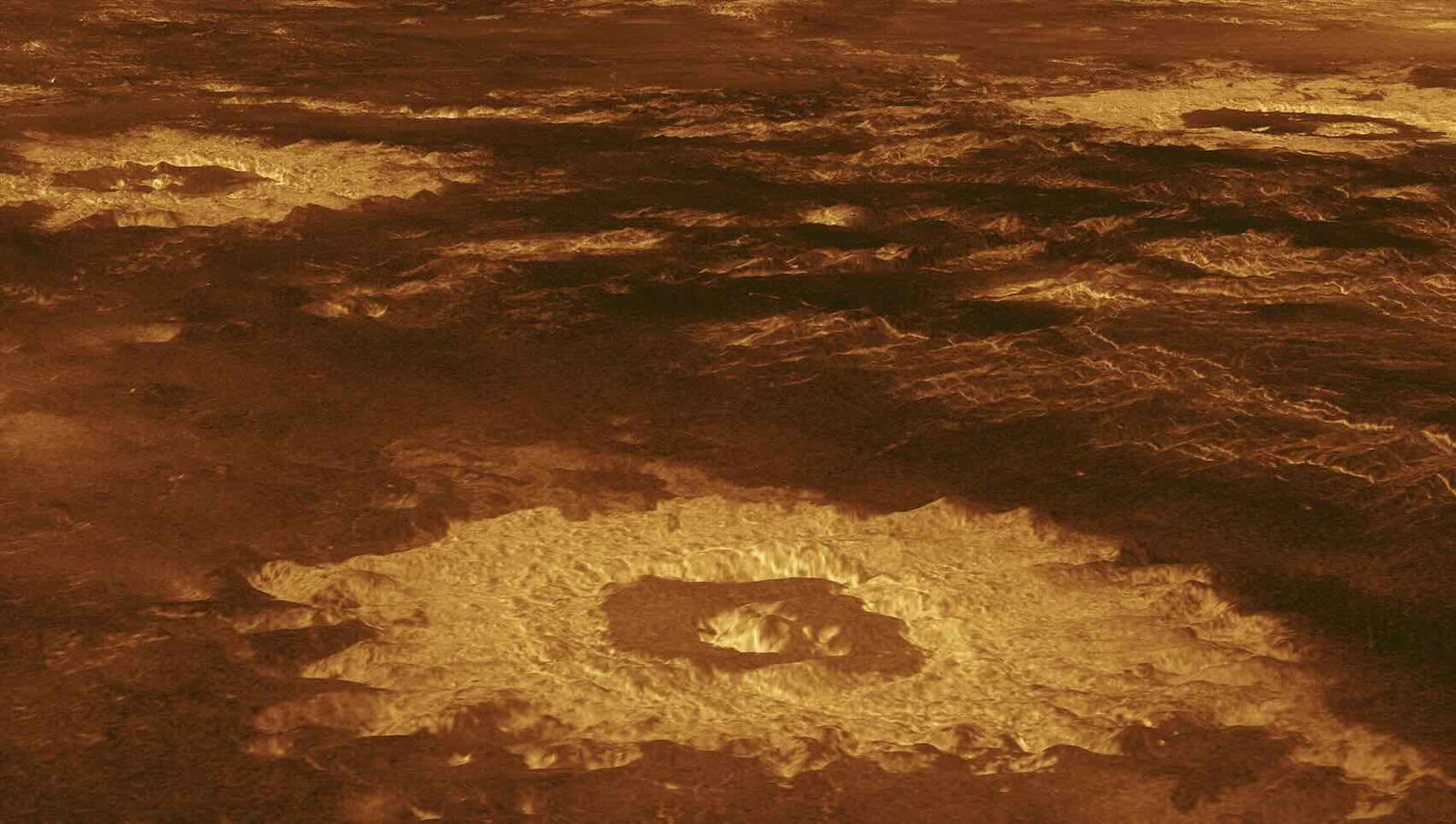
Craters seen in false color on the surface of Venus, where the presence of phosphine and ammonia could potentially point to the existence of life forms that may thrive in the planet’s inhospitable climate
(Credit: NASA).
Intriguingly, a separate research effort led by Rakesh Mogul with California State Polytechnic University reanalyzed data obtained by NASA’s Pioneer Venus Large Probe in 1978, revealing additional support for the presence of phosphine in the planet’s atmosphere that appeared to match the earlier findings.
“To date, our analyses remain unchallenged in the literature,” Mogul said of his team’s findings, which he characterized as being “in sharp contrast to the telescopic observations” made by Greaves and her colleagues, which Mogul said “remain controversial.”
NEW FINDINGS STILL WARRANT CAUTION
With the aid of a new receiver installed on the James Clerk Maxwell Telescope, Greaves and her colleagues now say they have collected as much as 140 times more data than previous observations yielded, which include additional detections of phosphine. The new findings were revealed in a pair of presentations by Greaves and David Clements, a researcher at Imperial College London who was involved with the discovery, on July 17 during a meeting of the Royal Astronomical Society.
However, of even greater potential interest in the search for possible life forms on Venus is evidence that ammonia is present in its atmosphere, which Clements has called “more significant than the discovery of phosphine.” Notably, the 2021 study by Mogul and his colleagues also determined that ammonia could potentially exist in Venus’s atmosphere.
Despite the potential significance of the discovery, during Greaves’s talk at the Society’s meeting earlier this month, a slide in her presentation emphasized that there are “many significant unknowns about the Venusian surface and atmosphere,” adding that “even a ‘gold standard’ discovery of two bio-associated molecules is not evidence that life is extant!”
Similarly, Clements told CNN that it would be premature to speculate that these gases point to the existence of life on Venus, although he conceded that the presence of ammonia along with phosphine certainly strengthens that possibility.
PROMISING PRELIMINARY FINDINGS
While cautioning against premature conclusions, Greaves explained during her presentation this month that there is at least a possibility that any organisms present on Venus could produce ammonia to help reduce the environment’s acidity and thereby make it more habitable. If this were the case, Greaves and her colleagues speculate that the gas could have potentially risen into the atmosphere, allowing its detection.
“The ammonia was detected in the upper clouds, where temperatures are -15°C or less and it is likely too cold for life to exist,” read a posting on the official X account of the Royal Astronomical Society summarizing Greave’s presentation.
“Researchers want to see if the molecule is also present deeper in Venus’s clouds, where it is much warmer,” it added.
Going forward, additional corroboration will be required, which might be obtained in one of several ways. One possibility includes data that could be collected by NASA’s Deep Atmosphere Venus Investigation of Noble gases, Chemistry, and Imaging (DAVINCI) mission, which will dispatch a probe into Venus’s harsh environment to measure its atmosphere in 2029.
Another potential chance to take measurements of the planet’s atmosphere could be afforded by the European Space Agency’s Jupiter Icy Moons Explorer, which will pass close to Venus next year and is equipped with instruments that could potentially obtain useful data that may complement the findings by Greaves and her colleagues.
Until that data is obtained, however, the new findings remain inconclusive, albeit promising.
“Again, it’s important to stress these are preliminary findings,” the Society said in its posting on X.
SpaceX returns to flight following Falcon 9 mishap investigation
SpaceX returns to flight following Falcon 9 mishap investigation
Story by Andrew Wulfeck
KENNEDY SPACE CENTER, Fla. – Two weeks after a leak doomed the deployment of Starlink satellites,SpaceXwas back in flight Saturday, with the release of nearly two dozen devices designed to expand broadband internet access around the world.
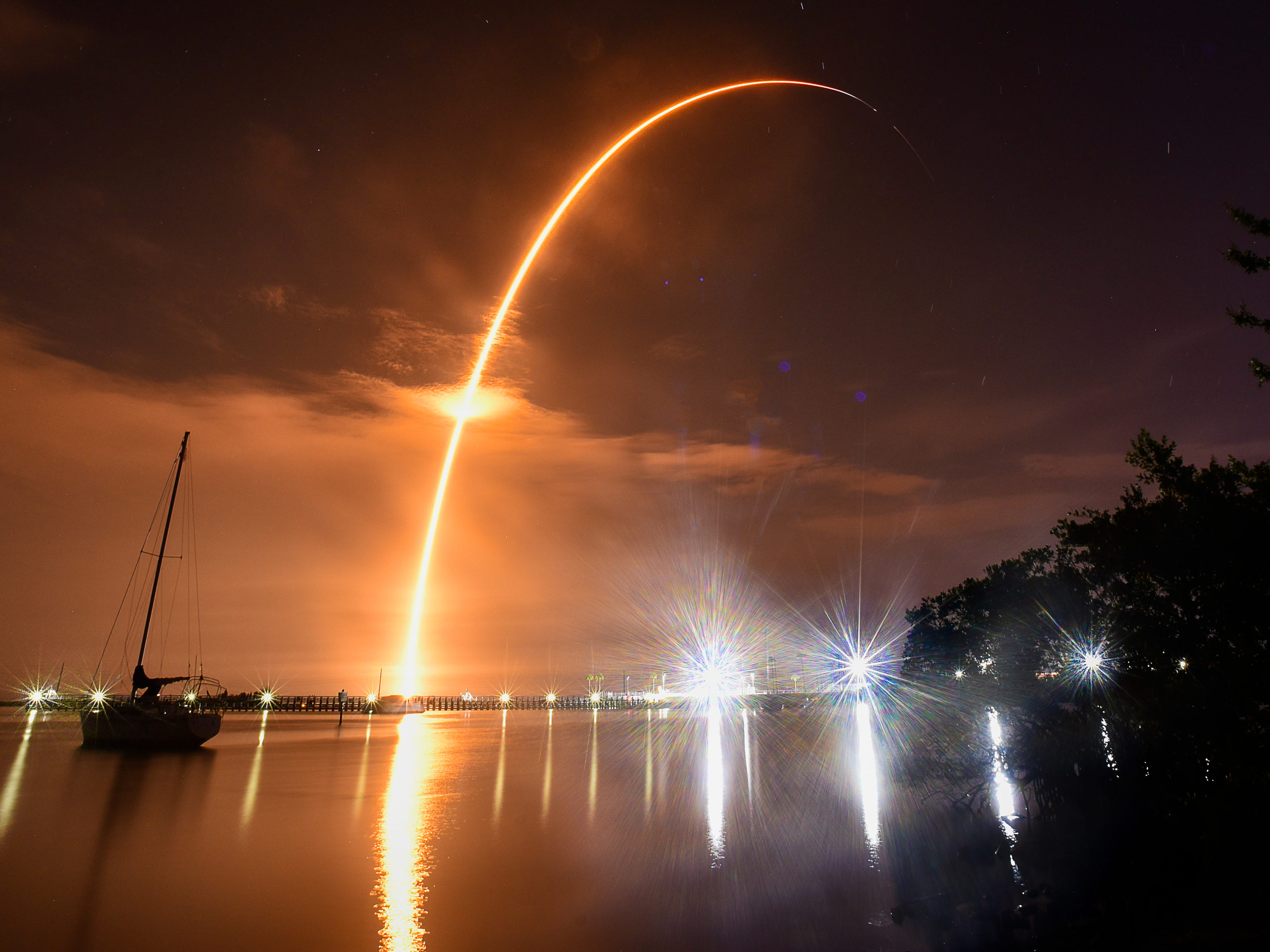
A SpaceX Falcon 9 rocket launches from Cape Canaveral Space Force station.
The Falcon 9 rocket took off from Launch Complex 39A at Florida’s Kennedy Space Center at 1:45 a.m. local time.
The launch was successful by all accounts, but space watchers were closely monitoring the moments surrounding payload deployment to see if the private space company would encounter issues similar to those of its July 11 mission.
During the previous mission, launch cameras showed a buildup of ice around an engine that prevented the successful deployment of satellites into orbit.
During the less than two-week-long review, SpaceX engineers identified a line for a sensor that was cracked, which they said led to the failure.
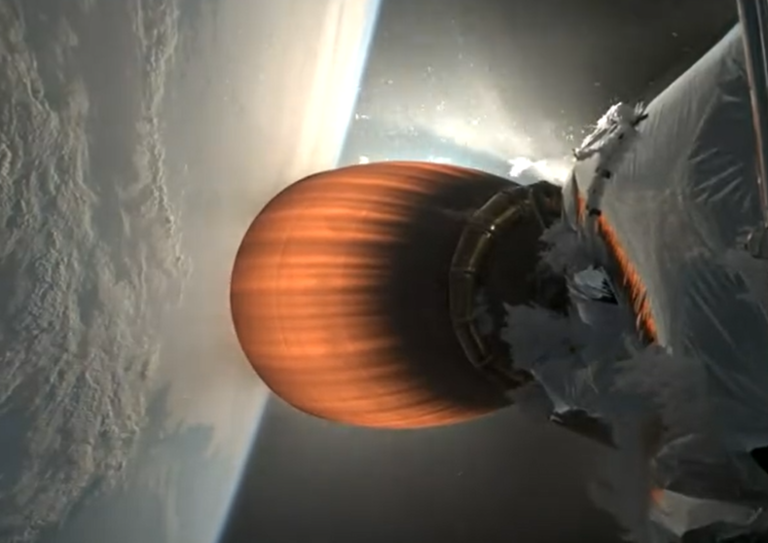
"During the first burn of Falcon 9’s second stage engine, a liquid oxygen leak developed within the insulation around the upper stage engine," SpaceX said regarding its mishap report to the FAA. "The cause of the leak was identified as a crack in a sense line for a pressure sensor attached to the vehicle’s oxygen system. This line cracked due to fatigue caused by high loading from engine vibration and looseness in the clamp that normally constrains the line."
The results were satisfactory enough for the government agency to approve the private space company’s return to flight, and less than 48 hours later, a Falcon 9 rocket was back in the air.
SpaceX did not report any anomalies with Saturday’s launch, which was the 50th of the year devoted to the Starlink program.
The company has around 6,000 satellites in low-Earth orbit that provide customers with ground terminal receivers access to high-speed internet.
A standard service will cost a residential customer about $120 a month, but packages listed on the company’s website run upwards of $5,000.
The company has gained international recognition for donating terminals to victims in disaster zones, such as in Florida after Hurricane Ian and flooding in South America.
SpaceX has scheduled at least five additional rocket launches over the next two weeks to deploy more Starlink satellites.
The schedule is part of the runup for what could be the launch of Crew-9 from Florida’s Space Coast in late August or early September.
NASA recently held a news conference where managers stated that all systems were a go for a crew of three astronauts and one Russian cosmonaut to launch in a Dragon spacecraft to the International Space Station for what is expected to be a six-month mission.
The space agency has been closely monitoring the review of the Falcon 9 rocket but said that nothing has arisen to a level that would require delaying the Crew-9 mission beyond the upcoming launch window.
SpaceX launches Starlink 10-9 mission from Cape Canaveral in Florida
SpaceX Falcon 9 fleet returns to flight on Starlink 10-9 mission at 1:45 a.m. Saturday, July 27, from NASA's Kennedy Space Center in Florida.
Launch off a SpaceX Falcon 9 rocket on Starlink 10-9 mission to launch Starlink satellites. Rocket launched from Pad 39A at Kennedy Space Center at1:45 a.m. EDT Saturday, July 27th.Show less
Public domain / ESA & MPS for OSIRIS Team MPS/UPD/LAM/IAA/RSSD/INTA/UPM/DASP/IDA/Wikimedia commons - CC BY-SA 3.0 igo
NASA's Perseverance rover zet zijn missie op Mars voort op zoek naar bewijs dat de oude aanwezigheid van buitenaards leven op de rode planeet zou kunnen onthullen: er komt een opzienbarende nieuwe ontdekking.
Perserverance vindt een pijlvormige rots op Mars
Een vreemde rots, waarvan de vorm lijkt op de punt van een pijl, heeft de aandacht getrokken van NASA's Perseverance rover, op een missie naar Mars om te zoeken naar tekenen van buitenaards leven. Hoewel het bestaan van marsmannetjes nog niet is aangetoond, zijn er wel elementen naar voren gekomen die hun aanwezigheid op de rode planeet miljarden jaren geleden zouden kunnen bewijzen.
De Amerikaanse ruimtevaartorganisatie maakte dit bekend nadat Perseverance een rots had ontdekt die bedekt was met vlekken en rijk was aan “aderen”. Wetenschappers hebben deze rots een speciale naam gegeven, Cheyava Falls, naar een van de watervallen van de Grand Canyon. Maar wat is er zo bijzonder aan en waarom zou het bewijs kunnen leveren van buitenaards leven op Mars, dat ooit bewoonbaar kan zijn geweest?
Gesteente op Mars bedekt met vlekken: mogelijke sporen van fossiel leven
Cheyava Falls lijkt organische verbindingen te bevatten en dit zou kunnen wijzen op sporen van microbieel leven uit de tijd dat er water was op Mars. Perseverance vond de rots in het noordelijke deel van de Neretva-vallei, waar in het verleden een rivier stroomde die uitmondde in de Jezero-krater. "Deze “luipaardvlekken” op een rots op Mars zijn aanwijzingen voor waarschijnlijk de beste tekenen van oeroud microbieel leven die we tot nu toe op Mars hebben gevonden. Om het zeker te weten, moeten we het gesteente bestuderen in laboratoria op aarde", staat te lezen in het X-profiel van NASA's Jet Propulsion Laboratory.
De route van de rover, zoals uitgelegd door de Associate Administrator voor het Directoraat Wetenschapsmissies, Nicola Fox, was ontworpen om ervoor te zorgen dat hij de gebieden van Mars kan bereiken waar zich vermoedelijk de meest interessante wetenschappelijke monsters bevinden. "Deze reis door de rivierbedding van de Neretva Vallis heeft zijn vruchten afgeworpen, omdat we iets hebben ontdekt dat we nog nooit eerder hadden gezien en dat onze wetenschappers veel te bestuderen zal geven."
Nieuw bewijs van leven op Mars: verzamelde monsters
Perseverance van zijn kant "verklaarde" op zijn X-profiel: "Ik kwam naar Mars met een taak om uit te voeren: het vinden en bemonsteren van de beste rotsen voor toekomstige studies in laboratoria op Aarde. Ik zal deze speciale rotskern, en de andere in mijn collectie, veilig bewaren totdat er een toekomstige missie komt om ze naar de Aarde te brengen voor verdere studie."
De rots, die 90 cm bij 60 cm meet, verschilt van andere roodgekleurde rotsen die op Mars zijn gevonden door de vele zwarte en witte vlekken die erop zitten. De zwarte delen bevatten fosfaat en ijzer, net als aardse gesteenten waarop gefossiliseerd microbieel leven is gevonden. Juist dit heeft de hoop van wetenschappers aangewakkerd om misschien het leven van microben op Mars te kunnen bevestigen, hoewel we voor een definitief antwoord zullen moeten wachten tot de monsters over een paar jaar naar onze planeet terugkeren.
"On Earth, these types of features in rocks are often associated with the fossilized record of microbes living in the subsurface."
NASA's Perseverance rover has discovered a rock on Mars that may have once hosted microbial life. The rock, nicknamed Cheyava Falls, has chemical compositions and structures that could have been formed by ancient life, although non-biological processes cannot yet be ruled out.
(Image credit: NASA/JPL-Caltech/MSSS)
NASA's Perseverance rover may have found signs of ancient life in a rock on Mars; the mission team's scientists are ecstatic, but remain cautious as further analysis is needed to confirm the discovery.
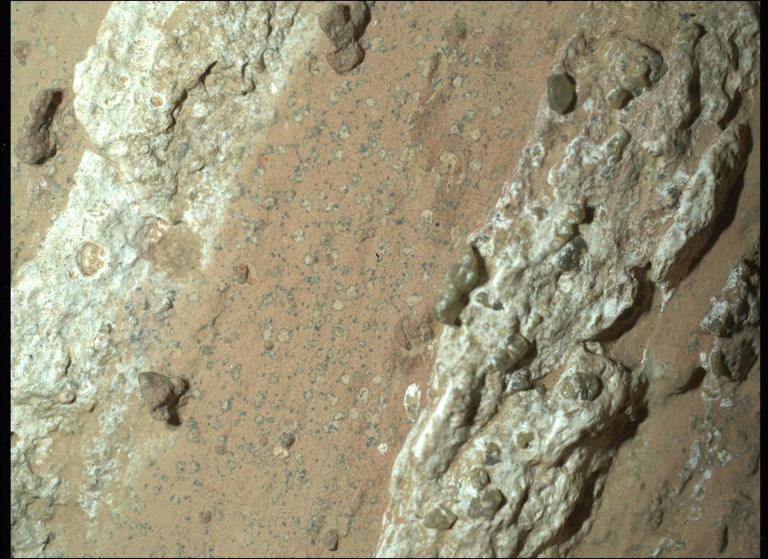
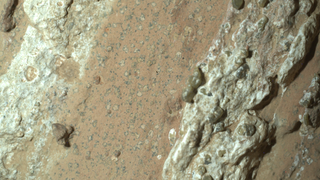
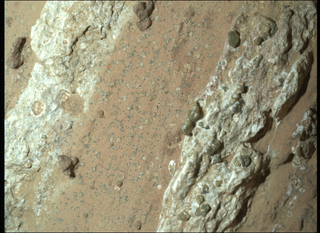
The rover has come across an intriguing, arrowhead-shaped rock that hosts chemical signatures and structures that could have been formed by microbial life billions of years ago, when Mars was significantly wetter than it is today. Inside the rock, which scientists have nicknamed "Cheyava Falls," Perseverance's instruments detected organic compounds, which are precursors to the chemistry of life as we know it. Wisping through the length of the rock are veins of calcium sulfate, which are mineral deposits that suggest water — also essential for life — once ran through the rock.
The rover also found dozens of millimeter-sized splotches, each surrounded by a black ring and mimicking the appearance of leopard spots. These rings contain iron and phosphate, which are also seen on Earth as a result of microbe-led chemical reactions.
"These spots are a big surprise," David Flannery, an astrobiologist and member of the Perseverance science team from the Queensland University of Technology in Australia, said in a statement. "On Earth, these types of features in rocks are often associated with the fossilized record of microbes living in the subsurface."
A better look at the exciting rock detected by Perseverance. (Image credit: NASA/JPL-Caltech/MSSS)
"We've never seen these three things together on Mars before," Morgan Cable, a scientist on the Perseverance team, said in a video NASA posted to YouTube today (July 25).
Cheyava Falls sits at the edge of an ancient, 400-meter-wide (437-yard-wide) river valley named Neretva Vallis. Scientists suspect this ancient channel was carved out long ago due to water gushing into Jezero Crater; Neretva Vallis runs along the inner wall of this region. In one possible scenario, mud that already possessed organic compounds got dumped into the valley and later cemented into the Cheyava Falls rock, which Perseverance sampled on July 21. A second episode of water oozing into the formed rock would have created the object's calcium sulfate veins and black-ringed spots the team sees today.
To be clear, the rock's visible features aren’t irrefutable evidence of ancient microbial life on Mars — not yet, at least. It is possible, for instance, that the observed calcium sulfate entered the rock at uninhabitably high temperatures, perhaps during a nearby volcanic event. However, whether such non-biological chemical reactions could have resulted in the observed black-ringed spots is an open question, the scientists say.
"This trip through the Neretva Vallis riverbed paid off as we found something we've never seen before, which will give our scientists so much to study," Nicola Fox, the associate administrator of NASA's Science Mission Directorate, said in the statement.
"We have zapped that rock with lasers and X-rays and imaged it literally day and night from just about every angle imaginable," Ken Farley, Perseverance project scientist of Caltech in California, said in the statement. "Scientifically, Perseverance has nothing more to give."
To fully grasp what really unfolded in the ancient river valley billions of years ago, scientists are keen to get the Cheyava Falls sample to Earth, where it can be scrutinized with powerful instruments that Perseverance’s limited suite doesn't have.
The complex Mars Sample Return effort, however, has run into many snags in recent months after its costs spiked to $11 billion. In its current form, the program requires multiple launches to Mars to place a vehicle on the Red Planet, after which either Perseverance will travel to the vehicle and drop off its collected samples, or pop those samples over to a retrieval helicopter that can complete the handoff. Then, an ascender would launch the samples into orbit, where a spacecraft would collect them and return them to Earth.
NASA assessed various simpler alternatives from industry and academic groups and awarded $1.5 million contracts to seven companies looking into the endeavor; three of the agency's own research centers are carrying out studies as well.
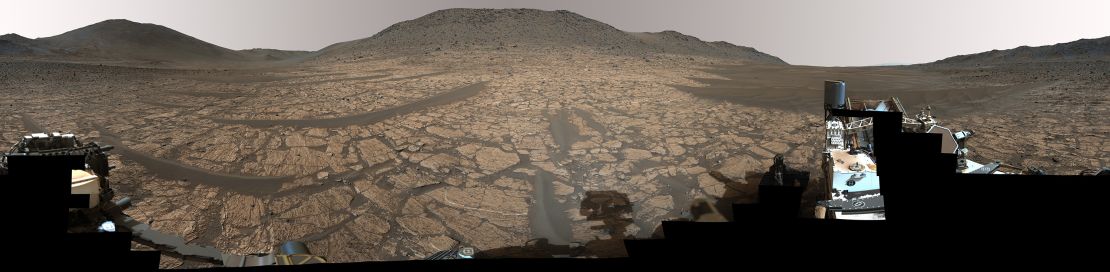
Perseverance rover captured a 360-degree panorama of a region on Mars called “Bright Angel,” where a river flowed billions of years ago.
NASA/JPL-Caltech/ASU/MSSS
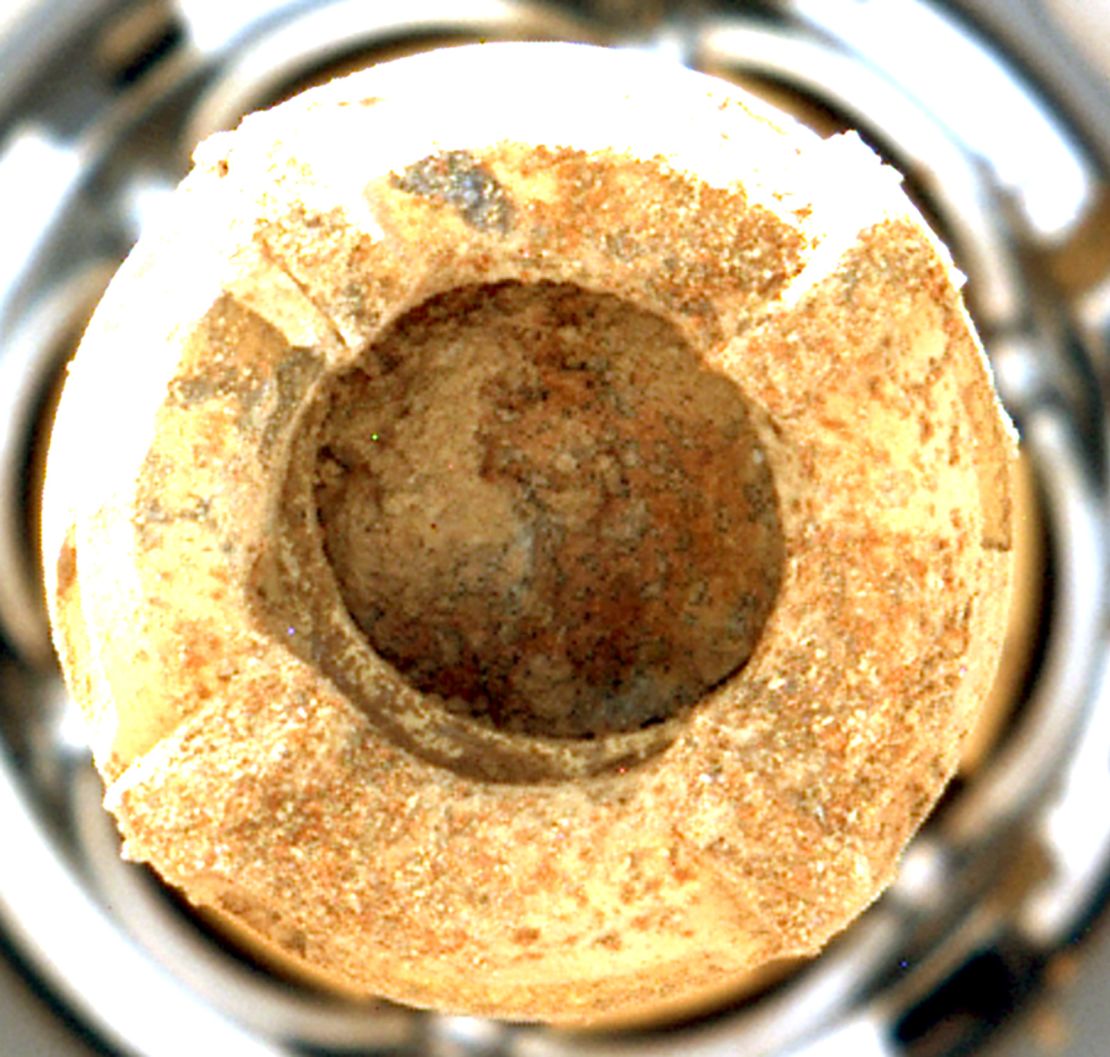
Perseverance collected a sample of the Cheyava Falls rock on July 21.
NASA/JPL-Caltech/ASU/MSSS
Perseverance took this selfie, made up of 62 individual images, on July 23.
What are those lasers shooting out from telescopes? Can we build a space elevator? Could we grow plants in Mars regolith? Why not assemble telescopes in space? Answering all these questions and more in this week's Overtime Q&A.
New studies, which utilized AI to monitor the effects of climate change on Earth's spin, have shown that our days are getting increasingly longer and that our planet will get more wobbly in the future. These changes could have major implications for humanity's future.
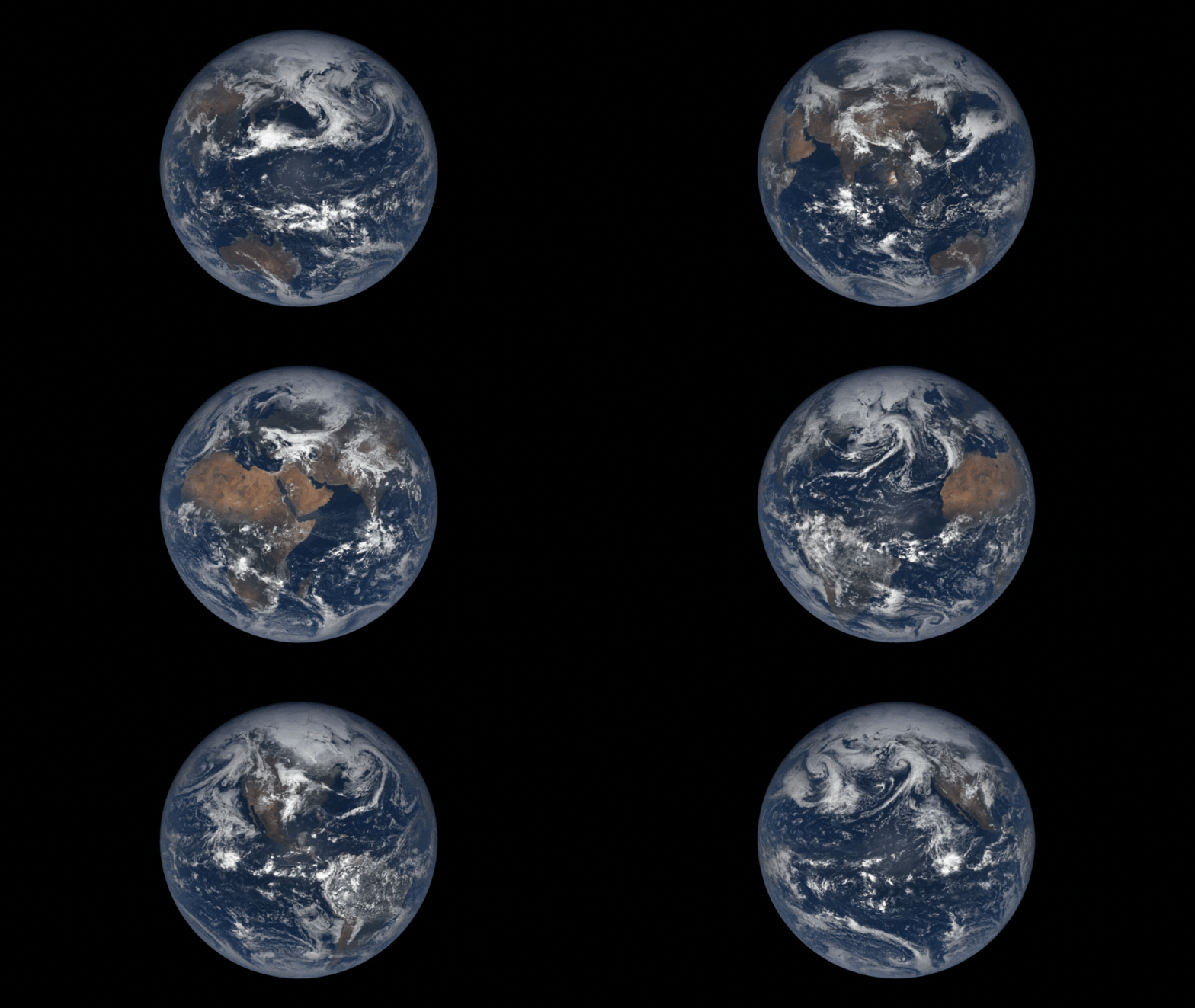
Earth moves much faster than it seems.
(Image credit: NASA)
The length of Earth's days and the orientation of our planet are being thrown out of balance as human-caused climate change continuously alters Earth's spin, new research suggests.
Initially, these changes will be imperceptible to us, but they could have serious knock-on effects, including forcing us to introduce negative leap seconds, interfering with space travel and altering our planet's inner core, researchers warn.
A day on Earth lasts about 86,400 seconds. But the exact time it takes our planet to complete a single rotation can shift by tiny fractions of milliseconds every year due to a number of factors, such as tectonic plate movements, changes to the inner core's rotation and gravitational tugging from the moon.
However, human-caused climate change is another factor that can alter the length of our days, and scientists are just starting to realize how much this will affect our planet's spin in the coming years.
Over the past few decades, the rate of ice loss from Earth's polar regions, particularly Greenland and Antarctica, has been increasing rapidly due to global warming, leading to rising sea levels. Most of this extra water accumulates near the equator, causing our planet to bulge slightly around the middle. This, in turn, slows the planet's spin because more weight is distributed farther away from the planet's center — similar to how spinning figure skaters slow down by moving their arms away from their bodies.
In the new study, published July 15 in the journal PNAS, researchers used an advanced artificial intelligence program that combines real-world data with the laws of physics to predict how the planet's spin will change over time.
Global warming has triggered sea level rises, which are impacting Earth's rotation. (Image credit: Getty Images)
The results back up a similar study published in March, which suggested that Earth's days will get longer in the future. However, the new program offered much more precise estimates of how days will lengthen over time.
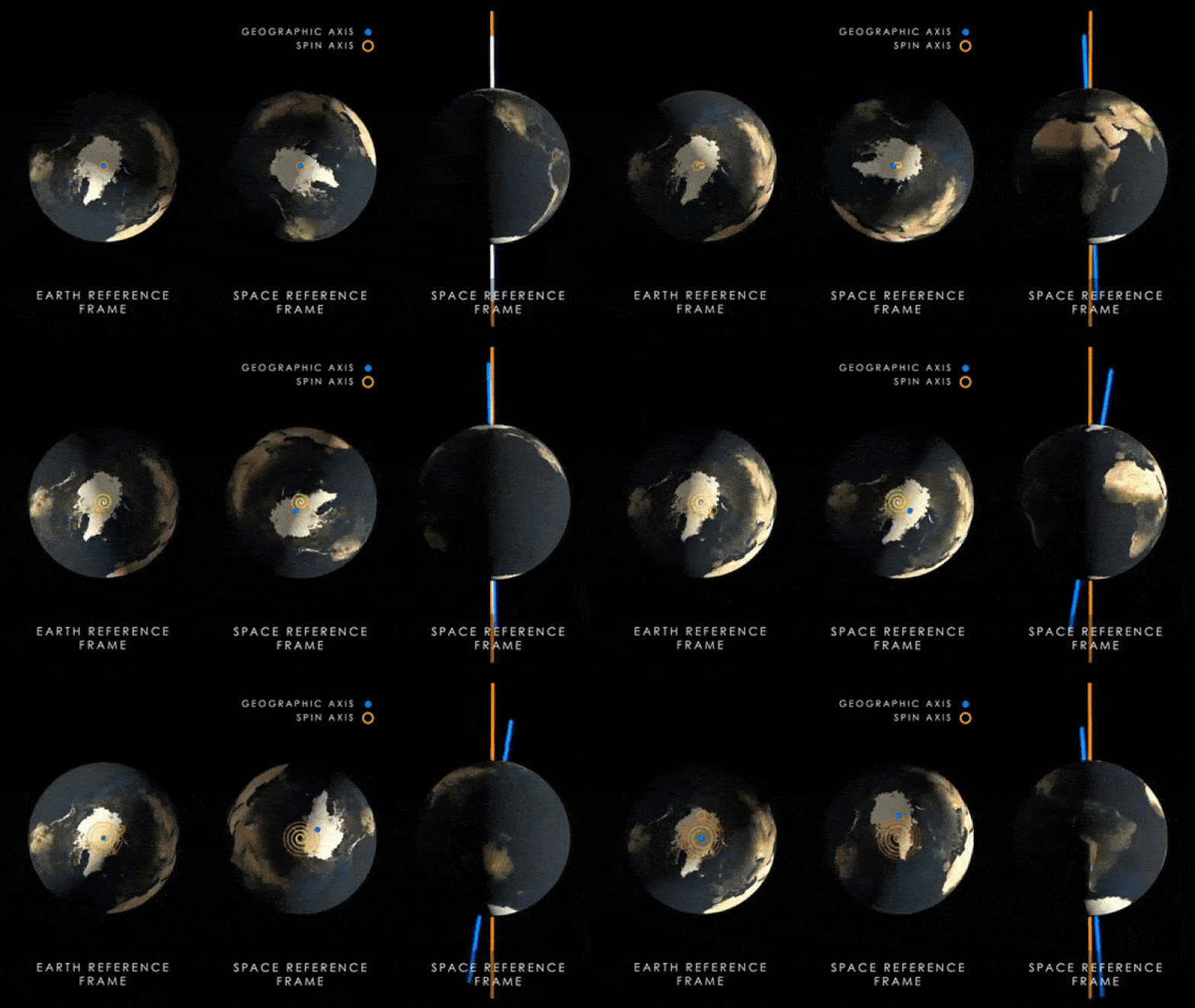
The same research team behind the new paper also released another study, published July 12 in the journal Nature Geoscience, which showed that the increased water near the equator is moving Earth's axis of rotation. This is making the magnetic poles wobble farther away from the axis every year.
Scientists previously found that this effect has likely been happening for at least the past three decades. However, the new study suggests the axis will move even farther from its current position than previous studies predicted.
"We humans have a greater impact on our planet than we realise," Benedikt Soja, a geodesist at ETH Zurich in Switzerland who was a co-author on both the new studies, said in a statement. "And this naturally places great responsibility on us for the future of our planet."
Earth's magnetic poles (blue) will begin to wobble around the planet's spin axis (yellow) as the latter begins to move as a result of climate change. (Image credit: ETH Zurich)
But in general, Earth's rotation has been slowing for millennia, mainly due to a process known as lunar tidal friction, in which the moon's gravitational effect on our oceans pulls water away from the poles. At the moment, this effect is lengthening our days by around 2.3 milliseconds every century.
The new studies show that climate change is currently lengthening our days by around 1.3 milliseconds every century. However, based on current global temperature models, the researchers predict that this could increase to 2.6 milliseconds per century by the end of the 21st century, which would make climate change the biggest influence on our planet's spin.
Potential impacts
Any changes to Earth's spin will have to be accounted for during space travel, researchers say. (Image credit: Getty Images)
One of the most likely effects of longer days would be the need to introduce negative leap seconds — where we'd occasionally lose a second from some future days to accommodate the lengthening days, similar to how leap years work.
The March study suggests that this may need to start happening as soon as 2029, mainly to accommodate for how much the days have already lengthened over the past few millennia.
In the past, scientists have suggested this introduction could mess with the timekeeping of computers and smartphones. However, not everyone is convinced this will be a major issue.
The researchers of the new studies also noted that future changes could impact space travel.
"Even if the Earth's rotation is changing only slowly, this effect has to be taken into account when navigating in space — for example, when sending a space probe to land on another planet," Soja said. It is therefore important to monitor these changes closely, he added.
The team also warned that the changes to Earth's rotational axis could alter the rotation of Earth's inner core, which could further increase how fast days lengthen. However, this potential interaction is still largely unknown.
Beneath the skin of Mercury, the smallest planet in our solar system, expect the unexpected. Reaching out across the cosmos with this fascinating revelation is a new study that points to a 9-mile-thick layer of diamonds concealed beneath the planet's surface.
While instance of such valuable encrustation might sound tantalizing, turning these precious stones into fashionable jewelry remains an impossibility due to their inaccessible location deep within the planet.
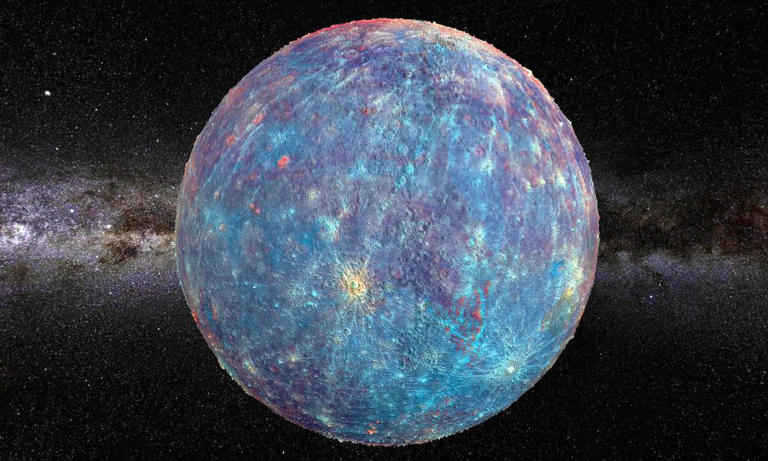
Mercury, seen in this false-color image, may have a deep layer of inner diamonds, new research finds.
(Image credit: NASA/Johns Hopkins University Applied Physics Laboratory/Carnegie Institution of Washington)
However, these gems could hold the key to unraveling some of the big unanswered questions circling around Mercury' composition and its rather curious magnetic field.
Oddly enough, for a planet its size, Mercury has a magnetic field. It is weaker than its Earth counterpart, but is still intriguing considering the planet's overall inactivity in geological terms.
What truly sparked Lin's interest, however, were the unusually dark patches on the surface of Mercury that were identified as graphite by NASA's Messenger mission.
Related video:
This planet has huge deposits of diamonds, reveals study (India Today)
This revelation triggered exploration into the possibility of something unique brewing within the planet's interior.
Birth of Mercury's diamond layer
Utilizing a team comprised of Chinese and Belgian researchers, Lin sought to explore the possibility of diamond formation deep in Mercury's core.
The team began by creating chemical mixtures that replicated Mercury's magma ocean. The concoction included iron, silica, and carbon, elements similar to certain kinds of meteorites, and was subjected to crushing pressures and extreme temperatures.
The team's rigorous experiments and computer simulations confirmed that Mercury's mantle would indeed be conducive to forming diamonds, especially under the revised conditions that the team established.
If these diamonds do exist, they could form a 9-mile average thick layer at the core-mantle boundary of Mercury, which is approximately 300 miles below the surface.
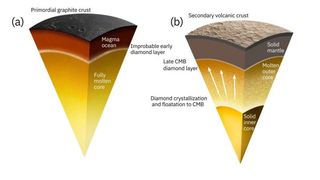
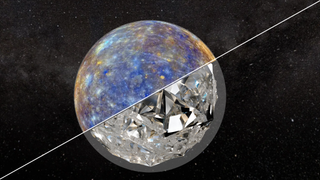
A diagram showing the proposed layer of diamond at Mercury's core-mantle boundary.
(Image credit: Dr. Yanhao Lin and Dr. Bernard Charlier)
Mercury's magnetism
The hypothesized existence of this layer of diamonds is more than just an intriguing fact. It could potentially explain the origin of Mercury's magnetic field.
These diamonds may facilitate heat transfer between the core and mantle, thereby creating temperature differences and causing liquid iron to circulate – a process that would kickstart the creation of a magnetic field.
Implications for future research
The discovery of a potential diamond layer within Mercury opens new avenues for planetary research and composition studies not only of Mercury but also of other celestial bodies.
Understanding the unique geological characteristics of Mercury could provide deeper insight into the formation and evolution of the solar system.
Future missions to Mercury may focus on directly exploring its interior structure through advanced geophysical measurements and remote sensing techniques to verify the existence of this diamond layer and its impact on the planet's magnetic field.
Mercury as seen by the MESSENGER spacecraft. Although easily the darkest of the planets, Mercury may have a sparkling layer deep inside.
Image Credit: NASA/Johns Hopkins University/Hopkins University Applied University Applied Physics Laboratory/Carnegie Institution of Washington
Planetary formation and Mercury's diamonds
This revelation also prompts a reconsideration of the processes involved in planetary formation.
Diamonds are typically associated with high-pressure environments, suggesting that similar conditions may exist in other distant rocky exoplanets and moons within our solar system.
Lin and his team's findings underline the importance of studying extreme planetary conditions, which can reveal not only the composition of these bodies but also the historical processes that formed them, leading to a more comprehensive understanding of geology across the cosmos.
Evolution of exoplanets
The potential discovery casts a new light on the evolution of carbon-rich exoplanets. According to Lin, the process that led to the formation of a diamond layer on Mercury could also be at play on other planets, possibly leaving similar traces.
The arrival of the BepiColombo spacecraft, a joint mission of the European Space Agency and the Japan Aerospace Exploration Agency, in 2025 will provide better opportunities to delve deeper into this intriguing discovery.
Mercury, it seems, continues to dazzle us with new surprises, keeping the scientific community and general public on their toes.
Who'd have thought that this small, seemingly quiet planet could hold such vast volumes of precious stones deep within its confines?
Marsrobot ontdekt verrassend (en bij toeval) pure zwavel: "Een oase in de woestijn, we kunnen dit niet verklaren"
Marsrobot ontdekt verrassend (en bij toeval) pure zwavel: "Een oase in de woestijn, we kunnen dit niet verklaren"
Artikel door Michaël Torfs
Curiosity bevindt zich sinds oktober 2023 in een gebied op Mars dat rijk is aan sulfaten, een mengeling van zout- en zwavelresten die gevormd worden wanneer water verdampt. Maar de jongste ontdekking is iets helemaal anders, en kwam als een echte verrassing.
Geen mengvorm, maar pure zwavelkristallen
Toen Curiosity over een steen reed, barstte die open als een noot. Er kwamen gele zwavelkristallen tevoorschijn: geen mengeling van zwavel met andere elementen, maar het pure spul. We associëren zwavel met de typische geur van rottende eieren, maar volgens de NASA is de pas ontdekte, pure zwavel geurloos.
Er is mogelijk nog veel meer pure zwavel aanwezig, want in de buurt liggen nog verschillende gelijkaardige stenen. Dat stelt wetenschappers voor vragen, want ze dachten niet dat er zich op die plek op Mars ooit zwavel zou hebben gevormd.
"Een veld vinden met stenen gemaakt uit puur zwavel, is zoals een oase in de woestijn vinden", vertelt Ashwin Vasavada van de NASA. "Het zou daar niet moeten liggen, dat veld, dus nu moeten we proberen om een verklaring te vinden. Het ontdekken van onverwachte en rare dingen maakt het verkennen van de ruimte zo opwindend."
De ontdekking gebeurde in het kanaal van Gediz Vallis, een bedding aan de voet van de 5 kilometer hoge Mount Sharp. Ooit moet daar water door gestroomd hebben, zeggen specialisten. Maar er is nog veel onderzoek nodig om te begrijpen hoe het landschap er zich precies heeft gevormd. De jongste ontdekking maakt die uitdaging nog wat groter.
Curiosity maakte een close-up van een witte steen, gelijkaardig aan degene die onlangs openbarstte. Er ligt in de buurt een heel veld.
Venus is known for being really quite inhospitable with high surface temperatures and Mars is known for its rusty red horizons. Even the moons of some of the outer planets have fascinating environments with Europa and Enceladus boasting underground oceans. Recent observations from the James Webb Space Telescope show that Ariel, a moon of Uranus, is also a strong candidate for a sub surface ocean. How has this conclusion been reached? Well JWST has detected carbon dioxide ice on the surface on the trailing edge of features trailing away from the orbital direction. The possible cause, an underground ocean!
Uranus is the seventh planet in the Solar System and has five moons. Ariel is one of them and is notable for its icy surface and fascinatingly diverse geological features. It was discovered back in 1851 by William Lassell who funded his love of astronomy from his brewing business! The surface of Ariel is a real mix of canyons, ridges, faults and valleys mostly driven by tectonic activity. Cryovolcanism is a prominent process on the surface which drives constant resurfacing and has led to Ariel having the brightest surface of all Uranus’ moons.
Image of Uranus from Webb
Studying Ariel closeup reveals that the surface is coated with significant amounts of carbon dioxide ice. The trailing hemisphere of Ariel seems to be particularly coated in the ice which has surprised the community. At the distance of Uranian system from the Sun, an average of 2.9 billion kilometres, carbon dioxide will usually turns straight into a gas and be lost to space, it’s not expected to freeze!
Until recently, the most popular theory that supplies the carbon dioxide to Ariel’s surface is interactions between its surface and charged particles in the magnetosphere of Uranus. The process known as radiolysis breaks down molecules through ionisation. A new study just published in the Astrophysical Journal Letters suggests an intriguing alternative, the carbon dioxide molecules are expelled from Ariel, possibly from a subsurface liquid ocean!
A team of astronomers using JWST have undertaken a spectral analysis of Ariel and compared the results with lab based findings. The results revealed that Ariel has some of the most carbon dioxide rich deposits in the solar system. The deposits are not just wisps and trace amounts instead adding up to about 10 millimetres across the trailing hemisphere. Furthermore, the results also showed signals from carbon monoxide too which should not be there given the average temperatures.
Illustration of James Webb Space Telescope
It is still possible that radiolysis is responsible for at least some of the deposits but the replenishment from the subsurface ocean is thought to be the main contributor. This hypothesis has been supported by the discovery of signals from carbonate minerals, salts that can only be present due to the interaction between rock and water.
The only way to be absolutely sure is for a future space mission to Uranus. Such a mission will undoubtedly explore the moons of Uranus. Ariel is covered in canyons, fissures and grooves and it is suspected these are openings to its interior. A robotic explorer in the Uranian system will be able to uncover the origin of the carbon oxides on Ariel. Without such a mission we are still somewhat in the dark given that Voyager 2 only imaged around 35% of the moon’s surface.
Our Carbon Dioxide Emissions Have a Mesmerizing Side
Our CO2 emissions are warming the planet and making life uncomfortable and even unbearable in some regions. In July, the planet set consecutive records for the hottest day.
NASA is mapping our emissions, and while what they show us isn’t uplifting, it is visually appealing in a ghoulish way. Maybe the combination of visual appeal and ghoulishness will build momentum in the fight against climate change.
NASA’s Scientific Visualization Studio has released a video showing how wind and air currents pushed CO2 emissions around Earth’s atmosphere from January to March 2020. The video’s high-resolution zooms in and sees individual sources of CO2, including power plants and forest fires.
“As policymakers and as scientists, we’re trying to account for where carbon comes from and how that impacts the planet,” said climate scientist Lesley Ott at NASA’s Goddard Space Flight Center in Greenbelt, Maryland. “You see here how everything is interconnected by these different weather patterns.”
Credit: NASA’s Goddard Space Flight Center
The video starkly shows that it doesn’t matter where CO2 emissions come from; we all deal with the outcomes. Yet there are some interesting global differences.
Above the USA, South Asia, and China, most of the carbon comes from industry, power plants, and transportation. But over Africa and South America, most of the emissions come from burning, including forest fires, agricultural burning, and land clearing. Emissions also come from fossil fuels like oil and coal.
The image pulses for a couple of reasons. Forest fires tend to flare during the day and then slow down at night. Also, trees and plants photosynthesize during the day, releasing oxygen and absorbing CO2. The land masses and the oceans act as carbon sinks.
There’s more pulsing in South America and the tropics because the data was collected during their growing season.
In this version, the video zooms in on the USA, showing individual CO2 sources.
These visualizations are based on GEOS, the Goddard Earth Observing System. GEOS is an integrated system for modelling Earth’s coupled atmosphere, ocean, and land systems. NASA calls it a “high-resolution weather analysis model,” and it uses supercomputers to show what’s happening in the atmosphere. GEOS is based on billions of data points, including data from the Terra satellite’s MODIS and the Suomi-NPP satellite’s VIIRS instruments. GEOS has a resolution that’s more than 100 times greater than typical weather models.
NASA, ESA, CSA, STScI; J. DePasquale, A. Koekemoer, A. Pagan (STScI)
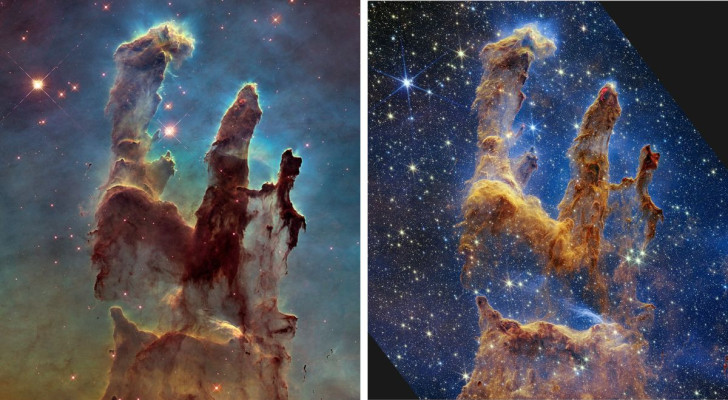
Er is niemand die de Pilaren der Creatie niet minstens één keer in zijn leven heeft gezien. Sinds ze beroemd zijn geworden door de Hubble ruimtetelescoop, heeft het buitengewone schouwspel van deze nevelachtige formaties astronomen en liefhebbers gefascineerd. Na de onthullingen van de James Webb Space Telescope heeft NASA een nieuwe voorstelling gepubliceerd waarmee het mogelijk is om de Pilaren der Creatie in 3D te verkennen. Laten we eens kijken hoe.
De Pilaren der Creatie, van Hubble tot JWST
De zogenaamde Pilaren der Creatie, die zich op ongeveer 7000 lichtjaar van de aarde bevinden, zijn nevelachtige formaties. Ze worden zo genoemd vanwege de visuele impact van eerst de weergave van Hubble en later JWST. Het zijn eigenlijk kolommen van gas en stof die na verloop van tijd bijdragen aan de vorming van nieuwe sterren.
De Pilaren der Creatie worden verlicht door het licht van nabije sterren, ook al bevindt de dichtstbijzijnde zich op zo'n 500 lichtjaar. Bovendien bestaan ze voornamelijk uit waterstof en helium en zijn ze ruim 5 lichtjaar lang. Hun lot is nauw verbonden met de vorming van nieuwe sterren, maar dat niet alleen: voortdurende stellaire winden botsen op deze nevel en eroderen de samenstellende elementen. Het duurt misschien “een paar” miljoen jaar voordat de Pilaren der Creatie ophouden te bestaan, tenminste in deze vorm.
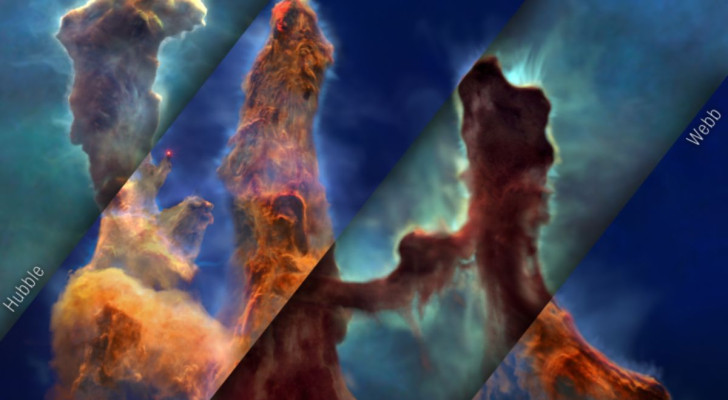
De nieuwe 3D-visualisatie van de Pilaren der Creatie
Greg Bacon, Ralf Crawford, Joseph DePasquale, Leah Hustak, Christian Nieves, Joseph Olmsted, Alyssa Pagan, and Frank Summers (STScI),
NASA's Universe of Learning
Zoals te zien is in de video die door NASA is gedeeld, maakt de nieuwe 3D-visualisatie van de Pilaren der Creatie het mogelijk om deze formaties als nooit tevoren te verkennen. Om tot deze weergave te komen, zijn gegevens van Hubble en James Webb gebruikt om meer detail te verkrijgen. Bovendien wordt in de video ruimte gegeven aan zowel de door Hubble verzamelde reconstructie in zichtbaar licht als de voor de JWST kenmerkende infraroodweergave. Volgens de experts die aan deze prestatie hebben bijgedragen, zullen alle mensen nu de Pilaren der Creatie kunnen verkennen:
We wilden de Pilaren der Creatie al heel lang in 3D nabootsen. Dankzij de Webb-gegevens in combinatie met de Hubble-gegevens konden we de pilaren gedetailleerder bekijken. Door de wetenschap te begrijpen en deze het beste weer te geven, kon ons kleine, getalenteerde team de uitdaging aangaan om deze iconische structuur te visualiseren.
Begrijpen hoe sterren worden gevormd, dankzij de weergave van de Pilaren
De combinatie van gegevens die zijn verkregen door de twee ruimtetelescopen Hubble en James Webb, respectievelijk in 1995 en 2022, heeft het mogelijk gemaakt om de Pilaren der Creatie te reconstrueren zoals niemand ze ooit heeft gezien. Maar dat is nog niet alles. Zoals Mark Clampin van NASA zich herinnert:
Het gebied van de Pilaren der Creatie blijft ons nieuwe inzichten bieden die ons begrip van de vorming van sterren kunnen verscherpen. En nu, met deze nieuwe visualisatie, kan iedereen dit rijke en fascinerende landschap op een nieuwe manier ervaren.
In de video zie je een nieuw gevormde ster, met zijn karakteristieke helderrode gloed in het infrarode licht van de JWST. Bovenaan de linkerpilaar is een diagonale straal te zien van materiaal dat afkomstig is van een andere, eveneens pas ontstane ster. Afgezien van de gegevens die zijn gebruikt voor de 3D-reconstructie, lijdt het geen twijfel dat de inspanning van NASA en alle technici ook en vooral gericht is op het grote publiek. Dankzij de nieuwe visualisatie zal het dus niet alleen mogelijk zijn om te begrijpen hoe sterren worden gevormd, maar ook om nieuwe generaties enthousiastelingen en astronomen te fascineren. Die in de toekomst meer kunnen ontdekken over dit buitengewone en verre spektakel, maar vanaf vandaag iets dichterbij.
Het verborgen geheim van Mercurius: een laag diamant van wel 18 kilometer
Het verborgen geheim van Mercurius: een laag diamant van wel 18 kilometer
Image by Tomislav Jakupec from Pixabay
Een team wetenschappers uit China en België heeft een baanbrekende ontdekking gedaan over de interne structuur van Mercurius, de kleinste planeet in ons zonnestelsel. Volgens hun onderzoek zou een laag diamant onder de korst van Mercurius wel 18 km dik kunnen zijn. “Ten eerste is er de kristallisatie van de magma-oceaan, maar dit proces heeft waarschijnlijk alleen een zeer dunne diamantlaag gevormd aan de kern/mantel-grens,” vertelde Olivier Namur, lid van het onderzoeksteam en universitair hoofddocent aan de KU Leuven, aan Space.com. “Ten tweede, en nog belangrijker, de kristallisatie van de metalen kern van Mercurius.” Toen de planeet ongeveer 4,5 miljard jaar geleden werd gevormd, was de metalen kern volledig vloeibaar, die zich in de loop van de tijd geleidelijk kristalliseerde, aldus Namur.
Groeiende diamantlaag
De exacte aard van de vaste fasen in de binnenkern is momenteel niet goed bekend, maar het team gelooft dat deze fasen arm aan koolstof of “koolstofarm” moeten zijn geweest. “De vloeibare kern bevatte vóór kristallisatie enige koolstof; kristallisatie leidt daarom tot koolstofverrijking in het resterende smelt,” vervolgde Namur. “Op een gegeven moment wordt een oplosbaarheidsdrempel bereikt, wat betekent dat de vloeistof geen extra koolstof kan oplossen en dat er diamant wordt gevormd.” Diamant is een dicht mineraal, maar niet zo dicht als metaal. Dit betekent dat tijdens dit proces de diamant naar de top van de kern zou zijn gedreven, tot aan de grens van de kern en de mantel van Mercurius. Dit zou hebben geleid tot de vorming van een ongeveer 1 kilometer dikke diamantlaag die in de loop van de tijd bleef groeien. De wetenschappers suggereren dat de laag wel 18 km dik zou kunnen zijn.
Van koolstof tot diamant
Deze ontdekking benadrukt de verschillen tussen het ontstaan van de planeet die het dichtst bij de zon staat en het ontstaan van andere rotsachtige planeten in het zonnestelsel, zoals Venus, Aarde en Mars. “Mercurius vormde zich veel dichter bij de zon, waarschijnlijk uit een koolstofrijke wolk van stof. Hierdoor bevat Mercurius minder zuurstof en meer koolstof dan andere planeten. Dit leidde tot de vorming van een diamantlaag,” voegde Namur toe. “De kern van de Aarde bevat echter ook koolstof, en de vorming van diamant in de kern van de Aarde is al door verschillende onderzoekers gesuggereerd.”
Belangrijkste bevindingen
Een team wetenschappers uit China en België heeft een laag diamant ontdekt onder de korst van Mercurius
De laag is tot 18 km dik en is daarmee een belangrijke ontdekking voor de planeetwetenschap
Het onderzoek suggereert dat twee processen kunnen hebben bijgedragen aan de vorming van deze diamantlaag: kristallisatie van de magma-oceaan en kristallisatie van de metaalkern.
Episolon Indi is a trio of stars, which is a complicated situation already — but two of them aren’t even real stars; they’re brown dwarfs, objects just a smidgeon too small to be stars, but several smidgeons too big to be planets. And now the system boasts an enormous gas giant in its outskirts, where astronomers didn’t expect it to be.
A team of astronomers recently used the James Webb Space Telescope (JWST)’s MIRI instrument to capture images of a gas giant orbiting a nearby star. Earlier studies had predicted that the star should have a giant planet, but no one expected the planet astronomer Elisabeth Matthews and her colleagues actually found in JWST’s data: a gargantuan beast of a world, six times the mass of Jupiter and orbiting three times farther from its star than Jupiter does from the Sun.
Matthews (of the Max Planck Institute for Astronomy) and her colleagues published their findings in the journal Nature.
This illustration shows what Epsilon Indi Ab might look like with its small orange star in the distance.
MPIA
A GIANT SURPRISE
Matthews and her colleagues pointed JWST’s Mid-Infrared Instrument, or MIRI, at the nearby star system Epsilon Indi, which is home to one small orange star, just a little smaller and cooler than our Sun, and a pair of brown dwarfs (objects much too large to be planets, but not quite massive enough to be stars). Other astronomers had previously noticed that Epsilon Indi A, the orange star, had a slight wobble, as if it were being pushed and pulled by the gravity of a giant gas planet in its orbit. But no one had ever actually seen that planet, and the researchers thought JWST would be up to the challenge.
They found the planet, but it wasn’t where all the previous data said it should have been. Instead, it was about four times farther from the star, and about twice as massive, as the researchers had expected. That’s pretty cool, both literally — its about 35 degrees Fahrenheit — but also figuratively, as it is a rare chance to study gas giants in the outer reaches of their star systems.
“To our surprise, the bright spot that appeared in our MIRI images did not match the position we were expecting for the planet,” says Matthews in a recent statement. They’d been looking for a planet about three times the mass of Jupiter, which orbited its star about once every 45 or 50 years. Instead, the bright point of light in MIRI’s images turned out to be a planet about six times more massive than Jupiter, and it’s so far away from its star that it takes around 200 years to finish a single orbit.
For comparison, Jupiter is about five times farther from the Sun than Earth is (that’s five astronomical units, or AU); at that distance, Jupiter takes about 12 years to make a full orbit. Epsilon Eridani Ab, as the new planet is called, is about 15 times farther from its star than Earth is from the Sun, and its orbit is a stretched-out oval, so its actual farthest point from its star is at least 20 AU away.
The earlier studies had drastically underestimated how huge, and how far out, Epsilon Eridani Ab actually was. That’s mostly because those astronomers discovered the planet using what’s called the radial velocity method, which measures how much a star wobbles back and forth as the planet, which exerts a small but noticeable gravitational tug on the star, moves around in its orbit. But astronomers were able to watch those stellar wobbles for just a tiny fraction of the planet’s actual orbit, so it was almost impossible for them to accurately reconstruct the whole thing.
That left Matthews and her colleagues with a huge surprise.
A LITTLE-KNOWN TYPE OF PLANET
Giant gas planets like Jupiter and Epsilon Indi Ab form in the outer reaches of their star systems, where there’s less radiation from the newborn star to blow away the gas that forms these giants. Over time, some of them migrate inward: In our own Solar System, Jupiter did some wandering in its younger days, and in many alien star systems, astronomers have discovered a type of planet called a “hot Jupiter,” a gas giant that’s migrated inward until it’s zipping around its host star once every few days.
Hot Jupiters may be the category of planet we know the most about, even though only about 1 percent of stars actually have a hot Jupiter in their collection of planets. That’s because hot Jupiters are relatively easy to spot: they’re big and close to their stars, so it’s easy to track their radial velocity effects or spot their silhouettes when they pass between their star and Earth.
More distant worlds, even huge gas giants like Epsilon Indi Ab, are harder to find, because their orbits are so long (see above) and because they’re less likely to pass in front of their stars from our point of view, thanks to the angles involved. So the gas giants that don’t end up falling inward into scorching hot orbits are sort of a gap in our knowledge of the universe — and Epsilon Indi Ab is a chance to fill in that blank spot on the cosmic map.
“In the long run, we hope to also observe other nearby planetary systems to hunt for cold gas giants that may have escaped detection,” says the Max Planck Institute for Astronomy’s Thomas Henning, a coauthor of the recent paper, in a statement. “Such a survey would serve as the basis for a better understanding of how gas planets form and evolve.”
Meanwhile, Matthews and her colleagues also hope to get more detailed measurements of the spectrum of light coming from the planet, which could tell them what its atmosphere is made of and whether it’s cloudy, hazy, or clear.
In this new video, we see a series of images as BepiColombo speeds away from the closest planet to the sun during the 3rd Mercury flyby. The spacecraft captured these images in a span of about 50 minutes.
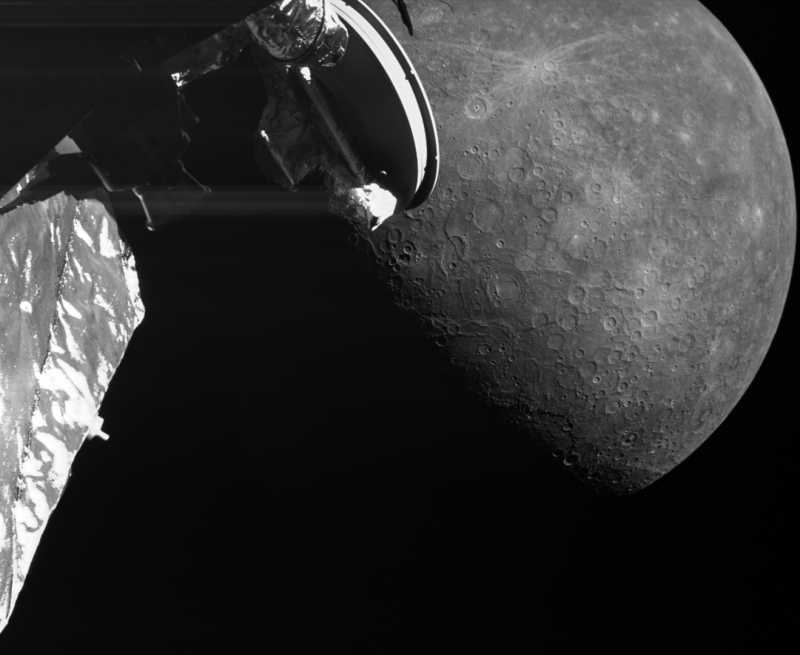
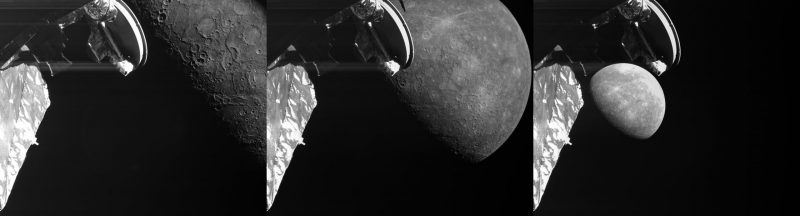
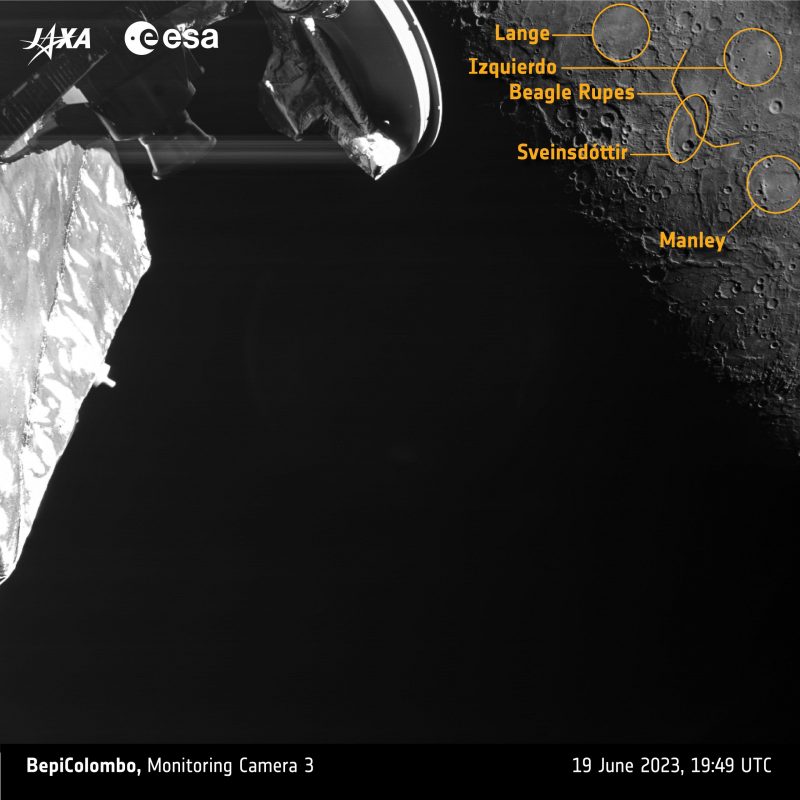
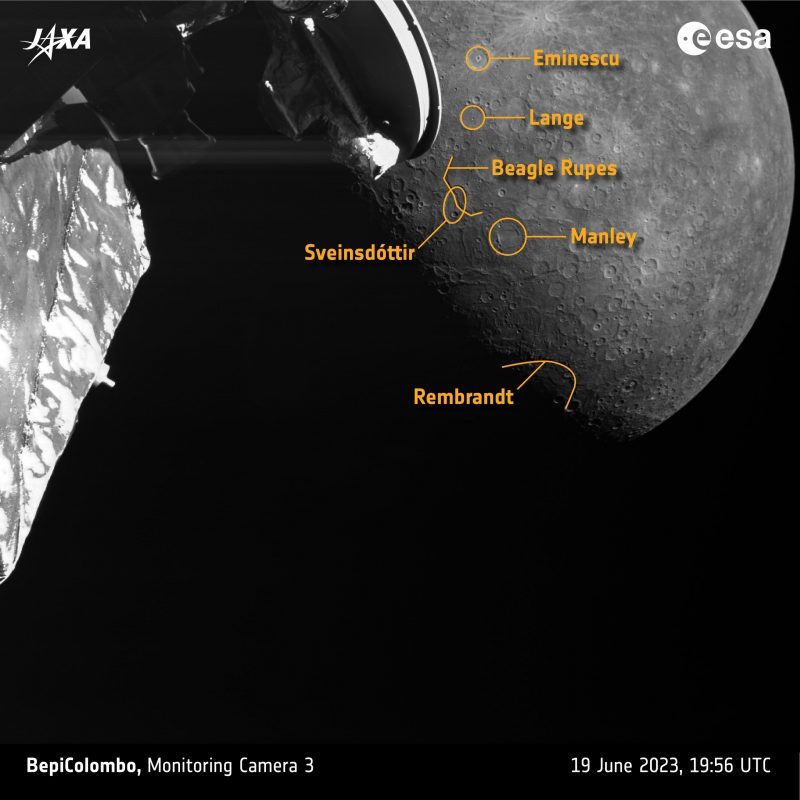
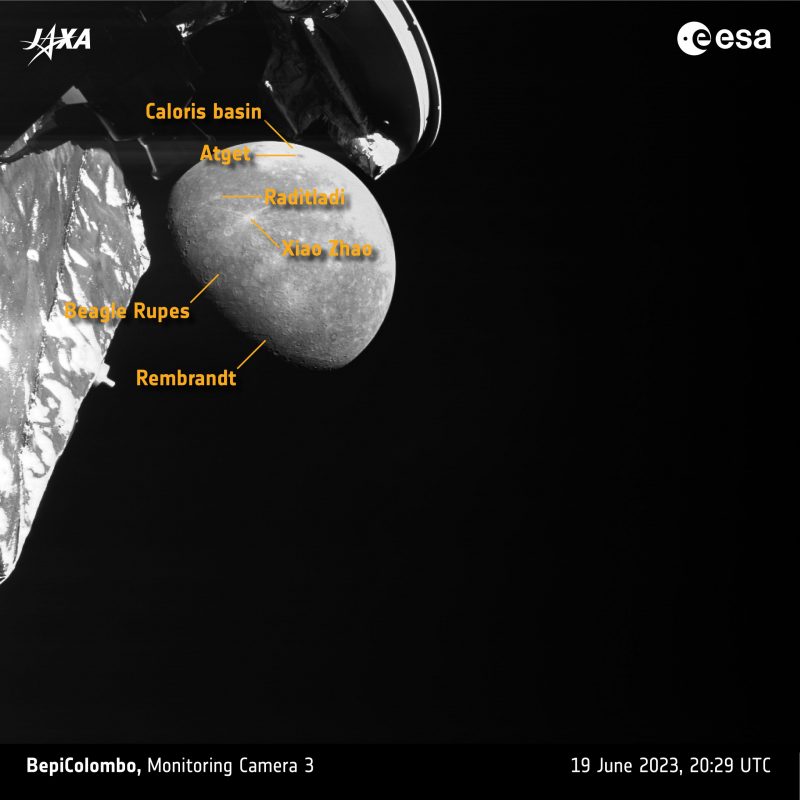
On June 20, 2023, ESA released new images of Mercury after BepiColombo spacecraft flew past the closest planet to the sun the day prior. In these images, we get to see a part of BepiColombo with cratered Mercury in the background. ESA released a trio of images as the spacecraft zoomed away during a gravity assist maneuver. It also released annotated images to point out important surface features.
Here’s 1 of the newest images of the closest planet to the sun from the 3rd Mercury flyby of the BepiColombo spacecraft. Image via ESA/ BepiColombo/ MTM.View larger. | These 3 images show the BepiColombo spacecraft with Mercury in the background as it zooms away after a gravity assist. Image via ESA/ BepiColombo/ MTM.This view of Mercury includes labels to point out some of its landmarks, including a scarp named Beagle Rupes. Image via ESA/ BepiColombo/ MTM.In the 2nd image released, we see labeled features such as the newly named Manley crater. Image via ESA/ BepiColombo/ MTM.In this 3rd image of Mercury, BepiColombo captures bright volcanic plains and the large impact basin named the Caloris basin. You can also see bright Xiao Zhao impact crater with its starlike ejecta pattern. It is 1 of the more recent craters on the planet. Image via ESA/ BepiColombo/ MTM.
Reactions from the BepiColombo team
The team involved with the BepiColombo mission were satisfied with the flyby and resulting images. Ignacio Clerigo, ESA’s BepiColombo Spacecraft Operations Manager, said:
Everything went very smoothly with the flyby, and images from the monitoring cameras taken during the close approach phase of the flyby have been transmitted to the ground. While the next Mercury flyby isn’t until September 2024, there are still challenges to tackle in the intervening time: our next long solar electric propulsion ‘thruster arc’ is planned to start early August until mid-September. In combination with the flybys, the thruster arcs are critical in helping BepiColombo brake against the enormous gravitational pull of the sun before we can enter orbit around Mercury.
One of the craters visible in the images is the newly named Manley crater. The International Astronomical Union (IAU) named this crater for Jamaican artist Edna Manley (1900–1987). David Rothery of the BepiColombo team said:
During our image planning for the flyby, we realized this large crater would be in view, but it didn’t yet have a name. It will clearly be of interest for BepiColombo scientists in the future because it has excavated dark ‘low reflectance material’ that may be remnants of Mercury’s early carbon-rich crust. In addition, the basin floor within its interior has been flooded by smooth lava, demonstrative of Mercury’s prolonged history of volcanic activity.
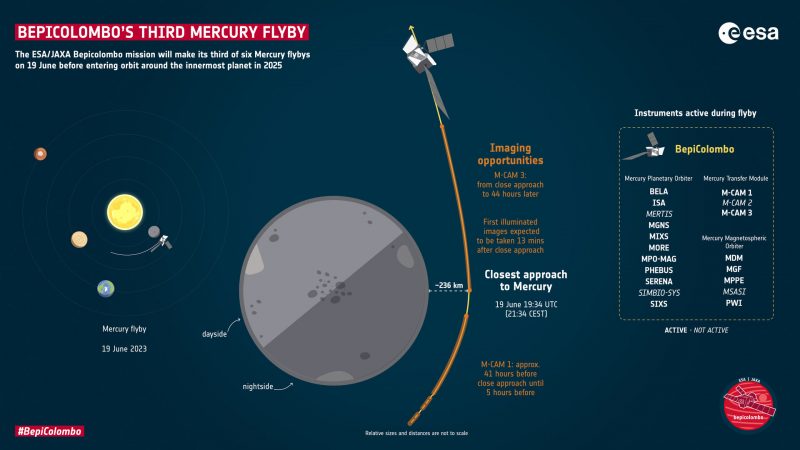
BepiColombo made its third flyby of the planet Mercury on June 19, 2023. The spacecraft swept closest to Mercury at 19:34 UTC (2:34 p.m. CDT).
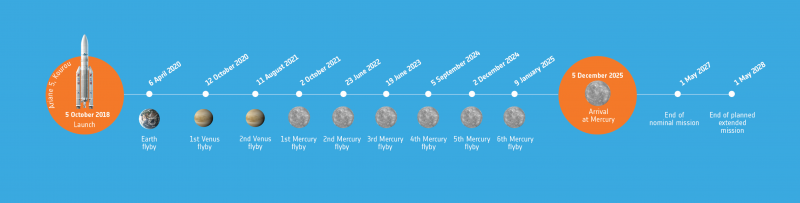
BepiColombo is a joint Mercury mission, launched in October 2018 by the European Space Agency (ESA) and the Japan Aerospace Exploration Agency (JAXA). For the past several years, our sun’s inner planets have been giving BepiColombo gravity assists, needed to enable the spacecraft to achieve a stable orbit around Mercury.
BepiColombo is due to enter Mercury’s orbit on December 5, 2025. In the meantime, there will be three more flybys after Monday’s close approach.
Why the gravity assists?
Why can’t BepiColombo just shoot on over to Mercury and go into orbit around it? It can’t because Mercury is so near the sun.
The flyby maneuvers will keep the craft from being pulled into the sun’s gravity well. With one Earth flyby, two Venus flybys, and six eventual Mercury flybys, the spacecraft will lose enough energy that Mercury will capture it in its orbit. That’s right, we said “lose.” We typically think of a gravity assist as a way to boost a spacecraft’s energy. But a gravity assist can either speed up or slow down a spacecraft. Or it can simply change a craft’s direction.
ESA flight dynamics expert Frank Budnik explained more about this 3rd flyby:
As BepiColombo starts feeling Mercury’s gravitational pull, it will be traveling at 3.6 km/s [2.2 mi/s] with respect to the planet. That’s just over half the speed it approached with during the previous two Mercury flybys.
And this is exactly what the point of such events is. Our spacecraft began with far too much energy because it launched from Earth and, like our planet, is orbiting the sun. To be captured by Mercury, we need to slow down, and we’re using the gravity of Earth, Venus and Mercury to do just that.
View larger. | BepiColombo is making a number of flybys on its way to entering orbit around Mercury. The June 19, 2023, flyby was the 3rd Mercury flyby. Image via ESA.
Tricky maneuvering
Even though BepiColombo’s flight to Mercury was meticulously mapped in advance, controllers will have to make corrections during the seven years it’ll take the spacecraft to get there. In May, mission control performed a course correction that otherwise would have put BepiColombo 15,000 miles (24,000 km) too far from Mercury and on the wrong side of the planet.
Santa Martinez Sanmartin, ESA’s BepiColombo mission manager, explained more about the methods used to get BepiColombo in orbit:
This is the first time scientists are using the complex solar electric propulsion method to get a spacecraft to Mercury. And it represents a big challenge during the remaining part of the cruise phase. We have already adapted our operations concept to have additional communications passes with our ground stations, enabling us to recover faster from thruster interruptions and to improve orbit determination.
And all the while this is working with communications delays of more than 10 minutes due to the time it currently takes light signals to travel between Earth and the spacecraft.
As ESA said, the most demanding part of its journey is still to come:
After this flyby, the mission will enter a very challenging part of its journey to Mercury, gradually increasing the use of solar electric propulsion through additional propulsion periods called ‘thrust arcs’ to continually brake against the enormous gravitational pull of the sun. These thrust arcs can last from a few days up to two months, with the longer arcs interrupted periodically for navigation and maneuver optimization.
This challenging journey is one of the reasons that Mercury is one of the least explored planets in our solar system.
The images from the 3rd Mercury flby
BepiColombo got as close as 146 miles (235 km) from Mercury’s surface during this flyby. However, closest approach was past the unlit portion of Mercury, so scientists didn’t capture any images until a bit later. At about 13 minutes past closest approach, when the spacecraft was 1,143 miles (1,840 km) away, it reached the illuminated part of Mercury. Then it began sending back black-and-white images, including part of the craft itself. A Mercurial selfie, if you will.
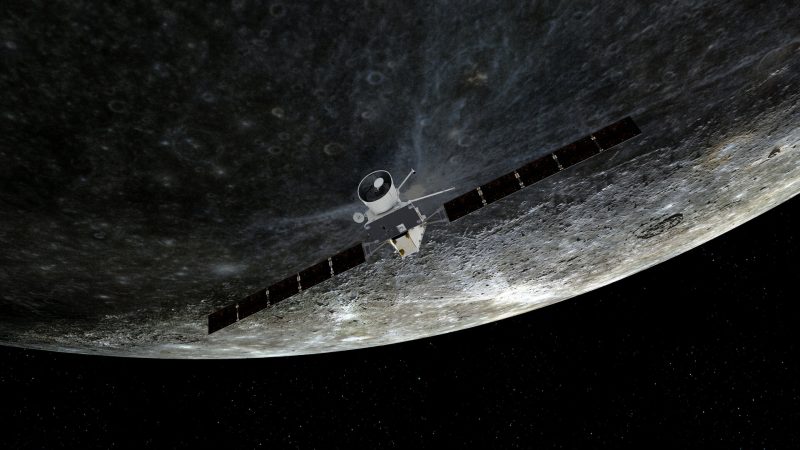
Artist’s concept of BepiColombo flying past Mercury. BepiColombo’s 3rd flyby of the closest planet to the sun was on June 19, 2023. Image via ESA/ ATG medialab.
Testing the instruments
The team uses these flybys as a chance to test some of the instruments. During Monday’s flyby, the magnetic, plasma and particle monitoring instruments sampled the environment. Johannes Benkhoff, project scientist, said:
Collecting data during flybys is extremely valuable for the science teams to check their instruments are functioning correctly ahead of the main mission. It also provides a novel opportunity to compare with data collected by NASA’s MESSENGER spacecraft during its 2011–2015 mission at Mercury from complementary locations around the planet not usually accessible from orbit. We are delighted to already have data published based on our previous flybys that generated new science results, which makes us even more excited to get into orbit!
View larger. | Here are the key moments in the 3rd flyby of BepiColombo past Mercury. BepiColombo saw the lit side of Mercury about 13 minutes after close approach. Image via ESA (acknowledgement: work performed by ATG under contract to ESA)/ CC BY-SA 3.0 IGO.
Bottom line:BepiColombo had its 3rd flyby of Mercury on June 19, 2023. The spacecraft will eventually go into orbit around the closest planet to the sun. ESA released three new images of Mercury taken during the encounter.
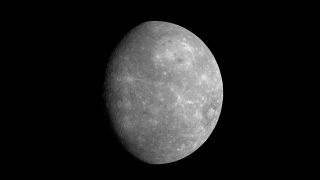
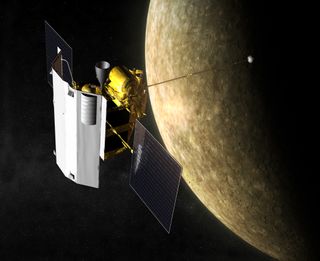
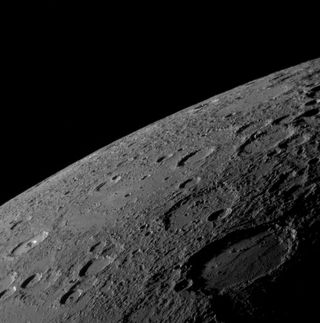
NASA's MESSENGER mission has revealed that Mercury, the solar system's tiniest planet and the closest to the sun, hides a big secret.
(Left) A colorful view of Mercury produced using images from the color base map imaging campaign during MESSENGER's primary mission (Right) what Mercury may look like were its outer layers stripped to expose its 10-mile-thick layer of diamond
(Image credit: Robert Lea (created with Canva)/NASA/Johns Hopkins University Applied Physics Laboratory/Carnegie Institution of Washington)
The solar system's tiniest planet may be hiding a big secret. Using data from NASA's MESSENGER spacecraft, scientists have determined that a 10-mile-thick diamond mantle may lie beneath the crust of Mercury, the closest planet to the sun.
Mercury has long puzzled scientists as it possesses many qualities that aren't common to other solar system planets. These include its very dark surface, remarkably dense core, and the premature end of Mercury's volcanic era.
Also among these puzzles are patches of graphite, a type (or "allotrope") of carbon on the surface of the innermost planet of the solar system. These patches have led scientists to suggest that in Mercury's early history, the tiny planet had a carbon-rich magma ocean. This ocean would have floated to the surface, creating graphite patches and the dark-shaded hue of Mercury's surface.
In this new video, we see a series of images as BepiColombo speeds away from the closest planet to the sun during the 3rd Mercury flyby. The spacecraft captured these images in a span of about 50 minutes.
The same process would have also led to the formation of a carbon-rich mantle beneath the surface. The team behind these findings thinks that this mantle isn't graphene, as previously suspected, but is composed of another much more precious allotrope of carbon: diamond.
"We calculate that, given the new estimate of the pressure at the mantle-core boundary, and knowing that Mercury is a carbon-rich planet, the carbon-bearing mineral that would form at the interface between mantle and core is diamond and not graphite," team member Olivier Namur, an associate professor at KU Leuven, told Space.com. "Our study uses geophysical data collected by the NASA MESSENGER spacecraft."
MESSENGER (Mercury Surface, Space Environment, Geochemistry, and Ranging) launched in Aug. 2004 and became the first spacecraft to orbit Mercury. The mission, which ended in 2015, mapped the entire tiny world, discovering abundant water ice in shadows at the poles and gathering crucial data about Mercury's geology and magnetic field.
A high-resolution mosaic of images of Mercury captured by NASA's MESSENGER as the spacecraft departed the planet following the mission's first flyby of Mercury. (Image credit: NASA/Johns Hopkins University Applied Physics Laboratory/Carnegie Institution of Washington)
Under pressure!
This new study also relates to a major surprise that came a few years ago when scientists re-evaluated the distribution of mass on Mercury, discovering the mantle of this tiny planet is thicker than previously thought.
"We directly thought that this must have a huge implication for the speciation [the distribution of an element or an allotrope amongst chemical species in a system] of carbon, diamond vs graphite, on Mercury," Namur said.
Artist's impression of NASA's MESSENGER spacecraft in orbit at Mercury. MESSENGER arrived at the solar system's innermost planet in March 2011. (Image credit: NASA/Johns Hopkins University Applied Physics Laboratory/Carnegie Institution of Washington)
The team investigated this here on Earth by using a large-volume press to replicate the pressures and temperatures that exist within the interior of Mercury. They applied incredible amounts of pressure, over seven gigapascals, to a synthetic silicate acting as a proxy for the material found in the mantle of Mercury, achieving temperatures of up to 3,950 degrees Fahrenheit (2,177 degrees Celsius).
This allowed them to study how minerals like those that would have been found in Mercury's mantle in its early existence changed under these conditions. They also used computer modeling to assess data about Mercury's interior, which gave them clues to how the diamond mantle of Mercury could have been created.
"We believe that diamond could have been formed by two processes. First is the crystallization of the magma ocean, but this process likely contributed to forming only a very thin diamond layer at the core/mantle interface," Namur explained. "Secondly, and most importantly, the crystallization of the metal core of Mercury."
Namur said that when Mercury formed around 4.5 billion years ago, the core of the planet was fully liquid, progressively crystallizing over time. The exact nature of the solid phases forming in the inner core is not currently well known, but the team believes that these phases must have been low in carbon or "carbon-poor."
"The liquid core before crystallization contained some carbon; crystallization, therefore, leads to carbon enrichment in the residual melt," he continued. "At some point, a solubility threshold is reached, meaning the liquid cannot dissolve more carbon, and diamond forms."
Diamond is a dense mineral but not as dense as metal, meaning that during this process, it would have floated to the top of the core, stopping at the boundary of Mercury's core and its mantle. This would have resulted in the formation of an around 0.62-mile (1 km) thick diamond layer that then continued to grow over time.
As the MESSENGER spacecraft drew closer to Mercury for its historic first flyby, the spacecraft acquired this mosaic of the sunlit portion of the planet. (Image credit: NASA/JHUAPL/CIW)
The discovery highlights the differences between the birth of the closest planet to the sun when compared with the creation of the solar system's other rocky planets, Venus, Earth, and Mars.
"Mercury formed much closer to the sun, likely from a carbon-rich cloud of dust. As a consequence, Mercury contains less oxygen and more carbon than other planets, which led to the formation of a diamond layer," Namur added. "However, Earth's core also contains carbon, and diamond formation in the Earth's core has already been suggested by various researchers."
The researcher hopes that this discovery could help reveal clues to some of the other mysteries surrounding the solar system's smallest planet, including why its volcanic phase was cut short around 3.5 billion years ago.
"A major question that I have about Mercury's evolution is why the major phase of volcanism lasted only a few hundred million years, much shorter than other rocky planets. This must mean that the planet cooled down very fast," Namur said. "This is partly related to the small size of the planet, but we are now working with physicists to try to understand if a diamond layer could have contributed to very fast heat removal, therefore terminating major volcanism very early."
Namur said that the team's next step will be to investigate the thermal effect of a diamond layer at the mantle/core boundary. This study could be supported by data from a mission that will follow in the footsteps of MESSENGER.
"We are also eagerly waiting for the first data collected by BepiColombo, hopefully in 2026, to refine our understanding of Mercury's internal structure and evolution," Namur concluded.
Producing Oxygen From Rock Is Harder In Lower Gravities
One of the challenges engineers face when developing technologies for use in space is that of different gravities. Mostly, engineers only have access to test beds that reflect either Earth’s normal gravity or, if they’re fortunate, the microgravity of the ISS. Designing and testing systems for the reduced, but not negligible, gravity on the Moon and Mars is much more difficult. But for some systems, it is essential. One such system is electrolysis, the process by which explorers will make oxygen for astronauts to breathe on a permanent Moon or Mars base, as well as critical ingredients like hydrogen for rocket fuel. To help steer the development of systems that will work in those conditions, a team of researchers led by computational physicist Dr. Paul Burke of the Johns Hopkins University Applied Physics Laboratory decided to turn to a favorite tool of scientists everywhere: models.
Before we explore the model, examining the problem they are trying to solve is helpful. Electrolysis immerses an electrode in a liquid and uses an electrical current and subsequent chemical reaction to split atoms apart. So, for example, if you put an electrode in water, it would separate that water into hydrogen and oxygen.
The problem comes from reduced gravity. As part of electrolysis, bubbles form on the surface of the electrode. On Earth, those bubbles typically detach and float to the surface, as the density difference between them and the remaining liquid forces them to.
Dr. Burke presented alongside other experts at the Space Resources Week Workshop back in March. Credit – ESRIC YouTube Channel
However, in reduced gravity, the bubbles either take much longer to detach or don’t do so at all. This creates a buffer layer along the electrode’s length that decreases the electrolysis process’s efficiency, sometimes stalling it out entirely. Electrolysis isn’t the only fluidic process that has difficulty operating in reduced gravity environments – many ISS experiments also have trouble. This is partly due to a lack of complete understanding of how liquids operate in these environments – and that in itself is partly driven by a dearth of experimental data.
Which is where the modeling comes in. Dr. Burke and his colleagues use a technique known as Computational Fluid Dynamics to attempt to mimic the forces the fluids will undergo in a reduced gravity environment while also understanding bubble formation.
Electrolysis on Earth is typically done with water, but why stop there? The team used their CFD to model two other liquids that might be used in electrolyzers – molten salt (MSE) and molten regolith (MRE). Molten salt is used on Earth, but less commonly than regular water, and has successfully produced oxygen. However, molten regolith electrolysis is still somewhat of a novel use case and has yet to be thoroughly tested. MOXIE, the experiment that famously created oxygen on Mars in 2021, used the carbon dioxide in Mars’ atmosphere and a solid-state electrode – neither representative of molten regolith.
Fraser discusses MOXIE electrolysis with Dr. Michael Hect.
Dr. Burke and his team found that, computationally, at least, MRE has the most challenging conditions in reduced gravity. It has also never been tested in any reduced gravity environment, so for now; these simulations are all engineers have to go on with if they are going to design a system.
There were a few key takeaways from the modeling, though. First, engineers should design horizontal electrodes into MRE systems, as the longer a bubble spreads across an electrode (i.e., as it goes “up” it), the longer it takes for that bubble to detach. In a horizontal configuration, the electrode has less surface area to attach to, making it more likely for the bubbles to detach and float to the surface.
Additionally, the amount of time bubbles remain attached to an electrode scales exponentially with decreasing gravity. That means bubbles on the Moon will take longer to detach than those on Mars, which will take longer than those on Earth. Consequently, electrolysis on the Moon will be less efficient than that on Mars, which will again be less efficient than that on Earth, and mission planners will need to account for these discrepancies if they plan on getting something as mission-critical as oxygen from this process. The smoothness of the electrodes also seems to matter, with rougher electrodes more likely to hold onto their bubbles and, therefore, end up less efficient.
SciShow Space explores the world of MRE. Credit – SciShow Space YouTube Channel
Other engineering solutions can overcome all these challenges, such as a vibratory mechanism on the electrode to shake the bubbles loose. However, it’s a good idea to consider all the additional complications operations in a reduced gravity environment have before launching a mission. That’s why modeling is so important, but humanity will ultimately have to experimentally test these systems, perhaps on the Moon itself, if we plan to utilize its local resources to sustain our presence there.
Beste bezoeker, Heb je zelf al ooit een vreemde waarneming gedaan, laat dit dan even weten via email aan Frederick Delaere opwww.ufomeldpunt.be. Deze onderzoekers behandelen jouw melding in volledige anonimiteit en met alle respect voor jouw privacy. Ze zijn kritisch, objectief maar open minded aangelegd en zullen jou steeds een verklaring geven voor jouw waarneming! DUS AARZEL NIET, ALS JE EEN ANTWOORD OP JOUW VRAGEN WENST, CONTACTEER FREDERICK. BIJ VOORBAAT DANK...
Druk op onderstaande knop om je bestand , jouw artikel naar mij te verzenden. INDIEN HET DE MOEITE WAARD IS, PLAATS IK HET OP DE BLOG ONDER DIVERSEN MET JOUW NAAM...
Druk op onderstaande knop om een berichtje achter te laten in mijn gastenboek
Alvast bedankt voor al jouw bezoekjes en jouw reacties. Nog een prettige dag verder!!!
Over mijzelf
Ik ben Pieter, en gebruik soms ook wel de schuilnaam Peter2011.
Ik ben een man en woon in Linter (België) en mijn beroep is Ik ben op rust..
Ik ben geboren op 18/10/1950 en ben nu dus 75 jaar jong.
Mijn hobby's zijn: Ufologie en andere esoterische onderwerpen.
Op deze blog vind je onder artikels, werk van mezelf. Mijn dank gaat ook naar André, Ingrid, Oliver, Paul, Vincent, Georges Filer en MUFON voor de bijdragen voor de verschillende categorieën...
Veel leesplezier en geef je mening over deze blog.