The purpose of this blog is the creation of an open, international, independent and free forum, where every UFO-researcher can publish the results of his/her research. The languagues, used for this blog, are Dutch, English and French.You can find the articles of a collegue by selecting his category. Each author stays resposable for the continue of his articles. As blogmaster I have the right to refuse an addition or an article, when it attacks other collegues or UFO-groupes.
Druk op onderstaande knop om te reageren in mijn forum
Zoeken in blog
Deze blog is opgedragen aan mijn overleden echtgenote Lucienne.
In 2012 verloor ze haar moedige strijd tegen kanker!
In 2011 startte ik deze blog, omdat ik niet mocht stoppen met mijn UFO-onderzoek.
BEDANKT!!!
Een interessant adres?
UFO'S of UAP'S, ASTRONOMIE, RUIMTEVAART, ARCHEOLOGIE, OUDHEIDKUNDE, SF-SNUFJES EN ANDERE ESOTERISCHE WETENSCHAPPEN - DE ALLERLAATSTE NIEUWTJES
UFO's of UAP'S in België en de rest van de wereld Ontdek de Fascinerende Wereld van UFO's en UAP's: Jouw Bron voor Onthullende Informatie!
Ben jij ook gefascineerd door het onbekende? Wil je meer weten over UFO's en UAP's, niet alleen in België, maar over de hele wereld? Dan ben je op de juiste plek!
België: Het Kloppend Hart van UFO-onderzoek
In België is BUFON (Belgisch UFO-Netwerk) dé autoriteit op het gebied van UFO-onderzoek. Voor betrouwbare en objectieve informatie over deze intrigerende fenomenen, bezoek je zeker onze Facebook-pagina en deze blog. Maar dat is nog niet alles! Ontdek ook het Belgisch UFO-meldpunt en Caelestia, twee organisaties die diepgaand onderzoek verrichten, al zijn ze soms kritisch of sceptisch.
Nederland: Een Schat aan Informatie
Voor onze Nederlandse buren is er de schitterende website www.ufowijzer.nl, beheerd door Paul Harmans. Deze site biedt een schat aan informatie en artikelen die je niet wilt missen!
Internationaal: MUFON - De Wereldwijde Autoriteit
Neem ook een kijkje bij MUFON (Mutual UFO Network Inc.), een gerenommeerde Amerikaanse UFO-vereniging met afdelingen in de VS en wereldwijd. MUFON is toegewijd aan de wetenschappelijke en analytische studie van het UFO-fenomeen, en hun maandelijkse tijdschrift, The MUFON UFO-Journal, is een must-read voor elke UFO-enthousiasteling. Bezoek hun website op www.mufon.com voor meer informatie.
Samenwerking en Toekomstvisie
Sinds 1 februari 2020 is Pieter niet alleen ex-president van BUFON, maar ook de voormalige nationale directeur van MUFON in Vlaanderen en Nederland. Dit creëert een sterke samenwerking met de Franse MUFON Reseau MUFON/EUROP, wat ons in staat stelt om nog meer waardevolle inzichten te delen.
Let op: Nepprofielen en Nieuwe Groeperingen
Pas op voor een nieuwe groepering die zich ook BUFON noemt, maar geen enkele connectie heeft met onze gevestigde organisatie. Hoewel zij de naam geregistreerd hebben, kunnen ze het rijke verleden en de expertise van onze groep niet evenaren. We wensen hen veel succes, maar we blijven de autoriteit in UFO-onderzoek!
Blijf Op De Hoogte!
Wil jij de laatste nieuwtjes over UFO's, ruimtevaart, archeologie, en meer? Volg ons dan en duik samen met ons in de fascinerende wereld van het onbekende! Sluit je aan bij de gemeenschap van nieuwsgierige geesten die net als jij verlangen naar antwoorden en avonturen in de sterren!
Heb je vragen of wil je meer weten? Aarzel dan niet om contact met ons op te nemen! Samen ontrafelen we het mysterie van de lucht en daarbuiten.
19-07-2024
Voor het eerst het bestaan van een ondergrondse maangrot aangetoond (en dat is goed nieuws voor toekomstige maankolonisten)
Voor het eerst het bestaan van een ondergrondse maangrot aangetoond (en dat is goed nieuws voor toekomstige maankolonisten)
Dergelijke tunnels onder het maanoppervlak zouden zomaar eens uitstekende verblijfplaatsen voor mensen kunnen zijn.
NASA en andere ruimtevaartorganisaties hebben al geruime tijd plannen om de maan te koloniseren. Het doel is om er een permanente basis te vestigen waar mensen langdurig kunnen verblijven. Dit biedt de mogelijkheid om essentiële kennis en ervaring op te doen die nodig is voor toekomstige missies naar Mars. Een cruciale vraag is echter: waar moeten toekomstige maankolonisten precies gaan wonen? Bestaan bijvoorbeeld de lang besproken ondergrondse maangrotten echt? Een nieuwe studie biedt nu duidelijkheid.
Lavatunnels Het idee om onder het oppervlak van de maan te gaan wonen, wordt al lange tijd overwogen. Onderzoekers denken daarbij vooral aan lege lavatunnels. Dat heeft namelijk belangrijke voordelen ten opzichte van het bouwen van een basis op het oppervlak. Deze tunnels bieden astronauten bescherming tegen kosmische straling, zonnestraling en micro-meteorieten. En dat is geen overbodige luxe. Kosmische en zonnestraling op het maanoppervlak kunnen namelijk tot wel 150 keer sterker zijn dan wat we op aarde ervaren. Bovendien blijft de temperatuur in deze tunnels stabiel, zonder de dagelijkse variaties die op het oppervlak voorkomen. En ook dat is prettig. Aan de verlichte zijde van de maan kunnen de oppervlaktetemperaturen namelijk oplopen tot een verzengende 127 graden Celsius, terwijl ze aan de onverlichte zijde kunnen dalen tot -173 graden Celsius. Daarnaast liggen deze grotten vaak dichter bij bronnen van waterijs en andere essentiële mineralen die nodig zijn voor langdurig verblijf. Hoewel dit allemaal veelbelovend klinkt, was het tot nu toe nog onduidelijk of dergelijke ondergrondse maangrotten echt bestaan.
Meer over lavatunnels Lavatunnels kunnen op twee verschillende manieren ontstaan. Wanneer lava met een lage viscositeit (stroperigheid) vrij dicht onder het oppervlak stroomt, kan boven de lavastroom een harde – en steeds dikker wordende – korst ontstaan. Die korst vormt als het ware een dak waaronder het gesmolten deel van de lava stroomt. Wanneer de erupties ten einde komen en al het lava is weggestroomd, blijft vlak onder het oppervlak een tunnel achter. Daarnaast kunnen lavatunnels ontstaan wanneer lava zich in bestaande breuken tussen gesteentelagen dwingt. De lava zet uit en creëert een heel netwerk van met elkaar in verbinding staande tunnels die – wanneer de erupties stilvallen – leeg komen te staan.
Tot op heden zijn er al meer dan 200 ‘putten’ ontdekt op het oppervlak van de maan. Deze putten zijn ontstaan door instortingen van onderliggende lavabuizen, wat leidt tot openingen naar ondergrondse holtes. Een prangende vraag is echter of deze putten toegang bieden tot grotten met uitgebreide ondergrondse ruimtes en of ze geschikt zijn om astronauten te huisvesten.
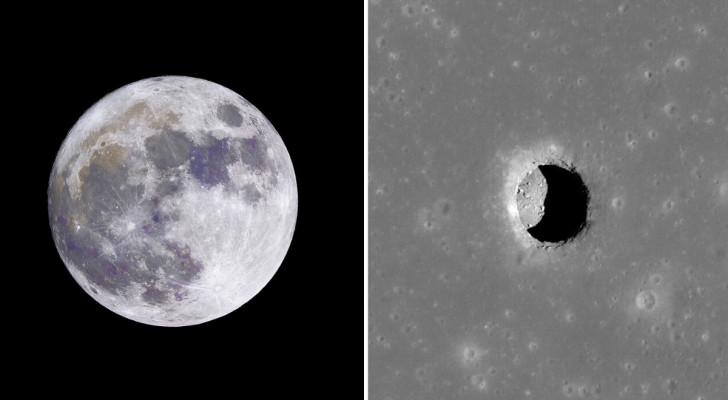
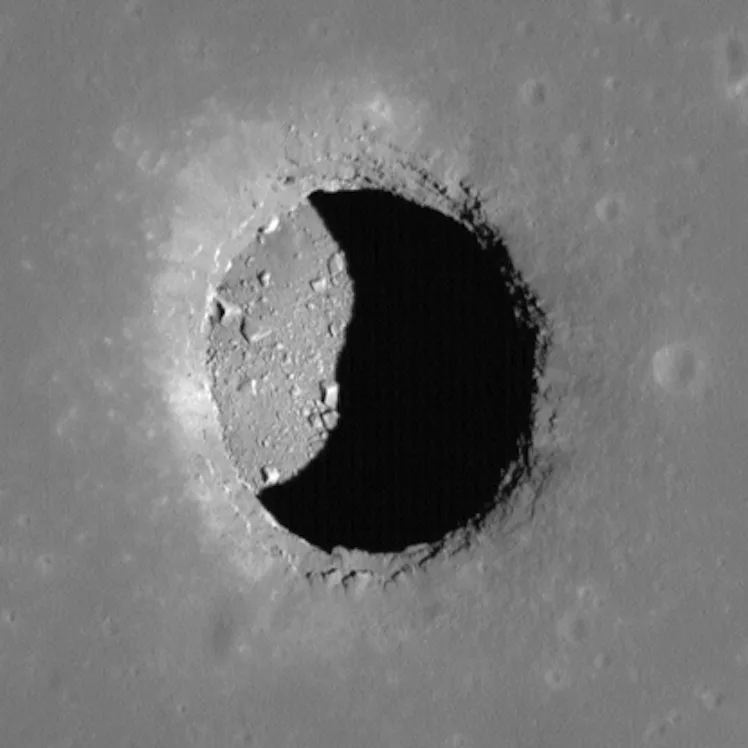
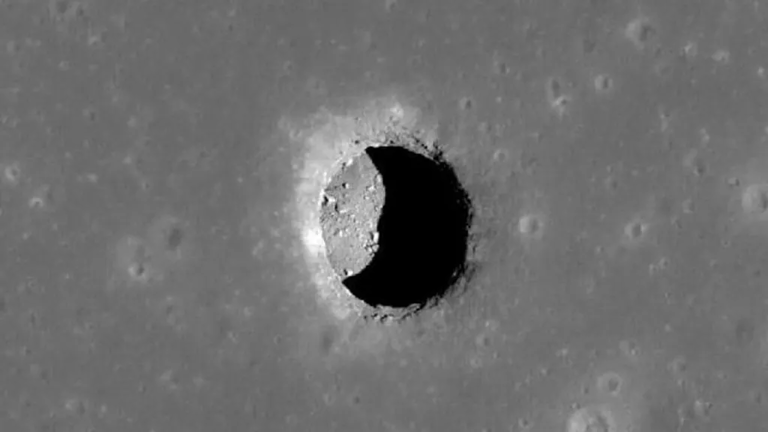
Mare Tranquillitatis Pit In een nieuwe studie hebben onderzoekers besloten om radargegevens van de Lunar Reconnaissance Orbiter te analyseren, specifiek gericht op de Mare Tranquillitatis Pit. Deze put staat bekend als de diepste op de maan, met een diameter van ongeveer 100 meter. “Wat we hebben gedaan, is radargegevens gebruiken om te onderzoeken of deze put een grot verborgen houdt,” vertellen onderzoekers Lorenzo Bruzzone en Leonardo Carrer in gesprek met Scientias.nl. “En wat we ontdekten, was dat de put in de Mare Tranquillitatis daadwerkelijk toegang geeft tot een grot, die we vervolgens in kaart hebben gebracht. Deze grot is bereikbaar vanaf het maanoppervlak. De meest waarschijnlijke verklaring voor onze waarnemingen is een lege lavabuis.”
Ze bestaan Het betekent dat Bruzzone en Carrer nu voor het eerst direct bewijs hebben gevonden van een toegankelijke lavatunnel onder het oppervlak. Een mijlpaal. “Al meer dan 50 jaar zijn maangrotten een mysterie,” vertelt Bruzzone. “Daarom was het opwindend om eindelijk het bestaan van een ondergrondse gang te kunnen bewijzen. Wat interessant is, is dat de gegevens die we in onze studie hebben gebruikt al veertien jaar beschikbaar zijn. Zoals in veel andere gevallen, heeft de ontwikkeling van nieuwe data-analysetechnologieën ook in ons geval geleid tot een nieuwe ontdekking door ‘oude’ gegevens opnieuw te analyseren.”
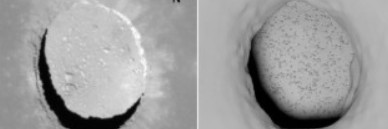
De maangrot De onderzoekers merkten een toename in radarhelderheid aan de westzijde van de Mare Tranquillitatis Pit op. Door simulaties uit te voeren op basis van de radarbeelden, hebben ze geconcludeerd dat deze observaties kunnen worden verklaard door de aanwezigheid van een holle ruimte die zich uitstrekt vanaf de westkant van de putbodem. De wetenschappers schatten dat deze holle ruimte zich bevindt op een diepte tussen 130 en 170 meter, met een lengte van 30 tot 80 meter en een breedte van ongeveer 45 meter. De grot is mogelijk ook vlak of heeft een helling van maximaal 45 graden.
Maankolonisten De ontdekking van de maangrot geeft hoop voor toekomstige maankolonisten. Zo toont het onderzoek aan dat ondergrondse grotten niet alleen bestaan, maar dat ze ook mogelijk bewoonbaar kunnen zijn. De Mare Tranquillitatis Pit en zijn ondergrondse holte worden bijvoorbeeld gezien als een veelbelovende locatie voor een toekomstige maanbasis. “Op dit moment lopen er verschillende internationale inspanningen van diverse ruimteagentschappen om te onderzoeken of dergelijke grotten geschikt kunnen zijn als schuilplaatsen,” zegt Carrer. “Als de omstandigheden gunstig blijken te zijn, bestaat de mogelijkheid dat ze in de toekomst als schuilplaatsen kunnen worden gebruikt.”
Uitdagingen Dat dit goed wordt onderzocht, is heel belangrijk. Dat komt omdat het leven ondergronds ook zo zijn eigen uitdagingen met zich meebrengt. “Bij het overwegen van het ondergronds huisvesten van astronauten op de maan is veiligheid de belangrijkste prioriteit,” onderstreept Carrer. “Elke mogelijke oplossing heeft zijn eigen voor- en nadelen op het gebied van veiligheid. Het grootste voordeel van grotten is dat ze de belangrijkste structurele onderdelen voor een mogelijke menselijke basis bieden, zonder dat er ingewikkelde bouwwerkzaamheden nodig zijn. Natuurlijk zijn er potentiële risico’s die grondig moeten worden overwogen en geanalyseerd. Denk bijvoorbeeld aan het uitvoeren van grondige structurele analyses om de stabiliteit van de grot te beoordelen, het versterken van de wanden en het plafond van de tunnels, het opzetten van alternatieve leefruimtes zodat astronauten kunnen verhuizen naar een andere veilige zone als een deel van de tunnel beschadigd raakt en het plaatsen van monitorsystemen die bijvoorbeeld aardbevingen kunnen registreren.”
Toekomstige missies De onderzoekers beschouwen hun studie als een startpunt voor verdere verkenning van maangrotten. Ze suggereren dat de gebruikte methode ook van nut kan zijn voor het onderzoeken van andere maanputten en het ontdekken van meerdere ondergrondse gangen. Al hebben we daar wel betere beelden van het maanoppervlak voor nodig. “Helaas zijn de huidige beschikbare gegevens zeer beperkt en bestrijken ze slechts een klein deel van het maanoppervlak,” merkt Bruzzone op. “Bovendien hebben ze niet genoeg detail om kleine grotten te kunnen waarnemen, die juist van groot belang zijn voor het plannen van een maanbasis. Daarom is het van cruciaal belang om nieuwe missies te plannen, bestaande uit satellieten die om de maan draaien en uitgerust zijn met radarinstrumenten. We hebben zowel een radar nodig zoals die we gebruikten voor onze recente ontdekking, om een gedetailleerde kaart te maken van alle maangrotten met voldoende resolutie, als een laagfrequente radarsonde die systematisch het maanoppervlak kan doordringen. Deze sonde moet specifiek ontworpen zijn om holtes en tunnels te detecteren, zelfs op locaties ver van de bekende putten.”
De studie markeert de eerste stap richting het begrijpen van maangrotten als potentiële verblijfplaatsen voor astronauten. Maar het is duidelijk dat er nog veel werk aan de winkel is voordat we kunnen bevestigen dat ze echt ideaal zijn voor langdurige bewoning. Toch zijn ruimtevaartorganisaties optimistisch gestemd. Sinds 2012 voert ESA bijvoorbeeld in samenwerking met enkele Europese universiteiten twee trainingsprogramma’s uit voor astronauten die gericht zijn op de ondergrondse systemen van Lanzarote. Tot dusver hebben al tientallen astronauten trainingen in ‘grotwandelen’ gekregen. Daarnaast hebben al enkele astronauten een geologische veldtraining gevolgd. Dit toont aan dat ESA de lavatunnels op andere hemellichamen zeer geschikt acht als verblijfplaatsen. En wellicht zullen deze ondergrondse systemen inderdaad de eerste nieuwe woonomgevingen voor mensen op een ander hemellichaam worden.
ORLANDO, Fla. — NASA and Boeing completed tests on the ground looking to mirror conditions that led to problems with the CST-100 Starliner that still awaits the go to bring home a pair of astronauts from the International Space Station.
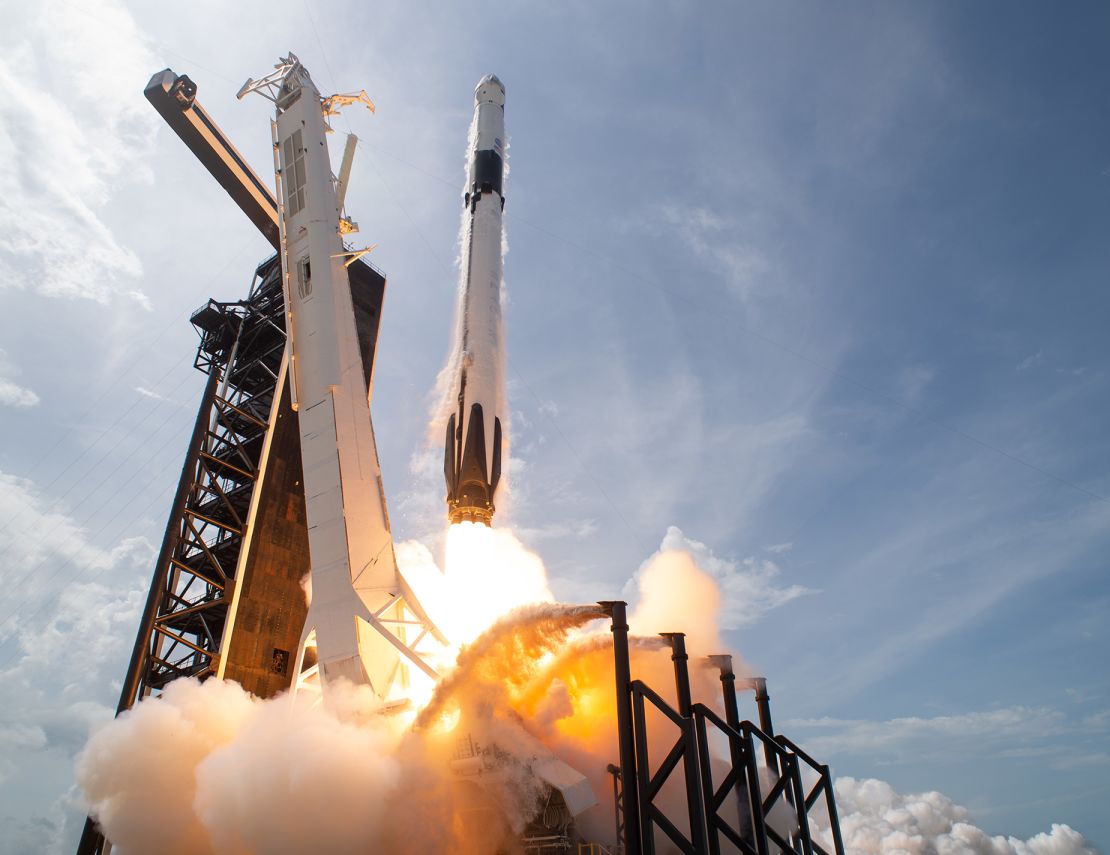
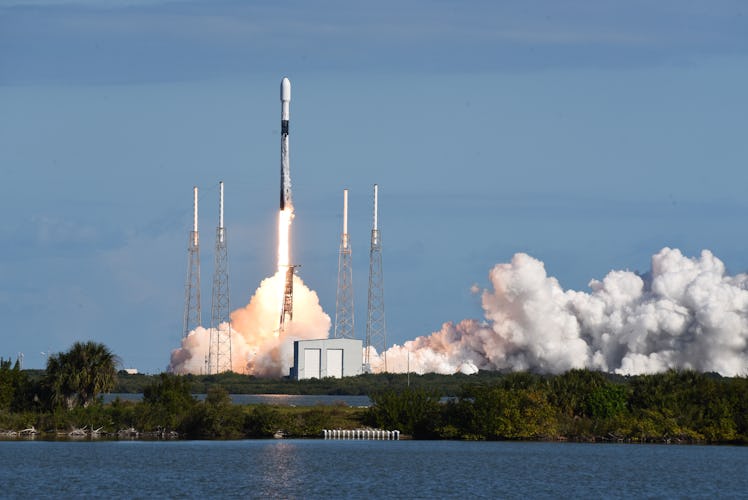
A SpaceX Falcon 9 rocket carrying the company's Crew Dragon spacecraft launched NASA astronauts Robert Behnken and Douglas Hurley to the International Space Station, marking the spacecraft's inaugural crewed flight, on May 30, 2020.
Joel Kowsky/NASA
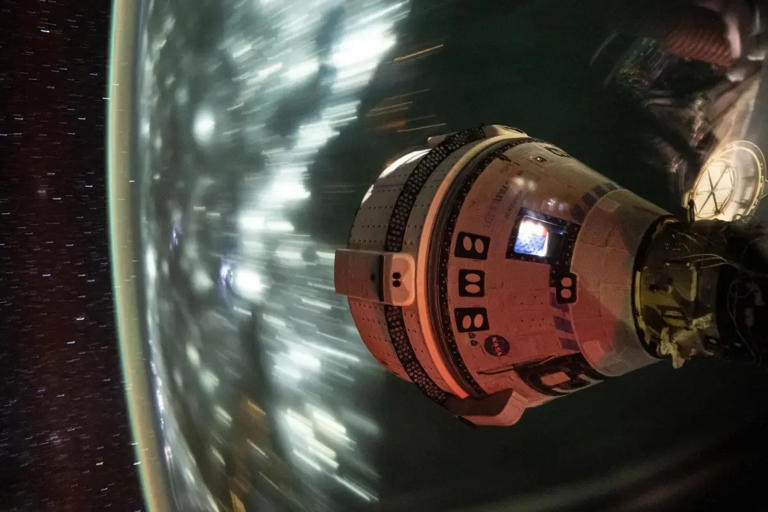
Butch Wilmore and Suni Williams docked Starliner at the ISS back on June 6 on the Crew Flight Test mission one day after launching from Cape Canaveral Space Force Station atop a United Launch Alliance Atlas V rocket.
What was originally planned to be just an eight-day stay on board the ISS has stretched to more than six weeks because of issues with helium leaks and thruster shutdowns on Starliner’s propulsion module as it approached the station.
While NASA has signed off on Starliner as safe enough to get its two NASA astronauts home in case of an emergency, it’s taking its time to look into as much data as possible about the thrusters and helium leaks before giving them the green light to come home and complete the CFT mission.
After docking, the helium lines were shut down, so no more leaking has occurred, but it will begin again once it undocks. NASA has said the spacecraft, though, has ample helium supply to make the trip home. As far as the reaction control thrusters, which are needed for small position corrections, NASA was able to get four of the five that failed on approach back online, although at lower power levels.
Related video:
Are two NASA astronauts stuck in space and how can they come home? (France 24)
NASA astronauts Suni Williams and Butch Wilmore say goodbye to friends and family as they leave astronaut crew quarters on their way to the launchpad Wednesday, June 5, 2024.
CRAIG BAILEY/FLORIDA TODAY / USA TODAY NETWORK
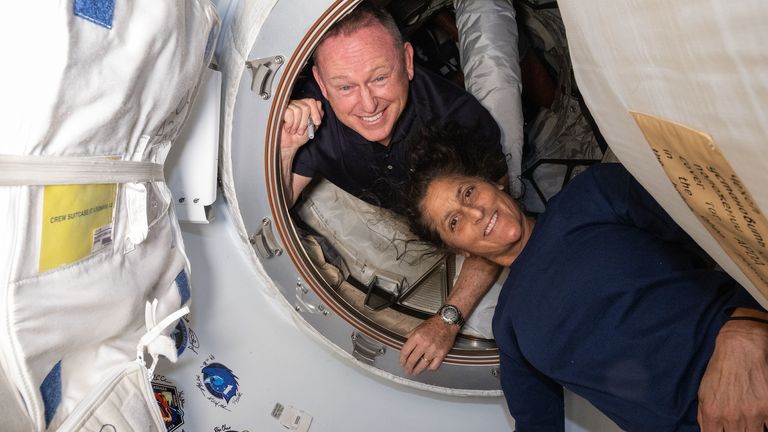
NASA's Boeing Crew Flight Test astronauts Butch Wilmore and Suni Williams.
Pic: NASA Johnson
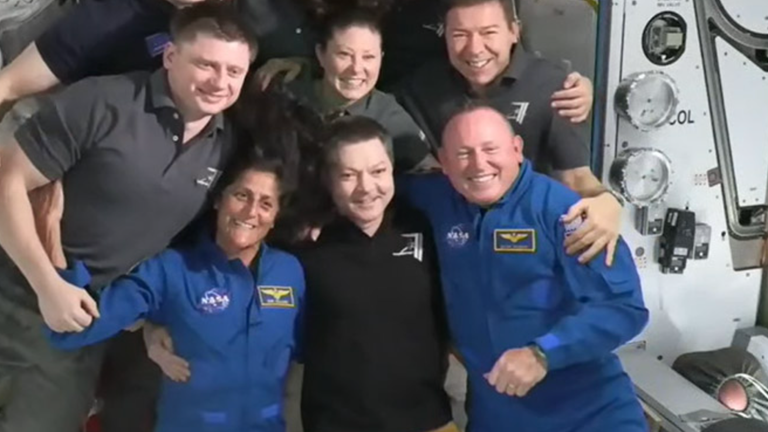
Suni Williams (front left) and Butch Wilmore (front right) as they entered the ISS.
Pic: NASA TV
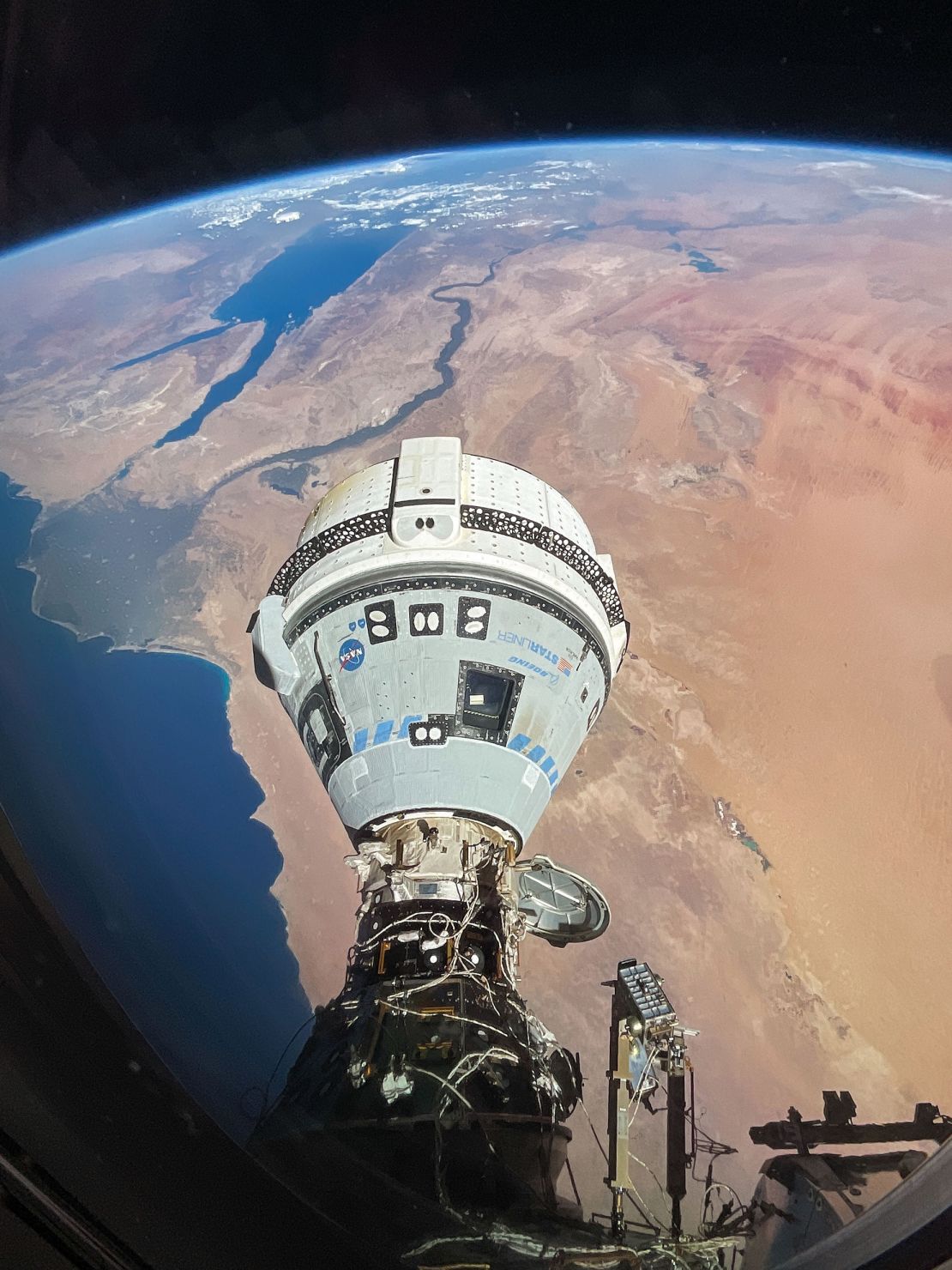
The Starliner spacecraft on NASA's Boeing Crew Flight Test is pictured docked to the Harmony module's forward port on June 13 as the International Space Station orbited 262 miles above Egypt's Mediterranean coast.
NASA
Suni Williams and Butch Wilmore speak to NASA officials during a live streamed event on Monday, June 10.
NASA
It’s a similar issue seen on the previous Starliner flight, the uncrewed Orbital Flight Test 2 in 2022.
A big issue is the problem propulsion hardware, housed on what’s called the service module, won’t make the flight home along with the crew capsule as it is jettisoned before reentry.
So teams took a surrogate engine for hot fire testing at NASA’s White Sands Test Facility in New Mexico, which was completed last week, mirroring both conditions Starliner experienced on the flight up as well as conditions expected for the return home.
Now teams will evaluate all the test firing data and inspect the engine with work expected to last through this week.
“I am extremely proud of the NASA, Boeing team for their hard work in executing a very complex test series,” said Steve Stich, manager, NASA’s Commercial Crew Program in a press release. “We collected an incredible amount of data on the thruster that could help us better understand what is going on in flight. Next, our team has moved into engine tear downs and inspections which will provide additional insight as we analyze the results and evaluate next steps.”
Before NASA will let Starliner undock, Stich said it has to go through an agency flight test readiness review, and that date has yet to be identified.
Stich previously said that return flight could occur before the end of July, but could also remain on station into mid-August with only the launch of the replacement Crew-9 on a SpaceX Crew Dragon looming next month that would cause a traffic jam.
The CFT mission aims to be the last step before NASA signs off on Boeing to begin the first of six contracted flights to ferry crew to and from the ISS before the station’s retirement as part of NASA’s Commercial Crew Program.
SpaceX is more than four years ahead of Boeing’s efforts as part of the program, and is in the midst of its eighth operational mission to the ISS.
NASA's Curiosity rover discovers a surprise in a Martian rock
NASA's Curiosity rover discovers a surprise in a Martian rock
Story by Science X staff
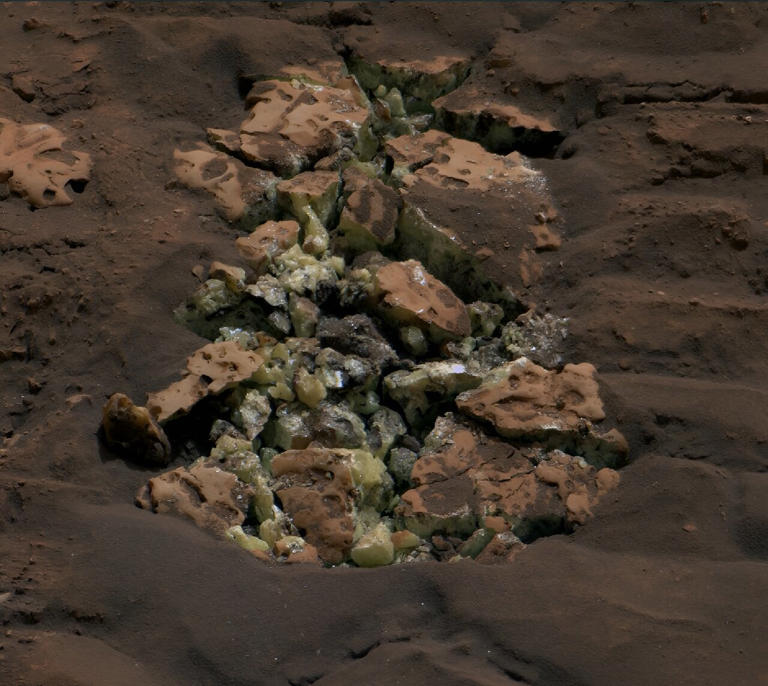
These yellow crystals were revealed after NASA's Curiosity happened to drive over a rock and crack it open on May 30. Using an instrument on the rover's arm, scientists later determined these crystals are elemental sulfur—and it's the first time this kind of sulfur has been found on the Red Planet.
Scientists were stunned on May 30 when a rock that NASA's Curiosity Mars rover drove over cracked open to reveal something never seen before on the Red Planet: yellow sulfur crystals.
Since October 2023, the rover has been exploring a region of Mars rich with sulfates, a kind of salt that contains sulfur and forms as water evaporates. But where past detections have been of sulfur-based minerals—in other words, a mix of sulfur and other materials—the rock Curiosity recently cracked open is made of elemental (pure) sulfur. It isn't clear what relationship, if any, the elemental sulfur has to other sulfur-based minerals in the area.
While people associate sulfur with the odor from rotten eggs (the result of hydrogen sulfide gas), elemental sulfur is odorless. It forms in only a narrow range of conditions that scientists haven't associated with the history of this location. And Curiosity found a lot of it—an entire field of bright rocks that look similar to the one the rover crushed.
"Finding a field of stones made of pure sulfur is like finding an oasis in the desert," said Curiosity's project scientist, Ashwin Vasavada of NASA's Jet Propulsion Laboratory in Southern California. "It shouldn't be there, so now we have to explain it. Discovering strange and unexpected things is what makes planetary exploration so exciting."
It's one of several discoveries Curiosity has made while off-roading within Gediz Vallis channel, a groove that winds down part of the 3-mile-tall (5-kilometer-tall) Mount Sharp, the base of which the rover has been ascending since 2014. Each layer of the mountain represents a different period of Martian history. Curiosity's mission is to study where and when the planet's ancient terrain could have provided the nutrients needed for microbial life, if any ever formed on Mars.
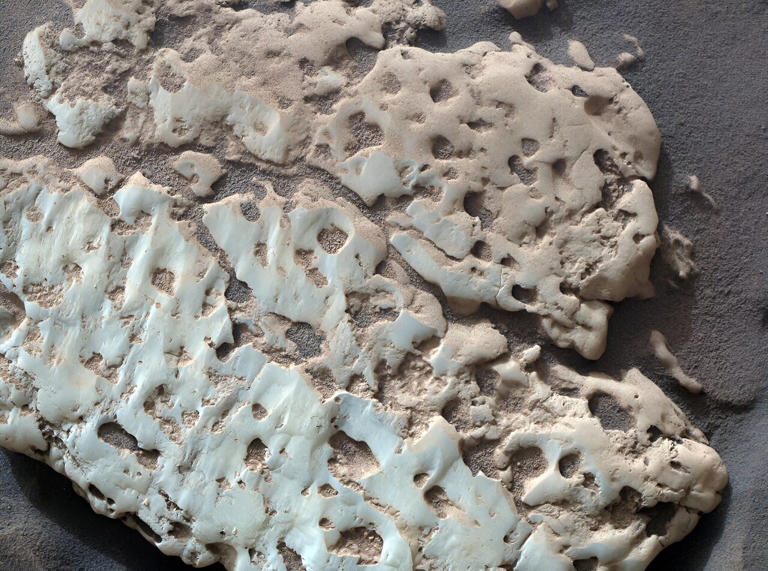
NASA’s Curiosity captured this close-up image of a rock nicknamed “Snow Lake” on June 8, 2024, the 4,209th Martian day, or sol, of the mission. Nine days earlier, the rover had crushed a similar-looking rock and revealed crystalline textures—and elemental sulfur—inside.
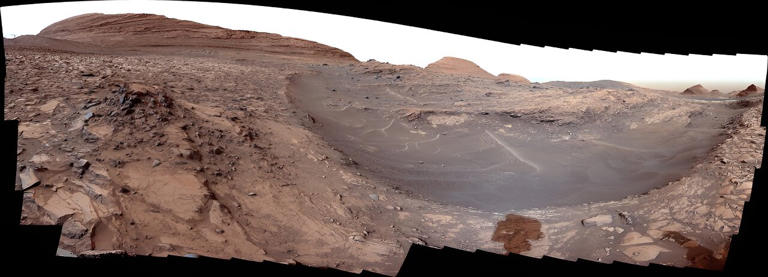
NASA/JPL-Caltech/MSSS NASA’s Curiosity Mars rover captured this view of Gediz Vallis channel on March 31. This area was likely formed by large floods of water and debris that piled jumbles of rocks into mounds within the channel.
Spotted from space years before Curiosity's launch, Gediz Vallis channel is one of the primary reasons the science team wanted to visit this part of Mars. Scientists think that the channel was carved by flows of liquid water and debris that left a ridge of boulders and sediment extending 2 miles down the mountainside below the channel. The goal has been to develop a better understanding of how this landscape changed billions of years ago, and while recent clues have helped, there's still much to learn from the dramatic landscape.
Since Curiosity's arrival at the channel earlier this year, scientists have studied whether ancient floodwaters or landslides built up the large mounds of debris that rise up from the channel's floor here. The latest clues from Curiosity suggest both played a role: Some piles were likely left by violent flows of water and debris, while others appear to be the result of more local landslides.
Related video:
Humans Could Settle in These Huge Lava Tubes on Mars and the Moon! (Dailymotion)
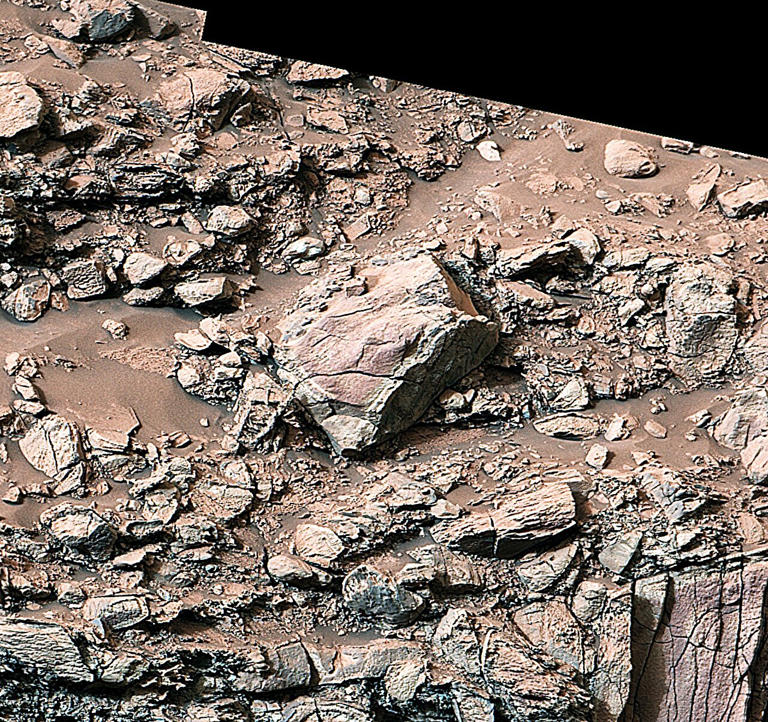
Those conclusions are based on rocks found in the debris mounds: Whereas stones carried by water flows become rounded like river rocks, some of the debris mounds are riddled with more angular rocks that may have been deposited by dry avalanches.
Finally, water soaked into all the material that settled here. Chemical reactions caused by the water bleached white "halo" shapes into some of the rocks. Erosion from wind and sand has revealed these halo shapes over time.
"This was not a quiet period on Mars," said Becky Williams, a scientist with the Planetary Science Institute in Tucson, Arizona, and the deputy principal investigator of Curiosity's Mast Camera, or Mastcam. "There was an exciting amount of activity here. We're looking at multiple flows down the channel, including energetic floods and boulder-rich flows."
A hole in 41
All this evidence of water continues to tell a more complex story than the team's early expectations, and they've been eager to take a rock sample from the channel in order to learn more. On June 18, they got their chance.
While the sulfur rocks were too small and brittle to be sampled with the drill, a large rock nicknamed "Mammoth Lakes" was spotted nearby. Rover engineers had to search for a part of the rock that would allow safe drilling and find a parking spot on the loose, sloping surface.
After Curiosity bored its 41st hole using the powerful drill at the end of the rover's 7-foot (2-meter) robotic arm, the six-wheeled scientist trickled the powderized rock into instruments inside its belly for further analysis so that scientists can determine what materials the rock is made of.
Curiosity has since driven away from Mammoth Lakes and is now off to see what other surprises are waiting to be discovered within the channel.
Provided by NASA
This story was originally published on Phys.org. Subscribe to our newsletter for the latest sci-tech news updates.
Study: Biological Amino Acids Could Survive in Near-Surface Ices of Europa and Enceladus
Study: Biological Amino Acids Could Survive in Near-Surface Ices of Europa and Enceladus
Europa and Enceladus are key targets to search for evidence of alien life in our Solar System. However, the surface and shallow subsurface of these airless icy moons are constantly bombarded by ionizing radiation that could degrade chemical biosignatures. Therefore, sampling of icy surfaces in future life detection missions to Europa and Enceladus requires a clear understanding of the necessary ice depth where unaltered organic biomolecules might be present. A team of scientists from NASA and the Pennsylvania State University has conducted experiments by exposing individual biological and abiotic amino acids in ices to gamma radiation to simulate conditions on these icy worlds.
The surface of Europa looms large in this newly-reprocessed color view; image scale is 1.6 km per pixel; north on Europa is at right.
Image credit: NASA / JPL-Caltech / SETI Institute.
“Based on our experiments, the ‘safe’ sampling depth for amino acids on Europa is almost 20 cm (8 inches) at high latitudes of the trailing hemisphere (hemisphere opposite to the direction of Europa’s motion around Jupiter) in the area where the surface hasn’t been disturbed much by meteorite impacts,” said Dr. Alexander Pavlov, a researcher at NASA’s Goddard Space Flight Center.
“Subsurface sampling is not required for the detection of amino acids on Enceladus — these molecules will survive radiolysis (breakdown by radiation) at any location on the Enceladus surface less than a few millimeters (a tenth of an inch) from the surface.”
Dr. Pavlov and his colleagues used amino acids in radiolysis experiments as possible representatives of biomolecules on icy moons.
Amino acids can be created by life or by non-biological chemistry.
However, finding certain kinds of amino acids on Europa or Enceladus would be a potential sign of life because they are used by terrestrial life as a component to build proteins.
Proteins are essential to life as they are used to make enzymes which speed up or regulate chemical reactions and to make structures.
Amino acids and other compounds from subsurface oceans could be brought to the surface by geyser activity or the slow churning motion of the ice crust.
To evaluate the survival of amino acids on these worlds, the researchers mixed samples of amino acids with ice chilled to about minus 196 Celsius (minus 321 Fahrenheit) in sealed, airless vials and bombarded them with gamma-rays, a type of high-energy light, at various doses.
Since the oceans might host microscopic life, they also tested the survival of amino acids in dead bacteria in ice.
Finally, they tested samples of amino acids in ice mixed with silicate dust to consider the potential mixing of material from meteorites or the interior with surface ice.
The experiments provided pivotal data to determine the rates at which amino acids break down, called radiolysis constants.
With these, the scientists used the age of the ice surface and the radiation environment at Europa and Enceladus to calculate the drilling depth and locations where 10% of the amino acids would survive radiolytic destruction.
Although experiments to test the survival of amino acids in ice have been done before, this is the first to use lower radiation doses that don’t completely break apart the amino acids, since just altering or degrading them is enough to make it impossible to determine if they are potential signs of life.
This is also the first experiment using Europa/Enceladus conditions to evaluate the survival of these compounds in microorganisms and the first to test the survival of amino acids mixed with dust.
The scientists found that amino acids degraded faster when mixed with dust but slower when coming from microorganisms.
“Slow rates of amino acid destruction in biological samples under Europa and Enceladus-like surface conditions bolster the case for future life-detection measurements by Europa and Enceladus lander missions,” Dr. Pavlov said.
“Our results indicate that the rates of potential organic biomolecules’ degradation in silica-rich regions on both Europa and Enceladus are higher than in pure ice and, thus, possible future missions to Europa and Enceladus should be cautious in sampling silica-rich locations on both icy moons.”
“A potential explanation for why amino acids survived longer in bacteria involves the ways ionizing radiation changes molecules — directly by breaking their chemical bonds or indirectly by creating reactive compounds nearby which then alter or break down the molecule of interest.”
“It’s possible that bacterial cellular material protected amino acids from the reactive compounds produced by the radiation.”
The team’s paper was published in the journal Astrobiology.
Alexander A. Pavlov et al. 2024. Radiolytic Effects on Biological and Abiotic Amino Acids in Shallow Subsurface Ices on Europa and Enceladus. Astrobiology 24 (7); doi: 10.1089/ast.2023.0120
This article was adapted from an original release by NASA.
Swarming Satellites Could Autonomous Characterize an Asteroid
An asteroid’s size, shape, and rotational speed are clues to its internal properties and potential resources for mining operations. However, of the more than 20,000 near-Earth asteroids currently known, only a tiny fraction have been sufficiently characterized to estimate those three properties accurately. That is essentially a resource constraint – there aren’t enough dedicated telescopes on Earth to keep track of all the asteroids for long enough to characterize them, and deep space resources, such as the Deep Space Network required for communications outside Earth’s orbit, are already overutilized by other missions. Enter the Autonomous Nanosatellite Swarming (ANS) mission concept, developed by Dr. Simone D’Amico and his colleagues at Stanford’s Space Rendezvous Laboratory.
The concept behind ANS is relatively simple. A primary “mothership” spacecraft travels to an asteroid, where it deploys several smaller, autonomous nanosatellites upon arrival. These nanosatellites take up positions surrounding the asteroid and, using relatively inexpensive sensor and communications technology, map the asteroid’s features. After observing for some time, they send data back to the mothership, where an algorithm pieces together information similar to a stereo vision system on Earth and calculates the asteroid’s shape, size, and rotational speed.
There are several deeper layers to unpack in the mission, though. Communication is the first one. In ANS, only the mothership communicates back to Earth using a high-gain antenna. The smaller swarming robots all communicate with each other – partly to estimate distances between the different swarming satellites but also to coordinate observations.
Characterization is the first step toward exploitation, as Fraser discusses.
Each nanosatellite utilizes only a few relatively inexpensive pieces of hardware, including a star tracker for overall positioning, short range camera (as compared to more expensive lidar systems typically used in asteroid characterization missions), atomic clocks to synchronize timing, and radio frequency communication modules. These components allow for relatively independent operation of each nanosatellite and lower the burden of communication back with Earth – freeing up those deep space communications resources for other critical work.
But the critical component of ANS isn’t so much the hardware—it’s the software, particularly the control and estimation algorithm. Dr. D’Amico and his team describe a technical tool known as an unscented Kalman filter, which allows them to estimate asteroid shape, size, and rotation based on landmarks noticed by each swarming nanosatellite and run through this algorithm.
To demonstrate the effectiveness of that algorithm, the team tested it using a relatively well-characterized asteroid: 443 Eros. That asteroid had the distinction of being both the first near-Earth object ever found, back in 1898, and the first ever visited by a mission – the NEAR mission 100 years later. The NEAR Shoemaker craft that visited 433 Eros also successfully landed on it, another first for humanity. Even with the comparatively simple sensing technology of a quarter century ago, Eros is still one of the most characterized asteroids in the solar system.
Here’s a talk about autonomous swarming given by Dr. D’Amico, the head of Stanford’s Space Rendezvous Lab.
The demonstration results clearly showed that the ANS algorithm does its job well. It can coordinate the positioning of the nanosatellites surrounding the asteroid and coalesce their disparate data sets into a coherent picture of the asteroid they are monitoring. And it can do so remotely, with very minimal input from Earth.
For now, that is how far the algorithm has gotten. Several missions, some of which we’ll cover in the near future, further explore the idea of nanosatellite swarms. But ANS itself hasn’t yet been adopted into a formal mission architecture. One day, though, thousands of satellites might be swarming the tens of thousands of small bodies surrounding our home, leading to the first stages of a genuinely off-Earth economy.
The Most Dangerous Part of a Space Mission is Fire
This AI generated image shows a fire spreading in a spacecraft. Researchers are working to understand how fire behaves differently in spacecraft environments so they can protect astronauts. Image Credit: ZARM/ University of Bremen
The Most Dangerous Part of a Space Mission is Fire
Astronauts face multiple risks during space flight, such as microgravity and radiation exposure. Microgravity can decrease bone density, and radiation exposure is a carcinogen. However, those are chronic effects.
The biggest risk to astronauts is fire since escape would be difficult on a long mission to Mars or elsewhere beyond Low Earth Orbit. Scientists are researching how fire behaves on spacecraft so astronauts can be protected.
“A fire on board a spacecraft is one of the most dangerous scenarios in space missions,” said Dr. Florian Meyer, head of the Combustion Technology research group at ZARM. “There are hardly any options for getting to a safe place or escaping from a spacecraft. It is therefore crucial to understand the behavior of fires under these special conditions.”
Since 2016, ZARM has been researching how fire behaves and spreads in microgravity conditions like those in the ISS. Those conditions also include an oxygen level similar to Earth’s, forced air circulation, and ambient pressure similar to Earth’s. NASA has been conducting similar experiments, and now we know that fire behaves differently in microgravity than it does on Earth.
Initially, a fire will burn with a smaller flame and take longer to spread. This is to the fire’s advantage since it won’t be noticed as quickly. Fire also burns hotter in microgravity, meaning that some materials that may not be combustible in normal Earth conditions could burn in spacecraft, creating toxic chemicals in the spacecraft’s air.
Spacecraft for Mars missions will have different environments than the ISS. The ambient air pressure will be lower, which provides two benefits: it makes the spacecraft lighter and also allows astronauts to prepare for external missions more quickly. However, the lower ambient pressure introduces another critical change in the spaceship environment. The oxygen content has to be higher to meet the astronauts’ respiration needs.
In these latest tests, the team at ZARM tested fire in these revised conditions.
PMMA stands for polymethyl methacrylate and is usually called acrylic. It’s a common material used in place of glass because it’s light and shatterproof. The ISS doesn’t use it, but it’s being developed for use in future spacecraft. The Orion capsule uses acrylic fused to other materials for windows, and future spacecraft will likely use something similar.
In their experiments, the researchers lit acrylic glass foils on fire and varied three environmental factors: ambient pressure, oxygen content and flow velocity.
This table from the figure is the test matrix for the experiments. The X’s and the single O indicate flow rates: X = 100 mm/s, O = 30–200 mm/s. Image Credit: Ries et al. 2024.
The experiments showed that lower ambient pressure dampens fire. However, higher oxygen content has a more powerful effect. The ISS’s oxygen level is 21%, just as it is on Earth. Future spacecraft with lower ambient pressures will have oxygen levels as high as 35%. That translates into a huge increase in the risk astronauts face from fire. The results show that a fire can spread three times faster than it would under Earth conditions.
“Our results highlight critical factors that need to be considered when developing fire safety protocols for astronautic space missions.”
Dr. Florian Meyer, Combustion Technology research group at ZARM
This figure from the study shows a time series of infrared images of the tests. They show fire on an acrylic film under microgravity conditions with 100 mm/second airflow, 75 kPa, and 28.3% oxygen. The white dashed lines show the contour of the acrylic sample. The green dotted lines are the evaluation lines used to measure the fire’s propagation rate. In panel b, the pink horizontal bar below the propagation front is the igniter. Image Credit: Ries et al. 2024.
We all know increased airflow spreads fire faster; that’s why we blow on a small flame to create a larger fire. Increased airflow delivers more oxygen, increasing combustion, so increased airflow in a higher-oxygen atmosphere creates a dangerous situation for astronauts.
“Our results highlight critical factors that need to be considered when developing fire safety protocols for astronautic space missions,” said Dr. Florian Meyer. “By understanding how flames spread under different atmospheric conditions, we can mitigate the risk of fire and improve the safety of the crew.”
Meteor Exploded Over N.Y.C. at 38,000 MPH: 'Rare Daylight Fireball'
Meteor Exploded Over N.Y.C. at 38,000 MPH: 'Rare Daylight Fireball'
Story by Anna Lazarus Caplan
NASA said that it does not track small meteors at "significant" distances from Earth, but individuals in New York and New Jersey reported witnessing the event
A small meteor was responsible for a big fireball over New York City on Tuesday, July 16, authorities said.
The astronomical event was first detected about 49 miles above Upper Bay/New York Harbor and moved west towards New Jersey at 38,000 mph, passing over the Statue of Liberty before disintegrating about 29 miles above midtown Manhattan, NASA confirmed in a statement.
Witnesses described seeing a fireball, hearing “booms” and feeling “shakings” between 10 a.m. to 12 p.m. local time, NASA said.
It is unclear if the sounds were related to the meteor or were due to military operations happening at the same time in New Jersey, Bill Cooke, with NASA’s Meteoroid Environments Office said, per ABC affiliate WABC-TV.
However, he added that the event was an unusual occurrence.
"Something when it's moving that fast it heats up,” Cooke said. “You expect to see meteors at night not during the day, so this was a rare daylight fireball."
While no meteorites were reported, the meteor gave pause to those underneath its trajectory.
Related video:
NASA Meteor Watch: 'Daylight fireball over New York City' around time of reported booms, shakings (News 12 (Video)
"It was long and really, really fast," Judah Bergman, who saw the meteor from his Lakewood, N.J. office, told WABC. "It looked like a flaming, long rod or something on fire and flying through the sky."
The meteor was not even on NASA’s radar, at first, according to the organization.
“We do keep track of asteroids that are capable of posing a danger to us Earth dwellers, but small rocks like the one producing this fireball are only about a foot in diameter, incapable of surviving all the way to the ground,” NASA said in its statement. “We do not (actually cannot) track things this small at significant distances from the Earth, so the only time we know about them is when they hit the atmosphere and generate a meteor or a fireball.”
While some seasoned New Yorkers were nonplussed, according to The New York Times, at least one resident who observed the moment reveled in its rarity.
“There’s something magical about it,” Tina Dang, a private chef, said. “You forget about these incredible moments in life, when so much else is going on.”
NASA's volgende doel is om de mens in 2026 terug te brengen naar de maan. In de tussentijd opent een ondergrondse grot op onze satelliet de deur naar nieuwe mogelijkheden.
De terugkeer van de mens naar de maan: de ondergrondse grot zou hem kunnen huisvesten
Meer dan 50 jaar zijn verstreken sinds de laatste mens op het maanoppervlak liep. Sinds 1972 heeft geen enkele andere bemanning onze natuurlijke satelliet bereikt, maar NASA bereidt zich voor op deze grote terugkeer en telt onder de astronauten op de missie de eerste vrouw en de eerste zwarte man met het Artemis-programma.
Nu heeft een nieuwe studie een ondergrondse grot op de maan ontdekt die nieuwe mogelijkheden opent: astronauten zouden daarin hun toevlucht kunnen zoeken voor een langdurig verblijf buiten de aarde. Wetenschappers hebben de aanwezigheid van de grot officieel gemaakt, gelegen op slechts 400 km van het punt waar Neil Armstrong in 1969 samen met Buzz Aldrin landde met de ruimtevlucht Apollo 11.
Bewijs voor het bestaan van maangrotten: de studie
Nature Astronomy
Het team van Italiaanse wetenschappers heeft bewijs gepubliceerd dat het bestaan bevestigt van de vrij grote grot, die toegankelijk zou kunnen zijn vanuit de diepst bekende maankuil. De grot bevindt zich in de Mare Tranquillitatis, de maanzee die zich bevindt op het halfrond dat altijd naar onze planeet is gericht. Tot nu toe zijn er tweehonderd mogelijk vergelijkbare grotten ontdekt, allemaal ontstaan door ingestorte lavabuizen.
Het onderzoek was erop gericht om de metingen van NASA's Lunar Reconnaissance Orbiter te vergelijken met de lavabuizen op aarde. De radar mat alleen het eerste deel van de ondergrondse grot en detecteerde een breedte van ongeveer 40 meter en een lengte van tientallen meters. Leonardo Carrer en Lorenzo Bruzzone van de Universiteit van Trento, Italië, legden uit dat "maangrotten meer dan 50 jaar een mysterie zijn gebleven, dus het was spannend om eindelijk hun bestaan te kunnen bewijzen."
De ondergrondse maangrot zou astronauten kunnen huisvesten
De grot zou een potentiële maanbasis kunnen worden, volgens de wetenschappers, omdat het “beschutting biedt tegen de barre omstandigheden aan het oppervlak en de menselijke verkenning van de maan op de lange termijn zou kunnen ondersteunen”. De bouw van een nieuwe maanbasis, zo beweren de auteurs van het onderzoek, zou veel duurder en tijdrovender zijn, hoewel de muren van de groeve waarschijnlijk verstevigd zouden moeten worden om een mogelijke instorting te voorkomen.
Volgens Helen Sharman, een Britse astronaute, zouden mensen dankzij deze diepe ondergrondse schuilplaatsen over twee of drie decennia op de maan kunnen blijven en een soort lift installeren om naar het oppervlak terug te keren. Bovendien zijn de materialen in deze kuilen in de loop van eonen, oftewel miljarden jaren, niet veranderd en zouden ze waardevolle nieuwe informatie kunnen opleveren over de evolutie van de satelliet en zijn vulkanische activiteit.
Na meer dan een halve eeuw zal de mens dus terugkeren naar de maan met nieuwe mogelijkheden vergeleken met die van de twintigste eeuw, en zou hij lange tijd op de satelliet kunnen blijven, in ondergrondse grotten.
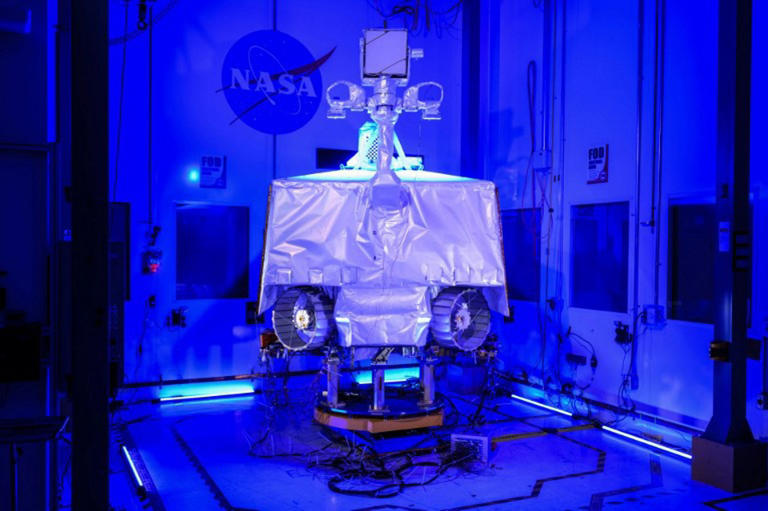
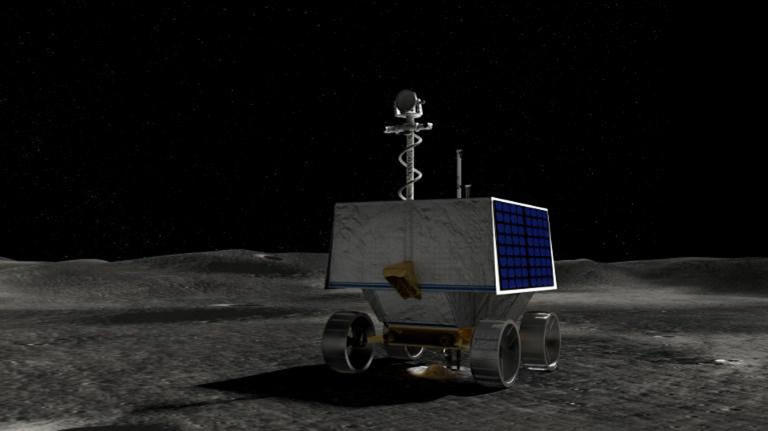
NASA zal dan toch geen "rover" (een rijdende robot) naar de zuidpool van de maan sturen om er water te zoeken. Dat heeft het Amerikaanse ruimtevaartagentschap woensdag bekendgemaakt. De kosten van de missie liepen te hoog op.
Het ruimtevaartagentschap gaf al 450 miljoen dollar uit aan de robot, waarvan de kosten oorspronkelijk waren geraamd op minder dan 430 miljoen dollar. De lancering was in eerste instantie voorzien voor 2022, maar was uitgesteld tot ten vroegste het voorjaar van 2025. Dat zou de totale kosten hebben opgedreven tot meer dan 600 miljoen dollar.
Het was volgens NASA een zeer moeilijke beslissing om de missie af te blazen, terwijl de rover al is opgetuigd. Het ruimtevaartagentschap heeft een oproep gelanceerd voor industriële of internationale partners die mogelijk geïnteresseerd zijn in de rover. Anders is NASA van plan om het toestel te ontmantelen om bepaalde onderdelen te hergebruiken, zoals batterijen en zonnepanelen.
This “penguin party” (called Arp 142) is loud! The distorted spiral galaxy at center, the Penguin, and the compact elliptical galaxy at left, the Egg, are locked in an active embrace. A new near- and mid-infrared image from the Webb Space Telescope, taken to mark its second year of science, shows that their interaction is marked by a faint upside-down U-shaped blue glow. The blue galaxy at upper right (near bright star) is a closer galaxie teeming with new stars. It's not part of the collision and lies closer to Earth than Arp 142.
What happens when a spiral and an elliptical galaxy collide? To celebrate the second anniversary of the “first light” for the Webb telescope, NASA released an amazing infrared view of two galaxies locked in a tight dance. They’re called the Penguin and the Egg and their dance will last hundreds of millions of years.
“In just two years, Webb has transformed our view of the universe, enabling the kind of world-class science that drove NASA to make this mission a reality,” said Mark Clampin, director of the Astrophysics Division at NASA Headquarters in Washington. “Webb is providing insights into longstanding mysteries about the early Universe.”
Webb Witnesses a Galactic Dance
The telescope targeted a collision scene named Arp 142 containing both galaxies—a scene that the Hubble Space Telescope has also explored. They lie about 326 million light-years away. Their first close encounter began somewhere between 25 and 75 million years ago. That’s when two partner galaxies had the first of many passages that will distort their shapes more than they already appear here.
The Hubble Space Telescope captured visible light when observing Arp 142, nicknamed the Penguin and the Egg, in 2013. The Webb view (right) shows the near-infrared view. Courtesy NASA, ESA, CSA, STScI
Webb’s observations, which combine near- and mid-infrared light from Webb’s NIRCam (Near-Infrared Camera) and MIRI (Mid-Infrared Instrument), respectively, clearly show that a hazy cloud of gas and stars (blue) links them together. The close approach also set off tremendous bursts of star birth in the colliding clouds of gas and dust.
Eventually, after several close approaches in their cosmic dance, these two galaxies will merge completely. Observers hundreds of millions of years in the future will look at Arp 142 and see one massive elliptical galaxy.
Interestingly, Webb’s sharp infrared eyes also picked out very distant galaxies. Some lie beyond this cosmic collision, although at least one lies about a hundred million light-years closer to Earth. It bristles with hot, young, newborn stars.
How The Arp 142 Galaxies Experience a Merger
The Penguin and Egg galaxies lie about 100,000 light-years apart but they affect each other. The Egg’s gravitational pull distorts the spiral and that interaction is “sculpting” the Penguin. The core makes up the eye of a penguin. The slowly unwinding spiral arms form a beak, head, backbone, and tail.
Webb’s infrared view reveals otherwise unseen activity between the two. For example, the Penguin is rich in dust. Webb’s view shows us how gravitational interactions pull that dust away from the Penguin. There are also scads of new stars in the galaxy, surrounded by what looks like smoke. Webb’s view shows this hydrogen cloud. It’s rich in carbon-based molecules called polycyclic aromatic hydrocarbons (PAHs). These are incredibly abundant in the Universe and astronomers find them just about everywhere they point a telescope.
Webb’s mid-infrared MIRI image shows the Egg as a small teal oval. Mid-infrared light predominantly shows the oldest stars in the elliptical galaxy, which has lost or used up most of its gas and dust. This is why the view is so different from the combined image, which includes near-infrared light. Courtesy: NASA, ESA, CSA, STScI
By contrast, in Webb’s view, the Egg looks like it’s hardly been touched—it’s still an egg-shaped elliptical. It has much older stars than the Penguin. Past epochs of star birth have pretty much used up the available star-making material. So, even though the two galaxies have about the same mass, the Egg just doesn’t have as much material to get stretched out or turned into stars.
Zeroing in on Webb’s Two Views
If you look at both of Webb’s infrared views of the galaxy collision, you can see marked differences in them. That’s because each one prioritizes a different set of infrared wavelengths. In the mid-infrared view, the egg looks tiny and washed out. That’s because the instrument sees only the old stars in the Egg. By contrast, the Penguin’s distorted core and spiral arms are brimming with young stars embedded in the PAH-rich hydrogen clouds.
The combined near- and mid-infrared view shows more of the gas clouds as the Egg tears them away from the Penguin. These regions will glitter in the future with the light of newly formed stars. For now, however, only cooler, older stars are visible in the combined image. The younger ones are there, but the mid-infrared-sensitive instrument doesn’t spot them.
Here’s a flythrough visualization of Arp 142. NASA, ESA, CSA, Ralf Crawford (STScI), Joseph DePasquale (STScI), Christian Nieves (STScI), Joseph Olmsted (STScI), Alyssa Pagan (STScI), Frank Summers (STScI), Greg Bacon (STScI)
Why Does Webb Study Galaxy Collisions?
By studying this galactic collision site, the Webb telescope further probes the activity as galaxies evolve. Collisions are an integral part of this process. Our Milky Way Galaxy will dance with the nearby Andromeda Galaxy, starting in about 5 billion years. Images and data from observations of other galaxies doing the same thing give astronomers a chance to understand the process and forecast the distant future when something called “Milkdromeda” will contain the stars and planets of two spirals that once were close neighbors.
A Hopping Robot Could Explore Europa Using Locally Harvested Water
Various forms of hopping robots have crept into development for us[e in different space exploration missions. We’ve reported on their use on asteroids and even our own Moon. But a study funded by NASA’s Institute for Advanced Concepts (NIAC) in 2018 planned a mission to a type of world where hopping may not be as noticeable an advantage—Europa.
The mission, developed by engineers at NASA’s Jet Propulsion Laboratory, Purdue University, and Honeybee Robotics, is known as the Steam Propelled Autonomous Retrieval Robot for Ocean Worlds, or SPARROW. It’s about the size and shape of a soccer ball, with the logic, power, and control systems inside a spherical outer hollow shell.
SPARROW wouldn’t be able to operate on its own, however. It would require a lander to deposit it onto the surface and serve as a refueling and sample collection storage base. Europa Clipper, the only currently planned NASA mission to the icy moon, would have been good for hitching a ride, but its lack of a lander made it unsuitable for SPARROW.
Budget constraints are always a problem for innovative missions – as Fraser explains with Dr. Manasvi Lingam.
However, the hopping robot itself is well suited for the environment in Europa. Its designers intended to make it “terrain agnostic,” meaning it could traverse even the harshest terrain the icy moon could throw at it. These would include penitentes, shards of ice that could be meters tall, and difficult for ground-based robots to traverse.
SPARROW could fly over them, collect interesting samples, and return to the lander to refuel and deposit them. Then, it could go out again in a different direction. To model this system architecture, the JPL team spent Phase I trying to determine the best propulsion system for the robot and modeling control algorithms for the flights.
First, let’s tackle the propulsion system. The lander accompanying SPARROW would have to mine ice off the moon’s surface, then heat it and store it as water. When SPARROW returned from a hop, it would use the water to refuel. Five different propulsion methods were considered as part of the study. Still, the best turned out to be a “hot water thruster,” where SPARROW would internally heat the water supplied by the lander, then eject that out in a burst of propulsive force to launch the robot off the surface.
Exploring the surface of Europa is only one part of its mystery – as Fraser explains.
The second major part of the paper was controlling that propulsion. Trajectory correction is critical to mission success, but in this case, the designers believe that no matter where the robot ends up, it will be able to collect a sample and return to the lander. This is due to its gimballed design, which allows the robot to consistently orient correctly, even after bouncing along a frozen surface for a while.
There is still much work to do before the mission is ready to go, though. Some of the most pressing questions are how to stop ice from forming in the robot’s propulsion nozzle and throughout its structural cage. Such blockages could easily throw off any existing trajectory calculations and theoretically immobilize the hopper entirely if they were severe enough.
However, no work is planned to solve those problems for now as the project has yet to receive Phase II funding from NIAC, and work on it appears to have stalled. Dr. Gareth Meirion-Griffith, the primary investigator on the project, has moved on from JPL to take a job at Collins Aerospace. Even so, someday, the author’s ideas might be integrated into a Europa lander mission—we’ll have to wait and see.
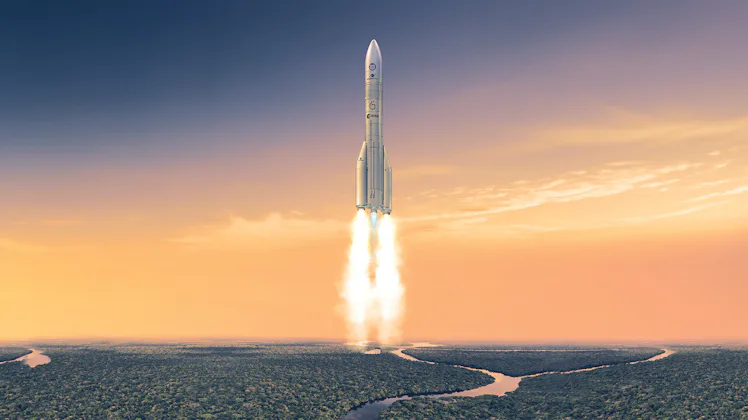
The Ariane 6 rocket promises to be Europe’s newest portal into space. On Tuesday, the rocket successfully reached orbit for the first time, taking off from Europe's Spaceport in northeastern South America. If all continues to go well on future flights, Ariane 6 will pick up after Ariane 5, the workhorse that flew for the last time in July 2023, and which delivered critical missions into space like the James Webb Space Telescope.
“Ariane 6 is Europe’s rocket for the needs of today, adaptable to our future ambitions,” Josef Aschbacher, ESA Director General, shared via ESA.
When the new rocket is fully functioning, the ESA will be able to pay a European company to launch its projects. Today, it relies on U.S.-based private space companies such as SpaceX.
Ariane 6, unlike SpaceX’s Falcon fleet, isn’t a reusable rocket. However, the newly constructed spacecraft does come with some novel technology, including a special upper stage engine, called Vinci, that will be agile and friendly to the space environment.
“With many features brand new to Ariane 6, we’ll be able to carry more and take it further, while sustainably disposing of the launcher's upper stage to prevent it becoming space debris,” officials from the operator of the Ariane 6’s inaugural flight, the European Space Agency (ESA), wrote on Sunday.
An illustration of the Ariane 6 lifting off from French Guiana.
The 184-foot-tall spacecraft is a collaboration between Arianespace, its main customer ESA, and the French space agency CNES, which built out the Ariane 6 launchpad at Guiana Space Centre near Kourou, French Guiana. Like Ariane 5, Ariane 6 will launch near the Equator, taking advantage of the boost from Earth’s rotation there to reach space.
MEET VINCI
The Vinci upper stage engine is the Ariane 6 feature with the most allure. For one, it can be reignited, which allows a single Ariane 6 launch to deliver multiple missions on different orbits.
“Reigniting an engine in zero gravity may not sound so difficult, but as fuels float freely inside the tanks, it is not as simple as you might think. The Auxiliary Propulsion Unit (APU) helps here, providing a small but steady amount of thrust to cause fuel in the Vinci tanks to settle ensuring it can fire again,” ESA officials added.
A final command tells Vinci to passivate, or remove energy, so that it can reenter the atmosphere and burn up with the least chance of an explosion. According to ESA, this reduces the chances that Vinci pieces will linger around as space debris.
With Ariane 6, the ESA can now envision missions both within Earth orbit and beyond to destinations like the Moon.
Researchers made a tantalizing discovery after they MacGyver-ed old data from a radar instrument on a satellite gathered 14 years ago from the Moon. When they used the mission data in a fresh new way, they found proof of a Moon cave hiding in plain sight.
The cave is inside a hole in the ground located in the Sea of Tranquility, which is the same region where the first Apollo astronauts walked on the Moon. This pit is named Mare Tranquillitatis pit (MTP) after the area’s Latin spelling.
The team behind the new work, which was published today in the journal Nature Astronomy, created an ad-hoc radar technique. This provided them a refreshing new look at observations made with the Miniature Radio Frequency (Mini-RF) instrument onboard NASA’s Lunar Reconnaissance Orbiter in 2010, when it fired pulses at an inclined angle down towards the pit. This data was invisible to the satellite’s optical cameras.
When they analyzed the signals anew, and compared it with simulations, they saw that Mini-RF had detected something spectacular. From an observational angle of about 47 degrees, they saw evidence that the pit floor, which was always visible overhead, is flanked by something burrowed beneath the surface. The finding may have repercussions for future lunar explorers.
The Mare Tranquillitatis pit (MTP) on the Moon’s near side.
The Moon cave is a conduit, or a section of a longer tunnel where something once used to flow.
What formed it? Researchers think that beneath the ground, lava flow likely formed the tunnel in the ancient past. Then suddenly, for an unknown reason (potentially a meteorite strike or tectonic activity), one section of the tunnel’s roof caved in, allowing Moon debris to fall down and form a cone-shaped pile.
This is the most compelling evidence for Moon conduits so far. There are several other conduits suspected of existing. But MTP was the right size to reveal its hidden cavern.
“It was large enough that the Mini-RF instrument could collect significant amounts of data from within the pit and, fortuitously, the conduit was oriented such that the look angle of the instrument could see into it,” Wes Patterson, study author and Mini-RF principal investigator, tells Inverse.
WHY LOOK FOR WHAT’S LURKING ON THE MOON?
Subsurface Moon caves could be an exciting foray for lunar science.
Beyond the natural silvery satellite, data on these features could shape how astronomers interpret other data to recreate an idea of how the planets formed. It could sharpen our idea of how the Moon and our world are intertwined.
“The study of this conduit could enhance our understanding of the dynamic relationship between the Earth and the Moon,” the study’s lead author Leonardo Carrer tells Inverse.
There’s also a far-off application: refuge for NASA’s Artemis program astronauts. The space agency is funneling its resources towards returning humans to the Moon this decade. The first program flight to bring boots back to the Moon is seeking a landing site near the lunar south pole. Craters may offer refuge to the crew. The lunar south pole, unlike the Sea of Tranquility, offers another critical resource: frozen water.
There’s no evidence that the Sea of Tranquility offers frozen water. But that doesn’t mean it’s not there, Carrer explains. “The presence of water ice in the lunar subsurface is unknown because we have not had the opportunity to observe it directly. This is why our discovery of a likely accessible cave is so important; it provides a potential entry point to explore the lunar subsurface.”
But if MTP leads to a conduit, there may be more. There could be other caverns on more distant worlds where NASA seeks to place astronauts: Mars.
This pit may have just opened up a whole new world of Moon science.
Cassini Reveals Surface Properties of Titan’s Hydrocarbon Seas
Cassini Reveals Surface Properties of Titan’s Hydrocarbon Seas
Saturn’s moon Titan was explored by NASA’s Cassini spacecraft from 2004 to 2017. While Cassini revealed a lot about this Earth-like world, its radar observations could only provide limited information about Titan’s liquid hydrocarbons seas Kraken, Ligeia and Punga Mare. In anew paper in the journal Nature Communications, Cornell University researcher Valerio Poggiali and colleagues report the results of the analysis of the Cassini radar experiments data of Titan’s polar seas.
An artistic rendering of Kraken Mare, a large liquid methane sea on Titan.
Image credit: NASA’s John Glenn Research Center.
“The Cassini spacecraft explored Saturn’s largest moon, Titan, from 2004 to 2017, revealing an Earth-like world with a diverse set of strange, yet very familiar, surface morphologies shaped by a methane-based hydrologic system, operating in a dense nitrogen atmosphere,” Dr. Poggiali and co-authors said.
“Winds in the lower atmosphere move sediments and shape them into vast dune fields that encircle Titan’s equatorial latitudes.”
“In the mid-latitudes, flat and relatively featureless plains mark a transition between the eolian-dominated equator and lacustrine-dominated poles.”
“In the polar regions, large seas and small lakes of liquid hydrocarbons dominate the terrain.”
“Precipitation-fed channels flow into the seas creating estuaries, in some cases deltas, and other familiar coastal sedimentary deposits.”
“While Cassini has revealed much about Titan, these discoveries have prompted more questions.”
In the study, the scientists used four bistatic radar observations, collected by Cassini during four flybys in 2014 (May 17, June 18, October 24) and 2016 (November 14).
For each, surface reflections were observed as the spacecraft neared its closest approach to Titan (ingress), and again as it moved away (egress).
The authors analyzed data from the egress observations of Titan’s three large polar seas: Kraken Mare, Ligeia Mare and Punga Mare.
“A bistatic radar experiment involves aiming a radio beam from the spacecraft at the target — in this case Titan — where it is reflected toward the receiving antenna on Earth,” they explained.
“This surface reflection is polarized — meaning that it provides information collected from two independent perspectives, as opposed to the one provided by monostatic radar data, where the reflected signal returns to the spacecraft.”
“The main difference is that the bistatic information is a more complete dataset and is sensitive to both the composition of the reflecting surface and to its roughness.”
The team found differences in the composition of the hydrocarbon seas’ surface layers, dependent on latitude and location (near rivers and estuaries, for example).
Specifically, the southernmost portion of Kraken Mare shows the highest dielectric constant — a measure of a material’s ability to reflect a radio signal.
For example, water on Earth is very reflective, with a dielectric constant of around 80; the ethane and methane seas of Titan measure around 1.7.
The researchers also determined that all three seas were mostly calm at the time of the flybys, with surface waves no larger than 3.3 mm.
A slightly higher level of roughness — up to 5.2 mm — was detected near coastal areas, estuaries and interbasin straits, possible indications of tidal currents.
“We also have indications that the rivers feeding the seas are pure methane until they flow into the open liquid seas, which are more ethane-rich,” Dr. Poggiali said.
“It’s like on Earth, when fresh-water rivers flow into and mix with the salty water of the oceans.”
“This fits nicely with meteorological models for Titan, which predict that the ‘rain’ that falls from its skies is likely to be almost pure methane, but with trace amounts of ethane and other hydrocarbons,” said Cornell University’s Professor Philip Nicholson.
“More work is already underway on the data Cassini generated during its 13-year examination of Titan.”
“There is a mine of data that still waits to be fully analyzed in ways that should yield more discoveries. This is only the first step.”
V. Poggialiet al. 2024. Surface properties of the seas of Titan as revealed by Cassini mission bistatic radar experiments.Nat Commun15, 5454; doi: 10.1038/s41467-024-49837-2
This article is a version of a press-release provided by Cornell University.
ESA bereidt missie voor naar asteroïde die vlak langs aarde zal scheren: “Zoiets gebeurt maar eens om de 5.000 of 10.000 jaar”
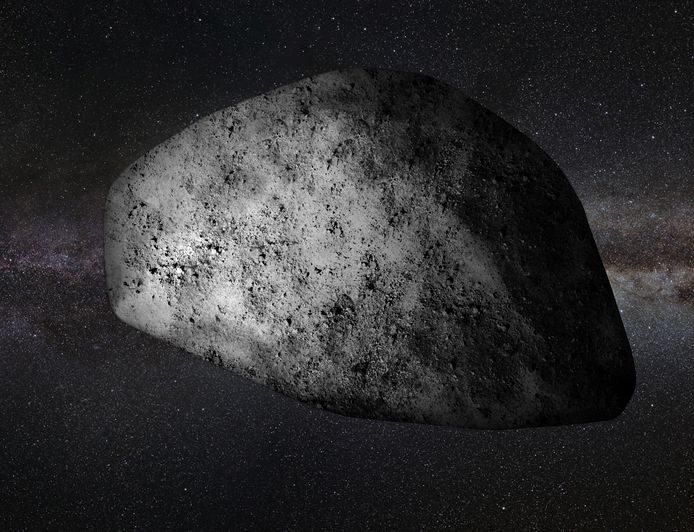
Een asteroïde die vroeger beschouwd werd als de gevaarlijkste van alle bekende planetoïden, zal op 13 april 2029 langs de aarde scheren en dichter bij komen dan sommige satellieten die rondom onze planeet cirkelen. Het Europese ruimtevaartagentschap ESA bereidt een missie voor om de passage van ‘99942 Apophis’ - een erg uitzonderlijke gebeurtenis - van nabij te volgen. Dat moet helpen om eventuele toekomstige botsingen met asteroïden te kunnen voorkomen.
Voor alle duidelijkheid: Apophis zal langs de aarde vliegen, maar tot een botsing zal het niet komen, volgens de ESA. “Astronomen hebben berekend dat een botsing tussen de asteroïde en de aarde voor minstens de komende honderd jaar uitgesloten is”, aldus het ruimtevaartagentschap.
De asteroïde met een diameter van 375 meter zal wel op minder dan 32.000 kilometer van het aardoppervlak passeren en dat is dichterbij dan telecomsatellieten in een geostationaire baan.
Unieke kans
Het biedt een unieke kans voor onderzoek, zegt ESA. Dat zo’n grote brok zo rakelings langs de aarde scheert, gebeurt immers maar eens om de 5.000 of 10.000 jaar.
Het Europese ruimtevaartagentschap wil met de missie Ramses (Rapid Apophis Mission for Space Safety) een ruimtetuig naar de asteroïde sturen om de passage te bestuderen. De verwachting is dat de aantrekkingskracht van de aarde een impact zal hebben op Apophis, met mogelijk aardbevingen of aardverschuivingen op de asteroïde tot gevolg. Ook de baan van de ruimtebrok kan veranderen.
“Door te analyseren hoe Apophis tijdens de passage verandert, zullen de wetenschappers veel te weten komen over de reactie van een asteroïde op externe krachten en over de samenstelling ervan, de interne structuur, de cohesie, de massa, de densiteit en de poreusheid”, stelt ESA. “Dat zijn allemaal belangrijke eigenschappen om te bepalen hoe een gevaarlijke asteroïde die op ramkoers ligt met de aarde, van baan kan worden veranderd.”
Gegevens die de Ramses-missie verzamelt, zullen ook meer inzicht geven in het ontstaan en de ontwikkeling van het zonnestelsel, “omdat asteroïden ook tijdcapsules zijn die ruim vier miljard jaar geleden gevormd werden”.
Experimenten
“Er is nog zo veel dat we moeten leren over asteroïden”, zegt Patrick Michel, onderzoeksdirecteur van het observatorium van de Côte d’Azur. “Tot nu toe moesten we ver in het zonnestelsel reizen om ze te bestuderen. We moesten zelf experimenten uitvoeren om in te werken op het oppervlak. Voor de eerste keer ooit brengt de natuur een asteroïde tot bij ons en voert die het experiment zelf uit.”
Ramses moet in april 2028 gelanceerd worden, zodat het ruimtetuig in februari 2029 bij Apophis kan aankomen, of twee maanden vóór de passage langs de aarde. De voorbereidingen voor de missie zijn nu gestart. In november 2025 moet tijdens een ministeriële top van ESA het licht definitief op groen worden gezet.
Blote oog
De passage van ‘99942 Apophis’ zal ook enkele uren met het blote oog te zien zijn in de nacht van 13 op 14 april 2029, als het weer het toelaat welteverstaan, en dat “voor ongeveer twee miljard mensen in het grootste deel van Europa en Afrika en delen van Azië”, aldus ESA.
De Amerikaanse ruimtevaartorganisatie NASA stuurt ook een ruimtetuig - OSIRIS-REx - naar de asteroïde. Maar dat zal er pas een maand na de scheervlucht langs de aarde aankomen.
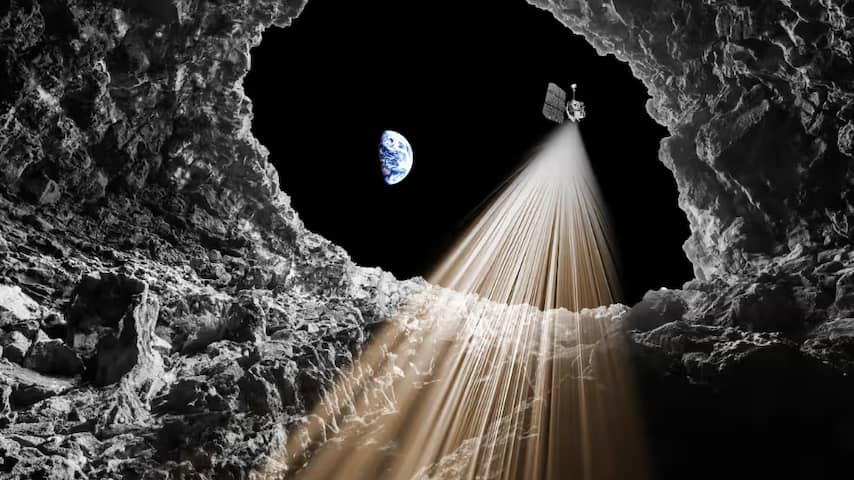
De ingang van de grot ligt op meer dan 100 meter diepte en de grot zelf zou zo'n 40 meter breed en tientallen meters lang zijn.
Foto: NASA, Universiteit van Trento
Grot gevonden op de maan: "Mogelijke uitvalsbasis voor toekomstige astronauten"
Wetenschappers hebben een grot ontdekt op de maan, niet ver van waar Neil Armstrong en Buzz Aldrin in 1969 voor het eerst voet op de maan hebben gezet. Ze vermoeden dat er nog honderden andere grotten zijn die als uitvalsbasis voor astronauten zouden kunnen gebruikt worden.
Stien Schoofs
Op slechts 400 meter van waar Neil Armstrong en Buzz Aldrin 55 jaar geleden zijn geland op de maan hebben Italiaanse en Amerikaanse wetenschappers een grot ontdekt die op meer dan 100 meter diepte ligt, onderin een diepe kuil.
De kuil, waarvan wetenschappers vermoeden dat er nog honderden andere zijn op de maan, zou miljoenen of miljarden jaren geleden ontstaan zijn toen lava op de maan stroomde en er zo een tunnel onder het gesteente ontstond.
De ingang van de grot ligt op meer dan 100 meter diepte en de grot zelf zou zo'n 40 meter breed en tientallen meters lang zijn. Dat staat allemaal beschreven in een onderzoek gepubliceerd in het wetenschappelijke tijdschrift Nature Astronomy.
"Je kan er dus niet zomaar in wandelen", nuanceert ruimtevaartingenieur Stijn Ilsen. "Het is een soort van oude 'lavabuis'. Je kan het vergelijken met oude vulkanen op de aarde die ook buizen hebben waar vroeger de lava heeft doorgestroomd."
Maangrotten zijn al meer dan vijftig jaar een mysterie
De Maansatelliet Lunar Reconnaissance Orbiter heeft in 2010 al beelden gemaakt van kuilen waarvan wetenschappers dachten dat het grotingangen konden zijn. Nu hebben ze echt bewijs door met een radar door te dringen in de opening van een kuil.
"Dat is een radar die die pulsen afvuurt naar de maan en zo kijkt wat er wordt teruggekaatst. Uit die terugkaatsing kunnen ze berekenen hoe het oppervlak zich gedraagt", legt Ilsen uit. "Nu hebben ze specifiek gemikt op een gebied waar ze een vermoeden hadden dat er een ingang van een grot zou zijn en daar hebben ze met een nauwkeurigheid van 25 centimeter die ingang gevonden."
"Maangrotten zijn al meer dan 50 jaar een mysterie. Het was dus spannend om eindelijk het bestaan ervan te kunnen bewijzen", zeggen onderzoekers Leonardo Carrer en Lorenzo Bruzzone van de Universiteit van Trento aan persbureau AP.
Uitvalsbasis voor astronauten
Wat kan zo’n grot betekenen voor een toekomstige Armstrong of Aldrin? Volgens de wetenschappers kan de grot gebruikt worden om een langere periode op de maan te overbruggen. De maangrot kan namelijk bescherming bieden tegen schadelijke straling, extreme temperatuurverschillen en kleine meteorietinslagen.
"Het leven op aarde is ook begonnen in grotten, dus het is logisch dat mensen ook op de maan veel hebben aan die grotten", zegt professor Carrer nog.
De maangrotten lijken zich volgens wetenschappers vooral te bevinden in de oude lavavlaktes van de maan.
Foto: NASA
Hoewel de wanden van de grotten misschien nog verstevigd moeten worden om instorting te voorkomen, is het volgens de wetenschappers een betere optie dan zelf voorzieningen bouwen om een langere periode op de maan te blijven.
De maangrotten lijken zich volgens wetenschappers vooral te bevinden in de oude lavavlaktes van de maan. Toch vermoeden ze ook dat er een paar op de zuidpool van de maan zijn, de plek waar NASA nog astronautenlandingen plant in de toekomst.
"Waar ze de grot ontdekt hebben, is het ongeveer 14 dagen heel warm, met temperaturen rond de 100 graden Celsius. Dan komt er 14 dagen nacht, waar het 100 graden Celsius onder nul is. Die lage temperaturen overleven mensen niet. Dan is zo'n grot de ideale schuilplaats", denkt Ilsen.Helen Sharman, de eerste Britse astronaut die naar de ruimte reisde, vertelde aan de Britse openbare omroep BBC dat de nieuwe ontdekte grot een goede uitvalsbasis lijkt. Ze suggereerde zelfs dat mensen mogelijk binnen 20 tot 30 jaar in maankuilen zouden kunnen wonen.
Wel vermoedt ze dat er jetpacks of een lift nodig zijn om eruit te komen, net omdat de grot zo diep is.
Leven op Mars?
De grotten kunnen dus handig zijn voor mensen, maar de wetenschappers benadrukken dat ze ook kunnen helpen bij het beantwoorden van vragen over de geschiedenis van de maan en ons zonnestelsel.
"De maan wordt continu gebombardeerd door deeltjes van de zon en die gaan de stenen die aan het oppervlakte liggen wel veranderen. In zo'n oude tunnel ga je net gesteente vinden dat bij wijze van spreken miljoenen - zelfs miljarden - jaren onaangeroerd bleef", zegt Ilsen.
Volgens Francesco Sauro, de coördinator van het Topical Team Planetary Caves van ESA, kan het onderzoek zelfs helpen om grotten op Mars te onderzoeken. Dat vertelt hij aan BBC.
"Dat zou de deur kunnen openen naar het vinden van bewijs dat er leven is op Mars. Want als dat er geweest is, zou dat vrijwel zeker in grotten zijn geweest, net omdat die bescherming bieden tegen elementen op het oppervlak."
Bekijk:
Professor sterrenkunde Leen Decin over het belang van deze ontdekking
Voor het eerst grot gevonden op de maan: "Mogelijke uitvalsbasis voor toekomstige astronauten"
Voor het eerst grot gevonden op de maan: "Mogelijke uitvalsbasis voor toekomstige astronauten"
Artikel door Stien Schoofs
Op slechts 400 meter van waar Neil Armstrong en Buzz Aldrin 55 jaar geleden zijn geland op de maan hebben Italiaanse en Amerikaanse wetenschappers een grot ontdekt die op meer dan 100 meter diepte ligt, onderin een diepe kuil.
De kuil, waarvan wetenschappers vermoeden dat er nog honderden andere zijn op de maan, zou miljoenen of miljarden jaren geleden ontstaan zijn toen lava op de maan stroomde en er zo een tunnel onder het gesteende ontstond.
De ingang van de grot ligt op meer dan 100 meter diepte en de grot zelf zou zo'n 40 meter breed en tientallen meters lang zijn. Dat staat allemaal beschreven in een onderzoek gepubliceerd in het wetenschappelijke tijdschrift Nature Astronomy.
De Maansatelliet Luna Reconnaissance Orbiter heeft in 2010 al beelden gemaakt van kuilen waarvan wetenschapper dachten dat het grondingangen konden zijn. Nu hebben ze echt bewijs door met een radar door te dringen in de opening van een kuil.
"Maangrotten zijn al meer dan 50 jaar een mysterie. Het was dus spannend om eindelijk het bestaan ervan te kunnen bewijzen", zeggen onderzoekers Leonardo Carrer en Lorenzo Bruzzone van de Universiteit van Trento aan persbureau AP.
Uitvalsbasis voor astronauten
Wat kan zo’n grot betekenen voor een toekomstige Armstrong of Aldrin? Volgens de wetenschappers kan de grot gebruikt worden om een langere periode op de maan te overbruggen. De maangrot kan namelijk bescherming bieden tegen schadelijke straling, extreme temperatuurverschillen en kleine meteorietinslagen.
"Het leven op aarde is ook begonnen in grotten, dus het is logisch dat mensen ook op de maan veel hebben aan die grotten", zegt professor Carrer nog.
De maangrotten lijken zich volgens wetenschappers vooral te bevinden in de oude lavavlaktes van de maan.
Hoewel de wanden van de grotten misschien nog verstevigd moeten worden om instorting te voorkomen, is het volgens de wetenschappers een betere optie dan zelf voorzieningen bouwen om een langere periode op de maan te blijven.
De maangrotten lijken zich volgens wetenschappers vooral te bevinden in de oude lavavlaktes van de maan. Toch vermoeden ze ook dat er een paar op de zuidpool van de maan zijn, de plek waar NASA nog astronautenlandingen plant in de toekomst.
Helen Sharman, de eerste Britse astronaut die naar de ruimte reisde, vertelde aan de Britse openbare omroep BBC dat de nieuwe ontdekte grot een goede uitvalsbasis lijkt. Ze suggereerde zelfs dat mensen mogelijk binnen 20 tot 30 jaar in maankuilen zouden kunnen wonen.
Wel vermoedt ze dat er jetpacks of een lift nodig zijn om eruit te komen, net omdat de grot zo diep is.
Leven op Mars?
De grotten kunnen dus handig zijn voor mensen, maar de wetenschappers benadrukken dat ze ook kunnen helpen bij het beantwoorden van vragen over de geschiedenis van de maan en ons zonnestelsel.
De rotsen in de grot zullen namelijk minder beschadigd zijn door het ruimteweer en kunnen de geologische geschiedenis van de maan beter weergeven.
Volgens Francesco Sauro, de coördinator van het Topical Team Planetary Caves van ESA, kan het onderzoek zelfs helpen om grotten op Mars te onderzoeken. Dat vertelt hij aan BBC.
"Dat zou de deur kunnen openen naar het vinden van bewijs dat er leven is op Mars. Want als dat er geweest is, zou dat vrijwel zeker in grotten zijn geweest, net omdat die bescherming bieden tegen elementen op het oppervlak."
The mysterious case of a UFO sighting at an African school nearly 20 years on
It wasn't the first high profile case of school children reporting to see a UFO
(Image: Getty Images)
The mysterious case of a UFO sighting at an African school nearly 20 years on
Almost 20 years ago 60 school children reported one of the now most famous alien sightings on record with detailed descriptions all the way down to wha the strange space creatures were wearing
By Danny Gutmann
A school in Africa is the scene of the most notoriousUFO sightings of all time.
In September 1994 Ruwa was only a tiny agricultural centre just 14 miles south east of the Zimbabwe's capital city Harare but ever since that day it has been a major talking point for all UFO enthusiasts.
It was a typically sunny early-afternoon on September 19 1994 when a group of 60 children at Ariel School made the shock claim to have witnessed aliens landing in their playground beside the school.
When asked by the BBC Zimbabwe correspondent Tim Leach one student said: "It looked like it was glinting in the trees. It looked like a disc, like a round...".
Some of the children claimed to have seen aliens alongside the spacecraft
( Image: BBC)
And when Leach asked the children whether they could have been mistaken and whether it could have been a 'Harrier Jump jet' or 'something the Zimbabwe Air Force have got?' they stuck to their guns and were adamant about what they had witnessed.
UFO enthusiast Cynthia Hinds had her interest peaked by the sighting and even travelled all the way from England to speak to the children.
She told the BBC: "I certainly believe the children. I've come across a similar type of thing in Broad Haven in Wales, 1979 and the British didn't believe it, although I went down three times. It's very similar to the whole incident here."
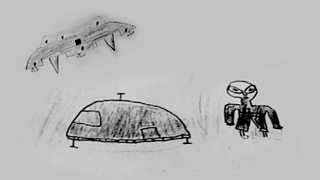
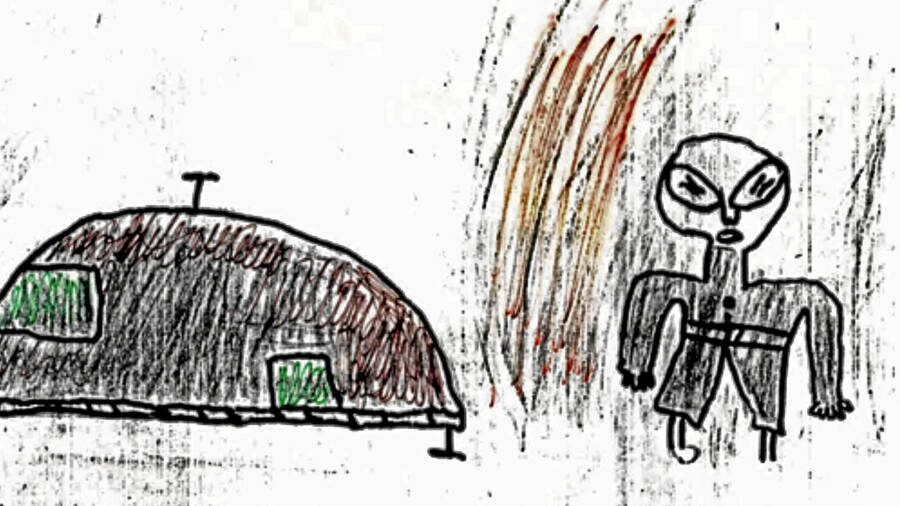
The headteacher at the school told the children to draw a picture of what they had seen
( Image: BBC)
Various different theories and explanations have been mused about what the children had actually seen or whether the in fact that had made the whole thing up.
But, in the days and weeks later a dramatic development was made in the case as more sightings were reported in nearby by areas.
One local woman said: "I saw a glow over my chicken run. A very orange glow."
Meanwhile 239 miles west in the town of Kariba, a man made a similar statement saying: "We suddenly looked up and we saw this this thing coming over the top of the hill. As it came abreast of us it suddenly changed from this glow to two big red orange balls."
The schoolkids who said they saw 'aliens'
A child’s drawing of what they saw during the Ariel School Phenomenon. /span> Ariel Phenomenon/Facebook
Any night now, a “new star” or nova will appear in the night sky. While it won’t set the sky ablaze, it’s a special opportunity to see a rare event that’s usually difficult to predict in advance.
The star in question is T Coronae Borealis (T CrB, pronounced “T Cor Bor”). It lies in the constellation of the Northern Crown, prominent in the Northern Hemisphere but also visible in the northern sky from Australia and Aotearoa, New Zealand, over the next few months.
Most of the time T CrB, which is 3,000 light years away, is much too faint to be seen. But once every 80 years or so, it brightly erupts.
A brand new star suddenly seems to appear, although not for long. Just a few nights later, it will have rapidly faded, disappearing back into the darkness.
A BURST OF LIFE
During the prime of their lives, stars are powered by nuclear fusion reactions deep inside their cores. Most commonly, hydrogen is turned into helium, which creates enough energy to keep the star stable and shining for billions of years.
But T CrB is well past its prime and is now a stellar remnant known as a white dwarf. Its internal nuclear fire has been quenched, allowing gravity to compress the dead star dramatically.
A white dwarf is about the same size as Earth but around 300,000 times more massive, generating a mighty gravitational field.
ESA/NASA
T CrB also has a stellar companion – a red giant that has puffed up as it enters old age. The white dwarf mops up the swollen red giant’s gas, and this forms what’s known as an accretion disc around the dead star.
The matter keeps piling up on a star that’s already compressed to its limit, forcing a continual rise in pressure and temperature. Conditions become so extreme they mimic what once would’ve been found inside the star’s core. Its surface ignites in a runaway thermonuclear reaction.
When this happens, the energy released makes T CrB shine 1,500 times brighter than usual. Here on Earth, it briefly appears in the night sky. With this dramatic reset, the star has then expelled the gas, and the cycle can begin all over again.
Animation of a nova erupting as thermonuclear reactions ignite on the smaller white dwarf star.
Credit: NASA/Conceptual Image Lab/Goddard Space Flight Center.
HOW DO WE KNOW IT’S DUE?
T CrB is the brightest of a rare class of recurrent novae that repeat within a hundred years — a time scale that allows astronomers to detect their recurrent nature.
Only ten recurrent novae are currently known, although more novae may be recurrent — just on much greater timescales that aren’t as easily tracked.
The earliest known date of T CrB erupting is from the year 1217, based on observations recorded in a medieval monastic chronicle. It’s remarkable that astronomers can now predict its eruptions so precisely as long as the nova follows its usual pattern.
The star’s two most recent eruptions — in 1866 and 1946 — showed the exact same features. About ten years prior to the eruption, T CrB’s brightness increased a little (known as a high state), followed by a short fading or dip about a year after the explosion.
The light curve of T CrB during the nova event of 1946, compiled from 6,597 observations logged with the American Association of Variable Star Observers (AAVSO).
MUSEUMS VICTORIA/AAVSO
T CrB entered its high state in 2015, and the pre-eruption dip was spotted in March 2023, setting astronomers on alert. What causes these phenomena are just some of the current mysteries surrounding T CrB.
The recent light curve of T CrB shown in two filters or bands – V (green) and B (blue) – and compiled using 95,901 observations from the AAVSO. It’s possible, especially in the B band, to see T CrB enter the high state in 2015 and currently experiencing the pre-eruption dip.
MUSEUMS VICTORIA/AAVSO
HOW CAN I SEE IT?
Start stargazing now! It’s a good idea to get used to seeing Corona Borealis as it is now so that you get the full impact of the “new” star.
Corona Borealis currently reaches its best observing position (known as a meridian transit) around 8:30 pm to 9 pm local time across Australia and Aotearoa. The farther north you are located, the higher the constellation will be in the sky.
The farther north you are located, the higher Corona Borealis will appear in the northern sky. The new star will be about as bright as Alphecca in Corona Borealis or the nearby Rasalhague in Ophiuchus.
MUSEUMS VICTORIA/STELLARIUM
Whereas down south in Hobart, Corona Borealis stays low in the north. The bright star Arcturus acts as a good guide.
MUSEUMS VICTORIA/STELLARIUM
Across Aotearoa, T CrB is best seen around 9pm throughout July. Additional constellations are shown for reference.
MUSEUMS VICTORIA/STELLARIUM
The nova is expected to be a reasonable brightness (magnitude 2.5): about as bright as Imai (Delta Crucis), the fourth brightest star in the Southern Cross. So it will be easy to see even from a city location, if you know where to look.
During July evenings, the Southern Crux can be found on its side, high in the southwest from Australia and Aotearoa.
MUSEUMS VICTORIA/STELLARIUM
WE WON’T HAVE MUCH TIME
We won’t have long once it goes off. The maximum brightness will only last a few hours; within a week T CrB will have faded and you’ll need binoculars to see it.
It almost certainly will be an amateur astronomer that alerts the professional community to the moment when T CrB outbursts.
These dedicated and knowledgeable people routinely monitor stars from their backyards on the chance of “what if” and, therefore, fill an important gap in night sky observations.
The American Association of Variable Star Observing (AAVSO) has a log of over 270,000 submitted observations on T CrB alone. Amateur astronomers are collaborating here and around the world to continually monitor T CrB for the first signs of eruption.
By September, Corona Borealis will be moving lower into the northwest sky and best seen between 7:30 pm to 8 pm local time.
MUSEUMS VICTORIA/STELLARIUM
Hopefully, the nova will erupt as expected sometime before October because, after that, Corona Borealis leaves our evening sky in the Southern Hemisphere.
This article was originally published onThe Conversation by Tanya Hill at Museums Victoria Research Institute and Amanda Karakas at Monash University. Read theoriginal article here.
The Ariane 6 is here. On Tuesday, the European Space Agency launched the 184-foot-tall spacecraft on its inaugural flight from Europe’s Spaceport in French Guiana. The feat comesyears behind scheduleand one year after its predecessor, the workhorse Ariane 5, flew for the last time.
The Ariane 6 will take the Arianespace fleet to the next level. The modular design enables the rocket to take on light and heavy launches, adapting to the client’s needs. It can lift off with the power of either two or four boosters. It also offers two lengths for its fairing, the tip of the rocket that carries satellites into space. Ariane 6’s upper stage Vinci engine can also reignite in space, which means that on a single launch, the rocket can deliver several different missions into their orbits. ESA expects it to be a lot cheaper to launch than its predecessors.
But Arianespace still faces tough competition from SpaceX, which currently operates its semi-reusable Falcon 9 and Falcon Heavy rockets to provide launch services. SpaceX is already looking ahead to the fully-reusable Starship, which can lift more than ever into space. The Ariane family, unfortunately, is not reusable..
CEO Elon Musk has previously criticized European efforts in the emergent new space race. In March 2021, he wrote on X: “They are aiming too low. Only rockets that are fully & rapidly reusable will be competitive. Everything else will seem like a cloth biplane in the age of jets.”
Here’s what you need to know about how they compare.
An artist's rendering of the two Ariane 5 configurations.
ARIANE 6 VS SPACEX: HOW MUCH CAN IT SEND TO LOW-EARTH ORBIT?
The Ariane 6 will send up varying amounts depending on the booster configuration. The two-booster version, known as Ariane 62, can launch 4,500 to 5,000 kg (9,920 to 11,023 pounds) to geostationary transfer orbit — where the Vinci engine would place a satellite on into the first leg so the mission can transfer towards its final orbit — or 6,500 kilograms (14,330 pounds) to a nearly polar, low-Earth orbit.
In the four-booster configuration, known as Ariane 64, the rocket can launch payloads of around 11,500 kg (25,353 pounds) into geostationary transfer orbit and 21,600 kg (47,620 pounds) into low-Earth orbit.
In its expendable configuration, the Falcon 9 Block 5 (the only variant in operation at the moment) can launch a similar amount to the four-booster Ariane 6. It can send 8,300 kg (18,300 pounds) to geostationary transfer orbit and 22,800 kg (50,265 pounds) to low-Earth orbit. The Falcon Heavy expands on this with the ability to launch 63,800 kilograms (140,660 pounds) to low-Earth orbit.
The Starship is set to blow these figures out of the water, with the ability to send 100,000 to 150,000 kgs (220,000 pounds) to low-Earth orbit. Its most recent launch test flew in June 2024.
In 2014, SpaceX first successfully landed a Falcon 9 booster. This component of the rocket, Musk has claimed, comprises around three-quarters of the total rocket price. By 2021, SpaceX was recovering 30 boosters successfully in a year. In April 2024, SpaceX hit a major milestone: 300 total booster recoveries. SpaceX also recovers the boosters used with the Falcon Heavy rocket.
The company has also started attempting to recover the protective fairing that protects the satellite during launch. SpaceX first successfully recovered a fairing in 2019, and it successfully recovered 13 in 2021.
The upcoming Starship should take this to the next level. SpaceX has designed the rocket to be entirely reusable, which means that the booster and ship can return to Earth for re-use after a flight.
The Ariane 6 is not reusable. It stems back to a design decision in 2014, when the space agency chose to stick with expendability. France’s economy minister, Bruno Le Maire, admitted at a 2020 conference that “in 2014 there was a fork in the road, and we didn’t take the right path.”
“We should have made the choice of the reusable launcher,” Le Maire said. “We should have had this audacity.”
SpaceX’s Falcon 9 rocket.
ANADOLU AGENCY/ANADOLU AGENCY/GETTY IMAGES
ARIANE 6 VS. SPACEX: HOW MUCH DOES IT COST TO LAUNCH?
In January 2021, Politicoreported that the Ariane 6 could launch for as little as $77 million. That’s a steep discount from the $177 million price tag for the Ariane 5.
In October 2023, Ars Technica reported that the Ariane 6 price cut won’t be that large, and roughly $98 million per flight instead. Inflation is partly to blame, according to Arianespace leadership.
SpaceX’s website previously listed the cost of a Falcon 9 launch at $62 million. But CNBC noted in 2020 that the United States Air Force contracts paid around $95 million per Falcon 9 launch. SpaceX estimated the costs for each launch at around $30 million each.
In November 2019, Musk suggested that a Starship could launch for around $2 million each. He’s held that stance into 2024, according to Space News, and still projects a price tag of $2 million to $3 million. If Starship reaches that price point, it will be impressively competitive.
ARIANE 6 VS. SPACEX: WHERE DO THEY LAUNCH FROM?
The Ariane 6, like its predecessor, will launch from Europe’s Spaceport, located around 10 miles from the town of Kourou, French Guiana.
SpaceX has launched the Falcon 9 from three locations:
Florida’s Space Launch Complex 40 at Cape Canaveral
Florida’s Launch Complex 39A at the Kennedy Space Center
California’s Space Launch Complex 4E at the Vandenberg Space Force Base
SpaceX has flown four Starship tests from launchpads near its Starbase facility, which hosts development operations, in Cameron County, Texas. The launchpad is located on the Gulf of Mexico, roughly three miles north of the Mexican border.
For the long term, Musk has also suggested that SpaceX could build ocean spaceports to enable point-to-point travel around the Earth using the Starship.
ARIANE 6 VS. SPACEX: CAN IT POWER MISSIONS TO MARS?
ESA expects to send its Earth Return Orbiter mission to Mars in 2027 aboard an Ariane 6. The mission, which will use the Ariane 64 (four-booster) configuration, will be the final part of a multi-phase plan to retrieve samples from Mars:
NASA’s Mars 2020 mission, which sent the Perseverance rover in February 2021, captures samples in canisters.
NASA’s Sample Retrieval Lander mission will land on Mars, and use Sample Recovery Helicopters to collect the samples and a Mars Ascent Vehicle to launch the samples back to space.
ESA designed the Astris kick stage to better support Ariane 6’s missions to Mars. The optional extra will help move payloads into their final positions in orbit.
SpaceX claims that the Falcon 9 can send 4,020 kg (8,860 pounds) to Mars. The company also claims the Falcon Heavy can send 16,800 kilograms (37,040 pounds) to Mars. The latter rocket sent Musk’s red Tesla Roadster into space back in 2018.
Starship may take all this to the next level. The stainless steel rocket is designed to send both crew and cargo to Earth orbit, the Moon, Mars and beyond. A version of Starship will ferry the Artemis III astronauts from lunar orbit down to the lunar surface. This mission could fly later this decade.
Beste bezoeker, Heb je zelf al ooit een vreemde waarneming gedaan, laat dit dan even weten via email aan Frederick Delaere opwww.ufomeldpunt.be. Deze onderzoekers behandelen jouw melding in volledige anonimiteit en met alle respect voor jouw privacy. Ze zijn kritisch, objectief maar open minded aangelegd en zullen jou steeds een verklaring geven voor jouw waarneming! DUS AARZEL NIET, ALS JE EEN ANTWOORD OP JOUW VRAGEN WENST, CONTACTEER FREDERICK. BIJ VOORBAAT DANK...
Druk op onderstaande knop om je bestand , jouw artikel naar mij te verzenden. INDIEN HET DE MOEITE WAARD IS, PLAATS IK HET OP DE BLOG ONDER DIVERSEN MET JOUW NAAM...
Druk op onderstaande knop om een berichtje achter te laten in mijn gastenboek
Alvast bedankt voor al jouw bezoekjes en jouw reacties. Nog een prettige dag verder!!!
Over mijzelf
Ik ben Pieter, en gebruik soms ook wel de schuilnaam Peter2011.
Ik ben een man en woon in Linter (België) en mijn beroep is Ik ben op rust..
Ik ben geboren op 18/10/1950 en ben nu dus 75 jaar jong.
Mijn hobby's zijn: Ufologie en andere esoterische onderwerpen.
Op deze blog vind je onder artikels, werk van mezelf. Mijn dank gaat ook naar André, Ingrid, Oliver, Paul, Vincent, Georges Filer en MUFON voor de bijdragen voor de verschillende categorieën...
Veel leesplezier en geef je mening over deze blog.