The purpose of this blog is the creation of an open, international, independent and free forum, where every UFO-researcher can publish the results of his/her research. The languagues, used for this blog, are Dutch, English and French.You can find the articles of a collegue by selecting his category. Each author stays resposable for the continue of his articles. As blogmaster I have the right to refuse an addition or an article, when it attacks other collegues or UFO-groupes.
Druk op onderstaande knop om te reageren in mijn forum
Zoeken in blog
Deze blog is opgedragen aan mijn overleden echtgenote Lucienne.
In 2012 verloor ze haar moedige strijd tegen kanker!
In 2011 startte ik deze blog, omdat ik niet mocht stoppen met mijn UFO-onderzoek.
BEDANKT!!!
Een interessant adres?
UFO'S of UAP'S, ASTRONOMIE, RUIMTEVAART, ARCHEOLOGIE, OUDHEIDKUNDE, SF-SNUFJES EN ANDERE ESOTERISCHE WETENSCHAPPEN - DE ALLERLAATSTE NIEUWTJES
UFO's of UAP'S in België en de rest van de wereld Ontdek de Fascinerende Wereld van UFO's en UAP's: Jouw Bron voor Onthullende Informatie!
Ben jij ook gefascineerd door het onbekende? Wil je meer weten over UFO's en UAP's, niet alleen in België, maar over de hele wereld? Dan ben je op de juiste plek!
België: Het Kloppend Hart van UFO-onderzoek
In België is BUFON (Belgisch UFO-Netwerk) dé autoriteit op het gebied van UFO-onderzoek. Voor betrouwbare en objectieve informatie over deze intrigerende fenomenen, bezoek je zeker onze Facebook-pagina en deze blog. Maar dat is nog niet alles! Ontdek ook het Belgisch UFO-meldpunt en Caelestia, twee organisaties die diepgaand onderzoek verrichten, al zijn ze soms kritisch of sceptisch.
Nederland: Een Schat aan Informatie
Voor onze Nederlandse buren is er de schitterende website www.ufowijzer.nl, beheerd door Paul Harmans. Deze site biedt een schat aan informatie en artikelen die je niet wilt missen!
Internationaal: MUFON - De Wereldwijde Autoriteit
Neem ook een kijkje bij MUFON (Mutual UFO Network Inc.), een gerenommeerde Amerikaanse UFO-vereniging met afdelingen in de VS en wereldwijd. MUFON is toegewijd aan de wetenschappelijke en analytische studie van het UFO-fenomeen, en hun maandelijkse tijdschrift, The MUFON UFO-Journal, is een must-read voor elke UFO-enthousiasteling. Bezoek hun website op www.mufon.com voor meer informatie.
Samenwerking en Toekomstvisie
Sinds 1 februari 2020 is Pieter niet alleen ex-president van BUFON, maar ook de voormalige nationale directeur van MUFON in Vlaanderen en Nederland. Dit creëert een sterke samenwerking met de Franse MUFON Reseau MUFON/EUROP, wat ons in staat stelt om nog meer waardevolle inzichten te delen.
Let op: Nepprofielen en Nieuwe Groeperingen
Pas op voor een nieuwe groepering die zich ook BUFON noemt, maar geen enkele connectie heeft met onze gevestigde organisatie. Hoewel zij de naam geregistreerd hebben, kunnen ze het rijke verleden en de expertise van onze groep niet evenaren. We wensen hen veel succes, maar we blijven de autoriteit in UFO-onderzoek!
Blijf Op De Hoogte!
Wil jij de laatste nieuwtjes over UFO's, ruimtevaart, archeologie, en meer? Volg ons dan en duik samen met ons in de fascinerende wereld van het onbekende! Sluit je aan bij de gemeenschap van nieuwsgierige geesten die net als jij verlangen naar antwoorden en avonturen in de sterren!
Heb je vragen of wil je meer weten? Aarzel dan niet om contact met ons op te nemen! Samen ontrafelen we het mysterie van de lucht en daarbuiten.
14-07-2024
NASA heeft twee asteroïden ontdekt die dicht langs de aarde kwamen: planetaire radarbeelden
NASA heeft twee asteroïden ontdekt die dicht langs de aarde kwamen: planetaire radarbeelden
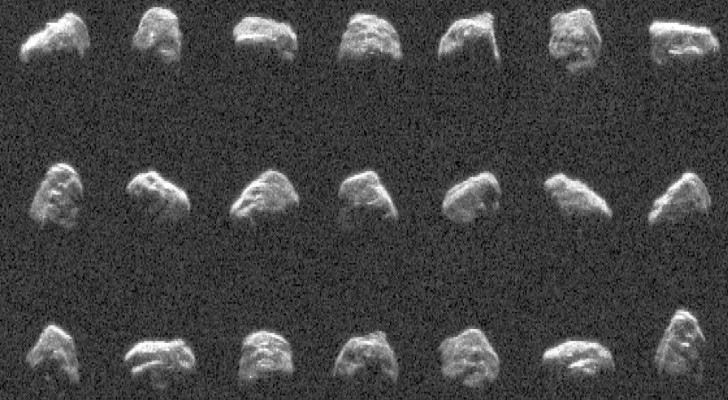
De ruimte van het zonnestelsel is bijna helemaal leeg, zelfs als je rekening houdt met de hemellichamen die rond de zon draaien, maar minder dan 0,15 procent van de massa van het hele stelsel uitmaken. Toch is het niet zo onwaarschijnlijk dat twee hemellichamen heel dicht bij elkaar kunnen zijn, zoals gebeurde met twee asteroïden die dicht bij de aarde passeerden, slechts een paar dagen na elkaar. De ontdekking werd gedaan door wetenschappers van JPL dankzij de Goldstone Solar System Radar, die er ook in slaagde om enkele beelden van deze asteroïden, die beide potentieel gevaarlijk zijn, vast te leggen.
Eerste waarneming: asteroïde van 1,5 kilometer passeerde dicht bij de aarde
Eén van de doelstellingen van op de ruimte gerichte radars is het relatief vroeg detecteren van de passage van asteroïden vlakbij de aarde. Onlangs werd bijvoorbeeld asteroïde 2011 UL21 slechts 13 dagen vóór zijn dichtste nadering tot onze planeet gedetecteerd. Nu hebben we het over een relatief groot hemellichaam, ongeveer 1,5 kilometer breed en potentieel gevaarlijk voor de aarde.
Gelukkig zijn er momenteel geen risico's, zoals bevestigd door wetenschappers van het Jet Propulsion Laboratory van NASA. 2011 UL21 passeerde feitelijk op 27 juni 2024 op een afstand van ongeveer 6,6 miljoen kilometer, oftewel ongeveer 17 keer de afstand tussen de aarde en de maan. Maar dat is nog niet alles: dankzij de Goldston Solar System Radar heeft JPL ontdekt dat 2011 UL21 niet één enkele asteroïde is, maar een systeem van twee asteroïden in een baan om de aarde. Een beetje zoals wat er gebeurde met Dinkinesh, het kleine binaire systeem dat werd geïdentificeerd door de Lucy-missie die eind 2023 richting Jupiter reisde.
Tweede waarneming: asteroïde passeerde veel dichter bij onze planeet
NASA/JPL-Caltech
Slechts twee dagen na de waarneming van 2011 UL21 op zo'n 6,6 miljoen kilometer van de aarde, hebben wetenschappers van JPL een tweede asteroïde gezien, dit keer veel dichter bij onze planeet. Het gaat om asteroïde 2024 MK, die slechts 150 meter breed is en dus veel kleiner dan het hemellichaam dat eerder werd waargenomen. 2024 MK wordt echter ook beschouwd als een potentieel gevaarlijke asteroïde en deze asteroïde passeerde slechts 295.000 kilometer van de aarde. Met andere woorden, ongeveer driekwart van de afstand die ons van de maan scheidt.
Dergelijke naderingen zijn vrij zeldzaam en komen ongeveer elke 20 jaar voor. Hoewel ze in strikte zin niet gevaarlijk zijn voor onze planeet, zijn ze essentiële informatiebronnen voor ons begrip van het zonnestelsel. De eenvoudige passage naar 295 duizend kilometer van de aarde verminderde bijvoorbeeld de baan van 2024 MK rond de zon met ongeveer 24 dagen.
Potentieel gevaarlijke asteroïden: wat betekent dat?
Er zijn verschillende factoren waarmee wetenschappers bij NASA en andere ruimtevaartorganisaties rekening houden om een asteroïde als "potentieel gevaarlijk" te definiëren. Hiervan zijn de volgende zeer belangrijk:
de afmetingen, met een diameter van minimaal 140 meter;
de afstand tot de aarde, binnen 0,05 Astronomische Eenheden, of ongeveer 7,5 miljoen kilometer;
de naderingssnelheid, de onregelmatige vorm en samenstelling, als secundaire factoren.
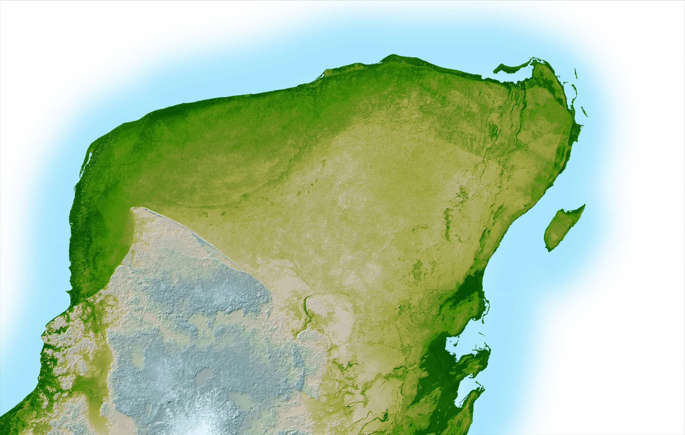
Zoals je kunt zien, zijn potentieel gevaarlijke asteroïden niet de asteroïden die een gevaar in de strikte zin van het woord voor de aarde inhouden, een beetje zoals in het geval van 2011 UL21 en 2024 MK. Kortom, we hebben het niet over Chicxulub dat 66 miljoen jaar geleden leidde tot het uitsterven van niet-aviaanse dinosaurussen, maar over hemellichamen die NASA van plan is te observeren tijdens hun passage op een bepaalde afstand van onze planeet. In de hoop dat deze afstand altijd groter zal zijn.
These seven radar observations by the Deep Space Network’s Goldstone Solar System Radar shows the mile-wide asteroid 2011 UL21 during its June 27 close approach with Earth from about 4 million miles away. The asteroid and its small moon (a bright dot at the bottom of the image) are circled in white.
Assembled into this animation, observations from NASA’s Goldstone Solar System Radar show the tumbling asteroid 2024 MK shortly after it made closest approach with our planet on June 29. The 150-meter-wide asteroid’s orbit was slightly altered by Earth’s gravity as it passed.
Credit: NASA/JPL-Caltech
Did you ever wonder how NASA spots asteroids that maybe getting too close to Earth for comfort? Watch and learn. Find out more about NASA finds, studies and tracks near-Earth objects by visiting
Astronomers don’t just detectexoplanets, or planets that orbit other stars, with today’s sharp telescopes. They can also feel them.
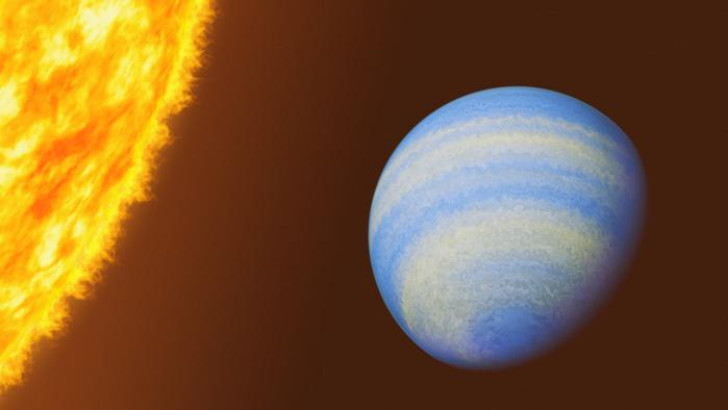
Prior data from the atmosphere of the Jupiter-sized world HD 189733 b, for instance, revealed its harsh, rapidly-blowing rain of glass, and that it is scorchingly hot. A new NASA-supported study found the exoplanet also reeks like rotten eggs.
A study published Monday in the journal Nature shows evidence for the presence of the toxic, nasty-smelling gas hydrogen sulfide in HD 189733 b. The knowledge isn’t just for sensorial space exploration: It shapes how astronomers understand the evolution of all planets under the Sun – err, stars.
An illustration of the Jupiter-sized exoplanet HD 189733 b.
Sewer gas on another world is a helpful clue. The chemical compound aids the construction of more complex molecules, including those essential to life. “Sulfur is a vital element for building more complex molecules, and — like carbon, nitrogen, oxygen, and phosphate — scientists need to study it more to fully understand how planets are made and what they’re made of,” Guangwei Fu, lead researcher and astrophysicist at Johns Hopkins University, said in an announcement about the new paper.
In the case of this particular exoplanet, Fu said, researchers aren’t looking for life. Astronomers already know this world, located 64 light years away from Earth, is inhospitable. Temperatures reach 1,700 degrees Fahrenheit there, and its glass-filled wind would humble any terrestrial storm, thanks to its 5,000 mph winds.
“We’re not looking for life on this planet because it’s way too hot, but finding hydrogen sulfide is a stepping stone for finding this molecule on other planets and gaining more understanding of how different types of planets form,” Fu added.
HD 189733 b is one of many exoplanets analyzed through a technique called the transit method. Astronomers glean details about it as the gas giant passes in front of its parent star. HD 189733 b is one of the nearest known “hot Jupiters” to Earth, making it a scientifically-rich object.
According to NASA, there are now more than 5,600 confirmed exoplanets in the Milky Way.
Secretive U-2 test flights caused a spike in UFO sightings, baffling pilots.
U-2 pilots wear NASA-like space suits & must endure challenging takeoff and landing.
U-2 pilots eat through a feeding port to avoid instant death from blood boiling.
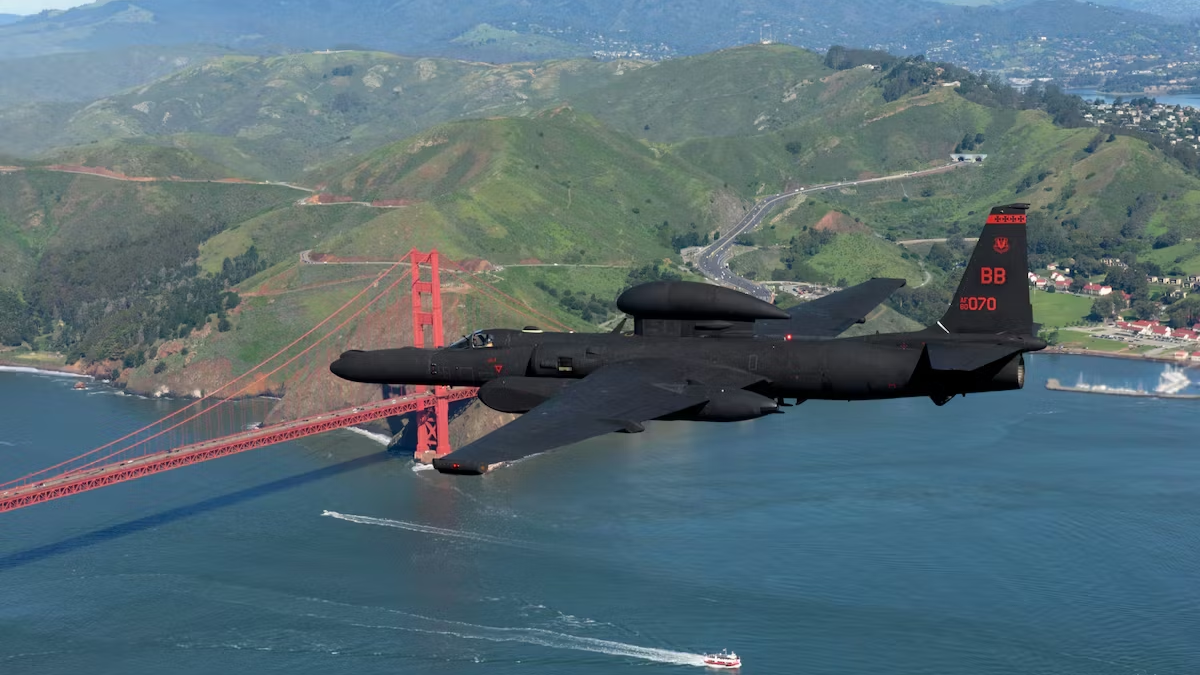
With its sleek design and technological prowess, the U-2 spy plane, often referred to as the "Dragon Lady," represents one of the most iconic aircraft in military aviation history. Developed in the early 1950s in response to increasing nuclear and long-range nuclear missile threats from the USSR during the Cold War, the high-flying aircraft changed the landscape of aerial reconnaissance and espionage, providing the United States with unmatched intelligence-gathering capabilities. In this article, we take a look at a healthy handful of interesting facts about the legendary Dragon Lady.
1. Secretive U-2 test flights caused a spike in UFO sightings
Fiery objects in the sky baffle pilots below
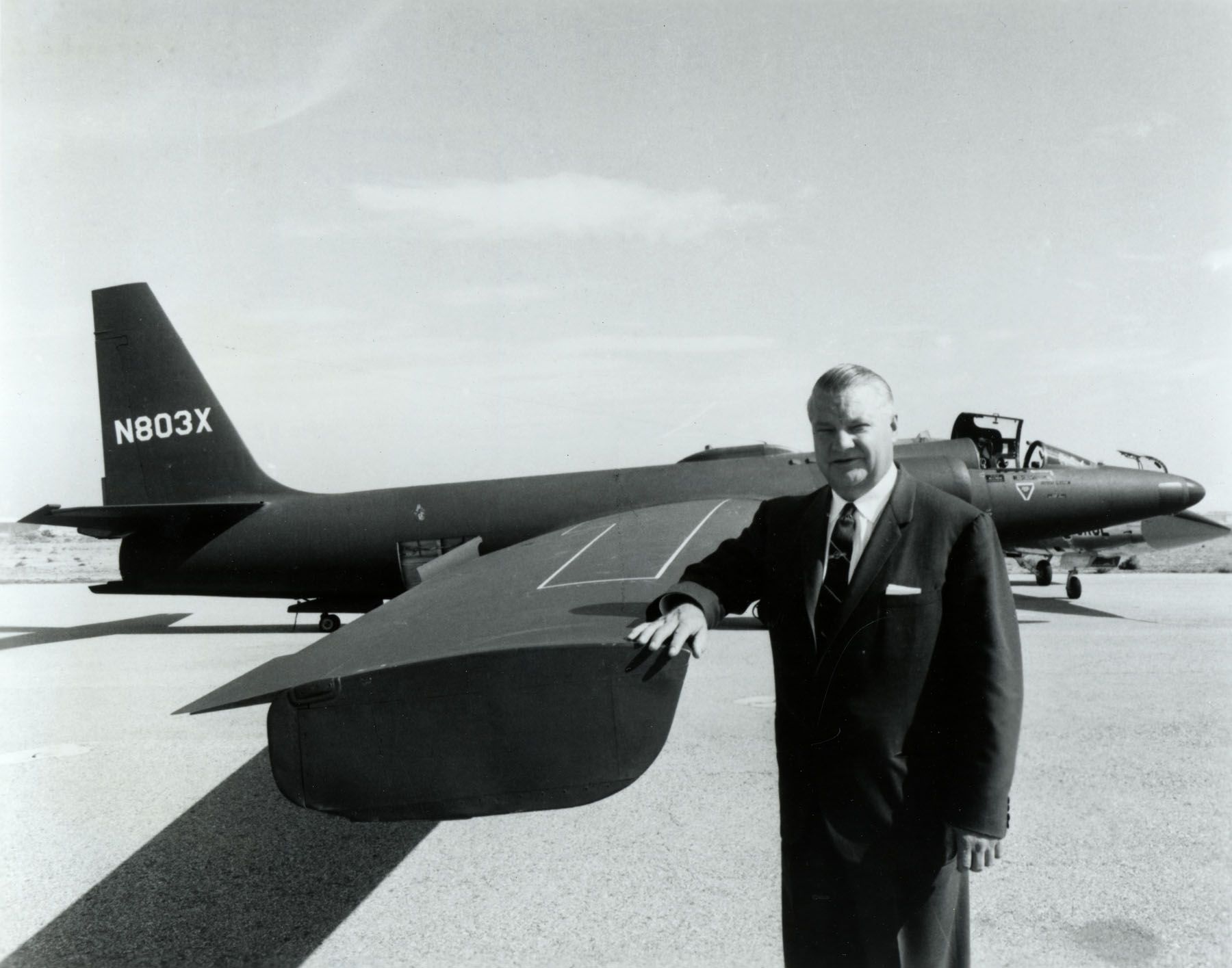
When given just eight months to design an aircraft capable of flight above 70,000 feet (21,336 m), Lockheed Chief Engineer Clarence "Kelly" Johnson (pictured below) and his team at the secret Skunk Works plant in California delivered what was essentially a jet-powered glider, the CL-282, which would later be dubbed the U-2. As time was of the essence, the design was quickly approved by the CIA, and production was immediately underway.
Photo: US Air Force
The "U" in U-2 stands for "utility," a deliberately misleading categorization of the then-secretive aircraft's purpose.
Completed units were delivered to the highly classified Nevada Test and Training Range, also known as Area 51, for testing under tremendous secrecy. According to the CIA, high-altitude testing of the aircraft led to a significant spike in UFO reports. With most commercial flights flying under 20,000 ft (6,096 m) and military aircraft below 40,000 ft (12,192 m), pilots of these aircraft were dumbfounded by the object flying above them at 60,000 ft (18,288 m), a feat considered impossible at the time
Under certain conditions, the sun would reflect off the then-silver wings of the U-2, which made them appear as "fiery objects" flying high above to pilots below. The overwhelming reports of UFOs led to the USAF's Operation Blue Book, also known asProject Blue Book, based at Wright-Patterson Air Force Base, Ohio.
Photo: US Air Force
Operation Blue Book gathered all the reports of UFOs and cross-referenced them against U-2 flight logs. USAF investigators would subsequently dismiss the reports as "natural phenomena," unable to reveal the truth behind these sightings. U-2 (and later OXCART) are believed to have been the source of over half of the UFO reports from the late 1950s through the 1960s.
The U-2 spy plane has had a long career, although it appears to be finally approaching the end of it.
Photo: US Air Force
2. Suited for space travel
U-2 pilots wear space suits similar to those worn by NASA astronauts
Photo: Senior Airman Alexander Recupero | US Air Force
Soaring to the edge of space at altitudes over 70,000 feet (21,336 m), U-2 pilots are required to wear specialized space suits, also known as full-pressure suits, made by the same company that supplies NASA, to ensure their survival in the harsh environment of the upper atmosphere. The model S1034 space suit serve as a personal life support system, should the cockpit pressurization system fail, and are key to safeguarding the pilots against decompression sickness, hypoxia, and exposure to the near-vacuum conditions of high altitudes.
Photo: US Air Force
The suit's engineering is nothing short of remarkable, meticulously designed to balance safety, functionality, and comfort, highlighting the extreme conditions U-2 pilots face. It features a distinct helmet equipped with a communications system, a visor that can be heated to prevent fogging and an oxygen supply system that guarantees the pilot has a steady flow of breathable air. Furthermore, the suit includes a cooling garment integrated with tubing to circulate temperature-controlled water, ensuring the pilot remains comfortable during long missions.
The space suit worn by U-2 pilots costs about $250,000.
3. It's like riding a bicycle...that weighs 16,000 pounds with massive wings
The U-2 has a very unique set of wheels
Photo: US Air Force
Designed to minimize aircraft weight and promote higher altitude, the U-2's unique landing gear configuration distinguishes it from most conventional aircraft. Unlike typical aircraft that utilize a tricycle arrangement, the U-2 employs a bicycle-style arrangement with two sets of wheels positioned along the longitudinal axis of the fuselage.
This setup includes a forward main landing gear located just behind the cockpit and an aft main landing gear near the tail and connected to the rudder to provide steering functionality during taxiing.
The U-2 was named "The Dragon Lady" after a character in the comic strip, "Terry and the Pirates," drawn by Milton Caniff in 1934.
To maintain balance during takeoff, the U-2 utilizes outrigger gears, known colloquially as "pogos." These removable wheels are attached to mid-wing sockets and jettisoned during takeoff, falling to the runway. Upon landing, once the aircraft comes to rest on its wingtip, the pogos are reinstalled for taxiing. Suffice it to say that U-2 takeoff and landing procedures are not for the faint of heart, as shown in the X link below.
The U-2 is widely considered the most difficult airplane to fly. Mastery of the U-2 requires an exceptional level of expertise, dexterity, and resilience, qualities that define the elite group of pilots (fewer than 1500) capable of taming the "Dragon Lady." There are several factors contributing to its notoriously difficult handling, making it a true test of a pilot's skill and endurance.
Firstly, the U-2 operates at extreme altitudes, often above 70,000 ft (21,336 m), where the air is thin and the margin for error is minimal. The aircraft's design prioritizes performance at these altitudes over ease of control, leading to a unique combination of a highly sensitive control system and low maneuverability.
"A lot of the earlier guys described it as like, wrestling the dragon...I describe it as like trying to fly a dump truck with wings."
Secondly, the U-2's takeoff and landing phases are particularly challenging. During takeoff, the aircraft's massive wings and lightweight frame make it highly susceptible to crosswinds and other atmospheric disturbances.
Landing the U-2 is equally daunting due to the bicycle-like landing gear configuration, as described above. Landing the U-2 requires exceptional skill and coordination, as the pilot must balance on the bicycle gear while reducing speed and altitude, with the assistance of a chase car driven by another pilot as shown below, providing real-time feedback and assistance. To make matters worse, visibility is limited during the landing because of the plane's unique design.
Moreover, pilots must endure long missions that can extend beyond ten hours, confined to a pressurized suit similar to those worn by astronauts. This suit is necessary due to the harsh conditions at cruising altitude and introduces additional challenges in terms of physical comfort, fatigue management, and sustenance.
The U-2 is still in service but the US Air Force plans to retire the iconic aircraft in 2026.
5. What do U-2 pilots eat during flight?
Hint: The Dragon Lady isn't much of a cook
Photo: David Kamm | US Army
Flying sorties up to and beyond ten hours, U-2 pilots often need to eat and drink during flight. However, at such extreme altitudes, doing so isn't as simple as it sounds. According to U-2 Support Launch and Recovery Supervisor Staff Sergeant David Labarge, U-2 pilots are instructed that once their helmet is locked down, they are not to open it until they land. Failure to heed this warning could have disastrous consequences.
As long as the cockpit is pressurized, theoretically, a U-2 pilot could safely open their helmet to eat, scratch their nose, or have a sip of water. However, Sgt. Labarge cautions that, at such high altitudes, were a pilot to open their helmet and the cockpit pressurization system suddenly failed, "the blood in their body would instantaneously boil, leading to instantaneous death."
"The blood in their body would instantaneously boil, leading to instantaneous death."
As such, the helmet is designed with a feeding port through which pilots can drink from a gravity-fed water bottle and eat "tube food, made by the same people who make traditional meals-ready-to-eat (MRE).
Photo: Airman 1st Class Drew Buchanan | US Air Force
The food is squeezed from a toothpaste-like tube through the helmet's feeding port directly into the pilot's mouth.
Photo: Jeff Sisto | US Army
Dinner service aboard a U-2 offers a variety of choices, including beef stroganoff, truffle mac and cheese, chicken alfredo, peaches, pears, chocolate pudding, and even caffeinated cinnamon applesauce. A heater inside the aircraft ensures their meatloaf-in-a-tube is nice and hot. Bon Appétit!
The Starliner crew is on the International Space Station for the long haul, according to NASA in a press conference today.
Boeing’s Starliner spacecraft is already on day 35 of what was originally supposed to be a nine-day mission, and it won’t leave the International Space Station (ISS) before the end of July, NASA commercial crew program manager Steve Stich and Boeing VP for commercial crew Mark Nappi told the press during a call earlier today. Engineers and technicians on the ground are finishing tests — and analyzing a mountain of data — on the spacecraft’s thrusters and a helium leak, and it could be at least another two or three weeks before they’re ready to bring Starliner home for anything short of an (unlikely) emergency evacuation from ISS.
Inverse has all the details about why it’s taking so long to bring Starliner home, how the not-stranded-but-definitely-delayed crew is spending their time in orbit, and why the spacecraft has to leave ISS by mid-August.
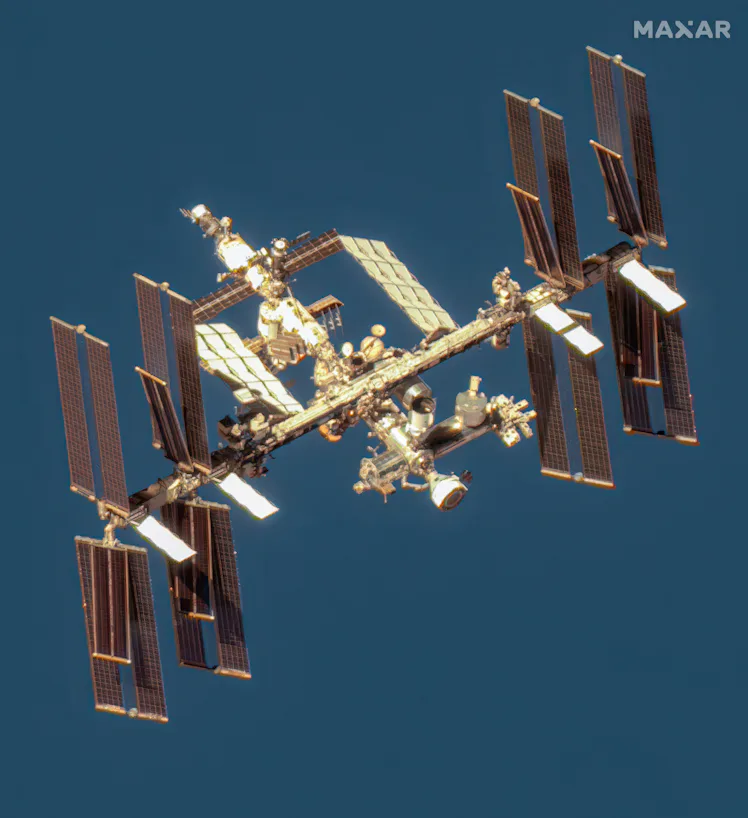
A satellite in orbit took this photo of the Starliner capsule docked to the forward port of the International Space Station. We live in the future.
MAXAR/MAXAR/GETTY IMAGES
AN ABUNDANCE OF CAUTION
Boeing and NASA don’t believe that any of Starliner’s thrusters are damaged, say Stich and Nappi speaking at a press conference on Wednesday. If Starliner had to leave the International Space Station immediately (maybe because of a collision with a piece of satellite debris, like the near-miss that caused the crew to take shelter aboard Starliner earlier this week), the ship could get its crew home safely, according to Nappi.
“If we were to have to do that today, we would just perform a nominal undocking and return,” Nappi told reporters during a press conference on Wednesday.
The extensive tests keeping the spacecraft docked at ISS, they said at the press conference, are a chance for engineers to figure out exactly why five of Starliner’s 28 maneuvering thrusters (technically called the Reaction Control System, or RCS) failed while the spacecraft was docking with the International Space Station on June 6. Starliner’s service module — which houses the thrusters — is designed to burn up during re-entry to Earth’s atmosphere, so once the ship heads home, engineers will lose their chance to poke at the problem.
Boeing and NASA also want to be extremely sure there’s actually nothing wrong. “We don’t believe that we have damaged thrusters, but we want to fill in the blanks and run these tests to assure ourselves of this,” Nappi says.
Stich adds, “Really, what we're doing is just taking the time to make sure that we have looked under every rock and every stone, just to make sure that there's nothing that would surprise us.”
STARLINER RECAP: FAILED THRUSTERS AND HELIUM LEAKS
During its rendezvous with ISS on June 6, five of Starliner's 28 maneuvering thrusters failed. The crew and mission control managed to get four of them back online, but one (thruster B1A3) refused to cooperate, first sputtering out just 11 percent of its normal thrust, and then nothing at all. B1A3 will remain shut off for the rest of the mission.
The thruster issues appeared after Starliner had to fire its thruster more — and more often, in several short pulses — than engineers had expected.
And then there are the helium leaks. Starliner uses helium to pressurize its thrusters, and some of that helium is leaking out around the O-rings used to seal the area where the helium — and two lines that carry rocket propellant — pass through a flange and into the thruster.
"Helium was getting out from that flange area and somehow getting around that O-ring," says Nappi "The design should have been sufficient, but there's obviously something going on in that cavity that we don't understand."
Butch Wilmore and Suni Williams are the first crew to fly aboard Starliner.
JOE RAEDLE/GETTY IMAGES NEWS/GETTY IMAGES
SO MUCH TESTING, SO LITTLE TIME
Last week, Starliner test-fired its thrusters while docked to the ISS, using the station’s flight control system to measure how much thrust the thrusters were actually thrusting (Inverse would certainly not like to apologize for that sentence, thank you).
Meanwhile, at White Sands Missile Range in New Mexico, engineers have test fired several thrusters, trying to re-create the extreme temperatures and workload Starliner’s thrusters faced during flight. Those tests are now complete, but engineers still need to physically check the tested thrusters for damage and analyze a tremendous collection of data about their performance. Next, engineers will be repeating the process — but this time they’ll be simulating the “downhill” phase of the mission, or the return to Earth.
“We really wanted to get that testing completed and actually physically inspect the thruster before we committed to the nominal undocking,” says Stich. “I think there's ways from what we've learned from this flight to change the number of pulses required for the rendezvous and docking phase to not put such demand on the thrusters.”
Engineers are also working on the helium leak, which means smearing grease on spare flanges, tossing debris into them, and blasting them with heat to test possible causes for the leak. They also need to make sure that the thrusters are still getting enough helium to keep them pressurized — at least enough to work reliably and safely.
“We would like to duplicate that flange design on the ground under a controlled test and see if we can't make it leak, and experiment with some larger seals or maybe a different seal material that might not be as susceptible to degradation from the propellant,” said Nappi.
“THE NATURE OF WHAT WE DO”
To bystanders, it seems like an alarming situation: a new spacecraft launches with its first crew, only for its thrusters to fail and start leaking helium pressurizer. But for test pilots like Starliner test commander Butch Wilmore, it’s another day at the office.
“Human spaceflight is not easy. There have been multiple issues with every spacecraft that has ever been designed, and that's the nature of what we do,” said Wilmore.
Nappi and Stich repeated a similar message to reporters.
“We knew that there would be some learning from this flight test. We've learned a great deal from how the hardware works, how our processes work, and how we can improve the things that we're doing,” said Nappi. “As engineers, we test, we learn, we fix, and that’s exactly what we’re going through.”
Starliner launched on a United Launch Alliance Atlas V rocket on June 5, following several delays.
ANADOLU/ANADOLU/GETTY IMAGES
MAKE ROOM, MAKE ROOM!
The testing and analysis are likely to take another couple of weeks, at least, which means Wilmore and Starliner test pilot Suni Williams probably won’t be bidding farewell to the ISS until at least the end of July – and Stich described that possible timeframe as optimistic. But Starliner needs to be on its way by mid-August, when a SpaceX Crew Dragon is set to bring a new quartet of spacefarers (astronauts Zena Cardman, Nick Hague, and Stephanie Wilson, as well as Russian cosmonaut Aleksandr Gorbunov) to the ISS.
The SpaceX Crew Dragon spacecraft that carried Crew-8 (astronauts Matthew Dominick, Michael Barratt, and Jeanette Epps, as well as Russian cosmonaut Alexander Grebenkin) to the ISS is still docked at the station, waiting for Crew-8 to hop aboard and fly it home. Before they leave, though, they need to meet and brief their replacements, a process NASA calls a handover. Crew-9 will dock their Crew Dragonwith ISS and come aboard before Crew-8 leaves. At the moment, that’s a problem, because Starliner is sitting in Crew-9’s parking spot.
That gives NASA and Boeing a deadline for finishing their tests and either deeming Starliner fit to fly home or making other arrangements.
“The beautiful thing about the commercial crew program is that we have two vehicles, two different systems, that we could use to return the crew,” said Stich, referring to Starliner and Crew Dragon. “We have a little more time to go through the data and decide whether we need to do anything different but the prime option today is to return Butch and Suni on Starliner.”
“LIKE COMING BACK HOME”
For now, Wilmore and Williams are safe and sound on the ISS, where they’ve been pitching in with maintenance and science experiments.
“Butch and I have been up here before, and it feels like coming back home,” says Williams. “We've been integrated right into Expedition 71. We've been doing science with them, maintenance, and some major maintenance that has been waiting for a little while.”
Wilmore recently tested NASA’s Moon Microscope, a handheld 3D-printed microscope that’s part of a medical kit that could help future lunar explorers diagnose illnesses and make sure their food, water, and quarters aren’t contaminated. And Williams sequenced DNA while zipping around Earth at 17,500 miles per hour. The pair also helped swap out a urine processor pump. (Never a dull moment aboard ISS, and no lack of variety, either.)
Stich says the whole ISS crew is comfortable and has plenty of supplies — including things like food and clothing — to last the duration. A Northrop-Grumman Cygnus cargo spacecraft is scheduled to launch in early August, bringing new supplies and probably some extra items from home for the Starliner crew, if they’re still aboard. Meanwhile, this isn’t even close to the most crowded the ISS has ever been.
In fact, situations like this one may become more common over the next few years. Stich, paraphrasing retired astronaut Ken Bowersox, said earlier today that now that ISS can provide electricity to docked spacecraft, it can serve as a sort of temporary hangar for engineers to troubleshoot spacecraft in orbit.
Meanwhile, Williams and Wilmore sound calm and confident – which is also part of their job.
“I have a really good feeling in my heart that the spacecraft will bring us home,” says Williams.
Astronomen hebben niet al te ver weg een veelbelovende superaarde ontdekt, waar het in ieder geval best lekker weer is. De exoplaneet is een ijs- of waterwereld, dat weten ze nog niet.
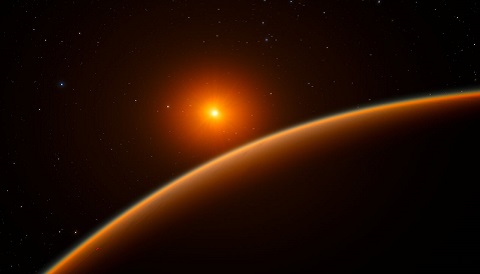
An artist’s impression of exoplanet LHS 1140 orbiting a red dwarf star 41 light-years distant. ESO/SpaceEngine.org
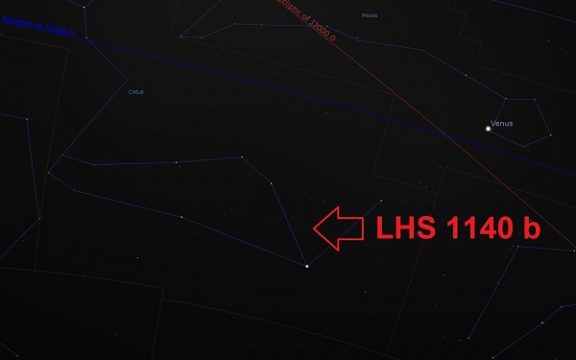
LHS 1140 b, die op zo’n 48 lichtjaar van de aarde staat, is een van de meest veelbelovende exoplaneten met een leefbare zone. Hij heeft zelfs mogelijk een atmosfeer en een oceaan met vloeibaar water, blijkt uit de data van de James Webb-telescoop.
Mogelijk water “Dit is de eerste keer dat we een hint van een atmosfeer hebben gezien op een rotsachtige of ijzige exoplaneet met een bewoonbare zone. Het vinden van een atmosfeer op kleine, rotsachtige werelden is een belangrijk doel voor James Webb, maar dat is veel moeilijker dan op grote planeten”, vertelt Ryan MacDonald van NASA. “LHS 1140 b is een van de beste kleine exoplaneten met een bewoonbare zone waar een dikke atmosfeer kan zijn, en we hebben daar mogelijk net bewijs van gevonden.”
LHS 1140 b, een exoplaneet die om een rode dwergster draait die ongeveer een vijfde zo groot is als onze zon, is zo interessant, omdat het een van de dichtstbijzijnde exoplaneten is die binnen de bewoonbare zone van zijn ster ligt. Dat wil zeggen dat de temperatuur dusdanig gematigd is dat er vloeibaar water kan bestaan, een cruciaal element voor leven.
Superaarde of mini-Neptunus? De vraag was in eerste instantie of LHS 1140 b een mini-Neptunus zou zijn of een superaarde, dus een kleine ijsreus met een waterstofrijke atmosfeer of een rotsachtige, waterrijke planeet, die groter is dan de aarde. Maar uit het onderzoek blijkt dat de pas ontdekte exoplaneet eigenlijk geen ijsreus kan zijn. Het lijkt er veel meer op dat LHS 1140 b inderdaad een superaarde is met mogelijk zelfs een stikstofrijke atmosfeer, zoals onze planeet ook heeft.
Maar er is meer: volgens de eerste metingen is de dichtheid van de planeet kleiner dan verwacht, wat erop kan wijzen dat 10 tot 20 procent van zijn massa uit water bestaat. Het maakt LHS 1140 b een overtuigende kandidaat als waterwereld. Mogelijk lijkt de planeet op een sneeuwbal of ijsplaneet met een vloeibare oceaan op het stuk dat altijd naar zijn ster wijst.
Beste gok op water “Van alle momenteel bekende gematigde exoplaneten zou LHS 1140 b wel eens onze beste gok kunnen zijn om op een dag vloeibaar water op het oppervlak van een wereld buiten ons zonnestelsel te vinden”, aldus hoofdonderzoeker Charles Cadieux van de Université de Montréal. “Dit zou een belangrijke mijlpaal zijn in de zoektocht naar potentieel bewoonbare exoplaneten.”
De aanwezigheid van stikstof toont aan dat de planeet wellicht een substantiële atmosfeer heeft behouden, waardoor omstandigheden ontstaan die vloeibaar water mogelijk maken. De huidige modellen laten zien dat als LHS 1140 b een aarde-achtige atmosfeer heeft, het een sneeuwbalplaneet zou zijn met een oceaan met een diameter van zo’n 4000 kilometer, ongeveer half zo groot als de Atlantische Oceaan. De oppervlaktetemperatuur in het midden van deze buitenaardse oceaan zou zelfs een comfortabele 20 graden Celsius kunnen zijn.
Uitzonderlijke planeet De potentiële atmosfeer en gunstige omstandigheden voor vloeibaar water maken de planeet een uitzonderlijk goede kandidaat voor mogelijk leven. “Dit is onze eerste glimp van een atmosfeer op een superaarde in de bewoonbare zone. Vergeleken met andere bekende exoplaneten, zoals die in het TRAPPIST-1-systeem, lijkt de ster LHS 1140 rustiger en minder actief, waardoor het minder ingewikkeld is om de atmosfeer te onderscheiden van signalen die worden veroorzaakt door sterrenvlekken”, vertelt MacDonald.
Volgens de wetenschapper is LHS 1140 b misschien wel de beste planeet met een bewoonbare zone die tot nu toe bekend is. “Hoewel we meer James Webb-waarnemingen nodig hebben om de stikstofrijke atmosfeer te bevestigen en om naar andere gassen te zoeken, is dit een heel veelbelovende start.”
SpaceX's workhorse Falcon 9 rocket suffered a rare anomaly on Thursday night (July 11).
The incident occurred during a launch of SpaceX's Starlink internet satellites fromVandenberg Space Force Base in California. The Falcon 9 performed well initially; its two stages separated on time, and the first stage came down for a landing on a drone ship about eight minutes after liftoff as planned.
But the rocket's upper stage, which was hauling 20 Starlink spacecraft to low Earth orbit, encountered a problem — a leak of liquid oxygen, which had serious repercussions for the mission.
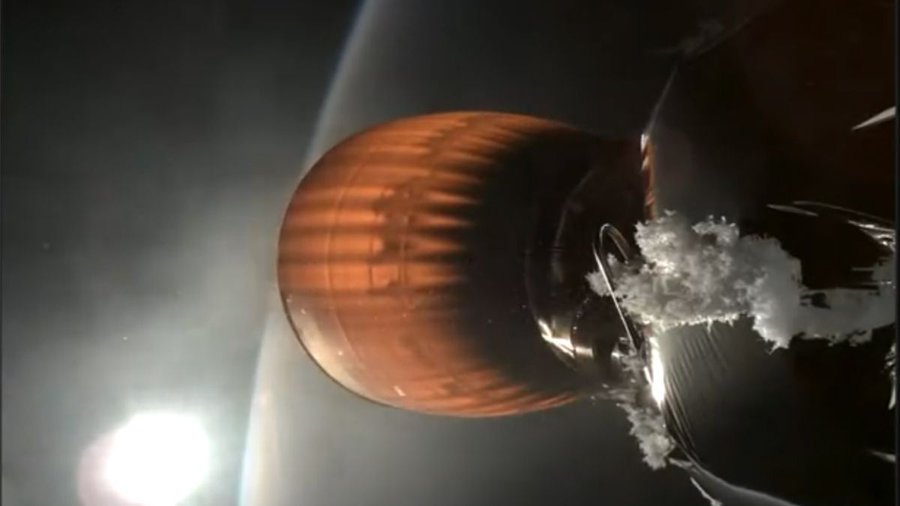
Screenshot from the webcast of a SpaceX Starlink satellite launch on July 11, 2024, showing a buildup of liquid-oxygen ice on the upper stage of a Falcon 9 rocket. (Image credit: SpaceX)
"After a planned relight of the upper-stage engine to raise perigee — or the lowest point of orbit — the Merlin Vacuum engine experienced an anomaly and was unable to complete its second burn," SpaceX wrote in an update today (July 12). (The Falcon 9's upper stage is powered by that single engine; the first stage sports nine Merlins, which explains the rocket's name.)
SpaceX engineers worked to get the 20 Starlink satellites — 13 of which were capable of beaming service directly to cell phones — to raise their orbits using their onboard ion thrusters. But the hill was too steep to climb, according to the company.
"At this level of drag, our maximum available thrust is unlikely to be enough to successfully raise the satellites," SpaceX wrote in the update. "As such, the satellites will reenter Earth’s atmosphere and fully demise. They do not pose a threat to other satellites in orbit or to public safety."
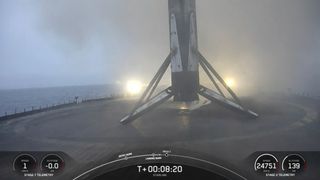
A SpaceX Falcon 9 rocket rests on the deck of a ship at sea shortly after launching 20 Starlink satellites to orbit from California on July 11, 2024. (Image credit: SpaceX)
The Falcon 9 is the most prolific rocket flying today, with 69 launches under its belt already in 2024. It's known for its reliability; before Thursday night, the Falcon 9 had suffered only one full in-flight failure in its storied history, which occurred during the launch of a robotic Dragon cargo capsule toward the International Space Station (ISS) in June 2015.
The Falcon 9 is also human-rated; it has launched 13 crewed missions to date, nine of which have sent astronauts to the ISS for NASA. It's unclear how Thursday's failure will affect the rocket and its manifest at this point; SpaceX will first need to figure out exactly what happened and how to address the issue — an effort that's already underway.
"SpaceX will perform a full investigation in coordination with the FAA [Federal Aviation Administration], determine root cause, and make corrective actions to ensure the success of future missions," SpaceX wrote in today's update. "With a robust satellite and rocket production capability, and a high launch cadence, we’re positioned to rapidly recover and continue our pace as the world’s most active launch services provider."
Most Falcon 9 missions these days service the giant and ever-growing Starlink megaconstellation, which currently consists of more than 6,100 operational satellites; 49 of the 69 Falcon 9 launches so far in 2024 have been dedicated Starlink missions.
Editor's note:This story was updated at 4:30 p.m. ET on July 12 with the news from SpaceX that all 20 Starlink satellites will be lost due to the Falcon 9 upper-stage failure.
A stack of SpaceX Starlink satellites, which included the first six featuring Direct to Cell capabilities. The batch launched on the Starlink 7-9 mission, which lifted off from Vandenberg Space Force Base on Jan. 2, 2024.
The sci-fi landscape is littered with wormholes. From Douglas Adam's Hitchhiker's Guide to the Galaxy and Rick and Morty to the Marvel Cinematic Universe, these theoretical constructs allow characters to zip between distant points in the universe as easy as stepping through a doorway.
An Einstein-Rosen bridge is the simplest kind of wormhole. And while it can, in theory, allow you to meet a new friend from a distant part of the universe, there are some important reasons why it won’t let you travel back in time.
Black Holes, White Holes and Wormholes
Let’s start with everybody’s favorite astronomical mystery: a black hole. Despite their fearsome reputation, they’re actually rather simple creature. They have a point of infinite density, known as the singularity, in their centers. They are surrounded by a boundary called the event horizon.
The event horizon doesn’t exist in the same way that the surface of a planet exists. Instead it’s just a mathematical line in the sand that tells you one thing: if you cross within that special distance, you’re trapped forever, because you’ll have to travel faster than the speed of light to escape.
And that’s it. That’s a black hole. A singularity and an event horizon. All things that cross the event horizon will never escape back into the universe – things go in and never come out.
Mathematically we can also define the polar opposite of a black hole, which is conveniently called a white hole. White holes also have a singularity, but their event horizons act differently. Anything already on the outside of a white hole (like, the entire universe) can never, ever cross within it, no matter how hard it tries. And anything already inside the white hole will find itself ejected from it faster than the speed of light.
Now when we take a black hole and a white hole and connect their singularities together, we get an entirely new kind of object: an Einstein-Rosen bridge, better known as a wormhole.
Wormholes are essentially hollow tubes through space and time that can connect very distant regions of the universe. A star may be thousands of light-years away, but a wormhole can connect that star to us with a tunnel only a few steps long.
Wormholes also have the somewhat mystical ability to allow backwards time travel. If you take one end of the wormhole and accelerate it to a speed close to that of light, it will experience time dilation — its internal “clock” will run slower than the rest of the universe.
That will cause the two ends of the wormhole to no longer be synchronized in time. Then you could walk in one end and end up in your own past. Voilà: time travel.
There's just one, tiny, teensy problem with this setup: Einstein-Rosen bridges are indeed wormholes, but the entrance to the wormhole sits behind the black hole event horizon. And the number one rule of black hole event horizons is that once you cross them, you’re never allowed to escape. Ever.
Once you pass through a black hole event horizon, you are forced towards the singularity, where you are guaranteed to meet your gruesome end. In other words, once you enter an Einstein-Rosen bridge, you will never escape.
So, the unfortunate truth with Einstein-Rosen bridges is that while they appear to be magical doorways to distant reaches of the universe, they are just as deadly as black holes. When you enter you can meet other travelers who have fallen in from the other side, and you could even carry on a conversation…briefly, before you both struck the singularity.
There have been attempts to stabilize Einstein-Rosen bridges and make them traversable by somehow getting their entrances to sit outside the event horizon. So far the only way we know how to do this is with exotic matter. If you threaded the wormhole tunnel with matter that had negative mass, then in principle you could have a not-deadly-at-all wormhole.
Alas, negative matter does not appear to exist in the universe, and so our wormhole — and time travel — dreams will have to remain as mere mathematical fantasies.
Milky Way's rarest black hole may lurk behind 7 stars that 'shouldn't be there'
Milky Way's rarest black hole may lurk behind 7 stars that 'shouldn't be there'
Story by Harry Baker
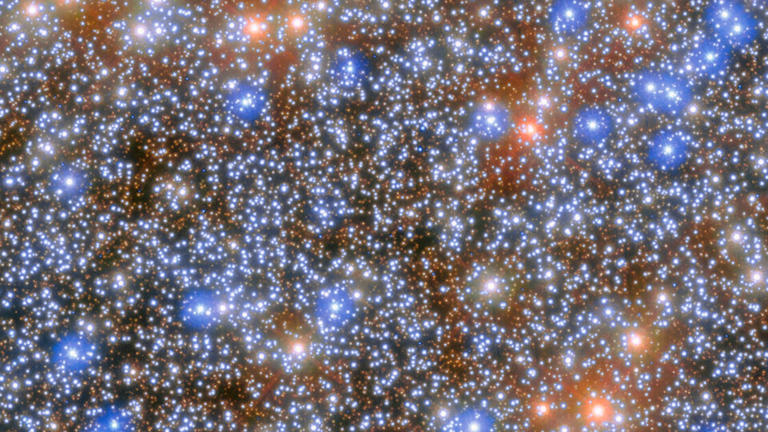
Astronomers may have found a rare "missing link" black hole in the Milky Way after spotting a group of improbably fast-moving stars at the heart of a nearby stellar cluster. If confirmed, the cosmic juggernaut, known as an intermediate-mass black hole (IMBH), would be the second-largest black hole ever found in our galaxy.
IMBHs are an extremely rare subset of black holes that are larger than stellar-mass black holes but smaller than supermassive black holes. This means they can be anywhere between 100 and 100,000 times the mass of the sun, according to NASA.
In theory, IMBHs should be just as common as other black hole types. However, astronomers have struggled to locate potential IMBHs or confirm their existence — and they aren't sure why. As a result, IMBHs are often referred to as missing link black holes. While several promising candidates have been detected, none have been proven to be the real deal.
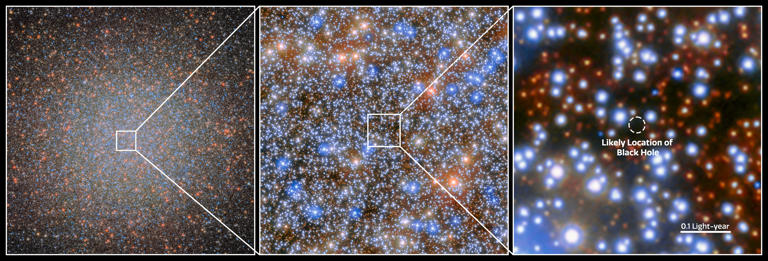
Now, in a recent study uploaded April 4 to the preprint server arXiv, researchers may have uncovered evidence of a large IMBH in the globular cluster Omega Centauri — a compact group of around 10 million stars in the Milky Way located around 17,000 light-years from Earth.
The team compared 500 photographs of Omega Centauri taken by the Hubble Space Telescope and mapped the movements of around 1.4 million stars at the cluster's center. This revealed at least seven stars that "should not be there," researchers wrote in a statement.
Omega Centauri is the largest globular cluster in the Milky Way.
This is because these stars were spotted whizzing around fast enough to escape the cluster's gravity and fly off into intergalactic space. But despite this, the stars continue to orbit at breakneck speed near the cluster's center.
"The most likely explanation [for this] is that a very massive object is gravitationally pulling on these stars and keeping them close to the [cluster's] centre," study lead author Maximilian Häberle, a doctoral candidate at the Max Planck Institute for Astronomy (MPIA) in Germany, said in the statement. "The only object that can be so massive is a black hole, with a mass at least 8,200 times that of our sun."
Omega Centauri is an unusual entity: It is around 10 times larger than most other globular clusters and is surprisingly flat. It is so massive that you can even see it with the naked eye on dark, clear nights, when it takes up almost as much of the night sky as the moon when viewed from Earth.
Researchers suspect that the cluster likely used to be a dwarf galaxy that orbited the Milky Way, before being pulled into the galaxy's middle. As a result, scientists have often wondered if there could have been a sizable black hole at its heart.
Researchers first proposed the idea of an IMBH in Omega Centauri in 2008, when Hubble revealed how tightly the cluster's stars are bunched at its center. However, at the time, other researchers argued that this could be caused by a swarm of several smaller, stellar-mass black holes.
But the superfast stars highlighted in the new study indicate the existence of an IMBH, the study authors argue.
"This discovery is the most direct evidence so far of an IMBH in Omega Centauri," study co-author Nadine Neumayer, an astronomer at MPIA, said in the statement. If confirmed, it would be the Milky Way's second-largest known black hole behind Sagittarius A* — the supermassive black hole at the heart of our galaxy, she added. "This is exciting because there are only very few other black holes known with a similar mass."
However, the presence of an IMBH in Omega Centauri is not confirmed, and more data is needed to know for certain if it is really there. It is also unclear exactly how large the cosmic entity might be and where it is.
The researchers have been granted time in the future to use the powerful James Webb Space Telescope to peer deeper into the cluster, which means we may not have to wait too long for more evidence of the black hole's existence.
We kunnen exoplaneten, die zich buiten ons zonnestelsel bevinden, niet bereiken, maar we kunnen hun geur wel waarnemen: een van hen ruikt naar rotte eieren, zo heeft een nieuw onderzoek ontdekt.
HD 189733 b, de “warme Jupiter" op 64 lichtjaar afstand van ons
Mensen associëren de geur van zwavel met die van rotte eieren, en zouden hun neus moeten dichtknijpen voor de exoplaneet die volgens wetenschappers een atmosfeer heeft die aan deze “geur” doet denken. De buitenaardse wereld in kwestie is een hete exoplaneet van Jupiter genaamd HD 189733 b en is 64 lichtjaar van de aarde verwijderd: een relatief korte afstand, gezien de locatie buiten ons zonnestelsel.
Dankzij de James Webb-telescoop was het mogelijk om te ontdekken dat het omgeven is door een atmosfeer gevuld met waterstofsulfide, waardoor je je gemakkelijk de geur kunt voorstellen die je zou kunnen inademen. HD 189733 b staat dertien keer dichter bij zijn moederster dan Mercurius bij de zon, waardoor het een “helse” planeet is, zoals beschreven. Een bijzonder hete en gasvormige Jupiter in het sterrenbeeld Vosje, die in slechts twee aardse dagen een baan rond zijn ster voltooit. Dit betekent dat de temperatuur bijna 925°C bedraagt: uiteraard onleefbaar voor mensen, afgezien van de geur die het afgeeft. Maar dit is niet de enige bizarre eigenaardigheid van de exoplaneet in kwestie.
De exoplaneet die naar rotte eieren ruikt en waarop het gesmolten glas regent
Roberto Molar Candanosa/Johns Hopkins Univeristy
Voordat ze in het nieuwe onderzoek de geur van HD 189733 b ontdekten, hadden wetenschappers al onthuld dat er een grote kans bestaat dat er op de exoplaneet buien van gesmolten glas ontstaan, die het gevolg zouden kunnen zijn van winden die het materiaal met een snelheid die kan oplopen tot 800 km per uur zijwaarts duwen, drie keer zo snel als een orkaan van categorie 5 op aarde. Het zijn precies de “eigenaardigheden” van deze buitenaardse wereld die onderzoekers ertoe hebben aangezet er nieuwe aandacht aan te besteden met behulp van de James Webb.
De nieuwe waarnemingen maakten het mogelijk om koolstofdioxide, zware metalen in de atmosfeer, de hoeveelheid water en zuurstof te meten. Zo ontdekten ze de aanwezigheid van waterstofsulfide, dat op onze planeet wordt uitgestoten door vulkanen en ontbindend organisch materiaal. Het is een licht ontvlambaar, schadelijk en kleurloos gas. Voor wetenschappers was het geen echte verrassing: men vermoedde al dat HD 189733 b, als zijnde gasreus, dit molecuul zou kunnen bevatten, dat ook op Uranus en Jupiter aanwezig is. Tot nu toe is dit gas echter zelden buiten het zonnestelsel gedetecteerd, behalve in de ruimte tussen de sterren.
Op zoek naar andere werelden met waterstofsulfide
Guangwei Fu, een astrofysicus aan de Johns Hopkins University, Maryland, noemde de ontdekking van waterstofsulfide op de exoplaneet een belangrijke "opstap naar het vinden van dit molecuul op andere planeten en om beter te begrijpen hoe verschillende soorten werelden ontstaan." Zwavel, zo legde Fu uit, is een essentieel element voor het bouwen van complexe moleculen en is van fundamenteel belang voor de overgrote meerderheid van de levensvormen op aarde.
De aanwezigheid van buitenaards leven op HD 189733 b kan echter vrijwel zeker worden uitgesloten, vanwege de extreem hoge temperaturen, maar ook vanwege de meteorologische omstandigheden. Het feit dat er waterstofsulfide aanwezig is op de exoplaneet doet ons echter denken dat andere werelden buiten ons zonnestelsel dit zouden kunnen bevatten, samen met mogelijke buitenaardse levensvormen. De volgende stap van de onderzoekers zal zijn om andere hete planeten vergelijkbaar met Jupiter te observeren met behulp van de James Webb om de aanwezigheid van hetzelfde gas te evalueren.
Tachyons are not just the stuff of science fiction.
Tachyons are hypothetical particles that move faster than the speed of light and travel backwards through time.
(Image credit: Yuichiro Chino via Getty Images)
Traveling faster than light and time-travel could be real for tachyons. If one thing science fiction excels at, it's allowing us to marvel at the breaking of the physical laws of the universe. We watch and read in wonder as the warp engines of the starship Enterprise push it to beyond the speed of light, or as Barry or Wally — whoever is carrying the name of the Flash at the time — does the same in no more than a pair of yellow boots.
Likewise, we enjoy tales of adventurers like the Doctor, or Doc Brown, using weird seemingly antiquated machinery to violate the laws of causality. What if there was a fundamental particle that could do all these things? Moving faster than light like the Flash, and traveling back through time without the need for a TARDIS or a Delorian or yellow boots.
That’s a tachyon. But make no mistake, these particles aren’t just the idling's of science fiction writers. Tachyons are the stuff of "hard" science.
Tachyons are one of the most interesting elements arising from Einstein’s theory of special relativity. The 1905 theory is based on two postulates, nothing with mass moves faster than the speed of light (c), and physical laws remain the same in all non-inertial reference frames. A significant consequence of special relativity is the fact that space and time are united into a single entity; spacetime. That mean’s a particle’s journey through speed is linked to its journey through time.
The term "tachyon" first entered scientific literature in 1967, in a paper entitled "Possibility of faster-than-light particles" by Columbia University physicist Gerald Feinberg. Feinberg posited that tachyonic particles would arise from a quantum field with “imaginary mass” explaining why the first populate of special relativity doesn’t restrain their velocity.
This would lead to two types of particles existing in the universe; bradyons that travel slower than light and compose all the matter we see around us, and tachyons traveling faster than light, according to the University of Pittsburgh. One of the key differences between these particle types is as energy is added to bradyons, they speed up. But, with tachyons, as energy is taken away, their speed increases.
Xuanyu Han//Getty Images
TACHYONS AND TIME TRAVEL
One of the most important and meaningful results from Einstein’s theory of special relativity is the establishing universal speed limit of c; the speed of light in a vacuum.
Einstein suggested that as an object approaches c its mass becomes near-infinite, as does the energy required to accelerate it. This should mean that nothing can travel faster than light. But, imagine an anti-mass particle like a tachyon, its lowest energy state would see it speeding at c. But, why would this lead to backward time travel?
That all hinges on the concept that puts the "relative" into "special relativity."
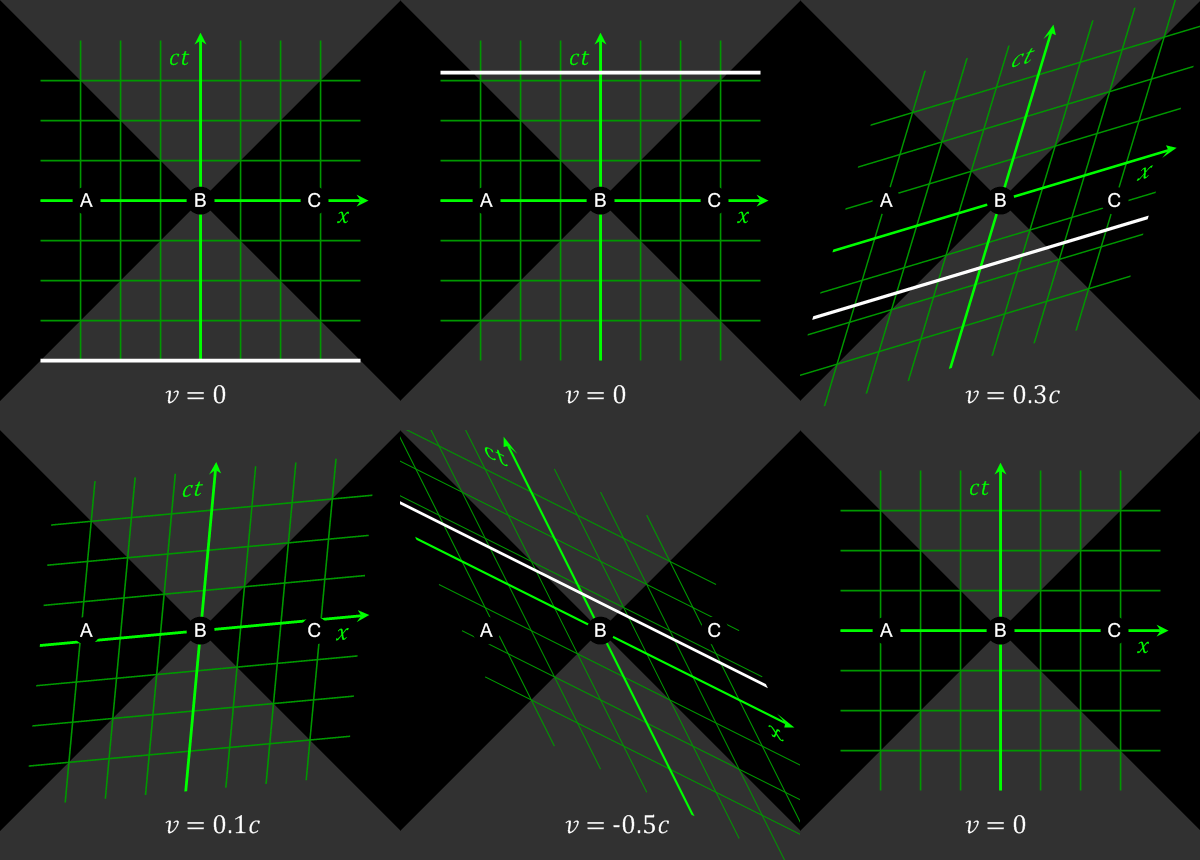
A common tool used to explain special relativity is the spacetime diagram.
Spacetime is filled with events ranging from the cosmically powerful and violent, like the supernova explosion of a distant star, or the mundane, such as the cracking of an egg on your kitchen floor. And these are mapped onto the spacetime diagram. This diagram shows as a particle whizzes through spacetime, it traces out a worldline that maps its progress.
Also filling spacetime are observers, each of whom has their own reference frame. These observers may see the events that fill spacetime occurring in different orders. Observer 1 may see event A, the supernova, occur before event B the egg crack. Observer 2 however may see event B happening before event A.
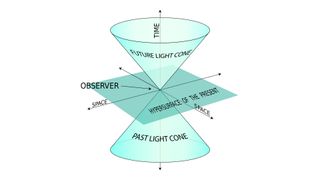
Events within an observer's light cone can be linked by a signal slower than light. (Image credit: By SVG version: K. Aainsqatsi at en.wikipediaOriginal PNG version: Stib at en.wikipedia - Transferred from en.wikipedia to Commons.(Original text: self-made), CC BY-SA 3.0, https://commons.wikimedia.org/w/index.php?curid=2210907)
Each event has a light cone associated with it. If event B falls within the lightcone of event A then the two could be causally linked. The supernova could have knocked the egg off the kitchen counter — or maybe the falling breakfast item caused the complete gravitational collapse of a dying star, somehow. That’s because in the light cone a signal traveling slower than light can link the events. The edges of the light cone represent the speed of light. Linking an event outside the light cone with one inside it requires a signal that travels faster than light.
If event A is in the light cone and event B is outside it, then the supernova and egg-related tragedy can't be causally related. But, a tachyon traveling at a speed greater than the speed of light could violate causality by linking these events.
To see why this is a problem, consider it like this. Image event A is the sending of a signal, and event B is the receiving of that signal. If that signal is traveling at the speed of light, or slower all observers in different reference frames agree that A preceded B.
But, if that signal is carried by a tachyon and thus moves faster than light, there will be reference frames that say the signal was received before it was sent. Thus, to an observer in this frame, the tachyon traveled backward in time.
One of the fundamental postulates of special relativity is that the laws of physics should be the same in all non-accelerating reference frames. That means if tachyons can violate causality and move backward in time in one reference frame, it can do it in them all.
A diagram showing how events are viewed at different times in different reference frames. (Image credit: By User:Acdx - Self-made, based on Image:Relativity_of_Simultaneity.svg, source code: en:User:Acdx/Relativity_of_Simultaneity_Animation, CC BY-SA 4.0, https://commons.wikimedia.org/w/index.php?curid=5560059)
TACHYONS PARADOXES
To see how this leads to problems called paradoxes, consider two observers, Stella aboard a spacecraft orbiting Earth, and Terra based on the surface of the planet. The two are communicating by sending messages with tachyons.
This means that if Stella sends a signal to Terra which moves faster than light in Stella’s frame but backward in time in Terra’s frame. Terra then sends a reply as ordered which moves faster than light in her frame but backward in time in Stella’s frame, Stella could receive the reply before sending the original signal.
What if this response signal from Terra says "do not send any signals"? Then Stella does not send the original signal, and Terra then has nothing to respond to and never sends the tachyon signal that says "don’t send any signals."
So not only do tachyons violate causality in every frame they open the door to severe logical paradoxes.
There are suggestions as to how these paradoxes could be avoided. Of course, the most simple solution is that tachyons don’t exist.
A less draconian suggestion is that observers in different reference frames can’t tell the difference between the emission and absorption of tachyons.
That means a tachyon traveling back in time could always be interpreted as a tachyon moving forward in time because receiving a tachyon from the future always creates the same tachyon and sends it forwards in time.
Another suggestion is that tachyons aren’t like any other particle we know of, in that they don't interact and can never be detected or observed. Meaning that the tachyon communication system used by Stella and Terra in the above example can’t exist.
Along similar lines, other researchers say that tachyons can’t be controlled. The receipt and emission of tachyons just happen at random. Thus, there’s no way to send a tachyon with a causality violating message.
Aside from the fact that like other particles, they are likely incomprehensibly tiny, because tachyons always travel faster than light it isn’t possible to detect one on its approach. That’s because it’s moving faster than any associated photons.
After it passes, an observer would see the image of the tachyon split into two distinct images. These would show it simultaneously arriving in one direction and disappearing in the opposite direction.
If detecting tachyons, at least of their approach, with light is out of the picture, is there another way we could detect these faster than light particles?
Possibly. Tachyons are proposed to have an "anti-mass" but this still constitutes mass energy. That means these particles should still have some gravitational effect. It’s possible highly sensitive detectors could spot this effect.
An alternative detection method could arise from their faster-than-light nature.
While the speed of light in a vacuum c is a universal speed limit, particles have been made to travel faster than light in other mediums. When electrically charged particles are accelerated up to and beyond the speed of light in certain mediums like water, they release a form of radiation called Cherenkov radiation, according to the International Atomic Energy Agency.
That means that if tachyons are electrically charged, one way of detecting them would be measuring Cherenkov radiation in the near-vacuum of space.
THE POWER OF IMAGINATION IN SCIENCE
What tachyons really demonstrate is the importance of imagination in our ongoing quest to understand the universe. They may not exist, and if they do we may have no hope of ever measuring one.
But what our technology can’t capture, our minds can. We can consider the possibility of a particle that journeys back through time and what that says about the nature of time, and the Universe, and the events that fill them.
In an interview with George Sylvester Viereck published in "The Saturday Evening Post"in 1929, Albert Einstein is believed to have said: "Imagination is more important than knowledge. Knowledge is limited. Imagination encircles the world."
ADDITIONAL INFORMATION
Discover more about Tachyons with this informative YouTube video.
Explore the possible experimental evidence for the existence of tachyons with George Mason University.
Ancient Mars was Cool and Relatively Wet, New Study Suggests
Ancient Mars was Cool and Relatively Wet, New Study Suggests
In a new study, planetary scientists found strong similarities between soils found in Gale Crater on Mars and those of Canada’s Newfoundland, a cold subarctic climate.
X-ray amorphous material comprises 15-73 wt.% of sedimentary rocks and eolian sediments in Gale Crater. This material is variably siliceous and iron rich but aluminum poor. The presence of volatiles is consistent with the existence of incipient weathering products. To better understand the implications of this material for past aqueous conditions on Mars, Feldman et al. investigated X-ray amorphous material formation and longevity within terrestrial iron rich soils with varying ages and environmental conditions using bulk and selective dissolution methods, X-ray diffraction, and transmission electron microscopy.
Image credit: M. Kornmesser / ESO.
Scientists often use soil to depict environmental history, as the minerals present can tell the story of landscape evolution through time.
Understanding more about how these materials formed could help answer long-standing questions about historical conditions on the red planet.
The soils and rocks of Gale Crater provide a record of Mars’ climate between 3 and 4 billion years ago, during a time of relatively abundant water on the planet — and the same time period that saw life first appear on Earth.
“Gale Crater is a paleo lakebed — there was obviously water present. But what were the environmental conditions when the water was there?” said Dr. Anthony Feldman, a soil scientist and geomorphologist at Desert Research Institute.
“We’re never going to find a direct analog to the Martian surface, because conditions are so different between Mars and Earth. But we can look at trends under terrestrial conditions and use those to try to extrapolate to Martian questions.”
NASA’s Curiosity Rover has been investigating Gale Crater since 2011, and has found a plethora of soil materials known as X-ray amorphous materials.
These components of the soil lack the typical repeating atomic structure that defines minerals, and therefore can’t be easily characterized using traditional techniques like X-ray diffraction.
When X-rays are shot at crystalline materials like a diamond, for example, the X-rays scatter at characteristic angles based on the mineral’s internal structure.
However, X-ray amorphous material does not produce these characteristic fingerprints.
This X-ray diffraction method was used by the Curiosity Rover to demonstrate that X-ray amorphous material comprised between 15 and 73% of the soil and rock samples tested in Gale Crater.
“You can think of X-Ray amorphous materials like Jello. It’s this soup of different elements and chemicals that just slide past each other,” Dr. Feldman said.
Curiosity also conducted chemical analyses on the soil and rock samples, finding that the amorphous material was rich in iron and silica but deficient in aluminum.
Beyond the limited chemical information, scientists don’t yet understand what the amorphous material is, or what its presence implies about Mars’ historical environment.
Uncovering more information about how these enigmatic materials form and persist on Earth could help answer persistent questions about the red planet.
Dr. Feldman and his colleagues visited three locations in search of similar X-ray amorphous material: the Tablelands of Gros Morne National Park in Newfoundland, Northern California’s Klamath Mountains, and western Nevada.
These three sites had serpentine soils that the researchers expected to be chemically similar to the X-ray amorphous material at Gale Crater: rich in iron and silicon but lacking in aluminum.
The three locations also provided a range of rainfall, snowfall, and temperature that could help provide insight into the type of environmental conditions that produce amorphous material and encourage its preservation.
At each site, the research team examined the soils using X-ray diffraction analysis and transmission electron microscopy, which allowed them to see the soil materials at a more detailed level.
The subarctic conditions of Newfoundland produced materials chemically similar to those found in Gale Crater that also lacked in crystalline structure. The soils produced in warmer climates like California and Nevada did not.
“This shows that you need the water there in order to form these materials,” Dr. Feldman said.
“But it needs to be cold, near-freezing mean annual temperature conditions in order to preserve the amorphous material in the soils.”
Amorphous material is often considered to be relatively unstable, meaning that at an atomic level, the atoms haven’t yet organized into their final, more crystalline forms.
“There’s something going on in the kinetics — or the rate of reaction — that is slowing it down so that these materials can be preserved over geologic time scales,” Dr. Feldman said.
“What we’re suggesting is that very cold, close to freezing conditions, is one particular kinetic limiting factor that allows for these materials to form and be preserved.”
“This study improves our understanding of the climate of Mars.”
“The results suggest that the abundance of this material in Gale Crater is consistent with subarctic conditions, similar to what we would see in, for instance, Iceland.”
The team’s work appears in the journal Communications Earth and Environment.
A.D. Feldman et al. 2024, Fe-rich X-ray amorphous material records past climate and persistence of water on Mars. Commun Earth Environ 5, 364; doi: 10.1038/s43247-024-01495-4
This article is based on a press-release from Desert Research Institute.
Ariane 6 Rocket’s Debut Puts Europe Back in the Launch Game
Europe’s next-generation Ariane 6 rocket rose today for the first time from its South American spaceport, ending a yearlong launch gap caused by the Ariane 5’s retirement.
The heavy-lift launch vehicle’s demonstration flight began with liftoff at 4 p.m. local time (19:00 GMT) from the Kourou spaceport in French Guiana, and continued with satellite deployments in orbit.
“A completely new rocket is not launched often, and success is far from guaranteed,” Josef Aschbacher, the European Space Agency’s director general, said in a statement. “I am privileged to have witnessed this historic moment when Europe’s new generation of the Ariane family lifted off – successfully – effectively reinstating European access to space.”
ESA and its partners have been working on the two-stage Ariane 6 since the early 2010s as an upgrade to the Ariane 5 series, which lofted more than 100 spacecraft (including NASA’s James Webb Space Telescope) into orbit beginning in 1998. Ariane 6 development cost is estimated at nearly $4 billion.
The first Ariane 6 was originally planned for 2020, but technical issues and the COVID-19 pandemic forced delays. After last year’s final Ariane 5 mission, Europe’s launch industry could offer only the Vega small-lift launch vehicle, leaving a gap in the medium- to heavy-lift market.
The market for the Ariane 6 is dramatically different from what it was when the Ariane 5 entered service more than a quarter-century ago. Thanks to SpaceX and other commercial ventures, rocket reusability is becoming the standard in the industry — raising questions about how competitive non-reusable rockets like the Ariane 6 can be.
ArianeGroup, a joint venture between Airbus and Safran, is counting on Ariane 6’s success. But in January, The Financial Times quoted Aschbacher as saying “there is no guarantee” that ArianeGroup would continue to be Europe’s launch company of choice.
The Ariane 6 line features a modular design that can be adapted for missions to low Earth orbit or to deep space. For today’s mission, known as VA262, the rocket’s core stage was augmented by two side-mounted solid rocket boosters. Another configuration calls for four strap-on boosters for heavy-lift missions. The four-booster configuration can deliver up to 21.6 metric tons to low Earth orbit.
An overview of Europe’s new rocket Ariane 6. Credit: ESA
Today’s launch sent the Ariane 6’s upper stage to an altitude of about 600 kilometers (373 miles). Nine satellites were deployed, and five onboard experiments were activated.
Another objective involved demonstrating the upper stage’s ability to relight its Vinci engine for orbital adjustments and deorbiting. Two experimental re-entry capsules were supposed to be released as the mission wound down. But in an update posted to the X social-media platform, ESA said the technology demonstration phase showed “an unexpected result which will only affect the end of the mission.”
During a follow-up briefing, mission managers said the upper stage’s auxiliary power unit suffered an anomaly that caused a premature engine shutdown. As a result, the re-entry capsules were not released, and the upper stage remained in orbit.
The next Ariane 6 mission is scheduled to put France’s CSO-3 spy satellite into orbit later this year. About 30 Ariane 6 launches are said to be booked already, including 18 launches for Amazon’s Project Kuiper satellites. Arianespace CEO Stéphane Israël said today’s end-of-mission anomaly would have “no consequence on the next launches.”
“We are perfectly on track now to make a second launch this year,” Israël said.
A Hopping Robot Could Explore Europa Using Locally Harvested Water
Various forms of hopping robots have crept into development for us[e in different space exploration missions. We’ve reported on their use on asteroids and even our own Moon. But a study funded by NASA’s Institute for Advanced Concepts (NIAC) in 2018 planned a mission to a type of world where hopping may not be as noticeable an advantage—Europa.
The mission, developed by engineers at NASA’s Jet Propulsion Laboratory, Purdue University, and Honeybee Robotics, is known as the Steam Propelled Autonomous Retrieval Robot for Ocean Worlds, or SPARROW. It’s about the size and shape of a soccer ball, with the logic, power, and control systems inside a spherical outer hollow shell.
SPARROW wouldn’t be able to operate on its own, however. It would require a lander to deposit it onto the surface and serve as a refueling and sample collection storage base. Europa Clipper, the only currently planned NASA mission to the icy moon, would have been good for hitching a ride, but its lack of a lander made it unsuitable for SPARROW.
Budget constraints are always a problem for innovative missions – as Fraser explains with Dr. Manasvi Lingam.
However, the hopping robot itself is well suited for the environment in Europa. Its designers intended to make it “terrain agnostic,” meaning it could traverse even the harshest terrain the icy moon could throw at it. These would include penitentes, shards of ice that could be meters tall, and difficult for ground-based robots to traverse.
SPARROW could fly over them, collect interesting samples, and return to the lander to refuel and deposit them. Then, it could go out again in a different direction. To model this system architecture, the JPL team spent Phase I trying to determine the best propulsion system for the robot and modeling control algorithms for the flights.
First, let’s tackle the propulsion system. The lander accompanying SPARROW would have to mine ice off the moon’s surface, then heat it and store it as water. When SPARROW returned from a hop, it would use the water to refuel. Five different propulsion methods were considered as part of the study. Still, the best turned out to be a “hot water thruster,” where SPARROW would internally heat the water supplied by the lander, then eject that out in a burst of propulsive force to launch the robot off the surface.
Exploring the surface of Europa is only one part of its mystery – as Fraser explains.
The second major part of the paper was controlling that propulsion. Trajectory correction is critical to mission success, but in this case, the designers believe that no matter where the robot ends up, it will be able to collect a sample and return to the lander. This is due to its gimballed design, which allows the robot to consistently orient correctly, even after bouncing along a frozen surface for a while.
There is still much work to do before the mission is ready to go, though. Some of the most pressing questions are how to stop ice from forming in the robot’s propulsion nozzle and throughout its structural cage. Such blockages could easily throw off any existing trajectory calculations and theoretically immobilize the hopper entirely if they were severe enough.
However, no work is planned to solve those problems for now as the project has yet to receive Phase II funding from NIAC, and work on it appears to have stalled. Dr. Gareth Meirion-Griffith, the primary investigator on the project, has moved on from JPL to take a job at Collins Aerospace. Even so, someday, the author’s ideas might be integrated into a Europa lander mission—we’ll have to wait and see.
De ontdekking van Mars gaat door, ook vanaf de aarde: na een jaar heeft de eerste bemanning die betrokken was bij een simulatie op de rode planeet zijn ongelooflijke ervaring beëindigd.
De eerste simulatie op Mars vanaf de aarde is voltooid
Een van NASA's meest ambitieuze en toekomstige doelen is om Mars te bereiken met de eerste menselijke bemanning. Om zich voor te bereiden op deze langverwachte missie, nam een team vrijwilligers deel aan een 378 dagen durende simulatie die zich afspeelde op de rode planeet, terwijl ze de hele tijd op aarde bleven.
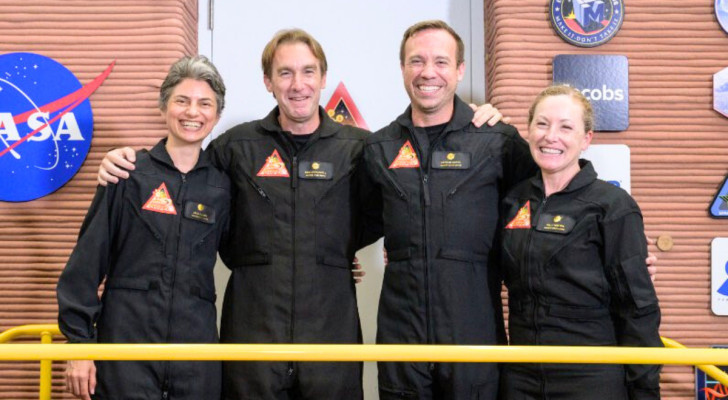
Ruim twaalf maanden van volledige isolatie, die eindigde op zaterdag 6 juli 2024, toen de vier vrijwilligers Kelly Haston, Anca Selariu, Ross Brockwell en Nathan Jones de 3D-geprinte habitat verlieten die ze op 25 juni 2023 waren binnengegaan. Dit is de eerste kunstmatige simulatie van NASA die de omgeving van Mars nabootst, gebouwd in het Johnson Space Center in Houston. De eerste bemanning van het project Crew Health and Performance Exploration Analog keerde vervolgens terug naar huis, na meer dan een jaar weg te zijn geweest van hun families.
HAPEA 1-missie afgerond: "Mars is ons doel"
NASA/X
De leiding van de missie als commandant was Haston die, toen ze met haar bemanning de simulatie verliet, begon: "Hallo. Het is echt geweldig om jullie allemaal gedag te kunnen zeggen." De emotie van de vier NASA-vrijwilligers was duidelijk, evenals het kunnen terugkeren naar huis. Jones, de arts die de missie volgde, voegde eraan toe dat de 378 dagen snel voorbijgingen, in tegenstelling tot wat je zou denken.
De groep deelde een ruimte van slechts 157 vierkante meter om uit te vinden hoe mensen op onze rode buurman zouden leven en om mogelijke strategieën te evalueren om oplossingen te ontwikkelen om ons te huisvesten. Dit omvatte onder andere wandelingen op Mars, Marswalks genaamd, het kweken van groenten, de uitdaging van beperkte beschikbare middelen en communicatievertragingen met de aarde, die de grens van 22 minuten bereikten. NASA plant nog twee CHAPEA-missies in 2025 en 2027 om andere aspecten van de toekomstige menselijke duurzaamheid op Mars te onderzoeken, afgezien van voedselvoorziening en de fysieke en mentale impact op de bemanning.
De groep deelde een ruimte van slechts 157 vierkante meter om uit te vinden hoe mensen op onze rode buurman zouden leven en om mogelijke strategieën te evalueren om oplossingen te ontwikkelen om ons te huisvesten. Dit omvatte onder andere wandelingen op Mars, Marswalks genaamd, het kweken van groenten, de uitdaging van beperkte beschikbare middelen en communicatievertragingen met de aarde, die de grens van 22 minuten bereikten. NASA plant nog twee CHAPEA-missies in 2025 en 2027 om andere aspecten van de toekomstige menselijke duurzaamheid op Mars te onderzoeken, afgezien van voedselvoorziening en de fysieke en mentale impact op de bemanning.
Steve Koerner, adjunct-directeur van het Johnson Space Center, verklaarde: "De vrijwilligers werden gescheiden van hun families, kregen een zorgvuldig voorgeschreven dieet en werden onderworpen aan veel observatie. Mars is ons doel." De belangrijkste les die men van deze ervaring heeft geleerd, meldt boordwerktuigkundige Brockwell, is het belang van een duurzaam leven op aarde voor het welzijn van de planeet en al haar bewoners.
Op Mars is een scheur groter dan de Grand Canyon
ESA/DLR/FU Berlin
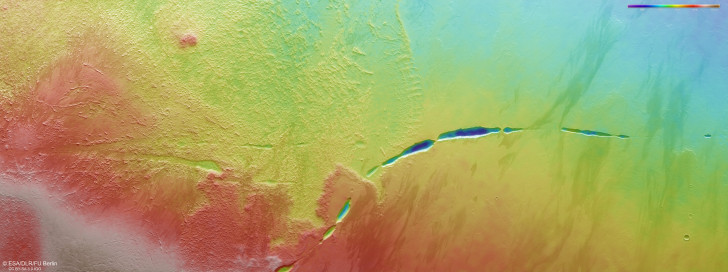
Ondertussen is er op Mars een scheur ter grootte van de Grand Canyon waargenomen dankzij satellietfoto's gemaakt door de Mars Express orbiter van de ESA, de Europese ruimtevaartorganisatie. Het is een immense afgrond, dat volgens wetenschappers is gevormd door een enorme hoeveelheid magma onder de miljoenen jaren oude vulkaan Arsia Mons op het Tharsis Plateau.
De gigantische kloof, met een donker aspect met merkwaardige zebrastrepen, heet Aganippe Fossa en meet ongeveer 600 km. Het meest interessante kenmerk, dat voor het eerst werd ontdekt in 1930, is de graben, "een gleuf-achtige greppel, met steile wanden aan beide zijden", aldus de ESA. Het overtreft de afmetingen van de Grand Canyon, 446 km lang, maar is kleiner dan de Valles Marineris van de evenaar van Mars, die 4000 km reikt, waardoor het wordt geclassificeerd als de langste kloof van het zonnestelsel.
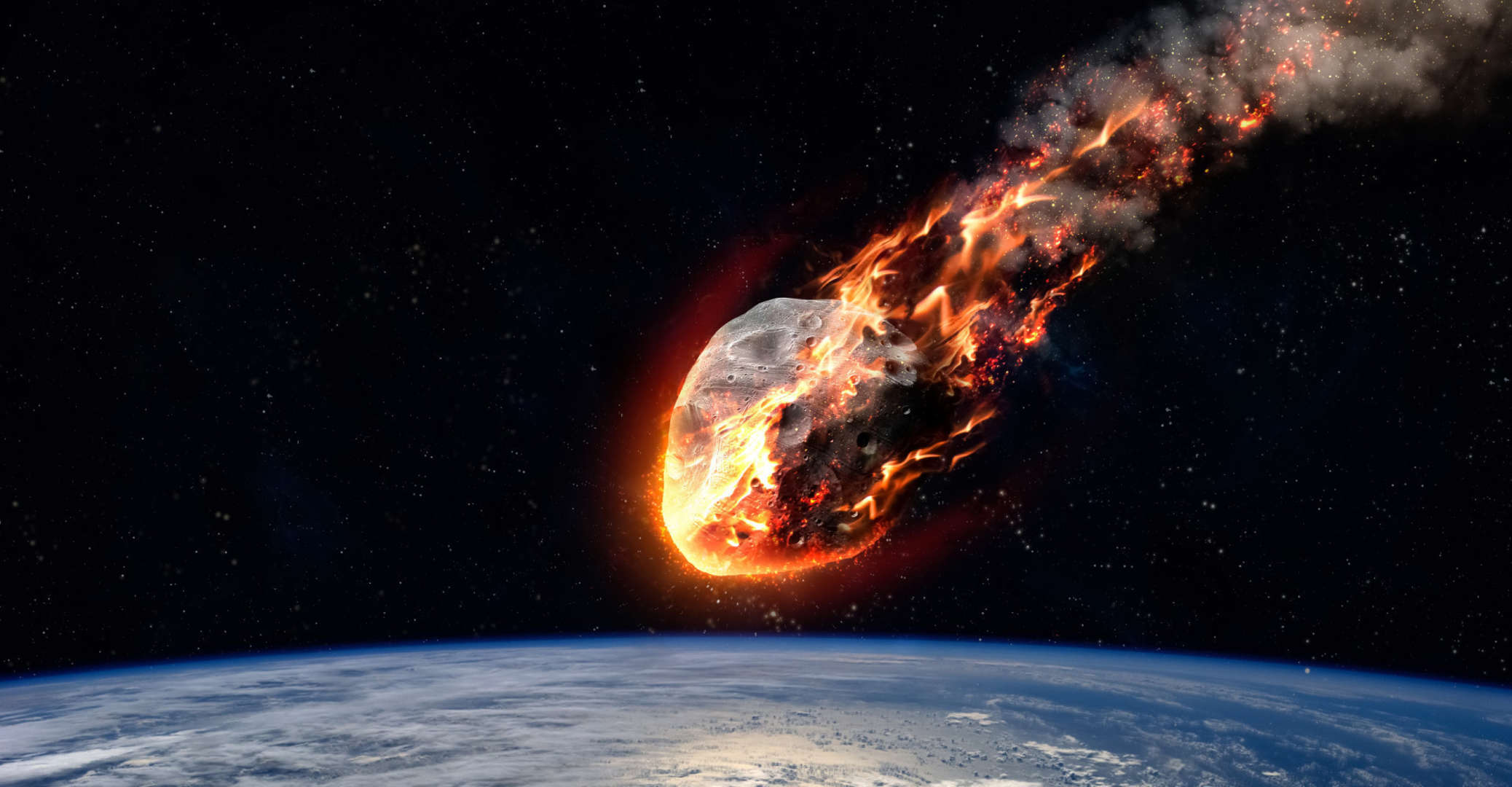
De asteroïde die de aarde zal raken heet Bennu Onderzoekers hebben de precieze datum bepaald waarop een asteroïde mogelijk de aarde zou kunnen inslaan, met een kracht die gelijk is aan die van 22 atoombommen. Dit hemellichaam, genaamd Bennu, nadert onze planeet elke zes jaar. Wetenschappers zijn echter van mening dat 24 september 2182 de datum zou kunnen zijn waarop er een reëel risico bestaat op een botsing tussen de aarde en de asteroïde.
Ondanks dat de mogelijke datum van de apocalyptische gebeurtenis nog ver weg is, is NASA momenteel bezig met intensieve inspanningen om de asteroïde Bennu af te buigen en bevindt zij zich in de laatste fase van haar missie. Zeven jaar geleden lanceerde de Amerikaanse ruimtevaartorganisatie een sonde naar de asteroïde met als doel monsters te verzamelen, in de hoop dat de verzamelde informatie een mogelijke catastrofale ontmoeting zou kunnen helpen voorkomen.
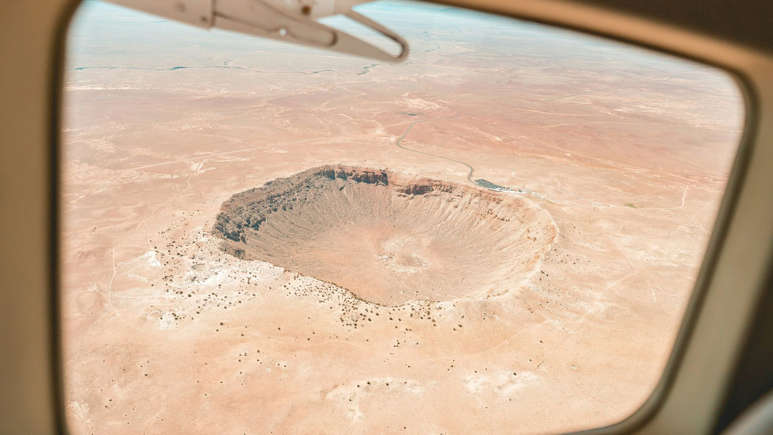
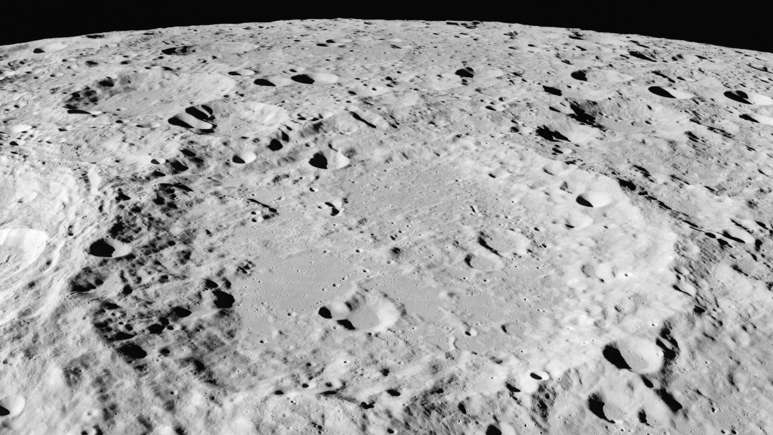
Asteroïden hebben de aarde door de jaren heen vele malen getroffen. Bekijk de volgende galerij voor enkele van de meest betekenisvolle effecten.
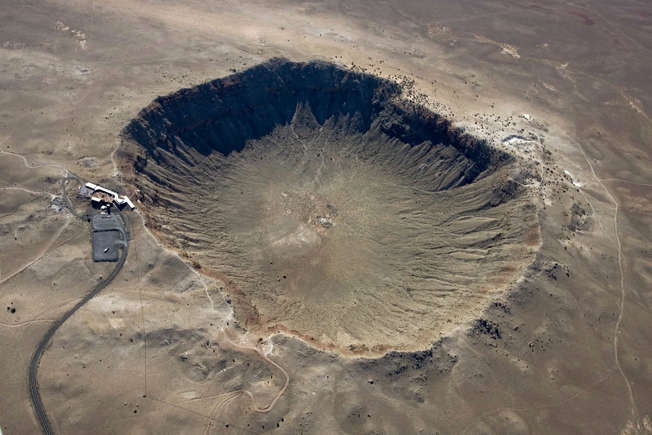
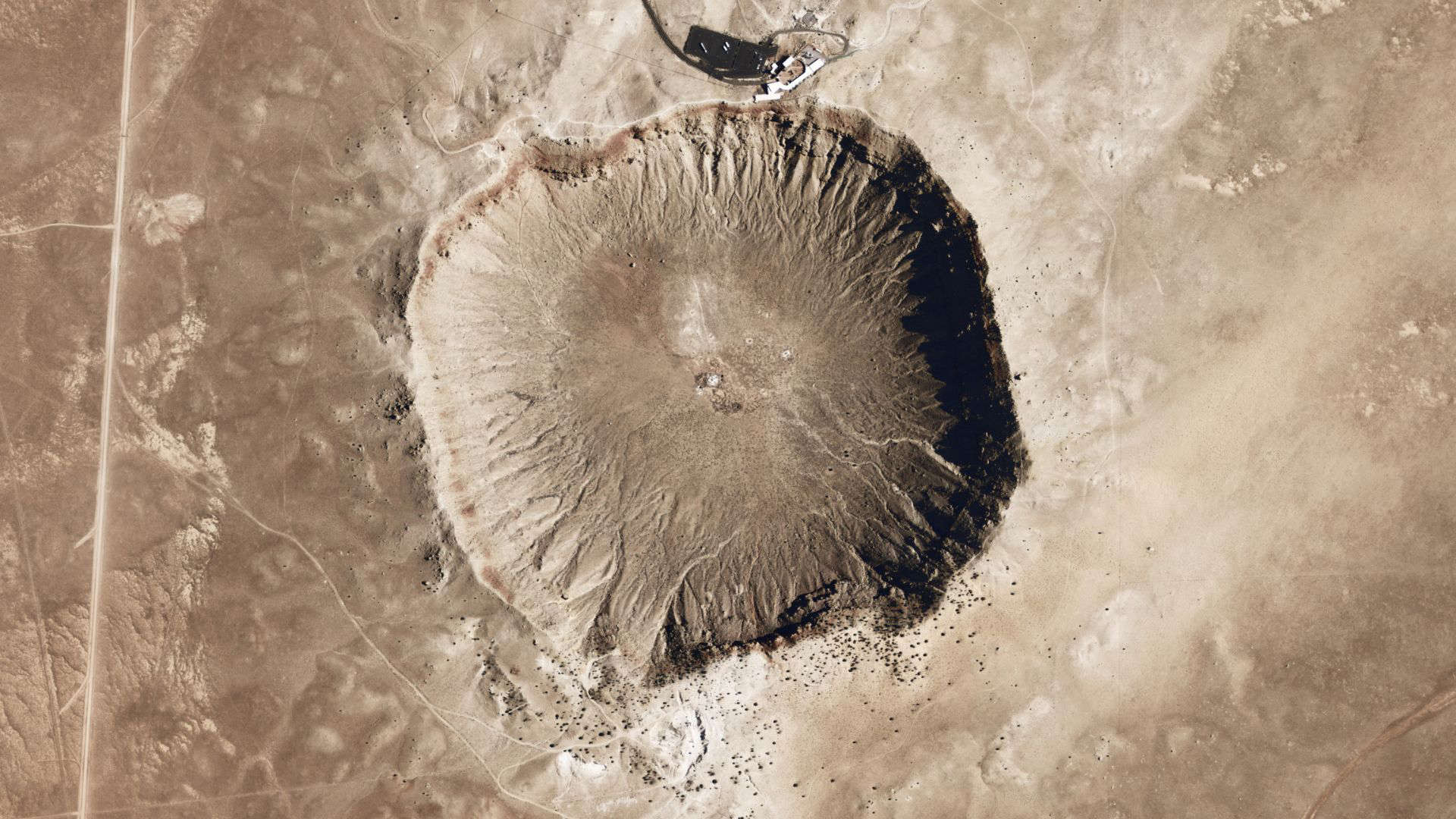
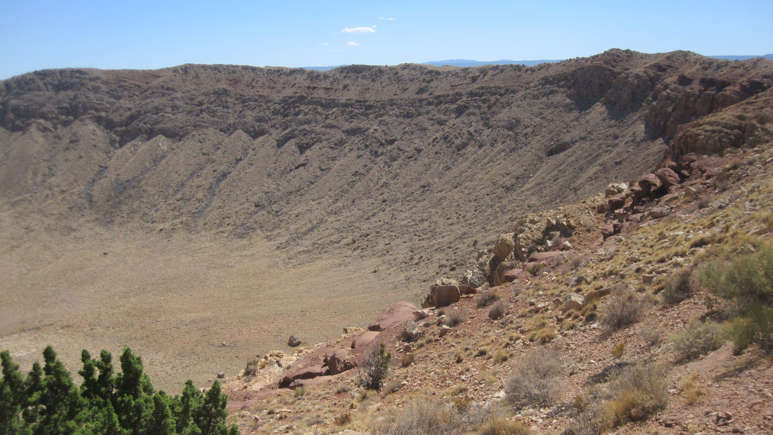
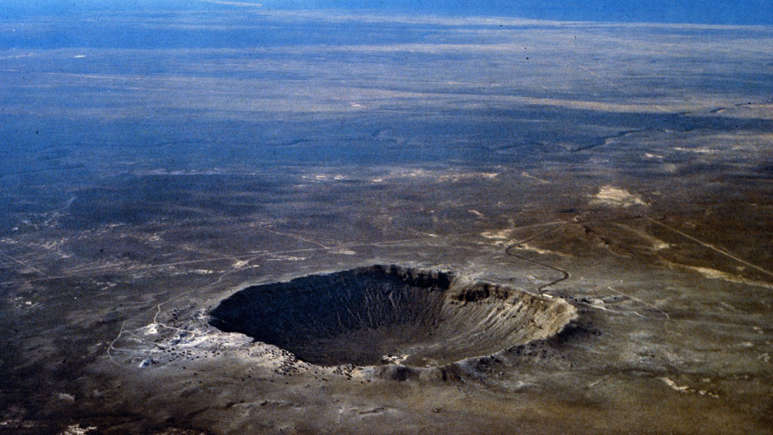
Meteoor inslag locatie, VS Meteor Crater, ook bekend als Barringer Crater, gelegen nabij Flagstaff, Arizona, is een grote meteorietinslagkrater. Dit opmerkelijke natuurverschijnsel is een van de best bewaarde kraters in zijn soort op onze planeet, met een diameter van ongeveer 1200 meter en een diepte van ongeveer 170 meter.
Tenoumer krater, Mauritanië Het kenmerkende geologische kenmerk van de Tenoumer-krater in de Sahara-woestijn van Mauritanië is de dramatische, bijna cirkelvormige rand. De foto van Michael Dennig geeft perfect de afmetingen van de krater weer.
Vredefort krater, Zuid-Afrika De Vredefort krater in de Zuid-Afrikaanse provincie Vrijstaat is de grootste bevestigde inslagkrater op aarde, met een diameter van meer dan 300 km (190 mijl). De afbeelding toont de Vredefort Dome, het centrale deel van de krater.
Kaali-krater, Estland Kaali verwijst naar een groep van negen meteorietkratermeren in het dorp Kaali op Saaremaa, een Ests eiland. Dit cluster van meren werd gevormd rond 1530-1450 v.Chr.
Gosses Bluff Impact Site, Australië De opmerkelijke meteoorkrater Gosses Bluff, gelegen in het zuidelijke deel van het Northern Territory, heeft een diameter van 5 km en een randhoogte van 200 meter. Deze locatie wordt door de westerse Arrernte Aboriginals Tnorala genoemd en wordt als een heilige plaats beschouwd.
Manicouaganmeer, Canada Het Manicouagan Reservoir in het centrum van Quebec ontstond 214 miljoen jaar geleden door een meteoorinslag. René-Levasseur Island is het eiland in het midden van het meer. De hele formatie wordt gewoonlijk "het oog van Quebec" genoemd.
De Wolfe Creek-krater in West-Australië is een opmerkelijk intacte inslaglocatie. Het meet een diameter van ongeveer 875 meter (2871 ft) en heeft een diepte van 60 meter (200 ft) van rand tot vloer. Deze krater, die minder dan 120.000 jaar oud is, ligt in het hart van het Wolfe Creek Meteorite Crater National Park.
Sudbury-bekken, Canada Het Sudbury Basin in Ontario beslaat ongeveer 10-15 km (6,2-9,3 mijl) en ontstond ongeveer 1,8 miljard jaar geleden. Een afbeelding van het bassin wordt weergegeven in NASA's wereldbolsoftware WorldWind.
Popigai-krater, Rusland De Popigai-krater, gelegen in Siberië, werd ongeveer 35 miljoen jaar geleden gevormd. De oostkant van de krater, met een diameter van 100 km (62 mijl), is linksboven in het satellietbeeld zichtbaar.
Acramankrater, Australië Lake Acraman in Zuid-Australië is een opvallend kenmerk van de Acraman-krater, die ongeveer 590 miljoen jaar geleden werd gevormd door een asteroïde-inslag. Dit satellietbeeld legt de 40 km lange krater vast, met het meer in het hart.
Karakul-krater, Tadzjikistan Karakul is de aangewezen naam voor het meer gelegen in een aanzienlijke inslagkrater van 52 km (32 mijl) in het Tadzjiekse Nationale Park. Deze formatie, zichtbaar op dit satellietbeeld, is ongeveer 25 miljoen jaar geleden ontstaan.
Chesapeake Bay, VS Ongeveer 35 miljoen jaar geleden werd de Chesapeake Bay aan de oostkust van Amerika gevormd door sediment dat over het puin van een meteoorinslag viel. De afbeelding toont een deel van de inslagstructuur in Virginia.
Bosumtwi-krater, Ghana Lake Bosumtwi is het enige natuurlijke meer in Ghana, gelegen in een oude inslagkrater ten zuidoosten van Kumasi. De Ashanti-bevolking vereert Bosumtwi als een heilig waterlichaam.
Morasko Meteoriet Natuurreservaat, Polen Het Morasko Meteoriet Natuurreservaat ligt in de bossen nabij Poznań. Bezoekers kunnen zeven kraters verkennen, waarvan de grootste een diameter van ongeveer 100 meter (328 ft) heeft en een diepte van ongeveer 11 meter (36 ft) bereikt.
Lonarkrater, India Het Lonar-meer in de staat Maharashtra is ontstaan door een meteorietinslag die ongeveer 35.000 tot 50.000 jaar geleden plaatsvond.
Middlesboro-krater, VS De Middlesboro-krater in Kentucky dankt zijn naam aan de stad waar hij nu staat. De krater is ongeveer 5 km breed en vermoedelijk minder dan 300 miljoen jaar oud.
Mistastin-krater, Canada De Mistastin-krater werd ongeveer 36 miljoen jaar geleden gevormd als gevolg van een krachtige asteroïde-botsing in Labrador, Canada. De afbeelding toont Mishta-minishtikᐡ, het gebogen eiland van het meer, levendig.
Tswaing-krater, Zuid-Afrika De schilderachtige Tswaing-krater ligt ten noordwesten van Pretoria en is vermoedelijk tussen de 220.000 en 52.000 jaar oud. Met name blijkt uit archeologisch bewijs dat de krater minstens 100.000 jaar geleden door mensen werd bezocht, zoals blijkt uit stenen werktuigen uit het middensteentijdperk.
Henbury Meteorites Conservation Reserve, Australië Het Henbury Meteorites Conservation Reserve in het Northern Territory van Australië bestaat uit minstens 14 kraters. Deze kraters zijn het resultaat van een meteoriet die uit elkaar viel bij een botsing met het aardoppervlak. De grootste krater, die een combinatie is van twee kleinere kraters, is 217 meter lang, 111 meter breed en 15 meter diep.
El'gygytgyn-krater, Rusland Het El'gygytgyn-meer ligt binnen de poolcirkel in het noordoosten van Siberië en werd ongeveer 3,6 miljoen jaar geleden gevormd uit een inslagkrater van een asteroïde.
Araguainha-impactstructuur, Brazilië De inslagstructuur van Araguainha is gemakkelijk herkenbaar als een cirkelvormige omtrek met een diameter van 40 km (25 mijl), gelegen op de grens van de staten Mato Grosso en Goiás. Het wordt beschouwd als de grootste inslagkrater van Zuid-Amerika.
Nördlinger Ries, Duitsland De Nördlinger Ries is een belangrijke inslagkrater in het westen van Beieren en het oosten van Baden-Württemberg. Het werd gebruikt als trainingslocatie voor de Apollo 14-astronauten. De foto toont de zuidelijke bosrand van de Nördlinger Ries.
Haughton-krater, Canada De Haughton-krater, gevonden op het eiland Devon in Nunavut, is vermoedelijk ongeveer 39 miljoen jaar oud en is het resultaat van een asteroïde-inslag die een 23 km brede krater creëerde.
Lappajärvi-krater, Finland Het Lappajärvi-meer, gelegen in de Finse regio Zuid-Österbotten, is een watermassa die de gedeeltelijk geërodeerde meteorietinslagkrater van Lappajärvi beslaat. Deze indrukwekkende krater, die 23 kilometer (14 mijl) beslaat, dient als herinnering aan een gebeurtenis die ongeveer 76 miljoen jaar geleden plaatsvond.
Chicxulub-krater, Mexico De Chicxulub-krater, gelegen onder het schiereiland Yucatán, is het gevolg van een enorme asteroïde-botsing die ongeveer 66 miljoen jaar geleden plaatsvond en leidde tot het uitsterven van dinosauriërs. Op deze NASA-foto van het noordwestelijke deel van het schiereiland benadrukt een vage donkergroene curve de overblijfselen van de inslagkrater, die de op een na grootste ter wereld is.
Tunguska-evenement, Rusland In het jaar 1908 drong een meteoriet de atmosfeer van de aarde binnen, maar in plaats van de grond te raken, ontplofte hij in de lucht. Deze buitengewone gebeurtenis vond plaats nabij de rivier Podkamennaya Tunguska en resulteerde in een wijdverbreide verwoesting. Hoewel er zich geen zichtbare krater vormde, veroorzaakte de explosie het afvlakken van ongeveer 80 miljoen bomen, waardoor een uitgestrekt bosgebied van 2.150 vierkante kilometer (830 vierkante mijl) werd aangetast. Bekende bronnen die informatie verstrekken over dit incident zijn onder meer NASA, de National Park Service, Smithsonian Magazine, Geopark Ries en EarthSky.
Als je geïnteresseerd bent, kun je hier ook enkele van de gevaarlijkste vulkanen ter wereld verkennen: Ontdek enkele van de gevaarlijkste vulkanen ter wereld
But, where are the best places to go if you wanted to spot a UFO? American non-profit organisation the National UFO Reporting Center (NUFORC) has a bank of data revealing, they feel to be, the most credible or interesting cases.
The organisation said these reports tend to be from ‘trained observers such as pilots, reports of anomalous structured craft seen at close distances, and reports with interesting and clear video or photographic evidence’.
Many of these cases stem back to the 1990s, and are posted in the author’s own words. So, where are the UFO hotspots around the world?
UFO hotspots from around the world (Picture: Metro.co.uk)
1. The United States
Naturally, the US made the top of the list with a whopping 133,682 apparent UFO sightings across the country dating back to 1995.
The state with the most viewings is California, with 16,399 ‘credible’ cases since the mid-90s, and the fewest number of viewings were around the capital, the District of Columbia, with only 155 cases.
In California, reported shapes often take the form of mysterious ‘lights’ or orbs.
One case as recent June 15 in Richmond reported three pink orbs glowing in the sky. The witness wrote: ‘Three orbs in a line coming up from the ground.
‘Was heading East on I-80 and saw three pink lights in a column. The lowest of the lights looked to be hovering just above the ground and the highest was probably 100-200ft in the air and the middle was directly in between the other two. They weren’t moving or blinking but eventually all three dimmed and went out.’
This photo of a flying saucer was taken by Paul Trent over his farm in McMinnville, Oregon (Picture: Bettmann Archive)
Another case report, from Minnesota, in 2008, details a cigar-shaped UAP.
The witness wrote: ‘Small white cigar-shaped object, low in sky, hovered for 2 minutes, then disappeared, no trail.
‘Two friends and I were golfing on the 10th hole at North Links golf course, and there was a clear blue sky. As we looked forward into the sky, one of us noticed a white, cigar or tampon-shaped object sitting in the sky, no wings, obviously not a plane or helicopter, and there was no smoke or jetstream coming from the object. It was probably about 500 yards or so away in the sky.
‘We sat stunned, asking each other, “What could that possibly be, besides a UFO?”
‘No one wanted to tee off, because we wanted to wait to see what happened with the foreign craft.
‘After about two minutes, the craft gradually got smaller for about 10 seconds, and then completely disappeared like it went into stealth mode, again, no smoke or anything, it just vanished.
‘Within minutes of seeing the craft, a small army-type plane was flying in the same general area where we had seen the craft. We kept looking for the next two hours of golf, but no reappearance occurred.’
The organisation noted that the witness chose to remain totally anonymous and provided no contact information.
A lot of UFOs are seen from a distance (Picture: Getty)
2. Canada
Still in North America, the people of Canada have compiled 5,973 UFO sightings dating back to 1995. With a large number like this, NUFORC has split case reports by province, and revealed the highest number of reports came from the province of Ontario, with 2,547 reports.
The fewest reports came from Prince Edward Island, with 27 ‘credible’ reports.
In the province of New Brunswick, in the town of Bouctouche, two observers reported that they saw a disk-like object. The witnesses wrote: ‘On May 17, 2021, I was driving my friend home as I noticed lights in the sky and told my friend about it.
‘It was a line of lights – seems like stars, but was not – and then it faded away. We were 30 seconds from my friend’s house, so I rushed to park and got out of the car to see if we could see more.
‘We started looking up and suddenly saw an oval-shaped flying object that was moving. We noticed it was passing in front of two stars. It also looked like it had windows, but was very low on lighting around, we could only spot it because of window lights on the objects.
‘We could see it floating for like a good 30 seconds before we lost track of it.’
UFOs have even been spotted mid-flight (Picture: Getty)
3.The UK
The UK is another well-known hotspot for UFOs, and has racked up 3,439 cases that date back to 1996.
The reports appear across the country. One witness in Birmingham, in September 2009, said: ‘South Birmingham 11.40am, clear sky gold flat object a few feet square with slight bend.
‘On Sunday morning, while taking a coffee after some light housework –my wife was at morning work. I witnessed something exceedingly weird off the back patio.
‘I have no belief in UFOs – laws of physics dictate against it – and have always explained away anything unusual as helicopter lights etc but not this time, I’m afraid.
‘I observed a crazy sighting which I cannot figure out.
‘It looked like a piece of gold vellum paper, slightly folded as if hovering in the wind. It was sunny so I could have been catching the Sun. I also considered a butterfly.
‘However, it became apparent that the size was wrong for a butterfly, and paper, it was not – because the object proceeded to move out across the park at supernatural speed, with increasing velocity. I was completely dumbstruck and offer no explanation. I’m employed as a physics engineering technician.’
These apparent encounters can leave people feeling uneasy (Picture: Getty)
Over in Ciliau Aeron, Wales, a report in 2018 told of a sphere-shaped, house-sized, UFO that hovered above the valley. The witness reported: ‘I opened the back door at 6am to let the dogs out.
‘I looked across the fields to where I have a view of the Aeron Valley. It was very dark, but I immediately saw what I thought was a house on fire about half a mile away.
‘I watched for a minute, planning to call 999. Then, the “fire” moved to the west a few hundred metres behind some trees. I realised it was a large sphere, the size of a house and seemed to churn or pulsate with its “fire”.
‘It was extremely bright and white/yellow in colour. Then it stopped where it hovered for a minute and then flew the other way to the east where it continued past its original position, all the way along the valley until out of sight. Just before it went out of sight, a bright red light appeared on the top half of the sphere.
‘It travelled in a straight path, sometimes behind trees at the speed of a car. It also had “sparks” flying out of it like molten metal falling to the ground. It didn’t make a sound. I believe it to have been something not of our Earth.’
4. Australia
On the other side of the world, there is one surprising country that has quite a few sightings of UFOs. In Australia, data from the NUFORC revealed there have been 961 sightings since 1996, and some echo other reports from elsewhere in the world.
In 2023, one witness in New South Wales reported a triangular UFO, with white lights that was moving fast and silently.
It seems triangle UFOs are in fashion(Picture: Getty)
The report said: ‘Standing in my suburban backyard at 6:45pm EST looking at the stars facing West.
‘I saw the object as it passed directly overhead heading in a south westerly direction. The object was triangular in shape with approximately 10 lights on the forward two sides and 3 on the rear side. The lights were white and not flashing. Stars were blacked out within the triangle as it passed over.
The object appeared to be the size of a football field in width and there was no sound whatsoever. It appeared to be quite close.
‘I lost sight of the object as it passed over a hill to the south west. The object was visible to me for approximately 20 seconds.’
Triangular objects seem to be a popular shape for a UFO down under – another report in 2018 in Victoria spoke about a solid metallic object that was around five feet on all sides.
The witness wrote: ‘It was in the middle of the day, I was sitting on an oval [an Australian Football field] with my friend and I look up and see a giant metal triangle hovering without moving a bit away from us, not to far away, maybe half an oval away.
‘It looked like it was solid metal and after a few seconds of hovering in the same spot it zoomed away very fast over the tree line. It was a nice sunny day without any wind. It definitely wasn’t a drone or a weather balloon. The metal didn’t look bendable and looked like a solid triangle just in the sky.’
Many UFOs have bright lights (Picture: Getty)
5. India
While we hear of many cases from countries like the US and the UK, we rarely hear of reports from countries such as India. However, according to the NUFORC, there are 502 ‘credible’ cases that stem back to 1999.
In 2010, a woman in the city of Alwar saw a UFO hovering overhead for around five minutes. She reported the object looked like a disk, and featured lights, as well as an aura or a haze surrounding it.
She wrote: ‘At 6:21pm, I was playing with my kids at the rooftop of our row house in Alwar city of Rajasthan State in India. Suddenly I saw a white and silver color saucer sparkling in the sky. It was moving in a zigzag way, it was moving towards the east and then suddenly changed direction to the north.
‘I told my parents and kids to also look and we all saw the object for around 5 minutes as it was moving very slowly and everybody was surprised to see the same thing. We tried to capture the picture of the object in our mobile phone camera but as the object was distant, we were not able to capture it.
‘Let me also say it was clear sky that day but suddenly we saw a rapid change in weather and after three hours a thunderstorm and lightning happened. I am not sure but this might be linked to this flying object.’
She wrote: ‘To add to my credibility I am a post graduate in science and a mother of two kids.’
The apparent UFOs are spotted across the globe (Picture: Getty)
In 2021, a witness in Jalpaiguri reported a hockey stick-shaped UFO that had lights, as well as an aura or haze.
They wrote: ‘It looked like a hockey stick oscillating like a pendulum. The two crafts suddenly collided and there was light which moved northwards.
‘I was playing with my friends and we suddenly noticed something in the sky quite far above. There was a shrill sound for a matter of a few seconds. Most thought it to be a jet aircraft or a shooting star but I thought it was something else.
‘Then as we looked carefully we saw as if something like a hockey stick was upside down and it was showing oscillatory movement. Suddenly the two crafts of the same sort collided and a streak of light was emitted. Then we all thought it was a UFO.
‘We were amazed and the crafts were separated for around 20 minutes. Suddenly they collided and the light streak started moving straight towards the north eastern direction continuously for around another half an hour and it was of the same size quite unlike the common thing that we know.
‘Though we all understood that it was going far, however the size of the light streak didn’t decrease. Suddenly, in an absurd way again the light disappeared and nothing else was seen. We had no mobiles or cameras then and we were alone.’
Some apparent UFOs have been spotted on camera (Picture: Getty)
6. South Africa
Another UFO hotspot on the list is the country of South Africa. According to the data, the country has 211 reports that date back to 1997.
But despite the smaller number of cases, they are still just as eerie. One witness reported seeing a UFO over a rhino sanctuary in Klerksdorp, which has a no-fly zone.
The witness wrote: ‘I have some very weird footage for you from South Africa, captured at 4am by my son on a high security rhino farm with state of the art security systems, including radar – which was how the object was detected in the first place – and night sight cameras.
‘They could not identify the object on camera, and as it is a no fly zone, they dispatched a team of rangers, but no lights and no sound was heard by the team, so they could not locate anything as it was still dark.
‘The object was not travelling in a straight line, and it changed course as well. Hard to determine the height of it, as it looked high at some stages, and very low at other stages. This is definitely not a drone of some kind, and the shape seems to move on the top of the object as if scanning or something.
‘Just very very weird.’
Some alleged UFOs move in a jagged fashion (Picture: Getty)
Another report came through of an apparent UFO sighting in Cape Town near the harbour. The alleged UFO had lights, and was in the shape of a triangle.
The witness reported: ‘South Africa also got UFOs.
‘I just left the restaurant called Panama Jacks Seafood in Cape Town Harbour and took a photo of my wife in front of the massive harbour cranes and lights. I handed her the camera back and she put it back in her handbag. As we looked up for the last time at the enormous cranes [we saw] 3 x orange lights in a perfect triangular shape.
‘They held formation in distance from each other, but were kind of erratic in movement, much the same way as a stingray fish would swim. Came from the ocean direction and passed over or left of Table Bay Mountain. I tried to get them on my Blackberry Cell phone camera but I could not find them on the screen. Sorry!’
7. Ireland
Back in Europe, another UFO hotspot country that might be unknown, is Ireland. The country has reported 189 cases which date back to 1998.
But despite being half a world away, the organisation revealed reports that also talked of a flying object moving in a zigzag pattern. One witness from Dublin in 1998 wrote of a strange light spotted with an aura nearby. The report said: ‘I was looking out my bedroom window staring at the stars when suddenly one moved.
‘At first I thought it was a satellite but it was zigzagging, jerking, moving in circles, and changing direction. I called my father and my brother and we went outside to look at it better. It stopped moving for a while then started moving again. I stayed there observing it for another 20 mins before I went inside again. When I got upstairs I couldn’t see it anymore…’
UFOs have been a figure of science fiction for decades (Picture: Getty)
A more recent report from 2019 told of an apparent UFO that seemed to scan the sky with lasers.
The report said: ‘At first it was just one blue glow in the clouds.
‘The glow would get stronger and then dim a little. Afterwards it moved and at stages bluish/white lights came through the clouds. Very hard to describe but the best example I can give is when you see a sci-fi movie where a robot or gadget 3D scans something with lasers.
‘These lights would light up the clouds but when they were visible they’d beam out one direction then change very quickly to another direction. They shot out at every angle too.
‘After maybe two minutes there were two blue glows behind clouds. Both moved rapidly from one point to another with flashing lighting up clouds as they stopped. When I could see the beam, it looked as though it came from a central point and spread out into a few beams like I said as though it was quickly scanning then moving.
‘Sorry I know it’s really hard to put into words this episode, but I didn’t know where or who else to report this to as I feel very uneasy about it all.’
In 2015, one person reported seeing a tear-shaped UFO in Florianopolis.
The witness said: ‘I was driving to class, when I looked up to see the sky and saw a lime green light, shaped like a teardrop, travelling really fast, and vanishing seconds later.
‘I’m positive it wasn’t a weather balloon or a drone, it appeared to be really high and the shape may be due to its velocity.’
NASA Imagines a Catastrophic Asteroid Impact to Study How to Prevent it
The Netflix movie Don’t Look Up received plenty of accolades for its scarily realistic portrayal of a professor from Michigan State University attempting to warn the world about a civilization-ending asteroid impact. In reality, there are plenty of organizations in the US government and beyond whose job it is to find and avoid those impacts. And the best way to train them to do those jobs is to run scenarios and try to determine what actions would need to be taken. That was the idea behind the fifth Planetary Defense Interagency Tabletop Exercise, held at John Hopkins University Applied Physics Laboratory in April. NASA recently released a preliminary report on the results of the exercise, with a fully detailed one to come in August.
This is the fifth in a series of exercises that have been ongoing for the last eleven years. Each exercise focuses on a different scenario of a possible strike to determine what actions would need to be taken immediately or over a more extended period.
International collaborators contributed to the discussion for the first time in one of these exercises. Over 100 people participated, including representatives of the UN, UK, ESA, and JAXA. Notably absent were two other space powers—Russia and China—who would obviously impact any decision-making in a realistic scenario of an asteroid impact.
Finding asteroids before they impact us is one of the main tasks of the planetary defense community, as Fraser explains.
In this case, the scenario some participants developed didn’t directly impact China or Russia. However, both could have been affected by a tidal wave if the target asteroid had landed in the Pacific Ocean. The scenario called for an asteroid a few hundred meters across that had a 72% chance of impacting the Earth in about 14 years.
The projected path that the asteroid carved across the Earth went from the Pacific across northern Mexico and the southern US, passing directly over Dallas and Washington DC before crossing over the Atlantic Ocean, passing over Portugal, Spain (including Madrid), and northern Africa. It was probably not lost on participants that this scenario could directly affect the town they were sitting in.
Calculations showed that there was a 45% chance the impact wouldn’t affect anybody, a relatively high chance it would impact between 1,000 and 100,000 people, and a .04% chance it would impact more than 10 million people—for example, if it scored a direct hit on the Dallas metropolitan area. That uncertainty and the extended timeline gave the planetary defense officials the most significant trouble for this exercise.
Stopping a potentially hazardous asteroid comes with its own challenges, as Fraser discusses in this video.
As in Don’t Look Up, political considerations played the forefront in the participant’s minds. Many repeated the sentiment of one anonymous participant reported in the preliminary report: “I know what I would prefer [to do], but Congress will tell us to wait.” The uncertainty about impact, and especially about whether it would affect anyone at all, was a significant consideration. In the scenario, the asteroid passed behind the Sun, so additional observations to clarify those estimates weren’t possible for another seven months.
The availability of resources was again a primary consideration, both to track the potential impactor closely enough and to design and execute a mission to potentially deflect it. Participants didn’t believe there would be enough resources for either task and stated that it was one of their main concerns in the future.
They also agreed that the tabletop exercise was a massive success, with it allowing decision-makers who would be involved in an actual process of determining what to do with a potential real asteroid strike to think through the steps they would have to take and what the likely political and public responses would be. Plans for additional exercises are already in the works, and the final report of the session is due to be released on August 5th, with specific assignable action items to come as part of it. While any expected asteroid impact isn’t foreseen in the coming decades, these sorts of exercises will continue to hone what is arguably one of the most valuable skills of any space agency – how to protect ourselves from one of our biggest threats.
This artist’s concept depicts an asteroid drifting through space. Many such objects frequency pass Earth. To help prepare for the discovery of one with a chance of impacting our planet, NASA leads regular exercises to figure out how the international community could respond to such a threat. Credit – NASA / JPL-Caltech
The Rugged Desert Moss Best Equipped to Survive on Mars
For decades, we have seen Mars as a desolate landscape devoid of any signs of life. Attempt to identify ways of growing plants and food on the red planet have focussed on greenhouse like structures to enable plants to survive, that is, until now! A desert moss called ‘Syntrichia caninervis’ has been identified and it can grown in extreme environments like Antarctica and the Mojave Desert. A new study revealed the moss can survive Mars-like environments too including low temperatures, high levels of radiation and drought.
Mars has often be referred to as the “Red Planet” for its distinct red hue. It is the fourth planet from the Sun and to some extent resembles the Earth. Polar ice caps, seasonal weather patterns, extinct volcanoes, ancient riverbeds and flood plains are among the many surface features and. This cold world has fascinated us for centuries and its thin atmosphere, mostly made up of carbon dioxide, has been subjected to lots of studies. It has been thought for many years that it experiences some of the harshest weather conditions, including planet-wide dust storms but the recent study suggests there may just be a plant on Earth capable of surviving these conditions.
Mars,Credit NASA
Exploring and colonising planets like Mars can enhance human sustainability. Since no life forms have been found on Mars, introducing Earth organisms might be necessary for creating suitable conditions for human life in a process known as terraforming. This will involve selecting or engineering plants that can thrive in the harsh environments of an alien world. Few studies have tested organisms’ ability to withstand extreme environments of space or Mars, focusing mainly on microorganisms, algae, and lichens. However until recently, studies including mosses and whole plants have been lacking.
There have been many long term plans and even whimsical ideas to establish settlements on Mars. Pivotal to the success is the establishment of adapted crops that can grow in controlled, synthetic environments. However, to develop such a plant requires significant progress and development before plants are capable of growing in the soils and harsh conditions. In the report by lead author Xiaoshuang Li and team the incredible resilience of a moss called Syntrichia caninervis (S. caninervis) to survive a Mars-like environment even after having lost more than 98% of its water content.
Studies into the resilience of the plants have shown they can withstand extremely low temperatures and regenerate even after being stored in a freezer at -80°C for five years or in liquid nitrogen for one month. S. caninervis also demonstrates high resistance to gamma radiation and can survive in simulated Martian conditions.
The study concluded that S. caninervis is among the most stress-tolerant organisms known. It shows how it is a real potential species for the colonisation of alien worlds like Mars. The resilience to extreme conditions such as desiccation, low temperatures, and high radiation makes it an ideal for future terraforming efforts. It helps to understand the unique properties of this moss (in particular) and how it can form a foundational layer for biologically sustainable human habitats in space.
Enormous Crater 3x the Size of the Grand Canyon Discovered in U.S. There are various craters that have been discovered around the United States, thanks to giant asteroids and meteors from outer space crashing into Earth millions of years ago.
These craters can come in all shapes and sizes. Often, average Americans don’t even realize some of these enormous craters even exist — and can be found in their local areas. In fact, the largest crater ever discovered in the U.S. is about three times larger than the Grand Canyon.
What Are Impact Craters? Impact craters occur on the Earth’s surface after large space rocks, such as meteors or asteroids, hit the planet forcefully, leaving behind a changed landscape.
These so-called impact events occur over millions of years. As there can be different types of sizes of these space rocks, the types of craters they leave behind can vary.
Discovering Craters While you may think that it’s easy to spot a crater — after all, they can often appear to be giant holes in the ground — scientists have long explained that discovering craters can be quite difficult.
Scientists conduct many tests to fully understand if an impression on the Earth is from a meteor or asteroid — or if it’s from something else.
Uncovering Hidden Impact Craters There are many crater sites around the world that likely haven’t been discovered yet, as weathering and erosion can keep these sites from view.
In some cases, scientists have even stumbled upon impact craters without even realizing it, only learning the truth after some studies have been conducted on the region.
Understanding the Planet’s Age There are a variety of reasons why studying impact crater sites is so important. Scientists explain that these craters can help us better understand how old a planet is.
For example, Earth is a relatively newer planet than the Moon and Mercury, which have many noticeable craters. The Moon even has about 9,137 craters on its surface that scientists have recognized. More could be found in the future.
The Largest Crater Sites in the U.S. The largest crater site in the country can be found in none other than the Chesapeake Bay. The Chesapeake Bay Crater was first discovered in the 1990s by C. Wylie Poag, quite by accident.
Poag was in the region for an offshore drilling project when this stunning discovery was made. The crater site was hidden beneath the Chesapeake Bay’s floor for centuries before Poag finally realized the truth of the Bay.
Larger Than the Grand Canyon Scientists have deemed the Chesapeake Bay Crater to be the most significant impact crater throughout the entire United States, as it’s enormous.
This crater site has a diameter of 53 miles. This makes it larger than the Grand Canyon, which has a widest point of about 18 miles.
How This Crater Site Formed According to scientists, this crater likely formed about 35 million years ago when a bolide — a very large crater-forming body — crashed into what is now known as Virginia’s Hampton Beach.
This 3 km long bolide traveled at 144,000 miles per hour before colliding with the planet, leaving a 1.3 km deep impact crater behind.
A Changed Region This collision left behind a completely different region, as scientists believe that the crater impact excavated coastal aquifers.
In our present day, a large reservoir filled with water 1.5 times saltier than seawater lies in the impact spot. Because this water is incredibly salty, it cannot be used for many purposes, such as for drinking water.
Changing the Rivers This crater also changed how the rivers flow in the area. For example, rivers like the Rappahannock flow to the Atlantic in a southeast direction.
Researchers believe that, after this collision, the York and James rivers changed their flow to head northeast to the crater.
Mars Express captured this view of the flank of an enormous volcano, shaped by millions of years of fire and ice.
Images of the Martian landscape often seem to show a dead planet, no longer teeming with life (if it ever was) and no longer animated by plate tectonics. But this one reveals what was once a landscape in constant motion — sometimes sudden and violent, sometimes slow and inexorable. The northwest flank of the giant Martian volcano Arsia Mons bears the remnants of ancient lava flows, the tracks of long-vanished glaciers, and a long, deep scar left by magma straining to escape the confines of its chamber beneath the mountain.
This image shows the northwestern slope of Arsia Mons. North is on the right-hand side of the image, for reasons known only to the European Space Agency. The huge crack in the surface is Aganippe Fossa, a crack formed when the ground stretched under pressure from upwelling magma millions of years ago.
WELCOME TO ARSIA MONS
The Martian volcano Arsia Mons looms nearly 6 miles above the surrounding landscape, but its peak lies off-camera in this image from the European Space Agency’s Mars Express Orbiter. Instead, the image focuses on the volcano’s northwestern flank, which rises from the plain in a wide slope up toward the southeast (the lower left corner of the image).
To the southwest (the upper left of the image), the terrain is rough, with clusters of strangely-shaped mounds split by networks of valleys. As you move north, though, that rough terrain smooths out, giving way to a wide swath of gentle slopes and lobe-like cliffs. Ancient glaciers probably carved this terrain and wore it smooth — and left behind rocky debris in their wake. Farther east lie the remains of ancient, long-cooled lava flows, partially covered in zebra stripes of windblown sand and dust.
Off-screen to the lower left is the peak of Arsia Mons, home to a wide caldera. North is still on the right.
And curving northeast across the mountain’s lower slope is a 375-mile-long scar in the Martian ground known as Aganippe Fossa. This steep-walled trench is what geologists call a graben: an area where a planet’s crust is being stretched, creating cracks called faults. When the rock between the faults drops downward and creates the floor of a rift valley like Aganippe Fossa, it’s called a graben; the higher rocks on either side of the rift are called horsts.
Planetary scientists at ESA say Aganippe Fossa probably formed because a huge mass of magma beneath the feet of Arsia Mons was welling upward, stretching the planet’s rocky crust to its breaking point.
Aganippe Fossa is just part of a fascinating landscape once shaped by flowing lava and ice. Around Arsia Mons, satellite images show that the ceilings of some lava tubes (underground tunnels once filled with flowing magma) have collapsed inward, leaving these volcanic caves open to the Martian sky. And during the Martian autumn, an icy cloud wraps the top of Arsia Mons in a glittering shroud of ice droplets which can stretch hundreds of miles across the sky.
Beste bezoeker, Heb je zelf al ooit een vreemde waarneming gedaan, laat dit dan even weten via email aan Frederick Delaere opwww.ufomeldpunt.be. Deze onderzoekers behandelen jouw melding in volledige anonimiteit en met alle respect voor jouw privacy. Ze zijn kritisch, objectief maar open minded aangelegd en zullen jou steeds een verklaring geven voor jouw waarneming! DUS AARZEL NIET, ALS JE EEN ANTWOORD OP JOUW VRAGEN WENST, CONTACTEER FREDERICK. BIJ VOORBAAT DANK...
Druk op onderstaande knop om je bestand , jouw artikel naar mij te verzenden. INDIEN HET DE MOEITE WAARD IS, PLAATS IK HET OP DE BLOG ONDER DIVERSEN MET JOUW NAAM...
Druk op onderstaande knop om een berichtje achter te laten in mijn gastenboek
Alvast bedankt voor al jouw bezoekjes en jouw reacties. Nog een prettige dag verder!!!
Over mijzelf
Ik ben Pieter, en gebruik soms ook wel de schuilnaam Peter2011.
Ik ben een man en woon in Linter (België) en mijn beroep is Ik ben op rust..
Ik ben geboren op 18/10/1950 en ben nu dus 75 jaar jong.
Mijn hobby's zijn: Ufologie en andere esoterische onderwerpen.
Op deze blog vind je onder artikels, werk van mezelf. Mijn dank gaat ook naar André, Ingrid, Oliver, Paul, Vincent, Georges Filer en MUFON voor de bijdragen voor de verschillende categorieën...
Veel leesplezier en geef je mening over deze blog.