The purpose of this blog is the creation of an open, international, independent and free forum, where every UFO-researcher can publish the results of his/her research. The languagues, used for this blog, are Dutch, English and French.You can find the articles of a collegue by selecting his category. Each author stays resposable for the continue of his articles. As blogmaster I have the right to refuse an addition or an article, when it attacks other collegues or UFO-groupes.
Druk op onderstaande knop om te reageren in mijn forum
Zoeken in blog
Deze blog is opgedragen aan mijn overleden echtgenote Lucienne.
In 2012 verloor ze haar moedige strijd tegen kanker!
In 2011 startte ik deze blog, omdat ik niet mocht stoppen met mijn UFO-onderzoek.
BEDANKT!!!
Een interessant adres?
UFO'S of UAP'S, ASTRONOMIE, RUIMTEVAART, ARCHEOLOGIE, OUDHEIDKUNDE, SF-SNUFJES EN ANDERE ESOTERISCHE WETENSCHAPPEN - DE ALLERLAATSTE NIEUWTJES
UFO's of UAP'S in België en de rest van de wereld Ontdek de Fascinerende Wereld van UFO's en UAP's: Jouw Bron voor Onthullende Informatie!
Ben jij ook gefascineerd door het onbekende? Wil je meer weten over UFO's en UAP's, niet alleen in België, maar over de hele wereld? Dan ben je op de juiste plek!
België: Het Kloppend Hart van UFO-onderzoek
In België is BUFON (Belgisch UFO-Netwerk) dé autoriteit op het gebied van UFO-onderzoek. Voor betrouwbare en objectieve informatie over deze intrigerende fenomenen, bezoek je zeker onze Facebook-pagina en deze blog. Maar dat is nog niet alles! Ontdek ook het Belgisch UFO-meldpunt en Caelestia, twee organisaties die diepgaand onderzoek verrichten, al zijn ze soms kritisch of sceptisch.
Nederland: Een Schat aan Informatie
Voor onze Nederlandse buren is er de schitterende website www.ufowijzer.nl, beheerd door Paul Harmans. Deze site biedt een schat aan informatie en artikelen die je niet wilt missen!
Internationaal: MUFON - De Wereldwijde Autoriteit
Neem ook een kijkje bij MUFON (Mutual UFO Network Inc.), een gerenommeerde Amerikaanse UFO-vereniging met afdelingen in de VS en wereldwijd. MUFON is toegewijd aan de wetenschappelijke en analytische studie van het UFO-fenomeen, en hun maandelijkse tijdschrift, The MUFON UFO-Journal, is een must-read voor elke UFO-enthousiasteling. Bezoek hun website op www.mufon.com voor meer informatie.
Samenwerking en Toekomstvisie
Sinds 1 februari 2020 is Pieter niet alleen ex-president van BUFON, maar ook de voormalige nationale directeur van MUFON in Vlaanderen en Nederland. Dit creëert een sterke samenwerking met de Franse MUFON Reseau MUFON/EUROP, wat ons in staat stelt om nog meer waardevolle inzichten te delen.
Let op: Nepprofielen en Nieuwe Groeperingen
Pas op voor een nieuwe groepering die zich ook BUFON noemt, maar geen enkele connectie heeft met onze gevestigde organisatie. Hoewel zij de naam geregistreerd hebben, kunnen ze het rijke verleden en de expertise van onze groep niet evenaren. We wensen hen veel succes, maar we blijven de autoriteit in UFO-onderzoek!
Blijf Op De Hoogte!
Wil jij de laatste nieuwtjes over UFO's, ruimtevaart, archeologie, en meer? Volg ons dan en duik samen met ons in de fascinerende wereld van het onbekende! Sluit je aan bij de gemeenschap van nieuwsgierige geesten die net als jij verlangen naar antwoorden en avonturen in de sterren!
Heb je vragen of wil je meer weten? Aarzel dan niet om contact met ons op te nemen! Samen ontrafelen we het mysterie van de lucht en daarbuiten.
04-07-2024
We Might Witness A Star Explode Soon — And It’s Not Betelgeuse
We Might Witness A Star Explode Soon — And It’s Not Betelgeuse
A mismatched pair of stars 3,000 light years away may be gearing up for an explosion in the next few months. T Coronae Borealis (T CrB to its friends) is normally too dim to see with the unaided eye, but roughly every 80 years, it flares brightly enough to appear as a “new” star, or nova, in Earth’s northern sky. Its last event was in 1946, and astronomers say it’s likely to go off again this summer.
TWINKLE, TWINKLE, LITTLE — BOOM
T CrB is actually a pair of stars, trapped in each other’s orbit — and in an extremely messy relationship that sometimes literally explodes.
One member of the pair is an aging red giant, which has burned up all its hydrogen fuel and is now fusing helium atoms together at its core. Helium fusion produces a tremendous amount of heat and radiation pressure, so the aging star’s outer layers have swelled outward to many times its original size (this is the same fate that will eventually befall our Sun in about 5 billion years). The other half of the dynamic duo is a white dwarf: the burned-out remains of a star’s core (this is what our Sun will look like sometime after its red giant phase).
About every 80 years, the red giant shrugs off its outermost layers of gas, and the white dwarf’s gravity grabs them. White dwarfs are nowhere near as dense as neutron stars, but they're still pretty dense, being the remnants of stellar cores — and it doesn't take much to ignite one again, at least temporarily. When the gas discarded by the red giant falls onto the surface of the white dwarf, it puts just enough pressure on the inner layers of the white dwarf to kickstart nuclear fusion.
That sudden burst of fusion triggers a chain reaction that eventually engulfs the outer layers of the star in what's called a runaway thermonuclear reaction. The envelope of gas around the white dwarf (the same envelope it just snatched away from the nearby red giant), heated by the runaway nuclear fusion, explodes outward at roughly 3,700 miles per second. In other words, KABOOM.
And 3,000 light years away, people on Earth will be able to see what looks like a new star in the night sky.
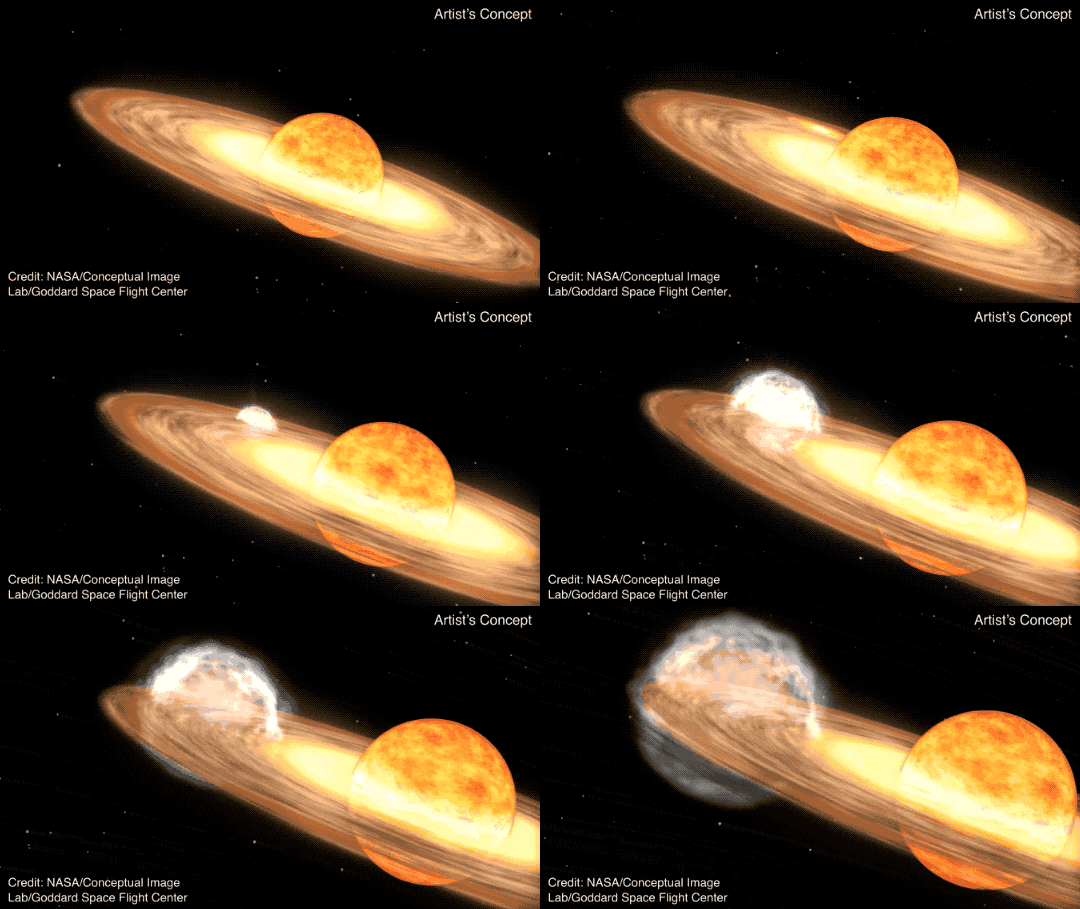
This illustration shows the red giant in T CrB with a disk of discarded gas around it. The white dwarf (the bright spot in the disk at the beginning of the animation) eventually gobbles up so much material that its surface explodes in a runaway thermonuclear reaction.
HOW TO SEE THE NOVA IN T. CORONAE BOREALIS
You can’t see the T Coronae Borealis system with the unaided eye right now, because it’s too dim and too far away. When the nova happens, that will change; the now-invisible star will suddenly appear, blazing brightly for about a week. But you’ll need to know where to look.
This occasionally explosive pair of stars is located in a very small, C-shaped constellation called Coronae Borealis (or the Northern Crown if you’re not a fan of conversational Latin). The Northern Crown lies between the big kite-shaped constellation Boötes and the smaller constellation Hercules. Hercules makes a good landmark, because it’s shaped a little like the more familiar Orion, and it’s almost directly overhead after sunset.
If you’re not an experienced stargazer with a clear view of the night sky, though, your best bet might be to download a star-chart app that can help you pinpoint objects in the sky. It’s a good idea to play with the app and find out where T Coronae Borealis is – the better to appreciate its sudden appearance when the nova finally goes off.
HOW DO WE KNOW WHEN T. CORONAE BOREALIS WILL GO SUPERNOVA?
For the last several centuries, astronomers have watched this pair of stars flare up fairly regularly: about once every 80 years. And the last time this happened, in 1946, astronomers had advanced enough equipment to measure changes in the stars’ brightness in specific wavelengths of light, especially during the months and years leading up to the nova.
“Its behavior over the past decade appears strikingly similar to the observed behavior in a similar timeframe leading up to the 1946 eruption,” writes NASA in a recent press release. “If this pattern continues, some researchers say, the nova event could occur by September 2024.”
But there are no guarantees, and predicting a nova in a star system 3,000 light years away is far from an exact science, especially since astrophysicists still don’t understand the mechanics of these explosions in much detail (which is something they’re hoping this year’s nova can shed more light on).
“Recurrent novae are unpredictable and contrarian,” says NASA astrophysicist Koji Mukai in a recent statement. “We’ll see how T Coronae Borealis behaves.”
WHAT WILL WE LEARN FROM THE NOVA?
The handful of stars in our galaxy that regularly flare up in bright novae are even farther away than T Coronae Borealis (which is actually pretty close by, in stellar terms). That makes it difficult for astronomers to see much detail about exactly how the runaway thermonuclear reaction kicks off and how it finally burns itself out. If predictions are correct, though, T Coronae Borealis should give astronomers an excellent view of all the gory details this time around.
Amateur astronomers all over the world are watching T Coronae Borealis’s dark spot in the night sky right now so they can alert scientists the moment it explodes. When that happens, electronic eyes all over the planet – and in orbit – will pivot toward the star system to record what happens. Teams of astronomers plan to watch the fireworks show with JWST, the Fermi Gamma-Ray Space Telescope, the Swift Observatory, the Very Large Array, and a host of other telescopes on Earth and in space. Those observations should cover pretty much the whole spectrum of radiation, from long, slow radio waves to short, energetic gamma rays.
Much of that information will be new; scientists didn’t have anything like the Fermi Gamma-Ray observatory back in 1946, so they have no idea how a nova looks in gamma rays. Another new addition is NASA’s Imaging Polarimetry Explorer, or IXPE, with its ability to study how closely the light waves in a given beam of x-rays line up with one another; that can reveal all sorts of detail about the x-rays’ origins and the space they’ve traveled through.
WHAT ABOUT BETELGEUSE?
It won’t take T CrB’s white dwarf very long to burn up all its hydrogen fuel and settle back down: It’ll only be visible in the sky for a few days, and the runaway thermonuclear reaction itself will last just a fraction of that time. When Betelgeuse eventually explodes, however, the glow of its death throes will hang in the sky for several months. What’s the difference?
The kind of explosion that lights up T CrB once every 40 years is called a nova, and it happens when a white dwarf gets briefly reignited in a runaway nuclear reaction. Imagine throwing lighter fluid and a match onto a pile of burned-up charcoal. It will catch fire and burn for a moment, but it won’t last.
When Betelgeuse dies, however, it will go out in a blaze of glory called a supernova. A supernova happens when an extremely massive star runs out of fuel for its nuclear reactions; the outer layers collapse, and the pressure of the collapse triggers an enormous explosion. Think of it as blowing up the grill: It’s going to be bigger and brighter than what happened when you lit up the charcoal, and you’re only going to be able to do it once.
Novae like T CrB, though, are the explosive cosmic gifts that just keep on exploding.
Webb Sees Hourglass-Shaped Molecular Cloud around Protostar
Webb Sees Hourglass-Shaped Molecular Cloud around Protostar
Astronomers using theMIRI (Mid-Infrared Instrument) cameraaboard the NASA/ESA/CSA James Webb Space Telescope have captured a striking new photo of the molecular cloud L1527.
L1527, shown in this image from Webb’s MIRI instrument, is a molecular cloud that harbors the IRAS 04368+2557 protostar. The more diffuse blue light and the filamentary structures in the image come from organic compounds known as polycyclic aromatic hydrocarbons (PAHs), while the red at the center of this image is an energized, thick layer of gases and dust that surrounds the protostar. The region in between, which shows up in white, is a mixture of PAHs, ionized gas, and other molecules.
Image credit: NASA / ESA / CSA / STScI.
L1527, also known as LDN 1527, is located approximately 447 light-years away from Earth in the constellation of Taurus.
An infant protostar called IRAS 04368+2557 is embedded within the molecular cloud, which is part of the Taurus star-forming region.
IRAS 04368+2557 is only 100,000 years old — a relatively young stellar body.
Given its age and its brightness in far-infrared light, the star is considered a class 0 protostar, the earliest stage of star formation.
IRAS 04368+2557 hosts an edge-on disk with two misaligned parts.
The inner and outer parts of the disk have slightly different orbital planes, connected at 40 to 60 AU (astronomical units) from the protostar, but the disk has point symmetry with respect to the protostar’s position.
Webb’s previous observation of L1527, with NIRCam (Near-Infrared Camera), allowed astronomers to peer into this region and revealed this molecular cloud and protostar in opaque, vibrant colors.
Both NIRCam and MIRI show the effects of outflows, which are emitted in opposite directions along the protostar’s rotation axis as the object consumes gas and dust from the surrounding cloud.
These outflows take the form of bow shocks to the surrounding molecular cloud, which appear as filamentary structures throughout.
They are also responsible for carving the bright hourglass structure within the molecular cloud as they energize, or excite, the surrounding matter and cause the regions above and below it to glow.
“Unlike NIRCam, however, which mostly shows the light that is reflected off dust, MIRI provides a look into how these outflows affect the region’s thickest dust and gases,” the Webb astronomers said in a statement.
“The areas colored here in blue, which encompass most of the hourglass, show mostly carbonaceous molecules known as polycyclic aromatic hydrocarbons.”
“The IRAS 04368+2557 protostar itself and the dense blanket of dust and a mixture of gases that surround it are represented in red.”
“In between, MIRI reveals a white region directly above and below the protostar, which doesn’t show as strongly in the NIRCam view.”
“This region is a mixture of hydrocarbons, ionized neon, and thick dust, which shows that the protostar propels this matter quite far away from it as it messily consumes material from its disk.”
“As IRAS 04368+2557 continues to age and release energetic jets, it’ll consume, destroy, and push away much of this molecular cloud, and many of the structures we see here will begin to fade.”
“Eventually, once it finishes gathering mass, this impressive display will end, and the star itself will become more apparent, even to our visible-light telescopes.”
“The combination of analyses from both the near-infrared and mid-infrared views reveals the overall behavior of this system, including how the central protostar is affecting the surrounding region.”
“Other stars in Taurus, the star-forming region where L1527 resides, are forming just like this, which could lead to other molecular clouds being disrupted and either preventing new stars from forming or catalyzing their development.”
Within the uncertainties of involved astronomical and biological parameters, the Drake equation typically predicts that there should be many exoplanets (< 100 to millions) in our Milky Way Galaxy hosting active, communicative civilizations. These optimistic calculations are however not supported by evidence, which is often referred to as the Fermi paradox. University of Texas at Dallas Professor Robert Stern and ETH-Zurich’s Professor Taras Gerya elaborate on this long-standing enigma by showing the importance of long-term plate tectonics as well as oceans and continents for the evolution of active, communicative civilizations.
Stern & Gerya propose that the lack of evidence for active, communicative civilizations reflects the scarcity of long-lived plate tectonics and/or continents and oceans on exoplanets with primitive life.
Image credit: Sci.News.
In 1961, the American astrophysicist and astrobiologist Dr. Frank Drake devised an equation in which several factors are multiplied together to estimate the number of intelligent civilizations in our Galaxy capable of making their presence known to humans:
N = R * fp * ne * fl * fi * fc * L
N: the number of civilizations in the Milky Way Galaxy whose electromagnetic emissions (radio waves, etc.) are detectable;
R: the number of stars formed annually;
fp: the fraction of those stars with planetary systems;
ne: the number of planets per solar system with an environment suitable for life;
fl: the fraction of suitable planets on which life actually appears;
fi: the fraction of life-bearing planets on which intelligent life emerges;
fc: the fraction of civilizations that develop a technology that produces detectable signs of their existence;
L: the average length of time (years) such civilizations produce such signs.
Assigning values to the seven variables has been an educated guessing game, leading to predictions that such civilizations should be widespread. But if that is true, why is there no conclusive evidence of their existence?
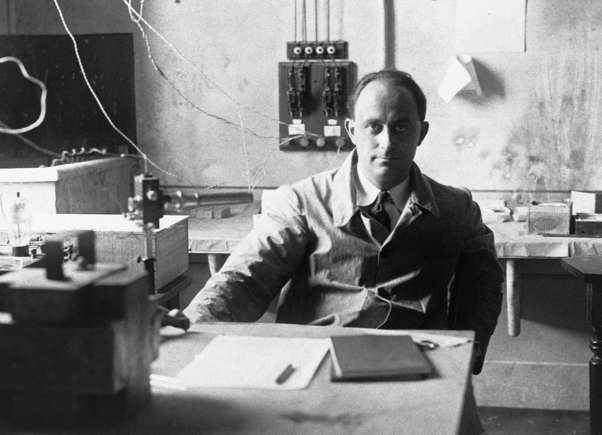
This contradiction is known as the Fermi paradox, named for the Italian and later naturalized American nuclear physicist and Nobelist Dr. Enrico Fermi, who informally posed the question to colleagues.
“Life has been around on Earth for about 4 billion years, but complex organisms like animals didn’t appear until about 600 million years ago, which is not long after the modern episode of plate tectonics began,” Professor Stern said.
“Plate tectonics really jump-starts the evolution machine, and we think we understand why.”
In their paper, Professor Stern and Professor Gerya propose refining one of the Drake equation factors — fi, the fraction of life-bearing planets on which intelligent life emerges — to take into account the necessity of large oceans and continents and the existence of plate tectonics for more than 500 million years on those planets.
“In the original formulation, this factor was thought to be nearly 1, or 100% — that is, evolution on all planets with life would march forward and, with enough time, turn into an intelligent civilization. Our perspective is: That’s not true,” Professor Stern said.
The researchers propose a revision to the Drake equation that defines fi as the product of two terms:
foc: the fraction of habitable exoplanets with significant continents and oceans;
and fpt: the fraction of planets that have had long-lasting plate tectonics.
Based on the team’s analysis, the fraction of the exoplanets with optimal water volume is likely very small.
The authors estimate the value of foc ranges between 0.0002 and 0.01.
Similarly, they conclude that plate tectonics lasting more than 500 million years is also highly unusual, leading to an estimate of fpt at less than 0.17.
“When we multiply these factors together, we get a refined estimate of fi that is very small, between 0.003% and 0.2%, instead of 100%,” Professor Stern said.
“This explains the extreme rareness of favorable planetary conditions for the development of intelligent life in our Galaxy and resolves the Fermi paradox.”
“Biogeochemistry posits that the solid Earth, particularly plate tectonics, speeds up the evolution of species,” he added.
“Studies like ours are useful because they stimulate thinking broadly about larger mysteries and provide an example of how we can apply our knowledge of Earth systems to interesting questions about our Universe.”
The paper appeared in the April 2024 edition of the journal Scientific Reports.
R.J. Stern & T.V. Gerya. 2024. The importance of continents, oceans and plate tectonics for the evolution of complex life: implications for finding extraterrestrial civilizations. Sci Rep 14, 8552; doi: 10.1038/s41598-024-54700-x
This article was adapted from an original release by the University of Texas at Dallas.
According to the San José Public Library, World UFO Day is celebrated on two days: June 24, the day that pilot Kenneth Arnold allegedly saw flying saucers in 1947, and July 2, the day a spaceship supposedly crashed in Roswell, New Mexico, in 1947.
Whether or not you believe in aliens, they have been been in the news lately. Just last year, a congressional hearing was formed to specifically to uncover the truth about UFOs, as the Deseret News previously reported.
While we might not get to the truth about UFOs any time soon, we can at least watch movies about UFOs.
So to celebrate World UFO day, here are the 21 best alien movies of all time.
The 21 best alien movies of all time
1. ‘Arrival’ (2016)
Rated: PG-13.
Streaming: Netflix.
In “Arrival,” giant, mysterious alien spaceships appear all over earth, and linguistics professor Louise Banks (Amy Adams) is recruited to investigate. Louise is tasked with a unique job: to communicate with the aliens.
Along with physicist Ian Donnelly, Louise makes serious headway — but the work with the aliens has a mysterious and puzzling effect on her mind.
2. ‘2001: A Space Odyssey’ (1968)
Rated: G.
Streaming: Max.
While we don’t see any aliens in “2001: A Space Odyssey,” the possibility of aliens looms over the entire movie.
Instead of focusing on aliens, the Stanley Kubrick film chooses to explore technology’s role in the evolution of humanity — and whether it’s for the better or for the worst. This exploration leads to a fascinating sci-fi thriller that might leave you pondering the potential downside of technological advancement.
3. ‘Men in Black’ (1997)
Rated: PG-13.
Streaming: Hulu.
One day, New York police office James Darrell Edwards III (Will Smith) finds himself chasing down a bad guy — who turns out to be an alien.
He’s then scouted by Agent K (Tommy Lee Jones), who introduces him to the Men in Black, or the MIB, a secret organization that monitors and polices aliens. James agrees to become K’s partner and takes on the name Agent J.
“Men in Black” is a hilarious action buddy-comedy that your whole family will love. Plus, it’s got a killer theme song.
4. ‘Invasion of the Body Snatchers’ (1978)
Rated: PG.
Streaming: Tubi.
If you’re looking for a classic alien movie, look no further than “Invasion of the Body Snatchers.” Based on a 1956 movie of the same name, the film takes place in San Fransisco, after a race of parasitic aliens descend to the earth.
The film has an excellent cast, including the late Donald Sutherland, Jeff Goldblum and Leonard Nimoy.
My personal favorite alien movie on the list, “Super 8″ follows a group of kids in 1979 whose hometown is facing alien invasion.
Months after the death of his mother, Joe (Joel Courtney) and his friends are shooting a zombie film when they witness a catastrophic train derailment. Joe and his friends begin to investigate as sinister and mysterious phenomena begin to occur around their town.
“Super 8″ a great film with lots of humor and heart, as well as a great mystery.
6. ‘Star Wars: A New Hope’ (1977)
Rated: PG.
Streaming: Disney+.
The first movie in the extensive “Star Wars” franchise, “Star Wars: A New Hope” is a heroic journey and space opera. It follows young Luke Skywalker (Mark Hamill) who finds himself unexpectedly embroiled in a sweeping galactic war.
Luke teams up with Han Solo (Harrison Ford) to rescue Princess Leia (Carrie Fisher) and meets a host of quirky aliens, robots and many more space creatures.
The first “Star Wars” film is beloved for a reason — it’s got great humor and action, and it will appeal to pretty much everyone.
7. ‘Asteroid City’ (2023)
Rated: PG-13.
Streaming: Prime Video.
If you’re looking for a quirky take on alien invasion, look no further than Wes Anderson’s “Asteroid City.” A play within a movie, “Asteroid City” is written by Conrad Earp (Edward Norton) and is shown on widescreen.
In the play, a youth stargazer convention is being held at the fictional desert town of Asteroid City. When a UFO descends over Asteroid City, the inhabitants are forced into a hush-hush quarantine.
8. ‘Galaxy Quest’ (1999)
Rated: PG.
Streaming: Paramount+.
Perhaps the funniest alien movie on the list, “Galaxy Quest” follows the has-been cast of the once-popular sci-fi show of the same name.
At a fan convention, Jason Nesmith (Tim Allen) and the rest of the cast get approached by a group of real aliens, called Thermians — and are beamed up on their ship.
The Thermians mistakenly believe that “Galaxy Quest” is a historical documentary and ask the crew for help. Chaos and hijinks ensue.
9. ‘Lilo & Stitch’ (2002)
Rated: PG.
Streaming: Disney+.
Lilo, a lonely Hawaiian girl who is cared for by her older sister, Nani, innocently adopts a strange-looking dog she names Stitch.
Unbeknownst to her, Stitch is actually a dangerous alien genetic experimentation. Two aliens, Jumba and Pleakley, go to Earth and attempt to capture Stitch.
“Lilo & Stitch” is the perfect family alien movie that everyone will enjoy.
10. ‘Edge of Tomorrow’ (2014)
Rated: PG-13.
Streaming: Apple TV, YouTube and Prime Video for $3.99.
“Edge of Tomorrow” is a great twist on the classic alien-action movie. Earth is under attack by aliens, and Major William Cage (Tom Cruise) — who has never been in combat — is assigned on a mission to defeat the aliens.
Cage is killed within minutes. But he’s thrown into a time loop and relives the same fight and death over and over again. As time goes by, his fighting skills and improve, and he grows closer to Sergeant Rita Vrataski (Emily Blunt) — and to defeating the aliens.
11. ‘Star Trek’ (2009)
Rated: PG-13.
Streaming: Paramount+.
A movie reboot of the original “Star Trek” series, the 2009 movie of the same name portrays the beginnings of Captain James T. Kirk’s space adventures (Chris Pine).
Kirk is three years into his time at Starfleet Academy — where he and Commander Spock (Zachary Quinto) have butted heads — when a distress signal is emitted from Vulcan. Along with his friend Leonard McCoy and other cadets, Kirk is assigned to Captain Christopher Pike’s ship, the Enterprise.
Both old fans and newer fans will enjoy “Star Trek,” including the few familiar faces from the original series who make an appearance.
12. ‘Independence Day’ (1996)
Rated: PG-13.
Streaming: Hulu.
A few days before Independence Day in 1996, aliens enter Earth’s orbit. In an effort to protect the country — and the world — Captain Steven Hiller (Will Smith), President Thomas Willmore (Bill Pullman) and others join together to stop total destruction.
This is a classic alien movie that even your kids will love — and it has one of the most iconic speeches of all time.
13. ‘Signs’ (2002)
Rated: PG-13.
Streaming: Apple TV for $3.99.
One of the most beloved alien movies ever, “Signs” follows a grieving family in rural Pennsylvania.
Former priest Graham Hess (Mel Gibson) lives with his children Morgan (Rory Culkin) and Bo (Abigal Breslin), alongside his younger brother Merrill (Joaquin Phoenix), who helps with the kids after Graham’s wife died in car accident six months ago.
Strange goings-on begin to happen in their town and all across the world. Rumors swirl that aliens are the cause, and the Hess family soon find themselves fighting for their lives.
14. ‘A Quiet Place’ (2018)
Rated: PG-13.
Streaming: Paramount +.
“A Quiet Place” is a surprisingly emotional film that focuses more on the love and resilience of a family instead of the alien invasion affecting them.
A species of sightless aliens with excellent hearing have invaded the planet. The Abbott family — headed by Lee (John Krasinski) and Evelyn (Emily Blunt) — have already lost one child to the aliens.
Now, over a year later, Evelyn is pregnant. The family lives in safety and silence and is able to communicate with their deaf daughter Reagan and their son Marcus using American Sign Language.
But soon their home is under attack by the aliens and Evelyn and Lee must fight to protect their children.
15. ‘The Day the Earth Stood Still’ (1951)
Rated: G.
Streaming: Prime Video for $3.59.
Another classic alien flick, “The Day the Earth Stood Still,” takes place during the Cold War.
An alien spaceship lands in Washington, D.C., from which a humanoid alien and his robot emerges. The alien is named Klaatu (Michael Rennie) and he has come on behalf of his alien race to deliver a message to all the leaders of the world.
But while Klaatu is friendly, his robot companion, Gort (Lock Martin), proves to be dangerous.
16. ‘E.T. the Extra-Terrestrial’ (1982)
Rated: PG.
Streaming: Prime Video for $3.79.
The kid-friendly alien movie “E.T. the Extra-Terrestrial” follows a gentle alien who, when visiting Earth with his fellow aliens, gets separated from his group.
The alien is quickly discovered by Elliot (Henry Thomas). Elliot introduces the alien, who names himself “E.T.,” to his older brother Michael (Robert MacNaughton) and younger sister Gertie (Drew Barrymore).
When both Elliot and E.T. fall ill, forcing the government to intervene, Elliot and his siblings must help. E.T. return home.
17. ‘Star Trek: First Contact’ (1996)
Rated: PG-13.
Streaming: Paramount+.
Possibly the best “Star Trek” movie, “Star Trek: First Contact” follows the crew of the USS Enterprise as they work to defeat the Borg, a species of of aliens connected to a hive mind called “The Collective.”
“Star Trek: First Contact” features the entire cast of “Star Trek: The Next Generation,” including Patrick Stewart as Jean-Luc Picard, Jonathan Frakes as Riker and Brent Spiner as Data.
18. ‘Dune: Part 1′ (2021) and ‘Dune: Part 2′ (2024)
Rated: PG-13.
Streaming: Max.
“Dune: Part 1″ and “Dune: Part 2″ follow Paul Atreides (Timothée Chalamet), the son of Duke Leto Atreides (Oscar Isaac) and Lady Jessica (Rebecca Furgeson).
In the distant future, Duke Leto has been tasked to oversee Arrakis, a desert planet that produces spice — a substance that helps with space travel and gives enlightenment to those who partake.
Upon arrival, the House of Atreides is attacked by the Harkonnens, who previously ruled over Arrakis. Paul and Jessica escape and are aided by the Fremen, the native people of Arrakis, who believe that Paul is the Lisan al Gaib or the prophesied messiah.
19. ‘No One Will Save You’ (2023)
Rated: PG-13.
Streaming: Hulu.
“No One Will Save You” follows Brynn (Kaitlyn Dever), a young woman who is shunned by the other people in her town and lives alone in her childhood home. One night, a humanoid alien breaks into her home and she kills it in order to defend herself.
Brynn continues to fight against the aliens — and her town. “No One Will Save You” leans more horror than classic alien movie, and it will have you on the edge of your seat.
20. ‘Close Encounters of the Third Kind’ (1977)
Rated: PG.
Streaming: Prime Video.
One day, electrician Roy Neary (Richard Dreyfuss) has a close encounter with a UFO — and has sunburns from the UFO’s bright lights to prove it. After his encounter, Roy becomes obsessed with UFOs, and will do anything to uncover the truth about aliens.
“Close Encounters of the Third Kind” is an iconic alien film — so much so that it was preserved in the National Film Registry.
NASA Releases a New 3D Animation of the Lunar Gateway
A detailed 3D animation of NASA's Gateway space station, showcasing its modules and structural components from various angles against the backdrop of deep space. NASA/Bradley Reynolds, Alberto Bertolin
NASA Releases a New 3D Animation of the Lunar Gateway
To get to the Moon, NASA is building a Lunar Gateway in orbit to facilitate easier access to the Moon. With construction beginning in 2028 as part of Artemis IV there will be an ongoing programme of enhancements and additions. NASA has now released a fabulous new 3D animation of the Lunar Gateway to showcase what the final Gateway will look like. It includes modules from partner nations and an Orion lunar landers dock to carry astronauts.
NASA’s Artemis program marks a historic return to lunar exploration following on from the Apollo era. It aims to land “the first woman and the next man” on the Moon by 2025 and heralds a new era of space exploration focused on sustainability and international collaboration. This ambitious project will use advanced technologies, including the Space Launch System (SLS) rocket and the Orion spacecraft, to establish a long-term human presence on the surface of the Moon. The program also aims to develop the Lunar Gateway, a space station orbiting the Moon, to support missions and serve as a staging point for future expeditions to Mars.
Stacking SLS for Artemis 1. Credit: NASA/Cory Huston
The purpose of the Lunar Gateway is to facilitate the exploration of the many scientific mysteries of deep space with Gateway’s first lunar space station. Starting with the Artemis IV mission in 2028, the international teams of astronauts will live, conducting science, and preparing for various lunar missions to the South Pole.
NASA has released a fabulous computer generated video of the Gateway showing its exterior form in amazing detail. You can view the video here.
A detailed 3D animation of NASA's Gateway space station, showcasing its modules and structural components from various angles against the backdrop of deep space.
NASA/Bradley Reynolds, Alberto Bertolin
The propulsion and power systems are prominent in the video and with the solar array will make the most powerful solar electric spacecraft ever flown. The array will power the station’s systems and even ionise the xenon gas that will produce thrust using an ion system to maintain the spacecrafts polar orbit.
At the hub of the spacecraft though is the Habitation and Logistics Outpost otherwise known as HALO! This element controls and commands the spacecraft and provides communication links back to Earth and the lunar surface. It has been provided by the European Space Station (ESA) and will also support life support systems, exercise equipment and science payload banks.
Another element provided by ESA with support from the Japan Aerospace Exploration Agency (JAXA) is the environmental control and life support systems. Without it, life on board simply would not survive.
There are a whole host of other systems on bard from a refuelling capability to ensure the power and propulsion system is topped up, a crew and science airlock system, science payloads and much more.
Determining the Safest Martian Caves for Future Astronauts
Image of a lava tube skylight entrance on the Martian volcano Pavonis Mons obtained by NASA’s HiRISE camera onboard the Mars reconnaissance Orbiter. (Credit: NASA/JPL/University of Arizona)
Determining the Safest Martian Caves for Future Astronauts
When astronauts land on Mars someday, they might have tolive in lava caves or lava tubes to survive the harsh radiation that rains down on the Martian surface every second. But which caves could offer them the best chance of survival? This is what arecent studypresented at the 55th Lunar and Planetary Science Conference hopes to address as Dr. Anatoliy P. Vidmachenko from the National University of Life and Environmental Sciences of Ukraine investigated where, how, and why lava tubes and lava caves could aid future Mars astronauts regarding their survival. This study holds the potential to help scientists and engineers help mitigate risks for future Mars astronauts and what steps that need to be taken to make that a reality.
For the study, Dr. Vidmachenko examined several locations across Mars that have been found to possess lava caves and lava tubes suitable for future first-time settlements, including Arsia Mons, which is one of three extinct volcanoes that comprise Tharsis Montes. It is here that a 2007 study presented at the 38th Lunar and Planetary Science Conference discussed seven alleged skylights observed from orbital images that were later interpreted to be entrances to lava caves. This recent study mentions that the diameters of these lava caves could be between 100-250 meters (328-820 feet) wide.
“Such reliable caves can be used to create the first permanent settlements,” the study notes. “They will allow you to reliably protect yourself from powerful radiation exposure. And a certain drawback will be the need to organize the delivery of water ice to provide the settlers with water resources and raw materials for extracting the much-needed oxygen and hydrogen fuel for rocket engines.”
The study mentions several other locations across Mars where pits or skylights have been observed, including Hebrus Valles, the Pavonis volcano, Ascraeus Mons, Acidalia Planitia (whose surface location was featured The Martian), and Cydonia Mensae. Additionally, the study discusses how lava channels, caves, or tubes close to sources of water ice would also prove beneficial for future astronauts, which could significantly reduce the costs of shipping and storing water on their spacecraft for the initial journey to Mars.
“The best case would be a lava tube with strong walls found next to powerful glacial structures,” the study notes. “The colony itself, most likely, will have the appearance of separate premises, with residential, engineering, elevator and greenhouse compartments. They will have to be connected to each other by small transition tunnels to control the pressure and composition of the artificially created atmosphere in them.”
Lava tubes were featured prominently in the National Geographic television series, Mars, which depicted the first astronauts to the Red Planet and their quest to survive the harsh environment. During their journey, lava tubes provided shelter from the cosmic and solar radiation while also having large deposits of water ice at their disposal which they used for drinking and rocket fuel while drastically reducing the amount of water they initially had to bring during their journey.
The reason why cosmic and solar radiation rains down on to the Martian surface daily is due to the lack of protective ozone layer and magnetic field that exists on Earth and helps deflect this deadly radiation from reaching our surface, enabling life to exist here for billions of years. While Mars might have had both mechanisms billions of years ago, the interior of the Red Planet has since cooled drastically, causing these protective features to be stripped away by the solar wind and lost to space.
This study comes as NASA plans to send humans back to the Moon for the first time in over 50 years, and eventually Mars, as part of the agency’s Moon to Mars Architecture. Therefore, adequate preparation prior to sending the first astronauts to the Red Planet would prove beneficial in increasing their chances of survival throughout the entire journey, and this study highlighted several ways lava tubes could do just that.
How will lava caves help future Mars astronauts in the coming years and decades? Only time will tell, and this is why we science!
Zijn er andere planeten zoals die van ons? De zoektocht naar buitenaards leven houdt de wereld al tientallen jaren bezig. Terwijl telescopen naar de hemel kijken en de uithoeken van de ruimte afspeuren, leggen sondes zoals Voyager 1 ongelofelijke afstanden af in de hoop buitenaards leven te vinden. Maar waar kan zulk leven gevonden worden? Wat zijn de ideale omstandigheden voor buitenaardse wezens om in te leven? En hoe vergelijkbaar zijn hun planeten met die van ons?
LEES door deze galerij om de antwoorden te vinden die verborgen liggen in de interstellaire ruimte.
Waar te beginnen met zoeken? Er zijn naar schatting een septiljoen sterren in het bekende heelal (dat is een 1 gevolgd door 24 nullen!). En om elk van deze sterren kunnen wel een dozijn planeten draaien. Dus hoe kunnen we buitenaards leven vinden? De eerste stap is om het dichter bij huis te zoeken.
De aarde en haar omstandigheden De aarde is astronomisch gezien de perfecte plek om te leven. Het bestaan van water en een stabiele atmosfeer heeft een ideale omgeving gecreëerd waarin leven kan floreren.
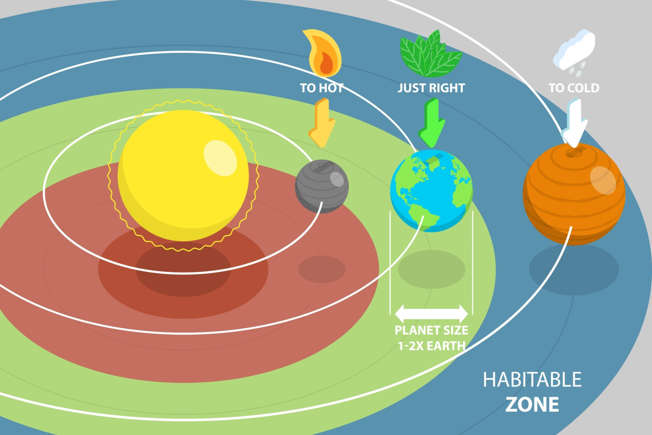
De bewoonbare zone De afstand van een planeet tot zijn ster is cruciaal voor het begrijpen van de leefbaarheid van een planeet. De aarde bevindt zich perfect in wat de bewoonbare zone wordt genoemd, waar de omstandigheden niet te warm of te koud zijn om te kunnen leven.
De 'Goldilocks zone' De bewoonbare zone wordt in het engels ook wel de 'Goldilocks zone' genoemd, vernoemd naar het sprookje. In het verhaal kiest Goudlokje tussen drie sets van items en negeert de items die te extreem zijn (groot of klein, warm of koud), in plaats daarvan neemt ze genoegen met het item dat "precies goed" is.
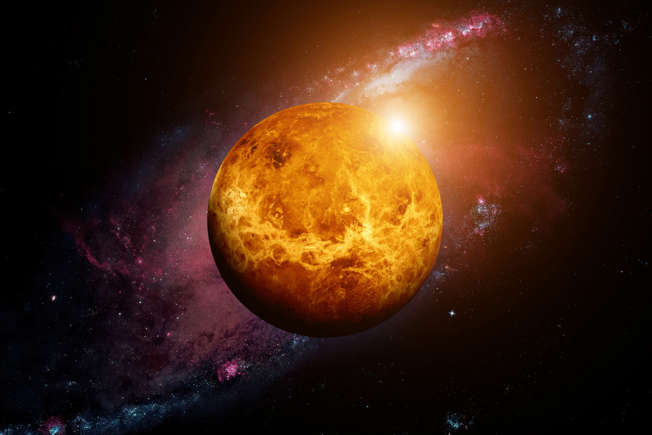
Venus Venus, dat qua massa vergelijkbaar is met de aarde, staat te dicht bij de zon om levensvatbaar te zijn. Planeetwetenschappers denken dat Venus ooit water aan het oppervlak heeft gehad, maar dat de planeet verstikt is door kooldioxide en een temperatuur van 462°C.
Mogelijkheden beperken Door de criteria voor de bewoonbare zone te begrijpen, konden astronomen achterhalen dat er zo'n 40 miljard planeten in de bewoonbare zones van de Melkweg zouden kunnen draaien.
In de sterren geschreven Tot nu toe hebben astronomen slechts 1.780 planeten buiten ons zonnestelsel kunnen bevestigen. En van al die planeten bevinden zich er maar 16 in hun bewoonbare zones.
Te groot of te klein Maar het is niet genoeg voor een planeet om zich op de juiste afstand van een ster te bevinden. De grootte doet er ook zeker toe. Een kleine planeet kan geen atmosfeer behouden, terwijl een te grote planeet een verpletterende atmosfeer zal hebben.
De aarde als schaal Om de juiste atmosferische druk te hebben, moet een planeet tussen 0,1 en 10 keer de massa van de aarde hebben. Dit is een zeer smalle bewoonbare zone, zeker als je bedenkt hoeveel planeten in het heelal honderden keren groter zijn dan de aarde.
Gliese 581c In 2007 werd de wetenschappelijke gemeenschap verblijd met het nieuws over Gliese 581c, de eerste superaarde in de bewoonbare zone. Al snel werd ontdekt dat de omstandigheden aan het oppervlak van de planeet veel leken op die van Venus.
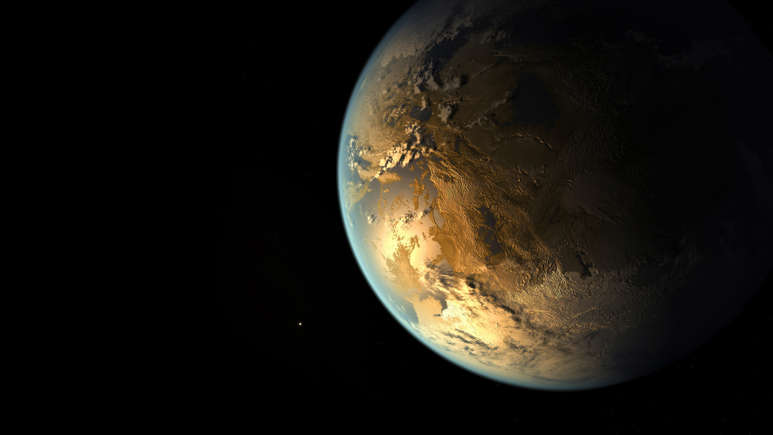
Kepler-186f In 2014 werd een exoplaneet ter grootte van de aarde ontdekt die Kepler-186f heet en in de bewoonbare zone van een rode dwergster rondcirkelt. Astronomen proberen nog steeds vast te stellen of de planeet leefbaar is.
Proxima Centauri b De exoplaneet die het dichtst bij de aarde staat is Proxima Centauri b. Deze planeet draait rond de ster die het dichtst bij de zon staat, op een afstand van ongeveer vier lichtjaar. Hoewel het een gouden planeet is, weten wetenschappers niet zeker of het ook een atmosfeer heeft.
Andere belangrijke criteria Hoewel de bewoonbare zone en de atmosfeer van een planeet belangrijk zijn om de bewoonbaarheid te begrijpen, is dat zeker niet alles. Planeten moeten aan een groot aantal andere criteria voldoen, waaronder het vermogen om vloeibaar water te bevatten.
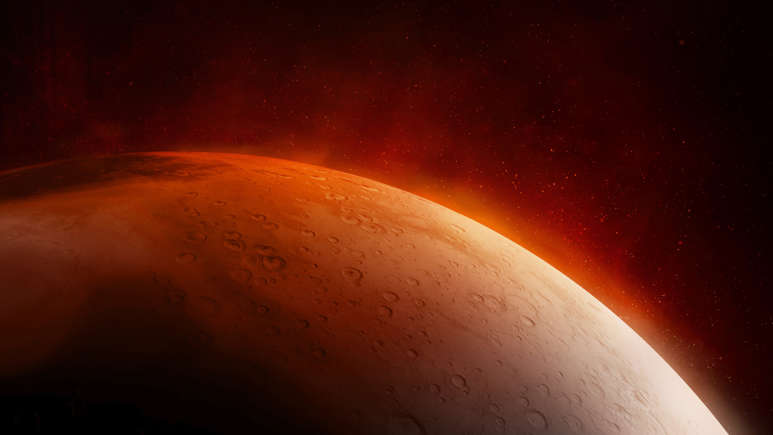
Mars Mars is de enige andere planeet in ons zonnestelsel die zich binnen de bewoonbare zone bevindt. Maar de juiste atmosferische druk is alleen te vinden op de lage punten van de planeet en er is nog geen bewijs dat de planeet vloeibaar water heeft.
Droge planeten Hypothetisch gezien zouden droge planeten water kunnen vasthouden via oases. Dit zou betekenen dat zulke planeten dichter bij een ster en buiten de bewoonbare zone kunnen draaien.
Oceaanplaneten Er bestaat een theorie dat de oceanen op aarde zijn ontstaan nadat ijslichamen op onze planeet insloegen en vervolgens smolten. Er zouden nog meer van zulke planeten kunnen bestaan.
Manen Natuurlijke satellieten van planeten, of manen, zouden ook bewoonbaar kunnen zijn. Maar deze manen moeten zich binnen de bewoonbare zone van hun gastheerplaneten bevinden en ze moeten ver genoeg rond hun planeet draaien, zodat ze geen vulkanische planeten worden zoals Jupiters maan, Io.
Europa De op drie na grootste maan van Jupiter, Europa, zou een wateroceaan onder het oppervlak van de planeet bevatten, welke mogelijk buitenaards leven zou kunnen herbergen.
Magnetische velden Het magnetische veld van de aarde is een voorbeeld van een ander belangrijk criterium dat de levensvatbaarheid bepaalt, omdat het het oppervlak van de planeet beschermt tegen straling en kosmische stralen. Andere planeten zouden een vergelijkbaar veld moeten hebben om complex leven te kunnen laten floreren.
Zonnetweeling Tot op de dag van vandaag hebben astronomen nog geen ster kunnen vinden die op de zon lijkt, een fenomeen dat een zonnetweeling wordt genoemd. Dit heeft het de wetenschappelijke gemeenschap moeilijker gemaakt om buitenaards leven te vinden dat op het onze lijkt.
Buitenaards leven Maar welke soorten buitenaards leven zouden we kunnen vinden? Het is algemeen aangenomen dat op koolstof gebaseerde levensvormen de enige levensvatbare manieren zijn waarop leven kan bestaan.
Koolstof-chauvinisme Veel wetenschappers hebben kritiek geuit op het idee dat buitenaards leven gebaseerd moet zijn op koolstof. Hypothetisch gezien zouden buitenaardse wezens uit heel andere elementen kunnen bestaan die hen in staat stellen om op plekken te overleven die voor mensen onherbergzaam zijn.
Titan Titan, de grootste maan van Saturnus, bezit koolwaterstofmeren die mogelijk leven zouden kunnen ondersteunen. Titan is het enige andere object in de ruimte waarvan is ontdekt dat het oppervlak vloeistof bevat.
Zijn we uniek, of alleen de eerste? Natuurkundige Enrico Fermi (1901-1954) kwam met de theorie dat we nog geen buitenaards leven zijn tegengekomen omdat intelligent leven ofwel zeldzaam is, ofwel nog maar net was onstaan in het universum.
Dicht bij het einde Andere natuurkundigen hebben beweerd dat we nog geen buitenaards leven hebben gevonden omdat we al te laat zijn. In feite zeggen ze dat de meeste buitenaardse wezens al dood zijn en dat het heelal te ver uitbreidt om hun overblijfselen nog te kunnen vinden.
Het Grote Filter Veel antropologen en astronomen geloven dat de mensheid alleen is in het universum, vanwege Het Grote Filter. Dit betekent in feite dat er zoveel onwaarschijnlijke stappen nodig zijn voor leven om intelligentie te ontwikkelen, dat het onwaarschijnlijk is dat dit nog eens zal gebeuren.
De 'dierentuin hypothese' Andere wetenschappers veronderstellen dat buitenaards leven wel degelijk bestaat, maar dat ze de mensheid vermijden om ons primitieve bestaan zonder tussenkomst te laten verlopen. Hoe dan ook, de ruimte is een grote grens die heel goed buitenaards leven zou kunnen herbergen.
Bronnen:
(National Geographic)
(NASA)
(Astronomy.com)
(Earth How)
(Harvard John A. Paulson School of Engineering and Applied Sciences)
Could A Mound of Dust and Rock Protect Astronauts from Deadly Radiation?
Protecting the astronauts of the Artemis program is one of NASA’s highest priorities. The agency intends to have a long-term presence on the Moon, which means long-term exposure to dangerous radiation levels. As part of the development of the Artemis program, NASA also set limits to the radiation exposure that astronauts can suffer. Other hazards abound on the lunar surface, including a potential micrometeoroid strike, which could cause catastrophic damage to mission equipment or personnel. NASA built a team to design and develop a “Lunar Safe Haven” to protect from these hazards. Their working paper was released in 2022 but still stands as NASA’s best approach to long-term living on the lunar surface.
The two hazards mentioned above provided the primary impetus for the design, but there are some nuances to them—in particular, radiation. Astronauts will experience two main types of hazardous radiation on the lunar surface: cosmic rays and solar eruptions.
Cosmic rays are the more insidious of the two. They have a high energy range, so a shielding material that might work well for higher-energy particles might not do so for lower-energy ones. Moreover, some high-energy particles can interact with shielding, causing even more damaging radiation further down its path. Essentially, this increases the radiation risk inside the shielding compared to outside. The order in which the radiative particles are dealt with is one of the critical design considerations for dealing with this dangerous phenomenon.
Lunar regolith can be hard to deal with, as Fraser discusses with Dr. Kevin Cannon.
However, solar particle events (SPEs) are the more overtly dangerous of the two types of radiation. While rare, they can cause acute radiation sickness. Current astronauts must shelter in place inside a protected chamber on the ISS when these happen, and building something equivalent on the surface of the Moon is a necessity to ensure that astronauts don’t simply die of acute radiation poisoning within the first six months of arrival.
With the problems to solve firmly in hand, the design team moved on to other considerations—like what the habitat inside the LSH would actually look like and how it would be built. Consideration of the habitat shape focused on one primary distinction—should the habitat be horizontal or vertical? The answer is vertical based on modeling the risk of radiation and micrometeoroid strikes.
So, how do you build a structure around a vertical habitat on the Moon? You employ robots and remotely operated construction equipment. Other groups at NASA had been working on solutions like the Lightweight Surface Manipulation System (LSMS), essentially a large crane that can be constructed in lunar gravity, and the Lunar Attachment Node for Construction and Excavation (LANCE) – a bulldozer module designed to attach to the front of NASA’s Chariot exploration vehicle. Utilizing these ideas and other construction ideas, it’s possible to construct a protective dome of lunar regolith around a long-term habitat for the Artemis missions.
Fraser overviews the Artemis mission that LSH will attempt to help.
Such a protective habitat has significant advantages over digging one into the ground, which requires moving a massive amount of regolith or utilizing lava tubes with indeterminate structural integrity. But that means the LSH must have an above-ground design. The team developed two separate design ideas – a parabolic arch and a “Round Cake” design using polyethylene. The first is self-explanatory, but the second looks more like a typical cylinder with the radiation and micrometeoroid-blocking polyethylene stored in “beans” at the top of the structure. This could be made of waste materials from the mission, such as discarded food packaging.
Each design has advantages and disadvantages, and the team didn’t pick a final one as part of the paper. However, they did come up with a five-phase development process, from preparing the site in advance to living in interconnected habitats surrounded by regolith and protective shielding. Depending on the amount of automation involved and some real luck, those development phases could take anywhere from a few years to a few decades.
It remains to be seen if this system will be adopted as an official part of the Artemis program. But it serves a need of critical importance to humanity’s long-term existence on the Moon. If that is indeed NASA’s goal for the end of the 2030s, it would be good to consider how to start making the LSH a reality.
Mars is Bombarded by Meteoroids At More Frequent Rates than Previously Thought
Mars is Bombarded by Meteoroids At More Frequent Rates than Previously Thought
Current impact rates at Mars could be 2-10 times higher than previously estimated, depending on the size of the meteoroids, according to new research.
Mars; the center of the scene shows the entire Valles Marineris canyon system.
Image credit: NASA Goddard Space Flight Center.
“It’s possible Mars is more geologically active than we thought, which holds implications for the age and evolution of the planet’s surface,” said Brown University’s Dr. Ingrid Daubar.
“Our results are based on a small number of examples available to us, but the estimate of the current impact rate suggests the planet is getting hit much more frequently than we can see using imaging alone.”
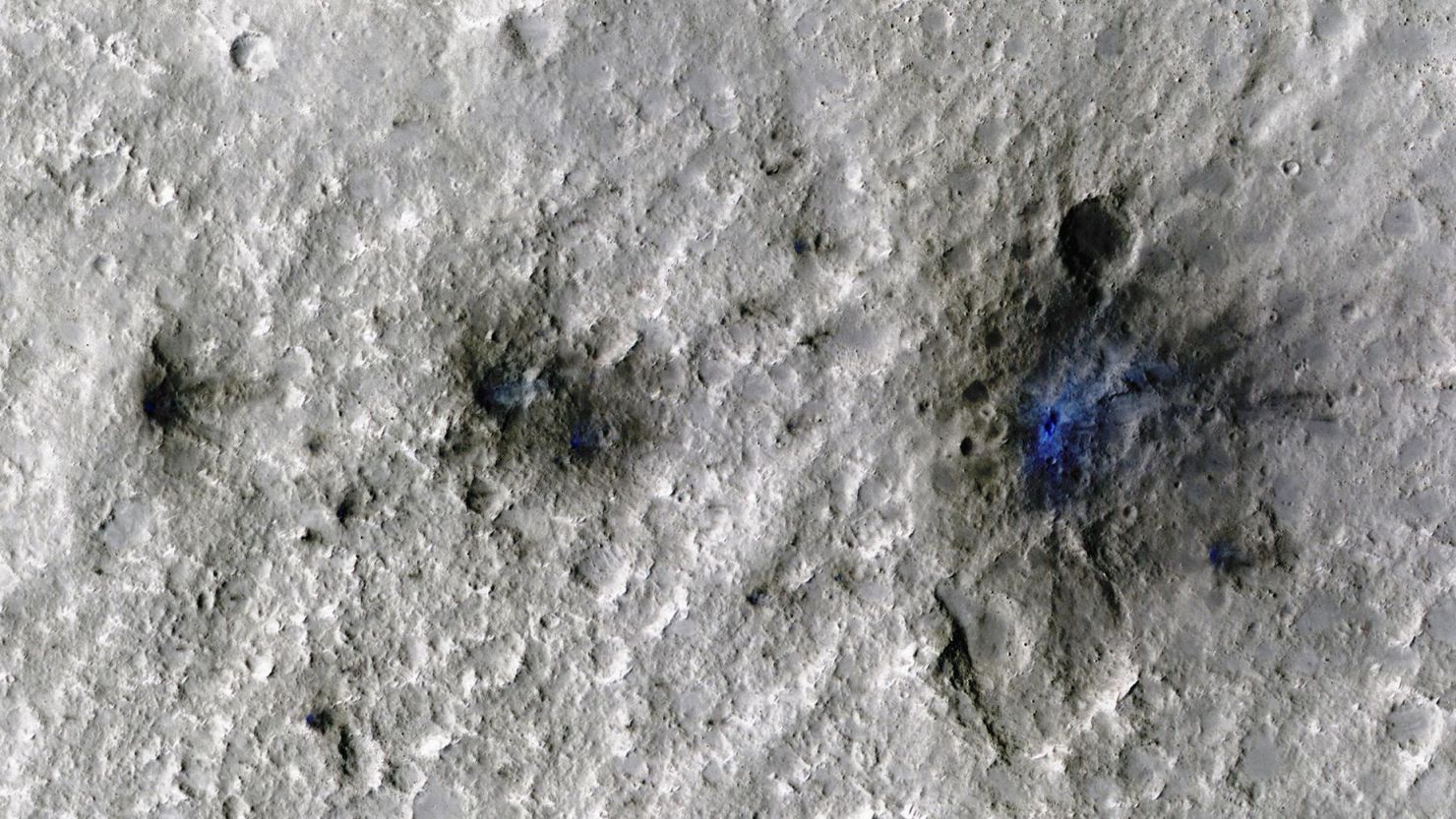
Dr. Daubar and colleagues used the highly sensitive seismometer onboard NASA’s InSight lander to identify eight new impact craters from meteoroids not previously seen from orbit.
The frequency of these cosmic collisions challenges existing notions about how often meteoroids hit the surface of Mars and suggests a need to revise current Martian cratering models to incorporate higher impact rates, especially from smaller meteoroids.
The findings could ultimately reshape current understandings of the Martian surface — as batterings from small meteoroids continue to sculpt it — and the impact history of not just Mars, but other planets.
“This is going to require us to rethink some of the models the science community uses to estimate the age of planetary surfaces throughout the entire Solar System,” Dr. Daubar said.
Six of the craters the researchers detected were near the site where the stationary InSight set down.
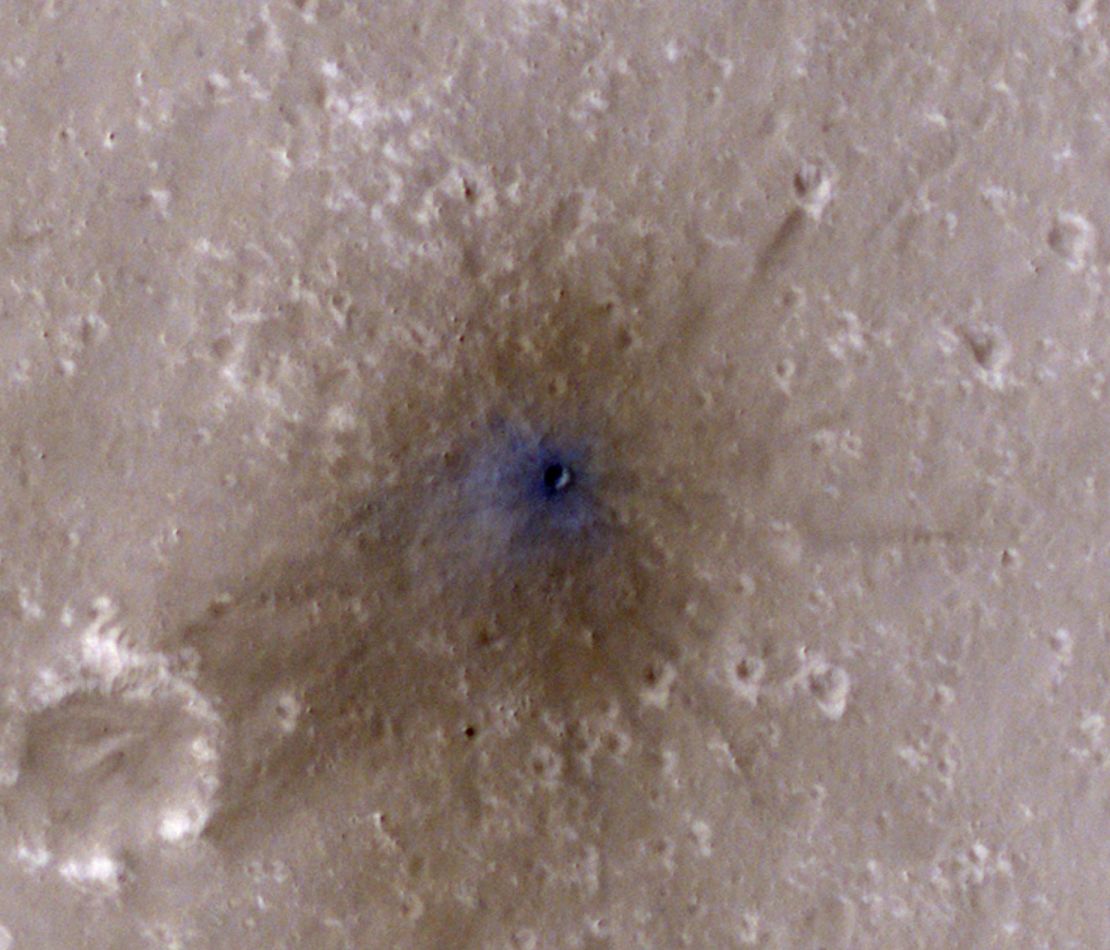
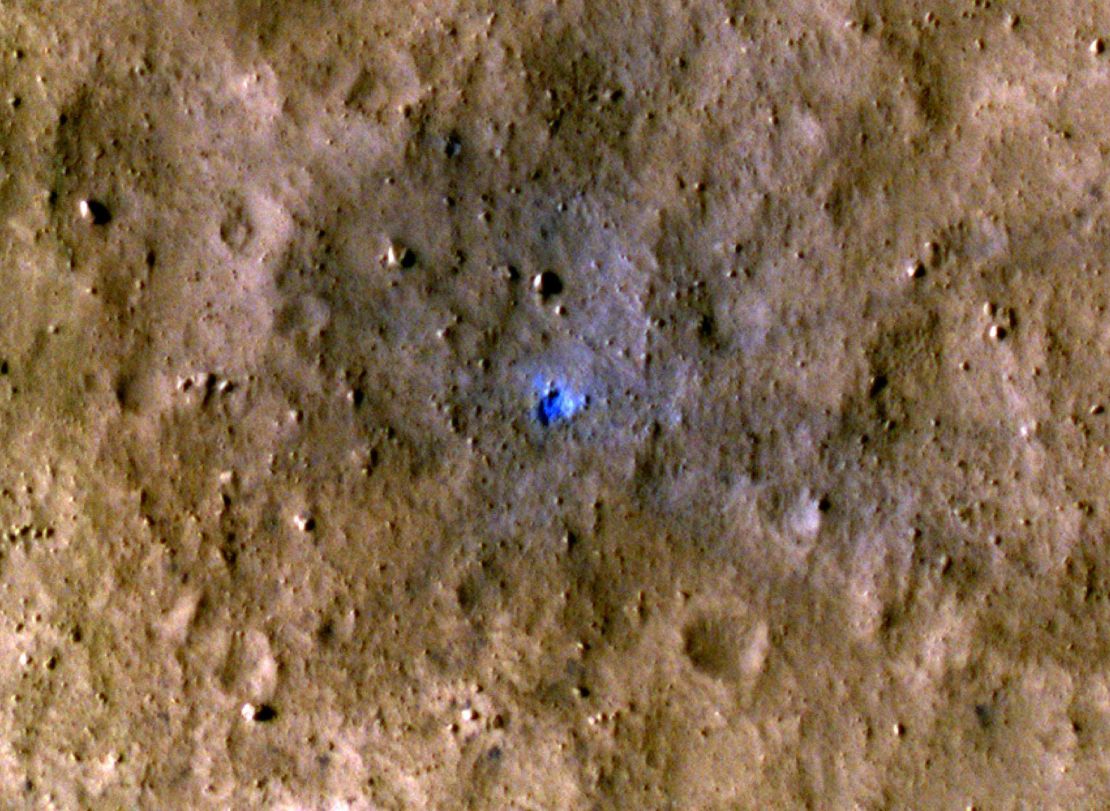
A meteoroid impact on Mars formed Martian craters, seen in blue, on September 5, 2021. NASA's InSight mission detected the impacts, and the Mars Reconnaissance Orbiter imaged the craters.
NASA/JPL-Caltech/University of Arizona
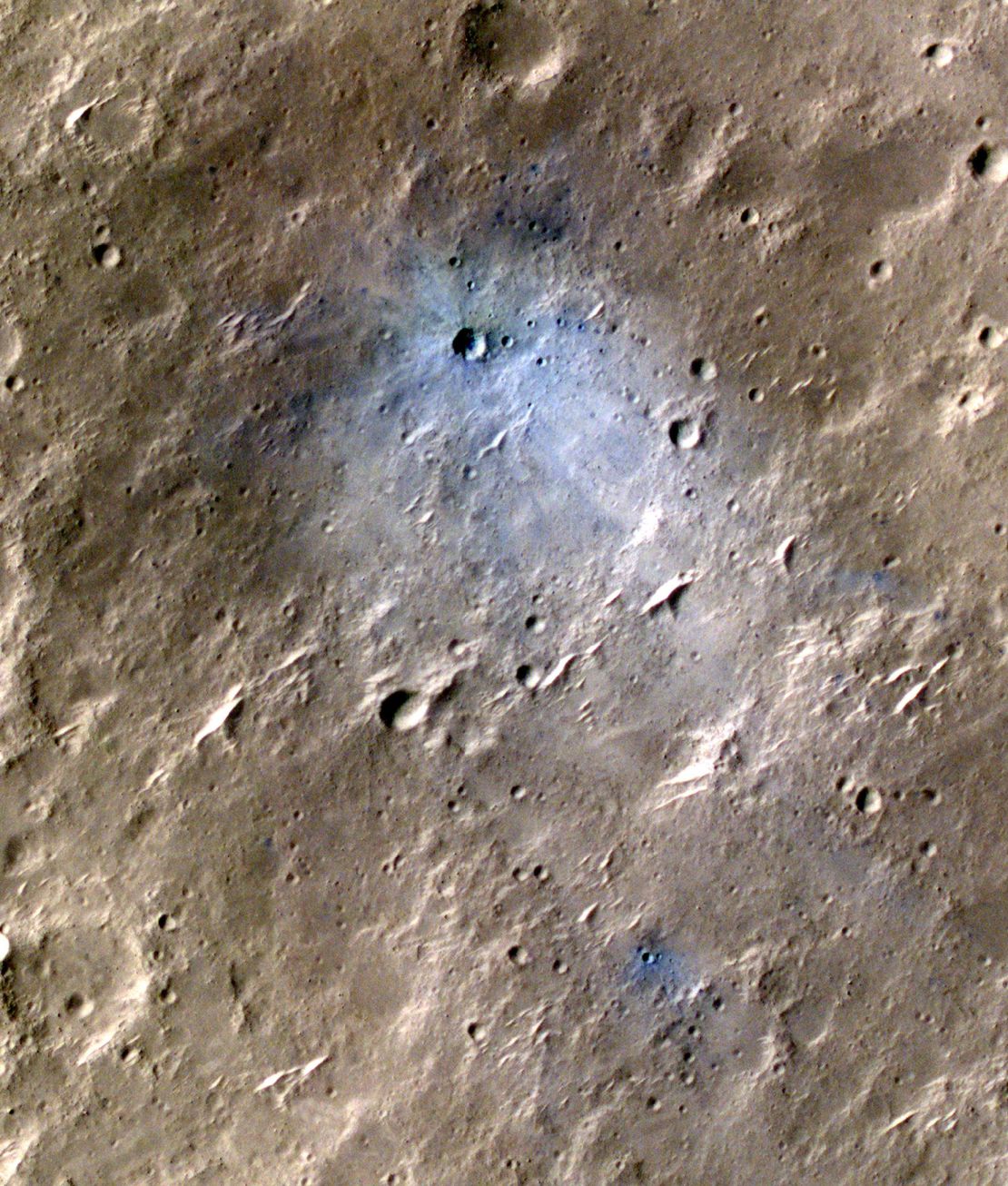
NASA's Mars Reconnaissance Orbiter captured an image of a meteoroid impact that was later associated with a seismic event detected by the agency's InSight lander. This crater was formed on May 27, 2020.
NASA/JPL-Caltech/University of Arizona
The two distant impacts they identified from the data were the two biggest impacts ever detected by scientists, even after decades of watching from orbit.
The larger impacts, each leaving a crater roughly the size of a football field, came just 97 days apart, underscoring the higher frequency of these types of geological events.
“This size impact, we would expect to happen maybe once every couple of decades, maybe even once in a lifetime, but here we have two of them that are just over 90 days apart,” Dr. Daubar said.
“It could just be a crazy coincidence, but there’s a really, really small likelihood that it’s just coincidence.”
“What’s more likely is that either the two big impacts are related, or the impact rate is a lot higher for Mars than what we thought it was.”
“Planetary impacts are happening all across the Solar System all the time.”
“We’re interested in studying that on Mars because we can then compare and contrast what’s happening on Mars to what’s happening on the Earth,”
“This is important for understanding our Solar System, what’s in it and what the population of impacting bodies in our Solar System looks like — both as hazards to the Earth and also historically to other planets.”
The orbiter spotted a meteoroid impact that occurred on February 18, 2021. InSight tracked a seismic signal from the event.
NASA/JPL-Caltech/University of Arizona
InSight data was matched with photos from orbiters, such as this one of an impact crater created on August 30, 2021, to pin down when and where meteoroid strikes happen on the red planet.
NASA/JPL-Caltech/University of Arizona
The study appeared today in the journal Science Advances.
Ingrid J. Daubar et al. 2024. Seismically detected cratering on Mars: Enhanced recent impact flux? Science Advances 10 (26); doi: 10.1126/sciadv.adk7615
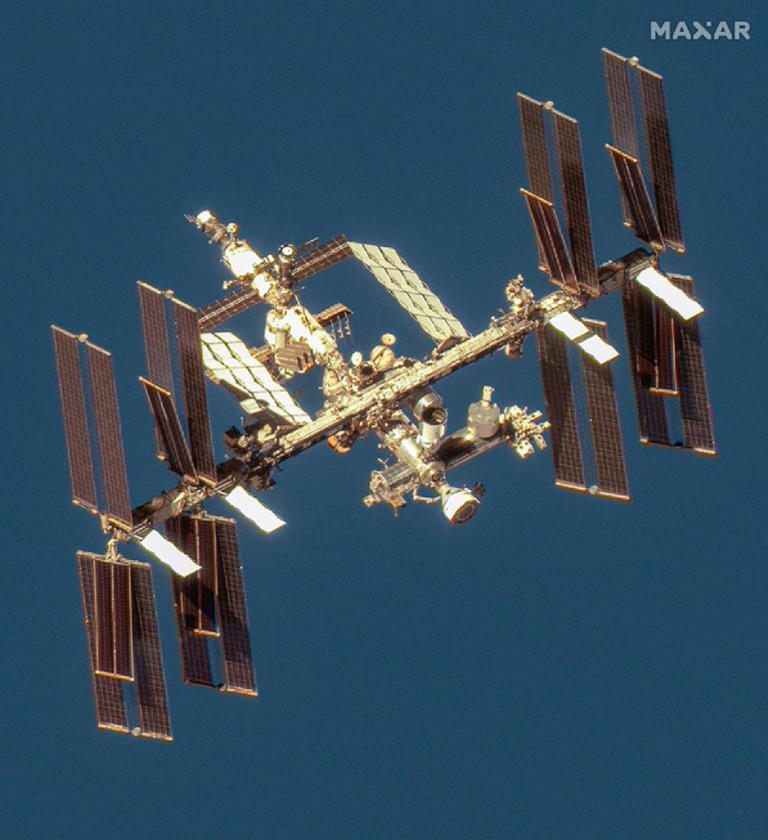
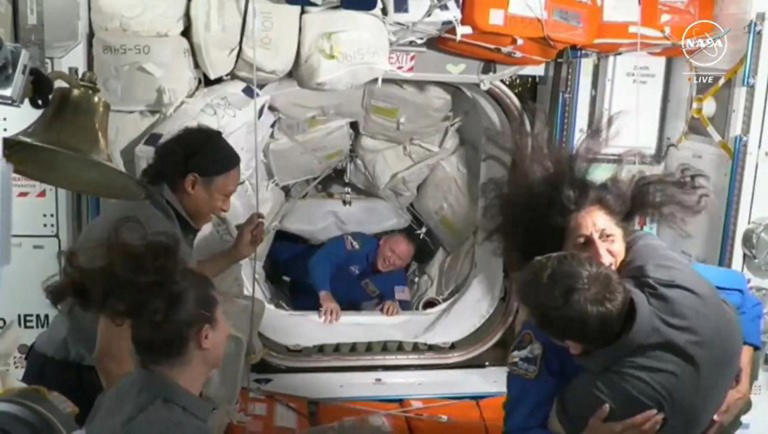
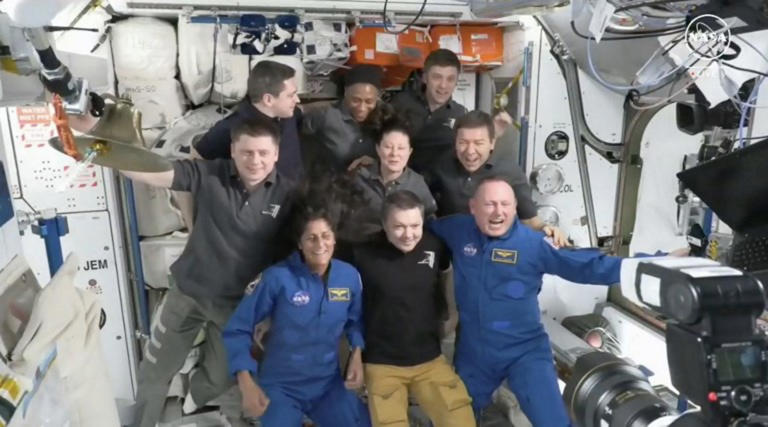
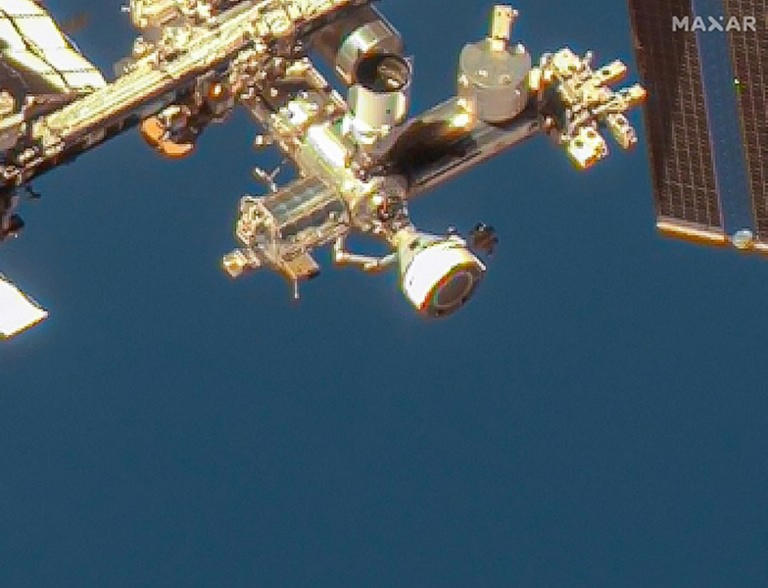
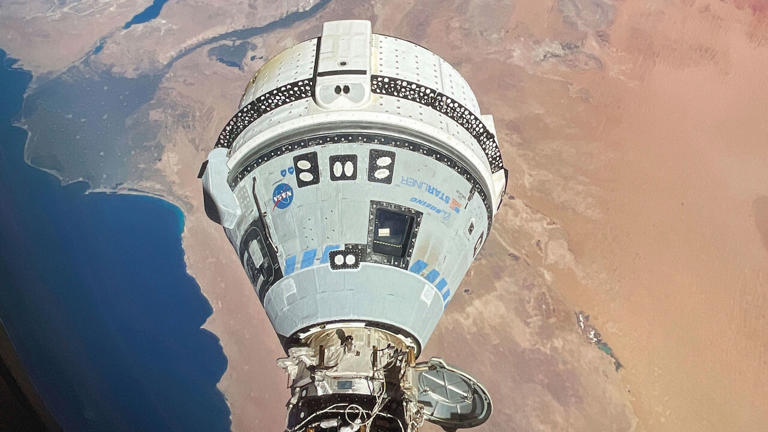
De twee astronauten die met de Boeing-ruimtecapsule Starliner drie weken geleden aankwamen in het internationale ruimtestation ISS, zitten daar "niet geblokkeerd". Dat heeft het Amerikaanse ruimteagentschap NASA vrijdag benadrukt. De terugkeer van de Starliner naar de aarde is ondertussen herhaaldelijk uitgesteld en zal er nu pas komen na nieuwe tests.
NASA benadrukt dat astronauten Starliner niet geblokkeerd zitten in ISS
De terugvlucht was aanvankelijk ten laatste op 26 juni gepland. NASA gaf geen nieuwe datum, maar liet eerder al weten dat de terugkeer van de Starliner met de twee astronauten Butch Wilmore en Suni Williams niet meer voor juni zou zijn.
Onderweg naar het ISS had de Starliner te maken gekregen met talrijke technische problemen. Er waren bijvoorbeeld heliumlekken opgetreden. Na problemen met de motoren slaagde het ruimteschip er pas bij de tweede poging in om aan te meren bij het ISS.
"Butch en Suni zijn niet geblokkeerd in de ruimte", benadrukte Steve Stich, een hoge verantwoordelijke van NASA, vrijdag tijdens een ongewoon gespannen persconferentie. De twee astronauten zouden aanvankelijk slechts iets meer dan een week in de ruimte blijven. In Amerikaanse media werd dan ook de vraag gesteld of de astronauten nog wel konden terugkeren naar aarde.
NASA benadrukt dat astronauten Starliner niet geblokkeerd zitten in ISS
"We kunnen Starliner op elk moment terughalen", benadrukte Mark Nappi, een hoge verantwoordelijke bij Boeing. De eerste bemande vlucht van de Starliner was de ultieme testvlucht van de Boeing-ruimtecapsule, alvorens er reguliere vluchten mee uitgevoerd kunnen worden van en naar het ISS.
De Starliner, ontwikkeld en gebouwd door de Amerikaanse vliegtuigbouwer Boeing, maakte zijn eerste succesvolle onbemande vlucht in 2022.
NASA benadrukt dat astronauten Starliner niet geblokkeerd zitten in ISS
NASA benadrukt dat astronauten Starliner "niet geblokkeerd" zitten in ISS, al is er voorlopig geen nieuwe datum voor terugkeer
NASA benadrukt dat astronauten Starliner "niet geblokkeerd" zitten in ISS, al is er voorlopig geen nieuwe datum voor terugkeer
Artikel door Belga
De terugvlucht was aanvankelijk ten laatste op 26 juni gepland. NASA gaf geen nieuwe datum, maar liet eerder al weten dat de terugkeer van de Starliner met de 2 astronauten Butch Wilmore en Suni Williams niet meer voor juni zou zijn.
Onderweg naar het ISS had de Starliner te maken gekregen met talrijke technische problemen. Er waren bijvoorbeeld heliumlekken opgetreden. Na problemen met de motoren slaagde het ruimteschip er pas bij de tweede poging in om aan te meren bij het ISS.
De capsule kon pas bij een tweede poging aanmeren bij het ISS
"Butch en Suni zijn niet geblokkeerd in de ruimte", benadrukte Steve Stich, een hoge verantwoordelijke van NASA, vrijdag tijdens een ongewoon gespannen persconferentie. De 2 astronauten zouden aanvankelijk slechts iets meer dan een week in de ruimte blijven. In Amerikaanse media werd dan ook de vraag gesteld of de astronauten nog wel konden terugkeren naar aarde.
"We kunnen Starliner op elk moment terughalen", benadrukte Mark Nappi, een hoge verantwoordelijke bij Boeing. De eerste bemande vlucht van de Starliner was de ultieme testvlucht van de Boeing-ruimtecapsule, alvorens er reguliere vluchten mee uitgevoerd kunnen worden van en naar het ISS.
De Starliner, ontwikkeld en gebouwd door de Amerikaanse vliegtuigbouwer Boeing, maakte zijn eerste succesvolle onbemande vlucht in 2022.
Samples retrieved from an asteroid during NASA’s OSIRIS-REx mission have undergone analysis, revealing the presence of components hinting at the origins of life on Earth.
Launched on September 8, 2016, the OSIRIS-REx spacecraft traveled to the near-Earth asteroid Bennu, where it retrieved a sample of rocks and dust and successfully brought them back to Earth for study.
Scientists were eager to analyze the 4.3-ounce (121.6-gram) sample, and now, less than a year after its arrival on Earth, a new study published in Meteoritics & Planetary Science has revealed the discovery of vital prebiotic compounds and minerals on Bennu’s rocky surface.
Jason Dworkin, OSIRIS-REx project scientist at NASA’s Goddard Space Flight Center and a co-author of the new paper, said the OSIRIS-REx mission “gave us exactly what we hoped: a large pristine asteroid sample rich in nitrogen and carbon from a formerly wet world.”
The asteroid’s composition, represented in the samples retrieved by OSIRIS-REx, offers scientists a look into the formation of the solar system and the components that may have played a role in the formation of life on Earth.
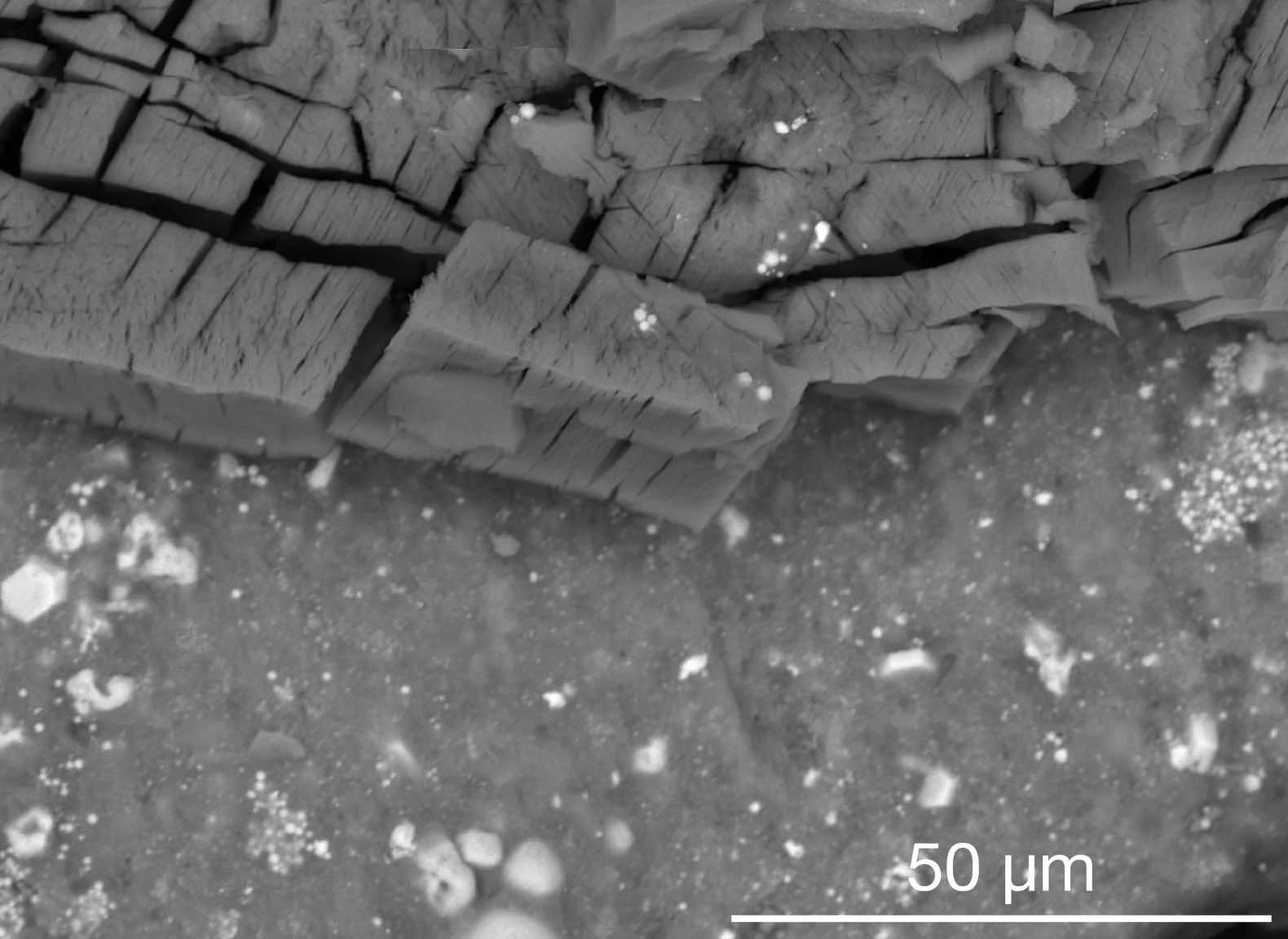
The analysis is key to confirming carbon and nitrogen-rich dusts and organic compounds essential for life. However, the sample also revealed a few surprises, including the presence of magnesium-sodium phosphate, which had not been detected in data obtained from the asteroid through remote sensing.
Microscopic view of samples obtained from asteroid Bennu by OSIRIS-REx, revealing a bright vein containing phosphate (Credit: Lauretta & Connolly et al. (2024) Meteoritics & Planetary Science, doi:10.1111/maps.14227.)
This significant finding points to the likelihood that Bennu may have its origins in a small, primitive ocean world since magnesium-sodium phosphate is a water-soluble phosphate that plays a crucial role in Earth’s biochemistry. The detections made in the Bennu samples were also very pure and of a size that set them apart from similar phosphates found in asteroid samples retrieved by JAXA’s Hayabusa2 mission.
Although it seems likely, based on the new data, that Bennu has a history involving interactions with water, the asteroid is still relatively chemically primitive, and somewhat paradoxically, researchers compare the elements it possesses to those of the Sun.
Confirming the presence of carbon and nitrogen in the asteroid samples obtained from Bennu’s surface allows researchers to glean new insights into environments where those elements formed, as well as how they became complex molecules over time. These processes would have once occurred early in Earth’s history, also a process that would have been fundamental in the formation of life.
Retrieving the samples directly from the surface of an asteroid also offered NASA scientists access to a veritable “time capsule” where the materials remained preserved for billions of years. Given their low density, such materials are destroyed when asteroids collide with Earth’s atmosphere, burning up during reentry.
Studying the preserved samples retrieved by OSIRIS-REx has already provided new insights toward understanding the intricate processes of solar system formation and prebiotic chemistry, but researchers involved in the ongoing analysis believe there will likely be more surprises in the near future.
“Each week, analysis by the OSIRIS-REx Sample Analysis Team provides new and sometimes surprising findings,” said Harold Connolly, co-lead author of the new study and OSIRIS-REx mission sample scientist at Rowan University.
Connolly said the ongoing discoveries Bennu’s samples are revealing “are helping place important constraints on the origin and evolution of Earth-like planets.”
The new paper by lead-author Dante Lauretta and colleagues, “Asteroid (101955) Bennu in the laboratory: Properties of the sample collected by OSIRIS-REx,” was published on June 26. Additional information about NASA’s OSIRIS-REx mission can be found on its official web page.
NASA Release 3D Visualization of ‘Pillars of Creation’
NASA Release 3D Visualization of ‘Pillars of Creation’
Using images from the NASA/ESA Hubble Space Telescope and the NASA/ESA/CSA James Webb Space Telescope, astronomers have produced a new 3D visualization of the Pillars of Creation, three towers of gas and dust within the Eagle Nebula.
The Pillars of Creation are three towers of gas and dust located some 6,500 light-years away in the constellation of Serpens.
They are a fascinating but relatively small feature of the Eagle Nebula (also known as Messier 16), which was discovered in 1745 by the Swiss astronomer Jean-Philippe Loys de Chéseaux.
The Pillars of Creation are approximately 4-5 light-years long, while the nebula is 55-70 light-years wide.
They arise when immense, freshly formed blue-white O- and B-type stars give off intense ultraviolet radiation and stellar winds that blow away less dense materials from their vicinity.
“By flying past and amongst the pillars, viewers experience their 3D structure and see how they look different in the Hubble visible-light view versus the Webb infrared-light view,” said Dr. Frank Summers, principal visualization scientist at the Space Telescope Science Institute.
“The contrast helps them understand why we have more than one space telescope to observe different aspects of the same object.”
“The four Pillars of Creation, made primarily of cool molecular hydrogen and dust, are being eroded by the fierce winds and punishing ultraviolet light of nearby hot, young stars.”
“Finger-like structures larger than the Solar System protrude from the tops of the pillars. Within these fingers can be embedded, embryonic stars.”
“The tallest pillar stretches across 3 light-years, three-quarters of the distance between our Sun and the next nearest star.”
A mosaic of visible-light (Hubble) and infrared-light (Webb) views of the same frame from the Pillars of Creation visualization.
Image credit: Greg Bacon / Ralf Crawford / Joseph DePasquale / Leah Hustak / Christian Nieves / Joseph Olmsted / Alyssa Pagan / Frank Summers, STScI / NASA’s Universe of Learning.
The movie takes visitors into the 3D structures of the Pillars of Creation.
“The Pillars of Creation were always on our minds to create in 3D,” said Dr. Greg Bacon, also from the Space Telescope Science Institute.
“Webb data in combination with Hubble data allowed us to see the Pillars in more complete detail.”
“Understanding the science and how to best represent it allowed our small, talented team to meet the challenge of visualizing this iconic structure.”
The new visualization helps viewers experience how two of the world’s most powerful space telescopes work together to provide a more complex and holistic portrait of the pillars.
Hubble sees objects that glow in visible light, at thousands of degrees. Webb’s infrared vision, which is sensitive to cooler objects with temperatures of just hundreds of degrees, pierces through obscuring dust to see stars embedded in the pillars.
“When we combine observations from NASA’s space telescopes across different wavelengths of light, we broaden our understanding of the Universe,” said Dr. Mark Clampin, astrophysics division director at NASA Headquarters.
“The Pillars of Creation region continues to offer us new insights that hone our understanding of how stars form.”
“Now, with this new visualization, everyone can experience this rich, captivating landscape in a new way.”
De telescoop tuurde naar het gebied boven de beroemde Grote Rode Vlek van Jupiter en ontdekte een reeks nieuwe, nog nooit eerder waargenomen kenmerken.
Jupiter is zonder twijfel een van de meest opvallende objecten aan de nachtelijke hemel. Bovendien is de enorme gasreus op een heldere nacht eenvoudig te aanschouwen. Afgezien van de heldere noorder- en zuiderlichten in de poolgebieden van de planeet, is de gloed van Jupiters bovenste atmosfeer zwak, waardoor het moeilijk is om met aardse telescopen details te zien. Maar gelukkig hebben we de James Webb-telescoop, die dankzij zijn infraroodgevoeligheid in staat is om de bovenste atmosfeer van Jupiter direct boven de Grote Rode Vlek met ongeëvenaarde precisie te bestuderen.
Meer over Jupiter’s Grote Rode Vlek Planeet Jupiter staat bekend om zijn kleurrijke banden en reusachtige, wervelende stormen. De bekendste storm is – misschien zelfs de bekendste in het hele zonnestelsel – de Grote Rode Vlek; een gigantische anticycloon die al heel wat jaren op de gasreus woedt. De Grote Rode Vlek is een immense atmosferische wervelwind, zo is hij bijna net zo groot als de aarde in diameter. Aan zijn buitenranden razen de winden met snelheden tot 450 kilometer per uur. De rode kleur ontstaat door chemische reacties in de atmosfeer, wat een opvallend contrast vormt met de bleke wolken van de gasreus. De Grote Rode Vlek heeft generaties van wetenschappers gefascineerd. Dat heeft onder andere met zijn omvang te maken, maar ook met het feit dat de storm zelfs zichtbaar is met kleine telescopen. Afgelopen week werd nog bekend dat de Grote Rode Vlek toch jonger is dan gedacht. Hoewel de immense storm met een respectabele leeftijd van 190 jaar nog altijd de langstlevende wervelwind in het zonnestelsel is, blijkt hij niet dezelfde te zijn als die astronoom Giovanni Cassini in 1665 waarnam.
De bovenste atmosfeer van Jupiter is de overgangslaag tussen het magnetisch veld van de planeet en de onderliggende atmosfeer. In dit gebied zijn de heldere en levendige noorder- en zuiderlichten te zien, aangedreven door vulkanisch materiaal dat wordt uitgestoten door Jupiters ‘pizzamaan’ Io. Dichter bij de evenaar wordt de structuur van deze atmosfeer beïnvloed door het binnenkomende zonlicht. Omdat Jupiter slechts 4 procent van het zonlicht ontvangt dat de aarde bereikt, dachten astronomen dat dit gebied vrij uniform zou zijn.
Saai In juli 2022 werd Jupiters Grote Rode Vlek geobserveerd met Webb’s Near-InfraRed Spectrograph (NIRSpec), waarbij de Integral Field Unit van het instrument werd gebruikt. Het doel was om te bestuderen of het gebied direct boven de beroemde wervelstorm echt zo saai is als wetenschappers vermoedden. Maar tot hun verrassing hebben ze nu ontdekt dat de bovenste atmosfeer een verscheidenheid aan ingewikkelde structuren bevat, waaronder donkere bogen en heldere vlekken, zo valt er te lezen in Nature Astronomy. “We gingen er misschien wat naïef vanuit dat dit gebied echt saai zou zijn,” zegt teamleider Henrik Melin. “Maar het blijkt eigenlijk net zo interessant te zijn als de noorderlichten, zo niet interessanter. Jupiter blijft ons altijd verrassen.”
Links: infraroodbeeld van Jupiter. De gasreus schittert in verschillende kleuren, vooral bij de polen en op de Grote Rode Vlek, die zich als een ronde storm rechtsonder op de planeet bevindt. De Grote Rode Vlek wordt omgeven door een scherp rechthoekig kader. Rechts: een close-up van dat gebied in verschillende kleuren. De blauwere tinten vertegenwoordigen de lagere hoogtes in de atmosfeer van Jupiter, terwijl roder aangeeft dat het om hogere hoogtes gaat. Afbeelding: ESA/Webb, NASA & CSA, Jupiter ERS Team, J. Schmidt, H. Melin, M. Zamani (ESA/Webb)
Zwaartekrachtsgolven Kortom, het gebied dat vroeger als onopvallend werd beschouwd, blijkt nu dus een diverse verzameling van complexe structuren en activiteiten te bevatten. Hoewel de lichtuitstraling van dit gebied wordt veroorzaakt door zonlicht, suggereert het team dat er een ander mechanisme moet zijn dat de vorm en structuur van de bovenste atmosfeer beïnvloedt. “Een manier om deze structuur te veranderen is door zwaartekrachtsgolven,” legt Henrik uit. “Dit is vergelijkbaar met golven die op een strand breken en rimpelingen in het zand veroorzaken. Deze golven ontstaan diep in de turbulente lagere atmosfeer rondom de Grote Rode Vlek. Ze kunnen omhoog bewegen naar hogere lagen, wat leidt tot veranderingen in de structuur en uitstoot van de bovenste atmosfeer.” Dergelijke atmosferische golven kunnen soms ook op aarde worden gezien, maar ze zijn veel zwakker dan die waargenomen op Jupiter door Webb.
Vervolgonderzoek Het team hoopt in de toekomst vervolgonderzoek te doen met Webb naar Jupiters complexe golfpatronen. Zo willen ze bijvoorbeeld achterhalen hoe deze patronen zich in de bovenste atmosfeer van de planeet bewegen. Ook willen ze meer inzicht krijgen in de energiebalans in dit gebied en bestuderen hoe de kenmerken ervan in de loop van de tijd veranderen.
Juice Maar dat niet alleen. Deze ontdekkingen kunnen ook van belang zijn voor de ESA’s Jupiter Icy Moons Explorer (Juice), die op 14 april 2023 werd gelanceerd. Juice zal uitgebreide waarnemingen doen van Jupiter en zijn drie grote manen met oceanen – Ganymedes, Callisto en Europa (lees hier meer over de missie). De missie heeft tot doel deze manen te karakteriseren, terwijl het ook Jupiters complexe omgeving in detail zal onderzoeken.
Dankzij de nieuw opgedane kennis van de atmosferische processen en dynamiek op Jupiter, krijgen we een steeds beter beeld van deze nog altijd raadselachtige planeet en zijn manen. En hopelijk zal dit niet alleen ons begrip van ons eigen zonnestelsel vergroten, maar ook bijdragen aan onze kennis van gasreuzen en hun manen elders in het universum.
Happy Asteroid Day! Schweickart Prize Spotlights Planetary Defense
Every year on June 30, Asteroid Day marks the anniversary of a meteor airburst in 1908 that leveled hundreds of square miles of Siberian forest land. But a more recent meteor blast — and a new plan for getting advance warning of the next one — is receiving some added attention for this year’s Asteroid Day.
The proposal from astronomy Ph.D. student Joseph DeMartini calls for setting up a consortium of ground-based observatories, anchored by the Vera C. Rubin Observatory in Chile, to focus on the twilight sky just after sunset and just before sunrise. Those are the times of day when astronomers have the best chance of finding sunward near-Earth objects (NEOs) that spend much of their time within Earth’s orbit.
“It’s a very interesting proposal that we hope gets picked up,” Rusty Schweickart said.
DeMartini’s concept for what he calls the Sunward NEO Surveillance and Early Twilight detection collaboration — or SUNSET for short — was judged the top entry in the competition for the Schweickart Prize. The award, which is a program of the California-based B612 Foundation, recognizes graduate students who come up with innovative ideas for planetary defense. As the prize winner, DeMartini will receive a $10,000 cash prize and a trophy topped by an authenticated meteorite during a ceremony on June 29 at the Chabot Space & Science Center in Oakland, Calif.
“The thing that actually got me to put my idea forward was the meteorite fragment,” said DeMartini, who’s earning his Ph.D. from the University of Maryland. “I saw that and I was like, ‘Oh my gosh, I really want that.’ But maybe that’s just me being an asteroid nerd.”
DeMartini said the idea behind SUNSET came out of discussions he had with a colleague about the asteroid that sparked the Chelyabinsk blast. “The reason we didn’t have any warning was because it came from the direction of the sun, and we can’t look in the direction of the sun,” he said. “That got me thinking, ‘Wow, that’s a region we should really monitor.'”
It turns out that the Rubin Observatory is looking into conducting just such a monitoring effort after it gets up and running next year. DeMartini suggests that the SUNSET network could augment the sightings made at the Rubin Observatory, and confirm the precise orbits traced by sunward NEOs.
“If these other telescopes know where to point in advance, then they can follow up on anything that Rubin discovers in a night, and then we can get these confirmations more easily,” he said.
The current focus of DeMartini’s research actually has to do with a different topic: numerical simulations of asteroid surfaces and interiors, and how close encounters with Earth might change those values. But when his faculty adviser told him about the Schweickart Prize, DeMartini decided to enter the competition.
From left: Apollo 9 astronaut Rusty Schweickart; the Schweickart Prize, topped by a meteorite; and the first winner of the prize, University of Maryland astronomer Joseph DeMartini. (Credits: RustySchweickart.com; Christopher Che via SchweickartPrize.org; University of Maryland)
It should come as no surprise that Rusty Schweickart himself was one of the judges. In his post-NASA career, he has focused on the challenges of asteroid threat detection and mitigation. He’s the founder and past president of the Association of Space Explorers, which took up the NEO threat as one of its causes. He’s also a co-founder of the B612 Foundation, which raises awareness about planetary defense, and a co-founder of Asteroid Day as well.
“What we’re talking about here in planetary defense is having the capability to ever so slightly, but critically, reshape the solar system to enhance the future of life on Earth,” Schweickart said. “To prevent this existential threat — that is what I’ve dedicated the last 20 years of my life to bringing about.”
Thanks in part to a congressional mandate, more than 90% of the biggest near-Earth asteroids, exceeding a kilometer (0.6 mile) in diameter, are thought to have been identified and are being tracked. That’s the kind of asteroid that wiped out the dinosaurs roughly 66 million years ago. “But it’s the ones that are the city-killers — the 40- to 50-meter-diameter guys — that you can’t see until they’re pretty close to the Earth,” Schweickart said. “That means looking interior [to Earth’s orbit] is going to be more productive than looking exterior.”
DeMartini’s proposal was selected as the winner because it addresses one of the biggest gaps in asteroid monitoring, and because it takes advantage of advances in observational firepower.
The Rubin Observatory’s Survey Cadence Optimization Committee, or SCOC, says doing the kind of twilight sky survey that DeMartini discusses in his SUNSET proposal would be “scientifically compelling.” It recommends starting such a survey soon after the telescope begins science operations next year.
“We currently are simulating the effect of adding low-solar-elongation observations during the start and end of twilight, spending about 15 to 20 minutes of the start and end of about a quarter of the survey nights observing at high airmass toward the sun,” Lynne Jones, an astronomer who’s part of the Rubin team, said in an email. “This gives us the opportunity to detect asteroids interior to the Earth, even down to parts of the sky which are closer than 40 degrees from the sun.”
This time-lapse simulation illustrates how the Rubin Observatory could focus on twilight zones at the start and end of a survey night.
Credit: Lynne Jones / Aerotek / Rubin Observatory.
DeMartini said the Rubin Observatory’s twilight survey campaign would be “step one” in his vision for the SUNSET collaboration. “The next bit, I suppose, would be networking. Hopefully, this event that I’ll be going to when I’m receiving the prize will be a good opportunity for that. And that’s something that B612 can really help with,” he said.
“If it takes off, I don’t know what it looks like in 10 years. But my hope is that we’re safer because of it,” DeMartini added.
Randy Schweickart, who is one of Rusty’s sons and the chair of the prize program’s judging committee, said he and other family members are committed to funding the Schweickart Prize for at least five years. “The hope is that — similar to the Astronaut Scholarship Foundation, which has expanded tremendously from its beginnings — there would be support from other sources as we move in time and are able to get more of the word out,” he said.
Rusty Schweickart said that the prize is meant for more than astronomers. “The really toughest problems related to planetary defense are the governance issues — the non-technical, geopolitical and legal issues,” he said. “So, in the future, what we want to do is move more in that direction, and get law students, economics students, public-safety people, emergency-response people to be involved in this. Because in the end, they’re going to be very critical.”
Schweickart, who’ll turn 90 next year, hopes the prize will carry on his legacy when he’s “pushing up daisies.”
“It seems to me that that we have, as human beings, a special responsibility to do whatever we can to see that this evolutionary experiment that we’re having here on planet Earth continues,” he said. “I’m not quite sure why that’s the responsibility, but I think it is. And if so, I feel obligated to do what I could.”
Scores of events have been scheduled around the world to mark Asteroid Day, including a two-day festival in Luxembourg.The award ceremony for the Schweickart Prize will take place at 3:30 p.m. PT June 29 at the Chabot Space & Science Center in Oakland, Calif. The event will feature a presentation by Rusty Schweickart, plus comments from NASA astronauts Steve Smith and Nicole Stott, and from YouTube space commentator Scott Manley. Click to purchase tickets.
Could We Detect an Alien Civilization Trying to Warm Their Planet?
This artist's illustration shows a hypothetical Earth-like inhabited planet being terraformed with artificial greenhouse gases. We could detect these chemicals with infrared spectroscopy. Image Credit: Sohail Wasif, UC Riverside/Schwieterman et al. 2024
Could We Detect an Alien Civilization Trying to Warm Their Planet?
Humanity is facing an atmospheric threat of our own device, and our internecine squabbles are hampering our ability to neutralize that threat. But if we last long enough, the reverse situation will arise. Our climate will cool, and we’ll need to figure out how to warm it up. If that day ever arises, we should be organized enough to meet the challenge.
If there are other civilizations out there in the galaxy, one may already be facing a cooling climate or an ice age. Could we detect the greenhouse chemicals they would be purposefully emitting into their atmosphere in an attempt to warm their planet?
New research in The Astrophysical Journal explains how the JWST or a future telescope named LIFE (Large Interferometer For Exoplanets) could detect certain chemicals in an exoplanet’s atmosphere that signal an intentional attempt to warm it. The title is “Artificial Greenhouse Gases as Exoplanet Technosignatures.” The lead author is Edward Schwieterman, Assistant Professor of Astrobiology at UC Riverside and a Research Scientist at Blue Marble Space Institute of Science in Seattle, Washington.
“Atmospheric pollutants such as chlorofluorocarbons and NO2 have been proposed as potential remotely detectable atmospheric technosignature gases,” the authors write in their paper. “Here, we investigate the potential for artificial greenhouse gases, including CF4, C2F6, C3F8, SF6, and NF3, to generate detectable atmospheric signatures.”
The first three are perfluorocarbons, potent and long-lived greenhouse gases (GHGs.) SF6 is Sulfur hexafluoride, and NF3 is Nitrogen trifluoride. They’re both greenhouse gases with global warming potentials 23,500 times greater and 17,200 times greater than CO2 over a 100-year period.
These artificial GHGs could be a technosignature of a civilization actively trying to warm their planet. They’re long-lived, have low toxicities, and have low false-positive potential. They also occur only in small amounts naturally. Their presence indicates industrial production.
“For us, these gases are bad because we don’t want to increase warming. But they’d be good for a civilization that perhaps wanted to forestall an impending ice age or terraform an otherwise-uninhabitable planet in their system, as humans have proposed for Mars,” said UCR astrobiologist and lead author Edward Schwieterman.
These chemicals could persist in an atmosphere for up to 50,000 years, making them near ideal for a civilization facing a freezing future. “They wouldn’t need to be replenished too often for a hospitable climate to be maintained,” Schwieterman said in a press release.
Unlike CFCs (chlorofluorocarbons), which damage the ozone layer, these chemicals are largely inert. Any civilization smart enough to engineer their atmosphere would avoid CFCs. CFCs also don’t last long in an oxygen atmosphere and wouldn’t be great technosignatures.
“If another civilization had an oxygen-rich atmosphere, they’d also have an ozone layer they’d want to protect,” Schwieterman said. “CFCs would be broken apart in the ozone layer even as they catalyzed its destruction.”
But from our ETI-seeking viewpoint, the best thing about the chemicals the researchers are studying is their prominent infrared signatures at extremely low concentrations.
“With an atmosphere like Earth’s, only one out of every million molecules could be one of these gases, and it would be potentially detectable,” Schwieterman said. “That gas concentration would also be sufficient to modify the climate.”
To understand these chemicals and their detectability, the research team simulated the atmosphere of TRAPPIST 1-f. This well-studied rocky exoplanet is in the habitable zone of a red dwarf star about 40 light-years away, making it a realistic observational target at that distance.
This artist’s illustration shows the exoplanet TRAPPIST-1f, a potentially rocky Super-Earth orbiting in a red dwarf’s habitable zone. Image Credit: NASA/JPL-Caltech
This study is based on the potential results of the LIFE telescope, which is still a concept. Its purpose is to examine the atmospheres of dozens of warm, terrestrial exoplanets. LIFE builds on telescope concepts from a couple of decades ago, like the European Space Agency’s Darwin spacecraft. Darwin wasn’t built, but the idea behind it was two-fold: to both find Earth-like exoplanets and to search for evidence of life.
Darwin was conceived as an interferometer, and so is LIFE. LIFE would have four separate space telescopes acting as one.
This artist’s illustration shows LIFE’s four telescopes and its central unit acting as an interferometer. Interferometers create a large and powerful “virtual telescope.” Image Credit: LIFE/ETH Zurich
With LIFE, the GHGs would be easier to see than other standard biosignatures like O2, O3, CH4, and N2O. But unlike these chemicals, which can give false positives without a planetary context, the GHGs are more akin to technosignatures, which can be understood more independently from atmospheric chemistry. “In contrast to biosignatures, many technosignatures may provide greater specificity (less “false positive” potential), as many putative technosignatures have more limited abiotic formation channels when compared to biosignatures,” the authors explain in their research.
These figures show some of the simulation transmission spectra from the research. The top panel shows how different concentrations of three of the GHGs show up in MIR spectrometry for a simulated Earth-like TRAPPIST 1-f planet. The bottom panel shows how different concentrations of NF3 show up. O3 is shown because it shows up in the same band. The black line is the atmospheric spectrum without the GHGs. The 100 ppm results are from observing the planet for 10 transits. Image Credit: Schwieterman et al. 2024.
One desirable aspect of the search for these technosignature GHGs is that astronomers can find them as part of a general effort to study atmospheres.
“You wouldn’t need extra effort to look for these technosignatures, if your telescope is already characterizing the planet for other reasons,” said Schwieterman. “And it would be jaw-droppingly amazing to find them.”
These figures show some of the simulated emission spectra for the GHGs compared to Earth with no technosignatures. They also show some of the technosignatures at different PPM concentrations and Earth’s O3, CO2, and H20. The spectra are different than the transmission spectra. Image Credit: Schwieterman et al. 2024.
This is not a futuristic scenario awaiting the development of new technology. We have the capability to do this soon, according to Daniel Angerhausen. Angerhausen is from the Swiss Federal Institute of Technology/PlanetS, a collaborating organization on LIFE.
“Our thought experiment shows how powerful our next-generation telescopes will be. We are the first generation in history that has the technology to systematically look for life and intelligence in our galactic neighborhood,” said Angerhausen.
This concept figure illustrates a hypothetical Earth-like inhabited planet terraformed with various combined abundances of artificial greenhouse gases C3F8, C2F6, and SF6 and its resulting qualitative MIR transmission (top) and emission (bottom) spectra. Image Credit: Sohail Wasif, UC Riverside/Schwieterman et al. 2024.
“While all technosignature scenarios are speculative, we argue that it is unlikely fluorine-bearing technosignature gases will accumulate to detectable levels in a technosphere due only to inadvertent emission of industrial pollutants (or volcanic production),” the authors write.
They also explain that before individual GHG technosignatures were identified, anomalous MIR or NIR absorption signatures “… would be consistent with the presence of artificial greenhouse gases in a candidate technosphere.”
In their conclusion, they say that GHGs are viable technosignatures that can be found during routine exoplanet characterizations. “Both positive or negative results would meaningfully inform the search for life elsewhere,” they conclude.
That’s No Planet. Detecting Transiting Megastructures
One of the easiest ways to find exoplanets is using the transit method. It relies upon monitoring the brightness of a star which will then dim as a planet passes in front of it. It is of course possible that other objects could pass between us and a star; perhaps binary planets, tidally distorted planets, exocomets and, ready for it…. alien megastructures! A transit simulator has been created by a team of researchers and it can predict the brightness change from different transiting objects, even Dyson Swarms in construction.
51 Pegasi-b was the first exoplanet discovered in 1995 and it sparked the development of numerous ground-based and space-based instruments. The launch of the Kepler Space Telescope and the Transiting Exoplanet Survey Satellite (TESS) in 2018 popularised the transit method, leading to the discovery of over 4,000 exoplanets. As instruments have become increasingly sensitive and precise, research has progressed from simply detecting exoplanets to studying their detailed characteristics.
Illustration of NASA’s Transiting Exoplanet Survey Satellite. Credit: NASA’s Goddard Space Flight Center
Transit photometry has uncovered signatures of many interesting phenomena beyond the detection of exoplanets and eclipsing binaries. This technique has been instrumental in identifying features such as star-spots, and signatures of tidal interactions between host stars and exoplanets leading to significant growth in the sub-field of Asteroseismology
The study of transiting exoplanets and their timing variations has led to many discoveries. Non-transiting planets in distant solar systems have been found, orbital decay, disintegrating planets, exocomets and exomoon candidates has all been identified. Additionally, and perhaps of particular interest is that transit photometry has detected signals that have sparked interest in the search for technosignatures for the evidence of advanced civilizations.
It is important to note that no technosignatures have been confirmed yet but such signatures would not arise form natural processes and would demonstrate the presence of intelligent life. The signatures would come from a wide range of astroengineering projects like Dyson Spheres (a theoretical shell surrounding a star to capture its energy output) or the newly conceptualised Dyson Swarms (habitable satellites and energy collectors that orbit the star in formation.
The research team led by Ushasi Bhowmick from the Indian based Space Application Centre has reported that they have developed a transit simulator that can not only generate light curves for exoplanets but also for any object of any size or shape! The simulation uses the Monte-Carlo technique that predicts all possible outcomes of an uncertain event. In this instance it can predict the light curve when an object of any shape or size transits across the disk of star.
Artist’s impressions of two exoplanets in the TRAPPIST-1 system (TRAPPIST-1d and TRAPPIST-1f). Credit: NASA/JPL-Caltech
When the simulation was tested against actual exoplanet systems such as Trappist-1 it nicely predicted the light curve. It can also be used to model tidal distortions in binary star systems and even predict the light curve of non-natural objects such as the alien megastructures. The simulator has shown itself to be an invaluable method for understanding a wide range of transit phenomena.
A Single Robot Could Provide a Mission To Mars With Enough Water and Oxygen
Utilizing regolith on the Moon or Mars, especially to refill propellant for rockets to get back off the surface, is a common theme in the more engineering-minded space exploration community. There have been plenty of proof-of-concept technologies that could move us toward that goal. One of the best supported was the Regolith Advanced Surface Systems Operations Robot (RASSOR). Let’s take a look at what made this project unique.
It was initially conceived at Swamp Works, NASA’s version of Skunk Works, the famous Lockheed Martin development facility that worked on the SR-71 Blackbird and F-117 stealth plane. So far, it has gone through two iterations, known as 1.0 and 2.0, released in 2013 and 2016, respectively.
RASSOR consists of a chassis, a drive train, and two large bucket drum excavators. The excavating elements are on opposing sides of the rover, allowing the system to cancel out any horizontal forces caused by the excavating activity. On Earth, those horizontal forces would be offset by the physical weight of the digging machinery. Since weight is a precious commodity on space missions, this force-canceling technology is arguably the most crucial innovation in the system.
Video showing testing of the RASSOR 2.0 prototype. Credit – NASA Video Collection YouTube Channel
The RASSOR 2.0 prototype had several design goals, but it’s probably most helpful to walk through a use-case scenario. According to the soil samples collected by Curiosity and other rovers, around 2% of the regolith on Mars is water, even in the relatively “dry” regions outside the poles. Collecting that water could help refuel rockets and supply settlements with drinking water, radiation shielding, or water for agriculture.
NASA commonly uses a mission structure involving four astronauts on a journey to Mars. In a paper describing the 2.0 version of the robot back in 2016, the authors, including Robert Mueller, the founder of the Swamp Works facility and a doyen of ISRU research, describe a mission structure that would see RASSOR mining 1,000,000 kg of Martian regolith per year and supplying 10,000 kilograms of oxygen to the mission.
To do so, it would utilize a lander with processing capabilities for separating the useful parts from the chaff and would trek from the lander site to the regolith collection site about 35 times a day. With a charging cycle that would take about 8 hours a day, that would leave upwards of 16 hours to continuously mine the surface of Mars for these valuable materials.
Fraser describes how to live off the land in space using ISRU.
The paper goes on to describe the design process for the RASSOR’s various subsystems, including the powerful actuators that make up the majority of the weight of the system. They also used 3D-printed titanium to make the bucket drum excavating tools, which required some ingenious machining by Swamp Work’s machinists.
But in the end, they did make a working prototype. They tested it with improvements like a 50% drop in weight and an autonomous mode that utilizes simple stereo-vision cameras. The team believes this project is ready to move on to the next phase, taking a step closer to making it a reality.
That paper, however, was published eight years ago. A relatively detailed internet search doesn’t produce any results for RASSOR 3.0 other than a brief mention at the end of the 2.0 paper. So, for now, it seems the project is on hold. However, another NASA project, the Lunabotics Challenge, keeps university teams working toward effectively mining regolith for us in ISRU systems. Maybe one of those teams will pick up where the RASSOR team left off – or come up with a completely new design. We’ll have to wait and see.
Deflecting potentially hazardous asteroids (PHAs) is one of humanity’s most critical long-term efforts to ensure we don’t suffer the fate of the dinosaurs. There are plenty of suggested mission architectures to move a PHA out of the way, the most famous of which was the Double Asteroid Redirection Test (DART), which successfully changed the orbit of Dimorphos, a harmless small asteroid. That proof of concept bodes well for our chances of deflecting any future PHAs as long as they are discovered in time. But when it comes to the safety of the planet, we can’t be too careful, so developing more ways to deflect a PHA is better, and a paper from researchers at Beihang University details a methodology that is gaining some traction lately – using an asteroid’s regolith as a propellant.
The paper details a mission known as deflecting an asteroid by dusting (DAD) and describes a potential proof-of-concept mission to Apophis. This asteroid recently captured the imagination as potentially hazardous, though it has been proven to be no threat to Earth lately. As part of the mission design, the paper describes a seven-step process.
First, an orbiting spacecraft would assess potential landing sites that might be good for dust collection and for the orbital mechanics of the thrust redirection efforts. A lander would then descend and characterize the asteroid’s internal structure, including assessments for any elements that might provide a higher level of thrust.
Finding a PHA is the first step in moving it, as Fraser discusses.
The next step would be to complete a full 3D model of the asteroid’s surface, followed by using a high-powered laser to force the dust off the surface and into a storage tank. In the storage tank, the dust would be pulverized even more, with a thruster motor pushing the dust out from the rover in a direction that causes thrust against the asteroid’s surface, thereby changing its orbit.
The dust thrust deflection would be monitored from Earth, and an orbiting probe would be used to close the loop. If necessary, several other autonomous rovers could make their way along the asteroid’s surface, coordinating their thrusting efforts to increase the deflection force.
All this requires a lot of new technologies, coordination, and testing to become a reality. The authors suggest a potential test case to be ready for the close approach of Apophis in 2029. However, even if a lander is prepared and ready for that time, it could take upwards of 20 years for a perceptible deflection to happen – assuming that nothing goes wrong with the system in that time frame. Any engineer will tell you that having a system operate non-stop for 20 years is almost unheard of, though admittedly, some space probes are the exception to that.
Fraser discusses ideas to stop a potential asteroid strike.
One major advantage of this technique, though, would be its dual use as a proof of concept for asteroid deflection and mining. Many of the technologies would overlap, and there would be an incentive for governments and non-profits to invest in a potentially world-saving technology—at least more so than for them to invest in an as-yet unproven mining technology.
For now, this idea remains on the drawing board. But, if there is ever a real push to try out different methods of asteroid redirection, it could crop up again, especially if it’s supported by one of the major space agencies. And humanity might even get the benefit of a fully functional asteroid miner out of it.
The world is becoming clogged with plastic. Particles of plastic so tiny they cannot be seen with the naked eye have been found almost everywhere,from the oceans’ depths to themountaintops. They are in the soil, in plants, in animals, and inside us. The question is: what harm, if any, are they causing?
When plastic trash is dumped in a landfill or the sea, it breaks down very slowly. Sunlight and waves cause the surface of the plastic to become brittle, and particles are shed into the environment. Collectively known as “small plastic particles,” they range in size from five millimeters or smaller (microplastics) to less than one-thousandth of a millimeter (nano plastics). The smallest can only be detected with special scientific instruments.
It remains unclear how microplastics and nanoplastics get inside living things, but several entry points have been suggested. For example, they might pass through the gut from food or drink contaminated with small plastic particles. Or they may be breathed in, or absorbed through the skin.
Our research suggests that, for some animals, nanoplastics are bad news. We injected plastic nanoparticles into chicken embryos. We found that the particles traveled quickly in the blood to all tissues, especially the heart, liver, and kidneys. They were also excreted by the embryonic kidneys.
We noticed, too, that plastic nanoparticles tend to stick to a certain type of stem cell in the embryo. These cells are essential for the normal development of the nervous system and other structures. Any damage to stem cells could put the development of the embryo in jeopardy.
We suspect that the chicken embryo stem cells have substances on their surface called “cell-adhesion molecules,” which stick to the polystyrene nanoparticles that we used. We are following up on this finding because when nanoplastics stick to cells and get inside them, they can cause cell death and even serious birth defects in chickens and mice.
Similar studies cannot, of course, be carried out on people, so it is not yet possible to say what the implications of our animal research are for humans. What we know is that nanoplastics are found in the blood of human beings, in other bodily fluids, and in several major organs and key body tissues.
In recent years, microplastics and nanoplastics have been found in the brains, hearts, and lungs of humans. They have been discovered in the arteries of people with arterial disease, suggesting they may be a potential risk factor for cardiovascular disease. And they have been detected in breast milk, the placenta, and, most recently, penises.
Chinese researchers reported earlier this year that they had found microplastics in human and dog testes. More recently, another Chinese team found microplastics in all 40 samples of human semen they tested. This follows an Italian study that found microplastics in six out of ten samples of human semen.
Our fear is that microplastics and nanoplastics might act in a similar way to deadly asbestos fibers. Like asbestos, they are not broken down in the body and can be taken up into cells, killing them and then being released to damage yet more cells.
Nanoplastics have even been found in breastmilk.
Dzmitry Kliapitski / Alamy Stock Photo
REASSURING, FOR NOW
But there is a need for caution here. There is no evidence that nanoplastics can cross the placenta and get into the human embryo.
Also, even if nanoplastics do cross the placenta and in sufficient numbers to damage the embryo, we would expect to have seen a big increase in abnormal pregnancies in recent years. That is because the problem of plastic waste in the environment has been growing enormously over the years. But we are not aware of any evidence of a corresponding, large increase in birth defects or miscarriages.
That, for now, is reassuring.
It may be that microplastics and nanoplastics if they cause harm to our bodies, do so in a subtle way that we have not yet detected. Whatever the case, scientists are working hard to discover what the risks might be.
One promising avenue of research would involve the use of human placental tissue grown in the laboratory. Special artificial placenta tissues, called “trophoblast organoids,” have been developed to study how harmful substances cross the placenta.
Researchers are also investigating potentially beneficial uses for nanoplastics. Although they are not yet licensed for clinical use, the idea is that they could be used to deliver drugs to specific body tissues that need them. Cancer cells could, in this way, be targeted for destruction without damaging other healthy tissue.
Whatever the outcome of nanoplastics research, we and many other scientists will continue trying to find out what nanoplastics are doing to ourselves and the environment.
This article was originally published on The Conversation by Michael Richardson and Meiru Wang at Leiden University. Read the original article here.
Beste bezoeker, Heb je zelf al ooit een vreemde waarneming gedaan, laat dit dan even weten via email aan Frederick Delaere opwww.ufomeldpunt.be. Deze onderzoekers behandelen jouw melding in volledige anonimiteit en met alle respect voor jouw privacy. Ze zijn kritisch, objectief maar open minded aangelegd en zullen jou steeds een verklaring geven voor jouw waarneming! DUS AARZEL NIET, ALS JE EEN ANTWOORD OP JOUW VRAGEN WENST, CONTACTEER FREDERICK. BIJ VOORBAAT DANK...
Druk op onderstaande knop om je bestand , jouw artikel naar mij te verzenden. INDIEN HET DE MOEITE WAARD IS, PLAATS IK HET OP DE BLOG ONDER DIVERSEN MET JOUW NAAM...
Druk op onderstaande knop om een berichtje achter te laten in mijn gastenboek
Alvast bedankt voor al jouw bezoekjes en jouw reacties. Nog een prettige dag verder!!!
Over mijzelf
Ik ben Pieter, en gebruik soms ook wel de schuilnaam Peter2011.
Ik ben een man en woon in Linter (België) en mijn beroep is Ik ben op rust..
Ik ben geboren op 18/10/1950 en ben nu dus 75 jaar jong.
Mijn hobby's zijn: Ufologie en andere esoterische onderwerpen.
Op deze blog vind je onder artikels, werk van mezelf. Mijn dank gaat ook naar André, Ingrid, Oliver, Paul, Vincent, Georges Filer en MUFON voor de bijdragen voor de verschillende categorieën...
Veel leesplezier en geef je mening over deze blog.