The purpose of this blog is the creation of an open, international, independent and free forum, where every UFO-researcher can publish the results of his/her research. The languagues, used for this blog, are Dutch, English and French.You can find the articles of a collegue by selecting his category. Each author stays resposable for the continue of his articles. As blogmaster I have the right to refuse an addition or an article, when it attacks other collegues or UFO-groupes.
Druk op onderstaande knop om te reageren in mijn forum
Zoeken in blog
Deze blog is opgedragen aan mijn overleden echtgenote Lucienne.
In 2012 verloor ze haar moedige strijd tegen kanker!
In 2011 startte ik deze blog, omdat ik niet mocht stoppen met mijn UFO-onderzoek.
BEDANKT!!!
Een interessant adres?
UFO'S of UAP'S, ASTRONOMIE, RUIMTEVAART, ARCHEOLOGIE, OUDHEIDKUNDE, SF-SNUFJES EN ANDERE ESOTERISCHE WETENSCHAPPEN - DE ALLERLAATSTE NIEUWTJES
UFO's of UAP'S in België en de rest van de wereld Ontdek de Fascinerende Wereld van UFO's en UAP's: Jouw Bron voor Onthullende Informatie!
Ben jij ook gefascineerd door het onbekende? Wil je meer weten over UFO's en UAP's, niet alleen in België, maar over de hele wereld? Dan ben je op de juiste plek!
België: Het Kloppend Hart van UFO-onderzoek
In België is BUFON (Belgisch UFO-Netwerk) dé autoriteit op het gebied van UFO-onderzoek. Voor betrouwbare en objectieve informatie over deze intrigerende fenomenen, bezoek je zeker onze Facebook-pagina en deze blog. Maar dat is nog niet alles! Ontdek ook het Belgisch UFO-meldpunt en Caelestia, twee organisaties die diepgaand onderzoek verrichten, al zijn ze soms kritisch of sceptisch.
Nederland: Een Schat aan Informatie
Voor onze Nederlandse buren is er de schitterende website www.ufowijzer.nl, beheerd door Paul Harmans. Deze site biedt een schat aan informatie en artikelen die je niet wilt missen!
Internationaal: MUFON - De Wereldwijde Autoriteit
Neem ook een kijkje bij MUFON (Mutual UFO Network Inc.), een gerenommeerde Amerikaanse UFO-vereniging met afdelingen in de VS en wereldwijd. MUFON is toegewijd aan de wetenschappelijke en analytische studie van het UFO-fenomeen, en hun maandelijkse tijdschrift, The MUFON UFO-Journal, is een must-read voor elke UFO-enthousiasteling. Bezoek hun website op www.mufon.com voor meer informatie.
Samenwerking en Toekomstvisie
Sinds 1 februari 2020 is Pieter niet alleen ex-president van BUFON, maar ook de voormalige nationale directeur van MUFON in Vlaanderen en Nederland. Dit creëert een sterke samenwerking met de Franse MUFON Reseau MUFON/EUROP, wat ons in staat stelt om nog meer waardevolle inzichten te delen.
Let op: Nepprofielen en Nieuwe Groeperingen
Pas op voor een nieuwe groepering die zich ook BUFON noemt, maar geen enkele connectie heeft met onze gevestigde organisatie. Hoewel zij de naam geregistreerd hebben, kunnen ze het rijke verleden en de expertise van onze groep niet evenaren. We wensen hen veel succes, maar we blijven de autoriteit in UFO-onderzoek!
Blijf Op De Hoogte!
Wil jij de laatste nieuwtjes over UFO's, ruimtevaart, archeologie, en meer? Volg ons dan en duik samen met ons in de fascinerende wereld van het onbekende! Sluit je aan bij de gemeenschap van nieuwsgierige geesten die net als jij verlangen naar antwoorden en avonturen in de sterren!
Heb je vragen of wil je meer weten? Aarzel dan niet om contact met ons op te nemen! Samen ontrafelen we het mysterie van de lucht en daarbuiten.
20-04-2024
Astronomers Discover 454 New Asteroids in Main Belt
Astronomers Discover 454 New Asteroids in Main Belt
A set of 632 main-belt asteroids (178 previously known and 454 unknown objects) has been identified in the archival images from the NASA/ESA Hubble Space Telescope. Citizen scientists from around the world contributed to the identification of this asteroid bounty. Professional astronomers combined the volunteers’ efforts with machine learning algorithm to identify the asteroids.
This Hubble image of the barred spiral galaxy UGC 12158 looks like someone took a white marking pen to it. In reality it is a combination of time exposures of a foreground asteroid moving through Hubble’s field-of-view, photobombing the observation of the galaxy. Several exposures of the galaxy were taken, what is evidence in the dashed pattern. The asteroid appears as a curved trail due to parallax: because Hubble is not stationary, but orbiting Earth, and this gives the illusion that the faint asteroid is swimming along a curved trajectory. The uncharted asteroid is in inside the asteroid belt in our Solar System, and hence is 10 trillion times closer to Hubble than the background galaxy.
Image credit: NASA / ESA / Hubble / Pablo García Martín, UAM / Joseph DePasquale, STScI / Alex Filippenko, UC Berkeley.
Over 4 billion years ago, the eight major planets around our Sun formed by sweeping up debris from a vast disk of dust and gas surrounding the Sun.
This is common to the planet birthing process, and the NASA/ESA Hubble Space Telescope was the first to optically see similar disks surrounding newborn stars, providing a peek into the Solar System’s formative years.
Now, 4 billon years later, the planet construction yard is still cluttered with leftover debris.
Most of this ancient space rubble — asteroids — can be found between the orbits of Mars and Jupiter within the main asteroid belt.
“We are getting deeper into seeing the smaller population of main belt asteroids,” said Dr. Pablo García Martín, an astronomer at the Autonomous University of Madrid.
“We were surprised with seeing such a large number of candidate objects.”
“There was some hint of this population existing, but now we are confirming it with a random asteroid population sample obtained using the whole Hubble archive.”
“This is important for providing insights into the evolutionary models of our Solar System.”
Because of Hubble’s fast orbit around the Earth, it can capture wandering asteroids through their telltale trails in the Hubble exposures.
As viewed from an Earth-based telescope, an asteroid leaves a streak across the picture.
Asteroids ‘photobomb’ Hubble exposures by appearing as unmistakable, curved trails in the photographs.
As Hubble moves around the Earth, it changes its point of view while observing an asteroid, which also moves along its own orbit.
By knowing the position of Hubble during the observation and measuring the curvature of the streaks, scientists can determine the distances to the asteroids and estimate the shapes of their orbits.
The asteroids snagged mostly dwell in the main belt, which lies between the orbits of Mars and Jupiter.
Their brightness is measured by Hubble’s sensitive cameras. And comparing their brightness to their distance allows for a size estimate.
The faintest asteroids in the survey are roughly one forty-millionth the brightness of the faintest star that can be seen by the human eye.
“Asteroid positions change with time, and therefore you cannot find them just by entering coordinates, because at different times, they might not be there,” Dr. Merín said.
“As astronomers we don’t have time to go looking through all the asteroid images.”
“So we got the idea to collaborate with over 10,000 citizen-science volunteers to peruse the huge Hubble archives.”
The results appear in the journal Astronomy & Astrophysics.
Pablo García-Martín et al. 2024. Hubble Asteroid Hunter III. Physical properties of newly found asteroids. A&A 683, A122; doi: 10.1051/0004-6361/202346771
The Giant Planets Migrated Between 60-100 Million Years After the Solar System Formed
The migration of the giant planets had a hand in shaping our Solar System, including Earth. New research shows the migration happened much earlier than thought. Image Credit: NASA
The Giant Planets Migrated Between 60-100 Million Years After the Solar System Formed
Untangling what happened in our Solar System tens or hundreds of millions of years ago is challenging. Millions of objects of wildly different masses interacted for billions of years, seeking natural stability. But its history—including the migration of the giant planets—explains what we see today in our Solar System and maybe in other, distant solar systems.
New research shows that giant planet migration began shortly after the Solar System formed.
Planetary migration is a well-established idea. The Grand-Tack Hypothesis says that Jupiter formed at 3.5 AU, migrated inward to 1.5 AU, and then back out again to 5.2 AU, where it resides today. Saturn was involved, too. Migration can also explain the Hot Jupiters we see orbiting extremely close to their stars in other solar systems. They couldn’t have formed there, so they must have migrated there. Even rocky planets can migrate early in a solar system’s history.
“The question is, when did it happen?” Dr. Avdellidou asked. “The orbits of these planets destabilised due to some dynamical processes and then took their final positions that we see today. Each timing has a different implication, and it has been a great matter of debate in the community.”
“What we have tried to do with this work is to not only do a pure dynamical study, but combine different types of studies, linking observations, dynamical simulations, and studies of meteorites.”
The meteorites in this study are enstatites or E-type asteroids. E-type asteroids have enstatite (MgSiO3) achondrite surfaces. Achondrite means they lack chondrules, grains of rock that were once molten before being accreted to their parent body. Specifically, this group of meteorites are the low-iron chondrites called ELs.
When giant planets move, everything else responds. Tiny asteroids are insignificant compared to Jupiter’s mass. Scientists think E-type asteroids were dispersed during the gas giants’ outward migration. They may even have been the impactors in the hypothetical Late Heavy Bombardment.
Artist concept of Earth during the Late Heavy Bombardment period. Scientists have wondered if E-type asteroids disturbed during giant planet migration could’ve been responsible for the Bombardment, but the authors of this research don’t favour that explanation. Credit: NASA’s Goddard Space Flight Center Conceptual Image Lab.
Enstatite achondrites that have struck Earth have similar compositions and isotope ratios as Earth. This signals that they formed in the same part of the protoplanetary disk around the young Sun. Previous research by Dr. Avdellidou and others has linked the meteorites to a population of fragments in the asteroid belt named Athor.
This work hinges on linking meteorites to parent asteroids and measuring the isotopic ratios.
“If a meteorite type can be linked to a specific parent asteroid, it provides insight into the asteroid’s composition, time of formation, temperature evolution, and original size,” the authors explain. When it comes to composition, isotopic abundances are particularly important. Different isotopes decay at different rates, so analyzing their ratio tells researchers when each meteorite closed, meaning when it became cool enough that there was no more significant diffusion of isotopes. “Therefore, thermochronometers in meteorites can constrain the epoch at which major collisional events disturbed the cooling curves of the parent asteroid,” the authors explain.
The team’s research shows that Athor is a part of a once much larger parent body that formed closer to the Sun. It also suffered from a collision that reduced its size out of the asteroid belt.
Athor found its way back when the giant planets migrated. Athor was at the mercy of all that shifting mass and underwent its own migration back into the asteroid belt. Analysis of the meteorites showed that this couldn’t have happened earlier than 60 million years ago. Other research into asteroids in Jupiter’s orbit showed it couldn’t have happened later than 100 million years ago. Since the Solar System formed about 4.56 billion years ago, the giant planet migration happened between 4.5 and 4.46 billion years ago.
This schematic from the research shows what the researchers think happened. Red circles are planetesimals (and their fragments) from the terrestrial planet region. The black solid curves roughly denote the boundary of the current asteroid inner main belt. Eccentricity increases from bottom to top.
A shows the formation and cooling of the EL parent planetesimal in the terrestrial planet region before 60 Myr after Solar System formation. In this period, the terrestrial planets began scattering planetesimals to orbits with high eccentricity and semimajor axes corresponding to the asteroid main belt. B shows that between 60 and 100 Myr, the EL planetesimal was destroyed by an impact in the terrestrial planet region. At least one fragment (the Athor family progenitor) was scattered by the terrestrial planets into the scattered disk, as in (A). Then the giant planet instability implanted it into the inner main belt by decreasing its eccentricity. C shows that a few tens of millions of years after the giant planet instability occurred, a giant impact between the planetary embryo Theia and proto-Earth formed the Moon. D shows that the Athor family progenitor experienced another impact event that formed the Athor family at ~1500 Myr. Image Credit: Avdellidou et al. 2024.
Another important event happened right around the same time. About 4.5 billion years ago, a protoplanet named Theia smashed into Earth, creating the Moon. Could it all be related?
“The formation of the Moon also occurred within the range that we determined for the giant planet instability,” the authors write in their research. “This might be a coincidence, or there might be a causal relationship between the two events.”
“It’s like you have a puzzle, you understand that something should have happened, and you try to put events in the correct order to make the picture that you see today,” Dr. Avdellidou said. “The novelty with the study is that we are not only doing pure dynamical simulations, or only experiments, or only telescopic observations.”
“There were once five inner planets in our Solar System and not four, so that could have implications for other things, like how we form habitable planets. Questions like, when exactly objects came delivering volatile and organics to our planet to Earth and Mars?”
Artist’s impression of the impact that caused the formation of the Moon. Could giant planet migration have caused that impact? Credit: NASA/GSFC
The Solar System’s history is a convoluted, beautiful puzzle that somehow led to us. Everything had to work out for life to arise on Earth, sustain itself, and evolve for so long. The epic migration of the gas giants must have played a role, and this research brings its role into focus.
Never mind habitability, complex life, and civilization, the migration may have allowed Earth to form in the first place.
“The timing is very important because our Solar System at the beginning was populated by a lot of planetesimals,” said study co-author Marco Delbo, Director of Research at France’s Nice Observatory. “And the instability clears them, so if that happens 10 million years after the beginning of the Solar System, you clear the planetesimals immediately, whereas if you do it after 60 million years you have more time to bring materials to Earth and Mars.
The Fred Lawrence Whipple Observatory’s 48-inch telescope captured this visible-light image of the Pinwheel galaxy (Messier 101) in June 2023. The location of supernova 2023ixf is circled. The observatory, located on Mount Hopkins in Arizona, is operated by the Center for Astrophysics | Harvard & Smithsonian. Hiramatsu et al. 2023/Sebastian Gomez (STScI)
Cosmic rays are high-energy particles accelerated to extreme velocities approaching the speed of light. It takes an extremely powerful event to send these bits of matter blazing through the Universe. Astronomers theorize that cosmic rays are ejected by supernova explosions that mark the death of supergiant stars. But recent data collected by the Fermi Gamma-ray space telescope casts doubt on this production method for cosmic rays, and has astronomers digging for an explanation.
It’s not easy to tell where a cosmic ray comes from. Most cosmic rays are hydrogen nuclei, others are protons, or free-flying electrons. These are charged particles, meaning that every time they come across other matter in the Universe with a magnetic field, they change course, causing them to zig-zag through space.
The direction a cosmic ray comes from when it hits Earth, then, is not likely the direction it started in.
But there are ways to indirectly track down their origin. One of the more promising methods is by observing gamma rays (which do travel in straight lines, thankfully).
When cosmic rays bump into other bits of matter, they produce gamma rays. So when a supernova goes off and sends cosmic rays out into the Universe, it should also send a gamma-ray signal letting us know it’s happening.
That’s the theory, anyway.
But the evidence hasn’t matched expectations. Studies of old, distant supernovas show some gamma ray production occurring, but not as much as predicted. Astronomers explained away the missing radiation as a result of the supernovas’ age and distance. But in 2023, the Fermi telescope captured a bright new supernova occurring nearby. Named SN 2023ixf, the supernova went off just 22 million light-years away in a galaxy called Messier 101 (better known as the ‘Pinwheel Galaxy’). And yet again, gamma rays were conspicuously absent.
NASA Goddard.
“Astrophysicists previously estimated that supernovae convert about 10% of their total energy into cosmic ray acceleration,” said Guillem Martí-Devesa, University of Trieste. “But we have never observed this process directly. With the new observations of SN 2023ixf, our calculations result in an energy conversion as low as 1% within a few days after the explosion. This doesn’t rule out supernovae as cosmic ray factories, but it does mean we have more to learn about their production.”
So where is all the missing gamma radiation?
It’s possible that interstellar material around the exploding star could have blocked gamma rays from reaching the Fermi telescope. But it might also mean that astronomers need to look for alternative explanations for the production of cosmic rays.
Nobody likes a good mystery better than astronomers, and digging into the missing gamma radiation could eventually tell us a whole lot more about cosmic rays and where they come from.
Astronomers plan to study SN 2023ixf in other wavelengths to improve their models of the event, and will of course keep an eye out for the next big supernova, in an effort to understand what is going on.
The most recent gamma-ray data from SN 2023ixf will be published inAstronomy and Astrophysicsin a paper led by Martí-Devesa.
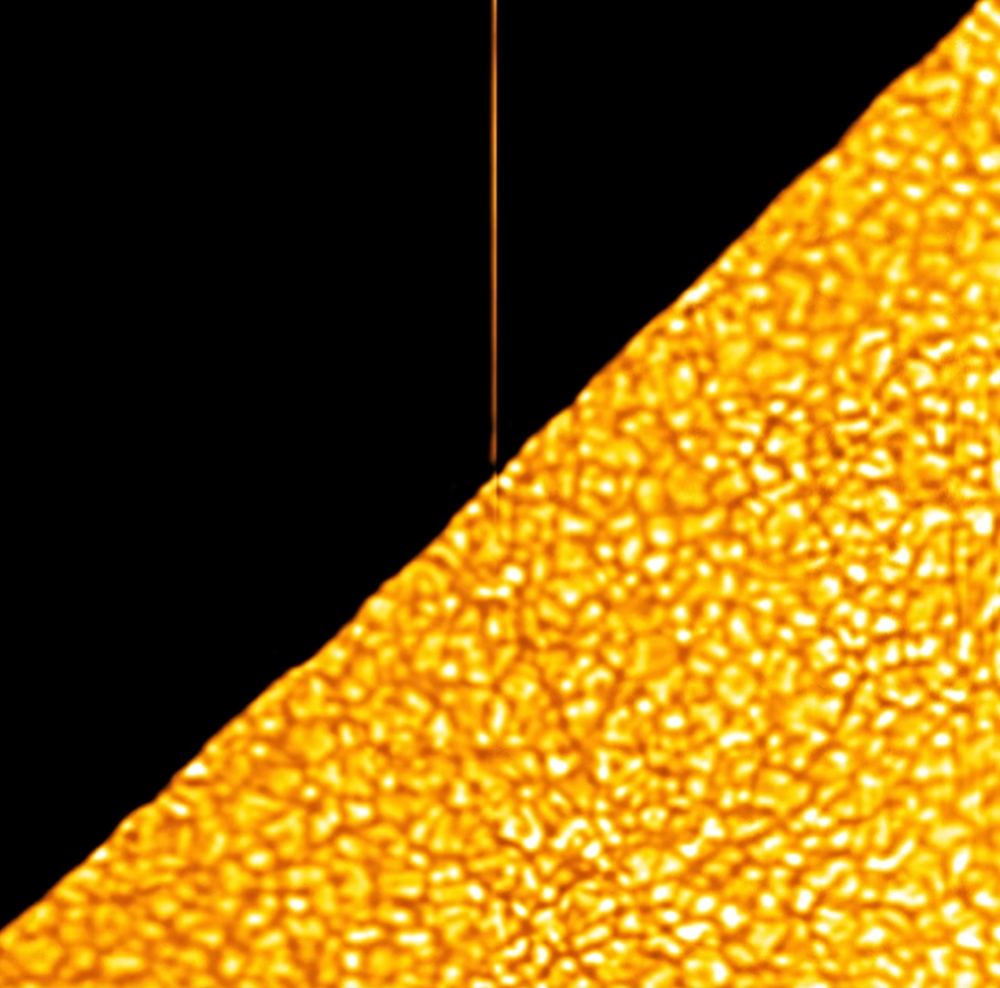
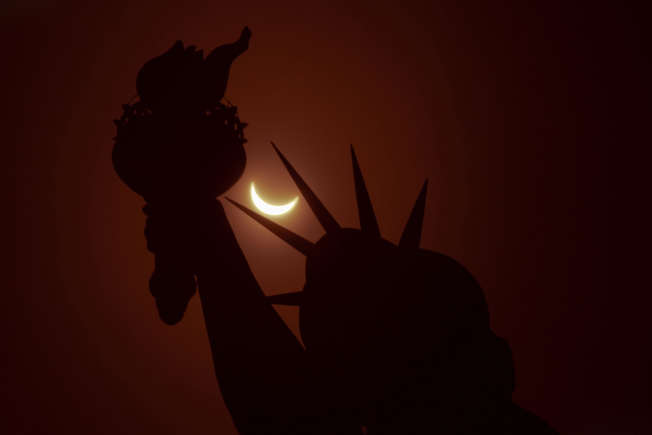
This image from the Inouye Solar Telescope shows the Moon blocking out part of the Sun during the April 8th solar eclipse. Image Credit: Credit: DKIST/NSO/NSF/AURA
You had to be in the right part of North America to get a great view of the recent solar eclipse. But a particular telescope may have had the most unique view of all. Even though that telescope is in Hawaii and only experienced a partial eclipse, its images are interesting.
You had to be in the right part of North America to get a great view of the recent eclipse. Image Credit: DKIST/NSO/NSF/AURA
The Daniel K. Inouye Solar Telescope (DKIST) is at the Haleakala Observatory in Hawaii. With its four-meter mirror, it’s the largest solar telescope in the world. It observes in visible to near-infrared light, and its sole target is the Sun. It can see features on the Sun’s surface as small as 20 km (12 miles.) It began science operations in February 2022, and its primary objective is to study the Sun’s magnetic fields.
This is a collage of solar images captured by the Inouye Solar Telescope. Images include sunspots and quiet regions of the Sun, known as convection cells. (Credit: NSF/AURA/NSO)
Though seeing conditions weren’t perfect during the eclipse and the eclipse was only partial when viewed from Hawaii, the telescope still gathered enough data to create a movie of the Moon passing in front of the Sun. The bumps on the Moon’s dark edge are lunar mountains.
“The team’s primary mission during Maui’s partial eclipse was to acquire data that allows the characterization of the Inouye’s optical system and instrumentation,” shares National Solar Observatory scientist Dr. Friedrich Woeger.
The Moon plays a critical role in measuring the telescope’s performance. Its edge is well-known and as a dark object in front of the Sun, it acts as a unique tool to measure the Inouye telescope’s performance and to understand the data it collects. Since the telescope has to correct for Earth’s turbulent atmosphere with adaptive optics, the Moon’s known qualities help researchers work with the telescope’s optical elements.
The Daniel Inouye Solar Telescope at the Haleakala Observatory on the Hawaiian island of Maui. Image Credit: DKIST/NSO
“With the Inouye’s high order adaptive optics system operating, the blurring due to the Earth’s atmosphere was greatly reduced, allowing for extremely high spatial resolution images of the moving lunar edge,” said Woeger. “The appearance of the edge is not straight but serrated because of mountain ranges on the Moon!” This serrated dark edge covers the granular convection pattern that governs the “surface of the Sun.”
The Inouye Solar Telescope studies the Sun’s magnetic fields, which drive space weather. What we see in the video is visually interesting, but there’s a lot of data behind it.
It’ll take several months to analyze all of the data it gathered during the eclipse.
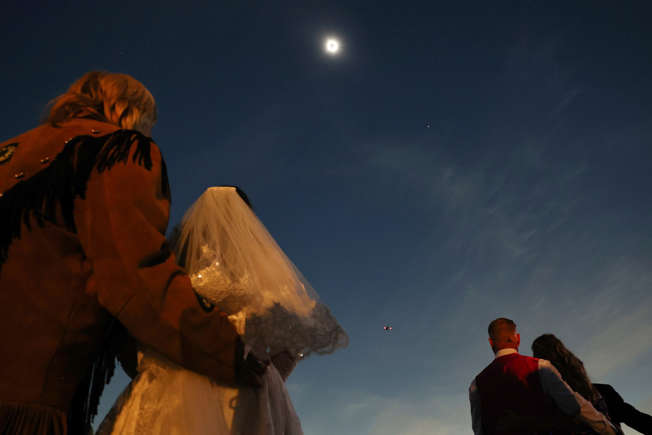
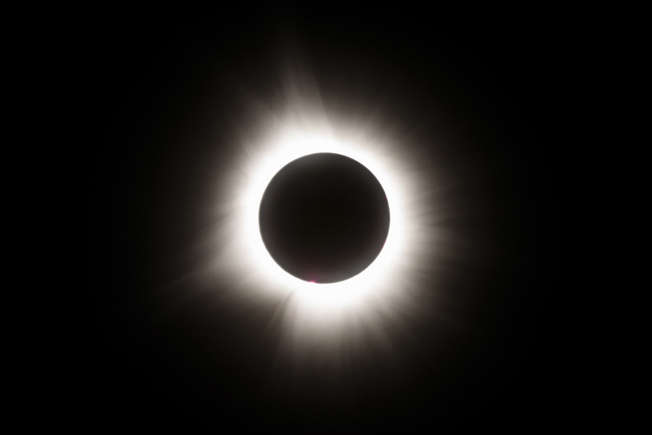
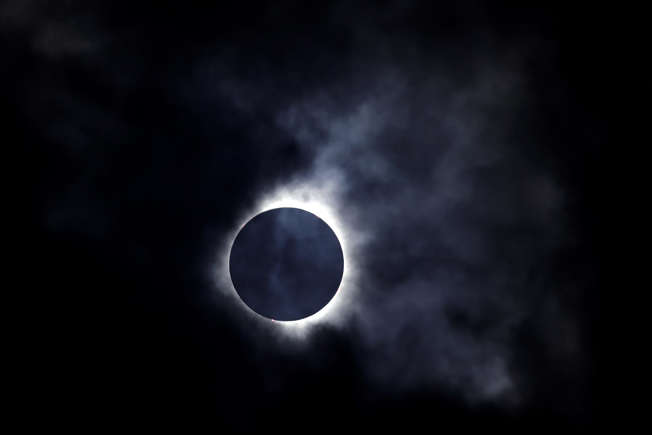
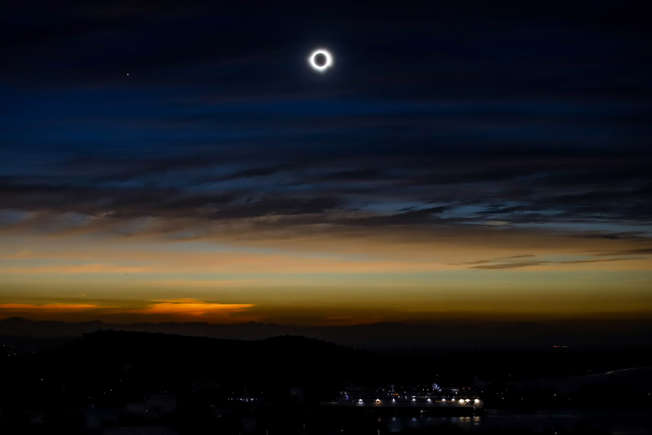
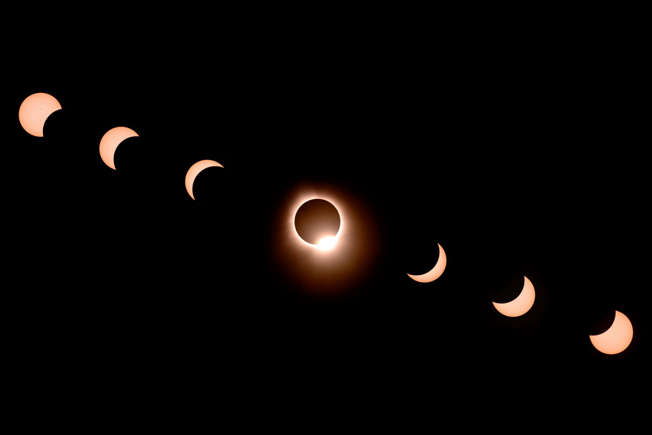
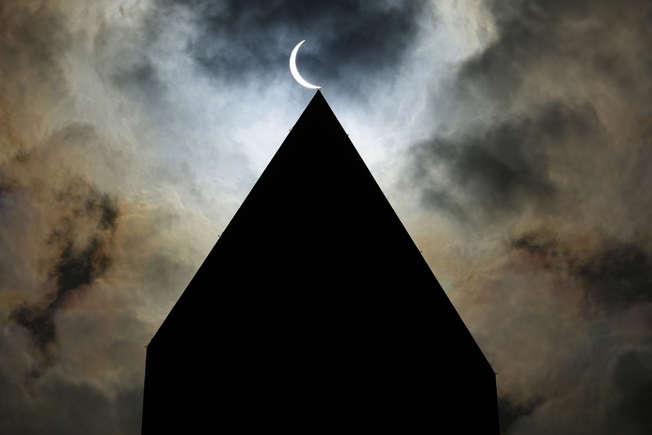
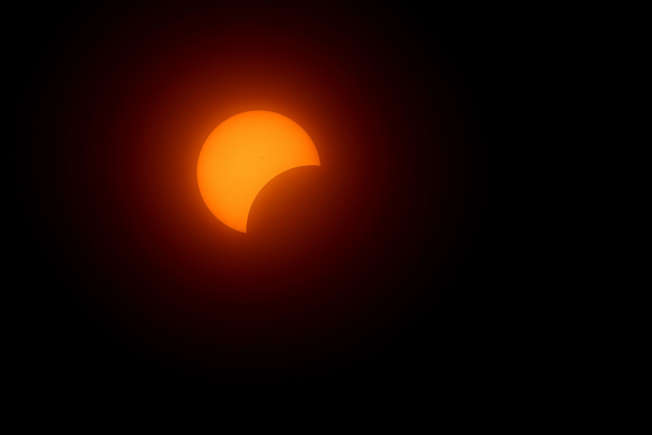
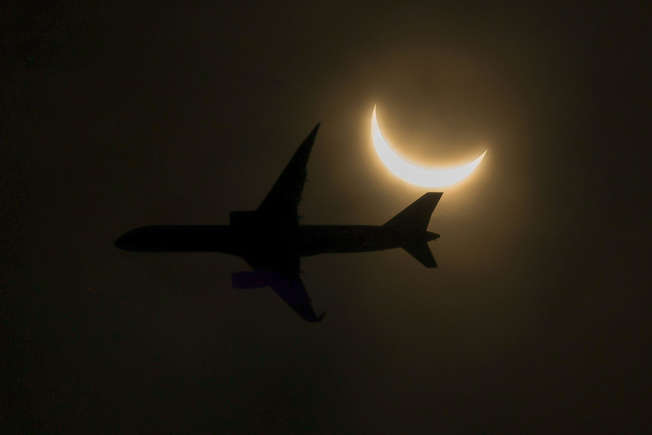
Amazing Amateur Images of April 8th’s Total Solar Eclipse
The last total solar eclipse across the Mexico, the U.S. and Canada for a generation wows observers.
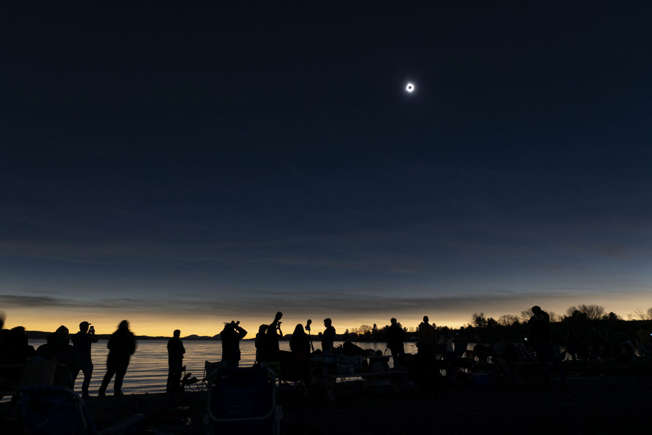
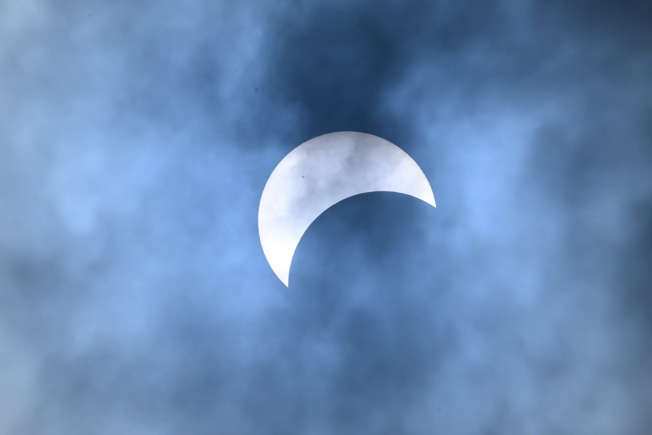
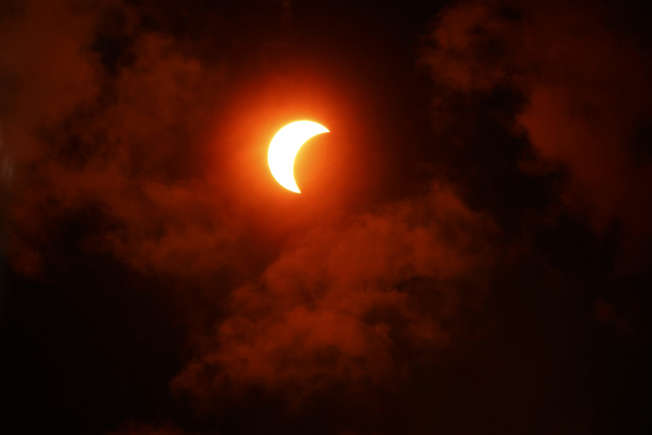
Did you see it? Last week’s total solar eclipse did not disappoint, as viewers from the Pacific coast of Mexico, across the U.S. from Texas to Maine and through the Canadian Maritime provinces were treated to an unforgettable show. The weather threw us all a curve-ball one week out, as favored sites in Texas and Mexico fought to see the event through broken clouds, while areas along the northeastern track from New Hampshire and Maine onward were actually treated to clear skies.
Many eclipse chasers scrambled to reposition themselves at the last minute as totality approached. In northern Maine, it was amusing to see tiny Houlton, Maine become the epicenter of all things eclipse-based.
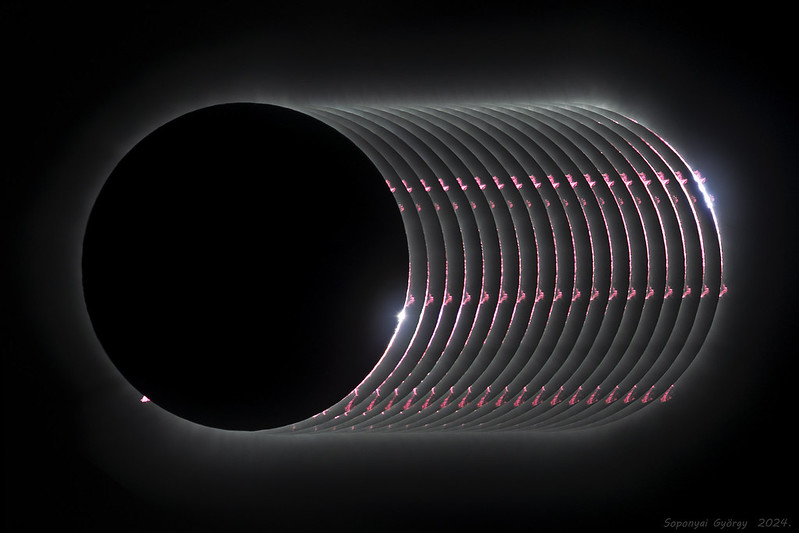
A composite of images snapped every five seconds during totality, showing off solar prominences. Credit: György Soponyai observing from Montreal, Canada.
Tales of a Total Solar Eclipse
We were also treated to some amazing images of the eclipse from Earth and space. NASA also had several efforts underway to chase the eclipse. Even now, we’re still processing the experience. It takes time (and patience!) for astro-photos to make their way through the workflow. Here are some of the best images we’ve seen from the path of totality:
Tony Dunn had an amazing experience, watching the eclipse from Mazatlan, Mexico. “When totality hit, it didn’t look real,” Dunn told Universe Today. “It looked staged, like a movie studio. the lighting is something that can’t be experienced outside a total solar eclipse.”
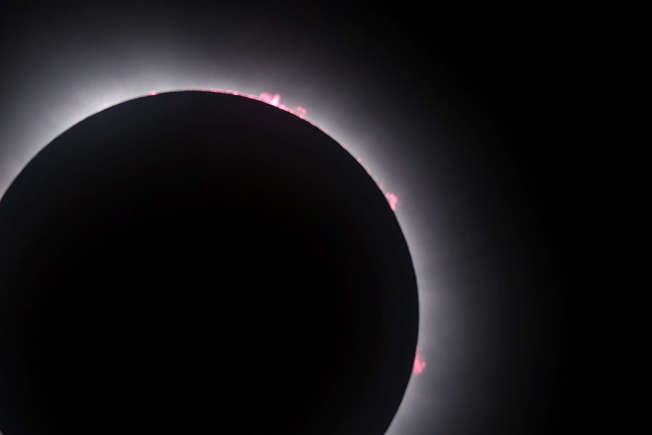
Totality on April 8th, with prominences. Credit: Tony Dunn.
Dunn also caught an amazing sight, as the shadow of the Moon moved across the low cloud cover:
Black Hole Sun
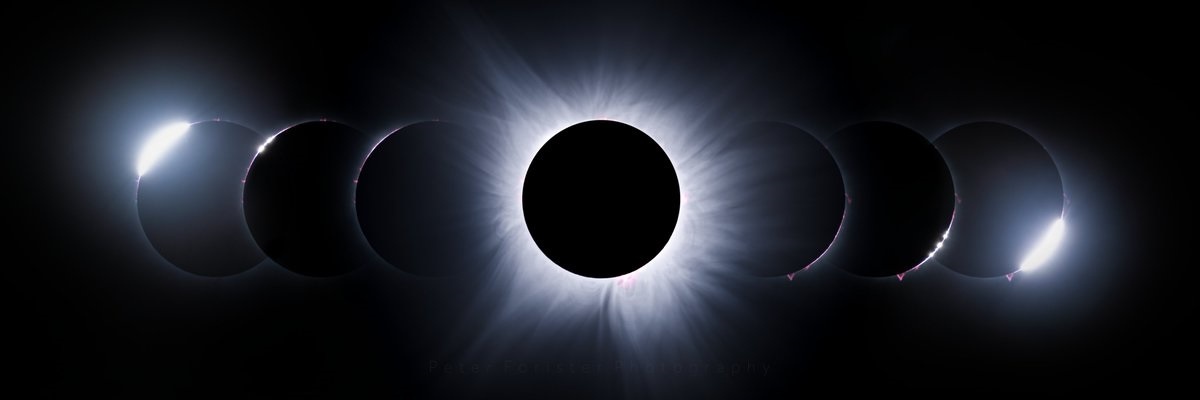
Peter Forister caught the eclipse from central Indiana. “It was my second totality (after 2017 in South Carolina), so I knew what was coming,” Forister told Universe Today. “But it was still as incredible and beautiful as anything I’ve ever seen in nature. The Sun and Moon seemed huge in my view—a massive black hole (like someone took a hole punch to the sky) surrounded by white and blue flames streaking out. Plus, there was great visibility of the planets and a few stars. The memory has been playing over and over in my head since it happened—and it’s combined with feelings of awe and wonder at how beautiful our Universe and planet really are. The best kind of memory!”
Totality over Texas. Credit: Eliot Herman
Like many observers, Eliot Herman battled to see the eclipse through clouds. “As you know, we had really frustrating clouds,” Herman told Universe Today. “I shot a few photos (in) which you can see the eclipse embedded in the clouds and then uncovered to show the best part. For me it almost seemed like a cosmic mocking, showing me what a great eclipse it was, and lifting the veil only at the end of the eclipse to show me what I missed…”
Totality and solar prominences seen through clouds. Credit: Eliot Herman
Totality Crosses Into Canada
Astrophotographer Andrew Symes also had a memorable view from Cornwall, Ontario. “While I’ve seen many beautiful photos and videos from many sources, they don’t match what those us there in person saw with our eyes,” Symes told Universe Today. “The sky around the Sun was not black but a deep, steely blue. The horizon was lighter–similar to what you’d see during a sunset or sunrise–but still very alien.”
“The eclipsed Sun looked, to me, like an incredibly advanced computer animation from the future! The Sun and corona were very crisp, and the Sun looked much larger in the sky than I’d expected. The eclipsed Sun had almost a three-dimensional quality… almost as if it were a dark, round button-like disk surrounded by a bright halo affixed to a deep blue/grey background. It was as if a ‘worm hole’ or black hole had somehow appeared in front of us. I’m sure my jaw dropped as it was truly a moment of utter amazement. I’m smiling as I type it now… and still awestruck as I recall it in my mind!”
An amazing eclipse. Credit: Andrew Symes.
Success for the Total Solar Eclipse in Aroostook County Maine
We were met with success (and clear skies) watching the total solar eclipse with family from our hometown of Mapleton, Maine. We were mostly just visually watching this one, though we did manage to nab a brief video of the experience.
What I was unprepared for was the switch from partial phases to totality. It was abrupt as expected, but there almost seemed to be brief but perceptible pause from day to twilight, as the corona seemed to ‘switch on.’ We all agreed later on that the steely blue sky was not quite night… but not quite twilight, either.
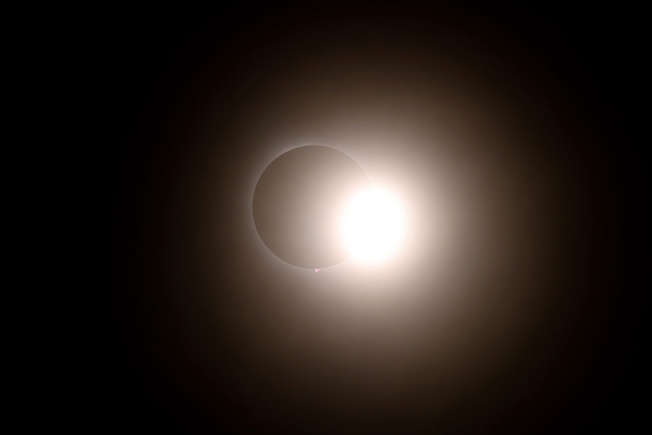
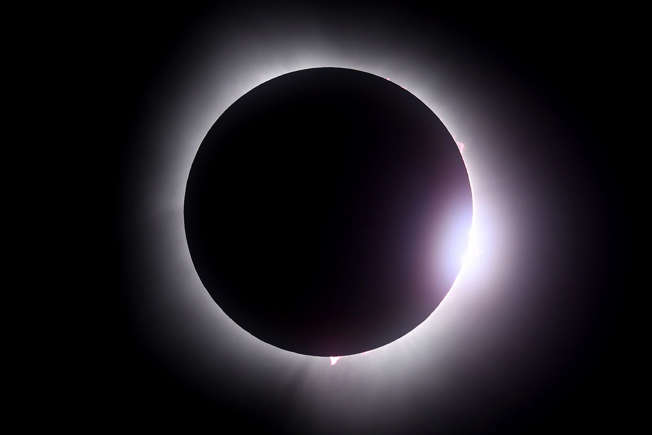
The elusive diamond ring, seen from Wappappello Lake, Missouri on April 8th. Credit: Chris Becke
When’s the next one? I often wonder how many watchers during a given eclipse were ‘bitten by the bug,’ and looking to chase the next one. Spain is set to see an eclipse a year for the next three years, starting in 2026:
Spain in August… be sure to stay cool and bring sunblock. Don’t miss the next total solar eclipse, and be thankful for our privileged vantage point in time and space.
Purple is the New Green: Purple Bacteria Could Dominate Wide Range of Exoplanetary Environments
Purple is the New Green: Purple Bacteria Could Dominate Wide Range of Exoplanetary Environments
With more than 5,500 detected exoplanets, the search for life is entering a new era. Using life on Earth as a guide, astrobiologists from Cornell University and the University of Minnesota looked beyond green landscapes to expand their ability to detect signs of surface life on other worlds. In new research, they characterized the reflectance spectra of a collection of purple sulfur and purple non-sulfur bacteria from a variety of environments.
To expand our baseline for finding life in the cosmos, Coelho et al. have measured the reflectance of purple bacteria that thrive across a range of anoxic and oxic environments.
Image credit: Sci.News.
From house plants and gardens to fields and forests, green is the color we most associate with surface life on Earth, where conditions favored the evolution of organisms that perform oxygen-producing photosynthesis using the green pigment chlorophyll a.
But an Earth-like planet orbiting another star might look very different, potentially covered by bacteria that receive little or no visible light or oxygen, as in some environments on Earth, and instead use invisible infrared radiation to power photosynthesis.
Instead of green, many such bacteria on Earth contain purple pigments, and purple worlds on which they are dominant would produce a distinctive ‘light fingerprint’ detectable by next-generation ground- and space-based telescopes.
“Purple bacteria can thrive under a wide range of conditions, making it one of the primary contenders for life that could dominate a variety of worlds,” said Dr. Lígia Fonseca Coelho, a postdoctoral researcher with the Carl Sagan Institute at Cornell University.
“We need to create a database for signs of life to make sure our telescopes don’t miss life if it happens not to look exactly like what we encounter around us every day,” added Dr. Lisa Kaltenegger, director of the Carl Sagan Institute at Cornell University.
For the study, the authors collected and grew samples of more than 20 purple sulfur and purple non-sulfur bacteria that may be found in a variety of environments, from shallow waters, coasts and marshes to deep-sea hydrothermal vents.
What are collectively referred to as purple bacteria actually have a range of colors including yellow, orange, brown and red due to pigments related to those that make tomatoes red and carrots orange.
They thrive on low-energy red or infrared light using simpler photosynthesis systems utilizing forms of chlorophyll that absorb infrared and don’t make oxygen.
They are likely to have been prevalent on early Earth before the advent of plant-type photosynthesis and could be particularly well-suited to planets that circle cooler red dwarf stars — the most common type in our Galaxy.
“They already thrive here in certain niches,” Dr. Coelho said.
“Just imagine if they were not competing with green plants, algae and bacteria: a red sun could give them the most favorable conditions for photosynthesis.”
After measuring the purple bacteria’s biopigments and light fingerprints, the researchers created models of Earth-like planets with varying conditions and cloud cover.
“Across a range of simulated environments, both wet and dry purple bacteria produced intensely colored biosignatures,” Dr. Coelho said.
“If purple bacteria are thriving on the surface of a frozen Earth, an ocean world, a snowball Earth or a modern Earth orbiting a cooler star, we now have the tools to search for them.”
The team’s work appears in the Monthly Notices of the Royal Astronomical Society.
Lígia Fonseca Coelho et al. 2024. Purple is the new green: biopigments and spectra of Earth-like purple worlds. MNRAS 530 (2): 1363-1368; doi: 10.1093/mnras/stae601
How Did Pluto Get Its Heart? Scientists Suggest an Answer
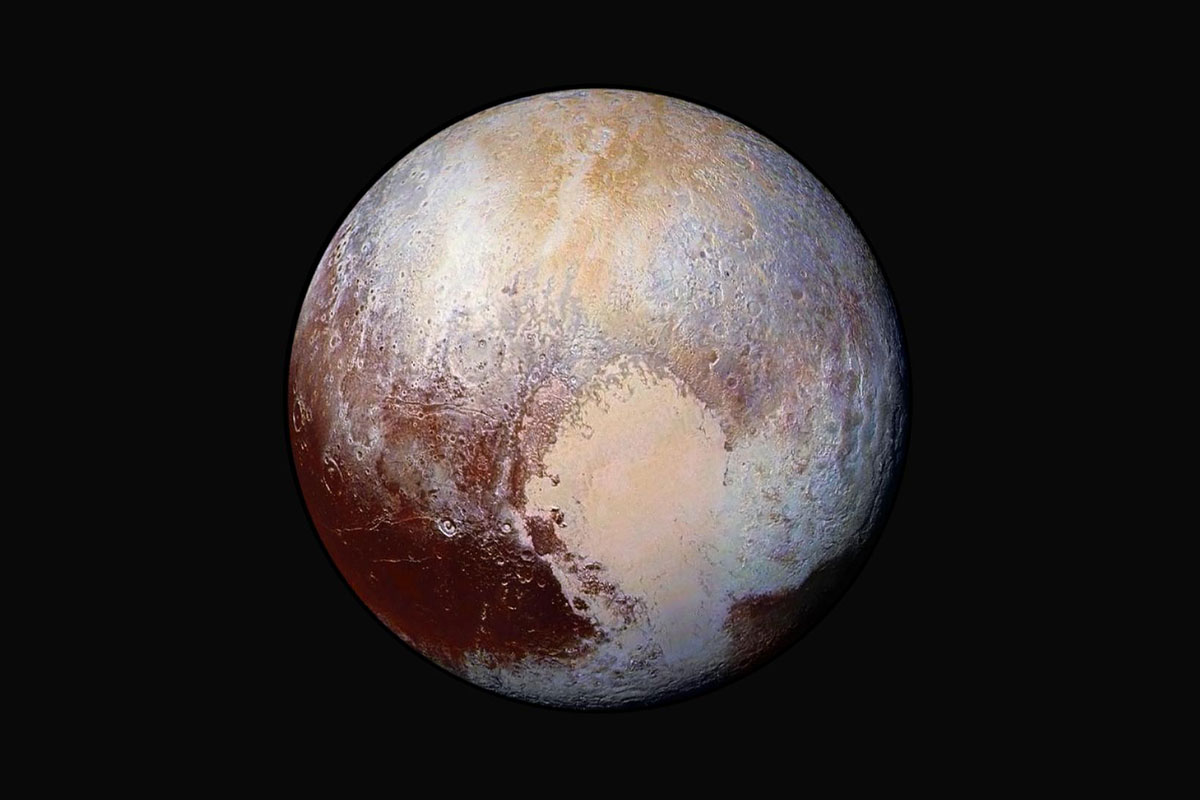
The most recognizable feature on Pluto is its “heart,” a relatively bright valentine-shaped area known as Tombaugh Regio. How that heart got started is one of the dwarf planet’s deepest mysteries — but now researchers say they’ve come up with the most likely scenario, involving a primordial collision with a planetary body that was a little more than 400 miles wide.
Astronomers from the University of Bern in Switzerland and the University of Arizona looked for computer simulations that produced dynamical results similar to what’s seen in data from NASA’s New Horizons probe. They found a set of simulations that made for a close match, but also ran counter to previous suggestions that Pluto harbors a deep subsurface ocean. They said their scenario doesn’t depend on the existence of a deep ocean — which could lead scientists to rewrite the history of Pluto’s geological evolution.
An artist’s conception shows the presumed collision of a planetary body with Pluto. (Thibaut Roger/University of Bern)
University of Arizona astronomer Adeene Denton, one of the study’s co-authors, said the formation of the heart “provides a critical window into the earliest periods of Pluto’s history.”
“By expanding our investigation to include more unusual formation scenarios, we’ve learned some totally new possibilities for Pluto’s evolution,” Denton said in a news release. Similar scenarios could apply to other objects in the Kuiper Belt, the ring of icy worlds on the edge of our solar system.
The study focuses on the western half of the heart, a roughly 1,000-mile-wide, teardrop-shaped region called Sputnik Planitia. That region contains an assortment of ices and is roughly 2.5 miles lower in elevation than the rest of Pluto. It’s clearly the result of a massive impact.
“While the vast majority of Pluto’s surface consists of methane ice and its derivatives, covering a water-ice crust, the Planitia is predominantly filled with nitrogen ice which most likely accumulated quickly after the impact due to the lower altitude,” said study lead author Harry Ballantyne, a research associate at the University of Bern.
The eastern half of the heart is covered by a similar but much thinner layer of nitrogen ice. The origins of that part of Tombaugh Regio are still unclear, but it’s probably related to the processes that shaped Sputnik Planitia.
Ballantyne and his colleagues ran a wide assortment of computer simulations for the ancient impact. Those simulations reflected a range of sizes and compositions for the impacting body, at different velocities and angles of approach. The best fit for Sputnik Planitia’s shape involved a 400-mile-wide object, composed of 15% rock, coming in at an angle of 30 degrees and hitting Pluto at a relatively low velocity.
Based on those parameters, the object would have plowed through Pluto’s surface with a splat. The resulting shape wouldn’t look like your typical impact crater. Instead, it would look like a bright, icy teardrop, with the rocky core of the impacting body ending up at the tail of the teardrop.
“Pluto’s core is so cold that the rocks remained very hard and did not melt despite the heat of the impact, and thanks to the angle of impact and the low velocity, the core of the impactor did not sink into Pluto’s core, but remained intact as a splat on it,” Ballantyne explained.
Previous scenarios for Sputnik Planitia’s origin relied on the presence of a deep ocean beneath Pluto’s surface to explain why the impact region hasn’t drifted toward Pluto’s nearest pole over time. But the researchers behind the newly published study found that the best matches in their simulations called for an ocean measuring no more than 30 miles in depth. “If the influence of ammonia proves negligible, Pluto might not possess a subsurface ocean at all, in accordance with our nominal case,” they wrote.
The researchers say they’ll continue their work to model Pluto’s geological history — and how those models could apply to other Kuiper Belt objects as well.
Stars at the outer edges of galaxies whirl around the galactic center far more swiftly than the laws of physics say they should. At even larger scales, galaxy clusters clump together in ways that should only be possible if the galaxies were more massive than they appear. And most of our models of how the Big Bang happened suggest that much more matter should have been created than we see.
Either there’s more to the universe than meets the eye, or the rules of physics work very differently than we think they do. Most astrophysicists and cosmologists (scientists who study the origins and evolution of the universe) today lean toward the first option: dark matter. But a few have devoted their efforts to finding a set of rules that could produce the universe we see, without dark matter.
Inverse spoke with experts in both fields about dark matter, the laws that make our universe work, and the quest to understand everything.
Most of the material in the universe is stuff we can’t see, can’t measure, and barely understand. Cue existential crisis in 3... 2... 1...
The things we can see in the universe — planets, stars, vast clouds of gas, and galaxies — make up only about 5 percent of what’s out there, according to physicists. Another 70 percent is dark energy, a little-understood force that’s driving the expansion of our universe (we know it’s expanding because astronomers have measured the way light waves from distant stars get stretched out as their sources accelerate away from us), and the remaining 25 percent is stuff called dark matter.
Dark matter doesn’t absorb, emit, or reflect light, and it doesn’t seem to interact with normal matter in most ways; theoretically, you could walk through a wall made of dark matter and never see it or feel it. The only rule of physics that dark matter seems to follow is gravity: It has mass, apparently, and that mass has gravity and forms a vital part of the scaffolding of galaxies, galaxy clusters, and the universe itself at a large scale.
As explanations go, dark matter sounds weird, but it works well. The amount of “extra” matter created in the Big Bang seems to match the amount of unseen mass in the universe. It balances physicists’ equations nicely and explains what we see in the universe around us.
But because dark matter doesn’t interact with light or matter, scientists haven’t yet actually detected it directly; they can only see how its gravity affects the universe around it. That leaves a little sliver of doubt and inspires some physicists and cosmologists to look for other ways to explain those effects.
One of the most popular alternatives to dark matter is called Modified Newtonian Dynamics, or MOND, and it proposes that gravity works a little differently than Isaac Newton first described it. The farther away an object is, the weaker its gravitational pull feels. According to MOND, gravity’s effect weakens slightly less over distance than it does in Newton’s original equations. That, allegedly, explains why galaxies seem to spin fast, as if they have a lot more mass on their outer edges than it appears.
MOND, and other modified ways of describing gravity, “are quite good at describing the properties of galaxies, but usually fail at describing the large-scale structure of the Universe,” astrophysicist Sébastien Comerón tells Inverse. And to replace dark matter, any new model of how the universe works has to explain everything we see, at large scales and small ones.
A recent study, led by cosmologist Rajendra Gupta, tackled that problem. Gupta suggested earlier this year that the universe might be 26.7 billion years old — nearly twice as old as all our evidence so far suggests — and that the laws of physics are much less consistent than we thought.
“I was trying to understand the so-called 'impossible early galaxy' problem,” Gupta tells Inverse. When astronomers peer into the distant, early universe with the James Webb Space Telescope (JWST), they see galaxies that look more massive and more neatly structured than they should; just 1 billion years after the Big Bang, galaxies shouldn’t have had time to pull so much mass together. (The same is true of some of the earliest supermassive black holes in the universe.)
Those precocious early galaxies challenge what we think we know about how supermassive black holes and galaxies form and evolve.
But Gupta tackled the “impossible early galaxies” problem by developing a new model of the universe, which would explain the precocious early galaxies. His model hinges on a century-old theory called tired light, which suggests that light actually loses energy as it travels across space. It also leans on another old theory that suggests the laws that govern how our universe works (like gravity) aren’t so constant after all — they weaken over distance. According to Gupta’s model, those changes add up to differences in how light appears by the time it reaches JWST, making the universe look younger than it is.
Some of the galaxies in this image are among the oldest ever seen by astronomers — and they’re suprisingly massive.
The model suggested another conclusion as well: Dark matter and dark energy don’t exist.
“The model yields matter content just enough for the Universe's ordinary matter; there is no room for dark matter. In fact, there is no dark energy in this model either,” says Gupta. “Accelerated expansion of the Universe, attributed to the dark energy, is due to the weakening of the forces of nature in the new model.”
But there are some problems with the idea, starting with the fact that both “tired light” and the idea of varying physical constants (like gravity) fell out of fashion among scientists a long time ago because they didn’t fit with observations about how the universe behaved.
“I think it is an interesting idea to explain the origin of recently discovered compact bright galaxies at high redshift with just varying two new parameters that determine the property of photons. However, it remains to be seen whether the model can explain the other phenomena,” cosmologist Kaiki Inoue tells Inverse. Those other phenomena include some inconsistences in how the cosmic microwave background looks in different directions, as well as how galaxy clusters and even larger-scale structures form. “So, in my opinion, it is an interesting idea but not a fully developed model,” says Inoue.
DON’T BET AGAINST DARK MATTER
NGC 1277, seen here in an image from the venerable Hubble Space Telescope, appears to contain no dark matter. Most galaxies are surrounded by an unseen halo of the mysterious stuff, so NGC 1277 is strange and interesting.
“It is worth doing exploratory work outside the box,” says Comerón. “But the likelihood of this particular avenue being the one that solves the problems in cosmology is rather low in my opinion.”
It’s not clear yet whether modified gravity theories, like MOND, actually fit well with Gupta’s proposed model of the universe, either.
One of the best arguments in favor of dark matter may be its inconsistency. Comerón and his colleagues recently discovered a galaxy that apparently contains no dark matter — which is weird but not unheard of. And if we’re seeing not invisible, undetectable matter, but different laws of physics, those laws should apply to all galaxies in the same way.
“I have sometimes been attracted by the idea of alternative gravities myself, but the discovery of the odd properties of NGC 1277 leaves me little doubt that dark matter exists,” says Comerón. “If dark matter could be explained by a modification of gravities, it would be odd to have gravity modified in all galaxies except in a few. On the other hand, one could conceive mechanisms to remove dark matter from galaxies that have got a peculiar formation or interaction history.”
And that seems to be the consensus among most astrophysicists and cosmologists. So far, no one has figured out how to directly measure dark matter — and until they do, there will always be at least a little room for debate about its existence. But Inoue and his colleagues recently used gravitational lensing to map how dark matter is distributed along one narrow swath of the universe, and others are busily trying to work out exactly what it’s made of and how it behaves.
“I would not bet any money against dark matter,” says Comerón.
In August 2021, the ESA/JAXA Mercury-bound BepiColombo spacecraft performed its secondflyby of Venus and provided a short-lived observation of its induced magnetosphere. The spacecraft detected cold oxygen and carbon ions at a distance of about six planetary radii in a region of the magnetosphere that has never been explored before.
Schematic view of planetary material escaping through Venus magnetosheath flank; the red line and arrow show the region and direction of observations by BepiColombo when the escaping ions (C+, O+, H+) were observed.
Image credit: Thibaut Roger / Europlanet 2024 RI / Hadid et al.
During its formation, Venus was similar to Earth in many ways, including the existence of substantial amounts of liquid water.
However, Venus eventually evolved in a divergent way, leading to substantial differences between the two planets.
Unlike Earth, Venus is now an extremely dry planet that lacks an intrinsic magnetic field.
The continuous impact of the solar wind on the atmospheres of both planets results in important atmospheric losses.
The atmosphere of Venus, predominantly composed of carbon dioxide with smaller amounts of nitrogen and other minor species, is affected by interactions with the solar wind, leading to important ion outflows.
“This is the first time that positively charged carbon ions have been observed escaping from Venus’ atmosphere,” said Dr. Lina Hadid, a researcher at the Plasma Physics Laboratory and CNRS.
“These are heavy ions that are usually slow moving, so we are still trying to understand the mechanisms that are at play.”
“It may be that an electrostatic ‘wind’ is lifting them away from the planet, or they could be accelerated through centrifugal processes.”
“Unlike Earth, Venus does not generate an intrinsic magnetic field in its core.”
“Nonetheless, a weak, comet-shaped ‘induced magnetosphere’ is created around the planet by the interaction of charged particles emitted by Sun (solar wind) with electrically charged particles in Venus’ upper atmosphere.”
“Draped around the magnetosphere is a region called the ‘magnetosheath’ where the solar wind is slowed and heated.”
On August 10, 2021, BepiColombo passed by Venus to slow down and adjust course towards its final destination of Mercury.
The spacecraft swooped up the long tail of the planet’s magnetosheath and emerged through the nose of the magnetic regions closest to the Sun.
Over a 90-minute period of observations, BepiColombo’s Mass Spectrum Analyzer (MSA) and the Mercury Ion Analyzer (MIA) measured the number and mass of charged particles it encountered, capturing information about the chemical and physical processes driving atmospheric escape in the flank of the magnetosheath.
“Characterizing the loss of heavy ions and understanding the escape mechanisms at Venus is crucial to understand how the planet’s atmosphere has evolved and how it has lost all its water,” said MSA’s principal investigator Dr. Dominique Delcourt, a researcher at the Plasma Physics Laboratory.
“This result shows the unique results that can come out of measurements made during planetary flybys, where the spacecraft may move through regions generally unreachable by orbiting spacecraft,” said Dr. Nicolas André, a researcher at the Institut de Recherche en Astrophysique et Planétologie.
The study was published in the journal Nature Astronomy.
L.Z. Hadid et al. BepiColombo observations of cold oxygen and carbon ions in the flank of the induced magnetosphere of Venus. Nat Astron, published online April 12, 2024; doi: 10.1038/s41550-024-02247-2
SpaceX's Starship, the largest rocket in the world, will get even bigger as the company continues to target Mars missions in the future.
Elon Musk, the billionaire founder of SpaceX, told employees on April 4 that Starship will eventually be as tall as 500 feet (150 meters), roughly 20 percent higher than the massive system aboard the Super Heavy rocket right now.
What's more, advances in reusability will have each launch cost roughly $3 million each, Musk predicted; that's less than a third of what a (much smaller) Falcon 1 rocket launch cost in 2004 when inflation is taken into account. (The figure two decades ago was $5.9 million, according to NBC, which is roughly $9.5 million in 2024 dollars.)
"These are sort of unthinkable numbers," Musk said in the Starship update, released publicly April 6, roughly one month after the third and last test flight to date. "Nobody ever thought that this was possible, but we're not breaking any physics to achieve this. So this is within the bounds, without breaking physics. We can do this."
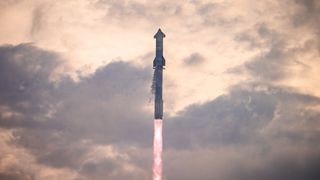
SpaceX Starship during a launch.(Image credit: SpaceX via X)
Musk tends to deliver Starship updates at least once ayear to highlight progress the company is making toward its long-term plans of settling Mars. Indeed, the last year has seen three Starship launches, so there has been progress made recently. Musk didn't, however, address delays in launching Starship that have contributed to pushing back the launch date for the first moon landing under the NASA-led Artemis program.
SpaceX was named the vendor for the Artemis 3 landing mission that, until recently, was set for 2025. In January, NASA elected to hold the launch date another year, to 2026, due to a range of technical issues. Aside from Starship not being ready — the agency wants many successful launches before approving it for astronaut flights — Artemis 3 was also delayed due to slow progress on spacesuits and problems with the mission's Orion spacecraft, among other factors.
However, Musk's words about Artemis, to employees, focused on Starship's future capabilities: orbiting the Earth and refilling its tanks, both of which have yet to be proven on its three test flights.
"This will ... be very important for the Artemis program for the NASA to get back to the moon," Musk said of those capabilities. He also envisions a "Moon Base Alpha" that would include ships "specialized for going to and from the moon", meaning there would be no heat shield or flaps due to the lack of atmosphere.
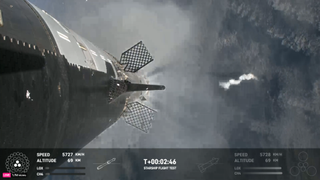
SpaceX Starship Flight 3 launch on March 14, 2024. (Image credit: SpaceX)
Musk's 45-minute speech touched on the usual themes for his Red Planet updates, focusing on how to send a lot of cargo out there for eventual settlers. He noted that would take thousands of launches to do; for perspective, Musk said the company has completed 327 successful Falcon series launches and about 80 percent of those had reused boosters (a key factor in reducing cost.)
SpaceX is by far the most active launching entity on Earth, and Musk forecasts the company will send roughly 90 percent of orbital mass aloft this year compared to China's 6 percent (the second-largest entity.)
Starship's next and fourth spaceflight attempt, expected to take place in May, aims to have the first stage of Super Heavy land "on essentially a virtual tower" in the Gulf of Mexico, Musk said. Once the company safely gets that done, they will consider using the launching area at Starbase, in south Texas, for future landings as soon as Flight 5. (Musk pegged the chances of success on Flight 4 at 80% or 90%.)
Musk also wants to perform two splashdowns of the upper stage of Starship in a row, in a controlled fashion, before sending it to Starbase on a future flight. "We do not want to rain debris over Mexico or the U.S.," he said. "My guess is probably next year when we will be able to reuse Starship."
Overall, Musk plans for multiple Starship launches to take place this year, and suggests SpaceX will build an additional six spacecraft by the end of 2024. A new rocket factory for the company should be available in 2025, which would make production even faster.
Future versions of Starship will include a "Starship 2" to send 100 tons of payload to low-Earth orbit and the 500-foot "Starship 3" for 200 or more tons. Bigger vehicles, Musk stressed, will mean fewer (four or five) refueling missions in low Earth orbit to get a Starship ready for the journey to Mars someday.
Of these milestones, Musk said it would be "very much a success-oriented schedule." His speech did not mention the Federal Aviation Administration, which must approve each one of the launches, nor ongoing criticism of the environmental impact of Starship on the ecologically sensitive area near Starbase.
That impact may continue to grow, as Musk said it would take roughly 10 launches a day to send hundreds of vehicles to Mars every two years (when the planet is closest) to make a long-term settlement feasible. As for the number of Mars-bound people, that would be roughly a million folks, he said — that matches predictions he made at least as far back as 2017. Musk also says he wants to get the settlement going "in 20 years." He said the same thing in 2011.
Astronomers operating the CSIRO’s Parkes radio telescope in Australia say they have detected unusual radio signals from Earth’s closest magnetar that are “behaving in complex ways.”
A previous dormant star with a powerful magnetic field, XTE J1810-197, is only 8,000 light years away, making it the closest such star to Earth. However, unlike a typical magnetar that emits polarized light, this magnetar appears to be sending out radio waves that are circularly polarized. That means the light appears to spiral as it moves through the universe. Such a discovery was not only unexpected; a press release announcing the discovery said, “It is totally unprecedented.”
”Unlike the radio signals we’ve seen from other magnetars, this one is emitting enormous amounts of rapidly changing circular polarization,” said Dr. Marcus Lower, a postdoctoral fellow at Australia’s national science agency – CSIRO, and the leader of the research effort. “We had never seen anything like this before.”
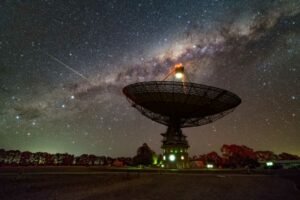
Murriyang, CSIRO’s Parkes radio telescope beneath the Milky Way. Image Credit: Alex Cherney/CSIRO.
The study’s co-author, University of Sydney’s Dr. Manisha Caleb, agrees, noting that the readings don’t match any previous radio signals coming from magnetars. In fact, they don’t even match theoretical models that try to predict the behavior of various cosmological phenomena.
”The signals emitted from this magnetar imply that interactions at the surface of the star are more complex than previous theoretical explanations,” Caleb explained.
Deepening the mystery behind the unusual radio signals is the fact that simply detecting any type of radio emission from a magnetar is extremely rare. According to the researchers who spotted the signals coming from XTE J1810-197, it is only one of a handful of magnetars astronomers have found that emit radio waves.
Further adding to the mystery is the fact that the signals were first detected back in 2003 before they suddenly went silent. Then, in 2018, astronomers using the University of Manchester’s 76-m Lovell telescope at the Jodrell Bank Observatory saw that the signals had returned. That data was quickly followed up by Murriyang, the CSIRO instrument that detected these most recent signals.
While there is no immediate explanation for the cause of the unusual radio signals, the researchers say that their complex behavior has led to an equally unusual theory.
“Our results suggest there is a superheated plasma above the magnetar’s magnetic pole, which is acting like a polarising filter,” Dr. Lower said. Still, the researcher admits it is only a theory, and concedes that explaining how exactly the plasma is doing this “is still to be determined.”
Follow-up studies will likely be required to answer the mystery behind the complex and unusual radio waves coming from Earth’s closest magnetar. Fortunately, the researchers note that the 64-meter diameter telescope is equipped with “a cutting-edge ultra-wide bandwidth receiver” that is perfect for the job.
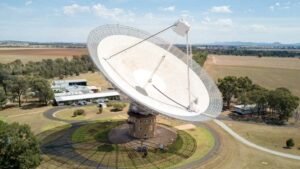
Murriyang, CSIRO’s Parkes radio telescope. Image Credit: CSIRO/Red Empire Media.
“The receiver allows for more precise measurements of celestial objects, especially magnetars,” the researchers explain, “as it is highly sensitive to changes in brightness and polarisation across a broad range of radio frequencies.
While it may be a long time before we know conclusively what is behind the unusual radio signals, the researchers behind this latest discovery, which is published in the journal Nature Astronomy, say that studying magnetars is crucial to understanding a great many mysteries of the universe.
“Studies of magnetars such as these provide insights into a range of extreme and unusual phenomena,” the release explains, “such as plasma dynamics, bursts of X-rays and gamma-rays, and potentially fast radio bursts.”
Christopher Plain is a Science Fiction and Fantasy novelist and Head Science Writer at The Debrief. Follow and connect with him onX,learn about his books atplainfiction.com, or email him directly atchristopher@thedebrief.org.
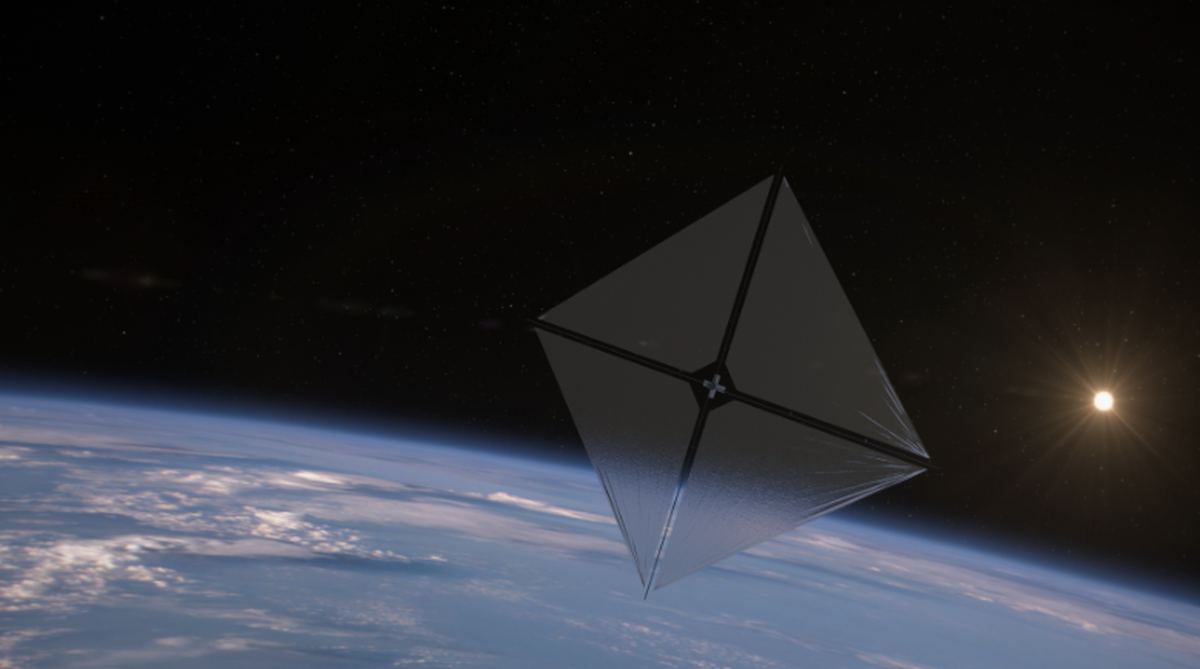
NASA is about to launch and test a new solar sail. Called the Advanced Composite Solar Sail System, it could advance future space travel and expand our understanding of our Sun and Solar System. Credits: NASA’s Ames Research Center
Everyone knows that solar energy is free and almost limitless here on Earth. The same is true for spacecraft operating in the inner Solar System. But in space, the Sun can do more than provide electrical energy; it also emits an unending stream of solar wind.
Solar sails can harness that wind and provide propulsion for spacecraft. NASA is about to test a new solar sail design that can make solar sails even more effective.
Solar pressure pervades the entire Solar System. It weakens with distance, but it’s present. It affects all spacecraft, including satellites. It affects longer-duration spaceflights dramatically. A spacecraft on a mission to Mars can be forced off course by thousands of kilometres during its voyage by solar pressure. The pressure also affects a spacecraft’s orientation, and they’re designed to deal with it.
Though it’s a hindrance, solar pressure can be used to our advantage.
A few solar sail spacecraft have been launched and tested, beginning with Japan’s Ikaros spacecraft in 2010. Ikaros proved that radiation pressure from the Sun in the form of photons can be used to control a spacecraft. The most recent solar sail spacecraft is the Planetary Society’s LightSail 2, launched in 2019. LightSail 2 was a successful mission that lasted over three years.
The Red Sea and the Nile River, from the LightSail 2 spacecraft. LightSail 2 was a successful demonstration mission that lasted more than two years. Image Credit: The Planetary Society.
Solar sail spacecraft have some advantages over other spacecraft. Their propulsion systems are extremely lightweight and never run out of fuel. Solar sail spacecraft can perform missions more cheaply than other spacecraft and can last longer, though they have limitations.
The solar sail concept is now proven to work, but the technology needs to advance for it to be truly effective. A critical part of a solar sail spacecraft is its booms. Booms support the sail material; the lighter and stronger they are, the more effective the spacecraft will be. Though solar sails are much lighter than other spacecraft, the weight of the booms is still a hindrance.
“Booms have tended to be either heavy and metallic or made of lightweight composite with a bulky design – neither of which work well for today’s small spacecraft.”
Keats Wilkie, ACS3 principal investigator, NASA
NASA is about to launch a new solar sail design with a better support structure. Called the Advanced Composite Solar Sail System (ACS3), it’s stiffer and lighter than previous boom designs. It’s made of carbon fibre and flexible polymers.
Though solar sails have many advantages, they also have a critical drawback. They’re launched as small packages that must be unfurled before they start working. This operation can be fraught with difficulties and induces stress in the poor ground crew, who have to wait and watch to see if it’s successful.
This image shows the ACS3 being unfurled at NASA’s Langley Research Center. The solar wind is reliable but not very powerful. It requires a large sail area to power a spacecraft effectively. The ACS2 is about 9 meters (30 ft) per side, requiring a strong, lightweight boom system. Image Credit: NASA
ACS3 will launch with a twelve-unit (12U) CubeSat built by NanoAvionics. The primary goal is to demonstrate boom deployment, but the ACS3 team also hopes the mission will prove that their solar sail spacecraft works.
To change direction, the spacecraft angles its sails. If boom deployment is successful, the ACS3 team hopes to perform some maneuvers with the spacecraft, angling the sails and changing the spacecraft’s orbit. The goal is to build larger sails that can generate more thrust.
“The hope is that the new technologies verified on this spacecraft will inspire others to use them in ways we haven’t even considered.”
Alan Rhodes, ACS3 lead systems engineer, NASA’s Ames Research Center
The ACS3 boom design is made to overcome a problem with booms: they’re either heavy and slim or light and bulky.
“Booms have tended to be either heavy and metallic or made of lightweight composite with a bulky design – neither of which work well for today’s small spacecraft,” said NASA’s Keats Wilkie. Wilke is the ACS3 principal investigator at Langley Research Center. “Solar sails need very large, stable, and lightweight booms that can fold down compactly. This sail’s booms are tube-shaped and can be squashed flat and rolled like a tape measure into a small package while offering all the advantages of composite materials, like less bending and flexing during temperature changes.”
ACS3 will launch from Rocket Lab’s launch complex 1 on New Zealand’s north island. Image Credit: Rocket Lab
ACS3 will be launched on an Electron rocket from Rocket Lab’s launch complex in New Zealand. It’ll head for a Sun-synchronous orbit 1,000 km (600 miles) above Earth. Once it arrives, the spacecraft will unroll its booms and deploy its sail. It’ll take about 25 minutes to deploy the sail, with a photon-gathering area of 80 square meters, or about 860 square feet. That’s much larger than Light Sail 2, which had a sail area of 32 square meters or about 340 square feet.
As it deploys itself, cameras on the spacecraft will watch and monitor the shape and symmetry. The data from the maneuvers will feed into future sail designs.
“Seven meters of the deployable booms can roll up into a shape that fits in your hand,” said Alan Rhodes, the mission’s lead systems engineer at NASA’s Ames Research Center. “The hope is that the new technologies verified on this spacecraft will inspire others to use them in ways we haven’t even considered.”
ACS3 is part of NASA’s Small Spacecraft Technology program. The program aims to deploy small missions that demonstrate unique capabilities rapidly. With unique composite and carbon fibre booms, the ACS3 system has the potential to support sails as large as 2,000 square meters, or about 21,500 square feet. That’s about half the area of a soccer field. (Or, as our UK friends mistakenly call it, a football field.)
With large sails, the types of missions they can power change. While solar sails have been small demonstration models so far, the system can potentially power some serious scientific missions.
“The Sun will continue burning for billions of years, so we have a limitless source of propulsion. Instead of launching massive fuel tanks for future missions, we can launch larger sails that use “fuel” already available,” said Rhodes. “We will demonstrate a system that uses this abundant resource to take those next giant steps in exploration and science.”
A solar flare as it appears in extreme ultraviolet light. The Sun is a free source of energy that’s not going away anytime soon, yet it’s also hazardous. Credit: NASA/SFC/SDO
Solar sail spacecraft don’t have the instantaneous thrust that chemical or electrical propulsion systems do. But the thrust is constant and never really wavers. They can do things other spacecraft struggle to do, such as taking up unique positions that allow them to study the Sun. They can serve as early warning systems for coronal mass ejections and solar storms, which pose hazards.
The new composite booms also have other applications. Since they’re so lightweight, strong, and compact, they could serve as the structural framework for lunar and Mars habitats. They could also be used to support other structures, like communication systems. If the system works, who knows what other applications it may serve?
“This technology sparks the imagination, reimagining the whole idea of sailing and applying it to space travel,” said Rudy Aquilina, project manager of the solar sail mission at NASA Ames. “Demonstrating the abilities of solar sails and lightweight, composite booms is the next step in using this technology to inspire future missions.”
Could Life Exist in Water Droplet Worlds in Venus’ Atmosphere?
It’s a measure of human ingenuity and curiosity that scientists debate the possibility of life on Venus. They established long ago that Venus’ surface is absolutely hostile to life. But didn’t scientists find a biomarker in the planet’s clouds? Could life exist there, never touching the planet’s sweltering surface?
It seems to depend on who you ask.
We’ll start with phosphine.
Phosphine is a biomarker, and in 2020, researchers reported the detection of phosphine in Venus’ atmosphere. There should be no phosphine because phosphorous should be oxidized in the planet’s atmosphere. According to the paper, no abiotic source could explain the quantity found, about 20 ppb.
Subsequently, the detection was challenged. When others tried to find it, they couldn’t. Also, the original paper’s authors informed everyone of an error in their data processing that could’ve affected the conclusions. Those authors examined the issue again and mostly stood by their original detection.
At this point, the phosphine issue seems unsettled. But if it is present in Venus’ atmosphere and is biological in nature, where could it be coming from? Venus’s surface is out of the question.
That leaves Venus’ cloud-filled atmosphere as the only abode of life. While the idea might seem ridiculous at first glance, researchers have dug into the idea and generated some interesting results.
In a new paper, researchers examine the idea of microscopic life that lives and reproduces in water droplets in Venus’s clouds. The title is “Necessary Conditions for Earthly Life Floating in the Venusian Atmosphere.” The lead author is Jennifer Abreu from the Department of Physics and Astronomy, Lehman College, City University of New York. The paper is currently in pre-print.
Spacecraft have struggled to contend with the harsh conditions on Venus’s surface. The Soviet Venera 13 lander captured this image of the planet’s surface in March of 1982. NASA/courtesy of nasaimages.org
“It has long been known that the surface of Venus is too harsh an environment for life,” the authors write. “Contrariwise, it has long been speculated that the clouds of Venus offer a favourable habitat for life but regulated to be domiciled at an essentially fixed altitude.” So, if life existed in the clouds, it wouldn’t be spread throughout. Only certain altitudes appear to have what’s needed for life to survive.
The type of life the authors envision aligns with other thinking about Venusian atmospheric life. “The archetype living thing <being> the spherical hydrogen gasbag isopycnic organism,” they state. (Isopycnic means constant density; the other terms are self-explanatory.)
Here’s how the authors think it could work.
Venus is shrouded in clouds so thick we can only see the surface with radar. The clouds reach all the way around the globe. The cloud base is about 47 km (29 miles) from the surface, where the temperature is about 100 C (212 F.) At equatorial and mid-latitudes, they extend up to a 74 km (46 miles) altitude, and at the poles, they extend up to about 65 km (40 miles.)
Cloud structure in the Venusian atmosphere in 2016, revealed by observations in two ultraviolet bands by the Japanese spacecraft Akatsuki. Image Credit: Kevin M. Gill
The clouds can be subdivided into three layers based on the size of aerosol particles: the upper layer from 56.5 to 70 km altitude, the middle layer from 50.5 to 56.5 km, and the lower layer from 47.5 to 50.5 km. The smallest droplets can float in all three layers. But the largest droplets, which the authors call type 3 droplets with a radius of 4 µm, are only present in the middle and lower layers.
“It has long been suspected that the cloud decks of Venus offer an aqueous habitat where microorganisms can grow and flourish,” the authors write. Everything life needs is there: “Carbon dioxide, sulfuric acid compounds, and ultraviolet (UV) light could give microbes food and energy.”
Because of temperature, life in Venus’ clouds would be restricted to a specific altitude range. At 50 km, the temperature is between 60 and 90 degrees Celsius (140 and 194 degrees Fahrenheit). The pressure at that altitude is about 1 Earth atmosphere.
This figure from the research shows the temperature and pressure throughout Venus’s atmosphere. Image Credit: Image Credit: S. Seager et al. 2021. doi:10.1089/ast.2020.2244
There’s a precedent for life existing in the clouds. It happens here on Earth, where scientists have observed bacteria, pollen, and even algae at altitudes as high as 15 km (9.3 miles.) There’s even evidence of bacteria growing in droplets in a super-cooled cloud high in the Alps. The understanding is that these organisms were carried aloft by wind, evaporation, eruptions, or even meteor impacts. But there’s an important difference between Earth’s and Venus’ clouds.
Earth’s clouds are transient. They form and dissolve constantly. But Venus’ clouds are long-lasting. They’re a stable environment compared to Earth’s clouds. In Earth’s clouds, aerosol particles are sustained for only a few days, while in Venus’ clouds, the particles can be sustained for much longer periods of time.
Add it all up, and you get stable cloud environments where aerosol particles can sustain themselves in an environment where energy and nutrients are available. The researchers say that though eventually aerosol particles and the life within them will fall to the surface, they have time to reproduce before that happens.
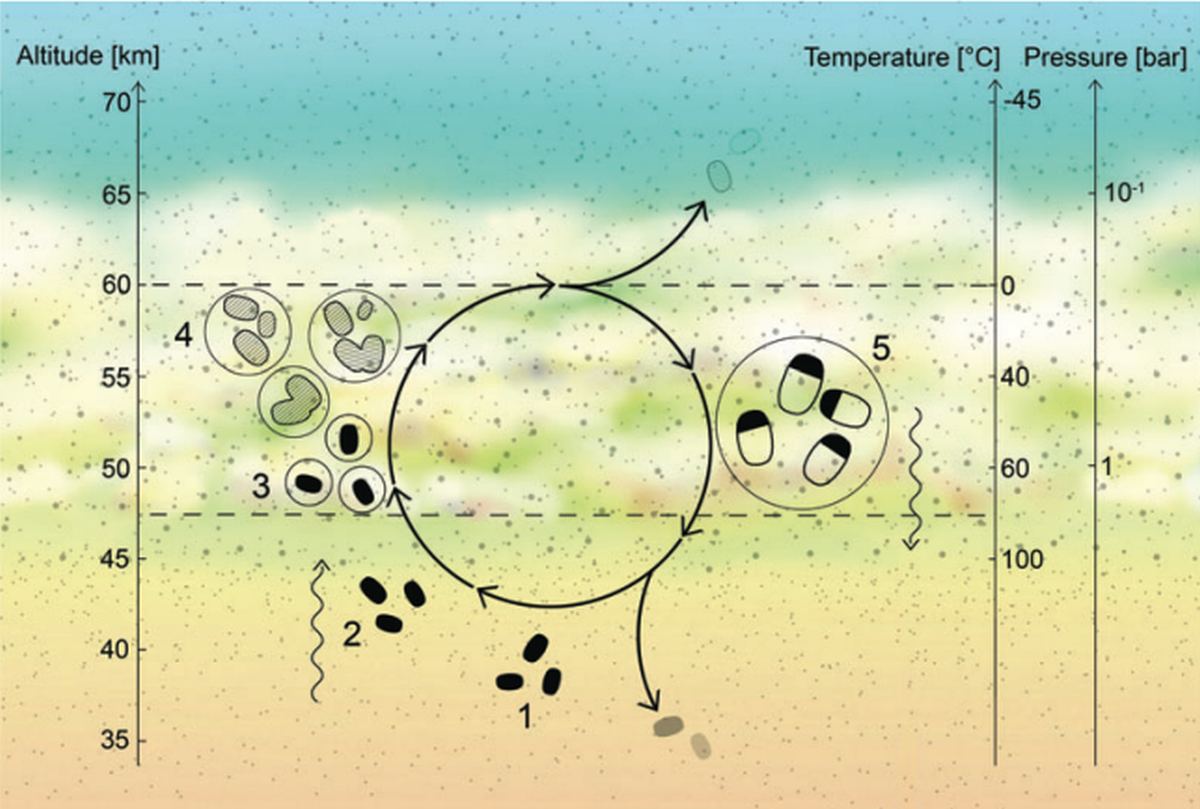
This image shows the cycle of Venusian aerial microbial life. Image Credit: S. Seager et al. 2021. doi:10.1089/ast.2020.2244
There are five steps in Venus’s proposed cloud lifecycle:
Dormant desiccated spores (black blobs) partially populate the lower haze layer of the atmosphere.
Updrafts transport them up to the habitable layer. The spores could travel up to the clouds via gravity waves.
Shortly after reaching the (middle and lower cloud) habitable layer, the spores act as cloud condensation nuclei, and more and more water gathers into a single droplet. Once the spores are surrounded by liquid with the necessary chemicals, they germinate and become metabolically active.
Metabolically active microbes (dashed blobs) grow and divide within liquid droplets (shown as solid circles in the figure). The liquid droplets continue to grow by coagulation.
Eventually, the droplets are large enough to settle out of the atmosphere gravitationally; higher temperatures and droplet evaporation trigger cell division and sporulation. The spores are smaller than the microbes and resist further downward sedimentation. They remain suspended in the lower haze layer (a depot of hibernating microbial life) to restart the cycle.
In this new work, the researchers focus on time.
“One of the key assumptions of the aerial life cycle put forward in Seager et al. 2021 is the timescale on which droplets would persist in the habitable layer to empower replication,” the authors write. “It is this that we now turn to study.”
This table from the research shows generation times for some common Earth bacteria. Image Credit: Abreu et al. 2024.
The authors used E. Coli generation times under optimal conditions in their work. In aerobic and nutrient-rich conditions, E. Coli can reproduce in 20 minutes. So, the E. Coli population will double three times in one hour. Bacteria must reproduce faster than they fall to the surface to sustain itself. They need to form a colony.
The researchers calculated that to sustain itself, the time it takes for bacteria to fall from the habitable part of the atmosphere to the inhabitable has to be longer than half an Earth day. As droplet size increases, the droplets would begin to sink. “As the droplet size approaches 100 µm, the droplets would start sinking to the lower haze layers,” they explain. However, their detailed calculations show that reproduction outpaces the fallout rate.
According to the team’s work, a population of bacteria could sustain itself in Venus’ clouds.
There are, obviously, still some questions. How certain are we that nutrients are available? Is there enough energy? Are there updrafts that can loft spores into the right layer of the atmosphere?
But the real big question is how was this all set in motion?
“An optimist might even imagine that the microbial life actually arose in a good-natured surface habitat, perhaps in a primitive ocean, before the planet suffered a runaway greenhouse, and the microbes lofted into the clouds,” the authors write. If that’s the case, this unique situation arose billions of years ago. Is there any other possibility? Could life have originated in the clouds?
Much scientific investigation into Venus, phosphine, clouds, and life relies on scant evidence. Few are willing to go out on a limb and proclaim that Venus can and does support life. We need more evidence.
For that, we have to wait for missions like the Venus Life Finder Mission. It’s a private mission being developed by Rocket Lab and a team from MIT. Who knows what VLF and other missions like DAVINCI and VERITAS will find? Stronger evidence of phosphine? Better data on Venus’ atmospheric layers and the conditions in them?
Life itself?
Artist’s impression of the Rocket Lab Mission to Venus. Credit: Rocket Lab
Did An Ancient Icy Impactor Create the Martian Moons?
The Martian moons Phobos and Deimos are oddballs. While other Solar System moons are round, Mars’ moons are misshapen and lumpy like potatoes. They’re more like asteroids or other small bodies than moons.
Because of their odd shapes and unusual compositions, scientists are still puzzling over their origins.
Two main hypotheses attempt to explain Phobos and Deimos. One says they’re captured asteroids, and the other says they are debris from an ancient impactor that collided with Mars. Earth’s moon was likely formed by an ancient collision when a planetesimal slammed into Earth, so there’s precedent for the impact hypothesis. There’s also precedent for the captured object scenario because scientists think some other Solar System moons, like Neptune’s moon Triton, are captured objects.
Phobos and Deimos have lots in common with carbonaceous C-type asteroids. They’re the most plentiful type of asteroid in the Solar System, making up about 75% of the asteroid population. The moons’ compositions and albedos support the captured asteroid theory. But their orbits are circular and close to Mars’ equator. Captured objects should have much more eccentric orbits.
This illustration shows Phobos and Deimos’ orbits along with the orbits of spacecraft at Mars. The moons’ near-circular orbits don’t support the captured asteroid theory. Image Credit: By NASA/JPL-Caltech – http://photojournal.jpl.nasa.gov/jpeg/PIA19396.jpg, Public Domain, https://commons.wikimedia.org/w/index.php?curid=39982795
The moons are less dense than silicate, the most abundant material in Mars’ crust. That fact works against the impact theory. A powerful impact would’ve blasted material from Mars into space, forming a disk of material rotating around the planet. Phobos and Deimos would’ve formed from that material. If they result from an ancient planetesimal impact, they should contain more Martian silica.
Here’s the problem in a nutshell. The captured asteroid theory can explain the moons’ observed physical characteristics but not their orbits. The impact theory can explain their orbits but not their compositions.
Phobos and Deimos look like potatoes more than moons. Image Credit: Left: By NASA / JPL-Caltech / University of Arizona – http://photojournal.jpl.nasa.gov/catalog/PIA10368, Public Domain, https://commons.wikimedia.org/w/index.php?curid=5191977. Right: By NASA/JPL-Caltech/University of Arizona – http://marsprogram.jpl.nasa.gov/mro/gallery/press/20090309a.html, Public Domain, https://commons.wikimedia.org/w/index.php?curid=6213773
In research presented at the 55th Lunar and Planetary Science Conference, three researchers proposed a different origin story for Phobos and Deimos. They suggest that an impactor is responsible for creating the moons, but the impactor was icy.
The research is titled “THE ICY ORIGINS OF THE MARTIAN MOONS.” The first author is Courteney Monchinski from the Earth-Life Science Institute at the Tokyo Institute of Technology.
If a rocky impactor slammed into Mars, it would’ve created a massive debris disk around the planet. Previous researchers have examined the idea using simulations and found that an impact could’ve created the moons. But the disk created by the impact would’ve been far more massive than Phobos and Deimos combined. The simulations showed that there would’ve been a third, much more massive moon created within Phobos’ orbit that would’ve fallen back down to Mars. But there’s no strong evidence of something that massive striking Mars.
This illustration shows how a giant impact could’ve created Phobos and Deimos. The collision would’ve created a massive debris disk where a third more massive moon formed before falling back to Mars. Image Credit: Antony Trinh / Royal Observatory of Belgium
Other impact studies used basaltic impactors. But those showed that the temperature in the debris disk would’ve been so high it would’ve melted the disk material and destroyed ancient chondritic materials. Since the pair of moons appear to contain those materials, a basaltic impactor is ruled out.
According to the research presented at the conference, an icy impactor can explain Phobos and Deimos’ origins. There are three reasons for that.
The extra disk mass created by a rocky impactor would not be present. Instead, much of the mass in the impactor would’ve been vapourized on impact and escaped the system rather than persisting in the disk and being taken up by the formation of moons. There would’ve been no large third moon and no need to explain how it fell back to Mars.
The second reason concerns the composition of the moons. With abundant water ice in the collision, the temperature in the debris disk would’ve been lower. That would’ve preserved the carbonaceous materials in Phobos and Deimos today. It also can help explain their density and possible porosity. An icy impactor could’ve also delivered water to Mars, and we know Mars was wetter in its past.
The third reason concerns Deimos’ orbit. It’s not synchronous with Mars, and an icy impactor can explain that. With more water ice in the disk, there would’ve been a viscous interaction between the disk’s dust and vapour that extended the disk, allowing Deimos to occupy its orbit.
The researchers used Smoothed Particle Hydrodynamic (SPH) simulations to test the icy impactor idea. They simulated giant impactors with varying quantities of water ice and watched as disks formed around Mars and moons formed in the disk.
They first found that an impactor with any amount of water ice produced a more massive debris disk. It could be because an impactor containing water ice would be larger, though less massive, than one without any ice. That allowed more material to spray from the planet into the disk. It could also be because the water ice absorbs some of the impact energy when it vapourizes. That would cool the disk temperature, lowering the velocities of particles in the disk and making them less likely to escape.
This figure from the research shows that any amount of ice in an impactor increases the size of the debris disk. Image Credit: Monchinski et al. 2024. LPSC
Varying the ice content in the impactor also affected the makeup of the disk. Different amounts of ice lead to disks with different amounts of Martian rock and impactor rock in the disk.
This graph from the study shows impactor ice content (x-axis) affects the debris disk composition. Image Credit: Monchinski et al. 2024. LPSC
The temperature in the disk is a critical part of this. Different amounts of water ice in the impactor change the disk temperature and what types of materials in the disk would melt. Impactors with more than 30% ice create disk temperatures too low to melt silicates. Perhaps more tellingly, impactors with more than 70% ice result in a disk temperature too low to alter or destroy chondritic material, which both Phobos and Deimos are expected to contain.
According to the researchers, an icy impactor can also explain other features. “The existence of water in the impact-generated disk also suggests that water may condense, accounting for the possible water-ice content of the moons,” they write.
Ultimately, the researchers say an icy impactor with 70% to 90% water ice mantles can explain the pair of moons.
“The best case for reproducing the moons’ proposed compositions are the 70% and 90% water-ice mantle impactor cases, as they allow for low disk temperatures and more chances for chondritic materials to survive,” they explain.
Unfortunately, that may not be realistic. “In our current solar system, an object with around 70% or 90% water-ice content is not exactly realistic, as the object with the highest amount of water content in our current solar system, Ganymede, is only about 50% water,” they write.
The ESA’s Mars Express orbiter captured this image of Phobos over the Martian landscape in this image taken in November 2010. Irregularly shaped and only 27 km long, Phobos is actually much darker (due to its carbon-rich surface) than is apparent in this contrast-enhanced view. Image Credit: ESA / DLR / G. neukum
But could things have been different in the past? Samples from asteroid Ryugu suggest that its parent body could’ve been up to 90% water. That number is based on the types of minerals in Ryugu. But unfortunately, scientists don’t now for sure. Ryugu’s parent body could have contained as little as 20% water.
But it’s at least plausible that early in the Solar System’s life, an impactor with 70% water ice could have existed. If so, then the icy impactor scenario could be a robust theory to explain the origins of Phobos and Deimos.
“This impactor would have come from the outer solar system around the time of giant planet instability,” the authors write. During that time, outer Solar System bodies were perturbed and sent flying into the inner Solar System. But in this case, the impact’s timing needs to be constrained by Phobos’ and Deimos’ formation ages.
Scientists need more evidence to deepen their understanding of Mars and its moons. Japan’s Martian Moons eXploration (MMX) mission will provide that. MMX’s mission is to return a sample of Phobos to Earth. The goal is to determine if it is a captured asteroid or the result of an impact.
Unfortunately, JAXA just delayed MMX’s launch. It was scheduled to launch in September 2024 but has been delayed until 2026. That means we won’t get samples until 2031 instead of 2029.
JAXA has completed successful sample return missions, so they have the expertise to bring a piece of Phobos back to Earth. If scientists can determine how Phobos and Deimos formed, it’ll be part of a much larger, detailed picture of how the Solar System formed.
It’ll be worth it if we have to wait a couple extra years.
Watch a Satellite Reaction Wheel Melt in a Simulated Orbital Re-Entry
This illustrations shows one of the ESA's Automated Transfer Vehicles burning up during re-entry. Heavier spacecraft components like satellite reaction wheels don't always burn up and constitute a hazard. ESA engineers are working to change that. Image Credit: ESA LICENCE ESA Standard Licence
Watch a Satellite Reaction Wheel Melt in a Simulated Orbital Re-Entry
Most satellites share the same fate at the end of their lives. Their orbits decay, and eventually, they plunge through the atmosphere toward Earth. Most satellites are destroyed during their rapid descent, but not always
Heavy pieces of the satellite, like reaction wheels, can survive and strike the Earth. Engineers are trying to change that.
Satellite debris can strike Earth and is a potential hazard, though the chances of debris striking anything other than ocean or barren land are low. Expired satellites usually just re-enter the atmosphere and burn up. But there are a lot of satellites, and their number keeps growing.
In February 2024, the ESA’s European Remote Sensing 2 (ERS2) satellite fell to Earth. The ESA tracked the satellite and concluded that it posed no problem. “The odds of a piece of satellite falling on someone’s head is estimated at one in a billion,” ESA space debris system engineer Benjamin Bastida Virgili said.
That would be fine if ERS 2 was an isolated incident. But, according to the ESA, an object about as massive as ERS 2 reenters Earth’s atmosphere every one to two weeks. The statistics may show there’s no threat to people, but statistics are great until you’re one of them.
The ESA’s ERS-2 Earth observation satellite was destroyed when it re-entered Earth’s atmosphere on February 21st, 2004. Heavy parts of satellites, like reaction wheels, don’t always burn up in the atmosphere and can pose a hazard. ESA engineers are working on reaction wheels that will break into pieces to reduce the hazard. Image Credit: Fraunhofer FHR
The risk of being struck by chunks of a satellite isn’t zero. In 1997, a piece of mesh from a Delta II rocket struck someone’s shoulder in Oklahoma. It was a light piece of debris, so the person was okay. But it was an instructive event.
The heaviest parts of satellites, like reaction wheels, can be hazardous because they may not be destroyed during re-entry. Reaction wheels provide three-axis control for satellites without the need for rockets. They give satellites fine pointing accuracy and are useful for rotating satellites in very small amounts.
Reaction wheels can be quite massive. The Hubble Space Telescope has four reaction wheels weighing 45 kg (100 lbs) each. Other satellites don’t have such massive wheels, but the Hubble’s hefty wheels indicate the extent of the hazard. ESA engineers are designing reaction wheels that will break up during re-entry to reduce the hazard of one striking Earth.
“… the need is becoming urgent as more and more satellites are placed in space.”
Kobyé Bodjona, Mechanisms Engineer at the ESA
As part of the design process, they’re testing their wheels in a plasma wind tunnel at the University of Stuttgart Institute of Space Systems. The heated plasma in the tunnel moves at several km/sec, mimicking the friction a satellite is exposed to when it plunges through Earth’s atmosphere. The wheel is rotated inside the tunnel as if tumbling through the atmosphere.
At a recent Space Mechanisms Workshop at ESA’s ESTEC technical center in the Netherlands, engineers showed a clip of the blow-torch effect that the atmosphere has on falling debris.
“Space mechanisms cover everything that enables movement aboard a satellite, from deployment devices to reaction wheels,” explains workshop co-organizer Geert Smet.
“But these mechanisms often use materials such as steel or titanium that are more likely to survive reentry into the atmosphere. This is a problem because our current regulations say reentering satellites should present less than one in 10,000 risks of harming people or property on the ground or even one in 100 000 for large satellite constellations. ESA’s Clean Space group is reacting by D4D—devising methods to make total disintegration of a mission more likely, including mechanisms.”
The effort to make satellites disintegrate completely goes back a few years. The ESA program Design for Demise (D4D) is helping satellite manufacturers comply with the Space Debris Mitigation (SDM) requirements. It’s aimed at eliminating debris falling to Earth, removing debris already in orbit, and designing satellites that don’t linger in orbit after their missions have ended.
At the recent workshop, the ESA revealed more of its plans for active debris removal. There’s a push to develop dedicated spacecraft that can attach themselves to derelict satellites and force them into reentry. This will help remove dead satellites from the congested Low Earth Orbit.
“The idea behind this event is to present the mechanisms community with the latest research on space debris to see how they might contribute to the work going on,” said Kobyé Bodjona, Mechanisms Engineer at the ESA. “It’s important because large system integrators—the big companies that lead satellite projects—are going to need systems that are fully compliant with debris mitigation regulations. And the need is becoming urgent as more and more satellites are placed in space.”
Measuring the Atmospheres of Other Worlds to See if There are Enough Nutrients for Life
Life on Earth depends on six critical elements: Carbon, Hydrogen, Nitrogen, Oxygen, Phosphorous, and Sulfur. These elements are referred to asCHNOPS, and along with several trace micronutrients and liquid water, they’re what life needs.
Scientists are getting a handle on detecting exoplanets that might be warm enough to have liquid water on their surfaces, habitability’s most basic signal. But now, they’re looking to up their game by finding CHNOPS in exoplanet atmospheres.
We’re only at the beginning of understanding how exoplanets could support life. To grow our understanding, we need to understand the availability of CHNOPS in planetary atmospheres.
At our current technological level, we’re just beginning to examine exoplanet atmospheres. The JWST is our main tool for the task, and it’s good at it. But the JWST is busy with other tasks. In 2029, the ESA will launch ARIEL, the Atmospheric Remote-sensing Infrared Exoplanet Large survey. ARIEL will be solely focused on exoplanet atmospheres.
An artist’s impression of the ESA’s Ariel space telescope. During its four-year mission, it’ll examine 1,000 exoplanet atmospheres with the transit method. It’ll study and characterize both the compositions and thermal structures. Image Credit: ESA
In anticipation of that telescope’s mission, Herbort and his co-researchers are preparing for the results and what they mean for habitability. “The detailed understanding of the planets itself becomes important for interpreting observations, especially for the detection of biosignatures,” they write. In particular, they’re scrutinizing the idea of aerial biospheres. “We aim to understand the presence of these nutrients within atmospheres that show the presence of water cloud condensates, potentially allowing the existence of aerial biospheres.”
Our sister planet Venus has an unsurvivable surface. The extreme heat and pressure make the planet’s surface uninhabitable by any measure we can determine. But some scientists have proposed that life could exist in Venus’ atmosphere, based largely on the detection of phosphine, a possible indicator of life. This is an example of what an aerial biosphere might look like.
This artistic impression depicts Venus. Astronomers at MIT, Cardiff University, and elsewhere may have observed signs of life in the atmosphere of Venus by detecting phosphine. Subsequent research disagreed with this finding, but the issue is ongoing. Image Credits: ESO (European Space Organization)/M. Kornmesser & NASA/JPL/Caltech
“This concept of aerial biospheres enlarges the possibilities of potential habitability from the presence of liquid water on the surface to all planets with liquid water clouds,” the authors explain.
The authors examined the idea of aerial biospheres and how the detection of CHNOPS plays into them. They introduced the concept of nutrient availability levels in exoplanet atmospheres. In their framework, the presence of water is required regardless of other nutrient availability. “We considered any atmosphere without water condensates as uninhabitable,” they write, a nod to water’s primacy. The researchers assigned different levels of habitability based on the presence and amounts of the CHNOPS nutrients.
This table from the research illustrates the authors’ concept of atmospheric nutrient availability. As the top row shows, without water, no atmosphere is habitable. Different combinations of nutrients have different habitability potential. ‘red’ stands for redox, and ‘ox’ stands for the presence of the oxidized state of CO2, NOx, and SO2. Image Credit: Herbort et al. 2024.
To explore their framework of nutrient availability, the researchers turned to simulations. The simulated atmospheres held different levels of nutrients, and the researchers applied their concept of nutrient availability. Their results aim to understand not habitability but the chemical potential for habitability. A planet’s atmosphere can be altered drastically by life, and this research aims to understand the atmospheric potential for life.
“Our approach does not directly aim for the understanding of biosignatures and atmospheres of planets, which are inhabited, but for the conditions in which pre-biotic chemistry can occur,” they write. In their work, the minimum atmospheric concentration for a nutrient to be available is 10?9, or one ppb (part per billion.)
“We find that for most atmospheres at ( p gas, T gas) points, where liquid water is stable, CNS-bearing molecules are present at concentrations above 10?9,” they write. They also found that carbon is generally present in every simulated atmosphere and that sulphur availability increases with surface temperature. With lower surface temperatures, nitrogen (N2, NH3) is present in increasing amounts. But with higher surface temperatures, nitrogen can become depleted.
Phosphorus is a different matter. “The limiting element of the CHNOPS elements is phosphorus, which is mostly bound in the planetary crust,” they write. The authors point out that, at past times in Earth’s atmosphere, phosphorus scarcity limited the biosphere.
An aerial biosphere is an interesting idea. But it’s not the main thrust of scientists’ efforts to detect exoplanet atmospheres. Surface life is their holy grail. It should be no surprise that it still comes down to liquid water, all things considered. “Similar to previous work, our models suggest that the limiting factor for habitability at the surface of a planet is the presence of liquid water,” the authors write. In their work, when surface water was available, CNS was available in the lower atmosphere near the surface.
But surface water plays several roles in atmospheric chemistry. It can bond with some nutrients in some circumstances, making them unavailable, and in other circumstances, it can make them available.
“If water is available at the surface, the elements not present in the gas phase are stored in the crust condensates,” the authors write. Chemical weathering can then make them available as nutrients. “This provides a pathway to overcome the lack of atmospheric phosphorus and metals, which are used in enzymes that drive many biological processes.”
Artist’s impression of the surface of a hycean world. Hycean worlds are still hypothetical, with large oceans and thick hydrogen-rich atmospheres that trap heat. It’s unclear if a world with no surface can support life. Image Credit: University of Cambridge
This complicates matters on worlds covered by oceans. Pre-biotic molecules might not be available if there’s no opportunity for water and rock to interact with the atmosphere. “If indeed it can be shown that life can form in a water ocean without any exposed land, this constraint becomes weaker, and the potential for the surface habitability becomes mainly a question of water stability,” the authors write.
Some of the models are surprising because of atmospheric liquid water. “Many of the models show the presence of a liquid water zone in the atmospheres, which is detached from the surface. These regions could be of interest for the formation of life in forms of aerial biospheres,” Herbort and his colleagues write.
If there’s one thing that research like this shows, planetary atmospheres are extraordinarily complex and can change dramatically over time, sometimes because of life itself. This research makes some sense in trying to understand it all. Emphasizing the complexity is the fact that the researchers didn’t include stellar radiation in their work. Including that would’ve made the effort unwieldy.
The habitability issue is complicated, confounded by our lack of answers to foundational questions. Does a planet’s crust have to be in contact with water and the atmosphere for the CHNOPS nutrients to be available? Earth has a temporary aerial biosphere. Can aerial biospheres be an important part of exoplanet habitability?
But beyond all the simulations and models, as powerful as they are, what scientists need most is more data. When ARIEL launches, scientists will have much more data to work with. Research like this will help scientists understand what ARIEL finds.
Testing a Probe that Could Drill into an Ice World
SLUSH prototype probe set up over an ice tower. Bottom left: Top view of 1.4 m borehole created by the SLUSH prototype probe. Middle: Dolphin Probe being tested inside an ice tower. Right: Salmon Probe being tested on top of Devon Island Ice Cap.
Testing a Probe that Could Drill into an Ice World
I remember reading about an audacious mission to endeavour to drill through the surface ice of Europa, drop in a submersible and explore the depths below. Now that concept may be taking a step closer to reality with researchers working on technology to do just that. Worlds like Europa are high on the list for exploration due to their potential to harbour life. If technology like the SLUSH probe (Search for Life Using Submersible Head) work then we are well on the way to realising that dream.
The search for life has always been something to captivate the mind. Think about the diversity of life on Earth and it is easy to see why we typically envisage creatures that rely upon sunlight, food and drink. But on Earth, life has found a way in the most inhospitable of environments, even at the very bottom of the ocean. The Mariana’s Trench is deeper than Mount Everest is tall and anything that lives there has to cope with cold water, crushingly high pressure and no sunlight. Seems quite alien but even here, life thrives such as the deep-sea crustacean Hirondellea Gigas – catchy name.
Location of the Mariana Trench. Credit: Wikipedia Commons/Kmusser
Europa, one of the moon’s of Jupiter has an ice crust but this covers over a global ocean of liquid water. The conditions deep down in the ocean of Europa might not be so very different from those at the bottom of the Mariana’s Trench so it is here that a glimmer of hope exists to find other life in the Solar System. Should it exist, getting to it is the tricky bit. It’s not just on Europa but Enceladus and even Mars may have water underneath ice shelves. Layers of ice up to a kilometre thick might exist so technology like SLUSH has been developed to overcome.
Natural color image of Europa obtained by NASA’s Juno spacecraft. (Credit: NASA/JPL-Caltech/SwRI/MSSS/Kevin M. Gill)
The technology is not too new though since melt probes like SLUSH have been tested before. The idea is beautifully simple. The thermo-mechanical probe uses a drilling mechanism to break through the ice and then the heat probe to partially melt the ice chips, forming slush to enable their transportation to behind the probe as it descends.
The probe, which looks rather like a light sabre, is then able to transmit data from the subsurface water back to the lander. A tether system is used for the data transmission using conductive microfilaments and an optical fibre cable. Intriguingly and perhaps even cunningly, should the fibre cable break (which is a possibility due to tidal stresses from the ice) then the microfilaments will work as an antenna. They can then be tuned into by the lander to resume data transmission. The tether is coiled up and housed inside spools which are left behind in the ice as the spool is emptied. I must confess my immediate thought here was ‘litter’! I accept we have to leave probes in order to explore but surely we can do it without leaving litter behind! However there is a reason for this too. As the spools are deployed, they act as receivers and transmitters to allow the radio frequencies to travel through the ice.
The company working on the device is Honeybee Robotics have created prototypes. The first was stand alone, had no data transmission capability and demonstrated the drilling and slushing technology in an ice tower in Honeybee’s walk in freezer. While this was underway, the tether communication technology was being tested too with the first version called the Salmon Probe. This was taken to Devon Island in the Arctic where the unspooling method is being put through its paces. The first attempts back in 2022 saw the probe achieving depths of 1.8m!
A further probe was developed called the Dolphin probe and this was capable of getting to depths of about 100m but sea ice limitations meant it could only get to a depth of 2m! Thus far, all probes have performed well. Honeybee are now working on the Narwhal Probe which will have more measuring equipment on board, a deployable tether and spool and will be far more like the finished product. If all goes to plan it will profile the ice on Devon Island to a depth of 100m. This is still quite short of the kilometre thick ice expected but it is most definitely fantastic progress toward exploring the cold watery depths of alien worlds.
A Neutron Star Merged with a Surprisingly Light Black Hole
Galactic collisions, meteor impacts and even stellar mergers are not uncommon events. neutron stars colliding with black holes however are a little more rare, in fact, until now, we have never observed one. The fourth LIGO-Virgo-KAGRA observing detected gravitational waves from a collision between a black hole and neutron star 650 million light years away. The black hole was tiny though with a mass between 2.5 to 4.5 times that of the Sun.
Neutron stars and black holes have something in common; they are both the remains of a massive star that has reached the end of its life. During the main part of a stars life the inward pull of gravity is balanced by the outward push of the thermonuclear pressure that makes the star shine. The thermonuclear pressure overcomes gravity for low mass stars like the Sun but for more massive stars, gravity wins. The core collapses compressing it into either a neutron star or a black hole (depending on the progenitor star mass) and explodes as a supernova – in the blink of an eye.
In May 2023, as a result of the fourth observing session of the LIGO-Virgo-KAGRA (Laser Interferometer Gravitational Wave Observatory-Virgo Gravitational Wave Interferometer and Kamioka Gravitational Wave Detector) network, gravitational waves were picked up from a merger event. The signal came from an object 1.2 times the mass of the Sun and another slightly more massive object. Further analysis revealed the likelihood that one was a neutron star and the other a low mass black hole. The latter falls into the so called ‘mass gap’, more massive than the most massive neutron star and less massive than the least massive black hole.
Interactions between objects can generate gravitational waves. Before they were detected back in 2015, stellar mass black holes were typically found through X-ray observations. Neutron stars on the other hand, were usually found with radio observations. Between the two, was the mass gap with objects lacking between three and five solar masses.
It has been the subject of debate among scientists with the odd object found which fell within the gap, fuelling debate about its existence. The gap has generally been considered to separate the neutron stars from the black holes and items in this mass group have been scarce. This gravitational wave discovery suggests maybe objects in this gap are not so rare after-all.
One of the challenges of detecting mass gap objects and mergers between them is the sensitivity of detectors. The LIGO team at the University of British Columbia researchers are working hard to improve the coatings used in mirror production. Enhanced performance on future LIGO detectors will further enhance detection capabilities. It’s not just optical equipment that is being developed, infrastructure changes are also being addressed including data analysis software too. Improving sensitivity in all aspects of the gravity wave network is sure to yield results in future runs. However for now, the rest of the first half of the observing run needs analysing with 80 more candidate signals to study.
Een spectaculaire show in de hemel Miljoenen Noord-Amerikanen, van Mexico tot de Verenigde Staten en Canada, kregen op 8 april een spectaculaire show te zien: een totale zonsverduistering. Afgebeeld:De evolutie van de totale zonsverduistering aan het strand in Mazatlan, Mexico. De foto is gemaakt met meerdere belichtingen en digitale bewerking.
Voor sommigen dé kans van hun leven Een totale zonsverduistering vindt plaats als de maan tussen de aarde en de zon in staat, waardoor het zicht op de zon vanaf een klein deel van de aarde wordt geblokkeerd. Klik verder om de spectaculairste foto's van deze gebeurtenis te bekijken.
Op de foto: stellen bekijken de zonsverduistering tijdens een massabruiloft op het festival 'Total Eclipse of the Heart' in Russellville, Arkansas.
Tussen de wolken door Een angstaanjagend beeld uit Niagara Falls in Canada. De lokale bevolking was bang dat ze de zonsverduistering niet zouden kunnen zien door de bewolking, maar gelukkig gebeurde dat niet. In plaats daarvan waren griezelige, buitenaardse beelden het resultaat, zoals je hier ziet.
De kunst van het universum Zicht op de totale zonsverduistering vanuit de haven van Mazatlan in Mexico. Dit was een van de weinige steden ter wereld waar de eclips met 100% zicht kon worden waargenomen.
Iconische foto uit New York City New Yorkers kregen alleen een gedeeltelijke zonsverduistering te zien, maar toch konden ze daarvan mooie plaatjes schieten, zoals deze.
Spectaculair Martin, Ohio was een van de steden in het "pad van de totaliteit" - de route waarlangs je de zon compleet kon zien verdwijnen. Hier zien we de maan voor de zon langs gaan.
Het diamantringeffect Een composiet van zeven foto's toont de maan die de zon passeert en het diamanten ringeffect creëert tijdens een totale zonsverduistering in Bloomington, Indiana.
Het Washingtonmonument Washington DC bevond zich niet in het pad van de totaliteit, maar wat de inwoners wel zagen was spectaculair. Hier zie je de zonsverduistering boven het Washington Monument in het centrum van de hoofdstad.
Vlucht met uitzicht Een vliegtuig kruist de route van een gedeeltelijke zonsverduistering, gezien vanuit Glen Rock, New Jersey. Volgens The Washington Post bood Delta Airlines een speciale vlucht aan zodat passagiers de zonsverduistering vanuit de lucht konden zien. Velen zeggen echter dat het uitzicht niet het beste was.
Fort Erie, Canada Fort Erie, gelegen in de provincie Ontario, lag in het pad van de totaliteit. Inwoners hadden echter te maken met veel bewolking. Ook al hadden ze misschien niet het meest heldere uitzicht, het was nog steeds indrukwekkend.
Het beeld waar mensen honderden kilometers voor hebben gereisd Over heel Noord-Amerika reisden mensen honderden kilometers om in het pad van de totaliteit te zijn en adembenemende beelden zoals deze in Ohio te zien.
Syracuse, New York Of mensen nu een totale of gedeeltelijke zonsverduistering konden zien, het was een unieke kans. Volgens NASA is de volgende totale zonsverduistering pas in 2044 in Noord-Amerika te zien. Voor Europa is die datum 12 augustus 2026 (van Groenland tot Spanje) en kunnen we een gedeeltelijke zonsverduistering in België en Nederland verwachten op 29 maart 2025.
De grootste mythes over het heelal Hoewel we meer van het heelal begrijpen dan ooit tevoren, zijn er nog steeds veel misvattingen over de ruimte, die grotendeels te danken zijn aan Hollywood. Sommige van deze misvattingen zijn eigenlijk aannemelijk en hebben velen van ons voor de gek gehouden. Denk je bijvoorbeeld dat Mercurius de heetste planeet in het zonnestelsel is omdat hij het dichtst bij onze zon staat? En zuigen zwarte gaten echt materie naar hun kern?
To find out the answers to these questions and more, check out the following gallery on the biggest myths about space. LEES VERDER.
De asteroïdengordel is heel gevaarlijk De asteroïdengordel ligt tussen Mars en Jupiter en bevat meer dan drieduizend kleine planeten en meer dan 750.000 afzonderlijke asteroïden. De grotere asteroïden botsen soms op elkaar, wat de mythe voedt dat het gevaarlijk is voor ruimtevaartuigen om zich er een weg doorheen te banen.
De asteroïdengordel is heel gevaarlijk Er is echter geen gevaar, omdat de afstand tussen asteroïden enorm is. Gemiddeld is er een afstand van ongeveer 970.000 km tussen de asteroïden, wat meer dan twee keer zo groot is als de afstand van de aarde tot de maan.
De zon staat in brand Elke seconde zet de zon 700 miljoen ton waterstof om in 695 miljoen ton helium. Er komt dan energie vrij in de vorm van gammastralen, die dan licht worden. De zon zendt dus licht en warmte uit, maar staat niet in brand, omdat er geen zuurstof aan te pas komt.
De maan heeft een donkere kant In tegenstelling tot wat vaak wordt gedacht, is de andere kant niet donker. Het krijgt dezelfde hoeveelheid zonlicht als de andere kant.
Sterren in constellaties staan dicht bij elkaar De sterren aan de nachthemel zijn verdeeld over 88 constellaties. Dit zijn herkenbare groeperingen die al duizenden jaren als richtlijn voor boeren en reizigers dienen.
Sterren in constellaties staan dicht bij elkaar Ondanks dat het lijkt alsof de sterren die de constellaties vormen dicht bij elkaar staan, zijn ze vaak tientallen of honderden lichtjaren van elkaar gescheiden.
Saturnus is de enige planeet in het zonnestelsel met ringen Wanneer de meeste mensen aan planeten met ringen denken, is er maar één die in hun gedachten opkomt. De gasreus Saturnus staat bekend om zijn zeven hoofdringen.
Saturnus is de enige planeet in het zonnestelsel met ringen Maar Saturnus is niet de enige. Jupiter, Uranus en Neptunus hebben ook allemaal hun eigen ringen. Niemand wist echter zeker dat ze bestonden totdat het ruimteschip Voyager in de jaren zeventig en tachtig heel dichtbij kwam.
Zwarte gaten creëren een vacuüm Zwarte gaten zijn eigenlijk meer een soort vliegenvangers dan vacuüms. Ze zijn vrij inactief totdat een ster te dichtbij komt. Dan worden ze actief en verscheuren ze lagen gas en versnipperen ze de bestaande atomen.
Zwarte gaten creëren een vacuüm In werkelijkheid lopen objecten die genoeg afstand houden en met een hoge snelheid passeren geen gevaar om in het centrum van een zwart gat gezogen te worden. Als de zon bijvoorbeeld zou worden vervangen door een zwart gat, zou de aarde gewoon blijven draaien.
De zon is geel Eigenlijk is deze gele kleur een illusie. De zon produceert alle golflengtes van zichtbaar licht en daarom is haar echte kleur wit. Maar als het zonlicht door de atmosfeer reist, verandert het van kleur.
De zon is geel De atmosferische gassen van de aarde buigen het licht af door een effect dat Rayleighverstrooiing heet en waardoor de lucht blauw lijkt.
De schaduw van de aarde veroorzaakt de maanfasen Maanfasen zijn eigenlijk het resultaat van de opkomst en ondergang van de zon boven de zichtbare kant van de maan terwijl deze om de aarde draait.
De schaduw van de aarde veroorzaakt de maanfasen Terwijl de maan om de aarde draait, worden verschillende delen ervan verlicht door de zon. Het draait dus allemaal om de positie van de zon, de maan en de aarde.
Een lichtjaar is een tijdmaat Een lichtjaar is eigenlijk een afstandsmaat. NASA omschrijft een lichtjaar als "de totale afstand die een lichtstraal, die in een rechte lijn beweegt, in één jaar aflegt".
Een lichtjaar is een tijdmaat Volgens de relativiteitstheorie van Albert Einstein is een lichtjaar de snelste snelheid in het heelal, met ongeveer 300.000 kilometer per seconde.
Sterren twinkelen Wanneer licht naar de aarde reist, passeert het gasmoleculen (sterren) waar onze atmosfeer uit bestaat. De sterren wervelen vanwege turbulentie in de atmosfeer. Hierdoor wordt een deel van het licht afgebogen, waardoor het lijkt alsof het licht verschuift en twinkelt.
Mercurius is de heetste planeet in het zonnestelsel Veel mensen geloven deze misvatting omdat Mercurius de planeet is die het dichtst bij de zon staat. De afstand tot de zon heeft echter weinig te maken met de gemiddelde temperatuur van een planeet.
Mercurius is de heetste planeet in het zonnestelsel Venus bijvoorbeeld, die bijna twee keer zo ver van de zon staat, heeft een gemiddelde temperatuur van 462ºC. Het verschil is te danken aan de atmosfeer. Op Venus is de atmosfeer dik en bestaat deze voornamelijk uit kooldioxide, waardoor de warmte wordt vastgehouden in een isolerende luchtbel, terwijl Mercurius een hele dunne atmosfeer heeft.
Komeetstaarten geven aan welke kant ze opgaan Kometen zijn in wezen brokken vies ijs die opwarmen wanneer ze de zon naderen. Op dat moment laten ze gas en stof los.
Komeetstaarten geven aan welke kant ze opgaan Op aarde zouden we verwachten dat de staart naar achteren wijst, maar in de ruimte is er geen lucht. Kometen worden gevormd en voortgeblazen door stralingsdruk en zonnewind, dus wijzen ze altijd van de zon af.
Zonder ruimtepak exploderen mensen in de ruimte De menselijke huid is rekbaar genoeg, dus het zal niet tot een explosie komen. Maar na ongeveer 10 seconden blootstelling raken mensen bewusteloos.
Zonder ruimtepak exploderen mensen in de ruimte In 1966 gebeurde dit helaas met een technicus tijdens een NASA-test, nadat bepaalde apparatuur uitviel. Gelukkig was de druk na 30 seconden al hersteld en knapte de technicus weer op.
De zon is de enige ster met planeten Deskundigen geloven dat de meeste sterren in de Melkweg planeten om zich heen hebben. Elke planeet die buiten ons zonnestelsel wordt gevonden, wordt een exoplaneet genoemd en deze beïnvloeden de manier waarop een ster verschijnt.
De zon is de enige ster met planeten Eén manier om exoplaneten te vinden is door op verschillende tijdstippen te zoeken naar een afname van het licht van bepaalde sterren. Dit kan betekenen dat een planeet voor de ster langs beweegt, wat invloed heeft op de manier waarop het licht voor ons verschijnt.
Beste bezoeker, Heb je zelf al ooit een vreemde waarneming gedaan, laat dit dan even weten via email aan Frederick Delaere opwww.ufomeldpunt.be. Deze onderzoekers behandelen jouw melding in volledige anonimiteit en met alle respect voor jouw privacy. Ze zijn kritisch, objectief maar open minded aangelegd en zullen jou steeds een verklaring geven voor jouw waarneming! DUS AARZEL NIET, ALS JE EEN ANTWOORD OP JOUW VRAGEN WENST, CONTACTEER FREDERICK. BIJ VOORBAAT DANK...
Druk op onderstaande knop om je bestand , jouw artikel naar mij te verzenden. INDIEN HET DE MOEITE WAARD IS, PLAATS IK HET OP DE BLOG ONDER DIVERSEN MET JOUW NAAM...
Druk op onderstaande knop om een berichtje achter te laten in mijn gastenboek
Alvast bedankt voor al jouw bezoekjes en jouw reacties. Nog een prettige dag verder!!!
Over mijzelf
Ik ben Pieter, en gebruik soms ook wel de schuilnaam Peter2011.
Ik ben een man en woon in Linter (België) en mijn beroep is Ik ben op rust..
Ik ben geboren op 18/10/1950 en ben nu dus 75 jaar jong.
Mijn hobby's zijn: Ufologie en andere esoterische onderwerpen.
Op deze blog vind je onder artikels, werk van mezelf. Mijn dank gaat ook naar André, Ingrid, Oliver, Paul, Vincent, Georges Filer en MUFON voor de bijdragen voor de verschillende categorieën...
Veel leesplezier en geef je mening over deze blog.