The purpose of this blog is the creation of an open, international, independent and free forum, where every UFO-researcher can publish the results of his/her research. The languagues, used for this blog, are Dutch, English and French.You can find the articles of a collegue by selecting his category. Each author stays resposable for the continue of his articles. As blogmaster I have the right to refuse an addition or an article, when it attacks other collegues or UFO-groupes.
Druk op onderstaande knop om te reageren in mijn forum
Zoeken in blog
Deze blog is opgedragen aan mijn overleden echtgenote Lucienne.
In 2012 verloor ze haar moedige strijd tegen kanker!
In 2011 startte ik deze blog, omdat ik niet mocht stoppen met mijn UFO-onderzoek.
BEDANKT!!!
Een interessant adres?
UFO'S of UAP'S, ASTRONOMIE, RUIMTEVAART, ARCHEOLOGIE, OUDHEIDKUNDE, SF-SNUFJES EN ANDERE ESOTERISCHE WETENSCHAPPEN - DE ALLERLAATSTE NIEUWTJES
UFO's of UAP'S in België en de rest van de wereld Ontdek de Fascinerende Wereld van UFO's en UAP's: Jouw Bron voor Onthullende Informatie!
Ben jij ook gefascineerd door het onbekende? Wil je meer weten over UFO's en UAP's, niet alleen in België, maar over de hele wereld? Dan ben je op de juiste plek!
België: Het Kloppend Hart van UFO-onderzoek
In België is BUFON (Belgisch UFO-Netwerk) dé autoriteit op het gebied van UFO-onderzoek. Voor betrouwbare en objectieve informatie over deze intrigerende fenomenen, bezoek je zeker onze Facebook-pagina en deze blog. Maar dat is nog niet alles! Ontdek ook het Belgisch UFO-meldpunt en Caelestia, twee organisaties die diepgaand onderzoek verrichten, al zijn ze soms kritisch of sceptisch.
Nederland: Een Schat aan Informatie
Voor onze Nederlandse buren is er de schitterende website www.ufowijzer.nl, beheerd door Paul Harmans. Deze site biedt een schat aan informatie en artikelen die je niet wilt missen!
Internationaal: MUFON - De Wereldwijde Autoriteit
Neem ook een kijkje bij MUFON (Mutual UFO Network Inc.), een gerenommeerde Amerikaanse UFO-vereniging met afdelingen in de VS en wereldwijd. MUFON is toegewijd aan de wetenschappelijke en analytische studie van het UFO-fenomeen, en hun maandelijkse tijdschrift, The MUFON UFO-Journal, is een must-read voor elke UFO-enthousiasteling. Bezoek hun website op www.mufon.com voor meer informatie.
Samenwerking en Toekomstvisie
Sinds 1 februari 2020 is Pieter niet alleen ex-president van BUFON, maar ook de voormalige nationale directeur van MUFON in Vlaanderen en Nederland. Dit creëert een sterke samenwerking met de Franse MUFON Reseau MUFON/EUROP, wat ons in staat stelt om nog meer waardevolle inzichten te delen.
Let op: Nepprofielen en Nieuwe Groeperingen
Pas op voor een nieuwe groepering die zich ook BUFON noemt, maar geen enkele connectie heeft met onze gevestigde organisatie. Hoewel zij de naam geregistreerd hebben, kunnen ze het rijke verleden en de expertise van onze groep niet evenaren. We wensen hen veel succes, maar we blijven de autoriteit in UFO-onderzoek!
Blijf Op De Hoogte!
Wil jij de laatste nieuwtjes over UFO's, ruimtevaart, archeologie, en meer? Volg ons dan en duik samen met ons in de fascinerende wereld van het onbekende! Sluit je aan bij de gemeenschap van nieuwsgierige geesten die net als jij verlangen naar antwoorden en avonturen in de sterren!
Heb je vragen of wil je meer weten? Aarzel dan niet om contact met ons op te nemen! Samen ontrafelen we het mysterie van de lucht en daarbuiten.
29-03-2024
The ESA’s Mars Rover Gets a New Map
European scientists have created an extremely detailed geological map of Oxia Planum, the landing site for the ESA's Rosalind Franklin rover. Not only will it help guide the rover's driving, it will help the rover sample the most promising sites. Image Credit: Fawdon et al. 2024.
Rosalind Franklin, the ESA’s Mars rover, is scheduled to launch no sooner than 2028. Its destination is Oxia Planum, a wide clay-bearing plain to the east of Chryse Planitia. Oxia Planum contains terrains that date back to Mars’ Noachian Period, when there may have been abundant surface water, a key factor in the rover’s mission.
Rosalind Franklin’s primary mission mirrors that of NASA’s Perseverance rover: to search for fossil evidence of life. To do that, both rovers are equipped with a suite of powerful instruments. They both have sampling drills, but Franklin’s drill wins the tale of the tape. It can penetrate to a depth of two meters, compared to Perseverance’s which can only drill a few inches deep.
In order for the Franklin to be successful, it needs to land in a place where its drilling capability can be put to good use. That’s why the ESA chose Oxia Planum. Not only is it flat, which makes for a safer landing, but it contains hydrated minerals. In fact, it’s one of the largest exposed sections of clay-bearing minerals on Mars, and that’s where the fossilized evidence of life it seeks may be found.
A team of European scientists has created the most detailed geological map of Oxia Planum ever. It took four years to complete and leans heavily on data from orbiters. The detailed map shows 15 units with characteristic geological features that can help decide how the rover explores the area. The map will also help the rover interpret its surroundings and collect evidence of primitive life.
“This map is exciting because it is a guide that shows us where to find the answers.”
Peter Fawdon, co-lead author, Open University
Oxia Planum preserves a record of the forces that shaped the region and that shaped Mars. It’s a transitional region between Chryse Planitia, which contains lower elevation plains from the Amazonian/Hesperian, and Arabia Terra, the heavily cratered Noachian-aged region.
The sediments at Oxia Planum are nearly four billion years old. This will be the oldest site ever visited by a rover.
The new map has its roots in the COVID lockdowns. During that time, the Rosalind Franklin science team trained 80 volunteers to help them map Oxia Planum. The ExoMars Trace Gas Orbiter and NASA’s Mars Reconnaissance Orbiter supplied the data.
The result is a map that shows Oxia Planum’s geology in high detail. It shows types of bedrock and features like ridges and craters. It also shows crater ejecta and windborne dust. The map will not only help the rover navigate through difficult terrain; it’ll inform the choices of where to drill for samples.
This isn’t the first geological map of the Martian surface. But as this comparison shows, the new map (left) is much more detailed than previous ones (right.) The map on the right is a global geological map that labels the entire landing region as lNh, or late Noachian highlands. Image Credit: L: Fawdon et al. 2024. R: Tanaka et al. 2014.
“The map represents our current understanding of bedrock units and their relationships prior to Rosalind Franklin’s exploration of this location,” the map creators write in the paper presenting the map.
“The objectives of this map are (i) to identify where the most astrobiologically relevant rocks are likely to be found, (ii) to show where hypotheses about their geological context (within Oxia Planum and in the wider geological history of Mars) can be tested, (iii) to inform both the long-term (hundreds of metres to ~1 km) and the short-term (tens of metres) activity planning for rover exploration, and (iv) to allow the samples analyzed by the rover to be interpreted within their regional geological context,” the authors explain.
This is the new geological map of Oxia Planum, along with explanatory text. Image Credit: Fawdon et al. 2024.
“The wider region was extensively modified during the late Noachian and Hesperian periods, as shown by evidence of fluvial and paleo-lake activity, possible shoreline formation, volcanism, and aqueous alteration,” the authors write. The Hesperian is when Mars lost its water and transitioned from a warm, wet environment to a dry, cold environment. Understanding how that happened is a primary goal in Mars science.
The map contains a location and context section that orients viewers. The image on the left shows Rosalind Franklin’s landing site, and the image on the right shows the geological context. Image Credit: Fawdon et al. 2024.
The map shows mound materials, different types of bedrock, features like Mensas and crater materials of different ages.
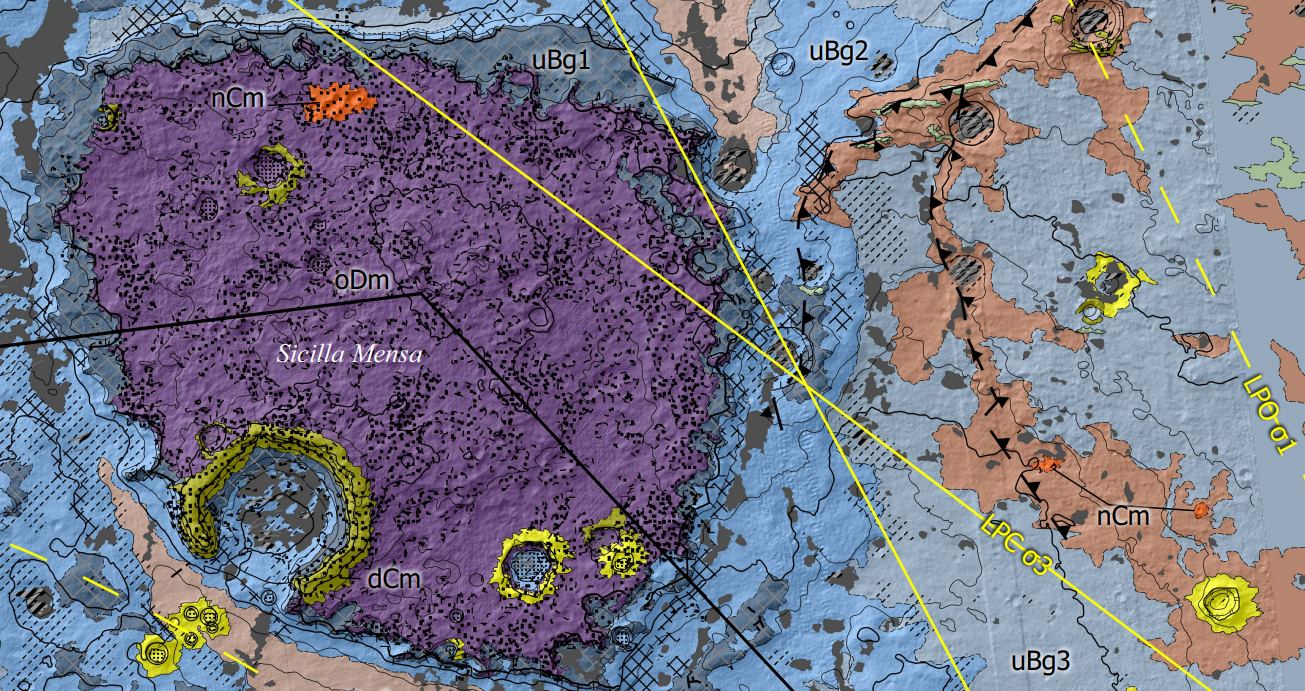
This zoom-in of the map shows Sicilla Mensa, a flat-topped feature with cliff-like edges. oDm stands for overlying dark material. The image also shows craters and the extent of their ejecta, shown in yellow. It’s labelled rCm for recent crater material. Image Credit: Fawdon et al. 2024.
This is the highest-resolution map of the region ever made. With a scale of 1:25,000, each centimetre on the map equals 250 meters on Mars. Since Rosalind Franklin will travel an average of 25 to 50 meters each day, a day’s journey is one or two millimetres on the map.
The making of the map has already provided some benefits to the Rosalind Franklin mission. “The mapping exercise has provided the wider <ExoMars> rover team with a sound knowledge of the landing site and has also helped us to develop new geological hypotheses for the region,” the authors write.
Oxia planum is rich in clays, also called hydrated minerals. Because clays are formed in water-rich environments, it makes these sites excellent locations to study for clues as to whether life once began on Mars. Image Credit: ESA/Mars Express (OMEGA and HRSC) and NASA/Mars Reconnaissance Orbiter (CRISM). LICENCE: ESA Standard Licence
The map is more than just a driving guide. It’s essentially a summary of our hypotheses about Mars. When the rover begins its mission, its initial exploration and drilling will test some of these existing hypotheses for Martian geology and history. Those results will inform the rover team, leading to better decisions about where to drill and explore. That will “… improve the chances of the mission meeting its search for life goals,” the authors explain.
“This map is exciting because it is a guide that shows us where to find the answers. It serves as a visual hypothesis of what we currently know about the different rocks in the landing site. The instruments on Rosalind Franklin will allow us to test our knowledge on the spot when the time comes,” explained Peter Fawdon, one of the lead authors from the Open University.
Astronauts Have Surprising Ability to Orient Themselves and Gauge Distance Traveled in Space: Study
Astronauts Have Surprising Ability to Orient Themselves and Gauge Distance Traveled in Space: Study
New research has implications for crew safety in space and could potentially give clues to how aging affects people’s balance systems here on Earth.
Jörges et al. tackled the question of whether body posture influences human perception of self-motion and distance; they found some evidence that the same amount of optic flow can elicit the sensation of having traveled further when supine versus when sitting upright, that is, optic flow is more effective at eliciting a sense of self-motion when supine; this constitutes evidence that visual and non-visual cues are at least partially integrated even when self-motion is presented only visually; however, they did not find any significant differences between performance on Earth and in the microgravity of the ISS, suggesting that vestibular cues play a minor role, if any, in the estimation of visually presented self-motion.
“It has been repeatedly shown that the perception of gravity influences perceptual skill,” said York University’s Professor Laurence Harris, senior author of the study.
“The most profound way of looking at the influence of gravity is to take it away, which is why we took our research into space.”
“We’ve had a steady presence for close to a quarter century in space and with space efforts only increasing as we plan to go back to the moon and beyond, answering health-and-safety questions only becomes more important.”
“Based on our findings it seems as though humans are surprisingly able to compensate adequately for the lack of an Earth-normal environment using vision.
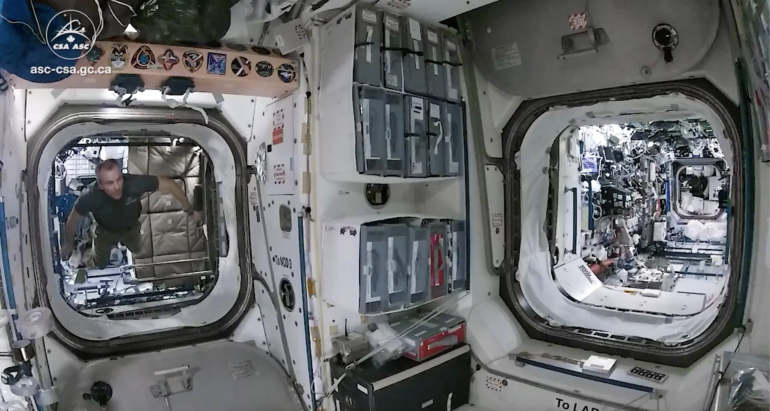
In the research, Professor Harris and colleagues studied a dozen astronauts aboard the International Space Station (ISS), which orbits about 400 km from the Earth’s surface.
“Here, Earth’s gravity is approximately cancelled out by centrifugal force generated by the orbiting of the station. In the resulting microgravity, the way people move is more like flying,” Professor Harris said.
“People have previously anecdotally reported that they felt they were moving faster or further than they really were in space, so this provided some motivation to actually record this.”
The authors compared the performance of a dozen astronauts — six men and six women — before, during, and after their year-long missions to the space station and found that their sense of how far they traveled remained largely intact.
Space missions are busy endeavors and it took the researchers several days to connect with the astronauts once they arrived at the space station.
“It’s possible our research was unable to capture early adaptation that may have occurred in those first few days. It’s still a good news message because it says that whatever adaptation happens, happens very quickly,” Professor Harris said.
Space missions are not without risk. As the ISS orbits the Earth it is sometimes hit with small objects that could penetrate the vessel requiring astronauts to move to safety.
“On a number of occasions during our experiment, the ISS had to perform evasive maneuvers,” Professor Harris said.
“Astronauts need to be able to go to safe places or escape hatches on the ISS quickly and efficiently in an emergency. So, it was very reassuring to find that they were actually able to do this quite precisely.”
“Our research shows exposure to microgravity mimics the aging process on a largely physiological level — wasting of bones and muscles, changes in hormonal functioning and increased susceptibility to infection — but this paper finds that self-motion is largely unaffected, suggesting the balance issues that frequently come from old age may not be related to the vestibular system.”
“It suggests that the mechanism for the perception of movement in older people should be relatively unaffected, and that the issues involved in falling may not be so much in terms of the perception of how far they’ve moved, but perhaps more to do with how they’re able to convert that into a balance reflex.”
The study was published in the journal npj Microgravity.
B. Jörges et al. 2024. The effects of long-term exposure to microgravity and body orientation relative to gravity on perceived traveled distance. npj Microgravity 10, 28; doi: 10.1038/s41526-024-00376-6
DART Changed the Shape of Asteroid Dimorphos, not Just its Orbit
The asteroid Dimorphos was captured by NASA’s DART mission just two seconds before the spacecraft struck its surface on Sept. 26, 2022. Observations of the asteroid before and after impact suggest it is a loosely packed “rubble pile” object. Credit: NASA/JHUAPL
DART Changed the Shape of Asteroid Dimorphos, not Just its Orbit
On September 26th, 2022, NASA’s Double Asteroid Redirection Test (DART) collided with the asteroid Dimorphos, a moonlet that orbits the larger asteroid Didymos. The purpose of this test was to evaluate a potential strategy for planetary defense. The demonstration showed that a kinetic impactor could alter the orbit of an asteroid that could potentially impact Earth someday – aka. Potentially Hazardous Asteroid (PHA). According to a new NASA-led study, the DART mission’s impact not only altered the orbit of the asteroid but also its shape!
The study was led by Shantanu P. Naidu, a navigation engineer with NASA’s Jet Propulsion Laboratory (JPL) at Caltech. He was joined by researchers from the Lowell Observatory, Northern Arizona University (NAU), the University of Colorado Boulder (UCB), the Astronomical Institute of the Academy of Sciences of the Czech Republic, and Johns Hopkins University (JHU). Their paper, “Orbital and Physical Characterization of Asteroid Dimorphos Following the DART Impact,” appeared on March 19th in the Planetary Science Journal.
The Didymos double asteroid system consists of an 851-meter-wide (2792 ft) primary orbited by the comparatively small Dimorphos. The latter was selected as the target for DART because any changes in its orbit caused by the impact would be comparatively easy to measure using ground-based telescopes. Before DART impacted with the moonlet, it was an oblate spheroid measuring 170 meters (560 feet) in diameter with virtually no craters. Before impact, the moonlet orbited Didymos with a period of 11 hours and 55 minutes.
Artist’s impression of the DART mission impacting the moonlet Dimorphos. Credit: ESA
Before the encounter, NASA indicated that a 73-second change in Dimorphos’ orbital period was the minimum requirement for success. Early data showed DART surpassed this minimum benchmark by more than 25 times. As Naidu said in a NASA press release, the impact also altered the moonlet’s shape:
“When DART made impact, things got very interesting. Dimorphos’ orbit is no longer circular: Its orbital period is now 33 minutes and 15 seconds shorter. And the entire shape of the asteroid has changed, from a relatively symmetrical object to a ‘triaxial ellipsoid’ – something more like an oblong watermelon.”
Naidu and his team combined three data sources with their computer models to determine what happened to the asteroid after impact. The first was the images DART took of Dimorphos right before impact, which were sent back to Earth via NASA’s Deep Space Network (DSN). These images allowed the team to gauge the dimensions of Didymos and Dimorphos and measure the distance between them. The second source was the Goldstone Solar System Radar (GSSR), part of the DNS network located in California responsible for investigating Solar System objects.
The GSSR was one of several ground-based instruments that precisely measured the position and velocity of Dimorphos relative to Didymos after impact – which indicated how the mission greatly exceeded expectations. The third source was provided by ground-based telescopes worldwide that measured changes in the amount of life reflected (aka. light curves) of both asteroids. Much like how astronomers monitor stars for periodic dips (which could indicate a transiting planet), dips in Didymos’ luminosity are attributable to Dimorphos passing in front of it.
Artist’s impression of the ESA’s Hera mission rendezvousing with Dimorphos. Credit: NASA
By comparing these light curves from before and after impact, the team learned how DART altered Dimorphos’ motion. Based on these data sources and their models, the team calculated how its orbital period evolved and found that it was now slightly eccentric. Said Steve Chesley, a senior research scientist at JPL and a co-author on the study:
“We used the timing of this precise series of light-curve dips to deduce the shape of the orbit, and because our models were so sensitive, we could also figure out the shape of the asteroid. Before impact, the times of the events occurred regularly, showing a circular orbit. After impact, there were very slight timing differences, showing something was askew. We never expected to get this kind of accuracy.”
According to their results, DART’s impact reduced the average distance between the two asteroids to roughly 1,152 meters (3,780 feet) – closer by about 37 meters (120 feet). It also shortened Dimorphos’ orbital period to 11 hours, 22 minutes, and 3 seconds – a change of 33 minutes and 15 seconds. These results are consistent with other independent studies based on the same data. They will be further tested by the ESA’s Hera mission, scheduled to launch in October 2024, when it makes a flyby of the double-asteroid and conducts a detailed survey.
Cosmochemistry: Why study it? What can it teach us about finding life beyond Earth?
Universe Today has had some fantastic discussions with researchers on the importance of studying impact craters, planetary surfaces, exoplanets,astrobiology,solar physics, comets, planetary atmospheres, and planetary geophysics, and how these diverse scientific fields can help researchers and the public better understand the search for life beyond Earth. Here, we will investigate the unique field of cosmochemistry and how it provides researchers with the knowledge pertaining to both our solar system and beyond, including the benefits and challenges, finding life beyond Earth, and suggestive paths for upcoming students who wish to pursue studying cosmochemistry. But what is cosmochemistry and why is it so important to study it?
“Cosmochemistry is the study of space stuff, the actual materials that make up planets, stars, satellites, comets, and asteroids,” Dr. Ryan Ogliore, who is an associate professor of physics at Washington University in St. Louis, tells Universe Today. “This stuff can take all the forms of matter: solid, liquid, gas, and plasma. Cosmochemistry is different from astronomy which is primarily concerned with the study of light that interacts with this stuff. There are two main benefits of studying actual astromaterials: 1) the materials record the conditions at the time and place where they formed, allowing us to look into the deep past; and 2) laboratory measurements of materials are extraordinarily precise and sensitive, and continue to improve as technology improves.”
In a nutshell, the field of cosmochemistry, also known as chemical cosmology, perfectly sums up Carl Sagan’s famous quote, “The cosmos is within us. We are made of star-stuff. We are a way for the cosmos to know itself.” To understand cosmochemistry is to understand how the Earth got here, how we got here, and possibly how life got wherever we’re (hopefully) going to find it, someday.
Like all scientific fields, cosmochemistry incorporates a myriad of methods and strategies with the goal of answering some of the universe’s most difficult questions, specifically pertaining to how the countless stellar and planetary objects throughout the universe came to be. These methods and strategies primarily include laboratory analyses of meteorites and other physical samples brought back from space, including from the Moon, asteroids, and comets. But what are some of the benefits and challenges of studying cosmochemistry?
“One of the primary benefits of cosmochemistry is the ability to reproduce measurements,” Dr. Ogliore tells Universe Today. “I can measure something in my lab, and somebody else can measure either the same object, or a very similar object, in another lab to confirm my measurements. Only after repeated measurements, by different labs and different techniques, will a given claim be universally accepted by the community. This is difficult to do in astronomy, and also difficult using remote-sensing measurements on spacecraft studying other bodies in the Solar System.”
Apart from the crewed Apollo missions to the Moon, all other samples from space have been returned via robotic spacecraft. While this might seem like an easy process from an outside perspective, collecting samples from space and returning them to Earth is a very daunting and time-consuming series of countless tests, procedures, precise calculations, and hundreds to thousands of scientists and engineers ensuring every little detail is covered to ensure complete mission success, often to only collect a few ounces of material. This massive effort is tasked with not only ensuring successful sample collection, but also ensuring successful storage of the samples to avoid contamination during their journey home, and then retrieving the samples once they land in a capsule back on Earth, where they are properly unpacked, cataloged, and stored for laboratory anal
To demonstrate the difficulty in conducting a sample return mission, only four nations have successfully used robotic explorers to collect samples from another planetary body and returned them to Earth: the former Soviet Union, United States, Japan, and China. The former Soviet Union successfully returned lunar samples to Earth throughout the 1970s; the United States has returned samples from a comet, asteroid, and even solar particles; Japan has successfully returned samples from two asteroids; and most recently, China succeeded in returning 61.1 ounces from the Moon, which is the current record for robotic sample return missions. But even with the difficulty of conducting a successful sample return mission, what can cosmochemistry teach us about finding life beyond Earth?
“Cosmochemistry can tell us about the delivery of the ingredients necessary for life to planets or moons via asteroids or comets,” Dr. Ogliore tells Universe Today. “Since we have both asteroid and comet material in the lab, we can tell if primitive pre-biotic organic compounds may have been delivered by these bodies. Of course, this doesn’t mean life on Earth (or elsewhere) started this way, only that it is one pathway. Detection of life on another world would be one of the biggest discoveries in the history of science. So of course we’d want to be absolutely sure! This requires repeated measurements by different labs using different techniques, which requires a sample on Earth. I think the only way we’d know for sure if there was life on Europa, Enceladus, or Mars is if we bring a sample back to Earth from these places.”
As it turns out, NASA is actively working on the Mars Sample Return (MSR) mission, for which Dr. Ogliore is a member of the MSR Measurement Definition Team. The goal of MSR will be to travel to the Red Planet to collect and return samples of Martian regolith to Earth for the first time in history. The first step of this mission is currently being accomplished by NASA’s Perseverance rover in Jezero Crater, as it is slowly collecting samples and dropping them in tubes across the Martian surface for future retrieval by MSR.
For Europa, while there have been several discussions regarding a sample return mission, including a 2002 study discussing a sample return mission from Europa’s ocean and a 2015 study discussing a potential plume sample return mission, no definitive sample return missions from Europa are currently in the works, possibly due to the enormous distance. Despite this, and while not a life-finding mission, Dr. Ogliore has been tasked to lead a robotic mission to Jupiter’s volcanic moon, Io, to explore its plethora of volcanoes. For Enceladus, the Life Investigation for Enceladus (LIFE) mission has had a number of mission proposals submitted to return samples from Enceladus’ plumes, though it has yet to be accepted. But what is the most exciting aspect about cosmochemistry that Dr. Ogliore has studied during his career?
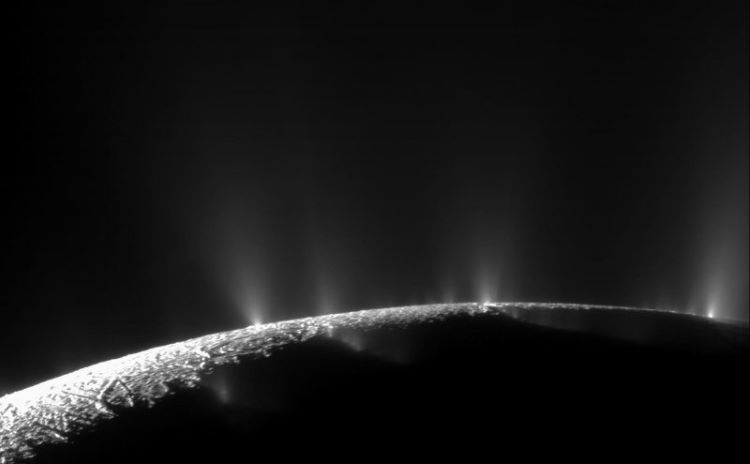
Image from NASA’s Cassini spacecraft of the water vapor plumes emanating from the south pole of Saturn’s moon Enceladus. (Credit: NASA/JPL/Space Science Institute)
“In my opinion the most important single measurement in the history of cosmochemistry was the measurements of the oxygen isotopic composition of the Sun,” Dr. Ogliore tells Universe Today. “To do this, we needed to return samples of the solar wind to Earth, which we did with NASA’s Genesis mission. However, the sample return capsule crashed on Earth. But did that stop the cosmochemists?! Hell no! Kevin McKeegan and colleagues at UCLA had built a specialized, enormous, complicated instrument to study these samples. Despite the crash, McKeegan and colleagues analyzed oxygen in the solar wind and found that it was 6% lighter than oxygen found on Earth, and it matched the composition of the oldest known objects in the Solar System: millimeter-sized calcium-aluminum inclusions (CAIs) found in meteorites.”
Dr. Ogliore continues by telling Universe Today about how this result was predicted by Bob Clayton at the University of Chicago, along with crediting his own postdoc, Lionel Vacher, for conducting a research project that built off the Genesis results, noting, “This was a really fun project because it was technically very challenging, and the results put the Solar System in its astrophysical context.”
Like the myriad of scientific disciplines that Universe Today has examined during this series, cosmochemistry is successful due to its multidisciplinary nature that contributes to the goal of answering some of the universe’s most difficult questions. Dr. Ogliore emphasizes that analysis of laboratory samples involves a multitude of scientific backgrounds to understand what the researchers are observing within each sample and the processes responsible for creating them. Additionally, this also includes the aforementioned sample return missions and hundreds to thousands of scientists and engineers who partake in each mission. Therefore, what advice can Dr. Ogliore offer to upcoming students who wish to pursue cosmochemistry?
“Biology, chemistry, geology, physics, math, electronics — you need it all!” Dr. Ogliore tells Universe Today. “If you like learning new things constantly, then planetary science is for you. It is good to get a very broad education. This will serve you well in a number of careers, but it is especially true for planetary science and cosmochemistry. I get to work with people who study volcanoes, and mathematicians working on chaotic motion. How cool is that?!”
All things considered, cosmochemistry is both an enormously challenging and rewarding field of study to try and answer some of the most difficult and longstanding questions regarding the processes responsible for the existence of celestial bodies in the Solar System and beyond, including stars, planets, moons, meteorites, and comets, along with how life emerged on our small, blue world. As noted, cosmochemistry perfectly sums up Carl Sagan’s famous quote, “The cosmos is within us. We are made of star-stuff. We are a way for the cosmos to know itself.” It is through cosmochemistry and the analysis of meteorites and other returned samples that enable researchers to slowly inch our way to answering what makes life and where we can find it.
“Meteorites are the most spectacular record of nature known to mankind,” Dr. Ogliore tells Universe Today. “We have rocks from Mars, the Moon, volcanic worlds, asteroid Vesta, and dozens of other worlds. Iron meteorites are the cores of broken apart planets. These rocks record processes that occurred four and a half billion years ago and fall to Earth in a blazing fireball traveling at miles per second. You can follow various blogs that track fireballs, and even calculate areas where meteorites might have fallen. If you ever have the opportunity, go try to find one of these freshly fallen meteorites. The odds are long, but it is worth a try. I have not found a meteorite myself yet, but it is a life goal of mine.”
How will cosmochemistry help us better understand our place in the universe in the coming years and decades? Only time will tell, and this is why we science!
Scientists have discovered a gigantic volcano on Mars near the planet’s equator that remained unnoticed for decades, according to newly published research.
The huge volcano was found in the Red Planet’s eastern Tharsis volcanic province, along with what researchers interpret to be a large sheet of buried glacial ice beneath the Martian surface. The discovery came as a surprise, partly because orbital spacecraft have photographed this region of Mars since the early 1970s.
Hidden in plain sight now for decades, the giant volcano, which has undergone extensive erosion over time, somehow remained unnoticed.
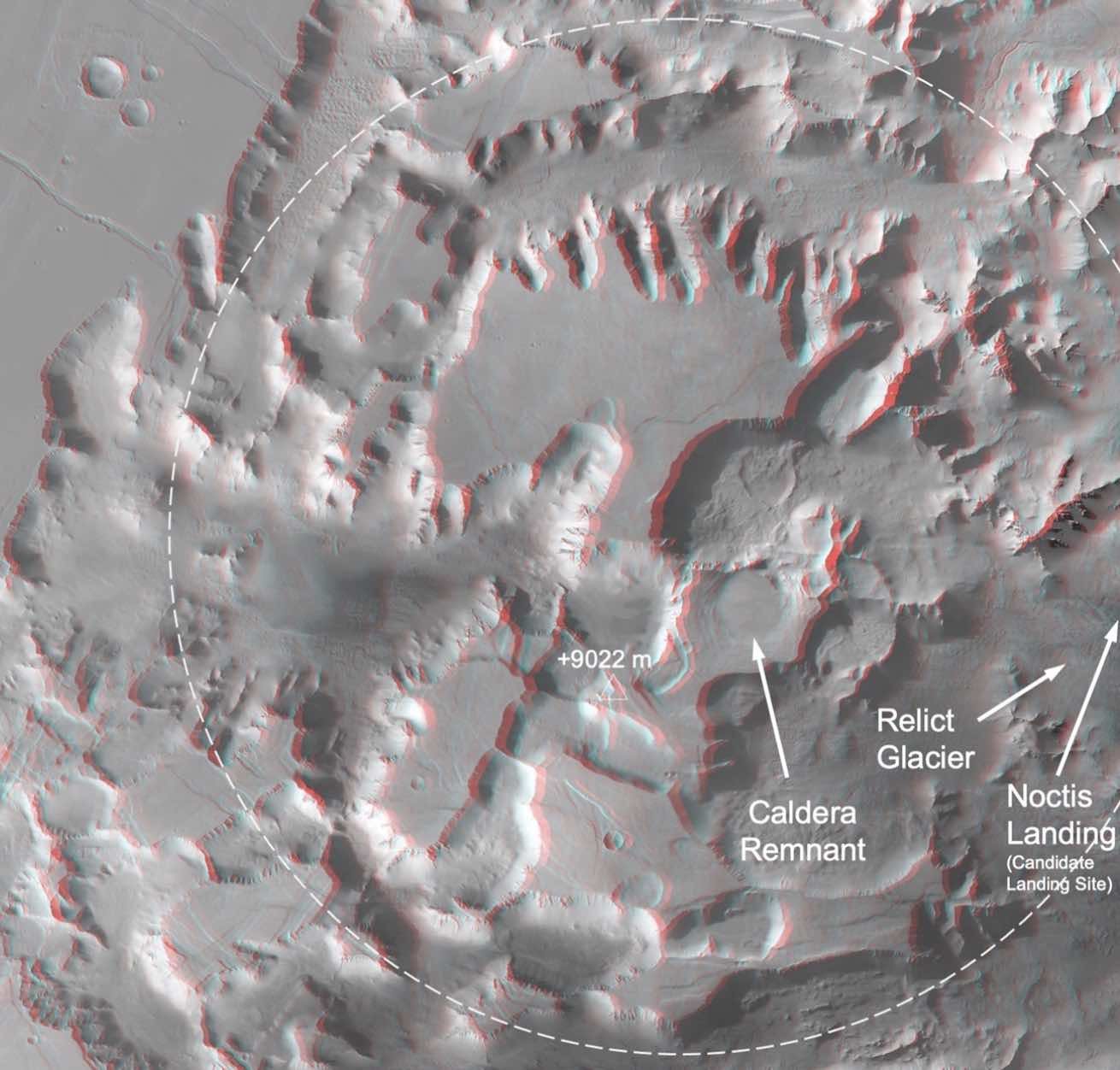
The feature has been given the temporary name “Noctis volcano” due to its proximity to the Noctis Labyrinthus, a region noted for its steep valleys that possess a maze-like appearance.
The 29,600-foot-tall volcano covers an area spanning approximately 280 miles and is believed to have remained active for an extended period. However, it is the giant volcano’s proximity to a region where glacier ice is believed to exist that makes the discovery so promising for researchers, who say it offers a location ripe for studies of the Red Planet’s geology and evolution over tim
The location could also be a promising area for future studies involving potential life that may have once existed—or could still exist—on Mars, with its promising combination of warmth from volcanic activity and water made present by the ancient glacier.
Dr. Pascal Lee, a planetary scientist with the SETI Institute and the Mars Institute, said he and his coauthors of a new study detailing the discoveries say they stumbled onto the huge volcano while observing other features.
“We were examining the geology of an area where we had found the remains of a glacier last year when we realized we were inside a huge and deeply eroded volcano,” Lee said in a statement.
Lee and his coauthors said there were several clues that the area was a massive volcano, which included a series of mesas that formed an arc, as well as what soon revealed itself through examination to be the remains of a caldera, where the volcano collapsed in the aftermath of past eruptions.
Additionally, past studies have revealed the presence of hydrated minerals, which were long believed to point to volcanic activity in the area.
“A volcanic setting for these minerals had long been suspected. So, it may not be too surprising to find a volcano here,” said Sourabh Shubham, one of the study’s co-authors.
“In some sense, this large volcano is a long-sought ‘smoking gun’,” Shubham said.
In addition to the newly discovered volcano, blister-like areas, believed to have been produced by the explosive escape of steam, point to the existence of a “relict glacier” further evidenced by deposits of light-colored sulfates like jarosite, which may represent the most recent past glaciation that affected the giant volcano.
The volcano provides scientists a window into the long history of glacial erosion and other processes that have occurred throughout the history of the region, although the ancient volcano’s age remains a mystery. However, scientists maintain that there is evidence of eruptions in modern history, and although it is presently unclear whether the Noctis volcano is still active, it is not impossible that it might erupt again in the future.
“It’s really a combination of things that makes the Noctis volcano site exceptionally exciting,” Lee said in a statement. “It has also had a long history of heat interacting with water and ice, which makes it a prime location for astrobiology and our search for signs of life.
Given all the potential for new discoveries, Lee added that the giant volcano “is looking very attractive for robotic and human exploration.”
Lee and his team’s new paper, “Large Eroded Volcano Complex and Buried Glacier Ice In Eastern Noctis Labyrinthus: Evidence For Recent Volcanism and Glaciation Near Mars’ Equator,” can be found online here.
The newest spot to search for life on Mars could be a collapsed volcano whose layers are sandwiched with the icy remains of ancient glaciers.
Noctis Mons (AKA the Night Mountain, which is an extremely cool name) has been hidden for a long time. Researchers just now recognized the jumbled terrain, in old images from decades of Martian satellites, as the remains of a collapsed volcano. It looks like Noctis Mons was active fairly recently (and it may still erupt again), and its slopes are layered with glacial ice and snow. That may make it the perfect place to search for alien life.
SETI Institute astrobiologist Pascal Lee and his colleagues presented their findings at the recent Lunar and Planetary Science Conference.
Looking down from orbit, Noctis Mons doesn’t immediately look like a volcano, but if you look closely, you can still spot the caldera at its center.
LEE AT AL. 2024
FIRE, ICE, AND ALIEN LIFE?
Lee and his colleagues recently realized that the strangle jumble of canyons and gently-sloping mesas in images of the Martian equator were actually the remains of a collapsed volcano, eroded and reshaped by glaciers. Looking closer, they spotted old lava flows, fields of pumice and ash, and minerals left by hydrothermal activity. And beneath the uppermost layer of volcanic debris lies a sheet of ice, which gleams here and there through an eroded hole in the thin blanket of volcanic ash that covers it.
Beneath the crumbling slopes of Noctis Mons, fire and ice may have created the perfect environment for life: warm, with plenty of liquid water and chemical nutrients. And since the volcano appears to have been active for a very long time, life has had plenty of opportunity to evolve from the complex chemistry that happens when water and volcanic rock meet.
All around the slopes of Noctis Mons lies a blanket of pumice and volcanic ash. Based on images from a whole series of Martian satellites, from Mariner 9 to the Mars Reconnaissance Orbiter, it’s between 3 and 9 feet thick, and it looks strangely blistered. Here on Earth, when hot volcanic ash lands atop ice, it cools quickly, but hot steam bubbled up beneath the surface, creating blister-like mounds. Where some of these mounds have eroded over time, satellite images reveal the telltale gleam of ice beneath a thin layer of minerals. Lee and his colleagues say the whole 1,900 square mile area of Noctis Mons could lie atop a huge ice sheet left over from one of the last glaciers to pass through the area.
That’s 1,900 square miles of ice interacting with the heat of a volcano, creating pockets and streams of liquid water underground, possibly for billions of years. In other words, it’s a huge Martian oasis that’s potentially perfect for life.
Noctis Mons is also an ideal place for rovers or — someday — astronauts to explore. Because it’s collapsed, what was once a tall, forbidding mountain is now “so deeply eroded that you could hike, drive, or fly through it,” says Lee in a recent statement. And all that glacial ice could support future exploration crews or provide the raw material for rocket fuel (assuming it’s not actually a sensitive alien habitat, that is).
In other words, the place is basically a theme park for astrobiologists.
A VOLCANO WITH A MESSY BACKSTORY
We don’t know how long ago Noctis Mons formed, but [authors] say it looks like the volcano has been active for a huge stretch of Martian history, and it’s been active fairly recently. It may even still be active today. Olympus Mons, the largest volcano in our Solar System, formed about 3.5 billion years ago and stayed active for millions of years, longer than any volcano here on Earth, but Noctis Mons may turn out to beat its neighbor’s impressive streak.
Noctis Mons was once a wide, gently-sloping mountain, built up over time from layers of lava and pyroclastic debris (small grains of volcanic ash and larger chunks of pumice). Between those layers of volcanic rock lay sheets of ice: some compacted snow that fell on the volcano’s slopes and some thick glaciers, all buried beneath the next eruption.
At some point, the magma welling up through cracks and fissures in the mountain melted all of that ice, causing the slopes of the volcano to collapse. Today, the summit is now just a partial ring of mesas, which slope gently downward. From above, it looks like a wide ring of broken rock, crossed by lava flows and cut by deep, glacier-carved canyons.
And someday it just might be the place where we discover we’re not alone in the Solar System.
Fifteen rare asteroids showcasing very unusual “active” properties have been detected as part of an ongoing international volunteer effort to unravel the mysteries of a peculiar variety of space objects.
The asteroids were spotted amid 430,000 images during an effort comprising more than 8000 volunteers who scoured images from the Dark Energy Camera, or DECam, on Chile’s Victor M. Blanco telescope.
Founded by Colin Orion Chandler, Ph.D., a University of Washington and DiRAC Institute scientist, the Active Asteroids project continues to leverage the work of volunteers in its ongoing search for asteroids possessing these unusual properties.
What makes these “active” objects so rare is that they possess traits that blur the lines between asteroids and other kinds of celestial objects, as some of them possess tails like comets, while others are enveloped in pockets of dust or gas.
Since their first discovery in 1949, only a few dozen of the rare asteroids have ever been discovered.
According to NASA, the properties these objects display challenge our conventional ideas about objects in the solar system, and present opportunities for new insights about the behavior and origins of these rare “active” asteroids.
Among the things astronomers hope to learn from studying these objects are insights into solar system evolution and the formation of planets, as well as clues to the origins of water on Earth.
Active asteroids may also help provide valuable resources for future space missions, since the ice within their tails could be used for a range of applications in deep space that include providing breathable air, to help power spacecraft on long missions.
The fifteen newest additions to the growing number of active asteroids currently known to exist are described in a new paper in the Astronomical Journal.
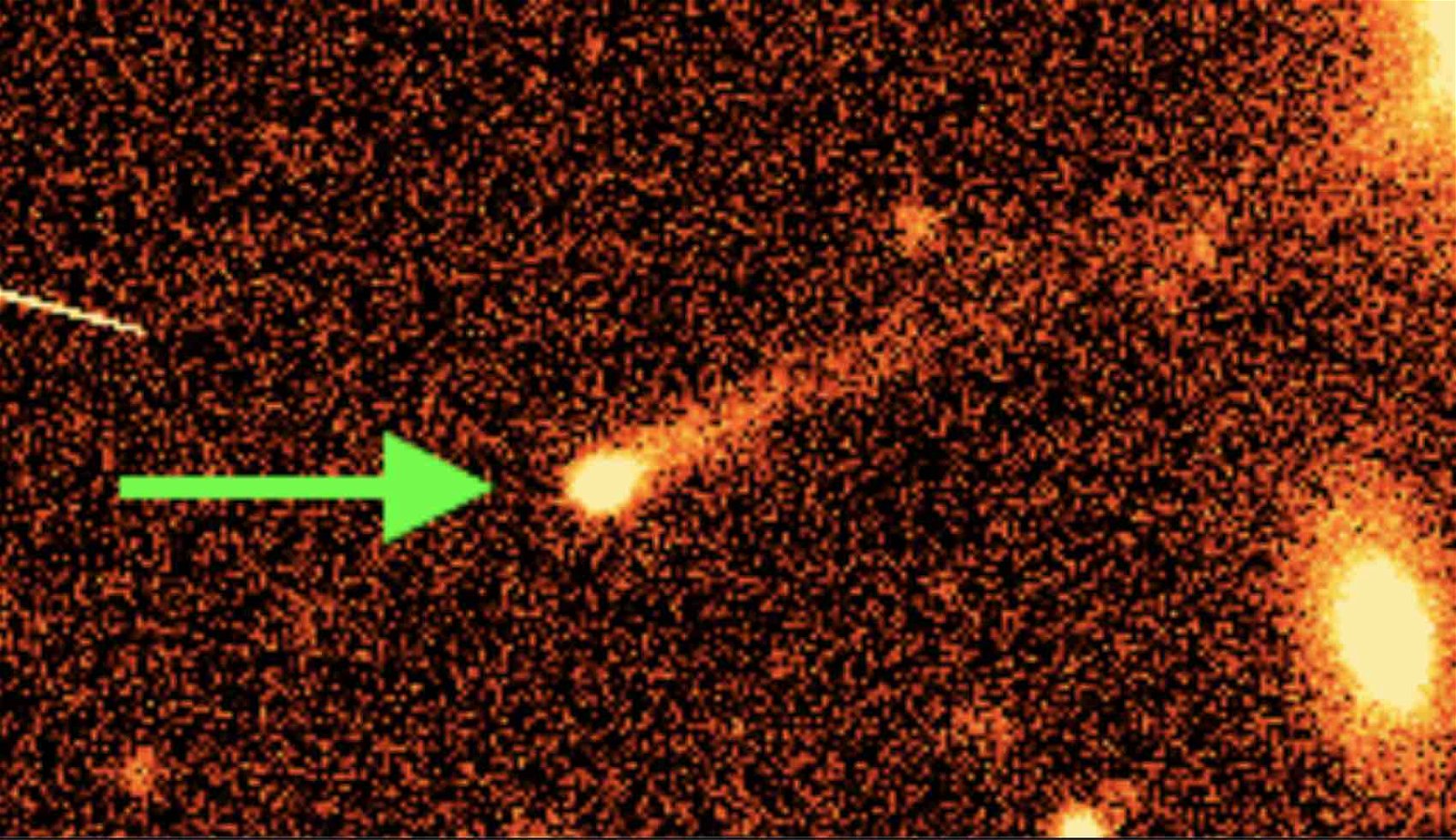
a comet tail coming from Asteroid 2015 VA108, one of the active asteroids spotted by volunteers from NASA’s “Active Asteroids” Citizen Science project (Credit: Colin Orion Chandler/University of Washington).
For many of the Active Asteroid project’s participants, helping to spot these odd space objects has been a life-changing experience. Virgilio Gonano, an Italian amateur astronomer and one of the volunteers who helped make the discoveries, said it was a “dream come true” to be able to be part of such an effort.
Tiffany Shaw-Diaz, a volunteer from Dayton, Ohio, said that she has been a member of Active Asteroids since the project produced some of its earliest results.
“To say that this project has become a significant part of my life is an understatement,” Shaw-Diaz recently said. “I look forward to classifying subjects each day, as long as time or health permits, and I am beyond honored to work with such esteemed scientists on a regular basis.”
There’s potentially good news for others who may be interested in joining the volunteer-driven effort: Active Asteroids is seeking additional volunteers for its growing network of contributors. Who knows, you may even be the next volunteer who helps them spot an asteroid that behaves a lot like a comet. More about the project can be found online at the project’s official website.
Op 14 november 1971 gebeurde er iets wat cruciaal was voor ons begrip van onze rode buurplaneet, Mars.
Na een ruimtereis van 167 dagen arriveerde de onbemande NASA-sonde Mariner 9 in het gebied rond de rotsplaneet en bracht zichzelf als het eerste ruimtevaartuig ooit in een baan om Mars.
Binnen een jaar wist de satelliet beelden vast te leggen van ongeveer 80 procent van het grillige oppervlak, waar bijvoorbeeld grote ravijnen in zitten, maar ook oude kraters en droge riviergeulen.
Maar blijkbaar hebben astronomen een groot landschapselement over het hoofd gezien op de in totaal ruim 7000 foto’s die in 50 jaar zijn gemaakt.
Dat kwam aan het licht tijdens een jaarlijkse maan- en planeetconferentie in Texas, halverwege maart 2024.
Hier onthulden astronomen van het SETI Institute en het Mars Institute van NASA Ames Research Center de ontdekking van een gigantische vulkaan die zich al decennia schuilhoudt op een van de meest iconische plekken van de planeet: de grens tussen een gebied dat bekendstaat om zijn diepe, doolhofachtige dalen en een groot kloofsysteem, dat langs de evenaar loopt en her en der tot wel 7 meter diep is.
‘We waren bezig met geologisch onderzoek in een gebied waar we afgelopen jaar de resten van een gletsjer ontdekten toen we beseften dat we in een enorme, geërodeerde vulkaan zaten,’ zegt onderzoeksleider dr. Pascal Lee in een persbericht.
Uitbarsting is al lang gaande
De pas ontdekte vulkaan, die voorlopig de naam Noctis-vulkaan heeft gekregen, is uitgestrekt over 450 kilometer en heeft een hoogte van 9022 meter.
De onderzoekers zeggen dat zowel de grootte als de vorm van de vulkaan erop wijzen dat de reus al vroeg in de geschiedenis van de planeet zijn krachten verzamelde, en zeer lange tijd actief is geweest.
De pas ontdekte megavulkaan (rode ring) ligt ten zuiden van de evenaar van de planeet, in het oostelijke deel van het doolhofachtige gebied Noctis Labyrinthus en in het westelijke deel Valles Marineris, een gebied met kloven met een diepte van 2 tot 7 kilometer. Ter vergelijking: het diepste punt van Grand Canyon is 1800 meter.
Maar de reusachtige vulkaan is niet de enige nieuwe ontdekking in het iconische gebied.
In het zuidoostelijke deel van de vulkaan ligt een nieuwere, smalle afzetting, waar volgens de onderzoekers gletsjerijs verstopt kan zitten.
De onderzoekers noemen de ontdekkingen opmerkelijk, want ze wijzen in de richting van een nieuw gebied, dat interessant kan zijn als we meer willen weten over de ontwikkeling van de planeet door de tijd heen en mogelijke tekens van leven.
De reden dat we tientallen jaren de 450 kilometer brede reus over het hoofd hebben gezien, moeten we zoeken in het grillige en gehavende landschap. Daardoor ging de als het ware op in de omgeving.
Op de rotsplaneet zijn meerdere grote, slapende vulkanen uit een ver verleden te vinden.
Een daarvan heet Olympus Mons en is met zijn 25 kilometer hoogte en 600 kilometer breedte de grootste vulkaan in het zonnestelsel.
An international team of astronomers has revealed a three-dimensional map of the known universe that charts the largest-ever volume of the extended cosmos. The tools used to create the map were initially designed to measure stars in our galaxy. However, their sensitivity revealed the locations of quasars powered by supermassive black holes at the centers of other galaxies, leading to the map’s eventual creation.
“This quasar catalog is different from all previous catalogs in that it gives us a three-dimensional map of the largest-ever volume of the universe,” says map co-creator David Hogg, a senior research scientist at the Flatiron Institute’s Center for Computational Astrophysics in New York City and a professor of physics and data science at New York University. “It isn’t the catalog with the most quasars, and it isn’t the catalog with the best-quality measurements of quasars, but it is the catalog with the largest total volume of the universe mapped.”
MAP OF THE KNOWN UNIVERSE COMBINES DATA FROM MULTIPLE OBSERVATORIES
Fans of the movie Star Trek: Generations may recall the map of the known universe used by Captain Picard and Commander Data to track an anomaly across vast regions of space known as the Nexus. Of course, such a detailed map covering the entire cosmos has thus far existed only in the world of science fiction. Now, a team of Flatiron Institute researchers say they have created the first-ever real-world map of the known universe, bringing yet another concept from science fiction to science fact.
To create their map of the known universe, the researchers compiled data from the European Space Agency’s Gaia Space telescope, which included over 6.6 million quasar candidates. That data was then compared against observations collected by NASA’s Wide-Field Infrared Survey Explorer and the Sloan Digital Sky Survey, allowing the map’s creators to remove “noise” from the final product, including from other stars and galaxies, which resulted in a final 1.3 million quasars ending up in the final version of the map. The team also mapped dust and other “nuisances” that may block out certain quasars from observation.
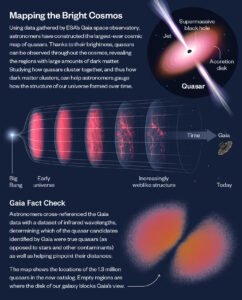
An infographic explaining the creation of a new map of around 1.3 million quasars from across the visible universe. CREDIT: ESA/Gaia/DPAC; Lucy Reading-Ikkanda/Simons Foundation; K. Storey-Fisher et al. 2024.
As previously noted, Gaia’s primary mission involved mapping stars in the Milky Way Galaxy. However, the researchers behind this latest effort found that Gaia “inadvertently spots objects outside the Milky Way.” This includes supermassive quasars dating back to 1.5 billion years after the Big Bang.
“We were able to make measurements of how matter clusters together in the early universe that are as precise as some of those from major international survey projects—which is quite remarkable given that we got our data as a ‘bonus’ from the Milky Way–focused Gaia project,” explained the paper’s lead author, Kate Storey-Fisher.
While black holes themselves typically emit no light, quasars driven by supermassive black holes are often hundreds of times brighter than entire galaxies. That’s because the extreme gravitational pull of black holes at the center of galaxies collects and “spins up” nearby gas, resulting in an enormously bright disk that can be spotted across the space between galaxies. The result is a massive collection of bright objects that can be spotted by humanity’s most advanced telescopes, leading to the creation of the cosmic map.
NEW MAP ALREADY PAYING SCIENTIFIC DIVIDENDS
In their published study, which appears in The Astrophysical Journal, the researchers behind the largest-ever map of the known universe say their tool is already paying dividends. For instance, the data gathered by Gaia was recently compared against the light from the Big Bang, known as the cosmic microwave background. According to the researchers, this comparison will allow scientists to measure how matter clumps together throughout the cosmos.
The map is also likely to aid scientists who are trying to unravel the mystery of dark matter, as enormous rings of dark matter surround these individual quasars. In fact, the researchers say they expect their new largest-ever map of the known universe to aid astronomers and astrophysicists across a wide range of research efforts.
“It has been very exciting to see this catalog spurring so much new science,” Storey-Fisher says. “Researchers around the world are using the quasar map to measure everything from the initial density fluctuations that seeded the cosmic web to the distribution of cosmic voids to the motion of our solar system through the universe.”
“This quasar catalog is a great example of how productive astronomical projects are,” adds Hogg. “Gaia was designed to measure stars in our own galaxy, but it also found millions of quasars at the same time, which give us a map of the entire universe.”
Christopher Plain is a Science Fiction and Fantasy novelist and Head Science Writer at The Debrief. Follow and connect with him on X, learn about his books at plainfiction.com, or email him directly at christopher@thedebrief.org.
NASA Reveals its Planetary Science Goals for Artemis III
If all goes well, NASA’s Artemis III mission will bring humans back to the Moon as early as 2026, the first time since the Apollo 17 crew departed in 1972. It won’t be a vacation, though, as astronauts have an enormous amount of science to do, especially in lunar geology. A team from NASA recently presented their planetary science goals and objectives for Artemis III surface activities, which will guide the fieldwork the astronauts will carry out on the lunar surface.
The landing site hasn’t been chosen yet, but it will be within 6 degrees of latitude from the South Pole. These instruments will collect valuable scientific data about the lunar environment, the lunar interior, and how to sustain a long-duration human presence on the Moon, which will help prepare NASA to send astronauts to Mars.
“Artemis marks a bold new era of exploration, where human presence amplifies scientific discovery. With these innovative instruments stationed on the Moon’s surface, we’re embarking on a transformative journey that will kick-start the ability to conduct human-machine teaming – an entirely new way of doing science,” said NASA Deputy Administrator Pam Melroy. “These three deployed instruments were chosen to begin scientific investigations that will address key Moon to Mars science objectives.”
Two of the three main Artemis science goals and the instruments deal with understanding the Moon itself. The Lunar Environment Monitoring Station (LEMS) is a compact, autonomous seismometer suite will help study planetary processes, while the Lunar Dielectric Analyzer (LDA) will aid in understanding the character and origin of lunar polar volatiles. The third main science objective will investigate how to mitigate the risks of human exploration, and to that end the Lunar Effects on Agricultural Flora (LEAF) instrument will investigate the lunar surface environment’s effects on space crops to see if the lunar regolith can be used to grow food.
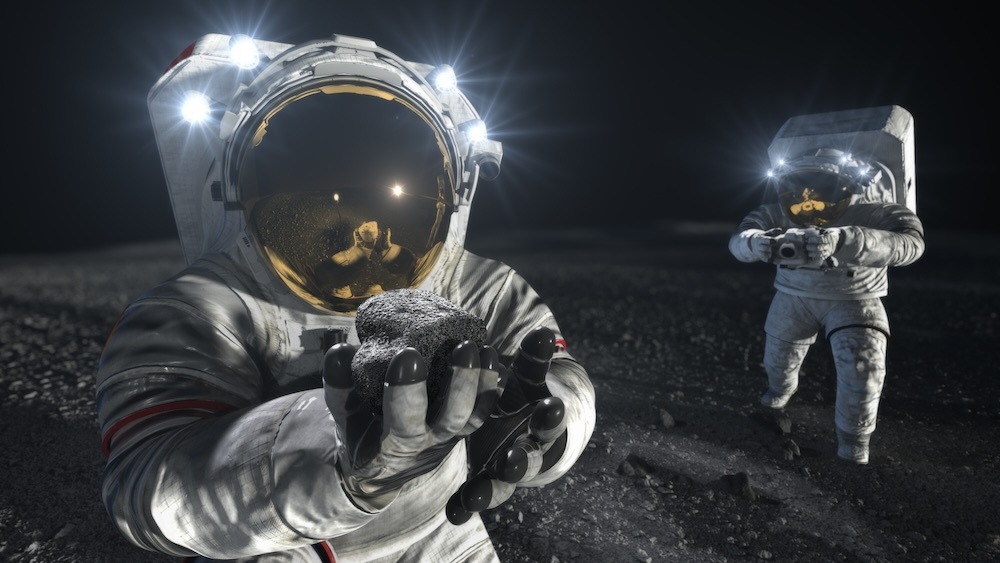
Artist’s concept of an Artemis astronaut deploying an instrument on the lunar surface. Credits: NASA
Falling under the planetary science goals with the two instruments, scientists have laid out four main objectives, which are designed to be “site agnostic,” so that they can be performed at any landing site, or be able to be modified to fit with any future chosen landing site.
A. Understand the Early Evolution of the Moon as a Model for Rocky Planet Evolution
The main objective here is to evaluate the leading theory of the Moon’s early days, which is the Lunar Magma Ocean (LMO) theory. It is theorized that a layer of molten rock was present on the surface of the Moon from the time of the Moon’s formation (about 4.5 or 4.4 billion years ago) to tens or hundreds of millions of years after that time, which led to the formation of the crust, mantle, and core. While the LMO model is supported by many observations, it is not supported by all.
The scientists said gathering samples from the Moon’s polar region and comparing the ages and chemical and isotopic compositions of the new samples to those collected by the Apollo astronauts will help to evaluate the current LMO model and perhaps “find alternate or more complex LMO models.” Scientists would also like to determine the composition of the lower crust, and mantle materials if possible.
Artist’s impression of the impact that caused the formation of the Moon. Credit: NASA/GSFC
Another theory that scientists hope to put under scrutiny during the Artemis program is the giant impact hypothesis. This is the most widely accepted theory for the origin of the Earth–Moon system, which proposes the Moon formed during a collision between the Earth and another small planet, about the size of Mars. The debris from this impact collected in an orbit around Earth to form the Moon. However, similarities between the Earth and Moon don’t quite fit that model, the majority of the Moon’s material should originate from the impactor. “The Artemis III samples will allow new assessments of the formation process and age of the Moon,” the scientists wrote.
B. Determine the Lunar Record of Inner Solar System Impact History.
Impacts played a big role in the early history of our Solar System, and scientists say they would like to determine the age of South Pole Aitken (SPA) Basin, the oldest known lunar impact basin. “This will provide key new information for determining when the record of bombardment starts and how complete that early record is,” the scientists wrote. They also hope to determine the sources of early impactors, which will provide a fundamental benchmark for understanding the ages of surfaces across the Solar System.
Scientists would also like to gather data to test the Lunar Cataclysm Hypothesis, a theory that says an intense period of bombardment occurred on the Moon about 3.9 billion years ago, where about 80% of the Moon was “resurfaced,” with the formation of approximately 1,700 craters 100 kilometers in size or larger. This hypothesis is controversial, but determining if this period of bombardment did occur would help scientists determine if a similar cataclysmic bombardment may have affected life on Earth or been involved in life’s origins.
For the two above goals, the Lunar Environment Monitoring Station (LEMS) will carry out continuous, long-term monitoring of the seismic environment, namely ground motion from moonquakes, in the lunar south polar region. This instrument is expected to operate for at least three months and up to two years and may become a key station in a future global lunar geophysical network. NASA said the instrument will characterize the regional structure of the Moon’s crust and mantle, providing valuable information to analyze the current lunar formation and evolution models.
C & D: Determine the Variability of Regolith in the Circumpolar Environment as a Keystone for Understanding Surface Modification of Airless Bodies, and Reveal the Age, Origin, and Evolution of Solar System Volatiles
The Moon’s poles – and especially the permanently shadowed regions – have been compared to an attic in an old house, because it likely contains a record of history. On the Moon, the “attic-like” regions near the poles would still hold the exogenous material delivered to the inner Solar System. Since the terrestrial record of the early Earth is largely lost, finding it on the Moon would be extremely valuable.
A map showing the permanently shadowed regions (blue) that cover about 3 percent of the moon’s south pole. Credit: NASA Goddard/LRO mission
“Little is known about cold-trapped volatile composition, abundance, age, and the general ability of the Moon to retain volatiles over time,” the scientists wrote. “….Assessing volatiles in cold traps of varying thermal environments and age will provide key new observations to understand their nature.”
And there’s also growing evidence for the presence of lunar polar volatiles like water, hydrogen, and methane, which would be extremely important for future long-term habitation on the Moon. Scientists also want to study how volatiles might be transported across the lunar surface, as such transport has yet to be measured on the Moon, and how it might occur – whether it driven by diurnal temperature changes, solar wind or and micrometeoroid delivery across the Moon.
The Lunar Dielectric Analyzer (LDA) will help in these studies as it will measure the regolith’s ability to propagate an electric field, which is a key parameter in the search for lunar volatiles, especially ice. It will gather essential information about the structure of the Moon’s subsurface, monitor dielectric changes caused by the changing angle of the Sun as the Moon rotates, and look for possible frost formation or ice deposits.
With the Artemis program, NASA will land the first woman, first person of color, and its first international partner astronaut on the Moon, and with the goal of establishing long-term exploration for scientific discovery and preparation for human missions to Mars for the benefit of all.
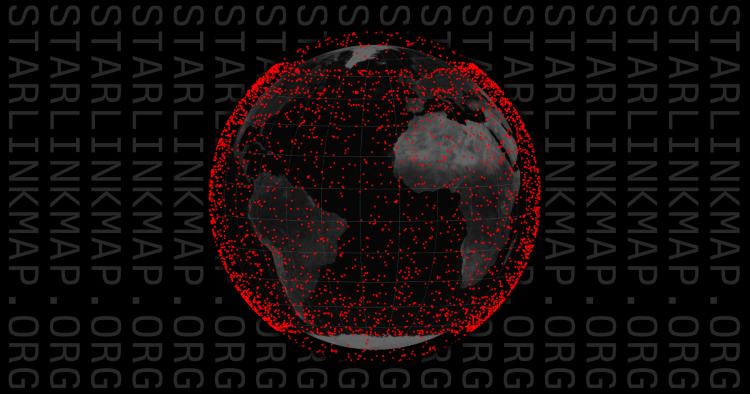
In an effort to enhance the educational outreach of their Starlink constellation, SpaceX has an interactive global map of their Starlink internet satellites, which provides live coverage of every satellite in orbit around the Earth. This interactive map comes as SpaceX continues to launch Starlink satellites into orbit on a near-weekly basis with the goal of providing customers around the world with high-speed internet while specifically targeting rural regions of the globe. In 2022, Starlink officially reached all seven continents after Starlink servicebecame available in Antarctica. Additionally, SpaceX announced in 2023 a partnership with T-Mobiel for Starlink to provide mobile coverage, as well.
2021 video showing an early attempt at Starlink tracking
Within this interactive map, users can opt to see live satellite coverage or rewind and fast forward their respective orbital speeds. Scrolling your mouse will highlight each satellite, and clicking on them will produce their individual satellite information and orbital trajectory, enabling the user to see if a particular satellite will pass over their location. Additionally, users can rotate the Earth and zoom in to anywhere on the planet. All in all, this interactive map gives users near-total control over identifying Starlink satellites currently orbiting the Earth.
To complement the interactive map, users can find data on the number of satellites both launched and currently in orbit, noting a few hundred of the several thousand satellites have been deorbited to burn up on re-entry. As of this writing, 5,977 satellites have been launched with 5,601 satellites currently in operation, and the remaining 376 having been deorbited for a variety of reasons, including failing to reach their target orbit or containing design flaws, as Elon Musk recently announced he plans to deorbit 100 Starlink satellites slowly degrading their orbits over the next five years.
Scrolling down the left menu provides users with information pertaining to the running gigabytes and terabytes having been sent to Earth, along with the most recent and next Starlink launch by SpaceX. Additionally, this menu provides the average time between Starlink launches, along with the number of satellites in orbit by SpaceX’s competition and how many Starlinks jobs are presently available at SpaceX.
As noted, the goal of Starlink is to provide worldwide high-speed internet, with the interactive map noting “The Starlink constellation could serve up to 188,180 MB/sec to Earth.” Despite the more than 5,500 Starlink satellites currently in orbit, SpaceX hopes to launch up to 12,000 satellites during this phase and possibly 42,000, someday.
Despite its impressive numbers and credentials, Starlink has been met with its share of backlash and controversy, including its negative impacts on astronomy, as reports have indicated the streaks from Starlink satellites caused by prolonged camera exposures result in obscuring optical images of the night sky from ground-based telescopes. Most recently, a 2023 study discussed both deliberate and accidental radio signals emanating from Starlink satellites that could interfere with radio astronomy. Additionally, there is growing concern over the increasing number of Starlink satellites could result in unavoidable collisions, leading to increasing space debris in Earth orbit.
With thousands of Starlink satellites still scheduled to be launched into orbit, this Starlink interactive map is going to get busier, and hopefully along with the worldwide high-speed internet access it provides across the globe.
How will Starlink contribute to internet availability in the coming years and decades? Only time will tell, and this is why we science!
A series of experiments studying the sensitivity of life-hunting instruments to be employed in NASA’s forthcoming Europa Clipper Mission have revealed promising new capabilities that significantly raise its chances of being the first to detect lifeforms beyond Earth.
With a launch window that opens in October of this year and a planned insertion into Jupiter’s orbit sometime around April 2030, the Europa Clipper is equipped with a suite of science instruments. Based on recent experiments, one particular instrument, SUrface Dust Analyzer, was determined to be so sensitive that it could likely detect signs of alien life in individual grains of ice ejected by Jupiter’s icy moon.
“For the first time, we have shown that even a tiny fraction of cellular material could be identified by a mass spectrometer onboard a spacecraft,” said lead author Fabian Klenner, a University of Washington (UW) postdoctoral researcher in Earth and space sciences. “Our results give us more confidence that using upcoming instruments, we will be able to detect lifeforms similar to those on Earth, which we increasingly believe could be present on ocean-bearing moons.”
OCEANS BENEATH SURFACE OF ICY MOONS ARE IDEAL TARGETS FOR ALIEN LIFEFORMS
While the search for life outside Earth has many targets, including the soil of Mars or the clouds of Venus, astrobiologists are increasingly optimistic about finding signs of past and present alien lifeforms within the subsurface oceans of the solar system’s icy moons. Along with Europa, these targets include Saturn’s moon Enceladus. Those hopes received even more fuel when researchers recently found evidence of phosphate on the surface of Enceladus.
The researchers explain, “This planetary body now appears to contain energy, water, phosphate, other salts, and carbon-based organic material, making it increasingly likely to support lifeforms similar to those found on Earth.”
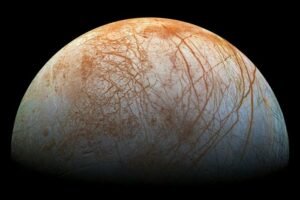
This image shows red streaks across the surface of Europa, the smallest of Jupiter’s four large moons. The upcoming Europa Clipper mission will send instruments to investigate this moon. Credit: NASA/JPL/Galileo
In the decade since NASA’s Cassini mission detected plumes of water and ice being ejected by Enceladus, mission planners and amateur enthusiasts alike have theorized about how such a life-hunting mission might actually take place. While some of the more exotic proposals include mini submarines or a snakelike probe that can crawl down into those subsurface oceans, the most popular involves flying a sample mission through those ejected plumes and scanning them for clues to alien lifeforms.
Now, an international team of researchers says instruments that might be included on upcoming missions should not only be able to detect signs of alien lifeforms, but they believe the conditions are ideal for such a finding as soon as the Europa Clipper.
LAB STUDY SHOWS INSTRUMENTS COULD SPOT SIGNS OF LIFE IN A SINGLE GRAIN OF ICE
To see if instruments slated to join future missions would be able to detect signs of life in the plumes ejected from Enceladus and Europa, the UW research team selected a type of bacteria called Sphingopyxis alaskensis for study. That’s because this particular bacterium lives in cold environments on Earth and can survive on very little nutrients, making it a likelier analog of extraterrestrial bacteria that may thrive beneath the surface of these icy moons. The researchers also say this bacterium is just the right size for future probes to spot within a single grain of ice.
“They are extremely small, so they are, in theory, capable of fitting into ice grains that are emitted from an ocean world like Enceladus or Europa,” Klenner said.
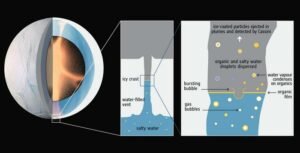
The drawing on the left depicts Enceladus and its ice-covered ocean, with cracks near the south pole that are believed to penetrate through the icy crust. The middle panel shows where authors believe life could thrive: at the top of the water, in a proposed thin layer (shown yellow) like on Earth’s oceans. The right panel shows that as gas bubbles rise and pop, bacterial cells could get lofted into space with droplets that then become the ice grains that were detected by Cassini. CREDIT: European Space Agency
After coming up with a lab experiment that would best simulate the conditions a future mission might experience these ejected ice grains, the team used a mass spectrometer to see if they could spot the life signs of their chosen bacterium in a single grain of ice. Significantly, they note that their instrument was less sensitive than the one planned for the Europa Clipper.
As hoped, their study was a success. An analysis of water injected into a vacuum showed that the right instruments could indeed detect alien lifeforms as they were ejected from Enceladus or Europa. In fact, the scientists behind the successful experiments say searching for life in this method “is more successful than averaging across a larger sample containing billions of individual grains.”
INSTRUMENT ON NASA’S EUROPA CLIPPER MISSION MAY BE FIRST TO DISCOVER ALIEN LIFEFORMS
In their published study, the UW researchers supplemented their experiments by looking at the conditions on Earth that cause bacteria to collect on the ocean’s surface and cause a layer of “ocean scum.” They soon realized that a similar set of conditions likely exists on the surface of these extraterrestrial oceans. As a result, any subsurface water ejected into space would likely capture pieces of alien lifeforms and encapsulate them within grains of space ice, where NASA’s instruments could detect them.
“We here describe a plausible scenario for how bacterial cells can, in theory, be incorporated into icy material that is formed from liquid water on Enceladus or Europa and then gets emitted into space,” Klenner said.
The left panel shows the kilometers-thick icy crust believed to encapsulate Saturn’s moon Enceladus. Filling the crack is salty water with a proposed thin layer (shown orange) at its surface. The right panel shows that as gas bubbles rise and pop, they combine with organic material and get lofted into the spray. CREDIT: Postberg et al. (2018)/Nature.
Although they are not directly involved with the planning of NASA’s missions, the team notes that NASA’s Europa Clipper, thanks to its unique instrumentation, could be perfectly equipped to find alien lifeforms living beyond Earth.
“With suitable instrumentation, such as the SUrface Dust Analyzer on NASA’s Europa Clipper space probe, it might be easier than we thought to find life, or traces of it, on icy moons:” said senior author Frank Postberg, a professor of planetary sciences at the Freie Universität Berlin, “if life is present there, of course, and cares to be enclosed in ice grains originating from an environment such as a subsurface water reservoir.”
Christopher Plain is a Science Fiction and Fantasy novelist and Head Science Writer at The Debrief. Follow and connect with him on X, learn about his books at plainfiction.com, or email him directly at christopher@thedebrief.org.
Mars’ Gale Crater was Filled with Water for Much Longer Than Anyone Thought
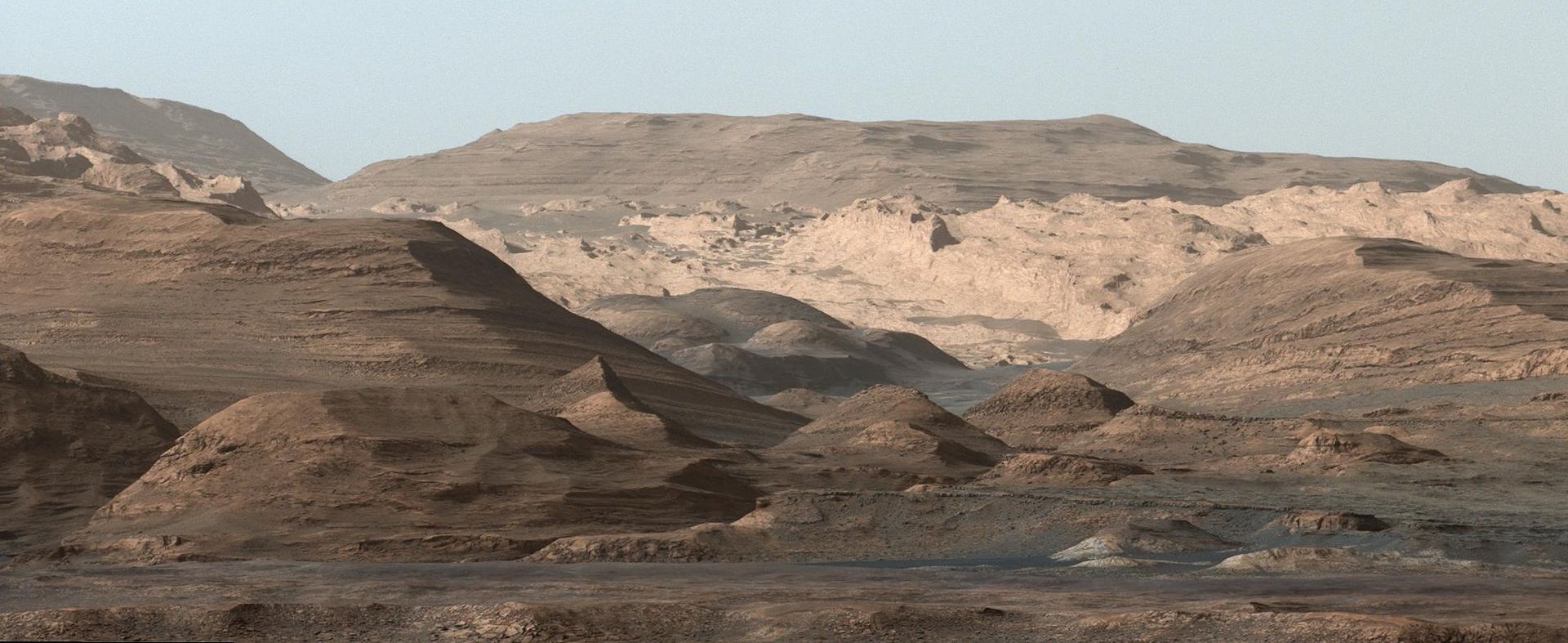
Layers at the base of Mt. Sharp. These visible layers in Gale Crater show the chapters of the geological history of Mars in this image from NASA's Curiosity rover. New evidence from this area shows that water persisted on Mars for longer than thought. Credit: NASA/JPL-Caltech/MSSS.
Mars’ Gale Crater was Filled with Water for Much Longer Than Anyone Thought
Even with all we’ve learned about Mars in recent years, it doesn’t stack up against all we still don’t know and all we hope to find out. We know that Mars was once warm and wet, a conclusion that was less certain a couple of decades ago. Now, scientists are working on uncovering the details of Mars’s ancient water.
New research shows that the Gale Crater, the landing spot for NASA’s MSL Curiosity, held water for a longer time than scientists thought.
Life needs water, and it needs stability. So, if Gale Crater held water for a long time, it strengthens the idea that Mars could’ve supported life. We know that Gale Crater is an ancient paleolake, and this research suggests that the region could’ve been exposed to water for a longer duration than thought. But was it liquid water
The research centers on desert sandstone that Curiosity found.Multiple rovers and orbiters have given us ample evidence of that. Orbital images show clear examples of ancient deltas. We also have many images of sedimentary rock, with its tell-tale layere
We know that water played a role in shaping the Martian surface. d structure, laid down in the presence of water. But beyond the initial creation of Martian sandstone, the details of the rock can tell scientists about what happened long after it formed
The Eberswalde delta near Holden Crater on Mars is considered the ‘smoking gun’ for evidence of liquid water on Mars. By NASA/JPL/Malin Space Science Systems
This research focuses on Gale Crater and the landforms within it. Mount Sharp (aka Aeolis Mons) is the dominant feature in the crater and rises 5.5 km or about 18,000 feet. It’s made up of sedimentary layers that have been eroded over time. But it has substructures that show its detailed history.
One structure overlays Mount Sharp and post-dates Mount Sharp’s erosion. It’s characterized by the accumulation of aeolian strata under arid conditions. That means windborne deposits instead of waterborne deposits. So scientists can tell that there was a wet period during which fluviolacustrine sediments built Mt. Sharp. They can also tell that a dry period followed, during which wind-borne sediment created the overlying structure. That’s what you’d expect to find if the story ended here: Mars was wet, then it wasn’t.
“Surprisingly, we found that these wind-deposited layers were contorted into strange shapes, which suggests the sand had been deformed shortly after being laid down. These structures point to the presence of water just below the surface.”
Amelie Roberts, study co-author, Imperial College London’s Department of Earth Science and Engineering.
But scientists found something odd in the overlying windborne sandstone: deformed layers that could only have been formed in the presence of water. “The sandstone revealed that water was probably abundant more recently, and for longer, than previously thought – but by which process did the water leave these clues?” Banham said in a press release.
That’s more difficult to determine.
“This water might have been pressurized liquid, forced into and deforming the sediment; frozen, with the repeat freezing and thawing process causing the deformation; or briny, and subject to large temperature swings,” Banham said.
“What’s clear is that behind each of these potential ways to deform this sandstone, water is the common link.”
There’s a generally accepted understanding of Martian water among scientists. By the middle of Mars’ Hesperian Period, the planet lost its water. The Hesperian’s boundaries in time are uncertain, but it’s generally thought of as the transition from the heavy bombardment period to the dry Mars we know today. The Hesperian could’ve ended between 3.2 and 2.0 billion years ago. The Noachian preceded it, and the Amazonian followed it.
This research presents a new wrinkle. It suggests that Mars had abundant subsurface water toward the end of the Hesperian. The evidence is in MSL Curiosity’s images of different sedimentary rocks on Gale Crater’s Mt. Sharp.
“When sediments are moved by flowing water in rivers, or by the wind blowing, they leave characteristic structures which can act like fingerprints of the ancient processes that formed them,” said Banham.
MSL Curiosity slowly worked its way up Mt. Sharp, studying the rocks at different elevations as it ascended. As expected, it found younger rocks the higher it went. Eventually, it reached the Stimson formation. The Stimson formation is the remnant of an ancient windborne desert dune field.
An analysis of Curiosity’s images shows that Stimson formed after Mt. Sharp when Mars was thought to be dry. But Stimson isn’t entirely uniform. One of its features is named the Feòrachas structure, and it contains features that were clearly influenced by the presence of water.
“Usually, the wind deposits sediment in a very regular, predictable way,” said study co-author Amelie Roberts, a PhD candidate from Imperial College London’s Department of Earth Science and Engineering. “Surprisingly, we found that these wind-deposited layers were contorted into strange shapes, which suggests the sand had been deformed shortly after being laid down. These structures point to the presence of water just below the surface.”
This image from the study shows part of the Feorachas structure with undeformed features. Water played no role in shaping them. B shows wind-ripple laminations. The image also shows cross laminations, which are the result of additional sediments deposited by wind. Image Credit: Banham et al. 2024, NASA/JPL-Caltech/MSSS
In the Brackenberry outcrop feature, the sedimentary rocks show evidence of deformation by water. There are laminations in various states of deformity, becoming more pronounced in the feature geologists call the cusp core. In the cusp core, wind-ripple laminations bend toward the vertical and become incoherent.
This image from the research shows some features that are deformed by the presence of water. Vertical, incoherent sedimentary lines in the cusp core, oversteepened laminations, and vertically deformed laminations are all evidence of the presence of water. Image Credit: Banham et al. 2024, NASA/JPL-Caltech/MSSS
The authors explain that there are three mechanisms that can explain the deformed features, and they all involve water. They’re also not mutually exclusive.
High-pressure water could’ve overcome the strength of the rock and deformed it. Large ice deposits on top of the structure could’ve caused deformation, as could freeze/thaw cycles of water inside the rock. The third explanation involves sediment rock weakly bound together by evaporites. Thermal expansion and contraction of the evaporites can deform the rock.
This image from the research shows more examples of fluidization structures. A shows a feature named Up Helly Aa, and B is a zoomed-in image showing up warping and vertical laminations. C shows the Lamington feature, and D is a zoomed-in image showing more deformed laminations. Image Credit: Banham et al. 2024, NASA/JPL-Caltech/MSSS
“The layers of sediment in the crater reveal a shift from a wet environment to a drier one over time – reflecting Mars’ transition from humid and habitable environment to inhospitable desert world,” said co-author Roberts. “But these water-formed structures in the desert sandstone show that water persisted on Mars much later than previously thought.”
Mars is no exoplanet, but it’s inadvertently teaching us a lot about our quest to understand exoplanets and habitability.
“Determining whether Mars and other planets were once able to support life has been a major driving force for planetary research for more than half a century,” said Dr. Banham. “Our findings reveal new avenues for exploration – shedding light on Mars’ potential to support life and highlighting where we should continue hunting for new clues.”
“Our finding extends the timeline of water persisting in the region surrounding Gale crater, and so the whole region could have been habitable for longer than previously thought,” said Amelie.
Maybe one day in the far distant future, one of our rovers on a distant exoplanet will flip over a rock and watch something scuttle away. It’s easy to imagine.
But Mars is an instructive example. If it remained habitable for longer than we thought, it was likely only marginally inhabitable. We can’t say for sure, but complex life seems to be out of the question. This should prepare humanity for what we can expect to find in our quest for habitable exoplanets.
There are a bewildering number of variables that go into making Earth the living oasis that it is. We’re much more likely to stumble on other planets like Mars, which were once habitable and maybe even harboured simple life. If Earth’s long-lived habitability is the outlier, and Mars’ marginal, interrupted habitability is more likely, we can expect to find many planets like it that were once alive but are now long dead.
Senior law enforcement in India investigated and video-taped eerie UFO sightings over nuclear plants across the Asian nation last year, a local news report revealed.
One witness, a police sub-inspector and engineer by training, said he was '100-percent sure' the object he taped, with its high-speed 'zigzag movements,' could not be explained by human tech.
But, reports of these 2023 incidents in India were allegedly less hostile.
One witness, a police sub-inspector and engineer by training, Syed Abdul Kader said he was '100-percent sure' the object he taped, with its high-speed 'zigzag movements,' could not be explained by human tech. Above, a still from one of Kader's encounters with the UFO
Police sub-inspector Syed Abdul Kader (right), assigned to the technical wing of the Tirunelveli office an hour's drive north of the Kudankulam nuclear plant, told UFO expert Sabir Hussain (left) that he filmed two videos of the unusual airborne phenomena.
The roughly dozen or so incidents all involved apparent craft loitering oddly near the Kudankulam nuclear plant at the southern tip of the subcontinent and the Madras atomic power station near Kalpakkam along the country's east coast.
Police sub-inspector Syed Abdul Kader, assigned to the technical wing of the service's Tirunelveli office an hour's drive north of the Kudankulam nuclear plant, told UFO expert Sabir Hussain he filmed two videos of unusual airborne phenomena.
'The way it stood still, the way it made zigzag movements and the speed in which it disappeared,' Kader told reporters for the English-language Indian daily DT Next, 'all were different.'
Confirming his conversations with Hussain, Kader told DT Next that he had personally spotted UFOs near the southern coast town of Kudankulam since 2020.
'After meeting UFO tracker Sabir and discussing with him,' he told the paper, 'I am more than 100-percent sure what I saw were UFOs.'
The roughly dozen or so incidents all involved apparent craft loitering oddly near the Kudankulam nuclear plant (pictured above) at the southern tip of the subcontinent and the Madras atomic power station (not pictured) near Kalpakkam along the country's east coast
This February, American UFO researchers dropped the bombshell that an ex-Pentagon UFO investigator had privately briefed Congress on a stunning 1964 incident where a UFO blasted an Atlas missile carrying a dummy nuclear warhead out of the sky (graphic re-creation above)
Chuck Schumer criticizes Republicans for striking down UFO bill
Kader's 2023 sightings to the south, overlapped with weeks of sightings in July and August up the eastern coast along the Neelankarai-Mahabalipuram shoreline.
That region, near the bustling city of Chennai, is home to the Madras Atomic Power Station (MAPS) in Kalpakkam.
Kader's video-taped sightings, Hussain told DT Next, 'happened just 10 days after former DGP [Director General of Police] Prateep V. Philip took pictures of a UFO on [the] Muttukadu sea shore near Chennai.'
US Customs and Border Patrol, the agency responsible for keeping terrorists and weapons out of the country, uploaded 10 videos that appear to show craft moving in strange ways in our skies. The videos document a fighter jet pursued by an apparently baffling flying orb, as well as something that appears to be a propeller-powered hang-glider, and another apparent orb hovering near a parked 16-wheeler truck
Philip's rank of DGP is the highest position attainable in the Indian Police Service.
Despite an official Pentagon UFO report to Congress this year, which attempted to dispel whistleblower allegations of a secret and illegal UFO crash retrieval program, senior members of the US Senate continue to pursue subpoena power to investigate the issue.
The Pentagon's report, produced by the Department of Defense's UFO-hunting All-Domain Anomaly Resolution Office (AARO), was preceded by a largely hobbled effort by lawmakers to pass a sweeping UFO 'disclosure' amendment — designed to grant authority to an independent panel that would then be tasked with scouring deeply buried clandestine information for the truth about UFOs.
As Senate Majority Leader Chuck Schumer, who sponsored the bill, told The New York Times: 'It is really an outrage the House [of Representatives] didn't work with us on adopting our proposal for a review board.
'It means that declassification of UAP records will be largely up to the same entities that have blocked and obfuscated their disclosure for decades.'
'We got ripped off. We got completely hosed. They stripped out every part,' said Congressman Tim Burchett, one of the House lawmakers most vocal on the issue of UFO disclosure.
While the watered-down version of the bill has meant that the Pentagon and US intelligence agencies can determine on their own what information about these mysterious sightings can be kept secret for now, Congress plans to seriously revisit the issue again later the year.
'It's just a matter of priorities right now,' Senator Mike Rounds, who co-sponsored the bill with Sen. Schumer, told Capitol Hill reporter Matt Laslo this March. 'We have an interest in pursuing somethings like that.'
The trojan asteroids of Mars. Credit: Armagh Observatory
POSTED BY EVAN GOUGH
An Asteroid Found Sharing the Orbit of Mars
Astronomers discovered another asteroid sharing Mars’ orbit. These types of asteroids are called trojans, and they orbit in two clumps, one ahead of and one behind the planet. But the origins of the Mars trojans are unclear.
Can this new discovery help explain where they came from?
There are now 14 known Mars Trojans and the name of the newest one is 2023 FW14. They’re in two groups, one 60 degrees ahead and one 60 degrees behind Mars. These are the Lagrange 4 and Lagrange 5 points.
Most of the Mars trojans are at the L5 point, and this newly discovered one is the second one found at the L4 point.
Scientists aren’t certain where the Mars trojans came from. Other trojans like the Jupiter trojans may have been captured by Jupiter in the Solar System’s early years. Or Jupiter may have captured them later when it migrated.
But Mars is a much less massive planet, and astronomers aren’t certain if Mars can capture trojans the same way Jupiter does. The Mars trojans could be as old as the Jupiter trojans, but some evidence suggests otherwise. The dozen or more trojans at the Mars L5 point seem to be a family from the same collision. The family is called Eureka, and their spectra indicate an olivine-rich composition.
Olivine is relatively rare in the main asteroid belt. That’s led some researchers to suggest that the L5 Mars trojans are debris from an ancient impact between Mars, where olivine is common, and a planetesimal.
The two L4 Mars trojans are different. They don’t have the same spectra as the L5 trojans, but the pair do show some similarities in their spectra, so a common origin for these two is a possibility.
In this paper, the researchers set out to determine 2023 FW14’s origins. They used the Gran Telescopio Canarias for their work. It’s a 10.4-meter telescope in Spain’s Canary Islands with an attached instrument called the OSIRIS camera spectrograph.
2023 FW14’s spectrum places it in the same class as an Xc-type asteroid. The X-type name contains several different types of asteroids with similar spectra but probably with different compositions. Xc-types are a sub-class of the X-types that are intermediate between C-type asteroids, the most common type of asteroid in the Solar System, and the uncommon K-type asteroids.
This graph from the research shows the spectrum of 2023 FW14 and several spectra of the other known L4 Mars Trojan (121514) 1999 UJ7. Orange shows 2023 FW14, with the red line representing the best asteroid taxonomical match, the Xc-type. Teal, blue, and green show different published spectra of 1999 UJ7. The gray area fills the entire domain between the mean B-type and D-type classes of asteroids.Image Credit: Marcos et al. 2024.
The researchers also used N-body simulations to try to understand the new asteroid’s resonance with Mars. Trojans follow what are known as tadpole orbits. Tadpole orbits are influenced by Earth’s gravity, which causes objects to librate or accelerate or decelerate alternately.
Tadpole orbits are complex. Asteroids on these orbits exchange large amounts of energy and angular momentum with a planet moving in a circular orbit. Tadpole loops are made of multiple overlapping epicyclic loops.
This video illustrates the tadpole orbit followed by an asteroid in Jupiter’s L4, not Mars’ L4, but the concept is the same.
2023 FW14 has a higher orbital eccentricity and lower inclination than Mars’ other L4 trojan. This means that it occupies an unstable region and orbits at the whim of several different resonances. That instability means that in a few million years, it’ll likely be ejected.
The researchers calculated its size as approximately 318 metres (+493/-199.) That makes it one of the smallest known trojans so far.
As for its origins, the authors say that there are two possibilities.
Its long-term behaviour, including its past, suggests that it was captured from the Near Earth Asteroid (NEA) population of Mars-crossing asteroids. But it could be a fragment of another trojan, as well, one that is so far undiscovered, or one that is no longer a trojan.
Spectral data suggests something else. Both of the L4 asteroids appear to be more primitive than Mars’ L5 trojans. 2023 FW14’s spectrum also supports the idea that it’s a captured Mars-crossing NEA. However, that data isn’t as clear, according to the authors, and can’t be used to rule out the other hypothesis, which is that the asteroid formed in situ. “Although incomplete, the data support the interpretation of 2023 FW14 as an interloper captured from the Mars-crossing NEA population, but they cannot be used to reject the competing hypothesis that 2023 FW14 was produced in situ,” they write.
Whatever its origins are, the researchers calculate that 2023 FW14 has about 10 million years before it’s ejected from its trojan orbit. It’s a temporary trojan, and this discovery could prove that Mars trojans can be temporarily captured, something that so far has been unproven.
The Sound of an Interstellar Meteor Might Have Just Been a Rumbling Truck
A 2023 expedition to the Pacific Ocean, searching for debris from a suspected extraterrestrial object, may have been looking in the wrong place. A new look at the infrasound data used to locate the point of impact suggests that they may have been confused by the rumblings of a truck driving past.
On 14 January 2018, a space rock hit the Earth’s atmosphere off the coast of Papua New Guinea. It was detected by what are mysteriously described as “US Government Sensors”, and given the catalogue entry “CNEOS 2014-01-08”. Based on the brightness of the fireball and its apparent speed, the physical rock likely survived without burning up completely. The observation was logged in a database kept by the Center for Near Earth Object Studies. Bolides like this can be a spectacular sight, when spotted by human eyes, but they are not rare; several are detected each week.
Extrasolar objects
A few years later, Oumuamua was discovered. Oumuamua was traveling at a high speed, along a path that showed it was not orbiting the Sun. Instead, it had come from interstellar space and was merely passing through. This was very exciting because it was the first time anybody had observed an interstellar rocky object, and so it attracted a lot of attention.
Some observations showed that Oumuamua’s path wasn’t steady, but kept making tiny changes. Most scientists agreed that this was almost certainly because of pockets of ice melting and jetting away in the Sun’s heat. This is a common phenomenon, that we often see happening with comets. More detailed observations and simulations showed that it had a long and skinny shape, more like a splinter than a boulder, which is very unusual among the asteroids and comets that we’re used to. But Oumuamua only really hit the mainstream press when a well-known and prestigious astrophysicist decided, in a surprising leap of logic, that all these details proved that it could be an alien spacecraft!
The Oumuamua discovery led many scientists to start searching for other interstellar objects. CNEOS 2014-01-08, with its high reported speed, looked like a promising candidate. The physicist who had made such a big deal about Oumuamua being artificial took a closer look at the bolide reports and concluded that it must have been traveling fast enough to be another extrasolar object. This claim was controversial, not only because the government sensors appear to be classified and so cannot be verified, but because meteor speeds are notoriously difficult to measure. Observers have mistakenly reported extrasolar meteors as far back as 1951!
But if CNEOS 2014-01-08 truly was from outside the Solar System, and we could find pieces of it, that would be an incredible discovery: The first actual geological samples from a planetary system outside our own!
The expedition
This is why an expedition was launched in 2023 to try and find it. The research team used seismic and infrasound data from seismic research stations in the area to try and find the exact place where the meteoroid would have splashed into the sea. They identified two likely signals from Geoscience Australia’s Passive Seismic Network. The signals were recorded by Manus Island, Papua New Guinea (AU.MANU) and Coen, Queensland, Australia (AU.COEN), at around the same time that people saw the fireball. They triangulated a precise location based on those recordings, and sailed out to search the ocean floor.
The expedition was widely reported as a success, after they found “metallic spherules”. These spherules had an unusual composition, which the expedition leader said was proof of a possible extraterrestrial origin. Like the speed calculations, though, this interpretation was widely challenged. Specialists in other fields have weighed in to argue that there was nothing unusual about the debris, and that various natural and human processes could have created them (My personal favorite: 19th century pollution!). With so much doubt as to where the spherules came from in the first place, it’s probably not wise to say that they are of “extraterrestrial technological” origin.
The area near the seismic station in Manus Island, based on satellite images. Image credit: Roberto Molar Candanosa and Benjamin Fernando/Johns Hopkins University, with imagery from CNES/Airbus via Google.
The truck
The most recent challenge to the results of this expedition come from a team led by Dr Benjamin Fernando of Johns Hopkins University. Their report focuses on the seismic and infrasound data used to locate the impact site.
They noticed a number of problems with the expedition’s analysis, starting with the fact that none of the detections happened within 30 seconds of the fireball. But beyond that, these stations are located in the Pacific Ring of Fire, which is very tectonically active. They detect a great many earthquakes and other natural seismic events every day, and some of these happened at the same time as the the meteorite impact. Separating the two signals is hard to do without distorting both of them. This adds a lot of error to any calculations based on those data.
Along with seismic data, these stations also have infrasound detectors, meant to detect and monitor nuclear weapons tests. But infrasound has a limited range, and is strongly affected by geography.
Fernando’s team concluded that only one station recorded an infrasound signal that could have come from CNEOS 2014-01-08, and that none of the seismic detections had anything to do with the bolide. Based on this, they believe that the expedition was looking in the wrong place, and that the debris they discovered had nothing at all to do with the 2014 bolide.
But their most damning claim is this: The strongest signal had an unusual pattern, lasting a long time and coming from a direction which changed halfway. They noticed that there is a road passing near the station, with a curve in it that matches the change in direction of the signal. They point out that the signals recorded by trucks driving that road are a far closer match than any natural event.
In other words, they believe that the expedition based its search location for an extraterrestrial meteoroid on the noise of somebody in a truck going for a drive.
In their defense
It’s tempting to laugh at the researchers on the expedition, especially since their leader was a respected astrophysicist who has recently developed a reputation for having crackpot ideas about aliens. But I think there is value in investigating these questions.
It’s easy to get tired of cranks and fools wasting our time with conspiracy theories and crazy stories about abductions. And we should always be skeptical of any claims about aliens, given what we know about the physics of interstellar travel and the absurd scale of the Universe.
But most astronomers agree that life has to exist elsewhere in the Universe, and many think that it could well be intelligent and technologically capable, like us. Nobody’s saying that they can’t possibly exist, only that it’s extremely unlikely that they are over here!
So we should be skeptical of these reports. It’s good to not waste too much time studying them, when there are other mysteries that are far more likely to be true. But that doesn’t mean we should ignore the possibility altogether. It would be disastrous if, by some chance, it turned out to be real, and the scientific community had simply refused to acknowledge it! When new evidence comes in, we must revisit our assumptions and go back and check our previous conclusions. And it’s important that somebody do this even when we’re certain that they’ll get a negative result.
Parker Solar Probe Was Blasted by Coronal Mass Ejections 28 Times in 4 Years
NASA’s Parker Solar Probe (PSP) was launched on August 12, 2018, with the goal of becoming the first spacecraft to touch the Sun while teaching us more about our host star than any spacecraft or solar instrument in human history. Now, a recent study submitted to The Astrophysical Journal discusses the incredible data that PSP collected on coronal mass ejections (CMEs) over a four-year period. This study holds the potential to help scientists and the public better understand the CMEs and how they contribute to space weather.
Here, Universe Today speaks with Dr. Tarik Mohammad Salman, who is a Postdoctoral Research Fellow at NASA and George Mason University and lead author of the study regarding the motivation behind the study, its most significant results, implications for future research, PSP contributions, and the importance of studying CMEs. So, what was the motivation behind this study?
“The PSP science data is a treasure trove as it samples the solar wind at uncharted radial distances from the Sun,” Dr. Salman tells Universe Today. “There have been numerous case studies of coronal mass ejections (CMEs) using PSP observations that provided new insights into the evolution of CMEs as the structures propagate farther from the Sun. We are in the sixth year of the PSP mission which provided us with a reasonable number of CME events to perform a statistical investigation. That was the motivation for this project to compile a catalog of CME events that PSP measured from 2018-2022 and also to investigate different perspectives of CME evolution in a statistical manner.”
For the study, PSP collected direct measurements of 32 interplanetary coronal mass ejections (ICMEs) between October 2018 and August 2022 and distances from the Sun ranging between 0.23 and 0.83 astronomical units (AU), with 1 AU being the distance between the Earth and the Sun, or approximately 150 million kilometers (93 million miles). Of the 32 measurements, four were discarded due to gaps in the data, leaving 28 CMEs successfully measured by PSP. The study’s objectives were to identify various aspects of CMEs, specifically pertaining to how they change as they travel farther from the Sun, also known as radial distance. So, what were the most significant results from this study?
Dr. Salman tells Universe Today, “A few results that I would like to highlight are that we observed the internal CME magnetic structure to become more complex with radial distance. We found the CME magnetic field strength to decrease at a lower rate than previous studies. We also saw that the expansion of the CME is important in the formation of the compression region ahead of it and the internal magnetic field has an influence on the short-scale fluctuations we find within the compression region.”
While the study of CMEs falls under the scientific field of solar physics, which studies how our entire Sun functions, scientists also classify CMEs as part of space weather, which studies the activity on the Sun’s surface and how it affects the surrounding environment. Space weather can wreak havoc on electronics, specifically communication satellites and power stations on Earth, with one of the most notable space weather events occurring in September 1859 known as the Carrington Event, which was caused by a massive solar storm that wreaked havoc on worldwide electrical grids and created spectacular auroras across the globe, as well, with the latter traditionally only being visible in the northern and southern latitudes. Therefore, what implications can this study have on future research regarding our Sun, and specifically space weather?
“The compiled catalog of CME events itself will be a valuable resource for performing future extensive case studies,” Dr. Salman tells Universe Today. “Understanding the evolution of CMEs is of paramount importance for space weather operations. This statistical investigation of different aspects of CME evolution is a step towards that as it validates previous approximations but also raises new questions that need to be explored further with a more robust data set in the future.”
After having its first solar encounter in October 2018, PSP has continued to smash records regarding its distance from our Sun. This includes achieving its closest distance of 7.26 million kilometers (4.51 million miles) on September 27, 2023, which is slated to be surpassed after its last flyby of Venus in November 2024. Science objectives for PSP include determining the solar corona processes responsible for producing the solar wind, gaining insight into the solar plasma and magnetic field properties, and learning more about additional energy particles emitted by the Sun.
The reason why PSP can travel so close to our Sun is due to its state-of-the-art solar shield comprised of a 11.43-centimeter-thick (4.5-inch-thich) carbon-composite shield capable of withstanding scorching temperatures up to 1,377 degrees Celsius (2,500 degrees Fahrenheit). While PSP has already broken records regarding its distance to the Sun, PSP is slated to come within 6.16 million kilometers (3.83 million miles) during its mission, which is planned to last a total of seven years. But how has PSP contributed to our understanding of our Sun and space weather?
“PSP is so important for us to advance our current understanding of CME evolution and space weather,” Dr. Salman tells Universe Today. “The questions of interest for space weather are will a CME impact Earth and whether it will have a southward field component to interact with the northward magnetic field of Earth. Our modeling frameworks depend on an initial characterization of the CME closer to the Sun (within 20 solar radii) based on which the models project the CME parameters when it impacts Earth.”
Dr. Salman continues, “The initial characterization is made based on CME remote-sensing imaging. What PSP is doing is providing direct measurements of CMEs in the initial phases of propagation. Adding to this are the widespread radial observations of PSP to make our statistical approximations more robust. This is how PSP is contributing to develop a more accurate picture of the CME propagation and evolution from closer to the Sun to Earth.”
Animation showing NASA’s Parker Solar Probe studying the Sun. (Credit: NASA Goddard Space Flight Center/CIL/Brian Monroe)
CMEs have been observed for thousands of years in the form of auroras when the solar wind interacts with the Earth’s magnetic field near the planet’s surface. They are produced from the Sun’s corona in the form of massive discharges when solar plasma interacts with the Sun’s massive magnetic field and their velocities can range from 250 kilometers per second (155 miles per second) to almost 3,000 kilometers per second (1,864 miles per second).
CMEs are monitored by the Space Weather Prediction Center with the National Oceanic and Atmospheric Administration using a combination of ground- and space-based solar observatories. As noted, space weather is constantly monitored to determine how much damage can be caused to Earth surface power grids and satellite communications. But aside from monitoring space weather, why is it so important to study CMEs?
“CMEs are crucial for the existence of our Sun,” Dr. Salman tells Universe Today. “CMEs appear as a valve that releases the built-up magnetic field from the Sun without which the Sun will rip itself apart. But the investigation of CME science also has important societal relevance. CMEs drive the strongest solar storms that can wreak havoc through impacting power grids and telecommunication networks. CMEs can also damage orbiting satellites and technological infrastructure. CMEs are now counted among the major natural hazards as well. A more in-depth understanding of CMEs (from initiation to propagation to evolution along the Sun-Earth line) is thus required to improve the current status quo of space weather operations.”
What new discoveries will researchers make about coronal mass ejections in the coming years and decades? Only time will tell, and this is why we science!
On July 1st, 2023, the European Space Agency (ESA) launched the Euclid Observatory, a mission that will spend the next six years investigating the composition and evolution of the Universe. In particular, Euclid will observe how the Universe has expanded over the past 10 billion years to test theories about Dark Energy. While fine-tuning and calibrating the telescope’s instruments in preparation for the mission’s first survey, the mission team noticed that a few layers of water ice formed on its mirrors after it entered the freezing cold of space.
While common, this is a problem for a highly sensitive mission like Euclid, which requires remarkable precision to investigate cosmic expansion. After months of research, the Euclid team tested a newly designed procedure to de-ice the mission’s optics. On March 20th, the ESA announced that the team’s de-icing approach worked (so far) and that Euclid’s vision has been restored. If the method proves successful, it will have validated the mission team’s plan to keep Euclid‘s optical system working for the rest of its mission.
The problem first became evident as science operations experts noticed a small but progressive decrease in light measured by the telescope’s VISible instrument (VIS). This instrument is responsible for measuring visible light from distant galaxies to determine how the light’s trajectory is affected by gravity fields. Mischa Schirmer, a calibration scientist for the Euclid consortium and one of the main designers of the new de-icing plan, explained in an ESA press release:
“We compared the starlight coming in through the VIS instrument with the recorded brightness of the same stars at earlier times, seen by both Euclid and ESA’s Gaia mission. Some stars in the Universe vary in their luminosity, but the majority are stable for many millions of years. So, when our instruments detected a faint, gradual decline in photons coming in, we knew it wasn’t them – it was us.”
Artist’s impression of the Euclid observatory. Credit: ESA
It was always expected that there would be some water contamination with Euclid, which is why there was an “outgassing campaign” shortly after launch. This consisted of the telescope being warmed up by onboard heaters and also partially exposed to the Sun, sublimating most of the water brought from Earth. However, a considerable amount remained after being absorbed in the telescope’s multi-layer insulation, which slowly began building up on the VIS intrument’s mirror surfaces. After months of research, lab studies, and calibrations, the team determined the source and began working on a solution.
The obvious solution was to heat Euclid again by running all its internal heaters for days. However, this ran the risk of deforming the mechanical structure of the spacecraft, which could alter Euclid’s optical alignment. Said Andreas Rudolph, Euclid Flight Director at ESA’s mission control:
“Most other space missions don’t have such demanding requirements on ‘thermo-optical stability’ as Euclid. To fulfilEuclid’s scientific goals of making a 3D map of the Universe by observing billions of galaxies out to 10 billion light-years, across more than a third of the sky, means we have to keep the mission incredibly stable – and that includes its temperature. Switching on the heaters in the payload module therefore needs to be done with extreme care.”
The team began by individually heating two of Euclid’s mirrors independently, a low-risk approach since they are located in areas where water vapor was not likely to contaminate other instruments. After analyzing the initial results, the team found that Euclid’s vision was restored to its previous accuracy. However, this was a temporary solution, and a long-term strategy for regular de-icing is still being sought. In the meantime, the ESA promises to continue to monitor the telescope for changes and share any new findings publicly.
However, the response to this problem highlights the international cooperation that made this mission possible. Said Ralf Kohley, Euclid Instrument Operations Scientist who coordinated the response:
“A complex mission requires a united response from teams across Europe, and I’m incredibly thankful for the effort and skill that so many have poured into this. It took work from teams at ESA’s ESTEC technical heart in the Netherlands, the ESAC science operations centre in Madrid and the Flight Control Team at ESOC mission control in Darmstadt – but we couldn’t have done it without the Euclid consortium and the critical inputs we got from spacecraft prime contractor Thales Alenia Space and its industrial partner Airbus Space.”
In addition, this issue could lead to vital research on how to maintain missions where highly sensitive optics are concerned. Despite how common this issue is for spacecraft, there is very little research on how ice forms on optical mirrors and impacts observations. Therefore, the solution devised by the mission team and agency could lead to new procedures for future missions. These could come in handy when Euclid is joined by NASA’sNancy Grace Roman Space Telescope (RST) in March 2027 – another mission that will explore the “dark Universe.”
The Defense Advanced Research Projects Agency (DARPA) continues to set its sights on the Moon, recently selecting defense giant Northrop Grumman to advance concepts on building a lunar railroad network.
Constructing a lunar railroad system may seem like something from a science fiction movie. Yet, the project reflects the Department of Defense’s (DoD) mysterious focus on lunar operations and potential ambition to establish a strategic military presence on the Moon.
“The envisioned lunar railroad network could transport humans, supplies, and resources for commercial ventures across the lunar surface – contributing to a space economy for the United States and international partners,” Northrop Grumman said in a statement.
According to Northrop Grumman, the company will begin by exploring concepts for constructing and operating a lunar railroad network, including identifying the foreseeable costs, necessary resources, and technological risks associated with such an ambitious endeavor.
The company will also provide DARPA with lunar railroad network prototypes, as well as demonstrations and analyses of how a fully operating system would perform.
DARPA’s plans to develop a lunar railroad network is a strategic initiative reminiscent of the pivotal role railroads played in expanding and developing the United States.
Just as the First Transcontinental Railroad revolutionized the settlement and economy of the American West, this lunar project aims to tackle the unique logistical and operational challenges of establishing a sustainable human and commercial presence on the Moon.
Chris Adams, vice president and general manager at Northrop Grumman’s Strategic Space Systems, emphasized the significance of this initiative. “This investment in key developmental research propels our technology to the forefront of next-generation solutions, establishing a sustainable space ecosystem,” Adams stated.
America’s development of a nationwide railroad network in the 1800s is primarily recognized as a symbol of modernity and national progress. However, the expansion of the First Transcontinental Railroad also came at a significant cost to the landscape and Indigenous communities of the American Midwest.
Many historians argue that the construction of the Pacific Railroad from 1863 to 1869 played a significant role in the near-extinction of the American bison. This was largely due to the railroad’s influx of settlers who hunted the bison extensively.
Furthermore, the arrival of these new settlers, coupled with diminishing natural resources, led to increased tensions and conflicts between the U.S. government and the Indigenous tribes of the region, as the expanded homesteading facilitated by the railroad encroached on their lands.
As a consequence of these developments, Indigenous peoples in the United States ended up losing nearly 99% of the land they had occupied for tens of thousands of years.
The Moon lacks human inhabitants or an ecosystem that a lunar railroad system could potentially disrupt. Nonetheless, this does not eliminate the possibility of unintended consequences as humanity plans to colonize the lunar surface.
As it relates to potential “unintended consequences,” perhaps one of the most pressing questions is why DARPA, the U.S. Department of Defense’s (DoD) primary brain trust, has taken such a keen interest in the Moon in recent years.
In addition to its 10-year Lunar Architecture (LunA-10) Capability Study, several other DARPA programs are developing various technologies to establish and facilitate a permanent human presence on the Moon.
One such initiative, the Demonstration Rocket for Agile Cislunar Operations program, or “DRACO,” looks to identify “leap-ahead” propulsion technologies to allow larger payload transfers between the Earth and the Moon.
Traditionally, NASA, the independent federal agency dedicated to the scientific exploration of aeronautics and outer space, has led America’s space exploration ventures. Yet, DARPA’s recent initiatives to develop lunar infrastructure, such as constructing a moon-based railroad, mark a significant change in how the U.S. is approaching space exploration.
In contrast to NASA’s emphasis on scientific research, DARPA’s official documents explicitly state its goal to foster a “thriving lunar economy” and establish a “civil lunar framework for peaceful U.S. and international use.”
During the announcement of industry partners for DARPA’s 10-Year Lunar Architecture (LunA-10) Capability Study, known as “LunA-10,” Dr. Michael “Orbit” Nayak, a program manager in DARPA’s Strategic Technology Office, underscored the agency’s intention to turn the Moon into an economic extension of the U.S.
“LunA-10 has the potential to upend how the civil space community thinks about spurring widespread commercial activity on and around the Moon within the next 10 years,” Dr. Nayak said. “LunA-10 performers include companies both big and small, domestic and international, each of which brought a clear vision and technically rigorous plan for advancing quickly towards our goal: a self-sustaining, monetizable, commercially owned-and-operated lunar infrastructure.”
Policy experts note that DARPA’s lunar initiatives, such as constructing a lunar railroad network, comply with the United Nations Outer Space Treaty of 1967. This treaty prohibits the militarization of space and requires the Moon and other celestial bodies to be used only for peaceful purposes.
However, there remains a risk of “unintended consequences” similar to those experienced during the construction of the First Transcontinental Railroad. In this case, the conflict would not involve Indigenous populations but could arise from commercialization and competition for lunar resources with another global power: China.
China likewise has plans for a permanent lunar settlement, including a nearly 14-square-mile lunar base with underground facilities, a command and communication center, a power station, laboratories, and a fleet of autonomous robots to support scientific research and commercialization of the Moon.
Even before either country has started constructing permanent settlements on the Moon, NASA Administrator Bill Nelson has accused China of intending to claim resource-rich areas of the Moon as its own sovereign territory, an allegation that Beijing has denied, labeling it a “lie.”
Nevertheless, as recently reported by The Debrief, Beijing plans to extend its advanced mass surveillance network, known as “Skynet,” to the Moon. Expanding its extensive spy network to include the lunar surface suggests China is already preparing for potential disputes with lunar neighbors, particularly the U.S.
The recent lunar railroad initiative by DARPA is not just about creating a novel means of transport but also envisioning a future where the Moon plays a pivotal role in supporting human life and commercial activities.
DARPA’s burgeoning interest in lunar infrastructure development subtly aligns with the DoD’s broader vision to leverage the Moon’s strategic position beyond mere scientific exploration to achieve economic and defense objectives.
It remains to be seen whether perceiving the Moon as a critical asset for U.S. national security and economic development will ultimately lead to earthly conflicts in the future.
“For my entire 50-year career, no one I knew was particularly interested in it [the moon], but now there is extreme attention,” Szymanski said. “In the 1970’s NASA asked the Air Force if they wanted a base on the moon, and they said ‘no,'”
“Yet now, I personally know of companies planning on providing cell phone service on the Moon, and the Air Force Research Lab is developing several programs, such as space surveillance for the far side of the Moon. None of this makes sense unless there is some other not publicly known factor that has changed everyone’s attitudes.”
Tim McMillan is a retired law enforcement executive, investigative reporter and co-founder of The Debrief. His writing typically focuses on defense, national security, the Intelligence Community and topics related to psychology. You can follow Tim on Twitter:@LtTimMcMillan. Tim can be reached by email: tim@thedebrief.org or through encrypted email:LtTimMcMillan@protonmail.com
JWST's view of Neptune in infrared. The telescope also studied the surfaces of two icy asteroids in the Kuiper Belt that lie beyond Neptune. Courtesy: NASA, ESA, CSA, STScI
A twinset of icy asteroids called Mors-Somnus is giving planetary scientists some clues about the origin and evolution of objects in the Kuiper Belt. JWST studied them during its first cycle of observations and revealed details about their surfaces, which gives hints at their origins. That information may also end up explaining how Neptune got to be the way it is today.
The Mors-Somnus binary is part of a collection of objects beyond Neptune. They’re called, aptly enough, “Trans-Neptunian Objects” or TNOs, for short. About 3,000 are numbered and known, and many more aren’t yet surveyed. They all lie beyond the orbit of Neptune and are divided into various classes. There are the classical Kuiper Belt Objects (KBOs) and scattered disc objects. Within those two classes, there are resonant TNOs—which move in resonance with Neptune and extreme TNOs, which orbit far beyond Neptune (around 30 AU). Then there are objects in orbits similar to Pluto’s, called “plutinos”. Mors-Somnus is also a Plutino.
The orbit of Mors-Somnus with respect to Neptune in the outer Solar System. Courtesy JPL.
Neptune and Beyond
Why is there such a varied bunch of objects “out there”? Where did they originate and how have they changed over time? One way to answer those questions is to study the surface properties of Kuiper Belt Objects and, in particular, icy rocks like Mors-Somnus. One way to do that is to take spectra of their surfaces. The data reveals information about the surface compositions of these objects. That, in turn, tells scientists something about the environments in which they formed and those they’ve experienced over time.
Neptune itself likely formed closer to the Sun but then migrated to the outer Solar System (along with Jupiter, Saturn, and Uranus). At the same time, a huge dense disk of rocky and icy planetesimals and asteroids populated space out to about 35 AU. As the giant planets migrated to more distant orbits, they preferentially scattered those smaller bodies. These icy asteroids and cometary bodies settled into the Kuiper Belt, scattered disk, and the Oort Cloud. How that activity progressed and where those icy bodies came from in the first place are questions planetary scientists are working to answer.
More About Mors-Somnus and Neptune
This is where Mors-Somnus comes in handy. The pair is a good example of a “cold classical” TNO. It was studied by JWST as part of a program called Discovering the Surface Compositions of Trans-Neptunian Objects (DiSCO-TNOs) led by Ana Carolina de Souza Feliciano and Noemí Pinilla-Alonso at the University of Central Florida. The project identifies the unique spectral properties of these small celestial bodies beyond Neptune, something that hasn’t been done before now.
An artist’s conception of Mors-Somnus, a binary duo — a pair of icy asteroids bound by gravity, is shown. These lie just beyond the orbit of Neptune. JWST was used to analyze their surface compositions for the first time. Image credit: Angela Ramirez, UCF
The Mors-Somnus is a member of the same dynamical group as other nearby TNOs and they share spectroscopic characteristics with other cold-classical group objects. This means they probably all formed at about the same time. They probably originated beyond 30 astronomical units from the Sun. Trans-Neptunian binaries such as Mors-Somnus provide a unique way to look at the formation and evolution of planetesimals in that region of space.
Studying the composition of small celestial bodies such as Mors-Somnus gives us precious information about where we came from, Pinilla-Alonso said. “We are studying how the actual chemistry and physics of the TNOs reflect the distribution of molecules based on carbon, oxygen, nitrogen, and hydrogen in the cloud that gave birth to the planets, their moons, and the small bodies,” she says. “These molecules were also the origin of life and water on Earth.”
The Importance of Objects Beyond Neptune
The chemical and physical properties of TNOs offer a treasure trove of information about what conditions were like in the early Solar System. They likely contain pristine materials that existed in the protoplanetary disk from which our Solar System formed, including primitive ices. Those ices don’t change due to solar heating (since the Sun is so far away), but they can be darkened by ultraviolet radiation over time, as planetary scientists have seen at Pluto and other icy worlds. And, those bodies can get transported from their birth regions to other parts of the solar system. If their surfaces don’t change much, then scientists can used spectral studies to trace where groups of objects originated.
The TNO region also contains what scientists call a “dynamical structure”. That is, its distribution of objects by various characteristics, including their orbits and motions over time. Objects and events can change the dynamical structure. For example, the dynamical structure of the trans-Neptunian region bears the traces of planetary migration that occurred in the first billion years of the Solar System’s existence. The TNOs, and in particular, binaries like Mors-Somnus were affected by such migrations.
Migration and Neptune
It’s very likely that this binary pair originally formed well beyond the orbit of Neptune. The researchers found similar spectroscopic characteristics between Mors and Somnus and the cold-classical group. It’s compositional evidence that this binary pair formed well beyond 30 astronomical units (nearly 2.7 billion miles away). Then, they moved to their present positions under the gravitational influence of other planetary migrations.
A model of possible migration paths in the outer solar system due to giant planet migrations. Model: R. Gomes, image by Morbidelli and Levison.
Thanks to gravitational perturbations from Neptune, Mors-Somnus and its neighbors moved closer to the planet. They now orbit in resonance with the planet. All these objects are potential tracers for Neptune’s migration path before it settled into its final orbit, the researchers say.
Binaries separated by distance, as Mors-Somnus is, rarely survive outside of areas bound by gravity, where they are sheltered by other KBOs. To survive migration, they require a slow transportation process toward their destination. The migration of Neptune to its final orbit offered such a leisurely opportunity.
Using JWST to study the surface characteristics of smaller distant worlds is a great accomplishment, according to co-author Pinilla-Alonso. The telescope has studied larger worlds out there, but this is the first time it’s focused on such tiny members of the outer Solar System. “For the first time, we can not only resolve images of systems with multiple components like the Hubble Space Telescope did, but we can also study their composition with a level of detail that only Webb can provide. We can now investigate the formation process of these binaries like never before.”
Beste bezoeker, Heb je zelf al ooit een vreemde waarneming gedaan, laat dit dan even weten via email aan Frederick Delaere opwww.ufomeldpunt.be. Deze onderzoekers behandelen jouw melding in volledige anonimiteit en met alle respect voor jouw privacy. Ze zijn kritisch, objectief maar open minded aangelegd en zullen jou steeds een verklaring geven voor jouw waarneming! DUS AARZEL NIET, ALS JE EEN ANTWOORD OP JOUW VRAGEN WENST, CONTACTEER FREDERICK. BIJ VOORBAAT DANK...
Druk op onderstaande knop om je bestand , jouw artikel naar mij te verzenden. INDIEN HET DE MOEITE WAARD IS, PLAATS IK HET OP DE BLOG ONDER DIVERSEN MET JOUW NAAM...
Druk op onderstaande knop om een berichtje achter te laten in mijn gastenboek
Alvast bedankt voor al jouw bezoekjes en jouw reacties. Nog een prettige dag verder!!!
Over mijzelf
Ik ben Pieter, en gebruik soms ook wel de schuilnaam Peter2011.
Ik ben een man en woon in Linter (België) en mijn beroep is Ik ben op rust..
Ik ben geboren op 18/10/1950 en ben nu dus 75 jaar jong.
Mijn hobby's zijn: Ufologie en andere esoterische onderwerpen.
Op deze blog vind je onder artikels, werk van mezelf. Mijn dank gaat ook naar André, Ingrid, Oliver, Paul, Vincent, Georges Filer en MUFON voor de bijdragen voor de verschillende categorieën...
Veel leesplezier en geef je mening over deze blog.