The purpose of this blog is the creation of an open, international, independent and free forum, where every UFO-researcher can publish the results of his/her research. The languagues, used for this blog, are Dutch, English and French.You can find the articles of a collegue by selecting his category. Each author stays resposable for the continue of his articles. As blogmaster I have the right to refuse an addition or an article, when it attacks other collegues or UFO-groupes.
Druk op onderstaande knop om te reageren in mijn forum
Zoeken in blog
Deze blog is opgedragen aan mijn overleden echtgenote Lucienne.
In 2012 verloor ze haar moedige strijd tegen kanker!
In 2011 startte ik deze blog, omdat ik niet mocht stoppen met mijn UFO-onderzoek.
BEDANKT!!!
Een interessant adres?
UFO'S of UAP'S, ASTRONOMIE, RUIMTEVAART, ARCHEOLOGIE, OUDHEIDKUNDE, SF-SNUFJES EN ANDERE ESOTERISCHE WETENSCHAPPEN - DE ALLERLAATSTE NIEUWTJES
UFO's of UAP'S in België en de rest van de wereld Ontdek de Fascinerende Wereld van UFO's en UAP's: Jouw Bron voor Onthullende Informatie!
Ben jij ook gefascineerd door het onbekende? Wil je meer weten over UFO's en UAP's, niet alleen in België, maar over de hele wereld? Dan ben je op de juiste plek!
België: Het Kloppend Hart van UFO-onderzoek
In België is BUFON (Belgisch UFO-Netwerk) dé autoriteit op het gebied van UFO-onderzoek. Voor betrouwbare en objectieve informatie over deze intrigerende fenomenen, bezoek je zeker onze Facebook-pagina en deze blog. Maar dat is nog niet alles! Ontdek ook het Belgisch UFO-meldpunt en Caelestia, twee organisaties die diepgaand onderzoek verrichten, al zijn ze soms kritisch of sceptisch.
Nederland: Een Schat aan Informatie
Voor onze Nederlandse buren is er de schitterende website www.ufowijzer.nl, beheerd door Paul Harmans. Deze site biedt een schat aan informatie en artikelen die je niet wilt missen!
Internationaal: MUFON - De Wereldwijde Autoriteit
Neem ook een kijkje bij MUFON (Mutual UFO Network Inc.), een gerenommeerde Amerikaanse UFO-vereniging met afdelingen in de VS en wereldwijd. MUFON is toegewijd aan de wetenschappelijke en analytische studie van het UFO-fenomeen, en hun maandelijkse tijdschrift, The MUFON UFO-Journal, is een must-read voor elke UFO-enthousiasteling. Bezoek hun website op www.mufon.com voor meer informatie.
Samenwerking en Toekomstvisie
Sinds 1 februari 2020 is Pieter niet alleen ex-president van BUFON, maar ook de voormalige nationale directeur van MUFON in Vlaanderen en Nederland. Dit creëert een sterke samenwerking met de Franse MUFON Reseau MUFON/EUROP, wat ons in staat stelt om nog meer waardevolle inzichten te delen.
Let op: Nepprofielen en Nieuwe Groeperingen
Pas op voor een nieuwe groepering die zich ook BUFON noemt, maar geen enkele connectie heeft met onze gevestigde organisatie. Hoewel zij de naam geregistreerd hebben, kunnen ze het rijke verleden en de expertise van onze groep niet evenaren. We wensen hen veel succes, maar we blijven de autoriteit in UFO-onderzoek!
Blijf Op De Hoogte!
Wil jij de laatste nieuwtjes over UFO's, ruimtevaart, archeologie, en meer? Volg ons dan en duik samen met ons in de fascinerende wereld van het onbekende! Sluit je aan bij de gemeenschap van nieuwsgierige geesten die net als jij verlangen naar antwoorden en avonturen in de sterren!
Heb je vragen of wil je meer weten? Aarzel dan niet om contact met ons op te nemen! Samen ontrafelen we het mysterie van de lucht en daarbuiten.
25-03-2024
DARPA’S LUNAR RAILROAD IS THE LATEST SAGA IN THE DOD’S MYSTERIOUS OBSESSION WITH THE MOON TIM MCMILLAN·MARCH 22, 2024
DARPA’S LUNAR RAILROAD IS THE LATEST SAGA IN THE DOD’S MYSTERIOUS OBSESSION WITH THE MOON
The Defense Advanced Research Projects Agency (DARPA) continues to set its sights on the Moon, recently selecting defense giant Northrop Grumman to advance concepts on building a lunar railroad network.
Constructing a lunar railroad system may seem like something from a science fiction movie. Yet, the project reflects the Department of Defense’s (DoD) mysterious focus on lunar operations and potential ambition to establish a strategic military presence on the Moon.
“The envisioned lunar railroad network could transport humans, supplies, and resources for commercial ventures across the lunar surface – contributing to a space economy for the United States and international partners,” Northrop Grumman said in a statement.
According to Northrop Grumman, the company will begin by exploring concepts for constructing and operating a lunar railroad network, including identifying the foreseeable costs, necessary resources, and technological risks associated with such an ambitious endeavor.
The company will also provide DARPA with lunar railroad network prototypes, as well as demonstrations and analyses of how a fully operating system would perform.
DARPA’s plans to develop a lunar railroad network is a strategic initiative reminiscent of the pivotal role railroads played in expanding and developing the United States.
Just as the First Transcontinental Railroad revolutionized the settlement and economy of the American West, this lunar project aims to tackle the unique logistical and operational challenges of establishing a sustainable human and commercial presence on the Moon.
Chris Adams, vice president and general manager at Northrop Grumman’s Strategic Space Systems, emphasized the significance of this initiative. “This investment in key developmental research propels our technology to the forefront of next-generation solutions, establishing a sustainable space ecosystem,” Adams stated.
America’s development of a nationwide railroad network in the 1800s is primarily recognized as a symbol of modernity and national progress. However, the expansion of the First Transcontinental Railroad also came at a significant cost to the landscape and Indigenous communities of the American Midwest.
Many historians argue that the construction of the Pacific Railroad from 1863 to 1869 played a significant role in the near-extinction of the American bison. This was largely due to the railroad’s influx of settlers who hunted the bison extensively.
Furthermore, the arrival of these new settlers, coupled with diminishing natural resources, led to increased tensions and conflicts between the U.S. government and the Indigenous tribes of the region, as the expanded homesteading facilitated by the railroad encroached on their lands.
As a consequence of these developments, Indigenous peoples in the United States ended up losing nearly 99% of the land they had occupied for tens of thousands of years.
The Moon lacks human inhabitants or an ecosystem that a lunar railroad system could potentially disrupt. Nonetheless, this does not eliminate the possibility of unintended consequences as humanity plans to colonize the lunar surface.
As it relates to potential “unintended consequences,” perhaps one of the most pressing questions is why DARPA, the U.S. Department of Defense’s (DoD) primary brain trust, has taken such a keen interest in the Moon in recent years.
In addition to its 10-year Lunar Architecture (LunA-10) Capability Study, several other DARPA programs are developing various technologies to establish and facilitate a permanent human presence on the Moon.
One such initiative, the Demonstration Rocket for Agile Cislunar Operations program, or “DRACO,” looks to identify “leap-ahead” propulsion technologies to allow larger payload transfers between the Earth and the Moon.
Traditionally, NASA, the independent federal agency dedicated to the scientific exploration of aeronautics and outer space, has led America’s space exploration ventures. Yet, DARPA’s recent initiatives to develop lunar infrastructure, such as constructing a moon-based railroad, mark a significant change in how the U.S. is approaching space exploration.
In contrast to NASA’s emphasis on scientific research, DARPA’s official documents explicitly state its goal to foster a “thriving lunar economy” and establish a “civil lunar framework for peaceful U.S. and international use.”
During the announcement of industry partners for DARPA’s 10-Year Lunar Architecture (LunA-10) Capability Study, known as “LunA-10,” Dr. Michael “Orbit” Nayak, a program manager in DARPA’s Strategic Technology Office, underscored the agency’s intention to turn the Moon into an economic extension of the U.S.
“LunA-10 has the potential to upend how the civil space community thinks about spurring widespread commercial activity on and around the Moon within the next 10 years,” Dr. Nayak said. “LunA-10 performers include companies both big and small, domestic and international, each of which brought a clear vision and technically rigorous plan for advancing quickly towards our goal: a self-sustaining, monetizable, commercially owned-and-operated lunar infrastructure.”
Policy experts note that DARPA’s lunar initiatives, such as constructing a lunar railroad network, comply with the United Nations Outer Space Treaty of 1967. This treaty prohibits the militarization of space and requires the Moon and other celestial bodies to be used only for peaceful purposes.
However, there remains a risk of “unintended consequences” similar to those experienced during the construction of the First Transcontinental Railroad. In this case, the conflict would not involve Indigenous populations but could arise from commercialization and competition for lunar resources with another global power: China.
China likewise has plans for a permanent lunar settlement, including a nearly 14-square-mile lunar base with underground facilities, a command and communication center, a power station, laboratories, and a fleet of autonomous robots to support scientific research and commercialization of the Moon.
Even before either country has started constructing permanent settlements on the Moon, NASA Administrator Bill Nelson has accused China of intending to claim resource-rich areas of the Moon as its own sovereign territory, an allegation that Beijing has denied, labeling it a “lie.”
Nevertheless, as recently reported by The Debrief, Beijing plans to extend its advanced mass surveillance network, known as “Skynet,” to the Moon. Expanding its extensive spy network to include the lunar surface suggests China is already preparing for potential disputes with lunar neighbors, particularly the U.S.
The recent lunar railroad initiative by DARPA is not just about creating a novel means of transport but also envisioning a future where the Moon plays a pivotal role in supporting human life and commercial activities.
DARPA’s burgeoning interest in lunar infrastructure development subtly aligns with the DoD’s broader vision to leverage the Moon’s strategic position beyond mere scientific exploration to achieve economic and defense objectives.
It remains to be seen whether perceiving the Moon as a critical asset for U.S. national security and economic development will ultimately lead to earthly conflicts in the future.
“For my entire 50-year career, no one I knew was particularly interested in it [the moon], but now there is extreme attention,” Szymanski said. “In the 1970’s NASA asked the Air Force if they wanted a base on the moon, and they said ‘no,'”
“Yet now, I personally know of companies planning on providing cell phone service on the Moon, and the Air Force Research Lab is developing several programs, such as space surveillance for the far side of the Moon. None of this makes sense unless there is some other not publicly known factor that has changed everyone’s attitudes.”
Tim McMillan is a retired law enforcement executive, investigative reporter and co-founder of The Debrief. His writing typically focuses on defense, national security, the Intelligence Community and topics related to psychology. You can follow Tim on Twitter:@LtTimMcMillan. Tim can be reached by email: tim@thedebrief.org or through encrypted email:LtTimMcMillan@protonmail.com
JWST's view of Neptune in infrared. The telescope also studied the surfaces of two icy asteroids in the Kuiper Belt that lie beyond Neptune. Courtesy: NASA, ESA, CSA, STScI
A twinset of icy asteroids called Mors-Somnus is giving planetary scientists some clues about the origin and evolution of objects in the Kuiper Belt. JWST studied them during its first cycle of observations and revealed details about their surfaces, which gives hints at their origins. That information may also end up explaining how Neptune got to be the way it is today.
The Mors-Somnus binary is part of a collection of objects beyond Neptune. They’re called, aptly enough, “Trans-Neptunian Objects” or TNOs, for short. About 3,000 are numbered and known, and many more aren’t yet surveyed. They all lie beyond the orbit of Neptune and are divided into various classes. There are the classical Kuiper Belt Objects (KBOs) and scattered disc objects. Within those two classes, there are resonant TNOs—which move in resonance with Neptune and extreme TNOs, which orbit far beyond Neptune (around 30 AU). Then there are objects in orbits similar to Pluto’s, called “plutinos”. Mors-Somnus is also a Plutino.
The orbit of Mors-Somnus with respect to Neptune in the outer Solar System. Courtesy JPL.
Neptune and Beyond
Why is there such a varied bunch of objects “out there”? Where did they originate and how have they changed over time? One way to answer those questions is to study the surface properties of Kuiper Belt Objects and, in particular, icy rocks like Mors-Somnus. One way to do that is to take spectra of their surfaces. The data reveals information about the surface compositions of these objects. That, in turn, tells scientists something about the environments in which they formed and those they’ve experienced over time.
Neptune itself likely formed closer to the Sun but then migrated to the outer Solar System (along with Jupiter, Saturn, and Uranus). At the same time, a huge dense disk of rocky and icy planetesimals and asteroids populated space out to about 35 AU. As the giant planets migrated to more distant orbits, they preferentially scattered those smaller bodies. These icy asteroids and cometary bodies settled into the Kuiper Belt, scattered disk, and the Oort Cloud. How that activity progressed and where those icy bodies came from in the first place are questions planetary scientists are working to answer.
More About Mors-Somnus and Neptune
This is where Mors-Somnus comes in handy. The pair is a good example of a “cold classical” TNO. It was studied by JWST as part of a program called Discovering the Surface Compositions of Trans-Neptunian Objects (DiSCO-TNOs) led by Ana Carolina de Souza Feliciano and Noemí Pinilla-Alonso at the University of Central Florida. The project identifies the unique spectral properties of these small celestial bodies beyond Neptune, something that hasn’t been done before now.
An artist’s conception of Mors-Somnus, a binary duo — a pair of icy asteroids bound by gravity, is shown. These lie just beyond the orbit of Neptune. JWST was used to analyze their surface compositions for the first time. Image credit: Angela Ramirez, UCF
The Mors-Somnus is a member of the same dynamical group as other nearby TNOs and they share spectroscopic characteristics with other cold-classical group objects. This means they probably all formed at about the same time. They probably originated beyond 30 astronomical units from the Sun. Trans-Neptunian binaries such as Mors-Somnus provide a unique way to look at the formation and evolution of planetesimals in that region of space.
Studying the composition of small celestial bodies such as Mors-Somnus gives us precious information about where we came from, Pinilla-Alonso said. “We are studying how the actual chemistry and physics of the TNOs reflect the distribution of molecules based on carbon, oxygen, nitrogen, and hydrogen in the cloud that gave birth to the planets, their moons, and the small bodies,” she says. “These molecules were also the origin of life and water on Earth.”
The Importance of Objects Beyond Neptune
The chemical and physical properties of TNOs offer a treasure trove of information about what conditions were like in the early Solar System. They likely contain pristine materials that existed in the protoplanetary disk from which our Solar System formed, including primitive ices. Those ices don’t change due to solar heating (since the Sun is so far away), but they can be darkened by ultraviolet radiation over time, as planetary scientists have seen at Pluto and other icy worlds. And, those bodies can get transported from their birth regions to other parts of the solar system. If their surfaces don’t change much, then scientists can used spectral studies to trace where groups of objects originated.
The TNO region also contains what scientists call a “dynamical structure”. That is, its distribution of objects by various characteristics, including their orbits and motions over time. Objects and events can change the dynamical structure. For example, the dynamical structure of the trans-Neptunian region bears the traces of planetary migration that occurred in the first billion years of the Solar System’s existence. The TNOs, and in particular, binaries like Mors-Somnus were affected by such migrations.
Migration and Neptune
It’s very likely that this binary pair originally formed well beyond the orbit of Neptune. The researchers found similar spectroscopic characteristics between Mors and Somnus and the cold-classical group. It’s compositional evidence that this binary pair formed well beyond 30 astronomical units (nearly 2.7 billion miles away). Then, they moved to their present positions under the gravitational influence of other planetary migrations.
A model of possible migration paths in the outer solar system due to giant planet migrations. Model: R. Gomes, image by Morbidelli and Levison.
Thanks to gravitational perturbations from Neptune, Mors-Somnus and its neighbors moved closer to the planet. They now orbit in resonance with the planet. All these objects are potential tracers for Neptune’s migration path before it settled into its final orbit, the researchers say.
Binaries separated by distance, as Mors-Somnus is, rarely survive outside of areas bound by gravity, where they are sheltered by other KBOs. To survive migration, they require a slow transportation process toward their destination. The migration of Neptune to its final orbit offered such a leisurely opportunity.
Using JWST to study the surface characteristics of smaller distant worlds is a great accomplishment, according to co-author Pinilla-Alonso. The telescope has studied larger worlds out there, but this is the first time it’s focused on such tiny members of the outer Solar System. “For the first time, we can not only resolve images of systems with multiple components like the Hubble Space Telescope did, but we can also study their composition with a level of detail that only Webb can provide. We can now investigate the formation process of these binaries like never before.”
Planetary scientist Dante Lauretta spent the last two decades pitching, preparing, and pondering a mission unlike one he or NASA had ever tried: OSIRIS-REx, the space agency’s first attempt at retrieving a sample from an asteroid.
Lauretta is now settling into his new role as an asteroid sample scientist. But way before that he began chronicling his epic career in a book. The Asteroid Hunter (Grand Central Publishing) is set to hit shelves today. The book takes readers through Lauretta’s out-of-this-world ventures, including the monumental effort it took to get a spacecraft off the ground, to an asteroid, back to Earth, and on to a new asteroid.
This month, Lauretta spoke to Inverse about the keystone to the entire mission — the space-rock scooper called the Touch and Go Sample Acquisition Mechanism (TAGSAM) that grabbed the sample — as well as what might be hiding inside the carbon-rich, ultra-dark asteroid samples, and what near-Earth asteroids keep him up at night.
This interview has been edited for brevity and clarity.
The Asteroid Hunter (Grand Central Publishing) by Dante Lauretta is out now.
GRAND CENTRAL PUBLISHING
Inverse: The TAGSAM, which is the robotic “arm” that scooped the asteroid sample as the spacecraft flew by Bennu, went through over 25 rounds of testing to ensure it could do this incredibly important, yet tricky task. It did these tests in NASA’s test plane, nicknamed the “Vomit Comet” for its signature parabolic, u-shaped flights known to induce severe nausea. When you saw the TAGSAM again once it landed on Earth last year, did you have flashbacks to this testing from 11 years ago?
Lauretta: Definitely. When the TAGSAM touched the test bed in the reduced gravity aircraft [the Vomit Comet], it was so gentle! Everything kind of just flipped up in slow motion. It was like a snow globe, but you could tell the physics were different.
It was so captivating. I found myself staring at it and thinking, ‘Wow.’ It really is a different regime when you’re trying to work in microgravity. We don’t have common sense for that. That really stuck with me. What will happen when we get down to the really low gravity [of Bennu], which is impossible to simulate on that aircraft?
This series of 82 images shows TAGSAM touching Bennu’s surface on October 20, 2020.
Have all the Bennu asteroid samples been cataloged yet or is it an ever-evolving process?
It’s kind of a fractal process. When we take them out of TAGSAM and put them in what we call our pizza trays — if you’ve seen some pictures of them, they look like pizza slices — and that whole tray has a sample number. Then we go in and say, ‘Oh, that stone looks interesting!’ That stone gets pulled out and gets its own sample number. That process will go on for years because there are thousands and thousands of stones, especially as you get to smaller particles.
There’s a lot of discussion and decision-making. It’s a balance between doing the most exciting science, meeting the minimum science requirements, and also preserving the legacy of the collection for the future. We don’t want to consume all of a unique thing. But we do want to look at it, so we figure out how to characterize it while maintaining its integrity.
A view of eight sample trays containing the final material from asteroid Bennu.
In the book, you describe the difficulties in talking to media outlets about an asteroid called Duende that would safely fly by the Earth. But then, that same morning, a meteoroid exploded with the power of a nuclear bomb over Chelyabinsk, Russia. Do you have fears that, say, OSIRIS-REx, now called OSIRIS-APEX, finds something gnarly about its new asteroid target, Apophis?
The risk of an asteroid impact is real. It’s small. But the consequences are huge. The event in Chelyabinsk really showed us. That was a true asteroid impact over a populated area. It was a really small object, as these things go, but it still caused damage. Hundreds of people were injured, and the property was destroyed. It woke everybody up.
That reminded me of the comet that struck Jupiter in 1994. Same kind of awareness. We live our lives with our heads down with all our daily struggles. But every once in a while, you look up, and you go, you know, there could be something coming, and maybe we should think about it. These kinds of high-profile events catalyze a lot more activity in these areas, absolutely.
The meteor that broke apart over Chelyabinsk, Russia on February 15, 2023 was caught on camera by Aleksandr Ivanov.
How did Chelyabinsk affect the progression of the OSIRIS-REx mission? At the time, the mission hadn't yet been confirmed.
My science is all about origins investigations: How did Earth form, where did life come from, and does it exist elsewhere in the universe? But that’s somewhat esoteric, I would say, especially for Congress and politicians. But something coming from outer space that could cause damage? Everybody understands that. Our mission directly addresses it. So we absolutely leaned into it.
A few years ago, NASA confirmed that the asteroid this spacecraft is chasing now, called Apophis, won’t hit Earth in 2029, nor in 2068, and will fly past us safely in both instances. But Bennu could strike our planet in the year 2182. If that happens, it could create a fireball many times brighter than the Sun and carve out a four-mile-wide crater where dislodged rocks the size of sixteen-story buildings would rain down. Does knowing all this ever give you nightmares?
No. I mean, what it does is make me very humble in the sense that the universe is much bigger than anything I can imagine. Even though I spend my time trying to imagine how big it is, it’s impossible.
The forces that are out there are unbelievably powerful. Once you kind of appreciate that, you can’t help but feel tiny. An asteroid impact is one facet of that. The universe is such an amazing place to explore. There are beautiful things, but there are dangerous things. Our place is very precious. At the end of the day, I come away grateful that I’m here, that I’m alive.
Asteroid Bennu, which was the target of NASA’s OSIRIS-REx mission, measures about 1,614 feet in diameter.
In the last 20 years, have advancements been made to better track asteroids? What would you like to see happen next in this field?
In the last 20 years, there have been advances, and there have been setbacks. Advances have been made in the sense that some very capable asteroid survey telescopes have come online. One of which is the Pan-STARRS facility in Hawaii. That was a huge asset that came online and has discovered many hazardous asteroids — and non-hazardous asteroids, for that matter — every night. At the University of Arizona, where I’m based, we operate the Catalina Sky Survey, which has continued to improve its capabilities. It is still a very productive program for looking for asteroids in the Solar System.
This aerial view shows the damage at the Arecibo Observatory after one of the main cables holding the receiver broke in Arecibo, Puerto Rico, on December 1, 2020.
RICARDO ARDUENGO/AFP/GETTY IMAGES
I think the biggest setback is the loss of the Arecibo planetary radar system in Puerto Rico. That took severe damage from the hurricane that passed through there. That was such a powerful tool for characterizing the nature of these asteroids: getting their orbit, their size, their shape, their rotation state, and even some information about their surface properties. Arecibo data was absolutely central to mission planning for OSIRIS-REx at Bennu.
We don’t have that anymore. There’s no plan to rebuild Arecibo. I think it’s critical infrastructure. We should be talking about a replacement radio telescope. That, to me, is a major setback and a loss in our capability to get up close and personal with these objects.
(Image Via Buena Vista Pictures Distribution/Touchstone Pictures
The allure of the unknown has always drawn us toward the stars, igniting our imaginations and prompting questions about what lies beyond. Among these cosmic curiosities, UFOs occupy a special place, blurring the line between reality and fiction. However, not every light in the sky is a sign of extraterrestrial visitors; many are the creations of earthly tricksters!
Today, we're looking at some UFO rumors and hoaxes that took the internet by storm. These posts and videos may have gone viral, but that doesn't mean they should be trusted. The truth may be out there!
From misunderstandings to outright deception, these are the UFO "sightings" that got the world talking:
1. Is This an Authentic Video of 3 UFOs Spotted Over New Mexico or Nevada?
In August 2023, a video claiming to show UFOs being chased by F-22 Raptors over Nevada took social media by storm. However, the creator disclosed that it was all virtual reality and that it was filmed using the "Digital Combat Simulator" video game.
Despite looking incredibly realistic and even fooling some UFO enthusiasts, the video doesn't feature real unidentified flying objects.
2. Did Rep. Tim Burchett Accuse US Government of Covering Up UFOs 'Since 1947'?
In a podcast appearance in June 2023, U.S. Rep. Tim Burchett discussed the U.S. House Oversight Committee's efforts to declassify unexplained anomalous phenomena and hold hearings on recovered non-human-made aircraft. Burchett mentioned the possibility of the government hiding evidence of alien technology since 1947, citing UFO sightings and the infamous Aurora, Texas, incident from 1897.
Though the alleged airship crash from Mars was later revealed as a hoax, Burchett did make this claim. These discussions shed light on the ongoing interest in unexplained aerial phenomena and their potential implications.
In mid-June 2023, a Twitter user posted a video supposedly capturing a UFO in Kazakhstan. However, it turned out to be an optical illusion created by the lights from the Russian Soyuz MS-22 spacecraft on its way to the International Space Station. The video, although genuine, didn't depict a UFO.
It was filmed in Balkhash, south of the Kazakh Uplands, shortly after the spacecraft's launch on Sept. 21, 2022. The footage surfaced online four days after the launch and continued circulating for a month, offering a glimpse into the fascinating world of misinterpreted space phenomena.
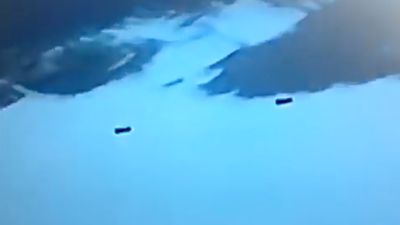
4. Does NASA Video Show Aliens Flying 2 Rectangular UFOs?
In February 2023, a Twitter post misleadingly claimed that NASA had recorded a video of aliens piloting two rectangular UFOs eight years prior. This assertion quickly sparked curiosity and skepticism. However, the truth is far less extraterrestrial.
The video in question was actually a digital animation created by NASA's Scientific Visualization Studio, showcasing the twin spacecraft satellites from the Gravity Recovery and Climate Experiment mission, not alien technology. This creative misunderstanding highlights the importance of verifying sensational claims, especially when they involve the vast unknown of space.
5. Does This Video Show Helicopters Escorting a UFO?
In early February 2022, UFO enthusiasts were abuzz with a video purporting to show an alien spacecraft being chased by helicopters over Durham, Connecticut. The footage, described in sensational headlines, was too grainy to confirm details such as the date, location and type of helicopters involved.
Despite the fuzzy quality, the video likely depicted three helicopters, with the middle one shining a spotlight below, rather than a UFO encounter. This interpretation leans more towards a terrestrial explanation.
6. Did Pentagon Confirm Leaked Pics of UFOs Were Taken by Military Personnel?
In July 2019, a night-vision video captured by the USS Russell crew showed pyramid-shaped objects flying in the night sky, confirmed as authentic by the U.S. Department of Defense. While the public might jump to extraterrestrial conclusions, these are officially termed "unidentified aerial phenomena." The origin and nature of these objects remain a mystery even to U.S. military officials.
Documentary filmmaker Jeremy Corbell and investigative reporter George Knapp released the footage, hoping it sparks a rational and transparent investigation into UFO phenomena, suggesting technology possibly beyond current human capability. Further images captured by military aviators in 2019 have also surfaced, adding to the intrigue around these unidentified objects.
7. Did a 'Declassified' Picture Show an Alien UFO Crash?
An online ad promising "40+ Wild Photos That the Government Has Declassified" featuring a dramatic image of a UFO crash scene led curious folks to a lengthy slideshow on the Daily Forest website. The intrigue? A flying saucer surrounded by officials, straight out of a sci-fi scene. However, the twist in the tale was that the advertised UFO crash photo didn't make an appearance in the article.
Instead, it was revealed to be a still from "The X-Files: The Event Series," dating back to 2016.
8. Was a UFO Spotted Over New Jersey?
In mid-September 2020, a TikTok video capturing what seemed to be a UFO over New Jersey quickly went viral, amassing millions of views. The footage showed onlookers near Route 21, mesmerized by the sight. However, the mystery was soon solved: the "alien spaceship" was actually a Goodyear Blimp, confirmed by a company representative.
The blimp was in the area to film the NFL game between the New York Giants and the Pittsburgh Steelers at MetLife Stadium.
9. Was an Alien Spotted Boarding a UFO in Romania?
In January 2018, a video allegedly capturing an alien boarding a spaceship in Romania and soaring over the forest became a social media sensation, amassing more 15 million views. Despite skepticism, some viewers were convinced it documented a real extraterrestrial visit.
However, the video's authenticity was questionable, with conflicting reports about its location — ranging from Târgoviște to Bacău, Romania, and even Alaska, highlighting a typical internet hoax pattern.
Originally posted on the "Alien Unleash" YouTube channel without a specific location, the video, surrounded by keywords like "UFO" and "Real Aliens," was part of a collection featuring fantastical elements such as dragons and alien abductions, casting further doubt on its legitimacy.
10. Did a UFO Disappear Into a 'Portal' Above Colorado?
On April 17, 2017, a video claiming to show a UFO over southern Colorado went viral after being posted on the "I'm From Denver" Facebook page. Despite its widespread sharing, there were no local news reports to corroborate the sighting, which would be expected for such an extraordinary event.
The video's true origins trace back to Sonora, Mexico, not Colorado. Skepticism grew as no concrete evidence supported the sighting, and the possibility of it being a drone light show or a digital creation was considered. Gabe Hash, a YouTube personality, debunked the video as a likely computer-generated hoax.
Astronomers Find Two Ancient Substructures in Inner Milky Way
Astronomers Find Two Ancient Substructures in Inner Milky Way
Dubbed Shakti and Shiva, the newly-identified structures are between 12 and billion years old — so ancient they likely formed before even the oldest parts of the present-day Milky Way’s spiral arms and disk.
This image shows the location and distribution of Shakti (yellow) and Shiva (blue) stars throughout the Milky Way.
Image credit: ESA / Gaia / DPAC / K. Malhan.
“What’s truly amazing is that we can detect these ancient structures at all,” said Dr. Khyati Malhan, an astronomer at the Max Planck Institute for Astronomy.
“The Milky Way has changed so significantly since these stars were born that we wouldn’t expect to recognize them so clearly as a group — but the unprecedented data we’re getting from ESA’s Gaia satellite made it possible.”
Using Gaia observations, Dr. Malhan and Max Planck Institute for Astronomy’s Dr. Hans-Walter Rix were able to determine the orbits of individual stars in the Milky Way, along with their content and composition.
“When we visualised the orbits of all these stars, two new structures stood out from the rest among stars of a certain chemical composition. We named them Shakti and Shiva,” Khyati said.
Each stream contains the mass of about 10 million Suns, with stars of 12 to 13 billion years in age all moving in very similar orbits with similar compositions.
The way they’re distributed suggests that they may have formed as distinct fragments that merged with the Milky Way early in its life.
Both Shakti and Shiva streams lie towards the Milky Way’s heart.
Gaia explored this part of the Milky Way in 2022 using a kind of galactic archaeology. This showed the region to be filled with the oldest stars in the entire Galaxy, all born before the disk of the Milky Way had even properly formed.
“The stars there are so ancient that they lack many of the heavier metal elements created later in the Universe’s lifetime,” Dr. Rix said.
“The stars in our Galaxy’s heart are metal-poor, so we dubbed this region the Milky Way’s ‘poor old heart’.”
“Until now, we had only recognized these very early fragments that came together to form the Milky Way’s ancient heart.”
“With Shakti and Shiva, we now see the first pieces that seem comparably old but located further out.”
“These signify the first steps of our Galaxy’s growth towards its present size.”
While very similar, the two streams are not identical. Shakti stars orbit a little further from the Milky Way’s center and in more circular orbits than Shiva stars.
Fittingly, the streams are named after a divine couple from Hindu philosophy who unite to create the Universe.
Some 12 billion years ago, the Milky Way looked very different to the orderly spiral we see today.
We think that our Galaxy formed as multiple long, irregular filaments of gas and dust coalesced, all forming stars and wrapping together to spark the birth of our Galaxy as we know it.
It seems that Shaki and Shiva are two of these components — and future Gaia data releases may reveal more.
The authors also built a dynamical map of other known components that have played a role in our Galaxy’s formation and were discovered using Gaia data.
These include Gaia-Sausage-Enceladus, LMS1/Wukong, Arjuna/Sequoia/I’itoi, and Pontus.
These star groups all form part of the Milky Way’s complex family tree, something that Gaia has worked to build over the past decade.
“Revealing more about our Galaxy’s infancy is one of Gaia’s goals, and it’s certainly achieving it,” said Gaia project scientist Dr. Timo Prusti, an astronomer at ESA.
“We need to pinpoint the subtle yet crucial differences between stars in the Milky Way to understand how our Galaxy formed and evolved.”
“This requires incredibly precise data — and now, thanks to Gaia, we have that data.”
“As we discover surprise parts of our Galaxy like the Shiva and Shakti streams, we’re filling the gaps and painting a fuller picture of not only our current home, but our earliest cosmic history.”
The study was published in the Astrophysical Journal.
Khyati Malhan & Hans-Walter Rix. 2024. Shiva and Shakti: Presumed Proto-Galactic Fragments in the Inner Milky Way. ApJ 964, 104; doi: 10.3847/1538-4357/ad1885
Northrup Grumman is Studying How to Build a Railway on the Moon
Roughly two years and six months from now, as part of NASA’sArtemis III mission, astronauts will set foot on the lunar surface for the first time in over fifty years. Beyond this mission, NASA will deploy the elements of the Lunar Gateway, the Artemis Base Camp, and other infrastructure that will allow for a “sustained program of lunar exploration and development.” They will be joined by the European Space Agency (ESA), the China National Space Agency (CNSA), and Roscosmos, the latter two collaborating to build theInternational Lunar Research Station (ILRS).
Anticipating this process of lunar development (and looking to facilitate it), the Defense Advanced Research Projects Agency (DARPA) launched the 10-year Lunar Architecture (LunA-10) Capability Study in August last year. In recent news, the agency announced that it selected Northrop Grumman to develop a moon-based railroad network. This envisioned network could transport humans, supplies, and resources for space agencies and commercial ventures, facilitating exploration, scientific research, and the creation of a lunar economy.
According to DARPA, the seven-month LunA-10 study aims to establish “an analytical framework that defines new opportunities for rapid scientific and commercial activity on and around the Moon.” It also aims to foster the development of foundational technology to optimize lunar infrastructure, allowing space agencies to move away from individual efforts within isolated, self-sufficient systems and towards shareable, scalable, resource-driven systems that can operate together. In keeping with NASA’s long-term objectives, this work will complement the administration’s “Moon to Mars” objectives.
Artist rendition of construction of the Moon. Credit: NASA.
In layman’s terms, the plan is to develop the technologies that will allow space agencies and companies to access each others’ resources, facilities, and information to promote further growth opportunities. Several key sectors are identified in the solicitation that must be developed into services to sustain a long-term presence on the Moon based on an independent market analysis of the future lunar economy. They include construction, mining, transit, energy, agriculture, and research (e.g., medicine, robotics, and life sustainment) that will have applications for space exploration and life on Earth.
Other aspects include lunar and planetary science, communications, digital infrastructure, and Position, Navigation, and Timing (PNT) technology. Dr. Michael “Orbit” Nayak, a program manager in DARPA’s Strategic Technology Office, extolled DARPA’s long history of working with NASA during last year’s announcement:
“For 65 years, DARPA has pioneered and de-risked technologies vital to civil space advancement — from the rocket technology in the Saturn V that took humans to the Moon for the first time, to the recent DARPA-NASA partnership to enable faster space travel to the Moon and beyond with a nuclear thermal rocket engine.
“LunA-10 continues this rich legacy by identifying and accelerating key technologies that may be used by government and the commercial space industry, and ultimately to catalyze economic vibrancy on the Moon. Just like DARPA’s foundational node of ARPANET grew into the sprawling web of the internet, LunA-10 is looking for those connective nodes to support a thriving commercial economy on the Moon.”
As part of this 10-year plan, Northrop Grumman will be tasked with creating the infrastructure that will physically connect lunar facilities and allow for the movement of people and resources back and forth. Their responsibilities, as spelled out in their contract of opportunity, include defining the interfaces and resources required to build a lunar rail network; identifying cost, technological, and logistical risks; creating prototypes, demonstrations, and analyses of a concept design and architecture, and exploring robotics concepts for constructing and operating the system.
These robotics concepts must be able to operate on the lunar surface and carry out specific tasks, such as grading and foundation preparation, track placement and alignment, joining and finishing, inspection, maintenance, and repairs. Said Chris Adams, the vice president and general manager of strategic space systems at Northrop Grumman:
“This investment in key developmental research keeps our technology at the forefront of next-generation solutions. With our proven experience in the integration of complex systems and commercialized autonomous services, we will continue to create lasting change for a sustainable space ecosystem.”
Northrop Grumman and other selectees will receive an Other Transaction award of up to $1 million. They will present their work at the Spring meeting of the Lunar Surface Innovation Consortium (LSIC) in April 2024 and provide a final report in June 2024.
Starshot … Not? Get a Reality Check on the Search for Alien Civilizations
Fortunately, the real-world search for signs of extraterrestrial civilizations doesn’t have to deal with an alien armada like the one that’s on its way to Earth in “3 Body Problem,”the Netflix streaming series based on Chinese sci-fi author Cixin Liu’s award-winning novels. But the trajectory of the search can have almost as many twists and turns as a curvature-drive tripfrom the fictional San-Ti star system.
Today, the Breakthrough Initiatives is focusing on projects closer to home. In addition to the millions of dollars it’s spending to support the search for radio or optical signals from distant planetary systems, it’s working with partners on a miniaturized space telescope to identify planets around Alpha Centauri, a radio telescope that could someday be built on the far side of the moon, and a low-cost mission to look for traces of life within the clouds of Venus.
Breakthrough Starshot, however, is on hold. “This looks to be quite feasible. However, it seems to be something that is still pretty, pretty expensive, and probably wouldn’t be feasible until later in the century,” says Pete Worden, executive director of the Breakthrough Initiatives. “So, we’ve put that on hold for a period of time to try to look at, are there near-term applications of this technology, which there may be.”
Worden provides a status report on the search for extraterrestrial intelligence — and sorts out science fact from science fiction — on the latest episode of the Fiction Science podcast.
“3 Body Problem” takes its name from a longstanding challenge in orbital mechanics: It’s devilishly difficult to predict the gravitational interactions of three massive bodies in a system, except in some special cases. In the Netflix series, and in the books on which the series is based, a Chinese radio astronomer makes contact with an alien civilization that suffers repeated crises because its home world is in an unstable triple-star system.
Pete Worden is the executive director of the Breakthrough Initiatives.
(Credit: Breakthrough Initiatives)
When the aliens learn of our existence, they set out on a 400-year mass migration to Earth — an onslaught that puts our own planet on edge. One of the key concepts in the book is the Dark Forest Theory. That’s the idea that civilizations shouldn’t broadcast their existence to the rest of the galaxy, for fear that other denizens of the “Dark Forest” will eventually come after them.
Worden admits that the Dark Forest Theory has had an effect on the Breakthrough Initiatives’ agenda.
“We initially had a program called Breakthrough Message. … Not that we were going to send anything, but we were going to think about it,” he recalls. “We got a lot of resistance to even thinking about sending messages. Interestingly enough, one of the key skeptics of this was Professor Stephen Hawking. He thought it was a bad idea for exactly the Dark Forest reason. Conversely, the chairman of our advisory committee — Lord Martin Rees, the Astronomer Royal of the U.K. — has the opposite view. He doesn’t think that’s a big issue.”
Worden’s personal view is that we’ve been sending out signs of our presence — ranging from radio transmissions to telltale pollutants in the atmosphere — for so long that “it’s probably too late to hide in the forest and be quiet.”
The Breakthrough Initiatives is counting on civilizations in other planetary systems to speak up, one way or the other. Starting in 2015, Breakthrough Listen has provided support for programs looking for radio signals or optical flashes that might have been transmitted by aliens. One signal in particular, known as BLC1, got hearts beating faster in 2019 — but astronomers eventually traced its origin to earthly radio interference rather than Proxima Centauri.
Another initiative, known as Breakthrough Watch, is working with Australian astronomers on a space telescope that would monitor the motions of the three stars in the Alpha Centauri system, looking for ever-so-slight gravitational wobbles that could point to the presence of Earthlike planets a little more than 4 light-years from Earth. The telescope is called TOLIMAN, which is the Arabic name for Alpha Centauri as well as an acronym for “Telescope for Orbit Locus Interferometric Monitoring of our Astronomical Neighborhood.”
Worden says launch is currently scheduled for the first half of 2025. “We’re still negotiating on the launch vehicles, but it’s most likely to be a piggyback mission, possibly on a SpaceX mission.” he says.
Meanwhile, Worden is working with CSIRO, the Australian government’s science agency, on a different sort of telescope.
“We think we can put a radio telescope for on the order of $100 million on the far side of the moon that looks for transients across the broad spectrum, mostly at higher frequencies,” he says. “That’s a good place, because right now it’s blocked from interference from the Earth. Just virtually everything you see is going to be something interesting.”
The Breakthrough team is also interested in extraterrestrial life in our own solar system: Years ago, Yuri Milner looked into the prospects for sending a probe to Enceladus, an icy moon of Saturn that may harbor hidden seas and perhaps even marine organisms. Today, Worden and his colleagues are collaborating with other interested parties — including Schmidt Sciences, researchers at MIT and engineers at Rocket Lab — to send a probe through Venus’ atmosphere to search for organic materials. Liftoff is set for as early as next January.
Getting to other stars
Even though Starshot is on hold, Worden is still thinking about interstellar travel, and he’s not the only one. Last weekend, SpaceX founder Elon Musk referred to the prospects of sending his company’s Starship super-rocket on trips beyond the moon and Mars.
“This Starship is designed to traverse our entire solar system and beyond to the cloud of objects surrounding us,” Musk said in a posting to X / Twitter, his social media platform. “A future Starship, much larger and more advanced, will travel to other star systems.”
Musk may not be thinking about using light sails, but NASA is. One of the proposals that won funding in the latest round of NASA Advance Innovative Concepts grants envisions developing swarms of sail-equipped, laser-propelled micro-probes that would take advantage of the same principle laid out by Breakthrough Starshot to get to the Alpha Centauri system.
An artist’s conception shows an early design for Breakthrough Starshot’s light sail. (Breakthrough Initiatives Illustration)
Worden thinks the best long-term approach to interstellar travel would be a combination of light sails to get the probes where they’re going, plus fusion power to slow them down once they get there. “I think that ultimately, something along that line is probably feasible in a century or so, maybe sooner,” he says.
A century may sound like a long time, but when you’re talking about sending probes to other stars, you have to adjust your time scales. After all, even the super-advanced aliens in “3 Body Problem” need 400 years to get to Earth. You can add interstellar travel to the other multi-generational challenges that are facing humanity, such as climate change. In fact, The New Yorker’s review of “3 Body Problem” notes that the approach of the aliens serves as “an unexpectedly potent metaphor for the looming perils of climate change.”
So, how long could it be before we connect with extraterrestrial civilizations? That’s the kind of question that can get alien-hunters in trouble. Two decades ago, the SETI Institute’s Seth Shostak speculated that we were likely to pick up signals from intelligent alien life by the year 2025 — a scenario that now seems extremely unlikely.
Worden prefers to think in terms of percentages.
“Within a decade, we’ll almost assuredly find life elsewhere,” he says. “We’ll probably find a life-bearing planet nearby. We’ll find life either on Mars, or Venus, or maybe the outer solar system moons. But an alien techno-civilization? I’d say, for any given decade, it’s probably a few percent. But if you don’t look, you don’t find it.”
It doesn’t bother him that he may not be around to answer one of life’s ultimate questions. “One of the cool things about science is that the journey is the fun part, and you never know what you’re going to find,” Worden says. “So, as a scientist, to me, you’re pursuing something that is unlikely, but really fundamental to our future. It’s the most fun thing I can imagine working on.”
If the aliens ever do arrive, let’s hope they find that oh-so-human trait endearing.
Europa Might Not Be Able to Support Life in its Oceans
Can Europa’s massive, interior ocean contain the building blocks of life, and even support life as we know it? This question is at the forefront of astrobiology discussions as scientists continue to debate the possibility for habitability on Jupiter’s icy moon. However, a recent study presented at the 55th Lunar and Planetary Science Conference (LPSC) might put a damper in hopes for finding life as a team of researchers investigate how Europa’s seafloor could be lacking in geologic activity, decreasing the likelihood of necessary minerals and nutrients from being recycled that could serve as a catalyst for life.
Here, Universe Today speaks with Henry Dawson, who is a PhD student in the Department of Earth, Environmental, and Planetary Sciences at Washington University in St. Louis and lead author of the study, about his motivation behind the study, significant results, follow-up studies, and whether Dawson believes there’s life on Europa. So, what was the motivation behind this study?
Dawson tells Universe Today, “A large portion of the community has been looking at the habitability potential of the seafloor, and looking at processes that might occur at seafloor hydrothermal vents, or at water–rock interaction chemistry. However, it was never established that there would actually be any fresh rock exposed at the seafloor, or if the tectonic processes that drive hydrothermal vents would be present. The silicate interior of Europa is a similar size to that of Earth’s Moon, which is largely geologically dead on the surface.”
Artist’s cutaway illustration of Europa and its potential geologic activity.(Credit: NASA/JPL-Caltech/Michael Carroll)
For the study, Dawson and his colleagues examined the likelihood for geologic activity occurring on Europa’s seafloor through analyzing data on Europa’s geophysical characteristics and comparing them with known geologic parameters and processes, including the strength of potential fault lines and fractures within Europa’s rocky interior, how the strength of this rock changes with depth, and how the rock could react to ongoing stresses, commonly known as convection. Using this, they conducted a series of calculations to ascertain whether the seafloor crust could drive geologic activity. Therefore, what were the most significant results from this study?
“It looks a lot more difficult to expose fresh rock (which is required to drive the reactions that life would exploit) to the ocean,” Dawson tells Universe Today. “Tidal forces do not seem able to cause motion along faults, like it can on the surface, and so the seafloor is most likely still. All the rock that water is able to interact with through porosity was likely altered hundreds of millions to billions of years ago, and so the ocean and rock are in chemical equilibrium. This means that there is no present day, continuous input of nutrients into the ocean from the rocky core, and so any possible life would likely have to exploit nutrient input from the icy shell above the ocean.”
While this study focused on geologic stresses related to fractures and fault lines, Europa’s interior ocean is produced from another type of geologic stress known as tidal heating, which is induced from the constant stretching and compressing as Europa orbits the much more massive Jupiter. This same tidal process occurs between the Earth and its Moon, and we see this in action in the rising and falling of the Earth’s waters around the globe. For Europa, over the course of thousands to millions of years, the stretching and compressing leads to friction in Europa’s inner rocky core, which leads to becoming heated and melting the inner ice into the interior ocean that exists today. It is in this ocean that astrobiologists hypothesize that life could exist, possibly even life as we know it.
However, given these study’s unfortunate findings, Dawson and his colleagues give dire implications for the potential habitability on Europa, noting their calculations estimate that geologic activity on Europa’s seafloor is limited enough to indicate habitable conditions within Europa’s interior ocean could be limited, as well. However, the study was quick to note that other geologic processes could be examined to explain the present state of Europa’s seafloor geologic activity, including processes known as serpentinization and thermal expansion anisotropy.
“As rock is exposed to water and chemically alters, the new minerals that form may have a different molar volume than the unaltered minerals in the original rock,” Dawson tells Universe Today. “Serpentinization specifically is the process where peridotite, a typical mantle rock, is altered to serpentinite. This reaction has a net volume increase, which introduces new stresses. These stresses might lead to the fracturing of the rock, fresh rock faces exposed, and more alteration, leading to a self-propagating cycle. On the other hand, the new minerals might cement up pre-existing fractures, preventing further exposure, and creating a negative feedback loop. Thermal expansion anisotropy describes the process where different minerals have varying degrees of expansion upon heating. Thus, when a rock is heated or cooled, the mineral grains inside will push against each other, introducing porosity and interior stresses.”
Regarding the tidal forces responsible for producing Europa’s interior ocean, this icy moon and the Earth’s Moon are not the only planetary bodies in the solar system that could experience these unique forces. Others include Jupiter’s third Galilean Moon, Ganymede, Saturn’s icy moon, Enceladus, and Saturn’s largest moon, Titan, all of which are currently hypothesized to possess interior oceans from tidal heating. Like Europa, Ganymede exhibits a predominantly crater-free surface, which is indicative of frequent resurfacing, and Enceladus was observed on numerous occasions by NASA’s Cassini spacecraft to have geysers on its south pole region that frequently shoots out water into space.
Additionally, Cassini flew through these geysers to obtain data on the ejecta’s composition, discovering organic molecules. For Titan, Cassini data revealed that an interior ocean exists beneath its surface, which is currently hypothesized to contain a combination of ammonia and salts. But regarding this most recent research, what follow-up studies are currently being conducted or planned?
Dawson tells Universe Today, “I’m currently using the same model to estimate whether tidal forces are able to cause fracturing on other icy moons in the outer solar system, such as Ganymede, Enceladus, Titan, and the mid-size Uranian moons. Based on my preliminary results that I presented at LPSC, it appears that tidal forces are insufficient on those moons as well. In addition, our collaborator Austin Green is looking at whether seafloor volcanism might occur, based on the forces that volcanic dikes can exert on the rock that they are propagating through. For Europa, the lithosphere is too deep and too strong for magma to reach the seafloor, and so any melt that forms in the mantle stalls out at depth.”
Despite being discovered by Galileo Galilei in 1610, the fascination for finding life within Europa’s ocean has only come within the last few decades, thanks largely to the NASA Voyager missions, with Voyager 1 and Voyager 2 flying through the Jupiter system in 1979 and imaged the Galilean Moons up close and in detail for the first time, hinting that Europa was currently geologically active. This is because Europa has almost no visible craters throughout its entire surface, indicating specific processes are responsible for reshaping the small moon and covering up evidence of past impacts. Europa, being the second Galilean Moon, shares these traits with the first and third Galilean Moons, Io and Ganymede, respectively, while the fourth Galilean Moon, Callisto has a surface that is almost entirely covered by craters.
The Galilean moons of Jupiter: Io, Europa, Ganymede, and Callisto. (Credit: NASA/JPL-Caltech)
Thanks to further data obtained from proceeding missions, including NASA’s Galileo spacecraft, Hubble Space Telescope, and Juno, scientists are almost entirely convinced that an interior ocean lies beneath Europa’s icy crust, with some estimates putting the volume of liquid water at double of Earth’s oceans. Therefore, as we see on Earth, liquid water means life, which is why Europa’s interior ocean is a target for astrobiology research. But does Henry Dawson think there’s life on Europa?
Dawson tells Universe Today, “I think there’s still a lot more that I would like to understand before I make a yes or no statement on that. While I believe that Europa is one of the most likely candidates to host life, alongside Enceladus, the chance of life remains small, and this research reduces the probability even more.”
This study comes as NASA prepares to launch the Europa Clipper spacecraft this October with a planned arrival date of April 2030 and is designed to explore the habitability potential of Europa and its interior ocean. During its 3.5-year mission, Clipper will perform up to 44 close flybys of Europa ranging between 25 and 2,700 kilometers (16 to 1,678 miles) as the spacecraft will perform elongated orbits to keep from staying within Jupiter’s powerful magnetic field for too long. To assess Europa’s habitability potential, Clipper will carry a powerful suite of scientific instruments designed to analyze Europa’s chemistry, surface geology, and interior ocean characteristics.
Artist’s rendition of NASA’s Europa Clipper (published in January 2021). (Credit: NASA/JPL-Caltech)
Additionally, the European Space Agency’s Jupiter Icy Moons Explorer (JUICE) mission was launched in April 2023 with a planned orbital insertion at Jupiter in July 2031, followed by a departure from Jupiter and an orbital insertion around Ganymede in December 2034. Like Clipper, JUICE is designed to investigate the habitability potential of the icy moon, but will also examine Ganymede and Callisto, as well.
“Get excited for the Europa Clipper and JUICE missions! Dawson exclaims to Universe Today. “While it will still be 6 years before they reach Jupiter, once they arrive, we will be able to learn much more about what is going on at Europa. While they will not be able to directly measure the interior, observations of the ice shell, gravity field, and tidal forcing on Europa will help to constrain future models. As well, always be careful about the assumptions you make for other planetary bodies. While Europa may be covered with ice, it is truly a rocky world that happens to have a deep ocean, and the processes occurring at depth may not reflect what we see at Earth’s seafloor.”
Is Europa’s seafloor geologically active, and what new insights will Europa Clipper and JUICE make about this astonishing and intriguing icy moon in the coming years and decades? Only time will tell, and this is why we science!
What Can Europa’s Surface Tell Us About the Thickness of Its Ice?
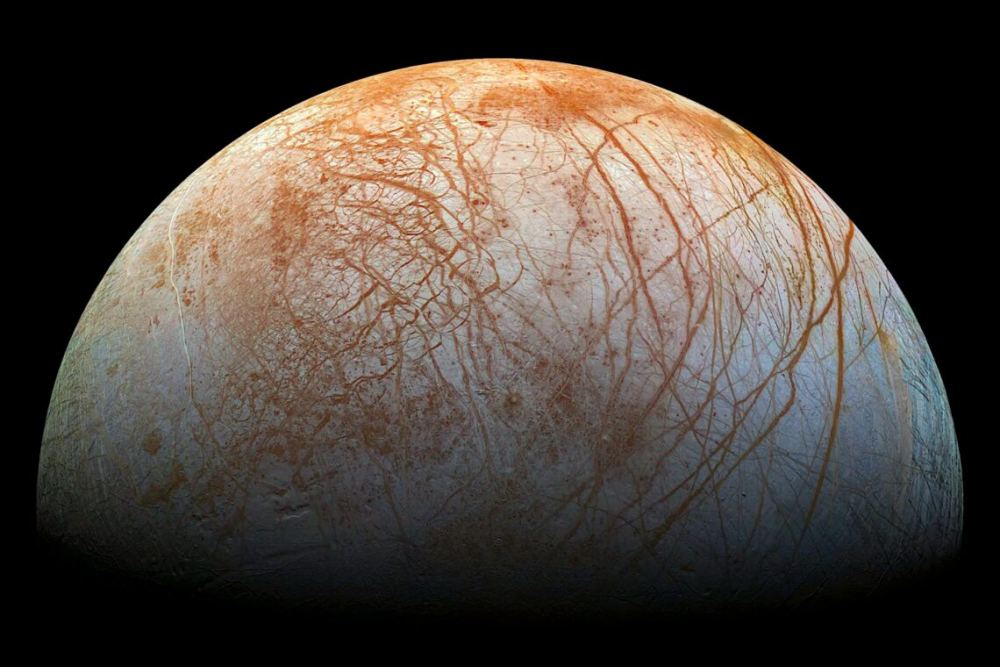
Jupiter's second Galilean moon, Europa. Its smooth surface has fewer craters than other moons, but they help us understand its icy shell. (Credit: NASA/JPL/Galileo spacecraft)
What Can Europa’s Surface Tell Us About the Thickness of Its Ice?
You can tell a lot about a planetary body just by looking at its surface, especially if it has craters. Take Europa, for example. It has a fairly young surface—somewhere between 50 and 100 million years old. That’s practically “new” when you compare it to the age of the Solar System. And, Europa’s icy crust is pretty darned smooth, with only a few craters to change the topography.
Planetary scientists already know that Europa’s icy surface is a thin shell over a large interior ocean of salty water. How thin? To find out, a team of researchers led by Brandon Johnson and Shigeru Wakita at Purdue University studied images of large craters on Europa. They used what they saw, coupled with a variety of physical characteristics, to create computer models of that shell. “Previous estimates showed a very thin ice layer over a thick ocean,” said Wakita. “But our research showed that there needs to be a thick layer—so thick that convection in the ice, which has previously been debated, is likely.”
The thickness of that shell may well influence whether or not life exists at Europa. Its existence is a topic of intense interest since Europa could provide a reasonably habitable ecosystem for life. It has water, warmth, and organic materials for life to eat. That makes the search for life at Europa quite important. So, what do craters have to do with all this?
More About Craters
Impact cratering performs a lot of gardening in the Solar System, according to Johnson. He is the first author on a recently published paper discussing these features on Europa. “Craters are found on almost every solid body we’ve ever seen. They are a major driver of change in planetary bodies,” he said.
Four featured craters among many on the Moon: the triplet of Theophilus, Cyrillus and Catharina and Maurolycus. Many more craters can be seen across the lunar surface. Credit: Virtual Moon Atlas / Christian LeGrande, Patrick Chevalley
Just looking at images of different worlds in the Solar System, we can see some pretty heavily cratered surfaces. The Moon is a good example, as is Mars. And, we see it at many of the smaller bodies, such as the moons of the gas and ice giants. The more craters we see, the older the surface. In some places, multiple overlapping craters indicate a very old surface. In other places, such as at Europa, the craters are fewer and farther between. Something has “paved over” the craters such that any we CAN see were made after the repaving event. In addition, the craters reveal information about the surface as well as the “subsurface” of Europa.
“When an impact crater forms, it is essentially probing the subsurface structure of a planetary body,” said Johnson. “By understanding the sizes and shapes of craters on Europa and reproducing their formation with numerical simulations, we’re able to infer information about how thick its ice shell is.”
What Europa’s Craters Tell Us
This tiny moon is an enigma wrapped in shimmering ice. Its frozen surface hides a rocky inner core covered with a salt-water ocean. Like Earth, it experiences surface plate tectonics, driven by the core region’s heating. Inside, that heating drives currents of warmer water up from the core. That water gets forced to the surface, where it freezes and creates a new layer overlying any other features. This resurfacing happens every 50 to 100 million years.
Incoming impactors carve out new craters in that “freshened-up” surface, which gives scientists some pretty easy-to-study craters. They aren’t terribly deep, however, which tells scientists a lot about the structure of the icy shell. Johnson, Wakita, and their team studied images from the Galileo spacecraft to analyze Europa’s craters. In particular, they focused on two multi-ringed basins imaged on this moon. They show two or more concentric rings around the point of the impact that created them. Such basins are fairly rare and usually indicate some kind of large, energetic impact. On Europa, their appearance and formation give clues to the thickness of the icy shell and their thermal structure, which is a way to understand how the shell conducts heat.
Multi-ringed Crater Basins Tell a Tale
In their study, the Purdue team simulated a multi-ring basin with varying thicknesses of ice. Those thicknesses influence the degree of tidal heating in the shell itself. They also help scientists understand how heat exchange occurs between the bottom of the shell and the underlying ocean. The team found that icy shells thinner than about 15 kilometers don’t show the kinds of multi-ringed basins that exist on Europa. However, a thicker one does. In particular, the best-fit simulation used a 20+ kilometer-thick shell. It consists of two layers: a 6-8 kilometer-thick conductive “lid” that covers up a layer of warm, convecting ice.
One of Galileo’s images of the Tyre multi-ringed basin on Europa. There are at least 5-7 rings around the impact crater center. Courtesy: NASA/JPL/ASU.
In addition to studying the craters, the team also looked at the types of impactors needed to create those multi-ringed basins on Europa. From the structures seen in the Galileo images, they concluded that the impactors would need to be around 1.5 kilometers in radius to create the multi-ringed basins. Smaller ones wouldn’t create the structures they saw, and bigger impactors would result in very different-looking craters and rings.
What About Other Worlds?
Europa isn’t the only world at Jupiter with an icy crust. Both Ganymede and Callisto also show cratering, with multi-ring basins. This tells us that these worlds also have to have thick enough icy crusts where such basins can form. Planetary scientists have suggested their crusts are at least 80 to 105 kilometers thick. In their paper, the Purdue teams suggest that since Europa’s crust is likely to be at least 20 kilometers thick (if not more) it’s also likely that Ganymede and Callisto have much thicker crusts than current predictions suggest.
Callisto has many more craters than Europa and a thicker icy crust. Image credit: NASA/JPL
Finally, although the paper doesn’t specifically address this, the fact that the scientists can deduce impactor size from the characteristics of the resulting craters does provide insight into the sizes of impactors available in Jovian “airspace”. To sustain these kinds of multi-ringed basins, you need a good population of sizable impactors to do the job. Also, for Europa to be so recently “refreshed” really does give a clue to the impact environment in the Jupiter system. While Ganymede and Callisto both have very old surfaces, the existence of “fresh” ice at various cratering sites tells us that they’re still being bombarded in recent times, although they’re not actively resurfacing themselves. These are all additional data points to consider when understanding the habitability of environments, particularly at Europa (and possibly at places such as Enceladus at Saturn).
“Understanding the thickness of the ice is vital to theorizing about possible life on Europa,” Johnson said. “How thick the ice shell is controls what kind of processes are happening within it, and that is really important for understanding the exchange of material between the surface and the ocean. That is what will help us understand how all kinds of processes happen on Europa—and help us understand the possibility of life.”
We might witness a star explode soon — and it’s not Betelgeuse.
A mismatched pair of stars 3,000 light years away may be gearing up for an explosion in the next few months. T Coronae Borealis (T CrB to its friends) is normally too dim to see with the unaided eye, but roughly every 80 years, it flares brightly enough to appear as a “new” star, or nova, in Earth’s northern sky. Its last event was in 1946, and astronomers say it’s likely to go off again this year.

This illustration shows the red giant in T CrB with a disk of discarded gas around it. The white dwarf (the bright spot in the disk at the beginning of the animation) eventually gobbles up so much material that its surface explodes in a runaway thermonuclear reaction.
TWINKLE, TWINKLE, LITTLE — BOOM
T CrB is actually a pair of stars, trapped in each other’s orbit — and in an extremely messy relationship that sometimes literally explodes.
One is an aging red giant, which has burned up all its hydrogen fuel and is now fusing helium atoms together at its core. Helium fusion produces a tremendous amount of heat and radiation pressure, so the aging star’s outer layers have swelled outward to many times its original size (this is the same fate that will eventually befall our Sun in about 5 billion years). The other half of the dynamic duo is a white dwarf: the burned-out remains of a star’s core (this is what our Sun will look like sometime after its red giant phase).
About every 80 years, the red giant shrugs off its outermost layers of gas, and the white dwarf’s gravity grabs them. White dwarfs are nowhere near as dense as neutron stars, but they're still pretty dense, being the remnants of stellar cores — and it doesn't take much to ignite one again, at least temporarily. When even more mass gets piled on the surface, it adds just enough heat and pressure for the white dwarf to start fusing hydrogen and helium in its inner layers.
That sudden burst of fusion triggers a chain reaction that eventually engulfs the outer layers of the star in what's called a runaway thermonuclear reaction. The envelope of gas around the white dwarf, heated by the runaway nuclear fusion, explodes outward at roughly 3,700 miles per second. In other words, KABOOM.
And 3,000 light years away, people on Earth will be able to see what looks like a new star in the night sky.
WHAT ABOUT BETELGEUSE?
It won’t take T CrB’s white dwarf very long to burn up all its hydrogen fuel and settle back down: It’ll only be visible in the sky for a few days, and the runaway thermonuclear reaction itself will last just a fraction of that time. When Betelgeuse eventually explodes, however, the glow of its death throes will hang in the sky for several months. What’s the difference?
The kind of explosion that lights up T CrB once every 40 years is called a nova, and it happens when a white dwarf gets briefly reignited in a runaway nuclear reaction. Imagine throwing lighter fluid and a match onto a pile of burned-up charcoal. It will catch fire and burn for a moment, but it won’t last.
When Betelgeuse dies, however, it will go out in a blaze of glory called a supernova. A supernova happens when an extremely massive star runs out of fuel for its nuclear reactions; the outer layers collapse, and the pressure of the collapse triggers an enormous explosion. Think of it as blowing up the grill: It’s going to be bigger and brighter than what happened when you lit up the charcoal, and you’re only going to be able to do it once.
Novae like T CrB, though, are the explosive cosmic gifts that just keep on exploding.
China launches relay satellite to allow communication with far side of the moon and further nation’s lunar ambitions
China launches relay satellite to allow communication with far side of the moon and further nation’s lunar ambitions
Story by Ling Xin
Queqiao-2 solar wings and relay communication antennas were deployed, making launch successful, says China National Space Administration
Smaller satellites Tiandu-1 and 2 were also launched and will orbit the moon to test and verify navigation and communications technologies
China has launched a new communications relay satellite to support its moon ambitions in the decade to come.
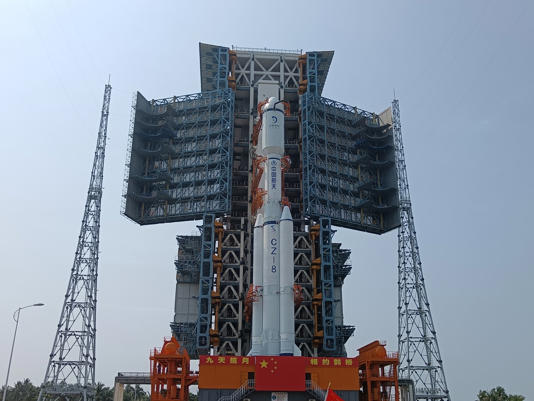
Queqiao-2, or Magpie Bridge-2, lifted off atop a Long March 8 rocket from Wenchang Satellite Launch Centre on southern China's Hainan island at 8.31am on Wednesday, according to the China National Space Administration.
After flying for 24 minutes, the rocket sent the relay satellite directly into the planned Earth-moon transfer orbit with a perigee height of 200km (124 miles) and an apogee height of 420,000km.
Do you have questions about the biggest topics and trends from around the world? Get the answers with SCMP Knowledge, our new platform of curated content with explainers, FAQs, analyses and infographics brought to you by our award-winning team.
The solar wings and relay communication antennas of the relay satellite were deployed normally in succession, "marking a complete success of the launch mission," the administration said.
The satellite would support future moon missions by China "and other countries", it said.
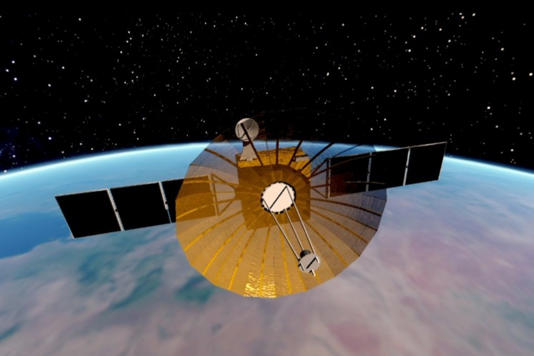
Queqiao-2 is planned to reach an elliptical orbit around the moon and unfold its 4.2 metre-wide (13.8 feet) parabolic antenna to make communications possible between Earth and the lunar far side, which never faces Earth.
It can relay signals up to eight hours straight for the first sample return from the far side of the moon later this year, two more complicated missions to establish a prototype base at the lunar south pole by 2028 and, potentially, more spacecraft from China and its international partners.
Related video:
How China explores the far side of the moon (Dailymotion)
Sharing the ride on the 50 metre-tall (164 foot) Long March rocket were a pair of experimental technology satellites - Tiandu-1 and 2 - which are headed to a separate orbit where they will fly in formation and test lunar navigation and communications technologies.
The moon is tidally locked to Earth. As a result, we always see the same side of the moon from Earth. In 2018, China launched the Queqiao relay satellite to support its Chang'e 4 mission, which made the first soft landing on the moon's far - or "invisible" - side.
The combination of the relay satellite Queqiao-2 and the Long March 8 Y3 carrier rocket is vertically transferred to the launching area at the Wenchang Space Launch Centre on March 17, 2024.
The 325kg (716lbs) Queqiao, which has a designed lifespan of five years, is still operating near Earth-Moon Lagrangian-2 point - a gravitationally balanced spot about 70,000km beyond the moon.
Queqiao-2 is much heavier with a mass of 1,200kg. Its orbit is also different: it is highly elliptical with the closest point at 300km and the farthest 8,600km above the moon's surface.
It will take Queqiao-2 around 12 hours to make one circle around the moon and during this time communications between Earth and the lunar far side could be provided for about eight hours.
This orbit is also known as a frozen orbit because it is very stable and requires the spacecraft to carry very little, if any, propellant for orbit maintenance over a very long time.
Queqiao-2's antenna surface was made of extremely thin molybdenum wires coated with gold, said the research team from Donghua University in Shanghai that developed the antenna.
"The wires used to weave the antenna were thinner than human hair. And gold is a very good reflector," team leader Chen Nanliang told state broadcaster CCTV back in February.
"Our 'golden umbrella' is lightweight and flexible enough to be first tucked in the rocket cabin, and then unfold in orbit. It's also strong enough to withstand the harsh conditions during launch and in flights," Chen said.
Besides signal relay, Queqiao-2 is also equipped with three scientific payloads, including an ultraviolet camera and a long-distance radio astronomy experiment. Its designed lifespan is at least eight years.
Compared with Queqiao-2, Tiandu-1 and Tiandu-2 satellites are much smaller. The 61kg Tiandu-1 carries a Ka dual-band communication payload, a laser retroreflector and a space router among other devices. The 15kg Tiandu-2 carries a communication payload and navigation devices.
Together, the two will orbit the moon to test and verify navigation and communications technologies, and inform the design of China's Queqiao lunar navigation and communication constellation, Xinhua reported last month.
The Queqiao constellation would greatly aid moon landing and lunar surface operations, said state news agency Xinhua. China plans to land astronauts on the moon no later than 2030, and build a moon base with international partners in about a decade.
More Articles from SCMP
This article originally appeared on the South China Morning Post (www.scmp.com), the leading news media reporting on China and Asia.
Copyright (c) 2024. South China Morning Post Publishers Ltd. All rights reserved.
Communication between spacecraft relies upon line of site technology, if anything is in the way, communication isn’t possible. Exploration of the far side of the Moon is a great example where future explorers would be unable to communicate directly with Earth. The only way around this is to use relay satellites and the Chinese Space Agency is on the case. The first Queqiao-1 was able to co-ordinate communications with Chang’e-4 landers and now they are sending Queqiao-2 to support the Change’e-6 mission.
If you have ever gazed upon the Moon you might have noticed that it always has the same hemisphere facing the Earth. This phenomenon is known as captured or synchronous rotation. It may look like the Moon isn’t rotating but in reality the time it takes to spin once on its axis is the same as the time it takes to complete one orbit around the Earth, keeping one hemisphere constantly facing us. Explorers on the near side of the Moon have no trouble communicating with transmissions taking just over one second to reach home. Explore the far side of the Moon and you have a problem.
The Chang’e 5 test vehicle captured this beautiful view of Earth over the far side of the Moon on October 28, 2014. Credit: Chinese national space agency (CNSA) and Chinese Academy of Sciences (CAS)
To overcome the problem China have launched a 1.2 ton communication satellite known as Queqiao-2. It’s name originates from the mythological bridge made from magpies. In the Chinese tale, the magpies formed a bridge across the Milky Way to allow the lovers Vega and Altair to be together for one night once a year. Two miniature satellites were also launched Tiandu-1 and Tiandu-2 from the island of Hainan.
On arrival it will orbit the Moon and provide a relay for the Chang’e-6 lander which is slated to launch in May. It will join satellites from United States, India and Japan to support the exploration of the far side of the Moon. Chang’e-6 will collected samples from an ancient basin. Not only will it serve the communications for Change-6, it will transfer communications for Chang’e-7 and ‘8. Both craft are to be launched in the years ahead 2026 and 2028 respectively.
The orbit of Queqiao-2 will take it almost over the south pole in an elliptical orbit. It will reach an altitude of 8,600 km so that communication can be achieved for a little over eight hours. At its closest, it will sweep over the lunar surface at an altitude of 300 km.
The ultimate goal of the Chinese Space Agency is to create a network of satellites, not too dissimilar (but not quite on the same scale) to the growing Space X constellation which is building a global internet presence. The purpose of Tiandu-1 and Tiandu-2 is to test the concept of such a constellation.
China’s longer term aspirations include a research station at the lunar south pole and for this to be viable, communication relays are essential to establish communication, navigation and remote sensing.
The Mars Science Helicopter Could be an Airborne Geologist on Mars
After over 70 successful flights, a broken rotor ended the remarkable and groundbreaking Ingenuity helicopter mission on Mars. Now, NASA is considering how a larger, more capable helicopter could be an airborne geologist on the Red Planet. For the past several years scientists and engineers have been working on the concept, proposing a six-rotor hexacopter that would be about the size of the Perseverance rover.
Called the Mars Science Helicopter (MSH), it would not only serve as an aerial scout for a future rover, but more importantly, it could also carry up to 5 kg (11 lbs) of science instruments aloft in the thin Martian atmosphere and land in terrain that a rover can’t reach.
A new paper presented at the March 2024 Lunar and Planetary Science Conference outlines the geology work that such a helicopter could accomplish.
The paper, “Unraveling the Origin and Petrology of the Martian Crust with a Helicopter,” notes there are several outstanding questions about the makeup and history of Mars’ surface, especially with recent discoveries of unexpected dichotomies in the composition of basaltic rocks. In observations from the Mars rovers and orbital spacecraft, some regions appear to have been influenced by water while some have not.
“Up to last decade, we thought that magmatic rocks were only basaltic on Mars,” said Valerie Payré from the University of Iowa, the paper’s lead author. “But with recent rover and orbital measurements, we observed that there is a wide diversity of magmatic rocks similar to what we see on Earth.”
Payré explained via email that there are rocks on Mars with elevated silica concentrations called felsic rocks – feldspar and silicate — that are rich in elements and were not expected to be found on the Martian surface.
“We measured these with the Curiosity rover and have some hints of where there might be others using orbital measurements,” Payré said. “However, close-up images (millimetric scale) and composition analyses are lacking from the orbital dataset to know if these felsic rocks are widespread on Mars or just at a few locations. This is yet highly important to understand what the crust of Mars is made of and if it is similar to Earth’s crust, which has implications regarding the formation of the planet and even past climate.”
First X-ray view of Martian soil – feldspar, pyroxenes, olivine revealed (Curiosity rover at “Rocknest”, October 17, 2012). Credit: NASA/JPL-Caltech/Ames
Payré and her team feel that a helicopter would be perfect to explore places where a rover could never traverse, such as terrains that are too high in altitude, since landing there would require too much fuel.
The instruments they propose include a miniaturized visible and near-infrared (VNIR) spectrometer for small scale mineralogical mapping and a small Laser Induced Breakdown Spectrometer (LIBS) with a micro-imager, an instrument similar to the ChemCam laser instrument on both the Curiosity and Perseverance rovers. In their paper, the team writes that a helicopter with these instruments could travel kilometers to detect promising felsic terrains, and measure their composition at a micron scale.
“We could fly over these possible felsic terrains and look at their minerals using a visible/near infrared spectrometer, land on locations of interest, take close-up images, and measure the compositions of these rocks with the LIBS,” Payré said. “We could finally know what Mars’ crust is, and better constrain how it formed.”
A graphic show the parts of the Ingenuity helicopter. Credit: NASA
There could also be an onboard a magnetometer, which measures magnetic field anomalies, to better understand how Mars’ magnetic field operated, which is still uncertain. Mars does not presently have a global magnetic field, but had one early in its lifetime.
“Such payload would finally enable us to better understand the past climate on Mars by measuring the composition and minerals of sedimentary rocks of various age,” Payré told Universe Today.
A conceptual design paper published in 2020 proposed a Mars hexacopter with a mass of about 31 kg (70 lbs) and a total diameter of just over four meters (13 feet). Each set of rotors would have blades about 0.64 meters (2 ft) long. The helicopter would be powered by a rechargeable solar cell. This would not only power the rotors, but the desired scientific instruments.
A model of NASA’s Mars Science Helicopter concept. Credit: NASA.
This helicopter could move as fast as 30 meters a second (60 mph) but also could hover over a spot for as long as five minutes. Engineers from Ames Research Center, the Jet Propulsion Lab and the University of Maryland wrote that MSH could fly with a range of up to 10 km (6.2 miles) per flight. With this speed and range, MSH could potentially cover as much ground in a few days as rovers like Perseverance and Curiosity have traversed in years.
“The fact that a helicopter can fly would facilitate the mission to visit to places that would be inaccessible for a rover, and we could access locations that we never imagined before,” Payré said.
Payré and team proposed several landing sites including Gale Crater Gale crater where evolved felsic rocks were found by the Curiosity Rover; the massive canyon of Valles Marineris, where orbital observations have revealed a deep crust with feldspar-bearing rocks; and Hellas basin, 2,300 km impact crater known to have layers of feldspar.
Annotated view of Valles Marineris from the High-Resolution Stereoscopic Camera (HRSC) on the Mars Express spacecraft. Credit: ESA/DLR/FU Berlin (G. Michael)
Clouds of Venus Could Be Hospitable for Some Forms of Life, New Research Suggests
Clouds of Venus Could Be Hospitable for Some Forms of Life, New Research Suggests
Planetary scientists have long speculated about the potential habitability of Venus, not at its hot surface, but in the cloud layers located at 48-60 km altitudes, where temperatures match those found on Earth’s surface. However, the prevailing belief has been that the Venusian clouds cannot support life due to the cloud chemical composition of concentrated sulfuric acid — a highly aggressive solvent. In a new study, chemists studied 20 biogenic amino acids at the range of Venus’ cloud sulfuric acid concentrations and temperatures. The researchers found 19 of the biogenic amino acids they tested are either unreactive or chemically modified in the side chain only, after 4 weeks. Their major finding is that the amino acid backbone remains intact in concentrated sulfuric acid.
This composite image, taken by JAXA’s Akatsuki spacecraft, shows Venus. Image credit: JAXA / ISAS / DARTS / Damia Bouic.
“What is absolutely surprising is that concentrated sulfuric acid is not a solvent that is universally hostile to organic chemistry,” said Dr. Janusz Petkowski, a researcher at MIT.
“We are finding that building blocks of life on Earth are stable in sulfuric acid, and this is very intriguing for the idea of the possibility of life on Venus,” added MIT Professor Sara Seager.
“It doesn’t mean that life there will be the same as here. In fact, we know it can’t be. But this work advances the notion that Venus’ clouds could support complex chemicals needed for life.”
The search for life in Venus’ clouds has gained momentum in recent years, spurred in part by a controversial detection of phosphine — a molecule that is considered to be one signature of life — in the planet’s atmosphere.
While that detection remains under debate, the news has reinvigorated an old question: Could Earth’s sister planet actually host life?
In search of an answer, scientists are planning several missions to Venus, including the first largely privately funded mission to the planet, backed by California-based launch company Rocket Lab.
That mission, on which Professor Seager is the science principal investigator, aims to send a spacecraft through the planet’s clouds to analyze their chemistry for signs of organic molecules.
Ahead of the mission’s January 2025 launch, Professor Seager and her colleagues have been testing various molecules in concentrated sulfuric acid to see what fragments of life on Earth might also be stable in Venus’ clouds, which are estimated to be orders of magnitude more acidic than the most acidic places on Earth.
“People have this perception that concentrated sulfuric acid is an extremely aggressive solvent that will chop everything to pieces. But we are finding this is not necessarily true,” Dr. Petkowski said.
In fact, the authors have previously shown that complex organic molecules such as some fatty acids and nucleic acids remain surprisingly stable in sulfuric acid.
They are careful to emphasize, as they do in their current paper, that complex organic chemistry is of course not life, but there is no life without it.
In other words, if certain molecules can persist in sulfuric acid, then perhaps the highly acidic clouds of Venus are habitable, if not necessarily inhabited.
In the new study, the researchers turned their focus on 20 biogenic amino acids — those amino acids that are essential to all life on Earth.
They dissolved each type of amino acid in vials of sulfuric acid mixed with water, at concentrations of 81 and 98%, which represent the range that exists in Venus’ clouds.
They then used the nuclear magnetic resonance spectrometer to analyze the structure of amino acids in sulfuric acid.
After analyzing each vial several times over four weeks, they found that the basic molecular structure, or ‘backbone’ in 19 of the 20 amino acids remained stable and unchanged, even in highly acidic conditions.
“Just showing that this backbone is stable in sulfuric acid doesn’t mean there is life on Venus,” said Dr. Maxwell Seager, a researcher at Worcester Polytechnic Institute.
“But if we had shown that this backbone was compromised, then there would be no chance of life as we know it.”
The study was published this week in the journal Astrobiology.
Maxwell D. Seager et al. Stability of 20 Biogenic Amino Acids in Concentrated Sulfuric Acid: Implications for the Habitability of Venus’ Clouds. Astrobiology, published online March 18, 2024; doi: 10.1089/ast.2023.0082
Citizen Scientists working on NASA's Active Asteroids Project have discovered 15 active asteroids and one Centaur. But it required 8,000 people poring over 430,000 images to find them. Image Credit: Henry Hsieh
Nature often defies our simple explanations. Take comets and asteroids, for example. Comets are icy and have tails; asteroids are rocky and don’t have tails. But it might not be quite so simple, according to new research.
That nice, clean definition took a hit in 1996 when a pair of astronomers discovered that what was thought to be a main-belt comet was actually an asteroid. The object is named 7968 Elst–Pizarro after the two scientists. It displayed a comet-like dust tail at perihelion.
These images from the La Silla Observatory show the active asteroid 7968 Elst–Pizarro. Its tail is clearly visible. Image Credit: By ESO – https://www.eso.org/public/images/eso9637a/, CC BY 4.0, https://commons.wikimedia.org/w/index.php?curid=26500568
7968 Elst-Pizarro was classified as a main-belt comet (MBC) because it orbits within the main asteroid belt between Mars and Jupiter. It’s still called an MBC sometimes. However, its icy component that sublimates into a vapour trail likely comes from a small surface crater with volatiles in it rather than from a homogenous ice component. That’s why it’s called an active asteroid.
Active asteroids are unusual and rare objects. To understand them and their place in the Solar System’s history, scientists want to find more of them. That led to the creation of NASA’s Active Asteroids Project.
Now, the Active Asteroids Project has announced the discovery of 15 new active asteroids. These findings are in a new paper published in The Astronomical Journal. It’s titled “The Active Asteroids Citizen Science Program: Overview and First Results,” and the lead author is Colin Chandler from the Dept. of Astronomy & the DiRAC Institute at the University of Washington in Seattle. Among the co-authors are nine volunteer citizen scientists.
“For an amateur astronomer like me, it’s a dream come true,” said volunteer Virgilio Gonano from Udine, Italy. “Congratulations to all the staff and the friends that also check the images!”
“Active objects are rare in large part because they are difficult to identify, so we ask volunteers to assist us in searching for active bodies in our collection of millions of images of known minor planets,” the authors of the paper write. Active asteroids aren’t the only objects they’re trying to find. There are several other types.
Centaurs are small Solar System bodies that orbit between Neptune and Jupiter. Centaurs have crossed the orbits of one or more giant planets, making their orbits unstable. They have traits in common with both comets and asteroids, and about 30 of them have dust-like comas. These are the active ones.
The Active Asteroid Project is also trying to identify active quasi-Hilda asteroids (QHAs). QHAs are beyond the asteroid belt but within Jupiter’s orbit. Astronomers have discovered about 3000 of them, and about 15 of them have tails of gas and dust.
Active asteroids have asteroid-like orbits but have tails or comae like comets do.Image Credit: Mark Garlick/SPL
The Project also hopes to identify Jupiter family comets (JFCs.) JFCs are comets with very short orbital periods of less than 20 years. They’re contained within Jupiter’s orbit but may be captured Kuiper Belt Objects. They likely originated from collisions between objects in the Kuiper Belt and then were captured by Jupiter.
All of these objects have something to tell us about how the Solar System formed. Beyond that, they can help unravel the mystery of Earth’s water. There’s another, more forward-thinking reason for wanting to find these active objects. Their water can be split into hydrogen for rocket fuel and oxygen for respiration in future missions, though that’s so far in the future it’s esoteric.
This image shows one of the active asteroids found by citizen scientists involved with the Active Asteroid project. It’s named 2015 VA108, and the green arrow highlights the asteroid and its tail. Image Credit: Colin Orion Chandler (University of Washington)
The commitment of the citizens taking part is admirable. Since the effort launched on August 31st, 2021, about 8300 volunteers have taken part. Collectively, they’ve examined about 430,000 images.
“I have been a member of the Active Asteroids team since its first batch of data,” said volunteer Tiffany Shaw-Diaz from Dayton, Ohio. “And to say that this project has become a significant part of my life is an understatement. I look forward to classifying subjects each day, as long as time or health permits, and I am beyond honoured to work with such esteemed scientists on a regular basis.”
The images in the project all come from the Dark Energy Camera (DECam.) DECam is a high-performance camera with a wide field of view that’s mounted on the Víctor M. Blanco 4-meter Telescope at Cerro Tololo Inter-American Observatory.
The images are filtered by query across multiple databases and image archives before they’re placed in front of the eyes of the citizen scientists. This includes the Minor Planet Center (MPC), the JPL Small-Body Database, the Canadian Astronomy Data Centre, and the National Optical and Infrared Laboratory (NOIRLab) AstroArchive. They also consider the observing telescope’s field-of-view, the objects’ coordinates and semi-major access, and multiple other factors.
The Project then uses scripts to download the desired data from astronomical archives. Then, they generate uniform DECam thumbnail images of each object. This results in millions of images of potential active asteroids or similar objects. There’s no possible way there are enough professional astronomers to handle this much work. So, the images are grouped up into “subject sets” and sent to the citizen scientists who put the effort in and make the project feasible.
Before the volunteers work with any real images, they’re trained on a set of images of objects that display some activity, like a tail or a coma. Then, the participants give them a score from zero (unidentifiable/missing;) to 9 (definitely active, overwhelming activity indicators.) “All training images in Active Asteroids are derived from those images to which we applied a score of ?5; our minimum threshold, for which we consider the activity to be highly likely,” the authors explain.
In each image, a green reticle identifies the object of interest. The citizen scientists are asked a fairly straightforward question: do they see activity (i.e., a tail or coma) coming from the central object?
This is one of the DECam thumbnail images in the project. It shows the active asteroid (62412) 2000 SY178. In the project’s analysis system, this object received a score of 0.35, below the threshold of 0.473 needed to classify it as an active object. Image Credit: Chandler et al. 2024/Active Asteroid Project.
Over time, most citizen scientists became more productive. But not always.
This figure from the study shows the number of images classified through time by 10 randomly selected participants, numbered from 0 to 9. Most got better over time, though number 7 seemed to buck that trend. Image Credit: Chandler et al. 2024/Active Asteroid Project.
Each subject set requires a certain amount of preparation by the professional astronomers. That has to be balanced by the work and time it takes a citizen scientist to go through it. After some experimenting, the project settled on sets of about 22,000 images, which took a citizen participant about four to eight weeks to go through.
The project takes place on the Zooniverse platform, home to many other citizen science projects. One of the benefits of that platform is that the citizen participants and the professional astronomers can talk with one another on the “Talk” discussion boards on Zooniverse. “Surprisingly, we have made discoveries that first come to light on the Talk pages, well before the subject set was fully retired,” the authors of the paper write.
This is just the first data release from the project. Finding 15 active asteroids and one Centaur is just the beginning. In fact, the project has produced more than 20 discoveries, resulting in multiple publications. And they’re not done.
They intend to continue working and improving their methods. The Project is also looking ahead to the Vera Rubin Observatory’s Legacy Survey of Space and Time (LSST), which will produce an enormous number of images for evaluation.
If you’re interested in participating, visit the project website.
“The Active Asteroids project is ongoing and can be accessed through the project website,” the authors write. “Participation is easy and intuitive and can take as little as a few minutes to contribute.”
One Impact on Mars Produced More than Two Billion Secondary Craters
There are plenty of craters on Mars, especially when compared to Earth. That is primarily thanks to the lack of weathering forces and strong plate tectonics that disrupt the formations of such impacts on our home planet. However, not all impact craters on Mars are directly caused by asteroid impacts. Many of them are caused by the ejecta from an asteroid impact falling back to the planet. One recent study showed how impactful this can be – it concludes that a single large impact crater on Mars created over two billion other smaller craters up to almost 2000 km away.
The study, released at the 55th annual Lunar and Planetary Science Conference in Texas, focuses on a crater called Corinto. It’s located in Elysium Planitia, only about 17 degrees north of the Red Planet’s equator. It’s a relatively young crater by Martian standards, with the scientists’ best estimate of its age being around 2.34 million years ago. It’s pretty massive for being that young, though, as the average time between impacts of its size is around 3 million years. As such, the scientists think it might be the most recent crater of its size on Mars.
That’s not why it’s interesting, though. It has an extensive “ray system”. That means that a significant amount of ejecta was cast out from the impact site and landed elsewhere on the planet, creating “rays” from the central impact point that can be seen on a map of the planet’s surface even today.
A video from JHU APL shows the details of how we understand how impact craters are made. Credit – JHU APl YouTube Channel
Corinto crater is about 14 km in diameter and 1 km deep. Its interior bowl is pock-marked with other, smaller craters that happened its impact. Indications suggest it was full of water ice when it was hit, as there appeared to be some degassing of the superheated ice after the impact. Calculations point to a relatively steep impact angle of about 30-45 degrees from straight on – and the impactor appeared to be coming from the north.
As a result, much of the ejecta impact field lies to the south, especially the southwest, of the crater. While some secondary ejecta craters are sitting to the north of the main one, it appears clear that the impactor’s angle was significant enough to push most ejecta to the south.
Tracking the path of this ejecta a few million years later isn’t easy. Scientists used data collected by HiRISE and the Context Camera (CTX) on the Mars Reconnaissance Orbiter (MRO) and analyzed characteristics of smaller craters surrounding the main Corinto crater. In particular, they looked for craters that looked like they would be caused by ejecta rather than by an interplanetary impactor.
Graphical Depiction of the Facies of Maritan craters around Corinto. Credit – Golombek et al.
They grouped the different types of ejecta craters they found into five different “facies,” primarily focused on how far away they were from the main crater. Each facies has its distinct characteristics. For example, Facies 0, the one closest to the main crater, are semi-circular, don’t appear to have any ejecta, or have very distinct rims. On the other hand, Facies 3 craters are long and narrow rather than semi-circular (hinting that something rolled through to create them) and have shown up as very bright in the MRO images.
Two main findings from the paper will probably turn the most heads. The scientists found that there are close to 2 billion secondary impact craters larger than 10 meters caused by the ejecta from Corinto. And those secondary craters appear up to 1850 km away. That would make it, by far, the most impactful (pun intended) of the recent Martian craters in terms of the sheer number and distance of its ejecta.
The paper didn’t go into what that might mean for our larger understanding of these processes on the red planet, nor what future work might be completed – the version reviewed for this article was only two pages. But, as with most things in science, a new record for something – in this case, distance and amount of secondary impact craters, attracts additional research, so we’ll have to see what if any, future discoveries can be made regarding this interesting Martian crater.
Earth’s Long-Term Habitability Relies on Chemical Cycles. How Can We Better Understand Them?
Biogeochemical cycles move matter around Earth between the atmosphere, the oceans, the lithosphere, and living things. Image Credit: By Alexander Davronov - Own work, CC BY-SA 4.0, https://commons.wikimedia.org/w/index.php?curid=106124364
Earth’s Long-Term Habitability Relies on Chemical Cycles. How Can We Better Understand Them?
We, and all other complex life, require stability to evolve. Planetary conditions needed to be benign and long-lived for creatures like us and our multicellular brethren to appear and to persist. On Earth, chemical cycling provides much of the needed stability.
Chemical cycling between the land, atmosphere, lifeforms, and oceans is enormously complex and difficult to study. Typically, researchers try to isolate one cycle and study it. However, new research is examining Earth’s chemical cycling more holistically to try to understand how the planet has stayed in the ‘sweet spot’ for so long.
Earth has supported complex life for hundreds of millions of years, possibly for more than a billion years. This is extremely rare, as far as we can tell. The vast majority of the exoplanets we’ve discovered are not in their stars’ habitable zones. They have very little chance of hosting any life, let alone complex life.
It’s possible that some planets experience a period of stability for much shorter periods of time than Earth. This may describe Mars. It was warm and wet and could’ve hosted simple life, but the planet lost most of its atmosphere and became uninhabitable. Now it’s cold, dry, and dead.
Earth robustly cycles the chemical elements through different systems and has done so for billions of years. Now, about 4.5 billion years after its formation, life is abundant on our precious planet. Biogeochemical cycles like the carbon cycle, the nitrogen cycle, and the methane cycle have allowed the planet to sustain its habitability.
“Overall, this work provides a systematic conceptual framework for understanding balance and imbalance in global biogeochemical cycles.”
From “Balance and imbalance in biogeochemical cycles reflect the operation of closed, exchange, and open sets.”
Earth’s carbon cycle plays a dominant role in the climate. As carbon accumulates in the atmosphere, the planet warms. As carbon is sequestered into the mantle, the planet cools. Even though it’s been stable for a long time, research shows that small imbalances can upset the system.
What Kemeny and his co-researchers wanted to do was get back to the basics. They wanted to identify a framework for all the reactions, both large and small, that comprise Earth’s chemical cycles. What’s different in their work is that they didn’t specify how they all worked together, if they worked together, or how much they affected one another.
“Our approach provides a new way to identify the fundamental building blocks of stability in the chemical components of Earth’s climate—the underlying ways in which the climate can be stabilized over geological time due to the movement of elements across the ocean, atmosphere, and rock reservoirs,” said Kemeny.
Earth’s long-lasting habitability created the conditions for complex life like us to appear. That habitability is dependent on the complex interplay of chemistry between the ocean, atmosphere and land. This image, captured from the International Space Station 400km above Earth’s surface, shows our planet’s thin atmosphere. Image Credit: NASA
The researchers describe their effort as ‘agnostic’ and explain that it creates “… a systematic and simplified conceptual framework for understanding the function and evolution of global biogeochemical cycles.” They call it agnostic because it doesn’t specify the relationship between environmental conditions and the strength of biogeochemical processes. “By remaining agnostic to the relationships between environmental conditions and the intensity of biogeochemical processes, we sought to recognize and systematize patterns that underly the stability of major element cycles,” Kemeny explains on his website.
“This is an elegant, simplified way to think about an enormous problem, which organizes a lot of previous research on elemental cycles into packages of chemical reactions that can be balanced and understood,” said University of Chicago Assistant Professor Clara Blättler, senior author of the paper.
The complexity of Earth’s cycles makes them difficult to study. They work on long geological timescales, which puts us at a disadvantage. The planet’s carbon cycle illustrates this.
The movement of carbon plays an important role in regulating the planet’s climate. When carbon dioxide accumulates in the atmosphere, the atmosphere traps more heat, which warms up the oceans. However, carbon also creates a weak acid called carbonic acid that breaks rocks down faster. The carbon eventually finds its way to the ocean floor and becomes sequestered in rock. Carbon can also spend some time as part of living things before being sequestered into rock or fossil fuels. This sequestration of carbon eventually cools the planet but takes millions of years. Carbon is eventually returned to the atmosphere by volcanoes and by the burning of fossil fuels.
The Carbon cycle plays a dominant role in moderating Earth’s climate, but other chemical cycles influence it. Image Credit: U.S. DOE, Biological and Environmental Research Information System.
Trying to understand the carbon cycle is made more difficult by its interaction with other cycles. The Earth’s cycles also aren’t static. They change over time, adding to the complexity. There are also missing pieces from the large puzzle of Earth’s cycles. Researchers are forced to make assumptions to fill in the blanks.
Kemeny devotes much of his time to understanding Earth’s cycles, and he and his colleagues hope that their approach can yield better results. “Models of global element cycles seek to understand how biogeochemical processes and environmental conditions interact to sustain planetary habitability,” Kemeny writes on his website. “However, outcomes from such models often reflect specific interpretations of geochemical archives.”
The researchers think their approach may help overcome the obstacles to understanding Earth’s cycles. They employed a mathematical analysis to develop a framework identifying all of the major and minor cycles that contribute to Earth’s long-term habitability by balancing the carbon cycle.
The result was a new, more holistic way to look at Earth. The climate can be represented by a large set of interconnected chemical equations. These equations must balance over certain time periods to keep the carbon cycle stable and the Earth habitable.
The Sulphur Cycle is just one of Earth’s important cycles. It moves sulphur between rocks, water, and living things. Kemeny and his colleagues are trying to understand all of Earth’s cycles holistically rather than in isolation. Image Credit: By Bantle – Own work, CC0, https://commons.wikimedia.org/w/index.php?curid=20411832
Kemeny highlights one episode in Earth’s climate history to illustrate the point. The Cenozoic era began about 65.5 million years ago and is the era we live in now. The Cenozoic is a long-term cooling trend in Earth’s history, and the period that preceded it was a greenhouse climate. Kemeny and his colleagues say that their holistic approach can open a window into how the climate changed.
“For example, say that you are considering a hypothesis for why the climate changed in the past – such as the major cooling of the last 65 million years,” Kemeny said. “You can take this framework and use it to say: well, if X process increased or decreased, then it should have also caused Y to happen, or would have needed to be balanced by Z, and that you have to account for those outcomes—so with that prediction we can look for evidence for the joint operation of the whole geochemical system.”
Astrobiology and planetary habitability are key topics in space science. With the help of the JWST and other upcoming observatories and telescopes, scientists are getting a look at the atmospheres of distant exoplanets. But it’s a difficult process, made more difficult by our less-than-complete understanding of our own planet’s habitability. Understanding our own planet can help us better understand exoplanets.
But there’s a certain type of joy in understanding Earth for its own sake, and this new holistic approach should grow our understanding.
“We hope it’s a beautiful way to help understand all the chemistries that are involved in making Earth a safe place for life to evolve,” Blättler said.
“Overall, this work provides a systematic conceptual framework for understanding balance and imbalance in global biogeochemical cycles,” the authors conclude.
This New Map of 1.3 Million Quasars Is A Powerful Tool
This figure from the research shows the sky distribution of the new Quaia quasar catalogue in Galactic coordinates and is displayed using a Mollweide projection. The grey region across the center is the Milky Way, a blind spot in the Quaia catalogue. Image Credit: K. Storey-Fisher et al. 2024
This New Map of 1.3 Million Quasars Is A Powerful Tool
Quasars are the brightest objects in the Universe. The most powerful ones are thousands of times more luminous than entire galaxies. They’re the visible part of a supermassive black hole (SMBH) at the center of a galaxy. The intense light comes from gas drawn toward the black hole, emitting light across several wavelengths as it heats up.
But quasars are more than just bright ancient objects. They have something important to show us about the dark matter.
Large galaxies have supermassive black holes at their centers. Even those only casually familiar with space know that black holes can suck everything in, even light. But as black holes draw nearby gas towards themselves, the gas doesn’t all go into the hole, past the event horizon and into oblivion. Instead, much of the gas forms a rotating accretion disk around the black hole.
SMBHs aren’t always actively drawing material to them, an act known as ‘feeding.’ But when an SMBH is actively feeding, it’s called an active galactic nucleus (AGN.) When the material in the disk rotates, it heats up. As it heats, it emits different wavelengths of electromagnetic radiation. It can also emit jets.
When astronomers first began to detect this light, they only knew they were seeing objects that emitted radio waves. The name quasar means quasi-stellar radio source. But as time went on astronomers learned more, and the term active galactic nucleus was adopted. The term quasar is still used, but they’re now a sub-class of AGN that are the most luminous AGN.
Quasars inhabit galaxies that are surrounded by enormous haloes of dark matter. Astronomers think there’s a link between the dark matter haloes (DMH) and the quasars. The DMH may direct more matter toward the center of the galaxy, feeding the SMBH and igniting a quasar, and even aiding the formation of more massive galaxies.
Artist rendering of the dark matter halo surrounding our galaxy. Credit: ESO/L. Calçada
A team of researchers has created a new catalogue of quasars that will be a powerful tool for probing quasars, DMHs, and SMBHs. Their results are in a new paper in The Astrophysical Journal titled “Quaia, the Gaia-unWISE Quasar Catalog: An All-sky Spectroscopic Quasar Sample.” The lead author is Kate Storey-Fisher, a postdoctoral researcher at the Donostia International Physics Center in Spain.
“This quasar catalogue is different from all previous catalogues in that it gives us a three-dimensional map of the largest-ever volume of the universe,” said map co-creator David Hogg, a senior research scientist at the Flatiron Institute’s Center for Computational Astrophysics in New York City and a professor of physics and data science at New York University. “It isn’t the catalogue with the most quasars, and it isn’t the catalogue with the best-quality measurements of quasars, but it is the catalogue with the largest total volume of the universe mapped.”
This infographic helps explain Quaia, the new catalogue of 1.3 million quasars.
Image Credit: ESA/Gaia/DPAC; Lucy Reading-Ikkanda/Simons Foundation; K. Storey-Fisher et al. 2024
The fact that the new catalogue captures the largest total volume of the Universe mapped and all the quasars in that space is key to understanding its purpose. It’s not meant as a survey that captures the largest number of quasars. The catalogue is meant to be a tool astrophysicists can use to understand the relationships between quasars, dark matter, black holes, and galaxies.
They call their catalogue Quaia because the data comes from the ESA’s Gaia spacecraft. Gaia’s mission is to map about one billion objects in the Milky Way, mostly stars. And it’s going about its mission with extreme accuracy. But among the multitudes of stars Gaia has mapped is a large number of quasars well beyond the Milky Way. That generated the name “Quaia.”
“We were able to make measurements of how matter clusters together in the early universe that are as precise as some of those from major international survey projects — which is quite remarkable given that we got our data as a ‘bonus’ from the Milky Way–focused Gaia project,” Storey-Fisher says.
Dark matter tends to clump in haloes around galaxies, and studying the distribution of quasars can help explain the distribution of dark matter. In the large scale of the Universe, dark matter is organized as a web, and the catalogue of quasars helps map that web.
The Cosmic Microwave Background (CMB), a strong piece of evidence for the Big Bang, is also part of this. As the light from the CMB travels toward us through space, the dark matter web’s massive gravitational power bends the light. Scientists can compare the CMB light we receive with the map of quasars and compare the two. The comparisons will them about the relationship between dark matter and quasars and how matter clumps together in the Universe.
Since quasars trace the cosmic web, their distribution gives information about the web that other sources can’t. For example, it can trace the distribution of matter at higher redshifts than galaxies can. And since it’s space-based, it avoids some of the data contamination that other quasar surveys suffer from, such as the Sloan Digital Sky Survey (SDSS.)
This is not the first quasar map/catalogue to be created. There are several others, including one from the Sloan Digital Sky Survey.
This figure shows five different quasar maps created by scientists using different data and methodologies. The creators of Quaia say that its redshifts are more accurate than the others, along with other properties.Image Credit: K. Storey-Fisher et al. 2024
As the animation below shows, Quaia is more complete than the SDSS’s DR16Q, the SDSS’s quasar catalogue that accompanied its data release 16.
Though the Gaia mission itself doesn’t generate many of its own headlines, it’s at the foundation of modern space science. Its data is behind lots of published research.
“This quasar catalogue is a great example of how productive astronomical projects are,” says Hogg. “Gaia was designed to measure stars in our own galaxy, but it also found millions of quasars at the same time, which give us a map of the entire universe.”
Now, the new Quaia catalogue is playing a similar role. The data it contains is already being used by other researchers.
“It has been very exciting to see this catalogue spurring so much new science,” Storey-Fisher says. “Researchers around the world are using the quasar map to measure everything from the initial density fluctuations that seeded the cosmic web to the distribution of cosmic voids to the motion of our solar system through the universe.”
"The results of my research suggest that the chance of life having existed on Mars is smaller than previously thought."
Main image: Illustration of NASA's Mars Reconnaissance Orbiter investigating Mars. Inset: a satellite image of Martian gullies with carbon dioxide ice visible at their edges.
(Image credit: Robert Lea/ NASA/ HiRISE (High Resolution Imaging Experiment), a camera on board the Mars Reconnaissance Orbiter (photo no.: ESP_039114_1115))
Mars may be dry and barren today, but multiple lines of evidence show that water flowed across the Red Planet billions of years ago.
Now, new research has suggested that this water may have existed at the surface of Mars for less time than previously thought. That's because gullies observed on Mars by spacecraft like NASA's Mars Reconnaissance Orbiter (MRO), which had previously been thought to have been carved out by the flow of water, could have instead been created by explosively evaporating carbon dioxide ice.
Because liquid water is considered a vital ingredient needed for the emergence and sustenance of living organisms, the results may be bad news for the hunt for ancient microscopic life on Mars.
"This influences our ideas about water on Mars in general, and therefore our search for life on the planet," team leader and Utrecht University planetary researcher Lonneke Roelofs said in a statement. "The results of my research suggest that the chance of life having existed on Mars is smaller than previously thought."
Less time with water means lower odds of life on Mars
Roelofs explained that the atmosphere of Mars is composed of 95% carbon dioxide. During the winter on Mars, temperatures fall to below minus 184 degrees Fahrenheit (minus 120 degrees Celsius), cold enough to freeze carbon dioxide in the Martian atmosphere.
As it freezes, carbon dioxide gas can change directly to carbon dioxide ice, skipping an intermediate liquid phase altogether. A similar process is seen on Earth when water vapor forms ice crystals that blanket the ground.
When warmer temperatures arrive with the Martian spring, the carbon dioxide ice can go back to a gaseous form, straight from solid to gas again, skipping a liquid phase, a process called "sublimation" that is particularly violent on the Red Planet.
"The process is extremely explosive due to Mars’ low air pressure," Roelofs said. "The created gas pressure pushes sediment grains apart, causing the material to flow, similar to debris flowing in mountainous areas on Earth. These flows can reshape the Martian landscape — even in the absence of water."
Mars gullies with carbon-dioxide ice on their edges, as seen by the HiRISE camera on board NASA's Mars Reconnaissance Orbiter. (Image credit: HiRISE (High Resolution Imaging Experiment), a camera on board the Mars Reconnaissance Orbiter (photo no.: ESP_039114_1115))
Scientists had previously suggested that geological structures on Mars could have been heavily influenced by the sublimation of carbon dioxide ice, but those theories were based on satellite data or computer modeling.
Roelofs and colleagues, however, simulated Mars conditions in the lab using their "Mars Chamber" and then directly observed the sublimation of carbon dioxide ice under these conditions.
"Using this specialized lab equipment, we could directly study this process with our own eyes," he said. "We even observed that debris flows driven by carbon dioxide ice under Martian conditions flow just as efficiently as the debris flows driven by water on Earth."
So flowing water may not have been involved in the creation of some Martian gullies and channels.
"My research now shows that, in addition to debris flows powered by water, the sublimation of frozen carbon dioxide can also serve as a driving force behind the formation of these Martian gully landscapes," Roelofs said. "That pushes the presence of water on Mars further into the past, making the chance of life on Mars smaller."
The tricarbon molecule (C3) is likely produced in the upper atmosphere of Titan by the reaction of abundant acetylene with atomic carbon.
This view of Titan is among the last images NASA’s Cassini spacecraft sent to Earth before it plunged into the giant planet’s atmosphere.
Image credit: NASA / JPL-Caltech / Space Science Institute.
Among our Solar System’s more than 150 known moons, Saturn’s largest moon Titan is the only one with a substantial atmosphere.
And of all the places in the Solar System, Titan is the only place besides Earth known to have liquids in the form of rivers, lakes and seas on its surface.
Titan is larger than the planet Mercury and is the second largest moon in our Solar System. Jupiter’s moon Ganymede is just a little bit larger (by about 2%).
Titan’s atmosphere is made mostly of nitrogen, like Earth’s, but with a surface pressure 50% higher than Earth’s.
Titan has clouds, rain, rivers, lakes and seas of liquid hydrocarbons like methane and ethane.
“Home to a thick and chemically diverse atmosphere, Titan stands out among the giant planet’s icy satellites, as one of the most thoroughly studied objects in the Solar System,” said Dr. Rafael Silva, an astronomer with Observatório Astronómico de Lisboa and the University of Lisbon.
“Titan’s atmosphere works like a planetary-sized chemical reactor, producing many complex carbon-based molecules.”
“Of all the atmospheres we know in the Solar System, it is the most similar to the one we think existed on the early Earth.”
“Methane, which on Earth is a gas, provides information about geological processes and potentially about biological processes.”
“It is a molecule that does not survive long in the atmospheres of Earth or Titan because it is quickly and irreversibly destroyed by solar radiation.”
“For this reason, on Titan, methane must be being replenished by geological processes, such as the release of underground gas.”
They were able to identify 97 absorption lines for methane as well as one for the tricarbon molecule.
“Even in high-resolution spectra, methane absorption lines are not strong enough with the amount of gas we can have in a lab on Earth,” Dr. Silva said.
“But on Titan we have an entire atmosphere, and the path that light travels through the atmosphere can be hundreds of km long.”
“This makes the different bands and lines, which have a weak signal in laboratories on Earth, very evident on Titan.”
“In the Solar System, the tricarbon molecule, which manifests itself as a bluish emission, was until now only known in the material surrounding the nucleus of a comet.”
“The absorption lines on Titan that we associated with tricarbon are few and of low intensity, despite being very specific to this type of molecules, so new observations will be carried out in the future to try to confirm this detection.”
“The more we know about the different molecules that participate in the chemical complexity of Titan’s atmosphere, the better we will understand the type of chemical evolution that may have allowed, or be related to, the origin of life on Earth.”
“Some of the organic matter that contributed to the origin of life on Earth is thought to have been produced in its atmosphere by processes relatively similar to those we observed on Titan.”
A paper on the findings was published in the journal Planetary and Space Science.
Rafael Rianço-Silva et al. 2024. A study of very high resolution visible spectra of Titan: Line characterisation in visible CH4 bands and the search for C3. Planetary and Space Science 240: 105836; doi: 10.1016/j.pss.2023.105836
Beste bezoeker, Heb je zelf al ooit een vreemde waarneming gedaan, laat dit dan even weten via email aan Frederick Delaere opwww.ufomeldpunt.be. Deze onderzoekers behandelen jouw melding in volledige anonimiteit en met alle respect voor jouw privacy. Ze zijn kritisch, objectief maar open minded aangelegd en zullen jou steeds een verklaring geven voor jouw waarneming! DUS AARZEL NIET, ALS JE EEN ANTWOORD OP JOUW VRAGEN WENST, CONTACTEER FREDERICK. BIJ VOORBAAT DANK...
Druk op onderstaande knop om je bestand , jouw artikel naar mij te verzenden. INDIEN HET DE MOEITE WAARD IS, PLAATS IK HET OP DE BLOG ONDER DIVERSEN MET JOUW NAAM...
Druk op onderstaande knop om een berichtje achter te laten in mijn gastenboek
Alvast bedankt voor al jouw bezoekjes en jouw reacties. Nog een prettige dag verder!!!
Over mijzelf
Ik ben Pieter, en gebruik soms ook wel de schuilnaam Peter2011.
Ik ben een man en woon in Linter (België) en mijn beroep is Ik ben op rust..
Ik ben geboren op 18/10/1950 en ben nu dus 75 jaar jong.
Mijn hobby's zijn: Ufologie en andere esoterische onderwerpen.
Op deze blog vind je onder artikels, werk van mezelf. Mijn dank gaat ook naar André, Ingrid, Oliver, Paul, Vincent, Georges Filer en MUFON voor de bijdragen voor de verschillende categorieën...
Veel leesplezier en geef je mening over deze blog.