The purpose of this blog is the creation of an open, international, independent and free forum, where every UFO-researcher can publish the results of his/her research. The languagues, used for this blog, are Dutch, English and French.You can find the articles of a collegue by selecting his category. Each author stays resposable for the continue of his articles. As blogmaster I have the right to refuse an addition or an article, when it attacks other collegues or UFO-groupes.
Druk op onderstaande knop om te reageren in mijn forum
Zoeken in blog
Deze blog is opgedragen aan mijn overleden echtgenote Lucienne.
In 2012 verloor ze haar moedige strijd tegen kanker!
In 2011 startte ik deze blog, omdat ik niet mocht stoppen met mijn UFO-onderzoek.
BEDANKT!!!
Een interessant adres?
UFO'S of UAP'S, ASTRONOMIE, RUIMTEVAART, ARCHEOLOGIE, OUDHEIDKUNDE, SF-SNUFJES EN ANDERE ESOTERISCHE WETENSCHAPPEN - DE ALLERLAATSTE NIEUWTJES
UFO's of UAP'S in België en de rest van de wereld Ontdek de Fascinerende Wereld van UFO's en UAP's: Jouw Bron voor Onthullende Informatie!
Ben jij ook gefascineerd door het onbekende? Wil je meer weten over UFO's en UAP's, niet alleen in België, maar over de hele wereld? Dan ben je op de juiste plek!
België: Het Kloppend Hart van UFO-onderzoek
In België is BUFON (Belgisch UFO-Netwerk) dé autoriteit op het gebied van UFO-onderzoek. Voor betrouwbare en objectieve informatie over deze intrigerende fenomenen, bezoek je zeker onze Facebook-pagina en deze blog. Maar dat is nog niet alles! Ontdek ook het Belgisch UFO-meldpunt en Caelestia, twee organisaties die diepgaand onderzoek verrichten, al zijn ze soms kritisch of sceptisch.
Nederland: Een Schat aan Informatie
Voor onze Nederlandse buren is er de schitterende website www.ufowijzer.nl, beheerd door Paul Harmans. Deze site biedt een schat aan informatie en artikelen die je niet wilt missen!
Internationaal: MUFON - De Wereldwijde Autoriteit
Neem ook een kijkje bij MUFON (Mutual UFO Network Inc.), een gerenommeerde Amerikaanse UFO-vereniging met afdelingen in de VS en wereldwijd. MUFON is toegewijd aan de wetenschappelijke en analytische studie van het UFO-fenomeen, en hun maandelijkse tijdschrift, The MUFON UFO-Journal, is een must-read voor elke UFO-enthousiasteling. Bezoek hun website op www.mufon.com voor meer informatie.
Samenwerking en Toekomstvisie
Sinds 1 februari 2020 is Pieter niet alleen ex-president van BUFON, maar ook de voormalige nationale directeur van MUFON in Vlaanderen en Nederland. Dit creëert een sterke samenwerking met de Franse MUFON Reseau MUFON/EUROP, wat ons in staat stelt om nog meer waardevolle inzichten te delen.
Let op: Nepprofielen en Nieuwe Groeperingen
Pas op voor een nieuwe groepering die zich ook BUFON noemt, maar geen enkele connectie heeft met onze gevestigde organisatie. Hoewel zij de naam geregistreerd hebben, kunnen ze het rijke verleden en de expertise van onze groep niet evenaren. We wensen hen veel succes, maar we blijven de autoriteit in UFO-onderzoek!
Blijf Op De Hoogte!
Wil jij de laatste nieuwtjes over UFO's, ruimtevaart, archeologie, en meer? Volg ons dan en duik samen met ons in de fascinerende wereld van het onbekende! Sluit je aan bij de gemeenschap van nieuwsgierige geesten die net als jij verlangen naar antwoorden en avonturen in de sterren!
Heb je vragen of wil je meer weten? Aarzel dan niet om contact met ons op te nemen! Samen ontrafelen we het mysterie van de lucht en daarbuiten.
19-03-2024
Bad news for life on Mars? Red Planet's wet epoch may have been shorter than we thought
Bad news for life on Mars? Red Planet's wet epoch may have been shorter than we thought
"The results of my research suggest that the chance of life having existed on Mars is smaller than previously thought."
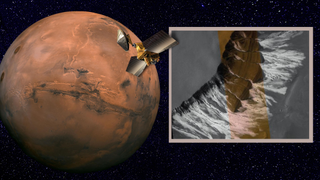
Main image: Illustration of NASA's Mars Reconnaissance Orbiter investigating Mars. Inset: a satellite image of Martian gullies with carbon dioxide ice visible at their edges.
(Image credit: Robert Lea/ NASA/ HiRISE (High Resolution Imaging Experiment), a camera on board the Mars Reconnaissance Orbiter (photo no.: ESP_039114_1115))
Mars may be dry and barren today, but multiple lines of evidence show that water flowed across the Red Planet billions of years ago.
Now, new research has suggested that this water may have existed at the surface of Mars for less time than previously thought. That's because gullies observed on Mars by spacecraft like NASA's Mars Reconnaissance Orbiter (MRO), which had previously been thought to have been carved out by the flow of water, could have instead been created by explosively evaporating carbon dioxide ice.
Because liquid water is considered a vital ingredient needed for the emergence and sustenance of living organisms, the results may be bad news for the hunt for ancient microscopic life on Mars.
"This influences our ideas about water on Mars in general, and therefore our search for life on the planet," team leader and Utrecht University planetary researcher Lonneke Roelofs said in a statement. "The results of my research suggest that the chance of life having existed on Mars is smaller than previously thought."
Less time with water means lower odds of life on Mars
Roelofs explained that the atmosphere of Mars is composed of 95% carbon dioxide. During the winter on Mars, temperatures fall to below minus 184 degrees Fahrenheit (minus 120 degrees Celsius), cold enough to freeze carbon dioxide in the Martian atmosphere.
As it freezes, carbon dioxide gas can change directly to carbon dioxide ice, skipping an intermediate liquid phase altogether. A similar process is seen on Earth when water vapor forms ice crystals that blanket the ground.
When warmer temperatures arrive with the Martian spring, the carbon dioxide ice can go back to a gaseous form, straight from solid to gas again, skipping a liquid phase, a process called "sublimation" that is particularly violent on the Red Planet.
"The process is extremely explosive due to Mars’ low air pressure," Roelofs said. "The created gas pressure pushes sediment grains apart, causing the material to flow, similar to debris flowing in mountainous areas on Earth. These flows can reshape the Martian landscape — even in the absence of water."
Mars gullies with carbon-dioxide ice on their edges, as seen by the HiRISE camera on board NASA's Mars Reconnaissance Orbiter. (Image credit: HiRISE (High Resolution Imaging Experiment), a camera on board the Mars Reconnaissance Orbiter (photo no.: ESP_039114_1115))
Scientists had previously suggested that geological structures on Mars could have been heavily influenced by the sublimation of carbon dioxide ice, but those theories were based on satellite data or computer modeling.
Roelofs and colleagues, however, simulated Mars conditions in the lab using their "Mars Chamber" and then directly observed the sublimation of carbon dioxide ice under these conditions.
"Using this specialized lab equipment, we could directly study this process with our own eyes," he said. "We even observed that debris flows driven by carbon dioxide ice under Martian conditions flow just as efficiently as the debris flows driven by water on Earth."
So flowing water may not have been involved in the creation of some Martian gullies and channels.
"My research now shows that, in addition to debris flows powered by water, the sublimation of frozen carbon dioxide can also serve as a driving force behind the formation of these Martian gully landscapes," Roelofs said. "That pushes the presence of water on Mars further into the past, making the chance of life on Mars smaller."
The tricarbon molecule (C3) is likely produced in the upper atmosphere of Titan by the reaction of abundant acetylene with atomic carbon.
This view of Titan is among the last images NASA’s Cassini spacecraft sent to Earth before it plunged into the giant planet’s atmosphere.
Image credit: NASA / JPL-Caltech / Space Science Institute.
Among our Solar System’s more than 150 known moons, Saturn’s largest moon Titan is the only one with a substantial atmosphere.
And of all the places in the Solar System, Titan is the only place besides Earth known to have liquids in the form of rivers, lakes and seas on its surface.
Titan is larger than the planet Mercury and is the second largest moon in our Solar System. Jupiter’s moon Ganymede is just a little bit larger (by about 2%).
Titan’s atmosphere is made mostly of nitrogen, like Earth’s, but with a surface pressure 50% higher than Earth’s.
Titan has clouds, rain, rivers, lakes and seas of liquid hydrocarbons like methane and ethane.
“Home to a thick and chemically diverse atmosphere, Titan stands out among the giant planet’s icy satellites, as one of the most thoroughly studied objects in the Solar System,” said Dr. Rafael Silva, an astronomer with Observatório Astronómico de Lisboa and the University of Lisbon.
“Titan’s atmosphere works like a planetary-sized chemical reactor, producing many complex carbon-based molecules.”
“Of all the atmospheres we know in the Solar System, it is the most similar to the one we think existed on the early Earth.”
“Methane, which on Earth is a gas, provides information about geological processes and potentially about biological processes.”
“It is a molecule that does not survive long in the atmospheres of Earth or Titan because it is quickly and irreversibly destroyed by solar radiation.”
“For this reason, on Titan, methane must be being replenished by geological processes, such as the release of underground gas.”
They were able to identify 97 absorption lines for methane as well as one for the tricarbon molecule.
“Even in high-resolution spectra, methane absorption lines are not strong enough with the amount of gas we can have in a lab on Earth,” Dr. Silva said.
“But on Titan we have an entire atmosphere, and the path that light travels through the atmosphere can be hundreds of km long.”
“This makes the different bands and lines, which have a weak signal in laboratories on Earth, very evident on Titan.”
“In the Solar System, the tricarbon molecule, which manifests itself as a bluish emission, was until now only known in the material surrounding the nucleus of a comet.”
“The absorption lines on Titan that we associated with tricarbon are few and of low intensity, despite being very specific to this type of molecules, so new observations will be carried out in the future to try to confirm this detection.”
“The more we know about the different molecules that participate in the chemical complexity of Titan’s atmosphere, the better we will understand the type of chemical evolution that may have allowed, or be related to, the origin of life on Earth.”
“Some of the organic matter that contributed to the origin of life on Earth is thought to have been produced in its atmosphere by processes relatively similar to those we observed on Titan.”
A paper on the findings was published in the journal Planetary and Space Science.
Rafael Rianço-Silva et al. 2024. A study of very high resolution visible spectra of Titan: Line characterisation in visible CH4 bands and the search for C3. Planetary and Space Science 240: 105836; doi: 10.1016/j.pss.2023.105836
NASA is Working on Zero-Boil Off Tanks for Space Exploration
No matter what mode of transportation you take for a long trip, at some point, you’ll have to refuel. For cars, this could be a simple trip to a gas station, while planes, trains, and ships have more specialized refueling services at their depots or ports. However, for spacecraft, there is currently no refueling infrastructure whatsoever. And since the fuel spacecraft use must be stored cryogenically, and the tanks the fuel is stored in are constantly subjected to the thermal radiation from the Sun, keeping enough fuel in a tank for a trip to Mars with astronauts is currently infeasible. Luckily, NASA is currently working on it and recently released a detailed look at some of that work on a blog on their website.
The problem definition is very clear – cryogenic hydrogen and oxygen are used as fuel on most spacecraft missions. Once in space, the tanks the fuel is stored in heat up due to the constant solar radiation they’re subjected to. Since there’s no air, there’s no way to radiate out that heat, so eventually, it can get through even the most sophisticated passive thermal insulation system. When it does, the fuel starts to boil, and mission planners typically have chosen to eject the vaporous fuel out into space rather than leaving it as a potential medium to heat the rest of the fuel faster.
This resultant fuel lost to this sublimation can cost as much as half of the cryogenic fuel needed for a 3-year mission to Mars – in just a single year. In short, crewed trips to Mars are impossible using the current fuel storage technology in space. However, there are alternatives, known as Zero Boil-Off (ZBO) or Reduced Boil-Off (RBO) systems. These advanced tanks use a combination of “active” processes to maintain tank pressure and not allow too much loss of fuel during long space flights.
Fraser makes an argument for why refueling is so critical.
An “active” process must be actively controlled and typically requires some sort of power input. In particular, ZBO systems rely on two technology ideas – a jet mixing of the propellant and a droplet injection technology. Let’s take a look at the mixing technology first.
In this example, part of the fuel would be forcibly mixed back into the vapor space in a particular way that would allow it to control the phase changes of the vapor/fuel interface. In essence, it would stop the fuel from sublimating into a vapor in the first place. Similarly, a droplet injection system would use a novel type of spray bar to inject fuel droplets into the vapor area, causing it to condense and remove some of the pressure from the system.
To add another layer of complexity to these already complicated fluid dynamics systems, this all must be done in microgravity, where things like droplet formation and liquid mixing don’t always happen the same way as they do on Earth. So, NASA decided to do what it does best and run some experiments – in this case on the ISS.
Image of the ZBOT-1 experiment being installed on the ISS by astronaut Joseph Acaba. Credit – NASA
Back in 2017, NASA started the ZBOT-1 Experiment on the ISS. It was intended to quantify how the jet mixing would behave in microgravity, and the result of some 30+ tests was that we still understand very little about how these systems work in microgravity. While how they were is different than what most fluid engineers are used to, they are still acting according to physical laws, so more experiments would help narrow down the models that tank designers can use to understand how these ZBO systems might best be used.
Two other experiments are focused on furthering that understanding – one called the ZBOT-NC Experiment, is due to be launched to the ISS in 2025. It will study the effects of microgravity on “non-condensable gases,” which can be used to control the pressure inside the fuel tank. Data from its observations can also be fed into the CFD models, allowing scientists to understand better how the model differs from reality in microgravity.
The final test in the series will focus on droplet phase changes. Known as the ZBOT-DP test, this is the most ambitious of the three, as it tests a technology that has never been used in microgravity at all before. It will focus on understanding how droplets interact with their surroundings, including superheated tank walls, in microgravity environments. They could eventually lead to a fully functional droplet system and an active control system to ensure no tank boil-off happens.
The idea of in-space refueling has been around for a long time, as this VideoFromSpace feature shows.Credit – VideosFromSpace YouTube Channel / NASA Technology
That’s still a long way off those, with no planned date for the ZBOT-DP test. Given the importance of this technology to missions like the crewed Artemis mission planned in the next few years, it seems that the successful completion of these experiments and the design and testing of a fully ZBO fuel tank should be very high on NASA’s priority list. While the agency’s already supporting it, let’s hope that the researchers involved can prove their ideas before they’re needed for a real human mission.
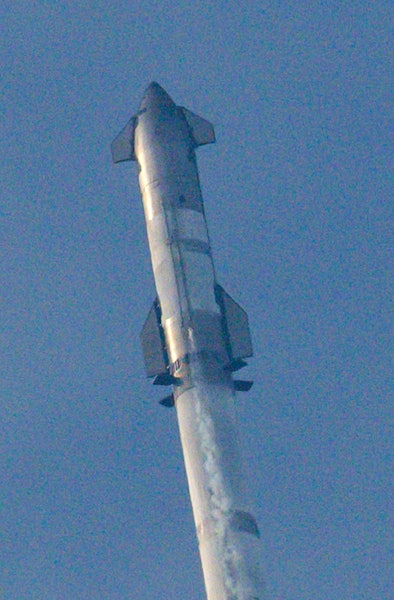
SpaceX’s Starship rocket, the most powerful ever built, successfully reached space for the second timeon Thursday. After the mighty first-stage booster Super Heavy delivered Starship into Earth orbit, the rocket achieved many firsts. But it also fell short.
The 397-foot-tall orbiter ended its test flight after flying longer and faster than ever before. It perished after entering Earth’s atmosphere during reentry and crashing into the Indian Ocean.
Unlike the last flight test in November, Starship survived long after separating from Super Heavy. Starship then entered Earth orbit for the first time, having crossed the designated border into space known as the Kármán line. It climbed to an altitude of at least 234 kilometers high and sustained speeds of more than 26,000 kilometers per hour. Following several tests and test omissions, Starship sent its last telemetry about 49 minutes after launch.
SpaceX is inching towards its own-established finish line. The Thursday flight was the third attempt for Elon Musk’s company to get the rocket into the sky from their Starbase launch facility at Boca Chica, Texas, by the Gulf of Mexico, and for Starship to take a 90-minute flight. But to be ready to carry hefty cargo and passengers on trips to deep space, Starship needs more work.
WHAT HAPPENS NEXT?
SpaceX will assess the results of Thursday’s flight.
According to SpaceX’s presentation during Thursday’s test, Super Heavy did well, and SpaceX views this launch as a success. It ignited its 33 Raptor engines upon takeoff, and minutes later it successfully performed critical maneuvers. But it didn't quite complete its final maneuvers before it splashed down in the Gulf of Mexico.
Super Heavy is designed to be reusable, so subsequent testing will attempt to get the booster to land back on Earth like the much smaller SpaceX Falcon 9 boosters regularly do now.
Starship aced payload and payload door test during Thursday’s flight. SpaceX officials said they will need to review the data to confirm how well it performed. Starship is designed to carry 100 to 150 tons of cargo into space, a massive increase compared to its current International Space Station ferry, Dragon, which can deliver 13,000 pounds into space.
Starship also has to test out its ability to reignite its engines from microgravity in space, after the first burn and after entering a coast phase. It’s called the on-orbit re-light demo. On Thursday, Starship’s software skipped the test. One possible explanation is that Starship’s orientation in space wasn’t ideal for sudden changes in velocity.
Starship will need to do that test in the future. The reignition of Starship’s six engines is critical for future in-space maneuvers, like achieving a good deorbit burn to get the craft to land on Earth someday, or to get it going on a journey into deep space.
Thursday was also important because it was the first reentry test for Starship.
Its hypersonic reentry was more than five times the speed of sound, according to SpaceX. Much like launch, reentry packs a lot of dramatic phenomena in just a few minutes, which the team is still learning about. They’ll evaluate data about Starship’s motion control and the heat shield, which work in tandem to keep the heat shield facing downward to protect the spacecraft.
The team may create new models of the plasma field, too. The presenters in SpaceX’s Thursday broadcast said the massive size of Starship would hopefully prevent the plasma of reentry from enveloping the craft, but moments later, that’s just what happened.
BEYOND THE SPACECRAFT
Next, the Federal Aviation Administration (FAA) will get involved. SpaceX will need their permission to fly again. And then along the way, some other things might be happening.
The Starship rocket launching on March 14, 2024 from Boca Chica, Texas.
HOUSTON CHRONICLE/HEARST NEWSPAPERS VIA GETTY IMAGES/HEARST NEWSPAPERS/GETTY IMAGES
SpaceX makes changes to each of their subsequent flights. They’re to address issues that happened previously, but the solutions might have their own consequences.
For instance, the first Starship flight in April 2023 resulted in the destruction of the launchpad’s foundation. Debris went flying because the power of Super Heavy’s 33 Raptor engines, and 16.7 million pounds of thrust, overwhelmed the structure. To address this issue, SpaceX’s second flight introduced a steel plate metal sheet that would create a barrier between the engines and the foundation. It works in tandem with a water deluge system to cool the surface down. Thursday’s flight would have been only the second time this system is evaluated and may have provided the team with new insights about how successful their metal plate is at protecting the launchpad.
The water component of this cooling system is also something to assess. According to an FAA report published after the first test, SpaceX personnel must test the water in the collection tanks after the launches to measure for any toxins or heavy metals present, which could have been released through a process called ablation as the high heat of the Raptor engines smashed into the metal plate, and mixing with the vapor or the liquid water.
These are some of the environmental assessments that SpaceX is required to perform more broadly to determine what negative effects the acute, powerful launches have on the surrounding coastal region, and how to address or restore them.
Starship’s future is yet to be seen, but testing has so far been beyond anything we’ve ever seen before.
NASA and Boeing Release New Rendering of their X-66 Sustainable Experimental Airliner
Climate change is arguably the single greatest threat facing the world today. According to the (AR6) by the UN Intergovernmental Panel on Climate Change (IPCC), average global temperatures are set to increase between 1.5 and 2 °C (2.7 to 3.6 °F) by mid-century. To restrict global temperatures to an increase of 1.5 C and avoid the worst-case scenarios, the nations of the world need to achieve net zero emissions by then. Otherwise, things will get a lot worse before they get better, assuming they ever do.
This means transitioning to cleaner methods in terms of energy, transportation, and aviation. To meet our climate commitments, the aviation industry is developing technology to significantly reduce air travel’s carbon footprint. To help meet this goal, NASA and Boeing have come together to create the X-66 Sustainable Experimental Airliner, the first experimental plane specifically focused on helping the U.S. achieve net-zero aviation. Last week, NASA released a new rendering of the concept, giving the public an updated look at the future of air travel.
This configuration is identical to the one unveiled by NASA and Boeing at the Experimental Aviation Association‘s (EAA) AirVenture Oshkosh airshow last year. As you can see from the renderings (above and below), the design features the Transonic Truss-Braced Wing concept. Developed by Boeing, this design features extra-long, thin wings stabilized by diagonal struts. This configuration is based on “Subsonic Ultra-Green Aircraft Reach (SUGAR)” research, a series of studies that began in 2011 to evaluate the benefits of truss-bracing and hybrid electric technologies.
The X-66A is the X-plane specifically aimed at helping the United States achieve the goal of net-zero greenhouse gas emissions by 2050. Credits: NASA
Combined with an advanced propulsion system, a sophisticated systems architecture, and advanced materials, this configuration could reduce fuel consumption and the resulting emissions by up to 30% (compared to top-of-the-line commercial aircraft). Development of the X-66 began in early 2019 through the Sustainable Flight Demonstrator (SFD) project, which is an integral part of NASA’s Sustainable Flight National Partnership (SFNP) – where NASA Aeronautics partners with industry, academia, and other agencies to accomplish the goal of net-zero aviation by 2050.
To build the X-66A, Boeing has been working with NASA to modify a McDonnell Douglas MD-90 single-aisle passenger aircraft. Modifications include a shortened fuselage and the replacement of its wings with the longer, thinner truss-braced variant. The engines have also been relocated from the tail section to under the wings and replaced with gas-electric models. Boeing transported the MD-90 aircraft to its facility in Palmdale, California, in August of 2023 and has since removed its engines and completed the 3-meter (10-foot) model wing they will use for aerodynamic testing.
The project’s ultimate goal is to inform a new generation of more sustainable, single-aisle aircraft, which account for the largest share of air travel worldwide. The program is also part of the U.S. Aviation Climate Action Plan, which seeks to not only meet the nation’s ambitious climate goals but also to improve the quality of life for those living near airports and under flight paths through reductions in noise and pollutants. As NASA Administrator Bill Nelson remarked in a press statement last year:
“At NASA, our eyes are not just focused on stars but also fixated on the sky. The Sustainable Flight Demonstrator builds on NASA’s world-leading efforts in aeronautics as well [as] climate. The X-66A will help shape the future of aviation, a new era where aircraft are greener, cleaner, and quieter, and create new possibilities for the flying public and American industry alike.”
A 790,000 Year-Old Asteroid Impact Could Explain Seafloor Spherules
Our solar system does not exist in isolation. It formed within a stellar nursery along with hundreds of sibling stars, and even today has the occasional interaction with interstellar objects such as Oumuamua and Borisov. So it’s reasonable to presume that some interstellar material has reached Earth. Recently Avi Loeb and his team earned quite a bit of attention with a study arguing that it had found some of this interstellar stuff on the ocean seabed. But a new study finds that the material has a much more local origin.
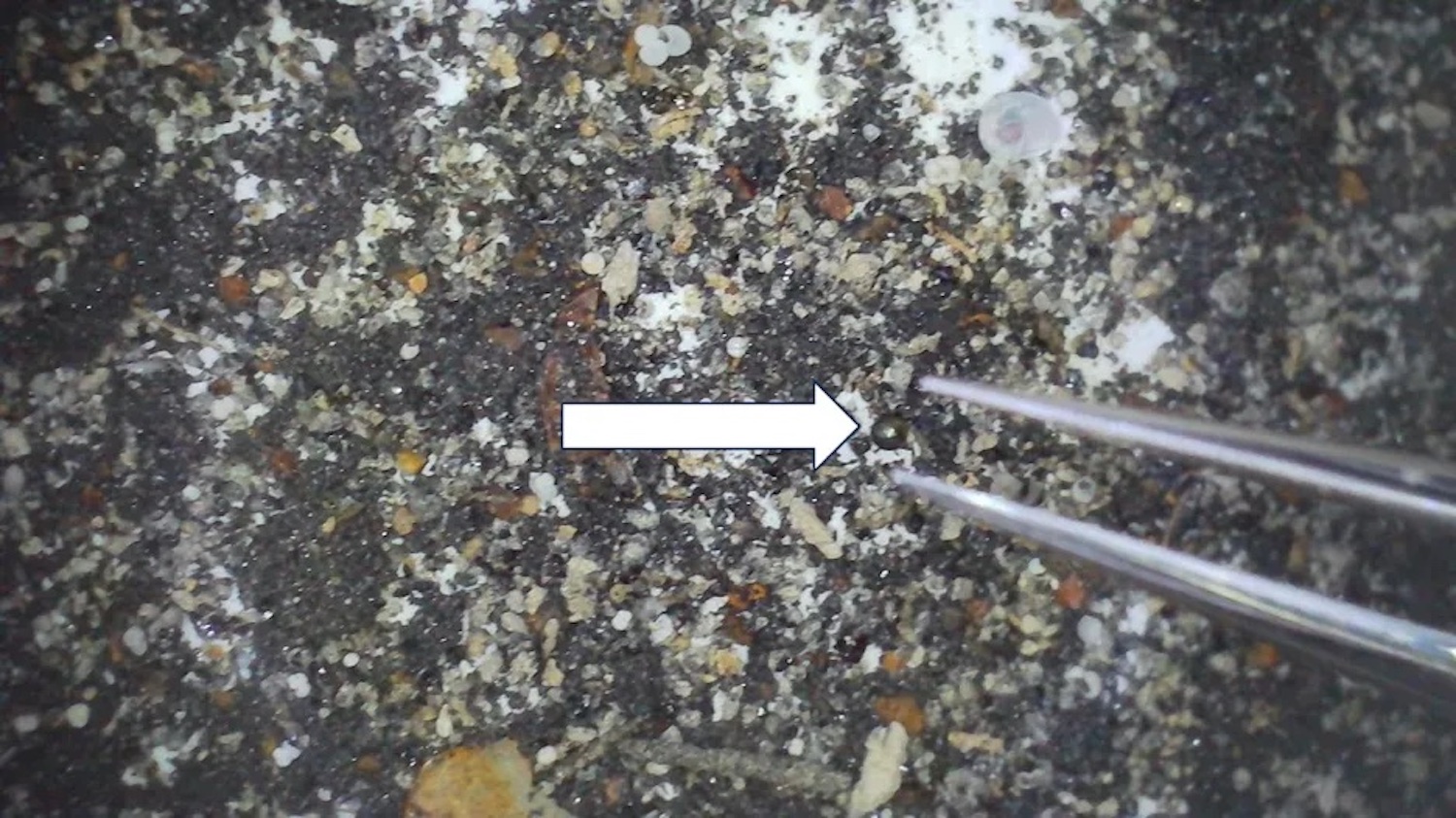
The original study is based on a 2014 meteor that entered the Earth’s atmosphere off the coast of Papua New Guinea. Observations of its impact trajectory suggested it might have been extraterrestrial in origin. And since we had an idea of where it hit, why not look for its debris? This led Loeb’s team to the seafloor near Papua New Guinea, where they found small, iron-rich spheres known as spherules. The study analyzed the composition of these spherules and found the isotope distribution was so unusual they must have an interstellar origin.
The iron isotopes of these spherules show a local origin. Credit: Desch, et al
While that sounds compelling, there are a few caveats. The first is that the trajectory of the 2014 meteor isn’t that precisely known. We know the general impact region, but the data simply isn’t good enough to prove that these spherules came from this particular meteor. The second is that “unusual” isotopes aren’t uncommon within our solar system. As the new study shows, there is a distribution of iron isotope ratios for objects originating in the solar system, specifically the ratios of 57Fe and 56Fe. The ratio for the “alien” spherules is well within that range. So well that the odds of them being interstellar is less than 1 in 10,000. So these spherules have a local origin.
But they were likely formed from an impact event, so this new study went further. Is there a known impact from which these spherules originated? Turns out there is. The region in which they were found is part of what’s known as the Australasian tektite strewn field. It is a vast field that spans southeast Asia to Antarctica and was caused by a large impact 790,000 years ago. The team looked at other isotope ratios and found they are consistent with other known Australasian tektites.
So these particular spherules have a local origin. But that doesn’t mean interstellar meteorites don’t exist. Given what we know, there are almost certainly interstellar objects on Earth just waiting to be found. We just have to keep looking for them.
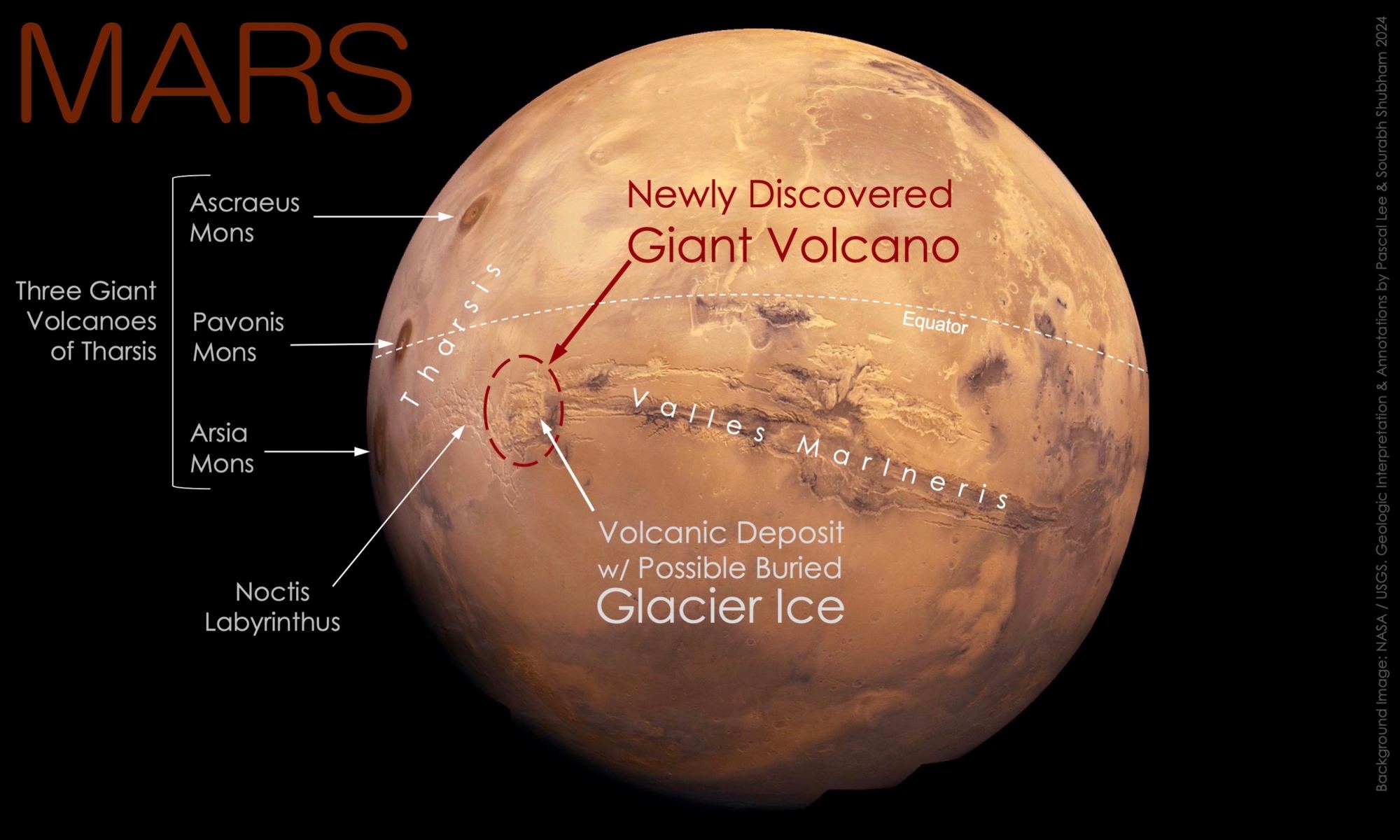
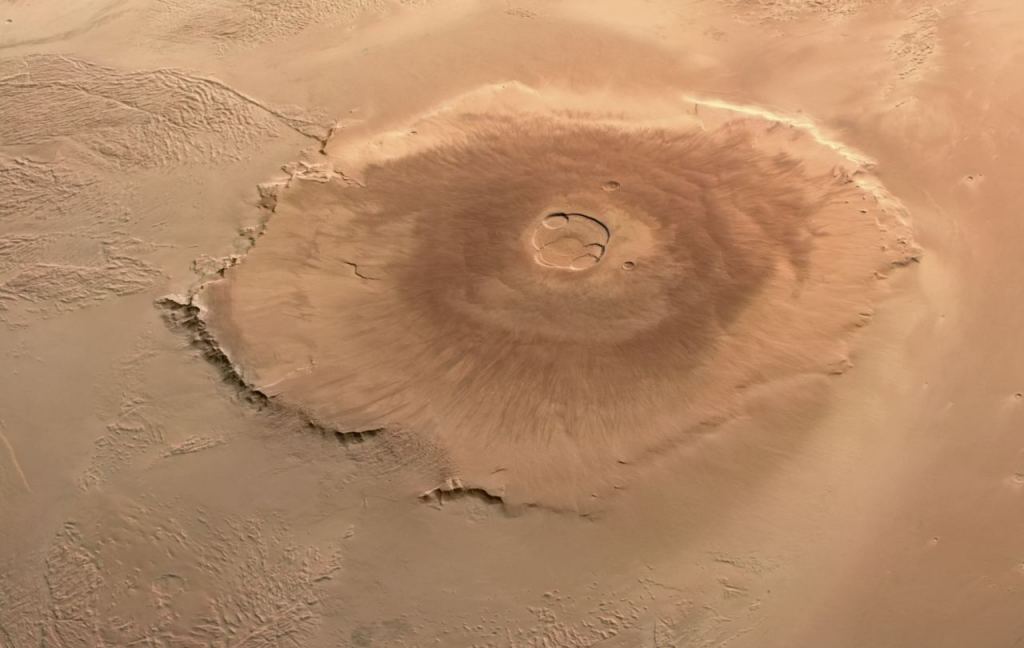
Olympus Mons is well known for being the largest volcano in the Solar System. It’s joined on Mars by three other shield volcanoes; Ascraeus, Pavonis and Arsia but a recent discovery has revealed a fifth. Provisionally called Noctis volcano, this previously unknown Martian feature reaches 9,022 metres high and 450 kilometres across. Its presence has eluded planetary scientists because it has been heavily eroded and is on the boundary of the fractured maze-like terrain of Noctis Labyrinthus.
Mars seems to like shield volcanoes. They are a type of volcano that have a broad gently sloping profile and are generally composed of basaltic lava flows. The flows spread out over large distances during eruptions before eventually solidifying and creating long gently sloping faces. They tend to be the result of divergent plate boundaries where tectonic plates gently drift apart. It’s not just Mars that hosts them, here on Earth Mauna Loa and Mauna Kea in Hawaii are great examples of shield volcanoes.
Olympus Mons, captured by the ESA’s Mars Express mission from orbit. Credit: ESA/DLR/FUBerlin/AndreaLuck
Noctis volcano was found on the edges of Noctis Labyrinthus, a region whose name means Labyrinth of the Night. It’s a fascinating surface feature with a complex valley, canyon and ridge system within Valles Marineris. It’s a distinctive feature on the Martian surface with disorderly, intersecting valleys and plateaus. Thought to be the result of erosion and tectonic activity the region has masked the new volcano, until now.
Noctis Labyrinthus on Mars as seen by Viking 1 orbiter. Courtesy NASA.
A team of scientists, led by SETI Institute planetary scientist Dr Pascal Lee said “We were examining the geology of an area where we had found the remains of a glacier last year when we realised we were inside a huge and deeply eroded volcano.” There were a number of signs that revealed the volcanic activity in the region and led to the volcano’s discovery. Located on the eastern edge of Noctis Labyrinthus there were a number of meseas – or flat topped mountains – arranged in an arc that seemed to reach a peak before descending away from an apparent summit area. A gentle slope softly slips away over distances of over 200km and close study seems to reveal the remains of a caldera. The study revealed what looked like a collapsed crater that once contained a lava lake and there was significant evidence of lava flows in the area including pyroclastic deposits.
The study of Mars over the years since the invention of the telescope and more recently the advent of space flight has revealed a complex geological history. The features across the planet seem to reveal significant modification too perhaps from thermal erosion, glacial erosion and fracturing of the crust.
The team conclude that the volcano is a shield volcano that has been built up of layers of accumulations of pyroclastic material, lava and ice. The ice it seems, just like volcanic lava, has built up over repeated years of snow and ice build up on the flanks of the volcano. With the fractures, likely driven by plate uplifts in the general Tharsis region, lava was able to seep through different regions of the volcano. Where the ice has been buried and subsequently melted, catastrophic collapses have occurred compounding the challenge of identifying it.
Mars Drives Deep-Ocean Circulation in Earth’s Oceans, Study Suggests
Mars Drives Deep-Ocean Circulation in Earth’s Oceans, Study Suggests
Geoscientists from Australia and France have used the geological record of Earth’s deep oceans to discover a connection between the orbits of our home planet and Mars. They’ve discovered a surprising 2.4-million-year cycle where deep currents wax and wane which, in turn, is linked to periods of increased solar energy and a warmer climate.
This image from Mars Express’ High Resolution Stereo Camera shows the globe of Mars set against a dark background. The disk of the planet features yellow, orange, blue and green patches, all with an overall muted grey hue, representing the varying composition of the surface.
Image credit: ESA / DLR / FU Berlin / G. Michael / CC BY-SA 3.0 IGO.
“In 1976, scientists demonstrated for the first time the presence of 10,000 – 100,000-year astronomical cycles in Pleistocene deep-sea sediments, confirming Milutin Milankovitch’s theory that Earth’s climate is modulated by periodicities in perturbations of Earth’s orbit around the Sun and Earth’s spin axis,” said University of Sydney researcher Adriana Dutkiewicz and her colleagues.
“Apart from the well-known astronomical cycles with periods of 19,000, 23,000, 41,000, 100,000, and 400,000 years that pace Earth’s climate, the geological record also contains signals of much longer-period grand cycles, which are predicted by astronomical theory.”
“These grand cycles include orbitally-forced periodicities of millions and even tens of millions of years that are similarly linked to changes in incoming solar energy and paleoclimate.”
In their new research, the authors used the deep-sea sediment record to check for links between sedimentary shifts and changes in the Earth’s orbit.
They found that the vigor of deep-sea currents shifts in 2.4-million-year cycles.
“We were surprised to find these 2.4-million-year cycles in our deep-sea sedimentary data,” Dr. Dutkiewicz said.
“There is only one way to explain them: they are linked to cycles in the interactions of Mars and Earth orbiting the Sun.”
“The gravity fields of the planets in the solar system interfere with each other and this interaction, called a resonance, changes planetary eccentricity, a measure of how close to circular their orbits are.”
“For the Earth it means periods of higher incoming solar radiation and warmer climate in cycles of 2.4 million years.”
The researchers found that the warmer cycles correlate with an increased occurrence of breaks in the deep-sea record, related to more vigorous deep ocean circulation.
They identified that deep eddies were an important component of earlier warming seas.
It is possible these could partly mitigate ocean stagnation some have predicted could follow a faltering AMOC (Atlantic meridional overturning circulation) that drives the Gulf Stream and maintains temperate climates in Europe.
“We know there are at least two separate mechanisms that contribute to the vigor of deep-water mixing in the oceans,” Professor Müller said.
“AMOC is one of them, but deep ocean eddies seem to play an important role in warm climates for keeping the ocean ventilated.”
“Of course, this would not have the same effect as AMOC in terms of transporting water masses from low to high latitudes and vice-versa.”
“These eddies are like giant whirlpools and often reach the abyssal seafloor, resulting in seafloor erosion and large sediment accumulations called contourites, akin to snowdrifts.”
“Our deep-sea data spanning 65 million years suggest that warmer oceans have more vigorous deep circulation,” Dr. Dutkiewicz said.
“This will potentially keep the ocean from becoming stagnant even if AMOC slows or stops altogether.”
The study was published in the journal Nature Communications.
A. Dutkiewicz et al. 2024. Deep-sea hiatus record reveals orbital pacing by 2.4 Myr eccentricity grand cycles. Nat Commun 15, 1998; doi: 10.1038/s41467-024-46171-5
Voyager 1 might be getting better after its recent bout of aphasia.
Since November, NASA’s Voyager 1 spacecraft has been speaking in electronic gibberish. NASA still hasn’t pinpointed the cause of the problem, but a likely culprit is a cosmic ray that corrupted a single bit of data in part of the spacecraft’s Flight Data System; specifically, the part that converts information about the spacecraft's status and data into binary code to send back to Earth. Instead of coherent lines of code, Voyager has been sending home random strings of 0s and 1s that don’t mean anything.
But over the last couple of weeks, Voyager 1’s issues seem to be improving. It’s putting its 0s and 1s together in patterns, not just random sequences. However, these patterns are more like baby babble than language.
“They're not exactly what we would expect, but they do look like something that can show us that the FDS is at least partially working.” Voyager program manager Suzanne Dodd tells Pasadena Star-News.
An artistic rendering of the interplanetary space probe Voyager II as it flies by Jupiter.
HISTORICAL/CORBIS HISTORICAL/GETTY IMAGES
Dodd recently told the press that it would take a miracle for Voyager 1 to pull through, but the hardy little spacecraft and its twin sister Voyager 2 have survived a lot over the 46 years of their joint mission. And their engineering teams have found creative ways to keep the aging sister spaceships flying — and most importantly, to keep them sending new data home. Inverse talked with a Voyager engineer about what the team has learned from those years of jury-rigging solutions and how it might help other missions.
“In the last decade, I have learned from Voyager that there is (almost) always a way around a problem, no matter how dire it is,” Voyager mission assurance manager Bruce Waggoner tells Inverse. “You just have to think ‘outside the box’ when people tell you not to do so.”
Voyager 1 and Voyager 2 are on different trajectories out of the Solar System.
The team of engineers running the twin Voyager spacecraft have had to get increasingly creative over the last 46 years, as aging parts and systems have started to develop glitches and the power supply has begun to dwindle. Most of the people who designed the Voyagers and worked on the spacecraft in the early years of their mission have long since retired (and several have died), and they would probably be surprised by the ways today’s Voyager team has kept the pair of space probes running.
“Recently, the team found a way to keep the instruments powered for an additional 2 to 4 years by operating the spacecraft with an unregulated voltage,” says Waggoner. “This is a first as far as I know: operating the power system in a completely different way than the designers intended.”
The Voyagers’ designers built a safety mechanism to protect the instruments from sudden changes in the flow of electricity. If that happens, a regulator allows the spacecraft to access a small reserve of power, which is supposed to help it ride out the voltage fluctuation. But recently, Voyager engineers decided that after 45 years of the electrical systems working smoothly, Voyager 2 needed the extra power more than it needed the safety feature — because the alternative was shutting off one of Voyager 2’s instruments. (Voyager 1 is already down an instrument due to a hardware failure earlier in the mission, but its payloads will eventually face the chopping block, too.)
That kind of off-script improvisation has been the Voyager team’s standard operating procedure for decades.
“I would say that 100 percent of it has been figured out along the way,” Dodd told Inverse last year. “Absolutely nothing was known about flying for 45 years at 175 AU from us here on Earth, and we're into our 46th year now.”
And it’s been mostly trial and error. When something goes wrong with one of the Mars rovers, for instance, engineers can try out their solutions on a testbed: a replica of the spacecraft here on Earth kept on hand for exactly that purpose. But there is no Voyager testbed.
The goal is for each spacecraft to reach 19 billion miles away from the Sun with at least one instrument still running and communicating with Earth. Waggoner says the team has a 120-page book of ideas on how to keep the aging Voyagers working. Along the way, they’ve learned some tricks that may help extend the lives of future space missions.
An artist's impression of the Voyager 1 space probe flying past Saturn in the outer solar system, circa 1980.
SPACE FRONTIERS/ARCHIVE PHOTOS/GETTY IMAGES
KEEP THE SPACECRAFT SIMPLE
“Hopefully, people will look back at the lessons of Voyager and apply them,” says Waggoner. I work on many missions, and I use ideas from Voyager all the time, especially to think outside the box.”
Another key lesson is that it’s easier for a space mission’s engineering team to be flexible if the spacecraft itself is simple, study, and has backups for most of its hardware. The Flight Data System that’s currently on the fritz, for example, is Voyager 1’s backup; it's original one failed in 1981, and without redundancy, scientists would have missed 33 years of exploring the outer fringes of our Solar System.
Compared with more recent spacecraft, the Voyagers’ hardware is pretty bare-bones, its software is programmed in languages most modern engineers don’t even learn, and it sports about 64 kilobytes of memory (about 240,000 times less than the smartphone you’re probably reading this article on). But as strange as it sounds, that antique simplicity is actually one of Voyager’s biggest assets because it makes troubleshooting easier.
“I like the simpler code on Voyager because people can understand what the system will do, in most cases without simulation,” says Waggoner. That especially helps when trying to fix a pair of spacecraft with no testbeds here on Earth “just by thinking through the problems,” as Waggoner puts it.
Dodd, speaking to Inverse last year, compares operating the Voyagers to repairing an older-model car, compared with a more modern version with more complex systems and electronics.
“The simplicity of Voyager helps if you want to change things over time as the spacecraft gets older and the mission lasts longer,” says Dodd. “It's kind of like having an old car, and you can look under the hood and know what the key pieces are. When you have a new car, it's all driven by software and it's really hard to just go in there and tweak the carburetor and have it still run.”
Waggoner has a story about that, too. The Voyagers’ thrusters, which keep the distant spacecraft’s antennas pointed toward Earth, are slowly clogging with silicon dioxide. Last summer, it looked like the clogged thrusters could doom the missions within the next couple of years.
“Again, the team found workarounds by changing the way the thrusters are fired and pointing is managed,” says [source]. “Once the worst [clogged] thrusters fail, there may even be a way to allow the spacecraft to roll and return data.”
Of course, for Voyager 1, that depends on whether the spacecraft ever learns to speak again.
The Pentagon Introduces a New Surveillance System for UFO Investigations
The Pentagon Introduces a New Surveillance System for UFO Investigations
In a groundbreaking development, the Pentagon has announced the deployment of a sophisticated surveillance system specifically designed to monitor and investigate reports of Unidentified Flying Objects (UFOs). This new initiative, known as the “gremlin system,” marks a significant step forward in the way the military approaches the phenomenon of unidentified objects.
Overview of the Gremlin System
The gremlin system is described as a deployable surveillance tool equipped with a suite of configurable sensors. These sensors can be quickly dispatched in response to UFO sightings, capturing detailed information about the encountered objects. Whether the sightings occur in the air, outer space, or underwater, the gremlin system’s versatility allows it to gather critical data from virtually any environment.
The technology behind the gremlin system is encapsulated in Pelican cases, making it not only highly portable but also ready for rapid deployment. This ensures that whenever reports of unidentified objects emerge, the system can be swiftly sent to the location to begin the investigative process.
Pentagon’s Commitment to Transparency
Despite past controversies surrounding the Pentagon’s handling of UFO information, this new development indicates a shift towards greater openness and diligence in investigating such reports. The introduction of the gremlin system is part of a broader effort to address the public’s curiosity and concerns about unidentified aerial phenomena with a more structured and scientific approach.
The system’s deployment underscores the Pentagon’s acknowledgment of the importance of thoroughly investigating reports of unidentified objects. By leveraging advanced technology, the military aims to demystify sightings and provide clear explanations for what are often perceived as mysterious occurrences.
Skepticism and Ongoing Debate
While the Pentagon’s report and the unveiling of the gremlin system suggest there is no concrete evidence of extraterrestrial life, the topic remains a hotbed of speculation and debate. Journalists and researchers who have dedicated their careers to studying UFO phenomena are skeptical of official denials of secret programs or encounters with alien life.
This skepticism is fueled by insider accounts and whistleblowers who challenge the official narrative, suggesting that there might be more to the story than what is publicly acknowledged. The debate continues, with many urging for more in-depth investigations and transparency from the government.
The Future of UFO Investigations
With the gremlin system now in play, the Pentagon has reaffirmed its commitment to investigating every report of unidentified flying objects. This commitment is critical, as the military receives over a hundred cases every month from various sources, including military branches and civilians.
VIDEO:
Pentagon has new surveillance system for UFO reports | NewsNation Now
The ongoing investigations, bolstered by the new technology, aim to shed light on the nature of these sightings, ensuring that the public receives accurate and comprehensive information. As the debate around UFOs persists, the gremlin system represents a crucial tool in the quest for clarity and understanding of these mysterious occurrences.
In conclusion, the Pentagon’s introduction of the gremlin system for UFO reports is a significant milestone in the ongoing investigation of unidentified aerial phenomena. By employing advanced surveillance technology, the military seeks to approach the subject with renewed rigor and transparency, hoping to demystify the sightings that have captivated public interest for decades.
NASA Scientists Unveil Design for Europa Clipper’s ‘Golden Record’
NASA Scientists Unveil Design for Europa Clipper’s ‘Golden Record’
NASA’s Europa Clipper spacecraftwill carry a triangular metal plate with a special message when it launches in October 2024 and heads toward Jupiter’s moon Europa.
This side of a commemorative plate mounted on NASA’s Europa Clipper spacecraft features U.S. Poet Laureate Ada Limón’s handwritten In Praise of Mystery: A Poem for Europa.
Image credit: NASA / JPL-Caltech.
Made of the metal tantalum and about 18 by 28 cm (7 by 11 inches), Europa Clipper’s metal plate features graphic elements on both sides.
At its heart is an engraving of U.S. Poet Laureate Ada Limón’s handwritten In Praise of Mystery: A Poem for Europa, along with a silicon microchip stenciled with more than 2.6 million names submitted by the public.
The microchip will be the centerpiece of an illustration of a bottle amid the Jovian system — a reference to NASA’s Message in a Bottle campaign.
The outward-facing panel features art that highlights Earth’s connection to Europa.
Linguists collected recordings of the word ‘water’ spoken in 103 languages, from families of languages around the world.
The audio files were converted into waveforms (visual representations of sound waves) and etched into the plate.
The waveforms radiate out from a symbol representing the American Sign Language sign for ‘water.’
In the spirit of the Voyager spacecraft’s Golden Record, which carries sounds and images to convey the richness and diversity of life on Earth, the layered message on Europa Clipper aims to spark the imagination and offer a unifying vision.
“The content and design of Europa Clipper’s vault plate are swimming with meaning,” said Dr. Lori Glaze, director of the Planetary Science Division at NASA Headquarters.
“The plate combines the best humanity has to offer across the Universe — science, technology, education, art, and math.”
“The message of connection through water, essential for all forms of life as we know it, perfectly illustrates Earth’s tie to this mysterious ocean world we are setting out to explore.”
In 2030, after a 2.6-billion-km (1.6-billion-mile) journey, Europa Clipper will begin orbiting Jupiter, making 49 close flybys of Europa.
To determine if there are conditions that could support life, the spacecraft’s powerful suite of science instruments will gather data about the moon’s subsurface ocean, icy crust, thin atmosphere, and space environment.
The electronics for those instruments are housed in a massive metal vault designed to protect them from Jupiter’s punishing radiation. The commemorative plate will seal an opening in the vault.
Because searching for habitable conditions is central to the mission, the Drake Equation is etched onto the plate as well — on the inward-facing side.
Astronomer Frank Drake developed the mathematical formulation in 1961 to estimate the possibility of finding advanced civilizations beyond Earth.
The equation has inspired and guided research in astrobiology and related fields ever since.
In addition, artwork on the inward-facing side of the plate will include a reference to the radio frequencies considered plausible for interstellar communication, symbolizing how humanity uses this radio band to listen for messages from the cosmos.
These particular frequencies match the radio waves emitted in space by the components of water and are known by astronomers as the ‘water hole.’ On the plate, they are depicted as radio emission lines.
Finally, the plate includes a portrait of one of the founders of planetary science, Ron Greeley, whose early efforts to develop a Europa mission two decades ago laid the foundation for Europa Clipper.
“We’ve packed a lot of thought and inspiration into this plate design, as we have into this mission itself,” said Europa Clipper project scientist Robert Pappalardo, a researcher at NASA’s Jet Propulsion Laboratory.
“It’s been a decades-long journey, and we can’t wait to see what Europa Clipper shows us at this water world.”
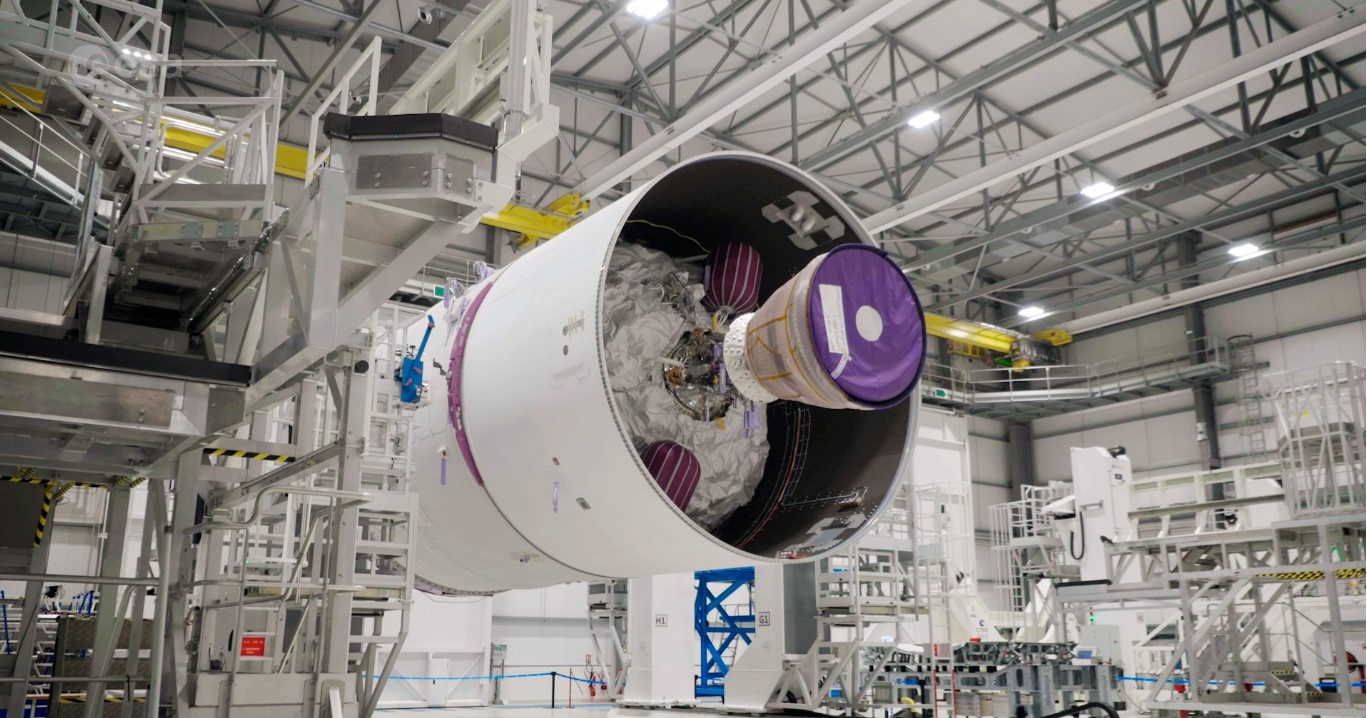
The European Space Agency (ESA)’s next generation heavy lift rocket is just months away from its first flight, and its major components are now being assembled for launch at the Vehicle Assembly Building in Kourou, French Guiana.
The new rocket is Europe’s upgrade to the retired Ariane 5, which flew for the last time in 2023. With a large payload fairing and lift capacity, Ariane 6 will be able to carry seriously heavy satellites (or multiple smaller ones). The heavy lift capability of the Ariane 6 is achieved using Hydrolox engines on both the first and second stages, assisted by up to four solid rocket boosters, enabling it to bring up to 11,000kg to geostationary transfer orbit.
The Ariane 6’s upper stage features the capability to relight its engine multiple times, giving it plenty of flexibility in the types of missions it can carry out, and improving the precision of the orbits it can reach. That makes it useful for both interplanetary missions and for unique orbital requirements around Earth.
Part of the first Ariane 6 rocket inside the Vehicle Assembly Building, Kourou, French Guiana. Credit: ESA/CNES/Arianespace/Arianegroup.
What it won’t be is reusable.
Ariane 6 is an expendable rocket, bringing critics to wonder if it can keep up with notable competitors pursuing reusability like SpaceX. But Ariane 6 has different capabilities and caters to different launch parameters than SpaceX, giving it a market share that the Falcon Heavy isn’t tuned for. Perhaps more importantly, independent access to space is a priority for Europe, making Ariane 6 a strategic imperative as much as a technological or competitive advancement. Still, Ariane 6 may not remain ESA’s workhorse rocket long-term – they are already investigating reusable alternatives that should come onto the scene in the 2030s.
The rocket stages themselves aren’t the only place where ESA can make eco-and-budget-friendly innovations, and some changes are happening now. The support and logistics infrastructure for the Ariane 6, for example, includes shipping the rocket stages aboard the Canopée, a wind-assisted hybrid cargo ship that can cut emissions by more than 20% – up to 30% depending on its speed – compared to a conventionally powered ship.
the Canopée, arriving in French Guiana in February, carrying the first Ariane 6 rocket for launch later this summer. 7Credit: ESA/CNES/Arianespace/Arianegroup/Optique Vidéo du CSG – S. Martin.
The Canopée delivered the first Ariane 6 to Kourou last month, arriving at port after a 10-day, 7,000km journey from mainland Europe in February.
The rocket now being prepared for flight within the vehicle assembly building will go vertical on the pad in the coming months.
Ariane 6’s first flight is set for no earlier than June 15. It will carry out a rideshare mission bringing multiple small spacecraft into orbit.
After that, the vehicle will have a steady launch cadence, with a series of flights scheduled for 2025 to carry upgraded satellites for Europe’s Galileo constellation (an independent GPS system). There are also plans to launch several deep space missions in the next few years, including ESA’s exoplanet hunting telescope PLATO, components of the Mars Sample Return infrastructure, and ESA’s Comet Interceptor mission.
Afew weeks before he died, President William G. Harding toured Yellowstone National Park. He said bluntly, “Commercialism will never be tolerated here as long as I have the power to prevent it.” The U.S. National Park system exists, in part, to protect some of our country’s most pristine wilderness from being destroyed by ventures like construction, mining, and logging.
While we’ve been able to create National Parks here in the U.S., nobody has the legal right to do that on the Moon. So what happens to the once-pristine Moon when the space miners show up?
Along with private missions like the recent Intuitive Machines’ lander IM-1, several countries’ space agencies all have their eyes on the same real estate around the Moon’s south pole, where water ice may lie waiting in permanently shadowed craters. Until recently, debates about what should and shouldn’t happen on the Moon have been abstract. Only one country’s space agency had ever sent humans to the Moon, and they didn’t stay long. That’s on the brink of changing. The next decade may see the once-pristine lunar landscape dotted with bases and riddled with mines, all jostling for space (and bandwidth) with telescopes and other scientific exploration. But is the lunar environment worth preserving, for science or in its own right, and who gets to decide?
There’s no life on the Moon, but the scenery is breathtaking (astronaut Harrison Schmitt for scale).
NASA
WHO OWNS THE MOON?
A recent (failed) mission to land cremated human remains on the Moon raised a high-profile example of the kind of ethical issues space ethicists say we should be considering. Astrobotic’s Peregrine One lander was scheduled to deliver the cremated remains of Gene Roddenberry and several members of the original Star Trek cast, and others to the Moon.
The Navajo Nation formally protested the mission’s launch; in Navajo beliefs, the Moon is a sacred object, and placing human remains there would be a desecration. In the end, a fuel leak forced the mission to return to Earth, where it ended in a fiery plunge into the upper atmosphere, but it drew attention to a larger debate about who gets to decide — for everyone — how we as a species relate to the Moon now.
“Every culture on Earth has conceptions about the Moon,” Santa Clara University space ethicist Brian Green tells Inverse. “There are lots of groups on Earth who have thoughts on how the Moon should be treated. This is why we need to have a larger conversation.”
Part of the unfolding discussion centers on what, if anything, we should try to protect on the Moon. Several groups here on Earth, such as For All Moonkind, have spent years arguing that the first crewed lunar landing sites are an important part of human history and should be preserved, but at the moment there’s no law or treaty preventing someone from erasing the rover tracks or astronauts’ footprints.
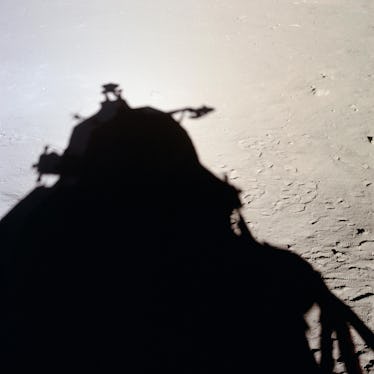
The Apollo 11 Lunar Module casts a long shadow over the surface of the Moon — and the footprints of Neil Armstrong and Buzz Aldrin — in July 1968.
NASA
The Navajo aren't the only people who consider the Moon sacred. Cultures around the world have always tended to connect the Moon with the divine. For Hindus, the Moon represents the god Chandra, who is associated with plants and the night. Shinto believers see the Moon as the god Tsukuyomi, and for the Inuit, it's Alignak, a god whose domain includes weather, tides, and earthquakes. In ancient times, the Greeks worshiped the virginal huntress and nature goddess Artemis, while the Egyptians worshiped the god Khonsu, a healer and protector of nighttime travelers.
These deities' domains reveal a lot about how people have seen the moon over the millennia. It's been something pure, a bright light in the darkness, sometimes protective but other times belonging more to wild things than to people.
But the Moon is also a place; in the late 1500s, Galileo pointed his early telescopes at the Moon and discovered mountains, valleys, and craters. Today, we know the Moon as a dusty landscape marked by ancient volcanoes and billions of years of meteors. We've crashed spacecraft into its surface (both accidentally and on purpose), a few people have walked and even driven around small parts of it, and most of them left behind bags of waste and piles of dead-weight junk. But most of the Moon is still what astrophysicist and space ethicist Erika Nesvold calls a “space wilderness." She acknowledges that it's hard to think of wilderness in a place with no life, but argues that perhaps we should.
“We also have to ask questions about things like resource overuse,” says Nesvold. “If we mine out all the water on the moon in the next three generations, what are future generations going to do? Do we need to make sure we're preserving any of that?”
Increasingly, national governments and private companies are seeing the Moon not as a deity, a symbol, or a scientific puzzle: they're beginning to see it as a resource: a source of fuel and water on the way to Mars, a site for radio telescopes, or a source of geopolitical clout.
And that's sparking an urgent debate about whether some parts of the Moon remain pristine -- and if so, which parts. Whose faith and traditions, whose scientific curiosity, whose sense of aesthetics, or whose billion-dollar business plan should decide the fate of the Moon's ancient landscape?
China is the Unites States’ main competitor in the current “space race,” with India close behind.
FUTURE PUBLISHING/FUTURE PUBLISHING/GETTY IMAGES
IF YOU’RE NOT FIRST, YOU’RE LAST
Part of the challenge of “space ethics” is to figure out what to do about these issues, but the really difficult part will be figuring out who gets to have a say. Can anyone tell a private company where, or whether, they can mine the Moon, open a lunar landfill, or turn a crater into a cemetery? How can countries with wildly differing values agree on the value – commercial, scientific, or ideological – of the Moon?
“At the more international level, that’s what international law is for,” says Nesvold.
At the moment, only the absolute basics are covered, starting with the Outer Space Treaty, in which most of the world’s nations have agreed that no one can claim territory in space, the Moon is to be used only for peaceful purposes, and nuclear weapons aren’t allowed in space. The Registration Convention requires states to register the orbital paths of their spacecraft with the UN to help prevent collisions. And the Rescue Agreement requires states to help spacefarers in distress, regardless of where they’re from.
Another treaty, the Space Liability Convention, says that spacecraft are the responsibility of the country they’re launched from — whether they’re publicly or privately owned. That means it’s up to an individual country to decide whether a company can launch human remains, soda cans, tardigrades, or anything else to the Moon (under U.S. regulations, any payload can go as long as it’s safe to launch and not a threat to national security).
What’s not covered by those laws is whether it’s okay to carve a giant advertising logo into a lunar basin, inter human remains or leave branded trinkets on the Moon, mine iconic lunar landmarks, or send tourists to the Apollo 11 landing site to walk in Neil Armstrong’s footsteps. And those are all very real possibilities in the near future. Space law, and space ethics, are urgent works in progress.
This artist’s illustration shows what future construction projects on the Moon might look like.
NASA
Meanwhile, the power to make those decisions is a big reason countries like the U.S., China, India, and Russia are all scrambling to get a foothold on the lunar surface before their rivals. Being the first to set up shop on the Moon is a huge way for a nation to show off its power, wealth, and technological chops. But on a practical level, being first also means first pick of landing sites, first dibs on lunar resources, and the first chance to choose which pieces of the lunar environment to protect.
“Ultimately, the people who get to make the decisions are the ones who are there,” says Green. “So that's why you hope that the people who are making the decisions and who are there are going to be ethical and actually considerate of other people's opinions.”
But that space race mentality can have its own problems.
“The space race dynamic always makes ethics more complicated,” says Green.
For one thing, there’s the question of what ethical shortcuts a nation or company might be willing to take to get there first. That could mean exploiting workers, taking undue risks with astronauts, or damaging the environment here on Earth.
“People who are arguing for more space telescopes, or people who are arguing for space launch centers on the path towards settling space often have really noble-sounding rhetoric: The idea of rocket launches and building more human civilization in space, versus the concerns about potential pollutants in local wetlands – the sorts of things you hear about in places like Boca Chica,” Nesvold tells Inverse. “I think that's very similar to the sort of manifest destiny rhetoric that you would see during colonization.”
Humans will go to great lengths to plant their country’s flag.
NASA
America’s crewed space program was built on a major ethical shortcut: the work of Nazi officer Werner von Braun, who also designed the V2 rockets that killed around 9,000 British civilians during World War II (thousands more forced laborers died building them). Operation Paperclip, which brought von Braun and his team of engineers to the U.S., might have been unthinkable without the pressure to stay ahead of the USSR in space.
What space ethicists like Green and Nesvold want to avoid is a future where we plow blindly forward, with whoever gets there first imposing their will on a satellite that has, for all of human history until now, belonged to everyone – but at the same time, to no one. Nesvold warns that if we do that, we risk repeating the injustices of colonialism here on Earth.
IS ANTARCTICA A BLUEPRINT FOR SPACE?
Nations whose interests and values often clash will have to agree on how to manage a commons: "a broad set of resources, natural and cultural, that are shared by many people," as the International Association for the Study of the Commons puts it. We've already done that here on Earth, to some extent. The future of the Moon and Mars may owe a lot to the system of treaties that protect Antarctica and the set of laws that apply in international waters.
The international agreements that protect these adorable penguins could provide a framework for cooperation on the Moon.
ANADOLU/ANADOLU/GETTY IMAGES
The 1959 Antarctic Treaty reserves the entire Antarctic continent for peaceful, scientific use. No commercial mining is allowed, and there are strict rules protecting plants, wildlife, and landscapes. Tourists, scientists, and even some military personnel are allowed to visit (or live there for months at a stretch), but only if the expedition or tour operator has a permit from one of the 56 countries that have signed the treaty.
Countries that issue permits have regulations about the type of activity and the number of people they'll allow; some of those rules are to protect the fragile polar environment, but others are for safety. For example, "the UK will also not normally authorize the use of helicopters for recreational purposes in areas with concentrations of wildlife, including the Antarctic Peninsula region." (As a side note, "for safety reasons the UK will not authorize snorkeling activities in the Antarctic." The more you know.)
Eight of the countries who signed the treaty claim sectors of territory in Antarctica, and some of them overlap. In theory, no one is allowed to claim new territory in Antarctica; the eight countries that claim sectors today had already made their claims before the Antarctic Treaty was written, and part of the treaty forbids anyone from making new claims. But both the U.S. and Russia argue that they've reserved the right to claim territory in Antarctica in the future.
On the other hand, several countries, including the U.S., have research stations in other countries' sectors without any major conflict.
If someone wants to violate the Antarctic Treaty, it's going to be hard to stop them without resorting to military force. That's even more true on the Moon. But so far, the Antarctic Treaty has worked fairly well.
"If we can look at what's worked and what hasn't in terms of preventing conflicts and protecting the environment, then we can apply those in space," says Nesvold.
A team of astronomers recently discovered that little red dots in the distant universe were actually baby quasars, the precursors to the supermassive black holes at the center of galaxies like our Milky Way. Astrophysicist Jorryt Matthee, of Austria’s Institute of Science and Technology, and his colleagues published their workin The Astrophysical Journal.
The small orange-red objects with the six refraction spikes are small, early galaxies with actively-feeding supermassive black holes, about 13 billion light years away.
MATTHEE AT AL. 2024
CONNECTING THE DOTS
Matthee and his colleagues used the James Webb Space Telescope (JWST) to peer deep into a tiny slice of the sky. In older images from the Hubble Space Telescope, the faint red dots in the cosmic distance (13 billion light years away) had looked like very ancient, but otherwise ordinary, galaxies. However, JWST’s instruments picked up something else: specific wavelengths of light associated with hot, fast-moving hydrogen.
“These spectra tell us that we are looking at a very small gas cloud that moves extremely rapidly and orbits something very massive, like a supermassive black hole,” says Matthee in a recent statement.
The supermassive black holes in these “little red dot” galaxies are small: about 10 to 100 million times more massive than our Sun, which is tiny for a supermassive black hole. And if Matthee is right, they’re still young.
“My intuition says these are fairly young systems of maximally a few hundred million years old that are rapidly evolving (at least, on "astronomical timescales" of millions of years),” Matthee tells Inverse. To be sure about that, he and his colleagues will need to measure the ages of the stars around the black holes. Meanwhile, these “little red dots” look like small, early versions of the type of supermassive black holes that Matthee calls “problematic quasars.” (A quasar is an actively-feeding supermassive black hole at the center of a galaxy.)
SOMETIMES SPACE IS PROBLEMATIC
Matthee’s problematic quasars are problematic because they’re too big to exist where and when they exist: between 11 and 12 billion light years away, when the universe was just a couple of billion years old. If supermassive black holes formed the way astrophysicists have long assumed — starting with a giant star collapsing into a black hole, then growing larger as it pulls in more material — then black holes that are billions of times more massive than our Sun shouldn’t have existed 11 billion years ago. Black holes that started as 30 times our Sun’s mass shouldn’t have had time to grow so large in less than a couple of billion years.
“It’s like looking at a 5-year-old child that is 2 meters tall,” says Matthee. “Something doesn’t add up.”
So either black holes grow faster than the laws of physics suggest they do, or they started as something more massive than an ordinary collapsed star. One possibility is that the “seeds” of supermassive black holes were already thousands of times our Sun’s mass, spawned by enormous clouds of gas collapsing under their gravity.
Much of what JWST has revealed about the early universe seems to support the idea that supermassive black holes formed from more massive “seeds,” not ordinary collapsed stars, but there’s not enough evidence yet to settle the debate.
“In my view, we currently can not yet discriminate between these scenarios,” Matthee tells Inverse.
WHAT’S NEXT?
To do that, astrophysicists will need more data. Matthee and his team want to measure the conditions in which these early black holes formed: the mass of the stars in their host galaxies, the amount of heavy elements in the galaxy’s ingredients list, and whether there’s galactic wind. They’re also curious about whether these precociously-large supermassive black holes tend to form in galaxy clusters or less-populated cosmic neighborhoods.
Over the next couple of years, Matthee and his team have booked more time on JWST, which they’ll use to search for more “little red dots” even farther away — and farther back in time.
“We want to extend the population of ‘baby quasars’ that we know of,” says Matthee. “By finding new ones even earlier in time, we should witness them closer to their birth, meaning we can learn more about their formation conditions. The same may be learned by finding even lower mass supermassive black holes, with masses ~100,000-1,000,000 times the Sun, and characterizing the properties of the galaxies they formed in.”
Perseverance is Keeping Track of the Big Picture While it’s Exploring Mars
It’s always a real benefit to have scientists on the ground, able to use the wealth of their experience and ingenuity to ‘think on their feet’. It is therefore always quite challenging to use space probes that to a degree need to be autonomous. This is certainly true of the NASA Perseverance Rover that has been drilling core samples that will one day (hopefully) be returned to Earth as part of the Mars Sample Return mission. Until then, a team of Geologists have developed a technique to calculate the orientation of the core samples to help with future analysis.
The journey of Mars Perseverance began on 30 July 2020 when it was launched off to the red planet. Arriving less than a year later on 18 February 2021, the rover carried with it an array of instrumentation. Its goal to explore the past habitability of Mars, looking for signs of ancient microbial life and helping to pave the way for future human exploration.
A United Launch Alliance Atlas V rocket with NASA’s Mars 2020 Perseverance rover onboard launches from Space Launch Complex 41 at Cape Canaveral Air Force Station, Thursday, July 30, 2020, from NASA’s Kennedy Space Center in Florida. The Perseverance rover is part of NASA’s Mars Exploration Program, a long-term effort of robotic exploration of the Red Planet. Photo Credit: (NASA/Joel Kowsky)
One instrument in particular, the Sample Caching System, gathered and stored rock and soil samples for the potential return to Earth by future missions. Perseverance and the Ingenuity drone have been exploring the Jezero crater, an ancient lake bed since. To date, 20 of the 43 tubes have been filled with core bedrock samples and a team of geologists have been looking at the original orientation of the samples to help answer questions about the planet’s past.
The research, which appeared in Earth and Space Science journal by lead authors Benjamin P. Weiss and Elias N. Mansbach explains that the team have identified the original orientation of the majority of the samples collected so far. This crucial bit of information will help geologists to understand the magnetic field that may have existed at the time the rocks formed, how water and lava has flowed, the direction of wind and the tectonic processes that were going on too.
Using data from the rover itself including its location and the positioning of the drill it was possible to calculate the orientation of the bedrock sample before it was drilled out. This will be the first time scientists have managed to orient the rock samples from another world. By completing the process for a number of samples at different locations will give clues to the conditions on Mars when the rocks formed.
The challenge was made more difficult by the mechanism that extracted the sample. A tube shaped drill is screwed into the ground at a 90 degree angle and then the sample is pulled directly out along with the rock. To be able to reorient the sample with the original location the team take what is effectively pitch, roll and yaw of a boat or aircraft. Using pictures and aligning with true north the team could calculate the original orientation. They also used distinguishing surface features in the area that would help with location identification. If perchance they were in an area devoid of any feature then the onboard laser would mark an ‘L’ into the rock before taking the sample.
Of all the stars in the sky, betelgeuse must be among the most enigmatic. One of its many mysteries surrounds the speed of its rotation which is surprisingly fast for a supergiant star. If it were placed where the Sun was, then its photosphere (visible layer) would be out around the orbit of Jupiter and it would be moving at 5 km/s. A new study now hints that instead of high rotation, it may be that the surface is boiling so furiously that it has been mistakingly identified as fast rotation.
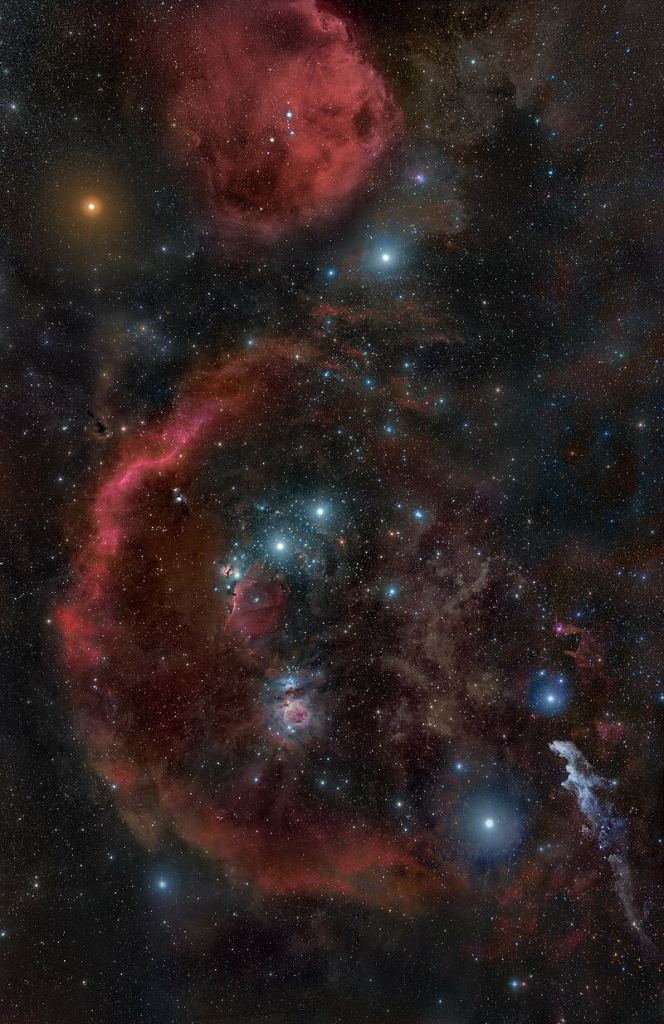
Betelgeuse is one of the first stars an amateur astronomer will learn. Its distinctive red colour in the upper left corner of Orion makes it a prominent star, easy to find and identify and a great signpost to other constellations. We all know that stars are big but Betelgeuse takes this to a whole new level at 1.2 billion km across, almost 2,000 larger than the Sun. Stars of this size are usually expected to rotate slowly but observations revealed its high rotation speed, far higher than expected of a star at this evolutionary stage.
Orion and the molecular cloud covering the region. Betelgeuse is the red star in the upper left. (Credit : Rogelio Bernal Andreo)
Observations from the Atacama Large Millimetre Array pointed at the rotation speed of Betelgeuse. The system, which is made up of 66 antennae is a radio interferometer that combines the signal from all dishes to increase its sensitivity. Using this instrument, astronomers had concluded that one hemisphere seems to be approaching while the other seems to be receding and the rate of this led to the conclusion of a 5 km/s rotation speed. If Betelgeuse was a perfect sphere then this would have been a reasonable conclusion however, the surface of Betelgeuse is not like that!
Two of the Atacama Large Millimeter/submillimeter Array (ALMA) 12-metre antennas gaze at the sky at the observatory’s Array Operations Site (AOS), high on the Chajnantor plateau at an altitude of 5000 metres in the Chilean Andes. There is now a total of 66 antennae, 54 of them with 12-metre diameter dishes, and 12 smaller ones, with a diameter of 7 metres each. The ALMA project is an international collaboration between Europe, East Asia and North America in cooperation with the Republic of Chile. ESO is the European partner in ALMA.
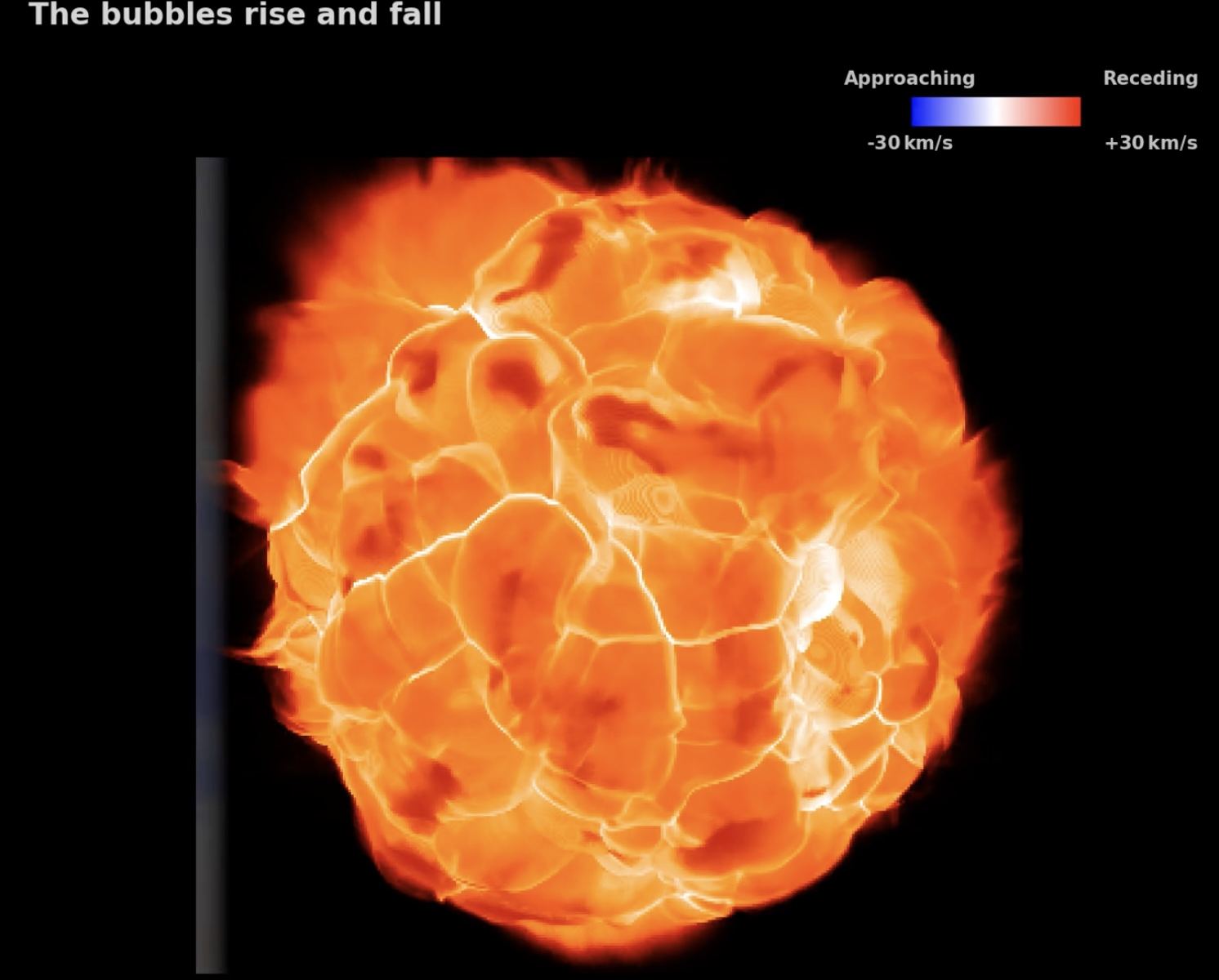
Like all stars, convection is a prominent process in the photosphere that brings heat from the stellar interior. In the case of Betelgeuse the convection cells are massive, sometimes even as large as the Earth’s orbit around the Sun and they rise and fall at speeds around 30 km/s (that’s over twice the escape velocity of the Earth so is faster than any launching spacecraft).
Jing-Ze Ma PhD from the Max Planck Institute for Astrophysics now proposes that the dipolar velocity map which identified the approaching and receding hemispheres, may actually have been picking up convection cells instead. The theory postulates that the limited resolution of the ALMA system was observing (but not able to differentiate) convection cells rising on one side of the star and sinking on the other.
To reach that conclusion, the team had developed a new processing technique to produce synthetic data from ALMA and in 90% of cases, the boiling motion was not clear and led to an interpretation of high rotational speeds. Further observations are now needed to explore this exciting possibility but instruments with greater resolution are required. to that end, higher resolution observations were made back in 2022 but the data is still being analysed but it will, it is hoped, start to reveal much more about the nature of Betelgeuse.
How Long Will Advanced Civilizations Try to Communicate With Us?
Technosignature research is heating up, with plenty of papers speculating on the nature, and sometimes the longevity, of signals created by technically advanced extraterrestrial civilizations. While we haven’t found any so far, that isn’t to say that we won’t, and a better understanding of what to look for would undoubtedly help. Enter a new paper by Amedeo Balbi and Claudio Grimaldi, two professors at the Universita di Roma Tor Vergata and the Ecole Polytechnique Federale de Lausanne, respectively. They have taken a statistical model to the problem of understanding how old a technosignature might be before we are likely to find it – and their answer is, surprisingly young.
We’ve reported before on how another recent paper thought that any civilization that created a technosignature that we can see is likely to be much older than ours. Simply put, technosignatures can last a long, long time. Over those long periods, the technosignatures can travel to places that are farther away. Given the extreme longevity of some of these civilizations, it turns out we are more likely to come across a technosignature that has been around for a very long time rather than one just created recently.
However, one big assumption in the previous paper is that the technosignature would last for extremely long periods. That assumption might not always hold, as many technosignatures have to be actively supported, such as radio signals or artificial lights on a planet. Given the active support these require, it’s likely they wouldn’t be supported anywhere near as long as implied by the previous paper.
Fraser discusses the idea of technosignatures.
Drs. Balbi and Grimaldi instead use a statistical technique to more accurately reflect what they think the actual situation in the universe would be – civilizations actively support their technosignatures for some time but let them die off once they are no longer beneficial to the civilization itself – essentially eliminating our chance to find them. From a statistical point of view, this clusters the vast majority of observable technosignatures to the far left of the x-axis, where that axis is defined as the longevity of a civilization.
We could see some obvious technosignature that have been around for billions of years and don’t require any active support, such as the thermoradiation of a Dyson sphere. But it’s much more likely that, if we do see one, it is actively being supported by an active civilization.
In the paper, the researchers perform a more rigorous statistical analysis, including invoking an idea known as Lindy’s Law. That law is somewhat counterintuitive, as it states that the life expectancy of a technology is roughly proportional to its age. In other words, as a technology ages, its life expectancy increases. However, it has been proven in multiple scenarios and has various causes.
Dr. David Kipping, the author of a previous paper discussing how long technosignatures might last, discusses the research he did on his channel. Credit – Cool Worlds YouTube Channel
The impact it has on this particular analysis is clear – the probability distribution of the length of a technically advanced civilization’s existence should be skewed per Lindy’s Law to show that short-lived technosignatures are much more common than long-lived ones.
At the moment, this is all theoretical, and it would be interesting to see what Dr. Kipping, the author of the original paper arguing for longer-lived societies, has to say about this alternative view of the statistical treatment. Maybe it will be featured on an episode of his Cool Worlds channel soon. Until then, the hard work of SETI data collection will continue apace, and the theoreticians will continue fine-tuning their statistical models, hoping to one day catch a glimpse of something out there.
China en Rusland gaan een overeenkomst ondertekenen voor de bouw van een basis op de maan. De Chinese ruimtevaartorganisatie zegt dat dit station vanaf 2035 stroom en communicatiemiddelen moet hebben, evenals voorzieningen die menselijke bewoning mogelijk moeten maken.
De Chinese ruimteambities worden verder verduidelijkt in een vrijdag gepubliceerde whitepaper. Hierin meldt het ruimteagentschap dat China doelt op “verkenning en gebruik van de kosmische ruimte voor vreedzame doeleinden”. Het land wil onder meer ruimteschroot beter in kaart brengen en het verdedigingssysteem tegen aardscheerders uitbouwen.
China en Rusland kondigden vorig jaar al gezamenlijke plannen aan voor het station. Het was toen nog niet duidelijk of het om een station om of op de maan zou gaan. De partners beloven dat wetenschappers van over de hele wereld de basis mogen gebruiken. Momenteel ontwikkelen de Verenigde Staten onder meer met Europa een eigen ruimtestation in een baan om de maan, de Lunar Gateway.
China en Rusland hebben ook afgesproken om samen te werken aan een toekomstige robotmissie naar de zuidpool van de maan, Chang'e 7. Het vertrek staat gepland voor 2024.
China hoopt voor 2030 mensen voet te laten zetten op de maan. Het kan er dan nog om gaan spannen of China dan het eerste land wordt om sinds de laatste Apollo-missie in 1972 weer mensen op het hemellichaam te zetten. De Verenigde Staten werken momenteel aan hun eigen nieuwe maanprogramma Artemis. Deze hebben een bemande maanlanding gepland staan voor 2026.
De laatste Chinese maanmissie was in 2020. De Chang'e 5 keerde in december dat jaar, na een missie van 22 dagen, terug met monsters van het maanoppervlak. Er rijdt nog altijd een Chinese rover rond op de maan.
Rusland en China overwegen samen een missie naar de maan te sturen om daar een kerncentrale te bouwen. Yuri Borisov, het hoofd van de Russische ruimtevaartorganisatie Roscosmos, deelde dit plan tijdens een jeugdevenement in Rusland. De missie zou plaatsvinden tussen 2033 en 2035.
De technologie die nodig is voor deze ambitieuze missie zou volgens Borisov bijna gereed zijn. Hij benadrukte dat zonnepanelen alleen niet voldoende zouden zijn voor een betrouwbare stroomvoorziening op de maan. Het plan omvat een samenwerking met China om een krachtbron op het maanoppervlak te plaatsen, waarbij nucleaire ruimte-energie als oplossing wordt voorgesteld.
Geen verrassing
Het nieuws komt op een moment dat Rusland en China al samenwerken aan het International Lunar Research Station (ILRS), dat in 2021 werd ondertekend. Het ILRS is een geplande maanbasis die wordt geleid door het Russische Roscosmos en de China National Space Administration (CNSA).
Ondanks recente tegenslagen van Rusland zoals de mislukte maanlanding in 2023, blijven de plannen voor de samenwerking tussen beide landen wel staande. China boekt vooruitgang met zijn Chang’e-sondes, waaronder Chang’e 5, die met succes monsters van het maanoppervlak naar de aarde heeft gebracht.
Niet nieuw
Het idee van een kerncentrale op de maan is niet nieuw. Zelfs de Amerikaanse ruimtevaartorganisatie NASA heeft eerder voorgesteld om kernreactoren te gebruiken om toekomstige maankolonies van stroom te voorzien. In 1969 gebruikten Apollo 12-astronauten al een nucleaire generator voor wetenschappelijke experimenten op de maan.
A sample return mission carried out by China’s Chang’e-5 that collected and returned 1.73 kilograms of lunar regolith to Earth and discovered an all-new mineral in the process is helping expand our knowledge of the Moon and its mysteries.
The first sample return mission to have occurred since the Soviet era Luna 24 mission in 1976, Chang’e-5 collected regolith samples from the massive Oceanus Procellarum, where it located an unusual combination of silica minerals, as well as a newly recognized mineral dubbed Changesite-(Y).
During recent studies undertaken by researchers with the Chinese Academy of Sciences, the samples retrieved by Chang’e-5 were compared alongside both lunar and Martian regolith samples, allowing scientists an unprecedented opportunity to search for answers to their unique compositions.
Oceanus Procellarum, located near the Chang’e-5 landing site (Credit: NASA).
The recent analysis also revealed an intriguing connection to a location on the Moon associated with sightings of anomalous activity that has long intrigued astronomers.
Extensive markings cover the surface of the Moon, many of which are visible on its Earth-facing side. While often viewed as resembling a man’s face in the West, according to Chinese traditions these same darkened regions are likened to the Yutu the rabbit, companion of the Moon goddess Chang’e after whom the country’s lunar lander was named.
The formation of these craters and other features that score the lunar landscape are the result of objects crashing into its surface over extensive periods. However, craters aren’t all that were left behind during these ongoing collisions.
During the extreme conditions that occur when asteroids and comets impact the lunar surface, alterations to the mineral composition and structure of the Moon also occur. Specifically, temperature and pressure conditions lead to changes that have certain characteristics that include the formation of silica variants known as polymorphs, offering researchers a valuable opportunity to analyze the resulting minerals and reveal clues about their past.
Wei Du, one of the authors of a new paper describing the Chinese team’s findings, says that although craters covering the Moon number in the tens of thousands, the presence of minerals that are formed as the result of intense pressure still isn’t very common.
A new impact feature on the lunar surface with freshly exposed regolith (Credit: NASA/GSFC/Arizona State University).
“One of the possible explanations for this is that most high-pressure minerals are unstable at high temperatures,” Du said in a statement, meaning that the ones that are likely to have been created during impact events may have undergone a retrograde process, meaning that the identifying characteristics of high-pressure conditions may not be readily apparent.
Fortunately, one silica fragment obtained in the CE-5 sample was found to possess both stishovite and seifertite, silica polymorphs that are unique because they should only be able to coexist under just such high-pressure conditions.
In their recent research, Du and his colleagues determined that seifertite becomes present in a phase that occurs between the formation of stishovite and another silica polymorph called α-cristobalite, which was also located in samples collected by Change’e-5.
According to Du, this means that seiftertite is likely to have formed from α-cristobalite as a result of compression that occurred following an impact event, whereas other portions of the sample would have become stishovite as a result of temperature increases.
Along with calculations that revealed the likely duration of the impact that formed the minerals and the peak pressure conditions that resulted, Du and his colleagues compared their data to shock wave models that allowed them to create estimates of the crater size.
An intriguing discovery made by the team involves the presence of materials believed to have resulted from ejecta from distant impact sites that were transferred to the site where Chang’e-5 collected its samples. Based on remote observations four craters were identified as sources of this ejecta, one of which had been the Aristarchus crater, which had been the likely source of the silica sample containing seifertite and stishovite.
Aristarchus crater (left) and the nearby Herodotus crater (right), located near the southernmost edge of the Cobra head, a feature produced by an ancient volcanic vent
(Credit: NASA/GSFC/ Arizona State University)
Aristarchus crater is unique for reasons other than being the youngest of the four craters believed to have contributed ejecta to the samples Chang’e-5 collected. For nearly two centuries, astronomers have observed anomalous flashes of light that appear to originate from within the center of the Aristarchus crater.
One early account of the phenomenon appeared in an 1836 letter from Captain W. Smyth in Monthly Notices of the Royal Astronomical Society, where he described his observation of “a light, resembling that of a star of the 9th or 10th magnitude”. Smyth reported that the unusual light source appeared “brilliant, and visible for several seconds together” and alluded to earlier observations of the same phenomenon “mentioned by Cassini, Sir W. Herschel, and Captain Kater,” among others.
Today, the Aristarchus “anomaly” is believed to result from the high reflectivity, or albedo, of lunar regolith located near the center of the crater, which could also be related to the presence of silicates found in the regolith there, and now also in the Change’e-5 samples.
Altogether, Du and his colleagues say the sample return mission has offered unprecedented insights into how the hidden history of celestial bodies like our Moon can be revealed through modern analysis techniques.
Duand his colleagues recently published their findings in Matter and Radiation at Extremes.
Beste bezoeker, Heb je zelf al ooit een vreemde waarneming gedaan, laat dit dan even weten via email aan Frederick Delaere opwww.ufomeldpunt.be. Deze onderzoekers behandelen jouw melding in volledige anonimiteit en met alle respect voor jouw privacy. Ze zijn kritisch, objectief maar open minded aangelegd en zullen jou steeds een verklaring geven voor jouw waarneming! DUS AARZEL NIET, ALS JE EEN ANTWOORD OP JOUW VRAGEN WENST, CONTACTEER FREDERICK. BIJ VOORBAAT DANK...
Druk op onderstaande knop om je bestand , jouw artikel naar mij te verzenden. INDIEN HET DE MOEITE WAARD IS, PLAATS IK HET OP DE BLOG ONDER DIVERSEN MET JOUW NAAM...
Druk op onderstaande knop om een berichtje achter te laten in mijn gastenboek
Alvast bedankt voor al jouw bezoekjes en jouw reacties. Nog een prettige dag verder!!!
Over mijzelf
Ik ben Pieter, en gebruik soms ook wel de schuilnaam Peter2011.
Ik ben een man en woon in Linter (België) en mijn beroep is Ik ben op rust..
Ik ben geboren op 18/10/1950 en ben nu dus 75 jaar jong.
Mijn hobby's zijn: Ufologie en andere esoterische onderwerpen.
Op deze blog vind je onder artikels, werk van mezelf. Mijn dank gaat ook naar André, Ingrid, Oliver, Paul, Vincent, Georges Filer en MUFON voor de bijdragen voor de verschillende categorieën...
Veel leesplezier en geef je mening over deze blog.