The purpose of this blog is the creation of an open, international, independent and free forum, where every UFO-researcher can publish the results of his/her research. The languagues, used for this blog, are Dutch, English and French.You can find the articles of a collegue by selecting his category. Each author stays resposable for the continue of his articles. As blogmaster I have the right to refuse an addition or an article, when it attacks other collegues or UFO-groupes.
Druk op onderstaande knop om te reageren in mijn forum
Zoeken in blog
Deze blog is opgedragen aan mijn overleden echtgenote Lucienne.
In 2012 verloor ze haar moedige strijd tegen kanker!
In 2011 startte ik deze blog, omdat ik niet mocht stoppen met mijn UFO-onderzoek.
BEDANKT!!!
Een interessant adres?
UFO'S of UAP'S, ASTRONOMIE, RUIMTEVAART, ARCHEOLOGIE, OUDHEIDKUNDE, SF-SNUFJES EN ANDERE ESOTERISCHE WETENSCHAPPEN - DE ALLERLAATSTE NIEUWTJES
UFO's of UAP'S in België en de rest van de wereld Ontdek de Fascinerende Wereld van UFO's en UAP's: Jouw Bron voor Onthullende Informatie!
Ben jij ook gefascineerd door het onbekende? Wil je meer weten over UFO's en UAP's, niet alleen in België, maar over de hele wereld? Dan ben je op de juiste plek!
België: Het Kloppend Hart van UFO-onderzoek
In België is BUFON (Belgisch UFO-Netwerk) dé autoriteit op het gebied van UFO-onderzoek. Voor betrouwbare en objectieve informatie over deze intrigerende fenomenen, bezoek je zeker onze Facebook-pagina en deze blog. Maar dat is nog niet alles! Ontdek ook het Belgisch UFO-meldpunt en Caelestia, twee organisaties die diepgaand onderzoek verrichten, al zijn ze soms kritisch of sceptisch.
Nederland: Een Schat aan Informatie
Voor onze Nederlandse buren is er de schitterende website www.ufowijzer.nl, beheerd door Paul Harmans. Deze site biedt een schat aan informatie en artikelen die je niet wilt missen!
Internationaal: MUFON - De Wereldwijde Autoriteit
Neem ook een kijkje bij MUFON (Mutual UFO Network Inc.), een gerenommeerde Amerikaanse UFO-vereniging met afdelingen in de VS en wereldwijd. MUFON is toegewijd aan de wetenschappelijke en analytische studie van het UFO-fenomeen, en hun maandelijkse tijdschrift, The MUFON UFO-Journal, is een must-read voor elke UFO-enthousiasteling. Bezoek hun website op www.mufon.com voor meer informatie.
Samenwerking en Toekomstvisie
Sinds 1 februari 2020 is Pieter niet alleen ex-president van BUFON, maar ook de voormalige nationale directeur van MUFON in Vlaanderen en Nederland. Dit creëert een sterke samenwerking met de Franse MUFON Reseau MUFON/EUROP, wat ons in staat stelt om nog meer waardevolle inzichten te delen.
Let op: Nepprofielen en Nieuwe Groeperingen
Pas op voor een nieuwe groepering die zich ook BUFON noemt, maar geen enkele connectie heeft met onze gevestigde organisatie. Hoewel zij de naam geregistreerd hebben, kunnen ze het rijke verleden en de expertise van onze groep niet evenaren. We wensen hen veel succes, maar we blijven de autoriteit in UFO-onderzoek!
Blijf Op De Hoogte!
Wil jij de laatste nieuwtjes over UFO's, ruimtevaart, archeologie, en meer? Volg ons dan en duik samen met ons in de fascinerende wereld van het onbekende! Sluit je aan bij de gemeenschap van nieuwsgierige geesten die net als jij verlangen naar antwoorden en avonturen in de sterren!
Heb je vragen of wil je meer weten? Aarzel dan niet om contact met ons op te nemen! Samen ontrafelen we het mysterie van de lucht en daarbuiten.
06-03-2024
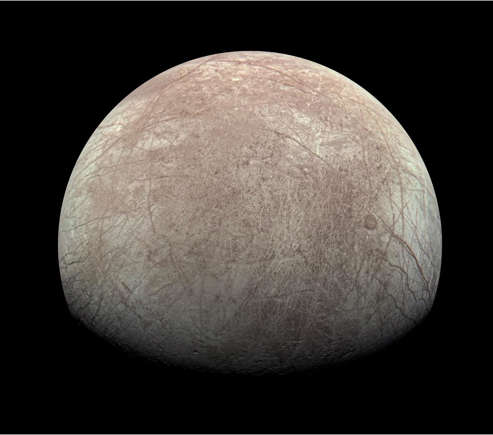
Jupiter's Icy Moon Europa May Be Missing a Key Ingredient for Life
Jupiter's Icy Moon Europa May Be Missing a Key Ingredient for Life
A recent study suggests the icy moon's hidden ocean may be anoxic.
A new study out today in the journal Nature Astronomy used data from NASA’s Juno spacecraft to simulate how much oxygen could be circulating in Europa’s oceans. It turns out, it is a lot less than researchers previously thought. Researchers formerly thought that there was likely quite a bit of oxygen on Europa, and therefore a good chance of life there, too.
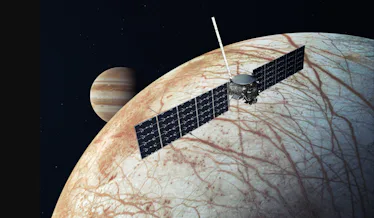
This illustration show’s what NASA’s Europa Clipper spacecraft may look like as it orbits Europa in the 2030s.
NASA/JPL
ANOXIC ALIEN SEAS
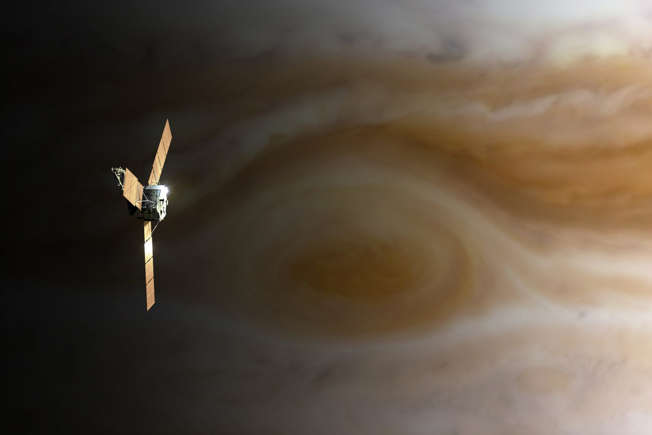
To figure out how much oxygen might be getting into Europa’s oceans, Jamey R. Szalay, a planetary scientist at Princeton University and lead author on the study, and his colleagues examined data from Juno’s Jovian Auroral Distribution Experiment (JADE), which measures the ions (electrically charged atoms) left in Europa’s wake as it orbits Jupiter. JADE captured the data during Juno’s close flyby of Europa in September 2022.
Specifically, the team measured the amount of ionized oxygen and hydrogen JADE detected in Europa’s wake and used a computer simulation to figure out how much total oxygen had to be released at Europa’s surface every second to produce the amount of ions JADE measured in space 200 miles from the moon’s surface.
The answer turned out to be a measly 12 kilograms per second. That’s a lot less than previous models had predicted. Only about a fraction of that amount makes its way into the ocean below. This means that there is hardly any oxygen in Europa’s oceans.
“Unless Europa’s oxygen production was significantly higher in the past, the oxygen production rates found here […] provide a narrower ranger range to support habitability than previous model-driven estimates,” write Szalay and his colleagues.
BREAKING BONDS
How do ions at Europa’s surface make their way into the ocean? On Europa’s surface, radiation and electrically charged particles, like electrons, constantly bombard the surface of the ice. That radiation breaks the bonds that hold water molecules together, releasing oxygen and hydrogen molecules from their frozen prison.
Some of those molecules escape into space and collide with other molecules or get zapped by yet more radiation and become the ions that JADE studies. Others become part of Europa’s thin wisp of an atmosphere. Still others settle back into the ice; they’re trapped in a crystalline matrix of frozen water, but this time they’re imprisoned oxygen molecules, not just pieces of water molecules.
Ice, and things trapped in it, are in constant motion, even if that motion is very slow. Over time, some of that trapped oxygen gets shifted slowly downward through Europa’s kilometers-thick layers of ice, where it “may work into the ocean as a possible source of metabolic energy for life,” write Szalay and his colleagues in their recent paper.
We’ll get a much more direct look at how much oxygen is in Europa’s oceans, or whether there’s alien life swimming around down there in the cold dark, when NASA’s Europa Clipper arrives in 2030.
Scientists have discovered that life may exist on Earth — wait, what?
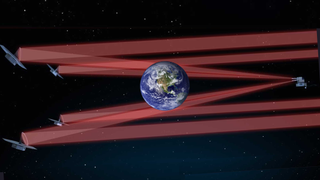
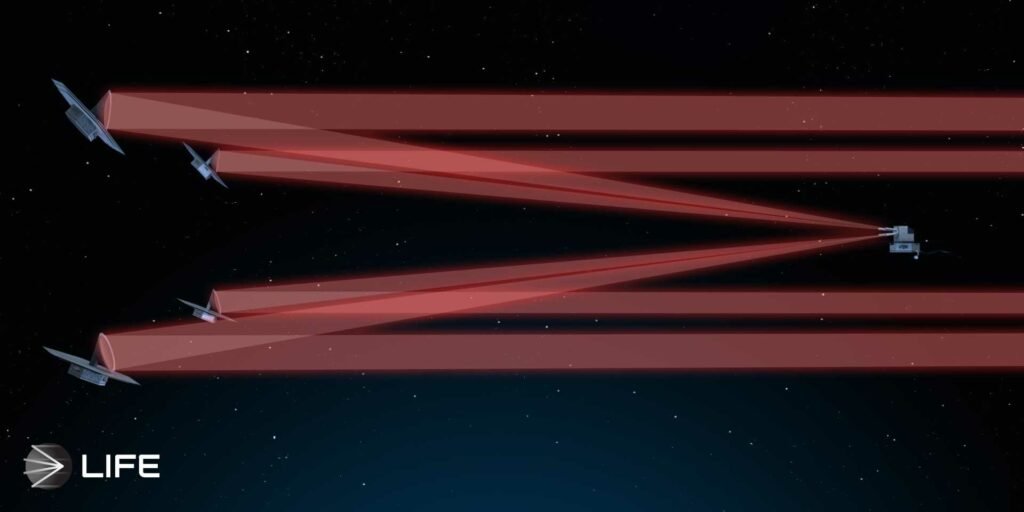
An illustration shows the five spacecraft of the LIFE mission with Earth between them
(Image credit: ETH Zurich / LIFE initiative)
After conducting a fair bit of research, scientists have come to a conclusion that may sound redundant: Life could exist on Earth.
Of course, you're probably thinking "Well, duh." In fact, it may feel more accurate to say that life does exist on Earth — not simply that it could. But here's the thing. The team's conclusion isn't the focus of the research. It's merely a means to an end. The plot of this story, rather, lies in precisely why these scientists reached the resu
Humans are fascinated by the possibility of discovering life on planets outside the solar system, otherwise known as exoplanets. So, to see things from a different perspective, this team of researchers pondered how life and habitability on Earth would look to an alien that would see our world as an exoplanet. How might they spy on us from afar? What would indicate to them that our planet is occupied?
These questions go far beyond philosophical musings. There's a practical use for the answers as well. They'll be used to validate a forthcoming space mission, dubbed the Large Interferometer for Exoplanets or "LIFE," mission, which will hunt for habitable exoplanets. The mission will be comprised of five spacecraft that form a single, mid-infrared interferometer. They'll sit relatively close to the James Webb Space Telescope (JWST) in an orbit around the sun known as Lagrange Point 2, or L2.
So, the team, which hails from ETH Zurich, turned the technology that'll support LIFE back on Earth to confirm that the mission will indeed be capable of hunting for life on distant worlds when it launches in late 2026 or early 2027. If it can't confirm life on Earth, how would it confirm life beyond?
The primary target of LIFE will be rocky or terrestrial planets that are similar in size and temperature to Earth. It's being built to pick up thermal emissions from these worlds and use their spectrums of light to deduce what elements and chemicals lie in their atmospheres.
This would be possible because elements and compounds absorb and emit light at characteristic wavelengths. This means light passing through a planet's atmosphere, perhaps from a star or in the form of thermal radiation, will carry spectral fingerprints of those chemicals. This would also apply to so-called "biomarker" molecules, such as methane, that are often produced by the biological processes of living things.
"Our goal is to detect chemical compounds in the light spectrum that hint at life on the exoplanets," Sascha Quanz, leader of the LIFE initiative, said in a statement.
Earth from afar
Rather than testing LIFE's capabilities using simulated spectra of light associated with an exoplanet, the team behind this research decided to validate the mission by using the only planet upon which life has been discovered. That's our planet, Earth.
The team took data from NASA's Aqua Earth observation satellite and used it to create the mid-infrared emission spectrum that would be expected from Earth if it was viewed as an unassuming speck from a great distance. At such a distance, our planet's beautiful mountains and blue seas would be indistinguishable.
The team then averaged out the spectra, and considered how the result would be impacted by seasonal fluctuations and our planet's geometry. The researchers accounted for three possible views, two from the poles of Earth and one from its equator. They also focused on data collected between January and July of 2017to calculate seasonal variations.
NASA's EPIC camera aboard the DSCOVR spacecraft views Earth nearly 1 million miles (1.6 million kilometers) away. But would life be detectable from 30 million light years away? (Image credit: NASA/DSCOVR EPIC team)
The team concluded that if LIFE or a similar instrument were to observe Earth from as far away as 30 light-years, it would successfully determine our planet is a warm, habitable world. The crew also determined that atmospheric gases like carbon dioxide, methane and water, all either important for or created by life, would be visible in our planet's spectra.
A distant observation of Earth by a LIFE-like telescope therefore would reveal the conditions needed for our planet to support liquid water at its surface.
The team found the same results were delivered regardless of geometry, which is positive news because scientists won't know the geometry of the exoplanets LIFE observes. However, less positively, they also found that seasonal variations would not be observed in detail by LIFE.
"Even if atmospheric seasonality is not easily observed, our study demonstrates that next-generation space missions can assess whether nearby temperate terrestrial exoplanets are habitable or even inhabited," Quanz concluded.
Join our Space Forums to keep talking space on the latest missions, night sky and more! And if you have a news tip, correction or comment, let us know at: community@space.com.
A long time ago in a galaxy far, far away, large amounts of light were being
A long time ago in a galaxy far, far away, large amounts of light were being generated by what is today recognized as one of the most remote star systems ever seen. Now, astronomers are getting a glimpse at how it looked at a time when our universe was still in its relative infancy with help from NASA’s James Webb Space Telescope.
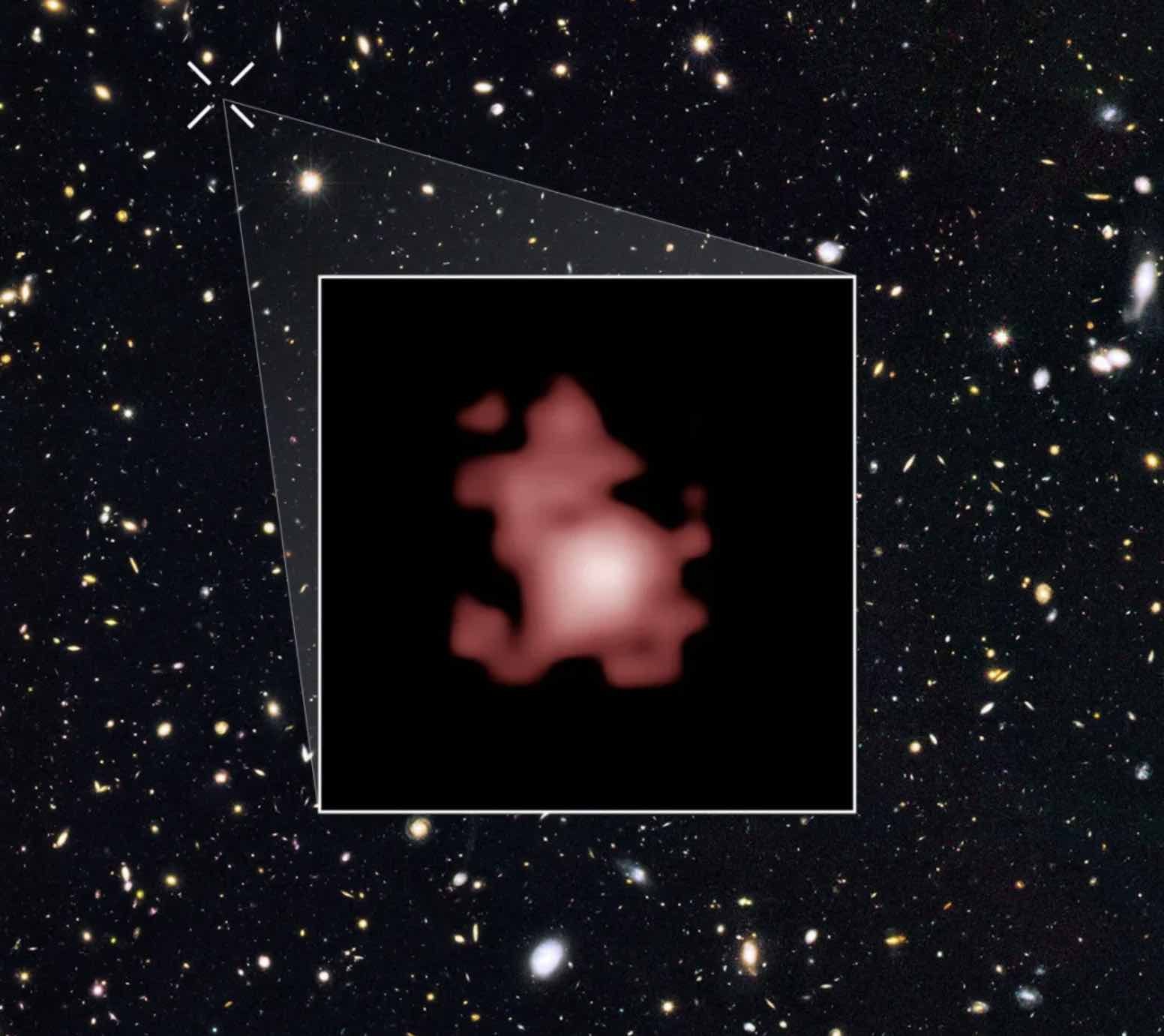
Given its extreme distance from Earth, this very bright galaxy, GN-z11, is a natural target for investigations by our most advanced space telescopes. The latest findings involve the research conducted by a team studying GN-z11 with the Webb telescope, which reported earlier this year that they had found the first clear evidence that the galaxy is hosting a central, supermassive black hole that is rapidly accreting matter.
The team’s findings indicate not only that this is the farthest active supermassive black hole spotted to date, which could help astronomers understand just what makes this region of stars so luminous, but they could also be revealing a few surprises too.
Hubble imagery depicting GN-z11, one of the furthest known galaxies ever observed (NASA/ESA/Hubble).
Roberto Maiolino, principal investigator in a recent study using Webb to study GN-z11, said that he and his team discovered an extremely dense region of gas that is commonly found where supermassive black holes exist.
“These were the first clear signatures that GN-z11 is hosting a black hole that is gobbling matter,” said Maiolino, a researcher with the Cavendish Laboratory and the Kavli Institute of Cosmology at the University of Cambridge in the United Kingdom, in a recent statement.
Along with signs of dense gases present within GN-z11, Maiolino and his team found evidence of ionization in association with chemicals that are also commonly found near supermassive black holes, as well as signs of powerful winds that seem to be emanating from the galaxy that is consistent with a black hole’s accretion disk.
Based on data collected with Webb’s Near-Infrared Camera, or NIRCam, coloration within the center of GN-z11 also appears to be consistent with supermassive black hole accretion, according to Hannah Übler, who is also a researcher at the Cavendish Laboratory and the Kavli Institute.
The available data all appears to suggest that the galaxy possesses a supermassive hole that is actively consuming matter, which Maiolino, Übler, and their team say can explain the extreme luminosity GN-z11 displays.
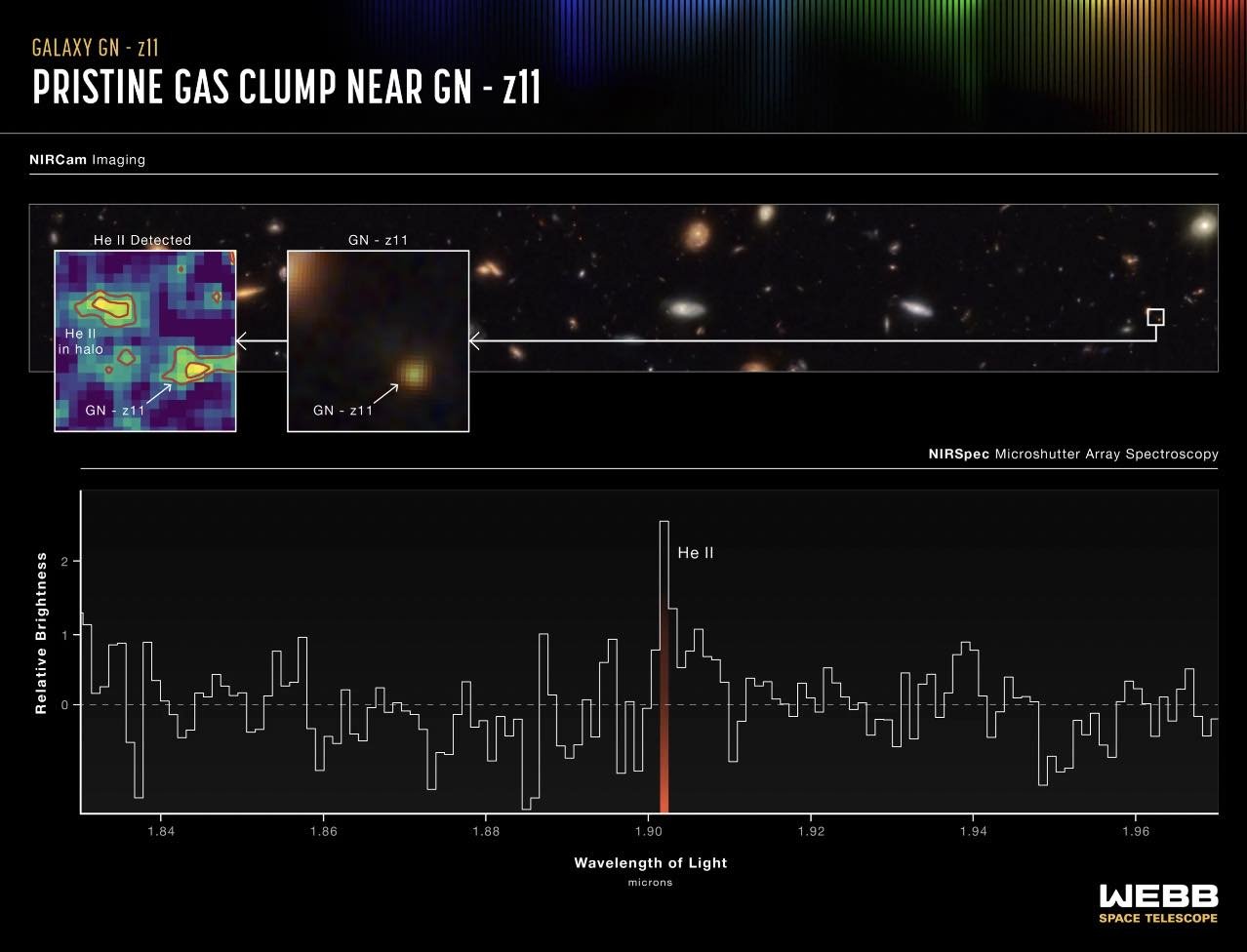
In addition to the revelation of a supermassive black hole at the galaxy’s center, Maoilino also says that an intriguing region of helium was discovered in the halo around GN-z11, which is consistent with existing theories about galaxies from this early stage in the universe.
Evidence of a gaseous clump of helium in the halo surrounding galaxy GN-z11 is revealed in data (above) collected by the James Webb Space Telescope (Credit: NASA, ESA, CSA, Ralf Crawford (STScI)).
“This is something that was expected by theory and simulations in the vicinity of particularly massive galaxies from these epochs,” Maoilino says, adding that “there should be pockets of pristine gas surviving in the halo, and these may collapse and form Population III star clusters.”
Such a discovery is extremely significant in astronomy, since it involves Population III stars, made mostly from hydrogen and helium and among the earliest ever to have formed, the discovery of which is a key area of research for astrophysicists.
Current theories expect Population III stars to be very hot and equally luminous, with signatures conveying an abundance of ionized helium. Going forward, Maiolino and Übler hope that their team’s ongoing observations will help them determine whether they have indeed observed Population III stars in the gaseous halo surrounding GN-z11.
Fundamentally, studying the earliest known stars grants astronomers a unique view of a period of significant change in our universe, where it emerged from a mostly dark and simplistic state to the far more structured version of the cosmos we observe in modern times.
Maiolino, Übler, and their team’s new study on GN-z11’s supermassive black hole was published earlier this year in the journal Nature.
Curiosity Rover is Climbing Through Dramatic Striped Terrain on Mars
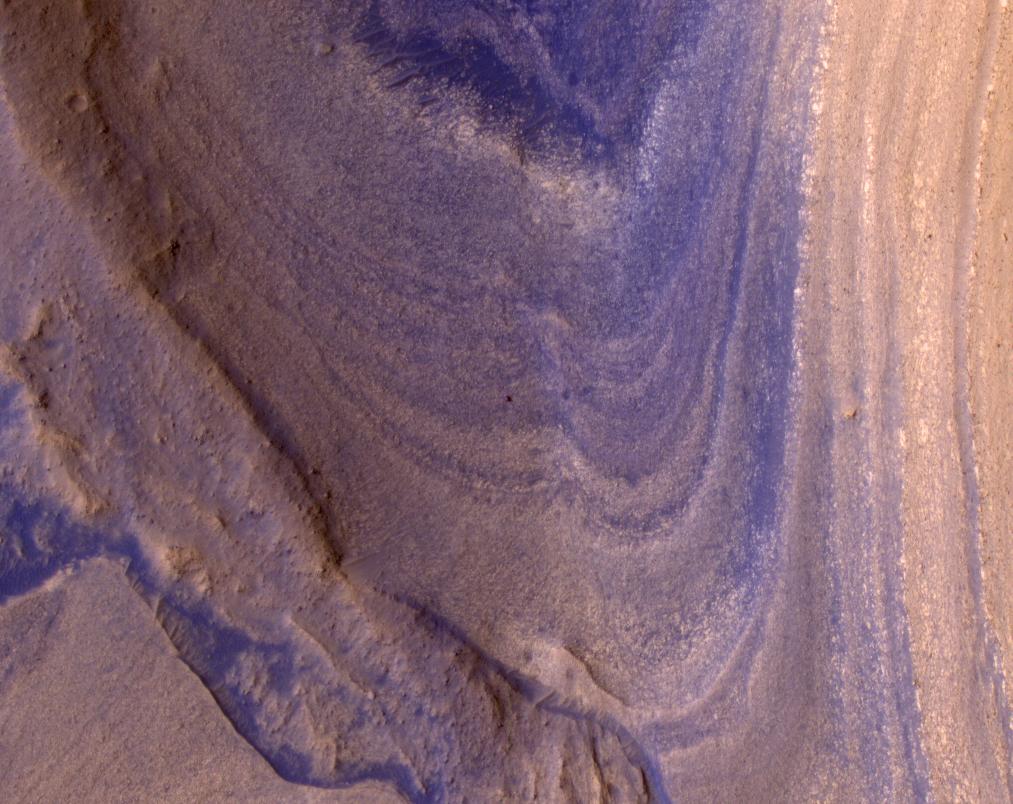
Just about every day we here on Earth get a breathtaking picture of Mars’s terrain sent back by a rover. But, the view from space can be pretty amazing, too. The Mars Reconnaissance Orbiter (MRO) just sent back a thought-provoking picture of Curiosity as it makes its way up a steep ridge on Mount Sharp.
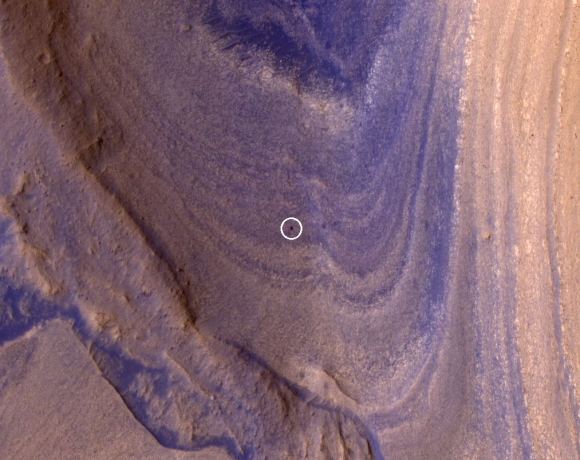
The rover is a tiny black dot in the center of the image, which gives a good feeling for what MRO’s HiRISE camera accomplished. For scale, the rover is about the size of a dinner table, sitting in a region of alternating dark and light bands of material on the Red Planet.
NASA’s Curiosity Mars rover appears as a dark speck in this image captured from directly overhead by the agency’s Mars Reconnaissance Orbiter, or MRO. Credit: NASA/JPL-Caltech/University of Arizona
Where’s Curiosity?
The Curiosity rover is exploring an ancient ridge on the side of Mount Sharp, which is the peak of a crater on Mars. It’s sitting on the side of a feature called Gediz Vallis Ridge, and the terrains and materials preserve a record of what things were like when water last flowed there. That happened about three billion years ago. The force of the flow brought significant amounts of rocks and debris through the region. They piled up to form the ridge. So, much of what you see here is the desiccated remains of that flooding.
Debris flows are pretty common here on Earth, particularly in the aftermath of floods, volcanic eruptions, tsunamis, and other actions. We can see them wherever material floods through a region or down a slope. In a flood-based flow, the speed of the water combines with gravity and the degree of slope to send material rushing across the surface. A debris flow can also be a dry landslide, and those can occur pretty much anywhere on Earth where the conditions are right. Another type of debris flow comes from volcanic activity. That occurs when material erupts from a volcano, or when earthquakes combined with an eruption collapse material into the side of the mountain. That results in what’s called a “lahar”. Folks in North America might recall the Mount St. Helens eruption in 1980; it resulted in several lahars that buried parts of the surrounding terrain.
Now that scientists see similar-seeming regions on Mars, they want to know several things. How did they form? Were they created by the same processes that make them on Earth? And, how long ago did they begin to form? Curiosity and Perseverance and other rovers and landers have been sent to Mars to help answer those questions.
Understanding the Debris Ridge
Did any of these actions happen on Mars? The evidence is pretty strong, which is why Gediz Vallis itself is a major exploration goal for the rover. It’s a canyon that stretches across 9 kilometers of the Martian surface and is carved about 140 meters deep. Gediz was likely carved by so-called “fluvial” activity (meaning flowing action) in the beginning. Later floods deposited a variety of fine-grained sands and rocks. Over time, winds have blown a lot of that material away, leaving behind protected pockets of materials left behind by the flooding. The size of the rocks tells something about the speed of the flows that deposited all the material. Geological studies of those rocks will reveal their mineral compositions, including their exposure to water over time.
The Gediz Vallis ridge resulted from the action of water pushing rocks and dirt around to build it up over time. Planetary scientists now need to figure out the sequence of events that created it. The clues lie in the scattered rocks in the region and the surrounding terrain. Mount Sharp itself (formally known as Aeolis Mons), is about 5 kilometers high and is, essentially, a stack of layered sedimentary rocks. As Curiosity makes its way up the mountain, it explores younger and younger materials.
NASA’s Curiosity captured this 360-degree panorama while parked below Gediz Vallis Ridge (seen at right), a formation that preserves a record of one of the last wet periods seen on this part of Mars. After previous attempts, the rover finally reached the ridge on its fourth try. Credits: NASA/JPL-Caltech/MSSS.
Curiosity’s Mission at Gediz
To put all this on a larger scale, Mount Sharp is the central peak of Gale Crater. It formed some 3.5 to 3.8 billion years ago from an impact. As time went by, water flooded the crater several times. It flowed out and eventually disappeared as Mars’s climate changed it to the dusty desert we see today.
Winds also played a role in filling the crater with dust and sand deposits. This so-called aeolian activity also helped carve out Mount Sharp. This history of wind- and water-based deposition and erosion made Gale Crater a very attractive place to explore. That’s why Curiosity was sent there and continues its journey up Mount Sharp.
As if the Mars Perseverance Rover and Ingenuity Drone were not exciting enough then the next step in this audacious mission takes it to a whole new level. Mars Sample Return Mission is to follow along, collect and return the samples collected by Perseverance back to Earth. However the status of Mars Sample Return is uncertain as engineers are still working on technology to retrieve the samples. The current challenge is the gripper arm that will collect the samples and stow them safely and securely before transportation without damaging them.
Mars, known as the “Red Planet,” is the fourth planet from the Sun. It’s named after the Roman god of war and has fascinated humans for centuries. The distinctive rusty-red colour and mysterious terrain has over the years, led many to believe Mars was inhabited by aliens. Exploration has shown us though that Mars is a barren landscape that is home to Olympus Mons, the largest volcano, and Valles Marineris, the deepest canyon, in the solar system.
Featured Image: True-color image of the Red Planet taken on October 10, 2014, by India’s Mars Orbiter mission from 76,000 kilometers (47,224 miles) away. (Credit: ISRO/ISSDC/Justin Cowart) (This file is licensed under the Creative Commons Attribution 2.0 Generic license.)
Viking 1 was the first spacecraft to visit Mars, successfully touching down on 20 July 1976 in the Chryse Planitia region. It comprised an orbiter and lander both of which were equipped with high resolution cameras to undertake a detailed examination of the Martian surface and atmosphere. A host of other spacecraft have visited Mars since then, most recently the Perseverance rover which carried with it the Ingenuity aircraft.
One of the mission objectives of Perseverance was to collect samples from Martian rocks and soil using the onboard drill. The samples were collected during a process known as ‘sample caching’ and then stored in tubes before being deposited on the surface for later collection. It’s a procedure that has never been undertaken before but set the foundations for future missions to collect and transport the samples back to Earth. Perseverance has been busy, there are now 23 titanium tubes sat on the Martian surface just waiting to be delivered back to Earth.
Mars Perseverence rover sent back this image of its parking spot during Mars Solar Conjunction. Courtesy NASA/JPL-Caltech
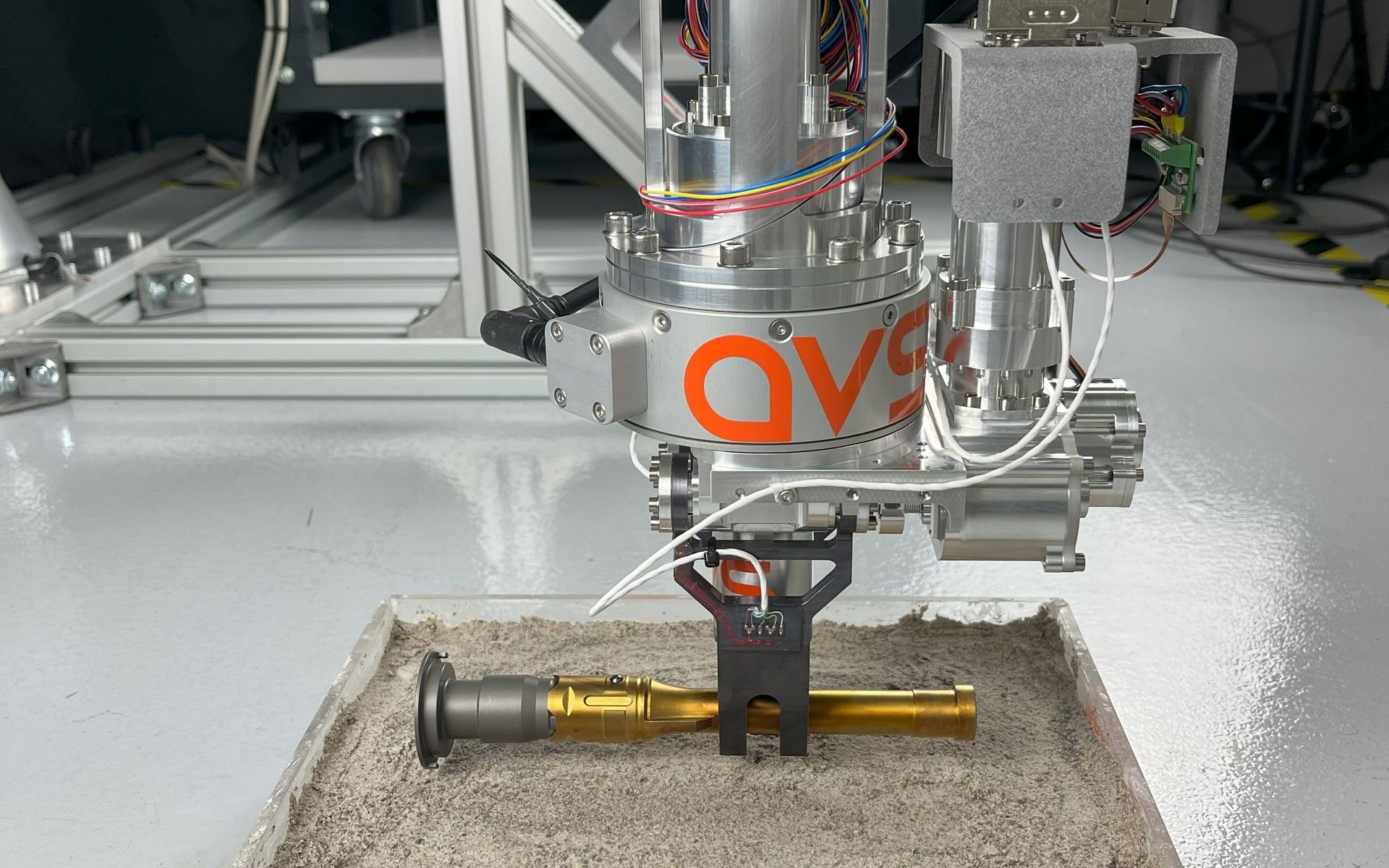
Enter Mars Sample Return mission, a joint NASA and ESA project that is planned to collect the tubes and bring them home for study. Engineers are now working on a prototype robotic arm that will collect the tubes from the surface. It uses a grip with two ‘fingers’ to pickup the hermetically sealed tubes from various angles and positions. There is a mechanism that ensures enough grip to pickup but not damage the tube or its contents which are Martian samples about the size of a piece of classroom chalk. It can even collect them direct from the rover itself.
As with all space missions, backup plans must always be considered. In the case of the the Sample Return mission the backup is likely to be two helicopters based on the Ingenuity design that can collect the tubes and deposit them in front of the lander for collection. An audacious mission perhaps but we will have to wait until 2028 to see the lander on Mars and until 2033 for the samples to be returned to Earth.
Massive Stars Have the Power to Shape Solar Systems
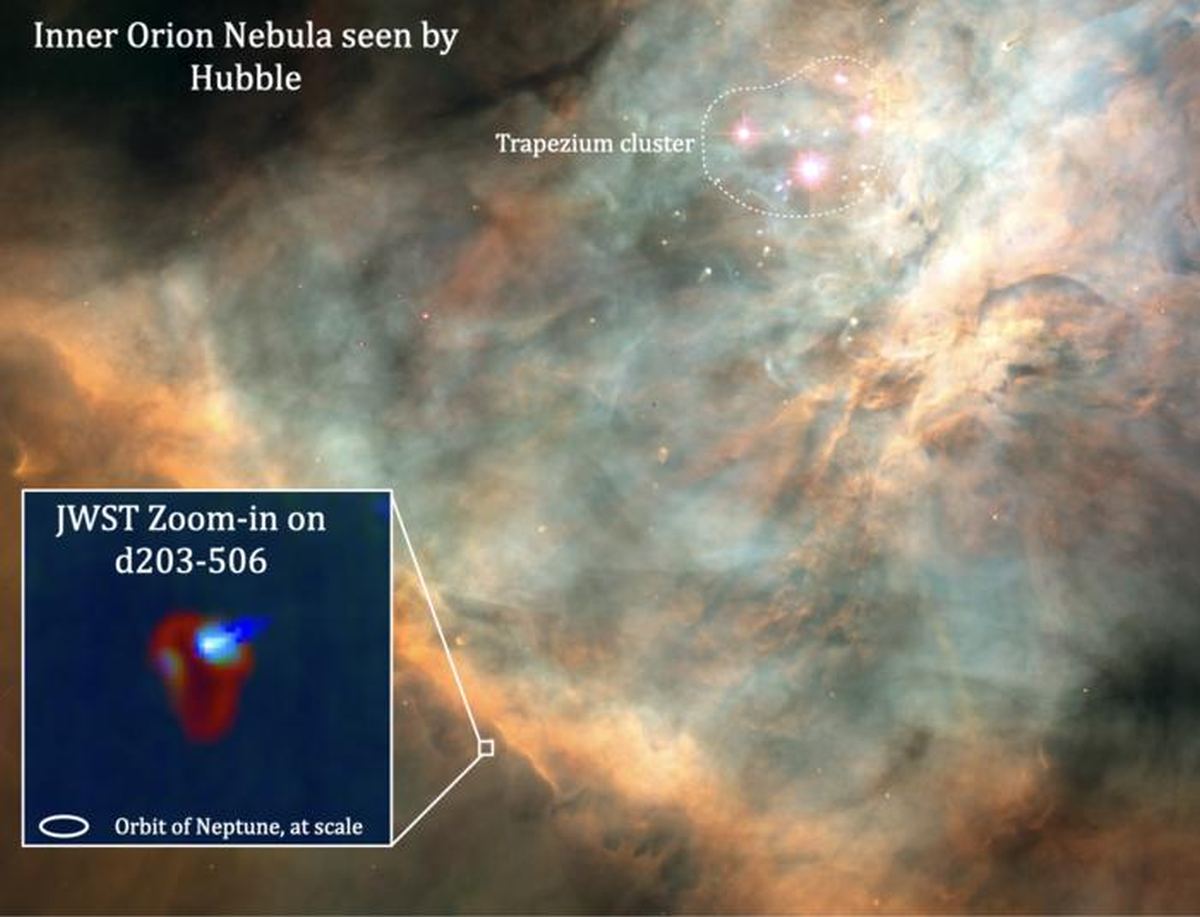
This image is a Hubble image of the inner regions in the Orion Nebula, with a JWST image of a protoplanetary disk named d203-506. The disk is close enough to the massive Trapezium Cluster stars that their UV radiation is shaping the planet-forming process in the disk. Image Credit: NASA/STSCI/RICE UNIV./C.O'DELL ET AL / O. BERNÉ, I. SCHROTTER, PDRS4ALL
Massive Stars Have the Power to Shape Solar Systems
Stars shape their solar systems. It’s true of ours, and it’s true of others. But for some massive stars, their power to shape still-forming systems is fateful and final.
In their youth, stars are surrounded by a rotating mass of gas and dust called a protoplanetary disk. Planets form in these disks, and the process can take millions of years. But stars have different masses and different radiation outputs that affect how planets form, or if they form at all.
New research examines how the powerful UV radiation from massive stars affects planet formation in disks. The research article is “A far-ultraviolet–driven photoevaporation flow observed in a protoplanetary disk.” It’s published in the journal Science, and the lead author is Olivier Berne from the Institute for Research in Astrophysics and Planetology, University of Toulouse, France.
The research looks at large stars in their first million years of life, when they’re not only young but extremely luminous. The researchers focused on several stars in the Orion Nebula and its stellar nurseries. The stars are at least ten times more massive than the Sun and are 10,000 times more luminous. What effect does their luminosity and all that radiation have on disks where planets form?
These powerful young stars emit high levels of Far-Ultraviolet (FUV) radiation, which has the power to remove mass from planet-forming disks. This power extends beyond their own immediate surroundings into the disks around neighbouring low-mass stars.
“Most low-mass stars form in stellar clusters that also contain massive stars, which are sources of far ultraviolet (FUV) radiation,” the researchers explain. “Theoretical models predict that this FUV radiation produces photodissociation regions (PDRs) on the surfaces of protoplanetary disks around low-mass stars, which affects planet formation within the disks.” The PDRs can span several hundred astronomical units (AU).
The researchers examined one protoplanetary disk that’s within range of energetic, high-mass stars residing in the Trapezium Cluster in the heart of the Orion Nebula. The five brightest stars in that cluster range from 15 to 30 solar masses, making them prime candidates to study PDRs in neighbouring planet-forming disks. The Orion Bar PDR is an often-studied and prototypical PDR.
The Orion Nebula. The Trapezium Cluster is above and to the right of the three stars in Orion’s Belt in this image. The stars in Trapezium are mostly responsible for illuminating Orion, and their powerful FUV energy can strip gas from the protoplanetary disks surrounding lower-mass stars nearby. Image Credit: NASA, ESA, M. Robberto (Space Telescope Science Institute/ESA) and the Hubble Space Telescope Orion Treasury Project Team, Public domain, via Wikimedia Commons
The disk in the image, d203-506, is being bombarded by intense FUV radiation from the massive Trapezium stars. The FUV radiation is dispersing matter in the disk, inhibiting planet formation. According to the research, it’s impossible for a Jupiter-mass planet to form in this disk because the radiation is stripping matter away.
This figure from the research has an optical image from Hubble on the left. On the right is a JWST NIR image of the same region, including a zoomed-in view of the d203-506 disk. The dotted line marks a feature named the Orion Bar PDR. On the upper right of the Bar, the gas is fully ionized, and on the lower left, the gas is neutral. The smaller inset image of the disk shows a bright spot where jets from the embedded star are sending material out into space. Image Credit: Berne et al. 2024.
“Planet formation is limited by processes that remove mass from the disk, such as photoevaporation,” the authors write. “This occurs when the upper layers of protoplanetary disks are heated by x-ray or ultraviolet photons.” Once heated, the gas exceeds the escape velocity of the disk, and the gas leaves the system.
After the radiation drives mass out of the disk, it collects in a diffuse envelope around the disk.
This schematic from the research illustrates some of the forces involved in the d203-506 planet-forming disk. Features like the bright spot and the jets are visible but unlabelled in the JWST images preceding this one. The brown arrows show gas being driven out of the disk by the FUV radiation, which produces the tan envelope around the disk. The orange outline is the dissociation front. Image Credit: Berne et al. 2024.
The powerful FUV radiation dissociates molecular hydrogen into atomic hydrogen. The PDR marks the transition between molecular and atomic hydrogen. As the hydrogen is converted into atomic hydrogen, it becomes warmer, and the heating helps drive the photoevaporation of the hydrogen.
When the star inside the affected disk is more massive, that helps restrict the loss of hydrogen from the disk. Its gravity can help the disk retain matter, making it available for planet formation.
This all plays out relatively quickly in a disk. In the d203-506 disk, the star is only about 0.3 solar masses. The researchers write that in only about 0.13 million years, enough material will be removed from the disk to prohibit the formation of a Jupiter-mass planet. “This is faster than even very early planet formation,” the researchers write.
But powerful FUV radiation and the PDRs they produce do more than just inhibit the formation of gas giants. They shape other aspects of the future solar system as well.
“The effect affects the disk mass, radius, and lifetime, its chemical evolution, and the growth and migration of any planets forming within the disk,” the authors explain.
Europa Produce Less Oxygen than Previously Thought
Europa Produce Less Oxygen than Previously Thought
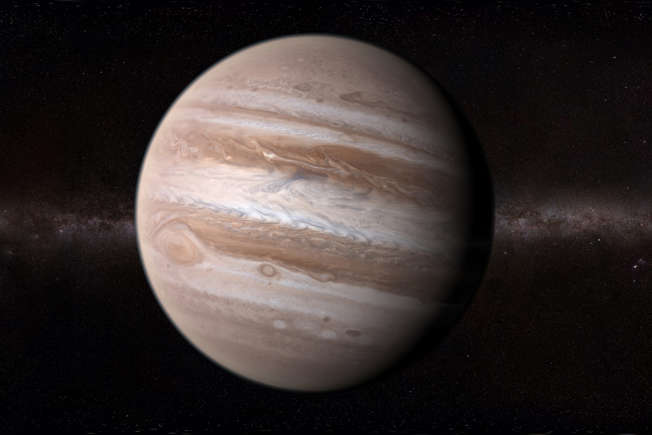
Using data from the Jovian Auroral Distributions Experiment (JADE) instrument onboard NASA’s Juno spacecraft, planetary scientists have calculated the rate of oxygen being produced at Jupiter’s icy moon Europa to be substantially less than most previous studies.
This illustration shows charged particles from Jupiter impacting Europa’s surface, splitting frozen water molecules into oxygen and hydrogen molecules; scientists believe some of these newly created oxygen gases could migrate toward the moon’s subsurface ocean, as depicted in the inset image.
Image credit: NASA / JPL-Caltech / SWRI / PU.
With an equatorial diameter of 3,100 km (1,940 miles), Europa is the fourth largest of Jupiter’s 95 known moons and the smallest of the four Galilean satellites.
The moon hosts an internal liquid ocean with potentially habitable conditions below a frozen crust.
Its surface is constantly bombarded by radiation that breaks the icy crust into oxygen and hydrogen, most of which are freed from the surface, escaping into space, or remain behind to form Europa’s atmosphere.
The abundance of these atmospheric gases and ions — and consequently their production rate at the surface — has mostly been inferred by remote sensing observations and has large uncertainties.
“Europa is like an ice ball slowly losing its water in a flowing stream,” said JADE scientist Dr. Jamey Szalay, a researcher at Princeton University.
“Except, in this case, the stream is a fluid of ionized particles swept around Jupiter by its extraordinary magnetic field.”
“When these ionized particles impact Europa, they break up the water-ice molecule by molecule on the surface to produce hydrogen and oxygen.”
“In a way, the entire ice shell is being continuously eroded by waves of charged particles washing up upon it.”
In the new study, Dr. Szalay and colleagues analyzed data from a flyby of Europa performed by the Juno spacecraft on September 29, 2022, which saw the spacecraft fly 353 km (219 miles) above Europa’s surface.
Using the JADE instrument, they extracted the abundance of various pickup ions, which are charged particles generated by the breakup of atmospheric neutrals when they collide with energetic radiation or other particles.
From these data, they calculate that approximately 12 kg of oxygen are produced at Europa’s surface every second.
This is at the lower end of the expectations inferred from previous models that ranged from 5 to 1,100 kg per second.
The results indicate there may be less oxygen on Europa’s surface than previously thought, and that this implies a narrower range to support habitability in Europa’s ocean.
“Our ability to fly close to the Galilean satellites during our extended mission allowed us to start tackling a breadth of science, including some unique opportunities to contribute to the investigation of Europa’s habitability,” said Juno’s principal investigator Dr. Scott Bolton, a researcher at the Southwest Research Institute.
“And we’re not done yet. More moon flybys and the first exploration of Jupiter’s close ring and polar atmosphere are yet to come.”
The findings were published in the journal Nature Astronomy.
J.R. Szalay et al. Oxygen production from dissociation of Europa’s water-ice surface. Nat Astron, published online March 4, 2024; doi: 10.1038/s41550-024-02206-x
SpaceX and NASA recently performed full-scale qualification testing of the docking system that will connect SpaceX’s Starship Human Landing System (HLS) with Orion and later Gateway in lunar orbit during future crewed Artemis missions. Based on the flight-proven Dragon 2 active docking system, the Starship HLS docking system will be able to act as an active or passive system during docking. Image Credit: SpaceX
The Apollo Program delivered 12 American astronauts to the surface of the Moon. But that program ended in 1972, and since then, no human beings have visited. But Artemis will change that. And instead of just visiting the Moon, Artemis’ aim is to establish a longer-term presence on the Moon. That requires more complexity than Apollo did. Astronauts will need to transfer between vehicles.
All of that activity requires a reliable spacecraft docking system.
When Artemis astronauts blast off from Earth, they’ll be in the four-seat Orion spacecraft. Orion will take them to lunar orbit, where two will transfer into the Starship HLS, and two will remain in Orion. Starship HLS will deliver them to the lunar surface. In the future, the Lunar Gateway will be in orbit around the Moon, and astronauts will move from Orion to the Gateway to the Starship HLS.
These transfers are complicated and risky maneuvers. The docking system that will make this work is called SpaceX’s Starship HLS docking system. It’s based on SpaceX’s successful Dragon 2 docking system. The Dragon 2 system allows the Dragon 2 spacecraft to dock with the ISS so crew and equipment can be transferred. It’s been in use since 2020.
NASA and SpaceX are busy testing the new Starship HLS docking system. They recently completed ten days of testing at the Johnson Space Centre in Houston, Texas. They conducted more than 200 different docking scenarios involving different speeds and angles. The results from this full-scale testing will feed into ongoing computer models of the system, which will, in turn, feed into future testing and design.
This graphic shows the Artemis III Concept of Operations. Docking and crew transfers are a critical stage in the missions. Image Credit: NASA
The system has both an active and a passive mode. When two spacecraft dock, one is active, and the other is passive. The active one is called the chaser, and the other is the target.
During this round of tests, NASA and SpaceX demonstrated the soft capture procedure. In passive capture, the chaser extends its soft capture system (SCS) while the target spacecraft’s system remains retracted. The chaser does all the work, employing latches and other mechanisms to grab the target spacecraft and complete the docking.
HLS requirements state that there must be redundancy in crew egress/ingress. The soft capture procedure seems to address this if the docking system works while one docking system remains retracted.
This is just the latest round of tests. SpaceX has already reached a series of important milestones for the Starship HLS. Those milestones involved power generation, communications, guidance and navigation, propulsion, life support, and space environments protection.
While watching powerful rockets being tested and launched takes up a lot of attention, there’s far more to successful missions than just launch vehicles. According to NASA, “the Human Landing System program is at the center of Artemis, designed to yield groundbreaking science, develop and utilize lunar surface resources and leverage what we learn at the Moon for future Mars missions.” Docking systems might not garner much attention, but they’re obviously a critical part of success.
Through that lens, any progress on Artemis is good news because, on other fronts, the news is not always good. Artemis was initially scheduled to launch in 2025. But it’ll be at least a year late, and NASA says that SpaceX will need to perform more launches before the Artemis mission is given the go-ahead.
How Startups on Earth Could Blaze a Trail for Cities on Mars
If future explorers manage to set up communities on Mars, how will they pay their way? What’s likely to be the Red Planet’s primary export? Will it be Martian deuterium, sent back to Earth for fusion fuel? Raw materials harvested by Mars-based asteroid miners, as depicted in the “For All Mankind” TV series? Or will future Martians be totally dependent on earthly subsidies?
In a new book titled “The New World on Mars,” Robert Zubrin — the president of the Mars Society and a tireless advocate for space settlement — says Mars’ most valuable product will be inventions.
“We’re talking about creating a new and potentially extremely inventive branch of human civilization, which will benefit humanity as a whole enormously,” he says in the latest episode of the Fiction Science podcast. “But moreover, we’ll play from that strength to make money.”
Zubrin isn’t waiting until humans step foot on Mars to get started.
“We are in the process of drawing up business plans for two major initiatives — one in the artificial intelligence area and the other in the synthetic food production area,” he says. “And the idea is, fairly soon we’re going to be presenting these business plans to investors, with the idea of starting companies devoted to these two different technological ideas that we have put together.”
Zubrin says it’s too early to reveal exactly what these companies would do, but he claims the ventures have the potential to become extremely profitable. The AI concept could be “a billion-dollar idea,” he says.
“They’re both addressing critical questions for Mars that have tremendous terrestrial spin-off potential,” Zubrin says.
Income from the ventures would be split between investors and the Mars Society, which would use the funds to support a Mars Technology Institute. “We just did a fundraising drive and raised $150,000 to get this thing started,” Zubrin says.
Robert Zubrin is the founder and president of the Mars Society. (Credit: Mars Society CC BY-SA 3.0)
Once things get rolling, Zubrin envisions setting up a headquarters for the institute — perhaps in the Pacific Northwest or in Colorado (where the Mars Society is currently based).
The concept of using earthly ventures to support off-Earth adventures is by no means new. Back in 2015, when SpaceX founder Elon Musk was recruiting engineers for the Starlink satellite internet network, he said the profits from Starlink would go toward funding a city on Mars.
“Looking in the long term, and saying what’s needed to create a city on Mars — well, one thing’s for sure: a lot of money,” Musk told an audience of about 400 techies (including prospective employees) in Seattle. “So we need things that will generate a lot of money.”
Zubrin says the challenge of establishing settlements on Mars will promote invention in the same way that the challenges facing pioneers in the United States led to innovations ranging from steamboats to light bulbs to iPhones.
“Mars is even going to be much more technologically selective in terms of who goes there, and also a much more challenging environment,” he says. “It’s going to be America to the third power in terms of what it will be able to invent.”
He argues that settlers will be forced to innovate when it comes to developing nuclear fission and fusion plants for energy, finding ways to conserve and recycle resources for sustaining Martian communities, and maximizing food production amid the planet’s harsh conditions. All those innovations can then be exported back to Earth.
Zubrin has laid out the case for Mars settlement in a series of books that goes back to, well, “The Case for Mars” in 1996. He also wrote a fictional account of a crewed mission to Mars, titled “First Landing.” And he has appeared in more than a dozen TV shows about Mars and space exploration, including “Mars,” a National Geographic series that blends science fiction and science fact.
“The New World on Mars” deals with thematic territory that spreads out much more broadly than what was covered in “The Case for Mars.” And Zubrin says SpaceX’s rise is the reason why.
For years, Musk and his team have been focusing on development of a reusable super-heavy-lift launch system known as Starship. The next test flight could take place within weeks — and it’s likely to be only a matter of time before Starship offers a reliable way to get to Earth orbit and beyond. Musk envisions building a fleet of the rockets to send thousands of settlers to Mars, in line with his long-term ambition to make humanity a multiplanet species.
“The New World on Mars: What We Can Create on the Red Planet” by Robert Zubrin. (Diversion Books)
Zubrin assumes that Starship or something like it will be a success — which means there’s less need to dwell on the nuts and bolts of interplanetary transport in “The New World on Mars.”
“This book essentially says, ‘Look, it’s soon going to be possible for humans to go to Mars,’” he says. “So the key question is not how do we do that, but what do we do when we get there?”
Zubrin goes into great detail about how Mars’ harsh realities could affect every aspect of daily life, from energy production and terraforming to marriage and parenthood. For example, he suggests that Martians might clean their clothes simply by airing them out in the Red Planet’s low-pressure, bacteria-killing environment.
Zubrin went so far as to test the technique by stuffing dirty clothes into a laboratory vacuum chamber. “The only downside is that stains are not removed, so they don’t look clean. One remedy for this would be to use camo coloration for clothes, as it does not show stains,” he writes. “I predict this will be the style.”
“The New World on Mars” is more optimistic about Red Planet settlement than “A City on Mars,” a book by Kelly and Zach Weinersmith that was featured on Fiction Science last November. That book argues that the drive to create space settlements is premature — and that a host of uncertainties need to be cleared up first. For example, the Weinersmiths say that much more research should be done on the potential effects of Mars’ reduced gravity on human reproduction and development. They also raise concerns about the potential international conflicts over property rights in space.
As you’d expect, Zubrin strongly disagrees with such views — in his book, on the podcast, and in a book review published by Quillette. “They say there’s no point going into space. There’s nothing to be gained from it, and therefore, there should be laws to stop it, which makes no sense whatsoever,” he says.
In Zubrin’s view, the 1967 Outer Space Treaty’s prohibition on claims of national sovereignty won’t tie the hands of Mars settlers. Instead, it would make it easier for them to stake their own claims. “If a Martian colony is set up, and declares property rights within its vicinity, [governments on Earth] have no jurisdiction to contradict it,” Zubrin says. “They have explicitly signed away their rights to interfere with Mars settlement.”
And what about the health effects of living on Mars? “OK, so yeah, we don’t know about the long-term effects of one-third gravity on people, but we’ll find that out,” Zubrin says. “When we send our first exploration missions to Mars, I believe it’ll be OK.”
The way Zubrin sees it, the main attraction for Mars settlers won’t be deuterium, or asteroid riches, or shiny red obsidian. It’ll be something money can’t buy: the freedom to create.
“I believe that there’s nothing more powerful than the creative power of life,” he says. “The grass finds a way to break through the pavement. Life finds a way. … And freedom is going to find a way.”
Some Intelligent Civilizations Will Be Trapped on their Worlds
With thousands of exoplanets discovered so far, astronomers are learning how different planets can be. What if intelligent alien civilizations arise on extremely different habitable worlds? Some civilizations could develop space exploration technologies, but others would be trapped underwater, under ice, or in enormous gravity wells. How could they escape? Image Credit: DALL-E
Some Intelligent Civilizations Will Be Trapped on their Worlds
Evolution has produced a wondrously diverse variety of lifeforms here on Earth. It just so happens that talking primates with opposable thumbs rose to the top and are building a spacefaring civilization. And we’re land-dwellers. But what about other planets? If the dominant species on an ocean world builds a technological civilization of some sort, would they be able to escape their ocean home and explore space?
We have no way of knowing if other Extraterrestrial Intelligences (ETIs) exist or not. There’s at least some possibility that other civilizations exist, and we’re certainly in no position to say for sure that they don’t. The Drake Equation is one of the tools we use to talk about the existence of ETIs. It’s a kind of structured thought experiment in the form of an equation that allows us to estimate the existence of other active, communicative ETIs. Some of the variables in the Drake Equation (DE) are the star formation rate, the number of planets around those stars, and the fraction of planets that could form life and on which life could evolve to become an ETI.
In his new research article, Quiroga comes up with two new concepts that feed into the DE: the Exoplanet Escape Factor and Fishbowl worlds.
Planets of different masses have different escape velocities. Earth’s escape velocity is 11.2 km/s (kilometres per second), which is more than 40,000 km/h. The escape velocity is for ballistic objects without propulsion, so our rockets don’t actually travel 40,000 km/h. But the escape velocity is useful for comparing different planets because it’s independent of the vehicle used and its propulsion.
“It could therefore be the case that an intelligent species on these planets would never be able to travel into space due to sheer physical impossibility.”
Elio Quiroga, Universidad del Atlántico Medio
Super-Earths have much greater masses and much higher escape velocities. While there’s no exact definition of a Super-Earth’s mass, many sources use the upper bound of 10 Earth masses to define them. So, an ETI on a Super-Earth would be facing a different set of conditions than we do here on Earth when it comes to space travel.
This simple graph from the research article shows how escape velocity rises with planetary mass. The x-axis shows Earth masses, and the y-axis shows the required escape velocity. Image Credit: Quiroga, 2024.
In this work, Quiroga implements the Exoplanet Escape Factor (Fex) and the Exoplanet Escape Velocity (Vex.) By working with them, he arrives at a sample of escape velocities for some known exoplanets. Note that the composition of the planets isn’t critical, only their masses.
This figure from the research shows how easy or difficult it would be to reach space from some known exoplanets. Green indicates that escape is possible, orange indicates likely problems, and red indicates the practical impossibility of space travel. Image Credit: Quiroga 2024.
Quiroga points out that a planet with a Fex value of <0.4 would struggle to hold onto any atmosphere anyway, making life unlikely. Conversely, a Fex value of >2.2 would make space travel unlikely. “Values of Fex > 2.2 would make space travel unlikely for the exoplanet’s inhabitants: they would not be able to leave the planet using any conceivable amount of fuel, nor would a viable rocket structure withstand the pressures involved in the process, at least with the materials we know (as far as we know, the same periodic table of elements and the same combinations of them govern the entire universe).”
“It could, therefore, be the case that an intelligent species on these planets would never be able to travel into space due to sheer physical impossibility,” Quiroga writes. In fact, they may never conceive of the idea of any type of space travel at all. Who knows?
Of course, space exploration isn’t a one-way street. Astronauts have to return from space, and a planet’s mass affects that. Re-entry imposes its own difficulties on a Super-Earth ten times more massive than our planet. The atmospheric density also plays a role. A spacecraft needs to control its velocity and frictional heating when re-entering, and that’s more difficult on a more massive planet, just as escaping is.
Quiroga also talks about the idea of the Fishbowl Worlds. These are the planets above Fex 2.2 from which escape is physically impossible. What could life for an intelligent species be like on a Fishbowl world?
Artist’s impression of the surface of a “Hycean” world. According to Quiroga, if a civilization arose on an ocean world, it could end up being a Fishbowl World where the inhabitants have no chance of ever exploring space. Image Credit: University of Cambridge
In his research article, Quiroga invites us to be speculative with a nod to science fiction. Imagine an ocean world that’s home to an intelligent species. In a fluid environment, unaided communication travels much further than in an atmosphere like Earth’s. Unaided signals could travel for hundreds of kilometres. In an environment like that, “… communication between individuals could be feasible without the need for communication devices,” Quiroga explains. So, the impetus to develop communication technologies might not be there. In that case, Quiroga says, the technology may not have developed and the civilization might not be considered “communicative” at all, one of the keys to the definition of an ETI.
“Telecommunications technology might never emerge on such a world, even though it could be home to a fully developed civilization,” Quiroga writes. “Such a civilization would not be “communicative” and would not be contemplated in the Drake equation.”
Other circumstances could effectively trap civilizations on their homeworlds. On a planet with continuous, unbroken cloud cover, the starry sky would never be visible. How would that affect a civilization? Can you wonder about the stars if you can’t see them and don’t know they’re there? Of course not. A similar thing is true in a binary star system with no nighttime. Stars would never be visible and would never be objects and sources of wonder.
Ocean worlds present a similar conundrum. On ocean worlds or moons with warm oceans and frozen ice shells kilometres thick, any inhabitants would have extremely limited views of the Universe they inhabit. It’s difficult to imagine a technological civilization arising in an ocean under several kilometres of ice. But we’re in no position to judge whether that’s possible or not.
Jupiter’s moon, Europa, has a warm ocean under a thick icy shell. Are there other worlds out there like Europa? What would it be like for intelligent creatures that lived in a world like this? They would never see the stars in the sky, their own stars, or any other planets in their solar systems. (Credit: NASA/JPL/Galileo spacecraft)
Quiroga’s Exoplanet Escape Factor (Fex) can help us imagine what kinds of worlds could host ETIs. It can help us anticipate the factors that prevent or at least inhibit space travel, and it brings more complexity into the Drake Equation. It leads us to the idea of Fishbowl Worlds, inescapable planets that could keep a civilization planet-bound forever.
Without the ability to ever escape their planet and explore their solar systems, and without the ability to communicate beyond their worlds, could entire civilizations rise and fall without ever knowing the Universe they were a part of? Could it happen right under our noses, so to speak, and we’d never know?
Laurent Palka is a microbiologist at France's National Museum of Natural History.
Just over five years ago, on 22 February 2019, an unmanned space probe was placed in orbit around the Moon. Named Beresheet and built by SpaceIL and Israel Aerospace Industries, it was intended to be the first private spacecraft to perform a soft landing. Among the probe’s payload were tardigrades, renowed for their ability to survive in even the harshest climates.
The mission ran into trouble from the start, with the failure of “star tracker” cameras intended to determine the spacecraft’s orientation and thus properly control its motors. Budgetary limitations had imposed a pared-down design, and while the command center was able to work around some problems, things got even trickier on 11 April, the day of the landing.
On the way to the Moon the spacecraft had been travelling at high speed, and it needed to be slowed way down to make a soft landing. Unfortunately during the braking manoeuvre a gyroscope failed, blocking the primary engine. At an altitude of 150 m, Beresheet was still moving at 500 km/h, far too fast to be stopped in time. The impact was violent – the probe shattered and its remains were scattered over a distance of around a hundred metres. We know this because the site was photographed by NASA’s LRO (Lunar Reconnaissance Orbiter) satellite on 22 April.
So what happened to the tardigrades that were travelling on the probe? Given their remarkable abilities to survive situations that would kill pretty much any other animal, could they have contaminated the Moon? Worse, might they be able to reproduce and colonize it?
Tardigrades are microscopic animals that measure less than a millimetre in length. All have neurons, a mouth opening at the end of a retractable proboscis, an intestine containing a microbiota and four pairs of non-articulated legs ending in claws, and most have two eyes. As small as they are, they share a common ancestor with arthropods such as insects and arachnids.
Most tardigrades live in aquatic environments, but they can be found in any environment, even urban ones. Emmanuelle Delagoutte, a researcher at the CNRS, collects them in the mosses and lichens of the Jardin des Plantes in Paris. To be active, feed on microalgae such as chlorella, and move, grow and reproduce, tardigrades need to be surrounded by a film of water. They reproduce sexually or asexually via parthenogenesis (from an unfertilised egg) or even hermaphroditism, when an individual (which possesses both male and female gametes) self-fertilises. Once the egg has hatched, the active life of a tardigrade lasts from 3 to 30 months. A total of 1,265 species have been described, including two fossils.
Tardigrades are famous for their resistance to conditions that exist neither on Earth nor on the Moon. They can shut down their metabolism by losing up to 95% of their body water. Some species synthesise a sugar, trehalose, that acts as an antifreeze, while others synthesise proteins that are thought to incorporate cellular constituents into an amorphous “glassy” network that offers resistance and protection to each cell.
During dehydration, the tardigrade’s body can shrink to half its normal size. The legs disappear, with only the claws still visible. This state, known as cryptobiosis, persists until conditions for active life become favourable again.
Depending on the species of tardigrade, individuals need more or less time to dehydrate and not all specimens of the same species manage to return to active life. Dehydrated adults survive for a few minutes at temperatures as low as -272°C or as high as 150°C, and over the long term at high doses of gamma rays of 1,000 or 4,400 Gray (Gy). By way of comparison, a dose of 10 Gy is fatal for humans, and 40-50,000 Gy sterilises all types of material. However, whatever the dose, radiation kills tardigrade eggs. What’s more, the protection afforded by cryptobiosis is not always clear-cut, as in the case of Milnesium tardigradum, w
An image of a tardigrade as seen under a microscope. (Image credit: STEVE GSCHMEISSNER/SCIENCE PHOTO LIBRARY/Getty Images)
Lunar life?
So what happened to the tardigrades after they crashed on the Moon? Are any of them still viable, buried under the moon’s regolith, the dust that varies in depth from a few metres to several dozen metres?
First of all, they have to have survived the impact. Laboratory tests have shown that frozen specimens of the Hypsibius dujardini species travelling at 3,000 km/h in a vacuum were fatally damaged when they smashed into sand. However, they survived impacts of 2,600 km/h or less – and their “hard landing” on the Moon, unwanted or not, was far slower.
The Moon’s surface is not protected from solar particles and cosmic rays, particularly gamma rays, but here too, the tardigrades would be able to resist. In fact, Robert Wimmer-Schweingruber, professor at the University of Kiel in Germany, and his team have shown that the doses of gamma rays hitting the lunar surface were permanent but low compared with the doses mentioned above – 10 years’ exposure to Lunar gamma rays would correspond to a total dose of around 1 Gy.
But then there’s the question of “life” on the Moon. The tardigrades would have to withstand a lack of water as well as temperatures ranging from -170 to -190°C during the lunar night and 100 to 120°C during the day. A lunar day or night lasts a long time, just under 15 Earth days. The probe itself wasn’t designed to withstand such extremes and even if it hadn’t crashed, it would have ceased all activity after just a few Earth days.
Unfortunately for the tardigrades, they can’t overcome the lack of liquid water, oxygen and microalgae – they would never be able to reactivate, much less reproduce. Their colonising the Moon is thus impossible. Still, inactive specimens are on lunar soil and their presence raises ethical questions, as Matthew Silk, an ecologist at the University of Edinburgh, points out. Moreover, at a time when space exploration is taking off in all directions, contaminating other planets could mean that we would lose the opportunity to detect extraterrestrial life.
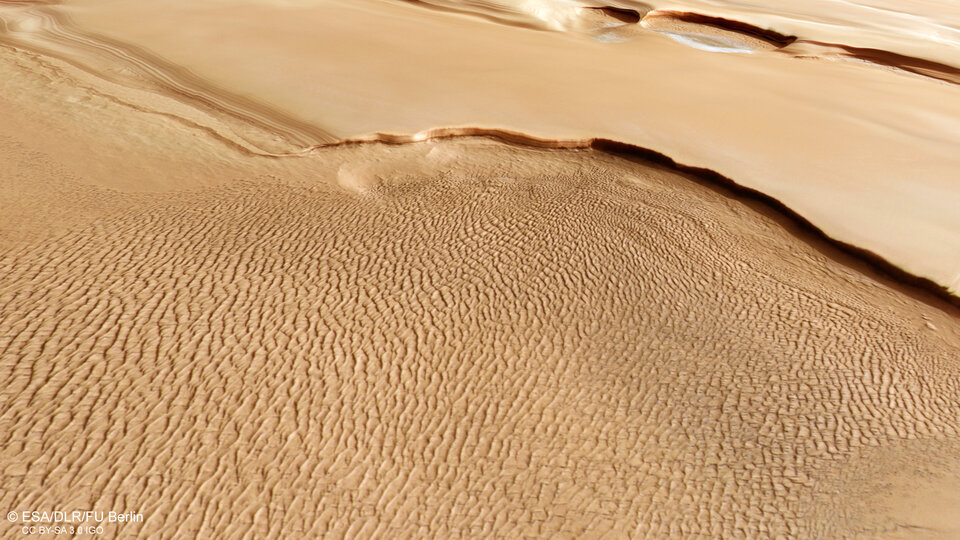
This image from ESA’s Mars Express shows an area close to Mars’ north pole. The image comprises data gathered by Mars Express’ High Resolution Stereo Camera (HRSC) on April 14, 2023.
Image credit: ESA / DLR / FU Berlin.
Mars’ permanent north polar ice cap is a stack of water ice and dust layers up to 3 km thick and approximately 1,000 km in diameter.
These are divided into four stacked ‘packets’ of different thicknesses, which in turn are made up of finer layers
These layers contain information about the climate dating back several million years in the history of Mars.
The deposits were formed by atmospheric precipitation of dust and water ice and by direct frost formation.
They consist mainly of water ice, with fine dust sediments making up between 10 and 15% of the total.
They probably reflect changes in the orbit of Mars and the inclination of the planet’s axis of rotation, whose orientation is much more unstable than that of the Earth.
It varies in several cycles with periods ranging from a few thousand to a few million years.
The varying solar radiation results in a strongly varying climate, especially at the poles. It is assumed that the north polar ice cap is currently growing.
“The terrain surrounding Mars’ north pole, known as Planum Boreum, is fascinating,” said members of the Mars Express team.
“The pole itself is covered in layers and layers of fine dust and water ice; these stack several km thick and stretch out for around 1,000 km.”
“While most of this material is not visible here, you can see the beginnings of Planum Boreum to the right of the frame, with some subtle wrinkling showing where layers of material are starting to build up.”
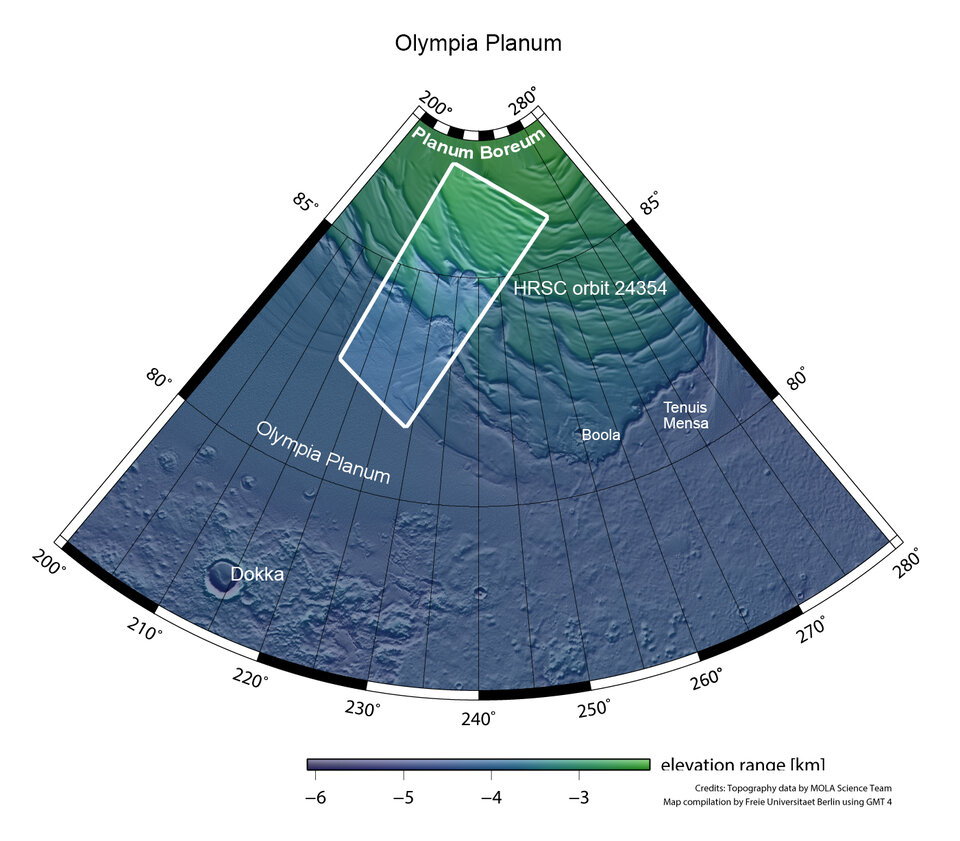
“Ground has also built up more starkly in steps, as is most clearly visible in the topographic view of this region below.”
“The lowest altitude regions are blue/green and the highest are red/white/brown.”
“These layers formed as a mix of dust, water ice and frost settled on the Martian ground over time.”
“Each layer holds valuable information about Mars’ history, telling the story of how the planet’s climate has changed over the past few million years.”
“In Martian winter, the layers are topped by a thin cap of carbon dioxide ice a couple of meters thick. This cap completely disappears to the atmosphere each Martian summer.”
The left part of the image is dominated by a vast, elongated swathe of rippled sand dunes, stretching out for more than 150 km within this frame alone.
This wrinkled, turbulent appearance is highly at odds with the smooth and more pristine terrain visible to the right.
This smooth region lacks clear signs of erosion and has avoided being hit by incoming rocks from space — an indicator that the surface is very young, likely rejuvenating every year.
“Between these two extremes sit two semicircular cliffs, the larger of which is around 20 km wide,” the researchers said.
“Within the curves of these cliffs sit frost-covered sand dunes.”
“The grand scale of the cliffs is clear from the dark shadows they cast on the surface below — their steep, icy walls tower up to a kilometer high.”
“These two cliffs are located at a so-called polar trough, a feature created as wind pushes into and wears away the surface.”
“These show up as rippled ridges in the terrain and are common in this region, creating the distinctive spiral-like pattern of the polar plateau.”
Amerikaanse maanlander Odysseus stuurt (wellicht) laatste foto vanop de maan:
Amerikaanse maanlander Odysseus stuurt (wellicht) laatste foto vanop de maan: "Slaap zacht, Odie"
Artikel door Wim De Maeseneer
"Slaap zacht, Odie. We hopen nog van je te horen." Op het socialemediakanaal X heeft het Amerikaanse bedrijf Intuitive Machines de (wellicht) laatste foto gepost die zijn maanlander Odysseus heeft kunnen maken vanop de maan.
"Voor de stroom helemaal leeg was, kon Odysseus nog een passend afscheid verzenden", schrijft het bedrijf bij de foto. "Deze foto, van 22 februari (de dag van de landing, red.), die we vandaag hebben ontvangen, is een subtiele herinnering aan de aanwezigheid van de mensheid in het heelal."
Intussen is de nacht aangebroken op de maan en krijgen de zonnepalen geen stroom meer. De kans dat het ruimtetuig na de lange maannacht, die 14 dagen duurt, opnieuw ontwaakt, is klein. Het ruimtetuig is niet ontworpen om de extreem ijskoude temperaturen te overleven. Op de zuidpool van de maan kan het tot min 230 graden Celsius worden.
Maar het is ook niet helemaal uitgesloten. De Japanse maanlander, die op 19 januari op het maanoppervlak landde, heeft zijn eerste maannacht verrassend genoeg wel overleefd. Met dat verschil dat het Japanse ruimtetuig dichter bij de evenaar geland is, waar het 's nachts zo'n 100 graden minder koud wordt.
Intuitive Machines hoopt in elk geval dat Odysseus over 3 weken, wanneer de zon hoog genoeg staat, opnieuw zal ontwaken. Het bedrijf heeft gisteren nog software in de maanlander kunnen programmeren, zodat hij zelf een teken geeft wanneer hij terug ontwaakt.
Gebroken landingspoot
Odysseus zal de geschiedenis ingaan als de eerste maanlander van een privébedrijf die erin geslaagd is om te landen op de maan. De eerdere pogingen van andere bedrijven waren telkens mislukt. Het is ook de eerste Amerikaanse maanlanding in meer dan 50 jaar.
De landing zelf liep nochtans niet van een leien dakje. Enkele uren voor de afdaling ontdekte het team dat er iets fout was met de hoogte- en snelheidsmeters.
Er werd een oplossing gevonden, waardoor de maanlander uiteindelijk toch zacht kon landen, maar niet helemaal zoals gehoopt. Het toestel kwam harder neer dan gepland en 1 van de landingspoten brak af, waardoor Odysseus op zijn zij kantelde.
Eerst werd gedacht dat de missie daardoor enkele dagen minder lang zou duren. Uiteindelijk heeft Odysseus het toch uitgehouden tot de laatste zonnestralen op de zonnepanelen vielen.
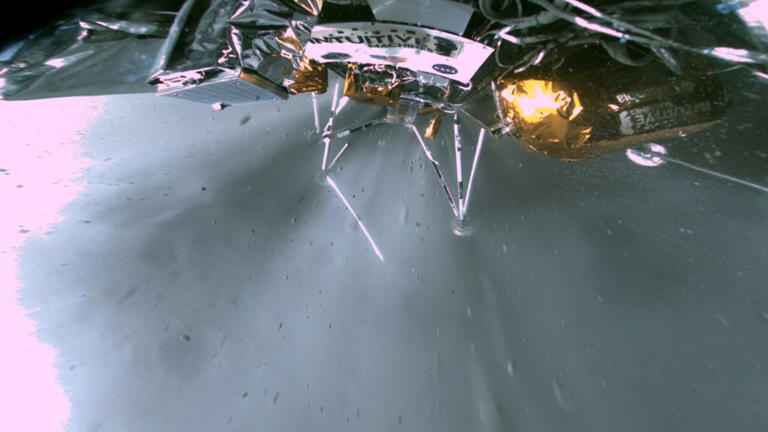
Op deze foto is te zien hoe één van de landingspoten afbreekt tijdens de landing op het maanoppervlak
Intuitive Machines is 1 van de bedrijven die in opdracht van de Amerikaanse ruimtevaartorganisatie NASA meewerkt aan het uiteindelijke doel om opnieuw astronauten op de maan te zetten. Het bedrijf sloot in 2019 een contract om voor 118 miljoen dollar (ruim 108 miljoen euro) een maanlander te bouwen en 6 NASA-experimenten mee naar de maan te vervoeren.
Alle 6 de instrumenten hebben intussen ook wetenschappelijke gegevens kunnen verzamelen en verzenden. NASA spreekt daarom van een geslaagde missie.
Tijdens de vlucht naar de maan is ook voor de eerste keer met succes een raketmotor op vloeibare methaan en zuurstof ontstoken in de ruimte. Dat is ook de technologie in de motoren van de (voorlopig nog experimentele) Starship-raket die SpaceX naar de maan én naar Mars hoopt te sturen.
Methaan past in de langetermijnstrategie om ooit mensen naar Mars te brengen, omdat er methaan kan worden aangemaakt op de rode planeet. Op die manier zouden astronauten op Mars zelf hun brandstof kunnen maken om terug naar de aarde te vliegen.
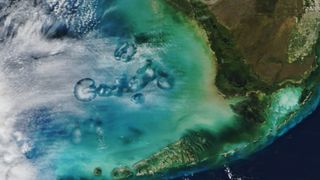
A NASA satellite recently spotted a series of bizarre "fallstreak holes" in clouds above Florida. The circular cloud gaps have been previously (and incorrectly) linked to paranormal phenomena.
The strange, circular holeswere captured by NASA's Terra satellite above the Gulf of Mexico on Jan. 30.
(Image credit: NASA Earth Observatory/Michala Garrison/MODIS)
A cluster of eerily circular holes recently appeared in the clouds above Florida, a stunning new NASA image shows. The rare occurrence, which has previously (and incorrectly) been linked to UFOs, has a surprisingly simple explanation — but it took scientists more than 60 years to figure it out.
NASA's Terra satellite photographed the bizarre voids, known as fallstreak holes or hole-punch clouds, above the Gulf of Mexico off Florida's west coast on Jan. 30. NASA's Earth Observatory revealed the striking image on Feb. 26.
Unusual, circular holes like these ones first began to appear in the 1940s, sparking wild theories that they were the result of UFOs, according to the Earth Observatory. However, they are actually created by airplanes flying through the clouds.
There are two types of clouds in the new photos: cavum clouds, which are large, circular holes; and canal clouds, which have a more oblong shape. Both types most commonly occur in altocumulus clouds — supercooled bands of water vapor that float in the sky between 7,000 and 18,000 feet (2,100 and 5,500 meters) above the surface, much higher than most rain clouds.
Altocumulus clouds can be as cold as around 5 degrees Fahrenheit (minus 15 degrees Celsius) without their water droplets freezing. This is because there are fewer small particles, such as dust and pollen, at that altitude, which are needed for ice crystals to form in the air.
However, when air moves around the wings or past the propellers of airplanes, it can further cool the surrounding water vapor by as much as 36 F (20 C). At these extremely low temperatures, the droplets freeze even without particles to form around and begin to fall below the holes, creating wispy strands of cloud, known as virga.
These wispy clouds often hang below the holes they fell from and can be seen at the heart of the misty voids when viewed from above.
From below, fallstreak holes can look especially strange. (Image credit: Shutterstock)
The holes in the new image were all created by planes taking off from Miami International Airport, according to the Earth Observatory.
Cavum and canal clouds can also form naturally when specific regions of the atmosphere cool down, but this is rare.
Scientists only discovered what was causing the more frequent artificially created holes within the last 15 years. In a 2011 study, researchers used satellite images and flight data to prove that planes were responsible.
Cavum clouds (circled in red) and canal clouds (circled in yellow) are both caused by airplanes ascending or descending through the clouds. (Image credit: NASA Earth Observatory/Michala Garrison/MODIS)
The study also showed that the angle at which planes rise and descend through the clouds affects which type of hole will appear: A steep angle will create the more circular cavum clouds, while a more shallow angle will create stretched canal clouds.
Cavum and canal clouds normally last around one hour before they close up, but their lifespan can be impacted by other factors such as temperature, cloud density and wind speeds, the study found.
The holes pose no threat to people on the ground but they can slightly increase the amount of precipitation that occurs in the areas surrounding airports, the study showed.
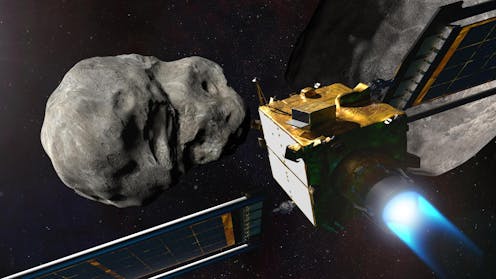
NASA’s DART (Double Asteroid Redirection Test) mission was hailed a success when it collided with its target asteroid Dimorphos last year. The purpose of the endeavour was to see if it could redirect an asteroid and, since the impact, astronomers have been measuring and calculating the impact on the target. It is incredible that the 580kg spacecraft travelling at 6 km/s was able to impart enormous kinetic energy to the 5 billion kg asteroid.
The DART mission, launched by NASA in 2021, aimed to test our ability to deflect asteroids. By crashing a spacecraft into the smaller asteroid of the Didymos binary system, DART was to demonstrate the effectiveness of kinetic impactors in altering an asteroid’s trajectory. This mission marked a crucial step in planetary defence, showcasing technology that could one day protect us from potential asteroid impacts.
Studies from the impact have shown that the kinetic impact approach for deflecting asteroids is a viable approach. Earth-based observations indicate that Dimorphos’ orbit around its parent asteroid, Didymos, decreased by approximately 33 minutes. However, researchers remain uncertain about the overall ‘impact’ to the asteroid from the spacecraft’s impact. Additionally to be able to understand the efficiency of the moment transfer from the impact (known as the beta factor) a precise measurement fo the asteroids mass must be known. This is up to the Hera mission to achieve.
This illustration shows the ESA’s Hera spacecraft and its two CubeSats at the binary asteroid Didymos. Image Credit: ESA
Hera is a European Space Agency mission due for launch in October 2024 and arrive in 2026. Its purpose is to survey the Didymos binary asteroid system following the DART impact. Hera will measure the mass accurately but will also attempt to measure the recoil from material ejected out into space. We already have some information from the Italian LICIACube, images from James Webb and Hubble show a plume of debris that extended 10,000 km into space.
While we wait for Hera to arrive, research teams have been simulating the DART impact using the Bern Smoothed Particle Hydrodynamics impact code (SPH). It was developed at the University of Bern and was designed to model the break up of rocky bodies from collisions. It’s a fascinating tool that converts colliding bodies into millions of individual particles whose behaviours are informed by the laws of physics. This isn’t just some whimsical game though, the software has been used already to reproduce the impact of Japan’s Hayabusa2 spacecraft with the asteroid Ryugu.
The simulation is very timely taking about a week and a half to run a simulation. In total, despite the slow processing, around 250 simulations were run. Asteroid parameters that were known were used in the simulation with others being varied where the information was not well known. The team then looked at which outcome most closely matched observation.
Running these simulations for Dimorphos revealed an asteroid that is largely a weak pile of rubble held together by a weak gravitational field rather than general cohesive strength. To understand cohesion, imagine the difference between a ‘poured’ pile of sand or flour. The flour would form a taller cone shape (high cohesivity) whereas the sand would be a flatter pile (low cohesivity). It is believed that the impact site would have formed a crater but the crater would likely have grown to encompass a good proportion of the asteroid, and the low gravity and cohesivity is likely to have reshaped the asteroid.
The data suggests that 1% of the entire mass of Dimorphos was ejected into space by the impact and that 8% of the mass was likely to have been shifted around its body. All of this is from simulations but we won’t know for sure just what impact DART had on Dimorphus, not until Hera arrives in two years time.
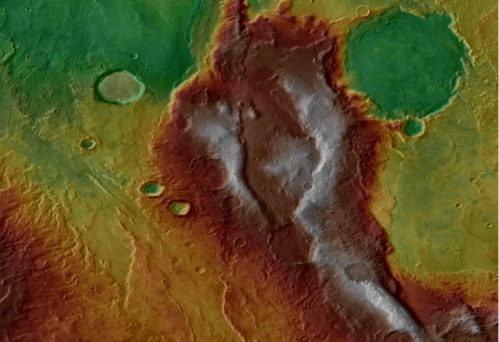
Plate tectonics is not something most people would associate with Mars. In fact, the planet’s dead core is one of the primary reasons for its famous lack of a magnetic field. And since active planetary cores are one of the primary driving factors of plate tectonics, it seems obvious why that general conception holds. However, Mars has some features that we think of as corresponding with plate tectonics – volcanoes. A new paper from researchers at the University of Hong Kong (HKU) looks at how different types of plate tectonics could have formed different types of volcanoes on the surface of Mars.
Typically, when you think of volcanoes on Mars, you think of massive shield volcanoes like Olympus Mons, similar to those seen in some locations on Earth, such as Hawai’i. These form when repeated eruptions deposit layers of lava for millions of years. Those eruptions aren’t impacted by how any underlying plates move underneath them. But they do create a different underlying landscape than elsewhere on the planet.
One of the main differences is that the volcanoes have a high silica concentration. Most of the rest of the Red Planet has relatively low silica concentration and consists primarily of basalt. However, they have distinctly more elevated levels of silica, and Dr. Joseph Michalski and his colleagues at HKU think they know why.
PBS has a geological history of Mars. Credit – PBS Eons YouTube Channel
Back in the Archean age, 3 billion years ago, on Earth, geologists have theorized that a type of plate tectonics known as “vertical tectonics” forced the planet’s crust to collapse into the planet’s mantle. There, it was reformed, injected with a high concentration of silica, and then spewed back onto the surface due to erupting volcanoes.
That would conveniently explain why the silica levels of volcanoes on Mars are higher than on the rest of the planet. To back up their findings, the paper describes signs of numerous other volcano types, such as stratovolcanoes and lava domes, that also contain high silica concentrations and could result from this type of theorized tectonics.
On Earth, other active geological processes have worn down the rock that could have been formed by these processes billions of years ago. But there isn’t nearly as much geological activity on Mars, so it provides a clearer picture of the resulting geology from these processes.
SciShow Space Discusses the possibility that Mars still has active volcanoes. Credit – SciShow Space YouTube Channel
This body of work contributes to our overall understanding of the geology of Mars, and the discovery of so many additional volcanoes is sure to interest areologists for years to come. But for now, this new theory of Mars’ geological history is another step in our understanding of the Red Planet.
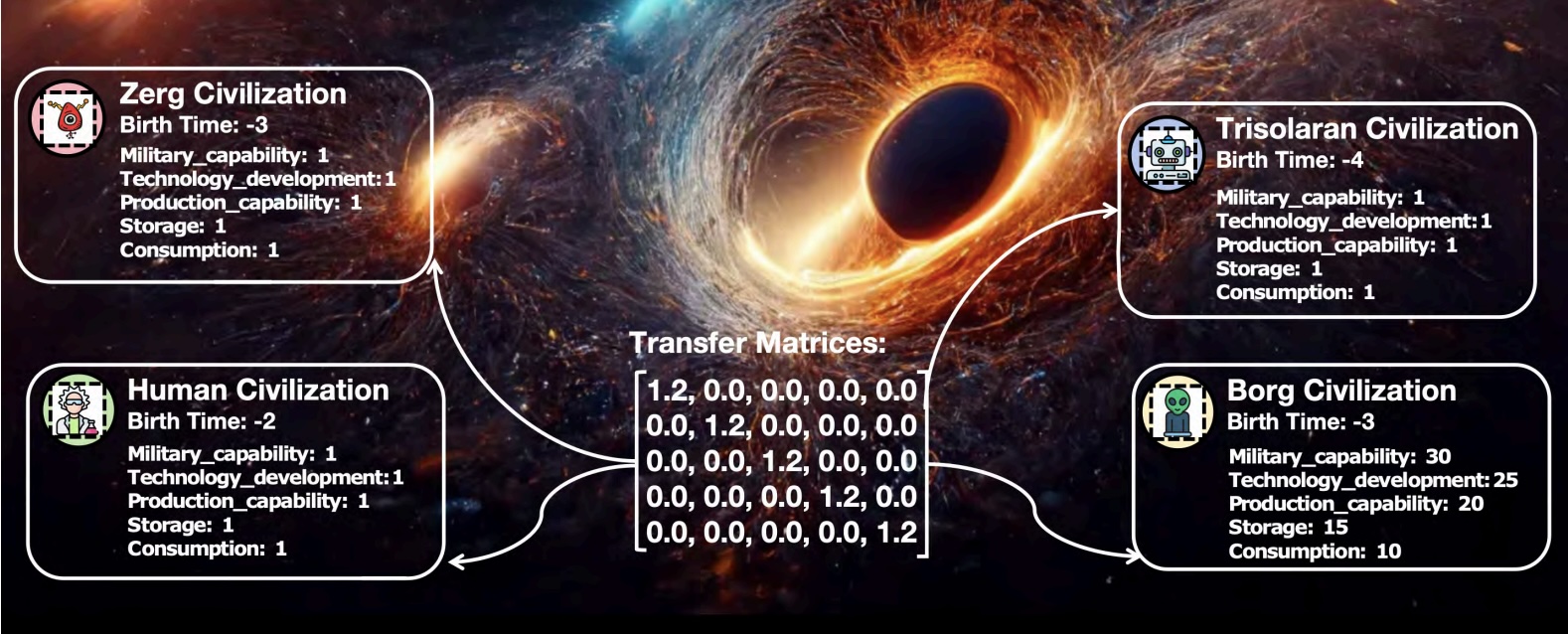
An AI Simulated Interactions Between Different Kinds of Advanced Civilizations
The possibility for life beyond the Earth has captivated us for hundreds of years. It has been on the mind of science fiction writers too as our imaginations have explored the myriad possibilities of extraterrestrial life. But what would it really be like if/when we finally meet one; would it lead to war or peace? Researchers have used a complex language model to simulate the first conversations with civilisations from pacifists to militarists and the outcomes revealed interesting challenges.
The first radio transmissions were made in 1895 and since then the signals, however weak have been leaking out into space. The first intentional transmission out into space was the Arecibo message of 1974 that was sent toward the globular cluster M13 22,180 light years away. That means the signal won’t arrive there for about another 22,131 years! During this time of course, all the signals have been leaking out but the further they travel, the weaker they get. Its likely then that any signals out to a distance of about 100 light years is likely to be so weak as to not be detectable.
The Arecibo Radio Telescope Credit: UCF
It would be so easy to be dragged into other areas of debate about aliens but it feels useful to set the scene of how difficult it will be to make contact or rather, how likely it may be. Assume then, that in some way, we do find ourselves making communication with an alien civilisation. Just how that conversation goes has been modelled by a team led by Mingyu Jin from Northwestern University.
The team used a new artificial intelligence framework known as CosmoAgent to simulate the interaction based upon the unique Large Language Model (LLM). The system uses a Multi-Agent System to enable modelling among a diverse range of civilisations. The civilisations have the ability to choose their own character traits from hiding, fighting or collaborating. This dynamic environment allows for a plethora of outcomes from alliances forming, adherence to rules to rivalries to how a civilisation might respond to an unforeseen event.
Diversity and conditions for life were also inherent in the modelling using transition matrices to analyse how civilisations might grow and change over time. This natural progression of an intelligent life form would inevitably mean ethics, morals, beliefs and sciences would develop along a varied path. These different frameworks would hugely effect just how such a civilisation might respond to alien contact.
There are limitations to the research though, largely from an Earth-centric bias developing the language model. The use of mathematics and algorithms to compute responses and outcomes may not cover the full spectrum of inter-civilisation responses. After all, we cannot even distill our own emotional responses down to a set of algorithms. Add in a speculative set of principles of an alien civilisation, of which, we have no evidence or experience to draw upon.
It is hoped that future research can address these obstacles and develop better models of inter-civilisational interaction. Taking into account a broader range of ethical paradigms and decision making processes to provide a more realistic simulation of just how first contact may just play out.
An AI Simulated Interactions Between Different Kinds of Advanced Civilizations
The possibility for life beyond the Earth has captivated us for hundreds of years. It has been on the mind of science fiction writers too as our imaginations have explored the myriad possibilities of extraterrestrial life. But what would it really be like if/when we finally meet one; would it lead to war or peace? Researchers have used a complex language model to simulate the first conversations with civilisations from pacifists to militarists and the outcomes revealed interesting challenges.
The first radio transmissions were made in 1895 and since then the signals, however weak have been leaking out into space. The first intentional transmission out into space was the Arecibo message of 1974 that was sent toward the globular cluster M13 22,180 light years away. That means the signal won’t arrive there for about another 22,131 years! During this time of course, all the signals have been leaking out but the further they travel, the weaker they get. Its likely then that any signals out to a distance of about 100 light years is likely to be so weak as to not be detectable.
The Arecibo Radio Telescope Credit: UCF
It would be so easy to be dragged into other areas of debate about aliens but it feels useful to set the scene of how difficult it will be to make contact or rather, how likely it may be. Assume then, that in some way, we do find ourselves making communication with an alien civilisation. Just how that conversation goes has been modelled by a team led by Mingyu Jin from Northwestern University.
The team used a new artificial intelligence framework known as CosmoAgent to simulate the interaction based upon the unique Large Language Model (LLM). The system uses a Multi-Agent System to enable modelling among a diverse range of civilisations. The civilisations have the ability to choose their own character traits from hiding, fighting or collaborating. This dynamic environment allows for a plethora of outcomes from alliances forming, adherence to rules to rivalries to how a civilisation might respond to an unforeseen event.
Diversity and conditions for life were also inherent in the modelling using transition matrices to analyse how civilisations might grow and change over time. This natural progression of an intelligent life form would inevitably mean ethics, morals, beliefs and sciences would develop along a varied path. These different frameworks would hugely effect just how such a civilisation might respond to alien contact.
There are limitations to the research though, largely from an Earth-centric bias developing the language model. The use of mathematics and algorithms to compute responses and outcomes may not cover the full spectrum of inter-civilisation responses. After all, we cannot even distill our own emotional responses down to a set of algorithms. Add in a speculative set of principles of an alien civilisation, of which, we have no evidence or experience to draw upon.
It is hoped that future research can address these obstacles and develop better models of inter-civilisational interaction. Taking into account a broader range of ethical paradigms and decision making processes to provide a more realistic simulation of just how first contact may just play out.
A team of researchers from ETH Zurich and the University of Zurich has recently published a studythat could significantly advance our ability to detect extraterrestrial life on exoplanets, with Earth serving as the guinea pig.
Published in The Astrophysical Journal, their work focuses on the Large Interferometer for Exoplanets (LIFE) space mission and its potential to characterize the habitability of exoplanets by observing Earth as a test object.
The Large Interferometer for Exoplanets (LIFE) is a proposed space mission designed to directly measure the mid-infrared spectrum of terrestrial habitable zone exoplanets. Using a collection of small orbiting telescopes, the mission would characterize the atmospheres of these exoplanets, assess their potential habitability, and search for signs of extraterrestrial life beyond our solar system.
With hopes that these space-based telescopes would one day be built, the researchers aimed to validate the LIFE mission’s ability to detect signs of life on exoplanets. Using Earth as a proxy, they proposed simulating how LIFE would observe an exoplanet.
Artistic rendering of the LIFE Satellite swarm. (Image: LIFE Mission)
THE SUBTLE ART OF USING EARTH TO SPOT EXTRATERRESTRIAL LIFE IN THE COSMOS
The study successfully characterized Earth as if it were an exoplanet using simulated observations of its Mid-Infrared thermal emission spectrum. The research concluded that Earth would be identified as a temperate, habitable planet with detectable levels of important atmospheric gasses such as carbon dioxide (CO2), water vapor (H2O), ozone (O3), and methane (CH4), which are significant for indicating the presence of life and habitable conditions. A good sign, seeing as how our planet is teeming with life (at least for now).
Now, here is where things get interesting. The study also found that the viewing angle and season did not significantly alter the detectability of these molecules or their relative abundances in Earth’s atmosphere. This is important because something as simple as cloud can mess with atmospheric data.
Moreover, seasonal changes in the amount of energy Earth reflects or emits were observed, particularly when the North Pole was observed, which led to variations in retrieved surface temperature, equilibrium temperature, and Bond albedo (in simple terms, it is how much electromagnetic radiation that ends up back in space after bouncing off the planet, but not coming from the planet directly). Due to this accuracy, the study was able to figure out Earth’s surface temperature despite the presence of clouds.
Surface pressure was much tougher to sort out, so future work needs to go into developing better methods to properly get those numbers. Basically, due to the scattered nature of Earth’s atmosphere, and by extension, other possible exoplanets like Earth out there, it made it difficult for the instruments to get an accurate reading.
However, there is a silver lining to error.
The research highlighted that common simplifications, such as neglecting clouds and assuming constant vertical gas abundances, introduce biases in the retrieval results. When interpreting exoplanet atmospheric data, including all the data collected up to now by other studies and astronomers, it all may need a second look. Earth is atmospherically complex. What’s to say the other exoplanets we’ve already discovered aren’t as complex?
Using Earth as a test subject provides compelling evidence that the mission’s measurement procedures are feasible and effective. Moreover, it also opens new avenues for the exploration of habitable worlds, marking a pivotal moment in the quest to understand our place in the universe and potentially finding signs of extraterrestrial life.
“The whole exoplanet community is gearing up for increasing amounts of data that will be coming in the future from smaller and smaller planets,” explained Professor Sascha at ETH Zurich Quanz, one of the study’s authors. Since Earth is the only planet with life as we know it, using it to test future equipment makes sense.
MJ Banias is a journalist who covers security and technology. He is the host of The Debrief Weekly Report. You can email MJ at mj@thedebrief.org or follow him on Twitter @mjbanias.
Juno has changed how we see the red gas giant NASA has been using space probes to explore the mysteries of Jupiter since the 1970s but few missions have been as important or revealing as the Juno probe, which was launched over a decade ago and has captured some amazing images of Jupiter.
A five-year journey to explore the mysteries ofJupiter
The Juno spacecraft embarked on a five-year journey back to our solar system’s back in August 2011 and was tasked with collecting all the data it could about Jupiter as well as lots of high quality images of the gas giant’s colorful surface.
Juno had an outsized impact on views of the gas giant NASA’s Jet Propulsion Laboratory noted on its Juno mission website that the spacecraft has completely changed our understanding of Jupiter's atmosphere, but it’s also altered how we see the largest planet in our solar system. Let’s look at how.
Photo Credit: /JPL-Caltech/Malin Space Science Systems
Saying goodbye to Earth as Juno launched itself to Jupiter From the moment Juno blasted off into space, it was providing the world with important images. One of the first was a goodbye shot of the Earth the spacecraft snapped off as it began its voyage to Jupiter.
Enhanced image by Alex Mai (CC-BY) based on images provided courtesy of NASA/JPL-Caltech/SwRI/MSSS
Juno arrived in 2016 and began capturing Jupiter’s beauty Juno didn’t arrive at its destination until July 2016 but one of the first images the probe captured during its very first flyby of the gas giant revealed a side of the planet that had never been seen before. The photo was titled: 'Jupiterrise'.
Photo Credit: Enhanced image by Kevin M. Gill (CC-BY) based on images provided courtesy of NASA/JPL-Caltech/SwRI/MSSS.
The distance travel was a lot but definitely worth it
The distances involvebd in Juno’s mission are completely unfathomable and Business Insider pointed out that the spacecraft traveled more than one billion miles—or over one and a half billion kilometers—to reach its final destination.
The raw data sent back revealed a lot about Jupiter However, the raw data that Juno began to send back to Earth regarding Jupiter was well worth the wait for scientists, and so were the pictures. Here you can see photo layers that reveal the red, green, and blue present in Jupiter's atmosphere.
Citizen scientists helped reveal the gas giants beauty Citizen scientists took the raw data sent back to Earth and used it to reveal the brilliant color of Jupiter’s surface. According to Business Insider, the picture featured above is an example of what citizen scientists created for the world to see.
Looking at Jupiter’s violent storms in a brand new light One of the most interesting aspects of the images that have come out of Juno’s mission to Jupiter is the way in which the planet’s storms have been highlighted and focused on to show just how amazing they look compared to previous images.
Photo Credit: image by Kevin M. Gill (CC-BY) based on images provided courtesy of NASA/JPL-Caltech/SwRI/MSSS.
The photos were unlike anything we ever saw before Photos of Jupiter are really quite unlike anything humanity has ever seen before, and from afar, they are beautiful, though you likely would not want to be caught up in one if you were on the planet. Not that that is a realistic possibility.
Juno captured an Earth-sized cyclone in the north pole Images from one orbital flyby of Jupiter’s north pole captured eight storms that were raging at the time as well as what Business Insider called an “Earth-size cyclone at the center.” How terrifying does an Earth-sized cyclone sound?
Photo Credit: NASA/JPL-Caltech/SwRI/MSSS / Enhanced image by Betsy Asher Hall and Gervasio Robles
Jupiter’s south pole is just as stunning as the north Jupiter’s south pole is just as beautiful and terrifying as its north pole. Before Juno, the scientific community never had any images of Jupiter’s south pole, which just adds one more feather to the cap of Juno’s accomplishments so far.
Jupiter’s signature red storm was caught in a new way Jupiter’s signature red storm that lies near the equator of the planet is also featured in a lot of images captured by Juno. However, it wasn’t just Jupiter that was captured by the Juno spacecraft during its mission. The gas giant's moons also got their own photo shoot.
The many moons of Jupiter were also caught on camera One of the most stunning images from Juno shows Jupiter at a distance with one of the gas giant's moons: Io. The shot was captured on Juno’s fifty-third flyby of the planet and was one of its planned final flights before its mission was set to end.
Juno’s mission ended years ago but was extended to 2025 Juno’s primary mission ended in July 2021 according to NASA. But the spacecraft had its mission extended by an additional 42 orbits and won’t end its time flying by Jupiter until September 2025.
Photo Credit: NASA/JPL-Caltech/SwRI/MSSS / Image processing: Kevin M. Gill CC BY 3.0
What amazing images might we see over the next two years? What amazing images will be captured by Juno in the coming years has yet to be seen, but more pass overs of Jupiter’s north pole will be included as well as flybys of the gas giants moons Ganymede, Europa (pictured), and Io. Plus it will explore Jupiter’s faint rings!
Beste bezoeker, Heb je zelf al ooit een vreemde waarneming gedaan, laat dit dan even weten via email aan Frederick Delaere opwww.ufomeldpunt.be. Deze onderzoekers behandelen jouw melding in volledige anonimiteit en met alle respect voor jouw privacy. Ze zijn kritisch, objectief maar open minded aangelegd en zullen jou steeds een verklaring geven voor jouw waarneming! DUS AARZEL NIET, ALS JE EEN ANTWOORD OP JOUW VRAGEN WENST, CONTACTEER FREDERICK. BIJ VOORBAAT DANK...
Druk op onderstaande knop om je bestand , jouw artikel naar mij te verzenden. INDIEN HET DE MOEITE WAARD IS, PLAATS IK HET OP DE BLOG ONDER DIVERSEN MET JOUW NAAM...
Druk op onderstaande knop om een berichtje achter te laten in mijn gastenboek
Alvast bedankt voor al jouw bezoekjes en jouw reacties. Nog een prettige dag verder!!!
Over mijzelf
Ik ben Pieter, en gebruik soms ook wel de schuilnaam Peter2011.
Ik ben een man en woon in Linter (België) en mijn beroep is Ik ben op rust..
Ik ben geboren op 18/10/1950 en ben nu dus 75 jaar jong.
Mijn hobby's zijn: Ufologie en andere esoterische onderwerpen.
Op deze blog vind je onder artikels, werk van mezelf. Mijn dank gaat ook naar André, Ingrid, Oliver, Paul, Vincent, Georges Filer en MUFON voor de bijdragen voor de verschillende categorieën...
Veel leesplezier en geef je mening over deze blog.