The purpose of this blog is the creation of an open, international, independent and free forum, where every UFO-researcher can publish the results of his/her research. The languagues, used for this blog, are Dutch, English and French.You can find the articles of a collegue by selecting his category. Each author stays resposable for the continue of his articles. As blogmaster I have the right to refuse an addition or an article, when it attacks other collegues or UFO-groupes.
Druk op onderstaande knop om te reageren in mijn forum
Zoeken in blog
Deze blog is opgedragen aan mijn overleden echtgenote Lucienne.
In 2012 verloor ze haar moedige strijd tegen kanker!
In 2011 startte ik deze blog, omdat ik niet mocht stoppen met mijn UFO-onderzoek.
BEDANKT!!!
Een interessant adres?
UFO'S of UAP'S, ASTRONOMIE, RUIMTEVAART, ARCHEOLOGIE, OUDHEIDKUNDE, SF-SNUFJES EN ANDERE ESOTERISCHE WETENSCHAPPEN - DE ALLERLAATSTE NIEUWTJES
UFO's of UAP'S in België en de rest van de wereld Ontdek de Fascinerende Wereld van UFO's en UAP's: Jouw Bron voor Onthullende Informatie!
Ben jij ook gefascineerd door het onbekende? Wil je meer weten over UFO's en UAP's, niet alleen in België, maar over de hele wereld? Dan ben je op de juiste plek!
België: Het Kloppend Hart van UFO-onderzoek
In België is BUFON (Belgisch UFO-Netwerk) dé autoriteit op het gebied van UFO-onderzoek. Voor betrouwbare en objectieve informatie over deze intrigerende fenomenen, bezoek je zeker onze Facebook-pagina en deze blog. Maar dat is nog niet alles! Ontdek ook het Belgisch UFO-meldpunt en Caelestia, twee organisaties die diepgaand onderzoek verrichten, al zijn ze soms kritisch of sceptisch.
Nederland: Een Schat aan Informatie
Voor onze Nederlandse buren is er de schitterende website www.ufowijzer.nl, beheerd door Paul Harmans. Deze site biedt een schat aan informatie en artikelen die je niet wilt missen!
Internationaal: MUFON - De Wereldwijde Autoriteit
Neem ook een kijkje bij MUFON (Mutual UFO Network Inc.), een gerenommeerde Amerikaanse UFO-vereniging met afdelingen in de VS en wereldwijd. MUFON is toegewijd aan de wetenschappelijke en analytische studie van het UFO-fenomeen, en hun maandelijkse tijdschrift, The MUFON UFO-Journal, is een must-read voor elke UFO-enthousiasteling. Bezoek hun website op www.mufon.com voor meer informatie.
Samenwerking en Toekomstvisie
Sinds 1 februari 2020 is Pieter niet alleen ex-president van BUFON, maar ook de voormalige nationale directeur van MUFON in Vlaanderen en Nederland. Dit creëert een sterke samenwerking met de Franse MUFON Reseau MUFON/EUROP, wat ons in staat stelt om nog meer waardevolle inzichten te delen.
Let op: Nepprofielen en Nieuwe Groeperingen
Pas op voor een nieuwe groepering die zich ook BUFON noemt, maar geen enkele connectie heeft met onze gevestigde organisatie. Hoewel zij de naam geregistreerd hebben, kunnen ze het rijke verleden en de expertise van onze groep niet evenaren. We wensen hen veel succes, maar we blijven de autoriteit in UFO-onderzoek!
Blijf Op De Hoogte!
Wil jij de laatste nieuwtjes over UFO's, ruimtevaart, archeologie, en meer? Volg ons dan en duik samen met ons in de fascinerende wereld van het onbekende! Sluit je aan bij de gemeenschap van nieuwsgierige geesten die net als jij verlangen naar antwoorden en avonturen in de sterren!
Heb je vragen of wil je meer weten? Aarzel dan niet om contact met ons op te nemen! Samen ontrafelen we het mysterie van de lucht en daarbuiten.
27-02-2024
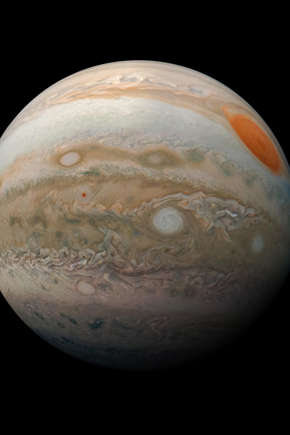
See the stunning images the Juno mission has captured of Jupiter
See the stunning images the Juno mission has captured of Jupiter
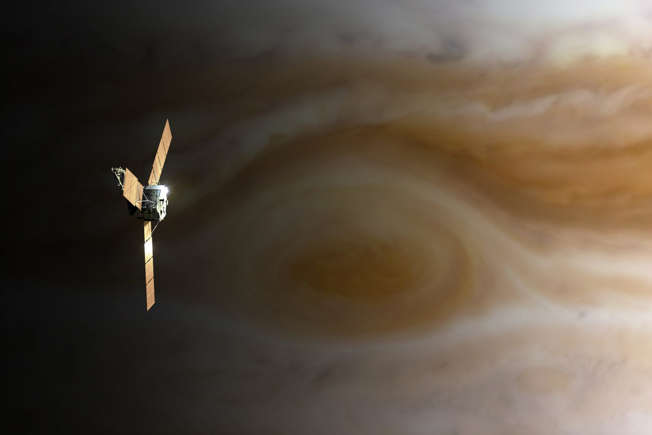
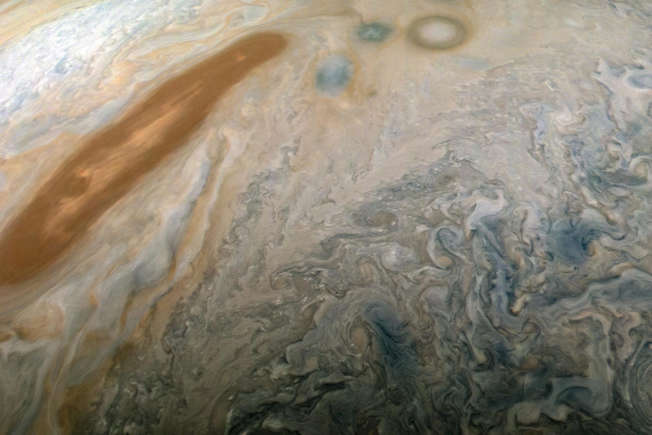
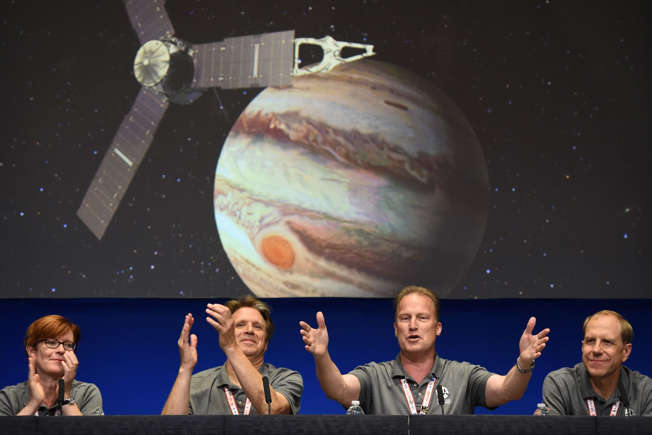
Juno has changed how we see the red gas giant NASA has been using space probes to explore the mysteries of Jupiter since the 1970s but few missions have been as important or revealing as the Juno probe, which was launched over a decade ago and has captured some amazing images of Jupiter.
A five-year journey to explore the mysteries ofJupiter
The Juno spacecraft embarked on a five-year journey back to our solar system’s back in August 2011 and was tasked with collecting all the data it could about Jupiter as well as lots of high quality images of the gas giant’s colorful surface.
Juno had an outsized impact on views of the gas giant NASA’s Jet Propulsion Laboratory noted on its Juno mission website that the spacecraft has completely changed our understanding of Jupiter's atmosphere, but it’s also altered how we see the largest planet in our solar system. Let’s look at how.
Photo Credit: /JPL-Caltech/Malin Space Science Systems
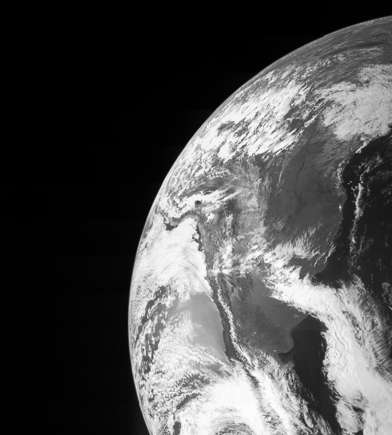
Saying goodbye to Earth as Juno launched itself to Jupiter From the moment Juno blasted off into space, it was providing the world with important images. One of the first was a goodbye shot of the Earth the spacecraft snapped off as it began its voyage to Jupiter.
Enhanced image by Alex Mai (CC-BY) based on images provided courtesy of NASA/JPL-Caltech/SwRI/MSSS
Juno arrived in 2016 and began capturing Jupiter’s beauty Juno didn’t arrive at its destination until July 2016 but one of the first images the probe captured during its very first flyby of the gas giant revealed a side of the planet that had never been seen before. The photo was titled: 'Jupiterrise'.
Photo Credit: Enhanced image by Kevin M. Gill (CC-BY) based on images provided courtesy of NASA/JPL-Caltech/SwRI/MSSS.
The distance travel was a lot but definitely worth it
The distances involvebd in Juno’s mission are completely unfathomable and Business Insider pointed out that the spacecraft traveled more than one billion miles—or over one and a half billion kilometers—to reach its final destination.
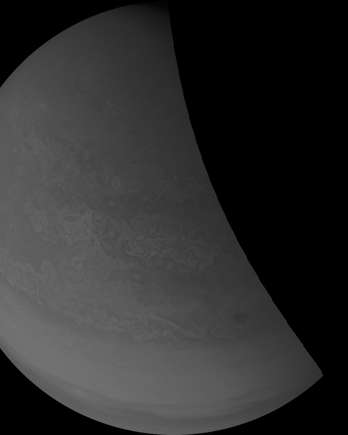
The raw data sent back revealed a lot about Jupiter However, the raw data that Juno began to send back to Earth regarding Jupiter was well worth the wait for scientists, and so were the pictures. Here you can see photo layers that reveal the red, green, and blue present in Jupiter's atmosphere.
Citizen scientists helped reveal the gas giants beauty Citizen scientists took the raw data sent back to Earth and used it to reveal the brilliant color of Jupiter’s surface. According to Business Insider, the picture featured above is an example of what citizen scientists created for the world to see.
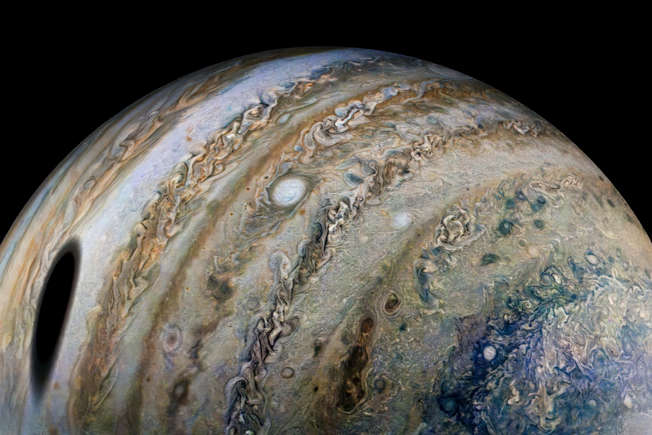
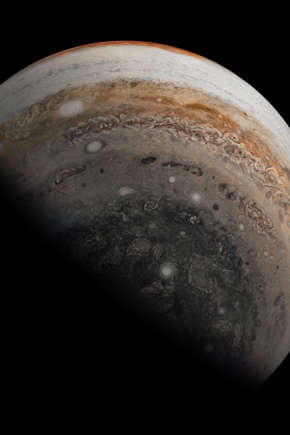
Looking at Jupiter’s violent storms in a brand new light One of the most interesting aspects of the images that have come out of Juno’s mission to Jupiter is the way in which the planet’s storms have been highlighted and focused on to show just how amazing they look compared to previous images.
Photo Credit: image by Kevin M. Gill (CC-BY) based on images provided courtesy of NASA/JPL-Caltech/SwRI/MSSS.
The photos were unlike anything we ever saw before Photos of Jupiter are really quite unlike anything humanity has ever seen before, and from afar, they are beautiful, though you likely would not want to be caught up in one if you were on the planet. Not that that is a realistic possibility.
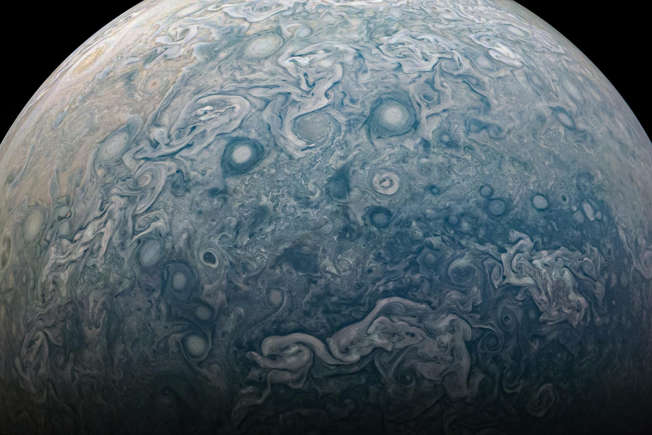
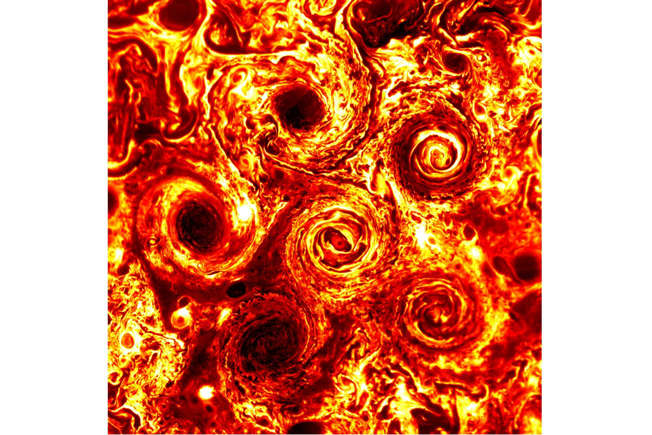
Juno captured an Earth-sized cyclone in the north pole Images from one orbital flyby of Jupiter’s north pole captured eight storms that were raging at the time as well as what Business Insider called an “Earth-size cyclone at the center.” How terrifying does an Earth-sized cyclone sound?
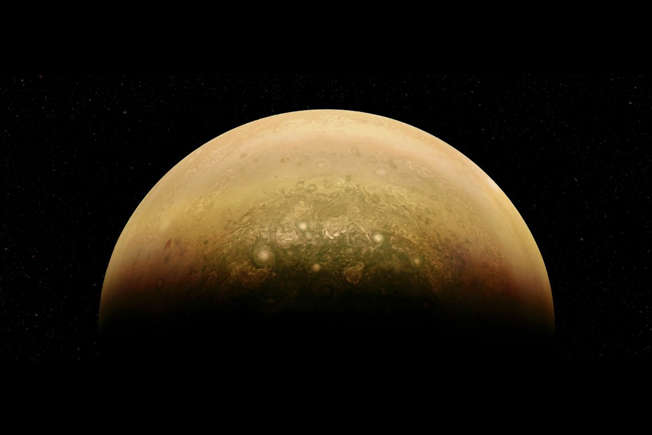
Photo Credit: NASA/JPL-Caltech/SwRI/MSSS / Enhanced image by Betsy Asher Hall and Gervasio Robles
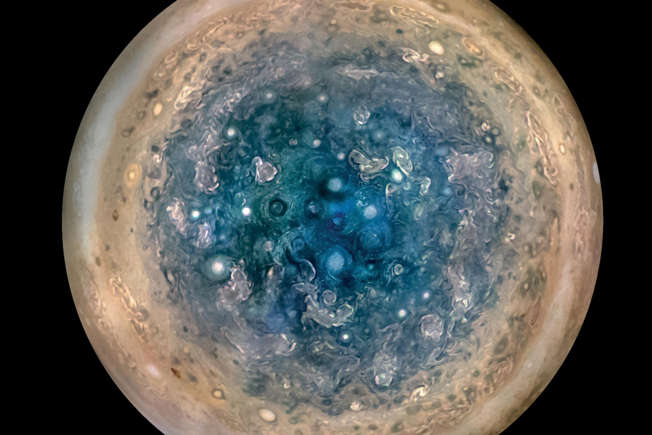
Jupiter’s south pole is just as stunning as the north Jupiter’s south pole is just as beautiful and terrifying as its north pole. Before Juno, the scientific community never had any images of Jupiter’s south pole, which just adds one more feather to the cap of Juno’s accomplishments so far.
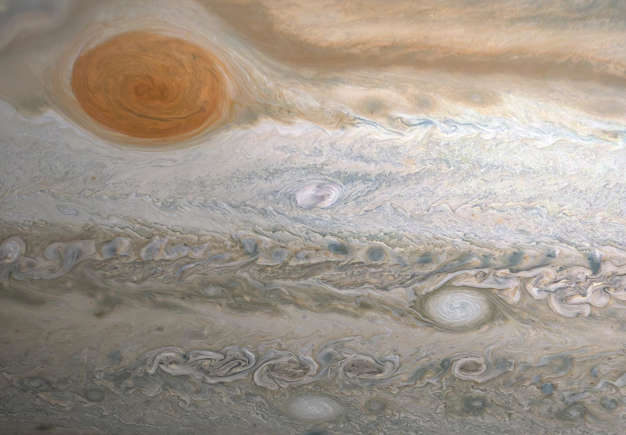
Jupiter’s signature red storm was caught in a new way Jupiter’s signature red storm that lies near the equator of the planet is also featured in a lot of images captured by Juno. However, it wasn’t just Jupiter that was captured by the Juno spacecraft during its mission. The gas giant's moons also got their own photo shoot.
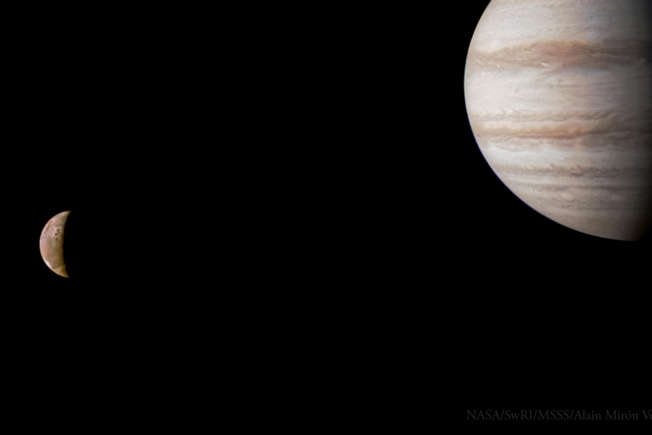
The many moons of Jupiter were also caught on camera One of the most stunning images from Juno shows Jupiter at a distance with one of the gas giant's moons: Io. The shot was captured on Juno’s fifty-third flyby of the planet and was one of its planned final flights before its mission was set to end.
Juno’s mission ended years ago but was extended to 2025 Juno’s primary mission ended in July 2021 according to NASA. But the spacecraft had its mission extended by an additional 42 orbits and won’t end its time flying by Jupiter until September 2025.
Photo Credit: NASA/JPL-Caltech/SwRI/MSSS / Image processing: Kevin M. Gill CC BY 3.0
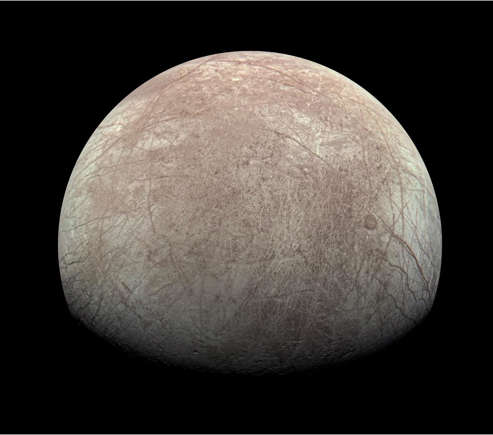
What amazing images might we see over the next two years? What amazing images will be captured by Juno in the coming years has yet to be seen, but more pass overs of Jupiter’s north pole will be included as well as flybys of the gas giants moons Ganymede, Europa (pictured), and Io. Plus it will explore Jupiter’s faint rings!
Commerciële maanlander Odysseus stuurt eerste foto's door, missie wordt gehalveerd in tijd
Commerciële maanlander Odysseus stuurt eerste foto's door, missie wordt gehalveerd in tijd
Artikel door Belga, Pieterjan Huyghebaert
Odysseus landde in de nacht van donderdag op vrijdag iets na middernacht (Belgische tijd) bij een krater in de buurt van de zuidpool van de maan. Het is de eerste geslaagde commerciële maanlanding. En de eerste Amerikaanse maanlanding sinds de jaren 70.
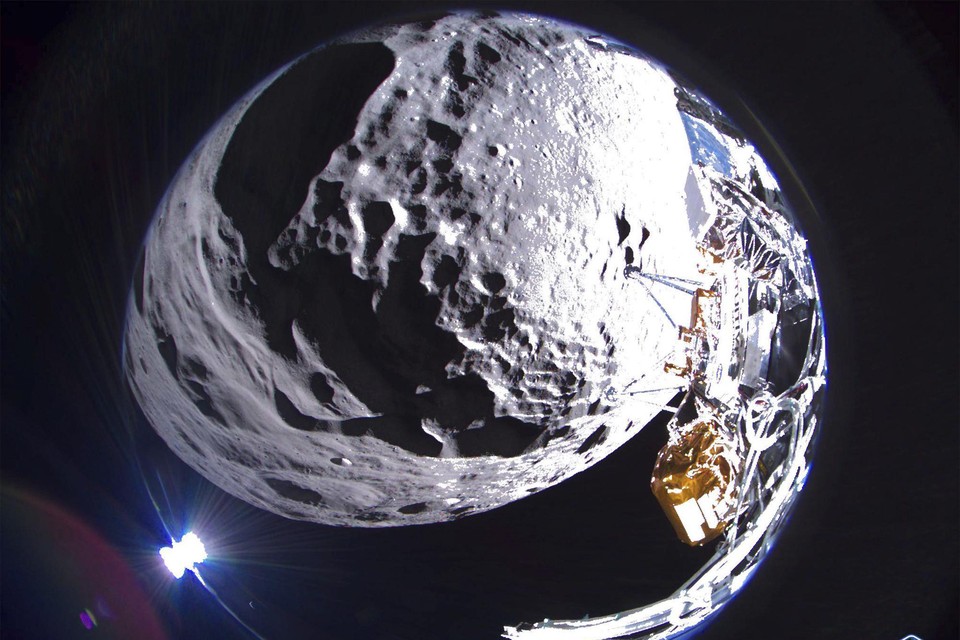
De maanlander stuurde vandaag een eerste foto door van op het maanoppervlak.
Commerciële maanlander Odysseus stuurt eerste foto's door, missie wordt gehalveerd in tijd
Vrijdag werd bekend dat de Odysseus de maanlanding weliswaar heelhuids doorstaan heeft, maar op zijn zij ligt. De zonnepanelen krijgen hierdoor niet genoeg licht om de batterijen voldoende op te laden. Hierdoor zal de missie slechts 5 dagen duren, zowat de helft minder dan gepland.
Odysseus Moon Lander Sends More Pictures — and We Know Where It Is
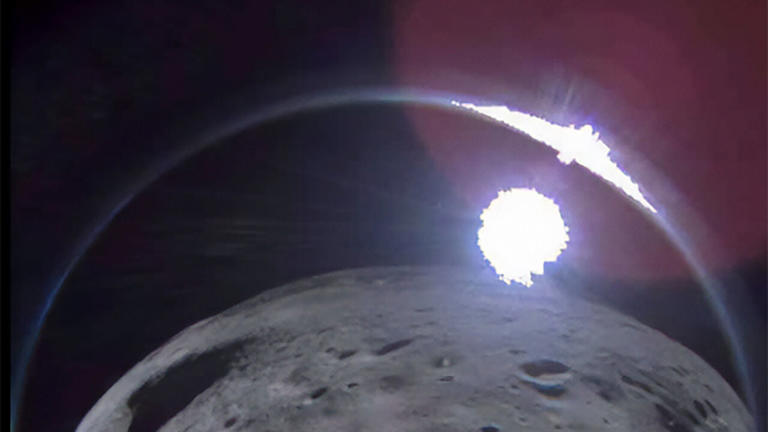
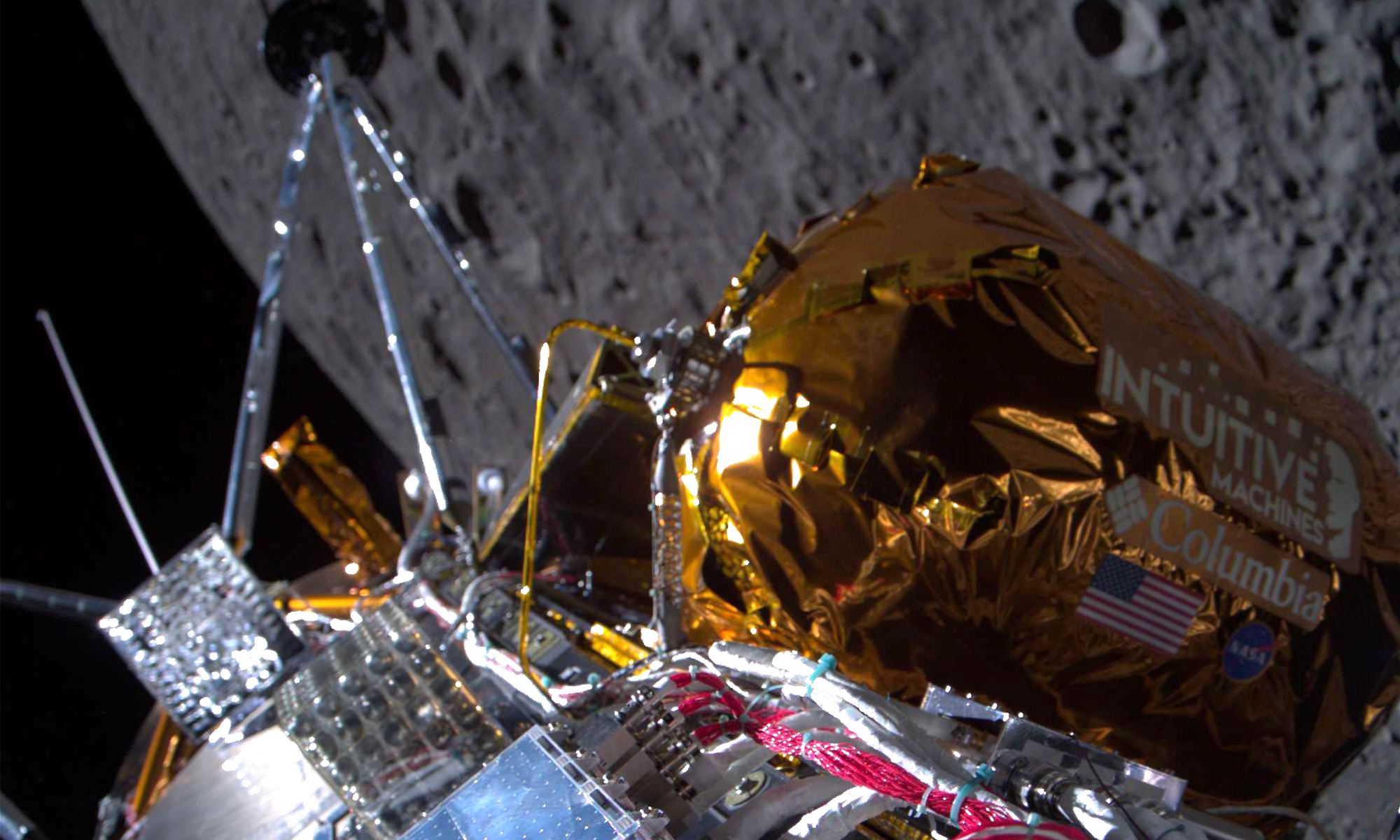
The Odysseus lander captured this image about 35 seconds after pitching over during its approach to the lunar landing site. The ultra-wide-angle view shows Odysseus and its landing legs at the bottom of the frame. (Credit: Intuitive Machines)
The ultra-wide-angle images confirm that the lander is continuing to communicate with flight controllers, even though it’s lying in an awkward angle that limits how much data its antennas can transmit.
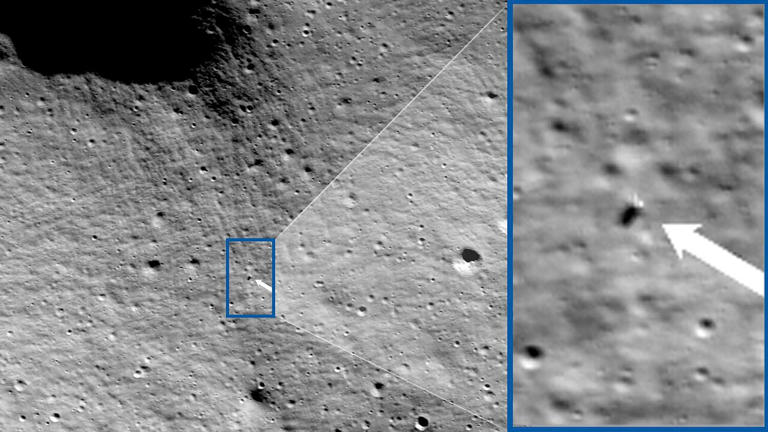
Meanwhile, images from NASA’s Lunar Reconnaissance Orbiter have identified Odysseus’ landing spot, within a mile (1.5 kilometers) of its intended target near a crater called Malapert A in the moon’s south polar region. The bad news is that the solar-powered lander may have to go dark sooner than anticipated.
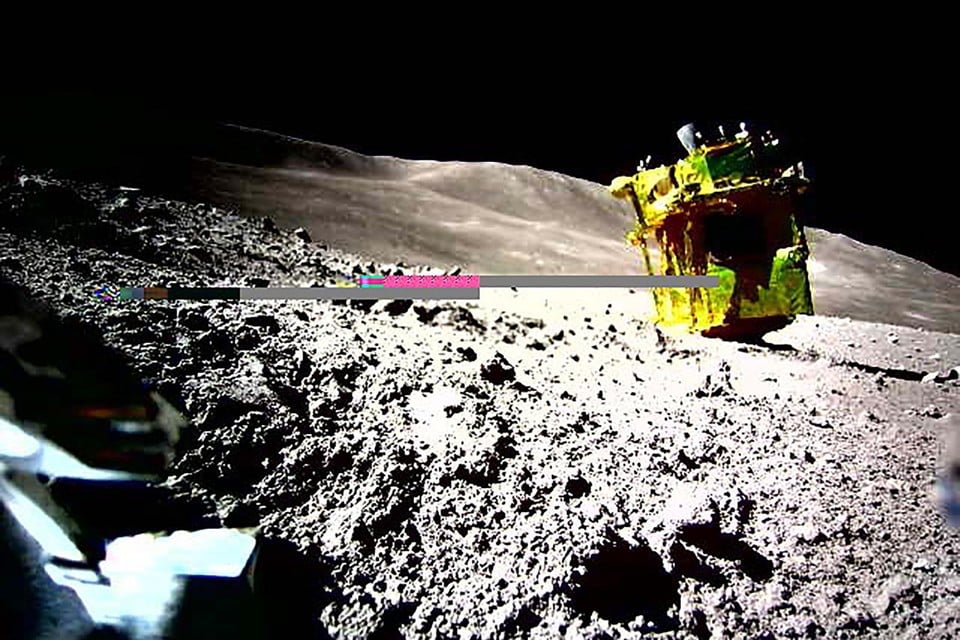
This low-resolution, ultra-wide-angle image from the Odysseus lander shows the lunar terrain with a scrunched view of the lander itself off to the right side of the frame. (Credit: Intuitive Machines)
The lander is the first-ever commercial spacecraft to survive a descent to the moon, and the first U.S-built spacecraft to do so since NASA’s Apollo 17 mission in 1972. NASA is paying Intuitive Machines $118 million to deliver six science payloads to the surface, and there are another six private-sector payloads on board.
Odysseus’ descent wasn’t easy: Just hours before the landing, the Nova Control team had to reprogram the lander to work around a disabled laser range-finding system. The spacecraft instead made use of one of the NASA payloads, an experimental laser range-finding system. Fortunately, the work-around worked.
The lander also hit the dirt faster than originally planned, with a lateral motion that’s thought to have tripped up one of Odysseus’ landing legs. As a result, the spacecraft is lying on its side. Mission managers say that doesn’t seem likely to affect data collection, but it is affecting data transmission.
An overhead image from NASA’s Lunar Reconnaissance Orbiter shows the location of the Odysseus lander, highlighted by the blue-bordered inset. (Credit: NASA / Goddard / Arizona State University)
“After traveling more than 600,000 miles, Odysseus landed within 1.5 km of its intended Malapert A landing site, using a contingent laser range-finding system patched hours before landing,” Intuitive Machines said in today’s update.
But Intuitive Machines also suggested that Odysseus won’t be able to remain in operation for the week to 10 days that mission managers had hoped for. “Flight controllers intend to collect data until the lander’s solar panels are no longer exposed to light,” according to the update. “Based on Earth and moon positioning, we believe flight controllers will continue to communicate with Odysseus until Tuesday morning.”
Maybe Odysseus and its controllers will have to hope for an unexpected revival similar to what the team behind another off-kilter moon lander, Japan’s SLIM spacecraft, experienced this weekend.
Electrodes in Spacesuits Could Protect Astronauts from Harmful Dust on Mars
To quote NASA associate administrator Jim Reuter, sending crewed missions to Mars by 2040 is an “audacious goal.” The challenges include the distance involved, which can take up to six months to traverse using conventional propulsion methods. Then there’s the hazard posed by radiation, which includes increased exposure to solar particles, flares, and galactic cosmic rays (GCRs). And then there’s the time the crews will spend in microgravity during transits, which can take a serious toll on human health, physiology, and psychology.
But what about the challenges of living and working on Mars for several months at a time? While elevated radiation and lower gravity are a concern, so is Martian regolith. Like lunar regolith, dust on Mars will adhere to astronauts’ spacesuits and inflict wear on their equipment. However, it also contains harmful particles that must be removed to prevent contaminating habitats. In a recent study, a team of aerospace engineers tested a new electrostatic system for removing Martian regolith from spacesuits that could potentially remove harmful dust with up to 98% efficiency.
The new system was designed by Benjamin M. Griggs and Lucinda Berthoud, a Master’s engineering student and Professor of Space Systems Engineering (respectively) with the Department of Aerospace Engineering at the University of Bristol, UK. The paper that describes the system and the verification process recently appeared in the journal Acta Astronautica. As they explain, the Electrostatic Removal System (ERS) they propose utilizes the phenomenon of dielectrophoresis (DEP) to remove Martian dust from spacesuit fabrics.
Dust flies from the tires of a moon buggy, driven by Apollo 17 astronaut Gene Cernan. These “rooster-tails” of dust caused problems. Credit: NASA
Much like its lunar counterpart, Martian regolith is expected to be electrostatically charged due to exposure to cosmic radiation. But on Mars, there’s also the contribution made by dust devils and storms, which have been known to generate electrostatic discharges (aka. lightning). During the Apollo missions, astronauts reported how the lunar regolith would adhere to their suits and get tracked back into their Lunar Modules. Once inside, it would similarly stick to everything and get into their eyes and lungs, causing irritation and respiratory problems.
Given their plans to return astronauts to the Moon through the Artemis Program, NASA is investigating several methods to prevent regolith from getting into habitation modules – like coating technology for spacesuits and electron beams for cleaning them. While Martian dust is expected to inflict similar wear on spacesuits, the situation is made worse because it may contain toxic particles. As Griggs explained to Universe Today via email:
“Beyond having an abrasive effect on spacesuits themselves, Martian regolith is also expected to present health issues to astronauts. It is known to contain a range of harmful particles which may be carcinogenic or cause respiratory issues, and data from the Pathfinder missionshowed the presence of toxic particles such as chromium. Martian regolith will therefore require removal from spacesuits prior to entry into habitation zones on Mars to prevent contact between astronauts and regolith particles.”
The principle behind the device, dielectrophoresis (DEP), refers to the movement of neutral particles when subjected to a nonuniform electric field. Their proposed Electrostatic Removal System (ERS) comprises two components: a High Voltage Waveform Generator (HVWG) used to produce square waves of varying frequencies and amplitudes up to 1000 volts and an Electrostatic Removal Device (ERD) consisting of an array of parallel copper electrodes. When the square waves are applied across the electrodes in the ERD, a large and varying electric field is generated. As Griggs summarized:
“Therefore, when dust particles are incident on the surface of the ERD, the dust particles are displaced through a combination of electrostatic and dielectrophoretic forces (due to the large electric field), which acts on charged and uncharged particles respectively within the dust. This acts to displace dust particles in a direction perpendicular to the electrodes, resulting in the clearing of the ERD surface.”
Microspheroids containing mostly aluminum and chlorine overgrow the mineral surface of synthetic Mars regolith. Credit: Tetyana Milojevic
To evaluate the performance of their proposed system, Griggs and Prof. Berthoud developed an experiment to investigate several key variables. This included the frequency and amplitude of square waves, the spacing between the electrodes, the incline of the surface of the ERD, the distance between the electrodes and the dust layer, and the material of the surface from which dust is removed. The first step was to produce analytical models, which was an extremely complex task for this system, and previous numerical models were not particularly useful.
“For this work, a simpler model was therefore derived using Couloumb’s law and the law of dielectrophoresis for a preliminary prediction of the effect of parameters including the square wave amplitude, electrode spacing, and dust-electrode separation (the actual distance between the electrodes and the dust particles they are acting to remove) on system performance,” said Griggs. The next step was to prepare an experiment that would quantify the optimum performance and behavior of the proposed system and measure its effects. As Griggs described:
“Two metrics were developed for quantifying and comparing the system performance during testing: clearing performance (% of the surface that was clear did not contain dust particles), and clearing rate (a normalised rate of clearing based on the time taken to go from 5% to 60% of final clearing performance). A wide range of parameters were experimentally explored, including the frequency and amplitude of square wave applied across the electrodes. The system was then applied to removing dust from the outer layer of spacesuits by integrating a layer of Ortho-fabric (the outer layer of spacesuits) between the system and a layer of dust particles.”
From their tests, they found that the system achieved an optimum clearing performance of 98% when integrated directly below a layer of dust particles. However, this dropped off significantly when the outer layer was introduced due to the increased distance between the system and dust particles. As a result, they conclude that this system would likely need to be integrated directly into the outer layer of spacesuits to increase performance, possibly woven into the fabric itself. The system offers a non-abrasive method for dust removal, which is essential to future Mars missions.
A recent dust devil on Mars captured by NASA’s High Resolution Imaging Experiment (HiRISE) camera. Credit: NASA/JPL-Caltech/UArizona
However, as Griggs summarized, further refinements are required before the technology can be used on future missions. In addition, the potential benefits reach beyond astronaut health and removing dust from spacesuits:
“This concept has already been explored with success, though by its very nature it compromises the integrity of the outer layer of spacesuit. The technology therefore requires refinement before application on future Mars missions. The technology provides a suitable alternative to the mechanical methods of dust removal used on the short-length Apollo missions (brushing and vacuuming), which are unsuitable for longer Martian missions due to their abrasive effect on the spacesuits. It is therefore also a very promising technology for dust removal in other applications such as dust removal from solar panels or optical devices, which will be essential in future Mars missions.”
Na twee weken maannacht is de Japanse maanlander SLIM opnieuw geactiveerd, meldt het Japanse ruimtevaartprogramma Jaxa.
De term maannacht verwijst naar een periode waarin het naar de aarde gekeerde deel van de maan geen zonlicht krijgt en de temperaturen dan ook navenant zakken. Een maannacht duurt ongeveer 15 dagen en de temperaturen kunnen zakken tot onder -160 graden Celsius.
"De voorbije nacht is een commando gestuurd naar SLIM en is een antwoord ontvangen, wat bevestigt dat het toestel de maannacht overleefd heeft en zijn vermogen om te communiceren behouden heeft", schrijft Jaxa op X, het voormalige Twitter. "De communicatie met SLIM werd na korte tijd afgebroken, omdat het nog steeds middag was op de maan en de temperatuur van de communicatietemperatuur erg hoog was. Er worden voorbereidingen getroffen om de operaties te hervatten wanneer de temperaturen van de instrumenten voldoende zijn afgekoeld", vervolgt Jaxa.
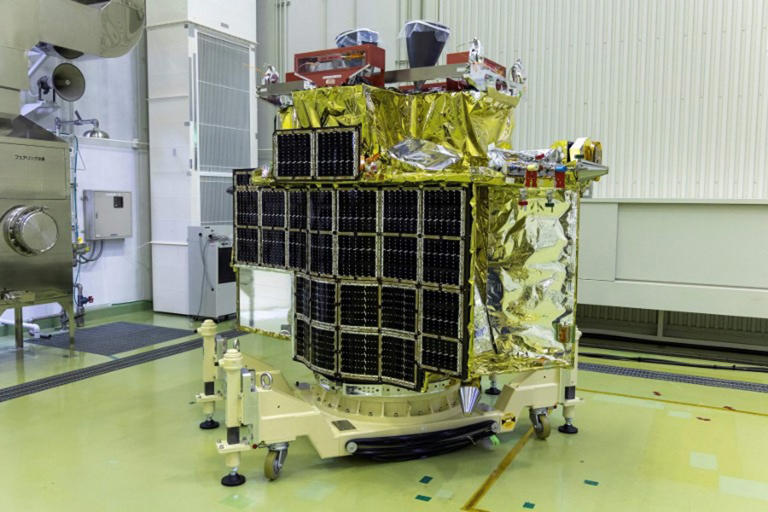
De Smart Lander for Investigating Moon (SLIM) landde op 20 januari op 55 meter van zijn oorspronkelijke doel op de maan. Dat maakte van Japan het vijfde land dat met succes landde op de maan, na de Verenigde Staten, de Sovjet-Unie, China en India. Door een motorprobleem in de laatste meters van de afdaling landde SLIM in een hoek, waardoor zijn naar het westen gerichte fotovoltaïsche cellen geen zonlicht konden opvangen. SLIM kwam in een kleine krater, genaamd Shioli, terecht. Voor het toestel werd uitgeschakeld, laadde het twee minirovers uit, die analyses zullen uitvoeren op gesteente uit de interne structuur van de maan, de maanmantel.
Japanse maanlander SLIM heeft onverwacht donkere en ijskoude maannacht overleefd
Het onbemande ruimtetuig kon opnieuw communiceren en zijn wetenschappelijke opdracht hervatten: onderzoek naar maangesteente. Dat moet duidelijk maken of onder het oppervlakte water, zuurstof en/of brandstoffen aanwezig zijn, cruciaal als mensen in de toekomst een station op de maan willen vestigen.
Nu blijkt dat SLIM de maannacht heeft doorstaan. Volgens de Japanse luchtvaartorganisatie JAXA is de maanlander niet gebouwd om een lange donkere periode en temperaturen tot -150 graden Celsius te overleven.
An invisible world exists beneath our feet, full of thriving organisms that few human eyes will ever see. Now, researchers have found that as global temperatures steadily rise, previously dormant bacteria are coming alive, which could further complicate worsening climate conditions on Earth.
A longstanding challenge in the study of climate change involves how it impacts the microbiome within Earth’s soil, which plays a significant role in helping researchers calculate global climate models. This is partly due to the role microorganisms play in the regulation of carbon fluxes that have a significant impact on climate.
With warming temperatures, some scientists warn that an increase in microbial activity in Earth’s soil could impact carbon stocks, which are especially prevalent in soils at higher latitudes where the activity of these organisms had once been limited by cooler temperatures.
Now, as more microorganisms awaken with rising temperatures, the carbon stocks within these soils are becoming more susceptible to decomposition and could lead to increases in the release of carbon into the atmosphere.
The findings were the result of a new study by researchers at the University of Vienna’s Centre for Microbiology and Environmental Systems Science (CeMESS).
According to the team behind the study, their findings represent a potentially major shift in how scientists view microbial activity in our soil, and the role these organisms play in the global carbon cycle, as well as its relationship to Earth’s climate.
Previously, it had been assumed that the release of carbon into the atmosphere was due to the accelerated growth of existing microbes due to warmer temperatures, although the new findings confirm the primary mechanism to be the activation of dormant bacteria.
Andreas Richter, lead author of the study and professor at the University’s Centre for Microbiology and Environmental Systems Science, says soils are the planet’s most significant supply of organic carbon, and the microorganisms within them govern the Earth’s carbon cycle as they break down materials, releasing carbon dioxide in the process.
Of particular concern to researchers is what is called soil carbon-climate feedback, which is the cycle that arises from the proportional emission of carbon dioxide by microorganisms that awaken as temperatures rise, thereby contributing to overall global warming trends.
As part of their research, Richter and his colleagues traveled to a region of Iceland where elevated soil temperatures compared with nearby areas were especially significant.
Dennis Metze Ph.D., the study’s lead author, said that increased microbial growth was evident in areas that had seen more than half a century of consistent soil warming.
“But remarkably, the growth rates of microbes in warmer soils were indistinguishable to those at normal temperatures,” Metze added, noting that the key difference the researchers found was bacterial diversity, in that warmer soils had a much greater variety of different active microbes.
The team made these discoveries through the collection of soil cores, and the application of state-of-the-art isotope probing capabilities.
Christina Kaiser, an associate professor involved with the study, likened the complexity of soil’s microbiomes and their response to climate “a ‘black box’ in climate modeling.”
The team says their findings will likely assist in the generation of more accurate models going forward and could help to unravel some of the existing mysteries involving how microbial communities respond to warmer temperatures, and their relationship to the overall carbon cycle going forward.
The team’s new study, “Soil warming increases the number of growing bacterial taxa but not their growth rates,” was published in the journal Science Advances on February 23, 2024.
Hundreds of thousands of icy rocks lurk around in the Kuiper Belt, a place discovered just a few decades ago, and exists far beyond Neptune. As a NASA spacecraft sojourns deeper into space, it has encountered a puzzling finding in this cosmic hinterland: The Kuiper Belt may be much bigger than expected.
Neptune, Uranus, Saturn, and Jupiter formed billions of years ago and their gravitational influence may have cleared out the middle of the Solar System of the objects that now live in the Kuiper Belt. Now, after having been slingshotted into the dark and frigid outer edges of the Solar System, these planetary building blocks are coming into the spotlight with missions like NASA’s New Horizons spacecraft.
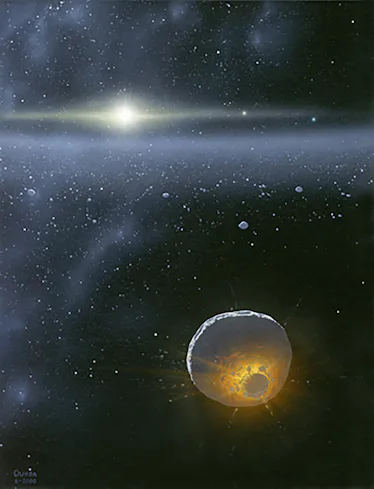
An artist’s concept of a collision between two objects in the Kuiper Belt.
To give an idea of how far away New Horizons currently is, it has been almost nine years since the spacecraft visited Pluto. It’s now about 60 times farther away than the distance between the Sun and the Earth, or 60 astronomical units (AU).
During the three years it took to go from 45 to 55 AUs, its Venetia Burney Student Dust Counter (SDC) instrument found something unusual. The Kuiper Belt showed higher levels of dust than models suggested. The dust is a symptom of its environment and could mean several things that the New Horizons team hopes to one day answer.
NASA officials announced on Tuesday, adding that the work is detailed in a study published in late January in the journal Astrophysical Journal Letters.
NASA says the new data contributes to “a growing body of evidence that suggests the outer edge of the main Kuiper Belt could extend billions of miles farther than current estimates — or that there could even be a second belt beyond the one we already know.”
Pluto is undeniably a frigid place, this image shows. According to NASA, this is the most accurate natural color images of Pluto from the space agency’s New Horizons spacecraft. Now located about 60 AU from the Sun, the spacecraft flew past the dwarf planet at a distance of around 39 AU from the Sun in 2015.
Telescopes on Earth have discovered several Kuiper Belt Objects that exist far beyond the traditional outer edge of the belt, around 50 AU. This, plus the New Horizons dust readings, highlights the scope of this icy population. The dust can be made when two objects smash into each other.
If earlier science models were accurate, New Horizons should have sailed beyond the Kuiper Belt about 10 AU ago. Now there are new ideas about the region's size.
The outer edge could be located at 80 AU, which, if Neptune’s orbit is considered where the belt starts (around 30 AU), means that the Kuiper Belt, on its own, is about 10 times bigger than the distance between the Sun and Jupiter.
New Horizons has notched 5 billion miles over 18 years. NASA says it has a lot of life left in it. According to the agency, the spacecraft should have enough propellant to carry it beyond 100 AU from the Sun and to operate through the 2040s.
One day, when it’s even farther away than it is now, the SDC instrument may sense the dominance of interstellar particles. If and when that happens, astronomy from the edge of our cosmic backyard won’t ever be the same.
A Planetary Disk in the Orion Nebula is Destroying and Replenishing Oceans of Water Every Month
A closeup of the inner region of the Orion Nebula as seen by JWST. There's a protoplanetary disk there that is recycling an Earth's ocean-full of water each month. Credit: NASA, ESA, CSA, PDRs4All ERS Team; Salomé Fuenmayor image
A Planetary Disk in the Orion Nebula is Destroying and Replenishing Oceans of Water Every Month
Planet-forming disks are places of chaotic activity. Not only do planetesimals slam together to form larger worlds, but it now appears that the process involves the destructive recycling of water within a disk. That’s the conclusion from scientists studying JWST data from a planetary birth crèche called d203-506 in the Orion Nebula.
The data they studied suggest that an amount of water equivalent to all of Earth’s oceans is created and replenished in a relatively short period—about a month. According to study co-lead Els Peeters at Western University in Canada, it was relatively easy to discover this process in the protoplanetary disk. “This discovery was based on a tiny fraction of our spectroscopic data,” she said. “It is exciting that we have so much more data to mine and I can’t wait to see what else we can find.”
The Orion Nebula is a vast active star- and planet-forming region and the d203-506 protoplanetary disk lies within it at a distance of about 1,350 light-years away from Earth. Astronomers study the nebula to understand all aspects of star birth since there are so many newborn stars there. In addition, many are surrounded by disks of gas and dust, called protoplanetary disks (proplyds, for short). Those regions are excellent places to observe planet-formation processes, and particularly the interplay between the young stars and their disks.
The Orion Nebula is one of the most studied objects in the sky. Many of its protostars and their planetary disks likely contain water in some form. Image: NASA
The Water Cycle of a Proplyd
We all know that water is an important ingredient for life. It certainly played a role in creating and sustaining life on our planet. As it turns out, water is a significant fraction of the materials in a proplyd. In the infant Solar System, water existed throughout our proplyd long before any of the planets formed, largely in their icy form, either as icy bodies or locked into asteroids and planetesimals. It also exists in interstellar space.
This view of Earth’s horizon by an Expedition 7 crewmember onboard the International Space Station. A new study suggests that Earth’s water didn’t all come from comets, but likely also came from water-rich planetesimals. Credit: NASA
Most of Earth’s water got delivered to the forming planet over millions of years. It melted or outgassed to form the oceans, rivers, and lakes we see today. But, some fraction of the water in our system’s birth disk probably went through a “freeze-thaw” cycle within the disk. That happened when the Solar System was still just a disk of gas and dust. The water was essentially destroyed and then re-formed at higher temperatures.
We can’t see that effect anymore in our system. But, astronomers can point telescopes at other proplyds to see if the same process happens there. That’s what Peeters and her team did. They used JWST to look at d203-506. There, bright young stars flood the nearby regions in the proplyd with intense ultraviolet radiation. The UV breaks up water molecules to form hydroxyl molecules and that process also releases infrared light. JWST can search out that light and report back on how much hydroxyl is in the birth cloud. The team estimates that the process in d203-506 regularly destroys and replenishes about an Earth oceans-full of water each month.
Formation of the Solar System Implications
The d203-506 system is currently forming new worlds, but it began as a cloud of gas and dust without a star. That’s exactly how our own Solar System began—as a cloud of gas and dust more than 4.5 billion years ago. The cloud it formed from was a cold, dark nebula containing some amount of water ice, or water-rich material. Something nudged the cloud to coalesce into a region of higher density, and that continued to shrink in on itself under the force of gravity. Temperatures rose, and eventually, a protostar began to form. Ultraviolet from the Sun irradiated the birth cloud, and that led to a similar water-destroying and replenishing activity. Heat and radiation from the Sun also forced lighter elements to migrate out to cooler regions in the system.
So, d203-506 makes a great analog to study the water cycle in the infant Solar System. Based on this JWST data, it’s very likely that water in Earth’s oceans went through this same process. Eventually, that water made its way to the planetesimals and icy bodies that helped form the worlds of the Solar System.
The icy bodies of the outer solar system probably didn’t experience the same extremes of heating, destruction, and replenishment. That’s because they migrated out to (or already existed at) great enough distances that the irradiation from the Sun didn’t have the same effect. That’s one reason planetary scientists are also interested in sampling those distant bodies. Their “primordial” water ices are a good sample of what conditions were like in the original nebula before it coalesced to form the Sun and planets.
Intuitive Machines’ Odysseus Lander Sends Faint Signal From the Moon
Intuitive Machines‘ Odysseus lander made space history today — becoming the first commercial spacecraft to survive a descent to the moon, and the first U.S.-built spacecraft to do so since the Apollo 17 mission in 1972. But it wasn’t a trouble-free landing.
Ground controllers had a hard time establishing contact with the robotic lander just after the scheduled touchdown time of 6:23 p.m. ET (2323 UTC). Several minutes passed, and then Intuitive Machines mission director Tim Crain reported that there was a faint signal coming from Odysseus’ high-gain antenna.
“We’re not dead yet,” he said.
A few minutes later, the IM-1 mission team decided that the signal was evidence enough that Odysseus was still operating.
“What we can confirm without a doubt is our equipment is on the surface of the moon, and we are transmitting,” Crain said. “So, congratulations, IM team, we’ll see how much more we can get from that.”
As mission team members applauded, Intuitive Machines CEO Steve Altemus radioed in with his congratulations. “I know this was a nail-biter, but we are on the surface and we are transmitting,” he said. “Welcome to the moon.”
“Houston, Odysseus has found his new home,” Crain replied.
What Odysseus was designed to do
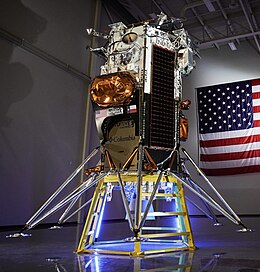
Odysseus, which is named after a seafaring hero in Greek mythology, was launched from NASA’s Kennedy Space Center on Feb. 15. The mission’s objective was to deliver payloads from NASA and commercial customers to a spot near Malapert A crater in the lunar south polar region. That area of the moon is of high interest because its cratered terrain is thought to hold resources of water ice that could be eventually be used to supply crewed outposts.
NASA is paying Houston-based Intuitive Machines $118 million for the delivery under the terms of its Commercial Lunar Payload Services initiative.
The space agency’s payloads include a camera system that was designed to document the plumes of dust kicked up by the landing, an experimental radio navigation beacon, a radio-based fuel gauge, a laser range finder, a set of laser reflectors and a sensor that will study the moon’s electron plasma environment. Data from the experiments could help NASA plan for the Artemis program’s crewed lunar landings, which could start happening as soon as 2026.
The commercial payloads range from a box of 125 marble-sized moon sculptures and a digital data storage device to a mini-observatory that could capture pictures of the lunar surface and the Milky Way above. There’s also a camera system that was designed to be dropped off during the descent to take “selfie” pictures of the touchdown.
Backup systems come into play
Odysseus reached lunar orbit on Feb. 21, and went through a series of maneuvers today to descend from an altitude of 92 kilometers (57 miles).
NASA’s laser range finder, known as the Navigation Doppler Lidar or NDL, ended up playing a crucial backup role in guiding the descent. Just a couple of hours before landing, Intuitive Machines reported that controllers couldn’t get Odysseus’ own laser range finders to work — so they reprogrammed the lander to use NASA’s NDL system instead.
In the wake of the landing, Intuitive Machines’ mission control team went through a series of procedures aimed at resetting equipment and boosting the signal from Odysseus.
“After troubleshooting communications, flight controllers have confirmed Odysseus is upright and starting to send data,” Intuitive Machines reported in a posting to X / Twitter. “Right now, we are working to downlink the first images from the lunar surface.”
There’s a chance that Odysseus went off track during the final stages of the descent and ended up landing askew. That’s what happened a month ago when Japan’s SLIM spacecraft tumbled into an awkward position on its lunar landing site. SLIM’s off-kilter solar arrays were able to soak up enough power for an abbreviated round of science observations.
Even under the best of circumstances, the solar-powered Odysseus lander is expected to be in operation on the lunar surface for only seven days. The mission is slated to end when the sun drops below the lunar horizon and the circuit-chilling lunar night begins.
Past and future lunar robots
NASA’s deputy associate administrator for exploration, Joel Kearns, noted in advance of the landing that the odds for a completely successful commercial moon landing were slim.
“This is not an easy thing we’ve asked these companies to do, but if they’re successful, the up side for American exploration is just so great we have to try it,” Kearns said.
Still more commercial moon landing attempts are on NASA’s calendar: Intuitive Machines is already working on another lander that will drill for ice in the moon’s south polar region. Meanwhile, Astrobotic is getting set to send NASA’s VIPER rover to a spot near the south pole, and Firefly Aerospace is due to deliver 10 NASA payloads to Mare Crisium aboard its Blue Ghost lander.
NASA Administrator Bill Nelson accentuated the positive in a pre-recorded video message that was released on the assumption that Odysseus survived its descent to the surface.
“Today, for the first time in more than half a century, the U.S. has returned to the moon,” Nelson said. “Today, for the first time in the history of humanity, a commercial company, an American company, launched and led the voyage up there. Today is a day that shows the power and promise of NASA’s commercial partnerships. … This feat is a giant leap forward for all of humanity. Stay tuned.”
Mysterie over spectaculaire supernova na 37 jaar eindelijk opgelost (met dank aan James Webb)
Mysterie over spectaculaire supernova na 37 jaar eindelijk opgelost (met dank aan James Webb)
Artikel door Kathleen Heylen
Op 23 februari 1987 ontdekten wetenschappers een supernova in de Grote Magelhaense Wolk, een van de meest nabije sterrenstelsels van onze eigen Melkweg. Een supernova is een gigantische ontploffing van een zware ster aan het einde van zijn leven. Daarbij wordt een enorme hoeveelheid licht uitgestraald. SN 1987A, zoals de supernova werd genoemd, was vanop de aarde zelfs met het blote oog zichtbaar.
En het was maandenlang waarneembaar vanop de aarde: de supernova straalde licht uit met de kracht van 100 miljoen zonnen. Het was de meest dichtstbijzijnde supernova die met het blote oog te zien was in meer dan 400 jaar. Maar vergis je niet, "meest dichtsbijzijnd" is in ruimtetermen nog altijd enorm ver. SN 1987A werd waargenomen op een afstand van 160.000 lichtjaar (één lichtjaar is de afstand die het licht overbrugt in één jaar tijd, red).
Lang voor de eigenlijke ontploffing hadden astronomen al details van de ster in kwestie beschreven. Het ging om een blauwe superreus. Superreuzen zijn de allergrootste en allerzwaarste sterren in het heelal, blauwe superreuzen zijn dan ook nog eens de warmste onder de superreuzen. Deze blauwe superreus had een massa die 20 keer groter was dan die van de zon.
Een van de meest bestudeerde objecten
SN 1987A werd een van de meest bestudeerde objecten in het heelal. Onder meer de beroemde ruimtetelescoop Hubble hielp wetenschappers in hun zoektocht naar hun antwoorden op vele vragen. Heel wat van de huidige astronomische kennis over het wat en hoe van supernova's is gebaseerd op onderzoek naar SN 1987A.
Een van die vragen was: wat rest er van de blauwe superreus na de ontploffing? Na een supernova blijft een klein en compact object over, maar wetenschappers konden bij SN 1987A niet achterhalen wat dat object dan precies was. De supernova was zo krachtig, de wolk van gas en stof zo groot, dat astronomen dat met de voorhanden zijnde instrumenten niet rechtstreeks konden bestuderen.
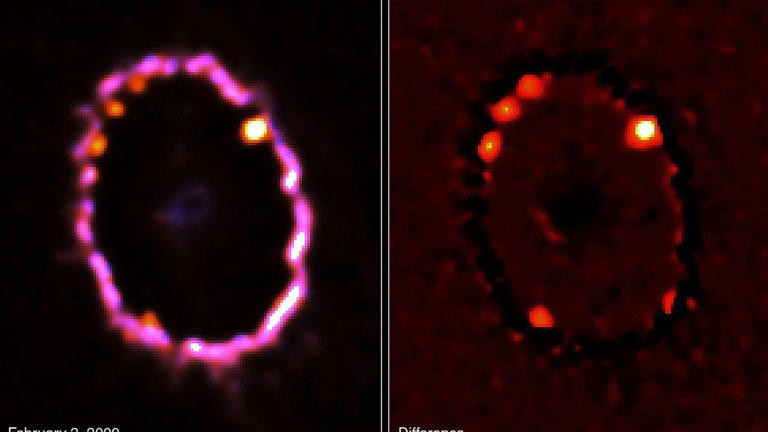
Beelden van SN 1987A die Hubble in februari 2000 kon vastleggen.
Volgens de huidige theorie ontploffen sterren wanneer ze niet genoeg "brandstof" meer over hebben om hen te doen schijnen. De massa van een ster wordt zo groot (een superreus) dat ze uiteindelijk onder druk van haar eigen zwaartekracht instort. En dan ontstaat ofwel een zwart gat, ofwel een neutronenster.
Een zwart gat is zo krachtig dat niets, zelfs licht niet, eruit kan ontsnappen. Ze kunnen ontstaan als reuzensterren in elkaar storten. Neutronensterren zijn de dode overblijfselen van de ingestorte kern van reuzensterren. Ze zijn de kleinste van alle sterren, maar hebben wel de hoogste dichtheid. Hoe zwaarder de massa van de ster, hoe groter de kans op een zwart gat.
Het onderscheid kunnen maken tussen zwarte gaten en neutronensterren is voor astronomen van belang, omdat bij supernova's chemische elementen vrijkomen zoals koolstof, zuurstof en ijzer. Die maken leven mogelijk. Dé vraag: wat bleef er over na de ontploffing van SN 1987A?
De wonderen van James Webb
Enter de James Webb-telescoop. Die werd op kerstdag 2021 gelanceerd. Met een diameter van 6,5 meter is hij de grootste en meest krachtige telescoop die de mens al de ruimte in gestuurd heeft. James Webb bevindt zich op 1,6 miljoen kilometer van de aarde. Vanaf daar speurt de telescoop naar exoplaneten en het licht van sterren dat al miljarden jaren onderweg is.
Sindsdien laat James Webb niet na om wetenschappers én het grote publiek te imponeren met adembenemende en betekenisvolle beelden van allerlei hoeken en kanten in ons universum. Hij biedt astronomen een schat aan materiaal waarmee ze hun kennis over het heelal kunnen bijstellen. Het zal waarschijnlijk niet verbazen dat het James Webb is die wetenschappers een stap dichter bij een antwoord rond het mysterie van SN 1987A heeft gebracht.
En het antwoord is...
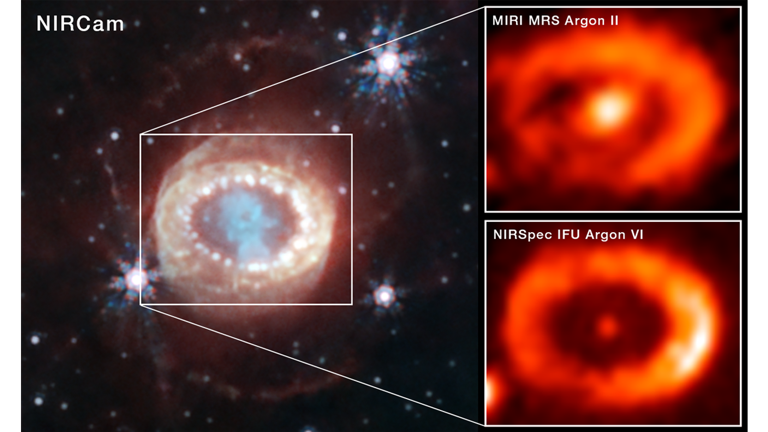
Een internationaal onderzoeksteam geleid door de Zweedse astronoom Claes Fransson van de Universiteit van Stockholm bestudeerde beelden die James Webb maakte van het restant van SN 1987A en van de puinwolk errond. Met de MIRI (Mid-Infra Red Instrument) en de NIRSpec (Near Infra Red Spectrometer) kan James Webb zeer gedetailleerd infraroodstraling in het heelal vastleggen. Vóór James Webb was dat op die manier niet mogelijk.
Wat leverden de James Webb-beelden op? Eenvoudig gezegd: Fransson en zijn team konden in de kern van de explosie licht detecteren dat uitgezonden wordt door sterk geïoniseerde argon- en zwavelgassen. De aanwezigheid van die geïoniseerde gassen kan alleen maar verklaard worden als er een compacte, heldere bron van ultraviolette en röntgenstraling is. En een zwart gat kan daar niet de oorzaak van zijn.
Met andere woorden: het lijkt er heel sterk op dat wat overbleef na de ontploffing van de blauwe superreus in 1987, een neutronenster is.
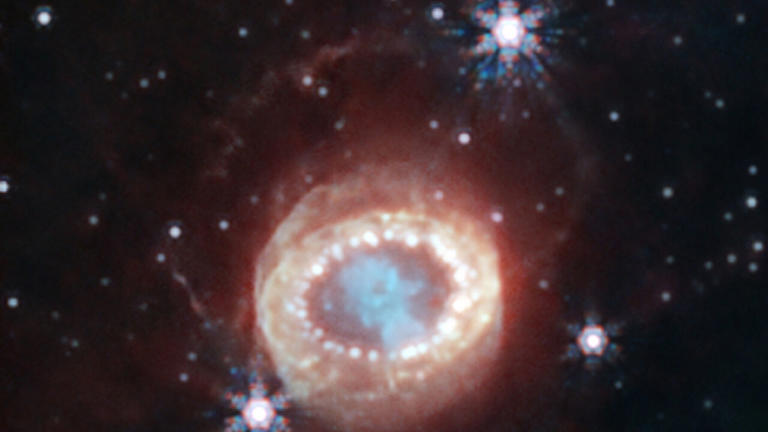
In het centrum van de ontploffing detecteerden wetenschappers licht dat uitgezonden wordt door sterk geïoniseerd argon- en zwavelgas.
"Het is de eerste keer dat we in staat waren om de kern van de supernova te onderzoeken, en wat daar precies ontstaan is", zegt Claes Fransson. "We weten nu dat er een compacte bron van ioniserende straling aanwezig is, vermoedelijk door een neutronenster. We zijn hiernaar al aan het zoeken sinds de waarneming van de ontploffing in 1987, maar we moesten tot nu wachten om onze vermoedens te kunnen toetsen."
Aan het onderzoek werkten 34 wetenschappers uit 12 landen mee. Een van hen is Joris Blommaert van de Astronomy and Astrophysics Research Group van de VUB. Hij werkt al sinds begin 2000 mee aan de ontwikkeling van MIRI, cruciaal bij dit onderzoek. "Dankzij onze bijdrage aan MIRI kregen we observatietijd op James Webb die eindelijk toeliet om sterke bewijzen te verzamelen voor het bestaan van de neutronenster", klinkt het in een persbericht.
James Webb kon met zijn MIRI en NIRSpec doordringen tot in het centrum van de supernova.
"Hoewel we al onrechtstreekse aanwijzingen hadden, heeft James Webb het eerste rechtstreekse bewijs geleverd dat er een neutronenster is", zegt professor Mike Barlow, fysicus en astronoom aan de Universiteit van Londen. "Het mysterie of er zich een neutronenster schuilhoudt in het stof heeft meer dan 30 jaar aangesleept. Het is opwindend dat we het nu hebben kunnen oplossen."
De komende jaren zullen wetenschappers SN 1987A blijven bestuderen om meer te weten te komen over de exacte details van de explosie. "Als we geluk hebben, krijgen we in de toekomst misschien een duidelijk beeld van de neutronenster zelf", zegt Fransson. Het zou een unieke gelegenheid zijn om een neutronenster van in zijn "babyjaren" op te volgen.
The history of water on Mars is a puzzle that is of interest to planetary scientists as well as the general public. The Red Planet currently has water in the form of ice at the poles, trace amounts of gas in the atmosphere, and an unknown amount beneath the surface as ground water, bound in minerals, and in ice. However, there is strong evidence that ancient Mars may have had long-lived streams, rivers, and lakes. There is still much to learn about what Mars was like and how it transformed over time. One approach is to study the inventory of water at different times. Now, NASA’s Perseverance rover has found hydrated magnesium sulfate (similar to Epsom salts) and dehydrated calcium sulfate that were formed by water flowing through cracks in volcanic rocks at the bottom of the 3.8-billion-year-old Jezero crater. These hydrated minerals trap water within themselves and record the history of how and when they formed. Returning samples of these minerals to Earth would allow researchers to explore the history of Mars’ water and climate, and possibly evidence of ancient life with the most sensitive instruments possible.
Jezero crater, Mars.
Image credit: NASA / Tim Goudge.
Planetary scientists suspect Mars once had long-lived rivers, lakes and streams.
Today, water on Mars is found in ice at the poles and trapped below the Martian surface.
In new research, University of Cincinnati’s Dr. Andy Czaja and his colleagues revealed that the planet also may have had hydrothermal systems based on the hydrated magnesium sulfate the rover identified in the volcanic rocks.
“When those rocks cool off and fracture, they become a habitable environment for life,” Dr. Czaja said.
“We have not found any definitive evidence of life in these deposits yet. But if there were fossil microorganisms trapped in the rocks, they would be too small to see with the rover.”
“These hydrated minerals trap water within themselves and record the history of how and when they formed.”
“Returning samples of these minerals to Earth would allow researchers to explore the history of Mars’ water and climate and possibly evidence of ancient life with the most sensitive instruments possible.”
Perseverance began its deliberate exploration from the floor of the crater to the front of the delta, formed by an ancient river or drainage channel where it encountered sedimentary rocks that often contain trapped minerals and another avenue for evidence of ancient life.
And last year the rover made it to the crater’s margin in what used to be an enormous lake where it is exploring deposits of magnesium carbonate, which can form geologically or biologically from bacteria.
“The decision to send Perseverance to Jezero crater appears to be paying off,” Dr. Czaja said.
“There were other places we could have gone that might have been just as good.”
“You won’t know until you explore them all. But Jezero was picked for good reason and it has been completely justified.”
Next the rover will make its way out of Jezero crater to explore the wider area.
“We are likely to find rocks dating back 4 billion years or more,” Dr. Czaja said.
“And Mars could harbor stromatolites or rocks that contain evidence of ancient layered mats of bacteria visible to the naked eye.”
“On Earth, these rocks are sometimes found in extreme environments such as geyser basins.”
“I hope that Perseverance has just whetted our appetite for more Martian exploration.”
“And bringing back samples will allow us to study Mars and search for evidence of ancient life with instruments that haven’t even been invented yet for years and years to come.”
The results were published in the January 2024 issue of the Journal of Geophysical Research: Planets.
Sandra Siljeström et al. Evidence of Sulfate-Rich Fluid Alteration in Jezero Crater Floor, Mars. JGR: Planets 129 (1): e2023JE007989; doi: 10.1029/2023JE00798
Amerikaanse maanlander Odysseus ligt allicht op zijn zij,
Amerikaanse maanlander Odysseus ligt allicht op zijn zij, "maar hij is stabiel en communiceert met de aarde"
Artikel door Kathleen Heylen
De maanlander Nova-C, bijgenaamd Odysseus, werd op 15 februari gelanceerd richting de maan met een Falcon 9-raket van SpaceX, het ruimtevaartbedrijf van Elon Musk. De landing was gepland voor 22 februari. Het werd nog erg spannend, omdat het navigatiesysteem van de Odysseus in de laatste uren voor de landing begon te haperen. Maar het controlecentrum in Houston, Texas, kon uiteindelijk meedelen dat delanding geslaagd was.
Groot nieuws, want de Odysseus is het eerste Amerikaanse ruimtetuig op de maan in 52 jaar. Bovendien is het de eerste lander ooit van een commercieel bedrijf die succesvol kon landen op het maanoppervlak. Het toestel kwam neer bij een krater in de buurt van de zuidpool van de maan, de geplande landingsplaats.
Maar nu blijkt uit de eerste gegevens van de lander dat een en ander toch niet helemaal volgens plan verlopen is.
Vermoedelijk blijven haken op het maanoppervlak
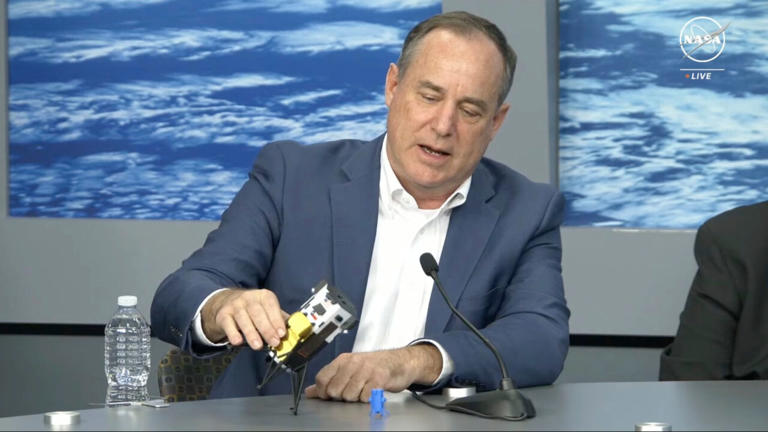
Intuitive Machines, het bedrijf dat de Odysseus heeft ontworpen en gebouwd, zegt dat de lander waarschijnlijk op zijn zij is beland. "Hij is hoogstwaarschijnlijk tijdens de laatste fase van de landing omgevallen", zei CEO Steve Altemus op een persconferentie. Volgens hem lijkt het erop dat een van de zes "poten" van de lander bij de afdaling waarschijnlijk is blijven haken op het maanoppervlak. Daardoor is het tuig gekanteld en tot stilstand gekomen tegen een rotsblok.
In eerste instantie leek het er nochtans wel op dat de Odysseus rechtop was geland. Volgens Steve Altemus bleek dat echter gebaseerd op data van net voor de landing.
Topman Steve Altemus toont wat er vermoedelijk is gebeurd tijdens de afdaling en de landing van de Odysseus.
Intuitive Machines zegt wel dat de lander stabiel is en met de aarde communiceert. Hij is ook nog steeds in staat om energie op te wekken uit zijn zonnepanelen en dus te werken. Hij is ook volledig opgeladen.
Het team verwacht dit weekend foto's binnen te krijgen. Die kunnen meer duidelijkheid geven over de exacte positie van de Odysseus. Op basis daarvan "kunnen we daadwerkelijk een beoordeling maken van de structuur en de staat van de externe apparatuur", zegt Altemus.
Mogelijk zit het deel van Odysseus met wetenschappelijke instrumenten aan "de goede kant", waardoor het geplande wetenschappelijke onderzoek met de lander wel gewoon zou kunnen doorgaan.
Contracten met de NASA
Het was al de vierde keer dat een commercieel bedrijf probeerde "zacht" te landen op de maan, en de eerste keer dat het succesvol was. Eerdere pogingen van het Israëlische bedrijf SpaceIL, het Japanse iSpace en het Amerikaanse Astrobotic Technology mislukten.
De Amerikaanse ruimtevaartorganisatie NASA heeft met het oog op latere onbemande en bemande maanmissies commerciële aanbestedingen uitgeschreven voor de bouw van maanlanders. Enkele Amerikaanse bedrijven, waaronder Intuitive Machines, sleepten zo'n contract in de wacht.
De NASA stuurt wetenschappelijke en technologische experimenten mee met de commeriële maanlanders. De Odysseus heeft zes van die experimenten aan boord.
Intuitive Machines deelde afgelopen nacht een foto van de maan, gemaakt door de Odysseus, kort voor de landing. Het tuig bevond zich op ongeveer 10 kilometer boven het maanoppervlak.
A New, More Accurate Measurement for the Clumpiness of the Universe
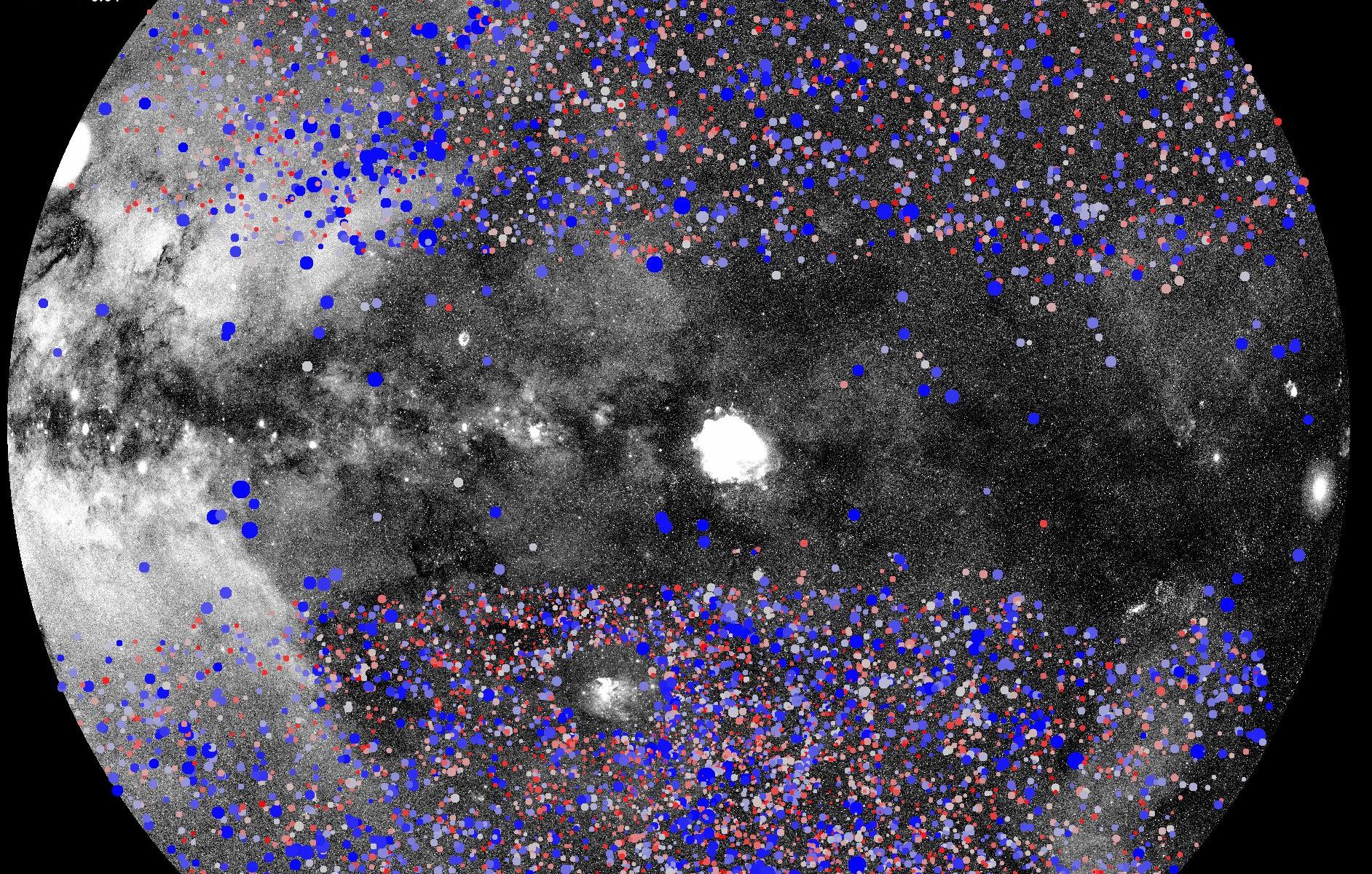
Clusters of galaxies as observed by the eROSITA instrument. The idea is to determine the clumpiness (or distribution) of matter in the Universe. Colors indicate the redshift of the clusters, up to about 9 billion years of lookback time. Credit: MPE, J. Sanders for the eROSITA consortium.
A New, More Accurate Measurement for the Clumpiness of the Universe
Cosmologists are wrestling with an interesting question: how much clumpiness does the Universe have? There are competing but not compatible measurements of cosmic clumpiness and that introduces a “tension” between the differing measurements. It involves the amount and distribution of matter in the Universe. However, dark energy and neutrinos are also in the mix. Now, results from a recent large X-ray survey of galaxy clusters may help “ease the tension”.
The eROSITA X-ray instrument orbiting beyond Earth performed an extensive sky survey of galaxy clusters to measure matter distribution (clumpiness) in the Universe. Scientists at the Max Planck Institute for Extraterrestrial Physics recently shared their analysis of its cosmologically important data.
“eROSITA has now brought cluster evolution measurement as a tool for precision cosmology to the next level,” said Dr. Esra Bulbul (MPE), the lead scientist for eROSITA’s clusters and cosmology team. “The cosmological parameters that we measure from galaxy clusters are consistent with state-of-the-art cosmic microwave background, showing that the same cosmological model holds from soon after the Big Bang to today.”
eROSITA, the Standard Cosmological Model, and Clumpiness
To get a better feel for what this means, let’s look at what the team is trying to confirm. The idea is to figure out just what the Universe has been like through time. That means understanding matter, its distribution (or clumpiness), and what role dark matter and dark energy have played. It all began just after the Big Bang when the Universe was in a hot, dense state. The only things existing were photons and particles. The Universe expanded and began to condense into regions of higher density. Think of these as density variations, or areas of more or less clumpiness in the primordial soup. As things cooled and expanded, the denser clumps in the soup became galaxies and eventually galaxy clusters. The clumpiness was smoother (or “isotropic”) than expected. That raises questions about the role of dark matter and dark energy, among other things.
eROSITA’s observations of galaxy clusters and distribution of matter showed several interesting results. First, both dark matter and visible matter (baryonic matter), make up about 29 percent of the total energy density of the Universe. Presumably, the rest consists of dark energy, which we don’t know much about, yet. Energy density is the amount of energy stored in a region of space as a function of volume. In cosmology, it also includes any mass in that volume of space.
This plot shows the constraints put on the total matter density in the Universe and the S8 “tension”. Constraints from eROSITA galaxy clusters are in orange, from the Cosmic Microwave Background (Planck) in blue, from weak lensing (DES+KiDS) in grey, and from cluster number counts (SPT) in black. Credit: MPE, V. Ghirardini for the eROSITA consortium
The measurement of energy density agrees with measurements of the cosmic microwave background radiation—also known as the CMB. Think of that as a map of the density variations in the early Universe. It’s made up of microwave radiation that permeates the Universe. That radiation is not completely smooth or uniform. That’s the variability in density that eventually became the seeds of the first galaxies.
Measuring Clumpiness
eROSITA’s goal is to measure the assembly of galaxy clusters over cosmic time. By tracing their evolution via the X-rays emitted by hot gas, the instrument traced both the total amount of matter in the Universe and its clumpiness. Those measurements solve the “tension” or discrepancy between past clumpiness measurements that used different techniques. Those included the CMB and observations of weak gravitational lensing.
A computer simulation of what gas and stars in a galaxy cluster look like, and how they look embedded in the cosmic web. The assembly of galaxy clusters has implications for the clumpiness of the Universe throughout time. Credit: Yannick Bahé.
The eROSITA data shows the distribution of matter is actually in good agreement with previous measurements of the CMB. That’s good news because cosmologists were afraid they’d have to invoke “new physics” to explain the tension between measurements. “eROSITA tells us that the Universe behaved as expected throughout cosmic history,” says Dr. Vittorio Ghirardini, the postdoctoral researcher at MPE who led cosmology study. “There’s no tension with the CMB. Maybe the cosmologists can relax a bit now.”
But Wait, There are Neutrinos to Worry About!
Interestingly, the eROSITA measurements of galaxy clusters and other large structures also provide information about neutrinos. They’re the most abundant particles with mass that we know of in the Universe. They come from the Sun and supernovae (for example), but also originated in the Big Bang. eROSITA’s survey offers new information about the mass of neutrinos and their prevalence. “We have obtained tight constraints on the mass of the lightest known particles from the abundance of the largest objects in the Universe,” said Ghirardini.
Computer simulations show how neutrinos can form cosmic clumpiness. Credit: Yoshikawa, Kohji, et al
Neutrinos may be small and tough to “see”, but they have mass that contributes to the total density of matter in the Universe. Cosmologists describe them as “hot”, which means they travel at nearly the speed of light. Therefore, they tend to smooth out the distribution of matter—which can be probed by analyzing the evolution of galaxy clusters in the Universe. And, there’s a good chance that eROSITA may help solve the mystery of neutrino mass. “We are even on the brink of a breakthrough to measure the total mass of neutrinos when combined with ground-based neutrino experiments,” added Ghirardini.
How eROSITA Did It
There’s a lot more to explore in the eROSITA data, but it’s also fascinating to look at the extent of the survey data. It comprises one of the most extensive catalogs of clusters of galaxies done so far. The so-called “Western Galactic half” of the all-sky survey contains 12,247 optically identified X-ray galaxy clusters. “Of these, 8,361 represent new discoveries – almost 70%,” said Matthias Kluge, a postdoctoral researcher at MPE who is responsible for the optical identification of the detected clusters. “This shows the huge discovery potential of eROSITA.”
All that data can be charted in three dimensions, and when scientists do that, galaxy clusters show up as intersections of the cosmic web. In addition, there’s a supercluster catalog, which also shows connected clusters and the filaments of matter between them. “We find more than 1,300 supercluster systems, which makes this the largest-ever X-ray supercluster sample,” said Ang Liu, a postdoctoral researcher at MPE.
This new look at clumpiness in the Universe comes from the first release of data from eROSITA. The instrument completed additional surveys in early 2022. Once those data are analyzed, astronomers expect to be probing even deeper into the distribution of matter in the Universe and testing their models against reality. “When the full data are analyzed,” said Esra Bulbul, “eROSITA will again put our cosmological models to the most stringent test ever conducted through a cluster survey.”
The Dulce Base theory posits the existence of a multi-level underground complex, allegedly situated under Archuleta Mesa near the town of Dulce, New Mexico. According to conspiracy theorists, this facility is not just a military installation but a joint human-alien endeavor. The roots of this extraordinary claim trace back to individuals like Phil Schneider, a former government geologist and engineer, who came forward with sensational details about his experiences at Dulce.
Schneider’s accounts of battles between humans and aliens, advanced technology beyond our comprehension, and hidden agendas have fueled the fire of speculation. He claimed to have encountered extraterrestrial beings and to have suffered injuries in a skirmish, purportedly confirming the presence of non-human entities deep beneath the earth.
The Alleged American Government Connection
What makes the Dulce Base narrative particularly compelling is its implication of an extensive government cover-up. Theories suggest that the U.S. government, along with other global powers, has been engaging with extraterrestrial intelligence for decades, entering into secret treaties and exchanges that have remained hidden from the public eye. The purported objective of such collaborations ranges from technological advancement to strategic military alliances, and even to darker agendas involving human experiments.
Critics of the official government narrative argue that the existence of such a facility, if proven true, would signify a profound and unsettling level of secrecy maintained by the government. It raises questions about the extent of governmental transparency, the ethical boundaries of covert operations, and the potential for abuses of power under the guise of national security.
Skepticism and Scrutiny
Despite the compelling nature of the Dulce Base stories, there remains a significant lack of concrete evidence to substantiate the claims. Skeptics point out that many of the assertions rely heavily on anecdotal evidence, unverifiable personal testimonies, and speculative leaps. The scientific community, for the most part, dismisses the Dulce Base theories as unfounded conspiracy theories lacking in empirical support.
However, the persistence of the Dulce Base narrative within popular culture and conspiracy theory circles reflects a deeper, widespread fascination with the unknown and a profound distrust of governmental institutions. It underscores a collective appetite for exploring alternative explanations for the mysteries that surround us, as well as a suspicion of the narratives presented by authorities.
VIDEO:
The Shocking TRUTH Inside Dulce Base and the American Government Connection
The story of the Dulce Base intertwines elements of science fiction, political intrigue, and speculative conspiracy, creating a perplexing puzzle that captivates the imagination. While definitive proof of its existence and the extent of any government involvement remains elusive, the Dulce Base has secured its place in the annals of conspiracy theory lore. It serves as a powerful reminder of the human desire for knowledge, the fear of the unknown, and the ever-present question of what lies beyond the boundaries of our understanding. Whether myth or reality, the tale of the Dulce Base challenges us to question, to wonder, and to seek the truth, however shocking it may be.
Kuiper Belt May Be Much Larger than Previously Estimated
Kuiper Belt May Be Much Larger than Previously Estimated
Kuiper Belt objects (KBOs) are thought to be the dominant source of interplanetary dust particles in the outer Solar System due to both collisions between KBOs and their continual bombardment by interstellar dust particles. New measurements by NASA’s New Horizons spacecraft show higher than model-predicted levels of interstellar dust as the spacecraft approaches the putative outer edge of theKuiper Belt.
Beyond Neptune, there is a large disk of small objects, called the KuiperBelt and beyond that is the Oort Cloud, home of the comets. This artwork shows a section of Kuiper Belt, crowded with the icy cores of potential comets.
Image credit: M. Kornmesser / ESO.
Interplanetary dust particles carry information about the birth and evolution of planetary bodies within our Solar System.
The orbital distribution of these dust particles is driven by the forces of gravity from the Sun and planets, radiation pressure etc. Additionally, the size and mass of individual particles are constantly evolving due to sputtering and mutual collisions.
While Jupiter-family comets and asteroids dominate the production of interplanetary dust particles in the inner Solar System, the Kuiper Belt is the dominant source of the particles in the outer Solar System from either mutual KBO collisions or interstellar dust bombardment.
The readings contribute to a growing body of evidence that suggests the outer edge of the main Kuiper Belt could extend billions of km farther than current estimates — or that there could even be a second belt beyond the one we already know.
“New Horizons is making the first direct measurements of interplanetary dust far beyond Neptune and Pluto, so every observation could lead to a discovery,” said lead author Alex Doner, a graduate student at the University of Colorado Boulder who serves as SDC lead.
“The idea that we might have detected an extended Kuiper Belt — with a whole new population of objects colliding and producing more dust — offers another clue in solving the mysteries of the Solar System’s most distant regions.”
The SDC instrument has detected microscopic dust grains produced by collisions among asteroids, comets and Kuiper Belt objects all along New Horizons’ 18-year journey across our Solar System — which after launch in 2006 included historic flybys of Pluto in 2015 and Arrokoth in 2019.
The first science instrument on a NASA planetary mission to be designed, built and ‘flown’ by students, the SDC counts and measures the sizes of dust particles, producing information on the collision rates of such bodies in the outer Solar System.
The latest, surprising results were compiled over three years as New Horizons traveled from 45 to 55 AU from the Sun.
These readings come as New Horizons scientists, using observatories like the Japanese Subaru Telescope in Hawaii, have also discovered a number KBOs far beyond the traditional outer edge of the Kuiper Belt.
This outer edge — where the density of objects starts to decline — was thought to be at about 50 AU, but new evidence suggests the belt may extend to 80 AU, or farther.
“As telescope observations continue, scientists are looking at other possible reasons for the high SDC dust readings,” Doner said.
“One possibility, perhaps less likely, is radiation pressure and other factors pushing dust created in the inner Kuiper Belt out past 50 AU.”
“New Horizons could also have encountered shorter-lived ice particles that cannot reach the inner parts of the Solar System and were not yet accounted for in the current models of the Kuiper Belt.”
“These new scientific results from New Horizons may be the first time that any spacecraft has discovered a new population of bodies in our Solar System,” said New Horizons principal investigator Dr. Alan Stern, a researcher at the Southwest Research Institute.
“I can’t wait to see how much farther out these elevated Kuiper Belt dust levels go.”
Now into its second extended mission, New Horizons is expected to have sufficient propellant and power to operate through the 2040s, at distances beyond 100 AU from the Sun.
That far out, the SDC could potentially even record the spacecraft’s transition into a region where interstellar particles dominate the dust environment.
With complementary telescopic observations of the Kuiper Belt from Earth, New Horizons, as the only spacecraft operating in and collecting new information about the Kuiper Belt, has a unique opportunity to learn more about KBOs, dust sources and expanse of the belt, and interstellar dust and the dust disks around other stars.
“Ongoing SDC measurements at even larger heliocentric distances will continue to constrain the contributions of dust production in the Kuiper Belt,” the authors said.
“Continued SDC measurements remain crucial for understanding the Kuiper Belt and the interpretation of dust disks around other stars.”
Their paper appears in the Astrophysical Journal Letters.
Alex Doner et al. 2024. New Horizons Venetia Burney Student Dust Counter Observes Higher than Expected Fluxes Approaching 60 AU. ApJL 961, L38; doi: 10.3847/2041-8213/ad18b0
Scientists Track How a Giant Wave Moved Through Our Galactic Backyard
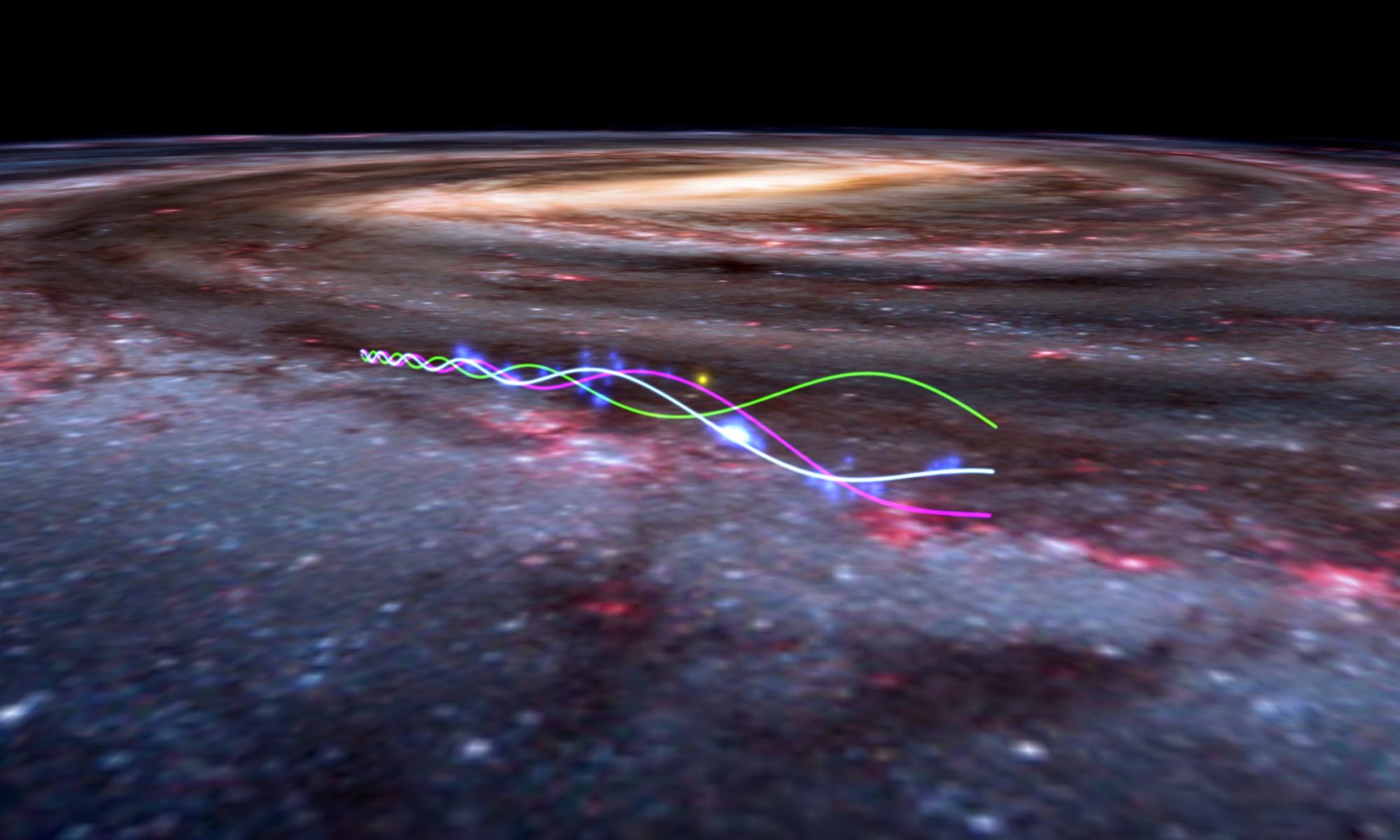
This illustration shows how the Radcliffe Wave moves through the backyard of our sun (shown as a yellow dot). The white line represents the wave's current shape and motion. Magenta and green lines show how the wave is expected to move over time. (Credit: Ralf Konietzka, Alyssa Goodman and WorldWide Telescope via CfA)
Scientists Track How a Giant Wave Moved Through Our Galactic Backyard
Astronomers say there’s a wave rippling through our galactic neighborhood that’s playing a part in the birth and death of stars — and perhaps in Earth’s history as well.
“Similar to how fans in a stadium are being pulled back to their seats by the Earth’s gravity, the Radcliffe Wave oscillates due to the gravity of the Milky Way,” study lead author Ralf Konietzka, a researcher at Harvard and the Harvard-Smithsonian Center for Astrophysics, or CfA, said in a news release.
The wave — which is named in honor of Harvard Radcliffe Institute, where the undulation was discovered — consists of a string of star clusters spread out over a stretch of the Milky Way measuring about 9,000 light-years in length.
Astronomers reported in 2020 that they identified the wavy pattern by correlating the 3-D locations of the clusters in data from the European Space Agency’s Gaia space telescope, plus observations of dust and gas clouds in the same region.
“It’s the largest coherent structure that we know of, and it’s really, really close to us,” said study co-author Catherine Zucker, an astrophysicist with the Smithsonian Astrophysical Observatory at the CfA. “It’s been there the whole time. We just didn’t know about it, because we couldn’t build these high-resolution models of the distribution of gaseous clouds near the sun, in 3-D.”
At the time, the astronomers didn’t have enough data to determine whether the peak of the wave was rolling down the line. That’s what’s known as a traveling wave, as opposed to a stationary wave — the kind of wave that’s set off, for example, by a vibrating guitar string.
Since then, additional readings about the motion of the star clusters have led the astronomers to conclude that the Radcliffe Wave is indeed a traveling wave that rises to a maximum height of more than 700 light-years and has a mean wavelength of roughly 6,500 light-years.
“Now we can go and test all these different theories for why the wave formed in the first place,” Zucker said.
Konietzka said the potential explanations range from “explosions of massive stars, called supernovae, to out-of-galaxy disturbances like a dwarf satellite galaxy colliding with our Milky Way.”
Astronomers say the wave’s rippling effect could in turn trigger bursts of supernovae and swarms of star formation within the gas and dust clouds of the interstellar medium. In earlier research, Zucker and other astronomers suggested that sometime around 14 million years ago, just such a burst gave rise to the “Local Bubble,” a star-forming shell that surrounds our own solar system.
The Radcliffe Wave is currently about 980 light-years away from our own solar system, and appears to be drifting outward at a speed of about 11,000 mph (5 km/sec). “The measured drift of the Radcliffe Wave radially outward from the galactic center suggests that the cluster whose supernovae ultimately created today’s expanding Local Bubble may have been born in the Radcliffe Wave,” authors of the newly published paper say.
Study co-author Alyssa Goodman, an astronomer at the CfA, said the evidence supports the case for claiming that the Radcliffe Wave had an effect on Earth and its cosmic neighborhood.
“Passage of the sun through over-dense material like the Radcliffe Wave and the Local Bubble does affect the heliosphere,” she wrote in an email, “and the timing does work out that some of the peaks in radioactivity on Earth (e.g., iron-60) line up time-wise with when the sun would have crossed the RadWave, Local Bubble surface, and other ‘Local Fluff’ clouds as well.”
Now the study’s authors are wondering whether the Radcliffe Wave is merely a local phenomenon. Could such waves be common? “The question is, what caused the displacement giving rise to the waving we see?” Goodman said. “And does it happen all over the galaxy? In all galaxies? Does it happen occasionally? Does it happen all the time?”
Volgens een nieuw NASA-onderzoek, uitgevoerd in samenwerking met de Universiteit van Hawaï, zou een oscilatie in de baan van de maan verschrikkelijke gevolgen kunnen hebben over de hele wereld. Dat zou vervolgens NASA kunnen leiden tot nooit eerder geziene, verwoestende overstromingen.
Een trilling of oscillatie is een periodiek herhaalde omkering van de bewegingsrichting. Een trilling wordt vaak veroorzaakt door de verstoring van een stabiele evenwichtssituatie.
Hoewel er een verandering in de baan van de maan wordt aangekondigd, zou het jaar 2030 catastrofaal kunnen zijn voor de wereldbevolking en vooral voor de kustbevolking. In een recent persbericht verklaarde NASA-onderzoeker en -beheerder Bill Nelson: “Gecombineerd met klimaatverandering zou dit maanfenomeen verwoestende overstromingen kunnen veroorzaken aan kusten in alle uithoeken van de wereld. De cumulatieve effecten van de zwaartekracht van de maan, de stijgende zee- en oceaanspiegels en de klimaatverandering zullen een toch al sterk gecompromitteerde huidige situatie nog erger maken. Zo bericht 7sur7.
De verandering in de maanbaan is een fenomeen dat elke 20 jaar voorkomt en natuurlijk is. De WordsSideKick.com-site wijst erop dat de oscillatie van de baan van de maan tijdens een regelmatige cyclus (18,6 jaar) de positie ten opzichte van de aarde zeer licht wijzigt. Volgens NASA “veroorzaakt het fenomeen gedurende de helft van deze cyclus zwakkere hoogwatertijden en sterkere laagwateren. Tijdens de andere helft van de cyclus worden de getijden versterkt, met sterker hoogwater en zwakker laagwater”, meldt 7sur7. Over een paar jaar zal de stijging van de zeespiegel significanter zijn en “dit effect, gecombineerd met andere, zou wel eens zelfs nog catastrofaler kunnen blijken voor de kustbevolking.”
JWST Sees a Milky Way-Like Galaxy Coming Together in the Early Universe
The ancient Firefly Sparkle galaxy is precursor to galaxies like the Milky Way. The JWST found ten separate clusters in the galaxy that show how the galaxy is growing through mergers. Image Credit: Mowla et al. 2024.
JWST Sees a Milky Way-Like Galaxy Coming Together in the Early Universe
The gigantic galaxies we see in the Universe today, including our own Milky Way galaxy, started out far smaller. Mergers throughout the Universe’s 13.7 billion years gradually assembled today’s massive galaxies. But they may have begun as mere star clusters.
In an effort to understand the earliest galaxies, the JWST has examined their ancient light for clues as to how they became so massive.
The JWST can effectively see back in time to when the Universe was only about 5% as old as it is now. In that distant past, structures that would eventually become as massive as the Milky Way, and even larger, were only about 1/10,000th as massive as they are now. What clues can the powerful infrared space telescope uncover that show us how galaxies grew so large?
A new paper presents JWST observations of a galaxy at redshift z~8.3. At that redshift, the light has been travelling for over 13 billion years and began its journey only 600 million years after the Big Bang. The galaxy, called the Firefly Sparkle, contains a network of massive star clusters that are evidence of how galaxies grow.
“The Firefly Sparkle provides an unprecedented case study of a Milky Way-like galaxy in the earliest stages of its assembly in only a 600 million-year-old Universe,”
From Mowla et al. 2024
Despite the JWST’s power, this distant, ancient galaxy is only visible through the gravitational lensing of a massive cluster of foreground galaxies. The lensing makes the Firefly Sparkle appear as an arc. Two other galaxies are also in the vicinity, called Firefly BF (Best Friend) and Firefly NBF (New Best Friend.)
This image shows the Firefly Sparkle galaxy and its two neighbours, BF and NBF. The Firefly Sparkle’s mass is concentrated in 10 clusters that contain up to 57% of its entire mass. Image Credit: Mowla et al. 2024.
“The Firefly Sparkle exhibits the hallmarks expected of a future Milky Way-type galaxy captured during its earliest and most gas-rich stage of formation,” the authors write. The young galaxy’s mass is concentrated in 10 clusters, which range from about 200,000 solar masses to 630,000 solar masses. According to the authors, these clusters “straddle the boundary between low-mass galaxies and high-mass globular clusters.”
These clusters are significant because they’re clues to how the galaxy is growing. The researchers were able to gauge the ages of the clusters and their star formation histories. They found that they experienced a burst of star formation at around the same time. “The cluster ages suggest that they are gravitationally bound with star formation histories showing a recent starburst possibly triggered by the interaction with a companion galaxy at the same redshift at a projected distance of ~2 kpc away from the Firefly Sparkle.”
There are two candidates for the interacting galaxy: Firefly Best Friend (BF) and Firefly New Best Friend (NBF). But NBF is about 13 kpcs away, while BF is about two kpcs away, making BF the likely interactor. “Faint low-surface brightness features are visible at the corners of the arc close to the neighbour, hinting at a possible interaction between the two galaxies <FS and BF> which may have triggered a burst of star formation in both of them,” explain the researchers.
This figure from the study illustrates the star formation histories of each cluster, as well as each galaxy. In the top right, “The Firefly Sparkle and FF-BF both show a recent burst of star formation in the last ~ 50 Myr indicative of recent interactions,” the authors explain. Image Credit: Mowla et al. 2024.
The researchers paid special attention to the central cluster. They found that the temperature is extremely high at about 40,000 Kelvin (40,000 C; 72,000 F.) It also has a top-heavy initial mass function, a signal that it formed in a very metal-poor environment. These observations and other evidence show that Firefly Sparkle is very likely a progenitor of galaxies like ours. For these reasons, “… the Firefly Sparkle provides an unprecedented case study of a Milky Way-like galaxy in the earliest stages of its assembly in only a 600 million-year-old Universe,” the authors write.
Fortunately, the researchers behind these results have a powerful supercomputer simulation to compare observations with. It’s called Illustris TNG. It’s a massive cosmological magnetohydrodynamical simulation based on a comprehensive physical model of the Universe. Illustris TNG has made three runs, called TNG50, TNG 100, and TNG 300. The researchers compared their results with TNG 50.
This figure compares Firefly Sparkle’s current mass with the TNG 50 simulations of galaxy growth and with the growth rate of the Milky Way, according to an upcoming paper. Image Credit: Mowla et al. 2024.
Finding these ancient star clusters is intriguing, but we can’t assume they’ll survive intact. There are tidal and evaporative forces at work. The authors examined the stability of the individual star clusters and how they’ll fare over time.
“Most of these star clusters are expected to survive to the present-day universe and will expand and then get ripped apart to form the stellar disk and the halo of the galaxy,” the authors explain. “The only way they survive is to get kicked out to large distances, away from the dense tidal field of the galaxy.” The ones that get kicked out may persist as globular clusters.
One of the JWST’s primary science goals is to study how galaxies formed and evolved in the early Universe. By finding one in which clusters are still forming, the space telescope is reaching its goal.
“The Firefly Sparkle represents one of JWST’s first spectrophotometric observations of an extremely lensed galaxy assembling at high redshifts, with clusters that are in the process of formation instead of seen at later epochs,” the authors conclude.
This artist’s impression shows the record-breaking quasar J059-4351, the bright core of a distant galaxy that is powered by a supermassive black hole. Credit: ESO/M. Kornmesser
It’s an exciting time in astronomy today, where records are being broken and reset regularly. We are barely two months into 2023, and already new records have been set for the farthest black hole yet observed, the brightest supernova, and the highest-energy gamma rays from our Sun. Most recently, an international team of astronomers using the ESO’s Very Large Telescope in Chile reportedly saw the brightest object ever observed in the Universe: a quasar (J0529-4351) located about 12 billion light years away that has the fastest-growing supermassive black hole (SMBH) at its center.
First observed in 1963 by Dutch-American astronomer Maarten Schmidt, quasars (short for “quasi-stellar objects”) are the bright cores of galaxies powered by SMBHs. These black holes collect matter from their surroundings and accelerate it to near the speed of light, which releases tremendous amounts of energy across the electromagnetic spectrum. Quasars become so bright that their cores will outshine all the stars in their disk, making them the brightest objects in the sky and visible from billions of light-years away.
As a general rule, astronomers gauge the growth rate of SMBHs based on the luminosity of their galaxy’s core region – the brighter the quasar, the faster the black hole is accreting matter. In this case, the SMBH at the core of J0529-4351 is growing by the equivalent of one Solar mass a day, making it the fastest-growing black hole yet observed. In the process, the accretion disk alone releases a radiative energy of 2 × 1041 Watts, more than 500 trillion times the luminous energy emitted by the Sun. Christian Wolf, an ANU astronomer and lead author of the study, characterized the discovery in a recent ESO press release:
“We have discovered the fastest-growing black hole known to date. It has a mass of 17 billion Suns, and eats just over a Sun per day. This makes it the most luminous object in the known Universe. Personally, I simply like the chase. For a few minutes a day, I get to feel like a child again, playing treasure hunt, and now I bring everything to the table that I have learned since.”
But what was most surprising was that this quasar was hiding in plain sight. “All this light comes from a hot accretion disc that measures seven light-years in diameter — this must be the largest accretion disc in the Universe,” said ANU Ph.D. student and co-author Samuel Lai. “It is a surprise that it has remained unknown until today, when we already know about a million less impressive quasars. It has literally been staring us in the face until now,” added co-author Christopher Onken, who is also an astronomer at ANU.
As Onken explained, J0529-4351 showed up in images taken by the ESO Schmidt Southern Sky Survey dating back to 1980. It was only in recent years that it was recognized as a quasar, thanks to improved instruments and measurements. Finding quasars requires precise observations from large areas of the sky, resulting in massive datasets that often require machine learning algorithms to analyze them. However, these models are somewhat limited because they are trained on existing data, meaning candidates are selected based on previously observed objects.
This image shows the region of the sky in which the record-breaking quasar J0529-4351 is situated. Credit: ESO/Digitized Sky Survey 2/Dark Energy Survey
Since J0529-4351 is so luminous, it was dismissed by the ESA’s Gaia Observatory as being too bright to be a quasar and was ruled to be a bright star. Last year, the ANU-led team identified it as a distant quasar based on observations using the 2.3-meter telescope at the Siding Spring Observatory in Australia. They then conducted follow-up observations using the X-shooter spectrograph on the ESO’s VLT telescope to confirm their results. The quasar is also an ideal target for the GRAVITY+ upgrade on ESO’s Very Large Telescope Interferometer (VLTI), designed to accurately measure the mass of black holes.
In addition, astronomers look forward to making observations with next-generation telescopes like the ESO’s Extremely Large Telescope (ELT). This 39-meter telescope, currently under construction in the Atacama Desert in Chile, will make identifying and characterizing distant quasars easier. Studying these objects and their central black holes could reveal vital details about how SMBHs and galaxies co-evolved during the early Universe.
Titan Most Likely Non-Habitable, Astrobiologists Say
Titan Most Likely Non-Habitable, Astrobiologists Say
Saturn’s moon Titan has an organic-rich atmosphere and surface with a subsurface ocean that may represent a habitable environment. In a new study, astrobiologists determined the amount of organic material that can be delivered from Titan’s surface to its ocean through impact cratering. Unless biologically available compounds can be sourced from Titan’s interior, or be delivered from the surface by other mechanisms, their calculations suggest that even the most organic-rich ocean world in the Solar System may not be able to support a large biosphere.
An artist’s rendering of the surface of Saturn’s largest moon, Titan.
Image credit: Benjamin de Bivort, debivort.org / CC BY-SA 3.0.
The identification of life in the outer Solar System is a significant area of interest for planetary scientists, astronomers and government space agencies like NASA, largely because many icy moons of the giant planets are thought to have large subsurface oceans of liquid water.
Titan, for example, is thought to have an ocean beneath its icy surface that is more than 12 times the volume of Earth’s oceans.
Life as we know it here on Earth needs water as a solvent, so planets and moons with lots of water are of interest when looking for extraterrestrial life,” said first author Professor Catherine Neish, an astrobiologist at the University of Western Ontario.
In the study, Professor Neish and her colleagues attempted to quantify the amount of organic molecules that could be transferred from Titan’s organic-rich surface to its subsurface ocean, using data from impact cratering.
Comets impacting Titan throughout its history have melted the surface of the icy moon, creating pools of liquid water that have mixed with the surface organics.
The resulting melt is denser than its icy crust, so the heavier water sinks through the ice, possibly all the way to Titan’s subsurface ocean.
Using the assumed rates of impacts on Titan’s surface, the researchers determined how many comets of different sizes would strike Titan each year over its history.
“Life as we know it here on Earth needs water as a solvent, so planets and moons with lots of water are of interest when looking for extraterrestrial life,” said first author Professor Catherine Neish, an astrobiologist at the University of Western Ontario.
In the study, Professor Neish and her colleagues attempted to quantify the amount of organic molecules that could be transferred from Titan’s organic-rich surface to its subsurface ocean, using data from impact cratering.
Comets impacting Titan throughout its history have melted the surface of the icy moon, creating pools of liquid water that have mixed with the surface organics.
The resulting melt is denser than its icy crust, so the heavier water sinks through the ice, possibly all the way to Titan’s subsurface ocean.
Using the assumed rates of impacts on Titan’s surface, the researchers determined how many comets of different sizes would strike Titan each year over its history.
This allowed them to predict the flow rate of water carrying organics that travel from Titan’s surface to its interior.
The authors found the weight of organics transferred in this way is quite small, no more than 7,500 kg/year of glycine, the simplest amino acid, which makes up proteins in life.
“One elephant per year of glycine into an ocean 12 times the volume of Earth’s oceans is not sufficient to sustain life,” Professor Neish said.
“In the past, people often assumed that water equals life, but they neglected the fact that life needs other elements, in particular carbon.”
Other icy worlds in the Solar System have almost no carbon on their surfaces, and it is unclear how much could be sourced from their interiors.
“This work shows that it is very hard to transfer the carbon on Titan’s surface to its subsurface ocean — basically, it’s hard to have both the water and carbon needed for life in the same place,” Professor Neish said.
The team’s paper was published online this month in the journal Astrobiology.
Catherine Neish et al. Organic Input to Titan’s Subsurface Ocean Through Impact Cratering. Astrobiology, published online February 2, 2024; doi: 10.1089/ast.2023.0055
Beste bezoeker, Heb je zelf al ooit een vreemde waarneming gedaan, laat dit dan even weten via email aan Frederick Delaere opwww.ufomeldpunt.be. Deze onderzoekers behandelen jouw melding in volledige anonimiteit en met alle respect voor jouw privacy. Ze zijn kritisch, objectief maar open minded aangelegd en zullen jou steeds een verklaring geven voor jouw waarneming! DUS AARZEL NIET, ALS JE EEN ANTWOORD OP JOUW VRAGEN WENST, CONTACTEER FREDERICK. BIJ VOORBAAT DANK...
Druk op onderstaande knop om je bestand , jouw artikel naar mij te verzenden. INDIEN HET DE MOEITE WAARD IS, PLAATS IK HET OP DE BLOG ONDER DIVERSEN MET JOUW NAAM...
Druk op onderstaande knop om een berichtje achter te laten in mijn gastenboek
Alvast bedankt voor al jouw bezoekjes en jouw reacties. Nog een prettige dag verder!!!
Over mijzelf
Ik ben Pieter, en gebruik soms ook wel de schuilnaam Peter2011.
Ik ben een man en woon in Linter (België) en mijn beroep is Ik ben op rust..
Ik ben geboren op 18/10/1950 en ben nu dus 75 jaar jong.
Mijn hobby's zijn: Ufologie en andere esoterische onderwerpen.
Op deze blog vind je onder artikels, werk van mezelf. Mijn dank gaat ook naar André, Ingrid, Oliver, Paul, Vincent, Georges Filer en MUFON voor de bijdragen voor de verschillende categorieën...
Veel leesplezier en geef je mening over deze blog.