The purpose of this blog is the creation of an open, international, independent and free forum, where every UFO-researcher can publish the results of his/her research. The languagues, used for this blog, are Dutch, English and French.You can find the articles of a collegue by selecting his category. Each author stays resposable for the continue of his articles. As blogmaster I have the right to refuse an addition or an article, when it attacks other collegues or UFO-groupes.
Druk op onderstaande knop om te reageren in mijn forum
Zoeken in blog
Deze blog is opgedragen aan mijn overleden echtgenote Lucienne.
In 2012 verloor ze haar moedige strijd tegen kanker!
In 2011 startte ik deze blog, omdat ik niet mocht stoppen met mijn UFO-onderzoek.
BEDANKT!!!
Een interessant adres?
UFO'S of UAP'S, ASTRONOMIE, RUIMTEVAART, ARCHEOLOGIE, OUDHEIDKUNDE, SF-SNUFJES EN ANDERE ESOTERISCHE WETENSCHAPPEN - DE ALLERLAATSTE NIEUWTJES
UFO's of UAP'S in België en de rest van de wereld Ontdek de Fascinerende Wereld van UFO's en UAP's: Jouw Bron voor Onthullende Informatie!
Ben jij ook gefascineerd door het onbekende? Wil je meer weten over UFO's en UAP's, niet alleen in België, maar over de hele wereld? Dan ben je op de juiste plek!
België: Het Kloppend Hart van UFO-onderzoek
In België is BUFON (Belgisch UFO-Netwerk) dé autoriteit op het gebied van UFO-onderzoek. Voor betrouwbare en objectieve informatie over deze intrigerende fenomenen, bezoek je zeker onze Facebook-pagina en deze blog. Maar dat is nog niet alles! Ontdek ook het Belgisch UFO-meldpunt en Caelestia, twee organisaties die diepgaand onderzoek verrichten, al zijn ze soms kritisch of sceptisch.
Nederland: Een Schat aan Informatie
Voor onze Nederlandse buren is er de schitterende website www.ufowijzer.nl, beheerd door Paul Harmans. Deze site biedt een schat aan informatie en artikelen die je niet wilt missen!
Internationaal: MUFON - De Wereldwijde Autoriteit
Neem ook een kijkje bij MUFON (Mutual UFO Network Inc.), een gerenommeerde Amerikaanse UFO-vereniging met afdelingen in de VS en wereldwijd. MUFON is toegewijd aan de wetenschappelijke en analytische studie van het UFO-fenomeen, en hun maandelijkse tijdschrift, The MUFON UFO-Journal, is een must-read voor elke UFO-enthousiasteling. Bezoek hun website op www.mufon.com voor meer informatie.
Samenwerking en Toekomstvisie
Sinds 1 februari 2020 is Pieter niet alleen ex-president van BUFON, maar ook de voormalige nationale directeur van MUFON in Vlaanderen en Nederland. Dit creëert een sterke samenwerking met de Franse MUFON Reseau MUFON/EUROP, wat ons in staat stelt om nog meer waardevolle inzichten te delen.
Let op: Nepprofielen en Nieuwe Groeperingen
Pas op voor een nieuwe groepering die zich ook BUFON noemt, maar geen enkele connectie heeft met onze gevestigde organisatie. Hoewel zij de naam geregistreerd hebben, kunnen ze het rijke verleden en de expertise van onze groep niet evenaren. We wensen hen veel succes, maar we blijven de autoriteit in UFO-onderzoek!
Blijf Op De Hoogte!
Wil jij de laatste nieuwtjes over UFO's, ruimtevaart, archeologie, en meer? Volg ons dan en duik samen met ons in de fascinerende wereld van het onbekende! Sluit je aan bij de gemeenschap van nieuwsgierige geesten die net als jij verlangen naar antwoorden en avonturen in de sterren!
Heb je vragen of wil je meer weten? Aarzel dan niet om contact met ons op te nemen! Samen ontrafelen we het mysterie van de lucht en daarbuiten.
21-02-2024
The Brightest Object Ever Seen in the Universe
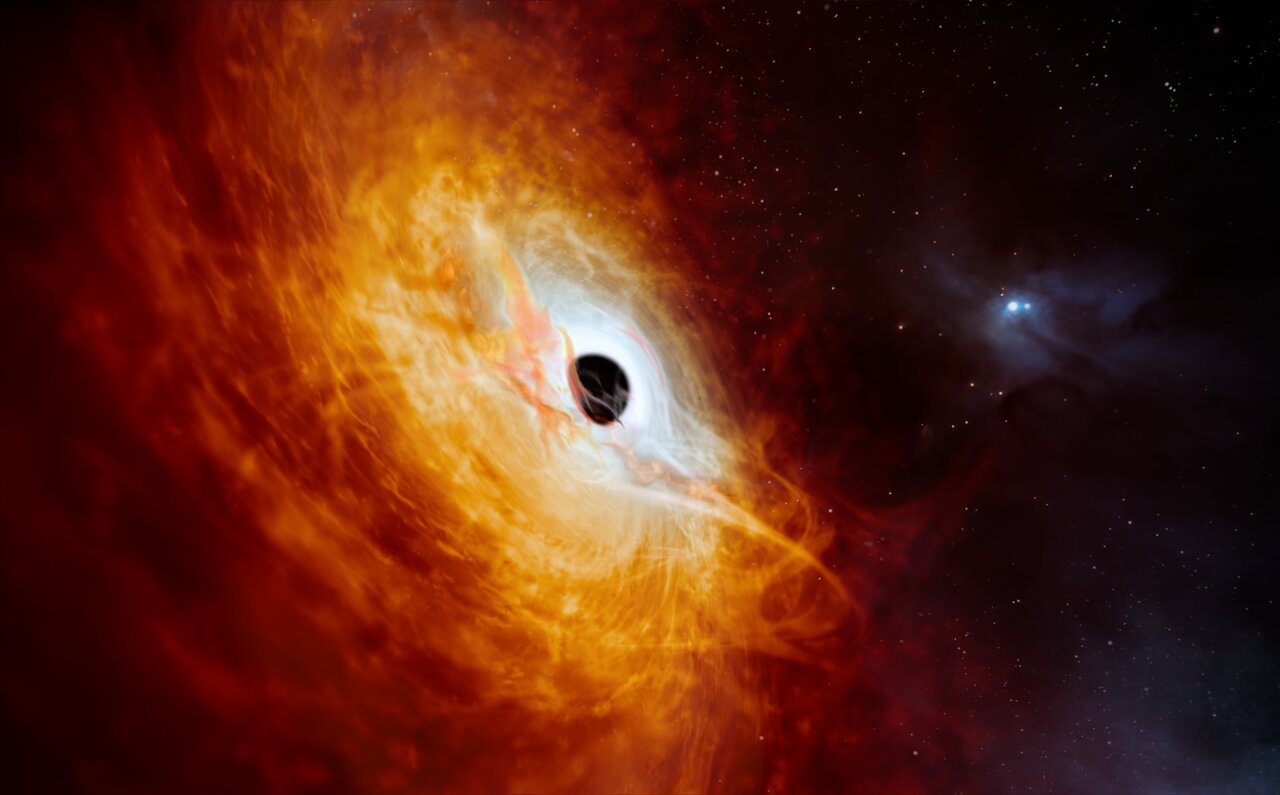
This artist’s impression shows the record-breaking quasar J059-4351, the bright core of a distant galaxy that is powered by a supermassive black hole. Credit: ESO/M. Kornmesser
It’s an exciting time in astronomy today, where records are being broken and reset regularly. We are barely two months into 2023, and already new records have been set for the farthest black hole yet observed, the brightest supernova, and the highest-energy gamma rays from our Sun. Most recently, an international team of astronomers using the ESO’s Very Large Telescope in Chile reportedly saw the brightest object ever observed in the Universe: a quasar (J0529-4351) located about 12 billion light years away that has the fastest-growing supermassive black hole (SMBH) at its center.
First observed in 1963 by Dutch-American astronomer Maarten Schmidt, quasars (short for “quasi-stellar objects”) are the bright cores of galaxies powered by SMBHs. These black holes collect matter from their surroundings and accelerate it to near the speed of light, which releases tremendous amounts of energy across the electromagnetic spectrum. Quasars become so bright that their cores will outshine all the stars in their disk, making them the brightest objects in the sky and visible from billions of light-years away.
As a general rule, astronomers gauge the growth rate of SMBHs based on the luminosity of their galaxy’s core region – the brighter the quasar, the faster the black hole is accreting matter. In this case, the SMBH at the core of J0529-4351 is growing by the equivalent of one Solar mass a day, making it the fastest-growing black hole yet observed. In the process, the accretion disk alone releases a radiative energy of 2 × 1041 Watts, more than 500 trillion times the luminous energy emitted by the Sun. Christian Wolf, an ANU astronomer and lead author of the study, characterized the discovery in a recent ESO press release:
“We have discovered the fastest-growing black hole known to date. It has a mass of 17 billion Suns, and eats just over a Sun per day. This makes it the most luminous object in the known Universe. Personally, I simply like the chase. For a few minutes a day, I get to feel like a child again, playing treasure hunt, and now I bring everything to the table that I have learned since.”
But what was most surprising was that this quasar was hiding in plain sight. “All this light comes from a hot accretion disc that measures seven light-years in diameter — this must be the largest accretion disc in the Universe,” said ANU Ph.D. student and co-author Samuel Lai. “It is a surprise that it has remained unknown until today, when we already know about a million less impressive quasars. It has literally been staring us in the face until now,” added co-author Christopher Onken, who is also an astronomer at ANU.
As Onken explained, J0529-4351 showed up in images taken by the ESO Schmidt Southern Sky Survey dating back to 1980. It was only in recent years that it was recognized as a quasar, thanks to improved instruments and measurements. Finding quasars requires precise observations from large areas of the sky, resulting in massive datasets that often require machine learning algorithms to analyze them. However, these models are somewhat limited because they are trained on existing data, meaning candidates are selected based on previously observed objects.
This image shows the region of the sky in which the record-breaking quasar J0529-4351 is situated. Credit: ESO/Digitized Sky Survey 2/Dark Energy Survey
Since J0529-4351 is so luminous, it was dismissed by the ESA’s Gaia Observatory as being too bright to be a quasar and was ruled to be a bright star. Last year, the ANU-led team identified it as a distant quasar based on observations using the 2.3-meter telescope at the Siding Spring Observatory in Australia. They then conducted follow-up observations using the X-shooter spectrograph on the ESO’s VLT telescope to confirm their results. The quasar is also an ideal target for the GRAVITY+ upgrade on ESO’s Very Large Telescope Interferometer (VLTI), designed to accurately measure the mass of black holes.
In addition, astronomers look forward to making observations with next-generation telescopes like the ESO’s Extremely Large Telescope (ELT). This 39-meter telescope, currently under construction in the Atacama Desert in Chile, will make identifying and characterizing distant quasars easier. Studying these objects and their central black holes could reveal vital details about how SMBHs and galaxies co-evolved during the early Universe.
Titan Most Likely Non-Habitable, Astrobiologists Say
Titan Most Likely Non-Habitable, Astrobiologists Say
Saturn’s moon Titan has an organic-rich atmosphere and surface with a subsurface ocean that may represent a habitable environment. In a new study, astrobiologists determined the amount of organic material that can be delivered from Titan’s surface to its ocean through impact cratering. Unless biologically available compounds can be sourced from Titan’s interior, or be delivered from the surface by other mechanisms, their calculations suggest that even the most organic-rich ocean world in the Solar System may not be able to support a large biosphere.
An artist’s rendering of the surface of Saturn’s largest moon, Titan.
Image credit: Benjamin de Bivort, debivort.org / CC BY-SA 3.0.
The identification of life in the outer Solar System is a significant area of interest for planetary scientists, astronomers and government space agencies like NASA, largely because many icy moons of the giant planets are thought to have large subsurface oceans of liquid water.
Titan, for example, is thought to have an ocean beneath its icy surface that is more than 12 times the volume of Earth’s oceans.
Life as we know it here on Earth needs water as a solvent, so planets and moons with lots of water are of interest when looking for extraterrestrial life,” said first author Professor Catherine Neish, an astrobiologist at the University of Western Ontario.
In the study, Professor Neish and her colleagues attempted to quantify the amount of organic molecules that could be transferred from Titan’s organic-rich surface to its subsurface ocean, using data from impact cratering.
Comets impacting Titan throughout its history have melted the surface of the icy moon, creating pools of liquid water that have mixed with the surface organics.
The resulting melt is denser than its icy crust, so the heavier water sinks through the ice, possibly all the way to Titan’s subsurface ocean.
Using the assumed rates of impacts on Titan’s surface, the researchers determined how many comets of different sizes would strike Titan each year over its history.
“Life as we know it here on Earth needs water as a solvent, so planets and moons with lots of water are of interest when looking for extraterrestrial life,” said first author Professor Catherine Neish, an astrobiologist at the University of Western Ontario.
In the study, Professor Neish and her colleagues attempted to quantify the amount of organic molecules that could be transferred from Titan’s organic-rich surface to its subsurface ocean, using data from impact cratering.
Comets impacting Titan throughout its history have melted the surface of the icy moon, creating pools of liquid water that have mixed with the surface organics.
The resulting melt is denser than its icy crust, so the heavier water sinks through the ice, possibly all the way to Titan’s subsurface ocean.
Using the assumed rates of impacts on Titan’s surface, the researchers determined how many comets of different sizes would strike Titan each year over its history.
This allowed them to predict the flow rate of water carrying organics that travel from Titan’s surface to its interior.
The authors found the weight of organics transferred in this way is quite small, no more than 7,500 kg/year of glycine, the simplest amino acid, which makes up proteins in life.
“One elephant per year of glycine into an ocean 12 times the volume of Earth’s oceans is not sufficient to sustain life,” Professor Neish said.
“In the past, people often assumed that water equals life, but they neglected the fact that life needs other elements, in particular carbon.”
Other icy worlds in the Solar System have almost no carbon on their surfaces, and it is unclear how much could be sourced from their interiors.
“This work shows that it is very hard to transfer the carbon on Titan’s surface to its subsurface ocean — basically, it’s hard to have both the water and carbon needed for life in the same place,” Professor Neish said.
The team’s paper was published online this month in the journal Astrobiology.
Catherine Neish et al. Organic Input to Titan’s Subsurface Ocean Through Impact Cratering. Astrobiology, published online February 2, 2024; doi: 10.1089/ast.2023.0055
Astronomers Spot Hundreds of Massive Gas Clouds Escaping Milky Way’s Center
Astronomers Spot Hundreds of Massive Gas Clouds Escaping Milky Way’s Center
Using new 21-cm radio observations made with NSF’s Green Bank Telescope, astronomers have discovered over 250 neutral gaseous clouds being blasted out of the center of our Milky Way Galaxy into interstellar space. These clouds are likely a product of the same phenomenon that created the Fermi Bubbles.
An artist’s conception of the clouds flowing out from the center of the Milky Way, entrained in a very hot wind that has accelerated them to velocities of many hundreds of km per second.
Image credit: NSF / GBO / P. Vosteen.
It has been known for some time that energetic processes in the center of the Milky Way have created fast, hot winds expanding into intergalactic space with temperatures of millions of degrees and velocities of thousands of km per second. Most large galaxies have winds like this.
The accidental discovery that some of this outflowing hot gas has entrained cold hydrogen clouds was made by the Australian ATCA telescope measuring the 21-cm radio emission emitted by interstellar hydrogen atoms.
This implied that there could be an undiscovered population of clouds carrying matter out of the nucleus of the Milky Way.
The hydrogen clouds are important on their own, but they also serve as probes of the hot wind.
It is difficult to measure conditions within the very hot wind, but the cool clouds can trace it in the same way that on Earth, a handful of leaves tossed upwards can show the direction and speed of the local wind.
The sensitivity of the Green Bank Telescope (GBT) make it the ideal instrument for detecting faint signals from interstellar hydrogen, but mapping these clouds, and realizing their true extent, was no easy feat.
“It took years using the GBT to systematically map hundreds of square degrees in search of faint hydrogen emission,” said Dr. Felix James ‘Jay’ Lockman, senior astronomer at the Green Bank Observatory.
“Once we identified some promising candidates, we could follow up with targeted observations at other telescopes to show us more.”
“The clouds must have been ripped from an area near the very center of the Milky Way and flung outward, either by a burst of star formation or activity of a black hole.”
Some of these clouds have the highest outflow velocity of any clouds ever observed in the Milky Way, and may escape the Galaxy.
In an unexpected twist, the new data from the APEX telescope revealed that some of the hydrogen clouds contain molecules and dense cold gas.
“No one would have expected that clouds violently ejected from the Milky Way could harbor relatively fragile molecular material, but there it is,” Dr. Lockman said.
Astronomers using the MeerKAT array recently mapped the hydrogen in a few clouds at high angular resolution, showing them evolving and being shredded as they flow into interstellar space.
“These new results open the door for more discoveries,” Dr. Lockman said.
“How the clouds remain stable as they are accelerated to more than 400 km per second is a mystery.”
“The chemical processes in these clouds are quite unusual and unexplored.”
Dr. Lockman and his colleague, Dr. Enrico Di Teodoro from the Università degli Studi di Firenze, presented the findings at AAS243, the 243rd meeting of the American Astronomical Society in New Orleans, Louisiana, the United States.
Felix Lockman & Enrico Di Teodoro. 2024. A New Census of Neutral Clouds in the Milky Way’s Nuclear Wind. AAS243, abstract #2851
De Amerikaanse ruimtevaartorganisatie NASA zoekt kandidaten om uit te testen hoe het leven op Mars is. Maar de vereisten zijn zeer strikt: om te beginnen mogen enkel Amerikanen deelnemen aan de tests.
Nu de rakettechnologie steeds meer op punt staat, lijkt exploratie op Mars dichterbij te komen. De levensomstandigheden zijn echter heel anders dan op aarde. Vandaar dat er getest moet worden of het wel verstandig is om mensen te sturen.
In het nieuws: De simulatiemissie Crew Health and Performance Exploration Analog (CHAPEA 2) moet NASA een beeld geven van het leven op Mars.
Vier personen zullen zich vanaf de lente van 2025 begeven in een ge-3D-printe omgeving van bijna 160 vierkante meter in de thuisbasis van NASA in Houston. Daar wordt het leven op Mars nagebootst. Er wordt onderzocht hoe je voedsel kan kweken of hoe ruimtewandelingen zouden zijn. De missie duurt een jaar.
Op dit moment is er al een crew aanwezig voor het CHAPEA 1-project. Zij zitten halverwege hun periode. Het gaat er hard aan toe: de levensomstandigheden zijn niet evident. De job is betaald, maar NASA wil niet zeggen hoeveel precies.
De details: De toelatingsvoorwaarden zijn niet min.
Om te beginnen zoekt NASA voor CHAPEA 2 uitsluitend Amerikaanse burgers die tussen de 30 en 55 jaar oud zijn. Ze moeten een masterdiploma in een STEM-richting hebben, plus minstens twee jaar werkervaring in een dergelijke richting.
Verder zijn ook nog minstens 1.000 vlieguren als piloot of twee jaar doctoraatswerk in een STEM-richting bepalende factoren.
Geïnteresseerden kunnen zich aanmelden op de NASA-website en krijgen een indrukwekkende vragenlijst voorgeschoteld. “Ben je bereid om geen communicatie te hebben voor een jaar behalve met je crewleden, met een vertraging van maximaal 20 minuten?” en “Ben je bereid uitgebreide cognitieve, sportieve en gedragstests te ondergaan?” geven een beeld van wat je kan verwachten.
Odysseus Moon Lander Sends Back Selfies With Earth in the Picture
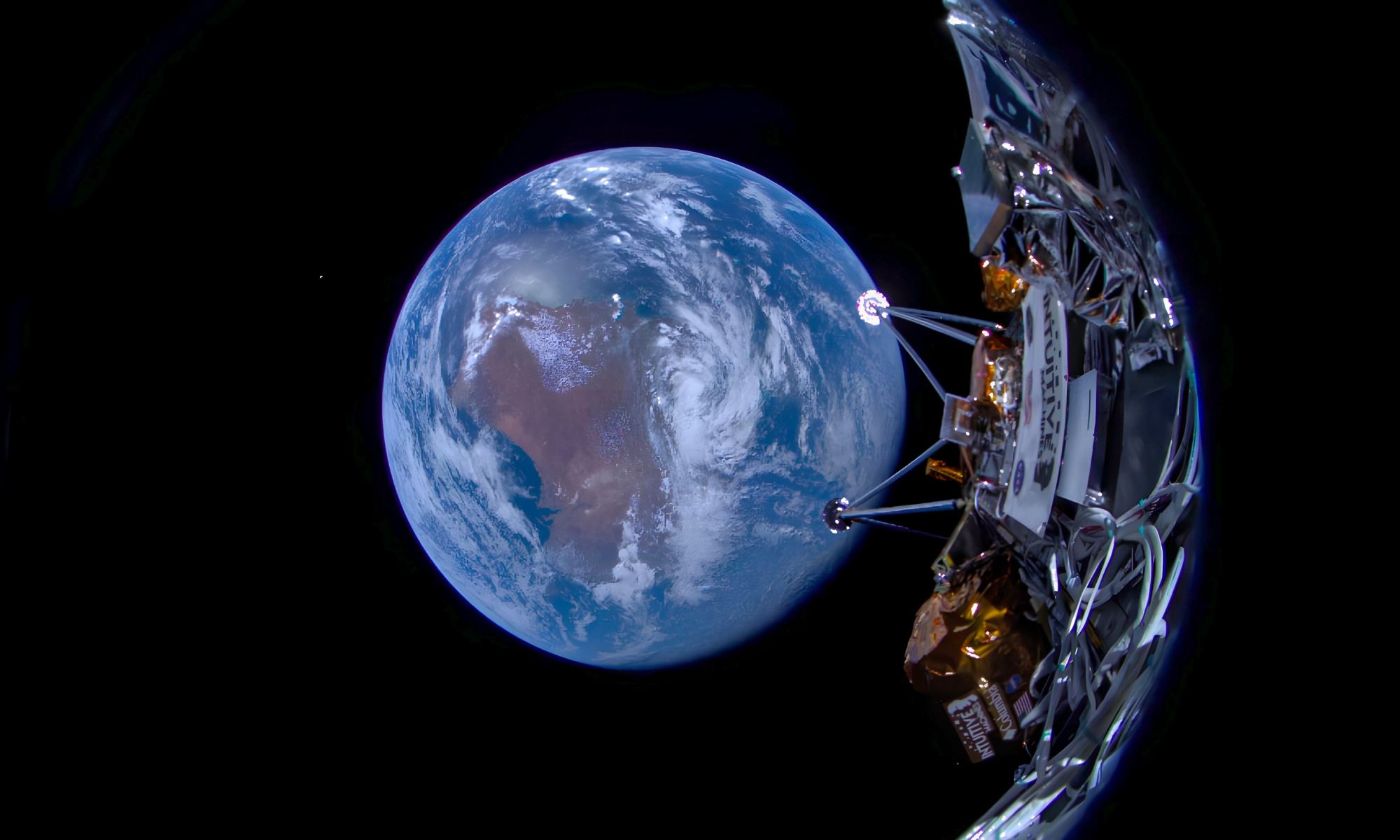
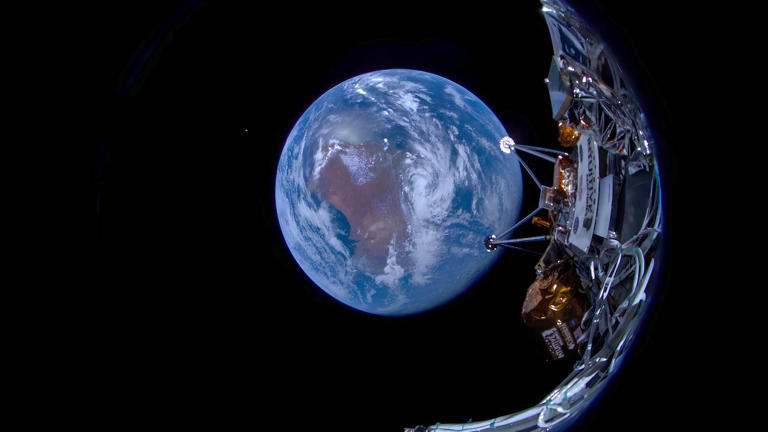
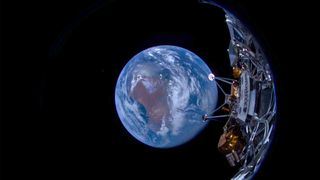
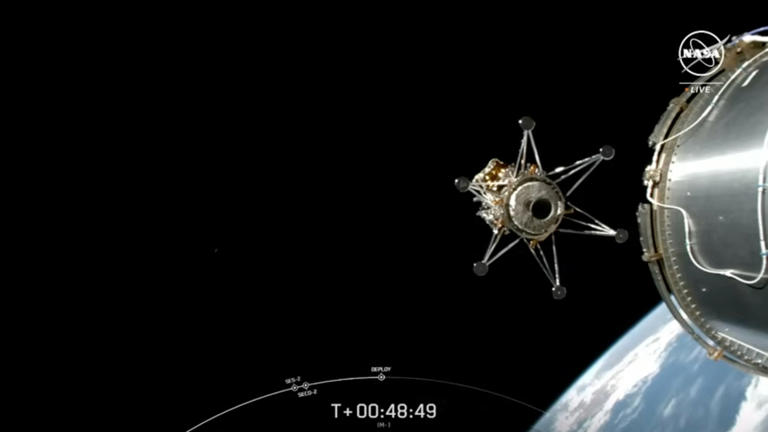
Intuitive Machines’ Odysseus lander has beamed back a series of snapshots that were captured as it headed out from the Earth toward the moon, and one of the pictures features Australia front and center. The shots also show the second stage of the SpaceX Falcon 9 rocket that launched the spacecraft, floating away as Odysseus pushed onward.
The pictures were taken on Feb. 16, the day of the launch.
“Payload integration managers programmed the lander’s wide and narrow field-of-view cameras to take five quick images every five minutes for two hours, starting 100 seconds after separating from SpaceX’s second stage,” Houston-based Intuitive Machines explained in a posting to X / Twitter. “Out of all the images collected, Intuitive Machines chose to show humanity’s place in the universe with four wonderful images we hope to inspire the next generation of risk-takers.”
If Intuitive Machines’ IM-1 mission is successful, Odysseus is due to become the first commercial spacecraft to make a soft landing on the moon, and the first U.S. spacecraft to do so since NASA’s Apollo 17 crewed mission in 1972.
The lander, which is about the size of an old-fashioned telephone booth, is carrying six science payloads for NASA, plus six commercial payloads — including a miniaturized camera system that would be dropped off just before landing to record the touchdown.
Odysseus is scheduled to reach lunar orbit on Feb. 21 and descend to Malapert A crater, near the moon’s south pole, on the 22nd. The mission’s objective is to test out spacecraft systems and assess the environment in the south polar region, in advance of a crewed landing that could take place as early as 2026.
Assuming all goes well, Intuitive Machines is in line to receive $118 million from NASA through the Commercial Lunar Payload Services program, which was created to take advantage of private-sector innovation and reduce NASA’s costs.
In a Feb. 18 mission update, Intuitive Machines reported that Odysseus “continues to be in excellent health, and flight controllers are preparing planned trajectory correction maneuvers to prepare the lander for lunar orbit insertion.”
Success isn’t guaranteed: Just last month, a NASA-supported commercial lander built by Astrobotic fell back to Earth after missing its chance to make a moon landing due to a propellant leak. Over the past few years, other robotic moon landing missions planned by Israel’s SpaceIL team, Japan’s iSpace and the Russian Space Agency have also ended in failure.
That being said, failure isn’t inevitable: In the past year, India and the Japan Aerospace Exploration Agency have successfully put landers on the lunar surface to send back science data.
If Odysseus survives its landing attempt, Intuitive Machines expects the solar-powered robot to be in operation for seven days. The mission is expected to end when the sun sinks below the lunar horizon.
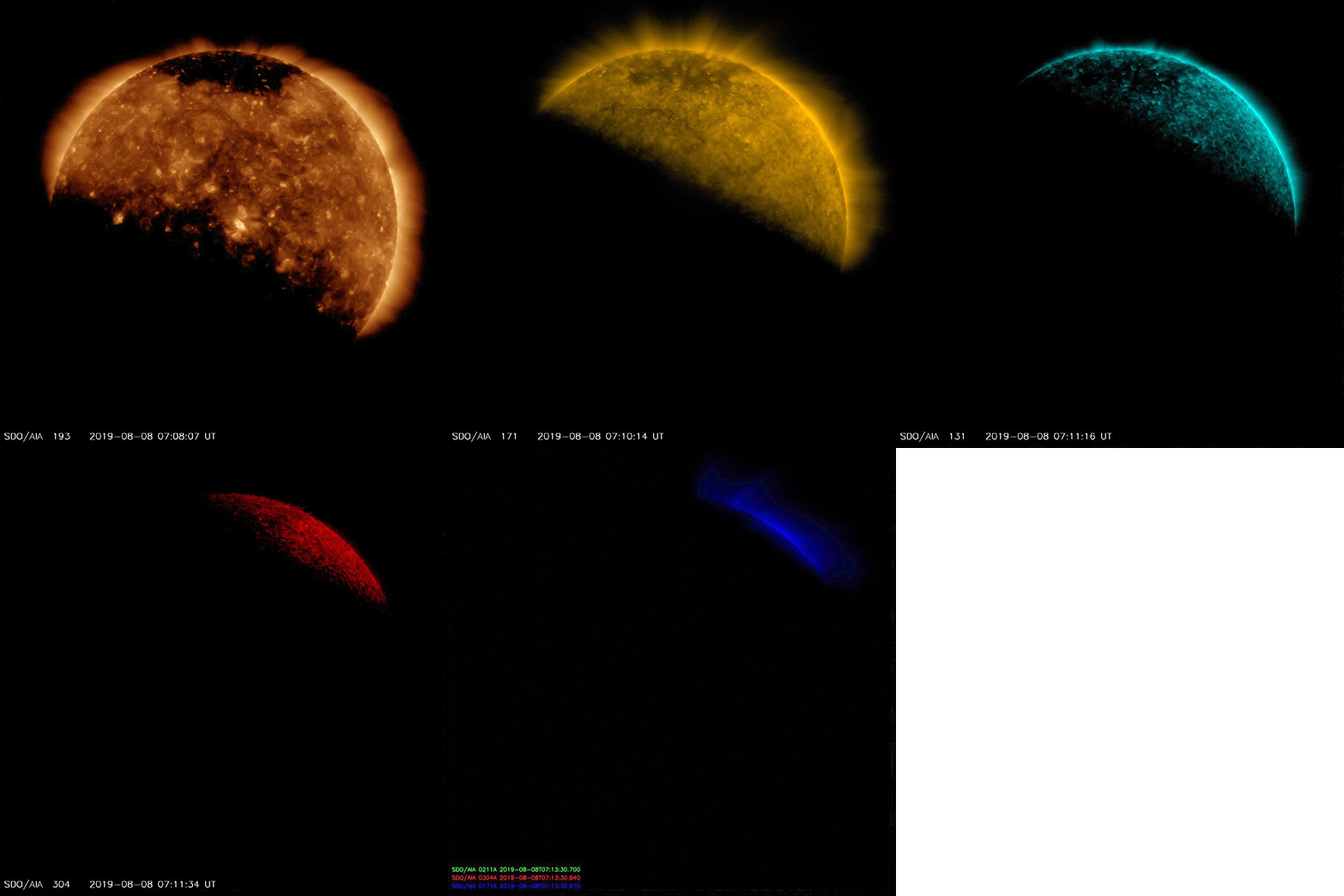
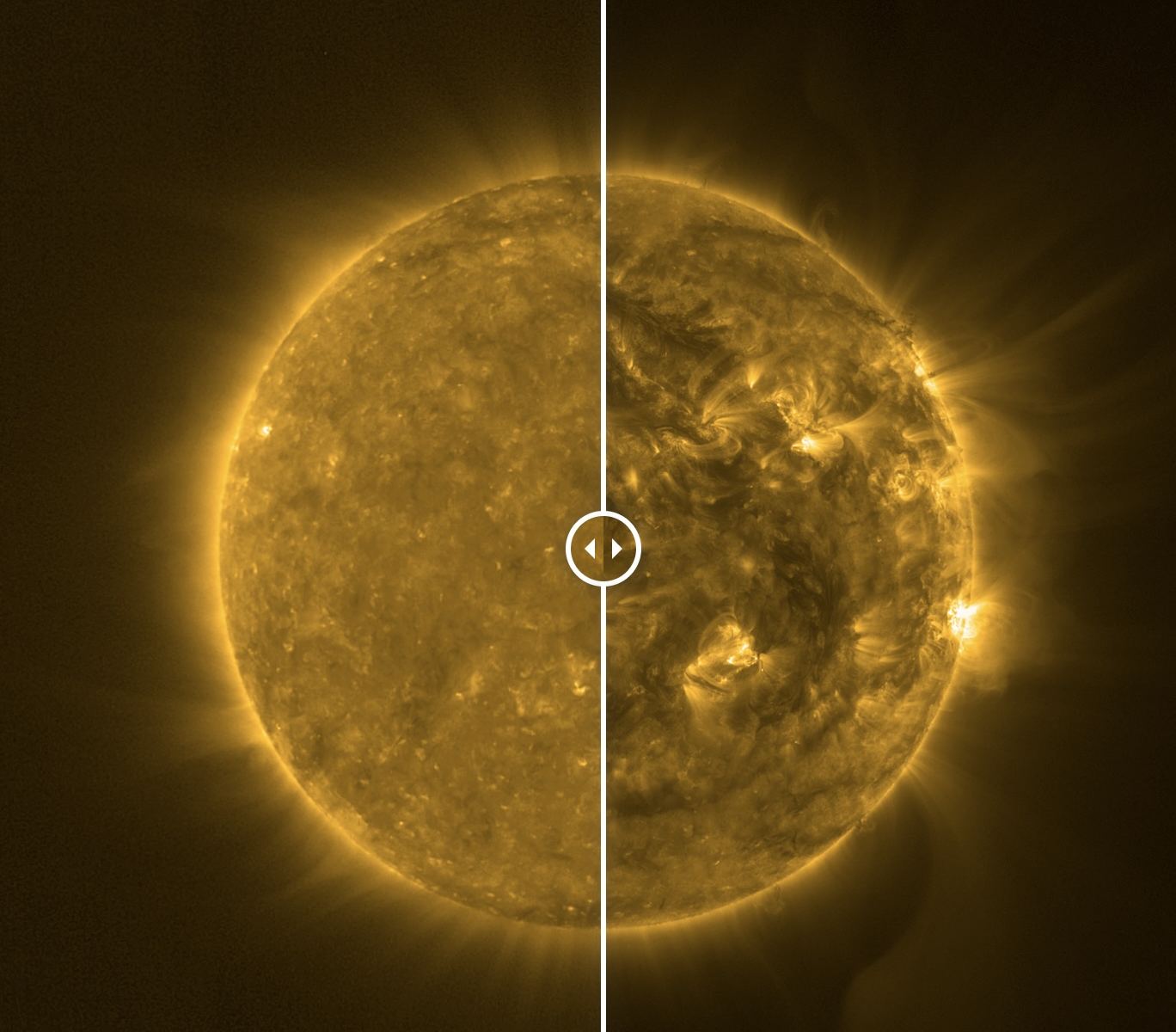
Look at How Much the Sun Has Changed in Just Two Years
The solar cycle has been reasonably well understood since 1843 when Samuel Schwabe spent 17 years observing the variation of sunspots. Since then, we have regularly observed the ebb and flow of the sunspots cycle every 11 years. More recently ESA’s Solar Orbiter has taken regular images of the Sun to track the progress as we head towards the peak of the current solar cycle. Two recently released images from February 2021 and October 2023 show how things are really picking up as we head toward solar maximum.
The Sun is a great big ball of plasma, electrically charged gas, which has the amazing property that it can move a magnetic field that may be embedded within. As the Sun rotates, the magnetic field gets dragged around with it but, because the Sun rotates faster at the equator than at the poles, the field lines get wound up tighter and tighter.
Under this immense stressing, the field lines occasionally break, snap or burst through the surface of the Sun and when they do, we see a sunspot. These dark patches on the visible surface of the Sun are regions where denser concentrations of solar material prohibit heat flow to the visible surface giving rise to slightly cooler, and therefore darker patches on the Sun.
A collage of new solar images captured by the Inouye Solar Telescope, which is a small amount of solar data obtained during the Inouye’s first year of operations throughout its commissioning phase. Images include sunspots and quiet regions of the Sun, known as convection cells. (Credit: NSF/AURA/NSO)
The slow rotation of the Sun and the slow but continuous winding up of the field lines means that sun spots become more and more numerous as the field gets more distorted. Observed over a period of years the spots seem to slowly migrate from the polar regions to the equatorial regions as the solar cycle progresses.
To try and help understand this complex cycle and unlock other mysteries of the Sun, the European Space Agency launched its Solar Orbiter on 10 February 2020. Its mission to explore the Sun’s polar regions, understand what drives the 11 year solar cycle and what drives the heating of the corona, the outer layers of the Sun’s atmosphere.
Solar Orbiter
Images from Solar Orbiter have been released that show closeups of the Sun’s visible surface, the photosphere as it nears peak of solar activity. At the beginning of the cycle, at solar minimum in 2019, there was relatively little activity and only a few sunspots. Since then, things have been slowly increasing. The image from February 2021 showed a reasonably quiet Sun but an image taken in October last year shows that things are, dare I say, hotting up! The maximum of this cycle is expected to occur in 2025 which supports theories that the period of maximum activity could arrive a year earlier.
Understanding the cycle is not just of whimsical scientific interest, it is vital to ensure we minimise damage to ground based and orbiting systems but crucially understand impact on life on Earth.
De Odysseus-maanlander van Intuitive Machines heeft met succes de eerste beelden vanuit de ruimte naar de aarde gestuurd. Het robotachtige ruimteschip is sinds 15 februari onderweg naar de maan. Kort na de lancering verstuurde de Falcon 9-raket, gebouwd door SpaceX, enkele selfies met de aarde op de achtergrond.
Deze mijlpaal werd aangekondigd door het Amerikaans bedrijf Intuitive Machines via een bericht op X, waarop vier foto’s werden gedeeld. Intuitive Machines met hoofdkantoor in Houston werd opgericht in 2013 door het drietal Stephen Altemus, Kam Ghaffarian en Tim Crain. Het bedrijf verwacht minstens één keer per dag missie-updates te blijven geven op X.
Eerste onbemande maanlanding
Odysseus zal de eerste onbemande Amerikaanse maanlanding zijn sinds de Apollo-missies tussen 1961 en 1972. Het ruimteschip verkeert in perfecte conditie en is op weg naar een geplande landingspoging op 22 februari.
Intuitive Machines gebruikt voor hun motor een combinatie van vloeibare methaan en vloeibare zuurstof. Die combinatie wordt ook gebruikt voor de Raptor-raketmotoren van SpaceX, die de Starship-raket aandrijven. Starship is het ambitieuze project van SpaceX om mensen naar de maan en Mars te brengen.
Doel
Het doel van het bedrijf is het bereiken van een baan om de maan, een zachte maanlanding en communicatie vanaf de maan mogelijk maken. Intuitive Machines heeft ook drie NASA-contracten om ladingen naar het maanoppervlak te transporteren.
De Odysseus-maanlander van Intuitive Machines heeft met succes de eerste beelden vanuit de ruimte naar de aarde gestuurd. Het robotachtige ruimteschip is sinds 15 februari onderweg naar de maan. Kort na de lancering verstuurde de Falcon 9-raket, gebouwd doorSpaceX, enkele selfies met de aarde op de achtergrond.
Deze mijlpaal werd aangekondigd door het Amerikaans bedrijf Intuitive Machines via een bericht op X, waarop vier foto’s werden gedeeld. Intuitive Machines met hoofdkantoor in Houston werd opgericht in 2013 door het drietal Stephen Altemus, Kam Ghaffarian en Tim Crain. Het bedrijf verwacht minstens één keer per dag missie-updates te blijven geven op X.
Eerste onbemande maanlanding
Odysseus zal de eerste onbemande Amerikaanse maanlanding zijn sinds de Apollo-missies tussen 1961 en 1972. Het ruimteschip verkeert in perfecte conditie en is op weg naar een geplande landingspoging op 22 februari.
Intuitive Machines gebruikt voor hun motor een combinatie van vloeibare methaan en vloeibare zuurstof. Die combinatie wordt ook gebruikt voor de Raptor-raketmotoren van SpaceX, die de Starship-raket aandrijven. Starship is het ambitieuze project van SpaceX om mensen naar de maan en Mars te brengen.
Doel
Het doel van het bedrijf is het bereiken van een baan om de maan, een zachte maanlanding en communicatie vanaf de maan mogelijk maken. Intuitive Machines heeft ook drie NASA-contracten om ladingen naar het maanoppervlak te transporteren.
Bij klimaatverandering denken we vooral aan opwarming, maar in grote delen van Europa zou ook weleens een flinke afkoeling kunnen plaatsvinden als een belangrijke Atlantische oceaanstroom plots tot stilstand komt. Uit nieuwe computersimulaties blijkt dat de kans daarop iets groter is geworden.
We hebben het hier over de AMOC, de Atlantic Meridional Overturning Circulation, waartoe ook de bekende warme Golfstroom behoort. De AMOC maakt deel uit van een grote circulatie van oceaanstromen, waardoor zout en warm water op verschillende dieptes over de aarde wordt verplaatst wat helpt om de temperatuur te regelen. Als deze AMOC tot stilstand komt, wordt er minder hitte uitgewisseld over de hele planeet en dat heeft vooral veel impact op Europa.
Van Groenland naar Zuid-Afrika en terug De motor achter het systeem bevindt zich voor de kust van Groenland. Doordat er daar meer ijs smelt door klimaatverandering belandt er meer zoetwater in de Noord-Atlantische Oceaan, waardoor de AMOC vertraagt. In het huidige systeem stroomt koud, diep water naar het zuiden langs Noord- en Zuid-Amerika en dan oostwaarts langs Afrika. Ondertussen beweegt zouter, warmer oceaanwater vanuit de Indische Oceaan rond het puntje van Afrika naar Florida via de Amerikaanse oostkust naar Groenland. En zo ontstaat een wereldwijde circulatie van oceaanwater.
Wereldwijde catastrofe Maar doordat die Groenlandse ijskap dus in hoog tempo aan het smelten is, dreigt de AMOC tot stilstand te komen. Waar dat eerder nog eeuwen leek te duren, blijkt uit de nieuwe computersimulatie dat dit mogelijk nog maar decennia ver weg is. Dat zou het weer overal op aarde veranderen. In Noordwest-Europa kan het 5 tot 15 graden kouder worden, het poolijs komt veel zuidelijker te liggen en op het zuidelijk halfrond wordt het nog warmer. Ook veranderen neerslagpatronen. Sommige wetenschappers denken dat het een ramp wordt die wereldwijd tot grote voedsel- en watertekorten kan leiden.
Maar zo ver is het nog niet. De wetenschappers van de Universiteit Utrecht zien wel dat we dichterbij de instorting van de AMOC komen, maar hoe dichtbij we precies zijn, is nog onduidelijk. Wel gaan we richting een omslagpunt. Dat kan nog een eeuw duren, maar ook enkele decennia. Dat hangt onder meer af van ons eigen gedrag: hoe minder CO2 we uitstoten, hoe langer het zal duren voor het ijs smelt en de AMOC stilvalt.
Op eigen risico Tot nu toe is duidelijk dat de oceaanstroom vertraagt, maar het probleem ontstaat pas als hij instort. Het VN-klimaatpanel IPCC heeft er ‘medium vertrouwen’ in dat dit niet voor 2100 gebeurt, maar meerdere wetenschappers denken daar anders over. Zo reageert een belangrijke Duitse klimaatwetenschapper dat de nieuwe studie bijdraagt aan de groeiende zorg over de instorting van de AMOC in de niet al te verre toekomst. “We negeren dit op eigen risico”, klinkt het. Een instorting van de AMOC heeft zulke grote gevolgen voor het wereldwijde klimaat, die zo abrupt zijn dat het in sommige gebieden onmogelijk is om aan te passen, reageert ook een Britse wetenschapper. Ook
2200 jaar AMOC De wetenschappers simuleerden 2200 jaar aan oceaanstromen met daarin de effecten van de huidige opwarming verwerkt. Ze vonden na 1750 jaar ‘een abrupte AMOC-instorting’ maar ze waren tot nu toe nog niet in staat om de gesimuleerde tijdlijn te vertalen naar de werkelijke toekomst van de aarde. Wel zagen ze dat een complexe oceaanstroommeting rond het puntje van Zuid-Afrika cruciaal is om te monitoren. Hoe negatiever die meting is, hoe trager de AMOC gaat. Door klimaatverandering wordt deze waarde negatiever en wanneer hij een bepaald punt bereikt, is er geen langzame stop, maar is het meer alsof je van een klif stort, waarschuwen de onderzoekers.
En waar dit eerst altijd klonk als een ver-van-je-bedshow zou het volgens de nieuwe studie zomaar kunnen dat het nog in ons leven gebeurt, al is er nog veel meer onderzoek nodig om meer te kunnen zeggen over de precieze termijn. Het is dus absoluut geen reden tot paniek, maar zeker wel tot zorg.
Private Odysseus moon lander beams home 1st photos from space
Intuitive Machines’ Nova-C lunar lander
NASA ID: IM_00309
IM-1, the first NASA Commercial Launch Program Services launch for Intuitive Machines’ Nova-C lunar lander, will carry multiple payloads to the Moon, including Lunar Node-1, demonstrating autonomous navigation via radio beacon to support precise geolocation and navigation among lunar orbiters, landers, and surface personnel. NASA’s CLPS initiative oversees industry development of small robotic landers and rovers to support NASA’s Artemis campaign.
Private Odysseus moon lander beams home 1st photos from space
Intuitive Machines' robotic Odysseus spacecraft snapped a few selfies with Earth in the background shortly after its Feb. 15 launch atop a SpaceX Falcon 9 rocket — and we can all check them out.
"Intuitive Machines successfully transmitted its first IM-1 mission images to Earth on February 16, 2024. The images were captured shortly after separation from @SpaceX's second stage on Intuitive Machines' first journey to the moon under @NASA's CLPS initiative," the Houston-based company wrote Saturday (Feb. 17) in a post on X that shared four of the photos.
Another selfie beamed home by Odysseus. (Image credit: Intuitive Machines via X)
CLPS is the Commercial Lunar Payload Services program, which puts agency science instruments on private robotic moon landers like Odysseus. These instruments are designed to collect data that will aid NASA's Artemis program, which aims to establish a crewed base near the lunar south pole by the end of the 2020s.
Odysseus is carrying six NASA experiments and technology demonstrations, along with six private payloads, on its current IM-1 mission.
IM-1 wasn't the first CLPS effort to get off the ground. That distinction goes to the debut flight of Peregrine, a moon lander built by Pittsburgh company Astrobotic, which launched last month atop a United Launch Alliance Vulcan Centaur rocket.
That launch went well, but Peregrine suffered a fuel leak shortly after separating from the rocket's upper stage. The lander couldn't reach the moon, so its handlers steered it to a controlled destruction in Earth's atmosphere on Jan. 18.
Another selfie, apparently taken with a fisheye lens, that Odysseus beamed home on Feb. 16, 2024. (Image credit: Intuitive Machines via X)
Things have been going better for Odysseus. The lander is healthy and communicating with mission control as it heads toward the moon for a planned Feb. 22 touchdown attempt, Intuitive Machines has said.
Odysseus' various systems are performing normally, including its engine, which just aced a crucial checkout in deep space.
"Intuitive Machines flight controllers successfully fired the first liquid methane and liquid oxygen engine in space, completing the IM-1 mission engine commissioning. This engine firing included a full thrust mainstage engine burn and throttle down-profile necessary to land on the moon," the company said in an X post on Friday evening (Feb. 16).
Success on the upcoming landing try would be historic; no private spacecraft has ever touched down softly on the moon.
Odysseus' liquid methane-liquid oxygen combination, by the way, is also employed by SpaceX's Raptor engines, which power the company's giant new Starship rocket. Starship, which SpaceX is developing to get people to the moon and Mars, is being prepped for its third test flight, which could take place in the coming weeks.
Engineers Design Habitats for the Moon Inspired by Terminite Mounds
Through theArtemis Program, NASA intends to send astronauts back to the Moon for the first time since the Apollo Era. But this time, they intend to stay and establish a lunar base and other infrastructure by the end of the decade that will allow for a “sustained program of lunar exploration and development.” To accomplish this, NASA is enlisting the help of fellow space agencies, commercial partners, and academic institutions to create the necessary mission elements – these range from the launch systems, spacecraft, and human landing systems to the delivery of payloads.
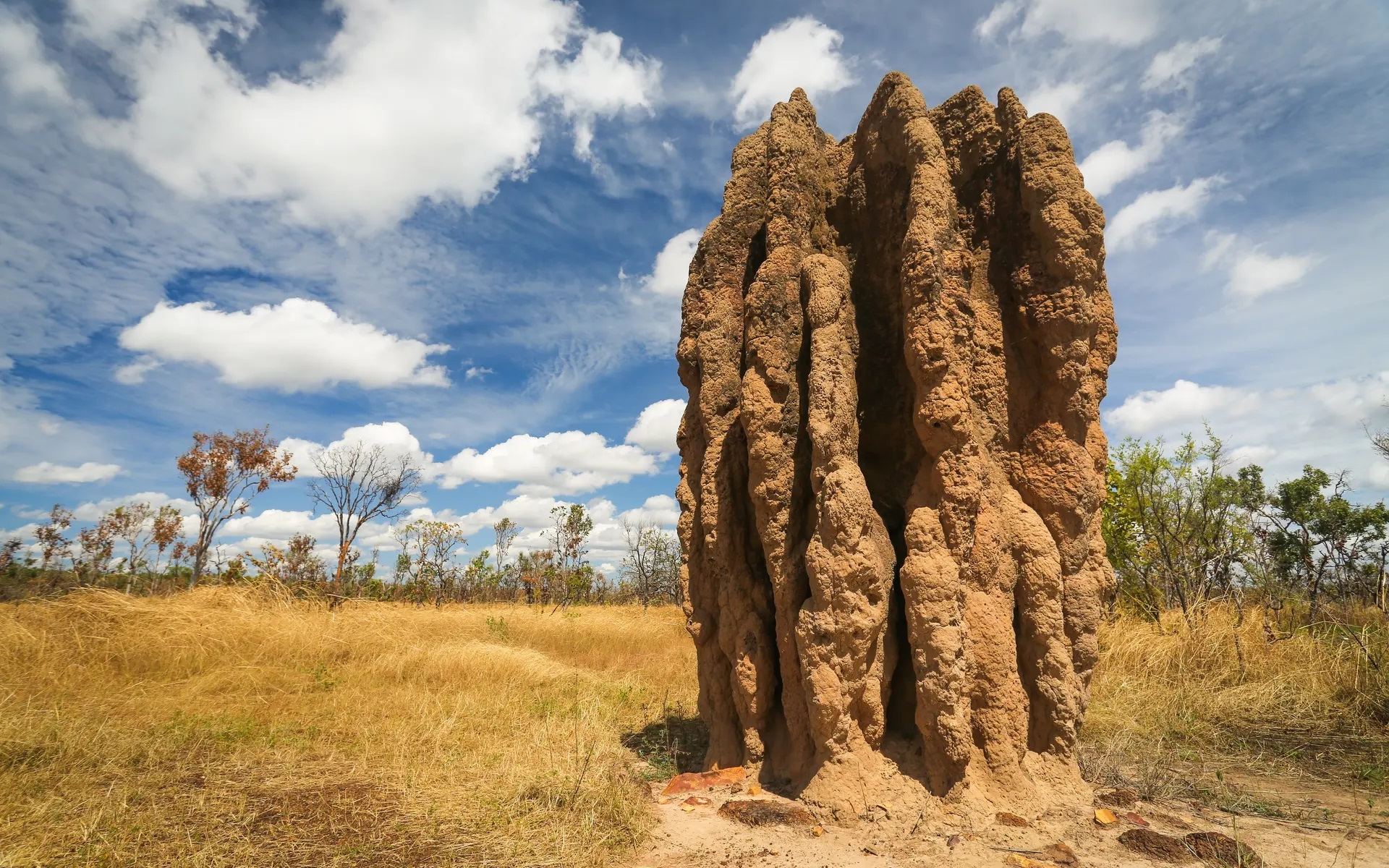
With NASA funding, a team of engineers from the University of Arizona College of Engineering (UA-CE) is developing autonomous robot networks to build sandbag shelters for NASA astronauts on the Moon. The designs are inspired by cathedral termite mounds, which are native to Africa and northern Australia’s desert regions. Their work was the subject of a paper presented at the American Astronautical Society Guidance, Navigation, and Control (AAS GNC) Conference, which took place from February 1st to 7th in Littleton and Breckinridge, Colorado.
Illustration of NASA astronauts and the elements of the Lunar Base Camp around the Moon’s south pole. Credit: NASA
Per the Artemis Program, NASA will land astronauts around the lunar south pole with the Artemis III mission, currently scheduled for 2026/27. By the end of the decade, they plan to build the infrastructure for long-duration stays, like the Lunar Gateway and the Artemis Base Camp. The latter element consists of a Foundation Lunar Habitat (FLH), the Lunar Terrain Vehicle (LTV), and a Habitation Mobility Platform (HMB). However, they will also need semi-permanent safe shelters while they search for optimal locations to build permanent habitats.
Consistent with NASA’s vision for future space exploration, a key element in this plan is to leverage local resources for building materials and resources – a process known as In-Situ Resource Utilization (ISRU). For their concept, Thanga and his team investigated whether sandbags filled with lunar regolith could be used instead of traditional building materials to build lunar infrastructure. This includes housing, warehouses, control towers, robot facilities, landing pads, and blast walls to protect lunar buildings as spacecraft conduct takeoffs and landings.
Thanga was first inspired by a YouTube video showing the work of Iranian-born American architect Nader Khalili, best known for designing structures that incorporate unconventional building materials. This includes his development of SuperAdobe sandbag construction to create structures for the developing world and emergency situations. During the 1980s, the late architect proposed building sandbag structures on the Moon and other extraterrestrial locations. Thanga incorporated the concept of insect “skyscrapers” into Khalili’s ideas, specifically the tall-standing cathedral termite mounds.
These mounds are common in African and Australian deserts and are important in regulating the subterranean nest environment. As Thanga described in a UA College of Engineering News release:
“In the case of the termites, it’s very relevant to our off-world challenges. The extreme desert environments the termites face are analogous to lunar conditions. Importantly, this whole approach doesn’t rely on water. Most of the moon is bone-dry desert. Learning about that helped direct me toward distributed systems for construction.”
UA aerospace engineering students (from left) Min Seok Kang, Athip Thirupathi Raj, Chad Jordan Cantin, Sivaperuman Muniyasamy, and Korbin Aydin Hansen display a smart sandbag structure. Credit: University of Arizona College of Engineering
Thanga has long been interested in applying insect social systems to distributed robot networks where machines are organized by swarm intelligence to work cooperatively without human intervention. In their system, the robots embed sensors and electronics in sandbags, fill them with lunar regolith, and then use these to assemble the structures in place. Some sensors provide location data to help the robots place the sandbags, while others provide communication capabilities and environmental information to warn of potential dangers.
These include moonquakes, which result from heating and cooling during every lunar day and night (which last 14 days each). The temperature swings during this cycle are also a potential hazard, ranging from -183 to 107 °C (-298 to 224 °F) between day and night. Because the Moon is an airless environment, there’s also the threat of micro-meteors that bombard the surface at an average speed of 96,560 km/h (60,000 mph). The lack of an atmosphere (and a magnetosphere) also means the lunar surface is exposed to considerably more solar radiation and cosmic rays.
These buildings meet NASA’s requirements for the Artemis Program by reducing the amount of material that must be transported to the Moon while protecting the harsh lunar environment. NASA has granted Thanga and his team $500,000 for lunar surface projects through the agency’s Space Technology Artemis Research program (M-STAR), part of the Minority University Research and Education Project (MUREP). NASA has also provided $1 million annually for UA student research projects over the last five years through a MUREP Institutional Research Opportunity (MIRO). Said Thanga:
“The goal is to raise the participation of underrepresented groups in aerospace. And these are hands-on, student-centric projects. This lab offers me the exact environment – it’s startup culture. I’m leading a team and working with multidisciplinary people. I’m glad I’m here.”
Thanga and Sivaperuman Muniyasamy, an aerospace engineering doctoral student and first author on the paper describing the technology, presented their idea during a classified session of the AAS GNC. “By publishing the paper at the conference, we’re gaining feedback from other experts that really helps us move forward,” said Muniyasamy. “It’s no accident this team has an academic partner, a commercial partner, and a government agency,” Thanga added. “Given the challenges, part of the path is for us to collaborate.”
Artist’s impression of a lunar mining facility harvesting resources from the Moon’s surface. Credit: NASA/Pat Rawlings
Beyond the team’s plans for lunar habitats, the LUNAR-BRIC consortium plans to produce many concepts that will support the creation of a space economy. In addition to leading a team of eight undergraduate and master’s students working on lunar surface projects, Muniyasamy plans to launch a space mining company after completing his Ph.D. As he noted, NASA plans to build facilities for long-term habitation and industry within a few years of the successful landing of Artemis III that will enable (among other things) environmentally responsible lunar and asteroid mining
Thanga and his student team worked with the university commercialization arm (Tech Launch Arizona) to file patents on the robotic system and the distributed computer processing networks that link the proposed structures and robots.
China's Chang'e-8 Mission Will Try to Make Bricks on the Moon
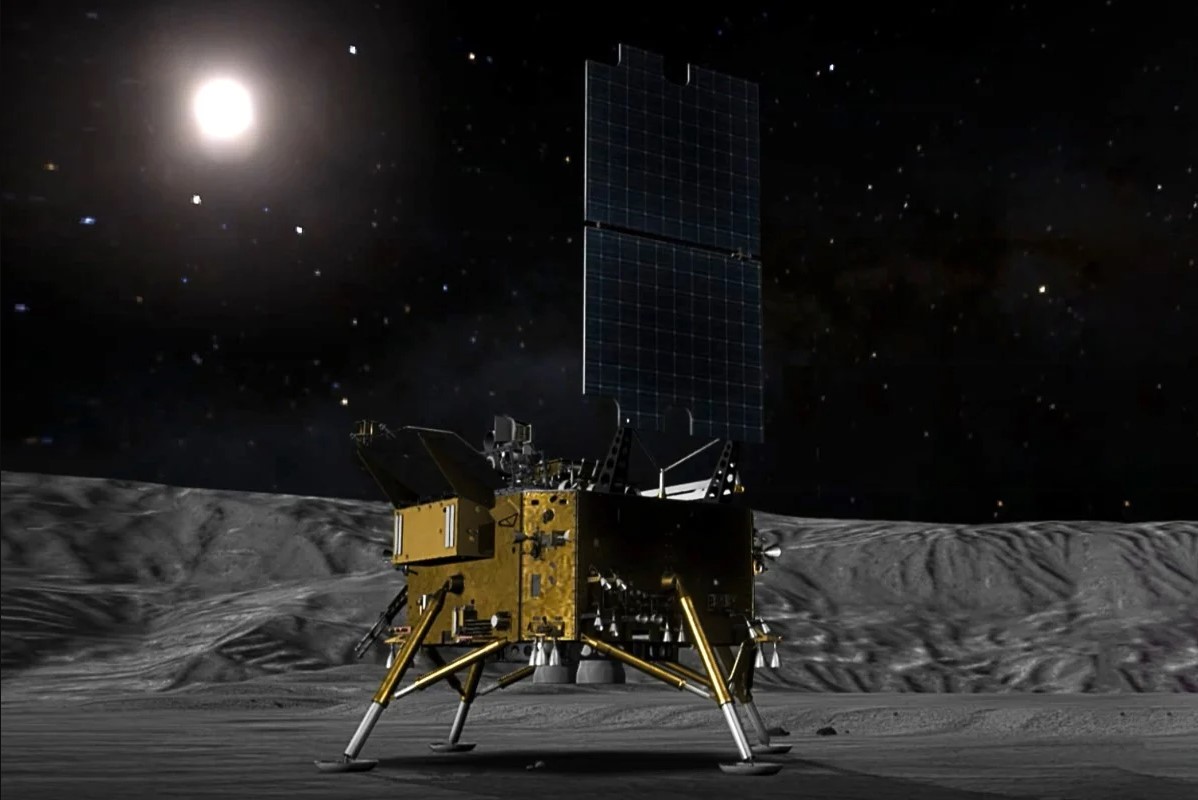
The China National Space Administration (CNSA) has put out a call for international and industry partners to contribute science payloads to its Chang’e-8 lunar lander, set for launch to the Moon in 2028. The mission, which will involve a lander, a rover, and a utility robot, will be China’s first attempt at in-situ resource utilization on the Moon, using lunar regolith to produce brick-like building materials.
Just like NASA’s Artemis plans, the CNSA’s plans for the Moon are targeted at the Lunar south pole, which is expected to be rich in useable resources, especially water. The presence of these resources will be vital for long-term human activity on the lunar surface.
Possible landing sites for Chang’e-8 include Leibnitz Beta, Amundsen crater, Cabeus crater, and the ridge connecting the Shackleton and de Gerlache craters, according to a presentation by Chang’e-8 chief deputy designer in October 2023.
Chang’e-8 will be the last CNSA robotic mission to be launched before construction begins on the International Lunar Research Station, China’s crewed moonbase being planned in collaboration with Russia’s Roscosmos. That makes Chang’e-8’s attempt to create building materials out of regolith a vital proof-of-concept for their lunar aspirations.
In order to make moon-bricks, the lander will carry an instrument that uses solar energy to melt lunar soil and turn it into useable parts at a speed of 40 cubic cm per hour.
Alongside the regolith processing equipment, the lander will be equipped with an array of science instruments, including cameras, a seismometer to detect moonquakes, and an x-ray telescope. Part of the mission will focus on moon-based Earth observation, with several instruments designed to monitor Earth’s atmosphere and magnetosphere.
The rover, meanwhile, will carry ground penetrating radar, cameras, a mineral analyzer, and tools for collecting and storing samples (leaving open the possibility of future missions to retrieve the samples).
The utility robot is a key piece of the mission, but CNSA isn’t developing it in-house. Instead, the space agency is seeking proposals from partners interested in developing it as a piggyback payload to ride alongside the rest of Chang’e-8.
According to the call for proposals, the 100kg, battery-powered robot will need to be able to “capture, carry and place items, shovel, and transfer lunar soil.” It will also need to be able to travel at 400m per hour.
There is room for an additional 100kg of piggyback payloads besides the robot, for which full proposals are expected to be submitted later this year.
While planning for Chang’e 8 is ongoing, the CNSA has two additional robotic moon missions in the works for the near future. The first, Chang’e-6, will launch this spring, and aims to return a regolith sample from the lunar far side (a never before accomplished feat). The next mission is planned for 2026, when Chang’e-7 will carry out a geological examination of the permanently shadowed craters scattered around the Moon’s south pole.
A recently submitted study to The Astronomical Journal continues to search for the elusive Planet Nine (also called Planet X), which is a hypothetical planet that potentially orbits in the outer reaches of the solar system and well beyond the orbit of the dwarf planet, Pluto. The goal of this study was to narrow down the possible locations of Planet Nine and holds the potential to help researchers better understand the makeup of our solar system, along with its formation and evolutionary processes. So, what was the motivation behind this study regarding narrowing down the location of a potential Planet Nine?
Dr. Mike Brown, who is a Richard and Barbara Rosenberg Professor of Astronomy at Caltech and lead author of the study, tells Universe Today, “We are continuing to try to systematically cover all of the regions of the sky where we predict Planet Nine to be. Using data from Pan-STARRS allowed us to cover the largest region to date.”
Pan-STARRS, which stands for Panoramic Survey Telescope and Rapid Response System, is a collaborative astronomical observation system located at Haleakala Observatory and operated by the University of Hawai’I Institute of Astronomy with telescope construction being funded by the U.S. Air Force. For the study, the researchers used data from Data Release 2 (DR2) with the goal of narrowing down the possible location of Planet Nine based on findings from past studies.
In the end, the team narrowed down possible locations of Planet Nine by eliminating approximately 78 percent of possible locations that were calculated from previous studies. Additionally, the researchers also provided new estimates for the approximate semimajor axis (measured in astronomical units (AU)) and Earth-mass size of Planet Nine at 500 and 6.6, respectively. So, what are the most significant results from this study, and what follow-up studies are currently being conducted or planned?
“While I would love to say that the most significant result was finding Planet Nine, we didn’t,” Dr. Brown tells Universe Today. “So instead, it means that we have significantly narrowed the search area. We’ve now surveyed approximately 80% of the regions where we think Planet Nine might be.”
In terms of follow-up studies, Dr. Brown tells Universe Today, “I think that the LSST is the most likely survey to find Planet Nine. When it comes online in a year or two it will quickly cover much of the search space and, if Planet Nine is there, find it.”
LSST stands for Legacy Survey of Space and Time, and is an astronomical survey currently scheduled as a 10-year program to study the southern sky and take place at the Vera C. Rubin Observatory in Chile, which is presently under construction. Objectives for LSST include studying identifying near-Earth asteroids (NEAs) and small planetary bodies within our solar system, but also include deep space studies, as well. These include investigating the properties of dark matter and dark energy and the evolution of the Milky Way Galaxy. But what is the importance of finding Planet Nine?
Dr. Brown tells Universe Today, “This would be the 5th largest planet of our solar system and the only one with a mass between Earth and Uranus. Such planets are common around other stars, and we would suddenly have a chance to study one in our own solar system.”
Scientists began hypothesizing the existence of Planet Nine shortly after the discovery of Neptune in 1846, including an 1880 memoir authored by D. Kirkwood and later a 1946 paper authored by American astronomer, Clyde Tombaugh, who was responsible for discovering Pluto in 1930. More recent studies include studies from 2016 and 2017 presenting evidence for the existence of Planet Nine, the former of which was co-authored by Dr. Brown. This most recent study marks the most complete investigation of narrowing down the location of Planet Nine, which Dr. Brown has long-believed exists, telling Universe Today, “There are too many separate signs that Planet Nine is there. The solar system is very difficult to understand without Planet Nine.”
He continues by telling Universe Today that “…Planet Nine explains many things about orbits of objects in the outer solar system that would be otherwise unexplainable and would each need some sort of separate explanation. The cluster of the directions of the orbits is the best know, but there is also the large perihelion distances of many objects, existence of highly inclined and even retrograde objects, and the high abundance of very eccentric orbits which cross inside the orbit of Neptune. None of these should happen in the solar system, but all are easily explainable as an effect of Planet Nine.”
Does Planet Nine exist and where will we find it in the coming years and decades? Only time will tell, and this is why we science!
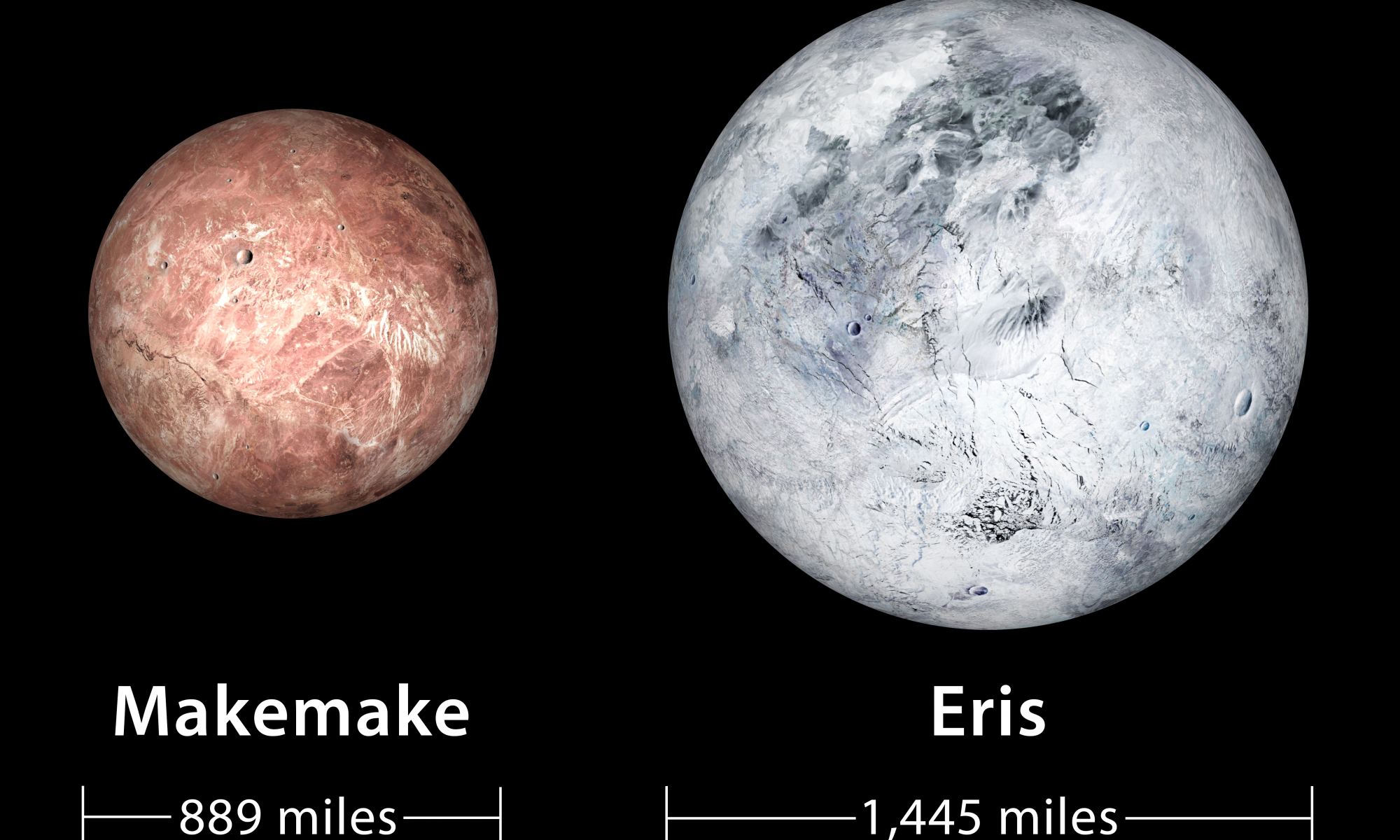
Even Eris and Makemake Could Have Geothermal Activity
Whether or not you agree that Pluto isn’t a planet, in many ways, Pluto is quite different from the classical planets. It’s smaller than the Moon, has an elliptical orbit that brings it closer to the Sun than Neptune at times, and is part of a collection of icy bodies on the edge of our solar system. It was also thought to be a cold dead world until the flyby of New Horizons proved otherwise. The plucky little spacecraft showed us that Pluto was geologically active, with a thin atmosphere and mountains that rise above icy plains. Geologically, Pluto is more similar to Earth than the Moon, a fact that has led some to reconsider Pluto’s designation as a dwarf planet.
Astronomers still aren’t sure how Pluto has remained geologically active. Perhaps the gravitational interactions with its moon Charon, or perhaps interior radioactive decay. But regardless of the cause, the general thought has been that Pluto is an exception, not a rule. Other outer worlds of similar size and composition are likely dead worlds. But a new study shows that isn’t the case for at least two dwarf planets, Eris and Makemake.
This new study doesn’t rely on high-resolution images like we have for Pluto. Our current observations of Eris and Makemake show them only as small, blurry dots. But we do have spectral observations of these worlds, which is where this study comes in.
The team looked at the spectral lines of molecules on the surface of these worlds, most specifically that of methane. Methane, or CH4 has two important variants. One is composed of standard hydrogen atoms, while the other contains one or more atoms of a type of hydrogen known as deuterium. Deuterium has a nucleus containing a proton and neutron rather than just a proton, and this skews the spectrum of methane a bit. From the spectral observations, the team could measure the D/H ratio for methane on both worlds.
How D/H ratios compare to possible origins. Credit: Glein, et al
Thisratio is determined by the source of the methane. If Eris and Makemake are dead worlds, then the methane they have stems from their origin more than 4 billion years ago, and the D/H level should be on the higher end. On the other hand, if the surface methane was generated through an interior process and vented through active geological processes, then the D/H ratio should be lower. The team found that the ratio is most consistent with thermogenic and abiotic mechanisms, suggesting that both Eris and Makemake are active worlds, or at least were active in geologically recent times.
Eris is about the same size as Pluto, so it isn’t too surprising that it’s a geologically active world given what we now know about Pluto. But Makemake is much smaller, about 60% the size of Pluto. If Makemake is an active world, then it is likely that other dwarf planets such as Haumea are as well. If that’s the case, then most if not all dwarf planets are geologically active. As the authors suggest, it might be worth sending a probe or two to the outer worlds for more study.
Rapporten van Amerikaanse inlichtingendiensten duiden op een mogelijke inzet van een Russisch nucleair systeem in de ruimte.
De aard van dit Russische project is nog niet duidelijk, maar het vormt deze week alvast het onderwerp van een intens politiek debat in de Verenigde Staten. Op basis van de beschikbare informatie zou het een nucleair aangedreven of nucleair bewapend antisatellietsysteem van het Kremlin kunnen zijn.
En volgens The New York Times zou dit kernwapen in de ruimte worden gebruikt om civiele communicatie te vernietigen of om andere landen in de gaten te houden.
Het is onduidelijk of deze nieuwe waarschuwing verband houdt met de Russische lancering van de Sojoez-raket met geheime vracht van het Ministerie van Defensie op 9 februari.
Republikeinse en Democratische leiders van de Senaatsinlichtingencommissie onthulden dat ze deze informatie hadden gevolgd, maar dat het moeilijk zou zijn om de specifieke berichtgeving vrij te geven zonder gevoelige bronnen bloot te leggen.
In the remote Bulandshahr District of India, on one Saturday in February 1867, a group of hunters embarked on a journey that led them to an inexplicable discovery. What they encountered in the dense jungle would become the source of an enduring tale, intertwining the realms of reality and myth. This is the captivating story of Dina Sanichar, a feral child whose life, though far from the whimsical narratives of Disney, left an indelible mark on the pages of history and, perhaps, inspired the iconic character of Mowgli in Rudyard Kipling’s “The Jungle Book.”
Dina Sanichar was discovered by the hunters as the young boy walking on all fours, accompanied by a wolf. After several attempts to lure him out, the hunters eventually succeeded but tragically, the wolf was put down. Dina was then taken to an orphanage, where missionaries baptized him as Sanichar, naming him after the day he arrived.
Young Dina Sanichar, c. 1889–1894. Image credit: Wikimedia Commons
When Dina came to the orphanage, everyone noticed that he acted like he was raised by wild animals. Missionaries immediately noticed that he could not stand straight or talk, and he preferred raw meat instead of cooked food. Reverend Erhardt Lewis, who was in charge of the orphanage, had a tough job trying to help Dina fit into regular society. Teaching him how to talk, wear clothes, and act like a regular person was very hard, and there were big challenges ahead.
Dina did not follow regular human rules. He did not like wearing clothes and preferred to move on all fours. People tried to teach him how to act in society, but he could only make sounds like an animal. Reverend Lewis, who was trying to understand Dina’s difficult childhood, called him an “imbecile.”
People tried to make Dina more like humans by teaching him to walk on two legs, wear clothes, and do other human things. But Dina did not like these changes and still preferred living like a wild animal. His unusual habits, like smoking tobacco, showed that he was trying to deal with his struggle between the wild and human ways of life.
Dina’s tale became more interesting when he became friends with some other wild children at the orphanage. Their friendship was special because they all had similar experiences and understood one another’s wild ways. This connection helped them find comfort during tough times in society. Reverend Lewis noticed this special bond between Dina and his feral friends, highlighting their shared understanding that went beyond the challenges of their unusual upbringing.
In 1895, Dina Sanichar passed away, but his story continued to be remembered, going beyond the orphanage where he lived. Even though he struggled to fit into human society, his life had a lasting impact on discussions about feral children and the balance between civilization and the wild.
Dina’s life is part of a bigger picture – the discovery of feral children in 19th-century India. The high number of such cases makes us question how society saw these children and the difficulties they faced when trying to adapt from the wild to human life. Dina’s experiences reflect the challenges that feral children in that era went through.
In 1894, Rudyard Kipling wrote “The Jungle Book,” drawing inspiration from India’s diverse culture. Although it is unclear if Dina directly influenced the character named Mowgli, many stories about feral children during Kipling’s time hint at a cultural background that might have shaped the fictional narrative. The jungle, both in real life and in stories, becomes a place where the line between wild and civilized blurs.
Dina Sanichar’s life is a bit of a mystery, and there are different stories about his early years. Some people wonder if he was left alone in the jungle because he had physical or mental problems. When we look at other cases of kids growing up in the wild, it is clear that it is both fascinating and tough for them to fit into human society.
Whether Dina is seen as a real-life Mowgli or just a unique wild child, his story makes us think about the thin line between civilization and the wild. His life was full of difficulties, but he showed strength in facing them, making us rethink what it means to be human. As we explore the mix of truth and tales about Dina, we are left thinking about the human spirit’s ability to adapt and the mysteries in our shared past. Dina’s life echoes as proof that our spirit can endure, even with an unusual upbringing.
Dina’s story is not only one from late 19th-century India. During that time, other wild children were found, each facing their challenges fitting into human society. Unfortunately, Dina’s mental growth was limited, and he died at 29, likely due to tuberculosis made worse by his addiction to tobacco.
Let us explore some stories of feral children beyond India. Among others, we have Marina Chapman, who survived with capuchin monkeys, Sidi Mohamed, who spent time with ostriches, and a touching tale of an Argentinian toddler raised by wild cats. These stories highlight how these children can adapt and stay strong. Each case shows that humans have a special ability to connect with different animals.
Marina Chapman – Raised by Monkeys
One remarkable case is of Marina Chapman, who was kidnapped at the age of five and abandoned in the Colombian jungle. Lucky enough to be adopted by a group of capuchin monkeys, Marina learned survival skills from them. In five years, she was rescued by hunters, sold to a brothel, and later escaped to establish a life in England. Despite skepticism, scientific studies and a documentary support her extraordinary story.
Ostrich Boy – Birds Cared for him
Sidi Mohamed, known as the “ostrich boy,” wandered off from his North African family at a young age and found refuge with ostriches. They nurtured him, teaching him survival skills. At the age of 12, he was reunited with his family by ostrich hunters.
Toddler Kept Alive by Cats
In 2008, Argentinian police discovered a one-year-old boy surrounded by eight wild cats. The cats had kept him alive during winter, showing surprising compassion by providing warmth and bringing him scraps of food. The boy, separated from his homeless father, was rescued, emphasizing the unexpected bond between feral cats and humans.
The Dog Boy from Chile
Abandoned by his mother at 10 or 11, the “Dog Boy” in Chile was adopted by a group of dogs. He lived with them, imitating their behavior, and scavenging for food together. When found by the police, he exhibited signs of intense depression and aggression, emphasizing the challenges of reintegrating feral children into human society.
Ng Chhaidy – 38 Years Living in the Jungle
Ng Chhaidy went missing in the jungle at the age of 4 and was rediscovered 38 years later in Myanmar. Remarkably, she exhibited human-like behavior, demonstrating the adaptability of the human psyche to life in the wild.
Ramachandra – The Human Amphibian
In India, around 1960, there was a sad story about a boy named Ramachandra. His life was similar to an amphibian, a creature that can live both in water and on land. People first heard about him in 1973, and he was “rescued” in 1979. Ramachandra lived near rivers infested with crocodiles, catching and eating raw fish, showing that he had partly adapted to a life different from humans.
Ramachandra – The Human Amphibian
He liked eating raw food and living by the river. But in 1982, something terrible happened. He approached a woman, probably not understanding human rules, and had a tragic end. The woman, feeling scared, poured boiling water on him, and he died.
Ramachandra’s life reminds us of the challenges that feral children face when trying to live in human society after growing up in the wild. His story shows how hard it is to fit into two very different worlds, and it ended sadly because of the tough experiences he had.
These stories show how strong and flexible people can be when they grow up in the wild. Even though the stories are amazing and sad, they highlight how hard it is for these individuals to fit back into human society. The age when they learn language and social skills is really important, and it shows that we need different ways to help kids who grew up in the wild have happy lives.
Another commercial spaceflight company is about to try to land on the Moon, and this time, it’s carrying miniature art, digital archives, and NASA’s first prototype radio telescope for the Moon.
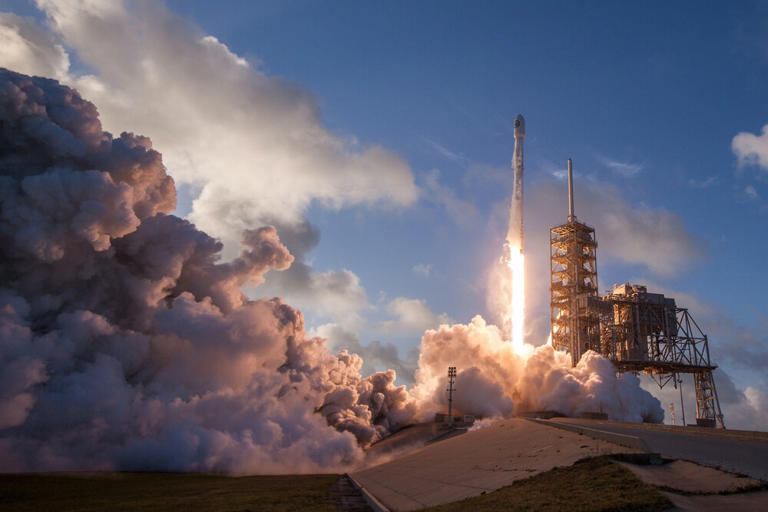
Intuitive Machines hopes its Nova-C lander, dubbed Odysseus, will launch to the Moon tonight aboard a SpaceX Falcon 9 rocket. Tonight’s launch attempt (well, technically very early Thursday morning) follows a couple of delays, first due to weather and then due to a problem with the lander’s propellant system. Here’s everything you need to know about the launch, the landing, and how to catch all the action live.
A pelican glides above the Turning Basin past a SpaceX Falcon 9 rocket that Intuitive Machines hopes will carry its Nova-C lander to the Moon.
GREGG NEWTON/AFP/GETTY IMAGES
WHEN WILL SPACEX LAUNCH INTUITIVE MACHINES’ MOON LANDER?
The IM-1 mission is scheduled to launch at 1:05 a.m. Eastern Time on February 15, which, in practical terms, means it’ll be blasting off extremely late tonight.
WHEN WILL ODYSSEUS LAND ON THE MOON?
The lander is scheduled to land on February 22, touching down in a small crater next door to Malapert Crater, near the Moon’s south pole. As long as SpaceX manages to launch by February 16, the lander can make it to the Moon on schedule. Otherwise, the crew will have to try for some time in March.
WHY WAS THE ODYSSEUS LANDER LAUNCH DELAYED?
Originally, the launch was scheduled for January 12, but bad weather in Florida forced SpaceX to push back the date to February 14 (which would have been early this morning). As technicians were loading the lander’s liquid methane propellant, however, they realized the methane was at an “off-nominal” temperature and called a halt. After taking a day to tackle the methane temperature issue, SpaceX plans to try again late tonight. The problem was with the lander’s propellant system; the Falcon 9’s rocket fuel seemed to be just fine.
The Nova-C lander, with an Intuitive Machines executive for scale.
HOUSTON CHRONICLE/HEARST NEWSPAPERS VIA GETTY IMAGES/HEARST NEWSPAPERS/GETTY IMAGES
WHAT’S ON BOARD THE NEW MOON LANDER?
Odysseus is carrying a handful of payloads for NASA as part of the agency’s Commercial Lunar Payload Services (CLPS) program: there’s a set of various sensors and beacons to help test automatic landing technologies, along with a laser reflector to provide a very visible, very precise navigation landmark for future missions. Also aboard Odysseus is a very simple radio receiver to measure the background radio waves on the Moon; called ROLSES, it might eventually pave the way for full-scale radio telescopes on the Moon. Other instruments will monitor how space weather — the bombardment of micrometeorites, radiation, and charged particles from the Sun, and cosmic rays from deeper in space — affects the lunar surface. A set of tiny cameras will record how the lander’s exhaust plume stirs up the fine-grained regolith that covers the lunar surface.
Along with NASA’s instruments, the lander also carries a selection of historical documents and literary works stored on disks: a “Lunar Library” from the nonprofit Arch Mission Foundation (the same nonprofit organization whose illicit cargo of tardigrades spilled across the lunar surface when the Israeli Beresheet lander crashed in 2019). Odysseus is also carrying some insulating material being tested for Columbia Sportswear. There’s also a set of 125 tiny sculptures of the Moon in different phases by artist Jeff Koons (it’s also linked to an NFT project because, of course, it is).
WHY DOES THIS MISSION MATTER?
If it launches on time and lands successfully, IM-1 will be the first private lander on the Moon. Several other attempts, including rival Astrobotic’s recent Peregrine lander, have failed to reach the Moon or — like Beresheet — crashed into the lunar surface. IM-1 will also be the first U.S.-based lander on the Moon since Apollo 17 in 1972, and it’ll be the first successful delivery of a CLPS payload (assuming, of course, that it’s successful).
All of those distinctions would have belonged to Astrobotic’s Peregrine lander, which launched on January 8 and was scheduled to land on February 23. Peregrine carried NASA’s first CLPS payload; it just didn’t get to deliver it to the Moon as planned.
In early January, it looked like Odysseus stood a good chance of beating Peregrine to the Moon. Despite the fact that Odysseus would have launched a few days after Peregrine, the IM-1 mission planned a shorter route to the Moon and should have arrived within a week of launch; Astrobotic chose a slower but more fuel-efficient route for Peregrine. But then a wave of bad weather pummeled Florida, and SpaceX rescheduled the IM-1 launch, ceding the lead to Astrobotic and Peregrine.
When a propellant leak forced Astrobotic to cancel its plans to land Peregrine on the Moon, and bring the lander home to burn up in Earth’s atmosphere instead, Odysseus took the lead again. Keeping it depends on a successful launch tonight and a successful landing on February 22 — and if the last several months of Moon missions have proven anything, it’s that neither of those successes is guaranteed.
HOW TO WATCH THE IM-1 MOON MISSION LAUNCH
NASA will start live streaming coverage of the launch about 20 minutes after midnight (Eastern Time) tonight on the NASA website. (Pro tip: If you’re staying up late to watch rocket launches anyway, you may as well tune in early at 10:00 p.m. Eastern to watch a Progress resupply ship blast off to the International Space Station.)
Cosmic Dust Could Spread Life from World to World Across the Galaxy
Could life spread throughout the galaxy on tiny grains of dust? It would be a perilous journey, but new research shows its possible and calculates how long it would take to spread. Image Credit: ESO
Cosmic Dust Could Spread Life from World to World Across the Galaxy
Does life appear independently on different planets in the galaxy? Or does it spread from world to world? Or does it do both?
New research shows how life could spread via a basic, simple pathway: cosmic dust.
One thing scientists have learned in the past few decades is that life on Earth might have had an early start. The Earth is about 4.53 billion years old, and some evidence shows that simple life existed here at least 3.5 billion years ago. Some evidence suggests life was here even before that, only about 500 million years after Earth formed when it had cooled down. The life would have been extremely simple, but it may have been there.
But life may not have originated here. Researchers question if there was enough time for life to appear spontaneously in early Earth conditions.
New research examines the idea that cosmic dust could be responsible for spreading life throughout the galaxy by panspermia. Life arose elsewhere, and was delivered to the young Earth. This is not a new idea, but in this work, the author calculates how quickly it could happen.
Artist’s impression of Earth in the early Archean with a purplish hydrosphere and coastal regions. Even in this early period, life flourished and was gaining complexity. Credit: Oleg Kuznetsov
No matter how much we ponder and investigate the origins of life, we don’t know how it starts. We have an idea about the type of environment that could spawn it, but even that is an idea obscured by billions of years. “It is clear that the main problem is the origin of life or abiogenesis, the details of which are still unknown to us,” Osmanov writes.
But it started somehow. Leaving life’s original appearance aside, for now, Osmanov moves on to how it could spread.
“By obtaining the assumption that planetary dust particles can escape from the gravitational attraction of a planet, we consider the possibility for the dust grains to leave the star’s system by means of the radiation pressure,” Osmanov writes.
The idea that life itself could travel through space on comets and asteroids is familiar to many people. When these objects crash into planets, the thinking goes, hitchhiking life is delivered, and if there’s a niche it can exploit, it will. But how could simple dust accomplish the same thing?
This artistic conception illustrates large asteroids penetrating Earth’s early atmosphere. Credit: SwRI/Dan Durda/Simone Marchi
For dust to carry life, it must originate from a planet that hosts life. This can happen in specific circumstances. Research shows that dust particles from Earth in the planet’s high-altitude atmosphere can scatter against cosmic dust grains. A 2017 paper in the journal Astrobiology showed how hypervelocity space dust can interact with this Earth dust, creating powerful momentum flows. A small fraction of the planetary dust particles can be accelerated enough to escape the planet’s gravity.
Once free of its planet’s gravity, dust is then at the mercy of stellar radiation pressure. “If a similar scenario takes place in other systems, the planetary dust particles, being already free from the planet’s gravitational field, might escape from the star’s system by means of the radiation pressure and initial velocity, spreading life into the cosmos,” Osmanov explains.
Life would need to be very hardy to survive on a dust grain as it travels through interstellar space. It would have to avoid hazards like radiation and heat. If life itself couldn’t do it, maybe complex molecules that lead to life could. If we grant that it’s possible, the next question concerns how quickly it could spread.
“It has been shown that, during 5 billion years, the dust grains will reach 105 stellar systems, and by taking the Drake equation into account, it has been shown that the whole galaxy will be full of planetary dust particles,” Osmanov explains.
Osmanov points to other research into panspermia and how it could happen in our neighbourhood of the galaxy. “In particular, it has been pointed out that, by means of the solar radiation pressure, small dust grains containing live organisms can travel to the nearest solar system, Alpha Centauri, in nine thousand years,” Osmanov writes. Our powerful rockets, like the Space Launch System and the Falcon Heavy, would take over 100,000 years to make the journey.
Panspermia is the idea that life is spread throughout the galaxy, or even the Universe, by dust, asteroids, comets, and even minor planets. Credit: NASA/Jenny Mottor
It’s an intriguing idea. Osmanov calculates that a significant number of dust grains will survive interstellar space with life or complex molecules intact. But his thinking hits a bit of a speed bump at one point. He takes a bold step beyond our current knowledge when he writes, “On the other hand, it is natural to assume that the number of planets with at least primitive life should be enormous.” It might be a natural assumption, but there’s little evidence that it’s true. It’s conjecture, stimulating conjecture, but conjecture nonetheless.
Working with a statistical approach to the Drake Equation, Osmanov writes that the number of planets that developed life is on “the order of 3×10⁷.
“This value is so huge that if dust particles can travel a distance of the order of several hundred light years, one can conclude that the MW, with a diameter of 100,000 light-years, should be full of complex molecules distributed throughout the whole galaxy,” Osmanov explains. “Even if we assume that life is destroyed during this time, the vast majority of complex molecules will remain intact.”
Standing beside the Milky Way. If Osmanov is correct, the entire galaxy is full of planetary dust. Credit: P. Horálek/ESO
It’s very interesting work. But the frustrating thing about this entire topic is that we still don’t know how life appears or how often it appears. So, all of our thought experiments and calculations, including Osmanov’s, have a stubborn nugget of the unknown at the centre.
If we’re fortunate to find solid evidence of life on Mars, for instance, then this type of research and the conversations it spawns will take on a new lustre. But for now, Osmanov’s work and similar work by other researchers leaves us in a funny spot: we can imagine and calculate how life can spread and how far and how fast.
Osmanov claims that the number of planets with primitive life is enormous. We don’t know that. Planets are extraordinarily complex, and there are a bewildering number of variables. Even if there are an enormous number of planets with primitive life, many of them will be more massive than Earth. Will dust particles carrying life or complex organic molecules be able to escape the gravitational grasp of super-Earths, for example?
This research shows how life, or at least its building blocks, could escape from planets and survive the interstellar journey to another world. If it’s true, and panspermia can account for life appearing on Earth so soon after it formed and cooled, then it changes our understanding of our origins and even the rest of the Universe.
But we don’t know how true it is, and we still don’t know how it starts.
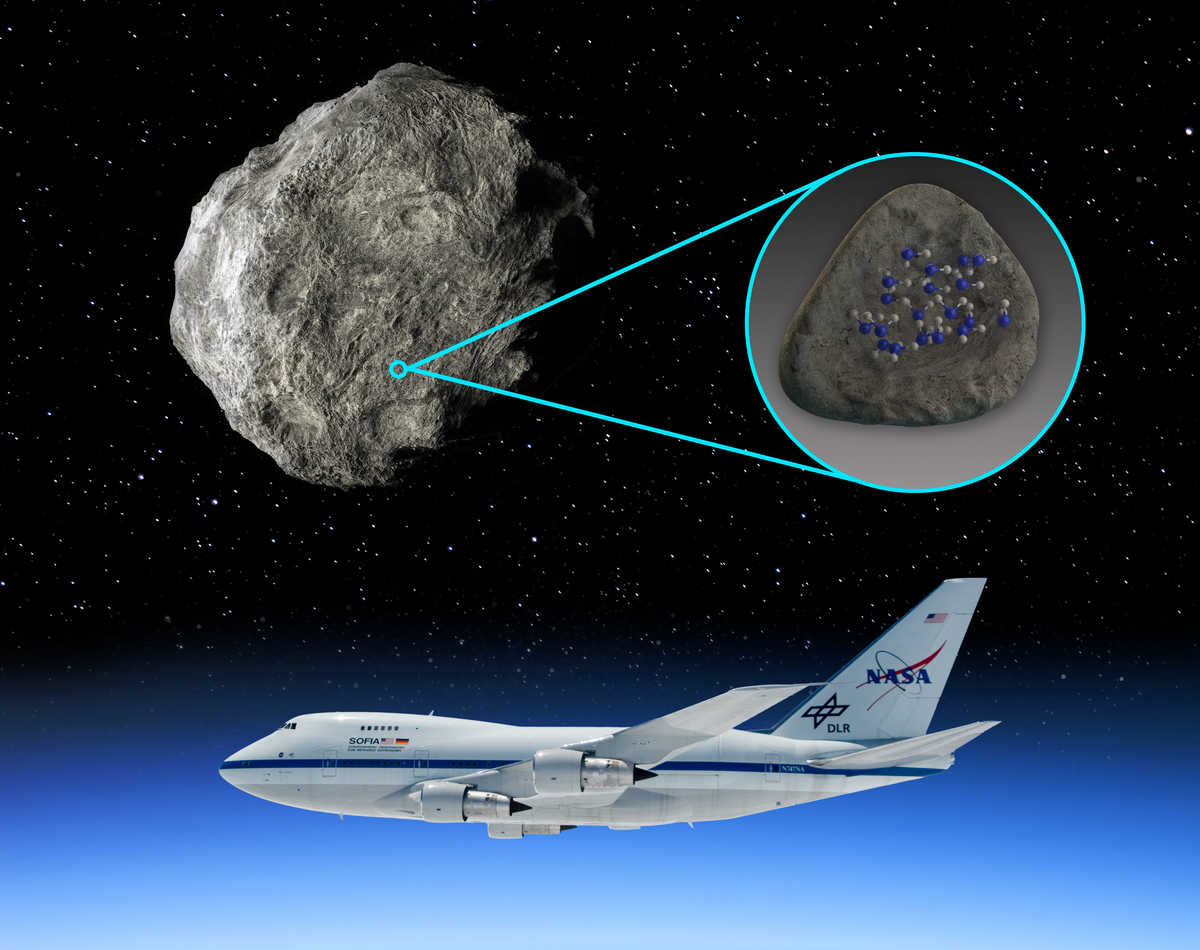
Courtesy of NASA/Carla Thomas/SwRI Using data from NASA’s Stratospheric Observatory for Infrared Astronomy (SOFIA), Southwest Research Institute scientists have discovered, for the first time, water molecules on the surface of an asteroid. Scientists looked at four silicate-rich asteroids using the FORCAST instrument to isolate the mid-infrared spectral signatures indicative of molecular water on two of them.
Our Solar System is a collection of objects from planets and moons to comets and asteroids. It’s thought there are upwards of 1 million asteroids orbiting the Sun and it was thought that any water present on them should have evaporate long ago. A recent study using data from the SOFIA infrared telescope discovered water on the asteroids Iris and Massalia.
Among the million or so asteroids, Iris is 199 km in diameter making it larger than about 99% of other asteroids. It orbits the Sun within the asteroid belt between Mars and Jupiter at an average distance of 2.39 astronomical units taking 3.7 years to complete one orbit. Massalia is of comparable in size to Iris coming in at 135 km across and shares an orbit similar to that of Iris.
Asteroids across the Solar System vary a little in composition and structure. Nearer to the Sun the Silicate asteroids devoid of ice dominate yet further out, icy asteroids are more common. Exploring the distribution of the asteroids helps to understand the composition and transfer of elements in the solar nebula before the planets and asteroids formed. If we can also understand the distribution of water too in our own system then it will help us to understand its prevalence in exoplanetary systems and the liklihood of extraterrestrial life.
Data captured by SOFIA – the Stratospheric Observatory for Infrared Astronomy which retired in 2022 – has revealed water on asteroids Iris and Massalia. It’s not the first time SOFIA has made a discovery of this sort. Back in October 2020 SOFIA identify water on the Moon. Using its Faint Object InfraRed Camera (FORCAST) it detected the signature of water molecules on the surface equivalent to about 350 millilitres of water in a cubic meter of soil.
The lead author on the paper, Dr Anicia Arredondo from the Southwest Research Institute confirmed that, based on the strength of the spectral lines, the volumes and prevalence of water on the asteroids was consistent with that found on the Moon. Here too it was locked up, bound to minerals as well as absorbed by silicates.
Data was also analysed from two fainter asteroids, Parthenope and Melpomene, but there was too much noise to yield a conclusive result. It appears that the FORCAST instrument lacks the necessary sensitivity to identify the spectral feature of water on these asteroids, if indeed it was present.
Further analysis is required to fully understand the distribution of water across the Solar System but following on from the study, the team will now utilise the James Webb Space Telescope which has higher quality optics and a much better signal to noise ratio to learn more.
Saturn’s “Death Star Moon” Mimas Probably has an Ocean Too
A recent study published in Nature presents a groundbreaking discovery that Saturn’s moon, Mimas, commonly known as the “Death Star” moon due to its similarities with the iconic Star Wars space station,possesses an internal ocean underneath its rocky crust. This study was conducted by an international team of researchers and holds the potential to help planetary geologists better understand the conditions for a planetary body to possess an internal ocean, which could also possess the conditions for life as we know it. While Mimas was photographed on several occasions by NASA’s Cassini spacecraft, including a close flyby in February 2010, what was the motivation behind this recent study regarding finding an internal ocean on Mimas?
Dr. Gabriel Tobie, who is a planetary scientist at Nantes Université in France and a co-author on the study, tells Universe Today, “One of the initial motivations to study Mimas was to understand why it is so different from the neighboring moon, Enceladus, which is characterized by a very active surface with direct communication with a global surface ocean. On Enceladus, we know that all the observed activity is controlled by tidal forces generated by Saturn. Mimas is closer to Saturn and should normally experience even more intense tidal forces. So why Mimas’ lack sign of activity?”
Discovered by William Herschel on September 17, 1789, Mimas is best known for its Death Star appearance due to Herschel Crater, which spans 139 kilometers (86 miles) in diameter, or just over one-third the diameter of Mimas at 396 kilometers (246 miles). Unlike other ocean worlds like Europa and Enceladus, whose surfaces are largely devoid of craters due to the frequent resurfacing from their respective internal oceans, the surface of Mimas possesses countless craters with no indications of resurfacing. Therefore, the debate for Mimas possessing an internal ocean has raged for years, including a 2014 study published in Science and a 2017 study published in JGR: Planets.
2022 video discussing the possibility of an ocean on Mimas based on research at the time.
Dr. Tobie continues by telling Universe Today, “It was initially thought that Mimas remained frozen since its formation and that the conditions to initiate ice melting in its interior were never met. This new finding we report in this study shows that Mimas in fact is not that different than Enceladus. It also has a global ocean, but in contrast to Enceladus, such an ocean was formed very recently, explaining the lack of surface activity.”
After analyzing data from NASA’s Cassini, the researchers concluded that an internal ocean exists on the heavily cratered Mimas approximately 20-30 kilometers (12-18 miles) beneath its surface, forming less than 25 million years ago, which is young in geologic terms. Additionally, the team concluded the juncture where the internal ocean and ice interact reached less than 30 kilometers (18 miles) from the surface only 2-3 million years ago, indicating the ocean is potentially still developing and growing. Therefore, what implications does finding an ocean on Mimas have for other potential ocean worlds in our solar system?
Saturn’s moon, Mimas, captured by NASA’s Cassini spacecraft in 2010. (Credit: NASA/JPL-Caltech/Space Science Institute)
Dr. Alyssa Rhoden, who is a Principal Scientist at the Southwest Research Institute (SwRI) in Boulder, Colorado and co-authored an article in Nature discussing the groundbreaking discovery, tells Universe Today, “As far as stealth ocean moons go, Mimas pretty much takes the cake. Its surface betrays nothing of the ocean underneath. Icy moons around Uranus, for example, do show some geologic activity on their surfaces that have (in absence of other options) have been attributed to oceans enabling tidal stresses and/or enhanced heating to drive processes like convection. More importantly, Mimas is showing us that it’s not too late for moons to undergo massive changes. Maybe triggering ocean formation later in a moon’s lifetime is more common in this size range of moons than we initially considered.”
As noted, an internal ocean on Mimas indicates it could possess habitable conditions for life as we know it like Europa and Enceladus. This is because scientists have hypothesized that internal oceans are created from internal heat generated from the moons being tugged and pulled as they orbit their respective planets, also known as tidal heating. While such internal oceans are completely absent from receiving sunlight due to their outer surfaces, scientists hypothesize that the internal heat that creates the ocean could also harbor hydrothermal vents where life has been observed to exist here on Earth. Therefore, what implications does finding an ocean on Mimas have for finding life beyond Earth?
“Finding an ocean on Mimas demonstrates that habitable environments may be found even in small objects far from the Sun, which is already a great discovery,” Dr. Tobie tells Universe Today. “However, the chance to detect any sign of life on such objects is extremely low, as there is no direct communication between the subsurface ocean and the surface. Enceladus, with its very active jets, is a much better target to address the question of life beyond Earth. Mimas, however, provides an opportunity to study the first stage of ocean formation and potentially chemical complexification before life emerged, a fundamental stage which is still unknown on Earth.”
In terms of follow-up studies, Dr. Tobie tells Universe Today that the methods used for this recent study could also be applied for other moons in the solar system, specifically moons orbiting Uranus, along with providing an opportunity to use Cassini data to re-evaluate not only Mimas, but other mid-sized moons orbiting Saturn, including Enceladus.
With this groundbreaking discovery, Mimas joins several other planetary bodies within the solar system that can be called ocean worlds, which include the aforementioned Europa and Enceladus, but also the dwarf planets, Ceres and Pluto; Jupiter’s moons, Ganymede and Callisto; Saturn’s largest moon, Titan; and Neptune’s moon, Triton. It is through these fantastic and mysterious worlds that scientists from around the world are studying to better understand the conditions for life to exist, both here on Earth and beyond.2
“The main take-away from Mimas is that we ought to test ideas, even if they seem unlikely,” Dr. Rhoden tells Universe Today. “Mimas’ surface doesn’t show evidence of an ocean, so it was easy to dismiss the ocean hypothesis when it was first proposed. But to come to a scientific conclusion, we have to back up inferences with tests. Sometimes, we find that the tests confirm our expectations, and sometimes, we get to be surprised.”
What new discoveries will scientists make about Mimas and other ocean worlds in the coming years and decades? Only time will tell, and this is why we science!
Beste bezoeker, Heb je zelf al ooit een vreemde waarneming gedaan, laat dit dan even weten via email aan Frederick Delaere opwww.ufomeldpunt.be. Deze onderzoekers behandelen jouw melding in volledige anonimiteit en met alle respect voor jouw privacy. Ze zijn kritisch, objectief maar open minded aangelegd en zullen jou steeds een verklaring geven voor jouw waarneming! DUS AARZEL NIET, ALS JE EEN ANTWOORD OP JOUW VRAGEN WENST, CONTACTEER FREDERICK. BIJ VOORBAAT DANK...
Druk op onderstaande knop om je bestand , jouw artikel naar mij te verzenden. INDIEN HET DE MOEITE WAARD IS, PLAATS IK HET OP DE BLOG ONDER DIVERSEN MET JOUW NAAM...
Druk op onderstaande knop om een berichtje achter te laten in mijn gastenboek
Alvast bedankt voor al jouw bezoekjes en jouw reacties. Nog een prettige dag verder!!!
Over mijzelf
Ik ben Pieter, en gebruik soms ook wel de schuilnaam Peter2011.
Ik ben een man en woon in Linter (België) en mijn beroep is Ik ben op rust..
Ik ben geboren op 18/10/1950 en ben nu dus 75 jaar jong.
Mijn hobby's zijn: Ufologie en andere esoterische onderwerpen.
Op deze blog vind je onder artikels, werk van mezelf. Mijn dank gaat ook naar André, Ingrid, Oliver, Paul, Vincent, Georges Filer en MUFON voor de bijdragen voor de verschillende categorieën...
Veel leesplezier en geef je mening over deze blog.