The purpose of this blog is the creation of an open, international, independent and free forum, where every UFO-researcher can publish the results of his/her research. The languagues, used for this blog, are Dutch, English and French.You can find the articles of a collegue by selecting his category. Each author stays resposable for the continue of his articles. As blogmaster I have the right to refuse an addition or an article, when it attacks other collegues or UFO-groupes.
Druk op onderstaande knop om te reageren in mijn forum
Zoeken in blog
Deze blog is opgedragen aan mijn overleden echtgenote Lucienne.
In 2012 verloor ze haar moedige strijd tegen kanker!
In 2011 startte ik deze blog, omdat ik niet mocht stoppen met mijn UFO-onderzoek.
BEDANKT!!!
Een interessant adres?
UFO'S of UAP'S, ASTRONOMIE, RUIMTEVAART, ARCHEOLOGIE, OUDHEIDKUNDE, SF-SNUFJES EN ANDERE ESOTERISCHE WETENSCHAPPEN - DE ALLERLAATSTE NIEUWTJES
UFO's of UAP'S in België en de rest van de wereld Ontdek de Fascinerende Wereld van UFO's en UAP's: Jouw Bron voor Onthullende Informatie!
Ben jij ook gefascineerd door het onbekende? Wil je meer weten over UFO's en UAP's, niet alleen in België, maar over de hele wereld? Dan ben je op de juiste plek!
België: Het Kloppend Hart van UFO-onderzoek
In België is BUFON (Belgisch UFO-Netwerk) dé autoriteit op het gebied van UFO-onderzoek. Voor betrouwbare en objectieve informatie over deze intrigerende fenomenen, bezoek je zeker onze Facebook-pagina en deze blog. Maar dat is nog niet alles! Ontdek ook het Belgisch UFO-meldpunt en Caelestia, twee organisaties die diepgaand onderzoek verrichten, al zijn ze soms kritisch of sceptisch.
Nederland: Een Schat aan Informatie
Voor onze Nederlandse buren is er de schitterende website www.ufowijzer.nl, beheerd door Paul Harmans. Deze site biedt een schat aan informatie en artikelen die je niet wilt missen!
Internationaal: MUFON - De Wereldwijde Autoriteit
Neem ook een kijkje bij MUFON (Mutual UFO Network Inc.), een gerenommeerde Amerikaanse UFO-vereniging met afdelingen in de VS en wereldwijd. MUFON is toegewijd aan de wetenschappelijke en analytische studie van het UFO-fenomeen, en hun maandelijkse tijdschrift, The MUFON UFO-Journal, is een must-read voor elke UFO-enthousiasteling. Bezoek hun website op www.mufon.com voor meer informatie.
Samenwerking en Toekomstvisie
Sinds 1 februari 2020 is Pieter niet alleen ex-president van BUFON, maar ook de voormalige nationale directeur van MUFON in Vlaanderen en Nederland. Dit creëert een sterke samenwerking met de Franse MUFON Reseau MUFON/EUROP, wat ons in staat stelt om nog meer waardevolle inzichten te delen.
Let op: Nepprofielen en Nieuwe Groeperingen
Pas op voor een nieuwe groepering die zich ook BUFON noemt, maar geen enkele connectie heeft met onze gevestigde organisatie. Hoewel zij de naam geregistreerd hebben, kunnen ze het rijke verleden en de expertise van onze groep niet evenaren. We wensen hen veel succes, maar we blijven de autoriteit in UFO-onderzoek!
Blijf Op De Hoogte!
Wil jij de laatste nieuwtjes over UFO's, ruimtevaart, archeologie, en meer? Volg ons dan en duik samen met ons in de fascinerende wereld van het onbekende! Sluit je aan bij de gemeenschap van nieuwsgierige geesten die net als jij verlangen naar antwoorden en avonturen in de sterren!
Heb je vragen of wil je meer weten? Aarzel dan niet om contact met ons op te nemen! Samen ontrafelen we het mysterie van de lucht en daarbuiten.
06-02-2024
Bevroren, uitgedroogd en afgeschoten: dit piepkleine diertje sterft alleen als de zon uitdooft
Bevroren, uitgedroogd en afgeschoten: dit piepkleine diertje sterft alleen als de zon uitdooft
Piepklein, maar niet klein te krijgen. Dat is het beerdiertje in een notendop. Maar er valt nog zoveel meer over te vertellen.
En dat doen we aan de hand van tien interessante feitjes waarmee je op een verjaardag of bij de koffiemachine op het werk moeiteloos de blits kan maken. Want beerdiertjes zijn hartstikke cool!
1. Klein en overal te vinden (ook in Nederland!) Beerdiertjes – ook wel waterberen genoemd – zijn heel kleine, meercellige organismen. Ze kunnen tot een halve millimeter lang worden en hebben acht pootjes, waarmee ze kunnen lopen én rennen. Hét beerdiertje bestaat niet; er zijn meer dan 1000 soorten beerdiertjes bekend! En die leven in uiteenlopende omgevingen; van bergtoppen tot diepe zeeën en van tropische regenwouden tot op Antarctica. Ook in Nederland komen beerdiertjes voor. Zo zijn ze bijvoorbeeld aangetroffen op de stranden langs de Oosterschelde.
2. Beerdiertjes zijn stokoud Zo’n 66 miljoen jaar geleden sloeg op aarde een planetoïde in. Het bleek de laatste nagel aan de doodskist van de dinosaurussen en tal van andere soorten te zijn. Het is misschien wel de bekendste massa-extinctie die de aarde trof. En hoe catastrofaal de gevolgen ook waren; het beerdiertje heeft deze massa-extinctie overleefd. Net als de vier(!) grote massa-extincties daarvoor, want wetenschappers denken dat het beerdiertje al zo’n 540 miljoen jaar op aarde voorkomt.
3. Het beerdiertje gaat waarschijnlijk nog wel even mee Hoewel de beerdiertjes al heel wat jaren meegaan en menig catastrofe het hoofd hebben weten te bieden, denken veel onderzoekers dat er voor de minuscule beestjes nog veel meer in het verschiet zit. Zo suggereerde een studie in 2017 dat eigenlijk alleen het sterven van de zon tot het uitsterven van de taaie beerdiertjes zou kunnen leiden. Het zou betekenen dat beerdiertjes nog zo’n 10 miljard jaar voor de boeg hebben.
4. Kou is geen probleem… Waar wij bij een paar graden vorst al flink beginnen te klagen, geven beerdiertjes geen krimp. Sterker nog: je kunt ze jaren invriezen en er vervolgens als je ze ontdooit, getuige van zijn hoe ze hun leven moeiteloos weer oppakken! Dat ontdekten onderzoekers een jaar of vijf geleden, toen ze beerdiertjes aantroffen in Antarctisch mos dat 30 jaar eerder voor onderzoeksdoeleinden was ingevroren. Ze ontdooiden twee beerdiertjes en zagen vervolgens hoe één ervan zijn in 1983 stilgelegde leven weer succesvol oppakte en een week of zes na zijn ontdooiing zelfs eitjes legde die ook nog eens bijna allemaal uitkwamen. Ook een eitje dat in het mos werd aangetroffen, kwam na ontdooiing – en dus met zo’n 30 jaar vertraging – uit en het beerdiertje dat daar uit kwam zetten, plantte zich ook weer succesvol voort.
Een beerdiertje. Afbeelding: Schokraie E, Warnken U, Hotz-Wagenblatt A, Grohme MA, Hengherr S, et al. (2012) (via Wikimedia Commons).
5. …en gevaarlijke UV-straling ook niet Beerdiertjes hebben in naam der wetenschap al heel wat te verduren gekregen. Zo werden ze vorig jaar bijvoorbeeld nog onder een kiemdodende ultraviolette lamp gelegd. Doel was om te achterhalen hoeveel UV-straling verschillende soorten beerdiertjes konden hebben. De meeste beerdiertjes bleken behoorlijk taai te zijn. Een dosis die voor bacteriën en rondwormen al na vijf minuutjes fataal is – bleek de meeste beerdiertjes pas na 24 uur fataal te worden. En één van de onderzochte soorten gaf helemaal geen krimp, waarop de onderzoekers besloten de dosis ultraviolet licht vier keer te verhogen. En ook deze keer gaven de mysterieuze beerdiertjes zich niet zomaar gewonnen. Ongeveer zestig procent van deze kranige beerdiertjes leefde na toetakeling nog zeker een maand door!
6. Je kunt ze ook afschieten Alsof dat experiment nog niet heftig genoeg was, gingen wetenschappers – op jacht naar de grenzen van het beerdiertje – eerder dit jaar nog een stap verder. Ze stopten bevroren beerdiertjes in een geladen geweer en schoten ze vervolgens met hoge snelheid af. Het onderzoek wees uit dat beerdiertjes inslagen tot ongeveer 900 meter per seconde kunnen overleven. “Het zijn taaie beestjes,” zo concludeerde onderzoeker Mark Butchell, die middels het experiment wilde vaststellen of beerdiertjes die tijdens een inslag op aarde samen met gesteente naar de maan worden geslingerd, dat kunnen navertellen. De experimenten suggereren dat het onder bepaalde omstandigheden denkbaar is. Of ze vervolgens ook van de maan hun thuis zouden kunnen maken, is trouwens dan weer heel twijfelachtig.
7. Of uit laten drogen Wanneer wij enkele dagen op rij niet drinken, raken we uitgedroogd. En dat is niet best. Het beerdiertje is een stuk minder afhankelijk van vocht; experimenten wijzen uit dat het diertje tot wel tien jaar zonder water kan! Zodra ze minder dan vijf procent van hun normale hoeveelheid water herbergen, gaan ze in standby-modus en maken en passant eiwitten aan die delen van hun lichaam in een soort glasachtige substantie veranderen en er zo voor zorgen dat hun cellen tegen uitdroging beschermd zijn. En als ze dan toch weer nattigheid voelen? Dan kunnen ze – zelfs als ze jaren op water gewacht hebben – in twintig minuten tijd weer tot leven komen.
Het beerdiertje van dichtbij (Eye of Science).
8. Ze zijn al in de ruimte geweest Ruimtevaarder worden: wie droomt daar nu niet van? Voor sommige beerdiertjes is die droom al werkelijkheid geworden. In 2007 schoot ESA een bonte verzameling beerdiertjes de ruimte in. “Onze belangrijkste ontdekking is dat het vacuüm in de ruimte – en daarmee gepaard gaande uitdroging – en kosmische straling geen probleem waren voor beerdiertjes,” zo concludeerde onderzoeker Ingemar Jönsson in 2008. Hetzelfde gold voor de extreme kou waaraan de beerdiertjes in de ruimte werden blootgesteld. In de jaren erna volgden nog meer experimenten in de ruimte en stuk voor stuk bevestigden ze dat het beerdiertje over het algemeen niet erg onder de indruk is van de daar geldende omstandigheden. Wetenschappers kunnen dat nog altijd lastig verklaren en daarom zijn eerder dit jaar beerdiertjes naar het internationale ruimtestation gestuurd. Tijdens experimenten wordt gekeken wat er met de genen van beerdiertjes gebeurt wanneer ze in de ruimte vertoeven. Welke genen worden uitgezet of juist geactiveerd? En wat gebeurt er dan? Onderzoekers hopen zo meer inzicht te krijgen in de overlevingsstrategieën van het beerdiertje en daar kunnen toekomstige astronauten dan misschien weer hun voordeel mee doen. Zo kan het leiden tot nieuwe manieren om biologische materialen – zoals voedsel, maar ook medicijnen – beter te wapenen tegen extreme temperaturen, uitdroging en kosmische straling.
Naar de maan Dat de piepkleine beestjes naar het ISS zijn afgereisd en daar weleens een grote bijdrage kunnen leveren aan toekomstige ruimtemissies is al heel indrukwekkend. Maar er zijn beerdiertjes die het nog verder geschopt hebben enhelemaal naar de maan zijn gevlogen. Deze beerdiertjes liftten in 2019 mee met maanlander Beresheet. De lander crashte helaas op het maanoppervlak, maar de beerdiertjes hebben de crash misschien wel overleefd. Het is echter uitgesloten dat ze de maan as we speak aan het koloniseren zijn; in de lander bevonden zich uitgedroogde beerdiertjes die alleen weer actief kunnen worden als ze aan behoorlijke hoeveelheden water worden blootgesteld en die zijn op de maan niet voorhanden.
9. Ze leggen enorme drollen (relatief gezien dan) Beerdiertjes mogen dan veel weghebben van superhelden; in bepaalde opzichten zijn ze ook weer net als wij. Zo moeten ze soms ook gewoon poepen. Maar de beerdiertjes zouden geen beerdiertjes zijn als ze ook op dat gebied niet de show zouden stelen. Zo heeft onderzoek uitgewezen dat de piepkleine beestjes enorme drollen fabriceren die soms bijna net zo groot zijn als zijzelf! En jawel, daar zijn beelden van. Klik!
10. Liften is wel gevaarlijk Het beerdiertje lijkt onverwoestbaar, maar toch vonden wetenschappers vorig jaar iets wat in sommige gevallen zelfs voor het beerdiertje een slecht idee is: liften. Beerdiertjes leggen namelijk enorme afstanden af door mee te liften met slakken. Dit gebeurt trouwens ongevraagd. Als een slak over een beerdiertje glijdt, dan wordt een beerdiertje meegenomen en deze blijft dan aan de slak plakken. En dat is niet zonder gevolgen. Slechts 34 procent van de beerdiertjes wist het contact met het slakkenslijm te overleven.
Could intelligent aliens be lurking at the heart of the Milky Way?
A new search for extraterrestrial life aims to find out by listening for radio pulses from the center of our galaxy. Narrow-frequency pulses are naturally emitted by stars called pulsars, but they're also used deliberately by humans in technology such as radar. Because these pulses stand out against the background radio noise of space, they're an effective way of communicating across long distances — and an appealing target to listen for when searching for alien civilizations.
Scientists described the alien-hunting strategy in a new study, published May 30 in The Astronomical Journal. Researchers led by Cornell University graduate student Akshay Suresh developed software to detect these repetitive frequency patterns and tested it on known pulsars to be sure it could pick up the narrow frequencies. These frequency ranges are very small, at about a tenth of the width of frequencies used by a typical FM radio station. The researchers then searched data from the Green Bank Telescope in West Virginia using the method.
"Until now, radio SETI has primarily dedicated its efforts to the search for continuous signals," study coauthor Vishal Gajjar of the SETI Institute, a nonprofit organization dedicated to the search for intelligent life in the universe, said in a statement. "Our study sheds light on the remarkable energy efficiency of a train of pulses as a means of interstellar communication across vast distances. Notably, this study marks the first-ever comprehensive endeavor to conduct in-depth searches for these signals."
The researchers are listening in to the middle of the Milky Way because it is dense with stars and potentially habitable exoplanets. What's more, if intelligent aliens at the core of the Milky Way wanted to reach out to the rest of the galaxy, they could send signals sweeping across a wide array of planets, given their privileged position at the center of the galaxy. Using narrow bandwidths and repeated patterns would be a prime way for aliens to reveal themselves, as such a combination is extremely unlikely to occur naturally, study co-author Steve Croft, a project scientist with the Breakthrough Listen program, said in a separate statement.
The method uses an algorithm that can search through 1.5 million telescope data samples in 30 minutes. Though researchers did not find any telltale signs in their first search, they say that the speed of the algorithm will help improve searches in the future.
"Breakthrough Listen captures huge volumes of data, and Akshay’s technique provides a new method to help us search that haystack for needles that could provide tantalizing evidence of advanced extraterrestrial life forms," Croft said.
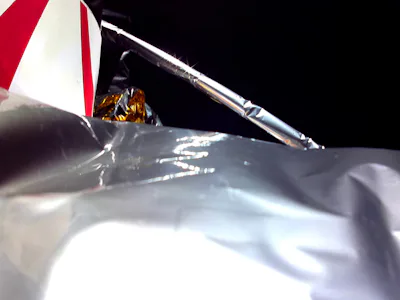
Gene Roddenberry’s ashes are set to burn up in Earth’s atmosphere later this week, along with those of half the main cast of his original Star Trek series, as well as a lunar rover, a small flock of robots, and millions of dollars in scientific instruments, all of which were originally supposed to land on the Moon.
Astrobotic’s Peregrine One lander was originally scheduled to be in lunar orbit early next week, preparing for a landing on the Moon’s near side in late February. Instead, the spacecraft is now headed back to Earth, where it will disintegrate in Earth’s upper atmosphere – so at least it’s going out in a blaze of glory. Here’s everything you need to know about the doomed mission and what went wrong.
As of this morning, January 16, the Peregrine Mission One spacecraft is on its way back to Earth after a 238,000-mile flight out to cross the path of the Moon’s orbit. The ill-fated spacecraft is scheduled to re-enter Earth’s atmosphere and disintegrate dozens of miles above the ground. Astrobotic says both the company and NASA are tracking the spacecraft’s path, and its re-entry won’t pose any safety risk to anyone on the ground.
The return to Earth is based on recommendations from NASA, other U.S. government agencies, and other members of “the space community” to prevent Peregrine from turning to a potentially hazardous piece of space debris orbiting the Moon or Earth, says Astrobotic in a recent update on its website.
“Ultimately, we must balance our own desire to extend Peregrine's life, operate payloads, and learn more about the spacecraft, with the risk that our damaged spacecraft could cause a problem in cislunar space,” the company says.
WHAT WENT WRONG?
Shortly after the mission’s launch from Cape Canaveral on January 8, things began to go wrong. It looks like a valve between the spacecraft’s oxidizer tank and a tank of high-pressure helium got stuck in the open position, according to Astrobotic. Here’s what that actually means:
It actually takes several ingredients to fuel a spacecraft. The stuff that actually burns, producing hot gas that gets pushed out the back end of the spaceship to create thrust, is called the propellant, and it’s usually something like liquid hydrogen, hydrazine, or even kerosene. But nothing burns without oxygen, so rocket engines need a second ingredient, called the oxidizer, to mix with the propellant so it can actually ignite.
Most of the time, the propellant and the oxidizer are stored in separate tanks, so they only combine when and where engineers want them to (most variations on that are catastrophically bad). Some spaceships – like Peregrine One – use pressurized helium to push the oxidizer and the propellant into the combustion chamber. Helium is a good choice because it won’t react with the oxidizer or the propellant.
But when the valve that’s supposed to push a small amount of helium into the oxidizer tank gets stuck, you end up with way too much helium in the tank – and like an overinflated balloon, the tank pops. Oxidizer goes everywhere except where the spaceship actually needs it to go, and suddenly, there’s not enough oxidizer to mix with the propellant to steer the spaceship to a safe landing on the Moon.
“While this is a working theory, a full analysis report will be produced by a formal review board made up of industry experts after the mission is complete,” says Astrobotic. “All available data is being downloaded from the lander to support this assessment.”
By January 14, the leak had started slowing down, and by January 15, Astrobotic reported, “The propellant leak caused by the anomaly has practically stopped.”
But by then, it was too late.
“Due to the anomaly, the fuel to oxidizer ratio is well outside of the normal operating range of the main engines, making long controlled burns impossible,” the company wrote in an update on its website.
The brand new rocket, United Launch Alliance's (ULA) Vulcan Centaur, lifts off from Space Launch Complex 41d at Cape Canaveral Space Force Station in Cape Canaveral, Florida, on January 8, 2024, for its maiden voyage, carrying Astrobotic's Peregrine Lunar Lander.
GREGG NEWTON/AFP/GETTY IMAGES
MOON LANDINGS ARE HARD
If it had succeeded, Peregrine would have been the first U.S.-based lander to reach the Moon since Apollo 17 visited in 1972, and the first private mission ever to pull it off.
The most recent successful Moon landing was India’s Chandrayaan-3, which touched down near the lunar south pole in August 2023. Just a few days earlier, Russia’s Luna-25 lander “ceased to exist as a result of a collision with the surface of the Moon” in the same region. Like the Peregrine lander for the U.S., Luna-25 would have been Russia’s first Moon landing in more than 50 years (or technically ever: the last Russian spacecraft to land on the Moon was actually built by the Soviet Union, not the modern Russian Federation).
India is now the fourth country ever to make a “soft landing” — as opposed to a crash, either accidental or on purpose — on the Moon, following the Soviet Union (but not post-Soviet Russia), the United States, and China. But nobody’s track record for Moon landings is perfect; India lost its Chandrayaan-2 lander in 2019 thanks to a software glitch.
An Israeli spacecraft also crashed on the Moon in 2019, spilling a payload of tardigrades and DNA onto the lunar surface. Oops.
WHAT’S BEING LOST?
Peregrine Mission One was originally meant to orbit the Moon for several weeks before landing on February 23. Its controversial payload of human remains and DNA made headlines, but the spacecraft is also carrying a payload of several instruments for NASA, a quintet of tiny robots for the National Autonomous University of Mexico (UNAM) and the Mexican space agency (AEM), a lunar rover from Carnegie Mellon University, and several other privately-funded instruments and experiments.
This diagram (not to scale) shows Peregrine’s new trajectory.
ASTROBOTIC
Several of those instruments managed to switch on and collect some data during the flight to lunar distance (meaning the distance at which the Moon orbits Earth, as opposed to “lunar orbit,” which would mean orbit around the Moon). Two NASA instruments successfully measured cosmic rays from deeper in our galaxy and space weather driven by our Sun’s activity.
“This data helps characterize the interplanetary radiation environment for humans and electronics,” says NASA in a statement.”
And although the five tiny robots from UNAM and AEM, called Colmena, didn’t get to trundle adorably around the lunar surface, they did get to power up and collect some data during the flight — making them the first Mexican instrument to operate in cislunar space.
Meanwhile, the doomed lander also carries the cremated remains of Star Trek creator Gene Roddenberry (mingled with those of his wife and son), Star Trek actors Nichelle Nichols, DeForest Kelley, and James Doohan, science fiction author Arthur C. Clarke, and others, along with DNA samples from several former U.S. presidents. Some of the ashes — a payload from “memorial spaceflight” company Celestis — were intended for interment on the lunar surface, while others were planned to carry on into deep space, but they will now return to Earth and burn up on re-entry later this week.
For Roddenberry, at least, Peregrine wasn’t his only memorial spaceflight. Other portions of the late screenwriter’s ashes traveled into space aboard the Space Shuttle Columbia in 1992 among the personal possessions of astronaut Jim Wetherbee, and aboard a Celestis orbital mission, which burned up during re-entry in 2002 (on purpose that time). Counting the Peregrine mission, Roddenberry’s remains have flown to space more times than many living astronauts.
A new analysis of subsurface deposit and erosion patterns beneath the dry lakebed in Mars’ Jezero crater indicates the process took place over eons, dramatically improving the chances that soil samples collected at the site by NASA’s Perseverance could contain signs of ancient life.
Although the exact timeline for a joint European Space Agency/NASA mission to retrieve Perseverance’s soil samples has not yet been set, the fact that the lake in Jezero crater had existed across numerous geological phases significantly increases the odds of finding signs of ancient life within those samples.
RESEARCHERS HAVE LONG SUSPECTED DEEP SEDIMENTARY LAYERS LIE BENEATH JEZERO
Over the last few decades, images captured by satellites orbiting Mars have long hinted at the idea of eroded subsurface layers in the region. However, researchers knew that up close analysis by Perseverance’s ground penetrating radar was the only way to confirm those suspicions.
“From orbit, we can see a bunch of different deposits, but we can’t tell for sure if what we’re seeing is their original state or if we’re seeing the conclusion of a long geological story,” said David Paige, a UCLA professor of Earth, planetary and space sciences and first author of the paper detailing the findings. “To tell how these things formed, we need to see below the surface.”
Fortunately, Perseverance’s mission planners included the Radar Imager for Mars’ Subsurface Experiment, or RIMFAX, as one of the seven instruments on board the rover. Like ground penetrating radar used on Earth, the RIFMAX fires radar waves directly into the Mars surface, then reads their reflections as they bounce off different sedimentary layers.
To scan the floor of the river delta that once fed the Jezero crater, Perseverance used RIMFAX to fire radar pulses into the ground every 10 centimeters. When those pulses are reflected from as deep as 20 meters below the surface, the instrument captures that data. Given the prolonged usage of this system on Earth, scientists have figured out how to read the structure and composition of subsurface layers from those reflections.
“Some geologists say that the ability of radar to see under the surface is kind of like cheating,” said Paige, who is RIMFAX’s deputy principal investigator.
The process occurred between May and December of 2021, offering researchers a chance to collect data from a wide area within the delta. As the researchers reported in the latest edition of Science Advances, the radar revealed compelling evidence that the ancient lake in Jezero crater had made soil deposits and eroded over eons
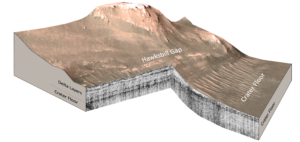
Mars Perseverance Rover RIMFAX ground penetrating radar measurements of the Hawksbill Gap region of the Jezero Crater Western Delta, Mars. Hawksbill Gap.
CREDIT: Svein-Erik Hamran, Tor Berger, David Paige, University of Oslo, UCLA, California Institute of Technology Jet Propulsion Laboratory, NASA
“The periods of deposition and erosion took place over eons of environmental changes, the radar indicates, confirming that inferences about the Jezero crater’s geologic history based on Mars images obtained from space are accurate,” the UCLA and the University of Oslo researchers explain,
FINDINGS INCREASE ODDS FOR SIGNS OF ANCIENT LIFE IN JEZERO SOIL SAMPLES
Although Perseverance has completed numerous missions and made countless significant findings about the red planet since its landing in February of 2021, few tasks undertaken by the SUV-sized rover have tantalized researchers and the public as much as the soil samples it collected and stored away for an eventual return to Earth. Not only did the original mission planners choose to study Jezero in hopes that there had been an ancient lake at the site, but the exact areas the vehicle has studied within the 30-mile wide crater were selected as the likeliest places to find signs of ancient life.
Furthermore, they chose specific sites within those study locations to select samples with the highest chances of life. So, the fact that the rover’s findings agree with the satellite imagery used by mission planners and confirm that they had indeed been chosen correctly should only increase the motivation to fund the sample return mission
“The changes we see preserved in the rock record are driven by large-scale changes in the Martian environment,” Paige said of the timescale revealed by the findings. “It’s cool that we can see so much evidence of change in such a small geographic area, which allows us [to] extend our findings to the scale of the entire crater.”
Ultimately, the sooner those samples can be returned to Earth, the sooner researchers can use the most advanced tools and techniques to analyze them. Given these latest findings, researchers may end up finding signs of ancient extraterrestrial life in the exact place they hoped to discover them.
“If life ever existed on Mars, the Perseverance rover’s verification of lake sediments at the base of the Jezero crater reinforces the hope that traces might be found in the crater,” the researchers explain.
Christopher Plain is a Science Fiction and Fantasy novelist and Head Science Writer at The Debrief. Follow and connect with him on X, learn about his books at plainfiction.com, or email him directly at christopher@thedebrief.org.
Hele Marsmannetjes moet je niet verwachten, maar de hoop om sporen van leven te vinden op de rode planeet is wel weer opgelaaid. Nieuw onderzoekheeft namelijk aangetoond dat de krater waarin Marsrover Perseverance momenteel rondrijdt ooit gevuld was met water.
Toen het meer in deze Jezero-krater kromp, bleven er sedimenten achter op de bodem, maar ook in de rivieren die het water aanvoerden. Langzaam kwam de hele krater en het gebied eromheen droog te staan en ontstond een delta met de specifieke kenmerken die nu nog zichtbaar zijn.
Eindelijk bevestigd De periodes waarin sedimentatie werd afgewisseld met erosie vonden plaats gedurende vele eeuwen waarin de omgeving steeds veranderde, zo blijkt uit radargegevens. Het maakt duidelijk dat de aannames, die op basis van beelden uit de ruimte zijn gedaan over de geschiedenis van de Jezero-krater, dus echt kloppen.
“Vanuit een baan om de aarde kunnen we een heleboel verschillende afzettingen zien, maar we kunnen niet met zekerheid zeggen of wat we bekijken de oorspronkelijke staat is, of dat we het slot zien van een lang geologisch verhaal”, zegt UCLA-professor David Paige. “Om echt te weten hoe deze dingen zijn ontstaan, moeten we onder het oppervlak kijken.”
Stukje volharding Marsrover Perseverance doet zijn naam eer aan. Al sinds 2021 onderzoekt het ding, zo groot als een auto, minutieus de kraterbodem van 48 kilometer breed. Met maar liefst zeven wetenschappelijke instrumenten aan boord bestudeert hij de samenstelling van de grond, kijkt naar de atmosfeer en verzamelt monsters. De monsters moeten door een toekomstige expeditie terug naar de Aarde worden gebracht om ze te onderzoeken op sporen van leven.
Eerder al trad de Perseverance buiten de gebaande paden van de kraterbodem en bezocht de delta eromheen. Dit is een enorm uitgestrekt gebied met 3 miljard jaar oude sedimenten, die vanaf de ruimte lijken op de rivierdelta’s op Aarde. Een van de instrumenten van de Marsrover stuurde iedere 10 centimeter radargolven naar de bodem om zo tot 20 meter onder het oppervlak te kunnen kijken.
RIMFAX Om met de radar echt iets te kunnen zeggen over de structuur en de samenstelling van de ondergrondse lagen is eerst op Aarde jarenlang onderzoek gedaan met het zogenoemde RIMFAX-instrument (afkorting van Radar Imager for Mars’ Subsurface Experiment). Het resultaat is indrukwekkend: de ondergrondse beelden tonen gesteentelagen die zich laten lezen als de dwarsdoorsnee van een snelweg. “Sommige geologen vinden dat het vermogen van de radar om onder het oppervlak te kijken een beetje op bedrog lijkt”, zegt onderzoeker Paige.
Een kijkje onder het oppervlak van Mars. Afbeelding: Svein-Erik Hamran, Tor Berger, David Paige, University of Oslo, UCLA, California Institute of Technology Jet Propulsion Laboratory, NASA
Mooi inkijkje Maar wat kan het schelen als het zo’n mooi inkijkje oplevert in de Marsbodem. De radar wist twee periodes van sedimentafzettingen te onderscheiden, met daar tussenin twee periodes van erosie. Omdat de bodem onder de delta niet perfect vlak is, heeft er waarschijnlijk een periode van erosie plaatsgevonden voor de afzetting van de sedimenten. Die zijn overigens heel regelmatig en horizontaal van vorm, net als de sedimenten in meren op Aarde. In eerdere studies werd al gesuggereerd dat er sedimenten in het meer zouden zijn, maar dat is door dit onderzoek pas bevestigd.
Een tweede periode van afzettingen ontstond toen schommelingen in het waterpeil ervoor zorgden dat de rivier een veel bredere delta vormde. Ooit strekte die zich uit tot ver in het meer, maar door erosie is hij veel kleiner geworden. “De veranderingen die in het gesteente terug te vinden zijn, duiden op enorme wijzigingen in de omgeving op Mars”, zegt Paige. “Het is mooi dat we zoveel bewijs zien van veranderingen in zo’n klein gebied, waardoor we onze bevindingen kunnen uitbreiden naar de hele krater.
Researchers operating China’s Zhurong rover say they have spotted a series of mysterious polygons hidden beneath the planet’s surface, similar to polygons NASA spotted on the surface of Mars in 2012. The newly discovered features, however, were detected more than 35 kilometers beneath the planet’s surface.
While researchers believe that these polygon structures could have formed due to extreme environmental shifts in Mars’ ancient past, their exact nature and formation remain a mystery.
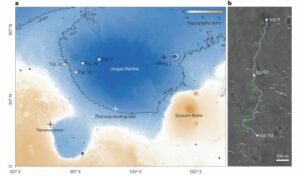
The discovery was initially made during the rover’s one-year mission, which lasted from May 2021 to May 2022, in the Utopia Planitia region. Described by researchers from the Institute of Geology and Geophysics under the Chinese Academy of Sciences as the largest impact crater in the entire solar system, the researchers behind this mysterious find say that Utopia Planitia “has both experienced and recorded variations of the Martian palaeoclimate.”
By using the rover’s ground penetrating radar, researchers scoured a 1.2-kilometer-wide area for various geological features. As a result, 16 mysterious polygons were spotted below a depth of 35 meters, meaning they were likely formed billions of years in the planet’s past.
Zhurong rover landing site and images of polygonal terrain in Utopia Planitia. Image Credit NASA/Zhang et al.
Perhaps even more significant, the researchers say that the 16 polygons spotted by Zhurong could be evidence of a long, wet period on ancient Mars, which would dramatically increase the chances that life once existed on the red planet.
“[The] formation mechanism for the buried palaeo-polygonal terrain requires a cold environment and might be related to water/ice freeze–thaw processes in southern Utopia Planitia on early Mars,” the researchers explain in the journal Nature Astronomy. “The detected buried polygons, which indicate that freezing occurred at low-to-mid latitudes, require strong palaeoclimatic variability.”
NASA, who spotted similar features on Mars’ surface back in 2012, says they study the mysterious polygons “because the occurrence and physical characteristics of the polygons helps us understand the recent and past distribution of ice in the shallow subsurface [and] also provide clues about climate conditions.”
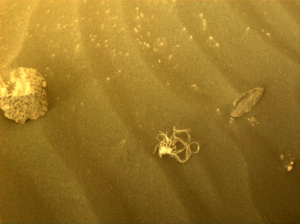
Of course, this is not the first time rovers have spotted something unusual on the red planet. For instance, a mysterious string was photographed by NASA’s Perseverance rover back in July 2022 before a photo taken four days later showed it had suddenly disappeared.
A mysterious string was spotted on the Martian surface.
Image credit: NASA
Rover operators have also spotted an unusual “flower” on Mars, a feature described as a “door,” and a number of pieces of debris left behind my previous missions. Just last October, rover operators even recorded a Martian whirlwind racing across the planet’s surface.
As for the recently discovered mysterious polygons hidden beneath the Martian surface, the researchers say they were potentially formed sometime between 3.7 and 2.9 billion years ago. While the exact process is unknown, the researchers say that their creation almost certainly involved large amounts of water, perhaps from water trapped underground that was pulled to the surface or even from ancient snowfall on the red planet.
“The possible presence of water and ice required for the freeze–thaw process in the wedges may have come from cryogenic suction-induced moisture migration from an underground aquifer on Mars, snowfall from the air, or vapor diffusion for pore ice deposition,” they explain.
While the Zhruong rover was decommissioned in 2022, the researcher note that the planet’s Utopia Planitia region is still one of the best places on the planet to search for signs of ancient water activity.
“The Zhurong landing site is thought to be one of the best places for detecting ground ice at low-to-mid latitudes on Mars25,” they write. “The GPR onboard Zhurong rover, thus, provides an unprecedented opportunity to illuminate subsurface structures and to investigate geological processes, particularly those associated with ancient or current water-related activities in southern Utopia Planitia.”
Christopher Plain is a Science Fiction and Fantasy novelist and Head Science Writer at The Debrief. Follow and connect with him on X, learn about his books at plainfiction.com, or email him directly at christopher@thedebrief.org
Project Starshot, an initiative sponsored by the Breakthrough Foundation, is intended to be humanity's first interstellar voyage. Credit: breakthroughinitiatives.org
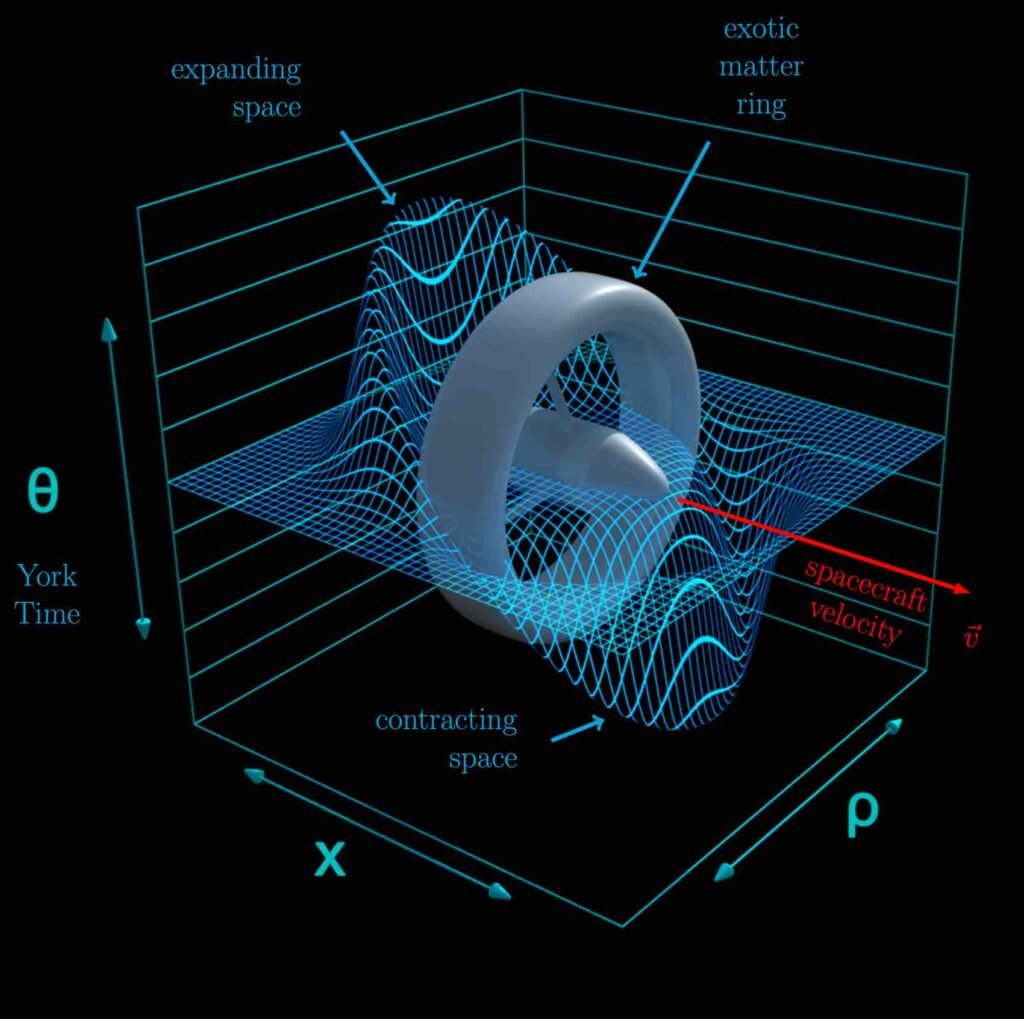
It’s a long way to the nearest star, which means conventional rockets won’t get us there. The fuel requirements would make our ship prohibitively heavy. So an alternative is to travel light. Literally. Rather than carrying your fuel with you, simply attach your tiny starship to a large reflective sail, and shine a powerful laser at it. The impulse of photons would push the starship to a fraction of light speed. Riding a beam of light, a lightsail mission could reach Proxima Centauri in a couple of decades. But while the idea is simple, the engineering challenges are significant, because, across decades and light-years, even the smallest problem can be difficult to solve.
One example of this can be seen in a recent arXiv paper. It looks at the problem of how to balance a lightsail on a laser beam. Although the laser could be aimed directly toward a star, or where it will be in a couple of decades, the lightsail would only follow the beam if it is perfectly balanced. If a sail is slightly tilted relative to the beam, the reflected laser light would give the lightsail a slight transverse push. No matter how small this deviation is, it would grow over time, causing its path to drift ever away from its target. We will never align a lightsail perfectly, so we need some way to correct small deviations.
How a small deviation can send a lightsail off course. Credit: Mackintosh, et al
For traditional rockets, this can be done with internal gyroscopes to stabilize the rocket, and engines that can dynamically adjust their thrust to restore balance. But a gyro system would be too heavy for an interstellar lightsail, and adjustments of the beam would take months or years to reach the lightsail, making quick changes impossible. So the authors suggest using a radiative trick known as the Poynting–Robertson effect.
That little forward component of light can slow down the asteroid ever so slightly. This effect causes dust to drift toward the inner solar system over time.
In this paper, the authors consider a two-dimensional model to see how the Poynting–Robertson effect might be used to keep our lightsail probe on course. To keep things simple, they assumed the light beam to be a simple monochromatic plane wave. Real lasers are more complex, but the assumption is reasonable for a proof of concept. They then showed how a simple two-sail system can use the effects of relative motion to keep the craft in balance. As the sails tilt off course slightly, a restorative force from the beam counters it. Thus proving the concept could work.
However, the authors noticed that over time the effects of relativity come into play. Earlier studies have taken the Doppler effect of relative motion into effect, but this study shows the relativistic version of chromatic aberration would also come into play. The full relativistic effects would need to be accounted for in a realistic design, which would require sophisticated modeling and optics.
So a lightsail still seems like a possible way to reach the stars. We just have to be careful not to make light of the engineering challenges.
Lake Rotorua, which sits at the heart of a dormant volcano and is the setting for one of New Zealand's most famous Māori love stories, has been mapped in detail for the 1st time.
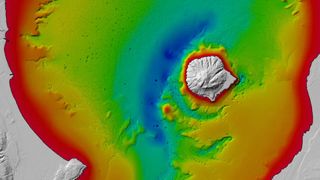
Map of Lake Rotorua.
(Image credit: Institute of Geological and Nuclear Sciences Limited (GNS Science))
New maps have revealed a hidden hydrothermal system beneath a legendary lake in New Zealand, which serves as the setting for a famous Māori love story.
Lake Rotorua sits at the heart of a massive ancient crater of a dormant volcano on New Zealand's North Island. The lake has a storied history: it is where the daughter of an influential chief is said to have overcome forbidden love by swimming across the lake to be with a young warrior.
The Rotorua area is also well known for hydrothermal activity, with the Tourism New Zealand website stating that clouds of steam drift around the lake's shore, and that sulfur gives a "magical green-blue" color to the water.
Researchers at GNS Science, a research institute in New Zealand, have now mapped Lake Rotorua's floor in never-before-seen detail, revealing eruption craters, an ancient river and a large magnetic anomaly in the southern part of the lake. These new maps prove for the first time that Rotorua's mainland hydrothermal systems extend into the lake's hidden depths.
Image showing the large magnetic anomaly in the southern part of the lake. (Image credit: Institute of Geological and Nuclear Sciences Limited (GNS Science).)
Cornel de Ronde, a principal scientist at GNS Science, told Live Science that seeing the maps was like wearing glasses for the first time when you didn't realize you needed them. "You finally put those glasses on, and you can see the fine print," he said.
The maps cover 21 square miles (55 square kilometers), which is around 68% of the lake's floor, according to a statement released by GNS Science. The Royal New Zealand Navy collected some of the data, mapping the lake floor's physical features using a multibeam echo sounder — a type of sonar. They also carried out magnetic surveys, which revealed the magnetic anomaly.
"Normally with volcanic rocks, when you run a magnetometer over the top of them, you get very positive anomalies, but in this case we're getting negative anomalies, likely due to very low magnetic susceptibilities," de Ronde said.
Lake Rotorua sits in the crater of a dormant volcano on New Zealand's North Island. (Image credit: GLVImages via Getty Images)
Volcanic rocks typically contain the highly magnetic mineral magnetite, but in Lake Rotorua, researchers believe hydrothermal fluids have passed through the rock and transformed the magnetite into pyrite, or fool's gold, which has almost no magnetic signal. This hydrothermal process would severely diminish the magnetic signal and explain the negative anomaly.
The researchers also found other evidence of hydrothermal activity in the same general area as the magnetic anomaly. A heat flow map shows heat, which is probably hot water, rising up to the lake floor from beneath. Craters are also visible in this same region, which de Ronde noted are likely hydrothermal eruption craters.
Despite all of this activity, water temperatures near the bottom of the lake are usually around a cool 57 degrees Fahrenheit (14 degrees Celsius), according to de Ronde. That's because the lake is so large that there's enough cool water to counteract heat coming up from below, and the temperature only fluctuates by around 1.8 degrees F (1 degree C) over a month.
"Nobody swimming in the lake would notice it, but with instrumentation, we do," de Ronde said.
Editor's note: Updated at 5:46 p.m. EST to note that the hydrothermal process would severely diminish the magnetic signal, not flip it, as had been previously stated.
Ax-2's SpaceX Dragon capsule put on a show during its homecoming late Tuesday night (May 30 - 2023).
SpaceX's Dragon capsule Freedom splashed down off the Florida coast late Tuesday night (May 30 - 2023), wrapping up the Ax-2 private astronaut mission.
Freedom's return to Earth was quite a sight, as footage posted on Twitter shows. For example, Stephanie Ivison shared a video of the capsule carving a bright orange slice into the skies above Oklahoma as it headed toward the Gulf of Mexico.
"Just streaked across the sky in Tulsa at about 9:55pm. Looks like something re-entering the atmosphere. Pretty neat!" Ivison wrote.
The Ax-2 SpaceX Dragon Freedom floats near a recovery ship shortly after splashing down in the Gulf of Mexico on May 30, 2023. (Image credit: SpaceX via Twitter)
Twitter user TJ posted a short video as well, one that captured Freedom much closer to its splashdown site — and therefore much closer to the ground.
Freedom hit the water right on schedule, splashing down in the Gulf off Panama City, Florida, at 11:04 p.m. EDT (0304 GMT on May 31). The capsule was then met by a recovery ship and hauled onto it for the trip back to shore.
SpaceX documented this process and shared it with us, posting three photos on Twitter about 45 minutes after splashdown.
One of the shots — the main photo for this story, featured above — shows Freedom floating near its ride home, whose deck is outfitted with a striking array of green and red lights.
Recovery crews get the Ax-2 SpaceX Dragon capsule Freedom ready for transfer to a recovery ship shortly after its splashdown in the Gulf of Mexico on May 30, 2023. (Image credit: SpaceX via Twitter)
Another shot depicts recovery personnel tending to the capsule from a smaller craft, which presumably launched from the large recovery ship.
The third shows Freedom — its once bright-white exterior now sporting a "toasted marshmallow" look from the heat of atmospheric reentry — safely aboard that ship.
The Ax-2 SpaceX Dragon capsule Freedom rests on a recovery ship shortly after its splashdown in the Gulf of Mexico on May 30, 2023. (Image credit: SpaceX via Twitter)
Ax-2 launched on May 21, carrying four people to the International Space Station (ISS). As its name suggests, Ax-2 is the second mission to the orbiting lab carried out by Houston-based company Axiom Space, after the pioneering Ax-1 flight in April 2022.
Ax-2 was commanded by former NASA astronaut Peggy Whitson, who is now director of human spaceflight at Axiom. The other three crewmembers were paying customer John Shoffner, Ali AlQarni and Rayyanah Barnawi.
SpaceX will send two more Dragons to the orbiting lab soon, if all goes according to plan.
The company plans to launch a robotic cargo mission to the ISS on Saturday (June 3). And SpaceX's Crew-7 mission, which will send four astronauts to the orbiting lab for NASA, is scheduled to fly on the Crew Dragon Endurance in August.
Join our Space Forums to keep talking space on the latest missions, night sky and more! And if you have a news tip, correction or comment, let us know at: community@space.com.
Marsrover vindt overblijfselen van een groot meer – is er misschien leven?
Marsrover vindt overblijfselen van een groot meer – is er misschien leven?
Geavanceerde ruimtetechnologie groef diep onder het oppervlak van Mars, en het gevonden materiaal heeft de vermoedens van veel wetenschappers bevestigd.
Op 18 februari 2021 rolde de NASA-rover Perseverance voor het eerst in de buurt van de Jezerokrater op Mars, die een diameter van 30 meter heeft en 250 meter diep is.
Zijn missie was duidelijk: Perseverance moest in de kleihoudende krater zoeken naar tekenen van leven.
De robot met zes wielen bevindt zich nog steeds op de rode planeet, en onlangs zorgde hij voor een nieuwe doorbraak.
Perseverance vuurde radargolven af om onder het oppervlak van Mars te kijken en vond daar duidelijk bewijs dat er ooit water stroomde door de Jezerokrater.
Ondergrond duidt op prehistorisch meer
Met zijn radarinstrument kon de rover 20 meter diep in de krater kijken. Hij zond met intervallen van 10 centimeter radargolven uit en mat daarna de pulsen die teruggekaatst werden.
Het instrument kan de structuur en samenstelling van de ondergrondse lagen in het sediment aflezen, en in de Jezerokrater waren duidelijke afzettingen in de lagen te zien.
De afzettingen beschrijven het proces waarbij eerder gevormde lagen grond of gesteente om verschillende redenen kunnen worden afgebroken. Het kan gaan om sediment dat is afgebroken en waarin zich mineralen, organisch materiaal of andere stoffen hebben opgehoopt.
Reis met Perseverance door de Jezerokrater:
Volgens de onderzoekers zijn de afzettingen het resultaat van een krater die ooit vol water zat – waarschijnlijk in de vorm van een groot meer.
Ze denken dat het meer langzaam kromp, waardoor een grote delta ontstond die later erodeerde en de geologische kenmerken vormde die nu aan het oppervlak zichtbaar zijn.
Natte planeet werd gevriesdroogd
Hoewel het water meermaals terugkeerde, eindigde Mars toch als een ijskoude woestenij. Op de lange termijn kon de planeet de verwarmende atmosfeer die nodig is voor vloeibaar water, niet vasthouden.
Dat is een belangrijke ontdekking, en het bevestigt de vermoedens dat hier ooit water stroomde.
‘De radarbeelden laten zien dat de sedimenten regelmatig en horizontaal zijn – net als sedimenten in meren op aarde,’ zei David Paige, professor aard-, planeet- en ruimtewetenschappen aan de UCLA en hoofdauteur van de studie, in een persbericht.
De resultaten ondersteunen de theorie die NASA-wetenschappers al lang aanhangen: dat het koude, droge, levenloze Mars ooit warm, nat – en misschien bewoonbaar – was.
Perseverance verzamelt nu zo snel als de technologie het toelaat monsters uit de Jezerokrater.
De bodem- en gesteentemonsters zullen uiteindelijk naar de aarde worden gestuurd, en de wetenschappers achter dit onderzoek hopen er sporen van leven in te vinden.
A Super-Earth (and Possible Earth-Sized) Exoplanet Found in the Habitable Zone
Astronomers have found a new Super-Earth orbiting an M-dwarf (red dwarf) star about 137 light-years away. The planet is named TOI-715b, and it’s about 1.55 Earth’s radius and is inside the star’s habitable zone. There’s also another planetary candidate in the system. It’s Earth-sized, and if it’s confirmed, it will be the smallest habitable zone planet TESS has discovered so far.
TOI-715 is an average red dwarf. It’s about one-quarter the mass and about one-quarter the radius of our Sun. TOI-715b is close to the star, and its tight orbit takes only 19 days to complete one trip around the dwarf star. Since red dwarfs are much dimmer than the Sun, this puts the Super-Earth in the star’s conservative habitable zone.
The habitable zone is a rather crude way to identify planets that may have liquid water. Its boundaries are unclear and even contradictory since stellar spectral type, planetary albedo, mass, and even how cloudy its atmosphere is can determine if a planet has liquid water.
The idea of a conservative habitable zone (CHZ) is more helpful. It comes from a 2014 paper by Kopparapu et al. It’s a region around a star where a rocky planet receives between 0.42 and 0.842 as much solar insolation as Earth does. Any rocky planet receiving that much energy is in the CHZ, regardless of distance.
The graphic shows optimistic and conservative habitable zone boundaries around cool, low-mass stars. The numbers indicate the names of known Kepler planet candidates. Yellow represents candidates with less than 1.4 times Earth-radius. Green represents planet candidates between 1.4 and 2 Earth radius. Note: the newly discovered planets are not shown. Credit: Penn State.
Discovering a Super-Earth in a star’s CHZ is always exciting. It fuels our sense of wonder about other planets and the possibility that some may harbour other life. For that reason, they’re more intriguing than planets like Hot Jupiters for instance, which have zero possibility of hosting liquid water or life. Not even the hardiest extremophiles can survive a Hot Jupiter’s wicked environment.
But this discovery is also exciting for a couple of other reasons.
“At long last, the era of JWST has arrived, and with it, the age of detailed exoplanetary atmospheric characterization.”
From “A 1.55 Earth-radius habitable-zone planet hosted by TOI-715, an M4 star near the ecliptic South Pole.”
Now that we’ve discovered thousands of exoplanets, astronomers are seeing trends in the population. One of the things they noticed is a gap in the small planet population between 1.5 and 2 Earth radii. It’s known as the small planet radius gap or the sub-Neptune radius gap (also called the Fulton gap and the photoevaporation valley.) At 1.55 Earth radii, TOI-715b is inside the gap.
A histogram of planets with given radii from a sample of 900 Kepler systems. The decreased occurrence rate between 1.5 and 2.0 Earth radii is apparent. It’s sometimes called the Fulton Gap because it comes from Fulton et al. 2017. Image Credit: Fulton et al. 2017.
It’s extremely unlikely that no planets form in this radius gap. Planets must start out larger and lose mass to end up in the gap. So, the Fulton Gap tells us something about how some planets lose mass. Astronomers think that planets in the gap start out larger, but their stars strip away some of their mass by photoevaporation, shrinking them. That’s why it’s sometimes called the photoevaporation valley. There’s a lot of uncertainty around the valley and photoevaporation, and astronomers want to study planets in the valley to see what they can learn.
“The importance of the radius valley lies in its potential to teach us about planetary formation and post-formation evolution, and hence, planets inside this gap are crucial in furthering our understanding of the factors that sculpt it,” the authors explain.
There’s some uncertainty if this radius gap exists around M-dwarfs or not. It’s possible that M-dwarfs have a density gap rather than a radius gap. “A recent study by Luque & Pallé (2022), however, indicates that M-dwarf planets may have a density gap rather than a radius gap separating two populations of small planets (rocky and water worlds),” the authors write.
Whether it’s a radius gap or a density gap, TOI-715b should have something to tell us about exoplanets, photoevaporation, and the nature of exoplanet distribution around red dwarfs. But to discover what it has to tell us requires further, detailed observations. That’s the second reason why this Super-Earth is so intriguing.
Ever since we started finding exoplanets, scientists have looked forward to the day when the James Webb Space Telescope is operational. “At long last, the era of JWST has arrived, and with it, the age of detailed exoplanetary atmospheric characterization,” the authors write in their paper. The JWST has the ability to observe the spectra of exoplanet atmospheres and determine their constituents. But even though the JWST is enormously powerful, some targets present better opportunities for transmission spectroscopy than others.
The JWST hasn’t studied TOI-715b yet, but it can measure an exoplanet’s transit spectrum and its eclipse spectrum, as shown in this spectrum of the exoplanet WASP-80b. During a transit, the planet passes in front of the star, and in a transit spectrum, the presence of molecules makes the planet’s atmosphere block more light at certain colours, causing a deeper dimming at those wavelengths. During an eclipse, the planet passes behind the star, and in this eclipse spectrum, molecules absorb some of the planet’s emitted light at specific colours, leading to a smaller dip in brightness during the eclipse compared to a transit. Image Credit: BAERI/NASA/Taylor Bell.
TOI-715b is a prime target because it’s close to its star. Since TOI-715 is a small red dwarf, and the planet orbits it every 19 days, the exoplanet’s transits in front of its star are deeper and more frequent. That means the JWST doesn’t need much time to observe the planet’s atmosphere, making it an efficient use of the space telescope’s time. “In the context of atmospheric characterization by transmission spectroscopy, bright, nearby M dwarfs are ideal planetary hosts as small temperate planets will transit frequently, enabling high signal-to-noise detections of atmospheric features with fewer hours of telescope time,” the authors explain.
This figure from the study shows the conservative habitable zone in blue. The y-axis shows the Transmission Spectroscopy Metric, a measure of how amenable a planet’s atmosphere is to the JWST spectroscopic measurements. The x-axis shows stellar insolation. TOI-715b is shown in two instances: as a rocky world and as a water world. If it’s a water world, it’s more accessible to effective spectroscopy by the JWST. TOI-715’s other planet candidate is shown in green. Other interesting exoplanets are also shown, including the TRAPPIST-1 planets in yellow. Image Credit: Dransfield et al. 2024.
Can this Super-Earth be habitable? Lacking the JWST’s spectroscopy, we’re reduced to speculating. It’s in the conservative habitable zone, but that doesn’t get us very far. Still, there are some hopeful signs.
TOI-715 is a little older than our Sun at about 6.6 billion years old. The star shows a “low degree of magnetic activity,” according to the authors. That’s probably why the star shows an absence of flaring in the TESS light curves compared to younger M-dwarfs. Red dwarfs are known to exhibit extremely powerful flaring that can sterilize planets. They can also strip away atmospheres, which could be responsible for the exoplanet photoevaporation valley.
This artist’s illustration shows a red dwarf star emitting a powerful flare. Red dwarf flaring can limit the habitability of planets in their habitable zones. Credits: NASA’s Goddard Space Flight Center
Another planet may be orbiting TOI-715. It’s currently only a candidate named TIC 271971130.02, but if confirmed, it will be the smallest habitable zone planet TESS has ever found. But follow-up observations are needed to confirm it.
The TOI-715 system is a compelling target for further study. TOI-715b is waiting its turn, but eventually, the JWST will examine its atmosphere. If those results support habitability, astronomers’ excitement will only grow. At the same time, we may learn more about the radius or density gap, an obstacle to a more thorough understanding of exoplanets.
Add in the fact that the star may host another habitable zone planet, the smallest one found yet by TESS, and the TOI-715 system becomes even more importan
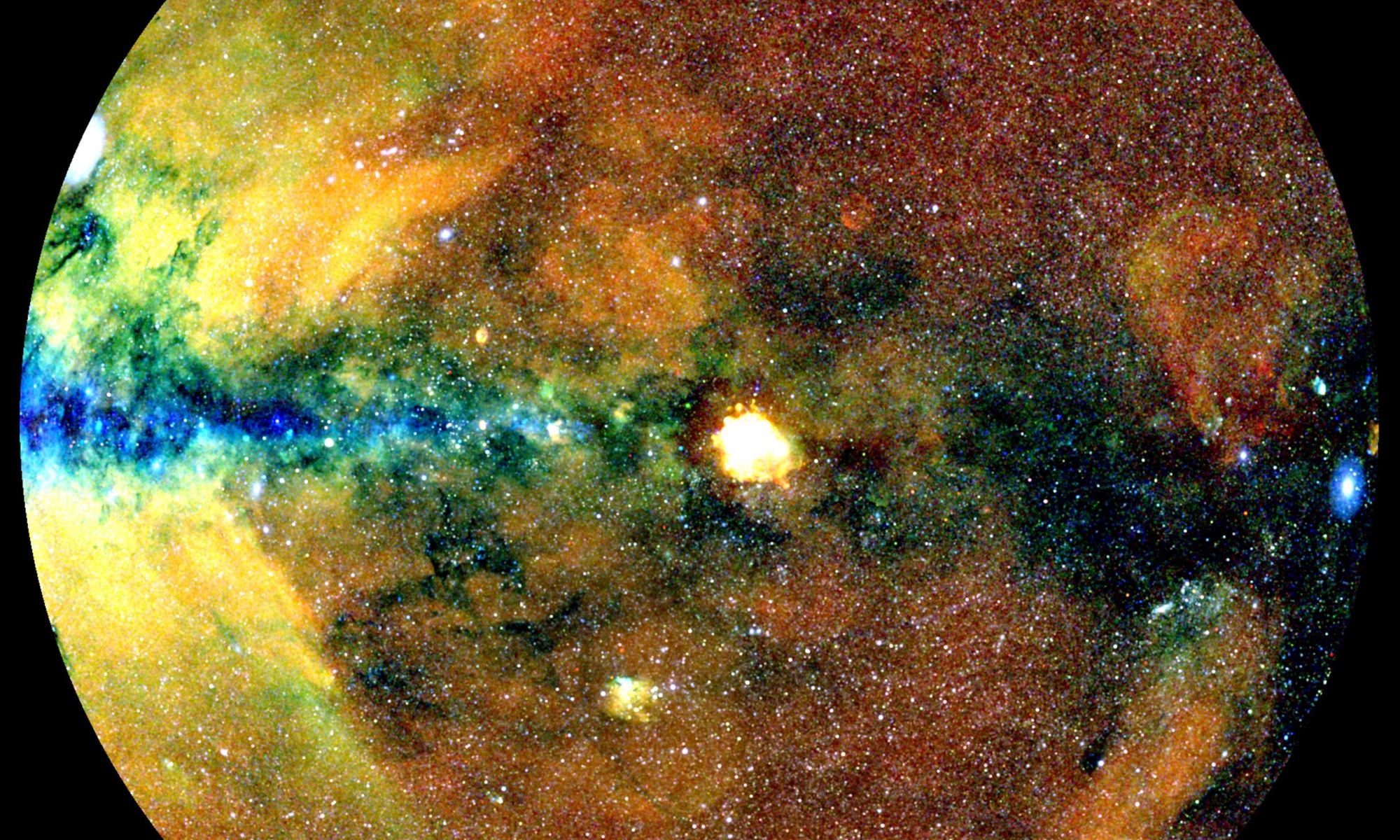
This image show half of the X-ray sky, projected onto a circle with the center of the Milky Way on the left and the galactic plane running horizontally. Photons have been colour-coded according to their energy (red for energies 0.3-0.6 keV, green for 0.6-1 keV, blue for 1-2.3 keV). Credit: MPE, J. Sanders for the eROSITA consortium
There’s an old trope in science fiction about someone suddenly getting X-ray vision and looking through solid objects. It turns out to be a physical impossibility with our Mark I eyeballs. However, astronomers have found a way around that challenge that lets us study the Universe with X-ray vision.
It’s called x-ray astronomy and it’s been around for 60 years. It reveals some of the most energetic and violent events and objects in the cosmos. Those include things like bright quasars, supernova explosions, streams of hot gas between galaxies, and hot, young stars.
Recently, astronomers in the eROSITA consortium at the Max Planck Institute for Extraterrestrial Physics announced the latest trove of X-ray data from the eROSITA survey. It covers half the X-ray sky and reveals information about 900,000 distinct X-ray sources. That’s more than all the ones ever detected in X-ray astronomy’s decades of history, including discoveries made with Chandra and other orbiting observatories.
About eROSITA
eROSITA is a soft x-ray imaging telescope aboard the Spectrum-RG satellite. Its first all-sky survey, called eRASS1, took place over 7 months beginning on December 12, 2019. At its most sensitive setting, the telescope detected 170 million X-ray photons. That allowed the cameras to measure their energies and arrival times.
The astronomy team, led by principal investigator Andrea Merloni, put together a first-release catalog of data. They also published more than 50 new science papers based on their findings. After finishing this first survey, the instrument carried out three more scans of the entire sky between June 2020 and February 2022. That huge treasuring of x-ray data will be released shortly. The video below explains more about the mission.
eROSITA’s Treasury of X-ray Sources
X-ray astronomy focuses on hot and energetic objects and events in the Universe. Those would be the cores of galaxies (where supermassive black holes lurk), supernova explosions, newborn stars, and other places where matter gets heated to high temperatures.
This preliminary data eRASS1 data set pinpoints about 710,000 supermassive black holes, 180,000 x-ray emitting stars in the Milky Way, and 12,000 clusters of galaxies. It also covers a small number of other exotic sources like X-ray-emitting binary stars, supernova remnants, pulsars, and other objects.
“These are mind-blowing numbers for X-ray astronomy,” says Andrea Merloni, eROSITA principal investigator and first author of the eROSITA catalog paper. “We’ve detected more sources in 6 months than the big flagship missions XMM-Newton and Chandra have done in nearly 25 years of operation.”
The eROSITA first data release is a rich, “multi-layered” look at the sky at several X-ray energies. Each energy level tells astronomers something about the objects and events emitting the X-rays. And, for each set of images and data, the consortium provides more information. There are lists of source classes, sky positions, energies, and precise arrival times of the photons to the instrument. “We’ve made a huge effort to release high-quality data and software,” added Miriam Ramos-Ceja, who leads the eROSITA Operations team. “We hope this will broaden the base of scientists worldwide working with high-energy data and help push the frontiers of X-ray astronomy.”
Zeroing in on Specific X-ray Objects
eROSITA’s science objectives are to use X-rays as a way to detect the hot intergalactic medium of 50 to 100,000 galaxy clusters and groups. It also looks at hot gas in filaments between them. Those filaments glow in X-rays. The instrument is also tasked with detecting accreting black holes hidden in galaxies. Finally, it studied the physics of galactic X-ray sources (which include pre-main-sequence stars, supernova remnants, and X-ray binaries).
eROSITA X-ray image with the newly discovered filament between two galaxy clusters. The distribution of galaxies (white contours, upper left), as seen from the Two Micron All Sky Survey, follows the structure of the filament. In the SLOW simulation, which is tailored to reproduce the main features of the Local Universe, this individual system with both clusters and the filament spine is reproduced as well. Credit: Dietl et al. (2024)
At least one of the papers released with the new survey data uses x-ray data to constrain cosmological models using clusters of galaxies. In one release image, we see a newly discovered filament of material. It stretches between one portion of the galaxy cluster Abell 3667 and the nearby cluster Abell 3651. This may help astronomers determine how much matter exists in the so-called “warm-hot intergalactic medium”. It gives insight into the formation of large-scale structures (like galaxy clusters) in the Universe.
This X-ray image shows the full extent of the Virgo Cluster in X-rays as seen by eROSITA. The bright white spot at the center is the central galaxy M87. The hazy white glow around M87 is the very hot gas between galaxies. It extends out more in some directions than others, and isn’t circular. This is evidence that the Virgo Cluster is still in the process of forming. Credit: McCall al. (2024)
The nearby Virgo Cluster of galaxies also shows up in the eRASS1 survey and provides a way to study large-scale filamentary structures. In particular, astronomers want to understand the physical effects operating in the outskirts of these massive galaxy clusters. Using the new survey data, plus other all-sky images, a science team explored the structure of the cluster’s outskirts. That included high-energy emissions around galaxies and groups within the cluster. They also studied a so-called 320-kiloparsec-long “x-ray extension” near the galaxy M49.
eROSITA’s Past Work and Future
eROSITA has enabled a huge leap forward in X-ray astronomy since its launch in June 2019. It began operations in October of that year, providing high-resolution X-ray vision of the cosmos. As it scanned the sky, it glimpsed changes in a distant quasar called SMSS J114447.77-430859.3. Those changes give some clues to the growth of the black hole at the heart of the quasar. It observed changes in the brightness variations at the heart of the quasar, indicating that the black hole swallows some of the material that strays into its event horizon. Other material escapes in the form of powerful winds.
The instrument has also detected a newly forming black hole in the early Universe and traced the existence of hot gas all around our own Milky Way Galaxy. The instrument had its first light on October 22, 2019. Currently, it’s in safe mode and technicians are assessing its health and status.
Maak je je zorgen over wat deze week gaat brengen? Nou, hou je vast: er zijn 5 gigantische asteroïdenonderweg naar de aarde! Maar voordat je in doemdagmodus schiet, geen paniek. Volgens NASA zullen deze ruimterotsen, waaronder eentje zo groot als een voetbalstadion, onze mooie blauwe planeet niet raken. Laten we hopen dat ze geen rekenfoutje hebben gemaakt en eens duiken in de details van deze kosmische voorbijgangers en ontdekken waarom we toch rustig kunnen slapen.
Niet Zomaar Een Steen
NASA houdt deze week 5 gigantische asteroïden in het vizier die onze richting uit komen. Onder hen bevindt zich een ware reus met een diameter van ongeveer 280 meter, vergelijkbaar met de omvang van een flink voetbalstadion! Hoewel de gedachte aan zo’n gigantische ruimterots misschien angstaanjagend is, is er gelukkig geen enkel gevaar voor een botsing met onze planeet. Deze asteroïden zullen ons op veilige afstand passeren, waardoor de aarde gespaard blijft van een potentieel catastrofale impact. Deze kosmische voorbijgangers bieden een unieke kans voor wetenschappers om meer te leren over de samenstelling en het gedrag van dergelijke ruimteobjecten.
Beeld: wikipedia
5 gigantische asteroïden
Deze asteroïden variëren in grootte, van zo groot als een vliegtuig tot een voetbalstadion, en hun afstanden tot de aarde zijn zowel indrukwekkend als veilig. De dichtstbijzijnde zal ons missen met 1,7 miljoen mijl, terwijl de anderen zelfs nog verder verwijderd zijn, wat ons een comfortabele veiligheidsmarge biedt en de kans geeft om deze fascinerende ruimterotsen van een afstand te observeren en te bestuderen.
Beeld: wikipedia
Hoe Dichtbij Is Dichtbij?
Voor wat perspectief: de gemiddelde afstand tussen de aarde en de maan is ongeveer 239.000 mijl. Deze asteroïden zullen dus aanzienlijk verder weg zijn, ruim buiten de baan van de maan. Dit betekent dat we, ondanks hun indrukwekkende grootte, geen Hollywood-achtige doemscenario’s hoeven te verwachten. Hun passage is een kans voor wetenschappers om meer te leren, terwijl wij veilig op aarde blijven.
Geen risico
Dus, daar heb je het: een hemelse parade van 5 gigantische asteroïden, met een als headliner die de grootte heeft van een voetbalstadion. Hoewel het een fascinerend kosmisch spektakel is, benadrukt NASA dat er geen risico is op een botsing met onze planeet. Deze week hoeven we dus niet te vrezen voor een doemdag-scenario. In plaats daarvan kunnen we genieten van de wonderen van ons zonnestelsel, veilig en wel vanaf onze eigen blauwe marmer.
Featured Image: True-color image of the Red Planet taken on October 10, 2014, by India’s Mars Orbiter mission from 76,000 kilometers (47,224 miles) away. (Credit: ISRO/ISSDC/Justin Cowart) (This file is licensed under the Creative Commons Attribution 2.0 Generic license.)
Universe Today has explored the potential for sending humans to Europa, Venus, Titan, and Pluto, all of which possess environmental conditions that are far too harsh for humans to survive. The insight gained from planetary scientists resulted in some informative discussions, and traveling to some of these far-off worlds might be possible, someday. In the final installment of this series, we will explore the potential for sending humans to a destination that has been the focus of scientific exploration and science folklore for more than 100 years: Mars aka the Red Planet.
Dr. Jordan Bretzfelder, who is a Postdoctoral Fellow in the Department of Earth, Planetary, and Space Sciences at the University of California, Los Angeles (UCLA), shares her insights on the viability of sending humans to Mars and how we should do it. So, should we send humans to Mars?
“Yes, I think there is immense value in sending humans to engage in scientific exploration on Mars,” Dr. Bretzfelder tells Universe Today. “Humans can make quick decisions about sampling and data acquisition and can move around certain obstacles and terrain with more ease and freedom than many types of robotic vehicles. This would also provide opportunities to study and develop technology to facilitate future planetary exploration.”
Countless robotic pioneers have explored the surface and atmosphere of Mars in incredible detail and continue to teach us whether Mars once had—or currently has—life. However, humans could provide an extra level of exploration since they won’t be hindered by waiting for instructions from Earth ground controllers, which can take anywhere from 5 to 20 minutes one way. If something goes wrong, human explorers can make on-the-spot decisions to find solutions, whereas robot explorers are faced with waiting for engineers back on Earth to find solutions, followed by sending instructions, and more waiting. Regarding technological advancements, a human mission will undoubtedly teach us how to live and work on Mars, and this includes testing shelters, food, bathroom facilities, and even combating the mental fatigue from being so far from Earth for a prolonged period. All things considered, what are the pros and cons of sending humans to Mars?
Dr. Bretzfelder tells Universe Today, “Pros are as above, and many examples of the benefits of humans in the field can be found in the history of the Apollo missions; instances where certain scientifically valuable rocks were collected due to the quick thinking and judgement of the astronauts. Cons include the difficulties involved in keeping astronauts alive and safe on a distant and environmentally complicated planetary surface. Additionally, the possibility of accidentally introducing terrestrial microbes to Mars is a potential risk.”
Whether it’s a robotic or human mission, NASA’s Office of Planetary Protection is responsible for ensuring that microbes don’t hitch a ride and contaminate extraterrestrial environments that we wish to explore, but especially to protect us from any microbes that could potentially be brought back to Earth.
Regarding the ongoing robotic exploration of Mars, there are presently seven active Mars orbiters from several nations teaching us more and more about the Red Planet and unlocking its secrets. On the surface, there are currently three active missions: NASA’s Curiosity and Perseverance rovers, and China’s Zhurong rover. Past successful surface missions include NASA’s Viking 1 and Viking 2 landers, Mars Pathfinder, Spirit and Opportunity rovers, Phoenix lander, and InSight lander. From marsquakes to finding evidence for past surface liquid water, each of these missions spent years unlocking the secrets of Mars, both above and below the surface. But what additional science could be conducted by a human mission compared to a robotic mission?
“As above, humans (within limits based on their suits and other equipment) have the ability to navigate terrain that may not be suitable for a rover or helicopter,” Dr. Bretzfelder tells Universe Today. “They also can make real time decisions in the field about sampling etc., meaning there is less delay in waiting for signals from mission control to guide the rovers. Humans are also very adaptable to changing conditions and can respond quickly to address any issues or unexpected situations during a mission.”
In terms of an actual human habitat on Mars, countless images, videos, movies, and television shows have depicted a human habitat on the Martian surface, with very little depiction of a human habitat below the surface. While this depiction might be for aesthetics, a habitat on the surface would provide ideal surveying and sampling conditions, along with far better communications with Earth. However, a habitat on the surface would also expose the crew to dangerous amounts of solar radiation since Mars does not possess either an ozone layer or magnetic field like the Earth, both of which protect us from solar storms and other cosmic rays.
Artist’s concept for a crewed mission on Mars. (Credit: NASA/Clouds AO/SEArch)
In contrast, another type of human habitat could be below the surface, with past studies identifying the use of lava tubes for human settlements to shield them from the harmful solar radiation. However, any surface ventures could become tedious, along with communications with Earth becoming more complicated, even if a communications array was above-ground. Therefore, if humans were to travel to Mars, should it be above the surface or below?
Dr. Bretzfelder tells Universe Today, “An above surface mission, similar to the Apollo and upcoming Artemis missions would be the most feasible given the technology available and would limit impact to the Martian surface by simply operating above ground rather than excavating below ground. Samples or cores taken from depth may be scientifically valuable though.”
This discussion comes as NASA prepares to send humans back to the Moon as part of its Moon to Mars Architecture while SpaceX develops its Starship with the goal of sending humans to Mars, someday. China announced plans in 2021 to send their own astronauts to the Red Planet in 2033, with follow-up launches occurring every two years afterwards. Additionally, NASA has the goal of sending humans to Mars sometime in the 2030s.
“It is an exciting time to be able to seriously consider this type of exploration, and as we return to the Moon, we will likely learn valuable lessons to enable human exploration of Mars,” Dr. Bretzfelder tells Universe Today.
Will we ever send humans to Mars? Will such a mission achieve greater scientific objectives than the myriad of robotic missions sent to the Red Planet, and what could a human mission to Mars teach us about living and working so far from Earth? Only time will tell, and this is why we science!
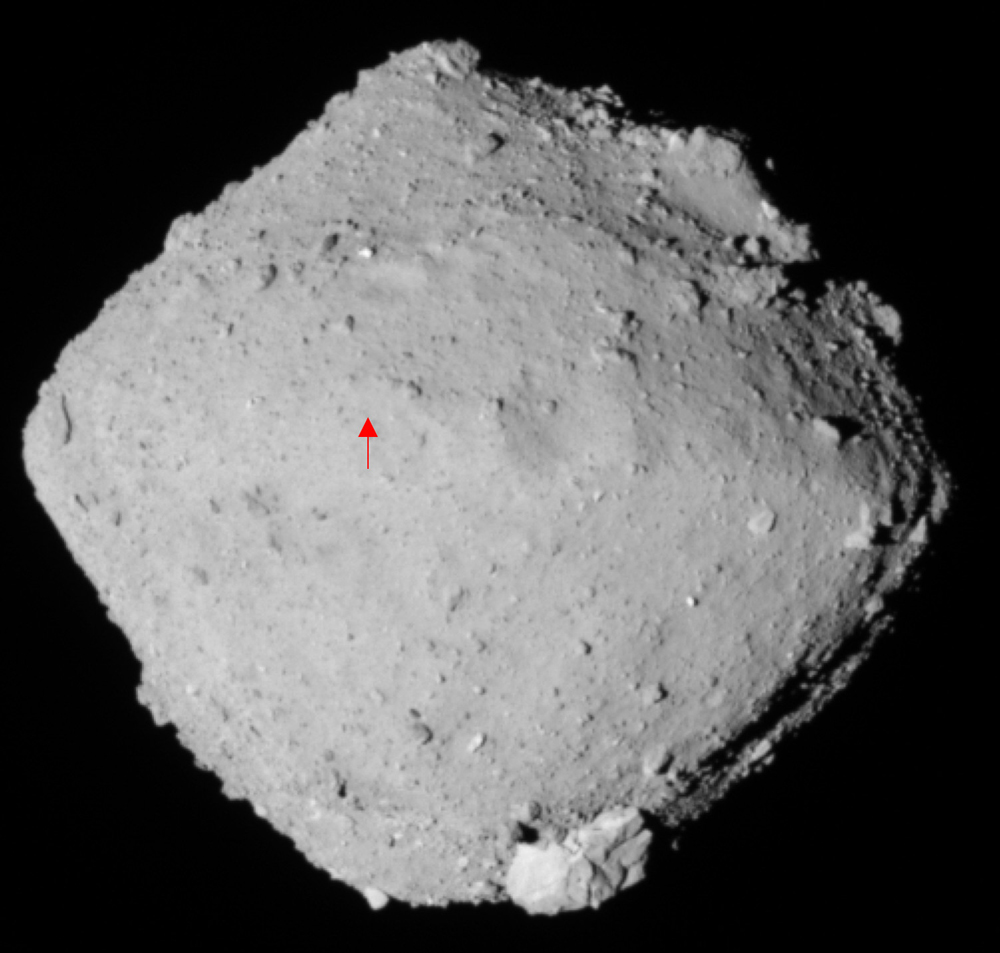
On December 5th, 2020, Japan’s Hayabusa2 mission successfully returned samples it had collected from the Near-Earth Asteroid (NEA) 162173 Ryugu home. Since asteroids are basically leftover material from the formation of the Solar System, analysis of these samples will provide insight into what conditions were like back then. In particular, scientists are interested in determining how organic molecules were delivered throughout the Solar System shortly after its formation (ca. 4.6 billion years ago), possibly offering clues as to how (and where) life emerged.
The samples have already provided a wealth of information, including more than 20 amino acids, vitamin B3 (niacine), and interstellar dust. According to a recent study by a team of Earth scientists from Tohoku University, the Ryugu samples also showed evidence of micrometeoroid impacts that left patches of melted glass and minerals. According to their findings, these micrometeoroids likely came from other comets and contained carbonaceous materials similar to primitive organic matter typically found in ancient cometary dust.
The team was led by Megumi Matsumoto, an assistant professor from the Earth Science Department at Tohoku University’s Graduate School of Science. He was joined by researchers from the Division of Earth and Planetary Sciences at Kyoto University, the CAS Center for Excellence in Deep Earth Science, the Institute of Space and Astronautical Science (ISAS), the Japan Synchrotron Radiation Research Institute (JASRI), the Japan Aerospace Exploration Agency (JAXA), and NASA’s Johnson Space Center. The details of their findings were presented in a paper that recently appeared in the journal Science Advances.
An artist’s conception shows Hayabusa 2’s sample return capsule making its atmospheric re-entry as its mothership flies above. Credit: JAXA Illustration
Like the Moon and other airless bodies, Ryugu has no protective atmosphere and does not experience weathering or erosion. This ensures that craters caused by past impacts on its surface (which is directly exposed to space) are carefully preserved despite the passage of eons. These impacts generate intense heat that leaves behind melted patches of glass (aka. “melt splashes”), which quickly solidify in the vacuum of space. These impacts cause changes to the composition of the asteroid’s surface materials, revealing information about the history of impacts.
After analyzing the Ryugu samples, Matsumoto and her colleagues found melt splashes ranging in size from 5 to 20 micrometers. Their composition suggests they came from cometary sources that impacted Ryugu while it was in a near-Earth orbit. “Our 3D CT imaging and chemical analyses showed that the melt splashes consist mainly of silicate glasses with voids and small inclusions of spherical iron sulfides,” said Matsumoto in a recent Tohoku University news release. “The chemical compositions of the melt splashes suggest that Ryugu’s hydrous silicates mixed with cometary dust.”
Their analysis revealed small carbonaceous materials with a spongy texture indicative of nano-pores, small voids caused by the release of water vapor from hydrous silicates. This vapor was subsequently captured in the melt splashes, which also contained silicate glasses rich in magnesium and iron (Mg-Fe) and iron-nickel sulfides. The carbonaceous materials are similar in texture to primitive organic matter observed in cometary dust but differ in composition – lacking nitrogen and oxygen. Said Matsumoto:
“We propose that the carbonaceous materials formed from cometary organic matter via the evaporation of volatiles, such as nitrogen and oxygen, during the impact-induced heating. This suggests that cometary matter was transported to the near-Earth region from the outer solar system. This organic matter might be the small seeds of life once delivered from space to Earth.”
Looking ahead, the team hopes to examine more Ryugu samples that will provide further insights into how primitive organic materials were delivered to Earth billions of years ago. Similarly, scientists at NASA’s Johnson Space Center recently completed the careful process of removing the samples collected by the OSIRIS-REx mission from their sample container. Analysis of these samples will reveal the composition and history of asteroid Bennu, another NEA that will provide vital information on how our Solar System evolved.
DLR's four-legged robot Bert explores and monitors the unfamiliar environment. The Surface Avatar Experiment rehearsed an important scenario for future exploration missions on the Moon and Mars. Bert is being developed at the DLR Institute of Robotics and Mechatronics and can walk, trot, gallop, perform a passing gait and even climb. This enables him to cover long distances and at the same time move around in rough terrain or small caves. Credit: DLR.
Swedish astronaut Marcus Wandt took control of a series of robots in Germany while on board the International Space Station, zipping around the Earth at 28,000 kilometers per hour (17,500 mph.) Researchers want to understand how time delays can affect the remote control of robots from an orbiting platform. Future astronauts could control rovers on the Moon’s or Mars’s surface from a spacecraft in orbit. Until now, only wheeled rovers have been part of the tests, but now they have added a dog-like robot called Bert.
This robot research session, called ‘Surface Avatar’ follows initial experiments carried out in July 2023. Wandt operated the robots from a control station in the space station’s Columbus module, commanding three different robots at the German Space Agency’s (DLR) Robotics and Mechatronics Center in Oberpfaffenhofen, Germany. The goal is to develop innovative technologies that will allow humans to control several robots with precision, and have them act semi- or fully autonomously and even have different robots perform a task together.
As part of the ‘Surface Avatar’ experiment, Swedish ESA astronaut Marcus Wandt commanded various robotic systems from the International Space Station (ISS). Credit: ESA/NASA
“Future stations on the Moon and Mars, including astronaut habitats, will be built and maintained by robots operating under the guidance of astronauts,” said Alin Albu-Schäffer, Director of the DLR Institute of Robotics and Mechatronics, in a DLR article. “Our latest control and AI algorithms enable a single astronaut to command an entire team of different robots. Our DLR-ESA team is a world leader when it comes to this technology.”
The remote operation of the dog-like robot Bert was marked the first time a non-wheel-driven robot was controlled remotely from space by astronauts. Previously, DLR’s humanoid service robot Rollin’ Justin and ESA’s Interact Rover have been teleoperated from space.
During the session, Wandt, who is part of the private Axiom Mission 3 (Ax-3), was able to command Bert to utilize several types of gaits and, because of his leg-based locomotion, Bert was able to explore rough terrain, including small caves — areas that the rolling robots cannot reach. At one point, Wandt allowed Bert to explore the lab’s surroundings independently and monitor the terrain with his camera eyes. Meanwhile, Wandt operated Rollin’ Justin and the Interact Rover.
The time delay between the ISS and Earth is usually less than one second.
“That’s because my radio call comes from ISS first to White Sands in the USA,” explained German Space Agency astronaut Matthias Maurer, in a video from DLR. “From there it goes to Houston at NASA. From there it will be forwarded to Munich where our control center is in Oberpfaffenhofen.”
Maurer added that the delay experienced is like what sometimes happens on a Skype call, which occasionally has delays in communications. And of course, the round-trip delay time might be close to 2 seconds, which is deficiently noticeable, especially during conversations.
DLR said that future operations of robots and humans working together must be well planned out in order for them to work as a team. When building a habitat, for example, combining the different skills of several robots is very helpful.
Successful collaboration between two intelligent robots: ESA’s Interact Rover and DLR’s Rollin’ Justin robot jointly installed a short pipe that reproduces a scientific measuring device. The task was coordinated by ESA astronaut Marcus Wandt, who was in control of the robot team in DLR’s Mars laboratory in Oberpfaffenhofen from on board the ISS. Credit: DLR.
Wandt also tested out this concept and for the first time two robots worked together to accomplish a task: Rollin’ Justin and the Interact Rover jointly installed a short pipe representing a scientific measuring device. Under the command of Wandt, Rollin’ Justin used his dexterous hands to safely grasp the pipe and carefully guide it to the measuring point. Wandt then used the Interact rover’s remote control to install the pipe held in position by Justin.
Robots have also been used in space on board the ISS. Robonaut is a joint DARPA–NASA project that created a humanoid torso robot to test out robotics in space. Additionally, three free-flying robots on the space station, known as Astrobees, support multiple demonstrations of technology for various types of robotic assistance on space exploration missions and on Earth.
A Super-Earth (and Possible Earth-Sized) Exoplanet Found in the Habitable Zone
Astronomers have found a new Super-Earth orbiting an M-dwarf (red dwarf) star about 137 light-years away. The planet is named TOI-715b, and it’s about 1.55 Earth’s radius and is inside the star’s habitable zone. There’s also another planetary candidate in the system. It’s Earth-sized, and if it’s confirmed, it will be the smallest habitable zone planet TESS has discovered so far.
TOI-715 is an average red dwarf. It’s about one-quarter the mass and about one-quarter the radius of our Sun. TOI-715b is close to the star, and its tight orbit takes only 19 days to complete one trip around the dwarf star. Since red dwarfs are much dimmer than the Sun, this puts the Super-Earth in the star’s conservative habitable zone.
The habitable zone is a rather crude way to identify planets that may have liquid water. Its boundaries are unclear and even contradictory since stellar spectral type, planetary albedo, mass, and even how cloudy its atmosphere is can determine if a planet has liquid water.
The idea of a conservative habitable zone (CHZ) is more helpful. It comes from a 2014 paper by Kopparapu et al. It’s a region around a star where a rocky planet receives between 0.42 and 0.842 as much solar insolation as Earth does. Any rocky planet receiving that much energy is in the CHZ, regardless of distance.
The graphic shows optimistic and conservative habitable zone boundaries around cool, low-mass stars. The numbers indicate the names of known Kepler planet candidates. Yellow represents candidates with less than 1.4 times Earth-radius. Green represents planet candidates between 1.4 and 2 Earth radius. Note: the newly discovered planets are not shown. Credit: Penn State.
Discovering a Super-Earth in a star’s CHZ is always exciting. It fuels our sense of wonder about other planets and the possibility that some may harbour other life. For that reason, they’re more intriguing than planets like Hot Jupiters for instance, which have zero possibility of hosting liquid water or life. Not even the hardiest extremophiles can survive a Hot Jupiter’s wicked environment.
But this discovery is also exciting for a couple of other reasons.
“At long last, the era of JWST has arrived, and with it, the age of detailed exoplanetary atmospheric characterization.”
From “A 1.55 Earth-radius habitable-zone planet hosted by TOI-715, an M4 star near the ecliptic South Pole.”
Now that we’ve discovered thousands of exoplanets, astronomers are seeing trends in the population. One of the things they noticed is a gap in the small planet population between 1.5 and 2 Earth radii. It’s known as the small planet radius gap or the sub-Neptune radius gap (also called the Fulton gap and the photoevaporation valley.) At 1.55 Earth radii, TOI-715b is inside the gap.
A histogram of planets with given radii from a sample of 900 Kepler systems. The decreased occurrence rate between 1.5 and 2.0 Earth radii is apparent. It’s sometimes called the Fulton Gap because it comes from Fulton et al. 2017. Image Credit: Fulton et al. 2017.
It’s extremely unlikely that no planets form in this radius gap. Planets must start out larger and lose mass to end up in the gap. So, the Fulton Gap tells us something about how some planets lose mass. Astronomers think that planets in the gap start out larger, but their stars strip away some of their mass by photoevaporation, shrinking them. That’s why it’s sometimes called the photoevaporation valley. There’s a lot of uncertainty around the valley and photoevaporation, and astronomers want to study planets in the valley to see what they can learn.
“The importance of the radius valley lies in its potential to teach us about planetary formation and post-formation evolution, and hence, planets inside this gap are crucial in furthering our understanding of the factors that sculpt it,” the authors explain.
There’s some uncertainty if this radius gap exists around M-dwarfs or not. It’s possible that M-dwarfs have a density gap rather than a radius gap. “A recent study by Luque & Pallé (2022), however, indicates that M-dwarf planets may have a density gap rather than a radius gap separating two populations of small planets (rocky and water worlds),” the authors write.
Whether it’s a radius gap or a density gap, TOI-715b should have something to tell us about exoplanets, photoevaporation, and the nature of exoplanet distribution around red dwarfs. But to discover what it has to tell us requires further, detailed observations. That’s the second reason wh
Ever since we started finding exoplanets, scientists have looked forward to the day when the James Webb Space Telescope is operational. “At long last, the era of JWST has arrived, and with it, the age of detailed exoplanetary atmospheric characterization,” the authors write in their paper. The JWST has the ability to observe the spectra of exoplanet atmospheres and determine their constituents. But even though the JWST is enormously powerful, some targets present better opportunities for transmission spectroscopy than others.
The JWST hasn’t studied TOI-715b yet, but it can measure an exoplanet’s transit spectrum and its eclipse spectrum, as shown in this spectrum of the exoplanet WASP-80b. During a transit, the planet passes in front of the star, and in a transit spectrum, the presence of molecules makes the planet’s atmosphere block more light at certain colours, causing a deeper dimming at those wavelengths. During an eclipse, the planet passes behind the star, and in this eclipse spectrum, molecules absorb some of the planet’s emitted light at specific colours, leading to a smaller dip in brightness during the eclipse compared to a transit. Image Credit: BAERI/NASA/Taylor Bell.
TOI-715b is a prime target because it’s close to its star. Since TOI-715 is a small red dwarf, and the planet orbits it every 19 days, the exoplanet’s transits in front of its star are deeper and more frequent. That means the JWST doesn’t need much time to observe the planet’s atmosphere, making it an efficient use of the space telescope’s time. “In the context of atmospheric characterization by transmission spectroscopy, bright, nearby M dwarfs are ideal planetary hosts as small temperate planets will transit frequently, enabling high signal-to-noise detections of atmospheric features with fewer hours of telescope time,” the authors explain.
This figure from the study shows the conservative habitable zone in blue. The y-axis shows the Transmission Spectroscopy Metric, a measure of how amenable a planet’s atmosphere is to the JWST spectroscopic measurements. The x-axis shows stellar insolation. TOI-715b is shown in two instances: as a rocky world and as a water world. If it’s a water world, it’s more accessible to effective spectroscopy by the JWST. TOI-715’s other planet candidate is shown in green. Other interesting exoplanets are also shown, including the TRAPPIST-1 planets in yellow. Image Credit: Dransfield et al. 2024.
Can this Super-Earth be habitable? Lacking the JWST’s spectroscopy, we’re reduced to speculating. It’s in the conservative habitable zone, but that doesn’t get us very far. Still, there are some hopeful signs.
TOI-715 is a little older than our Sun at about 6.6 billion years old. The star shows a “low degree of magnetic activity,” according to the authors. That’s probably why the star shows an absence of flaring in the TESS light curves compared to younger M-dwarfs. Red dwarfs are known to exhibit extremely powerful flaring that can sterilize planets. They can also strip away atmospheres, which could be responsible for the exoplanet photoevaporation valley.
This artist’s illustration shows a red dwarf star emitting a powerful flare. Red dwarf flaring can limit the habitability of planets in their habitable zones. Credits: NASA’s Goddard Space Flight Center
Another planet may be orbiting TOI-715. It’s currently only a candidate named TIC 271971130.02, but if confirmed, it will be the smallest habitable zone planet TESS has ever found. But follow-up observations are needed to confirm it.
The TOI-715 system is a compelling target for further study. TOI-715b is waiting its turn, but eventually, the JWST will examine its atmosphere. If those results support habitability, astronomers’ excitement will only grow. At the same time, we may learn more about the radius or density gap, an obstacle to a more thorough understanding of exoplanets.
Add in the fact that the star may host another habitable zone planet, the smallest one found yet by TESS, and the TOI-715 system becomes even more important.
Ieder mens is anders en dat geldt ook voor spiraalstelsels. De James Webb-ruimtetelescoop richtte zijn blik op negentien spiraalstelsels en trof verschillende structuren aan.
Op de foto’s zie je waar sterren, gas en stof zich bevinden in deze sterrenstelsels. De infraroodbeelden helpen wetenschappers om meer te weten te komen over spiraalstelsels. Zo kunnen computersimulaties verbeterd worden om zo meer inzicht te krijgen in de vorming en de evolutie van spiraalstelsels. En dat is handig, want ook ons eigen moederstelsel – de Melkweg – is namelijk een spiraalstelsel met een centrale balk.
IC 5332 op 30 miljoen lichtjaar van de aarde.NGC 628 op 32 miljoen lichtjaar van de aarde.
Dankzij de NIRCam zijn miljoenen sterren gefotografeerd in deze negentien spiraalstelsels. Je kunt deze sterren herkennen als blauwe stipjes. Zie je heldere verdikkingen? Dit zijn sterrengroepen. Het MIRI-instrument van James Webb is gebruikt om het gloeiende stof tussen sterren in kaart te brengen. Dit instrument kan ook protosterren zien. Dit zijn sterren die nog niet volledig zijn gevormd en zich schuilhouden in cocons van stof. Verder zien astronomen grote, ronde schillen van gas. Deze zijn mogelijk ontstaan door geëxplodeerde sterren, oftewel door supernova’s.
Astronomen denken dat sterrenstelsels van binnenuit groeien. De eerste sterren ontstaan nabij het centrum en daarna spreidt stervorming naar buiten. Des te verder een ster is verwijderd van het centrum, des te groter is de kans dat het een jonge ster is. Op de foto’s zie je veel blauwe stippen nabij de centra van de sterrenstelsels, maar dit zijn oude sterren.
NGC 1087 op 82 miljoen lichtjaar van de aarde. In het centrum is een lijn zichtbaar. Verder zijn er geen duidelijke spiraalarmen herkenbaar.NGC 1300 (69 miljoen lichtjaar afstand) heeft een helder rond centrum met een balk. Aan de uiteinden van de balk beginnen de spiraalarmen, die een omgekeerde letter S vormen.
Hierboven waren al vier sterrenstelsels zichtbaar. Hieronder volgen de overige vijftien foto’s. Klik op de foto’s om een grotere versie te downloaden, bijvoorbeeld als achtergrond op je telefoon.
NGC 1365 (56 miljoen lichtjaar van de aarde) is ook een spiraalstelsel met een omgekeerde S-structuur. Het centrum is ovaalvormig.NGC 1385 op 30 miljoen lichtjaar van de aarde is een rommelig balkspiraalstelsel in het sterrenbeeld Oven. Vergelijk deze foto maar eens met deze compositiefoto van NGC 1385.NGC 1433 (46 miljoen lichtjaar) is een balkspiraalstelsel met een duidelijk centraal gebied.Balkspiraalstelsel NGC 1512 (30 miljoen lichtjaar afstand) heeft een dubbele ring: een centrale ring en een buitenste ring gevormd door de spiraalarmen.
Ieder mens is anders en dat geldt ook voor spiraalstelsels. De James Webb-ruimtetelescoop richtte zijn blik op negentien spiraalstelsels en trof verschillende structuren aan.
Op de foto’s zie je waar sterren, gas en stof zich bevinden in deze sterrenstelsels. De infraroodbeelden helpen wetenschappers om meer te weten te komen over spiraalstelsels. Zo kunnen computersimulaties verbeterd worden om zo meer inzicht te krijgen in de vorming en de evolutie van spiraalstelsels. En dat is handig, want ook ons eigen moederstelsel – de Melkweg – is namelijk een spiraalstelsel met een centrale balk.
De twee spiraalarmen van NGC 1566 (60 miljoen lichtjaar) zijn duidelijk te herkennen op deze foto en draaien tegen de klok in om het centrum.
NGC 1672 op 60 miljoen lichtjaar van de aarde.
NGC 2835 (35 miljoen lichtjaar) is een sterrenstelsel bomvol sterren, gas en stof. Als je goed kijkt, kun je de spiraalarmen ontdekken. Deze draaien tegen de klok in.NGC 3351 (33 miljoen lichtjaar) is een balkspiraalstelsel. De armen draaien met de klok mee.NGC 3627 (36 miljoen lichtjaar) heeft een helder blauw centrum. Ook in de balk wemelt het van de sterren. De spiraalarmen zijn duidelijk te herkennen links en rechts van het centrum.NGC 4254 is 50 miljoen lichtjaar van de aarde verwijderd en maakt onderdeel uit van het Virgocluster.
Dit is NGC 4303 op 55 miljoen lichtjaar van onze planeet.Het centrum van NGC 4321 (56 miljoen lichtjaar) bevindt zich aan de rechterkant van de foto. In de spiraalarmen zijn veel ronde structuren zichtbaar: veroorzaakt door supernova’s?De balk van NGC 4535 (50 miljoen lichtjaar) heeft een blauwe gloed. Hier bevinden zich ontelbaar veel sterren.NGC 5068 (20 miljoen lichtjaar) is een warrig spiraalstelsel. De balk is herkenbaar aan de blauwe gloed (links van het centrum), maar de spiraalstructuur is moeilijker waar te nemenTenslotte het nabije spiraalstelsel NGC 7496: 24 miljoen lichtjaar bij ons vandaan.
Since Captain Kirk first ordered the Starship Enterprise to engage the warp drive back in 1967, fans of science fiction have dreamed of traveling to the stars at warp speed. That idea remained in the realm of science fiction until 1994, when Mexican mathematician Miguel Alcubierre proposed a mathematically viable solution for building a real-world faster-than-light warp drive.
Since then, numerous scientists and engineers have taken a swing at their own version of a viable, real-world warp drive, including an attempt to patent one of these “out there” ideas.
Here, The Debrief looks at three of the past most promising warp drive models, along with one brand new physics concept called the “Tri-Space Model,” which may hold the key to making faster-than-light travel possible.
THE ORIGINAL: ALCUBIERRE/WHITE WARP DRIVE
While Alcubierre’s warp drive concept showed that traveling faster than light was mathematically possible, it was widely criticized for its massive power requirements and use of purely theoretical “exotic matter.” Still, many scientists and engineers were intrigued by his work, including former NASA engineer and physicist Dr. Harold G. “Sonny” White.
Hoping to move Alcubierre’s metric from theory into a published, canonical form, White first looked at the idea more closely in 2003.
“I started working in the (NASA) space program in 2000,” White told The Debrief in an interview. “While I was working in the space program, I was thinking about this Advanced Power propulsion. I was thinking about this Alcubierre Warp metric. You know, it was not published in its canonical form. And so, in 2003, I published a paper in the journal General Relativity and Gravitation.”
White immediately noted how Alcubierre’s math worked but also spotted areas he thought his own background in engineering and physics could improve the concept.
“Some things didn’t quite make sense to me, but by putting it into canonical form, helped me figure out ‘how does this concept really work?’, White told The Debrief. “From the process of not being at warp to being at warp… what would that look like when you look at the mathematics? And the only way I could see to answer the question is to put it in the canonical form in 2003, so that’s what I talked about in that paper.”
Theoretical Warp Bubble Structure
(Image Credit LSI)
Years later, White was asked by NASA to present his updated warp concept, leading to his 2011 paper and the warp drive concept now known as the “Acubierre/White Warp Drive.”
“I got asked to give a talk [about the warp drive] to DARPA and NASA at the DARPA 100-year Starship Symposium in 2011,” he told The Debrief. “I did a sensitivity study on the metric. I looked at what happens when you change the parameters and the mathematics.”
Specifically, White looked at the geometry of the classic warp drive model and found something that dramatically reduced the amount of energy required by Alcubierre.
“It basically comes down to how thick you make the toroidal ring and negative vacuum energy density,” he explained. “How thick or thin to make it, topologically? What does that do to the overall energy required? And so, during that work, I had no ‘objective’ objectives, per se, other than just to explore. In the process of doing that, I discovered that by making that ring a little thicker, instead of being like a wedding band wrapped around your finger, it’s a little bit more like a lifesaver, was key.”
In fact, White’s geometric adjustment to the classic model dramatically reduced the amount of exotic matter required to a much more manageable concept.
“By using that optimization technique, I was able to reduce the amount of exotic matter from a Jupiter-sized amount down to something about the size of the Voyager spacecraft,” said White. “So about two metric tons or just under two metric tons.”
As White notes, even a few tons of a theoretical substance like exotic matter is still unachievable by today’s scientists and engineers, but his changes definitely improved the ultimate viability of Alcubierre’s idea.
“Instead of just being mathematically possible in our work, we potentially move it into the category of maybe it’s plausible,” he noted with a lighthearted shrug. “There are now two metric tons of this stuff we’re not quite sure exactly how to make.”
White’s views about the feasibility of warp drives and their related effects have garnered a fair amount of attention from critics over the years. Among them is astrophysicist Ethan Siegel who, while remaining skeptical of White’s claims, has noted that the warp drive concept “remains an interesting possibility and one worthy of continued scientific investigation, but one that you should remain tremendously skeptical about given the current state of affairs.”
THE LENTZ DRIVE
A decade after White updated the original warp drive concept, reducing the need for exotic matter down from a Jupiter-sized amount to a few tons, another scientist named Dr. Eric W. Lentz decided to take a stab at his own warp drive concept. Published in 2021, his paper “Breaking the warp barrier: hyper-fast solitons in Einstein–Maxwell-plasma theory” lays out a whole new warp drive concept. And unlike Alcubierre and White, Lentz believed that his faster-than-light warp drive model could be accomplished in a completely new and different way.
“The Alcubierre solution provided an intuitive picture of what a warp drive would do: contract the space immediately in front of the central region containing the ship or transport, and expand the space immediately behind,” Dr. Lentz explained in an email to The Debrief. “This gives us the picture of the warp drive as a wave of curvature on which a ship will ride to its destination.”
However, Lentz explains, “this picture is not an essential feature of a warp drive.” Instead, he says, a solution proposed by physicist Jose Natario back in 2002 showed that the expansion and contraction weren’t necessary to transport the ship forward. That work, says Lentz, was critical to forming his own theory, one where a warp field could be created using only traditional matter and not exotic matter.
“[Natario] showed that the expansion could be trivial (zero) everywhere and still perform the same task of transporting a ship,” Lentz told The Debrief. This is a significant breakthrough, he says, because it means that exotic matter that warps the space in front of the theoretical passenger, as well as behind them (as depicted in nearly all theoretical warp drive solutions), is no longer needed to achieve faster-than-light travel.
Could dark matter allow physicists a path toward overcoming the challenges of faster-than-light travel?
(Credit: ESO)
“In the Alcubierre solution, the energy density and curvatures are maximally separated, with the energy being restricted to a small torus between the regions of high contraction and expansion,” Lentz told The Debrief, once again evoking the classic image of the Alcubierre Warp model. “The curvatures and sources in my proposal are instead highly correlated, with the regions of high energy density and high expansion and contraction overlapping almost exactly.”
As his published paper explains, “This is the first example of hyper-fast solitons resulting from known and familiar sources, reopening the discussion of superluminal mechanisms rooted in conventional physics.”
Lentz does freely admit that his theory is somewhat novel, even in this highly theoretical arena. “The expansion factor in my proposal is stranger still [than in Natario or Alcubierre], having regions of large expansion and contraction of space surrounding the central region containing a ship.”
Still, the issue of power requirements is not totally solved by Lentz, although he told The Debrief there is some hope in this area.
“There are a number of very effective energy-saving mechanisms for the Alcubierre drive described in the literature,” he explained. “The challenge would be to either modify these mechanisms to operate using only conventional sources, [like his proposed theory which does not require exotic matter] or to innovate novel energy saving techniques.”
In other words, if these proposed energy reduction techniques don’t work on his drive concept due to the lack of exotic matter, a legitimate concern, then an entirely new solution, the likes of which has not yet been proposed, would need to be found. Fortunately, Lentz says, his drive already accomplishes some of that goal since “not all the energy needs to come directly from the reactor, as we expect much of the energy sourcing the bubble to come from the particles’ rest masses.”
Those particles, known in physics as solitons, are at the heart of the Lentz solution to faster-than-light travel and, aside from any theoretical attempts to further reduce energy needs, are something he believes represents the most viable area for future, practical testing. Lentz told The Debrief he sees a handful of reasonable goals going forward, including zeroing in on a viable energy level for a real-world, testable drive concept using only current power generation technology.
“After the energy requirements are low enough and suitable means of creating such solitons has been found, I would want to have the existence of such solitons confirmed in a laboratory setting for a small (~1m radius), slow (~km/s speed), but detectable soliton,” he said. “The target energy level is where a bubble of radius ten meters moving at 1% of the speed of light could be powered by a modern-day fission reactor.”
Although he is obviously enthusiastic about his novel solution to faster-than-light travel without exotic matter, Lentz also told The Debrief he is excited about all of the new, innovative concepts being discussed.
“It has been exciting to see how much progress has been made in this field recently,” he said, “and I think there are many more advances ready to be made. I am looking forward to seeing what the next few years bring.”
APPLIED PHYSICS WARP CONCEPT
Sometimes slower is better, especially when you want to avoid using “exotic matter” to make your theory work. Enter the Applied Physics (APL) Group. Their designs were recently published in the peer-reviewed journal Classical and Quantum Gravity and represent the latest in an increasingly crowded field of warp proposals.
Unlike the Alcubierre and White designs, the APL team shuns exotic matter as a power source. However, sacrifices need to be made. The physical nature of APL’s design means it is constrained by Newtonian physics. In short, while their drive concept is indeed designed to transport humans across the galaxy, it is not capable of breaking the speed of light. Damn.
“There is a common misconception that interstellar travel has to be superluminal,” Gianni Martire told The Debrief last year, “it doesn’t. If we can send a probe to reach another star within ten years, it is still incredibly useful.”
And while Sci-fi fans have the itch to go fast, APL’s warp drive doesn’t have the same energy requirements and, therefore, radiation, which tends to be a massive problem in building a crewed warp-capable vessel. Basically, no one gets cooked to death when they hit Warp Factor 1.
“Before our paper,” Martire says, “saying such things [like warp] was nonsense sci-fi. Now it’s real science.We took a small step into the future, do you feel it?”
THE TRI-SPACE MODEL
It all began in college when a young science fiction buff, future engineer, and Senior Project Leader for The Aerospace Corporation, Gregory Meholic, stumbled upon a curious little pamphlet made by the RAND Corporation.
“It was on Tachyon particles and their potential for faster-than-light travel and motion,” Meholic explained to The Debrief. “And I mean, lots of science fiction uses tachyons as the go-to faster-than-light widget, right?”
That RAND pamphlet was an exploratory work in speculative physics written by Lt. Col. Edward Puscher for the United States Air Force in 1980. It explores the theory regarding a theoretical particle called a tachyon that may exist in a permanent faster-than-light state.
“Basically, it was an algebraic solution to the general and special relativity equations that govern motion near the speed of light,” Meholic explained.
A big kick in the FTL pants for any science fiction fan is Einstien’s Theory of Relativity. The closer you get to light speed, the more your mass increases. As you near the 300,000 kilometers per second mark (the speed of light), you require an infinite amount of energy to hit light speed.
“And this pamphlet basically was trying to show that, first, Tachyons can theoretically exist in a super-liminal realm,” says Meholic. “And second, it provided the logical algebraic follow-outs of special and general relativity to show their characteristics.”
After Meholic read the pamphlet, it tweaked his imagination.
“What occurred to me in reading this was that three possible velocities could be associated with any given point in space: sub-light, light speed, and superluminal travel,” he explained.
So, in a nutshell, Meholic’s Tri-Space Theory breaks up reality into three “realms” that coexist at any point in spacetime. The sub-light realm is everything that moves slower than the speed of light, like your old Honda Accord or that barista at your regular coffee shop. The light-speed realm is the world of the massless photon zipping around at the 300,000 kps speed limit. And then there is the superliminal realm where things like tachyons dwell. Once you go beyond the math curve that brings you to light speed, the math doubles back.
“So when I started to think about this ‘other side of the curve,’ so to speak, what happens in this superluminal realm is really interesting because when you take energy away from the system, you go faster,” says Meholic.
In our realm, sub-light, the more energy you put into travel, the faster you go. In the superliminal realm, beyond the algebraic curve, as Meholic says, the more energy you put into travel, the slower you go, eventually bumping into the crawling 300,000 kps limit, but from the topside. To slow down to the speed of light, a superliminal object would require an infinite amount of energy; almost like a backward theory of relativity.
“And this implies that the rest mass becomes imaginary, which is the whole square root negative one thing…And so, as long as you’re moving faster than light speed, this particular algebraic solution says that tachyon particles could have a real positive mass traveling at these superluminal speeds,” Meholic postulates.
And for science fiction fans who need their ship to get from Earth to Wolf 359 in a hurry, the idea that something can have mass and achieve faster-than-light travel solves the whole cosmic speed limit issue. The Tri-Space Model doesn’t violate the rules because the superliminal object exists outside the sub-light and light-speed realms. No causality issues. No weird time dilations. No accidental time travel. No infinite mass problems. Just open superliminal space.
Sounds fun, but it begs one big question: How?
For an object to exist in superliminal space, it must jump from this realm to the superliminal realm. The idea isn’t to speed up to superliminal speed but to pop into it. And the best way to do that is to convert ordinary dull sub-light matter into a version that can exist in the superliminal realm. So how does someone build the machine to make such a conversion possible? Zero clue.
While Meholic’s idea is still very much speculative, it is unique. It doesn’t require a warp in spacetime or a wormhole or much in the way of new math. It is very similar to dark matter and dark energy; the biggest challenge is that we cannot currently observe the superliminal, so to say a “superliminal realm” exists becomes a matter of theoretical physics.
In sum total, we are still a long way from making the concept of faster-than-light travel anything more than just an entertaining element of science fiction. However, with the work of scientists like these who remain dedicated to its study, this fictional form of travel may indeed one day make its way into the realm of science fact.
Follow and Connect with Christopher Plain on Twitter @plain_fiction.
Beste bezoeker, Heb je zelf al ooit een vreemde waarneming gedaan, laat dit dan even weten via email aan Frederick Delaere opwww.ufomeldpunt.be. Deze onderzoekers behandelen jouw melding in volledige anonimiteit en met alle respect voor jouw privacy. Ze zijn kritisch, objectief maar open minded aangelegd en zullen jou steeds een verklaring geven voor jouw waarneming! DUS AARZEL NIET, ALS JE EEN ANTWOORD OP JOUW VRAGEN WENST, CONTACTEER FREDERICK. BIJ VOORBAAT DANK...
Druk op onderstaande knop om je bestand , jouw artikel naar mij te verzenden. INDIEN HET DE MOEITE WAARD IS, PLAATS IK HET OP DE BLOG ONDER DIVERSEN MET JOUW NAAM...
Druk op onderstaande knop om een berichtje achter te laten in mijn gastenboek
Alvast bedankt voor al jouw bezoekjes en jouw reacties. Nog een prettige dag verder!!!
Over mijzelf
Ik ben Pieter, en gebruik soms ook wel de schuilnaam Peter2011.
Ik ben een man en woon in Linter (België) en mijn beroep is Ik ben op rust..
Ik ben geboren op 18/10/1950 en ben nu dus 75 jaar jong.
Mijn hobby's zijn: Ufologie en andere esoterische onderwerpen.
Op deze blog vind je onder artikels, werk van mezelf. Mijn dank gaat ook naar André, Ingrid, Oliver, Paul, Vincent, Georges Filer en MUFON voor de bijdragen voor de verschillende categorieën...
Veel leesplezier en geef je mening over deze blog.