The purpose of this blog is the creation of an open, international, independent and free forum, where every UFO-researcher can publish the results of his/her research. The languagues, used for this blog, are Dutch, English and French.You can find the articles of a collegue by selecting his category. Each author stays resposable for the continue of his articles. As blogmaster I have the right to refuse an addition or an article, when it attacks other collegues or UFO-groupes.
Druk op onderstaande knop om te reageren in mijn forum
Zoeken in blog
Deze blog is opgedragen aan mijn overleden echtgenote Lucienne.
In 2012 verloor ze haar moedige strijd tegen kanker!
In 2011 startte ik deze blog, omdat ik niet mocht stoppen met mijn UFO-onderzoek.
BEDANKT!!!
Een interessant adres?
UFO'S of UAP'S, ASTRONOMIE, RUIMTEVAART, ARCHEOLOGIE, OUDHEIDKUNDE, SF-SNUFJES EN ANDERE ESOTERISCHE WETENSCHAPPEN - DE ALLERLAATSTE NIEUWTJES
UFO's of UAP'S in België en de rest van de wereld Ontdek de Fascinerende Wereld van UFO's en UAP's: Jouw Bron voor Onthullende Informatie!
Ben jij ook gefascineerd door het onbekende? Wil je meer weten over UFO's en UAP's, niet alleen in België, maar over de hele wereld? Dan ben je op de juiste plek!
België: Het Kloppend Hart van UFO-onderzoek
In België is BUFON (Belgisch UFO-Netwerk) dé autoriteit op het gebied van UFO-onderzoek. Voor betrouwbare en objectieve informatie over deze intrigerende fenomenen, bezoek je zeker onze Facebook-pagina en deze blog. Maar dat is nog niet alles! Ontdek ook het Belgisch UFO-meldpunt en Caelestia, twee organisaties die diepgaand onderzoek verrichten, al zijn ze soms kritisch of sceptisch.
Nederland: Een Schat aan Informatie
Voor onze Nederlandse buren is er de schitterende website www.ufowijzer.nl, beheerd door Paul Harmans. Deze site biedt een schat aan informatie en artikelen die je niet wilt missen!
Internationaal: MUFON - De Wereldwijde Autoriteit
Neem ook een kijkje bij MUFON (Mutual UFO Network Inc.), een gerenommeerde Amerikaanse UFO-vereniging met afdelingen in de VS en wereldwijd. MUFON is toegewijd aan de wetenschappelijke en analytische studie van het UFO-fenomeen, en hun maandelijkse tijdschrift, The MUFON UFO-Journal, is een must-read voor elke UFO-enthousiasteling. Bezoek hun website op www.mufon.com voor meer informatie.
Samenwerking en Toekomstvisie
Sinds 1 februari 2020 is Pieter niet alleen ex-president van BUFON, maar ook de voormalige nationale directeur van MUFON in Vlaanderen en Nederland. Dit creëert een sterke samenwerking met de Franse MUFON Reseau MUFON/EUROP, wat ons in staat stelt om nog meer waardevolle inzichten te delen.
Let op: Nepprofielen en Nieuwe Groeperingen
Pas op voor een nieuwe groepering die zich ook BUFON noemt, maar geen enkele connectie heeft met onze gevestigde organisatie. Hoewel zij de naam geregistreerd hebben, kunnen ze het rijke verleden en de expertise van onze groep niet evenaren. We wensen hen veel succes, maar we blijven de autoriteit in UFO-onderzoek!
Blijf Op De Hoogte!
Wil jij de laatste nieuwtjes over UFO's, ruimtevaart, archeologie, en meer? Volg ons dan en duik samen met ons in de fascinerende wereld van het onbekende! Sluit je aan bij de gemeenschap van nieuwsgierige geesten die net als jij verlangen naar antwoorden en avonturen in de sterren!
Heb je vragen of wil je meer weten? Aarzel dan niet om contact met ons op te nemen! Samen ontrafelen we het mysterie van de lucht en daarbuiten.
27-01-2024
The Moon is Still Shrinking, Explaining Why it Still Has Landslides Although our Moon forme
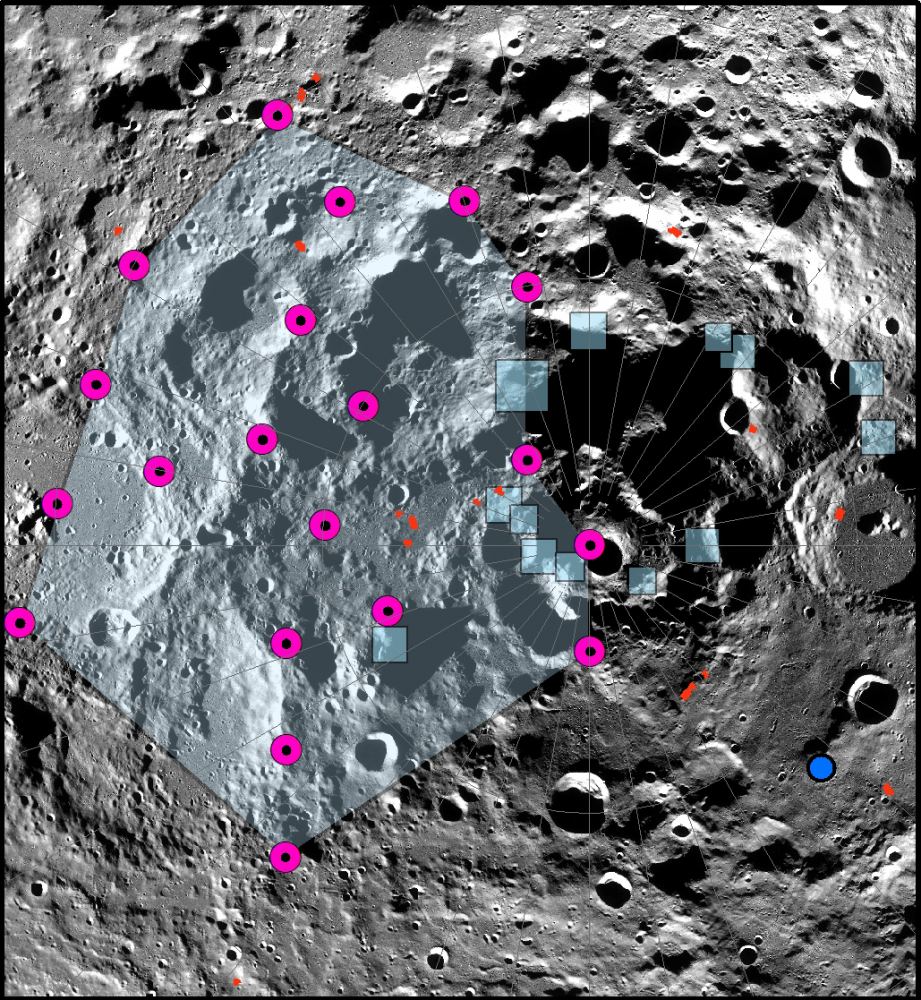
Artemis mission landing locations near the South Pole of the Moon. Blue boxes indicate selected landing spots, while small red marks are locations of scarps caused by moonquakes. Credit: NASA/ LRO/ LROC/ASU/ Smithsonian Institution
The Moon is Still Shrinking, Explaining Why it Still Has Landslides
Although our Moon formed 4.5 billion years ago, it’s still evolving. The interior continues to cool and its orbit is slowly changing. As a result, the Moon has lost 150 feet of its circumference. That shrinkage contributes to near-constant moonquakes, and those trigger landslides and other surface changes. The Moon is currently uninhabited, but all that activity threatens future Artemis landing sites and missions at the South Pole.
In a recent paper, planetary scientists point out that the potential of strong seismic events from active thrust faults should be a top consideration when NASA and other agencies are planning permanent outposts on the Moon. This is particularly true as the Artemis mission planners plot exploration of the South Pole. “Our modeling suggests that shallow moonquakes capable of producing strong ground shaking in the south polar region are possible from slip events on existing faults or the formation of new thrust faults,” said the study’s lead author Thomas R. Watters, a senior scientist emeritus in the National Air and Space Museum’s Center for Earth and Planetary Studies. “The global distribution of young thrust faults, their potential to be active, and the potential to form new thrust faults from ongoing global contraction should be considered when planning the location and stability of permanent outposts on the Moon.”
The Moon is particularly vulnerable to the large-scale effects of moonquakes. That’s because its surface is very brittle and easily broken up during a quake. One of the strongest quakes in lunar history occurred in the 1970s and lasted for hours. Such a lengthy event does quite a bit of damage to the lunar surface. So, even a light moonquake could cause significant damage via landslides.
Our Shaky, Shrinking Moon
Moonquakes generally happen within a hundred miles or so of the lunar surface. On Earth, that might result in a fairly mild quake. But, since the Moon’s surface is so brittle, the effects of those “shakes” are much more noticeable. According to Nicholas Schmerr, a co-author of the paper and an associate professor of geology at the University of Maryland, this means that shallow moonquakes can devastate hypothetical human settlements on the Moon.
“You can think of the Moon’s surface as being dry, grounded gravel and dust,” he said. “Over billions of years, the surface has been hit by asteroids and comets, with the resulting angular fragments constantly getting ejected from the impacts,” Schmerr explained. “As a result, the reworked surface material can be micron-sized to boulder-sized, but all very loosely consolidated. Loose sediments make it very possible for shaking and landslides to occur.”
An LROC NAC mosaic of the Wiechert cluster of lobate scarps in Moon’s south pole region, left pointing arrows). A scarp crosscuts a small (?1 km) degraded crater (right-pointing arrow).
Quakes affect every part of the lunar surface. Global compressional stresses deform the surface, forcing splits and cracks to occur. These scarps—steep slopes and cliffs—exist everywhere there. In their paper, the team suggests that many are close to the epicenters of geologically recent quakes. And the regions where they occurred could still be active today. That includes the lunar South Pole.
Risks to Artemis
The team led by Watters examined data and images of the lunar South Pole and linked faults there to a major moonquake in the 1970s. The region is filled with scarps, which are prime evidence for moonquakes. Although they conclude that some regions in the area are probably safe enough for the Artemis missions, others are not. The team’s computer models show that the most dangerous areas are vulnerable to landslides triggered by seismic shaking. They continue to map the Moon and track its quakes to identify the riskiest areas for Artemis astronauts to land.
A mosaic of Shackleton Crater at the Moon’s south pole region. It shows a portion of an interior wall and floor, with arrows pointing to boulder falls likely created during seismic shaking during a moonquake. Image courtesy: NASA/KARI/ASU
That mission could take place by the end of the decade, when NASA hopes to establish long-term habitations for research and exploration. Schmerr points out that the risks to safety from even the slightest quakes can’t be overestimated. “As we get closer to the crewed Artemis mission’s launch date, it’s important to keep our astronauts, our equipment, and infrastructure as safe as possible,” Schmerr said. “This work is helping us prepare for what awaits us on the moon—whether that’s engineering structures that can better withstand lunar seismic activity or protecting people from really dangerous zones.”
The Artemis missions essentially mark NASA’s return to human exploration of the Moon. The idea is to collaborate with both commercial partners and international agencies to make this happen. Teams of lunar astronauts will establish an Artemis Base camp, and depend on a lunar gateway to connect the mission to Earth. Eventually, what they learn there will inform the first human missions to Mars.
Watch a House-Sized Space Habitat (Intentionally) Burst
We live in an age of renewed space exploration, colloquially known as Space Age 2.0. Unlike the previous one, this new space age is characterized by inter-agency cooperation and collaboration between space agencies and the commercial space industry (aka. NewSpace). In addition to sending crews back to the Moon and onto Mars, a major objective of the current space age is the commercialization of Low Earth Orbit (LEO). That means large constellations of satellites, debris mitigation, and plenty of commercial space stations.
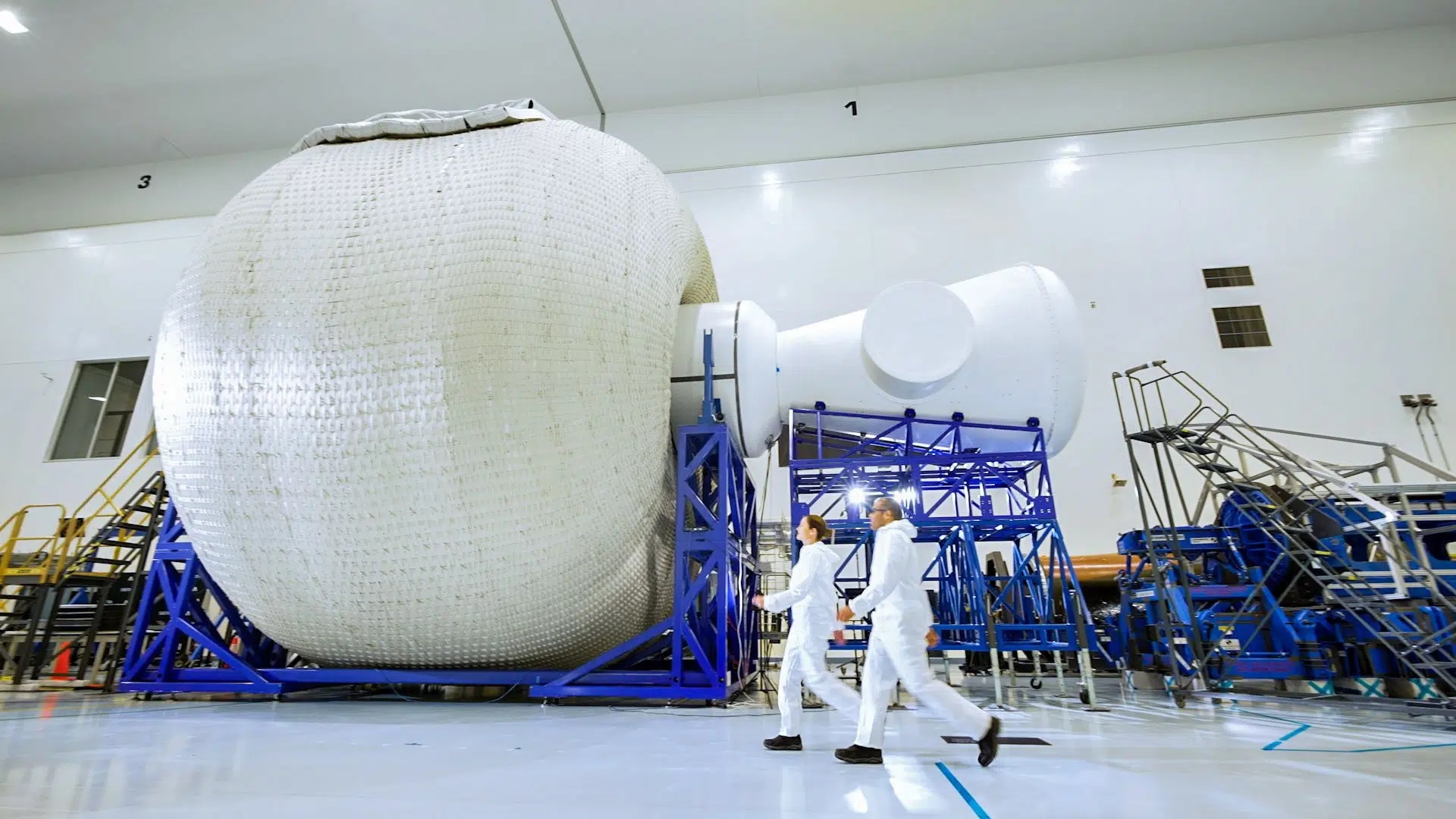
To accommodate this commercial presence in LEO, Sierra Space has developed the Large Integrated Flexible Environment (LIFE) habitat, an inflatable module that can be integrated into future space stations. As part of the Commercial Low Earth Orbit Development Program, NASA, Sierra Space, and ILC Dover (the Delaware-based engineering manufacturing company) recently conducted a full-scale burst pressure test of their LIFE habitat. The test occurred at NASA’s Marshall Space Flight Center in Huntsville, Alabama, and was caught on video (see below).
Commercial space has become one of the fastest-growing businesses on Earth. In the past decade, the space economy has expanded by over 60% and is currently valued at around $400 billion. This is expected to grow considerably in the coming years as launch services increase, small satellites (CubeSats) become more affordable, and orbital stations are built. As the International Space Station (ISS) nears retirement, these commercial stations will provide opportunities for research and development, orbital manufacturing, and space tourism.
Sierra Space, the developer of the Dream Chaser reusable spaceplane, has demonstrated its commitment to the commercialization of LEO and the NewSpace economy. The first iteration of their inflatable habitat, LIFE 1.0, measures 6 meters (~20 feet) long and 9 meters (~30 feet) in diameter and can be launched using conventional rockets and inflates once in orbit. With a volume of 285 cubic meters (over 10,000 ft3), it can accommodate four astronauts, with additional room for science experiments, exercise equipment, and Sierra Space’s Astro Garden® plant-growing system.
The purpose of a burst pressure test is to gauge the structural tolerances of a component, be it a fuel tank or an inflatable module. The data gained from this test will assist engineers in simulating how the module will fare in the vacuum of space. Once development and testing are complete, the module will be used on commercial space stations like Orbital Reef, a collaborative effort between Blue Origin and Sierra Space. Future versions, like Life 2.0 and 3.0, will offer additional volume and be able to accommodate larger crews and more science operations.
According to their National Strategic Plan (released in 2022), one of NASA’s strategic goals is to develop a human spaceflight economy in collaboration with the NewSpace industry. In 2021, as part of a Commercial LEO Destinations (CLDs) project, NASA Space Act Agreements with three companies to design commercial space stations. This includes the Orbital Reef proposed by Blue Origin and Sierra Space, the Starlab space station by Nanoracks LLC, Voyager Space, Lockheed Martin, and Northrop Grumman’s free flyer commercial space station.
Starlab, from Nanoracks, Voyager Space, and Lockheed Martin – a continuously crewed, free-flying commercial space station in low-Earth Orbit. Credits: NanoRacks/Lockheed Martin/Voyager Space
As per NASA’s plan, creating a human spaceflight economy will ensure continued research and development in space while “allowing NASA to focus Government resources on the challenges of deep space exploration through Artemis.” Another goal is to maintain the legacy of the ISS long past its retirement:
“Since its inception, industry, academia, and our international partners have used the International Space Station (ISS) as a testbed for research and the development and maturation of state-of-the-art systems that increase access to space. NASA is supporting new space stations from which we and other customers can purchase services and stimulate the growth of commercial human spaceflight activities. As commercial LEO destinations become available, we intend to implement an orderly transition from current ISS operations to these new commercial destinations.”
Our planet sits in the Habitable Zone of our Sun, the special place where water can be liquid on the surface of a world. But that’s not the only thing special about us: we also sit in the Galactic Habitable Zone, the region within the Milky Way where the rate of star formation is just right.
The Earth was born with all the ingredients necessary for life – something that most other planets lack. Water as a solvent. Carbon, with its ability to form long chains and bind to many other atoms, a scaffold. Oxygen, easily radicalized and transformable from element to element, to provide the chain reactions necessary to store and harvest energy. And more: hydrogen, phosphorous, nitrogen. Some elements fused in the hearts of stars, other only created in more violent processes like the deaths of the most massive stars or the collisions of exotic white dwarfs.
And with that, a steady, long-lived Sun, free of the overwhelming solar flares that could drown the system in deadly radiation, providing over 10 billion years of life-giving warmth. Larger stars burn too bright and too fast, their enormous gravitational weight accelerating the fusion reactions in their cores to a frenetic pace, forcing the stars to burn themselves out in only a few million years. And on the other end of the spectrum sit the smaller red dwarf stars, some capable of living for 10 trillion years or more. But that longevity does not come without a cost. With their smaller sizes, their fusion cores are not very far from their surfaces, and any changes or fluctuations in energy result in massive flares that consume half their faces – and irradiate their systems.
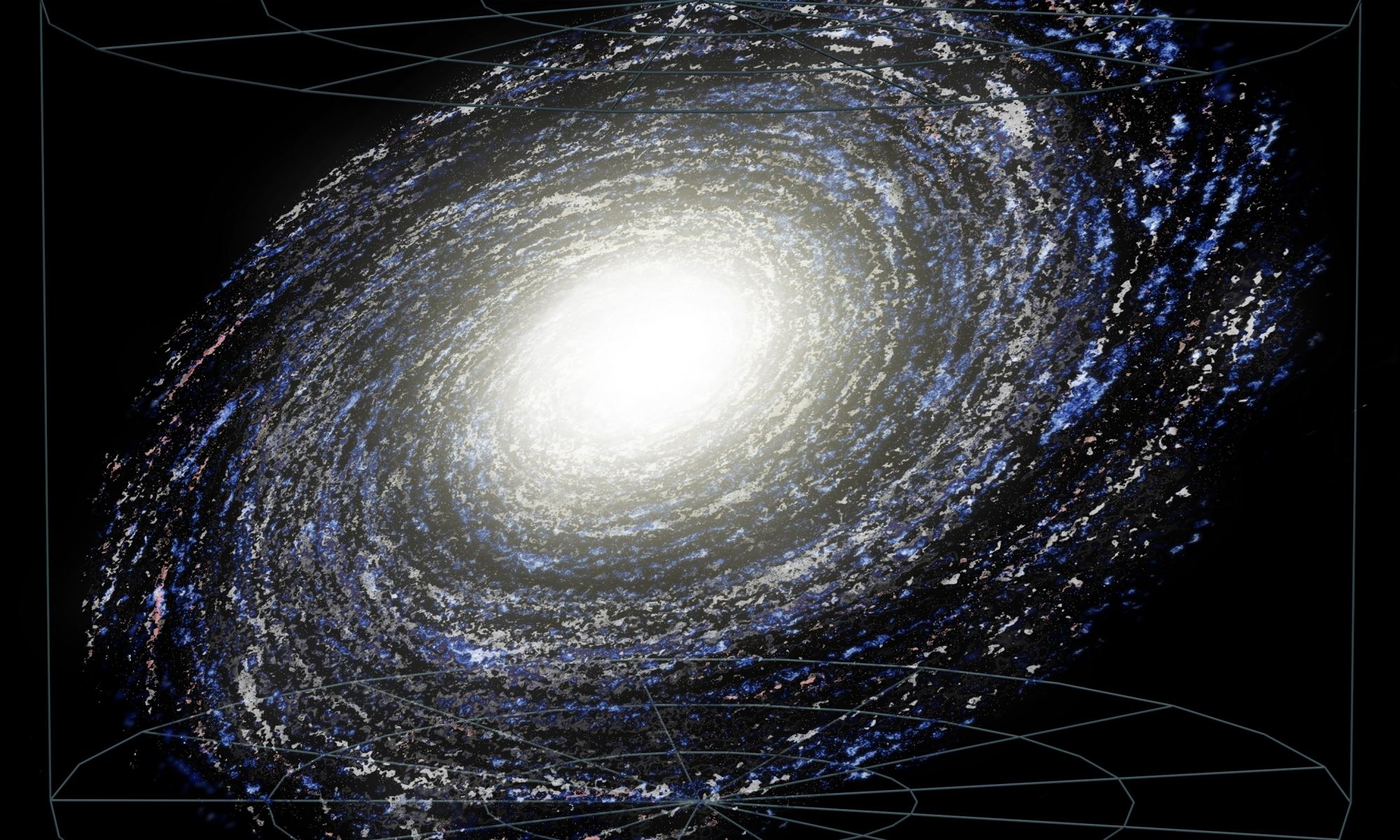
And on top of it all, our neighborhood in the galaxy, on a small branch of a great spiral arm situated about 25,000 light-years from the center, seems tuned for life: a Galactic Habitable Zone.
Too close to the center and any emerging life must contend with an onslaught of deadly radiation from countless stellar deaths and explosions, a byproduct of the cramped conditions of the core. Yes, stars come and go, quickly building up a lot of the heavy elements needed for life, but stars can be hundreds of times closer together in the core. The Earth has already suffered some extinction events likely triggered by nearby supernovae, and in that environment we simply wouldn’t stand a chance. Explosions would rip away our protective ozone layer, exposing surface life to deadly solar UV radiation, or just rip away our atmosphere altogether.
And beyond our position, at greater galactic radii, we find a deserted wasteland. Yes, stars appear and live their lives in those outskirts, but they are too far and too lonely to effectively spread their elemental ash to create a life-supporting mixture. There simply isn’t enough density of stars to support sufficient levels of mixing and recycling of elements, meaning that it’s difficult to even build a planet out there in the first place.
And so it seems that life would almost inevitably arise here, on this world, around this Sun, in thisregion of the Milky Way galaxy. There’s little else that we could conceivably call home.
Another Asteroid Discovered Hours Before it Impacts the Earth
What were you doing last Saturday? As it turns out, I was doing something rather unexciting… Trying to fix my washing machine (I did – in case you are interested). At the same time, Hungarian geography teacher by day and asteroid hunter by night Krisztián Sárneczky was out observing and detected a small asteroid which it transpired was on a collision course with Earth!
Spotting asteroids is a tricky business. Not least because they are typically dark in colour against a very black sky but the sky is quite a big place and spotting a tiny dark object against a massive black sky is worse than looking for a needle in a haystack!
Unperturbed by the statistics and likelihood of actually discovering one, Sárneczky regularly scours the sky looking for asteroids and supernova at the Konkoly observatory in Budapest, Hungary. He was engaged in this very task last Saturday night (20th January) at 22:48 CET (21:48 UT) when he spotted a new asteroid using a 0.6m Schmidt Telescope. Any discovery of this sort requires swift action to get the data over to the Minor Planet Center (MPC) who co-ordinate observations from astronomers around the World.
Sárneczky only had three observations when he submitted the data but continued to observe and over the course of the following minutes secured four more observations which he passed over realising it was heading straight for Earth. The actions that follow any such discovery like this are that the MPC alert others for follow up observations. Astronomers and automated impact monitoring systems including the European Space Agency’s wonderfully named ‘MeerKAT’ system sprang into action and more observations came in.
A radio image of the central portions of the Milky Way galaxy composited with a view of the MeerKAT radio observatory. Radio bubbles and associated vertical magnetized filaments can be seen. Courtesy: MeerKAT/SARAO/Oxford University/Heywood
With more data, came more accuracy and thankfully the knowledge the the impactor was only about a metre across and due to impact just west of Berlin in Germany. It is not unusual for asteroids of this size to hit Earth indeed, we get them every couple of weeks but they generally burn up in the atmosphere and pose no threat. Larger asteroids that do pose a threat are thankfully much rarer. Larger objects are also easier to spot so the majority have already been spotted and are already being tracked but there are automated searches and individuals like Sárneczky who are always on the look out.
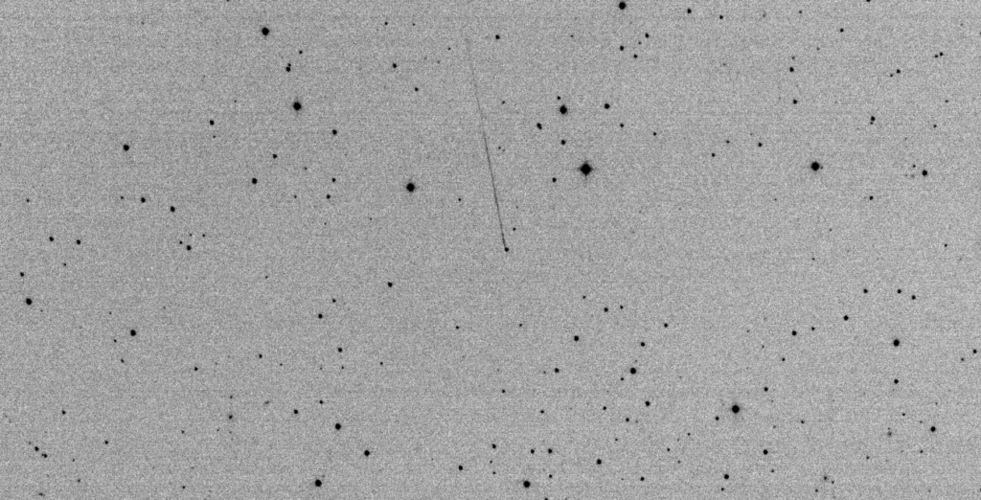
The asteroid, which is now known as 2024-BX1 hit the Earth’s atmosphere just a few hours after discovery at 01:32 CET (00:32 UT) on Sunday morning the 21st January, 50km to the west of Berlin. It burned up, leaving a fabulous streak across the sky which people witnessed as a fireball even being spotted over here in the UK.
Worryingly it is actually quite an unusual thing for asteroids to have been discovered before they impact our atmosphere. Only eight have been spotted with the first back in 2008. The difficulty of course is to find them early enough to give us time to understand their trajectory and size to understand what level of threat they pose to us. I should add there are no known asteroids on a collision course with Earth and fortunately there are people like Sárneczky and a number of automated search systems out there on the lookout for the next one.
NASA has announced that the Ingenuity helicopter has formally concluded its mission on Mars, following dozens of successful test flights during its three-year tenure on the planet.
The small helicopter, specially designed for flight in the Red Planet’s thin atmosphere, made history as the first aircraft to perform a powered, controlled flight on another planet.
Although initially planned as a technology demonstration that would only conduct five test flights, Ingenuity went on to perform a remarkable 72 flights, many of which provided useful aerial reconnaissance for the Perseverance rover in advance of its movement to areas of interest for potential study.
“It is bittersweet that I must announce Ingenuity… has taken its last flight on Mars,” Nelson said in a statement.
Characterizing the small aircraft as “the little helicopter that could,” Nelson said the helicopter sustained damage to one of its rotor blades while attempting a landing.
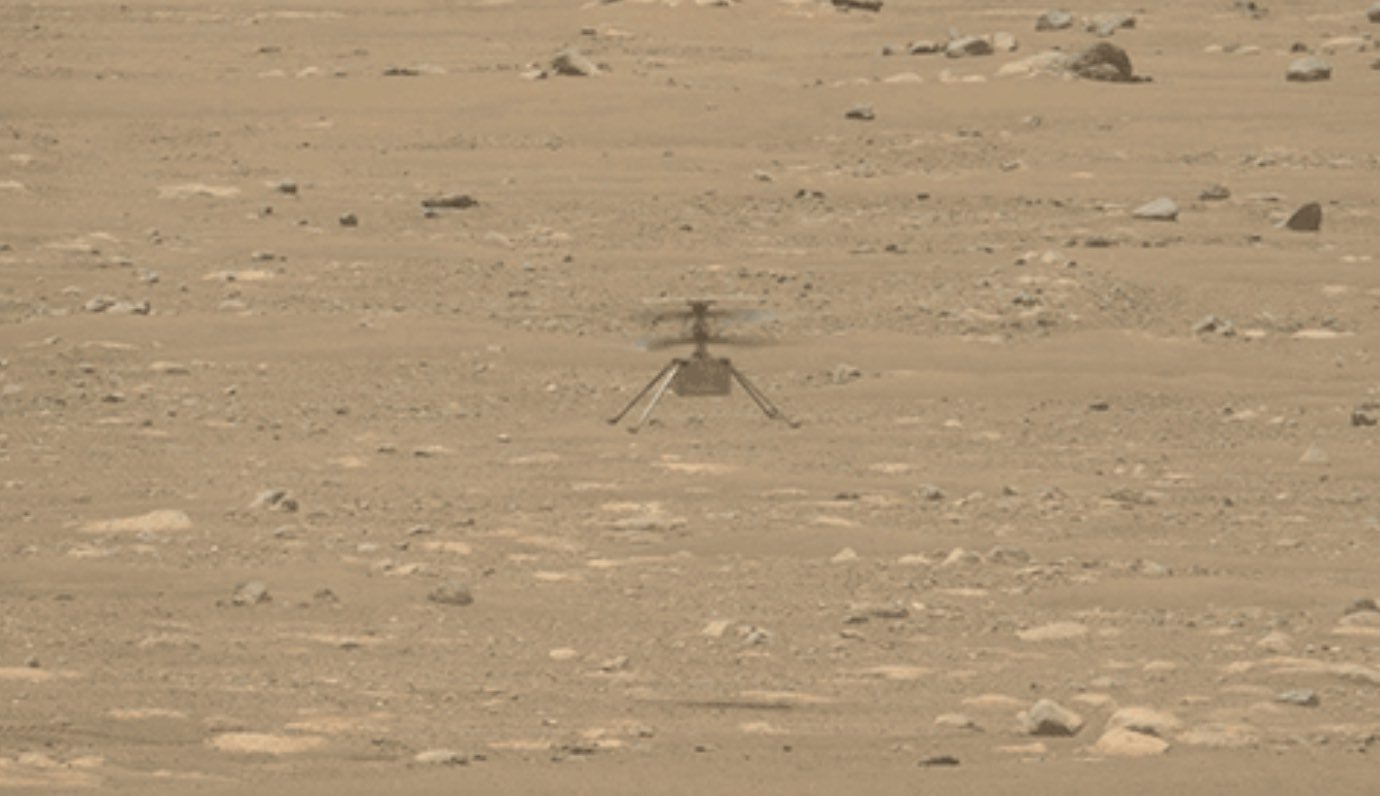
NASA’s Ingenuity helicopter takes off above Jezero crater
(Credit: NASA/JPL-Caltech/MSSS).
“At least one of its carbon fiber rotor blades was damaged,” Nelson said. “We’re investigating the possibility that the blade struck the ground.”
The damage occurred during a vertical flight the helicopter performed to determine its location several days ago, following an emergency landing during its previous flight.
Although the aircraft achieved a maximum altitude of 40 feet, hovering for a total of 4.5 seconds before beginning its descent, Ingenuity lost contact with Perseverance before reaching the ground. Several days later the rotor blade damage was revealed.
“What Ingenuity accomplished far exceeds what we thought possible,” Nelson said.
“Ingenuity demonstrated how flight can enhance operational missions, and it’s helping us in the search for life on Mars.”
Ingenuity’s first flight occurred on April 19, 2021, after arriving on the Red Planet earlier that year with the Perseverance rover.
Laurie Leshin, director of NASA’s Jet Propulsion Laboratory in Southern California, said Ingenuity was “an exemplar of the way we push the boundaries of what’s possible every day.
“I’m incredibly proud of our team behind this historic technological achievement and eager to see what they’ll invent next,” Leshin added.
Comparing Ingenuity’s operations to the pioneering flights of Wilbur and Orville Wright, Nelson said the Mars helicopter has set the pace for the future use of aircraft in space exploration.
“Ingenuity has paved the way for future flight in our solar system,” Nelson said, “and it’s leading the way for smarter, safer human missions to Mars and beyond.”
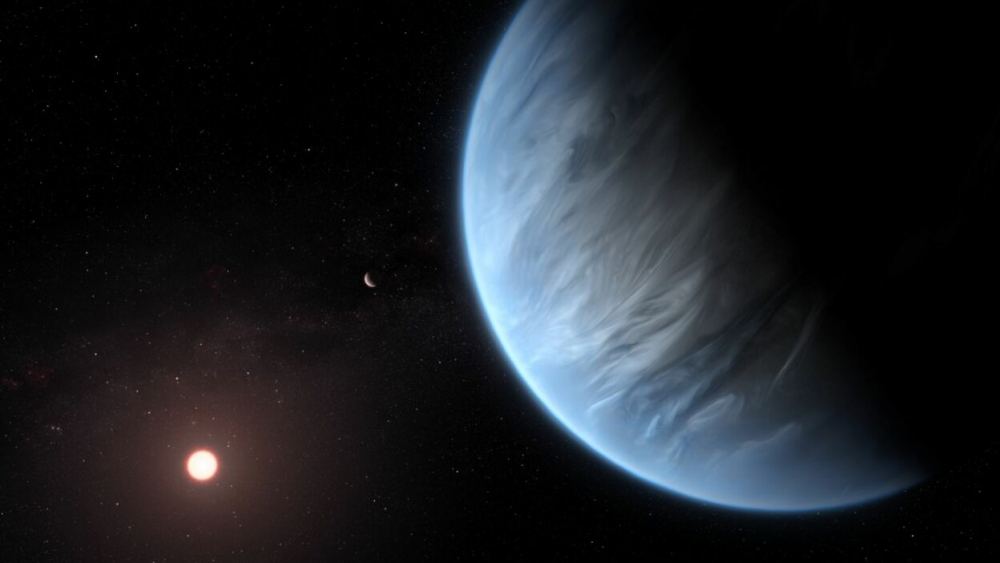
NASA’s Hubble Space Telescope has detected the presence of water in the atmosphere of a distant exoplanet, which astronomers say is the smallest planet of its kind to reveal such a discovery.
The planet, GJ 9827D, was initially found in 2017 by NASA’s Kepler Space Telescope. Roughly twice the diameter of Earth and located approximately 97 light years away, the tiny exoplanet completes an orbit around its nearest star, a red dwarf, in a little more than six Earth days.
Laura Kreidberg with the Max Planck Institute for Astronomy in Heidelberg, Germany, called the discovery of water on such a small exoplanet “a landmark discovery.”
Kreidberg, co-principal investigator in the new study that revealed the discovery, said that finding water on GJ 9827D “pushes [astronomers] closer than ever to characterizing truly Earth-like worlds.”
Artist’s depiction of the exoplanet GJ 9827D (Credit: NASA/Hubble)
The new discovery represents the first time that an exoplanet of this kind has been found to exist around other stars, an observation made entirely possible through atmospheric detection of water made possible by the Hubble telescope.
“This is an important step toward determining the prevalence and diversity of atmospheres on rocky planets,” said Björn Benneke, an astronomer with the Trottier Institute for Research on Exoplanets at Université de Montréal, in a statement.
Hubble was used to observe the planet during eleven transits before its host star over three years. As the planet moves in front of its star, the light the stellar body produces is filtered through GJ 9827D’s atmosphere, which allows astronomers the ability to observe key spectra that indicated the presence of water molecules.
Right now, astronomers cannot tell whether the planet is a “water world” with an abundance of liquid, or if the atmospheric detections made possible by Hubble only point to the presence of water vapor in its hydrogen-rich atmosphere.
Pierre-Alexis Roy, also with the University of Montreal’s Trottier Institute for Research on Exoplanets and lead author of a new paper describing the discovery, said either of these scenarios would be exciting, “whether water vapor is dominant or just a tiny species in a hydrogen-dominant atmosphere.”
Although possessing water like Earth, GJ 9827D’s proximity to its star causes it to resemble Venus due more closely to its extreme heat. With temperatures nearing 800 degrees Fahrenheit, it seems unlikely that GJ 9827D would be a place where life could thrive, particularly if an abundance of water vapor exists in its atmosphere.
If, however, the planet still possesses an atmosphere rich in hydrogen but possesses a degree of water vapor, it could also be a mini-Neptune, or even similar to Juputer’s moon Europa, which astronomers have determined to possess roughly twice as much water as Earth has.
If there are equal parts water and rock on GJ 9827D, it could be that the water vapor exists above the planet’s smaller rock body, Benneke explains.
However, Benneke, Roy, and the team also say that if the planet initially formed farther away from its nearest star, then it could be that the water-richness of its atmosphere is residual and that the heating of the planet as it has moved closer to its stellar host has heated the water as the planet receives more radiation over time.
Thomas Greene, astrophysicist at NASA’s Ames Research Center in California’s Silicon Valley, likened the observation of water as a “gateway” toward additional discoveries, some of which may be made with NASA’s James Webb Space Telescope.
“JWST can see much more with additional infrared observations, including carbon-bearing molecules like carbon monoxide, carbon dioxide, and methane,” Greene said.
“Once we get a total inventory of a planet’s elements, we can compare those to the star it orbits and understand how it was formed,” Greene added.
The team’s new paper, by Benneke, Roy, et al, titled “Water Absorption in the Transmission Spectrum of the Water World Candidate GJ 9827 d,” appeared in The Astrophysical Journal Letters.
The UK Ministry of Defense (MOD) has announced the successful test firing and downing of an aerial target using its high-powered DragonFire laser weapon. The exact power and range of the combat laser remain classified, but an official statement says DragonFire can hit a £1 coin-sized object from a kilometer away.
While there are no immediate plans to deliver the laser system to troops, the MoD says they are currently evaluating DragonFire and that this successful test was a critical next step toward actual deployment.
DRAGONFIRE JOINS GROWING LIST OF DIRECTED ENERGY WEAPONS
In the 1980s and 1990s, using lasers to down aerial targets remained firmly in the realm of science fiction. The U.S. Defense Department first tested a combat laser prototype in 1995, but that system required numerous buildings to operate and had limited target-destroying power.
In subsequent years more systems have been developed, with many sporting power ranges in the tens of kilowatts. Ranging from truck-mounted lasers and aircraft-mounted lasers to larger systems mounted directly on U.S. Navy ships, these lasers are not powerful enough to blast targets out of the sky. Instead, they have to stay locked on an incoming drone long enough to fry their electronics or burn off a wing.
More recently, advances in optical technology have allowed contractors like Raytheon and Lockheed Martin to steadily increase the power of these systems, with the most powerful coming in at 300kW. Dubbed the most powerful combat laser ever built, that system is currently undergoing an upgrade that will bring it up to as much as 500kW. It is possible that such a weapon could be strong enough to take down cruise missiles, something that smaller laser systems cannot do.
Perhaps the most well-known combat laser is employed by the Israeli armed forces. Dubbed Iron Beam, that system is mounted on the Israeli border to complement their Iron Dome system that uses conventional missiles to take down incoming drones and mortars. At 100kW, Iron Beam is the most potent combat laser in deployment anywhere in the world.
Now, it appears that the UK is joining the march toward adding lasers and other directed energy weapons that include powerful microwave emitters that can fry the electronics of a drone or missile to their arsenal. Along with the accuracy of these systems, the MoD is also hoping that laser systems can dramatically reduce costs.
SUCCESSFUL TEST SHOWS DRAGONFIRE IS MOVING CLOSER TO DEPLOYMENT
In that same statement, the MoD says, “This milestone demonstrated the ability to engage aerial targets at relevant ranges and is a major step in bringing this technology into service.” The latest test also builds on previous work that showed how DragonFire can effectively track both air and sea targets “effectively and at range.”
“These trials have seen us take a huge step forward in realising the potential opportunities and understanding the threats posed by directed energy weapons,” said Dstl’s Chief Executive, Dr. Paul Hollinshead.
The MoD also notes the potential financial advantages of using lasers instead of missiles, which can cost as much as 100,000 pounds, to counter the increasing use of low-cost drones.
“Firing it for 10 seconds is the cost equivalent of using a regular heater for just an hour,” they explain. “Therefore, it has the potential to be a long-term, low-cost alternative to certain tasks missiles currently carry out. The cost of operating the laser is typically less than £10 per shot.”
MOD FUNDING MULTI-MILLION POUND PROGRAM TO MAKE DRAGONFIRE READY FOR THE BATTLEFIELD
Following the successful downing of an aerial threat, the MoD says they are moving ahead with funding a multi-million-pound program “to transition the technology from the research environment to the battlefield.” They also say that both the Army and navy are evaluating using DragonFire and similar technologies as part of their future Air Defense capabilities.
“With our decades of knowledge, skills, and operational experience, Dstl’s expertise is critical to helping the armed forces prepare for the future,” said Hollinshead.
“The DragonFire trials at the Hebrides demonstrated that our world-leading technology can track and engage high-end effects at range,” added Shimon Fhima, Director of Strategic Programmes for the MOD. “In a world of evolving threats, we know that our focus must be on getting capability to the warfighter, and we will look to accelerate this next phase of activity.”
Christopher Plain is a Science Fiction and Fantasy novelist and Head Science Writer at The Debrief. Follow and connect with him on X, learn about his books at plainfiction.com, or email him directly at christopher@thedebrief.org.
NASA recently revealed that a laser beam was fired from its Lunar Reconnaissance Orbiter (LRO) at a spacecraft on the Moon’s surface, in a technological first that could pave the path toward new methods of precision target location.
The American space agency says a laser beam was transmitted from the LRO’s laser altimeter instrument at a tiny device on the Indian Space Research Organization’s (ISRO) Vikram lander on December 12, 2023. The transmission occurred while the LRO was more than 60 miles away as it passed over the lunar South Pole when it fired a series of laser pulses at the spacecraft.
The LRO registered light from its laser bouncing back off a tiny NASA retroreflector positioned on Vikram, confirming that the technique was a success.
Xiaoli Sun with NASA Goddard, who led the team that developed the retroreflector placed on Vikram, was enthusiastic about the achievement resulting from the cooperation between the two space agencies.
“We’ve [shown] that we can locate our retroreflector on the surface from the Moon’s orbit,” Sun said.
NASA’s Lunar Reconnaissance Orbiter (LRO) successfully targeted a retroreflector on the exterior of the ISRO’s Vikram lander on December 12, 2023
(Credit: NASA’s Goddard Space Flight Center/Arizona State University).
In principle, firing lasers at an object and measuring the time required for the light to bounce back to its point of origin is nothing new, and is commonly utilized for tracking Earth-orbiting satellites using ground-based laser systems.
However, the technique NASA recently demonstrated reverses this process, firing a laser from a moving satellite at a stationary object—in this case, on the surface of the Moon—and determining its precise location.
FIRING A LASER AT A COOKIE-SIZED RETROREFLECTOR
The special retroreflector NASA designed is tiny, at just two inches across. Roughly the size of an Oreo cookie, the device is formally known as a Laser Retroreflector Array and features a pattern of eight prisms fitted within an aluminum frame shaped like a tiny dome, which allows for a simple, but effective means of reflecting light coming from almost any direction.
The device also requires no power either, meaning that its durable design allows it to function for up to several decades.
This is not the first time NASA has used retroreflectors in novel ways. Since 1969, a technique known as Lunar Laser Ranging (LLR) has been used to measure the Moon’s distance from Earth-based observatories using retroreflectors that were placed on the Moon’s surface during the Apollo missions, as well as the Soviet Luna program.
However, more advanced retroreflector designs currently in use allow for a greater range of potential applications than their Apollo-era predecessors. Today, the devices are also fitted to the exterior of the International Space Station (ISS), which allows cargo-delivery spacecraft to measure their distance while approaching and autonomously dock with it.
In the years ahead, they may also provide several useful applications for Artemis astronauts working in locations where low light conditions would otherwise make landing next to existing spacecraft on the lunar surface difficult.
Right now there are plans for NASA retroreflectors to be carried to space on board several public and private Moon landers, including the Japan Aerospace Exploration Agency’s (JAXA) SLIM lander, which powered down within just three hours of making its historic landing on the Moon over the weekend.
A LOOK AT THE LUNAR RECONNAISSANCE ORBITER’S LOLA
One problem that arises from the more widespread use of this technology in space exploration is that the LRO’s altimeter—currently the only laser instrument orbiting the Moon that could be used for such applications—has been operating for thirteen years longer than its original mission intended and was never designed for such applications. Because of this, the LRO’s instrument required eight attempts before it could successfully contact the retroreflector on the Vikram lander.
The laser in question is the LRO’s Lunar Orbiter Laser Altimeter (LOLA). This instrument is primarily designed for precision measurements of topographic features on the lunar surface, which has helped NASA produce models of the Moon that are crucial for planning safe landings and lunar exploration, as well as increasing our understanding of the lunar environment overall.
LOLA functions with a small array of five laser beams, which are fired toward the Moon. The time required for each beam to bounce back to the LRO is measured, allowing the instrument to gauge the elevation of features on the lunar surface below.
Although LOLA’s capabilities are ideal for mapping the Moon’s surface features, there are large gaps between the beams it produces, meaning that the chances of hitting a cookie-sized target are fairly slim, especially when the beam is required to strike within one-hundredth of a degree of the retroreflector.
In the future, NASA plans to produce a laser that produces no gaps in coverage, and which can continuously beam against the lunar surface as it passes to ensure that it strikes any retroreflectors with maximum precision.
Until such lasers come into use, NASA’s best—and only—bet remains the simpler laser altimeter currently on board the Lunar Reconnaissance Orbiter, which the December experiment has already shown to be successful when used in this manner, although it may also require a bit of trial and error.
“The next step is to improve the technique,” Xiaoli Sun said in a statement, “so that it can become routine for missions that want to use these retroreflectors in the future.”
Some of the most energetic cosmic rays in the galaxy may come from a surprisingly small source.
If Max Planck Institute for Astrophysics researcher Laura Olivera-Nieto and her colleagues are right, they may have just pinpointed one of the sources of the high-energy cosmic rays that occasionally zip past Earth from the far reaches of the universe. Astrophysicists have spent years puzzling over the origin of these particles: protons carrying thousands of trillions of electron volts of energy (yes, cosmic rays are actually particles; early physicists thought they were radiation, and the name stuck). Some cosmic rays seem tocome from supernova remnants, but it turns out that at least some high-energy cosmic rays may come from the twin jets of matter being ejected from a smallish black hole.
NASA’s Chandra X-Ray observatory spotted the x-ray jets from SS 433 several years ago.
CHANDRA X-RAY OBSERVATORY
A COSMIC RAY CULPRIT
The astronomers used a telescope called the High Energy Stereoscopic System, or HESS, to observe gamma ray jets from SS 433, a black hole orbiting a mid-sized star at the heart of the Manatee Nebula.
Like most actively feeding black holes (whether the small ones left behind after the collapse of dying stars or the cosmic leviathans at the heart of galaxies like our Milky Way), SS 433 is ejecting twin jets of matter at nearly a quarter the speed of light. These jets glow brightly with x-rays, which is how astronomers first spotted them several years ago. But about a light year away from the black hole, in both directions, the x-ray jets seem to fade away only to reappear with a vengeance about 75 light-years away.
When Olivera-Nieto and her colleagues examined the black hole in the even shorter wavelengths of gamma rays, they saw that twin gamma ray jets flared to life at exactly the points where the x-ray jets reappeared. In other words, it looked like the jets were fizzling out somewhere between 1 and 75 light years from the black hole, and then something revved them up again.
That something, the researchers surmise, seems to be a shock wave in the gassy interstellar medium of the nebula. Shock waves act like giant cosmic versions of the Large Hadron Collider, accelerating electrons in the jets to ludicrous speeds.
The jets glow with x-rays and gamma rays because electrons crash into lower-energy photons. When that happens, the electron gives the photon part of its energy, which ramps low-energy infrared light up to the high-energy x-rays and gamma rays that light up the black hole’s jets. The faster the electrons are moving, the more energy they transfer to the photons — so fast electrons make x-rays, and even faster electrons make gamma rays.
More importantly, at least for the mystery of cosmic rays, the jets may also be accelerating protons, and even whole atomic nuclei, to the absurdly high energy that turns them into cosmic rays.
Researchers have known for a long time that “the jets of SS 433 do, in fact, contain nuclei [of elements] such as iron or nickel. And the shock that accelerates electrons would accelerate them in the same way,” Olivera-Nieto tells Inverse. However, the protons could potentially be accelerated to even higher energies than the electrons because they’re too big to shed energy in collision with photons.
Astronomers just can’t actually see these high-energy protons and nuclei because, unlike electrons, protons release radiation when they bump into dense matter, not stray photons, and there’s not a big pile of dense matter in the black hole’s jets.
A QUEST FOR MICROQUASARS
Despite having shed light on this cosmic ray mystery, black hole SS 433 isn’t actually the source of any of the cosmic rays physicists here on Earth have detected. It hasn’t been blasting its relativistic jets out into space long enough for any particles from those jets to have reached Earth. But someday, in the distant future, there’s a chance some of the protons and atomic nuclei being accelerated in those jets could reach our planet.
Meanwhile, Olivera-Nieto and her colleagues say other similar objects, called microquasars, could still be among the sources of cosmic rays that do reach Earth.
“Microquasars are intermittent sources, meaning that it is very likely that other systems were active in the past and made a contribution to what we now see,” says Olivera-Nieto.
Looking for those sources is the next step.
“Detecting gamma-ray emission from other microquasar systems and understanding how acceleration takes place in them will be critical because it will allow us to understand how common such systems are,” says Olivera-Nieto. “Answering this question will constrain how much can microquasars as a whole contribute as sources of very-high-energy cosmic rays.”
JAXA/Takara Tomy/Sony Group Corporation/Doshisha University
Last week, Japan became the fifth nation to successfully land on the Moon without crashing. Unfortunately, the historic touchdown left the Smart Lander for Investigating Moon(SLIM) positioned like a toy after a toddler is done playing with it: planted face down on the ground.
This less-than-ideal situation forced the Japan Aerospace Exploration Agency (JAXA) to power down the lander and save precious battery life. But before it did, SLIM was able to send some data back to Earth. Today, JAXA released new images that show how SLIM is situated in its new home.
The new data also confirmed Japan’s biggest hope for its SLIM project: a precise landing on the Moon within 100 meters of its target, confirming proof of concept.
JAXA rotated this image from its SLIM’s Multi-Band Camera “to align with the direction of gravity,” officials wrote on Thursday. The rover didn’t land as expected.
SLIM was designed to last just a few Earth days, JAXA officials wrote in a statement. But the mission will be drawn out for a month at least, to see if the angle of sunlight changes over time and perhaps strike SLIM’s landing site to sufficiently power its solar cells from its unintended westward orientation. The sunlight does a sort of angular reset on the Moon each Earth month (a day on the Moon lasts about one month on Earth).
While JAXA awaits those solar-cell results, SLIM’s Multi-Band Camera took a slanted image of Moon rocks nearby. In an annotated image, their names appear and seem to follow a canine theme. They have names like “St. Bernard,” “Bulldog,” “Toy Poodle,” plus Japanese breed-inspired names like “KAIKEN,” “AKITAINU,” “SHIBAINU.”
The JAXA team named several Moon rocks, and named them after dogs. The names are “with intent of communicating their relative sizes smoothly by the names,” officials wrote on Thursday.
There’ll be more, hopefully, if SLIM’s solar cells absorb enough energy, JAXA officials wrote. “Based on this landscape image, the team is sorting out rocks of interest, assigning a nickname to each of them, with the intent of communicating their relative sizes smoothly by the names,” the space agency shared. JAXA added that preparations are underway to “promptly conduct” high-resolution spectroscopy, a technique that extracts information from light, of Moon rocks once “SLIM recovers by the power generated by the solar array.”
SLIM’s peculiar position on the Moon’s surface appeared in imagery from one of its two tiny robotic passengers. Photo evidence came from JAXA’s collaboration with toy company Takara Tomy. Along with two other partners, Sony and Doshisha University in Kyoto, they created Lunar Excursion Vehicle 2 (LEV-2).
On Thursday, Daichi Hirnao (left), associate senior researcher at JAXA's Space Exploration Innovation Hub Center, explains an image of the lunar surface robot LEV-2, also known as SORA-Q.
KAZUHIRO NOGI/AFP/GETTY IMAGES
Also known as SORA-Q, LEV-2 looks like a rolling ball. It comes from the minds behind the popular toy Transformers and would easily sit in the palm of your hand. This small robot and SLIM’s other rover, LEV-1, are Japan’s first rovers on the Moon. LEV-1 also has other laurels, too. It achieved successful direct communication with Earth from the Moon, according to JAXA. “This is considered as the world's smallest and lightest case of direct data transmission from approximately 380,000 kilometers away,” space agency officials wrote in a recent statement.
JAXA will likely publish more updates in the near future to report the ongoing saga of SLIM’s solar cells.
Het gebeurt regelmatig dat er een asteroïde onze atmosfeer in zeilt, maar meestal zien we dat niet van tevoren aankomen. Nu wel: NASA waarschuwde afgelopen zondag voor een heldere vuurbal die op onze planeet af stormde en zou neerstorten in de buurt van Berlijn.
Normaal gesproken crashen er meerdere keren per jaar ruimtestenen op Aarde, maar wat vrijwel uniek was aan deze keer is dat wetenschappers hem zo’n drie uur voor de inslag al hadden opgemerkt. Het is pas de achtste keer ooit dat het lukt om de impact van een asteroïde op voorhand te voorspellen.
Bekende asteroïdejager had weer beet De asteroïde, die 2024 BXI is gedoopt, werd als eerste ontdekt door de zelfbenoemde asteroïdejager Krisztián Sárneczky, een astronoom van het Konkoly-observatorium in Hongarije. Hij zag de ruimterots door zijn Schmidt-telescoop in het observatorium. Vlak daarna kwam NASA met een gedetailleerde voorspelling van waar en wanneer de meteoriet zou neerstorten. “Een kleine asteroïde zal uit elkaar vallen als een onschadelijke vuurbal kort na half twee ’s nachts ten westen van Berlijn, vlakbij Nennhausen”, twitterde NASA in de nacht van 20 januari. Sárneczky is een expert. Hij ontdekte de afgelopen jaren honderden asteroïden en was de eerste die de 2022 EB5 waarnam, zo’n twee uur voor hij de atmosfeer binnenschoot. Ook toen gebruikte hij het Konkoly-observatorium voor zijn waarnemingen.
Slechts een paar seconden in beeld Een camera in Leipzig wist beelden te maken van de uitzonderlijk heldere meteoor. Daarop is te zien hoe de asteroïde binnen een paar seconden tevoorschijn komt en weer verdwijnt. Voor de inslag was de asteroïde ongeveer een meter breed. Hij begon zo’n 50 kilometer ten westen van Berlijn uit elkaar te vallen en onderweg stortten er waarschijnlijk een paar stukken steen op de grond. Daar is ook al druk naar gezocht. “We zoeken naar donker ogende stenen met een glazige buitenkant. Vind je er een, noteer dan de GPS-locatie, stop de steen in een zak en breng hem naar ons”, schreef het Duitse Sample Analysis Laboratory al op X (voorheen Twitter). Doordat de meteoor met een hele steile hoek de atmosfeer in kwam, is het zoekgebied relatief klein.
Hoe kleiner, hoe moeilijker Het is veel bijzonderder dan je misschien denkt dat we zo’n ruimterots waarnemen. Volgens het Europese Ruimteagentschap ESA is 99 procent van de asteroïden met een doorsnee van minder dan 30 meter, die in de buurt van de Aarde komen, nooit gevonden. De meeste planetoïden die onze planeet hebben getroffen, werden vele jaren na inslag pas ontdekt. Hoe kleiner een asteroïde is, hoe dichter hij bij de Aarde moet komen voor wetenschappers hem kunnen waarnemen. En dat maakt het natuurlijk erg lastig om ze van tevoren te zien aankomen.
In sommige gevallen kunnen asteroïden zich zelfs verborgen houden in het licht van de zon, zoals de meteoriet die uit de richting van de opkomende zon tevoorschijn schoot boven de Russische stad Tsjeljabinsk in 2013. Door deze asteroïde van zo’n 17 meter breed raakten zo’n 1200 mensen gewond, vooral als gevolg van gesneuvelde ruiten.
Er komt hulp Het kán dus gevaarlijk zijn, zo’n gloeiende verrassing. Daarom werken wetenschappers aan nieuwe technologie om de hemel te scannen op asteroïden, voordat ze heel dichtbij de Aarde komen. Zo gaat bijvoorbeeld de NEO Surveyor-satelliet van NASA in 2027 de lucht in, maar er is ook hulp vanaf de grond, in de vorm van het Vera C. Rubin-observatorium in Chili. Vanaf 2025 gaan ze daar het zonnestelsel in kaart brengen om zo asteroïden eerder op te merken.
“Het heeft ons tweehonderd jaar gekost om alle asteroïden die we tot nu toe kennen, te ontdekken, zo’n 1,2 miljoen stuks in totaal”, zegt astronoom Mario Jurić, die het project in het Rubin-observatorium leidt. “In de eerste drie tot zes maanden van Rubin, verdubbelen we dat aantal.”
Moeten we bang zijn voor neerstortende asteroïden? Het simpele antwoord: nee, dat hoeft niet. Van de meer dan een miljoen planetoïden die we nu in beeld hebben, zijn er een kleine 31.000 die in de buurt van de Aarde komen, schreven we eerder al. Daarvan zijn er uiteindelijk ruim 2200 als potentieel gevaarlijk bestempeld. ESA komt zelfs maar tot een lijst van iets meer dan 1400 ruimtestenen die een verhoogd risico vormen. Maar wees gerust: nader onderzoek heeft uitgewezen dat er geen enkele nu bekende ruimterots is, die in de komende honderd jaar een serieuze bedreiging voor onze planeet vormt.
Hubble Detects Water Vapor in Atmosphere of Gliese 9827d
Hubble Detects Water Vapor in Atmosphere of Gliese 9827d
Using the Wide Field Camera 3 (WFC3) instrument onboard the NASA/ESA Hubble Space Telescope, astronomers have detected water vapor in the transmission spectrum of the sub-Neptune exoplanet Gliese 9827d.
The water detection in the transit spectrum of Gliese 9827d makes it the first water world candidate with an atmospheric water detection consistent with a water-rich envelope.
Image credit: NASA / ESA / Leah Hustak, STScI / Ralf Crawford, STScI.
Gliese 9827 is a bright K-type dwarf star some 97 light-years away from Earth in the constellation of Pisces.
Also known as GJ 9827, K2-135 or EPIC 246389858, the star hosts a trio of transiting massive exoplanet, discovered recently by NASA’s Kepler/K2 mission.
The outermost planet, Gliese 9827d (GJ 9827d), completes an orbit around its parent star every 6.2 days and has a radius of 1.96 Earth radii.
Hubble observed this planet during 11 transits — events in which the planet crossed in front of its star — that were spaced out over three years.
During transits, starlight is filtered through the planet’s atmosphere and has the spectral fingerprint of water molecules.
“This would be the first time that we can directly show through an atmospheric detection, that these planets with water-rich atmospheres can actually exist around other stars,” said Dr. Björn Benneke, an astronomer with the Trottier Institute for Research on Exoplanets at the Université de Montréal.
“This is an important step toward determining the prevalence and diversity of atmospheres on rocky planets.”
“Water on a planet this small is a landmark discovery. It pushes closer than ever to characterizing truly Earth-like worlds,” said Dr. Laura Kreidberg, an astronomer at the Max Planck Institute for Astronomy.
However, it remains too early to tell whether Hubble spectroscopically measured a small amount of water vapor in a puffy hydrogen-rich atmosphere, or if the planet’s atmosphere is mostly made of water, left behind after a primeval hydrogen/helium atmosphere evaporated under stellar radiation.
“Our observing program was designed specifically with the goal to not only detect the molecules in the planet’s atmosphere, but to actually look specifically for water vapor,” said Dr. Pierre-Alexis Roy, also from the Trottier Institute for Research on Exoplanets at the Université de Montréal.
“Either result would be exciting, whether water vapor is dominant or just a tiny species in a hydrogen-dominant atmosphere.”
“Until now, we had not been able to directly detect the atmosphere of such a small planet. And we’re slowly getting in this regime now,” Dr. Benneke said.
“At some point, as we study smaller planets, there must be a transition where there’s no more hydrogen on these small worlds, and they have atmospheres more like Venus (which is dominated by carbon dioxide).”
Because Gliese 9827d is as hot as Venus, at 427 degrees Celsius (800 degrees Fahrenheit), it definitely would be an inhospitable, steamy world if the atmosphere were predominantly water vapor.
At present the team is left with two possibilities.
One scenario is that the planet is still clinging to a hydrogen-rich atmosphere laced with water, making it a mini-Neptune.
Alternatively, it could be a warmer version of Jupiter’s moon Europa, which has twice as much water as Earth beneath its crust.
“Gliese 9827d could be half water, half rock. And there would be a lot of water vapor on top of some smaller rocky body,” Dr. Benneke said.
If the planet has a residual water-rich atmosphere, then it must have formed farther away from its host star, where the temperature is cold and water is available in the form of ice, than its present location.
In this scenario, the planet would have then migrated closer to the star and received more radiation.
The hydrogen was heated and escaped, or is still in the process of escaping the planet’s weak gravity.
The alternative theory is that the planet formed close to the hot star, with a trace of water in its atmosphere.
“Observing water is a gateway to finding other things,” said Dr. Thomas Greene, an astrophysicist at NASA’s Ames Research Center.
“This Hubble discovery opens the door to future study of these types of planets by the NASA/ESA/CSA James Webb Space Telescope.”
“Webb can see much more with additional infrared observations, including carbon-bearing molecules like carbon monoxide, carbon dioxide, and methane.”
“Once we get a total inventory of a planet’s elements, we can compare those to the star it orbits and understand how it was formed.”
The results were published in the Astrophysical Journal Letters.
Pierre-Alexis Roy et al. 2024. Water Absorption in the Transmission Spectrum of the Water World Candidate GJ 9827d. ApJL 954, L52; doi: 10.3847/2041-8213/acebf0
The NASA/ESA Hubble Space Telescope has produced a spectacular image of a group of interacting galaxies known as LEDA 60847.
This Hubble image shows LEDA 60847, a group of interacting galaxies located in the constellation of Draco.
Image credit: NASA / ESA / A. Barth, University of California – Irvine / M. Koss, Eureka Scientific Inc. / A. Robinson, Rochester Institute of Technology / Gladys Kober, NASA & Catholic University of America.
“Galaxy mergers are relatively common occurrences,” the Hubble astronomers said.
“Most larger galaxies are the result of smaller galaxies merging.”
“The Milky Way Galaxy itself contains traces of other galaxies, indicating it is the product of past mergers.”
“Astronomers believe somewhere between 5% and 25% of all galaxies are currently merging.”
The researchers used Hubble to observe an interacting galaxy system called LEDA 60847.
Otherwise known as RBS 1661, Ka 163 or 2MASX J17465994+6836392, the system is located in the constellation of Draco.
“LEDA 60847 is classified as an active galactic nucleus (AGN),” the scientists noted.
“An AGN has a supermassive black hole in the galaxy’s central region that is accreting material.”
“The AGN emits radiation across the entire electromagnetic spectrum and shines extremely brightly.”
“By studying powerful AGNs that are relatively nearby, astronomers can better understand how supermassive black holes grow and affect galaxies.”
The color image of LEDA 60847 combines ultraviolet, visible, and near-infrared data from Hubble.
Several filters were used to sample various wavelengths. The color results from assigning different hues to each monochromatic image associated with an individual filter.
“The ability to see across all those wavelengths is one of the things that makes Hubble unique,” the astronomers explained.
“Different types of light across the electroagnetic spectrum tell astronomers different things about our Universe.”
“Ultraviolet light traces the glow of stellar nurseries and is used to identify the hottest stars.”
“Visible light shows us moderate-temperature stars and material, and also how the view would appear to our own eyes.”
“Last but not least, near-infrared light can penetrate cold dust, allowing us to study warm gas and dust, and relatively cool stars.”
This image from ESA’s Mars Express shows the wrinkled surroundings of Olympus Mons, the largest volcano not only on Mars but in the Solar System. This feature, created by previous landslides and lava-driven rockfalls, is named Lycus Sulci. Credit: ESA/DLR/FU Berlin.
We know of Mars as the Red Planet, for its surface and atmosphere is caked in endless swirling dust of rusted iron, the rusting action provided by the always-eager oxygen. But this was not always so.
As attested by our robotic emissaries that we have sent to that planet for over half a century, Mars was once a vibrant (if not verdant) world. We see the evidence for water everywhere we look: ancient flood plains, seabeds, alluvial fans, all of it. If I were to give you two pictures, one from the surface of Mars and one from one of Earth’s deserts, you could not tell the difference.
While Mars may not have had as rich an abundance of liquid water as the Earth, we do know with confidence that the world once hosted vast oceans, long, meandering rivers, and a weekly forecast featuring rainy, overcast, dreary days.
We do not yet know if the right chemicals found the right combinations at the right times to begin climbing the ladder to life on that planet, but we do know that if you could transport yourself back billions of years, to the early days of our solar system, you would find two Earth-like planets orbiting within thehabitable zone of our star.
But Mars was born with a flaw, a crippling birth defect that fated it to snuff out any hope for life on its surface. The planet Mars, though it gleams with red anger in our nighttime skies, is small. By mass it’s roughly only 11% that of the Earth. And that small mass means that its core cooled off much faster than it should have.
All worlds are warm. Some of the heat comes from the decay of radioactive elements, elements mixed within the primordial gas cloud that condensed long ago to form our solar system. But they also retain heat from the process of formation itself. Every planet that we see today is the end result of collapsing a large, diffuse cloud of gas and dust into a relatively compact volume. That collapse causes friction, and that friction generates heat.
That heat is trapped inside the body of a planet as it forms. The only way for that heat to escape is through the planet emitting radiation into the vacuum of space. As methods of heat transport go, radiation is by far the most inefficient (for a gruesome but tangible example, if we were to toss your body into the vacuum of space far away from the Sun, it would take several hours for you to freeze). As the planets emit infrared radiation, they slowly release the heat from within and cool off.
The Earth still has plenty of heat to spare, for two reasons. One, our planet is larger than Mars, and so it acquired more heat during its formation. Second, the heat of our planet is contained within the volume of its body, but the heat can only radiate from its surface. If you double the size of a planet, its surface area quadruples, but its volume becomes eight times larger. Larger planets release heat more slowly than smaller ones. In other words, we are much more inefficient than Mars when it comes to removing our heat.
Our heat keeps the core of our planet molten, and it’s there, buried thousands of miles beneath the surface, where the complex twisting of charged elements like iron, worming against each other in a great churning fire, generate our planet’s magnetic field. That magnetic field deflects the onslaught of the solar wind, the ever-present rain of charged subatomic particles streaming from our Sun, keeping our atmosphere safe. Without that protective magnetic field, we would lose our air like dandelion seeds in the breeze.
And this was Mars’ flaw. Born too small, within a billion years its core cooled and solidified, its magnetic field becoming feeble. Without that protection, Mars lost its atmosphere. Without that atmospheric pressure, the water on its surface boiled and evaporated into gas, where it too got caught up in the solar wind and blown out of the solar system. That water has now joined its brethren in the interstellar wastes, never to be seen again.
And with that, Mars died, along with any hope of life on that world.
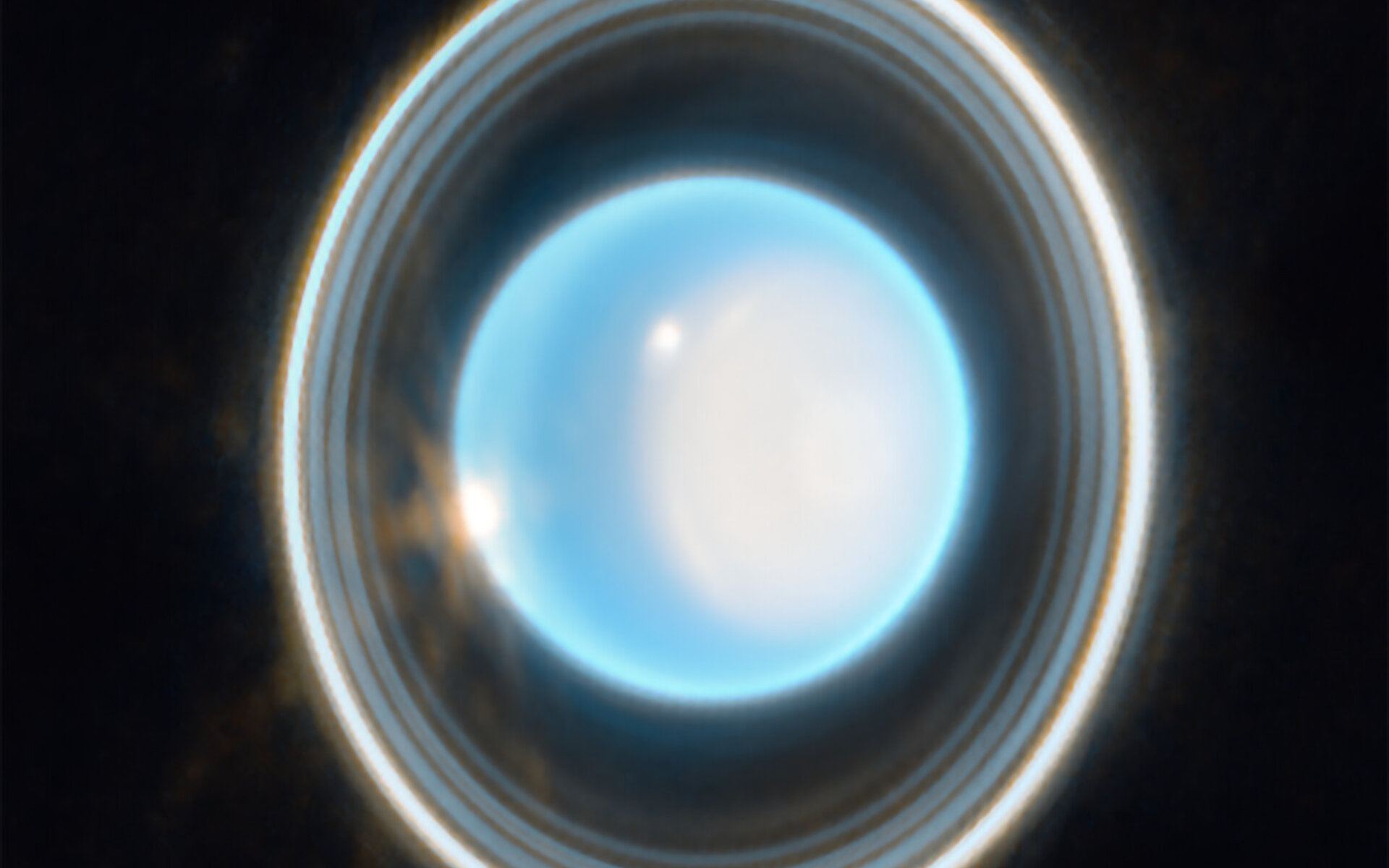
It’s Time to Go Back to Uranus. What Questions do Scientists Have About the Ice Giants?
It seems crazy that Uranus was discovered in 1781 yet here we are, in 2024 and we have only sent one spacecraft to explore Uranus. Voyager 2 is the only spacecraft to have given us close-up images of Uranus (and Neptune) but since their visit in 1986, we have not returned. There have of course been great images from the Hubble Space Telescope and from the James Webb Space Telescope but we still have lots to learn about them.
The discovery of Uranus was accidental! British astronomer William Herschel was surveying stars that were too faint to see with the naked eye. One star caught his attention as it seemed to move agasinst the fixed background of stars. He assumed therefore that it was closer than the more distant, background stars. Initially he thought it was a comet but it was soon realised that it was a new planet. It was Uranus
Our knowledge of Uranus was quite limited until the advent of space exploration, in particular the Voyager spacecraft. Voyager 2 was launched on 20 August 1977 via the Titan Centaur rocket. Following flybys of Jupiter and Saturn in 1979 and 1981 respectively, it visited Uranus in 1986. Voyager 2 revealed a world with a lack of internal heat, a warmer than expected thermosphere and a magnetic field offset from the planets rotational axis. Other than that, Uranus has been sitting quitely minding its own business, being observed from afar through our best space telescopes.
This artist’s concept depicts one of NASA’s Voyager spacecraft, including its high-gain antenna. Voyager 2 is out of communications until October. Credit: NASA/JPL-Caltech
There are however, many questions and uncertainties around the seventh planet from the Sun; from the nature of its interior and the interactions with the magnetic field to the mechanisms that shape the planet we see today. Without a doubt, a dedicated Uranian mission would help to unravel some of these mysteries.
It’s not just the paper that has been recently published by Emma K Dahl and team that recommends a Uranus Orbiter and Probe but a survey compiled by the National Academies of Sciences, Egineering and Medicine (NASEM) also found the same conclusion. A mission that could monitor Uranus over the long term would be invaluable in unlocking more details about the atmosphere; how the planet formed and how it has migrated around the Solar System? how the atmosphere has contributed to the evolution of the planet?; what processes are underway in the Uranian atmosphere and much more.
Uranus as seen by NASA’s Voyager 2. Credit: NASA/JPL
Unlocking some of these mysteries will not only help us to understand the nature or Uranus but also help us to understand how the Solar System and other planetary systems form. The paper goes further though, not just discussing the key outstanding questions but also looking at the measurements needed to derive conclusions and hypotheses from temperature and pressure profiles, chemical concentrations, wind speeds, vertical convection levels and magnetic field strengths to name a few.
There is a huge level of support across the science community for a mission to Uranus and not just an orbiter, a probe that can offer long term readings and observations. The recommendations from the NASEM review highlight the areas of focus and, if addressed, will help to finally unravel some of the mysteries of Uranus.
Artist rendition of a potential water-world exoplanet that might support life. Scientists could determine whether to explore this world based on its planetary entropy production. (Credit: ESA / Hubble / M. Kornmesser)
Water is the most common chemical molecule found throughout the entire universe. What water has going for it is that its constituents, hydrogen and oxygen, are also ridiculously common, and those two elements really enjoying bonding with each other. Oxygen has two open slots in its outmost electron orbital shell, making it very eager to find new friends, and each hydrogen comes with one spare electron, so the triple-bonding is a cinch.
Hydrogen comes to us from the big bang itself, making it by both mass and number the #1 element in the cosmos. Seriously, the stuff is everywhere. About 75% of every star, every interstellar gas cloud, and every wandering bit of intergalactic space debris never to know the warmth of stellar fusion in 13.8 billion years of cosmic history is made of hydrogen. That hydrogen got its start when our universe was only about ten minutes old, and all the hydrogen that has ever existed (except for random radioactive decays and fission reactions, but that would come later) formed before our universe turned 20 minutes.
A dozen minutes, 13.8 billion years ago. When you quench your thirst with a healthy glass, that’s what you’re consuming.
We can understand this epoch of cosmic history, known as the nucleosynthesis era, because over the past century we’ve become rather skilled at dealing with nuclear reactions, and in one of the hallmarks of our species we have unleashed this radical understanding into the physical nature of reality and deployed it for both peacetime energy generation and wartime bombs.
Our understanding of nuclear physics tells us that earlier than the ten-minute mark, our universe was too hot and too dense for protons and neutrons to form. Instead their subatomic parts, known as quarks, were unglued in a heaving maelstrom of nuclear forces, constantly binding and unbinding in a seething rage-filled sea of gluons, the force carriers of the strong nuclear force.
Once the universe expanded and cooled enough, condensates of protons and neutrons formed like droplets on the windowpane, low-energy pockets capable of keeping themselves together despite the temperatures. Eventually, however, as soon as the party got going it fizzled out: when the universe became too large and too cool, a mere dozen minutes later, there wasn’t sufficient density to bring the quarks close enough together to perform their nuclear binding trick. Some protons and neutrons would find each other in those storm-filled days, though, forming heavier versions of hydrogen, some helium, and a small amount of lithium.
And since then those hydrogen atoms have wandered about the cosmos; most lost in the intergalactic wastes, some participating in the glorious construction of stars and planets, and a lucky few finding themselves locked in a chemical dance with oxygen.
The oxygen has another tale to tell, also a story of fusion, on its way to becoming water. But not the fusion of the first few heady minutes of the big bang, but in the dance within the hearts of stars. There, crushing pressures and violent temperatures slam hydrogen atoms together, forcing them to fuse into helium, in the process releasing an almost vanishingly small amount of energy. But that forced marriage happens millions of times every second, in every one of the trillions upon untold trillions of stars strewn about the cosmos, enough to light up the universe for all conscious observers to enjoy.
Near the end of a star’s life, it turns to fusing the built-up ash of helium piled in its core, The fusion of helium produces two products: carbon and oxygen. Now this oxygen would end up forever closed off from the cosmos, locked behind a million-kilometer thick wall of plasma, if it were not for a trick of physics that happens when the star meets its final days.
Our Sun will someday experience this fate, about four and a half billion years now. When it grows old and weary, it will swell and turn red, violently spasming as it draws its last fatal breaths. Those gargantuan shudders release material from the star, launching it into the surrounding system, billowed by gusty winds of fundamental particles streaming away at nearly the speed of light. Fit by ragged fit, the Sun will lose its own self, driving away over half its mass into a spreading nebula, the only sign that distant eyes can perceive of yet another noble star laying down its struggle against the all-consuming night.
But in that gruesome death, a miracle. The cycle born anew: the hydrogen and helium, the primordial elements of the star, now mixed with carbon and oxygen drift off into the interstellar void, someday to take part in the formation of a new star, a new solar system, a new world wet with water, and, if the chances are perfect, a new life.
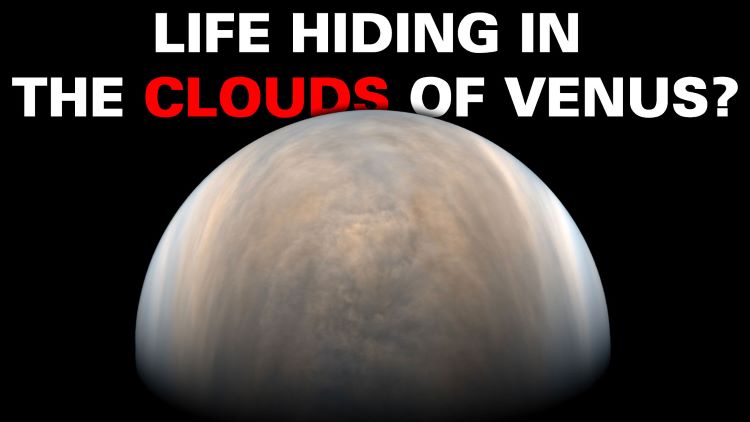
Venus’ Clouds Contain Sulfuric Acid. That’s Not a Problem for Life.
A recent study published in Astrobiology investigates the potential habitability in the clouds of Venus, specifically how amino acids, which are the building blocks of life, could survive in the sulfuric acid-rich upper atmosphere of Venus. This comes as the potential for life in Venus’ clouds has become a focal point of contention within the astrobiology community in the last few years. On Earth, concentrated sulfuric acid is known for its corrosivity towards metals and rocks and for absorbing water vapor. In Venus’ upper atmosphere, it forms from solar radiation interacting with sulfur dioxide, water vapor, and carbon dioxide.
Here, Universe Today discusses this new research with Dr. Sara Seager, who is a professor of physics at the Massachusetts Institute of Technology (MIT) and a co-author on the study, regarding the motivation behind the study, how it builds off previous studies, and what this could mean regarding the search for life in the clouds of Venus. Therefore, what is the motivation behind this recent research?
“We are pushing forward the decades-old speculative idea that there might be some kind of microbial-type life in the clouds of Venus,” Dr. Seager tells Universe Today. “The surface of Venus is too hot for life, but just like on Earth as one climbs a mountain or goes up in an airplane, the temperature gets colder and colder above the surface. In the Venus clouds 50 km above the surface the temperature is just right for life. However, the clouds of Venus are not made of water as Earth clouds are, but sulfuric acid is a highly destructive and toxic chemical. The motivation is to explore whether or not sulfuric acid can support complex molecules needed for life.”
For the study, the researchers examined 20 biogenic amino acids within sulfuric acid concentrations that mirrored Venusian atmospheric conditions. After four weeks, the researchers discovered that 11 of the 20 biogenic amino acids didn’t react—or exhibited stability—to the sulfuric acid concentrations while the eight amino acids exhibited stability in the sulfuric acid concentrations after experiencing alteration, and one experiencing instability after alteration. This alteration specifically pertained to the amino acid’s side chain, which is the part of the amino acid that contains each amino acid’s distinctive chemical characteristics, or its uniqueness compared to other amino acids. Along with demonstrating that amino acids remain stable in sulfuric acid concentrations, the study notes how this research “…also informs the possible origins of life on Venus, if life exists there.”
“We can broadly say that biochemistry of life on Earth is composed of four different categories of compounds: nucleic acid bases, amino acids, fatty acids, and carbohydrates,” Dr. Seager tells Universe Today. “Carbohydrates are not stable, but we are working through all the others. This work relates to the June 2023 study as a continuation of working through different classes of molecules. You’ll be hearing more as we make further progress.”
In addition to the June 2023 study, this recent study comes as discussions about the potential for life in the clouds of Venus continue to gain traction, including a myriad of studies between 2020 and 2021 being published in Astrobiology outlining the potential for habitable conditions for life within Venus’ clouds. These studies included using models to determine how life could be possible, the potential presence of phosphorus within the clouds, and a potential instrument package that could be used to sample aerosols within Venus’ clouds to detect potential biogenic markers.
One such future mission that Dr. Seager mentions to Universe Today is Rocket Lab’s First Private Mission to Venus, which was outlined in a 2022 study published in Instrumentation and Methods for Astrophysics and which Dr. Seager tells Universe Today has a current scheduled launch date of January 2025. The mission is slated to use Rocket Lab’s configurable Photon spacecraft that will be fitted with a small, 1-kg (2.2-lb) scientific instrument whose purpose is to shine a laser into the clouds of Venus with the goal of literally lighting up potential organic molecules that might be present. But with all these studies and planned missions, will we ever find life in the clouds of Venus, and in what form?
“If there is life it is most likely simple, single-celled life,” Dr. Seager tells Universe Today. “If we can continue to send space missions to probe the Venus atmosphere directly, we can make progress in answering this question.”
What further discoveries will researchers make about the potential for life in the clouds of Venus in the coming years and decades? Only time will tell, and this is why we science!
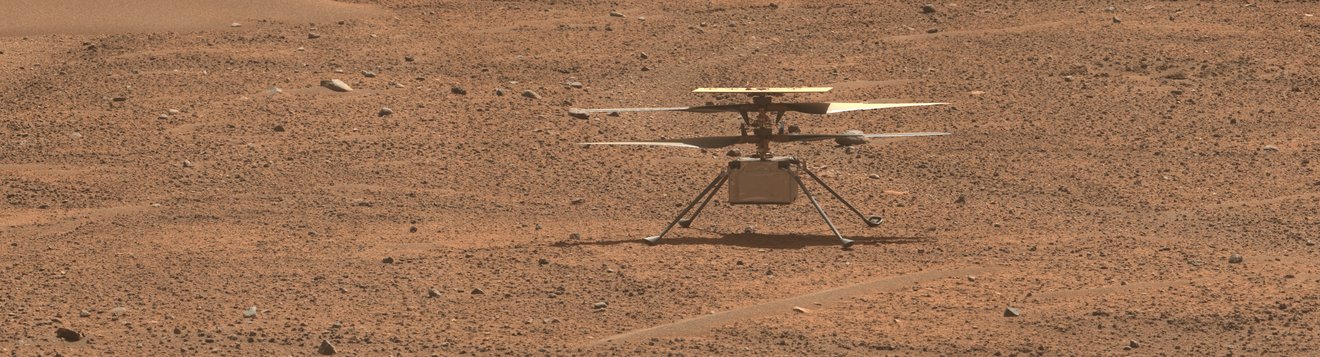
NASA Lost Contact With its Ingenuity Helicopter Briefly, but it's Back
This view of NASA’s Ingenuity Mars Helicopter was generated using data collected by the Mastcam-Z instrument aboard the agency’s Perseverance Mars rover on Aug. 2, 2023, the 871st Martian day, or sol, of the mission, one day before the rotorcraft’s 54th flight. Credit: NASA/JPL-Caltech/ASU/MSSS
NASA Lost Contact With its Ingenuity Helicopter Briefly, but it's Back
Imagine remotely flying a drone or small aircraft from a great distance and loosing contact with it during flight. You’d likely assume the worst, that your aircraft was probably laying in a crashed heap in some remote location.
That’s what engineers at NASA’s Jet Propulsion Laboratory went through with the beloved Ingenuity helicopter on Mars, millions of miles away. During a recent quick pop-up flight that was supposed to last just 32 seconds, Ingenuity lost communications before it touched back down. The engineers back on Earth had no idea if the little helicopter landed safely or not.
Communications were lost on January 18 when the tiny autonomous rotorcraft was flown on a short vertical flight to test its systems after an unplanned early landing during its previous flight, NASA reported in a status update.
For some reason, the communications link was severed between Ingenuity and the Perseverance rover, which relays data between the helicopter and Earth during the flights. Data received showed that Ingenuity had climbed to its assigned maximum altitude of 12 meters (40 feet), but then the data link terminated early, prior to touchdown.
Ingenuity captured this image of Mars on December 2, 2023 (Sol 990) with its high-resolution color camera. The shadow of the helicopter can be seen near the center of the images. Credit: NASA/JPL-Caltech
But thankfully, after engineers had worked around the clock, on late on January 20 communications were able to be reestablished between the helicopter and rover, with engineers able to determine the helicopter was “power-positive” and sitting upright on Mars.
The team is now running further diagnostic checks, and commanding Ingenuity to take photos of its location on the surface to help pinpoint its location, and performing a spin test.
“Ginny is back in contact!,” JPL Director Laurie Leshin posted on X. “Thanks to our team for working the issue so quickly and effectively. Still need to understand more about what happened. After far more flights than anticipated, no matter what, the #MarsHelicopter has been an extraordinary success!”
NASA’s Perseverance Mars rover took a selfie with the Ingenuity helicopter, seen here about 13 feet (3.9 meters) from the rover. This image was taken by the WATSON camera on the rover’s robotic arm on April 6, 2021, the 46th Martian day, or sol, of the mission. Credits: NASA/JPL-Caltech/MSSS.
JPL did say that during the flight, Perseverance was out of line-of-sight with Ingenuity, and after communications were lost, the team considered driving the rover closer for a visual inspection. They did use the rover “to perform long-duration listening sessions for Ingenuity’s signal.”
This was Ingenuity’s 72nd flight at the Red Planet – which is incredible given that only four flights were planned for the plucky little helicopter, the first aircraft to perform a powered, controlled extraterrestrial flight. But since becoming operational on April 19, 2021, it has blown away expectations, now completing 72 flights.
Ingenuity operates in a harsh environment that no aircraft has ever flown in before. Mars is extremely cold and dry, and Mars’ very thin atmosphere has only about 1% the density of Earth’s. The thin atmosphere makes lift more difficult to generate, although the gravity is weaker, which helps. There’s also the time delay in communications between Mars and Earth which adds a layer of complexity to every endeavor.
If we are practical, we realize that one day, Ingenuity will fly its last flight, never to be heard from again.
An international research team has discovered what they describe as ‘anomalous’ rocks on the Moon’s surface that exhibit unique magnetic properties. Located near an area named Reiner Gamma, the small group of meter-sized rocks stood out because they are covered in a layer of dust with special reflective properties, meaning they reflect light differently than all previously known lunar rocks.
The discoveries are part of an effort to better understand the movement of dust and other processes that form and change the surface of the Moon, but they may also end up offering unexpected insights into the history of its magnetic core.
“Current knowledge of the Moon’s magnetic properties is very limited, so these new rocks will shed light on the history of the Moon and its magnetic core,” said Ottaviano Rüsch from the Institut für Planetologie. “For the first time, we have investigated the interactions of dust with rocks in the Reiner Gamma region – more precisely, the variations in the reflective properties of these rocks.”
SCANNING OVER ONE MILLION IMAGES YIELDED THE ANOMALOUS ROCKS
To make the unexpected discovery, Rüsch and his team employed artificial intelligence to scour through over one million images taken by NASA’s Lunar Reconnaissance Orbiter, which continuously orbits the Moon. The use of artificial intelligence allowed the team, which was originally looking for cracks on the Moon, to investigate such a large number of photos while scanning for expected and unexpected variances in material on the lunar surface.
“Modern data processing methods allow us to gain completely new insights into global contexts,” explained Valentin Bickel from the Center for Space and Habitability at the University of Bern. “At the same time, we keep finding unknown objects in this way, such as the anomalous rocks that we are investigating in this new study.”
This effort led to the discovery of about 130,000 “flagged’ images, half of which were then examined by human scientists. In that group, the researchers spotted some unusual reflectivity coming off of certain rocks around Reiner Gamma, prompting them to investigate further.
“We recognized a boulder with distinctive dark areas on just one image,” said Rüsch. “This rock was very different from all the others, as it scatters less light back towards the sun than other rocks. We suspect that this is due to the particular dust structure, such as the density and grain size of the dust.”
“Normally, lunar dust is very porous and reflects a lot of light back in the direction of illumination,” adds Marcel Hess from TU Dortmund University. “However, when the dust is compacted, the overall brightness usually increases. This is not the case with the observed dust-covered rocks.”
The meter-high rocks discovered in the work are located near the Reiner K crater in the “Reiner Gamma” region, which has a magnetic anomaly.
CREDIT: NASA LRO/NAC
FUTURE ROBOTIC ROVER MISSION WILL EXAMINE THE ROCKS UP CLOSE
After publishing their findings in the Journal of Geophysical Research Planets, the research team says they want to spend the coming weeks and months performing additional investigations. This includes trying to better understand the underlying processes that govern interactions between dust and rocks as well as doing more study on what caused the formation of the special dust structure.
According to the press release announcing the findings, these efforts will also include investigating the process behind “the lifting of the dust due to electrostatic charging or the interaction of the solar wind with local magnetic fields.”
Fortunately, the research team notes, NASA is planning to send a robotic rover to the Reiner Gamma region “in the coming years” that will be tasked with finding similar anomalous rocks covered with the uniquely reflective dust. Having a better understanding of how dust behaves in the lunar environment will be critical for planning future manned missions, they argue, especially given how many problems moon dust caused for the Apollo missions of the late 1960s and 1970s and the bold goals of putting a permanent base on the Moon.
“Even if it is still a dream of the future, a better understanding of dust movement can help with the planning of human settlements on the Moon,” the release concludes.
Christopher Plain is a Science Fiction and Fantasy novelist and Head Science Writer at The Debrief. Follow and connect with him on X, learn about his books at plainfiction.com, or email him directly at christopher@thedebrief.org.
Some officials at the Pentagon have been calling for such a new classification policy for years.
A United Launch Alliance Delta 4 Heavy lifts off from Vandenberg Space Force Base, California as it launches a spy satellite from California, Sept. 24, 2022.
(Image credit: MATT HARTMAN/AFP via Getty Images)
The United States Department of Defense (DoD) wants to declassify more space programs in order to boost the nation's military edge in space.
As the world's superpowers continue to invest in the militarization of space, some leaders at the Pentagon believe it's time to declassify some of the secretive space programs in the United States' portfolio. To that end, U.S. Deputy Secretary of Defense Kathleen Hicks recently approved a new policy that will reduce the classification level of some highly secret space programs and technologies.
The policies that have prohibited sharing this information are outdated and are holding back the U.S. when it comes to superiority in space, according to DoD Assistant Secretary for Space Policy John Plumb. "What the classification memo does, generally, is it overwrites — it really completely rewrites — a legacy document that had its roots 20 years ago, and it's just no longer applicable to the current environment that involves national security space," Plumb said last week, according to Breaking Defense.
The policy does not mean that these programs and technologies will now be fully unclassified and revealed to the public; instead, it will lower their classification levels in order to share some technologies and programs with private industry and international allies to help the U.S. build an "asymmetric advantage and force multiplier that neither China nor Russia could ever hope to match," Plumb said in a DoD statement.
The move would allow each branch of the U.S. armed services to decide their own classification levels, rather than spread a blanket DoD policy over all military space programs and technologies.
One of the key issues driving this policy change is the use of what are known as Special Access Programs (SAPs), security protocols that severely restrict the sharing of highly sensitive and classified information. Some of these SAPs are acknowledged, meaning their existence is known to the public but their details haven't been revealed. Others, however, are unacknowledged, meaning their mere existence is even a secret.
Plumb argued that the new policy will remove SAP status from some of the Pentagon's most valuable space programs, giving the U.S. military an edge in what the Department of Defense now considers the "most essential domain" in terms of national security.
An Atlas V rocket carrying the classified Silent Barker multi-payload satellite for the National Reconnaissance Office and Space Force lifts off from Cape Canaveral Space Force Station, Florida on Sept. 10, 2023. (Image credit: United Launch Alliance)
"Anything we can bring from a SAP level to a Top Secret level for example, brings massive value to the warfighter, massive value to the department, and frankly, my hope is over time [it] will also allow us to share more information with allies and partners that they might not currently be able to share," Plumb said.
Some officials at the Pentagon have been calling for such a new classification policy for years, arguing that excessive classification has prevented advanced military capabilities from deterring attacks from adversaries, which is one of the main reasons they were created to begin with.
In a rare show of disclosure, the U.S. Space Force and National Reconnaissance Office revealed a set of general capabilities of the Silent Barker "watchdog" satellite launched by United Launch Alliance in September 2023.
Before the launch, NRO and Space Force officials told the public that Silent Barker was designed to keep an eye on satellites and spacecraft in geosynchronous orbit (GEO). The disclosure was designed to help deter attacks on U.S. satellites, Space Force Lt. General Michael Guetlein, commander of Space Systems Command, said at the time.
"Not only are we going to maintain custody and the ability to detect what's going on in GEO, but we'll have the indications and warnings to know there's something out of the normal occurring, and that goes a long way towards deterrence," Guetlein said.
The exact capabilities and specifications of many of the U.S. military's and intelligence community's satellites remain unknown.
Beste bezoeker, Heb je zelf al ooit een vreemde waarneming gedaan, laat dit dan even weten via email aan Frederick Delaere opwww.ufomeldpunt.be. Deze onderzoekers behandelen jouw melding in volledige anonimiteit en met alle respect voor jouw privacy. Ze zijn kritisch, objectief maar open minded aangelegd en zullen jou steeds een verklaring geven voor jouw waarneming! DUS AARZEL NIET, ALS JE EEN ANTWOORD OP JOUW VRAGEN WENST, CONTACTEER FREDERICK. BIJ VOORBAAT DANK...
Druk op onderstaande knop om je bestand , jouw artikel naar mij te verzenden. INDIEN HET DE MOEITE WAARD IS, PLAATS IK HET OP DE BLOG ONDER DIVERSEN MET JOUW NAAM...
Druk op onderstaande knop om een berichtje achter te laten in mijn gastenboek
Alvast bedankt voor al jouw bezoekjes en jouw reacties. Nog een prettige dag verder!!!
Over mijzelf
Ik ben Pieter, en gebruik soms ook wel de schuilnaam Peter2011.
Ik ben een man en woon in Linter (België) en mijn beroep is Ik ben op rust..
Ik ben geboren op 18/10/1950 en ben nu dus 75 jaar jong.
Mijn hobby's zijn: Ufologie en andere esoterische onderwerpen.
Op deze blog vind je onder artikels, werk van mezelf. Mijn dank gaat ook naar André, Ingrid, Oliver, Paul, Vincent, Georges Filer en MUFON voor de bijdragen voor de verschillende categorieën...
Veel leesplezier en geef je mening over deze blog.